Article

Development and Implementation of a Graph-Based Framework for Socio-Economic Resilience in Urban Systems


1
Department of Management, Strategies and Entrepreneurship, University Canada West, Vancouver, BC V6Z 0E5, Canada
2
URSA Project Lead, University Canada West, Vancouver, BC V6Z 0E5, Canada
*
Author to whom correspondence should be addressed.
Sustainability 2026, 18(11), 5703; https://doi.org/10.3390/su18115703
Submission received: 12 April 2026 / Revised: 18 May 2026 / Accepted: 26 May 2026 / Published: 4 June 2026
(This article belongs to the Section Sustainable Urban and Rural Development)

Abstract

Urban systems are becoming increasingly complex due to rapid urbanization, socio-economic disparities, and climate change. Addressing these challenges requires innovative approaches that integrate data-driven methodologies with resilience planning. This paper presents a novel extension to the Urban System Abstraction Hierarchy (USAH) framework by integrating socio-economic indicators into a graph-based modeling environment, enabling a more holistic understanding of urban resilience. Our approach advances existing models by operationalizing multi-domain resilience through a graph-based framework that captures complex interdependencies across critical infrastructure, governance, finance, and vulnerable populations. Unlike prior USAH applications, which focused primarily on acute shocks, the proposed model captures interdependencies across infrastructure, environmental conditions, health systems, economic robustness, public finance, and social cohesion. Several graph metrics were analyzed including betweenness centrality, and system-level resilience metrics. Sensitivity testing of the indicator weighting scheme showed that increasing the influence of the network structure from 0.7 to 0.9 betweenness centrality shifts indicator importance toward structurally central nodes while reducing the influence of sub-indicator averages. However, the system-level resilience remained unchanged across scenarios. Beyond traditional centrality measures, we introduce new network metrics that identify system stabilizers, key policy leverage points, cross-domain dependencies, and overall structural fragility. Together, these measures transform the model from a descriptive mapping tool into a practical decision-support framework for resilience planning.

1. Introduction

Urban systems are inherently complex, encompassing interrelated socio-economic, environmental, and infrastructural components. With the growing challenges posed by rapid urbanization, climate change, and socio-economic disparities, fostering resilience in urban systems has become a critical priority. Resilience refers to the capacity of urban systems to adapt, recover, and thrive amidst disruptions while maintaining essential functions and promoting sustainable development. This concept has gained prominence in policy and research, emphasizing the need for innovative approaches to resilience planning.
Graph networks have emerged as a transformative tool in addressing the complexity of urban systems. By employing graph network analysis, planners and policymakers can model urban systems more intuitively, simulate potential disruptions, and develop strategies to mitigate vulnerabilities. Existing studies have demonstrated the utility of graph frameworks in urban applications ranging from digital twins to disaster management.
Despite these advancements, significant gaps remain in current urban resilience frameworks. Most models struggle to integrate multiple resilience indicators across domains or to provide actionable insights into synergies and trade-offs among stakeholders. Furthermore, managing the vast, heterogeneous data generated by urban systems presents an ongoing challenge. Addressing these limitations requires the development of graph-based models that enhance data integration, ensure secure access, and support evidence-based decision-making.
McClymont [1] introduced the USAH model, demonstrating its potential in mapping urban interdependencies and responses to specific events, such as flooding. However, existing models have a limited capacity to address broader chronic stressors and multi-hazard scenarios [2,3]. A more comprehensive, system-wide approach is needed to enhance USAH modeling, incorporating multi-dimensional resilience strategies that enable cities to withstand, adapt to, and evolve in response to various challenges.
While the foundational USAH model provided a valuable framework for examining urban resilience by capturing the interconnections between physical and functional systems, it primarily focused on acute shocks and specific hazards. However, as urban environments increasingly grapple with chronic stressors, such as socio-economic disparities, air pollution, and long-term climate impacts, existing frameworks alone prove insufficient for supporting sustainable urban management. Our approach builds on and significantly extends this earlier work. We propose a data-driven, graph-based framework that moves beyond current practices by structurally integrating multi-domain resilience indicators, spanning not only infrastructure and environment but also health, economic robustness, public finance, and social cohesion. The model leverages graph-based frameworks to visualize and analyze these interconnections, enabling planners to identify critical nodes, simulate system vulnerabilities, and design targeted interventions that reflect the lived complexity of urban life. This expanded approach captures both the depth of chronic stressors and the breadth of socio-technical systems, offering a more complete, adaptive, and actionable resilience planning tool.
This expansion also addresses the rigid segmentation within traditional resilience frameworks, which often treat physical and social systems as separate entities. By leveraging graph framework methodologies, we propose a scalable and actionable framework that synthesizes insights from multi-dimensional resilience indices and urban governance models. The enhanced USAH model employs network analysis to map and quantify cascading effects of disruptions across multiple domains, thereby supporting both immediate response strategies and long-term planning.
The development of this extended framework is part of the multi-phase URSA (Urban Resilience and Sustainability Alliance) project, initiated to bridge the gap between technical resilience modeling and socio-economic realities in Canadian cities. Mosaic I began by identifying key urban resilience factors and their associated indicators. Mosaic II expanded this work through stakeholder engagement, capturing institutional knowledge and social context to validate and refine those indicators. Mosaic III, outlined in this paper, represents the project’s methodological culmination: the implementation of a graph-based framework capable of storing, querying, and visualizing the full spectrum of resilience data, starting with a testbed application in the city of Vancouver.
A key contribution of this study is the introduction of network-based resilience diagnostics (CECS, ECS, MDPS, IDDR, WDD), which move beyond traditional centrality measures. Existing graph-based planning models often rely on node-level metrics, whereas this study demonstrates the importance of edge-level and path-based analysis in identifying systemic leverage points and hidden dependencies. This advances graph-based urban planning from a visualization tool toward a decision-support framework.
This paper explores the development and implementation of a graph-based framework designed to enhance socio-economic resilience in urban systems, with a focus on Vancouver as a case study. It aims to integrate resilience indicators across critical dimensions, including infrastructure, health, the environment, and governance. By mapping stakeholders, normalizing indicators, and leveraging graph theory, the study seeks to provide a scalable and robust framework for urban resilience planning. This approach not only fills critical gaps in existing models but also sets a foundation for more resilient urban futures.

1.1. Review of Graph Theory and Urban Resilience Indicators

Innovative city platforms play a vital role in enabling the creation of innovative city applications by offering high-level services that developers can reuse. Ensuring interoperability and efficiently managing large volumes of diverse data is crucial to accomplish this. Additionally, these platforms must provide secure access to data, which requires implementing strong security measures to safeguard sensitive information from unauthorized access or breaches. Protecting data privacy and confidentiality is equally important, particularly when handling personal or sensitive information [3].
Monteiro et al. [4] present a comparative evaluation of multiple graph data management systems using the Linked Data Benchmark Council’s Social Network Benchmark (LDBC SNB). The analysis examines performance across key dimensions, including query execution time, data loading efficiency, and computational resource utilization (CPU and memory). The results demonstrate significant variation in system performance, particularly in scalability and responsiveness as data volumes increase. Systems with optimized query processing architectures exhibited lower latency and more efficient handling of complex queries, while others showed comparatively higher resource consumption and reduced performance during data ingestion and large-scale query execution. These findings emphasize the critical role of system efficiency, scalability, and resource management in the effective deployment of graph-based analytical frameworks for data-intensive applications.
Regarding urban resilience, graph networks have been instrumental in modeling complex urban systems. Their ability to efficiently store and analyze interconnected data supports decision-making processes aimed at enhancing city resilience. For instance, in Liu’s work, a graph network has been utilized to create digital twins of urban environments, facilitating real-time monitoring and optimization of city operations [5].
Graph theory has been widely applied in urban systems to model complex interrelations among city elements such as infrastructure, stakeholders, and environmental factors. Recent literature highlights the role of graph networks in urban planning by enabling scalable and efficient storage of nodes and relationships [6,7,8]. Furthermore, resilience indicators have been used to measure urban sustainability across domains such as social, economic, infrastructure, and environmental resilience [9].
Existing urban resilience frameworks, such as the City Resilience Index [10] and Urban Systems Abstraction Hierarchy (USAH) [11], have laid the foundation for assessing city resilience in response to economic and environmental disruptions. However, most frameworks lack integration of multiple resilience indicators across domains, and current models do not incorporate network-driven insights like synergies and trade-offs among stakeholders. Graph network analysis addresses this gap by mapping complex urban relationships, enabling more effective urban resilience planning.
Recent studies have highlighted the effectiveness of graph network analysis in enhancing urban resilience planning [12]. For instance, Bixler et al. [13] employed social network analysis and exponential random graph modeling to examine urban governance structures, revealing that collaborative networks among stakeholders significantly bolster resilience implementation.

1.2. Current Gaps and Challenges in Urban Resilience Frameworks

Current urban resilience models suffer from inconsistencies in indicator hierarchies and limited cross-domain integration [14]. While USAH has been applied successfully in isolated cases [11], scaling the model internationally requires a system that ensures data security across jurisdictions while enabling global comparability.
Graph network analysis provides a powerful tool to model these complex interconnections by representing each system as nodes and their interactions as edges. This allows for a more intuitive and structured approach to identifying vulnerabilities in interconnected systems. Using graph theory, planners can simulate the impact of failures in one part of the network and predict how disruptions may cascade through the system, aiding the development of more robust urban resilience strategies.
Another challenge is managing the vast amount of heterogeneous data generated by various urban systems, which include both spatial and temporal components. Graph networks, as demonstrated in the study of Janus Graph, Neo4j, and other systems [4], excel at handling large-scale, complex data with intricate relationships. By leveraging graph network analysis, urban resilience models can more efficiently manage and query this data, facilitating real-time decision-making in response to crises. This approach also supports better resource allocation and risk assessment by revealing critical nodes in the urban network that, if compromised, could have the most significant negative effects on city resilience.

1.3. Incorporation of Socio-Economic Parameters

While graph theory and digital urban platforms have enhanced the modeling of infrastructure and governance systems, the systematic integration of socio-economic parameters remains limited in many resilience frameworks. Existing models often prioritize physical infrastructure, environmental systems, or institutional capacity, while socio-economic and socio-cultural indicators, such as income inequality, human capital, demographic vulnerability, public finance stability, and social cohesion, are treated as secondary or static contextual variables [9,14].
However, urban resilience is fundamentally a socio-technical construct in which infrastructure performance, governance effectiveness, and community adaptability are deeply intertwined. Socio-economic indicators influence exposure, sensitivity, and adaptive capacity, shaping how shocks and chronic stressors propagate across urban systems. Without explicitly modeling these parameters within network structures, resilience assessments may overlook important dependencies and cross-sector interactions.
Graph-based modeling environments provide a structured mechanism to embed socio-economic variables directly as nodes within multi-domain dependency networks. By representing socio-economic indicators alongside infrastructure, environmental, and governance elements, graph models enable the analysis of cascading effects, trade-offs, and leverage points across domains. This integration supports a shift from siloed indicator lists toward a relational understanding of resilience, where socio-economic dynamics are recognized as both drivers and outcomes of systemic stability.
Despite this potential, few resilience frameworks operationalize socio-economic parameters within weighted, path-sensitive graph architectures. Addressing this gap requires not only indicator inclusion but also the quantification of their structural embeddedness and cross-domain influence; an area this study advances through network-based resilience metrics.
The existing urban-resilience frameworks have a general design flaw, i.e., they list indicators (within different domains) but do not illustrate how these are related to each other. The node-level centrality methods used in previous graph-based studies capture multi-domain interdependence using only a single position-based measure; therefore, they conceal relational leverage points and transitive chain dependencies. This research makes three additional theoretical contributions. First, this research expands on USAH by integrating socio-economic indicators and governance indicators into a weighted dependency network as structurally active nodes, whereas previously they were treated as either contextually or secondarily relevant. Second, this research presents five additional network diagnostics (CECS, ECS, MDPS, IDDR, WDD), which together illustrate the structural attributes of embeddedness, leverage, transitivity, domain coupling, and density of Vancouver’s urban resilience system as measurable structural properties. Finally, this research empirically demonstrates that urban resilience is an emergent attribute of network architecture, not of the performance of specific indicators within each domain, and identifies governance coherence and digital connectivity as the structural foundations of Vancouver’s urban resilience system. These contributions advance graph-based urban resilience modeling from descriptive mapping toward a structural diagnostic framework capable of informing targeted, evidence-based planning interventions.

2. Methods

2.1. Study Area

The current work is part of a multi-phase research initiative called URSA project, aiming to address socio-economic urban resiliency in Vancouver. The city of Vancouver, a major metropolitan center on the west coast of Canada, is characterized by a dense urban core, diverse socio-economic structure, and exposure to multiple environmental stressors. Vancouver was selected due to its advanced data availability, established resilience planning initiatives, and its relevance as a representative case for complex urban systems facing challenges such as climate change, population growth, and infrastructure pressure. The city exhibits a wide range of interconnected domains, including governance, infrastructure, environment, and social systems, making it well-suited for testing a graph-based resilience framework. Its coastal location also exposes it to risks such as flooding and climate-related impacts, further supporting its suitability as a case study for multi-domain resilience analysis.
The three phases of the project are illustrated in Table 1.

2.2. Identification of Dimensions, Indicators and Sub-Indicators

The methodology used in Mosaic III is structured around three key components: the identification of resilience indicators, the development of a graph network, and the implementation of a secure data model for cross-jurisdictional use.
We began by identifying key stakeholders relevant to urban resilience in Vancouver, grouped under categories such as academic institutions, government, NGOs, private sector, and community organizations. Stakeholders were further mapped to seven resilience dimensions, such as Infrastructure, Health and Wellbeing, Environment, and Governance, and linked to specific areas of engagement, such as education, transportation, or capacity building.
Indicator selection was conducted through a multi-phase validation process within the URSA project (see Table 2). In Mosaic I, candidate indicators were identified through a comprehensive review of the literature and evaluated using four specific criteria, the first of which was conceptual relevance to the body of literature on urban resilience. Second, measurable or quantifiable/structured qualitative data existed for each indicator selected for inclusion in this study. Third, to provide a broad representation of all seven identified areas of resiliency (environmental, economic, institutional, health, social, infrastructure, and governance) and to prevent any significant area of resiliency from being omitted, indicators were selected to ensure domain representativeness. Fourth, the indicators were evaluated for their contextual application to Vancouver’s urban system. This evaluation occurred through a structured stakeholder engagement process as part of Mosaic II. Any indicator that did not meet one or more of these criteria was either removed or combined with other indicators that met the same functional requirements.
This approach prioritizes capturing cross-domain interdependencies inherent in socio-economic urban systems. However, formal statistical screening methods (e.g., Principal Component Analysis or Delphi-based consensus) and tests of indicator independence and redundancy were not applied at this stage and are acknowledged as a limitation, to be addressed in future research.
Each indicator is represented as a node in the set, with directed edges illustrating dependency relationships. Edges within the same domain reflect functional interdependence (e.g., Transportation ↔ Energy), while edges across domains highlight cross-sector connections (e.g., Public Finance → Public Health). In this modular network, strong intra-domain coupling suggests subsystem cohesion, whereas bridging edges indicate key interdependencies.
Resilience indicators and sub-indicators were then defined and associated with these dimensions. Data for each sub-indicator was collected, classified as quantitative or qualitative, and normalized using various methods, such as dummy encoding, Likert scaling, min-max scaling, and Z-scoring, depending on the nature and availability of data. Particular care was taken to address indicators that could negatively affect resilience. A full breakdown of normalization procedures and indicator metrics is provided in Appendix A.
Once the data structure was established, a graph-based network was implemented to model the interdependencies between resilience indicators. Each node in the graph represents an indicator, and edges capture the directional relationships between them. This network structure allows us to simulate cascading effects, identify systemic bottlenecks, and analyze the overall integrity of urban systems under stress.
This methodological framework provides the foundation for an adaptive, data-driven approach to resilience planning, offering insights into both local and system-wide vulnerabilities in urban environments.

2.3. Graph Network Development

The graph-based model was implemented using Python’s NetworkX library (Python 3.10.12), in which indicators are represented as nodes, and their interactions define relationships between them (See Supplementary Materials). The model was applied to Vancouver using data on urban resilience. Future work will extend deployment to additional jurisdictions for cross-jurisdictional comparisons.

2.4. Mathematical Framework and Formulas

2.4.1. Normalization of Indicator Values

Data used in this study were collected from publicly available sources, including the City of Vancouver Open Data Portal, Statistics Canada, and Government of British Columbia, as well as relevant institutional reports. Indicators were compiled for the most recent available and consistent time period; where multi-year data existed, aggregated or representative values were used. Missing quantitative values were addressed using indicator-specific approaches depending on data availability and context. Where limited gaps existed in longitudinal datasets, values were estimated using temporal averaging or interpolation based on adjacent years.
To ensure methodological consistency, normalization techniques were selected based on data structure: Z-score normalization was applied where sufficient longitudinal data existed, while Min–Max scaling was used for cross-sectional indicators. For indicators with negative contributions to resilience, directionality was standardized post-normalization using inverse transformation following OECD composite indicator guidelines [15].
  • Min-Max Normalization
Applied when indicators had fixed upper and lower bounds.
x′ = (x − x_min)/(x_max − x_min)
where
  • x = raw value;
  • x_min, x_max = observed minimum and maximum values of the indicator
This method rescales the values to the [0, 1] range, preserving proportional relationships.
b.
Z-score Normalization
This method is used when data distribution approximated normality and historical trends were available.
For each sub-indicator x, the normalized value z is given by:
Z = (x − μ)/σ
where
  • μ = mean of the indicator across observations;
  • σ = standard deviation of the indicator.
This method highlights deviations from average performance and enables relative comparisons across time or jurisdictions.

2.4.2. Interconnectedness Metric

To measure the structural density within and between domains, we used a custom interconnectedness index:
I = E_realized/E_possible
where
  • E_realized = number of actual edges;
  • E_possible = n(n − 1) for a directed graph with n nodes.
This value was computed separately for intra-domain and inter-domain subgraphs to assess modular cohesion and systemic coupling.

2.4.3. Edge Weight Assignment Based on Distance Metrics

To identify strongly related sub-indicators, we computed pairwise distances between them and selected those with minimal distances for high-coupling designations (Table A9 in Appendix A).
Let d(i, j) be the computed distance between sub-indicators i and j, then:
d(i, j) = (|x_i − x_j|)/√2
where x_i, x_j are normalized values of sub-indicators.
Pairs with d(i, j) = 0 were designated as strongly coupled and represented with weighted edges in the sub-indicator network.
(1)
Shortest Path-Based Distance (for sub-indicator coupling)
Once normalized values were assigned to nodes (indicators), the edges between them were constructed to reflect either empirical dependency relationships or semantic proximity based on expert knowledge.
(2)
Edge Weight Assignment
Edge weights in the sub-indicator subnetwork are inversely proportional to deviation from the baseline:
w(ij) = 1 − |xi − xj|
This approach emphasizes harmonized relationships, assigning higher weights to more aligned sub-indicators: distance from the 45° line” produces weights in [0, 1] where higher = stronger coupling.
(3)
Indicator Value Computation
Indicator values combine the average normalized sub-indicator scores (data-driven performance) and their average betweenness centrality (node-level betweenness within each indicator’s sub-graph, not at the global level network structure):
Iₖ = 0.3(Xk) + 0.7(Bk)
This 30/70 ratio prioritizes network structure, reflecting dependencies and bottlenecks, while retaining data realism. These ratios are based on sensitivity analysis and network stability tests.
(4)
Indicator Influence Network Construction
With indicator values established, a 40 × 40 indicator network is generated to represent cross-domain influences. Edges are weighted using the same deviation method, ensuring consistency between sub-indicator and indicator levels.
w(ij) = 1 − |xi − xj|

2.4.4. Adjacency Matrix Construction

From domain-specific dependencies (e.g., Energy → Digital Infrastructure), we formed a binary or weighted adjacency matrix A:
A_uv = 1 if indicator u directly influences v, otherwise 0.
For weighted cases, we applied edge weights w_uv proportional to influence strength (from expert scoring or empirical alignment).

2.4.5. Network-Based Resilience Metrics

Given the high density of the constructed indicator network, traditional node betweenness centrality provided limited discrimination across nodes. Therefore, we implemented a suite of weighted, edge- and path-based metrics to quantify structural embeddedness, dependency propagation, cross-domain coupling, and overall system density. These metrics are computed directly from the weighted adjacency matrix of the graph.
(1)
Cumulative Edge Criticality Score (CECS)
For each node i, the Cumulative Edge Criticality Score (CECS) is defined as the sum of the weights of all edge’s incident to that node:
C E C S i   = j w _ i j
where w_ij represents the weighted dependency between indicators i and j.
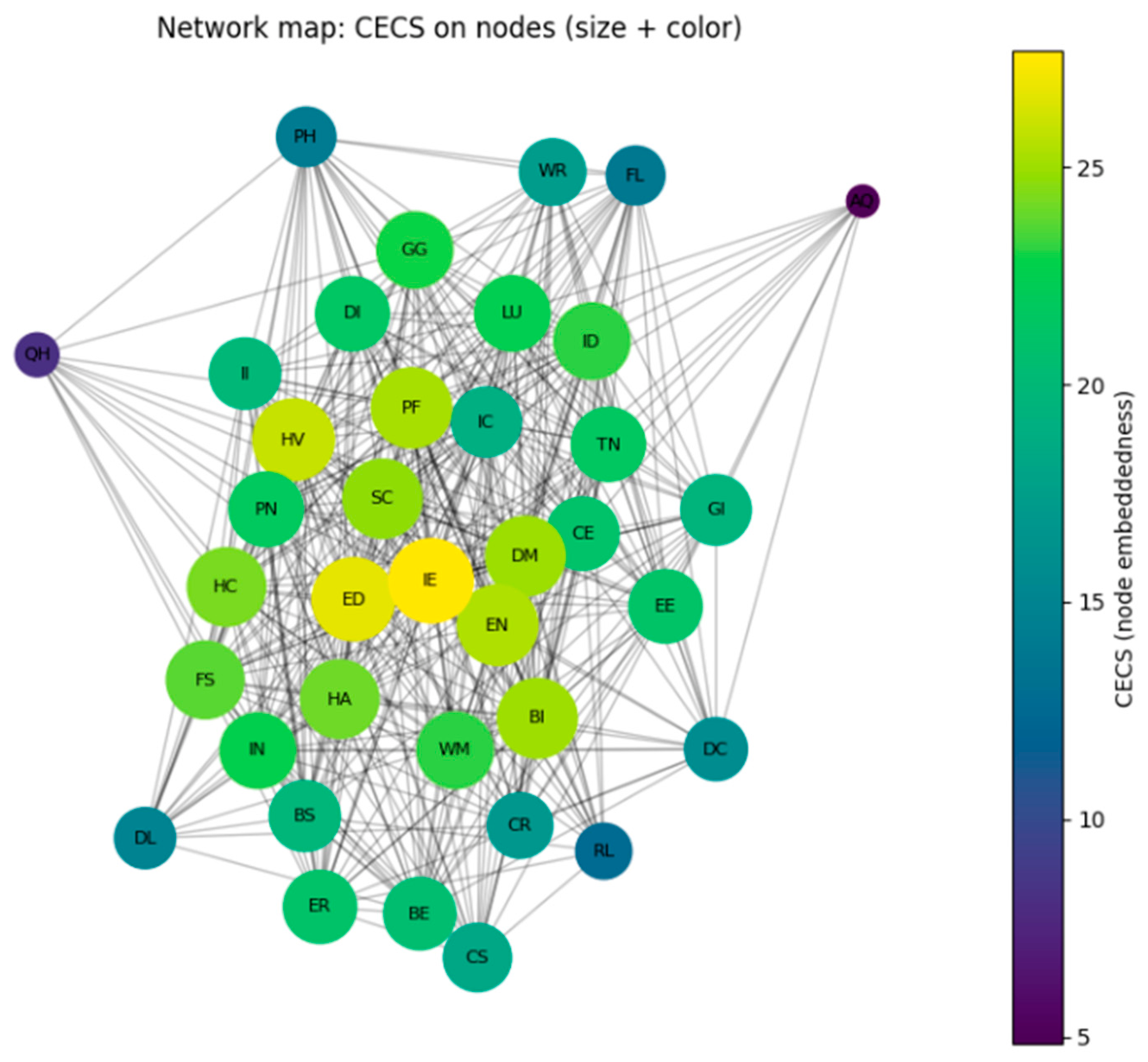
CECS measures the structural embeddedness of an indicator within the resilience network. Higher CECS values indicate greater integration across domains and stronger participation in dependency structures.

2.4.6. Edge Criticality Score (ECS)

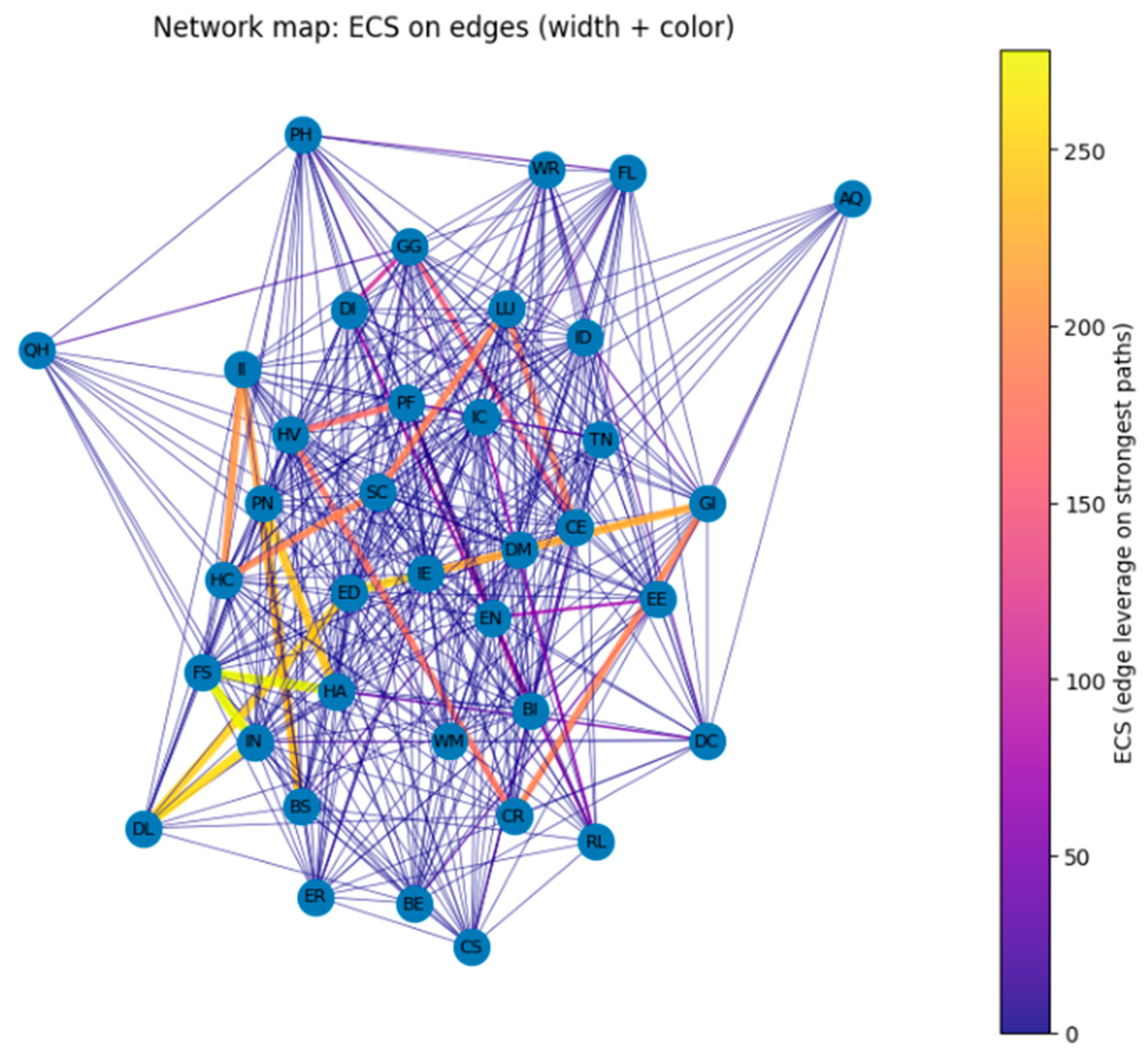
The Edge Criticality Score (ECS) quantifies the contribution of a given edge to the strongest dependency paths in the network. For each edge, eij, ECS is computed as the cumulative influence of that edge across all maximum-strength paths between indicator pairs.
ECS captures the structural importance of specific inter-indicator relationships within dominant dependency chains.

2.4.7. Maximum Dependency Path Strength (MDPS)

For each ordered pair of indicators (i, j), the Maximum Dependency Path Strength (MDPS) is defined as the maximum product of edge weights along any path connecting i and j:
M D P S i , j = max ( P a t h s   P i j ) ( u , v ) P i , j w u v
To ensure computational stability, this is implemented by transforming edge weights using −log(w) and applying shortest-path algorithms.
MDPS identifies the strongest transitive dependency relationships within the network.

2.4.8. Inter-Domain Dependency Ratio (IDDR)

For each domain d, the Inter-Domain Dependency Ratio (IDDR) is computed as:
I D D R d = T o t a l   C r o s s d o m a i n   E d g e   w e i g h t T o t a l   i n t r a d o m a i n   e d g e   w e i g h t
This metric measures the relative reliance of each domain on external versus internal relationships.

2.4.9. Weighted Dependency Density (WDD)

The WDD captures the overall structural coupling of the network and is defined as:
W D D = 2 w i j n ( n 1 )
where nis the total number of nodes in the graph.
WDD represents the average weighted connectivity relative to the maximum possible connectivity in a fully connected network.

3. Results

The results of the normalizations by various methods can be seen in Appendix A. In addition, we identified and classified the stakeholders based on the areas of resilience.

3.1. Identifying Stakeholders

The analysis identified six main categories of stakeholders critical to Vancouver’s resilience: Academic Institutions, Community Organizations, Government, Non-Governmental Organizations (NGOs), groups without “voice,” such as marginalized communities, and the private sector. Within these categories, specific subcategories were identified that reflect the particularities of each group. For example, in Academic Institutions, subcategories such as universities, technical colleges and applied research centers are included, each contributing uniquely to areas such as technical education and innovation. In Community Organizations, local groups focused on social equity, environmental sustainability and cultural development are differentiated. Within Government, levels such as local government, provincial government and specialized agencies are subdivided, each with specific roles in infrastructure and planning. NGOs also include subcategories oriented to disaster management, environmental conservation and capacity building. Finally, the Private Sector is broken down into small businesses, technology corporations and financial institutions that drive innovation and economic resources.
Each of these categories represents a distinct role in strengthening urban resilience, contributing uniquely to areas such as education, sustainable development, capacity building and disaster management.
To identify key stakeholders, a structured approach was used that included collecting data from reliable sources such as official reports (e.g., the Vancouver Resilience Report), institutional websites (such as those of local and provincial governments), and academic papers published in journals such as the Journal of Urban Resilience and the Canadian Journal of Sustainable Development. Subsequently, matrices were developed and analyzed that assessed the power, interest, influence and importance of each stakeholder in the context of urban resilience. This in-depth analysis allowed the stakeholders to be categorized according to their capacity to impact resilience and their level of interest in related initiatives.
Academic Institutions were represented by eight key stakeholders, including Vancouver Community College and the British Columbia Institute of Technology (BCIT). These institutions contributed primarily to the areas of “Education” and “Research.” Their efforts focused on fostering institutional collaboration, advancing technical education, and promoting innovative research, which collectively enhances the city’s preparedness and adaptability.
Community Organizations represented the largest group, with 12 stakeholders. This category included organizations involved in environmental sustainability, social equity and leadership in urban strategies. These groups played a key role in integrating diverse community needs into resilience planning, thereby enhancing social cohesion and local engagement.
Government, with nine stakeholders, was key in areas such as infrastructure development, capacity building and environmental conservation. Their contributions focused on strategic leadership, emergency preparedness and community engagement. These stakeholders provided the necessary regulatory frameworks and resources to facilitate resilience efforts in all sectors.
Non-Governmental Organizations (NGOs) included five stakeholders with a strong focus on sustainable development and capacity building. They facilitated regional coordination, disaster management and energy resilience through their initiatives and advocacy.
Private Sectors had a significant impact on innovation and investment in sustainable technologies. Businesses played an essential role in generating innovative solutions to critical problems, such as clean energy and efficiency in urban infrastructure. Evaluating their impacts, significance, and authority.

3.2. Evaluating Stakeholders Impacts, Significance, and Authority

The evaluation of stakeholder contributions revealed varying degrees of impact, significance, and authority across the categories, and also integrated the main findings of the study. This analysis, based on matrices of power, interest, influence and importance, identified the stakeholders most critical to strengthening Vancouver’s resilience. Government and community organizations demonstrated the greatest direct impact due to their ability to mobilize resources and implement large-scale programs. For example, government stakeholders were instrumental in emergency preparedness and resilient infrastructure development, while community-based organizations excelled in addressing local needs and fostering social cohesion.
NGOs played a key role in addressing gaps in traditional resilience frameworks. They brought specialized expertise in disaster management and sustainability, serving as a bridge between government policies and community needs.
Strategic leadership and innovation emerged as critical factors, especially driven by government and academic institutions. While the government provided regulatory frameworks and allocated essential resources, academic institutions contributed innovative research and quality education, which strengthened the city’s long-term resilience. Finally, collaboration among stakeholders was identified as essential, integrating complementary strengths to address Vancouver’s multifaceted challenges and enhance its resilience in the face of adversity.

3.3. Implementation and Network Analysis

Interconnectedness (or Edge values) quantifies the overall connectivity of the network by measuring the density of existing links relative to all possible directed connections. This metric reflects how tightly knit the system is, both within and across domains. High interconnectedness suggests a high potential for rapid transmission of shocks, feedback loops, and cascading effects, as indicators are more deeply embedded in the network. Low interconnectedness, conversely, may point to structural isolation or modular containment, potentially buffering parts of the system from widespread disruptions.
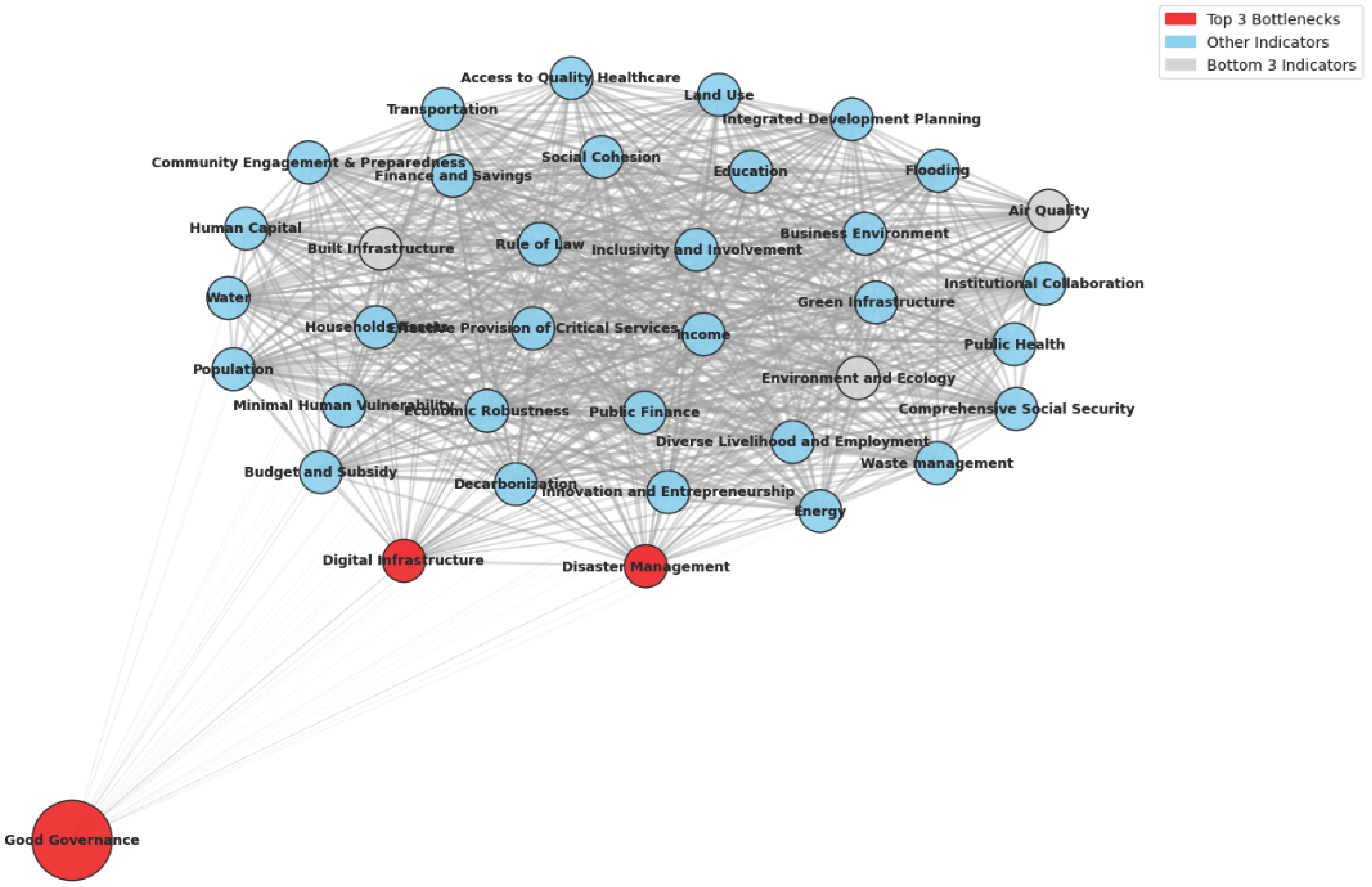
The computed total edge weights represent a form of edge-betweenness centrality, where lower cumulative weights correspond to shorter and more critical pathways between indicators. In this model, shorter paths signify structurally essential “bridges” in the network, relationships whose disruption would disproportionately constrain information, coordination, or resource flows across the broader urban system. Because the network exhibits dense interconnections among indicators, edge-based centrality offers a more precise diagnostic than node-betweenness centrality alone. In such settings, node betweenness can become less discriminating, whereas edge betweenness captures subtle yet strategic relational vulnerabilities by quantifying the network's dependence on specific influence pathways. As shown in Table 3, the lowest total edge weights are associated with Rule of Law, Air Quality, and Human Capital, identifying them as the most critical bottlenecks. These indicators serve as foundational bridges (Table 4) across institutional, environmental, and socio-economic domains, underscoring that reinforcing these dimensions is essential for reducing systemic fragility and enhancing the city’s overall resilience.
The Vancouver case study demonstrates the capacity of the proposed graph-based resilience model to capture and visualize systemic dependencies among urban indicators. Figure 1 presents the indicator-level network, where each node represents an indicator and weighted edges represent the magnitude of inferred dependency influence derived from the pairwise influence matrix. Centrality analyses, particularly betweenness centrality, reveal several high-impact bottlenecks, including Good Governance, Disaster Management, and Digital Infrastructure. These nodes occupy structurally critical positions within the urban system, meaning that their disruption could constrain multiple dependent indicators across environmental, institutional, and socio-economic domains.
In the Vancouver context, these bottlenecks reveal distinct vulnerabilities. Good Governance now occupies the most pronounced bottleneck position in the network, indicating its extensive mediation role across institutional, economic, infrastructure, and environmental domains. Its structural centrality suggests that governance effectiveness, encompassing transparency, regulatory coherence, coordination capacity, and institutional trust, acts as the primary integrative backbone of the resilience system. Disruptions or weaknesses in governance structures are therefore likely to cascade widely, fragmenting cross-sector coordination and weakening adaptive response capacity.
Disaster Management emerges as a second-order structural bottleneck, highlighting the system’s sensitivity to preparedness, response coordination, and recovery mechanisms. Its prominence reflects the model’s emphasis on multi-hazard and chronic stressor scenarios, in which emergency planning and risk management capabilities shape performance across health, infrastructure, and economic indicators. This indicates that resilience in Vancouver is strongly contingent on the operational effectiveness of crisis management systems.
Digital Infrastructure also appears as a critical bottleneck, underscoring the increasing reliance of urban systems on information flows, communication networks, and digital service delivery. Its structural role suggests that disruptions to digital connectivity or cybersecurity vulnerabilities could propagate across governance, economic activity, public services, and social coordination functions. The prominence of this node reflects the growing centrality of digital systems in enabling adaptive governance and cross-domain integration.
From a policy perspective, these findings suggest that resilience planning in Vancouver—and, by extension, other urban jurisdictions—should prioritize reinforcing the identified bottlenecks rather than treating them as independent sectoral challenges. A graph-based resilience assessment provides decision-makers with a systems-level diagnostic tool: by quantifying interdependencies among governance, infrastructure, and socio-economic functions, it enables targeted interventions that stabilize the entire network rather than marginally improving individual sectors.

3.4. Alignment Between Stakeholder and Data-Driven Matrices

This subsection evaluates the alignment between the empirical data-driven dependency matrix and the stakeholder-derived adjacency matrix. The objective was to identify instances in which stakeholders perceived no relationship between indicators (value = 0), but empirical analysis revealed a strong dependence (weight ≥ 0.75).
The comparison revealed 106 such discrepancies (Table 5). Of these, 41 were intra-domain cases, meaning missing dependencies within the same domain (e.g., Economic → Economic), while 65 were inter-domain discrepancies, spanning domains such as Health, Environment, Infrastructure, Economics, Governance, and Leadership. These hidden dependencies represent structurally significant couplings that stakeholders did not recognize or affirm.
Examples include QH → AQ (Health and Well-being influencing Environment), BS → CR (Economic factors influencing Critical Infrastructure), and BI → GG (Infrastructure informing Leadership and Strategy). Many of these pairs aligned with high-betweenness indicators identified in the network analysis, particularly Rule of Law, Air Quality, and Human Capital, suggesting stakeholder perceptions under-recognize pathways essential for systemic stability.
These overlooked dependencies highlight potential early-stage vulnerabilities in the urban resilience system. Their identification supports hybrid model validation: strengthening stakeholder calibration, improving cross-domain awareness, and guiding targeted interventions.
In addition to the bottleneck indicators identified earlier, our masking evaluation revealed latent dependencies not captured by stakeholder inputs. Specifically, the 106 high-weight empirical relationships (≥0.75) that stakeholders assigned a weight of zero demonstrate a measurable misalignment between expert perception and data-driven system behavior. These mismatches are not random; rather, they cluster around domains previously identified as high-betweenness and structurally critical, including Rule of Law, Air Quality, Human Capital, Public Health, and Transportation.
By integrating the masking analysis with betweenness and edge-weight diagnostics, we show that several unacknowledged dependencies occur along key cross-domain bridges. For example, links such as QH → AQ (Healthcare to Air Quality), BS → CR (Budget/Subsidy to Critical Services), and BI → GG (Built Infrastructure to Good Governance) reveal multidimensional ties between health, infrastructure, socio-economics, and governance systems. These represent precisely the type of latent cross-domain couplings that the 75% deviation framework aims to uncover. The existence of these strong yet unrecognized relationships suggests that stakeholder mental models under-represent systemic interdependencies central to shock transmission and resilience performance.
Recognizing these hidden relationships strengthens the hybrid validation workflow proposed for future phases of the Mosaic III project. Stakeholders can use this information to recalibrate local judgments, refine influence matrices, and prioritize interventions in areas that both the data-driven model and network topology indicate are structurally sensitive. This supports more accurate scenario modeling, particularly under cascading failure conditions or chronic stress pathways.

3.5. Network-Based Resilience Metrics

3.5.1. System-Level Dependency Structure (Weighted Dependency Density-WDD)

The value of WDD for the City of Vancouver is calculated as 0.5673. This value indicates that more than half of the network’s maximum possible weighted connectivity is active. The system therefore exhibits a relatively high degree of structural coupling, with dependencies broadly distributed across domains rather than concentrated in isolated clusters. The network is neither sparse nor loosely organized; instead, a substantial portion of potential inter-indicator relationships carries meaningful influence.
Such density implies that disturbances are likely to propagate beyond their immediate point of origin through multiple alternative pathways. System risk is therefore embedded not only in a few dominant corridors of influence but within a wider architecture of interdependence. While high connectivity may support coordination under stable conditions, it also increases exposure to cascading effects during periods of stress.

3.5.2. Indicator Embeddedness (Cumulative Edge Criticality Score—CECS)

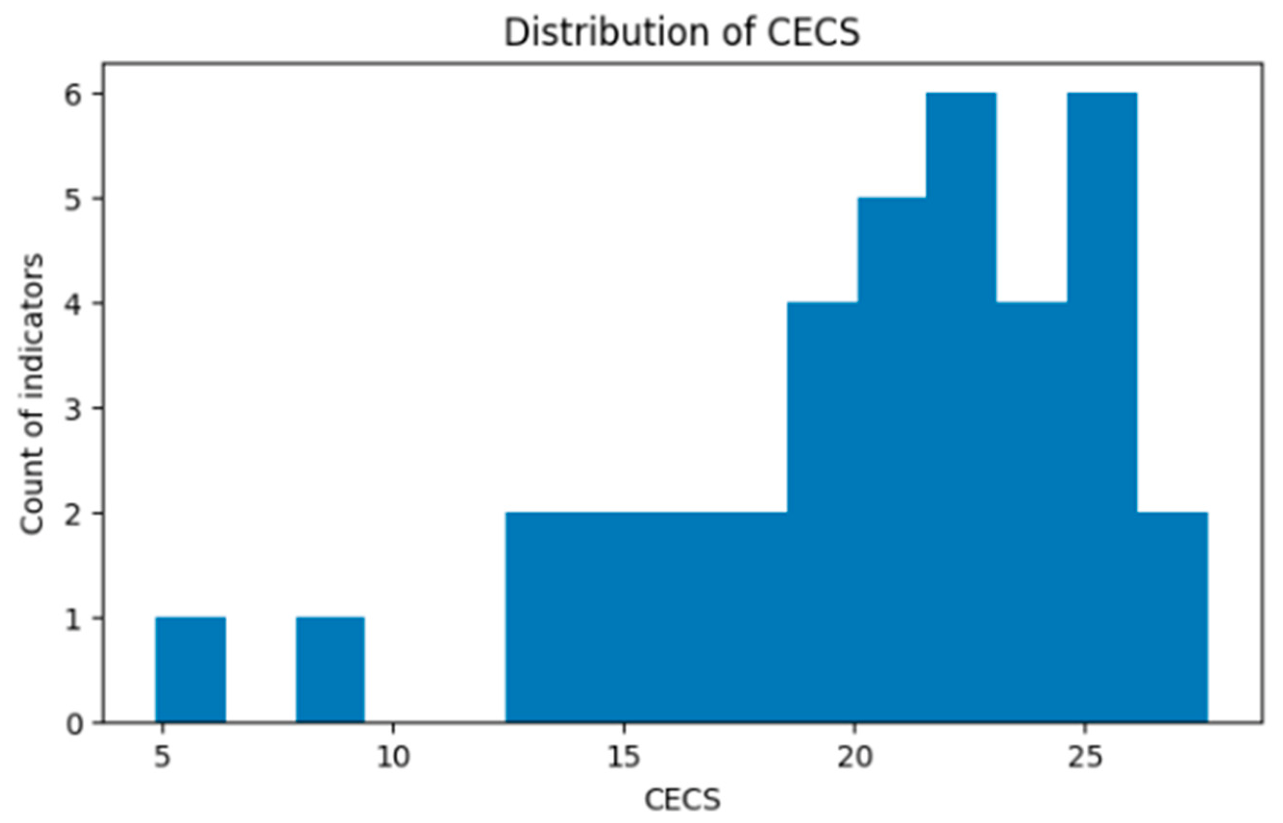
The Cumulative Edge Criticality Score (CECS) as presented in Table 6, reveals a clear hierarchy of indicator embeddedness within the resilience network.
Indicators such as IE, ED, HV, EN, and PF exhibit the highest embeddedness, reflecting extensive weighted connectivity across multiple domains. High CECS values indicate participation in numerous dependency relationships and suggest that these indicators are structurally integrated within the broader resilience system.
In contrast, PH, FL, RL, QH, and AQ display comparatively lower CECS values, indicating more limited participation in dominant dependency structures. These indicators occupy relatively peripheral structural positions and are less influential in cross-domain cascading dynamics.
Figure 2 illustrates the structural distribution of the metric across the network, while Figure 3 presents its statistical distribution in the form of a histogram, providing complementary perspectives on the same underlying data.

3.5.3. Edge-Level Leverage Points (Edge Criticality Score—ECS)

The Edge Criticality Score (ECS) identifies relationships that disproportionately contribute to the strongest dependency paths in the network. Table 7 shows the top 10 edges ranked by ECS values.
Edges such as FS–HA, FS–IN, DL–IN, and ED–IE emerge as dominant structural connectors. These relationships contribute significantly to maximum-strength dependency paths, indicating that resilience dynamics are sensitive to the integrity of specific inter-indicator linkages rather than solely to individual node performance.
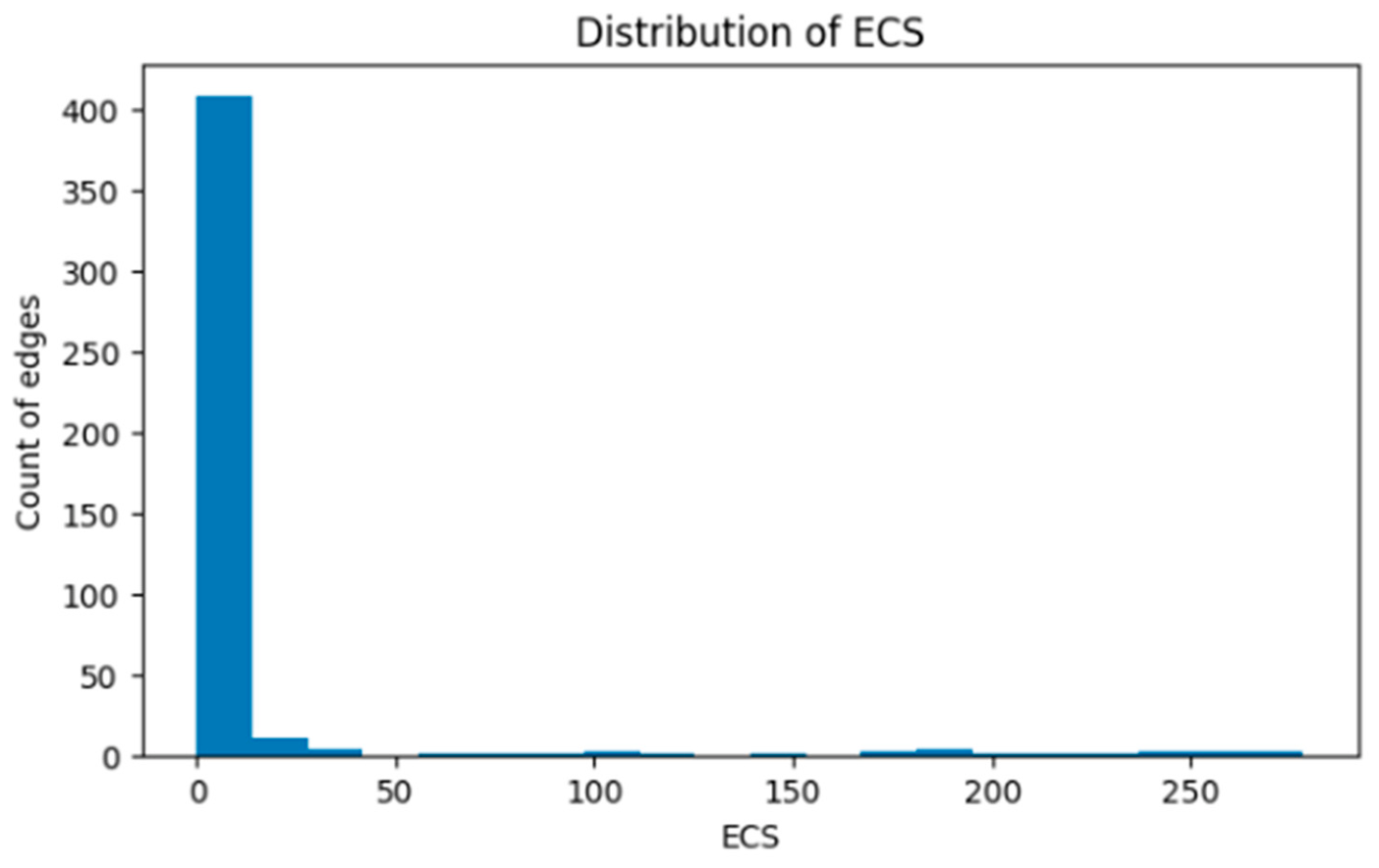
The ECS distribution (Figure 4 and Figure 5) demonstrates that a relatively small subset of edges accounts for a disproportionate share of path influence.

3.5.4. Dominant Dependency Chains (Maximum Dependency Path Strength—MDPS)

The Maximum Dependency Path Strength (MDPS) analysis captures the strongest transitive relationships between indicator pairs (Table 8).
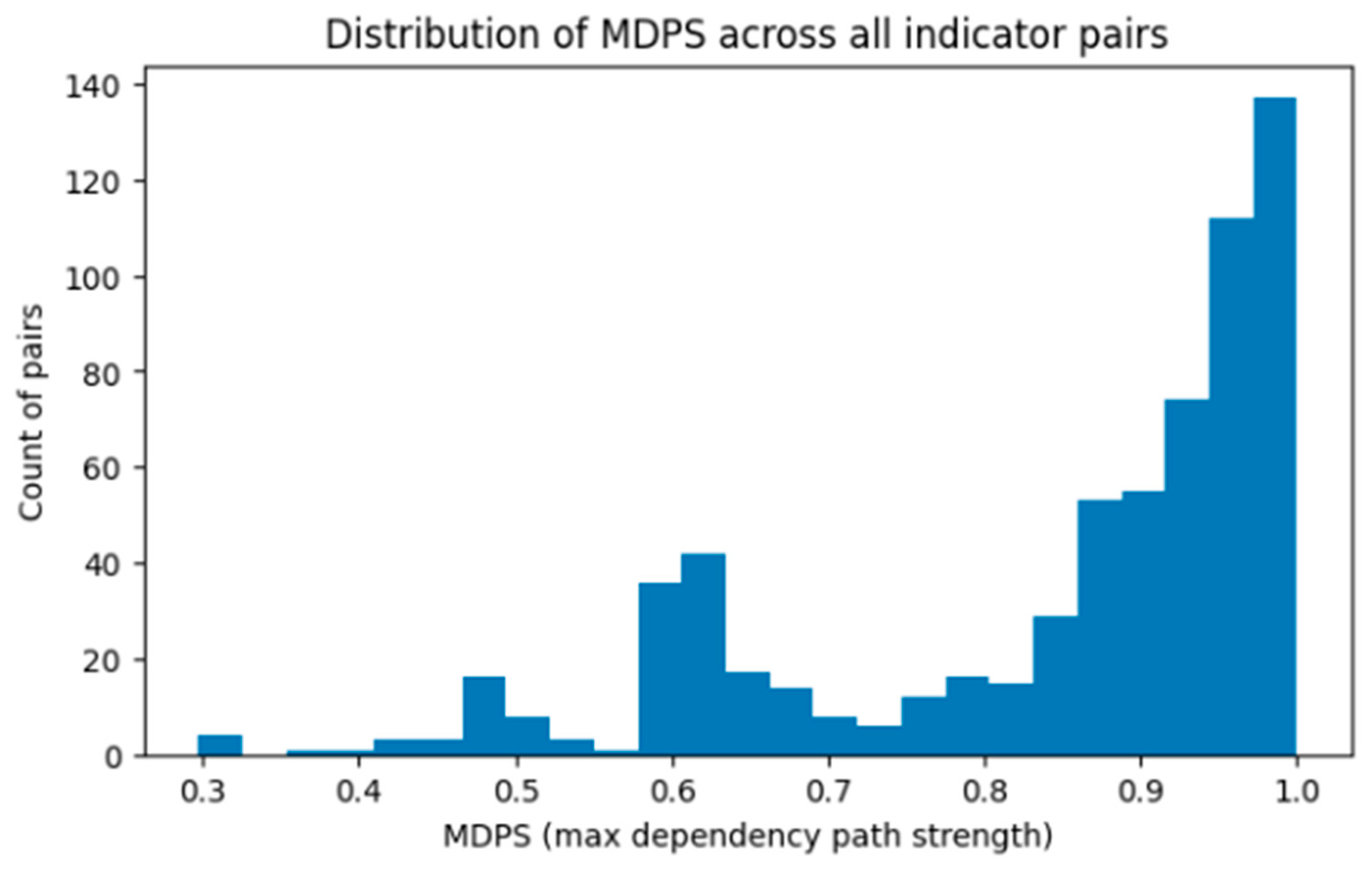
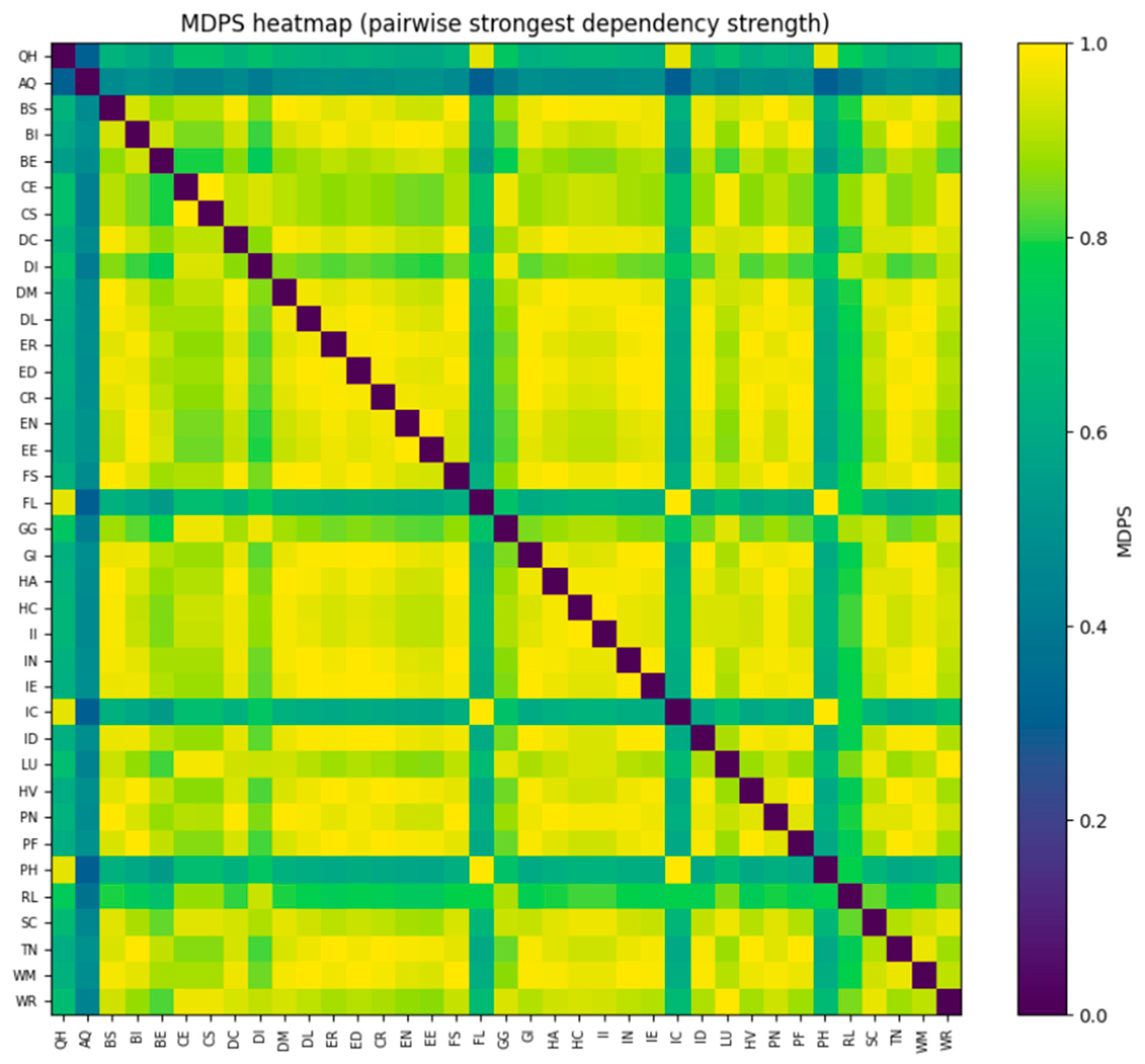
Several indicator pairs exhibit near-unity path strength, indicating that resilience in certain areas is highly conditional on upstream performance elsewhere, even when direct edges are absent.
The MDPS distribution (Figure 6) and heatmap (Figure 7) reveal strong transitive-dependency clusters spanning governance-, institutional-, and infrastructure-related indicators. These findings suggest that coordination requirements extend beyond direct pairwise interactions and are embedded within multi-step dependency chains.

3.5.5. Cross-Domain Coupling (Inter-Domain Dependency Ratio—IDDR)

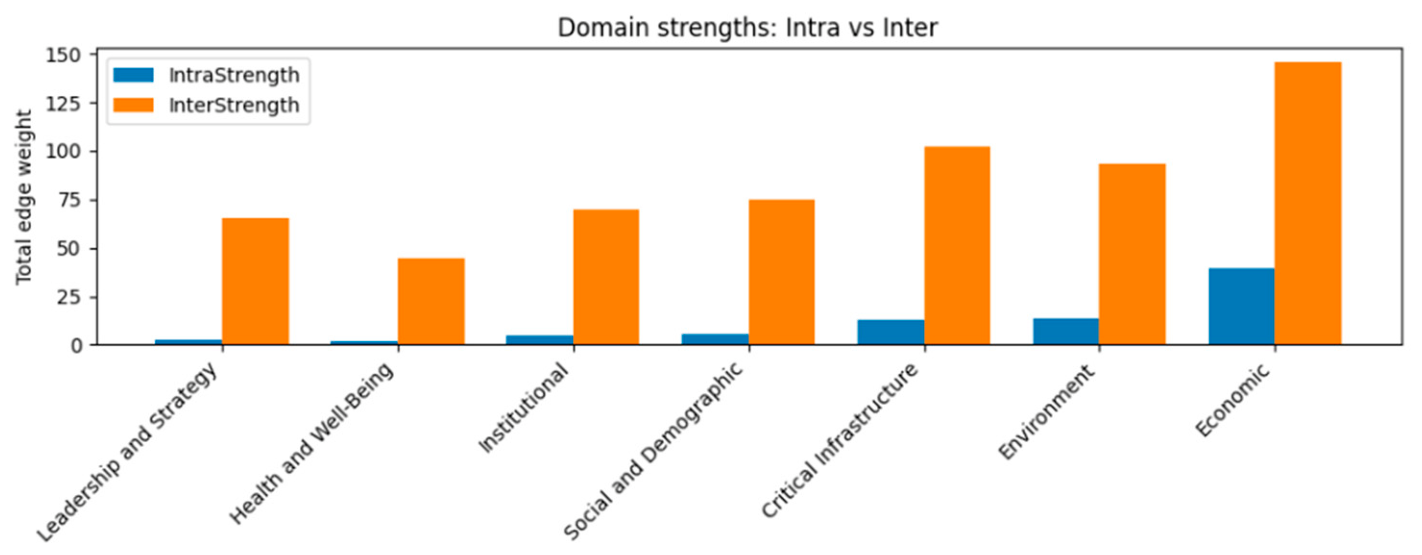
The Inter-Domain Dependency Ratio (IDDR) quantifies the balance between cross-domain and intra-domain connectivity (Table 9).
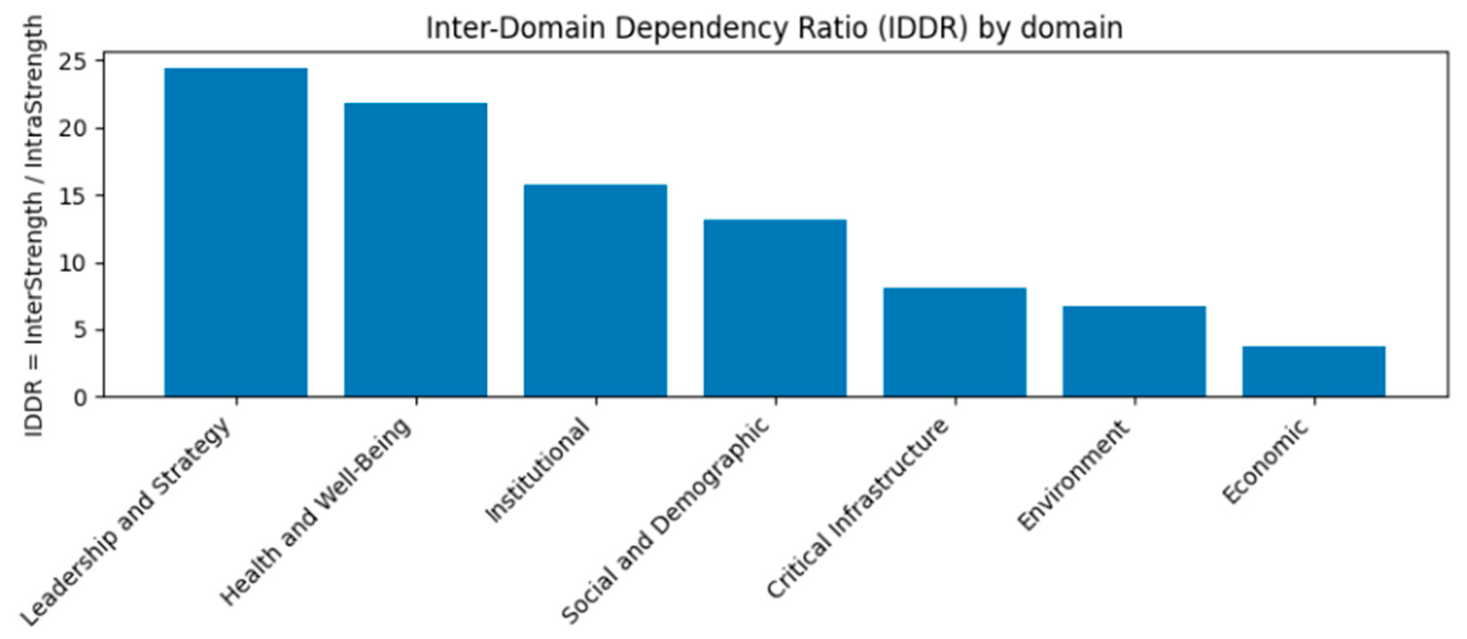
Leadership and Strategy, Health and Well-Being, and Institutional domains exhibit the highest IDDR values, indicating that their structural influence is derived primarily from cross-domain linkages rather than internal cohesion. In contrast, the Economic domain demonstrates comparatively stronger intra-domain connectivity and lower reliance on cross-domain relationships.
Figure 8 and Figure 9 visualize inter-domain ratios and the relative magnitude of intra- versus inter-domain strength.

3.6. Sensitivity Analysis of Indicator Weighting

A sensitivity analysis was conducted to evaluate the robustness of the indicator value formulation presented in Equation (4), where indicator scores are calculated as a weighted combination of average normalized sub-indicator values and their average betweenness centrality within each indicator’s sub-network. The baseline configuration assigns 30% weight to data-driven performance (Avg-SubValue) and 70% weight to structural importance (Avg-Betweenness). To test the stability of the framework, an alternative scenario increasing the structural emphasis (0.1 × Avg-SubValue + 0.9 × Avg-Betweenness) was evaluated.
The comparison as depicted in Table 10a,b, shows that increasing the betweenness weight shifts indicator importance toward nodes with higher structural centrality in the network. Indicators that play bridging or intermediary roles gain relative weight, while indicators primarily supported by strong sub-indicator scores lose relative influence. This behavior confirms the intended interpretation of the formulation: the model increasingly prioritizes structural dependencies and potential system bottlenecks as the betweenness contribution grows.
Despite these shifts in indicator-level weights, the system-level network metrics remained stable across both scenarios (Table 11). Key resilience measures, including Cumulative Edge Criticality Score (CECS), Edge Criticality Score (ECS), Maximum Dependency Path Strength (MDPS), Inter-Domain Dependency Ratio (IDDR), and Weighted Domain Density (WDD), remained unchanged between the two configurations. The purpose of the weighting sensitivity analysis is to evaluate the topological stability of the network rather than to determine an optimal weighting configuration. This stability occurs because the network topology and influence matrices that generate these metrics remain unchanged in the sensitivity test; only the indicator weighting layer is affected. This supports the use of the 30/70 configuration as a stable and balanced representation of both empirical indicator performance and network structure, although it is not claimed to be optimal. Future work will explore data-driven or optimization-based approaches for calibrating these weights.

4. Discussion

This study advances urban resilience modeling by extending the Urban Systems Abstraction Hierarchy (USAH) into a fully operational, graph-based analytical framework supported by weighted network diagnostics. Unlike traditional resilience frameworks that treat indicators as parallel or sectoral components, the proposed model operationalizes interdependencies explicitly, enabling structural analysis of embeddedness, leverage points, transitive dependencies, and cross-domain coupling. The Vancouver case study demonstrates that resilience is not merely a function of indicator performance but of how indicators are structurally positioned within a densely interconnected socio-technical system.
At the system level, the Weighted Dependency Density (WDD) value of 0.5673 indicates a moderately high degree of structural coupling. More than half of all potential weighted interactions in the network are active, suggesting that dependencies are broadly distributed rather than concentrated in isolated clusters. This density implies that systemic risk is embedded in the overall architecture of interdependence rather than in a few isolated pathways. While such coupling can enhance coordination under stable conditions, it also increases the risk of cascading propagation when disturbances occur. Resilience, therefore, depends not only on strengthening individual indicators but also on managing structural connectivity itself.
The CECS results reveal a hierarchical distribution of indicator embeddedness. Indicators such as IE, ED, HV, EN, and PF function as system stabilizers due to their extensive weighted connectivity across domains. Their structural embeddedness suggests that disruptions affecting these nodes would reverberate across multiple sectors. Conversely, lower-ranked indicators, including PH, FL, RL, QH, and AQ, occupy more peripheral structural positions, indicating comparatively weaker participation in dominant dependency structures. This hierarchy reinforces the importance of distinguishing between substantively important indicators and structurally embedded indicators; the latter exert disproportionate systemic influence due to their connectivity patterns.
Edge-level analysis through ECS further refines this understanding by identifying relationships that disproportionately support dominant dependency pathways. Edges such as FS–HA, FS–IN, DL–IN, and ED–IE contribute most significantly to maximum-strength paths, indicating that resilience dynamics are often conditioned by specific inter-indicator interfaces rather than by individual node centrality alone. These findings shift attention from isolated indicators toward relational leverage points within the system.
The MDPS results extend this insight by revealing near-unity transitive dependencies among several indicator pairs. Strong dependency chains demonstrate that certain outcomes are structurally conditioned on upstream performance even when direct links appear weak. This underscores the presence of latent coordination requirements embedded in multi-step pathways, reinforcing the need to analyze resilience beyond pairwise interactions. The MDPS formulation, based on multiplicative path strength, inherently emphasizes shorter and stronger dependency chains, as values decay rapidly along longer paths. While this highlights dominant transitive relationships, it may underrepresent extended dependency structures. To mitigate this limitation, multiple complementary metrics (CECS, ECS, IDDR, and WDD) are used to capture different aspects of network structure. However, potential correlations among these metrics were not formally evaluated in this study. Future work will incorporate statistical analyses (e.g., correlation and multicollinearity assessments) to better understand metric independence and ensure a robust representation of structural properties, particularly in dense networks.
Even though the existing sensitivity analysis demonstrates the network's topological robustness to varying degrees of weighting, the impact of altering the configuration of structural metrics in response to changes in indicator representation (e.g., adding or removing certain indicators) has not been quantitatively assessed. As such, this represents a major area for continued work, evaluating how well the framework can be generalized across other combinations of indicators and urban contexts.
Cross-domain analysis using IDDR reveals pronounced asymmetries in structural coupling across domains. Leadership and Strategy, Health and Well-Being, and Institutional domains exhibit exceptionally high cross-domain reliance relative to intra-domain cohesion. These domains derive their structural influence primarily through external linkages, functioning as integrative layers within the system. In contrast, the Economic domain demonstrates comparatively stronger internal cohesion and lower relative dependence on cross-domain interactions. This pattern confirms that governance- and society-oriented domains operate less as insulated clusters and more as systemic connectors.
Importantly, the updated bottleneck analysis identifies Good Governance, Disaster Management, and Digital Infrastructure as the dominant structural mediators within the network. Good Governance emerges as the primary integrative backbone, mediating interactions across institutional, environmental, infrastructure, and socio-economic dimensions. Disaster Management serves as a critical conditioning node for adaptation to multi-hazard and chronic stressors, reflecting the system’s reliance on preparedness and coordinated response mechanisms. Digital Infrastructure’s prominence underscores the centrality of information flows, communication networks, and technological systems in sustaining cross-domain integration. Together, these bottlenecks reflect a structural shift toward governance and coordination-centric resilience rather than purely sectoral vulnerabilities.
The integration of CECS, ECS, MDPS, IDDR, and WDD metrics thus provides a multi-scalar diagnostic lens. Rather than relying solely on node betweenness or isolated indicator rankings, the model captures embeddedness (CECS), relational leverage (ECS), transitive conditioning (MDPS), domain coupling (IDDR), and system density (WDD). This layered structural perspective reveals resilience as an emergent property of network architecture.
Despite these advances, several limitations remain. Data heterogeneity, indicator normalization, and weighting assumptions influence structural outputs. Socio-economic and governance indicators often rely on composite or perception-based measures that may vary across jurisdictions. Additionally, high-density networks risk over-amplifying weak relationships unless thresholding and sensitivity testing are rigorously applied. Future work should incorporate robustness testing under alternative weighting schemes and longitudinal recalibration to assess the temporal stability of structural bottlenecks.
Additionally, edge weights in this study are derived from similarity-based measures using normalized differences between indicators. This approach reflects statistical alignment rather than causal dependency. In the absence of longitudinal data required for causality inference (e.g., Granger causality or structural equation modeling), similarity-based coupling provides a pragmatic alternative consistent with similarity-based network construction approaches [16,17]. The interpretation of strong coupling, therefore, indicates behavioral similarity rather than direct causal influence. Future work will incorporate causality-based methods as more comprehensive temporal datasets become available.
Overall, the extended USAH framework, combined with graph-based structural diagnostics, moves resilience assessment beyond static indicator inventories toward an operational systems model. By quantifying embeddedness, leverage points, transitive dependencies, and cross-domain coupling, the approach provides a more precise understanding of systemic fragility and integrative capacity. The Vancouver case study demonstrates that resilience emerges not only from infrastructure robustness but from governance coherence, coordinated disaster response, and digital connectivity, collectively shaping the structural backbone of the urban system.
From a policy perspective, the proposed framework enables a shift from sector-specific interventions toward system-level prioritization. High-centrality and bottleneck indicators (e.g., governance, disaster management, digital infrastructure) can be targeted as leverage points for maximizing system-wide resilience gains. Similarly, high ECS edges highlight critical interdependencies that require coordinated policy action across sectors, while IDDR results identify domains with strong cross-domain reliance that may benefit from integrated governance approaches. These outputs can support prioritization of investments, inter-agency coordination, and risk-informed planning. Detailed implementation pathways remain an area for future applied research.

5. Conclusions

This study sets out to address a key limitation in existing urban resilience frameworks: the lack of integrated, system-level analysis of socio-economic, infrastructural, and governance interdependencies. By extending the Urban System Abstraction Hierarchy (USAH) into a graph-based modeling environment, this research demonstrates how urban resilience can be operationalized as a networked, multi-domain system rather than a collection of isolated indicators.
Vancouver’s analysis shows that network structure, rather than performance within a specific sector, determines the structural basis of resilience. Although it has a moderate to high Weighted Dependency Density indicating that there is an extensive distribution of the risks from the various interdependencies throughout the system and not located primarily on one or two paths; more importantly three “bottleneck” nodes (Good Governance, Disaster Management, Digital Infrastructure) have been identified as having a greater influence over the overall resilience of the system due to their role as coordination points among institutional, economic, and environmental dimensions. Additionally, 106 high-weight dependencies were identified, which were not known to stakeholders and indicate that stakeholders’ mental models of urban risk systematically underestimate cross-domain coupling and therefore can also impact what interventions will be prioritized regarding increasing resilience.
Beyond methodological contributions, this study provides practical implications for urban planners and policymakers. The graph-based framework offers a decision-support tool that can identify hidden dependencies, diagnose systemic vulnerabilities, and guide targeted interventions. For Vancouver specifically, this means that investments in governance coherence, digital connectivity, and disaster preparedness yield disproportionate system-wide returns, not because these sectors are individually important, but because they structurally mediate resilience across all other domains. By shifting focus from siloed planning toward system-wide coordination, the approach supports more effective and adaptive resilience strategies in complex urban environments.
Future research should focus on extending this framework across multiple cities to enable comparative analysis. In parallel, incorporating longitudinal data will allow future work to explore causal dependency modeling through methods such as Granger causality or structural equation modeling [18], moving beyond the current similarity-based edge weight construction toward more theoretically grounded inference. Additional directions include incorporating temporal dynamics to assess how resilience evolves over time, and refining data inputs through improved stakeholder calibration and real-time data integration. These directions will further enhance the robustness and applicability of graph-based resilience modeling.
In conclusion, this research demonstrates that urban resilience is not only a function of what systems exist, but how they are connected. Understanding and managing these connections is essential for building cities that can adapt, withstand, and evolve in the face of increasing uncertainty.

Supplementary Materials

The following supporting information can be downloaded at https://github.com/AbbyGholidoust/Supplementary-Materials-for-URSA.git (accessed on 4 April 2026).

Author Contributions

Conceptualization, A.A.; methodology, A.A. and A.G.; Coding, A.G.; validation, A.A.; formal analysis, A.G. and A.A.; investigation, A.A.; resources, A.G.; data curation, A.G.; writing—original draft preparation, A.G.; writing—review and editing, A.A.; visualization, A.G.; supervision, A.A.; funding acquisition, A.G. and A.A. All authors have read and agreed to the published version of the manuscript.

Funding

This research was partially funded by an RSAC Grant from the University Canada West, grant number 2024F02.

Institutional Review Board Statement

Not applicable.

Informed Consent Statement

Not applicable.

Data Availability Statement

The original data presented in this study are now available in Appendix A.

Conflicts of Interest

The authors declare no conflicts of interest.

Abbreviations

The following abbreviations are used in this manuscript:
USAHUrban System Abstraction Hierarchy
URSAUrban Resilience and Sustainability Alliance
BCITBritish Columbia Institute of Technology
NGONon-Governmental Organizations
WDDWeighted Dependency Density
CECSCumulative Edge Criticality Score
ECSEdge Criticality Score
MDPSMaximum Dependency Path Strength
IDDRInter-Domain Dependency Ratio
RSACResearch and Scholarly Activity Committee

Appendix A

For data normalization, the first thing we implemented was to collect information on the sub-indicator measures. Then, we proceeded to classify them as Quantitative or Qualitative. For qualitative variables, a total of 88 measurements were identified, compared to 208 measurements for quantitative variables. Following classification, all variables were normalized using methods appropriate to their data type and structure.
Qualitative data were transformed using binary encoding (dummy variables), where categorical responses were represented as 1 (presence/“Yes”) and 0 (absence/“No”). In total, 73 measurements across 13 indicators were normalized using this approach (see Table A1). This transformation is widely adopted in statistical modeling and machine learning to enable the inclusion of categorical variables in quantitative analysis while preserving interpretability [19,20]. Dummy encoding provides a consistent numerical representation of qualitative attributes and avoids imposing arbitrary ordinal relationships between categories [21].
Table A1. Dummy Variables.
IndicatorSub IndicatorMeasurement
Budget and SubsidyAvailability of subsidies/incentives for residents to rebuild housesAvailability of subsidies/incentives (Yes/No
Budget and SubsidyFinancial SupportAvailability of financial support programs (Yes/No)
Budget and SubsidyStructure of Budgetary SystemAssessment of budgetary system structure (Effective, Needs Improvement)
Built InfrastructureAdequate continuity for critical assets and servicesAssessment of continuity plans and provisions (Adequate, Inadequate)
Built InfrastructureAlerts and emergency notification systemsExistence of alert systems (Yes/No)
Built InfrastructureBuilding codeCompliance with established building codes (yes/no), or rating of adherence to standards
Built InfrastructureEnergy monitoringPresence of energy monitoring systems (Yes/No)
Built InfrastructureFlexible infrastructure servicesLevel of service flexibility, assessed by ability to scale or adjust to different conditions
Built InfrastructureFuture-proofing the built structuresAssessment of the structures’ ability to adapt to future conditions
Built InfrastructureGuarantee of continued critical servicesPresence of service level agreements or guarantees (Yes/No)
Built InfrastructureNatural ventilationPresence of natural ventilation features (Yes/No), percentage of buildings utilizing natural ventilation
Built InfrastructurePermeable pavement and bioswalesPresence of permeable pavement and bioswales (Yes/No), area covered by permeable pavement
and bioswales (square meters)
Built InfrastructureSecure technology networksAssessment of network security protocols and measures (Secure, Vulnerable)
Built InfrastructureUrban energy supply systems for increasing shares of renewable energyAssessment of urban energy supply system adaptability to renewable energy integration (Yes/No)
Business EnvironmentAttractive business environmentBusiness environment index (score)
Business EnvironmentAvailability of credit facility to prevent disasterAvailability of credit facilities (Yes/No)
Business EnvironmentComplementary CurrenciesExistence of complementary currency systems (Yes/No)
Business EnvironmentComprehensive business continuity planningExistence of business continuity plans (Yes/No)
Business EnvironmentInclusive labor policiesAvailability of anti-discrimination laws (Yes/No)
Business EnvironmentInnovation ecosystemInnovation ecosystem index (Yes/No)
Business EnvironmentLocal business development and innovationInnovation index (Yes/No)
Business EnvironmentStrong integration with regional and global economiesParticipation in regional and international trade agreements (Yes/No)
Business EnvironmentSupportive financing mechanismsAvailability of financing programs (Yes/No)
Business EnvironmentSupportive Livelihood and EmploymentAvailability of programs supporting livelihood and employment (Yes/No)
Comprehensive Social SecurityDefensible SpacesAvailability of defensible spaces (Yes/No)
Digital InfrastructureGeospatial informationAvailability of geospatial data sets (Yes/No), number of geospatial data layers available
Disaster ManagementComprehensive hazard and exposure mappinghazards mapped (Yes/No)
Environment and EcologyBiodiversityBiodiversity index (Yes/No)
Good GovernanceAccountabilityAccountability index (Yes/No)
Good GovernanceBalanced demographic distributiondistribution ratio (Yes/No)
Good GovernanceCentralized government approachApproach description (text)
Good GovernanceCulture of cooperationInitiatives/projects (Yes/No)
Good GovernanceCulture of readinessMeasurement Unit/Metric: Readiness culture index (Yes/No)
Good GovernanceDemocratic StructuresAvailability of democratic structures (Yes/No)
Good GovernanceE-gov portal for residentsAvailability of e-gov portal (Yes/No)
Good GovernanceHuman Rights and Civil LibertiesHuman rights index (Yes/No)
Good GovernanceInteragency trustCollaboration effectiveness index (Yes/No)
Good GovernanceSource of InformationType of information source (categorical) (Yes/No)
Good GovernanceTransparencyTransparency index (Yes/No)
Good GovernanceVisibility of Security InfrastructuresPresence of security infrastructure (yes/no), number of security personnel, or security infrastructure
density per area (Yes/No)
Good GovernanceVolunteered geographic informationAccess to geographic data (Yes/No)
Good GovernanceWidespread community awareness and preparednessAwareness and preparedness index (Yes/No)
Heat StressHeat StressHeat stress index (Yes/No)
Public FinanceCarbon removalDoes the city mention carbon removal in its net zero target plan?
Public FinanceExistence of disaster awareness programs for communitiesAvailability of disaster awareness programs (Yes/No)
Public FinanceFinancial stability and flexibilityLiquidity ratio/Financial stability index
Public FinanceGovernment EffectivenessGovernment effectiveness index, public satisfaction with government services
Public FinanceImplementation of efficient waste management system (RRR)Implementation status of waste management system (Yes/No)
Public FinanceIntegrated pest managementEffective use of IPM strategy/policy (Yes, No)
Public FinanceQuality of Veterinary serviceService ratings, number of certified professionals, or availability of advanced facilities
Public FinanceScenario-based planningImplementation of scenario-based planning (Yes/No)
Public FinanceSpaces for citizen participation facilitated by institutionsAvailability of spaces (Yes/No)
Public FinanceUrban pest managementSystems to manage and respond to urban pests.
Public FinanceVulnerable group integrationIntegration index for vulnerable groups
Public FinanceWell-managed public financesPublic finance management index
Rule of LawEffectiveness of early warning systemsEffective warning systems (Yes/No)
Rule of LawEfficiency of trained emergency workers during a disasterEffective emergency workers during a disaster (Yes/No)
Rule of LawExistence and effectiveness of an emergency team during a disasterAvailability of an emergency team (Yes/No)
Rule of LawExistence of alternative decision-making personnelAvailability of personnel (Yes/No)
Rule of LawProactive corruption preventionAnti-corruption initiatives
Rule of LawSeverity of shockImpact assessment
Rule of LawUrban risk management capacity indexCapacity Index Score (Yes/No)
Social CohesionBuilds Cohesive and Committed CommunitiesCommunity Engagement metrics
Social CohesionCohesive communitiesCommunity cohesion index
Social CohesionImmigrant IntegrationIntegration index
Social CohesionRate of face-to-face interactionsSurvey data (Yes/No)
Social CohesionStrong city-wide identity and cultureIdentity and culture strength index
TransportationAccessibility of roads during floodingAssessment of road accessibility during flooding (Yes/No)
TransportationAccessible connection to evacuation routesPresence of accessible connections (Yes/No)
TransportationDiversity of transport networksVariety of transport modes available
TransportationSmart traffic managementDoes the city have smart traffic management systems that leverage AI, IoT and data analytics?
(Yes/No)
TransportationWalking trails that link with public transportation routesPresence of walking trails linked to public transportation (Yes/No)
TransportationWater efficient landscapingPresence of water-efficient landscaping (Yes/No)
Additionally, we used an ordinal Likert scale method, according to the ranges of the data. For example, if a measure is averaged as Excellent, Good and Bad. We put 1, 2, or 3 according to the result. In total, 15 measurements were normalized by Likert, pertaining to 5 indicators.
Table A2. Likert scale method.
IndicatorSub IndicatorMeasurement
Budget and SubsidySufficient Budget for Disaster Risk ReductionAssessment of DRR budget sufficiency (Sufficient, Insufficient)
Built InfrastructureBuilding layout and orientationAssessment of building layout and orientation with respect to environmental efficiency (Good, Average, Poor)
Built InfrastructureCybersecurity preparednessLevel of preparedness (High, Medium, Low)
Built InfrastructureDiligent maintenance of critical servicesFrequency of maintenance activities (monthly, quarterly, yearly)
Built InfrastructureFlexibility of gridGrid flexibility rating (High, Medium, Low)
Built InfrastructureGeneration and utilization of informationLevel of information generation and utilization (High, Medium, Low)
Built InfrastructureUrban formCompact, Dispersed, Poly-centric
Business EnvironmentDiversificationAssessment of economic diversification (High, Medium, Low)
Business EnvironmentHistory of InsuranceHistorical development and growth of insurance sector (years, milestones)
Business EnvironmentRegional Economic BalanceAssessment of economic balance across regions (Balanced, Unbalanced)
Public FinanceInsurance and compensation systemAssessment of insurance and compensation system effectiveness (Effective Needs Improvement)
TransportationPublic transport qualityPublic transport service quality rating (Excellent, Good, Fair, Poor)
TransportationReliable mobility and communicationReliability rating (High, Medium, Low)
TransportationWater managementAssessment of water management practices (Effective, Needs Improvement)
TransportationWater provision qualityWater quality rating (Excellent, Good, Fair, Poor)
For quantitative data, we first looked at the amount of data we had. If you had longitudinal data for 10 years, you proceeded to normalize by Z-score, otherwise you used the Min–Max Scaler.
For Min–Max Scaler, a total of 181 Measurements were normalized, pertaining to 38 indicators.
Table A3. Min–Max Scaler.
IndicatorSub IndicatorMeasurement
Access to Quality HealthcareAccess to HealthcarePercentage of population with access to healthcare (%)
Access to Quality HealthcareAdequate access to quality healthcarePercentage of population with adequate access to quality healthcare (%)
Access to Quality HealthcareHealth Insurance penetration and densityPercentage of population covered by health insurance (%)
Access to Quality HealthcareProportion of medical insurance coveragePercentage of population with medical insurance (%)
Access to Quality HealthcareQuality of HealthcarePatient satisfaction rate (%)
Air QualityDays of good air qualityWhat is the city’s annual average PM2.5 concentration (μg/m3)?
Budget and SubsidyFunding for Disaster Resilience MappingTotal funding allocated to DRM (% of budget)
Budget and SubsidyPercentage of Total Budget Spent on CulturePercentage of total government budget spent on cultural activities (%)
Budget and SubsidyRefinancing CostsAverage interest rate on refinancing (%)/total refinancing costs.
Budget and SubsidyThe capital investment in improving the infrastructure and public service facilities in historical cities and historical and cultural blocks in the last three yearsTotal capital investment in CAD
Built InfrastructureBuilding insulationPercentage of buildings with building insulation
Built InfrastructureElectricity qualityFrequency and duration of outages (hours/year)
Built InfrastructureHome ownershipPercentage of population that owns their homes
Built InfrastructurePopulation living in proximity to polluted industriesPercentage of population living within a specified distance of polluted industries
Built InfrastructurePreservation of housingNumber of preserved housing units
Built InfrastructureReducing air infiltration and thermal bridgingAir changes per hour (ACH), thermal bridging index
Built InfrastructureThe infrastructure coverage ratePercentage of area or population covered by infrastructure services
Business EnvironmentBusiness sizeNumber of employees
Business EnvironmentDiverse Economic baseDiversity index of economic sectors, number of industries represented
Business EnvironmentDiversity of businessNumber of business sectors represented
Business EnvironmentFood Self SufficiencyPercentage of resources produced domestically (%)
Business EnvironmentJob satisfactionAverage job satisfaction score (on a scale of 1 to 10)
Business EnvironmentMarket AccessTrade agreements
Business EnvironmentNumber of patents per 10K peopleNumber of patents per 10,000 people (patents/10,000 people)
Business EnvironmentNumber of startupsNumber of startups launched per year
Business EnvironmentPersonal Economic SecurityEconomic security index, income stability score
Business EnvironmentStimulation of economic prosperityEconomic growth rate (GDP growth %)
Community Engagement & PreparednessPopulation evacuating voluntarilyPercentage of population (%)
Comprehensive Social SecurityCity-wide surveillance networksNumber of surveillance cameras
DecarbonizationCarbon pricingPrice per ton of carbon (CAD/ton)
DecarbonizationImplementation of mitigation policies to reduce air pollutionWhat is the percentage of electricity generated from renewable sources?
Digital InfrastructureAccess to internetPercentage of population with access to the internet
Digital InfrastructureInternet qualityInternet speed (Mbps)
Disaster ManagementComprehensive government emergency managementNumber of emergency plans (count)
Disaster ManagementProvision of open space for shelterPercentage of city area dedicated to open spaces (%)
Disaster ManagementTransparency of city body to disseminate accurate emergencyPercentage of accurate and timely emergency communications
Diverse Livelihood and EmploymentAccess to EmploymentEmployment rate (%)
Diverse Livelihood and EmploymentEmployees in trade unionsPercentage of total workforce in trade unions (%)
Diverse Livelihood and EmploymentGender employment gapDifference in employment rates between men and women (%)
Economic RobustnessCapital FlowsNet capital inflows
Economic RobustnessExport Partner ConcentrationPercentage of exports concentrated with top trading partners (%)
Economic RobustnessPer Capita GDPGDP per capita
Economic RobustnessPer Capita Regional GDPRegional GDP
EducationAccess to schoolPercentage of population within a specified distance of a school
EducationAdult participation rate in educationPercentage of adults participating in education (%)
EducationHousehold adult education levelAverage years of education among household adults (years)
EducationHousehold adult literacy levelPercentage of literate adults in households (%)
EducationLiteracy and education attainmentPercentage of population with literacy and educational attainment (%)
EducationLiteracy ratePercentage of population literate (%)
EducationPercentage of population with access to quality educationPercentage of population with access to quality education (%)
EducationProgram for International Student Assessment (PISA)Average PISA scores in reading, mathematics, and science
EducationScientific publicationsNumber of scientific publications per 10,000 people (publications/10,000 people)
EducationStudents in universities per 10K peopleNumber of students in universities per 10,000 people (students/10,000 people)
Effective Provision of Critical ServicesAccess to extension services (Basic Service Infrastructure)Availability (presence) of extension services.
Effective Provision of Critical ServicesProvision of shelter for affected peopleNumber of shelters available, capacity of shelters (people)
EnergyElectricity priceWhat is the price of one kilowatt hour (kWh) of electricity?
EnergyUse of renewable energyPercentage of total energy from renewable sources (%)
Environment and EcologyConservation of ecologically vulnerable areasPercentage of vulnerable areas under conservation (%)
Environment and EcologyErosion ratesErosion rate (tons of soil per hectare per year)
Environment and EcologyExtent of implementation of environmental conservation policiesImplementation rate of environmental conservation policies (%)
Environment and EcologyForestationHectares of forested area
Environment and EcologyPlant and tree diversitySpecies count
Finance and SavingsAffordable and suitable housingNumber of affordable housing units available (%)
Finance and SavingsHousehold saving rateAverage household saving rate (% of income)
Finance and SavingsHousing capitalTotal value of housing capital (CAD)
Finance and SavingsInsurance penetrationPercentage of population with insurance coverage (%)
Finance and SavingsLiving costsConsumer Price Index (CPI)
Finance and SavingsPoverty ratePercentage of population living in poverty (%)
Finance and SavingsProportion of people with access to insurancePercentage of population with access to insurance (%)
FloodingCoastal flood riskPercentage of area at risk (%)
Good GovernanceAcceptance level of community leaderPercentage of population supporting the leader (%)
Good GovernanceConfidence in National InstitutionsGeneral Social Survey (GSS) or Canadian Social Service (CSS)
Good GovernanceCrime and safetyCrime rate (crimes per 1000 people)
Good GovernanceData availabilityNumber of data sources available (count)
Good GovernanceMainstreaming of CCA (Climate Change Adaptation) and DRR (Disaster Risk Reduction) in cities development plansNumber of plans incorporating CCA and DRR (count)
Good GovernanceOpen data availability and accessibilityPercentage of data sets available to the public (%)
Good GovernanceParticipation in community activitiesParticipation rate (%)
Good GovernancePerceptions about political environmentSatisfaction index
Good GovernancePolitical stabilityPolitical Stability Index
Good GovernanceRobust planning and approval processPlanning approval efficiency (days)
Good GovernanceSubdivision requirements that take account of risks and vulnerabilitiesCompliance rate (%)
Good GovernanceTrust in governmentPercentage of population expressing trust (%)
Green InfrastructureAmount of Urban Green Space (UGS)Total amount of urban green space (square kilometers)
Green InfrastructureForest ConservationPercentage of forest area under conservation (%)
Green InfrastructureParksTotal number of parks, total park area (square kilometers)
Green InfrastructurePer-capital area of parks and green landArea of parks and green land per capita (square meters per person)
Green InfrastructureUrban Green CommonsNumber of urban green commons
Households AssetsHouseholds have mobile phonesPercentage of households with mobile phones (%)
Households AssetsHouseholds have motorized vehiclesPercentage of households with motorized vehicles (%)
Households AssetsHouseholds have non-motorized vehiclesPercentage of households with non-motorized vehicles (%)
Households AssetsHouseholds have televisionPercentage of households with a television (%)
Households AssetsProperty FireNumber of Property Fires per year
Human CapitalBrain retentionPercentage of graduates and professionals who remain in the country or region (%)
Human CapitalHealth worker number per thousand peopleNumber of health workers per 1000 people
Human CapitalHigh-skilled workforcePercentage of the workforce with advanced degrees or specialized training (%)
Human CapitalRelevant skills and trainingNumber of training programs available
Inclusivity and InvolvementAccess to FinancePercentage of population with access to financial services (%)
Inclusivity and InvolvementDegree of citizen participationPercentage of citizens participating in civic activities (%)
Inclusivity and InvolvementDiversity of organized citizen groupsDiversity index of organized citizen groups, number of different groups
Inclusivity and InvolvementDiversity of populationDiversity index
Inclusivity and InvolvementGroup-based Inclusionpercentage of groups included in activities (%)
Inclusivity and InvolvementSocial protection benefitsPercentage of population receiving benefits (%)
IncomeIncome derived from informal sectorPercentage of total income derived from the informal sector (%)
IncomeIncome inequalityWhat is the extent of income inequality in the city? (Gini Score)
IncomeNumber of income sources per householdAverage number of income sources per household
IncomeProportion of old people with pension and property incomePercentage of elderly population with pension and property income (%)
IncomeRegional dispersion of incomeGini Coefficient
IncomeUrban per capita disposable incomeUrban per capita disposable income (CAD)
IncomeWage GrowthAnnual wage growth rate (%)
Innovation and EntrepreneurshipAccess to new technologyPercentage of population/businesses with access to new technology (%)
Innovation and EntrepreneurshipAdoption of new technologiesPercentage of businesses adopting new technologies (%)
Innovation and EntrepreneurshipAI readinessNumber of AI projects implemented
Innovation and EntrepreneurshipEmbracing e-commercePercentage of businesses engaged in e-commerce (%)
Innovation and EntrepreneurshipICT service sector in GDPPercentage of GDP derived from the ICT service sector (%)
Institutional CollaborationCity’s cooperation (support) with central municipal department for emergency managementNumber of cooperative initiatives (count)
Integrated Development PlanningCity networking at different levels (regional, national, transnational)Network coverage
Integrated Development PlanningComprehensive city monitoring and data managementNumber of monitoring systems in place (count)
Integrated Development PlanningExtent of community participation in development plan preparation processParticipation rate (%)
Integrated Development PlanningNumber of librariesNumber of libraries per specified area
Knowledge Dissemination and ManagementAvailability of public awareness programs/disaster drillsNumber of public awareness programs or drills conducted (count)
Land UseDiversity of land useLand use diversity index
Land UseElevationAverage elevation above sea level (meters)
Land UseGreen area per capitaGreen area per capita (square meters per person)
Land UseLand Use ChangePercentage change in land use over time (annual or decadal change in hectares or square kilometers)
Land UseLand use PlanNumber of land use plans developed
Land UseNumber of protected and historical landmarksTotal number of protected and historical landmarks
Land UsePer capita urban road areaUrban road area per capita (square meters per person)
Land UseUrban AgriculturePercentage of urban areas dedicated to agriculture (%)
Minimal Human VulnerabilityPeople at risk of poverty or social exclusionPercentage of population at risk of poverty or social exclusion (%)
Minimal Human VulnerabilitySufficient food supplyPercentage of population with access to sufficient food supply (%)
Minimal Human VulnerabilityThe proportion of vulnerable population (under 16 or above 60 years old)Percentage of population under 16 or above 60 years old (%)
PopulationAging populationPercentage of population over 64 years old (%)
PopulationHuman Development IndexHDI score
PopulationPopulation DensityPeople per square kilometer (people/km2)
PopulationPopulation density at dayNumber of People per Square Kilometer During Daylight Hours
PopulationPopulation density at nightNumber of People per Square Kilometer During nighttime Hours
PopulationPopulation density in built-up areasPeople per square kilometer in built-up areas (people/km2)
PopulationPopulation growthGrowth rate (% per year)
PopulationPopulation of informal settlersNumber of informal settlers (count)
PopulationRatio of population with college education and without high school educationRatio (college educated: without high school education)
Public FinanceEducation OutcomesAverage test scores
Public FinanceFiscal expenditure coveragePercentage of fiscal needs covered by expenditure (%)
Public FinanceInclusion of YouthYouth participation rate (%)
Public FinancePublic DebtTotal government debt as a percentage of GDP (%).
Public FinanceQuality of schoolSchool ranking, student-to-teacher ratio, or standardized test scores
Public FinanceRenewable energy adoptionDoes the city mention carbon removal in its net zero target plan?
Public FinanceSafe and accessible housingPercentage of population with safe and accessible housing (%)
Public FinanceThe proportion of environmental expenditure in fiscal expenditurePercentage of fiscal expenditure allocated to environmental purposes (%)
Public FinanceThe proportion of Infrastructure investment in all investmentPercentage of total investment allocated to infrastructure (%)
Public FinanceTourist attractionNumber of tourists visiting per year
Public HealthLongevityAverage life expectancy (years)
Public HealthPublic health facilities per capitaNumber of public health facilities per 1000 people (facilities/1000 people)
Public HealthRobust public health systemsNumber of public health programs
Rule of LawAccessible criminal and civil justicecase resolution rate (%)
Rule of LawFreedom from CorruptionCorruption perception index
Rule of LawIndividual preparednesspercentage of population prepared (%)
Rule of LawSubdivision requirements that take account of risks and vulnerabilitiesCompliance rate (%)
Social CohesionCultural diversityDiversity index (percentage or number of different ethnic groups)
Social CohesionLanguage proficiencyPercentage of population fluent in official language (%)
TransportationAccess to paved roadsConditions of roads in the community (sandy, paved, gravel)
TransportationHigh frequency scheduled public transportationFrequency of service (minutes between services)
TransportationPaved roadsPercentage of roads that are paved (%)
TransportationPercentage of land transportation networkPercentage of land covered by transportation network (%)
TransportationPrinciple arterial miles per square mileMiles of principle arterial roads per square mile (miles/square mile)
TransportationProtection of water-sensitive lands (wetlands, etc.)Area of protected water-sensitive lands
TransportationStreet connectivityIntersection density (intersections per square km)
TransportationTraffic congestionAverage delay per vehicle (minutes)
TransportationTransport electrificationPercentage of electric vehicles in total fleet (%)
TransportationTransport operationNumber of accidents per day/(Or SCALE? 1 to 5?)
TransportationVehicle ownershipNumber of vehicles per 1000 habitants
Waste managementCorrect disposal of wastePercentage of waste correctly disposed of (%)
Waste managementHarmless treatment of municipal solid wastePercentage of municipal solid waste treated in an environmentally safe manner (%)
Waste managementThe industrial solid waste treatmentPercentage of industrial solid waste treated (%)
WaterBacterial Contamination LevelTotal coliforms CFU per 100 mL
WaterHigh-efficiency irrigationPercentage of irrigation systems that are high efficiency (%)
WaterInclusive Access to Safe Drinking WaterPercentage of population with access to safe drinking water (%)
WaterSafe water for Domestic UsePercentage of households with access to safe water for domestic use (%)
WaterWastewater treatmentPercentage of wastewater treated (%) before discharge.
WaterWater demand and conservation systemsPercentage reduction in water demand (%)
WaterWater quantity and quality monitoringFrequency of monitoring.
WaterWater supply capacityTotal water supply capacity (liters/day, cubic meters/day)
For the Z–Score, a total of 9 measurements were normalized by this method, pertaining to 8 indicators.
Table A4. Min–Max Scaler Z–Score.
IndicatorSub IndicatorMeasurement
Business EnvironmentFirm’s financial constraintsDebt-to-equity ratio
Disaster ManagementPercent vacant rental unitsPercentage of vacant units (%)
Diverse Livelihood and EmploymentLong term unemployment ratePercentage of the labor force unemployed for more than one year (%)
Economic RobustnessInvestment share of GDPPercentage of GDP allocated to investment (%)
IncomePer capita disposable incomePer capita disposable income (CAD)
Populationpeople aged over 65 in Canadapeople aged over 65 in Canada
PopulationPopulation under 14 and above 64Population
Public FinanceGovernment fiscal spending per capitaFiscal spending per capita
TransportationStatus of interruption of transportation after intense rainfallAverage duration of transportation interruption (hours), frequency of interruptions (number of incidents per year)
In addition, we analyzed which indicators could have a negative impact on resilience, for which we subtracted 1—the value found in their measure. In total, 4 measurements were normalized by this method, pertaining to 4 indicators.
Table A5. Negative impact.
IndicatorSub IndicatorMeasurement
Air QualityAir Quality Health Index (AQHI)Air Quality Health Index (AQHI) score
Built InfrastructureBuildings above water loggingPercentage of buildings built above flood-prone areas or elevation levels
Green InfrastructureLoss of Urban Green SpacePercentage reduction in urban green space (%)
IncomePopulation below poverty linePercentage of population below the poverty line (%)
Finally, we used another normalization for numbers that were outside the range 0–1, since the network does not accept values greater than 1. So, we applied a second normalization, with the long or short average methods based on the fluctuations of the data.
A 5-year average was used to normalize two sub-indicators: Energy Consumption per GDP and Level of Urbanization. This methodology was applied to smooth annual fluctuations that could distort the results due to temporary factors, such as economic changes or exceptional events. In addition, as these indicators reflect long-term structural trends, the use of the average allows us to obtain a more representative and stable view, facilitating a more accurate and consistent comparison over time.
Table A6. 5-year average.
IndicatorSub IndicatorMeasurement
EnergyEnergy consumption per GDPEnergy consumption per unit of GDP
Land UseUrbanization levelPercentage of population living in urban areas (%)
A long-term average was used to normalize the following sub-indicators: Age of housing, Concentration of import trading partners, Access to electricity, Forest coverage, Income level, Access to ICTs, Share of urban population, Tax burden, Access to sanitation facilities and Effective sanitation. This methodology was applied because these indicators reflect structural changes that occur gradually and are less susceptible to short-term fluctuations. Using a long-term average better captures sustainable transformations and general trends that impact economic, social and environmental development. In total, 10 measurements were normalized by this method, pertaining to 9 indicators.
Table A7. Long-term average.
IndicatorSub IndicatorMeasurement
Built InfrastructureHousing ageAverage age of house owner (years)
Economic RobustnessImport Partner ConcentrationPercentage of imports concentrated with top trading partners (%)
EnergyAccess to electricityPercentage of population with access to electricity
Green InfrastructureForest coveragePercentage of total area covered by forest (%)
IncomeIncome levelAverage income level (CAD per capita)
Innovation and EntrepreneurshipAccess to ICTPercentage of population with access to internet and communication technology
PopulationProportion of urban populationPercentage of urban population (%)
Public FinanceTax BurdenTotal tax revenue as a percentage of Gross Domestic Product (GDP) (%)
Waste managementAccess to Sanitation FacilitiesPercentage of population with access to improved sanitation facilities
Waste managementEffective sanitationPercentage of population with access to effective sanitation (%)
A 5-year moving average was applied to normalize the Forest Fires and Waste Collection: Treated and Recycled sub-indicators. This technique was used to smooth annual fluctuations and better capture recent trends, as these indicators can be affected by seasonal events, extreme weather conditions, or changes in environmental management policies.
The use of the moving average allows the analysis to be continuously updated by incorporating the most recent data, providing a more dynamic and up-to-date perspective. This is especially relevant for these sub-indicators, as they reflect processes that may vary significantly from year to year but require constant monitoring to assess their evolution and effectiveness over time.
Table A8. Five-year moving average.
IndicatorSub IndicatorMeasurement
Environment and EcologyWildfireArea affected by wildfires
Waste managementCollection of waste: treated, recycledPercentage of waste collected that is treated or recycled (%)
Table A9. Sub-indicator distances and clusters.
IndicatorSub-Indicator 1Sub-Indicator 2Distance from y = x
Access to Quality HealthcareAccess to HealthcareAdequate access to quality healthcare0
Access to Quality HealthcareAccess to HealthcareHealth Insurance penetration and density0
Access to Quality HealthcareAccess to HealthcareProportion of medical insurance coverage0
Access to Quality HealthcareAccess to HealthcareQuality of Healthcare0
Access to Quality HealthcareAdequate access to quality healthcareHealth Insurance penetration and density0
Access to Quality HealthcareAdequate access to quality healthcareProportion of medical insurance coverage0
Access to Quality HealthcareAdequate access to quality healthcareQuality of Healthcare0
Access to Quality HealthcareHealth Insurance penetration and densityProportion of medical insurance coverage0
Access to Quality HealthcareHealth Insurance penetration and densityQuality of Healthcare0
Access to Quality HealthcareProportion of medical insurance coverageQuality of Healthcare0
Air QualityAir Quality Health Index (AQHI)Days of good air quality0.707106804
Budget and SubsidyAvailability of subsidies/incentives for residents to rebuild housesFinancial Support0
Budget and SubsidyAvailability of subsidies/incentives for residents to rebuild housesFunding for Disaster Resilience Mapping0.707106781
Budget and SubsidyAvailability of subsidies/incentives for residents to rebuild housesPercentage of Total Budget Spent on Culture0.675815062
Budget and SubsidyAvailability of subsidies/incentives for residents to rebuild housesRefinancing Costs0.186080732
Budget and SubsidyAvailability of subsidies/incentives for residents to rebuild housesStructure of Budgetary System0
Budget and SubsidyAvailability of subsidies/incentives for residents to rebuild housesSufficient Budget for Disaster Risk Reduction0
Budget and SubsidyAvailability of subsidies/incentives for residents to rebuild housesThe capital investment in improving the infrastructure and public service facilities in historical cities and historical and cultural blocks in the last three years0.707106781
Budget and SubsidyFinancial SupportFunding for Disaster Resilience Mapping0.707106781
Budget and SubsidyFinancial SupportPercentage of Total Budget Spent on Culture0.675815062
Budget and SubsidyFinancial SupportRefinancing Costs0.186080732
Budget and SubsidyFinancial SupportStructure of Budgetary System0
Budget and SubsidyFinancial SupportSufficient Budget for Disaster Risk Reduction0
Budget and SubsidyFinancial SupportThe capital investment in improving the infrastructure and public service facilities in historical cities and historical and cultural blocks in the last three years0.707106781
Budget and SubsidyFunding for Disaster Resilience MappingPercentage of Total Budget Spent on Culture0.031291719
Budget and SubsidyFunding for Disaster Resilience MappingRefinancing Costs0.521026049
Budget and SubsidyFunding for Disaster Resilience MappingStructure of Budgetary System0.707106781
Budget and SubsidyFunding for Disaster Resilience MappingSufficient Budget for Disaster Risk Reduction0.707106781
Budget and SubsidyFunding for Disaster Resilience MappingThe capital investment in improving the infrastructure and public service facilities in historical cities and historical and cultural blocks in the last three years0
Budget and SubsidyPercentage of Total Budget Spent on CultureRefinancing Costs0.48973433
Budget and SubsidyPercentage of Total Budget Spent on CultureStructure of Budgetary System0.675815062
Budget and SubsidyPercentage of Total Budget Spent on CultureSufficient Budget for Disaster Risk Reduction0.675815062
Budget and SubsidyPercentage of Total Budget Spent on CultureThe capital investment in improving the infrastructure and public service facilities in historical cities and historical and cultural blocks in the last three years0.031291719
Budget and SubsidyRefinancing CostsStructure of Budgetary System0.186080732
Budget and SubsidyRefinancing CostsSufficient Budget for Disaster Risk Reduction0.186080732
Budget and SubsidyRefinancing CostsThe capital investment in improving the infrastructure and public service facilities in historical cities and historical and cultural blocks in the last three years0.521026049
Budget and SubsidyStructure of Budgetary SystemSufficient Budget for Disaster Risk Reduction0
Budget and SubsidyStructure of Budgetary SystemThe capital investment in improving the infrastructure and public service facilities in historical cities and historical and cultural blocks in the last three years0.707106781
Budget and SubsidySufficient Budget for Disaster Risk ReductionThe capital investment in improving the infrastructure and public service facilities in historical cities and historical and cultural blocks in the last three years0.707106781
Built InfrastructureBuilding insulationAdequate continuity for critical assets and services0.707106781
Built InfrastructureBuilding insulationAlerts and emergency notification systems0.707106781
Built InfrastructureBuilding insulationBuilding code0.707106781
Built InfrastructureBuilding insulationBuilding layout and orientation1.63 × 10−11
Built InfrastructureBuilding insulationBuildings above water logging0.696500179
Built InfrastructureBuilding insulationCybersecurity preparedness1.63 × 10−11
Built InfrastructureBuilding insulationDiligent maintenance of critical services1.63 × 10−11
Built InfrastructureBuilding insulationElectricity quality0.004824091
Built InfrastructureBuilding insulationEnergy monitoring0.707106781
Built InfrastructureBuilding insulationFlexibility of grid1.63 × 10−11
Built InfrastructureBuilding insulationFlexible infrastructure services0.707106781
Built InfrastructureBuilding insulationFuture-proofing the built structures0.707106781
Built InfrastructureBuilding insulationGeneration and utilization of information1.63 × 10−11
Built InfrastructureBuilding insulationGuarantee of continued critical services0.707106781
Built InfrastructureBuilding insulationHome ownership1.63 × 10−11
Built InfrastructureBuilding insulationHousing age0.707106781
Built InfrastructureBuilding insulationNatural ventilation0.707106781
Built InfrastructureBuilding insulationPermeable pavement and bioswales0.707106781
Built InfrastructureBuilding insulationPopulation living in proximity to polluted industries6.15 × 10−12
Built InfrastructureBuilding insulationPreservation of housing1.75 × 10−5
Built InfrastructureBuilding insulationReducing air infiltration and thermal bridging1.97 × 10−10
Built InfrastructureBuilding insulationSecure technology networks0.707106781
Built InfrastructureBuilding insulationThe infrastructure coverage rate0.281994184
Built InfrastructureBuilding insulationUrban energy supply systems for increasing shares of renewable energy0.707106781
Built InfrastructureBuilding insulationUrban form1.63 × 10−11

References

  1. McClymont, K.; Bedinger, M.; Beevers, L.; Visser-Quinn, A.; Walker, G.H. Understanding Urban Resilience with the Urban Systems Abstraction Hierarchy (USAH). Sustain. Cities Soc. 2022, 80, 103729. [Google Scholar] [CrossRef]
  2. Chantry, W. Built from the Internet Up: Assessing Citizen Participation in Smart City Planning through the Case Study of Quayside, Toronto. GeoJournal 2023, 88, 1619–1637. [Google Scholar] [CrossRef]
  3. Lymperis, D.; Goumopoulos, C. SEDIA: A Platform for Semantically Enriched IoT Data Integration and Development of Smart City Applications. Future Internet 2023, 15, 276. [Google Scholar] [CrossRef]
  4. Monteiro, J.; Sá, F.; Bernardino, J. Experimental Evaluation of Graph Databases: JanusGraph, Nebula Graph, Neo4j, and TigerGraph. Appl. Sci. 2023, 13, 5770. [Google Scholar] [CrossRef]
  5. Liu, Y.; Li, Q.; Li, W.; Zhang, Y.; Pei, X. Progress in Urban Resilience Research and Hotspot Analysis: A Global Scientometric Visualization Analysis Using CiteSpace. Environ. Sci. Pollut. Res. 2022, 29, 63674–63691. [Google Scholar] [CrossRef] [PubMed]
  6. Wang, Y.; Lin, P.; Zhang, L.; Yu, H.; Robert, T.L.K. Resilience-Oriented Design for Complex MEP Systems in BIM. Adv. Eng. Inform. 2023, 55. [Google Scholar] [CrossRef]
  7. Zhang, Q.; Wang, X.; Su, C.; Liu, J. Research on the Complex Network Characteristics and Driver Paths of Virtual Agglomeration in Manufacturing. Systems 2026, 14, 426. [Google Scholar] [CrossRef]
  8. Žalik, K.R.; Mongus, D.; Žalik, M. Enhancing Graph Summarization Using Node Importance and Graph Attention Networks. Mathematics 2026, 14, 1283. [Google Scholar] [CrossRef]
  9. Kountche, D.A.; Aubert, J.; Nguyen, M.-D.; Kalfa, N.; Durante, C.P.; Passerini, C.; Kuding, S. The PRECINCT Ecosystem Platform for Critical Infrastructure Protection: Architecture, Deployment and Transferability. In Proceedings of the 19th International Conference on Availability, Reliability and Security (ARES ’24), Vienna, Austria, 30 July–2 August 2024; Association for Computing Machinery: New York, NY, USA, 2024; pp. 1–8. [Google Scholar] [CrossRef]
  10. The Resilient Cities Index Whitepaper. Available online: https://fii-institute.org/wp-content/uploads/2025/10/GLOBAL1-3.pdf (accessed on 4 October 2025).
  11. Bedinger, M.; McClymont, K.; Beevers, L.; Visser-Quinn, A.; Aitken, G. Five Cities: Application of the Urban Systems Abstraction Hierarchy to Characterize Resilience across Locations. Cities 2023, 139, 104355. [Google Scholar] [CrossRef]
  12. Sharifi, A.; Allam, Z.; Feizizadeh, B.; Ghamari, H. Three Decades of Research on Smart Cities: Mapping Knowledge Structure and Trends. Sustainability 2021, 13, 7140. [Google Scholar] [CrossRef]
  13. Bixler, R.P.; Lieberknecht, K.; Atshan, S.; Zutz, C.P.; Richter, S.M.; Belaire, J.A. Reframing urban governance for resilience implementation: The role of network closure and other insights from a network approach. Cities 2020, 103, 102726. [Google Scholar] [CrossRef]
  14. Ribeiro, P.J.G.; Gonçalves, L.A.P.J. Urban Resilience: A Conceptual Framework. Sustain. Cities Soc. 2019, 50, 101625. [Google Scholar] [CrossRef]
  15. Organisation for Economic Co-operation and Development (OECD). Handbook on Constructing Composite Indicators: Methodology and User Guide; OECD Publishing: Paris, France, 2008. [Google Scholar]
  16. Barrat, A.; Barthélemy, M.; Pastor-Satorras, R.; Vespignani, A. The Architecture of Complex Weighted Networks. Proc. Natl. Acad. Sci. USA 2004, 101, 3747–3752. [Google Scholar] [CrossRef] [PubMed]
  17. Donges, J.F.; Zou, Y.; Marwan, N.; Kurths, J. Complex Networks in Climate Dynamics: Comparing Linear and Nonlinear Network Construction Methods. Eur. Phys. J. Spec. Top. 2009, 174, 157–179. [Google Scholar] [CrossRef]
  18. PourmoradNasseri, M.; Albadvi, A.; Shaikh, A.; Ghodrat, M.; Bahrami, M.K. Experimenting with Urban Stressors: A Network-Based Approach to Systemic Resilience through the URSA Framework. Urban Transform. 2026, 8, 3. [Google Scholar] [CrossRef]
  19. James, G.; Witten, D.; Hastie, T.; Tibshirani, R. An Introduction to Statistical Learning; Springer: New York, NY, USA, 2021. [Google Scholar] [CrossRef]
  20. Wooldridge, J.M. Introductory Econometrics: A Modern Approach; Cengage Learning: Boston, MA, USA, 2015; Available online: https://books.google.ca/books?id=wUF4BwAAQBAJ (accessed on 4 October 2025).
  21. Hastie, T.; Tibshirani, R.; Friedman, J. The Elements of Statistical Learning: Data Mining, Inference, and Prediction, 2nd ed.; Springer: New York, NY, USA, 2009. [Google Scholar] [CrossRef]
Figure 1. Graph-based network illustration. A multi-domain network of urban resilience indicators. Nodes are connected by direct edges representing dependency relationships. Red circles represent the bottleneck nodes.
Sustainability 18 05703 g001
Figure 2. CECS (node embeddedness) distribution across network.
Sustainability 18 05703 g002
Figure 3. CECS distribution by indicator counts.
Sustainability 18 05703 g003
Figure 4. ECS distribution on Network Edges.
Sustainability 18 05703 g004
Figure 5. ECS distribution by count of edges.
Sustainability 18 05703 g005
Figure 6. MDPS distribution across all indicator pairs.
Sustainability 18 05703 g006
Figure 7. MDPS heatmap (pairwise strongest dependency strength).
Sustainability 18 05703 g007
Figure 8. Inter-domain Dependency Ratio by Domain.
Sustainability 18 05703 g008
Figure 9. Domain Strength: A comparison between Intra- and Inter-domain.
Sustainability 18 05703 g009
Table 1. URSA Project Phases.
PhaseObjective
Mosaic IIdentify the key factors and their corresponding indicators that can be utilized to develop an Urban System Abstraction Hierarchy (USAH) model.
Mosaic IIStakeholders’ analysis to provide the necessary critical answers to fill the gaps for those factors and indicators that were not quickly and logically identified in Mosaic I
Mosaic IIIImplement a graph-based network for managing resilience data, optimize performance, and do a test run for Vancouver socio-economic data
Table 2. URSA Domain and Indicators.
DomainIndicators
Critical InfrastructureBuilt Infrastructure BI
Digital Infrastructure DI
Effective Provision of Critical Services CR
Energy EN
Transportation TN
Water WR
EconomicsBudget and Subsidy BS
Business Environment BE
Diverse Livelihood and Employment DL
Economic Robustness ER
Finance and Savings FS
Households Assets HA
Human Capital HC
Income IN
Innovation and Entrepreneurship IE
Public Finance PF
EnvironmentAir Quality AQ
Decarbonization DC
Environment and Ecology EE
Flooding FL
Green Infrastructure GI
Heat Stress HS
Land Use LU
Waste Management WM
Health & Well-beingAccess to Quality Healthcare QH
Emergency Medical Care EM
Minimal Human Vulnerability HV
Public Health PH
InstitutionalEducation ED
Inclusivity and Involvement II
Institutional Collaboration IC
Knowledge Dissemination and Management KD
Rule of Law RL
Leadership & StrategyDisaster Management DM
Good Governance GG
Integrated Development Planning ID
Social & DemographicsCommunity Engagement and Preparedness CE
Comprehensive Social Security CS
Population PN
Social Cohesion SC
Table 3. Top 10 edges between Nodes (Indicators).
Indicator 1Indicator 2NormWeight1NormWeight2Edge Weight
FloodingInstitutional Collaboration111
FloodingPublic Health111
Institutional CollaborationPublic Health111
Public FinanceTransportation0.51012064430.51012142850.9999992158
IncomeWaste management0.54321030870.54306122450.9998509157
Households AssetsPopulation0.55921088440.55945119450.9997596899
Community Engagement & PreparednessComprehensive Social Security0.65661224490.65633028620.9997180413
Green InfrastructureIntegrated Development Planning0.52913724730.52774603170.9986087844
Diverse Livelihood and EmploymentWaste management0.54161904760.54306122450.9985578231
Green InfrastructureInnovation and Entrepreneurship0.52913724730.53060573840.9985315089
Table 4. Important Path between Nodes.
IndicatorCumulative Path Distance (Lower = More Central)
Air Quality36.733137
Rule of Law37.266863
Human Capital47.299812
Flooding57.357473
Institutional Collaboration57.357473
Public Health57.357473
Business Environment57.924712
Comprehensive Social Security58.354250
Access to Quality Healthcare58.923718
Decarbonization61.150886
Transportation63.544240
Built Infrastructure64.357981
Green Infrastructure64.600280
Minimal Human Vulnerability64.784086
Public Finance64.907095
Economic Robustness64.925844
Environment and Ecology64.934659
Digital Infrastructure65.103356
Innovation and Entrepreneurship65.227872
Education65.434159
Population65.560219
Income65.674401
Community Engagement & Preparedness65.700611
Good Governance65.806184
Household Assets65.837344
Integrated Development Planning65.903256
Effective Provision of Critical Services65.971340
Energy65.993720
Disaster Management66.061187
Land Use66.064641
Water66.091541
Social Cohesion66.112887
Waste Management66.223363
Inclusivity and Involvement66.225914
Budget and Subsidy66.233508
Diverse Livelihood and Employment66.244431
Finance and Savings66.249209
Table 5. Summary of Unaligned High-Weight Relationships where stakeholder weights = 0.
Indicator 1Dimension 1Indicator 2Dimension 2Domain RelationshipData-Driven Value
QHHealth and Well-BeingQHHealth and Well-BeingIntra-domain1.000000
QHHealth and Well-BeingRLInstitutionalInter-domain0.827343
AQEnvironmentAQEnvironmentIntra-domain1.000000
BSEconomicBSEconomicIntra-domain1.000000
BSEconomicBICritical InfrastructureInter-domain0.936756
BSEconomicCESocial and DemographicInter-domain0.906749
BSEconomicCRCritical InfrastructureInter-domain0.956486
BSEconomicEEEnvironmentInter-domain0.924624
BSEconomicLUEnvironmentInter-domain0.926652
BSEconomicWMEnvironmentInter-domain0.979700
BSEconomicWRCritical InfrastructureInter-domain0.934672
BICritical InfrastructureBICritical InfrastructureIntra-domain1.000000
BICritical InfrastructureDICritical InfrastructureIntra-domain0.788329
BICritical InfrastructureGGLeadership and StrategyInter-domain0.815900
BICritical InfrastructureHVHealth and Well-BeingInter-domain0.988039
BICritical InfrastructurePNSocial and DemographicInter-domain0.940666
BEEconomicBEEconomicIntra-domain1.000000
BEEconomicCRCritical InfrastructureInter-domain0.910004
BEEconomicIIInstitutionalInter-domain0.850146
CESocial and DemographicCESocial and DemographicIntra-domain1.000000
CESocial and DemographicDCEnvironmentInter-domain0.914800
CESocial and DemographicEREconomicInter-domain0.860923
CESocial and DemographicCRCritical InfrastructureInter-domain0.863235
CESocial and DemographicWRCritical InfrastructureInter-domain0.972077
CSSocial and DemographicCSSocial and DemographicIntra-domain1.000000
CSSocial and DemographicDCEnvironmentInter-domain0.915082
CSSocial and DemographicGIEnvironmentInter-domain0.872807
CSSocial and DemographicLUEnvironmentInter-domain0.980378
CSSocial and DemographicWMEnvironmentInter-domain0.886731
CSSocial and DemographicWRCritical InfrastructureInter-domain0.972359
DCEnvironmentDCEnvironmentIntra-domain1.000000
DCEnvironmentDMLeadership and StrategyInter-domain0.995224
DCEnvironmentDLEconomicInter-domain0.970206
DCEnvironmentFSEconomicInter-domain0.980420
DCEnvironmentRLInstitutionalInter-domain0.786450
DCEnvironmentSCSocial and DemographicInter-domain0.962383
DICritical InfrastructureDICritical InfrastructureIntra-domain1.000000
DICritical InfrastructurePNSocial and DemographicInter-domain0.847662
DICritical InfrastructureWMEnvironmentInter-domain0.831273
DMLeadership and StrategyDMLeadership and StrategyIntra-domain1.000000
DMLeadership and StrategyDLEconomicInter-domain0.974982
DMLeadership and StrategyINEconomicInter-domain0.976573
DMLeadership and StrategyWMEnvironmentInter-domain0.976424
DLEconomicDLEconomicIntra-domain1.000000
DLEconomicEEEnvironmentInter-domain0.946366
DLEconomicGIEnvironmentInter-domain0.987518
DLEconomicWMEnvironmentInter-domain0.998558
DLEconomicWRCritical InfrastructureInter-domain0.912930
EREconomicEREconomicIntra-domain1.000000
EREconomicCRCritical InfrastructureInter-domain0.997688
Found 106 unique relationships where Stakeholder = 0 and Data-Driven ≥ 0.75. Intra-domain: 41; Inter-domain: 65.
Table 6. Top and Bottom 5 Indicators by CECS (node embeddedness).
IndexIndicatorCECS
0IE27.66356910
1ED26.75927235
2HV25.94399954
3EN25.38543553
4PF25.22175078
32PH14.14703247
33FL13.85444293
34RL12.73613903
35QH8.16475894
36AQ4.83022090
Table 7. Top Edges by ECS (policy leverage points on strongest dependency paths).
IndexEdgeECS
0FS–HA278.34514029
1FS–IN277.77045339
2DL–IN258.16394197
3ED–IE256.91323014
4DL–ED251.93158240
5HA–PN248.88479636
6BS–PN243.73880490
7GI–IE227.24389897
8BS–II216.20522631
9HC–II205.73043893
Table 8. Top 10 Strongest Dependency Paths by MDPS.
IndexSourceTargetMDPS
0FLPH1.00000000
1FLIC1.00000000
2ICPH1.00000000
3PFTN0.99999922
4INWM0.99985092
661AQRL0.37857051
662QHAQ0.30520043
663AQFL0.29716362
664AQIC0.29716362
665AQPH0.29716362
Table 9. Domains by IDDR (cross-domain reliance vs. within-domain cohesion).
DomainIntra-StrengthInter-StrengthIDDR
0Leadership and Strategy2.68705665.59081724.409915
1Health and Well-Being2.02415644.20747921.839954
2Institutional4.40391169.59005715.801875
3Social and Demographic5.66121674.49757313.159288
4Critical Infrastructure12.727689102.3080548.038227
5Environment13.86361692.9455036.704276
6Economic39.127003145.5652283.720327
Table 10. (a) Largest raw increases in indicator weight. (b) Largest decreases in normalized standing.
(a)
IndicatorWeight (0.3/0.7)Weight (0.1/0.9)Change
Good Governance4.56805.6802+1.1122
Digital Infrastructure1.92182.2703+0.3484
Disaster Management1.35081.5792+0.2284
Budget and Subsidy0.77540.8848+0.1095
Access to Quality Healthcare0.63690.6634+0.0265
(b)
IndicatorNorm (0.3/0.7)Norm (0.1/0.9)Change
Public Health0.06570.0176−0.0481
Flooding0.06570.0176−0.0481
Institutional Collaboration0.06570.0176−0.0481
Access to Quality Healthcare0.23000.1896−0.0404
Community Engagement & Preparedness0.13640.1089−0.0276
Table 11. Change in network resilience measures derived by indicator weight coefficient.
Final MetricScenario 1 (0.3/0.7)Scenario 2 (0.1/0.9)Change
WDD0.56730.56730.0000
MDPS pairs6666660
MDPS = 1 pairs330
MDPS = 1 (%)0.45%0.45%0.00%
Top CECS indicatorIE (27.6636)IE (27.6636)No change
Lowest CECS indicatorAQ (4.8302)AQ (4.8302)No change
Top ECS edgeFS–HA (278.3451)FS–HA (278.3451)No change
Highest IDDR domainLeadership and Strategy (24.4099)Leadership and Strategy (24.4099)No change
Disclaimer/Publisher’s Note: The statements, opinions and data contained in all publications are solely those of the individual author(s) and contributor(s) and not of MDPI and/or the editor(s). MDPI and/or the editor(s) disclaim responsibility for any injury to people or property resulting from any ideas, methods, instructions or products referred to in the content.