1. Introduction
Rural areas serve as the first checkpoint for hidden danger investigation and control, as well as the frontline for emergency rescue operations. Their security and stability not only serve as the fundamental guarantee for implementing the rural revitalization strategy, but also constitute a crucial foundation for achieving the Sustainable Development Goals (SDGs), specifically “Sustainable Cities and Communities” (SDG 11) and “Climate Action” (SDG 13) [
1,
2,
3,
4,
5,
6]. However, global climate change and the flow of people and resources between urban and rural areas are accelerating changes in the risk landscape of rural areas [
7,
8,
9]: On the one hand, rural areas are the main vulnerable areas for natural disasters, with frequent occurrences of events such as flash floods, landslides, and forest fires [
10,
11,
12,
13]. On the other hand, with the adjustment of the rural industrial structure, new risks such as road transportation, hazardous chemical transportation, and rural tourism have intertwined with traditional risks, coupling and amplifying each other, forming a complex disaster chain [
14,
15]. Under such circumstances, the inherent vulnerabilities of rural areas, such as an inadequate emergency response system, an aging population, and insufficient emergency resources, have been further exacerbated. The vulnerability of emergency response capabilities has become a key bottleneck constraining sustainable rural development [
16].
To date, international research on emergency response capacity assessment has yielded a wealth of findings. In terms of disaster risk assessment, early studies predominantly focused on single-hazard evaluations such as floods [
17] and landslides [
18], while the research scope has gradually extended to multi-hazard coupling approaches in recent years. The “Regional Disaster System” theory proposed by Professor Peijun Shi systematically explains the interaction mechanisms among hazards, disaster-bearing bodies, and the disaster-formative environment [
19]. Through a systematic review of 192 publications, White et al. identified key challenges in multi-hazard coupling assessment regarding indicator construction and method integration [
20]. Tilloy et al. reviewed quantitative methods for characterizing multi-hazard interrelationships [
21]. Li et al. and Mohan et al. independently developed probabilistic multi-hazard assessment models based on Bayesian networks [
22,
23]. Building on these foundations, Leone et al., Hochrainer-Stigler et al., and Terzi et al. subsequently put forward comprehensive assessment frameworks incorporating multi-hazard coupling effects, systemic vulnerability, and exposure [
24,
25,
26]. Zhang et al. and Men et al. further broadened the methodological scope of multi-hazard coupling assessment from the perspectives of scenario construction and process industry safety, respectively [
27,
28]. However, most of the existing frameworks have been mainly applied at the urban and regional macro scale, with limited attention to the inherent rural characteristics in terms of risk exposure, infrastructure conditions, and social organization patterns.
With regard to research on emergency response capacity and vulnerability, vulnerability assessments have established the classic IPCC framework of “exposure, sensitivity, and adaptive capacity” [
29]. Sharma et al. and Estoque et al. examined the applicability of this framework to different hazard types and regions, respectively, verifying its wide adaptability [
30,
31]. In rural research contexts, existing studies mainly evolve along three mainstream strands: vulnerability assessment, resilience construction, and emergency capacity evaluation. Vulnerability-related studies primarily focus on exploring the damage degree and spatial variations in rural systems under disaster impacts. For instance, a vulnerability assessment by Asare-Kyei et al. established risk profiles for multiple natural hazards in rural communities in West Africa [
11]. Zhang et al. and Shi et al. further revealed the spatiotemporal evolution of Social-Ecological System vulnerability in China’s Loess Plateau and Sichuan Aba Prefecture, respectively [
32,
33]. Li et al. spatially identified urban-rural disparities in disaster vulnerability across China and highlighted the inherent disadvantages of rural areas in infrastructure endowment, economic affordability and social security systems [
5]. Based on field investigations in flood-prone areas, Fahad et al. evaluated the vulnerability and resilience of rural households in the face of natural disasters [
34]. Resilience research predominantly concentrates on the recovery and adaptive capacity of rural systems after disasters. Zhu and colleagues summarized the progress of rural resilience research in the last two decades and emphasized its vital role in rural sustainable development [
16]. In terms of emergency capacity evaluation, Lee et al. adopted a coupling framework integrating system dynamics and a Geographic Information System (GIS) to assess the disaster response capacity of rural citizen teams in South Korea [
35]. Targeting public health emergencies, An et al. constructed a rural emergency management capacity evaluation system covering organizational setup, resource allocation, professional training and emergency drills [
36]. Wang applied machine learning algorithms to evaluate the emergency management capacity of rural areas in China [
37].
The above studies have laid a solid theoretical foundation for clarifying the core components of rural emergency response capacity. Nevertheless, two prominent research gaps remain. First, most existing studies independently evaluate disaster risk level or emergency capacity, rather than incorporating both into a unified analytical framework to explore their interactive and adaptive matching relationships. Second, there is a lack of quantitative identification of key restrictive factors hindering the enhancement of rural emergency capacity, which fails to provide targeted empirical support for differentiated policy formulation and intervention.
Addressing the above research limitations, this study adopts a risk–capacity matching perspective and conceptualizes the vulnerability of emergency response capacity as the degree of mismatch between the risk system and the adaptive capacity system. In contrast to traditional unidimensional assessments, this study is the first to jointly apply the coupling coordination degree model and the obstacle degree model at the rural level. Set in the rural context of China, the study takes four typical villages in Jiangxi Province as case studies to investigate the following questions: What matching patterns emerge between risk and capacity under different geographical and economic conditions? How does matching quality affect the level of emergency response capacity vulnerability? What structural heterogeneity do the key obstacle factors that constrain the improvement of emergency capacity exhibit? By answering these questions, this study aims to provide a novel analytical perspective for understanding the formation mechanism of rural emergency response capacity vulnerability and to offer empirical evidence for advancing rural resilience through differentiated policy interventions.
2. Materials and Methods
2.1. Analysis of Key Concepts
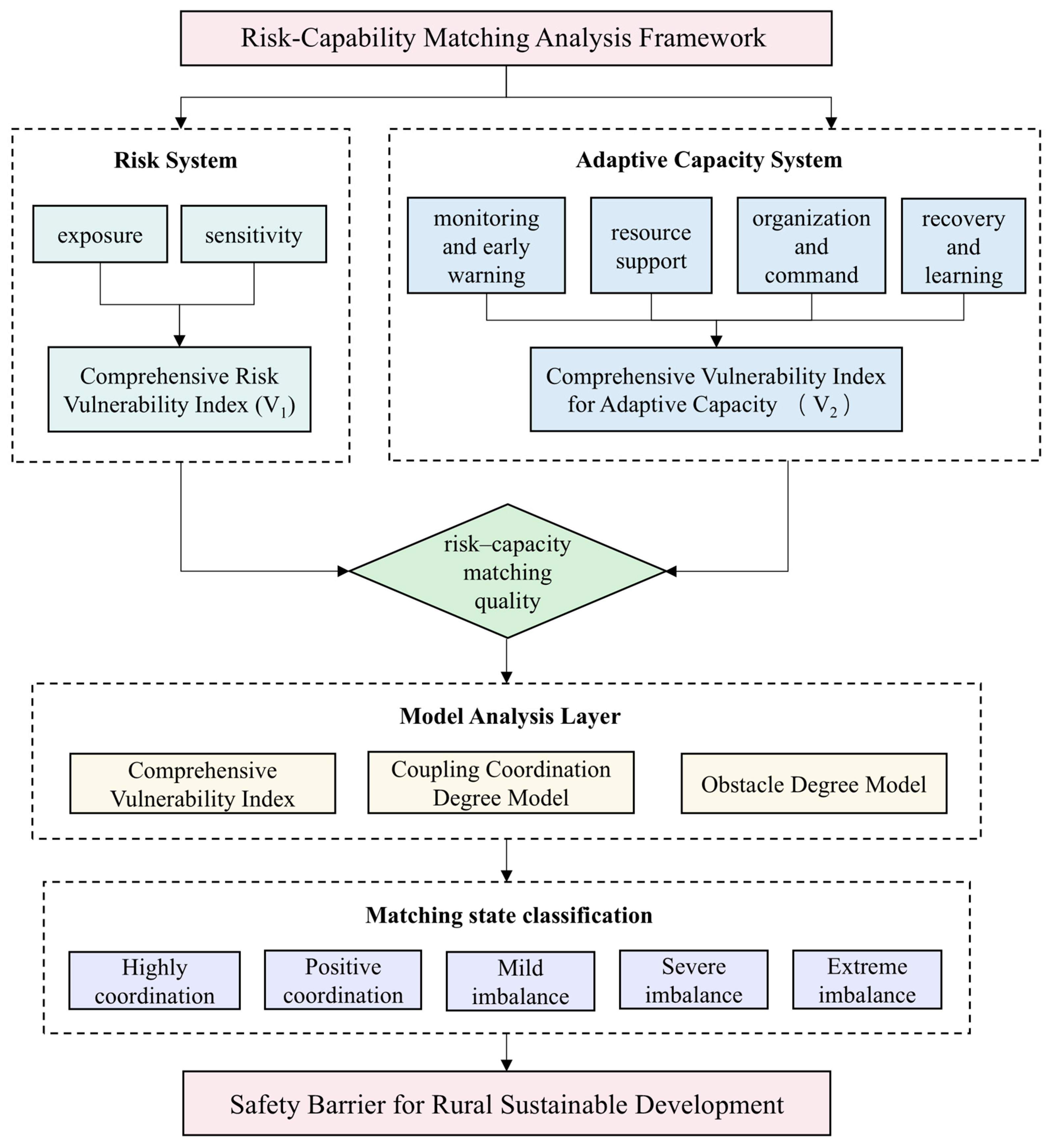
Risk–capacity matching refers to the degree of coordination and compatibility between the rural risk system, which comprises exposure and sensitivity, and the adaptive capacity system, which consists of monitoring and early warning, resource support, organization and command, and recovery and learning. The matching quality directly determines the level of vulnerability: when adaptive capacity exceeds risk requirements, vulnerability is relatively low; when adaptive capacity fails to meet risk pressure, vulnerability rises. This study quantitatively assesses this risk–capacity matching relationship using the coupling coordination degree model [
29,
38,
39].
Vulnerability of emergency response capabilities: In this study, it is defined as the degree to which the emergency response capacity system in rural areas regains its functions of monitoring and early warning, resource assurance, organizational command, and recovery and learning when subjected to multi-risk coupling impacts. Essentially, this is a combination of high exposure, high sensitivity, and insufficient adaptive capabilities, making it difficult to restore normal operations in the event of a disaster [
37,
40].
2.2. “Risk–Capability Matching” Analytical Framework
This study constructs a “risk–capacity matching” analytical framework (
Figure 1). The framework comprises two core systems: the risk system consists of exposure and sensitivity, while the adaptive capacity system includes four components, namely, monitoring and early warning, resource support, organization and command, and recovery and learning. The core of the interaction between the two systems lies in “matching”, that is, whether adaptive capacity can counteract risk pressure. When capacity exceeds risk requirements, the two systems are in good coordination and vulnerability is relatively low; conversely, when capacity lags behind risk pressure, the systems become mismatched and vulnerability is relatively high. This study uses the comprehensive vulnerability index to measure the matching outcome, the coupling coordination degree model to measure the matching quality, and the obstacle degree model to diagnose the key factors causing matching mismatches, thereby forming a progressive analytical pathway of level assessment, quality measurement, and factor diagnosis.
2.3. Indicator System and Weights
This study constructed the evaluation indicator system following a three-step approach: bibliometric framework definition, literature-based initial screening, and field investigation refinement.
In the first step, a bibliometric method was used to establish a three-dimensional first-level criterion framework comprising exposure, sensitivity, and adaptive capacity, grounded in vulnerability theory. In the second step, a systematic review was conducted of literature on rural emergency capacity and vulnerability assessment published over the past fifteen years (2011–2025) in the China National Knowledge Infrastructure (CNKI) and Web of Science. High-frequency quantitative indicators were extracted and, after deduplication, consolidation, and categorization, a candidate list containing second-level and third-level indicators was generated. In the third step, based on the natural conditions, disaster characteristics, and field visits in the study area, indicators were screened according to three criteria: regional suitability, data availability, and practical applicability. Indicators that could not be reliably obtained at the village level (e.g., building structure type, proportion of dedicated emergency funds) were removed, while context-specific indicators that align with grassroots emergency governance realities (e.g., effectiveness of cross-departmental emergency coordination mechanisms, institutional completeness of village-level emergency management organizations) were added.
Through the above process, an evaluation system comprising 3 first-level indicators, 8 second-level indicators, and 20 third-level indicators was ultimately constructed. (As shown in
Table 1).
2.4. Research Methods
2.4.1. Entropy Weighting Method: Determining Indicator Weights
To avoid subjective bias, this paper employs the entropy weighting method for objective weighting:
First, data standardization: Given
m sample villages and
n evaluation indicators, a raw matrix
is formed. Positive indicators (such as frequency of disasters) are calculated using Formula (1), while negative indicators (such as emergency broadcast coverage) are calculated using Formula (2).
where
Xij represents the standardized value of the
jth indicator for the
ith rural, max(
xj) and min(
xj) denote the maximum and minimum values of the
jth indicator.
Then, calculate the weight of each indicator:
where
i = 1, 2, …,
m (
m = number of rural case studies),
j = 1, 2, …,
n (
n = number of indicators).
Next, calculate the entropy of the metric:
Calculate the coefficient of variation:
The coefficient of variation dj reflects the degree of variation in the jth indicator across all samples; the higher the dj value, the greater the role this indicator plays in the evaluation.
Finally, determine the weights of the indicators:
2.4.2. Coupling Coordination Model: Measuring Interactions Within a System
Once the weights of the indicator system have been determined, they are applied to the data for each village to calculate the Comprehensive Risk Vulnerability Index (V1) and the Comprehensive Vulnerability Index for Adaptive Capacity (V2). However, a single index assessment can only present the level of risk and the level of emergency response capability in isolation; it cannot reveal the intrinsic relationship between the two. Therefore, this paper introduces the coupling degree model:
First, calculate
V1 using Equation (7) and calculate
V2 using Equation (8).
Based on existing research findings and the actual distribution characteristics of the data from this study, the calculated vulnerability indices were categorized into grades. The grading criteria are as follows:
0 < V1 ≤ 0.1: low risk, 0.1 < V1 ≤ 0.2: medium risk, V1 > 0.2: high risk;
0 < V2 ≤ 0.2: high adaptive capacity, 0.2 < V2 ≤ 0.4: medium adaptive capacity, V2 > 0.4: low adaptive capacity;
0 < V ≤ 0.25: low vulnerability, 0.25 < V ≤ 0.5: medium-to-low vulnerability, 0.5 < V ≤ 0.75: medium-to-high vulnerability, V > 0.75: high vulnerability.
Next, calculate the coupling degree
C and the coupling coordination degree
D:
where
C ∈ [0, 1], the closer
C is to 1, the stronger the coupling. (
C ≤ 0.3: low coupling, 0.3 <
C ≤ 0.7: medium coupling,
C > 0.7: high coupling).
The coordination index D reflects the quality of alignment between the risk system and the adaptive capacity system. Since both V1 and V2 are inverse indicators in this study (a higher V1 indicates higher risk, and a higher V2 indicates lower adaptive capacity), the practical interpretation of D is as follows: a smaller D value indicates that the village has low risk and strong adaptive capacity, and the two systems are in a state of good coordination; a larger D value indicates that the village has high risk and weak adaptive capacity, and the two systems are in a state of misalignment. D ∈ [0, 1], with the following classification criteria: D ≤ 0.2: high coordination; 0.2 < D ≤ 0.4: positive coordination; 0.4 < D ≤ 0.6: mild imbalance; 0.6 < D ≤ 0.8: severe imbalance; D > 0.8 extreme imbalance.
2.4.3. Obstacle Degree Model: Calculate the Obstacle Degree (O) and Identify Key Limiting Factors
Using the entropy weighting method and the coupling degree model, we can determine the overall level of emergency response capacity in the case of rural areas, as well as the degree of coordination imbalance between the emergency response system and the risk system. However, to identify specifically which indicators are hindering the improvement of emergency response capacity and leading to system vulnerability and coordination imbalance, it is necessary to introduce the obstacle degree model:
First, calculate the Factor Contribution (
Fj):
Then calculate the indicator deviation degree (
Ij):
Finally, calculate the obstacle degree (
Oj):
2.5. Study Area and Data Sources
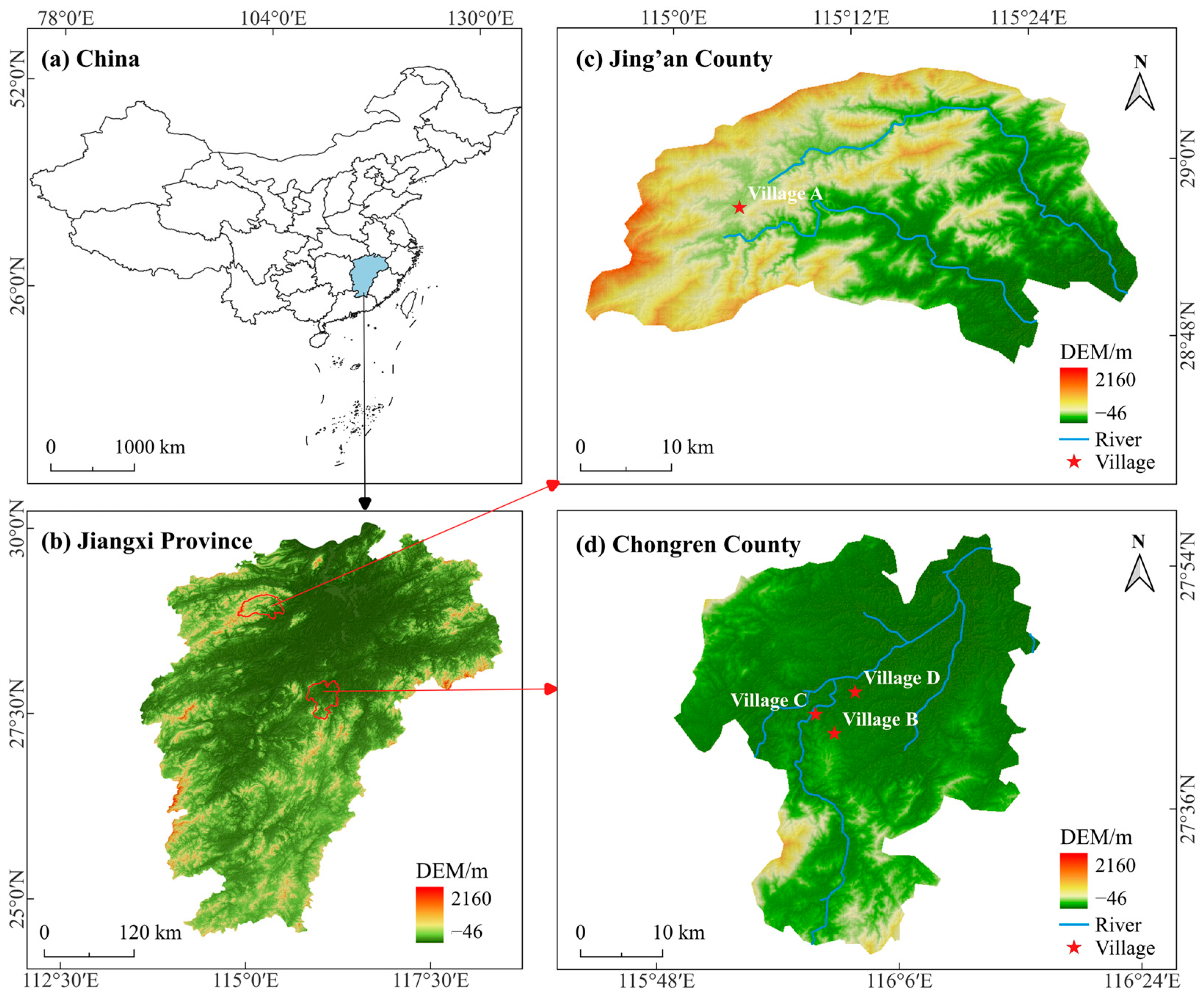
Jiangxi Province is located in southeastern China, and its terrain consists mainly of mountains and hills (
Figure 2). Its humid subtropical climate leads to concentrated rainfall, resulting in frequent floods and geological disasters. While rural areas in Jiangxi serve as the backbone of agricultural production, they also face practical challenges such as inadequate infrastructure and population decline, which severely hinder their sustainable development.
To enhance the representativeness of the sample, this study selected four typical villages from two counties in Jiangxi Province that differ markedly in geographical characteristics and levels of economic development (
Table 2). Chongren County encompasses hilly, riverine, and plain terrain. Its economic development is relatively underdeveloped, and the construction of its adaptive capacity system faces tighter resource constraints. Three villages with different topographical conditions (Villages B, C, and D) were selected within this county to examine the influence of topographical factors while controlling for administrative and fiscal backgrounds. In contrast, Jing’an County has a relatively strong economic base and is predominantly mountainous, with a relatively greater capacity to invest in emergency resources. Village A in this county was selected as an inter-county reference to reveal the moderating role of economic conditions in overcoming topographical constraints. Both counties have maintained long-term field investigation partnerships with our research group, ensuring reliable access to village-level data. Moreover, the differences between the two counties in topography, economic development level, and adaptive capacity systems provide a valuable comparative case foundation for this study.
Data sources include (1) village-level disaster records covering the period from 2023 to 2025, which were routinely recorded by village disaster information officers and compiled by township emergency management offices. These records include the frequency and intensity of disasters, economic losses, and emergency response measures. (2) Field research conducted by our team from December 2025 to January 2026. The study employed a combination of household visits and semi-structured interviews with village officials to collect data for all 20 third-level indicators. Additionally, one-on-one interviews were conducted with more than 20 village leaders (including party secretaries) and emergency management personnel to gain an in-depth understanding of the actual conditions at the organizational level regarding the development of emergency response plans, the conduct of emergency drills, and the management of material reserves.
3. Results
3.1. Differentiation Characteristics of the Comprehensive Vulnerability Index
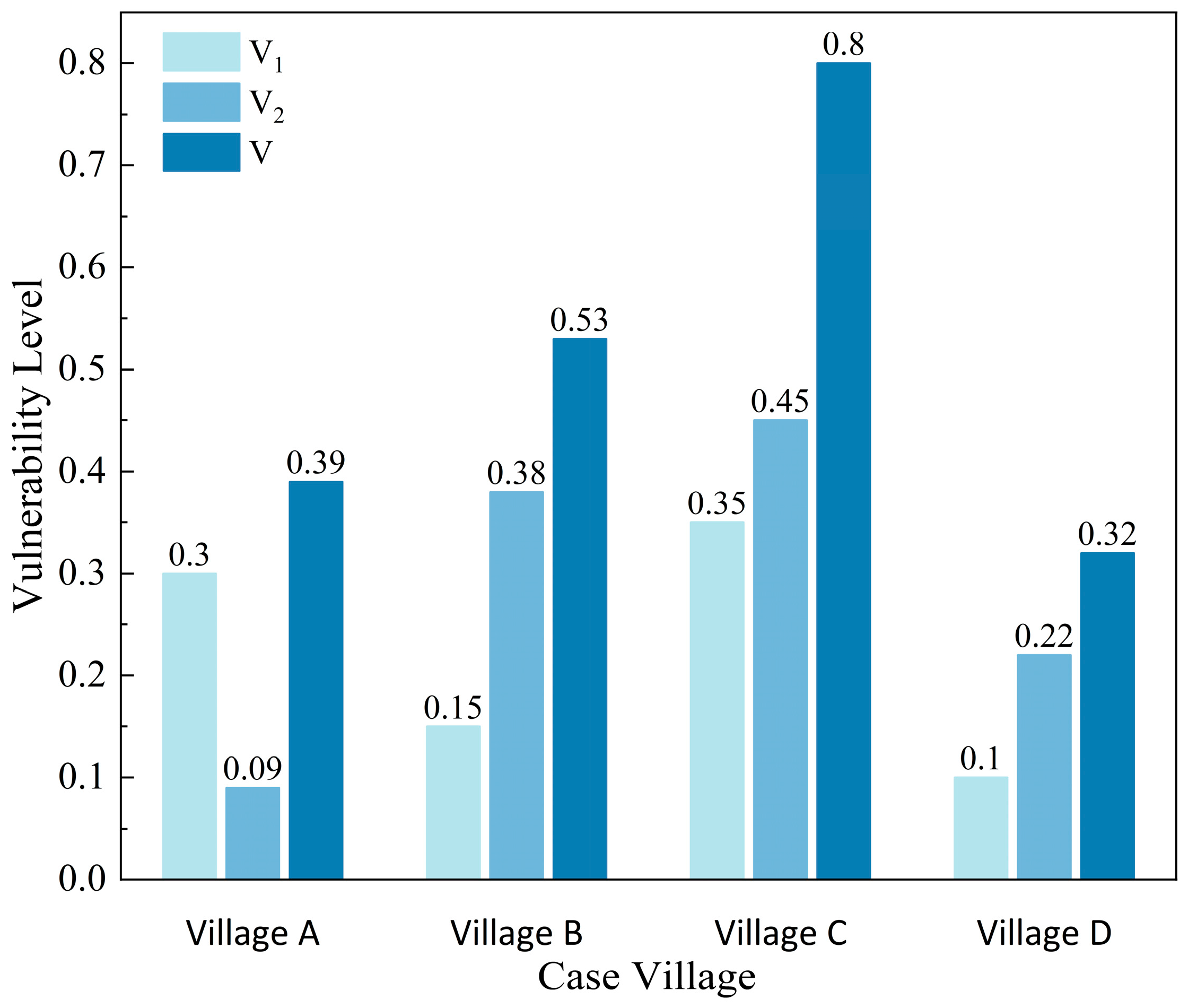
Based on the weights of the indicator system and the standardized indicator data, the Comprehensive Risk Vulnerability Index (
V1), the Comprehensive Vulnerability Index for Adaptive Capacity (
V2), and the Comprehensive Vulnerability Index (
V) were calculated for the four case villages. Based on the classification criteria established in
Section 2.4.2, the vulnerability level of each village was categorized by type. The results are shown in
Table 3 and
Figure 3:
In terms of the Comprehensive Vulnerability Index (V): Village C (V = 0.8) falls into the high vulnerability category, making it the most vulnerable among the four villages; Village B (V = 0.53) is rated as medium-to-high vulnerability; Villages A (V = 0.39) and D (V = 0.32) are classified as medium-to-low vulnerability. To further analyze the differences in the internal structure across villages, we conducted a multidimensional vulnerability index analysis.
Regarding the Comprehensive Risk Vulnerability Index (V1): Village C (0.35) and Village A (0.3) are classified as high-risk areas, a classification closely linked to their geographical characteristics. Village C is located along a river and frequently faces the threat of flooding, while Village A is situated in a mountainous area with a relatively high risk of geological disasters. Furthermore, based on the collected data, both Village C and Village A have high population densities, resulting in a combination of high exposure and high sensitivity, which makes them high-risk villages. Village B (0.15) is classified as medium risk, with its hilly terrain posing a certain risk of landslides; Village D (0.1) is classified as low risk, as its flat terrain carries the lowest risk of natural disasters.
Regarding the Comprehensive Vulnerability Index for Adaptive Capacity (V2): Village C (0.45) has a low adaptive capacity, which is directly linked to its poor economic conditions; these economic constraints limit investment in per capita emergency supplies, equipment modernization, and emergency rescue teams. Village B (0.38) and Village D (0.22) have moderate adaptive capacity; although their economies are average, they are stronger than Village C’s, and they outperform Village C in terms of per capita emergency supply reserves and rescue teams. Village A (0.09) demonstrates a high level of adaptive capacity. Its core performance indicators, including per capita stockpiles of emergency supplies, the level of modernization of emergency equipment, and the comprehensiveness of emergency plans, all meet ideal standards, fully illustrating the positive impact of favorable economic conditions on the development of adaptive capacity.
Based on the combined characteristics of V1 and V2, four types of risk-capability relationships are identified:
(1) High risk–High adaptive capacity (Village A): Although its V1 indicates a high risk level, its V2 is the lowest among all villages, creating a virtuous cycle in which “high capacity offsets high risk,” resulting in relatively low overall vulnerability.
(2) Medium risk–Medium adaptive capacity (Village B): At the medium-risk level in V1, the medium-to-low adaptive capacity reflected in V2 emerges as the primary weakness, resulting in a medium-to-high level of overall vulnerability.
(3) High risk–Low adaptive capacity (Village C): It is the most vulnerable of the four villages, creating a vicious cycle of “high risk and low adaptive capacity”; the combination of these two factors has pushed vulnerability to its peak.
(4) Low risk–Medium adaptive capacity (Village D): While its V1 score is the lowest among all villages, the medium adaptive capacity reflected in V2 weakens the advantages of low risk, resulting in a rating of medium-to-low vulnerability.
3.2. An Analysis of the Relationship Between Coupling Coordination and Vulnerability
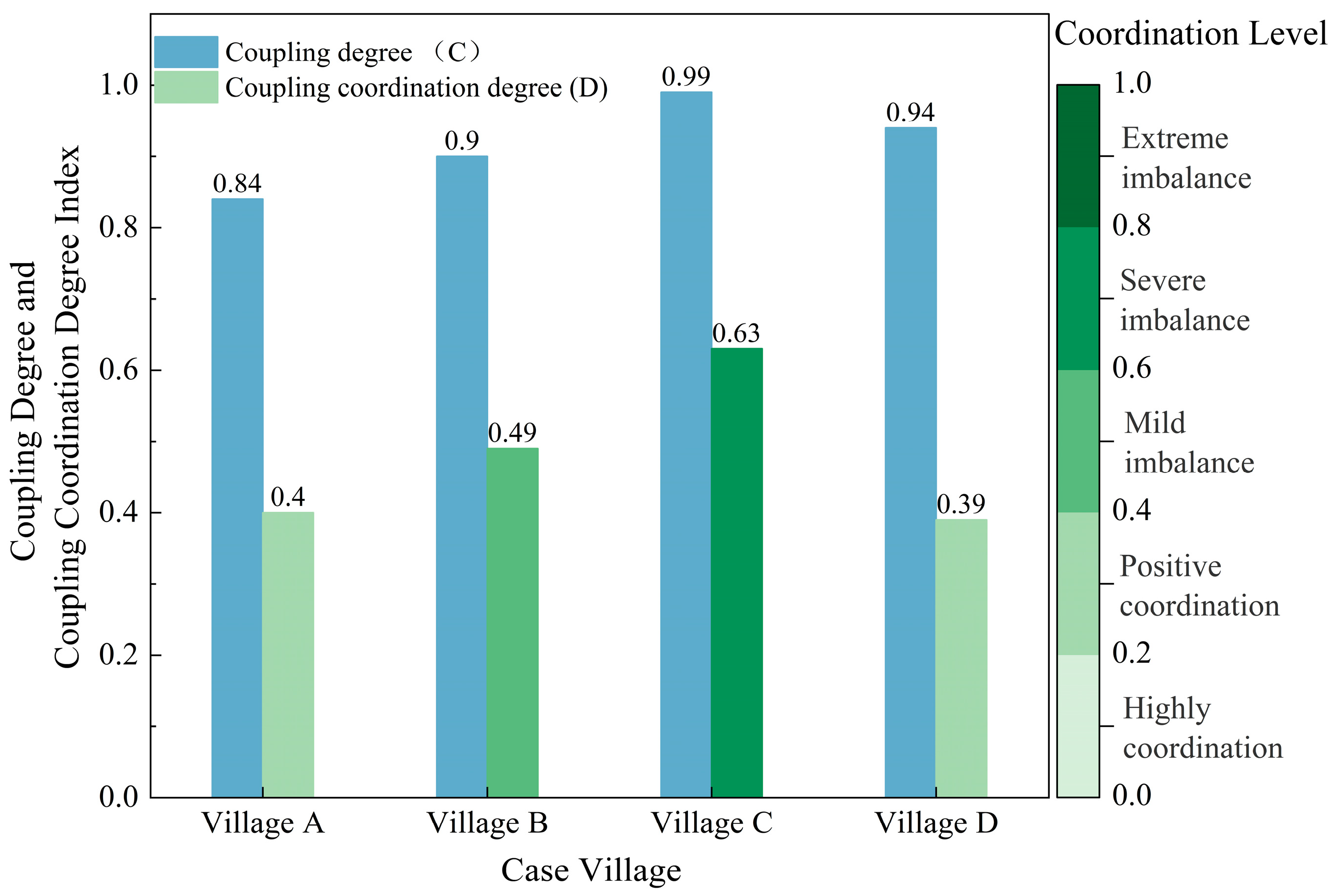
The coupling degree
C ≥ 0.7 for all four case villages, placing them in the high-coupling range. This indicates a strong interactive relationship between the risk systems and the adaptive capacity systems in each village. The level of coordination is determined by the quality of the “risk-capacity” match and exhibits distinct hierarchical characteristics (see
Figure 4).
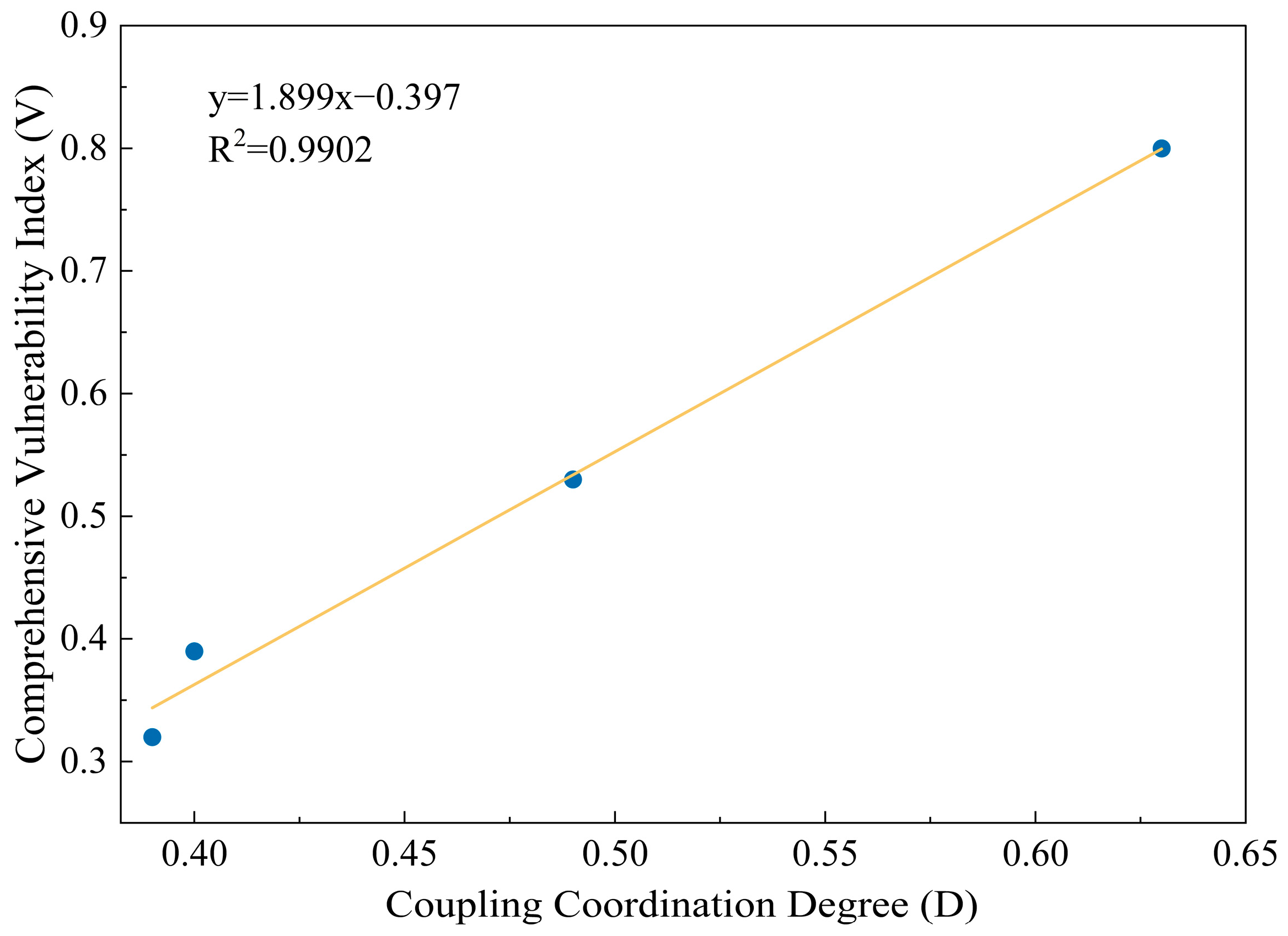
Using Pearson’s correlation coefficient, we analyzed the linear relationship between the coupling coordination index
D and the comprehensive vulnerability index
V. The results are shown in
Figure 5. The two variables show a very strong positive correlation (r = 0.995,
p < 0.01); that is, the higher the coupling coordination index
D (the more severe the imbalance) and the higher the comprehensive vulnerability index
V. This validates the core logic that “the coordination quality of the ‘risk-capacity’ system directly determines the level of vulnerability”:
Positive coordination (Village A and Village D) corresponds to medium-to-low vulnerability: high coupling amplifies the positive feedback loops of “high risk–high adaptive capacity” and “low risk–medium adaptive capacity,” and the systemic interaction creates a virtuous cycle of “risk prevention and control–adaptive capacity,” which is key to reducing vulnerability.
Mild imbalance (Village B) corresponds to medium-to-high vulnerability: Although classified as “medium risk–medium adaptive capacity,” its V2 value of 0.38 indicates a capacity closer to the medium-to-low range. High coupling amplifies the mismatch between risk and capacity, and systemic interactions face localized constraints, resulting in vulnerability at the medium-to-high level.
Severe imbalance (Village C) corresponds to high vulnerability: with a coupling coefficient as high as 0.99, the negative feedback loop of “high risk–low adaptive capacity” is amplified to the extreme. Systemic interactions create a vicious cycle of “escalating risk–failing capacity,” and this dual high vulnerability is continuously amplified by high coupling, pushing vulnerability to its highest level.
3.3. Obstacle Factor Diagnosis
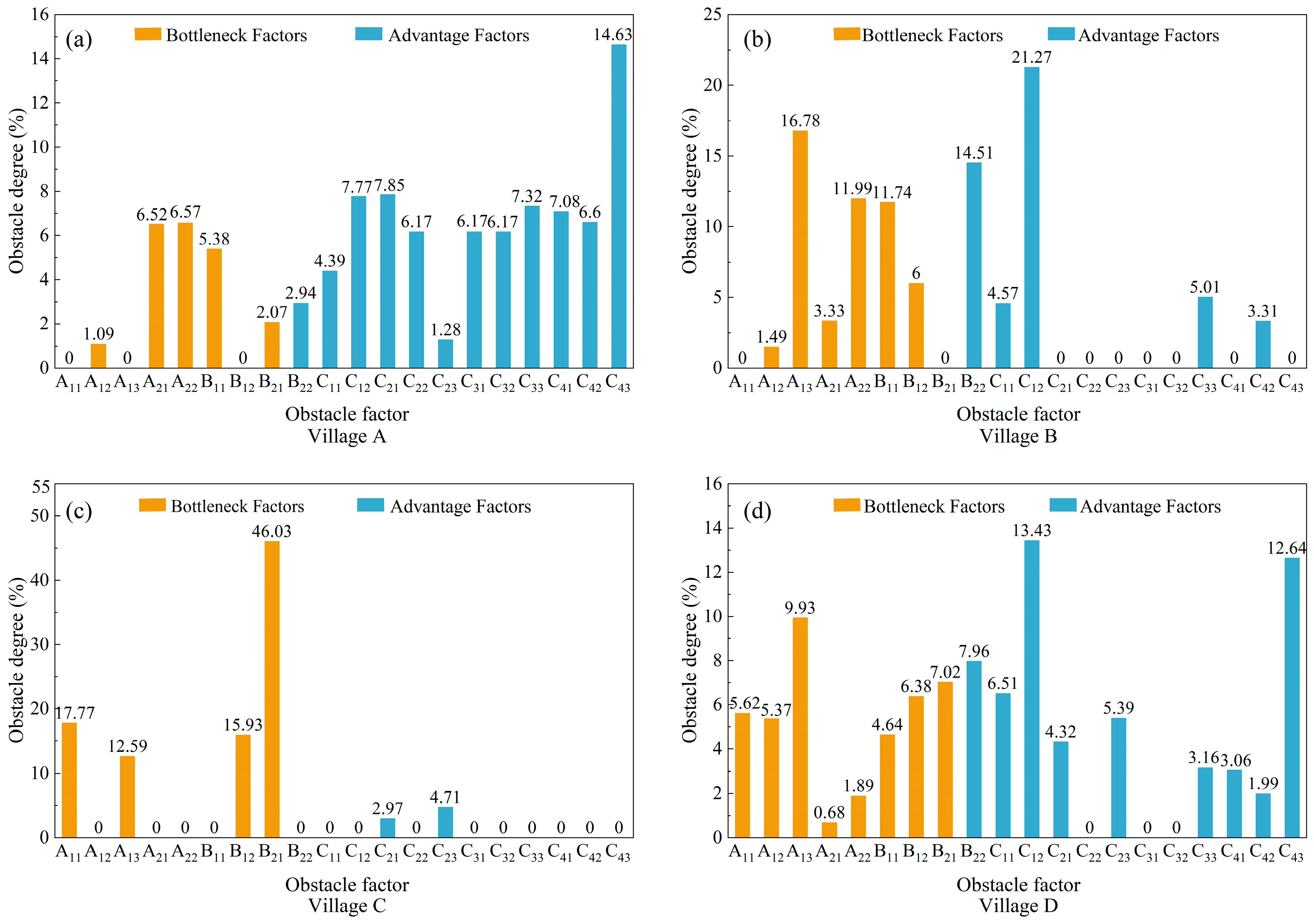
To identify the key factors affecting the vulnerability of each village’s emergency response capacity, the obstacle degree model was used to calculate the contribution of each indicator to vulnerability. Since the indicator system used in this study includes positive indicators (where higher values indicate higher vulnerability) and negative indicators (where higher values indicate lower vulnerability), the meaning of the “obstacle index” differs: in the calculation of the obstacle index, positive indicators are considered factors that exacerbate vulnerability—that is, “bottleneck factors” that impair emergency response capacity—while negative indicators are considered factors that mitigate vulnerability—that is, “advantage factors” that enhance emergency response capacity. Based on the actual calculation results, this paper uses a threshold of “obstacle degree > 7%” to identify core obstacle factors. The diagnostic results are shown in
Table 4 and
Figure 6:
Village A (Capability-dominated): core obstacle factors emergency awareness rate C43, per capita emergency supplies C21, emergency broadcast coverage C12, effectiveness of cross-regional emergency response mechanisms C33, and others are all advantage factors that mitigate vulnerability. These advantage factors account for 78.37%, and no significant bottleneck factors are present, indicating that Village A has already developed strong adaptive capacity. This structure has laid a solid safety foundation for sustainable rural development and serves as the core basis for achieving low vulnerability under high-risk conditions.
Village B (balanced type): core obstacle factors emergency broadcast coverage C12, density of geological hazard sites A13, per capita floor area in emergency shelters B22, infrastructure density A22, and ratio of the elderly to the child population B11, encompass both advantage and bottleneck. However, since the bottleneck factor (51.33%) outweighs the advantage factor (48.67%), this creates a compound exacerbating effect of “risk exposure coupled with insufficient capacity,” ultimately resulting in medium-to-high vulnerability and becoming a security bottleneck for rural sustainable development.
Village C (risk-dominated): core obstacle factors percentage of older housing B21, frequency of disasters A11, percentage of low-income residents B12, and density of geological hazard sites A13 are all factors that exacerbate vulnerability. Furthermore, there are no significant advantage indicators in the adaptive capacity dimension. The “risk amplification–capacity failure” pattern directly exacerbates Village C’s vulnerability, classifying it as a highly vulnerable village and severely hindering sustainable development processes such as rural living environment improvements and industrial planning.
Village D (balanced Type): core obstacle factors emergency broadcast coverage C12, emergency awareness rate C43, per capita floor area in emergency shelters B22, density of geological hazard sites A13, percentage of older housing B21 are relatively balanced, with advantage (58.46%) outweighing bottleneck (41.54%). The strengths in medium-level adaptive capacity offset local risk shortcomings, ultimately placing Village D in a state of low-to-medium vulnerability. This represents a balanced state of risk and safety in rural sustainable development.
As shown in
Figure 6, Village A, which has a stronger economic foundation, exhibits a higher proportion of advantage factors, with core obstacle factors concentrated at the adaptive capacity level. In contrast, in Village C, which has a less developed economy, obstacles are highly concentrated at the risk level, and with poor adaptive capacity, the village struggles to break free from a risk-dominated structure. Villages B and D have comparable economic levels, but their distributions of obstacle factors differ due to differing pressures from natural risks. This indicates that the level of economic development determines, to a certain extent, the allocation of emergency resources, which in turn shapes the structure of obstacle factors in rural areas.
4. Discussion
Based on the analysis of the empirical findings presented above, this study reveals that the level of vulnerability in rural emergency response capacity is not determined by a single factor but rather results from the combined effects of three factors: the “risk-capacity matching relationship,” the “direction of coupling,” and the “foundation of economic development.” The core mechanism underlying this phenomenon can be summarized in the following three dimensions:
4.1. Risk–Capacity Matching Degree and System Vulnerability
The results of the coupling coordination degree model indicate that system vulnerability depends on the degree of matching between risk and capacity, rather than a simple sum of their respective levels. A comparison between Village A and Village C clearly illustrates this logic: Village A (V1 = 0.30) and Village C (V1 = 0.35) both fall into the high-risk category, yet their vulnerability levels differ by two grades. The key lies in the stark disparity in their adaptive capacities: Village A (V2 = 0.09) versus Village C (V2 = 0.45).
This discrepancy can be explained in greater detail by examining the actual progression of the disaster chain. Take torrential rain disasters as an example: Village C is located in a low-lying area along a river. After heavy rains, the river swelled and flooded the main thoroughfare, causing severe waterlogging in areas with a high concentration of dilapidated housing. However, due to insufficient emergency broadcast coverage and low per capita floor area in emergency shelters, the transmission of early warning information was delayed and the evacuation of residents was difficult, resulting in a complete disaster chain of “torrential rain—flooding—road disruption—people trapped.” Although Village A is located in a mountainous area and faces landslide risks, it has comprehensive monitoring and early warning facilities and ample emergency supplies. After heavy rain triggered a landslide, the village was able to quickly activate its emergency plan and organize evacuations, thereby breaking the disaster chain at an early stage. It is evident that high adaptive capacity does not involve passively enduring the sequential transmission of the disaster chain but rather involves intervening early to interrupt the evolution of the disaster chain; this is the fundamental difference between the two matching models.
This conclusion can be further verified by examining the distribution of obstacle factors: The obstacle factors in Village A are concentrated at the adaptive capacity system level, indicating that its adaptive capacity is already largely aligned with risk requirements. The obstacle factors in Village B and Village D are spread across multiple dimensions of risk and adaptive capacity, indicating that the risk and adaptive capacity system are in a state of competition. There is an urgent need to implement targeted response strategies and address core weaknesses. The obstacle factors in Village C are highly concentrated at the risk level, indicating that its adaptive capacity is completely inadequate to meet high-risk demands; therefore, risks must be addressed at their source, and the development of an adaptive capacity system must be accelerated. This finding complements the research by Li et al., which attributes the divergence in urban and rural vulnerability not only to disparities in resource endowments but also to structural imbalances in the risk–capacity relationship [
5].
4.2. The Dual Amplification Effect of High Coupling
The empirical results show that the coupling degree for all four villages is greater than 0.7, indicating a very strong interaction between the risk and capacity systems, the direction of which depends on the quality of the system alignment: Village A and Village D form a virtuous cycle of positive amplification. Village A effectively counteracts mountain hazard risks with ample material reserves, comprehensive early warning facilities, and a sound organizational structure. Village D, situated on plain terrain with relatively low risk, possesses a moderate response capacity sufficient to cope with routine disasters. High coupling fully transforms capacity advantages into risk prevention and control effectiveness, generating a virtuous cycle of “risk prevention and control–capacity response–vulnerability reduction.”
Village C exemplifies a vicious cycle of negative amplification. Its coupling coefficient of 0.99 amplifies the negative feedback loop of “high risk–low adaptive capacity” to the extreme. Topographically, Village C is situated in a low-lying area along a river, exposing it to elevated flood risks; the high proportion of dilapidated housing and the concentration of low-income populations further increase its sensitivity. Economically, its underdeveloped conditions constrain the stockpiling of emergency supplies, the modernization of equipment, and the building of professional teams. These dual adverse factors combine to create a vicious interaction of “escalating risk–failing capacity–rising vulnerability.” This also explains why Village C and Village A both fall into the high-risk category, yet Village C reaches a high vulnerability level while Village A remains at a medium-to-low vulnerability level.
The above analysis indicates that topographical conditions determine the baseline of risk, the level of economic development determines the upper limit of adaptive capacity, and high coupling amplifies the gap between the two to the extreme. This finding extends the research of Yao et al. on the risk coupling amplification effect and corroborates the view of de Ruiter et al. regarding the coupling amplification effects of successive disasters: the amplification effect of coupling is not merely the amplification of risks but the extreme amplification of the gap in risk–capacity matching [
45,
46].
4.3. The Foundational Role of the Level of Economic Development and the Moderating Effect of Topographical Conditions
Obstacle factors are directional and heterogeneous, while the level of economic development plays a fundamental shaping role in the interplay of these factors. It fundamentally determines the upper limit of emergency response capacity building and serves as the core resource underpinning the development of safety capabilities in rural sustainable development. Village A possesses a sound economic base and sufficient investment in adaptive capacity building, with advantage factors accounting for as high as 78.37%, forming an “adaptive capacity–dominated” structure. In contrast, constrained by a weak economic foundation, Village C has limited investment in adaptive capacity building, resulting in widespread weaknesses across emergency supplies, equipment, and professional teams; it struggles to break free from a risk-dominated structure and remains trapped in a vicious cycle of “high risk–high vulnerability.” Villages B and D have comparable economic levels, yet their obstacle factor distributions diverge due to differing topographical conditions. Village B, situated on hilly terrain with higher risk, has marginally more constraint factors than advantage factors; Village D, located on flat terrain with lower risk, shows advantage factors surpassing constraint factors. This indicates that, under similar economic conditions, natural geographical conditions can alter the spatial distribution of obstacle factors by changing the exposure level of regional risks. The economic foundation sets the upper limit of resources for adaptive capacity building, while topographical conditions determine the baseline level of regional risks; together, they shape the obstacle factor structure of villages.
The finding that economic conditions and topography jointly shape the structure of obstacle factors can engage in academic dialogue with the existing literature at three levels. First, Li et al. confirmed the systemic disadvantages of rural areas in infrastructure and fiscal capacity [
5]. Building on this, the present study further shows that the impact of economic constraints on vulnerability extends beyond simply reducing the level of adaptive capacity; it fundamentally alters the distribution structure of obstacle factors, and in economically disadvantaged villages the core bottleneck factors often originate from the risk side rather than the capacity side. Second, de Ruiter et al. revealed the resource depletion mechanism of successive disasters [
46]. From a static perspective, our study adds the finding that unfavorable topography itself constitutes sustained high risk exposure, and when combined with economic disadvantage, it significantly amplifies vulnerability, whereas favorable topography can serve as a risk buffer. Finally, Zhu et al. emphasized that the interaction of multiple factors is a key direction in rural resilience research [
16]. The empirical analysis presented in this paper provides concrete evidence from rural China to support this line of inquiry.
4.4. Limitations of the Study
Although this study systematically analyzes the differentiated characteristics and formation mechanisms of rural emergency response capacity vulnerability in typical villages of Jiangxi Province, several limitations remain due to constraints in research design and data scope. First, the sample covers only four villages in two counties of Jiangxi Province, limiting the number of cases. The strong correlation (r = 0.995) shown in
Figure 5 only reflects the internal patterns of the current sample, and the generalizability of the conclusions requires further validation with more cases. Future research should extend to different provinces and types of disaster-prone areas. Second, the indicator system primarily consists of socioeconomic and management indicators, while spatial dimensions such as terrain slope, road accessibility, and the service radius of emergency shelters are insufficiently represented. Subsequent studies can integrate GIS-based spatial analysis methods to address this gap. Third, the indicators and grading criteria in this study were developed based on the rural context of China. When applied to other countries or regions, recalibration according to local conditions is necessary; however, the “risk–capacity matching” analytical perspective and methodological pathway hold cross-contextual reference value. Fourth, this study places particular emphasis on economic development factors, with insufficient attention to sociocultural factors such as community cohesion and local leadership. Future research can complement these aspects through qualitative methods.
5. Conclusions and Recommendations
Using four typical rural communities as case studies, this paper adopts a perspective of rural sustainable development and integrates the Comprehensive Vulnerability Index, the Coupling Degree Model, and the Obstacle Degree Model to reach the following conclusions:
(1) Rural emergency response capacity vulnerability is the result of the matching between the risk system and the adaptive capacity system, rather than a simple superposition of risk and capacity levels. Promoting the system’s transformation from a risk-dominated to an adaptive capacity-dominated state is the core pathway to reducing vulnerability and strengthening the safety foundation for sustainable rural development.
(2) High coupling exerts a dual amplification effect on system interactions. In a virtuous cycle, it generates a positive amplification of “risk prevention and control–capacity response,” thereby reducing vulnerability; in a vicious cycle, it generates a negative amplification of “escalating risk–failing capacity,” thus aggravating vulnerability.
(3) Obstacle factors exhibit directionality and heterogeneity. Indicators with high obstacle degrees in the exposure and sensitivity dimensions are constraint factors that need to be reduced with priority, while those in the adaptive capacity dimension are advantage factors that need to be consolidated. Furthermore, the economic foundation determines the capacity for resource input, fundamentally influencing whether a village can shift from a risk-dominated to an adaptive capacity-dominated state; topographical conditions moderate the level of risk exposure, thereby further shaping the distribution pattern of obstacle factors.
Based on the above conclusions, the following targeted recommendations are proposed for enhancing rural emergency response capacity. For villages characterized by a vulnerable economy and high risk-dominated structure (e.g., Village C), priority should be given to risk source reduction measures such as hazard avoidance relocation, dilapidated housing renovation, and the mitigation of geological hazard sites, alongside increased investment in basic adaptive capacity, including emergency material reserves and the development of rescue teams. For villages characterized by a moderate economy and balanced structure (e.g., Villages B and D), efforts should focus on optimizing constraint factors, such as improving the coverage of emergency broadcasting, increasing the per capita area of emergency shelters, and strengthening targeted protection for the elderly and children. For villages characterized by a sound economy and adaptive capacity–dominated structure (e.g., Village A), on the basis of consolidating existing capacity advantages, it is essential to further improve cross-regional emergency coordination mechanisms and the dissemination of emergency knowledge, so as to play an exemplary and leading role. The above measures should be effectively aligned with current village planning standards and regulations on the layout of disaster prevention facilities, so as to integrate risk prevention and control as well as adaptive capacity building into rural spatial planning and daily governance.