1. Introduction
Accessibility in natural and recreational landscapes is increasingly recognised as a fundamental condition for equitable participation in social, cultural and leisure activities. Nevertheless, it remains particularly challenging in environments characterised by topographic complexity, climatic severity and seasonal variability. In alpine ski areas, accessibility is shaped not only by physical conditions—such as steep terrain and variable snow cover—but also by the fragmentation of services, infrastructures and organisational responsibilities that collectively define the visitor experience. This integrated view aligns with broader perspectives in landscape planning that emphasise the interconnected nature of social-ecological systems and the need for multi-disciplinary approaches to understand and address landscape change and human-environment interactions.
The Universal Design (UD) paradigm provides a conceptual foundation for inclusive environments, promoting solutions usable by diverse people without subsequent adaptation [
1]. In snow-covered mountain environments, however, UD must be interpreted through dynamic conditions such as seasonal surface changes, temporary accessibility routes and the need for human mediation. These conditions call for a process-based understanding of accessibility, which is developed in
Section 2.2.
Within tourism studies, the concept of Accessible Tourism has gained prominence not only as a human-rights issue but also as a strategic component of sustainable destination competitiveness. According to the World Tourism Organization [
2], accessible tourism involves the design of products, services and environments that enable people with disabilities, older adults and other users with specific needs to participate independently, safely and with dignity in tourism experiences. This approach emphasises the idea of a chain of accessibility, whereby the failure of a single element—such as information availability, site entry systems or service interfaces—can compromise the entire visit experience. Moreover, research in accessible tourism highlights that effective inclusion involves not only physical infrastructure but also information systems, staff competence, and coordinated service delivery [
3].
Recent literature further underscores the role of inclusive tourism as a vector of social cohesion and local development, particularly in regions facing demographic decline and economic fragility. Inclusive tourism policies that embed accessibility and Universal Design principles contribute not only to the inclusion of people with disabilities, but also to broader objectives of social equity, community resilience and quality of life for local populations [
4]. Such perspectives resonate with research showing that the design and provision of accessible public spaces enhance social interaction and collective wellbeing, thereby strengthening social cohesion and community integration.
Despite these advances, accessibility in natural and outdoor recreational contexts remains less developed than accessibility in urban and building environments. Existing studies document persistent physical, informational and organisational barriers in nature-based recreation [
5,
6,
7], while existing accessibility checklists and audit tools provide useful compliance baselines but do not model the continuity of experience across sequential phases of use [
8,
9]. In ski areas, available accessibility indications are often fragmented, tourism-oriented, promotional or based on local practice rather than on systematic academic literature or dedicated regulation. This creates a specific methodological gap: the absence of a framework able to assess alpine ski resort accessibility as an interdependent flow of information, arrival, transfer, lift access, slope use, rest and return.
In response to this gap, the paper proposes a flow-chain framework that conceptualises accessibility in alpine ski areas as a continuous and interconnected experience structured across key phases of use: pre-trip information, arrival and welcome, active participation on lifts and slopes, rest and socialisation, return and feedback. The contribution does not lie in the generic concept of a user journey, which is well established in service design, but in its accessibility-oriented operationalisation for a seasonal, multi-actor and infrastructure-dependent mountain environment. In this context, a single unresolved interruption, such as an inaccessible transfer point or unsupported boarding procedure, can prevent participation in the whole experience rather than merely reducing service satisfaction.
Building on this clarified research gap and methodological positioning, the study presents the development of an operational accessibility toolkit designed to support ski resort managers, planners and local stakeholders in assessing current conditions and identifying incremental strategies for improvement. Selected evaluation sheets are presented to demonstrate how theoretical principles of UD and accessible tourism can be translated into practical decision-support tools without reducing accessibility to rigid standards or prescriptive measures.
The paper contributes in three ways. First, it integrates Universal Design, accessible tourism and systems thinking within a landscape-planning perspective for alpine ski areas. Second, it develops an operational toolkit that translates the flow-chain framework into qualitative assessment and improvement procedures. Third, it demonstrates the methodological relevance of non-compensatory, journey-based accessibility assessment in a seasonal and multi-actor environment where conventional compliance checklists are insufficient. The study is therefore relevant to sustainability-oriented research on SDG 10, SDG 11 and SDG 3, while remaining explicitly limited to methodological and qualitative validation rather than large-scale quantitative impact assessment.
2. Conceptual Background
2.1. Accessibility as a Relational and Socio-Spatial Concept
Accessibility is understood here as a relational socio-spatial condition rather than as a purely technical attribute of the built environment. This position follows disability studies and public-health approaches that interpret disability as the result of interactions between individual capabilities, environmental demands and institutional arrangements [
10,
11]. It also builds on the distinction between accessibility and usability, where objective environmental conditions must be considered together with activities, perception and effective use [
12,
13].
In snow-covered mountain environments, this relational interpretation is essential because the same infrastructure may be usable or unusable depending on snow cover, slope conditions, available assistance, equipment and information. The Ski-Ability framework therefore treats accessibility and usability as interdependent dimensions of the ski-resort experience [
14].
2.2. Universal Design, Adaptive Design and Landscape Inclusivity
UD provides a foundational framework for inclusive environments by promoting solutions that accommodate diverse users from the outset [
15,
16]. In alpine ski areas, however, UD cannot be applied only through static dimensional standards, because accessibility is affected by snow cover, slope gradients, weather variability, specialised equipment, staff procedures and seasonal operating conditions.
For this reason, the Ski-Ability framework distinguishes between fixed accessibility outcomes and flexible implementation means. The first tier comprises structurally non-negotiable outcomes: requirements whose absence produces exclusion rather than a lower-quality experience. These include, for example, at least one usable route connecting parking, ticketing and lift access; accessible toilets at relevant service levels; and trained staff at primary transfer or boarding points. These outcomes correspond to Essential and Priority elements in the toolkit.
The second tier comprises contextually adjustable means: solutions whose technical form may vary according to season, morphology or operational capacity, provided that continuity of access is maintained. For example, the same route objective may be achieved through snow clearing, compact surfaces, synthetic sliding surfaces, staff-assisted transfer or temporary management measures. In this sense, adaptation does not weaken UD; it specifies how UD outcomes can be maintained in variable mountain conditions. The operational principle is therefore fixed outcomes with flexible means.
2.3. Accessibility, Justice and Access to Nature
Accessibility to natural and recreational landscapes is a dimension of social sustainability because unequal access to nature reinforces broader inequalities in wellbeing, participation and citizenship [
17,
18,
19,
20]. This is particularly relevant in mountain regions, where topography, climate and limited service integration can transform recreational landscapes into exclusionary environments for people with disabilities.
In alpine tourism, accessibility therefore cannot be treated only as a technical requirement. It is also a territorial and social issue that affects participation opportunities, local cohesion and the long-term resilience of mountain communities. This perspective justifies the paper’s focus on ski areas as complex landscape-service systems rather than as collections of isolated facilities.
2.4. Accessible Tourism, Outdoor Recreation and Community Resilience
Accessible tourism research highlights that inclusive destinations can support participation, diversify demand and strengthen community resilience, especially in peripheral and mountain regions [
21,
22]. In outdoor recreation, participation in sport and nature-based activities is also associated with social integration, identity and place attachment [
23,
24]. In winter-sport contexts, adaptive snowsport research has shown that participation depends on equipment, instructor competence, staff coordination and site-level organisation rather than on isolated infrastructure alone.
Recent work on alpine skiing confirms that barriers are multi-dimensional. Studies of skiers with visual impairments highlight the importance of guides, resort awareness and inclusive sport structures [
25], while design research on skiing accessibility identifies architectural, attitudinal, organisational, informational and technological barriers [
26]. These studies show that accessible skiing cannot be reduced to adaptive equipment or individual programmes; it requires resort-level assessment of routes, lifts, services, information and governance. The Ski-Ability project responds to this gap by shifting the unit of analysis from individual adaptive-ski programmes to the ski-resort system.
2.5. Systemic Approaches and the Flow-Chain Logic
A recurring limitation in accessibility assessment is the tendency to evaluate individual components, such as paths, toilets, lifts or service desks, without modelling how they depend on one another over time. The service-design literature has long analysed customer journeys as sequences of touchpoints [
27,
28,
29,
30]. The Ski-Ability flow-chain adopts this sequential logic but changes its purpose and normative meaning (
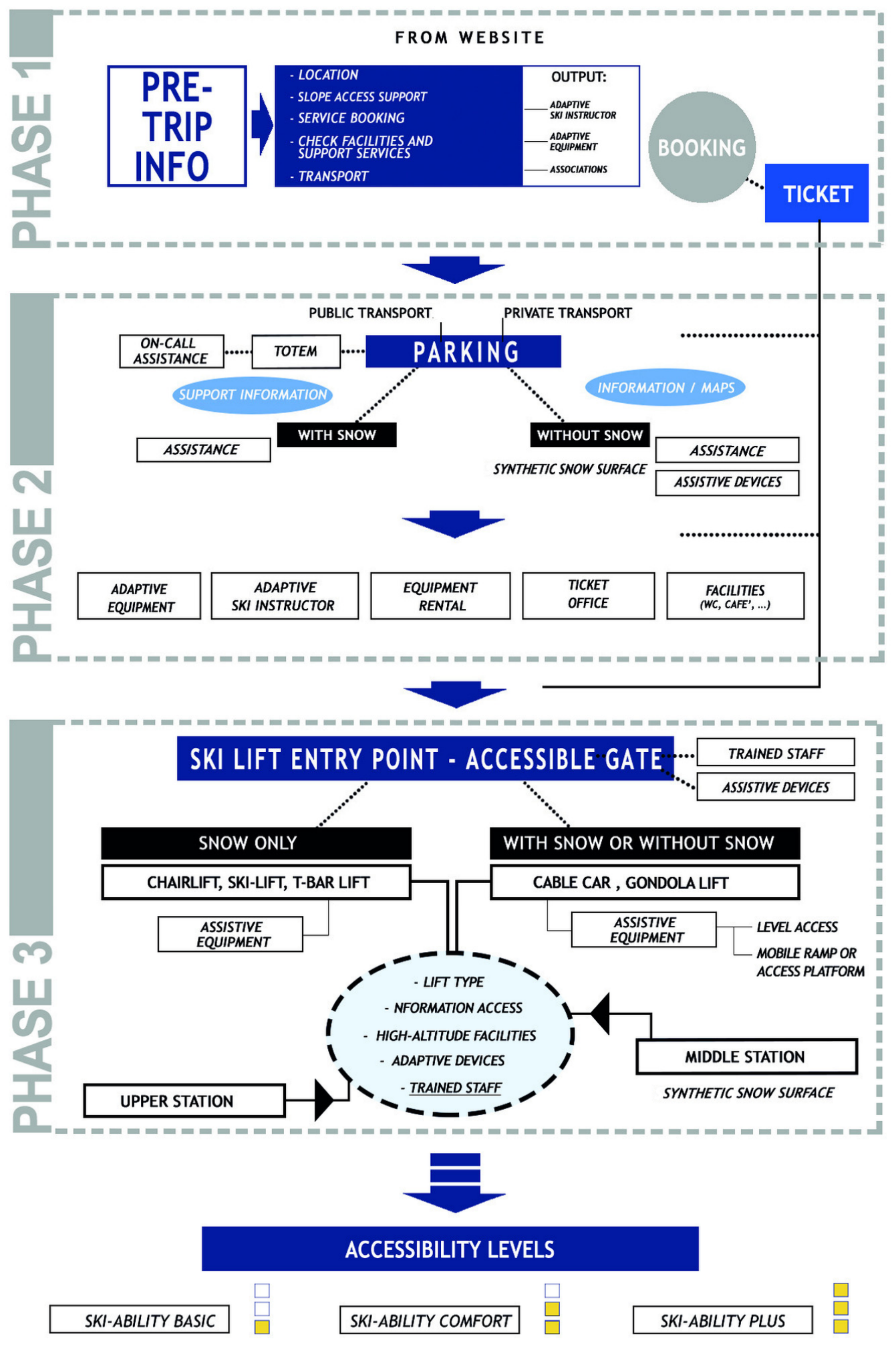
Figure 1).
In commercial journey mapping, discontinuities are generally treated as friction points affecting satisfaction or service optimisation. In accessibility, a discontinuity can produce total exclusion: one inaccessible transfer area, unsupported boarding point or missing information step can make the entire ski experience impossible. The flow-chain framework therefore uses the journey concept as a non-compensatory accessibility logic, supported by transversal layers of infrastructure, services, staff, information and governance.
The toolkit translates this framework into an operational methodology for ski areas, using qualitative levels, priority categories and improvement sheets rather than a purely prescriptive checklist [
31].
2.6. Existing Accessibility Assessment Tools and Their Limitations
Accessibility assessment in built and recreational environments commonly relies on compliance-based tools, regulatory checklists and audit protocols that verify discrete components against predefined criteria. Frameworks such as the UNICEF Accessibility Toolkit and United Nations physical accessibility guidance provide useful baselines for identifying accessible routes, facilities and services [
8,
9]. However, these tools primarily assess individual elements and do not model the temporal and organisational continuity of a complex outdoor experience.
This limitation is particularly significant in alpine ski areas. Existing accessibility information for ski resorts is often provided as tourism guidance, promotional material or local service descriptions, and there is limited academic literature or dedicated regulation addressing ski-resort accessibility as a system. The pilot resorts were therefore used to obtain an exploratory field-based understanding of current operational conditions and recurring accessibility issues.
The methodological gap addressed by Ski-Ability is the absence of a framework that links component-level accessibility to the continuity of the whole experience. The flow-chain and toolkit address this gap by combining sequential phases, priority levels, qualitative classification and governance responsibilities.
3. Study Area and Context: ArgeAlp Working Community and Pilot Ski Resorts
The study was developed within the ArgeAlp Working Community, a transnational cooperation network of Alpine regions and provinces. Regione Lombardia promoted the Ski-Ability project in collaboration with the University of Brescia to develop a shared model for reading and improving accessibility in Alpine ski areas.
Seven pilot resorts were analysed: Colere, Piani di Bobbio and Predazzo in Italy; Madrisa-Klosters in Switzerland; Kaunertaler Gletscher in Austria; and Söllereckbahn-Oberstdorf and Großer Arber in Germany (
Table 1). These resorts were not selected as a statistically representative sample and were not used to rank accessibility performance. Their role was exploratory and methodological: they provided field evidence on the current state of accessibility practices in Alpine ski areas, in a context where systematic literature, dedicated regulation and comparable audit protocols are scarce.
The pilot resorts differ in morphology, altitude, spatial compactness, distance between base areas and slopes, snow reliability, service integration and prior experience with adaptive skiing. This heterogeneity was used to test whether the flow-chain logic could remain intelligible across different operational configurations.
The territorial analysis was complemented by stakeholder involvement coordinated by Regione Lombardia, including ski-lift operators, hospitality providers, local administrations and associations. This multi-actor engagement highlighted the governance complexity of ski areas, where accessibility outcomes depend not only on spatial design but also on coordination mechanisms and operational practices.
The operational toolkit was co-developed through the interaction between academic research, institutional coordination and service-design expertise. Sketchin–Bip Red contributed as service-design and toolkit co-developer, with specific responsibility for translating the flow-chain logic into a usable operational instrument, refining the structure of the cards, the visual language, the user interaction logic and the clarity of the decision-support materials. The scientific framing, interpretation of accessibility and methodological positioning were developed by the research team in connection with the Ski-Ability project objectives.
4. Methodology: A Toolkit for Accessibility Assessment
4.1. Foundation of the Framework
4.1.1. Methodological Approach
The methodological process combined seven exploratory field visits, one for each pilot resort, documentary analysis, stakeholder discussion and co-design translation [
32]. The field visits were used to observe recurrent accessibility discontinuities in the ski-lift and slope experience, with particular attention to pre-trip information, arrival, parking, ticketing, equipment and instructor access, lift-entry systems, boarding procedures, accessible routes, rest areas and return operations. The stakeholder discussions involved categories of actors directly connected with the ski-area experience, including ski-lift operators, resort managers, local and regional institutional representatives, hospitality and service providers, ski-school or adaptive-skiing actors, and organisations or associations with accessibility-related expertise. The objective was not to produce statistically representative empirical data, but to identify recurring operational conditions and translate them into assessable toolkit elements.
Second, the collected evidence was organised through iterative thematic coding. Recurrent issues were grouped into experience phases, sub-phases and operational elements. This step transformed field observations into evaluable categories, distinguishing between spatial elements, service procedures, staff assistance, information systems and governance arrangements.
Third, the categories were translated into toolkit cards through a co-design process involving the research team, institutional coordination and service-design expertise. Experience mapping was used as an exploratory and alignment tool, not as a profit-oriented service optimisation method. In this study, journey mapping is used to identify where accessibility can be interrupted and where coordinated design or management actions are required. Human functional diversity is treated as a core design condition rather than as an exception to be accommodated after design.
The resulting flow-chain was structured into three macro-phases: pre-experience, including planning, accessibility information and booking; on-site experience, including arrival, ski-lift access, slope use and ancillary services; and post-experience, including return, feedback and sharing. This process supported the definition of the Basic, Comfort and Plus levels and of the priority categories used in the toolkit.
4.1.2. Concepts of Interdependence, Multi-Actor Processes, and the Ski-Resort Ecosystem
The framework was developed with the objective of mapping ski-resort systems to evaluate accessibility and act as a strategic planning tool for improvement actions across the territory. The analysis does not focus solely on individual structural elements to be “evaluated”; rather, it considers the ski resort as a connected organism. The resort exists within a context composed of micro-elements that, combined, form a mountain hospitality ecosystem made of infrastructures, services, people, and interdependent processes.
Following this reasoning, the framework does not evaluate accessibility at the level of each structural component; instead, it considers accessibility as the result of a flow of experiences lived within the ski resort, which we may define as the user journey.
The tool was designed to offer resorts the opportunity to engage in a guided, in-depth reflection on the true meaning of accessibility in mountain environments, enabling them to map the current situation and, at the same time, provide insights for future development, moving from urgent priorities to more strategic, long-term themes.
The present study focuses primarily on ski-lift operations, slopes and directly connected services, because these components constitute the minimum operational chain for practicing skiing. A full territorial assessment including accommodation, restaurants, local transport, cultural services and the broader destination system would be necessary for a complete accessible-tourism model. At present, such a comprehensive assessment is difficult because these components are managed by different public and private actors whose responsibilities, data systems and decision-making processes are often not integrated. The toolkit therefore provides a first operational framework for the ski-area core, while identifying broader territorial integration as a necessary future development.
At the methodological level, the framework resolves potential conflicts between Universal Design principles and seasonal mountain constraints through the fixed-outcomes/flexible-means principle introduced in
Section 2.2. Non-negotiable accessibility outcomes define the minimum conditions required to avoid exclusion, while implementation means may vary according to snow cover, morphology, available technologies and operational capacity. This distinction prevents contextual adaptation from becoming an arbitrary deviation from Universal Design and provides the basis for the veto rule used in the toolkit assessment.
4.2. Components and Variables
Definition of Phases, Sub-Phases, and Analytical Parameters
The eight phases, 23 experience moments and evaluation elements (
Table 2) were derived through triangulation between four sources: (i) literature on accessible tourism, Universal Design and service journeys; (ii) field observations in the seven pilot resorts; (iii) stakeholder discussions with resort operators, institutional actors and accessibility-related organisations; and (iv) iterative co-design translation into toolkit cards. Elements were retained when they met at least one of three criteria: they represented a recurrent barrier observed across pilot resorts; they constituted a necessary transition point in the flow-chain; or they corresponded to a service or infrastructure element required to maintain continuity of the skiing experience.
For each retained element, the toolkit card defines an objective, a set of accessibility elements, and checklist criteria organised according to Basic, Comfort and Plus levels. The cards do not function as rigid technical regulations. They define assessable operational conditions and improvement prompts that help ski-area actors identify whether the experience can be completed without interruption.
The minimum accessibility condition is therefore systemic rather than exhaustive: a ski resort can be considered accessible at the Basic level only if it offers at least one continuous ski route supported by the essential services required to complete the experience, including passable surfaces, toilets, food or rest services, assistance and return logistics. Not all lifts or slopes must be accessible, but at least one coherent and supported chain must be available.
4.3. Operational Steps
4.3.1. Application of the Toolkit and Flow-Chain Logic
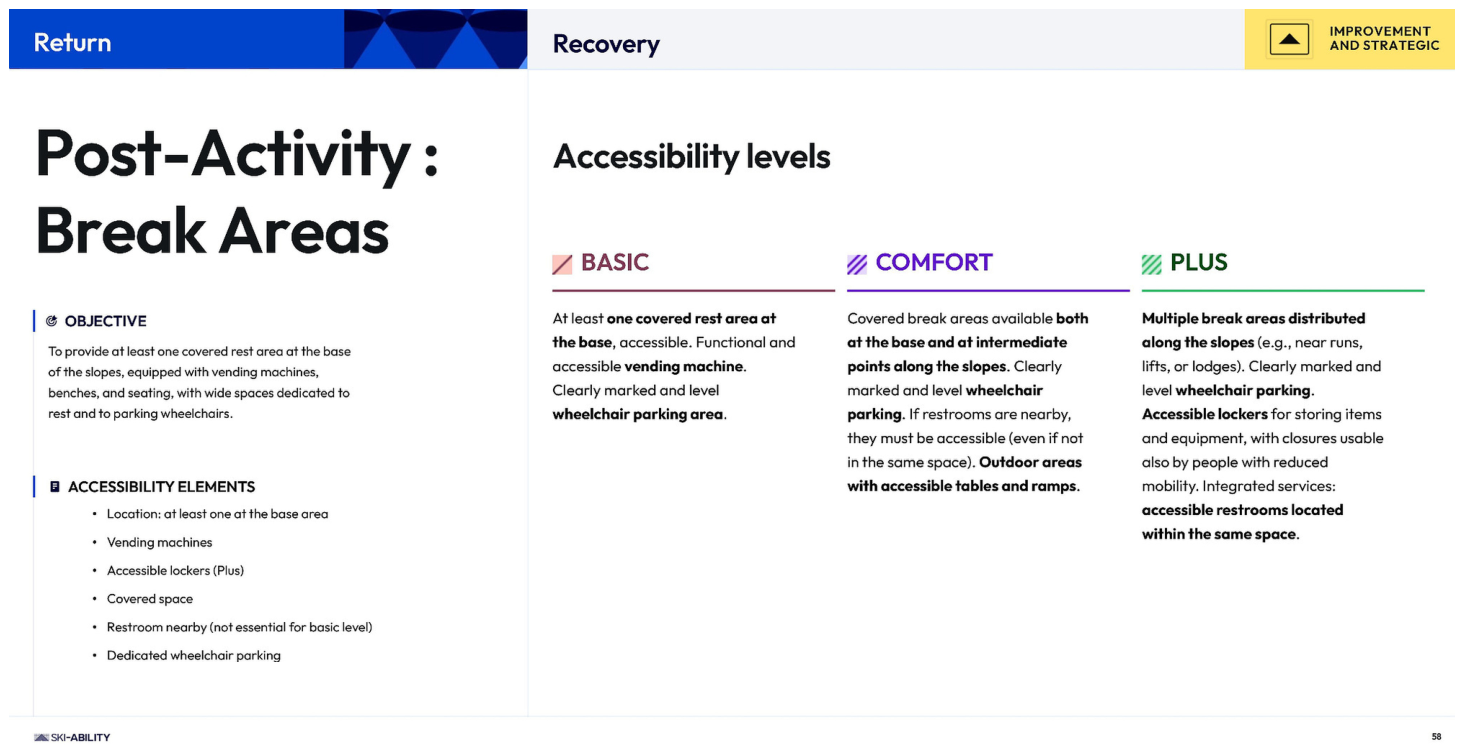
The toolkit, as noted earlier, is composed of multiple cards (
Figure 2) that map the various elements of the ski resort. Each element is assessed across three progressive “levels” of accessibility: Basic, the minimum requirements; Comfort, an enhanced experience; Plus, the most advanced and inclusive level. These levels help observe and track the resort’s current state of accessibility on a continuum.
The second dimension concerns priority and urgency. Since the tool aims to guide resort managers in evaluating accessibility, each element is also assigned a priority level: Essential and Priority, Important but Programmable and Improvement and Strategic.
These categories help identify which elements require urgent implementation when accessibility is not guaranteed. The intersection of accessibility levels and priority levels enables a more articulated reading of the resort’s conditions and supports more informed resource allocation.
In detail:
Essential and Priority: Elements without which minimum accessibility cannot be guaranteed. They require immediate intervention to allow everyone to experience the resort at a Basic level;
Important but Programmable: Aspects that enhance the experience and increase autonomy, while still allowing basic use. They can be planned in the medium term;
Improvement and Strategic: Interventions that bring the resort to an excellent level. They introduce innovative and fully inclusive solutions, to be developed in the long term as strategic objectives.
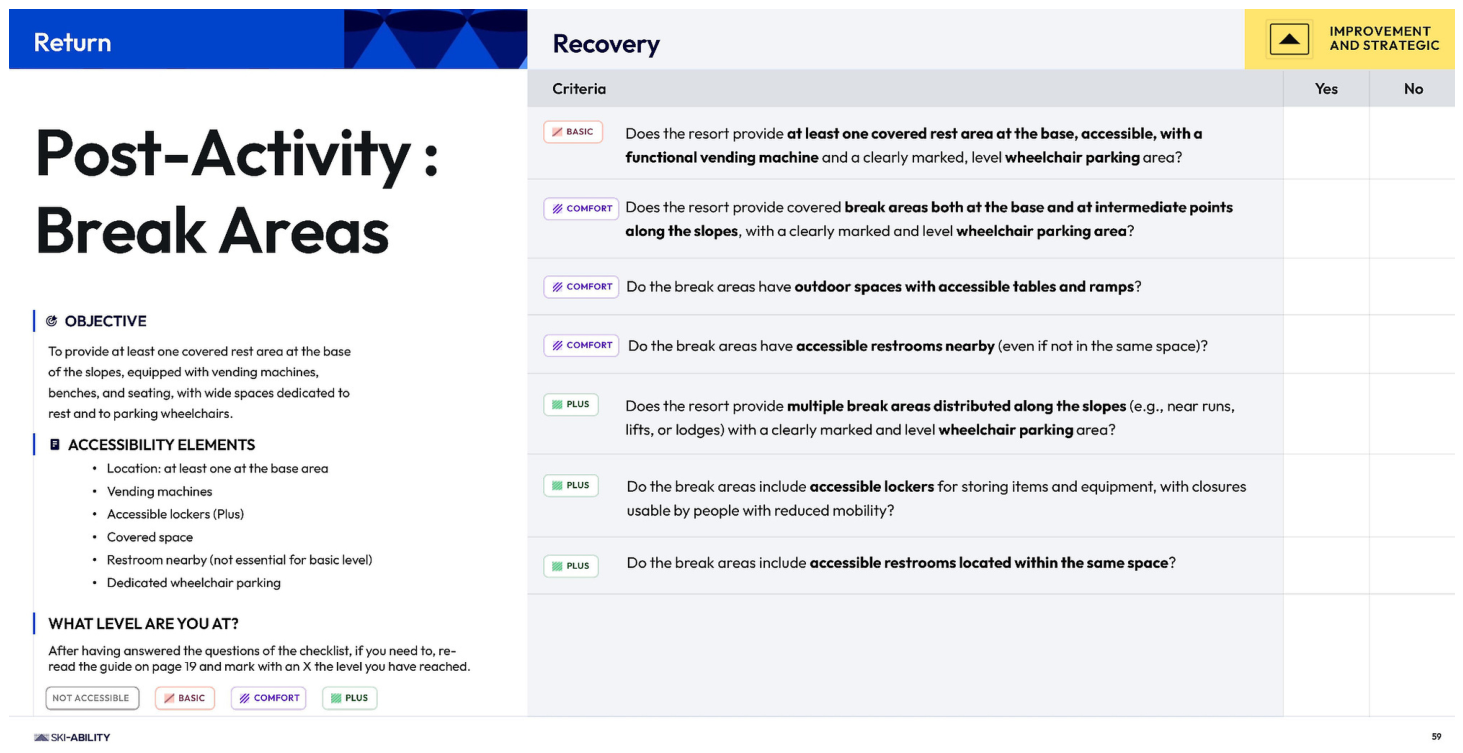
The conversion of observational evidence into a Basic, Comfort or Plus classification follows a rule-based ordinal procedure rather than a weighted numerical score. This choice reflects the logic of the flow-chain framework: high performance in one element cannot compensate for a critical interruption in another essential element of the experience. For each element, the evaluator completes the checklist by answering the criteria associated with the relevant accessibility levels. Each answer is recorded as Yes, No or Not applicable, with supporting evidence where needed. Within each level, checklist questions carry equal weight. However, the levels themselves are hierarchical: Basic requirements define the minimum accessibility threshold; Comfort criteria improve autonomy, predictability and quality of use; Plus criteria identify advanced and more inclusive solutions. The classification follows a hierarchical non-compensatory logic. An element can be classified as Basic only when all applicable Basic criteria are met. Criteria may be marked as Not applicable only when they do not correspond to the physical, operational or seasonal characteristics of the specific resort, and this decision must be justified in the assessment record. If one or more applicable Basic criteria are not met, the element remains below the Basic threshold, unless an equivalent alternative measure ensures the same accessibility outcome. Comfort can be assigned only when all applicable Basic criteria are met and at least one applicable Comfort criterion is met. Plus can be assigned only when all applicable Basic and Comfort criteria are met and at least one applicable Plus criterion is met.
This progression is non-compensatory. Comfort or Plus features cannot compensate for the absence of Basic requirements. In particular, criteria associated with Essential and Priority elements act as veto points: if one of these criteria is not met and no equivalent alternative measure is available, the element remains below the corresponding accessibility threshold. This rule is consistent with the flow-chain logic, according to which one critical interruption can compromise the entire accessible experience. Expert judgement is used only in borderline or context-dependent cases, such as seasonal alternatives, temporary operational measures or locally adapted solutions. In these cases, the decision should be reviewed by a multidisciplinary assessment group including resort management, operational staff, accessibility expertise and, where possible, representatives of users or disability associations. The decision and its justification should be recorded in the improvement sheet to ensure transparency and consistency (
Table 3).
4.3.2. The Reading Grid as an Interpretative Tool and Guide for Improvement Strategies
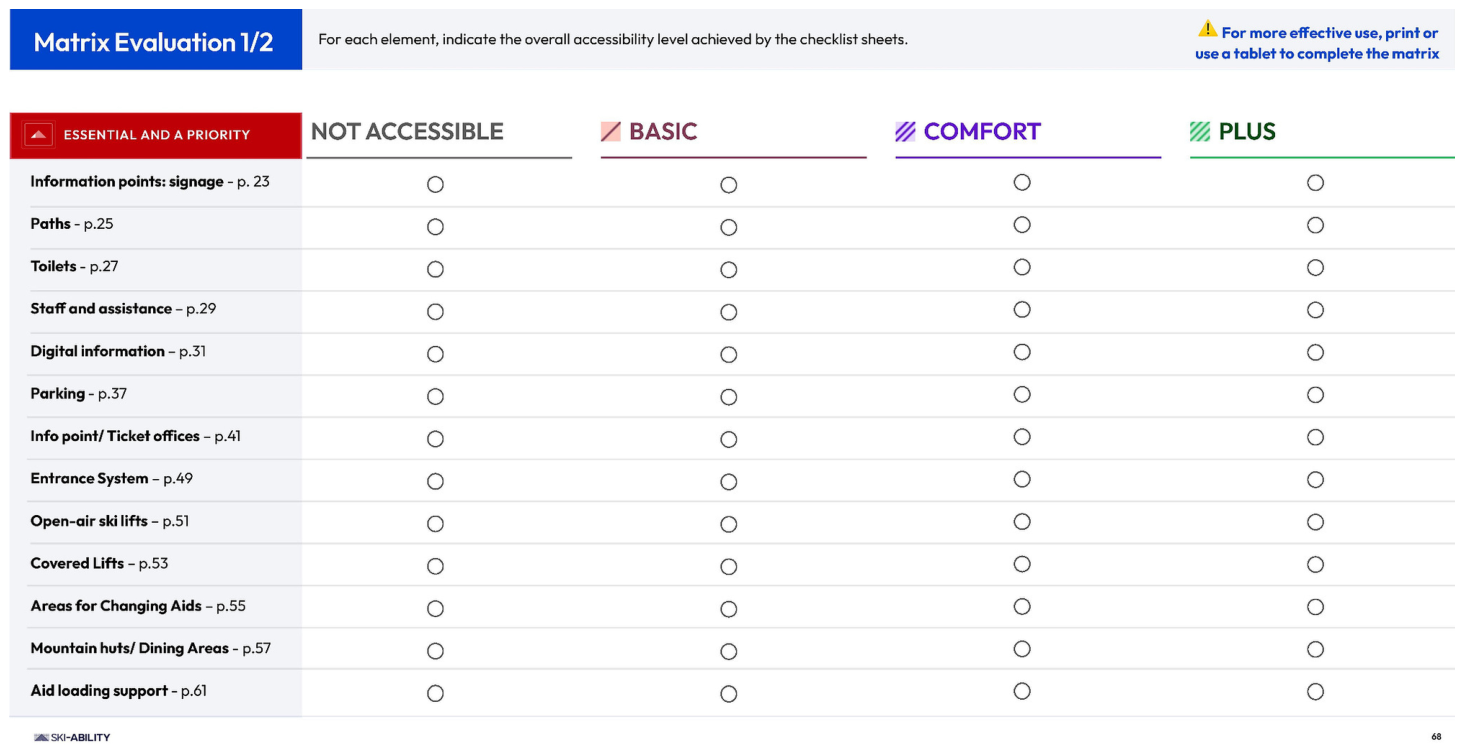
One of the central contributions of the toolkit is the introduction of a reading grid that supports the evaluation and interpretation of accessibility across the entire ski resort. Rather than aggregating scores into numerical averages or weighted indices, the reading grid provides a structured qualitative synthesis tool. It visualises the distribution of element-level classifications and supports a modal-plus-veto interpretation: the most frequent level gives the initial reading, while unresolved Essential and Priority interruptions prevent compensatory overestimation.
After assessing each element in its current level (
Figure 3), that level is plotted onto the grid (
Figure 4). The overall visualisation makes it possible to identify recurring patterns, imbalances, and systemic issues. A ski resort may, for example, display good accessibility in some areas but fail to meet minimum requirements in critical experiential elements. The reading grid makes such discontinuities immediately visible, facilitating comparison and supporting informed decision-making among all actors involved.
At resort level, the most frequent level in the matrix provides the initial overall interpretation. However, this modal reading is subject to a non-compensatory veto rule: if an Essential and Priority element remains below Basic and no equivalent alternative route, service or management procedure is available, the corresponding phase of the flow-chain is considered interrupted. In such cases, the overall interpretation cannot exceed the level permitted by the unresolved critical element. This prevents a generally positive distribution of results from masking a critical exclusion point.
The toolkit therefore seeks to move beyond a purely checklist-based logic: the evaluation is not limited to regulatory verification tied to structural norms or regulations, but a reflective tool that opens opportunities for improvement. The questions are not meant to be verified passively but to stimulate critical reflection, inviting stakeholders to consider not only the presence of solutions but also their effectiveness, usability, and coherence within the overall experience.
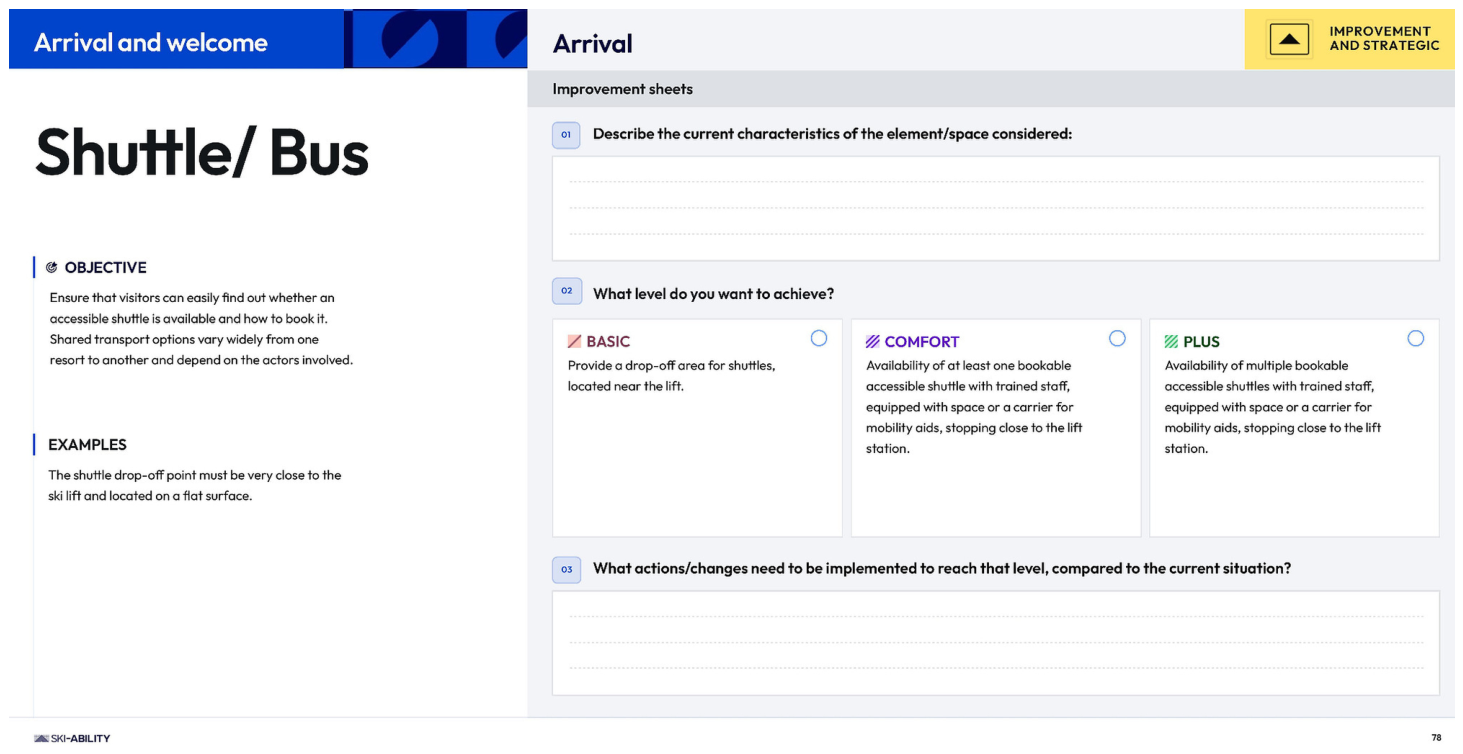
The process is further developed through improvement cards (
Figure 5), activated once the accessibility level of each element has been identified. These cards help identify priority interventions more easily; they guide the analysis of current characteristics, the definition of target levels, and the identification of actions necessary to close the gap. In this way, evaluation becomes a generative activity aimed at designing concrete, contextualised interventions.
Attention to priorities enables resorts to identify the most urgent intervention areas without losing sight of a medium-to-long-term strategic vision. This approach supports the prioritisation of action areas and helps align the various actors involved in accessibility-related decision-making.
4.3.3. Differences Compared to Traditional Methods
Compared to traditional accessibility assessment methods [
8,
9], such as regulatory audits and compliance checklists, the Ski-Ability toolkit introduces a different methodological logic. Conventional approaches provide essential compliance baselines, but they generally evaluate discrete components and classify environments as compliant or non-compliant. In a seasonal mountain context, where accessibility depends on changing snow conditions, staff procedures, lift operations, information systems and multiple service actors, this component-based logic is insufficient to capture continuity of use.
The toolkit instead adopts an evolutionary, design-oriented perspective, interpreting accessibility as a changing condition rather than a fixed state. Accessibility in such a context can only be achieved through a synergistic approach that integrates design, organisational, and communication dimensions. The introduction of progressive levels, priority categories, and qualitative interpretation tools shifts the focus from verification to meaning, from control to reflection.
Furthermore, while traditional audits often separate physical accessibility from organisational and communication accessibility, the toolkit explicitly integrates these dimensions, recognising that, in mountain environments, accessibility depends on coordination among multiple actors, seasonality, and the consistency of information distributed across different channels (both externally to users and internally among services and stakeholders). The collection of feedback on lived experience is another essential factor, central to user-centred design approaches that observe and analyse first-person service experiences.
By embedding evaluation within a structured yet flexible process, the toolkit supports continuous improvement, strategic planning, and cultural change. In this sense, accessibility is not treated as a regulatory obligation but as a shared responsibility and an enabling factor for creating inclusive value in mountain systems.
The main strength of the proposed toolkit lies in its ability to support individual operators in conducting a realistic self-assessment of their current state, free from the need to achieve a specific score or standardised level.
Its primary goal is instead to enable evidence-based planning of future investments, aligned with the operational and organisational specificities of each stakeholder.
5. Results
The empirical and methodological process developed within the Ski-Ability project led to three main outcomes: (i) the formalisation of a systemic flow-chain framework, (ii) its translation into a structured assessment toolkit, and (iii) the identification of recurring patterns and criticalities across pilot ski resorts.
A Systemic Reading of Accessibility
The pilot surveys conducted in seven Alpine ski areas [
14] confirmed that accessibility cannot be interpreted as a facility-based condition. Resorts displaying technically compliant elements—such as accessible lifts or toilets—still presented discontinuities along the user journey. These discontinuities were often located at transition points: parking-to-lift connections, boarding procedures, equipment transfer areas, or coordination between ski schools and lift operators (
Table 4).
The field observations validated the central assumption of the flow-chain: accessibility in snow-covered environments behaves as a chain of interdependent moments, where weaknesses at one stage compromise the entire experience. The empirical material collected across the Italian, Austrian, German and Swiss pilot resorts demonstrated significant variability in:
morphological configuration (glacier systems vs. valley-based resorts);
spatial compactness (clustered vs. dispersed layouts);
distance between base stations and hospitality structures;
degree of integration with accommodation and transport services;
maturity of collaboration with disability associations.
Rather than representing inconsistencies, this variability reinforced the need for a flexible and scalable framework, capable of adapting to heterogeneous Alpine contexts.
6. Discussion
6.1. Accessibility as a Landscape Attribute
The findings reinforce the interpretation of accessibility as an emergent landscape quality rather than a technical compliance outcome. The flow-chain demonstrates that accessibility depends on the continuity of experiential transitions, particularly in environments where snow cover, slope gradients and seasonal transformation modify spatial conditions daily.
In snow-covered landscapes, accessibility is inherently dynamic. Snow acts simultaneously as an enabler and barrier. For adaptive skiing, snow cover can facilitate mobility through synthetic sliding surfaces; yet uneven compaction, ice formation or snowbanks can interrupt continuity. Accessibility in winter, therefore, operates within a constantly shifting morphological field.
This reinforces the interpretation of accessibility as a temporal and relational landscape attribute, not as a fixed infrastructural state.
6.2. Implications for Inclusive Mountain Planning
The flow-chain framework suggests a planning paradigm based on continuity of experience rather than completeness of compliance. In fragile Alpine environments, universal full accessibility of all slopes and lifts is neither realistic nor environmentally sustainable. Instead, ensuring at least one coherent and fully supported route—physically and organisationally—emerges as a pragmatic and strategic objective.
This approach aligns with adaptive planning logics and incremental transformation strategies suited to climate-sensitive territories. It may also support broader policy and economic objectives, such as widening the potential visitor base, improving year-round usability and strengthening territorial resilience. These implications should be understood as plausible planning hypotheses and policy directions rather than as effects empirically measured in the present study.
These considerations support the interpretation of accessibility as a relevant component of social sustainability strategies in mountain tourism systems, while future research should test its socio-economic effects through longitudinal and comparative evidence.
6.3. Management, Governance and Community Involvement
The toolkit explicitly foregrounds governance. Accessibility outcomes depend on multi-actor coordination involving lift operators, ski schools, hospitality providers, transport systems and local authorities [
31].
The evaluation sheets emphasise managerial involvement and cross-sector engagement as fundamental prerequisites. Accessibility is thus framed as a governance ecosystem rather than a design intervention (
Table 5).
The governance process should operate as a closed loop: annual assessment, shared diagnosis, prioritisation of Essential and Priority gaps, implementation planning, user feedback and periodic reassessment.
However, the research also reveals a structural limitation: governance cultures vary widely across Alpine regions. The effectiveness of the toolkit depends on institutional willingness to engage in collective self-assessment processes. Without this, the instrument risks remaining a diagnostic tool rather than becoming a transformation driver.
6.4. Transferability, Seasonality and Future Steps
6.4.1. Absence of Large-Scale Application
The primary limitation of the present research is the absence of a broad quantitative implementation phase across a statistically significant sample of Alpine ski resorts. The pilot phase provided exploratory field evidence, methodological refinement and proof of conceptual coherence, but it did not produce comparative performance rankings or generalisable statistical findings. Future research should apply the toolkit to a larger sample of resorts, develop cross-regional datasets, integrate measurable socio-economic indicators and monitor accessibility improvements over time. Such expansion would allow the framework to evolve from a qualitative planning-support instrument into a regional or cross-national policy tool.
6.4.2. Seasonality and Differential Morphology
The framework has been developed primarily in relation to winter conditions, where snow and slope gradients shape the landscape accessibility. However, several pilot resorts operate year-round (e.g., Colere and Kaunertaler Gletscher).
Seasonal variation is particularly significant:
In winter, snow modifies surface friction and mobility logic;
In summer, exposed terrain, gravel paths, and altitude differences reconfigure accessibility barriers.
The framework could be further developed through a seasonally differentiated declination, distinguishing:
snow-dependent accessibility factors;
slope gradient exposure in snow-free periods;
summer trail usability;
year-round governance continuity.
Extending the framework to summer conditions represents a promising direction for future research, allowing the integration of year-round accessibility into sustainable mountain planning.
6.4.3. Validation Status and Future Validation Protocol
The present study provides conceptual and procedural validation of the flow-chain framework through exploratory application across seven pilot resorts. It does not yet provide psychometric validation of the toolkit as a benchmarking instrument. In particular, inter-rater reliability, correlation with independent professional audits and systematic comparison with user-reported experience were beyond the scope of the current phase. A future validation protocol should include: (i) independent application of the toolkit by at least two assessor teams in the same resorts; (ii) calculation of inter-rater agreement for element-level classifications; (iii) comparison with independent accessibility audits; and (iv) collection of structured feedback from disabled skiers and adaptive-skiing organisations. This would allow the toolkit to evolve from a qualitative planning-support instrument into a reproducible regional or cross-national assessment tool.
7. Conclusions
This study contributes to repositioning accessibility from a compliance-based requirement to a central component of sustainable landscape planning. By introducing the flow-chain framework and its operational toolkit, the research provides a structured and adaptable approach for addressing accessibility in complex and seasonal environments.
The findings demonstrate that accessibility in alpine ski areas is inherently dynamic, shaped by environmental variability, organisational coordination and user experience. Rather than pursuing universal standardisation, the proposed approach supports incremental and context-sensitive strategies that enhance both usability and inclusivity.
From a sustainability perspective, accessibility emerges as a key driver of social cohesion, inclusive tourism and territorial resilience. Future research should focus on large-scale applications of the framework and on its extension to summer conditions, enabling a comprehensive understanding of accessibility in year-round mountain systems.
Author Contributions
Conceptualisation, A.A. and E.Z.; methodology, A.A., M.B., V.D.F. and E.Z.; validation, F.C. and C.R.; formal analysis, A.A., M.B., F.C., V.D.F., C.R. and E.Z.; investigation, M.B. and F.C.; resources, A.A. and E.Z.; data curation, M.B. and E.Z.; writing—original draft preparation, A.A. and V.D.F.; writing—review and editing, A.A., F.C., V.D.F. and C.R.; visualisation, M.B. and F.C.; supervision, A.A. and C.R.; project administration, A.A. and E.Z.; funding acquisition, A.A. and E.Z. All authors have read and agreed to the published version of the manuscript.
Funding
This research was supported by Regione Lombardia (DGR XII-1274 DEL 13-11-2023) within the ArgeAlp Ski-Ability project.
Institutional Review Board Statement
Not applicable.
Informed Consent Statement
Not applicable.
Data Availability Statement
The raw data supporting the conclusions of this article will be made available by the authors on request.
Acknowledgments
The authors acknowledge Direzione UO Impianti Sportivi e Infrastrutture e Professioni Sportive della Montagna di Regione Lombardia (Luca Ambrogio Vaghi, Leonardo La Rocca, Raffaele Verdelli, Massimo Martini, Daniela Cavanna) and all stakeholders involved in the Ski-Ability project.
Conflicts of Interest
Author Valentina Di Floriano, Claudia Rossati and Elena Zordan were employed by the company Sketchin–Bip Red. The remaining authors declare that the research was conducted in the absence of any commercial or financial relationships that could be construed as a potential conflict of interest.
References
- American Society of Landscape Architects. Universal Design Guide; ASLA: Washington, DC, USA, 2019; Available online: https://www.asla.org/focus-areas/diversity,-equity,-inclusion/universal-design-guide (accessed on 4 May 2026).
- World Tourism Organization. Accessible Tourism for All: An Opportunity Within Our Reach; UNWTO: Madrid, Spain, 2016. [Google Scholar] [CrossRef]
- Rossato, C.; Baratta, R. Accessibility and accessible tourism: The conceptual evolution through the analysis of the literature. In Accessible Tourism in the Digital Ecosystem; Springer: Cham, Switzerland, 2023; pp. 1–16. [Google Scholar] [CrossRef]
- Quattrone, G. Appropriate planning policies for the development of accessible and inclusive tourism. Sustainability 2025, 17, 3972. [Google Scholar] [CrossRef]
- Groulx, M.; Freeman, S.; Lemieux, C. Accessible nature beyond city limits: A scoping review. J. Outdoor Recreat. Tour. 2022, 37, 100490. [Google Scholar] [CrossRef]
- Aguilar-Carrasco, M.J.; Gielen, E.; Valles-Planells, M.; Galiana, F.; Riutort-Mayol, G. Assessment of barriers for people with disability to enjoy national parks. Front. Psychol. 2023, 13, 1058647. [Google Scholar] [CrossRef] [PubMed]
- Bianchi, P.; Cappelletti, G.M.; Mafrolla, E.; Sica, E.; Sisto, R. Accessible tourism in natural park areas: A social network analysis to discard barriers and provide information for people with disabilities. Sustainability 2020, 12, 9915. [Google Scholar] [CrossRef]
- UNICEF. Accessibility Toolkit—Section G: Accessibility Checklists; UNICEF: New York, NY, USA, 2021; Available online: https://accessibilitytoolkit.unicef.org/reports/section-g-accessibility-checklists (accessed on 4 May 2026).
- United Nations. Physical Accessibility: Making UN Premises and Facilities Accessible Through the Business Operations Strategy (BOS 2.0); UN: New York, NY, USA, 2021; Available online: https://unsdg.un.org/sites/default/files/2021-04/Physical%20Accessibility-BOS-Disability%20Inclusion-Practice%20Note-20210303.pdf (accessed on 4 May 2026).
- World Health Organization. International Classification of Functioning, Disability and Health (ICF); WHO: Geneva, Switzerland, 2001. [Google Scholar]
- Shakespeare, T. Disability Rights and Wrongs Revisited, 2nd ed.; Routledge: London, UK, 2014. [Google Scholar]
- Iwarsson, S.; Ståhl, A. Accessibility, usability and universal design—Positioning and definition of concepts describing person–environment relationships. Disabil. Rehabil. 2003, 25, 57–66. [Google Scholar] [CrossRef] [PubMed]
- Gibson, J.J. The Ecological Approach to Visual Perception; Houghton Mifflin: Boston, MA, USA, 1979. [Google Scholar]
- Arenghi, A.; Bonetti, M.; Cesena, F. Ski-Ability: Operational Indications for Inclusive Ski Resorts in the Alpine Area; Marcianum Press: Venezia, Italy, 2026; Available online: https://www.marcianumpress.it/libri/ski-ability-operational-indications-inclusive-ski-resorts-alpine-area (accessed on 4 May 2026).
- Story, M.F.; Mueller, J.L.; Mace, R.L. The Universal Design File: Designing for People of All Ages and Abilities; NC State University: Raleigh, NC, USA, 1998. [Google Scholar]
- Steinfeld, E.; Maisel, J. Universal Design: Creating Inclusive Environments; Wiley: Hoboken, NJ, USA, 2012. [Google Scholar]
- Agyeman, J. Sustainable Communities and the Challenge of Environmental Justice; New York University Press: New York, NY, USA, 2005. [Google Scholar]
- Mitchell, D. The Right to the City: Social Justice and the Fight for Public Space; Guilford Press: New York, NY, USA, 2003. [Google Scholar]
- Hartig, T.; Mitchell, R.; de Vries, S.; Frumkin, H. Nature and health. Annu. Rev. Public Health 2014, 35, 207–228. [Google Scholar] [CrossRef] [PubMed]
- Shanahan, D.F.; Fuller, R.A.; Bush, R.; Lin, B.B.; Gaston, K.J. The health benefits of urban nature: How much do we need? Bioscience 2015, 65, 476–485. [Google Scholar] [CrossRef]
- Darcy, S.; Buhalis, D. Conceptualising disability. In Accessible Tourism: Concepts and Issues; Buhalis, D., Darcy, S., Eds.; Channel View Publications: Bristol, UK, 2011; pp. 21–44. [Google Scholar]
- Darcy, S.; Dickson, T.J. A Whole-of-Life Approach to Tourism: The Case for Accessible Tourism Experiences. J. Hosp. Tour. Manag. 2009, 16, 32–44. [Google Scholar] [CrossRef]
- Kyle, G.; Graefe, A.; Manning, R. Testing the Dimensionality of Place Attachment in Recreational Settings. Environ. Behav. 2005, 37, 153–177. [Google Scholar] [CrossRef]
- Mannella, S.; Labbé, D.; Bundon, A.; Sauvé, J.-L.; McBride, C.B.; Best, K.L.; Yung, O.; Miller, W.C. Access at elevation: Strategies used to support participation for people with disabilities in adaptive snowsports. J. Outdoor Recreat. Tour. 2023, 43, 100685. [Google Scholar] [CrossRef]
- Oldorp, F.; Schaller, T.; Grenier, M.; Giese, M. The importance of abilities in inclusive experiences from the perspective of people with visual impairments: The example of alpine skiing. Front. Sports Act. Living 2025, 7, 1587603. [Google Scholar] [CrossRef] [PubMed]
- McCauley, L. Barriers to Accessibility for Skiing. Master’s Thesis, Carleton University, Ottawa, ON, Canada, 2021. [Google Scholar] [CrossRef]
- Norman, D.A. The Design of Everyday Things, Revised ed.; Basic Books: New York, NY, USA, 2013. [Google Scholar]
- Stickdorn, M.; Hormess, M.E.; Lawrence, A.; Schneider, J. This Is Service Design Doing; O’Reilly Media: Sebastopol, CA, USA, 2018. [Google Scholar]
- Lemon, K.N.; Verhoef, P.C. Understanding customer experience throughout the customer journey. J. Mark. 2016, 80, 69–96. [Google Scholar] [CrossRef]
- Følstad, A.; Kvale, K. Customer journeys: A systematic literature review. J. Serv. Theory Pract. 2018, 28, 196–227. [Google Scholar] [CrossRef]
- Sketchin—Red Bip. Accessibility Toolkit for Ski Areas. 2025. Available online: https://www.regione.lombardia.it/content/dam/rl/canali-tematici-servizi/07-cultura-turismo-e-sport/10-fare-sport/la-progettazione-europea/red-il-progetto-ski-ability/allegati/SkiAbility%20Toolkit.pdf (accessed on 4 May 2026).
- Brown, T. Change by Design: How Design Thinking Transforms Organizations and Inspires Innovation, Revised ed.; HarperCollins: New York, NY, USA, 2019. [Google Scholar]
| Disclaimer/Publisher’s Note: The statements, opinions and data contained in all publications are solely those of the individual author(s) and contributor(s) and not of MDPI and/or the editor(s). MDPI and/or the editor(s) disclaim responsibility for any injury to people or property resulting from any ideas, methods, instructions or products referred to in the content. |



 ,
,