1. Introduction
Green innovation has become a central strategic response to the global transition toward low-carbon development. It enables firms to redesign products, improve production processes, reduce environmental externalities, and align their competitive strategies with increasingly stringent sustainability expectations. Environmental regulation may strengthen competitiveness when it induces firms to upgrade technologies rather than merely absorb compliance costs [
1]. Yet the practical difficulty facing firms is not only whether they can produce green innovation, but whether they can sustain green innovation over time.
This distinction matters because green innovation is rarely a one-period decision. It often requires repeated experimentation, cumulative knowledge accumulation, specialized human capital, and long-term financial commitment. Innovation persistence captures this dynamic dimension by asking whether firms that innovate in one period continue to innovate in subsequent periods. Peters shows that persistent innovation reflects more than random repetition; it is closely associated with learning effects, sunk costs, and accumulated organizational capabilities [
2]. For green innovation, this persistence is especially important because environmental technologies usually involve longer payback periods, higher uncertainty, and stronger dependence on complementary resources than ordinary short-cycle innovation.
However, the conditions of capital markets often work against such continuity. Managers of listed firms face earnings pressure, market valuation pressure, and investor attention pressure. When external monitoring is excessively short-term, managers may reduce long-horizon investment even when such investment is valuable for the firm’s future. He and Tian provide evidence that analyst coverage can discourage innovation by intensifying market pressure and reducing managerial tolerance for failure [
3]. This creates a governance tension: green innovation requires patience, but capital markets frequently reward short-term performance.
Patient capital offers a potential solution to this tension. Unlike transient capital that emphasizes trading gains and short-term price movements, patient capital is characterized by longer investment horizons, stronger willingness to tolerate temporary underperformance, and deeper interest in durable value creation. Institutional ownership has been shown to support innovation partly because sophisticated long-term investors can shield managers from myopic market pressure [
4]. Long-term strategic orientation can also create firm value by encouraging managers to invest in stakeholder relationships and future-oriented capabilities [
5]. These arguments suggest that patient capital may provide the governance conditions needed for firms to maintain green innovation rather than engage in isolated or symbolic green patenting.
This issue is also timely because the corporate finance literature has moved from asking whether ESG matters to asking which governance arrangements make sustainability commitments credible. Gillan et al. show that ESG and CSR issues have become core questions in corporate finance rather than peripheral ethical concerns [
6]. In this context, patient capital should not be treated merely as a source of funding. It is better understood as a governance architecture that shapes managerial time horizons, disclosure incentives, and tolerance for uncertain environmental investment.
Within this broader shift in corporate finance toward identifying which governance arrangements make sustainability commitments credible [
6], patient capital is best understood not merely as a source of funding but as a governance architecture that shapes managerial time horizons, disclosure incentives, and tolerance for uncertain environmental investment. This framing motivates our focus on the mechanism, rather than only the existence, of a patient-capital effect.
Despite this theoretical relevance, the existing literature has not fully explained whether patient capital promotes the persistence of corporate green innovation. First, studies on innovation persistence have mainly focused on general technological innovation. Raymond et al. show that persistent innovation may be driven by genuine state dependence rather than simply by time-invariant firm characteristics [
7]. Yet green innovation persistence remains a more specific phenomenon because it combines technological uncertainty with environmental legitimacy, regulatory exposure, and sustainability pressure.
Second, existing green innovation research has mostly examined innovation output rather than innovation continuity. Tavassoli and Karlsson demonstrate that different types of innovation exhibit different persistence patterns, suggesting that persistence should not be inferred mechanically from innovation levels [
8]. A firm with many green patents in one year may not necessarily possess a stable green innovation capability. Conversely, a firm with moderate but continuous green innovation may be more strategically committed to environmental transformation than a firm with sporadic patent surges.
Recent evidence strengthens the need to distinguish green innovation persistence from green innovation quantity. Jing and Liu examine firm-level persistent green innovation and show that green finance can support the continuity of green innovation under environmental regulation [
9]. This finding implies that continuity is a distinct and policy-relevant outcome, not simply a by-product of higher green patent counts. It also suggests that financial and governance conditions may shape whether environmental innovation becomes durable.
Third, the literature on institutional investors and corporate sustainability has rarely opened the black box between ownership horizon and green innovation persistence. Dyck et al. show that institutional ownership can improve firms’ environmental and social performance across countries [
10]. Yet this line of research generally focuses on broad sustainability outcomes rather than the specific process through which long-horizon ownership stabilizes green innovation over time. The mechanism linking patient capital to sustained green innovation therefore remains undertheorized.
The governance channel is particularly relevant in China because institutional investors can influence firms not only through shareholding but also through direct information-gathering and engagement. Jiang et al. find that institutional investors’ corporate site visits improve firms’ subsequent ESG performance in Chinese listed companies [
11]. This suggests that investor monitoring can alter corporate sustainability behavior, making China an appropriate empirical setting for examining how patient capital may support continuous green innovation.
This paper argues that information disclosure quality is a key mediating mechanism. High-quality disclosure reduces information asymmetry between managers and external stakeholders, improves the credibility of strategic commitments, and helps external investors evaluate whether firms are genuinely pursuing long-term green strategies. Healy and Palepu emphasize that disclosure plays a central role in reducing information asymmetry in capital markets [
12]. In the context of green innovation, disclosure quality may be especially important because environmental innovation is difficult to observe, difficult to value, and vulnerable to symbolic presentation.
Recent studies further indicate that disclosure is not a passive reporting outcome but an active condition for green innovation. Ding et al. show that environmental information disclosure is positively associated with firms’ green innovation in China [
13]. Ruan et al. similarly find that ESG information disclosure promotes corporate green innovation among Chinese A-share listed companies [
14]. These findings support the idea that disclosure quality can influence real environmental innovation by improving transparency, external monitoring, and resource access.
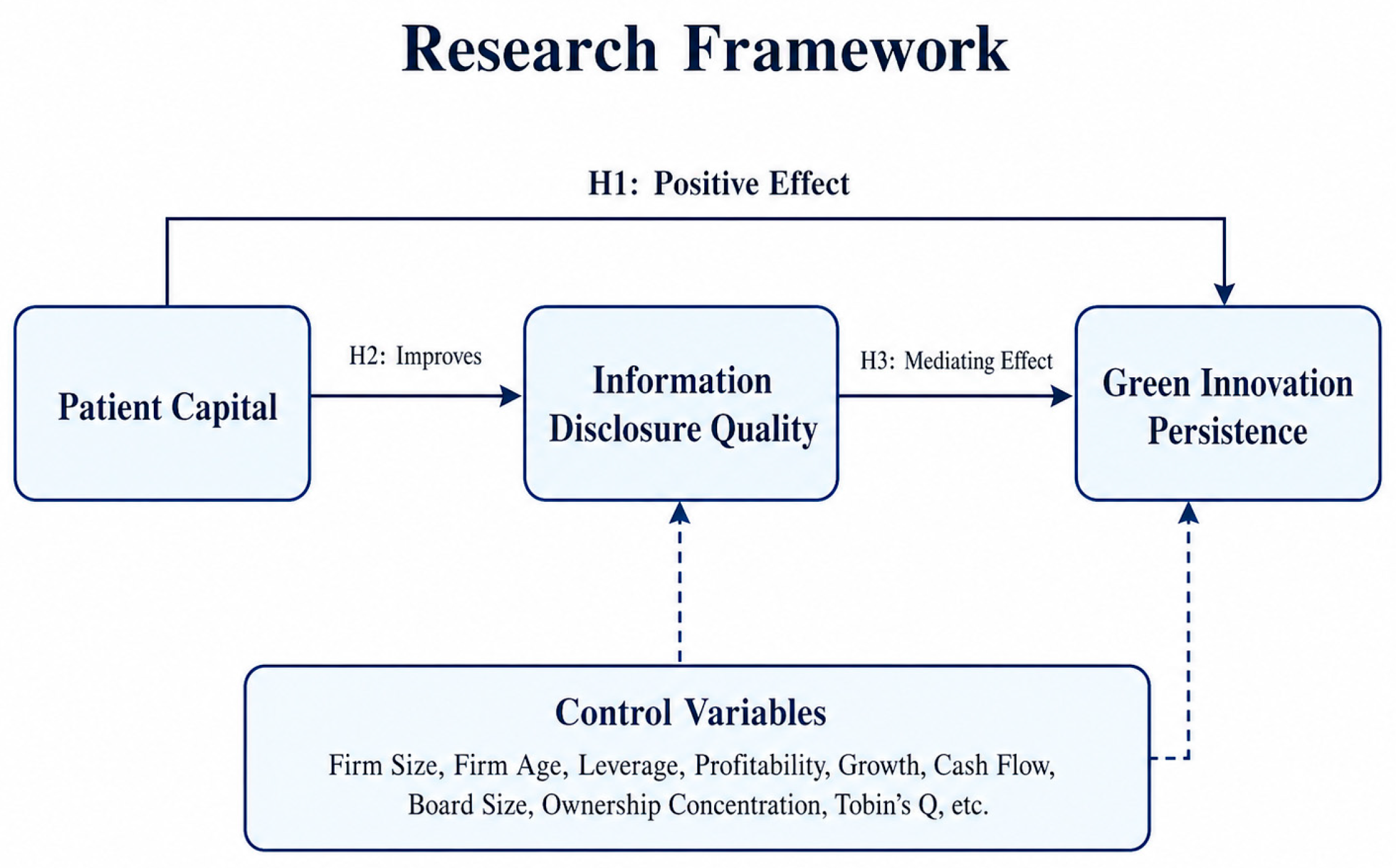
We therefore propose a theoretical chain in which patient capital improves green innovation persistence through the enhancement of information disclosure quality. Patient capital may pressure managers to disclose more credible and informative firm-specific information. Better disclosure then helps firms mobilize resources for long-term green innovation, reduces external uncertainty about the firm’s environmental strategy, and makes managerial commitments more observable. Under this logic, information disclosure quality is not only a reporting outcome; it is a governance channel through which ownership horizon affects real innovation behavior.
The argument is also consistent with the newest patient-capital research. Suo and Qiao document that patient capital improves corporate ESG performance and that its effect is shaped by green innovation bubbles [
15]. Wang et al. further show that patient capital is positively related to corporate green innovation performance in the presence of executive environmental concerns [
16]. These studies confirm the relevance of patient capital for sustainability outcomes, but they leave room for a more specific investigation of green innovation persistence and disclosure quality as an intervening mechanism.
To test this argument, we use a panel of Chinese A-share listed firms from 2010 to 2022. China provides a suitable setting because listed firms operate under both strong environmental policy pressure and active capital market scrutiny. The country’s green transition has increased the strategic importance of corporate environmental innovation, while the development of institutional investors has created meaningful variation in ownership horizons. The empirical setting therefore allows us to examine whether patient capital is associated with the continuity of green innovation and whether disclosure quality helps explain this association.
Building on these considerations, this paper addresses two central questions. First, does patient capital, in the form of stable strategic equity ownership, promote the persistence—rather than merely the level—of corporate green innovation? Second, if such an association exists, does information disclosure quality operate as a transmission mechanism through which long-horizon ownership sustains green innovation over time? Answering these questions matters both theoretically, because it links the investor-horizon literature to the under-examined outcome of green innovation persistence, and practically, because the social value of green innovation depends on its continuity rather than on isolated patent surges.
Our main explanatory variable is patient capital, measured by strategic equity ownership. Our dependent variable is green innovation persistence, constructed to capture the continuity of green patenting activity rather than one-time patent output. Our mediating variable is information disclosure quality, measured using the KV-based disclosure quality indicator. The baseline model controls for firm characteristics and includes industry and year fixed effects, with standard errors clustered at the firm level. Additional analyses examine robustness, mediation, supplementary endogeneity checks, and boundary conditions.
The empirical results support the proposed argument. Patient capital is positively associated with green innovation persistence in the baseline model. The relationship remains robust when we use related green innovation outcomes, alternative patient capital measures, and different data-processing choices. Mediation analysis shows that information disclosure quality serves as a statistically significant partial mediator. The evidence does not imply that disclosure quality is the only mechanism, but it does show that transparency is an important channel through which patient capital is connected to sustained green innovation.
This study makes three contributions. First, it shifts the research focus from green innovation quantity to green innovation persistence. This distinction is important because the policy value of green innovation depends not only on whether firms innovate, but also on whether they maintain innovation efforts over time. Second, it extends the patient capital literature by linking ownership horizon to the continuity of environmental innovation. This moves beyond the general claim that long-term investors support innovation and identifies a specific sustainability-related outcome. Third, it identifies information disclosure quality as a mediating mechanism. This contribution connects corporate governance, disclosure quality, and green innovation into one integrated framework.
The remainder of this paper proceeds as follows.
Section 2 reviews the relevant literature and develops the hypotheses.
Section 3 describes the sample, variables, and empirical model.
Section 4 reports the baseline regression and mediation results.
Section 5 presents robustness checks and supplementary endogeneity analyses.
Section 6 examines heterogeneity and boundary conditions.
Section 7 discusses theoretical and practical implications.
Section 8 concludes.
3. Research Design
3.1. Sample and Data
Our empirical analysis uses Chinese A-share listed firms from 2010 to 2022. Financial and governance variables are obtained from standard listed-firm databases, and green patent information is matched to listed firms to construct measures of green innovation activity. We exclude financial firms because their capital structure, regulation, and disclosure regimes differ substantially from those of nonfinancial corporations. We also exclude observations with missing values for variables used in the baseline regression. The final baseline sample contains 21,811 firm-year observations for 3495 unique firms. Continuous variables are winsorized at the 1st and 99th percentiles to reduce the influence of outliers. The mediation analysis uses a smaller subsample of 14,835 firm-year observations because the KV-based disclosure-quality variable is unavailable for some firm-years.
3.2. Variable Definitions
The dependent variable is green innovation persistence (GIP). Following He et al. [
35], we construct a rolling, patent-based green innovation persistence index rather than a simple ratio of active innovation years. Let
denote the number of green patent applications filed by firm i in year t. Define the recent two-year green patent window as
and the previous two-year window as
. The persistence index is calculated as
, and the regression variable is
. This construction compares the firm’s current two-year green patenting activity with its immediately preceding two-year activity and then weights the growth rate by the current patenting scale.
This definition is important for interpretation. GIS is not computed as the cumulative number of years with at least one green patent divided by a fixed 13-year sample window. Nor is it divided by the number of years a firm appears in the sample. The measure is instead based on adjacent rolling patent windows, so later-listed firms are not mechanically penalized by having fewer observed years in 2010–2022. In implementation, the rolling construction requires sufficient lagged patent information, and observations without the necessary patent-history structure are excluded by the baseline sample filters.
The primary independent variable is patient capital (PC), measured through the strategic-equity approach used in the Chinese patient-capital literature. Wu et al. [
36] distinguish patient capital from ordinary capital by emphasizing stable, long-horizon financing relations. Li and Shi [
37] further operationalize patient capital for listed companies using strategic equity ownership. In this paper, pc1 is constructed as institutional investor shareholding divided by the standard deviation of institutional investor shareholding over the previous three years. We then use PC = ln(pc1 + 1) as the main patient-capital variable. Economically, a higher value indicates that institutional ownership is both substantial and relatively stable, which is consistent with a long-horizon strategic shareholding structure.
We also report PC_alt as an alternative patient-capital proxy in robustness checks. Compared with PC, PC_alt is based on a broader classification and is therefore less selective in identifying highly stable strategic equity. We treat PC as the primary measure because the theoretical mechanism of this paper requires not merely institutional ownership, but ownership that is sufficiently stable to relax short-term pressure and support long-cycle green innovation.
The mediating variable is information disclosure quality (DIQ). The theoretical foundation for empirically measuring disclosure informativeness is established by Kim and Verrecchia [
38], who show that the quality of corporate disclosure can be inferred from market participants’ trading responses around information events. Building on this insight while adopting an approach better suited to the Chinese institutional setting, we follow Lin et al. [
39] and construct a comprehensive accounting information disclosure quality rating for each listed firm-year observation. The rating evaluates multiple dimensions of disclosure practice, including the completeness, accuracy, timeliness, and relevance of information provided to capital-market participants. Each firm-year is assigned an ordered score on a four-point scale, where 1 indicates the lowest disclosure quality and 4 indicates the highest. This ordinal structure captures meaningful cross-firm and cross-year variation in disclosure quality while reducing noise inherent in any single raw indicator. The construction methodology has been adopted in the Chinese empirical accounting literature as a tractable and theoretically grounded approach to measuring the overall quality of listed firm disclosures, and is particularly well suited to panel analyses of large samples of A-share firms.
DIQ is appropriate for this study for two reasons. First, it measures the substantive quality of corporate disclosure across multiple evaluative dimensions rather than the mere quantity of disclosed text or the compliance with minimum reporting requirements. This distinction matters because the theoretical mechanism proposed in this paper operates through the credibility and informativeness of disclosure, not through its volume. Second, because sustained green innovation requires external stakeholders—including investors, lenders, and regulators—to evaluate long-horizon and uncertain projects on an ongoing basis, a comprehensive and multi-dimensional disclosure quality proxy is theoretically aligned with the proposed channel. Higher values of DIQ indicate that a firm’s disclosures provide more complete, accurate, and timely information to outside stakeholders, thereby reducing information asymmetry, strengthening the credibility of long-term strategic commitments, and facilitating the sustained resource mobilization that persistent green innovation requires.
The control variables include firm size, leverage, return on assets, revenue growth, operating cash flow, listing age, state ownership, board size, board independence, CEO-chair duality, largest shareholder ownership, Big 4 auditor engagement, analyst coverage, and institutional ownership. Detailed definitions and data sources for all variables are summarized in
Table 1.
3.3. Empirical Models
To test H1, we estimate the following baseline model:
Here, is the green innovation persistence of firm i in year t, is patient capital, and X_it is the vector of firm-level controls. We include industry fixed effects and year fixed effects to compare firms within the same industry while controlling for common macroeconomic and policy shocks. Standard errors are clustered at the firm level.
The choice of industry rather than firm fixed effects is deliberate. Patient capital, as measured by strategic equity ownership, is a slow-moving governance characteristic. Firm fixed effects would absorb much of the relevant cross-firm variation and leave limited within-firm variation for identification. Our main specification therefore asks whether firms with greater patient capital display more persistent green innovation relative to industry peers facing the same year-specific environment. We acknowledge that this design does not fully eliminate time-invariant firm-level omitted variables; supplementary analyses are used to assess the robustness of the baseline association.
To test H2, we estimate a standard mediation sequence. First, we estimate the total effect of patient capital on green innovation persistence. Second, we estimate the association between patient capital and disclosure quality. Third, we regress green innovation persistence on both patient capital and disclosure quality. The indirect effect is computed as the product of the a-path and b-path coefficients. Because the product of two coefficients need not be normally distributed, we assess the indirect effect using both the Sobel test and a firm-level cluster bootstrap with 1000 replications.
4. Empirical Results
4.1. Descriptive Statistics
Table 2 reports variable definitions and descriptive statistics. The mean of GIP is 1.380, with a standard deviation of 1.701 and a maximum of 5.923, indicating substantial dispersion in the continuity of green innovation among listed firms. The primary patient-capital measure, PC, has a mean of 1.924 and a standard deviation of 1.241, showing meaningful cross-firm heterogeneity in strategic equity ownership. The broader measure PC_alt has a higher mean of 2.634, which is consistent with its less restrictive definition of strategic equity holders.
The disclosure-quality variable DIQ has a mean of 3.159 on a 1–4 scale in the mediation subsample, suggesting that most observations fall in the middle-to-high range of disclosure informativeness while still retaining sufficient variation for mediation analysis. The control variables also show meaningful heterogeneity. The average leverage ratio is 0.464, mean ROA is 0.041, mean revenue growth is 0.211, and approximately 40.4% of firm-year observations are state-owned enterprises. Analyst coverage and institutional ownership also vary substantially, supporting their inclusion as controls and as part of the information-environment analysis.
4.2. Baseline Results
Table 3 reports the baseline regression results. Column (1) includes PC with industry and year fixed effects but without controls. Column (2) adds the full set of firm-level controls and serves as the main specification. Column (3) replaces PC with PC_alt to examine whether the result is sensitive to the patient-capital measure.
Across all specifications, patient capital is positively associated with green innovation persistence, supporting H1. In the main specification, the coefficient on PC is 0.0425 with a standard error of 0.0114, significant at the 1% level. Column (3) shows that the alternative patient-capital measure PC_alt is also positive and significant at the 5% level, although the point estimate is smaller. This attenuation is consistent with the broader type 1 classification being less precise in identifying genuinely patient strategic shareholders.
The magnitude is also economically meaningful. A one-standard-deviation increase in PC, equal to approximately 1.241 log points, is associated with an increase of about 0.0527 in GIP (0.0425 × 1.241). Relative to the full-sample standard deviation of GIP, 1.701, this amounts to roughly 3.1% of one standard deviation. The effect is not large enough to imply that patient capital alone determines innovation persistence, but it is substantively meaningful for a slow-moving ownership variable and a cumulative innovation outcome.
The control structure is important for interpretation. Adding the full control vector reduces the PC coefficient from 0.1542 to 0.0425 while increasing adjusted R2 from 0.2965 to 0.4403. This indicates that firm scale, capital structure, profitability, growth opportunities, governance characteristics, analyst coverage, and institutional ownership explain a substantial share of cross-firm differences in green innovation persistence. At the same time, the patient-capital coefficient remains positive and significant after these controls are introduced, suggesting that the baseline association is not merely a reflection of observable firm size, financial performance, or information-environment differences.
4.3. Mediation Analysis
Table 4 and
Table 5 examines whether disclosure quality mediates the relationship between patient capital and green innovation persistence. Column (1) reports the full-sample total effect of PC on GIP. Because mediation requires non-missing disclosure-quality data, Column (4) re-estimates the total effect on the mediation subsample. The coefficient remains positive and significant at 0.0334, confirming that the baseline association holds within the restricted sample used for mediation tests.
Column (2) estimates the a-path from patient capital to disclosure quality. The coefficient on PC is 0.0289 and significant at the 1% level, indicating that firms with more patient capital have higher-quality disclosure. Column (3) adds disclosure quality to the main equation. DIQ has a coefficient of 0.0810 and is significant at the 1% level, indicating that disclosure quality is positively associated with green innovation persistence conditional on patient capital. The direct effect of PC is 0.0310 and remains significant at the 5% level.
Because the disclosure-quality variable is unavailable for some firm-years, we examine whether the mediation subsample suffers from selection bias. The missingness is overwhelmingly a database time-coverage feature: disclosure ratings are entirely absent before 2013 and essentially complete after 2018, so the missing observations are concentrated in early years rather than in systematically self-selected firms. Reassuringly, mean firm size is virtually identical across the available and unavailable groups. To test selection on unobservables directly, we estimate a Heckman two-step model on the transition years 2013–2017, using the leave-one-out industry-year coverage rate as an exclusion restriction—a variable that predicts whether a firm’s rating is recorded but is excluded from the outcome equation because it has no direct bearing on the firm’s own green innovation.
Table 6 shows the exclusion restriction is relevant, yet the inverse Mills ratio is statistically insignificant (−0.150,
p = 0.353; Heckman lambda −0.044,
p = 0.671), indicating that selection into the disclosure-quality subsample is uncorrelated with the unobserved determinants of disclosure quality. Moreover, the a-path coefficient is stable with and without the selection correction (0.0231 versus 0.0263, both
p < 0.01). Together, these results indicate that the mediation evidence is not driven by sample-selection bias.
These results indicate standard partial mediation rather than a suppression effect. Within the mediation subsample, the total effect of PC is 0.0334, while the direct effect after adding DIQ is 0.0310. The reduction is consistent with a positive indirect effect through disclosure quality. Because both the Sobel test and the bootstrap confidence intervals reject a zero indirect effect, the evidence supports H2: disclosure quality is a significant, though not exclusive, channel through which patient capital is associated with green innovation persistence. The disclosure-quality channel accounts for approximately 6.9% of the total effect (0.00234/0.0334). While statistically robust, this magnitude indicates that disclosure quality is one of several operative pathways rather than the dominant one. The remaining effect plausibly operates through the direct provision of stable financing, board-level governance engagement, and reduced managerial myopia—channels that we cannot fully separate here and that constitute promising directions for future research.
6. Further Analyses: Boundary Conditions
To understand when patient capital is most strongly associated with green innovation persistence, we examine four dimensions of firm-level heterogeneity: firm size, pollution intensity, information environment, and ownership type. These tests are best understood as boundary-condition analyses rather than strict causal moderation tests. They clarify the empirical scope of the baseline finding and help identify the organizational contexts in which patient capital is more likely to translate into sustained green innovation. The subgroup regression results are reported in
Table 11.
6.1. Firm Size
The first boundary condition is firm size. In the large-firm subsample, the coefficient on PC is 0.0530 and statistically significant at the 1% level. In the small-firm subsample, the coefficient is −0.0138 and statistically insignificant. The interaction-based group-difference test is significant at p = 0.019. This result indicates that the baseline effect is driven primarily by firms with stronger resource endowments.
The size pattern is theoretically meaningful for three reasons. Financially, larger firms are better able to absorb the sunk costs and delayed payoffs of continuous green R&D. Organizationally, they are more likely to possess dedicated environmental management systems, patent-management capacity, and cross-functional coordination routines. In terms of knowledge accumulation, larger firms usually have stronger absorptive capacity and more stable innovation teams, making it easier to convert long-horizon shareholder monitoring into repeated green innovation activity. For smaller firms, patient capital may improve governance orientation, but resource constraints can prevent that orientation from becoming persistent green innovation.
6.2. Pollution Intensity
The second boundary condition is pollution intensity. In heavily polluting industries, the coefficient on PC is 0.0540 and significant at the 5% level. In less polluting industries, the coefficient is 0.0354 and significant at the 1% level. The interaction test indicates a significant group difference at p = 0.045. Patient capital therefore appears more influential where environmental stakes are higher.
Two mechanisms help explain this amplification. First, heavily polluting firms face stronger regulatory exposure, making continuous green innovation more valuable as a way to demonstrate compliance capability and reduce future adjustment costs. Second, these firms face greater reputational risk if environmental commitments appear discontinuous or symbolic. Patient capital can provide a governance buffer that encourages managers to maintain green innovation even when short-term earnings pressure would otherwise encourage retrenchment. In this sense, the value of patient capital is not uniform; it rises when the cost of abandoning environmental upgrading is higher.
6.3. Information Environment
The information-environment split is directionally consistent with the disclosure mechanism but statistically inconclusive. The coefficient on PC is 0.0608 and significant at the 1% level among high-analyst-coverage firms, whereas it is 0.0143 and insignificant among low-analyst-coverage firms. However, the interaction test has p = 0.112, which does not meet conventional significance thresholds. We therefore interpret this pattern as suggestive evidence only.
Substantively, the directional pattern is still informative. When analyst coverage is high, external information intermediaries can process and disseminate governance-relevant information more effectively. This may strengthen the link between patient capital, disclosure quality, and innovation persistence. However, because the group difference is not statistically significant, the paper should not claim that information environment is a confirmed boundary condition. It is more appropriate to describe it as a pattern that aligns with the proposed mechanism and merits further examination.
6.4. Ownership Type
The ownership split does not provide evidence of significant heterogeneity. The coefficient on PC is positive and significant for both state-owned enterprises and non-state-owned enterprises, but the group-difference test is insignificant at p = 0.231. This indicates that the patient-capital effect is not statistically distinguishable across ownership types in the present sample.
This result should be interpreted cautiously rather than overexplained. State-owned firms may benefit from policy support and resource access, while non-state firms may respond more flexibly to market-based governance signals. These opposing forces may offset each other, resulting in no significant ownership-type difference. The evidence therefore supports a neutral conclusion: patient capital is relevant in both ownership contexts, but ownership type is not a clear moderator of its effect on green innovation persistence.
6.5. Patient Capital Versus Passive Institutional Ownership
A potential concern is that the baseline effect is driven by state-affiliated or passive institutional ownership rather than by active long-horizon monitoring. We address this in two ways. First, the effect remains positive and significant in the non-SOE subsample (
Table 12 Column 1: 0.0370,
p < 0.05), which rules out the possibility that the result is a by-product of state-policy-driven green investment. Second, and more decisively, when patient capital and total institutional ownership enter the model simultaneously, PC remains strongly positive (0.0422,
p < 0.01) while inst carries a negative coefficient (−0.154,
p < 0.1). This contrast indicates that what matters is not the level of institutional holdings per se, but the stability and long-horizon character of strategic equity ownership that PC captures—consistent with an active-monitoring rather than a passive-stake interpretation.
6.6. Integrated Summary
Overall, the heterogeneity analyses reveal a clear hierarchy of boundary conditions. Firm size and pollution intensity emerge as the most credible moderators, with statistically significant group differences and theoretically coherent mechanisms. Information-environment heterogeneity is directionally aligned with the disclosure-quality channel but should be treated as suggestive because the interaction test is not significant. Ownership-type heterogeneity is not supported. These results refine the scope of the patient-capital argument: long-horizon ownership is most effective when firms have sufficient internal resources and when environmental pressure makes continuous green innovation strategically salient.
7. Discussion
7.1. Theoretical Implications
This study advances the patient-capital literature by moving beyond the general question of whether long-horizon investors support innovation. Aghion et al. show that institutional ownership can stimulate innovation by shielding managers from short-term pressure [
4]. Our evidence narrows and extends this argument in two ways. First, it focuses on a more specific form of long-horizon capital, strategic equity ownership, rather than treating institutional ownership as homogeneous. Second, it examines whether such capital is associated with the persistence of green innovation, not merely the level of innovation output. This distinction is theoretically important because persistence requires repeated commitment under uncertainty, whereas one-period output may arise from temporary subsidies, regulatory pressure, or opportunistic patenting.
The findings also extend the sustainability-governance literature. Dyck et al. demonstrate that institutional investors can improve firms’ environmental and social performance across countries [
10]. Our contribution is to identify a narrower real outcome within the environmental domain: the continuity of green technological activity. ESG performance and CSR ratings aggregate many managerial choices, some of which are symbolic or disclosure-driven. Green innovation persistence is a more behaviorally demanding outcome because it requires firms to maintain environmental R&D and patenting activity across time. Showing that patient capital is associated with this outcome suggests that investor horizon matters not only for broad sustainability scores but also for the durable technological processes behind corporate environmental transition.
Taken together, our findings specify when ownership horizon matters most—when firms possess the organizational resources to act on long-horizon signals and when environmental stakes make continuity strategically salient partly through the enhancement of disclosure quality, which renders long-term environmental commitments observable and credible to external stakeholders.
The paper further argues that persistence is a more suitable governance outcome than innovation levels for studying patient capital. Innovation levels capture how much a firm innovates in a given period, but they do not reveal whether the firm can sustain innovation when payoffs are delayed or when short-term performance pressure intensifies. Persistent innovation better reflects cumulative capability building, organizational learning, and strategic consistency. For green innovation, this is especially important because environmental technologies require repeated experimentation and adaptation to evolving regulatory and market conditions. The use of a rolling patent-window measure therefore aligns the empirical design more closely with the theoretical claim that patient capital supports long-horizon commitment.
The mediation result contributes to the real-effects literature on disclosure. Park shows that financial reporting quality can affect corporate innovation decisions [
25]. Simpson and Tamayo similarly emphasize that disclosure can shape innovation through changes in incentives and information flows [
29]. Our evidence extends this literature by showing that disclosure quality is not only an independent determinant of innovation, but also a channel through which ownership horizon is connected to sustained green innovation. In this sense, disclosure quality functions as a governance transmission mechanism: patient capital is associated with better disclosure, and better disclosure is associated with more continuous green innovation.
This mechanism also refines the interpretation of disclosure in sustainability research. Much of the green-disclosure debate asks whether firms disclose more environmental information or whether disclosure reduces greenwashing. Our results suggest a related but distinct point: disclosure quality can help stabilize long-horizon environmental investment by making strategic commitments more credible to outside stakeholders. When disclosure is informative and verifiable, investors and analysts can better distinguish genuine green innovation continuity from episodic or symbolic green patenting. This helps explain why the mediation channel is partial rather than complete; disclosure is one pathway through which patient capital operates, but it works alongside resource, monitoring, and strategic-consistency mechanisms.
Finally, the boundary-condition findings clarify the scope of the theory. The stronger association among large firms indicates that patient capital requires complementary organizational resources to become effective. The stronger association among heavily polluting firms indicates that environmental pressure increases the strategic value of long-horizon ownership. These patterns prevent the theory from becoming overly universal. Patient capital is not a magic solution that automatically produces sustained green innovation in all firms. Its effectiveness depends on whether firms have the capacity to act on long-term governance signals and whether environmental stakes make continuous innovation strategically salient.
7.2. Managerial Implications
For corporate managers, the findings imply that attracting patient capital can be part of a broader strategy for sustaining green innovation. Long-horizon shareholders may reduce pressure to cut environmental R&D during periods of short-term earnings volatility and can help legitimate longer-cycle green investment projects. However, the heterogeneity evidence also suggests that patient capital is not a substitute for internal capability. Firms must build the financial, organizational, and knowledge resources needed to translate patient ownership into persistent innovation.
The mediation result also highlights disclosure quality as a managerial lever. Firms often treat disclosure as a compliance exercise, but the results suggest that high-quality disclosure can support sustained green innovation by reducing information asymmetry and making long-term environmental commitments more credible. Managers seeking to benefit from patient capital should therefore improve the informativeness, specificity, and verifiability of their disclosures.
7.3. Policy Implications
The findings have implications for green finance and disclosure policy. First, policies that encourage long-horizon institutional investment may help support persistent green innovation, particularly in firms where environmental upgrading requires repeated investment. More concretely, regulators such as the China Securities Regulatory Commission could amplify the governance value of patient capital by refining the classification and monitoring of institutional investors—distinguishing short-horizon traders from stable strategic holders—and by extending disclosure requirements to cover the continuity, not merely the existence, of firms’ green innovation commitments. Such measures would strengthen the transparency channel through which long-horizon ownership supports sustained environmental innovation. Second, disclosure policy should emphasize quality rather than volume alone. Standardized metrics, assurance mechanisms, and enforcement against vague or misleading environmental claims can strengthen the ability of disclosure to support sustained green innovation.
Third, policy support should address scale-based inequality. The patient-capital effect is concentrated among large firms, suggesting that smaller listed firms may lack the resources needed to benefit fully from long-horizon ownership. Green innovation subsidies, preferential credit, shared R&D platforms, and technical assistance may be necessary to help smaller firms convert patient capital into persistent environmental innovation.
We also note that the modest magnitude of the patient-capital coefficient is expected rather than problematic. Green innovation persistence is a multiply determined outcome shaped by government subsidies, executive incentives, technological opportunity, and industry dynamics; patient capital is one slow-moving governance input among several. Its effect should therefore be interpreted as an incremental but durable contribution operating alongside, not in place of, these complementary drivers.
The temporal pattern we observe—where lagged, contemporaneous, and even lead patient capital all predict green innovation persistence—carries its own theoretical implication. Rather than indicating simple reverse causality, this symmetry is consistent with a view of patient capital and green innovation persistence as mutually reinforcing and co-evolving over long horizons. Stable strategic ownership and sustained environmental innovation are not linked by a single short-lived causal impulse; instead, they appear to form a persistent equilibrium in which long-horizon investors are drawn to, and simultaneously sustain, firms on durable green trajectories. This reframing is theoretically meaningful: it suggests that ownership horizon matters for environmental innovation not as an external shock but as part of a stable governance configuration that both selects and reinforces long-term commitment. It also implies that cross-sectional, between-firm variation is the more natural locus for identifying the patient-capital effect, which is consistent with our industry-year fixed-effects design.
8. Conclusions
This study investigates whether patient capital promotes corporate green innovation persistence and whether information disclosure quality mediates this relationship. Using Chinese A-share listed firms from 2010 to 2022, we find a positive association between strategic equity ownership and the persistence of green innovation. The main coefficient on PC is 0.0425 and significant at the 1% level. Mediation analysis shows that information disclosure quality partially mediates this relationship: patient capital improves disclosure quality, and disclosure quality is positively related to green innovation persistence. The indirect effect is statistically significant in both Sobel and bootstrap tests.
The findings remain robust across alternative green innovation outcomes, an alternative patient-capital measure, and a different winsorization threshold. Supplementary 2SLS and matched-sample analyses support the baseline association, but they should be interpreted cautiously rather than as definitive causal evidence. Temporal tests show that both lagged and lead patient capital predict current green innovation persistence, indicating strong persistence in ownership and innovation trajectories. Heterogeneity tests show that the patient-capital effect is strongest among large firms and firms in heavily polluting industries, while information-environment and ownership-type differences are weaker.
This study has limitations. First, the empirical setting is limited to Chinese A-share listed firms, and the findings may not generalize to private firms or other institutional environments. Second, although the analyses address several endogeneity concerns, the research design remains observational. Future research could exploit regulatory shocks, index-inclusion events, or exogenous changes in institutional-investor holdings to establish stronger causal identification. Third, the disclosure mechanism is measured using a composite accounting information disclosure quality rating that aggregates multiple evaluative dimensions into an ordered four-point scale following Lin and Lei (2020) [
39]. While validated and tractable for large-panel analysis, this measure cannot be decomposed into mandatory financial-reporting quality versus voluntary ESG disclosure. Identifying which specific dimension of disclosure most strongly supports green innovation persistence would require richer, disclosure-specific data and is left to future research. Also, this approach provides a tractable and validated summary measure of overall disclosure quality, it does not distinguish between specific dimensions of disclosure practice. Future studies could examine the content, tone, assurance, and specificity of environmental disclosures to identify which dimensions of disclosure quality are most important for green innovation persistence.
Overall, the evidence suggests that patient capital can contribute to sustainable corporate transformation when combined with informative disclosure and sufficient organizational capacity. The sustainability of green innovation depends not only on the amount of capital allocated to green activities, but also on the horizon, monitoring orientation, and information environment surrounding that capital.