Article

Exploratory Baseline Monitoring of International Roughness Index (IRI) Evolution on an Andean Mountain Corridor Under Data-Constrained Conditions: The Loja–Catamayo Highway, Ecuador

by
Belizario A. Zárate-Torres
*,
Alex X. Aguinsaca-Aguinsaca
and
Jorge S. Paredes-Torres
Departamento de Ingeniería Civil, Arquitectura y Geociencias, Universidad Técnica Particular de Loja, Loja 1101608, Ecuador
*
Author to whom correspondence should be addressed.
Sustainability 2026, 18(11), 5674; https://doi.org/10.3390/su18115674
Submission received: 24 April 2026 / Revised: 22 May 2026 / Accepted: 28 May 2026 / Published: 3 June 2026
(This article belongs to the Section Sustainable Urban and Rural Development)

Abstract

Systematic spatiotemporal records of the International Roughness Index (IRI) for South American Andean rural corridors remain scarce, and available deterioration models, calibrated mostly under temperate or arid conditions, transfer to Andean tropical contexts with considerable uncertainty. This exploratory baseline study addresses that gap on the 36.50 km Loja–Catamayo corridor in southern Ecuador under three a priori constraints: eleven IRI campaigns, one meteorological station whose record starts ten months after the first campaign, and a traffic series anchored on a base-year count conducted ten years before the monitoring window. The campaigns, conducted with a Roughometer III between 2023 and 2025, were integrated with daily climate records from the INAMHI Villonaco station, a yearly AADT series cross-validated against a contemporary classified count, and the as-designed pavement structural section. The non-parametric framework combined the Mann–Kendall trend test with a 25-cell Antecedent Moisture Index sensitivity grid, AASHTO 1993 Structural Number computation, Sayers-derived Present Serviceability Index, and linear, exponential, and Gompertz modelling. The results revealed a statistically significant positive monotonic trend robust to post-peak truncation (H1 supported) and no detectable short-term climate–IRI association under any of the twenty-five AMI specifications tested (H2 not supported at the available resolution). The corridor exhibits a structural reserve exceeding projected cumulative ESAL demand by an order of magnitude yet reached the functional intervention threshold at one-third of its design service life. This decoupling between structural adequacy and functional decay locates the dominant deterioration mechanism in the bituminous surface and the drainage regime, supporting surface preservation interventions as the operationally appropriate response.

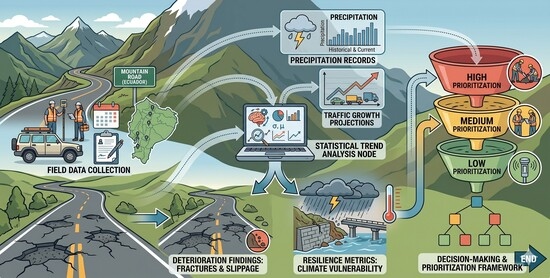
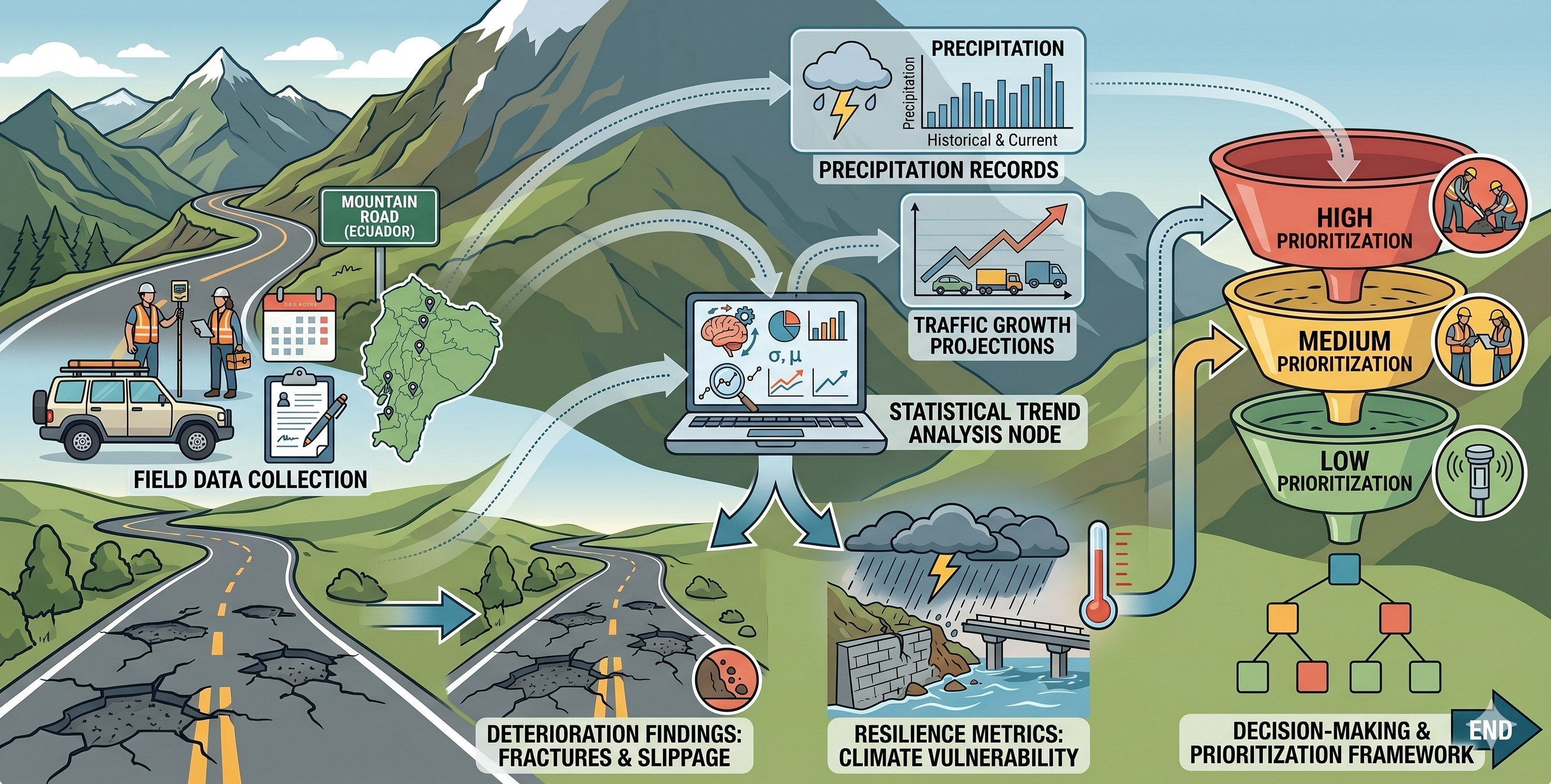
Graphical Abstract

1. Introduction

Flexible pavement deterioration is a multifactorial phenomenon in which structural, traffic, and environmental variables interact synergistically [1,2,3,4], with intense rainfall consistently identified in the recent literature as a first-order climatic driver in warm and humid zones [5,6,7,8,9]. The International Roughness Index (IRI), a functional descriptor derived from the quarter-car model and regulated by ASTM E1926-08 [10,11], is the most widely adopted roughness metric in the broader pavement asset management literature [12,13,14], and the cost asymmetry between deferred maintenance and corrective rehabilitation has motivated its adoption as a primary input for intervention prioritisation [15]. The availability of portable Class 3 devices such as the Roughometer III has enabled the systematic collection of IRI even in resource-constrained contexts [16,17,18].
Roads located in mountainous terrain face particularly severe deterioration conditions due to rugged topography, steep gradients that amplify shear stresses on the riding surface, and the concentration of surface runoff that increases hydraulic loading on the pavement [19,20]. In the Ecuadorian Andes, these continuous loading conditions are intensified by the spatial variability of rainfall, the presence of volcanic soils with low bearing capacity, and the influence of two well-defined annual rainy seasons that subject the surface to alternating cycles of intense hydraulic stress and relative drying. Superimposed on these continuous mechanisms, a second class of deterioration drivers operates on mountain corridors: episodic geohazards—landslides, debris flows, rockfalls, and embankment edge failures—that contribute to surface decay as discrete events whose magnitude–frequency distribution is heavy tailed [21] and whose susceptibility along highways in Loja Province has been documented to be approximately one order of magnitude higher than at the regional baseline [22]. The occurrence of these episodic events depends not only on climatic forcing but also on geological structure, slope geometry, vegetation cover, antecedent moisture conditions, and anthropogenic slope modifications, so that climate resilience in mountain roads must be interpreted in terms of the broader interaction between climatic loading and geohazard susceptibility rather than in terms of direct rainfall effects on pavement materials alone. The interaction of continuous and episodic mechanisms thus constitutes the broader conceptual context for the analysis of temporal IRI evolution, although the empirical analysis presented here focuses on the continuous component and treats the episodic component as a declared limitation.
Evidence from comparable mountain corridors indicates that cumulative precipitation is one of the most significant predictors of surface condition [23]. However, baseline empirical data on the temporal evolution of the IRI on flexible pavement mountain roads in Ecuador—and more broadly in South America—remain scarce [24,25], and most available deterioration models have been calibrated under temperate or arid climates, whose transfer to Andean tropical contexts entails considerable uncertainty [7]. Consequently, asset management decisions on these corridors currently rely on transferred parameters whose representativeness for the local topoclimatic regime has not been verified, leaving operational interventions without an adequate empirical foundation.
The Loja–Catamayo road, which connects the provincial capital of Loja with the canton of Catamayo in southern Ecuador, exemplifies this empirical gap with particular clarity. The corridor traverses a markedly mountainous alignment over 36.50 km, with steep gradients, sharp horizontal curvature, and a bimodal precipitation regime characteristic of the southern Sierra. The riding surface exhibits documented severe deterioration along extensive sections, yet no systematic record of its temporal IRI evolution has been published. The absence of such a record prevents both the diagnosis of dominant deterioration trends along the route and the construction of a reference dataset that could support future predictive or maintenance prioritisation studies on this and comparable Andean rural roads. Addressing this gap therefore requires the integrated acquisition and analysis of IRI, climatic, and traffic data over a multi-year monitoring window.
To support an honest interpretation of the results, the following data constraints—beyond their treatment in the Discussion—are made explicit at the outset because they govern the inferential boundaries of every conclusion that follows: (i) the campaign-level analytical sample is n = 11, supporting only the detection of large effect sizes; (ii) the meteorological record begins on 1 January 2024, reducing the effective number of inter-campaign windows with full climate coverage to n = 7; (iii) the AADT base-year count was conducted in 2014–2015, ten years prior to the monitoring window, and all projections are therefore indicative order-of-magnitude estimates rather than precise forecasts; (iv) no contemporary structural validation data (FWD, GPR, and in situ density/CBR) and no systematic visual distress catalogue (VIZIR/PCI) were available; and (v) AADT is not stratified by travel lane, and weigh-in-motion axle-load spectra are not available.
Within these exploratory boundaries, the present study—framed as a baseline rather than as a confirmatory or predictive contribution—is guided by three research questions: (RQ1) Does the corridor-mean IRI of the Loja–Catamayo road exhibit a statistically significant monotonic deterioration trend over the 2023–2025 monitoring window? (RQ2) Is there a detectable short-term association between rainfall, or thermal-cycling exposure, and pavement roughness at the campaign-level temporal resolution available? (RQ3) Does the as-designed structural section provide sufficient ESAL capacity for the projected traffic demand over the post-rehabilitation life cycle of the route? These questions are addressed through eleven Class 3 Roughometer III campaigns conducted between 12 March 2023 and 9 November 2025, integrated with daily climate records from the INAMHI Villonaco station, a reconstructed yearly AADT series cross-validated against a contemporary classified count, the as-designed pavement structural section, and a non-parametric inferential framework supplemented by a 25-cell Antecedent Moisture Index sensitivity grid, AASHTO 1993 Structural Number computation, the Sayers-derived Present Service-ability Index, and linear, exponential, and Gompertz predictive modelling.
The study contributes original quantitative evidence on IRI behaviour under Andean tropical mountain conditions and delivers, to the best of the authors’ knowledge, the first temporally structured IRI baseline for a rural Andean corridor in southern Ecuador. It additionally provides a reference dataset and a fully reproducible analytical workflow integrating climatic, traffic, structural, and geometric indicators on a single corridor, offering a replicable methodology to support evidence-based maintenance and rehabilitation decisions on the Loja–Catamayo road and on comparable rural mountain roads in Latin America. The explicit limitations of the monitoring design, including the diffuse-loading assumption with respect to episodic geohazards, are systematically discussed in the Discussion section that follows.

2. Materials and Methods

2.1. Study Design and Research Approach

This study adopts an exploratory, descriptive, and correlational research design. It is exploratory insofar as it constitutes the first systematic, temporally structured IRI monitoring programme documented for a flexible pavement corridor in the Ecuadorian Andes, where comparable baseline datasets do not yet exist in the published literature. It is descriptive in characterising the temporal evolution of pavement roughness—together with its concurrent climatic and traffic context—across the observation period. It is correlational in examining the statistical associations between inter-campaign climate exposure descriptors (cumulative precipitation, mean and maximum daily thermal range, and Antecedent Moisture Index) and the campaign-to-campaign change in mean IRI and between the IRI series of the two measured travel lanes, without manipulating any of the independent variables. The traffic dataset is used as input to a structural capacity benchmarking exercise (AASHTO 1993 Structural Number versus projected ESAL demand) rather than as a variable in any inferential correlation test.
Based on this observational framework, two directional hypotheses were formulated a priori to guide the inferential procedures applied in the present study:
H1 (Deterioration Trend Hypothesis).
The International Roughness Index of the Loja–Catamayo flexible pavement exhibits a statistically significant positive monotonic trend over the monitoring period (12 March 2023–9 November 2025), reflecting progressive pavement deterioration driven by the combined effect of cumulative traffic loading and climatic stresses characteristic of mountainous Andean environments. The null hypothesis (H01) states that no significant monotonic trend exists in the IRI series over the study period (Mann–Kendall τ = 0, p ≥ 0.05).
H2 (Precipitation–IRI Association Hypothesis).
Cumulative inter-campaign precipitation exhibits a statistically significant positive monotonic association with the campaign-to-campaign change in mean IRI (ΔIRI), reflecting the cumulative effect of moisture-induced damage mechanisms documented in the literature for tropical mountain pavements [5,6,8,23]. The null hypothesis (H02) states that the Spearman rank correlation coefficient between cumulative inter-campaign precipitation and ΔIRI is equal to zero (ρ = 0, p ≥ 0.05). Given the limited number of inter-campaign windows with complete climate coverage (n = 7), a non-rejection of H02 is interpreted as inconclusive at the available temporal resolution rather than as evidence of climatic irrelevance, consistent with the conservative inferential treatment of small-sample tests recommended in the recent literature [24].
Both hypotheses were tested using non-parametric statistical methods, consistent with the small sample sizes available at the analytical scales adopted: n = 11 IRI campaigns at the corridor-mean resolution for H1 and n = 7 inter-campaign windows with ≥80% climate data coverage for H2. The strong positive skewness of the daily precipitation distribution (Section 3.1, Table 5) additionally precludes the use of parametric inferential methods.
The study was conducted under an observational, non-experimental design using secondary meteorological and traffic data combined with primary IRI measurements collected by the authors. The methodological approach follows the conservative inferential protocol recommended for IRI temporal analysis under resource-constrained monitoring conditions [24].

2.2. Study Area

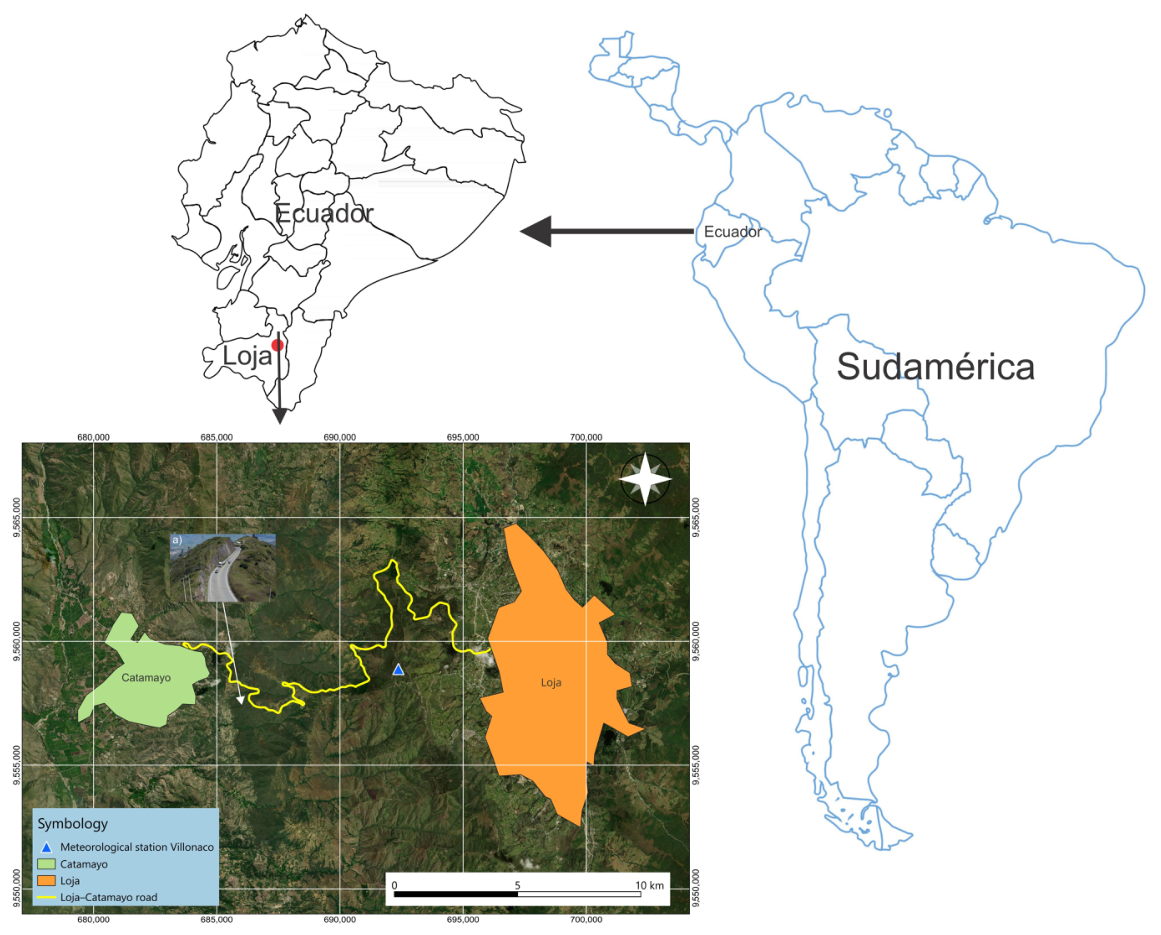
The study corridor is the Loja–Catamayo road section, designated as national route E35 (Troncal de la Sierra) and administered by the Ministerio de Transporte y Obras Públicas (MTOP) of Ecuador. The corridor connects the provincial capital of Loja (2059 m a.s.l., coordinates: station 0+000, E: 699,308.789, N: 9,560,208.529) with the canton of Catamayo (1267 m a.s.l., coordinates: station 36+500, E: 681,384.187, N: 9,558,177.277) over a total distance of 36.50 km in the southern Sierra region of Ecuador (Figure 1). The corridor forms part of the national primary road network and constitutes a strategic interprovincial axis for commerce, agriculture, passenger transport, and heavy goods movement connecting the provinces of Loja, Zamora Chinchipe, and El Oro.

2.2.1. Topography, Geometry, and Longitudinal Alignment

The corridor traverses a markedly mountainous topographic profile, descending approximately 792 m over 36.50 km. To characterise the longitudinal alignment beyond a single corridor-average gradient, the corridor was divided into three sections of approximately equal length based on the average longitudinal slope reported in the as-built records and consolidated in this study (Section 3.3).
Section 1 (chainage 0+000–11+300, length 11.3 km) exhibits an average longitudinal slope of 4.6%. Section 2 (chainage 11+300–22+000, length 10.7 km) exhibits 4.5%. Section 3 (chainage 22+000–36+500, length 14.5 km)—corresponding to the descent toward Catamayo—exhibits 7.0%. The length-weighted mean longitudinal slope is 5.52%, and 39.7% of the corridor length is classified as Steep under a 6% threshold. Individual grade values along the corridor have been reported to range from −0.5% to −7.0% in the descending direction (Loja to Catamayo), with horizontal curve radii as tight as 42–51 m along the most sinuous reaches [26], consistent with the classification of mountainous terrain under the Ecuadorian road design standard (NEVI-12), which designates maximum allowable grades of 8–10% for this terrain category and design speed.
The transverse cross-section (see Supplementary Figure S2), is two-lane bidirectional with a 4.5 m lane width per direction (total carriageway 9.0 m), 0.5 m paved shoulders on both sides, and a 2% transverse slope from the central crown toward both edges. The 2% cross-slope, the standard MTOP-NEVI-12 [27] value for primary mountainous corridors, defines the surface runoff direction from the centreline toward the shoulder–side-drain interface and is the geometric driver of the hydraulic loading concentration discussed in Section 4.5. The IRI measurement convention adopted in this study assigns “left lane” to the Loja → Catamayo direction (descending) and “right lane” to the Catamayo → Loja direction (ascending), consistent with the operator’s chainage-increasing reference. Detailed planimetric data (full longitudinal profile, radii of curvature, superelevation, and vertical curve geometry) at the sub-section resolution were not available and are declared as a data limitation (Section 4.7).

2.2.2. Pavement Structural Section

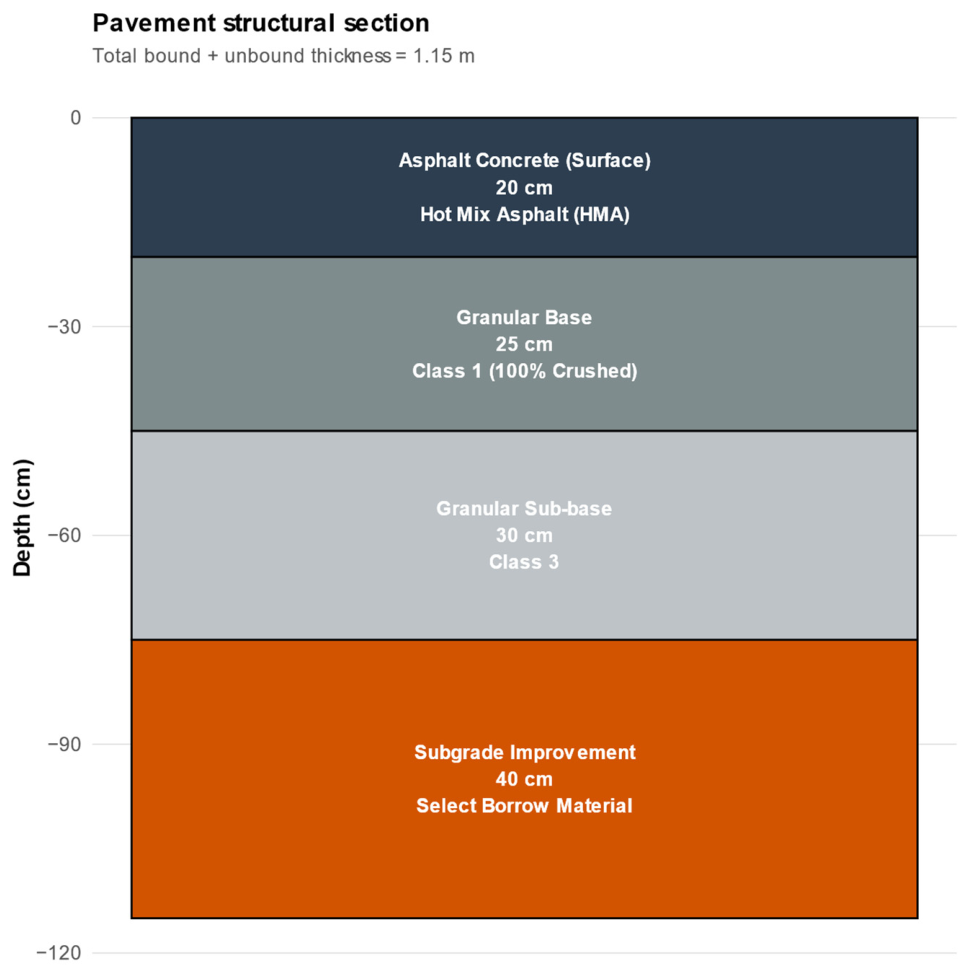
The as-designed pavement structural section is summarised in Table 7 of Section 3.2 and visualised in Figure 4. The section comprises four layers above the natural subgrade: a Hot Mix Asphalt (HMA) surface course of 0.20 m thickness; a Class-1 granular base course of 0.25 m thickness (100% crushed aggregate); a Class-3 granular sub-base course of 0.30 m thickness; and a select-borrow subgrade improvement layer of 0.40 m thickness. The total bound + unbound thickness above the natural subgrade is 1.15 m. The values reported above for the asphalt binder content, gradation envelope, and target air-void content are the design-specification ranges of the MTOP-NEVI-12 [27] standard for this corridor class; the as-built mix-design parameters and the in situ density/void records corresponding to the 2019 rehabilitation works were not retrievable from the publicly available documentation and are declared as a data limitation. Consequently, the structural assessment of Section 3.2 must be interpreted as conditional on the design-specification inputs and not on contemporary in situ characterisation, as further discussed in Section 4.3.
For the computation of pavement age at each IRI campaign, a reference date of 1 July 2019 was adopted, corresponding to the midpoint of the most recent documented major rehabilitation of the corridor as recorded in the MTOP project file for the Loja–Catamayo road [28]. In the absence of a precise reception-of-works date in the publicly available documentation, this mid-year reference is adopted as the best available proxy and represents an inherent uncertainty in the absolute pavement-age values reported throughout this study, of approximately ±0.25 years. Under this reference, the corridor was 3.70 years post-rehabilitation at the first IRI campaign and 6.36 years at the last. The detailed mix-design parameters (asphalt binder content, gradation envelope, and in situ density), the records of intermediate maintenance interventions during the monitoring period, and any historical structural evaluation (Falling Weight Deflectometer measurements, ground-penetrating radar layer characterisation, and in situ density tests) were not available to the authors and are declared as data limitations of the present study.

2.2.3. Regional Climate

The regional climate along the corridor is governed by its position in the outer western Andes of southern Ecuador and is characterised by a pronounced altitudinal gradient in precipitation. The Catamayo valley floor receives less than 400 mm of mean annual rainfall and exhibits semi-arid conditions, while precipitation increases markedly with altitude toward Loja [29]. The precipitation regime is bimodal, with two wet seasons per year (approximately February–May and October–December) separated by drier interludes, consistent with the climatic zonation of Loja Province described by INAMHI [29]. This bimodal pattern is particularly relevant to pavement deterioration dynamics, as it implies that the pavement surface is subjected to alternating cycles of intense hydraulic stress and relative drying over the course of each year. The combination of elevated traffic volumes, steep and variable gradients, tight horizontal geometry, and a bimodal high-intensity rainfall regime makes the Loja–Catamayo corridor a representative and technically demanding case study for the analysis of climate resilience and pavement deterioration in Andean mountainous road infrastructure.

2.3. Description of the Study Sample and Data Source

The study integrates four complementary data sources at the corridor level: (i) eleven IRI measurement campaigns conducted between 12 March 2023 and 9 November 2025 on the Loja–Catamayo road section; (ii) 731 daily records of accumulated precipitation and daily maximum, mean, and minimum air temperature obtained from the INAMHI Villonaco (UTPL) automatic meteorological station for the period 1 January 2024–31 December 2025; (iii) Annual Average Daily Traffic (AADT) data reconstructed at annual resolution for the period 2015–2025 by vehicle class, cross-validated against a seven-day classified vehicle count conducted in May 2024; and (iv) as-built data on pavement layer composition and longitudinal slope by corridor section.

2.3.1. IRI Measurement Campaigns

Eleven IRI campaigns were conducted between 12 March 2023 and 9 November 2025 using a Roughometer III Class 3. Each campaign covered the full 36.50 km corridor and both travel lanes; for inferential analyses at the campaign level, each IRI observation (n = 11) represents the arithmetic mean of all 100-metre segment measurements recorded along the corridor for a given lane and campaign date. This campaign-level aggregation reduces the analytical unit from the individual segment to the corridor mean, which is the appropriate spatial unit for trend and seasonal comparison analyses given the monitoring scope of this study. IRI data were collected for both the left and right travel lanes across the full 36.50 km length, yielding 11 paired lane observations per campaign and a total of 22 individual lane-campaign records. Field acquisition was performed at a constant operating speed of 50–60 km/h with the Roughometer III mounted on the rear axle of the survey vehicle, with two-way GPS-georeferenced traverses per campaign (one per lane), and 100 m segment IRI values computed in real time by the on-board profiler according to the ASTM E1926-08 quarter-car algorithm [10] (See Supplementary Figure S1). Table 1 presents the temporal distribution, lane coverage, and seasonal classification of the 11 IRI measurement campaigns.
The seasonal classification used here follows INAMHI’s climatological calendar for Loja Province, under which calendar January is nominally a dry month and is therefore labelled “Dry” in the binary scheme of Table 1, regardless of the year. However, the refined monthly classification of Section 2.4.4 is data driven and assigns the regime of each calendar month independently for 2024 and 2025 from the recorded monthly precipitation total. The apparent inconsistency between Table 1 (campaign 8, 27 January 2025, labelled “Dry”) and Table 6 (January 2025, labelled “Wet” under the data-driven scheme) is therefore not a contradiction but the explicit demonstration of why the binary calendar-based scheme is insufficient: the January 2024 total was 48.29 mm (genuinely Dry under the <50 mm/month threshold), while the January 2025 total was 183.67 mm (Wet under the 100–200 mm/month threshold, almost four times the typical climatological January value). The 2025 anomaly is consistent with the documented interannual ENSO modulation of the Ecuadorian Pacific coast and southern Sierra [30] and is the principal motivation for introducing the refined classification in Section 2.4.4. The thermal regime is reported in Table 6 for the same months to make the joint rainfall–temperature stratification visible: January 2025 is classified a Wet/Moderate cycle, while the December 2024 → January 2025 transition exhibits the highest dT_mean of the December series (Table 6), which justifies the joint use of rainfall and daily-thermal-range descriptors in the inter-campaign association test of Section 2.4.5.
A retrospective visual condition index (VIZIR or PCI) could not be reconstructed for the monitoring campaigns because no systematic photographic archive or distress survey fiches were preserved from the field operations, despite the successful execution of the Roughometer III traverses listed in Table 1. This represents an important limitation of the study. Without a contemporaneous visual distress inventory, the corridor-mean IRI remains the only available functional indicator for characterising pavement surface performance during each campaign. Consequently, retrospective corroboration through PCI- or VIZIR-based assessments is not possible. Future monitoring activities should therefore systematically combine IRI acquisition with a standardised visual distress catalogue. As discussed in Section 4.9, this is considered the highest-priority action for the confirmatory monitoring phase.
Table 1. Summary of IRI measurement campaigns (2023–2025).
CampaignDatePavement Age (Years) 1Lanes MeasuredSeasonNotes
112 March 20233.7Left/RightWetBaseline survey; first systematic IRI measurement
26 August 20234.1Left/RightDryMid-dry-season monitoring
31 October 20234.25Left/RightWetOnset of secondary wet season
423 February 20244.65Left/RightWetPrimary wet-season campaign
517 May 20244.88Left/RightWetEnd of primary wet season
66 September 20245.18Left/RightDryFirst crossing of the 4.0 m/km maintenance threshold
716 November 20245.38Left/RightWetSustained Fair condition
827 January 20255.58Left/RightDryENSO-modulated wet-month exception within calendar-dry January
920 April 20255.81Left/RightWetPeak corridor-mean IRI of the series
1020 July 20256.06Left/RightDryPost-peak observation; unattributed decline
119 November 20256.36Left/RightWetFinal monitoring campaign; post-peak decline
Note. Season classification follows the bimodal precipitation regime of Loja Province (INAMHI climatological zonation) [31]: campaigns conducted in February–May and October–December are classified as Wet; campaigns in June–September and January are classified as Dry. 1 Pavement age in years referenced to the completion of the major rehabilitation works on the corridor (reference date: 1 July 2019, see Section 2.2.2). The reference date is the midpoint of the most recent documented major rehabilitation as recorded in the MTOP project file [28]; the uncertainty in the absolute age value is approximately ±0.25 years.
Throughout this study the corridor-mean IRI of each campaign is classified under the World Bank operational scheme defined by Sayers et al. [32] and currently adopted by the FHWA [13] and the recent IRI-prediction literature [7,24,31]: Excellent (IRI < 2 m/km), Good (2 ≤ IRI < 4 m/km), Fair (4 ≤ IRI < 6 m/km), Poor (6 ≤ IRI < 8 m/km), and Very Poor (IRI ≥ 8 m/km). The 4.0 m/km boundary between the Good and Fair classes corresponds to the operational maintenance intervention threshold adopted for primary corridors by the MTOP under NEVI-12 [27], and the 6.0 m/km boundary between the Fair and Poor classes corresponds to the rehabilitation intervention threshold. These two thresholds are used as the operational targets of the time-to-threshold projections of Section 3.11.

2.3.2. Precipitation Dataset

Daily accumulated precipitation data (mm/day) were obtained from the INAMHI automatic meteorological station Villonaco (station code: UTPL Villonaco), situated at 2952 m a.s.l. (latitude: 3°59′10.6″ S; longitude: 79°16′9.9″ W; UTM Zone 17S: E 692,138 m, N 9,559,012 m) [32,33]. The station is located approximately 1.80 km from the midpoint of the study corridor, 7.27 km from the Loja end (2100 m a.s.l.), and 10.79 km from the Catamayo end (1267 m a.s.l.), making it the nearest INAMHI station to the corridor centreline. Its elevation of 2952 m a.s.l. places it approximately 1269 m above the mean corridor elevation (~1683 m a.s.l.), which represents an inherent limitation in the representativeness of point precipitation data for the full altitudinal range of the road section. Table 2 summarises the key technical characteristics of the station and the precipitation dataset.
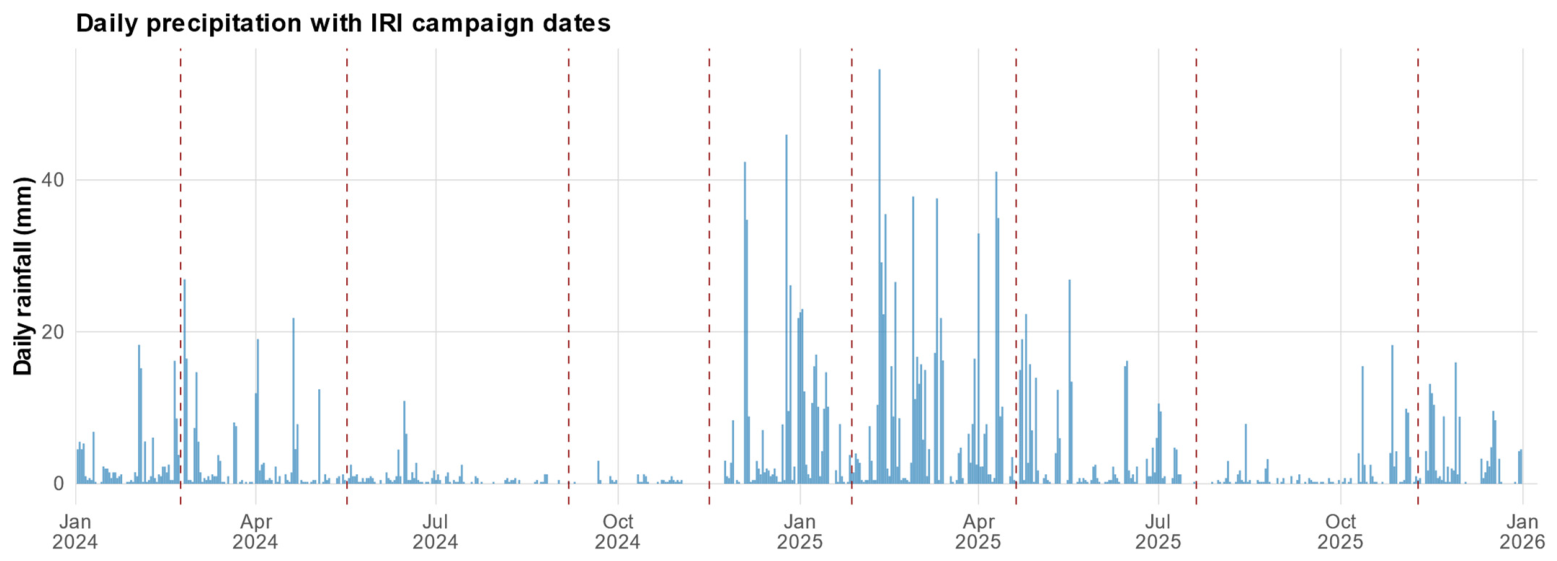
The precipitation record comprises 366 records for 2024 (leap year, complete) and 365 records for 2025 (complete), with no missing calendar dates and no null values in either annual series. Zero-precipitation days (daily accumulation = 0 mm) accounted for 125 out of 366 records in 2024 (34.2%) and 108 out of 365 records in 2025 (29.6%), consistent with the semi-arid to sub-humid character of the Catamayo valley and the influence of the dry season at this elevation [29]. Total annual accumulation was 674.27 mm in 2024 and 1357.27 mm in 2025, representing a near-doubling between years consistent with the high interannual variability documented for Andean precipitation regimes [30]. Across the combined 731-day record, the mean daily precipitation was 2.78 mm/day (SD = 6.40 mm/day; median = 0.50 mm/day; CV = 230.4%), confirming the strong positive skewness characteristic of daily rainfall distributions [34]. Monthly accumulation totals (Table 3) confirm the bimodal seasonal structure, with maximum monthly totals concentrated in December–April in both years. Wet-season days yielded a combined mean of 3.78 mm/day (total: 1604.98 mm; n = 425 days) compared with 1.39 mm/day during dry-season months (total: 426.56 mm; n = 306 days).

2.3.3. Temperature Dataset

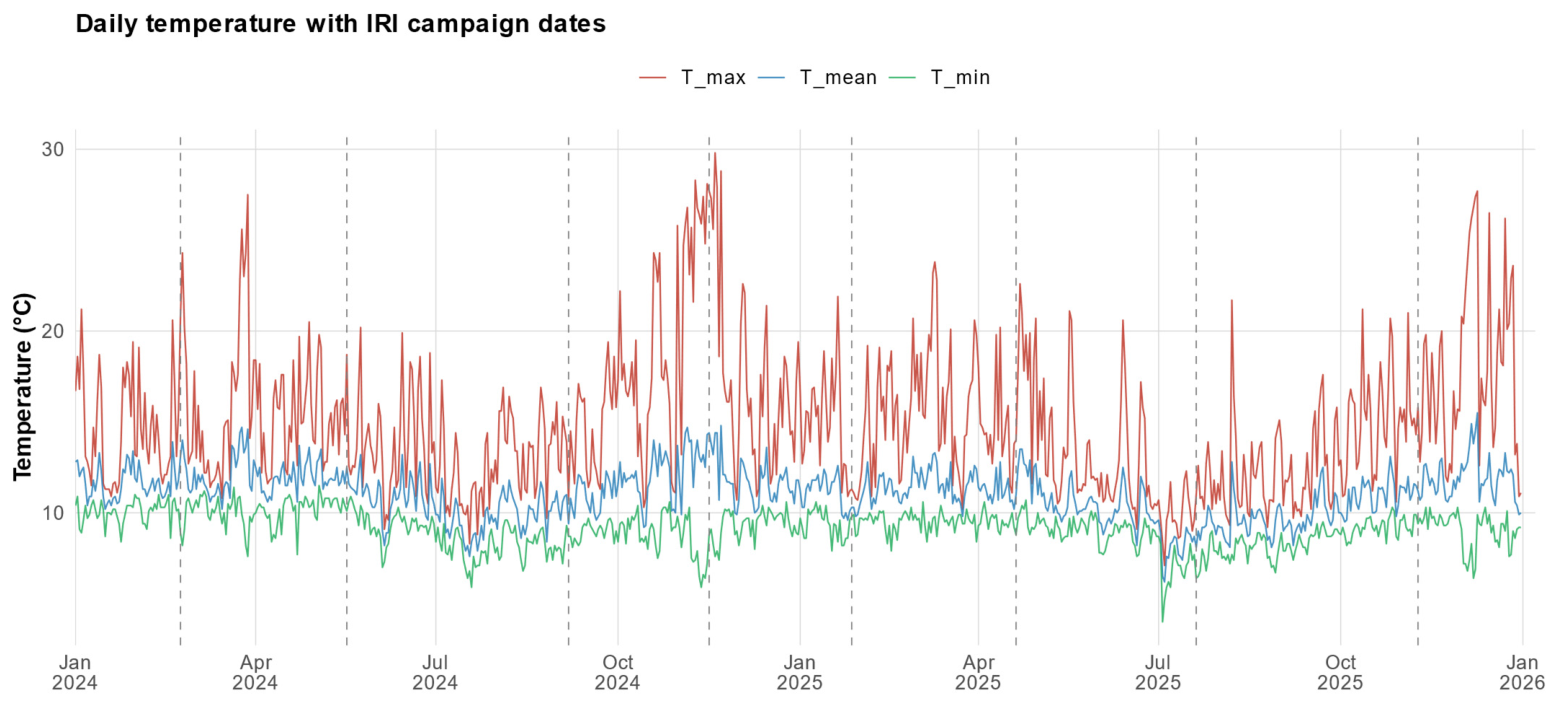
In addition to the daily precipitation record, daily maximum air temperature (T_max), daily mean air temperature (T_mean), and daily minimum air temperature (T_min) [14] were obtained from the same INAMHI Villonaco (UTPL) automatic station for the complete period 1 January 2024–31 December 2025. The temperature record comprises 731 complete daily observations matching the precipitation record on a one-to-one basis, with no missing dates and no null values in any of the three series. From the recorded T_max and T_min, the daily thermal range (ΔT_daily = T_max − T_min) was derived as a thermal-cycling exposure descriptor. Temperature was incorporated as an additional exploratory variable on the basis that diurnal thermal cycling is known to affect bituminous surface behaviour in mountainous tropical settings [14]. This thermal analysis was conceived as exploratory and post hoc with respect to the original hypothesis framework: it was not part of the H2 formulation, which addresses precipitation only, and its results are reported as descriptive contributions to the climate–IRI interpretation rather than as confirmatory tests. Across the combined 731-day record, mean T_mean was 11.06 °C (SD = 1.40 °C), with daily maximum and minimum extrema of 29.80 °C and 4.00 °C, respectively. The derived daily thermal range averaged 5.81 °C (SD = 4.02 °C) with a maximum of 22.20 °C, indicating substantial diurnal thermal-cycling characteristic of high-altitude tropical Andean conditions. Descriptive statistics of all five climate variables (rainfall, T_max, T_mean, T_min, and ΔT_daily) are presented in Section 3.1.

2.3.4. Annual Average Daily Traffic Dataset and Cross-Validation Count

Annual Average Daily Traffic (AADT) data were obtained from the classified vehicle count study conducted by Arévalo Maldonado and Segarra Morales [35] in 2014–2015 for the Loja–Catamayo corridor, with vehicle classes consolidated into three groups consistent with the MTOP-NEVI-12 standard [27]: light vehicle, light truck and heavy truck. From the base-year count, the AADT was reconstructed at annual resolution for the period 2015–2025 by applying class-specific compound annual growth rates [36,37,38] derived from the historical fluctuations of the regional traffic series documented for the southern Sierra primary network, with a distinct growth regime applied between 2019 and 2020 to accommodate the documented COVID-19 mobility contraction and the subsequent post-pandemic recovery. The resulting nominal growth from 2015 to 2025 is approximately 2.0× for light vehicles (5365 → 10,820 veh/day), 2.1× for light trucks (1068 → 2242 veh/day), and 2.1× for heavy trucks (63 → 133 veh/day), not the “3× increase” that an unmoderated post-COVID extrapolation would have produced, because the reconstruction explicitly imposes the historical pre-COVID growth regime over 2015–2019, the documented contraction over 2019–2020, and the post-COVID recovery regime over 2020–2025 (Table 12). The 2.0–2.1× decadal growth is consistent with the regional traffic-evolution pattern reported for primary corridors of the southern Sierra over the same period and does not require the construction of new attractor points at either corridor endpoint.
External cross-validation of the 2024 reconstructed value was conducted against a seven-day classified vehicle count carried out at a representative cross-section of the corridor on 6–12 May 2024, covering all three consolidated vehicle classes. The seven-day weekly mean was compared with the reconstructed 2024 annual value at the class level. The classification of “unclassified” base-year vehicles followed the methodology of the original traffic study [30]: these vehicles, which represent 50% of the total base-year count, were distributed proportionally across the three consolidated vehicle groups (light vehicle 82%, light truck 17%, and heavy truck 1%) in proportion to the observed classified counts (Table 4).
It must be acknowledged that the AADT base-year count was conducted in 2014–2015, approximately ten years prior to the monitoring period of this study, and that the eleven IRI campaigns of 2023–2025 represented an unrealised opportunity to collect concurrent classified vehicle counts at the same field windows. This methodological gap is explicitly recognised here, and the corresponding action—pairing each future IRI campaign with at least one full week of classified counts at a representative cross-section, ideally with lane-stratified counts and weigh-in-motion axle-load spectra—is the highest-priority traffic-side recommendation of the confirmatory monitoring phase (Section 4.9). The reconstruction of intermediate years and forward projections beyond 2025 must therefore be interpreted as indicative order-of-magnitude estimates rather than precise forecasts. Axle-load spectra (weigh-in-motion data) and lane-level classified counts are not available and are declared as data limitations of the present study.

2.4. Statistical Analysis and Modelling

2.4.1. Computational Environment and Reproducibility

All statistical analyses, derived quantities, and figures were produced in R version 4.4.1 within the RStudio 2026.01.1 Build 403 integrated development environment, organised as a single reproducible script. The script imports the seven primary data files (rainfall, temperature, IRI, traffic time series, weekly count, pavement structure, and slope), executes all computations described below, and exports the complete set of results as a single multi-sheet workbook and vector figures. The R packages used were dplyr and tidyr (data manipulation), lubridate (date handling), ggplot2, scales, GGally and patchwork (visualisation), Kendall (Mann-Kendall trend test), tseries (Augmented Dickey-Fuller test), openxlsx (workbook export), and knitr (tabular console output). The conventional significance level α = 0.05 was applied throughout. To support reproducibility, the random seed was fixed at 2026 at the start of the script.

2.4.2. Descriptive Statistics

For each numeric variable, descriptive statistics—number of observations, mean, standard deviation, minimum, 25th percentile, median, 75th percentile, maximum, skewness, and coefficient of variation—were computed and reported. The five climate variables (rainfall, T_max, T_mean, T_min, and ΔT_daily) were summarised over the 731-day record. The three IRI variables (IRI_left, IRI_right, and IRI_mean) were summarised over the 11 campaigns. The 11 campaigns were aggregated annually (2023, 2024, and 2025) and classified under the World Bank IRI condition scheme (Excellent < 2; Good 2–4; Fair 4–6; Poor 6–8; Very Poor > 8 m/km).
Non-parametric methods were systematically adopted at the inferential level, motivated by (i) the small sample size at the campaign-level resolution (n = 11), (ii) the strong positive skewness of the daily precipitation distribution (skewness = 3.89; CV = 230.4%, Section 3.1), and (iii) the consistent recommendation in the recent literature for non-parametric trend analysis on small-sample IRI series [24].

2.4.3. Non-Parametric Inferential Procedures

All inferential procedures applied at the campaign level were non-parametric because of the limited sample size at that resolution (n = 11). Under these conditions, the statistical framework provides sufficient power primarily for the detection of moderate-to-large effect sizes (|τ| ≳ 0.45) at α = 0.05. Consequently, the post-peak truncation sensitivity analysis described in Section 2.4.7 was incorporated to evaluate the robustness of the inferred deterioration trend. This limitation was identified upfront in the Introduction as one of the five principal data constraints governing the study.
The Mann–Kendall trend test (Kendall package) was applied to the corridor-mean IRI series to evaluate the H1 deterioration-trend hypothesis. An Augmented Dickey–Fuller (ADF) stationarity test was not included because the campaign-level series (n = 11) is substantially below the sample size generally considered necessary for the test to retain meaningful statistical power (typically n ≥ 25). Under such conditions, the resulting diagnostic would not provide reliable inferential value and was therefore excluded from the analytical workflow.
Differences between left- and right-lane IRI distributions were evaluated using both the unpaired Mann–Whitney U test and the paired Wilcoxon signed-rank test, complemented by Spearman rank correlation analysis between lane-specific series. Differences in IRI values between the dry and wet seasonal classifications defined in Section 2.3.1 were assessed using the Mann–Whitney U test2.
Refined Climate-Regime Classification and Kruskal–Wallis Tests
A binary calendar-based dry/wet scheme is insufficient to capture the climatic complexity of the southern Ecuadorian Andes, where intra-annual variability is shaped by altitudinal gradients, ENSO modulation, and a bimodal precipitation regime with two well-defined wet seasons per year. To address this limitation, a refined monthly classification was derived directly from the 731-day meteorological record of the INAMHI Villonaco station. Each calendar month was independently assigned to a rainfall regime based on monthly accumulated precipitation—Dry (<50 mm/month), Transitional (50–100 mm/month), Wet (100–200 mm/month), or Extreme (>200 mm/month)—and to a thermal-cycling regime based on the mean daily thermal range: Low cycle (mean ΔT_daily < 4 °C), Moderate cycle (4–7 °C), or High cycle (>7 °C). The four-by-three classification space yields up to twelve combined regime combinations and provides a substantially finer descriptor of the monthly climatic state than the binary calendar-based scheme. Each IRI campaign falling within the meteorological record was assigned the regimes of its calendar month (Table 6), and Kruskal–Wallis tests of mean IRI across the rainfall and thermal regimes were applied to assess whether the more granular stratification revealed contrasts undetected by the binary classification (Section 3.8).

2.4.4. Inter-Campaign Climate Aggregation and Antecedent Moisture Index

To address the temporal mismatch between the daily climate record and the campaign-level IRI sampling, climate exposure was aggregated over each inter-campaign window (campaigni → campaign{i + 1}). For each window, the following descriptors were computed: cumulative precipitation (P_cum, mm); mean daily precipitation (P_mean, mm/day); count of heavy-rain days (N_heavy_rain, daily total ≥ 10 mm); mean inter-campaign air temperature (T_mean_avg, °C); mean daily thermal range (dT_mean, °C); maximum daily thermal range (dT_max, °C); count of high-thermal-stress days (N_thermal, ΔT_daily > 15 °C); and the Antecedent Moisture Index evaluated at the closing campaign date (AMI_end).
The rationale for the AMI specification is that flexible-pavement moisture damage is a cumulative and time-lagged process: water infiltration, subgrade-support reduction, and bituminous-stripping mechanisms operate over weeks to months rather than at the daily resolution at which precipitation is recorded [5,6,8]. Direct correlation between daily rainfall on a campaign date and campaign-level mean IRI would therefore be physically uninformative; the inter-campaign cumulative descriptors (P_cum, P_mean, N_heavy_rain) and the time-decayed AMI of Equation (1) constitute the appropriate exposure variables for the H2 test.
The Antecedent Moisture Index was defined with a time-decayed cumulative-precipitation form (Equation (1)):
A M I t = i = 1 N P ( t i ) k i
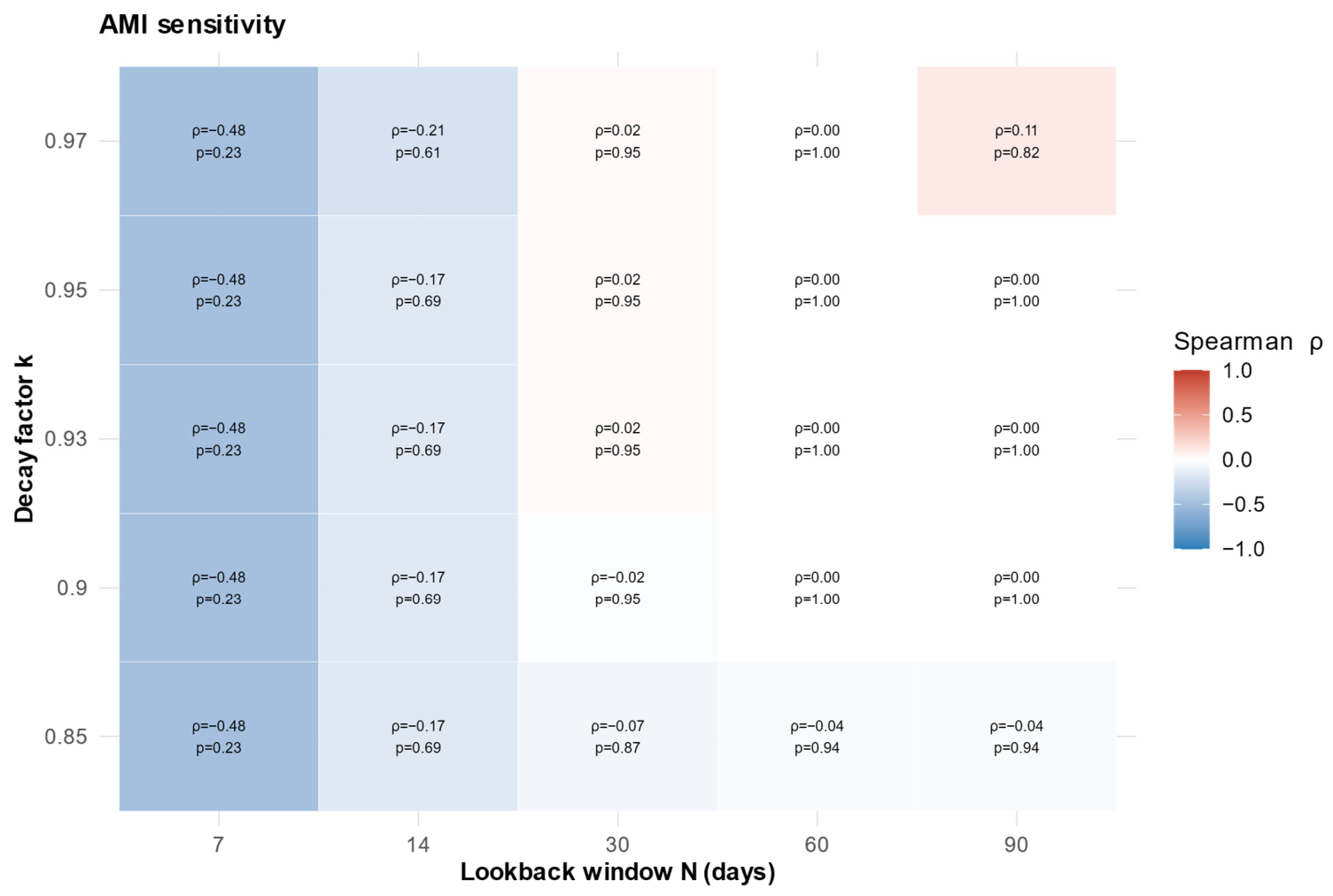
where P(ti) is the recorded daily precipitation i days before date t, k ∈ (0, 1) is the daily decay factor, and N is the lookback window in days. To prevent the absence of a detectable climate–IRI association from being interpreted as an artefact of a specific parameterisation, a sensitivity grid was constructed combining five decay factors (k = 0.85, 0.90, 0.93, 0.95, 0.97) with five lookback windows (N = 7, 14, 30, 60, 90 days), yielding 25 candidate AMI specifications. The Spearman correlation between the AMI and IRI mean was computed for each specification.
Of the ten inter-campaign windows, only those with ≥80% climate data coverage was retained for inferential analysis. The remaining windows fell partially or wholly outside the meteorological record (which begins on 1 January 2024) and were excluded.

2.4.5. Climate–IRI Association Tests

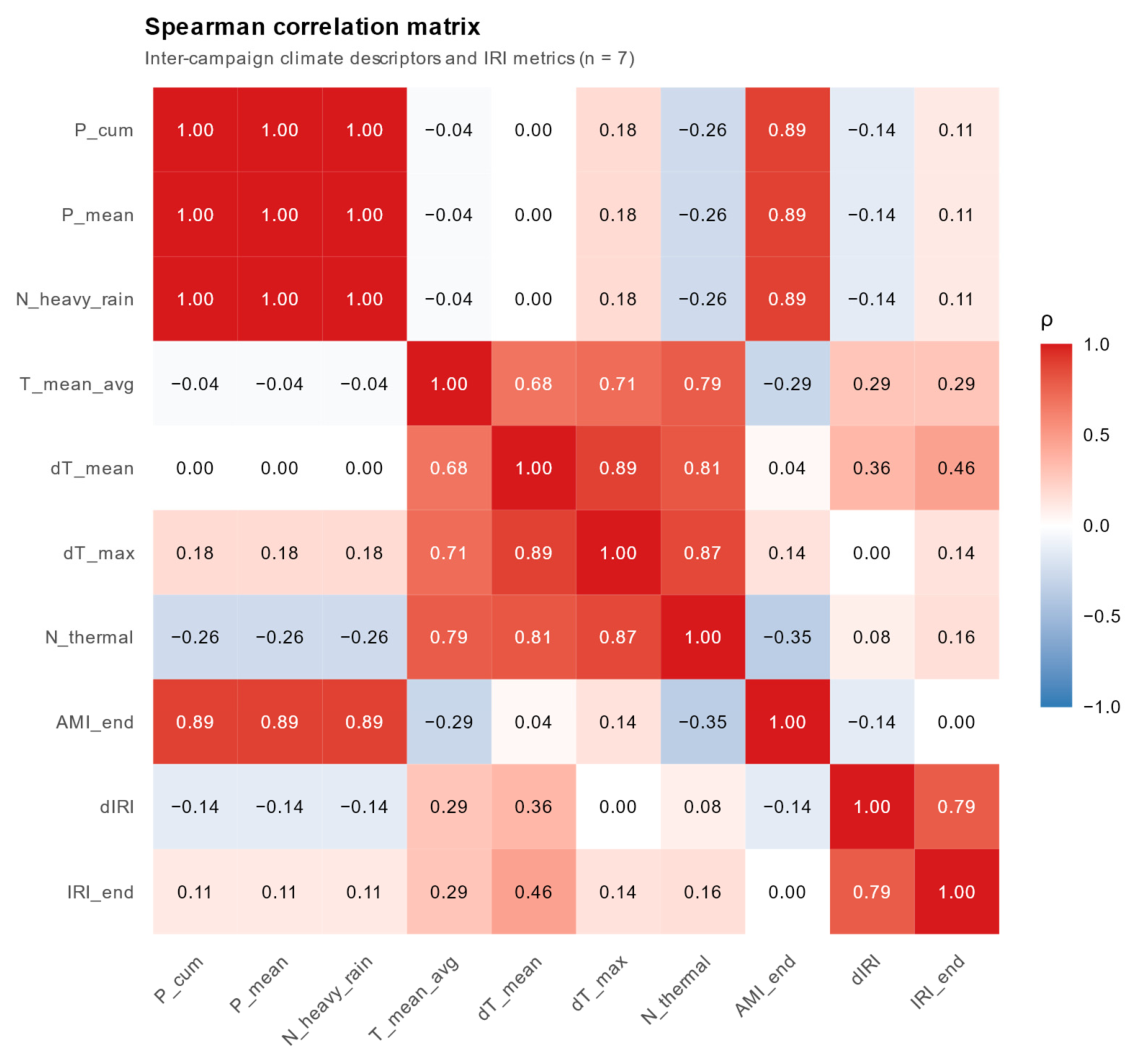
Spearman rank correlations between each climate exposure descriptor of Section 2.4.4 and the campaign-to-campaign change in mean IRI (ΔIRI = IRI_end − IRI_start) were computed on the subset of inter-campaign windows with full climate coverage. The full Spearman correlation matrix among the climate descriptors, ΔIRI, and the closing-campaign IRI was additionally computed for visualisation. These tests collectively address the H2 hypothesis on the precipitation–IRI association and extend its scope to thermal-cycling descriptors not contemplated in the original H2 formulation.

2.4.6. Sensitivity of the Deterioration Trend to Post-Peak Truncation

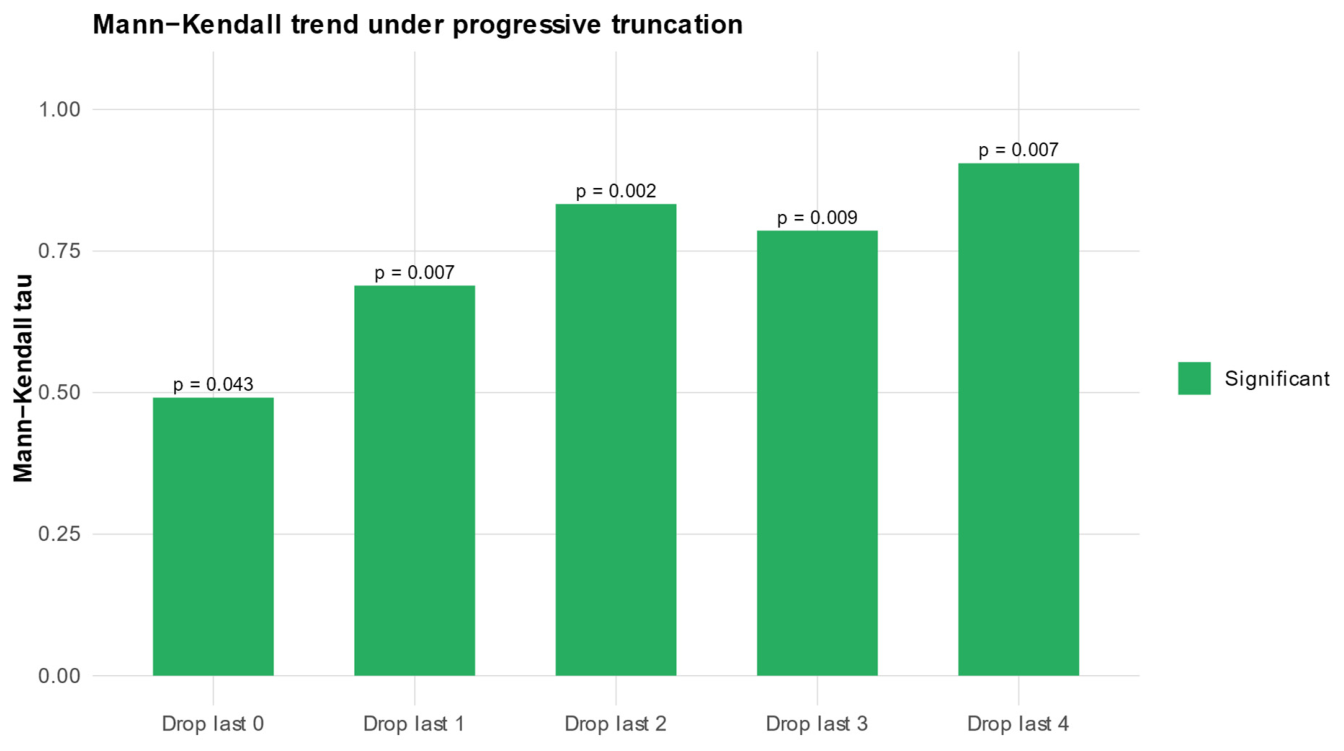
To assess the robustness of the Mann–Kendall trend conclusion in the presence of post-peak IRI fluctuation that could not be unambiguously attributed to deterministic deterioration (Section 4), a truncation sensitivity analysis was performed. The Mann–Kendall test was reapplied to the IRI_mean series after progressively removing the last 0, 1, 2, 3, and 4 campaigns from the series; the resulting τ statistics, p-values, and significance status were reported.

2.4.7. Predictive Deterioration Modelling and Time to Threshold

Three parametric deterioration models were fitted to the IRI_mean series: a linear specification (IRI = β0 + β1·t), an exponential specification (log(IRI) = γ0 + γ1·t), and a sigmoidal Gompertz specification (IRI(t) = A·exp(−B·exp(−C·t))), which is a standard non-linear functional form in flexible-pavement deterioration modelling that accommodates an initial slow-degradation phase, a rapid-decay regime, and an asymptotic stabilisation [24,39,40,41,42]. Higher-order autoregressive (ARIMA) and state-space time-series specifications are not implemented in this study because the campaign-level sample size (n = 11) is well below the minimum n ≥ 25 typically required to retain reliable parameter identification under these methods; their implementation is deferred to the confirmatory monitoring phase outlined in Section 4.9.
The pre-peak segment of the series (campaigns 1 through the maximum, k = 9) was then used to compute time-to-threshold projections for the maintenance (IRI = 4.0 m/km) and rehabilitation (IRI = 6.0 m/km) operational intervention levels. The projected dates were converted to pavement age (years from the 1 July 2019 rehabilitation reference date defined in Section 2.2.2) to enable comparison with the design service life of mountainous flexible pavements.
The Gompertz upper asymptote parameter A was constrained to the physically admissible range of 6–15 m/km, consistent with the practical upper limits reported for severely deteriorated flexible pavements in the literature. The available pre-peak dataset (n = 9 campaigns) does not yet capture the saturation stage of the Gompertz trajectory. Consequently, the optimisation process depends on the imposed constraint to stabilise the estimation of A. The fitted value (A = 15.0 m/km) should therefore be interpreted as the maximum admissible asymptotic level compatible with the observed acceleration phase, rather than as an independently identified deterioration ceiling.

2.4.8. Present Serviceability Index Derived from IRI

The Present Serviceability Index (PSI) is the original functional ride-quality descriptor of the AASHO Road Test [43] and remains the user-perception-calibrated indicator on which the AASHTO 1993 flexible-pavement design equation is constructed: terminal serviceability p_t—one of the inputs of the design ESAL capacity computation of Section 2.4.10—is expressed in PSI units. Although PSI and IRI are conceptually distinct (PSI captures user-perceived ride quality on a 0–5 scale calibrated by panel ratings; IRI captures the quarter-car-derived longitudinal-profile statistic in m/km), they are operationally linked: Sayers (1986) [32] derived the empirical exponential relationship of Equation (2) from a regression of panel-rated PSI on measured IRI, and the relationship is now the standard route by which an IRI series can be re-expressed in the AASHTO design-equation reference frame.
The Present Serviceability Index was computed from the corridor-mean IRI of each campaign via the empirical Sayers (1986) [32] relationship:
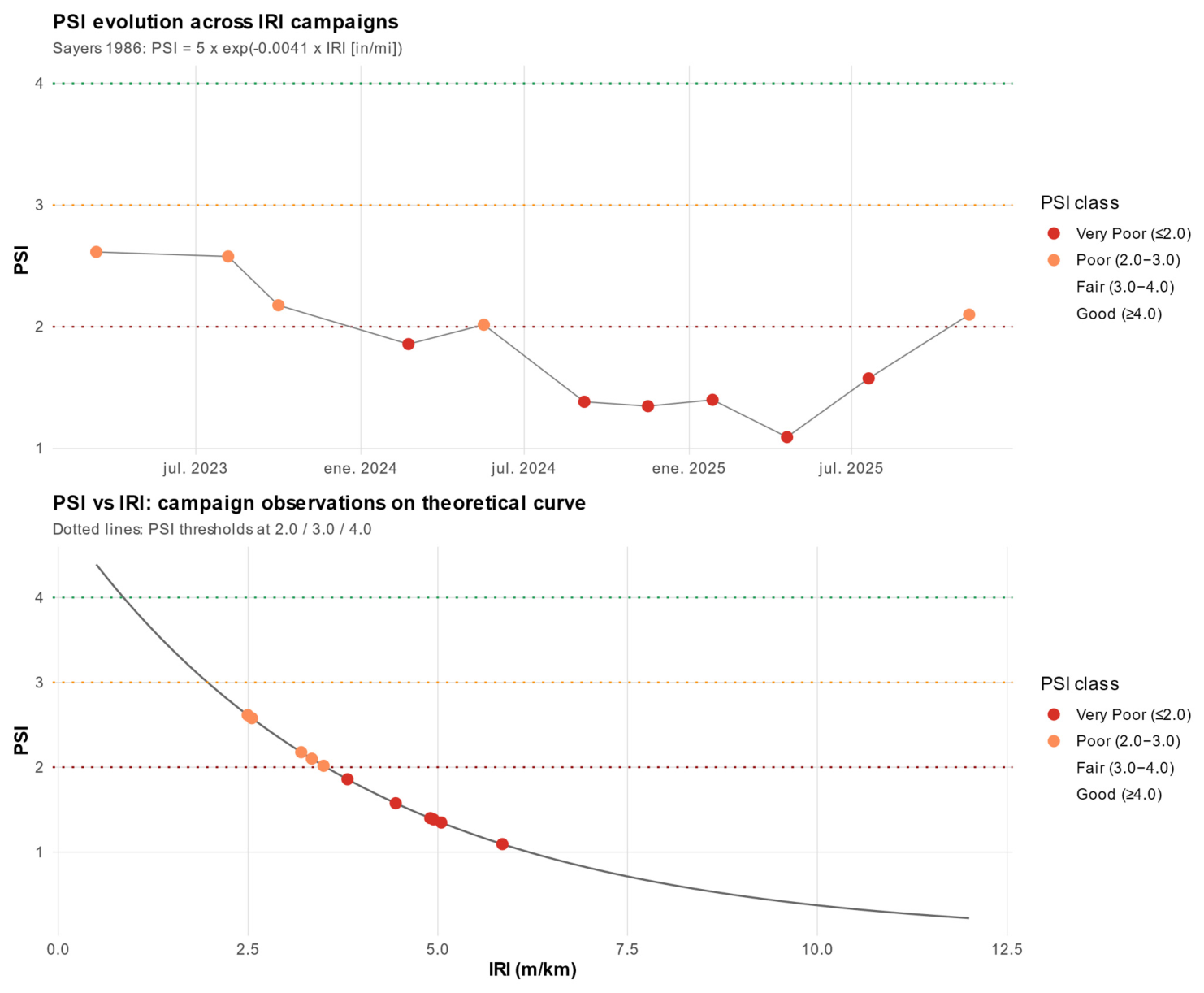
P S I = 5 e 0.2598 I R I ( m / k m )
Each PSI value was classified under the AASHO operational scheme: Good (PSI ≥ 4.0), Fair (3.0 ≤ PSI < 4.0), Poor (2.0 ≤ PSI < 3.0), and Very Poor (PSI < 2.0).

2.4.9. Traffic Time-Series Analysis, Projection Scenarios, and ESAL Conversion

The reconstructed 2015–2025 AADT series was analysed in three complementary forms. (i) Year-over-year growth rates were computed for each vehicle class and reported as a time series, with the 2019–2020 transition identified as a structural discontinuity associated with the COVID-19 mobility contraction. (ii) Three compound annual growth rate (CAGR) scenarios were derived directly from the observed series: a pre-COVID scenario (CAGR computed over 2015–2019), a post-COVID scenario (over 2020–2025), and a full-period scenario (over 2015–2025). (iii) Forward projections to 2030 and 2035 were generated by applying each of the three CAGRs to the most recent observed AADT (2025), labelled as lower (pre-COVID), central (post-COVID), and upper (full period) bounds.
External cross-validation was performed by comparing the 2024 reconstructed AADT against the seven-day classified count of May 2024 at the class level (Section 2.3.4). AADT was then converted to Equivalent Single Axle Loads (ESALs) using AASHTO 1993 Load Equivalency Factors [44] of 0.0004 for light vehicles, 0.05 for light trucks, and 1.5 for heavy trucks. The daily ESAL contribution by class for the 2025 base year and the projected 2035 central scenario were computed, and the cumulative ESAL between 2025 and 2035 was estimated by trapezoidal interpolation of the daily ESAL.

2.4.10. Pavement Structural Number (AASHTO 1993) and Design ESAL Capacity

The Structural Number was computed from the as-designed layer thicknesses (Section 2.2.2) under the AASHTO 1993 equation for flexible pavements (Equation (3)):
S N = a 1 D 1 + a 2 D 2 m 2 + a 3 D 3 m 3 + a 4 D 4 m 4
where a1 are the layer coefficients (HMA surface a1; granular base a2; granular sub-base a3), Di are the layer thicknesses in inches, and mi are the drainage coefficients of the unbound layers. To accommodate the uncertainty in coefficient values for the available material specifications, a 3 × 3 sensitivity grid was constructed combining three layer-coefficient levels (low/central/high) with three drainage-coefficient levels (poor/good/very good), yielding nine SN scenarios.
The design ESAL capacity (W18) corresponding to the central SN was computed by inversion of the AASHTO 1993 flexible-pavement design equation for three representative subgrade resilient modulus levels (MR = 4000/7500/10,000 psi), under standard reliability inputs: ZR = −1.282 (90% reliability), overall standard deviation S0 = 0.45, initial serviceability pi = 4.2, and terminal serviceability pt = 2.5.

3. Results

The Results section is organised in five blocks following the analytical logic of the study: (i) characterisation of the operating environment (climate, pavement structure, geometry, and traffic), (ii) descriptive characterisation of the IRI dataset, (iii) inferential tests of the corridor-level trend, (iv) climate–IRI association under refined exposure descriptors, and (v) predictive modelling and ride-quality indices derived from IRI.

3.1. Climatic Characterisation of the Corridor Environment

The meteorological record retrieved from the INAMHI Villonaco (UTPL) automatic station comprised 731 complete daily observations covering 1 January 2024–31 December 2025. Descriptive statistics for the five climate variables analysed are presented in Table 5. Mean daily precipitation across the record was 2.78 mm (SD = 6.40 mm; skewness = 3.89; max = 54.57 mm). Mean daily air temperature (T_mean) averaged 11.06 °C (SD = 1.40 °C) over the record. The mean of the daily maxima (T_max) was 14.94 °C (SD = 3.99 °C), with an absolute maximum of 29.80 °C; the mean of the daily minima (T_min) was 9.12 °C (SD = 1.06 °C), with an absolute minimum of 4.00 °C. The derived daily thermal range (ΔT_daily) averaged 5.81 °C (SD = 4.02 °C), with a maximum of 22.20 °C.
The full daily series of T_max, T_mean, and T_min, with the IRI campaign dates overlaid as vertical dashed lines, is shown in Figure 2. The corresponding precipitation record is shown in Figure 3.
The monthly aggregation of rainfall, mean air temperature, mean daily thermal range, and the refined rain regime and thermal regime classification (used in Section 3.8) is reported in Table 6.

3.2. Pavement Structure and Structural Number

The pavement structural section is described in Table 7, with the corresponding vertical cross-section shown in Figure 4. The structure comprises a 0.20 m Hot Mix Asphalt (HMA) surface course, a 0.25 m Class-1 granular base (100% crushed), a 0.30 m Class-3 granular sub-base, and a 0.40 m select-borrow subgrade improvement layer, for a total bound + unbound thickness of 1.15 m above the natural subgrade.
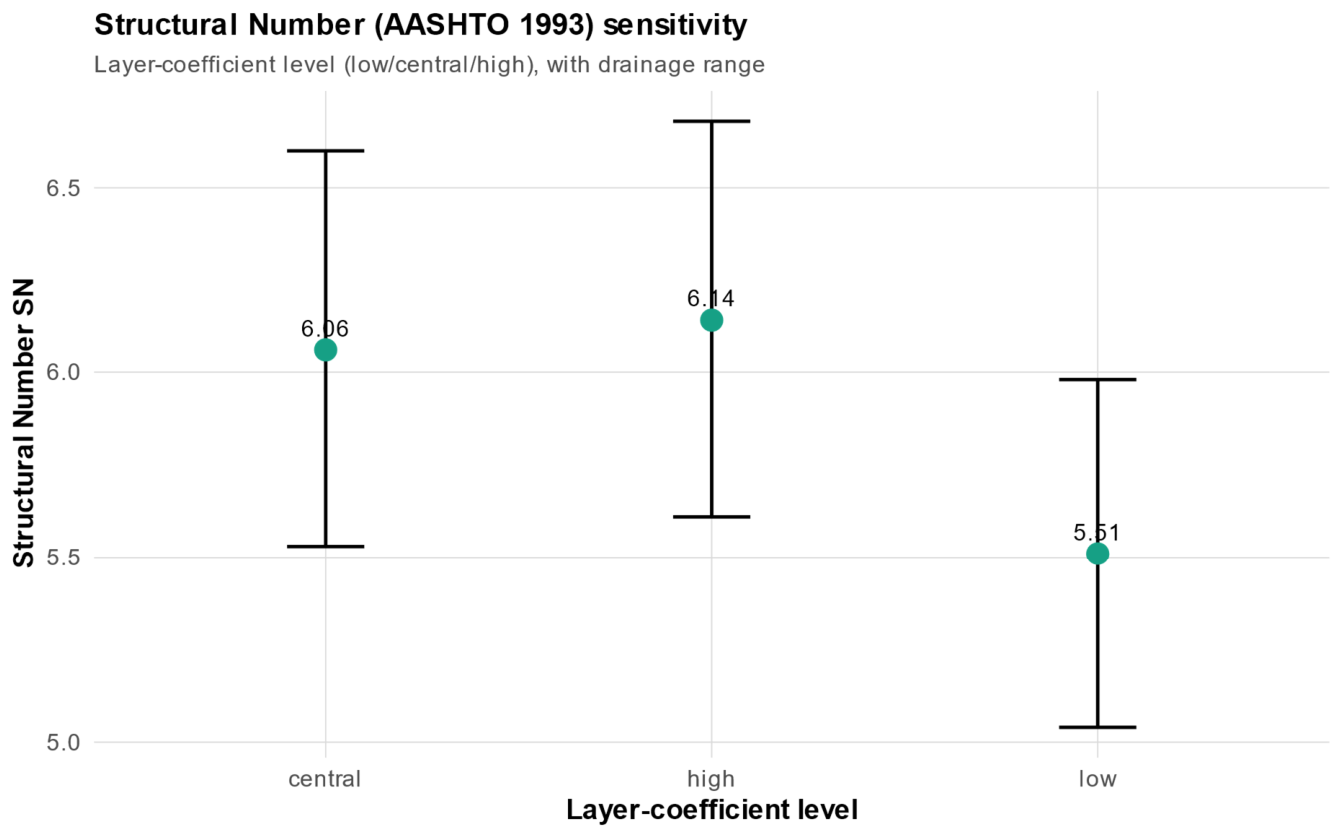
The AASHTO 1993 Structural Number was computed from the as-designed layer thicknesses under a 3 × 3 sensitivity grid combining low/central/high layer coefficients with poor/good/very good drainage modifiers. The nine SN scenarios are reported in Table 8, and the corresponding envelope is visualised in Figure 5. The central SN estimate is 6.06, with the envelope spanning SN = 5.04 (low coefficients, poor drainage) to SN = 6.68 (high coefficients, very good drainage).
The design ESAL capacity computed by inversion of the AASHTO 1993 flexible pavement design equation at the central SN under three representative subgrade resilient modulus levels is reported in Table 9: 30.87 million ESALs at MR = 4000 psi, 132.70 million ESALs at MR = 7500 psi, and 258.65 million ESALs at MR = 10,000 psi.

3.3. Geometric Characterisation of the Corridor

The 36.50 km corridor was characterised in three longitudinal sections by average gradient, as reported in Table 10. Section 1 (chainage 0+000–11+300, length 11.3 km) has an average longitudinal slope of 4.6% (Moderate). Section 2 (11+300–22+000, length 10.7 km) has 4.5% (Moderate). Section 3 (22+000–36+500, length 14.5 km) has 7.0% (Steep). The length-weighted mean slope of the corridor is 5.52%, and 39.7% of the corridor length is classified as Steep, corresponding to the descent toward Catamayo with an approximate elevation change of 1015 m over that section. Only corridor-mean IRI is available in the present dataset, so a segment-level association of IRI with slope category cannot be tested.

3.4. Traffic Time Series, Projection Scenarios, and ESAL

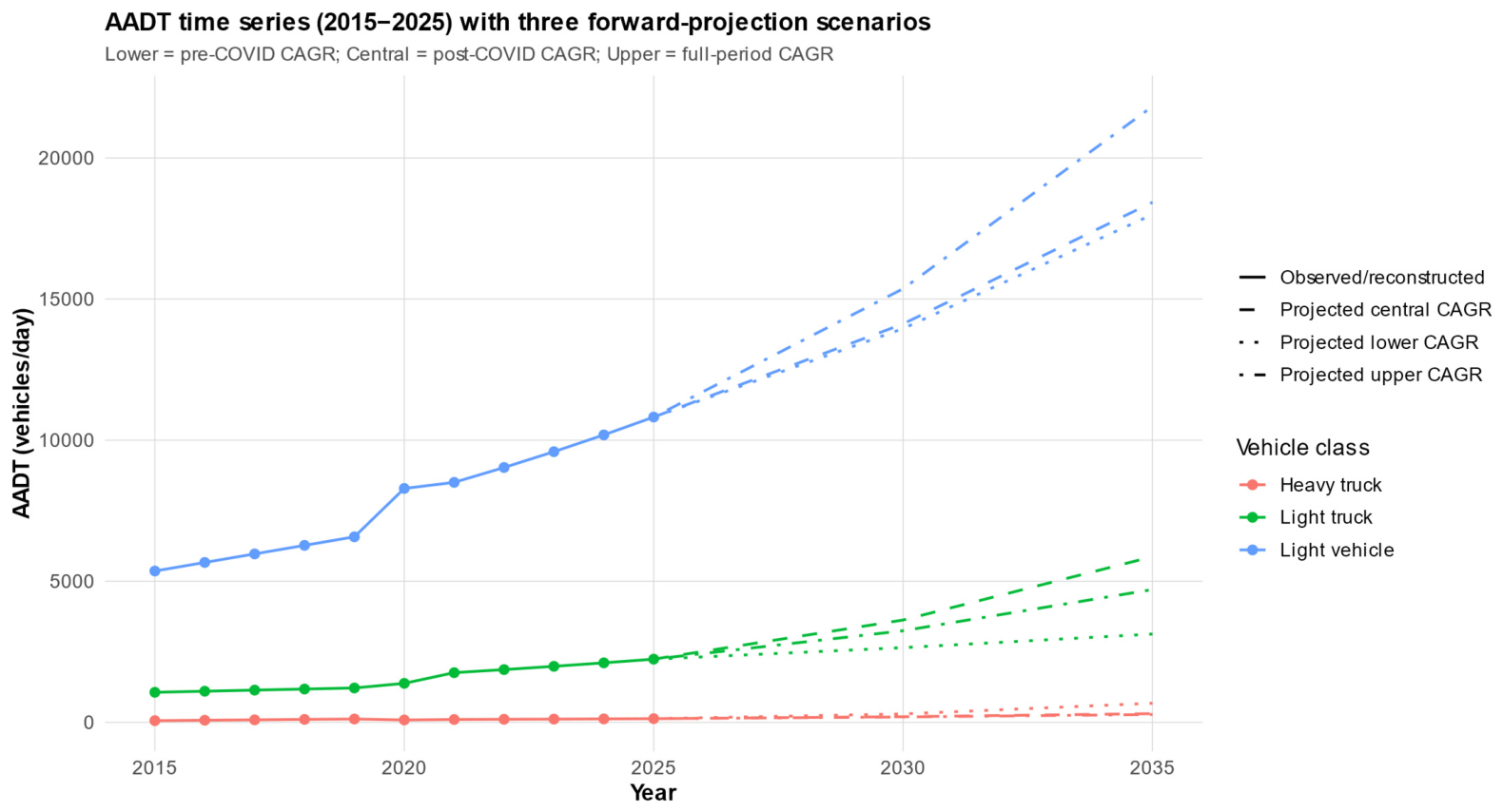
The reconstructed AADT time series for the corridor is presented in Table 11. Total corridor AADT increased monotonically from 6496 veh/day in 2015 to 13,195 veh/day in 2025, a 103% cumulative increase. Year-over-year growth rates are reported in Table S1 and exhibit a marked discontinuity at the 2019–2020 transition: the light-vehicle class shows +26.06% between 2019 and 2020, the light-truck class +13.43%, and the heavy-truck class −28.10%, consistent with the differentiated effect of the 2020 pandemic restrictions on passenger and freight flows.
Three CAGR scenarios derived from the observed series are reported in Table 12. The corresponding forward projections to 2030 and 2035 under each scenario are reported in Table 13 and visualised in Figure 6. Total corridor AADT in 2035 is projected at 21,809 veh/day (lower/pre-COVID), 24,615 veh/day (central/post-COVID), and 26,817 veh/day (upper/full period).
The consolidated observed-plus-projected total AADT series is reported in Supplementary Table S2.
The 2024 reconstructed AADT values were compared against the seven-day classified count of May 2024 to assess internal calibration consistency (Table 14). As reported in Table 15, the absolute and relative differences are zero at the class level. This consistency must be interpreted as confirmation that the base-year reconstruction parameters (vehicle-class growth rates and proportional allocation of unclassified vehicles) are internally coherent with the May 2024 count, but it does not constitute an independent external validation: the May 2024 count was the only contemporary observation available and was used in the construction of the reconstruction parameters. A fully independent external validation would require an additional classified count at a different temporal location within the monitoring window, which is identified as a priority in the future-work section (Section 4.9).
The AADT-to-ESAL conversion was performed under the AASHTO 1993 Load Equivalency Factors (LEFs) consolidated for the three MTOP vehicle classes of this corridor: LEF = 0.0004 for light vehicles, LEF = 0.05 for light trucks, and LEF = 1.5 for heavy trucks (Table 16). In the 2025 base year, the daily ESAL of the corridor is dominated by heavy trucks: 199.5 ESAL/day (63.1% of the corridor total) from a vehicle class representing only 1.0% of the AADT; light trucks contribute 112.1 ESAL/day (35.5%); and light vehicles 4.3 ESAL/day (1.4%). The cumulative ESAL between 2025 and 2035 under the central scenario is approximately 1.98 million, to be compared with the design ESAL capacity at the central Structural Number reported in Table 9 (30.87 to 258.65 million ESALs across the three-subgrade resilient modulus levels considered), confirming that the corridor’s projected ESAL demand is approximately one order of magnitude below the lowest design capacity scenario. This is the quantitative basis for the “structural reserve” interpretation of Section 4.3.

3.5. IRI Descriptive Characterisation and Pavement Age

Eleven IRI campaigns were conducted between 12 March 2023 and 9 November 2025. Lane-level and corridor-mean descriptive statistics are reported in Table 17. The corridor-mean IRI across all campaigns was 4.01 m/km (SD = 1.10 m/km; range 2.50–5.85 m/km). The left lane registered a slightly higher mean (4.13 m/km) than the right lane (3.89 m/km).
The annual aggregation of campaign means together with the pavement age (referenced to the major rehabilitation completed in mid-2019) is presented in Table 18: 2.75 m/km in 2023 (n = 3 campaigns; mean age 4.02 years), 4.32 m/km in 2024 (n = 4; mean age 5.02 years), and 4.63 m/km in 2025 (n = 4; mean age 5.95 years).
The class distribution across campaigns under the World Bank classification is reported in Table 19: 6 campaigns (54.5%) fell within the Good class and 5 (45.5%) within the Fair class; no campaign reached Excellent, Poor, or Very Poor. Across the eleven campaigns, 45.5% equalled or exceeded the 4.0 m/km maintenance intervention threshold. The complete per-campaign record of IRI by lane, mean IRI, IRI class, pavement age, time index, AMI, and PSI is reported in Supplementary Table S3.

3.6. Temporal Evolution of IRI

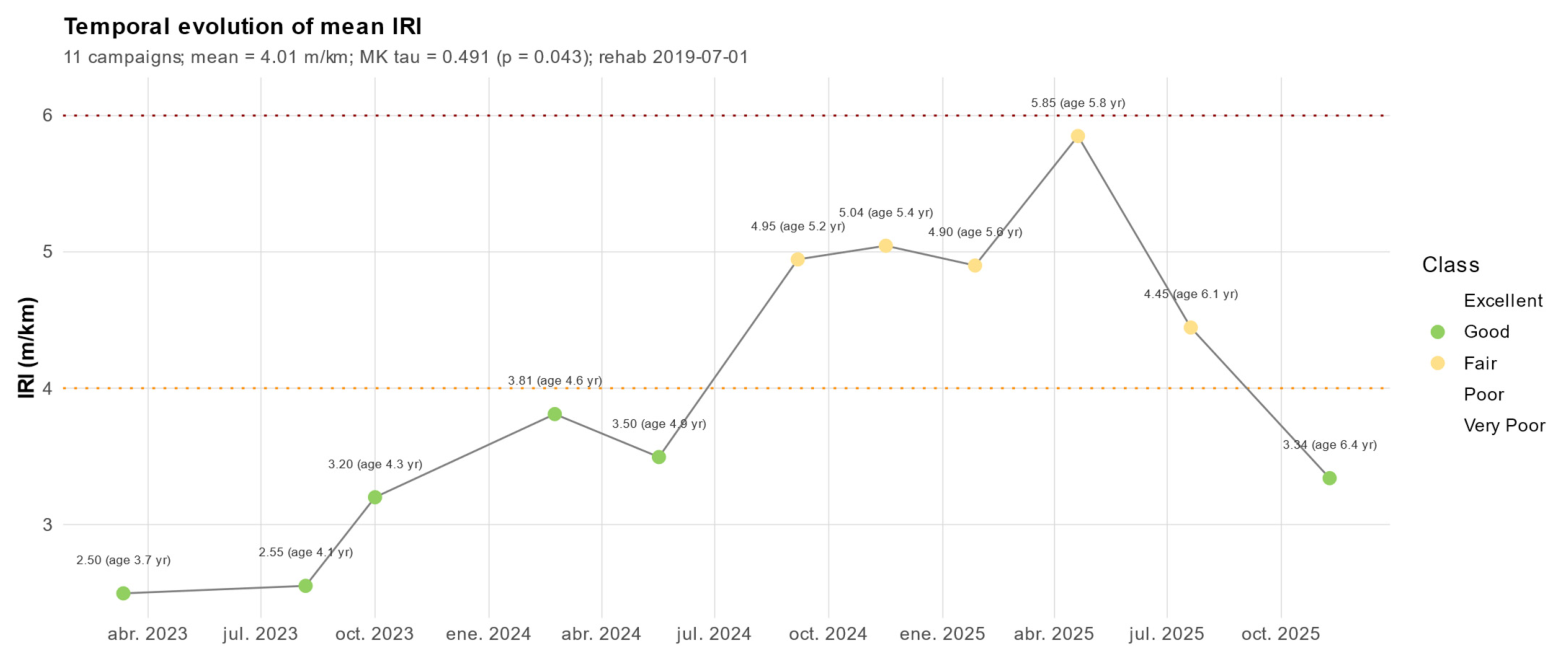
The temporal evolution of the corridor-mean IRI is presented in Figure 7. The series rises progressively from 2.50 m/km at the first campaign (12 March 2023, pavement age 3.70 years) through a peak of 5.85 m/km at the ninth campaign (20 April 2025, pavement age 5.81 years), followed by a partial decline to 3.34 m/km at the eleventh campaign (9 November 2025, pavement age 6.36 years). Visually, the trajectory is therefore not strictly monotonic: the series exhibits a clearly identifiable peak rather than a uniformly increasing trend, and the apparent contrast between the dominant ascending segment (campaigns 1–9) and the post-peak descending segment (campaigns 10–11) is the most salient feature of the visualisation. The Mann–Kendall trend test on the corridor-mean IRI series nevertheless yields a statistically significant positive monotonic trend (τ = 0.491, p = 0.043, n = 11), for two reasons that are essential to the correct reading of Figure 7. First, the Mann–Kendall procedure evaluates the global rank-order tendency of the complete series rather than requiring strictly monotonic stepwise increases between consecutive observations: even though campaigns 10 and 11 reverse the local direction, most pairs (i, j) with i < j preserve a positive ordering IRI(i) < IRI(j) across the full series, which is what the test detects. Second, the post-peak truncation sensitivity analysis of Section 3.10 shows that the trend conclusion strengthens—rather than weakens—when the post-peak campaigns are progressively removed: τ = 0.491 (p = 0.043, n = 11) → τ = 0.689 (p = 0.007, n = 10) → τ = 0.833 (p = 0.002, n = 9) → τ = 0.786 (p = 0.009, n = 8) → τ = 0.905 (p = 0.007, n = 7). The trend remains statistically significant at α = 0.05 under every truncation tested, demonstrating that the central conclusion is governed by the pre-peak deterioration trajectory and is not an artefact of the post-peak fluctuation.
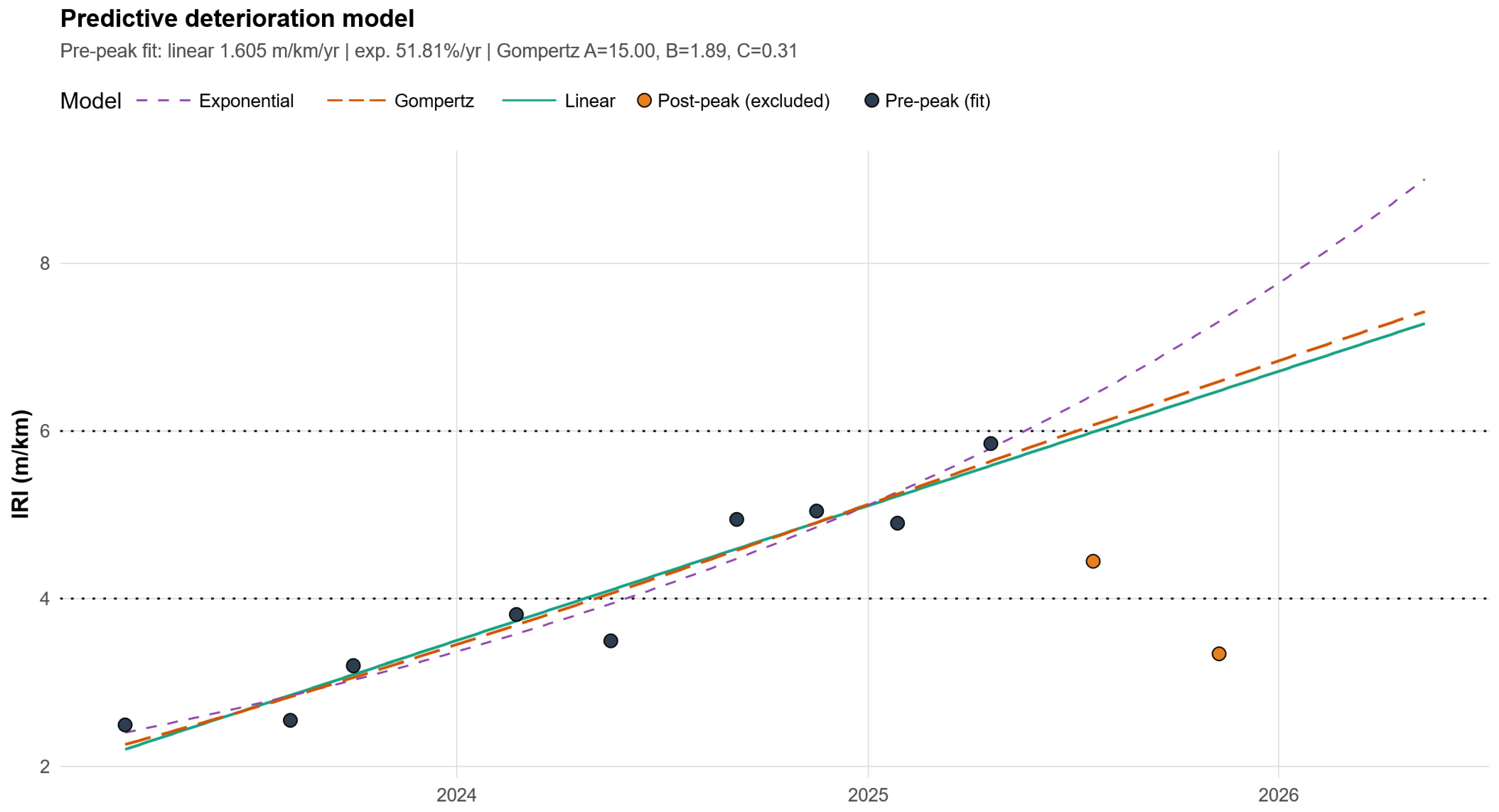
The pre-peak linear fit overlaid on Figure 7 captures this deterioration trajectory explicitly, yielding a linear rate of 1.605 m/km/year (R2 = 0.924) and projecting the crossing of the 4.0 m/km maintenance threshold at pavement age 4.82 years (Section 3.11). The post-peak decline of approximately 2.5 m/km between April and November 2025 is not attributable to any climatic, traffic, or geometric driver that could plausibly account for a reduction of this magnitude over seven months, and is most parsimoniously interpreted—as developed in detail in Section 4.4—as the signature of an undocumented localised maintenance intervention by the corridor operator (MTOP). The interpretation of the post-peak segment is therefore treated as analytically uncertain, while the trend conclusion itself is robust under the truncation sensitivity analysis.

3.7. Inter-Lane Comparison

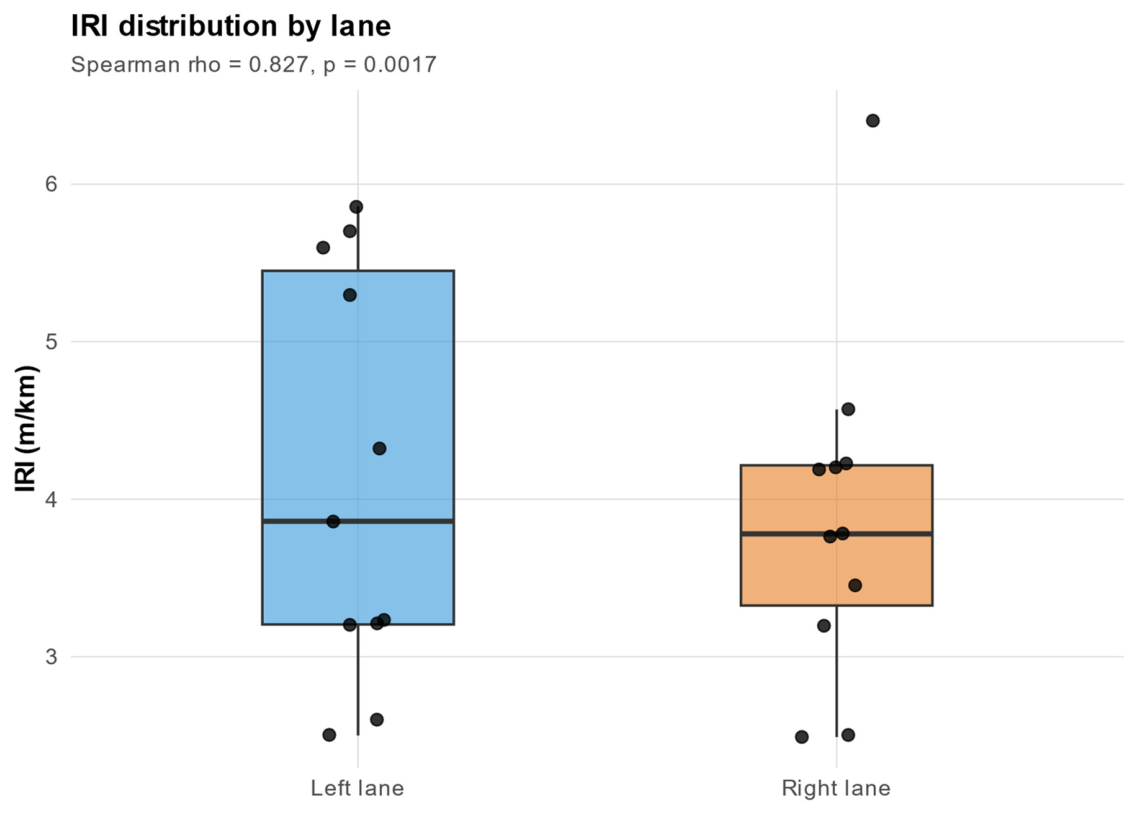
Lane-level IRI values were strongly positively correlated across campaigns (Spearman ρ = 0.827, p = 0.002, n = 11), with both the unpaired Mann–Whitney U (W = 67.00, p = 0.693) and the paired Wilcoxon signed-rank tests (V = 33.00, p = 0.610) non-significant (Figure 8). The mean lane-level difference was 0.24 m/km in favour of the left lane (Loja→Catamayo descending direction). The full lane-by-lane IRI series and the boxplot visualisation are reported in Supplementary Figure S1; the lane-asymmetry interpretation in light of unavailable lane-stratified traffic data is discussed in Section 4.5.

3.8. Seasonal and Refined Climate-Regime Contrasts

Under the binary calendar-based season classification, the Mann–Whitney U test comparing IRI means between dry- and wet-season campaigns was non-significant (W = 12.00, p = 0.777). The refined climate classification developed in Section 3.1 was subsequently used to test whether a more granular regime stratification would reveal a contrast undetected by the binary scheme. Two non-parametric Kruskal–Wallis tests were applied to the eight campaigns located within the meteorological record, with results reported in Table 20. The test of IRI against the rain regime returned χ2 = 3.208 (df = 2, p = 0.201) and against the thermal-cycling regime χ2 = 1.194 (df = 2, p = 0.550). Neither result is significant at α = 0.05.

3.9. Inter-Campaign Climate Exposure and IRI Change

Climate exposure was aggregated over each inter-campaign window. The complete set of per-window descriptors is reported in Supplementary Table S4. Of the ten inter-campaign windows, seven had at least 80% climate data coverage and were retained for inferential analysis; these are reported in Supplementary Table S5.
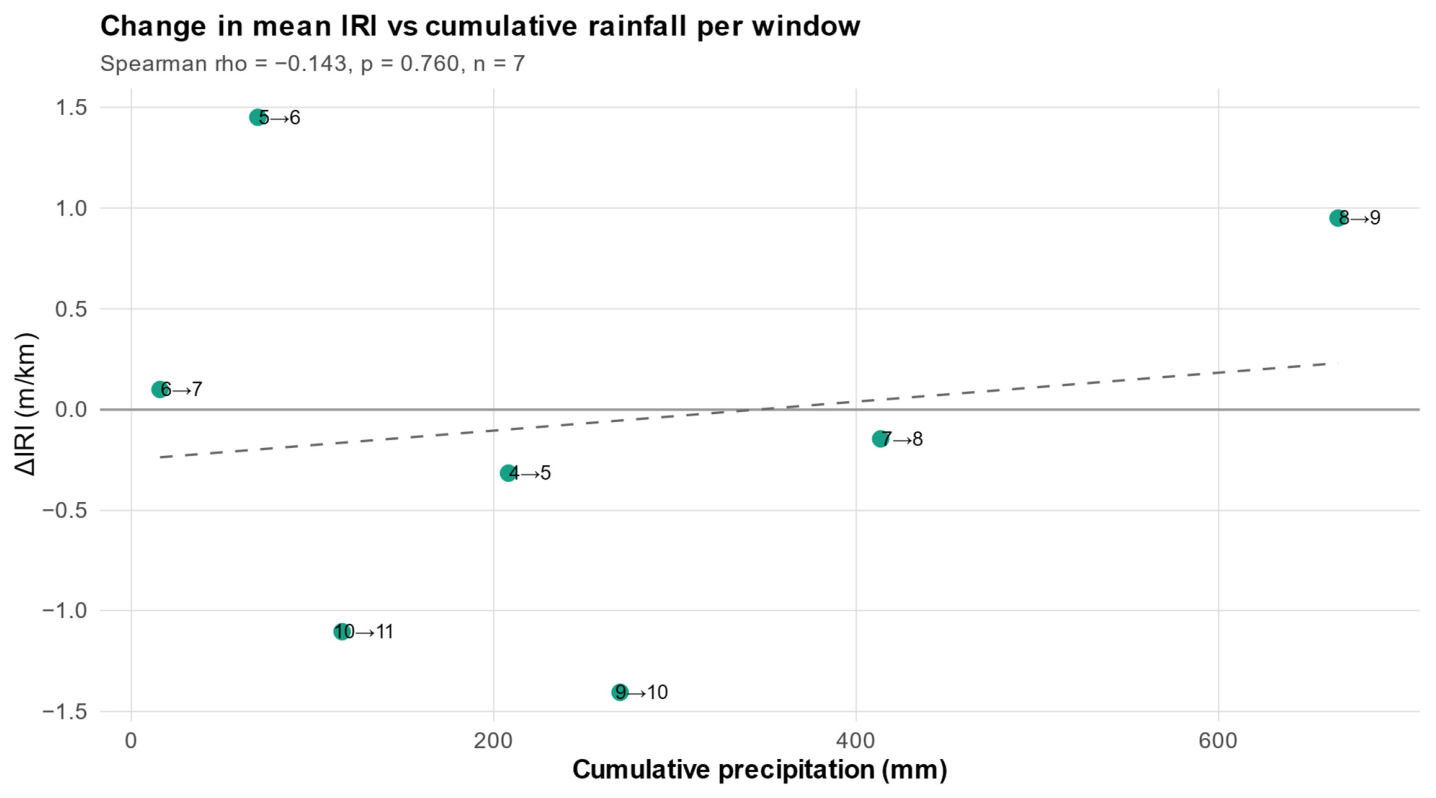
The Spearman rank correlation coefficients between each climate descriptor and the campaign-to-campaign change in the mean IRI are presented in Table 21. None of the eight descriptors yielded a statistically significant association with ΔIRI at α = 0.05: P cum, P mean, N heavy rain, and AMI end each produced ρ = −0.143 (p = 0.760); T mean avg ρ = 0.286 (p = 0.535); dT mean ρ = 0.357 (p = 0.432); dT max ρ = 0.000 (p = 1.000); and N thermal ρ = 0.079 (p = 0.867).
The bivariate distribution of ΔIRI against cumulative inter-campaign rainfall is illustrated in Figure 9.
The full Spearman correlation matrix among climate descriptors, ΔIRI, and the closing-campaign IRI is presented in Figure 10.
To assess whether the absence of a detectable climate–IRI association in the available sample could be attributed to the specific choice of AMI parameters, twenty-five combinations of the exponential decay factor k (0.85, 0.90, 0.93, 0.95, 0.97) and the lookback window N (7, 14, 30, 60, 90 days) were tested. The complete grid is reported in Table 22 and visualised in Figure 11. The configuration achieving the largest absolute correlation (k = 0.85, N = 7 days) produced ρ = −0.476 (p = 0.233, n = 8), and no specification reached significance at α = 0.05.

3.10. Sensitivity of the Deterioration Trend to Post-Peak Truncation

A sensitivity analysis was conducted by progressively truncating the IRI series from the end and re-applying the Mann–Kendall test. The results are presented in Table 23 and visualised in Figure 12. The Mann–Kendall τ strengthens monotonically with the depth of truncation: τ = 0.491 (p = 0.043) for the full series (n = 11), τ = 0.689 (p = 0.007, n = 10), τ = 0.833 (p = 0.002, n = 9), τ = 0.786 (p = 0.009, n = 8), and τ = 0.905 (p = 0.007, n = 7). The trend remains statistically significant at α = 0.05 under every truncation tested.

3.11. Predictive Deterioration Model and Time to Threshold

Three parametric deterioration models were fitted to the pre-peak segment of the IRI series and validated against the remaining campaigns: a linear specification (IRI = β0 + β1·t), an exponential specification (IRI = α0·exp(α1·t)), and a sigmoidal Gompertz specification (IRI = A·exp(−B·exp(−C·t))). The Gompertz upper-asymptote parameter A was constrained to the physically admissible range 6 ≤ A ≤ 15 m/km, reflecting the practical IRI ceiling for fully failed flexible pavements reported in the literature [44]. The calibration and validation results across four train/test splits are reported in Table 24.
The time-to-threshold projections derived from the pre-peak fit are reported in Table 25, and the full observed-versus-predicted comparison is visualised in Figure 13.
A notable feature of the calibration/validation diagnostics reported in Table 24 is the substantial discrepancy between the high coefficient of determination in training (R2 > 0.83 across all four splits) and the validation-set error metrics: RMSE values range from 1.49 to 2.47 m/km and MAPE values from 27.2% to 64.3%, with both metrics monotonically increasing as the training window is extended toward the peak. This pattern is consistent with the post-peak fluctuation absorbing into the validation set rather than into the training trajectory and indicates that the predictive utility of the fitted models is restricted to the pre-peak deterioration regime. Consequently, the time-to-threshold projections derived below should be interpreted as descriptive projections of the observed pre-peak trajectory rather than as confirmatory forecasts.
The pre-peak linear fit yielded a deterioration rate of 1.605 m/km/year (R2 = 0.924); the pre-peak exponential fit a rate of 51.81%/year (R2 = 0.934); and the pre-peak Gompertz fit produced A = 15.000 m/km (saturated at the upper physical bound), B = 1.892, and C = 0.313 yr−1 (R2 = 0.930), with a theoretical inflection point at t = 2.04 years post-baseline (IRI = 5.52 m/km, equal to A/e). Under the linear projection, the corridor-mean IRI is projected to reach 4.0 m/km on 24 April 2024 (pavement age 4.82 years) and 6.0 m/km on 23 July 2025 (pavement age 6.06 years). The Gompertz projections—4 May 2024 for the 4.0 m/km maintenance threshold (pavement age 4.84 years) and 5 July 2025 for the 6.0 m/km rehabilitation threshold (pavement age 6.01 years)—agree with the linear projections within ten days and twenty days, respectively, while the exponential projections bound them from below by approximately five weeks and two months for the maintenance and rehabilitation thresholds. The convergence of three structurally distinct deterioration specifications on essentially the same maintenance and rehabilitation timing reinforces the robustness of the time-to-threshold conclusion at the corridor-mean resolution. The observed maintenance-threshold crossing in the field data occurred between campaigns 5 and 6, bracketing the central (Gompertz/linear) projection; the observed peak (5.85 m/km on 20 April 2025) lies within 0.15 m/km of the projected 6.0 m/km threshold crossing date under both the linear and Gompertz specifications.

3.12. Present Serviceability Index Derived from IRI

The Present Serviceability Index was computed from the corridor-mean IRI of each campaign via the Sayers (1986) relationship PSI =5·exp(−0.2598·IRI(m/km). Per-campaign PSI values, together with the PSI class assignment, are reported in Table 26. The PSI across the eleven campaigns ranged from 1.09 to 2.62 (mean = 1.83): five campaigns (45.5%) fell within the Poor class (PSI 2.0–3.0) and six campaigns (54.5%) within the Very Poor class (PSI ≤ 2.0). No campaign reached the Fair or Good PSI classes. The PSI evolution across campaigns and the bivariate IRI–PSI plot on the theoretical Sayers curve are presented in Figure 14.

4. Discussion

4.1. Progressive Deterioration as the Principal Finding

The principal substantive result of the study is the demonstration of a statistically significant positive monotonic trend in the corridor-mean IRI over the monitoring window. This trend addresses the first specific objective stated in the Introduction—the construction of a systematic IRI baseline for the Loja–Catamayo corridor—and constitutes, to the best of the authors’ knowledge, the first temporally structured IRI baseline available for an Andean rural corridor in southern Ecuador, contributing to the gap in baseline empirical data for South American mountain roads identified in the recent literature [7,24,44]. The trend strengthens monotonically—rather than weakens—under progressive truncation of the post-peak campaigns, demonstrating that the central finding is governed by the pre-peak deterioration trajectory and not by the unresolved fluctuation observed in the final campaigns. This robustness property addresses directly the concern, raised in the literature on small-sample monotonic-trend testing [24], that single-realisation IRI series at the campaign-mean resolution may produce trend conclusions excessively sensitive to terminal-point behaviour.

4.2. The Non-Detection of a Short-Term Climate–IRI Association

Across the inferential framework adopted—binary calendar-based seasonal contrast, refined four-category rainfall classification, three-category thermal-cycling classification, eight inter-campaign exposure descriptors, and a 25-specification Antecedent Moisture Index sensitivity grid—no statistically significant association between any cli-mate descriptor and the change in mean IRI was detected. This is the substantive resolution of the H2 hypothesis.
The non-detection should not be interpreted as evidence that climate variables are physically unimportant on the corridor. The literature consistently identifies intense and sustained rainfall as a first-order driver of flexible-pavement deterioration through water-infiltration mechanisms [5,6,8], with cumulative precipitation specifically identified as a significant predictor on mountainous corridors in comparable topographic contexts [23]. Three considerations are relevant for the correct interpretation of the non-detection. First, the test on seven inter-campaign windows with full climate coverage is severely under-powered, detecting only large effect sizes (|ρ| ≳ 0.75) at α = 0.05. Second, the eight climate descriptors tested are not statistically independent in this sample, with cumulative precipitation, mean daily precipitation, the heavy-rain day count, and the AMI at the closing campaign producing identical Spearman estimates; the 25-cell AMI sensitivity grid eliminates the possibility that the absence of a detectable association is an artefact of a specific decay/lookback parameterisation, shifting the source of the limitation explicitly to the temporal sampling resolution [7,40]. Third, the post-peak fluctuation introduces within-sample variability that may be unrelated to climate forcing and further reduces discriminative power. Fourth, the drainage-lag mechanism—by which infiltrated water progressively reduces subgrade support over days to weeks before the functional manifestation reaches the riding surface [5,6,8]—is approximated by the time-decayed AMI of Equation (1), but the 25-cell sensitivity grid of decay factor and lookback window cannot fully compensate for the absence of direct drainage observations (catchment-area mapping, side-drain hydraulic condition, and sub-surface drainage outflow). The acquisition of a corridor-wide drainage-system inspection record is consequently identified as a methodological priority for the confirmatory monitoring phase (Section 4.9). The non-detection is therefore a property of the monitoring design, not a refutation of the physical mechanisms documented in the literature [5,6,7,8,23]. In the confirmatory monitoring phase outlined in Section 4.9, the climate–IRI exposure characterisation will be supplemented by a corridor-wide photographic and descriptive inventory of the surface water-management system (longitudinal side drains, cross drains, culverts, and shoulder-erosion features), so that the AMI-derived hydraulic exposure can be cross-referenced with the spatial distribution of the drainage-system condition along the corridor.

4.3. Structural Reserve, Functional Deterioration, and Pavement Age

The structural assessment reported in this study is based on the as-designed layer thicknesses and material specifications recorded in the MTOP project file for the Loja–Catamayo corridor (Table 7) and not on contemporary in situ structural measurements. Falling Weight Deflectometer (FWD) deflection surveys, Ground Penetrating Radar (GPR) layer characterisation, and in situ density/California Bearing Ratio (CBR) testing were not available to the authors during the present study. The Structural Number was therefore computed under a 3 × 3 sensitivity grid spanning conservative-to-favourable layer coefficients and poor-to-very good drainage modifiers (Table 8) to bracket the parametric uncertainty associated with the absence of in situ structural data. The structural interpretation that follows must consequently be read as conditional on the as-designed inputs and on the AASHTO 1993 framework; its confirmation requires the dedicated structural-validation campaign specified in Section 4.9.
The application of the AASHTO 1993 framework to the as-designed layer composition places the central Structural Number in a range associated with a well-designed flexible pavement, with a design ESAL capacity that substantially exceeds the cumulative ESAL demand projected over the post-rehabilitation life cycle. The deterioration documented in this study cannot therefore be attributed primarily to a structural undersizing of the original design. The PSI conversion via the Sayers (1986) relationship reinforces this interpretation from the functional side: even at the best ride-quality state recorded, the corridor was already operating within the Poor PSI class; the worst observation reached Very Poor. The discrepancy between the World Bank IRI classification—under which the corridor oscillated between Good and Fair—and the PSI classification reflects the difference between the maintenance-economics calibration of the World Bank thresholds and the user-perceived ride-quality calibration of the AASHO scale [12,13]. The pavement age framing—referenced to the 1 July 2019 rehabilitation completion and now made explicit in Table 1, the upper x-axis of Figure 7, and the annual aggregation of Table 18—places the corridor at 3.70 years post-rehabilitation at the first campaign and 6.36 years at the last, with a mean annual age increasing from 4.02 years in 2023 to 5.95 years in 2025 (Table 18). The age-conditioned interpretation of the observed deterioration trajectory is essential to the discussion that follows because the temporal evolution of pavement roughness is not stationary across the life cycle of a flexible pavement: deterioration models documented in the recent literature for two-lane primary corridors consistently identify a near-linear progression during the early-to-middle service window (ages 3–8 years), followed by an accelerated non-linear regime as the bituminous surface course exits its “young” phase [45]. The Loja–Catamayo corridor is observed during precisely this early-to-middle window, and the pre-peak linear deterioration rate of 1.605 m/km/year (R2 = 0.924) is consistent with this age-conditioned phase. The predictive model projects the crossing of the 4.0 m/km maintenance threshold at pavement age 4.82 years and the 6.0 m/km rehabilitation threshold at pavement age 6.06 years (Table 25) against a conventional service life of ten to fifteen years for flexible pavements designed under NEVI-12 on a primary mountainous corridor [26]. The corridor is therefore reaching its operational maintenance threshold at approximately one-third of its design life and the rehabilitation threshold at approximately 40% of its design life. The combination of “structurally over-designed for the projected demand” (Section 4.3, first paragraph) and “functionally deteriorating at one-third to two-fifths of the design life” (this paragraph) identifies the dominant deterioration mechanism not in the pavement design but in the age–maintenance interaction: the as-designed structural reserve has not been depleted, but the surface course and the surface drainage system have entered a deterioration regime that, in the absence of timely intervention, will compress the operational service life by approximately one half. This interpretation is consistent with the multifactorial framework of Kayadelen et al. [2], the maintenance-deficit interpretation of Angelo, Sasai, and Kaito [15], and the cost-asymmetry argument of Buitrago Atehortua [46].

4.4. The Post-Peak Fluctuation and Its Analytical Treatment

The decline of the corridor-mean IRI in the final campaigns is not consistent with a deterministic deterioration trajectory under climatic and traffic loading alone and exceeds the run-to-run variability typically reported for Class 3 inertial profilometers [16,17]. Three candidate explanations are consistent with the available evidence: undocumented localised maintenance interventions during the post-peak interval; accumulated measurement variability across campaigns; and transient seasonal surface effects. Because none of these candidate explanations can be confirmed with the data currently available, the post-peak segment is treated as analytically uncertain, and the truncation sensitivity analysis of Section 3.10 ensures that the central deterioration finding is robust to this uncertainty [47,48,49]. A formal request to the corridor operator (Ministerio de Transporte y Obras Públicas, MTOP) for the complete inventory of maintenance interventions executed between April 2025 and November 2025 is identified as the highest-priority action to resolve the interpretation of the post-peak segment; this request has been initiated and the results, once obtained, will be incorporated into the confirmatory monitoring phase described in Section 4.9.

4.5. Lane Equivalence, Traffic Loading, and Geometric Context

The mean lane-level difference of 0.24 m/km is small in absolute terms and not statistically significant under either the paired or unpaired tests. The reconstructed AADT series shows substantial growth between 2015 and 2025 with a clearly identifiable structural discontinuity at the 2019–2020 transition; the three CAGR scenarios provide an explicit envelope of projection uncertainty that addresses the limitation of fixed-CAGR projections noted in the Introduction. The ESAL conversion confirms an asymmetric loading characteristic of mountainous freight corridors: a vehicle class representing a small fraction of the total AADT contributes the dominant share of cumulative pavement damage, in line with the AASHTO fourth-power law [50]. The structural-reserve interpretation should be revisited if axle-load spectra ever become available, since the Load Equivalency Factors used here are class averages.
The longitudinal characterisation of Section 3.3 identifies the descent toward Cata-mayo (Section 3, chainage 22+000–36+500, length 14.5 km) as exhibiting an average gradient of 7.0%—substantially greater than the corridor-mean value of 5.52%—and as concentrating 39.7% of the corridor length classified as Steep under the 6% threshold. Three mechanisms documented in the literature on mountainous pavements converge along this section: gradient-amplified tangential shear under heavy-vehicle braking and acceleration [19,20]; runoff-concentrated hydraulic loading at the pavement–shoulder interface under the bimodal regime of Loja Province [9,21,22]; and curvature-induced differential transverse loading along the most sinuous reaches (radii of 42–51 m) [26]. This convergence is the engineering rationale for prioritising the Catamayo descent in the surface-preservation programme of Section 4.6. The segment-level spatial test of the aggravation hypothesis requires the 100 m resolution Roughometer III output and is deferred to the confirmatory phase (Section 4.9).

4.6. Geohazards as a Mountain-Specific Episodic Deterioration Driver

The discussion thus far has framed pavement deterioration on the Loja–Catamayo corridor as the cumulative outcome of climatic, traffic, and structural loading mechanisms acting continuously throughout the monitoring period. However, in mountainous environments, an additional class of deterioration drivers must also be considered: episodic geohazards, including landslides, debris flows, rockfalls, slope-toe undermining, and embankment-edge failures. Unlike continuous loading mechanisms, these processes affect both the riding surface and the pavement–shoulder interface through discrete events whose occurrence may not be directly associated with immediately antecedent climatic conditions.
These mechanisms are particularly relevant in the southern Ecuadorian Andes. Brenning et al. [22] reported that landslide susceptibility near highways in Loja Province is approximately one order of magnitude greater than the regional baseline, while Guns and Vanacker [21] described the frequency–magnitude distribution of mass-wasting events in the tropical Andes as a heavy-tailed regime in which a limited number of high-magnitude events accounts for a disproportionate fraction of total geomorphic work. The Loja–Catamayo corridor presents several conditions that increase susceptibility to these processes, including steep gradients (Section 3 average: 7.0%), tight horizontal curvature (42–51 m radii along the most sinuous sections [26]), volcanic-derived soils with reduced shear strength under saturated conditions, and a bimodal high-intensity precipitation regime. Consequently, geohazard-related processes are expected to constitute a significant component of the corridor’s effective deterioration loading, operating both in parallel with and partially independently from continuous deterioration mechanisms. The relationship between geohazards and the IRI signal documented in the present study is more complex than a direct cause–effect link. First, geohazards manifest as localised surface discontinuities (debris cover, scarp formation, embankment-edge subsidence, and post-event repair patches) whose contribution to the corridor-mean IRI depends on the spatial extent of the affected segments relative to the 36.50 km baseline; a metre-scale landslide deposit on a sub-segment of the order of 50–100 m is typically corrected by emergency interventions within days to weeks and may leave only a transient signature in subsequent IRI campaigns. Second, the post-peak IRI decline documented between campaigns 9 and 11 (Section 4.4) is itself a plausible signature of a maintenance intervention triggered by a localised distress event—whether of climatic, hydraulic, or mass-wasting origin—that cannot be discriminated in the present dataset because no geohazard inventory was compiled in parallel with the IRI campaigns. Third, the non-detection of a short-term climate–IRI association reported in Section 4.2 is fully consistent with the heavy-tailed character of mountain-corridor deterioration loading documented in the literature [21,22]: when a small number of high-magnitude episodic events accounts for a disproportionate share of the deterioration work, and when these events are not directly triggered by the immediately antecedent rainfall (e.g., when antecedent saturation, lithological factors, or vegetation-cover changes are the proximal cause), a continuous rainfall descriptor at the campaign-level resolution is structurally unable to capture the dominant deterioration signal.
A direct consequence of this analysis is that the IRI baseline assembled in the present study, although necessary, is not sufficient to fully characterise the deterioration regime of an Andean mountain corridor. We therefore identify a corridor-wide georeferenced geohazard inventory as a methodological priority for the confirmatory monitoring phase outlined in Section 4.9. This inventory should record, for each event over the monitoring window: location (chainage and georeferenced coordinates), date, event type (landslide, debris flow, rockfall, embankment failure, or scour), affected length of carriageway, severity (closure or partial occupation of the carriageway, post-event remediation type), and proximal triggering condition (antecedent rainfall, seismic event, anthropic disturbance, or undetermined). The cross-reference of this inventory with the IRI campaign series—preferably at the 100 m segment resolution rather than only at the corridor-mean resolution—would allow mountain-specific episodic damage mechanisms to be quantified separately from the diffuse climatic and traffic loading and would substantially refine the multifactorial interpretation of pavement deterioration on Andean rural corridors.

4.7. Operational Implications and Recommended Maintenance Windows

The convergence of the structural-reserve assessment (Section 4.3), the predictive time-to-threshold projection (Section 3.11), and the PSI classification (Section 3.12) sup-ports a specific maintenance recommendation organised in three-time horizons, consistent with the international focus on improving rural road infrastructure in Ecuador [51]:
Short-term window—Immediate to 12 months (2026): Programmed surface-preservation intervention along the steep Catamayo descent (chainage 22+000–36+500, length 14.5 km), in response to the convergence of gradient-amplified shear, runoff-amplified moisture damage, and the documented post-peak IRI fluctuation that is not attributable to deterministic deterioration alone (Section 4.4). Recommended treatment: localised milling and overlay on the most distressed sub-segments, complemented by surface seal on the remaining length of Section 3, and a corridor-wide drainage-system inspection focused on the steep descent.
Medium-term window—12 to 36 months (2026–2028): Corridor-wide surface-preservation treatment extended to Section 1 and Section 2 (Moderate gradient, chainage 0+000–22+000), conditional on the IRI evolution observed during the short-term monitoring cycle. The pre-peak linear projection of Section 3.11 places the 6.0 m/km rehabilitation threshold at pavement age 6.06 years; the medium-term window therefore represents the operationally critical interval during which surface preservation can prevent the corridor from entering a regime requiring major rehabilitation. Recommended treatment: corridor-wide micro-overlay or surface seal, complemented by selective milling and overlay at locations of concentrated distress.
Long-term window—36 to 72 months (2028–2031): Confirmatory structural assessment via FWD/GPR survey (Section 4.9) to verify the “structural reserve” interpretation of Section 4.3 with in situ measurements before any major rehabilitation programme is initiated. Major rehabilitation is provisionally not indicated by the present analysis on the grounds that the deterioration mechanism is functional rather than structural under the as-designed inputs available. This recommendation is conditional on the outcomes of the confirmatory structural campaign and on the documented evolution of the IRI deterioration trajectory in the short- and medium-term windows.

4.8. Limitations of the Study

The following limitations of the present study are explicitly declared:
Temporal monitoring window. The 32-month monitoring period (12 March 2023–9 November 2025) does not cover the full design service life of the pavement; the inferential resolution of n = 11 campaigns supports the detection of large effect sizes only.
Climatic–IRI temporal mismatch. The meteorological record begins on 1 January 2024, while the first IRI campaign was conducted on 12 March 2023, reducing the effective number of inter-campaign windows available for climate–IRI correlation to n = 7.
Spatial representativeness of precipitation. Daily precipitation is recorded at a single meteorological station (INAMHI Villonaco) located 1.80 km from the corridor midpoint but at +1269 m above the mean corridor elevation, which constrains the representativeness of point precipitation data for the full altitudinal range.
AADT base year and projection horizon. The base-year classified count was conducted in 2014–2015; the May 2024 weekly count is the only contemporary cross-reference. Forward projections beyond 2025 are indicative.
Absence of axle-load spectra. ESAL conversion relies on class-average AASHTO 1993 Load Equivalency Factors; weigh-in-motion data are not available.
Absence of contemporary structural validation. Falling Weight Deflectometer, Ground Penetrating Radar, and in situ density/CBR tests are not available; structural assessment is based on as-designed layer specifications only.
Absence of intermediate maintenance records. Maintenance interventions executed during the monitoring period are not formally documented (see Section 4.4).
Absence of retrospective visual condition index. No systematic photographic record or VIZIR/PCI distress fiche was retrieved for the IRI campaigns; the corridor-mean IRI is the only functional descriptor available.
Geometric resolution. Geometric characterisation is limited to average longitudinal slope by section; full planimetric data and a geohazard inventory are not part of the dataset.
Lane-level classified counts. AADT is not stratified by travel lane; the directional-loading interpretation of Section 4.5 cannot be confirmed.

4.9. Future Work

The findings identify three methodological priorities for converting the present baseline into a confirmatory monitoring framework.
First, the IRI monitoring frequency should be increased to at least quarterly—and preferably monthly—to bring the effective inferential sample to a size at which moderate climate–IRI associations can be detected and at which the seasonal modulation of the deterioration trajectory can be resolved. IRI campaigns should be paired with contemporaneous classified vehicle counts of at least one full week per campaign at a representative cross-section, replacing historical AADT projections with measured contemporaneous loading, and with parallel visual condition assessments using VIZIR-derived or PCI-derived distress catalogues, providing an independent cross-check on the IRI trend and enabling spatial localisation at the segment resolution that the corridor-mean IRI cannot resolve.
Second, the incorporation of updated structural, traffic, and surface-condition indicators would enable validation and refinement of the present baseline interpretation. On the traffic side, several priority actions were identified. First, each IRI survey should be paired with a concurrent classified vehicle count conducted over a full week at a representative corridor cross-section, preferably at the same chainage as the May 2024 campaign, in order to ensure temporal correspondence between traffic and roughness measurements. Second, traffic counts should be stratified by travel lane so that lane-specific IRI values can be evaluated against lane-level vehicle composition and loading intensity.
Third, weigh-in-motion measurements or periodic portable-scale campaigns should be implemented to obtain site-specific axle-load spectra and improve ESAL estimation beyond the class-average Load Equivalency Factors proposed in AASHTO 1993. Finally, a corridor-wide inventory of new economic activity nodes in Loja and Catamayo—including commercial, logistics, and industrial developments—should be compiled to assess potential deviations from the assumed regional traffic-growth regime.
On the structural side, Falling Weight Deflectometer (FWD) surveys, Ground Penetrating Radar (GPR) layer characterisation, and selective in situ density and California Bearing Ratio (CBR) tests would provide the information required to evaluate the remaining structural capacity of the pavement system and to verify the interpretation proposed in Section 4.3.
Third, the construction of segment-level IRI series at the one-hundred-metre resolution available in the raw Roughometer III output would enable the spatial heterogeneity hypothesis articulated in Section 4.5 to be tested directly, with stratification by slope category, curvature radius, and drainage configuration. The densification of the meteorological observation along the corridor, with at least one additional station in the upper-altitude segment and the incorporation of pavement surface temperature measurements, would address the spatial-representativeness limitation of the present single-station record. The construction of a geohazard inventory—recording dates, locations, and severities of slope-related events with cross-reference to climatic conditions—would enable mountain-specific damage mechanisms to be quantified separately from diffuse climatic and traffic loading.
The dataset and analytical workflow assembled in the present study are intended to serve as the reference framework against which any of these confirmatory actions can be implemented on this and analogous Andean rural corridors.

5. Conclusions

Trend and central finding. The present study constructed a systematic, temporally structured IRI baseline for the Loja–Catamayo mountainous Andean corridor over the 2023–2025 window. Eleven IRI campaigns conducted with a Class 3 Roughometer III revealed a statistically significant positive monotonic deterioration trend at the corridor-mean resolution (Mann–Kendall τ = 0.491, p = 0.043, n = 11), robust to progressive post-peak truncation under which τ strengthens to 0.905 (p = 0.007, n = 7). The pre-peak linear deterioration rate is 1.605 m/km/year (R2 = 0.924).
Climatic association—H2 not supported as a substantive finding of the monitoring design. The hypothesised short-term association between rainfall and IRI was not confirmed at α = 0.05 under any of the schemes tested: binary calendar-based seasonal contrast, refined four-category rainfall classification, eight inter-campaign exposure descriptors, and a 25-specification Antecedent Moisture Index sensitivity grid (strongest configuration ρ = −0.476, p = 0.233, n = 8). We make explicit that this non-confirmation is itself a substantive result of the present study, not a shortfall of the analysis: it quantifies the minimum sampling resolution that the available data can deliver against a hypothesis consistently supported by the international literature [5,6,7,8,9,23], and operationally specifies the monitoring densification required to test moderate climate–IRI effect sizes (Section 4.9). The non-detection is therefore interpreted as a property of the limited monitoring resolution (n = 7 inter-campaign windows with full climate coverage) and not as evidence of climatic irrelevance.
Structural reserve and functional deterioration. The integrated application of the AASHTO 1993 Structural Number framework (central SN = 6.06), the Sayers-derived Present Serviceability Index (corridor-mean PSI = 1.83, range 1.09–2.62), and pavement-age framing converges on a coherent engineering interpretation. The corridor is structurally over-designed for the projected ESAL demand—design capacity exceeding the 2025–2035 cumulative ESAL of approximately 1.98 million by one order of magnitude under central parameters—but exhibits accelerated functional deterioration relative to its expected service life, crossing the 4.0 m/km maintenance threshold at approximately one-third of the design life. The dominant deterioration mechanism therefore lies on the bituminous surface and the surface drainage regime, not on the underlying granular structure.
Operational implications and confirmatory monitoring. The convergent evidence supports surface-preservation interventions—surface seal, micro-overlay, or selective milling and overlay of distressed segments—as the operationally appropriate engineering response, with the steep Catamayo descent (Section 3, average gradient 7.0%) identified as the highest-priority sub-section. The reproducible analytical workflow assembled in this study constitutes a reference framework for confirmatory monitoring of comparable Andean rural corridors, and the additional variables required by a confirmatory protocol—higher monitoring frequency, contemporaneous classified counts with axle-load spectra, parallel visual inspections, structural-validation indicators (FWD, GPR), and documented maintenance records—are explicitly specified in Section 4.9.
The reported temporal evolution should therefore be interpreted as a multifactorial deterioration process controlled not only by climatic exposure but also by geometry, drainage performance, surface-material durability, traffic loading, and maintenance history.

Supplementary Materials

The following supporting information can be downloaded at: https://www.mdpi.com/article/10.3390/su18115674/s1, Table S1 (Year-over-year AADT growth rates by vehicle class, 2016–2025); Table S2 (Consolidated observed and projected total corridor AADT, 2015–2035); Table S3 (Per-campaign record of IRI by lane, mean IRI, condition class, pavement age, Antecedent Moisture Index, and Present Serviceability Index); Table S4 (Inter-campaign climate exposure descriptors and IRI changes for all ten windows); Table S5 (Inter-campaign climate exposure descriptors and IRI changes for the seven windows with full climate coverage); Figure S1 (Installation steps for the Class 3 Roughometer); Figure S2 (Cross-section of the road). The data are deposited at https://doi.org/10.5281/zenodo.19686265.

Author Contributions

Conceptualisation, B.A.Z.-T.; methodology, B.A.Z.-T.; software, A.X.A.-A. and J.S.P.-T.; validation, B.A.Z.-T.; formal analysis, B.A.Z.-T.; investigation, A.X.A.-A. and J.S.P.-T.; resources, B.A.Z.-T.; data curation, B.A.Z.-T.; writing—original draft preparation, B.A.Z.-T.; writing—review and editing, B.A.Z.-T.; visualisation, A.X.A.-A. and J.S.P.-T.; supervision, B.A.Z.-T.; project administration, B.A.Z.-T. All authors have read and agreed to the published version of the manuscript.

Funding

This research received no external funding.

Institutional Review Board Statement

Not applicable.

Informed Consent Statement

Not applicable.

Data Availability Statement

All datasets presented are publicly available for download at the referenced online locations: https://doi.org/10.5281/zenodo.19686265.

Acknowledgments

During the preparation of this manuscript, the authors used Claude Sonnet 4.6 to assist with language editing, literature synthesis, and refinement of the English text. After using this tool, the authors reviewed and edited the content as needed and take full responsibility for the content of the publication.

Conflicts of Interest

The authors declare no conflicts of interest.

Abbreviations

The following abbreviations are used in this manuscript:
AADTAnnual Average Daily Traffic
AASHTOAmerican Association of State Highway and Transportation Officials
AMIAntecedent Moisture Index
ASTMAmerican Society for Testing and Materials
CAGRCompound Annual Growth Rate
CBRCalifornia Bearing Ratio
ΔT (dT)Daily Thermal Range (T_max − T_min)
ENSOEl Niño–Southern Oscillation
ESALEquivalent Single Axle Load
FHWAFederal Highway Administration (United States)
FWDFalling Weight Deflectometer
GPRGround Penetrating Radar
HMAHot Mix Asphalt
INAMHIInstituto Nacional de Meteorología e Hidrología (Ecuador)
IRIInternational Roughness Index
LEFLoad Equivalency Factor
MAPEMean Absolute Percentage Error
MKMann–Kendall (non-parametric monotonic trend test)
MRSubgrade Resilient Modulus
MTOPMinisterio de Transporte y Obras Públicas (Ecuador)
NEVINorma Ecuatoriana Vial
PCIPavement Condition Index
PSIPresent Serviceability Index
RMSERoot Mean Square Error
SNStructural Number (AASHTO 1993)
UTMUniversal Transverse Mercator
UTPLUniversidad Técnica Particular de Loja
VIZIRVision Inspection de Zones et Itinéraires à Risque (visual distress inspection method)
W18Design accumulated ESAL capacity
YoYYear over Year

References

  1. Bhandari, S.; Luo, X.; Wang, F. Understanding the Effects of Structural Factors and Traffic Loading on Flexible Pavement Performance. Int. J. Transp. Sci. Technol. 2023, 12, 258–272. [Google Scholar] [CrossRef]
  2. Kayadelen, C.; Önal, Y.; Altay, G.; Öztürk, M.; Serin, S. Effects of Maintenance, Traffic and Climate Condition on International Roughness Index of Flexible Pavement. Int. J. Pavement Eng. 2023, 24, 2038382. [Google Scholar] [CrossRef]
  3. Llopis-Castelló, D.; García-Segura, T.; Montalbán-Domingo, L.; Sanz-Benlloch, A.; Pellicer, E. Influence of Pavement Structure, Traffic, and Weather on Urban Flexible Pavement Deterioration. Sustainability 2020, 12, 9717. [Google Scholar] [CrossRef]
  4. Moretti, L.; Loprencipe, G. Climate Change and Transport Infrastructures: State of the Art. Sustainability 2018, 10, 4098. [Google Scholar] [CrossRef]
  5. Qiao, Y.; Wang, Y.; Zhang, S.; Stoner, A.M.K.; Santos, J. Effects of 1.5 °C Global Warming on Pavement Climatic Factors and Performance. Transp. Res. Part D Transp. Environ. 2024, 136, 104393. [Google Scholar] [CrossRef]
  6. Mushtaq, M.; Corradi, M.; Sikdar, S. Climate Adaptation of Roads to Flooding Hazards—A Review. Constr. Mater. 2024, 4, 748–776. [Google Scholar] [CrossRef]
  7. Al-Samahi, S.; Zeiada, W.; Al-Khateeb, G.G.; Hamad, K.; Alnaqbi, A. A Comparative Study of Pavement Roughness Prediction Models under Different Climatic Conditions. Infrastructures 2024, 9, 167. [Google Scholar] [CrossRef]
  8. Chu, X.; Campos-Guereta, I.; Dawson, A.; Thom, N. Sustainable Pavement Drainage Systems: Subgrade Moisture, Subsurface Drainage Methods and Drainage Effectiveness. Constr. Build. Mater. 2023, 364, 129950. [Google Scholar] [CrossRef]
  9. Brondani, C.; Faccin, C.; Specht, L.P.; Nummer, A.V.; da Silva Pereira, D.; Vestena, P.M.; Baroni, M. Evaluation of Moisture Susceptibility of Asphalt Mixtures: Influence of Aggregates, Visual Analysis, and Mechanical Tests. J. Mater. Civ. Eng. 2023, 35, 04022433. [Google Scholar] [CrossRef]
  10. ASTM E1926-08; Standard Practice for Computing International Roughness Index of Roads from Longitudinal Profile Measurements. ASTM International: West Conshohocken, PA, USA, 2008.
  11. ASTM E1364-95(2017); Standard Test Method for Measuring Road Roughness by Static Level Method. ASTM International: West Conshohocken, PA, USA, 2017.
  12. Du, Y.; Liu, C.; Wu, D.; Jiang, S. Measurement of International Roughness Index by Using Z-Axis Accelerometers and GPS. Math. Probl. Eng. 2014, 2014, 928980. [Google Scholar] [CrossRef]
  13. Federal Highway Administration (FHWA). Pavement Smoothness; U.S. Department of Transportation: Washington, DC, USA, 2024. Available online: https://highways.dot.gov/research/pavement/pavement-smoothness (accessed on 1 March 2025).
  14. Titus-Glover, L.; Darter, M.I.; Von Quintus, H. Impact of Environmental Factors on Pavement Performance in the Absence of Heavy Loads; Report No. FHWA-HRT-16-084; Federal Highway Administration, Office of Infrastructure Research and Development: McLean, VA, USA, 2019. Available online: https://www.fhwa.dot.gov/publications/research/infrastructure/pavements/16084/16084.pdf (accessed on 10 March 2025).
  15. Angelo, A.A.; Sasai, K.; Kaito, K. Safety Integrated Network Level Pavement Maintenance Decision Support Framework as a Practical Solution in Developing Countries: The Case of Addis Ababa, Ethiopia. Sustainability 2023, 15, 8884. [Google Scholar] [CrossRef]
  16. Mahardika, A.G.; Herawati; Rachman, T.; Nuryono, B.; Fadriani, H.; Hidayat, I.; Ramady, G.D. Road Handling Using International Roughness Index and Surface Distress Index Method. J. Phys. Conf. Ser. 2021, 1933, 012087. [Google Scholar] [CrossRef]
  17. Central Road Research Institute (CSIR-CRRI). Roughometer-III with GPS; Central Road Research Institute: New Delhi, India, 2024. Available online: https://crridom.gov.in/en/roughometer (accessed on 1 March 2025).
  18. Xu, S.; Liu, Q.; Bo, Y.; Chen, Z.; Wang, C. Estimating the International Roughness Index of Asphalt Concrete Pavement by Response-Based Testing Equipment and Intelligent Algorithms. Constr. Build. Mater. 2024, 433, 136659. [Google Scholar] [CrossRef]
  19. Valencia-Gallego, V.; Montoya, L.J. Erosion Mechanisms in Unpaved Roads: Effects of Slope, Rainfall, and Soil Type. Air Soil Water Res. 2024, 17, 11786221241272396. [Google Scholar] [CrossRef]
  20. Department of Roads, Government of Nepal. Road Asset Management Guidelines for Mountain Roads; Department of Roads, Ministry of Physical Infrastructure and Transport: Kathmandu, Nepal, 2025.
  21. Guns, M.; Vanacker, V. Shifts in Landslide Frequency–Area Distribution after Forest Conversion in the Tropical Andes. Anthropocene 2014, 6, 75–85. [Google Scholar] [CrossRef]
  22. Brenning, A.; Schwinn, M.; Ruiz-Páez, A.P.; Muenchow, J. Landslide Susceptibility near Highways Is Increased by 1 Order of Magnitude in the Andes of Southern Ecuador, Loja Province. Nat. Hazards Earth Syst. Sci. 2015, 15, 45–57. [Google Scholar] [CrossRef]
  23. Shakya, M.M.; Sasai, K.; Obunguta, F.; Angelo, A.A.; Kaito, K. Modeling Pavement Deterioration on Nepal’s National Highways: Integrating Rainfall Factor in a Hazard Analysis. Infrastructures 2025, 10, 52. [Google Scholar] [CrossRef]
  24. Tamagusko, T.; Ferreira, A. Machine Learning for Prediction of the International Roughness Index on Flexible Pavements: A Review, Challenges, and Future Directions. Infrastructures 2023, 8, 170. [Google Scholar] [CrossRef]
  25. Mathew, J.; Desai, J.; Sakhare, R.; Hunter, J.; Bullock, D. Spatiotemporal Analysis of Pavement Roughness Using Connected Vehicle Data for Asset Management. J. Transp. Technol. 2025, 15, 1–16. [Google Scholar] [CrossRef]
  26. Segarra-Morales, M.S.; Ortega Lapo, D.F.; Vasquez-Monteros, J. Impact of Horizontal Curves and Gradient on the Speed of Heavy Vehicles on Two-Lane Rural Mountain Roads: Case of the Loja–Catamayo Road. In Proceedings of the 10th World Congress on New Technologies (NewTech’24), Barcelona, Spain, 25–27 August 2024. Paper No. ICCEIA 157. [Google Scholar] [CrossRef]
  27. Ministerio de Transporte y Obras Públicas del Ecuador (MTOP). Norma Ecuatoriana Vial NEVI-12-MTOP, Volumen 2: Norma de Diseño Geométrico de Carreteras, revised ed.; MTOP: Quito, Ecuador, 2013. Available online: https://www.obraspublicas.gob.ec/wp-content/uploads/downloads/2013/12/01-12-2013_Manual_NEVI-12_VOLUMEN_2A.pdf (accessed on 1 March 2025).
  28. Secretaría de Inversiones Público-Privadas del Ecuador (APP Ecuador). Ficha de Proyecto: Diseño, Financiamiento, Construcción, Operación y Mantenimiento del Corredor Vial Loja–Catamayo; Ministerio de Transporte y Obras Públicas (MTOP): Quito, Ecuador, 2024. Available online: https://www.appecuador.gob.ec (accessed on 1 March 2025).
  29. Instituto Nacional de Meteorología e Hidrología (INAMHI). Red de Estaciones Meteorológicas e Hidrológicas del Ecuador—Catálogo de Estaciones; INAMHI: Quito, Ecuador, 2024. Available online: https://www.inamhi.gob.ec (accessed on 1 March 2025).
  30. Vuille, M.; Francou, B.; Wagnon, P.; Juen, I.; Kaser, G.; Mark, B.G.; Bradley, R.S. Climate Change and Tropical Andean Glaciers: Past, Present and Future. Earth-Sci. Rev. 2008, 89, 79–96. [Google Scholar] [CrossRef]
  31. Radwan, M.M.; Mousa, A.; Zahran, E.M.M. Enhancing Pavement Sustainability: Prediction of the Pavement Condition Index in Arid Urban Climates Using the International Roughness Index. Sustainability 2024, 16, 3158. [Google Scholar] [CrossRef]
  32. Sayers, M.W.; Gillespie, T.D.; Queiroz, C.A.V. The International Road Roughness Experiment: Establishing Correlation and a Calibration Standard for Measurements; World Bank Technical Paper No. 45; World Bank: Washington, DC, USA, 1986. [Google Scholar]
  33. Fries, A.; Pucha-Cofrep, F. Datos Meteorológicos. Observatorio de Clima, Departamento de Ingeniería Civil; Universidad Técnica Particular de Loja: Loja, Ecuador, 2026. [Google Scholar]
  34. Alqaydi, S.; Zeiada, W.; El Wakil, A.; Alnaqbi, A.J.; Azam, A. A Comprehensive Review of Smartphone and Other Device-Based Techniques for Road Surface Monitoring. Eng 2024, 5, 3397–3426. [Google Scholar] [CrossRef]
  35. Papalexiou, S.M.; Koutsoyiannis, D. Battle of Extreme Value Distributions: A Global Survey on Extreme Daily Rainfall. Water Resour. Res. 2013, 49, 187–201. [Google Scholar] [CrossRef]
  36. Arévalo Maldonado, D.F.; Segarra Morales, M.S. Caracterización del Volumen de Tránsito Vehicular en las Vías Loja–Catamayo y Loja–Zamora. Bachelor’s Thesis, Universidad Técnica Particular de Loja, Loja, Ecuador, 2015. Available online: https://dspace.utpl.edu.ec/bitstream/123456789/13172/1/AREVALO%20MALDONADO%20DIEGO%20FERNANDO.pdf (accessed on 1 March 2025).
  37. Federal Highway Administration (FHWA). Highway Performance Monitoring System (HPMS); U.S. Department of Transportation, Office of Highway Policy Information: Washington, DC, USA. Available online: https://www.fhwa.dot.gov/policyinformation/hpms.cfm (accessed on 1 March 2025).
  38. Qureshi, M.F.R.; Al-Kaisy, A. Estimating AADT Using Statewide Traffic Data Programs: Missing Data Impact. Sustainability 2025, 17, 9896. [Google Scholar] [CrossRef]
  39. Ziari, H.; Sobhani, J.; Ayoubinejad, J.; Hartmann, T. Prediction of IRI in Short and Long Terms for Flexible Pavements: ANN and GBDT Methods. Int. J. Pavement Eng. 2016, 17, 776–788. [Google Scholar] [CrossRef]
  40. Abdelaziz, N.; Abd El-Hakim, R.T.; El-Badawy, S.M.; Afify, H.A. International Roughness Index Prediction Model for Flexible Pavements. Int. J. Pavement Eng. 2020, 21, 88–99. [Google Scholar] [CrossRef]
  41. Sandamal, K.; Shashiprabha, S.; Muttil, N.; Rathnayake, U. Pavement Roughness Prediction Using Explainable and Supervised Machine Learning Technique for Long-Term Performance. Sustainability 2023, 15, 9617. [Google Scholar] [CrossRef]
  42. Alnaqbi, A.; Zeiada, W.; Al-Khateeb, G.G. Machine Learning Modeling of Pavement Performance and IRI Prediction in Flexible Pavement. Innov. Infrastruct. Solut. 2024, 9, 385. [Google Scholar] [CrossRef]
  43. National Academy of Sciences; Carey, W.N., Jr.; Irick, P.E. The Pavement Serviceability-Performance Concept; Highway Research Board Bulletin No. 250; Highway Research Board, National Academy of Sciences–National Research Council: Washington, DC, USA, 1960; pp. 40–58. [Google Scholar]
  44. Fuentes, L.G.; Macea, L.F.; Vergara, A.; Flintsch, G.W.; Alvarez, A.E.; Reyes, O.J. Evaluation of Truck Factors for Pavement Design in Developing Countries. Procedia Soc. Behav. Sci. 2012, 53, 1139–1148. [Google Scholar] [CrossRef]
  45. Chen, S.-L.; Lin, C.; Tang, C.-W.; Hsieh, H.-A. Evaluation of Pavement Roughness by the International Roughness Index for Sustainable Pavement Construction in New Taipei City. Sustainability 2022, 14, 6982. [Google Scholar] [CrossRef]
  46. Pan, N.; Du, Y.; Parlikad, A.K. A Spatiotemporal Prediction Method for the Evolution of Pavement Distress in Road Net-works. Comput.-Aided Civ. Infrastruct. Eng. 2025, 40, 6513–6532. [Google Scholar] [CrossRef]
  47. Pérez-Acebo, H.; Linares-Unamunzaga, A.; Rojí, E.; Gonzalo-Orden, H. IRI Performance Models for Flexible Pavements in Two-Lane Roads until First Maintenance and/or Rehabilitation Work. Coatings 2020, 10, 97. [Google Scholar] [CrossRef]
  48. Pérez, G. Rural Roads: Key Routes for Production, Connectivity and Territorial Development. FAL Bull. 2020, 377, 1–17. Available online: https://repositorio.cepal.org/server/api/core/bitstreams/e6bb921f-2aef-4992-a506-c7c5d2744e9d/content (accessed on 1 March 2025).
  49. Saplıoğlu, M.; Unal, A.; Bocek, M. Detection of Critical Road Roughness Sections by Trend Analysis and Investigation of Driver Speed Interaction. Front. Struct. Civ. Eng. 2022, 16, 515–532. [Google Scholar] [CrossRef]
  50. Nurhidayat, A.; Kamarudin, K. A Systematic Review of the Impact of Overload on Road Pavement, Batu City, Indonesia. Int. J. Transp. Dev. Integr. 2024, 8, 49–60. [Google Scholar] [CrossRef]
  51. World Bank. The World Bank Will Support Ecuador in Improving Rural Roads. Press Release No. 2024/LAC, 13 September 2024. Available online: https://www.worldbank.org/en/news/press-release/2024/09/13/-the-world-bank-will-support-ecuador-in-improving-rural-roads (accessed on 15 March 2025).
Figure 1. Location map of the study area and pavement cross-section. (a) Detail of the Loja–Catamayo corridor (route E35, 36.50 km, station 0+000 at Loja to station 36+500 at Catamayo) overlaid on a digital elevation model of southern Ecuador, with the location of the INAMHI Villonaco automatic meteorological station (3°59′10.6″ S, 79°16′9.9″ W; 2952 m a.s.l.) explicitly indicated together with its Euclidean distances to the two corridor endpoints (7.27 km to Loja; 10.79 km to Catamayo) and to the corridor midpoint (1.80 km).
Sustainability 18 05674 g001
Figure 2. Daily air temperature record at the INAMHI Villonaco station, 2024–2025, with IRI campaign dates overlaid.
Sustainability 18 05674 g002
Figure 3. Daily precipitation record at the INAMHI Villonaco station, 2024–2025, with IRI campaign dates overlaid.
Sustainability 18 05674 g003
Figure 4. Vertical pavement cross-section: layer materials and thicknesses.
Sustainability 18 05674 g004
Figure 5. Structural Number sensitivity envelope under layer-coefficient and drainage-modifier variation.
Sustainability 18 05674 g005
Figure 6. Reconstructed AADT 2015–2025 and three forward-projection scenarios to 2035.
Sustainability 18 05674 g006
Figure 7. Temporal evolution of the corridor-mean IRI across the 11 monitoring campaigns. The lower x-axis reports the calendar date of each campaign; the upper x-axis reports the pavement age in years referenced to the 1 July 2019 rehabilitation completion (Section 2.2.2), spanning the range 3.70 years (campaign 1) to 6.36 years (campaign 11). The series rises progressively from 2.50 m/km at age 3.70 years (campaign 1) to a peak of 5.85 m/km at age 5.81 years (campaign 9), followed by an unattributed decline to 3.34 m/km at age 6.36 years (campaign 11; see Section 4.4). Horizontal reference lines at 4.0 m/km and 6.0 m/km mark, respectively, the MTOP operational maintenance and rehabilitation intervention thresholds adopted in the time-to-threshold projections of Section 3.11. Background colour bands indicate the World Bank IRI condition classes (Section 2.3.1). The fitted pre-peak linear regression (1.605 m/km/year, R2 = 0.924) is overlaid to make the deterioration trajectory explicit (see Section 3.11 for calibration and validation diagnostics).
Sustainability 18 05674 g007
Figure 8. Boxplot of IRI distribution by lane, with Spearman correlation across campaigns.
Sustainability 18 05674 g008
Figure 9. Inter-campaign IRI change versus cumulative inter-campaign rainfall, with linear reference and labelled windows.
Sustainability 18 05674 g009
Figure 10. Spearman correlation matrix of inter-campaign climate descriptors and IRI metrics.
Sustainability 18 05674 g010
Figure 11. Antecedent Moisture Index sensitivity heatmap: Spearman ρ across decay factor k and lookback window N.
Sustainability 18 05674 g011
Figure 12. Mann–Kendall τ and significance under progressive truncation of post-peak campaigns.
Sustainability 18 05674 g012
Figure 13. Predictive IRI deterioration model: observed campaigns and pre-peak linear, exponential, and Gompertz fits, with maintenance (4.0 m/km) and rehabilitation (6.0 m/km) intervention thresholds.
Sustainability 18 05674 g013
Figure 14. PSI evolution across IRI campaigns and PSI–IRI relationship on the theoretical curve.
Sustainability 18 05674 g014
Table 2. Technical characteristics of the UTPL Villonaco meteorological station and precipitation dataset used in this study.
ParameterValueSource
Station nameVillonaco (UTPL)INAMHI
Station codeUTPL VillonacoINAMHI
Station typeAutomatic (UTPL)INAMHI
Variable recordedDaily accumulated precipitation (mm/day)INAMHI
UTM X (Zone 17S)692,138 mINAMHI
UTM Y (Zone 17S)9,559,012 mINAMHI
Elevation2952 m a.s.l.INAMHI
Distance to Loja end7.27 km (corridor start, 2100 m a.s.l.)Calculated
Distance to Catamayo end10.79 km (corridor end, 1267 m a.s.l.)Calculated
Distance to corridor midpoint1.80 kmCalculated
Altitudinal difference vs. corridor mean (~1683 m a.s.l.)+1269 mCalculated
Record period1 January 2024–31 December 2025Source files
Total records731 (366 in 2024 + 365 in 2025)Source files
Note. UTPL = Universidad Técnica Particular de Loja; automatic tipping-bucket rain gauge network operated by INAMHI. Distances calculated from station UTM coordinates to corridor endpoint coordinates published by APP Ecuador [3] using Euclidean distance in UTM Zone 17S projection.
Table 3. Monthly accumulated precipitation totals recorded at the INAMHI Villonaco station (2024–2025), with seasonal classification.
Month2024 (mm)Season2025 (mm)Season
January48.29Dry183.67Wet
February134.11Wet284.57Wet
March60.76Wet212.78Wet
April83.51Wet252.37Wet
May30.70Wet76.46Wet
June38.02Dry61.77Dry
July12.25Dry35.37Dry
August7.51Dry24.64Dry
September6.78Dry8.26Dry
October8.77Wet57.87Wet
November17.17Wet113.04Wet
December226.40Wet46.47Wet
Annual total674.271357.27
Note. Season classification as described in Section 2.3. Both annual series are complete with no missing dates or null values. Wet-season totals: 2024 = 595.46 mm (88.3% of annual total); 2025 = 1047.79 mm (77.2% of annual total). Dry-season totals: 2024 = 112.87 mm; 2025 = 313.71 mm.
Table 4. MTOP vehicle classification categories recorded in the base-year AADT survey for the Loja–Catamayo corridor.
MTOP CategoryVehicle TypeRecorded in Base-Year Survey
Light vehiclePassenger cars, taxis, and pickup trucks (≤3.5 t)Yes—CAGR 6.37%
BusIntercantonal and interprovincial busesYes
2-axle truck2-axle rigid trucksYes
3-axle truck3-axle rigid trucksYes
Articulated vehicleSemi-articulated trucks (tractor-trailer)Yes
UnclassifiedVehicles not assigned to an MTOP categoryYes—CAGR 6.34%
Note. Vehicle classification follows the MTOP standard defined in NEVI-12 [27]. “Unclassified” vehicles represent 50% of the total base-year count and were distributed proportionally across the three consolidated vehicle groups (light vehicle 82%, light truck 17%, and heavy truck 1%) in proportion to the observed classified counts, following the methodology of the original traffic study [35]. CAGR for buses and multi-axle trucks were aggregated under the light truck and heavy truck growth rates, respectively. Socioeconomic disruptions between 2015 and 2025—including the COVID-19 pandemic (2020–2022) and associated supply chain and freight volume volatility—may have altered traffic growth trajectories relative to the projected CAGR values applied here. In the absence of updated official traffic counts from MTOP for the Loja–Catamayo corridor post-2020, the projections should be interpreted as indicative order-of-magnitude estimates rather than precise forecasts. Field verification through a new classified vehicle count is strongly recommended prior to any pavement rehabilitation design based on these traffic projections.
Table 5. Descriptive statistics of daily climatic variables at the INAMHI Villonaco station, 2024–2025.
VariablenMeanSDMin25th PercentileMedian75th PercentileMaxSkewnessCV (%)
rainfall7312.786.40000.51.7654.573.89230.36
T_max73114.943.997.111.814.216.929.81.1126.72
T_mean73111.061.406.210.111.111.915.5−0.0412.67
T_min7319.121.0648.59.39.911.5−0.7211.57
dT_daily7315.814.020.82.757.5522.21.5069.07
Table 6. Monthly climate summary and refined rain/thermal regime classification, 2024–2025.
MonthP Month 2024P Month 2025T Mean m 2024T Mean m 2025dT Mean m 2024dT Mean m 2025Rain Regime 2024Rain Regime 2025Thermal Regime 2024Thermal Regime 2025
Jan48.29183.6711.67011.0524.7135.152DryWetModerate cycleModerate cycle
Feb134.11284.5711.78911.3715.0595.786WetExtremeModerate cycleModerate cycle
Mar60.76212.7812.08411.7005.7747.045TransitionalExtremeModerate cycleHigh cycle
Apr83.51252.3711.91711.6405.2776.433TransitionalExtremeModerate cycleModerate cycle
May30.776.4611.70310.5454.5004.126DryTransitionalModerate cycleModerate cycle
Jun38.0261.7710.80710.0404.7103.663DryTransitionalModerate cycleLow cycle
Jul12.2535.379.3198.5813.6683.309DryDryLow cycleLow cycle
Aug7.5124.6410.2719.4905.4584.184DryDryModerate cycleModerate cycle
Sep6.788.2610.8339.9035.6233.923DryDryModerate cycleLow cycle
Oct8.7757.8711.86510.9327.9195.803DryTransitionalHigh cycleModerate cycle
Nov17.17113.0412.75711.51313.9336.030DryWetHigh cycleModerate cycle
Dec226.446.4711.53212.1876.41911.045ExtremeDryModerate cycleHigh cycle
Table 7. Pavement structural section of the Loja–Catamayo corridor.
LayerThickness (m)MaterialThickness (in)Thickness (cm)Role
Asphalt Concrete (Surface)0.20Hot Mix Asphalt (HMA)7.8720HMA surface
Granular Base0.25Class 1 (100% Crushed)9.8425granular base
Granular Sub-base0.30Class 311.8130granular subbase
Subgrade Improvement0.40Select Borrow Material15.7440subgrade improvement
Table 8. Structural Number sensitivity grid: AASHTO 1993 layer-coefficient and drainage-modifier combinations.
a Levelm LevelSN
lowpoor5.04
centralpoor5.53
highpoor5.61
lowgood5.51
centralgood6.06
highgood6.14
lowvery good5.98
centralvery good6.60
highvery good6.68
Table 9. Design ESAL capacity at the central Structural Number for three subgrade resilient modulus levels.
SNMR (psi)W18 (Million ESALs)
5.0440007.30
6.06400030.87
6.68400067.45
5.04750031.38
6.067500132.70
6.687500289.96
5.0410,00061.17
6.0610,000258.65
6.6810,000565.20
Table 10. Longitudinal sections of the Loja–Catamayo corridor: chainage, length, average gradient, slope category, and approximate elevation change.
Section StationKm StartKm EndLength (km)Slope (%)Slope CategoryElev Change (m Approx.)
0+000–11+300011.311.34.6Moderate520
11+300–22+00011.32210.74.5Moderate482
22+00–36+5002236.514.57Steep1015
Table 11. Reconstructed AADT by vehicle class, 2015–2025.
Vehicle Type20152016201720182019202020212022202320242025
Heavy truck63789210712187104111118125133
Light truck10681106114511831221138517631872198821112242
Light vehicle53655668597162746577829185069033959310,18810,820
Table 12. Compound annual growth-rate scenarios by vehicle class: pre-COVID, post-COVID, and full period.
Vehicle TypeAADT FirstAADT 2019AADT 2020AADT LastCAGR Pre-COVID [%]CAGR Post-COVID [%] CAGR Full [%]
Heavy truck631218713317.728.867.76
Light truck10681221138522423.410.117.7
Light vehicle53656577829110,8205.225.477.27
Table 13. Projected AADT by vehicle class and scenario for the 2030 and 2035 horizons.
Vehicle TypeAADT FirstAADT 2019AADT 2020AADT LastCAGR Pre-COVID [%]CAGR Post-COVID [%]CAGR Full [%]AADT 2030 LowerAADT 2030 CentralAADT 2030 UpperAADT 2035 LowerAADT 2035 CentralAADT 2035 Upper
Heavy truck631218713317.728.867.76 203193680311281
Light truck10681221138522423.410.117.7265036293249313258744708
Light vehicle53656577829110,8205.225.477.2713,95514,12115,36817,99718,43021,828
Table 14. Classified daily vehicle count, Loja–Catamayo corridor, 6–12 May 2024.
DayDateLight VehicleLight TruckHeavy TruckDaily Total
Monday6 May 20249169190014011,209
Tuesday7 May 20248864183714510,846
Wednesday8 May 20249067187914511,091
Thursday9 May 20249373194214011,455
Friday10 May 202411,716242813014,274
Saturday11 May 202410,90122599513,255
Sunday12 May 202412,22625338014,839
Table 15. Calibration cross-check: 2024 reconstructed AADT against the May 2024 weekly classified count.
Vehicle TypeAADT 2024 TPDAAADT 2024 Weekly CountΔ (abs)Δ [%]
Light vehicle10,18810,18800
Light truck2111211100
Heavy truck12512500
Table 16. Daily ESAL contribution and 2035 projection by vehicle class under the central scenario, with AASHTO 1993 Load Equivalency Factors.
Vehicle TypeAADT LatestAADT 2035 CentralLEFDaily ESAL LatestDaily ESAL 2035Pct of Total ESAL
Light vehicle10,82018,4300.00044.337.371.4
Light truck224258740.05112.1293.735.5
Heavy truck1333111.5199.5466.563.1
Table 17. Descriptive statistics of IRI by lane and corridor mean across the 11 monitoring campaigns.
VariablenMeansdMinp25Medianp75MaxSkewnessCV (%)
IRI left114.1251.2892.53.2053.865.455.860.16231.245
IRI right113.8881.082.493.3253.784.2156.40.75427.766
IRI mean114.0071.1022.4953.273.814.9235.850.10127.509
Table 18. Annual IRI summary and corresponding pavement age, 2023–2025.
YearnMean IRISd IRIMin IRIMax IRIMean Pavement Age (Years)Δ IRI vs. Prior Year (m/km)ANNUALISED Rate (m/km·yr−1) 1
202332.7480.3922.4953.24.02--
202444.3240.7873.4955.0455.02+1.576+1.58
202544.6341.0423.345.855.95+0.310+0.33
Note: 1 Annualised rate is the change in annual mean IRI divided by the change in mean pavement age between consecutive years. The reduction in the 2024 → 2025 annualised rate relative to the 2023 → 2024 rate is the aggregate signature of the post-peak fluctuation in the 2025 sub-sample and is consistent with the analytical treatment of the post-peak segment described in Section 3.6 and Section 4.4.
Table 19. Distribution of IRI campaign means across World Bank condition classes.
IRI ClassnPercentage of Campaigns in Each Class
Excellent00
Good654.5
Fair545.5
Poor00
Very Poor00
Table 20. Kruskal–Wallis tests of mean IRI across the refined rain and thermal regimes.
TestChi sqrdfpn
Kruskal–Wallis IRI~rain regime3.20820.20118
Kruskal–Wallis IRI~thermal regime1.19420.55038
Table 21. Spearman correlations between inter-campaign climate exposure descriptors and IRI change, n = 7.
Descriptornρpp < 0.05
P cum7−0.1430.76False
P mean7−0.1430.76False
N heavy rain7−0.1430.76False
T mean avg70.2860.535False
dT mean70.3570.432False
dT max701False
N thermal70.0790.867False
AMI end7−0.1430.76False
Table 22. Antecedent Moisture Index sensitivity grid: Spearman correlation between AMI and IRI mean across 25 specifications.
kNρ (AMI, IRI)pn
0.857−0.4760.2338
0.97−0.4760.2338
0.937−0.4760.2338
0.957−0.4760.2338
0.977−0.4760.2338
0.8514−0.1670.6938
0.914−0.1670.6938
0.9314−0.1670.6938
0.9514−0.1670.6938
0.9714−0.2140.618
0.8530−0.0710.8678
0.930−0.0240.9558
0.93300.0240.9558
0.95300.0240.9558
0.97300.0240.9558
0.8560−0.0360.9397
0.960017
0.9360017
0.9560017
0.9760017
0.8590−0.0360.9397
0.990017
0.9390017
0.9590017
0.97900.1070.8197
Table 23. Mann–Kendall trend statistics under progressive truncation of post-peak campaigns.
TruncationnτpSignificant
Drop last 0110.4910.043True
Drop last 1100.6890.007True
Drop last 290.8330.002True
Drop last 380.7860.009True
Drop last 470.9050.007True
Table 24. Predictive IRI deterioration models: calibration and validation across four train/test splits and three model specifications.
Calibration Sample Size (k)Modeln Calibrationn ValidationKey Parameter(s) of the Fitted ModelR2 (Train)RMSE (Test, m/km)MAPE (Test, %)
6Linear65slope = 1.524 m/km/yr0.8381.48627.2
6Exponential65rate = 55.27%/yr0.8692.19338.9
6Gompertz65A = 15.000; B = 1.887; C = 0.3100.8491.62029.2
7Linear74slope = 1.605 m/km/yr0.8911.76635.0
7Exponential74rate = 56.02%/yr0.9102.50349.7
7Gompertz74A = 15.000; B = 1.898; C = 0.3210.9011.89137.3
8Linear83slope = 1.512 m/km/yr0.9011.89742.1
8Exponential83rate = 51.31%/yr0.9122.52954.2
8Gompertz83A = 15.000; B = 1.869; C = 0.2970.9051.98943.8
9Linear92slope = 1.605 m/km/yr0.9242.47364.3
9Exponential92rate = 51.81%/yr0.9343.13981.8
9Gompertz92A = 15.000; B = 1.892; C = 0.3130.9302.57167.0
Note. A is the Gompertz upper asymptote in m/km; B controls the displacement along the time axis; and C is the growth-rate parameter in yr−1. The upper-asymptote bound (15 m/km) was reached by the optimiser in all four splits, indicating that the available pre-peak data do not yet contain information on the saturation phase of the sigmoidal curve and the asymptote is anchored by the physical constraint rather than independently identified.
Table 25. Time-to-threshold projections for the maintenance and rehabilitation IRI thresholds derived from the pre-peak deterioration model.
ModelThresholdt (Years from First Campaign)Projected DatePavement Age at Threshold (Years)
Linear41.11924 April 20244.82
Linear62.36523 July 20256.06
Exponential41.2231 May 20244.92
Exponential62.19120 May 20255.89
Gompertz41.1464 May 20244.84
Gompertz62.3175 July 20256.01
Table 26. PSI derived from IRI for each monitoring campaign, with class assignment.
Campaign DateIRI MeanPSIPSI Class
112 March 20232.4952.615Poor (2.0–3.0)
26 August 20232.552.578Poor (2.0–3.0)
31 October 20233.202.177Poor (2.0–3.0)
423 February 20243.811.858Very Poor (<=2.0)
517 May 20243.4952.017Poor (2.0–3.0)
66 September 20244.9451.384Very Poor (<=2.0)
716 November 20245.0451.348Very Poor (<=2.0)
827 January 20254.901.400Very Poor (<=2.0)
920 April 20255.851.094Very Poor (<=2.0)
1020 July 20254.4451.576Very Poor (<=2.0)
119 November 20253.342.100Poor (2.0–3.0)
Disclaimer/Publisher’s Note: The statements, opinions and data contained in all publications are solely those of the individual author(s) and contributor(s) and not of MDPI and/or the editor(s). MDPI and/or the editor(s) disclaim responsibility for any injury to people or property resulting from any ideas, methods, instructions or products referred to in the content.