1. Introduction
Socio-emotional competencies have become a central focus in educational research because of their contribution to student well-being, school coexistence, academic achievement, and the construction of more sustainable educational environments. These competencies can be understood as a set of learned individual and interpersonal capacities that influence the ways in which people respond to environmental demands and pressures, including those emerging in school settings [
1]. Over recent decades, the identification, assessment, and promotion of socio-emotional competencies have gained increasing relevance in both national and international educational agendas and across all levels of schooling. This growing interest is supported by evidence showing a direct relationship between emotional competencies, social skills, cognitive abilities, learning processes, and academic performance among students [
2,
3].
Although much of this evidence has been produced through empirical and longitudinal studies conducted in developed countries, available research in Latin America, while still limited, also confirms the importance of these competencies for educational and occupational outcomes [
4,
5,
6]. In Chile, this discussion has become especially relevant because educational systems have historically privileged cognitive and quantitative outcomes, often neglecting dimensions such as empathy, emotional regulation, teamwork, and interpersonal understanding. Yet these dimensions are essential to students’ integral development. Even when teachers recognize the relevance of emotions in educational processes, these issues remain difficult to address, particularly when educators themselves have not received systematic emotional education [
7].
The acquisition of socio-emotional competencies provides students with tools to cope more effectively with frustration, stress, uncertainty, fear, insecurity, and anxiety, all of which are common in adolescent and school life. These competencies may also contribute to better academic performance, greater well-being, self-acceptance, and deeper learning [
8,
9,
10,
11,
12]. Accordingly, current research increasingly emphasizes the need to study socio-emotional development from systemic, integral, and holistic perspectives, especially in diverse and changing contexts marked by uncertainty and social transformation [
8,
13,
14,
15,
16,
17]. This need becomes even more pressing in secondary education, where adolescents face academic pressures, identity construction, relational tensions, and complex socio-emotional demands.
Within this framework, emotional education in secondary school has been widely recognized as a relevant dimension for promoting personal development, academic achievement, and social competencies [
18,
19,
20]. The literature highlights the importance of integrating emotional education into school curricula to strengthen emotional regulation, self-awareness, and interpersonal skills among adolescents, considering these capacities essential not only for academic success but also for overall well-being [
20]. From the perspective of Social and Emotional Learning, evidence suggests that programs designed to strengthen these skills may improve academic performance and cognitive development [
19]. Emotional education has also been identified as a protective factor against psychosocial risks, helping to mitigate the effects of physical and emotional violence and the deterioration of school coexistence, phenomena that have intensified in recent years, partly because of the expansion of online interactions [
21,
22]. In this sense, schools that incorporate emotional education, particularly in articulation with families, may generate long-term improvements in students’ academic and social lives [
21].
At the same time, the literature shows that the effectiveness of emotional education is not homogeneous across contexts. Socioeconomic, cultural, and environmental factors play a relevant role in shaping students’ social and emotional competencies, which suggests that standardized or context-blind interventions may be insufficient [
18,
22,
23]. Earlier studies have already shown that some emotional education programs do not produce significant improvements in all areas, such as self-concept or academic grades, thus underscoring the need for situated, pedagogically robust, and context-sensitive approaches [
23,
24]. In Chile, however, recent studies report positive effects of emotional education programs on emotional regulation and interpersonal skills among secondary school students, improving psychosocial health and contributing to more harmonious school environments [
20,
25,
26].
A key concept within this discussion is emotional metaknowledge. Based on the classical notion of metacognition proposed by Flavell, metacognition refers to the capacity to reflect on and regulate one’s own cognitive processes [
27]. In educational settings, this competence supports planning, monitoring, and evaluating learning, thereby promoting autonomy, knowledge transfer, and problem solving [
28,
29]. However, learning cannot be fully understood through cognition alone, because emotions and context also shape motivation, engagement, and performance. From this perspective, emotional metaknowledge may be understood as the capacity to identify, interpret, and consciously regulate one’s own emotions in learning and school experiences [
30,
31]. This includes recognizing emotions such as anxiety, frustration, or insecurity and deploying adaptive strategies for their management.
Research using the Trait Meta-Mood Scale, derived from the work of Salovey and Mayer, has shown that students with higher levels of emotional attention, emotional clarity, and emotional repair tend to display greater persistence and better adjustment in academic and collaborative tasks [
32]. In Chilean contexts, recent studies have also found a significant association between emotional metaknowledge and self-determination, suggesting that emotional awareness may strengthen intrinsic motivation and commitment to learning [
33]. In addition, the articulation between metacognitive and emotional processes seems especially relevant for academic self-regulation. This integration enables students to select learning strategies according to their emotional states and to reorient goals after negative feedback, thereby supporting resilience and adaptive functioning [
33]. From a pedagogical perspective, this requires teachers to create scaffolds and curricular opportunities that foster both metacognitive and emotional reflection [
34]. Such an approach is coherent with recent educational orientations in Chile, which increasingly recognize emotional and metacognitive self-regulation as relevant dimensions of school formation [
35]. It is also supported by work in cognitive and educational psychology that links metacognitive processes with anxiety and other emotional difficulties, reinforcing the need for an integrated approach to learning and well-being in secondary education [
36].
These issues are particularly significant in contemporary societies characterized by uncertainty, rapid transformation, and persistent inequality. In Chile, territorial differences frequently express broader social, cultural, and educational asymmetries, which may influence the conditions under which students experience school life, emotional demands, and access to socio-emotional support. Therefore, studying socio-emotional competencies from a territorial perspective contributes not only to the understanding of adolescent emotional development but also to the discussion on educational sustainability. From this standpoint, sustainable education involves more than access and academic attainment; it also requires the development of emotional and relational capacities that allow students to participate meaningfully in school and social life.
Territoriality should not be understood as a fixed geographic attribute, but as a dynamic configuration of social, institutional, cultural, and educational conditions. In school trajectories, territorial differences may intersect with mobility processes, changes in educational environments, family expectations, and forms of cultural adaptation that shape how students experience belonging, identity, academic pressure, and socio-emotional support. Therefore, comparing metropolitan and non-metropolitan school contexts does not imply assuming homogeneous territorial identities; rather, it allows for an exploratory examination of how emotional metaknowledge may be situated within differentiated educational ecologies.
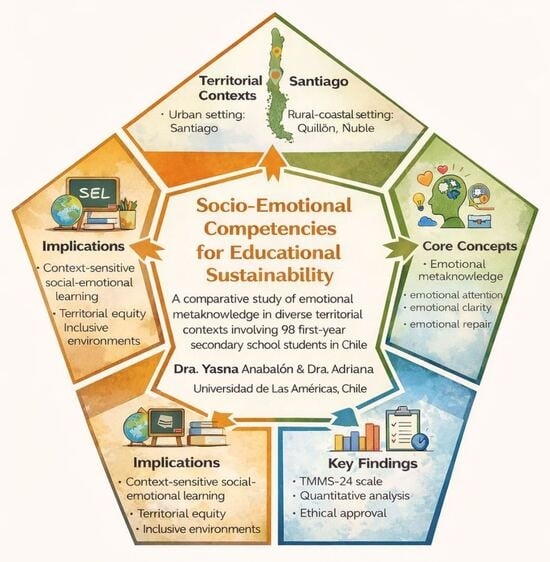
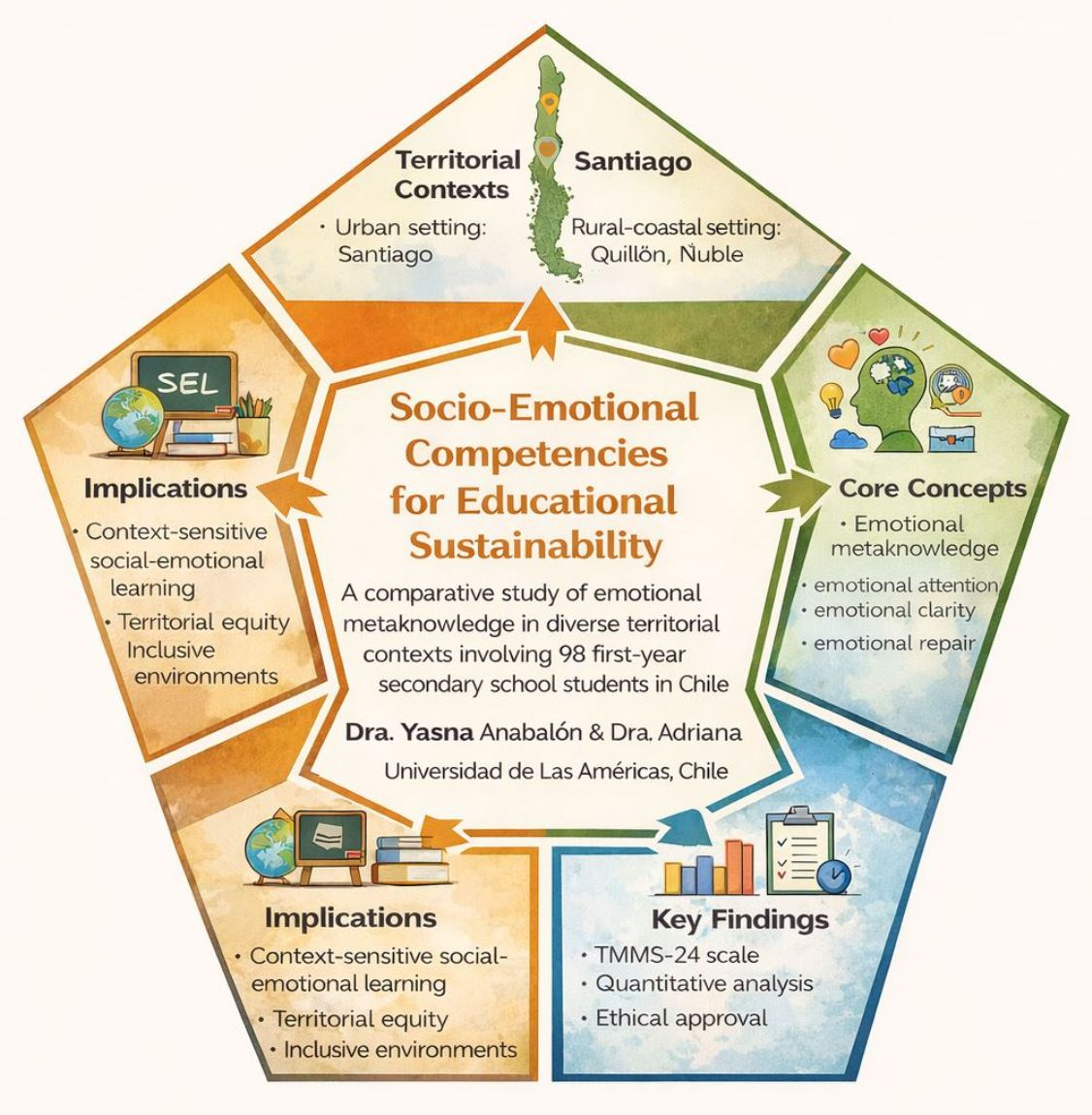
Based on the above, this study examines emotional metaknowledge in secondary school students from Chile by comparing the configuration of Emotional Attention, Emotional Clarity, and Emotional Repair in two territorially contrasting school contexts. Rather than treating territoriality as a deterministic variable, the study uses it as a contextual frame to explore how socio-emotional competencies may be interpreted in relation to educational sustainability, equity, well-being, and school coexistence.
Although the TMMS-24 has been widely used to assess perceived emotional intelligence and emotional metaknowledge, evidence remains uneven in Latin American school contexts, particularly in small, non-metropolitan, and territorially diverse educational communities. Most studies have focused on psychometric validation, general adolescent samples, or associations with academic and psychosocial outcomes. However, fewer studies have examined how Emotional Attention, Emotional Clarity, and Emotional Repair are configured in school contexts marked by territorial differences. This gap is relevant in Chile, where educational inequalities are not only socioeconomic but also territorial, affecting school resources, student trajectories, psychosocial support, and the implementation of socio-emotional learning policies. Therefore, this study contributes by providing situated evidence from two contrasting Chilean school contexts, emphasizing that emotional metaknowledge should not be interpreted as an individual attribute detached from the educational and territorial conditions in which students learn, relate, and regulate their emotions.
This study aimed to analyze the configuration of self-perceived emotional metaknowledge among first-year secondary school students from two Chilean schools located in contrasting territorial contexts, focusing on the three TMMS-24 dimensions: Emotional Attention, Emotional Clarity, and Emotional Repair.
2. Materials and Methods
A non-probability convenience sampling strategy was used. The initial database included 184 records from two Chilean schools located in Santiago and Quillón. After data cleaning, three cases were excluded because of invalid or incomplete responses: one case from Quillón with an out-of-range value and two cases from Santiago with non-response values. The final analytical sample consisted of 181 first-year secondary school students, 105 from Quillón and 76 from Santiago.
The sample was composed of first-year secondary school students whose ages ranged between 14 and 15 years. Because of this narrow age range and the shared educational level, age was not included as a covariate in the statistical analyses. In addition, the analytical database did not include individual-level information on gender or socioeconomic status. Consequently, these variables could not be incorporated as covariates without compromising the integrity of the dataset. Locality was therefore interpreted as a contextual descriptor of the participating school communities rather than as an isolated causal predictor.
The participating schools were intentionally selected because they represent contrasting territorial contexts. Santiago corresponds to a metropolitan urban setting, whereas Quillón is a small municipality in the Ñuble Region with lower school enrolment and non-metropolitan territorial characteristics. For this reason, the study does not claim statistical representativeness of Santiago, Quillón, or Chilean secondary students as a whole. Instead, it provides situated quantitative evidence from two school communities that differ in territorial and institutional conditions. The main sample characteristics by locality are presented in
Table 1.
Emotional metaknowledge was assessed using the Trait Meta-Mood Scale (TMMS-24), a widely used self-report instrument derived from the Trait Meta-Mood framework proposed by Salovey et al. [
32] and later adapted and psychometrically validated in Spanish by Fernández-Berrocal et al. [
37]. As a self-report questionnaire, the TMMS-24 does not require the use of laboratory equipment, devices, or manufacturer-dependent materials. The Spanish validated version was used in the present study. The instrument assesses self-perceived emotional intelligence through 24 items distributed into three eight-item subscales: Emotional Attention, Emotional Clarity, and Emotional Repair.
In the original TMMS-24 format, items are answered on a five-point Likert scale ranging from 1 = strongly disagree to 5 = strongly agree. In the database used for this study, responses were coded from 0 to 4; therefore, all responses were recoded to a 1–5 scale before computing subscale scores. Each subscale score was calculated by summing the corresponding eight items, producing possible scores ranging from 8 to 40. Higher scores indicate higher self-perceived Emotional Attention, Emotional Clarity, or Emotional Repair. Internal consistency was estimated for each subscale using Cronbach’s alpha.
Data were analyzed using the R statistical environment, version 4.3.3 (R Foundation for Statistical Computing, Vienna, Austria;
https://www.r-project.org/ (accessed on 11 April 2026)). Data cleaning was performed to identify incomplete responses and out-of-range values. After excluding invalid or incomplete cases, descriptive statistics were calculated for each TMMS-24 dimension by locality, including means, standard deviations, minimum and maximum values, and 95% confidence intervals. Internal consistency was assessed using Cronbach’s alpha.
Given that each participant provided scores for the three TMMS-24 dimensions, the analysis considered the repeated-measures structure of the data. A mixed ANOVA was conducted, with emotional dimension—Emotional Attention, Emotional Clarity, and Emotional Repair—as the within-subject factor and locality—Quillón and Santiago—as the between-subject factor. Statistical assumptions were examined through Shapiro–Wilk tests, Levene’s tests, and Mauchly’s test of sphericity. When the sphericity assumption was violated, Greenhouse–Geisser corrections were applied. Effect sizes were reported using partial eta squared for ANOVA effects and Cohen’s dz or Hedges’ g for pairwise comparisons. Post hoc comparisons were adjusted using the Holm method. Exact p-values and 95% confidence intervals were reported following APA style.
To assess the robustness of the inferential results, complementary non-parametric sensitivity analyses were conducted. Because Emotional Repair showed deviations from normality and the sphericity assumption was violated, a Friedman test was used to examine within-subject differences among the three TMMS-24 dimensions. In addition, Kruskal–Wallis and Mann–Whitney U tests were conducted to compare localities separately for each emotional dimension. Holm correction was applied to adjust for multiple comparisons. These analyses were interpreted as sensitivity checks rather than replacements for the mixed ANOVA, given the repeated-measures structure of the data.
Given the absence of individual-level demographic covariates, the statistical analyses focused on differences by emotional dimension and locality. The results were interpreted cautiously and descriptively, emphasizing patterns of self-perceived emotional metaknowledge rather than causal effects attributable to territorial context.
The study was conducted in accordance with ethical principles governing research involving human participants and followed the Singapore Statement on Research Integrity, which emphasizes honesty, accountability, professionalism, and stewardship in the conduct of research [
38]. Informed consent was obtained from parents or legal guardians, and assent was obtained from the participating students. Voluntary participation, anonymity, and data confidentiality were guaranteed throughout the research process. Authorization was also obtained from school administrators and governing authorities at the participating institutions. In addition, the study was approved by the Comité Ético-Científico (CEC) of Universidad de Las Américas.
4. Discussion
The present study contributes to the understanding of self-perceived emotional metaknowledge among Chilean secondary school students by examining the differentiated configuration of Emotional Attention, Emotional Clarity, and Emotional Repair in two territorially contrasting school contexts. From an educational sustainability perspective, emotional metaknowledge is relevant not because it operates as an isolated individual attribute, but because it supports students’ perceived capacity to recognize, interpret, and regulate emotional experiences that affect participation, school coexistence, well-being, and learning. Therefore, the results should be interpreted in relation to the socio-educational conditions in which students experience academic pressure, interpersonal conflict, uncertainty, and relational demands.
The absence of a significant main effect of locality suggests that the overall level of self-perceived emotional metaknowledge did not differ substantially between students from Quillón and Santiago. This finding should be interpreted cautiously. It does not mean that territorial conditions are irrelevant; rather, it indicates that this study does not provide evidence of broad territorial differences in overall emotional metaknowledge. Territoriality remains analytically relevant as a contextual frame, but not as a causal explanatory factor. This distinction is important because Chilean educational inequalities are expressed through multiple dimensions, including school resources, psychosocial support, family–school relations, and local opportunities for socio-emotional development.
The territorial interpretation of these findings should also be understood dynamically. The distinction between Santiago and Quillón does not exhaust the complexity of students’ educational experiences, particularly in contexts where school trajectories may be shaped by mobility, commuting, family migration, or transitions between rural, small-town, and urban educational environments. Such processes may influence students’ sense of belonging, emotional self-monitoring, and perceived access to socio-emotional support. However, because the present study did not collect direct indicators of mobility, migration, or cultural adaptation, these issues are proposed as interpretative considerations and as relevant directions for future research rather than as empirical conclusions derived from the current data.
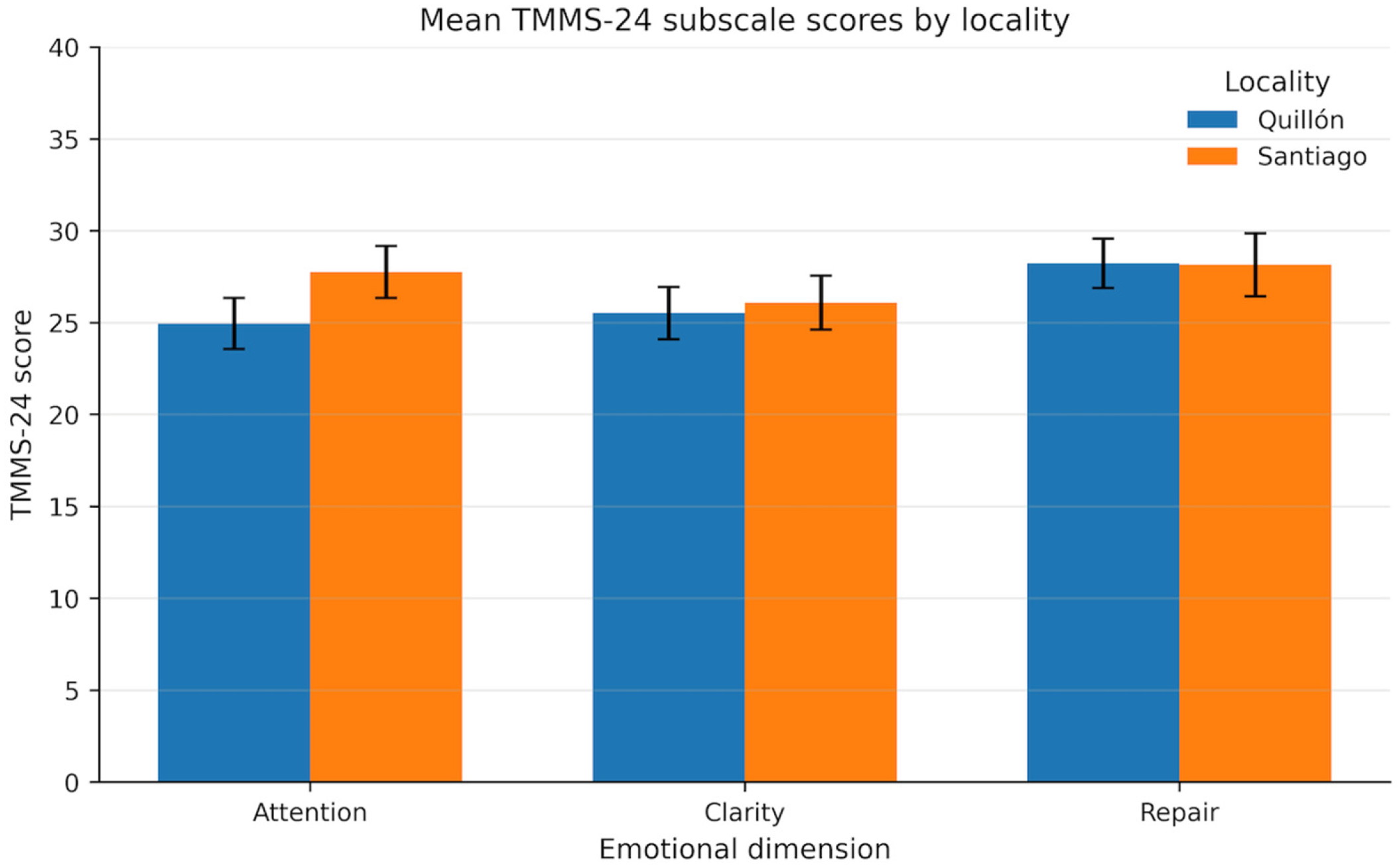
The significant main effect of emotional dimension confirms that the three TMMS-24 dimensions should not be treated as equivalent or interchangeable. Emotional Repair obtained the highest scores in the total sample, followed by Emotional Attention and Emotional Clarity. This result suggests that students perceived themselves as relatively capable of modifying or regulating negative emotional states. However, because the TMMS-24 measures perceived competence rather than observed emotional behavior, this result should not be interpreted as direct evidence of effective emotional regulation practices in everyday school life. Rather, it indicates that students report a favorable perception of their emotional repair capacity.
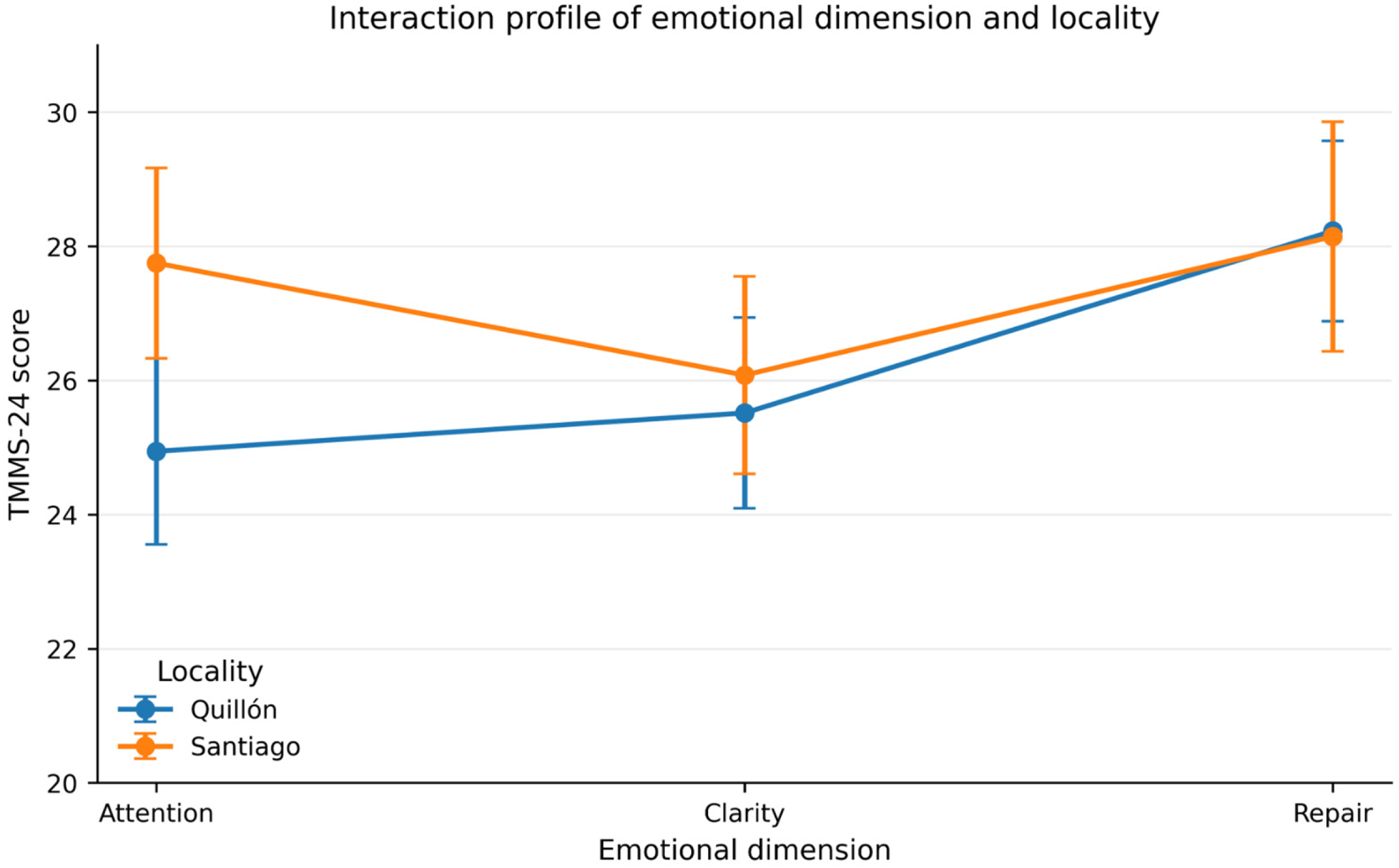
The significant interaction between emotional dimension and locality adds a relevant nuance. Santiago showed significantly higher Emotional Attention than Quillón, while no statistically significant differences were found between localities in Emotional Clarity or Emotional Repair. This suggests that the observed difference was not general, but dimension specific. Emotional Attention refers to the tendency to observe, notice, and monitor one’s emotional states. The higher Emotional Attention scores observed among students from Santiago should be interpreted with caution. Although this difference may suggest a dimension-specific variation in students’ tendency to notice and monitor their emotional states, the study design does not allow this pattern to be attributed exclusively to territorial context. Since gender and socioeconomic status were not available as covariates, and because locality is confounded with school context, this finding should be understood as a situated descriptive result rather than as evidence of a causal territorial effect.
These findings are consistent with the multidimensional understanding of emotional metaknowledge proposed in studies using the TMMS-24 and related models of perceived emotional intelligence [
32,
37,
39,
40,
41,
42]. Previous research has shown that Emotional Attention, Emotional Clarity, and Emotional Repair may follow different patterns across adolescent populations and cultural contexts. In this sense, socio-emotional learning programs should avoid assuming that emotional awareness automatically leads to emotional understanding or regulation. The present results suggest that each dimension requires differentiated pedagogical attention. Emotional Attention may be linked to students’ ability to recognize and monitor their affective states, whereas Emotional Repair is more closely related to their perceived capacity to recover from negative moods or regulate emotional discomfort.
A critical implication of these results is that socio-emotional education should not be reduced to the individual responsibility of students to manage their emotions. The contextual conditions of schools, teaching practices, peer relations, family–school articulation, and access to psychosocial support shape the opportunities students have to learn and practice emotional regulation. Thus, asking students to regulate their emotions without providing institutional, relational, and pedagogical conditions for doing so would reproduce an individualizing interpretation of socio-emotional learning. Educational sustainability requires moving beyond this approach by recognizing emotional development as both an individual and collective process [
43].
The inclusive scope of socio-emotional education also requires attention to students whose emotional, communicative, and sensory needs may not be adequately addressed through standardized pedagogical strategies. Recent interdisciplinary work on autism spectrum disorder has shown that multimodal and personalized platforms can support more accessible educational experiences by adapting learning environments to students’ specific profiles and modes of expression. Although the present study did not assess neurodivergence or special educational needs, this line of research reinforces the need to understand educational sustainability as a flexible, inclusive, and context-sensitive process rather than as a uniform policy model. In this regard, socio-emotional learning should be articulated with inclusive pedagogies, differentiated supports, and multimodal resources that recognize the heterogeneity of students’ emotional and communicative experiences [
44].
The connection with SDG 4 should be understood in terms of quality, equity, and inclusion. The findings do not suggest that emotional metaknowledge alone guarantees educational sustainability. Rather, they indicate that sustainable education requires attention to the socio-emotional conditions that enable students to participate, learn, and coexist in school communities. In territorially diverse contexts, especially in small or non-metropolitan schools, socio-emotional learning policies should avoid standardized implementation models and instead incorporate local diagnoses, teacher training, family–school articulation, and context-sensitive supports. Emotional repair is especially relevant for educational policy because it relates to students’ perceived capacity to respond to frustration, conflict, and uncertainty, all of which affect school coexistence and inclusion.
Finally, the study contributes to the literature on TMMS-24 and socio-emotional competencies in Latin American contexts by offering situated evidence from Chilean school communities. Its main contribution does not lie in establishing generalizable territorial differences, but in showing that emotional metaknowledge is internally differentiated and that territorial analysis can help identify specific socio-emotional needs. This is particularly relevant for small or low-enrolment school communities, where educational interventions must be sensitive to local realities rather than derived exclusively from standardized national models.
Limitations and Future Research
This study has several limitations. First, the sample was based on non-probability convenience sampling; therefore, the findings cannot be generalized to all students from Santiago, Quillón, or Chile. Second, only two schools participated, and locality is confounded with school context, which prevents separating institutional effects from territorial effects. Third, although the final sample included 181 valid cases, the distribution between localities was unequal, with 105 students from Quillón and 76 from Santiago. Fourth, the TMMS-24 is a self-report instrument and measures perceived emotional competencies rather than observed emotional behavior. Consequently, the findings should be interpreted as indicators of students’ self-perceived emotional metaknowledge, not as direct evidence of emotional regulation practices in school life. Fifth, the cross-sectional design prevents causal interpretations.
Future research should include larger and more diverse samples, longitudinal designs, and additional school contexts. It would also be useful to incorporate classroom observations, interviews, focus groups, and ethnographic or mixed-method approaches to better understand how emotional regulation is enacted in everyday school life. In addition, future studies should examine gender, age, socioeconomic status, school climate, and institutional support as variables that may influence emotional metaknowledge and socio-emotional development.
Another limitation concerns the absence of individual-level sociodemographic covariates in the analytical database. Gender and socioeconomic status were not collected, and age showed minimal variability because all participants were first-year secondary school students between 14 and 15 years old. Therefore, it was not possible to estimate adjusted models including these variables as covariates. This limitation is particularly relevant because previous research has shown that socio-emotional competencies may vary according to gender, socioeconomic conditions, family background, and school climate. Future studies should include these variables and apply mixed ANCOVA, multilevel models, or longitudinal designs to better distinguish individual, institutional, and territorial sources of variation.
5. Conclusions
This study examined self-perceived emotional metaknowledge among 181 Chilean first-year secondary school students from two territorially contrasting school contexts: Santiago and Quillón. The findings indicate that there were no statistically significant differences between localities in the overall level of emotional metaknowledge. However, significant differences were found among the TMMS-24 dimensions, and a significant interaction between emotional dimension and locality was observed.
Emotional Repair obtained the highest scores in the total sample, suggesting that students perceived themselves as relatively capable of regulating or modifying negative emotional states. At the same time, Santiago showed significantly higher Emotional Attention than Quillón, while Emotional Clarity and Emotional Repair did not differ significantly between localities. These results suggest that territorial differences, when present, may be dimension-specific rather than general.
The findings support the interpretation of emotional metaknowledge as a multidimensional construct and suggest that future socio-emotional learning initiatives should consider Emotional Attention, Emotional Clarity, and Emotional Repair as differentiated but interrelated dimensions. From the perspective of educational sustainability and SDG 4, the study provides situated evidence that may inform socio-emotional learning approaches sensitive to territorial contexts, school coexistence, equity, and inclusion.
The findings should be interpreted as situated evidence from two participating school communities and not as statistically representative of Chilean secondary education. Because gender and socioeconomic status were not available in the analytical database, and because age variability was minimal, the findings should be interpreted as unadjusted comparisons between two participating school communities. Therefore, the results do not establish causal territorial effects but rather describe differentiated patterns of self-perceived emotional metaknowledge in two contrasting educational contexts. Despite these limitations, the study contributes to the discussion on educational sustainability by showing that socio-emotional competencies should be examined in relation to the specific educational and territorial conditions in which students learn, interact, and perceive their capacity to regulate emotions.