1. Introduction
Urban traffic congestion is a persistent obstacle to implementing sustainable urban mobility. When demand exceeds the effective capacity of signalized networks, vehicles experience longer travel times, more frequent stops, idling, and unreliable arrival times. These operating conditions increase fuel or energy consumption and traffic-related emissions while also reducing the service quality and resilience of urban transport systems [
1,
2,
3]. For this reason, traffic signal control is not only an operational efficiency problem, but also an important component of sustainable traffic management. Recent studies in Sustainability have accordingly evaluated intelligent traffic control with respect to delay, fuel or energy use, emissions, and network-level coordination, rather than only local throughput [
4,
5]. At the same time, urban traffic demand is not purely random: peak hours, weekday–weekend differences, and public holiday patterns create recurrent demand structures that shape the baseline operating conditions of a road network. Empirical evidence has shown systematic differences between public holiday and workday traffic distributions on selected road network elements [
6], indicating that signal control strategies should be examined under both recurrent demand pressure and non-recurrent disruptions.
However, congestion in urban networks is not simply a result of the accumulation of local delays at isolated intersections. In heterogeneous networks with irregular junctions, roundabouts, different road capacities, and strong spillback coupling, a local queue can propagate beyond its original bottleneck and gradually affect a much larger part of the network. This network-level degradation is especially important under high-demand or incident-like perturbations, where small disruptions may trigger persistent queue growth and instability amplification. Therefore, sustainable signal control requires not only reducing local delay, but also describing and regulating how congestion develops and spreads under stressed operating conditions.
This motivates a transition-sensitive view of urban congestion. In this study, “transition-sensitive” means that signal control design and evaluation explicitly account for the tendency of an urban traffic network to shift from relatively stable operation toward severe congestion under increasing demand or incident-like perturbations. Operationally, we use the term as a control-oriented, transition-aware perspective that targets congestion growth risk, spillback tendency, and network-level degradation during this shift. Traffic flow and complex network studies show that local vehicle interactions, network topology, and external loading jointly shape macroscopic transport states [
7,
8,
9]. As demand increases, the system may evolve nonlinearly from relatively stable flow to congestion-dominated operation, with strong sensitivity to perturbations and cascade-like degradation under high loading conditions [
10,
11,
12,
13]. In heterogeneous urban networks, localized disruptions may therefore trigger congestion propagation well beyond the original bottleneck and produce transition-like deterioration at the network scale [
14,
15,
16]. This perspective provides a useful bridge between sustainable traffic operation objectives and the macroscopic dynamics of congestion growth.
Many existing traffic signal control studies remain organized primarily around engineering performance metrics and controller architectures. Classical responsive strategies such as Max-Pressure [
17] and more recent reinforcement learning approaches [
18,
19] have improved operational efficiency in many settings, but they still focus mainly on local delay, queue balance, or short-horizon responses. In most cases, congestion propagation, instability amplification, and transition-sensitive degradation are not incorporated into the control design through explicit macroscopic observables. As a result, even when modern learning-based controllers improve reported traffic performance, their connection to the network-level evolution of congestion under stressed heterogeneous traffic conditions remains underdeveloped.
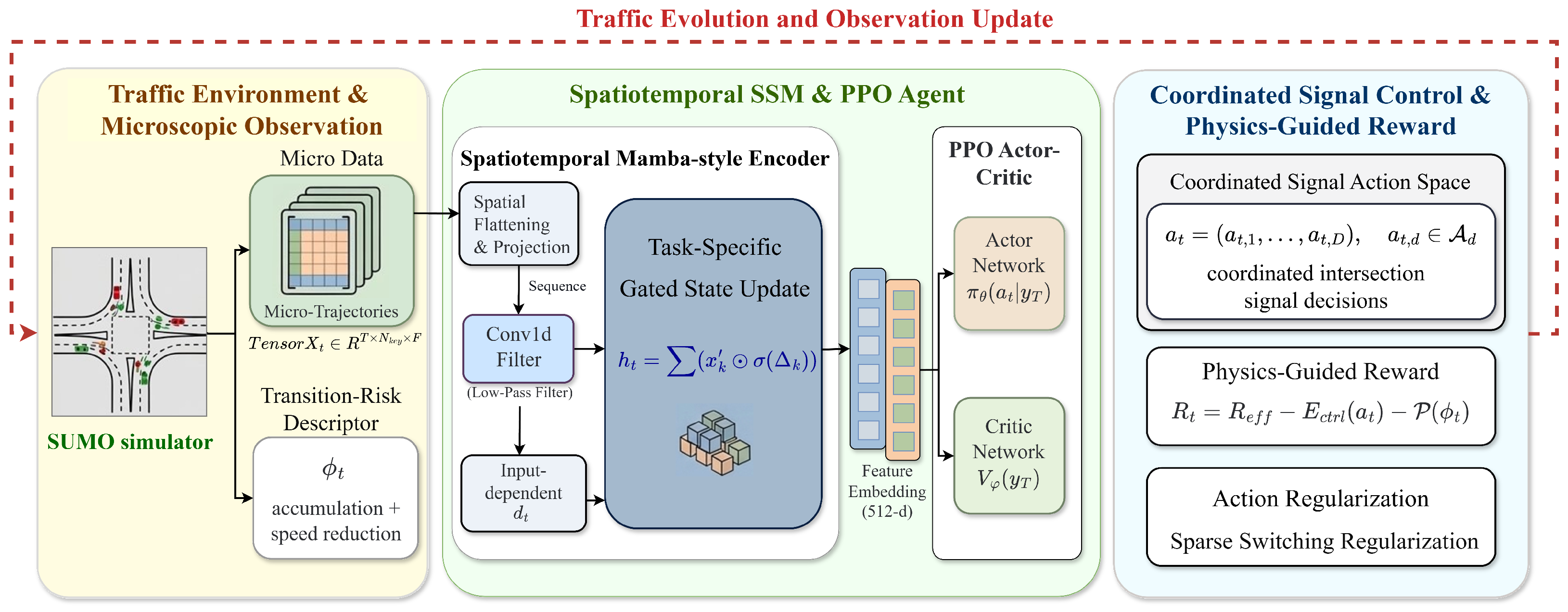
Motivated by this gap, this paper studies how coordinated reinforcement learning can be used as a regulation mechanism for transition-sensitive congestion dynamics in stressed heterogeneous urban networks. We develop Mamba-PTC as a spatiotemporal deep reinforcement learning controller that combines a transition-aware objective, macroscopic congestion observables, a task-specific simplified Mamba-style sequence backbone [
20], and a centralized coordinated signal control interface. Built on this design, the method aims to improve aggregate traffic performance while also regulating congestion growth and instability under sustained stress. The main contributions of this study are summarized as follows:
Transition-aware reward and macroscopic congestion observables: We define a congestion-sensitive reward together with control-oriented macroscopic observables for evaluation, so that the controller can be trained with transition-aware signals and assessed in terms of network-level degradation under stressed traffic conditions.
History-aware spatiotemporal representation of congestion evolution: We employ the Mamba-PTC backbone as the main spatiotemporal feature extractor. Implemented as a task-specific simplified Mamba-style encoder, it provides a history-aware representation of congestion evolution under strong perturbations and is better aligned with the temporally accumulated dynamics of heterogeneous traffic flow.
Coordinated multi-intersection regulation of congestion propagation: To translate the Mamba-PTC spatiotemporal representation into effective intervention, we formulate urban traffic signal control as a centralized joint decision problem over multiple signalized intersections. The controller receives a network-level observation and outputs coordinated signal–actions across the controlled intersections, enabling the policy to respond to congestion propagation through inter-intersection coordination rather than isolated local reaction.
The remainder of this paper is organized as follows:
Section 2 reviews prior studies on signal control objectives, congestion transition views, spatiotemporal modeling, and realistic topology validation.
Section 3 presents the observation design, reward formulation, macroscopic observables, and Mamba-PTC policy architecture.
Section 4 describes the simulation environment, perturbation design, comparison groups, training protocol, and evaluation metrics.
Section 5 reports the training behavior, stress-response comparisons, ablation studies, extended seed analysis, and cross-network validation.
Section 6 interprets the findings and discusses practical feasibility.
Section 7 summarizes the main conclusions and future research directions.
2. Related Work
To position the present study more clearly, this section reviews prior work from four aspects that match the motivation given in the Introduction: traffic signal control objectives and coordination structure, macroscopic views of congestion transition, spatiotemporal sequence modeling, and validation on realistic heterogeneous topologies.
2.1. Traffic Signal Control Objectives and Coordination Structure
Traffic signal control provides the main operational lever through which recurrent queues, spillback, and intersection-level delay can be regulated in urban networks. Early methods focused on stable and interpretable timing rules. Fixed-time methods such as Webster’s method [
21] perform reasonably well under relatively stable flow conditions, while adaptive systems such as SCOOT [
22] and SCATS [
23] improve responsiveness by adjusting signal settings according to detector information. These approaches established the operational foundation of urban signal control, but their objectives are usually defined in terms of local delay, queue discharge, or corridor-level responsiveness.
As network interactions became more important, coordination-oriented objectives received increasing attention. Max-Pressure control [
17] became a strong decentralized baseline because it uses queue differentials to promote network throughput, and PressLight later incorporated max-pressure intuition into a reinforcement learning framework [
18]. With the development of deep reinforcement learning, high-dimensional traffic states and larger action spaces became more tractable. The DQN framework introduced by Mnih et al. [
24] provided a basis for value-based control, and Li et al. [
25] demonstrated the effectiveness of DRL for signalized intersection control. Subsequent studies further explored movement-centric signal modeling [
26,
27], network-level cooperation and communication [
28,
29,
30], and spatial extensions of pressure-based control [
31]. These works improved adaptivity and coordination, but their evaluation still tends to emphasize aggregate performance indicators such as throughput, delay, queue length, or waiting time.
Recent studies have further broadened the objective of signal control beyond conventional delay and queue reduction. Related work has examined signal optimization for delay, fuel consumption, and emissions [
1], reinforcement learning control for reducing vehicle emissions [
2], CO
2-oriented DRL control in mixed traffic flow [
3], and priority-metric signal optimization based on real-time-measured traffic information [
32]. Other studies have extended this line to hierarchical multi-agent DRL and coordinated multi-intersection control [
4,
5]. These works show that signal control objectives are becoming broader and more system-oriented. However, even in these settings, congestion propagation and transition-sensitive network degradation are still rarely represented through explicit macroscopic observables. This gap motivates the present study: the controller should not only improve conventional traffic metrics, but should also be evaluated by how it affects the growth and amplification of congestion under network stress.
2.2. Macroscopic Views of Congestion Transition
Macroscopic traffic flow and complex network studies provide a useful way to describe how local vehicle interactions, bottlenecks, and network topology produce network-level congestion states [
7,
8]. Earlier work examined traffic instability, metastability, and congestion onset in traffic networks [
10,
11]. Subsequent studies further showed that urban traffic degradation can exhibit percolation-like transition behavior, macroscopic collapse, and switching between different congested regimes under increasing stress [
12,
13,
14,
33]. These findings suggest that traffic degradation should not be understood only as accumulated local delay, but also as a collective network process with transition-sensitive behavior.
Complex network studies have further examined urban congestion through topological complexity, congestion-warning communities, cascading degradation, topology-dependent traffic performance, and large-scale spatiotemporal congestion patterns. Prior work has examined the topological characteristics and flow complexity of urban traffic congestion [
34], identified congestion-warning communities in heterogeneous traffic networks [
35], analyzed cascading dynamics in urban road systems [
36], and studied how road network structure shapes the performance of urban traffic systems [
37]. Other studies also investigated spatial heterogeneity and migration characteristics of traffic congestion from large-scale trajectory data [
38], while recent work uncovered interpretable spatiotemporal congestion patterns through a complex network approach [
39]. Together, these works support the interpretation of congestion as a network-level dynamical process rather than merely as isolated local delay.
These studies provide important insight into congestion propagation, topology-dependent vulnerability, and transition-like degradation, but their integration into closed-loop traffic signal control remains limited. Most DRL-based traffic controllers still rely mainly on local observables such as queue length, waiting time, or phase pressure. By contrast, macroscopic congestion observables can provide a more informative description of system-level congestion risk and degradation. In this study, our goal is not to construct a strict phase-transition model. Instead, we adopt a control-oriented framing in which congestion observables are used to describe and regulate network-level degradation under stress.
2.3. Spatiotemporal Sequence Modeling for Traffic Control
Capturing congestion propagation across a road network requires models that can represent network-scale spatiotemporal dependence. Earlier traffic forecasting and control studies often used recurrent architectures such as LSTMs to process sequential traffic states [
40]. These models are effective for short- to medium-range sequence modeling, but their long-range memory is limited and their parallel efficiency is relatively low. Graph-based and attention-based approaches later strengthened the modeling of inter-intersection interaction and nonlocal dependency, while coordination-aware methods such as Wang et al. [
29] further emphasized scalable large-network cooperation. Transformer-style architectures [
41,
42] made global dependency modeling more explicit. Recent studies have further broadened this direction through deep spatiotemporal graph experts, multi-view attention, and federated graph learning for traffic state prediction [
43,
44,
45]. Related traffic management studies have also coupled travel time prediction with route optimization and distributed multi-agent signal coordination [
46,
47]. Recent multi-agent signal control studies also suggest that coordinated learning architectures are needed when the control objective shifts from isolated intersection response toward network-level spillback mitigation [
4,
5].
However, congestion evolution in heterogeneous urban networks often combines slowly accumulated spillback structure with rapidly fluctuating local disturbances. In such settings, the main challenge is not only long-sequence representation, but also the causal accumulation of traffic history relevant to transition-sensitive degradation. These recent studies show the value of richer temporal, topological, and cooperative traffic representations, but most of them focus on prediction, route guidance, or intersection-level coordination rather than on embedding history-aware representation inside a closed-loop signal control policy and evaluating macroscopic degradation under matched stressed traffic realizations. More recently, Gu and Dao [
20] proposed Mamba, which is based on selective state-space models and offers a promising alternative for long-sequence modeling through linear-time recursive processing. For online traffic signal control, this direction is attractive because congestion evolution often shows long memory, sensitivity to perturbations, and non-Markovian propagation. In this context, we use a simplified Mamba-style module as a history-aware state encoder within the reinforcement learning controller, linking recent congestion evolution to coordinated signal decisions for regulating spillback and network-level degradation.
2.4. Validation on Realistic Heterogeneous Topologies
A substantial portion of traffic RL research is still evaluated on synthetic grids or Manhattan-style layouts, where the topology is relatively regular and interactions are easier to isolate [
19]. In contrast, real urban networks contain irregular junctions, roundabouts, heterogeneous road capacities, and stronger spillback coupling. These structural heterogeneities are not merely engineering complications; they also influence congestion propagation pathways, vulnerability to non-recurrent disruption, and the growth of delay-related externalities [
35,
37,
39].
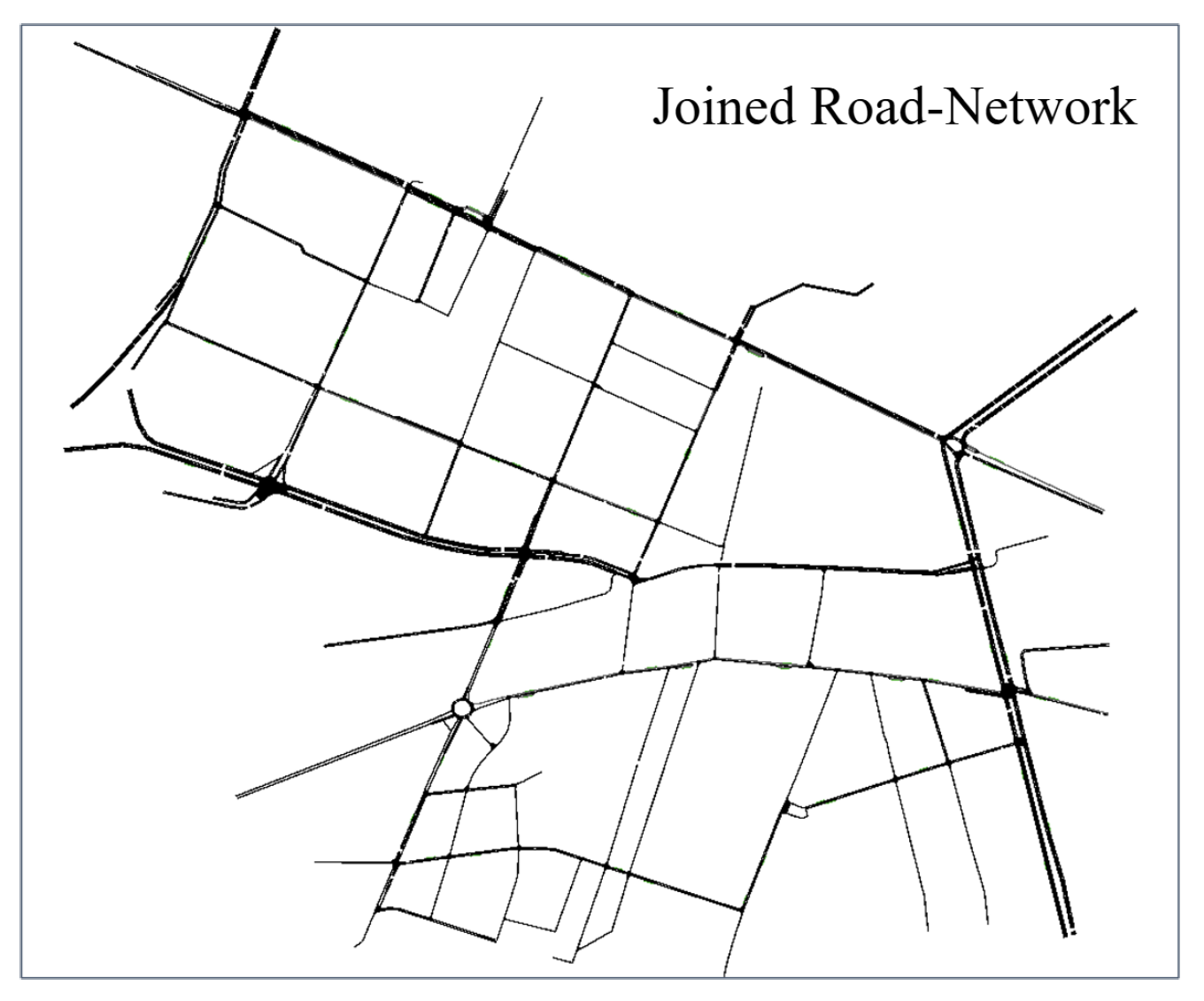
To examine algorithmic robustness under realistic topological stress, this study adopts the “Joined Network” scenario from the DLR-TS Bologna dataset released by Bieker et al. [
48] as the primary comparison setting. This network combines signalized urban grids with non-Euclidean structures such as roundabouts and irregular multi-branch intersections. It therefore provides a more demanding test bed for studying network-level congestion regulation than standard synthetic layouts. In addition, experiments are conducted on additional network settings to examine whether the observed performance trends remain qualitatively stable beyond a single topology.
Taken together, the literature shows that current traffic signal control research has made substantial progress in coordination structure, movement-level inductive bias, and sequence representation, while traffic flow and complex network studies have clarified the importance of congestion propagation, topology-dependent degradation, and transition-sensitive dynamics. However, the joint consideration of macroscopic congestion observables, simplified state-space sequence modeling, and coordinated signal control under stressed heterogeneous urban topologies remains limited. In this context, the present study develops a coordinated signal control framework that combines transition-sensitive observables with the Mamba-PTC backbone under a unified stress-testing setting.
4. Experimental Setup
We evaluate Mamba-PTC using Eclipse SUMO version 1.24.0 [
54] with the standardized SUMO-RL interface version 1.4.5 [
55]. This section describes the simulation environment, the perturbation modeling, the shared signal control interface, the common training protocol, and the stress-testing program used to examine transition-sensitive congestion regulation under heterogeneous urban traffic conditions. The experiments focus on mobility and congestion degradation indicators; explicit fuel, energy, or emission models are left for future work.
4.1. Simulation Environment and Controlled Network
To test the proposed framework under realistic topological stress, we use the Joined Network from the DLR-TS Bologna scenario family [
48] as the primary evaluation setting. Unlike regular synthetic grids, this network combines heterogeneous urban structures, including standard signalized intersections, roundabouts, and irregular multi-branch junctions, which substantially increase spillback coupling and the difficulty of congestion propagation control. This setting therefore provides a demanding test bed for studying network-level congestion regulation and transition-sensitive degradation in non-Euclidean urban traffic systems.
In the reported setting, the directly controlled elements are the signalized intersections in the network. For the Joined Network setting used in the main experiments, the number of controlled signalized intersections is . The coordinated signal control action is therefore instantiated over these 29 controlled nodes. Roundabouts and unsignalized structures remain part of the traffic-propagation dynamics, but they are not directly actuated by the controller. The signal control interface is updated at a fixed decision interval of 15 s, and standard transition constraints are enforced through a 2 s yellow phase and a 5 s minimum green duration. These constraints keep the reported setting within the operational scope of coordinated urban signal control, rather than broader simulator-side intervention.
Vehicle routes follow the dataset-provided SUMO-RL scenario configurations for the Joined, Acosta, and Pasubio Networks. This preserves the released demand profiles and movement patterns of these real-network scenarios. Within each stress slice, all compared controllers use the same route realization and departures; demand scaling is handled uniformly in the stress-testing matrix below.
Figure 2 shows the topology of the Bologna Joined Network used as the primary evaluation setting. In addition to this main scenario, we also evaluate the framework on the Acosta and Pasubio [
48] Networks later in the paper as a cross-network validation under the same stress-testing protocol.
4.2. Perturbation Modeling
To evaluate whether the controller can still respond effectively under non-recurrent disruptions, we introduce explicit perturbations into the SUMO environment. The purpose is to create controlled local blockages that can trigger queue growth, spillback, and congestion propagation. The perturbation levels follow a monotonic stress-gradient design based on traffic operational mechanisms. The design links perturbation severity to three factors that directly affect spillback risk: local disruption occupancy, queue-accumulation time, and the recovery opportunity before the next disruption. This stress-testing choice is consistent with recent work that evaluates intelligent signal control under accident-like or incident-driven scenarios [
56]. In this way, the experiments probe how different controllers regulate stressed traffic dynamics rather than only how they perform under near-stationary demand conditions.
In the simulator, each perturbation is implemented as a scheduled temporary blockage at the vehicle level. At a trigger time, a prescribed number of vehicles near junction centers are selected, their speeds are set to zero, and they remain blocked for a specified duration. This design creates localized flow interruption and network-scale stress without changing the road topology itself. Operationally, the perturbations are implemented in SUMO as deterministic vehicle-level blockage events within the active time window of 200–5800 s. At each trigger slot, a predefined number of vehicles are temporarily halted for the configured hold duration and then released. The three levels are chosen as a mechanism-based incident stress gradient: the low level represents short local obstruction with sufficient recovery opportunity, the middle level increases both blockage occupancy and queue-retention time, and the high level combines repeated triggers, longer holding duration, and shorter recovery intervals to create sustained spillback pressure. This design provides a controlled representation of urban incident-like disruptions while keeping disruption timing and severity matched across controllers within each stress slice.
The perturbation schedule is defined by the parameter tuple
where
is the number of blocked vehicles triggered in each event,
is the interval between two consecutive events,
is the blockage duration, and
is the active time window of the perturbation schedule. Increasing
raises the local blockage intensity, increasing
allows queues to accumulate for a longer time, and decreasing
reduces the time available for the network to dissipate the previous disruption.
Different perturbation levels therefore form an ordered stress gradient while keeping the topology, demand pattern, and signal control scope unchanged.
4.3. Comparison Groups and Control Scope
To clarify the comparison scope, the reported experiments are organized into three comparison tracks: practical adaptive baselines, shared-interface learned baselines, and movement-centric reference controllers. Across all tracks, the perturbation schedule, demand scaling settings, and signal control layer are kept consistent so that the reported differences can be interpreted under the same stressed traffic realization.
Within this structure, practical adaptive baselines include Max-Pressure and PressLight [
18], with fixed-time control reported separately in the framework-level comparison. Shared-interface learned baselines include Wang et al. [
29], LSTM [
40], and Transformer [
41,
42]; this group is used for backbone-attribution analysis. Movement-centric reference controllers include FRAP [
26] and MoveLight [
27], which are treated as controller-level references because their internal policy structures are method-specific.
4.4. Training Protocol and Baseline Tuning
Given the large state–action space of the Joined Network, we adopt an end-to-end distributed PPO training protocol with parallel simulation for the learning-based controllers. All learned controllers were trained on a server equipped with dual Intel Xeon Gold 6148 CPUs (2.40 GHz, 40 physical cores/80 threads), 128 GB RAM, and one NVIDIA GeForce RTX 4090 GPU. This hardware setup was sufficient to support the parallel PPO training and large-scale SUMO roll-out collection reported in this paper.
For the shared-interface learned baselines, baseline tuning follows a common training protocol: the environment configuration, observation schema, signal–action interface, reward definition, PPO optimizer, training budget, extractor output width, and actor–critic head widths are held fixed, while only the representation backbone is changed. Mamba-PTC and the shared-interface learned baselines are trained from scratch and selected under the same validation rule. Practical adaptive baselines keep their established control formulations, including queue-pressure or pressure-based decision rules, while movement-centric baselines keep their method-specific policy structures and movement-level inductive biases. These baselines are therefore tuned and reported according to their intended controller families, and their evaluation conditions are matched later through the common route files, demand scaling, perturbation schedule, signal control layer, and seed protocol.
We launch 72 independent SUMO environments to reduce temporal correlation among samples and improve gradient estimation stability. For the main Joined Network training runs, the total interaction horizon reaches approximately decision timesteps, where one timestep corresponds to one policy decision interval of 15 s in simulation time.
Policy learning is performed with PPO [
49]. The main hyperparameters are summarized in
Table 1. Only the settings most relevant to reproducibility and control behavior are retained here.
For the main learned controllers, model selection is based on the shared validation protocol under matched departures and perturbations, rather than on manually choosing a visually favorable run. This rule is kept consistent across the shared-interface comparisons and, where applicable, the movement-centric controller-level comparison so that the reported differences are not driven by inconsistent checkpoint selection.
These hyperparameters serve three roles in the reported experiments. The PPO optimization settings, including the learning rate, roll-out length, batch size, and update epochs, determine how data are collected and how policy updates are performed during training. The risk calibration and reward weight parameters specify how congestion risk, waiting cost, queue-related penalty, switching cost, and completion reward are balanced in the training objective. The remaining policy-stabilization settings, namely , , the clip range, and the entropy coefficient, are used to keep policy learning stable under high-variance traffic dynamics.
4.5. Stress-Testing Matrix and Evaluation Slices
Based on the perturbation mechanism defined above, we construct a factorial stress matrix to examine how different controllers respond as the traffic system is driven from moderate load toward increasingly stressed regimes.
In the stress tests, traffic load is controlled by the demand scaling factor
. This factor is implemented through SUMO’s built-in demand scaling applied to the fixed evaluation route files. The demand scaling dimension represents recurrent mobility pressure, while the perturbation dimension represents non-recurrent disruptions. For paired comparisons, controllers in the same flow–perturbation slice use the same route files, flow scale, perturbation schedule, and evaluation seed. The primary matrix uses five matched seeds (
, seeds 42–46), while the extended seed protocol uses ten matched seeds on selected high-severity slices (
, seeds 47–56). The resulting settings are summarized in
Table 2.
Accordingly, the experiments are organized into training-stability analysis, stress-response comparisons on the Joined Network, ablation studies, and generalization tests under different evaluation settings.
4.6. Evaluation Metrics and Reporting Protocol
The primary operational metrics are throughput
and mean trip duration
. Mean waiting time
is reported as an additional operational indicator to characterize waiting-related trade-offs among controllers. These metrics are relevant to sustainable traffic operation because prolonged travel, waiting, and stopping are associated with inefficient vehicle operation and have been used in emissions-aware signal control analyses [
57]. Alongside these operational metrics, the macroscopic quantities
and
are reported as transition-sensitive observables for characterizing network-level degradation and instability amplification under increasing load and perturbation.
Accordingly, the main empirical claims are based on paired comparisons under matched departures and matched perturbations, so that the reported differences can be attributed to controller behavior rather than unrelated stochastic variation. The results tables therefore emphasize pooled means together with matched-run robustness indicators. Where paired sign tests are reported, they are two-sided non-parametric checks of whether the direction of improvement is consistent across matched traffic realizations, while the extended seed analysis characterizes run-to-run variability on selected high-stress slices within the same evaluation protocol. In the tables below, ↑ and ↓ indicate whether higher or lower values are preferred, respectively, and bold values identify the best result for the corresponding metric within each comparison group.
5. Experimental Results
This section reports the empirical evidence in four steps.
Section 5.1 first examines whether Mamba-PTC shows stable and progressively improving training behavior on the heterogeneous Joined Network.
Section 5.2 then presents the main results on the Joined Network from the perspective of transition-sensitive congestion dynamics under coordinated regulation.
Section 5.3 separates the effect of the framework itself from that of the reward design.
Section 5.4 finally checks whether the main qualitative trends remain visible under extended seeds and on other road networks.
5.1. Training Stability of Mamba-PTC
Before comparing traffic control performance across baselines, we first examine whether Mamba-PTC can be trained stably on the heterogeneous Joined Network. This step is necessary because the training environment is high-dimensional, strongly non-stationary, and subject to stressed traffic dynamics.
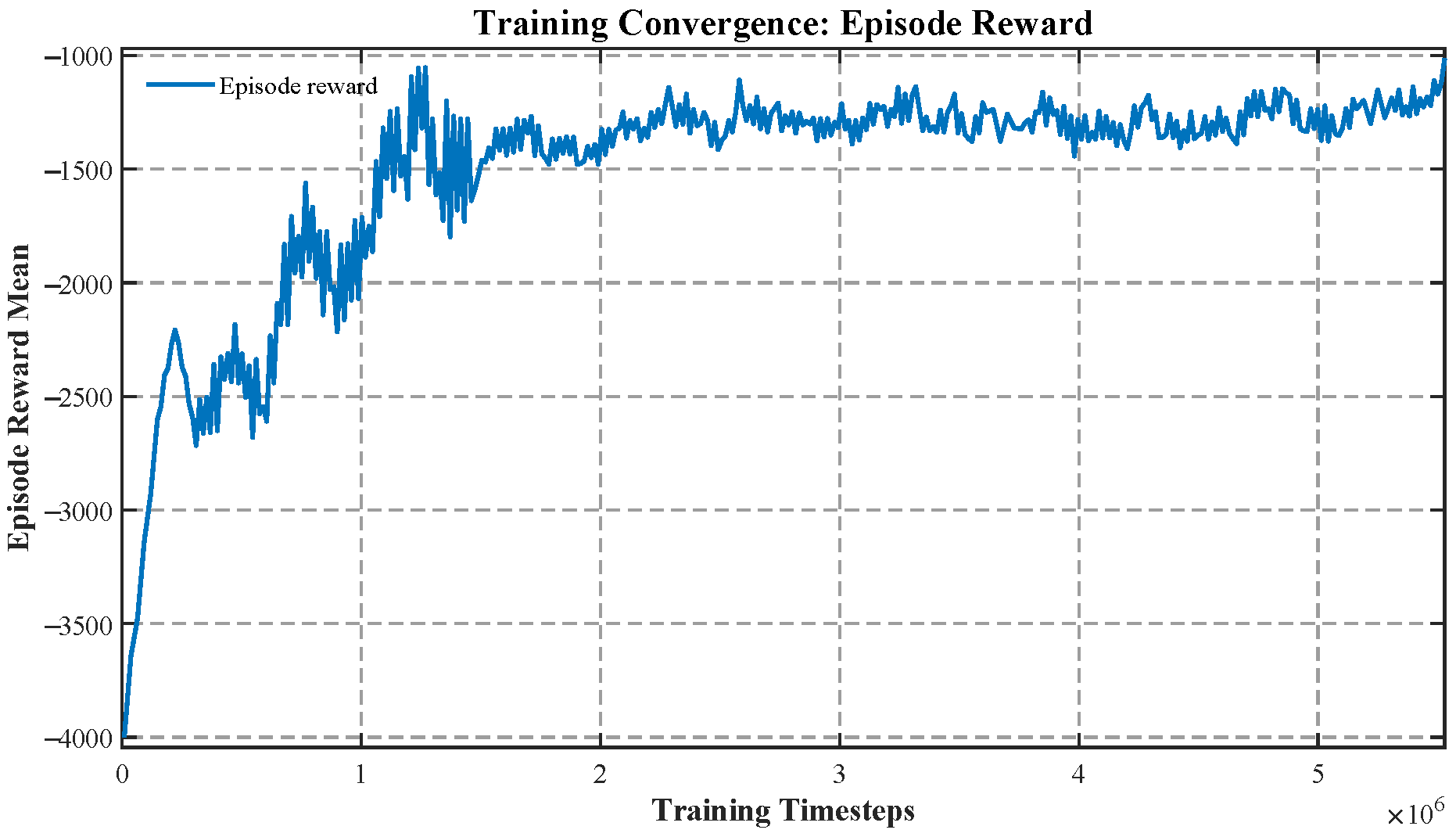
Figure 3 reports the evolution of the episode reward during training. Since the reward is the quantity directly optimized by the policy, it provides the clearest training-side evidence of whether the controller is progressively learning a better operating strategy.
The curve shows a clear three-stage pattern. In the early stage, the reward rises rapidly from about to around , indicating that the policy quickly escapes the poorest exploration regime. In the middle stage, the reward continues to improve overall while exhibiting noticeable oscillations, especially between approximately and timesteps, where it moves upward from the range toward roughly to . In the later stage, after roughly timesteps, the trajectory enters a relatively stable high-reward regime and fluctuates mainly between about and .
Overall,
Figure 3 shows that Mamba-PTC can be trained without evident optimization collapse and that the learned policy progressively reaches a stable and substantially improved operating regime. This provides the training basis for the stressed regime congestion analyses reported in the following subsections.
5.2. Stress-Response of Network Degradation Observables and Supporting Comparisons
This section examines how the heterogeneous Joined Network responds as demand and perturbation push traffic from stable operation toward congestion growth. The main question is whether a controller improves throughput and trip duration while also limiting propagation, degradation, and instability amplification under the same stressed realization. Matched control comparisons provide the primary evidence because the observation, action, reward, and training interfaces are aligned; practical controller and movement-centric comparisons are retained as supporting operational results.
5.2.1. Practical Controller Baselines: Max-Pressure and PressLight
This subsection evaluates whether Mamba-PTC can regulate stressed network dynamics more effectively than practical baselines with clear operational meaning.
Table 3 reports the direct pooled comparison, and
Table 4 reports the robustness check separately.
Table 3 gives the direct practical controller comparison. Relative to Max-Pressure, Mamba-PTC increases throughput from
to
vehicles, an increase of
vehicles or about
. At the same time, mean trip duration decreases from
to
min, mean waiting time decreases from
to
s,
decreases from
to
, and
decreases from
to
. The comparison with PressLight shows larger gains in throughput and trip duration: throughput rises from
to
vehicles (
), mean trip duration decreases from
to
min (
), and mean waiting time decreases from
to
s. In the macroscopic observables, Mamba-PTC also attains the lowest
in this practical controller track, while its
remains close to the best baseline value (
versus
for PressLight). Taken together, these results show that the advantage of Mamba-PTC is not limited to a single operational metric, but remains visible in both transport performance and the reported macroscopic observables in this comparison setting.
Table 4 shows further checks of whether the practical controller gains are stable at the paired-run level. The mean effects remain positive after accounting for run-to-run variation: against Max-Pressure, Mamba-PTC improves throughput by
vehicles and reduces duration by
min; against PressLight, the corresponding gains are
vehicles and
min. This indicates that the practical controller advantage is not only visible in pooled averages, but also remains consistent under matched traffic realizations.
5.2.2. Matched Control Evidence for Suppression of Congestion Amplification
This subsection uses a stricter matched control comparison: the environment, observation format, signal control interface, PPO optimizer, and reward definition are fixed, and only the learned backbone is changed. The resulting comparison is therefore used to examine whether different sequence representations lead to different regulation of transition-sensitive congestion growth under the same stressed traffic dynamics.
Table 5 provides the main matched-RL evidence in compact form. Across the full set of 15 slices, Mamba-PTC attains the highest mean throughput and the shortest mean trip duration. At the slice level, it achieves the best throughput in 14 of the 15 matched scenarios and the shortest trip duration in 14 of the 15 scenarios; the only exception in both metrics is the
slice, where LSTM is marginally better.
The regime-wise summary also clarifies where the advantage becomes most visible. When only the high-perturbation branch is retained, the throughput gap of Mamba-PTC relative to LSTM widens to about vehicles on average, while the mean trip duration decreases by about min. On the two most-stressed slices, and , the separation grows further: Mamba-PTC reaches an average throughput of vehicles, compared with for LSTM and for Wang et al., while mean trip duration falls to min, compared with and min. This pattern indicates that the backbone advantage is not expressed as a uniform shift at all operating points, but becomes clearer as the system is pushed deeper into the stressed regime.
Table 6 reports the matched-RL comparison with the Transformer baseline. Relative to the Transformer baseline, Mamba-PTC increases throughput by
vehicles, reduces trip duration by
min, reduces waiting time by
s, and lowers both
and
. This result is consistent with the regime-level summary above and suggests not only better operational performance, but also a weaker departure from the low-stress reference regime and reduced instability amplification under the same control interface.
To make the role of the macroscopic observables explicit,
Table 7 reports
and
on the two most-stressed slices of the matched-RL comparison, where the throughput–duration separation is already strongest in
Table 5. At
, Mamba-PTC reduces
from
and
to
, and reduces
from
and
to
, relative to LSTM and Wang et al., respectively. At
,
decreases from
and
to
, while
decreases from
and
to
. These observable-level differences show that, once the network enters the severe stressed regime, the throughput–duration advantage of Mamba-PTC is accompanied by a weaker departure from the low-stress reference regime and lower instability amplification under the same control interface.
The robustness test in
Table 8 confirms the same pattern at the matched-run level. Mamba-PTC wins
of the runs against LSTM on both throughput and duration, and
against Wang et al. on the same two metrics. Against the Transformer baseline, the win rates are
for throughput,
for duration, and
for waiting time. The paired statistics show the same direction: the mean gains are
,
, and
vehicles in throughput, and
,
, and
min in duration against LSTM, Wang et al., and Transformer, respectively. Taken together with
Table 5,
Table 6 and
Table 7, these results indicate that, once the control interface is matched, Mamba-PTC provides the strongest regulation effect in the stressed regime, with the clearest separation appearing near the transition from moderate to severe congestion.
5.2.3. Supporting Comparison with Movement-Centric Controllers
This subsection provides a controller-level comparison with FRAP and MoveLight, which are stronger movement-centric signal control methods with their own inductive biases. Because these methods are not matched backbone replacements, the comparison is interpreted mainly at the operational level.
Table 9 shows that Mamba-PTC attains the strongest throughput–duration profile in this controller-level comparison, while FRAP and MoveLight remain more competitive on waiting time. This comparison should not be interpreted as uniform superiority on all metrics. Instead, it indicates that the main strength of Mamba-PTC lies in network-level discharge efficiency and trip completion under stress, whereas movement-centric controllers may retain an advantage on some waiting-related slices.
The robustness test in
Table 10 confirms this interpretation. Mamba-PTC shows a stable throughput–duration advantage. Compared with FRAP, the paired gains are
vehicles and
min; compared with MoveLight, they are
vehicles and
min. Accordingly, this controller-level comparison is used to show the strongest throughput–duration profile among the tested controller families, rather than to claim that Mamba-PTC dominates every metric against FRAP and MoveLight.
5.3. Ablation Study
This section explains where the gains in
Section 5.2 come from. The first ablation asks whether the learning-based Mamba-PTC framework itself is better than a fixed signal plan on the same network. The second keeps the framework fixed and asks whether the reward design is responsible for the observed improvement.
5.3.1. Framework-Level Comparison with Fixed-Time Control
This ablation addresses a different question from the comparison analyses above. The issue here is whether the overall learning-based Mamba-PTC framework provides a stronger control regime than a non-learning fixed signal plan on the same road network.
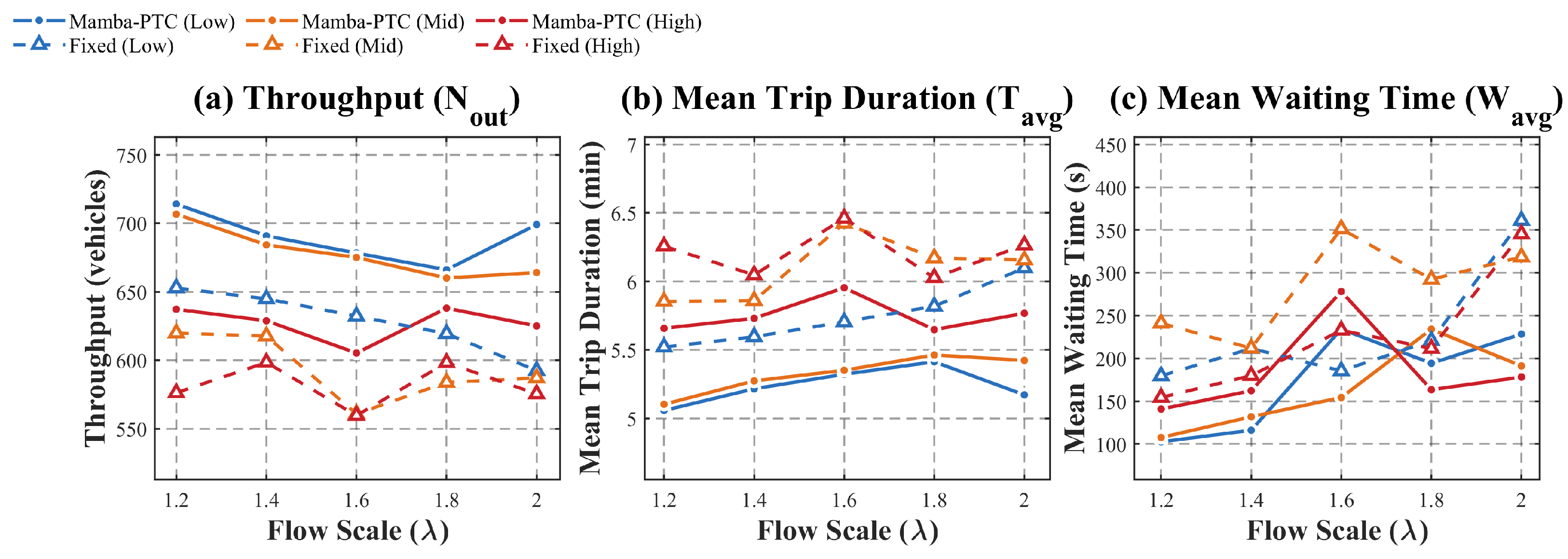
Figure 4, together with
Table 11 and
Table 12, clarifies the first ablation result at the framework level. The figure shows that, across the tested flow range and under all three perturbation levels, Mamba-PTC generally remains above fixed-time in throughput and below fixed-time in mean trip duration, indicating that the advantage of the learning-based framework is not confined to a single operating point. This visual pattern is consistent with the pooled summary in
Table 11, where Mamba-PTC raises throughput from
to
vehicles, reduces mean trip duration from
to
min, and reduces mean waiting time from
to
s. Importantly, the same pooled comparison also shows a clear reduction in the macroscopic degradation observables, with
decreasing from
to
and
decreasing from
to
. This means that the framework-level gain is not only an operational improvement, but is also accompanied by lower values of the macroscopic degradation observables under the same network stress.
5.3.2. Reward Design Ablation on Matched High-Stress Slices
The second ablation keeps the network architecture, training protocol, and evaluation setting fixed and changes only the reward design. The purpose is to test whether the transition risk term and the switching regularization term contribute useful improvements beyond pure efficiency shaping, especially in terms of the resulting degradation profile under stressed traffic conditions.
Table 13 shows that the reward design changes the control profile in a systematic way. The efficiency-only variant attains almost the same throughput as the full objective (
versus
), so the difference in discharge is negligible. However, the full objective reduces waiting time from
to
s, a drop of
s or about
. It also reduces
from
to
and
from
to
, corresponding to reductions of about
and
. Once the risk term is removed, throughput falls to
and waiting time rises to
s. Once the switching regularization is removed, the collapse is even stronger: throughput drops to
, which is about
lower than the full objective, while the mean waiting time increases to
s. Therefore, the reward ablation does not merely show that the full objective is better overall; it shows that the additional transition risk and switching-related terms help prevent the controller from exchanging short-term efficiency for more unstable stressed regime behavior, as reflected in both the operational metrics and the transition-sensitive observables.
5.4. Generalization Under Different Evaluation Settings
After establishing the main Joined Network analysis and the two ablation layers, this section examines whether the same qualitative pattern of transition-sensitive congestion regulation remains visible under different evaluation settings. LSTM is used here as the reference learned baseline because it is the strongest non-Mamba baseline in the matched-RL comparison and is also closest to Mamba-PTC in model scale. The first validation increases the seed budget on the high-stress slices. The second validation transfers the protocol from the Joined Network to the heterogeneous Acosta and Pasubio Networks.
Table 14 and
Table 15 show a consistent stressed regime trend across the extended seed high-stress slices. The per-flow means in
Table 14 show that Mamba-PTC maintains higher throughput and shorter trip duration from
to
. When these high-stress slices are pooled in
Table 15, the paired mean gains remain positive across all reported metrics: throughput increases by
vehicles, mean trip duration decreases by
min, mean waiting time decreases by
s,
decreases by
, and
decreases by
. The positive-pair ratios range from
to
, and the sign-test results remain below
, indicating that the high-stress advantage is visible across seeds rather than being driven by a single flow level.
Cross-Network Validation on Acosta and Pasubio
The cross-network validation transfers the same stress matrix from the Joined Network analysis to two heterogeneous road networks, Acosta () and Pasubio (). In this validation layer, Mamba-PTC is compared with LSTM, which is selected as the strongest overall baseline in the Joined Network experiments. Each network contains 15 stress scenarios and 75 paired runs.
Table 16 and
Table 17 show a consistent cross-network trend. On Acosta, Mamba-PTC improves from
to
in
(+15.73%), while reducing
from
to
min (−13.61%) and
from
to
s (−22.43%). On Pasubio, gains are smaller but remain positive:
increases from
to
(+3.19%), with
and
reduced by 3.12% and 13.79%. Overall, the pooled cross-network results show that Mamba-PTC maintains a favorable transfer pattern across heterogeneous road networks: mean
increases from
to
(+8.63%), mean
decreases from
to
min (−9.07%), and mean
decreases from
to
s (−18.06%). These results indicate that the observed advantage is not confined to the primary Joined Network setting, although its magnitude remains topology-dependent.
Taken together, the evidence indicates that Mamba-PTC is most useful when the network moves from moderate load into sustained high-stress operation. Its main advantage appears in the throughput–duration profile, while the matched control, ablation, extended seed, and cross-network results suggest weaker degradation under stress and point to the joint contribution of temporal representation, transition-aware reward design, and coordinated control.
6. Discussion
The results suggest that the advantage of Mamba-PTC becomes clearer when the traffic system enters a sustained high-stress regime. Under these conditions, congestion is not determined only by the current local state, but also by the recent evolution of spillback, delayed discharge, and inter-intersection interactions. High-stress traffic states contain delayed effects: blocked vehicles form queues, queues reduce discharge at neighboring intersections, and the resulting spillback may appear several decision steps after the original disruption. A controller based mainly on instantaneous local response may therefore react after the network has already entered a degraded state. This provides a plausible explanation for why the proposed framework shows more stable gains in the stressed slices: compared with methods that rely mainly on instantaneous response, it is better able to use temporally accumulated traffic information for the coordinated regulation of congestion growth. Mamba-PTC combines this history-aware representation with a transition risk penalty and coordinated multi-intersection actions, making the policy more likely to preserve network discharge before local disruption develops into broader congestion amplification.
The matched comparisons sharpen this interpretation. Because the environment, observation format, action interface, PPO setup, and reward definition are fixed, the remaining difference is mainly the sequence representation. The better throughput–duration profile and lower transition-sensitive observables therefore suggest that Mamba-PTC benefits from representing recent traffic evolution more effectively under stressed dynamics.
At the same time, the results do not support a claim of uniform superiority on all metrics or across all controller families. The movement-centric comparisons show that the main strength of Mamba-PTC lies in network-level discharge efficiency and trip duration, while waiting time performance remains more method-dependent. In connection to this, the transition-sensitive observables are most informative when they are used to interpret degradation under matched or closely comparable control settings, rather than as the sole ranking criterion across all heterogeneous controller families. The ablation and robustness results point in the same direction. The reported gain appears to come from the combined effect of temporal representation, transition-aware objective design, and coordinated control, rather than from any single component alone.
Taken together, the evidence suggests that Mamba-PTC is most useful in operating regimes where congestion growth has a clear temporal and network-coupled structure. In the tested heterogeneous networks, this is associated with better throughput retention, shorter trip duration, and weaker transition-sensitive degradation under stress. From this perspective, the main value of the framework lies not only in improved control performance, but also in linking coordinated signal control with the macroscopic regulation of congestion growth in a stressed urban traffic network.
Regarding practical feasibility, the centralized microscopic observation used in Mamba-PTC should be interpreted as an information-rich benchmark rather than a required field-deployment condition. In real traffic networks, such a state description could only be approximated in well-instrumented areas through connected-vehicle trajectories, roadside detectors, camera- or radar-based tracking, and data-fusion or state-estimation modules. Therefore, the present experiments mainly test the control value of rich network-state information under stress; practical deployment would require replacing the full microscopic observation with partial and noisy estimates and evaluating performance under different sensing-penetration levels.
From the perspective of sustainable transport networks, the practical implication is that a controller that weakens congestion growth can also reduce the operating conditions that normally increase fuel or energy consumption and emissions, such as excessive waiting, repeated stopping, and network-wide spillback [
1,
2,
3,
57]. The present experiments do not directly estimate pollutant emissions; therefore, the sustainability interpretation should be understood as an operational pathway rather than a direct emissions inventory. A natural next step is to couple the proposed transition-sensitive control framework with SUMO-based emission models so that congestion regulation, energy consumption, and CO
2 or pollutant emissions can be evaluated within the same stress-testing matrix.
7. Conclusions
This paper investigated transition-sensitive congestion dynamics in heterogeneous urban traffic networks under coordinated reinforcement learning. Mamba-PTC combines a transition-aware control objective, recursively accumulated spatiotemporal representation, and coordinated signal control within a unified reinforcement learning framework. Across the Joined Network stress tests and the Acosta–Pasubio validation, the method attains a favorable throughput–duration profile under stress and, under matched control conditions, produces lower macroscopic degradation observables. The robustness and ablation analyses further suggest that these gains arise from the joint effect of representation, objective design, and coordinated control. Accordingly, the main contribution of the present study is not only a coordinated reinforcement learning framework for urban signal control, but also a control formulation that links network-level signal coordination with the macroscopic regulation of congestion growth in stressed heterogeneous urban networks.
Several limitations define the scope of the present evidence and indicate the next steps. The current observation model still assumes relatively reliable microscopic trajectory access; in real-world deployment, however, sparse sensor coverage, limited connected-vehicle penetration, and partial connected-vehicle information may reduce the quality and availability of such observations [
58,
59,
60]. Thus, field use would not require observing every vehicle in exactly the same form as the simulator; instead, an implementable system would need to approximate the centralized state through connected-vehicle samples, roadside sensing, and state estimation. The signal control setting remains a simulator-level abstraction of field deployment, and the observables
and
are used here as control-oriented macroscopic indicators of degradation and instability amplification rather than as universal measures of congestion transition. In addition, although the current validation spans two heterogeneous urban networks, it is not yet a broad multi-topology study. The Acosta and Pasubio experiments should therefore be viewed as preliminary cross-network validation rather than as evidence of full multi-city generalization. Accordingly, the most relevant follow-up directions are stricter operational comparisons under more tightly matched signal–transition rules, improved realism under partial observability, and broader evaluation across additional irregular urban networks. Future work should further examine online adaptation, transfer across cities, and integration with connected-vehicle systems so that the framework can operate under changing demand, incomplete observations, and heterogeneous sensing infrastructure. This study also evaluates sustainability through congestion-related operational proxies; future work should incorporate explicit fuel, energy, and emissions models to quantify the environmental benefits of transition-sensitive coordinated control more directly.



 ,
,