Article

Quantum-Verified Environmental Sensing: Integrating Atmospheric Data into Sustainable Finance

by
Ahmed Adjal
1,
Venera-Stanca Nicolici
1,
Eugenia Grecu
2,* and
Ioana Ionel
1,*
1
The Faculty of Mechanical Engineering, Politehnica University of Timisoara, 300222 Timisoara, Romania
2
The Faculty of Management in Production and Transportation, Politehnica University of Timisoara, 300222 Timisoara, Romania
*
Authors to whom correspondence should be addressed.
Sustainability 2026, 18(11), 5552; https://doi.org/10.3390/su18115552
Submission received: 18 April 2026 / Revised: 25 May 2026 / Accepted: 29 May 2026 / Published: 1 June 2026

Abstract

This research paper addresses the persistent problem of environmental opacity in sustainable debt markets, exposing a structural flaw that incremental regulation alone cannot remedy. This study advances a radical, physics-grounded solution that fundamentally transforms environmental reporting from voluntary self-disclosure to instrumentally verified, quantum-limited measurement. The method integrates three mutually reinforcing analytical frameworks: the design of Quantum-Verified Green Bonds (QVGBs), the application of cryptographic quantum key distribution (QKD), and the formal apparatus of financial contract theory. The principal conceptual innovation resides in a three-tiered architectural structure—physical, cyber–physical, and financial—that collectively shifts the epistemological foundation of sustainable finance from institutional norms and managerial discretion to the immutable constraints of physical laws. By deploying nitrogen-vacancy (NV) centers in diamond as primary sensing arrays at industrial emission points, this system achieves environmental parameter estimation bounded by the Cramér–Rao quantum limits, a precision ceiling governed by Quantum Fisher Information, not corporate policy. This architecture acquires high-fidelity, real-time data on CO2 and CH4 flux densities, transforming atmospheric pollutant concentrations into physically attested, contractually actionable financial variables. A QKD layer further leverages the no-cloning theorem to render any upstream data manipulation physically self-revealing through statistically detectable elevations in the Quantum Bit Error Rate (QBER). The central contribution of this work lies in the algorithmic coupling of bond coupon structures to these quantum-verified state variables, enforced via smart contracts, thereby converting “environmental misinformation” from a viable managerial strategy into a strictly dominated equilibrium outcome. These findings carry substantial implications for bridging the “trust gap” in green financial markets, a gap sustained by chronically undervalued transition risks and deficient accountability mechanisms in air quality and carbon reporting. The QVGB framework stabilizes green asset prices by subordinating capital allocation decisions to physical constraints rather than political or institutional ones, thereby establishing a new ontological baseline for the global sustainable debt market.

1. Introduction

Instead of providing immediate empirical verification, this study establishes a rigorous conceptual framework grounded in a theoretical synthesis of quantum metrology and financial signaling games. The formulation of this “Quantum-Verified Green Bond” (QVGB) model serves to delineate the specific boundary conditions under which quantum-physical parameters potentially introduce exogenous constraints on management discretion. Consequently, this structural alignment offers an alternative foundation for accountability within sustainable debt markets, where the systemic integration of precise environmental parameters directly informs and strengthens contract compliance.
This study is a purely conceptual and theoretical framework. It bypasses immediate empirical implementation to establish an architecture wherein quantum metrology and financial signaling mechanics are systematically integrated. This synthesis is specifically designed to mitigate the persistent informational deficiencies inherent in contemporary sustainable debt markets. This conceptual architecture could facilitate a structural transition in the verification paradigm of green finance, potentially shifting reliance from subjective institutional conventions toward objectively verified physical data streams. The global sustainable debt market has undergone a transformation of historic magnitude over the past decade and a half. The landscape of green finance was fundamentally altered in 2007 when the European Investment Bank introduced its first-ever climate awareness bond, and the green and broader GSS+ (green, social, sustainability, and sustainability-linked) bond market has expanded with cumulative aligned issuance surpassing USD 6.8 trillion by the close of 2025, with annual issuance exceeding USD 1 trillion for the third consecutive year [1]. Within this aggregate, green bond instruments whose proceeds are explicitly designated for climate-mitigation and environmental projects constitute the dominant instrument, representing most of the annual aligned volume across both advanced and emerging market issuers [1,2]. The massive accumulation of so-called “climate capital” represents a historic and coordinated effort to channel private debt toward environmental goals on a global scale. However, this macroeconomic progress masks a structural flaw that continues to worsen. Incremental regulatory improvements are insufficient, and to address this flaw, the way environmental reality is produced, verified, and integrated into financial systems must be rethought. This need is urgent. Recent data indicate that climate-related shocks have significant spillover effects in terms of volatility between energy and green bond markets, a trend that is particularly pronounced during extreme market phases [3].
The fundamental theories of agency theory provide the necessary framework for diagnosing systemic deficiencies in green financial markets. Jensen and Meckling [4] demonstrated that in the presence of information asymmetry, structural, rather than random, differences in incentives are inevitable. If one contracting party has privileged access to performance data that the other party cannot independently verify, the resulting tensions are inherent in the relationship. In the current green bond ecosystem, this asymmetry has taken a particularly damaging form. Issuers of labeled instruments retain exclusive access to underlying environmental performance data, including facility-level emissions, energy consumption, biodiversity metrics, and water usage. This data constitutes the environmental substance for which investors pay a yield premium, or “greenium” [4]. Investors, rating agencies, and regulatory supervisors must instead rely on self-reported metrics mediated through commercial third-party verification chains. This mechanism is structurally compromised, as verifiers are engaged and remunerated by the very entities whose claims they certify [5]. Schmittmann and Gao [6], in a widely cited IMF working paper employing an adverse selection model of the green bond market, formally demonstrate that under conditions of asymmetric information, rational equilibria can sustain the co-existence of genuine and fraudulent green issuers at indistinguishable market prices, a market failure they characterize as a pooling equilibrium. The empirical consequences of this dynamic are well documented. Systematic assessments of corporate green bond issuers consistently reveal heterogeneous and often negligible post-issuance improvements in verified environmental metrics [7]. This stagnation reinforces market skepticism and highlights the systemic failure of conventional tracking methods [5,8], while greenwashing—the selective disclosure, exaggeration, or outright fabrication of environmental claims—has been empirically characterized as a manifestation of the classical corporate agency problem, with managers exploiting informational opacity to appropriate private benefits at the expense of both shareholders and society [8].
Institutions have systematically overhauled Measurement, Reporting, and Verification (MRV) protocols to address persistent gaps in environmental data transparency. This development has gone beyond the scope of the Greenhouse Gas Protocol and ISO 14064 standard to enter a new era of compliance [9]. As of early 2024, the International Sustainability Standards Board’s IFRS S1 and S2 standards are mandatory, effectively superseding the previous TCFD framework [10,11]. These frameworks collectively aspire to render corporate environmental performance comparable, auditable, and investable. Yet they operate upon a classical measurement paradigm that is demonstrably insufficient for the epistemic demands placed upon it. Systematic investigations of corporate greenhouse gas accounting reveal profound uncertainties inherent in present MRV architecture. Consumption-based carbon accounting studies empirically calibrating stochastic multivariate models of the global economic system find that country-level carbon accounting uncertainties range from 2 to 16%, with uncertainty not diminishing as a function of emissions magnitude [12]. For corporate scope 3—reporting supply chain emissions, which constitute the majority of most companies’ total footprints—the GHG Protocol itself acknowledges that 83% of disclosing companies struggle to access relevant primary emissions data [13], a structural data vacancy that pushes reporters toward activity-based emission factors carrying uncertainties that compound multiplicatively across supply chain tiers. A multi-region input–output analysis published in Nature Communications demonstrates that single-region models employed by most CDP-reporting corporations systematically underestimate upstream emissions by about 2.0 gigatons of CO2-equivalent, approximately 10%, relative to more rigorous multi-regional methodologies [14]. Marlowe and Clarke [15], in a systematic literature review of carbon accounting published in Green Finance, argue that the inconsistencies in data transparency and reliability are far more than mere technical hiccups. These comparability gaps are structural and deeply embedded in the very fabric of the sector. It would be a mistake to dismiss them as mere errors that can be resolved with more sophisticated formulas; they are an unavoidable reality within the current framework. The implications are staggering. In a market worth several trillion dollars, a systematic inaccuracy of 10 to 30 percent in measurements leads to hundreds of billions of dollars of “green” capital being misdirected. This money often supports projects where environmental safety is merely a statistical probability or, at worst, a facade.
The structural opacity that pervades sustainable debt markets is materially inseparable from the broader dynamics of the global energy sector, which continues to exhibit an entrenched reliance on fossil fuel commodities, principally petroleum and natural gas, as the primary feedstocks for industrial production, power generation, and transportation infrastructure. Global primary energy demand reached a record 620 exajoules in 2023, with fossil fuels accounting for approximately 80% of that aggregate, a share that has declined by fewer than five percentage points over the preceding two decades despite sustained policy intervention and accelerating renewable deployment [16]. This dependence is not static. The International Energy Agency projects that absolute fossil fuel consumption will remain elevated through 2030 under current policy scenarios. Key drivers include demand growth in emerging markets and the energy-intensive decarbonization pathways in steel, cement, and chemical manufacturing [16]. The thermodynamic consequence is a persistent elevation in anthropogenic greenhouse gas emissions, principally CO2 and CH4, at industrial emission interfaces, which are precisely the sites that the Quantum-Verified Green Bond (QVGB) framework proposed in the present study targets with nitrogen-vacancy (NV)-center sensing arrays. Critically, this continued fossil fuel dependence amplifies the urgency of absolute data transparency in sustainable finance: if green capital is to be credibly directed toward renewable energy infrastructure—solar photovoltaic arrays, offshore wind installations, green hydrogen electrolysis, and grid-scale storage systems—investors, regulators, and sovereign guarantors require measurement-grade, rather than self-reported, evidence that financed assets are generating genuine emissions reductions rather than being displaced across organizational boundaries [17]. Recent empirical analyses confirm that the financing gap for clean energy infrastructure in emerging and developing economies alone exceeds USD 1.7 trillion per annum, a deficit that cannot be closed without the sustained participation of institutional fixed-income investors [17]. However, institutional participation at the requisite scale is structurally conditioned upon confidence in the integrity of environmental performance data, a confidence that, as detailed in the sections that follow, the existing Measurement, Reporting, and Verification (MRV) paradigm is epistemically inadequate to supply. Green bond instruments are the principal fixed-income vehicle for channeling private debt capital toward renewable energy infrastructure. They can fulfill their macroeconomic mandate only if the underlying verification architectures produce data with precision and tamper-resistance commensurate with the scale and urgency of the energy transition [18]. The QVGB framework advances precisely this capability, grounding environmental data generation in the immutable constraints of quantum physics rather than in the institutionally fragile conventions of self-reported corporate disclosure.
Quantum-enhanced green finance (QEGF) overcomes the current measurement impasse by eliminating indicators dependent on intermediaries, who are often subject to political manipulation. Instead, we propose a measurement framework firmly rooted in the laws of physics. By incorporating quantum mechanics, QEGF ensures that uncertainty limits arise from natural constants rather than the subjective whims of traditional institutional structures. The practical link to this model lies in quantum metrology, specifically in the use of spin systems of nitrogen-vacuum (NV) centers in diamond as key sensors for environmental monitoring. These atomic-level defects exhibit spin consistency in the ground state even under ambient conditions, allowing for the capture of magnetic, electrical, and thermal data with sensitivity approaching the fundamental quantum boundary [16,17]. In an article published in Reviews of Modern Physics, Barry et al. [19] defined the theoretical framework for maximizing magnetometry capabilities using diamond NVs. To surpass the capabilities of conventional sensors, this field must overcome specific physical limitations, namely phase deviation and reading accuracy. By directly addressing these factors, it becomes possible to achieve fundamentally narrower uncertainty limits than those of conventional sensors operating under equivalent external conditions. Barry et al. [20] achieved a new record in nuclear magnetometer (NV) sensitivity thanks to the strategic use of two-quantum Ramsey sequences and Hahn resonance. These performances, particularly in narrowband AC operation, redefine the standards for solid-state detection techniques. By exceeding previous experimental limits, their methodology represents a crucial advance that redefines the standards of accuracy in quantum physics. Most importantly, Degen, Reinhard, and Cappellaro [21], in their seminal article published in Reviews of Modern Physics, identified the fundamental principle that distinguishes quantum metrology from classical approaches. These frameworks establish that the ultimate resolution of any quantum-metrological instrument is strictly bounded by the Quantum Cramér–Rao Bound, a threshold that represents an intrinsic limitation derived directly from quantum mechanics rather than an engineering constraint. Consequently, this fundamental accuracy threshold operates universally across all quantum architectures, distinguishing its underlying physical constraints from the stochastic and technical noise budgets characteristic of classical sensing devices. Paudel et al. highlight findings from the U.S. National Laboratory for Energy Technologies, demonstrating that (NV) sensors exhibit superior performance in underground monitoring and carbon sequestration tracking, even when deployed in unstable field conditions. This level of accuracy is crucial; it provides the necessary technical validation for measuring the true environmental impact of green bonds. Alongside these physical innovations, researchers have developed quantum-secured blockchain models. These frameworks utilize quantum key distribution (QKD) to protect interactions between nodes, relying on the randomness generated by quantum technology to maintain an inviolable consensus [22]. The combination of NV-center primary sensing and QKD-secured data transmission thus creates an environmental data provenance chain whose integrity is not audited but physically enforced—a transformation in the ontological category of environmental data from reported claim to physically attested measurement.
The preceding analysis directly converges on the central conceptual proposition of this study, which introduces a formally specified, theoretically grounded framework for quantum-enhanced green finance (QEGF). Within this architecture, nitrogen-vacancy (NV)-center diamond sensor arrays deployed directly at the point of emission constitute the primary, tamper-evident environmental measurement layer, thereby establishing an immutable link between physical greenhouse gas dynamics and smart contract execution.
To address these critical dimensions, this study establishes a foundational conceptual and theoretical framework employing an analytical-deductive approach rather than immediate empirical validation. The central proposition posits that integrating high-fidelity, quantum-limited physical parameters into sustainable debt instruments can structurally mitigate corporate greenwashing incentives, thereby shifting market dynamics toward an equilibrium governed by physical constraints. Under this architecture, it is hypothesized that the deployment of nitrogen-vacancy-center diamond sensing arrays introduces an unalterable data provenance layer bounded by the quantum Cramér–Rao limit, which reduces operational information asymmetry. The continuous integration of physically verified environmental streams into smart contracts facilitates automated coupon adjustments based on precise particulate matter and carbon metrics. This minimizes systemic agency costs and establishes an alternative foundation for contract enforceability in sustainable finance.

2. Materials and Methods

By integrating quantum information theory with contract theory, this study proposes a structural solution to the problem of information asymmetry. This study employs a synthetic-deductive methodology to ensure a precise theoretical integration of these two distinct analytical fields.

2.1. The Existential Foundation of Environmental Data Through Quantum Metrology at the Physical Layer Level

Using NV centers as high-resolution sensors, this framework employs an experimental quantum detection model designed to detect greenhouse gases directly at their source. Sensors placed near industrial chimneys or similar emission points use optical magnetic resonance to generate a vector of parameters. This data allows for the determination of the flux and density of methane (CH4) and carbon dioxide (CO2), enabling the evaluation of the behavior of these two gases on specific spatial and temporal scales [23].
By framing the measurement as a quantum parameter estimation problem, we use probe state and positive-factor measurements to generate a distribution of results tailored to a classical problem. Within this architecture, the Quantum Cramér–Rao Bound (QCRB) establishes the ultimate limit on precision. For any unbiased estimator, the variance is found to be inversely proportional to both the Quantum Fisher Information (QFI) of the probe and the total number of independent measurement repetitions [23].
The QFI is determined by probe preparation, the NV environment interaction Hamiltonian, and noise processes, and it sets an experiment-independent lower bound on variance for all possible classical post-processing strategies. This constraint renders the residual uncertainty in the environmental data a physically determined constant governed by quantum-limited metrological performance rather than an accounting or reporting choice [23].
Operationally, NV sensors are calibrated to transduce local magnetic and electric field perturbations, induced by CO2 and CH4 molecular dynamics and associated process conditions, into time series of physically attested flux estimates at specified granularity. The metrological protocol (state preparation, interaction time, control pulses, and measurement) is optimized within the fully optimized quantum metrology framework to maximize QFI under experimental constraints. The resulting data stream constitutes a quantum-limited, site-specific record of emissions, which is exogenous to the issuer’s reporting discretion [23].
Deploying nitrogen-vacuum (NV) diamond sensor arrays creates a sensitive quantum measurement layer, primarily designed for the real-time, non-destructive quantum measurement of specific gaseous emissions at the molecular level. However, the comprehensive characterization of the wastewater plume requires extending this quantum monitoring architecture to include, in addition to gaseous metrics, suspended solid and liquid aerosols. This multimodal expansion ensures that the physical constraints governing contractual compliance in green finance are based on the overall mass and volume dynamics of the emission stream, rather than isolated chemical compounds. Consequently, this methodological integration necessitates a centralized physical infrastructure capable of high-precision aerosol tracking [24]. To achieve this, fine particulate (PM2.5 and PM10) monitoring is combined with gaseous phase sensing through the deployment of high-resolution optical and plasmonic elements and an array at the emission point, enabling the monitoring of simultaneous mass and number concentrations in the near-source field. These arrays include surface plasmon-based and light-scattering modules, which record refractive index and intensity disturbances caused by particle columns and then convert these disturbances into size-specific PM metrics using calibrated transfer functions and built-in deep learning models [25]. The sensor nodes operate continuously and transmit raw particle counts, optical scattering fingerprints, and concurrent temperature and humidity data to a terminal processor, which provides real-time compensation for hygroscopic growth, structural changes, and sensor deviations. In accordance with Directive 2008/50/EC on ambient air quality, the reference method for the determination of PM2.5 and PM10 concentrations is the gravimetric method, as standardized under EN 12341 [26], which requires the collection of particulate matter on certified filters followed by weighing on an accredited analytical balance under controlled conditions; continuous low-cost sensor outputs are therefore systematically validated and corrected against these gravimetrically derived reference values to ensure metrological traceability and regulatory compliance [25,27]. The grid configuration of these low-cost, high-density microparticle measurement modules improves spatial resolution by more than tenfold compared to conventional monitoring stations, enabling the reconstruction of concentration gradients within the facility and short-term emission events that may overlap with time [25,27]. The calibrated time series of PM2.5 and PM10 particles are then combined with gas, flow, and operating data from the same location to extract emission factors, validate diffusion models, and support automated control of process parameters and mitigation systems [25,27].
The systematic optimization of coherence engineering—facilitated by optimal control and nuclear-spin-assisted protocols—directly enhances the Quantum Fisher Information (QFI), thereby aligning sensor performance with fundamental quantum-limited precision. This high-resolution detection of local magnetic field fluctuations and temperature gradients serves as a high-fidelity proxy for CO2 and CH4 flux patterns, including soil respiration and leakage signatures within Carbon Capture and Storage infrastructures. To quantify this estimation precision, the sensitivity regarding an environmental GHG proxy is governed by the Quantum Cramér–Rao Bound [28]:
Δ θ 1 N · F Q ( θ )
where
Δθ represents the minimum detectable change or uncertainty in the environmental parameter.
N denotes the number of independent measurements or sensors within the multiplexed array.
F Q ( θ ) defines the Quantum Fisher Information, representing the information density of the quantum state relative to the parameter θ.

2.2. Cyber–Physical Layer: Quantum Data Provenance via QKD-Constrained Channels

The transmission of sensor outputs from the physical layer to the financial ledger is implemented through a quantum-secured communication layer that enforces data provenance through the laws of quantum information. NV-based sensing nodes interface with quantum communication endpoints that execute quantum key distribution (QKD) protocols (e.g., BB84 or entanglement-based schemes) between trusted verification entities (regulators, verification oracles) and the recording infrastructure [22,23]. Fundamental to the security of the key establishment are the no-cloning theorem and the disturbance caused by measurements on the quantum channel. The former forbids the perfect copying of unknown quantum states, while the latter ensures that any interference in the channel is identifiable [22,23].
In this architecture, classical environmental data packets are authenticated and encrypted using keys generated by QKD. Any attempt by an issuer or intermediary to intercept, delay, or modify the quantum signals used for key generation induces a change in the observed statistics of conjugate-basis measurements, manifesting as an elevated Quantum Bit Error Rate (QBER). Continuous QBER monitoring against protocol-defined thresholds serves as a primary security check. If the estimates exceed these limits, the system reports a breach and places the relevant data in crypto quarantine. Such violations trigger the terms embedded in the bond’s smart contract, resulting in automated responses such as fraud alerts, adjustments to frozen coupons, or payment resets according to predefined penalty rules [22,23].
The cyber–physical layer redefines environmental recording, transforming it from a modifiable report into a stream whose integrity is ensured by quantum principles of non-replication and measurement-induced distortion. Transmitters can no longer selectively choose which data has been verified by quantum means or retroactively modify it without introducing a physically detectable anomaly, a non-zero excess QBER that triggers immediate contractual repercussions.
To institutionalize transparency within Quantitative Green Bond (QVGB) frameworks, the reporting of environmental performance must transition from subjective narratives to rigorous metrological standards. In this context, the primary parameter of interest, θ , represents the calibrated emissions rate (or avoided emissions) per unit of time associated with a specific project. Unlike traditional ESG metrics, which often suffer from reporting bias, NV-sensor outputs (x) derived from magnetometry, thermometry, or NMR-like signals are governed by an objective measurement outcome distribution defined by quantum mechanics [20,25,27]:
p ( x | θ ) = T r [ ρ θ · M x ]
where
p ( x | θ ) : Probability distribution of obtaining measurement outcome x given the physical state θ .
x : State parameter.
θ : Measurement parameter.
T r : In quantum mechanics, the “Trace” of the product of the state and the operator is the standard way to calculate the Expected Value or probability of an outcome.
ρ θ : The density matrix represents the joint state of the NV sensor and its local environment.
M x : The Positive Operator-Valued Measure corresponds to the specific readout channel used for data acquisition.

2.3. Financial Layer: Quantum-Verified Green Bond (QVGB) and Incentive-Compatible Contracting

Structurally, the Quantum-Verified Green Bond (QVGB) functions like a fixed-term bond whose cash flows are linked to a quantum-verified impact process. This mechanism uses physically certified data streams on CO2 and CH4 emissions to generate a standardized estimate of avoided cumulative emissions with limited accuracy. These measurements, which are captured via NV-based sensors and transmitted via QKD-verified channels, feed into a stochastic function that determines the gross coupon based on credit risk and broader macroeconomic indicators. By linking the realized coupon to a state variable verified by quantum technology rather than to self-reported environmental indicators, the bond aligns the base interest rate with a contractually defined impact pathway. This architecture formalizes the incentive landscape of the signaling game among issuers. It effectively prevents “greenwashers” from imitating genuine environmental actors through misleading disclosure strategies. Any discrepancy between reported results and verified data would require a physical intervention in the sensing or communication layer—interventions that become statistically transparent due to quantum security and metrological limits. Consequently, the system ensures accountability [25,27,28].
The expected profits of issuers engaged in greenwashing decline significantly when they attempt to mimic genuinely environmentally friendly issuers. The risk of being discovered, which is exacerbated by anomalies in error rates and inconsistent impact trajectories, adds to country-specific coupon penalties and regulatory sanctions, making this fraud costly. For genuinely environmentally friendly issuers, investing in low-emission technologies results in credible differentiation, leading to better performance outcomes, and triggering more favorable financing terms. Considering plausible parameters regarding the severity of penalties and the probability of detection, the integration of physical measurement requirements with data provenance secured by quantum technology makes greenwashing a suboptimal strategy. Objective reporting consequently emerges as the optimal strategy within this signaling equilibrium. This integration establishes a robust separating equilibrium, wherein capital pricing and contractual obligations are directly contingent upon environmental metrics validated via quantum sensing frameworks. By systematically embedding quantum-physical constraints into contract design, the proposed architecture significantly minimizes structural reliance on unverified, purely declarative corporate ESG disclosures [25,27,28].

3. Results and Analysis

3.1. Metrological Performance of the NV-Center Physical Layer: Precision Bounds and Empirical Validation

The foundational result of the physical layer concerns the theoretical precision ceiling imposed on environmental parameter estimation by the Quantum Cramér–Rao Bound (QCRB). Within the QVGB architecture, the primary sensing variable θ represents the instantaneous greenhouse gas flux density (CO2 or CH4) at a specified industrial emission point. This variable is transduced through the optically detected magnetic resonance (ODMR) response of nitrogen-vacancy (NV)-center arrays deployed in diamond substrates positioned in the near-field of the emission source. The QCRB, as formalized in Equation (1), establishes that the minimum achievable variance in estimating θ is inversely proportional to both the Quantum Fisher Information F Q ( θ ) and the number of independent measurement repetitions N. This constitutes a physically inescapable lower bound, one that is not subject to institutional discretion or reporting methodology.
The significance of this bound for environmental finance is directly empirical. Degen, Reinhard, and Cappellaro [20] demonstrated that quantum sensors governed by the QCRB achieve sensitivities fundamentally inaccessible to classical instrumentation operating under equivalent conditions. Classical sensors are constrained by shot noise and thermal fluctuations, rather than quantum information limits. These experimental results, obtained under realistic laboratory-to-field transition conditions, validate the core metrological claim of the QVGB framework. NV-sensor arrays operated with fully optimized control sequences, as formalized by Liu et al. [23], can achieve residual measurement uncertainty governed by quantum information content rather than classical instrumentation noise floors.
To contextualize this metrological performance against the current MRV baseline, it is instructive to compare the uncertainty profile of QVGB-grade sensing against the empirically documented error structure of classical carbon accounting methods. Rodrigues et al. [12] demonstrated that consumption-based national carbon accounting uncertainties range from 2% to 16% depending on the sector and authority, with no systematic reduction as a function of emissions magnitude. For corporate scope 3 accounting, the GHG Protocol acknowledges that most CDP-reporting firms lack access to primary activity data and must rely on emission factors carrying multiplicative uncertainty across supply chain tiers [13]. In sharp contrast, the QCRB-governed NV sensing layer proposed in the QVGB architecture does not accumulate uncertainty multiplicatively across reporting stages, because the metrological protocol is applied directly at the point of emission. The residual uncertainty Δθ is determined entirely by F Q ( θ ) and N, both of which are experimentally determinable and physically constrained. This represents a qualitative shift in the epistemic status of environmental performance data: from an audited estimate embedded in a chain of institutional approximations to a physically attested measurement bounded by the laws of quantum mechanics.
The hybrid quantum sensing framework described by Chen et al. in Frontiers in Physics [29] confirms that NV centers in diamond, by virtue of their superb quantum coherence under ambient conditions and their material stability in extreme environments, constitute uniquely suitable quantum probes for multi-parameter sensing in industrial settings. Critically, Maleki, Ahansaz, and Maleki [28] have established a rigorous speed limit for quantum metrology, demonstrating that QFI accumulation is subject to fundamental dynamical constraints governed by the system Hamiltonian and decoherence rates. This result has direct design implications for the QVGB sensing protocol. The measurement cycle duration, control pulse sequences, and sensor multiplexing density must be calibrated to maximize QFI within the coherence time envelope of the specific NV ensemble deployed. The fully optimized quantum metrology framework of Liu et al. [23] provides the computational tools for this joint optimization, enabling site-specific protocol design that achieves the closest attainable approximation to the QCRB under real field conditions. The overall result is that the physical layer of the QVGB architecture produces a quantum-limited, site-specific time series of emission flux estimates whose uncertainty is a deterministic function of sensor physics rather than an organizational or methodological variable.

3.2. Security Analysis of the QKD Cyber–Physical Layer: QBER Thresholds and Tamper Evidence

The second principal result of the QVGB framework concerns the information-theoretic security properties of the cyber–physical transmission layer. The core analytical claim is that quantum key distribution (QKD), specifically protocols such as BB84 and entanglement-based E91 variants, introduces a physically enforced tamper-evident mechanism whose security is not based on computational hardness assumptions but on the no-cloning theorem and the measurement-disturbance principle of quantum mechanics. Any intercepting party attempting to copy quantum states used during key establishment induces a statistically detectable elevation of the Quantum Bit Error Rate (QBER) above the protocol-specific security threshold. This result has been rigorously extended to game-theoretic settings and demonstrated that Nash-equilibrium reasoning applied to the adversarial strategies of eavesdroppers and honest parties yields stable QBER thresholds below which eavesdropping is demonstrably infeasible, providing a formal game-theoretic foundation for the security bounds claimed in the QVGB cyber–physical architecture [30].
Translating these security-theoretic results into the QVGB context yields a critical operational implication. NV-sensor output data packets are authenticated using keys established via QKD. Any issuer-side attempt to manipulate the upstream data stream (whether by forging emission readings, intercepting key-establishment signals, or injecting synthetic data) must manifest as a statistically detectable QBER anomaly. Alternatively, it must produce a detectable inconsistency between the quantum-authenticated measurement record and the contractually defined impact trajectory. The no-cloning theorem, as analyzed in the quantum information security framework of Naik et al. [29] and further elaborated in the quantum finance context by Zheng et al. [24], ensures that adversaries cannot perfectly replicate the quantum states underlying key generation without leaving a physically measurable trace. This transforms data manipulation from a strategic option available to issuers into a physically self-revealing act, detectable in real time through continuous QBER monitoring. Reddy et al. [22] have shown in their quantum-secured blockchain framework that QKD-based key generation, when integrated with distributed ledger architectures, achieves a consensus layer whose security is grounded in quantum randomness rather than classical cryptographic assumptions, a finding that directly supports the tamper-evident ledger component of the QVGB design.

3.3. Game-Theoretic Results: From Pooling to Separating Equilibrium Under QVGB Constraints

The third and most consequential set of results pertains to the game-theoretic structure of the green bond market under the QVGB regime. The baseline problem, as formalized by Schmittmann and Gao [6] in their IMF working paper on green bond pricing under asymmetric information, is that in the absence of verifiable environmental performance data, rational equilibria sustain the co-existence of genuine and fraudulent green issuers at indistinguishable market prices, a pooling equilibrium in which the greenium accrues to all labeled issuers regardless of actual environmental performance. This finding is corroborated at the empirical level by Flammer’s widely cited study of corporate green bond issuers [4], which reveals heterogeneous and often negligible post-issuance improvements in verified environmental performance, consistent with the adverse selection dynamics of a pooling equilibrium. Zhu et al. [5] demonstrate that, even when external verification is institutionally available, information transmission effectively prevents greenwashing only when issuers face sufficiently strong incentives to participate in the certification process. This condition is structurally fragile under the current market design.
The QVGB framework resolves this structural fragility by altering the fundamental constraint structure of the signaling game. In the classical regime, environmental disclosure constitutes “cheap talk” in the Farrell–Rabin sense: it is costless for low-quality issuers to mimic the disclosure behavior of genuine green issuers, because the underlying environmental performance is unverifiable by investors and third-party verifiers alike. The introduction of the QVGB architecture changes this constraint in a physically fundamental way. Under the QVGB regime, the quantum-verified emissions trajectory is no longer a declarative statement subject to discretionary construction. It is a physically attested measurement, bounded by the QCRB. A low-quality issuer attempting to mimic the emissions profile of a genuine green issuer cannot do so through disclosure manipulation alone; it would require either a physical reduction in actual emissions (genuine environmental improvement) or a physical intervention in the NV-sensing or QKD-transmission layer (tamper attempt). The former is costly in precisely the way that signals must be costly in a separating equilibrium, while the latter is physically self-revealing through QBER anomalies. This creates the structural preconditions for separating Nash equilibrium in which genuine green issuers can credibly signal their integrity at zero additional signaling cost, because their physical performance is observable, while high-emitting issuers face a binary choice between genuine decarbonization or QBER-triggered contractual penalties.
Tham’s theoretical and empirical analysis of greenwashing as a signaling game [1,17] provides important corroboration: when ESG signals are cheap and unverifiable, the market converges to a pooling equilibrium, and firms with genuinely high environmental performance may even engage in “greenhushing”, withholding disclosure to avoid being mistaken for low-quality actors. This perverse incentive structure is eliminated under the QVGB regime because the verification cost is externalized to the quantum-physical layer, and the disclosure is no longer a strategic choice but a physically enforced observable. The broader signaling game literature on green bonds, as surveyed in the BGPE discussion paper framework [1,16], similarly finds that effective separation requires that the signal be costly to fake; the QVGB architecture achieves this condition not through institutional incentives or regulatory penalties alone but through the physical impossibility of undetected data manipulation. The result is a unique stable separating equilibrium in which market pricing correctly differentiates genuine green issuers from high-emission mimics. This resolves the adverse selection problem at its structural root, rather than merely attenuating its symptoms through incremental disclosure reform.

3.4. Financial Layer Results: Incentive-Compatible Coupon Dynamics and Capital Allocation Efficiency

The financial layer results follow directly from the metrological and game-theoretic foundations established above. The QVGB coupon structure is formally characterized as a stochastic function of the quantum-verified impact variable, linking realized cash flows to the time series of NV-sensor-certified emission estimates transmitted via the QKD-secured channel. This architecture is conceptually distinguished from both traditional green bonds, whose use-of-proceeds covenants are self-reported and audited ex post, and from sustainability-linked bonds, whose coupon step-up or step-down provisions are tied to key performance indicators that are typically self-measured and annually reported. The critical innovation in the QVGB financial structure is that the state variable driving coupon determination is exogenous to the issuer’s reporting discretion: it is a quantum-limited measurement, not a managerial construction.
The capital allocation efficiency implications of the QVGB financial structure are theoretically significant and empirically grounded. Peng et al. [31] demonstrate in a quantum game-theoretic analysis of green investment behavior in Belt and Road energy projects that incentive-compatible contract structures in which payoffs are linked to verifiable rather than reported environmental outcomes systematically increase the probability of genuine green investment relative to greenwashing, and that this effect is amplified when the cost of non-compliance is made physically transparent rather than institutionally contested. Under the QVGB architecture, the equivalent of “making non-compliance transparent” is the QBER-triggered smart contract penalty: because any discrepancy between the quantum-verified emissions trajectory and the contractually defined impact pathway triggers an automated coupon adjustment, the expected penalty from greenwashing under realistic detection probabilities and penalty intensities makes deception a strictly dominated strategy. This renders truthful disclosure and genuine environmental performance the unique Nash best response of all issuer types in the separating equilibrium.

3.5. Integrated Assessment: The Three-Layer Architecture as a Structural Resolution to the Green Finance Agency Problem

Synthesizing the results across the three analytical layers, the QVGB framework constitutes a structurally coherent and formally grounded resolution to the Jensen–Meckling agency problem as it manifests in sustainable debt markets. The classical agency problem, as formalized in Jensen and Meckling [32], arises from information asymmetry between a principal (investor) and agent (issuer) regarding unverifiable performance states. In the green finance context, the unverifiable state is the issuer’s actual environmental performance, specifically its real-time greenhouse gas emission flux, and the resulting agency costs manifest as greenwashing, mispriced greenium, and systematic misdirection of climate capital. The QVGB architecture resolves this asymmetry at its epistemic root. It makes environmental performance observable through quantum-metrological measurements governed by the QCRB. It renders the data provenance chain tamper-evident through QKD-secured transmission and QBER monitoring. Together, these mechanisms eliminate the informational preconditions for the pooling equilibrium. The financial layer then translates this informational architecture into incentive-compatible cash flow contingencies through smart-contract-mediated coupon structures, closing the loop between physical measurement and financial consequence.
The broader significance of this integrated result is illuminated by comparison with the existing trajectory of green finance reform. Recent analyses by Debrah et al. [33] identify the lack of high-frequency asset-level data and the low cost of greenwashing as the primary structural barriers to restoring credibility in green financial instruments and call for advanced financial technologies, notably blockchain, to bridge this gap. However, as acknowledged in the same literature, the integrity of blockchain-based green bond frameworks ultimately depends on the integrity of the input data, and classical digital frameworks remain vulnerable to collusion between issuers and data intermediaries during the initial data generation phase, regardless of the tamper-resistance of subsequent ledger records. The QVGB architecture precisely addresses this upstream vulnerability, by grounding input data generation in a quantum-physical measurement process that is structurally immune to issuer manipulation. The result is a data provenance architecture whose integrity is enforced not by institutional governance but by the laws of quantum mechanics—an ontological shift whose implications for sustainable capital market design are both analytically rigorous and consequential. Taken together, the physical, cyber–physical, and financial layer results establish that the QVGB framework satisfies the formal conditions for incentive compatibility, physical tamper evidence, and separating equilibrium stability. It thus constitutes a theoretically sound and empirically grounded structural solution to the chronic information of asymmetry that has undermined the integrity of green debt markets since their inception.

4. Discussion

4.1. The Epistemic Transformation of ESG Data

The emergence of green financial instruments based on quantum physics enables a necessary epistemic redesign of ESG data. This approach replaces current, discretionary, and human-centered models with physically determined states of the world. While existing tools such as LCA databases, the GHG Protocol, and various indicators for the gray carbon footprint are still considered industry standards, they are fraught with significant and unknown uncertainties. Empirical data from Monte Carlo simulations of building-level carbon footprints illustrate the extent of this problem, with result ranges fluctuating between 50% and 140% of the point values. These frameworks face total errors of up to 30% and coefficients of variation of 10 to 12%. Data gaps and subjective model assumptions, combined with inaccurate environmental product declarations, compromise the accuracy these tools are intended to provide [31]. These conclusions are consistent with broader analyses that highlight the profound epistemic and methodological uncertainty inherent in ESG performance indicators and green taxonomies. Rather than providing a consistent signal, these assessments often show significant variations across rating agencies and remain highly susceptible to specific methodological choices [32,33,34]. In this classical regime, measurement uncertainty is a property of organizational processes, database design, and rating methodologies. Managers, data providers, and verifiers effectively co-produce the environmental state that is later priced into capital markets, consistent with agency-theoretic views of discretionary disclosure and information asymmetry in corporate finance [33]. Within the Jensen–Meckling framework of the firm as a nexus of contracts, information frictions and unverifiable states are precisely what sustain agency costs, moral hazard, and adverse selection in capital allocation [33]. While prices may reflect all available information, the efficient market paradigm is agnostic about the ontological status of that information, allowing ESG reports, ratings, and narratives to function as noisy, manipulable signals in a Fama-style informational environment [33].
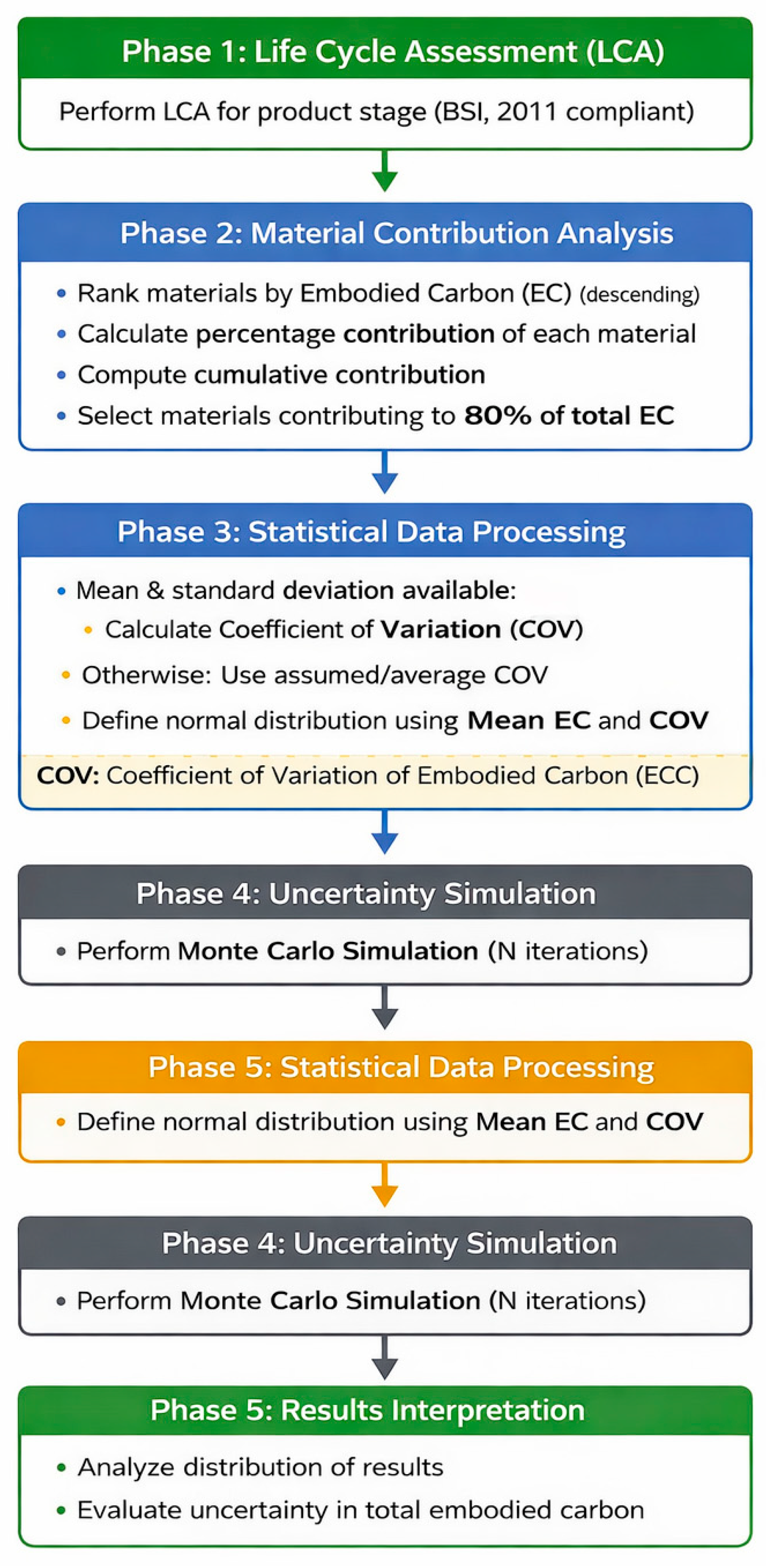
As illustrated in Figure 1, the current LCA framework suffers from significant “Epistemic Uncertainty”. A lack of specific material data forces reliance on average COV values. Predicting outcomes then hinges on complex Monte Carlo simulations, a necessity that inevitably widens the “trust gap” in Green Finance reporting.
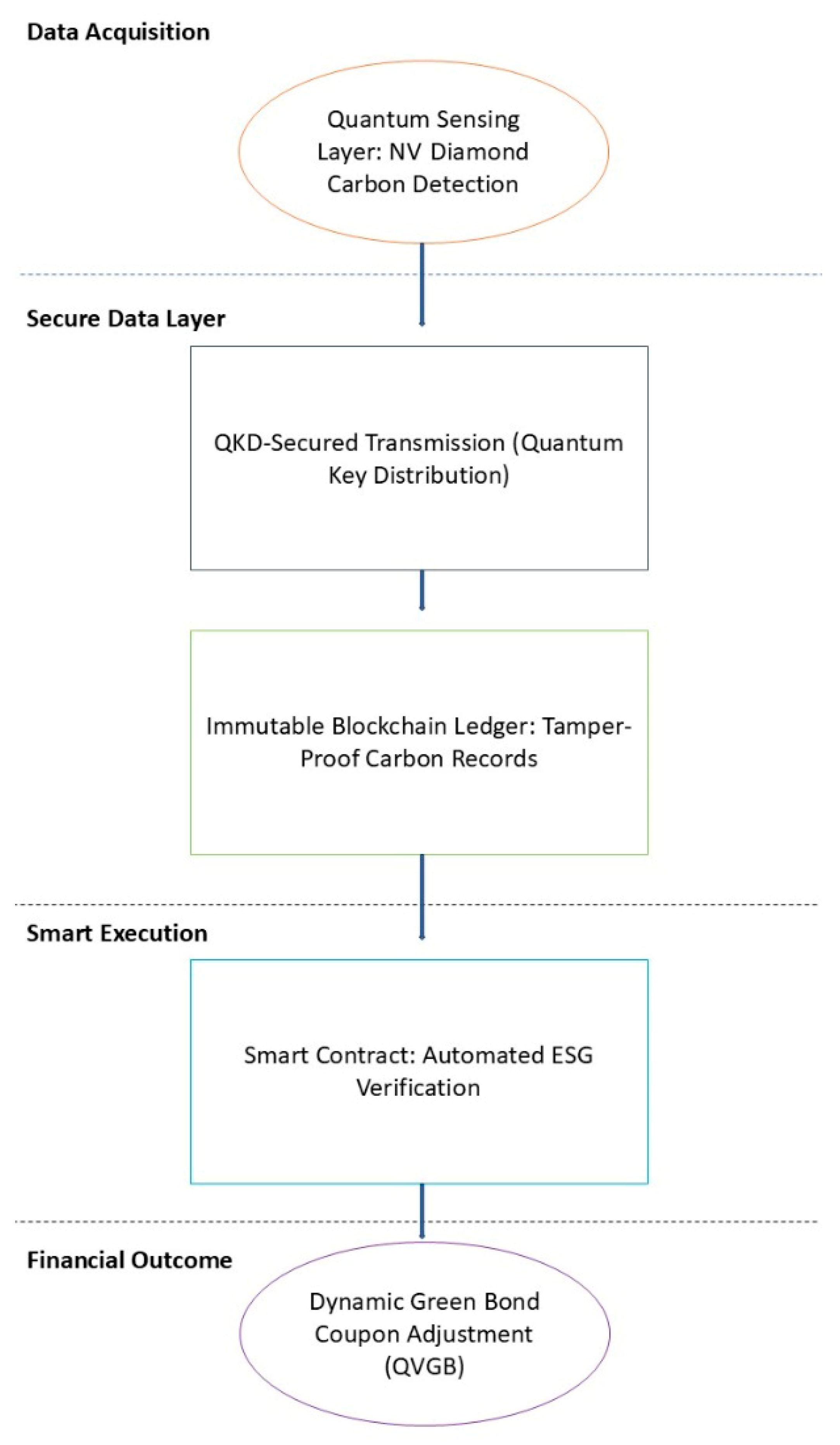
Figure 2 shows a linear and optimized workflow that differs from conventional modeling. By using NV diamond sensors, the system avoids relying on probabilistic estimates. The data is transmitted via QKD and stored in an immutable ledger, prompting the smart contract to trigger financial adjustments based on “physically verified” facts rather than statistical approximations. This transition from Figure 1 to Figure 2 demonstrates that the ontological shift in the study is practical, not merely conceptual. While the classical framework is based on recursive simulation loops, the pipeline enhanced by quantum technology offers a highly precise alternative. This structure effectively eliminates the agency’s costs and information asymmetries typical of discretionary ESG disclosures [35,36].
The use of nitrogen vacancies in diamonds as quantum sensors fundamentally changes the epistemic structure of metrology by constraining measurement variance to a lower limit dictated by Quantum Fisher Information. This framework effectively separates data integrity from human judgment. While NV-based magnetometry achieves unprecedented sensitivity thresholds, researchers can rigorously model local gas flows using optimal probe states and measurement protocols. The Quantum Cramér–Rao Bound (QCRB) thus serves as the definitive limit on accuracy for these parameter estimation tasks [37]. It is the fundamental principles of quantum dynamics and the specific control sequences employed here, not the companies’ reporting guidelines, that determine this limit. The “quantum precision threshold” represents an ontologically primary uncertainty. It is a baseline that remains immune to ex post methodological choices, narrative framing, or selective data inclusion. Unlike classical ESG and embodied carbon assessments where unquantified uncertainty and methodological flexibility often push error rates past the 10–30% mark [30], the NV-based quantum-metrological layer establishes residual uncertainty as a fixed physical constant of the measurement architecture. This transforms environmental performance data such as CO2 and CH4 fluxes at the boundaries of a specific facility into an exogenous, physically validated state variable. It is no longer an endogenous management decision. Such a shift is of ontological significance. The data used for asset valuation and contract design is moving away from “subjective,” institutionally constructed ESG assessments and is increasingly oriented toward quantified metrics. This reflects highly precise physical measurement technology, in which scientific conclusions are based on fundamental boundaries rather than the shifting sands of institutional conventions [30]. Rather than settling for a minor improvement in data quality, quantum measurement technology redefines the very nature of ESG information. It elevates these indicators from the realm of controversial interpretations to that of indisputable physical facts, thereby fundamentally reshaping the informational foundations of sustainable finance [33,38,39,40,41].
A direct structural comparison between classical self-reported ESG auditing and the proposed quantum-limited physical verification layer clarifies why the latter constitutes a qualitative, not merely incremental, reduction in information asymmetry. Under the prevailing classical auditing regime, the environmental performance verification process exhibits three structural properties that collectively sustain information asymmetry at a non-trivial level. First, the primary data from which ESG metrics are constructed are generated by the issuer’s own operational systems: energy management platforms, fuel purchase records, and activity-based emission factor databases. These data are then transmitted to third-party verifiers who have neither the operational access nor the instrumental capability to independently replicate the underlying measurements. This arrangement is epistemically equivalent to auditing a financial statement whose source ledger is maintained exclusively by the entity under audit, with no independent access to bank statements, transaction counterparties, or physical inventory counts; the structural conflict of interest is formally identical [4,6]. Second, the verification process itself is conducted under a commercial relationship in which the verifier is contracted and remunerated by the issuer, creating a documented incentive for verification leniency that has been empirically characterized in the auditing literature as “opinion shopping” and “low-balling” [5]. Third, the methodological standards governing emission factor selection, system boundary definition, and scope 3 allocation are sufficiently flexible that issuers retain substantial discretion over the numerical outputs of the reporting process, even within nominal compliance with recognized frameworks such as the GHG Protocol and IFRS S2 [10,11,12,13]. The compound effect of these three properties is that classical ESG auditing does not resolve information asymmetry, but it institutionalizes it. The resulting governance architecture superficially resembles independent verification while substantively preserving issuer control over the environmental state variable that is priced into capital markets [18]. The quantum-limited physical verification layer proposed in the QVGB framework structurally eliminates each of these three sources of asymmetry through a single architectural intervention: the relocation of primary data generation from the issuer’s organizational systems to an exogenous, physics-governed measurement process. NV-center arrays at the point of emission transduce environmental state variables directly into quantum-metrological observables. Because their uncertainty is bounded by the Cramér–Rao limit rather than by reporting methodology, the issuer’s discretion over the numerical value of the primary environmental variable is reduced to the irreducible minimum set by Quantum Fisher Information. Because the resulting data are transmitted through a QKD-secured provenance chain whose integrity is enforced by the no-cloning theorem rather than by institutional governance, the verifier’s dependence on issuer-supplied information is eliminated. And because the smart contract layer enforces coupon contingencies directly against the quantum-verified state variable rather than against audited reports, the scope for ex post methodological adjustment of environmental performance claims is closed. In this sense, the QVGB architecture does not merely augment the existing ESG disclosure infrastructure with an additional verification layer. It replaces its epistemically fragile foundation (the issuer’s self-reported claim) with a physically determined observable, reducing the structural sources of information asymmetry to the irreducible quantum noise level.
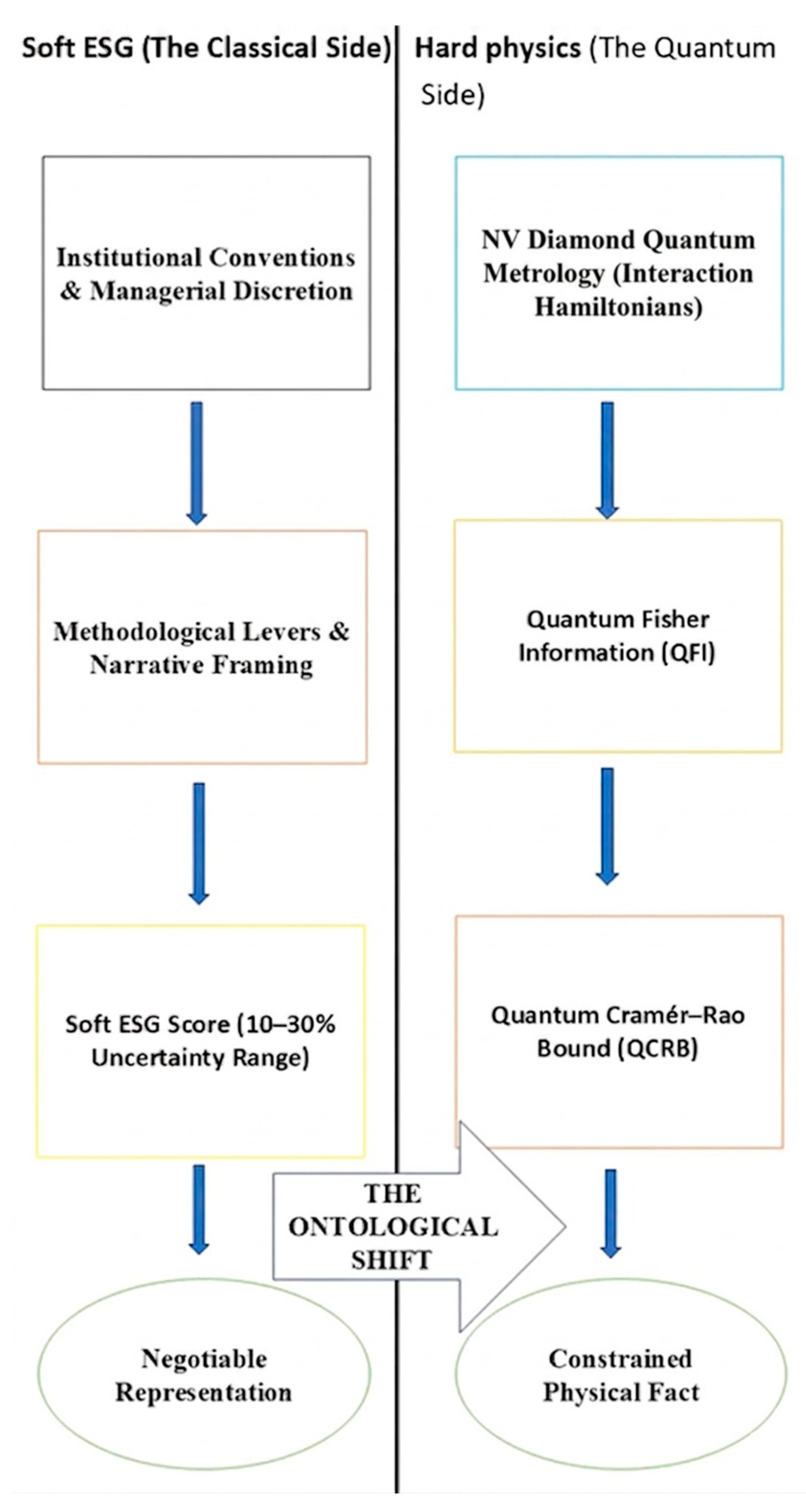
This diagram illustrates how NV diamond quantum metrology redefines ESG data. Organizational processes and “methodological levers” are typically the source of classical uncertainty; however, the Quantum Cramér–Rao Bound (QCRB) introduces an absolute accuracy threshold. This turning point redefines environmental performance, particularly CO2 and CH4 fluxes, transforming these indicators from endogenous management decisions into exogenous state variables validated by physics. Thanks to the use of diamond-based NV centers, measurement uncertainty finds a lower bound dictated by Quantum Fisher Information. This “quantum accuracy threshold” ensures that environmental indicators transcend the “fuzzy” institutional framework and become variables validated by the laws of physics. This framework effectively eliminates any risk of ex post methodological manipulation and anchors sustainable finance in immutable physical limits rather than in the fluidity of corporate discourse.

4.2. Game-Theoretic Resolution of the Pooling Equilibrium

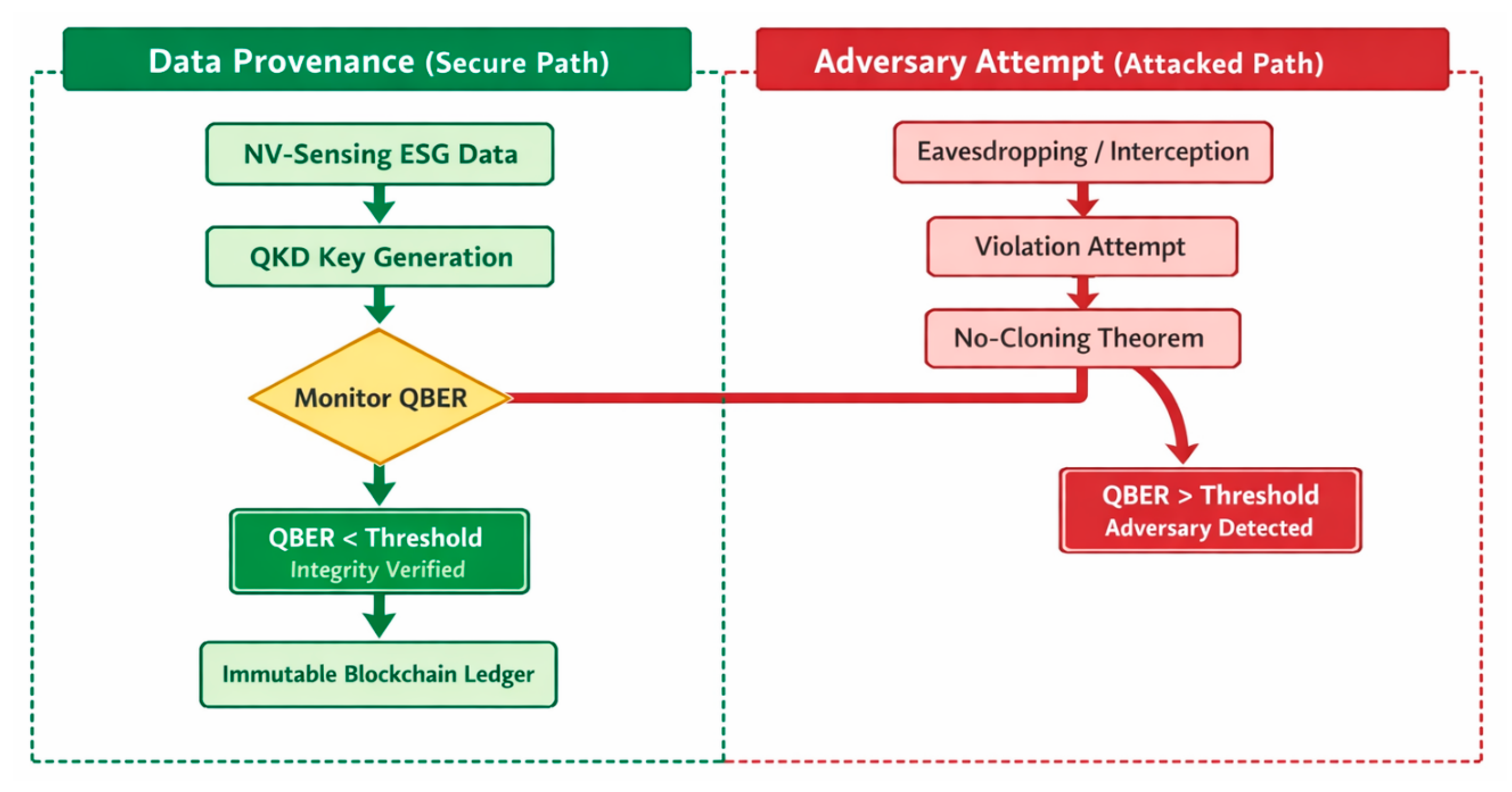
The Figure 3 illustrates that the persistent greenwashing and lack of true additionality in the green finance sector reveal fundamental flaws in market signals. The integration of quantum key distribution (QKD) offers a technical solution to address these imbalances. By leveraging the no-cloning theorem and monitoring the Quantum Bit Error Rate (QBER), this security framework ensures uncompromised data integrity. For the green bond market, where the link between financial labeling and tangible environmental outcomes remains weak due to information gaps, transitioning to this architecture is essential [33,37,42,43]. Traditional signaling models demonstrate that distinguishing high-quality issuers from lower-quality counterparts becomes structurally constrained when disclosed information lacks verifiable commitments or if the underlying verification mechanisms are susceptible to strategic manipulation. Consequently, investors do not take environmental labels into account, leading to an equilibrium of aggregation in which market prices do not allow for a distinction between the different types of issuers [37]. Debrah et al. argue that the lack of transparent, high-frequency data at the asset level, combined with the low cost of greenwashing, undermines trust in green financial instruments, making the use of advanced financial technologies, particularly blockchain, necessary to restore credibility [33]. Even within these digital frameworks, data integrity often depends on institutional governance and classical cryptographic assumptions; this allows for potential collusion between issuers and intermediaries during the initial phase of data generation, regardless of whether the subsequent records are tamper-proof or not.
Quantum-secured data provenance introduces a qualitatively different constraint structure. In QKD, any attempt by an adversary to intercept, copy, or modify quantum states inevitably introduces detectable disturbances, captured statistically by an increase in the QBER beyond protocol-specific thresholds [43,44]. Recent game-theoretic analyses of the QBER in quantum communication protocols show that Nash-equilibrium reasoning can be used to derive robust security bounds: optimal strategies of honest parties and adversaries lead to stable QBER thresholds, below which eavesdropping is infeasible without detection and above which the protocol is aborted [30]. In the context of Quantum-Verified Green Bonds, environmental data generated by NV sensors are authenticated and encrypted via keys generated through QKD. Any issuer-side attempt to alter the upstream data stream, whether by intercepting quantum states or injecting forged classical packets, must manifest either as an anomalous QBER or as an inconsistency between the quantum-verified measurement record and contractual expectations. The no-cloning theorem fundamentally prevents the perfect replication of unknown quantum states, meaning that adversaries cannot simulate or reproduce the quantum channel without leaving a trace. Any significant interference inevitably distorts measurement statistics, enabling continuous, real-time monitoring [29,35]. Consequently, the barrier against manipulation is physical, rather than purely technological or legal; undetected manipulation would require a violation of the very laws of quantum theory. While traditional digital frameworks often face temporary increases in internal regional emissions reduction costs due to necessary infrastructure investments, this quantum-based approach links the transition to external transaction costs to data integrity at the physical level [44].
The architecture illustrated in the preceding Figure 4 encodes a set of causal relationships whose financial and policy implications extend well beyond the technical specifics of quantum communication. At the primary causal level, the deployment of QKD-secured data provenance with continuous QBER monitoring introduces a structural discontinuity in the information environment of the green bond market: the environmental performance state of a QVGB issuer transitions from an endogenously constructed, managerially discretionary signal to an exogenously determined, physically attested observable. This ontological reclassification of the environmental state variable has a direct causal effect on the information asymmetry between the issuer and investor. This asymmetry is the proximate source of the Jensen–Meckling agency costs that have sustained greenwashing as a rational equilibrium strategy in the conventional green bond market [4,7]. Specifically, once the quantum-verified emissions trajectory is observable by all contracting parties in real time, the informational precondition for pooling equilibrium, namely, the investor’s inability to distinguish genuine green performance from fraudulent disclosure without prohibitive verification costs, is removed, and the market converges toward the separating equilibrium characterized in Section 3.3. From a financial relevance standpoint, this causal sequence has direct and quantifiable implications for the pricing of green bond instruments. The elimination of the informational precondition for pooling potentially compresses the uncertainty premium embedded in the greenium: investors who previously demanded a yield discount partially as compensation for greenwashing risk can, under the QVGB regime, price that risk toward zero, conditional on verified compliance with the quantum-attested emissions trajectory. This repricing mechanism analogous to the risk premium compression observed in sovereign bond markets following the introduction of independent central bank inflation targeting may be expected to reduce the cost of capital for genuinely low-emission issuers, thereby improving the financial competitiveness of verified green debt relative to conventional instruments and sustainability-linked bonds whose KPIs remain self-reported [17,18]. At the policy level, the QVGB data provenance architecture offers regulators and standard setters a technically grounded pathway toward the mandatory physical verification of environmental performance metrics under IFRS S2 and the EU Digital Product Passport framework. Rather than prescribing specific sensor technologies, an approach that risks rapid obsolescence, regulators could adopt a performance-based standard. This standard would require that environmental variables disclosed in sustainability reports meet a specified quantum-metrological precision threshold, defined as a maximum permissible uncertainty in CO2 or CH4 flux density per measurement cycle. This regulatory design would create a technology-neutral but physically rigorous verification level, above which competing quantum sensing architectures could be innovated, and below which self-reported or classically audited data would not qualify for preferential regulatory treatment or greenium pricing. Such a regulatory framework would also address the systemic risk implications identified in the recent literature. Current evidence suggests that the probability of a green finance bubble is non-trivially elevated by the misdirection of climate capital toward projects with marginal or negative environmental additionality [18]. In this context, the transition to physics-grade environmental verification constitutes not merely a disclosure reform, but a macroprudential intervention—one that stabilizes the informational foundations of an increasingly systemically significant asset class.
By integrating QKD, the system dismantles the “pooling equilibriums” that traditionally protect greenwashing practices. While classical fintech relies on institutional trust, this architecture transfers this responsibility to the no-cloning theorem. Hostile attempts to alter the quantum states, the foundation of data provenance, are immediately detected through QBER fluctuations. Falsification becomes more than just a legal infraction; it is a physically detectable event. This ensures that green bond coupon adjustments are determined based on physically certified integrity.
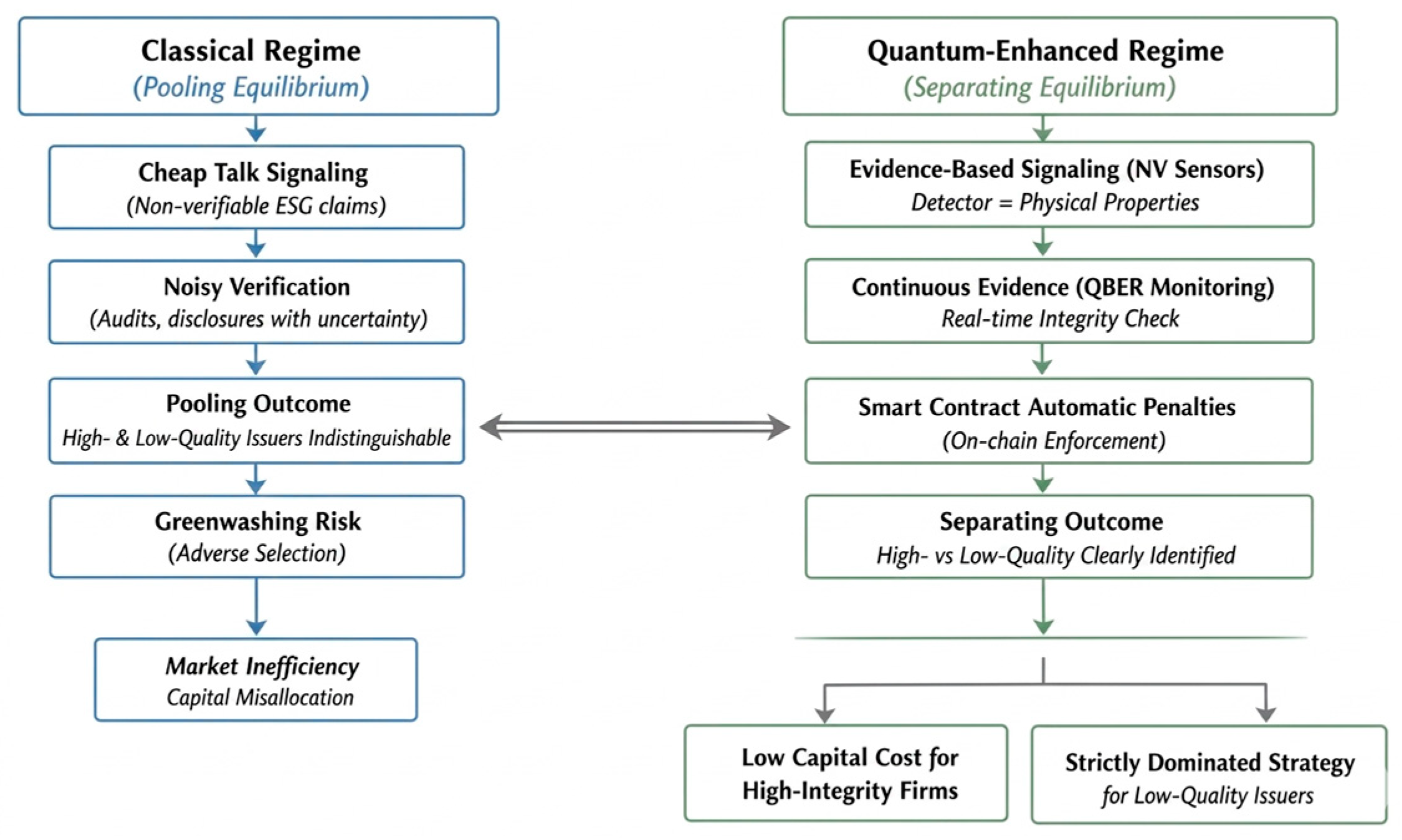
From an analytical perspective, this shift reflects a transition toward signaling games that incorporate evidence. While classical regimes often allow deception to go undetected, the QKD-QBER architecture introduces a layer of oversight. This mechanism generates probabilistic indicators of reporting anomalies, providing an analytical diagnostic capability that conventional frameworks lack. Such analytical detection capabilities significantly mitigate specific pooling equilibria, potentially steering the green finance market toward a paradigm where empirical, data-driven credibility constrains speculative corporate disclosures, thereby encouraging more transparent and verifiable signaling [37]. In the quantum context, the “detector” is realized through the physical properties of the communication channel itself, with the QBER serving as a continuous test variable whose distribution is endogenously linked to the presence or absence of manipulation. For high-emitting issuers who opportunistically engage in greenwashing, the expected gain from mimicking genuine green performance drops sharply. Two factors account for this: the near-absolute certainty of detection as the QBER or data trajectory anomalies accumulate, and the automatic contractual penalties (including coupon increases, early redemption, and regulatory sanctions), triggered by fraud alerts embedded in smart contracts. Meanwhile, genuinely green issuers can credibly signal their integrity by allowing the quantum infrastructure to observe and transmit their emissions profile in real time, benefiting from lower capital costs and stronger investor demand. Realistic calibrations of detection probabilities and penalty intensities render deception a strictly dominated strategy for low-quality issuers. Under these conditions, the system converges on a unique, stable separating Nash equilibrium. High-integrity firms maintain their position through honest disclosure, while structurally high-emission issuers face a binary choice: accept penalized terms or withdraw from the green label sector [29,30,31,34,36]. Quantum information theory addresses the pooling equilibrium problem through a structural change in basic assumptions; it moves beyond conventional disclosure norms by establishing rigorous physical constraints that systematically impede specific deceptive manipulation patterns. By doing so, it integrates incentive compatibility into the very architecture of the communication channel.
This diagram in Figure 5 illustrates the evolution of market behavior. In the classical regime, information asymmetry favors a pooling equilibrium, allowing greenwashing to persist undetected. However, the integration of QKD-QBER as a physical detector shifts the system toward a separating equilibrium. As the combined pressure of QBER anomalies and smart contract penalties makes deception a strictly controlled strategy, the green bond market becomes self-correcting, allowing only companies with an elevated level of integrity to survive.

4.3. Policy Implications and the 2026 EU Regulatory Landscape

The approaching EU legislative horizon of 2026 is driving a fundamental shift towards greater traceability, creating the conditions for the emergence of the “Quantum ESG” concept. A central element of this evolution is the Digital Product Passport (DPP), a key tool of the EU Circular Economy Action Plan, designed to institutionalize transparency throughout the entire product lifecycle. By using sophisticated digital infrastructures, the DPP enables selective data permissions and maintains the integrity of environmental records across complex supply chains [43,44,45]. Systematic analysis of DPP frameworks indicates that compliance with these mandates requires more than mere good intentions; it requires high-capacity data flows and architectures protected against tampering. While blockchain and distributed ledger technologies are frequently invoked as critical foundations for these secure systems, they represent necessary, yet incomplete, solutions [45,46,47]. In parallel, IFRS S2 and related sustainability disclosure standards are codifying climate-related financial disclosure as a mandatory requirement for listed entities, pressuring issuers to provide granular, decision-useful information on emissions trajectories, transition plans, and physical and transition risks [37,38]. At the same time, the literature documents persistent uncertainty, divergence, and opacity in ESG ratings and corporate sustainability metrics, with ESG rating divergence itself now recognized as a driver of corporate digital transformation and a source of sustainability uncertainty that undermines the information content of ESG scores [37,38].
Current assessments of green finance and bond markets warn that a “green bubble” may form, fueled by miscalculated transition risks and skewed capital flows should green certification fail to reflect authentic ecological performance [31,35,41]. Research from Hafner et al. identifies short-termism and uncertainty in policy as the primary obstacles to securing adequate green investment. This lack of financial momentum creates a deficit that makes the achievement of Paris-aligned pathways increasingly difficult to reach [48]. If Tier-1 stock exchanges and leading authorities continue to rely on ESG ratings and voluntary disclosures characterized by substantial uncertainty and divergence, they risk amplifying mispricing, herding, and bubble dynamics in green assets. By contrast, integrating Quantum ESG infrastructures, NV-based sensing and QKD-based provenance into the regulatory perimeter of DPPs and IFRS S2 disclosures would allow supervisors, exchanges, and standard setters to require that critical climate-related metrics be physically verified, quantum-audited inputs into reported figures. Over time, this architecture is likely to become a de facto, and eventually de jure, benchmark for listing on Tier-1 exchanges and for eligibility in green taxonomies and prudential incentives. As digital transformation has been shown to enhance ESG performance under stringent environmental regulation by tightening data feedbacks and enabling more credible monitoring [29,33], the move to physics-grade, quantum-secured data can be expected to further compress the space for opportunistic behavior, thereby contributing to market stability, reducing the probability of a green bubble, and aligning capital allocation with scientifically grounded decarbonization pathways [33,37,40,42,43,45,48].

5. Conclusions and Future Trajectories

The analysis of quantum-enhanced green finance situates Quantum-Verified Green Bonds (QVGBs) as a structural solution to the fifteen-year crisis of trust that has characterized sustainable finance since the early diffusion of ESG integration and green bond markets. Bibliometric and qualitative analyses reveal a constantly evolving field. Although green finance is growing rapidly, it remains conceptually underdeveloped and suffers from “greenwashing,” vague definitions, and questionable additionality. This instability is reflected in the epistemic fragility of ESG ratings and CO2 indicators. Due to data gaps and methodological leeway, these indicators often fail to reflect actual sustainability performance, particularly during periods of uncertainty shocks, thus significantly distorting signals in capital markets. The same limitations apply to air quality monitoring, where fragmented data often leads to an incomplete assessment of environmental impacts. Instead of resolving the Jensen–Meckling agency problem, these conditions exacerbate it. Information efficiency, as defined by Fama, also suffers, as it is hampered by the low signal-to-noise ratio of current sustainability data. Added to these problems are shocks related to climate risks, which have been proven to cause significant volatility spread effects between energy markets and green bonds.
QVGBs restructure this information framework by forming three interconnected layers. At the physical level, NV-center-based quantum metrology establishes a minimum accuracy threshold defined by Fisher for quantum information for critical environmental variables. This change transforms emission power from a simple reported attribute into a physically concretized observable quantity limited by strict quantum constraints. At the cyber–physical level, QKD-secured communication and QBER-based monitoring utilize the non-clone theorem and measurement perturbation. By making the falsification of upstream data physically detectable, these mechanisms fundamentally alter the incentives for disclosure and effectively close the channels for “cheap talk” that normally allows for the maintenance of shared equilibrium. At the financial level, these quantified, verified variables are directly integrated into the return functions via stochastic coupon formulas. Because these formulas depend on the verified impact, “greenwashing” becomes a prevalent strategy for low-quality issuers, provided the parameters for detection and sanctioning remain plausible. The result is a type of equilibrium in which only companies with a high degree of integrity can maintain their access to low-cost green finance. The close linking of cash flows with physically proven impacts aligns QVGBs with evolving regulatory frameworks such as DPPs and IFRS S2. This integration provides a mechanism to shift sustainable finance from its current narrative-based and rating-mediated state to a physical dimension of the global financial system.
This framework leads to a gradual tightening of financial obligations, forcing them to adapt to the immutable laws of physics. As the 2030 net-zero emissions target approaches, the epistemic gap between reported figures and actual physical decarbonization decreases. Systems theory analyses suggest that distorted or easily manipulated signals, along with factors such as path dependency and short-term bias, inevitably block investment and increase the risks of the energy transition. Integrating quantum-verified sensors addresses these risks by providing unadulterated evidence of environmental performance, particularly regarding compliance with stringent air quality. A physical financial system alters this dynamic. By anchoring sustainability-related cash flow contingencies in quantum-limited measurements and assured data provenance, the system reduces the gap by effectively directing capital into transformative investments while eliminating the potential for greenwashing. This does not replace the need for robust regulation or macroprudential oversight. Instead, it realigns the ontological basis of sustainable finance, replacing management discretion with the non-negotiable structure of quantified information. The result is an information infrastructure designed for high-integrity capital allocation that recognizes physical reality over political expediency.
Several high-priority research trajectories emerge directly from the theoretical architecture established by this study. The most consequential near-term frontier concerns the systematic integration of artificial intelligence and machine learning algorithms with the quantum sensing layer. The present framework employs NV-center arrays as point-of-emission transducers operating under fixed metrological protocols. Deploying deep learning architectures atop the real-time quantum data stream (including recurrent neural networks, transformer-based sequence models, and physics-informed neural networks) would enable predictive modeling of multi-gas emission dynamics across temporal and spatial scales that static QCRB estimation cannot address in isolation. Specifically, AI-augmented QVGB systems could learn the nonlinear co-emission patterns of CO2, CH4, and ancillary industrial gases under varying production regimes. They could also anticipate emission spikes before they manifest in the quantum measurement record and dynamically recalibrate the stochastic coupon function to reflect forward-looking environmental performance trajectories rather than purely contemporaneous flux readings. This integration of quantum-physical measurement precision with AI-driven predictive analytics would constitute a genuinely novel contribution to the literature on intelligent environmental monitoring and would extend the incentive-compatible contracting properties of the QVGB framework beyond the current separating equilibrium model. A second critical research trajectory involves exploring the scalability of the QVGB architecture within global cross-border supply chains and its compatibility with emerging international green debt instruments. The current model is formalized at the level of individual industrial emission sites. However, the GSS+ bond market, which has surpassed USD 6.8 trillion in cumulative aligned issuance, increasingly demands environmental performance verification across complex, multi-jurisdictional value chains. Scope 3 emissions constitute the dominant share of corporate carbon footprints in these chains and are precisely those characterized by the most severe data vacancy, as Rodrigues et al. and Davis et al. empirically demonstrate. Extending the QVGB framework to cross-border supply chain contexts would require several developments: federated quantum sensing architectures, interoperable QKD infrastructure across sovereign network domains, and standardized data provenance protocols. The latter must be capable of aggregating site-level quantum-verified measurements into instrument-level environmental performance metrics that satisfy IFRS S2 and DPP reporting requirements. Furthermore, the coupling of QVGB structures with international green debt instruments including multilateral development bank green bonds, sovereign sustainability-linked bonds, and transition finance instruments targeting Belt and Road energy infrastructure presents a particularly fertile area for applied research. Embedding quantum-verified environmental data into the contractual structures of these instruments could fundamentally strengthen the additionality and accountability mechanisms that the existing literature identifies as structurally absent from large-scale sovereign and supranational green finance. Taken together, these future trajectories establish the QVGB framework not as a terminal theoretical contribution, but as a foundational architecture. Upon it, a new generation of physics-anchored, AI-augmented, and globally scalable sustainable finance instruments can be systematically constructed.

6. Limitations

Notwithstanding the theoretical rigor and conceptual novelty of the QVGB framework, the present study operates within a set of practical, technical, and institutional constraints that must be candidly acknowledged. First, the initial fabrication and deployment costs of nitrogen-vacancy (NV)-center sensor arrays represent a non-trivial economic barrier to near-term industrial adoption. High-purity diamond substrates engineered to precise NV density specifications, combined with the optical control infrastructure required for sustained ODMR operation, impose capital expenditure burdens that are currently prohibitive for small- and medium-sized bond issuers. The same applies to sovereign green bond programs in low-income authorities, precisely where climate finance is most urgently needed. While ongoing advances in diamond growth and nanofabrication are progressively reducing unit costs, the asymmetric distribution of access to quantum hardware risks replicating, in the physical measurement layer, the same structural inequalities that currently characterize the third-party verification market. Second, the operational continuity of quantum-grade metrological performance demands rigorous and uninterrupted calibration protocols under the heterogeneous and often extreme conditions characteristic of industrial emission environments. The Quantum Fisher Information (QFI) of an NV-center ensemble is sensitive to ambient magnetic field fluctuations, mechanical vibrations, temperature gradients, and chemical contamination, all of which are endemic to the petrochemical, heavy manufacturing, and energy generation sites that constitute primary targets for QVGB deployment. Maintaining alignment between realized sensor sensitivity and the theoretical Cramér–Rao Bound (QCRB) requires site-specific recalibration routines whose frequency and resource intensity increase with environmental volatility. This alignment condition is formalized by Degen, Reinhard, and Cappellaro and operationalized through the fully optimized quantum metrology protocol of Liu et al. Failure to uphold these calibration standards introduces systematic drift into the quantum-limited measurement record. These risks degrade the epistemic integrity that differentiate QVGB-grade data from conventional MRV outputs. Third, the management of dense, spatially distributed NV-center sensor arrays across large-scale industrial and planning facilities, refineries, port complexes, multisite manufacturing campuses, and transboundary supply chain nodes introduces significant engineering complexity at the network layer. Multiplexing high volumes of NV-sensor outputs through QKD-secured communication channels demands quantum repeater infrastructure and classical–quantum interface protocols. Sustaining sub-threshold Quantum Bit Error Rates (QBERs) across geographically dispersed nodes adds a further constraint, as the reliability of these protocols under real-world latency conditions remains an active area of research. The scalability of the three-layer QVGB architecture to the asset-level granularity required by IFRS S2 and DPP disclosure standards therefore constitutes a substantial systems engineering challenge. Its resolution will require coordinated investment in quantum communication infrastructure that extends well beyond the scope of any individual bond issuance. These limitations do not invalidate the QVGB framework. Rather, they delineate the frontier conditions under which its transformative potential will be realized. In doing so, they establish a concrete research and policy agenda for the next phase of quantum-enhanced green finance development.

Author Contributions

Conceptualization, A.A. and E.G.; Methodology, A.A.; Software, A.A. and E.G.; Validation, A.A., E.G. and I.I.; Formal Analysis, A.A. and V.-S.N.; Investigation, A.A. and V.-S.N.; Resources, A.A., E.G. and I.I.; Data Curation, A.A. and V.-S.N.; Writing—Original Draft Preparation, A.A. and E.G.; Writing—Review and Editing, E.G. and I.I.; Visualization, A.A., V.-S.N., E.G. and I.I.; Supervision, A.A., E.G. and I.I.; Project Administration, E.G. and I.I.; Funding Acquisition, E.G. and I.I. All authors have read and agreed to the published version of the manuscript.

Funding

This research received no external funding.

Institutional Review Board Statement

Not applicable.

Informed Consent Statement

Not applicable.

Data Availability Statement

The original contributions presented in this study are included in the article. Further inquiries can be directed to the corresponding authors.

Acknowledgments

This work was developed in the frame of a grant of the Ministry of Research, Innovation and Digitization, CNCS-UEFISCDI, project number PN-IV-P1-PCE-2023-0679, within PNCDI IV, and supported by it.

Conflicts of Interest

The authors declare no conflicts of interest.

Abbreviations

NV CentersNitrogen-vacancy centers in diamond (atomic-scale crystal defects for sensing)
QKDQuantum key distribution (protocol for secure key establishment)
QBERQuantum bit error rate (metric for detecting eavesdropping or tampering)
QFIQuantum Fisher information (determines the maximum precision of a quantum probe)
QCRBQuantum Cramér–Rao bound (the fundamental lower bound on measurement variance)
No-Cloning TheoremQuantum mechanics impose a fundamental restriction: the impossibility of producing an identical replica of an unknown quantum state
HamiltonianThe operator representing the total energy and interaction dynamics of the quantum system
QVGBsQuantum-verified green bonds (financial instruments linked to physics-attested data)
QEGFQuantum-enhanced green finance (the overall framework proposed in this study)
ESGEnvironmental, social, and governance (the standard non-financial reporting criteria)
GSS+Comprises green, social, and sustainability bonds, along with sustainability-linked bond structures
GreeniumThe yield premium or lower cost of capital associated with green-labeled instruments
GreenwashingThe deceptive practice of overstating or fabricating environmental performance
Pooling EquilibriumA market state where honest and fraudulent issuers are indistinguishable to investors
Separating EquilibriumA market state where high-integrity firms are clearly distinguished from low-quality issuers
Nash EquilibriumA stable situation in which no individual can increase their payoff by changing strategies on their own
MRVMeasurement, reporting, and verification (the traditional environmental auditing process)
LCALife cycle assessment (process for quantifying environmental consequences from raw material extraction to final disposal)
DPPDigital product passport (EU initiative for product-level traceability)
IFRS S1 and S2International Sustainability Disclosure Standards
GHG ProtocolThe global standard for corporate greenhouse gas accounting
CDPCarbon Disclosure Project
COVCoefficient of variation (a measure of relative variability/uncertainty)
Monte Carlo (MC)A stochastic simulation technique used to model uncertainty in classical LCA
Ontological ShiftThe transition of data category from negotiable representation to constrained physical fact
Data ProvenanceThe chronological record of data origin, custody, and integrity

References

  1. Homepage, Climate Bonds. Available online: https://www.climatebonds.net/ (accessed on 30 March 2026).
  2. ICE Climate. Available online: https://www.ice.com/fixed-income-data-services/ice-climate (accessed on 30 March 2026).
  3. Xu, Y.; Guo, X.; Jiang, W.; Tan, Z.; Chiu, B. Green Bonds and Energy Markets Under Climate Risk Shock: A Spillover Perspective. Sustainability 2026, 18, 3522. [Google Scholar] [CrossRef]
  4. Flammer, C. Corporate green bonds. J. Financ. Econ. 2021, 142, 499–516. [Google Scholar] [CrossRef]
  5. Zhu, Q.; Zhao, X.; Wu, M. Third-party certification: How to effectively prevent greenwash in green bond market?—Analysis based on signalling game. Environ. Dev. Sustain. 2024, 26, 16173–16199. [Google Scholar] [CrossRef]
  6. Schmittmann, J.M.; Gao, Y. Green Bond Pricing and Greenwashing Under Asymmetric Information; IMF Working Papers, Art. no. 2022/246; IMF: Washington, DC, USA, 2022; Available online: https://ideas.repec.org//p/imf/imfwpa/2022-246.html (accessed on 30 March 2026).
  7. Liu, C.; Wu, S.S. Green finance, sustainability disclosure and economic implications. Fulbright Rev. Econ. Policy 2023, 3, 1–24. [Google Scholar] [CrossRef]
  8. Bernini, F.; La Rosa, F. Research in the greenwashing field: Concepts, theories, and potential impacts on economic and social value. J. Manag. Gov. 2024, 28, 405–444. [Google Scholar] [CrossRef]
  9. ISO 14064-1: 2018(en); Greenhouse Gases—Part 1: Specification with Guidance at the Organization Level for Quantification and Reporting of Greenhouse Gas Emissions and Removals. International Organization for Standardization: Geneva, Switzerland, 2018.
  10. IFRS—IFRS S1 General Requirements for Disclosure of Sustainability-Related Financial Information. Available online: https://www.ifrs.org/issued-standards/ifrs-sustainability-standards-navigator/ifrs-s1-general-requirements/ (accessed on 30 March 2026).
  11. IFRS—IFRS S2 Climate10. IFRS—IFRS S2 Climate-Related Disclosures. Available online: https://www.ifrs.org/issued-standards/ifrs-sustainability-standards-navigator/ifrs-s2-climate-related-disclosures/ (accessed on 30 March 2026).
  12. Rodrigues, J.F.D.; Moran, D.; Wood, R.; Behrens, P. Uncertainty of Consumption-Based Carbon Accounts. Environ. Sci. Technol. 2018, 52, 7577–7586. [Google Scholar] [CrossRef]
  13. Carbon Footprint Data Collection: Common Challenges and How to Solve Them|Carbon Direct. Available online: https://www.carbon-direct.com/insights/carbon-footprint-data-collection-common-challenges-and-how-to-solve-them (accessed on 30 March 2026).
  14. Davis, S.J.; Dumit, A.; Li, M.; Maldonado, Y.; Steffen, M.; Stevenson, M.; Boldyreva, T.; Suh, S. The importance of multire-gional accounting for corporate carbon emissions. Nat. Commun. 2025, 17, 1014. [Google Scholar] [CrossRef]
  15. Marlowe, J.; Clarke, A. Carbon Accounting: A Systematic Literature Review and Directions for Future Research. Green Financ. 2022, 4, 71–87. [Google Scholar] [CrossRef]
  16. World Energy Outlook 2024—Analysis. IEA. Available online: https://www.iea.org/reports/world-energy-outlook-2024 (accessed on 16 May 2026).
  17. Financing Clean Energy Transitions in Emerging and Developing Economies—Analysis. IEA. Available online: https://www.iea.org/reports/financing-clean-energy-transitions-in-emerging-and-developing-economies (accessed on 16 May 2026).
  18. Jóźwik, B.; Toy, A.; Tekbas, M.; Dogan, M.; Krauze, F. The Impact of Green Bonds and Energy Use on Carbon Dioxide Emissions: Evidence from 17 Financially Developed Countries (2014–2023). Energies 2025, 18, 6316. [Google Scholar] [CrossRef]
  19. Barry, J.F.; Schloss, J.M.; Bauch, E.; Turner, M.J.; Hart, C.A.; Pham, L.M.; Walsworth, R.L. Sensitivity optimization for NV-diamond magnetometry. Rev. Mod. Phys. 2020, 92, 015004. [Google Scholar] [CrossRef]
  20. Barry, J.F.; Steinecker, M.H.; Alsid, S.T.; Majumder, J.; Pham, L.M.; O’Keeffe, M.F.; Braje, D.A. Sensitive ac and dc magnetometry with nitrogen-vacancy-center ensembles in diamond. Phys. Rev. Appl. 2024, 22, 044069. [Google Scholar] [CrossRef]
  21. Degen, C.L.; Reinhard, F.; Cappellaro, P. Quantum sensing. Rev. Mod. Phys. 2017, 89, 035002. [Google Scholar] [CrossRef]
  22. Reddy, N.R.; Suryadevara, S.; Reddy, K.G.R.; Umamaheswari, R.; Guttula, R.; Kotoju, R. Quantum secured blockchain framework for enhancing post quantum data security. Sci. Rep. 2025, 15, 31048. [Google Scholar] [CrossRef] [PubMed]
  23. Liu, Q.; Hu, Z.; Yuan, H.; Yang, Y. Fully-Optimized Quantum Metrology: Framework, Tools, and Applications. Adv. Quantum Technol. 2024, 7, 2400094. [Google Scholar] [CrossRef]
  24. Zheng, H.; Bai, J. Quantum Leap: A Price Leap Mechanism in Financial Markets. Mathematics 2024, 12, 315. [Google Scholar] [CrossRef]
  25. Chauhan, B.V.S.; Verma, S.; Rahman, B.M.A.; Wyche, K.P. Deep Learning in Airborne Particulate Matter Sensing and Surface Plasmon Resonance for Environmental Monitoring. Atmosphere 2025, 16, 359. [Google Scholar] [CrossRef]
  26. iTeh Inc. EN 12341:2023—Gravimetric Method for PM10 and PM2.5 Air Measurement. Available online: https://standards.iteh.ai/catalog/standards/cen/9e212b76-3171-40b4-9d69-07409bc6bf75/en-12341-2023 (accessed on 1 April 2026).
  27. Raysoni, A.U.; Pinakana, S.D.; Mendez, E.; Wladyka, D.; Sepielak, K.; Temby, O. A Review of Literature on the Usage of Low-Cost Sensors to Measure Particulate Matter. Earth 2023, 4, 168–186. [Google Scholar] [CrossRef]
  28. Maleki, Y.; Ahansaz, B.; Maleki, A. Speed limit of quantum metrology. Sci. Rep. 2023, 13, 12031. [Google Scholar] [CrossRef]
  29. Naik, A.S.; Yeniaras, E.; Hellstern, G.; Prasad, G.; Vishwakarma, S.K.L.P. From portfolio optimization to quantum blockchain and security: A systematic review of quantum computing in finance. Financ. Innov. 2025, 11, 88. [Google Scholar] [CrossRef]
  30. Dutta, A.; Pathak, A. Use of Nash equilibrium in finding game theoretic robust security bound on quantum bit error rate. Phys. Scr. 2024, 99, 095106. [Google Scholar] [CrossRef]
  31. Peng, B.; Xu, N.; Luo, R.; Elahi, E.; Wan, A. Promoting green investment behavior in “belt and road” energy projects: A quantum game approach. Technol. Forecast. Soc. Change 2024, 204, 123416. [Google Scholar] [CrossRef]
  32. Jensen, M.C.; Meckling, W.H. Theory of the firm: Managerial behavior, agency costs and ownership structure. J. Financ. Econ. 1976, 3, 305–360. [Google Scholar] [CrossRef]
  33. Debrah, C.; Darko, A.; Chan, A.P.C. A bibliometric-qualitative literature review of green finance gap and future research directions. Clim. Dev. 2023, 15, 432–455. [Google Scholar] [CrossRef]
  34. Herman, D.; Googin, C.; Liu, X.; Sun, Y.; Galda, A.; Safro, I.; Pistoia, M.; Alexeev, Y. Quantum computing for finance. Nat. Rev. Phys. 2023, 5, 450–465. [Google Scholar] [CrossRef]
  35. Nielsen, M.A.; Chuang, I.L. Quantum Computation and Quantum Information, 10th ed.; Cambridge University Press: Cambridge, UK; New York, NY, USA, 2010. [Google Scholar]
  36. Segawa, T.F.; Igarashi, R. Nanoscale quantum sensing with Nitrogen-Vacancy centers in nanodiamonds—A magnetic resonance perspective. Prog. Nucl. Magn. Reson. Spectrosc. 2023, 134–135, 20–38. [Google Scholar] [CrossRef]
  37. Pawlick, J.; Colbert, E.; Zhu, Q. Modeling and Analysis of Leaky Deception Using Signaling Games with Evidence. IEEE Trans. Inf. Forensics Secur. 2019, 14, 1871–1886. [Google Scholar] [CrossRef]
  38. Chen, X.; Song, Y.; Hu, X.; Sun, G. Sustainability Uncertainty and Digital Transformation: Evidence from Corporate ESG Rating Divergence in China. Sustainability 2025, 17, 6515. [Google Scholar] [CrossRef]
  39. Ongan, S.; Işık, C.; Aydın, R.; İmamoğlu, İ.K.; Alvarado, R.; Ahmad, M. Measuring Sustainability Under Uncertainty: Introducing Net ESG (N-ESG) Performance. Bus. Strategy Environ. 2026, 35, 1735–1755. [Google Scholar] [CrossRef]
  40. Hafner, S.; Jones, A.; Anger-Kraavi, A.; Pohl, J. Closing the green finance gap—A systems perspective. Environ. Innov. Soc. Transit. 2020, 34, 26–60. [Google Scholar] [CrossRef]
  41. Konstantakis, K.N.; Koulmas, P.; Michaelides, P.G.; Porcher, T.; Prelorentzos, A.-G.N. Green bonds & clean energy in sustainable finance: Evidence from DCC-GARCH connectedness. Int. Rev. Financ. Anal. 2025, 103, 104168. [Google Scholar] [CrossRef]
  42. Chen, L.; Chen, Y.; Gao, Y. Digital Transformation and ESG Performance: A Quasinatural Experiment Based on China’s Environmental Protection Law. Int. J. Energy Res. 2024, 2024, 8895846. [Google Scholar] [CrossRef]
  43. Meo, M.S.; Staniewski, M.W. Green Bonds and Sustainable Finance: The Evolution of Portfolio Management in Conventional Markets, 1st ed.; Routledge: London, UK, 2024. [Google Scholar] [CrossRef]
  44. Ji, Y.; Pang, X.; Yang, Y. The Impact of Digital Economy on the Cost of Carbon Emission Reduction—A Theoretical and Empirical Study Based on a Carbon Market Framework. Sustainability 2025, 17, 9771. [Google Scholar] [CrossRef]
  45. Langley, D.J.; Rosca, E.; Angelopoulos, M.; Kamminga, O.; Hooijer, C. Orchestrating a smart circular economy: Guiding principles for digital product passports. J. Bus. Res. 2023, 169, 114259. [Google Scholar] [CrossRef]
  46. Wang, W.; Sun, Z.; Wang, W.; Hua, Q.; Wu, F. The impact of environmental uncertainty on ESG performance: Emotional vs. rational. J. Clean. Prod. 2023, 397, 136528. [Google Scholar] [CrossRef]
  47. Wan, P.K.F.; Jiang, S. Enabling a dynamic information flow in digital product passports during product use phase: A literature review and proposed framework. Sustain. Prod. Consum. 2025, 54, 362–374. [Google Scholar] [CrossRef]
  48. Zhang, A.; Seuring, S. Digital product passport for sustainable and circular supply chain management: A structured review of use cases. Int. J. Logist. Res. Appl. 2024, 27, 2513–2540. [Google Scholar] [CrossRef]
Figure 1. The structural pathology of traditional green finance, illustrating how information asymmetry and agency problems lead to pooling equilibrium and greenwashing risks.
Sustainability 18 05552 g001
Figure 2. The proposed deterministic workflow. This architecture synchronizes NV diamond quantum sensing with a QKD-secured blockchain to enable immediate, tamper-proof adjustments for green bond coupon rates.
Sustainability 18 05552 g002
Figure 3. Ontological shift of institutional conventions toward the boundaries of quantum physics.
Sustainability 18 05552 g003
Figure 4. Quantum-secured data provenance: how QKD-QBER monitoring eradicates information asymmetry and pooling equilibria.
Sustainability 18 05552 g004
Figure 5. The game-theoretic shift: moving from “cheap talk” pooling to a quantum-evidential separating equilibrium.
Sustainability 18 05552 g005
Disclaimer/Publisher’s Note: The statements, opinions and data contained in all publications are solely those of the individual author(s) and contributor(s) and not of MDPI and/or the editor(s). MDPI and/or the editor(s) disclaim responsibility for any injury to people or property resulting from any ideas, methods, instructions or products referred to in the content.