Structural-Tectonic Interpretation of Lineaments and Their Role in the Development of Karst-Suffosion Processes in the Mangystau Region Based on Remote Sensing Data




Abstract
1. Introduction
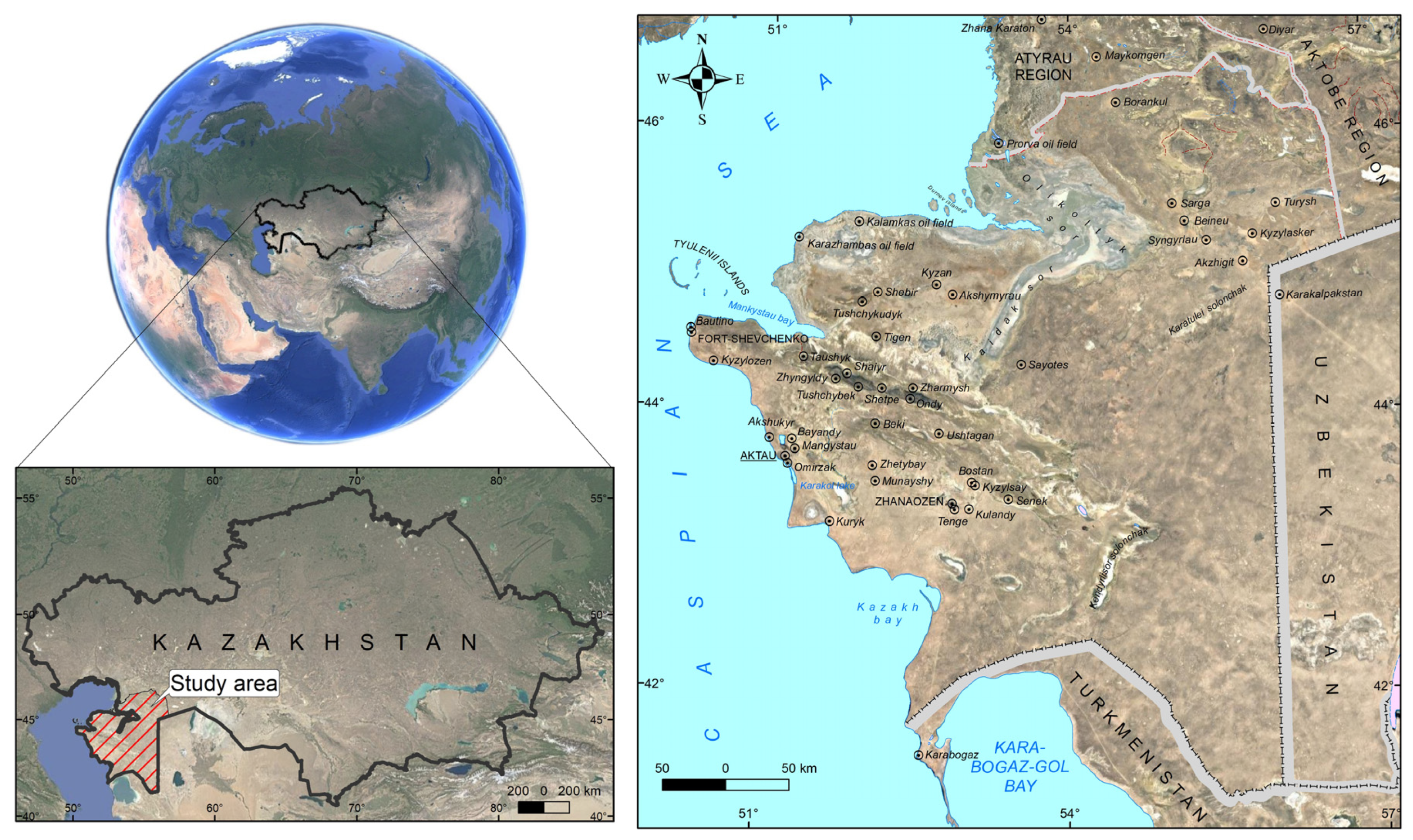
2. Study Area
3. Materials and Methods
3.1. Data Sources
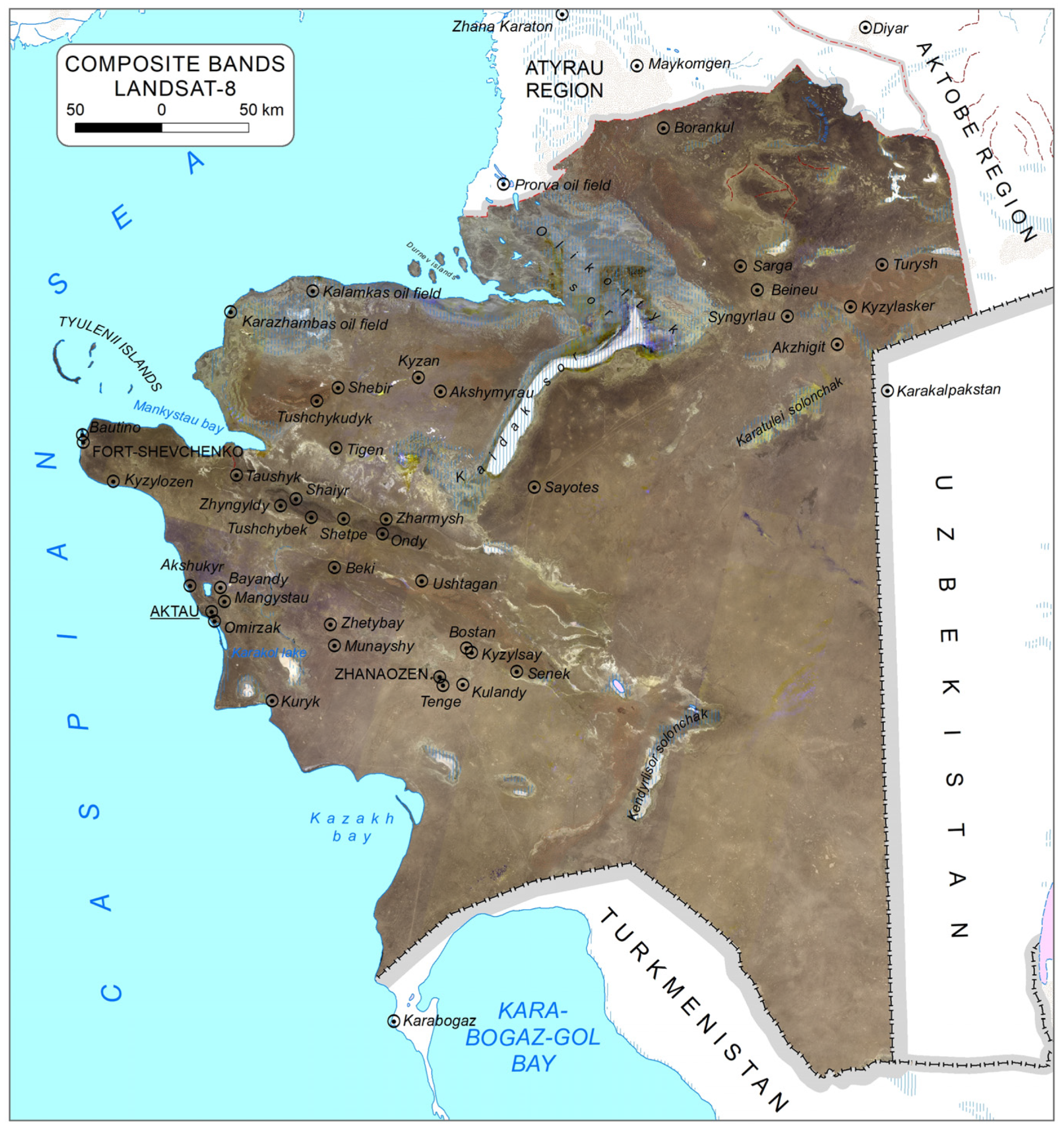
3.1.1. Optical Data: Landsat-8 OLI
3.1.2. Radar Data (Digital Elevation Model (DEM))
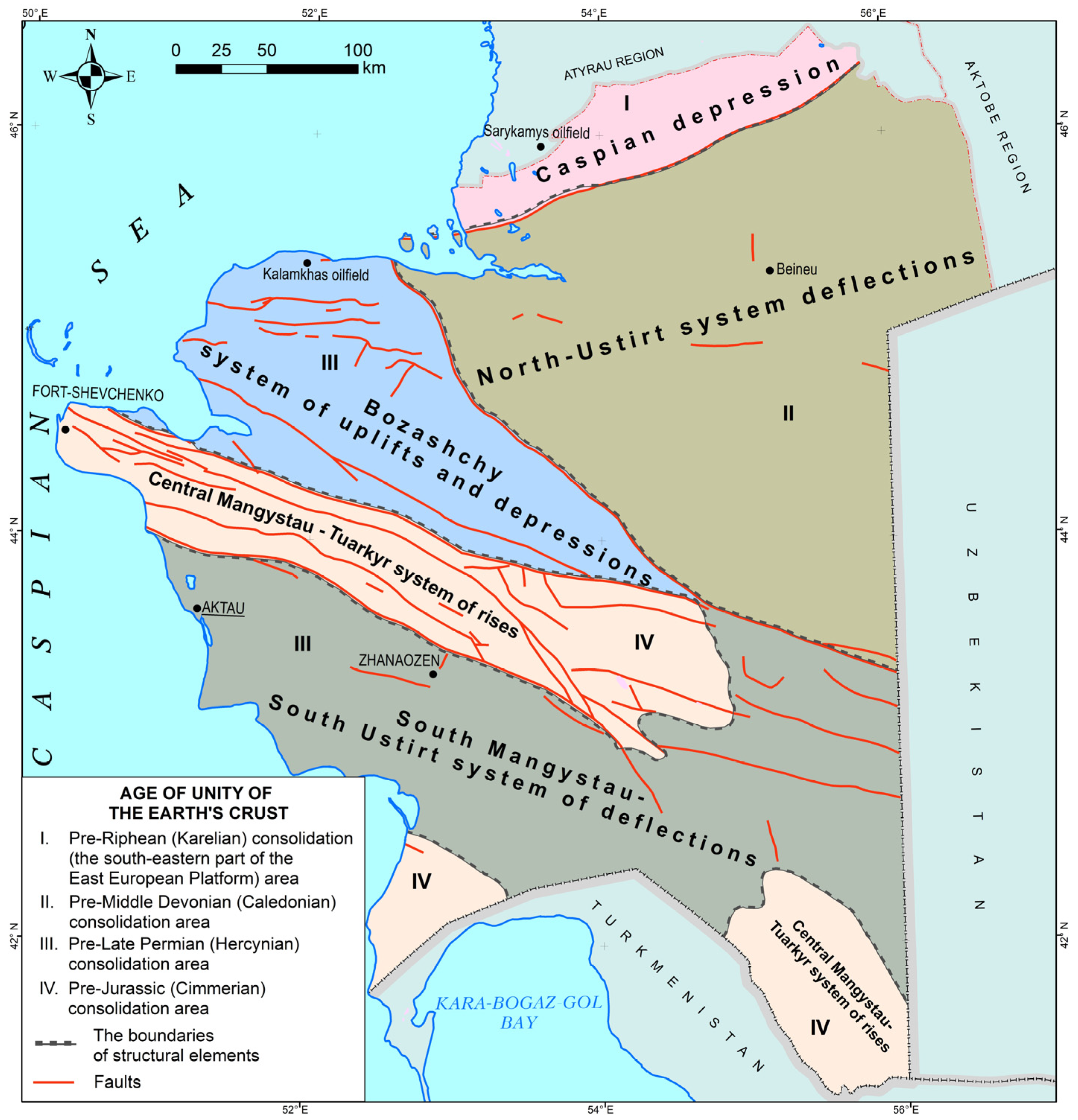
3.1.3. Geological Reference Data
3.2. Methodology
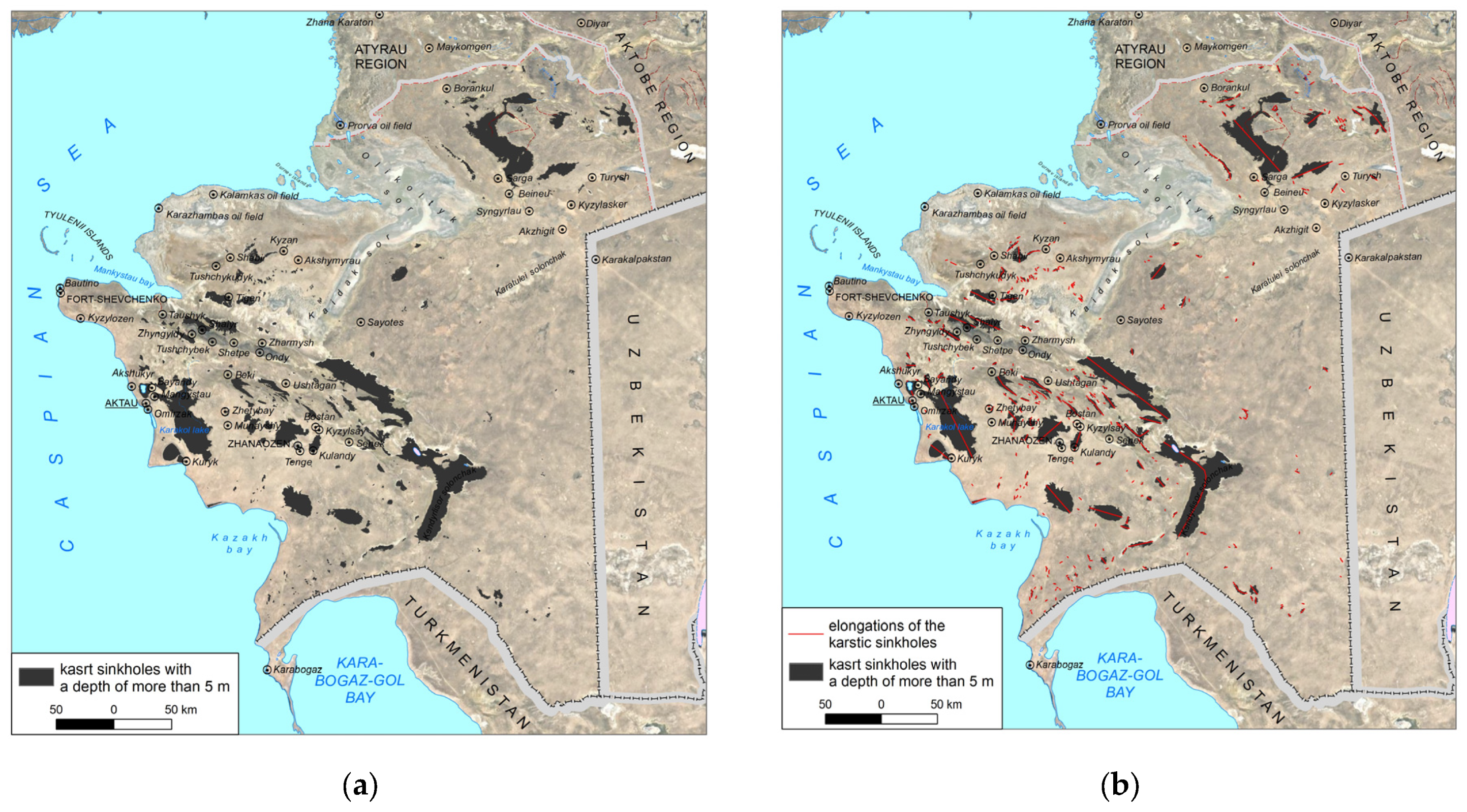
- Stage 1. Identification of Karst Depressions
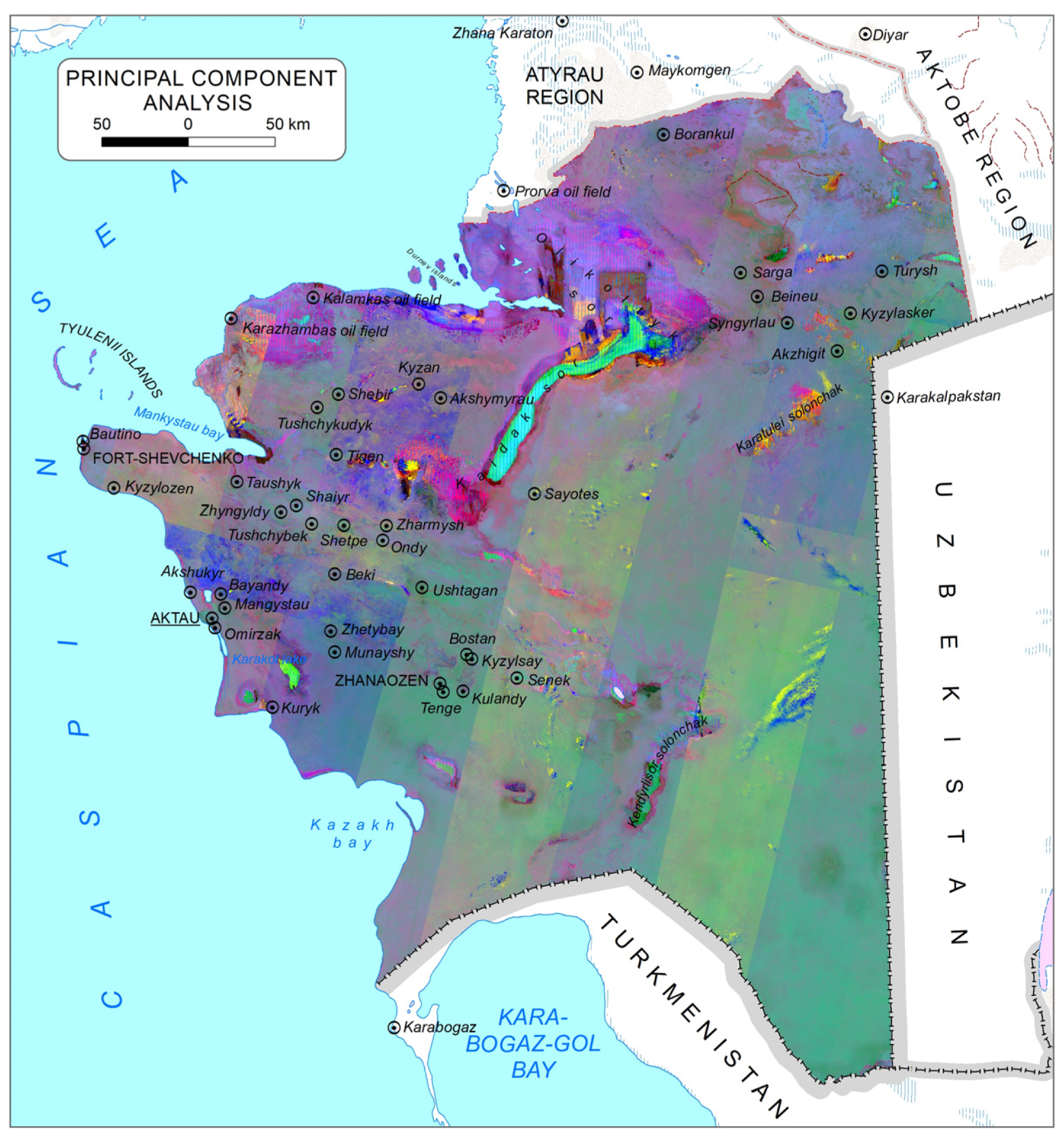
- Stage 2. Optical Image Pre-Processing: Principal Component Analysis
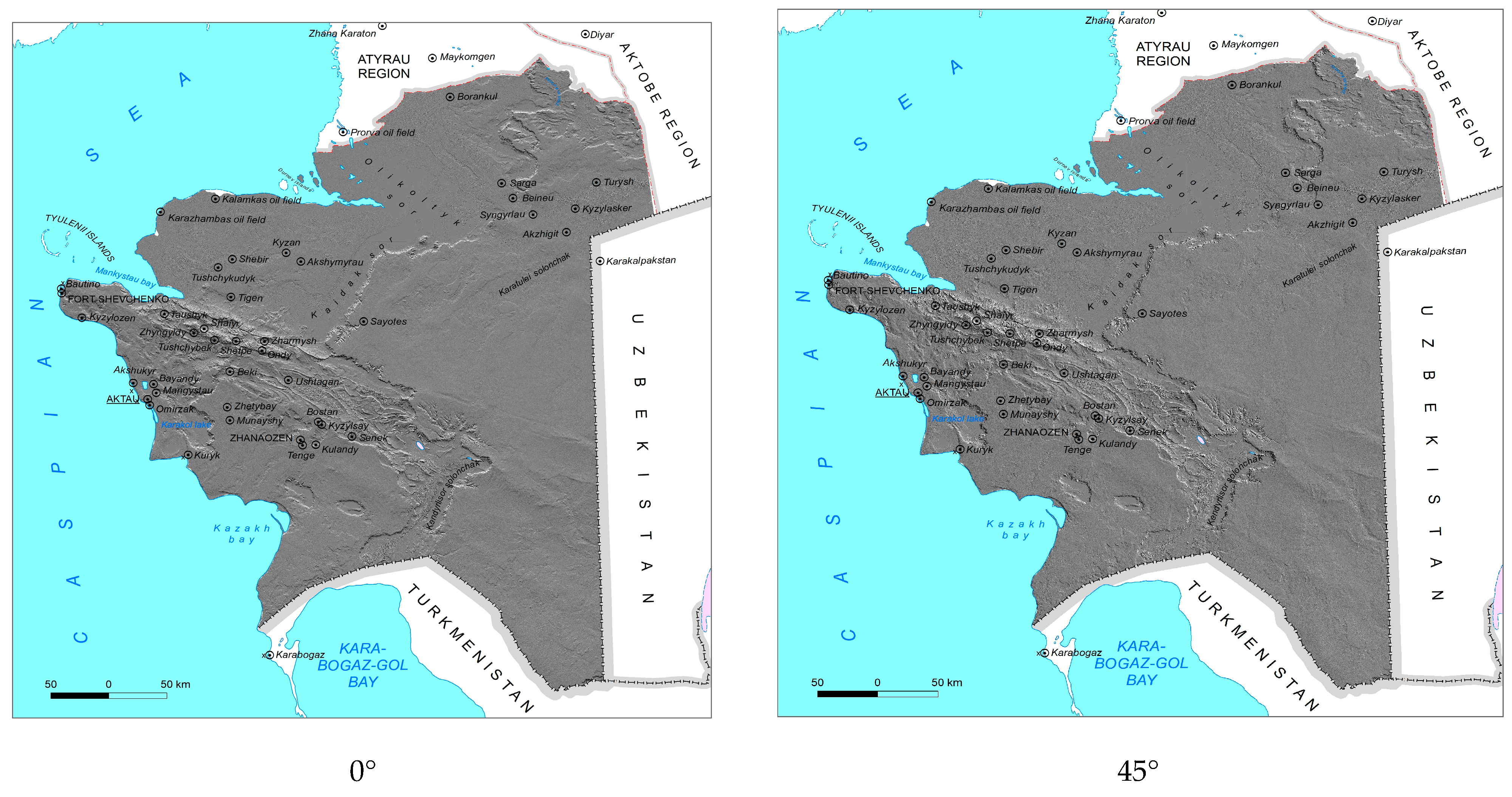
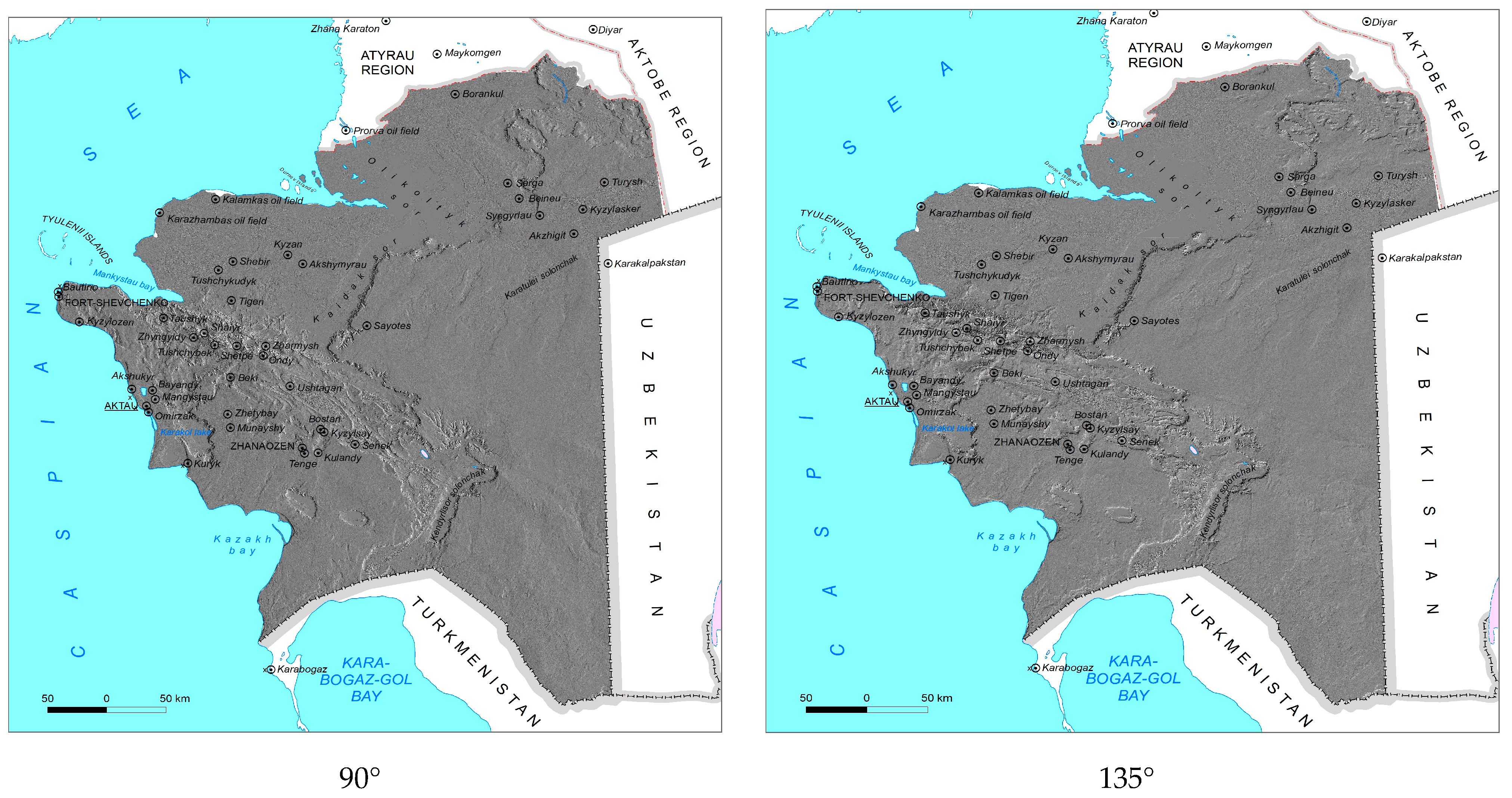
- Stage 3. DEM Derivative Generation: Multi-Azimuth Shaded Relief
- Stage 4. Automated Lineament Extraction (PCI Geomatica 2018, LINE Module)
- Stage 5. Post-Processing and Filtering
- Stage 6. Geometric Segmentation and Metric Characterization
- Stage 7. Validation
4. Results
4.1. Results of PCA Analysis of Landsat-8 OLI Data and Automatic Lineament Extraction
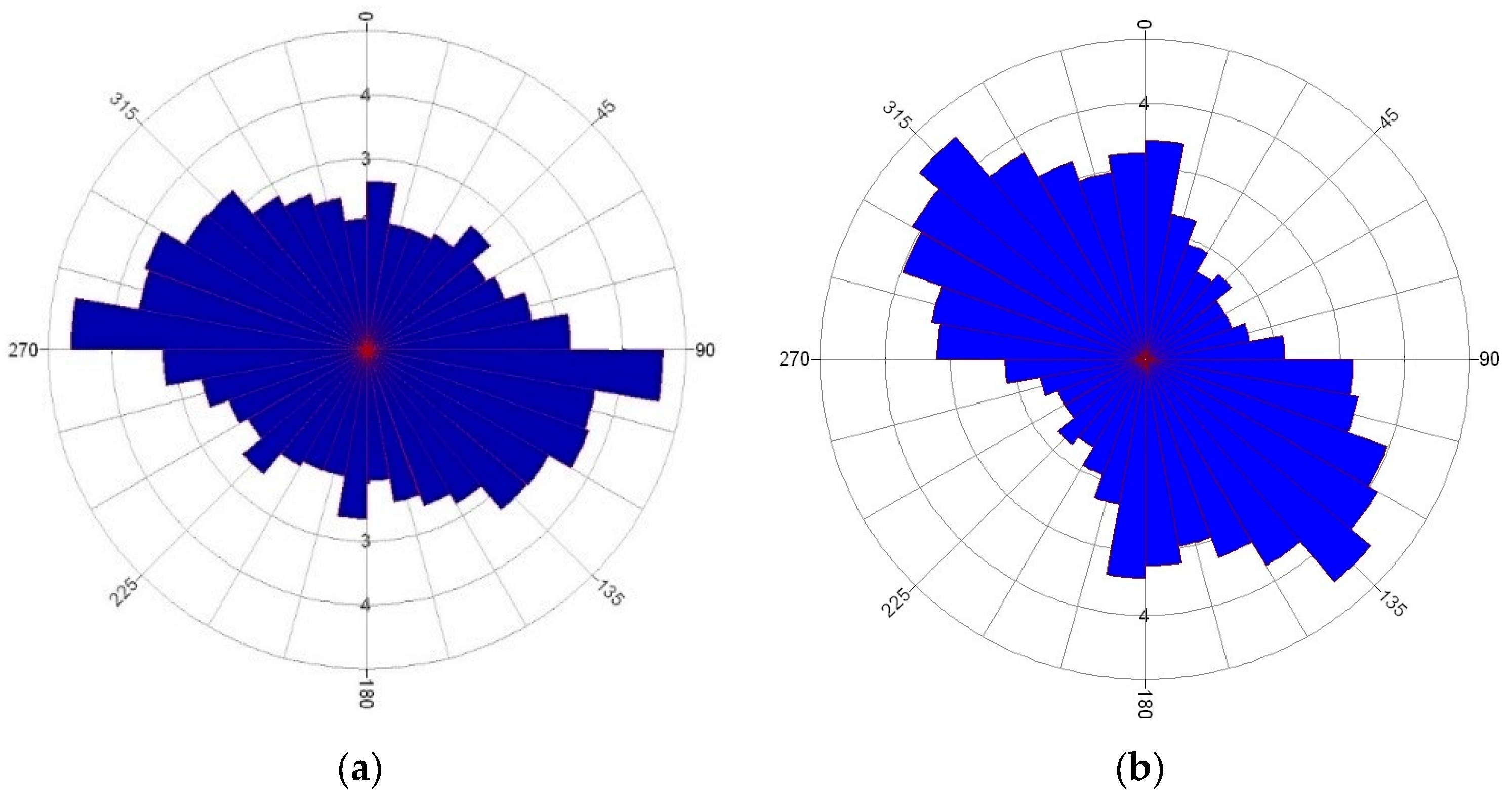
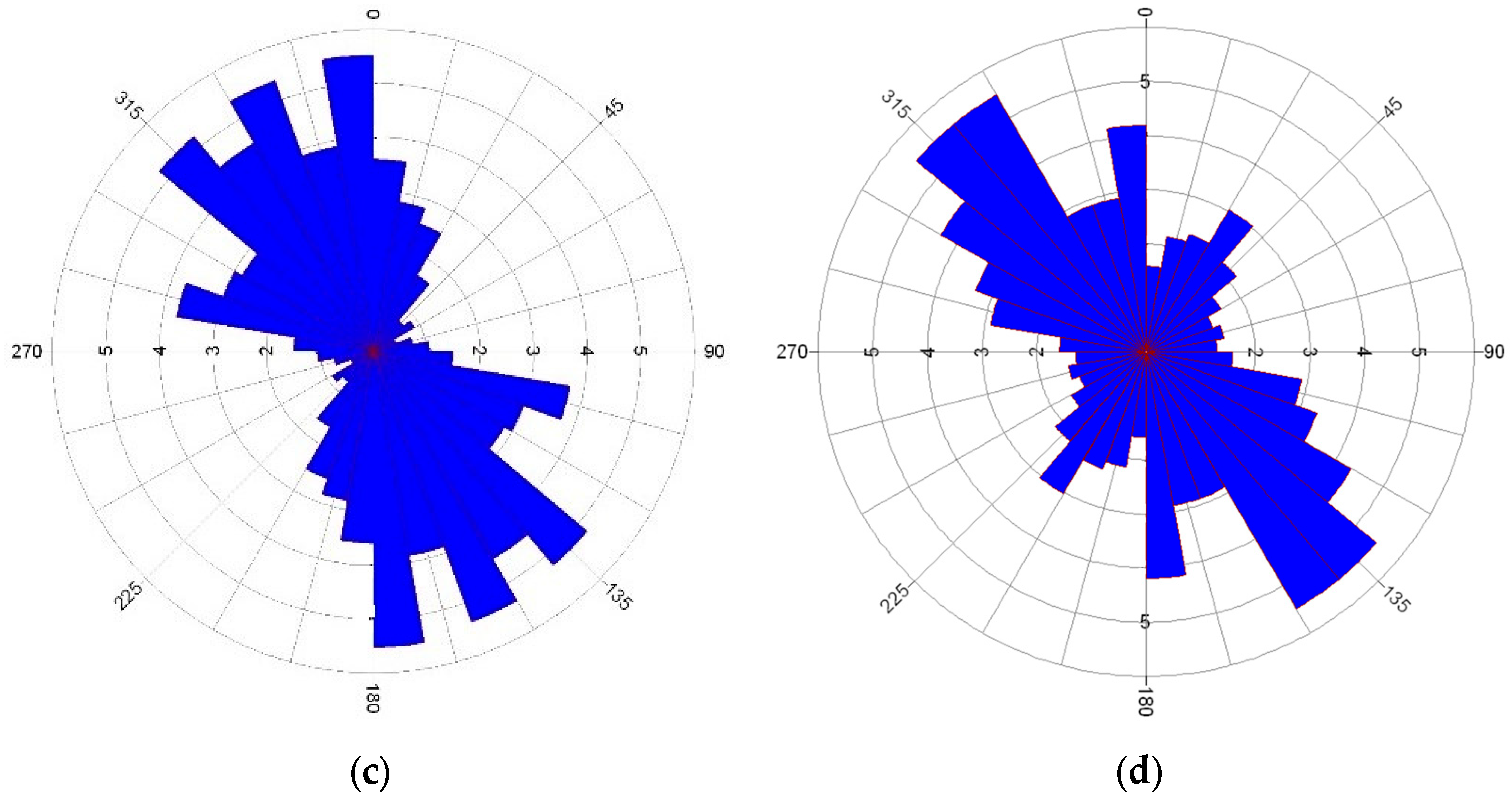
4.2. Orientations of Lineaments, Faults, and Karst-Suffosion Depressions
4.2.1. Lineaments Identified by PCA (Landsat-8 OLI)
4.2.2. Lineaments Based on DEM (Hillshade)
4.2.3. Mapped Faults
4.2.4. Axis Lines of Karst-Suffosion Depressions
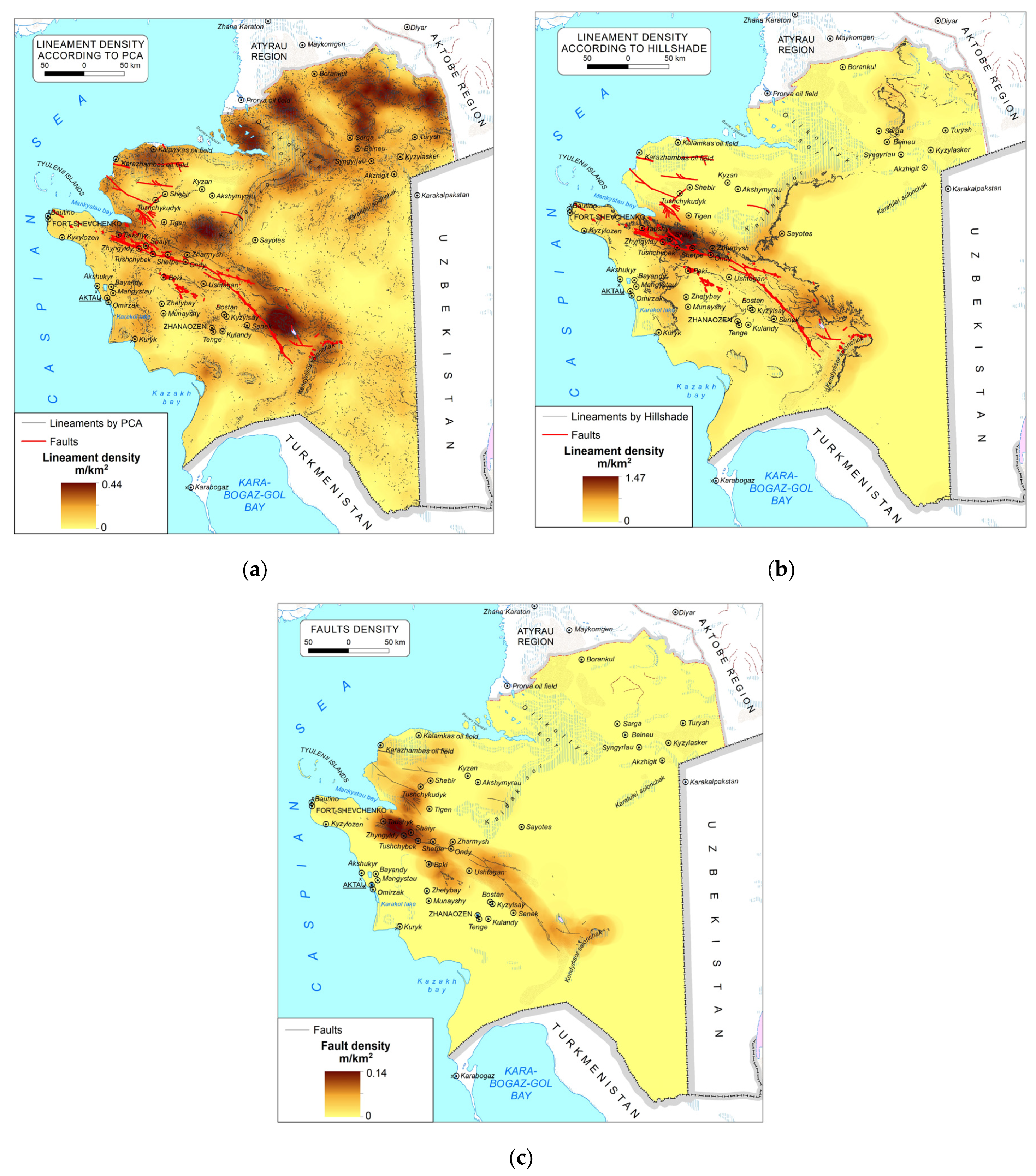
4.3. Spatial Distribution of Lineament Density
4.3.1. Map of Lineament Density Based on DEM (Hillshade)
4.3.2. PCA-Based Lineament Density Map (Landsat-8 OLI)
4.3.3. Fault Density Map
4.4. Analysis of the Spatial Relationship Between Lineaments and Karst-Suffosion Depressions
4.4.1. Density Overlay Analysis
4.4.2. Near Analysis
4.4.3. Regression Analysis
4.5. Comparative Assessment of the Effectiveness of the PCA and Hillshade Methods
4.6. Summary Interpretation of the Results and the Nature of Structural Control over Karst-Suffosion Processes
5. Discussion
6. Conclusions
Author Contributions
Funding
Institutional Review Board Statement
Informed Consent Statement
Data Availability Statement
Acknowledgments
Conflicts of Interest
Abbreviations
| OLI | Operational Land Imager |
| DEM | Digital elevation models |
| PCA | Principal component analysis |
| GIS | Geographic Information Systems |
| SAR | Synthetic Aperture Radar |
| SRTM | Shuttle Radar Topography Mission |
| USGS | United States Geological Survey |
| DLR | German Aerospace Center |
References
- Hussain, H.; Yun, L.; Cao, F.; Yang, M.; Wang, Y.; Li, X.; Pan, L.; Wang, X.; Hussain, W.; James, F. Fracture influence on karst development in carbonate reservoirs: Insights from the Lichuan karst region, Hubei, China. Phys. Chem. Earth 2025, 141, 104180. [Google Scholar] [CrossRef]
- Maksimovich, G.A. Fundamentals of Karst Studies. In Issues in Karst Morphology, Speleology and Hydrogeology; Perm Book Publishing House: Perm, Russia, 1963; Volume 1, 445p. [Google Scholar]
- Tolmachev, V.N. Engineering Karst and Suffosion; Nedra: Moscow, Russia, 1986. [Google Scholar]
- Gutierrez, F.; Cooper, A.H.; Johnson, K.S. Identification, prediction, and mitigation of sinkhole hazards in evaporite karst areas. Environ. Geol. 2008, 53, 1007–1022. [Google Scholar] [CrossRef]
- Akhmedenov, K.M.; Iskaliev, D.Z.; Petrishev, V.P. Karst and pseudokarst of the west Kazakhstan (republic of Kazakhstan). Int. J. Geosci. 2014, 5, 131. [Google Scholar] [CrossRef]
- Masoud, A.; Koike, K. Tectonic architecture through Landsat-7 ETM+/SRTM DEM-derived lineaments and relationship to the hydrogeologic setting in Siwa region, NW Egypt. J. Afr. Earth Sci. 2006, 45, 467–477. [Google Scholar] [CrossRef]
- Corgne, S.; Magagi, R.; Yergeau, M.; Sylla, D. An integrated approach to hydro-geological lineament mapping of a semi-arid region of West Africa using Radarsat-1 and GIS. Remote Sens. Environ. 2010, 114, 1863–1875. [Google Scholar] [CrossRef]
- Maina, M.M.; Tudunwada, I.Y. Lineament Mapping for Groundwater Exploration in Kano State, Nigeria. Int. J. Adv. Agric. Environ. Eng. 2017, 4, 226–229. [Google Scholar]
- Nanda, S.; Annadurai, R.; Barik, K.K. Geospatial decipherment of groundwater potential of Kattankolathur block of Tamil Nadu using MCDM techniques. Remote Sens. Appl. Soc. Environ. 2017, 8, 240–250. [Google Scholar] [CrossRef]
- Sahoo, S.; Das, P.; Kar, A.; Dhar, A. A forensic look into the lineament, vegetation, groundwater linkage: Study of Ranchi District, Jharkhand (India). Remote Sens. Appl. Soc. Environ. 2018, 10, 138–152. [Google Scholar] [CrossRef]
- Marghany, M.; Hashim, M. Lineament mapping using multispectral remote sensing satellite data. Res. J. Appl. Sci. 2010, 5, 126–130. [Google Scholar] [CrossRef]
- Adiri, Z.; El Harti, A.; Jellouli, A.; Lhissou, R.; Maacha, L.; Azmi, M.; Zouhair, M.; Bachaoui, E.M. Comparison of Landsat-8, ASTER and Sentinel 1 satellite remote sensing data in automatic lineaments extraction: A case study of Sidi Flah-Bouskour inlier, Moroccan Anti Atlas. Adv. Space Res. 2017, 60, 2355–2367. [Google Scholar] [CrossRef]
- Saadi, N.M.; Zaher, M.A.; El-Baz, F.; Watanabe, K. Integrated remote sensing data utilization for investigating structural and tectonic history of the Ghadames Basin, Libya. Int. J. Appl. Earth Obs. Geoinf. 2011, 13, 778–791. [Google Scholar] [CrossRef]
- Drobinina, E.V. Automation of Surface Karst Assessment Using Sentinel-2 Satellite Imagery. Cosm. Res. 2023, 61, S173–S181. [Google Scholar] [CrossRef]
- Shaban, A.; Khawlie, M.; Abdallah, C. Use of remote sensing and GIS to determine recharge potential zones: The case of Occidental Lebanon. Hydrogeol. J. 2006, 14, 433–443. [Google Scholar] [CrossRef]
- Baali, A. Genèse et Évolution au Plio-Quaternaire de Deux Bassins Intram-Ontagneux en Domaine Carbonaté Méditerranéen. Les Bassins Versants des Dayets (Lacs) Afourgagh et Agoulmam (Moyen Atlas, Maroc). Master’s Thesis, Université Sidi Mohamed Ben Abdellah, Fès, Morocco, 1998; 326p. [Google Scholar]
- Davraz, A.; Karaguzel, R.; Soyaslan, I.; Sener, E.; Seyman, F.; Sener, S. Hydrogeology of karst aquifer systems in SW Turkey and an assessment of water quality and contamination problems. Environ. Geol. 2009, 58, 973–988. [Google Scholar] [CrossRef]
- Nechyaev, D.A. Application of lineament-geodynamic analysis for assessment of karst hazard on the example of the Chayanda–ESPO oil pipeline route. News Ural. State Min. Univ. 2023, 1, 57–66. [Google Scholar] [CrossRef]
- Zeng, C.; Xia, D.; Dong, Y.; Zhang, Q.; Wang, D. Karstological Significance of the Study on Deep Fracture–Vug Reservoirs in the Tarim Basin Based on Paleo-Modern Comparison. Water 2025, 17, 3530. [Google Scholar] [CrossRef]
- Zerga, B. Karst topography: Formation, processes, characteristics, landforms, degradation and restoration: A systematic review. Watershed Ecol. Environ. 2024, 6, 252–269. [Google Scholar] [CrossRef]
- Meijerink, A.; Bannert, D.; Batelaan, O.; Lubczynski, M.; Pointet, T. Remote Sensing Applications to Groundwater; United Nations Educational, Scientific and Cultural Organization: Paris, France, 2007; 304p. [Google Scholar]
- Faith, J.R.; Blome, C.D.; Clark, A.K.; Ozuna, G.B.; Smith, B.D. Structural controls on karst development in fractured carbonate rock, Edwards and Trinity aquifers, south-central Texas. In US Geological Survey Karst Interest Group Proceedings; U.S. Geological Survey: Reston, VA, USA, 2005; p. 45. [Google Scholar]
- Hung, L.Q.; Batelaan, O.; De Smedt, F. Lineament extraction and analysis, comparison of LANDSAT ETM and ASTER imagery: Case study: Suoimuoi tropical karst catchment, Vietnam. Proc. SPIE 2005, 5983, 59830T–59831T. [Google Scholar] [CrossRef]
- Hashim, M.; Makoundi, C.; Zaw, K. Structural mapping of the Bentong-Raub Suture Zone using PALSAR remote sensing data, Peninsular Malaysia: Implications for sediment-hosted/orogenic gold mineral systems exploration. Resour. Geol. 2016, 66, 368–385. [Google Scholar] [CrossRef]
- Alonso-Contes, C.A. Lineament Mapping for Groundwater Exploration Using Remotely Sensed Imagery in a Karst Terrain: Rio Tanama and Rio de Arecibo Basins in the Northern Karst of Puerto Rico. Master’s Thesis, Michigan Technological University, Houghton, MI, USA, 2011. [Google Scholar] [CrossRef]
- Bruning, J.; Gierke, J.; Maclean, A. An approach to lineament analysis for groundwater exploration in Nicaragua. Photogramm. Eng. Remote Sens. 2011, 77, 509–519. [Google Scholar] [CrossRef]
- Hashim, M.; Ahmad, S.; Johari, M.A.M.; Pour, A.B. Automatic lineament extraction in a heavily vegetated region using Landsat Enhanced Thematic Mapper (ETM+) imagery. Adv. Space Res. 2013, 51, 874–890. [Google Scholar] [CrossRef]
- Li, N. Textural and Rule-Based Lithological Classification of Remote Sensing Data, and Geological Mapping in Southwestern Prieska Sub-Basin, Transvaal Supergroup, South Africa. Ph.D. Dissertation, Ludwig-Maximilian University of Munich, Munich, Germany, 2010. [Google Scholar]
- Meshkani, S.A.; Mehrabi, B.; Yaghubpur, A.; Sadeghi, M. Recognition of the regional lineaments of Iran: Using geospatial data and their implications for exploration of metallic ore deposits. Ore Geol. Rev. 2013, 55, 48–63. [Google Scholar] [CrossRef]
- Pour, A.B.; Hashim, M. Structural geology mapping using PALSAR data in the Bau gold mining district, Sarawak, Malaysia. Adv. Space Res. 2014, 54, 644–654. [Google Scholar] [CrossRef]
- Pour, A.B.; Hashim, M. Structural mapping using PALSAR data in the Central Gold Belt, Peninsular Malaysia. Ore Geol. Rev. 2015, 64, 13–22. [Google Scholar] [CrossRef]
- Pour, A.B.; Hashim, M. Integrating PALSAR and ASTER data for mineral deposits exploration in tropical environments: A case study from Central Belt, Peninsular Malaysia. Int. J. Image Data Fusion 2014, 6, 170–188. [Google Scholar] [CrossRef]
- Mwaniki, M.; Möller, M.; Schellmann, G. Application of remote sensing technologies to map the structural geology of Central Region of Kenya. IEEE J. Sel. Top. Appl. Earth Obs. Remote Sens. 2015, 8, 1855–1867. [Google Scholar] [CrossRef]
- Desoky, H.A.; Abd El-Dayem, M.; Hegab, M.A.E.-R. A comparative analysis to assess the efficiency of lineament extraction utilizing satellite imagery from Landsat-8, Sentinel-2B, and Sentinel-1A: A case study around Suez Canal zone, Egypt. Remote Sens. Appl. Soc. Environ. 2024, 36, 101312. [Google Scholar] [CrossRef]
- Baid, S.; Tabit, A.A.A.; Ezzahzi, S.; Elghouat, A. Lineaments extraction and analysis using Sentinel-2B, Sentinel-1A data and ALOS PALSAR DEM: A case study of the Igoudrane Region, Jbel Saghro, Eastern Anti-Atlas, Morocco. Iraqi Geol. J. 2024, 57, 1–17. [Google Scholar] [CrossRef]
- Jellouli, A.; El Harti, A.; Adiri, Z.; Chakouri, M.; El Hachimi, J.; Bachaoui, E.M. Application of optical and radar satellite images for mapping tectonic lineaments in Kerdous inlier of the Anti-Atlas belt, Morocco. Remote Sens. Appl. Soc. Environ. 2021, 22, 100509. [Google Scholar] [CrossRef]
- Errami, M.; Algouti, A.; Algouti, A.; Farah, A. Mapping and analysis of structural lineaments using SRTM radar data and Landsat-8 OLI image: An example from the Telouet–Tighza area, Marrakech High Atlas, Morocco. Can. J. Earth Sci. 2023, 60, 653–671. [Google Scholar] [CrossRef]
- Hamdani, N.; Baali, A. Fracture network mapping using Landsat 8 OLI data and linkage with the karst system: A case study of the Moroccan Central Middle Atlas. Remote Sens. Earth Syst. Sci. 2019, 2, 1–17. [Google Scholar] [CrossRef]
- El-Omairi, M.A.; El Garouani, A.; Shebl, A. Investigation of lineament extraction: Analysis and comparison of digital elevation models in the Ait Semgane region, Morocco. Remote Sens. Appl. Soc. Environ. 2024; advance online publication. [CrossRef]
- Hamann, J.S.; Baranskaya, A.V.; Geissler, W.H.; Baranov, B.V.; Tsukanov, N.V. Digital topographic analysis and lineament interpretation south of the Lena Delta, North Siberia: Landscape expression of its tectonic activity. Geomorphology 2024, 457, 109228. [Google Scholar] [CrossRef]
- Strokova, L.A.; Ezhkova, A.V.; Leonova, A.V. Primenenie lineamentnogo analiza dlya otsenki karstoopasnosti pri proektirovanii magistral’nogo gazoprovoda v Yuzhnoy Yakutii [Application of lineament analysis for assessing karst hazard in the design of a main gas pipeline in Southern Yakutia]. Izv. Tomsk. Politekh. Univ. Inzhiniring Georesursov 2020, 331, 117–126. [Google Scholar]
- Jonathan, M.; Mjemah, I.C.; Kimambo, O.N.; Hamad, A.A. A Geospatial Approach to Delineate Lineaments on the Granite Gneissic Terrain of Mpwapwa District, Dodoma, Central Tanzania. Heliyon 2024, 10, e38346. [Google Scholar] [CrossRef]
- Darge, Y.; Gebremichael, E.; Holbrook, J.; Ahmed, M. Detecting active sinkholes through combination of morphometric-cluster assessment and deformation precursors. Sci. Total Environ. 2024, 955, 177061. [Google Scholar] [CrossRef] [PubMed]
- Medeu, A.R. (Ed.) Tectonics Map. Scale 1:1,500,000. In Atlas of the Mangystau Region, 1st ed.; VIT BRAND: Almaty, Kazakhstan, 2010; pp. 16–17. [Google Scholar]
- Muromtsev, V.S. A scheme of tectonic zoning of the Mangyshlak region and adjacent areas. In Features of the Geological Structure and Assessment of Oil and Gas Potential in the Mangyshlak Region; Nedra: Moscow, Russia, 1968. [Google Scholar]
- Potapova, G.M. The Karst of Southern Mangyshlak and Ustyurt: Abstract of a Thesis for the Degree of Candidate of Geographical Sciences. Ph.D. Thesis, Academy of the Sciences of the Kazakh SSR, Alma-Ata, Kazakhstan, 1971; pp. 61–62. [Google Scholar]
- Bekkuliyeva, A. The risk of karst processes developing on the Mangystau Peninsula. Hydrometeorol. Ecol. 2010, 134–139. [Google Scholar]
- Chikishev, A.G. The Karst of Ustyurt and Mangyshlak. In Earth Research. Collected Artiles of the Moscow Soviety of Naturalists; New series; Moscow University Press: Moscow, Russia, 1971; Volume IX, pp. 165–194. [Google Scholar]
- Gorbunova, K.A. Karstology. Issues in Karst Typology and Morphology: A Course Book for a Specialised Course; Perm University: Perm, Russia, 1985; 88p. [Google Scholar]
- Gvozdetsky, N.A. Issues in Karst Research and Practical Applications; Mysl: Moscow, Russia, 1972; 92p. [Google Scholar]
- Sydykov, Z.; Kukabayev, B.; Kugeshev, A.K.; Vishnyakov, A.S.; Kulikov, G.V.; Sokolov, V.N. Groundwater in the Mangyshlak-Ustyurt Oil and Gas Province; Nauka: Alma-Ata, Kazakhstan, 1970. [Google Scholar]
- Ford, D.; Williams, P. Karst Hydrogeology and Geomorphology; Wiley: Hoboken, NJ, USA, 2013; 578p. [Google Scholar]
- Goldscheider, N.; Chen, Z.; Auler, A.; Bakalowicz, M.; Broda, S.; Drew, D.; Hartmann, J.; Jiang, G.; Moosdorf, N.; Stevanovic, Z.; et al. Global distribution of carbonate karst aquifers and their importance. Hydrogeol. J. 2020, 28, 1661–1677. [Google Scholar] [CrossRef]
- Luo, Y.; Zhou, Q.; Peng, D.; Yan, W.; Zhao, M. Key influence of hydrogeological, geochemical, and geological structure factors on runoff characteristics in karst catchments. J. Hydrol. 2023, 623, 129852. [Google Scholar] [CrossRef]
- Akiyanova, F.Z.; Potapova, G.M.; Nurmambetov, E.I.; Radusnova, O.V. The Dangers of Karst Processes. In Atlas of the Republic of Kazakhstan; Environment and Ecology; Iskakov, N.A., Medeu, A.R., Eds.; VIT BRAND: Almaty, Kazakhstan, 2006; Volume 3, 67p. [Google Scholar]
- Bektursynova, A.; Temirbayeva, R.; Lyy, Y.; Sharapkhanova, Z. Integrated UAV, GNSS and GPR methods for karst terrain analysis in an arid region: A case study from the Saura Valley, western Kazakhstan. Geoj. Tour. Geosites 2025, 63, 2788–2799. [Google Scholar] [CrossRef]
- Roy, D.P.; Wulder, M.A.; Loveland, T.R.; Woodcock, C.E.; Allen, R.G.; Anderson, M.C.; Helder, D.; Irons, J.R.; Johnson, D.M.; Kennedy, R.; et al. Landsat-8: Science and product vision for terrestrial global change research. Remote Sens. Environ. 2014, 145, 154–172. [Google Scholar] [CrossRef]
- Munyati, C. Detecting the air-cooling effect of urban green spaces in a hot climate town relative to land surface temperature on Landsat-9 thermal imagery. Adv. Space Res. 2024, 74, 4598–4615. [Google Scholar] [CrossRef]
- Choudhury, N.; Mitra, A.K.; Nath, B.; Lindsay, M.D. Lineament extraction and structural mapping using Landsat-9 OLI and Sentinel-1 SAR data in the Proterozoic North Singhbhum Mobile Belt, Eastern India. Geosyst. Geoenviron. 2025, 4, 100392. [Google Scholar] [CrossRef]
- Abdelkareem, M.; Hamimi, Z.; El-Bialy, M.Z.; Khamis, H.; Wahed, S.A.A. Integration of remote-sensing data for mapping lithological and structural features in the Esh El-Mallaha area, west Gulf of Suez, Egypt. Arab. J. Geosci. 2021, 14, 497. [Google Scholar] [CrossRef]
- Airbus Defence and Space. WorldDEM4Ortho (Version 2) Technical Product Specification (Issue 1.1). Available online: https://earth.esa.int/eogateway/documents/20142/37627/WorldDEM4Ortho-Technical-Specification.pdf (accessed on 12 January 2026).
- De Carvalho, O.A., Jr.; Guimarães, R.F.; Montgomery, D.R.; Gillespie, A.R.; Trancoso Gomes, R.A.; De Souza Martins, É.; Silva, N.C. Karst Depression Detection Using ASTER, ALOS/PRISM and SRTM-Derived Digital Elevation Models in the Bambuí Group, Brazil. Remote Sens. 2014, 6, 330–351. [Google Scholar] [CrossRef]
- Shannon, J.C.; Moore, D.; Li, Y.; Olsen, C. LiDAR-based Sinkhole Detection and Mapping in Knox County, Tennessee. Purs. J. Undergrad. Res. Univ. Tenn. 2019, 9, 3. [Google Scholar] [CrossRef]
- Filin, S.; Avni, Y.; Baruch, A.; Morik, S.; Arav, R.; Marco, S. Characterization of land degradation along the receding Dead Sea coastal zone using airborne laser scanning. Geomorphology 2014, 206, 403–420. [Google Scholar] [CrossRef]
- Zhang, B.; Wang, R.; Deng, Y.; Ma, P.; Lin, H.; Wang, J. Mapping the Yellow River Delta land subsidence with multitemporal SAR interferometry by exploiting both persistent and distributed scatterers. ISPRS J. Photogramm. Remote Sens. 2019, 148, 157–173. [Google Scholar] [CrossRef]
- Wu, Q.; Deng, C.; Chen, Z. Automated delineation of karst sinkholes from LiDARderived digital elevation models. Geomorphology 2016, 266, 1–10. [Google Scholar] [CrossRef]
- Guimarães, R.F.; Carvalho Junior, O.A.; Souza Martins, E.M.; Carvalho, A.P.F.; Gomes, R.A.T. Detection of karst depression by ASTER image in the Bambui Group, Brazil. Proc. SPIE 2005, 5983, 328–339. [Google Scholar] [CrossRef]
- Frutuoso, R.; Lima, A.; Teodoro, A.C. Application of remote sensing data in gold exploration: Targeting hydrothermal alteration using Landsat 8 imagery in northern Portugal. Arab. J. Geosci. 2021, 14, 459. [Google Scholar] [CrossRef]
- Sedrette, S.; Rebai, N. Automatic extraction of lineaments from Landsat ETM+ images and their structural interpretation: Case study in Nefza region (North West of Tunisia). J. Res. Environ. Earth Sci. 2016, 4, 139–145. [Google Scholar]
- Adiri, Z.; El Harti, A.; Jellouli, A.; Maacha, L.; Bachaoui, E. Lithological mapping using Landsat 8 OLI and Terra ASTER multispectral data in the Bas Draâ inlier, Moroccan Anti-Atlas. J. Appl. Remote Sens. 2016, 10, 016005. [Google Scholar] [CrossRef]
- Amer, R.; Kusky, T.; Ghulam, A. Lithological mapping in the Central Eastern Desert of Egypt using ASTER data. J. Afr. Earth Sci. 2010, 56, 75–82. [Google Scholar] [CrossRef]
- Pour, A.B.; Hashim, M. The application of ASTER remote sensing data to porphyry copper and epithermal gold deposits. Ore Geol. Rev. 2012, 44, 1–9. [Google Scholar] [CrossRef]
- Amer, R.; Kusky, T.; El Mezayen, A. Remote sensing detection of gold-related alteration zones in Um Rus area, Central Eastern Desert of Egypt. Adv. Space Res. 2012, 49, 121–134. [Google Scholar] [CrossRef]
- Gabr, S.; Ghulam, A.; Kusky, T. Detecting areas of high-potential gold mineralization using ASTER data. Ore Geol. Rev. 2010, 38, 59–69. [Google Scholar] [CrossRef]
- Paganelli, F.; Grunsky, E.; Richards, J.; Pryde, R. Use of RADARSAT-1 principal component imagery for structural mapping: A case study in the Buffalo Head Hills area, northern Central Alberta, Canada. Can. J. Remote Sens. 2003, 29, 111–140. [Google Scholar] [CrossRef]
- Abdelouhed, F.; Ahmed, A.; Abdellah, A.; Mohammed, I. Lineament mapping in the Ikniouen area (Eastern Anti-Atlas, Morocco) using Landsat-8 OLI and SRTM data. Remote Sens. Appl. Soc. Environ. 2021, 23, 100606. [Google Scholar] [CrossRef]
- Bentahar, I.; Raji, M.; Mhamdi, H.S. Fracture network mapping using Landsat-8 OLI, Sentinel-2A, ASTER, and ASTER-GDEM data in the Rich area (Central High Atlas, Morocco). Arab. J. Geosci. 2020, 13, 1–19. [Google Scholar] [CrossRef]
- Kiran Raj, S.; Ahmed, S.A. Lineament extraction from southern Chitradurga Schist Belt using Landsat TM, ASTERGDEM and geomatics techniques. Int. J. Comput. Appl. 2014, 93, 12–20. [Google Scholar] [CrossRef]
- Nugroho, U.C.; Tjahjaningsih, A. Lineament density information extraction using DEM SRTM data to predict the mineral potential zones. Int. J. Remote Sens. Earth Sci. 2016, 13, 67–74. [Google Scholar] [CrossRef][Green Version]
- Nath, B.; Niu, Z.; Acharjee, S. Pre-earthquake anomaly detection and assessment through lineament changes observation using multi-temporal Landsat 8-OLI imageries: Case of Gorkha and Imphal. In Multipurpose Applications of Geospatial Data; IntechOpen: London, UK, 2017; pp. 149–171. [Google Scholar] [CrossRef]
- Ahmadi, H.; Pekkan, E. Fault-based geological lineaments extraction using remote sensing and GIS: A review. Geosciences 2021, 11, 183. [Google Scholar] [CrossRef]
- Nath, B.; Choudhury, N.; Mitra, A.K. Observing tectonic-geomorphological changes along the Dawki Fault and adjoining areas of Sylhet, Bangladesh from 1980 to 2020 using remote sensing and GIS techniques. J. Earth Syst. Sci. 2022, 131, 160. [Google Scholar] [CrossRef]
- Nanou, E.A.; Zagana, E.; Kokkalas, S.; Kazakis, N. Contribution of tectonic analysis in refining karst aquifer regimes: A multimethod approach applied to the karst groundwater system of Ziria (Peloponnese, Greece). Hydrogeol. J. 2026, 34, 537–555. [Google Scholar] [CrossRef]
- Potapova, G.M. Some features of the development and distribution of karst landforms in Southern Mangyshlak. In Issues in the Geography of Kazakhstan; Academy of Sciences of the Kazakh SSR: Almaty, Kazakhstan, 1980. [Google Scholar]
- Gokhstein, V.I.; Ten, M.S. On the origin of drainless depressions in the steppe region of Mangyshlak. In Proceedings of the Academy of Sciences of the Kazakh SSR; Geology Series; Nauka Publishing House: Almaty, Kazakhstan, 1967. [Google Scholar]
- Javhar, A.; Chen, X.; Bao, A.; Jamshed, A.; Yunus, M.; Jovid, A.; Latipa, T. Comparison of Multi-Resolution Optical Landsat-8, Sentinel-2 and Radar Sentinel-1 Data for Automatic Lineament Extraction: A Case Study of Alichur Area, SE Pamir. Remote Sens. 2019, 11, 778. [Google Scholar] [CrossRef]
- Soliman, A.; Han, L. Effects of vertical accuracy of digital elevation model (DEM) data on automatic lineaments extraction from shaded DEM. Adv. Space Res. 2019, 64, 603–622. [Google Scholar] [CrossRef]
- Rossi, P.; Almeida, J.C.H.; Pires, A.d.P.; Araujo, M.N. Topographic lineaments extraction in digital elevation model: A comparison between human interpretation and a convolutional neural network output. Bol. Geociências Petrobras 2025, 24, 1–14. [Google Scholar] [CrossRef]
- Moreno-Gómez, M.; Liedl, R.; Stefan, C. A New GIS-Based Model for Karst Dolines Mapping Using LiDAR.; Application of a Multidepth Threshold Approach in the Yucatan Karst, Mexico. Remote Sens. 2019, 11, 1147. [Google Scholar] [CrossRef]
- Papadaki, E.S.; Mertikas, S.P.; Sarris, A. Identification of lineaments with possible structural origin using ASTER images and DEM derived products in Western Crete, Greece. EARSeL Eproc. 2011, 10, 9–18. [Google Scholar]
- Masoud, A.A.; Koike, K. Morphotectonics inferred from the analysis of topographic lineaments auto-detected from DEMs: Application and validation for the Sinai Peninsula, Egypt. Tectonophysics 2011, 510, 291–308. [Google Scholar] [CrossRef]
- Jordan, G.; Meijninger, B.M.L.; van Hinsbergen, D.J.J.; Meulenkamp, J.E.; van Dijk, P.M. Extraction of morphotectonic features from DEMs: Development and applications for study areas in Hungary and NW Greece. Int. J. Appl. Earth Obs. Geoinf. 2005, 7, 163–182. [Google Scholar] [CrossRef]
- Florinsky, I.V. An illustrated introduction to general geomorphometry. Prog. Phys. Geogr. Earth Environ. 2017, 41, 723–752. [Google Scholar] [CrossRef]
- EL Hamdouni, R.; Irigaray, C.; Fernández, T.; Chacón, J.; Keller, E. Assessment of Relative Active Tectonics, Southwest Border of Sierra Nevada (Southern Spain). Geomorphology 2008, 96, 150–173. [Google Scholar] [CrossRef]
- Vasuki, Y.; Holden, E.-J.; Kovesi, P.; Micklethwaite, S. Semi-automatic mapping of geological structures using UAV-based photogrammetric data: An image analysis approach. Comput. Geosci. 2014, 69, 22–32. [Google Scholar] [CrossRef]
- Binda, G.; Pozzi, A.; Spanu, D.; Livio, F.; Trotta, S.; Bitonte, R. Integration of photogrammetry from unmanned aerial vehicles, field measurements and discrete fracture network modeling to understand groundwater flow in remote settings: Test and comparison with geochemical markers in an Alpine catchment. Hydrogeol. J. 2021, 29, 1203–1218. [Google Scholar] [CrossRef]
- Bruno, P.P.G. Seismic Exploration Methods for Structural Studies and for Active Fault Characterization: A Review. Appl. Sci. 2023, 13, 9473. [Google Scholar] [CrossRef]



| Bands | Wavelength (µm) | Spatial Resolution (m) |
|---|---|---|
| Band 1: Aerosols | 0.43–0.45 | 30 |
| Band 2: Blue | 0.45–0.51 | 30 |
| Band 3: Green | 0.53–0.59 | 30 |
| Band 4: Red | 0.64–0.67 | 30 |
| Band 5: Near Infrared (NIR) | 0.85–0.88 | 30 |
| Band 6: Shortwave Infrared 1 (SWIR 1) | 1.57–1.65 | 30 |
| Band 7: Shortwave Infrared 2 (SWIR 2) | 2.11–2.29 | 30 |
| Band 8: Panchromatic | 0.50–0.68 | 15 |
| Band 9: Cirrus clouds | 1.36–1.38 | 30 |
| Parameter | Unit | Used Value |
|---|---|---|
| RADI | Pixel | 10 |
| GTHR | Unitless | 60 |
| LTHR | Pixel | 25 |
| FTHR | Pixel | 3 |
| ATHR | Degrees | 10 |
| DTHR | Pixel | 20 |
| Data | Number | Minimum, km | Maximum, km | Sum, km | Medium, km | Standard Deviation |
|---|---|---|---|---|---|---|
| PCA | 18,977 | 0.75 | 22.6 | 21,525.3 | 1.13 | 0.63 |
| DEM (Hillshade) | 35,629 | 0.59 | 19.5 | 34,930.8 | 0.98 | 0.63 |
| Density Class | Hillshade | PCA | ||
|---|---|---|---|---|
| Number of Depressions | % | Number of Depressions | % | |
| Very low (0–0.075) | 205 | 56.2% | 138 | 37.8 |
| Low (0.076–0.242) | 119 | 32.6% | 189 | 51.8 |
| Moderate (0.243–0.489) | 28 | 7.7% | 38 | 10.4 |
| High (0.49–0.863) | 11 | 3.0% | - | |
| Very high (0.864–1.468) | 2 | 0.5% | - | |
| Density Class | Hillshade | PCA | ||
|---|---|---|---|---|
| Number of Depressions | % | Number of Depressions | % | |
| up to 1 km | 17 | 4.7% | 134 | 36.7% |
| up to 3 km | 78 | 21.4% | 243 | 66.6% |
| up to 5 km | 108 | 29.6% | 307 | 84.1% |
Disclaimer/Publisher’s Note: The statements, opinions and data contained in all publications are solely those of the individual author(s) and contributor(s) and not of MDPI and/or the editor(s). MDPI and/or the editor(s) disclaim responsibility for any injury to people or property resulting from any ideas, methods, instructions or products referred to in the content. |
© 2026 by the authors. Licensee MDPI, Basel, Switzerland. This article is an open access article distributed under the terms and conditions of the Creative Commons Attribution (CC BY) license.
Share and Cite
Temirbayeva, R.; Bektursynova, A.; Sharapkhanova, Z.; Lyy, Y. Structural-Tectonic Interpretation of Lineaments and Their Role in the Development of Karst-Suffosion Processes in the Mangystau Region Based on Remote Sensing Data. Sustainability 2026, 18, 5549. https://doi.org/10.3390/su18115549
Temirbayeva R, Bektursynova A, Sharapkhanova Z, Lyy Y. Structural-Tectonic Interpretation of Lineaments and Their Role in the Development of Karst-Suffosion Processes in the Mangystau Region Based on Remote Sensing Data. Sustainability. 2026; 18(11):5549. https://doi.org/10.3390/su18115549
Chicago/Turabian StyleTemirbayeva, Roza, Aruzhan Bektursynova, Zhanerke Sharapkhanova, and Yuisya Lyy. 2026. "Structural-Tectonic Interpretation of Lineaments and Their Role in the Development of Karst-Suffosion Processes in the Mangystau Region Based on Remote Sensing Data" Sustainability 18, no. 11: 5549. https://doi.org/10.3390/su18115549
APA StyleTemirbayeva, R., Bektursynova, A., Sharapkhanova, Z., & Lyy, Y. (2026). Structural-Tectonic Interpretation of Lineaments and Their Role in the Development of Karst-Suffosion Processes in the Mangystau Region Based on Remote Sensing Data. Sustainability, 18(11), 5549. https://doi.org/10.3390/su18115549