Article

Predicting the Distribution of Taxus baccata L. in Morocco Under Climate Change Using MaxEnt: Implications for Conservation and Sustainable Management


by
Inass El Haddouti
1,
Yahya El Karmoudi
1,
Abdelmajid Khabbach
2,* and
Mohamed Libiad
1,2,*
1
Ecology, Systematics and Biodiversity Conservation Laboratory, URL-CNRST N° 18, FS, Abdelmalek Essaadi University, M’Hannech II, Tetouan 93002, Morocco
2
Biotechnology, Environment, Agri-Food and Health Laboratory, Faculty of Sciences Dhar El Mahraz, Sidi Mohamed Ben Abdellah University, Fez 30000, Morocco
*
Authors to whom correspondence should be addressed.
Sustainability 2026, 18(11), 5544; https://doi.org/10.3390/su18115544
Submission received: 24 March 2026 / Revised: 23 May 2026 / Accepted: 27 May 2026 / Published: 1 June 2026

Abstract

Taxus baccata is a rare conifer species that occurs as isolated individuals or in small patches in Morocco and is listed in the National List of Protected Flora. To predict its current and future distribution areas, based on 41 occurrence records and 11 bioclimatic variables, the Maxent model was applied using cross-validation (1000 replicates) with logistic outputs under current climate conditions and the SSP1-2.6, SSP2-4.5, and SSP5-8.5 future climate scenarios. Our results indicate high-performing models (AUC > 0.966, TSS > 0.862). The bioclimatic factors that most influence the current potential geographic distribution of yew are the Mean Temperature of Driest Quarter (Bio9) and Isothermality (Bio3). The spatial distribution indicates that the current potential range of yew is discontinuous, with a current suitable area not exceeding 4602 km2. Predictive modeling identifies a decline of the predicted suitable habitat under the SSP1-2.6 and SSP2-4.5 scenarios, fueled by both climate change and human activities. Given the species’ limited dispersal and the ongoing fragmentation of its habitat, immediate conservation actions, both in situ and ex situ, are urgently needed. This study demonstrates the vital role of predictive modeling in identifying these vulnerabilities to guide long-term sustainability efforts.

1. Introduction

Under the influence of climate change, the Earth has experienced an intensification of extreme climatic events (floods, heat waves, and droughts), leading to increasing pressure on ecosystems and their resources, thereby threatening their stability and sustainability [1,2,3,4]. In response to these environmental changes, plants may undergo physiological acclimation and genetic adaptation to environmental stressors, often resulting in altered distributional ranges [4,5]. They may also alter their distribution ranges and adapt to new environmental conditions in order to avoid the risk of extinction [6,7,8]. Mountainous plant species, such as Taxus baccata L., exhibit greater sensitivity to climate change and environmental pressures than those of lowland or non-mountainous ecosystems [9,10,11], and my experiencing the greatest rate of migration.
Given these mounting pressures, understanding the environmental drivers of T. baccata distribution and its adaptive capacity is crucial for long-term persistence. Consequently, Species Distribution Modeling (SDM) has emerged as a robust tool for simulating contemporary and future climatic scenarios. By predicting potential range shifts, SDMs provide essential data for informed decision-making in the conservation and management of this species [4,7,12,13,14,15].
Ecological Niche Modelling has been used in numerous studies to assess the impact of climate on the distribution range of T. baccata [4,7,13,14]. Among a set of modeling methods, Maxent is recognized as one of the highest performing groups [13]. To better understand the ecological distribution of T. baccata and inform conservation planning in Northern Morocco, the MaxEnt modeling framework is particularly effective. It generates accurate distribution predictions without requiring absence data [13,16], even when presence records are limited [16]. Among the environmental variables integrated into niche modeling, bioclimatic factors possess the highest predictive power for determining a species’ geographic distribution [14], such factors like temperature and precipitation could directly regulate physiological processes that shape a species’ geographical range and ecological niche [17].
T. baccata is an evergreen coniferous tree belonging to the Taxaceae family, characterized by its slow growth and long lifespan, which can exceed several thousand years in some individuals [18,19,20]. The species is considered one of the oldest known plants, with origins dating back to prehistoric times, and is classified as a Tertiary relict species [21,22,23]. The yew is distributed fragmentally across Europe and Asia Minor, extending to Northwest Africa, at altitudes ranging from sea level to about 2200 m [20,24,25]. It prefers humid environments [19,26], and tolerates low light [27], and could grow on calcareous and siliceous substrate [26]. Despite its resilience to certain environmental conditions, T. baccata is found in the southernmost limit of its distribution, and could experience a decrease in both population densities and the number of occupied habitats, indicating more marginal or suboptimal ecological conditions [28]. The above-mentioned problems of conservations are exacerbated by challenges ranging from the overexploitation of its high-quality timber [25,26,27] to the extensive uses in medicine, due to its paclitaxel content used in the manufacture of numerous drugs, primarily cancer medications [29,30]. Furthermore, its limited capacity for natural regeneration, caused by overgrazing and seed predation by mammals and birds [12,25,31,32], has led to its classification as a globally threatened species by the International Union for Conservation of Nature (IUCN) [30].
However, the Moroccan yew generally occurs as individual trees or small patches, isolated or more-or-less dense, within other forest or pre-forest formations in the Moroccan mountains, without being physiognomically dominant. The overall trend is likely one of decline; to date, the species has been heavily exploited (timber, taxol, etc.) [26,33,34,35]. This species was listed in the Red List of Vascular flora of Morocco under threat category as Vulnerable [33], and included in the National List of Protected Flora [36]. This inclusion could improve its conservation status in the medium term.
In fact, the in situ conservation of yew in Morocco faces two major problems: habitat fragmentation associated with the scarcity of fruit-producing trees available for seed dispersal, and the very low survival probability of germinated seeds—in other words, the near absence of seedling survival [26,34]. The extremely limited survival of germinated seeds is particularly concerning in countries experiencing high rates of climate change and strong human pressure (fire, pastoralism, water drainage, etc.), as is the case in Morocco. Therefore, precise knowledge of the ecology and the potential distribution area of the species is essential for better planning of conservation measures [37]. To the best of our knowledge, no studies have examined the combined effects of current and future climate scenarios on the distribution of the yew in Morocco. However, several studies have successfully applied SDMs, particularly MaxEnt, to evaluate the impacts of climate change on the distribution of plant species in Morocco (e.g., [38,39,40]). Similar approaches have also been applied to yew, demonstrating strong sensitivity of their distributions to climatic variables such as temperature and precipitation (e.g., [4,7,14]).
In order to address this issue, our study aims to evaluate the impact of current and future climate changes to predict the spatiotemporal distribution pattern of T. baccata in Morocco, using ecological niche modeling approach. Three Shared Socioeconomic Pathways (SSP) scenarios of future climate change were used to obtain the most comprehensive insight in the possible habitat loss or gain of T. baccata in Morocco. The ultimate objective is to assess the vulnerability of Moroccan populations and support sustainable conservation strategies to reduce the risk of extinction at the national level. The specific objectives of this study are to describe the current geographical distribution of yew in northern Morocco, identify the environmental factors that most strongly influence its distribution, and predict how its habitat may change in the future under the influence of climate change. We hypothesize that the Mean Temperature of the Driest Quarter (Bio9) and Isothermality (Bio3) chiefly govern the potential distribution of yew in Morocco. Under a high-emission scenario (SSP5-8.5), we further expect a contraction of suitable habitat, particularly at lower elevations and in the High Atlas Mountains, where environmental conditions were projected to become increasingly unfavorable.

2. Materials and Methods

2.1. Study Area

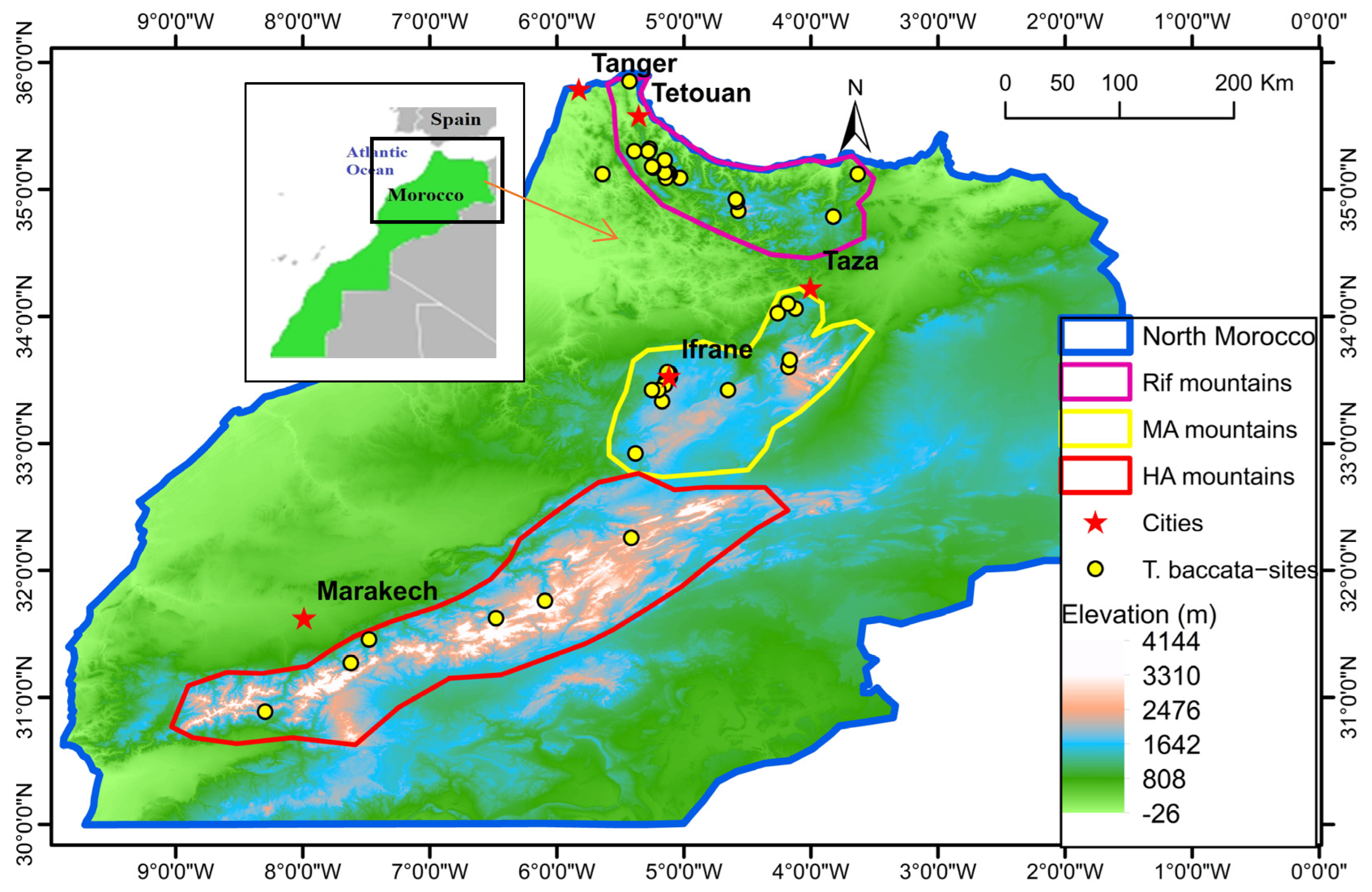
The study area encompasses an area of 348,746 km2 in northern Morocco (Figure 1) and includes three major mountain ranges: the Rif Mountains, the Middle Atlas, and the High Atlas [41], situated between latitudes 29.996° N and 35.931° N and longitudes −9.891° W and −0.72° W (Figure 1). This represents the expanded bioclimatic zone of northern Morocco, delimited by major geographical and climatic barriers, including the Mediterranean Sea to the north, the Atlantic Ocean to the west, and the transition to the hyper-arid pre-Saharan zones to the south and east. These limits constitute major barriers to post-glacial dispersal and the migration of Mediterranean montane flora such as T. baccata.
The Rif Mountains, generally below 2000 m in elevation, and represent the most humid region in Morocco [42,43]. The Rif Mountains are characterized by a predominantly Mediterranean climate, classified as Csa (temperate with dry, hot summers) at low to mid-elevations, and Csb (temperate with dry, warm summers) at higher elevations [44]. The annual precipitation may vary from 263 mm to 1209 mm. However, the annual mean temperature may range from 7.84 °C to 18.74 °C, extracted from WorldClim v2.1 (1970–2000 baseline) at a spatial resolution of 30 arc-seconds (~1 km2) [45] (https://www.worldclim.org/, accessed on 28 August 2023).
The High Atlas, extending about 700 km with elevations up to 4167 m at Jbel Toubkal, forms a major topographic barrier and experiences a relatively dry climate due to its proximity to the Sahara [42,43]. The High Atlas Mountains show a pronounced altitudinal climatic gradient. Lower slopes are characterized by Csa conditions, while mid-elevations correspond to Csb. At higher elevations, the climate becomes continental and colder, classified as Dsb (cold with dry, warm summers), and at the highest altitudes, Dsc (cold with dry, cool summers) [44]. The annual precipitation may vary from 134 mm to 742 mm. However, the annual mean temperature may range from 1.21 °C to 19.57 °C (extracted from WorldClim v2.1 (1970–2000 baseline) at a spatial resolution of 30 arc-seconds (~1 km2) [45]).
Located between the Rif and the High Atlas, the Middle Atlas covers about 27,550 km2 (about 15% of the country’s mountainous area) and extends roughly 450 km. It has a less arid climate than the High Atlas [42,43,46]. The Middle Atlas exhibits a transition from Mediterranean to montane climates. Lower elevations are mainly classified as Csa and Csb, while higher elevations shift toward colder conditions, corresponding to Dsb [44]. The annual precipitation may vary from 173 mm to 598 mm. However, the annual mean temperature may range from 4.17 °C to 17.91 °C (extracted from WorldClim v2.1 (1970–2000 baseline) at a spatial resolution of 30 arc-seconds (~1 km2) [45].
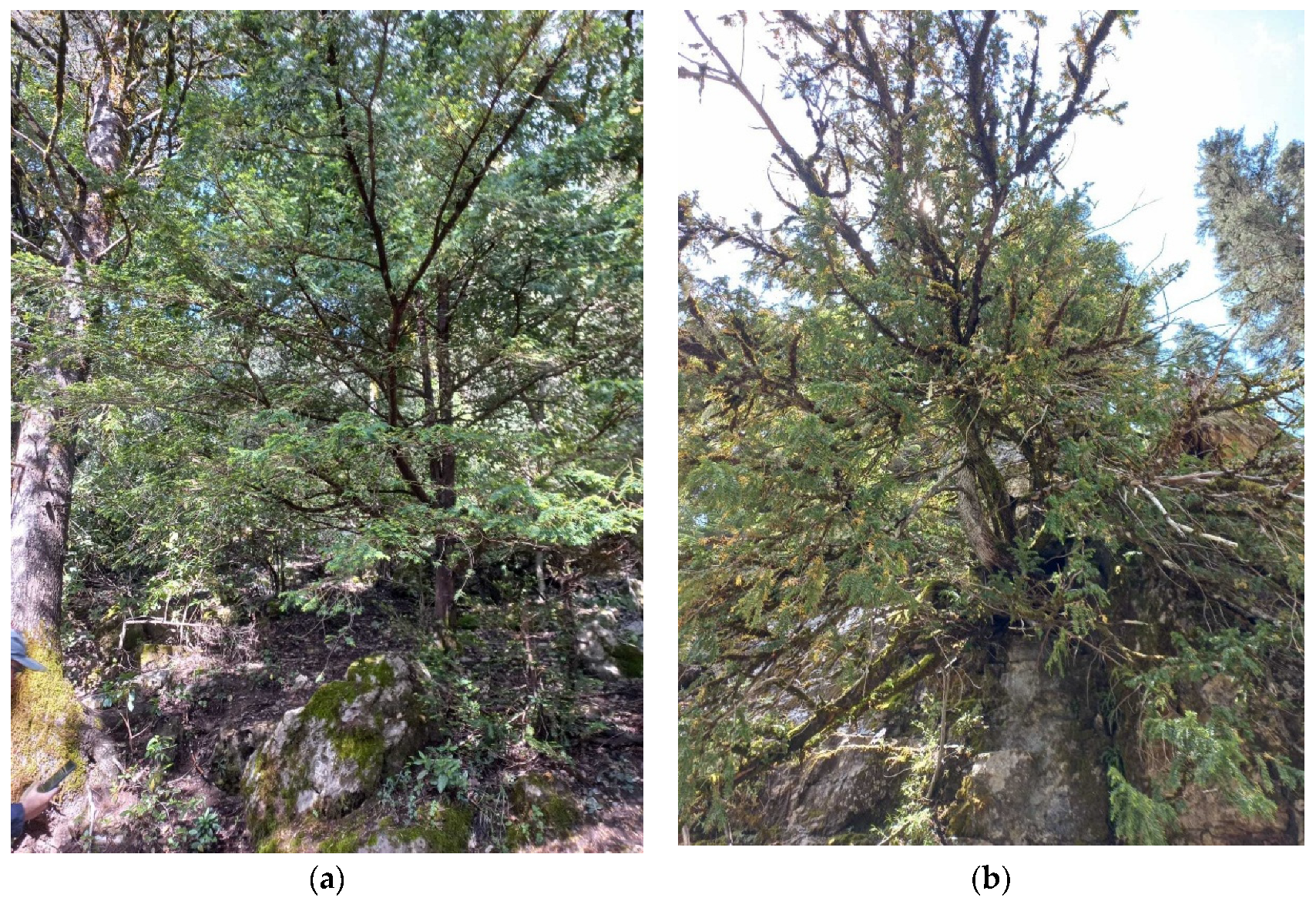
Among the 4500 taxa, 940 genera and 135 families of vascular plants in Morocco, the Taxaceae family is represented by a single species, the large-leaved yew (Taxus baccata) [47,48]. The yew occupies the coolest and most humid habitat, in shaded slopes, stream banks, and rocky ledges of the Rif (Figure 2), Middle Atlas, and High Atlas Mountains [26,49]. It forms isolated populations acting as localized refugia within these mountains [26]. In the western Rif, yew living within diverse plant communities, such as the Rif fir (Abies marocana Trab.), Atlas cedar (Cedrus atlantica (Fin.) Carrière), Maghreb maritime pine (Pinus pinaster subsp. escarena (Risso) K.Richt.), Maghreb black pine (Pinus nigra subsp. mauritanica (Maire & Peyerimh.) Heywood), holly (Ilex aquifolium L.), Italian maple (Acer granatense Boiss.), Maghreb spindle (Euonymus latifolius Mill), and Portuguese oak (Quercus faginea Lam.). Within the Tazekka National Park, west of Bab Boudir, the yew is found in the most calcareous zones of the Holm oak (Quercus ilex L.) forest [26,34].

2.2. Methods

A total of 41 occurrence records for T. baccata were compiled, including field surveys (n = 2) and published studies (n = 3) [50,51]. An additional 36 presence records for yew in Morocco were obtained from the Global Biodiversity Information Facility (GBIF) (https://www.gbif.org/occurrence/5063055734, accessed on 29 December 2025) [52]. The dataset was manually curated to retain only high-quality records suitable for analysis, applying the following criteria: (1) availability of precise geographic coordinates; (2) inclusion of the record year; and (3) location within the known native range of the species (Figure 1). To reduce spatial sampling bias and remove duplicate records, the occurrences were filtered to a 1 × 1 km grid resolution, retaining only one occurrence point per grid cell.
In this study, the highly predictive and stable Maxent model was used to perform ecological niche modelling of T. baccata [53,54], based on species presence-only observations. This application has been shown to work better with small number of samples than other approaches [16,55]. Maxent (Version 3.4.1) was used [56], and climatic data were retrieved from the WorldClim database [45] and processed in ArcGIS v.10.8.
We utilized bioclimatic variables to model the potential suitable area for T. baccata, because these variables possess significant predictive potential for species distribution [14]. In total, 19 bioclimatic variables and elevation were used to test correlation. To avoid multicollinearity, eight bioclimatic variables and elevation were excluded from the analysis after Spearman correlation test using IBM SPSS Statistics 23. When two layers were found to be highly collinear (|r| > 0.8), we used only one layer for modeling [6]. Resulting in the retention of eleven bioclimatic factors: Annual Mean Temperature (Bio1), Mean Diurnal Range (Bio2), Isothermality (Bio3), Temperature Seasonality (Bio4), Max Temperature of Warmest Month (Bio5), Min Temperature of Coldest Month (Bio6), Mean Temperature of Wettest Quarter (Bio8), Mean Temperature of Driest Quarter (Bio9), Annual Precipitation (Bio12), Precipitation Seasonality (Bio15), and Precipitation of the Warmest Quarter (Bio18).
To assess the potential impact of projected climate change, we used the same environmental variables within the BCC-CSM2-MR General Circulation Model (GCM). Although ensemble approaches are generally recommended to reduce uncertainty, the use of a single GCM remains common in regional species distribution modeling (SDM) studies, particularly when high-resolution climate projections are required.
To estimate the potential impact of projected climate change, we used the same variables within the BCC-CSM2-MR General Circulation Model (GCM). Although ensemble approaches are generally recommended to reduce uncertainty, the use of a single GCM remains common in regional SDM studies, particularly when high-resolution projections climate projection are required. Future monthly climate data from CMIP6 were used, covering three Shared Socio-economic Pathways: SSP1-2.6 (low emissions), SSP2-4.5 (“middle of the road”), and SSP5-8.5 (high emissions) for the 2061–2080 period. All data were processed at a 30 arc-second (~1 km) resolution, which is optimal for estimating T. baccata distribution [14]. The selection of the SSP1-2.6, SSP2-4.5, and SSP5-8.5 scenarios was intended to capture a wide range of plausible future climate trajectories, from low to high greenhouse gas emissions, as recommended by O’Neill et al. [57]. However, uncertainties in future projections also arise from differences among general circulation models (GCMs), emission pathways, and the correlative nature of species distribution models, which assume equilibrium between species and climate [58,59].
To ensure model stability, the maximum number of iterations was set to 10,000 with a convergence threshold of 0.00001. The “random seed” option was enabled to generate a random test partition and background subset for each run. Model performance was evaluated using a cross-validation approach with 1000 replicates, and results were produced in a logistic output format [6,60]. The “Auto” feature classes option was used, and the regularization multiplier was set to the default value of 1 providing a standard exploratory framework for modeling our presence records (n = 41). This method is particularly advantageous for restricted datasets, as it maximizes the use of available occurrence data for both training and validation [60]. Model performance was evaluated using the Area under the Curve (AUC) of the Receiver Operator Curve (ROC), and the True Skill Statistic (TSS) [39,61]. AUC values range from 0.5 to 1.0, with AUC > 0.9 indicates excellent discriminatory ability [62]. However, TSS > 0.8 indicates excellent results [39]. TSS was calculated based on the formula “TSS = 1 − Omission Rate − Fractional Predicted Area” (based on Maximum training sensitivity plus specificity Logistic Threshold).
The resulting ASCII files for current and future distributions were exported to ArcGIS v. 10.8 for spatial representation. The probability distributions were categorized, according to the Maximum test sensitivity plus specificity threshold, into two suitability classes: suitable and unsuitable.
Response curves are generated to illustrate the ranges of environmental variables associated with high predicted probabilities of occurrence, representing the environmental conditions favorable for T. baccata. The limits of these ranges were determined using the commonly adopted 0.5 logistic threshold, which acts as a functional approximation of habitat suitability, separating preferred environmental conditions from marginal ones, and representing the probability of presence, assuming a ~50% prevalence [38].
Because of the absence of a mapped distribution area for T. baccata, we used the Buffer tool (ArcMap) around occurrence points, applying a 5 km distance considered appropriate for this rare species, followed by the Dissolve tool to merge overlapping buffers into a single polygon. This approach allowed us to generate a map of the species’ distribution area in Morocco. Subsequently, a binary map derived from the model was compared with the mapped distribution area to validate the results by confronting observed and predicted distributions, thereby assessing the relevance of areas identified as suitable for the species.

3. Results

3.1. Model Evaluation

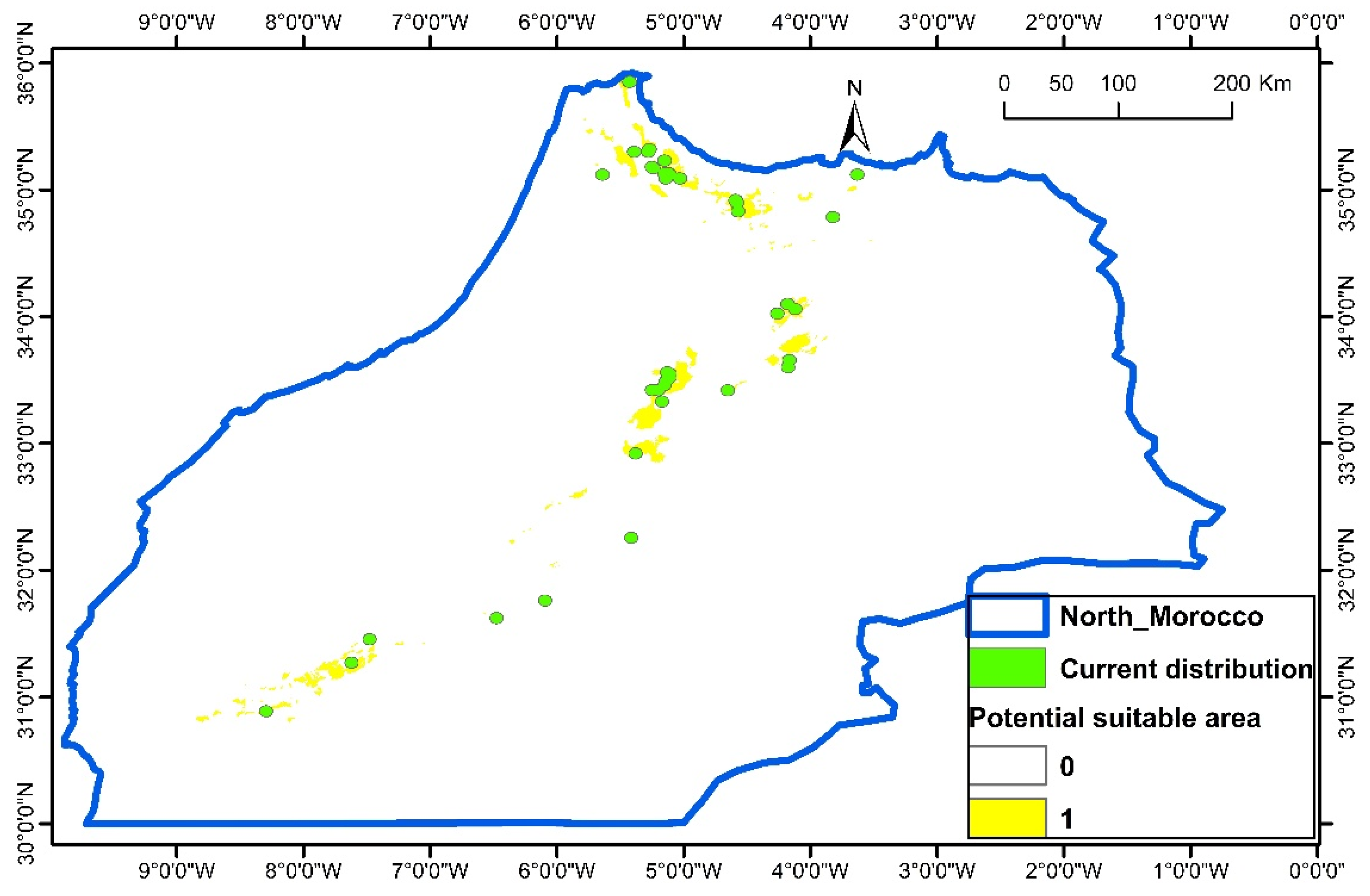
The four models used to simulate the current and future spatial distribution of T. baccata in northern Morocco show high Area Under the Curve (AUC) values. The AUC values are 0.966, 0.970, 0.969, and 0.967 for the current climate model and the SSP1-2.6, SSP2-4.5, and SSP5-8.5 scenarios, respectively. These models achieved high average test values (close to 1) and low standard deviation values (0.043–0.045). The True Skill Statistic (TSS) values ranged from 0.862 to 0.885. These results indicate strong predictive performance of the models. The generated models are largely consistent with the current geographic distribution of T. baccata in Morocco, with the exception of five recorded occurrence sites. However, the models also identified additional areas of suitable habitats for the species in the Rif (Bouhachem National Park, Bab Taza), and some areas of Middle and High Atlas, where no occurrences of T. baccata have been reported to date (Figure 3).

3.2. Bioclimatic Factors

The permutation importance of bioclimatic variables reflects the relative contribution of predictors to the model’s predictive performance. According to our finding, the bioclimatic factors that have the greatest effect on the current geographic distribution of yew in Morocco are the Mean Temperature of Driest Quarter (Bio9) and Isothermality (BIO2/BIO7) (×100) (Bio3) (Table 1). Similarly, the two bioclimatic factors (Bio9 and Bio3) are crucial for the future distribution of yew under the three future climatic scenarios SSP1-2.6, SSP2-4.5 and SSP5-8.5 (Table 1). In fact, thermal variables appear to be the primary environmental factors shaping both the current and future geographic distribution of yew in northern Morocco. This finding highlights the strong sensitivity of T. baccata to temperature conditions, particularly in Mediterranean mountain ecosystems where climatic gradients strongly influence species establishment and persistence.

3.3. Response Curves of the Most Important Bioclimatic Variables

Response curves of the most important bioclimatic variables contributing to the models were represented in the Supplementary Materials (Figure S1). Under current climatic conditions, the response curves indicate a high predicted probability of occurrence for the Mean Temperature of Driest Quarter (Bio9) values ranging from 15.4 to 20.4 °C, Isothermality (Bio3) values ranging from 36.2 to 38.8, and Mean Diurnal Range (Bio2) values ranging from 7 to 11.7 °C.
Under the SSP1-2.6 scenario, high predicted probabilities were associated with the Mean Temperature of Driest Quarter (Bio9) values ranging from 16 to 25.5 °C, Isothermality (Bio3) values ranging from 33 to 39, and Max Temperature of Warmest Month (Bio5) less than 31.5 °C.
Under the SSP2-4.5 scenario, the species shows high predicted suitability for the Mean Temperature of Driest Quarter (Bio9) values between 18 and 24 °C, Isothermality (Bio3) values between 37 and 39.5, and Mean Temperature of Wettest Quarter (Bio8) values between 0.5 and 8.5 °C. The introduction of Bio8 is an important factor, suggesting that the mean temperature of the wettest quarter is a critical constraint in this mid-range scenario.
Under the SSP5-8.5 scenario, high predicted suitability occurs for the Mean Temperature of Driest Quarter (Bio9) values less than 26.5 °C, Isothermality (Bio3) values ranging from 35.6 to 38, and Temperature Seasonality (Bio4) values ranging from 620 to 760. This implies that in a high-emission future, the overall “swing” of temperatures throughout the year becomes a primary factor in determining where the species can persist.
Overall, future scenarios show a pattern similar to that observed under the current climate, particularly for Isothermality (Bio3), whose values remain close across scenarios. This indicates that T. baccata is sensitive to the relationship between daily and annual temperature fluctuations, requiring a specific level of climatic “steadiness” regardless of the overall warming trend. However, under current conditions, the species favors a relatively narrow and cooler window (Bio9 up to 20.4 °C). As we move toward more extreme scenarios (SSP5-8.5), the model predicts suitability at much higher temperatures (Bio9 up to 26.5 °C). This suggests that for the species to survive in these scenarios, it must either adapt to warmer, drier periods or migrate to potential refugial areas.
While the species shows some “modelled flexibility” by appearing suitable in warmer dry quarters (Bio9) in future projections, the shift in secondary variables suggests that the ecological niche is being pressured. The transition from Mean Diurnal Range (Bio2) to Temperature Seasonality (Bio4) as a key predictor indicates a fundamental shift in the climatic stresses that the species is expected to face in Morocco.

3.4. Jackknife Test of Variables Importances Under Current and Future Climate Scenarios

Based on the Jackknife tests (Figure S2), variable importance shifted according to the specific climate scenario modeled. Under current conditions and the SSP2-4.5 scenario, Mean Temperature of Driest Quarter (Bio9) emerged as the predictor with the highest standalone gain. In contrast, under the SSP1-2.6 and SSP5-8.5 scenarios, the Annual Mean Temperature (Bio1) contributed the most independent information to the model. Regarding the exclusion of unique information, the Isothermality (Bio3) was the most critical variable for the current and SSP5-8.5 models. Meanwhile, the Precipitation of Warmest Quarter (Bio18) and Mean Temperature of Wettest Quarter (Bio8) showed the greatest gain reduction for the SSP1-2.6 and SSP2-4.5 models, respectively. These shifts highlight how different bioclimatic drivers influence the model’s predictive performance across varying future trajectories.

3.5. Potential Distribution of Yew Under Current Climate

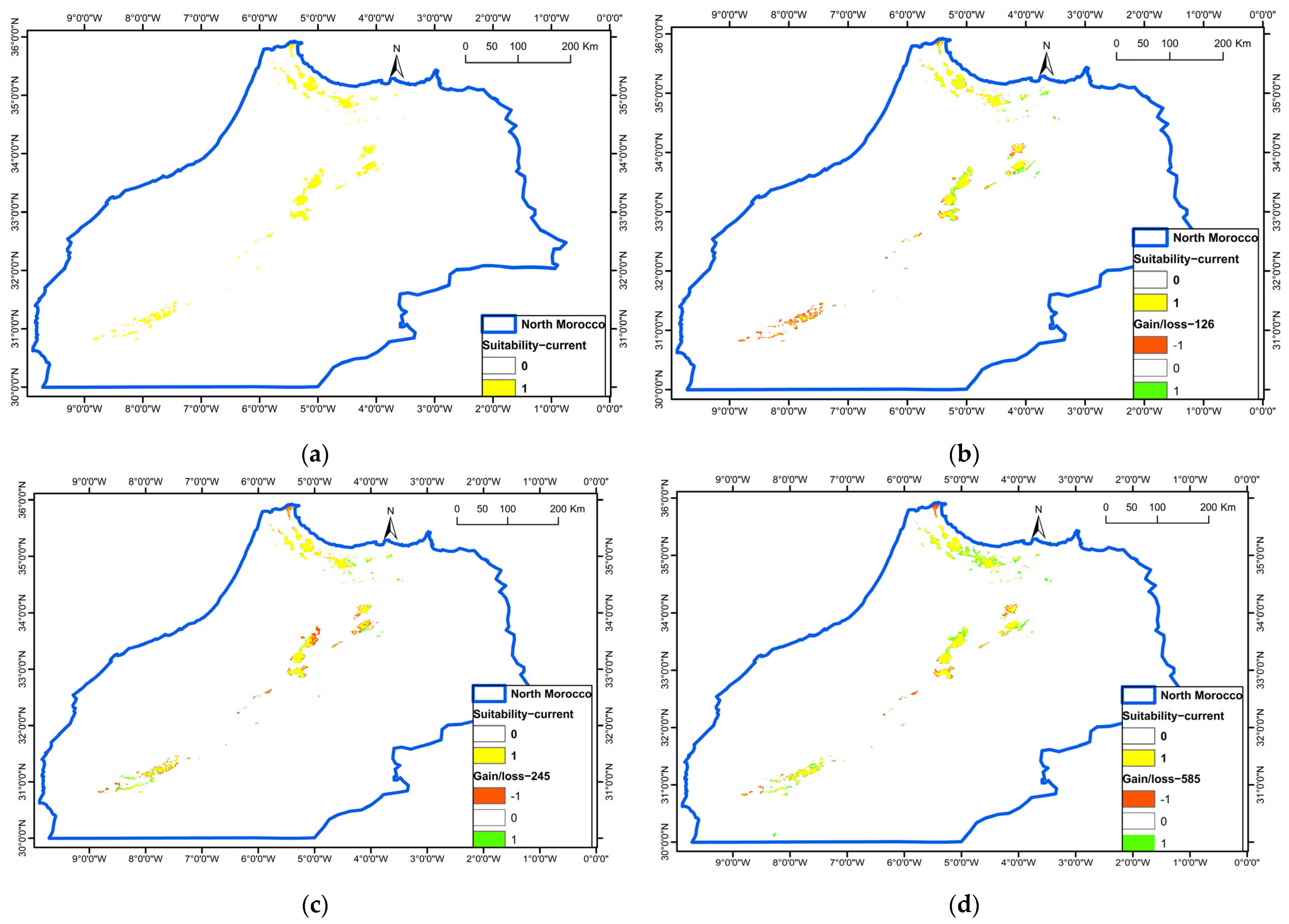
Under the current climate model, the present distribution map shows that T. baccata occurs in northern Morocco as fragmented populations in the Rif Mountains (Jbel Moussa, Jbel Kelti, Talassemtane National Park, Bouhachem National Park, Bab Taza, Bab Berred, Ketama, and Issaguen), the Middle Atlas Mountains (Tazekka National Park, Bab Boudir, Maghraoua, Ighzrane, Ifrane-Ben Smim, Oued Ifrane, and Aguelmam Azegza), and the High Atlas Mountains (Ait Oum El Bekht, Sti Fadma, and Ouirgane). Together, these areas cover a total of 4602 km2 of suitable habitat for T. baccata (Table 2, Figure 4a).

3.6. Future Changes in Climatic Niches of Taxus baccata in Northern Morocco

3.6.1. Current Climate vs. SSP1-2.6 Scenario

Under the SSP1-2.6 scenario, compared with the current situation, the suitable distribution area of T. baccata was projected to decrease from the edge of almost all areas of its distribution (Rif, Middle Atlas and High Atlas). However, the rate of loss will be greater in Middle Atlas and High Atlas compared to the Rif area. However, an increase in suitable habitat is projected in Rif and Middle Atlas, associated with increased climatic suitability in the Middle-Eastern Rif region (Figure 4b). Our results show that 9.15% of reduction in suitable habitat was projected under the SSP1-2.6 scenario (Table 2). Overall, suitable habitat of T. baccata was negatively affected by climate change in Northern Morocco.

3.6.2. Current Climate vs. SSP2-4.5 Scenario

The SSP2-4.5 scenario was the most influencing scenario on the distribution area of T. baccata in Morocco, particularly in the Middle Atlas and Jbel Moussa in the Rif. However, a slight improvement in suitable habitat is projected in the eastern parts of the Middle Atlas (Tazekka National Park, Bab Boudir, and Maghraoua), in the Eastern Rif and in the HA. In total, the suitable habitat is projected to loss 585.74 km2 (−12.7%) in Northern Morocco (Table 2, Figure 4c).

3.6.3. Current Climate vs. SSP5-8.5 Scenario

Climate change under the SSP5-8.5 scenario appears to be associated with increased climatic suitability for T. baccata in Morocco. The results indicate that the suitable distribution area of the species is expected to increase compared to the current distribution across most occurrence areas in the Rif, Middle Atlas, and High Atlas. An exception was observed in Jbel Moussa (Rif), where a notable reduction in suitable habitat is projected. Overall, the suitable habitat is projected to gain 643.18 km2 (+14%) (Table 2, Figure 4d).
According to these projections, the species is expected to gain and loss suitable habitat areas in all areas of the species distribution in northern Morocco (Table 2, Figure 4). It is also noteworthy that nearly 80% of the suitable habitat for the species is located in the Rif and Middle Atlas Mountains, suggesting a potential shift in suitable habitat of the species toward the North of Morocco to concentrate within the Rif and Middle Atlas in Morocco. However, while predicted habitat suitability represents a potential distribution based on climatic conditions, biological processes such as seed dispersal, germination, and pollination may constrain the realized distribution and limit the species’ capacity to colonize newly suitable areas.

4. Discussion

The yew performs multiple ecological functions within its natural habitat. It contributes to local biodiversity, serves as a source of food and habitat for wildlife, and plays a major role in soil and moisture retention, especially in mountainous areas [26]. Consequently, understanding its global distribution pattern and its response to climate change were essential to its conservation. Climate is one of the most important factors influencing plant distribution [9,10]. Therefore, bioclimatic variables are used to model the impact of climate change on habitat suitability. This approach contributes to the conservation and long-term sustainability of these species [5]. In this context, Maxent model was used to analyze the potential distribution of the European yew species. The modeling results showed high predictive power, with an AUC value of 0.966 ± 0.044 under current climatic conditions, demonstrating the model’s high predictive power. AUC values remained high and stable even under future climate scenarios (0.970, 0.969, and 0.967), supporting model robustness and the strength of its results [39,63].
Ecological models, including MaxEnt, primarily rely on the relationship between species occurrence data and environmental variables to predict potential habitats. However, these results remain potential estimates and do not guarantee the species’ presence in those areas [64,65]. This is because actual distribution is governed not only by climate, but also by abiotic conditions, biotic interactions, and dispersal capability, along with interconnected processes like physiological factors, population dynamics, and adaptation. These elements can affect prediction accuracy if overlooked [65,66]. Furthermore, most models assume the species is in equilibrium with its current environment, whereas in reality, species are in a continuous state of response and flux as environmental conditions change, making their distribution non-static over time [64,66].
Our results show that most of the mapped area coincides with the predicted potential distribution of the species (Figure 2). However, we observed the absence of yew in several areas identified as suitable by the models. This absence may be explained, on the one hand, by insufficient field surveys in these areas, highlighting the need for additional field investigations to validate the predicted suitable distribution. And, on the other hand, by the influence of other factors not accounted for in the models, such as human activities (grazing, fire, water drainage, land clearing for agriculture, etc.), which may strongly affect the distribution of yew [26,67,68,69].
Our study highlights the importance of thermal factors in the determination of current potential distribution of T. baccata in northern Morocco, namely the Mean Temperature of Driest Quarter (Bio9) and the Isothermality (Bio3), which contributed 51.8% and 25.5% respectively. These results are consistent with those of Cruz Román et al. (2025) [4] in the Iberian Peninsula, which reported the importance of temperature as the key factor influencing the distribution and spread of T. baccata, due to its high sensitivity to drought. Moreover, Alavi et al. (2020) [70] reported the importance of the Mean Temperature of Driest Quarter in the determination of the yew distribution in Iran.
The significance of the Mean Temperature of Driest Quarter (Bio9) and Isothermality (Bio3) arises from their link to the environmental and physiological requirements of T. baccata. This species inhabits cool, humid montane environments, favoring shaded sites near watercourses or rocky edges where moisture is sufficient for growth. In North Africa, its distribution is restricted to mesomediterranean and supramediterranean zones, where sub-humid to per-humid conditions prevail, consistent with its requirement for cool and moist environments [32,71]. In this context, the Mean Temperature of Driest Quarter is an important indicator of heat and water stress during the driest season, as increased temperatures and drought intensity lead to higher evaporation and transpiration rates, causing water stress that negatively affects the growth and physiological functions of this species. Prolonged exposure to these conditions can also lead to increased mortality rates, even in ecosystems that are not typically water-stressed [32,67,72]. In contrast, isothermality reflects the importance of thermal stability in maintaining physiological and reproductive performance, as temperature fluctuations affect vital processes such as photosynthesis and respiration [73]. In addition, pollen formation requires a precise temperature range (1–10 °C); any continuous deviation may disrupt meiosis, leading to partial or total sterility [32].
Environmental distribution models under current climatic conditions indicate that the suitable habitats of the T. baccata in Morocco are located in the Rif and Middle Atlas regions, with a limited range in some areas of the High Atlas. The total area of these habitats is approximately 4602 km2. The spread of the yew in these regions could be explained by suitable environmental conditions. It thrives in environments with average temperatures of around 11 °C in both the Rif and the Middle Atlas, and abundant rainfall, averaging 971 mm in the Rif and 647 mm in the Middle Atlas. This provides a sub-humid to humid environment suitable for yew growth [34]. In contrast, the High Atlas region is less suitable due to unfavorable climatic conditions, with higher temperatures and increased aridity, which limits the spread of the T. baccata [26,34].
Under lower-emission scenarios, a contraction of suitable habitat was predicted, with areas declining to 4180.94 km2 under SSP1-2.6 and to 4016.24 km2 under SSP2-4.5, corresponding to decreases of about 9.15% and 12.7%, respectively. However, contrary to initial expectations, predictive models under future climate scenarios suggest a potential expansion of suitable habitat for T. baccata in certain regions, particularly under high-emission conditions. In Morocco, the area of suitable habitat was projected to increase from 4602 km2 to 5245.18 km2 under the SSP5-8.5 scenario, representing a gain of approximately 14%. These findings contrast with most global studies, which generally predict negative impacts of climate warming on the distribution of yew, particularly under high-emission scenarios such as SSP5-8.5 [4,7,12,53].
The projected expansion of suitable habitat under the SSP5-8.5 scenario likely results from a relaxation of cold climatic constraints and the emergence of favorable conditions at higher elevations. Such upward and latitudinal shifts are well-documented for temperate tree species under climate warming [74,75]. This trend aligns with the ecological preferences of T. baccata, which favors the cool, and humid microclimates [26,32,71], that are expected to become more prevalent in alpine regions as temperatures rise. Consequently, climate change may generate new niches in mountainous areas, partially compensating for habitat loss in currently occupied territories (Figure 4b–d). However, the counter-intuitive expansion of suitable habitat projected under the extreme SSP5-8.5 scenario requires careful evaluation of correlative model assumptions. These models assume environmental equilibrium and do not account for important non-climatic constraints such as edaphic requirements (e.g., soil depth and quality), biotic interactions (e.g., competitive exclusion by thermophilic species moving upward), or localized anthropogenic pressures [76,77]. Consequently, rather than providing a definitive prediction of future population growth, the projected expansion under SSP5-8.5 should be interpreted as an upward shift of the potential bioclimatic envelope, highlighting theoretical future refugia where intensive management or assisted migration may be required [78].
Rising temperatures may facilitate an upward shift of the species from mid- to high-elevation zones, leading to the emergence of new suitable habitats, in line with the widely reported altitudinal migration of climate-sensitive plant species [79]. However, studies from the Iberian Peninsula predict a reduction in suitable habitats for T. baccata, particularly under SSP5-8.5, due to increasing temperatures and decreasing humidity [4]. This contrast underscores the importance of regional climatic and topographic heterogeneity in shaping species responses to climate change. The expansion of suitable habitat of yew towards the middle and eastern Rif (Figure 4d) may be attributed to the region’s humid oceanic character, where high rainfall, along with nighttime fog from the Mediterranean Sea, helps mitigate aridity. This contributes to creating favorable conditions for this species [26,34], making the middle Rif a climatic potential refugial areas in the face of future climate changes.
In Morocco, T. baccata has been classified as threatened because of its limited natural regeneration capacity in many locations [26,34]. These findings suggest that biological and human-related factors, such as fires and logging, may exert a greater influence on the future distribution of yew than climatic drivers alone [22,35,80,81,82,83]. This situation underscores the urgent need for rigorous in situ conservation measures and detailed assessments of the current status of yew populations.
Our study reveals that T. baccata occurs in fragmented and scattered populations across the Rif, Middle Atlas, and High Atlas Mountains. Such fragmentation may restrict genetic exchange among populations, thereby increasing the risk of genetic erosion. In addition, the wide dispersion of trees can reduce pollination efficiency [26]. There is a critical distance, estimated between 200 and 300 m, beyond which pollen can no longer ensure fertilization [84]. This situation was exacerbated by the pressure from frugivorous animals, which could reduce yew regeneration, especially in years of low seed production. While morphophysiological dormancy could constitute another barrier to its regeneration [22]. In contrast, Charco (2007) [26] reported that the consumption of yew seeds by thrushes and blackbirds (fruit-eating birds of the genus Turdus) is not necessarily detrimental, since they act as potential seed dispersal agents.
Natural germination of yew seeds involves only 10% of seeds (those that have escaped rodent predation), generally occurring within the first three years following dispersal, with a natural germination rate reaching nearly 80% in northern Spain [71]. Of the seeds that germinate, nearly 90% disappear in the first year [71,84], and the remaining 10% disappear in subsequent years, unless the seedlings develop in areas completely inaccessible to livestock, such as on steep rock faces or sheltered by thorny vegetation. Relatively limited natural regeneration and dispersal constraints may hinder the ability of yew to track shifting suitable habitats under climate change. Therefore, areas identified as suitable by the model, particularly under future scenarios, may not be readily occupied without effective seed dispersal and successful recruitment.
As reported for several plants’ species [6,7,8,12,81], our findings indicate a geographic displacement of suitable climate habitat of yew from the South toward the northwest of Morocco and constitute an area of persistent climatic suitability in the middle-east Rif, especially in the Talassemtane National Park, Ketama and Issaguene areas, which were considered as centres of diversity in Morocco [83]. However, with the exception of a few seedlings recorded in the Talassemtane National Park, there is no natural regeneration of the yew in the remaining areas of Morocco [26,34], demonstrating the lack of in situ conservation of the Moroccan yew, and suggesting that increased in situ conservation efforts should be prioritized in Talassemtane National Park. It is interesting to note that the persistence of yew in Morocco, despite high environmental and human pressures, could be attributed to its survival strategy, which involves structural and physiological adaptations, as reported by Kornienko 2025 [23]. In contrast, the reduction in suitable areas for yew in the High Atlas Mountains could be explained by the species’ inability to migrate upward due to severe climatic conditions. As reported by Bell et al. (2014) [10], projected climatic changes over the next century is expected to substantially reduce climatically suitable habitat for high-elevation tree species compared to those of lower elevation.
The implementation of Law 29-05 of 2 July 2011 on the protection of species of wild fauna and flora and their trade [36] could reduce the pressure on the species. However, consultation with the local population is essential to clarify the ambiguity surrounding the species’ toxicity to livestock. Although yew is not considered a preferred fodder species in the Rif and the Middle Atlas regions [26], the conservation and enhancement of this gymnosperm could constitute an alternative for the local population. Moreover, the expansion of protected areas should be supported by ex situ conservation measures. The establishment of seed banks, combined with research on germination requirements to ensure successful regeneration, and the cultivation and long-term maintenance of individuals in botanical gardens, are essential conservation measures to preserve genetic diversity and provide material for future restoration or reintroduction programs [85,86,87,88]. Finally, effective conservation planning must incorporate the regulation and mitigation of anthropogenic pressures, such as overgrazing and fire [68,69].
The current modeling approach is subject to uncertainties arising from the limited number of occurrence records of T. baccata, a consequence of its rarity and progressive decline. Nevertheless, MaxEnt modeling has proven to be highly effective for analyzing habitat use and species distribution in various contexts, even with a reduced number of localities. Indeed, by relying solely on presence data, it avoids the constraints associated with presence-absence approaches and remains relatively insensitive to spatial errors related to location data [16,55]. Although MaxEnt is widely used and often exhibits strong predictive performance, no single modeling approach consistently outperforms others across all contexts. Comparative studies have shown that model performance depends on the species, the study area, and the characteristics of the data [89,90].
The use of a single Global Climate Model (CMIP6) for modelling, selected as suitable for the study region, may not provide a reliable estimate of future spatial trends of yew in Morocco and constitutes another source of uncertainty. In contrast, using a finer spatial resolution (30 arc-seconds, ~1 km) could improve our model performance.
Additional uncertainty arises from our modeling approach. Specifically, the MaxEnt models were run using default settings, including auto feature classes and a regularization multiplier of 1. However, current best practices in species distribution modeling, particularly for studies with relatively small sample sizes (n = 41), recommend rigorous model calibration. Evaluating alternative regularization multipliers and feature class combinations using tools such as ENMeval- [91] or AICc-based approaches (e.g., [92]) could help optimize model complexity and reduce the risk of overfitting.
Furthermore, another limitation of this study lies in the fact that the eleven selected climatic variables do not necessarily cover all the factors influencing the geographic distribution of T. baccata. In addition to climatic variables, other factors may play a decisive role, notably human activities such as habitat fragmentation, land-use changes, fires, and pastoralism, which are particularly detrimental to young seedlings [26,67,68,69]. These factors may limit the actual colonisation of newly suitable areas.
Finally, it is important to emphasize that the potentially suitable habitat areas predicted by the model do not always perfectly coincide with the habitats actually occupied by the species [93]. This discrepancy could be explained by the uncertainties and assumptions inherent in species distribution models, highlighting the need for further field investigation and the integration of additional factors to improve prediction accuracy.

5. Conclusions

This study evaluated the impact of climate change on the distribution of Taxus baccata in Morocco under both current and future climatic conditions using ecological niche modeling. The results indicate that thermal factors are the main factors influencing the distribution of the yew in North Morocco and show that the majority of habitats will be concentrated in mountainous regions, particularly the Rif and the middle Atlas, which may provide areas of persistent climatic suitability for this species. Future climate projections indicate the possibility of decrease in suitable habitats in some areas, in contrast to the emergence of new habitats in other areas. In addition to climate change, T. baccata remains a threatened species due to several other factors, such as the failure of natural regeneration in some areas and human pressure. Therefore, this study recommends giving special attention to this species by focusing on conducting morphological studies to reveal potential variations within yew populations in the Rif, Middle Atlas, and High Atlas, in addition to studying its germination requirements to ensure its regeneration. Moreover, comprehensive and systematic field surveys are needed to validate model predictions and improve their ecological accuracy under real-world conditions. Such surveys would enable the verification of species presence, the assessment of population structure, and the detection of potential discrepancies between predicted and actual distributions. In parallel, the identification, mapping, and conservation of key habitat corridors for T. baccata are crucial to ensure landscape connectivity, facilitate gene flow, and enable species migration in response to ongoing climate change. Additional measures, including monitoring land-use changes, promoting sustainable resource management practices, and raising local awareness, can further reduce human-induced impacts and enhance the long-term resilience of the species and its habitats.

Supplementary Materials

The following supporting information can be downloaded at https://www.mdpi.com/article/10.3390/su18115544/s1, Figure S1: Response curves of the most important bioclimatic variables influencing current and future distribution of Taxus baccata in Northern Morocco; Figure S2: Results of the jackknife test of variables importance.

Author Contributions

Conceptualization, M.L.; methodology, M.L.; software, M.L.; validation, I.E.H., A.K. and M.L.; formal analysis, M.L.; investigation, I.E.H., Y.E.K. and M.L.; resources, M.L., and Y.E.K.; data curation, I.E.H. and M.L.; writing—original draft preparation, I.E.H. and M.L.; writing—review and editing, I.E.H., Y.E.K., A.K. and M.L.; visualization, M.L.; supervision, M.L. and A.K. All authors have read and agreed to the published version of the manuscript.

Funding

This research received no external funding.

Institutional Review Board Statement

Not applicable.

Informed Consent Statement

Not applicable.

Data Availability Statement

All floristic and ecological data obtained during the research are included in this study. The original dataset used in the analysis is available upon request.

Acknowledgments

The authors would like to thank the anonymous reviewers for their constructive and valuable comments and the editorial team members for their help in refining this article.

Conflicts of Interest

The authors declare no conflicts of interest.

References

  1. Wang, J.; Wang, Y.; Feng, J.; Chen, C.; Chen, J.; Long, T.; Li, J.; Zang, R.; Li, J. Differential responses to climate and land-use changes in threatened Chinese Taxus species. Forests 2019, 10, 766. [Google Scholar] [CrossRef]
  2. Malhi, Y.; Franklin, J.; Seddon, N.; Solan, M.; Turner, M.G.; Field, C.B.; Knowlton, N. Climate change and ecosystems: Threats, opportunities and solutions. Philos. Trans. R. Soc. Lond. B Biol. Sci. 2020, 375, 20190104. [Google Scholar] [CrossRef]
  3. Tayyab, M.; Muhammad, S.; Nawaz, H.; Ali, A.; Malik, S.M.; Waheed, M.; Rasool, K.; Khan, M.J.T.; Khan, Z.U.D.; Zahid, M. Climatically induced anomalies in tree-ring structure of Abies pindrow (Royal ex D. Don) and Taxus baccata (L.) growing in Hindu-Kush mountainous region of Pakistan. Environ. Res. Commun. 2023, 5, 065002. [Google Scholar] [CrossRef]
  4. Cruz Román, J.F.; Hernández-Lambraño, R.E.; Rodríguez-de la Cruz, D.; Sánchez-Agudo, J.Á. Climate vulnerability analysis of marginal populations of yew (Taxus baccata L.): The case of the Iberian Peninsula. Forests 2025, 16, 931. [Google Scholar] [CrossRef]
  5. Li, D.; Li, T.; Xue, W.; Xia, Y.; Wang, Z. Prediction and analysis of potential habitat distribution of Taxus wallichiana var. chinensis under climate change: A case study of Hubei Province. Ecol. Environ. Sci. 2025, 34, 1398–1409. [Google Scholar] [CrossRef]
  6. Kolanowska, M.; Kras, M.; Lipińska, M.; Mystkowska, K.; Szlachetko, D.L.; Naczk, A.M. Global warming not so harmful for all plants: Response of holomycotrophic orchid species for the future climate change. Sci. Rep. 2017, 7, 12704. [Google Scholar] [CrossRef]
  7. Koç, D.E.; Svenning, J.C.; Avcı, M. Climate change impacts on the potential distribution of Taxus baccata L. in the Eastern Mediterranean and the Bolkar Mountains (Turkey) from Last Glacial Maximum to the future. Eurasian J. For. Sci. 2018, 6, 69–82. [Google Scholar] [CrossRef]
  8. Wu, X.; Wang, M.; Li, X.; Yan, Y.; Dai, M.; Xie, W.; Zhou, X.; Zhang, D.; Wen, Y. Response of distribution patterns of two closely related species in Taxus genus to climate change since Last Inter-Glacial. Ecol. Evol. 2022, 12, e9302. [Google Scholar] [CrossRef] [PubMed]
  9. Mazzola, P.; Domina, G. Distribution, ecology and conservation of Taxus baccata (Taxaceae) in Sicily. Bocconea 2006, 19, 209–215. [Google Scholar]
  10. Bell, D.M.; Bradford, J.B.; Lauenroth, W.K. Mountain landscapes offer few opportunities for high-elevation tree species migration. Glob. Change Biol. 2014, 20, 1441–1451. [Google Scholar] [CrossRef]
  11. Chan, W.P.; Lenoir, J.; Mai, G.S.; Kuo, H.C.; Chen, I.C.; Shen, S.F. Climate velocities and species tracking in global mountain regions. Nature 2024, 629, 114–120. [Google Scholar] [CrossRef]
  12. Zhang, S.; Zhou, Y.; Lin, J.; Qin, W.; Zhou, T.; Peng, S. Potential effects of future climate change on global Taxus distributions and diversity. J. Plant Ecol. 2026, 19, rtaf154. [Google Scholar] [CrossRef]
  13. Elith, J.; Graham, C.H.; Anderson, R.P.; Dudík, M.; Ferrier, S.; Guisan, A.; Hijmans, R.J.; Huettmann, F.; Leathwick, J.R.; Lehmann, A.; et al. Novel methods improve prediction of species’ distributions from occurrence data. Ecography 2006, 29, 129–151. [Google Scholar] [CrossRef]
  14. Habibi Kilak, S.; Alavi, S.J.; Esmailzadeh, O. Spatial resolution matters: Unveiling the role of environmental predictors in English yew (Taxus baccata L.) distribution using MaxEnt modeling. Earth Sci. Inform. 2025, 18, 214. [Google Scholar] [CrossRef]
  15. McShea, W.J. What are the roles of species distribution models in conservation planning? Environ. Conserv. 2014, 41, 93–96. [Google Scholar] [CrossRef]
  16. Hernandez, P.A.; Franke, I.; Herzog, S.K.; Pacheco, V.; Paniagua, L.; Quintana, H.L.; Soto, A.; Swenson, J.J.; Tovar, C.; Valqui, T.H.; et al. Predicting species distributions in poorly-studied landscapes. Biodivers. Conserv. 2008, 17, 1353–1366. [Google Scholar] [CrossRef]
  17. Kearney, M.; Porter, W. Mechanistic niche modelling: Combining physiological and spatial data to predict species’ ranges. Ecol. Lett. 2009, 12, 334–350. [Google Scholar] [CrossRef]
  18. Thomas, P.; Garcia-Marti, X. Response of European yews to climate change: A review. For. Syst. 2015, 24, eR01. [Google Scholar] [CrossRef]
  19. Thakur, A.; Kanwal, K.S. Assessing the global distribution and conservation status of the Taxus genus: An overview. Trees For. People 2024, 15, 100501. [Google Scholar] [CrossRef]
  20. Francisco, T.; Mayol, M.; Vajana, E.; Riba, M.; Westergren, M.; Cavers, S.; Pinosio, S.; Bagnoli, F.; Marchi, M.; Aravanopoulos, F.A.; et al. Genomic signatures of climate-driven (mal)adaptation in an iconic conifer, the English yew (Taxus baccata L.). Evol. Appl. 2025, 18, e70160. [Google Scholar] [CrossRef] [PubMed]
  21. Dong, C.; Shi, G.L.; Herrera, F.; Wang, Y.D.; Herendeen, P.S.; Crane, P.R. Middle-Late Jurassic fossils from northeastern China reveal morphological stasis in the catkin-yew. Natl. Sci. Rev. 2020, 7, 1765–1767. [Google Scholar] [CrossRef]
  22. Maleki, K.; Chmielarz, P.; Wawrzyniak, M.K.; Maleki, K.; Maleki, A.; Soltani, E. Seed regeneration in Taxus baccata: Unveiling ecological restrictions and paving the way for future studies. Ecol. Evol. 2024, 14, e70534. [Google Scholar] [CrossRef] [PubMed]
  23. Kornienko, V.; Shkirenko, A.; Reuckaya, V.; Meskhi, B.; Dzhedirov, D.; Olshevskaya, A.; Odabashyan, M.; Shevchenko, V.; Mangasarian, D.; Kulikova, N. Taxus baccata L. under changing climate conditions in the steppe zone of the East European Plain. Plants 2025, 14, 1970. [Google Scholar] [CrossRef] [PubMed]
  24. Benham, S.E.; Houston Durrant, T.; Caudullo, G.; de Rigo, D. Taxus baccata in Europe: Distribution, habitat, usage and threats. In European Atlas of Forest Tree Species; San-Miguel-Ayanz, J., de Rigo, D., Caudullo, G., Houston Durrant, T., Mauri, A., Eds.; Publications Office of the EU: Luxembourg, 2016; p. e015921. [Google Scholar]
  25. Bledý, M.; Vacek, S.; Vacek, Z.; Černý, J.; Cukor, J.; Kubenka, M.; Zeidler, A.; Tomczak, K.; Lukáčik, I.; Králíček, I. European yew (Taxus baccata L.) and its importance in close-to-nature management under climate change conditions—Review. Zpr. Lesn. Vyzk. 2025, 70, 33–44. [Google Scholar]
  26. Charco, G.J. Biogeografía del tejo (Taxus baccata L.) en el norte de África. In El Tejo en el Mediterráneo Occidental; Serra, L., Ed.; Conselleria de Territori i Habitatge: Valencia, Spain, 2007; pp. 177–183. [Google Scholar]
  27. Tumpa, K.; Liber, Z.; Šatović, Z.; Medak, J.; Idžojtić, M.; Vidaković, A.; Vukelić, J.; Šapić, I.; Nikl, P.; Poljak, I. High level of phenotypic differentiation of common yew (Taxus baccata L.) populations in the north-western part of the Balkan Peninsula. Forests 2022, 13, 78. [Google Scholar] [CrossRef]
  28. Pfeifer, M.; Passalacqua, N.G.; Bartram, S.; Schatz, B.; Croce, A.; Carey, P.D.; Kraudelt, H.; Jeltsch, F. Conservation priorities differ at opposing species borders of a European orchid. Biol. Conserv. 2010, 143, 2207–2220. [Google Scholar] [CrossRef]
  29. Dehghan, A.K.; Zargar, M.; Bamneshin, M.; Mahmoudieh, M.; Safaie, N.; Yang, J.L.; Naghavi, M.R. The effects of Fusarium graminearum cell extracts and culture filtrates on the production of paclitaxel and 10-deacetylbaccatin III in suspension cell cultures of Taxus baccata L. BMC Plant Biol. 2025, 25, 229. [Google Scholar] [CrossRef]
  30. Zhang, S.; Zhou, Y.; Yuan, S.; Liu, B.; Zhou, T.; Peng, S. Climate change-driven threats to Taxus survival and strategies for sustainable taxol resource management. Ind. Crops Prod. 2025, 235, 121725. [Google Scholar] [CrossRef]
  31. Hulme, P.E. Natural regeneration of yew (Taxus baccata L.): Microsite, seed or herbivore limitation? J. Ecol. 1996, 84, 853–861. [Google Scholar] [CrossRef]
  32. Thomas, P.A.; Polwart, A. Taxus baccata L. J. Ecol. 2003, 91, 489–524. [Google Scholar] [CrossRef]
  33. Fennane, M. Eléments Pour un Livre Rouge de la Flore Vasculaire du Maroc; Tela Botanica: Montpellier, France, 2017. [Google Scholar]
  34. Romo, A.; Iszkuło, G.; Taleb, M.S.; Walas, Ł.; Boratyński, A. Taxus baccata in Morocco: A tree in regression in its southern extreme. Dendrobiology 2017, 78, 63–74. [Google Scholar] [CrossRef]
  35. Boubekraoui, H.; Maouni, Y.; Ghallab, A.; Draoui, M.; Maouni, A. Spatio-temporal analysis and identification of deforestation hotspots in the Moroccan western Rif. Trees For. People 2023, 12, 100388. [Google Scholar] [CrossRef]
  36. Dahir No 1-11-84. Loi n° 29-05 Relative à la Protection des Espèces de Faune et de Flore Sauvages et à leur Commerce. Bulletin Officiel. B.O n° 5962. 2011; pp. 1860–1868. Available online: https://ma.chm-cbd.net/sites/ma/files/2022-01/Loi%2029-05%20relaive%20%C3%A0%20la%20CITES.pdf (accessed on 26 May 2026).
  37. Ferrier, S. Mapping spatial pattern in biodiversity for regional conservation planning: Where to from here? Syst. Biol. 2002, 51, 331–363. [Google Scholar] [CrossRef] [PubMed]
  38. Ghallab, A. Modélisation de la Distribution Potentielle Actuelle des Espèces Forestières Majeures dans le Rif Occidental du Maroc et Prédiction de L’impact du Changement Climatique. Ph.D. Thesis, Abdelmalek Essaadi University, Tetouan, Morocco, 2018. [Google Scholar]
  39. Jaouani, M.; Boubekraoui, H.; Abdelilah, G.; Saidi, R.; Maouni, A. Ecological niche differentiation and climate change response of Origanum elongatum and Origanum compactum in northern Morocco. Ecol. Eng. Environ. Technol. 2025, 26, 60–73. [Google Scholar] [CrossRef] [PubMed]
  40. Laaribya, S.; Alaoui, A.; Ayan, S.; Benabou, A.; Labbaci, A.; Ouhaddou, H.; Bijou, M. Prediction by maximum entropy of potential habitat of the cork oak (Quercus suber L.) in Maamora Forest, Morocco. Forestist 2021, 71, 63–69. [Google Scholar] [CrossRef]
  41. Baadi, K. Geoheritage of the Middle Atlas (Morocco); Springer: Cham, Switzerland, 2023. [Google Scholar] [CrossRef]
  42. Mokhtari, N.; Mrabet, R.; Lebailly, P.; Bock, L. Spatialisation des bioclimats, de l’aridité et des étages de végétation du Maroc. Rev. Mar. Sci. Agron. Vét. 2014, 2, 50–66. [Google Scholar]
  43. Camarero, J.J.; Sánchez-Salguero, R.; Sangüesa-Barreda, G.; Lechuga, V.; Viñegla, B.; Seco, J.I.; Taïqui, L.; Carreira, J.A.; Linares, J.C. Drought, axe and goats. More variable and synchronized growth forecasts worsening dieback in Moroccan Atlas cedar forests. Sci. Total Environ. 2020, 765, 142752. [Google Scholar] [CrossRef]
  44. Köppen-Geiger Climate Classification System. 2026. Available online: https://www.arcgis.com/apps/instant/atlas/index.html?appid=0cd1cdee853c413a84bfe4b9a6931f0d&webmap=9966020554ae4b468c5ca9b62739e2a2 (accessed on 16 March 2026).
  45. Hijmans, R.J.; Cameron, S.E.; Parra, J.L.; Jones, P.G.; Jarvis, A. Very high resolution interpolated climate surfaces for global land areas. Int. J. Climatol. 2005, 25, 1965–1978. [Google Scholar] [CrossRef]
  46. El-Jihad, M.D. Climate change and rural development in the Middle Atlas Mountains and fringe areas (Morocco). J. Alp. Res. 2016, 104, 1–16. [Google Scholar] [CrossRef]
  47. Benzyane, M.; Aafi, A.; Sbay, H.; El Antry, S.; Yassine, M.; Ilmen, R.; Ghaïloule, D. Les Ecosystèmes Naturels Marocains et les Changements Climatiques: La Résilience Ecologique à L’épreuve; Centre de Recherche Forestière: Rabat, Morocco, 2010. [Google Scholar]
  48. Fennane, M.; Ibn Tattou, M. Statistiques et commentaires sur l’inventaire actuel de la flore vasculaire du Maroc. Bull. Inst. Sci. Rabat 2012, 34, 1–9. Available online: https://www.researchgate.net/publication/267780499_Statistiques_et_commentaires_sur_l%27inventaire_actuel_de_la_flore_vasculaire_du_Maroc (accessed on 30 December 2025).
  49. Fennane, M.; Ibn Tattou, M.; Mathez, J.; Ouyahya, A.; Eloualidi, J. Flore Pratique du Maroc: Manuel de Détermination des Plantes Vasculaires; Editions OKAD: Rabat, Morocco, 1999. [Google Scholar]
  50. Mateos, M.A.; Valdés, B. Catálogo de la flora vascular del Rif occidental calizo (N de Marruecos). I selaginellaceae—Rosaceae. Lagascalia 2009, 29, 105–257. Available online: https://hdl.handle.net/11441/11654 (accessed on 30 December 2025).
  51. Chambouleyron, M. Contribution à la connaissance de la flore de la péninsule tingitane (Maroc). Lagascalia 2012, 32, 35–227. Available online: https://www.researchgate.net/publication/321997201_Contribution_a_la_connaissance_de_la_flore_de_la_peninsule_tingitane_Maroc (accessed on 26 February 2025).
  52. GBIF (Global Biodiversity Information Facility). GBIF Occurrence Dataset. Available online: https://www.gbif.org/occurrence/5063055734 (accessed on 29 December 2025).
  53. Ahmadi, K.; Alavi, S.J.; Amiri, G.Z.; Hosseini, S.M.; Serra-Diaz, J.M.; Svenning, J.C. The potential impact of future climate on the distribution of European yew (Taxus baccata L.) in the Hyrcanian Forest region (Iran). Int. J. Biometeorol. 2020, 64, 1451–1462. [Google Scholar] [CrossRef]
  54. Valavi, R.; Guillera-Arroita, G.; Lahoz-Monfort, J.J.; Elith, J. Predictive performance of presence-only species distribution models: A benchmark study with reproducible code. Ecol. Monogr. 2022, 92, e01486. [Google Scholar] [CrossRef]
  55. Hernandez, P.A.; Graham, C.H.; Master, L.L.; Albert, D.L. The effect of sample size and species characteristics on performance of different species distribution modeling methods. Ecography 2006, 29, 773–785. [Google Scholar] [CrossRef]
  56. Phillips, S.J.; Dudík, M.; Schapire, R.E. Maxent Software for Modeling Species Niches and Distributions (Version 3.4.1). Available online: https://biodiversityinformatics.amnh.org/open_source/maxent/ (accessed on 23 October 2025).
  57. O’Neill, B.C.; Kriegler, E.; Ebi, K.L.; Kemp-Benedict, E.; Riahi, K.; Rothman, D.S.; van Ruijven, B.J.; van Vuuren, D.P.; Birkmann, J.; Kok, K. The roads ahead: Narratives for shared socioeconomic pathways describing world futures in the 21st century. Glob. Environ. Change 2017, 42, 169–180. [Google Scholar] [CrossRef]
  58. Elith, J.; Leathwick, J.R. Species Distribution Models: Ecological Explanation and Prediction across Space and Time. Annu. Rev. Ecol. Evol. Syst. 2009, 40, 677–697. [Google Scholar] [CrossRef]
  59. Araújo, M.B.; Peterson, A.T. Uses and Misuses of Bioclimatic Envelope Modeling. Ecology 2012, 93, 1527–1539. [Google Scholar] [CrossRef]
  60. Phillips, S.J. A Brief Tutorial on MaxEnt. 2017. Available online: https://biodiversityinformatics.amnh.org/open_source/maxent/Maxent_tutorial_2021.pdf (accessed on 16 January 2026).
  61. Raes, N.; ter Steege, H. A null-model for significance testing of presence-only species distribution models. Ecography 2007, 30, 727–736. [Google Scholar] [CrossRef]
  62. Fielding, A.H.; Bell, J.F. A review of methods for the assessment of prediction errors in conservation presence/absence models. Environ. Conserv. 1997, 24, 38–49. [Google Scholar] [CrossRef]
  63. Phillips, S.J.; Anderson, R.P.; Schapire, R.E. Maximum entropy modeling of species geographic distributions. Ecol. Model. 2006, 190, 231–259. [Google Scholar] [CrossRef]
  64. Soberón, J.; Nakamura, M. Niches and distributional areas: Concepts, methods, and assumptions. Proc. Natl. Acad. Sci. USA 2009, 106, 19644–19650. [Google Scholar] [CrossRef]
  65. Jiménez, L.; Soberón, J. Estimating the fundamental niche: Accounting for the uneven 770 availability of existing climates in the calibration area. Ecol. Modell. 2022, 464, 109823. [Google Scholar] [CrossRef]
  66. Zurell, D. Introduction to Species Distribution Modelling (SDM) in R. Ecology & Macroecology Categories Inst. of Biochemistry and Biology University of Potsdam. 2020. Available online: https://damariszurell.github.io (accessed on 15 April 2026).
  67. Sanz, R.; Pulido, F.; Nogués-Bravo, D. Predicting Mechanisms across Scales: Amplified Effects of Abiotic Constraints on the Recruitment of Yew Taxus baccata. Ecography 2009, 32, 993–1000. [Google Scholar] [CrossRef]
  68. García, D.; Zamora, R.; Hódar, J.A.; Gómez, J.M.; Castro, J. Yew (Taxus baccata L.) regeneration is facilitates by fleshy-fruited shrubs in Mediterranean environments. Biol. Conserv. 2000, 95, 31–38. [Google Scholar] [CrossRef]
  69. Linares, J.C. Shifting Limiting Factors for Population Dynamics and Conservation Status of the Endangered English Yew (Taxus baccata L., Taxaceae). For. Ecol. Manag. 2013, 291, 119–127. [Google Scholar] [CrossRef]
  70. Alavi, S.J.; Ahmadi, K.; Hosseini, S.M.; Tabari, M.; Nouri, Z. The importance of climatic, topographic and edaphic variables in the distribution of yew species (Taxus baccata L.) and prioritization of areas for conservation and restoration in the north of Iran. Iran. J. For. 2020, 11, 477–492. [Google Scholar]
  71. García, D. Regeneración natural y conservación del tejo (Taxus baccata L.) en la cordillera Cantábrica. In El Tejo en el Mediterráneo Occidental; Serra, L., Ed.; Conselleria de Territori i Habitatge: Valencia, Spain, 2007. [Google Scholar]
  72. Allen, C.D.; Macalady, A.K.; Chenchouni, H.; Bachelet, D.; McDowell, N.; Vennetier, M.; Kitzberger, T.; Rigling, A.; Breshears, D.D.; Hogg, E.H.; et al. A Global Overview of Drought and Heat-Induced Tree Mortality Reveals Emerging Climate Change Risks for Forests. For. Ecol. Manag. 2010, 259, 660–684. [Google Scholar] [CrossRef]
  73. Jafari, M.; Behroozian, M.; Pirani, A.; Shabani, F.; Mummenhoff, K.; Lysak, M.A.; Moazzeni, H. Climate change drives the retreat of Aethionema spinosum (Brassicaceae) to high-elevation refugia. Sci. Rep. 2025, 15, 36764. [Google Scholar] [CrossRef] [PubMed]
  74. Parmesan, C.; Yohe, G. A Globally Coherent Fingerprint of Climate Change Impacts across Natural Systems. Nature 2003, 421, 37–42. [Google Scholar] [CrossRef]
  75. Lenoir, J.; Gégout, J.C.; Marquet, P.A.; de Ruffray, P.; Brisse, H. A significant upward shift in plant species optimum elevation during the 20th century. Science 2008, 320, 1768–1771. [Google Scholar] [CrossRef] [PubMed]
  76. Araújo, M.B.; Luoto, M. The importance of biotic interactions for modelling species distributions under climate change. Glob. Ecol. Biogeogr. 2007, 16, 743–753. [Google Scholar] [CrossRef]
  77. Thuiller, W.; Albert, C.; Araujo, M.B.; Berry, P.M.; Cabeza, M.; Guisan, A.; Hickler, T.; Midgley, G.F.; Paterson, J.; Schurr, F.M.; et al. Predicting the surplus loss of plant species from climate change compared with indirect anthropogenic effects. Glob. Change Biol. 2008, 14, 2133–2146. [Google Scholar] [CrossRef]
  78. Gavin, D.G.; Fitzpatrick, M.C.; Gugger, P.F.; Heath, K.D.; Rodríguez-Sánchez, F.; Dobrowski, S.Z.; Hampe, A.; Hu, F.S.; Ashcroft, M.B.; Bartlein, P.J.; et al. Climate refugia: Joint inference from fossil records, species distribution models and phylogeography. New Phytol. 2014, 204, 37–54. [Google Scholar] [CrossRef]
  79. Pauli, H.; Gottfried, M.; Grabherr, G. Effects of climate change on the alpine and nival vegetation of the Alps. J. Mt. Ecol. 2003, 7, 9–12. Available online: https://www.pngp.it/sites/default/files/documenti/Pubblicazioni/ibex_journal_mountain_ecology/134-491-1-PB.pdf (accessed on 26 May 2026).
  80. Zhang, X.; Huang, X. Human disturbance caused stronger influences on global vegetation change than climate change. PeerJ 2019, 7, e7763. [Google Scholar] [CrossRef]
  81. El Karmoudi, Y.; Libiad, M.; Fahd, S. Diversity and conservation strategies of wild Orchidaceae species in the West Rif area (Northern Morocco). Botanica 2025, 31, 13–24. [Google Scholar] [CrossRef]
  82. El Karmoudi, Y.; Krigas, N.; Chergui El Hemiani, B.; Khabbach, A.; Libiad, M. In Situ Conservation of Orchidaceae Diversity in the Intercontinental Biosphere Reserve of the Mediterranean (Moroccan Part). Plants 2025, 14, 1254. [Google Scholar] [CrossRef] [PubMed]
  83. El Karmoudi, Y.; Libiad, M.; Samartza, I.; Khabbach, A.; Lazarina, M.; Krigas, N. Ecological factors influencing the diversity and distribution of terrestrial orchids in the Intercontinental Biosphere Reserve of the Mediterranean of Northern Morocco. Plant Ecol. 2026; in press. [CrossRef]
  84. Sanz, R.; Pulido, F.; Abel, D.; Jiménez, L.; Martín, A.M.; Martín, M.; Moreno, G. Distribución y demografía de un relicto de montaña: El tejo (Taxus baccata) en Extremadura. In El Tejo en el Mediterráneo Occidental; Serra, L., Ed.; Conselleria de Territori i Habitatge: Valencia, Spain, 2007. [Google Scholar]
  85. Libiad, M.; Khabbach, A.; El Haissoufi, M.; Bourgou, S.; Megdiche-Ksouri, W.; Ghrabi-Gammar, Z.; Sharrock, S.; Krigas, N. Ex-situ conservation of single-country endemic plants of Tunisia and northern Morocco (Mediterranean coast and Rif region) in seed banks and botanic gardens worldwide. Kew Bull. 2020, 75, 46. [Google Scholar] [CrossRef]
  86. Hatzilazarou, S.; El Haissoufi, M.; Pipinis, E.; Kostas, S.; Libiad, M.; Khabbach, A.; Lamchouri, F.; Bourgou, S.; Megdiche-Ksouri, W.; Ghrabi-Gammar, Z.; et al. GISFacilitated Seed Germination and Multifaceted Evaluation of the Endangered Abies marocana Trab. (Pinaceae) Enabling Conservation and Sustainable Exploitation. Plants 2021, 10, 2606. [Google Scholar] [CrossRef]
  87. Pipinis, E.; Hatzilazarou, S.; Kostas, S.; Bourgou, S.; Megdiche-Ksouri, W.; Ghrabi-Gammar, Z.; Libiad, M.; Khabbach, A.; El Haissoufi, M.; Lamchouri, F.; et al. Facilitating Conservation and Bridging Gaps for the Sustainable Exploitation of the Tunisian Local Endemic Plant Marrubium aschersonii (Lamiaceae). Sustainability 2022, 14, 1637. [Google Scholar] [CrossRef]
  88. Kostas, S.; Hatzilazarou, S.; Pipinis, E.; Bourgou, S.; Ben Haj Jilani, I.; Ben Othman, W.; Megdiche-Ksouri, W.; Ghrabi-Gammar, Z.; Libiad, M.; Khabbach, A.; et al. DNA Barcoding, GIS-Facilitated Seed Germination and Pilot Cultivation of Teucrium luteum subsp. gabesianum (Lamiaceae), a Tunisian Local Endemic with Potential Medicinal and Ornamental Value. Biology 2022, 11, 462. [Google Scholar] [CrossRef]
  89. Araújo, M.B.; New, M. Ensemble forecasting of species distributions. Trends Ecol. Evol. 2007, 22, 42–47. [Google Scholar] [CrossRef] [PubMed]
  90. Qiao, H.; Soberón, J.; Peterson, A.T. No silver bullets in correlative ecological niche modelling: Insights from testing among many potential algorithms for niche estimation. Methods Ecol. Evol. 2015, 6, 1126–1136. [Google Scholar] [CrossRef]
  91. Muscarella, R.; Galante, P.J.; Soley-Guardia, M.; Boria, R.A.; Kass, J.M.; Uriarte, M.; Anderson, R.P. ENMeval: An R package for conducting spatially independent evaluations and estimating optimal model complexity for MAXENT ecological niche models. Methods Ecol. Evol. 2014, 5, 1198–1205. [Google Scholar] [CrossRef]
  92. Warren, D.L.; Seifert, S.N. Ecological niche modeling in Maxent: The importance of model complexity and the performance of model selection criteria. Ecol. Appl. 2011, 21, 335–342. [Google Scholar] [CrossRef]
  93. Lissovsky, A.A.; Dudov, S.V. Species-distribution modeling: Advantages and limitations of its application. 2. MaxEnt. Biol. Bull. Rev. 2021, 11, 265–275. [Google Scholar] [CrossRef]
Figure 1. Presence records used to model the distribution of Taxus baccata suitable habitats in North Morocco.
Sustainability 18 05544 g001
Figure 2. Taxus baccata in its natural habitat in Talassemtane National Park, showing a healthy individual (a) and an individual with necrotic leaves (b). Photographed by Y. El Karmoudi (29 May 2023).
Sustainability 18 05544 g002
Figure 3. Comparison of the current distribution and potential suitable habitat of Taxus baccata in Morocco. Green indicates the current distribution, yellow indicates the current potential distribution area, and white indicates areas unsuitable for the species.
Sustainability 18 05544 g003
Figure 4. Habitat suitability of Taxus baccata in Northern Morocco. Yellow color indicates the suitable stable area of the yew, red color indicates the suitable habitat loss, green color indicates the suitable habitat gain, and white color indicates the unsuitable habitat of the species: (a) Under Current climate. (b) Under SSP1-2.6 scenario. (c) Under SSP2-4.5 scenario. (d) Under SSP5-8.5 scenario.
Sustainability 18 05544 g004
Table 1. Permutation importance of bioclimatic variables in habitat suitability models for Taxus baccata in Northern Morocco.
Bioclimatic VariablesCurrent (%)SSP1-2.6 (%)SSP2-4.5 (%)SSP5-8.5 (%)
Mean Temperature of Driest Quarter (Bio9)51.8 26.7 58.1 60.8
Isothermality (BIO2/BIO7) (×100) (Bio3)25.5 40.4 22.6 19.8
Mean Diurnal Range (Mean of monthly (max temp − min temp)) (Bio2)6.2 2.1 0.6 0.1
Temperature Seasonality (standard deviation ×100) (Bio4)5.6 2 4.28.3
Precipitation of Warmest Quarter (Bio18)3.2 6.6 0.8 0
Min Temperature of Coldest Month (Bio6)2.3 7.5 3.3 2.8
Max Temperature of Warmest Month (Bio5)1.4 9.9 0.3 2.1
Annual Precipitation (Bio12)1.41.31.8 4.2
Precipitation Seasonality (Bio15)1.3 1.9 0.9 1.9
Mean Temperature of Wettest Quarter (Bio8)1.3 1.5 7.40.1
Annual Mean Temperature (Bio1)0000
Table 2. Suitable and unsuitable areas of potential distribution of yew in Morocco. Loss indicates habitat contraction, while Gain indicates habitat expansion of yew.
Probability of Area Suitability Current Area (km2)SSP1-2.6 Scenario (km2)/(Loss)SSP2-4.5 Scenario (km2)/(Loss)SSP5-8.5 Scenario (km2)/(Gain)
Suitable46024180.94/(−421)4016.24/(−585.74)5245.18/(+643.18)
Unsuitable344,144344,565.06344,729.76343,500.82
Caption: Values of the Maximum test sensitivity plus specificity threshold used for binary classification are 0.4984, 0.4967, 0.5078, and 0.5208, respectively, for current, SSP1-2.6, SSP2-4.5, and SSP5-8.5 models.
Disclaimer/Publisher’s Note: The statements, opinions and data contained in all publications are solely those of the individual author(s) and contributor(s) and not of MDPI and/or the editor(s). MDPI and/or the editor(s) disclaim responsibility for any injury to people or property resulting from any ideas, methods, instructions or products referred to in the content.