Article

Sustainable PLA/PEG Biocomposites Reinforced with Moroccan Biowastes: Comparative Analysis Between Injection Molding and 3D Printing


by
Mohamed Ait Balla
1,2,
Fatima Ezzahra Laaguel
2,
Layla El Brigui
2,
Abderrahim Maazouz
1,3,
Khalid Lamnawar
1 and
Fatima Ezzahra Arrakhiz
2,*
1
Université de Lyon, INSA Lyon, Université Jean Monnet, CNRS UMR 5223, Ingénierie des Matériaux Polymères, F-69621 Villeurbanne Cédex, France
2
Laboratory of Materials, Signals, Systems and Physical Modeling, Faculty of Science, Ibn Zohr University, Agadir 80000, Morocco
3
Hassan II Academy of Science and Technology, Rabat 10100, Morocco
*
Author to whom correspondence should be addressed.
Sustainability 2026, 18(11), 5536; https://doi.org/10.3390/su18115536
Submission received: 17 April 2026 / Revised: 22 May 2026 / Accepted: 26 May 2026 / Published: 1 June 2026

Abstract

Eco-friendly biocomposites were prepared from poly(lactic acid) (PLA) plasticized with polyethylene glycol (PEG) and reinforced with Moroccan sugarcane bagasse fibers at 5, 10 and 15 wt%. The aim was to enhance PLA ductility through PEG incorporation while valorizing locally available lignocellulosic residues. Two processing methods, injection molding and melt extrusion additive manufacturing (MEX, 3D printing), were employed to investigate the influence of manufacturing method on the morphological, thermal, rheological and mechanical properties of the composites. Thermal analysis confirmed that PLA maintained its stability within the processing temperature range, supporting its suitability for MEX. Morphological observations revealed improved fiber dispersion and reduced porosity in injection-molded samples, whereas MEX-printed parts exhibited visible interlayer voids. These microstructural differences explained the superior tensile strength and modulus of injection-molded specimens compared to MEX ones.

1. Introduction

In recent years, growing environmental concerns associated with the widespread use of petroleum-based plastics have driven the scientific community to develop more sustainable alternatives, particularly natural fiber-reinforced polymers and bio-based renewable polymers [1,2]. These materials are increasingly being investigated for advanced manufacturing applications, where they offer the dual benefit of reducing environmental impact and providing competitive mechanical performance. Among the various processing techniques available, additive manufacturing, commonly referred to as three-dimensional (3D) printing, has emerged as a particularly promising fabrication route, owing to its ability to rapidly produce parts with complex geometries while minimizing material waste [3,4]. The combination of bio-based feedstocks with 3D printing thus represents a strategic pathway toward more sustainable manufacturing, motivating the present study. This research interest coincides with rapid market growth. The global biocomposites market stood at USD 31.76 billion in 2025 and is forecast to reach USD 79.35 billion by 2033, a CAGR of 12.1% [5]. The narrower natural fiber composites segment is expected to follow a similar trajectory, climbing from USD 10.57 billion to USD 26.31 billion over the same period [6]. Demand comes mainly from packaging, automotive, and construction, where producers face tightening regulation on single-use plastics and end-of-life vehicles, alongside customer demand for bio-based content. The scale of these forecasts suggests that bio-based composites are moving out of laboratory demonstration and into industrial volumes. Derived from bio-based resources, PLA represents a sustainable alternative to conventional petroleum-based polymers. Moreover, its low printing temperature, minimal warpage, and good dimensional stability make it one of the most widely used and reliable materials for fused deposition modeling (FDM) [7,8,9]. The incorporation of natural fibers such as flax, hemp, kenaf, wood, argan nut shell, or bagasse fibers into a polymer matrix enables a replacement of petroleum-based reinforcements while improving stiffness and reducing material cost and environmental impact [10,11,12,13,14]. A key obstacle in 3D printing natural fiber-reinforced polymers is the weak fiber–matrix adhesion. Common strategies to strengthen this interface, and at the same time toughen the PLA matrix, include fiber surface treatments, (alkali, silane), block copolymerization [15], molten ring opening copolymerization [16], and plasticization with a miscible ingredient [1,2,7,8,9]. Melt-processing conditions can also be tuned to lower the interfacial tension between the dispersed phase and the polymer matrix, improving wetting and adhesion.
However, challenges related to fiber dispersion, interfacial adhesion, and nozzle clogging, remain critical issues, making the study of biocomposite mixtures essential for optimizing natural fiber-reinforced polymers in 3D printing applications. To address these challenges, the use of plasticizers has been widely investigated. Plasticizers can enhance the flexibility, melt flow behavior, and interlayer bonding of PLA based composites [17,18].
Carichino et al. [19] found that plasticizers improved processability and the polymer bagasse interface. Ait Balla et al. findings confirm that TSCB fibers represent a promising bio-based additive for PLA filament manufacturing, contributing to the advancement of sustainable and high-performance materials for 3D printing applications [20,21]. Iannello et al. worked on reinforcing a matrix consisting of a thermosetting resin, poly-furfuryl alcohol (PFA), with hemp micro-fibrillated cellulose (MFC); rheological results indicate that MFC induces a transition from Newtonian to pseudoplastic flow behavior, making the resin more suitable for 3D printing [22]. Pante et al. worked on a Robocasting additive manufacturing technique; the results showed that the incorporation of sugarcane bagasse fiber significantly increased compressive strength (by up to 74%) [23]. Mazur et al. studied the effect of fiber type, infill level and crystallization rate on the mechanical properties. It was found that, composites made of PLA are more sensitive to high temperatures than to water [24].
In this present study, PLA-based composites plasticized with polyethylene glycol (PEG) and reinforced with sugarcane bagasse at three different fiber loadings (5, 10 and 15 wt%) were prepared. The aim of this work is to compare the morphological, thermal, rheological and mechanical properties of the two processing methods, injection molding and melt extrusion additive manufacturing (3D printing). In addition, the PEG content was fixed at the highest level investigated, in order to ensure an optimal balance between ductility and stiffness, in agreement with the recommendations of Qiao et al. [25]. The novelty of our work lies in the systematic comparison between two distinct processing routes (extrusion/injection molding vs. FDM 3D printing) applied specifically to PLA/PEG composites reinforced with sugarcane bagasse fibers, an abundant yet underexploited agricultural by-product.

2. Materials and Methods

2.1. Materials

The base polymer matrix used throughout this study was a commercial semi-crystalline poly(lactic acid) grade (PLA Ingeo 2003D, NatureWorks LLC, Plymouth, MN, USA), supplied in pellet form and characterized by a D-isomer content of 4.0 wt%. According to the manufacturer’s technical data sheet, this PLA grade exhibits a glass transition temperature (Tg) of 60 °C, a melting temperature (Tm) of 155 °C, a melt flow index (MFI) of 6 g/10 min (measured at 190 °C under a 2.16 kg load), and a density of 1.24 g·cm−3. As a renewable lignocellulosic reinforcement, sugarcane bagasse (SCB), a locally abundant agro-industrial by-product harvested in the Agadir region (Morocco), was selected for its wide availability and low environmental footprint. To partially overcome the well-known brittleness of PLA and enhance its chain mobility, poly(ethylene glycol) (PEG, Mn ≈ 1450 g·mol−1, Sigma-Aldrich, Karlsruhe, Germany) was incorporated as a biocompatible plasticizer, owing to its proven compatibility with the PLA matrix and its semi-crystalline nature.

2.2. Fiber Extraction and Preparation

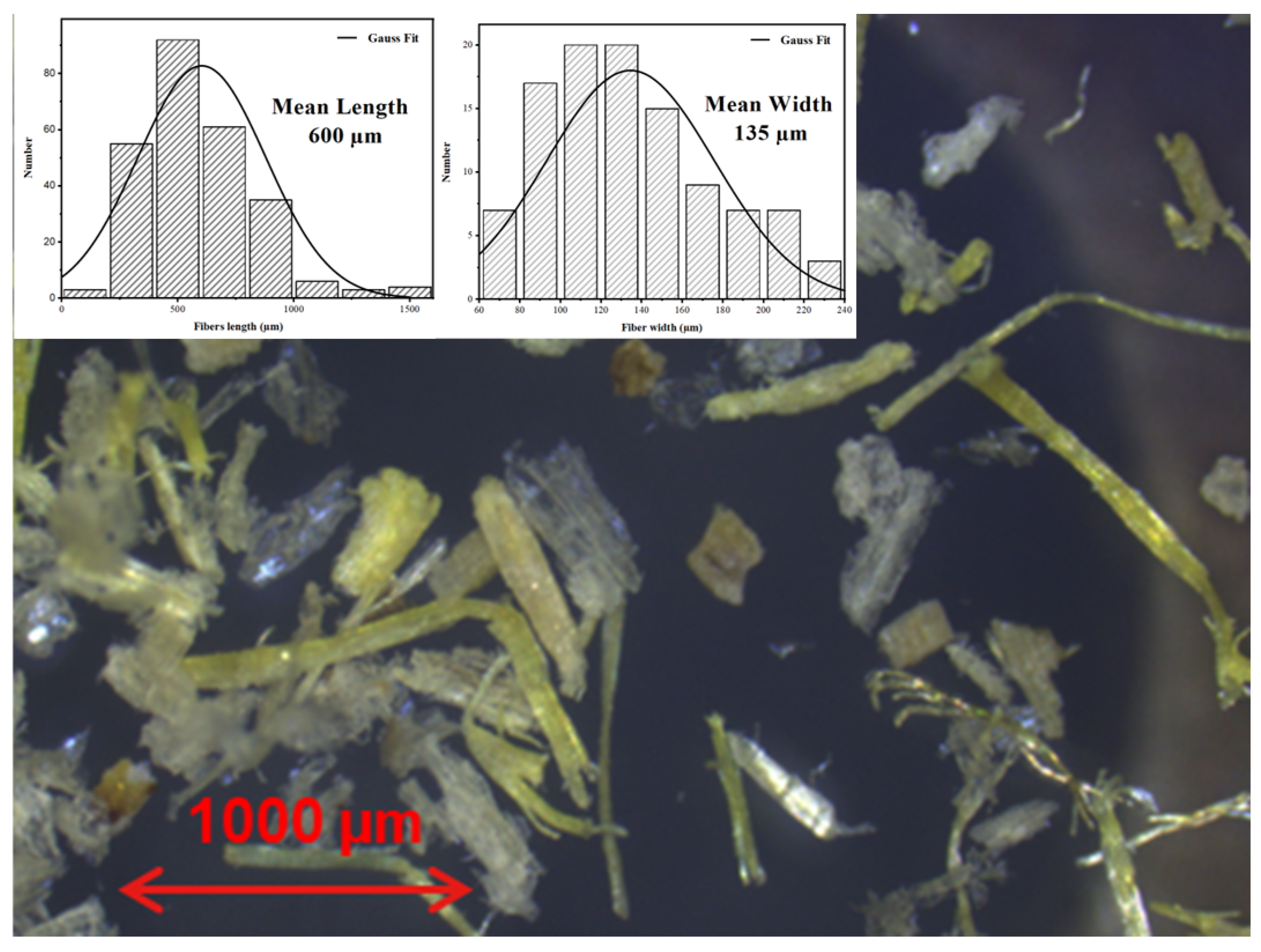
The raw bagasse residue obtained from local sugar refineries underwent a multi-step preparation procedure prior to its use as reinforcement. First, the harvested material was washed under warm running water to remove the soft pulp adhering to the fibrous structure, and the recovered fibrous fraction was further rinsed several times until a clean surface was obtained. The cleaned fibers were subsequently oven-dried at 80 °C over a 12 h period to eliminate any residual moisture that could hinder downstream processing. Once dried, the fibers were size-reduced through mechanical grinding to ensure a more uniform geometric distribution suitable for melt-compounding. The resulting fiber dimensions were quantified by means of optical microscopy, with statistical data extracted from a population of 150 individual fibers. As illustrated in Figure 1, the SCB fibers exhibited an average length of 600 ± 130 µm and a mean diameter of 135 ± 40 µm.

2.3. Chemical Treatment of Bagasse Fibers

In order to remove non-cellulosic constituents (hemicelluloses, lignin residues, waxes) and to attenuate the natural hydrophilic character of the lignocellulosic surface, an alkaline treatment was applied to the ground SCB fibers [26]. The fibers were dispersed in a 2 wt% NaOH aqueous solution and kept under magnetic stirring at ambient temperature (≈25 °C) for 2 h; this concentration had been previously optimized by our group [27]. After the soaking step, the treated fibers were repeatedly washed with deionized water acidified by a few drops of acetic acid, in order to neutralize any residual alkaline species adsorbed on the fiber surface. The resulting alkaline-treated fibers, hereafter denoted TSCB, were finally oven-dried at 80 °C for 24 h before being incorporated into the polymeric matrix. The surface state of the fibers before and after NaOH treatment is presented and discussed in the Supplementary Materials.

2.4. Processing and Preparation of the Biocomposites

2.4.1. Melt Extrusion and Injection Molding

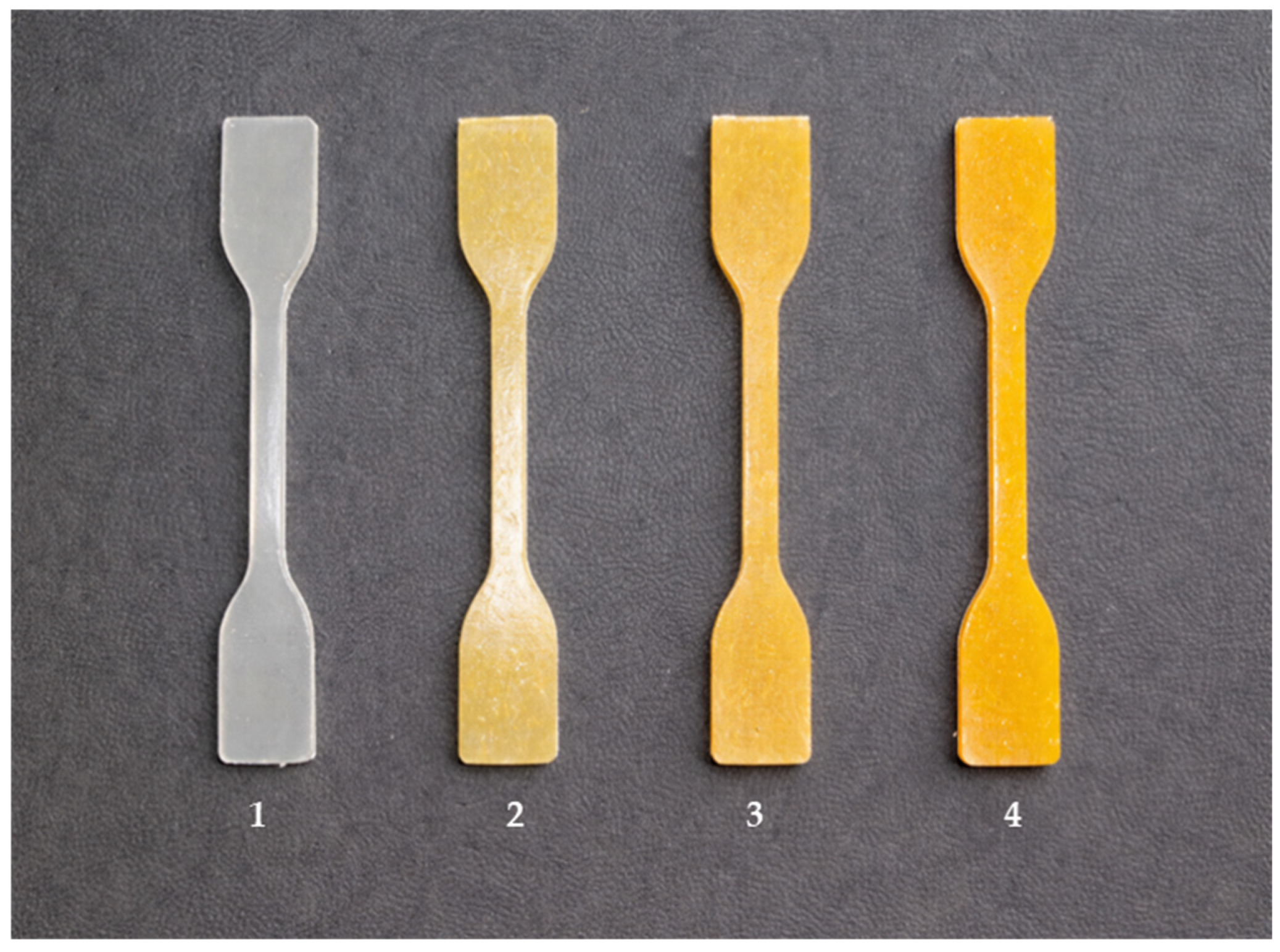
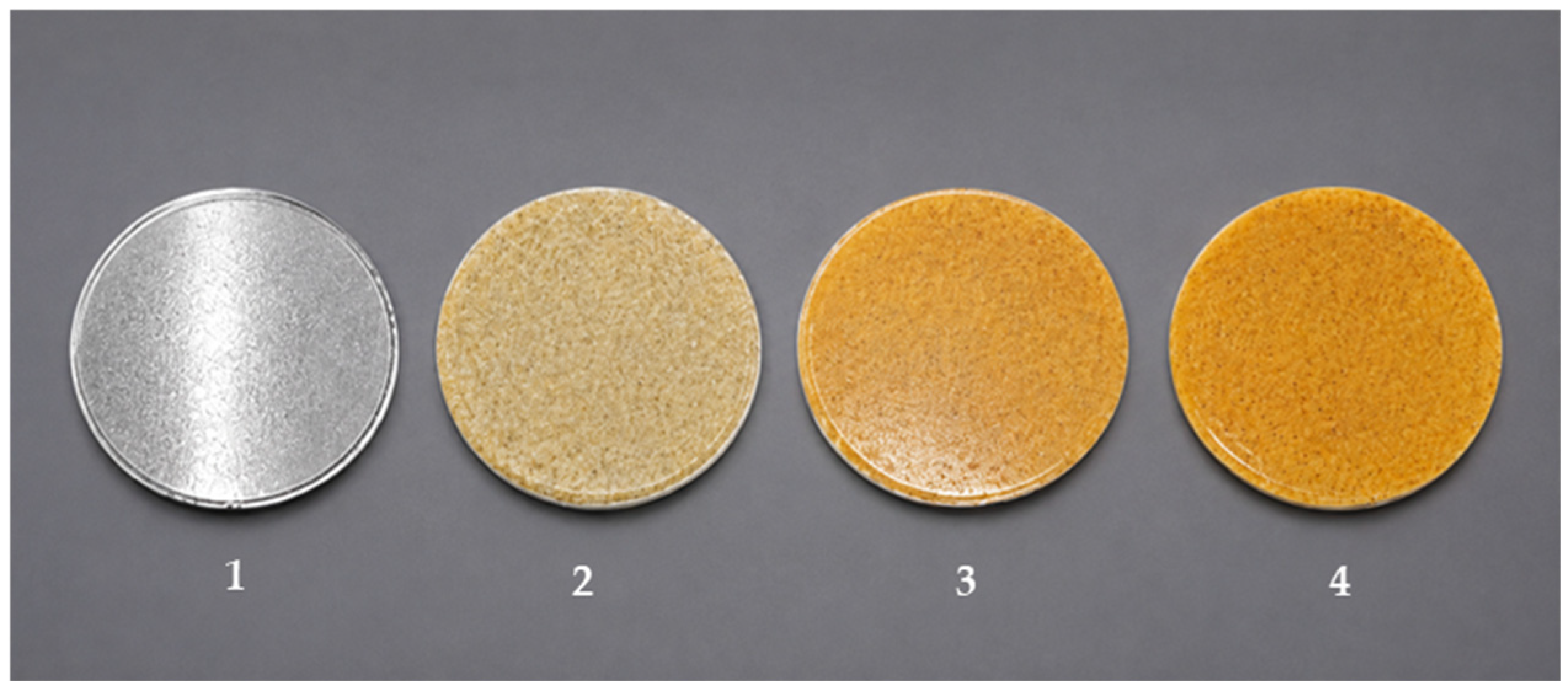
Composite formulations were prepared via melt-compounding using a co-rotating conical twin-screw micro-extruder (DSM Xplore, 15 mL chamber capacity, Geleen, The Netherlands), operated under nitrogen purge to minimize oxidative and hydrolytic degradation of the PLA matrix during processing. The mixing parameters, barrel temperature of 170 °C, residence time of 3 min and screw rotation speed of 100 rpm, were established beforehand based on the rheological time-sweeps and the thermogravimetric measurements presented later in the thermal stability section. Immediately after compounding, the molten material was transferred to a Micro 5 cc mini-injection unit (DSM Xplore) operating at an injection pressure of 5 MPa, with the barrel and mold-holder temperatures regulated at 180 °C and 60 °C, respectively. Two specimen geometries were produced, namely dog-bone tensile bars (thickness 2 mm) and disk-shaped samples (Ø 25 mm × 2 mm) intended for rheological measurements (Figure 2 and Figure 3). Four formulations were prepared with increasing contents of treated sugarcane bagasse (TSCB) fibers (0, 5, 10 and 15 wt%). The corresponding sample designations are summarized in Table 1.

2.4.2. 3D Printing Setup and Processing Parameters

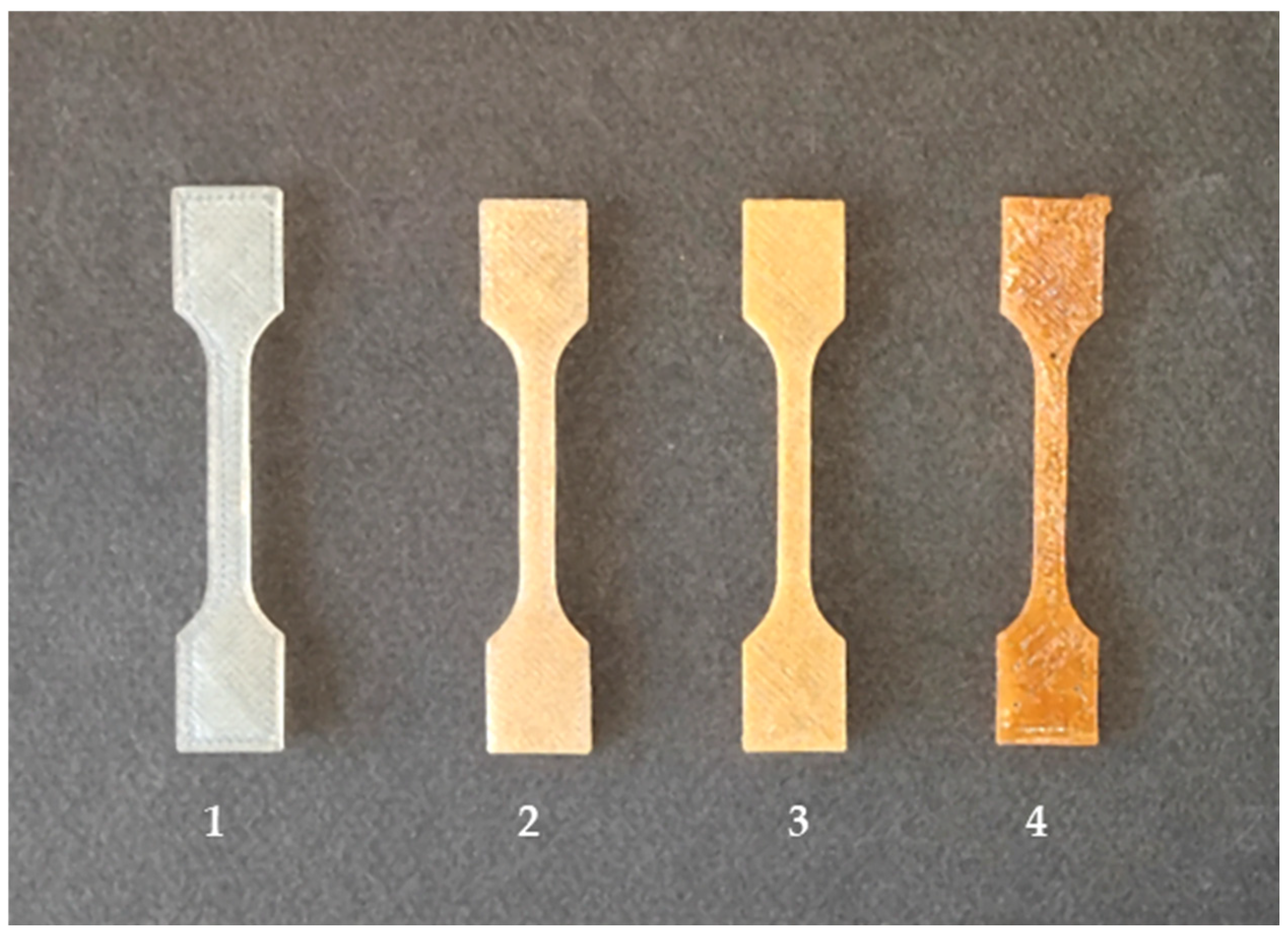
Material extrusion (MEX) additive manufacturing was carried out on a Tobeca printer equipped with a hopper-fed extrusion head, providing an effective build envelope of 900 × 400 × 400 mm3. The previously melt-compounded PLA/PEG/TSCB granules were directly fed into the hopper, while the plasticized PLA/PEG filament reference used for comparison had a nominal diameter of 1.75 mm. The geometry of the tensile specimens was modeled in CATIA V5, exported as STL files, and subsequently converted into machine-readable G-code through Repetier-Host slicing software, version 2.3.2. The printed samples (Figure 4) were obtained under the following set of parameters: nozzle temperature ≈ 200 °C, build-plate temperature 60 °C, deposition velocity 35 mm/s, nozzle orifice 0.6 mm, and infill density set to 100%. Despite the relatively coarse fiber dimensions (average length ≈ 600 µm, diameter ≈ 135 µm), no nozzle obstruction was reported during the printing process. This favorable behavior is attributed to the prior melt-compounding stage, which promoted both fiber dispersion and partial alignment along the flow direction. The naming convention of the four 3D-printed formulations is summarized in Table 2.

2.5. Fourier Transform Infrared Spectroscopy (FTIR)

FTIR spectra of the biocomposites were recorded on a Perkin Elmer spectrometer (Waltham, MA, USA) in transmission mode. For each sample, 32 scans were averaged over the 4000–500 cm−1 range at 4 cm−1 resolution.

2.6. Thermogravimetric Analysis (TGA)

The thermal decomposition behavior of the formulations was examined on a TA Instruments Q550 thermobalance (New Castle, DE, USA). Specimens of 5–10 mg were heated from ambient temperature up to 700 °C at a constant ramp of 10 °C/min, while a continuous nitrogen flow of 60 mL/min was maintained throughout the measurement. Preliminary tests carried out under air revealed a more pronounced thermo-oxidative degradation; for the sake of clarity, only the data acquired under inert atmosphere are presented in this work.

2.7. Differential Scanning Calorimetry (DSC) Analysis

DSC measurements were performed on a Mettler Toledo DSC-3 (Columbus, OH, USA) with liquid-nitrogen cooling, under a 50 mL/min nitrogen purge. Each sample (neat PLA and biocomposites) underwent three ramps: heating to 200 °C followed by a 2 min isothermal hold to erase the thermal history, cooling to 25 °C at 10 °C/min to probe matrix crystallization, and a second heating from 25 °C to 200 °C at the same rate. The degree of crystallinity (Xc) was calculated from the second heating thermogram using Equation (1):
X c % = H m H c c 1 w × H ° m × 100
where Δ H m and Δ H c c denote, respectively, the experimental enthalpies (J/g) of melting and the cold crystallization extracted from the thermogram, (w) corresponds to the mass fraction (wt%) of the charges withing the composites, and H m 0 is the reference enthalpy of fusion of fully (100%°) crystalline PLA, taken as 93.6 J/g [28].

2.8. Scanning Electron Microscopy (SEM)

The internal microstructure and the fiber–matrix arrangement of the composites obtained from both processing routes were observed by scanning electron microscopy on a JEOL 7600F FEG instrument (JEOL Ltd., Tokyo, Japan) operating at an accelerating voltage of 8 kV. Prior to imaging, the specimens were immersed in liquid nitrogen for 2 min and subsequently fractured to obtain brittle cryo-fracture surfaces, which were then sputter-coated with a thin metallic conductive layer to prevent charging effects under the electron beam.

2.9. Rheological Assessment of Thermal Stability

Small-amplitude oscillatory shear measurements in the molten state were performed in order to probe the viscoelastic response of the neat polymer and of the biocomposites under processing-relevant thermal conditions. To eliminate any residual moisture that could trigger hydrolytic chain scission of PLA, all specimens were dried under vacuum at 80 °C for 8 h prior to testing. The measurements were carried out on a Rheometrics ARES rheometer fitted with a 25 mm parallel-plate geometry, under a continuous nitrogen blanket. A constant testing temperature of 190 °C was selected as it is representative of the actual processing window of both injection molding and FDM 3D printing. The disk samples were inserted between the preheated plates with a fixed gap of 1.5 mm and equilibrated for 3 min before any data acquisition, in order to relax residual crystallinity and ensure a fully molten state. To guarantee the reproducibility of the measurements, each formulation was tested in triplicate.

2.10. Mechanical Properties

Uniaxial tensile testing was conducted on an Instron universal testing machine following the ISO 527-2:2012 standard [29] with Type 1BA dog-bone specimens (gauge dimensions: 20 × 4 × 2 mm3, length × width × thickness). The tests were carried out at room temperature (23 °C) under a constant crosshead displacement rate of 5 mm/min. To prevent any moisture absorption, the samples were dried in a vacuum oven at 70 °C for 6 h and stored within sealed desiccators until measurement. Each reported value corresponds to the arithmetic average of five replicates per formulation. The engineering tensile stress (σ), the engineering tensile strain (ε), and Young’s modulus (E) were derived from the load–displacement curves using the classical relations given in Equations (2)–(4):
σ = F A 0
ε = L L 0
E = σ ε
where F denotes the instantaneous tensile force (N), A0 is the initial cross-sectional area of the gauge region (mm2), L is the elongation undergone by the specimen during loading (mm), L 0 corresponds to the initial gauge length (mm), and E (MPa) is computed from the slope of the linear elastic portion of the resulting stress–strain curve.

3. Results and Discussion

3.1. Structural Properties (FTIR)

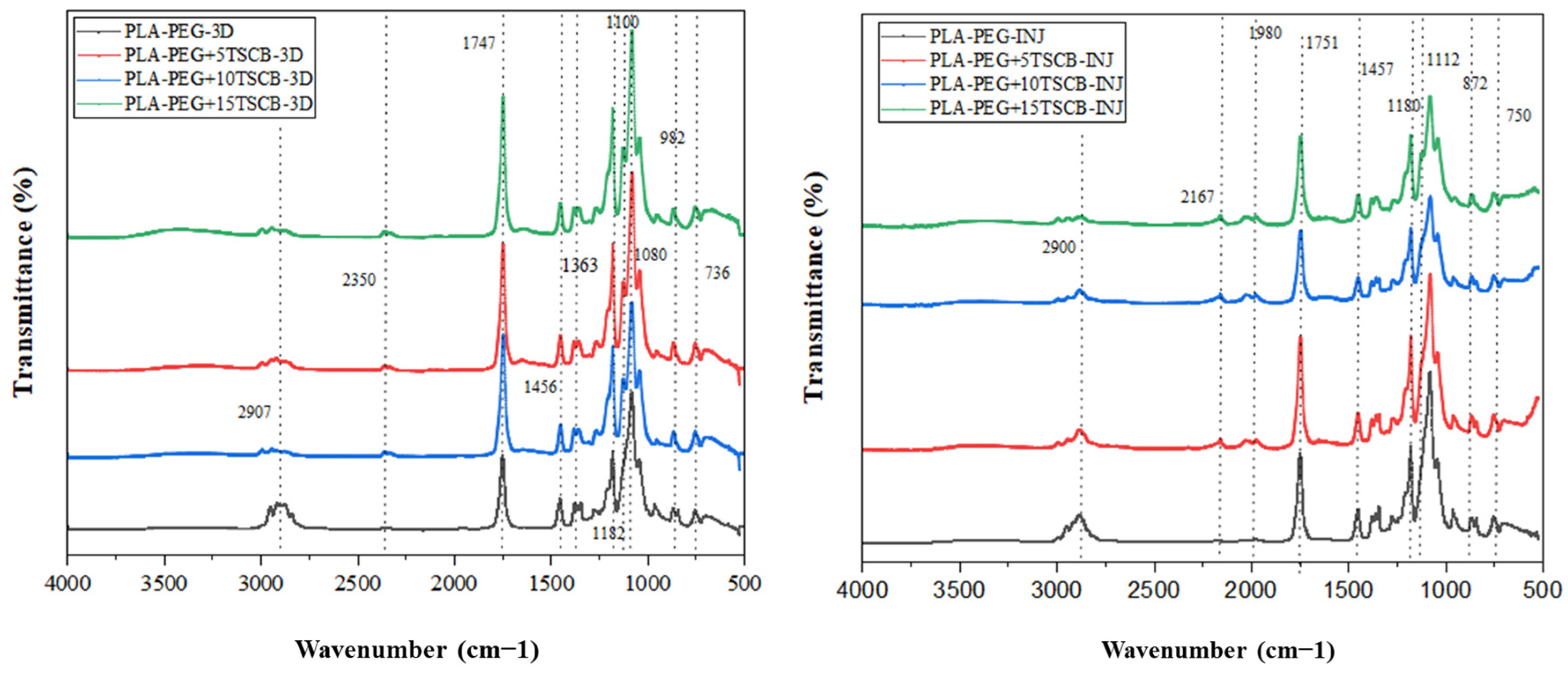
FTIR was used to identify the functional groups in the PLA/PEG/TSCB composites and probe possible interactions between components. Figure 5 shows the spectra of the printed and injected samples; peak assignments are listed in Table 3. Three main regions can be distinguished. The typical peak of the composites at 2900 cm−1 and 2350 cm−1 is attributed to C–H stretching. The band 2167 cm−1, corresponding to C-C (alkyne stretching), is attributed to atmospheric CO2 absorption. The peak is weak. Peaks at 1980 cm−1, 1751 cm−1 and 1747 cm−1 are attributed to C=O stretching. Peaks at 1456 cm−1, 1457 cm−1 and 1363 cm−1 are attributed to CH3 bending. Peaks at 1180 cm−1, 1080 cm−1, 1112 cm−1 and 736 cm−1 are assigned to C–O stretch. The band at 872 cm−1 is assigned to the amorphous region in cellulose [30]. Crystalline phases of PLA are attributed to 750 cm−1 wavenumbers. Overall, the peak positions shows that the main chemical functional groups are preserved regardless of the processing method.

3.2. Thermal Properties

3.2.1. Thermal Stability and Degradation Behavior

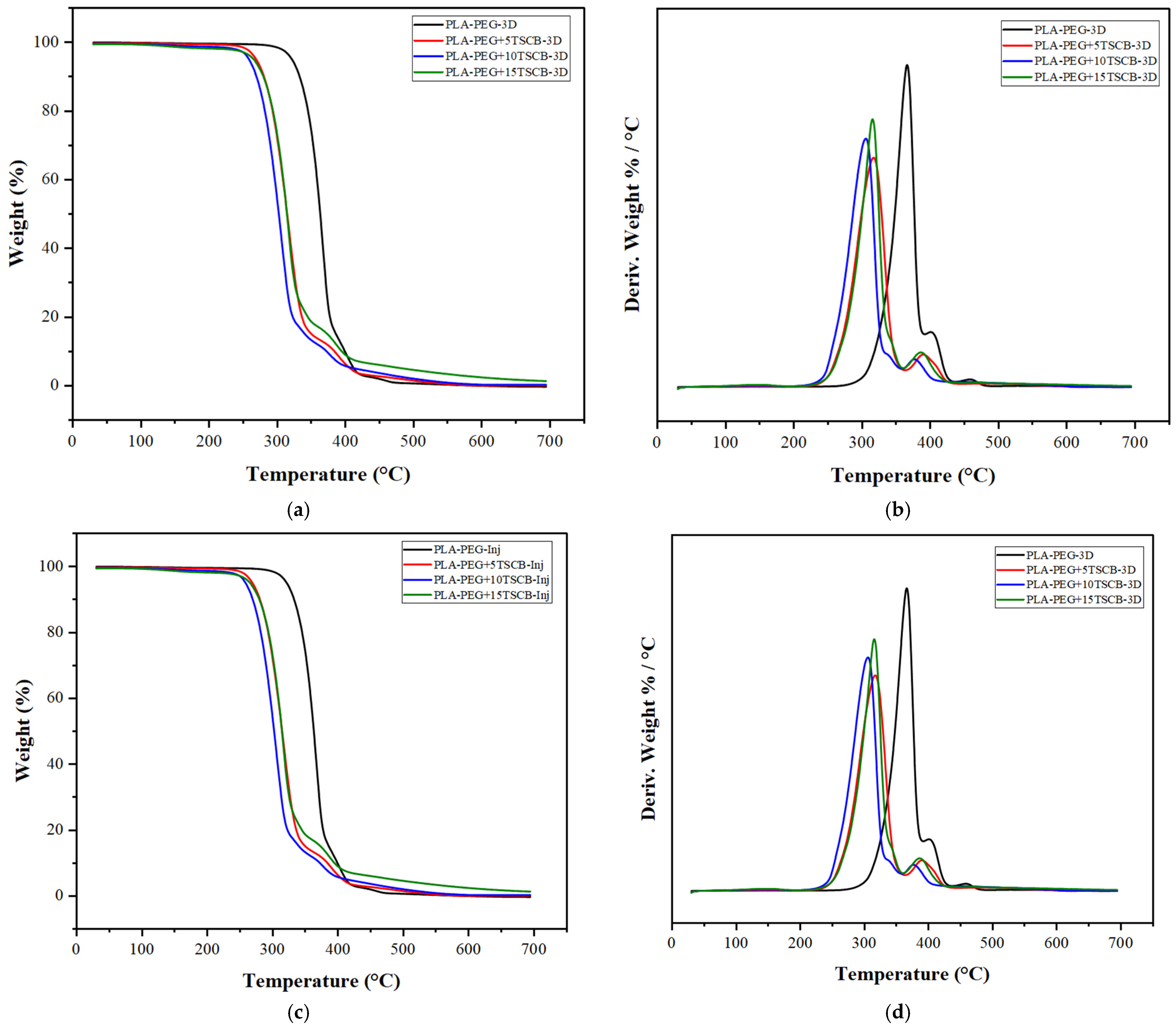
Figure 6 represents the thermal degradation and the derivative thermal degradation of PLA-based composites plasticized with PEG and reinforced with TSCB fibers for both manufacturing methods. Both 3D-printed and injection-molded specimens exhibit a single main degradation step, a common characteristic of PLA-based composites, followed by a gradual residue formation at higher temperatures. This indicates that the processing method does not impact the fundamental degradation behavior of the PLA/PEG/TSCB composite. Injection-molded samples show a slightly higher onset degradation temperature (Tonset) and a delayed maximum degradation temperature (Tmax) compared to the 3D-printed samples. The composite’s onset degradation temperature was around 260 °C and around 350 °C for the PLA/PEG mixture for injected samples. Meanwhile, for 3D-printed parts, the composite’s onset degradation temperature was around 250 °C and around 340 °C for the PLA/PEG mixture. This mass degradation can be mainly explained by the decomposition of the main constituent components of the biocomposites [37]. On the other hand, 3D-printed samples begin thermal degradation at marginally lower temperatures, suggesting reduced thermal stability. This behavior can be attributed to the thermal history repetition experienced during filament extrusion in the 3D printing process, which induces a partial degradation of the polymer chains prior to printing. A similar trend has been reported by El hadi et al. [38], who observed that PLA-based biocomposites reinforced with sugarcane bagasse fibers exhibited slightly lower onset and maximum degradation temperatures when subjected to repeated thermal processing cycles, in good agreement with our observations. The results obtained from the paragraph are summarized in Table 4.

3.2.2. Differential Scanning Calorimetry Properties

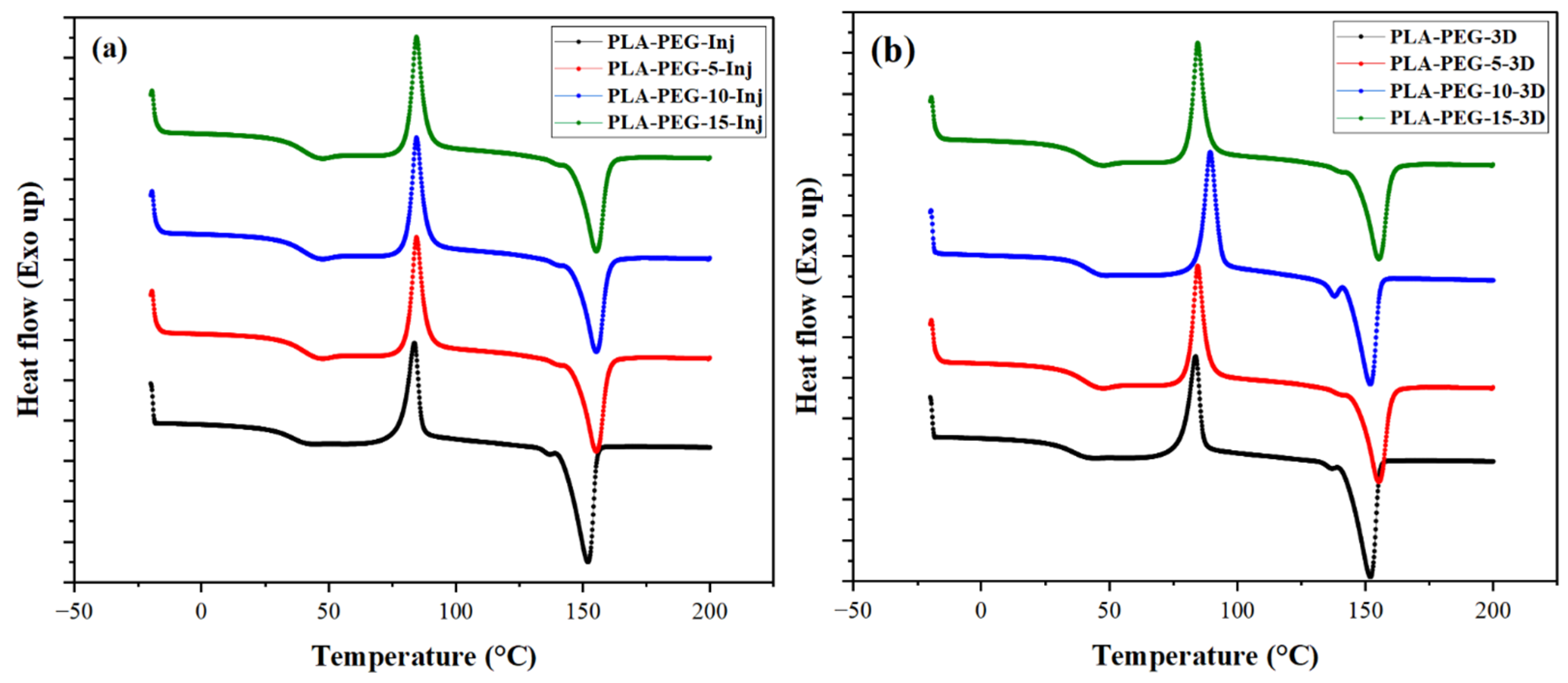
Figure 7 shows the DSC thermograms of the PLA/PEG/TSCB composites obtained by injection molding (Figure 7a) and 3D printing (Figure 7b). Table 5 and Table 6 give the corresponding thermal parameters: glass transition temperature ( T g ), cold crystallization temperature ( T c c ), melting temperature ( T m ), melting enthalpy ( H m ), cold crystallization enthalpy ( H c c ), and degree of crystallinity ( X c ).
The impact of the processing method on the thermal behavior and crystalline structure of the composites is observed. Overall, injection-molded samples exhibit slightly higher or comparable degrees of crystallinity compared to the 3D-printed samples at low and intermediate fiber contents. This behavior is attributed to the longer effective cooling time and thermal homogenization experienced during injection molding, which favor chain rearrangement and crystal growth within the PLA matrix. In contrast, 3D-printed samples generally show lower ΔHm and higher relative contributions of cold crystallization, especially for PLA/PEG specimens. For instance, PLA-PEG-3D exhibits a significantly lower melting enthalpy (ΔHm ≈ 9.73 J.g−1) compared to PLA-PEG-Inj (ΔHm ≈ 20.57 J.g−1), indicating a more amorphous structure after printing. This result confirms that the rapid solidification and cooling related to the 3D printing processing method limit crystal formation during deposition. These observations are in good agreement with the findings of Volkov et al. [39], who demonstrated that the deposition parameters in fused filament fabrication strongly influence the crystallinity development of PLA-based materials, leading to predominantly amorphous structures due to the fast cooling rates inherent to the printing process.
The presence of a pronounced cold crystallization peak (Tcc ≈ 83–88 °C) in all samples indicates that a substantial fraction of the PLA matrix remains amorphous after processing. However, the higher ΔHcc values observed for the 3D-printed samples, particularly at low fiber contents, suggest that printed materials possess a higher ability to crystallize upon reheating. This behavior is consistent with the rapid cooling and limited molecular organization during filament deposition. As fiber content increases, Xc increases for both processing methods, highlighting the nucleating effect of sugarcane bagasse fibers. The lignocellulosic structure, rich in cellulose microfibrils, provides heterogeneous nucleation sites that promote PLA crystallization. This effect becomes particularly evident at 15 wt% fiber content, where comparable crystallinity levels are reached for injection-molded and 3D-printed samples (Xc ≈ 7.5%). A comparable nucleating effect of sugarcane bagasse on the PLA matrix has been previously reported by Mazlina et al. [40], who attributed this enhancement to the abundant hydroxyl groups present on the fiber surface, which act as preferential sites for PLA chain organization and crystal growth.
The glass transition temperature (Tg) remains in the range of 40–46 °C for all composite materials, confirming the plasticizing effect of PEG on the PLA matrix (Tg = 60 °C). The melting temperature (Tm) slightly increases with fiber addition, suggesting the formation of more stable crystalline structures promoted by fiber nucleation. Overall, the DSC analysis confirms that while material extrusion limits crystal development during processing, the presence of lignocellulosic fibers compensates for this effect by enhancing nucleation. This dual influence of the processing route and the natural fiber reinforcement on the crystalline behavior of biocomposites has also been highlighted in the comprehensive review by Bi and Huang [2], which underlines the central role of fiber–matrix interactions in tailoring the thermal and structural properties of 3D-printed natural fiber composites.

3.3. Rheological Properties

Thermal Stability of PLA-PEG and Biocomposites Prepared by Injection Molding

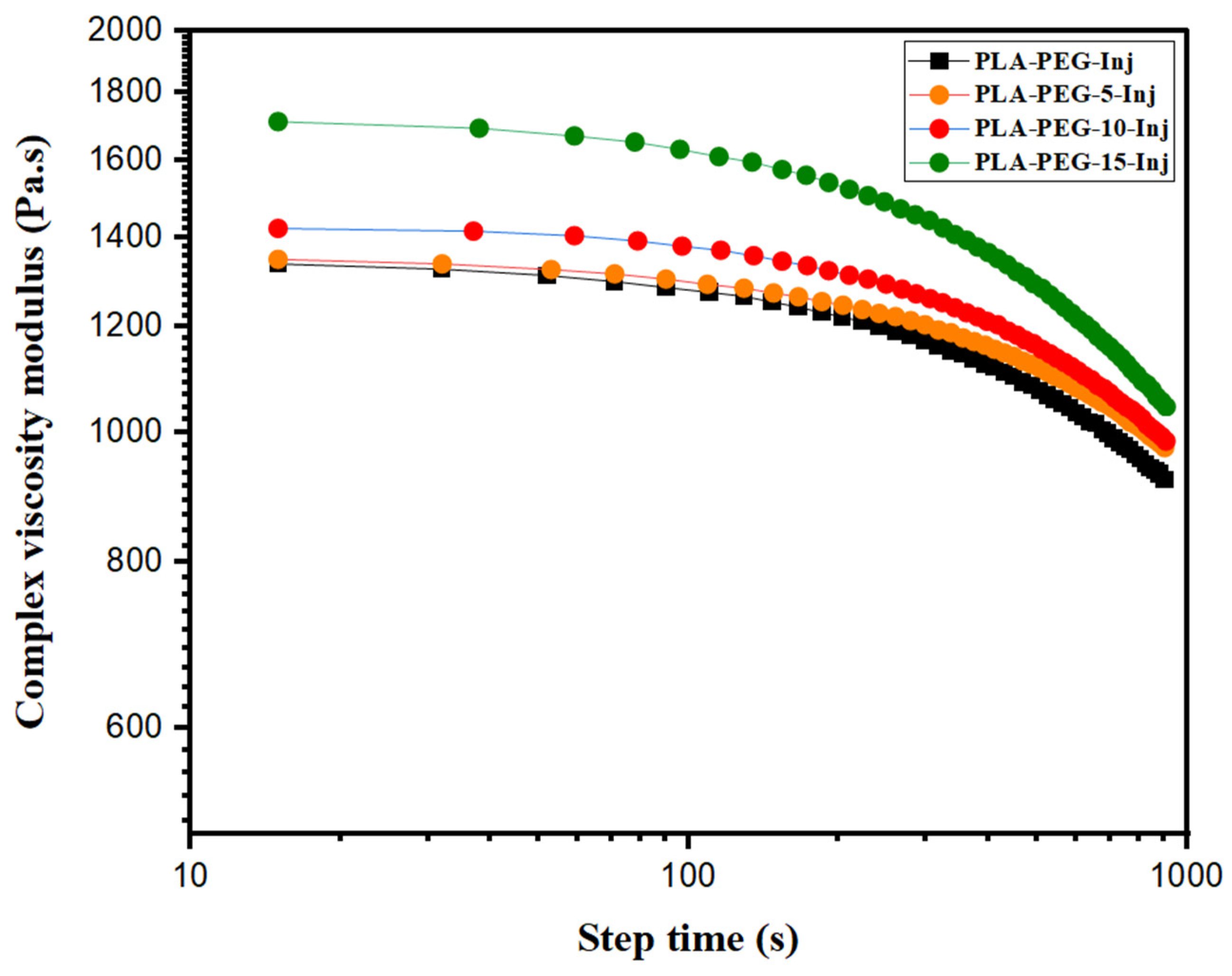
To assess the thermomechanical stability of the PLA/PEG/bagasse formulations prior to 3D printing, a time-sweep rheological test was performed on injection-molded disks at the printing-relevant melt temperature. The evolution of the complex viscosity (η*) as a function of step time provides a direct indication of melt stability under prolonged thermal exposure and shear history, which is critical for material extrusion (MEX) where the polymer remains molten inside the nozzle and hot-end for several minutes. As shown in Figure 8, all formulations exhibit a progressive decrease in complex viscosity with increasing step time, indicating time-dependent melt degradation. A slight decrease in viscosity is observed during the initial stage, followed by a more significant drop after approximately 300 s (≈5 min). This behavior suggests that the formulations remain reasonably stable within a short processing window, which is consistent with typical MEX conditions where a tensile specimen can be printed within a few minutes (e.g., at 40 mm/s). Beyond this time, the accelerated reduction in η* reflects the onset of significant chain scission and molecular weight reduction, which would negatively impact filament integrity, interlayer bonding, and ultimately mechanical performance. The addition of sugarcane bagasse fibers increases the viscosity level over the whole time range, with PLA-PEG-15-Inj showing the highest η* values. This trend stems from the rigid lignocellulosic structure of the fibers, which strengthens hydrodynamic interaction and the formation of a more constrained polymer–filler network, thereby increasing the melt resistance to flow. However, despite this viscosity reinforcement effect, all fiber-filled systems still show a time-dependent viscosity decay, indicating that the fibers do not fully suppress thermal degradation during prolonged melt exposure.
A plausible degradation mechanism is thermo-hydrolytic chain scission of PLA. Natural fibers inherently contain residual moisture and abundant hydroxyl (–OH) groups from cellulose/hemicellulose, which can promote hydrolysis and transesterification reactions at elevated temperature. Similar observations have been reported by Khemakem et al. [41]. Furthermore, recent studies by Ait Balla et al. [21] highlighted the importance of optimizing PLA processing conditions and elucidated its hydrolytic degradation mechanisms in the presence of cellulosic fibers.
The presence of PEG can enhance water uptake due to its hydrophilic nature, thereby increasing the susceptibility of the PLA matrix to hydrolytic degradation. Consequently, increasing fiber content may raise the initial viscosity through filler-induced structuring, while also promoting a more pronounced time-dependent viscosity reduction driven by moisture- and hydroxyl group-assisted degradation mechanisms, particularly under prolonged molten-state conditions. In this context, the rheological data show that the processing window for PLA-based composites is narrow: high enough for the melt to flow, low enough to avoid thermal degradation, in agreement with Khemakhem et al. [41].
Finally, the time-sweep results confirm that the PLA/PEG/bagasse systems exhibit an adequate short-term stability compatible with MEX processing, while highlighting a critical processing-structure-properties relationship: maintaining a short residence time in the nozzle (≤~5 min) is essential to limit viscosity loss and preserve printability and interlayer cohesion. These findings support the processing strategy adopted in this study and provide a rheological justification for the observed differences in printed part quality and mechanical performance.

3.4. Mechanical Results

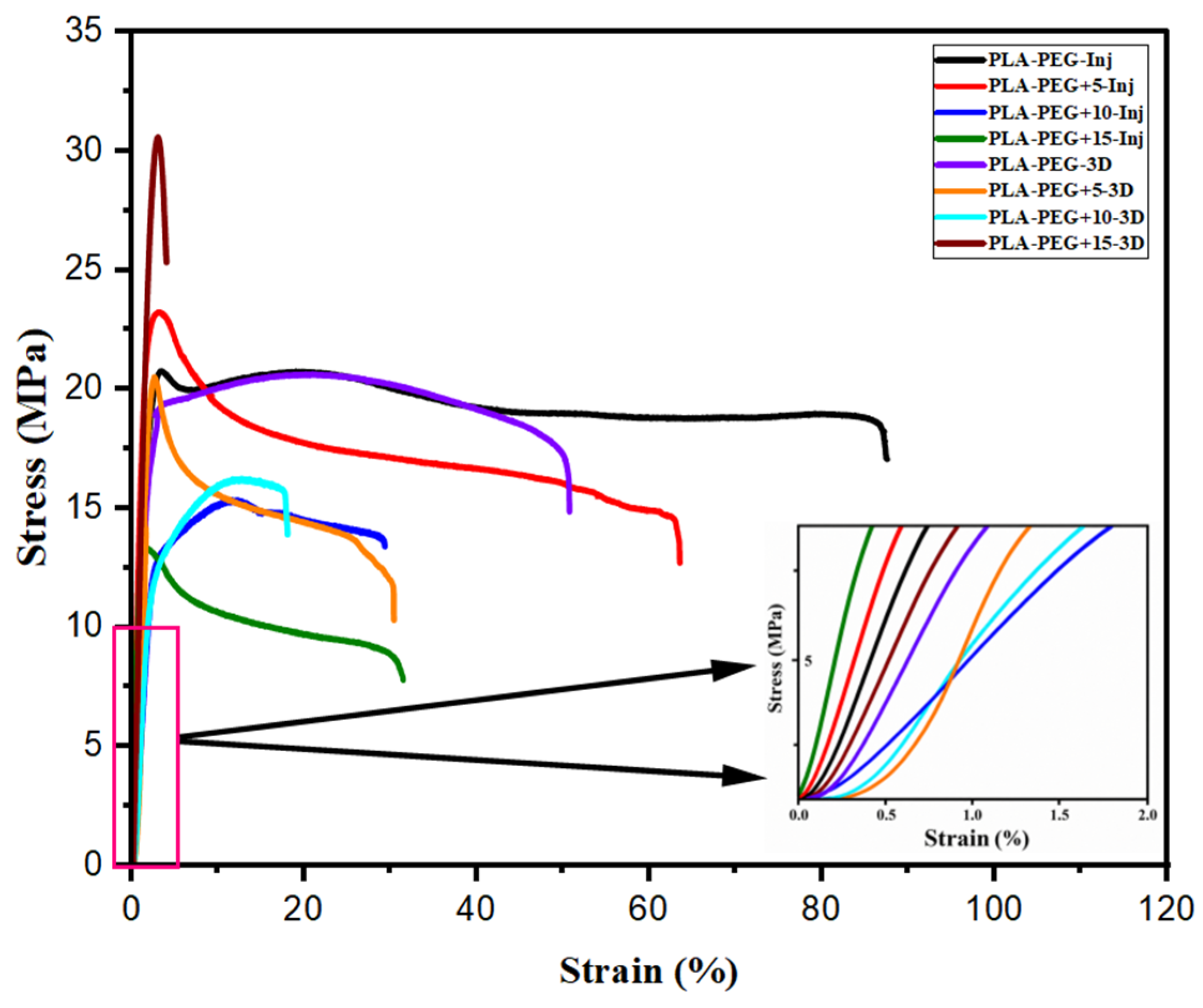
The tensile stress–strain curves of the PEG-plasticized PLA composites reinforced with different contents of TSCB and processed by injection molding and FDM 3D printing are shown in Figure 9. All samples exhibit a characteristic mechanical response composed of an initial linear elastic region followed by a plastic deformation stage up to the maximum stress. After reaching this peak, a gradual stress decrease is observed with increasing strain until final fracture, reflecting a ductile failure behavior, particularly for the PEG-plasticized PLA composites.
Figure 9, Table 7 and Table 8 summarize the tensile Young’s modulus, tensile strength, and strain at yield respectively, derived from the stress–strain curves. PLA/PEG exhibits a ductile behavior due to the plasticizing effect of PEG, which enhances polymer chain mobility and significantly enlarges the plastic deformation region. This behavior is clearly reflected by the high strain at yield obtained for the injection-molded PLA-PEG sample (=87%), confirming the efficiency of PEG in converting rigid PLA into a more flexible and ductile material.
A significant difference in mechanical properties is observed between the two processing methods. Injection-molded specimens consistently exhibit higher stiffness compared to the 3D-printed parts. The Young’s modulus of injection-molded composites increases from approximately 1.1 GPa for PLA-PEG-Inj to about 2.7 GPa for PLA-PEG-15-Inj, indicating a progressive stiffening effect induced by the incorporation of sugarcane bagasse fibers. In contrast, the elastic modulus of the 3D-printed samples remains significantly lower, ranging between approximately 1.06 and 1.65 GPa, regardless of fiber content. This reduction is mainly attributed to the presence of interlayer voids, and higher porosity due to the layer-by-layer deposition process.
The tensile strength follows a similar trend. Injection-molded PLA-PEG exhibits a tensile strength of about 18.2 MPa, which gradually decreases with increasing fiber content, reaching approximately 7.8 MPa for the PLA-PEG-15-Inj composite. This reduction is mainly attributed to fiber agglomeration and stress concentration effects at higher filler loadings. Nevertheless, injection-molded samples systematically show higher tensile strength than the 3D-printed parts. The strain at yield decreases with increasing fiber content for both processing methods. For injection-molded samples, the strain at yield decreases from approximately 87% for PLA-PEG-Inj to about 31% for PLA-PEG-15-Inj, while for 3D-printed materials it decreases from 51% to below 10% for the same fiber content range. This loss of ductility is attributed to the rigid nature of lignocellulosic fibers, particularly cellulose, which restricts polymer chain mobility. In addition, fiber agglomeration and increased porosity accelerate breakage, especially in the 3D-printed composites. A consistent behavior was previously documented by Lendvai [42], who reported a marked decrease in both tensile strength and elongation at break with increasing lignocellulosic filler content in PLA-based biocomposites, attributing this phenomenon to the limited interfacial adhesion between the hydrophilic natural fibers and the hydrophobic PLA matrix, which is in good accordance with the trends observed in our investigation.

3.5. Morphological Properties

Following the analysis of the mechanical properties, scanning electron microscopy (SEM) was employed to investigate the morphological features of PLA/PEG/TSCB composites processed by injection molding and material extrusion (3D printing).
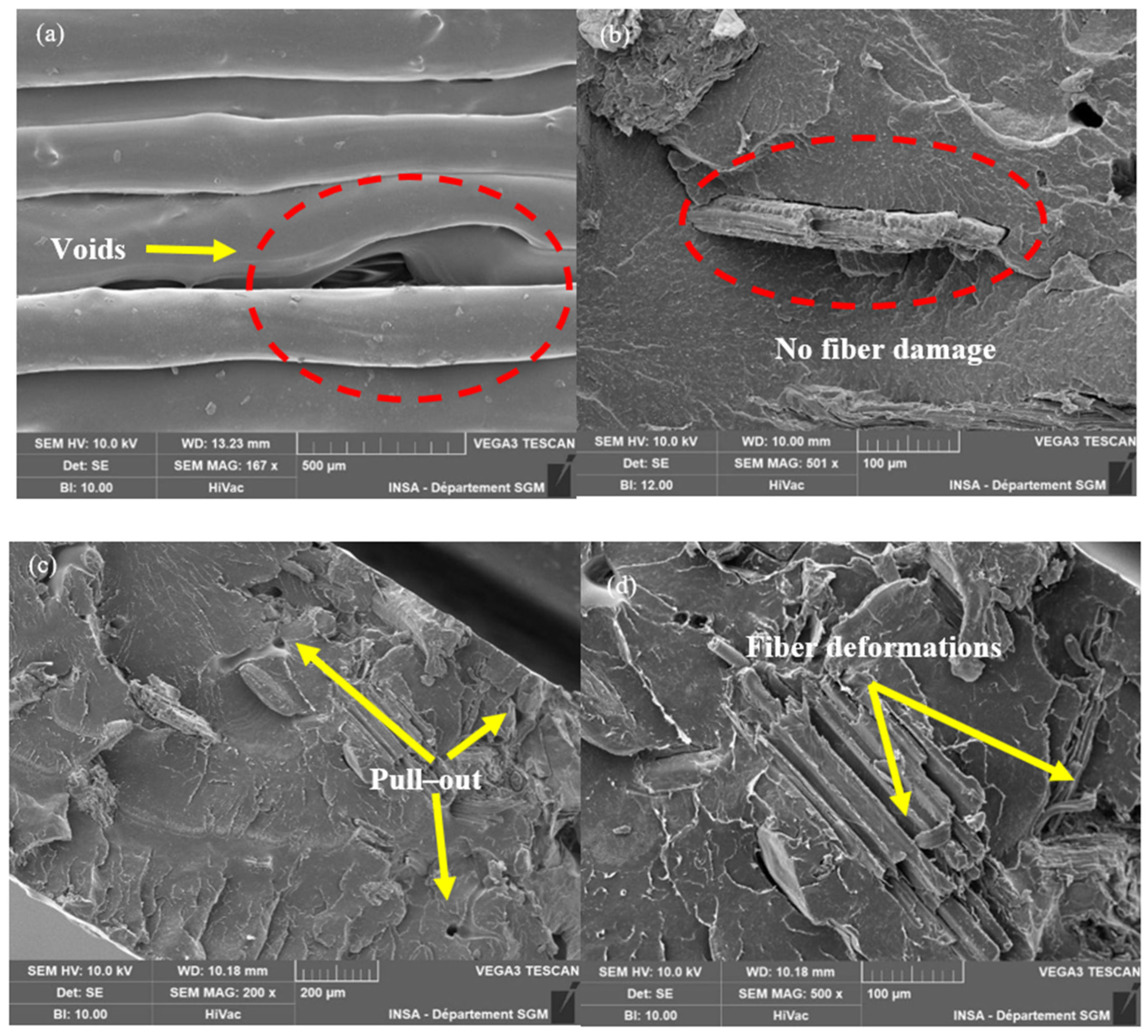
Figure 10 presents SEM micrographs of the fracture surfaces of 3D-printed and injection-molded PLA/PEG composites reinforced with TSCB fibers after tensile testing. As shown in Figure 10a,b, the 3D-printed specimens exhibit a characteristic layered morphology with clearly distinguishable deposited filaments and partial separation between adjacent layers. These interlayer gaps are inherent to the material extrusion process and arise from limited molecular diffusion between successive layers during deposition. Such defects promote stress concentration and facilitate crack initiation under tensile loading, thereby explaining the lower mechanical performance of the printed samples.
Despite the presence of interlayer porosity, the morphology of the sugarcane bagasse fibers in the 3D-printed composites remains remarkably well preserved, as evidenced by the absence of fiber breakage or severe deformation. The fibers retain their original length, shape, and surface features, indicating that the material extrusion process induces minimal thermomechanical stress on the lignocellulosic reinforcement. This observation highlights one of the major advantages of additive manufacturing, namely its ability to process fiber-reinforced biocomposites while preserving the intrinsic structural integrity of natural fibers.
In contrast, the fracture surfaces of the injection-molded composites (Figure 10c,d) reveal a much denser and more homogeneous microstructure, with improved fiber–matrix contact and the absence of macroscopic voids. This densification explains the superior stiffness and tensile strength obtained through injection molding. However, SEM observations also show clear signs of fiber deformation, fragmentation, and pull-out, which can be attributed to the intense thermomechanical stresses experienced during processing. The passage of fibers through the rotating screws, combined with high shear rates and compression forces, leads to partial degradation and shortening of the fibers, thereby altering their original morphology.

4. Conclusions

This study demonstrated the development of eco-friendly PLA-based biocomposites plasticized with PEG and reinforced with Moroccan TSCB fibers. A comparative analysis of injection-molded and melt extrusion additive manufacturing was investigated. The results revealed a strong dependence of composite properties on the processing method. Tensile strength, DSC, TGA, FTIR, melt shear rheological measurements, and SEM testing were conducted. FTIR results indicate that the peak positions preserve the main chemical functional groups regardless of the processing method. TGA results show that the materials are thermally stable and that the processing method does not impact the fundamental degradation behavior of the PLA/PEG/TSCB composite. DSC analysis confirms that while 3D printing limits crystal development during processing, the presence of lignocellulosic fibers compensates for this effect by enhancing nucleation. The rheological measurements suggest that the formulations remain reasonably stable within a short processing window. Injection-molded specimens exhibit higher stiffness compared to the 3D-printed parts. However, morphological characterization showed that injection-molded samples exhibited more homogeneous fiber dispersion and lower porosity, whereas MEX-printed parts presented interlayer voids. These microstructural differences explain the superior tensile strength of injection-molded specimens compared to the 3D-printed ones.
A key insight emerging from this comparison is that the two processes interact very differently with the fiber phase: extrusion and injection molding subject the bagasse fibers to severe thermomechanical solicitations that alter their morphology and shorten their length, whereas FDM 3D printing preserves their original aspect ratio and structural integrity. This fundamental contrast directly accounts for the distinct mechanical, thermal, and morphological responses observed between the two sets of samples.
Overall, PEG TSCB-reinforced PLA biocomposites are considered as sustainable engineering materials suitable for 3D printing applications.
These findings highlight the potential of PLA/PEG/TSCB biocomposites for a wide range of applications. Due to their biodegradability, low environmental impact, and suitable mechanical properties, these materials are promising candidates for lightweight structural components, packaging materials, and consumer products. Specifically, injection-molded specimens, which exhibit higher stiffness, better fiber dispersion, and lower porosity, are well suited for load-bearing applications, such as automotive interior components, rigid packaging, and structural parts in construction. In contrast, 3D-printed parts are more appropriate for rapid prototyping, customized designs, and low-load functional components, where design flexibility and manufacturing speed are prioritized over mechanical performance. Building upon the findings of the present comparative study, several promising research directions are envisaged to further extend this work. Future investigations will focus on the chemical surface treatment of sugarcane bagasse fibers through alkaline and silane modifications to enhance fiber–matrix interfacial adhesion. Particular attention will also be devoted to the optimization of FDM printing parameters in order to minimize interlayer porosity and structural anisotropy.

Supplementary Materials

The following supporting information can be downloaded at: https://www.mdpi.com/article/10.3390/su18115536/s1, Figure S1: SEM images of (a) untreated, (b) after alkali treatment SCB fibers and (c) and (d) present SEM images showing the cross-section of an individual SCB fiber [26,43].

Author Contributions

Conceptualization, M.A.B.; Methodology, M.A.B., F.E.L., A.M., K.L. and F.E.A.; Software, M.A.B. and L.E.B.; Validation, A.M., K.L. and F.E.A.; Formal analysis, M.A.B. and L.E.B.; Investigation, M.A.B., F.E.L., L.E.B., A.M., K.L. and F.E.A.; Resources, A.M., K.L. and F.E.A.; Data curation, A.M., K.L. and F.E.A.; Writing—original draft, M.A.B., F.E.L., L.E.B., A.M., K.L. and F.E.A.; Writing—review & editing, M.A.B., F.E.L., L.E.B., A.M., K.L. and F.E.A.; Visualization, A.M., K.L. and F.E.A.; Supervision, A.M., K.L. and F.E.A.; Project administration, A.M., K.L. and F.E.A.; Funding acquisition, A.M., K.L. and F.E.A. All authors have read and agreed to the published version of the manuscript.

Funding

This research received no external funding.

Institutional Review Board Statement

Not applicable.

Informed Consent Statement

Not applicable.

Data Availability Statement

The data that support the findings of this study are available from the corresponding author upon reasonable request.

Acknowledgments

The authors gratefully acknowledge the UM6P, The OCP Foundation, The CNRST and the MESRSI for the through the research program R&D multithematique under the agreement APRD 25146, Project Name MCI-SMB.

Conflicts of Interest

The authors declare that they have no competing financial interests or personal relationships that could have influenced the work presented in this paper.

References

  1. Prasad, V.; Alliyankal Vijayakumar, A.; Jose, T.; George, S.C. A Comprehensive Review of Sustainability in Natural-Fiber-Reinforced Polymers. Sustainability 2024, 16, 1223. [Google Scholar] [CrossRef]
  2. Bi, X.; Huang, R. 3D printing of natural fiber and composites: A state-of-the-art review. Mater. Des. 2022, 222, 111065. [Google Scholar] [CrossRef]
  3. Mateti, T.; Jain, S.; Ananda Shruthi, L.; Laha, A.; Thakur, G. An overview of the advances in the 3D printing technology. In 3D Printing Technology for Water Treatment Applications; Elsevier: Amsterdam, The Netherlands, 2023; pp. 1–37. [Google Scholar] [CrossRef]
  4. Kharat, V.J.; Singh, P.; Sharath Raju, G.; Kumar Yadav, D.; SatyanarayanaGupta, M.; Arun, V.; Majeed, A.H.; Singh, N. Additive manufacturing (3D printing): A review of materials, methods, applications and challenges. Mater. Today Proc. 2023, 143, 172–196. [Google Scholar] [CrossRef]
  5. Grand View Research. Biocomposites Market Size & Share|Industry Report, 2033. 2025. Available online: https://www.grandviewresearch.com/industry-analysis/biocomposites-market (accessed on 1 May 2026).
  6. Grand View Research. Natural Fiber Composites Market Size|Industry Report, 2033. 2024. Available online: https://www.grandviewresearch.com/industry-analysis/natural-fiber-composites-market (accessed on 1 May 2026).
  7. Joseph, T.M.; Kallingal, A.; Suresh, A.M.; Mahapatra, D.K.; Hasanin, M.S.; Haponiuk, J.; Thomas, S. 3D printing of polylactic acid: Recent advances and opportunities. Int. J. Adv. Manuf. Technol. 2023, 125, 1015–1035. [Google Scholar] [CrossRef]
  8. Wang, X.; Huang, L.; Li, Y.; Wang, Y.; Lu, X.; Wei, Z.; Mo, Q.; Zhang, S.; Sheng, Y.; Huang, C.; et al. Research progress in polylactic acid processing for 3D printing. J. Manuf. Process. 2024, 112, 161–178. [Google Scholar] [CrossRef]
  9. Plamadiala, I.; Croitoru, C.; Pop, M.A.; Roata, I.C. Enhancing Polylactic Acid (PLA) Performance: A Review of Additives in Fused Deposition Modelling (FDM) Filaments. Polymers 2025, 17, 191. [Google Scholar] [CrossRef]
  10. Zeid, M.A.; Awad, M.; Elsabbagh, A. 3D Printing of Natural Fiber-Reinforced Composites. In Encyclopedia of Green Materials; Springer Nature: Singapore, 2025; pp. 13–23. [Google Scholar] [CrossRef]
  11. Somsuk, N.; Pramoonmak, S.; Chongkolnee, B.; Tipboonsri, P.; Memon, A. Enhancing Mechanical Properties of 3D-Printed PLA Composites Reinforced with Natural Fibers: A Comparative Study. J. Compos. Sci. 2025, 9, 180. [Google Scholar] [CrossRef]
  12. Srivastava, P.; Arumugam, A.B.; Agrawal, A.P.; Ntumba, Z.N. Development of Hemp Fiber Reinforced PLA Composites for Sustainable 3D Printing: Mechanical and Microstructural Properties. J. Nat. Fibers 2025, 22, 2558214. [Google Scholar] [CrossRef]
  13. Belcadi, O.; Ait Balla, M.; Legrand, C.; Lyagoubi, N.; Laaguel, F.E.; Khalij, L.; Desilles, N.; Gautrelet, C.; El Minor, H.; Arrakhiz, F.E. Impact of process parameters and coupling agent on the thermal stability of argan nut shell composites. J. Compos. Mater. 2025, 59, 171–186. [Google Scholar] [CrossRef]
  14. Laaguel, F.E.; Ait Balla, M.; Elbrigui, L.; Erchiqui, F.; Maazouz, A.; Arrakhiz, F.E. A Comparative analysis of mechanical and thermal properties of Injection molded and Additive manufactured Argan nut shell particles reinforced polypropylene. Front. Sci. Eng. Int. J. 2026, 15, 33–42. [Google Scholar] [CrossRef]
  15. Marcuello, C.; Chabbert, B.; Berzin, F.; Bercu, N.B.; Molinari, M.; Aguié-Béghin, V. Influence of Surface Chemistry of Fiber and Lignocellulosic Materials on Adhesion Properties with Polybutylene Succinate at Nanoscale. Materials 2023, 16, 2440. [Google Scholar] [CrossRef] [PubMed]
  16. Lee, C.H.; Khalina, A.; Lee, S.H. Importance of Interfacial Adhesion Condition on Characterization of Plant-Fiber-Reinforced Polymer Composites: A Review. Polymers 2021, 13, 438. [Google Scholar] [CrossRef] [PubMed]
  17. Sun, S.; Weng, Y.; Zhang, C. Recent advancements in bio-based plasticizers for polylactic acid (PLA): A review. Polym. Test. 2024, 140, 108603. [Google Scholar] [CrossRef]
  18. Li, D.; Jiang, Y.; Lv, S.; Liu, X.; Gu, J.; Chen, Q.; Zhang, Y. Preparation of plasticized poly (lactic acid) and its influence on the properties of composite materials. PLoS ONE 2018, 13, e0193520. [Google Scholar] [CrossRef] [PubMed]
  19. Carichino, S.; Scanferla, D.; Fico, D.; Rizzo, D.; Ferrari, F.; Jordá-Reolid, M.; Martínez-García, A.; Corcione, C.E. Poly-Lactic Acid-Bagasse Based Bio-Composite for Additive Manufacturing. Polymers 2023, 15, 4323. [Google Scholar] [CrossRef]
  20. Ait Balla, M.; Belcadi, O.; Maazouz, A.; Lamnawar, K. Polypropylene Composites and Hybrid Composites Reinforced with Sugarcane Bagasse Fibers and Nanoclays: Structure—Processing—Properties Relationships. Polym. Eng. Sci. 2026, 1–16. [Google Scholar] [CrossRef]
  21. Ait Balla, M.; Maazouz, A.; Lamnawar, K.; Arrakhiz, F.E. Biowastes as Reinforcements for Sustainable PLA-Biobased Composites Designed for 3D Printing Applications: Structure–Rheology–Process–Properties Relationships. Polymers 2025, 18, 128. [Google Scholar] [CrossRef]
  22. Iannello, G. 3D Printing of Polymeric Composites with Cellulose Micro-Fibrils. Master’s Thesis, Politecnico di Torino, Turin, Italy, 2020. [Google Scholar]
  23. Pante Leme de Campos, G.; Sinigaglia Lunelli, P.; Guzi de Moraes, E.; Tramontin Souza, M.; Novaes de Oliveira, A.P. Optimization of clay-based ceramic mixtures with sugarcane bagasse fiber for 3D printing. Case Stud. Constr. Mater. 2025, 22, e04693. [Google Scholar] [CrossRef]
  24. Mazur, K.E.; Borucka, A.; Kaczor, P.; Gądek, S.; Bogucki, R.; Mirzewiński, D.; Kuciel, S. Mechanical, Thermal and Microstructural Characteristic of 3D Printed Polylactide Composites with Natural Fibers: Wood, Bamboo and Cork. J. Polym. Environ. 2022, 30, 2341–2354. [Google Scholar] [CrossRef]
  25. Qiao, H.; Sudre, G.; Maazouz, A.; Lamnawar, K. Dual enhancement of dispersion of cellulose nanocrystals, crystallization performance, flexibility and barrier properties through polyethylene glycol coating in melt-processed poly(L-lactide)-based nanocomposites. Ind. Crops Prod. 2025, 224, 120337. [Google Scholar] [CrossRef]
  26. Taha, I.; Steuernagel, L.; Ziegmann, G. Optimization of the alkali treatment process of date palm fibres for polymeric composites. Compos. Interfaces 2007, 14, 669–684. [Google Scholar] [CrossRef]
  27. Ait-Abdellah, A.; Belcadi, O.; Ait Balla, M.; Bounouader, H.; Kaddami, H.; Abidi, N.; Arrakhiz, F.-E. Alkaline treatment of sugarcane bagasse fibers for biocomposite applications. Cellul. Chem. Technol. 2024, 58, 561–575. [Google Scholar] [CrossRef]
  28. Martin, O.; Avérous, L. Poly (lactic acid): Plasticization and properties of biodegradable multiphase systems. Polymer 2001, 42, 6209–6219. [Google Scholar] [CrossRef]
  29. ISO 527-2:2012; Plastics—Determination of Tensile Properties—Part 2: Test Conditions for Moulding and Extrusion Plastics. ISO (International Organization for Standardization): Geneva, Switzerland, 2012.
  30. Properties, T. Native Cellulose: Structure, Characterization and Thermal Properties. Materials 2014, 7, 6105–6119. [Google Scholar] [CrossRef]
  31. Chieng, B.W.; Ibrahim, N.A.; Zin, W.; Yunus, W.; Hussein, M.Z. Poly (lactic acid)/Poly(ethylene glycol) Polymer Nanocomposites: Effects of Graphene Nanoplatelets. Polymers 2014, 6, 93–104. [Google Scholar] [CrossRef]
  32. Nandiyanto, A.B.D.; Ragadhita, R.; Fiandini, M. Interpretation of Fourier Transform Infrared Spectra (FTIR): A Practical Approach in the Polymer/Plastic Thermal Decomposition. Indones. J. Sci. Technol. 2023, 8, 113–126. [Google Scholar] [CrossRef]
  33. Wang, F.; Sun, Z.; Yin, J.; Xu, L. Preparation, Characterization and Properties of Porous PLA/PEG/Curcumin Composite Nanofibers for Antibacterial Application. Nanomaterials 2019, 9, 508. [Google Scholar] [CrossRef]
  34. Mohamed, K.; Miroslav, A.; Katarína, M.; Jaroslav, M. Physical and Electrical Properties of Polylactic Acid-Based Adsorbents for the Malachite Green Dye Removal with Potential Sensoric Application. J. Polym. Environ. 2025, 33, 2776–2797. [Google Scholar] [CrossRef]
  35. Moldovan, A.; Sarosi, I.; Cuc, S.; Prodan, D.; Catalin, A.; Ioan, T. Development and characterization of PLA food packaging composite. J. Therm. Anal. Calorim. 2025, 150, 2469–2481. [Google Scholar] [CrossRef]
  36. Tasci, M.E.; Dede, B.; Tabak, E.; Gur, A.; Sulutas, R.B. Production, Optimization and Characterization of Polylactic Acid Microparticles Using Electrospray with Porous Structure. Appl. Sci. 2021, 11, 5090. [Google Scholar] [CrossRef]
  37. Vellingiri, L.; Arungandhi, K. Comparative analysis of mechanical, thermal, and biodegradability properties of PLA and starch-based bioplastics. Int. J. Mater. Sci. 2024, 5, 35–40. [Google Scholar] [CrossRef]
  38. El-hadi, A.M. Increase the elongation at break of poly (lactic acid) composites for use in food packaging films. Sci. Rep. 2017, 7, 46767. [Google Scholar] [CrossRef] [PubMed]
  39. Volkov, D.S.; Rogova, O.B. Organic Matter and Mineral Composition of Silicate Soils: FTIR Comparison Study by Photoacoustic, Diffuse Reflectance, and Attenuated Total Reflection Modalities. Agronomy 2021, 11, 1879. [Google Scholar] [CrossRef]
  40. Mazlina, N.; Wahab, A.; Mohamad, S.; Fizal, N.S. Characterization and Properties of Durian Skin Fiber Filled Polylactic Acid/Polypropylene Compatibilized with Glut Palmitate Salt. Sci. Res. J. 2023, 20, 85–100. [Google Scholar] [CrossRef]
  41. Khemakhem, M.; Lamnawar, K.; Maazouz, A.; Jaziri, M. Biocomposites based on polylactic acid and olive solid waste fillers: Effect of two compatibilization approaches on the physicochemical, rheological, and mechanical properties. Polym. Compos. 2018, 39, E152–E163. [Google Scholar] [CrossRef]
  42. Lendvai, L. Lignocellulosic agro-residue/polylactic acid (PLA) biocomposites: Rapeseed straw as a sustainable filler. Clean. Mater. 2023, 9, 100196. [Google Scholar] [CrossRef]
  43. Manimaran, P.; Sanjay, M.R.; Senthamaraikannan, P.; Jawaid, M.; George, R. Synthesis and characterization of cellulosic fiber from red banana peduncle as reinforcement for potential applications. J. Nat. Fibers 2019, 16, 768–780. [Google Scholar] [CrossRef]
Figure 1. Fiber distribution by optical microscope.
Sustainability 18 05536 g001
Figure 2. Injected specimens with different TSCB content.
Sustainability 18 05536 g002
Figure 3. Injected disk-shaped samples with different TSCB content for rheological measurements.
Sustainability 18 05536 g003
Figure 4. 3D-printed specimens with different TSCB content.
Sustainability 18 05536 g004
Figure 5. FTIR spectra of PLA/PEG 3D-printed and injected composites.
Sustainability 18 05536 g005
Figure 6. TGA and DTG curves of PLA-based composites plasticized with PEG and reinforced with TSCB fibers: (a,b) 3D-printed specimens and (c,d) injection-molded specimens.
Sustainability 18 05536 g006
Figure 7. DSC thermograms (second heating cycle) of neat PLA-PEG and PLA-PEG-TSCB biocomposites prepared via (a) injection molding and (b) 3D printing process.
Sustainability 18 05536 g007
Figure 8. Results of complex viscosity modulus versus time t of PLA-PEG biocomposites at different contents of the treated sugarcane bagasse fibers at 190 °C.
Sustainability 18 05536 g008
Figure 9. Evolution of Young’s modulus and tensile strength of neat PLA and PLA-PEG/TSCB biocomposites prepared via injection molding and 3D printing.
Sustainability 18 05536 g009
Figure 10. SEM Images of the fracture surface after tensile testing of the 3D-printed samples (a) PLA-PEG-5-3D; (b) PLA-15-3D; and injected specimens (c) PLA-PEG-5-Inj; (d) PLA-PEG-15-Inj.
Sustainability 18 05536 g010
Table 1. Composition of PLA/PEG-based composite prepared via injection molding.
No. SampleSample NamePLA Content
(wt%)
PEG Content (wt%)TSCB Content
(wt%)
1PLA-PEG-Inj85150
2PLA-PEG + TSCB5-Inj80155
3PLA-PEG + TSCB10-Inj751510
4PLA-PEG + TSCB15-Inj701515
Table 2. Composition of PLA/PEG-based composite reinforced with treated sugarcane bagasse (TSCB) fibers prepared by 3D printing.
No. SampleSample NamePLA Content
(wt%)
PEG Content (wt%)TSCB Content
(wt%)
5PLA-PEG-3D85150
6PLA-PEG + TSCB5-3D80155
7PLA-PEG + TSCB10-3D751510
8PLA-PEG + TSCB15-3D701515
Table 3. Peak positions and assignments of chemical groups in PLA/PEG composites.
Peak Positions: Wave Number (cm−1)AssignmentsProcessing Method
2900C–H stretching (aliphatic CH, CH3) [31]INJ/3D
2350C–H group [32]3D
1747C=O stretching [31]3D
1456–1457CH3 asymmetric bending [33]INJ/3D
1363CH3 symmetric bending [34]3D
1180C–O stretch [35]INJ/3D
1080–1112C–O–C, stretching [36]INJ/3D
982CH3 Rocking [37]3D
736C–O stretching [38]3D
2167C–C (alkyne stretching)INJ
1980C=O stretch [39]INJ
1751C=O stretch [39]INJ
872C–O–C symmetric stretchingINJ
750C–O–C bending Crystaline phase [40]INJ
Table 4. Summary of TGA data for PLA/PEG-based samples processed by 3D printing and injection molding.
Sample TypeTonset (°C)Tmax (°C)
3D-printed samples~250~340
Injection-molded samples~260~350
Table 5. Thermal characteristics of PLA/TSCB blends prepared by injection molding with different compositions.
Sample T g (°C) T c c (°C) T m (°C) Δ H m P L A (J.g−1) Δ H c c P L A
(J.g−1)
X c (%)
PLA-PEG-Inj408315220.5718.432.28
PLA-PEG-5-Inj468415421.519.092.7
PLA-PEG-10-Inj458415420.6117.473.7
PLA-PEG-15-Inj4684.515622.7718.447.5
Table 6. Thermal characteristics of PLA/TSCB blends prepared by 3D printing with different compositions.
Sample T g (°C) T c c (°C) T m (°C) Δ H m P L A (J.g−1) Δ H c c P L A
(J.g−1)
X c
PLA-PEG-3D41.5831529.738.381.44
PLA-PEG-5-3D468415415.2212.413.16
PLA-PEG-10-3D4688152.517.8212.046.86
PLA-PEG-15-3D458415518.0412.117.45
Table 7. Tensile modulus (Mpa) and tensile strength (Mpa) for PLA-PEG and all biocomposites.
MethodNo. SampleSampleTensile Modulus (MPa)Tensile Strength (Mpa)
Injection molding1PLA-PEG-Inj1100 (±120)18.23 (±1.3)
2PLA-PEG + 5-Inj1904 (±70)13.58 (±1.1)
3PLA-PEG + 10-Inj2482 (±60)12.9 (±1.5)
4PLA-PEG + 15-Inj2700 (±50)7.81 (±1.8)
3D Printing5PLA-PEG-3D1080 (±70)15.16 (±2.3)
6PLA-PEG + 5-3D1650 (±85)11.38 (±2)
7PLA-PEG + 10-3D1200 (±90)10.68 (±0.9)
8PLA-PEG + 15-3D1060 (±70)9.25 (±1.9)
Table 8. Strain at yield (%) for PLA and all biocomposites.
MethodNo. SampleSampleStrain at Yield (%)
Injection molding1PLA-PEG-Inj87.23 (±8)
2PLA-PEG + 5-Inj63.46 (±10)
3PLA-PEG + 10-Inj29.34 (±12)
4PLA-PEG + 15-Inj31.45 (±16)
3D Printing5PLA-PEG-3D50.72 (±10)
6PLA-PEG + 5-3D30.36 (±13)
7PLA-PEG + 10-3D18.05 (±10)
8PLA-PEG + 15-3D9.08 (±9)
Disclaimer/Publisher’s Note: The statements, opinions and data contained in all publications are solely those of the individual author(s) and contributor(s) and not of MDPI and/or the editor(s). MDPI and/or the editor(s) disclaim responsibility for any injury to people or property resulting from any ideas, methods, instructions or products referred to in the content.