Circular Economy Implementation in the Australian Construction Industry: A SWOT-Oriented Content Analysis



Abstract
1. Introduction
2. Literature Review
2.1. Circular Economy
2.2. Circular Economy in Construction
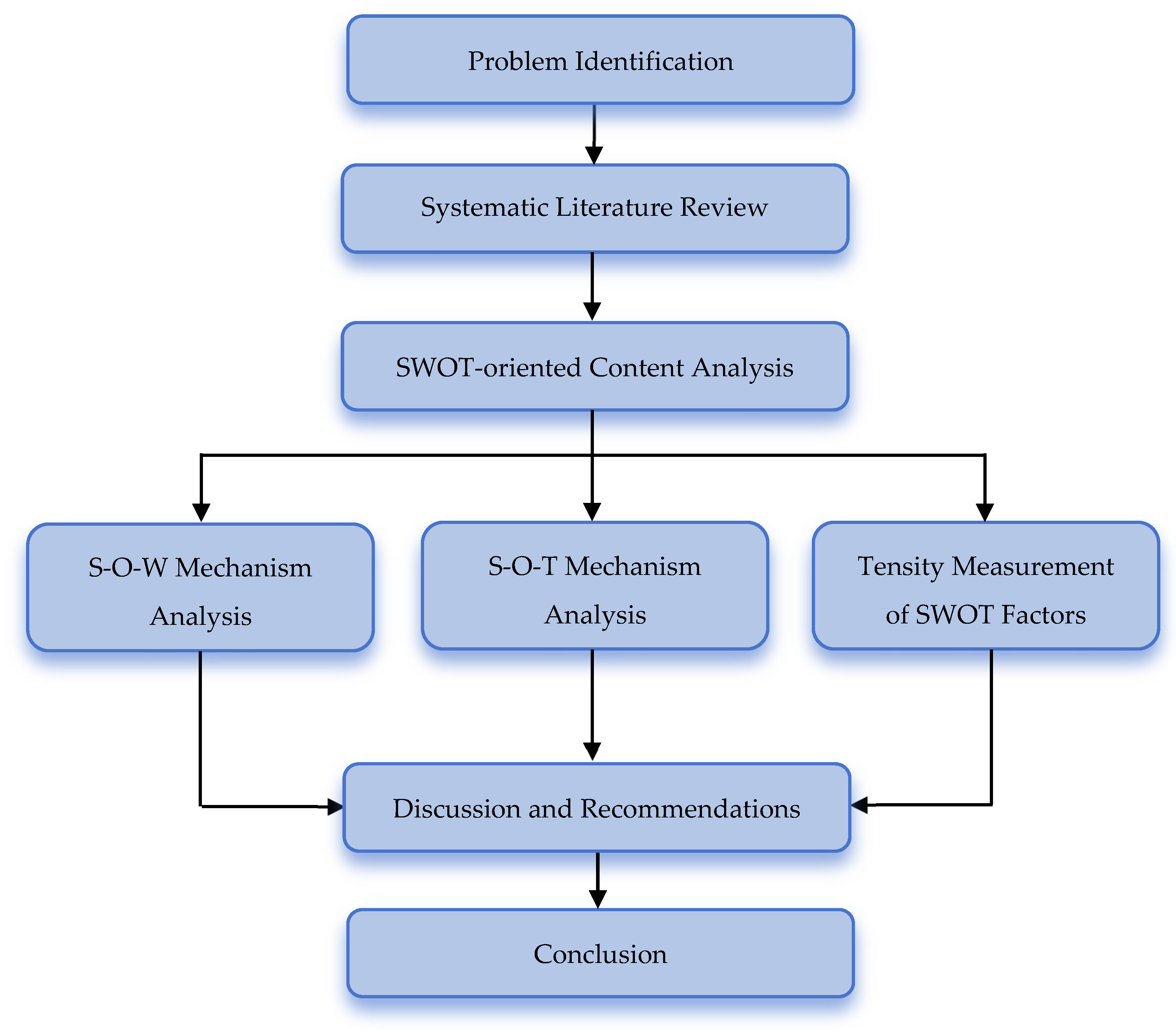
3. Research Methodology
3.1. Systematic Literature Review
3.2. SWOT-Oriented Content Analysis
3.3. Quantitative Analysis of SWOT Factors for CE Improvements
4. Results
4.1. SWOT Factors of CE Implementation
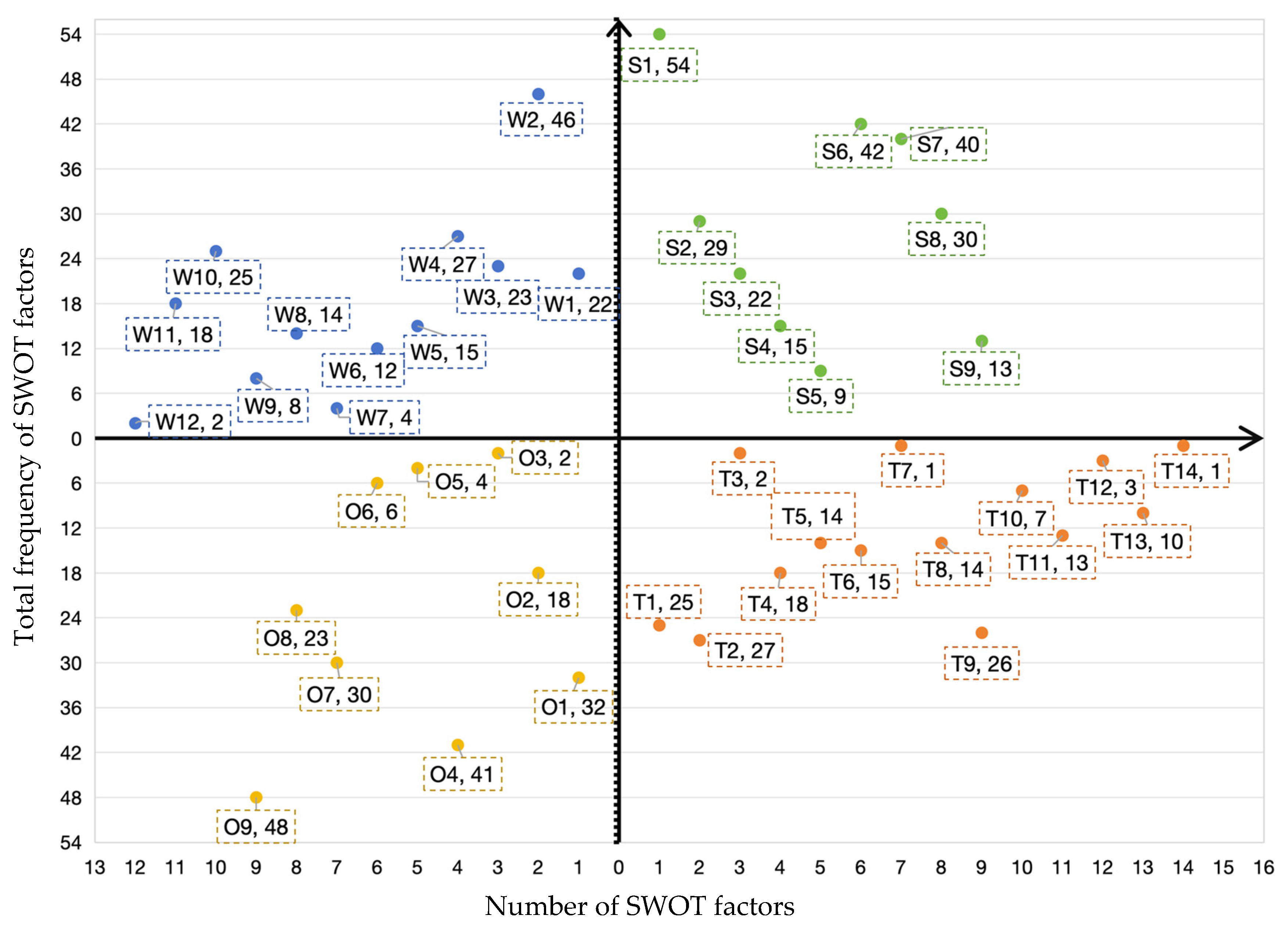
4.2. Frequency Analysis of the SWOT Factors
5. Discussion and Recommendations
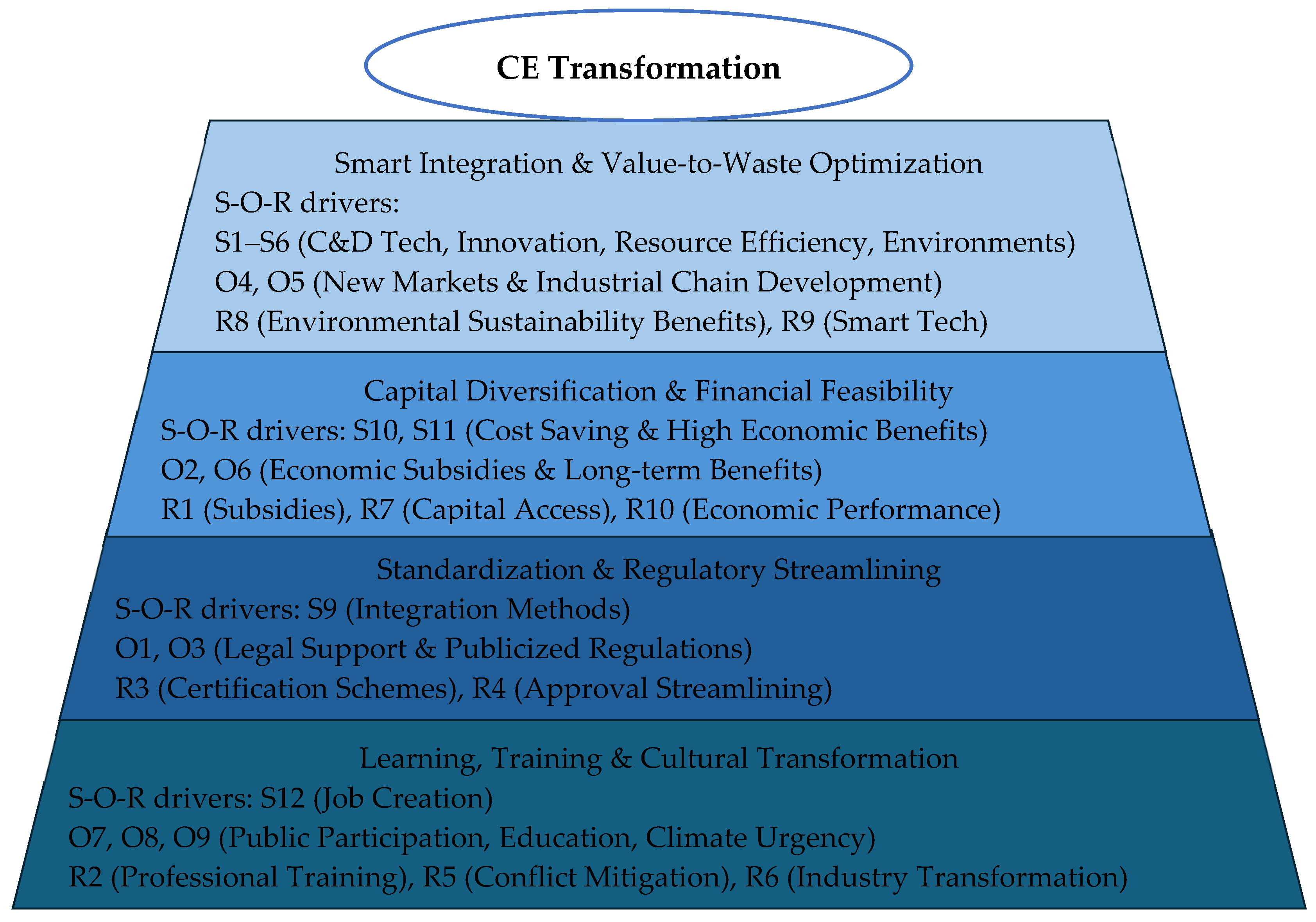
5.1. SWOT-Based Strategic Implications for CE Implementation
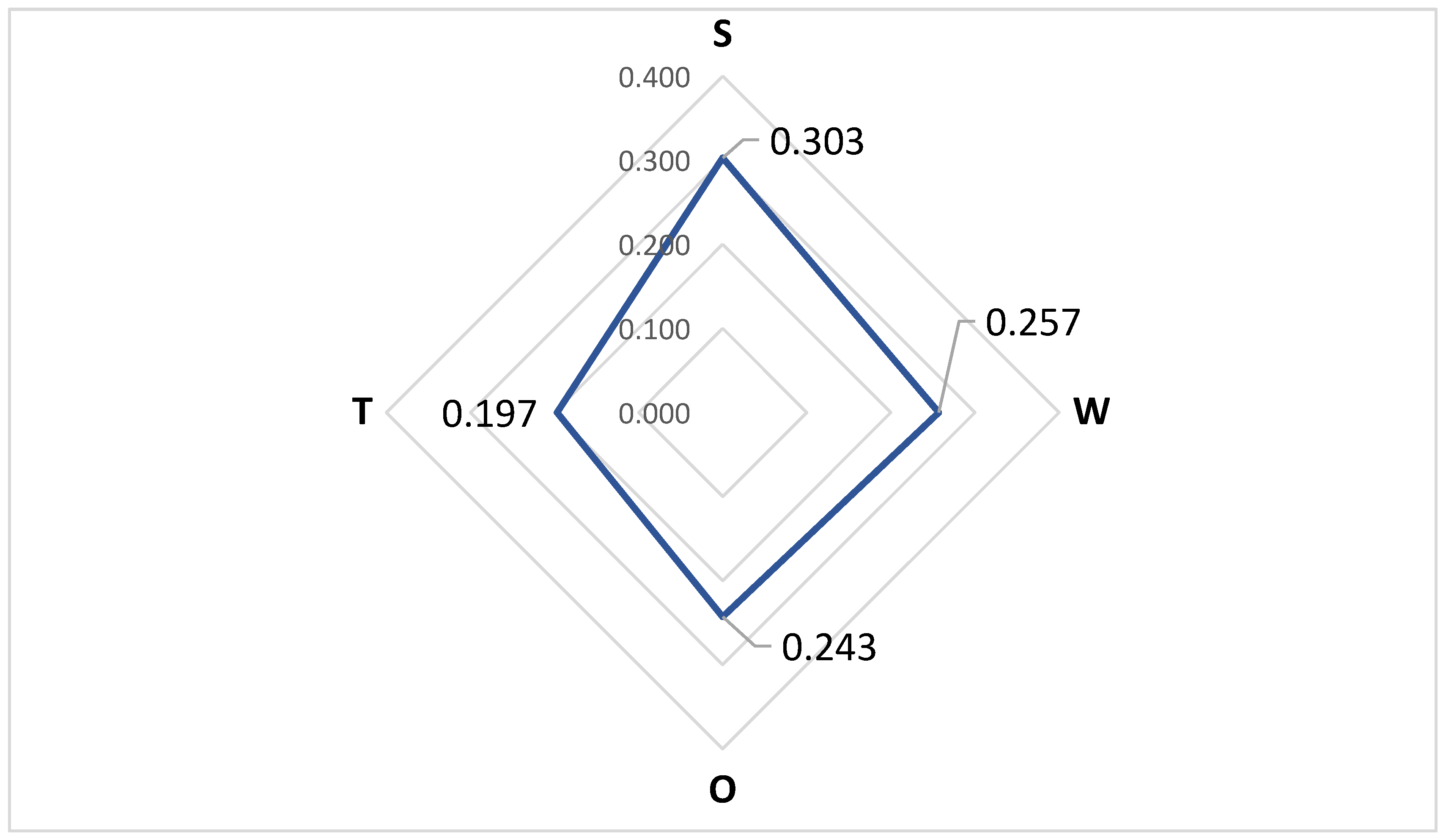
5.2. Intensity Analysis of SWOT Factors for CE Implementation Recommendations
6. Conclusions
Author Contributions
Funding
Institutional Review Board Statement
Informed Consent Statement
Data Availability Statement
Acknowledgments
Conflicts of Interest
Appendix A

| No. | Titles of the Included Studies | Reference |
|---|---|---|
| 1 | An evaluation of the potential of waste to energy technologies for residual solid waste in New South Wales, Australia. | [32] |
| 2 | Analysis of factors influencing the creation and stimulation of the Australian market for recycled construction and demolition waste products | [34] |
| 3 | Artificial Intelligent Technologies for the Construction Industry: How Are They Perceived and Utilized in Australia? | [38] |
| 4 | Assessment of Public Opposition to Construction and Demolition Waste Facilities: A Case Study in Australia | [45] |
| 5 | Assessment of solid waste generation and treatment in the Australian economic system: A Closed Waste Supply-Use model | [46] |
| 6 | Barriers inhibiting the transition to sustainability within the Australian construction industry: An investigation of technical and social interactions | [47] |
| 7 | Beyond Construction Waste Management: A Systematic Review of Strategies for the Avoidance and Minimisation of Construction and Demolition Waste in Australia | [48] |
| 8 | Building envelope systems for the circular economy; Evaluation parameters, current performance and key challenges | [49] |
| 9 | Building Information Modeling (BIM) for Construction and Demolition Waste Management in Australia: A Research Agenda | [50] |
| 10 | Changes of waste generation in Australia: Insights from structural decomposition analysis | [51] |
| 11 | Circular economy 4 business: A program and framework for small-to-medium enterprises (SMEs) with three case studies | [52] |
| 12 | Circular economy barriers in Australia: How to translate theory into practice? | [28] |
| 13 | Circular economy in modular construction: An Australian case study | [39] |
| 14 | Circular economy policies and the use of recycled materials in the Australian built environment | [35] |
| 15 | Circular Economy-Related Strategies to Minimise Construction and Demolition Waste Generation in Australian Construction Projects | [40] |
| 16 | City-scale assessment of the material and environmental footprint of buildings using an advanced building information model: A case study from Canberra, Australia | [53] |
| 17 | Converting waste plastics into construction applications: A business perspective | [54] |
| 18 | Cross-regional mobility of construction and demolition waste in Australia: An exploratory study | [55] |
| 19 | Design for Structural Adaptation in timber buildings: Industry perspectives and implementation roadmap for Sweden and Australia | [56] |
| 20 | Dismantling linear lock-ins in the Australian AEC industry: A pathway to a circular economy | [57] |
| 21 | Effective construction and demolition waste management assessment through waste management hierarchy; a case of Australian large construction companies | [4] |
| 22 | End-user engagement: The missing link of sustainability transition for Australian residential buildings | [58] |
| 23 | Environmental emissions influencing solar photovoltaic waste management in Australia: An optimised system network of waste collection facilities | [59] |
| 24 | Environmental impacts of cross-regional mobility of construction and demolition waste: An Australia Study | [60] |
| 25 | Evaluating the COVID-19 impacts on the construction and demolition waste management and resource recovery industry: Experience from the Australian built environment sector | [61] |
| 26 | Experts’ Perceptions of the Management and Minimisation of Waste in the Australian Construction Industry | [62] |
| 27 | Exploring challenges and strategies in circular economy applications in modular construction: The case in Australia | [36] |
| 28 | Extended producer responsibility in the Australian construction industry | [63] |
| 29 | Full circle: Challenges and prospects for plastic waste management in Australia to achieve circular economy | [64] |
| 30 | Green growth assessment across 203 economies: Trends and insights | [65] |
| 31 | Implementing a circular economy in regional Australia: who bears the economic costs in construction projects? | [66] |
| 32 | Improving construction and demolition waste collection service in an urban area using a simheuristic approach: A case study in Sydney | [67] |
| 33 | Institutional and Actor Network Perspectives of Waste Management in Australia: Is the Construction Industry Prepared for a Circular Economy? | [23] |
| 34 | Investigating Residential Building Materials in a Circular Economy: An Australian Perspective | [41] |
| 35 | Investigating the efficacy of a professional education program in promoting sustainable residential construction practices in Australia | [68] |
| 36 | Investigation of the social and economic impacts of cross-regional mobility of construction and demolition waste in Australia | [69] |
| 37 | Investigation of waste diversion rates in the construction and demolition sector in Australia | [42] |
| 38 | Life Cycle Assessment of Disposed and Recycled End-of-Life Photovoltaic Panels in Australia | [70] |
| 39 | Material demand, and environmental and climate implications of Australia’s building stock: Current status and outlook to 2060 | [71] |
| 40 | Methodology to assess the circularity in building construction and refurbishment activities | [44] |
| 41 | Navigating complexity: systems thinking insights on deploying the PSS for circular economy housing | [37] |
| 42 | New circularity indicator for decision making in the stockpile management of construction and demolition waste: Perspectives of Australian practitioners | [72] |
| 43 | Overcoming Head Contractor Barriers to Sustainable Waste Management Solutions in the Australian Construction Industry | [73] |
| 44 | Practical considerations of circular economy strategies in the residential sector in Australia using the ReSOLVE Framework | [74] |
| 45 | Spatial modelling of municipal waste generation: Deriving property lot estimates with limited data | [75] |
| 46 | Stakeholder analysis of construction liquid waste management in Victoria, Australia | [43] |
| 47 | Stakeholder Perspectives on Aligning Sawmilling and Prefabrication for Greater Efficiency in Australia’s Timber Manufacturing Sector | [76] |
| 48 | The dynamics of concrete recycling in circular construction: a system-dynamics approach in Sydney, Australia | [33] |
| 49 | The relative importance of carbon markets to the waste management sector’s future contribution to climate change commitments under the Paris Agreement: insights from Australia | [77] |
| 50 | The role of proximity principle in driving circular economy in built environment | [78] |
| 51 | The transition to a circular built environment in Australia: an analysis of the jurisdictional policy framework | [10] |
| 52 | Towards a more circular construction sector: Estimating and spatialising current and future non-structural material replacement flows to maintain urban building stocks | [79] |
| 53 | Transformation towards a circular economy in the Australian construction and demolition waste management system | [11] |
| 54 | What influences the on-site recycling behaviour of C&D plastic waste in Australia? An action determination model approach | [80] |
References
- Hentges, T.I.; Machado da Motta, E.A.; Valentin de Lima Fantin, T.; Moraes, D.; Fretta, M.A.; Pinto, M.F.; Spiering Böes, J. Circular economy in Brazilian construction industry: Current scenario, challenges and opportunities. Waste Manag. Res. 2022, 40, 642–653. [Google Scholar] [CrossRef]
- Illankoon, C.; Vithanage, S.C. Closing the loop in the construction industry: A systematic literature review on the development of circular economy. J. Build. Eng. 2023, 76, 107362. [Google Scholar] [CrossRef]
- Pickin, J.; Wardle, C.; O’Farrell, K.; Nyunt, P.; Donovan, S. National Waste Report 2020; Department of Agriculture, Water and the Environment: Canberra, Australia, 2020; p. 1121. Available online: https://www.dcceew.gov.au/sites/default/files/env/pages/5a160ae2-d3a9-480e-9344-4eac42ef9001/files/national-waste-report-2020.pdf (accessed on 26 May 2026).
- Kabirifar, K.; Mojtahedi, M.; Wang, C.C.; Tam, V.W. Effective construction and demolition waste management assessment through waste management hierarchy; a case of Australian large construction companies. J. Clean. Prod. 2021, 312, 127790. [Google Scholar] [CrossRef]
- Park, J.; Tucker, R. Overcoming barriers to the reuse of construction waste material in Australia: A review of the literature. Int. J. Constr. Manag. 2017, 17, 228–237. [Google Scholar] [CrossRef]
- Giorgi, S.; Lavagna, M.; Wang, K.; Osmani, M.; Liu, G.; Campioli, A. Drivers and barriers towards circular economy in the building sector: Stakeholder interviews and analysis of five European countries policies and practices. J. Clean. Prod. 2022, 336, 130395. [Google Scholar] [CrossRef]
- Hossain, M.U.; Ng, S.T. Critical consideration of buildings’ environmental impact assessment towards adoption of circular economy: An analytical review. J. Clean. Prod. 2018, 205, 763–780. [Google Scholar] [CrossRef]
- Charef, R.; Lu, W. Factor dynamics to facilitate circular economy adoption in construction. J. Clean. Prod. 2021, 319, 128639. [Google Scholar] [CrossRef]
- Mhatre, P.; Gedam, V.; Unnikrishnan, S.; Verma, S. Circular economy in built environment–Literature review and theory development. J. Build. Eng. 2021, 35, 101995. [Google Scholar] [CrossRef]
- Iyer-Raniga, U.; Gajanayake, A.; Ho, O.T.-K. The transition to a circular built environment in Australia: An analysis of the jurisdictional policy framework. Environ. Policy Law 2023, 53, 233–246. [Google Scholar] [CrossRef]
- Shooshtarian, S.; Maqsood, T.; Caldera, S.; Ryley, T. Transformation towards a circular economy in the Australian construction and demolition waste management system. Sustain. Prod. Consum. 2022, 30, 89–106. [Google Scholar] [CrossRef]
- Shooshtarian, S.; Caldera, S.; Maqsood, T.; Ryley, T.; Khalfan, M. An investigation into challenges and opportunities in the Australian construction and demolition waste management system. Eng. Constr. Archit. Manag. 2022, 29, 4313–4330. [Google Scholar] [CrossRef]
- Puyt, R.W.; Lie, F.B.; Wilderom, C.P. The origins of SWOT analysis. Long Range Plan. 2023, 56, 102304. [Google Scholar] [CrossRef]
- Wong, K.M.; Velasamy, P.; Arshad, T.N.T. (Eds.) Medical tourism destination SWOT analysis: A case study of Malaysia, Thailand, Singapore and India. In SHS Web of Conferences; EDP Sciences: Les Ulis, France, 2014. [Google Scholar]
- Zhou, J.; He, P.; Qin, Y.; Ren, D. A selection model based on SWOT analysis for determining a suitable strategy of prefabrication implementation in rural areas. Sustain. Cities Soc. 2019, 50, 101715. [Google Scholar] [CrossRef]
- Paes, L.A.B.; Bezerra, B.S.; Deus, R.M.; Jugend, D.; Battistelle, R.A.G. Organic solid waste management in a circular economy perspective–A systematic review and SWOT analysis. J. Clean. Prod. 2019, 239, 118086. [Google Scholar] [CrossRef]
- Weerakoon, P.; Wijayawardena, D.; Ranadewa, K.; Perera, B. SWOT-based assessment of capacity building strategies for circular economy implementation in construction SMES. Int. J. Constr. Manag. 2026, 1–22. [Google Scholar] [CrossRef]
- Dokyi, G.O.; Osei, K.K.; Tookey, J.; Rotimi, F.E. A SWOT analysis of stakeholder perspectives on the strategic application of economic sustainability indicators in Ghana’s road infrastructure development. Int. J. Sustain. Transp. 2025, 19, 375–392. [Google Scholar] [CrossRef]
- Yuan, H. A SWOT analysis of successful construction waste management. J. Clean. Prod. 2013, 39, 1–8. [Google Scholar] [CrossRef]
- Akhimien, N.G.; Latif, E.; Hou, S.S. Application of circular economy principles in buildings: A systematic review. J. Build. Eng. 2021, 38, 102041. [Google Scholar] [CrossRef]
- Kirchherr, J.; Reike, D.; Hekkert, M. Conceptualizing the circular economy: An analysis of 114 definitions. Resour. Conserv. Recycl. 2017, 127, 221–232. [Google Scholar] [CrossRef]
- Purchase, C.K.; Al Zulayq, D.M.; O’Brien, B.T.; Kowalewski, M.J.; Berenjian, A.; Tarighaleslami, A.H.; Seifan, M. Circular economy of construction and demolition waste: A literature review on lessons, challenges, and benefits. Materials 2021, 15, 76. [Google Scholar] [CrossRef] [PubMed]
- Lim, B.T.H.; Oo, B.L.; McLeod, C.; Yang, P.Q. Institutional and Actor Network Perspectives of Waste Management in Australia: Is the Construction Industry Prepared for a Circular Economy? Sustainability 2024, 16, 617. [Google Scholar] [CrossRef]
- Yuan, H. Barriers and countermeasures for managing construction and demolition waste: A case of Shenzhen in China. J. Clean. Prod. 2017, 157, 84–93. [Google Scholar] [CrossRef]
- Acuña-Díaz, O.; Al-Halawani, N.; Alonso-Barneto, M.; Ashirbekov, A.; Ruiz-Flores, C.; Rojas-Solórzano, L. Economic viability of phase-changing materials in residential buildings–A case study in Alice Springs, Australia. Energy Build. 2022, 254, 111612. [Google Scholar] [CrossRef]
- Alawode, A.; Rajagopalan, P. Feasibility of net zero energy high rise apartment buildings in Australia. Sol. Energy 2022, 231, 158–174. [Google Scholar] [CrossRef]
- Hager, I.; Golonka, A.; Putanowicz, R. 3D printing of buildings and building components as the future of sustainable construction? Procedia Eng. 2016, 151, 292–299. [Google Scholar] [CrossRef]
- Feldman, J.; Seligmann, H.; King, S.; Flynn, M.; Shelley, T.; Helwig, A.; Burey, P.P. Circular economy barriers in Australia: How to translate theory into practice? Sustain. Prod. Consum. 2024, 45, 582–597. [Google Scholar] [CrossRef]
- Vilchez Olivares, P.A.; Astorga De La Cruz, B.J. Global trends and dynamics of the circular economy: A bibliometric analysis based on Scopus (2010–2024). Rev. Investig. Neg. 2025, 18, 39–47. [Google Scholar] [CrossRef]
- Khan, A.; Hussain, A.; Zareef, M. The use of human-computer interaction in libraries: A systematic literature review. Glob. Knowl. Mem. Commun. 2025, 74, 864–882. [Google Scholar] [CrossRef]
- Hu, X. Data envelopment analysis for performance measurement in the construction field: A systematic review. Eng. Constr. Archit. Manag. 2025, 32, 8145–8170. [Google Scholar] [CrossRef]
- Dastjerdi, B.; Strezov, V.; Kumar, R.; Behnia, M. An evaluation of the potential of waste to energy technologies for residual solid waste in New South Wales, Australia. Renew. Sustain. Energy Rev. 2019, 115, 109398. [Google Scholar] [CrossRef]
- Wang, Z.; Bell, M.G.H.; Bhattacharjya, J.; Geers, G. The Dynamics of Concrete Recycling in Circular Construction: A System-Dynamics Approach in Sydney, Australia. Sustainability 2025, 17, 4282. [Google Scholar] [CrossRef]
- Shooshtarian, S.; Caldera, S.; Maqsood, T.; Ryley, T.; Wong, P.S.P.; Zaman, A. Analysis of factors influencing the creation and stimulation of the Australian market for recycled construction and demolition waste products. Sustain. Prod. Consum. 2022, 34, 163–176. [Google Scholar] [CrossRef]
- Shooshtarian, S.; Wong, P.S.P.; Caldera, S.; Jayarathna, C.; Ryley, T.; Maqsood, T.; Zaman, A.; Ruiz, A.M.C. Circular economy policies and the use of recycled materials in the Australian built environment. J. Environ. Manag. 2025, 389, 126108. [Google Scholar] [CrossRef]
- Senaratne, S.; Saysanavongpheth, E.; Samaratunga, M. Exploring Challenges and Strategies in Circular Economy Applications in Modular Construction: The Case in Australia. Buildings 2025, 15, 1515. [Google Scholar] [CrossRef]
- Ghafoor, S.; Kocaturk, T.; Hosseini, M.R.; Weiss, M.; Barnett, M. Navigating complexity: Systems thinking insights on deploying the PSS for circular economy housing. Archit. Eng. Des. Manag. 2025, 1–18. [Google Scholar] [CrossRef]
- Regona, M.; Yigitcanlar, T.; Xia, B.; Li, R.Y.M. Artificial intelligent technologies for the construction industry: How are they perceived and utilized in Australia? J. Open Innov. Technol. Mark. Complex. 2022, 8, 16. [Google Scholar] [CrossRef]
- Shooshtarian, S.; Wong, P.S.P.; Maqsood, T. Circular economy in modular construction: An Australian case study. J. Build. Eng. 2025, 103, 112182. [Google Scholar] [CrossRef]
- She, Y.C.; Udawatta, N.; Liu, C.L.; Tokede, O. Circular Economy-Related Strategies to Minimise Construction and Demolition Waste Generation in Australian Construction Projects. Buildings 2024, 14, 2487. [Google Scholar] [CrossRef]
- Dorignon, L.; Oswald, D.; Kempton, L.; Boehme, T.; Iyer-Raniga, U.; Moore, T.; Dalton, T. Investigating Residential Building Materials in a Circular Economy: An Australian Perspective. J. Constr. Eng. Manag. 2024, 150, 04024115. [Google Scholar] [CrossRef]
- Ratnasabapathy, S.; Alashwal, A.; Perera, S. Investigation of waste diversion rates in the construction and demolition sector in Australia. Built Environ. Proj. Asset Manag. 2021, 11, 427–439. [Google Scholar] [CrossRef]
- Karunasena, G.; Wijeratne, W.P.U.; Gajanayake, A.; Udawatta, N.; Perera, S. Stakeholder analysis of construction liquid waste management in Victoria, Australia. Int. J. Constr. Manag. 2025, 25, 1691–1702. [Google Scholar] [CrossRef]
- González, A.; Sendra, C.; Herena, A.; Rosquillas, M.; Vaz, D. Methodology to assess the circularity in building construction and refurbishment activities. Resour. Conserv. Recycl. Adv. 2021, 12, 200051. [Google Scholar] [CrossRef]
- Ghafoor, S.; Shooshtarian, S.; Maqsood, T.; Wong, P.S.P. Assessment of Public Opposition to Construction and Demolition Waste Facilities: A Case Study in Australia. Recycling 2022, 7, 62. [Google Scholar] [CrossRef]
- He, H.; Reynolds, C.J.; Boland, J. Assessment of solid waste generation and treatment in the Australian economic system: A Closed Waste Supply-Use model. Waste Manag. 2018, 78, 346–355. [Google Scholar] [CrossRef]
- Martek, I.; Hosseini, M.R.; Shrestha, A.; Edwards, D.J.; Durdyev, S. Barriers inhibiting the transition to sustainability within the Australian construction industry: An investigation of technical and social interactions. J. Clean. Prod. 2019, 211, 281–292. [Google Scholar] [CrossRef]
- Heffernan, E.; Kempton, L. Beyond construction waste management: A systematic review of strategies for the avoidance and minimisation of construction and demolition waste in Australia. Sustainability 2025, 17, 7095. [Google Scholar] [CrossRef]
- Finch, G.; Marriage, G.; Pelosi, A.; Gjerde, M. Building envelope systems for the circular economy; Evaluation parameters, current performance and key challenges. Sustain. Cities Soc. 2021, 64, 102561. [Google Scholar] [CrossRef]
- Han, D.C.; Kalantari, M.; Rajabifard, A. Building Information Modeling (BIM) for Construction and Demolition Waste Management in Australia: A Research Agenda. Sustainability 2021, 13, 12983. [Google Scholar] [CrossRef]
- He, H.; Reynolds, C.J.; Zhou, Z.; Wang, Y.; Boland, J. Changes of waste generation in Australia: Insights from structural decomposition analysis. Waste Manag. 2019, 83, 142–150. [Google Scholar] [CrossRef] [PubMed]
- Maher, R.; Yarnold, J.; Pushpamali, N.N.C. Circular economy 4 business: A program and framework for small-to-medium enterprises (SMEs) with three case studies. J. Clean. Prod. 2023, 412, 137114. [Google Scholar] [CrossRef]
- Soonsawad, N.; Marcos-Martinez, R.; Schandl, H. City-scale assessment of the material and environmental footprint of buildings using an advanced building information model: A case study from Canberra, Australia. J. Ind. Ecol. 2024, 28, 247–261. [Google Scholar] [CrossRef]
- Li, L.C.; Zuo, J.; Duan, X.G.; Wang, S.B.; Chang, R.D. Converting waste plastics into construction applications: A business perspective. Environ. Impact Assess. Rev. 2022, 96, 106814. [Google Scholar] [CrossRef]
- Wu, H.Y.; Zuo, J.; Yuan, H.P.; Zillante, G.; Wang, J.Y. Cross-regional mobility of construction and demolition waste in Australia: An exploratory study. Resour. Conserv. Recycl. 2020, 156, 104710. [Google Scholar] [CrossRef]
- Öberg, V.; Jockwer, R.; Goto, Y. Design for Structural Adaptation in timber buildings: Industry perspectives and implementation roadmap for Sweden and Australia. J. Build. Eng. 2024, 98, 111413. [Google Scholar] [CrossRef]
- Hosseini, M.R.; Memari, S.; Martek, I.; Kocaturk, T.; Bararzadeh, M.; Arashpour, M. Dismantling linear lock-ins in the Australian AEC industry: A pathway to a circular economy. Sustain. Dev. 2024, 32, 7171–7185. [Google Scholar] [CrossRef]
- Martek, I.; Hosseini, M.R.; Shrestha, A.; Edwards, D.J.; Seaton, S.; Costin, G. End-user engagement: The missing link of sustainability transition for Australian residential buildings. J. Clean. Prod. 2019, 224, 697–708. [Google Scholar] [CrossRef]
- Oteng, D.; Zuo, J.; Sharifi, E. Environmental emissions influencing solar photovoltaic waste management in Australia: An optimised system network of waste collection facilities. J. Environ. Manag. 2022, 314, 115007. [Google Scholar] [CrossRef]
- Wu, H.; Zuo, J.; Zillante, G.; Wang, J.; Duan, H. Environmental impacts of cross-regional mobility of construction and demolition waste: An Australia Study. Resour. Conserv. Recycl. 2021, 174, 105805. [Google Scholar] [CrossRef]
- Shooshtarian, S.; Caldera, S.; Maqsood, T.; Ryley, T. Evaluating the COVID-19 impacts on the construction and demolition waste management and resource recovery industry: Experience from the Australian built environment sector. Clean Technol. Environ. Policy 2022, 24, 3199–3212. [Google Scholar] [CrossRef]
- Jahan, I.; Zhang, G.M.; Bhuiyan, M.; Navaratnam, S.; Shi, L. Experts’ Perceptions of the Management and Minimisation of Waste in the Australian Construction Industry. Sustainability 2022, 14, 11319. [Google Scholar] [CrossRef]
- Shooshtarian, S.; Maqsood, T.; Wong, P.S.; Khalfan, M.; Yang, R.J. Extended producer responsibility in the Australian construction industry. Sustainability 2021, 13, 620. [Google Scholar] [CrossRef]
- Hossain, R.; Islam, M.T.; Ghose, A.; Sahajwalla, V. Full circle: Challenges and prospects for plastic waste management in Australia to achieve circular economy. J. Clean. Prod. 2022, 368, 133127. [Google Scholar] [CrossRef]
- Sarkodie, S.A.; Owusu, P.A.; Taden, J. Green growth assessment across 203 economies: Trends and insights. Sustain. Horiz. 2024, 10, 100083. [Google Scholar] [CrossRef]
- Mathur, D.; Jayasinghe, M.; Zander, K.K. Implementing a circular economy in regional Australia: Who bears the economic costs in construction projects? Urban Res. Pract. 2025, 19, 34–55. [Google Scholar] [CrossRef]
- Yazdani, M.; Kabirifar, K.; Frimpong, B.E.; Shariati, M.; Mirmozaffari, M.; Boskabadi, A. Improving construction and demolition waste collection service in an urban area using a simheuristic approach: A case study in Sydney, Australia. J. Clean. Prod. 2021, 280, 124138. [Google Scholar] [CrossRef]
- Graham, E.; Warren-Myers, G. Investigating the efficacy of a professional education program in promoting sustainable residential construction practices in Australia. J. Clean. Prod. 2019, 210, 1238–1248. [Google Scholar] [CrossRef]
- Wu, H.; Zuo, J.; Yuan, H.; Zillante, G.; Wang, J. Investigation of the social and economic impacts of cross-regional mobility of construction and demolition waste in Australia. Resour. Conserv. Recycl. 2023, 190, 106814. [Google Scholar] [CrossRef]
- Singh, J.K.D.; Molinari, G.; Bui, J.; Soltani, B.; Rajarathnam, G.P.; Abbas, A. Life Cycle Assessment of Disposed and Recycled End-of-Life Photovoltaic Panels in Australia. Sustainability 2021, 13, 11025. [Google Scholar] [CrossRef]
- Soonsawad, N.; Martinez, R.M.; Schandl, H. Material demand, and environmental and climate implications of Australia’s building stock: Current status and outlook to 2060. Resour. Conserv. Recycl. 2022, 180, 106143. [Google Scholar] [CrossRef]
- Pilipenets, O.; Hui, F.K.P.; Gunawardena, T.; Mendis, P.; Aye, L. New circularity indicator for decision making in the stockpile management of construction and demolition waste: Perspectives of Australian practitioners. J. Environ. Manag. 2024, 363, 121345. [Google Scholar] [CrossRef]
- van der Lans, P.A.; Jensen, C.A.; Oraee, M. Overcoming Head Contractor Barriers to Sustainable Waste Management Solutions in the Australian Construction Industry. Buildings 2023, 13, 2211. [Google Scholar] [CrossRef]
- Gurusinghe, D.I.; Iyer-Raniga, U.; Moore, T. Practical considerations of circular economy strategies in the residential sector in Australia using the ReSOLVE Framework. Build. Environ. 2025, 282, 113279. [Google Scholar] [CrossRef]
- Madden, B.; Florin, N.; Mohr, S.; Giurco, D. Spatial modelling of municipal waste generation: Deriving property lot estimates with limited data. Resour. Conserv. Recycl. 2021, 168, 105442. [Google Scholar] [CrossRef]
- Dissanayake, H.; Gunawardena, T.; Mendis, P. Stakeholder Perspectives on Aligning Sawmilling and Prefabrication for Greater Efficiency in Australia’s Timber Manufacturing Sector. Sustainability 2025, 18, 148. [Google Scholar] [CrossRef]
- Rossetto, D. The relative importance of carbon markets to the waste management sector’s future contribution to climate change commitments under the Paris Agreement: Insights from Australia. Carbon Neutrality 2023, 2, 25. [Google Scholar] [CrossRef]
- Shooshtarian, S.; Wong, P.S.; Maqsood, T.; Ryley, T.; Zaman, A.; Caldera, S.; Jayarathna, C.; Ruiz, A.M.C. The role of proximity principle in driving circular economy in built environment. Circ. Econ. Sustain. 2025, 5, 4859–4887. [Google Scholar] [CrossRef]
- Stephan, A.; Athanassiadis, A. Towards a more circular construction sector: Estimating and spatialising current and future non-structural material replacement flows to maintain urban building stocks. Resour. Conserv. Recycl. 2018, 129, 248–262. [Google Scholar] [CrossRef]
- Li, L.C.; Zuo, J.; Du, L.W.; Chang, R.D. What influences the on-site recycling behaviour of C&D plastic waste in Australia? An action determination model approach. J. Environ. Manag. 2024, 371, 123158. [Google Scholar] [CrossRef]


| Internal Conditions | External Conditions |
|---|---|
| Strengths | Opportunities |
| Environmental dimension | Regulatory dimension |
| S1. Enhanced resource and energy efficiency | O1. Continuous improvement of laws and regulations |
| S2. Reduced greenhouse gas emissions and environmental impacts | O2. Legal support and economic incentives for CE implementation |
| S3. Reduced reliance on virgin materials and resources | O3. Increased promotion and awareness of policies and practices |
| Technological dimension | Market dimension |
| S4. Advancement of C&D waste management technologies | O4. New market opportunities |
| S5. Availability of smart and sustainable solutions | O5. Development of industrial chain |
| S6. Constantly innovative practices in construction and CE adoption | O6. Long-term economic benefits |
| Economic dimension | Societal dimension |
| S7. Reduced current waste treatment costs | O7. Increased public and stakeholder participation |
| S8. Improved economic competitiveness | O8. Improved environmental education |
| S9. Increased employment opportunities | O9. Increasing societal concern regarding climate change |
| Weaknesses Material dimension W1. High difficulty in obtaining certain waste W2. Challenges in waste sorting and disposal W3. Potential quality degradation of reused construction materials Technological dimension W4. High costs of CE-related technologies W5. Limitations of existing technologies W6. Unstable supply chain Institutional dimension W7. Lack of incentives for CE stakeholders W8. Lack of specialised knowledge and technical expertise W9. Lack of harmonised industry standards and guidelines Economic dimension W10. High initial investment W11. Limited short-term economic returns W12. Low long-term profitability and high financial risks | Threats Institutional dimension T1. Incomplete and outdated regulations T2. Weak enforcement and monitoring of regulations T3. Conflict between international and national policies T4. Bureaucracy and complicated procedures T5. High regulatory costs Cultural dimension T6. Cultural conflicts T7. Social prejudice T8. Lack of public awareness T9. Conservative nature of the industry Structural dimension T10. Entrenched linear economy structure T11. Limited CE diffusion T12. Lack of immediate returns or unfamiliarity with new methods Economic dimension T13. High economic volatility T14. Market competition |
| Weakness | Strengths | Opportunities | Mechanism Logic |
|---|---|---|---|
| W1 | S4, S5 | O3, O5, O7, O8 | Digital waste tracking + management + policy + education + participation + industrial chain coordination improve waste collection |
| W2 | S4, S5 | O2, O4, O8 | Automation + policy + market + education improve source separation efficiency |
| W3 | S5, S6 | O1, O3 | Innovations + standards + smart monitoring improve material certification and acceptance |
| W4 | S6, S8 | O2, O6 | Innovation + incentives + long-term returns improve feasibility |
| W5 | S6 | O4, O9 | Innovation pressure from market expansion drives R&D improvement |
| W6 | S4, S5 | O5 | Integrated industrial chain + digital platforms stabilize flows |
| W7 | (R1) | O1, O2 | Regulatory reform + subsidies directly address policy gap |
| W8 | (R2) | O7, O8 | Innovation diffusion + education/training improve skills |
| W9 | (R3) | O1, O3 | Regulatory harmonisation + digital standards systems |
| W10 | S7, S8 | O2, O6 | Cost savings + incentives + long-term returns |
| W11 | S8 | O4, O6 | Market expansion + long-term economic justification |
| W12 | S8 | O6 | Stable long-term CE market reduces risk perception |
| Threats | Strengths | Opportunities | Mechanism Logic |
|---|---|---|---|
| T1 | S6 | O1 | Innovation + regulatory updates improve governance completeness |
| T2 | S5 | O1, O3 | Digital monitoring + policy promotion improve compliance |
| T3 | S2, S9 | O1 | Carbon reduction and job creation (SDGs) + regulatory harmonisation minimise conflicts |
| T4 | S5 | O1 | Digitalisation reduces administrative burden |
| T5 | (R4) | O2 | Incentives offset compliance cost |
| T6 | (R5) | O7, O8 | Public participation + education improve acceptance |
| T7 | S2, S9 | O7, O8 | Carbon reduction + job creation + awareness reduce resistance |
| T8 | S2 | O3, O8, O9 | Environmental benefits + policy promotion + education + climate awareness |
| T9 | (R6) | O7, O8 | Innovation diffusion + stakeholder engagement |
| T10 | S6, S7 | O4, O5 | Innovation + cost reduction + industrial chain development enable transition |
| T11 | S6 | O4, O5 | Innovation + market expansion accelerate adoption |
| T12 | S8 | O2, O6 | Long-term economic framing improves adoption logic |
| T13 | S8 | O2, O6 | Efficiency + long-term benefits improve resilience |
| T14 | S4, S8 | O4, O6 | Technologies + competitiveness + market expansion strengthen positioning |
Disclaimer/Publisher’s Note: The statements, opinions and data contained in all publications are solely those of the individual author(s) and contributor(s) and not of MDPI and/or the editor(s). MDPI and/or the editor(s) disclaim responsibility for any injury to people or property resulting from any ideas, methods, instructions or products referred to in the content. |
© 2026 by the authors. Licensee MDPI, Basel, Switzerland. This article is an open access article distributed under the terms and conditions of the Creative Commons Attribution (CC BY) license.
Share and Cite
Hu, X.; Fan, L. Circular Economy Implementation in the Australian Construction Industry: A SWOT-Oriented Content Analysis. Sustainability 2026, 18, 5531. https://doi.org/10.3390/su18115531
Hu X, Fan L. Circular Economy Implementation in the Australian Construction Industry: A SWOT-Oriented Content Analysis. Sustainability. 2026; 18(11):5531. https://doi.org/10.3390/su18115531
Chicago/Turabian StyleHu, Xiancun, and Linzixin Fan. 2026. "Circular Economy Implementation in the Australian Construction Industry: A SWOT-Oriented Content Analysis" Sustainability 18, no. 11: 5531. https://doi.org/10.3390/su18115531
APA StyleHu, X., & Fan, L. (2026). Circular Economy Implementation in the Australian Construction Industry: A SWOT-Oriented Content Analysis. Sustainability, 18(11), 5531. https://doi.org/10.3390/su18115531