Article

Assessing Carbon Emission and Energy-Related Knowledge, Attitudes and Practices in Higher Education Institutions


1
Department of Public Health, Chung Shan Medical University, Taichung 40201, Taiwan
2
Department of Science Education and Application, National Taichung University of Education, Taichung 403514, Taiwan
3
Department of Family and Community Medicine, Chung Shan Medical University Hospital, Taichung 40201, Taiwan
*
Author to whom correspondence should be addressed.
Sustainability 2026, 18(11), 5521; https://doi.org/10.3390/su18115521
Submission received: 26 January 2026 / Revised: 9 February 2026 / Accepted: 11 February 2026 / Published: 1 June 2026
(This article belongs to the Section Sustainable Education and Approaches)

Abstract

Higher education institutions (HEIs), engaged in education, research and community services, play an important role in promoting sustainable development. This study investigated the relationships between carbon emission-related variables—Knowledge, Attitude, and Practice (KAP)—and the amount of carbon emissions in HEIs. A cross-sectional design was adopted, and data were collected via an online questionnaire from September to December 2024. The participants were students from eight colleges and universities in central Taiwan, yielding 293 valid responses. The average daily per capita carbon emissions were calculated based on activity categories and emission coefficients. Carbon emissions from daily life contributed 87.7%, followed by transportation and academic activities (9.7% and 2.6%). The average carbon emission was 11.82 kg CO2e/day/person. Statistical analysis showed that living arrangements and household size exhibited significant differences (p < 0.05). Regarding the KAP analysis, attitude and practice showed a significant positive correlation (r = 0.59, p < 0.01), while practice and individual-level Scope 3 emissions were negatively correlated (r = −0.12, p < 0.01), indicating that carbon reduction behaviors can effectively decrease individual carbon emissions. This study quantified the carbon emission in HEIs and addressed a research gap by linking individual-level energy behaviors with carbon emission estimates in Taiwan. The findings provide a basis for policy-making and promoting low-carbon behaviors. Future campus initiatives should focus on equipment upgrades, environmental education, and low-carbon actions to achieve sustainability and net-zero carbon goals.

1. Introduction

Climate change, driven by greenhouse gas (GHG) emissions from human energy consumption, has become one of the most urgent global challenges [1]. As of 2017, the average global temperature had risen by approximately 1.0 °C above pre-industrial levels, largely due to the accumulation of CO2 and other GHGs [2]. To limit the global temperature to the 1.5 °C climate threshold, the United Nations Development Programme (UNDP) aims to reduce global net CO2 emissions by 45% between 2010 and 2030 and achieve net-zero carbon emissions by 2050 [3]. According to the International Energy Agency (IEA), the world emitted 39,023.94 million metric tons of CO2 in 2023, while Taiwan emitted 279.85 million metric tons, accounting for 0.72% of global emissions and ranking 26th in the world [4].
Higher education institutions (HEIs) are increasingly recognized as key actors in global climate mitigation efforts [5,6,7,8]. As centers for education, research, and innovation, they not only consume significant amounts of energy but also shape the sustainability values of future leaders. In Taiwan, HEIs account for 65% of electricity consumption in the education sector, with medical universities using the most due to energy-intensive laboratories and diagnostic equipment [9,10,11]. Given their dual role as energy consumers and cultural influencers, understanding and managing carbon emissions within universities is of strategic importance.
Numerous empirical studies have attempted to quantify energy use and associated carbon emissions within higher education [11,12,13,14,15]. For instance, Energy Use Intensity (EUI) values in Taiwanese universities from 2015 to 2017 ranged from 56.5 to 93.2 kWh/m2/year, with national universities typically exhibiting higher figures due to their larger scale [11]. International case studies also show electricity as the dominant source of campus emissions—for example, accounting for 92.3% at Jakarta University and 84% at the University of Technology Malaysia [8,16]. These studies provide important benchmarks, especially for understanding sector-specific patterns, such as the high emissions of medical schools.
In parallel, systematic reviews have begun to address methodological consistency and comparability in higher education institution (HEI)-level carbon accounting. For example, they outlined critical issues such as the need to define representative emission sources, develop robust emission factor databases, and standardize assessment tools and boundary definitions. Despite these efforts, most studies remain focused on infrastructure and institutional-level metrics, often overlooking individual behavioral contributions to emissions [17].
The knowledge, attitude and practice (KAP) survey was first applied to understand family planning and population studies in the 1950s [18]. In fact, recent KAP studies have been employed in various environmental studies [19,20,21]. Using the KAP framework, which posits that individuals move from knowledge to attitudes to practices [22], this study explores how students’ energy-related behaviors contribute to carbon emissions. It found that, although 74.1% of Malaysian university students had high knowledge of sustainable consumption, only 49.2% practiced it—mainly due to habits and limited awareness [21]. It also noted gender-based differences in energy attitudes among Chinese students [23].
Although Taiwan’s government has promoted the “green lifestyle” since 2020 [24], students’ individual-level emissions and energy-related behaviors, which contribute to carbon emissions in HEIs, are still rarely explored. To address this gap, we surveyed undergraduate students in HEIs across central Taiwan. We estimated annual carbon emissions based on daily energy-use activities and analyzed their association with KAP scores. By comparing differences across gender, institution, grade, residence, and household size, this study aimed to offer insight into behavior-driven emissions and provide evidence to inform education strategies aligned with Taiwan’s net-zero goals.

2. Materials and Methods

2.1. Study Data

This study targeted university students aged 18 to 25 in central Taiwan, including Taichung City, Nantou County, Changhua County, and Yunlin County. Data were collected via an online questionnaire from September to November 2024, during the academic semester. To ensure representativeness, a stratified sampling method was applied based on 2024 Ministry of Education statistics, with a total university student population of 227,619 in Taiwan [25]. The required sample size (n = 403) was calculated using formula developed by [26] at a 95% confidence level and 5% margin of error, adjusted for non-response and invalid submissions. Sample allocation was proportional by county (Table S1) [27], and universities were selected accordingly (Table S2) [25]. Informed consent was provided to all participants, and signed consent forms were obtained from each participant during this study.
The questionnaire was adapted from existing validated tools developed by [28] and [29], both focusing on energy-related behaviors and attitudes. After integrating and modifying these instruments, the draft was reviewed by the supervising professor for clarity and relevance. A pilot test was conducted internally to ensure reliability and user-friendliness (Figure S1). The final version of the questionnaire was distributed by university websites and social media platforms. It comprised 48 items organized into five sections: (1) demographic information; (2) daily life activities; (3) academic-related activities; (4) transportation behaviors; and (5) energy-related KAP. Information on activity duration and frequency (Section 2.2) was used for estimating individual carbon emissions.
The reliability analysis of the questionnaire on carbon emission-related energy attitudes and behaviors showed a good internal consistency. The overall standardized Cronbach’s alpha (α) was 0.85, indicating high reliability for the entire scale. Specifically, the energy attitude assessment had an α of 0.81, and the energy behavior assessment had an α of 0.73, both demonstrating acceptable reliability.

2.2. Carbon Emission Estimation and KAP Scores

In this study, the average daily carbon emissions ( C i ) were estimated based on self-reported activity data. The estimation followed the equation in Equation (S1) in Table S3. In that, Fi is the carbon emission factor for activity i (e.g., kg CO2e per km or per h), and Ui is the activity data for activity i (e.g., km traveled, hours used) reported by each student. Activity codes i ranged from 1 to 20, covering three categories: daily activities, academic activities, and transportation. The emission factors (Fi) were sourced from Table S4 [28,30,31,32,33,34,35,36], and the activity data (Ui) were obtained from the questionnaire responses. The categories of carbon emissions were adopted from Li et al. [28]. Separating transportation from daily life helps isolate travel-related emissions to better understand and target this category independently. Otherwise, the transportation involves different energy consumption patterns and sources compared to daily living activities.
The KAP scores were assessed for each student based on responses to structured questionnaire items. The total score for each dimension was calculated as follows: for knowledge dimension (TK), each item was scored +1 for a correct answer and −1 for an incorrect answer. For attitude and practice dimensions (TA and TP), items were rated on a 5-point Likert scale, from 5 (strongly agree) to 1 (strongly disagree). Individual total scores for each dimension (TK, TA and TP) were calculated by summing item scores (Equations (S2)–(S4) in Table S3). Subgroup average KAP scores (e.g., by university, gender, or grade level) were derived by dividing the sum of individual scores by the number of students in each subgroup.

2.3. Statistical Analysis

The research hypotheses were established based on the KAP framework and previous studies on pro-environmental behavior:
H1. 
Significant differences in carbon emissions exist among students from the eight universities across different variables (e.g., residence, household size);
H2. 
Significant differences in students’ carbon emissions exist among the eight universities according to different activity categories;
H3. 
Students’ knowledge related to carbon emissions is positively associated with their attitudes toward carbon reduction;
H4. 
Students’ attitudes toward carbon reduction are positively associated with their carbon reduction practices;
H5. 
Students’ carbon reduction practices are negatively associated with their carbon emissions.
After collecting the completed questionnaires, invalid responses with incomplete answers were excluded, and only valid questionnaires were included in the analysis. Descriptive statistics, including frequency distributions and percentages, were used to present the demographic characteristics of the university students. Means and standard deviations were calculated to describe students’ energy knowledge accuracy rate, energy attitudes, and energy-related behaviors. To prove the hypothesis, inferential statistics including independent sample t-tests and one-way ANOVA were conducted to examine differences in average carbon emissions across demographic variables. In addition, Spearman’s rank correlation coefficient was used to explore the relationships among energy knowledge, attitudes, and behaviors, as well as their associations with carbon emission levels. Data analysis was conducted using the SAS statistical software version 9.4 × 64.

3. Results

3.1. Demographic Description

A total of 310 questionnaires were collected. After excluding those who declined to participate (n = 1), had incorrect time-use data (n = 1), or had missing information in the transportation section (n = 15), 293 valid questionnaires were included in the final analysis, with a response rate of 73% (Figure S2). As shown in Table 1, 202 respondents were female, accounting for 68.94% of the total sample. Most participants were from Chung Shan Medical University (20.14%), followed by China Medical University (17.06%) and National Chung Hsing University (13.99%). In terms of year of study, most were fourth-year students (29.01%), followed by second-year students (24.57%). Regarding living arrangements, the majority lived in off-campus rentals (55.29%), followed by living in on-campus dormitories (29.01%) and at home (15.70%). For household size, most students lived alone (43.00%), followed by those living with three others (29.01%).

3.2. Activity Duration and Transportation Modes Related to Carbon Emissions

Based on the questionnaire survey, Table S5 summarizes the average daily time (hours) spent on three activity categories: daily activities, academic activities, and transportation and across demographic groups. Daily activity patterns were generally similar across schools, though AU students reported the longest lighting use (10.3 ± 7.3 h) and NCNU students had the longest fan use (12.9 ± 6.1 h). NCNU students also reported the highest air conditioning use (8.9 ± 4.9 h), while NCUT students reported the longest fan use after NCNU. In addition, males and females reported similar patterns across most activities. Males spent slightly more time using computers (3.8 ± 2.5 h vs. 3.1 ± 2.5 h), whereas females reported slightly more lighting use (8.0 ± 4.8 h vs. 7.7 ± 5.3 h) (Table S5). For the residence variable, dormitory students reported the highest air conditioning use (9.5 ± 5.5 h) and longest weekend return trips (2.7 ± 1.9 h), compared to rental and home residents. Students living at home reported the least weekend commuting (0.8 ± 1.1 h) and slightly less lighting use (7.8 ± 4.4 h). In terms of household size, lighting use increased with household size, reaching 10 ± 7.9 h for households with ≥5 members. Computer use was highest in households with three members (3.6 ± 2.0 h). Weekend return trips were longest in single-person households (2.6 ± 2.0 h), whereas holiday/vacation travel peaked among households with ≥5 members (3.0 ± 3.7 h) (Table S5).
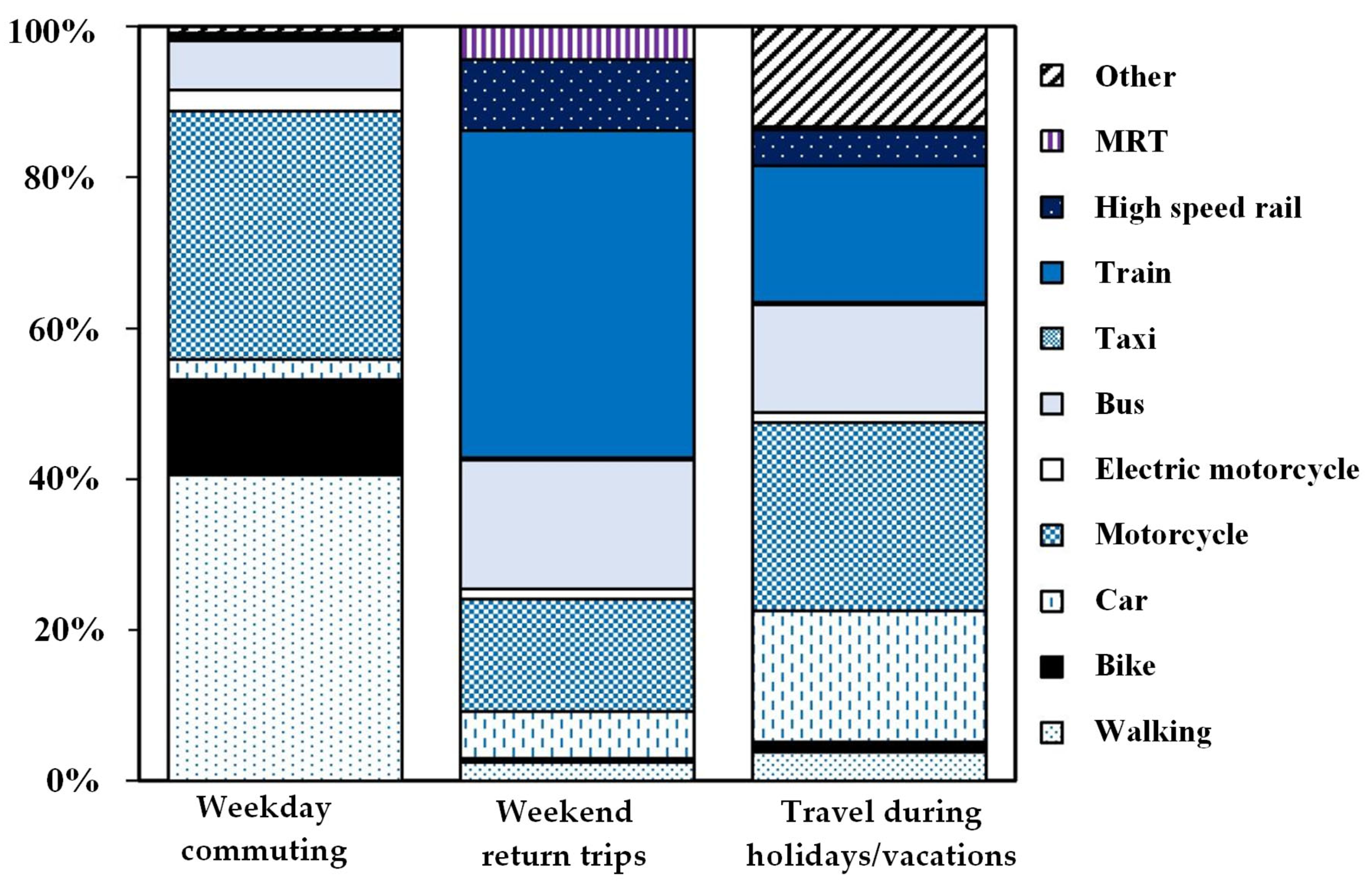
We illustrated the proportion of carbon emissions by transportation models in Figure 1. Specifically, walking dominates weekday commuting (40%), reflecting short distances and good walking ability, followed by motorcycles and bicycles. For weekend home trips, when students return home from college, train travel is the primary mode (43%), indicating longer intercity trips, with buses and motorcycles accounting for 17% and 15%, respectively. During holiday travel, motorcycles are the main mode (25%), followed by buses (18%) and bicycles (17%), while 13% of students reported infrequent travel. These differences reflect the distinct travel contexts—weekday commuting, weekend trips, and holiday travel—rather than inconsistencies in the data.

3.3. Carbon Emission Profile

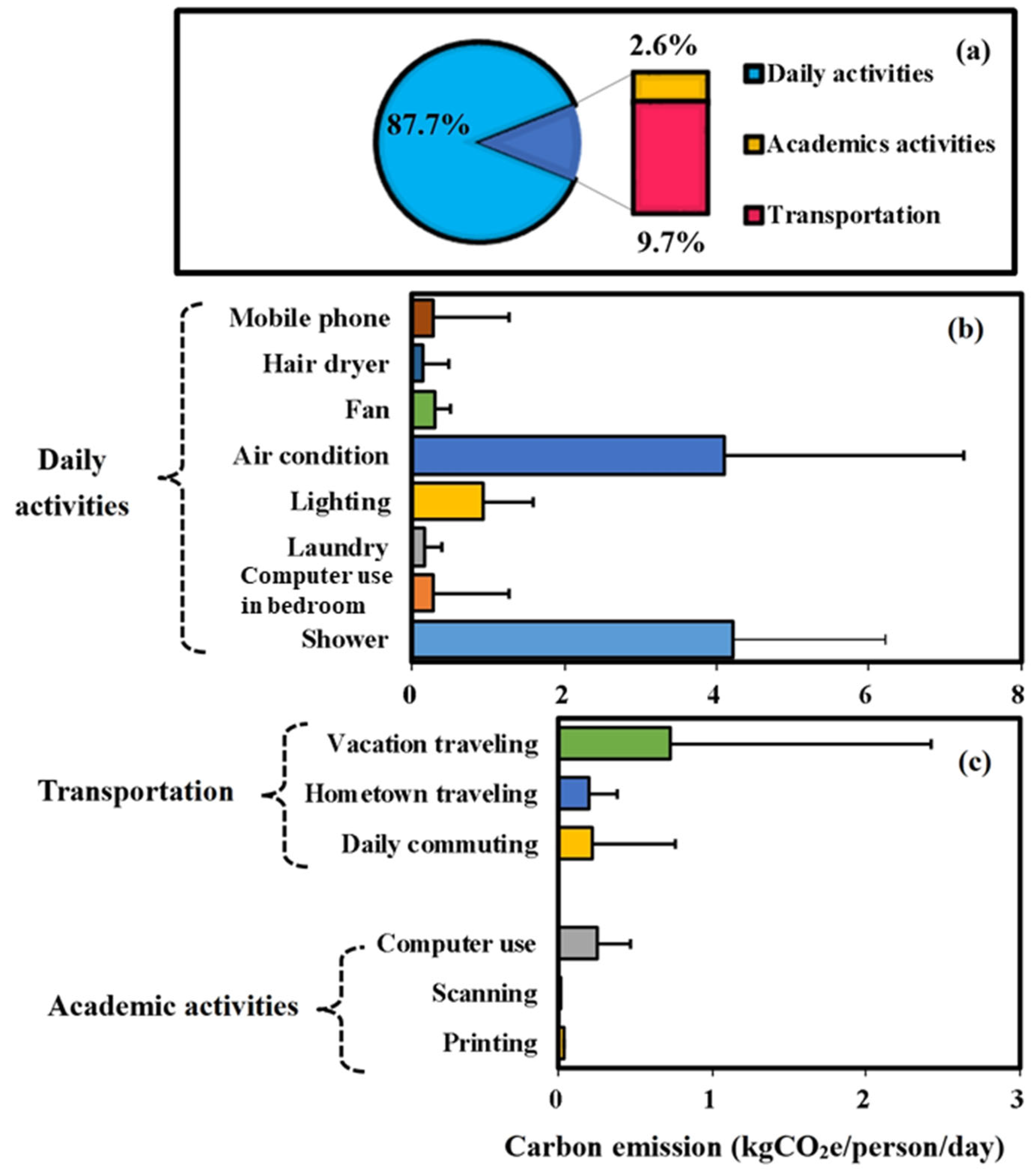
While presenting the proportion of individual-level Scope 3 emissions attributed to different activity categories as a pie chart, we found that daily activities accounted for 87.7% of university students’ total emissions, followed by transportation at 9.7%, while academic activities contributed only 2.6% (Figure 2a). We further presented the average daily carbon emissions (kg CO2e/person/day) and standard deviations (mean ± SD) for daily activities in Figure 2b, and transportation and academic activities in Figure 2c, respectively. Results show that showering (4.21 ± 2.02 kg CO2e/person/day) and air conditioning (4.11 ± 3.15 kg CO2e/person/day) were the dominant emission sources, followed by lighting (0.92 ± 0.67 kg CO2e/person/day) (Figure 2b). For transportation, vacation traveling (0.73 ± 1.70 kg CO2e/person/day) accounted for the highest emissions and variability, whereas daily commuting (0.22 ± 0.54) and hometown traveling (0.20 ± 0.18) had smaller impacts (Figure 2b,c). Academic activities generated relatively low emissions, with computer use (0.26 ± 0.21 kg CO2e/person/day) as the main contributor. In the analysis of individual-level Scope 3 emissions by demographic variables, no statistically significant differences (p > 0.05) were observed for gender, school, or grade (Table 2, Figure S3). This may be due to the fact that all participating schools were located in central Taiwan, where students share relatively similar lifestyles, commuting needs, and geographical contexts. However, significant differences were found for residential type (p-value = 0.006) and household size (p-value = 0.033). Household size was also associated with emissions, with students from larger families (≥5 members) showing higher total emissions (13.9 ± 10.1 kg CO2e/person/day) (Table 2).

3.4. Correlation Between Carbon Emissions and KAP Scores

We compiled the results of analyzing differences in KAP scores based on demographic variables in Table 3. Results showed that students’ scores on the energy attitude assessment ranged from 0 to 25, with a mean score of 20.20 (SD = 3.03) and a 95% confidence interval (CI) from 19.85 to 20.55 (Table S6). The energy practice assessment scores also ranged from 0 to 25, with a mean of 21.30 (SD = 2.71) and a 95% CI between 20.99 and 21.61 (Table S7). These findings indicate that participants generally exhibited relatively high levels of positive energy attitudes and behaviors. Knowledge scores ranged from 0 to 5 and showed no significant differences by school, grade, residence, or household size. However, females scored significantly higher in knowledge than males (p-value < 0.05), although no gender differences were observed in attitudes or practices. In terms of grade level, sixth-year students had significantly higher practice scores compared to other grades (p-value < 0.05), while their knowledge and attitude scores did not differ significantly. Additionally, residence location and household size did not have significant effects on any KAP scores.
The results of the correlation analysis (Table 4) showed that the carbon emissions were negatively associated with attitude and practice scores, indicating that students with more positive energy-related attitudes and who engaged more frequently in low-carbon practices tended to have lower actual emissions. Energy-related attitudes were moderately correlated with practice scores (r = 0.59), while knowledge was not significantly correlated with attitudes, practices, or carbon emissions.

4. Discussion

4.1. Methodological Assessment for Carbon Emission Estimation

The methodology for calculating carbon emissions among higher education institution (HEI) students is not yet standardized. A systematic review by [17] analyzed 35 studies published between 2010 and 2021 and found substantial variation in the standards and practices used. Specifically, 17% of studies did not report the standard applied, while the remainder used frameworks such as the GHG Protocol (54%) [37], the IPCC Guidelines (20%) [38], ISO 14064–1 (11%) [39], or PAS 2050 (two studies) [40]. Despite these efforts, all methods face a common limitation of either overestimating or underestimating GHG emissions, largely depending on the availability and quality of data [41]. To address this, our study adopted the methodology of [28], which categorizes emissions into 14 items and focuses exclusively on scope 3 emissions, defined as indirect GHG emissions from activities not directly owned or controlled by the organization [37]. Consistent with previous research, we estimated emissions from students’ daily life and transportation based on energy type, duration of use, and emission coefficients. Overall, the findings from prior studies highlight the lack of a unified methodological framework, underscoring the need for standardized protocols to enhance comparability and reliability in HEI carbon footprint assessments.

4.2. Influence of Living Arrangements and Household Size

Living arrangements significantly influenced students’ carbon emissions. In our survey, 55% of students rented accommodation, 15.7% lived at home, and 20% lived in dormitories. Students living in rental housing and those living at home showed comparable individual-level Scope 3 emissions (11.3 ± 5.1 and 11.1 ± 3.6 kg CO2e/person/day, respectively). Dormitory residents exhibited distinctive emission patterns: they had lower transportation-related emissions (1.0 ± 1.1 kg CO2e/person/day) but reported higher emissions from electricity use, particularly lighting and air conditioning (11.9 ± 4.1 kg CO2e/person/day) (Table 2). Interestingly, no significant differences in knowledge, attitudes, and practices (KAP) scores were observed across the three residential groups. This may partly reflect institutional differences in dormitory electricity payment systems, such as whether basic electricity consumption is included in accommodation fees or managed via prepayment and reimbursement mechanisms. These findings highlight that institutional upgrades in dormitory facilities, such as installing energy-efficient appliances, could further reduce emissions.
Household size was another significant factor associated with carbon emissions. Students from larger households (≥5 members) tended to have higher transportation-related emissions (3.4 kg CO2e/person/day in Table 2), likely reflecting greater commuting from home. Prior research shows that household size is a key demographic variable influencing household carbon emissions, primarily through economies of scale [42,43]. Larger households typically reduce per capita living costs while maintaining the same standard of living, which helps lower per capita energy consumption. Conversely, smaller households experience diminished economies of scale, potentially increasing per capita emissions [44]. Empirical evidence from a large sample of 9090 households in the China Family Panel Studies also confirms that per capita carbon footprints decrease with increasing household size [45]. Similarly, Yang et al. [46] reported that household structure matters: even within households of the same size, those with fewer children generally generate lower per capita emissions. In summary, living arrangements for students and household size are associated with variations in students’ carbon emissions. Dormitory living and larger household sizes are associated with lower per capita transportation emissions or shared electricity use, but these trends are specific to university students and may not reflect general household-level patterns.

4.3. Contribution to Carbon Emission

The carbon emission profile of university students revealed that daily activities accounted for the overwhelming majority of total emissions (87.7%), while transportation and academic activities played relatively minor roles. This finding underscores the dominant contribution of lifestyle-related factors, particularly showering and air conditioning, which together constituted the largest share of emissions. In contrast, the study by Wang [11] reported that institutional-level emissions in Taiwan were primarily driven by electricity consumption in campus buildings and facilities. Although the calculation boundaries and units differ from those in this study, both consistently highlight the central role of energy use as the dominant source of emissions in the higher education sector. Comparable studies support our result that daily life behaviors are key emission drivers. In a “hot-summer cold-winter” region in China, research based on the Theory of Planned Behavior showed that values toward energy saving and habitual behavior significantly predict students’ energy-saving actions [47]. Additionally, a USC study found that student commuting, although less frequent than daily home energy use, contributes substantially to university Scope 3 emissions, suggesting that transportation remains a non-negligible source of emissions [48].

4.4. Limitations

Our study has several limitations. First, the quantitative questionnaire was self-administered and required participants to recall activities from the previous week. As a result, the data may be subject to recall or social desirability bias [18,19,21,26]. Second, although stratified sampling was applied and eight universities were selected from higher education institutions (HEIs) in central Taiwan, the final sample size did not fully meet the threshold suggested by the power analysis. Of the 403 responses required, only 293 valid questionnaires were obtained. In addition, the number of respondents from National Chi Nan University and National Yunlin University of Science and Technology was fewer than 30. These limitations may have reduced the statistical power of the analyses and weakened the robustness of subgroup comparisons; therefore, findings related to specific universities or subgroups should be interpreted with caution, and their generalizability may be limited [21,26]. Third, the demographic distribution of the sample may not fully represent the overall student population. In particular, female students accounted for approximately 69% of the respondents, indicating a gender imbalance that may have influenced the observed patterns of energy-related behaviors and carbon emissions. Finally, this study focused primarily on activity-related consumption in daily life associated with carbon emissions. Emissions from Scope 1 and Scope 2 sources were not included in the carbon assessment.

4.5. Implications

Taiwan’s National Development Council [49] and Ministry of Education [50] have promoted net-zero emissions goals for 2050 and the development of climate-friendly campuses. However, only a few universities have established net-zero targets or conducted comprehensive carbon inventories, partly due to challenges in accounting for emissions from commuting and personal activities. To better support national policy, universities should enhance energy-saving facilities and implement integrated management covering food, clothing, housing, transportation, education, and recreation. Globally, research on zero-emission campuses is still emerging and highlights the importance of including indirect emission sources such as commuting in carbon accounting [51]. Successful campus zero-carbon plans integrate carbon inventories, energy management, and active stakeholder involvement [52]. Furthermore, decarbonization efforts in higher education emphasize not only reducing operational emissions but also integrating sustainability into campus culture and education [53]. By expanding carbon accounting to cover indirect emissions and improving facilities, Taiwanese universities can strengthen the sustainability impact and support the national 2050 net-zero pathway.
Our results indicated that students with more positive energy-related attitudes tended to have lower actual carbon emissions; however, energy-related knowledge was not significantly correlated with attitudes, practices, or emissions. This finding aligns with a substantial body of environmental behavior research documenting a persistent knowledge–action gap, whereby increases in environmental knowledge do not necessarily translate into consistent pro-environmental behaviors, and where the influence of knowledge is often indirect rather than a direct predictor of behavior. Recent empirical evidence further supports this interpretation, showing that cognitive constructs such as climate change health risk perception affect pro-environmental behavior primarily through attitudinal and intentional mediating pathways, rather than through direct effects [54]. Similarly, Ahamad and Ariffin [21] found that Malaysian university students exhibited high levels of sustainable consumption knowledge but only moderate levels of pro-environmental attitudes and practices. University students are likely to express positive attitudes towards something when they find its worth [55]. The attitude of school workers and tutors in the courses could also affect students [56]. Taken together, these findings suggest a persistent gap between knowledge and practice, which may be shaped by factors such as personal values, perceived behavioral barriers, social norms, and limited awareness of feasible sustainable alternatives [57].
We observed that sixth-year students exhibited higher practice scores compared to those in lower grades. This result aligns with Lee et al. [58], who noted that students in higher academic years in Taiwan showed stronger impacts of energy literacy, partly attributable to socioeconomic status. Apart from knowledge, no gender differences were identified in attitudes or practices in this study. Consistently, Tsai and Tan [59] found no significant influences of gender on environmental awareness, attitudes and behaviors of undergraduate students from a university that actively promotes environmental protection in Taiwan. Whereas they observed that students with higher moral norms regarding environmental protection had higher environmental awareness. Although students demonstrate concerned behaviors that support sustainability in the university environment, such as rationalizing water consumption and using environmentally friendly products, they would disagree with limiting the use of a private vehicle when it was an essential part of their daily life [60].
To ensure that students are adequately prepared for sustainable development in the context of a changing climate, climate change education should not only transmit knowledge but also cultivate awareness of risks and negative effects [61]. Furthermore, environmental education on the low-carbon behaviors of university students should emphasize practical knowledge and consider demographic characteristics to enhance educational effectiveness [62]. Moving towards a green economy, it is urgent to promote and implement community-based and campus-based policies, programs, workshops and training on promoting environmental sustainability in higher education through collaboration among multi-stakeholders [63]. By doing so, HEIs can act as key drivers of systemic change in climate change mitigation and adaptation, enabling students to not only learn about climate change and engage in broad learning, but also to apply their knowledge to workplaces, thereby leading to changes in societal causes of climate change [64].

5. Conclusions

This study found that daily activities like showering and air conditioning are the main sources of carbon emissions for university students, while transportation and academic activities contribute less. Carbon emissions did not differ by gender, school, or grade, but students living in larger households had higher emissions. Female students showed better knowledge, and senior students practiced more energy-saving behaviors. Importantly, students with better attitudes and practices had lower emissions, while knowledge alone did not affect emissions. These results highlight that promoting positive attitudes and energy-saving habits is key to reducing students’ carbon emissions, indicating that climate change education in Taiwanese universities should not only transmit knowledge but also cultivate awareness of risks and negative effects to strengthen the sustainability impact and support the national 2050 net-zero pathway.

Supplementary Materials

The following supporting information can be downloaded at: https://www.mdpi.com/article/10.3390/su18115521/s1, Figure S1: Flowchart illustrating the questionnaire construction process. Figure S2: Questionnaire screening process and sample size at each stage. Figure S3: Institution-based carbon emissions (kgCO2e/person/day) contributed by students’ daily activities. CSMU: Chung Shan Medical University; CMU: China Medical University; NCHU: National Chung Hsing University; NCUT: National Chin-Yi University of Technology; AU: Asia University; NCNU: National Chi Nan University; NCUE: National Changhua University of Education; NYUST: National Yunlin University of Science and Technology. Table S1: Distribution of school population and proposed number of sampled schools using stratified sampling methodology [27]. Table S2: Number of students, percentage, and proposed number of sampled students using stratified sampling methodology. The total number of university students in selected universities in this study and in all universities in Taiwan are 78,997 and 227,619 [25]. Table S3: Equations used in carbon emission and Knowledge–Attitude–Practice (KAP) assessment. Table S4: Student energy behaviors and CO2e emission calculation summary. Carbon emission factors for consumption of resources and specific end-use components. Table S5: Analysis of the duration of carbon emissions (mean ± standard deviation) from daily life, academic activities, and transportation based on demographic variables. Table S6: The frequency and distribution of each item regarding students’ knowledge of carbon emissions. N (%) indicates the sample size and percentage. Table S7: The frequency and distribution of each item regarding students’ knowledge, attitudes, and behaviors toward carbon emissions. N (%) indicates the sample size and percentage.

Author Contributions

Conceptualization, S.-C.C. and M.-F.S.; methodology, S.-C.C. and M.-F.S.; software, M.-F.S.; validation, T.-H.L. and S.-C.C.; formal analysis, S.-C.C. and M.-F.S.; investigation, M.-F.S.; resources, M.-F.S.; data curation, S.-C.C. and M.-F.S.; writing—original draft preparation, S.-C.C. and M.-F.S. and T.-H.L.; writing—review and editing, S.-C.C. and T.-H.L. and M.-F.S.; visualization, S.-C.C. and M.-F.S.; supervision, S.-C.C. and T.-H.L.; project administration, S.-C.C.; funding acquisition, S.-C.C. and T.-H.L. All authors have read and agreed to the published version of the manuscript.

Funding

This research was funded by the National Science and Technology Council, grant number NSTC 114-2313-B-002-026, and Chung Shan Medical University, grant number CSMU-INT-113-11.

Institutional Review Board Statement

This study was conducted in accordance with the Declaration of Helsinki and approved by the Institutional Review Board of Chung Shan Medical University (CSMU) under approval number CSMUH No. CS2-24088 and approval date 9 September 2024.

Informed Consent Statement

Informed consent was obtained from all subjects involved in this study.

Data Availability Statement

The original contributions presented in this study are included in the article/Supplementary Materials. Further inquiries can be directed to the corresponding author.

Conflicts of Interest

The authors declare no conflicts of interest.

References

  1. IPCC. AR6 Synthesis Report: Climate Change 2023; Intergovernmental Panel on Climate Change: Geneva, Switzerland, 2023; Available online: https://www.ipcc.ch/report/ar6/syr/ (accessed on 18 January 2024).
  2. IPCC. Global Warming of 1.5 °C: An IPCC Special Report; Intergovernmental Panel on Climate Change: Geneva, Switzerland, 2018; Available online: https://www.ipcc.ch/sr15/ (accessed on 18 January 2024).
  3. United Nations. Net Zero Coalition; United Nations: New York, NY, USA, 2024; Available online: https://www.un.org/en/climatechange/net-zero-coalition (accessed on 7 February 2026).
  4. Crippa, M.; Guizzardi, D.; Pagani, F.; Banja, M.; Muntean, M.; Schaaf, E.; Monforti-Ferrario, F.; Becker, W.E.; Quadrelli, R.; Risquez Martin, A.; et al. GHG Emissions of All World Countries; Publications Office of the European Union: Luxembourg, 2024; Available online: https://data.europa.eu/doi/10.2760/4002897 (accessed on 2 October 2024).
  5. Budihardjo, M.A.; Syafrudin, S.; Putri, S.A.; Prinaningrum, A.D.; Willentiana, K.A. Quantifying carbon footprint of Diponegoro University: Non-academic sector. IOP Conf. Ser. Earth Environ. Sci. 2020, 448, 012012. [Google Scholar] [CrossRef]
  6. Clabeaux, R.J. Building a Carbon Footprint of Clemson University’s Main Campus. Master’s Thesis, Clemson University, Clemson, SC, USA, 2017. Available online: https://reurl.cc/M4yQln (accessed on 19 January 2024).
  7. Iskandar, J.; Rahma, N.; Rosnarti, D.; Purnomo, A.B. The carbon footprint of Trisakti University’s campus in Jakarta, Indonesia. IOP Conf. Ser. Earth Environ. Sci. 2020, 452, 012103. [Google Scholar] [CrossRef]
  8. Ridhosari, B.; Rahman, A. Carbon footprint assessment at Universitas Pertamina from the scope of electricity, transportation, and waste generation: Toward a green campus and promotion of environmental sustainability. J. Clean. Prod. 2020, 246, 119172. [Google Scholar] [CrossRef]
  9. Taiwan Power Company. Official Statistics of Electricity Usage in 2021; Taiwan Power Company: Taipei, Taiwan, 2021; Available online: https://www.esist.org.tw/a0303/02/database/search/electric-consumption-107/ (accessed on 16 January 2023).
  10. Wang, J.C. A study on the energy performance of school buildings in Taiwan. Energy Build. 2016, 133, 810–822. [Google Scholar] [CrossRef]
  11. Wang, J.C. Analysis of energy use intensity and greenhouse gas emissions for universities in Taiwan. J. Clean. Prod. 2019, 241, 118363. [Google Scholar] [CrossRef]
  12. Li, L.; Tong, Z.; Linhua, Z.; Hongchang, S. Energy consumption investigation and data analysis for one university of Guangzhou. Procedia Eng. 2017, 205, 2118–2125. [Google Scholar] [CrossRef]
  13. Ruusala, A.; Laukkarinen, A.; Vinha, J. Energy consumption of Finnish schools and daycare centers and the correlation to regulatory building permit values. Energy Policy 2018, 119, 183–195. [Google Scholar] [CrossRef]
  14. Daly, D.; Roth, J.; Kokogiannakis, G.; McDowell, C.; Tibbs, M.; Cooper, P. Energy consumption in Australian primary schools: Influences and metrics. Energy Build. 2022, 277, 112549. [Google Scholar] [CrossRef]
  15. Syafrudin, S.; Zaman, B.; Budihardjo, M.A.; Yumaroh, S.; Gita, D.I.; Lantip, D.S. Carbon footprint of academic activities: A case study in Diponegoro University. IOP Conf. Ser. Earth Environ. Sci. 2020, 448, 012008. [Google Scholar] [CrossRef]
  16. Yazdani, Z.; Talkhestan, G.A.; Kamsah, Z.M. Carbon footprint at University Technology Malaysia (UTM). Appl. Mech. Mater. 2013, 295–298, 872–875. [Google Scholar] [CrossRef]
  17. Valls-Val, K.; Bovea, M.D. Carbon footprint in higher education institutions: A literature review and prospects for future research. Clean Technol. Environ. Policy 2021, 23, 2523–2542. [Google Scholar] [CrossRef]
  18. Launiala, A. How much can a KAP survey tell us about people’s knowledge, attitude and practices? Some observations from medical anthropology research on malaria in pregnancy in Malawi. Anthropol. Matters 2009, 11, 1–13. [Google Scholar] [CrossRef]
  19. Zanin, L.M.; De Cunha, D.T.; De Rosso, V.V.; Capriles, V.D.; Stedefeldt, E. Knowledge, attitude and practices of food handlers in food safety: An integrative review. Food Res. Int. 2017, 100, 53–62. [Google Scholar] [CrossRef]
  20. Ariffin, M.; Wan Yacoob, W.N.A. Assessment of knowledge, attitude and practice of solid waste open burning in Terengganu, Malaysia. Environ. Asia 2017, 10, 25–32. [Google Scholar] [CrossRef]
  21. Ahamad, N.R.; Ariffin, M. Assessment of knowledge, attitude and practice towards sustainable consumption among university students in Selangor, Malaysia. Sustain. Prod. Consum. 2018, 16, 88–98. [Google Scholar] [CrossRef]
  22. Alsaleh, F.M.; Elzain, M.; Alsairafi, Z.K.; Naser, A.Y. Perceived knowledge, attitude, and practices (KAP) and fear toward COVID-19 among patients with diabetes attending primary healthcare centers in Kuwait. Int. J. Environ. Res. Public Health 2023, 20, 2369. [Google Scholar] [CrossRef]
  23. Fang, X.; Qu, Z.; Sun, C.; Wu, C.; Wei, J. Public attitude and policy selection of future energy sustainability in China: Evidence of the survey of the college students. Energy Policy 2022, 165, 112961. [Google Scholar] [CrossRef]
  24. Ministry of Environment, Executive Yuan. “Green Lifestyle for All” Promotes Environment-Friendly Approaches in Daily Life. 2020. Available online: https://www.moenv.gov.tw/en/news/press-releases/28474.html (accessed on 7 February 2026).
  25. University Affairs Information Disclosure Platform, Ministry of Education. University Affairs Information Disclosure Platform. 2024. Available online: https://udb.moe.edu.tw/udata/ (accessed on 10 July 2025).
  26. Rea, L.M.; Parker, R.A. Designing and Conducting Survey Research: A Comprehensive Guide; Jossey-Bass: San Francisco, CA, USA, 1997. [Google Scholar]
  27. Department of Statistics, Ministry of Education. Educational Statistics Information. 2024. Available online: https://depart.moe.edu.tw/ed4500/News_Content.aspx?n=5A930C32CC6C3818&sms=91B3AAE8C6388B96&s=33128143574210DF (accessed on 9 November 2024).
  28. Li, X.; Tan, H.; Rackes, A. Carbon footprint analysis of student behavior for a sustainable university campus in China. J. Clean. Prod. 2015, 106, 97–108. [Google Scholar] [CrossRef]
  29. Huang, H.H. College Students’ Demand and Learning Outcomes of Energy Education Curriculum for Sustainable Environment. Master’s Thesis, National Taichung University of Education, Taichung, Taiwan, 2012. Available online: https://etds.ncl.edu.tw/cgi-bin/gs32/gsweb.cgi/ccd=_kYj4T/webmge?switchlang=en (accessed on 22 April 2024).
  30. Ministry of Environment, Executive Yuan. Net-Zero Green Living—Action Guideline (2024 Edition). 2024. Available online: https://greenlifestyle.moenv.gov.tw/en_About (accessed on 6 June 2024).
  31. International Energy Agency (IEA). The Carbon Footprint of Streaming Video: Fact-Checking the Headlines. 2020. Available online: https://www.iea.org/commentaries/the-carbon-footprint-of-streaming-video-fact-checking-the-headlines (accessed on 30 November 2024).
  32. Streimikiene, D.; Volochovic, A. The Impact of Household Behavioral Changes on GHG Emission Reduction in Lithuania. Renew. Sustain. Energy Rev. 2011, 15, 4118–4124. [Google Scholar] [CrossRef]
  33. Yang, Y.; Wang, C.; Liu, W. Urban daily travel carbon emissions accounting and mitigation potential analysis using surveyed individual data. J. Clean. Prod. 2018, 192, 821–834. [Google Scholar] [CrossRef]
  34. Carbon Footprint Information Platform, Ministry of Environment (MOE). Carbon Footprint Coefficient Database. Available online: https://cfp-calculate.tw/cfpc/WebPage/WebSites/CoefficientDB.aspxcfp-calculate.tw+6cfpcalculate.tw+6thesis.lib.nccu.edu.tw+6 (accessed on 15 November 2024).
  35. Institute of Transportation, Ministry of Transportation and Communications (MOTC). Green Lifestyle Report. 2022. Available online: https://greenlifestyle.moenv.gov.tw/Files/DownLoadArea/1/20240319-c7dd614f-ed37-469b-a3b6-54f7ee23e677.pdf (accessed on 30 November 2024).
  36. Taiwan High Speed Rail Corporation. Corporate Information. 2025. Available online: https://www.thsrc.com.tw/ArticleContent/5a1f4c72-b564-4706-bcdd-efbda93c3d93 (accessed on 10 July 2025).
  37. GHG Protocol. The Greenhouse Gas Protocol: A Corporate Accounting and Reporting Standard; World Resources Institute and World Business Council for Sustainable Development: Washington, DC, USA, 2004; Available online: https://ghgprotocol.org/sites/default/files/ghgp/standards/ghg-protocol-revised.pdf (accessed on 18 January 2024).
  38. Eggleston, H.S.; Miwa, K.; Srivastava, N.; Tanabe, K. 2006 IPCC Guidelines for National Greenhouse Gas Inventories; Institute for Global Environmental Strategies (IGES): Hayama, Japan, 2006; Available online: https://www.ipcc-nggip.iges.or.jp/public/2006gl/index.html (accessed on 18 January 2024).
  39. ISO 14064–1; Greenhouse Gases—Specification with Guidance at the Organizational Level for Quantification and Reporting of Greenhouse Gas Emissions and Removals. International Organization for Standardization: Geneva, Switzerland, 2006.
  40. PAS 2050; Specification for the Assessment of the Life Cycle Greenhouse Gas Emissions of Goods and Services. BSI Standards Limited: London, UK, 2021. Available online: https://knowledge.bsigroup.com/products/specification-for-the-assessment-of-the-life-cycle-greenhouse-gas-emissions-of-goods-and-services (accessed on 16 January 2023).
  41. Cano, N.; Berrio, L.; Carvajal, E.; Arango, S. Assessing the carbon footprint of a Colombian university campus using the UNE-ISO 14064-1 and WRI/WBCSD GHG Protocol Corporate Standard. Environ. Sci. Pollut. Res. Int. 2023, 30, 3980–3996. [Google Scholar] [CrossRef] [PubMed]
  42. Ellsworth-Krebs, K. Implications of declining household sizes and expectations of home comfort for domestic energy demand. Nat. Energy 2020, 5, 20–25. [Google Scholar] [CrossRef]
  43. Yu, S.; Zhang, Q.; Hao, J.L.; Ma, W.T.; Sun, Y.; Wang, X.; Song, Y.J. Development of an extended STIRPAT model to assess the driving factors of household carbon dioxide emissions in China. J. Environ. Manag. 2023, 325, 116502. [Google Scholar] [CrossRef] [PubMed]
  44. Zhang, Y.M.; Wang, F.; Zhang, B. The impacts of household structure transitions on household carbon emissions in China. Ecol. Econ. 2023, 206, 107734. [Google Scholar] [CrossRef]
  45. Shao, H.; Yu, M.; Xia, M.; Yu, D.; Gao, F. Will the miniaturization of household size promote household carbon emissions in China? Analysis based on CFPS data. Front. Environ. Sci. 2024, 12, 1382083. [Google Scholar] [CrossRef]
  46. Yang, K.; Wu, J.; Li, L.; Mi, Z.; Yang, J.; Tang, L. Impact of household size and structure on carbon emissions in China. Struct. Change Econ. Dyn. 2025, 75, 9–19. [Google Scholar] [CrossRef]
  47. Li, J.; Zeng, Y.; Gu, Z.; Chen, H.; Chen, X.; Zou, D.; Liu, Y.; Deng, L. Research on the energy saving behaviors of university students based on TPB in a hot summer–cold winter area in China. Heliyon 2024, 10, e36995. [Google Scholar] [CrossRef]
  48. Roknaldin, A.; Kruke, L.; Qiao, A.J.R.S.; Winterfeldt, D. Reducing carbon emissions from student commuting in higher education. Environ. Syst. Decis. 2025, 45, 5. [Google Scholar] [CrossRef]
  49. National Development Council. Taiwan’s Pathway to Net-Zero Emissions in 2050; Executive Yuan: Taipei, Taiwan, 2022. Available online: https://www.ndc.gov.tw (accessed on 20 June 2025).
  50. Ministry of Education. Smart and Climate-Friendly Campus Program; Ministry of Education: Taipei, Taiwan, 2023; Available online: https://www.edu.tw (accessed on 20 June 2025).
  51. Longfor, N.R.; Hu, J.; Li, Y.; Qian, X.; Zhou, W. Scientometric trends and knowledge gaps of zero-emission campuses. Sustainability 2023, 15, 16384. [Google Scholar] [CrossRef]
  52. Islam, S.; Liu, G.Y.; Xu, D.; Chen, Y.; Li, H.; Chen, C.C. University-campus-based zero-carbon action plans for accelerating the zero-carbon city transition. Sustainability 2023, 15, 13504. [Google Scholar] [CrossRef]
  53. da Silva, L.A.; de Aguiar Dutra, A.R.; de Andrade Guerra, J.B.S.O. Decarbonization in higher education institutions as a way to achieve a green campus: A literature review. Sustainability 2023, 15, 4043. [Google Scholar] [CrossRef]
  54. Shen, T.; Rasdi, I.B.; Ezani, N.E.B.; San, O.T. The mediating role of pro-environmental attitude and intention on the translation from climate change health risk perception to pro-environmental behavior. Sci. Rep. 2024, 14, 9831. [Google Scholar] [CrossRef] [PubMed]
  55. Pham, A.T.; Truong, U.T. Students’ attitudes towards mobile learning: A Case Study in Higher Education in Vietnam. Int. J. Emerg. Technol. Learn. 2023, 18, 7. [Google Scholar] [CrossRef]
  56. Spychalski, B. Quality management system in shaping students’ pro-quality attitude in the era of Industry 4.0. Appl. Sci. 2025, 15, 4227. [Google Scholar] [CrossRef]
  57. Mokhtar, N.A.S.; Zaman, N.Q.A.K.; Zawawi, N.A.S.; Salehfuddin, W.A.A.; Zakaria, A.Q.; Ali, N.S.A.; Aminuddin, M.A.M.; Nazli, S.N.; Sabri, N.; Ibrahim, T.N.B.T. Assessment of knowledge, attitude and practice towards sustainable consumption among university students in Penang, Malaysia. Bioresour. Environ. 2025, 3, 37–56. [Google Scholar] [CrossRef]
  58. Lee, L.S.; Lee, Y.F.; Altschuld, J.W.; Pan, Y.J. Energy literacy: Evaluating knowledge, affect, and behavior of students in Taiwan. Energy Policy 2015, 76, 98–106. [Google Scholar] [CrossRef]
  59. Tsai, A.Y.J.; Tan, A.Y.K. Survey on environmental awareness, attitudes and behaviours of undergraduate students in Taiwan. Int. J. Glob. Warm. 2023, 31, 194–208. [Google Scholar] [CrossRef]
  60. Radwan, A.F.; Khalil, E.M.A.S. Knowledge, attitude and practice toward sustainability among university students in UAE. Int. J. Sustain. High. Educ. 2021, 22, 964–981. [Google Scholar] [CrossRef]
  61. Cornejo, G.A.; Lamiño, P.; Trejos, B. Climate change: Relationship between knowledge and perception in students of an agricultural-based university in Ecuador. Sustainability 2024, 16, 5548. [Google Scholar] [CrossRef]
  62. Wang, S.; Mbanyele, W.; Feng, T.; Khan, S.; Fan, S.S. Bridging the knowledge-action divide: Environmental awareness and low-carbon behaviors of Chinese university students. Hum. Soc. Sci. Commun. 2025, 12, 925. [Google Scholar] [CrossRef]
  63. Magora, R.R.; Cardenas, N.C. Investigation of knowledge, attitudes, practices toward environmental sustainability among omani college students. Bayan Coll. Int. J. Multidiscip. Res. 2024, 4, 4–18. [Google Scholar]
  64. Sustainable Development Solutions Network (SDSN); Climateworks Centre; Monash University. Net Zero on Campus: A Guide and Accompanying Toolkit for Universities and Colleges to Accelerate Climate Action Worldwide; Sustainable Development Solutions Network (SDSN): New York, NY, USA; Climateworks Centre: Melbourne, Australia; Monash University: Melbourne, Australia, 2023; Available online: https://www.unsdsn.org/resources/net-zero-on-campus-a-guide-and-accompanying-toolkit-for-universities-and-colleges-to-accelerate-climate-action-worldwide/ (accessed on 10 October 2025).
Figure 1. Proportions of transportation modes used for weekday commuting, weekend return trips, and travel during holidays/vacations.
Sustainability 18 05521 g001
Figure 2. (a) Proportion of individual-level Scope 3 emissions attributed to different activity categories. (b) Mean carbon emissions (kg CO2e/person/day) from various daily life activities, and (c) Mean carbon emissions (kg CO2e/person/day) from transportation and academic-related activities. The bars in (b,c) indicate the standard deviation (SD).
Sustainability 18 05521 g002
Table 1. Background characteristics of surveyed university students.
Demographic CharacteristicFrequencyPercentage (%)
GenderMale9131.06
Female20268.94
UniversityCSMU5920.14
CMU5017.06
NCHU4113.99
NCUT279.22
AU3411.60
NCNU217.17
NCUE3511.95
NYUST268.87
GradeFirst5318.09
Second7224.57
Third6823.21
Fourth8529.01
Fifth103.41
Sixth51.71
ResidenceRental16255.29
Home4615.70
Dormitory8529.01
Household size112643.00
23311.26
33612.29
48529.01
≥5134.44
CSMU: Chung Shan Medical University; CMU: China Medical University; NCHU: National Chung Hsing University; NCUT: National Chin-Yi University of Technology; AU: Asia University; NCNU: National Chi Nan University; NCUE: National Changhua University of Education; and NYUST: National Yunlin University of Science and Technology.
Table 2. Analysis of individual-level Scope 3 emissions from daily activity, transportation, and academic activities based on demographic variables. The unit of carbon emissions is kg CO2e/person/day. Values are represented as mean ± standard deviation. The t-values are derived from an independent samples t-test and the F-values from one-way ANOVA (Analysis of Variance).
Demographic Characteristic
(Sample Size)
Carbon Emission (kg CO2e/Person/Day)Individual-Level Scope 3 Emissions
Daily ActivityAcademic ActivityTransportation
UniversityCSMU (59)10.8 ± 4.30.4 ± 0.21.0 ± 0.712.2 ± 4.3
CMU (50)9.9 ± 3.20.5 ± 0.20.7 ± 0.611.0 ± 3.2
NCHU (41)10.7 ± 4.70.2 ± 0.21.0 ± 1.312.0 ± 5.3
NCUT (27)9.6 ± 4.20.2 ± 0.22.1 ± 4.512.0 ± 7.7
AU (34)12.0 ± 5.00.3 ± 0.21.8 ± 2.314.0 ± 5.8
NCNU (21)10.2 ± 4.60.3 ± 0.21.2 ± 0.911.6 ± 4.9
NCUE (35)9.8 ± 3.50.3 ± 0.21.0 ± 0.711.1 ± 3.5
NYUST (26)9.2 ± 2.40.2 ± 1.91.0 ± 1.210.5 ± 2.8
F, p value1.46, 0.18065.66, <0.0001 ***2.40, 0.0213 *1.73 ± 0.1019
GenderMale (91)9.9 ± 4.30.3 ± 0.21.5 ± 2.911.8 ± 6.0
Female (202)10.6 ± 4.00.3 ± 0.21.0 ± 1.011.9 ± 4.2
t, p value−1.29, 0.19810.03, 0.97981.72, 0.0882−0.21 ± 0.8364
GradeFirst (53)12.2 ± 4.20.3 ± 0.21.0 ± 1.013.4 ± 4.3
Second (72)10.0 ± 3.90.3 ± 0.21.2 ± 1.211.5 ± 4.3
Third (68)10.0 ± 3.80.3 ± 0.31.3 ± 3.011.7 ± 5.8
Fourth (85)10.0 ± 4.40.3 ± 0.21.1 ± 1.411.5 ± 4.8
Fifth (10)9.8 ± 1.90.5 ± 0.40.9 ± 0.511.1 ± 2.1
Sixth (5)7.2 ± 2.70.4 ± 0.20.7 ± 0.38.3 ± 2.9
F, p value3.13, 0.0090 **2.62, 0.0247 *0.40, 0.84911.90 ± 0.0945
ResidenceRental (162)9.9 ± 4.20.3 ± 0.21.1 ± 2.111.3 ± 5.1
Home (46)9.2 ± 3.00.3 ± 0.21.6 ± 1.611.1 ± 3.6
Dormitory (85)11.9 ± 4.10.3 ± 0.21.0 ± 1.113.2 ± 4.5
F, p value9.42, 0.0001 **0.20, 0.81882.10, 0.12455.13 ± 0.0065 *
Household
size
1 (126)9.5 ± 3.80.3 ± 0.20.9 ± 0.710.7 ± 3.9
2 (33)11.7 ± 4.10.3 ± 0.21.2 ± 1.813.3 ± 4.9
3 (36)10.5 ± 4.30.3 ± 0.21.0 ± 1.111.9 ± 4.3
4 (85)11.1 ± 4.30.3 ± 0.21.2 ± 1.312.6 ± 4.7
≥5 (13)10.2 ± 4.40.3 ± 0.23.4 ± 6.413.9 ± 10.1
F, p value3.34, 0.0108 *0.16, 0.95686.18, <0.0001 ***4.05 ± 0.0033 *
* p-value < 0.05, ** p-value < 0.01, *** p-value < 0.001.
Table 3. Analysis of differences in KAP scores based on demographic variables. Values are represented as mean ± standard deviation. The t-values are derived from an independent samples t-test, and the F-values are derived from one-way ANOVA (Analysis of Variance).
Demographic Characteristic (Sample Size)KAP Dimension
Knowledge (0–5)Attitude (5–25)Practice (5–25)
SchoolCSMU (59)4.13 ± 0.8420.29 ± 2.9621.05 ± 2.81
CMU (50)4.12 ± 0.8420.32 ± 2.9321.64 ± 2.72
NCHU (41)4.09 ± 0.8320.02 ± 2.9821.56 ± 2.62
NCUT (27)4.04 ± 0.8021.26 ± 2.6521.52 ± 2.74
AU (34)3.71 ± 0.8020.41 ± 3.4321.38 ± 2.63
NCNU (21)3.77 ± 1.2219.67 ± 2.3521.00 ± 2.05
NCUE (35)4.03 ± 0 ± 7819.91 ± 3.3220.60 ± 3.30
NYUST (26)3.77 ± 0.7119.5 ± 3.4121.62 ± 2.35
F, p value1.54, 0.15280.86, 0.53500.68, 0.6856
GenderMale (91)3.82 ± 1.0420.30 ± 2.8820.95 ± 2.73
Female (202)4.07 ± 0.7320.16 ± 3.1021.55 ± 2.69
t, p value−2.34, 0.0201 *0.36, 0.7186−1.50, 0.1357
GradeFirst (53)3.98 ± 0.7720.13 ± 3.5221.60 ± 2.39
Second (72)3.99 ± 0.8120.81 ± 2.8921.70 ± 2.77
Third (68)3.91 ± 0.9319.59 ± 3.1220.72 ± 3.05
Fourth (85)4.06 ± 0.9220.07 ± 2.7220.99 ± 2.56
Fifth (10)4.20 ± 0.7920.50 ± 2.7622.10 ± 2.02
Sixth (5)4.00 ± 0.0022.20 ± 2.6823.80 ± 1.09
F, p value0.34, 0.88861.64, 0.15042.37, 0.0397 *
ResidenceRental (162)3.94 ± 0.8820.17 ± 3.0921.12 ± 2.95
Home (46)4.02 ± 0.8220.80 ± 2.8021.78 ± 2.19
Dormitory (85)4.08 ± 0.8219.93 ± 3.0221.36 ± 2.45
F, p value0.75, 0.47371.26, 0.28501.10, 0.3344
Household size1 (126)3.95 ± 0.8619.88 ± 3.0520.98 ± 2.83
2 (33)4.03 ± 1.1220.33 ± 3.0221.39 ± 2.54
3 (36)4.06 ± 0.7620.47 ± 3.0821.75 ± 2.69
4 (85)4.09 ± 0.8120.24 ± 2.9821.46 ± 2.97
>5 (13)3.54 ± 0.8822.00 ± 2.8921.92 ± 1.98
F, p value1.36, 0.24830.61, 0.17490.91, 0.4578
* p-value < 0.05.
Table 4. Correlation between carbon emissions and the individual score of knowledge, attitude, and practice dimensions.
Carbon Emissions (kg CO2e/Person/Day)Knowledge ScoreAttitude ScorePractice Score
Carbon emissions (kg CO2e/day/person)1.00
Knowledge score0.071.00
Attitude score−0.040.051.00
Practice score−0.120.040.59 **1.00
** p-value < 0.001.
Disclaimer/Publisher’s Note: The statements, opinions and data contained in all publications are solely those of the individual author(s) and contributor(s) and not of MDPI and/or the editor(s). MDPI and/or the editor(s) disclaim responsibility for any injury to people or property resulting from any ideas, methods, instructions or products referred to in the content.