Article

Driving Paths of Digital Transformation in Resource-Based Cities from the TOE Configuration Perspective

School of Economics and Management, Jiangxi University of Science and Technology, Ganzhou 341000, China
*
Author to whom correspondence should be addressed.
Sustainability 2026, 18(11), 5519; https://doi.org/10.3390/su18115519 (registering DOI)
Submission received: 28 April 2026 / Revised: 22 May 2026 / Accepted: 26 May 2026 / Published: 1 June 2026

Abstract

Accelerating the digital transformation of resource-based cities is a key measure for breaking the “resource curse” and fostering new drivers of development. Based on TOE theory and employing the fsQCA method, this paper explores the driving mechanisms of digital transformation in resource-based cities through the synergistic interaction of multiple factors. The findings reveal that: (1) The digital transformation of resource-based cities is not driven by a single condition, but rather results from the synergistic interaction of multiple factors. (2) There are six configuration pathways leading to high levels of digital transformation, which can be further categorised as technology-driven, innovation–organisational synergy, collaborative composite linkage, and technology–environmental linkage; there are four configurations leading to non-high levels of digital transformation, which exhibit asymmetric characteristics relative to those of high digital transformation. (3) Technological conditions form the core foundation of the transformation and play a central role in most pathways leading to high levels of digital transformation; environmental pressures act as important catalysts for the transformation; organisational conditions exhibit strong characteristics of flexible substitution. The study reveals the synergistic mechanisms of multiple conditions in the digital transformation of resource-based cities, providing pathway options and theoretical references for these cities to advance their transformation in a manner suited to local conditions.

1. Introduction

Resource-based cities face the “resource curse”, that is, a monolithic industrial structure and ecological degradation [1], making digital transformation urgent. Unlike ordinary cities with diversified industries, they suffer from path dependence, fiscal volatility, and talent shortages. Therefore, accelerating digital transformation is key to breaking path dependence for sustainable development [2].
The rapid development of next-generation information technologies has opened up new possibilities for resource-based cities to break through their development bottlenecks. Although China’s digital economy has established a certain practical foundation, the process of realising the benefits of digital transformation relies on specific socio-economic contexts and requires the close integration of software and hardware, as well as institutions and technology; its development still faces numerous bottlenecks and constraints [3]. The digital transformation of resource-based cities is a complex systemic project encompassing technological penetration, organisational restructuring and environmental responsiveness, and its successful advancement depends on the interplay and integration of multiple factors. Resource-based cities must build upon their own conditions and implement transformation plans tailored to local circumstances, avoiding blind imitation and inefficient replication. Against this backdrop, identifying and integrating the key factors in the digital transformation of resource-based cities, and thereby exploring differentiated transformation pathways, holds significant practical reference value for advancing the digital transformation of resource-based cities and promoting high-quality development.
Based on this, this paper introduces the TOE (Technology–Organization–Environment) theoretical framework, adopts a configuration perspective, and employs the fuzzy-set qualitative comparative analysis (fsQCA) method to systematically investigate the driving mechanisms of digital transformation in resource-based cities across the three dimensions of technology, organization, and environment. This study focuses on answering the following three questions: First, what are the key factors influencing the digital transformation of resource-based cities? Second, what are the respective configuration pathways for high and non-high levels of digital transformation in resource-based cities? Third, do the configuration pathways for high and non-high levels of digital transformation exhibit causal asymmetry?
The innovations of this paper are as follows: First, theoretical innovation. This paper introduces the TOE theoretical framework into the research domain of digital transformation in resource-based cities, constructing a three-dimensional analytical framework of “Technology–Organization–Environment”. This breaks through the limitation of single-dimensional analysis and reveals the complex mechanisms through which multiple factors synergistically drive transformation. Second, content innovation: taking 79 resource-based cities in China as cases, this paper identifies multiple equivalent driving pathways, revealing the phenomenon of “different paths leading to the same destination” in the digital transformation of resource-based cities. By comparing the differences between high and non-high transformation pathways, this study fills the gap in existing research that has paid insufficient attention to resource-based cities. Third, methodological innovation. This paper employs the fsQCA method, breaking through the limitations of traditional linear regression analysis. It systematically reveals the complex causal relationships through which multiple conditions synergistically drive digital transformation and verifies the causal asymmetry between high and non-high levels of digital transformation.
The structure of this paper is as follows: Section 2 presents the literature review and theoretical framework. Section 3 describes the research design, data processing, and empirical analysis. Section 4 concludes the study with findings, recommendations, limitations, and future research directions.

2. Literature Review and Theoretical Framework

2.1. Literature Review

Coile [4] first proposed the concept of “digital transformation”, aiming to explore the application of digital technologies in internet-based healthcare business models. With the continuous innovation and expansion of digital technologies, profound transformations have occurred across various sectors, including government and society. Digital transformation has gradually become a major topic of academic research, with the focus of studies shifting to the urban level, giving rise to the research direction of urban digital transformation [5]. Urban digital transformation refers to the structural shift in urban development models and physical forms driven by digital technologies and data elements; it is a systematic process of change spanning multiple domains and levels [6]. Based on existing literature, research on urban digital transformation covers both the influencing factors and the logic of the transformation.
Regarding influencing factors, existing literature at the technological level suggests that digital infrastructure [7] and digital technologies [8] can provide basic support and innovation momentum for urban digital transformation. At the organisational level, a government’s own resource endowment and internal leadership characteristics are key factors influencing the level of government digitalisation [9]. Government digital innovation requires substantial investment of human, financial, and material resources [10]. Moreover, the professional knowledge and work experience of government leaders play an important role in the application and development of digital innovation [11]. At the environmental level, government quality incentives, institutional pressure, public demand, and inter-governmental competition [12,13] are the driving forces behind government digital innovation. However, the linear logic of a single perspective struggles to explain the complex reality of intertwined multiple factors. Subsequent research has shifted towards multidimensional integrated frameworks, revealing the complex mechanisms of transformation from various angles. Tangi et al. [14] found through structural equation modelling that organisational barriers significantly hinder digital government transformation, while management activities are the strongest driving factor. Luna-Reyes et al. [15] point out that the co-evolution of organisational networks, institutionalised processes and technology is key to the success of government portals. Gu Limei et al. [16], drawing on the “institution-technology–environment” framework and through a comparative analysis of Shanghai, Shenzhen and Chengdu, found that the selection of transformation content and sectoral focus directly determine the form of transformation, and are shaped by a combination of institutional innovation, technological drivers and economic resources.
Regarding the logic of transformation, existing research primarily identifies three approaches. First, the technology-enabling logic. Emerging technologies such as 5G, big data, cloud computing, blockchain and artificial intelligence [17], by establishing cross-system, cross-level and cross-departmental digital collaboration networks, have broken down the temporal and spatial constraints and information silos inherent in traditional bureaucratic systems, thereby reconfiguring organisational operational space and information boundaries [18]. The driving force of digital technology, its regulatory development, and governance innovation in digital platforms collectively constitute the technological logic of urban digital transformation [19]. Secondly, the institutional promotion logic: its core lies in overcoming path dependence and the dilemma of fragmented governance under the traditional hierarchical system through institutional provision, institutional arrangements, and institutional innovation [16]. Under the traditional bureaucratic system, departmental barriers and inefficient collaboration have constrained the government’s ability to address complex urban governance needs [20]. By restructuring responsibilities, re-engineering processes and optimising structures, it is possible to promote data openness and operational integration across departments, thereby overcoming the inherent drawbacks of compartmentalisation and fragmented governance, and achieving cross-departmental data sharing and efficient coordination [21]. Third, the logic of environmental drivers. As urbanisation accelerates, the objects of urban governance are becoming increasingly diverse and tasks highly complex. Traditional hierarchical governance models lack flexibility and suffer from delays, posing severe challenges to the responsiveness of public services [22]. At the same time, market competition and the need for industrial upgrading, residents’ expectations for a green and low-carbon lifestyle, and the pressure to protect the ecological environment [23], collectively constitute the external driving forces behind urban digital transformation. Under these internal and external pressures, city governments are compelled to enhance their responsiveness, accelerate the construction of new infrastructure, and drive systemic innovation in operational management and the provision of public services, thereby achieving integrated coordination of urban governance, the monetisation of data, and scenario integration [24].
Overall, research on digital transformation has made significant progress, yet there remains scope for further development: firstly, existing studies tend to focus on linear relationships or typical pathways, with insufficient attention paid to the non-linear synergistic effects between multiple factors and the identification of equivalent pathways that achieve the same outcome through different means. Secondly, existing research predominantly uses urban agglomerations in developed regions as case studies, with insufficient attention paid to resource-based cities. Unlike developed regions, which feature diversified industries and abundant factors of production, resource-based cities have long faced the “resource curse” dilemma characterised by structural monotony and resource dependence, creating an urgent need for specialised research addressing this unique context. Consequently, this paper employs the TOE theoretical framework, adopting a configuration perspective and utilising the fsQCA method to investigate the driving mechanisms of digital transformation in resource-based cities across the three dimensions of technology, organisation and environment.

2.2. Theoretical Foundation and Analytical Framework

The TOE framework was first proposed by the American scholars Tornatizky and Fleischer in 1990. It comprises three dimensions—Technology, Organisation and Environment—and is used to examine the interactions between multiple factors. The Technology dimension (T) focuses on analysing the characteristics of the technology itself and related technical elements, covering technological resources and innovation; the Organisation dimension (O) focuses on the institutions, financial investment and organisational structures that align with the technology, emphasising organisational resources and structural support; the environmental dimension (E) addresses external conditions such as government regulations, market demand and public expectations. Existing research has applied the TOE framework to various fields, including urban environmental governance performance [25], digital government development [26], smart city governance [27], and the value realization of digital transformation in retail enterprises [28]. Across different research fields, the specific factors represented by the three dimensions—technology, organisation and environment—vary, indicating that the TOE framework can be flexibly adapted to suit the research topic. The digital transformation process of resource-based cities is influenced by the interaction of multiple factors, including digital technology, organisational structure and the external environment [29]. Consequently, research into the digital transformation of resource-based cities is highly compatible with the TOE framework. The antecedent conditions selected in this paper are as follows:
(1)
At the technological dimension, this includes two key factors: digital infrastructure and digital technological innovation. Firstly, the core characteristic of digital infrastructure, as distinct from traditional infrastructure, lies in treating data as a key factor of production. Through emerging communication technologies, it fosters digital platforms, providing the core driving force for the digital transformation of resource-based cities [30]. By constructing a high-speed, interconnected data foundation, it breaks down data barriers across the industrial, governance and ecological sectors of resource-based cities, enabling the intelligent upgrading of production, the precise allocation of resources and the cultivation of emerging business models, thereby providing core support for breaking free from path dependence and driving digital transformation. Secondly, digital technological innovation is the key driving force behind the digital transformation of resource-based cities. Through the widespread application of technologies such as big data and cloud computing, digital innovation enables the in-depth integration and efficient utilisation of urban data resources [31], breaking down the traditional data silos between departments and promoting cross-departmental and cross-sectoral data flow and sharing [32]. This integration process lays the foundation for resource-based cities to overcome compartmentalisation and achieve collaborative governance.
(2)
At the organisational dimension, this encompasses two key factors: fiscal resource capacity and human capital. Firstly, fiscal resource capacity serves as the material foundation for the digital transformation of resource-based cities. Both resource-based theory and policy diffusion theory support the notion that available resources are essential prerequisites for government organisational innovation and its sustainability. Technological innovation and organisational change in urban digital transformation require sufficient and sustained resource investment [33]. Fiscal resource capacity provides the necessary financial security for urban digital transformation, enabling investment in advanced technologies, infrastructure development and innovative applications, thereby driving the digitalisation process. Secondly, human capital serves as the knowledge and innovation backbone for the digital transformation of resource-based cities. The long-standing reliance on resource-based industries in such cities has contributed to urban decline by stifling the development of human capital [34]. The accumulation of human capital helps provide resource-based cities with the critical knowledge base and innovative capacity required to assimilate and harness digital technologies and promote industrial diversification, thereby increasing the likelihood of a successful digital transformation. Only by possessing first-class talent resources can cities achieve talent-led and innovation-driven development [35].
(3)
The environmental dimension, this encompasses two key factors: pressure from higher-level governments and public demand pressure. Firstly, pressure from higher-level governments constitutes external institutional pressure for transformation. The central government has issued a series of top-level designs centred on the Digital China strategy; provincial governments promote policy diffusion through the formulation of administrative regulations or the issuance of planning guidelines; and municipal governments provide institutional responses to pressure from higher-level governments through policy implementation [36]. The strategic deployments and performance evaluation pressures from higher-level governments have shaped the external institutional environment within which the digital transformation of resource-based cities takes place. Secondly, public demand constitutes the social driving force behind the transformation. In the practice of promoting “people-centred” digital transformation, if the ‘contextual’ needs of the public and enterprises are overlooked, local governments will face the risk of deviating from their objectives [37]. Urban digital transformation is, in essence, a problem-oriented policy solution, with its direct impetus stemming from a response to real-world social issues and needs. As localised and complex challenges—such as traffic congestion, environmental pollution and inadequate public services—become increasingly prominent, public expectations for digital governance grow ever more urgent. This bottom-up pressure of demand has become a significant external force driving the government to accelerate digital transformation.
The selection of these six antecedent conditions is guided by the TOE framework and the specific context of resource-based cities. Technological conditions (digital infrastructure and digital technological innovation) capture the foundational digital capabilities required for transformation. Organisational conditions (fiscal resource capacity and human capital) reflect the internal resource constraints that are particularly salient in resource-based cities, where fiscal volatility and talent shortages are common. Environmental conditions (pressure from higher-level governments and public demand pressure) represent the external institutional and social drivers that push digital transformation. Other potential factors, such as market environment and industrial structure, are deliberately excluded for two reasons. First, resource-based cities typically have highly homogeneous industrial structures (dominated by resource extraction and processing), which exhibit limited cross-city variation and would therefore contribute little explanatory power in a configurational analysis. Second, market environment variables (e.g., degree of marketisation, foreign direct investment) are more relevant to firm-level digitalisation than to urban governance transformation; including them would increase model complexity without a strong theoretical justification. Thus, the six selected conditions provide a parsimonious and theoretically grounded set for fsQCA.
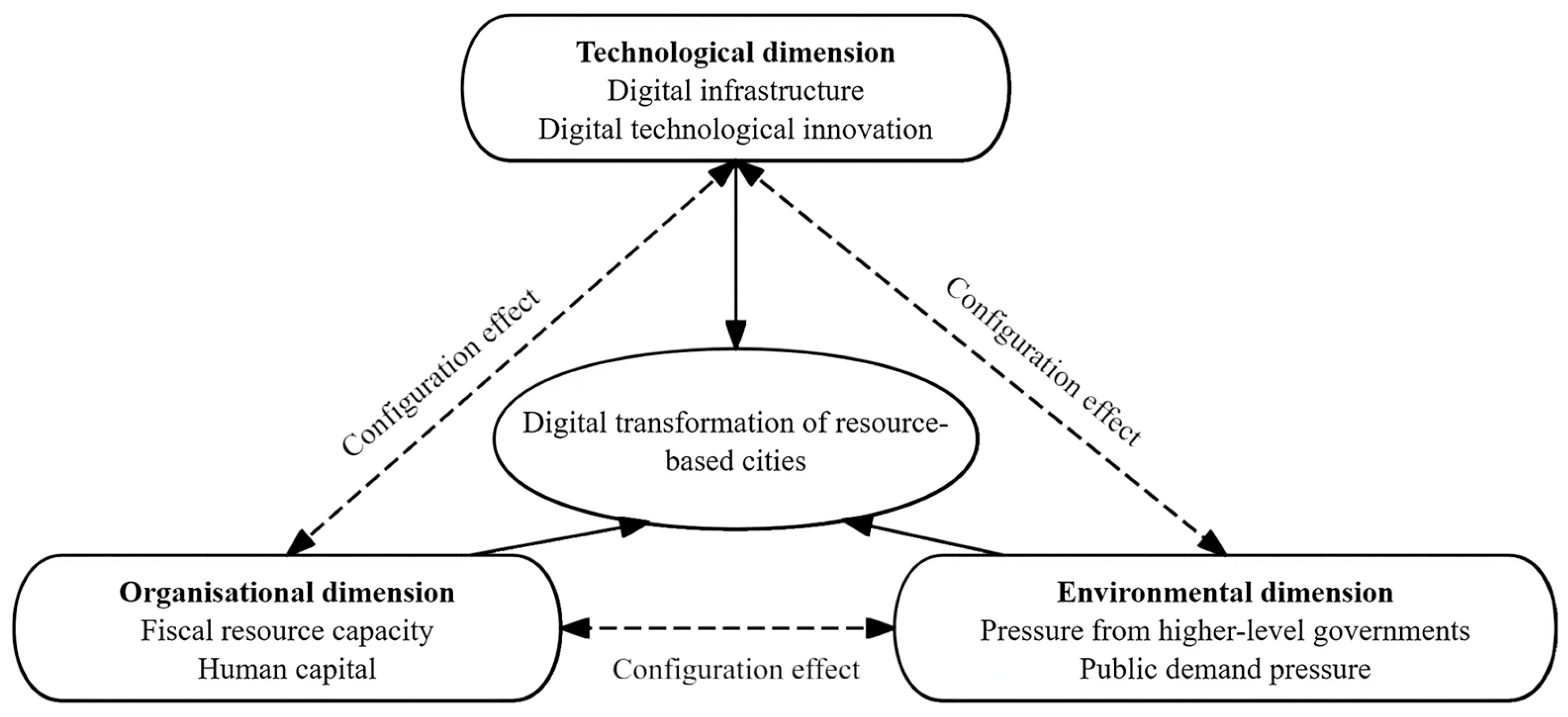
In summary, as the digital transformation of resource-based cities constitutes an organic system with complex interrelationships, this paper constructs six antecedent factors across the technological, organisational and environmental dimensions based on the TOE framework. These are utilised to analyse the multi-configurational pathways of complex causal relationships in digital transformation under multi-factor synergy. The analytical framework is illustrated in Figure 1.
Given the specificities of resource-based cities in terms of industrial structure, fiscal capacity, and talent endowment, a single linear analysis cannot capture the multiple causal pathways of their digital transformation. Drawing on the TOE framework, this study conceptualizes the digital transformation of resource-based cities as the outcome of interactions among technological, organizational, and environmental conditions. Importantly, the same technological or organizational condition may generate different transformation outcomes depending on its configurational context, implying that no single condition is universally necessary or sufficient. Accordingly, rather than formulating linear hypotheses, this study advances a set of configurational propositions that can be empirically evaluated using a configurational comparative approach.
Proposition 1.
The digital transformation of resource-based cities is not driven by any single technological, organizational, or environmental condition alone, but rather results from the synergistic interaction of multiple conditions across these three dimensions.
Proposition 2.
Fiscal resource capacity and human capital are likely to exhibit flexible substitution patterns with each other and with other conditions, such that different combinations of organizational resources may compensate for the absence of one another in driving digital transformation.
Proposition 3.
There may exist multiple equivalent configuration pathways leading to high levels of digital transformation in resource-based cities, reflecting the principle of equifinality, with technological, organizational, and environmental conditions potentially playing different roles (e.g., core, peripheral, or absent) across pathways.
Proposition 4.
The configuration pathways leading to non-high levels of digital transformation are unlikely to be simply the mirror image of those leading to high levels, suggesting causal asymmetry between high and non-high outcomes.

3. Research Methods and Data Processing

3.1. Research Methodology

This study adopts fsQCA from a configurational perspective to explore the driving mechanisms of digital transformation in resource-based cities. The method focuses on asymmetry and causal complexity [38] and is well suited to capture the complex causal relationships and multi-condition synergistic effects arising from the interplay of technology, organisation and environment. Moreover, fsQCA fits the medium-sized sample of 79 Chinese resource-based cities, integrates qualitative and quantitative strengths [39,40], handles continuous variables flexibly, and overcomes the limitations of traditional regression analysis.

3.2. Data Sources and Variable Selection

3.2.1. Case Selection and Data Sources

Compared to conventional small-sample case studies, fsQCA is more suitable for case studies with medium-sized samples. Based on the sample characteristics, it allows for the analysis of the complex interactions among various antecedent conditions [41]. The initial sample consisted of 126 resource-based cities identified by the State Council’s Sustainable Development Plan for Resource-Based Cities (2013–2020). For the year 2024, we collected seven core variables and retained only cities with complete data on all of them. This procedure resulted in a final sample of 79 cities with complete records. The remaining 47 cities were excluded due to at least one missing value, representing an exclusion proportion of 37.3%. The main types of missing data included: difficulty in obtaining digital patent application counts and unavailable government website comment data.
To examine whether the excluded cities differ systematically from the included ones, we compared their distribution across the four resource-based city types defined by the State Council plan. Among the included sample, there are 9 growing, 49 mature, 11 declining, and 10 regenerative cities. Among the excluded sample, there are 11 growing, 17 mature, 13 declining, and 6 regenerative cities. Both samples cover all four city types, and no type is completely absent. While growing and declining cities are somewhat over-represented in the excluded group, the included sample still contains 11 declining cities. Regarding geographical distribution, the excluded cities are not concentrated in underdeveloped western regions, indicating no significant systematic regional bias. The final sample is therefore considered sufficiently representative of China’s resource-based cities for configurational analysis.
The data sources for this paper are primarily derived from two channels: firstly, manual collection and collation, with the conditional variables involved being pressure from higher-level governments and public demand pressure. Data on pressure from higher-level governments was primarily obtained through central and local policy documents, manually compiling information on the 79 resource-based cities in China that are pilot cities for smart cities and “Internet Plus Government Services”, and calculating the number of pilot projects undertaken by the sample cities as of 2024; data on public demand pressure was primarily sourced from the “Annual Reports on Government Website Operations” of each city. Secondly, data was obtained directly from authoritative databases. Data on the permanent resident population and the population with a university degree or higher was sourced from the Seventh National Population Census. All other data was sourced from the “China Science and Technology Statistical Yearbook”, the “China Urban Statistical Yearbook”, and the official statistical yearbooks of various provinces and municipalities published in 2024.

3.2.2. Variable Selection

(1) Dependent Variable. This study uses the digital transformation index of resource-based cities as the dependent variable. Drawing on the research approach of Wang Jun et al. [42], we utilise the numerical scores published in the Urban Digital Development Index database for representation.
The Urban Digital Development Index (2024) is published by the Digital China Institute of H3C Group. It comprises five primary dimensions: Digital Infrastructure, Digital Economy, Digital Society, Digital Government, and Digital Ecosystem, with 15 secondary and 54 tertiary indicators. The index is synthesised using Principal Component Analysis (PCA) and reflects the overall level of digital transformation for each city. The index covers all 79 resource-based cities in our sample with a consistent and comparable evaluation framework that does not adjust weights based on city type. The core of digital transformation in resource-based cities lies in industrial upgrading, governance efficiency improvement, ecological enhancement, and digital empowerment of traditional industries. The index comprehensively covers key dimensions such as industrial digitalization, digital governance, and digital ecology, which align well with the connotation of transformation in resource-based cities. Therefore, the index is appropriately applicable to resource-based cities.
It is worth noting that while the dependent index includes a dimension labelled “Digital Infrastructure”, this dimension is a broad composite covering connectivity, computing, security, platforms, and operations. In contrast, our independent variable “digital infrastructure” is measured only by the number of internet users per 10,000 people and the number of mobile phone users per 10,000 people—reflecting basic network coverage and access. Hence, the two constructs are not identical, and the dependent variable is not directly explained by its own components.
(2) Explanatory Variables. This study examines six explanatory variables, including digital infrastructure, digital technology innovation, fiscal resource capacity, human capital, pressure from higher-level governments, and public demand pressure.
Digital infrastructure constitutes the fundamental network and physical foundation for the digital transformation of resource-based cities. It reflects a city’s capacity for digital connectivity and information access, shaping the starting point and development potential of digital construction. This study measures digital infrastructure using the number of internet users per 10,000 people and the number of mobile phone users per 10,000 people [43]. These indicators directly reflect the coverage scale and penetration rate of basic networks.
Digital technology innovation serves as the core driving force for the digital transformation of resource-based cities. It promotes the upgrading of traditional industries, the cultivation of emerging business forms, and the enhancement of production efficiency. This study measures digital technology innovation by screening and aggregating the total number of digital invention patent applications in each prefecture-level city, following the methodology of Huang Xianhai et al. [44] and utilising the IPC codes from the “Classification of Key Digital Technology Patents (2023)” issued by the National Intellectual Property Administration and the reference table for the International Patent Classification. This study uses the volume of digital patent applications in resource-based cities as an indicator of digital technological innovation [45].
Fiscal resource capacity provides the material foundation for the digital transformation of resource-based cities. It determines a city’s investment capacity in digital infrastructure, technology R&D, and talent cultivation. Fiscal capacity is measured using per capita general public budget expenditure as an indicator of local government fiscal capacity [33].
Human capital constitutes the knowledge base and innovation source for the digital transformation of resource-based cities. Highly educated talent can effectively promote the research, application, and diffusion of digital technologies. Human capital is measured by the proportion of the population with a bachelor’s degree or higher relative to the permanent resident population, drawing on the research by Tong Xinhua et al. [34].
Pressure from higher-level governments acts as an external institutional driver for the digital transformation of resource-based cities. National pilot projects come with clear construction targets and acceptance requirements, effectively motivating local governments to accelerate digital construction. This pressure is assessed by selecting smart city pilot schemes [46] and “Internet Plus Government Services” pilot cities [47]. Policy documents were retrieved via Beida Fabao, Beida Fayi and government portal websites, with the number of pilot projects undertaken serving as the measurement indicator.
Public demand pressure acts as a social driving force for the digital transformation of resource-based cities. Public expectations for convenient, efficient, and transparent digital government services are growing, and this bottom-up demand pushes local governments to continuously improve their digital governance capacity. To assess public demand pressure, the number of comments per capita on government websites was used as the metric [37].

3.2.3. Variable Calibration

Prior to conducting the empirical analysis, it is necessary to perform formal transformations on each variable in accordance with the core requirements of Boolean logic, converting them into fuzzy set form and completing the calibration. Calibration is the process of converting the conditional variables and outcome variables for each case into set membership degrees, ensuring that all variable values fall within the range of 0 to 1. Before calibration, the thresholds for each variable must be determined in advance. Drawing on existing research [48,49], this study adopts the direct calibration method, using the 95th, 50th and 5th percentiles of the case data as the thresholds for full membership, the intersection point, and the anchor point for full non-membership, respectively. The descriptive statistics for each variable are shown in Table 1, and the calibration anchor points are shown in Table 2.

3.3. Empirical Analysis

3.3.1. Necessity Analysis

Prior to conducting an analysis using the fsQCA 3.0 software, it is necessary to perform a necessity test on each condition variable to determine whether it is a necessary condition for the outcome variable. The necessity analysis primarily yields two metrics: consistency and coverage. Consistency is typically used as the key criterion for judgement (Formula (1)), representing the probability of the condition variable occurring under the conditions for the outcome; coverage, on the other hand, reflects the explanatory power of the condition variable regarding the outcome (Formula (2)), with higher values indicating stronger explanatory power.
Consistency ( Y i X i ) = min X i , Y i Y i
Coverage ( Y i X i ) = min X i , Y i X i
Generally, when the consistency level of a condition exceeds 0.9, it may be regarded as a necessary condition; conversely, it does not constitute a necessary condition [50]. As shown in Table 3, the consistency of each condition is less than 0.9, indicating that there are no necessary conditions for promoting digital transformation among digital infrastructure, digital technology innovation, fiscal resource capacity, human capital, pressure from higher-level governments, and public demand pressure [51]. This also suggests that there are multiple concurrent causal relationships in the digital transformation process of resource-based cities.

3.3.2. Configurational Analysis of Condition Variables

Using the fsQCA software to construct truth tables, it is theoretically possible to generate 2 k configuration rows (where k is the number of antecedent conditions). As some configurations lack corresponding urban case support, logical minimisation operations must be performed by setting consistency thresholds, case frequency thresholds and PRI consistency thresholds. Firstly, in accordance with established research practice, the consistency threshold is set to the software default of 0.8. Secondly, the case frequency threshold is typically no less than 1; accordingly, this study sets it to 1. Finally, existing research indicates that the PRI consistency threshold should not be lower than 0.5, as otherwise contradictory configurations are likely to arise [52]. Consequently, this study sets the PRI consistency threshold at 0.5 [53]. Following fsQCA analysis, complex, reduced and intermediate solutions were obtained. This study selected the intermediate solution for analysis, combining it with the reduced solution to distinguish between core and marginal conditions, thereby deriving six configuration pathways leading to high digital transformation, as shown in Table 4.
(1)
Configuration analysis of high digital transformation.
As shown in Table 4, the overall consistency of the six configurations exceeds 0.8 and the overall coverage exceeds 0.5, indicating that the condition configurations are sound [54]. In fsQCA, raw coverage measures the proportion of membership scores in the outcome set covered by a configuration; it is not equivalent to the percentage of cases in a conventional statistical sense. Based on the core conditions, the six configurations that lead to high-level digital transformation are categorised into four types: technology-driven, innovation–organisational synergy, collaborative composite linkage, and technology–environmental linkage.
① Technology-driven type. This type is characterised by digital infrastructure and digital technological innovation as core conditions, corresponding to configurations H1a, H1b and H1c. Configuration H1a has a consistency of 0.934 and a raw coverage of 0.458. Configuration H1a indicates that when resource-based cities possess robust digital infrastructure and digital technological innovation, they can achieve digital transformation even if their fiscal resources and human capital are relatively weak. Cities with membership values higher than 0.5 in this configuration include 9 cities: Linyi, Handan, Nanyang, Ganzhou, Suzhou, Dazhou, Zaozhuang, Luzhou and Suqian.
Configuration H1b has a consistency of 0.955 and a raw coverage of 0.356. Configuration H1b suggests that when resource-based cities possess strong digital infrastructure and digital technological innovation, coupled with human capital and public demand pressures, they can effectively drive digital transformation. Cities with membership values higher than 0.5 in this configuration include 8 cities: Xianyang, Jinzhong, Huzhou, Chuzhou, Jiaozuo, Tai’an, Anshan and Zibo.
Configuration H1c has a consistency of 0.957 and a raw coverage of 0.349. Configuration H1c suggests that when resource-based cities possess strong digital infrastructure and digital technological innovation, supplemented by fiscal capacity, they can achieve digital transformation even if pressure from higher-level governments and public demand is relatively weak. Cities with membership values higher than 0.5 in this configuration include 3 cities: Zhangjiakou, Yulin and Yichun.
A comprehensive comparison of configuration models H1a, H1b and H1c reveals that digital infrastructure and digital technological innovation, as core driving conditions, play a stable role. Provided that the levels of both are sufficiently robust, they can support resource-based cities in achieving digital transformation regardless of changes in organisational and environmental conditions.
Linyi is a typical representative of the technology-driven type. As a major logistics hub in Shandong Province, Linyi pursues a two-pronged strategy of digital infrastructure construction and digital technology innovation. First, the city has made substantial investments in 5G networks, gigabit optical networks, and computing infrastructure, achieving full regional coverage and becoming a national “gigabit city” as well as one of the five provincial data center clusters. Second, Linyi has continuously increased R&D investment in the digital industry, cultivated innovative enterprises, provided affordable intelligent computing resources through its computing power platform, and actively explored integrated applications of computing power innovation. In addition, an integrated e-government service platform has been established to enable one-stop online processing of high-frequency public services. Linyi’s experience demonstrates that even with relatively limited fiscal resources, a resource-based city can still achieve high-level digital transformation by consolidating its digital foundation and strengthening technological innovation capabilities.
② Innovation–Organisational Synergy Type. Configuration H2 is characterised by digital technology innovation, fiscal resource capacity and human capital as core conditions, with a consistency of 0.830 and a raw coverage of 0.390. This configuration indicates that when resource-based cities possess strong digital technology innovation capabilities, along with sufficient fiscal resources and human capital, they can still drive digital transformation even if their digital infrastructure is relatively weak. Cities with membership values higher than 0.5 in this configuration include 12 cities: Dongying, Ordos, Maanshan, Daqing, Ezhou, Tongling, Changzhi, Hulunbuir, Chizhou, Longyan, Jingdezhen and Huangshi.
Dongying City is a typical representative of this category. Firstly, Dongying has established a 300 million yuan special fund for high-quality industrial development and a 100 million yuan risk compensation fund pool, with a cumulative total of 3.262 billion yuan in loans for the commercialisation of scientific and technological achievements approved over the past three years. Secondly, the city has comprehensively deepened the “Industry Empowerment Dongying” initiative; the “Yunfan” platform has been recognised as a national-level “cross-industry, cross-domain” platform, and a total of 11 provincial-level industrial internet platforms have been cultivated. Finally, the city has innovatively implemented entrepreneur training programmes; by 2025, it will have cultivated a total of 488 specialised, refined, distinctive and innovative SMEs and 61 specialised, refined, distinctive and innovative “Little Giant” enterprises. Dongying’s experience demonstrates that resource-based cities, even with relatively weak digital infrastructure, can still effectively drive digital transformation provided that digital technology innovation is vibrant, fiscal investment is adequate, and talent reserves are substantial.
③ Collaborative and Integrated Model. Configuration H3 indicates that, with digital infrastructure and human capital as core conditions, supplemented by pressure from higher-level governments, digital transformation in resource-based cities can still be driven even in the face of limited fiscal resources and weak public demand. This configuration has a consistency of 0.943 and an original coverage of 0.218. When resource-based cities possess relatively well-developed digital infrastructure and sufficient human capital, they can still effectively drive digital transformation through policy guidance and performance evaluation pressure from higher-level governments, even with limited fiscal investment and weak social demand. Cities with membership values higher than 0.5 in this configuration include 4 cities: Yuncheng, Tangshan, Xuzhou and Luoyang.
Xuzhou is a typical representative of this type. First, Xuzhou has steadily promoted the deployment of new digital infrastructure such as 5G networks, big data centres, and edge computing, continuously addressing the shortcomings in urban and rural digital construction, and was successfully designated a national “dual-gigabit” city, thereby consolidating the hardware foundation for digital development. Second, the city has introduced multiple talent attraction and local cultivation policies for the digital industry, established university–industry collaborative education platforms, and trained professionals in digital technology and intelligent manufacturing, continuously strengthening the local digital talent pool and securing human capital support. Finally, Xuzhou has actively implemented various provincial digital development tasks, taken on multiple provincial pilot projects for industrial transformation and digital construction, and followed the development direction set by higher authorities to promote the digital transformation of traditional industries. Relying on a solid infrastructure foundation and sufficient talent advantages, and leveraging policy guidance and performance pressure from higher-level governments, Xuzhou has gradually broken free from the path dependence of heavy industry, seized opportunities for industrial upgrading, and steadily achieved city-wide digital transformation.
④ Technology–Environment Interaction Type. Configuration H4 is characterised by digital infrastructure, pressure from higher-level governments and public demand as core conditions, with a consistency of 0.934 and an original coverage of 0.189. This configuration indicates that when fiscal resources are insufficient and human capital reserves are relatively weak, resource-based cities can still achieve a high level of digital transformation by consolidating their digital infrastructure and leveraging the dual external pressures of policy guidance from higher authorities and social demand. Cities with membership values higher than 0.5 in this configuration include 3 cities: Handan, Suzhou and Bozhou.
Handan is a typical representative of this category of cities. Firstly, Handan has long been dominated by steel and coal industries, making the task of transformation particularly challenging. Despite relatively limited fiscal and human resources, the city has continuously intensified efforts to build digital infrastructure, vigorously promoted the development of the “City Brain” and intelligent computing centres, and actively established a digital foundation. Secondly, Handan has seized opportunities presented by policy support from higher authorities, thoroughly implementing the “Digital Handan” initiative and successfully securing approval for multiple national and provincial reform pilot schemes. Finally, in response to the public’s urgent demand for environmental improvements and optimised government services, the city has actively addressed social concerns, using these demands to drive improvements in governance capabilities and seek better opportunities for industrial upgrading, thereby further advancing its digital transformation.
To enhance transparency, Table 5 presents the membership scores of the typical cities selected for each configurational pathway. The selection criterion is membership greater than 0.5 and representativeness.
(2)
Configurational analysis of non-high digital transformation.
As shown in Table 6, there are four configurations leading to non-high-level digital transformation. Analysis reveals that these configurations do not simply correspond in reverse to the drivers of high-level digital transformation, exhibiting distinct features of causal asymmetry. The consistency levels of all four configurations exceed 0.8, meeting the overall consistency requirements for analysis. Configuration NH1 indicates that when both technological and policy support are lacking, achieving a high level of digital transformation remains difficult even with a certain degree of fiscal capacity. Configuration NH2 indicates that digital transformation is difficult to advance in a context where the technological foundation is weak, policy guidance is insufficient, and social demand is low. Configuration NH3 indicates that even if fiscal conditions are acceptable, transformation will still be hindered if technological innovation capacity is insufficient, talent reserves are scarce, and there is a lack of external drivers from policy and society. Configuration NH4 indicates that relying solely on limited talent reserves and policy support, without a solid technological foundation to underpin them, makes it difficult to drive high-level digital transformation.
Note on unique coverage. Some configurations exhibit very low unique coverage values. This often occurs in fsQCA when multiple configurations cover largely overlapping sets of cases. Although these pathways reflect genuine empirical patterns, their unique explanatory contribution is limited. Accordingly, conclusions regarding these pathways should be drawn cautiously.
(3)
Further Analysis.
A comprehensive analysis of the high and non-high configuration groups reveals that the digital transformation of resource-based cities exhibits significant causal asymmetry. Firstly, technological conditions (digital infrastructure and digital technology innovation) are generally present as core conditions in high digital transformation pathways, whilst they are generally absent as core conditions in non-high digital transformation pathways. This indicates that technological conditions form a crucial foundation for transformation, and their absence is difficult to compensate for through other conditions. Secondly, environmental conditions (pressure from higher-level governments and public demand) act as catalysts in certain configurations of the high-digital-transformation pathway, whilst being almost entirely absent in the non-high-digital-transformation pathway. This suggests that external pressure is a key driver of transformation, but its effectiveness requires a certain level of technological foundation. Finally, organisational conditions (financial resources and human capital) exhibit characteristics of flexible combinations and mutual substitution in high-digital-transformation pathways, which can be categorised into three combination patterns: limited financial resources, limited human resources, and ample financial and human resources; whereas in non-high-digital-transformation pathways, their presence or absence is not a decisive factor, further revealing the diversity of organisational resource allocation methods.


3.3.3. Robustness Tests

To enhance the reliability of the configurational analysis results, this study conducted a series of robustness tests, including raising the original consistency threshold, raising the PRI consistency threshold, changing the calibration thresholds, and adjusting the case frequency threshold (see Table 7, Table 8 and Table 9). The variable “public demand pressure” exhibits a heavily right-skewed distribution; therefore, we performed a sensitivity analysis exclusively for this variable, while keeping the original 95th/50th/5th percentile calibration for all other variables. Specifically, we tested two alternative calibration schemes: recalibrating this variable using the 90th/50th/10th percentiles, and applying a logarithmic transformation before calibration. In addition, we raised the case frequency threshold from 1 to 2. The results show that the core configurational pathways remain highly consistent across different calibration schemes, the core conditions remain unchanged, and the overall consistency and coverage values remain stable. Adjustments to peripheral conditions do not materially affect the overall conclusions, demonstrating that the findings of this study possess good robustness.

4. Conclusions and Recommendations

4.1. Conclusions

Based on the TOE framework and fsQCA method, this study investigates 79 resource-based cities in China. These cities are characterised by monolithic industrial structures, strong path dependence, talent shortages, and volatile fiscal revenues, which make their digital transformation constraints fundamentally different from those of ordinary cities. Adopting a configurational perspective, this study explores the driving pathways of high and non-high digital transformation and reveals the complex logical relationships between technology, organisation, environment, and digital transformation. The main conclusions are as follows:
(1)
No single factor is sufficient to independently drive the digital transformation of resource-based cities. The digital transformation of resource-based cities is the result of the interweaving and combined effects of the three factors—technology, organisation and environment. These three factors do not simply add up; rather, they require synergistic interaction to form a combined force. This further reveals the complexity of digital transformation in resource-based cities and confirms the existence of multiple concurrent causal relationships from a configuration perspective.
(2)
Digital infrastructure and technological innovation serve as core prerequisites in most high-transformation pathways, whereas they are notably absent in non-high-transformation pathways, indicating that technological conditions form a crucial foundation for transformation. At the same time, a minority of alternative pathways exist where “soft power compensates for hardware deficiencies”. Pressure from higher-level governments and public demand act as catalysts in high-transformation pathways, but their effectiveness is contingent upon a technological foundation. Fiscal resource capacity and human capital exhibit three combination patterns: limited financial resources, limited human resources, and ample financial and human resources, indicating that organisational resource allocation methods are diverse and that there is no single optimal solution.
(3)
There are multiple equivalent driving pathways for the digital transformation of resource-based cities. High-level digital transformation comprises six configuration pathways, which can be categorised into four types: technology-driven, innovation–organisational synergy, collaborative composite linkage, and technology–environmental linkage. Concurrently, four non-high-level digital transformation configurations emerge; the configurations of high- and non-high-level digital transformation exhibit causal asymmetry.
Taken together, these findings shift the analytical focus from isolated linear drivers to synergistic configurational mechanisms, providing empirical evidence of equifinality and causal asymmetry in the context of resource-based cities.

4.2. Recommendations

Based on the above conclusions, this paper puts forward the following recommendations, with a view to providing theoretical guidance and practical references for the digital transformation of resource-based cities.
(1)
Adopt a systems approach to promote the synergistic interaction of the three key elements. Local governments should abandon the traditional “single-point breakthrough” mindset and avoid over-reliance on the improvement of a single condition whilst neglecting the supporting role of other conditions. When formulating digital transformation policies, they must holistically consider the multidimensional alignment of technological infrastructure, organisational resources and the external environment, thereby establishing an integrated framework where technology, organisation and environment interact synergistically.
(2)
Consolidate the technological foundation, flexibly allocate organisational resources, and effectively harness environmental pressures. At the technological level, investment in digital infrastructure should be continuously increased to foster technological innovation capabilities and solidify the foundations of transformation. At the organisational level, cities should optimise the allocation of fiscal and human resources in accordance with local conditions. At the environmental level, policy guidance and performance incentives from higher authorities should be strengthened, whilst public demand should be effectively transformed into a driving force for transformation.
(3)
Select appropriate transformation pathways tailored to local conditions. Resource-based cities should assess their actual circumstances, identify core strengths and key weaknesses, and choose transformation pathways that align with local conditions. Cities with a solid technological foundation may opt for a technology-driven approach. Cities with vibrant innovation ecosystems, substantial financial resources and an ample talent pool may opt for an innovation-organisation synergy approach. Cities with well-developed infrastructure and distinct talent advantages may choose a collaborative, multi-faceted approach. Cities with limited financial and human resources but facing significant external pressures may draw on a technology–environment linkage model.
(4)
Differentiated digital transformation paths should be adopted according to city type. Growing cities should prioritise the deployment of digital infrastructure and the cultivation of technological innovation capabilities. Mature cities, while consolidating their existing industrial base, should optimise fiscal and human resource allocation and leverage policy guidance from higher-level governments and public demand pressure to promote deep integration of digital technologies with traditional industries. Declining cities, facing resource depletion and fiscal and talent constraints, should prioritise addressing deficiencies in digital infrastructure at a relatively low cost, seek policy support from higher authorities, and activate endogenous transformation momentum by starting with digital applications in areas of high public concern such as environmental governance and employment services. Regenerative cities, having already emerged from resource dependence, should build on their existing advantages to achieve higher-level digital development through the synergistic interaction of technology, organisation and environment, for example by building smart city brains, developing digital industrial clusters, and participating in national pilot projects to serve as demonstration models for digital transformation.

4.3. Research Limitations

This study investigates the configurational driving mechanisms of digital transformation in resource-based cities based on the TOE framework and using the fsQCA method from a static cross-sectional perspective. However, there are several limitations that should be acknowledged. First, due to data availability constraints, this study relies on cross-sectional data, which limits the ability to capture the dynamic evolution of digital transformation configurations over time or to reveal the lagged effects of technological, organizational, and environmental conditions. Second, the antecedent conditions are limited to six core indicators under the TOE framework, and more multidimensional contextual factors and governance conditions are not fully incorporated. Third, this study focuses on prefecture-level resource-based cities in China, which ensures analytical consistency but may limit the generalizability of the findings to county-level resource-based cities or to resource-based cities in other national contexts. Finally, the fsQCA method emphasizes holistic configurational analysis and does not fully explore the micro-level interaction mechanisms among conditions, leaving some of the operational logic underlying different pathways underexamined.

4.4. Future Research Directions

Building on the aforementioned limitations, several directions for future research can be identified. Future studies could expand the sample scope to include county-level resource-based cities or conduct cross-country comparative analyses to test the generalizability of the present findings across different institutional and economic contexts. Longitudinal and dynamic research is also needed; future investigations could employ dynamic fsQCA or panel data techniques to explore the temporal evolution of configurational pathways and the driving mechanisms underlying pathway shifts, thereby capturing the inherently dynamic nature of digital transformation in resource-based cities. Finally, building on the TOE framework, future research could incorporate additional antecedent conditions at different levels to further elucidate the complex synergistic effects of multi-level factors on digital transformation outcomes. Pursuing these directions would help to further validate, refine, and extend the findings of this study.

Author Contributions

Conceptualization, M.H.; Methodology, M.Z. and M.H.; Software, M.H.; Validation, M.Z. and M.H.; Formal analysis, M.Z. and M.H.; Investigation, M.H.; Resources, M.Z. and M.H.; Data curation, M.H.; Writing—original draft, M.H.; Writing—review & editing, M.Z. and M.H.; Visualization, M.Z. and M.H.; Supervision, M.Z.; Project administration, M.H.; Funding acquisition, M.Z. All authors have read and agreed to the published version of the manuscript.

Funding

This research received no external funding.

Institutional Review Board Statement

Not applicable.

Informed Consent Statement

Not applicable.

Data Availability Statement

The data presented in this study are available on request from the corresponding author.

Conflicts of Interest

The authors declare no conflicts of interest.

Abbreviations

The following abbreviations are used in this manuscript:
fsQCAFuzzy-set Qualitative Comparative Analysis
TOETechnology-Organization-Environment

References

  1. Li, G.; Ma, Y. Research context and prospect of urban digital transformation based on knowledge graph. J. Southwest Univ. Natl. Hum. Soc. Sci. 2025, 46, 215–230. [Google Scholar]
  2. Yang, Y. Measurement and Influencing Factors of Digital Transformation Level of Chinese Cities. Master’s Thesis, Anhui Jianzhu University, Hefei, China, 2025. [Google Scholar]
  3. Chen, X.; Liu, S.; Shen, H. Empowering new quality productivity through digital transformation. Xinjiang Soc. Sci. 2024, 26, 41–45. [Google Scholar] [CrossRef]
  4. Coile, R.C. The digital transformation of health care. Physician Exec. 2000, 26, 8–15. [Google Scholar]
  5. Huang, Q.; Xu, L.; Yang, Y. Measurement, dynamic evolution and influencing factors of digital transformation level of Chinese cities. J. Chongqing Univ. Technol. Soc. Sci. 2024, 38, 90–102. [Google Scholar]
  6. Zheng, L. The content, path and direction of urban digital transformation. Explor. Free Views 2021, 147–152+180. [Google Scholar] [CrossRef]
  7. Ajoudanian, S.; Aboutalebi, H.R. A capability maturity model for smart city process-aware digital transformation. J. Urban Manag. 2025, 14, 877–895. [Google Scholar] [CrossRef]
  8. Demirkan, H.; Spohrer, J.C. Cultivating T-shaped professionals in the era of digital transformation. Serv. Sci. 2018, 10, 88–109. [Google Scholar] [CrossRef]
  9. Laksmana, T.; Shee, H.; Thai, V.V. Common resources—Resource bundling-performance: The mediating role of resource bundling in container terminal operations. Int. J. Phys. Distrib. Logist. Manag. 2020, 50, 809–831. [Google Scholar] [CrossRef]
  10. Ariana, S.; Azim, C.; Antoni, D. Clustering of ICT human resources capacity in the implementation of E-government in expansion area: A case study from pali regency. Cogent Bus. Manag. 2020, 7, 1754103. [Google Scholar] [CrossRef]
  11. Li, Z. Multiple Logics of Policy Pilot Promotion: An Analysis Based on China’s Smart City Pilots. J. Public Manag. 2019, 16, 145–156, 175. [Google Scholar]
  12. Zhang, H.; Qian, W. Driving digital innovation through quality incentives: Evidence from Chinese cities in the digital transformation era. J. Innov. Knowl. 2026, 15, 100994. [Google Scholar] [CrossRef]
  13. Guo, G.; Hu, G. Influencing Factors and Generation Paths of Digital Government Construction Performance in China: A Fuzzy-Set Qualitative Comparative Analysis Based on 31 Provinces. Chongqing Soc. Sci. 2022, 41–55. [Google Scholar] [CrossRef]
  14. Tangi, L.; Janssen, M.; Benedetti, M.; Noci, G. Digital government transformation: A structural equation modelling analysis of driving and impeding factors. Int. J. Inf. Manag. 2021, 60, 102356. [Google Scholar] [CrossRef]
  15. Luna-Reyes, L.F.; Gil-Garcia, J.R. Digital government transformation and internet portals: The co-evolution of technology, organizations, and institutions. Gov. Inf. Q. 2014, 31, 545–555. [Google Scholar] [CrossRef]
  16. Gu, L.; Li, H. Comparison of three typical models of urban digital transformation in China: A case study of Shanghai, Shenzhen and Chengdu. J. Public Manag. 2023, 20, 53–63. [Google Scholar]
  17. Wu, L.; Leng, Y.; Tang, S. Academic landscape of agile governance in the digital age: Research paradigms and implementation paths. E-Government 2022, 77–88. [Google Scholar] [CrossRef]
  18. Qiu, Q.; Zhang, J.; Chu, C. Digital transformation of mega-city governance: Logic, approach and optimization. J. Beijing Adm. Coll. 2023, 38–47. [Google Scholar] [CrossRef]
  19. Chen, S. The holistic logic of urban governance digital transformation. J. Lanzhou Univ. Soc. Sci. 2022, 50, 72–80. [Google Scholar]
  20. Weng, S. Technology-driven and bureaucratic integration: Interaction mechanism of urban governance digital transformation. Chin. Public Adm. 2023, 42–50. [Google Scholar] [CrossRef]
  21. Shen, F.; Zhu, J. Data empowerment: Operation mechanism and innovation path of digital government governance. J. Polit. Sci. 2021, 1, 104–115. [Google Scholar]
  22. Wen, H.; Wang, S. Mutual constitutive evolution: Continuous advancement and internal mechanism of urban digital transformation. J. Nantong Univ. Soc. Sci. Ed. 2025, 41, 53–64. [Google Scholar]
  23. Zhou, M.; Qiao, Y. Regional differences and internal mechanisms of the integrated development of urban greening and digitalization. Urban Probl. 2023, 4–14. [Google Scholar] [CrossRef]
  24. Gu, L.; Song, Y. Research on the path and optimization of agile governance in mega-cities: Based on the analysis of Shanghai’s “One-Network Unified Management” practice in responding to public opinions. Chin. Public Adm. 2023, 6–14. [Google Scholar]
  25. Liu, Z.; Xing, Z. Study on environmental governance performance of cities along the Yellow River: An empirical analysis based on TOE framework. J. Ecol. Civiliz. 2025, 54–66. [Google Scholar] [CrossRef]
  26. Gong, W.; Ruan, J. Influencing factors and paths of digital government construction under the TOE and “Resource-Pressure” framework. J. Southwest Univ. Natl. Hum. Soc. Sci. 2024, 45, 188–197. [Google Scholar]
  27. Li, Y.; Yan, C.; Zhao, Y. A configurational study on the antecedents of smart city governance path under the TOE framework: A fuzzy-set qualitative comparative analysis of 35 key cities. J. Technol. Econ. 2022, 41, 140–151. [Google Scholar]
  28. Han, C.; Zhang, X.; Sun, X.; Wang, Q. The Adoption of Smart Retail and Business Performance: A New Mechanism Analysis. Sustainability 2026, 18, 4514. [Google Scholar] [CrossRef]
  29. Hao, W.; Meng, X.; Duan, Z. The theoretical logic and configuration path of urban digital transformation from the perspective of dynamic capabilities: A fuzzy-set qualitative comparative analysis of national key cities. E-Government 2023, 73–86. [Google Scholar] [CrossRef]
  30. Huang, M.; Zhang, W.; Lan, X. Impact of digital infrastructure construction on urban economic resilience. Stat. Decis. 2025, 41, 101–106. [Google Scholar]
  31. Wu, C.; Deng, H.; Xia, Q. The impact of digital technology innovation on green development level. China Soft Sci. 2025, 66–80. [Google Scholar] [CrossRef]
  32. Yin, P.; Li, R.; Wang, S.; Wang, F.; Duan, P. The impact of digital technology innovation on rural tourism public services and its spatial effects. Econ. Geogr. 2026, 46, 256–265. [Google Scholar]
  33. Yi, C.; Qiu, X. Agency adaptation: How to promote digital transformation in mega-cities? A qualitative comparative analysis of 21 cases. J. Shanghai Adm. Coll. 2025, 26, 13–26. [Google Scholar]
  34. Tong, X.; Guo, S.; Duan, H.; Li, B. Influence mechanism of resource industry dependence on the shrinkage of resource-based cities in China. Resour. Sci. 2024, 46, 2022–2033. [Google Scholar]
  35. Xiong, Z.; Zhao, H.; Liu, X. Research and reflection on the transformation of resource-based cities in China: Taking Datong, Shanxi Province as an example. Bull. Chin. Acad. Sci. 2024, 39, 2120–2130. [Google Scholar]
  36. Edelman, L.B. Legal environments and organizational governance: The expansion of due process in the American workplace. Am. J. Sociol. 1990, 95, 1401–1440. [Google Scholar] [CrossRef]
  37. Jiang, L.; Su, J. Differentiation realization mechanism of urban digital transformation in China: Based on “Pressure-State-Response” analytical framework. New Horiz. 2025, 88–98. [Google Scholar] [CrossRef]
  38. Qu, L.; Hou, M.; Xu, Z. Enhancing Smart Seaport Operational Efficiency for Sustainable Development: A Configuration Analysis Using DEA and fsQCA. Sustainability 2026, 18, 2770. [Google Scholar] [CrossRef]
  39. Du, Y.; Li, J.; Liu, Q.; Zhao, S.T.; Chen, K. Configurational theory and QCA method from a complex dynamic perspective: Research progress and future directions. Manag. World 2021, 37, 180–197. [Google Scholar]
  40. Furnari, S.; Crilly, D.; Misangyi, V.F.; Greckhamer, T.; Fiss, P.C.; Aguilera, R.V. Capturing causal complexity: Heuristics for configurational theorizing. Acad. Manag. Rev. 2021, 46, 778–799. [Google Scholar] [CrossRef]
  41. Stokke, O.S. Qualitative comparative analysis, shaming, and international regime effectiveness. J. Bus. Res. 2007, 60, 501–511. [Google Scholar] [CrossRef]
  42. Wang, J.; Wang, J. Urban digital transformation and the synergistic effect of “pollution reduction and carbon reduction”. Urban Probl. 2024, 46–56. [Google Scholar] [CrossRef]
  43. Yang, W.; Yao, Q.; Li, D. The spatial threshold effect and geographical decay boundary of digital economy enabling high-quality development: Evidence from the Yangtze River Delta. East China Econ. Manag. 2025, 39, 79–90. [Google Scholar]
  44. Huang, X.; Wang, H.; Sun, Y.; Yu, L. Digital technology and firm export quality upgrading: Evidence from patent text machine learning. J. Quant. Technol. Econ. 2023, 40, 69–89. [Google Scholar]
  45. Ye, T.; Liu, H. Research on information consumption enabling urban digital technology innovation: Empirical evidence from the National Information Consumption Pilot Policy. J. Hubei Minzu Univ. Philos. Soc. Sci. 2025, 43, 121–133. [Google Scholar]
  46. Wang, H.; Chen, H. The evolution mechanism and enlightenment of smart city innovation diffusion in China: An event history analysis of 38 cities. Sci. Technol. Prog. Policy 2017, 34, 44–48. [Google Scholar]
  47. Liu, B.; Fu, K.; Zhang, J. Digital transformation of government governance and improvement of urban economic efficiency: A quasi-natural experiment based on the “Internet + Government Services” pilot. J. Nanjing Univ. Finance Econ. 2023, 53–64. [Google Scholar] [CrossRef]
  48. Zhu, J.; Jin, K.; Jin, H.; He, Y.; Yang, S. Spatiotemporal Evolution, Regional Differences, and Configurational Paths of Green Total Factor Productivity in China’s Power Industry Driven by Digital Economy Factors. Sustainability 2026, 18, 3377. [Google Scholar] [CrossRef]
  49. Wu, H. How Does the Dual Credit Policy Affect the Green Innovation Performance of New Energy Vehicle Enterprises?—A Dynamic Configuration Analysis Based on the TOE Framework. Sustainability 2026, 18, 2186. [Google Scholar] [CrossRef]
  50. Schneider, C.Q.; Wagemann, C. Set-Theoretic Methods for the Social Sciences: A Guide to Qualitative Comparative Analysis; Cambridge University Press: Cambridge, UK, 2012. [Google Scholar] [CrossRef]
  51. Pei, X.; Li, C. How Can Artificial Intelligence Policies Promote the Sustainable Enhancement of Regional Science and Technology Industrial Competitiveness? A Fuzzy-Set Qualitative Comparative Analysis (fsQCA) of Policy Instruments. Sustainability 2026, 18, 4052. [Google Scholar] [CrossRef]
  52. Greckhamer, T.; Furnari, S.; Fiss, P.C.; Aguilera, R.V. Studying configurations with qualitative comparative analysis: Best practices in strategy and organization research. Strate. Organ. 2018, 16, 482–495. [Google Scholar] [CrossRef]
  53. Zhang, X.; Zhang, W.; Zhang, R.; Feng, T. Research on the improvement path of platform ecosystem resilience from a configurational perspective. Soft Sci. 2024, 38, 15–25. [Google Scholar]
  54. Wen, Y.; Jiang, C. Attention redistribution, external resource dependence and digital rural governance performance: A configurational analysis based on TOE framework. Chin. Public Adm. 2023, 7, 58–67. [Google Scholar]
Figure 1. Theoretical Analysis Framework for the Digital Transformation of Resource-Based Cities.
Sustainability 18 05519 g001
Table 1. Descriptive statistics.
VariableSampleMeanStandard DeviationMinimumMaximum
Digital infrastructure791.6420.9750.3804.940
Digital technology innovation79864.279957.17089.0005666.000
Fiscal capacity7914,033.0405683.7548410.90050,428.000
Human capital790.1200.0340.0600.220
Pressure from higher-level government790.3670.5080.0002.000
Public demand pressure79168.023513.1170.0732167.000
Digital transformation 7950.6588.64738.50071.700
Table 2. Variable calibration anchors.
Research VariableAnchor
Full MembershipCrossover PointComplete Non-Membership
Conditional variableDigital infrastructure3.9031.4800.518
Digital technology innovation2568.100486.000121.500
Fiscal capacity20,133.14613,003.0208624.936
Human capital0.1810.1200.070
Pressure from higher-level government210
Public demand pressure1797.3815.2920.383
Outcome variableDigital transformation65.85050.20039.190
Table 3. Necessity Analysis Results.
Conditional VariablesDigital Transformation of Resource-Based Cities~Digital Transformation of Resource-Based Cities
ConsistencyCoverageConsistencyCoverage
Digital infrastructure0.7760.8140.4710.570
~Digital Infrastructure0.5900.4910.8450.814
Digital technology innovation0.8110.8180.4550.529
~Digital Technology Innovation0.5330.4590.8440.828
Fiscal capacity0.5810.5560.6440.711
~Fiscal resource capacity0.6980.6290.5980.622
Human capital0.6590.6420.5800.653
~Human capital0.6440.5710.6820.697
Pressure from higher-level government0.3470.7470.2900.721
~Pressure from higher authorities0.8710.5150.8980.613
Public demand pressure0.5450.6610.5160.720
~Public demand pressure0.7690.5790.7570.658
“~” represents the logical operator “NOT”.
Table 4. Configurations for high digital transformation in resource-based cities.
PreconditionsHigh Digital Transformation
H1aH1bH1cH2H3H4
Digital infrastructure
Digital technology innovation
Fiscal capacity
Human capital
Pressure from higher-level government
Public demand pressure
Consistency0.9340.9550.9570.8300.9430.934
Initial coverage0.4580.3560.3490.3900.2180.189
Unique coverage0.1070.0170.0150.0960.0090.001
Overall consistency0.859
Overall coverage0.711
indicates the presence of a core condition; ● indicates the presence of a peripheral condition; indicates the absence of a core condition; ⊗ indicates the absence of a peripheral condition; blank space indicates that the condition is irrelevant.
Table 5. Representative cities and membership values.
ConfigurationRepresentative CityConfiguration MembershipOutcome Membership
H1Linyi0.8500.950
H2Dongying0.7500.920
H3Xuzhou0.5010.980
H4Handan0.5010.930
Table 6. Configurations for Non-High Digital Transformation in Resource-Based Cities.
PreconditionsNon-High Digital Transformation
NH1NH2NH3NH4
Digital infrastructure
Digital technology innovation
Fiscal capacity
Human capital
Pressure from higher-level government
Public demand pressure
Consistency0.9040.9700.9690.937
Initial coverage0.5180.4780.3520.153
Unique coverage0.1520.1250.0080.001
Overall consistency0.911
Overall coverage0.662
indicates the presence of a core condition; ● indicates the presence of a peripheral condition; indicates the absence of a core condition; ⊗ indicates the absence of a peripheral condition; blank space indicates that the condition is irrelevant.
Table 7. Results of robustness test (original consistency = 0.85).
PreconditionsHigh Digital Transformation
123456
Digital infrastructure
Digital technology innovation
Fiscal capacity
Human capital
Pressure from higher-level government
Public demand pressure
Consistency0.9440.9550.9570.8650.9430.933
Initial coverage0.4580.3560.3490.3740.2180.189
Unique coverage0.1070.0170.0070.0240.0090.001
Overall consistency0.876
Overall coverage0.682
indicates the presence of a core condition; ● indicates the presence of a peripheral condition; indicates the absence of a core condition; ⊗ indicates the absence of a peripheral condition; blank space indicates that the condition is irrelevant.
Table 8. Results of robustness test (PRI = 0.6).
PreconditionsHigh Digital Transformation
12345
Digital infrastructure
Digital technology innovation
Fiscal capacity
Human capital
Pressure from higher-level government
Public demand pressure
Consistency0.9440.8300.9610.9550.957
Initial coverage0.4580.3900.2480.3560.349
Unique coverage0.0990.0960.0070.0170.015
Overall consistency0.871
Overall coverage0.693
indicates the presence of a core condition; ● indicates the presence of a peripheral condition; ⊗ indicates the absence of a peripheral condition; blank space indicates that the condition is irrelevant.
Table 9. Results of robustness test (calibration = 90%. 50%. 10%).
PreconditionsHigh Digital Transformation
12345
Digital infrastructure
Digital technology innovation
Fiscal capacity
Human capital
Pressure from higher-level government
Public demand pressure
Consistency0.9350.8320.9540.9550.930
Initial coverage0.7430.3070.3230.2700.165
Unique coverage0.1590.0980.0470.0240.012
Overall consistency0.855
Overall coverage0.705
indicates the presence of a core condition; ● indicates the presence of a peripheral condition; indicates the absence of a core condition; ⊗ indicates the absence of a peripheral condition; blank space indicates that the condition is irrelevant.
Disclaimer/Publisher’s Note: The statements, opinions and data contained in all publications are solely those of the individual author(s) and contributor(s) and not of MDPI and/or the editor(s). MDPI and/or the editor(s) disclaim responsibility for any injury to people or property resulting from any ideas, methods, instructions or products referred to in the content.