Article

Treatment of Pumping Water from the Engraulis ringens Fishmeal Industry Using Moringa oleifera Seed Coagulant and Chitosan

by
Nadia Sofia Legua-Quezada
1,
Maria Cristina Miglio-Toledo
2,
Juan Gabriel Juscamaita-Morales
3,
Luis Fernando Hurtado-Díaz
1,
Paola Jorge-Montalvo
4,* and
Lizardo Visitación-Figueroa
4
1
Applied Biotechnology Research Circle, Faculty of Science, Universidad Nacional Agraria La Molina, Lima 15024, Peru
2
Department of Fisheries Management and Environment, Faculty of Fisheries, Universidad Nacional Agraria La Molina, Lima 15024, Peru
3
Environmental Biotechnology-Bioremediation Laboratory, Department of Biology, Faculty of Science, Universidad Nacional Agraria La Molina, Lima 15024, Peru
4
Research Group in Industrial and Chemical Waste Valorization, Faculty of Science, Universidad Nacional Agraria La Molina, Lima 15024, Peru
*
Author to whom correspondence should be addressed.
Sustainability 2026, 18(11), 5411; https://doi.org/10.3390/su18115411
Submission received: 20 April 2026 / Revised: 20 May 2026 / Accepted: 25 May 2026 / Published: 28 May 2026

Abstract

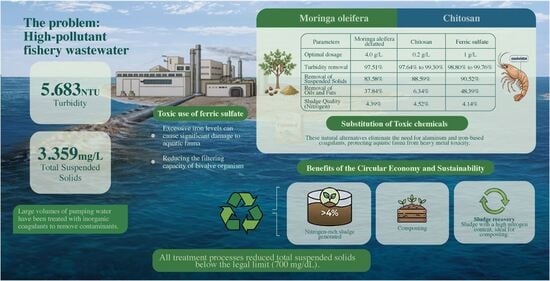
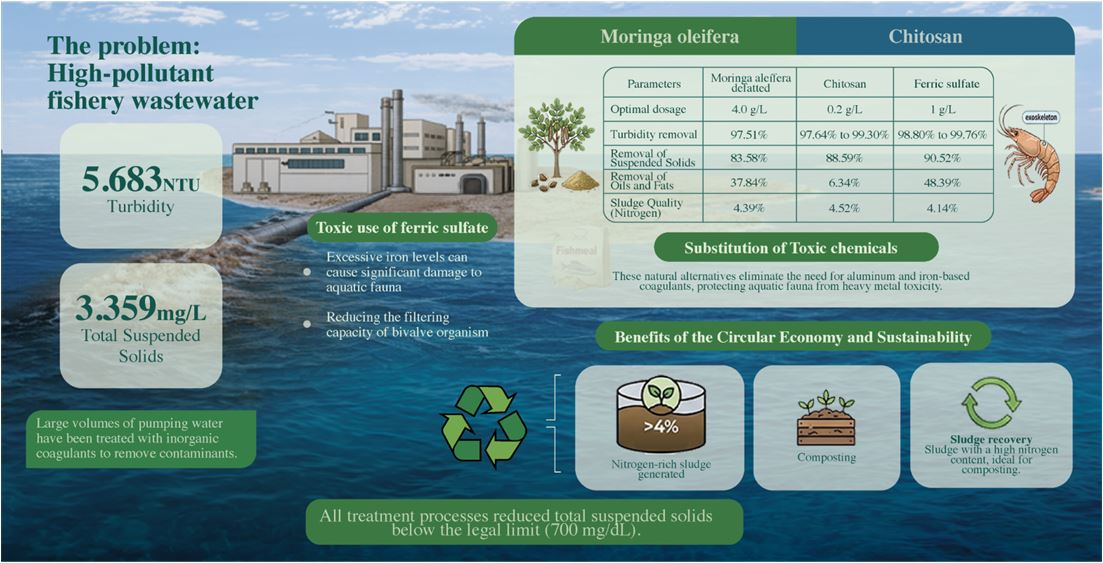
The Peruvian anchoveta fishmeal industry generates wastewater (pumping water) during the transport of fish from boats to production plants. This study represents the first evaluation in Peru of Moringa oleifera (MOD) and chitosan as bio-coagulants specifically applied to the coagulation–flocculation treatment of pumping water, providing a direct comparative analysis against traditional ferric sulfate under identical experimental conditions. The effluent is characterized by an extreme turbidity of 5,683 NTU, total suspended solids (TSS) at 3359.3 mg/L, and oils and fats at 451.3 mg/L, and it was treated using optimized doses: 4.0 g/L for MOD and 0.2 g/L for chitosan. The results demonstrate that natural alternatives achieve turbidity removal exceeding 97.5%, matching the efficiency of inorganic salts. Notably, chitosan achieved 88.59% TSS removal with no significant statistical difference (p > 0.05 according to the Kruskal–Wallis test) from ferric sulfate, while MOD excelled in oil reduction (37.84%) compared with chitosan. Beyond treatment efficiency, this research fills a gap in circular economy data by identifying that the resulting sludge, containing >4% non-toxic nitrogen, is suitable for composting. These findings establish a new renewable benchmark for the Peruvian fishing industry’s transition toward sustainable, zero-waste water management.

Graphical Abstract

1. Introduction

The global projection for fishmeal production in 2030 is 7583 thousand metric tons [1], with Peru producing approximately 30% [2]. Fishmeal processing plants generate wastewater from cleaning and maintenance, pumping water, sanguaza, and stickwater. Pumping water originates during the transfer of raw material from the vessel to the plant and uses large volumes of seawater as a transport fluid [3]. Between 2 and 15 m3 of pumping water is produced per Tm of anchoveta raw material [2,3,4], which contains between 6.9 and 12.4 kg/m3 of suspended solids, 4.0 to 8.3 kg/m3 of organic matter, and 0.56 kg/m3 of oils and fats [3,5]. These percentages depend on the time of capture, the quality of the raw material (higher or lower blood content), the seasonality of the fishery (higher or lower fat content), and the pump used to transfer the raw material (damage to the raw material) [2,3,5]. The pumping water is treated by various processes, including rotating filters, grease traps, a dissolved air flotation (DAF) system, and a clarifier, in which chemical agents are added during a Chemical Coagulation Process to promote coagulation and flocculation of suspended solids. The clarified water is then discharged into the sea in compliance with maximum permissible limits (MPL): 700 mg/L for total suspended solids (TSS) and 350 mg/L for fats, oils, and grease (D.S. 010-2018-MINAM).
The use of iron and aluminum coagulants in wastewater treatment has raised concerns due to their adverse effects on the ecosystem and public health [6,7]. Excessive iron levels can cause significant damage to aquatic fauna, affecting gills and other vital organs of fish and crustaceans [8,9], and reduce the filtering capacity of bivalves [10]. From a production perspective, treated wastewater generates sludge with trace iron that re-enters the production process, accelerating the oxidation of fishmeal and adversely affecting its organoleptic characteristics [11,12]. Therefore, it is necessary to explore safer and more sustainable coagulant alternatives, such as Moringa oleifera and chitosan, over conventional chemical coagulants due to their biodegradability and low toxicity [13,14]. The main removal mechanisms identified in Moringa oleifera are charge neutralization thanks to its low-molecular-weight cationic proteins, which destabilize the negative colloids in the effluent [15]. However, due to its long-chain polymeric structure, chitosan complements this process through a bridging mechanism between particles, facilitating the formation of denser, larger flocs [16,17].
The structural characteristics of Moringa oleifera, an evergreen tree native to the southern Himalayas, are directly linked to its chemical efficiency as a bio-coagulant. It belongs to the Moringaceae family, order Capparidales, class Magnoliopsida. It is a very fast-growing species. The seeds are dark brown, globular, and 1 cm in diameter, with wings and a papery consistency. The mature pods remain on the tree for several months before splitting and releasing the seeds, which are dispersed by wind, water, and probably animals. The importance of its use as a forage crop is due to its good nutritional characteristics and its high yield in fresh biomass production. The seed contains 33.6–40% oil. Studies conducted in Pakistan extracted oil from dry seeds with hexane. It contains 7.01% palmitic acid, 71.4% oleic acid, 1.92% linolenic acid, and 0.976% linoleic acid [18].
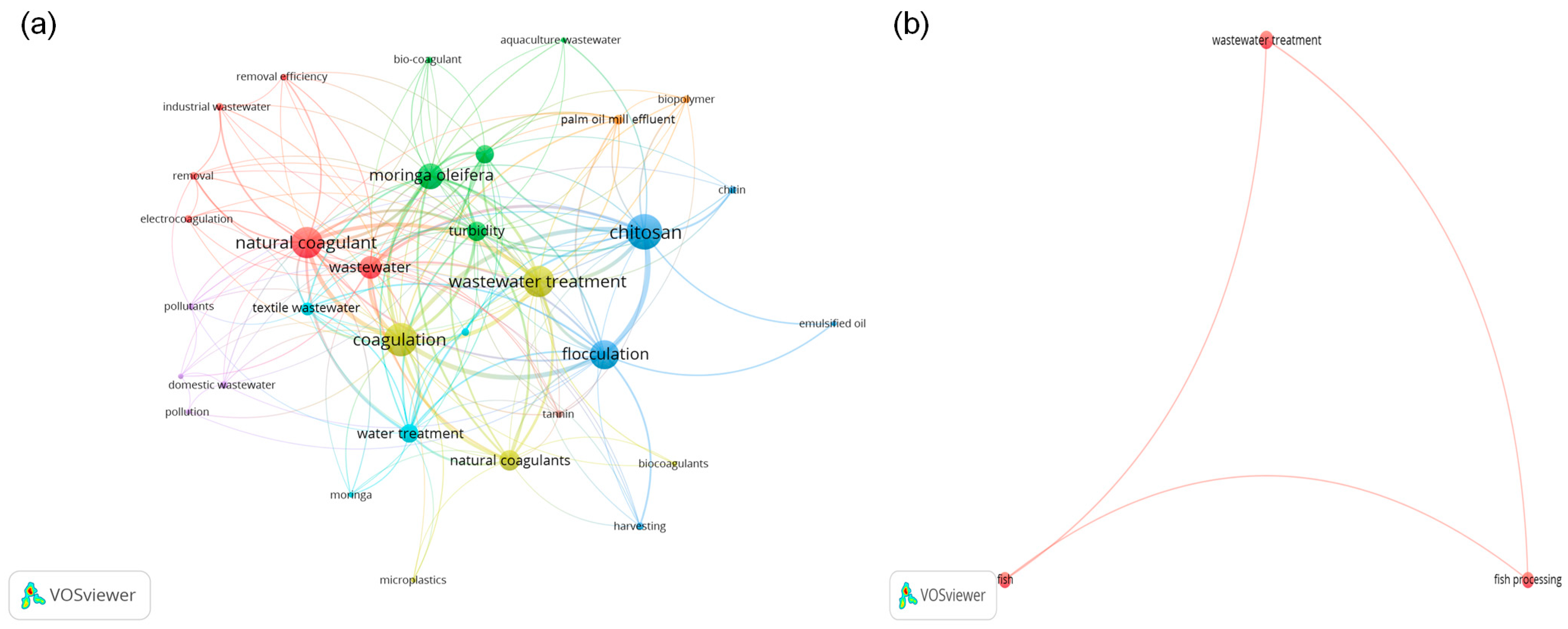
The ability of Moringa oleifera to reduce pollutant loads and turbidity in aquatic environments has been widely documented, and its potential to remove heavy metals—specifically iron and manganese—has also been highlighted [19,20,21,22]. Recent research highlights this versatility in the treatment of industrial and complex effluents; for example, Khattabi et al. [21] achieved 83% turbidity removal and 65.6% COD removal when treating wastewater from the olive oil industry, while Kenea et al. [20] reported an 87% reduction in turbidity and a 52.6% reduction in COD in surface water using a mixture of moringa and aloe vera. Similarly, in matrices containing anionic dyes, El Gaayda et al. [19] achieved 98.5% efficiency in turbidity removal, and Nkurunziza et al. [22] demonstrated a removal capacity exceeding 90.4% for metals such as iron. Even in effluents with high lipid loads, such as crude oil emulsions, Magalhães et al. [23] achieved 82.43% removal of oils and fats using these biopolymers. However, these investigations have been predominantly conducted using synthetic wastewater, surface water, oil-contaminated wastewater, and textile wastewater matrices, with limited attention paid to industrial effluents of high organic complexity, such as those from the fishing industry. To substantiate this trend, a structured bibliometric search was performed in the Scopus database. An initial query combining Moringa oleifera, chitosan, and coagulation–flocculation processes in wastewater treatment retrieved 803 documents for the period 1984–2026. A co-occurrence analysis of author keywords, conducted using VOSviewer version 1.6.20.0 (Leiden, Netherlands), revealed well-defined and strongly interconnected thematic clusters, indicating a mature and consolidated research field (Figure 1a). By contrast, when the search was refined to include fishery-related wastewater, only five documents were identified within the same timeframe. The resulting keyword network exhibited a sparse and weakly connected structure, dominated by generic terms such as fish and wastewater treatment, with no significant representation of natural coagulants or coagulation–flocculation processes (Figure 1b). This lack of thematic density highlights a clear research gap in the application of natural coagulants to fisheries-related effluents, justifying the need for the present study.
The general objective of this study was to evaluate the effectiveness of Moringa oleifera and chitosan in removing total suspended solids from pumping water at a fishmeal and fish oil processing plant. To achieve this, three specific objectives were established: (1) to characterize the pumping wastewater from the equalization tank of a processing facility located in Callao, Peru; (2) to determine the optimal dosage of each natural coagulant using jar test to maximize turbidity removal and comply with environmental regulations; and (3) to comparatively evaluate the performance of natural coagulants (Moringa oleifera and chitosan) against an inorganic coagulant (ferric sulfate) regarding TSS removal efficiency, optimal dosage, pH variation, and sludge generation.

2. Materials and Methods

2.1. Sampling and Characterization of Pumping Water

Samples were collected in January 2024 at the outlet of the grease trap treatment system and the DAF system at an industrial fishing establishment located in Callao. This sampling point corresponds to the wastewater stream conventionally subjected to physicochemical coagulation–flocculation treatment under industrial operating conditions. Therefore, the evaluated matrix represents partially clarified pumping water after primary removal of free oils, floatable materials, and coarse suspended solids. The collected samples were refrigerated until their characterization. Analyses for pH, oils and fats, and TSS were conducted according to SMEWW-APHA-AWWA-WEF (24th Ed. 2023) methods 4500-H+ B, 5520B, and 2540 D, respectively, and turbidity was assessed using Environmental Protection Agency Method 180.1 (1993).

2.2. Preparation and Characterization of Coagulants

Moringa oleifera seeds were obtained from a wholesale market in Lima. Subsequently, they were subjected to dehulling and crushing, resulting in a material referred to as crushed Moringa oleifera (MOT). The MOT defatting procedure was carried out using hexane as a dissolving agent using Soxhlet equipment [23,24]. Subsequently, the sample was subjected to a drying process at 70 °C for 24 h in a forced convection oven (UF110, Memmert, Büchenbach, Germany). This temperature is suitable for removing the solvent used in the extraction process (68 °C) and for preserving protein integrity at temperatures ranging from 70 to 80 °C [20]. This step was performed to ensure uniform dehydration in the sample. Once drying was complete, the sample was sieved using a 100-mesh screen. The resulting product was designated as defatted Moringa oleifera (MOD), which had a yield of 26.5%. Then, 1 L of sodium chloride solution (NaCl 1M) was added to 20 g of MOD and subjected to agitation at 350 rpm for 35 min [25]. This procedure favors the extraction of the cationic proteins responsible for the coagulant activity, as the cationic proteins in moringa seeds are globulin proteins with low water solubility; therefore, a saline medium is necessary to promote sodium ion exchange with the cationic proteins on the surface of the MOD [19,21,23].
Low-molecular-weight chitosan was obtained from Aoxin Biotechnology company (Lianyungang, China) with a degree of deacetylation ≥95% and an 80-micron granule size. Dissolution of 2 g of chitosan in 100 mL of a 2% acetic acid solution, with the pH adjusted to 3.0, was carried out by using the magnetic stirrer (YP5105, Ovan, Barcelona, Spain) [26,27].
The surface morphologies of crushed Moringa oleifera (MOT), defatted Moringa oleifera (MOD), protein-free Moringa oleifera after activation (SP-MOD), and chitosan were analyzed via scanning electron microscopy (SEM) (Q250 Analytical, Thermo Fisher Scientific, Middleton, WI, USA), where the samples were covered by a gold film, with a voltage acceleration of 25 kV and 6000 magnification [28]. The functional structure was performed via Fourier transform infrared spectroscopy (FTIR) (Nicolet iS10, Thermo Fisher Scientific, Middleton, WI, USA), with a spectrum between 700 and 3500 cm−1 [29]. These techniques provide information on their potential mechanism of action in coagulation.

2.3. Coagulation–Flocculation Tests of Pumping Water

The measured pH of the pumping water was 6.36 ± 0.6; this value was maintained without adjustment for two primary reasons. First, it falls within the optimal operating range of 6–8 for Moringa oleifera, where the prevalence of positively charged active molecules remains stable and facilitates charge neutralization and flocculation, resulting in improved contaminant removal [30]. Similarly, previous studies on the use of chitosan as a natural coagulant have reported high removal efficiencies, including turbidity, biochemical oxygen demand, chemical oxygen demand, and TSS, under mildly acidic to near-neutral conditions, typically within a pH range of approximately 4–7, as its amino groups become protonated in this range, which improves binding to the particles [31]. Second, treating the enormous volumes of wash water typical of the fishmeal industry requires large quantities of chemical additives (acids or alkalis), making the process economically unfeasible and increasing the environmental impacts of treatment. Therefore, by operating at the effluent’s natural pH, the study ensures a more sustainable, environmentally friendly, and cost-effective treatment without compromising the chemical efficiency of natural biopolymers. Therefore, no pH adjustment was performed to maintain realistic treatment conditions and prevent excessive chemical use, which would be economically impractical on an industrial scale; furthermore, the use of extreme pH levels would affect the speciation of the amino groups in chitosan and the isoelectric point of the moringa proteins.
Coagulation–flocculation tests were performed using a jar test apparatus (JLT6, VELP Scientifica, Usmate Velate, Italy) to determine the optimal dosage of the coagulant by measuring turbidity removal. The following were tested: MOD at 500–5000 mg/L, chitosan at 100–400 mg/L, and ferric sulfate as a control at 125–1000 mg/L.
After determining the optimal dosages through turbidity reduction, the treated supernatant was analyzed to determine TSS, oils and fats, and residual turbidity to comprehensively assess treatment performance. This approach allowed us to use turbidity strictly as a preliminary operational parameter while considering TSS as the main response variable of the study.
The coagulation process consisted of rapid mixing for one minute at 150, 120, and 120 rpm for MOD, chitosan, and ferric sulfate, respectively, followed by slow mixing at 60, 40, and 40 rpm for 15 min to promote floc formation. The mixing speed ranges and durations used were based on the findings of Rodríguez et al. and Alvarez et al. [26,32], with a higher stirring speed for MOD due to the need for better dispersion of the viscous cationic proteins, thereby breaking the surface tension while keeping the mixing time constant. After mixing, the samples were allowed to settle for 30 min. The treated water was then carefully collected for physicochemical analysis (turbidity, TSS, and oils and fats).
The sludge generated during coagulation–flocculation was separated, dried, and stored in a refrigerator before characterization. Subsequently, sludge valorization was explored through total nitrogen analysis using the Official Methods of Analysis (19th edition, method 920.87) due to the sludge’s potential as a protein-rich byproduct. This viscous, protein-rich byproduct is often concentrated by evaporation and used in animal feed to enhance its nutritional value.

2.4. Statistical Analysis

The assays for each test were performed in triplicate (n = 3), reporting the average and standard deviation. To determine the appropriate statistical approach, the Shapiro–Wilk test was used to assess normality and Bartlett’s test for homogeneity of variances. As the data did not satisfy the assumptions for parametric testing, significant differences between coagulant doses and the control group were evaluated using the non-parametric Kruskal–Wallis test, followed by Dunn’s post hoc test for multiple comparisons. All statistical procedures were performed using XLSTAT version 2025.1.3 (Addinsoft, NY, USA), with a significance level of 5% (p < 0.05) in all cases.

3. Results and Discussion

3.1. Pumping Water Characterization

The results of the analyses of oils and fats, turbidity, TSS, and pH are presented in Table 1. The measurements reported served as a starting point for evaluating the efficacy of both coagulants. The results obtained from the oil and fats analysis, as well as the TSS analysis, were lower than those reported by other authors [3,5,33,34,35]. These variations in concentration are primarily influenced by the specific industrial pre-treatment sequence. The evaluated wastewater had previously undergone primary separation through grease traps and dissolved air flotation (DAF), which explains the lower concentrations of suspended solids, oils and fats compared with untreated raw pumping water reported in some studies. However, this condition reflects the actual industrial treatment sequence commonly applied in fishmeal processing plants, where coagulation–flocculation is used as a secondary clarification stage to remove residual fine suspended solids, colloidal material, and remaining emulsified oils not efficiently removed during primary treatment. Therefore, the efficiencies obtained in this study should be interpreted within the context of post-DAF pumping water treatment under real operating conditions. In addition, the difference in collection time, raw material quality, seasonality of fishing, and type of pump used to transfer the raw material contributed to the variation in the results.

3.2. Characterization of Moringa and Chitosan as the Basis of Coagulants

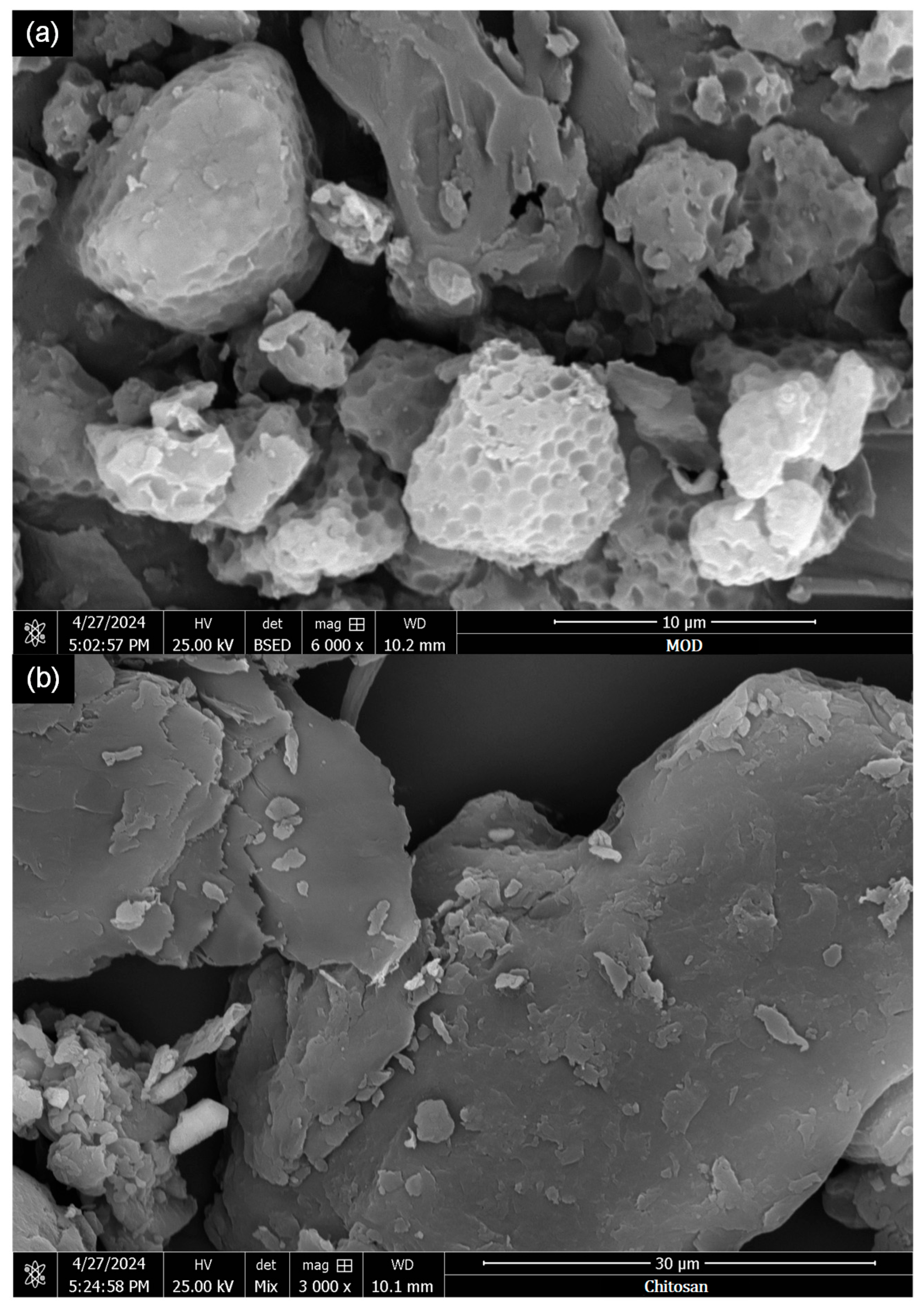
MOD and chitosan were superficially characterized using SEM at magnifications of 6000× and 3000×, respectively, and a heterogeneous and porous matrix of small spherical agglomerates can be seen in Figure 2a [23]. The spherical agglomerates represent seed oil storage compartments. Oil extraction produces a greater fiber exposure and increases the surface area; this increase facilitates protein extraction during the activation of natural coagulants [23]. An increase in the amount of extracted proteins can increase their coagulant activity [23]. Furthermore, the porous and fibrous morphology is related to the high coagulation performance of Moringa oleifera, as it provides more active sites for the adsorption of organic matter and facilitates the capture of suspended solids during floc formation.
In the chitosan (Figure 2b), a particle distribution with a marked lack of homogeneity can be observed [36], which can be attributed to the characteristic branching of polysaccharides. The surface presents a rough and coarse texture, which agrees with the findings reported by Abdullah et al. [37]. These researchers used crab exoskeletons to extract chitin and subsequently prepare chitosan. The squamous layers had a dense and firm structure, lacking porosity, agreeing with the observations made by El Knidri et al. [38]. The lack of a porous structure in chitosan limits its available surface area, which could compromise its efficiency in adsorption processes [39]. The lack of porosity in chitosan allows the polymer, through its chains, to extend into the water like “arms”, which trap multiple particles simultaneously, binding them together.
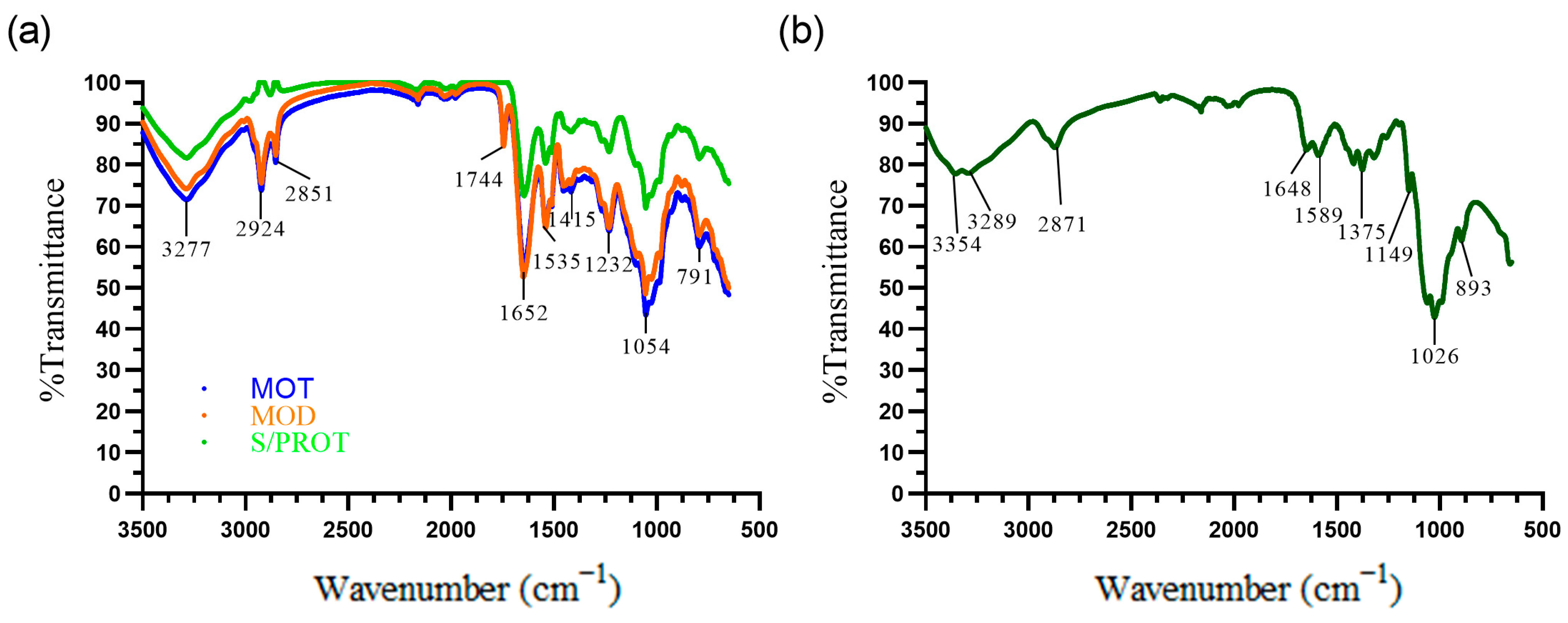
The functional groups of moringa and chitosan were characterized with an FTIR spectrophotometer in a range of 650 to 4000 cm−1 for both cases. MOT, MOD, and SP-MOD were evaluated to assess the difference in the absorbance of the functional groups and to determine how oil extraction impacts their coagulant activity.
The functional groups of moringa are shown in Figure 3a. A peak at 3284 cm−1 is also identified in MOT, MOD, and SP-MOD, attributable to amine and OH- bond stretching [40] due to the high protein and fatty acid content. The peaks at 2924 and 2851 cm−1 [23] correspond to the CH3–CH2 chains of the fatty acids in the seed lipids. A decrease in the absorption of these peaks is evidenced after oil extraction. The signal detected at 1744 cm−1 is due to the stretching vibration of the C=O groups, indicating carbonyl groups associated with the protein amides and the fatty acids in the sample [23]. A slight increase in absorbance can be observed for MOD due to the higher protein concentration after the degreasing process. In the case of SP-MOD, the peak disappears due to the removal of proteins from the MOD surface during activation, which verifies the relevance of the proposed process. In addition, a peak can be observed at 1647 cm−1, which undergoes a further decrease after oil extraction. The peaks between 1658 cm−1 (amide I) and 1587 cm−1 (amide II) correspond to the amide group of the protein, which confirms the presence of protein structures [41]. From a mechanistic perspective, the dibasic amino acids that make up these proteins contribute terminal and side-chain amino groups that become protonated in the aqueous medium. This net positive charge reduces the repulsive energy of the electric double layer of the pumping water colloids. These peaks increase their transmittance due to the removal of proteins in SP-MOD. Finally, a peak was found at 1035 cm−1, similar to that reported by George et al. [42] at 1053.5 cm−1, corresponding to the amine functional group, specifically to the bending of the C–O–H group.
Therefore, polar functional groups such as carboxyl, amine, or imine (O–H, C–O, and C–N) on the surface may be responsible for coagulation activity in wastewater. The protonation of the amine functional group in Moringa oleifera protein releases positively charged polyelectrolytes when the protein dissolves in water. These cationic sites enable the capture of negatively charged impurities, bacteria, and sediments, which promote floc formation and the subsequent clarification of the effluent [43].
The functional groups of chitosan are shown in Figure 3b. The characteristic band at 3354 cm−1 can be attributed to the strain of the –OH group, and the 3289 cm−1 band indicates the strain of the N-H group, while the 2871 cm−1 band is assigned to the stretching of the C–H group. In addition, the peaks at 1648, 1589, 1375, and 1026 cm−1 can be attributed to C–O stretching of amide-I, N–H bending, C–N stretching, and C–O stretching, respectively [44]; the 1589 cm−1 band (–NH2 group bending vibration) and the broad band around 3289 cm−1 (N–H stretching superimposed with O–H) not only confirm the chemical structure of chitosan but also form the basis of its coagulant activity. At the effluent’s operating pH, these amino groups undergo significant protonation, transforming into cationic sites (–NH3+). This high positive charge density is directly responsible for the charge neutralization process, electrostatically attracting the colloidal particles and suspended proteins from the anchoveta, which possess predominantly negative surface charges.
The spectrum shows signals at 1149 cm−1 and 850 cm−1, corresponding to the antisymmetric stretching of the C–O bonds and the vibration of the glycosidic bridge (C–O–C), respectively [45]; this polymeric chain complements the removal process through the interparticle bridging mechanism, allowing chitosan to act simultaneously in an electrostatic and structural manner. These characteristics, combined with the high density of amino and hydroxyl functional groups, give chitosan an exceptional capacity for adsorbing various contaminants [46].
The spectra show that the chemical nature of MOD is based on cationic proteins (amide I and II bands), which primarily act by neutralizing charges to clarify the water. By contrast, chitosan is a linear polysaccharide (C–O–C glycosidic bond bands) with abundant free amino groups, which allows it to combine charge neutralization with interparticle bridging. While moringa is more efficient at interacting with lipids due to its protein affinity, chitosan excels at capturing suspended solids thanks to its long-chain structure, which physically traps the particles.
Table 2 shows the results for moisture content, total nitrogen, fat, and crude fiber in natural coagulants such as MOD and chitosan, as well as in natural coagulants and ferric sulfate in the sludge.
The resulting moisture percentage (6.7%) coincides with the value indicated by Silva et al. [47]. The protein percentage was 50%, which is slightly lower than 63.7% [47] and higher than 45.86% [32]. The differences in the results can be attributed to differences in the oil extraction methods employed. The fat percentage was 6.5%, well below the 11% obtained by using the screw press (CA 59 G, Komet, Mönchengladbach, Germany) reported in previous research [32]. This result suggests that the Soxhlet method, employed in the present investigation, could be more efficient than screw press extraction. Removing oils increases the concentration of proteins, resulting in a higher efficiency in the coagulation–flocculation processes due to an increase in the concentration of solubilized coagulant proteins.
Proximal analysis of chitosan was performed before mixing with acetic acid. The moisture percentage was 9.4%, confirming the data provided in the data sheet that establishes a lower limit of ≤10%. In contrast to the above findings, Okafor et al. [48] reported moisture percentages of 1.65 in chitosan extracted from Scylla serrata shell, suggesting a variation in moisture conditions between different regions or products. The nitrogen percentage was 6.62%, which is higher than that recorded by Okafor et al. [48], who found protein contents of 0.62%. Notably, the nitrogen present in chitosan is found predominantly in the primary aliphatic amino groups [49], in agreement with the technical data sheet provided by Aoxin Biotechnology, which indicates minimum undetected protein values. The ash content was 1.4%, which was higher than that indicated in the technical data sheet (≤1%). Studies carried out by Okafor et al. [48] reported higher ash concentrations due to the conditions of production.

3.3. Coagulation–Flocculation Tests

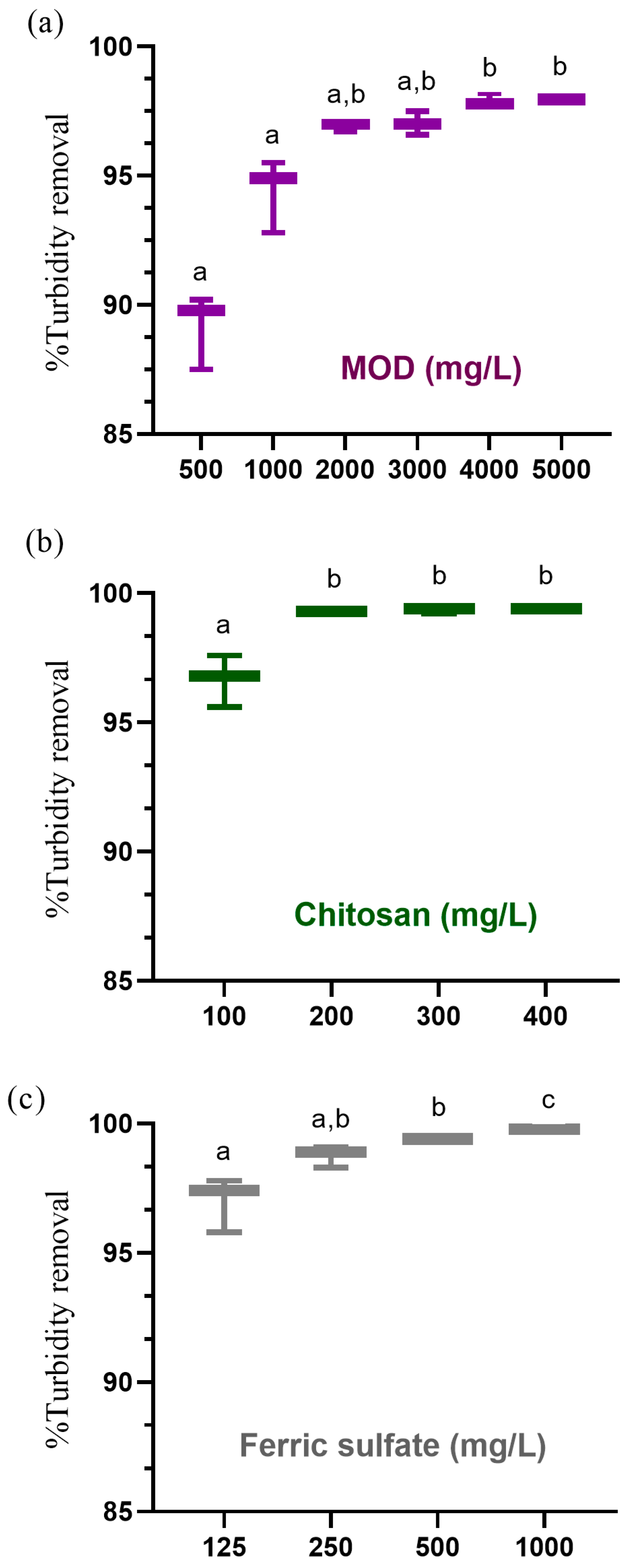
Figure 4a–c show the maximum percentage of turbidity removal following the coagulation–flocculation of the feedwater; for this purpose, different doses of the coagulants MOD, chitosan, and ferric sulfate were used.
In the pumping water coagulation–flocculation test, a maximum turbidity removal of 97.5 ± 0.32% was obtained when using a dose of 4.0 g/L of MOD at pH 6.36 (Figure 4a), with an initial turbidity of 5683.33 ± 402.66 NTU. This removal rate was higher than that reported by Tong et al., Nonfodji et al., and Noor et al., which ranged from 47% to 64% [27,50,51]. This efficiency exhibits significant differences compared with the other doses used, ranging from 0.5 to 3.0 g/L MOD. Statistical analysis showed no significant differences between 4.0 and 5.0 g/L (p > 0.05), indicating a plateau effect in the coagulation performance at higher dosages. Therefore, 4.0 g/L was selected as the optimal dose considering treatment efficiency and operational economy.
The optimal dose found exceeds the values reported by other researchers for wastewater with high levels of organic matter, from 0.189 to 3.0 g of moringa/L [27,50,51,52]; the effectiveness of natural coagulants in this study was validated by optimizing direct physicochemical parameters (turbidity, TSS, and fats/oils). These results provide sufficient evidence that colloidal destabilization occurred effectively, which can be verified by measuring the zeta potential. However, the optimal dose found is lower than that reported by other authors, ranging from 6.7 to 65.0 g/L [21,53,54,55].
Lower doses are associated with wastewater with low turbidity contents between 15 and 273 NTU, while higher doses are associated with high turbidity contents between 1144 and 5846 NTU. The optimal dose found is similar to 7.5 g/L for feed lot water reported by Arias-Hoyos et al. [55], where a high protein content in the wastewater is also evident. When proteins from Moringa oleifera are dissolved in a medium with a pH lower than their isoelectric point, the amino groups become protonated. This phenomenon creates an attractive force toward various colloids and anionic contaminants—including microorganisms, fatty acid salts, and sediments—which catalyzes floc formation [43,56].
Although the optimal dose of 4.0 g/L of MOD is higher than the dose used in less complex waters, this is justified by the extremely high colloidal load in anchoveta pumping water. From an economic perspective, the low cost of moringa (as a byproduct of oil extraction) offsets the dosage volume. Furthermore, the increase in sludge production does not represent an environmental burden but rather an opportunity for recovery as fertilizer due to its high nitrogen content and absence of toxic metal residues, thereby complying with zero-waste principles.
In the coagulation–flocculation test of pumping water with chitosan, a maximum turbidity removal of 99.30 ± 0.10% was obtained when a dose of 0.2 g/L was used (Figure 4b); this result was higher than the 84% reported by Tong et al. [27]. This efficiency exhibits a significant difference compared with the 0.1 g/L dosage; however, it shows no difference with the other dosages used of 0.3 and 0.4 g/L. The optimal dose of chitosan found is in a range of 0.1–0.7 g of chitosan/L. These values were reported by other authors for wastewater rich in organic matter when working with turbidity values between 227 and 1000 NTU [26,27,57].
Due to the speed of this analytical method and its standardized use as an indicator of initial colloidal destabilization, the optimal doses of the bio-coagulants were preselected based on turbidity removal; however, the subsequent evaluation of TSS and oils and fats confirmed the validity of this selection. In the case of chitosan, the 0.2 g/L dose not only reduced the turbidity by 97.5% but also represented the optimal saturation point for the interparticle bridging mechanism, achieving maximum TSS removal (88.59%). Increasing the dose beyond this point did not result in significant increases in TSS or oil and fat removal due to the phenomenon of restabilization caused by excess positive charge and the nature of the fats.
Treating pumping water with coagulation–flocculation using ferric sulfate (the most commonly used coagulant in wastewater treatment for anchoveta fishmeal companies) yields a maximum turbidity removal of 99.76 ± 0.062% with a dose of 1 g/L (Figure 4c). The optimal dose with ferric sulfate was lower than that obtained with MOD and higher than that obtained with chitosan, similar to other studies [58,59].
Table 3 shows the concentrations and removal percentages for oils and fats, turbidity, TSS, and pH for natural coagulants such as MOD and chitosan, as well as ferric sulfate. The pumping water treatment with the optimal doses of MOD, chitosan, and ferric sulfate removed 83.58 ± 0.48%, 88.59 ± 1.61%, and 90.52 ± 0.52% TSS, respectively. The treatment with chitosan does not differ significantly when compared with the ferric sulfate coagulant, making it an alternative treatment with lower environmental impact and greater potential for reusing the sludge generated for food use [33]. However, the results with MOD were lower than the values of 96% and 95% reported by Mera-Alegria et al. [54] and Bhatia et al. [60], respectively. These authors used higher doses of 6.7 g/L and 6 g/L at longer settling times of 48 h and 90 min, respectively. This treatment not only generates sludge but also generates sludge that can be reused in the food industry, as it is non-toxic due to the absence of metals. Finally, the three types of treatment can obtain treated wastewater that complies with the MPL of D.S. 010-2018-MINAM [61] for the TSS parameter (700 mg/L).
Regarding oil and grease removal, MOD (37.84%) showed a numerical increase of over 30 percentage points compared with chitosan (6.35%). Although the Kruskal–Wallis test resulted in a statistical overlap (sharing letters “a” and “b” in Table 3) due to the conservative nature of rank-based tests on small sample sizes (n = 3), this difference is chemically significant. The superior performance of MOD is mechanistically supported by the presence of specific hydrophobic amino acid residues, which facilitate the adsorption of nonpolar lipid droplets, a feature that the predominantly hydrophilic chitosan lacks. The values obtained for moringa and chitosan are lower than those reported (82.43% and 75.26%) by Magalhaes et al. and Castañeda et al. [23,62].
The removal capacity of oils and fats from pumping water was higher when using MOD than when using chitosan, similar to results obtained by other studies [23,62]. The mechanisms that remove oils and fats when MOD is applied include charge neutralization between negatively charged lipid droplets and positively charged protein fractions, inter-particle bridging through polymeric adsorption, emulsion destabilization, and sweep flocculation; fundamentally, the superior performance of MOD is linked to specific hydrophobic amino acid residues, such as leucine, valine, alanine, and phenylalanine. These residues promote London dispersion interactions with the long aliphatic carbon chains of fats, creating a hydrophobic effect that facilitates the agglomeration of oil droplets even at low concentrations [23,51,60,63,64]. This dual action (electrostatic attraction followed by hydrophobic entrapment) allows MOD to effectively capture nonpolar compounds within the floc structure.
By contrast, the lower oil and fat removal observed with chitosan may be associated with its higher degree of acetylation and lower molecular weight, which prevent particle aggregation. Chitosan primarily promotes charge neutralization for emulsion destabilization through its protonated amino groups (–NH3+). Owing to the abundance of hydroxyl groups and protonated amino groups, the predominantly hydrophilic nature of chitosan favors interactions with the aqueous phase and polar suspended solids through hydrogen bonding and charge neutralization. Thus, chitosan lacks significant hydrophobic fractions necessary to effectively interact with and destabilize emulsified oil droplets. However, its rigid polysaccharide backbone and high degree of acetylation limit the flexibility needed to form dense hydrophobic agglomerates. A high degree of acetylation implies fewer free amino groups and a more polar structure, which restricts van der Waals interactions with lipid chains [16].
Using chitosan with a lower degree of acetylation (less than 70%) has been reported to enhance lipid removal efficiency by reducing polarity and improving hydrophobic interactions [17]. Therefore, while chitosan acts primarily as a bridging agent for suspended solids, MOD functions as a more versatile amphiphilic agent, capable of interacting with the charged and nonpolar fractions of the pumping water. The higher removal capacity of ferric sulfate is attributable to stronger emulsion destabilization and the formation of larger, denser flocs through metal salt hydrolysis.
Notably, the primary focus of this study was not the removal of oils and fats, as the evaluated pumping water was collected from an equalization tank downstream of grease traps and DAF systems, where most of the lipids had already been removed. Therefore, oils and fats were assessed as a secondary parameter to confirm that the coagulation–flocculation treatments did not cause re-emulsification or increase their concentration. Positive removal percentages were observed in all cases, and none of the treatments increased oil and fat levels. This confirms the stability of the process under post-DAF industrial conditions. Consequently, the treated pumping water obtained with MOD and ferric sulfate complied with MPL for oils and fats. However, chitosan showed worse performance. This suggests that higher lipid pre-removal during flotation could improve its efficiency, as suggested by Khattabi et al. [21].
Operational stability was further evidenced by the minimal pH fluctuations observed following coagulation–flocculation. The final pH values recorded were 6.30 ± 0.02 for MOD, 6.82 ± 0.03 for chitosan, and 5.87 ± 0.02 for ferric sulfate (Table 3). These results demonstrate that all evaluated treatments maintain the effluent within the maximum permissible limits (MPL) established by D.S. 010-2018-MINAM. Operating at the effluent’s natural pH not only ensures the chemical efficiency of the biopolymers by preserving the protonation of amino groups and protein stability but also confirms the process’s sustainability by eliminating the need for large-scale chemical neutralization.

3.4. Characterization of Sludge

Nitrogen levels in all sludge samples exceeded 4% (Table 2), confirming their high proteinaceous nature regardless of the coagulant used. Notably, in all cases, the total nitrogen content was analyzed mainly as protein. The value obtained using MOD was lower than the 5.60% and 7.06% reported by Aguilar-Ascón et al. [3]. This variation is technically attributable to the fact that the pumping water in this research was collected downstream of a pre-treatment stage consisting of aeration and grease traps, as well as a dissolved air flotation (DAF) system. These mechanical and flotation processes achieved a preliminary removal of organic matter and coarse solids containing significant nitrogenous fractions before the coagulation–flocculation step. A similar situation can be observed in the treatments with chitosan and ferric sulfate. These sludges have lower nitrogen content than 8–9.6% fishmeal [65]. The valorization of sludge resulting from MOD and chitosan treatment, as an input to be reused in fishmeal production, can negatively impact fishmeal quality if the doses are very high. However, given its high nitrogen content, it is possible to use it as an input in composting processes of carbon-rich lignocellulosic material, allowing for an appropriate C/N ratio within the recommended range of 20 to 25 [66,67].

4. Conclusions

This study demonstrates that MOD and chitosan are technically viable and sustainable alternatives for treating anchoveta pumping water in Peru, achieving turbidity removal rates exceeding 97.5% at optimal dosages of 4.0 and 0.2 g/L, respectively. While chitosan stood out for its high efficiency in removing total suspended solids (88.59%), our analysis revealed a critical limitation in its ability to remove oils and fats (6.35%) due to its predominantly hydrophilic nature, which hinders interaction with lipid fractions. By contrast, MOD showed superior performance in grease removal (37.84%) owing to hydrophobic amino acid residues in its cationic proteins, which facilitate lipid adsorption. Finally, the valorization of the generated sludge, with a nitrogen content greater than 4%, reinforces the viability of these bio-coagulants within a circular economy model, transforming industrial waste into useful byproducts for composting. Thus, the knowledge gap regarding the treatment of high-organic-load fishery effluents under local conditions is closed.

Author Contributions

Conceptualization, N.S.L.-Q., M.C.M.-T., and J.G.J.-M.; methodology, N.S.L.-Q., M.C.M.-T., and J.G.J.-M.; validation, N.S.L.-Q.; formal analysis, N.S.L.-Q., M.C.M.-T., J.G.J.-M., L.F.H.-D., P.J.-M., and L.V.-F.; investigation, N.S.L.-Q., M.C.M.-T., J.G.J.-M., L.F.H.-D., P.J.-M., and L.V.-F.; resources, N.S.L.-Q., M.C.M.-T.; data curation, N.S.L.-Q., P.J.-M., and L.V.-F.; writing—original draft preparation, N.S.L.-Q., M.C.M.-T., J.G.J.-M., L.F.H.-D., P.J.-M., and L.V.-F.; writing—review and editing, N.S.L.-Q., M.C.M.-T., J.G.J.-M., P.J.-M., and L.V.-F.; visualization, N.S.L.-Q., P.J.-M., and L.V.-F.; supervision, N.S.L.-Q., M.C.M.-T., J.G.J.-M., and L.V.-F.; project administration, N.S.L.-Q., and M.C.M.-T.; funding acquisition, N.S.L.-Q., M.C.M.-T., and J.G.J.-M. All authors have read and agreed to the published version of the manuscript.

Funding

This research was funded by the Prociencia program of CONCYTEC, grant number PE501085597-2023.

Institutional Review Board Statement

Not applicable.

Informed Consent Statement

Not applicable.

Data Availability Statement

Data is contained within the article.

Acknowledgments

The researchers would like to thank the Organismo de Evaluación y Fiscalización Ambiental (OEFA) for providing information and technical guidance and Diego Aaron Crispín Ramos for his contribution to this research.

Conflicts of Interest

The authors declare no conflicts of interest.

Abbreviations

The following abbreviations are used in this manuscript:
DAFDissolved Air Flotation
FTIRFourier Transform Infrared Spectroscopy
MODDefatted Moringa oleifera
MOTCrushed Moringa oleifera
MPLMaximum permissible limits
SEMScanning Electron Microscopy
SP-MODProtein-free Moringa oleifera after activation
TSSTotal suspended solids

References

  1. Msangi, S.; Kobayashi, M.; Batka, M.; Vannuccini, S.; Dey, M.M.; Anderson, J.L. Fish to 2030: Prospects for Fisheries and Aquaculture; World Bank Report Number 83177-GLB; The World Bank: Washington, DC, USA, 2013; Available online: https://www.fao.org/4/i3640e/i3640e.pdf (accessed on 1 April 2026).
  2. Santoyo, J.G.; Jung, H.Y.; Jeong, G.; Kim, J.K. The High Reutilization Value Potential of High-Salinity Anchovy Fishmeal Wastewater through Microbial Degradation. World J. Microbiol. Biotechnol. 2015, 31, 1575–1586. [Google Scholar] [CrossRef] [PubMed]
  3. Aguilar-Ascón, E.; Neyra-Ascón, W.; Albrecht-Ruiz, M.; Ibarra-Basurto, A. Optimizing the Reduction of Total Suspended Solids in Pump Water from Fish Factories through Electrocoagulation Using Response Surface Methodology. J. Ecol. Eng. 2021, 22, 269–277. [Google Scholar] [CrossRef]
  4. Hall, G.M.; Kose, S. Fish Processing Installations: Sustainable Operation. In Seafood Processing: Technology, Quality and Safety; Boziaris, I.S., Ed.; John Wiley & Sons, Ltd.: Hoboken, Turkey, 2014; pp. 311–343. [Google Scholar] [CrossRef]
  5. Jayashree, C.; Tamilarasan, K.; Rajkumar, M.; Arulazhagan, P.; Yogalakshmi, K.N.; Srikanth, M.; Banu, J.R. Treatment of Seafood Processing Wastewater Using Upflow Microbial Fuel Cell for Power Generation and Identification of Bacterial Community in Anodic Biofilm. J. Environ. Manag. 2016, 180, 351–358. [Google Scholar] [CrossRef]
  6. Pinotti, G.; Gaucher, L.; Fleitas, V.; Boccardi, L.; Goyenola, G. Aluminum Compounds as a Management Tool for Eutrophic Lakes: State of the Art. Ecol. Eng. 2025, 212, 107503. [Google Scholar] [CrossRef]
  7. García-Ávila, F.; Encalada-Alvear, T.; Alvarez-Altamirano, L.M.; Avilés-Añazco, A.; Valdiviezo-Gonzalez, L.; Alfaro-Paredes, E. Human Health Risk Assessment of Aluminium in Water Treated with Aluminium-Based Coagulants in a Rural Area. Results Eng. 2025, 25, 104200. [Google Scholar] [CrossRef]
  8. Lall, S.P.; Kaushik, S.J. Nutrition and Metabolism of Minerals in Fish. Animals 2021, 11, 2711. [Google Scholar] [CrossRef]
  9. Lemonnier, H.; Wabete, N.; Pham, D.; Barri, K.; Mermoud, I.; Royer, F.; Boulo, V.; Laugier, T. Iron Deposits Turn Blue Shrimp Gills to Orange. Aquaculture 2021, 540, 736697. [Google Scholar] [CrossRef]
  10. Drewek, A.; Rybak, M.; Drzewiecka, K.; Niedzielski, P.; Polak, J.; Klimaszyk, P. The Impact of Iron Coagulant on the Behavior and Biochemistry of Freshwater Mussels Anodonta Cygnea and Unio Tumidus during Lake Restoration. J. Environ. Manag. 2022, 318, 115535. [Google Scholar] [CrossRef]
  11. Mohammady, E.Y.; Elashry, M.A.; Ibrahim, M.S.; Elarian, M.; Salem, S.M.R.; El-haroun, E.R.; Hassaan, M.S. Nano Iron Versus Bulk Iron Forms as Functional Feed Additives: Growth, Body Indices, Hematological Assay, Plasma Metabolites, Immune, Anti-Oxidative Ability, and Intestinal Morphometric Measurements of Nile Tilapia, Oreochromis Niloticus. Biol. Trace Elem. Res. 2024, 202, 787–799. [Google Scholar] [CrossRef]
  12. Yarnpakdee, S.; Benjakula, S.; Kristinsson, H.G. Lipid Oxidation and Fishy Odour in Protein Hydrolysate Derived from Nile Tilapia (Oreochromis Niloticus) Protein Isolate as Influenced by Haemoglobin. J. Sci. Food Agric. 2014, 94, 219–226. [Google Scholar] [CrossRef]
  13. Baptista, A.T.; Silva, M.; Gomes, R.; Bergamasco, R.; Viera, M.; Vieira, A. Protein Fractionation of Seeds of Moringa Oleifera Lam and Its Application in Superficial Water Treatment. Sep. Purif. Technol. 2017, 180, 114–124. [Google Scholar] [CrossRef]
  14. Agarwal, P.; Saini, G. Use of Natural Coagulants (Moringa Oleifera and Benincasa Hispida) for Volume Reduction of Waste Drilling Slurries. Mater. Today Proc. 2022, 49, 3274–3278. [Google Scholar] [CrossRef]
  15. Agarwal, P.; Prakash, S.; Saini, G. Natural Coagulants (Moringa Oleifera and Benincasa Hispida) Based Removal of Microplastics. Clean. Water 2024, 1, 100010. [Google Scholar] [CrossRef]
  16. Ababneh, H.; Hameed, B.H. Chitosan and Chitosan Composites for Oil Spills Treatment: Review of Recent Literature. J. Water Process Eng. 2023, 55, 104193. [Google Scholar] [CrossRef]
  17. Hernández-Parra, H.; Gutiérrez-Ruíz, S.C.; Rodríguez-Morales, N.L.; García-Gasca, H.A.; Peña-Corona, S.I.; Chávez-Corona, J.I.; Florán, B.; Cortés, H.; Leyva Gómez, G. Influencia Del Grado de Desacetilación Del Quitosano En La Síntesis de Nanopartículas Para Aplicaciones Farmacéuticas. Mundo Nano. Rev. Interdiscip. Nanociencias Nanotecnología 2025, 18, e69860. [Google Scholar] [CrossRef]
  18. Hassan, M.H.U.; Shahbaz, M.; Ahmad, S.; Khan, M.A.; Farooq, U.; Naeem, H.; Momal, U.; Mujtaba, A.; Qaisrani, T.B. Assessment of Moringa Seed Oil: Fatty Acid Profile, Oxidative Stability and Antioxidant Activity. J. Nutr. Food Sci. 2024, 5, 36–45. [Google Scholar] [CrossRef]
  19. El Gaayda, J.; Titchou, F.E.; Barra, I.; Karmal, I.; Afanga, H.; Zazou, H.; Yap, P.-S.; Abidin, Z.Z.; Hamdani, M.; Akbour, R.A. Optimization of Turbidity and Dye Removal from Synthetic Wastewater Using Response Surface Methodology: Effectiveness of Moringa Oleifera Seed Powder as a Green Coagulant. J. Environ. Chem. Eng. 2022, 10, 106988. [Google Scholar] [CrossRef]
  20. Kenea, D.; Denekew, T.; Bulti, R.; Olani, B.; Temesgen, D.; Sefiw, D.; Beyene, D.; Ebba, M.; Mekonin, W. Investigation on Surface Water Treatment Using Blended Moringa Oleifera Seed and Aloe Vera Plants as Natural Coagulants. S. Afr. J. Chem. Eng. 2023, 45, 294–304. [Google Scholar] [CrossRef]
  21. Khattabi, S.; Souabi, S.; El Fels, L.; Driouich, A.; Madinzi, A.; Nassri, I.; Hafidi, M. Moringa Oleifera Organic Coagulant to Eliminate Pollution in Olive Oil Mill Wastewater. Environ. Nanotechnol. Monit. Manag. 2023, 20, 100871. [Google Scholar] [CrossRef]
  22. Nkurunziza, T.; Nduwayezu, J.B.; Banadda, E.N.; Nhapi, I. The Effect of Turbidity Levels and Moringa Oleifera Concentration on the Effectiveness of Coagulation in Water Treatment. Water Sci. Technol. 2009, 59, 1551–1558. [Google Scholar] [CrossRef]
  23. Magalhães, E.R.B.; de Menezes, N.N.F.; Silva, F.L.; Garrido, J.W.A.; Sousa, M.A.D.S.B.; dos Santos, E.S. Effect of Oil Extraction on the Composition, Structure, and Coagulant Effect of Moringa Oleifera Seeds. J. Clean. Prod. 2021, 279, 123902. [Google Scholar] [CrossRef]
  24. Sagnon, P.; Mahoudo, F.; Hounsinou, M.; Adounkpè, J.; Arsene, L.; Comlan, A.; Kéwouyèmi, W.; Mama, D.; Gbénou, J.D.; Ladekan, E.Y. New Method of Producing a More Efficient Coagulant for the Treatment of Water from Seeds of Moringa Oleifera. MethodsX 2023, 11, 102485. [Google Scholar] [CrossRef]
  25. Hadi, M.; Bina, B. Application of Moringa Oleifera Coagulant Protein as Natural Coagulant Aid with Alum for Removal of Heavy Metals from Raw Water. Desalin. Water Treat. 2018, 116, 187–194. [Google Scholar] [CrossRef]
  26. Rodríguez, J.; De la Cruz, G.; López, W.; Ricaurte, L.; Morales, M. Uso de Un Polímero Natural (Quitosano) Como Coagulante Durante El Tratamiento de Agua Para Consumo. Available online: https://dialnet.unirioja.es/descarga/articulo/5662381.pdf (accessed on 12 May 2026).
  27. Tong, C.Y.; Che Yusuf, F.H.B.; Derek, C.J.C. Optimization of Moringa Oleifera Seed Extract and Chitosan as Natural Coagulant in Treatment of Fish Farm Wastewater. Desalin. Water Treat. 2022, 256, 99–113. [Google Scholar] [CrossRef]
  28. Jorge-Montalvo, P.; Vílchez-Perales, C.; Visitación-Figueroa, L. Evaluation of Antioxidant Capacity, Structure, and Surface Morphology of Ginger (Zingiber officinale) Using Different Extraction Methods. Heliyon 2023, 9, e16516. [Google Scholar] [CrossRef] [PubMed]
  29. Dioses, J.J.; Téllez Monzón, L.A.; Nieto, R.L.; Jorge-Montalvo, P.; Visitación-Figueroa, L. Valorization of Treated Wastewater from the Soaking of Baby Alpaca Skin Fur. Heliyon 2024, 10, e38247. [Google Scholar] [CrossRef]
  30. Adelodun, B.; Ajibade, F.O.; Ogunshina, M.S.; Choid, K.S. Dosage and Settling Time Course Optimization of Moringa Oleifera in Municipal Wastewater Treatment Using Response Surface Methodology. Desalin. Water Treat. 2019, 167, 45–56. [Google Scholar] [CrossRef]
  31. Labastida-Núñez, I.; Velasco-Pérez, M.; Pablo-Reyes, E.P.; González-Aragón, A.; Beltrán-Villavicencio, M. Evaluation of Wastewater Coagulation/Flocculation with Chitosan from Shrimp Exoskeletons Waste and Aluminum Sulfate. Terra Latinoam. 2023, 41, e1743. [Google Scholar] [CrossRef]
  32. Alvarez-Chancasanampa, H.; Juscamaita, J.G.; Monteghirfo, M.; de Mendiburu, F.; Silva-Jaimes, M.; Carrión-Carrera, G.J.; Alvarez-Chancasanampa, J.J. Uso de La Torta de Semilla de Moringa Oleifera Lam. En La Clarificación de Aguas Residuales. Manglar 2023, 20, 389–395. [Google Scholar] [CrossRef]
  33. Aguilar-Ascón, E.; Solari-Godiño, A.; Cueva-Martínez, M.; Neyra-Ascón, W.; Albrecht-Ruíz, M. Characterization of Sludge Resulting from Chemical Coagulation and Electrocoagulation of Pumping Water from Fishmeal Factories. Processes 2023, 11, 567. [Google Scholar] [CrossRef]
  34. Marti, C.; Roeckel, M.; Aspeb, E.; Kanda, H. Recovery of Proteins from Fishmeal Factory Wastewaters. Process Biochem. 1994, 29, 39–46. [Google Scholar] [CrossRef]
  35. Putra, A.A.; Watari, T.; Maki, S.; Hatamoto, M.; Yamaguchi, T. Anaerobic Baffled Reactor to Treat Fishmeal Wastewater with High Organic Content. Environ. Technol. Innov. 2020, 17, 100586. [Google Scholar] [CrossRef]
  36. Dhillon, G.; Dhillon, S.K.; Brar, K. Facile Fabrication and Characterization of Chitosan-Based Zinc Oxide Nanoparticles and Evaluation of Their Antimicrobial and Antibiofilm Activity. Int. Nano Lett. 2014, 4, 107. [Google Scholar] [CrossRef]
  37. Abdullah, K.S.; Devi, G.; Rashid, A.S.; Adeeb, M.A.S.; Al Hudaifi, A.S.M.; Khalfan, S.S. Extraction of Bio Polymers from Crustacean Shells and Its Application in Refinery Wastewater Treatment. Walailak J. Sci. Technol. 2021, 18, 1–11. [Google Scholar] [CrossRef]
  38. El Knidri, H.; El Khalfaouy, R.; Laajeb, A.; Addaou, A.; Lahsini, A. Eco-Friendly Extraction and Characterization of Chitin and Chitosan from the Shrimp Shell Waste via Microwave Irradiation. Process Saf. Environ. Prot. 2016, 104, 395–405. [Google Scholar] [CrossRef]
  39. Bonardd, S.; Ramirez, O.; Abarca, G.; Leiva, A.; Saldías, C.; Díaz, D. Porous Chitosan-Based Nanocomposites Containing Gold Nanoparticles. Increasing the Catalytic Performance through Film Porosity. Int. J. Biol. Macromol. 2022, 217, 864–877. [Google Scholar] [CrossRef]
  40. Fatiqin, A.; Amrulloh, H.; Apriani, I.; Lestari, A.; Erawanti, B.; Saputri, A.; Gita, M.; Fitrianti, M.; Rao, R.; Steven, Y.; et al. A Comparative Study on Phytochemical Screening and Antioxidant Activity of Aqueous Extract from Various Parts of Moringa Oleifera. Indones. J. Nat. Pigment. 2021, 3, 43–47. [Google Scholar] [CrossRef]
  41. Shah, A.; Manning, G.; Zakharova, J.; Arjunan, A.; Batool, M.; Hawkins, A.J. Particle Size Effect of Moringa Oleifera Lam. Seeds on the Turbidity Removal and Antibacterial Activity for Drinking Water Treatment. Environ. Chem. Ecotoxicol. 2024, 6, 370–379. [Google Scholar] [CrossRef]
  42. George, T.T.; Oyenihi, A.B.; Rautenbach, F.; Obilana, A.O. Characterization of Moringa Oleifera Leaf Powder Extract Encapsulated in Maltodextrin and/or Gum Arabic Coatings. Foods 2021, 10, 3044. [Google Scholar] [CrossRef] [PubMed]
  43. Tukki, O.H.; Barminas, J.T.; Osemeahon, S.A.; Onwuka, J.C.; Donatus, R.A. Adsorption of Colloidal Particles of Moringa Oleifera Seeds on Clay for Water Treatment Applications. J. Water Supply Res. Technol.—AQUA 2016, 65, 75–86. [Google Scholar] [CrossRef]
  44. Ewais, A.; Saber, R.A.; Abdel Ghany, A.; Sharaf, A.; Sitohy, M. High Quality, Low Molecular Weight Shrimp and Crab Chitosans Obtained by Short-Time Holistic High-Power Microwave Technology. SN Appl. Sci. 2023, 5, 365. [Google Scholar] [CrossRef]
  45. Adebisi, F.; Adedayo, A.; Oluwaseye, A.; Adekunle, F.; Olutayo, O.; Clement, A.; Ikokoh, P.; Rasheed, K.; Ademola, A. Instrumental and Chemical Characterization of Moringa Oleifera Lam Root Starch as an Industrial Biomaterial. Res. Pharm. Biotechnol. 2014, 5, 7–12. Available online: https://academicjournals.org/article/article1397743029_Adebisi%20et%20al.pdf (accessed on 1 April 2026).
  46. Bhatt, P.; Joshi, S.; Urper Bayram, G.M.; Khati, P.; Simsek, H. Developments and Application of Chitosan-Based Adsorbents for Wastewater Treatments. Environ. Res. 2023, 226, 115530. [Google Scholar] [CrossRef]
  47. Silva, M.; Cibej, F.; Salvá, B.; Guevara, A.; Pascual, G. Efecto Del Desamargado de La Torta de Semilla de Moringa (Moringa Oleifera) Sobre Su Composición Proximal y Su Perfil Nutricional y Toxicológico. Sci. Agropecu. 2018, 9, 247–257. [Google Scholar] [CrossRef]
  48. Okafor, V.; Blessing, T.; Okonkwo, C.; Obiefuna, J.N. Potentiality of Diethylamine as Agent of Deproteination and Deacetylation in the Extraction of Chitosan from Scylla Serrata Shell. Chem. Mater. Res. 2020, 12, 35–45. [Google Scholar] [CrossRef]
  49. Brugnerotto, J.; Lizardi, J.; Goycoolea, F.M.; Argüelles-Monal, W.; Desbrières, J.; Rinaudo, M. An Infrared Investigation in Relation with Chitin and Chitosan Characterization. Polymer 2001, 42, 3569–3580. [Google Scholar] [CrossRef]
  50. Nonfodji, O.M.; Fatombi, J.K.; Ahoyo, T.A.; Osseni, S.A.; Aminou, T. Performance of Moringa Oleifera Seeds Protein and Moringa Oleifera Seeds Protein-Polyaluminum Chloride Composite Coagulant in Removing Organic Matter and Antibiotic Resistant Bacteria from Hospital Wastewater. J. Water Process Eng. 2020, 33, 101103. [Google Scholar] [CrossRef]
  51. Noor, M.; Lee, W.J.; Azli, M.; Ngadi, N.; Mohamed, M. Moringa Oleifera Extract as Green Coagulant for POME Treatment: Preliminary Studies and Sludge Evaluation. Mater. Today Proc. 2021, 46, 1940–1947. [Google Scholar] [CrossRef]
  52. Mekonin, W.; Ebba, M. Wastewater Treatment Using a Natural Coagulant (Moringa Oleifera Seeds): Optimization through Response Surface Methodology. Heliyon 2021, 7, e08451. [Google Scholar] [CrossRef]
  53. Rifi, S.K.; Souabi, S.; El Fels, L.; Driouich, A.; Nassri, I.; Haddaji, C.; Hafidi, M. Optimization of Coagulation Process for Treatment of Olive Oil Mill Wastewater Using Moringa Oleifera as a Natural Coagulant, CCD Combined with RSM for Treatment Optimization. Process Saf. Environ. Prot. 2022, 162, 406–418. [Google Scholar] [CrossRef]
  54. Mera-Alegria, C.F.; Gutiérrez-Salamanca, M.L.; Montes-Rojas, C.; Paz-Concha, J.P. Efecto de La Moringa Oleifera En El Tratamiento de Aguas Residuales En El Cauca, Colombia. Biotecnol. Sect. Agropecu. Agroind. 2016, 14, 100–109. [Google Scholar] [CrossRef][Green Version]
  55. Arias-Hoyos, A.; Hernández-Medina, J.L.; Castro-Valencia, A.F.; Sánchez-Peña, N.E. Tratamiento de Aguas Residuales de Una Central de Sacrificio: Uso Del Polvo de La Semilla de La M. Oleifera Como Coagulante Natural. Biotecnol. Sect. Agropecu. Agroind. 2017, 15, 29–39. [Google Scholar] [CrossRef]
  56. Al-Jadabi, N.; Laaouan, M.; El Hajjaji, S.; Mabrouki, J.; Benbouzid, M.; Dhiba, D. The Dual Performance of Moringa Oleifera Seeds as Eco-Friendly Natural Coagulant and as an Antimicrobial for Wastewater Treatment: A Review. Sustainability 2023, 15, 4280. [Google Scholar] [CrossRef]
  57. Pérez-Calderón, J.; Santos, M.V.; Zaritzky, N. Optimal Clarification of Emulsified Oily Wastewater Using a Surfactant/Chitosan Biopolymer. J. Environ. Chem. Eng. 2018, 6, 3808–3818. [Google Scholar] [CrossRef]
  58. Abuka, O.C.; Chibuzo, E.A.; Amaefule, E.O.; Nwachukwu, N.C. Comparative Studies of the Clarification Potentials of Ferric Chloride and Moringa Oleifera Coagulants. Biol. Environ. Sci. 2022, 8, 4001–4008. [Google Scholar] [CrossRef]
  59. Ramli, S.F.; Aziz, H.A. Use of Ferric Chloride and Chitosan as Coagulant to Remove Turbidity and Color from Landfill Leachate. Appl. Mech. Mater. 2015, 773–774, 1163–1167. [Google Scholar] [CrossRef]
  60. Bhatia, S.; Othman, Z.; Ahmad, A.L. Pretreatment of Palm Oil Mill Effluent (POME) Using Moringa Oleifera Seeds as Natural Coagulant. J. Hazard. Mater. 2007, 145, 120–126. [Google Scholar] [CrossRef]
  61. Ministerio del Ambiente (MINAM). Decreto Supremo N° 010-2018-MINAM: Aprueban Límites Permisibles Para Efluentes de Los Establecimientos Industriales Pesqueros de Consumo Humano Directo e Indirecto; Diario Oficial El Peruano: Lima, Peru, 2018. Available online: https://cdn.www.gob.pe/uploads/document/file/202925/ds_10-2018-minam.pdf?v=15 (accessed on 1 April 2026).
  62. Castañeda-Olivera, C.A.; Ñaupa Garay, Y.V.; Ramon Gamboa, M.E.; Espinoza Farfan, E.R.; Celis, J.M.C. Crab Chitosan-Based Sponge as an Adsorbent for Oil and Grease in Wastewater from an Automotive Repair Shop. Chem. Eng. Trans. 2023, 100, 19–24. [Google Scholar] [CrossRef]
  63. Ueda Yamaguchi, N.; Cusioli, L.F.; Quesada, H.B.; Ferreira, M.E.; Fagundes-Klen, M.R.; Salcedo Vieira, A.M.; Gomes, R.G.; Vieira, M.F.; Bergamasco, R. A Review of Moringa Oleifera Seeds in Water Treatment: Trends and Future Challenges. Process Saf. Environ. Prot. 2021, 147, 405–420. [Google Scholar] [CrossRef]
  64. Villaseñor-Basulto, D.L.; Astudillo-Sánchez, P.D.; del Real-Olvera, J.; Bandala, E.R. Wastewater Treatment Using Moringa Oleifera Lam Seeds: A Review. J. Water Process Eng. 2018, 23, 151–164. [Google Scholar] [CrossRef]
  65. Kumar, N.; Sharma, S.; Hari, H.; Satvik, K.; Aruna, K.; Choudhary, B.K.; Meena, D.K. Chapter 13—Conversion of Fish Processing Waste to Value-Added Commodities: A Waste to Wealth Strategies for Greening of the Environment. In Organic Farming. Global Perspectives and Methods; Sarathchandran, M.U., Thomas, S., Meena, D.K., Eds.; Woodhead Publishing: Cambridge, UK, 2023; pp. 421–466. ISBN 9780323991452. [Google Scholar]
  66. Téllez, L.A.; Ortiz, L.F.; Calle, J.L.; Jorge, P.A.; Cesare, M.F.; Visitación, L. Estabilización de La Bosta de Caballo Mediante Un Proceso Aeróbico Similar Al Compostaje. Rev. Soc. Química Perú 2019, 85, 25–33. [Google Scholar] [CrossRef]
  67. Jorge, P.A.; Ortiz, L.F.; Calle, J.L.; Téllez, L.A.; Césare, M.F.; Visitación, L. Transformación Del Nitrógeno Durante El Compostaje de Bosta de Caballo. Prod. + Limpia 2018, 13, 77–88. [Google Scholar] [CrossRef]
Figure 1. VOSviewer graph based on the Scopus database for the period 1984–2026, using a combination of the following terms: (a) Moringa oleifera, chitosan, coagulation–flocculation, and wastewater treatment; (b) Moringa oleifera, chitosan, coagulation–flocculation, wastewater treatment, and fish wastewater. (Different colors represent thematic clusters identified by VOSviewer based on keyword co-occurrence relationships.)
Sustainability 18 05411 g001
Figure 2. Scanning electron microscopy: (a) defatted Moringa oleifera (MOD) with 6000× magnification and (b) chitosan with 3000× magnification.
Sustainability 18 05411 g002
Figure 3. Fourier transform infrared spectroscopy: (a) crushed Moringa oleifera (MOT) and defatted Moringa oleifera (MOD); (b) chitosan.
Sustainability 18 05411 g003
Figure 4. Box plot of optimal dosage in the pumping water coagulation–flocculation process: (a) defatted Moringa oleifera (MOD), (b) chitosan, and (c) ferric sulfate coagulant. Data reported with mean ± standard deviation, n = 3. a,b,c Different letters within the same series indicate the presence of statistically significant differences between treatments, as determined by the Kruskal–Wallis test (p < 0.05).
Sustainability 18 05411 g004
Table 1. Characterization of pumping water from the fishmeal industry. Data reported as mean ± standard deviation, n = 3.
ParameterUnitPresent StudyAguilar-Ascón et al. [3,33]Putra et al. [35]Jayashree et al. [5]Marti et al. [34]
Oils and fatsmg/L451.3 ± 14.652037,000-2180
TurbidityNTU5683.3 ± 402.7----
TSSmg/L3359.3 ± 45.712,36038,000696245,250
pH-6.36 ± 0.016.136.09.0-
Table 2. Proximate analysis of defatted Moringa oleifera (MOD), chitosan, and sludge generated by each coagulant after the coagulation–flocculation treatment. Data reported as mean ± standard deviation, n = 3.
Parameters MODChitosanSludge with
MOD
Sludge with
Chitosan
Sludge with
Fe2(SO4)3
Moisture (%)6.7 ± 0.019.4 ± 0.01---
Total nitrogen (%)8.0 ± 0.156.62 ± 0.144.39 ± 0.154.52 ± 0.144.14 ± 0.20
Fat (%)6.5 ± 0.05nd---
Crude fiber (%)4.4 ± 0.12nd---
Ash (%)5.6 ± 1.401.4 ± 0.94---
Nitrogen-free extract (%)26.9 ± 0.0547.8 ± 0.10---
nd: not detected.
Table 3. Pumping wastewater treatment results. Data reported with mean ± standard deviation, n = 3.
ParameterUnitInitial ConcentrationMODChitosanFe2(SO4)3MPL D.S. 010-2018-MINAM
Concentration After Treatment (mg/L)Percent Removal (%)Concentration After Treatment (mg/L)Percent Removal (%)Concentration After Treatment (mg/L)Percent Removal (%)
Oils and fatsmg/L451.33 ± 14.57327.57 ± 8.1737.84 ± 3.390 a,b424.47 ± 6.676.34 ± 1.66 a304.23 ± 6.1848.39 ± 2.99 b350
TurbidityNTU5683.33 ± 402.66141.67 ± 18.5897.51 ± 0.32 a134 ± 22.3397.64 ± 0.39 a68.13 ± 9.9398.80 ± 0.17 b-
TSSmg/L3359.33 ± 45.74551.67 ± 16.0783.58 ± 0.48 a383.33 ± 53.9288.59 ± 1.61 b318.33 ± 17.5590.52 ± 0.52 b700
pH-6.36 ± 0.016.30 ± 0.02-6.82 ± 0.03-5.87 ± 0.02-6–9
a,b Different letters within the same series indicate the presence of statistically significant differences between treatments, as determined by the Kruskal–Wallis test (p < 0.05). MPL: maximum permissible limits.
Disclaimer/Publisher’s Note: The statements, opinions and data contained in all publications are solely those of the individual author(s) and contributor(s) and not of MDPI and/or the editor(s). MDPI and/or the editor(s) disclaim responsibility for any injury to people or property resulting from any ideas, methods, instructions or products referred to in the content.