Review

Interdigitation as an Emerging Paradigm for Preparing Sustainable Products from Cellulosic Fibers and Nanocellulose

by
Chisom C. Umeileka
1,
Lucian A. Lucia
1,2,
Melissa A. Pasquinelli
1 and
Martin A. Hubbe
1,*
1
Department of Forest Biomaterials, College of Natural Resources, North Carolina State University, Raleigh, NC 27695, USA
2
Department of Chemistry, College of Sciences, North Carolina State University, Raleigh, NC 27695, USA
*
Author to whom correspondence should be addressed.
Sustainability 2026, 18(11), 5373; https://doi.org/10.3390/su18115373
Submission received: 16 April 2026 / Revised: 12 May 2026 / Accepted: 19 May 2026 / Published: 27 May 2026

Abstract

Growing environmental concerns associated with non-renewable and persistent materials have intensified the search for sustainable alternatives, with cellulosic fibers and nanocellulose emerging as promising candidates. This review examines diverse product opportunities where interdigitation plays a critical role, including nanopaper and barrier films, wet wipe technologies, spun cellulose-based yarns, hydrogels, and composite materials. Particular emphasis is placed on the interplay between colloidal stability, fibrillar alignment, hydrogen bonding, and time-dependent network evolution in governing material performance. Additionally, emerging strategies such as hydroentanglement, ice-templating, in situ crosslinking, and post-formation modification are discussed as means to optimize interdigitated structures. The article further explores how conventional papermaking processes may be reimagined to better exploit interdigitation through innovations in fiber dispersion, alignment, and controlled crosslinking. Interdigitation is presented not as a discrete processing tool but as a unifying framework for understanding and engineering hierarchical cellulose networks. By leveraging the inherent fibrillar nature of cellulose and the dynamics of self-assembly, this paradigm offers new pathways towards the development of next-generation, high-performance, bio-based products that contribute to a circular economy.

1. Introduction

Modern society has greatly benefited, but also suffered, from a reliance on non-renewable and environmentally persistent materials for the production of a wide range of items that we use every day. On the one hand, industrial plastics and related composites have achieved high levels of product performance relative to the narrowly defined costs of production [1,2]. But, on the other hand, the source materials—especially petroleum—are not renewable, and the build-up of waste plastics on land and in waterways presents major challenges [3,4].
Global plastic production has increased from approximately 2 million metric tons in 1950 to more than 400 million metric tons annually in recent years [5,6]. In addition, the worldwide plastics industry represents a market valued at hundreds of billions of U.S. dollars annually, reflecting the major economic importance of plastic-based materials in packaging, transportation, healthcare, electronics, and construction applications [6,7]. At the same time, it has been estimated that more than 6 billion metric tons of plastic waste have accumulated in landfills or natural environments, creating major environmental concerns related to persistence, pollution, and greenhouse gas emissions [3,4,5]. These concerns have intensified interest in renewable and recyclable material alternatives derived from biomass resources.
This article reviews an emerging paradigm that can serve as a guide for ongoing developments related to cellulosic fibers and various nanocellulose materials, which are widely used for the preparation of renewable and recyclable products, including paper, nanopaper, and a wide range of composites. The review builds upon concepts, evidence, and a theoretical basis developed in a companion article [8]. The present article emphasizes product opportunities that can take advantage of strategies associated with interdigitation. In addition, two other review articles in preparation will go more deeply into the mechanistic aspects of interdigitation that are associated with wet processing of fibrillar cellulose suspensions and the drying of such suspensions, especially in the form of sheets.
In the context of this review, the term “interdigitation” refers to the partial interpenetration and spatial engagement of fibrillar or macromolecular elements from adjacent cellulose-based entities during assembly and consolidation, resulting in a mechanically integrated network without requiring full molecular mixing or covalent bonding. This concept includes but is not limited to simple physical entanglement, which primarily arises from topological constraints in flexible polymer chains, as well as from interweaving at larger structural scales, which is governed by geometric arrangement rather than nanoscale interfacial interactions. It is also broader than hydrogen bonding alone, which represents a specific interfacial interaction mechanism rather than a structural outcome. Instead, interdigitation emerges from the coupled action of colloidal stability, fibrillar alignment, interfacial adhesion (including hydrogen bonding), and confinement-driven organization during processing, drying and consolidation. A more detailed conceptual discussion of evidence of interdigitation in cellulose-based systems was provided in a recent dedicated review [8].
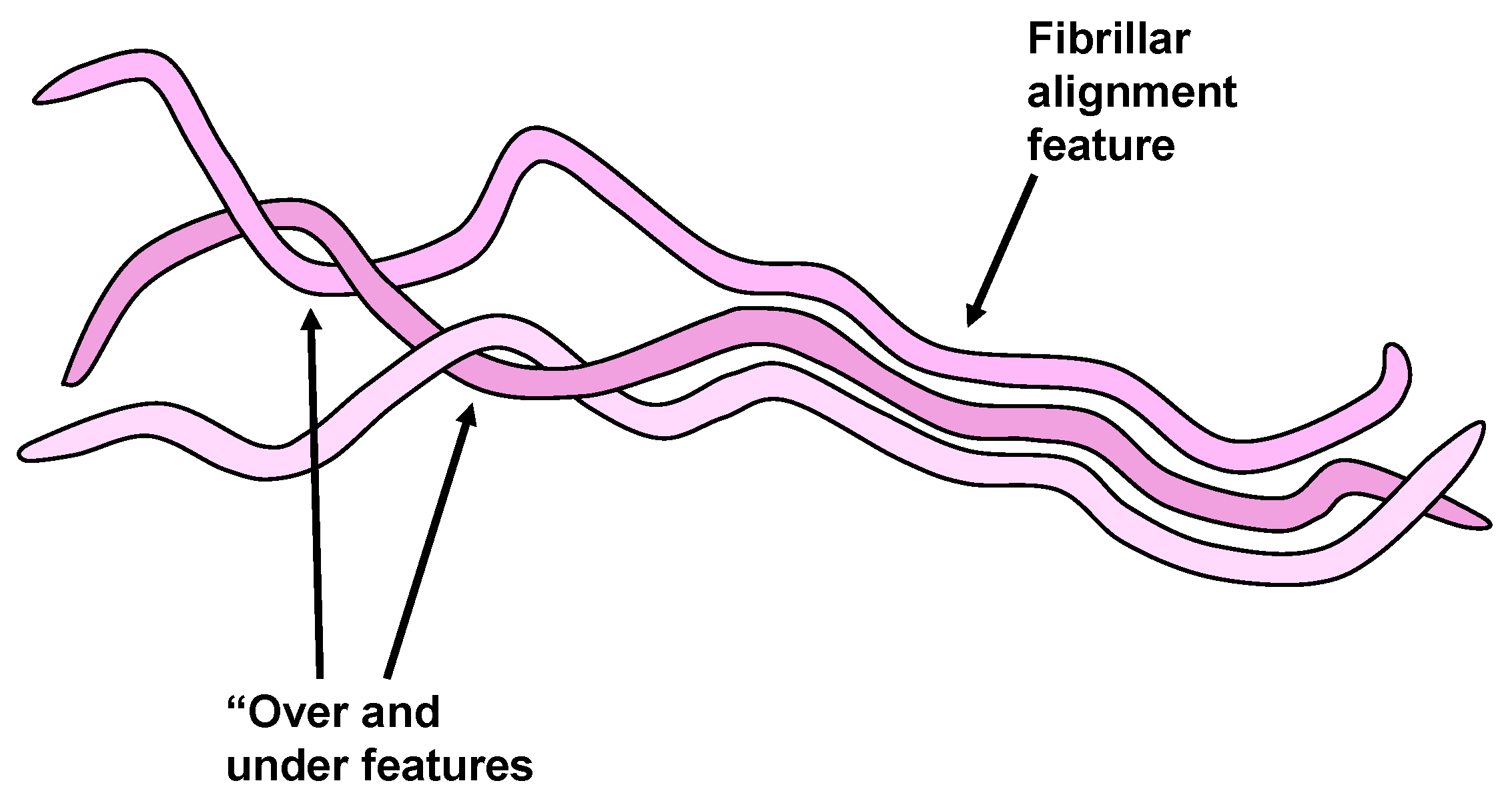
From a structural perspective, production processes involving “interdigitation” benefit from the inherently fibrillar nature of cellulosic fibers and nanocellulose materials such as cellulose nanofibrils. Their high aspect ratios (lengths divided by diameters) can facilitate the formation of structures that can achieve extensive overlapping, as well as some degree of randomly interwoven structures, depending on the details of processing. Figure 1 provides a schematic representation of two features related to interdigitation (i.e., “over & under features” and “fibrillary assignment”) that may be applied to the formation of structures from suspensions of fiber-like or fibrillated cellulosic materials [8].
The relatively simple, almost iconic nature of this figure is intentional. Rather than attempting to depict a real collection of objects, the goal here is to help define a pair of concepts, i.e., a couple of modes of interdigitation that are depicted in the figure. A brief verbal description of the “over and under” feature, as shown on the left of the figure, could include “a feature in which a fiber that is primarily oriented within the plane of a fiber sheet bends to pass over or under another fiber having another mainly within-the-plane orientation, then returning to its predominant plane.” In future work it may be possible to also define various features in quantitative terms. For instance, one might insist that in order to be counted, the extent of such an out-of-plane bending must be at least as large as one fiber width.
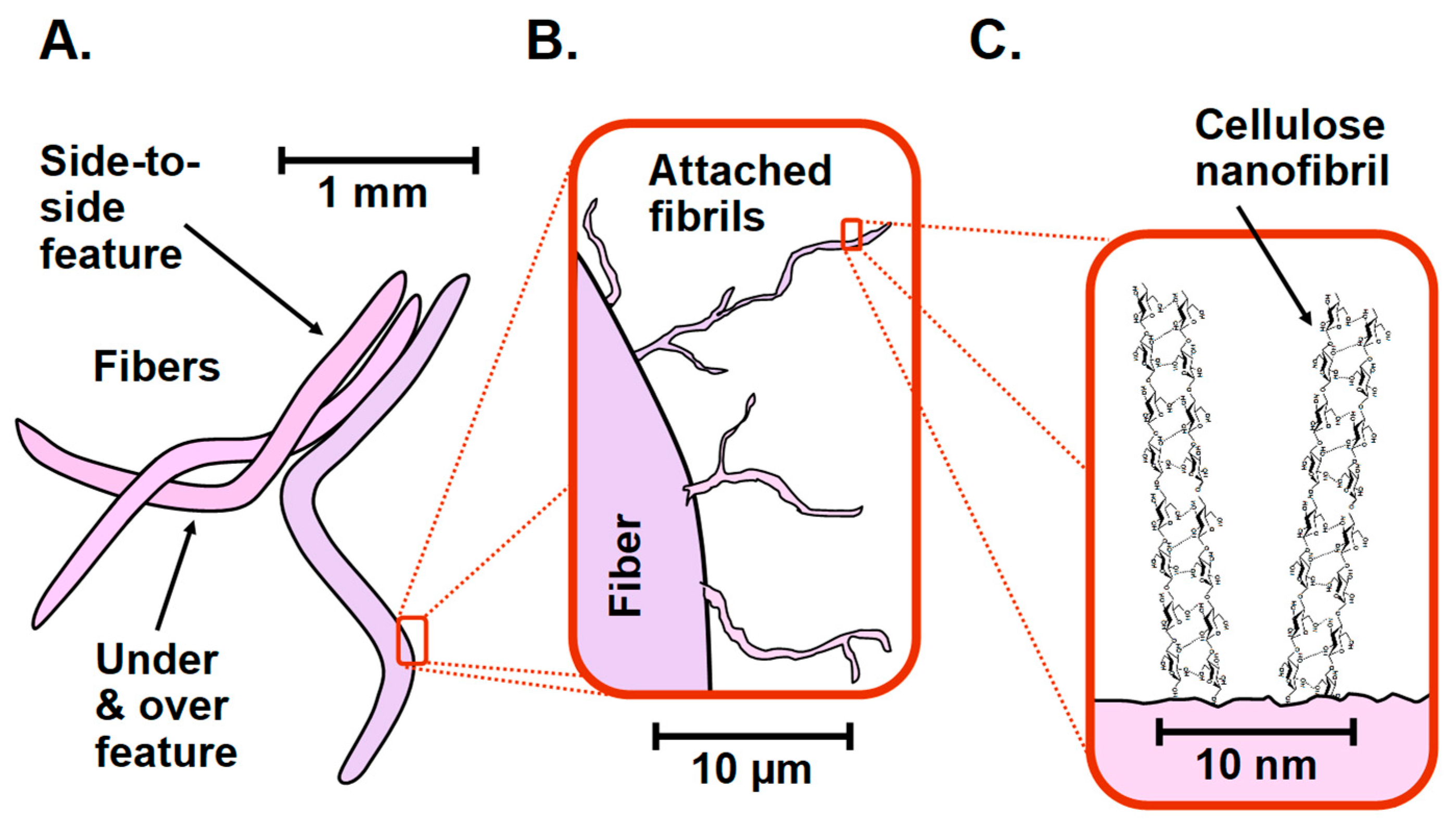
Another important aspect of interdigitation in aqueous systems with cellulosic material is that the concepts appear to span a very wide range of sizes. As illustrated in Figure 2, one can expect features of interdigitation to manifest themselves in the arrangements among papermaking fibers (with lengths of about 1 to 3 mm), in associations among fibrils on adjacent fibers (e.g., in the μm range), and at the quasi-molecular scale (i.e., the nano-scale).
Because cellulose-based structures can take advantage of the reversible formation of hydrogen bonding during drying, the main emphasis will be placed here on the preparation of products starting from aqueous suspensions of cellulosic materials. As described in more detail elsewhere [8], there is substantial evidence that suspensions of either cellulosic fibers or cellulosic nanofibers (i.e., nanofibrillated cellulose or cellulose nanofibrils) can become engaged in interdigitated network structures within aqueous suspensions and that such structures can be partly preserved during transformation into products such as paper, molded pulp items, cellulose-based composites, and nanocellulose-based films, etc.
In the context of fibrillated cellulosic materials, interdigitation should not be viewed as an isolated phenomenon but rather as the outcome of multiple interacting physicochemical processes that occur during suspension preparation, consolidation, and drying. Colloidal stability plays a critical role by allowing fibrils to have sufficient mobility and dispersion to achieve intimate contact and network formation, while excessive flocculation or premature aggregation may limit effective interpenetration among fibrillar elements. Alignment effects likewise can influence the degree and orientation of fibrillar engagement, affecting stress transfer, anisotropy, and packing density within the resulting structure. During consolidation and drying, hydrogen bonding and other interfacial interactions progressively stabilize the evolving network, contributing to strength development and structural integrity. At the same time, the structure may continue to evolve in a time-dependent manner due to rearrangement, hornification, relaxation phenomena, or changes in local moisture content. Thus, the concept of interdigitation may be understood as a coupled and dynamic process involving colloidal interactions, fibrillar organization, interfacial adhesion, and network evolution across multiple length and time scales [9,10].
Despite the importance of such phenomena, the concept of interdigitation has received relatively limited direct attention within the cellulose literature. Accordingly, the present review intentionally draws upon studies spanning a broad historical time frame. In many cases, earlier investigations provided important foundational insights regarding fibrillar interactions, consolidation behavior, hydrogen bonding, and network formation, even when the term “interdigitation” itself was not explicitly employed. The authors therefore have attempted to balance citation of recent advances with inclusion of historically significant studies that help establish the scientific basis for understanding interdigitated cellulosic structures and their influence on material performance.

2. Product Opportunities from Self-Assembly of Cellulose Fibers or Fibrils

2.1. Interdigitation as a Process Rather than a Tool

When evaluating product development opportunities, it is important to view interdigitation as a widely occurring process within various natural and manufacturing systems, rather than as a tool for direct application. Because interdigitation often emerges during processes that involve self-assembly, there are inherent limits on the extent to which the details can be dictated by a developmental engineer. Instead, processing conditions can be selected to favor or suppress the mechanisms that promote various aspects of interdigitation. It will be assumed here that development teams can take advantage of natural tendencies of fiber-like or fibrillated cellulosic materials to intertwine with each other, such that preferential processes and products can be achieved. It is proposed here that an understanding of self-assembly processes underlying such interdigitation can help product development teams select and optimize processing conditions. In addition, future successes in such efforts may provide additional clues as to how interdigitation takes place or fails to take place in different manufacturing situations. The subsections that follow will consider product development opportunities related to nanopaper, advanced wet wipe technologies, the spinning of cellulose fibers from fibrillar entities, the enhanced development of hydrogel products, composite structures involving interdigitation, and the reimagining of conventional paper forming from the perspective of enhancing aspects of interdigitation.
The subsections that follow, which deal with different potential application areas, focus on some parallel features, including preparation, performance, and industrial applications at different scales and for different purposes. Collectively, the diverse examples help to reveal the broad relevance of the concept of interdigitation. Also, the different examples illustrate different ways in which a balance can be achieved between interdigitation processes and useful results by means of optimizing process conditions.

2.2. Nano-Scale Papermaking Options

Intensive work is ongoing throughout the industrialized world to develop nanocellulose-based structures, especially for barrier layer applications. To achieve favorable results, nanocellulose-based films need to achieve favorable levels of strength, an absence of defects, and densely packed structures. For instance, high density and uniformity, along with strong cohesive energy density (arising from high density of hydrogen bonding), enable nanocellulose films to block oxygen gas and grease penetration [11]. These attributes are consistent with a high degree of interdigitation among fibrils, maximizing contact area and load transfer. Marchetti et al. showed that the barrier performance of nanocellulose films could be enhanced by prior treatment with short peptide chains [12]. That approach is consistent with the idea that the cellulosic surfaces need to be colloidally stable due to influences such as charge repulsion or steric stabilization. In that way, the fibrils have better opportunities to interdigitate with each other rather than become prematurely entrapped in highly nonuniform or poorly integrated structures.
In addition to colloidal stability, interfacial forces among nanocellulose and adjacent cellulosic surfaces strongly influence the efficiency of stress transfer, consolidation behavior and overall performance in paper and nanopaper structures. Marcuello et al. demonstrated the importance of controlling surface interactions involving cellulose nanocrystals through highly controlled surface-functionalization approaches developed for single-molecule force spectroscopy studies [13]. Such findings highlight the sensitivity of cellulose interfacial behavior to molecular-scale surface chemistry. Likewise, Spagnuolo et al. emphasized that the surface chemistry of nanocellulose strongly affects coating performance, adhesion, compatibility, and barrier properties in paper and textile applications [14]. These considerations suggest that optimizing interfacial forces and surface chemistry among fibrillated cellulosic materials may represent an important pathway toward improved interdigitation, structural uniformity, and end-use performance in nanocellulose-based materials. Such interfacial effects are particularly critical in layered and coating-based architectures, where nanoscale interactions directly govern macroscopic performance.
A particularly advantageous area of application for nanocellulose film structures can involve coatings applied to the surface of paper. Ridgway and Gane prepared paper coatings from aqueous suspensions of nanofibrillated cellulose and calcium carbonate particles [15]. The cited authors emphasized the importance of maintaining a high degree of continuity within such films. Benefits included higher paper stiffness, which was attributed to having a high-modulus layer at the outside surfaces of the paper. The coating layer also contributed to high paper smoothness. Because the coating components were fully compatible with the papermaking system, the coated paper was potentially recyclable, enabling the manufacture of succeeding generations of paper products. In this context, these coatings can be viewed as externally imposed zones of highly interdigitated fibrillar material that reinforce the underlying fiber network.
Santos et al. pioneered a radically different way to incorporate nanocellulose into paper products [16]. Rather than add the nanocellulose directly, they used bacteria to manufacture the nanocellulose in situ. The bacterium Gluconacetobacter sucrofermentans was cultured on the surface of paper sheets. After seven days, a layer about 10 μm thick was achieved. The resulting papers were shown to have increased tolerance to artificial aging and decreased air permeability. In this case, interdigitation likely occurred not only within the bacterial cellulose layer itself but also at the interface between the biosynthesized network and the underlying paper fibers.
There appear to be important product opportunities in the manufacture of membranes with specified sizes of pores. Awati et al. used the term “intertwined” to describe nanofibers assembled in such a way as to form nanochannels within membranes [17]. TEMPO-oxidized cellulose nanofibers were used in combination with aluminum oxide, in a design that takes advantage of opposite signs of electrical potential in aqueous media. Such membranes, when placed into a salinity gradient, were shown to have the potential to develop electrical power. The membranes showed the highest current development at a high pH of 11, ensuring the deprotonation of essentially all the carboxylic acid groups associated with the TEMPO-oxidized cellulose surfaces. These results illustrate how electrostatically guided interdigitation can be harnessed to produce functional architectures beyond traditional structural applications.
Traditional hand-crafted paper is often prepared with application of shaking motions or by tilting the handsheet screen to promote slideways (lateral) flow relative to the screen surface [18]. To extend such technology to nanocellulose, Park et al. applied high-power shaking to suspensions of carbon nanotubes and nanofibrillated cellulose [19]. The details of the shaking were shown to affect both the rheology of the suspensions and the electrical conductivity of the resulting films. Tabulated results showed that conductivity and mechanical properties of the dried composite films rose with increasing shaking time of the mixtures, which is consistent with increased dispersion and/or alignment or, possibly, more effective interdigitation of the nanomaterials.

2.3. Advanced Wet Wipe Technologies

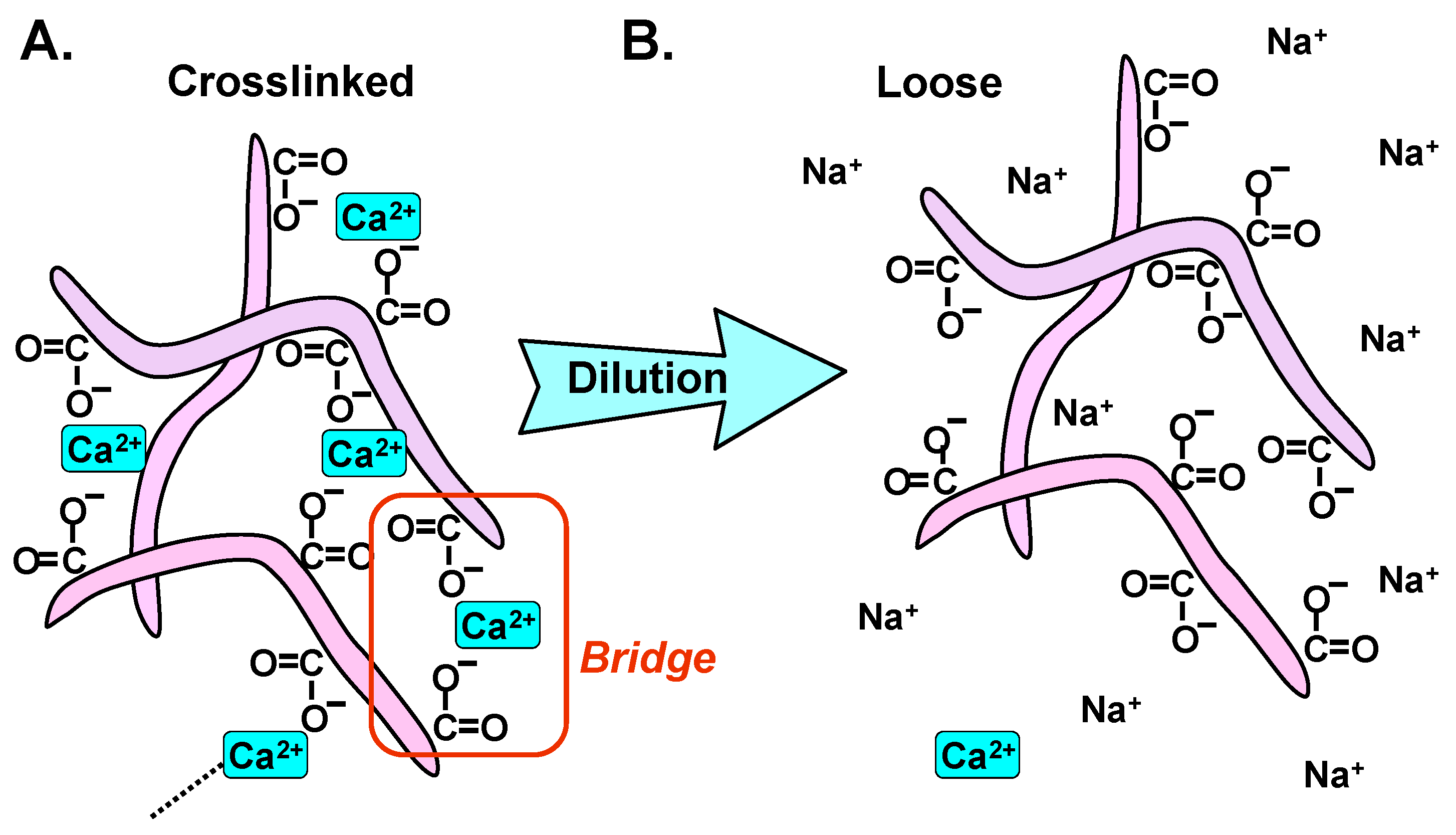
Labile crosslinking through interactions between calcium ions and either oxidized cellulose or polymers such as carboxymethyl cellulose (CMC) can be used as a strategy for the preparation of wet wipes [20]. Such products can be dispersed in sufficiently large amounts of tap water, thereby possibly satisfying flushability requirements. The apparent mechanism is depicted in Figure 3. In practice, however, this strategy presents challenges that motivate continued research. A key challenge is the fact that levels of calcium ions in tap water can be highly dependent on geographical location [21]. High levels of water hardness have been found to impede the redispersal of calcium-crosslinked wet wipe products [22]. These observations suggest that labile ionic crosslinks alone may be insufficient to guarantee reliable dispersibility under real-world conditions.
Work by Harter et al. has provided a clue that, in addition to other possible mechanisms, the ability of wet wipes to remain intact under wet conditions can be partly attributed to interdigitation [23]. These authors observed that the ability of wet wipes to become dispersed in water decreased with the passage of time during storage. Diffusional motions of cellulosic fibrils can be expected to take a long time, especially with the increasing size of the fibrils and due to various constraints. For instance, diffusion of a fibril segment might be restrained by temporary local adhesion to another fibril in the suspension. Another possibility is that the passage of time leads to more complete or mature self-assembly, taking advantage of calcium’s role in bridging between carboxylate groups in the structure. Such maturation could gradually convert initially labile associations into mechanically effective networks, thereby reducing dispersibility. These interpretations highlight the need to consider interdigitation as a dynamic, time-dependent contributor to wet strength, rather than attributing performance solely to ionic crosslinking density.
Hydroentanglement offers an additional mechanism by which wet wipe integrity can be enhanced. In this technology, tiny, high-velocity jets of water impinge upon a wet mat of fibers and cause local changes in the orientation of some of the fibers [24,25,26]. The flow of water from a wet paper web can be expected to orient attached fibrils so that they are generally aligned perpendicular to the plane of a paper sheet. The speed of the small jets used in hydroentanglement is sufficient to induce local turbulent eddies, which can also promote local entanglement. Harter et al. used the term “hydroentangled” to explain why wet wipes become increasingly hard to disperse with increased time of storage, implying that mechanically induced interdigitation may complement chemical bonding [23]. Pourmohammadi et al. reported the strongest bonding when both sides of a nonwoven sheet were impinged by jets of similar pressure, emphasizing the importance of symmetric mechanical action [27]. Although extensive hydroentanglement in some products renders them unflushable, other hydroentangled nonwoven products have been formulated that can be redispersed in water [28]. These findings underscore the delicate balance between achieving sufficient interdigitation for use-phase integrity and ensuring controlled disintegration upon disposal.

2.4. Spinning of Cellulose Fibers or Fibrillar Entities

Cotton thread is a prime example of a cellulosic structure formed by the twisting of overlapping fibrillar entities [29,30]. Alignment of the individual cotton fibers is achieved by carding, as well as by the drawing of the cotton thread (drafting) during spinning. Here, the term “spinning” retains its original meaning as a process involving the twisting motion of the equipment. Such products derive their strength from the tight structure, which gives rise to high frictional forces among the individual fibers or filaments. From an interdigitation perspective, twisting promotes repeated overlap and mutual constraint among fibers, thereby stabilizing the structure without the need for chemical bonding.
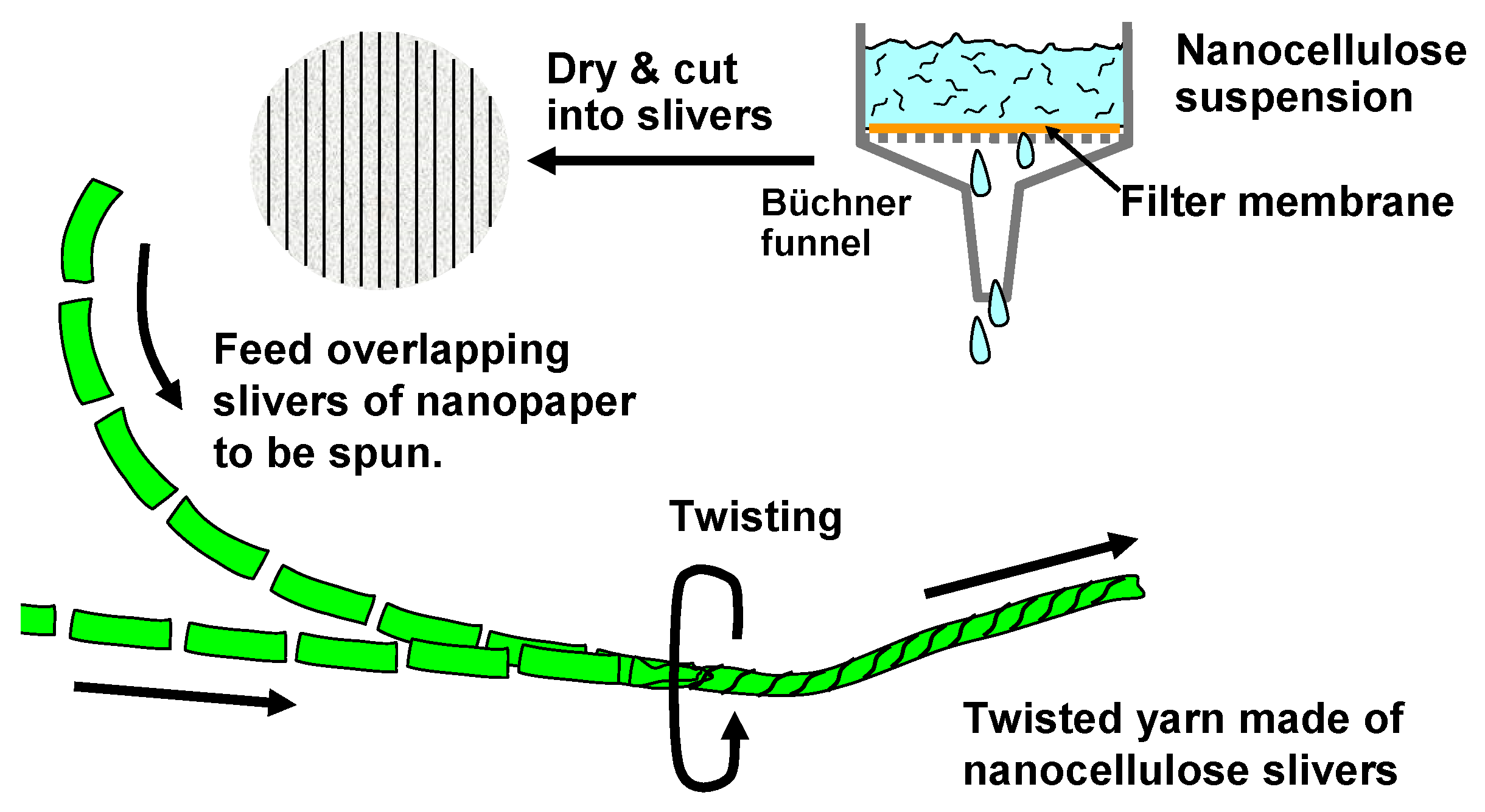
Although most spinning processes involve relatively long fibers, such as cotton lint, related products have been prepared from small strips of paper, which have been likewise spun to form somewhat durable yarns that have been woven into fabrics [31]. Despite being composed of relatively short (e.g., 1 to 3 mm) papermaking fibers that give rise to only moderate tensile strength, such products have been claimed to exhibit good tolerance to laundering [31]. A gradual loss of strength over several cycles of soaping, rinsing, and redrying was attributed to cyclic swelling, disruption of hydrogen bonding, and general loosening of the twisted structures. Zhai et al. achieved parallel results, except that the yarns had been spun from thin rectangles cut from dry films of nanopaper, composed of nanofibrillated cellulose [32]. The procedure is shown schematically in Figure 4. High toughness was reported for yarns composed of tightly twisted nanopaper strips. The twisting of highly aligned nanocellulose fibrils was observed in scanning electron micrographs. In both cases, twisting can be interpreted as a macroscopic strategy to promote interdigitation across multiple length scales.
Wet spinning appears to be a promising approach to prepare yarns directly from aqueous nanofibrillated cellulose suspensions [33,34,35]. In contrast to common practices of spinning continuous cellulosic fibers from a solution, the cited authors reported work in which the fibers were drawn from a gel-like nanocellulose suspension, and the drawing process aligned the individual nanocellulose fibrils. Results have been found to depend on extensional flow, which helps to align the fibrils [33]. The alignment and spinning can be hypothesized to bring about a degree of hydrogen bonding among the fibrils upon evaporative drying of the threads. While these early studies demonstrate feasibility, follow-up work is needed to establish whether these findings can lead to the implementation of commercial products.

2.5. Nanocellulose Hydrogels and Interdigitation

A hydrogel can be defined as a hydrophilic polymer structure in which there is sufficient crosslinking to prevent solubility of the component parts. In the case of nanocellulose, contributions to crosslinking can include entanglements [36], covalent bonding [37], and ionic associations [38]. Additional crosslinking effects can be achieved with borax, polyvinyl alcohol, and TEMPO-oxidized cellulosic surfaces, with results showing Hofmeister effects with the use of different anions [39]. For example, crosslinking by means of the multivalent ion citrate was found to strongly decrease the swelling of such gels, which was indicative of enhanced network cohesion. Product opportunities for cellulose-based hydrogels include controlled release [40,41], wound dressings [40], adsorption of pollutants [42,43], and sensors [39]. In each case, interdigitation among fibrils can be expected to influence network connectivity, transport pathways, and mechanical stability.
Addition of calcium ions has been the most popular strategy to achieve crosslinking in nanocellulose-based hydrogels [40,41]. Rheological tests have been used to demonstrate a strong reversibility of crosslinking, depending on the concentration of calcium in the system [41]. In addition, the crosslinking of hydrogels by calcium ions conferred a high degree of storage stability to the hydrogels.
A key challenge in formulating strongly crosslinked hydrogels is to avoid unfavorable agglomeration of the structures, which can disrupt uniform network formation and compromise performance. Khanjani et al. reached that goal by in situ generation of Ca2+ ions after the preparation of hydrogels from TEMPO-oxidized nanofibrillated cellulose [38]. In their approach, calcium carbonate particles were precipitated onto the cellulosic fibrils by treating the slurry with milk of lime, Ca(OH)2, followed by exposure of the aqueous system to carbon dioxide gas. The resulting hydrogel containing the attached CaCO3 particles was blended with acetic anhydride solution just before casting the hydrogel in a PTFE mold. Gradual dissolution of the CaCO3 particles gave rise to the release of Ca2+ ions, which served as ionic bridges to cross-link the gel. By delaying the onset of cross-linking, the researchers aimed to preserve the interdigitated gel structure while subsequently reinforcing it. Strong increases in tensile strength of the dried product were shown for systems in which the in situ cross-linking strategy had been applied, thereby supporting the hypothesis that maintaining interdigitation prior to crosslinking is critical for achieving optimal mechanical performance.

2.6. Composite Structures Involving Interdigitation

Composites are widely used in modern products. By combining two or more different phases, composite materials can achieve properties beyond those of the individual components. Cellulose-containing composites of various types have been reviewed [9,44,45]. Some issues to be considered in this subsection concern the possible role of interdigitation among the cellulosic fibrillar structures of such composites. Three topic areas to be discussed below are: composites with pre-formed cellulosic structures, ice templating as a method to control the arrangement of nanocellulose in certain composites, and quasi-molecular scale effects in certain wood-polymer composites. Together, these examples illustrate how interdigitation can operate across multiple length scales in composite systems.

2.6.1. Pre-Formed Cellulosic Structures

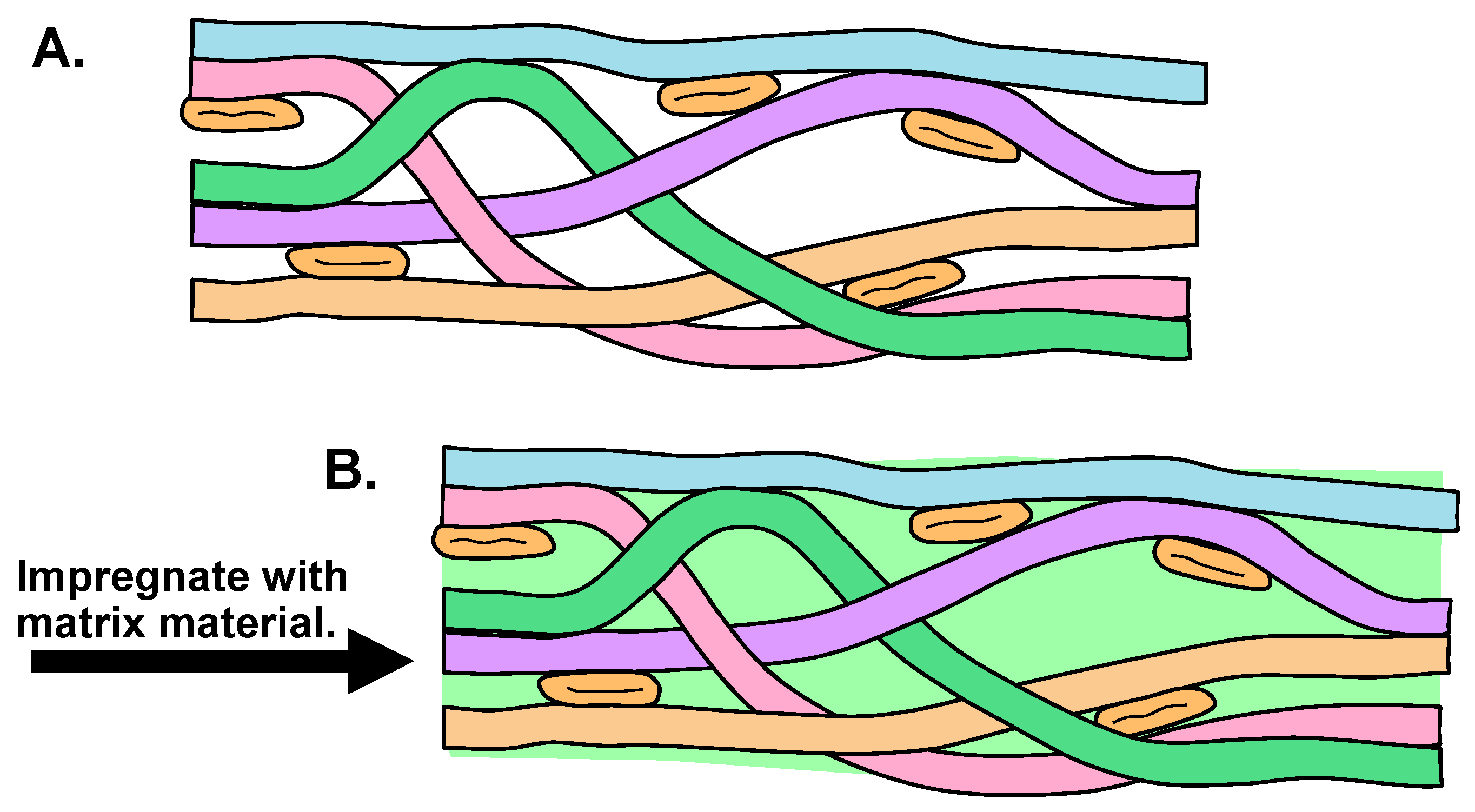
Higher composite strength can be achieved by first preparing a porous cellulosic skeleton structure and then infusing that structure with either a thermoplastic polymer in the liquid state or a self-curing resin, such as an epoxy system. The concept is shown schematically in Figure 5. Note that Part A of the figure depicts a cross-section of a dry cellulosic paper-like structure, showing some features of interdigitation. When using non-aqueous uncured resin, such as an epoxy product, it may be possible to achieve full impregnation without disturbing the interdigitated structure (Part B). Such a sequence makes it possible to take advantage of strong hydrogen bonding interactions at junctions between the cellulosic entities. This process is already presently carried out at an industrial scale for the preparation of decorative laminates using water-borne resins such as melamine formaldehyde and urea formaldehyde [46]. Saturating kraft paperboard sheets used in such systems need to be made with high uniformity and high levels of porosity, thus ensuring deep resin penetration while maintaining structural continuity [47]. In such materials, the cured resin reinforces an already interdigitated cellulose network rather than replacing it. Related approaches have demonstrated promising results in research settings. Lebrun et al. reported enhanced properties when impregnating epoxy resin into pre-formed paper from hemp or flax [48]. Desmaisons et al. impregnated porous paper with a polyvinyl alcohol suspension that contained cellulose nanocrystals (CNCs) [49]. The presence of the CNCs in the polyvinyl alcohol phase promoted crystallization of that phase, which can be important for the development of mechanical properties. From an interdigitation perspective, these results suggest that reinforcing the matrix phase can amplify the benefits of an already well-connected cellulosic skeleton.
Although extensive interdigitation and strong interfacial adhesion are often associated with improved mechanical strength, excessive interdigitation or overly rigid interphase formation may also introduce disadvantages in certain composite systems. For example, highly constrained fibrillar or polymer networks can reduce the ability of the structure to dissipate energy during deformation, thereby increasing brittleness and crack propagation tendencies [50,51]. In thermoplastic and thermoset composites, strong interpenetration and irreversible crosslinking may also hinder recyclability, reprocessability, or separation of constituent phases at end-of-life [52,53]. Thus, optimization of interdigitated structures requires balancing strength enhancement with toughness, flexibility, and circularity considerations.
There are analogous opportunities to take advantage of the inherent interdigitation within nanopaper structures by forming the nanopaper first and thereafter infusing those structures [54]. Because nanopaper consists of densely interdigitated nanofibrils, subsequent impregnation has the potential to lock in nano-scale contact regions while enhancing environmental resistance. For example, Plantnieks et al. impregnated hemp nanopaper with UV-curable resins [55]. Similarly, Yan et al. first prepared and dried cellulose nanofiber aerogels along with carbon nanotubes and subsequently infused them with curable epoxy resin [56]. The resulting composites had suitable strength for the preparation of solar thermal panels, illustrating how interdigitated nanocellulose networks can serve as high-performance reinforcement architectures.

2.6.2. Ice Templating Strategies with Nanocellulose

Freezing of water within a suspension of nanocellulose has been used as a way to align the cellulosic entities, as in the production of specialized aerogels [54,57,58,59,60,61] and hydrogels [62]. Because water increases its volume during freezing, in addition to its tendency to exclude solids from the ice microphases, ice templating procedures can be expected to press some of the cellulose surfaces tightly together. Strong bonding within cellulose structures has been reported to result from ice templating of nanocellulose even without drying [62]. One possible explanation for such strength development is a hypothesized development of dense hydrogen bonding patterns as the surfaces are pressed together in the wet state. As noted by Zhang et al. [59], such ice templating procedures can be regarded as a type of self-assembly, since the nucleation of individual ice domains is not under the direct control of the engineer but instead arises from thermodynamic and kinetic factors.

2.6.3. Wood-Polymer Composites and Quasi-Molecular Scale Interdigitation

Wood-polymer composites represent both a popular topic of research and an important area of manufacturing [63]. A key attraction of such products is that they are often made from low-grade or used plastics and cellulosic materials [64]. The importance of quasi-molecular-scale interdigitation in such products is evident from the strong influence of compatibilizing agents. Colom et al. showed that treatment with maleated polyethylene resulted in strong adhesion between the wood surfaces (which are reactive with maleic anhydride functions upon heating) and a high-density polyethylene (HDPE) phase [65]. The polyethylene tails grafted onto the wood surfaces are expected to intermix three-dimensionally with the adjacent HDPE phase. Foundational work on the same topic was reported by Felix and Gatenholm, who employed maleated polypropylene, since the polymer phase under consideration was polypropylene [66]. The cited authors showed that the thickness of the inter-phase was related to the molecular mass of the polypropylene groups on the compatibilizing agent, highlighting the molecular-level nature of the interdigitation process. Rao et al. further showed that the reaction of such coupling agents can convert some of the crystalline cellulose to an amorphous form, thus showing the profound effects of the agents [67]. A review by Hubbe and Grigsby reported strength improvements approaching a factor of two in wood-polymer composites prepared with suitable compatibilizing agents [68]. These findings collectively illustrate how quasi-molecular-scale interdigitation, enabled by chemical coupling, can dramatically enhance macroscopic composite performance.
Multiscale molecular and granular modeling may offer a means to correlate the reality of quasi-molecular interdigitation with macroscopic composite performance. Atomistic and coarse-grained simulations can quantify polymer penetration, interphase density, hydrogen bond disruption, and adhesion energy at cellulose–polymer interfaces, revealing the extent of chemically enabled interpenetration and limited amorphization. Such nano-scale descriptors can be incorporated through the mesoscale network and cohesive-zone models to predict load transfer, damage, and failure. The predictions would ultimately correlate directly with experimentally measurable properties, including crystallinity, storage modulus, interfacial shear strength, fracture toughness, and tensile strength. Such combined modeling–experimental frameworks may provide evidence for the role of quasi-molecular interdigitation in governing bulk mechanical performance.
Despite these opportunities, it is important to recognize that multiscale simulations of highly interdigitated cellulose-polymer systems can require substantial computational resources, especially when attempting to bridge atomistic, mesoscale, and continuum length scales simultaneously. The complexity arises from the need to capture large numbers of interacting fibrillar entities, long relaxation times, heterogeneous interfaces, and evolving hydrogen bonding networks. As a consequence, practical modeling approaches often rely on coarse-grained representations, reduced-order methods, or hybrid multiscale frameworks that balance computational efficiency with physically meaningful predictions [69,70]. Continued advances in high-performance computing and data-driven modeling approaches are expected to further improve the feasibility of such simulations in future studies.

2.7. Reimagining Conventional Paper Forming

In 1799, Louis Robert revolutionized papermaking with the invention of a machine capable of continuous sheet formation [71]. Within a decade or two, mechanized papermaking had achieved dominant status in England, with the technology quickly spreading to Europe and the rest of the world. Many papermaking practices have remained largely unchanged, and some features resemble those employed by Cai Lun in ancient China [18]. While this continuity reflects the robustness of the core technology, it also suggests that opportunities remain to rethink long-standing assumptions in light of the modern understanding of fiber-fiber interactions. Strategic adjustments could better leverage interdigitation in the course of papermaking. This subsection will consider some approaches related to increasing the freedom of fiber or fibril segments to intermingle, ways to modify the alignment of fibers within paper, and ways to induce forms of crosslinking into the wet web of paper after its interdigitated structure has become established. These approaches shift the emphasis from merely forming a sheet to engineering the internal network architecture of paper.

2.7.1. Enhancing Interdigitation Prior to Sheet Forming

In the production of nonwoven fabrics from aqueous suspensions, using the so-called wet-laid approach, it is common practice to add mucilaginous polymers to the solution [72]. Carboxymethyl cellulose (CMC) can be considered for such applications due to its strongly negative charge, which gives rise to electrical repulsion between fiber surfaces onto which the CMC is adsorbed. Kargl et al. showed that adsorption of CMC onto cellulose fibers is favored by increasing the ionic strength of the solution and by their shared cellulose chemical backbone [73]. Another candidate is carboxymethyl starch [74], which has the advantage of high solubility in water. Such treatments are seldom used in routine papermaking, where wood-derived fibers are typically employed. This is because of an observed negative effect on rates of water removal during sheet formation. However, potential gains in various paper properties may provide an incentive to reconsider such treatments in the future. There are reasons to expect that treatments to enhance the colloidal stability of cellulosic fiber surfaces have the potential to achieve more effective interdigitation among fibers and perhaps even among attached cellulosic fibrils. Frictional interactions between cellulosic surfaces in suspension can be reduced by coating the fibers with water-loving polymers, leading to steric stabilization effects [75,76]. Such effects are expected to promote deeper interpenetration of fibrils at fiber crossings, potentially leading to more extensive bonded areas after consolidation and drying. Thus, the trade-off between drainage efficiency and network quality may be worth reconsidering for applications where strength, toughness, or optical properties are prioritized.
A possible alternative to adding carboxymethylated polyelectrolytes to fiber suspensions can involve direct carboxymethylation of the fibers themselves. As shown by Lin et al. (2024), such treatment can lead to high swelling of kraft fibers, making them suitable for applications such as highly transparent, foldable paper [77]. The high degree of swelling can be expected to favor intermixing of quasi-molecular-sized fibrils during the paper forming and drying processes. In addition, the strong negative charges can be expected to favor electrostatic repulsion between the surfaces, thereby favoring uniform formation and a higher level of interdigitation. From an interdigitation perspective, this combination of swelling and controlled repulsion is particularly attractive as it favors both uniform dispersion and effective fibrillar entanglement.

2.7.2. Reengineering Fiber Alignment in Paper

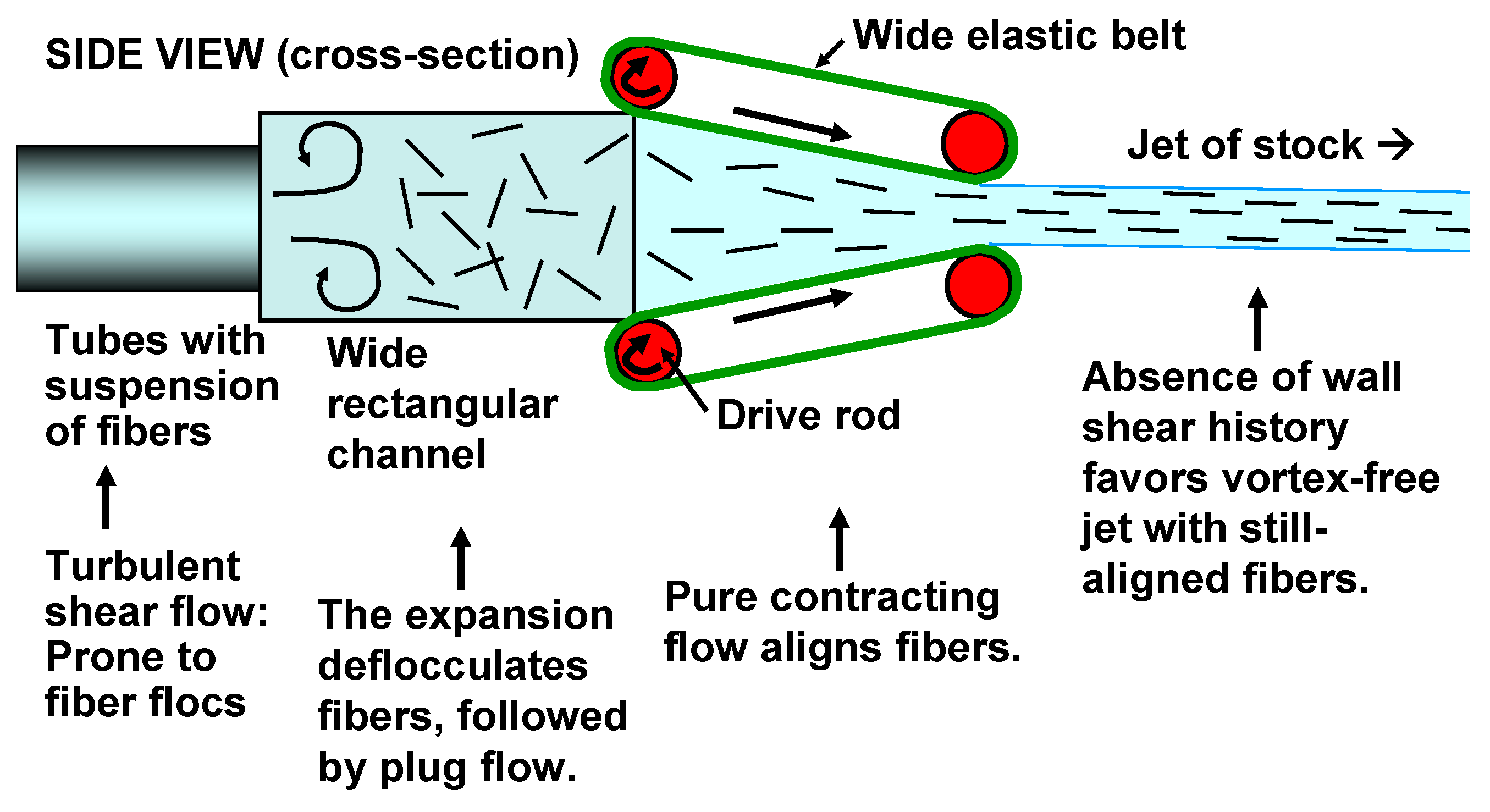
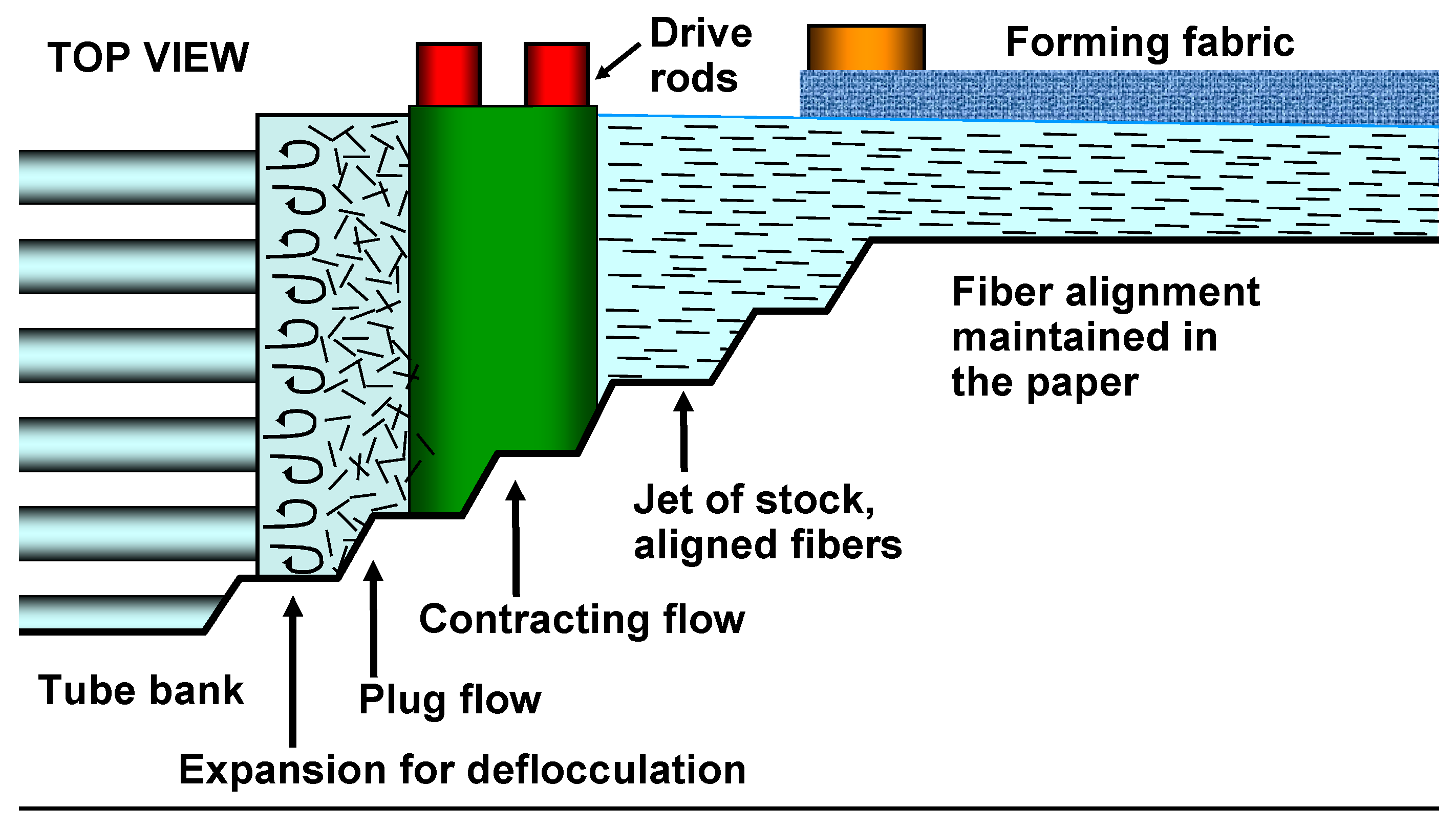
Going back to the time of Louis Robert, mechanized paper machines delivered the pulp suspension to the forming section of the paper machine by means of some kind of slit-like, stationary nozzle, which papermakers call the slice. Although this feature of paper machines has generally produced satisfactory results, it has an inherent drawback. The flow of the jet of the papermaking fiber suspension through the slice invariably involves the imposition of hydrodynamic shear as the mixture flows past the unmoving surfaces. As shown by Aidun, the abrupt change in boundary conditions as the jet of stock emerges from the slice into the air gives rise to strong vortex flow in the machine direction [78,79,80]. In addition to manifesting itself as streaks in the paper [79], the shear flow can also be expected to adversely affect the machine-directional preference of fiber alignment in the jet of stock. It is well known that contractional flow, as occurs in many modern paper machine headbox systems, will tend to favor fiber alignment in the process direction [81,82]. Figure 6 (side detail view) and Figure 7 (top view) sketch the concept of a modified slice design for a paper machine headbox, in which the slice walls are re-engineered to have a velocity that approximately matches that of the jet, thus minimizing the generation of vorticity at the boundary of the fluid phase. It is proposed that by using such equipment, future papermakers could achieve greater fiber alignment in the machine direction, even without relying on speed differences between the jets of stock and the forming fabric. From the standpoint of interdigitation, this approach offers the possibility of balancing directional strength with transverse connectivity, enabling more isotropic or deliberately anisotropic network structures as required by the application.
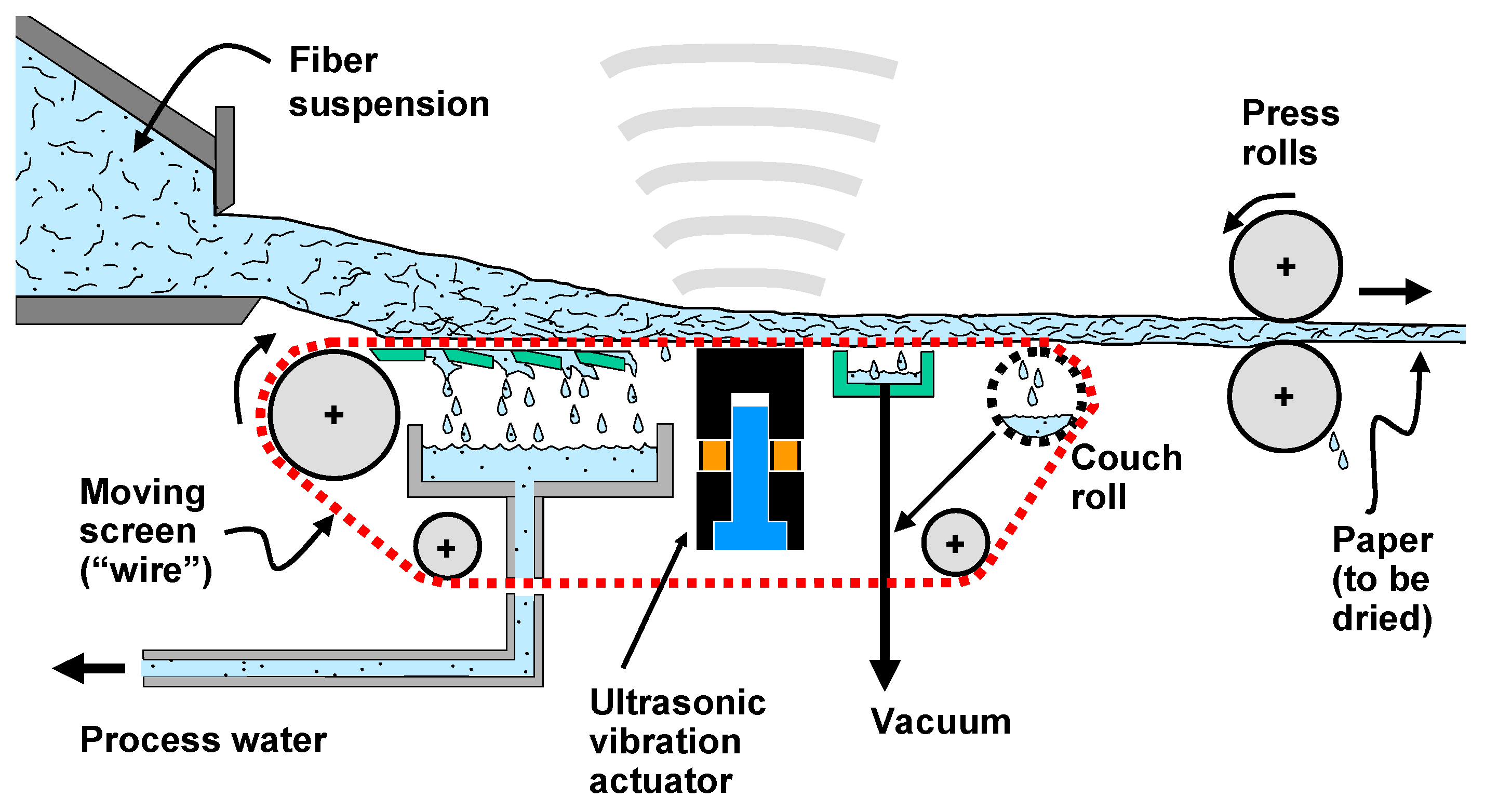
While the system just described may be favorable for certain paper products in which a high ratio of machine-directional to cross-directional strength is needed, other strategies can be envisioned in cases where other attributes, such as resistance to delamination, z-direction strength, or toughness, are desired. When there is reason to prefer interdigitation among fibers and fibrils in different directions, some other approaches can be used. Ultrasonic vibrations are already widely used to promote various kinds of mixing [83]. An inherent advantage of ultrasonic waves is that the associated distances of motion are tiny. Because of this, it may be possible to increase or modify interdigitation without causing major disruption of existing structures within a jet of papermaking stock or a wet web of paper. Such localized perturbations may increase out-of-plane fibril engagement or disrupt weakly aligned domains that promote delamination. Figure 8 depicts an optional arrangement that could be investigated in future studies.
At present, such ultrasonic strategies remain largely within the realm of laboratory-scale investigation, and significant engineering challenges would need to be addressed before implementation on commercial paper machines. These challenges include the large widths and high operating speeds of modern papermaking systems, energy consumption, transducer durability under continuous wet conditions, and the need to maintain uniform acoustic effects across the full width of the paper web. Nevertheless, the papermaking industry already employs various forms of process intensification and online sensing technologies under demanding operating conditions, suggesting that selective ultrasonic treatments may eventually become feasible for specialty grades or targeted process zones [84]. Future advances in energy-efficient transducer design, process control, and localized application strategies may help bridge the gap between laboratory demonstrations and industrial implementation.
Inducing Crosslinking After Immobilization of the Paper Web
In addition to achieving extensive interdigitation of fibers and attached fibrils up to the point at which the paper structure is established, there are also important reasons to induce coagulation or flocculation during sheet formation. In particular, high retention efficiency of fine particles, including cellulosic fines, mineral fillers, and functional additives, is often required. Certain combinations of coagulants and flocculants, often in combination with microparticles or nanoparticles, are used in many papermaking systems to increase the rate of dewatering, which often limits overall production from the paper mill [10]. One of the challenges inherent in papermaking is that there are conflicting goals of wanting a high uniformity of the product while at the same time wanting a high efficiency of retaining the fine material in the paper [85]. Such treatment strategies generally employ combinations of coagulants (such as a solution of aluminum sulfate or an intermediate mass, high-charge cationic polymer) and flocculants (which can be a charged copolymer of acrylamide with a very high mass). While effective, these strategies inevitably introduce flocculation early in the process, potentially limiting the extent of fiber and fibril interdigitation that can develop prior to immobilization.
In modern papermaking operations, the additives employed for retention and drainage promotion are invariably added to the fiber suspension before it enters the headbox. This situation prompts the following question: Is there a way in which a coagulant or a flocculant can be added to the wet web after the structure of the sheet has already become established? Further questions can be asked as to whether such treatments might be too late to achieve the desired benefits in terms of retention and dewatering. To begin the discussion, it is well known that various solutions can be applied to the top and bottom of a freshly dried paper web as it passes through a size press [86]. That point in the process is clearly too late to have any impact on retention and drainage. Another option, which is possible when using Fourdrinier (one-directional dewatering) equipment, is to spray additives onto the wet surface of the paper no later than before the final suction box [87]. Although such spray operations are usually positioned rather late in the forming zone of a Fourdrinier section of a paper machine, earlier positioning could be evaluated. Spraying of a solution of a soluble calcium salt onto the wet paper surface might be employed to achieve a crosslinking effect in combination with the carboxymethylated polymers mentioned earlier. Such an approach could “lock in” an already interdigitated structure while simultaneously improving retention. In addition, it is known that treatment of the paper surface with calcium ions can promote rapid immobilization of widely used inkjet dyes during later printing of a paper product [88].
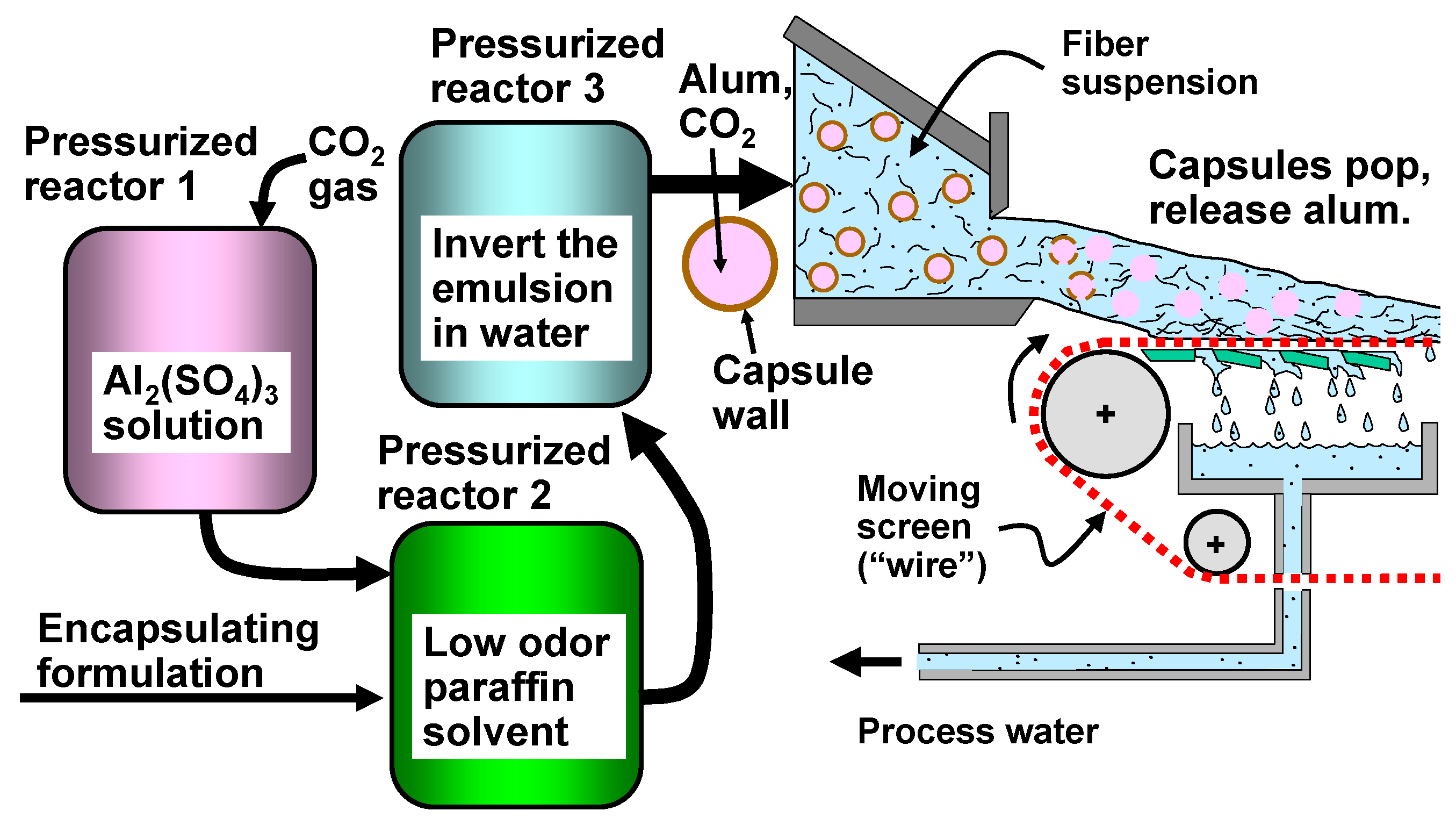
Another option could be to disperse the coagulants or flocculants into the fiber suspension in encapsulated form. In this scenario, a trigger to bring about release of the contents of the capsules within the microstructure of the wet paper web could be the abrupt decrease in pressure associated with the emergence of the jet of fiber suspension from a headbox [89]. Such a mechanism could allow fibers and fibrils to interdigitate freely under pressurized conditions, followed by rapid coagulation or crosslinking within the microstructure of the wet web. To formulate such an encapsulated product, it would be necessary to maintain elevated pressure during the emulsification and development of the capsule wall. Such a process is illustrated in Figure 9, where three pressurized, stirred reactors are employed. In the system shown, it is assumed that the coagulant is aluminum sulfate (“alum”), which is a much more aggressive, fast-acting coagulant in comparison to the calcium ion. Carbon dioxide has a relatively high solubility in water, but it readily comes out of solution, thereby potentially breaking the capsules, when the pressure is lowered.
The pressure of such a system would need to be maintained through to the point of injection into the pressurized approach flow to the paper machine headbox. A water-in-oil type of emulsification, as already commonly used in the formulation of acrylamide-type retention aids for papermaking [90], would be appropriate. One option for forming the capsule walls would be by means of Pickering stabilizer particles, as described by Marquez et al. [91], offering mechanical robustness and tunable rupture behavior. Since such technology for delivery of additives under pressure to papermaking systems does not yet exist, considerable developmental effort would be required to enable an unprecedented level of control over the timing and location of flocculation or crosslinking. Realizing this vision would require substantial research and engineering effort. There may be a potential payoff in terms of decoupling interdigitation from immobilization, and this suggests that it may be a fertile area for future innovation.
Although substantial progress has been achieved in understanding interdigitation within cellulose-based systems, many important scientific and engineering questions remain unresolved. One important direction should focus on developing quantitative methods to characterize interdigitation across multiple length scales, including fibril-level imaging, in situ monitoring during processing, and multiscale mechanical analysis. Another promising area involves the development of predictive computational models capable of correlating interdigitated structures with bulk performance properties such as toughness, barrier resistance, durability, and recyclability. Future work also may focus on developing new crosslinking and surface engineering strategies capable of preserving favorable interdigitated structures under wet or highly humid conditions, while still allowing adequate flexibility, recyclability, and processability. From an industrial perspective, future investigations should evaluate the scalability, energy requirements, and economic feasibility of emerging strategies, including ultrasonic structuring, ice templating, controlled crosslinking, and in situ self-assembly approaches. Progress in these areas may enable the design of next-generation cellulose-based materials with improved performance, sustainability, and circularity.

3. Conclusions

Interdigitation has emerged as a set of phenomena that needs to be better understood by developers of future cellulose-based products. As shown in this review article, cellulosic materials, ranging from ordinary paper to various composites and nano-structures, have different scales of fibrillar features. Those working to develop various products can take advantage of the fact that cellulosic fibers, fibrils, and even nano-scaled structures have a tendency to engage in interdigitated arrangements that can positively affect various developmental goals. By focusing on the underlying processes, which often depend on eddies, flow or diffusion-related motions, there will be opportunities to take further advantage of self-assembly phenomena involved in the formation of interdigitated structures.
This review article highlighted product opportunities, involving interdigitation, in the case of nano-scale papermaking, wet wipe technology, the preparation of yarns from cellulosic entities (including thin strips of nanopaper), hydrogels, and composites. In addition, it is even possible to imagine new strategies for commercial papermaking that can take better advantage of inherent tendencies of cellulose fibers to form interdigitated structures, as long as conditions are set up to encourage such outcomes. Interdigitation represents a set of opportunities that have been existing in plain view. By paying explicit attention to the underlying processes, in addition to the highly fibrillar character of cellulose at different size domains, these principles can be helpful in the development of the next generation of bio-based, Earth-friendly products.

Author Contributions

C.C.U.: Conceptualization, writing; L.A.L.: Conceptualization, writing; M.A.P.: Conceptualization, organization of contents; M.A.H.: Conceptualization, writing, artwork. All authors have read and agreed to the published version of the manuscript.

Funding

This work was supported by an endowment fund from the Buckman Foundation.

Institutional Review Board Statement

Not applicable.

Informed Consent Statement

Not applicable.

Data Availability Statement

This is a review article; no new data were generated.

Acknowledgments

AI was used only for searching for relevant articles to cite and discuss in the course of preparing the revised version, before those searched articles were downloaded, read, and corresponding revisions made to the article. There was no usage of AI for the composing or polishing of this work. Graphics were prepared using Microsoft PowerPoint version 2003.

Conflicts of Interest

The authors declare no conflicts of interest.

References

  1. Fasake, V.; Shelake, P.S.; Srivastava, A.; Dashora, K.; Bhagat, A.; Dhakane-Lad, J. Characteristics of different plastic materials, properties and their role in food packaging. Curr. Nutr. Food Sci. 2021, 17, 944–954. [Google Scholar] [CrossRef]
  2. Walker-Franklin, I.; Jambeck, I. Plastics; The MIT Press: Cambridge, MA, USA, 2023. [Google Scholar] [CrossRef]
  3. Rhodes, C.J. Plastic pollution and potential solutions. Sci. Prog. 2018, 101, 207–260. [Google Scholar] [CrossRef] [PubMed]
  4. Idris, S.N.; Amelia, T.S.M.; Bhubalan, K.; Lazim, A.M.M.; Zakwan, N.A.M.A.; Jamaluddin, M.I.; Santhanam, R.; Amirul, A.A.; Vigneswari, S.; Ramakrishna, S. The degradation of single-use plastics and commercially viable bioplastics in the environment: A review. Environ. Res. 2023, 231, 115988. [Google Scholar] [CrossRef]
  5. Geyer, R.; Jambeck, J.R.; Law, K.L. Production, use, and fate of all plastics ever made. Sci. Adv. 2017, 3, e1700782. [Google Scholar] [CrossRef]
  6. Grand View Research. Plastic Market Size, Share & Growth|Industry Report, 2033; Grand View Research Plastics Market Report; Grand View Research: San Francisco, CA, USA, 2026; Available online: https://www.grandviewresearch.com/industry-analysis/global-plastics-market (accessed on 10 May 2026).
  7. PlasticsEurope. Plastics—The Fast Facts 2024: An Analysis of European Plastics Production, Demand and Waste Data; PlasticsEurope: Brussels, Belgium, 2024. [Google Scholar]
  8. Umeileka, C.C.; Lucia, L.A.; Pasquinelli, M.A.; Hubbe, M.A. Concepts and evidence of interdigitation in the strength development of paper and sheets formed from highly fibrillated cellulose: A review. BioResources 2026, 21, 5666–5705. [Google Scholar] [CrossRef]
  9. Moon, R.J.; Martini, A.; Nairn, J.; Simonsen, J.; Youngblood, J. Cellulose nanomaterials review: Structure, properties and nanocomposites. Chem. Soc. Rev. 2011, 40, 3941–3994. [Google Scholar] [CrossRef]
  10. Hubbe, M.A.; Sjöstrand, B.; Nilsson, L.; Kopponen, A.; McDonald, J.D. Rate-limiting mechanisms of water removal during the formation, vacuum dewatering, and wet-pressing of paper webs: A review. BioResources 2020, 15, 9672–9755. [Google Scholar] [CrossRef]
  11. Aulin, C.; Johansson, E.; Wågberg, L.; Lindström, T. Self-organized films from cellulose I nanofibrils using the layer-by-layer technique. Biomacromolecules 2010, 11, 872–882. [Google Scholar] [CrossRef]
  12. Marchetti, A.; Marelli, E.; Bergamaschi, G.; Lahtinen, P.; Paananen, A.; Linder, M.; Pigliacelli, C.; Metrangolo, P. Nanocellulose-short peptide self-assembly for improved mechanical strength and barrier performance. J. Mater. Chem. B 2024, 12, 9229–9237. [Google Scholar] [CrossRef] [PubMed]
  13. Marcuello, C.; Foulon, L.; Chabbert, B.; Molinari, M.; Aguié-Béghin, V. Langmuir–Blodgett procedure to precisely control the coverage of functionalized AFM cantilevers for SMFS measurements: Application with cellulose nanocrystals. Langmuir 2018, 34, 9376–9386. [Google Scholar] [CrossRef]
  14. Spagnuolo, L.; D’Orsi, R.; Operamolla, A. Nanocellulose for paper and textile coating: The importance of surface chemistry. ChemPlusChem 2022, 87, e202200204. [Google Scholar] [CrossRef] [PubMed]
  15. Ridgway, C.J.; Gane, P.A.C. Constructing NFC-pigment composite surface treatment for enhanced paper stiffness and surface properties. Cellulose 2012, 19, 547–560. [Google Scholar] [CrossRef]
  16. Santos, S.M.; Carbajo, J.M.; Gómez, N.; Ladero, M.; Villar, J.C. Paper reinforcing by in situ growth of bacterial cellulose. J. Mater. Sci. 2017, 52, 5882–5893. [Google Scholar] [CrossRef]
  17. Awati, A.; Zhou, S.; Shi, T.; Zeng, J.; Yang, R.; He, Y.J.; Zhang, X.; Zeng, H.; Zhu, D.Z.; Cao, T.C. Interfacial super-assembly of intertwined nanofibers toward hybrid nanochannels for synergistic salinity gradient power conversion. ACS Appl. Mater. Interfaces 2023, 15, 27075–27088. [Google Scholar] [CrossRef] [PubMed]
  18. Hunter, D. Papermaking: The History and Technique of an Ancient Craft, 2nd ed.; Alfred Knopf: New York, NY, USA, 1947. [Google Scholar]
  19. Park, S.; Song, Y.; Ryu, B.; Song, Y.W.; Lee, H.E.; Kim, Y.; Lim, J.; Lee, D.J.; Yoon, H.; Lee, C.K. Highly conductive ink based on self-aligned single-walled carbon nanotubes through inter-fiber sliding in cellulose fibril networks. Adv. Sci. 2024, 11, 2854. [Google Scholar] [CrossRef]
  20. Wang, K.Y.; Demeny, L.M.; Pomplun, W.S.; Mumick, P.S.; Anderson, R.L.; Merker, J.F. Dispersible Nonwoven Fabric and Method of Making Same. U.S. Patent 5935880 A, 22 September 1997. [Google Scholar]
  21. Johnson, S.F.; Gillespie, N.J.; Zhang, D.; Goodwin, K.D.; Sutton, C.G.; Hubbe, M.A. Effects of water hardness (CaCl2) addition) on performance of papermaking additives for fine-particle retention, dewatering, and flocculation. TAPPI J. 2025, 24, 504–512. [Google Scholar] [CrossRef]
  22. Yeo, R.S. Flushable Compositions. U.S. Patent 5509913A, 23 April 1996. [Google Scholar]
  23. Harter, T.; Bernt, I.; Winkler, S.; Hirn, U. Reduced dispersibility of flushable wet wipes after wet storage. Sci. Rep. 2021, 1, 15543. [Google Scholar] [CrossRef] [PubMed]
  24. Mao, N.; Russell, S.J. A framework for determining the bonding intensity in hydroentangled nonwoven fabrics. Compos. Sci. Technol. 2006, 66, 80–91. [Google Scholar] [CrossRef]
  25. Xiang, P.; Kuznetsov, A.V.; Seyam, A.M. Modeling of the hydroentanglement process. J. Eng. Fibers Fabr. 2006, 1, 155892500600100201. [Google Scholar] [CrossRef]
  26. Moyo, D.; Anandjiwala, R.D. Studies on waterjet impact forces in the hydroentanglement process. Text. Res. J. 2013, 83, 1717–1727. [Google Scholar] [CrossRef]
  27. Pourmohammadi, A.; Russell, S.J.; Höffele, S. Effect of water jet pressure profile and initial web geometry on the physical properties of composite hydroentangled fabrics. Text. Res. J. 2003, 73, 503–508. [Google Scholar] [CrossRef]
  28. Deng, C.; Liu, W.J.; Zhang, Y.J.; Huang, C.; Zhao, Y.; Jin, X.Y. Environmentally friendly and breathable wet-laid hydroentangled nonwovens for personal hygiene care with excellent water absorbency and flushability. R. Soc. Open Sci. 2018, 5, 171486. [Google Scholar] [CrossRef] [PubMed]
  29. Lawrence, C.A. Fundamentals of Spun Yarn Technology; CRC Press: Boca Raton, FL, USA, 2003. [Google Scholar]
  30. Manandhar, R.; Delhom, C.D. Miniature spinning: An improved cotton research tool. J. Cotton Sci. 2018, 22, 126–135. [Google Scholar] [CrossRef]
  31. Memon, H.; Hu, D.F.; Wu, L.Y.; Wang, Y.; Yao, J.M.; Militky, J.; Kremenakova, D.; Zhu, G.C. Structure, properties, and fabric applicability of sustainable paper yarn with high washing stability. Heliyon 2024, 10, e27467. [Google Scholar] [CrossRef]
  32. Zhai, Y.D.; Cui, Y.D.; Zhou, M.; Chen, P.; Chang, C.Y.; Chen, J.H. Large-scale additive fabrication of tough nanocellulose yarns. Chem. Eng. J. 2024, 496, 154105. [Google Scholar] [CrossRef]
  33. Lundahl, M.J.; Klar, V.; Wang, L.; Ago, M.; Rojas, O.J. Spinning of cellulose nanofibrils into filaments: A review. Ind. Eng. Chem. Res. 2017, 56, 8–19. [Google Scholar] [CrossRef]
  34. Clemons, C. Nanocellulose in spun continuous fibers: A review and future outlook. J. Renew. Mater. 2016, 4, 327–339. [Google Scholar] [CrossRef]
  35. Frazier, R.M.; Lendewig, M.; Vera, R.E.; Vivas, K.A.; Forfora, N.; Azuaje, I.; Reynolds, A.; Venditti, R.; Pawlak, J.J.; Ford, E.; et al. Textiles from non-wood feedstocks: Challenges and opportunities of current and emerging fiber spinning technologies. J. Bioresour. Bioprod. 2024, 9, 410–432. [Google Scholar] [CrossRef]
  36. Feng, Y.Q.; Wang, S.C.; Li, Y.Q.; Ma, W.X.; Zhang, G.; Yang, M.; Li, H.B.; Yang, Y.S.; Long, Y. Entanglement in smart hydrogels: Fast response time, anti-freezing and anti-drying. Adv. Funct. Mater. 2023, 33, 1027. [Google Scholar] [CrossRef]
  37. Yang, D.; Gustafsson, E.; Stimpson, T.C.; Esser, A.; Pelton, R.H. Hydrazide-derivatized microgels bond to wet, oxidized cellulose giving adhesion without drying or curing. ACS Appl. Mater. Interfaces 2017, 9, 21000–21009. [Google Scholar] [CrossRef]
  38. Khanjani, P.; Ristolainen, M.; Kosonen, H.; Virtanen, P.; Ceccherini, S.; Maloney, T.; Vuorinen, T. Time-triggered calcium ion bridging in preparation of films of oxidized microfibrillated cellulose and pulp. Carbohyd. Polym. 2019, 218, 63–67. [Google Scholar] [CrossRef]
  39. Wang, X.; Wei, S.-H.; Huang, X.-W.; Tang, J.-J.; Yu, J.-L.; Qin, Z.-Y.; Gao, W.; Deng, X.-D.; Mo, L.-T. Hofmeister effect and dual-dynamic cross-linking interaction enhanced ionic conductive and balanced mechanical properties hydrogels for flexible sensors. Colloids Surf. A Physicochem. Eng. Asp. 2025, 725, 137703. [Google Scholar] [CrossRef]
  40. Basu, A.; Stromme, M.; Ferraz, N. Towards tunable protein-carrier wound dressings based on nanocellulose hydrogels crosslinked with calcium ions. Nanomaterials 2018, 8, 550. [Google Scholar] [CrossRef]
  41. Mariano, M.; Naseri, N.; Nascimento, D.M.; Franqui, L.; Seabra, A.B.; Mathew, A.P.; Bernardes, J.S. Calcium cross-linked cellulose nanofibrils: Hydrogel design for local and controlled nitric oxide release. ACS Appl. Bio Mater. 2024, 7, 8377–8388. [Google Scholar] [CrossRef]
  42. Dai, Y.T.; Zhu, Y.; Li, Z.D.; Zhang, T.; Yue, X.J.; Pan, J.M.; Xue, S.L.; Li, C.X.; Qiu, F.X. Support platform of functionalized sustainable cellulose self-entanglement monolithic adsorbents for efficient adsorption of cadmium(II) ions. Langmuir 2024, 40, 4927–4939. [Google Scholar] [CrossRef]
  43. Johnson, K.I.; Sharma, S.K.; Sharma, P.R.; Alhamzani, A.G.; Hsiao, B.S. Aluminum-crosslinked nanocellulose scaffolds for fluoride removal. Nanomaterials 2024, 14, 1032. [Google Scholar] [CrossRef]
  44. Hubbe, M.A.; Rojas, O.J.; Lucia, L.A.; Sain, M. Cellulosic nanocomposites, A review. BioResources 2008, 3, 929–980. [Google Scholar] [CrossRef]
  45. Eichhorn, S.J.; Dufresne, A.; Aranguren, M.; Marcovich, N.E.; Capadona, J.R.; Rowan, S.J.; Weder, C.; Thielemans, W.; Roman, M.; Renneckar, S. Review: Current international research into cellulose nanofibres and nanocomposites. J. Mater. Sci. 2010, 45, 1–33. [Google Scholar] [CrossRef]
  46. Thébault, M.; Li, Y.; Beuc, C.; Frömel-Frybort, S.; Zikulnig-Rusch, E.M.; Kutuzova, L.; Kandelbauery, A. Impregnated paper-based decorative laminates prepared from lignin-substituted phenolic resins. J. Renew. Mater. 2020, 8, 1181–1198. [Google Scholar] [CrossRef]
  47. Brazier, K.A. Saturating kraft requirements for decorative and industrial laminates. TAPPI J. 1993, 76, 203–206. [Google Scholar]
  48. Lebrun, G.; Couture, A.; Laperrière, L. Tensile and impregnation behavior of unidirectional hemp/paper/epoxy and flax/paper/epoxy composites. Compos. Struct. 2013, 103, 151–160. [Google Scholar] [CrossRef]
  49. Desmaisons, J.; Rueff, M.; Bras, J.; Dufresne, A. Impregnation of paper with cellulose nanocrystal reinforced polyvinyl alcohol: Synergistic effect of infrared drying and CNC content on crystallinity. Soft Matter 2018, 14, 9425–9435. [Google Scholar] [CrossRef] [PubMed]
  50. Razavi-Nouri, M.; Ghorbanzadeh-Ahangari, M.; Fereidoon, A.; Jahanshahi, M. Effect of Carbon Nanotubes Content on Crystallization Kinetics and Morphology of Polypropylene. Polym. Test. 2009, 28, 46–52. [Google Scholar] [CrossRef]
  51. Kang, T.; Dai, J.; Huang, Y.; Kim, H.; Keten, S.; Kim, J. Entanglements and Fracture in Polymers. Chem. Rev. 2025, 125, 11032–11057. [Google Scholar] [CrossRef] [PubMed]
  52. Yang, Y.; Boom, R.; Irion, B.; Van Heerden, D.J.; Kuiper, P.; De Wit, H. Recycling of Composite Materials. Chem. Eng. Process. Process Intensif. 2012, 51, 53–68. [Google Scholar] [CrossRef]
  53. Ragaert, K.; Delva, L.; Van Geem, K. Mechanical and Chemical Recycling of Solid Plastic Waste. Waste Manag. 2017, 69, 24–58. [Google Scholar] [CrossRef]
  54. Nissilä, T.; Wei, J.Y.; Geng, S.Y.; Teleman, A.; Oksman, K. Ice-templated cellulose nanofiber filaments as a reinforcement material in epoxy composites. Nanomaterials 2021, 11, 490. [Google Scholar] [CrossRef]
  55. Platnieks, O.; Briede, S.; Grase, L.; Thakur, V.K.; Gaidukovs, S. Fully bio-based thermoset composites from UV curable prepregs: Vegetable oil acrylate impregnated hemp nanopaper. Polym. Compos. 2023, 44, 5721–5733. [Google Scholar] [CrossRef]
  56. Yan, J.L.; Sun, Y.; Jia, T.; Tao, B.; Hong, M.; Song, P.G.; Xu, M.J. Vertically aligned cellulose nanofiber/carbon nanotube aerogel-infused epoxy nanocomposites for highly efficient solar-thermal-electric conversion. J. Mater. Sci. Technol. 2025, 214, 313–321. [Google Scholar] [CrossRef]
  57. Lee, J.; Deng, Y.L. The morphology and mechanical properties of layer structured cellulose microfibril foams from ice-templating methods. Soft Matter 2011, 7, 6034–6040. [Google Scholar] [CrossRef]
  58. Gupta, S.; Martoïa, F.; Orgéas, L.; Dumont, P.J.J. Ice-templated porous nanocellulose-based materials: Current progress and opportunities for materials engineering. Appl. Sci. 2018, 8, 2463. [Google Scholar] [CrossRef]
  59. Zhang, M.L.; Li, M.M.; Xu, Q.Y.; Jiang, W.; Hou, M.H.; Guo, L.F.; Wang, N.; Zhao, Y.J.; Liu, L.F. Nanocellulose-based aerogels with devisable structure and tunable properties via ice-template induced self-assembly. Ind. Crops Prod. 2022, 179, 114701. [Google Scholar] [CrossRef]
  60. Sun, Z.H.; Tian, S.Y.; Guo, Z.H.; Bi, J.Y.; Wang, J.S.; Sha, Y.; Xie, H.J.; Qian, L. Multi-stage anisotropic cellulose-based aerogels via ‘foam-flake-fiber’ interweaving for versatile microwave absorbers. Adv. Funct. Mater. 2025, 35, 2508255. [Google Scholar] [CrossRef]
  61. Wu, Y.Q.; Yao, L.H. Preparation of nanocellulose aerogels by ice-templating: Structure regulation and performance study. Ind. Crops Prod. 2025, 237, 122201. [Google Scholar] [CrossRef]
  62. Li, J.W.; Chen, F.Q.; Lin, X.B.; Ding, T. Hydrogen-bonding-assisted toughening of hierarchical carboxymethyl cellulose hydrogels for biomechanical sensing. Carbohydr. Polym. 2021, 269, 118252. [Google Scholar] [CrossRef]
  63. Friedrich, D. Thermoplastic moulding of wood-polymer composites (WPC): A review on physical and mechanical behaviour under hot-pressing technique. Compos. Struct. 2021, 262, 113649. [Google Scholar] [CrossRef]
  64. Teuber, L.; Osburg, V.S.; Toporowski, W.; Militz, H.; Krause, A. Wood polymer composites and their contribution to cascading utilization. J. Clean. Prod. 2016, 110, 9–15. [Google Scholar] [CrossRef]
  65. Colom, X.; Carrasco, F.; Pagès, P.; Cañavate, J. Effects of different treatments on the interface of HDPE/lignocellulosic fiber composites. Compos. Sci. Technol. 2003, 63, 161–169. [Google Scholar] [CrossRef]
  66. Felix, J.M.; Gatenholm, P. Formation of entanglements at brush-like interfaces in cellulose polymer composites. J. Appl. Polym. Sci. 1993, 50, 699–708. [Google Scholar] [CrossRef]
  67. Rao, J.P.; Zhou, Y.H.; Fan, M.Z. Revealing the interface structure and bonding mechanism of coupling agent treated WPC. Polymers 2018, 10, 266. [Google Scholar] [CrossRef]
  68. Hubbe, M.A.; Grigsby, W. From nanocellulose to wood particles: A review of particle size vs. the properties of plastic composites reinforced with cellulose-based entities. BioResources 2020, 15, 2030–2081. [Google Scholar] [CrossRef]
  69. Kovalenko, A. Predictive Multiscale Modeling of Nanocellulose Based Materials and Systems. IOP Conf. Ser. Mater. Sci. Eng. 2014, 64, 012040. [Google Scholar] [CrossRef]
  70. Poma, A.B.; Hinostroza Caldas, A.; Cofas-Vargas, L.; Jones, M.; Ferguson, A.L.; Medrano Sandonas, L. Recent Advances in Machine Learning and Coarse-Grained Potentials for Biomolecular Simulations. Biophys. Soc. Biophys. J. 2026, 125, 327–343. [Google Scholar] [CrossRef]
  71. Basbanes, N.A. On Paper, the Everything on Its Two-Thousand-Year History; Penguin Random House: New York, NY, USA, 2014. [Google Scholar]
  72. Hubbe, M.A.; Koukoulas, A.A. Wet-laid nonwovens manufacture—Chemical approaches using synthetic and cellulosic fibers. BioResources 2016, 11, 5500–5552. [Google Scholar] [CrossRef]
  73. Kargl, R.; Mohan, T.; Bracic, M.; Kulterer, M.; Doliska, A.; Stana-Kleinschek, K.; Ribitsch, V. Adsorption of carboxymethyl cellulose on polymer surfaces: Evidence of a specific interaction with cellulose. Langmuir 2012, 28, 11440–11447. [Google Scholar] [CrossRef]
  74. Seidel, I.J.; Litavecz, M.S.; Putney, S.; Davis, M.E.; Hubbe, M.A. Effects of carboxymethyl starch as a papermaking additive. TAPPI J. 2024, 23, 78–87. [Google Scholar] [CrossRef]
  75. Zauscher, S.; Klingenberg, D.J. Normal forces between cellulose surfaces measured with colloidal probe microscopy. J. Colloid Interface Sci. 2000, 229, 497–510. [Google Scholar] [CrossRef]
  76. Zauscher, S.; Klingenberg, D.J. Friction between cellulose surfaces measured with colloidal probe microscopy. Colloids Surf. A Physicochem. Eng. Asp. 2001, 178, 213–229. [Google Scholar] [CrossRef]
  77. Lin, X.Q.; Fang, Z.Q.; Zhao, S.S.; Zhang, D.J.; Liu, Y.; Qiu, X.Q. Super foldable transparent paper by regulating the multi-scale structure of cellulose fibers. Carbohydr. Polym. 2024, 346, 122610. [Google Scholar] [CrossRef]
  78. Aidun, C.K. Hydrodynamics of streaks on the forming table. TAPPI J. 1997, 80, 155–162. [Google Scholar]
  79. Aidun, C.K. Growth and decay of streaks and waves on the forming table. TAPPI J. 1998, 81, 159–162. [Google Scholar]
  80. Aidun, C.K. Quantitative evaluation of the forming jet delivered from four different hydraulic headboxes using high speed digital imaging. TAPPI J. 1998, 81, 172–179. [Google Scholar]
  81. Rahnama, M.; Koch, D.L.; Cohen, C. Observations of fiber orientation in suspensions subjected to planar extensional flows. Phys. Fluids 1995, 7, 1811–1817. [Google Scholar] [CrossRef]
  82. Chun, B.; Jung, H.W. Universal flow-induced orientational ordering of colloidal rods in planar shear and extensional flows: Dilute and semidilute concentrations. J. Rheol. 2023, 67, 315–330. [Google Scholar] [CrossRef]
  83. Girard, M.; Bertrand, F.; Tavares, J.R.; Heuzey, M.C. A technique for the ultrasonic dispersion of larger quantities of cellulose nanocrystals with in-line validation. Chem. Eng. J. 2022, 446, 137434. [Google Scholar] [CrossRef]
  84. Ashokkumar, M. Applications of ultrasound in food and bioprocessing. Ultrason. Sonochem. 2015, 25, 17–23. [Google Scholar] [CrossRef]
  85. Rojas, O.J.; Hubbe, M.A. The dispersion science of papermaking. J. Dispers. Sci. Technol. 2004, 25, 713–732. [Google Scholar] [CrossRef]
  86. Hubbe, M.A. Size press practices and formulations affecting paper properties and process efficiency: A review. BioResources 2024, 19, 1925–2002. [Google Scholar] [CrossRef]
  87. Price, C.; Hubbe, M.A. Spraying starch on the Fourdrinier—An option between wet end starch and the size press. TAPPI J. 2021, 20, 21–26. [Google Scholar] [CrossRef]
  88. Pal, L.; Fu, X. Printable Recording Media. U.S. Patent 20,160,339,729 A1, 25 April 2017. [Google Scholar]
  89. Matula, J.; Kukkamäki, E. New findings of entrained air and dissolved gases in PM wet end—Mill case study. Wochenbl. Papierfabr. 1998, 126, 814–820. [Google Scholar]
  90. Hagiopol, C.; Johnston, J.W. Chemistry of Modern Papermaking; CRC Press: Boca Raton, FL, USA, 2011. [Google Scholar] [CrossRef]
  91. Marquez, R.; Aguado, R.J.; Tarrés, Q.; Tolosa, L.; Tardy, B.L.; Rojas, O.J.; Hubbe, M.A.; Aquilar, M.D. Lignin nanoparticles as Pickering stabilizers: Emulsion engineering through physicochemical design and meta-analysis. Adv. Colloid Interface Sci. 2025, 349, 103752. [Google Scholar] [CrossRef]
Figure 1. Schematic diagram representing two kinds of features associated with the interdigitation among cellulosic fibers or fibrils in aqueous suspension or structures created by removal or evaporation of water from such suspensions.
Sustainability 18 05373 g001
Figure 2. Concept of cellulosic features at three dramatically different size ranges that have the potential to engage in aspects of interdigitation. (A) Fibers; (B) Attached fibrils; (C) Quasi-molecular features (nanocellulose).
Sustainability 18 05373 g002
Figure 3. Principle of action of Wang’s [20] 1997 invented form of wet wipes, which remain strong during storage, are used in a calcium ion-rich solution (A), and are intended to become loose upon dilution in tap water (B).
Sustainability 18 05373 g003
Figure 4. Redrawn schematic depiction of the spinning of small sheets of nanocellulose film to form an all-cellulose yarn (drawing inspired by parts of an original by Zhai et al. [32] (2024).
Sustainability 18 05373 g004
Figure 5. Schematic diagram of a process whereby an interdigitated cellulosic fiber structure is allowed to remain intact during impregnation of a resin, which may become the matrix phase of a composite. Note: (A) of this figure is taken from Umeileka et al. 2026 [8] and is copyrighted by the authors. (A) Cross-section of a dry cellulosic paper-like structure, showing some features of interdigitation; (B) Full impregnation of (A) using non-aqueous uncured resin without disturbing the interdigitated structure. Different colors are used to distinguish different fibers. A light green color indicates the presence of a continuous phase (a matrix).
Sustainability 18 05373 g005
Figure 6. Concept of a headbox slice that imposes contractive flow while minimizing hydrodynamic shear, thereby strongly favoring fiber alignment in the machine direction (side view detail).
Sustainability 18 05373 g006
Figure 7. Top view of the tender-side edge of a hypothetical wide headbox slice that imposes contractive flow while minimizing hydrodynamic shear, thereby strongly favoring fiber alignment in the machine direction.
Sustainability 18 05373 g007
Figure 8. Concept of using optimized ultrasonic vibrations as a means to tailor the extents and directions of interdigitation among fibers and attached fibrils in a wet web of paper supported by a forming fabric.
Sustainability 18 05373 g008
Figure 9. Hypothetical system in which encapsulated aluminum sulfate solution (“alum”) with dissolved pressurized carbon dioxide is prepared under pressure and then fed to the pressurized paper machine headbox. It is proposed that the decompression upon emergence of the jet from the headbox causes the capsules to burst, releasing the coagulant.
Sustainability 18 05373 g009
Disclaimer/Publisher’s Note: The statements, opinions and data contained in all publications are solely those of the individual author(s) and contributor(s) and not of MDPI and/or the editor(s). MDPI and/or the editor(s) disclaim responsibility for any injury to people or property resulting from any ideas, methods, instructions or products referred to in the content.