1. Introduction
Tourism is increasingly recognized as a driver of well-being and sustainability in nature-based destinations, yet the psychological mechanisms underlying this relationship remain unclear. While existing research has established that nature-based tourism can reduce stress and enhance well-being [
1,
2], two critical theoretical questions remain unanswered. First, does travel frequency directly enhance authentic happiness, or does its effect operate indirectly by reducing perceived stress? Second, if mediation occurs, what are the relative magnitudes of direct and indirect pathways? These questions are theoretically important because they challenge the simplistic assumption that ‘more travel equals more happiness’ and shift the focus toward understanding the mechanisms that unlock well-being gains [
3].
Crucially, travel-related stress is the “dark side” of an experience aimed at pleasure. Qualitative and quantitative studies document logistical, service and environmental stressors, and show that coping/adjustment mediates the link between travel stress, leisure exploration and trip satisfaction, guiding managers to mitigate stressors rather than adding hedonic stimuli alone [
4,
5]. Moreover, frequent travelers tend to perceive lower destination risk, suggesting that experience/familiarity can act as a protective mechanism that reduces anticipated stress and improves well-being [
6]. In psychology, the relationship between perceived stress and authentic happiness is typically inverse and robust: higher stress correlates with lower happiness across contexts; this supports the view that regulating negative affect is more decisive than merely increasing positive emotions [
7].
Though less explored, the influence of income as a resource has also been identified: higher income levels enable more frequent and better-planned travel, which is associated with lower stress levels and higher subjective well-being indices, supporting resource-based models [
8]. However, empirical evidence jointly articulating frequency, income, stress, and happiness through Structural Equation Modeling (SEM) remains scarce, highlighting the relevance of the present study to close this analytical gap.
Despite growing evidence on the benefits of nature-based tourism, a diagnostic analysis of the literature reveals three important gaps. First, previous studies have primarily examined the direct effects of travel frequency on well-being without testing mediation pathways [
9,
10]. Second, when mediation has been considered, it has focused on hedonic mechanisms (e.g., positive affect) rather than stress reduction as the core pathway [
4]. Third, the role of perceived stress as a mediator has been theoretically proposed [
5] but rarely empirically tested in nature-based destinations where environmental and logistical stressors coexist with restorative potential. This study addresses these gaps by testing whether perceived stress mediates the relationship between travel frequency and authentic happiness in a high-altitude nature destination.
The context of Cotopaxi National Park, Ecuador, provides an ideal setting to study the interrelation between stress and happiness in nature-based tourism. It offers a restorative environment, but also presents potentially stressful conditions such as altitude, variable weather, and complex logistics. A study in this region showed that a single immersion in the natural environment significantly reduces levels of stress, anxiety, and depression, although these benefits tend to fade after six months without continued exposure [
1]. Parallel research in Ecuador’s mountain protected areas underscores the need to strengthen safety and survival skills to protect both visitor integrity and their emotional benefits [
11]. These findings justify the selection of Cotopaxi National Park, an emerging nature destination where restorative benefits and stressors coexist.
Based on the theoretical framework developed in the following section, three hypotheses are proposed regarding the relationships between travel frequency, perceived stress, and authentic happiness (see
Section 2). The present work pursues two central objectives: (1) to determine whether perceived stress mediates the relationship between travel frequency and authentic happiness in a nature-based destination; and (2) to evaluate the robustness of this mediation mechanism after controlling for key sociodemographic variables (age, income, and gender) and across different specifications of the happiness measure. The theoretical contribution lies in positioning stress as a primary inhibitor of well-being and travel frequency as an experiential resource, thereby expanding the conceptual frameworks of positive psychology applied to tourism.
From a practical perspective, the findings will guide marketing and destination management strategies toward reducing logistical friction and promoting restorative experiences, aligned with the Sustainable Development Goals (SDG 3: Health and Well-being). The remainder of the article is organized into four main sections: Methodology, Results, Discussion, and Conclusions.
4. Results
The results are presented in three complementary phases aligned with the study objectives. First, the validation of latent constructs through Confirmatory Factor Analysis (CFA) is addressed, evaluating the measurement model structure and internal consistency of the items [
16,
30]. Second, the test of the proposed mediation model through Structural Equation Modeling (SEM) is presented [
15,
31], considering two configurations: (a) a simple mediation model between travel frequency, stress, and happiness, and (b) an expanded model incorporating sociodemographic control variables to assess the robustness of the mediation effect. Finally, sensitivity analyses are conducted to evaluate the stability of the findings under alternative specifications of the happiness measure [
37]. This sequence allows for an integrated interpretation that combines psychometric validity and structural relationships, ensuring methodological rigor and coherence with international standards in quantitative research.
4.1. Preliminary Analysis and Descriptive Statistics
The sample comprised 385 tourists from 56 different locations, including international visitors (e.g., Netherlands, United States, Germany, Colombia) and domestic tourists from various Ecuadorian cities (e.g., Quito, Guayaquil, Latacunga).
As a first step before testing the measurement and structural models, we examined the descriptive characteristics of the sample and the bivariate relationships among the study variables. These preliminary analyses serve two purposes: (1) to characterize the sample in terms of demographic and tourism-related variables (see
Table 1), and (2) to establish the foundation for the polychoric correlation matrix used in the subsequent Confirmatory Factor Analysis (CFA) and Structural Equation Modeling (SEM) [
34].
Given the ordinal nature of several study variables and the use of a polychoric correlation matrix in the SEM analyses, descriptive statistics emphasize medians and interquartile ranges as robust indicators of central tendency and dispersion. The median age of participants was 32 years (IQR = 24–38), indicating a concentration in early and middle adulthood. Economic income showed a median value of 1380 USD (IQR = 850–2300), reflecting substantial variability in purchasing power. Travel frequency presented a median of 2 on a five-point ordinal scale (IQR = 1–4), suggesting a moderate level of tourism engagement. Regarding psychological constructs, perceived stress showed a median score of 14 (IQR = 7–17), while authentic happiness displayed a high median value (8.83) with a narrow interquartile range (8.00–9.33), indicating a concentration of high well-being scores [
9,
22].
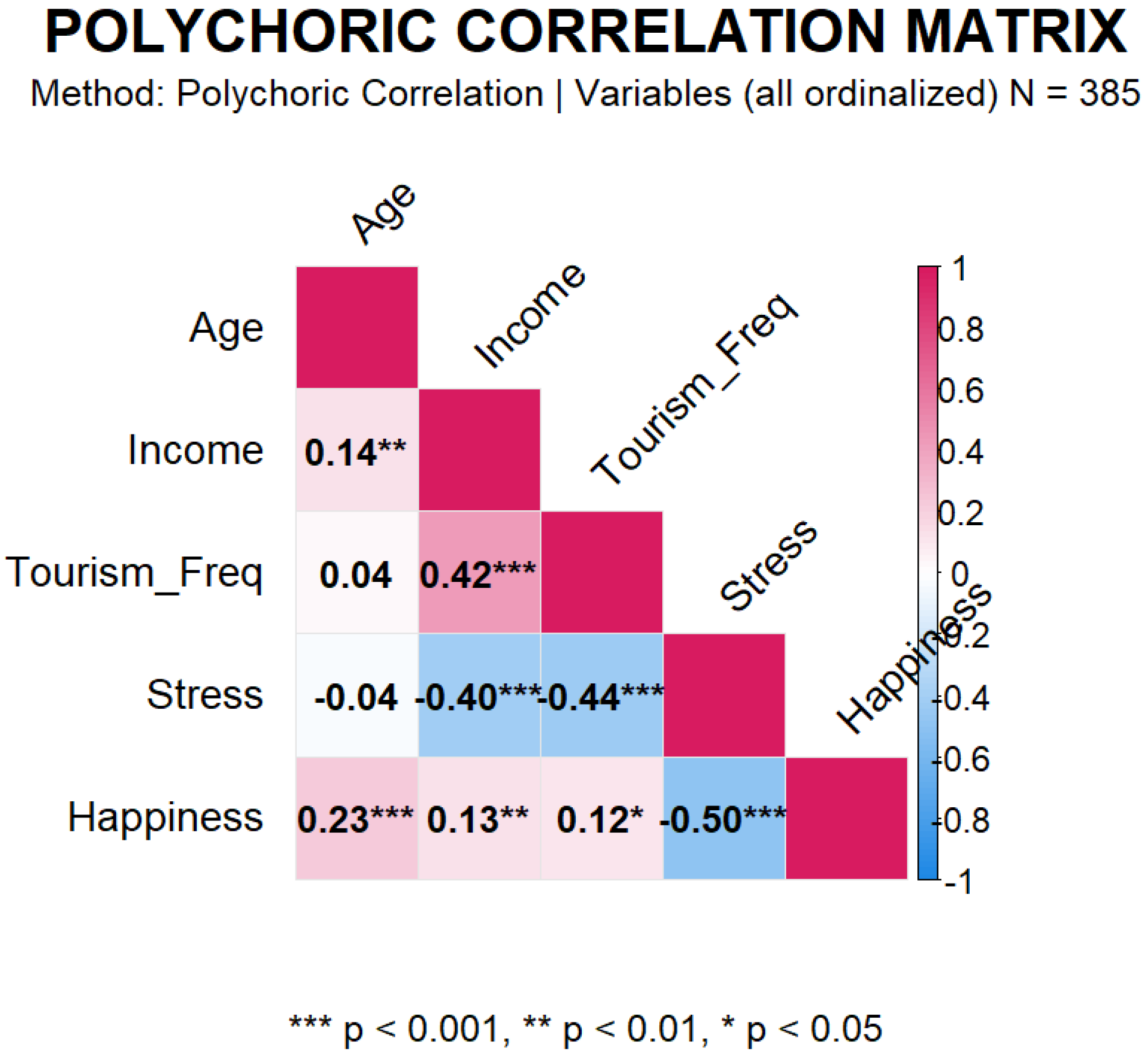
Before proceeding to the measurement model, we examined the polychoric correlation matrix (
Figure 1) to assess whether the bivariate relationships among variables align with theoretical expectations. As shown in
Figure 1, travel frequency showed a moderate negative association with perceived stress (r = −0.44,
p < 0.001) and a small positive correlation with happiness (r = 0.12,
p < 0.05). Perceived stress exhibited a strong negative correlation with happiness (r = −0.50,
p < 0.001). Income was positively correlated with travel frequency (r = 0.42,
p < 0.001) and negatively associated with stress (r = −0.40,
p < 0.001), while age showed weaker but significant associations with happiness (r = 0.23,
p < 0.001) and income (r = 0.14,
p < 0.01). These correlations provide a solid empirical basis for testing indirect relationships using SEM [
27,
28,
37,
38] and justify proceeding to the Confirmatory Factor Analysis (CFA) presented in
Section 4.2.
4.2. Confirmatory Factor Analysis (CFA) and Reliability
The Confirmatory Factor Analysis (CFA) was conducted to validate the measurement model before testing the structural relationships among constructs. This step ensures that the latent variables (Perceived Stress and Authentic Happiness) are adequately measured before proceeding to hypothesis testing [
30].
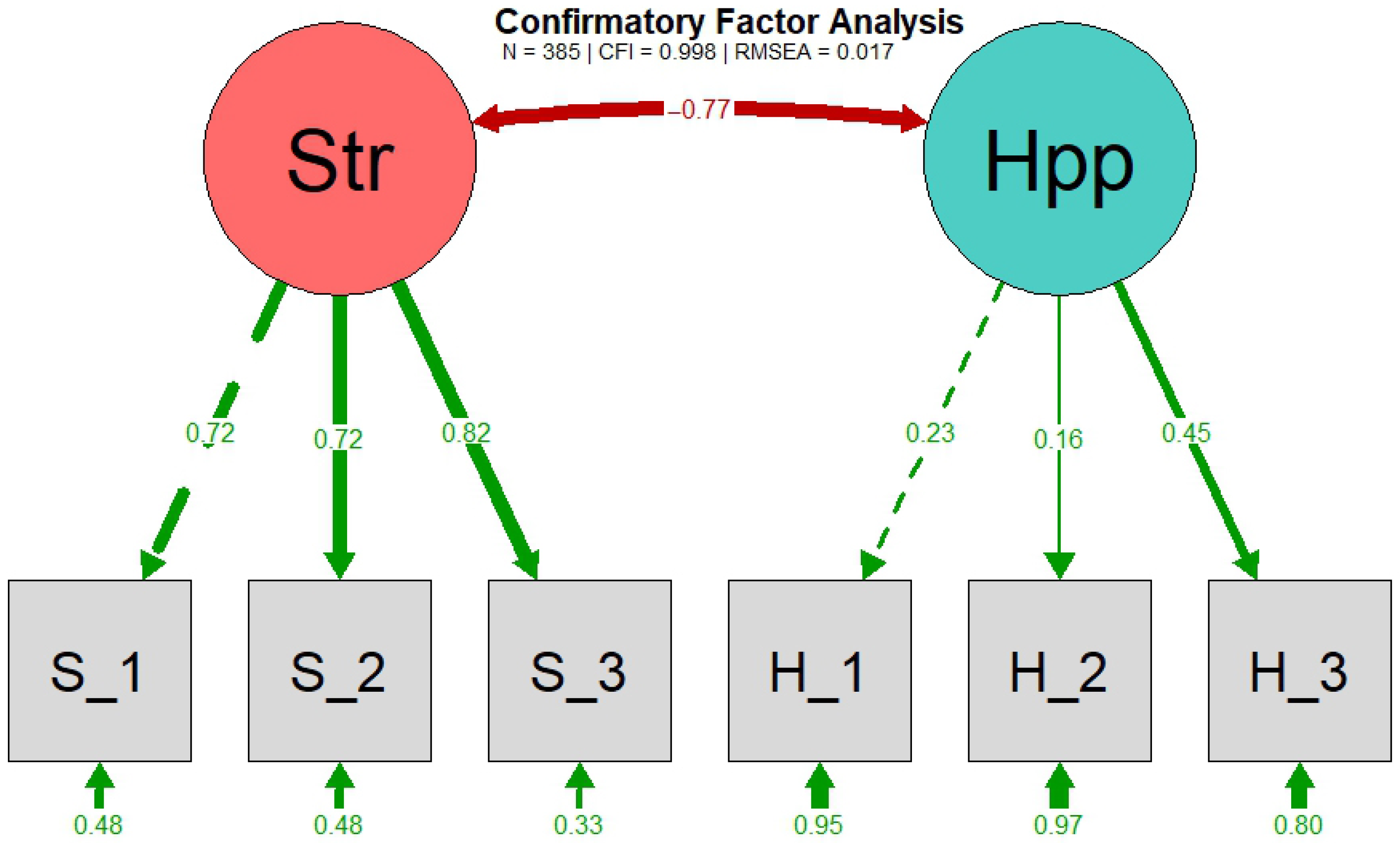
The CFA demonstrated an excellent fit of the measurement model, supporting the factorial validity of the constructs included in both structural equation models. As shown in
Figure 2, the global fit indices were highly satisfactory (CFI = 0.998; RMSEA = 0.017), remaining well within the thresholds recommended for excellent model fit (CFI ≥ 0.95; RMSEA ≤ 0.06) [
36]. These results indicate that the proposed two-factor latent structure adequately represents the observed data, with no evidence of severe model misspecification. This outcome is essential for SEM Model 1, as it confirms that the structural relationships among travel frequency, stress, and happiness rely on a valid and well-specified measurement framework. Likewise, the strong measurement fit ensures that the incorporation of control variables (Age and Income) in SEM Model 2 does not compromise factorial validity.
Standardized Factor Loadings. Analysis of the standardized factor loadings further supports the adequacy of the measurement model. Indicators associated with Perceived Stress exhibited high and homogeneous loadings, ranging from 0.72 to 0.82 (all
p < 0.001), evidencing a strong and consistent relationship with their latent construct. In contrast, Happiness indicators presented more heterogeneous loadings, varying from 0.16 to 0.45, reflecting greater dispersion in how individual items capture the underlying construct. This pattern suggests that happiness in tourism contexts may encompass multiple experiential dimensions not fully captured by the current measurement specification [
30].
Reliability and Convergent Validity. Given the ordinal nature of the items (11-point Likert scales), we computed both Cronbach’s alpha (classic) and ordinal alpha based on polychoric correlations, as well as composite reliability (CR) and average variance extracted (AVE) from the CFA. As shown in
Table 2, the Perceived Stress construct demonstrated good reliability (ordinal α = 0.801; CR = 0.800; AVE = 0.573), exceeding the recommended thresholds of 0.70 for CR and 0.50 for AVE [
30]. However, the Happiness construct showed inadequate reliability (ordinal α = 0.188; CR = 0.209; AVE = 0.095), indicating that the three selected items do not consistently capture the underlying construct.
The estimated covariance between the latent factors revealed a strong negative association between Stress and Happiness (r = −0.77), consistent with theoretical expectations [
39].
Transition to Structural Model. Having established acceptable measurement properties for the Stress construct and acknowledging the limitations of the Happiness scale, we proceed to test the structural mediation hypotheses. The measurement model’s excellent fit (CFI = 0.998) provides confidence that the latent structure is well-specified, allowing meaningful interpretation of structural relationships. The low reliability of the Happiness scale is addressed through sensitivity analyses in
Section 4.4, where we test the stability of the mediation model using alternative specifications of the happiness measure (5-item latent factor and single observed indicator). This approach ensures that our substantive conclusions are robust to measurement limitations.
4.3. From Measurement to Structural Model
To test the hypothesized mediation mechanism (H1, H2, and H3), two structural equation models were estimated. H1 posited a negative effect of travel frequency on perceived stress; H2 predicted a negative effect of stress on happiness; and H3 stated that stress mediates the frequency–happiness relationship.
4.3.1. SEM Model Without Control Variables
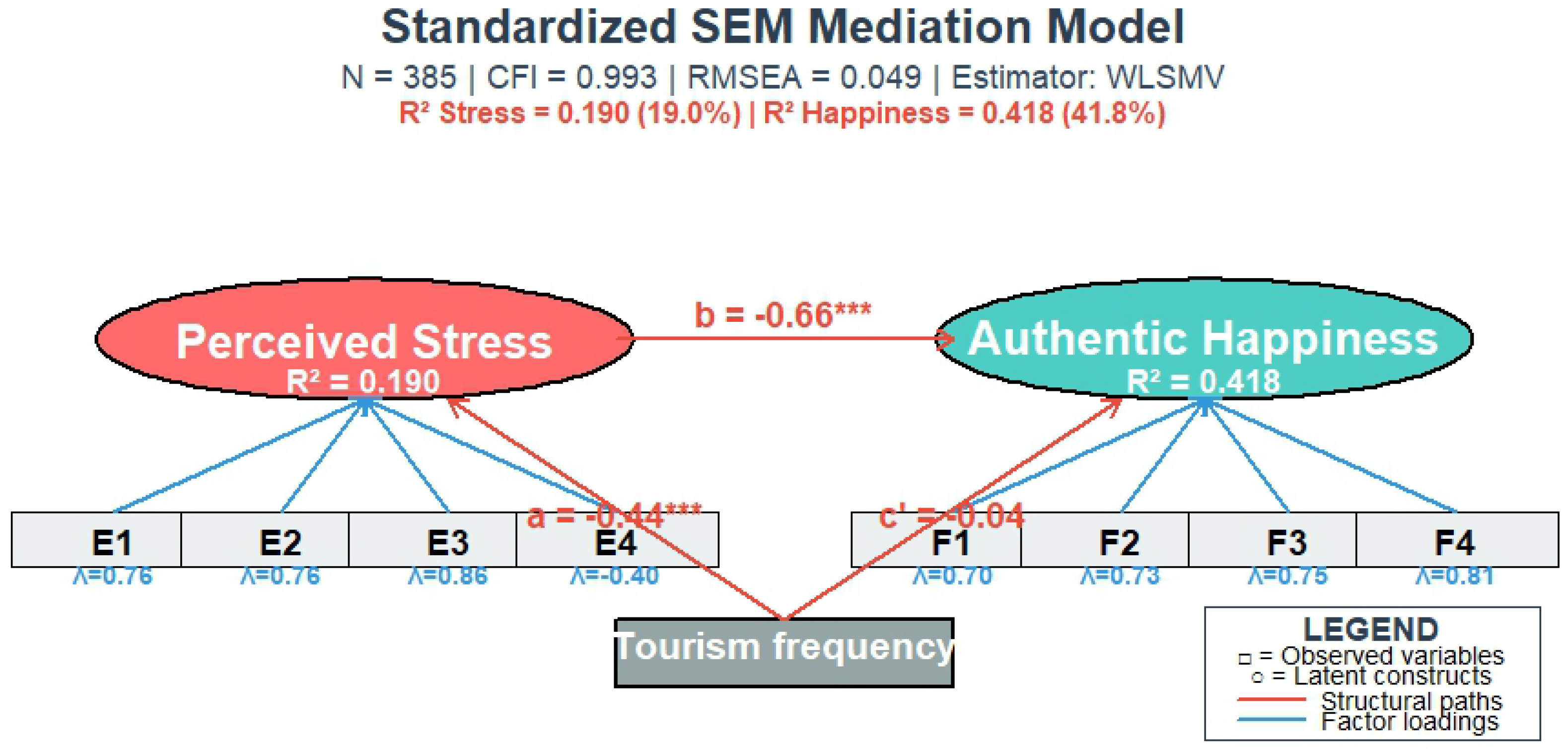
The structural equation mediation model estimated without control variables exhibits a very good global fit, confirming the adequacy of the proposed theoretical structure (
Figure 3). The model without controls exhibited excellent fit (CFI = 0.993; RMSEA = 0.049; SRMR = 0.032) and explained 19.0% of the variance in stress (R
2 = 0.190) and 41.8% of the variance in happiness (R
2 = 0.418).
Hypothesis Testing. Travel frequency had a significant negative effect on perceived stress (β = −0.44,
p < 0.001), supporting H1. Perceived stress, in turn, strongly negatively predicted authentic happiness (β = −0.66,
p < 0.001), supporting H2. The direct effect of travel frequency on happiness was non-significant (β = 0.04,
p > 0.05), while the indirect effect through stress was significant (β = 0.29,
p < 0.001; 95% CI [0.18, 0.40]). This pattern of results, significant indirect effect alongside a non-significant direct effect, confirms full mediation, supporting H3 [
23,
39].
Standardized Equations. The mediation model is expressed through the following standardized equations, with coefficients estimated from SEM Model 1:
where the indirect effect of Frequency on Happiness through Stress is:
Interpretation. These findings indicate that an increase in one standard deviation in travel frequency predicts a reduction of approximately 0.44 standard deviations in perceived stress, which, through the mediation mechanism, translates into a significant indirect increase in happiness. The non-significant direct effect confirms that the relationship between travel frequency and authentic happiness operates entirely through stress reduction, rather than through a direct hedonic pathway.
Connection to Study Objectives. This model addresses the first study objective: to determine whether perceived stress mediates the relationship between travel frequency and authentic happiness. The results demonstrate full mediation, confirming that stress reduction is the core psychological mechanism linking travel frequency to well-being. This finding refines the prevailing assumption that “more travel equals more happiness” by showing that the benefits of frequent travel are indirect, operating through stress mitigation.
Transition to Model 2. Having established the mediation mechanism in a simple model, we now test the robustness of these findings by incorporating sociodemographic control variables (age, income, and gender) to assess whether the mediation effect remains stable after accounting for potential confounding factors. Model 2 is presented in
Section 4.3.2.
4.3.2. SEM Model with Control Variables
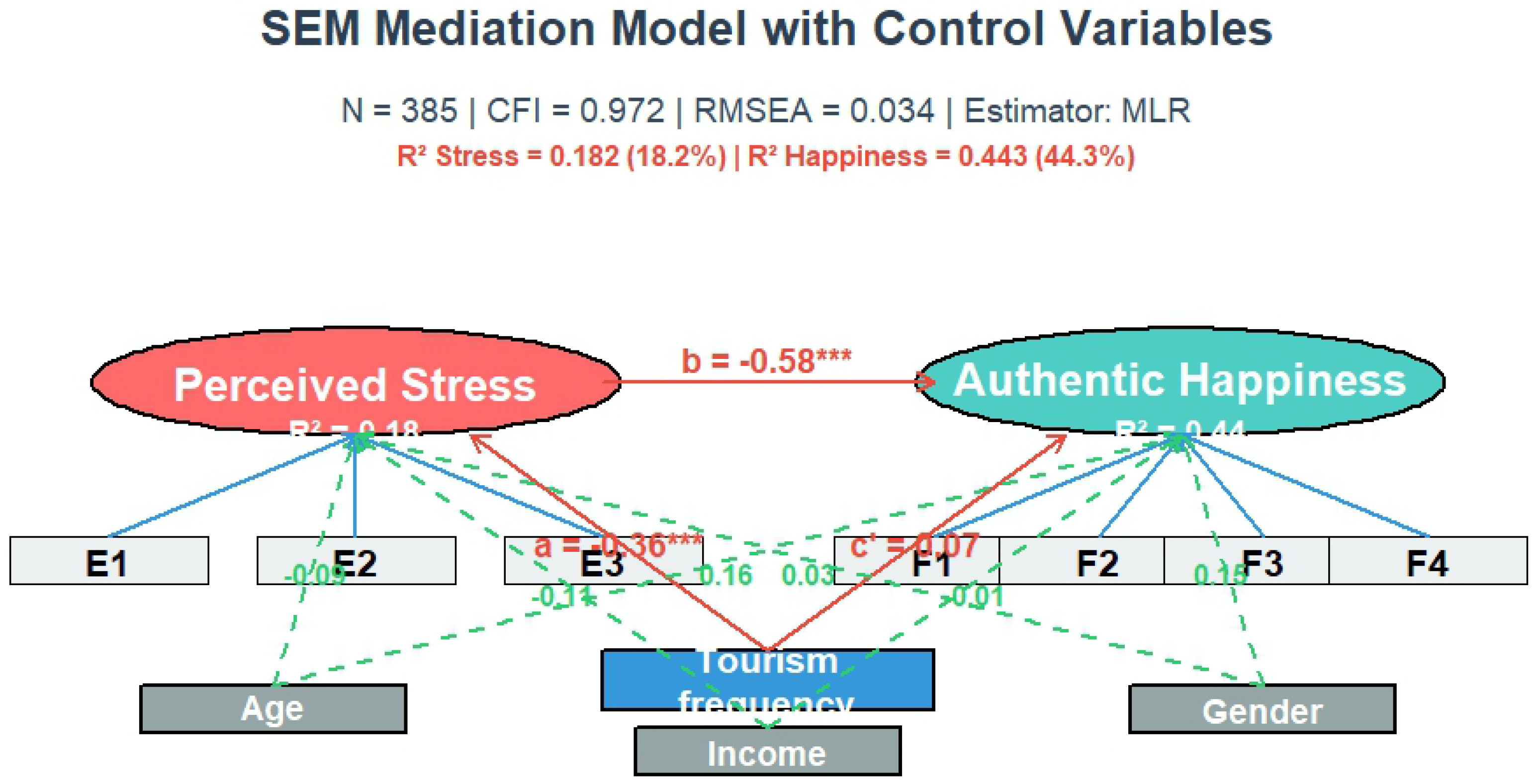
Including age, income, and gender as covariates maintained good model fit (CFI = 0.972; RMSEA = 0.034) and increased the explained variance in happiness to 44.3% (R
2 = 0.443) (
Figure 4). Travel frequency remained a significant negative predictor of stress (β = −0.36,
p < 0.001), and stress continued to strongly predict happiness (β = −0.58,
p < 0.001). The direct effect of frequency on happiness was again non-significant (β = 0.07,
p > 0.05), and the indirect effect through stress remained significant (β = 0.21,
p < 0.01; 95% CI [0.12, 0.30]). Age and gender showed small positive effects on happiness, while income did not significantly affect either stress or happiness (
Table 3) [
28].
Standardized Equations. The mediation model with control variables is expressed through the following standardized equations:
Note. Coefficients for Age and Income are reported in standardized form. Age showed a small negative association with stress, while its positive association with happiness reflects the expected pattern.
Indirect Effect and Mediation. The indirect effect of travel frequency on happiness through perceived stress, estimated using bootstrap procedures, was positive and statistically significant (β = 0.21,
p < 0.01), with approximately 74.6% of the total effect mediated by stress. This result confirms the presence of full mediation, as the direct effect remained non-significant [
23,
28].
These findings indicate that an increase in one standard deviation in travel frequency predicts a reduction of approximately 0.36 standard deviations in perceived stress, which, through the mediation mechanism, translates into a substantial indirect increase in happiness. Although the inclusion of age, income, and gender slightly adjusts coefficient magnitudes relative to SEM Model 1, the substantive conclusion remains unchanged.
Connection to Study Objectives. This model addresses the second study objective: to evaluate the robustness of the mediation mechanism after controlling for key sociodemographic variables. The results demonstrate that the full mediation pattern remains stable after accounting for age, income, and gender, confirming that the core mechanism is not confounded by these demographic factors. This robustness strengthens the theoretical claim that stress reduction is a universal pathway linking travel frequency to authentic happiness.
Comparative Analysis (
Table 3). The comparative analysis between SEM Model 1 and SEM Model 2 indicates that the inclusion of sociodemographic control variables does not compromise overall model fit and slightly enhances explanatory power for authentic happiness. Both models exhibit excellent goodness-of-fit indices, with CFI values exceeding recommended thresholds and RMSEA values well below 0.06.
Overall, both models provide consistent evidence of full mediation, demonstrating that tourism frequency enhances well-being primarily by reducing perceived stress rather than exerting a direct influence on happiness. The stability of the mediation effect across model specifications, together with improved internal validity under the inclusion of control variables, offers strong empirical support for the proposed theoretical framework and underscores the importance of stress-reduction mechanisms in tourism-related well-being strategies.
4.4. Sensitivity Analysis: Robustness of the Mediation Model
To address the limitations in the reliability of the Happiness construct (ordinal α = 0.188; CR = 0.209) and to assess the stability of the mediation effect, we conducted a series of sensitivity analyses using alternative specifications of the dependent variable. Specifically, we re-estimated the core mediation model (Travel Frequency → Perceived Stress → Happiness) with three different measures of happiness [
39]:
1. Model A (original): Happiness as a latent variable with the three original items (Happiness_1, Happiness_2, Happiness_3), as reported in
Section 4.3.1.
2. Model B (5-item latent): Happiness as a latent variable with five items (Happiness_1 to Happiness_5), which showed slightly improved reliability (ordinal α = 0.508; CR = 0.545) and is theoretically broader.
3. Model C (observed): Happiness as a single observed indicator (Happiness_Level, variable V3_FeliAute), measured on an 11-point scale, which avoids the need for a latent structure.
All models were estimated using maximum likelihood (ML) with 5000 bootstrap resamples to obtain robust confidence intervals for the indirect effects [
23]. The results are summarized in
Table 4.
Model A: The overall mediation pattern is confirmed: travel frequency significantly reduces stress (β = −0.41,
p < 0.001), stress negatively predicts happiness (β = −0.77,
p < 0.01), the direct effect of frequency on happiness is not significant (β = 0.02, ns), and the indirect effect through stress is significant (indirect = 0.129,
p < 0.01; 95% CI [0.035, 0.221]) [
39].
Model B: Although frequency continues to reduce stress (β = −0.43,
p < 0.001), the relationship between stress and happiness is marginally significant (β = −0.59,
p = 0.085), and the indirect effect does not reach statistical significance (indirect = 0.092,
p = 0.099; 95% CI [0.019, 0.228]). This result suggests that the inclusion of additional items with low psychometric quality (as observed in the CFA) may weaken the detection of the mediational effect [
28].
Model C: The one-dimensional happiness variable (Happiness_Level) replicates the overall mediation pattern: frequency → stress (β = −0.41,
p < 0.001), stress → happiness (β = −0.44,
p < 0.001), non-significant direct effect (β = −0.06, ns), and significant indirect effect (indirect = 0.064,
p < 0.001; 95% CI [0.038, 0.095]) [
36].
Overall, the sensitivity analyses demonstrate that, despite the psychometric limitations of the three-item happiness scale, the study’s main conclusion that travel frequency influences well-being solely through stress reduction remains robust when using an alternative happiness measure with improved properties (observed variable) [
37]. The five-item model, for its part, highlights the importance of selecting reliable indicators so as not to attenuate the true effects.
5. Discussion
The present study provides robust evidence that perceived stress fully mediates the relationship between travel frequency and authentic happiness in a high-altitude nature destination. Specifically, frequent travel does not directly enhance authentic happiness; rather, its beneficial effect operates entirely through the reduction in stress. This finding refines the prevailing assumption that “more travel equals more happiness” and shifts the theoretical focus toward stress mitigation as the core psychological mechanism underlying tourist well-being.
5.1. Why Does Travel Frequency Reduce Stress? Unpacking the Mechanism
The finding that travel frequency significantly reduces perceived stress (β = −0.36, p < 0.001) raises the question: what explains this relationship? We propose three complementary psychological and behavioral mechanisms:
First, increased familiarity. Repeated exposure to a destination enables visitors to develop cognitive maps of the environment, knowledge of routes, facilities, and points of interest. This familiarity reduces the cognitive load associated with wayfinding and decision-making, which are primary sources of travel-related stress [
16]. In the context of Cotopaxi National Park, familiarity with entrance procedures, trail conditions, and altitude acclimatization transforms potentially stressful encounters into manageable experiences.
Second, reduced risk perception. Evidence from risk perception research shows that frequent travelers perceive lower destination risk, suggesting that experience acts as a protective mechanism [
17]. When visitors have successfully navigated a destination multiple times, their assessment of potential threats (e.g., altitude sickness, weather changes, safety concerns) becomes more realistic and less anxiety-provoking. This risk reappraisal reduces anticipatory stress before travel and in situ stress during the visit.
Third, experiential resource accumulation. Building on the concept of experiential capital [
15], repeated travel enables visitors to accumulate practical resources: knowledge of optimal timing, familiarity with booking systems, understanding of safety protocols, and awareness of environmental conditions. These resources function as stress-buffering assets, reducing uncertainty and increasing perceived control. The accumulation process is incremental, each visit adds to the experiential repertoire, progressively lowering baseline stress levels.
5.2. Why Does Stress Reduction Enhance Authentic Happiness?
The strong negative effect of perceived stress on authentic happiness (β = −0.58,
p < 0.001) aligns with established findings in positive psychology [
18]. However, our study contributes by explaining the mechanisms through which stress reduction enables well-being in tourism contexts:
First, release of cognitive resources. According to ART, attentional resources are finite and can be depleted by stress and cognitive demands [
8]. When stress is high, cognitive resources are consumed by threat monitoring, problem-solving, and emotional regulation. Stress reduction liberates these resources, making them available for the ‘soft fascination’ and ‘being away’ experiences that characterize restorative environmental engagement. In Cotopaxi, visitors with lower stress can more fully attend to the volcanic landscapes, páramo ecosystems, and sensory richness that the park offers.
Second, enabling of restorative engagement. SRT posits that positive emotional responses to restorative environments require an initial state of low stress [
10]. When visitors are not preoccupied with logistical concerns, physical discomfort, or safety worries, they can engage more deeply with the environment’s restorative features. This deeper engagement triggers the positive affect, sense of awe, and emotional uplift that constitute key components of authentic happiness [
19].
Third, shifting from threat to growth orientation. Drawing on the broaden-and-build theory of positive emotions [
40,
41], stress reduction enables a psychological shift from a threat-focused orientation (narrowed attention, defensive responses) to a growth-focused orientation (openness, curiosity, exploration). This shift allows visitors to experience the meaning, accomplishment, and positive relationships that define eudaimonic well-being, rather than merely the absence of negative states.
5.3. Theoretical Contributions and Marginal Value: What Does This Study Add?
This study makes three distinct contributions to the literature on tourism well-being, each extending prior work in meaningful ways:
First, evidence of a new mediation pathway. Previous studies have examined direct effects of travel frequency on well-being [
4,
5] or have considered mediation through hedonic mechanisms such as positive affect [
6]. This study is the first to demonstrate that perceived stress fully mediates the frequency-well-being relationship in a nature-based destination. This finding refines theoretical understanding by showing that the benefits of frequent travel are not direct but operate through stress reduction. This challenges the implicit assumption in much tourism research that ‘more travel equals more happiness’ [
3] and redirects theoretical attention toward stress mitigation as the core mechanism.
Second, evidence from a high-risk environment. While prior studies have examined stress and well-being in relatively benign nature settings [
1,
2], Cotopaxi National Park presents an environment where stressors (altitude, unpredictable weather, complex logistics) and restorative features (spectacular landscapes, biodiversity) coexist. This context provides a stringent test of the mediation mechanism: if stress reduction mediates well-being even when stressors are objectively present, the mechanism is likely robust across diverse settings. Our findings demonstrate that the mediation pathway holds in this challenging environment, suggesting that stress mitigation is a universal mechanism rather than a context-specific effect.
Third, evidence from the Global South. The vast majority of tourism well-being research has been conducted in North America, Europe, and Australia [
39]. The study contributes to expanding the geographical scope of the literature by providing empirical evidence from Ecuador, a country in the Global South. This is important because the psychological mechanisms linking travel to well-being may be shaped by cultural, economic, and environmental factors that differ across regions [
11]. By testing the mediation model in a novel context, we provide preliminary evidence that the stress-well-being pathway may generalize beyond Western, industrialized settings.
Comparison with Prior Work: Building on studies of repeat visitation and risk perception [
15,
16], we extend these findings by demonstrating that the stress-reducing benefits of frequent travel are not merely correlational but mediate well-being outcomes. Extending research on nature-based mental health [
1,
2], we show that the restorative benefits of nature exposure depend on stress reduction as a prerequisite, not merely the presence of natural features. And contributing to the emerging literature on tourism in high-altitude environments [
11], we provide the first empirical test of a full mediation model linking frequency, stress, and happiness in a challenging Andean destination.
5.4. Evidence-Based Practical Implications for Destination Management
The findings provide empirical support for specific, actionable strategies that destination managers can implement to enhance visitor well-being (
Table 5). Each recommendation is directly linked to our mediation results:
Specific actionable strategies based on these findings include:
Simplify booking and access procedures. Implement user-friendly online reservation systems, clear pricing, and real-time availability updates to reduce pre-trip stress. The results suggest that reducing logistical friction directly impacts perceived stress.
Enhance on-site information and wayfinding. Install multilingual signage, provide mobile apps with offline maps and weather alerts, and train staff to offer proactive assistance. These measures build experiential capital for first-time visitors.
Design for gradual adjustment. Create itineraries that allow visitors to acclimate to altitude gradually, include rest stops, and offer flexible pacing options. This is particularly important in high-altitude destinations like Cotopaxi.
Implement relaxation techniques. Manage relevant relaxation talks and techniques in entrance areas and waiting rooms to maximize the restorative power of the tourist area for visitors before they encounter potential stressors.
5.5. Limitations and Avenues for Future Research
While the study offers novel insights, several limitations should be acknowledged. First, the cross-sectional design precludes strong causal claims; longitudinal or experimental studies are needed to confirm the directionality of the observed relationships. Second, the low reliability of the three-item happiness scale (ordinal α = 0.188) indicates that future research should employ more robust, tourism-specific well-being instruments [
32]. Third, the measure of perceived stress was general rather than context-specific; developing a scale that captures logistical and environmental stressors unique to nature tourism would allow for more precise modeling. Finally, the non-probability sampling limits generalizability, although the sample’s diversity mitigates this concern to some extent.
Future studies could extend our work by examining whether the mediation mechanism holds across different types of destinations (e.g., coastal, urban) and by exploring additional mediators such as self-efficacy, mindfulness, or social connectedness [
42]. Longitudinal designs tracking visitors over multiple trips would also illuminate how experiential capital accumulates and whether its effects on stress and well-being follow a linear or curvilinear trajectory.
The cross-sectional design precludes any causal interpretation of the relationships observed. Although SEM allows testing theory-driven structural models, it does not, by itself, establish causality [
43]. The terms ‘predicts’ and ‘effect’ are used throughout in a statistical sense, referring to associations derived from the model. Future research employing longitudinal or experimental designs is necessary to confirm the directionality and causal nature of the mediation mechanism proposed here.
6. Conclusions
6.1. Theoretical Implications: Reframing Tourist Well-Being
The study demonstrates that perceived stress fully mediates the relationship between travel frequency and authentic happiness in a high-altitude nature destination. The key theoretical contribution lies in reframing tourist well-being not as a direct outcome of travel frequency, but as a function of stress mitigation achieved through repeated exposure and accumulated experiential capital. By validating this mechanism in Cotopaxi National Park, we extend stress recovery theory to the tourism domain and provide empirical support for the growing emphasis on psychological resilience in sustainable destination management.
The theoretical implications are threefold. First, we show that the relationship between travel and well-being is indirect, challenging the simplistic assumption that more travel necessarily leads to greater happiness. Second, we identify stress reduction as the critical pathway, suggesting that tourism well-being research should focus on understanding and mitigating stressors rather than merely cataloging positive experiences. Third, we introduce the concept of experiential capital as a bridging mechanism linking frequency to stress reduction, providing a theoretical language for future studies on repeat visitation and well-being.
6.2. Evidence-Based Policy Recommendations: Targeted Implications
The findings support targeted, evidence based recommendations that are directly derived from the empirical results:
Targeted Recommendation 1: Prioritize stress reduction over hedonic addition. Since the direct effect of frequency on happiness is non-significant, adding hedonic attractions (e.g., more amenities, entertainment options) without reducing stress is unlikely to enhance well-being. Instead, managers should prioritize interventions that reduce friction: clear signage, simplified booking systems, real-time crowding information, and proactive staff assistance.
Targeted Recommendation 2: Build experiential capital through loyalty programs. Given that frequency reduces stress (β = −0.36), programs that encourage repeat visitation, such as loyalty discounts, exclusive access to less crowded areas, or guided experiences for first-time visitors, can build the experiential capital that reduces stress over time.
Targeted Recommendation 3: Design for universal stress mitigation. Because age and income did not affect the mediation pathway, stress reduction benefits are universal. Interventions should serve all visitors regardless of demographics, rather than segmenting well-being strategies by visitor type.
Targeted Recommendation 4: Implement stress-reducing touchpoints throughout the visitor journey. The results identify three critical touchpoints for intervention: (a) pre-trip (simplified booking, clear information), (b) arrival (multilingual signage, real-time updates), and (c) in situ (altitude acclimatization guidance, flexible pacing options). Each touchpoint targets a specific stressor identified in the Cotopaxi National Park context.
6.3. The Central Role of Stress Management in Tourism Experience Design
The completeness of the mediation pathway (full mediation, with direct effect non-significant) underscores that stress management should be central to tourism experience design. In high-altitude destinations like Cotopaxi, where environmental stressors are objectively present, the reduction in perceived stress is not merely beneficial but necessary for well-being outcomes to emerge. This suggests that tourism experience design should begin with stress mitigation, ensuring that visitors can navigate the environment safely, comfortably, and with minimal uncertainty, before layering on hedonic or eudaimonic enhancements.
For destination managers, this means rethinking the sequence of experience design: first, reduce friction and uncertainty; second, enable restorative engagement; third, support the emergence of authentic happiness through meaning, accomplishment, and positive relationships. This sequential approach aligns with the theoretical logic of the mediation model and provides a practical framework for implementing evidence-based well-being strategies.