Article

Sustainable Corporate Governance Under Organizational Complexity and Decentralized Structures: Evidence from Two Emerging Capital Markets


1
College of Business Administration, University of Business and Technology, Jeddah 21448, Saudi Arabia
2
Faculty of Business and Economics, Palestine Technical University—Kadoorie, Tulkarm 20030, Palestine
3
College of Business Administration, University College of Bahrain, Saar 55040, Bahrain
4
College of Business and Finance, Ahlia University, Manama 10878, Bahrain
*
Author to whom correspondence should be addressed.
Sustainability 2026, 18(11), 5309; https://doi.org/10.3390/su18115309
Submission received: 22 April 2026 / Revised: 20 May 2026 / Accepted: 21 May 2026 / Published: 25 May 2026
(This article belongs to the Special Issue Sustainable Corporate Governance and Firm Performance)

Abstract

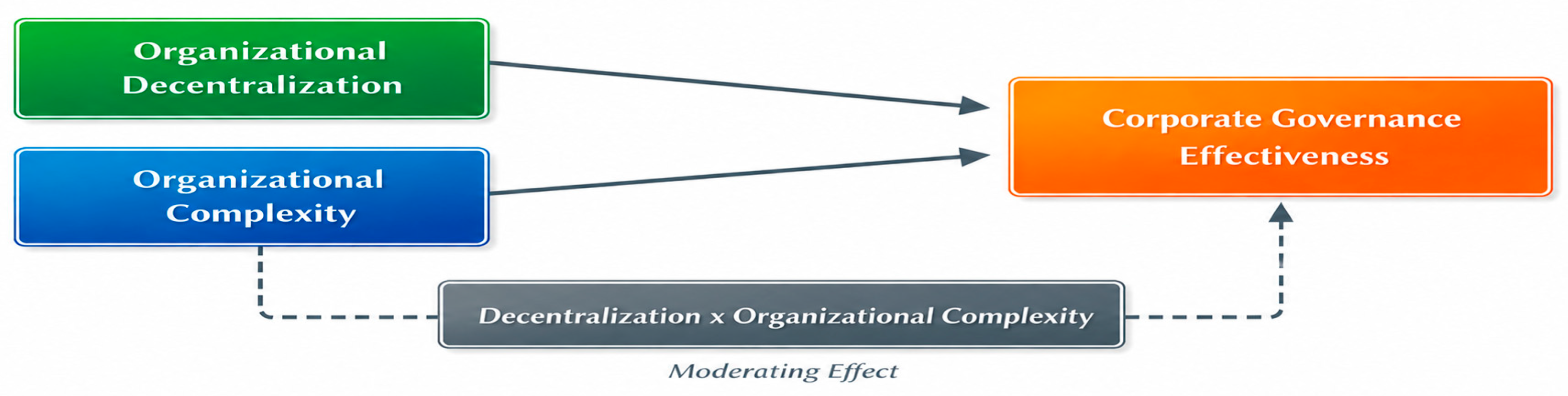
Despite extensive research on corporate governance compliance and firm-level outcomes, limited attention has been paid to how internal organizational structures, particularly business complexity and decentralization, shape governance effectiveness across institutionally differentiated emerging markets. This study examines these relationships within the Palestinian and Jordanian capital markets, which provide a relevant comparative setting due to differences in governance enforcement, institutional maturity, and sustainable governance adaptation. Grounded in agency theory, transaction cost theory, and contingency theory, the study adopts a comparative cross-sectional design using documentary data from non-financial firms listed on the Palestine Exchange (PEX) and the Amman Stock Exchange (ASE) for the 2023 fiscal year. Composite indices for governance effectiveness, decentralization, and business complexity were constructed using binary-coded governance disclosures. The empirical analysis employs descriptive statistics, correlation analysis, regression models, and moderation testing. The findings reveal substantial cross-market heterogeneity. In the Palestinian market, decentralization and business complexity are positively associated with governance effectiveness when examined independently, whereas the interaction effect is not supported. In the Jordanian market, business complexity emerges as the primary determinant of governance effectiveness, while decentralization shows no significant effect. Across both markets, the hypothesized moderating role of business complexity is not supported. The study contributes to the sustainable corporate governance literature by demonstrating that governance effectiveness in emerging markets is not merely a compliance issue, but also a sustainability-related organizational capability that supports transparency, accountability, institutional resilience, and responsible long-term decision-making. The findings provide context-sensitive implications for regulators and firms seeking to strengthen sustainable corporate governance practices within institutionally heterogeneous emerging-market environments.
Keywords: sustainable corporate governance; corporate governance effectiveness; organizational complexity; decentralization; sustainable management; emerging capital markets; Palestine; Jordan sustainable corporate governance; corporate governance effectiveness; organizational complexity; decentralization; sustainable management; emerging capital markets; Palestine; Jordan