From Waste to a Potential Food Resource: Evaluation of Papaya Trunk Xylem Rays in Temperate Cultivation Systems

Abstract
1. Introduction
2. Materials and Methods
2.1. Plant Materials and Cultivation Conditions
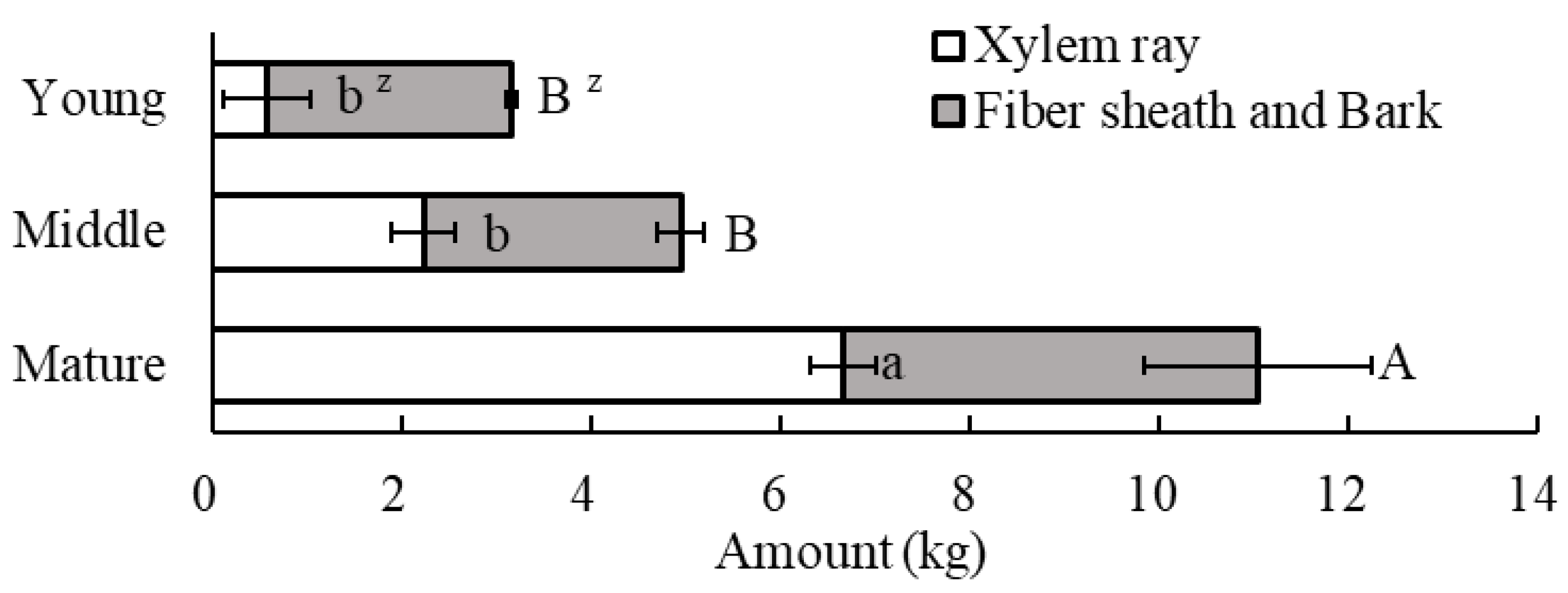
2.2. Measurement of Biomass Distribution
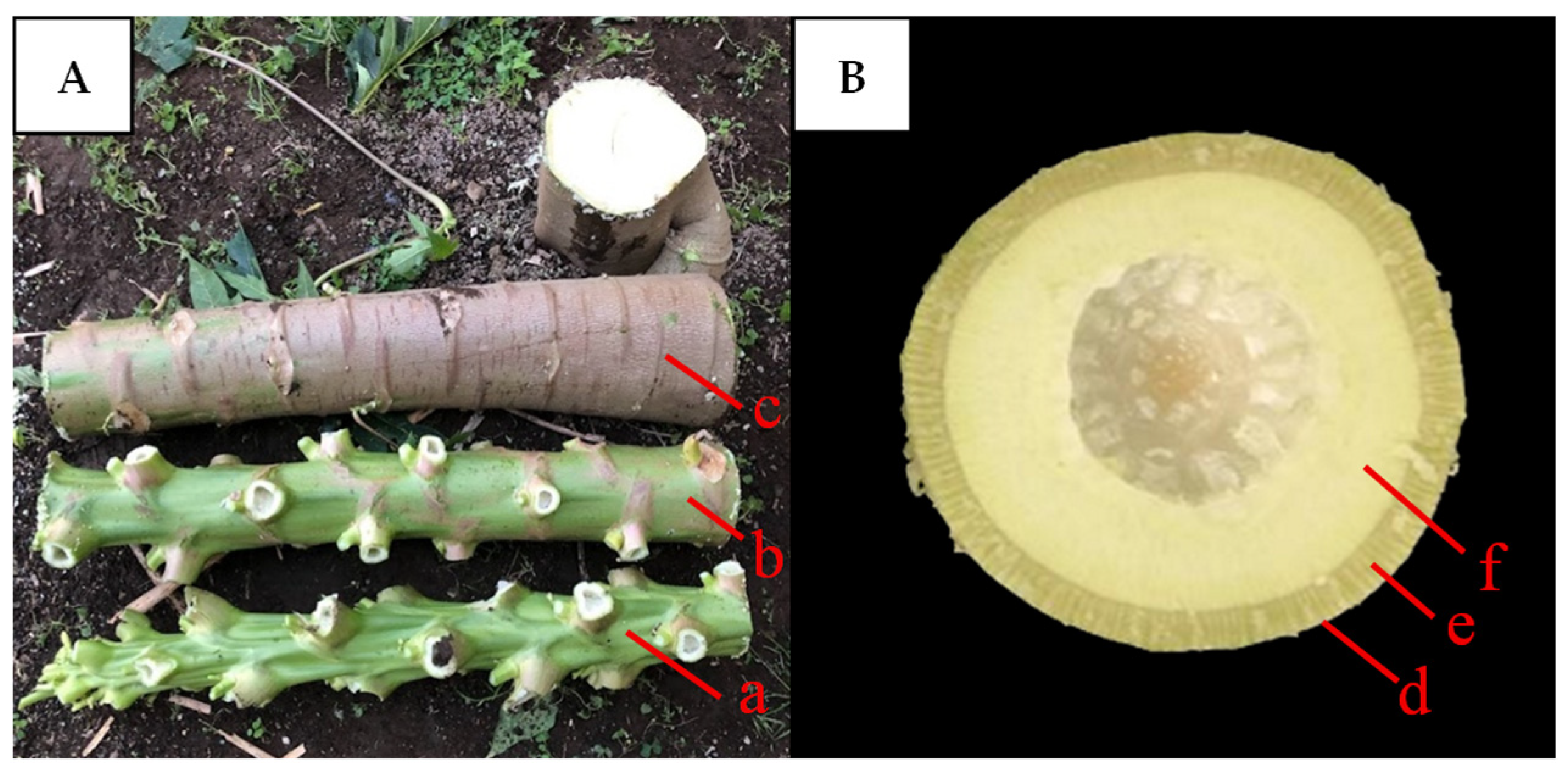
2.3. Sampling Design and Tissue Classification
2.4. Sample Preparation for Proximate/Compositional, Sensory, and Chemical Analyses
2.5. Proximate Composition Analysis
2.6. Sensory Analysis
2.7. Chemical Composition Analysis
2.8. Statistical Analysis
3. Results
3.1. Distribution of Papaya Biomass Excluding Fruit at the End of Fruit Harvesting
3.2. Differences in the Proximate Composition of Each Trunk Organ Based on Maturity, and a Comparison with Green Papaya
3.3. Variations in the Proportion of Xylem Rays Due to Differences in Trunk Maturity
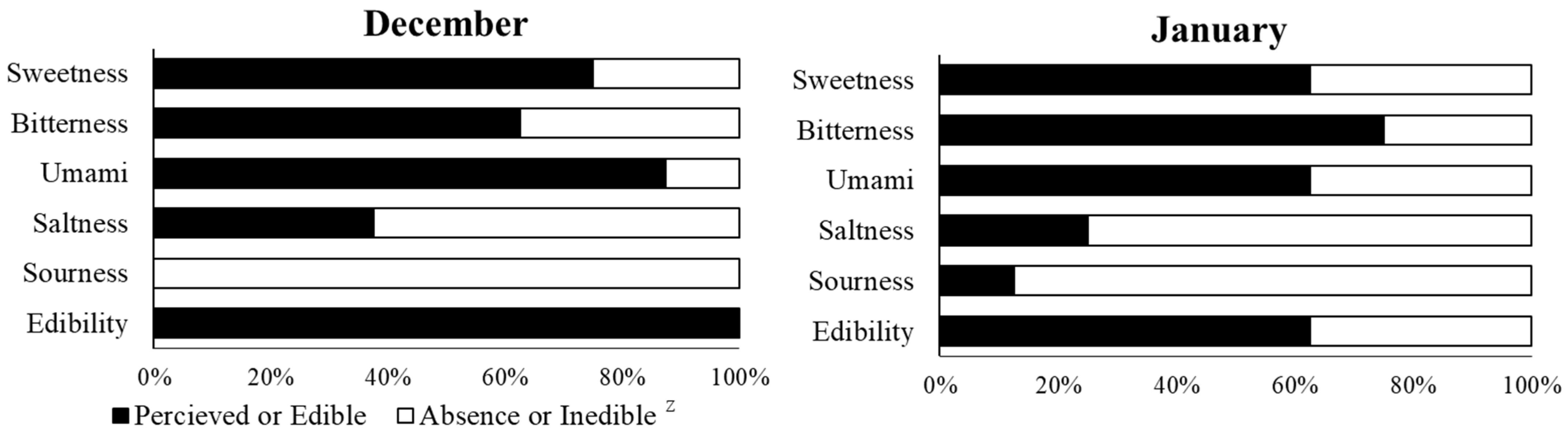
3.4. Independent Investigation of Edibility and Sensory Characteristics of Xylem Rays at Each Harvest Period
3.5. Direct Comparison of Acceptability and Sensory Characteristics of Xylem Rays at Each Harvest Period
3.6. Direct Comparison of Acceptability and Sensory Characteristics of Xylem Rays by the Difference in Maturity
3.7. Effect of Pre-Treatment on Improving the Taste and Edibility of January-Harvested Xylem Rays
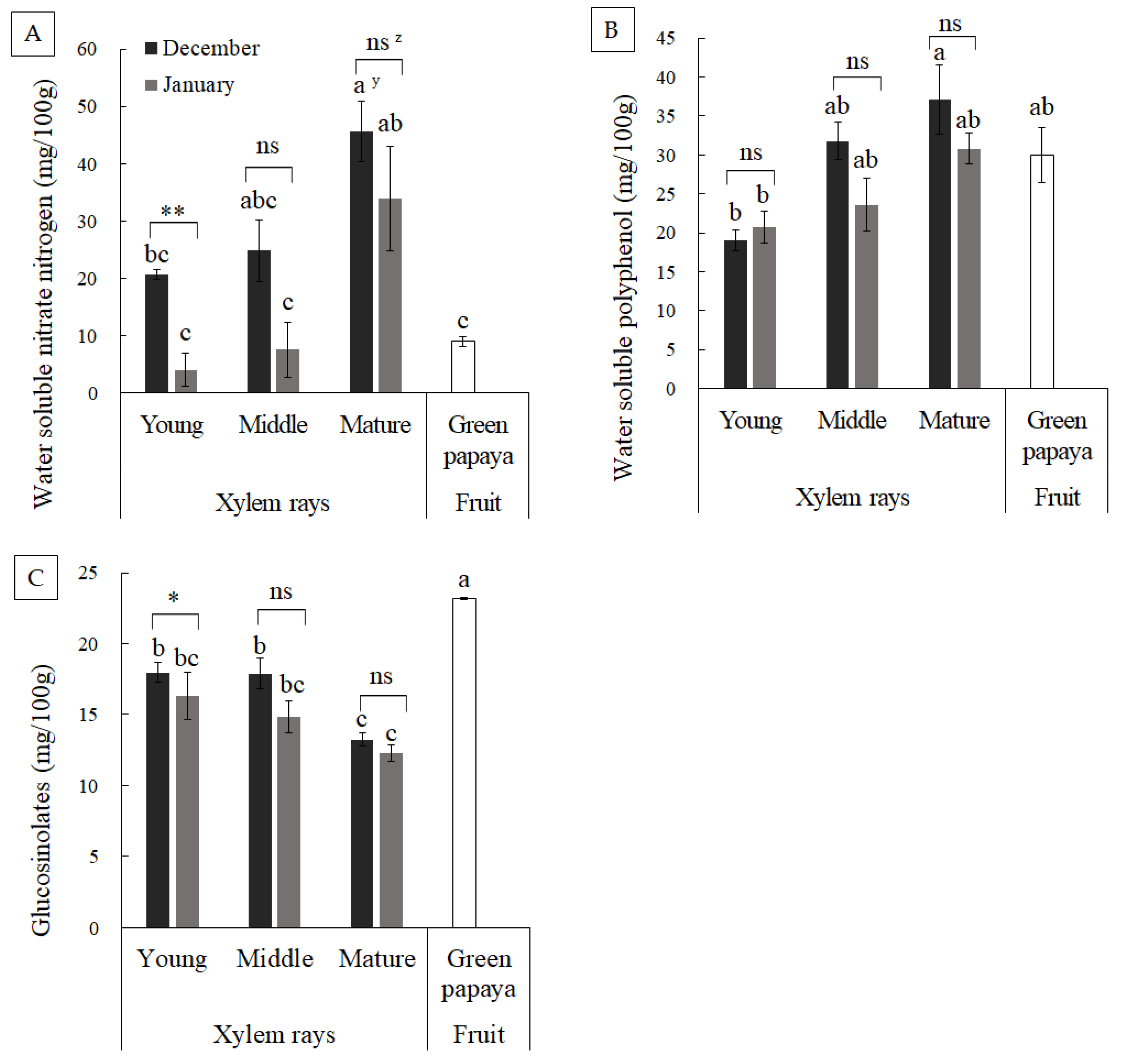
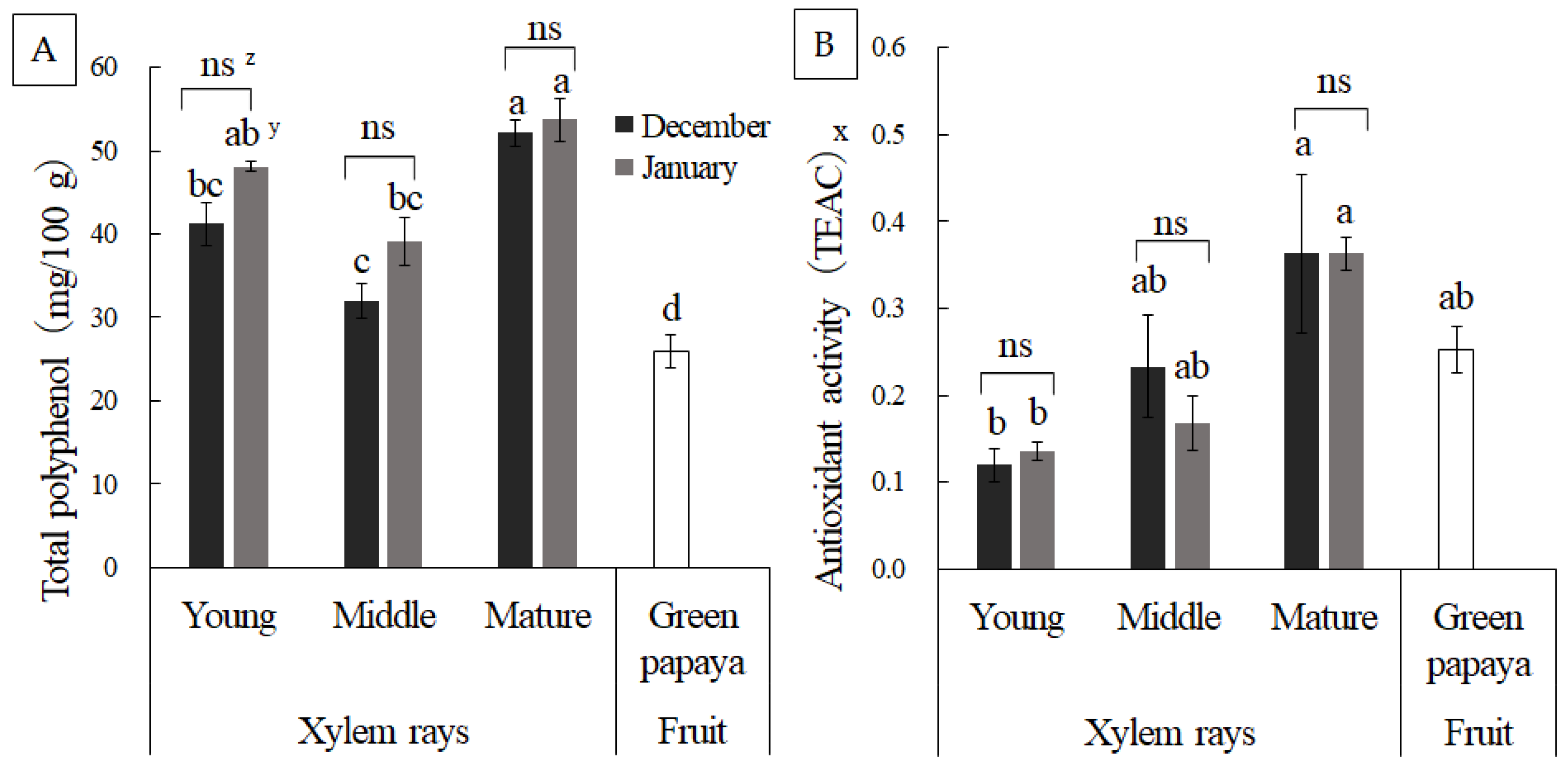
3.8. Changes in Bitterness-Related Compounds in Xylem Rays Across Harvest Periods and Maturity Levels and the Comparison with the Green Papaya Fruit
3.9. Changes in Antioxidant-Related Properties in Xylem Rays Across Harvest Periods and Maturity Levels and the Comparison with the Green Papaya Fruit
4. Discussion
5. Conclusions
Author Contributions
Funding
Institutional Review Board Statement
Informed Consent Statement
Data Availability Statement
Acknowledgments
Conflicts of Interest
Abbreviations
| ICT | Information and Communication Technology |
| IoT | Internet of Things |
| DPPH | 2,2-diphenyl-1-picrylhydrazyl |
| TEAC | Trolox Equivalent Antioxidant Capacity |
| SEM | Standard Error of the Mean |
References
- FAO. The State of Food and Agriculture 2022: Leveraging Automation in Agriculture for Transforming Agrifood Systems; FAO: Rome, Italy, 2022. [Google Scholar] [CrossRef]
- OECD. Agricultural Policy Monitoring and Evaluation 2025: Making the Most of the Trade and Environment Nexus in Agriculture; OECD Publishing: Paris, France, 2025. [Google Scholar] [CrossRef]
- Otsuka, K.; Liu, Y.; Yamauchi, Y. The future of small farms in Asia. Dev. Policy Rev. 2016, 34, 441–461. [Google Scholar] [CrossRef]
- Reich, J.; Paul, S.S.; Snapp, S.S. Highly variable performance of sustainable intensification on smallholder farms: A systematic review. Glob. Food Secur. 2021, 30, 100553. [Google Scholar] [CrossRef]
- Hong, Y.; Heerink, N.; Werf, W. Farm size and smallholders’ use of intercropping in Northwest China. Land Use Policy 2020, 99, 105004. [Google Scholar] [CrossRef]
- Maitra, S.; Hossain, A.; Brestic, M.; Skalicky, M.; Ondrisik, P.; Gitari, H.; Brahmachari, K.; Shankar, T.; Bhadra, P.; Palai, J.B.; et al. Intercropping—A low input agricultural strategy for food and environmental security. Agronomy 2021, 11, 343. [Google Scholar] [CrossRef]
- Padam, B.S.; Tin, H.S.; Chye, F.Y.; Abdullah, M.I. Banana by-products: An under-utilized renewable food biomass with great potential. J. Food Sci. Technol. 2014, 51, 3527–3545. [Google Scholar] [CrossRef] [PubMed]
- Kora, A.J. Leaves as dining plates, food wraps and food packing material: Importance of renewable resources in Indian culture. Bull. Natl. Res. Cent. 2019, 43, 205. [Google Scholar] [CrossRef]
- Chavan, P.; Singh, A.K.; Kaur, G. Recent progress in the utilization of industrial waste and by products of citrus fruits: A review. J. Food Process Eng. 2018, 41, e12895. [Google Scholar] [CrossRef]
- Manai, S.; Boulila, A.; Silva, A.S.; Barbosa-Pereira, L.; Sendón, R.; Khwaldia, K. Recovering functional and bioactive compounds from date palm by-products and their application as multi-functional ingredients in food. Sustain. Chem. Pharm. 2024, 38, 101475. [Google Scholar] [CrossRef]
- De La Cruz Medina, J.; Vela Gutiérrez, G.; García, H.S. Papaya (Pawpaw): Post-harvest operations. In Post-Harvest Compendium; Mejía, D., Ed.; FAO: Rome, Italy, 2003. [Google Scholar]
- Ito, O.; Imamura, Y.; Horiuchi, M.; Kubota, K.; Fukazawa, M.; Nakazawa, T.; Nakazawa, S.; Kobayashi, M.; Ogihara, S.; Sawanobori, Y.; et al. Relationship between growth/yield of green papaya and meteorological parameters—An example of field cultivation in a hilly and mountainous area in Yamanashi, Japan. Clim. Biosph. 2023, 23, 90–98. [Google Scholar] [CrossRef]
- Salinas, I.; Hueso, J.J.; Cuevas, J. Fruit growth model, thermal requirements and fruit size determinants in papaya cultivars grown under subtropical conditions. Sci. Hortic. 2019, 246, 1022–1027. [Google Scholar] [CrossRef]
- Ikuram, E.H.K.; Stanley, R.; Netzel, M.; Fanning, K. Phytochemicals of papaya and its traditional health and culinary uses—A review. J. Food Compos. Anal. 2015, 41, 201–211. [Google Scholar] [CrossRef]
- Folharini, Z.F.; Orlandi, C.R.; Martini, M.C.; Bruxel, F.; Altmayer, T.; Brietzke, D.T.; Gonçalves, T.E.; Finatto, J.; Ethur, E.M.; Moura, N.F.; et al. Nutritional characterization of Vasconcellea quercifolia A.St-Hil.: Potential for the development of functional food. Food Sci. Technol. 2019, 39, 432–438. [Google Scholar] [CrossRef]
- Japan Meteorological Agency (JMA). Available online: https://www.data.jma.go.jp/stats/etrn/view/annually_a.php?prec_no=50&block_no=0456&year=2023&month=&day=&view= (accessed on 5 April 2025).
- Jiménez, V.M.; Mora-Newcomer, E.; Gutiérrez-Soto, M.V. Biology of the papaya plant. In Genetics and Genomics of Papaya; Ming, R., Moore, P.H., Eds.; Springer: New York, NY, USA, 2014; pp. 17–33. [Google Scholar] [CrossRef]
- Consumer Affairs Agency. Food Labeling Standards (Notification No. 139, 2015). Available online: https://www.caa.go.jp/policies/policy/food_labeling/food_labeling_act/ (accessed on 5 April 2025).
- Shizuoka University. Guidelines for Research Involving Human Participants. Available online: https://reiki.adb.shizuoka.ac.jp/act/110000598.html (accessed on 15 May 2026).
- Kondo, T.; Yoshimura, Y.; Aramaki, S.; Hayakawa, Y.; Tanaka, Y.; Kinbara, Y. Results of questionnaire surveys on new Japanese pear cultivar “Aichi-Nashi 3” and requirements for profitable sales. Res. Bull. Aichi Agric. Res. Ctr. 2019, 51, 1–8. [Google Scholar]
- Singleton, V.L.; Rossi, J.A. Colorimetry of Total Phenolics with Phosphomolybdic–Phosphotungstic Acid Reagents. Am. J. Enol. Vitic. 1965, 16, 144–158. [Google Scholar] [CrossRef]
- Esaki, H.; Onozaki, H. Colorimetric determination of pungent principles in radish root. J. Jpn. Soc. Nutr. Food Sci. 1980, 33, 161–167. [Google Scholar] [CrossRef]
- Fisher, J.B. The Vegetative and reproductive structure of papaya (Carica papaya). Lyonia 1980, 1, 191–208. [Google Scholar]
- Kempe, A.; Lautenschläger, T.; Lange, A.; Neinhuis, C. How to become a tree without wood—Biomechanical analysis of the stem of Carica papaya L. Plant Biol. 2014, 16, 264–271. [Google Scholar] [CrossRef]
- Wingler, A.; Purdy, S.; MacLean, J.A.; Pourtau, N. The role of sugars in integrating environmental signals during the regulation of leaf senescence. J. Exp. Bot. 2006, 57, 391–399. [Google Scholar] [CrossRef]
- Zhao, X.; Zhao, L.; Cui, B. Strategies and mechanisms of sweetness enhancement in food. Int. J. Food Sci. Technol. 2025, 60, vvaf207. [Google Scholar] [CrossRef]
- Salam, U.; Ullah, S.; Tang, Z.-H.; Elateeq, A.A.; Khan, Y.; Khan, J.; Khan, A.; Ali, S. Plant Metabolomics: An Overview of the Role of Primary and Secondary Metabolites against Different Environmental Stress Factors. Life 2023, 13, 706. [Google Scholar] [CrossRef] [PubMed]
- Kim, M.; Yun, S.K.; Kim, S.S.; Park, Y.; Joa, J.; Han, S. Influence of freezing temperatures on metabolite composition and antioxidant activity in Shiranuhi mandarin. Sci. Hortic. 2021, 288, 110397. [Google Scholar] [CrossRef]
- Kano, Y.; Goto, H.; Fukuda, H.; Kenji, I. Relationship between the occurrence of bitter cucumber (Cucumis sativus L. cv. Kagafutokyuri) and total nitrogen, nitrate-N, amino acid-N and protein contents in the leaf and peel. J. Jpn. Soc. Hort. Sci. 2001, 70, 438–442. [Google Scholar] [CrossRef]
- Qiao, K.; Zhao, M.; Huang, Y.; Liang, L.; Zhang, Y. Bitter perception and effects of foods rich in bitter compounds on human health: A comprehensive review. Foods 2024, 13, 3747. [Google Scholar] [CrossRef] [PubMed]
- Jioe, I.P.J.; Lin, H.L.; Shiesh, C.C. The Investigation of Phenylalanine, Glucosinolate, Benzylisothiocyanate (BITC) and Cyanogenic Glucoside of Papaya Fruits (Carica papaya L. cv. ‘Tainung No. 2’) under Different Development Stages between Seasons and Their Correlation with Bitter Taste. Horticulturae 2022, 8, 198. [Google Scholar] [CrossRef]
- Fleming, A.J. The co-ordination of cell division, differentiation and morphogenesis in the shoot apical meristem: A perspective. J. Exp. Bot. 2006, 57, 25–32. [Google Scholar] [CrossRef]
- Doidy, J.; Wang, Y.; Gouaille, L.; Goma-Louamba, I.; Jiang, Z.; Pourtau, N.; Gourrierec, J.L.; Sakr, S. Sugar Transport and Signaling in Shoot Branching. Int. J. Mol. Sci. 2024, 25, 13214. [Google Scholar] [CrossRef] [PubMed]
- Yan, J.; Tong, H. An overview of bitter compounds in foodstuffs: Classifications, evaluation methods for sensory contribution, separation and identification techniques, and mechanism of bitter taste transduction. Compr. Rev. Food Sci. Food Saf. 2023, 22, 187–232. [Google Scholar] [CrossRef]
- Kunzek, H.; Kabbert, R.; Gloyna, D. Aspects of material science in food processing: Changes in plant cell walls of fruits and vegetables. Z. Leb. Und-Forsch. A 1999, 208, 233–250. [Google Scholar] [CrossRef]
- Miglio, C.; Chiavaro, E.; Visconti, A.; Fogliano, V.; Pellegrini, N. Effects of Different Cooking Methods on Nutritional and Physicochemical Characteristics of Selected Vegetables. J. Agric. Food Chem. 2008, 56, 139–1470. [Google Scholar] [CrossRef]



| Treatment Method | Solution z |
|---|---|
| Soaking | Water |
| 1% saline solution | |
| Boiling | Water |
| 5% rice bran suspension | |
| 0.2% sodium bicarbonate solution |
| Biomass Type | Biomass Amount (kg/tree) |
|---|---|
| Trunk | 19.2 ± 2.5 z |
| Petiole | 6.1 ± 0.5 |
| Leaf | 5.5 ± 0.6 |
| Plant Part | Organ | Maturity Level | Moisture | Carbohydrates | Protein | Lipid | Salt | Sodium | Ash | Energy |
|---|---|---|---|---|---|---|---|---|---|---|
| g/100 g | g/100 g | g/100 g | g/100 g | g/100 g | mg/100 g | g/100 g | kcal | |||
| Trunk | Xylem rays | Young | 89.8 z | 7.5 | 1.1 | 0.1 | 0.03 | 11 | 1.5 | 35 |
| Middle | 90.1 | 7.0 | 0.9 | 0.1 | 0.03 | 11 | 1.9 | 33 | ||
| Mature | 92.8 | 4.7 | 0.9 | 0.2 | 0.02 | 6 | 1.4 | 24 | ||
| Fiber sheath | Young | 83.7 | 13.5 | 1.2 | 0.1 | 0.03 | 10 | 1.5 | 60 | |
| Middle | 80.9 | 16.6 | 0.9 | 0.1 | 0.02 | 7 | 1.5 | 71 | ||
| Mature | 81.4 | 16.1 | 1.1 | 0.1 | 0.01 | 5 | 1.3 | 70 | ||
| Bark | Young | 83.5 | 12.0 | 2.0 | 0.1 | 0.00 | 3 | 2.4 | 57 | |
| Middle | 83.0 | 12.1 | 2.0 | 0.2 | 0.00 | 2 | 2.7 | 58 | ||
| Mature | 81.6 | 13.7 | 1.7 | 0.2 | 0.00 | 2 | 2.8 | 63 | ||
| Fruit | Fresh | Green papaya | 91.5 | 7.1 | 0.8 | 0.2 | 0.00 | 2 | 0.4 | 33 |
| Sensory Characteristics | Comparison Between Two Harvest Periods z | |||||||||||
|---|---|---|---|---|---|---|---|---|---|---|---|---|
| December | January | |||||||||||
| Sweetness | 3.8 ± 0.3 x | 2.3 ± 0.4 w | ||||||||||
| Bitterness | 2.1 ± 0.2 | 3.6 ± 0.4 | ||||||||||
| Umami | 3.4 ± 0.2 | 3.0 ± 0.2 | ||||||||||
| Saltiness | 3.0 ± 0.2 | 3.5 ± 0.2 | ||||||||||
| Sourness | 3.0 ± 0.0 | 2.9 ± 0.1 | ||||||||||
| Overall acceptability | 3.8 ± 0.2 | 2.5 ± 0.3 | ||||||||||
| The meaning of color y | ||||||||||||
| ← Weak (for five basic tastes) | Same as reference | Strong (for five basic tastes) → | ||||||||||
| 1 | 1.1~1.5 | 1.6~2.0 | 2.1~2.5 | 2.6~2.9 | 3 | 3.1~3.4 | 3.5~3.9 | 4.0~4.4 | 4.5~4.9 | 5 | ||
| ← Bad (for overall acceptability) | Good (for overall acceptability) → | |||||||||||
| Harvest Season | Sensory Characteristics | Pairwise Comparisons Among Maturity Levels | ||||||||||||||
|---|---|---|---|---|---|---|---|---|---|---|---|---|---|---|---|---|
| Young vs. Middle z | Young vs. Mature | Middle vs. Mature | ||||||||||||||
| Young | Middle | Young | Mature | Middle | Mature | |||||||||||
| December | Sweetness | 2.9 ± 0.4 x | 2.9 ± 0.3 | 2.3 ± 0.3 | 3.6 ± 0.3 w | 2.3 ± 0.3 | 3.6 ± 0.4 | |||||||||
| Bitterness | 3.4 ± 0.5 | 2.6 ± 0.4 | 3.9 ± 0.3 | 1.8 ± 0.3 | 4.3 ± 0.2 | 2.0 ± 0.4 | ||||||||||
| Umami | 2.6 ± 0.3 | 3.0 ± 0.2 | 2.8 ± 0.3 | 3.3 ± 0.3 | 3.0 ± 0.3 | 3.4 ± 0.4 | ||||||||||
| Saltiness | 2.9 ± 0.2 | 2.9 ± 0.1 | 3.0 ± 0.2 | 2.6 ± 0.2 | 3.0 ± 0.0 | 2.8 ± 0.2 | ||||||||||
| Sourness | 2.6 ± 0.3 | 3.0 ± 0.0 | 3.0 ± 0.2 | 2.6 ± 0.2 | 2.9 ± 0.1 | 3.0 ± 0.0 | ||||||||||
| Overall acceptability | 2.8 ± 0.5 | 2.9 ± 0.4 | 2.4 ± 0.3 | 3.8 ± 0.4 | 2.4 ± 0.4 | 3.9 ± 0.4 | ||||||||||
| January | Sweetness | 2.8 ± 0.3 | 3.1 ± 0.3 | 2.8 ± 0.3 | 3.1 ± 0.4 | 2.8 ± 0.3 | 2.9 ± 0.3 | |||||||||
| Bitterness | 3.8 ± 0.3 | 1.9 ± 0.3 | 3.9 ± 0.2 | 2.0 ± 0.2 | 2.4 ± 0.3 | 3.1 ± 0.2 | ||||||||||
| Umami | 3.0 ±0.3 | 3.0 ± 0.3 | 3.0 ± 0.2 | 3.3 ± 0.3 | 3.0 ± 0.4 | 3.0 ± 0.2 | ||||||||||
| Saltiness | 3.0 ± 0.2 | 2.4 ± 0.3 | 3.0 ± 0.2 | 2.6 ± 0.2 | 2.8 ± 0.3 | 2.9 ± 0.3 | ||||||||||
| Sourness | 2.9 ± 0.1 | 2.5 ± 0.3 | 3.0 ± 0.2 | 2.6 ± 0.3 | 2.5 ± 0.3 | 2.6 ± 0.3 | ||||||||||
| Overall acceptability | 2.5 ± 0.3 | 3.3 ± 0.3 | 2.5 ± 0.3 | 3.3 ± 0.3 | 3.9 ± 0.2 | 3.1 ± 0.3 | ||||||||||
| The meaning of color y | ||||||||||||||||
| ← Weak (for five basic tastes x) | Same as reference | Strong (for five basic tastes) → | ||||||||||||||
| 1 | 1.1~1.5 | 1.6~2.0 | 2.1~2.5 | 2.6~2.9 | 3 | 3.1~3.4 | 3.5~3.9 | 4.0~4.4 | 4.5~4.9 | 5 | ||||||
| ← Bad (for overall acceptability) | Good (for overall acceptability) → | |||||||||||||||
| Treatment Method | Solution | Sensory Characteristics | Comparison of Raw and Pre-Treated Samples z | ||||||||||||
|---|---|---|---|---|---|---|---|---|---|---|---|---|---|---|---|
| Raw | Pre-Treated | ||||||||||||||
| Soaking | Water | Sweetness | 3.1 ± 0.3 x | 2.8 ± 0.3 | |||||||||||
| Bitterness | 2.0 ± 0.3 | 2.8 ± 0.3 | |||||||||||||
| Overall Acceptability | 3.6 ± 0.2 | 2.5 ± 0.3 w | |||||||||||||
| Edibility v | 75.0% | 50.0% | |||||||||||||
| 1% saline solution | Sweetness | 2.8 ± 0.3 | 2.9 ± 0.1 | ||||||||||||
| Bitterness | 2.9 ± 0.4 | 4.3 ± 0.3 | |||||||||||||
| Overall Acceptability | 2.9 ± 0.4 | 2.5 ± 0.3 | |||||||||||||
| Edibility | 62.5% | 25.0% | |||||||||||||
| Boiling | Water | Sweetness | 2.4 ± 0.3 | 3.5 ± 0.3 | |||||||||||
| Bitterness | 3.9 ± 0.2 | 1.8 ± 0.3 | |||||||||||||
| Overall Acceptability | 2.6 ± 0.3 | 3.5 ± 0.3 | |||||||||||||
| Edibility | 50.0% | 100% | |||||||||||||
| 5% rice bran suspension | Sweetness | 2.5 ± 0.2 | 3.3 ± 0.3 | ||||||||||||
| Bitterness | 3.5 ± 0.2 | 2.9 ± 0.5 | |||||||||||||
| Overall Acceptability | 3.0 ± 0.3 | 3.4 ± 0.3 | |||||||||||||
| Edibility | 75.0% | 87.5% | |||||||||||||
| 0.2% sodium bicarbonate solution | Sweetness | 2.6 ± 0.3 | 3.3 ± 0.3 | ||||||||||||
| Bitterness | 3.8 ± 0.2 | 2.0 ± 0.2 | |||||||||||||
| Overall Acceptability | 3.0 ± 0.3 | 3.3 ± 0.3 | |||||||||||||
| Edibility | 75.0% | 87.5% | |||||||||||||
| The meaning of color y | |||||||||||||||
| ← Weak (for sweetness and bitterness) | Same as Reference | Strong (for sweetness and bitterness) → | |||||||||||||
| 1 | 1.1~1.5 | 1.6~2.0 | 2.1~2.5 | 2.6~2.9 | 3 | 3.1~3.4 | 3.5~3.9 | 4.0~4.4 | 4.5~4.9 | 5 | |||||
| ← Bad (for overall acceptability) | Good (for overall acceptability) → | ||||||||||||||
Disclaimer/Publisher’s Note: The statements, opinions and data contained in all publications are solely those of the individual author(s) and contributor(s) and not of MDPI and/or the editor(s). MDPI and/or the editor(s) disclaim responsibility for any injury to people or property resulting from any ideas, methods, instructions or products referred to in the content. |
© 2026 by the authors. Licensee MDPI, Basel, Switzerland. This article is an open access article distributed under the terms and conditions of the Creative Commons Attribution (CC BY) license.
Share and Cite
Oka, A.; Kageyama, F.; Nakagomi, M.; Matsumoto, K. From Waste to a Potential Food Resource: Evaluation of Papaya Trunk Xylem Rays in Temperate Cultivation Systems. Sustainability 2026, 18, 5268. https://doi.org/10.3390/su18115268
Oka A, Kageyama F, Nakagomi M, Matsumoto K. From Waste to a Potential Food Resource: Evaluation of Papaya Trunk Xylem Rays in Temperate Cultivation Systems. Sustainability. 2026; 18(11):5268. https://doi.org/10.3390/su18115268
Chicago/Turabian StyleOka, Akari, Fumiya Kageyama, Mitsuho Nakagomi, and Kazuhiro Matsumoto. 2026. "From Waste to a Potential Food Resource: Evaluation of Papaya Trunk Xylem Rays in Temperate Cultivation Systems" Sustainability 18, no. 11: 5268. https://doi.org/10.3390/su18115268
APA StyleOka, A., Kageyama, F., Nakagomi, M., & Matsumoto, K. (2026). From Waste to a Potential Food Resource: Evaluation of Papaya Trunk Xylem Rays in Temperate Cultivation Systems. Sustainability, 18(11), 5268. https://doi.org/10.3390/su18115268