


Upcycled Apple Pomace as an Innovative Ingredient in High-Moisture Meat Analogs: Sustainable Valorization for Food Production


Abstract
1. Introduction
2. Materials and Methods
2.1. Experimental Materials
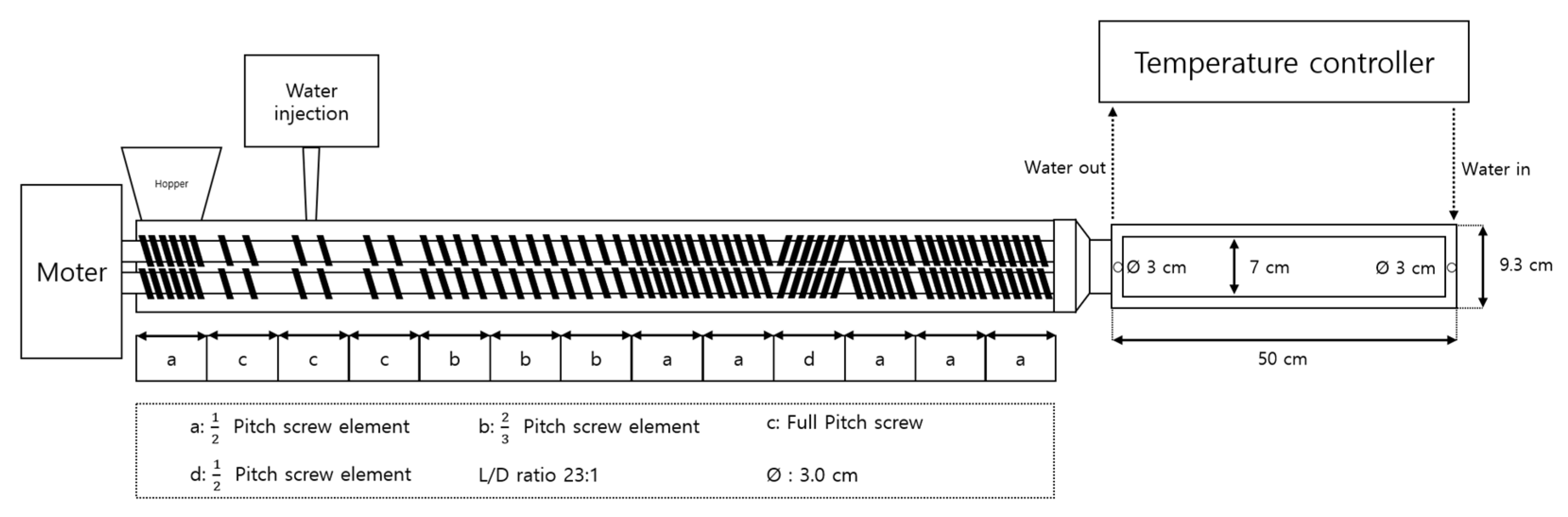
2.2. Extrusion Processing
2.3. Color Measurement
2.4. Water Holding Capacity (WHC) and Water Solubility Index (WSI)
2.5. Expansion Ratio (ER) and Bulk Density (BD)
2.6. Texture Profile Analysis (TPA)
2.7. Integrity Index (I-Index)
2.8. DPPH Radical Scavenging Activity
2.9. ABTS Radical Scavenging Activity
2.10. Statistical Analysis
3. Results and Discussion
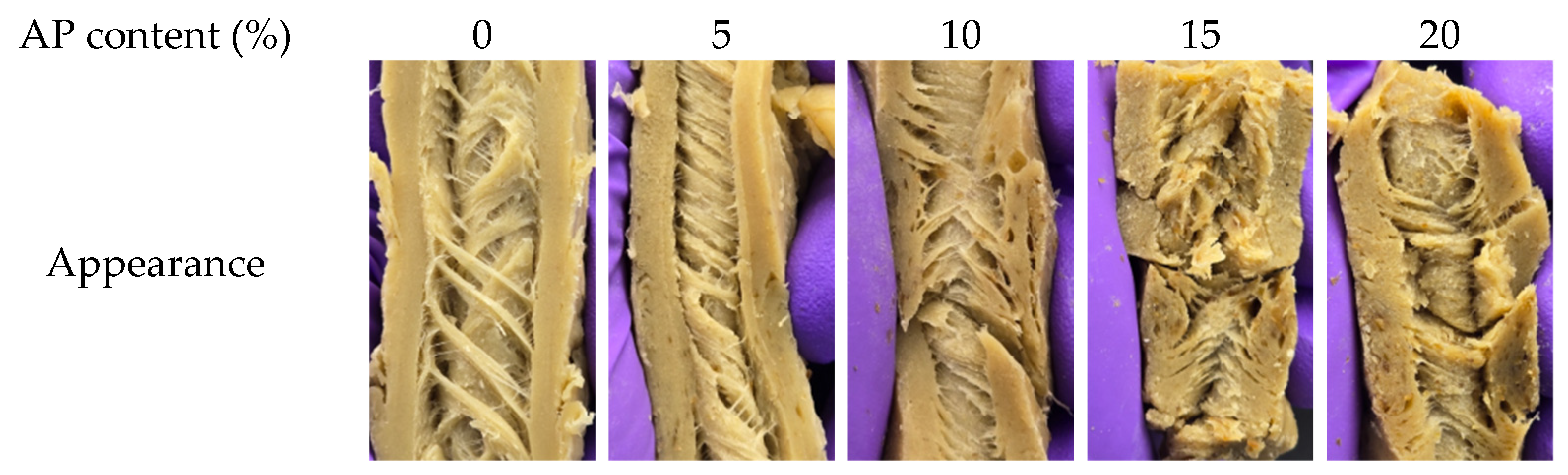
3.1. Appearances
3.2. Multivariate Analysis
3.3. Color Properties
3.4. Water Retention Capacity
3.5. Expansion Ratio (ER) and Bulk Density (BD)
3.6. Texture Properties
3.6.1. Hardness (HD)
3.6.2. Springiness (SP), Chewiness (CHE) and Cohesiveness (COH)
3.6.3. Cutting Strength (CS) and Texturization Degree (TD)
3.7. Integrity Index (I-Index)
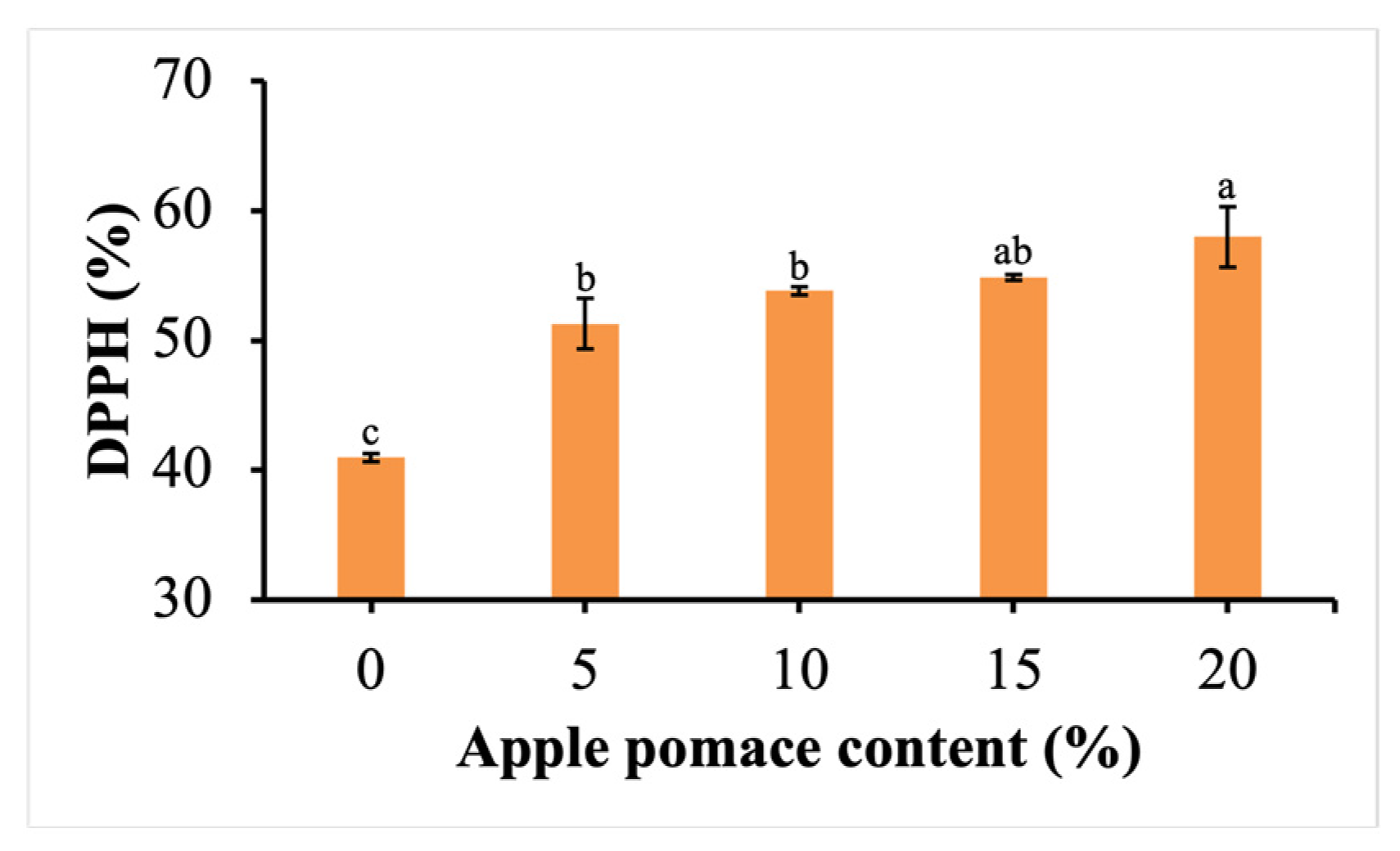
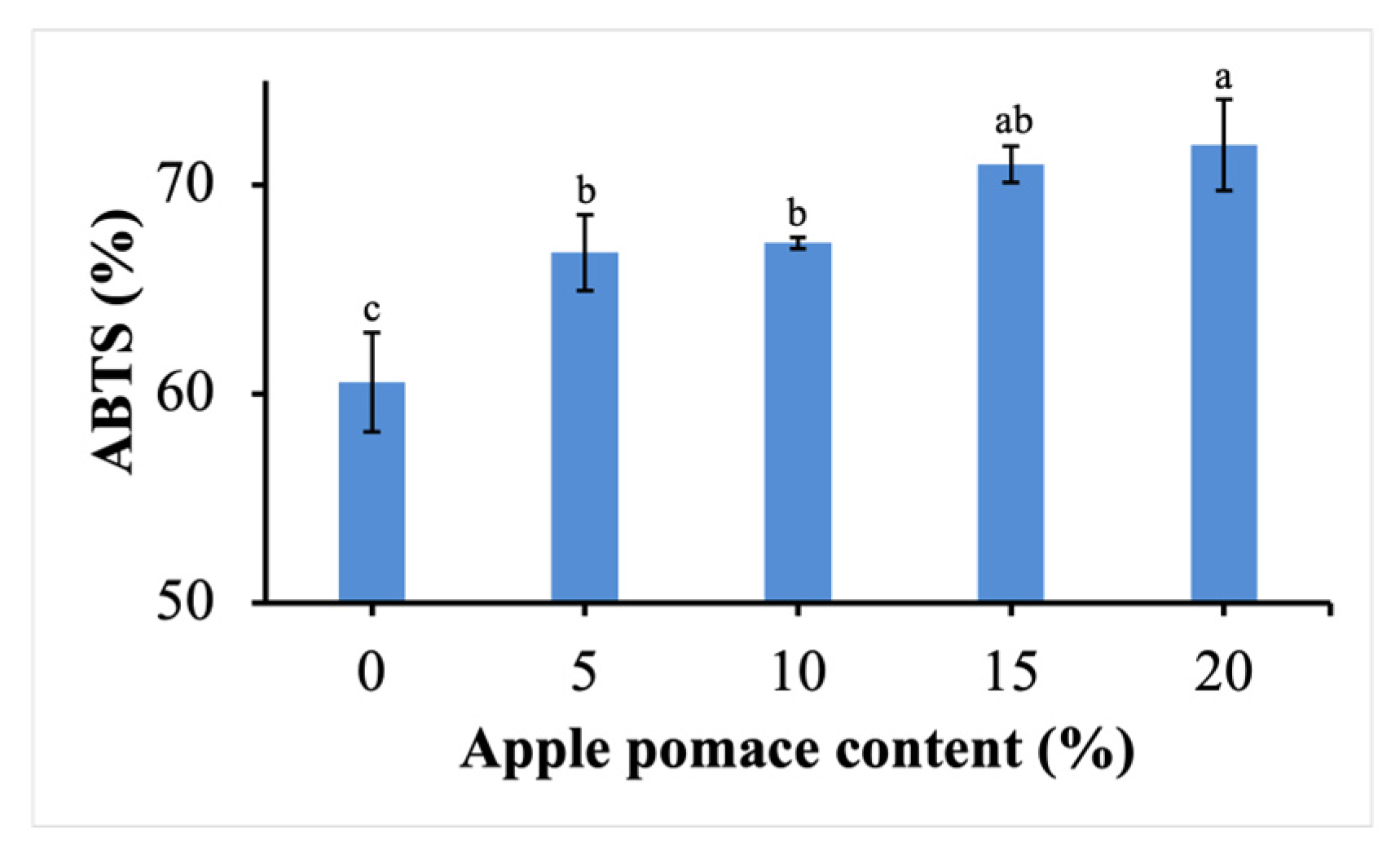
3.8. Antioxidant Activity
3.9. Quadratic Regression Analysis
4. Conclusions
Author Contributions
Funding
Institutional Review Board Statement
Informed Consent Statement
Data Availability Statement
Acknowledgments
Conflicts of Interest
Abbreviations
| AP | Apple pomace |
| N-glycolylneuraminic acid | Neu5Gc |
| ISP | Isolated soy protein |
| WG | Wheat gluten |
| L* | Lightness |
| a* | Redness |
| b* | Yellowness |
| ∆E | Color difference |
| WHC | Water holding capacity |
| WSI | Water solubility index |
| ER | Expansion ratio |
| BD | Bulk density |
| TPA | Texture profile analysis |
| HD | Hardness |
| HD1 | First hardness |
| HD2 | Second hardness |
| HDR | Hardness degradation ratio |
| SP | Springiness |
| COH | Cohesiveness |
| CHE | Chewiness |
| TD | Texturization degree of cutting strength |
| CS | Cutting strength |
| CSV | Cutting strength of vertical direction |
| CSP | Cutting strength of parallel direction |
| I-index | Integrity index |
References
- Godfray, H.C.J.; Aveyard, P.; Garnett, T.; Hall, J.W.; Key, T.J.; Lorimer, J.; Pierrehumbert, R.T.; Scarborough, P.; Springmann, M.; Jebb, S.A. Meat Consumption, Health, and the Environment. Science 2018, 361, eaam5324. [Google Scholar] [CrossRef]
- Celada, P.; Sánchez-Múniz, F.J. Are Meat and Meat Product Consumptions Harmful? their Relationship with the Risk of Colorectal Cancer and Other Degenerative Diseases. An. Real Acad. Farm. 2016, 82, 68–90. [Google Scholar]
- Zur Hausen, H.; Bund, T.; de Villiers, E. Infectious agents in bovine red meat and milk and their potential role in cancer and other chronic diseases. In Viruses, Genes, and Cancer; Hunter, E., Bister, K., Eds.; Springer: New York, NY, USA, 2017; pp. 83–116. [Google Scholar]
- You, W.; Feng, S.; Donnelly, F. Total Meat (Flesh) Supply may be a Significant Risk Factor for Cardiovascular Diseases Worldwide. Food Sci. Nutr. 2023, 11, 3203–3212. [Google Scholar] [CrossRef] [PubMed]
- Li, C.; Pradhan, P.; Wu, X.; Li, Z.; Liu, J.; Hubacek, K.; Chen, G. Livestock Sector can Threaten Planetary Boundaries without Regionally Differentiated Strategies. J. Environ. Manag. 2024, 370, 122444. [Google Scholar] [CrossRef]
- Louzada, G.E.; Barboza, D.R.S.; Chanca, N.L.; de Sousa Coutinho, J.V.; Broedel, H.P.; de Oliveira, J.V.X.; de Oliveira, E.R.; Falsoni, R.M.P. Dieta Vegana e Vegetariana: Seus Impactos na Saúde Infantil. Rev. Ibero-Am. Humanid. Ciênc. Educ. 2023, 1, 235–242. [Google Scholar] [CrossRef]
- Jappe, U. Vegan Diet-alternative Protein Sources as Potential Allergy Risk. Allergo J. Int. 2023, 32, 251–257. [Google Scholar] [CrossRef]
- Yao, Y.; Li, C.; Yuen, J.S.K., Jr.; Stout, A.J.; Kaplan, D.L. Manufacture of hybrid alternative protein food products using a combination of plant-based ingredients, fermentation-derived ingredients, and animal cells. In Cellular Agriculture; Fraser, E.D.G., Kaplan, D.L., Newman, L., Yada, R.Y., Eds.; Elsevier Science Publishing Co., Inc.: New York, NY, USA, 2024; pp. 251–266. [Google Scholar]
- Gu, B.-J.; Ryu, G.-H. Effect of Die Geometry on Expansion of Corn Flour Extrudate. Food Eng. Prog. 2011, 15, 148–154. [Google Scholar] [CrossRef]
- Harper, J.M. Food Extrusion. In Food Properties and Computer-Aided Engineering of Food Processing Systems; Singh, R.P., Medina, A.G., Eds.; Kluwer Academic Publishers: Dordrecht, The Netherlands, 1989; pp. 271–297. [Google Scholar]
- Zhang, W.; Li, S.; Zhang, B.; Drago, S.R.; Zhang, J. Relationships between the Gelatinization of Starches and the Textural Properties of Extruded Texturized Soybean Protein-Starch Systems. J. Food Eng. 2016, 174, 29–36. [Google Scholar] [CrossRef]
- Gu, B.-Y.; Ryu, G.-H. Effects of Extrusion Variables and Die Configuration on Physicochemical Characteristics of Texturized Soy Protein Isolate. J. Korean Soc. Food Sci. Nutr. 2019, 48, 1405–1411. [Google Scholar] [CrossRef]
- Bhushan, S.; Kalia, K.; Sharma, M.; Singh, B.; Ahuja, P.S. Processing of Apple Pomace for Bioactive Molecules. Crit. Rev. Biotechnol. 2008, 28, 285–296. [Google Scholar] [CrossRef]
- Gołębiewska, E.; Kalinowska, M.; Yildiz, G. Sustainable use of Apple Pomace (AP) in Different Industrial Sectors. Materials 2022, 15, 1788. [Google Scholar] [CrossRef]
- Gassara, F.; Brar, S.K.; Pelletier, F.; Verma, M.; Godbout, S.; Tyagi, R.D. Pomace Waste Management Scenarios in Québec-Impact on Greenhouse Gas Emissions. J. Hazard. Mater. 2011, 192, 1178–1185. [Google Scholar] [CrossRef]
- Ampese, L.C.; Ziero, H.D.D.; Velásquez, J.; Sganzerla, W.G.; Martins, G.; Forster-Carneiro, T. Apple Pomace Management by Anaerobic Digestion and Composting: A Life Cycle Assessment. Biofuels Bioprod. Bioref. 2023, 17, 29–45. [Google Scholar] [CrossRef]
- Gumul, D.; Kruczek, M.; Ivanišová, E.; Słupski, J.; Kowalski, S. Apple Pomace as an Ingredient Enriching Wheat Pasta with Health-Promoting Compounds. Foods 2023, 12, 804. [Google Scholar] [CrossRef] [PubMed]
- Kim, J.; Shin, J.; Yang, J. Nutritional Analyses and Antioxidant Activity of Apple Pomace. J. Life Sci. 2021, 31, 617–625. [Google Scholar]
- Oh, C.; Kang, C. Effects of Apple Pomace on Cookie Quality. Culin. Sci. Hosp. Res. 2016, 22, 89–98. [Google Scholar]
- Cantero, L.; Salmerón, J.; Miranda, J.; Larretxi, I.; Fernández-Gil, M.d.P.; Bustamante, M.Á.; Matias, S.; Navarro, V.; Simón, E.; Martínez, O. Performance of Apple Pomace for Gluten-Free Bread Manufacture: Effect on Physicochemical Characteristics and Nutritional Value. Appl. Sci. 2022, 12, 5934. [Google Scholar] [CrossRef]
- Zaky, A.A.; Witrowa-Rajchert, D.; Nowacka, M. Turning Apple Pomace into Value: Sustainable Recycling in Food Production—A Narrative Review. Sustainability 2024, 16, 7001. [Google Scholar] [CrossRef]
- Gu, B.-Y.; Ryu, G.-H. Effects of Moisture Content and Screw Speed on Physical Properties of Extruded Soy Protein Isolate. J. Korean Soc. Food Sci. Nutr. 2017, 46, 751–758. [Google Scholar]
- Trinh, K.T.; Glasgow, S. On the texture profile analysis test. In Proceedings of the Chemeca, Wellington, New Zealand, 23–26 September 2012. [Google Scholar]
- Brand-Williams, W.; Cuvelier, M.; Berset, C. Use of a Free Radical Method to Evaluate Antioxidant Activity. LWT-Food Sci. Technol. 1995, 28, 25–30. [Google Scholar] [CrossRef]
- Re, R.; Pellegrini, N.; Proteggente, A.; Pannala, A.; Yang, M.; Rice-Evans, C. Antioxidant Activity Applying an Improved ABTS Radical Cation Decolorization Assay. Free Radic. Biol. Med. 1999, 26, 1231–1237. [Google Scholar] [CrossRef]
- Jeon, Y.-H.; Gu, B.-J.; Ryu, G.-H. Effects of Brewer’s Spent Yeast Content on the Physicochemical Properties of Extruded High-Moisture Meat Analog. J. Korean Soc. Food Sci. Nutr. 2022, 51, 1084–1090. [Google Scholar] [CrossRef]
- Deng, Q.; Wang, Z.; Fu, L.; He, Z.; Zeng, M.; Qin, F.; Chen, J. High-Moisture Extrusion of Soy Protein: Effects of Insoluble Dietary Fiber on Anisotropic Extrudates. Food Hydrocoll. 2023, 141, 108688. [Google Scholar] [CrossRef]
- Karkle, E.N.L. Carbohydrate Components of Pomace in Corn-Based Extrudates: Interactions, Expansion Dynamics, and Structure-Texture Relationships. Ph.D. Thesis, Kansas State University, Manhattan, KS, USA, 2011. [Google Scholar]
- Marzec, A.; Lewicki, P.P. Antiplasticization of cereal-based products by water. Part I. Extruded flat bread. J. Food Eng. 2006, 73, 1–8. [Google Scholar] [CrossRef]
- Antonic, B.; Jancikova, S.; Dordevic, D.; Tremlova, B. Apple Pomace as Food Fortification Ingredient: A Systematic Review and Meta-analysis. J. Food Sci. 2020, 85, 2977–2985. [Google Scholar] [CrossRef]
- Yadav, S.; Malik, A.; Pathera, A.; Islam, R.U.; Sharma, D. Development of Dietary Fibre Enriched Chicken Sausages by Incorporating Corn Bran, Dried Apple Pomace and Dried Tomato Pomace. Nutr. Food Sci. 2016, 46, 16–29. [Google Scholar] [CrossRef]
- Zhang, G.; Peng, H.; Zhang, J.; Wang, S.; Qi, M.; Ren, Z.; He, Z.; Ma, C. The effect of high-moisture extrusion on the water holding capacity of pea protein texturized products. IOSR J. Agric. Vet. Sci. 2021, 14, 50–54. [Google Scholar]
- Marczak, A.; Mendes, A.C. Dietary Fibers: Shaping Textural and Functional Properties of Processed Meats and Plant-Based Meat Alternatives. Foods 2024, 13, 1952. [Google Scholar] [CrossRef]
- Aslam, K.; Sattar, S.; Latif, A. Apple Pomace: Transforming Waste into Wealth Across various Food Industries. Mathews J. Nutr. Diet. 2024, 7, 1–10. [Google Scholar] [CrossRef]
- Korkerd, S.; Wanlapa, S.; Puttanlek, C.; Uttapap, D.; Rungsardthong, V. Expansion and Functional Properties of Extruded Snacks Enriched with Nutrition Sources from Food Processing by-Products. J. Food Sci. Technol. 2016, 53, 561–570. [Google Scholar] [CrossRef] [PubMed]
- Richter, J.K.; Gu, B.-J.; Ek, P.; Dey, D.; Saunders, S.R.; Ganjyal, G.M. Potential Interactions between Starch and Fruit Pomace may Impact the Expansion Ratio of Direct Expanded Extrudates. J. Food Sci. 2022, 87, 3513–3527. [Google Scholar] [CrossRef] [PubMed]
- Singha, P.; Muthukumarappan, K. Single Screw Extrusion of Apple Pomace-Enriched Blends: Extrudate Characteristics and Determination of Optimum Processing Conditions. Food Sci. Technol. Int. 2018, 24, 447–462. [Google Scholar] [CrossRef] [PubMed]
- Adamska, A.; Wielguszewska, A.I. A sustainable approach to new generation food thickeners: Apple fibre in meat and vegetable burgers. Postępy Tech. Przetw. Spożywczego 2023, 1, 1–7. [Google Scholar]
- Feng, J.; Kong, B.; Sun, F.; Xia, X. Effect of Potato Dietary Fiber on the Quality, Microstructure, and Thermal Stability of Chicken Patty. Foods 2022, 11, 3978. [Google Scholar] [CrossRef]
- Lian, W.; Hu, Q.; Qu, M.; Sun, B.; Liu, L.; Zhu, Y.; Xia, X.; Huang, Y.; Zhu, X. Impact of Insoluble Dietary Fiber and CaCl2 on Structural Properties of Soybean Protein Isolate-wheat Gluten Composite Gel. Foods 2023, 12, 1890. [Google Scholar] [CrossRef]
- Lu, V.L.; Gavahian, M.; Lin, J. Textural properties of plant-based meat analogue extrudates enriched with pineapple processing by-product powder. Int. J. Food Sci. Technol. 2025, 60, vvae080. [Google Scholar] [CrossRef]
- Samard, S.; Gu, B.-Y.; Ryu, G.-H. Effects of Extrusion Types, Screw Speed and Addition of Wheat Gluten on Physicochemical Characteristics and Cooking Stability of Meat Analogues. J. Sci. Food Agric. 2019, 99, 4922–4931. [Google Scholar] [CrossRef]
- Gracey, P.R.; Tako, E. Apple and grape pomace: Emerging upcycled functional ingredients in processed meat products, designed to increase polyphenol and fiber contents. Sus. Food Technol. 2025, 3, 861–874. [Google Scholar] [CrossRef]
- León, E.A.V.; Aldapa, C.A.G.; Rojas, J.A.; Torres, A.V.; Uribe, J.P.H.; Rodríguez, H.M.P.; Cortez, R.O.N. Phytochemical Content and Antioxidant Activity of Extruded Products made from Yellow Corn Supplemented with Apple Pomace Powder. Food Sci. Technol. 2022, 42, e91221. [Google Scholar] [CrossRef]
- Zeng, X.; Zheng, B.; Xiao, G.; Chen, L. Synergistic effect of extrusion and polyphenol molecular interaction on the short/long-term retrogradation properties of chestnut starch. Carbohydr. Polym. 2022, 276, 118731. [Google Scholar] [CrossRef] [PubMed]



| AP Content (%) | ISP (1) | WG | Corn Starch |
|---|---|---|---|
| 0 | 50 | 40 | 10 |
| 5 | 47.5 | 38 | 9.5 |
| 10 | 45 | 36 | 9 |
| 15 | 42.5 | 34 | 8.5 |
| 20 | 40 | 32 | 8 |
| Effect | Value | F | Hypothesis df | Error df | Partial η2 |
|---|---|---|---|---|---|
| Pillai’s Trace | 0.906 | 16.619 *** | 40.000 | 16.000 | 0.976 |
| Wilks’ lambda | 0.000 | 298.476 *** | 40.000 | 5.647 | 0.999 |
| Independent Variable | Dependent Variable | Sum of Type III Squares | df | Mean Square | F | Partial η2 | |
|---|---|---|---|---|---|---|---|
| AP content (%) | L* (1) | 503.792 | 4 | 125.948 | 174.764 *** | 0.986 | |
| a* | 8.185 | 4 | 2.046 | 10.544 ** | 0.808 | ||
| b* | 13.864 | 4 | 3.466 | 41.286 *** | 0.943 | ||
| ∆E | 499.980 | 4 | 124.995 | 163.970 *** | 0.985 | ||
| WHC | 4.626 | 4 | 1.157 | 12.088 *** | 0.829 | ||
| WSI | 47.935 | 4 | 11.984 | 43.940 *** | 0.946 | ||
| BD | 0.0150 | 4 | 0.004 | 40.245 *** | 0.942 | ||
| ER | 0.0280 | 4 | 0.007 | 43.138 *** | 0.945 | ||
| HD | HD1 | 1315.972 | 4 | 328.993 | 150.925 *** | 0.984 | |
| HD2 | 1169.077 | 4 | 292.269 | 123.891 *** | 0.980 | ||
| HDR | 0.196 | 4 | 0.049 | 14.588 *** | 0.854 | ||
| TPA | SP | 1227.214 | 4 | 306.804 | 56.487 *** | 0.958 | |
| CHE | 3,658,620.324 | 4 | 914,655.081 | 209.012 *** | 0.988 | ||
| COH | 872.936 | 4 | 218.234 | 40.699 *** | 0.942 | ||
| CS | CSP | 38.440 | 4 | 9.610 | 75.638 *** | 0.968 | |
| CSV | 132.600 | 4 | 33.150 | 253.094 *** | 0.990 | ||
| TD | 0.234 | 4 | 0.059 | 58.369 *** | 0.959 | ||
| I-index | 501.445 | 4 | 125.361 | 17.758 *** | 0.877 | ||
| DPPH | 508.119 | 4 | 127.030 | 66.970 *** | 0.964 | ||
| ABTS | 241.891 | 4 | 60.473 | 20.860 *** | 0.893 | ||
| AP Content (%) | L* (1) | a* | b* | ∆E |
|---|---|---|---|---|
| 0 | 66.68 ± 0.00 a | 2.39 ± 0.01 c | 20.99 ± 0.03 a | 20.59 ± 0.00 e |
| 5 | 61.58 ± 0.04 b | 2.84 ± 0.01 bc | 21.04 ± 0.01 a | 25.68 ± 0.04 d |
| 10 | 57.43 ± 0.15 c | 3.73 ± 0.07 ab | 21.07 ± 0.06 a | 29.88 ± 0.13 c |
| 15 | 54.78 ± 1.42 d | 3.96 ± 0.11 ab | 19.92 ± 0.21 b | 32.44 ± 1.40 b |
| 20 | 49.69 ± 1.25 e | 4.39 ± 0.98 a | 18.61 ± 0.61 c | 37.52 ± 1.35 a |
| AP Content (%) | WHC (g/g) (1) | WSI (%) | BD (g/cm3) | ER |
|---|---|---|---|---|
| 0 | 4.67 ± 0.19 a | 7.84 ± 0.65 c | 0.92 ± 0.01 bc | 1.14 ± 0.00 a |
| 5 | 3.93 ± 0.05 ab | 9.12 ± 0.89 bc | 0.94 ± 0.01 bc | 1.09 ± 0.02 b |
| 10 | 4.17 ± 0.08 ab | 9.98 ± 0.31 b | 0.95 ± 0.01 b | 1.08 ± 0.01 bc |
| 15 | 3.68 ± 0.36 bc | 11.73 ± 0.22 a | 0.96 ± 0.01 b | 1.05 ± 0.02 c |
| 20 | 2.99 ± 0.55 c | 12.82 ± 0.11 a | 1.01 ± 0.01 a | 1.01 ± 0.01 d |
| AP Content (%) | HD (N) | HDR | TPA | |||
|---|---|---|---|---|---|---|
| HD1 (1) | HD2 | SP (%) | CHE (g) | COH (%) | ||
| 0 | 35.97 ± 2.30 a | 30.63 ± 1.79 a | 1.17 ± 0.01 c | 83.31 ± 1.25 a | 1598.31 ± 107.84 a | 52.33 ± 0.68 a |
| 5 | 28.77 ± 1.38 b | 22.92 ± 1.24 b | 1.26 ± 0.02 bc | 80.22 ± 1.98 a | 1002.86 ± 97.92 b | 42.56 ± 2.53 b |
| 10 | 19.68 ± 2.31 c | 15.55 ± 2.21 c | 1.27 ± 0.04 bc | 75.10 ± 1.26 b | 628.02 ± 123.01 c | 41.45 ± 4.51 b |
| 15 | 13.32 ± 0.71 d | 9.64 ± 1.36 d | 1.40 ± 0.14 a | 63.17 ± 1.94 c | 290.59 ± 38.16 d | 33.93 ± 3.95 c |
| 20 | 10.27 ± 1.47 e | 7.59 ± 1.05 d | 1.35 ± 0.05 ab | 60.61 ± 3.10 c | 212.77 ± 33.45 d | 33.51 ± 1.41 c |
| AP Content (%) | CS (g/mm2) | TD | I-Index (%) | |
|---|---|---|---|---|
| CSP (1) | CSV | |||
| 0 | 10.01 ± 0.74 a | 15.19 ± 1.34 a | 1.52 ± 0.04 a | 23.47 ± 0.82 a |
| 5 | 8.93 ± 0.24 b | 12.53 ± 0.83 b | 1.40 ± 0.06 b | 18.89 ± 0.86 b |
| 10 | 8.09 ± 0.64 b | 9.47 ± 0.31 c | 1.17 ± 0.06 c | 12.57 ± 2.28 c |
| 15 | 6.34 ± 0.25 c | 7.69 ± 0.53 d | 1.21 ± 0.05 c | 6.73 ± 0.69 d |
| 20 | 5.40 ± 0.38 d | 6.19 ± 0.46 e | 1.15 ± 0.04 c | 8.34 ± 1.85 d |
| Constant | AP | AP (Quadratic) | F | p-Value | R2 | ||||
|---|---|---|---|---|---|---|---|---|---|
| Coef. (1) | S.E | Coef. | S.E | Coef. | S.E | ||||
| L* | 66.406 *** | 0.532 | −0.903 *** | 0.126 | 0.004 | 0.006 | 260.199 | <0.001 | 0.977 |
| a* | 2.338 *** | 0.229 | 0.143 ** | 0.054 | −0.002 | 0.003 | 22.592 | <0.001 | 0.790 |
| b* | 20.945 *** | 0.161 | 0.105 ** | 0.038 | −0.011 *** | 0.002 | 77.638 | <0.001 | 0.928 |
| ∆E | 20.861 *** | 0.546 | 0.907 *** | 0.129 | −0.005 | 0.006 | 245.710 | <0.001 | 0.976 |
| WHC | 4.521 *** | 0.198 | −0.037 | 0.047 | −0.002 | 0.002 | 14.950 | <0.001 | 0.714 |
| WSI | 7.853 *** | 0.276 | 0.223 *** | 0.065 | 0.001 | 0.003 | 92.210 | <0.001 | 0.939 |
| BD | 0.921 *** | 0.007 | 0.001 | 0.002 | 0.000 * | 0.000 | 45.347 | <0.001 | 0.883 |
| ER | 1.133 *** | 0.008 | −0.006 *** | 0.002 | 0.000 | 0.000 | 71.411 | <0.001 | 0.922 |
| HD1 | 36.544 *** | 0.715 | −1.967 *** | 0.169 | 0.032 *** | 0.008 | 394.604 | <0.001 | 0.967 |
| HD2 | 30.965 *** | 0.620 | −1.918 *** | 0.147 | 0.037 *** | 0.007 | 419.133 | <0.001 | 0.969 |
| HDR | 1.170 *** | 0.029 | 0.018 ** | 0.007 | 0.000 | 0.000 | 14.447 | <0.001 | 0.517 |
| SP | 84.149 *** | 1.092 | −0.920 *** | 0.259 | −0.016 | 0.012 | 145.667 | <0.001 | 0.915 |
| CHE | 1596.418 *** | 33.855 | −130.962 *** | 8.021 | 3.065 *** | 0.385 | 500.590 | <0.001 | 0.974 |
| COH | 51.767 *** | 1.272 | −1.628 *** | 0.301 | 0.035 ** | 0.014 | 61.576 | <0.001 | 0.820 |
| CSP | 10.022 *** | 0.197 | −0.200 *** | 0.047 | −0.002 | 0.002 | 159.919 | <0.001 | 0.922 |
| CSV | 15.299 *** | 0.298 | −0.663 *** | 0.071 | 0.010 *** | 0.003 | 264.997 | <0.001 | 0.952 |
| TD | 1.529 *** | 0.024 | −0.039 *** | 0.006 | 0.001 *** | 0.000 | 70.999 | <0.001 | 0.840 |
| I-index | 24.679 *** | 1.774 | −1.894 *** | 0.420 | 0.061 ** | 0.020 | 20.838 | <0.001 | 0.776 |
| DPPH | 42.016 *** | 1.094 | 1.658 *** | 0.259 | −0.045 *** | 0.012 | 59.044 | <0.001 | 0.908 |
| ABTS | 61.058 *** | 1.008 | 0.954 *** | 0.239 | −0.021 * | 0.011 | 33.326 | <0.001 | 0.847 |
Disclaimer/Publisher’s Note: The statements, opinions and data contained in all publications are solely those of the individual author(s) and contributor(s) and not of MDPI and/or the editor(s). MDPI and/or the editor(s) disclaim responsibility for any injury to people or property resulting from any ideas, methods, instructions or products referred to in the content. |
© 2026 by the authors. Licensee MDPI, Basel, Switzerland. This article is an open access article distributed under the terms and conditions of the Creative Commons Attribution (CC BY) license.
Share and Cite
Jung, H.; Gu, B.-J.; Jung, D.-E. Upcycled Apple Pomace as an Innovative Ingredient in High-Moisture Meat Analogs: Sustainable Valorization for Food Production. Sustainability 2026, 18, 475. https://doi.org/10.3390/su18010475
Jung H, Gu B-J, Jung D-E. Upcycled Apple Pomace as an Innovative Ingredient in High-Moisture Meat Analogs: Sustainable Valorization for Food Production. Sustainability. 2026; 18(1):475. https://doi.org/10.3390/su18010475
Chicago/Turabian StyleJung, Hojin, Bon-Jae Gu, and Da-Eun Jung. 2026. "Upcycled Apple Pomace as an Innovative Ingredient in High-Moisture Meat Analogs: Sustainable Valorization for Food Production" Sustainability 18, no. 1: 475. https://doi.org/10.3390/su18010475
APA StyleJung, H., Gu, B.-J., & Jung, D.-E. (2026). Upcycled Apple Pomace as an Innovative Ingredient in High-Moisture Meat Analogs: Sustainable Valorization for Food Production. Sustainability, 18(1), 475. https://doi.org/10.3390/su18010475