Article

How Do Stated Knowledge and Attitudes Influence End-of-Current-Use Disposition of Electronics?

by
Payam Saeedi
1,*,
Willie Cade
2,
Nazeera Jabin
1,
Tae Oh
3,
Stacey Watson
4 and
Eric Williams
1
1
Golisano Institute for Sustainability, Rochester Institute of Technology, Rochester, NY 14623, USA
2
Graceful Solutions, Chicago, IL 60607, USA
3
Golisano College of Computing and Information Sciences, Rochester Institute of Technology, Rochester, NY 14623, USA
4
Cheriton School of Computer Science, University of Waterloo, Waterloo, ON N2L 3G1, Canada
*
Author to whom correspondence should be addressed.
Sustainability 2026, 18(11), 5239; https://doi.org/10.3390/su18115239
Submission received: 30 March 2026 / Revised: 3 May 2026 / Accepted: 4 May 2026 / Published: 22 May 2026

Abstract

When finished with an electronic device, consumers choose between storing, recycling, giving away, trading-in, reselling, or throwing it away. This choice has environmental and data privacy implications, e.g., reuse of devices is generally environmentally preferable to recycling, which is better than throwing away in the trash. Through a survey of 4000 U.S. consumers and regression analysis, this study analyzes how stated attitude and knowledge connect to consumers’ previous and planned disposition choices. The binomial regression model (pseudo- R 2 = 13 % ) models the decision to store or not store a device. Important factors leading to increased likelihood of storing are data security concerns when recycling (+14%) or reselling (+9%), lack of knowledge of recycling (+10%), and wanting a backup of data (+11%). Notably, data security concerns when recycling or reselling were significant for past behavior, but not for intended behavior. This suggests consumers take data security more seriously when faced with the actual disposition decision. Multinomial regression (pseudo- R 2 = 15 % ) is used to model which non-storage option is chosen. Knowledge of (+47%) and perceived convenience (+9%) of recycling programs were important in consumers choosing to recycle, reselling of devices was strongly influenced by knowledge of reuse markets.

1. Introduction

The rapid evolution of information technology has fundamentally reshaped various aspects of our daily lives. This evolution has come along with dramatic growth in ownership of electronic devices. In 2024, 80% of the world population owned a smartphone [1]. In the U.S., by 2024, 98% of adults owned a cellphone, and 91% owned a smartphone [2].
Intelligence and networking are increasingly integrated into new and existing products, leading to an Internet of Things (IoT) [3], which is the term used to refer to a global network infrastructure of interconnected devices equipped with advanced sensing, computing and communication technologies [4,5,6,7]. IoT implies a new suite of devices, such as smart kitchen appliances, home security cameras, and wearable devices. By 2030, there will be an estimated 125 billion connected IoT devices worldwide [8].
The increasing proliferation of electronic devices leads to global environmental and data security challenges. Ref. [9] reported global generation of electronic waste (e-waste) at 62 million tons in 2022, marking an 82% increase from 2010. Global e-waste generation is projected to grow 2.6 million tons per year, leading to an 82-million-ton total in 2030 [9].
Key drivers of environmental impacts of consumer electronics are improper recycling of e-waste and environmentally intensive production. Only 22% of total e-waste generated in 2024 went to documented recycling systems [9], much of the remainder was recycled by an “informal sector” in various countries around the world. Informal recycling, done by unregistered households or groups, has been shown to cause serious environmental pollution, for example, by using acid baths to recover copper and use of harmful chemicals to recover gold from scrap circuit boards [10]. In addition to end-of-life, the production and operation of electronic devices also cause environmental impacts. The environmental intensity of electronics manufacturing is surprisingly high, largely due to the stringent purity and quality standards in manufacturing semiconductors and other components [11]. This leads to the production phase accounting for a high share of impacts for some devices, e.g., 70% of energy used by a laptop computer was incurred in production, opposed to 30% for electricity used in operation [12]. Most of the energy investment in a high tech component came from attaining its complex form, not its raw materials. Materials recycling is thus less effective at recovering the environmental “investment” in comparison with other waste streams such as aluminum cans [11]. This implies that for electronics, the waste management hierarchy (Reduce, Reuse, Recycle) is tilted towards Reduce and Reuse more strongly compared to many other products [13]. Extension of lifespan, including reuse, is thus a priority for environmental management of electronics. The life cycle energy use of electronics is also significant; the annual energy use of a typical portfolio of electronics owned by a U.S. consumer in 2007 was around 30% of annual gasoline consumption [14].
The environmental and economic importance of electronics reuse calls for more precise terminology. E-waste is currently used for any device leaving a consumer, but a substantial fraction of devices are actually reused. We thus define the term End-of-Current-Use (EoCU) electronics to refer to all devices leaving a consumer, including reusable devices, unusable waste, and in-between (needs repair). We use the term e-waste for the unusable portion that cannot feasibly be repaired and needs waste management.
End-of-Current-Use devices can also lead to data security risks. Many devices still contain Personally Identifiable Information (PII) when disposed of. There are reported cases where waste devices end up in the wrong hands, and data was recovered and misused for fraud or blackmail [15]. 78% of devices examined in a study of electronic waste dumpsites and computer dealers used in Ghana contained Personally Identifiable Information [16]. Morgan Stanley exposed sensitive information of 15 million customers when their old hard drives were sold on an auction site without proper data sanitization [17]. Many consumers lack the knowledge or tools to fully erase data. One representative survey of the US population showed that 31% of respondents do not wipe data when dispositioning a consumer electronic device [18]. In 2003, researchers from MIT examined 158 secondhand hard drives, and found that only 9% had been adequately scrubbed of data, leaving recoverable information including credit card numbers, personal messages, and medical history [19]. In another study, graduate students from the University of British Columbia visited an e-waste site in Agbogbloshie, Ghana, and purchased hard drives containing sensitive financial data. These included online transaction records, and a government contract worth $22 million from Northrop Grumman, which included information linked to the Defense Intelligence Agency, Homeland Security, and NASA [16].
Another link between End-of-Current-Use and privacy is the challenge of reuse and recycling when devices are effectively “locked” to their original owners. For instance, many disposed devices cannot be reused because the hardware or software is tied to the initial user account, making the device inaccessible to a new user [19]. Additionally, manufacturers often restrict repairs on their devices, further limiting reuse and contributing to electronic waste [20]. Some consumers, wary of the privacy risks involved in disposal, may choose to store outdated devices at home, adding to the growing volume of obsolete technology. For example, a study in Japan found that privacy-conscious users were more likely to stockpile, discard in regular trash, or even physically destroy their old devices rather than recycle them [21].

Research Area

This article investigates decision-making of consumers for their End-of-Current-Use electronic devices. These decisions are key to environmental and data security outcomes. From an environmental perspective, reuse is preferable to recycling, which is preferable to throwing away trash. “Poor” decisions are common, for example, consumers often store unused devices indefinitely [22]. While in some cases a stored device provides utility as a spare or data backup, often it does not, losing any potential value for reuse. Consumers also often throw electronics away in regular trash, even when recycling is reasonably convenient [13]. Valuable materials in electronics thus end up in landfills rather than recovered.
Many approaches have been used to model consumer behavior for EoCU electronics. Ref. [23] provides an extensive summary of survey-based studies that focus on waste mobile phones across the globe. Ref. [24] on the other hand, summarizes survey-based studies of faculty and staff throughout university campuses in the U.S., China, India, Turkey, the UK, Germany, Ghana and Poland. Ref. [25] offers a comprehensive global snapshot of consumer e-waste disposal behaviors, and reports key behavioral determinants including convenience, environmental awareness, and economic incentives as factors that have been identified by researchers in the space to impact e-waste disposal behavior. The theoretical frameworks employed in prior work can be broadly categorized into several methodological approaches. Interview-based qualitative studies have provided rich insights into consumer motivations and barriers [26,27,28,29,30,31], while survey-based quantitative approaches have enabled broader population-level assessments [24,32,33,34,35,36,37,38,39,40]. Regression models have been developed based on surveys to identify predictive factors in consumer behavior [28,29,36,41,42,43,44], and others have employed Structural Equation Modeling (SEM) to examine complex relationships between latent constructs such as environmental concern, perceived behavioral control, and disposal intentions [45,46,47,48,49].
These studies reveal several key behavioral drivers in consumer decisions at End-of-Current-Use:
Convenience and accessibility emerge as primary factors. Consumers are more likely to recycle e-waste when collection facilities are easily accessible and known [50]. The location and familiarity of collection points significantly influence responsible disposal behavior [23,51].
Psychological factors including trust in recycling entities, emotional attachment to devices, and the perceived need for backups shape disposition choices [26,35]. Device “hibernation”—indefinite storage at home—often stems from data security concerns and lack of formal recycling channels [44,51].
Environmental awareness varies significantly across regions, with developing countries often lacking both knowledge and infrastructure for proper e-waste management [28]. Higher awareness of environmental impacts correlates with more responsible disposal practices.
Economic considerations influence behavior differently across contexts, with economic factors being a major consideration especially in developing nations. Financial incentives can motivate responsible disposal, particularly in developing nations [24]. Device malfunction, obsolescence, or repair costs also drive disposal decisions, with younger consumers more likely to discard rather than repair damaged devices [24,52].
Reselling, recycling, donating, storing or trading-in an electronic device is an exclusive choice, i.e., among options to store, resell, donate, recycle, trade-in or throw in the trash, only one is selected. A consumer’s decision is presumably influenced by their perception of these options, weighing multiple ones and then selecting. For instance, a person may choose to recycle not because they are particularly enthusiastic about it, but because they find the other available options such as repairing, reselling, or donating, less appealing. This line of thought leads to a notable gap in the prior literature: Prior research treats the decision to recycle or resell in isolation rather than considering the interdependencies between these choices, e.g., for a specific instance, Ref. [53] focused on willingness to recycle e-waste, examining factors influencing recycling behavior, but did not consider other possible behaviors. Ref. [22] investigated reasons for storing waste electrical and electronic equipment (WEEE).
We propose that the choice to recycle or store is not made in isolation, rather it is a relative decision shaped by perceptions of other options. This study addresses the literature by employing a comprehensive choice modeling framework that treats End-of-Current-Use disposition as an integrated decision process, in which attitudes and knowledge of one option can influence the selection of another. This is a crucial expansion of perspective. Whether expressed as the 3R (Reduce, Reuse, Recycle) waste management hierarchy or more recently, circular economy, cycling products through shorter “loops” has long been emphasized as key to improved environmental, economic and social outcomes. Consumer decisions drive circularity in electronics and thus disposition options should be treated in an integrated way.
The research question of this article is thus: How do consumers’ stated attitudes and knowledge on End-of-Current-Use disposition options for electronics influence their choice? Disposition choices at End-of-Current-Use are: Store at home, resell, recycle, give away/donate, or throw away in trash. By “stated attitudes and knowledge” we mean responses to questions rating the convenience, data security, environmental and other attributes of each disposition option. For example, does the consumer know how to resell it? Are they concerned about the security of data if they throw away a device? We build an empirical regression model, calibrated with new survey data, to predict choice based on stated knowledge and attitudes for all disposition options.
The central contribution of this work is to quantify consumer behavior for End-of-Current-Use (EoCU) electronics, treating disposition as an exclusive choice among the full range of options. Ref. [53] also undertakes a survey and builds a regression model to understand behavior, but only considers recycling. Refs. [54,55,56] undertake consumer surveys to characterize consumer attitudes and knowledge for multiple disposition options for smartphones. These studies, however, do not quantify how attitudes/knowledge affect behavior via regression or other methods, rather only report descriptive statistics. Also, our survey covers 10 device types and is representative of the U.S. population (4000 responses = 400 per device type × 10 device types). Ref. [56]’s survey was representative with 988 responses, Ref. [55] had 53 respondents, and the survey of [54] covered 99 university faculty and students. Our survey results thus also contribute to available data in the field. We aim to quantify how a measured individual attitudes/knowledge change the probability of disposition choice. This will reveal tradeoffs. For example, making recycling more convenient hopefully leads to less throwing away, but it could also reduce reselling, generally thought of as environmentally preferable to recycling. The insights generated from this analysis are intended to inform public policy, industry standards, and consumer education initiatives, thereby addressing critical gaps in responsible electronic disposal practices and ultimately encouraging alternatives that favor recycling, reselling, and donation over indefinite storage or disposal in landfills.

2. Materials and Methods

2.1. Study Overview

To describe the overall design of the study, the end goal is a multivariable regression model that clarifies how different variables describing stated attitudes and knowledge influence consumer choices of End-of-Current-Use disposition of electronics. First, we develop a survey querying past and intended disposition behavior, attitudes and knowledge for each disposition option, attitudes and knowledge on environmental and security issues overall, and demographics. The survey is distributed to U.S. consumers, with 4000 responses collected intended as a statistically representative sample of the population. The survey responses are used to calibrate two types of regression models. We separate EoCU disposition into a two-stage decision, first the decision to do something with the device other than store it (store or not store), and second, if not stored, which disposition option was chosen (resell, donate/give away, trade-in, recycle, throw away). The store versus not-store decision is modeled with a binomial logistic model, the not-store disposition via a multinomial logistic model.

2.2. Approach to Behavioral Modeling

There are many approaches to quantitative modeling of behavior, including the Theory of Planned Behavior [57], Theory of Reasoned Action [58], and Value Belief Norm Theory [59]. While inspired by these, we do not strictly follow a particular framework, here we summarize our perspective. We treat the process of consumer decision on End-of-Current-Use disposition as based on evaluating multiple attributes of each option and selecting a “preferred” one. This is a common approach in choice modeling, for example it is often used in simulating vehicle purchases and travel mode choice [60]. A consumer’s evaluation of an option is based on their attitudes and knowledge. Measuring attitudes and knowledge via survey is imperfect [61]. We thus refer to our survey-based measurements as stated attitudes and knowledge. Many regression studies include demographic variables as explicit variables describing behavior. We intentionally do not include demographic variables in the choice modeling. From a statistical perspective, if demographics are uncorrelated with attitudes, adding them would not change explanatory power of the latter. If demographics are correlated with attitudes, they should be eliminated from model to avoid multicollinearity. From a theoretical perspective, our model is based on the proposition that attitudes and knowledge explain behavior. Demographics may or may not affect attitudes and knowledge, but they are not direct variables influencing behavior. We only model the effect of these direct determinants, leaving the question of how knowledge and attitudes are formed to future work. Note that the focus on attitudes and knowledge supports identifying interventions. For example, an information campaign can potentially change knowledge, but not household demographics.
We typically use single measures of attitude and knowledge. A community of researchers prefers multiple measure constructs [62,63], in which answers to several similar questions are combined into a measure of a concept. Multiple measure constructs are impractical for our goal. We are evaluating several attitudes and knowledge for each disposition option (store, resell, donate/give away, recycle, throw away), as well as measuring intended future and past behavior and demographics. The resulting large number of explanatory variables calls for a single measure construct to realize a manageable survey length. There is a set of research establishing that single measure constructs work well when the prompts are defined precisely and narrowly enough [64,65].

2.3. Devices to Cover

There are many consumer electronic devices, it is not feasible to cover every type and model. The following considerations are used to decide the scope of covered devices. First, we set a goal to focus on “newer” “devices”, which leads us to exclude computers, printers, and networking equipment from the scope of the study. Another consideration in selecting devices is to include those with high degrees of ownership. A survey conducted by Ting states that the most owned devices with IoT functionality are smartphones 96%, followed by laptop computers 86%, tablets 70%, smart TVs 69%, gaming consoles 62%, streaming devices 40.9%, smart speakers 42% and smartwatches 31% [66].
Considering the above, we select ten device categories to survey: 1. Smart kitchen appliances (Coffee maker, Fridge, Oven), 2. Security devices (Security camera, Smartlock, Video Baby monitor, Video Doorbell), 3. Gaming devices, 4. Augmented Reality/Virtual Reality (AR/VR) devices, 5. Smart home (Lawn mowers, Light bulbs, Thermostats, Vacuum cleaners), 6. Smart TVs, 7. Smartphones, 8. Streaming device, 9. Tablets, 10. Wearables (e.g., Smart watch).
It is likely that attitudes, knowledge and disposition behavior vary between devices. There could be classes of devices that show similar patterns, e.g., Smart Phones and Tablets, as distinct from other classes, e.g., Appliances and Smart Home devices. In this article, we focus solely on finding patterns common among all ten categories, i.e., one regression model for all devices. The current goal is to find robust average trends that apply to all devices, finding distinctions between device types is a task for future work.

2.4. Survey Design

Qualtrics was used to design, develop and implement surveys. The survey explored both past and anticipated End-of-Current-Use behaviors, including recycling, reselling, donating, and discarding. Stated attitudes, knowledge, and concerns regarding End-of-Current-Use decisions were queried, focusing on security concerns, perceived convenience and logistical familiarity with different disposition options. The questionnaires employed single-item measures with a 5-point Likert scale, chosen for their efficiency and proven validity over multi-item measures. This approach, while comprehensive, maintained a manageable survey length, with a completion time of 10 min on average. Reliability was assessed using Cronbach’s alpha across the full 35 attitudinal and knowledge prompts, yielding α = 0.85, affirming their effectiveness as single-item measures. Our survey design was informed by relevant industry research, including a Google white paper on disposal behavior drivers and barriers [67]. Details of the survey questions can be found in Supplementary Material Section S1.

2.5. Data Collection and Cleaning

The survey was deployed via the Prolific platform targeting a representative sample of 4000 unique respondents to be representative of the U.S. Census population, 400 responses per device type. To verify income representativeness, we computed a mean income from survey bin midpoints of $75,137 and compared it to a U.S. Census mean income calculated using the same bin structure, yielding $81,603. The two averages are close and the two histograms are similar, thus the sample is representative of the U.S. income distribution. To prevent duplicate respondents and to ensure the integrity of responses to general questions, Qualtrics controls were used to exclude participants who had already completed any of the other device specific surveys. This ensured that each of the 4000 responses came from distinct individuals, reducing response bias and eliminating redundancy. Data cleaning and validation are discussed further in Supplementary Material Section S2.

Variable Coding

Predictor variables were aggregated and dummy variables constructed via N-1 encoding. Specifically:
  • “Strongly Disagree” and “Somewhat Disagree” responses were consolidated into a single “Disagree” dummy variable (0 for not present, 1 for present).
  • “Strongly Agree” and “Somewhat Agree” responses were combined into an “Agree” dummy variable (0 for not present, 1 for present).
  • “Neutral/I don’t know” is not assigned a dummy variable in order to avoid redundancy (N-1 encoding).
This encoding strategy was chosen to enhance the interpretability of variable effects within the regression models, as elaborated in Section 3. To ensure robustness of our findings, we conducted parallel analyses using Likert scale encodings of predictor variables. Notably, the performance metrics of these models were highly comparable to those presented in the main text, further corroborating the validity of our primary analyses.

2.6. Behavioral Modeling—Binary and Multinomial Logit

We aim to model quantitative connections between stated attitudes and knowledge and past and intended choices for End-of-Current-Use disposition options. There are many possible modeling frameworks that could be used, in this work we use a common approach: Binomial and multinomial logit models. These have been used to predict consumer decisions in a variety of situations [42,68].
A binomial logistic regression model was constructed to predict the outcome of storing versus not storing devices, while the multinomial model was used to predict the likelihood of other post-storage options being preferred over recycling, reselling, giving away, or discarding. The multinomial model requires the selection of baseline or reference behavior. Baseline choice does not affect the statistical significance of results, but it does affect ease of interpretation. We chose recycling as the reference category for two reasons. First, while the most common non-storing behavior was donating to friend/family member (13%), many of these devices remain in the home, so we prefer the most popular option that left home, which is recycling (11%). Second, recycling is the first option that generally comes to mind when consumers are considering environmentally friendly disposition.
Importantly, we divide the End-of-Current-Use decision into two stages: First the consumer decides to store or not to store, then they select a non-store option. To explain this choice, consider this breakdown of the decision. First, the consumer must decide to consider doing something other than leave the device in storage. This is a major hurdle, many devices remain in storage because the consumer does not engage with the decision. Second, the consumer compares options and decides disposition. Our separation into a two-stage decision assumes that the first hurdle (deciding to do something) is more important than the pairwise comparison of storage with other options. In other words, the model aggregates the consideration of non-storage options in the decision to store or not to store. Alternatively, one could build a single multinomial model in which storage is among the options. The problem with this formulation is that it neglects the key stage in which a consumer decides to interact with the decision. We acknowledge that our two-stage model of the decision is an approximation of the full process, the above argument suggests it is reasonable, and preferable to the alternative of treating the store decision on an equal footing with the other options.
For the binomial regression, the dependent variable is 0 (Store) or 1 (Not Store). For the multinomial regression, the model estimates multiple logistic equations, each effectively comparing one alternative (coded as 1) against the baseline category recycling (coded as 0), estimated simultaneously so that probabilities across all alternatives sum to one.
We emphasize that alternative specifications were considered. A nested logit model for instance, with storage in one nest and active options in another, assumes that unobserved factors driving the choice among active options are correlated with each other but uncorrelated with those driving storage. This assumption does not hold: A consumer who stores a device out of inertia shares unobserved characteristics such as low engagement and perceived low device value, with a consumer who discards a device for similar reasons, cutting across what would be separate nests. The two-stage approach avoids these issues by first isolating the store-versus-act decision and then modeling the choice among active options conditional on acting.
All models underwent rigorous multicollinearity diagnostics. Variance Inflation Factors (VIFs) were calculated for all predictor variables. In cases where high multicollinearity was detected, one variable from each highly correlated pair was systematically removed to ensure model stability and interpretability. As an example, the results of the VIF analyses for the binomial model for past behavior are available in Supplementary Material Section S5.
The binomial models estimate the relationship between predictor variables and discrete choice outcomes through predicted probabilities. For a choice set with k alternatives, the model estimates k 1 equations relative to a baseline category. To have more intuitive results we are going to transform the coefficient into a probability differential according to the following formula:
The regression equation for binomial and multinomial regressions is : P ( j ) = exp ( X × β j ) 1 + k = 1 2   or   5 ( exp ( X × β k ) )
where P ( j ) is the probability of choosing alternative j. For the binomial model, dependent variables values are 0 for Store and 1 for Not Store responses. For the multinomial model, there are variable comparisons for each non-recycling choice, with recycling as the baseline 0. X is a binary predictor variable, each response has dummy variables for disagree and agree, 0 for not present, 1 for present. See Section Variable Coding for details. β j is the coefficient for alternative j for that predictor, and the summation in the denominator is over all the alternatives (k = 2 for Store and Not Store) or (k = 5 for Recycle vs. give away, trade-in, resell, or throw away), k including the baseline.

3. Results

3.1. Summary Descriptive Statistics

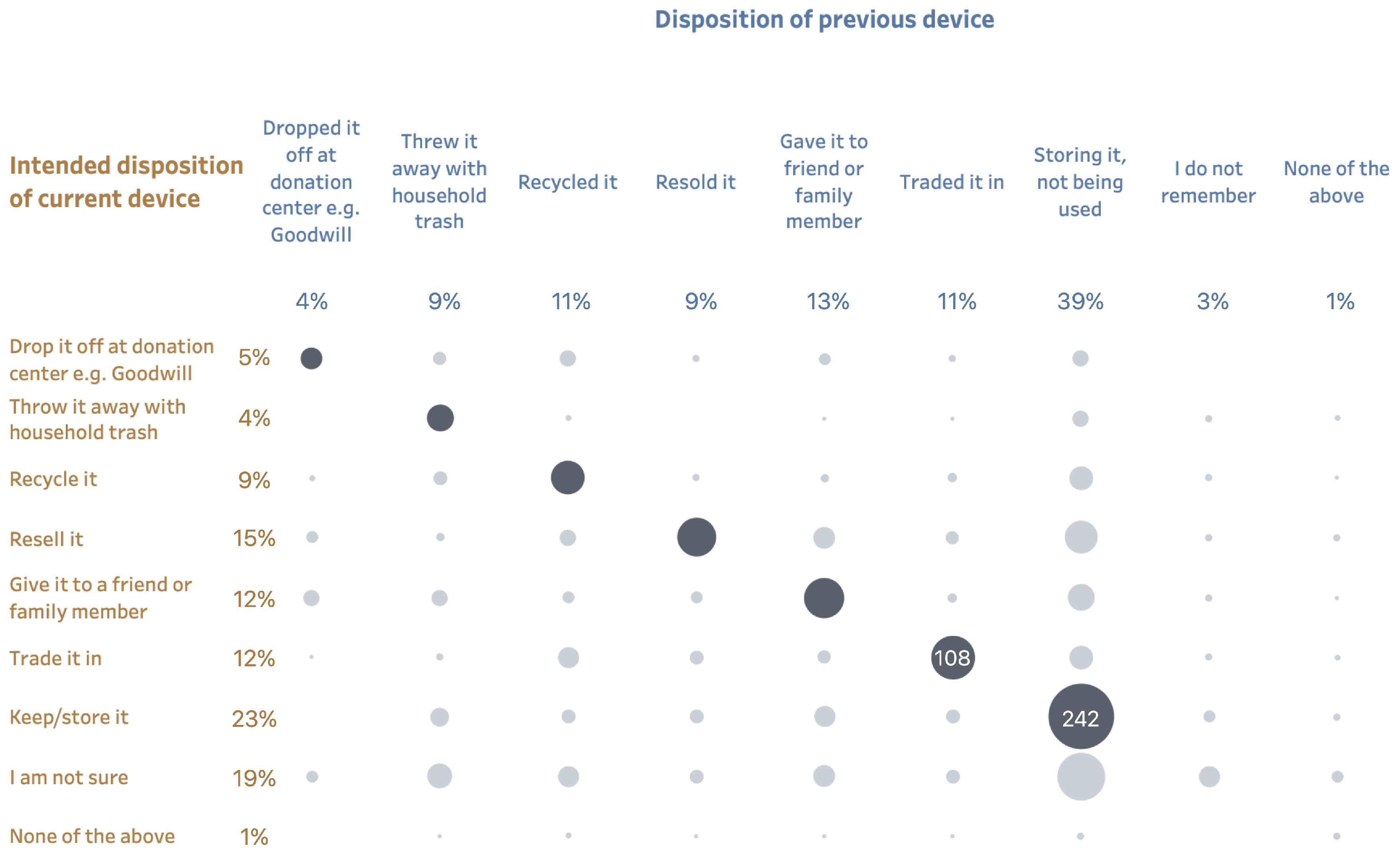
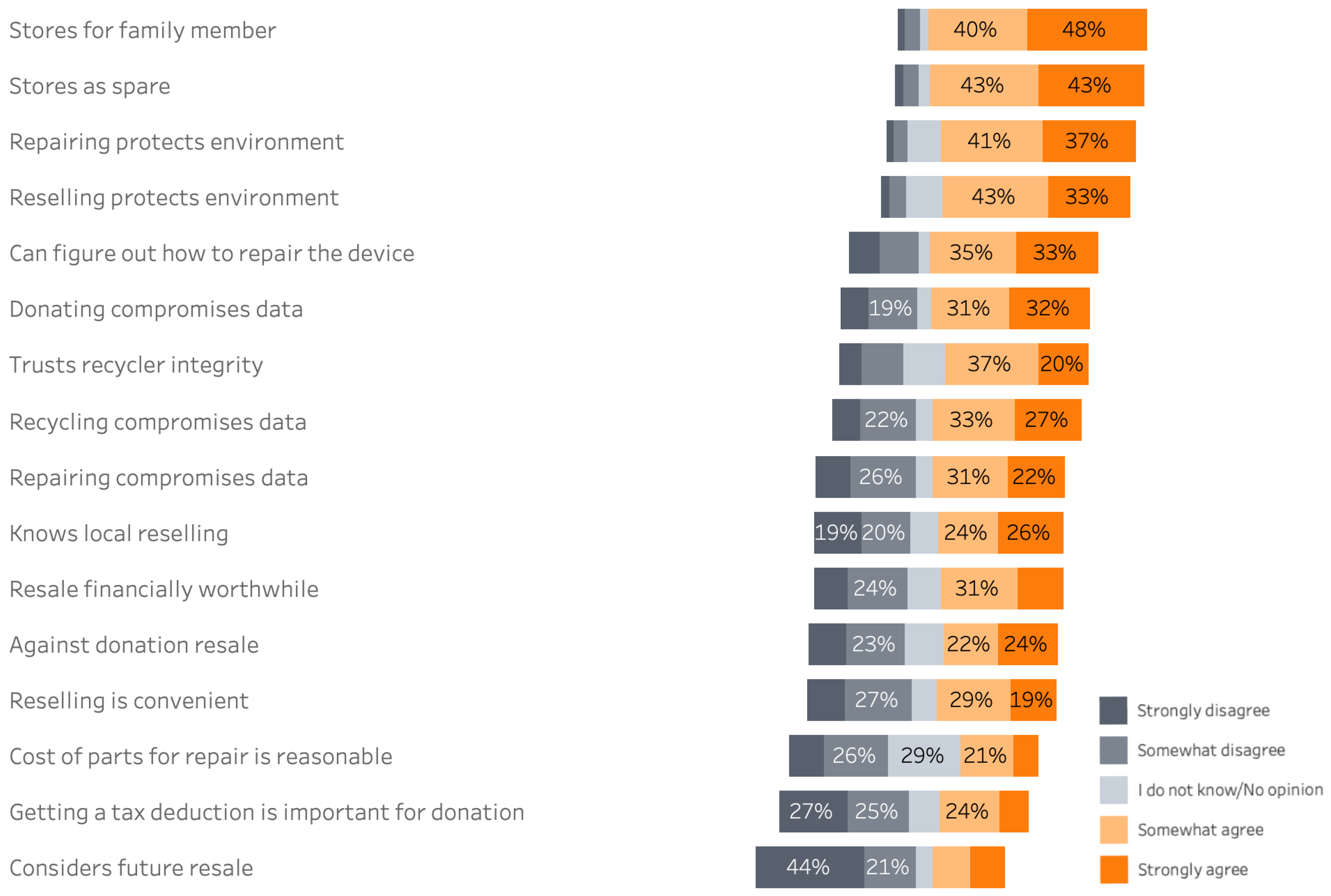
Figure 1 shows the scores assigned to stated attitude and knowledge prompts. Average agreement and disagreement vary by question, with over 75% of respondents believing reselling devices can help protect the environment, while fewer than 40% consider future resale value when purchasing devices. Figure 2 shows the percentage of population engaged in each of the End-of-Current-Use behaviors. A notable gap is observed between consumer intentions and actual behavior: While only 23% of respondents intended to store their devices, 39% actually did so when faced with the real decision, making storage the dominant disposition choice.

3.2. Binomial Logistic Regression: To Store or Not to Store

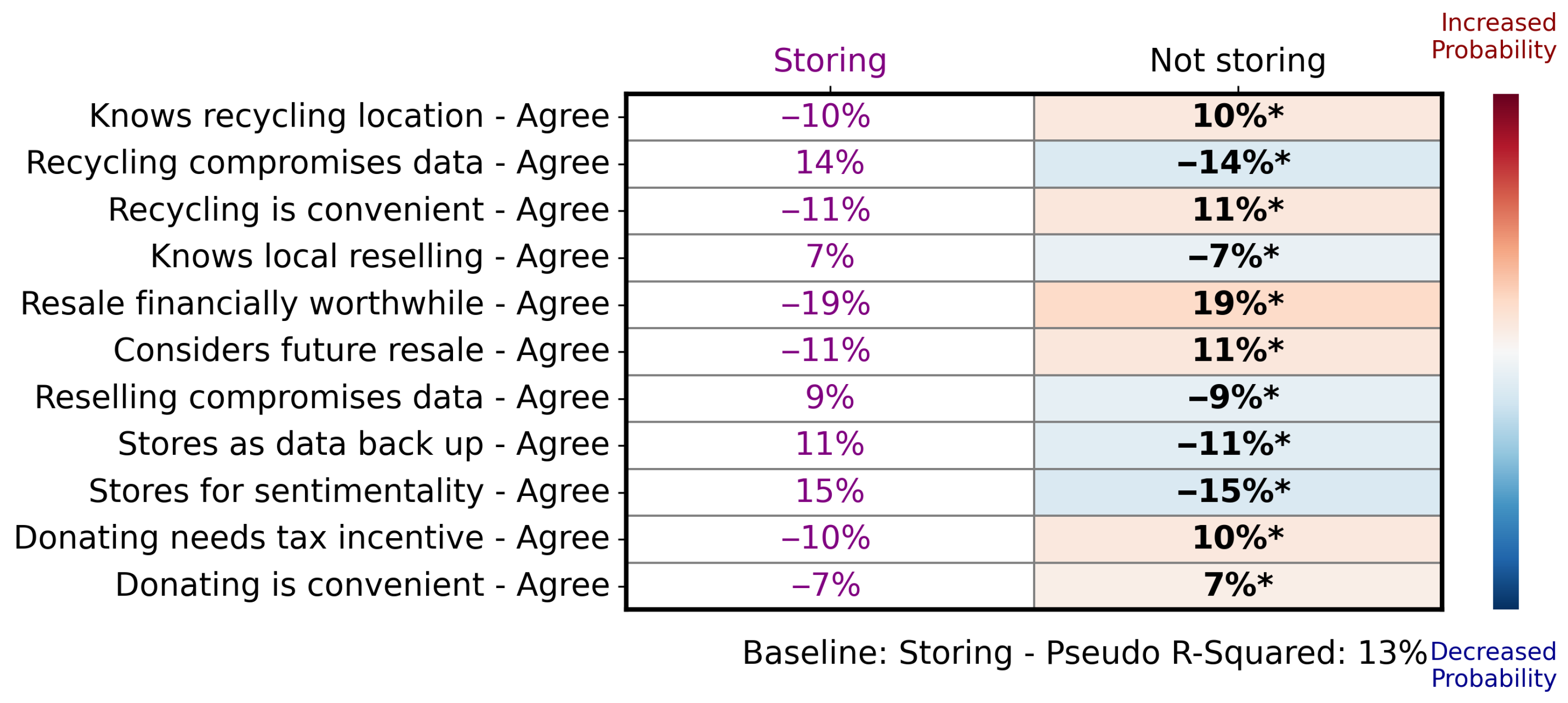
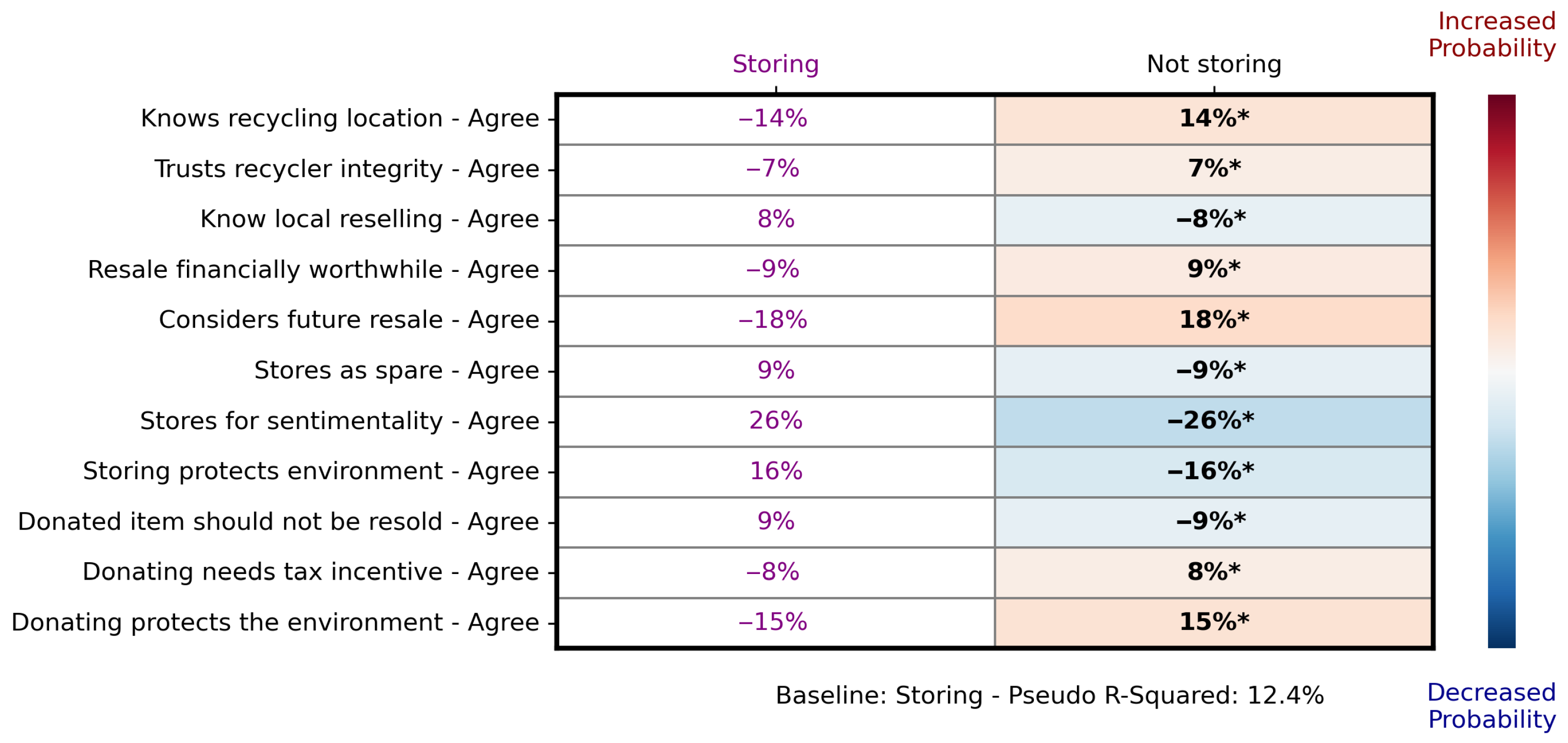
Figure 3 and Figure 4 present and visualize results for the binomial logistic regression model for past and intended behavior respectively. Full regression results, including all coefficients, standard errors, z-statistics, p-values, and 95% confidence intervals, are reported in Supplementary Material Sections S3 and S4.
The cohort for past behavior had prior experience dispositioning a device type, while the cohort for intended behavior did not. The rationale for making this distinction is to explore if experience affects decision-making. As we see in Figure 3, the binomial logistic regression model for past behavior (pseudo R-squared = 13%) reveals sentimental value and data security concerns when recycling or reselling were strong predictors of device storage, while knowledge and trust in recycling programs reduced storage likelihood. In Figure 4 and for consumers without prior disposition experience, the intended behavior model (pseudo R-squared = 12.4%) shows a similar pattern but with a key difference: Data security concerns, which significantly influenced past behavior, were not significant predictors of intended storage decisions. This indicates that consumers place more emphasis on data security when confronted with the actual decision of what to do with a device.
Regression results in estimates of values of β in Equation (1) for each attitude/knowledge dummy variable X. To make results easier to interpret, we find the differential probability associated with each variable:
Change in probability of alternative j favored over the baseline for variable X = P ( j , X = 1 ) P ( j , X = 0 )
where P ( j ) is defined in Equation (1).
The resulting probability changes are marginal effects computed at the reference profile, in which all other binary predictors are set to their baseline value of 0 (disagree/no opinion).
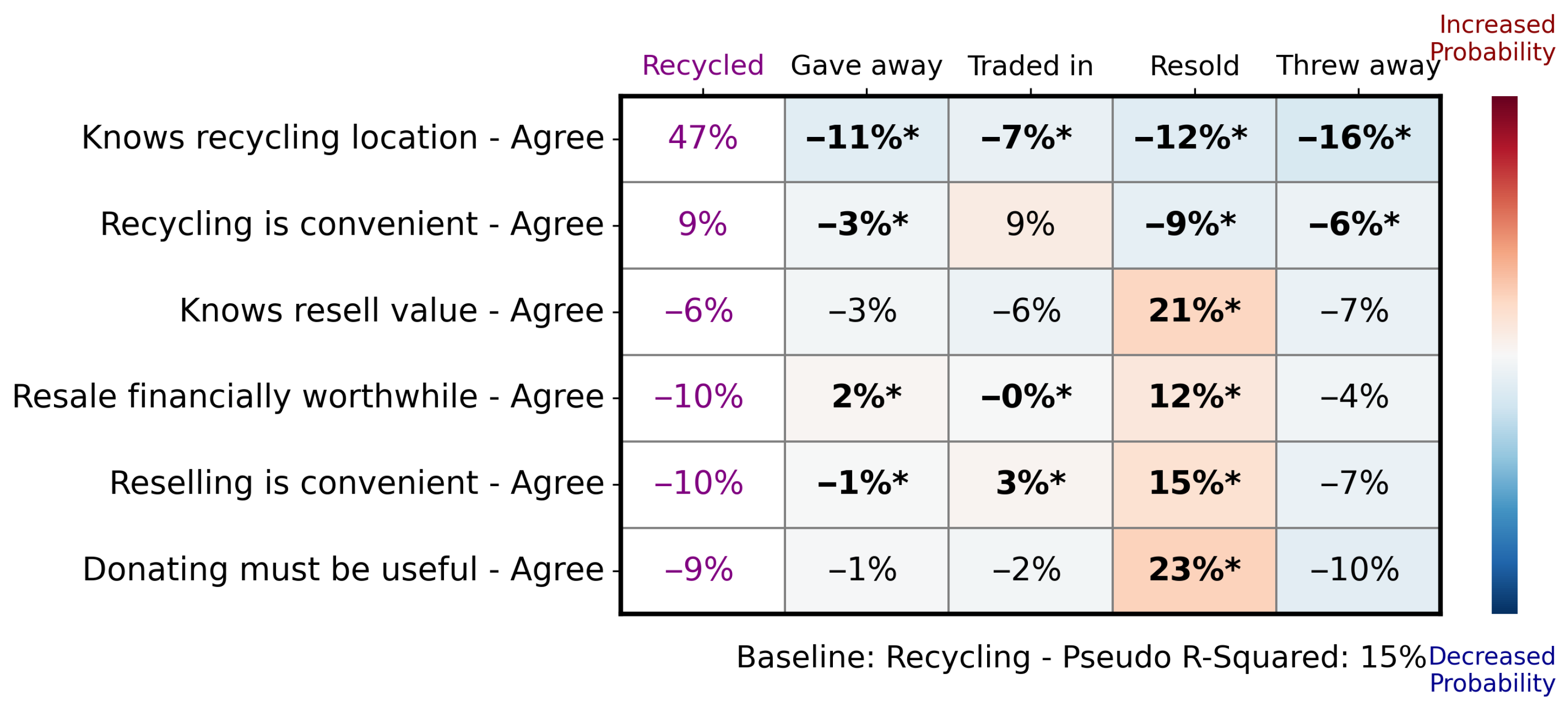
The numbers in Figure 3, Figure 4 and Figure 5 represent percentage point changes in probability. Red font indicates an increased probability of choosing an alternative behavior over baseline, while a blue font reflects an increased probability of choosing the baseline behavior over that alternative. For instance, the red value of “+19%” for “Resale financially worthwhile” indicates that with all other variables held constant, by agreeing that reselling is financially worthwhile, the probability of choosing not storing over storing increases by 19%. Note that concerns over recycling and reselling compromising data security show up as significant for choosing storing as a past behavior, but not for intended behavior.
We posit that consumers take data security more seriously when faced with the reality of giving up a device. This result has implications for future behavioral studies, i.e., risks may be perceived differently for future hypothetical versus actual behavior. The binomial model for store versus not store indicates that knowledge and perceived convenience of recycling are important for the decision not to store. Data security concerns when recycling or reselling and wanting to keep a backup of data contributed to the decision to store. Notably, concern over data during recycling and reselling appears as significant factors affecting reported behavior; however, they are not present in the binomial model for intended behavior. This suggests that concern over data manifests when the decision for disposition has already been made.

3.3. Multinomial Logistic Model: Recycle vs. Give Away, Trade-In, Resell, or Throw Away

Respondents who selected ’Still using it’, ’I do not remember’, or ’None of the above’ were excluded from the multinomial regression for past behavior, as these responses do not represent a disposition decision.
For the population of 833 respondents who dispositioned a device (not Store), we developed a multinomial logistic model to explain which disposition option was chosen, with recycling as a baseline. Results are shown in Figure 5 for how agreeing with knowledge/attitude prompt affects the probability of choosing Give away, Trade in, Resell, or Throw away compared to Recycling. The multinomial logistic regression (pseudo R-squared = 15%) revealed that familiarity with recycling locations emerged as a strong predictor of choosing recycling over all other disposition options. The reselling of devices was strongly influenced by knowledge of how to sell online or in a local store. Note that there is an antagonistic relationship between knowing where to recycle and the likelihood of reselling.

4. Caveats/Assumptions

The analysis presented in this study is subject to several assumptions and limitations that should be acknowledged. First, per using linear regression, a linear relationship is assumed between consumer behavior and the independent variables. It is possible that certain behavioral responses may follow non-linear patterns unaccounted for. Second, any survey is dependent on respondents understanding and responsibly answering questions. To address the consistency of responses, we undertook outlier analysis and quality control measures were implemented during data cleaning, outlined in Supplementary Material Section S2. Third, our model is based on past behaviors and past statements of intended behavior. We assume these past behaviors are linked to possible future ones in interpreting the results. Fourth, we assume that choices are explained by self-declared knowledge/attitudes prompts we selected. There are limitations to this approach, decision-making is not always a “measured” comparison of each choice. For example, storage may be dominant because consumers do not view the choice as important enough to devote time to thinking about it.
The two-stage modeling approach assumes that consumers make the decision to store or not to store separately from choosing among active disposition options. As discussed in Section 2.6, we argue that this sequential structure is a reasonable approximation because 1. Store or Not Store is qualitatively different from other options because it involves the previous decision to engage with disposition or not, and 2. Aggregation of perception of other disposition options can reasonably represent the yes or no decision.
Note that we build behavioral models aggregating all 10 device types and all users. It is very likely that there are behavioral trends within groups of devices, e.g., AR/VR devices are the most resold (31% versus 6% for streaming devices). There could also be subgroups of consumers with common behavioral tendencies. The aggregate models developed here do provide statistically robust results for all devices/consumers, but it could prove useful to explore device and/or consumer group disaggregation.

5. Conclusions

Many U.S. consumers are choosing less sustainable disposition options for End-of-Current-Use electronics: Storage is by far the most popular option, standing at a 39% share for consumers’ past decisions. Storing often has poor outcomes for reuse and data security: After spending years in storage, there is less reuse potential and erasing data is likely difficult. 9% of consumers threw devices away, leading to wasting of product, components and/or materials, as well as potential environmental issues for landfills. 11% were recycled and 9% were resold, ideally these choices would be far more popular. Given the dominance of storage and low levels of recycling and reselling, our results suggest a need for interventions to nudge U.S. consumers towards more sustainable behaviors.
Data security concerns contribute to people storing devices (when faced with actual decision): Concern for data security when recycling or reselling increased chance of storing by 14% and 9% respectively, these variables were significant (p = 1.8 × 10 5 for recycling, p = 0.005 for reselling) for past behavior, but not significant for intended behavior for consumers without prior experience (p = 0.744, for recycling, p = 0.541 for reselling). In general, consumers may be more sensitive to risks associated with the device disposition when faced with the actual decision. There are avenues to intervene to allay data privacy concerns. Manufacturers can work to improve interfaces to guide users through data erasure, more clearly explaining what data is present and more easily enabling erasure. One possibility is an “End-of-Current-Use” app that could be made for any device with a visual user interface. Such an app would guide users through their options to resell, recycle or otherwise disposition a device, including data erasure. Despite the growing importance of data security in our increasingly digital lives, there is a distinct lack of efforts to educate consumers. There are many questions of effectiveness of routes for such education, e.g., formal versus informal, and modes of communication, that should be explored.
Knowledge of recycling and its convenience lead to less storage and more recycling by 47% in the multinomial model: This corroborates prior results showing that knowledge of how to recycle increases the propensity to do so [24,28,53]. Our approach clarifies how other disposition options change, e.g., with knowledge of recycling, recycling increases by 47%, with 11% less giving away, 7% less trading in, 12% less reselling, and 16% less throwing away. The key point is that recycling knowledge does decrease choice of the least sustainable option (throwing away), it also decreases more sustainable ones. Overall, 37% of consumers disagreed with knowing recycling location, suggesting potential for interventions to raise awareness.
Perceiving reselling as worthwhile leads to less storage and more reselling compared to other options: Resale financial worthwhileness is significant in the binomial model. Knowledge of resale value is significant in the multinomial model. Consumers who consider future resale value when purchasing, or consider reselling worthwhile, are less likely to store (−11% and −19% respectively). Greater knowledge of reselling decreases other non-storage options, both throwing away (the least sustainable) and recycling. Reselling is often more sustainable than recycling (assuming the device is ultimately recycled). Curiously, knowledge of local resell markets increases storage (+7%). This might be an artifact of regression, or it could be that this knowledge leads consumers to put off disposition, we do not resolve this question here. Overall, 41% of consumers disagreed with the statement that they know resale value. This suggests prospects for interventions to improve consumer knowledge of resale markets and thus levels of resale.
Future directions: How to best design and implement effective interventions is an important task for future work. Previous work indicates problems with the usability of data wiping for consumer electronics [69], more work is needed to evaluate and improve interfaces. We suggest it is important to undertake Randomized Controlled Trial studies to assess future interventions. Randomized Controlled Trials are increasingly used in development projects, e.g., [70], there is potential to use the approach to improve nudging of sustainable behaviors. Given progress in Artificial Intelligence (AI), it should also be applied to sustainable consumer behavior, e.g., [71]. In the current context, an End-of-Current-Use AI Chatbot could guide consumers through their choices for electronic devices. If nudging should prove insufficient to realize sustainable End-of-Current-Use behavior, financial incentives, such as rebate for resale or recycling, should be explored to understand societal benefits and costs.

Supplementary Materials

The following supporting information can be downloaded at: https://www.mdpi.com/article/10.3390/su18115239/s1.

Author Contributions

P.S.: Conceptualization, Methodology, Software, Formal Analysis, Visualization, Validation, Investigation, Data Curation, Writing—Original Draft, Writing—Review & Editing, Visualization. E.W.: Conceptualization, Visualization, Funding acquisition, Project administration, Supervision, Writing—Review & Editing. S.W.: Conceptualization, Writing—Review & Editing, Supervision. W.C.: Conceptualization, Writing—Review & Editing, Supervision. T.O.: Supervision, Writing—Review & Editing. N.J.: Data Curation, Writing—Review & Editing. All authors have read and agreed to the published version of the manuscript.

Funding

This research was funded by the National Science Foundation Secure & Trustworthy Cyberspace program, grant #2037535.

Institutional Review Board Statement

The study was conducted in accordance with the Declaration of Helsinki, and approved by the Institutional Review Board of Rochester Institute of Technology.

Informed Consent Statement

Informed consent was obtained from all subjects involved in the study.

Data Availability Statement

Data available upon request.

Conflicts of Interest

Author Willie Cade was employed by the company Graceful Solutions. The remaining authors declare that the research was conducted in the absence of any commercial or financial relationship that could be construed as a potential conflict of interest.

References

  1. International Telecommunication Union. Fact and Figures—Mobile Phone Ownership; Technical Report; International Telecommunication Union: Geneva, Switzerland, 2024. [Google Scholar]
  2. Gelles-Watnick, R. Americans’ Use of Mobile Technology, Home Broadband; Pew Research Center: Washington, DC, USA, 2024. [Google Scholar]
  3. Dorsemaine, B.; Gaulier, J.P.; Wary, J.P.; Kheir, N.; Urien, P. Internet of Things: A Definition & Taxonomy. In Proceedings of the 2015 9th International Conference on Next Generation Mobile Applications, Services and Technologies, Cambridge, UK, 9–11 September 2015; pp. 72–77. [Google Scholar] [CrossRef]
  4. Hernandez, R.J.; Miranda, C.; Goñi, J. Empowering Sustainable Consumption by Giving Back to Consumers the ‘Right to Repair’. Sustainability 2020, 12, 850. [Google Scholar] [CrossRef]
  5. Mu, X.; Antwi-Afari, M.F. The applications of Internet of Things (IoT) in industrial management: A science mapping review. Int. J. Prod. Res. 2024, 62, 1928–1952. [Google Scholar] [CrossRef]
  6. Tan, L.; Wang, N. Future internet: The Internet of Things. In Proceedings of the 2010 3rd International Conference on Advanced Computer Theory and Engineering(ICACTE), Chengdu, China, 20–22 August 2010; pp. V5-376–V5-380. [Google Scholar] [CrossRef]
  7. Ystgaard, K.F.; Atzori, L.; Palma, D.; Heegaard, P.E.; Bertheussen, L.E.; Jensen, M.R.; De Moor, K. Review of the theory, principles, and design requirements of human-centric Internet of Things (IoT). J. Ambient. Intell. Humaniz. Comput. 2023, 14, 2827–2859. [Google Scholar] [CrossRef]
  8. IHS Markit. The Internet of Things: A Movement, Not a Market; Technical Report; IHS Markit: London, UK, 2017. [Google Scholar]
  9. UNITAR. The Global E-Waste Monitor 2024—E-Waste Monitor; UNITAR: Geneva, Switzerland, 2024. [Google Scholar]
  10. Jain, M.; Kumar, D.; Chaudhary, J.; Kumar, S.; Sharma, S.; Singh Verma, A. Review on E-waste management and its impact on the environment and society. Waste Manag. Bull. 2023, 1, 34–44. [Google Scholar] [CrossRef]
  11. Williams, E.D.; Ayres, R.U.; Heller, M. The 1.7 Kilogram Microchip: Energy and Material Use in the Production of Semiconductor Devices. Environ. Sci. Technol. 2002, 36, 5504–5510. [Google Scholar] [CrossRef]
  12. Deng, L.; Babbitt, C.W.; Williams, E.D. Economic-balance hybrid LCA extended with uncertainty analysis: Case study of a laptop computer. J. Clean. Prod. 2011, 19, 1198–1206. [Google Scholar] [CrossRef]
  13. Zhao, W.; Xu, J.; Fei, W.; Liu, Z.; He, W.; Li, G. The reuse of electronic components from waste printed circuit boards: A critical review. Environ. Sci. Adv. 2023, 2, 196–214. [Google Scholar] [CrossRef]
  14. Ryan, N.A.; Lin, Y.; Mitchell-Ward, N.; Mathieu, J.L.; Johnson, J.X. Use-Phase Drives Lithium-Ion Battery Life Cycle Environmental Impacts When Used for Frequency Regulation. Environ. Sci. Technol. 2018, 52, 10163–10174. [Google Scholar] [CrossRef]
  15. Warner, J. Understanding Cyber-Crime in Ghana: A View from Below. Int. J. Cyber Criminol. 2011, 5, 736–749. [Google Scholar]
  16. Forgor, L.; Brown-Acquaye, W.; Arthur, J.K.; Owoo, S. Security of Data on E-waste equipment to Africa: The Case of Ghana. In Proceedings of the 2019 International Conference on Communications, Signal Processing and Networks (ICCSPN), Accra, Ghana, 29–31 May 2019; pp. 1–5. [Google Scholar] [CrossRef]
  17. Page, C. Morgan Stanley to Pay $35M After Hard Drives with 15M Customers’ Personal Data Turn Up in Auction; TechCrunch: San Francisco, CA, USA, 2022. [Google Scholar]
  18. Saeedi, P.; Cade, W.; Oh, T.; Watson, S.; Williams, E. Data Wiping Behaviors for End-of-First-Use Electronics: Insights from a survey of U.S. consumers. In Proceedings of the ACM SIGCAS/SIGCHI Conference on Computing and Sustainable Societies, Toronto, ON, Canada, 22–25 July 2025. [Google Scholar] [CrossRef]
  19. Garfinkel, S.; Shelat, A. Remembrance of data passed: A study of disk sanitization practices. IEEE Secur. Priv. 2003, 1, 17–27. [Google Scholar] [CrossRef]
  20. Hanley, D.A.; Kelloway, C.; Vaheesan, S. Fixing America: Breaking Manufacturers’ Aftermarket Monopoly and Restoring Consumers’ Right to Repair; Technical Report; Open Market Institute: Washington, DC, USA, 2020. [Google Scholar]
  21. Mishima, K.; Nishimura, H. Requirement analysis to promote small-sized E-waste collection from consumers. Waste Manag. Res. J. Sustain. Circ. Econ. 2016, 34, 122–128. [Google Scholar] [CrossRef]
  22. Nowakowski, P. Investigating the reasons for storage of WEEE by residents – A potential for removal from households. Waste Manag. 2019, 87, 192–203. [Google Scholar] [CrossRef] [PubMed]
  23. Islam, M.T.; Dias, P.; Huda, N. Waste mobile phones: A survey and analysis of the awareness, consumption and disposal behavior of consumers in Australia. J. Environ. Manag. 2020, 275, 111111. [Google Scholar] [CrossRef]
  24. Islam, M.T.; Dias, P.; Huda, N. Young consumers’ e-waste awareness, consumption, disposal, and recycling behavior: A case study of university students in Sydney, Australia. J. Clean. Prod. 2021, 282, 124490. [Google Scholar] [CrossRef]
  25. Islam, M.T.; Huda, N.; Baumber, A.; Shumon, R.; Zaman, A.; Ali, F.; Hossain, R.; Sahajwalla, V. A global review of consumer behavior towards e-waste and implications for the circular economy. J. Clean. Prod. 2021, 316, 128297. [Google Scholar] [CrossRef]
  26. Gautam, S.; Jain, S. Managing Electronic Waste: A Qualitative Inquiry into the Behaviour of Young Indian Consumers. Glob. Bus. Rev. 2022, 27, 097215092211217. [Google Scholar] [CrossRef]
  27. Miafodzyeva, S.; Brandt, N.; Andersson, M. Recycling behaviour of householders living in multicultural urban area: A case study of Järva, Stockholm, Sweden. Waste Manag. Res. J. Sustain. Circ. Econ. 2013, 31, 447–457. [Google Scholar] [CrossRef]
  28. Nisha, B.; Shajil, S.; Dutta, R.; Jain, T. Consumer awareness and perceptions about e-waste management in semi-urban area of northern Tamil Nadu: A mixed-method approach. J. Fam. Community Med. 2022, 29, 132–137. [Google Scholar] [CrossRef]
  29. Nuwematsiko, R.; Oporia, F.; Nabirye, J.; Halage, A.A.; Musoke, D.; Buregyeya, E. Knowledge, Perceptions, and Practices of Electronic Waste Management among Consumers in Kampala, Uganda. J. Environ. Public Health 2021, 2021, 3846428. [Google Scholar] [CrossRef]
  30. Patali, M.A.; Ngereza, C.G.; Mfinanga, F.A. A Descriptive Analysis of Electronic Waste Management among Electronic Repair Vendors in Mwanza City, Tanzania. Afr. J. Empir. Res. 2024, 5, 315–324. [Google Scholar] [CrossRef]
  31. Zheng, S.; Apthorpe, N.; Chetty, M.; Feamster, N. User Perceptions of Smart Home IoT Privacy. Proc. ACM Hum.-Comput. Interact. 2018, 2, 200. [Google Scholar] [CrossRef]
  32. Abdul Waheed, K.; Singh, A.; Siddiqua, A.; El Gamal, M.; Laeequddin, M. E-Waste Recycling Behavior in the United Arab Emirates: Investigating the Roles of Environmental Consciousness, Cost, and Infrastructure Support. Sustainability 2023, 15, 14365. [Google Scholar] [CrossRef]
  33. Ananno, A.A.; Masud, M.H.; Dabnichki, P.; Mahjabeen, M.; Chowdhury, S.A. Survey and analysis of consumers’ behaviour for electronic waste management in Bangladesh. J. Environ. Manag. 2021, 282, 111943. [Google Scholar] [CrossRef] [PubMed]
  34. Arain, A.; Pummill, R.; Adu-Brimpong, J.; Becker, S.; Green, M.; Ilardi, M.; Van Dam, E.; Neitzel, R. Analysis of e-waste recycling behavior based on survey at a Midwestern US University. Waste Manag. 2020, 105, 119–127. [Google Scholar] [CrossRef]
  35. Bai, H.; Wang, J.; Zeng, A.Z. Exploring Chinese consumers’ attitude and behavior toward smartphone recycling. J. Clean. Prod. 2018, 188, 227–236. [Google Scholar] [CrossRef]
  36. Bhutto, M.Y.; Rūtelionė, A.; Šeinauskienė, B.; Ertz, M. Exploring factors of e-waste recycling intention: The case of generation Y. PLoS ONE 2023, 18, e0287435. [Google Scholar] [CrossRef] [PubMed]
  37. Cairns, C. E-waste and the consumer: Improving options to reduce, reuse and recycle. In Proceedings of the 2005 IEEE International Symposium on Electronics and the Environment, New Orleans, LA, USA, 16–19 May 2005; pp. 237–242. [Google Scholar] [CrossRef]
  38. Chang, Y.S.; Yue, Z.; Qureshi, M.; Rasheed, M.I.; Wu, S.; Peng, M.Y.P. Residents’ waste mobile recycling planned behavior model: The role of environmental concern and risk perception. Int. J. Emerg. Mark. 2023, 18, 6388–6406. [Google Scholar] [CrossRef]
  39. Islam, M.T.; Abdullah, A.; Shahir, S.; Kalam, M.; Masjuki, H.; Shumon, R.; Rashid, M.H. A public survey on knowledge, awareness, attitude and willingness to pay for WEEE management: Case study in Bangladesh. J. Clean. Prod. 2016, 137, 728–740. [Google Scholar] [CrossRef]
  40. Liang, L.; Sharp, A. Determination of the knowledge of e-waste disposal impacts on the environment among different gender and age groups in China, Laos, and Thailand. Waste Manag. Res. J. Sustain. Circ. Econ. 2016, 34, 388–395. [Google Scholar] [CrossRef]
  41. Nik Mohd Munir, N.M.; Abd Hadi Khan, N.F.; Mat Daud, N.I.; Ahmad, N.A.; Mohd, F. Households Intention to Formally Dispose E-waste Using Theory Planned Behavior. Asian J. Prof. Bus. Stud. 2023, 4. [Google Scholar] [CrossRef]
  42. Song, Q.; Wang, Z.; Li, J. Residents’ behaviors, attitudes, and willingness to pay for recycling e-waste in Macau. J. Environ. Manag. 2012, 106, 8–16. [Google Scholar] [CrossRef]
  43. Wang, Z.; Zhang, B.; Yin, J.; Zhang, X. Willingness and behavior towards e-waste recycling for residents in Beijing city, China. J. Clean. Prod. 2011, 19, 977–984. [Google Scholar] [CrossRef]
  44. Zheng, R.; Qiu, M.; Wang, Y.; Zhang, D.; Wang, Z.; Cheng, Y. Identifying the influencing factors and constructing incentive pattern of residents’ waste classification behavior using PCA-logistic regression. Environ. Sci. Pollut. Res. 2022, 30, 17149–17165. [Google Scholar] [CrossRef] [PubMed]
  45. Garg, S.; Ahmad, A.; Madsen, D.Ø.; Sohail, S.S. Sustainable Behavior with Respect to Managing E-Wastes: Factors Influencing E-Waste Management among Young Consumers. Int. J. Environ. Res. Public Health 2023, 20, 801. [Google Scholar] [CrossRef] [PubMed]
  46. Muthukumari, W.A.C.S.; Ahn, J.; Kim, M. Impact of information publicity on Korean residents’ E-waste recycling intentions: Applying the norm activation model and theory of planned behavior. Heliyon 2024, 10, e34319. [Google Scholar] [CrossRef] [PubMed]
  47. Akmal, T.; Jamil, F.; Raza, M.H. Assessing the Household’s Municipal Waste Segregation Intentions in Metropolitan of Twin Cities of Pakistan: A Structural Equation Modeling Approach. Environ. Monit. Assess. 2023, 195, 1207. [Google Scholar] [CrossRef]
  48. Thi Thu Nguyen, H.; Hung, R.J.; Lee, C.H.; Thi Thu Nguyen, H. Determinants of Residents’ E-Waste Recycling Behavioral Intention: A Case Study from Vietnam. Sustainability 2018, 11, 164. [Google Scholar] [CrossRef]
  49. Mohamad, N.S.; Thoo, A.C.; Huam, H.T. The Determinants of Consumers’ E-Waste Recycling Behavior through the Lens of Extended Theory of Planned Behavior. Sustainability 2022, 14, 9031. [Google Scholar] [CrossRef]
  50. Islam, M.T.; Huda, N. E-waste in Australia: Generation estimation and untapped material recovery and revenue potential. J. Clean. Prod. 2019, 237, 117787. [Google Scholar] [CrossRef]
  51. Tan, Q.; Duan, H.; Liu, L.; Yang, J.; Li, J. Rethinking residential consumers’ behavior in discarding obsolete mobile phones in China. J. Clean. Prod. 2018, 195, 1228–1236. [Google Scholar] [CrossRef]
  52. Parajuly, K.; Green, J.; Richter, J.; Johnson, M.; Rückschloss, J.; Peeters, J.; Kuehr, R.; Fitzpatrick, C. Product repair in a circular economy: Exploring public repair behavior from a systems perspective. J. Ind. Ecol. 2024, 28, 74–86. [Google Scholar] [CrossRef]
  53. Saphores, J.D.M.; Ogunseitan, O.A.; Shapiro, A.A. Willingness to engage in a pro-environmental behavior: An analysis of e-waste recycling based on a national survey of U.S. households. Resour. Conserv. Recycl. 2012, 60, 49–63. [Google Scholar] [CrossRef]
  54. Venkitachalam, V.S.; Namboodiri, V.; Joseph, S.; Dee, E.; Burdsal, C.A. What, Why, and How: Surveying what consumers want in new mobile phones. IEEE Consum. Electron. Mag. 2015, 4, 54–59. [Google Scholar] [CrossRef]
  55. Ylä-Mella, J.; Keiski, R.L.; Pongrácz, E. Electronic waste recovery in Finland: Consumers’ perceptions towards recycling and re-use of mobile phones. Waste Manag. 2015, 45, 374–384. [Google Scholar] [CrossRef]
  56. Wieser, H.; Tröger, N. Exploring the inner loops of the circular economy: Replacement, repair, and reuse of mobile phones in Austria. J. Clean. Prod. 2018, 172, 3042–3055. [Google Scholar] [CrossRef]
  57. Ajzen, I. The theory of planned behavior. Organ. Behav. Hum. Decis. Process. 1991, 50, 179–211. [Google Scholar] [CrossRef]
  58. Madden, T.J.; Ellen, P.S.; Ajzen, I. A Comparison of the Theory of Planned Behavior and the Theory of Reasoned Action. Personal. Soc. Psychol. Bull. 1992, 18, 3–9. [Google Scholar] [CrossRef]
  59. Stern, P.C.; Dietz, T.; Abel, T.; Guagnano, G.A.; Kalof, L. A Value-Belief-Norm Theory of Support for Social Movements: The Case of Environmentalism. Hum. Ecol. Rev. 1999, 6, 81–97. [Google Scholar]
  60. Hasnine, M.S.; Habib, K.N. What about the dynamics in daily travel mode choices? A dynamic discrete choice approach for tour-based mode choice modelling. Transp. Policy 2018, 71, 70–80. [Google Scholar] [CrossRef]
  61. Tourangeau, R.; Rips, L.J.; Rasinski, K. The Psychology of Survey Response, 1st ed.; Cambridge University Press: Cambridge, UK, 2000. [Google Scholar] [CrossRef]
  62. Campbell, D.T.; Fiske, D.W. Convergent and discriminant validation by the multitrait-multimethod matrix. Psychol. Bull. 1959, 56, 81–105. [Google Scholar] [CrossRef] [PubMed]
  63. Cronbach, L.J.; Meehl, P.E. Construct validity in psychological tests. Psychol. Bull. 1955, 52, 281–302. [Google Scholar] [CrossRef]
  64. Allen, M.S.; Iliescu, D.; Greiff, S. Single Item Measures in Psychological Science: A Call to Action. Eur. J. Psychol. Assess. 2022, 38, 1–5. [Google Scholar] [CrossRef]
  65. Christophersen, T.; Konradt, U. Reliability, validity, and sensitivity of a single-item measure of online store usability. Int. J. Hum.-Comput. Stud. 2011, 69, 269–280. [Google Scholar] [CrossRef]
  66. Weinschenk, C. Web Article: People Underestimate Number of IoT Devices in Their Homes—Telecompetitor. 2023. Available online: https://www.telecompetitor.com/report-people-underestimate-number-of-iot-devices-in-their-homes/ (accessed on 3 May 2026).
  67. Bourne, D. Electronics Hibernation: Understanding Barriers to Consumer Participation in Electronics Recycling Services; Technical Report; Google: Mountain View, CA, USA, 2021. [Google Scholar]
  68. Yin, J.; Gao, Y.; Xu, H. Survey and analysis of consumers’ behaviour of waste mobile phone recycling in China. J. Clean. Prod. 2014, 65, 517–525. [Google Scholar] [CrossRef]
  69. Chhetri, C.; Genaro Motti, V. User-Centric Privacy Controls for Smart Homes. Proc. ACM Hum.-Comput. Interact. 2022, 6, 349. [Google Scholar] [CrossRef]
  70. Banerjee, A.V.; Duflo, E. Poor Economics: A Radical Rethinking of the Way to Fight Global Poverty, Paperback ed.; PublicAffairs: New York, NY, USA, 2012. [Google Scholar]
  71. Ahmed, U.; Roorda, M.J. Modeling Freight Vehicle Type Choice using Machine Learning and Discrete Choice Methods. Transp. Res. Rec. J. Transp. Res. Board 2022, 2676, 541–552. [Google Scholar] [CrossRef]
Figure 1. Summary breakdown of survey answers, for all respondents, to select questions on stated attitude and knowledge of disposition options, ranked from highest agreement to lowest. Note the highest levels of agreement occur for stored devices have utility, and the highest disagreement for evaluating future resell price when purchasing a device.
Sustainability 18 05239 g001
Figure 2. Survey results, all respondents: Intended future disposition (“What do you intend to do with current device”) versus prior disposition (“What did you do with the previous device”). Note there is a high correlation between intended and past behavior, except that consumers in practice store more often (39%) than they said they intended (23%). Storing is the most popular option for both intended and past behavior. Reselling, recycling and throwing away are all in the range of 4–15% each).
Sustainability 18 05239 g002
Figure 3. Results of binomial logistic regression model, all consumers and devices, past disposition: Change in probability for Store versus Not Store decision attributed to agreeing with knowledge/attitude question (Equation (2)). Explanatory variables take on value of agree (aggregating strongly agree and somewhat agree), No opinion/I don’t know, and disagree (aggregating strongly disagree and somewhat disagree). Only variables with p < 0.05 are shown, values range from <10−3 to 0.032, (*) marks statistical significance of values (See Supplementary Material Section S3 for details.) % values represent the change in probability of making choice (blue = baseline = more likely to store, red = alternative = more likely not to store). The largest factors favoring storing are sentimental value of device, data security concerns when recycling and reselling, and the usefulness of a stored device as a data backup. Factors disfavoring storing are considering resale value, knowing, trusting and finding recycling convenient.
Sustainability 18 05239 g003
Figure 4. Results of binomial logistic regression model, intended disposition, all consumers who did not indicate prior disposition experience, for all devices: Changes in probability for Store versus Not Store choice attributed to agreeing with attitude/knowledge question (Equation (2)). Explanatory variables take on value of agree (aggregating strongly agree and somewhat agree), No opinion/I don’t know, and disagree (aggregating strongly disagree and somewhat disagree). Only variables with p < 0.05 are shown, values range from <10−3 to 0.048, (*) marks statistical significance of values (See Supplementary Material Section S3.), % values represent the change in probability of making choice (blue = baseline = more likely to store, red = alternative = more likely not to store). The largest factors favoring storing are sentimental value of device, data security concerns when recycling and reselling, and the usefulness of a stored device as a data backup. Factors favoring not storing are considering resale value, knowing, trusting, and finding recycling convenient.
Sustainability 18 05239 g004
Figure 5. Results of multinomial logistic regression model, past disposition, all consumers and devices: Changes in probability to Recycle, Give away, Trade in, Resell, and Throw away choice, attributed to agreeing with attitude/knowledge question (Equation (2)). Recycling is the baseline option. Explanatory variables take on value of agree (aggregating strongly agree and somewhat agree), No opinion/I don’t know, and disagree (aggregate strongly disagree and slightly disagree). Significant variables (p < 0.01) are shown in bold and marked with (*), all values are <10−3 (See Supplementary Material Section S4.), % values represent the change in probability of making choice (blue = baseline = more likely to recycle, red = alternative = more likely to engage in the behavior marked at the bottom of the column). The recycling column (shown in purple to distinguish it) is constructed by summing the others. The largest factors favoring recycling are familiarity with recycling location and convenience of recycling. Factors favoring alternative behaviors include perception of resell being worthwhile, its convenience and finding value in reselling.
Sustainability 18 05239 g005
Disclaimer/Publisher’s Note: The statements, opinions and data contained in all publications are solely those of the individual author(s) and contributor(s) and not of MDPI and/or the editor(s). MDPI and/or the editor(s) disclaim responsibility for any injury to people or property resulting from any ideas, methods, instructions or products referred to in the content.