Research on Green Supply Chain Investment Strategies Considering Multi-Dimensional Consumer Preferences and Distrust Under Government Intervention



Abstract
1. Introduction
- (i)
- Can the adoption of blockchain technology incentivize green product manufacturers to allocate more effort toward green production?
- (ii)
- Under different combinations of government intervention policies, which mechanism is optimal for encouraging manufacturers to adopt blockchain technology for green production?
- (iii)
- What are the evolutionary stable strategies (ESS) for the two heterogeneous populations: the government and the green supply chain?
2. Literature Review
2.1. The Application of Blockchain Technology
2.2. Green Supply Chain
2.3. Government Intervention Policies
2.4. Supply Chain Digital Integration and Resilience
2.5. Research Implications and Contributions
- (i)
- First, this study provides a quantitative micro-foundation for how blockchain mitigates information asymmetry in sustainable supply chain operations. While recent literature highlights that blockchain can structurally alleviate information asymmetry to optimize supply chain resource allocation [15], the specific operational boundaries and pricing dynamics of such technological interventions in green markets remain underexplored. Drawing on this premise, our study conceptualizes blockchain as a disruptive mechanism that transitions the supply chain from fragile exogenous signaling (e.g., traditional eco-labels) to immutable structural transparency. By introducing a novel three-dimensional demand function—encompassing consumer green sensitivity, green trust, and price sensitivity—our model mathematically captures the interactive effects of these preferences. This allows us to precisely identify the economic boundaries and market-breaking points triggered by the resolution of information asymmetry, bridging the theoretical framework of blockchain with the analytical rigor of green supply chain governance.
- (ii)
- Breaking away from the idealized assumption that technology adoption is inherently beneficial, this paper mathematically derives and defines the “budget crowding-out effect” of blockchain technology in green production. By explicitly identifying the Empowerment Threshold and the Feasibility Threshold, we uncover the intrinsic economic mechanism through which technology implementation costs erode substantive green R&D investments, offering theoretical support for delineating the structural boundaries of corporate digital transformation.
- (iii)
- Employing evolutionary game theory, we endogenize boundedly rational government entities to construct a long-term co-evolutionary model of composite tax-subsidy policies and supply chain strategic transitions. This dynamic perspective not only overcomes the limitations of static policy assumptions but also provides a systematic governance paradigm for how regulators can leverage flexible policy toolkits to hedge against technological cost risks and guide the green transition of supply chains.

| Articles | SC Structure | Blockchain Technology | Government Intervention Policies | EGT | Consumer Price Sensitivity & Green Trust | Product Greenness |
|---|---|---|---|---|---|---|
| [16] | Two S, One R | Yes | - | - | - | - |
| [13] | One M, One R, One C | Yes | Tax & subsidy | Yes | Yes | Yes |
| [14] | One M, One R | Yes | Tax | - | Yes | Yes |
| [28] | One S, One R | Yes | Subsidy | - | Yes | Yes |
| [40] | One M, One R | Yes | Tax & subsidy | - | - | Yes |
| [43] | Two R | Yes | - | - | - | Yes |
| [48] | One G, One M, One R | Yes | Tax | - | - | Yes |
| [42] | One M, One G | Yes | Tax | - | - | - |
| [45] | One M, One R | - | Tax | - | Yes | Yes |
| [47] | One M, One R | - | Subsidy | - | Yes | - |
| [20] | One S, One R | Yes | - | - | Yes | Yes |
| Our article | One M, One R | Yes | Tax & subsidy | Yes | Yes | Yes |
3. Problem Definition and Stackelberg Model
3.1. Model Without Blockchain
- (i)
- The optimal values of retail price, wholesale price and greenness:
- (ii)
- Optimal values of market demand, manufacturers’ profits and retailers’ profits:
3.2. Model with Blockchain
- (i)
- The optimal values of wholesale price, retail price and greenness:
- (ii)
- The optimal values of market demand and profits are:
- (i)
- The Feasibility Threshold (): When , the manufacturer’s optimal green investment in the blockchain mode drops to zero ().
- (ii)
- The Empowerment Threshold (): There exists a unique threshold strictly satisfying . The blockchain-enabled mode achieves higher product greenness than the traditional mode () if and only if .
- (i)
- (ii)
- and
- (iii)
- and
- (iv)
- and
- (v)
- and .
4. Numerical Simulations and Analysis of the Results
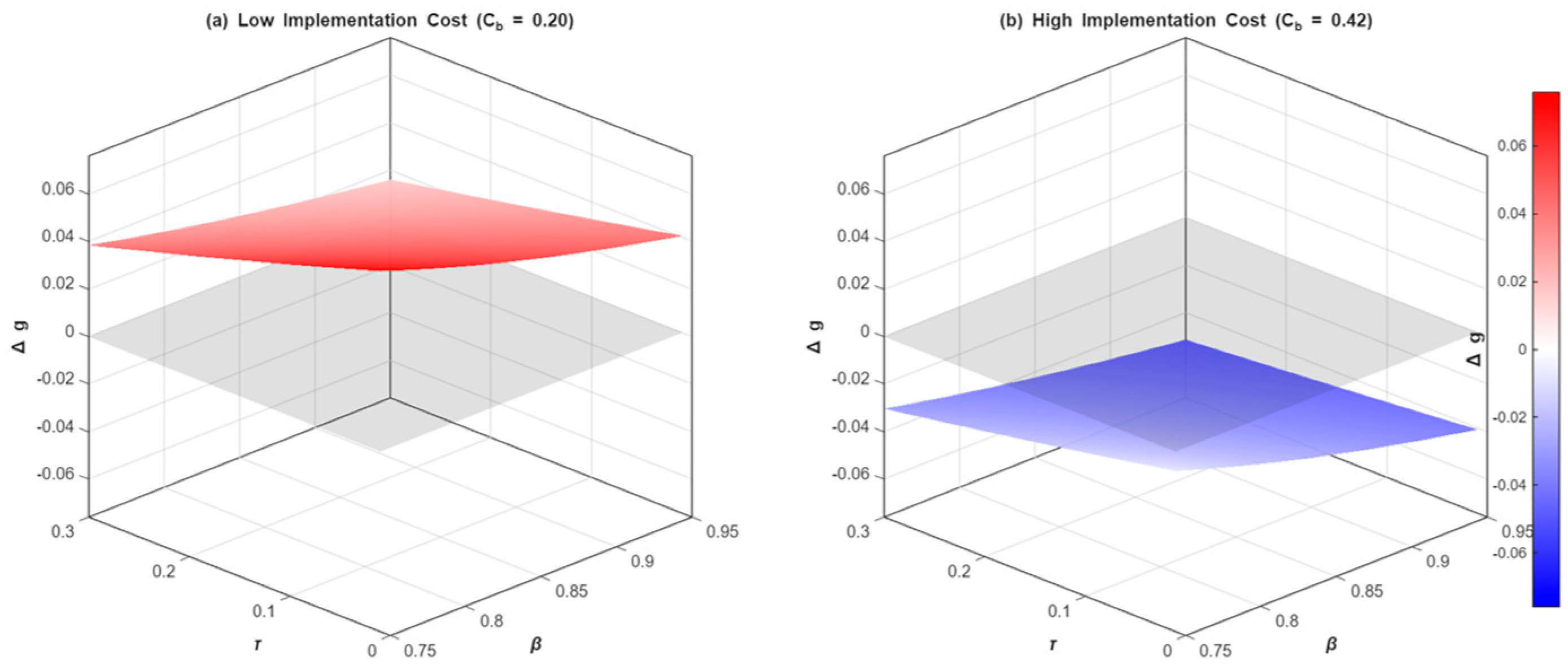
4.1. Analysis of the Impact of Blockchain Implementation Costs on the Greenness Differential
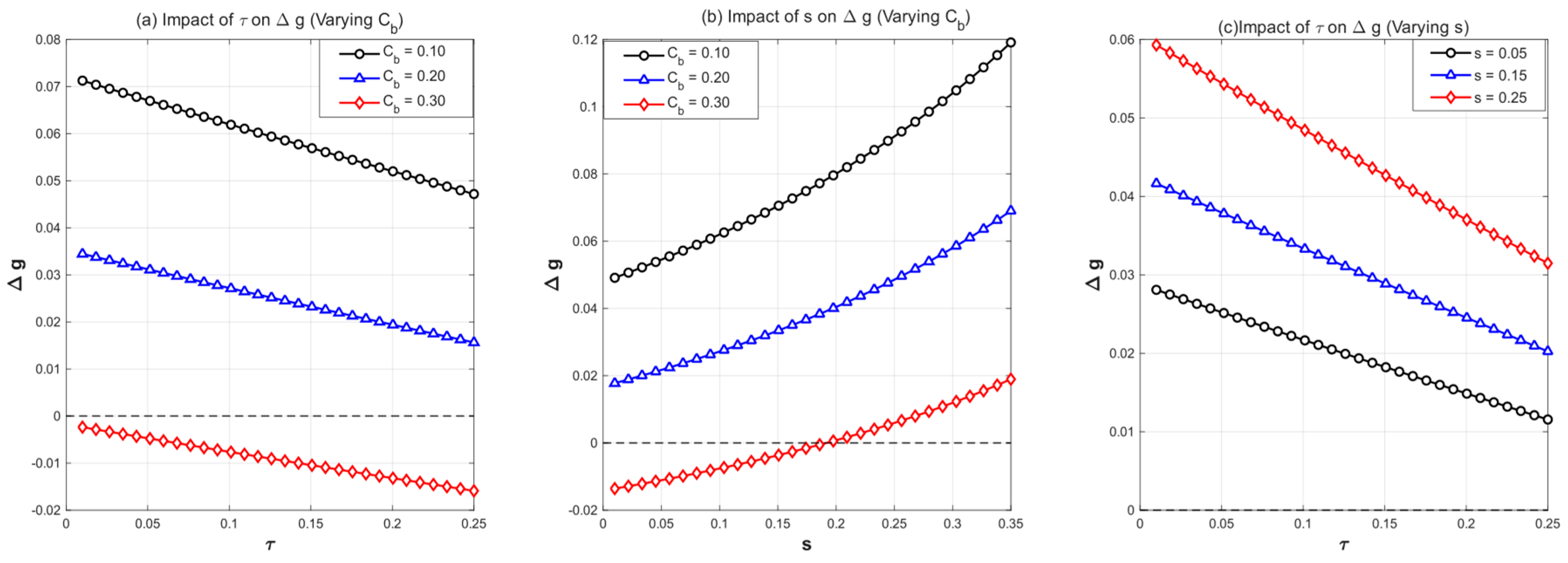
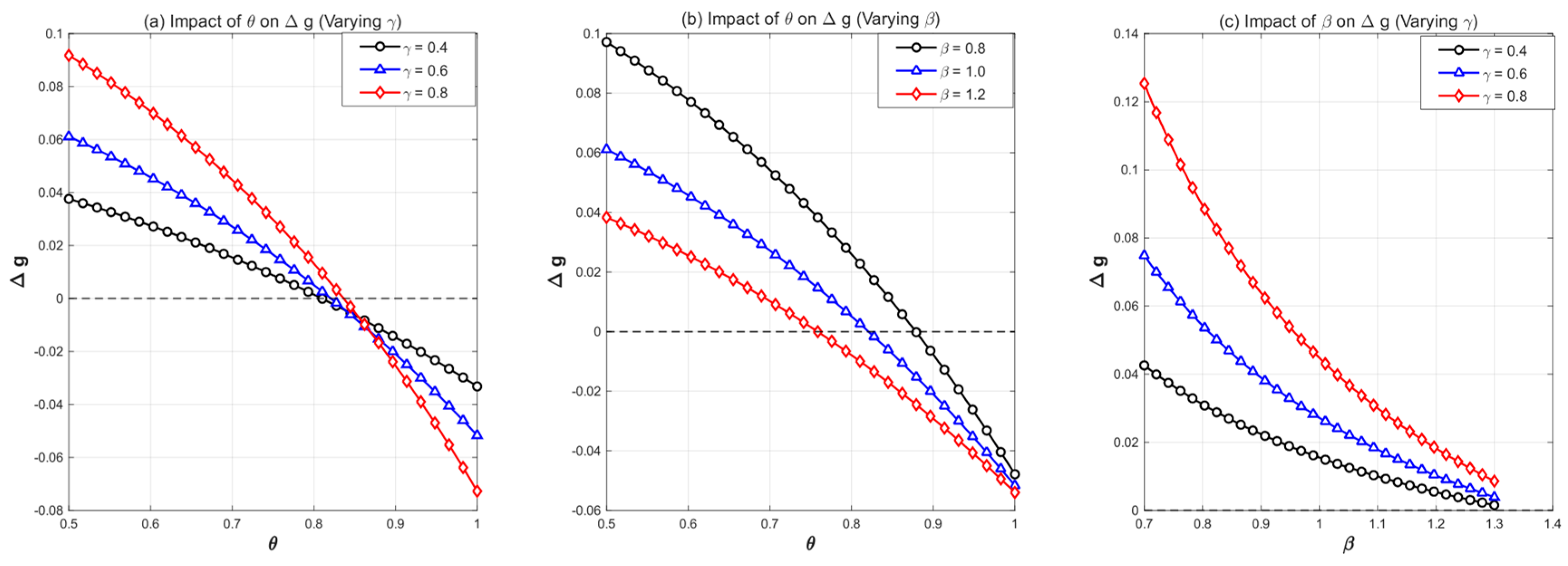
4.2. The Dual Impacts of Consumer Trust, Price Sensitivity, and Green Sensitivity on the Greenness Difference
4.3. The Dual Impact of Environmental Carbon Tax and Government Subsidy Rates on the Greenness Differential
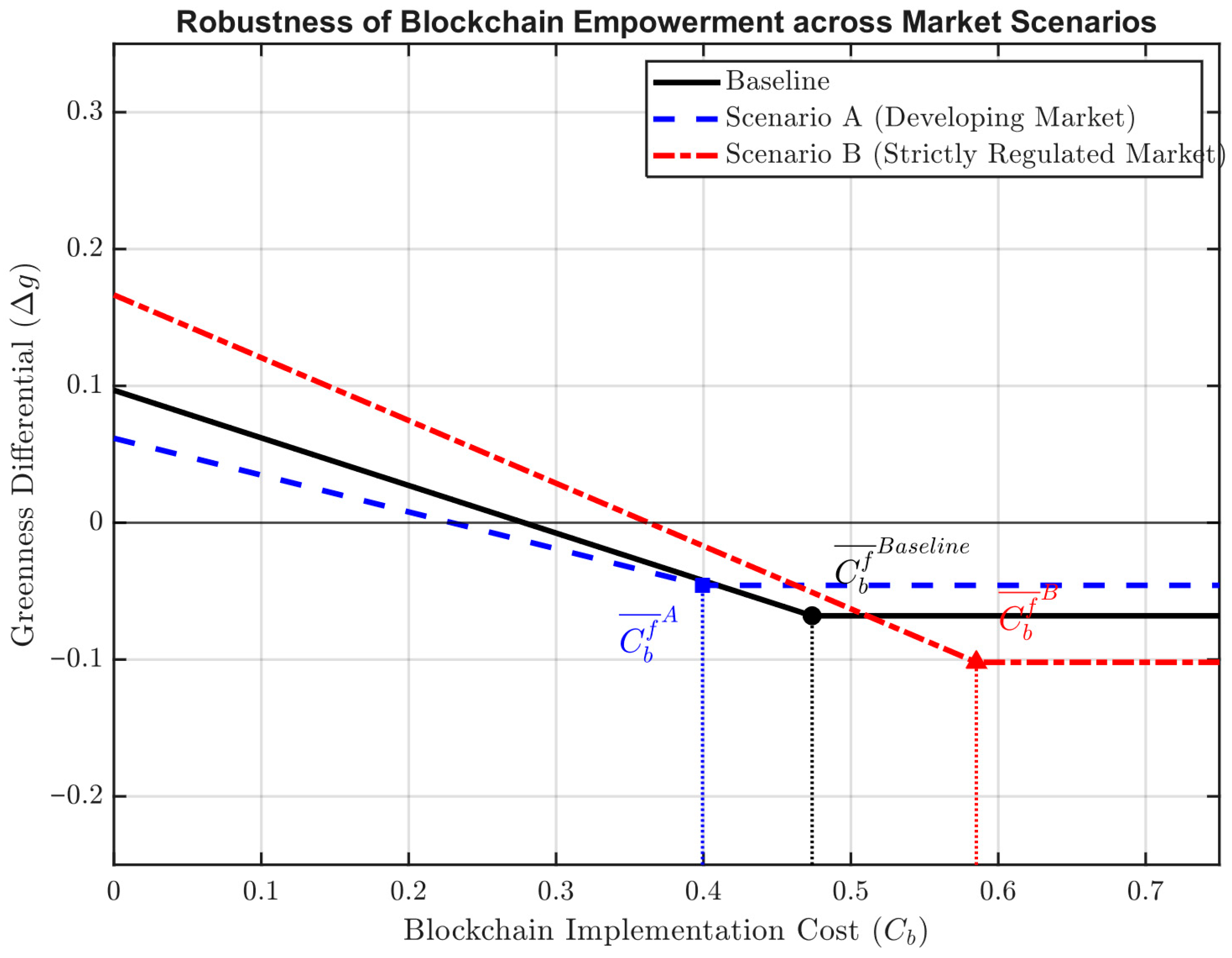
4.4. Robustness Check and Market Heterogeneity Analysis
5. Evolutionary Game Theory Model
5.1. Model Analysis
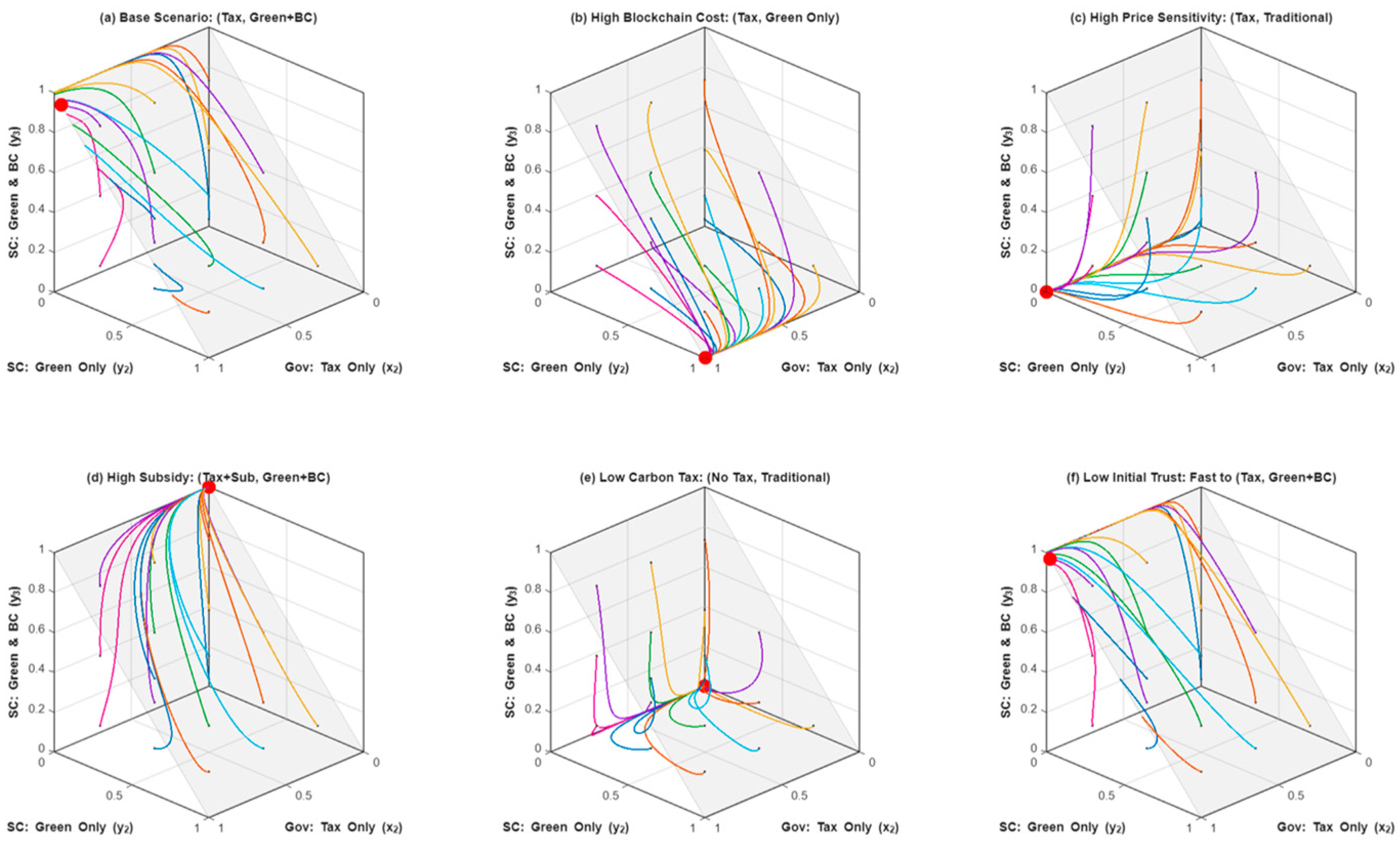
5.2. Numerical Simulation
6. Conclusions
7. Management Implications
7.1. Managerial Implications for Supply Chain Enterprises
7.2. Policy Implications for the Government
8. Limitations and Future Research
Author Contributions
Funding
Institutional Review Board Statement
Informed Consent Statement
Data Availability Statement
Conflicts of Interest
Appendix A. Mathematical Proofs of Each Proposition
- By solving the joint first-order conditions and .
- (1)
- (2)
- □
- The proof procedure for Proposition 3 is strictly analogous to that of Proposition 1; hence, it is omitted here for brevity. □
- To simplify the algebraic expressions, we denote the strictly positive denominators of the optimal greenness in the traditional and blockchain models as and , respectively. The greenness functions can thus be rewritten as:□
- Take the first-order partial derivatives of the critical threshold with respect to the consumer price sensitivity and the tax rate respectively, and the derivation process is as follows:
- To simplify the expression, define the optimal greenness denominators of the traditional model and the blockchain model as respectively and , and the numerator is defined as .
- (i)
- For consumer trust level :
- (ii)
- For consumer price sensitivity: Take the partial derivatives of the difference terms, respectively:
- (iii)
- For the consumer green sensitivity :
- (iv)
- For the government subsidy rate :
- (v)
- For the environmental carbon tax rate :
- According to the evolutionary game stability criterion proposed by Friedman, the sufficient and necessary condition for an equilibrium point to become an Evolutionarily Stable Strategy (ESS) of the system is that all eigenvalues of its Jacobian matrix are strictly negative.
- (1)
- For Case (1):
- (2)
- For Case (2):
References
- Asgari, E.; Hammami, R.; Frein, Y.; Nouira, I. The effect of greenness-and price-based competition on a product’s environmental performance. Int. J. Prod. Econ. 2021, 234, 108062. [Google Scholar] [CrossRef]
- Wang, D.; Dong, H.; Zhang, K. Differential Game of Dynamic Low-Carbon Supply Chain Driven by Block-Chain Technology and Considering Enthusiasm for Emission Reduction. J. Syst. Sci. Math. Sci. 2024, 44, 1412–1431. [Google Scholar] [CrossRef]
- Baksi, S.; Bose, P. Credence Goods, Efficient Labelling Policies, and Regulatory Enforcement. Environ. Resour. Econ. 2007, 37, 411–430. [Google Scholar] [CrossRef]
- European Commission. Screening of Websites for ‘Greenwashing’: Half of Green Claims Lack Evidence. Available online: https://ec.europa.eu/commission/presscorner/detail/en/ip_21_269 (accessed on 5 May 2026).
- Leonidou, C.N.; Skarmeas, D. Gray Shades of Green: Causes and Consequences of Green Skepticism. J. Bus. Ethics 2017, 144, 401–415. [Google Scholar] [CrossRef]
- Yang, D.; Yu, Y.; Feng, Z. Ecolabel Selection Strategy of Environmentally Responsible Manufacturer with Consumer Skepticism Behavior. Chin. J. Manag. Sci. 2023, 31, 73–82. [Google Scholar] [CrossRef]
- Changing Markets Foundation. Synthetics Anonymous: Fashion Brands’ Addiction to Fossil Fuels. Available online: https://changingmarkets.org/report/synthetics-anonymous-fashion-brands-addiction-to-fossil-fuels/ (accessed on 5 May 2026).
- Eaton, C. Throwing Away the Future: How Companies Still Have It Wrong on Plastic Pollution “Solutions”. Available online: https://www.greenpeace.org/usa/how-companies-still-have-it-wrong-on-plastic-pollution-solutions/ (accessed on 5 May 2026).
- JD Digits. 2020 JD Blockchain Technology Practice White Paper. Available online: https://jdcorporateblog.com/wp-content/uploads/2020/10/2020%E4%BA%AC%E4%B8%9C%E5%8C%BA%E5%9D%97%E9%93%BE%E6%8A%80%E6%9C%AF%E5%AE%9E%E8%B7%B5%E7%99%BD%E7%9A%AE%E4%B9%A6.pdf (accessed on 5 May 2026).
- Cao, C.; He, Y.; Liu, Y.; Huang, H.; Zhang, F. Blockchain technology adoption mechanism for semiconductor chip supply chains considering information disclosure under cost-sharing contract. Int. J. Prod. Econ. 2025, 282, 109496. [Google Scholar] [CrossRef]
- Saberi, S.; Kouhizadeh, M.; Sarkis, J.; Shen, L. Blockchain technology and its relationships to sustainable supply chain management. Int. J. Prod. Res. 2019, 57, 2117–2135. [Google Scholar] [CrossRef]
- Liu, K.; Song, H. Contract and incentive mechanism in low-carbon R&D cooperation. Supply Chain Manag. Int. J. 2017, 22, 270–283. [Google Scholar] [CrossRef]
- Sarabi, M.A.; Taleizadeh, A.A.; Bhattacharya, A. Towards blockchain-enabled circular closed-loop supply chain and impact of consumers’ distrust in price, product greenness sensitivity and carbon tax and subsidy. Eur. J. Oper. Res. 2025, 328, 105–121. [Google Scholar] [CrossRef]
- Li, Q.; Ma, M.; Shi, T.; Zhu, C. Green investment in a sustainable supply chain: The role of blockchain and fairness. Transp. Res. Part E Logist. Transp. Rev. 2022, 167, 102908. [Google Scholar] [CrossRef]
- Sun, G.; Xu, D.; Hu, X. Digital Innovation and Supply Chain Financing in China. Digital 2026, 6, 12. [Google Scholar] [CrossRef]
- Naoum-Sawaya, J.; Elhedhli, S.; De Carvalho, P. Strategic blockchain adoption to deter deceptive counterfeiters. Eur. J. Oper. Res. 2023, 311, 373–386. [Google Scholar] [CrossRef]
- Choi, T.-M. Blockchain-technology-supported platforms for diamond authentication and certification in luxury supply chains. Transp. Res. Part E Logist. Transp. Rev. 2019, 128, 17–29. [Google Scholar] [CrossRef]
- Fang, C.; Chi, M.; Fan, S.; Choi, T.-M. Who should invest in blockchain technology under different pricing models in supply chains? Eur. J. Oper. Res. 2024, 319, 777–792. [Google Scholar] [CrossRef]
- Pun, H.; Swaminathan, J.M.; Chen, J.J. Application of blockchain in the secondary market with counterfeiting. Transp. Res. Part E Logist. Transp. Rev. 2025, 197, 104079. [Google Scholar] [CrossRef]
- Awasthy, P.; Haldar, T.; Ghosh, D. Blockchain enabled traceability—An analysis of pricing and traceability effort decisions in supply chains. Eur. J. Oper. Res. 2025, 321, 760–774. [Google Scholar] [CrossRef]
- Liu, L.; Li, F.; Qi, E. Research on risk avoidance and coordination of supply chain subject based on blockchain technology. Sustainability 2019, 11, 2182. [Google Scholar] [CrossRef]
- Babich, V.; Hilary, G. OM Forum—Distributed ledgers and operations: What operations management researchers should know about blockchain technology. Manuf. Serv. Oper. Manag. 2020, 22, 223–240. [Google Scholar] [CrossRef]
- Xu, X.; He, P.; Zhou, L.; Cheng, T. Coordination of a platform-based supply chain in the marketplace or reselling mode considering cross-channel effect and blockchain technology. Eur. J. Oper. Res. 2023, 309, 170–187. [Google Scholar] [CrossRef]
- Shen, X.; Dai, L. Coordination of Blockchain Adoption and Sales Mode for Green Products. Chin. J. Manag. Sci. 2024; early access. [CrossRef]
- Wei, G.; Yang, C.; Li, X. Selection Strategies of Low-Carbon E-CLSC Sales Mode Under the Introduction of Blockchain Technology. J. Syst. Sci. Math. Sci. 2025, 45, 3047–3075. [Google Scholar] [CrossRef]
- Zhang, L.; Wang, F.; Liu, X. Research on Emission Reduction Decision-Making of Dual-Product Low-Carbon Supply Chain Under Carbon Trading and Blockchain Technology. J. Ind. Eng. Eng. Manag. 2025, 39, 239–250. [Google Scholar] [CrossRef]
- Biswas, D.; Jalali, H.; Ansaripoor, A.H.; De Giovanni, P. Traceability vs. sustainability in supply chains: The implications of blockchain. Eur. J. Oper. Res. 2023, 305, 128–147. [Google Scholar] [CrossRef]
- Cao, Y.; Yi, C.; Wan, G.; Hu, H.; Li, Q.; Wang, S. An analysis on the role of blockchain-based platforms in agricultural supply chains. Transp. Res. Part E Logist. Transp. Rev. 2022, 163, 102731. [Google Scholar] [CrossRef]
- Cheng, F.; Chen, T.; Shen, Y.; Jing, X. Impact of green technology improvement and store brand introduction on the sales mode selection. Int. J. Prod. Econ. 2022, 253, 108587. [Google Scholar] [CrossRef]
- Guo, X.; Cheng, L.; Liu, J. Green supply chain contracts with eco-labels issued by the sales platform: Profitability and environmental implications. Int. J. Prod. Res. 2020, 58, 1485–1504. [Google Scholar] [CrossRef]
- Zhang, C.-T.; Liu, L.-P. Research on coordination mechanism in three-level green supply chain under non-cooperative game. Appl. Math. Model. 2013, 37, 3369–3379. [Google Scholar] [CrossRef]
- Song, H.; Gao, X. Green supply chain game model and analysis under revenue-sharing contract. J. Clean. Prod. 2018, 170, 183–192. [Google Scholar] [CrossRef]
- Jiang, S.; Li, S. Green Supply Chain Game Models and Revenue Sharing Contract with Product Green Degree. Chin. J. Manag. Sci. 2015, 23, 169–176. [Google Scholar] [CrossRef]
- Xie, G.; Wang, S.; Lai, K.K. Quality improvement in competing supply chains. Int. J. Prod. Econ. 2011, 134, 262–270. [Google Scholar] [CrossRef]
- Liu, Z.L.; Anderson, T.D.; Cruz, J.M. Consumer environmental awareness and competition in two-stage supply chains. Eur. J. Oper. Res. 2012, 218, 602–613. [Google Scholar] [CrossRef]
- Hafezalkotob, A. Competition, cooperation, and coopetition of green supply chains under regulations on energy saving levels. Transp. Res. Part E Logist. Transp. Rev. 2017, 97, 228–250. [Google Scholar] [CrossRef]
- Xiong, F.; Wei, Y.; Wang, Q.; Li, Z.; Shao, L. Study on Pricing and Green Input Decision of Dual-channel Green Supply Chain Based on Risk Aversion of Members. Chin. J. Manag. Sci. 2022, 30, 267–276. [Google Scholar] [CrossRef]
- Malladi, K.T.; Sowlati, T. Impact of carbon pricing policies on the cost and emission of the biomass supply chain: Optimization models and a case study. Appl. Energy 2020, 267, 115069. [Google Scholar] [CrossRef]
- Chen, W.; Hu, Z.-H. Using evolutionary game theory to study governments and manufacturers’ behavioral strategies under various carbon taxes and subsidies. J. Clean. Prod. 2018, 201, 123–141. [Google Scholar] [CrossRef]
- Choi, T.-M.; Luo, S. Data quality challenges for sustainable fashion supply chain operations in emerging markets: Roles of blockchain, government sponsors and environment taxes. Transp. Res. Part E Logist. Transp. Rev. 2019, 131, 139–152. [Google Scholar] [CrossRef]
- Liu, Z.; Yang, T.; Xia, X.; Hu, B. Research on the introduction strategy of blockchain considering consumer demand under carbon tax policy. Chin. J. Manag. Sci. 2026; early access. [CrossRef]
- Miao, Z.; Mao, H.; Fu, K.; Wang, Y. Remanufacturing with trade-ins under carbon regulations. Comput. Oper. Res. 2018, 89, 253–268. [Google Scholar] [CrossRef]
- Zhang, N.; Zhang, Z. Manufacturer or retailer? The optimal remanufacturing channel choice under carbon tax policy. J. Ind. Manag. Optim. 2025, 21, 3362–3392. [Google Scholar] [CrossRef]
- Yang, D.; Xiao, T. Pricing and green level decisions of a green supply chain with governmental interventions under fuzzy uncertainties. J. Clean. Prod. 2017, 149, 1174–1187. [Google Scholar] [CrossRef]
- Cao, Y.; Xun, J.; Li, Q. A Comparative Study of Green Efforts in Supply Chain Based on Different Government Subsidy Strategies. Oper. Res. Manag. Sci. 2020, 29, 108–118. Available online: https://kns.cnki.net/kcms2/article/abstract?v=iO0L29morZl_yIRrUM4Vb_zaAybwHF27trHa1gCzLUv7c0mfYkEFtN-9jklobF6qZ-Z3q-TibIqDWVwuHFqoisEyTmf2bjTdI9ecY7p2jtcaKp6-iKiRAvvForl2T70BJEx-GhVnSFITiZCUtWNZrJH65YhxN23zZrlTOkFrh_aRn12yGkYdiqEFptYta18g&uniplatform=NZKPT&language=CHS (accessed on 5 May 2026).
- Wen, X.; Cheng, H.; Cai, J.; Lu, C. Government Subside Policies and Effect Analysis in Green Supply Chain. Chin. J. Manag. Sci. 2018, 15, 625–632. [Google Scholar] [CrossRef]
- Feng, Y.; Wang, M.; Zhang, Y.; Feng, C. The government subsidy mechanism in a green supply chain with the manufacturer assuming social responsibility. J. Ind. Eng./Eng. Manag. 2022, 36, 156–167. [Google Scholar] [CrossRef]
- Chen, S.; Su, J.; Wu, Y.; Zhou, F. Optimal production and subsidy rate considering dynamic consumer green perception under different government subsidy orientations. Comput. Ind. Eng. 2022, 168, 108073. [Google Scholar] [CrossRef]
- Zeng, Y.; Sheng, L.; Wu, J. Construction and Optimization of Green Closed-loop Supply Chain Based on Government Subsidies. Math. Pract. Theory 2023, 53, 26–36. [Google Scholar] [CrossRef]
- Singh, P. Measuring the Broader Value Proposition of Digital Transformation in Supply Chains. Int. J. Supply Chain Manag. 2024, 13, 16–24. [Google Scholar] [CrossRef]
- Wang, H. Supply Chain Digital Integration and Operational Resilience: An Empirical Study Based on Matched Data Between Manufacturing and Logistics Firms in Central and Eastern Europe. Int. Sci. Tech. Econ. Res. 2026, 4, 23–46. [Google Scholar] [CrossRef]
- Liu, P.; Long, Y.; Song, H.-C.; He, Y.-D. Investment decision and coordination of green agri-food supply chain considering information service based on blockchain and big data. J. Clean. Prod. 2020, 277, 123646. [Google Scholar] [CrossRef]
- Li, J.; Li, Y.; Liu, L.; Xue, K. Mechanism decisions to encourage product eco-design implemented by green supply chain enterprises. Syst. Eng.-Theory Pract. 2019, 39, 2287–2299. [Google Scholar] [CrossRef]
- Gleim, M.R.; Smith, J.S.; Andrews, D.; Cronin, J.J. Against the Green: A Multi-method Examination of the Barriers to Green Consumption. J. Retail. 2013, 89, 44–61. [Google Scholar] [CrossRef]
- Deselnicu, O.C.; Costanigro, M.; Souza-Monteiro, D.M.; McFadden, D.T. A Meta-Analysis of Geographical Indication Food Valuation Studies: What Drives the Premium for Origin-Based Labels? J. Agric. Resour. Econ. 2013, 38, 204–219. [Google Scholar]
- Song, Y.; Liu, J.; Zhang, W.; Li, J. Blockchain’s role in e-commerce sellers’ decision-making on information disclosure under competition. Ann. Oper. Res. 2023, 329, 1009–1048. [Google Scholar] [CrossRef]
- Tian, L.; Vakharia, A.J.; Tan, Y.; Xu, Y. Marketplace, Reseller, or Hybrid: Strategic Analysis of an Emerging E-Commerce Model. Prod. Oper. Manag. 2018, 27, 1595–1610. [Google Scholar] [CrossRef]
- Ghosh, D.; Shah, J. A comparative analysis of greening policies across supply chain structures. Int. J. Prod. Econ. 2012, 135, 568–583. [Google Scholar] [CrossRef]
- Wu, L.; Wang, H.; Zhu, D.; Hu, W.; Wang, S. Chinese consumers’ willingness to pay for pork traceability information—The case of Wuxi. Agric. Econ. 2016, 47, 71–79. [Google Scholar] [CrossRef]
- Niu, B.; Dong, J.; Liu, Y. Incentive alignment for blockchain adoption in medicine supply chains. Transp. Res. Part E Logist. Transp. Rev. 2021, 152, 102276. [Google Scholar] [CrossRef]
- Shen, T.; Cai, Y.; Liu, L. Green supply chain with strategic retailers: Transportation-based carbon penalty. Energy Econ. 2025, 145, 108411. [Google Scholar] [CrossRef]
- Krass, D.; Nedorezov, T.; Ovchinnikov, A. Environmental Taxes and the Choice of Green Technology. Prod. Oper. Manag. 2013, 22, 1035–1055. [Google Scholar] [CrossRef]
- Trinks, A.; Hille, E. Carbon costs and industrial firm performance: Evidence from international microdata. Energy Econ. 2026, 153, 109077. [Google Scholar] [CrossRef]
- Lehmann, P. Justifying a Policy Mix for Pollution Control: A Review of Economic Literature. J. Econ. Surv. 2012, 26, 71–97. [Google Scholar] [CrossRef]
- Skjærseth, J.B. Towards a European Green Deal: The evolution of EU climate and energy policy mixes. Int. Environ. Agreem. Politics Law Econ. 2021, 21, 25–41. [Google Scholar] [CrossRef]
- Friedman, D. Evolutionary games in economics. Econom. J. Econom. Soc. 1991, 59, 637–666. [Google Scholar] [CrossRef]
- Routh, E.J. A Treatise on the Stability of a Given State of Motion, Particularly Steady Motion, Being the Essay to Which the Adams Prize Was Adjudged in 1877, in the University of Cambridge; Macmillan and Company: London, UK, 1877. [Google Scholar]


| Category | Symbol | Definition |
|---|---|---|
| Indices | Index for the supply chain scenario ( denotes the scenario without blockchain; denotes the blockchain adoption scenario) | |
| Index for the supply chain member ( denotes the manufacturer; denotes the retailer) | ||
| Parameters | Consumer’s price sensitivity coefficient | |
| Consumer’s green sensitivity coefficient | ||
| Consumer’s trust level regarding product greenness | ||
| Product greenness level | ||
| Carbon tax rate | ||
| Government subsidy rate for green investment cost | ||
| Unit cost of blockchain implementation | ||
| Environmental benefits accrued to the government when the supply chain invests solely in green production (), or simultaneously in green production and blockchain technology () | ||
| Decision variables | Retail price of the product in scenario | |
| Manufacturer’s green investment level in scenario | ||
| Wholesale price of the product in scenario | ||
| Dependent variables | Market demand in scenario | |
| Profit function of member in scenario | ||
| Optimal profit of member under equilibrium in scenario |
| Supply Chain | ||||
|---|---|---|---|---|
| Payoff | Conventional Production (y1) | Green Production (y2) | Green Production with Blockchain (1 − y1 − y2) | |
| Government | Neither tax nor subsidy (x1) | , | , | , |
| Taxation (x2) | , | , | , | |
| Taxation and subsidy (1 − x1 − x2) | , | , | , | |
| Equilibrium Point | Tr J < 0 | Det J > 0 |
|---|---|---|
Disclaimer/Publisher’s Note: The statements, opinions and data contained in all publications are solely those of the individual author(s) and contributor(s) and not of MDPI and/or the editor(s). MDPI and/or the editor(s) disclaim responsibility for any injury to people or property resulting from any ideas, methods, instructions or products referred to in the content. |
© 2026 by the authors. Licensee MDPI, Basel, Switzerland. This article is an open access article distributed under the terms and conditions of the Creative Commons Attribution (CC BY) license.
Share and Cite
Zhang, R.; Liu, C. Research on Green Supply Chain Investment Strategies Considering Multi-Dimensional Consumer Preferences and Distrust Under Government Intervention. Sustainability 2026, 18, 5236. https://doi.org/10.3390/su18115236
Zhang R, Liu C. Research on Green Supply Chain Investment Strategies Considering Multi-Dimensional Consumer Preferences and Distrust Under Government Intervention. Sustainability. 2026; 18(11):5236. https://doi.org/10.3390/su18115236
Chicago/Turabian StyleZhang, Ruijie, and Chao Liu. 2026. "Research on Green Supply Chain Investment Strategies Considering Multi-Dimensional Consumer Preferences and Distrust Under Government Intervention" Sustainability 18, no. 11: 5236. https://doi.org/10.3390/su18115236
APA StyleZhang, R., & Liu, C. (2026). Research on Green Supply Chain Investment Strategies Considering Multi-Dimensional Consumer Preferences and Distrust Under Government Intervention. Sustainability, 18(11), 5236. https://doi.org/10.3390/su18115236