1. Introduction
Landslides are among the most consequential geodynamic hazards worldwide, causing human casualties, infrastructure damage, and substantial economic losses. Their occurrence is not limited to inherently unstable terrains; rather, the combined effects of intense rainfall, seismic activity, land-use change, and unplanned urban expansion have progressively increased the exposure of vulnerable communities, particularly in developing countries with complex topography. In this context, sustainable geohazard risk management has become a critical challenge for territorial planning, land management, and urban resilience at both regional and global scales.
In the South American Andes, steep relief and marked rainfall seasonality create conditions highly favorable to mass movements. Ecuador, owing to its location along the Andean Cordillera, records one of the highest landslide frequencies on the continent, with precipitation, seismic activity, and deforestation acting as major triggering factors. Within this setting, the city of Loja in southern Ecuador represents a particularly relevant case study. Located in an intermontane depression at approximately 2150 m a.s.l., Loja is characterized by steep slopes, geotechnically sensitive soils, annual rainfall concentrated between December and April, and sustained urban growth over unstable hillsides. These conditions have resulted in documented landslides affecting housing, road infrastructure, and local economic activity, highlighting the need for technically effective and environmentally sustainable hillside management strategies.
Conventional slope stabilization techniques, including retaining structures, anchors, and mechanical ground improvement, are often technically effective but commonly involve high construction costs, considerable environmental disturbance, and limited ecological integration. Soil bioengineering offers a more sustainable alternative by combining geotechnical principles with the use of living vegetation. Through root reinforcement, vegetation can increase soil shear strength, improve near-surface drainage, and contribute to erosion control, while also providing ecological and landscape benefits. For this reason, vegetation-based slope stabilization is increasingly aligned with the broader framework of Nature-based Solutions (NbSs), which promotes the use of natural processes to address environmental and societal challenges in an integrated manner. In this sense, vegetation-based stabilization may also be understood as a low-impact measure that can support sustainable land management in urban and peri-urban hillside environments.
Among plant species with recognized geotechnical potential, vetiver grass (
Chrysopogon zizanioides) is one of the most widely cited for slope stabilization in tropical and subtropical environments. Its dense, deep, and predominantly vertical root system enables mechanical reinforcement of the soil matrix and may substantially modify key shear strength parameters, particularly effective cohesion (
c′) and internal friction angle (
φ′), thereby influencing the factor of safety (FS) of a slope. Recent studies have shown that rainfall-induced landslides, earthquake-triggered slope failures, urban expansion over unstable terrain, local land-use planning constraints, landslide susceptibility assessment, soil bioengineering strategies, and computational/numerical modelling are key components for understanding and mitigating slope instability in mountainous and urban environments [
1,
2,
3,
4,
5,
6,
7,
8,
9,
10,
11,
12,
13,
14,
15,
16,
17]. The theoretical basis for this reinforcement mechanism was established by Waldron [
18] and Wu et al. [
19], who demonstrated that root-permeated soil exhibits increased shear resistance through tensile load transfer across potential failure planes, providing the foundational framework for later root reinforcement models in soil bioengineering.
The present study addresses this gap through an integrated laboratory and numerical modeling approach. A reduced-scale physical model with vetiver grass was developed using two representative soils from Loja, namely sandy silt (SM) and sandy clay (SC). Consolidated–drained direct shear tests were conducted on bare and vetiver-reinforced specimens to determine the corresponding shear strength parameters. These parameters were subsequently incorporated into numerical slope stability analyses carried out in Slide and PLAXIS 2D, considering three slope inclinations (30°, 45°, and 50°), six root-positioning configurations, and hydraulic conditions with and without a water table.
Accordingly, the objectives of this study are to quantify the effect of vetiver root reinforcement on soil shear strength through laboratory testing; to evaluate the influence of slope geometry, root position, and hydraulic condition on slope stability through numerical modeling; and to assess the consistency of the model response under controlled parametric variation. Through this framework, the study aims to examine the potential of vetiver as a technically grounded and environmentally sustainable Nature-based Solution for slope stabilization in vulnerable Andean urban contexts, while providing decision-relevant evidence for sustainable land management and hillside intervention in areas exposed to urban expansion.
2. Materials and Methods
2.1. Study Area and Geotechnical Soil Classification
The study area is located in the city of Loja, southern Ecuador, within the Hoya de Loja intermontane basin at an elevation of approximately 2150 m a.s.l., between the Western and Eastern Andean Cordillera. Loja records an annual precipitation of 917 mm and a mean annual temperature of 16.2 °C, with a rainy season concentrated between December and April that accounts for 88% of the total annual rainfall [
6,
14]. This combination of mountainous terrain, weak soils, and intense seasonal rainfall creates a setting highly susceptible to mass movements, with documented landslides in both urban and peri-urban areas [
7,
16]. From a land management perspective, these conditions make Loja a relevant case for evaluating vegetation-based stabilization in hazard-prone hillside environments.
Two sampling points (P1 and P2) were selected along the Ángel Felicísimo Rojas neighborhood integration road in the northeastern sector of the city (
Figure S1 in Supplementary Materials). The selection criteria were: (i) documented occurrence of slope instability phenomena in the corridor, consistent with landslide records for the northeastern sector of Loja [
7,
16]; (ii) geotechnical representativeness of the two dominant soil types identified along the road alignment—sandy silt (SM) and sandy clay (SC)—which reflect the contrasting lithological units present in the study area; and (iii) accessibility for sampling and physical model preparation. Although the study is based on two sampling points, these were selected to represent distinct geotechnical conditions relevant to hillside intervention in the northeastern urban periphery of Loja.
The available coordinate record for point P2 corresponds to UTM 17S, 697,632 E–9,554,925 S. Soil classification was established through grain-size distribution and Atterberg limits testing following ASTM procedures, and the materials were classified according to the Unified Soil Classification System (USCS). As shown in
Table 1, the two representative soils considered in this study were identified as sandy silt (SM) and sandy clay (SC). The consistency of the classification was further verified using the Casagrande plasticity chart, with the sandy silt plotting below the A-line and the sandy clay plotting above it. The adopted Atterberg limits were also consistent with the mechanical behavior observed in the direct shear tests and the subsequent numerical analyses.
2.2. Physical Model and Direct Shear Testing
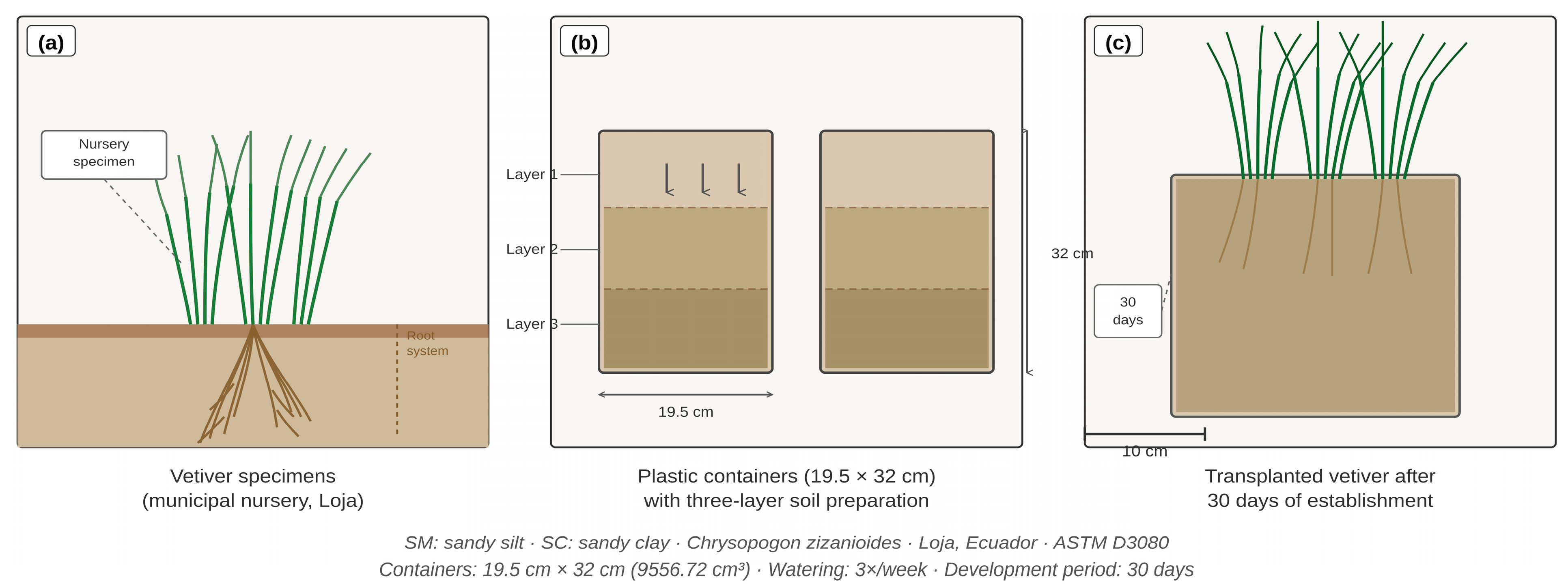
To evaluate the effect of vetiver grass (Chrysopogon zizanioides) root reinforcement on soil shear strength, a reduced-scale physical experimental model was developed. Plastic containers measuring 19.5 cm × 32 cm, with a total volume of 9556.72 cm3, were used to reproduce the two soil types identified in the study area. The container dimensions were selected to be compatible with the specimen size of the Soiltest D-114 direct shear apparatus (Soiltest, Inc., Evanston, IL, USA; 60 mm × 60 mm specimen) while providing sufficient soil volume for root establishment. It is acknowledged that this reduced-scale setup does not reproduce the in situ stress state of a 20 m slope and was not designed under formal similitude criteria. In this study, the laboratory stage was intended to provide comparative shear strength parameters reflecting the short-term influence of vetiver roots under controlled conditions. These parameters were subsequently transferred to the numerical model as representative inputs for comparative scenario analysis. The scale gap between the physical model and the numerical geometry is therefore recognized as a structural limitation of the study, and the resulting parameters should be interpreted as conservative comparative estimates rather than as directly design-prescriptive values. In each container, the soil was placed in three layers of uniform thickness, and each layer was compacted before placement of the next in order to achieve a relatively homogeneous density profile.
As illustrated in
Figure 1, vetiver specimens obtained from the municipal nursery of the city of Loja were transplanted into the prepared containers.
The models were then maintained under ambient conditions for 30 days, with manual watering three times per week. This period represents an early stage of root development, during which the vetiver root system had not yet reached its full functional extent. The 30-day period was selected as a controlled short-term establishment stage intended to allow measurable soil–root interaction within the reduced-scale setup while avoiding excessive root confinement effects associated with longer growth periods in the containers. At the end of this period, root development was sufficient for comparative mechanical testing, but still representative of an early-stage reinforcement condition rather than mature field-scale rooting. Under field conditions, vetiver roots may reach depths of 3–4 m [
4]. Accordingly, the geotechnical parameters obtained in this study should be interpreted as conservative estimates, and a greater reinforcing contribution would be expected under mature vegetation conditions.
After the 30-day development period, consolidated–drained (CD) direct shear tests were carried out in accordance with ASTM D3080/D3080M-23 [
20] using a Soiltest D-114 direct shear apparatus (Soiltest, Inc., Evanston, IL, USA). Three normal stress levels, namely 50, 100, and 200 kPa, were applied at a constant shear rate of 1 mm/min until failure. For each soil-condition combination (bare and vetiver-reinforced), one specimen was tested at each normal stress level, and a single Mohr–Coulomb failure envelope was derived from the resulting three shear-strength points. The same testing protocol was applied to bare soil specimens as the reference condition. Because one specimen was tested at each stress level, the resulting parameters should be interpreted as comparative laboratory estimates intended to support scenario-based numerical evaluation rather than as definitive field design values. Although no parallel specimens were tested at each normal stress level, this limitation was addressed by interpreting the derived Mohr–Coulomb parameters as comparative inputs for scenario-based modeling rather than as replicated design parameters. The subsequent sensitivity analysis was therefore used to evaluate whether the stabilization trend remained mechanically stable under assumed variation in the input parameters.
The shear strength parameters, specifically effective cohesion (
c′) and internal friction angle (
φ′), were determined from the Mohr–Coulomb failure envelope, expressed as:
where
τ is the shear strength (kPa),
c′ is the effective cohesion (kPa),
σ′ is the effective normal stress (kPa), and
φ′ is the internal friction angle (°).
The resulting shear strength parameters are summarized in
Table 2. To quantify the improvement induced by root reinforcement, the percentage increase in
c′ and
φ′ was calculated as:
where Δ
P is the percentage increase,
Pvetiver is the parameter value for the reinforced soil, and
Pbare is the corresponding value for the bare soil.
2.3. Numerical Slope Modeling
Numerical slope modeling was performed using the geotechnical parameters obtained from the direct shear tests presented in
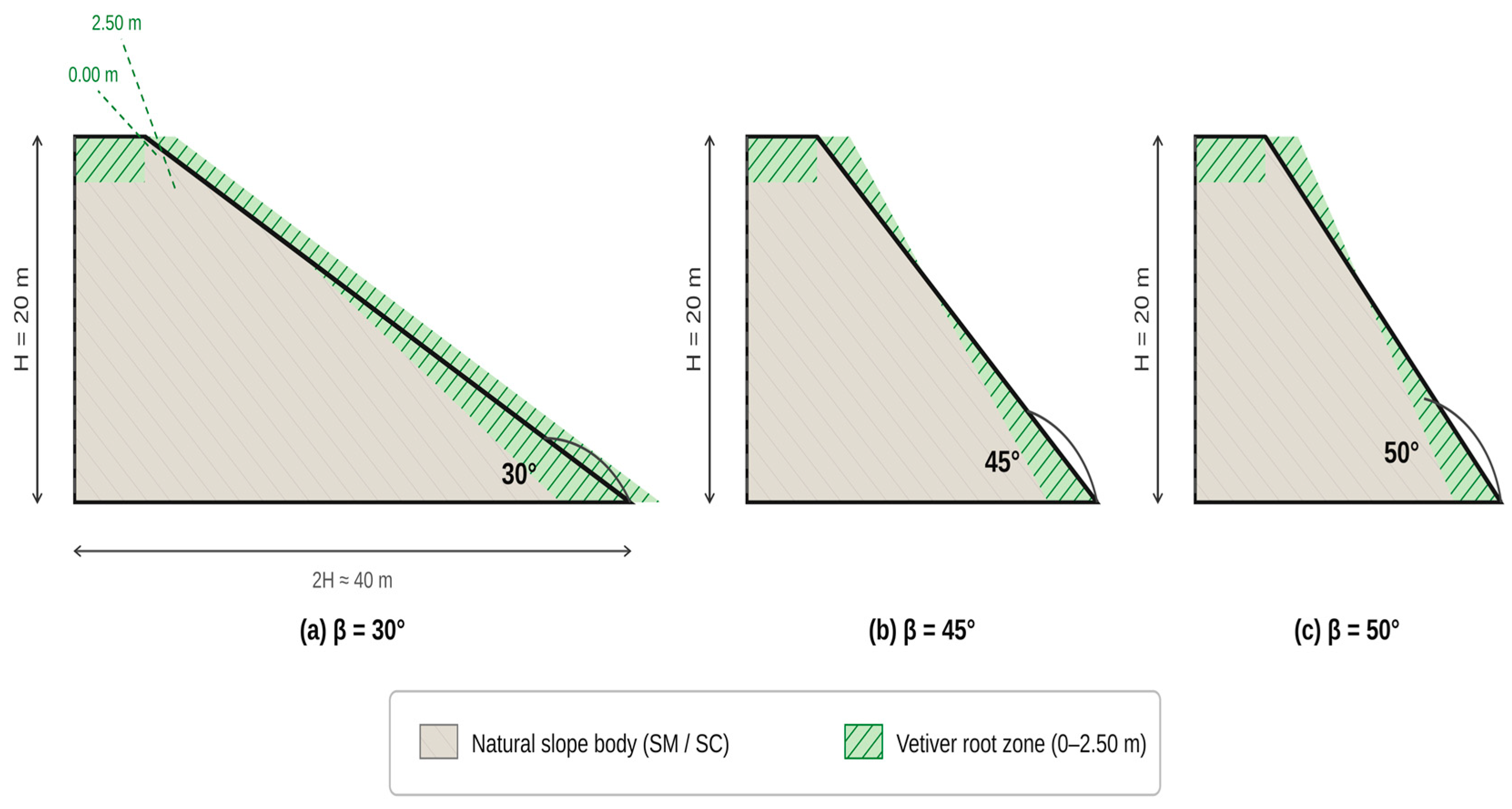
Table 2. A representative slope geometry was defined for the topographic conditions of Loja, with a height of 20 m and three inclination angles of 30°, 45°, and 50°.
These inclination angles were selected to be representative of the slope conditions documented in the urban and peri-urban hillside environment of Loja. Soto et al. [
14] characterised landslide-prone slopes in the Loja intermontane basin and reported that instability predominantly occurs in the range of 25–55°, with a concentration of events between 35° and 50°. The angles of 30°, 45°, and 50° therefore cover the lower bound, central, and upper portion of this instability range, respectively, allowing evaluation of vetiver reinforcement across a spectrum from moderately inclined to steep slopes. The 45° angle is particularly relevant as it corresponds to the critical inclination range identified in the study area. As shown in
Figure 2, the slope was modeled as a single homogeneous soil layer, while the vetiver root influence zone was defined between 0.00 and 2.50 m depth.
The 0.00–2.50 m depth was defined as a representative shallow reinforced layer intended to capture the portion of the slope most directly affected by root-induced changes in shear strength and most relevant to shallow failure mechanisms. Although root development observed in the 30-day physical model was limited to an early establishment stage, the numerical reinforced depth was not intended to reproduce the exact laboratory rooting depth. Instead, it was adopted as a conservative conceptual reinforcement zone for comparative slope stability analysis, while acknowledging that mature vetiver roots under field conditions may extend beyond this depth [
4]. This approach is consistent with the conservative interpretation adopted throughout the study for the geotechnical parameters derived from the 30-day model.
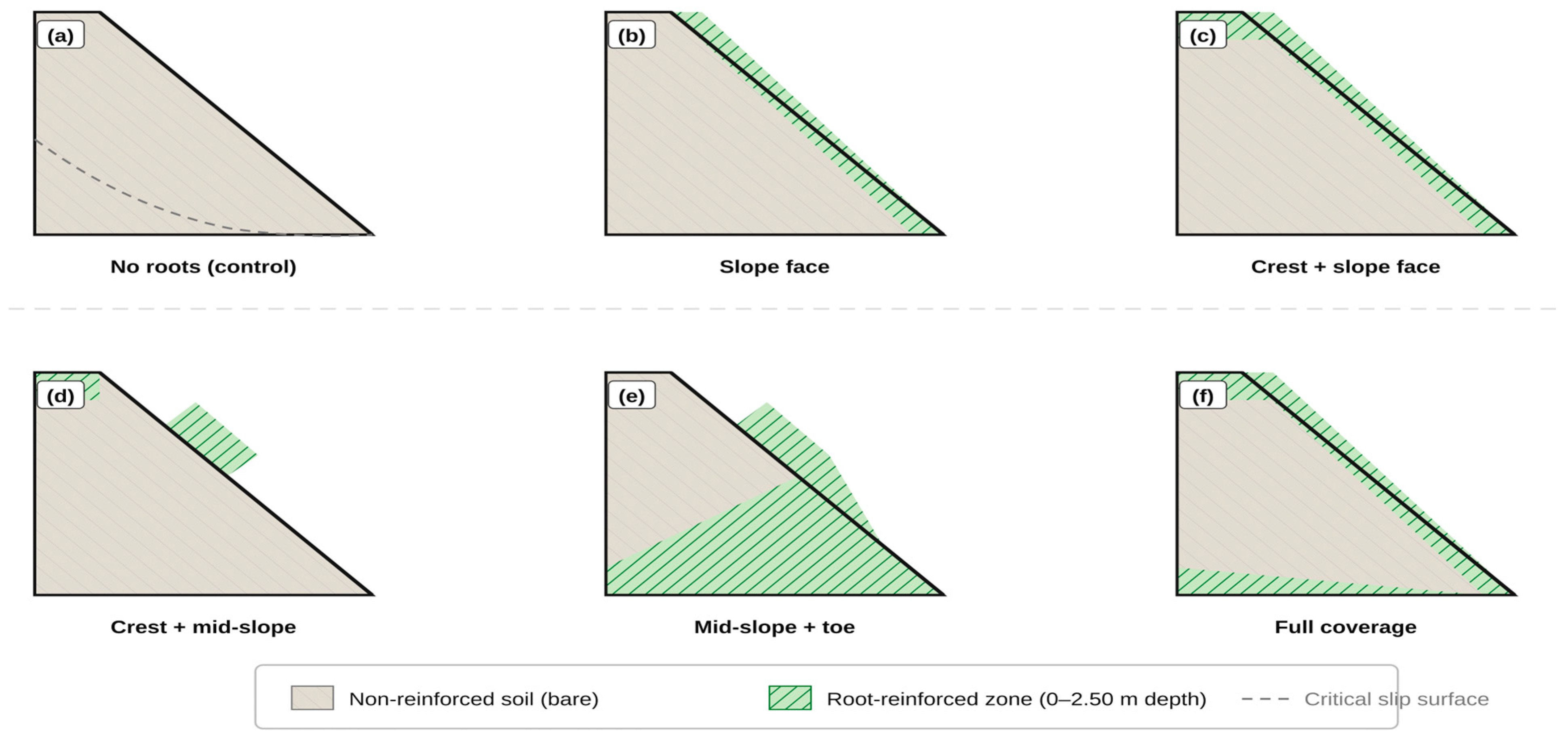
For each slope angle, six root-positioning configurations were evaluated. As illustrated in
Figure 3, these configurations were: (1) no roots, adopted as the control scenario; (2) slope face only; (3) crest and slope face; (4) crest and mid-slope; (5) mid-slope and toe; and (6) the full-coverage configuration, including crest, slope face, and toe. These layouts were also interpreted as simplified vegetation arrangements with practical relevance for hillside intervention, allowing comparison not only of whether vetiver improved stability, but also of where reinforcement was most effective within the slope profile.
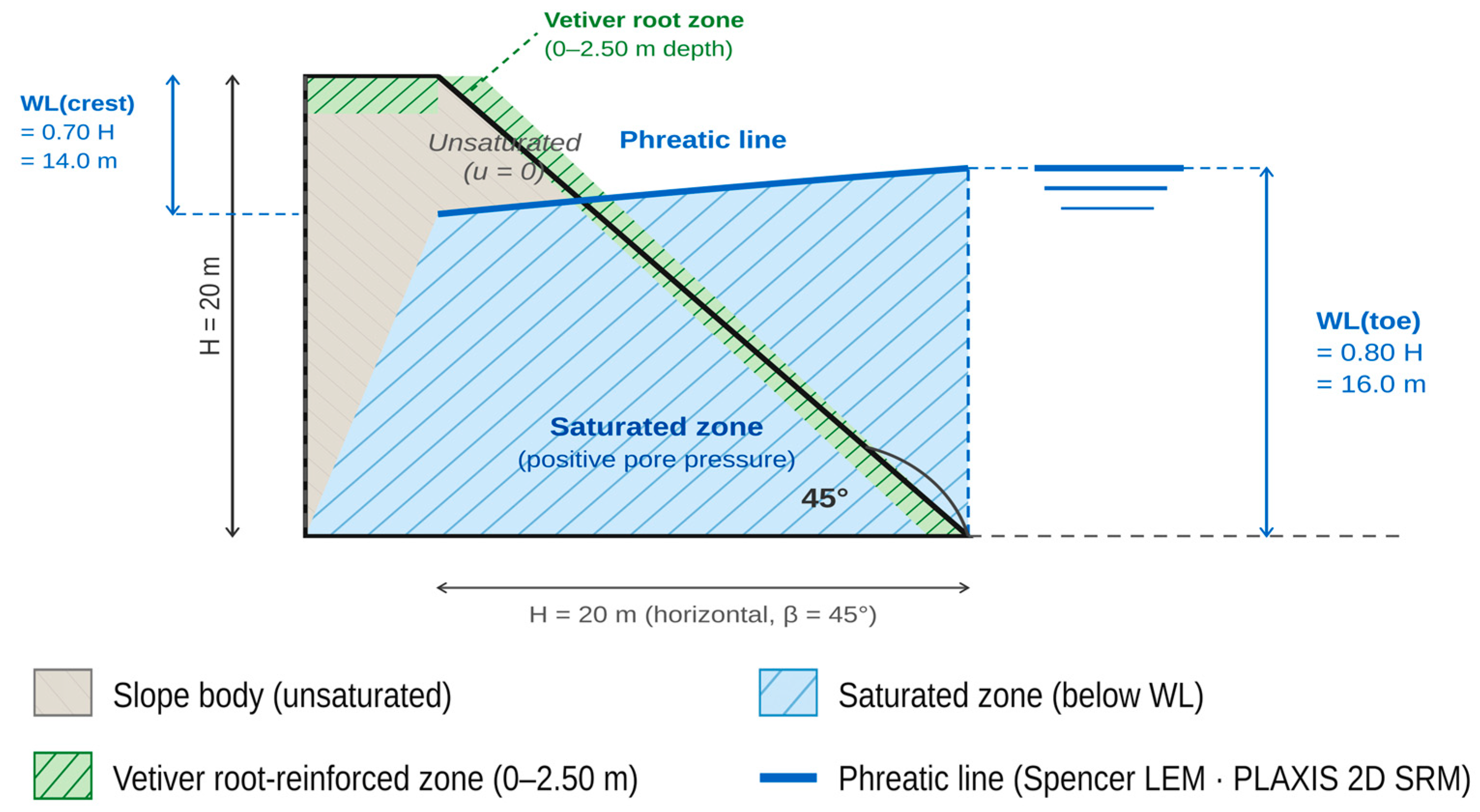
Two hydraulic conditions were considered: without a water table and with a water table. In the latter case, the hydraulic boundary condition was defined using a water level equivalent to 80% of H at the slope toe and 70% of H at the crest (
Figure 4). This condition was adopted following the reference hydraulic framework described by Fries et al. [
6] for the southern Ecuadorian Andes, where the rainy season (December–April) accounts for 88% of annual precipitation and generates pore-water pressure conditions representative of partial to near-full saturation in hillside soils. The adopted phreatic configuration represents a conservative but physically plausible scenario for the seasonal hydraulic state of slopes in the Loja region and has been applied here as a comparative hydraulic condition rather than as a monitored site-specific groundwater profile.
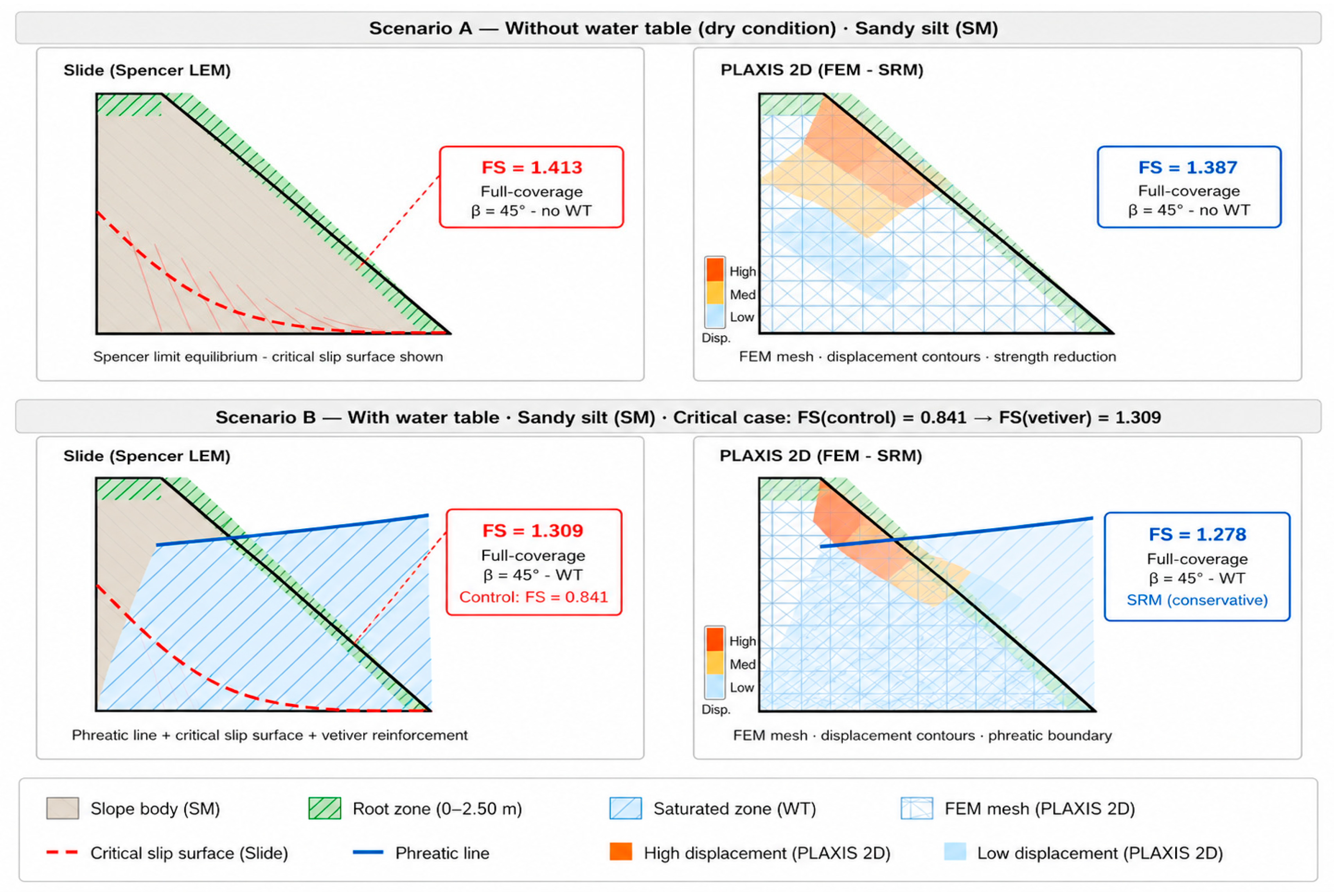
Slope stability was assessed using two complementary computational approaches. The first was Slide2 v9.040 (Rocscience Inc., Toronto, ON, Canada), based on Spencer’s limit equilibrium method, which was used to calculate the factor of safety (FS) and to evaluate the effect of root position on global slope stability. The second was PLAXIS 2D 2024.2 (Bentley Systems, Exton, PA, USA), based on the finite element method and the Mohr–Coulomb constitutive model, which was used to estimate FS through the strength reduction method (SRM) and to obtain the corresponding displacement response. The combined use of these two approaches strengthened result interpretation by allowing comparison between limit equilibrium and deformation-based estimates of slope performance. Representative examples of the numerical models developed in Slide and PLAXIS 2D are presented in
Figure 5.
In the Slide analyses, the slope geometry shown in
Figure 2 defined the external numerical domain, and the critical rotational slip surface was searched within the full soil mass for each geometric and hydraulic scenario. The phreatic line controlled the pore-water pressure distribution in the scenarios with a water table, while the reinforced and non-reinforced zones were assigned the corresponding laboratory-derived shear strength parameters according to each root-positioning configuration. No external surcharge or structural restraint was included; therefore, the computed factor of safety reflects the interaction among slope geometry, pore-water pressure regime, and spatial distribution of the reinforced layer within a consistent boundary domain.
Because different root-positioning configurations were evaluated within each scenario, the subsequent comparative analysis was intended to identify the maximum practical stabilization potential associated with vetiver reinforcement under each geotechnical and hydraulic condition. Given the early developmental stage of the root system and the reduced-scale nature of the experimental setup, the derived shear strength parameters were treated as representative but conservative inputs for the numerical modeling stage.
2.4. Statistical and Comparative Analysis
To assess the magnitude, consistency, and parametric stability of the improvement induced by vetiver root reinforcement, three complementary quantitative procedures were applied to the results derived from laboratory testing and numerical modeling.
First, the percentage increase in effective cohesion (c′) and internal friction angle (φ′) between bare and vetiver-reinforced conditions was calculated using Equation (2). This step provided a direct measure of the laboratory-observed improvement in soil shear strength associated with root reinforcement.
Second, a systematic scenario-based comparison was carried out using the factor of safety (FS) values obtained from Slide for each combination of soil type, slope angle, hydraulic condition, and root-positioning configuration. Because these FS values arise from deterministic numerical modeling configurations rather than from independent experimental observations, the comparisons were interpreted as exploratory and comparative rather than as strict population-level statistical inference. Within this framework, the FS of the control scenario (no roots) was compared with the FS of the best-performing vetiver configuration for each of the 12 evaluated scenarios, and the corresponding improvement was expressed as ΔFS.
Third, a parametric sensitivity analysis was performed on the laboratory-derived values of
c′ and
φ′ by applying controlled perturbations of ±10% to
c′ and ±5% to
φ′ relative to the base values. This asymmetric perturbation scheme was adopted because cohesion is generally more sensitive to specimen preparation, root distribution, and local soil–root interaction than the internal friction angle, particularly when shear strength parameters are derived from a limited number of direct shear tests. The same asymmetric scheme was applied consistently in the
Supplementary Materials.
These perturbation ranges were not derived from a formal experimental uncertainty estimate, since only one specimen was tested at each normal stress level. Accordingly, the sensitivity analysis should not be interpreted as a probabilistic characterization of experimental uncertainty. Instead, it was used as a controlled parametric procedure to evaluate whether the stabilizing trend remained mechanically consistent under reasonable variations in the laboratory-derived shear strength parameters.
For each scenario, the resulting FS values were used to calculate the mean, standard deviation (SD), coefficient of variation (CV), and minimum and maximum values. This procedure allowed the stability of the model response to be evaluated under controlled variations in the shear strength parameters and provided a basis for assessing the mechanical consistency of the stabilizing effect induced by vetiver.
For the laboratory-based sensitivity analysis, a representative reinforced configuration was selected for each soil–slope–hydraulic scenario; therefore, the mean FS values reported in the sensitivity tables do not necessarily coincide with the best-performing configurations identified in the comparative scenario analysis.
3. Results
3.1. Improvement in Shear Strength Parameters Induced by Root Reinforcement
As reported in
Table 2, the consolidated–drained direct shear tests showed that vetiver root reinforcement increased both effective cohesion (
c′) and internal friction angle (
φ′) in the two soil types analyzed. This trend was observed consistently in both sandy silt (SM) and sandy clay (SC), indicating that the presence of roots improved the shear resistance of the soil matrix under the tested conditions.
Using Equation (2), sandy silt exhibited an increase in c′ of 22.7%, from 6.40 to 7.85 kPa, and an increase in φ′ of 21.8%, from 21.57° to 26.28°. Sandy clay showed an increase in c′ of 19.0%, from 10.30 to 12.26 kPa, and an increase in φ′ of 12.2%, from 30.92° to 34.70°. Although the relative percentage increase was greater in sandy silt, sandy clay retained the highest absolute shear strength values under both bare and reinforced conditions. This indicates that the reinforcing effect of vetiver was positive in both soils, although its mechanical expression depended on the initial geotechnical characteristics of each material.
From a geotechnical perspective, the simultaneous increase in c′ and φ′ suggests that root reinforcement acted through more than one mechanism. The increase in effective cohesion is consistent with the additional bonding and confinement provided by the root network, whereas the increase in friction angle indicates improved interlocking and greater resistance to particle displacement within the reinforced soil structure. In practical terms, these results show that vetiver not only contributed an apparent cohesive effect, but also enhanced the overall shear resistance framework of the soil.
These findings confirm that vetiver root reinforcement improves soil shear strength under both tested soil conditions and support its use as a stabilizing bioengineering measure. The observed trend is consistent with previously reported root reinforcement mechanisms in vegetated slopes [
4]. From an applied perspective, the laboratory results indicate that vetiver can modify the mechanical response of both soils in a direction favorable to shallow slope stabilization in hazard-prone hillside environments.
3.2. Factor of Safety as a Function of Slope Geometry, Root Position, and Hydraulic Condition
The factor of safety (FS) values obtained with Slide for the six root-positioning configurations under each combination of slope angle and hydraulic condition are presented in
Table 3 for sandy silt and in
Table 4 for sandy clay.
The results indicate that root position exerted a clear influence on slope stability in both soils; however, the magnitude of this influence depended on slope angle and hydraulic condition. In sandy silt, the full-coverage configuration generally produced the most favorable response under the more demanding scenarios, particularly at 45° and 50°. Under dry conditions, the highest FS values were 1.413 at 45° and 1.314 at 50°, both obtained under the full-coverage configuration. Under water-table conditions, the same configuration maintained the highest FS values at 45° and 50°, confirming that broader root distribution enhanced slope stability more effectively than localized reinforcement.
In sandy clay, FS values were consistently higher than in sandy silt across most configurations, reflecting the greater baseline shear strength of this material. The highest FS value obtained in the present study was 1.590, recorded at 30° without a water table in both the crest + slope and full-coverage configurations. Under saturated conditions, the full-coverage configuration again produced the most favorable overall response, with FS values of 1.544, 1.413, and 1.512 at 30°, 45°, and 50°, respectively. These results indicate that sandy clay not only benefited from vetiver reinforcement, but also retained a more stable response under adverse hydraulic conditions.
The control cases without vegetation highlight the stabilizing contribution of root reinforcement more clearly. The most critical condition in sandy silt was recorded at 45° with a water table, where the control scenario yielded FS = 0.841, indicating instability. Under the full-coverage configuration, this value increased to FS = 1.309, representing a substantial recovery of stability. A similarly critical response was observed in sandy clay at 50° with a water table, where FS increased from 0.948 in the control condition to 1.512 under the full-coverage configuration. Overall, these results show that vetiver reinforcement was particularly effective in scenarios that were initially closer to the stability threshold, suggesting that the contribution of the root system becomes more relevant as mechanical and hydraulic conditions become more restrictive.
It should be noted that this non-monotonic behavior occurs under both hydraulic conditions, with and without a water table. Under dry conditions (no water table), the control scenario in sandy silt also yields a lower FS at 45° (0.997) than at 50° (1.085), indicating that the phenomenon is primarily governed by the geometry-dependent nature of the critical failure surface rather than by the pore-water pressure distribution alone. In Spencer’s limit equilibrium method, the factor of safety in homogeneous slopes is not a strictly monotonic function of inclination angle when the slope angle β approaches or exceeds the internal friction angle φ′. For sandy silt under bare conditions (φ′ = 21.57°), both 45° and 50° exceed φ′, placing the slope in a geometrically critical regime. At 45°, the critical slip surface extends deeper into the slope mass, mobilizing a larger soil volume and producing a lower FS. At 50°, the increased inclination constrains the failure surface geometry to shallower, shorter paths with a smaller mobilized mass, which partially offsets the effect of the greater inclination angle. This geometric interaction has been documented in limit equilibrium analyses of homogeneous cohesive–frictional slopes [
3] and does not reflect any inconsistency in the modeling approach. The introduction of vetiver reinforcement, which substantially increases both c′ and φ′, modifies the failure surface geometry sufficiently to reverse this pattern in some configurations, as evidenced by the higher FS at 45° than at 50° observed under the full-coverage vetiver configuration.
From a hillside management perspective, the results also suggest that vegetation layout is not a secondary implementation detail but a determining factor in stabilization performance. Broader root coverage, particularly under the full-coverage configuration, proved more effective in the steeper and hydraulically more restrictive cases, indicating that continuous planting along crest–slope–toe systems may offer greater protective value in hazard-prone slopes exposed to saturation and instability.
3.3. Comparative Analysis of the Model Response
3.3.1. Systematic Scenario Comparison
Table 5 presents the comparative results for all 12 evaluated scenarios, showing the FS of the control condition (no roots), the FS of the best-performing vetiver configuration, and the corresponding improvement expressed as ΔFS. Because the FS values were obtained from deterministic numerical model configurations, the reported differences should be interpreted as consistent mechanical trends within the modeling framework rather than as formal inferential statistics.
The reported ΔFS values represent the improvement relative to the control condition obtained from the best-performing root-positioning configuration in each scenario; they should therefore be interpreted as the maximum practical improvement within the evaluated configuration set rather than as a mean treatment effect.
A systematic improvement in FS was observed across all 12 scenarios when vetiver reinforcement was introduced. This trend was consistent for both soil types, across the three slope angles, and under both hydraulic conditions. The magnitude of the improvement, however, varied as a function of slope geometry, water-table condition, and root-positioning configuration.
In sandy silt, the greatest absolute improvement was observed at 45° with a water table, where FS increased from 0.841 in the control condition to 1.309 under the best-performing vetiver configuration, corresponding to ΔFS = +0.468. In sandy clay, the largest improvement was recorded at 50° with a water table, where FS increased from 0.948 to 1.512, corresponding to ΔFS = +0.564. By contrast, the smallest improvement was observed in sandy silt at 30° without a water table, where ΔFS was +0.080. These results indicate that the stabilizing contribution of vetiver became more pronounced under the most restrictive geotechnical and hydraulic conditions.
From a comparative standpoint, the results show that vetiver root reinforcement not only improved shear strength at the laboratory scale, but also translated into a consistent enhancement of global slope performance in the numerical analyses. The effect was particularly relevant in scenarios close to the stability threshold, where root reinforcement shifted the response from marginal or unstable conditions to clearly stable conditions. This pattern suggests that vegetation-based stabilization may be especially useful in slopes where instability risk coincides with restrictive hydraulic and geometric conditions.
3.3.2. Parametric Sensitivity Analysis
Table 6 and
Table 7 present the descriptive statistics of FS obtained from the parametric sensitivity analysis for sandy silt and sandy clay, respectively, considering controlled perturbations of ±10% in c′ and ±5% in
φ′. For each scenario, the sensitivity analysis was performed using a representative reinforced configuration selected from the numerical screening stage; therefore, the reported mean FS values should be interpreted as reference-case responses for the selected reinforced layouts rather than as the best-performing configurations reported in
Table 5.
The coefficients of variation ranged from 4.97% to 7.03% across all analyzed scenarios, indicating low relative dispersion of FS under controlled parameter perturbations. The most sensitive case corresponded to sandy silt at 50° with a water table, where the maximum CV reached 7.03% and the minimum FS under the most adverse perturbation was 1.024. Despite being the most sensitive scenario, this value still remained above unity, indicating that the reinforced configuration retained stability even under the least favorable parameter combination considered.
By contrast, sandy clay showed the lowest CV values, ranging from 4.97% to 5.59%, indicating a more stable model response under parameter variation. Overall, these results suggest that the stabilizing effect induced by vetiver remained mechanically consistent under reasonable changes in c′ and φ′, with the response being comparatively more robust in sandy clay than in sandy silt.
It should also be noted that the standard deviation remained constant across scenarios (SD = 0.0791). This reflects the controlled and proportional perturbation scheme applied to the base parameters within the sensitivity analysis, rather than emergent stochastic variability in the system. Accordingly, the sensitivity analysis should be interpreted as a structured assessment of model response stability under assumed parameter variation rather than as a probabilistic characterization of uncertainty.
4. Discussion
The results suggest that vetiver grass (Chrysopogon zizanioides) can be considered a technically plausible and environmentally sustainable stabilization measure for hazard-prone urban hillsides in Andean settings. Unlike studies that rely exclusively on literature-derived parameters or purely numerical assumptions, the present work combines laboratory-derived shear strength data with numerical slope modeling under local geotechnical and climatic conditions. This provides a more grounded basis for evaluating the stabilizing contribution of root reinforcement in soils representative of Loja, Ecuador.
The observed increases in effective cohesion (
c′) and internal friction angle (
φ′) are consistent with the root reinforcement mechanisms reported in the literature [
4].
To contextualize the magnitude of the observed improvements,
Table 8 compares the shear strength parameters obtained in this study with values reported for vetiver and other grass species in comparable tropical and subtropical soils in the literature.
The results of this study are within the range reported in the literature for vetiver in tropical and subtropical soils, with percentage improvements in c′ between 19.0% and 22.7%, which are conservative relative to values reported for cohesive soils with higher plasticity [
4,
21]. The comparatively moderate increments observed here are consistent with the early-stage root development (30 days) and the relatively lower plasticity of the two soils evaluated (PI = 9 and PI = 19), which limits the degree of root–soil interlocking achievable under short-term laboratory conditions.
These mechanisms were first formalized by Waldron [
18] and Wu et al. [
19], whose foundational models describe how roots crossing a failure plane mobilize tensile resistance that translates into an apparent increase in soil cohesion. Within this classical framework, root-reinforced soil may be understood as a composite matrix in which root tensile resistance, root distribution, and root–soil interaction control the magnitude of the added shear resistance. In the present study, the simultaneous increase in both
c′ and
φ′ suggests that vetiver reinforcement was not limited to an apparent cohesive contribution alone, but also modified the interlocking structure of the soil matrix. This interpretation is consistent with the short-term establishment of the root system within the soil and should be understood as a macroscopic expression of reinforcement rather than as a direct measurement of individual root tensile behavior.
Consistent with this mechanistic interpretation, vetiver improved the shear strength framework of both sandy silt and sandy clay through concurrent increases in both
c′ and
φ′, indicating that the effect of the root system was not limited to an apparent cohesive contribution alone. From a mechanical standpoint, the increase in
c′ may be associated with additional confinement and bonding within the soil–root matrix, whereas the increase in
φ′ suggests improved interlocking and greater resistance to particle displacement. Although the relative increase in
φ′ was smaller in sandy clay than in sandy silt, sandy clay reached the highest absolute FS values because of its greater baseline frictional resistance, a behavior that is also consistent with previous studies on vegetated slopes [
8].
A particularly relevant contribution of this study is the systematic evaluation of six root-positioning configurations. This aspect gives the results direct practical value, since it goes beyond a simple comparison between vegetated and non-vegetated slopes and provides guidance on where vegetation is likely to be more effective within the slope profile. The results showed that the full-coverage configuration generally produced the most favorable FS values under the more demanding scenarios, particularly at 45° and 50°, whereas the crest + slope configuration also performed well at 30°. This trend supports the interpretation that a broader spatial distribution of roots along the potential failure zone is more effective than localized reinforcement, in agreement with previous bioengineering studies [
2].
The presence of the water table reduced FS in all analyzed cases, confirming the destabilizing role of saturation in both soils. This effect was especially evident in sandy silt, where the most critical control condition was recorded at 45° with a water table (FS = 0.841). Under the best-performing vetiver configuration, this value increased to 1.309, indicating that root reinforcement substantially improved stability under otherwise critical hydraulic conditions. A similar pattern was observed in sandy clay, particularly at 50° with a water table, where FS increased from 0.948 in the control condition to 1.512 under the full-coverage configuration. These results suggest that the stabilizing contribution of vetiver becomes more relevant as the system approaches restrictive hydraulic and mechanical conditions. From a regional perspective, this finding is particularly important in Loja, where marked seasonal rainfall concentration promotes conditions favorable to pore-pressure increase and shallow instability [
6,
9].
The comparison between Slide and PLAXIS 2D further strengthens the interpretation of the results. Although both methods showed the same overall stabilization trend, PLAXIS 2D generally produced lower, and therefore more conservative, FS estimates than Slide. This difference is methodologically reasonable, since limit equilibrium methods evaluate stability through predefined failure mechanisms, whereas finite element analyses account for stress redistribution and deformation within the soil mass [
3]. For practical interpretation, the PLAXIS 2D results may therefore be regarded as the more conservative reference, while the agreement in trends between both approaches supports the consistency of the overall findings.
An additional strength of the study lies in the consistency of the model response across all evaluated scenarios. The comparative analysis showed that vetiver improved FS in all 12 combinations of soil type, slope angle, and hydraulic condition, although the magnitude of the improvement varied according to the scenario. This pattern indicates that the stabilizing effect of vetiver was not restricted to an isolated favorable case, but rather emerged as a coherent mechanical trend across the full set of modeled conditions. The sensitivity analysis further showed coefficients of variation between 4.97% and 7.03%, indicating low relative dispersion of FS under controlled perturbations of c′ and φ′. These values support the interpretation that the reinforced response remained mechanically stable under reasonable parameter variation, particularly in sandy clay, which showed the lowest CV range.
Beyond its geotechnical implications, the present study also has relevance for sustainable urban hillside management in intermediate Andean cities such as Loja, where urban growth increasingly interacts with unstable slopes, sensitive soils, and concentrated seasonal rainfall. In such environments, the challenge is not only to stabilize slopes effectively, but to do so through interventions that can be integrated into the landscape, implemented progressively, and adapted to environmentally constrained urban settings. Within this perspective, vetiver may be understood as a vegetation-based stabilization measure with potential value for the management of hazard-prone urban and peri-urban slopes. The superior performance of broader planting layouts, particularly under the full-coverage configuration, suggests that stabilization effectiveness depends not only on the presence of vegetation, but also on its spatial distribution along the slope profile. From a land management standpoint, this finding supports the prioritization of more continuous planting schemes across crest, slope face, and toe in critical hillside sectors, rather than fragmented or localized planting strategies.
The results must nevertheless be interpreted within the scope of the study. The geotechnical parameters were obtained after 30 days of root development, corresponding to an early growth stage of vetiver. Accordingly, the measured reinforcement effect should be regarded as conservative, since greater root density and depth would be expected under mature field conditions [
2,
4]. In addition, the physical model was developed at reduced scale, and the spatial characterization of the site was based on two sampling points, which limits the direct generalizability of the findings to broader geotechnical settings. A further limitation is that the root system was not characterized in terms of length, density, diameter, or biomass. The observed improvements in
c′ and
φ′ are therefore attributed to the overall reinforcing effect of the vetiver root network rather than to specific root morphological traits. Future research should incorporate root area ratio (
RAR), root biomass, or root architecture measurements to establish a more direct relationship between root development and geotechnical performance. Further work should also include longer root development periods, broader spatial sampling, evaluation of additional species with geotechnical potential in Andean environments, and field validation through in situ monitoring or instrumentation.
Within these limitations, the present results provide strong support for the use of vetiver as a Nature-based Solution for slope stabilization and geohazard risk management in vulnerable Andean urban environments. At the same time, the findings provide locally grounded evidence that may contribute to more sustainable land management in urban hillside areas exposed to instability, particularly where low-impact stabilization measures are needed to complement broader risk reduction and planning strategies.
5. Conclusions
This study evaluated the effect of vetiver grass (Chrysopogon zizanioides) root reinforcement on the stability of sandy silt and sandy clay from Loja, Ecuador, through an integrated laboratory and numerical modeling approach. Vetiver increased effective cohesion from 6.40 to 7.85 kPa and the internal friction angle from 21.57° to 26.28° in sandy silt, and from 10.30 to 12.26 kPa and 30.92° to 34.70° in sandy clay, corresponding to relative improvements of 22.7% and 21.8% in sandy silt and 19.0% and 12.2% in sandy clay.
Root position within the slope profile strongly influenced the global response. Broader root coverage, particularly along the crest, slope face, and toe, produced the highest FS values under the most restrictive scenarios. The most critical case corresponded to sandy silt at 45° with a water table and without vegetation, where FS = 0.841 increased to 1.309 under the full-coverage configuration. Across all evaluated scenarios, vetiver consistently improved FS, with the largest increase observed in sandy clay at 50° with a water table (ΔFS = +0.564).
The sensitivity analysis showed that the stabilizing trend remained mechanically consistent under assumed parameter variation, with coefficients of variation between 4.97% and 7.03%. Because the geotechnical parameters were obtained after 30 days of root development and from a reduced-scale experimental setup, the results should be interpreted as conservative and comparative rather than directly design-prescriptive. Within these limitations, the study supports vetiver as a technically grounded and environmentally sustainable Nature-based Solution for slope stabilization and provides locally grounded evidence for the management of hazard-prone urban hillsides in Andean environments.




 ,
,