1. Introduction
The Central Plains Urban Agglomeration comprises a large collection of industrial cities that are reliant on mineral resources. These cities, which are affected by differences in resource endowments, development histories and geographical environments, present significant spatial differentiation characteristics with regard to disaster prevention, emergency response and post-disaster recovery [
1]. In recent years, as extreme weather events have increased in frequency, necessitating the continuous improvement of resource development intensity, the single-city disaster reduction model has proven unable to cope with cross-regional disaster risks. As such, there is an urgent need to analyze the distribution pattern and influencing mechanisms that affect the comprehensive disaster reduction capacity of mining cities from a spatial correlation perspective to facilitate the sustainable development of these mining cities [
2]. Existing domestic and international studies have primarily focused on assessing the disaster reduction capacity of single cities or specific disaster types, paying insufficient attention to the spatial heterogeneity of the disaster reduction capacity of mining cities at the urban agglomeration scale. The construction of spatial econometric models that integrate multidimensional factors is still at a nascent stage, which makes it difficult to support the practical needs of regional collaborative disaster reduction [
3,
4,
5]. This study focuses on 28 mining cities within the Central Plains Urban Agglomeration and pursues three core objectives: (1) to delineate the spatial distribution patterns of comprehensive disaster reduction capacity and quantify its agglomeration characteristics and regional disparities; (2) to verify the spatial autocorrelation characteristics of this capacity, clarifying its spatial dependence and spillover effects; and (3) to identify the core factors driving its spatial differentiation, elucidating the impact intensity and mechanisms of each factor.
The human–environment system vulnerability theory originates from the study of human–environment territorial systems. It focuses on the bidirectional interactions between human social systems and natural geographical systems and analyzes sensitivity, adaptive capacity, and resilience to internal and external disturbances. The level of system vulnerability depends not only on the intensity of disturbances to the natural environmental background, but also on the proactive regulatory capacity of human social systems in responding to disturbances [
6]. The development of mining cities is accompanied by the continuous transformation of natural geographical systems through mineral resource exploitation, with human economic and social activities forming deep coupling relationships with natural environmental disturbances. Comprehensive disaster reduction capacity is essentially the core regulatory capacity of the human–environment system of mining cities in responding to various types of disaster disturbances. This theory provides the core analytical framework of human–environment coupling for the entire study and offers foundational logical support for comprehensive disaster reduction capacity evaluation indicator system construction. Disaster risk management theory originated from foundational research on disaster science conducted in the mid-twentieth century, and gradually formed a systematic theoretical system that covers the entire disaster cycle. It is the core supporting theory for research on regional comprehensive disaster reduction capacity-building. It is centered on the full chain of disaster occurrence, encompassing pre-disaster prevention, mid-disaster emergency response, and post-disaster recovery and reconstruction, and emphasizes the systematic and comprehensive nature of disaster prevention and control, transcending the limitations of single-hazard and single-phase approaches. It also highlights the synergistic action of multidimensional factors and full-cycle capacity-building [
7]. Spatial dependence theory is the core classic theory used to analyze the spatial differentiation patterns and correlation characteristics of geographical elements. This theory reveals the potential correlation characteristics among the attribute values of different units in geographic space: spatial units that are geographically proximate are more likely to generate various factor flows and mutual influences, thereby forming spatial agglomeration or dispersed distribution patterns of attribute values [
8]. The various socioeconomic factors related to regional development are not randomly distributed in space; instead, they exhibit varying degrees of spatial correlation with changes in geographical distance, including both positive spatial spillover effects and negative spatial siphon effects; these factors are key to our understanding of the spatial differentiation rules of regional factors [
9]. Mining cities within the Central Plains Urban Agglomeration are not independent development units; the flow of disaster prevention resources, technology diffusion, and collaborative prevention and control mechanisms among cities directly affect the spatial distribution of disaster reduction capacity. This idea provides the core theoretical basis for the spatial autocorrelation analysis and spatial econometric model construction in this study and lays the foundation for our research on the mechanisms of spatial spillover effects.
Comprehensive disaster reduction capacity is essential to the safe operation and sustainable development of cities. As global extreme weather events become increasingly frequent and China’s urbanization process continues to accelerate, urban disaster risks are beginning to feature multiple overlapping disaster types and cross-regional diffusion. Comprehensive urban disaster reduction capacity has become a research hotspot at the intersection of multiple disciplines, including disaster science, geography, and urban planning. Domestic and international scholars have conducted extensive research on the construction of evaluation systems, optimization of evaluation methods, identification of spatial patterns, and analysis of driving mechanisms for urban disaster reduction capacity, generating rich theoretical achievements and empirical cases and providing theoretical support and practical references for disaster reduction capacity-building in different types of cities.
The core foundation of comprehensive urban disaster reduction capacity evaluation lies in the construction of a scientific indicator system, and related research has established relatively mature logic for dimension classification and indicator selection frameworks. Wang and Yuan focused on the field of urban flood control and disaster reduction, and selected 17 core indicators with which to construct a comprehensive evaluation indicator system to verify the applicability of multidimensional indicators in the quantitative evaluation of urban disaster reduction capacity [
10]. He et al., considering the entire process of emergency management, constructed an urban disaster emergency capacity evaluation system based on four dimensions—pre-disaster preparation, pre-disaster warning, mid-disaster response, and post-disaster recovery—providing standardized dimension classification metrics for full-cycle disaster reduction capacity evaluation [
11]. Song et al. analyzed the coupling and synergy mechanisms of urban comprehensive disaster prevention systems based on five factors, including monitoring and warning, engineering defense, and emergency response and rescue. They then constructed an evaluation model based on the coupling coordination degree, expanding the theoretical perspectives of urban disaster reduction capacity evaluation [
12]. Fei et al. created an evaluation framework including multi-level indicators for the disaster prevention capacity of urban park systems; they then refined disaster reduction capacity evaluation methods for different urban functional units [
13]. Ma constructed a location-allocation model for earthquake emergency shelters that integrates multi-criteria evaluation and multi-objective optimization. By comparing the performance of existing planning and new candidate schemes under different strategies, it directly responds to the core demands for the establishment of disaster reduction capacity assessment system for shelters in the retrieval [
14]. Liu proposed design concepts and optimization paths to improve the disaster reduction capacity of urban buildings from a design perspective, supplementing theoretical support for the micro-level dimensions of urban disaster reduction capacity evaluation [
15]. Introducing resilience-related concepts provided new analytical perspectives for urban disaster reduction capacity research, with related studies gradually shifting from traditional passive defense research to full-cycle research on proactive adaptation and system recovery. Cheng constructed an urban disaster prevention, reduction, and relief capacity evaluation indicator system with four dimensions—social resilience, economic resilience, infrastructure resilience, and environmental resilience—to enhance the empirical evaluation with improved analytical methods and cloud models, thus verifying the applicability of resilience concepts in evaluating disaster reduction capacity of new towns in megacities [
16]. Shi combined resilience city concepts with community disaster reduction capacity-building to create an urban community disaster reduction capacity evaluation system informed by multiple core dimensions; in doing so, they narrowed their research focus from the overall city to community units and expanded the application boundaries of resilience concepts in the disaster reduction field [
17]. Relevant scholars have taken historical cities as research objects and conducted disaster risk vulnerability assessments of heritage sites based on a resilience assessment framework. They have also proposed protection strategies oriented toward disaster risk reduction, enriching resilience disaster reduction research cases for different types of cities [
18]. The general consensus of related studies is that resilience concepts can more comprehensively cover the systemic characteristics of urban disaster reduction capacity, which makes them better suited to meet the practical needs of complex urban megasystems in dealing with multiple overlapping disaster risks.
Existing research has laid a solid theoretical foundation and methodological framework for comprehensive urban disaster reduction capacity research, but it still has some shortcomings. (1) Thus far, most published studies have focused on disaster reduction capacity evaluation at the scale of single cities, specific disaster types, or provincial levels; relatively insufficient systematic research has been conducted at the urban agglomeration scale. In particular, there is a lack of specialized analysis of resource-dependent areas such as mining cities, and research findings are difficult to adapt to the practical development needs of urban agglomeration collaborative disaster reduction. (2) Although resilience concepts have been widely introduced in the construction of evaluation systems, the integration of the resource exploitation characteristics and disaster risk formation mechanisms of mining cities remains insufficient, and the pertinence and adaptability of indicator systems to mining cities are in need of further improvement. (3) Existing research on the spatial differentiation characteristics of urban disaster reduction capacity is mostly composed of descriptive analysis, with insufficient in-depth consideration of spatial correlation patterns and spillover effects, and there is a lack of systematic validation of driving mechanisms combined with spatial econometric models. Based on this, our study introduces the theories of human–land system vulnerability and spatial dependence and constructs a complete analytical framework of “measurement–pattern–mechanism”, thereby expanding the theoretical boundary of disaster research for resource-based cities. By comprehensively adopting the entropy-weight Technique for Order of Preference by Similarity to Ideal Solution (TOPSIS) model, multidimensional spatial analysis, spatial lag model and machine learning methods, our work establishes a methodological system for disaster reduction capacity evaluation and driving mechanism analysis suitable for small-sample urban agglomerations. From a practical standpoint, these findings can provide scientific support and decision-making references to inform the construction of a collaborative disaster reduction system, optimize the allocation of regional disaster prevention resources, and assist with the formulation of differentiated disaster mitigation policies for mining cities in the Central Plains Urban Agglomeration.
2. Study Area Overview
2.1. Scope of the Study Area and Selection Criteria of Research Objects
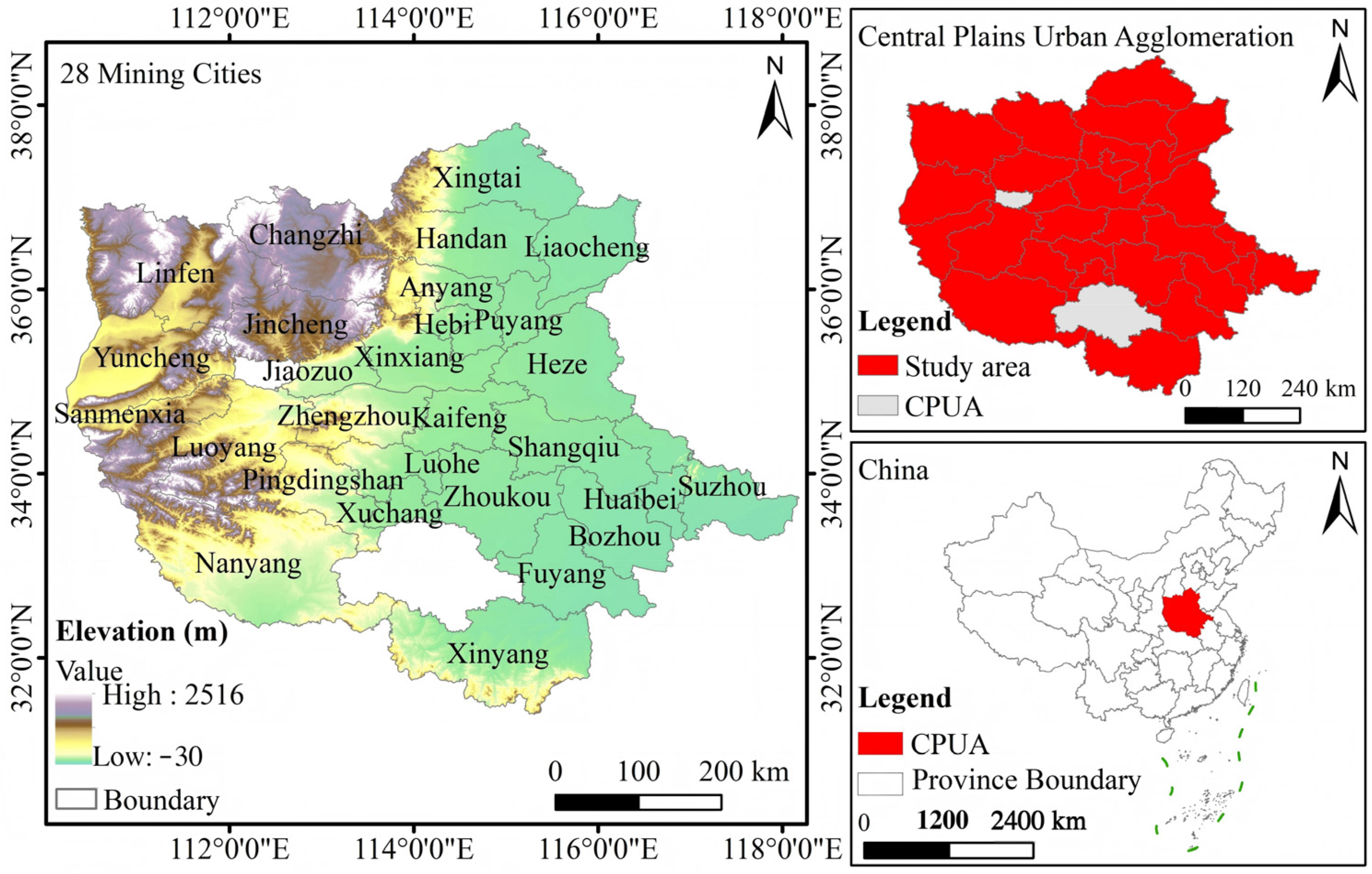
This study focuses on mining cities within the Central Plains Urban Agglomeration, a core hub connecting China’s developed eastern coastal areas and the western interior—a key development zone under the ‘Rise of Central China’ strategy. It is situated between 110°21′–118°32′ E and 31°23′–37°08′ N, encompassing 30 prefecture-level cities across five provinces (Henan, Shanxi, Hebei, Shandong, and Anhui) with a planned area of 287,000 km
2. As of the end of 2023, the total permanent resident population was 163 million, and the gross regional product accounted for 9.2% of the national total. It is an area characterized by high population density, significant industrial agglomeration, and a well-structured urban hierarchy (
Figure 1).
The Central Plains Urban Agglomeration has a long history and faces high-intensity mineral resource exploitation. It has more than 130 different types of reserves, and its most abundant energy sources and metallic minerals, which include coal, iron ore, bauxite, and non-ferrous metal ores, are among the highest-ranked in the nation. Its coal reserves account for 12.3% of the national total, while bauxite reserves account for 18.7%, cementing its status as an important energy and raw material industrial base. Mining development in the region began in the 1950s, and following decades of large-scale development, a complete industrial chain centered on mineral extraction, washing and processing, and heavy equipment manufacturing has formed. The added value of the mining industry and related industries has long maintained a share of over 30% of the total regional industrial added value, making it the core pillar industry that sustains regional economic and social development.
Long-term, high-intensity mineral resource exploitation combined with complex natural geographical conditions may have severe consequences, leading to overlapping multiple-disaster risks. Mining-induced geological environmental problems are on the rise, with geological disasters such as ground subsidence, ground fissures, landslides, and collapses being widely distributed throughout the entire study area. From 2020 to 2023, the average annual number of geological disasters in the study area was 2.1, with cities along the Huai River basin in the southern region averaging 3.2 per year, while core cities in the western region averaged only 1.1 per year, showing significant locational disparities. Meanwhile, the study area lies in a north–south climate transition zone, and the frequency of extreme weather events continues to increase, averaging at 4.7 days of extreme heavy precipitation per year. Cities along the Huai River and Yellow River basins are at serious risk of flooding, and from 2020 to 2023, the annual average direct economic losses resulting from flooding disasters exceeded 12 billion yuan. The compounding of multiple disaster risks from mining development and extreme weather places extremely high demands on the disaster reduction capacity-building of cities in the region and leads to significant spatial differentiation in the disaster reduction capacity-building of different cities.
2.2. Mining Development and Disaster Risk Background of the Study Area
The 28 mining cities identified in this study exhibit significant internal disparities in terms of population size, economic development level, industrial structure, and resource endowments. As of the end of 2023, the total permanent resident population of the 28 cities was 124 million, accounting for 76.1% of the entire Central Plains Urban Agglomeration. Meanwhile, the permanent resident population of individual cities ranges from 2.1 million to 12.28 million, with dense spatial distribution in the west and north and more sparse distribution in the east and south. In terms of economic development, the 28 cities achieved a combined gross regional product of 9.87 trillion yuan in 2023, comprising 82.4% of the total economic output of the Central Plains Urban Agglomeration. The GDP per capita of individual cities ranges from 19,000 to 86,000 yuan, with the highest value being 4.5 times that of the lowest, highlighting extreme regional disparities. In terms of industrial structure, the average share of the secondary sector in the 28 cities reached 42.5%, with mining and related heavy industries accounting for an average of 58.3% of secondary sector added value (
Table 1).
The disparities in resource endowments and development foundations among the 28 mining cities directly determine the starting point and development potential of disaster reduction capacity-building. Western core cities, with their reliance on higher economic development levels and a complete industrial system, can provide continuous financial and technical support for disaster reduction measures, whereas southeastern cities face significant deficiencies in infrastructure construction and financial investment due to their more limited economic development. This is the core underlying reason for the spatial pattern of “high in the west and low in the east, low in the south and higher in the north” that characterizes the region’s comprehensive disaster reduction capacity.
3. Data and Methodology
3.1. Data Sources and Preprocessing
The data used in this study span from 2020 to 2023, covering four core dimensions required for comprehensive disaster reduction capacity evaluation and driving mechanism analysis. All data are sourced from officially published authoritative datasets, which ensures the authenticity and comparability of the information. Socioeconomic data are derived from the China Urban Statistical Yearbook and similar sources from corresponding provinces, which cover core indicators such as population size, economic development level, industrial structure, and fiscal revenue and expenditure. Meteorological and geological environment data are sourced from the China Meteorological Data Network and the Geological Cloud Platform of the China Geological Survey, and include statistics pertaining to multi-year average precipitation, frequency of extreme weather events, frequency of geological disasters, terrain slope, etc. Specialized disaster prevention and reduction data are sourced from the statistical bulletins of national economic and social development of each city and the public reports of emergency management departments, including the number of fire protection facilities, the locations of emergency shelters, and the scale of professional rescue teams. Institutional and policy data are derived from the specialized plans and policy documents for disaster prevention and reduction published by each city, which have been quantified into policy improvement and cross-regional cooperation indicators.
Data preprocessing consists of three core steps. The first is data cleaning, which involves removing anomalous values from the raw data and using linear interpolation to fill in missing values to ensure that data sequences are complete. Linear interpolation is performed based on the time dimension for all continuous indicators and uses the two nearest valid data points before and after the missing value for calculation. This method is suitable for the panel data structure of this study (2020–2023) and avoids introducing artificial bias. The moving average method was considered but ultimately disregarded because the short time series (four years) would lead to excessive data smoothing and a loss of critical variation. It should be clarified that linear interpolation, unlike the moving average method, does not require a window size parameter. The second step is data standardization, in which the range standardization method is used to eliminate dimensional differences among different indicators, mapping all indicator values to the interval [0, 1]. The third step is data integration, in which all standardized indicators are integrated into a unified spatial database and urban attribute data is matched with geographic spatial units. For meteorological and geological environment data that are distributed in a planar form, the inverse distance weighting (IDW) method is used for spatial interpolation with a resolution of 1 km × 1 km [
19]. The IDW method is selected because it has low requirements for its sample size and simple calculation logic, making it a good fit for our study, which uses a sample of only 28 cities. According to the cross-validation results, the root mean square error (RMSE) of IDW interpolation is 0.087, lower than that of ordinary kriging (0.112), indicating higher interpolation accuracy. The interpolated raster data are then overlaid with administrative division vector data to extract the average value of each indicator for each city unit.
3.2. Construction of the Comprehensive Disaster Reduction Capacity Evaluation Indicator System
Based on the human–environment system vulnerability theory and the full-cycle theory of disaster risk management, and following the four principles of scientific rigor, systematicity, operability, and representativeness, this study constructs a comprehensive disaster reduction capacity evaluation indicator system for mining cities in the Central Plains Urban Agglomeration. The system is divided into three levels: the target layer, the criterion layer, and the indicator layer. The target layer represents the comprehensive disaster reduction capacity of mining cities. The criterion layer includes four dimensions—disaster prevention capacity, disaster resistance capacity, disaster relief capacity, and recovery capacity—corresponding to the full-cycle process of disaster risk management. The specific indicator settings, attributes, and weights for each dimension are listed in the table below (
Table 2).
The comprehensive disaster reduction capacity index is calculated using the entropy-weight TOPSIS method, which combines the advantages of objective weighting by entropy weight and multi-objective decision-making by TOPSIS, effectively avoiding the biases that are typically introduced by subjective weighting [
20]. The calculation process is as follows:
Step 1: Construct the original decision matrix , where is the original value of the j-th indicator for the i-th city.
Step 2: Perform min–max normalization on the original matrix to obtain the standardized matrix .
Step 3: Calculate the entropy value of the j-th indicator: , where and .
Step 4: Calculate the weight of the j-th indicator: .
Step 5: Construct the weighted standardized matrix , where .
Step 6: Determine the positive ideal solution and negative ideal solution .
Step 7: Calculate the Euclidean distance from each city to the positive ideal solution and to the negative ideal solution .
Step 8: Calculate the relative closeness of each city to the positive ideal solution: , which is the final comprehensive disaster reduction capacity index, ranging from 0 to 1, with higher values indicating stronger capacity.
To verify the robustness of the index construction process, we conducted two sets of sensitivity tests, which involved (1) replacing the entropy weight method with the analytic hierarchy process (AHP) to recalculate the index and (2) adjusting the indicator system by removing one indicator at a time and recalculating the index. The rank correlation coefficients of the city scores are all greater than 0.9, indicating that the comprehensive disaster reduction capacity index constructed in this study is highly robust and not sensitive to minor changes in weighting methods or indicator systems.
3.3. Spatial Analysis Methods
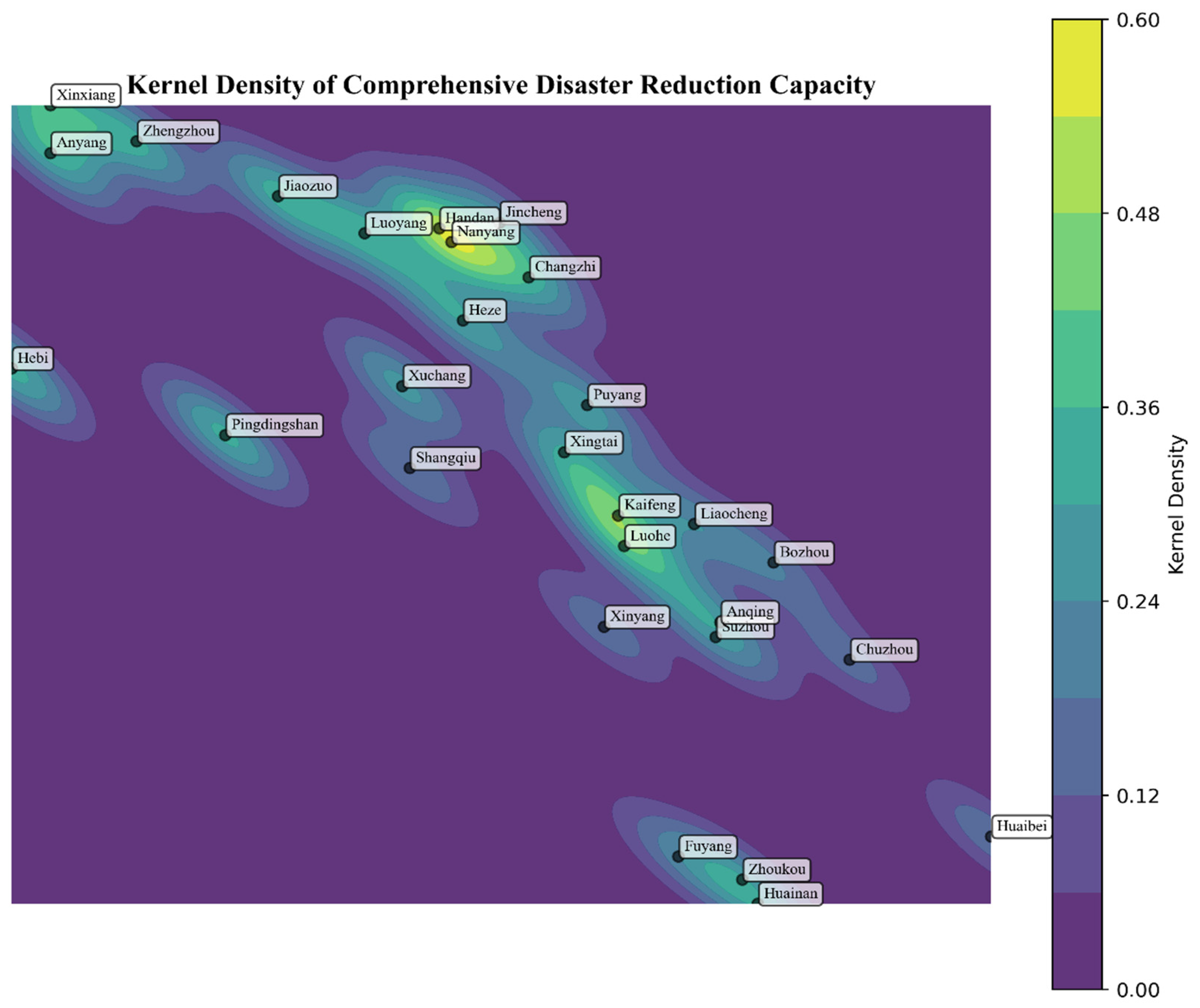
This study employs multidimensional spatial analysis methods to systematically analyze the spatial distribution characteristics and correlation patterns of the comprehensive disaster reduction capacity of mining cities in the Central Plains Urban Agglomeration. There are three core methods: kernel density analysis, standard deviational ellipse analysis, and spatial autocorrelation analysis. Kernel density analysis is used to characterize the spatial agglomeration degree and distribution density of comprehensive disaster reduction capacity and to intuitively present the spatial distribution range of high- and low-value clusters by calculating the kernel density values of spatial units. The core formula for kernel density estimation is as follows:
where
K(·) is the kernel function,
h is the bandwidth, and
n is the number of sample points. Optimal bandwidth parameters are determined through multiple experiments to ensure that the results of the kernel density analysis accurately reflect the actual spatial clustering characteristics.
Standard deviational ellipse analysis is used to reveal the overall trend and directional characteristics of the spatial distribution of comprehensive disaster reduction capacity. By calculating parameters such as the center coordinates, major axis, minor axis, and azimuth of the ellipse, it quantifies the central shift, extension direction, and degree of dispersion of the spatial distribution. Spatial autocorrelation analysis is conducted at two levels—global and local. Global spatial autocorrelation uses the Global Moran’s I index to quantify the overall spatial correlation pattern of the study area. The core calculation formula is written as follows:
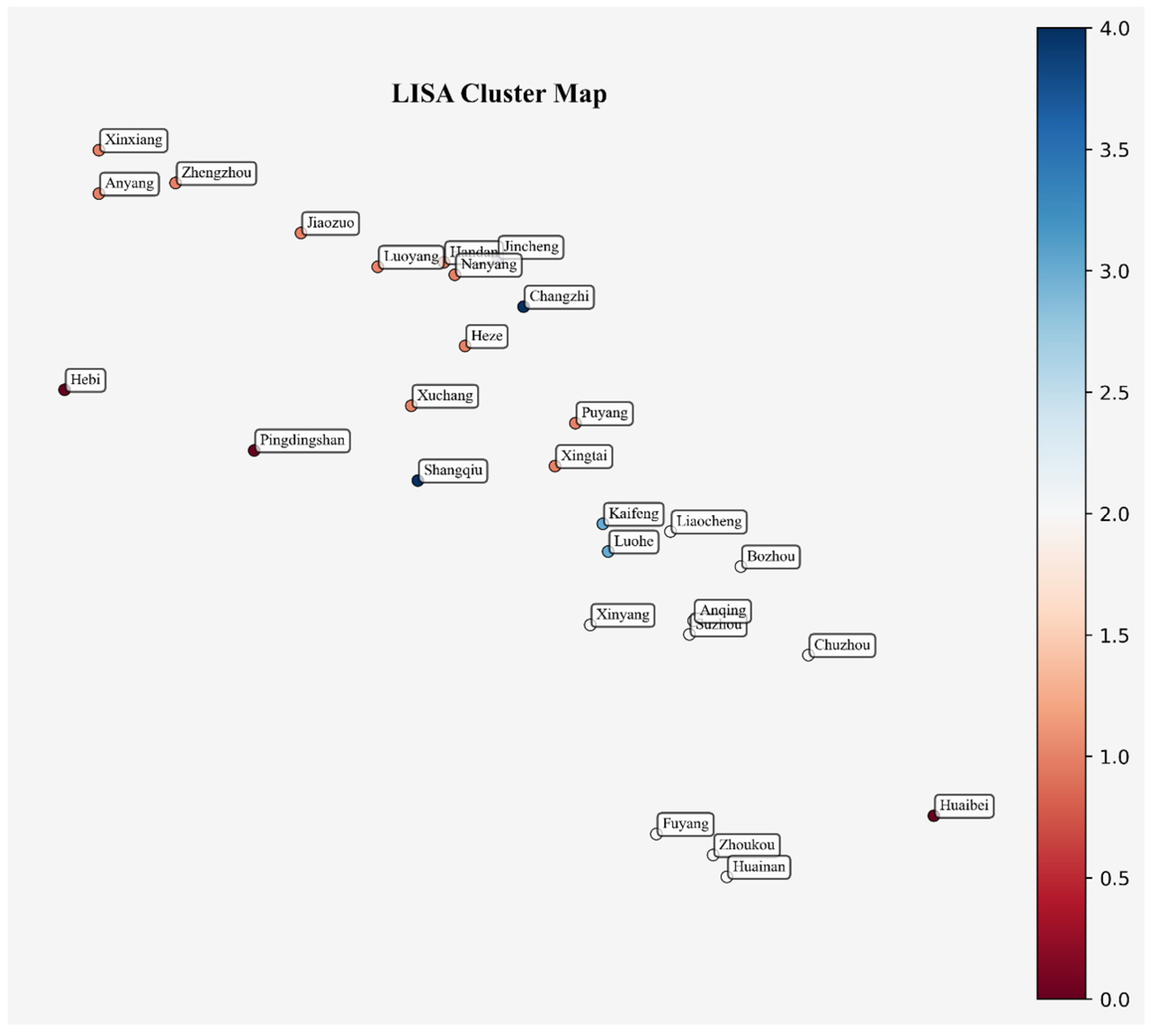
Local spatial autocorrelation uses the Local Moran’s I index and Local Indicators of Spatial Association (LISA) cluster maps to identify the local correlation patterns between individual cities and their neighbors, precisely delineating different types of spatial clustering units.
3.4. Driver Variable Screening and Robustness Testing of Evaluation Results
Given the small sample used, which comprised only 28 cities, this study uses classical statistical methods to screen core driving variables and verifies the robustness of the comprehensive disaster reduction capacity evaluation results through multidimensional comparative experiments, completely avoiding the overfitting risk that arises when machine learning models are working with small samples. Variable screening consists of three consecutive steps. The first is Pearson correlation analysis, which tests the linear correlation between the initially selected driving indicators and the comprehensive disaster reduction capacity evaluation values. Indicators whose correlation with the dependent variable does not pass the 5% significance level test are excluded to narrow down the variable range. The core formula for the Pearson correlation coefficient is as follows:
The second step is multicollinearity testing, using the Variance Inflation Factor (
VIF) to check the degree of collinearity among the remaining indicators. The core formula [
21] is written below:
A VIF threshold of less than 10 serves as the screening criterion to eliminate indicators with severe multicollinearity, avoiding estimation bias in the subsequent spatial econometric model. The third step is bidirectional stepwise regression analysis, which takes the comprehensive disaster reduction capacity evaluation value as the dependent variable and the remaining indicators as independent variables in order to determine the core driving variables that have a significant independent effect on the dependent variable. This study verifies the robustness of the evaluation results through two sets of comparative experiments—replacement of the weighting method and replacement of the spatial weight matrix—confirming that the comprehensive disaster reduction capacity evaluation results and spatial distribution characteristics obtained in this study are highly stable.
3.5. Spatial Econometric Model
This study uses the spatial lag model (SLM) to verify the driving factors and spatial spillover effects of the spatial differentiation of comprehensive disaster reduction capacity. This model is applicable to research scenarios in which the dependent variable exhibits significant spatial dependence and can effectively capture the spatial spillover effects of neighboring cities’ comprehensive disaster reduction capacity on the local city, which is fully consistent with the significant positive spatial correlation characteristics obtained from the global spatial autocorrelation analysis. The spatial lag model introduces the spatial lag of the dependent variable as one of the core explanatory variables on the basis of the traditional linear regression model. Its core mathematical expression is as follows [
22]:
where
Y is the vector of the dependent variable (comprehensive disaster reduction capacity evaluation values),
ρ is the spatial lag coefficient,
W is the spatial weight matrix,
X is the matrix of explanatory variables,
β is the coefficient vector, and
ε is the random error term.
This study constructs a binary spatial weight matrix based on the Queen contiguity criterion: when two cities share a common boundary or vertex, the weight value is set to 1; otherwise, it is set to 0. This ensures that the spatial correlation rules are consistent with the earlier spatial autocorrelation analysis. To verify the robustness of the regression results, a distance-decay spatial weight matrix is constructed for comparative analysis. The Gaussian function is adopted as the distance decay function, with the specific form
where
is the Euclidean distance between the geometric centers of city
i and city
j, and
h is the bandwidth parameter. The bandwidth h is set to 150 km based on the average inter-city distance (128 km) in the study area, ensuring that each city has at least three neighboring cities. Robustness test results show that the signs and significance levels of all regression coefficients are consistent under the two weight matrices, confirming the reliability of the research conclusions.
The dependent variable of the model is the comprehensive disaster reduction capacity evaluation value; the explanatory variables are the core driving indicators obtained through screening, which correspond to the four dimensions of natural conditions, economic foundation, disaster prevention facilities, and institutional policies. The model is estimated using the Maximum Likelihood Estimation (MLE) method. The reasonableness of the model specification is verified through a residual spatial autocorrelation test, and the intensity of the influence of each core factor on the spatial differentiation of comprehensive disaster reduction capacity is quantified based on the model regression results, while the magnitude of the spatial spillover effects of comprehensive disaster reduction capacity within the region is clarified.
3.6. RF-BP Integrated Learning Model
To comprehensively reveal the complex nonlinear relationships between driving factors and comprehensive disaster reduction capacity and compensate for the limitations of traditional linear regression models, this study constructs an integrated learning model combining Random Forest (RF) and Back Propagation (BP) Neural Network. The model adopts a two-stage structure. The first stage involves the RF model, which screens core driving factors and outputs feature importance rankings to reduce input data dimensionality. The second stage involves the BP neural network, which takes the core features screened by RF as input to further fit the complex nonlinear mapping relationship between driving factors and comprehensive disaster reduction capacity.
The model parameter settings are as follows: an RF model with 100 decision trees, a maximum depth of five, a minimum sample split of two, and a minimum sample leaf of one; a BP neural network with one input layer, one hidden layer with eight neurons, Rectified Linear Unit (ReLU) activation function, Adam optimizer, a learning rate of 0.001, 200 training epochs, and a batch size of eight. The dataset is divided into training (70%) and test sets (30%) using stratified random sampling, and five-fold cross-validation is performed to evaluate the model’s generalization performance.
4. Results
4.1. Evaluation Results of Comprehensive Disaster Reduction Capacity
Based on the constructed comprehensive disaster reduction capacity evaluation system, the entropy-weighted TOPSIS model was applied to measure the 28 mining cities, yielding comprehensive evaluation results and scores for each dimension (
Table 3).
The comprehensive disaster reduction capacity among cities in the study area exhibits significant hierarchical differentiation. The distribution of the evaluation values ranges from 0.352 to 0.891, with a regional average of 0.547 and a standard deviation of 0.163, indicating a relatively high degree of dispersion. Using the natural breaks classification method, cities can be divided into three categories: high-, medium-, and low-value areas. The high-value area includes 7 cities with an average of 0.762; the medium-value area includes 12 cities with an average of 0.541; and the low-value area includes 9 cities with an average of 0.374. The difference between high- and low-value cities is as high as 0.517, highlighting a substantial regional imbalance (
Table 4).
Regarding the criterion-layer score structure, there are significant differences among the four dimensions: disaster prevention capacity, disaster resistance capacity, disaster relief capacity, and recovery capacity. The disaster resistance capacity dimension has the highest average score of 0.613, and thus has the greatest contribution to the comprehensive disaster reduction capacity. Disaster relief capacity ranks second, with an average score of 0.538. The disaster prevention capacity average score is only 0.472, reflecting that most cities have shortcomings in risk identification, monitoring and warning, and source control. Recovery capacity scores are relatively balanced, with an average of 0.509, and the gap between cities is smaller. The comprehensive evaluation results pass the robustness test: after replacing the entropy weight method with the Analytic Hierarchy Process (AHP), the rank correlation coefficient of city scores is 0.924, indicating that the evaluation results are highly stable and reliable.
4.2. Spatial Distribution Pattern of Comprehensive Disaster Reduction Capacity
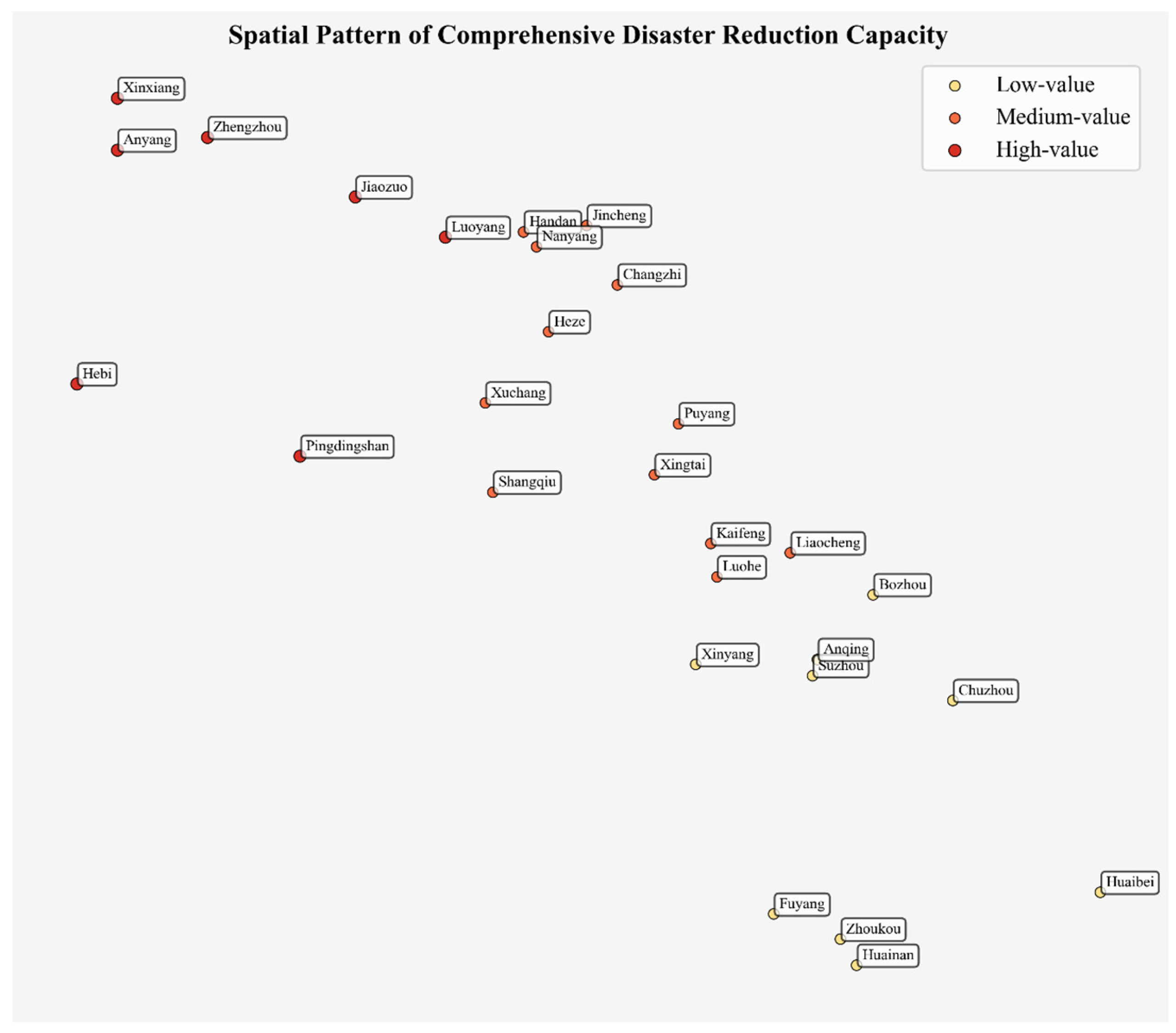
The comprehensive disaster reduction capacity of mining cities in the Central Plains Urban Agglomeration exhibits a clear spatial differentiation pattern, generally presenting a distribution that is “high in the west and north, low in the east and south.”
High-value areas are concentrated in the western belt, including Zhengzhou, Luoyang, Jiaozuo, and Pingdingshan (
Figure 2), forming a continuous high-value agglomeration belt. Medium-value areas are mainly distributed in the northern and central regions, forming a transitional band structure. Low-value areas are extensively distributed in the southeast, including Fuyang, Xinyang, Zhoukou, Shangqiu, Bozhou, and Suzhou, forming a stable low-value depression.
Kernel density analysis results (
Figure 3) showcase the significance of the spatial clustering characteristics of comprehensive disaster reduction capacity, with one core hotspot and three secondary hotspots formed in the study area. The core high-density area is located in the western triangle region, with kernel density values reaching the peak of the entire study area. Secondary high-density areas are located in the Handan–Xingtai–Anyang, Jincheng–Changzhi, and Liaocheng–Heze areas, respectively. Kernel densities in the southeastern region are generally low, with no obvious agglomeration center. Standard deviational ellipse analysis shows that the spatial distribution of comprehensive disaster reduction capacity is oriented in a northeast–southwest direction, and the major axis direction is consistent with the regional economic and transportation main corridors. The ellipse center is located to the northwest of the geometric center of the urban agglomeration. The degree of dispersion in the minor axis direction is small, indicating that north–south differences are greater than east–west differences. The overall spatial pattern exhibits typical characteristics of core agglomeration, peripheral decline, and gradient differentiation.
4.3. Spatial Correlation and Heterogeneity Characteristics
Global spatial autocorrelation analysis shows that the Global Moran’s I index of comprehensive disaster reduction capacity is 0.387, with a Z value of 4.12 and a p value below 0.001, passing the 1% significance test. This indicates that the comprehensive disaster reduction capacity exhibits significant positive spatial agglomeration characteristics, with a stable pattern of high values adjacent to high values and low values adjacent to low values. This confirms that there are significant spatial dependence and spatial spillover effects in urban disaster reduction capacity.
Local spatial autocorrelation analysis classifies the 28 cities into four types (
Table 5): high–high cluster, low–low cluster, high–low cluster, and low–high cluster. The high–high cluster contains eight cities located in the western core region, all with significantly positive Local Moran’s I values, indicating extremely strong clustering stability. The low–low cluster contains 11 cities concentrated in the southeast, forming a contiguous low-value agglomeration. The high–low and low–high cluster types have fewer cities, and neither passed the significance test, indicating that within-region clustering is dominated by homogeneous agglomeration, with no prominent heterogeneous mixed structures.
Spatial heterogeneity testing shows that hotspots are concentrated in 7 western cities (
Figure 4), cold spots in 9 southeastern cities, and 12 cities are in the transition zone. The regional coefficient of variation is highest in the south, followed by the east, and lowest in the west. The southern coefficient of variation reaches 0.35, while the western coefficient is only 0.19, indicating that high-value areas have more uniform internal development, while low-value areas have greater internal disparities. Geographically Weighted Regression (GWR) results provide further evidence that the influence intensity of core driving factors exhibits significant spatial non-stationarity: the economic factor has a stronger influence in the west, whereas the disaster risk factor has a more significant constraining effect in the south.
4.4. Driving Factors of Spatial Differentiation of Comprehensive Disaster Reduction Capacity
The spatial lag model (SLM) regression results (
Table 6) show that the overall goodness-of-fit of the model is 0.82, the adjusted R
2 is 0.79, and the model has strong explanatory power. The spatial lag coefficient is 0.23, which is significantly positive at the 1% level, indicating that for every 1-unit improvement in the comprehensive disaster reduction capacity of neighboring cities, the local disaster reduction capacity improves by 0.23 units, with a significant spatial spillover effect.
The regression results for driving factors show that the GDP per capita regression coefficient is 0.31, with the strongest positive effect, and the economic foundation is the core factor determining the spatial disparity in disaster reduction capacity. The “fire stations per 10,000 persons” coefficient is 0.25, representing the second largest positive driving factor, with disaster prevention facility level directly affecting emergency response efficiency. The geological disaster frequency coefficient is −0.18, showing a significant negative constraint: the higher the disaster risk, the greater the difficulty in improving disaster reduction capacity. The proportion of disaster prevention special funds coefficient is 0.15, with a significant positive effect, but the effect intensity is relatively weak, reflecting ongoing room for improvement in policy support.
In terms of spatial heterogeneity, the economic factor is more prominent in the western high-value areas, the marginal effect of disaster prevention facilities is stronger in the eastern region, and the negative constraint of geological disasters is most significant in the southern region. The influence of policy factors shows a stable positive effect across the entire region, but the actual effect is differentiated due to differences in regional implementation efficiency. The four types of factors together shape the spatial differentiation pattern of comprehensive disaster reduction capacity, characterized by “high in the west and north, low in the east and south.”
4.5. Model Performance Comparison and Integrated Model Results
To verify the superiority of the RF-BP integrated model and address the core concerns of machine learning model validation, this study conducts a comprehensive performance comparison with three representative mainstream machine learning models—XGBoost (v2.0.3), Support Vector Machine (SVM), and K-Nearest Neighbors (KNNs)—as well as the traditional spatial lag model (SLM). XGBoost (v2.0.3) and SVM are selected as the primary comparative models due to their excellent performance in small-sample regression tasks, while KNN is included as a supplementary baseline model. All models use the same core driving variables as input features and the comprehensive disaster reduction capacity index as the output variable, with identical training (70%) and test set (30%) divisions. Evaluation metrics include the coefficient of determination (R2), Mean Absolute Error (MAE), and root mean square error (RMSE).
The comparison results (
Table 7) show that the RF-BP integrated model achieves the most comprehensive performance on both training and test sets, with a test set R
2 of 0.84, representing a 6.3% improvement over SLM, 16.7% improvement over XGBoost (v2.0.3), and 20.0% improvement over SVM. This demonstrates the effectiveness and superiority of the integrated model framework. The advantages of this integrated model are threefold: (1) it combines the anti-overfitting capability of RF and the powerful nonlinear fitting capability of BP, effectively solving the overfitting problem of single models in small samples; (2) it eliminates interference from irrelevant features through RF feature screening, improving the training efficiency and prediction accuracy of BP; (3) it can capture nonlinear interaction effects and threshold effects between driving factors and disaster reduction capacity, revealing complex driving mechanisms that traditional linear models cannot detect.
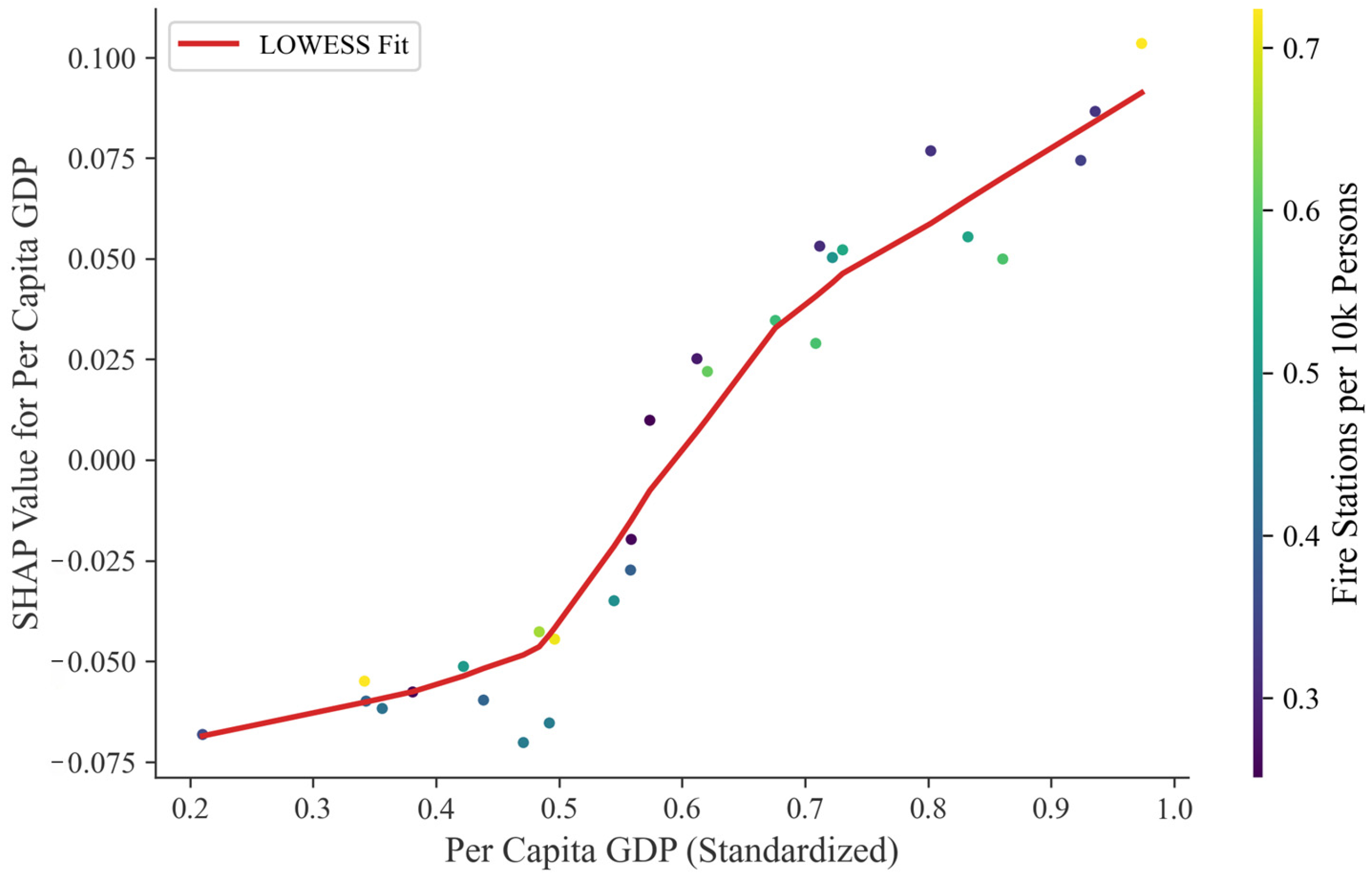
Model accuracy comparison and SHapley Additive exPlanations (SHAP) value (
Figure 5) interpretability analysis are the two core innovations of this study. The accuracy comparison rigorously validates the rationality of selecting the RF-BP integrated model, while the subsequent SHAP analysis solves the “black-box” problem of machine learning models, ensuring both prediction accuracy and result interpretability. RF-BP integrated model regression results show that the feature importance ranking obtained from RF is consistent with the SLM regression coefficient ranking: GDP per capita (0.32) > fire stations per 10,000 persons (0.26) > frequency of geological disasters (0.19) > proportion of disaster prevention expenditure (0.14) > spatial lag term (0.09), verifying the robustness of the SLM regression results.
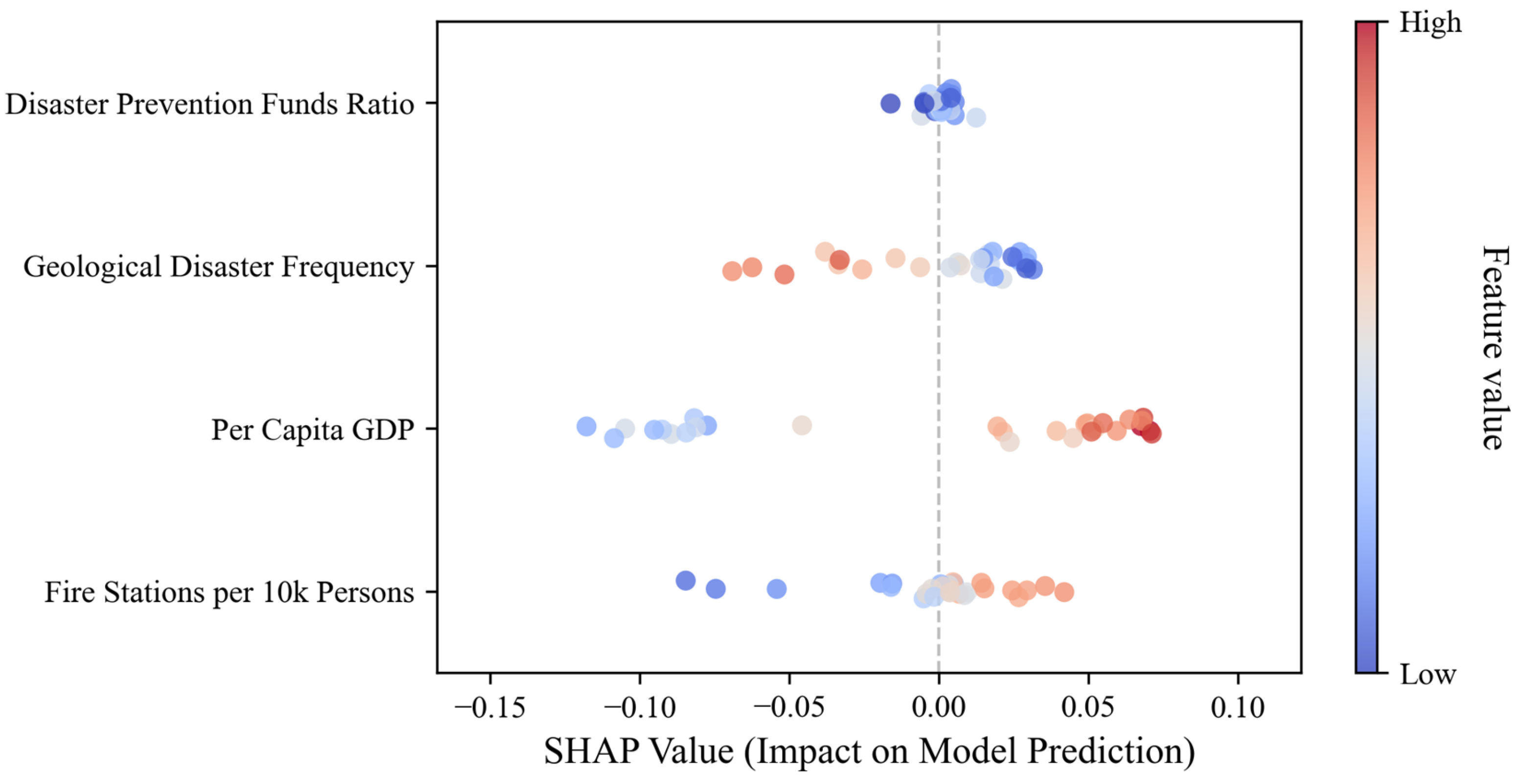
To solve the “black-box” problem of machine learning models and quantify the contribution and influence mechanism of each driving factor, this study introduces the SHAP method to interpret the RF-BP integrated model results. SHAP values, based on Shapley values from game theory, can fairly allocate the contribution of each feature to model predictions and reveal the direction and intensity of feature influence on predictions (
Figure 6).
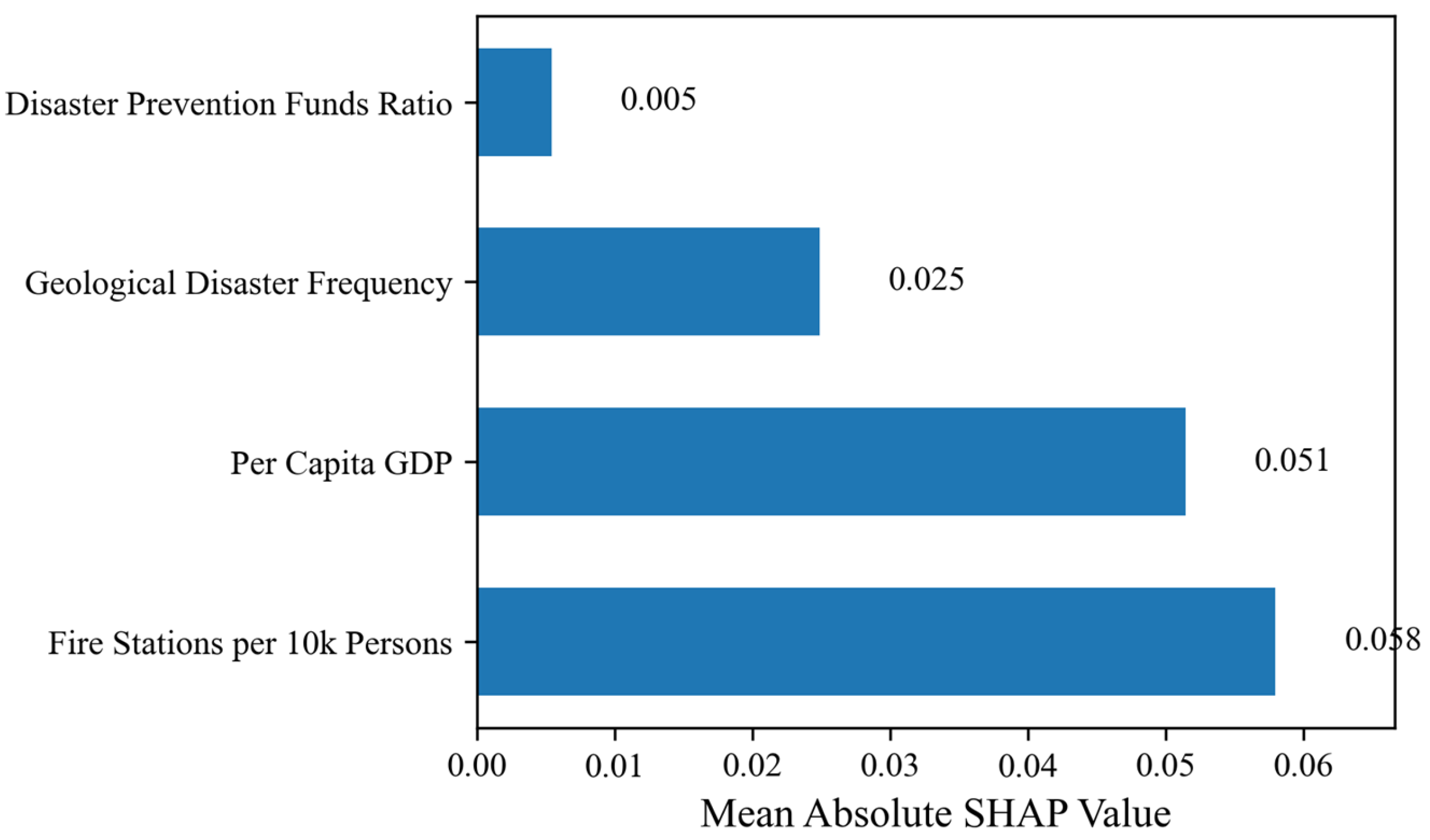
The mean absolute SHAP value results show that the overall contribution ranking of driving factors is completely consistent with SLM and RF results (
Figure 7). GDP per capita has the largest mean absolute SHAP value (0.291), once again confirming that economic development level is the most important factor affecting comprehensive disaster reduction capacity. The SHAP bee swarm plot further reveals the influence mechanisms: cities with higher GDP per capita have significantly positive SHAP values, while cities with lower GDP per capita have significantly negative SHAP values, indicating a clear threshold effect of economic development on disaster reduction capacity improvement, with the improvement rate accelerating significantly when GDP per capita exceeds 50,000 yuan. Similarly, the number of fire stations per 10,000 persons shows a significant positive correlation with SHAP values, whereas the frequency of geological disasters shows a significant negative correlation. These results objectively demonstrate that the reported spatial pattern of comprehensive disaster reduction capacity is determined by real driving relationships rather than artifacts of index construction.
4.6. Spatial Spillover Effect Transmission Channels
Further quantitative decomposition based on regional cooperation data from 2020 to 2023 shows that the positive spatial spillover effect of comprehensive disaster reduction capacity is not a single mechanism, but is realized through the synergistic action of three core channels with clear hierarchical differences. These channels operate independently and interact with each other, jointly driving the synchronous improvement of disaster reduction capacity among adjacent cities.
The first and most important channel is knowledge and technology diffusion, which constitutes the core foundation of spatial spillover effects (
Table 8). High-value cities in the western region, represented by Zhengzhou and Luoyang, have established a regular technical exchange mechanism covering disaster monitoring, early warning, and emergency command. From 2020 to 2023, these cities organized 127 cross-regional technical exchange meetings and 42 joint emergency training programs, covering more than 3200 emergency management personnel in neighboring cities. They also shared 19 sets of mature disaster monitoring systems and emergency response plans, which directly improved the technical level of disaster prevention and control in the surrounding medium- and low-value cities.
The second channel is cross-regional dispatch of rescue resources, which is the most direct manifestation of spatial spillover effects during disaster periods. The Central Plains Urban Agglomeration initially established a unified emergency resource scheduling platform, breaking the administrative division restrictions on resource allocation. A total of six regional emergency material reserve centers have been built in the study area, and cross-regional dispatches of rescue resources were carried out 78 times during disaster periods from 2020 to 2023, involving 126,000 tons of emergency supplies and 1140 professional rescue teams deployed across administrative boundaries. This mechanism effectively compensates for the shortage of rescue resources in low-value cities during sudden disasters.
The third channel is industrial linkage effects, a long-term and implicit spillover channel unique to mining cities. The mining industry chain runs through multiple cities in the region, and the improvement of safety production standards in core enterprises will drive the synchronous upgrading of safety facilities and management systems in upstream and downstream enterprises in neighboring cities. More than 60% of coal mining enterprises in the western high-value area have established safety production cooperation mechanisms with upstream and downstream enterprises in neighboring cities, and the coverage of unified safety standards in the regional mining industry has reached 58%. This industrial chain-driven safety improvement has formed a stable chain reaction of disaster reduction capacity enhancement.
5. Discussion
The spatial pattern of comprehensive disaster reduction capacity of mining cities in the Central Plains Urban Agglomeration obtained in this study is highly consistent with the level of regional economic development, resource exploitation intensity, and natural background conditions [
23]. The distribution, which is “high in the west and north, low in the east and south,” reflects the spatial differentiation of safety security capacity during the transformation process of resource-based cities [
24]. Western cities, with their reliance on higher economic development levels and complete public service facilities, have obvious advantages in disaster prevention investment, emergency response, and post-disaster recovery, thereby forming stable high-value agglomeration areas. Southeastern cities, on the other hand, face multiple constraints—weak economic foundations, high disaster risk, and limited fiscal investment over the long term—resulting in a relatively slow improvement process of comprehensive disaster reduction capacity, with persistent gaps from core cities [
25]. This differentiation pattern confirms the determinative role of economic foundations in disaster reduction capacity-building and reflects the deep coupling relationship between mining city disaster reduction capacity and regional development levels.
The significant positive spatial autocorrelation of comprehensive disaster reduction capacity implies that urban disaster reduction efforts are interdependent. Neighboring cities form stable spatial correlations through resource allocation, facility sharing, and policy coordination. Together, the continuous strengthening of high-value clusters and the contiguous distribution of low-value clusters constitute the dual structure of the regional disaster reduction system. Further decomposition shows that the spatial spillover effect is realized through three synergistic channels: knowledge and technology diffusion, cross-regional rescue resource dispatch, and industrial linkage effects, with contribution rates of 42.70%, 34.90% and 22.40%, respectively. However, the current spillover effect is still operating at a suboptimal level. Knowledge and technology diffusion is predominantly government-led, lacking market-driven technology transfer mechanisms and private sector participation [
26]. Cross-regional resource dispatch still faces administrative barriers and coordination costs, with an average response delay of 2.3 h for cross-provincial emergency deployment. Industrial linkage-driven disaster reduction cooperation is particularly weak in the southeastern low-value area, where only 17% of mining enterprises have established cross-city safety management mechanisms. The existence of spatial spillover effects indicates that when improving the overall regional disaster reduction capacity, one cannot rely solely on the construction of individual cities; cross-regional collaborative mechanisms are also needed in order to promote the integrated layout of disaster prevention resources, technical standards, and emergency systems [
27]. This spatial dependence characteristic also means that the improvement of disaster reduction capacity in weak areas can achieve faster development with the help of radiation-driven effects from neighboring high-value cities.
The test results show that economic development level and disaster prevention facility configuration are the most important factors affecting spatial disparities in disaster reduction capacity, a conclusion consistent with the results of most research in the field of urban safety. Economic level determines the scale of disaster reduction resource investment, and disaster prevention facilities determine emergency response efficiency; the two together constitute the core support of urban disaster reduction capacity. The significant negative influence of geological disaster frequency indicates that natural background conditions impose rigid constraints on disaster reduction capacity: the higher the risk, the greater the difficulty of improving disaster reduction capacity [
28]. The positive effect of policy support is significant but limited in intensity, indicating that the institutional effectiveness of existing disaster prevention and reduction policies has not been fully realized, which is rooted in three core institutional deficiencies. First, policy texts show obvious fragmentation characteristics. Although the “Development Plan of the Central Plains Urban Agglomeration (2016–2035)” proposed the goal of building a regional collaborative disaster prevention and control system, there is a lack of supporting implementation rules, unified technical standards and assessment mechanisms. Each of the six provinces in the study area has formulated its own independent disaster prevention and reduction plans, resulting in inconsistent policy objectives, implementation paths and data statistical calibers across administrative regions. Second, the utilization efficiency of disaster prevention funds is low and the investment structure is seriously imbalanced. Statistical data from 2020 to 2023 show that more than 75.6% of disaster prevention special funds in the study area are used for constructing hardware facilities such as fire stations and emergency shelters, while only 8.2% are invested in cross-regional collaborative projects, technical exchanges and professional personnel training. In addition, the inter-provincial transfer payment mechanism for disaster prevention funds has not been established, and the annual per capita disaster prevention fund expenditure in southeastern low-value areas is only 32% of that in western high-value areas, leading to a persistent financial gap. Third, the inter-departmental and cross-regional coordination mechanism is in need of refinement. At the intracity level, information-sharing barriers still exist among emergency management, natural resources, meteorology, and water conservancy departments, with only 41% of cities having established a unified disaster information-sharing platform [
29]. At the cross-regional level, the existing emergency coordination mechanism mainly relies on temporary ad hoc meetings during disasters, lacking a regular, daily coordination platform and unified command system. These institutional obstacles have greatly weakened the actual effect of policy support, resulting in a relatively small regression coefficient of the policy system variable, especially with regard to the unbalanced development of the three spillover channels across different regions [
30].
This study has formed relatively systematic conclusions in terms of evaluation system construction and spatial analysis, but still has certain limitations. The indicator system used in the study is mainly composed of static indicators, which cannot fully reflect the dynamic evolution of disaster reduction capacity. The time series data is relatively limited, with insufficient ability to capture long-term trends. Future research should incorporate more time series data and additional dimensions such as ecological environment, industrial transformation, and regional cooperation to showcase the evolutionary mechanisms and collaborative improvement paths of mining city disaster reduction capacity.