Article

Driving Digital Adoption in Rural Tajikistan: An Extended Technology Acceptance Model (TAM) Analysis of Institutional and Psychological Barriers


by
Azizakhon Salieva
,
Jiafeng Zhang
,
Miao Wan
* and
Erpeng Wang
School of Economics and Management, Nanjing Tech University, 30 Puzhu South Road, Pukou District, Nanjing 211816, China
*
Author to whom correspondence should be addressed.
Sustainability 2026, 18(11), 5218; https://doi.org/10.3390/su18115218
Submission received: 3 April 2026 / Revised: 11 May 2026 / Accepted: 20 May 2026 / Published: 22 May 2026

Abstract

The digital transformation of agriculture is a critical pathway for promoting sustainable rural livelihoods in transition economies. This study examines the determinants of mobile agricultural application adoption among 327 smallholder farmers in Tajikistan, integrating the Technology Acceptance Model (TAM) with New Institutional Economics (NIE). We develop a formative Institutional Support Index (ISI) comprising cooperative membership, extension access, and regulatory familiarity. Using binary logistic regression and multi-model robustness checks (probit, LPM, IV-probit), we identify three core findings. First, perceived usefulness (PU) is the dominant positive driver (AME = +12.2 pp; p < 0.001). Second, perceived risk (PR) constitutes a significant psychological barrier (AME = −7.6 pp; p < 0.01), while perceived trust (PT) partially offsets this deterrent effect (AME = +6.4 pp; p < 0.01). Third, we document a “land ownership puzzle,” where land ownership exerts a robust negative conditional effect on adoption (AME = −14.2 pp; p < 0.01). This finding suggests a property-rights-based “conservatism bias” unique to transition contexts, where asset-protection motives increase the adoption threshold for landowners compared to tenants. Exploratory analysis indicates a tentative “Sensitization Effect,” in which institutional support may increase risk awareness in the absence of financial risk-sharing mechanisms. These results broaden the applicability of the TAM to post-Soviet transition environments and suggest that digital extension initiatives must incorporate risk-management tools to effectively assist smallholder farmers.

1. Introduction

The digital transformation of agriculture presents one of the most consequential opportunities for improving rural livelihoods and fostering sustainable agricultural intensification in developing economies [1,2]. Digital transformation is not only a technical modernization but also an important element in achieving the UN Sustainable Development Goals (SDGs), including Goal 2 (Zero Hunger) and Goal 8 (Decent Work and Economic Growth). Mobile agricultural applications (agri-apps), by providing real-time weather forecasts, pest management guidance, and market price information, can substantially reduce the informational asymmetries that constrain smallholder farm decision making [3,4]. In Tajikistan—where over 60% of the labor force is engaged in agriculture, contributing approximately 22% to GDP [5,6]—this potential is especially pronounced, yet remains largely unrealized.
As a transition economy, Tajikistan’s agricultural sector faces a unique dependence on its Soviet past, making it an important laboratory for studying how institutional legacy influences the sustainability of modern digital technologies. Tajikistan presents a paradox of mobile connectivity without digital agriculture adoption. By 2023, mobile phone subscriptions exceeded 100% of the population and 4G coverage was expanding; nevertheless, fewer than half of mobile internet users actively engage with digital services [7,8]. Despite their technical capabilities, locally developed applications like Agroinform.tj, Daftari Dehqon, and Hosil—which are primarily supported by international NGOs and the Ministry of Agriculture—remain marginal in practice. Actual barriers to adoption include relatively high network service costs, a lack of specialized digital knowledge among the aging rural population, and the structural degradation of the traditional state-led agricultural extension system.
This disparity between access and utilization indicates that the primary constraints in this setting are not infrastructural or service-related, but rather embedded in the institutional and psychological frameworks influencing farmer decision making. In this transition economy, the decision to adopt an agri-app represents a strategic response to perceived institutional instability and the farmer’s vulnerability within a precarious legal framework. In particular, the transition from Soviet collective farming to dispersed smallholder systems [9] has resulted in a structural disparity between nominally titled landowners and informal tenants, whose asset-protection objectives and risk tolerances are fundamentally distinct. This study focuses on the ‘psychological architecture’ to bridge the gap between internet accessibility and rural sustainable development.
Standard behavioral models—chiefly Davis’s [10] Technology Acceptance Model (TAM) and the Unified Theory of Acceptance and Use of Technology (UTAUT) [11]—offer established frameworks for identifying adoption determinants. Yet their application in post-Soviet transition contexts raises important questions. Nevertheless, recent research suggests that these psychological factors—risk, perceived usefulness, and trust—are closely associated with land tenure status in post-Soviet conditions. Tajikistan’s land tenure system is a legacy of Soviet collectivization and subsequent fragmented redistribution [12], creating a structural divide between formally titled landowners and informal tenants whose risk tolerances and opportunity costs may differ systematically. Similarly, the institutional environment—comprising cooperatives, extension services, and regulatory frameworks—may shape adoption decisions through channels that the TAM was not designed to capture. By considering land tenure as a critical source of heterogeneity, this study contributes to the literature by redirecting the primary empirical focus to the associations between perceived usefulness (PU), perceived risk (PR), and perceived trust (PT) with adoption intention.
Moreover, although the current literature has thoroughly investigated the role of extension services and cooperatives in technology dissemination [13,14], and has separately highlighted the significance of psychological trust and risk in individual adoption decisions [15], these elements are infrequently analyzed as an interconnected, interactive system in transition economies. Current research often views institutional support as a unilateral facilitator that reduces access barriers [16].
The relationship between institutional exposure and psychological characteristics is examined in this study, with a focus on how land tenure affects adoption threshold variability. Crucially, we move beyond basic additive models to address the “land ownership puzzle”: a phenomenon where landowners, despite their greater levels of wealth and more positive views of technology, are often more reluctant to adopt digital technologies than tenants once these advantages are controlled for. The study aims to examine the following research questions:
  • In a transition economy, how do the fundamental components of the Technology Acceptance Model (perceived usefulness and perceived ease of use) affect adoption when augmented by perceived risk and Trust?
  • What is the impact of land tenure status on the asset-protection motives and adoption thresholds that differentiate landowners from tenants?
  • To what extent does institutional exposure (ISI) function as a supplementary structural control in the digital adoption process?
By integrating ISI into an enhanced TAM framework, alongside perceived risk (PR) and perceived trust (PT), grounded in North’s New Institutional Economics (NIE) [17], we shift focus to a sophisticated behavioral model that examines the impact of institutions on psychological constructs, thus remedying a theoretical void in the digital transformation of Central Asian agriculture.
This study contributes to these theoretical gaps by developing a formative Institutional Support Index (ISI) that measures the cumulative institutional environment accessible to individual farmers, following the pragmatic approach of Khan et al. [13]. It is imperative to investigate the structural contexts of land tenure status and institutional exposure (ISI) that influence these psychological factors.
Using survey data from 327 smallholder farmers across Tajikistan, we estimate three sequential logistic regression specifications with progressively richer interaction structures. We complement the main analysis with probit, LPM, and IV-probit robustness checks to ensure result stability. The study is transparent about its data limitations, most notably potential common method bias (CMB) inherent in cross-sectional self-report surveys, and interprets its findings accordingly. This study is the first empirical investigation to examine the joint role of institutional support and land tenure in shaping the psychological barriers to digital agriculture in Central Asia.
The remainder of the paper is organized as follows. Section 2 reviews the theoretical background and derives the study hypotheses. Section 3 describes the data, variable construction, and econometric strategy. Section 4 reports empirical results. Section 5 discusses findings in the context of the extant literature and elaborates policy implications. Section 6 concludes.

2. Theoretical Background and Hypotheses

2.1. TAM and Behavioral Determinants of Adoption

The Technology Acceptance Model [10] posits that perceived usefulness (PU)—the degree to which a technology is believed to improve task performance—and perceived ease of use (PEU) jointly determine behavioral intention. The TAM has been extensively validated in agricultural technology contexts across Sub-Saharan Africa [18], Southeast Asia [19], and South Asia [20]. Extending the TAM, Venkatesh et al.’s [11] UTAUT incorporates social influence (SI) and facilitating conditions (FC) as additional determinants, providing a richer account of heterogeneous adoption decisions.
Although PU and PEU are conventional constructs, their formalization is essential for the purpose of directing empirical expectations in the Central Asian context.
H1. 
Perceived usefulness (PU) has a positive effect on farmers’ adoption intention.
H2. 
Perceived ease of use (PEU) has a positive effect on farmers’ adoption intention.
Two additional constructs—perceived risk (PR) and perceived trust (PT)—have emerged as critical additions to the TAM in e-commerce and agricultural digitization research [21,22]. Perceived risk captures farmers’ subjective probability of incurring losses from hardware failures, data breaches, or inaccurate information [21]. Perceived trust reflects farmers’ confidence in the reliability, competence, and benevolence of digital systems and their information sources [23,24]. Featherman and Pavlou [21] demonstrate that PR and PT operate as complementary psychological gatekeepers: risk discourages adoption, while trust enables it by reducing perceived vulnerability. Trust in the benevolence of digital systems is a primary motivator for overcoming the inherent risks of new technology in Tajikistan, where formal legal protections are frequently perceived as inadequate. This theoretical framing motivates the following hypotheses:
H3. 
Perceived risk has a significant negative direct effect on farmers’ adoption intention.
H4. 
Perceived trust has a significant positive direct effect on farmers’ adoption intention.

2.2. New Institutional Economics and the Institutional Support Index

North [17] conceptualizes institutions as the ‘rules of the game’—formal laws, regulations, and enforcement mechanisms alongside informal norms and conventions—that structure economic incentives and constrain behavior. Williamson [25] extends this framework by emphasizing transaction cost reduction as the primary function of effective institutions. In agricultural technology adoption, institutional density—the richness and accessibility of cooperative networks, extension services, and regulatory frameworks—reduces the information and contracting costs that make new technologies appear risky [26,27].
Following Khan et al. [13] and Diamantopoulos and Siguaw [28], we operationalize institutional support as a formative index rather than a reflective scale. A formative construction is appropriate because cooperative membership, extension service access, and regulatory familiarity represent theoretically independent institutional pathways rather than indicators of a common latent factor. Each pillar reduces a distinct type of transaction cost: cooperatives mitigate information asymmetry through peer knowledge exchange; extension services lower search costs for technical information; and regulatory frameworks provide the legal clarity necessary for platform trust. Together they form a cumulative institutional endowment accessible to individual farmers.
The present study utilizes the Institutional Support Index (ISI) as a supplementary structural variable that reflects a farmer’s cumulative institutional exposure, rather than the complex moderator role frequently assigned to institutional support in prior research. In transition economies such as Tajikistan, institutional channels predominantly serve as baseline facilitators that lower information search costs for digital tools without necessarily affecting an individual’s underlying risk sensitivity. Prior work in transition economies finds mixed evidence: Kazumi and Kawai [26] show that institutional support enhances entrepreneurial self-efficacy in uncertain environments, while Diaz et al. [27] document that institutional presence can simultaneously increase technology awareness and risk salience. To investigate whether institutional presence simultaneously enhances technology awareness and risk salience, we maintain the following hypotheses:
H5a. 
ISI moderates the effect of perceived risk on adoption intention; at high ISI levels, the deterrent effect of perceived risk is amplified (the Sensitization Effect).
H5b. 
ISI moderates the effect of perceived trust on adoption intention; at high ISI levels, the facilitative effect of perceived trust is enhanced.
H5c. 
ISI moderates the effect of income on adoption intention, reducing financial vulnerability associated with technology costs.
By exploring these institutional paths, we aim to identify governance structures for the long-term socio-economic sustainability of digital extension services in Central Asia.

2.3. Land Ownership as a Structural Moderator

Tajikistan’s land tenure system is a complex legacy of post-Soviet redistribution, in which land is still technically state-owned but utilization rights are distributed through a variety of certificates [12]. A distinction is made between landowners, who possess long-term land-use certificates, and tenants, who are informal or temporary users. Typically, landowners possess greater social capital, while tenants often experience “tenure insecurity.”
Property rights theory [17,29] predicts that secure asset ownership increases the subjective cost of failure because landowners bear a higher proportion of any loss relative to the productive value of their holdings. Applied to digital technology, this manifests as an “Asset-Protection Motive,” where landowners may perceive application failure—whether due to data inaccuracy, financial loss, or reputational risk—as a threat not merely to current income but to the underlying asset base. Tenants, holding residual claims on lower fixed assets, may face a lower psychological cost of experimentation. The post-Soviet land reform in Tajikistan created present-day ownership status largely through historical administrative allocation rather than market choice [12], providing a plausibly exogenous source of variation in asset structure.
Notably, this theoretical prediction concerns the conditional effect of land ownership. It does not imply that landowners are uniformly averse to digital adoption in absolute terms; indeed, landowners may hold more favorable technology perceptions on average if ownership correlates with wealth and information access. Rather, the hypothesis concerns differential risk sensitivity—how steeply PR deters adoption for owners versus tenants:
H6a. 
Land ownership has a significant positive direct effect on adoption intention due to higher wealth and information access.
H6b. 
Land ownership moderates the negative effect of perceived risk on adoption intention; landowners exhibit greater risk sensitivity than tenants.

2.4. Conceptual Framework

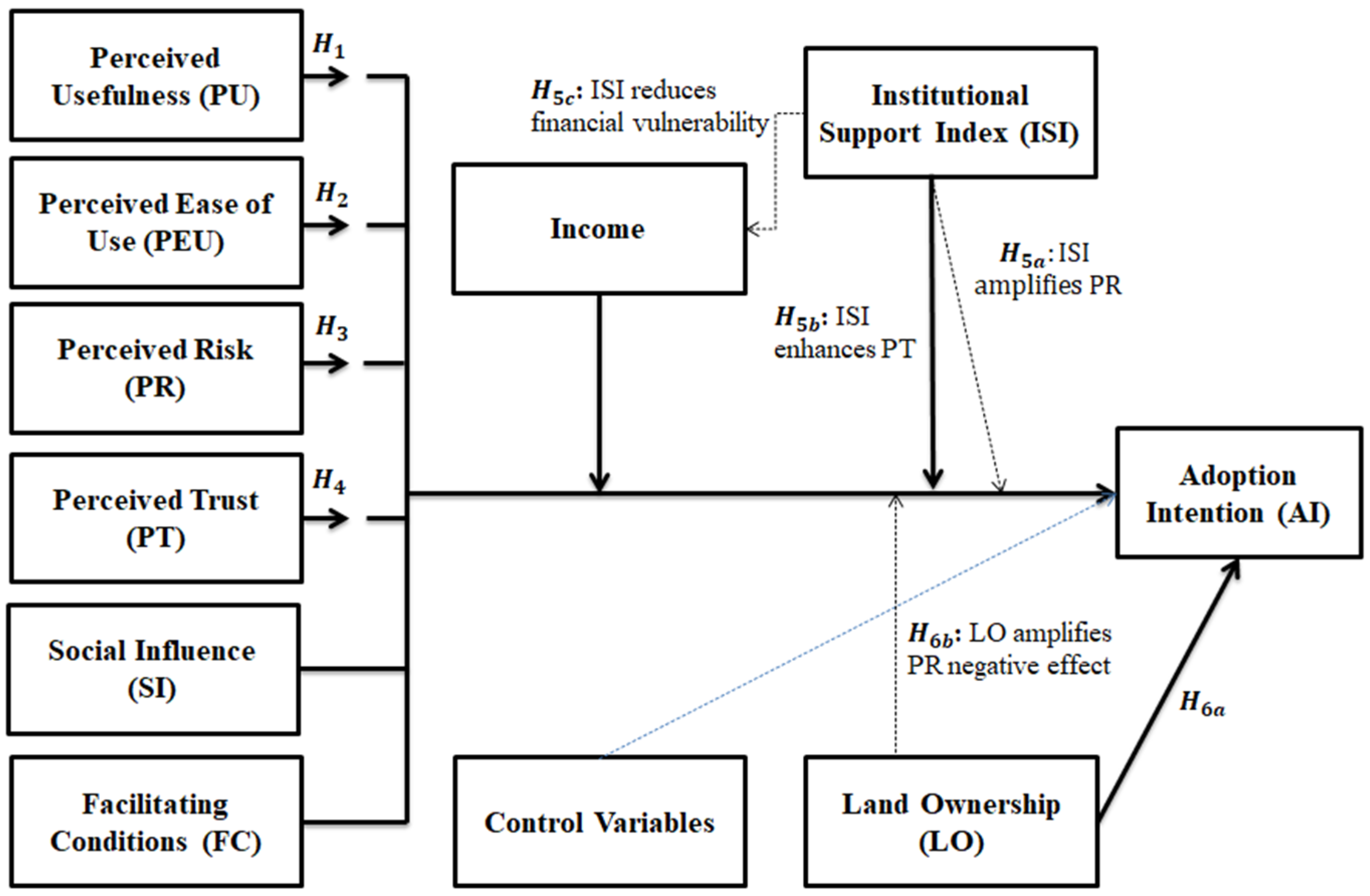
The joint interactive system that combines these numerous interactions is depicted in Figure 1. The model illustrates the impact of the structural contexts of land ownership and the Institutional Support Index on the fundamental TAM structures and psychological motivators.

3. Materials and Methods

3.1. Data Collection

Data were collected via a structured questionnaire administered to farmers across multiple provinces of Tajikistan in 2024–2025. Questionnaires were distributed through mobile social media and in-person channels, yielding 361 responses from an initial distribution of 500. After listwise deletion of incomplete records, 327 valid observations were retained for analysis (response completion rate of 65.4%). The questionnaire captured psychometric constructs, institutional conditions, and socioeconomic characteristics (Appendix A). The geographical distribution of the sample ensures representation of various agro-ecological regions of Tajikistan, providing a comprehensive view of the digital barriers standing in the way of sustainable rural development in the region.
The questionnaire was developed using a three-stage process to operationalize variables and determine the instrument’s provenance:
  • Construct Identification: The UTAUT framework [11] was used to derive the items for perceived usefulness (PU), perceived ease of use (PEU), social influence (SI), and facilitating conditions (FC). Featherman and Pavlou [21] were consulted for perceived risk (PR) and perceived trust (PT).
  • Contextual Adaptation: The Institutional Support Index (ISI) was created by incorporating binary indicators relevant to the agrarian transition in Tajikistan [12,13].
  • Pilot Testing: Prior to its widespread distribution, the instrument was pre-tested with 20 farmers and subsequently refined for local linguistic and conceptual context.
All reflective psychometric items were measured on a five-point Likert scale (1 = strongly disagree to 5 = strongly agree). Informed consent was obtained from all participants, and data were anonymized at collection. The ethical considerations comply with the Declaration of Helsinki.
We note an important data quality concern. Harman’s single-factor test yields a first-factor variance share of 67.1%, exceeding the conventional 50% threshold [30]. This result is consistent with common method bias (CMB) arising from the single-source, self-report design. We interpret this as an indication that reported inter-construct correlations may be inflated relative to true population relationships, and we caution against strong causal inference. Structural validation confirms, however, that the ISI—a binary composite—loads distinctly on a separate factor (loading = 0.99) from the psychometric constructs, providing partial evidence of discriminant validity.

3.2. Variable Operationalization

To enhance clarity and transparency, Table 1 consolidates the key variables and their measurement scales. Based on the current literature on the adoption of agricultural technology and the distinctive socioeconomic conditions of Central Asian agrarian transitions, the selected variables and the questionnaire items were modified. Socioeconomic controls are consistent with the established characteristics that are recognized in smallholder adoption studies, and the psychometric items were adapted from validated measures.
As indicated in Table 1, all reflective constructs exhibit high internal consistency, with Cronbach’s α values ranging from 0.790 to 0.938, well above the accepted 0.70 threshold for exploratory research [33].
Institutional Support Index (ISI). Following Khan et al. [13] and North [17], the ISI is operationalized as a formative additive index comprising three binary indicators: cooperative membership (MC; 1 = member of an agricultural cooperative), extension service access (ES; 1 = access to agricultural extension services), and regulatory framework familiarity (RF; 1 = familiar with relevant digital agriculture regulations). ISI ranges from 0 to 3 (mean = 1.69; SD = 0.98). Consistent with the formative nature of the construct, the low inter-item correlation and Cronbach’s α = 0.45 are expected and do not constitute a validity concern [28].
Regarding measurement sensitivity, we acknowledge that the index assumes equal weighting for each indicator; however, the underlying distributions differ (e.g., extension access at 77.4% vs. regulatory familiarity at 38.8%). We mitigate potential bias by conducting a sensitivity analysis, which involves treating ISI as a categorical regressor in the robustness tests to investigate non-monotonic effects.

3.3. Model Specification

To evaluate the factors that influence the intention to adopt agri-apps, we employ a Binary Logistic Regression framework, which is the standard econometric method for analyzing categorical choice behavior with a binary dependent variable. Based on a sequence of independent variables, the model determines the probability that a farmer intends to adopt the application. Three nested model specifications are estimated:
  • Model 1 (Baseline):
AI = β0 + β1PR + β2PT + β3PU + β4PEU + β5SI + β6FC + Σβi Controlsi + εi.
  • Model 2 (Socioeconomic Heterogeneity):
AI = Model 1 + γ1(Income × PR) + γ2(Gender × PR) + γ3(LO × PR).
  • Model 3 (Institutional Moderation):
AI = Model 2 + δ1ISI + δ2(PR × ISI) + δ3(PT × ISI) + δ4(Income × ISI).
where AI—adoption intention; PR—perceived risk; PT—perceived trust; PU—perceived usefulness; PEU—perceived ease of use; SI—social influence; FC—facilitating conditions; ISI—Institutional Support Index; LO—land ownership; and ε—stochastic error term.
The incorporation of interaction elements in Model 2 is conceptually supported by the literature on “vulnerability-driven risk sensitivity.” The Income × PR and LO × PR formulations are designed to illustrate the influence of a farmer’s financial stability and asset ownership (land ownership) on their vulnerability to technology-related hazards. It is anticipated that the deterrent impact of risk will be exacerbated by reduced income and lower asset stability, as these farmers have a limited capacity to withstand future potential losses. The Gender × PR interaction is implemented to alleviate the institutional access and risk aversion disparities within transition economies. ISI and its interactions are included as exploratory variables in Model 3; we acknowledge their secondary empirical function while maintaining these paths to fully trace the theoretical framework.
All continuous variables (PR, PT, PU, PEU, SI, FC, ISI, Income) are mean-centered prior to interaction term construction to reduce multicollinearity and facilitate the interpretation of constituent main effects [34]. Heteroscedasticity-consistent (HC1) robust standard errors are employed throughout. The mean VIF across all Model 3 regressors is 3.33, with the mean-centered PR parent variable reaching VIF = 10.77—a mathematically expected artifact of interaction models that does not invalidate inference [34]. Average marginal effects (AME) are computed from Model 1 coefficients to obtain probability-scale effect estimates.

4. Results

4.1. Descriptive Statistics and Construct Validity

Table 2 presents summary statistics for the primary analytical variables. Adoption intention is 56.3% in the sample. Perceived risk registers a mean of 3.43 (SD = 0.99), indicating moderately elevated risk concerns among respondents. Perceived trust (mean = 3.37; SD = 1.11) reflects a baseline but heterogeneous level of confidence in digital tools. Perceived usefulness records the highest score among TAM constructs (mean = 3.58; SD = 1.07), suggesting that awareness of agri-app utility is relatively widespread. All Cronbach’s α values exceed 0.79, confirming adequate internal consistency.
The ISI distribution reveals structural gaps in institutional support: while 77.4% of farmers report extension service access, only 52.3% are cooperative members and merely 38.8% are familiar with the regulatory framework. Socioeconomically, 73.4% of respondents are landowners, 82.9% are male, 55.9% hold a university-level degree, and 89.9% reside in rural areas. Only 32.1% report access to formal credit—a structural vulnerability that contextualizes risk sensitivity.
Table 3 provides a systematic comparison of the mean characteristics of landowners and tenants to further investigate the impact of land tenure. This comparison reveals substantial unconditional differences: landowners report a higher adoption intention (60.0%) than tenants (46.0%, p = 0.024). Furthermore, landowners exhibit significantly more favorable perspectives regarding technology, demonstrating lower perceived risk (p < 0.001) and higher perceived usefulness (p < 0.001). They supervise larger properties and earn more than tenants. These baseline advantages suggest that landowners are more advantageously situated for adoption, establishing a “land ownership puzzle” when contrasted with the conditional regression results presented in Section 4.3.

4.2. Correlation Structure and CMB Assessment

Table 4 presents Pearson correlations among the analytical constructs. The psychometric constructs (PR, PT, PU, PEU, SI, FC) are substantially intercorrelated (r = 0.68–0.83 in absolute value), which is expected for attitudinal measures sharing common variance but also consistent with CMB inflation. Notably, AI correlates strongly and in the theoretically expected direction with PR (r = −0.628), PT (r = 0.667), PU (r = 0.689), PEU (r = 0.606), SI (r = 0.623), and FC (r = 0.632). The ISI is largely orthogonal to all other measures (|r| ≤ 0.073), confirming its conceptual independence as a structural rather than attitudinal construct. This orthogonality provides a form of discriminant validity for the formative index and suggests that ISI-related findings are not confounded by the common method variance that likely affects psychometric inter-correlations.

4.3. Main Logistic Regression Results

Table 5 presents the results of the three nested logistic regression specifications. All models employ HC1 robust standard errors. Pseudo-R2 values are 0.509, 0.513, and 0.518 for Models 1, 2, and 3, respectively, indicating that the addition of interaction terms yields only modest incremental fit—a finding that suggests restraint in interpreting moderation effects.
Across all specifications, perceived usefulness (PU) is the most robust and economically significant predictor of adoption intention (M1: β = 1.207; p < 0.001), confirming H1—that utility perceptions constitute the primary adoption motivator. Perceived trust (PT) consistently shows a positive and statistically significant effect (M1: β = 0.630; p < 0.01), supporting H4. Perceived risk (PR) is negative and significant in the baseline model (M1: β = −0.752; p < 0.01), supporting H3.
Among structural controls, land ownership (LO) is the most robust negative predictor (M1: β = −1.402; p < 0.01), persisting across all three specifications and robustness checks. This result contradicts the direct positive effect proposed in H6a. As shown in Table 3, in unconditional means, landowners actually report higher adoption intention (60.0% vs. 46.0% for tenants; t-test p = 0.024) and more favorable technology perceptions (lower PR, higher PT and PU). However, the negative conditional coefficient reflects a suppressor mechanism: once the mediation of technology perceptions and socioeconomic advantages are controlled, landowners—despite holding more favorable perceptions on average—actually show lower than expected adoption given those perceptions. This empirical pattern is crucial to the “land ownership puzzle,” showing that while landowners have the financial and psychological means to adopt, a conservatism based on property rights creates a higher threshold for final commitment than it does for tenants.
To ensure model parsimony and prevent multicollinearity with Farming Experience, Age was excluded from the regression models, though it was initially collected as a demographic control. The PEU coefficient is negative and approaches marginal significance (M1: β = −0.629; p = 0.132), failing to support H2 and suggesting that ease of use is not a primary adoption driver in this context. Social influence (SI) and facilitating conditions (FC) are consistently non-significant, indicating that adoption decisions in rural Tajikistan are primarily internally motivated.

4.4. Average Marginal Effects

To facilitate economic interpretation, Table 6 reports average marginal effects (AMEs) from Model 1, expressed as probability-scale changes in adoption likelihood. A one-unit increase in PU raises the probability of adoption by 12.2 percentage points (pp), confirming the dominant role of utility perceptions as posited in H1. A one-unit increase in PR reduces adoption probability by 7.6 pp (supporting H3), while a one-unit increase in PT raises it by 6.4 pp, supporting H4. These effects are of economically meaningful magnitude given the 56.3% base rate.
Land ownership reduces the probability of adoption by 14.2 pp compared to tenancy. This estimate is robust to model specification (LPM: −13.2 pp; p = 0.021; IV-probit: −14.3 pp; p = 0.021). As noted, this outcome contradicts the direct positive effect proposed in H6a but highlights a stable negative conditional association. The negative conditional effect must be interpreted alongside the positive unconditional correlation between land ownership and adoption: landowners hold more favorable technology attitudes on average (lower PR, higher PU and PT), but once these attitudes are controlled for, ownership-related conservatism suppresses adoption below what perceptions alone would predict. This implies that asset-protection concerns may serve as a structural barrier, irrespective of a positive psychometric disposition.

4.5. Interaction Effects and the Sensitization Effect

Model 3 incorporates the full set of interaction terms to test the structural moderation hypotheses (H5a–H5c and H6b). The ISI direct coefficient is near zero and statistically insignificant (β = 0.080; p = 0.790), indicating that the average effect of institutional support, collapsing over levels of PR, PT, and income, does not predict adoption. This finding is consistent with the theoretical expectation that ISI functions primarily as a moderator rather than a direct driver.
The PR × ISI interaction coefficient is negative (β = −0.234; p = 0.509), suggesting that the deterrent effect of perceived risk on adoption is more pronounced at higher levels of institutional support—providing only directional, exploratory support for the Sensitization Effect (H5a). While this interaction does not reach conventional statistical significance, likely due to limited sample size and CMB-inflated residual variance, the coefficient implies that at one standard deviation above the mean ISI, the marginal effect of PR increases from −7.6 pp (at mean ISI) to approximately −10.6 pp. We treat this directional evidence as indicative and exploratory rather than confirmatory.
The LO × PR interaction in Model 3 is negative (β = −0.652; p = 0.145), directionally consistent with H6b (landowners being more risk-sensitive), but below conventional significance thresholds. In the simpler Model 2 (before ISI inclusion), the same interaction yields β = −0.515 (p = 0.264). Nevertheless, the directional consistency across specifications, coupled with the clear group-level evidence (landowners show steeper adoption probability decline with risk in predictive margin plots), supports the conservatism bias hypothesis as a structurally plausible pattern in the Tajik context even if individual coefficient significance is insufficient at n = 327. These results suggest that, despite the fact that institutions and tenure provide the framework for adoption, they have minimal impact on the psychological consequences of risk in this sample.
Table 7 presents a scenario analysis of predicted adoption probabilities across combinations of PR and ISI levels, computed from Model 3. The key observation is that institutional support raises adoption probability in low-risk environments (+7.9 pp from low to high ISI) but amplifies the risk penalty in high-risk environments (−10.5 pp differential). While exploratory, this asymmetric pattern provides a visual basis for the Sensitization Effect, where a farmer’s awareness of potential technical or regulatory hazards may be enhanced through institutional engagement.

4.6. Robustness Checks and Identification Strategy

To confirm that the primary findings are not the result of distributional assumptions or endogeneity, we implemented a sequence of robustness tests. Table 8 presents the robustness comparison across logit (Model 3), probit, LPM, and IV-probit specifications for key variables. Core findings are stable across all functional forms. PU remains the dominant positive predictor; LO remains the dominant negative structural predictor. The LO × PR interaction maintains consistent direction and magnitude (probit: β = −0.360; p = 0.147; LPM: β = −0.042; p = 0.476), providing further directional support for H6b without achieving conventional significance.
The endogeneity of Institutional Support (ISI) is a potential concern; farmers who have a higher latent propensity to adopt may actively pursue institutional involvement. We employ an instrumental variable (IV-probit) methodology, employing Training Program Participation (TP) as an instrument for ISI. We acknowledge that the acquisition of skills can have a direct impact on adoption through training. We argue, following Wossen et al. [35], that the primary function of extension and training services is to provide the structural “bridging” capital and institutional access that are necessary for technology assimilation within the context of rural technology adoption.
The validity of TP as an instrument rests on two conditions: (i) relevance: TP significantly predicts ISI access, supported by the first-stage estimate (β_TP = 0.500; F-statistic = 18.28, exceeding the conventional weak instrument threshold of 10); and (ii) exclusion restriction: To validate that training programs plausibly affects adoption intention only through the institutional knowledge and network channels captured by ISI, in a non-instrumented regression analysis, we included TP as a direct control variable. The results suggested that TP did not have a significant direct impact on adoption intention (β = −0.246; p = 0.548) after controlling for psychometric factors (PU, PT, PR). This suggests that the institutional and cognitive pathways outlined in our model are indeed facilitating its influence. We argue that Training Programs (TPs) provide the structural access to the institutional networks measured in the ISI, while the internal motivation to adopt is captured separately by the psychometric variables (PU, PT).
We analyze these IV results with the heightened caution recommended by Conley et al. [36], considering the IV-probit as a robustness check to verify that our baseline values are not substantially distorted by endogeneity, in light of the intricacies of exclusion restrictions in this domain. The Wald test of exogeneity (χ2 = 0.04; p = 0.83) fails to reject the null hypothesis that ISI is exogenous, providing post hoc support for the consistency of baseline logit estimates and confirming that endogeneity bias is not a first-order concern in this sample.
The model was re-estimated by treating the index as a categorical regressor through the use of dummy variables in order to improve the ISI’s measurement sensitivity in the formulation. This test confirmed that the additive index’s equal-weight assumption does not affect the primary results. The fundamental psychometric predictors maintained their robustness, despite the fact that the individual categorical coefficients failed to attain statistical significance (βisi_d2 = 0.188 (p = 0.779), βisi_d3 = 0.520 (p = 0.485), and βisi_d4 = 0.249 (p = 0.777). Under this specification, perceived usefulness (PU) demonstrated a robust positive influence (β = 1.210, p < 0.001), while land ownership (LO) continued to be a significant negative predictor (β = −1.208, p = 0.010). The primary findings are not influenced by the equal-weight assumption of the summed index, as evidenced by a pseudo-R2 of 0.516, which indicates that the model possesses significant explanatory power.
Finally, sensitivity analysis excluding observations with PR values outside the interquartile range (n = 87 excluded; retained n = 240) yields a pseudo-R2 decline of only 4.3 pp, confirming that model explanatory power is not concentrated in outlier observations.

5. Discussion

5.1. Core Behavioral Drivers: Utility, Trust, and Risk

The finding that perceived usefulness dominates adoption decisions—with an AME twice as large as that of perceived risk or trust—resonates with the theoretical primacy of utilitarian motivation in technology adoption [10,11,18]. For Tajik smallholders, who face persistent income volatility and uncertain market access, the prospect of economic gains from real-time weather forecasting, pest alerts, or price information constitutes a compelling adoption rationale that overrides interface usability concerns. The theoretically consistent and straightforward foundation provided by the robust significance of PU, PR, and PT is essential for comprehending adoption in Tajikistan. The non-significance of PEU is consistent with this interpretation: farmers are willing to invest effort in learning complex applications if the expected payoff is credible [37].
The significant deterrent effect of perceived risk (H3 confirmed) and the significant facilitating effect of perceived trust (H4 confirmed) replicate findings from analogous low-income agricultural digitization contexts [19,21,22]. The fact that PT maintains significance even conditional on the high inter-construct correlations that characterize the data—which arguably provides a lower bound estimate under CMB inflation—suggests that trust formation is a genuinely independent pathway to adoption distinct from generalized technology optimism.

5.2. The Land Ownership Puzzle

The negative conditional effect of land ownership on adoption intention presents what we term the ‘land ownership puzzle’: landowners hold more favorable technology attitudes on average (lower PR, higher PT and PU), yet are conditionally less likely to adopt after accounting for those attitudes. This pattern suggests that the effect is not a statistical artifact but a theoretically coherent consequence of property rights logic. Landowners, facing higher opportunity costs in the event of technological failure, appear to apply a more stringent adoption threshold: a given level of perceived usefulness must exceed a higher risk-adjusted hurdle rate before action is taken. In contrast, tenants, with lower sunk costs, may adopt despite greater residual uncertainty.
This finding emphasizes the distinctiveness of the adoption of digital agricultural technology in Tajikistan’s distinctive land tenure context. While conventional modernization theory predictions [30,31] in which secure land tenure is expected to facilitate investment and technology adoption, our results suggest that the directionality of this effect depends critically on whether technology perceptions are held constant. In unconditional terms, land ownership does correlate positively with adoption—consistent with the wealth and information advantages of ownership. The conditional reversal is what property rights theory predicts: the intensive margin response (how much risk a farmer will tolerate, conditional on intentions) is negatively moderated by ownership.
This is an important policy realization: institutional initiatives should recognize that in order to overcome the higher risk-bearing thresholds connected with their property-holding status, landowners may require more explicit performance guarantees or “peer-to-peer” proof of concept. Future longitudinal studies should track whether the ownership penalty diminishes as agri-app track records accumulate, as the conservatism bias should theoretically decline as performance uncertainty resolves.

5.3. Exploratory Insights: Institutions as Information Providers

Institutional Support (ISI) appears to have an insignificant main effect on adoption intention (β = 0.080, p = 0.790), when the “Sensitization Effect” is regarded as a tentative and exploratory finding. The non-significant interaction variables (PR × ISI, PT × ISI) and the insignificant direct effect of ISI (p = 0.790) indicate that Tajikistan’s current institutional context is not currently a major driver of digital adoption. However, careful emphasis should be given to the results’ directional coherence. Extension workers reach 77.4% of farmers in Tajikistan, but they do not currently have the financial risk-mitigation tools—like crop insurance or digital performance guarantees—necessary to turn “awareness” into “intention.” This suggests that institutional support in Tajikistan is primarily informational.
This context helps explain the high-connectivity/low-adoption paradox. In a high-ISI environment, farmers may have more detailed information about potential failure modes—such as hardware reliability, data accuracy, or cybersecurity through extension services. However, in the absence of formal risk-pooling mechanisms, this increased awareness may unintentionally raise the salience of risk.
This interpretation aligns with Kazumi and Kawai [26], who find that formal institutional support enhances risk awareness without necessarily building self-efficacy in resource-constrained contexts, and with Khan et al. [13], who emphasize that institutional effectiveness must be measured multidimensionally. The institutional infrastructure in Tajikistan appears to be primarily informational. Extension workers, who interact with 77.4% of surveyed farmers, and cooperatives can effectively communicate technological constraints and potential failure modes. However, they currently lack the financial risk-mitigation tools required to address these concerns. Consequently, institutional initiatives that promote awareness of digital tools without incorporating performance assurances or risk-sharing systems may inadvertently increase risk salience for certain farmers.
Furthermore, the non-significance of PT × ISI (H5b not supported) indicates that trust formation is an internally mediated process independent of formal institutional exposure. Farmers in this sample appear to calibrate technology trust primarily through direct bilateral experience or informal networks rather than through institutionally mediated credibility signals. This is consistent with the general finding in post-Soviet transition economies that informal trust networks (family, peers) often remain stronger credibility sources than formal institutional channels [17,26].

5.4. Limitations of the Study

Important limitations warrant acknowledgment. First, the Harman single-factor test result (67.1% first-factor variance) indicates that inter-construct correlations among psychometric variables are likely CMB-inflated, which may reduce the precision of interaction effect estimates and limit causal inference. Furthermore, the cross-sectional design of this study precludes a dynamic analysis of how risk perceptions evolve with app experience. Consequently, since the “Sensitization Effect” and associated interaction variables (PR × ISI, PT × ISI, Income × ISI) failed to achieve conventional statistical significance, these findings remain suggestive mechanisms for future research rather than definitive.
While diagnostic testing validated the IV-probit methodology, the exclusion restriction for Training Program Participation (TP) remains challenging to explicitly validate and should be interpreted within the context of plausible exogeneity. Future research should employ longitudinal panel designs with objective behavioral outcomes (actual app downloads and usage frequency) rather than stated intentions, and should test the Sensitization Effect experimentally by randomly varying the informational content of institutional interventions.

6. Conclusions

This study contributes to the literature on digital agricultural technology adoption by combining TAM with New Institutional Economics in a post-Soviet transition context, using original survey data from 327 Tajik smallholder farmers. We offer three primary contributions to the understanding of digitization in resource-constrained environments.
Theoretically, we developed the formative Institutional Support Index (ISI) as a multidimensional measure of farmers’ institutional endowments. We observed exploratory directional support for the “Sensitization Effect,” the counterintuitive mechanism by which exposure to institutional information may increase rather than decrease risk salience in the absence of comparable financial risk-sharing instruments. Despite lacking conventional statistical significance, this interaction provides a suggestive paradigm for understanding why information-dense extension services occasionally fail to promote adoption among risk-averse groups.
Empirically, we documented the ‘land ownership puzzle’: after conditioning on technology perceptions, land ownership exerts a robust negative effect on adoption intention (AME = −14.2 pp), consistent with a property-rights-based conservatism bias. This finding challenges standard modernization theory predictions while being fully consistent with a property rights interpretation grounded in research conducted by North [17].
Methodologically, we demonstrated the importance of transparently addressing CMB limitations in cross-sectional self-report survey research. The orthogonality of the ISI to psychometric constructs provides partial discriminant validity even in a high-CMB environment, and the IV-probit robustness check provides reassurance that endogeneity bias is not the primary driver of the results.

Practical and Policy Implications

For application developers, the dominant role of PU suggests that product-market fit should prioritize demonstrable economic returns over usability polish. Applications offering real-time localized price information or yield forecasting tied to specific crop varieties in Tajik agro-ecological zones, are more likely to overcome the risk threshold than applications focusing solely on improved interfaces. The negative conditional effect of land ownership suggests that developer onboarding strategies should specifically address ‘failure scenarios’—offering offline functionality, data encryption, and performance guarantees that directly speak to the asset-protection concerns of landowners.
For the Government of Tajikistan, the exploratory Sensitization Effect implies that information-only extension campaigns are likely insufficient and may paradoxically reduce adoption among high-risk-perception farmers. A more effective approach would be to link digital extension with risk-management instruments: formal ‘digital crop loss verification’ protocols that can validate agri-app prediction failures for insurance purposes, or government-backed ‘digital performance bonds’ for certified applications. The Ministry of Agriculture’s extension service (ES) reaches 77.4% of surveyed farmers—making it the most extensive institutional channel—and could serve as the primary distribution mechanism for such risk-management add-ons.
For development finance institutions, the finding that only 32.1% of farmers have credit access, combined with the non-significance of income-based risk buffering (H5c not supported), suggests that credit expansion may not directly translate to technology adoption in the absence of risk-sharing instruments. Digital financial inclusion programs should explicitly integrate app-performance risk coverage as a condition of digital lending products targeting smallholders. Consequently, implementing these risk-management tools is essential to achieving SDG 2 (Zero Hunger) and SDG 8 (Decent Work and Economic Growth), ensuring that digital tools lead to sustainable returns rather than increasing financial instability for smallholder farmers.

Author Contributions

Conceptualization, A.S. and E.W.; methodology, A.S. and J.Z.; software, A.S.; validation, J.Z. and M.W.; formal analysis, A.S. and M.W.; investigation, A.S.; resources, A.S.; data curation, A.S.; writing—original draft preparation, A.S.; writing—review and editing, A.S., J.Z. and M.W.; visualization, A.S.; supervision, J.Z., M.W. and E.W.; project administration, A.S. All authors have read and agreed to the published version of the manuscript.

Funding

This research received no external funding.

Institutional Review Board Statement

Ethical review and approval were waived for this study by Institution Committee as per Tajikistan Laws No. 1197 and No. 1537.

Informed Consent Statement

Informed consent for participation was obtained from all subjects involved in the study.

Data Availability Statement

The data presented in this study are available upon request from the corresponding author. The data are not publicly available due to confidentiality agreements with participants.

Acknowledgments

The authors sincerely thank the organization of the mobile agricultural application “Daftari Dehqon” for their facilitation and cooperation during the data collection. We are grateful to all the farmers who participated in the survey and shared their time and insights. Finally, we thank our families and friends for their support throughout our academic journey.

Conflicts of Interest

The authors declare no conflicts of interest.

Appendix A. Survey Instrument Items

All psychometric items were presented on a 5-point Likert scale (1 = strongly disagree; 5 = strongly agree).
Table A1. Survey items by construct.
ConstructItem CodeItem Text
Adoption Intention (AI)AII intend to use a mobile agricultural application in my farming activities.
Perceived RiskPR1Using mobile agricultural applications would involve significant financial risk.
PR2I am concerned about the reliability of data provided by mobile agricultural apps.
PR3I am concerned that my personal/farm data could be misused by app providers.
PR4I believe the performance of mobile apps could be unpredictable and risky.
Perceived TrustPT1I believe mobile agricultural apps are reliable and honest.
PT2I feel confident that mobile agricultural apps protect my personal information.
PT3I trust that mobile agricultural apps provide accurate farming information.
PT4I believe the technology behind agricultural apps is trustworthy.
Perceived UsefulnessPU1Mobile agricultural apps would help me make better farming decisions.
PU2Using mobile apps would improve my farm productivity.
PU3Mobile apps would be useful for accessing market price information.
Perceived Ease of UsePEU1Learning to use a mobile agricultural app would be easy for me.
PEU2I would find mobile agricultural apps flexible and easy to interact with.
PEU3My interaction with a mobile agricultural app would be clear and understandable.
Social InfluenceSI1People who influence my behavior think I should use mobile apps.
SI2My family members recommend that I use mobile apps for farming.
SI3Other farmers in my community use mobile apps.
Facilitating ConditionsFC1I have access to the resources needed to use mobile apps (e.g., smartphone, internet).
FC2I have the technical knowledge to use mobile agricultural apps.
FC3Agricultural support organizations provide technical support for mobile app users.
Notes: Binary structural variables (LO, G, GL, AC, MC, ES, RF, TP) and ordinal demographic variables (A, E, FE, I, FS) are included as model controls; their definitions follow standard survey conventions.

References

  1. Odeh, K.; Ehui, S.K. Digital Solutions in Agriculture Drive Meaningful Livelihood Improvements for African Smallholder Farmers. Agriculture, 2025; forthcoming.
  2. Thar, S.P.; Ramilan, T.; Farquharson, R.J.; Pang, A.; Chen, D. An empirical analysis of the use of agricultural mobile applications among smallholder farmers in Myanmar. Electron. J. Inf. Syst. Dev. Ctries. 2021, 87, e12159. [Google Scholar] [CrossRef]
  3. Mahata, C.; Mhagama, P. Factors affecting adoption of mobile phone applications among farmers in Lilongwe, Malawi. In Proceedings of the Conference on Multidisciplinary Research (MyRes); Society for Research and Knowledge Management: Port Louis, Mauritius, 2022; p. 358. [Google Scholar]
  4. Javaid, M.; Haleem, A.; Khan, I.H.; Suman, R. Understanding the potential applications of Artificial Intelligence in Agriculture Sector. Adv. Agrochem. 2023, 2, 15–30. [Google Scholar] [CrossRef]
  5. World Bank. Agriculture, Forestry, and Fishing, Value Added (% of GDP)—Tajikistan. World Bank Open Data. 2022. Available online: https://data.worldbank.org (accessed on 15 May 2025).
  6. FAO. Tajikistan Country Profile. Food and Agriculture Organization of the United Nations. 2018. Available online: http://www.fao.org (accessed on 20 May 2025).
  7. DataReportal. Digital 2024: Tajikistan. 2024. Available online: https://datareportal.com (accessed on 15 April 2025).
  8. GSMA. Less than half of population uses mobile internet in Tajikistan. Trend News Agency, 15 May 2024.
  9. Lerman, Z. Agricultural development in Central Asia: A survey of Uzbekistan, Turkmenistan and Tajikistan. Eurasian Geogr. Econ. 2008, 49, 481–505. [Google Scholar] [CrossRef]
  10. Davis, F.D. Perceived usefulness, perceived ease of use, and user acceptance of information technology. MIS Q. 1989, 13, 319–340. [Google Scholar] [CrossRef] [PubMed]
  11. Venkatesh, V.; Morris, M.G.; Davis, G.B.; Davis, F.D. User acceptance of information technology: Toward a unified view. MIS Q. 2003, 27, 425–478. [Google Scholar] [CrossRef]
  12. World Bank. Land 2030 Umbrella Program: Annual Report 2022; World Bank Group: Washington, DC, USA, 2022. [Google Scholar]
  13. Khan, N.A.; Chowdhury, A.; Shah, A.A.; Khan, P.; Alotaibi, B.A. The institutional support index: A pragmatic approach to assessing the effectiveness of institutions’ climate risk management support. Clim. Risk Manag. 2023, 42, 100560. [Google Scholar] [CrossRef]
  14. Meijer, S.S.; Catacutan, D.; Ajayi, O.C.; Sileshi, G.W.; Nieuwenhuis, M. The role of knowledge, attitudes and perceptions in the uptake of agricultural and agroforestry innovations among smallholder farmers in sub-Saharan Africa. Int. J. Agric. Sustain. 2015, 13, 40–54. [Google Scholar] [CrossRef]
  15. Pavlou, P.A. Consumer acceptance of electronic commerce: Integrating trust and risk with the technology acceptance model. Int. J. Electron. Commer. 2003, 7, 101–134. [Google Scholar] [CrossRef]
  16. Marius, M.; Bonke, V.; Musshoff, O. Understanding the adoption of smartphone apps in crop protection. Precis. Agric. 2020, 21, 1209–1226. [Google Scholar] [CrossRef]
  17. North, D.C. Institutions, Institutional Change and Economic Performance; Cambridge University Press: Cambridge, UK, 1990. [Google Scholar]
  18. Miine, L.K.; Akorsu, A.D.; Boampong, O.; Bukari, S. Drivers and intensity of adoption of digital agricultural services by smallholder farmers in Ghana. Heliyon 2023, 9, e22419. [Google Scholar] [CrossRef]
  19. Diaz, A.C.; Sasaki, N.; Tsusaka, T.W.; Szabo, S. Factors affecting farmers’ willingness to adopt a mobile app in the marketing of bamboo products. Resour. Conserv. Recycl. Adv. 2021, 11, 200056. [Google Scholar] [CrossRef]
  20. Nkandu, P.; Phiri, J. Assessing the Effect of ICTs on Agriculture Productivity Based on the UTAUT Model in Developing Countries. Open J. Bus. Manag. 2022, 10, 3436–3454. [Google Scholar] [CrossRef]
  21. Featherman, M.S.; Pavlou, P.A. Predicting e-services adoption: A perceived risk facets perspective. Int. J. Hum.-Comput. Stud. 2003, 59, 451–474. [Google Scholar] [CrossRef]
  22. Caffaro, F.; Cremasco, M.M.; Roccato, M.; Cavallo, E. Drivers of farmers’ intention to adopt technological innovations in Italy. J. Rural Stud. 2020, 76, 264–271. [Google Scholar] [CrossRef]
  23. Gefen, D.; Karahanna, E.; Straub, D.W. Trust and TAM in online shopping: An integrated model. MIS Q. 2003, 27, 51–90. [Google Scholar] [CrossRef]
  24. McKnight, D.H.; Choudhury, V.; Kacmar, C. Developing and validating trust measures for e-commerce: An integrative typology. Inf. Syst. Res. 2002, 13, 334–359. [Google Scholar] [CrossRef]
  25. Williamson, O.E. The new institutional economics: Taking stock, looking ahead. J. Econ. Lit. 2000, 38, 595–613. [Google Scholar] [CrossRef]
  26. Kazumi, T.; Kawai, N. Institutional support and women’s entrepreneurial self-efficacy. Asia Pac. J. Innov. Entrep. 2017, 11, 345–365. [Google Scholar] [CrossRef]
  27. Shepherd, M.; Turner, J.A.; Small, B.; Wheeler, D. Priorities for science to overcome hurdles thwarting the full promise of the ‘digital agriculture’ revolution. J. Sci. Food Agric. 2020, 100, 5083–5092. [Google Scholar]
  28. Diamantopoulos, A.; Siguaw, J.A. Formative versus reflective indicators in organizational measure development. Br. J. Manag. 2006, 17, 263–282. [Google Scholar] [CrossRef]
  29. Zeng, D.; Alwang, J.; Norton, G.; Jaleta, M.; Shiferaw, B.; Yirga, C. Land ownership and technology adoption revisited: Improved maize varieties in Ethiopia. Land Use Policy 2018, 72, 270–279. [Google Scholar] [CrossRef] [PubMed]
  30. Podsakoff, P.M.; MacKenzie, S.B.; Lee, J.Y.; Podsakoff, N.P. Common method biases in behavioral research: A critical review of the literature and recommended remedies. J. Appl. Psychol. 2003, 88, 879. [Google Scholar] [CrossRef]
  31. Marenya, P.P.; Barrett, C.B. Household-level determinants of adoption of improved natural resources management practices among smallholder farmers in western Kenya. Food Policy 2007, 32, 515–536. [Google Scholar] [CrossRef]
  32. Adamides, G.; Stylianou, A.; Kosmas, P.C.; Apostolopoulos, C.D. Factors affecting PC and Internet usage by the rural population of Cyprus. Agric. Econ. Rev. 2013, 14, 16–36. [Google Scholar]
  33. Nunnally, J.C. Psychometric Theory, 2nd ed.; McGraw-Hill: New York, NY, USA, 1978. [Google Scholar]
  34. Aiken, L.S.; West, S.G.; Reno, R.R. Multiple Regression: Testing and Interpreting Interactions; Sage: Thousand Oaks, CA, USA, 1991. [Google Scholar]
  35. Wossen, T.; Abdoulaye, T.; Alene, A.; Haile, M.G.; Feleke, S.; Olanrewaju, A.; Manyong, V. Impacts of extension access and cooperative membership on technology adoption and household welfare. J. Rural Stud. 2017, 54, 223–233. [Google Scholar] [CrossRef]
  36. Conley, T.G.; Hansen, C.B.; Rossi, P.E. Plausibly exogenous. Rev. Econ. Stat. 2012, 94, 260–272. [Google Scholar] [CrossRef]
  37. Pivoto, D.; Barham, B.; Waquil, P.D.; Foguesatto, C.R.; Corte, V.F.D.; Zhang, D.; Talamini, E. Factors influencing the adoption of smart farming by Brazilian grain farmers. Int. Food Agribus. Manag. Rev. 2019, 22, 571–588. [Google Scholar] [CrossRef]
Figure 1. Conceptual framework of agri-app adoption: An augmented TAM with institutional and structural moderators. Note: Solid lines represent hypothesized direct effects ( H 1 ,   H 2 , H 3 , H 4 ,   H 6 a ); dashed lines represent moderating interactions ( H 5 a , H 5 b , H 5 c ,   H 6 b ).
Sustainability 18 05218 g001
Table 1. Operationalization of variables and measurements.
Variable TypeConstructSymbolMeasurement/ItemsSource
DependentAdoption IntentionAIBinary: 1 = intend to adopt in next season; 0 = otherwise[10]
PsychometricPerceived RiskPR4-item scale (mean score); α = 0.904[21]
Perceived TrustPT4-item scale (mean score); α = 0.938[23]
Perceived UsefulnessPU3-item scale (mean score); α = 0.865[11]
Perceived Ease of UsePEU3-item scale (mean score); α = 0.790[11]
Social InfluenceSI3-item scale (mean score); α = 0.878[11]
Facilitating ConditionsFC3-item scale (mean score); α = 0.840[11]
InstitutionalInstitutional Support IndexISIFormative additive index (0–3) of MC, ES, RF[13,17]
StructuralLand OwnershipLOBinary: 1 = Landowner (Certificate holder); 0 = Tenant[12]
SocioeconomicIncomeIOrdinal scale (1–5)[14]
Age AOrdinal scale (1–5)[31]
GenderGBinary: 1 = Male; 0 = Female[2]
EducationEOrdinal (1–5); College dummy = 1 if E ≥ 4[14]
Farming ExperienceFEOrdinal (Years/Categories)[31]
Farm SizeFSOrdinal (Hectares/Categories)[31]
Geographic LocationGLBinary: 1 = Rural; 0 = Peri-urban/Urban[32]
Access to CreditACBinary: 1 = Yes; 0 = No[31]
Training ParticipationTPBinary: 1 = Yes; 0 = No[27]
Notes: cooperative membership (MC), extension service access (ES), and regulatory framework familiarity (RF).
Table 2. Summary statistics (n = 327).
VariablenMeanSDMinMedianMaxα
Adoption Intention (AI)3270.5630.4970.0001.0001.000
Perceived Risk (PR)3273.4270.9851.0003.2505.0000.904
Perceived Trust (PT)3273.3711.1111.2503.7505.0000.938
Perceived Usefulness (PU)3273.5771.0741.6673.6675.0000.865
Perceived Ease of Use (PEU)3273.3870.9311.6673.3335.0000.790
Social Influence (SI)3273.1741.0801.0003.0005.0000.878
Facilitating Conditions (FC)3273.5101.0811.0003.6675.0000.840
Institutional Support Index (ISI)3271.6850.9760.0002.0003.0000.45 a
Land Ownership (LO = 1 if owner)3270.7340.443011
Gender (G = 1 if male)3270.8290.377011
Income (ordinal 1–5)3272.3731.065125
Farming Experience (FE, ordinal)3272.5071.188135
Training Participation (TP)3270.6090.489011
Notes: All psychometric constructs are measured on a 5-point Likert scale (1 = strongly disagree; 5 = strongly agree) and computed as unweighted item means. The ISI is a formative additive index (range: 0–3); its low α is theoretically expected and not a reliability concern for formative indices [28]. a Reported for completeness only.
Table 3. Comparison of mean characteristics by land ownership status (n = 327).
VariableLandowners (n = 240)Tenants (n = 87)Differencep-Value
Adoption Intention (AI)0.600.460.14 **0.024
Perceived Usefulness (PU)3.763.060.70 ***0.000
Perceived Trust (PT)3.522.960.56 ***0.000
Perceived Risk (PR)3.283.82−0.54 ***0.000
Income (I)3.332.980.35 **0.035
Farm Size (FS)1.931.430.50 ***0.000
Institutional Support (ISI)1.502.18−0.68 ***0.000
College Education0.630.590.040.481
Training Participation (TP)0.590.67−0.080.196
Notes: Significance: *** p < 0.01; ** p < 0.05.
Table 4. Pearson correlation matrix.
AIPRPTPUPEUSIFCISI
AI1.000
PR−0.628 ***1.000
PT0.667 ***−0.718 ***1.000
PU0.689 ***−0.681 ***0.769 ***1.000
PEU0.606 ***−0.702 ***0.754 ***0.823 ***1.000
SI0.623 ***−0.702 ***0.788 ***0.774 ***0.813 ***1.000
FC0.632 ***−0.698 ***0.766 ***0.776 ***0.831 ***0.795 ***1.000
ISI0.025−0.0730.047−0.046−0.035−0.012−0.0411.000
Notes: *** p < 0.01. Upper-triangular cells omitted for brevity. High inter-correlations among psychometric constructs are consistent with common method bias; ISI correlations confirm structural independence of the formative index.
Table 5. Logistic regression results for mobile app adoption intention (n = 327).
VariableM1: β (SE)pM2: β (SE)pM3: β (SE)p
Psychometric Constructs
Perceived Risk (PR)−0.752 (0.269)0.005 ***−0.859 (0.553)0.120−0.678 (0.612)0.268
Perceived Trust (PT)0.630 (0.234)0.007 ***0.582 (0.244)0.017 **0.564 (0.254)0.027 **
Perceived Usefulness (PU) 1.207 (0.307)<0.001 ***1.211 (0.310)<0.001 ***1.278 (0.315)<0.001 ***
Perceived Ease of Use (PEU) −0.629 (0.418)0.132−0.691 (0.423)0.103−0.626 (0.437)0.152
Social Influence (SI)0.181 (0.344)0.5980.199 (0.338)0.5560.151 (0.374)0.686
Facilitating Conditions (FC)0.226 (0.335)0.5000.253 (0.328)0.4400.306 (0.351)0.383
Structural and Demographic Controls
Land Ownership (LO)−1.402 (0.483)0.004 ***−1.254 (0.448)0.005 ***−1.192 (0.456)0.009 ***
Gender (G)0.082 (0.501)0.8700.071 (0.544)0.8960.074 (0.562)0.896
College Education0.213 (0.439)0.6270.196 (0.429)0.6480.185 (0.461)0.689
Farming Experience−0.198 (0.188)0.294−0.209 (0.185)0.258−0.201 (0.207)0.331
Income0.224 (0.168)0.1830.211 (0.167)0.2070.207 (0.179)0.248
Farm Size0.400 (0.284)0.1580.430 (0.291)0.1390.389 (0.307)0.205
Geographic Location0.729 (0.573)0.2040.708 (0.587)0.2280.633 (0.623)0.310
Access to Credit−0.203 (0.480)0.672−0.265 (0.482)0.582−0.368 (0.507)0.468
Training Participation−0.249 (0.414)0.547−0.268 (0.418)0.521−0.267 (0.429)0.534
ISI0.080 (0.302)0.790
Interaction Terms
Gender × PR0.447 (0.636)0.4820.400 (0.668)0.550
Income × PR−0.022 (0.168)0.895−0.042 (0.189)0.823
LO × PR (H6b)−0.515 (0.460)0.264−0.652 (0.447)0.145
PR × ISI (H5a)−0.234 (0.353)0.509
PT × ISI (H5b)0.137 (0.262)0.601
Income × ISI (H5c)−0.029 (0.169)0.863
Model Fit
Observations327 327 327
Wald χ255.67 *** 58.42 *** 69.24 ***
Pseudo-R20.509 0.513 0.518
Log-likelihood−110.03 −109.09 −108.09
AIC254.1 258.2 264.2
Notes: Heteroscedasticity-consistent (HC1) robust standard errors in parentheses. Significance: *** p < 0.01; ** p < 0.05. All continuous predictors are mean-centered. Pseudo-R2 = McFadden’s R2. ‘—‘ indicates variable not included in that specification.
Table 6. Average marginal effects from model 1 (n = 327).
VariableAME (pp)95% CIp-ValueHypothesis
Perceived Usefulness (PU)+12.2[+6.1, +18.3]<0.001 ***H1 ✓
Perceived Risk (PR)−7.6[−13.0, −2.3]0.005 ***H3 ✓
Perceived Trust (PT)+6.4[+1.7, +11.0]0.007 ***H4 ✓
Perceived Ease of Use (PEU)−6.4[−14.7, +1.9]0.132H2 ✗
Land Ownership (LO)−14.2[−23.8, −4.6]0.004 ***H6a ✗/H6b partial ◌
Social Influence (SI)+1.8[−4.9, +8.6]0.598
Facilitating Conditions (FC)+2.3[−4.3, +8.9]0.500
Income+2.3[−1.1, +5.6]0.183H5c (direct) ✗
Notes: AMEs computed as mean of p(1 − p)·β evaluated at the sample distribution. Probability-scale changes expressed in percentage points (pp). ✓ = hypothesis supported; ◌ = directionally consistent but interpretation requires caution; and ✗ = hypothesis not supported. Significance: *** p < 0.01.
Table 7. Predicted adoption probability across risk and institutional support scenarios (Model 3).
ScenarioLow PR (−1 SD)High PR (+1 SD)Risk Impact (Δ)
Low Institutional Support (−1 SD)59.9%47.9%−12.0 pp
High Institutional Support (+1 SD)67.8%37.4%−30.4 pp
ISI Gain (Δ)+7.9 pp−10.5 pp
Notes: Predicted probabilities computed as predictive margins from Model 3 at ±1 SD from mean for PR and ISI. Remaining variables held at their sample means. The asymmetric ISI effect is the empirical basis for the Sensitization Effect hypothesis (H5a).
Table 8. Robustness checks: Comparison across logit, probit, LPM, and IV-probit.
VariableLogit M3
β (p)
Probit
β (p)
LPM
β (p)
IV-Probit
β (p)
Perceived Usefulness (PU)1.278 (<0.001) ***0.736 (<0.001) ***0.163 (<0.001) ***0.691 (<0.001) ***
Perceived Trust (PT)0.564 (0.027) **0.326 (0.014) **0.072 (0.025) **0.329 (0.015) **
Perceived Risk (PR)−0.678 (0.268)−0.378 (0.261)−0.093 (0.217)−0.407 (0.007) ***
Land Ownership (LO)−1.192 (0.009) ***−0.681 (0.007) ***−0.124 (0.020) **−0.884 (0.021) **
LO × PR−0.652 (0.145)−0.360 (0.147)−0.042 (0.476)
ISI0.080 (0.790)0.049 (0.789)0.013 (0.796)−0.239 (0.580)
R2/Pseudo-R20.5180.5180.5680.500
Notes: HC1 robust standard errors used in all specifications. IV-probit instruments ISI with Training Program Participation (TP); first-stage F = 18.28. Wald test of exogeneity: χ2 (1) = 0.04, p = 0.83. Significance: *** p < 0.01; ** p < 0.05.
Disclaimer/Publisher’s Note: The statements, opinions and data contained in all publications are solely those of the individual author(s) and contributor(s) and not of MDPI and/or the editor(s). MDPI and/or the editor(s) disclaim responsibility for any injury to people or property resulting from any ideas, methods, instructions or products referred to in the content.