Article

Firm Entry, Environmental Regulation, and Air Pollution: Evidence from China’s Air Pollution Prevention and Control Action Plan


Business School, Shandong University, Weihai 264209, China
*
Author to whom correspondence should be addressed.
Sustainability 2026, 18(10), 5202; https://doi.org/10.3390/su18105202
Submission received: 29 March 2026 / Revised: 12 May 2026 / Accepted: 13 May 2026 / Published: 21 May 2026
(This article belongs to the Section Air, Climate Change and Sustainability)

Abstract

This paper examines how local firm entry affects air pollution and whether the Air Pollution Prevention and Control Action Plan (APPCAP) changes this relationship. Using a county–month panel for 2010–2020, we match the Chinese Industrial and Commercial Enterprise Registration Database with county-level monthly PM2.5 data to measure new firm entry and its sectoral composition. To address the potential endogeneity of firm entry, we use the opening of high-speed rail as an instrumental variable. The results show that firm entry significantly increases county-level PM2.5 concentrations. This effect is highly heterogeneous across industries, with stronger pollution effects in sectors such as wholesale and retail, manufacturing, and accommodation and catering. We further find that the APPCAP significantly weakens the positive effect of firm entry on air pollution. Additional evidence suggests that the policy improves air quality not only by tightening environmental constraints, but also by shifting firm entry toward relatively cleaner industries. This paper explains the environmental consequences of local economic expansion from the perspective of incremental firm entry and provides new evidence on the joint role of environmental regulation and industrial restructuring in air pollution control.

1. Introduction

Over the past two decades, China’s rapid growth has been reflected not only in the expansion of existing firms, but also in the continuous entry of new firms. As urbanization advanced, infrastructure investment expanded, export-oriented manufacturing grew, and urban commercial and service sectors prospered, a large number of new market entities emerged across the country. These entrants included not only relatively large firms, but also a vast number of small and medium-sized enterprises, micro firms, self-employed businesses, and household-based operations. At the local level, firm entry may involve more factories, logistics, catering, transportation, and related supporting services. It may also bring more jobs, more active transactions, and more frequent production and business activities. Firm entry is therefore one of the most direct micro-level manifestations of local economic expansion. It reshapes local employment structures, commercial density, and resource allocation, and may also affect local environmental quality [1].
Yet firm entry brings more than growth. Expansion in manufacturing, as well as in services such as wholesale and retail, accommodation and catering, transportation, and resident services, is often associated with higher energy use, more freight movement and commuting, more intensive construction activity, and greater end-use emissions. These changes may raise local air pollution levels [2]. This mechanism is particularly relevant in China. On the one hand, rapid urbanization supplied labor to cities, while expanding market demand created favorable conditions for new firm entry. On the other hand, local officials were long evaluated largely on economic growth, investment, tax revenue, and employment performance, which gave them strong incentives to attract firms and expand local economic activity [3]. When environmental accountability and pollution constraints were relatively weak, these growth incentives tended to lead to a “growth first, cleanup later” development path. Local governments encouraged firm entry, which generated more production and commercial activity and consequently increased pollution. Existing research also shows that local growth targets can worsen environmental pollution by weakening environmental regulation and delaying industrial upgrading [4]. In this sense, the tension between entrepreneurial dynamism, local growth incentives, and air pollution in China is closely related to the country’s development process.
Against this background, air pollution became a central issue in national governance. In 2013, the State Council issued the Air Pollution Prevention and Control Action Plan, hereafter APPCAP, commonly known as the “Ten Measures for Air Pollution Control.” This policy marked a shift toward PM2.5-centered air quality governance and elevated air quality improvement to a binding national policy target. Compared with earlier and more fragmented regulatory efforts, the APPCAP was more action-oriented and more closely tied to policy accountability. It set explicit air quality improvement targets for the country as a whole and for key regions, and introduced a broad set of measures, including coal reduction, pollution control, the elimination of outdated capacity, and adjustments in industrial and energy structures. Official assessments indicate that by 2017 the main tasks under the APPCAP had been completed on schedule, and PM2.5 concentrations in key regions such as Beijing–Tianjin–Hebei, the Yangtze River Delta, and the Pearl River Delta declined substantially. This implies that after 2013 local development in China operated under much stronger environmental constraints, and the relationship between firm entry and pollution may have changed accordingly. Consistent with this background, Figure 1 presents descriptive spatial patterns of PM2.5 concentrations and registered firms across Chinese cities in 2000, 2010, and 2020.
Understanding this relationship matters because air pollution affects far more than environmental indicators alone. A growing body of research shows that air pollution harms human capital accumulation, reduces labor productivity, and lowers urban livability and attractiveness. For example, improvements in air quality can significantly improve adult earnings outcomes [5]. Air pollution can also affect income and consumption decisions by reducing labor efficiency, productivity, and earnings, thereby shaping both current consumption and expectations about future income [6]. In addition, pollution is capitalized into housing prices and influences urban residential attractiveness [7]. Air pollution is therefore not only a public health issue, but also an economic issue that affects labor allocation, urban attractiveness, and the quality of long-run growth. Studying how firm entry affects air pollution helps us understand whether local growth can move from quantitative expansion toward a more sustainable pattern of structural change.
An important question remains insufficiently answered: how does firm entry at the local level affect air pollution? This question matters because new firm entry is one of the clearest manifestations of local economic expansion. It brings investment, jobs, and more active production and business activity, but it may also increase energy use, transportation activity, and end-use emissions. Existing studies have paid considerable attention to the health and economic consequences of air pollution and to the effects of environmental regulation on firm behavior. Much less is known about how new firm entry, as a form of incremental economic activity, affects local air pollution. Even less is known about whether environmental policy can reshape this relationship by changing either the pollution intensity of firm entry or the sectoral composition of new entrants. Answering this question helps us understand the environmental cost of local growth and assess whether environmental governance can reduce pollution while maintaining economic vitality.
This paper examines the effect of local firm entry on air pollution and further investigates the role of the APPCAP in shaping this relationship. In this paper, firm entry includes not only medium-sized and large firms, but also micro firms and self-employed businesses. We use the Chinese Industrial and Commercial Enterprise Registration Database to construct county–month data on new firm registrations from 2010 to 2020, and we further distinguish firm entry by industry. For air pollution, we use county-level monthly average PM2.5 concentration as the main outcome variable. Compared with datasets that cover only above-scale firms or selected samples, this database includes nearly all formally registered firms and therefore provides a more complete picture of local entry activity. Our analysis goes beyond the question of whether firm entry increases air pollution. It also asks whether the effect differs across industries and whether environmental regulation reduces the pollution intensity associated with new firm entry or changes the type of firms that enter.
The remainder of the paper is organized as follows. Section 2 reviews the related literature and presents the main findings and contributions of this study. Section 3 introduces the data, variables, and empirical strategy. Section 4 reports the empirical results, including the baseline estimates, industry heterogeneity, and the role of the APPCAP. Section 5 discusses mechanisms and policy implications. Section 6 concludes the paper.

2. Literature Review and Research Contributions

2.1. Related Literature

The existing literature has first examined the consequences of air pollution. In the health dimension, Currie et al. [8] and Gutierrez [9] show that exposure to ambient air pollution significantly harms infant health and increases infant mortality. In the Chinese context, Chen et al. [10] and Ebenstein et al. [11] use the Huai River heating policy, which provided centralized winter heating only to areas north of the Huai River, to identify the long-term effects of exposure to air pollution. They find that sustained air pollution significantly reduces life expectancy. Subsequent studies extend the analysis to cognition, human capital, and economic performance. Zhang et al. [12] show that exposure to air pollution impairs cognitive ability. Graff Zivin et al. [13] and Hanna et al. [14] show that cleaner air generates direct economic gains by increasing labor productivity and labor supply. Research on China further suggests that air pollution affects not only individual health, but also economic outcomes at the firm and city levels. For example, Chang et al. [15] show that ambient air pollution lowers the productivity of call-center workers. He et al. [16] find that severe pollution reduces labor productivity in industrial towns, while Fu et al. [17] document that worsening air pollution lowers manufacturing firm productivity. Deryugina et al. [18] extend the analysis to mortality and medical costs, and Khanna et al. [19] and Wang et al. [20] show that pollution can also affect long-run development through migration, human capital mobility, and innovation. Taken together, this literature shows that air pollution is not only an environmental issue, but also an economic issue that affects health, labor, and the quality of growth.
A second strand of the literature examines how environmental policy changes firm behavior and, through firm adjustment, affects pollution. Some studies focus specifically on air pollution-related regulation, while others examine broader environmental policies. Greenstone [21] and Walker [22] show that stringent air pollution regulation affects industrial activity, firm location, and labor reallocation. Shapiro et al. [23] argue that air pollution regulation is a major driver of the decline in U.S. manufacturing pollution. Within the Porter Hypothesis literature, Lanoie et al. [24], Calel et al. [25], and Albrizio et al. [26] show that environmental policy does not only impose constraints; it may also induce innovation and efficiency improvements, although these effects are often heterogeneous and evolve over time. In the Chinese context, the literature places greater emphasis on how regulation shapes firm entry, location choice, and upgrading. Hering et al. [27], Cai et al. [28], and Wu et al. [29] examine policies closely related to emission reduction and air pollution control, and show that they affect exports, foreign direct investment, and the location choice of new polluting firms. Yang et al. [30] examine how environmental regulation affects firm entry, exit, and industrial productivity. At the firm level, Liu et al. [31] show that China’s new Environmental Protection Law promotes green innovation. Ma et al. [32] argue that pollution pressure can induce green innovation, while Shen et al. [33] show that polluted environments tighten financing constraints for firms undergoing green transition. Kong et al. [34] further show, through the relationship between trade liberalization and toxic emissions, that firm pollution behavior is shaped jointly by policy and market competition. Overall, this literature provides substantial evidence on how environmental policy changes firm decisions. However, it focuses mainly on incumbent firms, specific firm behaviors, or firm-level emissions, and pays less attention to how new firm entry at the local level affects air pollution.
A third strand of the literature studies the relationship between economic expansion, urbanization, industrial agglomeration, and air pollution. Grossman et al. [35] propose that the relationship between growth and the environment may be nonlinear. Harbaugh et al. [36] question the robustness of this relationship and show that the link between growth and pollution depends heavily on institutional context and identification strategy. Hanlon [37], using historical evidence, shows that urban growth often comes with substantial environmental costs. In the Chinese context, Fang et al. [38] find that urbanization significantly worsens air quality. The literature on industrial agglomeration further shows that air pollution depends not only on the scale of economic activity, but also on its spatial organization. Chen et al. [39] show that industrial agglomeration aggravates haze pollution. He et al. [40] find that pollution-intensive industrial agglomeration and environmental regulation generate spatial spillovers, meaning that agglomeration and regulation in one region can affect environmental outcomes in neighboring regions. Han et al. [41] document a close relationship between industrial agglomeration, air pollution, and economic sustainability at the city level. At the same time, Ye et al. [42] show that collaborative agglomeration may reduce haze under certain conditions through resource sharing and technology diffusion. This literature makes clear that local economic activity, urbanization, and agglomeration systematically shape air pollution patterns. Yet it still offers limited evidence on new firm entry, which is one of the most direct micro-level forms of local economic expansion.

2.2. Main Findings and Contributions

An important question remains insufficiently addressed in the existing literature: how does new firm entry at the local level affect air pollution, and does this relationship change when environmental regulation becomes more stringent? This question matters because new firm entry is one of the most direct forms of local economic expansion. It brings investment, jobs, and more intensive production and business activity, but it may also increase energy use, transportation activity, and end-use emissions. While previous studies have examined the health and economic consequences of air pollution, and others have explored how environmental policy affects firm behavior, much less is known about how new firm entry affects local air pollution and how environmental regulation may reshape this effect.
This paper addresses this gap by examining the effect of firm entry on county-level air pollution and the role of the Air Pollution Prevention and Control Action Plan (APPCAP) in reshaping this relationship. Using county–month panel data for 2010–2019, we match the Chinese Industrial and Commercial Enterprise Registration Database with county-level monthly PM2.5 data. We examine not only whether firm entry increases air pollution, but also whether this effect differs across industries and whether the APPCAP changes both the marginal pollution effect and the industry composition of new firm entry.
We obtain three main findings. First, new firm entry significantly increases county-level air pollution, and this result is supported by the instrumental-variable estimates. Second, the pollution effect of firm entry is highly heterogeneous across industries. In particular, service-sector entry is not necessarily pollution-neutral. Sectors such as wholesale and retail, accommodation and catering, and resident services can also generate sizable pollution effects through logistics, commercial energy use, consumption activity, and traffic flows. Third, the APPCAP significantly weakens the positive effect of firm entry on air pollution. The mechanism analysis suggests that this occurs through two channels: stricter environmental regulation weakens the marginal pollution effect of new firm entry, and the policy also shifts new firm entry toward relatively cleaner industries.
This paper makes three main contributions. First, it brings firm entry, as a form of incremental economic activity, directly into the analysis of air pollution. In doing so, it connects the literature on the consequences of air pollution with the literature on local entrepreneurship and firm entry. Second, by using a registration database that covers nearly all formally registered firms, the paper captures not only large firms but also a wide range of small, micro, and service-sector entrants. This provides a more complete picture of local economic activity than studies based only on industrial firms, listed firms, or above-scale firms. Third, the paper shows that environmental regulation affects air quality not only by directly constraining emission, but also by changing the industry composition of new firm entry. More broadly, it shows how local growth, industrial structure, and environmental governance interact, and how environmental policy can improve air quality through structural adjustment rather than through emissions control alone.

3. Identification Strategy, Empirical Specification, and Data

3.1. Identification Strategy

This paper uses a county–month panel to identify the effect of firm entry on air pollution. Data on firm entry come from the Chinese Industrial and Commercial Enterprise Registration Database. This database has broad coverage and includes nearly all formally registered firms in China. It therefore captures not only medium-sized and large firms, but also a large number of small and micro firms, self-employed businesses, and local service-sector entities. Compared with datasets that cover only industrial firms, listed firms, or above-scale firms, this database provides a much more complete picture of actual firm entry at the local level.
The key variables used in this study are the registration date, registered location, and industry classification. These variables come from administrative registration records rather than voluntary firm surveys, and are required for formal business registration. Therefore, they are relatively reliable for measuring formal firm entry. Nevertheless, we acknowledge that the data may contain reporting errors, registration delays, or industry-classification inconsistencies. To reduce firm-level noise, we aggregate firm entries to the county–month level and focus on the number of newly registered firms rather than firm-reported production or emission information.
Based on this source, we calculate the monthly number of newly registered firms in each county from 2010 to 2019. We also distinguish among manufacturing, agriculture, and services, as well as more detailed industries, to examine heterogeneity in the pollution effects of different types of firm entry.
A clear endogeneity concern may arise in the relationship between firm entry and air pollution. On the one hand, firm entry may increase pollution through production, transportation, commercial activity, and end-use energy consumption. On the other hand, areas with worse pollution may discourage firm registration because of poorer living conditions and higher operating costs. To address reverse causality and omitted-variable bias, we use the opening of high-speed rail at the city level as an instrument for firm entry. The basic logic is straightforward. High-speed rail significantly improves city accessibility and lowers the costs of factor mobility and market connection. It therefore promotes firm formation, investment inflows, and commercial expansion, making it highly relevant for local firm registration. At the same time, the direct effect of high-speed rail on county-level PM2.5 is likely to be limited. Most Chinese cities already had conventional rail systems before high-speed rail was introduced. High-speed rail mainly upgraded and substituted for existing transport modes. It changed travel speed, market reach, and allocative efficiency, rather than directly generating large additional local industrial emissions. In terms of transport emissions, high-speed rail may even reduce pollution per unit of transport by substituting for some road and air travel. Its direct effect on air pollution is therefore likely to be weak, and possibly negative. For these reasons, the opening of high-speed rail provides a plausible exogenous shock to local firm entry.
In addition to the instrumental-variable strategy, we also use the 2013 Air Pollution Prevention and Control Action Plan (APPCAP) to examine whether stronger environmental regulation changes the effect of firm entry on air pollution. Issued by the State Council in September 2013, the APPCAP made PM2.5 control a central policy target and introduced a broad set of measures, including coal control, industrial pollution reduction, dust suppression, vehicle emission control, the elimination of outdated production capacity, and stronger regional joint prevention and control. It marked a substantial strengthening of air pollution governance in China. Because the policy was launched by the central government at a clearly defined point in time, it can be treated as an institutional shock to the firm entry–pollution relationship. For air pollution, we use county-level monthly average surface PM2.5 concentration, measured in micrograms per cubic meter. The underlying data come from the ChinaHighPM2.5 (CHAP) 1 km gridded dataset developed by Jing Wei’s team at the University of Maryland and publicly released through the National Tibetan Plateau Data Center. This dataset combines satellite remote sensing, ground monitoring, reanalysis data, and model simulations, and provides daily, monthly, and annual PM2.5 data for China at a 1 km resolution since 2000 [43]. We aggregate the grid cells within county administrative boundaries to construct county-level monthly PM2.5 measures.
We focus on PM2.5 for three reasons. First, PM2.5 is one of the most important indicators of local air pollution and has been a central target of China’s air pollution control policies. Second, PM2.5 captures both direct particulate emissions and secondary particulate formation related to industrial and energy-use activities. Third, consistent and comparable PM2.5 data are available at a fine spatial and temporal scale, which allows us to construct a county–month panel. Although other pollutants such as SO2 and NOx are also important, especially for industrial emissions, analyzing multiple pollutants would require a separate framework and is beyond the main scope of this study.

3.2. Empirical Specification

We begin by estimating the baseline effect of firm entry on air pollution. Let PM it denote PM2.5 concentration in county i in month t , Entry it denote the logarithm of newly registered firms in county i in month t , X it denote a vector of control variables, including per capita consumption, share of tertiary industry, per capita GDP, rural population share, and total population. We use μ i to capture county fixed effects, which absorb time-invariant county characteristics, and λ t to capture time fixed effects, which absorb common shocks over time. β 0 is the constant term, γ is the coefficient vector associated with the control variables, and ε it is the idiosyncratic error term. The baseline specification is:
PM it   =   β 0   +   β 1 Entry it   +   γ X it   +   μ i   +   λ t   +   ε it
Here, β 1 captures the effect of firm entry on air pollution.
Because firm entry may be endogenous, we also estimate the model using an instrumental-variable approach. In the first stage, county-level firm entry is explained by the opening of high-speed rail in the prefecture-level city to which the county belongs:
Entry it   =   β 0   +   β 1 HSR ct   +   θ X it   +   μ i   +   λ t   +   υ it
where HSR ct indicates whether the prefecture-level city c, which contains county i , had high-speed rail service in month t . θ is the coefficient vector on the control variables in the first-stage regression, and υ it is the first-stage error term. In the second stage, the predicted value of firm entry from Equation (2) is used to explain changes in PM it , allowing us to identify the causal effect of firm entry on air pollution.
To examine whether the APPCAP changes the effect of firm entry on air pollution, we further introduce a policy interaction term. Let Post t be a dummy variable equal to one in the post-policy period. The specification is:
PM it   =   β 0   +   β 1 Entry it   +   β 2 ( Entry it × Post t )   +   β 3 Post t   +   γ X it   +   μ i   +   λ t   +   ε it
The coefficient β 2 captures the change in the marginal pollution effect of firm entry after the APPCAP. If β 2   <   0 , the contribution of new firm entry to air pollution becomes weaker after environmental regulation is strengthened. This change may reflect either lower emission intensity among entering firms or changes in the composition of firm entry across industries.

3.3. Data and Variables

The main dependent variable is county-level monthly PM2.5 concentration, measured in μg/m3. Table 1 reports the descriptive statistics for the main variables. The mean PM2.5 concentration is 6.3 μg/m3 and its standard deviation is 8.9 μg/m3, indicating substantial variation in air pollution across counties and over time. The core explanatory variable is firm entry, measured as the logarithm of monthly new firm registrations at the county level. It has a mean of 5.333 and a standard deviation of 1.165, suggesting considerable cross-county heterogeneity in entry activity. The main control variables include per capita consumption, share of tertiary industry, per capita GDP, rural population share, and total population. These variables control for local consumption capacity, industrial structure, economic development, urban–rural composition, and population scale, and help reduce bias arising from the fact that both firm entry and air pollution may vary systematically with local development conditions.
The descriptive statistics also show substantial heterogeneity in economic scale and development stage across counties during the sample period. Per capita consumption has a mean of 1.765, while per capita GDP has a mean of 4.537. The mean value of share of tertiary industry is 0.405, indicating that the sample includes both more industrialized counties and counties with larger service sectors. Rural population share and total population also display substantial dispersion, suggesting clear differences across counties in urbanization and population concentration. Taken together, these variables provide a useful set of controls for local economic activity, industrial structure, and demographic conditions when estimating the effect of firm entry on air pollution.
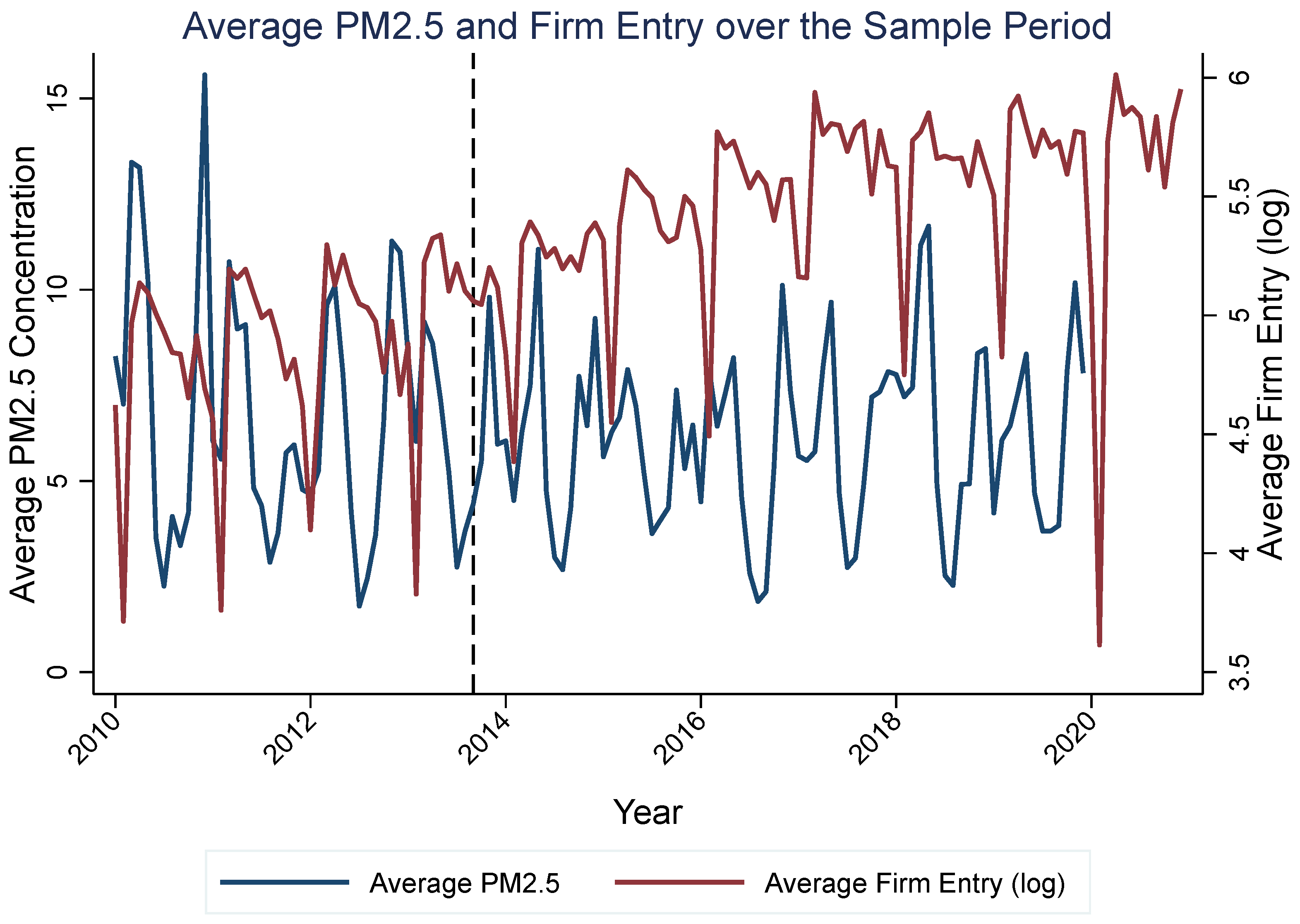
Figure 2 plots the monthly evolution of the cross-county average of county-level PM2.5 concentration and firm entry from 2010 to 2020. The blue line shows the monthly average PM2.5 concentration across all sample counties, while the red line shows the monthly average number of newly registered firms across counties. The vertical dashed line marks the implementation of the APPCAP in September 2013. Overall, Firm entry displays a clear upward trend over the sample period, increasing from about seven at the beginning of the sample to roughly 14 by the end of the period. By contrast, PM2.5 concentration shows noticeable fluctuations and some upward movement in the earlier period, but no sustained upward trend after the policy intervention. The average level is about 5 μg/m3 at the beginning of the sample and about 4.5 μg/m3 at the end. These descriptive patterns provide useful background for the empirical analysis: firm entry continued to rise over time, while the upward trend in air pollution was restrained after environmental regulation became more stringent.
Figure 3 shows the monthly cross-county average number of newly registered firms, in logarithms, for 18 industries over the sample period from 2010m1 to 2020m12, where the x-axis is reported in year-month format. Overall, firm registrations in all industries display upward trends, although the magnitude of growth and volatility varies across sectors. This indicates that market entry increased broadly across industries during the sample period. The figure also shows recurrent short-run dips around the same period of the year, which may partly reflect temporary slowdowns in firm registration activity during the Chinese Spring Festival holiday. In terms of industry composition, wholesale and retail consistently has the largest number of new firm registrations and is the most active sector in the sample. Manufacturing ranks second and also maintains a relatively high level of entry. At the same time, many service sectors, such as accommodation and catering, leasing and business services, and information transmission, software and IT services, also display clear growth over time. The figure suggests that the expansion of firm entry was not concentrated in a single sector. Instead, it was widespread across both manufacturing and services, with particularly large shares in wholesale and retail and in manufacturing. The underlying data come from the Chinese Industrial and Commercial Enterprise Registration Database. This provides a useful descriptive basis for the later analysis of industry heterogeneity in the pollution effects of firm entry.

4. Results

4.1. Baseline Results

Table 2 reports the baseline estimates of the effect of firm entry on county-level air pollution. Column (1) includes county fixed effects and month fixed effects only. Column (2) further controls for per capita consumption, share of tertiary industry, per capita GDP, rural population share, and total population. In both columns, the coefficient on firm entry is positive and statistically significant at the 1% level, indicating that new firm entry significantly increases county-level air pollution.
In terms of magnitude, the estimated coefficient on firm entry is 0.223 without additional controls and 0.213 after controls are added. The coefficient changes only slightly, suggesting that the relationship is fairly robust. The result implies that counties with more new firm registrations tend to have higher PM2.5 concentration. In other words, firm entry significantly worsens air pollution. This finding is consistent with our baseline expectation. New firm entry is typically accompanied by more frequent production and business activity, greater energy demand, and more transportation and supporting commercial activity, all of which can raise local emissions.
The control variables also yield plausible results. The coefficient on share of tertiary industry is negative and significant at the 10% level, suggesting that counties with a larger service-sector share tend to have lower air pollution. The coefficient on per capita GDP is also significantly negative, which may reflect better pollution control capacity or a cleaner industrial structure in more developed areas. The remaining controls are not consistently significant in this table. Overall, the baseline results show that firm entry is an important determinant of county-level air pollution, and that an increase in new firm registrations significantly raises PM2.5 concentration.

4.2. Instrumental-Variable Regression

Although the baseline estimates are robust, the relationship between firm entry and air pollution may still be affected by reverse causality and omitted-variable bias. For example, heavier pollution may discourage entrepreneurship and reduce new firm registrations. At the same time, places with stronger governance capacity or higher levels of development may both attract more firms and control pollution more effectively. To address these endogeneity concerns, we use the opening of high-speed rail as an instrument for firm entry and estimate the model using two-stage least squares.
Table 3 reports the instrumental-variable results. In the first stage, high-speed rail DID has a positive and statistically significant effect on firm entry. The estimated coefficients are 0.02 and 0.007, respectively, and both are significant at the 1% level. This indicates that the opening of high-speed rail significantly promotes local firm entry and that the instrument satisfies the relevance condition.
The second-stage results show that, after instrumenting for firm entry, the effect of firm entry on PM2.5 concentration remains positive and statistically significant. In column (2), the coefficient on firm entry is 3.646 and significant at the 1% level. In column (4), after controls are included, the coefficient rises to 10.184 and remains significant at the 5% level. These results suggest that, after addressing reverse causality and omitted-variable bias, new firm entry still significantly increases county-level air pollution.
Compared with the baseline estimates, the IV coefficients are numerically larger. We do not interpret this difference as the result of a separate group-comparison test. Rather, it suggests that the OLS estimates may be downward biased in the presence of reverse causality and omitted variables. Since our purpose is to estimate the conditional effect of firm entry in a panel regression framework rather than to compare unconditional group means, tests such as Mann–Whitney or ANOVA are not appropriate here. Statistical significance is assessed using regression-based t-tests with robust standard errors, while the relevance and strength of the instrument are evaluated using the Kleibergen–Paap rk LM and Wald F statistics. This suggests that ordinary least squares may underestimate the true effect of firm entry on pollution. This pattern is plausible. More polluted areas may discourage firm formation, generating reverse causality. In addition, more developed or better-governed places may both attract firms and control pollution more effectively, which would bias the OLS estimates downward. The IV strategy helps remove part of this endogeneity and therefore yields larger coefficients.
The identification tests also support the validity of the instrument. For the specification without controls, the Kleibergen–Paap rk LM statistic and Kleibergen–Paap rk Wald F statistic are 51.91 and 51.61, respectively, indicating that the instrument is strong and that weak-instrument concerns are limited. For the specification with controls, the corresponding statistics are 6.83 and 6.78. Although the LM statistic rejects the null of underidentification, the first-stage strength becomes weaker once controls are included, so the estimates in column (4) should be interpreted with some caution. Overall, however, the IV results are consistent with the baseline estimates in both sign and significance, reinforcing our main conclusion that firm entry significantly increases air pollution.

4.3. Heterogeneity by Broad Industry Groups

Having established that overall firm entry significantly increases air pollution, a natural next question is whether the pollution effect differs across broad sectors. To address this issue, we divide firm entry into three major groups—services, manufacturing, and agriculture—and estimate their effects on county-level PM2.5 concentration separately.
Table 4 reports the results. The estimated coefficients for all three types of firm entry are positive and statistically significant at the 1% level. This suggests that new entry in services, manufacturing, and agriculture all increase local air pollution.
In terms of magnitude, the coefficient on service-sector entry is 0.1702, the coefficient on manufacturing entry is 0.1557, and the coefficient on agricultural entry is 0.0724. Service-sector entry therefore has an effect on air pollution that is at least as large as that of manufacturing entry, while the effect of agricultural entry is noticeably smaller. This finding suggests that, at the county level, pollution is not driven by traditional industry alone. Expansion in the service sector can also place substantial pressure on local air quality.
There are several possible reasons why service-sector entry does not appear cleaner than manufacturing entry. First, many service activities do not involve industrial production directly, but they are often accompanied by more transportation, logistics, and personnel movement, all of which increase vehicle emissions. Second, the expansion of sectors such as accommodation and catering, wholesale and retail, and resident services often raises commercial energy use and end-use emissions. Third, at the county level, service-sector entry often coincides with population concentration, commercial expansion, and construction activity. As a result, its pollution effect may operate through multiple indirect channels. By contrast, the estimated effect of agricultural entry is smaller in our empirical specification. This does not imply that agriculture is unimportant for particulate matter pollution at the national level. Rather, it suggests that the marginal association between agricultural entry and local measured air pollution in our sample is weaker than that observed for some other sectors, possibly because agricultural emissions are more diffuse, seasonal, and often operate through indirect channels such as secondary particulate formation.
Overall, Table 4 shows that firm entry in all three broad sectors has a significant effect on air pollution, but the magnitude of the effect differs across sectors. Most notably, service-sector entry does not appear inherently cleaner than manufacturing entry. This finding suggests that analyses of local pollution should not focus exclusively on manufacturing expansion. The pollution consequences of service-sector entry also deserve close attention.

4.4. Industry Heterogeneity

The results by broad sector show that the pollution effects of firm entry differ across major industries. However, the three-sector classification remains coarse and may conceal more detailed industry-level heterogeneity. We therefore further divide firm entry into 18 industries and examine how the pollution effect varies across them.
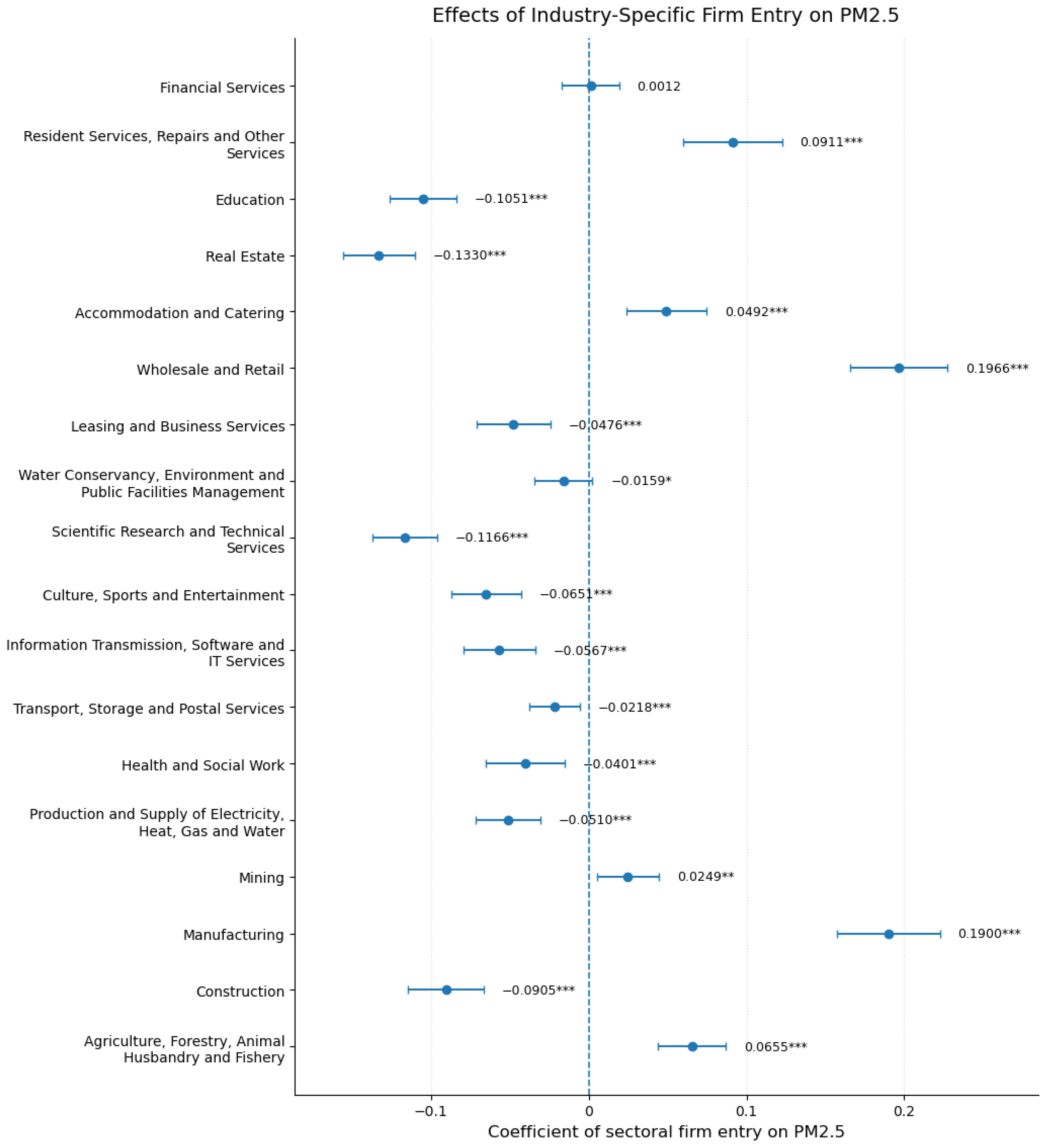
Figure 4 presents the estimates by detailed industry. The results reveal substantial heterogeneity, both in sign and in magnitude. Industries with relatively large positive effects include wholesale and retail, manufacturing, resident services, repairs and other services, agriculture, forestry, animal husbandry and fishery, accommodation and catering, and mining. Among them, wholesale and retail and manufacturing have the largest coefficients, at about 0.1966 and 0.1900, respectively, and both are noticeably larger than those of the other industries. This implies that more entry in wholesale and retail and in manufacturing is associated with larger increases in local PM2.5 concentration. As shown in the descriptive statistics, these two industries also account for a large share of new firm entry. Their overall contribution to local air pollution is therefore important both because their marginal pollution effects are strong and because their entry volumes are large.
These findings are generally intuitive. Entry in manufacturing is typically associated with expanded production, greater energy use, and higher industrial emissions, so its positive association with PM2.5 is expected. Wholesale and retail is not a traditional high-emission sector, but its expansion may involve more logistics activity, warehousing, commercial operations, and human mobility, thereby increasing end-use energy demand and transport-related emissions. A similar logic applies to accommodation and catering, as well as resident services, repairs, and other services. Entry in these consumer-oriented service sectors may increase local pollution through higher commercial energy use, stronger consumption activity, and heavier traffic flows. In this sense, service-sector entry is not necessarily pollution-neutral.
By contrast, several sectors have negative coefficients, including education, real estate, leasing and business services, water conservancy, environment and public facilities management, scientific research and technical services, culture, sports and entertainment, information transmission, software and IT services, transport, storage and postal services, health and social work, production and supply of electricity, heat, gas and water, and construction. These negative coefficients should be interpreted with caution. They do not imply that entry in these sectors directly reduces air pollution, nor do they necessarily indicate that these sectors are intrinsically low-emission. Rather, they capture conditional associations between sectoral firm entry and local PM2.5 concentrations after controlling for fixed effects and other covariates.
This distinction is particularly important for production and supply of electricity, heat, gas and water and construction, both of which can be important sources of particulate matter emissions. Their negative coefficients may instead reflect broader local changes associated with sectoral entry, such as cleaner energy infrastructure, stricter environmental regulation, technological upgrading, urban renewal, improved public infrastructure, or stronger pollution-control capacity. For construction, the result may also reflect the fact that firm registration does not necessarily coincide with the actual timing and location of construction-site emissions. For sectors such as scientific research, information technology, education, culture, and health services, the negative coefficients are more consistent with their knowledge- and human-capital-intensive nature and weaker reliance on heavily polluting production processes. Similarly, water conservancy, environment and public facilities management may be closely related to environmental investment and governance.
The negative coefficient for construction should be interpreted with caution. It does not imply that construction activities reduce PM2.5 emissions or that construction is a low-emission sector. Construction activities can generate substantial particulate matter through earthwork, demolition, material handling, vehicle movement, and equipment use. In our data, however, the variable measures the registration of construction firms rather than the timing, scale, or location of actual construction-site activities. Therefore, the negative coefficient should be interpreted as a conditional association, which may reflect broader urban renewal, infrastructure improvement, stricter dust-control regulation, or better environmental management, rather than a direct reduction in PM emissions from construction activities.
Overall, Figure 4 shows that the effect of firm entry on air pollution has a clear industry-structure dimension. Focusing only on the total number of new firms would mask important heterogeneity across sectors. If environmental policy affects not only how many firms enter but also which types of firms enter, then the sectoral composition of firm entry becomes central to understanding the pollution effects of policy.

5. Policy Effects and Mechanism Analysis

Having established that firm entry significantly increases county-level air pollution, and that this effect varies substantially across broad sectors and detailed industries, the next question is whether environmental regulation can alter this relationship. The results in the previous section show that the pollution effect of firm entry is not homogeneous. Instead, it depends strongly on industry composition. This suggests that environmental policy may work not only by directly reducing emissions, but also by changing the direction of new firm entry across industries. Against this background, this section examines how the APPCAP changed local air pollution and the pollution effect of firm entry, and then explores the underlying mechanisms.

5.1. Moderating Effect of APPCAP

Once we establish that firm entry significantly increases county-level air pollution, a natural next question is whether environmental regulation can change this relationship. To address this question, we use the 2013 Air Pollution Prevention and Control Action Plan (APPCAP) to examine how local air pollution and the pollution effect of firm entry changed after the policy was implemented.
Table 5 reports the baseline policy results. Column (1) includes only the policy indicator, APPCAP policy. Its coefficient is negative and statistically significant, indicating that county-level PM2.5 concentration declined after the policy was introduced. This suggests that the APPCAP itself had a meaningful pollution-reduction effect, and that centrally led air-quality regulation improved local environmental conditions.
Column (2) further includes firm entry and its interaction with the policy variable, firm entry × APPCAP policy. The coefficient on firm entry remains positive and statistically significant, indicating that new firm entry still increases local air pollution. More importantly, the interaction term is negative and statistically significant. This implies that the positive effect of firm entry on air pollution becomes weaker after the APPCAP. Put differently, the policy not only reduced average pollution directly, but also reduced the pollution consequences of new firm entry. For a given amount of firm entry, the associated increase in pollution is smaller after the policy than before.
These results suggest that environmental regulation affects more than pollution control itself. It also changes the relationship between local economic expansion and environmental quality. The earlier results show that firm entry tends to raise PM2.5 concentration through production, logistics, consumption, and end-use energy use. Table 5 further shows that this effect can be substantially weakened under stronger environmental constraints. In this sense, the policy does not simply suppress economic activity. Rather, it appears to reduce the environmental cost of new economic activity by tightening emission constraints, changing firm behavior, and reshaping the structure of entry.

5.2. Parallel Trend Test

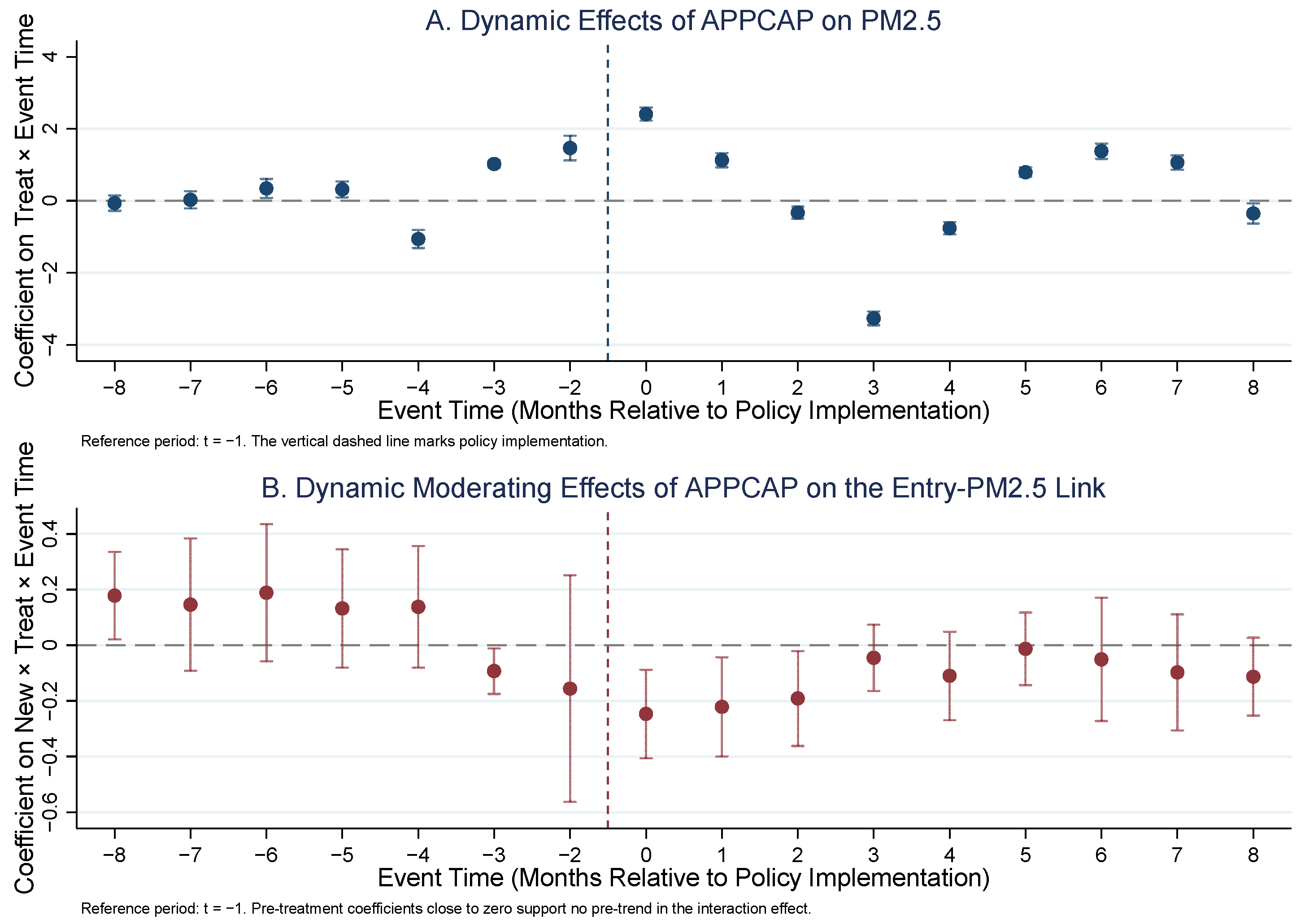
To assess the validity of the difference-in-differences design, we next conduct an event-study analysis. Specifically, we replace the policy dummy with a full set of event-time indicators before and after policy implementation, using the period immediately before the policy as the omitted category. We then estimate the dynamic effect of the policy on PM2.5 concentration and the dynamic moderating effect of the policy on the relationship between firm entry and air pollution.
Figure 5A reports the dynamic effect of the APPCAP on air pollution. Before the policy, the coefficients fluctuate around zero and show no clear systematic trend. This suggests that the treatment and control groups followed similar pollution trajectories before the APPCAP, providing support for the parallel-trends assumption. After the policy, the coefficients gradually turn negative, indicating that local air pollution declined following implementation.
Figure 5B reports the dynamic moderating effect of the policy on the firm entry–pollution relationship. Before the policy, the coefficients on firm entry × event-time are mostly close to zero, with no obvious pre-trend. After the policy, the coefficients become negative overall, indicating that the pollution effect of firm entry weakens after the APPCAP. This pattern is consistent with the interaction-term estimates in Table 5. It suggests that our conclusion that the APPCAP reduces the pollution effect of firm entry is not driven by differential pre-policy trends.

5.3. Placebo Test

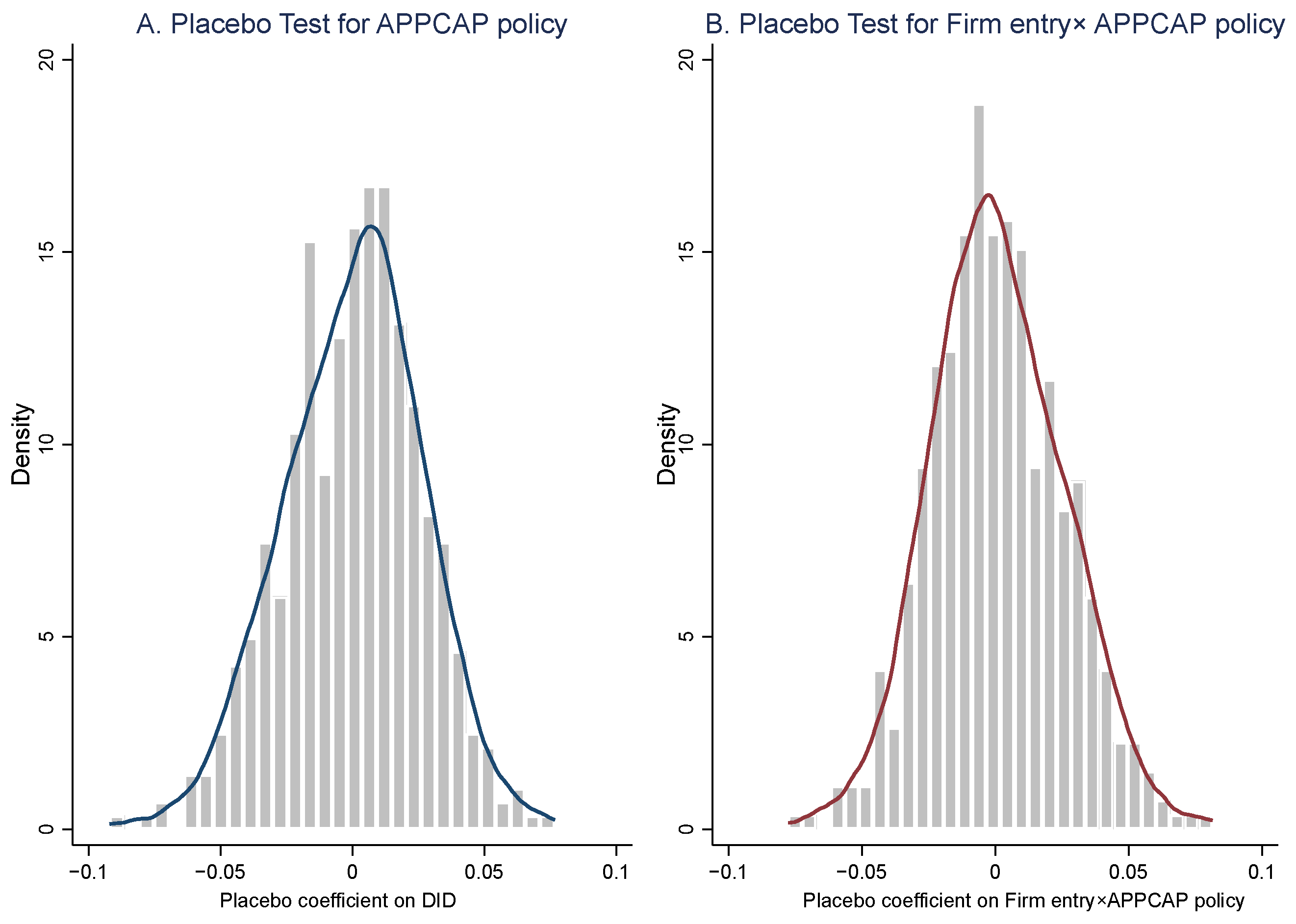
To further rule out the possibility that the policy effects are driven by random shocks or unobserved factors, we conduct a placebo test. Specifically, holding the sample and regression specification fixed, we randomly assign treatment status many times and repeatedly re-estimate the coefficients on APPCAP policy and firm entry × APPCAP policy. We then compare the resulting placebo distribution with the actual estimated coefficients.
Figure 6 presents the placebo results. Figure 6A corresponds to the policy variable itself, while Figure 6B corresponds to the interaction between the policy and firm entry. In both cases, the placebo coefficients are concentrated around zero, whereas the actual estimates are far from the center of the placebo distribution. This indicates that the policy effect and its moderating effect are unlikely to be driven by random factors and are therefore reasonably robust.
Taken together, the parallel-trend test and the placebo test support the credibility of our identification strategy. The results that the APPCAP reduced local air pollution and weakened the pollution effect of firm entry do not appear to be driven by sample composition or random shocks.

5.4. Mechanism: Reallocation of Industry Entry

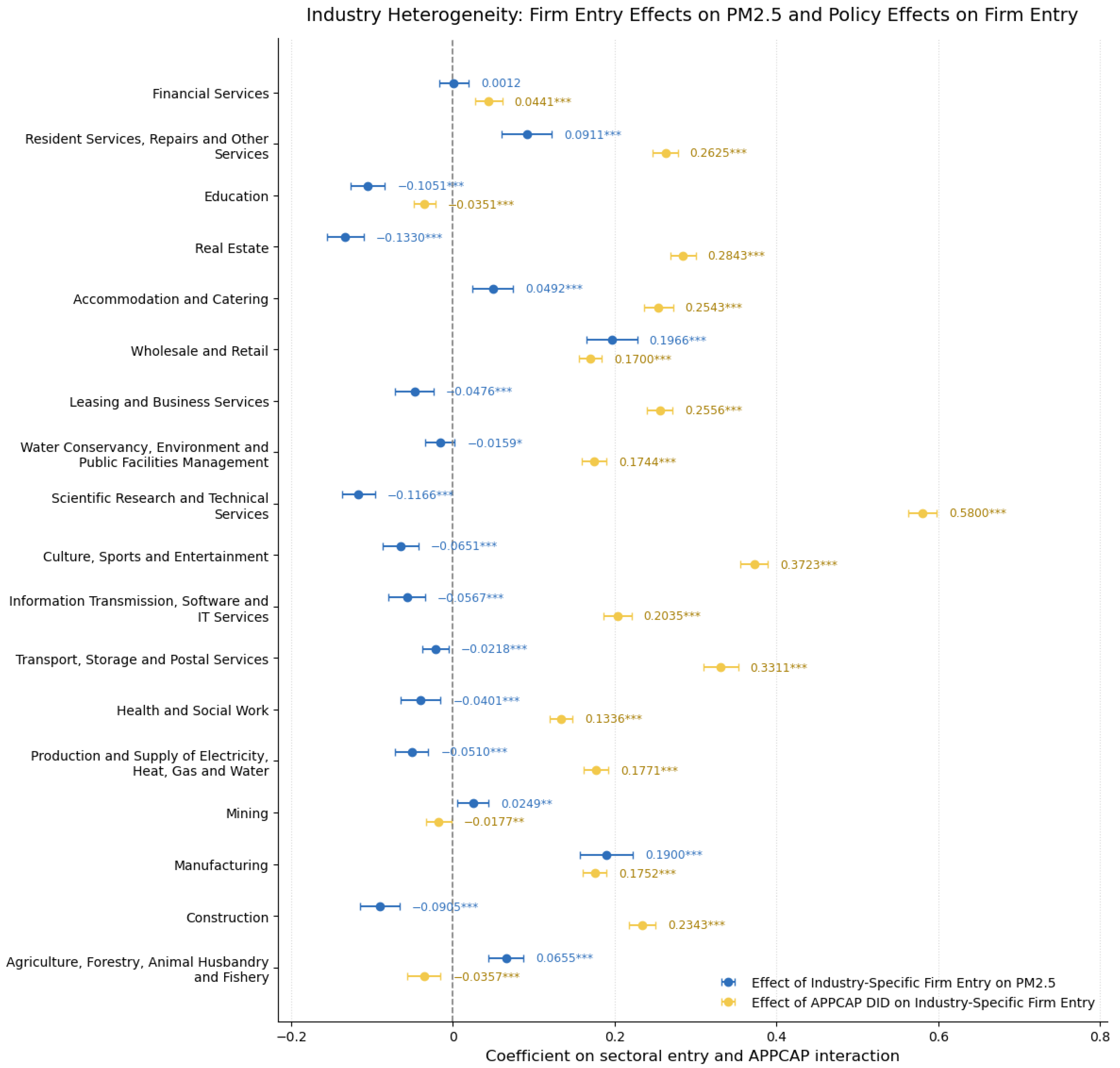
The previous results show that the APPCAP significantly reduced air pollution and weakened the positive effect of firm entry on air pollution. A natural question is where this effect comes from. One possibility is that the policy directly constrained firms’ emission intensity, so that new entrants generated less pollution even if entry continued. Another possibility is that the policy changed the way firm entry translated into pollution across industries. To examine this mechanism, we compare the baseline pollution effect of firm entry across industries with the interaction effect between APPCAP and sectoral firm entry.
Figure 7 presents this comparison. The blue coefficients represent the baseline association between firm entry in each industry and PM2.5 concentration. They show substantial heterogeneity in the pollution effect of entry across industries. Wholesale and retail and manufacturing have the largest positive coefficients, indicating that entry in these two industries is more strongly associated with higher local PM2.5 concentrations than entry in other sectors. As shown in the descriptive statistics, these industries also account for a large share of total new firm registrations. Their contribution to local air pollution may therefore be important both at the margin and in the aggregate. Importantly, this does not necessarily mean that these are the “most polluting” industries in a technical sense. A more cautious interpretation is that expansion in these sectors is often associated with larger output scale, more transport and delivery activity, denser commercial operations, and greater energy use, all of which are closely related to local air pollution.
At the same time, several industries have negative blue coefficients, indicating that entry in these industries is associated with lower PM2.5 concentrations after controlling for fixed effects and other covariates. Representative examples include scientific research and technical services, culture, sports and entertainment, information transmission, software and IT services, education, health and social work, and water conservancy, environment and public facilities management. These results should not be interpreted as evidence that these sectors directly reduce pollution. Rather, many of these sectors are knowledge-intensive, technology-intensive, or public-service-oriented and rely less on heavily polluting production processes. Some may also be related to environmental infrastructure and public governance. At the county level, entry in these sectors is therefore more likely to be associated with cleaner patterns of local economic activity.
The yellow coefficients show how the APPCAP changes the pollution effect of sectoral firm entry. A negative yellow coefficient means that, after the APPCAP, entry in that sector is associated with a weaker increase in PM2.5, or with a stronger reduction in PM2.5 if the baseline coefficient is already negative. A positive yellow coefficient means that the APPCAP does not weaken the pollution effect of entry in that sector and may even strengthen the association. Therefore, the yellow coefficients should not be interpreted as the effect of the APPCAP on the number of firms entering each industry. Instead, they capture whether the marginal pollution effect of sectoral entry changes after the policy.
The results suggest that the APPCAP weakened the pollution effect of entry in several sectors. In some industries with positive baseline pollution coefficients, the interaction coefficients are negative, indicating that the policy reduced the marginal pollution effect of new entry. This pattern is consistent with stricter environmental regulation, cleaner production requirements, and stronger pollution-control constraints after the APPCAP. For sectors with negative baseline coefficients, negative interaction coefficients further suggest that the APPCAP strengthened the association between entry in cleaner or public-service-oriented sectors and lower PM2.5 concentrations.
Overall, Figure 7 provides evidence that the APPCAP changed not only the overall relationship between firm entry and air pollution, but also the sector-specific pollution effects of firm entry. These results are consistent with two possible mechanisms. First, the policy may have reduced the emission intensity of new or expanding firms within sectors. Second, the APPCAP may have changed the sectoral channel through which firm entry affects PM2.5. The results suggest that, after the policy, entry in sectors with lower direct fuel combustion, lower material throughput, and weaker dependence on heavy transport and production processes is associated with a smaller pollution effect. Examples include scientific research and technical services, information transmission, software and IT services, education, health and social work, and environmental management. This provides a more specific channel through which environmental regulation reduces the pollution consequences of firm entry. However, because Figure 7 is based on interaction coefficients in the pollution regression, it should be interpreted as evidence on changes in the pollution effect of sectoral entry rather than as direct evidence on changes in the number or share of entrants in each sector. This distinction is important. The results show that industry structure matters for understanding the pollution-reduction effect of the APPCAP, but they should be interpreted as suggestive evidence on the mechanism rather than a complete decomposition of industrial reallocation.

6. Conclusions

This paper examines how local firm entry affects air pollution and further investigates the role of the Air Pollution Prevention and Control Action Plan (APPCAP). To do so, we construct a county–month panel for 2010–2019 by matching the Chinese Industrial and Commercial Enterprise Registration Database with county-level monthly PM2.5 data. We use these data to systematically analyze the effect of new firm entry on air pollution. Compared with existing studies, which often rely on samples of industrial firms, listed firms, or above-scale firms, our registration data cover not only medium-sized and large firms but also a large number of small firms, micro firms, and self-employed businesses. This allows us to provide a more complete picture of actual firm entry at the local level. In terms of identification, we use the opening of high-speed rail as an instrument to mitigate endogeneity concerns in the relationship between firm entry and air pollution, and we further use the APPCAP to examine how stronger environmental regulation changes this relationship.
We arrive at three main findings. First, new firm entry significantly increases county-level PM2.5 concentration, indicating that local business expansion carries environmental costs. Second, this effect is highly heterogeneous across industries. Service-sector entry is not necessarily pollution-neutral. At a more disaggregated level, entry in wholesale and retail, manufacturing, accommodation and catering, and resident services, repairs and other services has particularly strong pollution effects, whereas entry in sectors such as scientific research and technical services, education, culture, sports and entertainment, and information transmission, software and IT services is associated with relatively lower pollution effects. Third, the APPCAP not only significantly reduces local air pollution, but also weakens the positive effect of firm entry on air pollution. The mechanism analysis suggests that this policy effect may operate through two channels: stronger constraints on firms’ pollution emission and changes in the sector-specific pollution effect of new firm entry. These results are consistent with the view that environmental regulation can improve air quality not only through direct emissions control, but also through cleaner patterns of local economic development.
The main contribution of this paper is to bring firm entry, as a form of incremental economic activity, directly into the analysis of air pollution and to link it to environmental regulation and industrial restructuring. Existing studies have documented the health and economic consequences of air pollution and have examined how environmental policy affects firm behavior. However, they pay much less attention to how new firm entry changes local pollution and whether environmental policy can reduce the pollution consequences of entry. Our results show that understanding changes in local environmental quality requires more than studying pollution control alone or the total volume of firm entry. It also requires close attention to the industry composition of new market entrants and to how the pollution effects of entry vary across sectors and policy environments.
The policy implications are straightforward. When local governments promote entrepreneurship, expand the number of market entities, and pursue economic growth, they should pay greater attention to the environmental consequences of new firm entry. In particular, the service sector should not be treated as inherently clean or pollution-neutral. Environmental policy should also go beyond end-of-pipe emission control and place greater emphasis on cleaner entry guidance, differentiated regulation, and industrial upgrading. Through green entry standards, sector-specific environmental governance, and better factor allocation, policy can direct local growth toward cleaner, more technology-oriented, and less pollution-intensive activities. Our results suggest that environmental regulation does not necessarily come at the expense of economic vitality. On the contrary, well-designed environmental policy can keep firm entry active while reducing its pollution consequences and improving the structure of growth.

Author Contributions

Conceptualization, K.G. and T.P.; methodology, K.G. and R.L.; software, K.G.; validation, K.G., R.L. and T.P.; formal analysis, K.G.; investigation, K.G. and R.L.; resources, T.P.; data curation, K.G. and R.L.; writing—original draft preparation, K.G.; writing—review and editing, R.L. and T.P.; visualization, K.G.; supervision, T.P.; project administration, T.P.; funding acquisition, R.L. All authors have read and agreed to the published version of the manuscript.

Funding

National Social Science Foundation of China (No. 22&ZD194); Shandong Province Natural Science Foundation of PRC (No. ZR2025QC804); Social Sciences Research Fund Project of Ministry of Education of PRC (No. 22YJC790101).

Institutional Review Board Statement

Not applicable.

Informed Consent Statement

Not applicable.

Data Availability Statement

The data supporting the findings of this study are available from the corresponding author upon reasonable request.

Conflicts of Interest

The authors declare no conflicts of interest.

References

  1. Cheng, H.; Ding, S.; Liu, Y. The effectiveness of entry deregulation: Novel evidence from removing minimum capital requirements. J. Dev. Econ. 2024, 170, 103304. [Google Scholar] [CrossRef]
  2. Zhu, L.; Hao, Y.; Lu, Z.; Wu, H.; Ran, Q. Do economic activities cause air pollution? Evidence from China’s major cities. Sustain. Cities Soc. 2019, 49, 101593. [Google Scholar] [CrossRef]
  3. Li, H.; Zhou, L.-A. Political turnover and economic performance: The incentive role of personnel control in China. J. Public Econ. 2005, 89, 1743–1762. [Google Scholar] [CrossRef]
  4. Yu, Y.; Li, K.; Duan, S.; Song, C. Economic growth and environmental pollution in China: New evidence from government work reports. Energy Econ. 2023, 124, 106803. [Google Scholar] [CrossRef]
  5. Isen, A.; Rossin-Slater, M.; Walker, W.R. Every breath you take—Every dollar you’ll make: The long-term consequences of the Clean Air Act of 1970. J. Polit. Econ. 2017, 125, 848–902. [Google Scholar] [CrossRef]
  6. Chen, S.; Wang, M.; Zhang, D. Air pollution, labor productivity, and individual consumption. J. Popul. Econ. 2025, 38, 63. [Google Scholar] [CrossRef]
  7. Ou, Y.; Zheng, S.; Nam, K.-M. Impacts of air pollution on urban housing prices in China. J. Hous. Built Environ. 2022, 37, 423–441. [Google Scholar] [CrossRef]
  8. Currie, J.; Neidell, M.; Schmieder, J.F. Air pollution and infant health: Lessons from New Jersey. J. Health Econ. 2009, 28, 688–703. [Google Scholar] [CrossRef] [PubMed]
  9. Gutierrez, E. Air quality and infant mortality in Mexico: Evidence from variation in pollution concentrations caused by the usage of small-scale power plants. J. Popul. Econ. 2015, 28, 1181–1207. [Google Scholar] [CrossRef]
  10. Chen, Y.; Ebenstein, A.; Greenstone, M.; Li, H. Evidence on the impact of sustained exposure to air pollution on life expectancy from China’s Huai River policy. Proc. Natl. Acad. Sci. USA 2013, 110, 12936–12941. [Google Scholar] [CrossRef]
  11. Ebenstein, A.; Fan, M.; Greenstone, M.; He, G.; Zhou, M. New evidence on the impact of sustained exposure to air pollution on life expectancy from China’s Huai River policy. Proc. Natl. Acad. Sci. USA 2017, 114, 10384–10389. [Google Scholar] [CrossRef]
  12. Zhang, X.; Chen, X.; Zhang, X. The impact of exposure to air pollution on cognitive performance. Proc. Natl. Acad. Sci. USA 2018, 115, 9193–9197. [Google Scholar] [CrossRef]
  13. Graff Zivin, J.; Neidell, M. The impact of pollution on worker productivity. Am. Econ. Rev. 2012, 102, 3652–3673. [Google Scholar] [CrossRef]
  14. Hanna, R.; Oliva, P. The effect of pollution on labor supply: Evidence from a natural experiment in Mexico City. J. Public Econ. 2015, 122, 68–79. [Google Scholar] [CrossRef]
  15. Chang, T.Y.; Graff Zivin, J.; Gross, T.; Neidell, M. The effect of pollution on worker productivity: Evidence from call center workers in China. Am. Econ. J. Appl. Econ. 2019, 11, 151–172. [Google Scholar] [CrossRef]
  16. He, J.; Liu, H.; Salvo, A. Severe air pollution and labor productivity: Evidence from industrial towns in China. Am. Econ. J. Appl. Econ. 2019, 11, 173–201. [Google Scholar] [CrossRef]
  17. Fu, S.; Viard, V.B.; Zhang, P. Air pollution and manufacturing firm productivity: Nationwide estimates for China. Econ. J. 2021, 131, 3241–3273. [Google Scholar] [CrossRef]
  18. Deryugina, T.; Heutel, G.; Miller, N.H.; Molitor, D.; Reif, J. The mortality and medical costs of air pollution: Evidence from changes in wind direction. Am. Econ. Rev. 2019, 109, 4178–4219. [Google Scholar] [CrossRef] [PubMed]
  19. Khanna, G.; Liang, W.; Mobarak, A.M.; Song, R. The productivity consequences of pollution-induced migration in China. Am. Econ. J. Appl. Econ. 2025, 17, 184–224. [Google Scholar] [CrossRef]
  20. Wang, L.; Cao, Z.; Wang, H.; Zhang, J.; Luo, J. Air pollution, health, migration, and innovation: Evidence from urban China. J. Popul. Econ. 2025, 38, 64. [Google Scholar] [CrossRef]
  21. Greenstone, M. The impacts of environmental regulations on industrial activity: Evidence from the 1970 and 1977 Clean Air Act Amendments and the Census of Manufactures. J. Polit. Econ. 2002, 110, 1175–1219. [Google Scholar] [CrossRef]
  22. Walker, W.R. The transitional costs of sectoral reallocation: Evidence from the Clean Air Act and the workforce. Q. J. Econ. 2013, 128, 1787–1835. [Google Scholar] [CrossRef]
  23. Shapiro, J.S.; Walker, R. Why is pollution from US manufacturing declining? The roles of environmental regulation, productivity, and trade. Am. Econ. Rev. 2018, 108, 3814–3854. [Google Scholar] [CrossRef]
  24. Lanoie, P.; Laurent-Lucchetti, J.; Johnstone, N.; Ambec, S. Environmental policy, innovation and performance: New insights on the Porter Hypothesis. J. Econ. Manag. Strategy 2011, 20, 803–842. [Google Scholar] [CrossRef]
  25. Calel, R.; Dechezleprêtre, A. Environmental policy and directed technological change: Evidence from the European carbon market. Rev. Econ. Stat. 2016, 98, 173–191. [Google Scholar] [CrossRef]
  26. Albrizio, S.; Kozluk, T.; Zipperer, V. Environmental policies and productivity growth: Evidence across industries and firms. J. Environ. Econ. Manag. 2017, 81, 209–226. [Google Scholar] [CrossRef]
  27. Hering, L.; Poncet, S. Environmental policy and exports: Evidence from Chinese cities. J. Environ. Econ. Manag. 2014, 68, 296–318. [Google Scholar] [CrossRef]
  28. Cai, X.; Lu, Y.; Wu, M.; Yu, L. Does environmental regulation drive away inbound foreign direct investment? Evidence from a quasi-natural experiment in China. J. Dev. Econ. 2016, 123, 73–85. [Google Scholar] [CrossRef]
  29. Wu, H.; Guo, H.; Zhang, B.; Bu, M. Westward movement of new polluting firms in China: Pollution reduction mandates and location choice. J. Comp. Econ. 2017, 45, 119–138. [Google Scholar] [CrossRef]
  30. Yang, M.; Yuan, Y.; Yang, F.; Patino-Echeverri, D. Effects of environmental regulation on firm entry and exit and China’s industrial productivity: A new perspective on the Porter Hypothesis. Environ. Econ. Policy Stud. 2021, 23, 915–944. [Google Scholar] [CrossRef]
  31. Liu, Y.; Wang, A.; Wu, Y. Environmental regulation and green innovation: Evidence from China’s new environmental protection law. J. Clean. Prod. 2021, 297, 126698. [Google Scholar] [CrossRef]
  32. Ma, X.; He, J. Air pollution and corporate green innovation in China. Econ. Model. 2023, 124, 106305. [Google Scholar] [CrossRef]
  33. Shen, Y.; Lyu, M.; Zhu, J. Air pollution and corporate green financial constraints: Evidence from China’s listed companies. Int. J. Environ. Res. Public Health 2022, 19, 15034. [Google Scholar] [CrossRef] [PubMed]
  34. Kong, D.; Ma, G.; Qin, N. Trade liberalization and firm toxic emissions. Rev. Int. Econ. 2022, 30, 971–1002. [Google Scholar] [CrossRef]
  35. Grossman, G.M.; Krueger, A.B. Economic growth and the environment. Q. J. Econ. 1995, 110, 353–377. [Google Scholar] [CrossRef]
  36. Harbaugh, W.T.; Levinson, A.; Wilson, D.M. Reexamining the empirical evidence for an environmental Kuznets curve. Rev. Econ. Stat. 2002, 84, 541–551. [Google Scholar] [CrossRef]
  37. Hanlon, W.W. Coal smoke, city growth, and the costs of the Industrial Revolution. Econ. J. 2020, 130, 462–488. [Google Scholar] [CrossRef]
  38. Fang, C.; Liu, H.; Li, G.; Sun, D.; Miao, Z. Estimating the impact of urbanization on air quality in China using spatial regression models. Sustainability 2015, 7, 15570–15592. [Google Scholar] [CrossRef]
  39. Chen, Y.; Zhu, Z.; Cheng, S. Industrial agglomeration and haze pollution: Evidence from China. Sci. Total Environ. 2022, 845, 157392. [Google Scholar] [CrossRef]
  40. He, Z.-X.; Cao, C.-S.; Wang, J.-M. Spatial impact of industrial agglomeration and environmental regulation on environmental pollution—Evidence from pollution-intensive industries in China. Appl. Spat. Anal. Policy 2022, 15, 1525–1555. [Google Scholar] [CrossRef]
  41. Han, C.; Hua, D.; Li, J. A view of industrial agglomeration, air pollution and economic sustainability from spatial econometric analysis of 273 cities in China. Sustainability 2023, 15, 7091. [Google Scholar] [CrossRef]
  42. Ye, Y.; Ye, S.; Yu, H. Can industrial collaborative agglomeration reduce haze pollution? City-level empirical evidence from China. Int. J. Environ. Res. Public Health 2021, 18, 1566. [Google Scholar] [CrossRef] [PubMed]
  43. Wei, J.; Li, Z.; Lyapustin, A.; Sun, L.; Peng, Y.; Xue, W.; Su, T.; Cribb, M. Reconstructing 1-km-resolution high-quality PM2.5 data records from 2000 to 2018 in China: Spatiotemporal variations and policy implications. Remote Sens. Environ. 2021, 252, 112136. [Google Scholar] [CrossRef]
Figure 1. Air pollution and firm distribution. The top three maps present the spatial distribution of city-level PM2.5 concentrations in China in 2000, 2010, and 2020. The bottom three maps present the spatial distribution of the number of registered firms across Chinese cities in the same years. White areas indicate cities or regions with missing data or unmatched observations in the corresponding year. The maps are provided as descriptive evidence of spatial patterns and are drawn using ArcGIS 10.8.
Sustainability 18 05202 g001
Figure 2. This figure shows monthly cross-county averages for the sample period 2010–2020. The left y-axis reports average county-level PM2.5 concentration (μg/m3), and the right y-axis reports the log of average county-level new firm registrations. The x-axis is reported in year-month format. The vertical dashed line indicates the implementation of the APPCAP in September 2013.
Sustainability 18 05202 g002
Figure 3. Industry trends in firm entry. The figure reports monthly cross-county averages based on county-level observations in the sample from 2010 to 2020. Each line shows the logarithm of the monthly average number of newly registered firms in a given industry across sample counties. The x-axis labels are reported in year-month format. The underlying data are from the Chinese Industrial and Commercial Enterprise Registration Database.
Sustainability 18 05202 g003
Figure 4. Industry heterogeneity. The horizontal axis reports the sector-specific coefficient estimates from the regression of local PM2.5 concentrations on sectoral firm entry. The coefficients should be interpreted as conditional associations between sectoral firm entry and local PM2.5 concentrations, rather than as direct measures of sectoral emission intensity. All regressions include the same set of control variables and fixed effects as in the baseline specification. Confidence intervals are reported at the 95% level. ***, **, and * indicate significance at the 1%, 5%, and 10% levels, respectively.
Sustainability 18 05202 g004
Figure 5. Dynamic effects of APPCAP.
Sustainability 18 05202 g005
Figure 6. Placebo test. (A,B) Report placebo tests for APPCAP policy and firm entry × APPCAP policy, respectively. The histograms show the distributions of placebo coefficients from repeated random assignments. Both panels use the same y-axis scale.
Sustainability 18 05202 g006
Figure 7. Baseline sectoral entry effects and APPCAP interaction effects. The figure reports two types of sector-specific coefficient estimates. The blue bars show the baseline coefficients of sectoral firm entry on local PM2.5 concentrations, as reported in Figure 4, and are included here as a benchmark. The yellow bars show the coefficients of the interaction terms between the APPCAP and sectoral firm entry, which capture how the APPCAP changes the association between entry in each sector and local PM2.5 concentrations. The horizontal axis reports coefficient estimates. These estimates should be interpreted as conditional associations rather than direct measures of sectoral emission intensity. ***, **, and * indicate significance at the 1%, 5%, and 10% levels, respectively.
Sustainability 18 05202 g007
Table 1. Descriptive statistics.
Var NameVariable DefinitionObsMeanSDMinMax
PM2.5 concentrationMonthly average PM2.5 concentration at the county level (μg/m3)347,1246.3418.9160.071170.278
Firm entryLog of monthly newly registered firms at the county level347,1245.3331.1650.0009.974
Per capita consumptionPer capita consumption expenditure at the county level (10,000 yuan)329,3401.7652.5140.00361.826
Share of tertiary industryShare of tertiary industry in regional GDP329,5200.4050.2400.0377.559
Per capita GDPPer capita GDP at the county level (10,000 yuan)329,3404.5375.2670.118134.840
Rural population shareShare of rural population in total population326,6760.7570.5400.01229.000
Total populationYear-end total population at the county level (10,000 persons)329,34049.11836.2481.000557.000
Table 2. Baseline regression results.
(1)(2)
PM2.5 Concentration
Firm entry0.222 ***0.213 ***
(0.017)(0.018)
Per capita consumption 0.036
(0.033)
Share of tertiary industry −0.101 *
(0.052)
Per capita GDP −0.021 **
(0.009)
Rural population share 0.041
(0.033)
Total population −0.000
(0.000)
Constant5.152 ***5.373 ***
(0.094)(0.113)
Month fixed effects
County fixed effects
Observations347,124326,676
R-squared0.8430.843
Note: The dependent variable is PM2.5 concentration. The key explanatory variable, firm entry, is measured as the logarithm of monthly new firm registrations at the county level. Column (1) includes county and month fixed effects, while column (2) further controls for per capita consumption, share of tertiary industry, per capita GDP, rural population share, and total population. The symbol “√” indicates that the corresponding controls or fixed effects are included. Standard errors are reported in parentheses. ***, **, and * indicate significance at the 1%, 5%, and 10% levels, respectively.
Table 3. IV results.
(1)(2)(3)(4)
First StageSecond StageFirst StageSecond Stage
Firm EntryPM2.5 ConcentrationFirm EntryPM2.5 Concentration
High-speed rail DID 0.020 *** 0.007 ***
0.002 0.002
Firm entry 3.646 *** 10.184 **
(0.9271) (4.468)
Controls
Month fixed effects
County fixed effects
Observations305,844305,844286,656286,656
R-squared −0.379 −2.956
Kleibergen–Paap rk LM statistic51.916.83
p-value0.000.01
Kleibergen–Paap rk Wald F statistic51.616.78
Note: This table reports two-stage least squares estimates using high-speed rail DID as an instrument for firm entry. The dependent variable in the first stage is firm entry, and that in the second stage is PM2.5 concentration. Column (1) excludes additional controls, while column (2) includes per capita consumption, share of tertiary industry, per capita GDP, rural population share, and total population. All regressions include county and month fixed effects. The symbol “√” indicates that the corresponding controls or fixed effects are included. Standard errors are reported in parentheses. *** and ** indicate significance at the 5%, and 10% levels, respectively.
Table 4. Broad industry heterogeneity.
(1)(2)(3)
PM2.5 Concentration
Service-sector entry0.170 ***
(0.018)
Manufacturing entry 0.155 ***
(0.017)
Agricultural entry 0.072 ***
(0.010)
Constant5.655 ***5.926 ***6.293 ***
(0.105)(0.087)(0.068)
Controls
Month fixed effects
County fixed effects
Observations325,095322,643310,903
R-squared0.8430.8440.846
Note: The dependent variable is PM2.5 concentration. Service-sector entry, manufacturing entry, and agricultural entry denote the logarithm of monthly new firm registrations in the service, manufacturing, and agricultural sectors, respectively. All specifications include county fixed effects, month fixed effects, and the full set of control variables. The symbol “√” indicates that the corresponding controls or fixed effects are included. Standard errors are reported in parentheses. *** indicate significance at the 10% levels, respectively.
Table 5. Policy effects.
(1)(2)
PM2.5 Concentration
APPCAP policy−0.257 ***0.993 ***
(0.029)(0.129)
Firm entry 0.152 ***
(0.021)
Firm entry × APPCAP policy −0.221 ***
(0.022)
Constant6.704 ***5.906 ***
(0.067)(0.128)
Controls
Month fixed effects
County fixed effects
Observations239,832239,832
R-squared0.8410.841
Note: The dependent variable is PM2.5 concentration. APPCAP policy is a post-policy dummy, and firm entry × APPCAP policy is its interaction with firm entry. All regressions include county and month fixed effects; column (2) further includes control variables. The symbol “√” indicates that the corresponding controls or fixed effects are included. *** indicate significance at the 10% levels, respectively.
Disclaimer/Publisher’s Note: The statements, opinions and data contained in all publications are solely those of the individual author(s) and contributor(s) and not of MDPI and/or the editor(s). MDPI and/or the editor(s) disclaim responsibility for any injury to people or property resulting from any ideas, methods, instructions or products referred to in the content.