Firm Entry, Environmental Regulation, and Air Pollution: Evidence from China’s Air Pollution Prevention and Control Action Plan


Abstract
1. Introduction
2. Literature Review and Research Contributions
2.1. Related Literature
2.2. Main Findings and Contributions
3. Identification Strategy, Empirical Specification, and Data
3.1. Identification Strategy
3.2. Empirical Specification
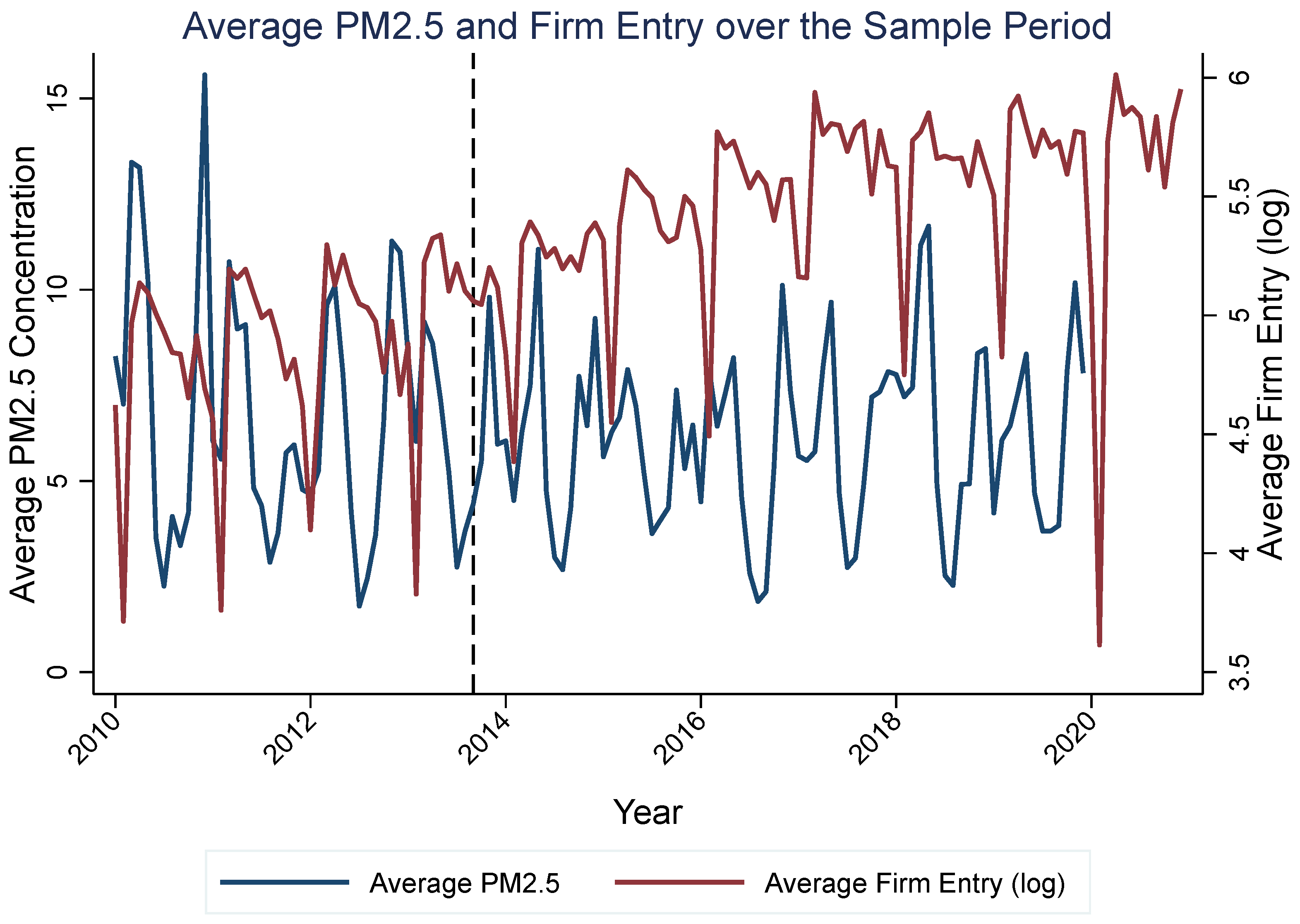
3.3. Data and Variables
4. Results
4.1. Baseline Results
4.2. Instrumental-Variable Regression
4.3. Heterogeneity by Broad Industry Groups
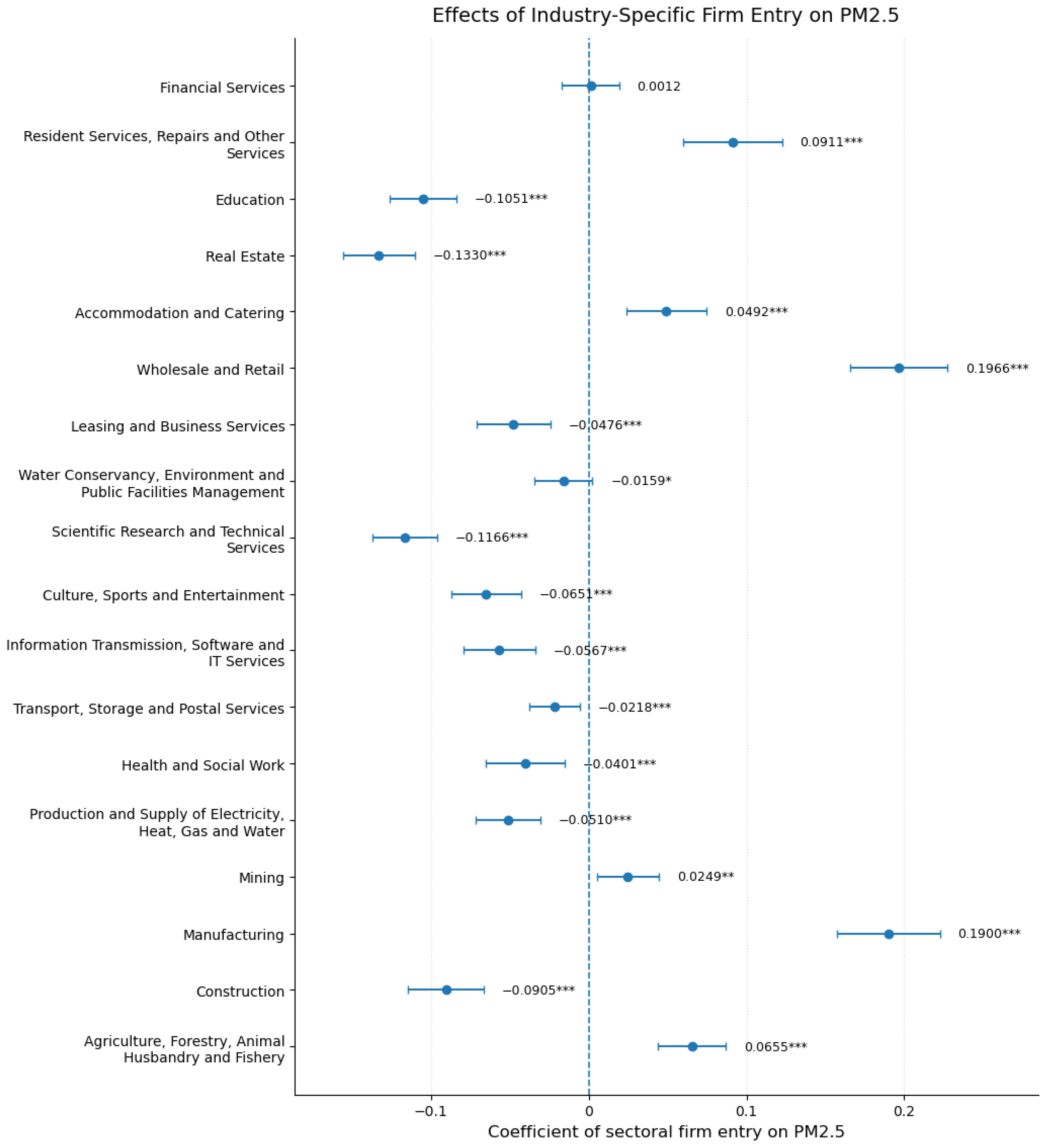
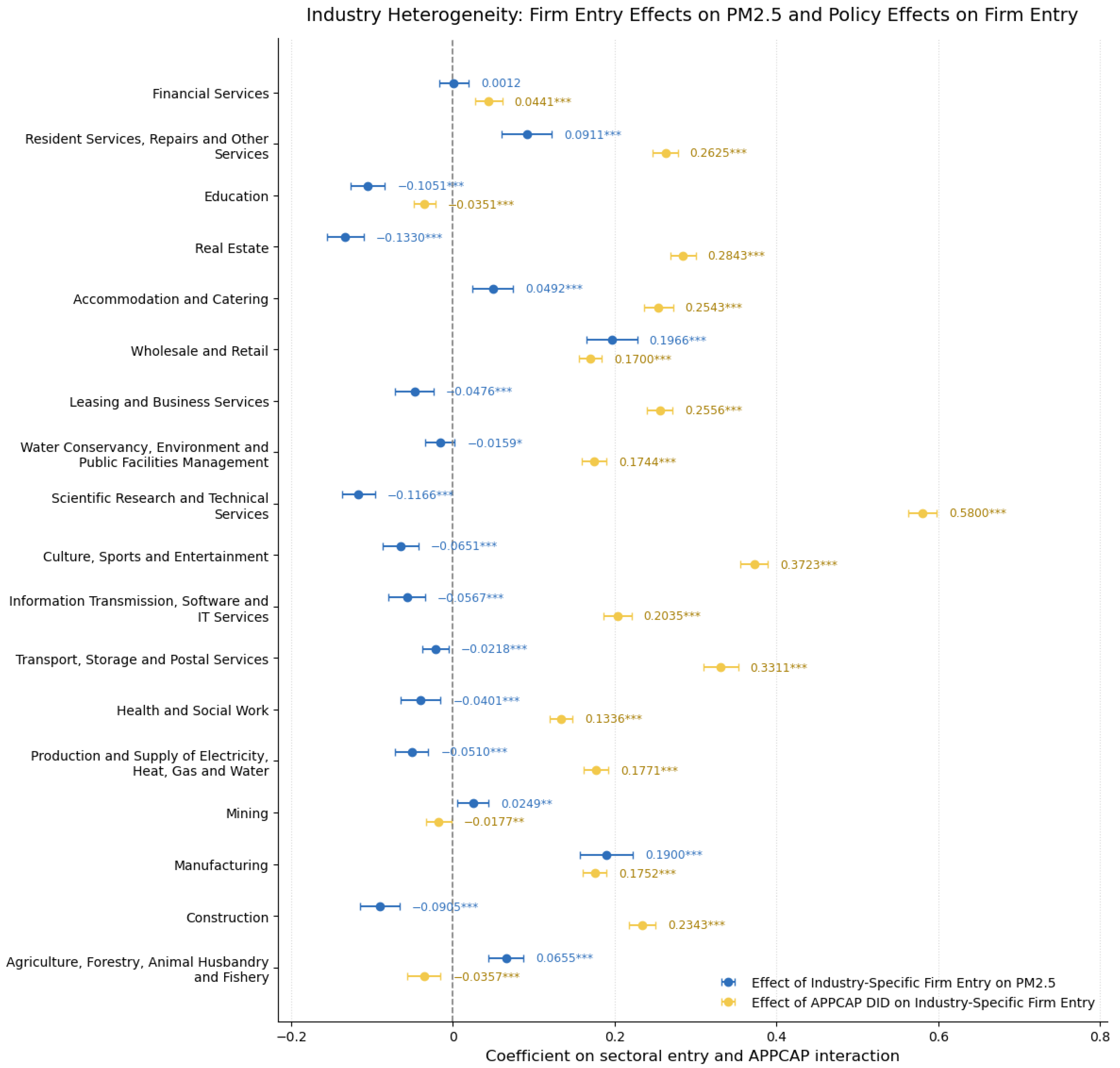
4.4. Industry Heterogeneity
5. Policy Effects and Mechanism Analysis
5.1. Moderating Effect of APPCAP
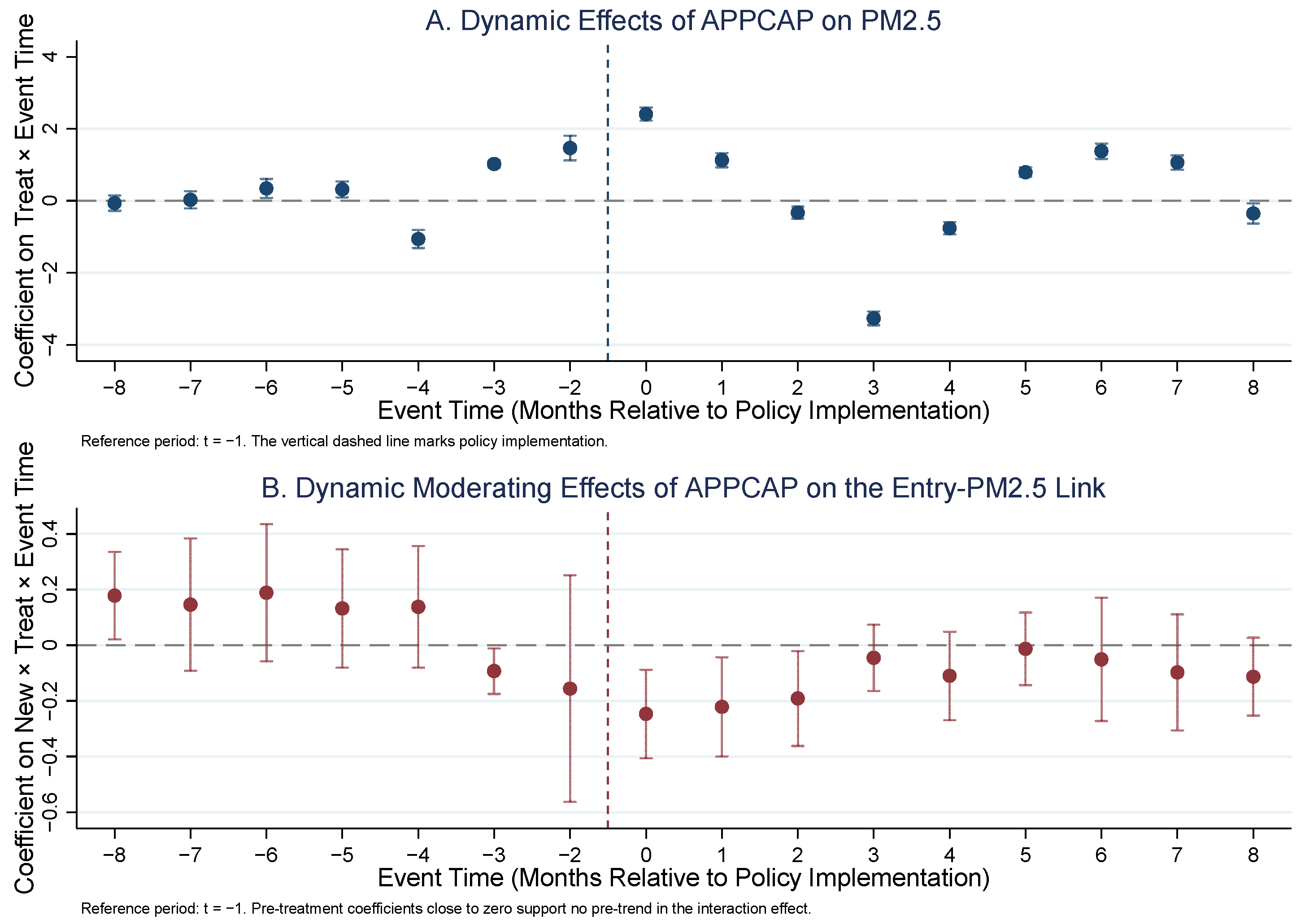
5.2. Parallel Trend Test
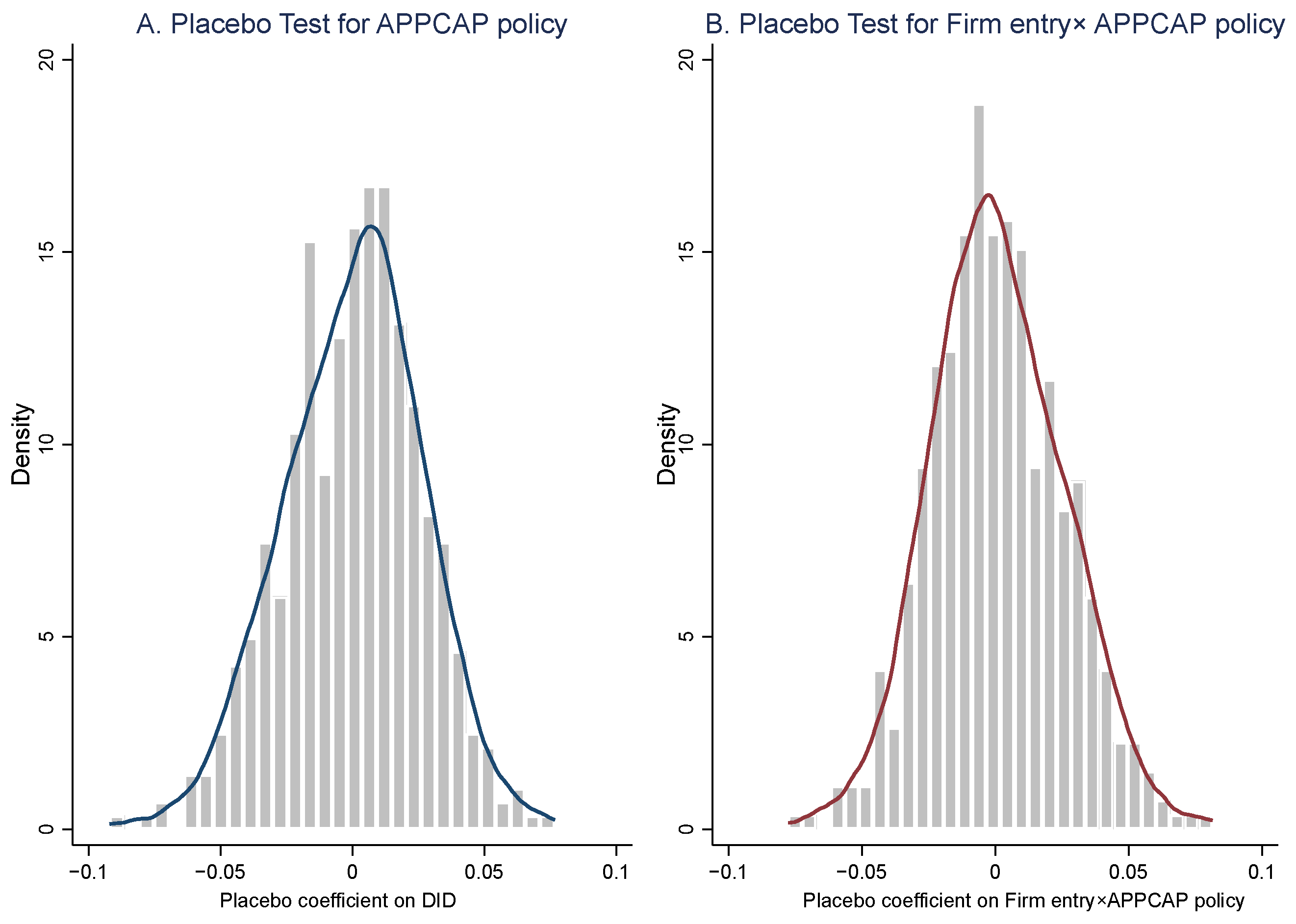
5.3. Placebo Test
5.4. Mechanism: Reallocation of Industry Entry
6. Conclusions
Author Contributions
Funding
Institutional Review Board Statement
Informed Consent Statement
Data Availability Statement
Conflicts of Interest
References
- Cheng, H.; Ding, S.; Liu, Y. The effectiveness of entry deregulation: Novel evidence from removing minimum capital requirements. J. Dev. Econ. 2024, 170, 103304. [Google Scholar] [CrossRef]
- Zhu, L.; Hao, Y.; Lu, Z.; Wu, H.; Ran, Q. Do economic activities cause air pollution? Evidence from China’s major cities. Sustain. Cities Soc. 2019, 49, 101593. [Google Scholar] [CrossRef]
- Li, H.; Zhou, L.-A. Political turnover and economic performance: The incentive role of personnel control in China. J. Public Econ. 2005, 89, 1743–1762. [Google Scholar] [CrossRef]
- Yu, Y.; Li, K.; Duan, S.; Song, C. Economic growth and environmental pollution in China: New evidence from government work reports. Energy Econ. 2023, 124, 106803. [Google Scholar] [CrossRef]
- Isen, A.; Rossin-Slater, M.; Walker, W.R. Every breath you take—Every dollar you’ll make: The long-term consequences of the Clean Air Act of 1970. J. Polit. Econ. 2017, 125, 848–902. [Google Scholar] [CrossRef]
- Chen, S.; Wang, M.; Zhang, D. Air pollution, labor productivity, and individual consumption. J. Popul. Econ. 2025, 38, 63. [Google Scholar] [CrossRef]
- Ou, Y.; Zheng, S.; Nam, K.-M. Impacts of air pollution on urban housing prices in China. J. Hous. Built Environ. 2022, 37, 423–441. [Google Scholar] [CrossRef]
- Currie, J.; Neidell, M.; Schmieder, J.F. Air pollution and infant health: Lessons from New Jersey. J. Health Econ. 2009, 28, 688–703. [Google Scholar] [CrossRef] [PubMed]
- Gutierrez, E. Air quality and infant mortality in Mexico: Evidence from variation in pollution concentrations caused by the usage of small-scale power plants. J. Popul. Econ. 2015, 28, 1181–1207. [Google Scholar] [CrossRef]
- Chen, Y.; Ebenstein, A.; Greenstone, M.; Li, H. Evidence on the impact of sustained exposure to air pollution on life expectancy from China’s Huai River policy. Proc. Natl. Acad. Sci. USA 2013, 110, 12936–12941. [Google Scholar] [CrossRef]
- Ebenstein, A.; Fan, M.; Greenstone, M.; He, G.; Zhou, M. New evidence on the impact of sustained exposure to air pollution on life expectancy from China’s Huai River policy. Proc. Natl. Acad. Sci. USA 2017, 114, 10384–10389. [Google Scholar] [CrossRef]
- Zhang, X.; Chen, X.; Zhang, X. The impact of exposure to air pollution on cognitive performance. Proc. Natl. Acad. Sci. USA 2018, 115, 9193–9197. [Google Scholar] [CrossRef]
- Graff Zivin, J.; Neidell, M. The impact of pollution on worker productivity. Am. Econ. Rev. 2012, 102, 3652–3673. [Google Scholar] [CrossRef]
- Hanna, R.; Oliva, P. The effect of pollution on labor supply: Evidence from a natural experiment in Mexico City. J. Public Econ. 2015, 122, 68–79. [Google Scholar] [CrossRef]
- Chang, T.Y.; Graff Zivin, J.; Gross, T.; Neidell, M. The effect of pollution on worker productivity: Evidence from call center workers in China. Am. Econ. J. Appl. Econ. 2019, 11, 151–172. [Google Scholar] [CrossRef]
- He, J.; Liu, H.; Salvo, A. Severe air pollution and labor productivity: Evidence from industrial towns in China. Am. Econ. J. Appl. Econ. 2019, 11, 173–201. [Google Scholar] [CrossRef]
- Fu, S.; Viard, V.B.; Zhang, P. Air pollution and manufacturing firm productivity: Nationwide estimates for China. Econ. J. 2021, 131, 3241–3273. [Google Scholar] [CrossRef]
- Deryugina, T.; Heutel, G.; Miller, N.H.; Molitor, D.; Reif, J. The mortality and medical costs of air pollution: Evidence from changes in wind direction. Am. Econ. Rev. 2019, 109, 4178–4219. [Google Scholar] [CrossRef] [PubMed]
- Khanna, G.; Liang, W.; Mobarak, A.M.; Song, R. The productivity consequences of pollution-induced migration in China. Am. Econ. J. Appl. Econ. 2025, 17, 184–224. [Google Scholar] [CrossRef]
- Wang, L.; Cao, Z.; Wang, H.; Zhang, J.; Luo, J. Air pollution, health, migration, and innovation: Evidence from urban China. J. Popul. Econ. 2025, 38, 64. [Google Scholar] [CrossRef]
- Greenstone, M. The impacts of environmental regulations on industrial activity: Evidence from the 1970 and 1977 Clean Air Act Amendments and the Census of Manufactures. J. Polit. Econ. 2002, 110, 1175–1219. [Google Scholar] [CrossRef]
- Walker, W.R. The transitional costs of sectoral reallocation: Evidence from the Clean Air Act and the workforce. Q. J. Econ. 2013, 128, 1787–1835. [Google Scholar] [CrossRef]
- Shapiro, J.S.; Walker, R. Why is pollution from US manufacturing declining? The roles of environmental regulation, productivity, and trade. Am. Econ. Rev. 2018, 108, 3814–3854. [Google Scholar] [CrossRef]
- Lanoie, P.; Laurent-Lucchetti, J.; Johnstone, N.; Ambec, S. Environmental policy, innovation and performance: New insights on the Porter Hypothesis. J. Econ. Manag. Strategy 2011, 20, 803–842. [Google Scholar] [CrossRef]
- Calel, R.; Dechezleprêtre, A. Environmental policy and directed technological change: Evidence from the European carbon market. Rev. Econ. Stat. 2016, 98, 173–191. [Google Scholar] [CrossRef]
- Albrizio, S.; Kozluk, T.; Zipperer, V. Environmental policies and productivity growth: Evidence across industries and firms. J. Environ. Econ. Manag. 2017, 81, 209–226. [Google Scholar] [CrossRef]
- Hering, L.; Poncet, S. Environmental policy and exports: Evidence from Chinese cities. J. Environ. Econ. Manag. 2014, 68, 296–318. [Google Scholar] [CrossRef]
- Cai, X.; Lu, Y.; Wu, M.; Yu, L. Does environmental regulation drive away inbound foreign direct investment? Evidence from a quasi-natural experiment in China. J. Dev. Econ. 2016, 123, 73–85. [Google Scholar] [CrossRef]
- Wu, H.; Guo, H.; Zhang, B.; Bu, M. Westward movement of new polluting firms in China: Pollution reduction mandates and location choice. J. Comp. Econ. 2017, 45, 119–138. [Google Scholar] [CrossRef]
- Yang, M.; Yuan, Y.; Yang, F.; Patino-Echeverri, D. Effects of environmental regulation on firm entry and exit and China’s industrial productivity: A new perspective on the Porter Hypothesis. Environ. Econ. Policy Stud. 2021, 23, 915–944. [Google Scholar] [CrossRef]
- Liu, Y.; Wang, A.; Wu, Y. Environmental regulation and green innovation: Evidence from China’s new environmental protection law. J. Clean. Prod. 2021, 297, 126698. [Google Scholar] [CrossRef]
- Ma, X.; He, J. Air pollution and corporate green innovation in China. Econ. Model. 2023, 124, 106305. [Google Scholar] [CrossRef]
- Shen, Y.; Lyu, M.; Zhu, J. Air pollution and corporate green financial constraints: Evidence from China’s listed companies. Int. J. Environ. Res. Public Health 2022, 19, 15034. [Google Scholar] [CrossRef] [PubMed]
- Kong, D.; Ma, G.; Qin, N. Trade liberalization and firm toxic emissions. Rev. Int. Econ. 2022, 30, 971–1002. [Google Scholar] [CrossRef]
- Grossman, G.M.; Krueger, A.B. Economic growth and the environment. Q. J. Econ. 1995, 110, 353–377. [Google Scholar] [CrossRef]
- Harbaugh, W.T.; Levinson, A.; Wilson, D.M. Reexamining the empirical evidence for an environmental Kuznets curve. Rev. Econ. Stat. 2002, 84, 541–551. [Google Scholar] [CrossRef]
- Hanlon, W.W. Coal smoke, city growth, and the costs of the Industrial Revolution. Econ. J. 2020, 130, 462–488. [Google Scholar] [CrossRef]
- Fang, C.; Liu, H.; Li, G.; Sun, D.; Miao, Z. Estimating the impact of urbanization on air quality in China using spatial regression models. Sustainability 2015, 7, 15570–15592. [Google Scholar] [CrossRef]
- Chen, Y.; Zhu, Z.; Cheng, S. Industrial agglomeration and haze pollution: Evidence from China. Sci. Total Environ. 2022, 845, 157392. [Google Scholar] [CrossRef]
- He, Z.-X.; Cao, C.-S.; Wang, J.-M. Spatial impact of industrial agglomeration and environmental regulation on environmental pollution—Evidence from pollution-intensive industries in China. Appl. Spat. Anal. Policy 2022, 15, 1525–1555. [Google Scholar] [CrossRef]
- Han, C.; Hua, D.; Li, J. A view of industrial agglomeration, air pollution and economic sustainability from spatial econometric analysis of 273 cities in China. Sustainability 2023, 15, 7091. [Google Scholar] [CrossRef]
- Ye, Y.; Ye, S.; Yu, H. Can industrial collaborative agglomeration reduce haze pollution? City-level empirical evidence from China. Int. J. Environ. Res. Public Health 2021, 18, 1566. [Google Scholar] [CrossRef] [PubMed]
- Wei, J.; Li, Z.; Lyapustin, A.; Sun, L.; Peng, Y.; Xue, W.; Su, T.; Cribb, M. Reconstructing 1-km-resolution high-quality PM2.5 data records from 2000 to 2018 in China: Spatiotemporal variations and policy implications. Remote Sens. Environ. 2021, 252, 112136. [Google Scholar] [CrossRef]




| Var Name | Variable Definition | Obs | Mean | SD | Min | Max |
|---|---|---|---|---|---|---|
| PM2.5 concentration | Monthly average PM2.5 concentration at the county level (μg/m3) | 347,124 | 6.341 | 8.916 | 0.071 | 170.278 |
| Firm entry | Log of monthly newly registered firms at the county level | 347,124 | 5.333 | 1.165 | 0.000 | 9.974 |
| Per capita consumption | Per capita consumption expenditure at the county level (10,000 yuan) | 329,340 | 1.765 | 2.514 | 0.003 | 61.826 |
| Share of tertiary industry | Share of tertiary industry in regional GDP | 329,520 | 0.405 | 0.240 | 0.037 | 7.559 |
| Per capita GDP | Per capita GDP at the county level (10,000 yuan) | 329,340 | 4.537 | 5.267 | 0.118 | 134.840 |
| Rural population share | Share of rural population in total population | 326,676 | 0.757 | 0.540 | 0.012 | 29.000 |
| Total population | Year-end total population at the county level (10,000 persons) | 329,340 | 49.118 | 36.248 | 1.000 | 557.000 |
| (1) | (2) | |
|---|---|---|
| PM2.5 Concentration | ||
| Firm entry | 0.222 *** | 0.213 *** |
| (0.017) | (0.018) | |
| Per capita consumption | 0.036 | |
| (0.033) | ||
| Share of tertiary industry | −0.101 * | |
| (0.052) | ||
| Per capita GDP | −0.021 ** | |
| (0.009) | ||
| Rural population share | 0.041 | |
| (0.033) | ||
| Total population | −0.000 | |
| (0.000) | ||
| Constant | 5.152 *** | 5.373 *** |
| (0.094) | (0.113) | |
| Month fixed effects | √ | √ |
| County fixed effects | √ | √ |
| Observations | 347,124 | 326,676 |
| R-squared | 0.843 | 0.843 |
| (1) | (2) | (3) | (4) | |
|---|---|---|---|---|
| First Stage | Second Stage | First Stage | Second Stage | |
| Firm Entry | PM2.5 Concentration | Firm Entry | PM2.5 Concentration | |
| High-speed rail DID | 0.020 *** | 0.007 *** | ||
| 0.002 | 0.002 | |||
| Firm entry | 3.646 *** | 10.184 ** | ||
| (0.9271) | (4.468) | |||
| Controls | √ | √ | ||
| Month fixed effects | √ | √ | √ | √ |
| County fixed effects | √ | √ | √ | √ |
| Observations | 305,844 | 305,844 | 286,656 | 286,656 |
| R-squared | −0.379 | −2.956 | ||
| Kleibergen–Paap rk LM statistic | 51.91 | 6.83 | ||
| p-value | 0.00 | 0.01 | ||
| Kleibergen–Paap rk Wald F statistic | 51.61 | 6.78 | ||
| (1) | (2) | (3) | |
|---|---|---|---|
| PM2.5 Concentration | |||
| Service-sector entry | 0.170 *** | ||
| (0.018) | |||
| Manufacturing entry | 0.155 *** | ||
| (0.017) | |||
| Agricultural entry | 0.072 *** | ||
| (0.010) | |||
| Constant | 5.655 *** | 5.926 *** | 6.293 *** |
| (0.105) | (0.087) | (0.068) | |
| Controls | √ | √ | √ |
| Month fixed effects | √ | √ | √ |
| County fixed effects | √ | √ | √ |
| Observations | 325,095 | 322,643 | 310,903 |
| R-squared | 0.843 | 0.844 | 0.846 |
| (1) | (2) | |
|---|---|---|
| PM2.5 Concentration | ||
| APPCAP policy | −0.257 *** | 0.993 *** |
| (0.029) | (0.129) | |
| Firm entry | 0.152 *** | |
| (0.021) | ||
| Firm entry × APPCAP policy | −0.221 *** | |
| (0.022) | ||
| Constant | 6.704 *** | 5.906 *** |
| (0.067) | (0.128) | |
| Controls | √ | √ |
| Month fixed effects | √ | √ |
| County fixed effects | √ | √ |
| Observations | 239,832 | 239,832 |
| R-squared | 0.841 | 0.841 |
Disclaimer/Publisher’s Note: The statements, opinions and data contained in all publications are solely those of the individual author(s) and contributor(s) and not of MDPI and/or the editor(s). MDPI and/or the editor(s) disclaim responsibility for any injury to people or property resulting from any ideas, methods, instructions or products referred to in the content. |
© 2026 by the authors. Licensee MDPI, Basel, Switzerland. This article is an open access article distributed under the terms and conditions of the Creative Commons Attribution (CC BY) license.
Share and Cite
Guo, K.; Luo, R.; Pei, T. Firm Entry, Environmental Regulation, and Air Pollution: Evidence from China’s Air Pollution Prevention and Control Action Plan. Sustainability 2026, 18, 5202. https://doi.org/10.3390/su18105202
Guo K, Luo R, Pei T. Firm Entry, Environmental Regulation, and Air Pollution: Evidence from China’s Air Pollution Prevention and Control Action Plan. Sustainability. 2026; 18(10):5202. https://doi.org/10.3390/su18105202
Chicago/Turabian StyleGuo, Kaiyi, Rundong Luo, and Tianyue Pei. 2026. "Firm Entry, Environmental Regulation, and Air Pollution: Evidence from China’s Air Pollution Prevention and Control Action Plan" Sustainability 18, no. 10: 5202. https://doi.org/10.3390/su18105202
APA StyleGuo, K., Luo, R., & Pei, T. (2026). Firm Entry, Environmental Regulation, and Air Pollution: Evidence from China’s Air Pollution Prevention and Control Action Plan. Sustainability, 18(10), 5202. https://doi.org/10.3390/su18105202