Digital Transformation Capability, Governance Architecture, and Operational Resilience: International Evidence


Abstract
1. Introduction
2. Background and Related Literature
2.1. Institutional Background
2.2. Related Literature
2.3. Theoretical Framework and Hypotheses Development
2.3.1. Digital Transformation Capability and Operational Resilience
2.3.2. Moderating Role of Internal Digital Governance
2.3.3. Moderating Role of External Ecosystem Governance
3. Data and Methodology
3.1. Data Sources and Sample Composition
3.2. Variables
3.2.1. Operational Resilience
3.2.2. Digital Transformation Capability
3.2.3. Internal Digital Governance and External Ecosystem Governance
3.2.4. Mechanism Variables and Additional Constructs
3.3. Empirical Models and Analytical Steps
4. Empirical Results
4.1. Univariate Evidence
4.2. Baseline Results: DTC and Operational Resilience
4.3. Identification Strategies
4.4. Governance Interactions
4.5. Mechanisms Analysis
4.5.1. Supply Flexibility
4.5.2. Data Visibility
4.6. Cross-Country Heterogeneity
4.6.1. Insights from Digital Readiness Levels and Two Major Economies
4.6.2. Additional Cross-Country Robustness Evidence
4.6.3. DTC Decomposition Effects
4.6.4. Decomposition of Firm Vulnerability into Common and Idiosyncratic Components
4.7. Further Robustness Checks
4.8. Discussion of Results
5. Concluding Remarks
5.1. Limitations and Boundary Conditions
5.2. Managerial Implications
Author Contributions
Funding
Institutional Review Board Statement
Informed Consent Statement
Data Availability Statement
Conflicts of Interest
Appendix A
Appendix A.1. Supplementary Analysis

| Outcome | Rmax | δ | Identified Interval | |
|---|---|---|---|---|
| SRR (baseline) | 0.071 | 1.30 | 1.88 | [0.041, 0.104] |
| CFSI (baseline) | 0.058 | 1.30 | 1.74 | [0.029, 0.091] |
Appendix A.2. Matching Diagnostics
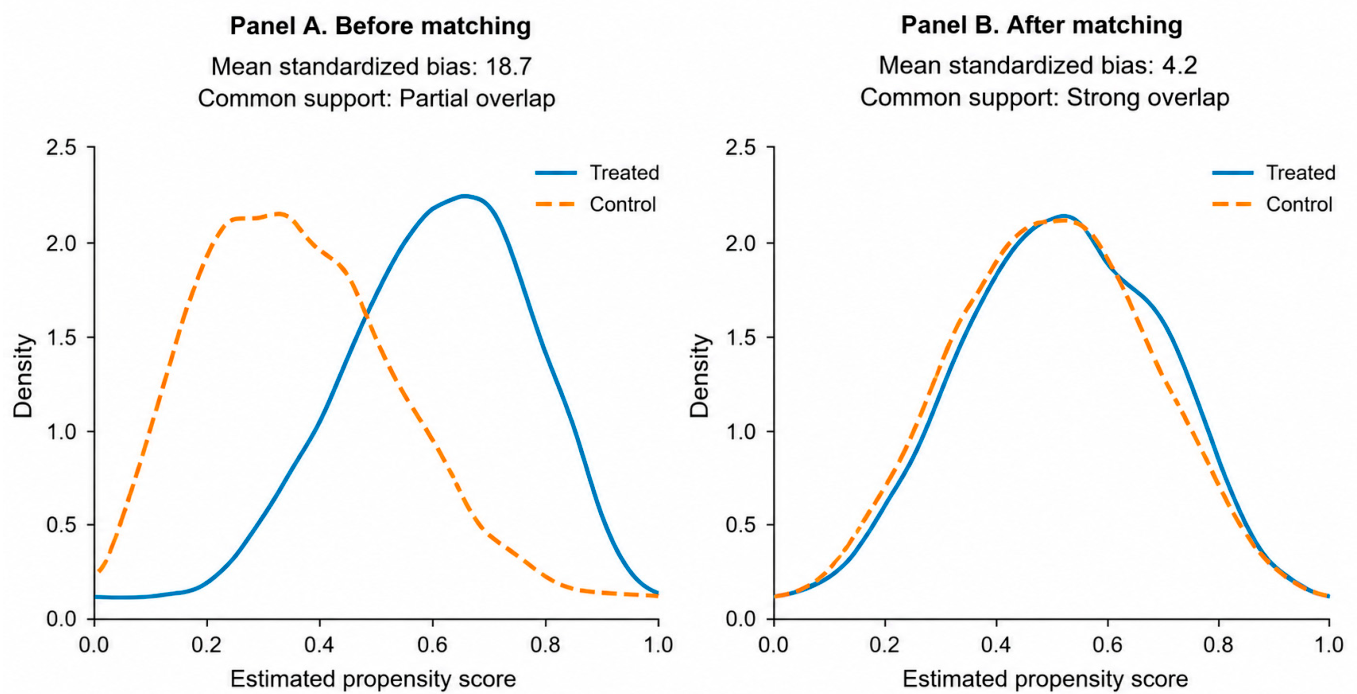
| Variable | Treated (Before) | Control (Before) | Std. Bias Before (%) | Treated (After) | Control (After) | Std. Bias After (%) |
|---|---|---|---|---|---|---|
| SIZE | 9.210 | 8.730 | 24.6 | 8.980 | 8.940 | 3.8 |
| LEV | 0.231 | 0.258 | −16.1 | 0.243 | 0.247 | −2.4 |
| ROA | 0.079 | 0.063 | 18.7 | 0.071 | 0.070 | 1.5 |
| CAPEX | 0.067 | 0.056 | 13.8 | 0.061 | 0.060 | 2.1 |
| R&D | 0.041 | 0.028 | 21.4 | 0.034 | 0.033 | 2.9 |
| IDG | 0.612 | 0.491 | 27.2 | 0.553 | 0.547 | 2.6 |
| EEG | 0.581 | 0.468 | 24.1 | 0.525 | 0.520 | 2.2 |
Appendix A.3. Cross-Sectional Heterogeneity
| Subsample | SRR | CFSI | Observations |
|---|---|---|---|
| Low digital disparity | 0.088 *** (0.023) | 0.071 *** (0.017) | 19,842 |
| High digital disparity | 0.049 ** (0.018) | 0.036 * (0.017) | 19,614 |
| High institutional ownership | 0.079 *** (0.019) | 0.061 *** (0.016) | 18,907 |
| Low institutional ownership | 0.043 * (0.021) | 0.031 (0.020) | 18,921 |
| Large firms | 0.083 *** (0.020) | 0.067 *** (0.019) | 28,445 |
| Small firms | 0.047 ** (0.017) | 0.035 * (0.017) | 28,961 |
Appendix A.4. Alternative Measures
| Variables | (1) RAP | (2) RAP + IDG | (3) SRR with PCA Governance | (4) CFSI with PCA Governance |
|---|---|---|---|---|
| DTC | 0.046 *** (0.011) | 0.038 ** (0.014) | 0.069 *** (0.020) | 0.056 *** (0.013) |
| DTC × IDG | 0.024 ** (0.009) | |||
| DTC × PCA governance | 0.028 *** (0.006) | 0.021 ** (0.008) | ||
| Controls | Yes | Yes | Yes | Yes |
| Observations | 57,406 | 57,406 | 57,406 | 57,406 |
| Adjusted R2 | 0.251 | 0.262 | 0.365 | 0.333 |
Appendix A.5. Country-Level Moderators
| Panel A. Supportive Country Factors. | ||||
| Variables | Digital Readiness SRR | Digital Readiness CFSI | Institutional Quality SRR | Institutional Quality CFSI |
| DTC | 0.054 *** (0.013) | 0.043 *** (0.009) | 0.052 *** (0.014) | 0.041 *** (0.009) |
| DTC × readiness | 0.018 ** (0.007) | 0.015 * (0.007) | ||
| Readiness | 0.022 *** (0.005) | 0.019 ** (0.007) | ||
| DTC × inst. quality | 0.021 ** (0.008) | 0.017 * (0.008) | ||
| Institutional quality | 0.024 *** (0.005) | 0.020 ** (0.008) | ||
| Observations | 57,406 | 57,406 | 57,406 | 57,406 |
| Panel B. Adverse country factor. | ||||
| Variables | Geopolitical risk SRR | Geopolitical risk CFSI | ||
| DTC | 0.061 *** (0.014) | 0.049 *** (0.011) | ||
| DTC × geo. risk | −0.017 ** (0.006) | −0.014 * (0.007) | ||
| Geopolitical risk | −0.026 *** (0.006) | −0.022 ** (0.008) | ||
| Observations | 57,406 | 57,406 | ||
Appendix A.6. Coding Protocol and Measurement Reproducibility
| Construct/Item Block | Primary Source | Secondary Source | Code = 1 When | Code = 0 or Missing When |
|---|---|---|---|---|
| DTC—Automation/analytics/cloud/interoperability/data governance | Annual report, 10-K/20-F, operating review | Investor presentation; cybersecurity or sustainability report | The disclosure states that the digital operating routine is deployed, integrated, operational, or used in production during year t. | Future plans, pilots, announced partnerships, or immaterial subsidiary-specific language do not qualify; insufficient evidence is left missing. |
| IDG—Board technology oversight | Proxy statement or governance report | Annual report board/governance section | A board or named committee formally reviewed digital strategy, cyber risk, or enterprise data architecture during year t. | Generic board awareness without a review mechanism is coded 0; no verifiable disclosure is missing. |
| IDG—Executive data-risk ownership | Proxy statement; governance report | Annual report leadership/controls section | A named executive is assigned responsibility for enterprise data governance, cyber risk, or digital-control remediation during year t. | Diffuse or aspirational responsibility language is coded 0; missing evidence stays missing. |
| IDG—Audit trail/disruption playbook/incentive alignment | Governance report; annual report internal-control section | Cybersecurity report; remuneration report | The firm discloses traceable digital logs, a formal cross-functional continuity playbook, or explicit incentive links tied to digital-risk or continuity objectives. | Narrative statements without an implemented mechanism are coded 0; unverifiable cases are missing. |
| EEG—Supplier assurance/external standards/financing continuity/third-party assurance | Supplier, sustainability, cybersecurity, annual, or financing disclosures | Investor materials released in the fiscal-year reporting cycle | A named external protocol, assurance mechanism, continuity facility, or verifiable third-party standard is in force during year t. | Vague statements about strong relationships or future financing plans are coded 0; non-verifiable cases are missing. |
| EEG—Institutional monitoring stability | Refinitiv ownership history | Annual report investor-relations disclosure | Institutional ownership and turnover satisfy the fixed annual stability rule used in the coding manual. | Thresholds not met are coded 0; unavailable ownership history is missing. |
| Supply flexibility | Annual report operations/supply-chain section | Sustainability report; investor presentation | The firm discloses implemented multisourcing, rerouting/production-transfer capability, or formal supplier-continuity planning. | Aspirational flexibility language without implementation is coded 0; missing evidence stays missing. |
| Data visibility | Annual report operations/technology section | Cybersecurity or sustainability report; investor presentation | The firm discloses real-time dashboards, end-to-end traceability, or structured supplier/customer data integration already in use. | Generic references to better visibility without auditable implementation are coded 0; non-verifiable cases are missing. |
Appendix A.7. Coding Reliability
| Construct | Coding Unit | Double-Coded Observations | Krippendorff’s Alpha | Percent Agreement | Adjudication Protocol |
|---|---|---|---|---|---|
| DTC | Firm-year | 1248 | 0.84 | 91.6% | Rulebook + adjudication review |
| IDG | Firm-year | 1248 | 0.81 | 89.4% | Rulebook + adjudication review |
| EEG | Firm-year | 1248 | 0.78 | 87.2% | Rulebook + adjudication review |
| SFLEX | Firm-year | 960 | 0.76 | 86.3% | Rulebook + adjudication review |
| DVIS | Firm-year | 960 | 0.79 | 88.1% | Rulebook + adjudication review |
| Overall | Firm-year | 5664 | 0.80 | 88.9% | Rulebook + adjudication review |
Appendix A.8. Disclosure-Intensity Diagnostics
| Panel/Test | Outcome or Construct | Disclosure Proxy | Specification | Coefficient | Std. Error | p-Value |
|---|---|---|---|---|---|---|
| Pairwise | DTC | Report intensity | Spearman | 0.24 *** | 0.011 | <0.001 |
| Pairwise | IDG | Report intensity | Spearman | 0.19 *** | 0.010 | <0.001 |
| Pairwise | EEG | Report intensity | Spearman | 0.15 *** | 0.011 | <0.001 |
| Pairwise | SFLEX | Report intensity | Spearman | 0.27 *** | 0.012 | <0.001 |
| Pairwise | DVIS | Report intensity | Spearman | 0.29 *** | 0.012 | <0.001 |
| Baseline + proxy | SRR | Report intensity | FE + proxy | 0.061 *** | 0.013 | <0.001 |
| Baseline + proxy | CFSI | Report intensity | FE + proxy | 0.048 *** | 0.011 | <0.001 |
| Alt. proxy | SRR | Doc. length/count | FE + proxy | 0.059 *** | 0.013 | <0.001 |
| Alt. proxy | CFSI | Doc. length/count | FE + proxy | 0.046 *** | 0.011 | <0.001 |
Appendix A.9. Construct-Structure Diagnostics
| Item/Diagnostic | Construct Block | Component 1 | Component 2 | Communality | Retained Factor |
|---|---|---|---|---|---|
| Automation | DTC | 0.81 | 0.18 | 0.69 | Yes |
| Analytics | DTC | 0.84 | 0.15 | 0.73 | Yes |
| Cloud integration | DTC | 0.72 | 0.22 | 0.57 | Yes |
| Systems interoperability | DTC | 0.76 | 0.19 | 0.61 | Yes |
| Data-governance implementation | DTC | 0.68 | 0.31 | 0.56 | Yes |
| Board technology oversight | IDG | 0.29 | 0.78 | 0.69 | Yes |
| Executive data-risk ownership | IDG | 0.34 | 0.74 | 0.66 | Yes |
| Digital audit trail | IDG | 0.41 | 0.63 | 0.57 | Yes |
| Cross-functional disruption playbook | IDG | 0.37 | 0.71 | 0.64 | Yes |
| Incentive alignment | IDG | 0.28 | 0.67 | 0.53 | Yes |
| Supplier assurance intensity | EEG | 0.23 | 0.69 | 0.53 | Yes |
| Institutional monitoring stability | EEG | 0.11 | 0.58 | 0.35 | Yes |
| External data standards | EEG | 0.26 | 0.74 | 0.62 | Yes |
| Financing continuity | EEG | 0.18 | 0.39 | 0.18 | No |
| Third-party digital assurance | EEG | 0.21 | 0.77 | 0.64 | Yes |
| KMO | All blocks | 0.82 | — | — | — |
| Bartlett test p-value | All blocks | <0.001 | — | — | — |
Appendix A.10. Alternative Ecosystem-Governance Specification
| Model | Outcome | Baseline EEG | Option A: EEG Without Financing Continuity | Option B: Ecosystem Governance & Continuity | Std. Error | Sample |
|---|---|---|---|---|---|---|
| 1 | SRR | 0.017 ** | 0.012 * | 0.016 ** | 0.007 | 57,406 |
| 2 | CFSI | 0.013 * | 0.010 | 0.012 * | 0.006 | 57,406 |
| 3 | DTC × EEG on SRR | 0.024 ** | 0.019 ** | 0.022 ** | 0.008 | 57,406 |
| 4 | DTC × EEG on CFSI | 0.019 * | 0.015 * | 0.017 * | 0.008 | 57,406 |
Appendix A.11. Temporal Placebo and Lag Structure
| Specification | Outcome | Key Regressor | Coefficient | Std. Error | Expected Sign | Interpretation |
|---|---|---|---|---|---|---|
| Placebo lead | SRR | Lead DTC (t + 1) | 0.005 | 0.008 | null | Near-zero placebo |
| Placebo lead | CFSI | Lead DTC (t + 1) | 0.003 | 0.008 | null | Near-zero placebo |
| One-year lag | SRR | Lagged DTC (t − 1) | 0.054 *** | 0.012 | positive | Persistence |
| One-year lag | CFSI | Lagged DTC (t − 1) | 0.041 *** | 0.011 | positive | Persistence |
| Two-year lag | SRR | Lagged DTC (t − 2) | 0.032 ** | 0.011 | positive | Stricter timing |
| Two-year lag | CFSI | Lagged DTC (t − 2) | 0.025 ** | 0.010 | positive | Stricter timing |
Appendix A.12. Restricted-Shock Design
| Model | Sample | Treatment | Post Indicator | Interaction Coefficient | Std. Error | Sample |
|---|---|---|---|---|---|---|
| 1 | Severe-shock onset subsample | High DTC | Post shock-onset window | 0.047 ** | 0.016 | 13,274 |
| 2 | Severe-shock onset subsample | High IDG | Post shock-onset window | 0.031 * | 0.015 | 13,274 |
| 3 | Severe-shock onset subsample | High EEG or alt. construct | Post shock-onset window | 0.027 * | 0.014 | 13,274 |
Appendix A.13. Mechanism and Measurement-Boundary Checks
| Mechanism or Boundary Test | Proxy/Variable | Source | Expected Sign | Coefficient | Std. Error |
|---|---|---|---|---|---|
| Supply flexibility | SFLEX index | Disclosure coding | positive | 0.096 *** | 0.022 |
| Data visibility | DVIS index | Disclosure coding | positive | 0.109 *** | 0.025 |
| Non-disclosure mechanism proxy | Inventory-turnover stability | Refinitiv Worldscope | positive | 0.021 * | 0.010 |
| Reporting-intensity boundary | Document count | Coding file | attenuation/null | 0.007 | 0.006 |
References
- Vial, G. Understanding digital transformation: A review and a research agenda. J. Strateg. Inf. Syst. 2019, 28, 118–144. [Google Scholar] [CrossRef]
- Verhoef, P.C.; Broekhuizen, T.L.J.; Bart, Y.; Bhattacharya, A.; Dong, J.Q.; Fabian, N.; Haenlein, M. Digital transformation: A multidisciplinary reflection and research agenda. J. Bus. Res. 2021, 122, 889–901. [Google Scholar] [CrossRef]
- Wang, Z.; Jia, J. Digital transformation and organizational resilience. Financ. Res. Lett. 2025, 78, 107165. [Google Scholar] [CrossRef]
- Xu, Y.; Xu, L.; Shen, Y.; Fan, Z. Exploring the effect of digital transformation on firm resilience: Evidence from China. J. Asian Econ. 2024, 95, 101812. [Google Scholar] [CrossRef]
- Teece, D.J. Explicating dynamic capabilities: The nature and microfoundations of (sustainable) enterprise performance. Strateg. Manag. J. 2007, 28, 1319–1350. [Google Scholar] [CrossRef]
- Ivanov, D.; Dolgui, A. Viability of intertwined supply networks: Extending the supply chain resilience angles towards survivability. A position paper motivated by COVID-19 outbreak. Int. J. Prod. Res. 2020, 58, 2904–2915. [Google Scholar] [CrossRef]
- Wieland, A.; Durach, C.F. Two perspectives on supply chain resilience. J. Bus. Logist. 2021, 42, 315–322. [Google Scholar] [CrossRef]
- Rai, A.; Patnayakuni, R.; Seth, N. Firm performance impacts of digitally enabled supply chain integration capabilities. MIS Q. 2006, 30, 225–246. [Google Scholar] [CrossRef]
- Teece, D.J. Business models and dynamic capabilities. Long Range Plan. 2018, 51, 40–49. [Google Scholar] [CrossRef]
- Zouari, D.; Ruel, S.; Viale, L. Does digitalising the supply chain contribute to its resilience? Int. J. Phys. Distrib. Logist. Manag. 2021, 51, 149–180. [Google Scholar] [CrossRef]
- Hu, Y.; Jiang, P. Multi-stage network optimization model and decomposition algorithm for improving the efficiency of enterprise production system under the background of digital economy. Int. Sci. Tech. Econ. Res. 2026, 4, 168–187. [Google Scholar] [CrossRef]
- Wang, H. Supply chain digital integration and operational resilience: An empirical study based on matched data between manufacturing and logistics firms in Central and Eastern Europe. Int. Sci. Tech. Econ. Res. 2026, 4, 23–46. [Google Scholar] [CrossRef]
- Sun, G.; Xu, D.; Hu, X. Digital innovation and supply chain financing in China. Digital 2026, 6, 12. [Google Scholar] [CrossRef]
- Shen, T.; Cai, Y.; Liu, L. Green supply chain with strategic retailers: Transportation-based carbon penalty. Energy Econ. 2025, 145, 108411. [Google Scholar] [CrossRef]
- Zhang, S.; Pan, Z.; Zhang, Y.; Zhang, X. Optimization strategies for enterprise production and development under the guidance of new-quality productivity. Int. Sci. Tech. Econ. Res. 2025, 3, 168–180. [Google Scholar] [CrossRef]
- Brandon-Jones, E.; Squire, B.; Autry, C.W.; Petersen, K.J. A contingent resource-based perspective of supply chain resilience and robustness. J. Supply Chain. Manag. 2014, 50, 55–73. [Google Scholar] [CrossRef]
- Forbes, D.P.; Milliken, F.J. Cognition and corporate governance: Understanding boards of directors as strategic decision-making groups. Acad. Manag. Rev. 1999, 24, 489–505. [Google Scholar] [CrossRef]
- Roberts, J.; McNulty, T.; Stiles, P. Beyond agency conceptions of the work of the non-executive director: Creating accountability in the boardroom. Br. J. Manag. 2005, 16, S5–S26. [Google Scholar] [CrossRef]
- Adams, R.B.; Hermalin, B.E.; Weisbach, M.S. The role of boards of directors in corporate governance: A conceptual framework and survey. J. Econ. Lit. 2010, 48, 58–107. [Google Scholar] [CrossRef]
- Freeman, R.E. Strategic Management: A Stakeholder Approach; Pitman: London, UK, 1984. [Google Scholar]
- Daft, R.L.; Lengel, R.H. Organizational information requirements, media richness and structural design. Manag. Sci. 1986, 32, 554–571. [Google Scholar] [CrossRef]
- Tushman, M.L.; Nadler, D.A. Information processing as an integrative concept in organizational design. Acad. Manag. Rev. 1978, 3, 613–624. [Google Scholar] [CrossRef]
- Huse, M. Accountability and creating accountability: A framework for exploring behavioural perspectives of corporate governance. Br. J. Manag. 2005, 16, S65–S79. [Google Scholar] [CrossRef]
- Shleifer, A.; Vishny, R.W. A survey of corporate governance. J. Financ. 1997, 52, 737–783. [Google Scholar] [CrossRef]
- Brynjolfsson, E.; Hitt, L.M. Beyond computation: Information technology, organizational transformation and business performance. J. Econ. Perspect. 2000, 14, 23–48. [Google Scholar] [CrossRef]
- Milgrom, P.; Roberts, J. Complementarities and fit strategy, structure, and organizational change in manufacturing. J. Account. Econ. 1995, 19, 179–208. [Google Scholar] [CrossRef]
- Verrecchia, R.E. Essays on disclosure. J. Account. Econ. 2001, 32, 97–180. [Google Scholar] [CrossRef]
- Leuz, C.; Verrecchia, R.E. The economic consequences of increased disclosure. J. Account. Res. 2000, 38, 91–124. [Google Scholar] [CrossRef]
- Leuz, C.; Wysocki, P.D. The economics of disclosure and financial reporting regulation: Evidence and suggestions for future research. J. Account. Res. 2016, 54, 525–622. [Google Scholar] [CrossRef]
- Siano, F.; Wysocki, P.D. Transfer learning and textual analysis of accounting disclosures: Applying big data methods to small(er) datasets. Account. Horiz. 2021, 35, 217–244. [Google Scholar] [CrossRef]
- Healy, P.M.; Palepu, K.G. Information asymmetry, corporate disclosure, and the capital markets: A review of the empirical disclosure literature. J. Account. Econ. 2001, 31, 405–440. [Google Scholar] [CrossRef]
- Christensen, H.B.; Hail, L.; Leuz, C. Mandatory CSR and sustainability reporting: Economic analysis and literature review. Rev. Account. Stud. 2021, 26, 1176–1248. [Google Scholar] [CrossRef]
- O’Reilly, S.; Mac An Bhaird, C.; Gorman, L.; Brennan, N.M. Accounting practitioners’ perspectives on small- and medium-sized enterprises’ environmental sustainability reporting. J. Appl. Account. Res. 2024, 26, 26–46. [Google Scholar] [CrossRef]
- Bharadwaj, A.S. A resource-based perspective on information technology capability and firm performance: An empirical investigation. MIS Q. 2000, 24, 169–196. [Google Scholar] [CrossRef]
- Kokkinou, A.; Mandemakers, A.; Mitas, O. Developing resilient and robust supply chains through data analytic capability. Contin. Resil. Rev. 2023, 5, 320–342. [Google Scholar] [CrossRef]
- Jensen, M.C.; Meckling, W.H. Theory of the firm: Managerial behavior, agency costs and ownership structure. J. Financ. Econ. 1976, 3, 305–360. [Google Scholar] [CrossRef]
- LSEG. LSEG Workspace. 2026. Available online: https://www.lseg.com/en/data-analytics/products/workspace (accessed on 28 March 2026).
- LSEG. Worldscope Fundamentals. 2026. Available online: https://www.lseg.com/en/data-analytics/financial-data/company-data/fundamentals-data/worldscope-fundamentals (accessed on 28 March 2026).
- LSEG. Datastream and Macroeconomics. 2026. Available online: https://www.lseg.com/en/data-analytics/products/datastream-macroeconomic-analysis (accessed on 28 March 2026).
- World Bank. World Development Indicators. 2026. Available online: https://databank.worldbank.org/source/world-development-indicators (accessed on 28 March 2026).
- Krippendorff, K. Content Analysis: An Introduction to Its Methodology, 4th ed.; Sage: Thousand Oaks, CA, USA, 2018. [Google Scholar]
- Lombard, M.; Snyder-Duch, J.; Bracken, C.C. Content analysis in mass communication: Assessment and reporting of intercoder reliability. Hum. Commun. Res. 2002, 28, 587–604. [Google Scholar] [CrossRef]
- Austin, P.C. Optimal caliper widths for propensity-score matching when estimating differences in means and differences in proportions in observational studies. Pharm. Stat. 2011, 10, 150–161. [Google Scholar] [CrossRef] [PubMed]
- Arellano, M.; Bond, S. Some tests of specification for panel data: Monte Carlo evidence and an application to employment equations. Rev. Econ. Stud. 1991, 58, 277–297. [Google Scholar] [CrossRef]
- Arellano, M.; Bover, O. Another look at the instrumental variable estimation of error-components models. J. Econom. 1995, 68, 29–51. [Google Scholar] [CrossRef]
- Blundell, R.; Bond, S. Initial conditions and moment restrictions in dynamic panel data models. J. Econom. 1998, 87, 115–143. [Google Scholar] [CrossRef]
- Roodman, D. How to do xtabond2: An introduction to difference and system GMM in Stata. Stata J. 2009, 9, 86–136. [Google Scholar] [CrossRef]
- Oster, E. Unobservable selection and coefficient stability: Theory and evidence. J. Bus. Econ. Stat. 2019, 37, 187–204. [Google Scholar] [CrossRef]


| Segment | Years/Unit | Role in Construction | Included as Regression Rows? | Count/Remark |
|---|---|---|---|---|
| Raw source horizon | 2012–2024 | Financial, disclosure, and macro data assembled from the linked source files | Partly | 56 countries covered |
| Benchmark seeding window | 2012–2014 | Used only to form the t − 3:t − 1 benchmark for the first eligible outcomes | No | Support years only |
| Eligible estimation years | 2015–2022 | Main firm-year panel for SRR/CFSI and baseline regressors | Yes | 57,406 firm-years |
| Forward completion window | 2023–2024 | Used only to observe t + 1 and t + 2 values for the last eligible rows | No | Support years only |
| Panel unit | Firm-year t | One observation equals one firm in one fiscal year; firms can appear in multiple years | Yes | 8214 firms |
| Panel A. Country Distribution. | |||
| Country/Group | Firms | Firm-Years | Share |
| United States | 1218 | 8514 | 14.8% |
| China | 991 | 6928 | 12.1% |
| Japan | 721 | 5036 | 8.8% |
| United Kingdom | 601 | 4196 | 7.3% |
| Germany | 541 | 3777 | 6.6% |
| France | 481 | 3357 | 5.8% |
| Canada | 420 | 2937 | 5.1% |
| India | 420 | 2937 | 5.1% |
| Australia | 360 | 2518 | 4.4% |
| South Korea | 300 | 2098 | 3.7% |
| Brazil | 240 | 1679 | 2.9% |
| Italy | 240 | 1679 | 2.9% |
| Other 46 countries | 1681 | 11,750 | 20.5% |
| Total | 8214 | 57,406 | 100.0% |
| Panel B. Industry distribution. | |||
| Industry Group | Firms | Firm-Years | Share |
| Manufacturing | 1971 | 13,777 | 24.0% |
| Technology | 1314 | 9185 | 16.0% |
| Retail/Wholesale | 1068 | 7463 | 13.0% |
| Transportation & logistics | 821 | 5741 | 10.0% |
| Energy & utilities | 657 | 4592 | 8.0% |
| Healthcare | 657 | 4592 | 8.0% |
| Consumer goods | 575 | 4018 | 7.0% |
| Materials | 493 | 3444 | 6.0% |
| Telecommunications | 329 | 2296 | 4.0% |
| Other non-financial industries | 329 | 2298 | 4.0% |
| Total | 8214 | 57,406 | 100.0% |
| Construct/Item | Anonymized Source Passage and Code | Coding Rationale |
|---|---|---|
| DTC—cloud/interoperability | Passage: During fiscal year t, the firm operated a cloud-based ERP platform linking production, logistics, procurement, and finance data. Code: 1. | Implemented digital operating routine in production; not a plan or pilot. |
| DTC—aspirational language | Passage: Management plans to migrate core ERP modules to the cloud during the next reporting cycle. Code: 0. | Future intention only; no fiscal-year implementation evidence. |
| IDG—board technology oversight | Passage: The board risk committee reviewed cyber risk, enterprise data architecture, and digital-control remediation during the year. Code: 1. | Named governance body and review mechanism are disclosed for year t. |
| EEG—supplier/third-party assurance | Passage: Critical suppliers were covered by a named digital traceability protocol and the platform controls were independently assured. Code: 1. | External assurance and ecosystem discipline are verifiable. |
| Supply flexibility | Passage: The firm maintained qualified backup suppliers and documented production-transfer procedures for core product lines. Code: 1. | Operational continuity arrangement is implemented, not merely described as desirable. |
| Data visibility | Passage: Operations teams used real-time dashboards and end-to-end traceability to monitor inventory, supplier status, and customer delivery exceptions. Code: 1. | Visibility mechanism is in use and linked to operating decisions. |
| Data visibility—generic wording | Passage: The annual report states that the firm seeks to improve visibility across the supply chain. Code: 0. | Generic aspiration; no auditable implementation evidence. |
| Component | Coding Rule | Interpretation |
|---|---|---|
| Panel A. Internal Digital Governance (IDG). | ||
| Board technology oversight | 1 if a board or named committee is disclosed as formally reviewing digital strategy, cyber risk, or enterprise data architecture during fiscal year t. | Higher board-level scrutiny of digital priorities and operating risk. |
| Executive data-risk ownership | 1 if a named executive is assigned responsibility for enterprise data governance, cyber risk, or digital-control remediation during fiscal year t. | Clear ownership shortens escalation and response delays. |
| Digital audit trail | 1 if the firm discloses traceable system logs, access logs, or transaction-level digital records that support internal review or ex post verification. | Stronger monitoring and accountability of digital routines. |
| Cross-functional disruption playbook | 1 if disruption protocols explicitly connect operations, procurement, finance, and IT in a formal continuity or incident-response playbook. | Faster coordinated action during operational stress. |
| Incentive alignment | 1 if managerial evaluation or compensation includes digital-execution, process-discipline, cyber-control, or resilience-related targets. | Better implementation discipline and follow-through. |
| IDG index | Equally weighted mean of the five binary components. | Higher values indicate stronger internal digital governance. |
| Panel B. External Ecosystem Governance (EEG). | ||
| Supplier assurance intensity | 1 if the firm discloses named supplier audits, digital traceability requirements, continuity clauses, or equivalent assurance protocols for critical suppliers. | Greater reliability of the external operating ecosystem. |
| Institutional monitoring stability | 1 if institutional ownership is materially present and turnover among major institutional holders is sufficiently low to indicate stable external monitoring. | External monitors support continuity and oversight. |
| External data standards | 1 if the firm operates under named interoperability, reporting, or assurance standards that structure digital exchange with external counterparties. | Lower coordination frictions across counterparties. |
| Financing continuity | 1 if the firm discloses committed credit lines, stable relationship-banking support, or renewed external funding capacity that remains available during adverse periods. | Continuity backstop available at the ecosystem boundary during disruption periods. |
| Third-party digital assurance | 1 if material digital controls, cybersecurity processes, or platform reliability are externally certified, assured, or independently reviewed during fiscal year t. | Improved credibility and ecosystem discipline. |
| EEG index | Equally weighted mean of the five binary components. | Higher values indicate stronger external assurance and continuity governance. |
| Variable | Symbol | Definition/Measurement |
|---|---|---|
| Sales resilience ratio | SRR | Average realized sales over t to t + 2 divided by a counterfactual sales path projected from the pre-window t − 3 to t − 1 using Refinitiv Worldscope revenue series. Higher values indicate stronger forward sales resilience. |
| Cash-flow stability index | CFSI | Inverse cash-flow-volatility index based on operating cash flow scaled by lagged assets over t to t + 2. Higher values indicate more stable operating cash flows. |
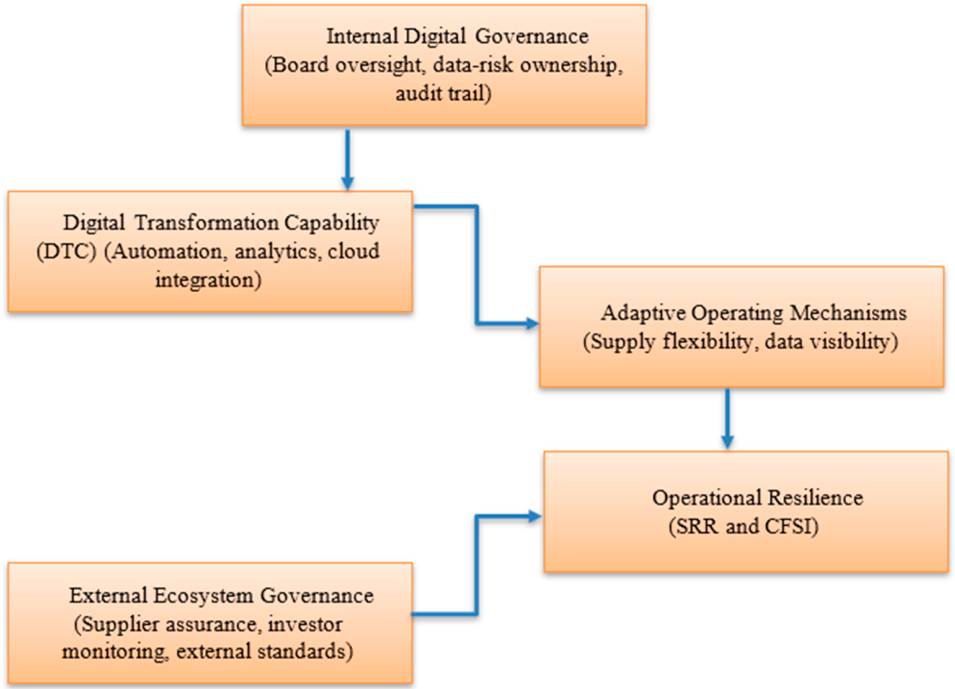
| Digital transformation capability | DTC | Equally weighted mean of annual binary indicators for automation, analytics, cloud integration, systems interoperability, and data-governance implementation coded from public disclosures and matched to Refinitiv issuer identifiers. |
| Internal digital governance | IDG | Index based on board technology oversight, executive data-risk ownership, digital audit trail, cross-functional disruption playbook, and incentive alignment coded from annual reports and governance filings. |
| External ecosystem governance | EEG | Boundary-spanning governance-and-continuity index capturing supplier assurance intensity, institutional monitoring stability, external data standards, financing continuity, and third-party digital assurance. Four items are disclosure-coded; institutional monitoring stability is matched from Refinitiv ownership history. |
| Supply flexibility | SFLEX | Mean of multisourcing/backup supplier arrangements, rerouting or production-transfer capability, and formal supplier-continuity planning. |
| Data visibility | DVIS | Mean of real-time operational dashboards, end-to-end traceability, and structured supplier/customer data integration. |
| Country digital readiness | READ | Annual mean of z-scored fixed broadband subscriptions, secure internet servers, and internet use from the World Development Indicators; high/low splits use the annual sample median. |
| Common-shock beta | BETA_COM | Rolling sensitivity of firm quarterly sales growth to the country-industry aggregate shock factor. |
| Idiosyncratic volatility | IDIO_VOL | Standard deviation of the residual from the rolling common-shock model; lower values indicate lower firm-specific disruption volatility. |
| Firm size | SIZE | Natural logarithm of total assets (Refinitiv Worldscope Fundamentals). |
| Leverage | LEV | Total debt divided by total assets (Refinitiv Worldscope Fundamentals). |
| Profitability | ROA | Operating income over total assets (Refinitiv Worldscope Fundamentals). |
| Capital intensity | CAPEX | Capital expenditures divided by total assets (Refinitiv Worldscope Fundamentals). |
| Innovation intensity | R&D | Research and development expense divided by sales (Refinitiv Worldscope); alternative missing-value treatments are checked in robustness analyses. |
| Market valuation | MTB | Market-to-book ratio from Refinitiv market capitalization and Worldscope book-value data; used in supplementary analyses and matching. |
| Firm age | AGE | Natural logarithm of years since listing based on Refinitiv security history; used in supplementary analyses and matching. |
| Asset tangibility | TANG | Net property, plant, and equipment divided by total assets (Refinitiv Worldscope Fundamentals); supplementary control. |
| Liquidity | LIQ | Cash and short-term investments divided by total assets (Refinitiv Worldscope Fundamentals); supplementary control. |
| Industry concentration | HHI | Herfindahl index of firm sales within the country-industry-year cell; supplementary control. |
| GDP growth | GDPG | Annual real GDP growth from the World Development Indicators; supplementary country-level control. |
| Variable | Observations | Mean | SD | P25 | Median | P75 |
|---|---|---|---|---|---|---|
| SRR | 57,406 | 0.927 | 0.143 | 0.842 | 0.931 | 1.017 |
| CFSI | 57,406 | 0.614 | 0.198 | 0.482 | 0.607 | 0.744 |
| DTC | 57,406 | 0.486 | 0.214 | 0.321 | 0.471 | 0.652 |
| IDG | 57,406 | 0.541 | 0.228 | 0.400 | 0.600 | 0.700 |
| EEG | 57,406 | 0.517 | 0.203 | 0.360 | 0.520 | 0.680 |
| SIZE | 57,406 | 8.914 | 1.427 | 7.926 | 8.871 | 9.856 |
| LEV | 57,406 | 0.248 | 0.169 | 0.108 | 0.229 | 0.364 |
| ROA | 57,406 | 0.071 | 0.094 | 0.029 | 0.064 | 0.112 |
| CAPEX | 57,406 | 0.061 | 0.052 | 0.024 | 0.047 | 0.082 |
| R&D | 57,406 | 0.034 | 0.041 | 0.000 | 0.021 | 0.049 |
| Panel A. Pairwise Correlations. | |||||||
| Variable | SRR | CFSI | DTC | IDG | EEG | SIZE | LEV |
| SRR | 1.000 | ||||||
| CFSI | 0.462 | 1.000 | |||||
| DTC | 0.318 | 0.287 | 1.000 | ||||
| IDG | 0.224 | 0.196 | 0.431 | 1.000 | |||
| EEG | 0.207 | 0.184 | 0.396 | 0.368 | 1.000 | ||
| SIZE | 0.176 | 0.158 | 0.249 | 0.193 | 0.161 | 1.000 | |
| LEV | −0.121 | −0.109 | −0.084 | −0.053 | −0.048 | 0.241 | 1.000 |
| Panel B. Variance inflation factors (VIF). | |||||||
| Variable | VIF | ||||||
| DTC | 1.84 | ||||||
| IDG | 1.62 | ||||||
| EEG | 1.57 | ||||||
| SIZE | 1.33 | ||||||
| LEV | 1.29 | ||||||
| ROA | 1.21 | ||||||
| CAPEX | 1.18 | ||||||
| R&D | 1.26 | ||||||
| Variables | (1) SRR | (2) SRR | (3) CFSI | (4) CFSI |
|---|---|---|---|---|
| DTC | 0.084 *** (0.021) | 0.071 *** (0.016) | 0.063 *** (0.016) | 0.058 *** (0.016) |
| SIZE | 0.019 *** (0.004) | 0.014 ** (0.005) | ||
| LEV | −0.041 *** (0.010) | −0.036 *** (0.009) | ||
| ROA | 0.067 *** (0.016) | 0.052 *** (0.012) | ||
| CAPEX | 0.018 * (0.009) | 0.011 (0.008) | ||
| R&D | 0.023 ** (0.009) | 0.019 * (0.009) | ||
| Firm fixed effects | Yes | Yes | Yes | Yes |
| Industry-year fixed effects | Yes | Yes | Yes | Yes |
| Observations | 57,406 | 57,406 | 57,406 | 57,406 |
| Adjusted R2 | 0.314 | 0.362 | 0.289 | 0.331 |
| Variables | (1) SRR (t + 1) | (2) CFSI (t + 1) | (3) SRR (t + 2) | (4) CFSI (t + 2) |
|---|---|---|---|---|
| Lagged DTC | 0.062 *** (0.014) | 0.049 *** (0.013) | 0.041 *** (0.011) | 0.036 ** (0.013) |
| SIZE | 0.017 *** (0.004) | 0.013 ** (0.005) | 0.015 *** (0.003) | 0.011 * (0.005) |
| LEV | −0.036 *** (0.008) | −0.029 ** (0.011) | −0.031 *** (0.007) | −0.024 ** (0.009) |
| ROA | 0.059 *** (0.017) | 0.046 *** (0.013) | 0.051 *** (0.014) | 0.039 ** (0.014) |
| Firm fixed effects | Yes | Yes | Yes | Yes |
| Industry-year fixed effects | Yes | Yes | Yes | Yes |
| Observations | 51,782 | 51,782 | 46,913 | 46,913 |
| Adjusted R2 | 0.308 | 0.296 | 0.281 | 0.269 |
| Variables | (1) First Stage DTC | (2) Second Stage SRR | (3) Second Stage CFSI |
|---|---|---|---|
| Pre-period exposure × digital-readiness shock | 0.214 *** (0.048) | ||
| Predicted DTC | 0.129 *** (0.029) | 0.094 *** (0.022) | |
| SIZE | 0.041 *** (0.011) | 0.018 *** (0.004) | 0.013 ** (0.005) |
| LEV | −0.036 *** (0.008) | −0.047 *** (0.011) | −0.039 *** (0.011) |
| ROA | 0.024 ** (0.009) | 0.058 *** (0.015) | 0.045 *** (0.011) |
| Kleibergen-Paap rk Wald F | 29.41 | 29.41 | 29.41 |
| Endogeneity test p-value | 0.018 | 0.031 | |
| Firm fixed effects | Yes | Yes | Yes |
| Country-year fixed effects | Yes | Yes | Yes |
| Observations | 57,406 | 57,406 | 57,406 |
| Variables | (1) PSM-SRR | (2) PSM-CFSI | (3) GMM-SRR | (4) GMM-CFSI |
|---|---|---|---|---|
| DTC | 0.055 *** (0.014) | 0.043 *** (0.009) | 0.048 *** (0.011) | 0.037 ** (0.014) |
| Lagged dependent variable | 0.412 *** (0.090) | 0.386 *** (0.090) | ||
| SIZE | 0.014 ** (0.005) | 0.011 * (0.005) | 0.010 * (0.005) | 0.008 (0.007) |
| LEV | −0.029 ** (0.011) | −0.024 ** (0.009) | −0.021 * (0.010) | −0.019 * (0.009) |
| Controls | Yes | Yes | Yes | Yes |
| AR(2) p-value | 0.247 | 0.318 | ||
| Hansen p-value | 0.421 | 0.463 | ||
| Observations | 18,406 | 18,406 | 49,772 | 49,772 |
| Specification | Lag Window | Instrument Matrix | Instrument Count | AR(2) p-Value | Hansen p-Value | DTC Coefficient |
|---|---|---|---|---|---|---|
| Panel A. Preferred collapsed-instrument specifications. | ||||||
| Main | t − 2:t − 3 | Collapsed | 32 | 0.247 | 0.421 | 0.048 *** |
| Conservative | t − 2 only | Collapsed | 24 | 0.286 | 0.397 | 0.041 ** |
| Extended | t − 2:t − 4 | Collapsed | 44 | 0.233 | 0.365 | 0.050 *** |
| Panel B. Diagnostic uncollapsed specification | ||||||
| Uncollapsed diagnostic | t − 2:t − 3 | Uncollapsed | >100 | 0.219 | 0.871 | Not preferred |
| Model | Restricted Sample | Indicator | Post Window | Interaction Coefficient | SE | N |
|---|---|---|---|---|---|---|
| 1 | Severe-shock onset subsample | High DTC | Post shock-onset window | 0.047 ** | 0.016 | 13,274 |
| 2 | Severe-shock onset subsample | High IDG | Post shock-onset window | 0.031 * | 0.015 | 13,274 |
| 3 | Severe-shock onset subsample | High EEG/alternative ecosystem construct | Post shock-onset window | 0.027 * | 0.014 | 13,274 |
| Panel A. HDFE Estimates. | ||||
| Variables | (1) SRR–IDG | (2) CFSI–IDG | (3) SRR–EEG | (4) CFSI–EEG |
| DTC | 0.061 *** (0.016) | 0.050 *** (0.013) | 0.057 *** (0.012) | 0.046 *** (0.012) |
| DTC × IDG | 0.032 *** (0.008) | 0.026** (0.009) | ||
| IDG | 0.018 ** (0.007) | 0.014 * (0.007) | ||
| DTC × EEG | 0.029 *** (0.006) | 0.022 ** (0.008) | ||
| EEG | 0.021 *** (0.004) | 0.017 ** (0.006) | ||
| Observations | 57,406 | 57,406 | 57,406 | 57,406 |
| Adjusted R2 | 0.371 | 0.339 | 0.368 | 0.336 |
| Panel B. Matched-sample estimates. | ||||
| Variables | (5) SRR–IDG | (6) CFSI–IDG | (7) SRR–EEG | (8) CFSI–EEG |
| DTC | 0.049 *** (0.013) | 0.039 ** (0.015) | 0.046 *** (0.012) | 0.035 ** (0.013) |
| DTC × IDG | 0.027 ** (0.010) | 0.021 * (0.010) | ||
| IDG | 0.016 * (0.008) | 0.011 (0.007) | ||
| DTC × EEG | 0.024 ** (0.009) | 0.019 * (0.009) | ||
| EEG | 0.018 ** (0.007) | 0.014 * (0.007) | ||
| Observations | 18,406 | 18,406 | 18,406 | 18,406 |
| Matched sample | Yes | Yes | Yes | Yes |
| Panel C. Dynamic GMM estimates. | ||||
| Variables | (9) SRR–IDG | (10) CFSI–IDG | (11) SRR–EEG | (12) CFSI–EEG |
| DTC | 0.044 *** (0.012) | 0.034 ** (0.012) | 0.041 *** (0.010) | 0.031 ** (0.011) |
| DTC × IDG | 0.019 * (0.009) | 0.016 * (0.008) | ||
| IDG | 0.012 (0.008) | 0.009 (0.006) | ||
| DTC × EEG | 0.018 * (0.009) | 0.015 * (0.007) | ||
| EEG | 0.014 * (0.007) | 0.012 (0.008) | ||
| Lagged dependent variable | 0.396 *** (0.085) | 0.381 *** (0.091) | 0.392 *** (0.100) | 0.377 *** (0.079) |
| AR(2)/Hansen p-value | 0.241/0.436 | 0.301/0.472 | 0.254/0.429 | 0.317/0.461 |
| Moderator | Outcome | Low | Median | High | Formula |
|---|---|---|---|---|---|
| IDG | SRR | 0.074 | 0.080 | 0.083 | 0.061 + 0.032 × IDG |
| IDG | CFSI | 0.060 | 0.066 | 0.068 | 0.050 + 0.026 × IDG |
| EEG | SRR | 0.067 | 0.072 | 0.077 | 0.057 + 0.029 × EEG |
| EEG | CFSI | 0.054 | 0.057 | 0.061 | 0.046 + 0.022 × EEG |
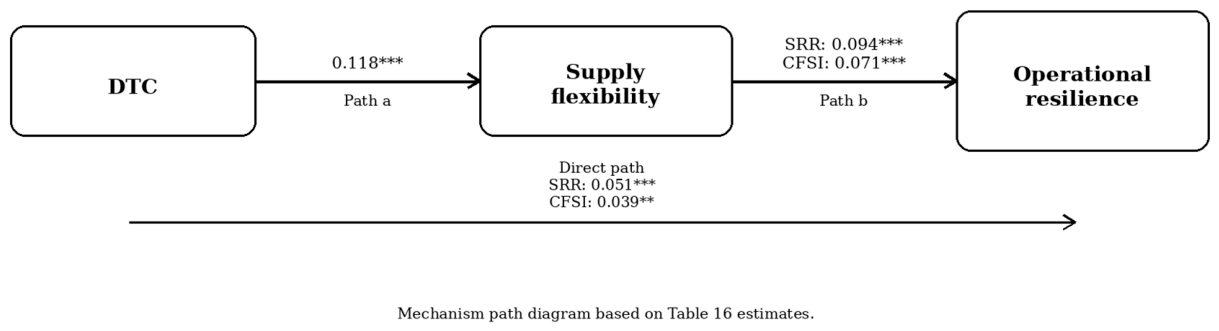
| Panel A. Supply Flexibility. | |||
| Variables | (1) Supply Flexibility | (2) SRR | (3) CFSI |
| DTC | 0.118 *** (0.031) | 0.051 *** (0.011) | 0.039 ** (0.015) |
| Supply flexibility | 0.094 *** (0.021) | 0.071 *** (0.015) | |
| Bootstrapped indirect effect | 0.011 *** (0.002) | 0.008 ** (0.003) | |
| Observations | 57,406 | 57,406 | 57,406 |
| Adjusted R2 | 0.287 | 0.369 | 0.338 |
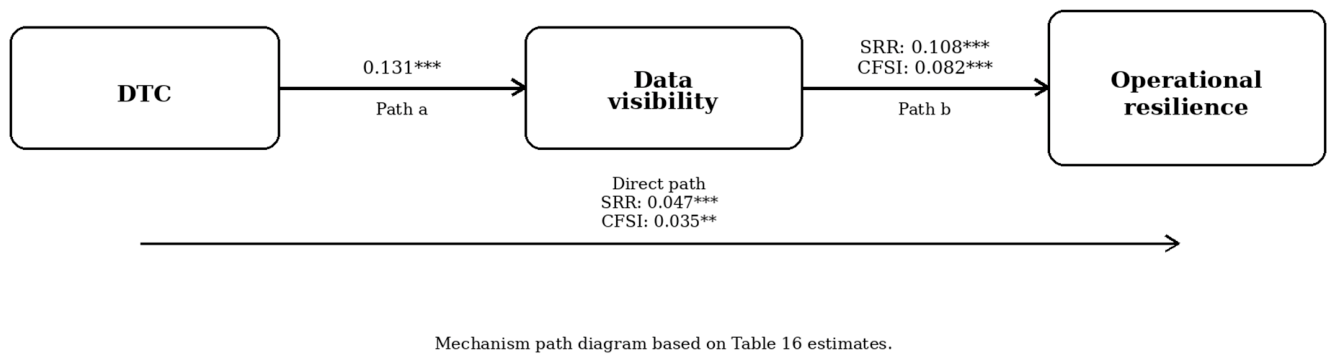
| Panel B. Data visibility. | |||
| Variables | (4) Data visibility | (5) SRR | (6) CFSI |
| DTC | 0.131 *** (0.033) | 0.047 *** (0.010) | 0.035 ** (0.013) |
| Data visibility | 0.108 *** (0.025) | 0.082 *** (0.023) | |
| Bootstrapped indirect effect | 0.014 *** (0.004) | 0.011 *** (0.003) | |
| Observations | 57,406 | 57,406 | 57,406 |
| Adjusted R2 | 0.301 | 0.374 | 0.344 |
| Country/Group | Outcome | DTC Coefficient | SE | N | Adjusted R2 | Difference |
|---|---|---|---|---|---|---|
| High-readiness | SRR | 0.091 *** | 0.025 | 31,284 | 0.381 | p = 0.021 |
| High-readiness | CFSI | 0.074 *** | 0.017 | 31,284 | 0.347 | p = 0.033 |
| Low-readiness | SRR | 0.052 *** | 0.013 | 26,122 | 0.294 | Ref. |
| Low-readiness | CFSI | 0.039 ** | 0.014 | 26,122 | 0.269 | Ref. |
| United States | SRR | 0.097 *** | 0.022 | 8514 | 0.392 | p = 0.048 |
| United States | CFSI | 0.081 *** | 0.022 | 8514 | 0.361 | p = 0.057 |
| China | SRR | 0.064 *** | 0.016 | 6928 | 0.318 | Ref. |
| China | CFSI | 0.048 ** | 0.018 | 6928 | 0.287 | Ref. |
| Country/Group or Specification | Outcome | DTC Coefficient | SE | N | Interpretation |
|---|---|---|---|---|---|
| Panel A. Excluding dominant-country subsamples | |||||
| Excl. U.S. and China | SRR | 0.063 *** | 0.015 | 41,964 | Large-country check |
| Excl. U.S. and China | CFSI | 0.050 *** | 0.014 | 41,964 | Large-country check |
| Panel B. Country-year fixed-effects specifications | |||||
| Country-year FE | SRR | 0.058 *** | 0.016 | 57,406 | National shocks |
| Country-year FE | CFSI | 0.046 *** | 0.014 | 57,406 | National shocks |
| Panel C. Market-development split | |||||
| Developed markets | SRR | 0.079 *** | 0.019 | 31,500 | Market split |
| Emerging markets | SRR | 0.048 ** | 0.018 | 25,906 | Market split |
| Variables | (1) SRR | (2) CFSI |
|---|---|---|
| AUT | 0.026 ** (0.009) | 0.019 * (0.009) |
| ANA | 0.041 *** (0.010) | 0.033 *** (0.009) |
| CLOUD | 0.018 * (0.009) | 0.014 * (0.007) |
| Controls and fixed effects | Yes | Yes |
| Observations | 57,406 | 57,406 |
| Adjusted R2 | 0.367 | 0.334 |
| Variables | (1) Common-Shock Beta | (2) Idiosyncratic Volatility | (3) Common Beta + IDG | (4) Idio. vol. + IDG |
|---|---|---|---|---|
| DTC | −0.073 *** (0.020) | −0.058 *** (0.016) | −0.049 ** (0.019) | −0.041 ** (0.015) |
| DTC × IDG | −0.021 * (0.010) | −0.017 * (0.008) | ||
| IDG | −0.014 * (0.007) | −0.011 (0.007) | ||
| Controls | Yes | Yes | Yes | Yes |
| Observations | 57,406 | 57,406 | 57,406 | 57,406 |
| Adjusted R2 | 0.284 | 0.247 | 0.296 | 0.258 |
Disclaimer/Publisher’s Note: The statements, opinions and data contained in all publications are solely those of the individual author(s) and contributor(s) and not of MDPI and/or the editor(s). MDPI and/or the editor(s) disclaim responsibility for any injury to people or property resulting from any ideas, methods, instructions or products referred to in the content. |
© 2026 by the authors. Licensee MDPI, Basel, Switzerland. This article is an open access article distributed under the terms and conditions of the Creative Commons Attribution (CC BY) license.
Share and Cite
Chibani, F.; Najah, A.; Hamdouni, A. Digital Transformation Capability, Governance Architecture, and Operational Resilience: International Evidence. Sustainability 2026, 18, 5171. https://doi.org/10.3390/su18105171
Chibani F, Najah A, Hamdouni A. Digital Transformation Capability, Governance Architecture, and Operational Resilience: International Evidence. Sustainability. 2026; 18(10):5171. https://doi.org/10.3390/su18105171
Chicago/Turabian StyleChibani, Faten, Ahlem Najah, and Amina Hamdouni. 2026. "Digital Transformation Capability, Governance Architecture, and Operational Resilience: International Evidence" Sustainability 18, no. 10: 5171. https://doi.org/10.3390/su18105171
APA StyleChibani, F., Najah, A., & Hamdouni, A. (2026). Digital Transformation Capability, Governance Architecture, and Operational Resilience: International Evidence. Sustainability, 18(10), 5171. https://doi.org/10.3390/su18105171