Article

Research on Carbon Emission Accounting and Reduction Measures for Bridges in Africa Throughout Its Life Cycle: A Case Study of the Jangwani Bridge in Tanzania

1
CCCC Second Highway Engineering Co., Ltd., Xi’an 710119, China
2
School of Civil Engineering and Architecture, Henan University of Science and Technology, Luoyang 471023, China
*
Author to whom correspondence should be addressed.
Sustainability 2026, 18(10), 5149; https://doi.org/10.3390/su18105149
Submission received: 13 April 2026 / Revised: 6 May 2026 / Accepted: 17 May 2026 / Published: 20 May 2026

Abstract

To quantify the carbon footprint of cross-border bridges built by Chinese companies in Africa, based on the Janwani Bridge in Tanzania and the life cycle theory, it is divided into five stages: production, transportation, on-site construction, operational maintenance, and demolition and disposal. Using the emission factor method to construct carbon emission models for each stage, while considering cross-border supply chains and the addition of vegetation carbon sinks, we quantify the emissions for each stage. The research is based on the project design stage bill of quantities and construction organization data for prediction and estimation. The energy consumption parameters of construction machinery refer to the Chinese quota standards, and the energy consumption of lighting during the operation period is estimated according to the design parameters. The results show that the total carbon emissions of the life cycle of the bridge is about 41,668,548.20 kgCO2e, with the production stage being the dominant position (87.48%), and cement and reinforcing steel contributing more than 95% of the emissions during this stage. The operational maintenance stage comes second (7.28%), mainly driven by lighting electricity (accounting for 73.65% of the total emissions in this stage), attributed to the local power grid dominated by fossil fuels. Sensitivity analysis shows that the key factors are ranked as cement > reinforcing steel > electricity > diesel. Considering the reality of insufficient supply of low-carbon materials and weak infrastructure in Africa, emission reduction measures are proposed from three aspects: optimizing concrete mix proportion, controlling construction machinery, and implementing intelligent lighting. The research contribution lies in incorporating the entire cross-border transportation chain and newly added vegetation carbon sinks into the LCA boundary of bridges, while considering the dual attributes of “technology output + localized operation”, and constructing a carbon emission accounting model adapted to the built-up areas of African cities. On this basis, the carbon emission characteristics of the life cycle were quantitatively analyzed, feasible emission reduction measures in the region were proposed, and the carbon reduction potential was calculated, providing scientific basis for low-carbon control of Chinese enterprises’ overseas bridges.

1. Introduction

With escalating global climate change trends and carbon neutrality goals, there is a growing focus on transportation infrastructure due to its significant role in human-induced carbon missions [1,2]. According to the Global Energy and CO2 Status Report 2024 by the International Energy Agency, emissions from global infrastructure sectors account for over 30–40% of total energy-related emissions, with transportation infrastructure being the primary contributor. Infrastructure-related carbon emissions in developing countries are growing at a far faster rate than in developed nations. The African continent is currently undergoing a large-scale expansion of infrastructure construction, with many countries investing up to $25 billion annually in infrastructure—an amount representing approximately 7% of their GDP. This construction boom has directly led to a surge in carbon emissions, particularly within the transportation sector, which accounts for 16% of the continent’s total carbon emissions [3]. Bridge engineering serves as vital linear infrastructure connecting Africa’s regional transportation networks and driving its socioeconomic development. Achieving comprehensive measurement and control of carbon emissions throughout the life cycle of bridge projects is central to Africa’s pursuit of low-carbon infrastructure. Taking Tanzania, the study area of this paper, as an example, the National Climate and Development Report indicates that the transportation sector emits 6.78 MtCO2e annually, making it the third-largest greenhouse gas-emitting sector in the country, following agriculture, land-use change, and forestry. This emissions baseline indicates that carbon emissions from transportation infrastructure constitute a significant component in emission reduction efforts. As bridges represent the “fixed assets” of transportation infrastructure, the absence of life cycle carbon emissions data for bridges makes it challenging to quantify emission reduction targets for the transportation sector.
Life Cycle Assessment (LCA), as the fundamental methodology for bridge carbon emission research, has prioritized the construction and refinement of its application framework within the academic community. Karimova et al. [4] proposed a methodological framework for assessing embodied carbon in bridge structures, encompassing material quantification, normalization, and carbon emission calculation formulas. Xia et al. [5] integrated consequential LCA with dynamic LCA concepts to propose a decision-making method for low-carbon bridge renewal. By constructing a comparative system boundary, they incorporated the low-carbon benefits of functional improvements into the assessment and introduced time-dependent factors to quantify the differences in global warming impacts at various renewal time points. Kaewunruen et al. [6] proposed a sustainable life cycle management framework for bridges based on 6D BIM, identifying raw materials as the primary source of embodied carbon emissions. Kim et al. [7] conducted a comparative analysis of embodied carbon in cast-in-place and precast concrete bridges using BIM and LCA tools, revealing concrete waste rates and transportation distances as critical factors influencing the results. Yang et al. [8] integrated BIM with LCA technologies to develop a rapid calculation and analysis system for the life cycle carbon emissions of bridges. Srivastava et al. [9] proposed a method for systematically selecting low-carbon concrete for various bridge components, achieving up to a 53% reduction in overall embodied carbon. Zhao et al. [10] developed a low-carbon assessment model for the construction stage of railway bridges by integrating the Network Analytic Hierarchy Process with fuzzy comprehensive evaluation, identifying the material production and transportation stages as the largest contributors to cumulative carbon emissions.
Regarding the stage distribution and key influencing factors of life cycle carbon emissions, scholars have conducted extensive empirical research [11,12,13,14]. Cao et al. [15], after calculating emissions for two actual bridges, found that the material production stage accounts for the largest proportion of carbon emissions, while the construction stage accounts for the smallest. Wu et al. [16], in their study on cross-sea tunnels, pointed out that the materialization stage is the largest source of carbon emissions, followed by the operation stage. Zhou et al. [17] analyzed a three-tower cable-stayed bridge and found that its impact on global warming is primarily concentrated in the operation and maintenance stages. Zhang et al. [18] conducted research on a steel deck pavement, indicating that the maintenance stage (accounting for 66.7–71.4%) is the main source of carbon emissions. Hou et al. [19] proposed an ‘SPMT technology + large-segment cutting’ scheme, which resulted in significantly lower carbon emissions during the demolition stage compared to traditional methods. Qian et al. [20] conducted a comparative study on hollow slab bridges and T-beam bridges, discovering that carbon emissions from the production stage account for over 84% in both cases. Suwondo et al. [21] investigated the influence of concrete strength grade, beam spacing, and span length on the embodied carbon and cost of T-beam bridges, finding that embodied carbon increases exponentially once the span exceeds 20 m. Wang et al. [22] incorporated carbon tax and carbon trading mechanisms to monetize carbon emissions into carbon costs, revealing that the material production stage is the primary source of both carbon emissions (accounting for 92.1%) and carbon costs.
In exploring the emission reduction potential within the engineering field, research focused on how to effectively lower carbon emissions continues to deepen. Zerin et al. [23] proposed the construction of ultra-high durability, low-carbon bridges using zero-cement concrete and non-metallic reinforcement, which can reduce life cycle carbon emissions by approximately 80%. Praseeda et al. [24], through a case study of a coastal bridge in India, found that using concrete containing 70% slag can extend the corrosion initiation life by approximately four times and reduce embodied carbon by 8% during the construction stage. Khorgade et al. [25] discovered that substituting steel reinforcement with prestressed CFRP can significantly reduce carbon emissions (by approximately 28% and 18%, respectively). Li et al. [26] conducted research on the reconstruction project of the Beijing Lu Yi River Bridge, demonstrating that a renovation scheme involving jacking up the old bridge and widening it on both sides can reduce carbon emissions by 38.81% compared to complete demolition and reconstruction. Ma et al. [27] proposed a method for recommending bridge construction schemes based on knowledge graphs and similarity calculations, opening a new pathway for intelligent control of carbon emissions during the construction stage. Qin et al. [28] quantified the carbon emissions during the construction stage of cable-stayed bridges and simulated various emission reduction scenarios, showing that full electrification and carbon-neutral scenarios can significantly reduce future emissions. Liu et al. [29] achieved a reduction of 7.3% (approximately 4048 tCO2e) through three strategies: substituting supplementary cementitious materials (SCM), optimizing steel component hoisting processes, and enhancing the reuse of formwork and temporary works.
Although robust methodological frameworks, emission characteristics at specific stages, and low-carbon technologies have been established by previous studies on the life cycle assessment (LCA) of bridges, the focus has mainly been on domestic construction scenarios in developed countries or rapidly industrializing countries such as China, the United States, and Europe. The existence of mature regional supply chains, stable low-carbon energy grids, and well-established waste recycling systems is typically assumed. Research specifically targeting carbon footprint accounting in Africa remains extremely limited, and LCA studies on African infrastructure mainly focus on two aspects. On the one hand, the systemic barriers to implementing life cycle sustainability assessments in developing countries have been extensively documented by scholars, including the long-term scarcity of localized life cycle inventory data, methodological uncertainties, and institutional constraints in terms of cost and expertise. These challenges are reflected in LCA studies in Nigeria, South Africa, and other African countries [30,31,32]. On the other hand, the feasibility of low-carbon solutions for rural footpath bridges in East Africa has been demonstrated by empirical studies, such as the use of stone arch structures, which can reduce emissions by 50–80% compared to concrete structures [33]. However, the focus of these studies is primarily on small-scale, low-material-strength rural infrastructure or general methodological critiques. In contrast, the infrastructure projects built by Chinese enterprises in Africa face vastly different conditions: cross-border material supply chains (involving maritime and inland transportation), high-carbon power structures reliant on fossil fuels, and the carbon sequestration potential inherent in local vegetation. Furthermore, the “technology export + localized operation” model, where construction standards and equipment are imported while local environmental constraints (such as ecologically sensitive areas and weak infrastructure systems) must be considered, has seldom been addressed by existing life cycle assessment studies on infrastructure in developing countries.
In light of this, the Tanzania Jangwani Bridge, constructed by Chinese enterprises in Africa, was selected as the research subject. Within the framework of the life cycle theory, an emission accounting model was constructed for this bridge using the emission factor method. Explicitly incorporated into this model are: (a) five stages (production, transportation, on-site construction, operational maintenance, and demolition/disposal); (b) cross-border transportation links (from China via maritime transportation plus local land transportation); (c) vegetation carbon sinks in newly afforested areas calculated using regional carbon sequestration rates. The carbon emission characteristics of each stage were systematically analyzed, and key influencing factors were examined through sensitivity coefficient analysis. Additionally, feasible emission reduction measures for the region were proposed. Three specific contributions are provided as follows: (1) by incorporating cross-border transportation (maritime transportation) and vegetation carbon sinks, the traditional life cycle assessment boundaries of bridges are expanded, and a customized accounting model is provided for local projects in Africa; (2) an empirical life cycle carbon emission dataset is provided for bridges constructed by Chinese enterprises in Africa, revealing the contribution and sensitivity patterns at various stages; (3) feasible emission reduction measures in the region are proposed and quantified, taking into account the actual construction conditions and resource and environmental characteristics of Africa, targeted emission reduction strategies are proposed, and their emission reduction potential is estimated, thus laying a scientific foundation for energy conservation and emission reduction efforts in similar bridge projects.

2. Scope of Carbon Emissions Calculation for the Life Cycle of Bridges

2.1. Life Cycle Stage Classification

The life cycle of a bridge spans from project inception to completion, comprising five stages: design, material preparation, construction, operational maintenance, and demolition. Design form the foundational work of bridge construction, primarily encompassing project justification, project proposal preparation, feasibility study preparation, engineering surveys, preliminary design, and construction drawing design. This stage consumes significant human and material resources, objectively generating a certain amount of carbon emissions. However, relevant research [34] indicates that carbon emissions during the design stage constitute a negligible portion of a bridge’s life cycle emissions. These emissions primarily stem from office energy consumption and personnel commuting, contributing minimally compared to subsequent stages. Consequently, when conducting a systematic assessment of a bridge’s life cycle carbon emissions, emissions from this stage are typically considered negligible and do not impact the overall carbon footprint calculation.
To provide a reliable computational basis for bridge carbon footprints and support more precise life cycle carbon emission analysis, the scope of bridge life cycle carbon emission accounting is clearly defined based on practical research. The core scope is confined to the entire process from raw material production to bridge demolition, and is further subdivided into five distinct stages: production, transportation, on-site construction, operational maintenance, and demolition and disposal.

2.2. System Boundary Definition

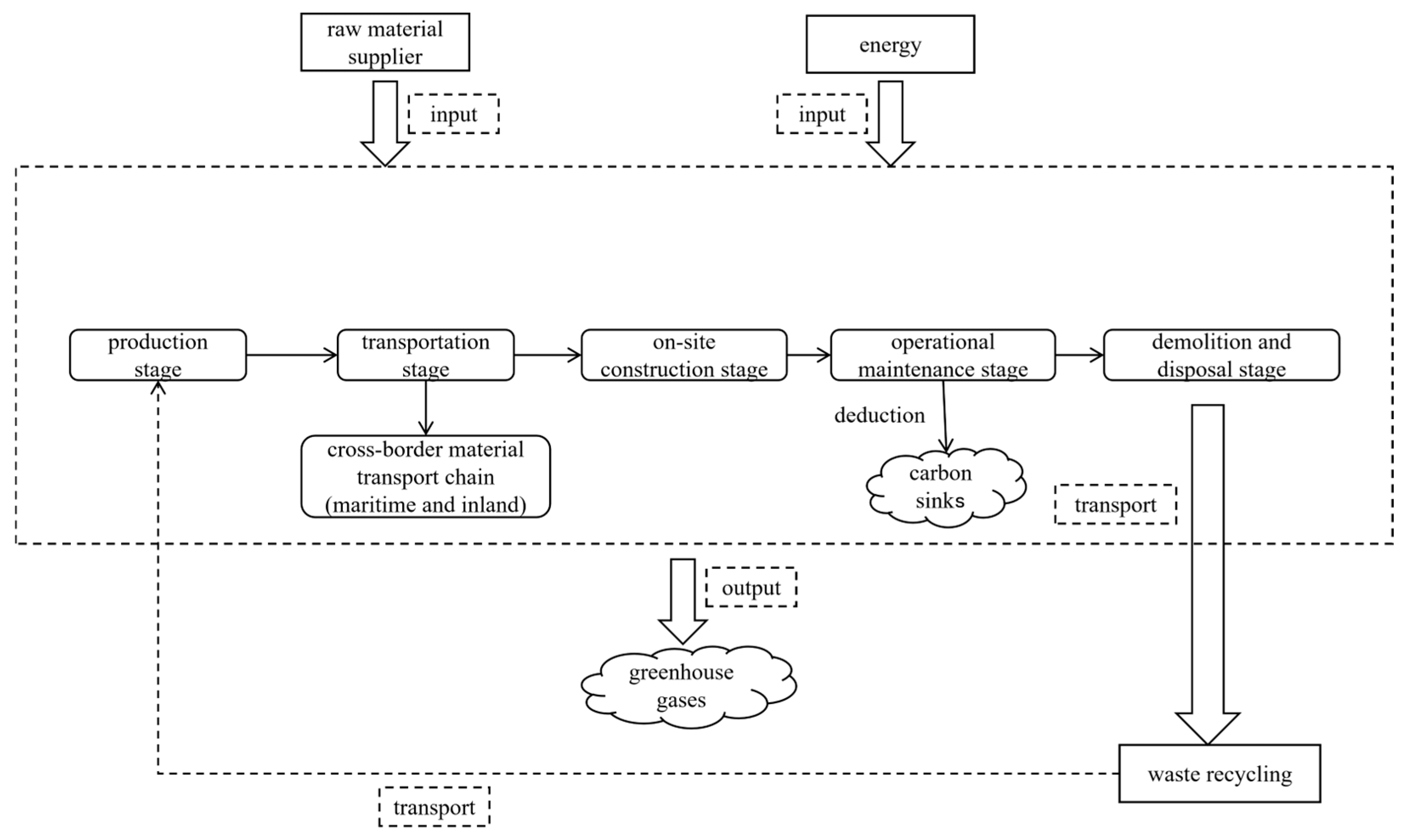
To accurately calculate the total greenhouse gas emissions throughout the life cycle of products and systems, a core methodology for clearly defining the carbon emission calculation boundary is established. The scope definition draws upon the classic “cradle-to-grave” boundary standard from the Life Cycle Assessment (LCA) framework, covering core stages including bridge material production, transportation, on-site construction, operational maintenance, and demolition and disposal. However, adjustments were made to the boundary to account for the unique characteristics of the African region and the specific construction model employed by Chinese enterprises. Unlike domestic bridge projects where procurement primarily relies on mature regional supply chains, a new cross-border material transport chain, encompassing both maritime and inland shipping, is necessitated—specifically, international maritime shipping from a Chinese port to the Port of Dar es Salaam, followed by inland road transport from the port to the construction site in Tanzania. Additionally, in accordance with the accounting principles for “land use change and forestry” specified in the IPCC Guidelines for National Greenhouse Gas Inventories, alterations in biomass carbon stocks resulting from project activities must be incorporated into the carbon footprint assessment. Following the completion of the Jangwani Bridge, artificial reforestation will be conducted in the area directly impacted by the project. The resulting additional carbon sinks should be integrated into the life cycle carbon emission boundary to provide a more thorough representation of the project’s net carbon emissions, as illustrated in Figure 1.

2.3. Carbon Emission Source Classification

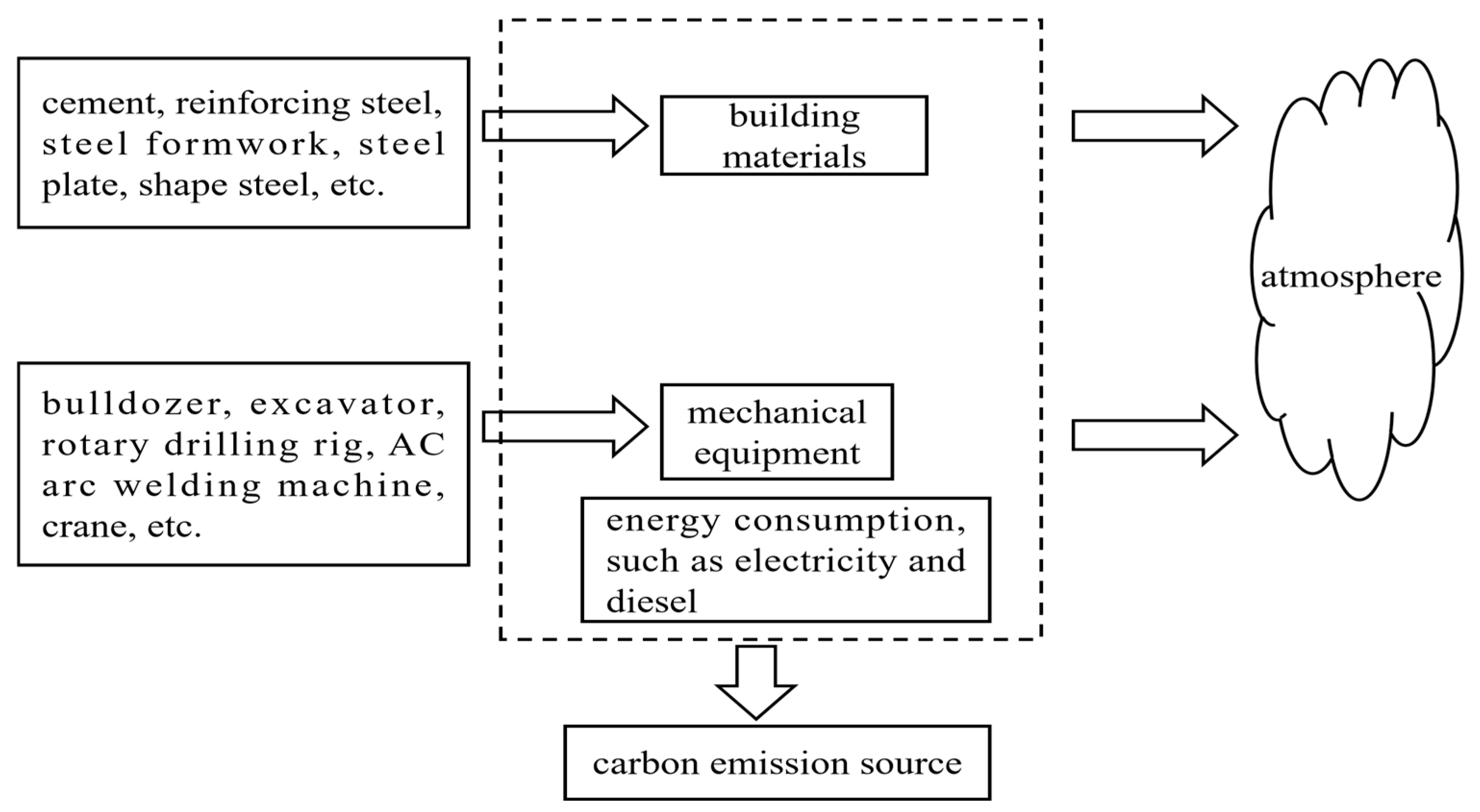
The bridge construction stage is the core component of the life cycle carbon emissions, with clearly identifiable emission sources primarily categorized into two types: firstly, carbon emissions generated from the production of raw materials for building materials, processing procedures, and energy consumption of transportation vehicles during the building materials transportation stage; secondly, carbon emissions resulting from the operation of construction machinery and equipment on-site consuming electricity, diesel, and other energy sources. Prior to conducting the calculation, it is essential to adhere to the scope defined earlier and systematically organize and identify the core carbon emission sources. These sources include the consumption of key construction materials, the number of shifts for mechanical equipment, and diverse energy consumption statistics, as illustrated in Figure 2.

2.4. Calculation Method

The Intergovernmental Panel on Climate Change (IPCC), as the authoritative body in global climate change research, has established the emission factor method as the most widely applied greenhouse gas accounting approach internationally. To ensure the scientificity and authority of the carbon emission accounting results for the entire life cycle of the Jangwani Bridge, the core framework of the emission factor method established in the “2006 IPCC Guidelines for National Greenhouse Gas Inventories” [35] is strictly followed to carry out the accounting work. Meanwhile, the principle of “local priority, hierarchical supplementation” is followed by the selection of emission factors. Specifically, locally validated data from Africa are used for cement, electricity, and others; for materials lacking local data, such as reinforcing steel, IPCC default values and Ecoinvent international mean values are used, whose applicability is based on the global consistency of material chemical composition and production processes; fuel emission factors such as diesel are taken from IPCC general values, which are independent of geography. Maximum proximity to the actual situation in Africa under data-limited conditions is ensured by this principle. The fundamental equation is presented in Formula (1):
C = AD × EF
where C is the carbon emissions, kgCO2e; AD is the activity data, indicating material or energy consumption; EF is the emission factor, representing carbon emissions per unit of material or energy consumption, kgCO2e/unit.

3. Life Cycle Carbon Emissions Calculation Model

3.1. Production Stage

Carbon emissions during the production Stage are primarily generated by material manufacturing and are calculated using Formula (2).
C 1 = i = 1 m M i × EF i
where Mi is the production quantity of i material; EFi is the production carbon emission factor corresponding to i material, kgCO2e/unit; m is the number of building material types.

3.2. Transportation Stage

Carbon emissions from transportation primarily stem from the process of transporting building materials from production sites to construction sites using various modes of transport, calculated according to Formula (3).
C 2 = j = 1 n M j × D j × EF j
where Mj is the loading mass of j material transport vehicle, t; Dj is the transport distance of j material transport vehicle, km; EFj is the carbon emission factor per unit weight transported distance for j material transport vehicle, kgCO2e/(km·t); n is the number of types of material transport vehicles.

3.3. On-Site Construction Stage

Carbon emissions at construction sites primarily stem from energy consumption during the operation of machinery and equipment. The carbon emissions from this process are directly correlated with the number of shifts for mechanical equipment, calculated according to Formula (4).
C 3 = k = 1 p T k × M k × EF k
where Tk is the number of machine shifts for k machinery; Mk is the energy consumption per unit shift for k machinery; EFk is the carbon emission factor for k machinery, kgCO2e/unit; p is the number of types of construction machinery.

3.4. Operational Maintenance Stage

The operational maintenance stage encompasses the entire process from the completion and handover of bridge projects until their eventual decommissioning at the end of their design service life, representing the longest duration within the life cycle. To enable more precise carbon emission accounting, this stage can be further subdivided into the operation stage and the maintenance stage. In light of the artificial reforestation planned for the directly affected area upon completion of the Jangwani Bridge, the carbon emission reductions achieved through absorption by local vegetation (carbon sink) are incorporated into the accounting as a deduction. Carbon emissions can be calculated using Formula (5).
C 4 = C 4.1 + C 4.2 C 4.3
where C4 is carbon emissions during the operational maintenance stage, kgCO2e; C4.1 is carbon emissions generated during the operation stage, kgCO2e; C4.2 is carbon emissions generated during the maintenance stage, kgCO2e; C4.3 is carbon emissions reduced by the absorption of green plants, kgCO2e.

3.4.1. Operation-Stage Carbon Emissions Model

Carbon emissions during the operation stage primarily stem from electricity consumption by bridge deck lighting equipment. Emissions in this stage correlate with factors such as lighting duration and power output, calculated according to Formula (6).
C 4.1 = 365 × W × t × EF e × T
where W is the total power of the lighting equipment, kw; t is the daily operating time of the lighting equipment, h; EFe is the electricity carbon emission factor, kgCO2e/kw·h; T is the design service life of the bridge, a.

3.4.2. Maintenance-Stage Carbon Emissions Model

Carbon emissions during the maintenance stage arise from sustaining the structure’s normal operation. These include emissions from material consumption due to component replacement during maintenance, as well as emissions from energy consumption related to transportation and mechanical equipment. Calculations are performed according to Formula (7).
C 4.2 = i = 1 m M i × EF i + j = 1 n M j × D j × EF j + k = 1 p T k × M k × EF k × T T m 1
where Tm is the service life of m material used during the maintenance stage, a.

3.4.3. Green Plant Carbon Sink Model

A carbon sink is defined as the process, activities, and related mechanisms that absorb and sequester carbon dioxide from the atmosphere, with vegetation’s capacity to absorb and store carbon dioxide long-term being its core component. A building carbon sink refers to the amount of carbon dioxide absorbed by vegetation within the vicinity of a building, calculated according to Formula (8).
C 4.3 = G × S × T
where G is the annual carbon sequestration per unit area of green vegetation, kgCO2e/(ha·a); S is the green area, ha; T is the number of years, a.

3.5. Demolition and Disposal Stage

The demolition and disposal stage involves dismantling the bridge’s main structure, transporting the waste, and recycling the construction debris, calculated according to Formula (9).
C 5 = C 5.1 + C 5.2
where C5 is carbon emissions during the demolition and disposal stage, kgCO2e; C5.1 is carbon emissions generated during the demolition stage, kgCO2e; C5.2 is carbon emissions generated during the disposal stage, kgCO2e.

3.5.1. Demolition-Stage Carbon Emissions Model

Calculating carbon emissions during the demolition stage using actual data presents significant challenges. Referring to the relevant study by reference [36], a simplified relationship was derived through statistical analysis of multiple building demolition cases: energy consumption during the demolition stage is approximately 90% of that during the on-site construction stage. This finding has been widely cited in the field of building carbon emissions. Although bridge demolition involves a larger scale, its primary processes are similar to those of building demolition. Furthermore, given that the present project is undertaken by a Chinese enterprise, demolition operations also rely on large-scale fuel-powered machinery and equipment, such as rotary drilling rigs and cranes, and their unit energy consumption characteristics are comparable to those of local projects in China. Therefore, this simplified formula is adopted in this study for estimation purposes. The simplified calculation expression for carbon emissions during the demolition stage is as follows:
C 5.1 = C 3 × 90 %

3.5.2. Disposal-Stage Carbon Emissions Model

The disposal stage involves the transportation, processing and recycling of construction waste, calculated according to Formula (11).
C 5.2 = s = 1 v M s × D s × EF s + f = 1 q M f × EF f h = 1 r M h × EF h × η h × T T h
where Ms is the loading mass of the s-th waste transport vehicle, t; Ds is the transport distance of the s-th waste transport vehicle, km; EFs is the carbon emission factor per unit weight transported distance for the s category of waste transport vehicles, kgCO2e/(km·t); v is the number of waste transport vehicle categories; Mf is the waste treatment volume of the f category; EFf is the carbon emission factor for waste treatment of type f, kgCO2e/unit; q is the number of waste treatment types; Mh is the consumption of recyclable material of type h; EFh is the carbon emission factor for recyclable material of type h, kgCO2e/unit; ηh is the recycling rate of recyclable material of type h, %; r is the number of recyclable material types.

4. Carbon Emissions Calculation Example

4.1. Project Overview

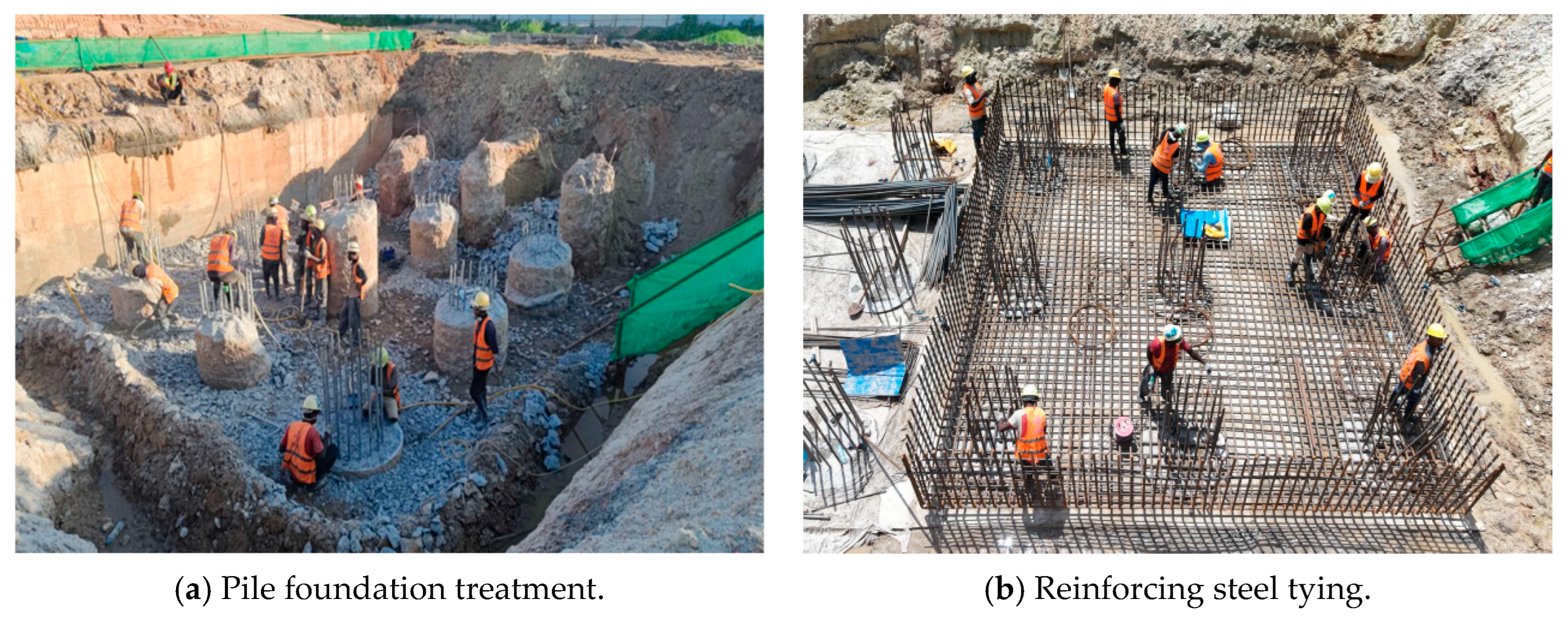
The Jangwani Bridge is located in the urban built-up area of Dar es Salaam, Tanzania, with vegetation primarily consisting of savanna, shrubs, and urban artificial greenery. From the production of construction materials to its eventual dismantling and disposal, a bridge spans a significant time frame. Throughout its life cycle, it generates substantial greenhouse gas emissions that pollute the local environment. Therefore, carbon emissions must be calculated at each stage to identify high-emission stages or components for targeted attention. Relevant carbon reduction measures should be proposed to minimize its environmental impact. A life cycle carbon emissions calculation is conducted for the Jangwani Bridge project in Tanzania. Located in the heart of Dar es Salaam, the bridge serves as the core interchange between the Phase I BRT trunk line and the bus terminal. The bridge spans a total length of 390 m, comprising 13 simply supported spans, each measuring 30 m. The superstructure features a double-deck configuration, with each deck formed by 10 prestressed T-beam composites with reinforced concrete deck slabs. Both decks exhibit symmetrical structural and layout configurations, each with a total width of 21 m. The bridge is designed for a speed limit of 50 km per hour, featuring one bus-only lane and two mixed-use lanes, along with segregated bicycle lanes and sidewalks. Currently in the construction phase, the project has completed portions of pile foundation and cap structure work, as shown in Figure 3. A life cycle theory is employed to conduct carbon emission calculations, enabling predictive analysis of the project’s carbon footprint. Through forecasting, high-emission stages in core stages, such as production, on-site construction, and operational maintenance, can be identified in advance. This data foundation enables the precise formulation and implementation of emission reduction recommendations for subsequent construction and operational stages.

4.2. Carbon Emissions Accounting

(1)
Carbon emissions during the production stage
Given the diverse range of building materials consumed in bridge projects, this stage focuses solely on primary materials whose calculated mass accounts for over 95% of total material consumption. The primary material consumption during the bridge production stage is detailed in Table 1. A carbon emission factor inventory was established based on the IPCC National Greenhouse Gas Inventory Guidelines, the Ecoinvent database, the Building Carbon Emission Calculation Standard (GB/T 51366-2019) [37] and relevant literature [38,39,40], as shown in Table 2. Combining the material consumption data from Table 1, the carbon emission factors from Table 2, and Formula (3), the carbon emissions during the production stage were quantified. The results indicate that the carbon emissions for this stage amount to 36,452,305.26 kgCO2e.
(2)
Carbon emissions during the transportation stage
Data for this phase is categorized into “cross-border transportation (sea freight)” and “localized transportation (land freight).” Cross-border transportation data is unique to overseas projects undertaken by Chinese enterprises, with no corresponding domestic scenarios. Domestic bridge construction material transportation typically involves a single segment from “local factory to site” without sea freight. Directly applying domestic transportation data would result in significant deviations in carbon emissions calculations for this stage. All sand, rubble, and cement used in the project are delivered by suppliers: sand transport distance is approximately 40 km, rubble transport distance is approximately 120 km, and cement transport distance is approximately 24 km. Reinforcing steel, steel plates, and shape steel are delivered by suppliers: reinforcing steel transport distance is approximately 32 km; steel plate and shape steel transport distance is approximately 8.3 km. Steel formwork is centrally procured domestically and shipped to Tanzania by sea. Asphalt transport distance is approximately 10 km. Miscellaneous consumables such as welding electrodes, iron wire, and iron parts were generally procured locally near the project site, with a transport distance of approximately 7 km. Given the transportation methods and distances for various building materials, combined with the consumption data of each material in Table 1 and the carbon emission factors in Table 2, the carbon emissions during the transportation phase were calculated using Formula (4). The results indicate that the carbon emissions for this phase amount to 998,009.55 kgCO2e.
(3)
Carbon emissions during the on-site construction stage
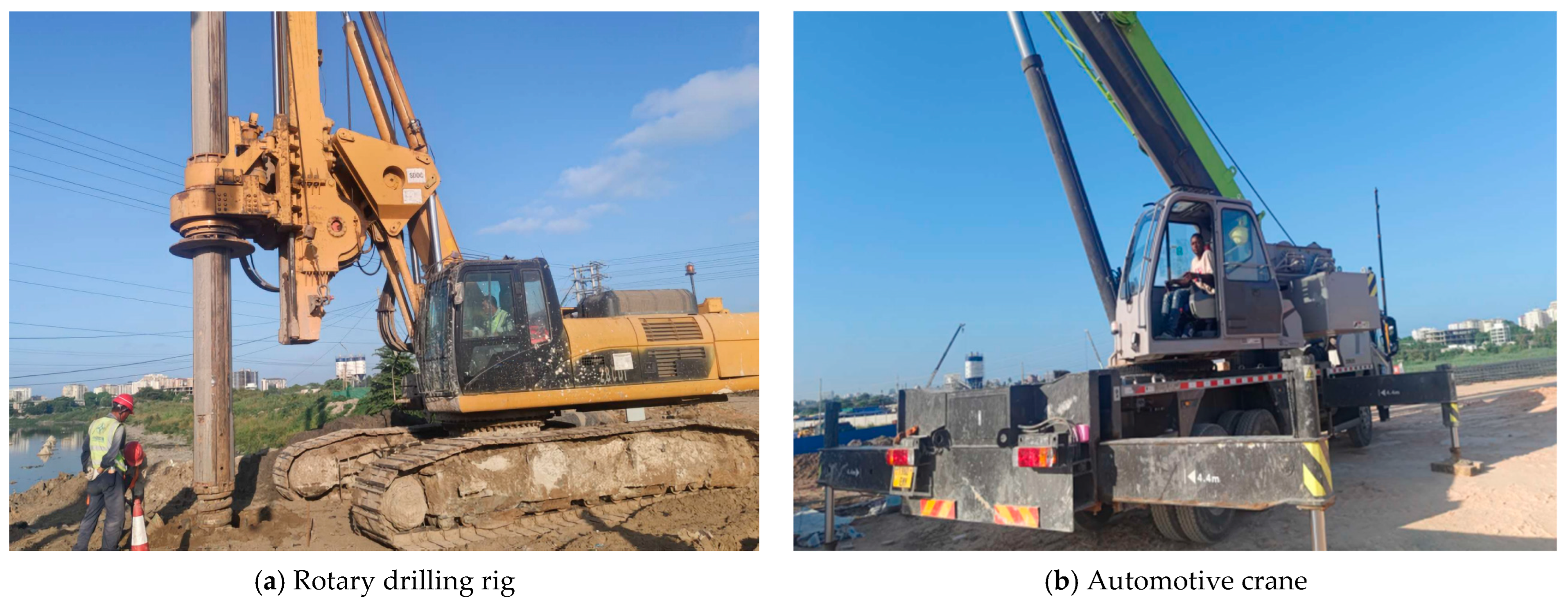
The engineering project covered in this case study was undertaken by a Chinese enterprise. Therefore, when determining the two key data points—the consumption of machinery shifts and the energy consumption per unit shift—reference was made to the “Budget Quotas for Highway Engineering (JTG/T 3832-2018) [41]” and the “Quotas for Machinery Shift Costs in Highway Engineering (JTG/T 3833-2018) [42]”. The mechanical and energy consumption for the construction of the Jangwani Bridge in Tanzania is shown in Table 3, with the corresponding carbon emission factors listed in Table 2. Combining the carbon emission factors from Table 2 with the energy consumption of construction machinery from Table 3, the carbon emissions during the on-site construction stage were calculated using Formula (5), resulting in a total of 942,423.16 kgCO2e.
(4)
Carbon emissions during the operational maintenance stage
During the operation stage of bridges, carbon emissions accounting primarily focuses on the environmental impact generated by lighting equipment operation. The quantification method is to estimate the energy consumption according to the bridge deck area, and then deduce the carbon emission of the lighting system. Electrical parameter values are reasonably determined by referencing relevant provisions in the “Urban Road Lighting Design Standards” [43]. For the subject bridge, with a width of 42 m and a length of 390 m, the lighting power density was set to 0.00085 kW/m2, based on the natural and social conditions of its location. The bridge has a design life of 100 a, with daily lighting duration set at 12 h. Calculating carbon emissions from lighting operations using Formula (6) yields a total of 3,225,986.95 kgCO2e for this stage.
Carbon emissions generated during the bridge maintenance stage primarily stem from material production, transportation, and mechanical equipment usage associated with component replacement. The key prerequisite for conducting carbon emission calculations in this stage lies in determining the number of replacements required for the bridge’s primary structural components over their design service life. The required maintenance frequency for bridges within their design service life is established by referencing component design service life data proposed by relevant scholars [44]. Based on this, carbon emissions generated during the maintenance stage are calculated. Table 4 presents the specific design service life parameters for the primary replaceable components of bridges.
As shown in Table 4, during the service life of the Jangwani Bridge, the bridge deck pavement underwent six maintenance replacements, the crash barriers were replaced once, the expansion joints were replaced six times, and the bridge bearings were replaced six times. Assuming that all components were fully replaced during each replacement, the carbon emissions generated during this stage were calculated using Formula (7) to be 1,153,900.76 kgCO2e.
According to the project’s greening design plan, following the completion of the bridge, artificial turf and shrubs will be planted in the area affected by construction, encompassing approximately 2.5 hectares. Based on research regarding carbon storage in green spaces within tropical cities in East Africa [45], the annual carbon sequestration rate for newly established green vegetation in this study is established as 5390 kgCO2e/(ha·a), aligning with local climate and vegetation conditions. The calculated reduction in carbon emissions from this component amounts to 1,347,500 kgCO2e, as determined by Formula (8).
Therefore, the carbon emissions during the operational maintenance stage amount to 3,032,387.71 kgCO2e.
(5)
Carbon emissions during the demolition and disposal stage
Carbon emissions accounting for this stage primarily considers the use of demolition machinery, transportation of waste materials, recycling and disposal processes. In accordance with the relevant provisions for demolition stage carbon emissions accounting, energy consumption for this stage may be estimated at 90% of on-site construction energy consumption. Correspondingly, carbon emissions may also be approximated at 90%. Additionally, steel and concrete waste from this project is transported for recycling and disposal via diesel trucks over a distance of approximately 10 km. Steel recycling has a recovery rate of 70%, while waste concrete is disposed of through landfill. By comprehensively evaluating the energy consumption of demolition machinery, the disposal methods, and the recycling rates, the carbon emissions during the demolition and disposal stage are calculated using Formula (9) to be 243,422.52 kgCO2e.
It should be noted that the simplified estimation method for energy consumption during the demolition stage, which refers to 90% of the on-site construction energy consumption, is based on literature. This method has been widely adopted in carbon emission accounting within the construction sector. Although bridge demolition shares certain procedural similarities with building demolition, the specific energy consumption ratio may vary depending on structural form and demolition technique. Given that carbon emissions during the demolition and disposal stage account for only about 0.58% of the life cycle emissions, even a certain degree of deviation in this ratio would have an extremely limited impact on the overall accounting results and main conclusions. Such deviation would not alter the conclusion that the production of building materials and the operational maintenance stages are the dominant emission stages.

4.3. Carbon Emissions Contributions by Life Cycle Stage

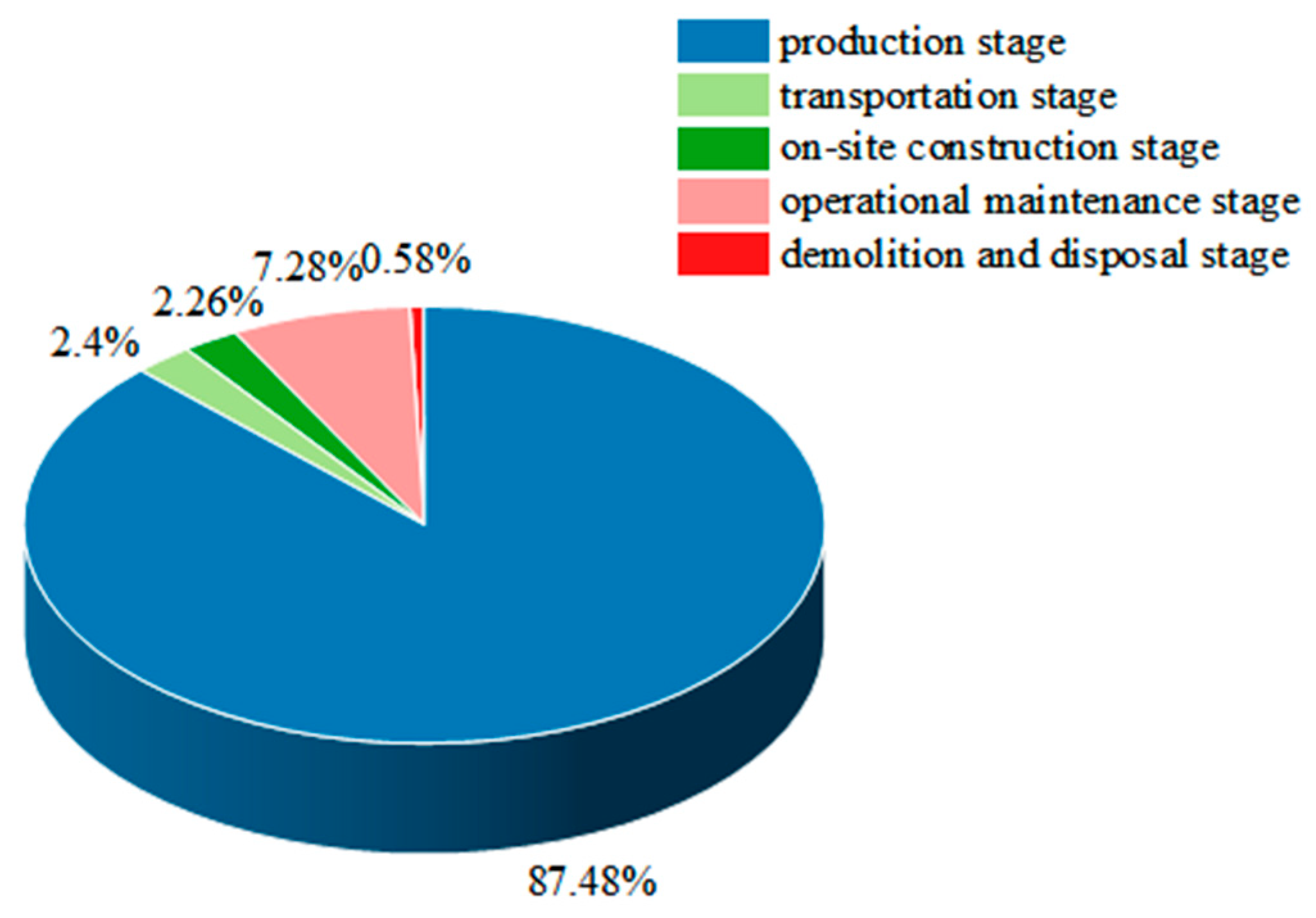
Using the proposed carbon emission calculation model, the carbon emissions for each stage of the case bridge’s life cycle were determined: 36,452,305.26 kgCO2e during building the production stage, 998,009.55 kgCO2e during the transportation stage, 942,423.16 kgCO2e during the on-site construction stage, 3,032,387.71 kgCO2e during the operational maintenance stage, and 243,422.52 kgCO2e during the demolition and disposal stage. The total carbon emissions over the life cycle amounted to 41,668,548.20 kgCO2e. The proportion of carbon emissions for each stage is shown in Figure 4.
The life cycle carbon emission analysis of the bridge in this case shows that carbon emissions are mainly concentrated in the production and operational maintenance stages. Among them, the carbon emissions from the production of building materials account for as high as 87.48%, becoming the main source of emissions. This proportion is consistent with the reported range of LCA research on Chinese bridges in recent years (80%~90%, such as Cao et al., 2024; Qian et al. 2025), indicating that whether in Africa or China, building materials production is the dominant link in the carbon emissions of bridges throughout their life cycle, with cross-regional commonalities. However, the carbon emission characteristics during the operational maintenance stage show significant regional differences. The proportion of the operational maintenance stage was 7.28%, which is significantly higher than the level of less than 5% for similar bridges in China (such as the 4% to 6% reported by Zhou et al., 2020 for a cable-stayed bridge in Liaoning). Further analysis reveals that this difference is mainly due to the different carbon emission factors of electricity. During the operational maintenance stage, the carbon emissions generated by the energy consumption of lighting equipment account for 73.65% of that stage. However, the fundamental driving factor is not the lighting intensity itself, but rather the fact that the Tanzanian power grid is composed mainly of fossil fuels and has high transmission and distribution losses, resulting in a much higher carbon emission factor than the gradually decarbonized Chinese power grid. Therefore, even if the lighting design requirements are similar, the indirect emissions of lighting electricity during Tanzania’s operation stage are systematically amplified, which is one of the key reasons why the carbon emission structure of African bridges differs from that of China. In addition, although the proportion of carbon emissions during transportation (2.40%) is much smaller than that during the production and operational maintenance, its methodological significance cannot be ignored. Unlike domestic bridge projects where all materials come from the local supply chain, the Jangwani Bridge involves cross-border sea freight and long-distance inland transportation from China to Tanzania, which is typically omitted in the domestic LCA framework. Although the proportion of emissions in this stage is relatively low, it reveals the unavoidable sources of emissions when Chinese companies undertake infrastructure construction in Africa, and emphasizes the necessity of including international transportation in the system boundary when carbon accounting for overseas engineering projects in the future. On the other hand, the proportion of carbon emissions during the on-site construction stage (2.26%) and the demolition and disposal stage (0.58%) is not significantly different from similar studies in China, and does not show significant regional specificity.
In conclusion, to effectively reduce carbon emissions throughout the life cycle of this bridge, it is essential to analyze the contributions of carbon emissions, the potential for emission reduction, and the sources of emissions. Examination is first focused on the production and on-site construction stages, given their significant influence on life cycle emissions and direct relevance to engineering practice control. Other stages contribute relatively minor emissions, have fewer emission sources, or have already identified core drivers in stage-specific calculations. To facilitate research and analysis, the carbon emission characteristics of key materials in the production stage and primary machinery in the on-site construction stage are further examined, with the detailed analysis of other stages omitted.
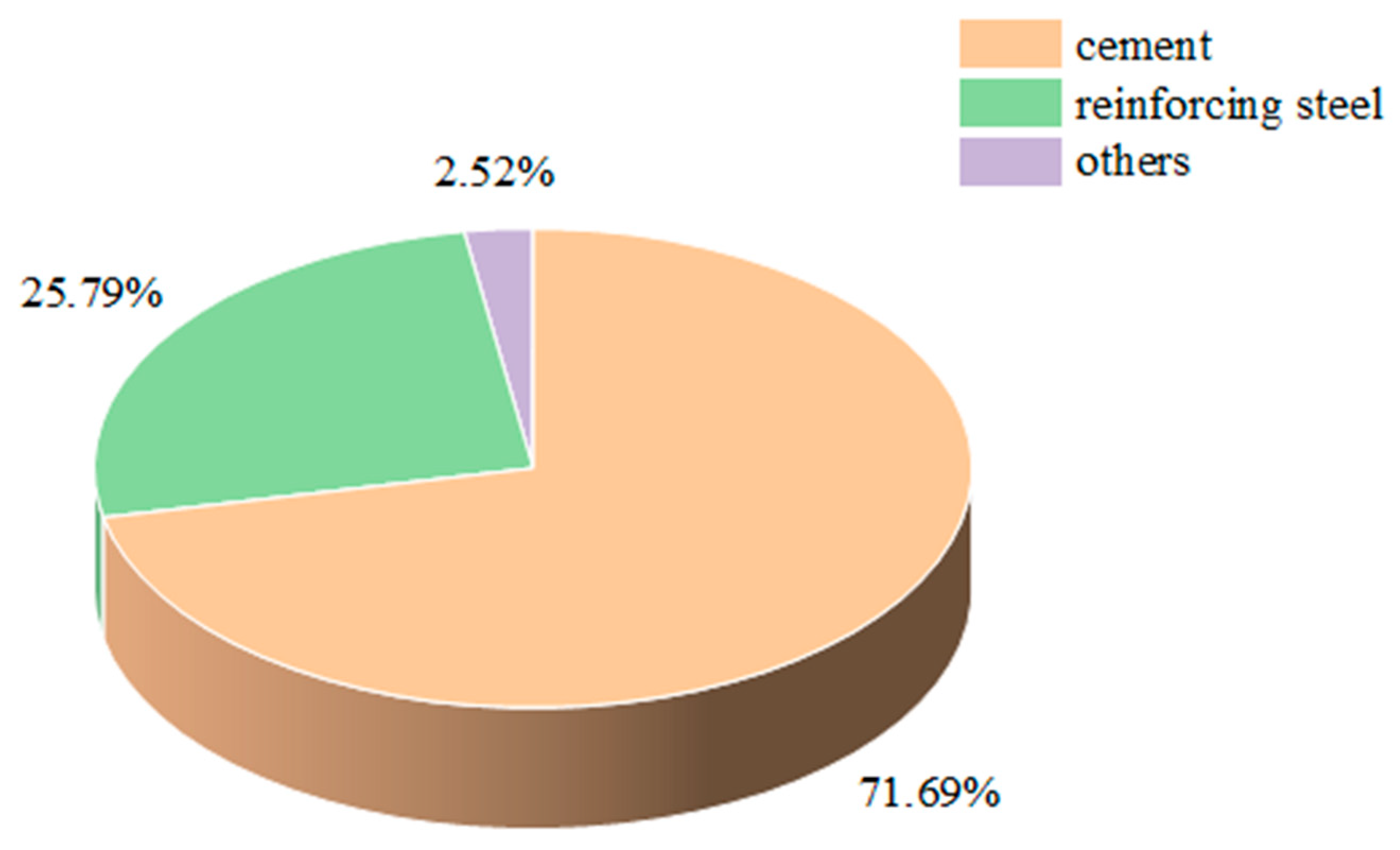
During the production stage, based on the breakdown of material carbon emissions, as shown in Figure 5, cement accounted for the highest proportion at 71.69%. Reinforcing steel followed with 25.79%. Other materials—including steel formwork, rubble, steel bearing, welding electrode, and over a dozen others—contributed between 0.01% and 0.6% each, collectively representing less than 3% of total emissions.
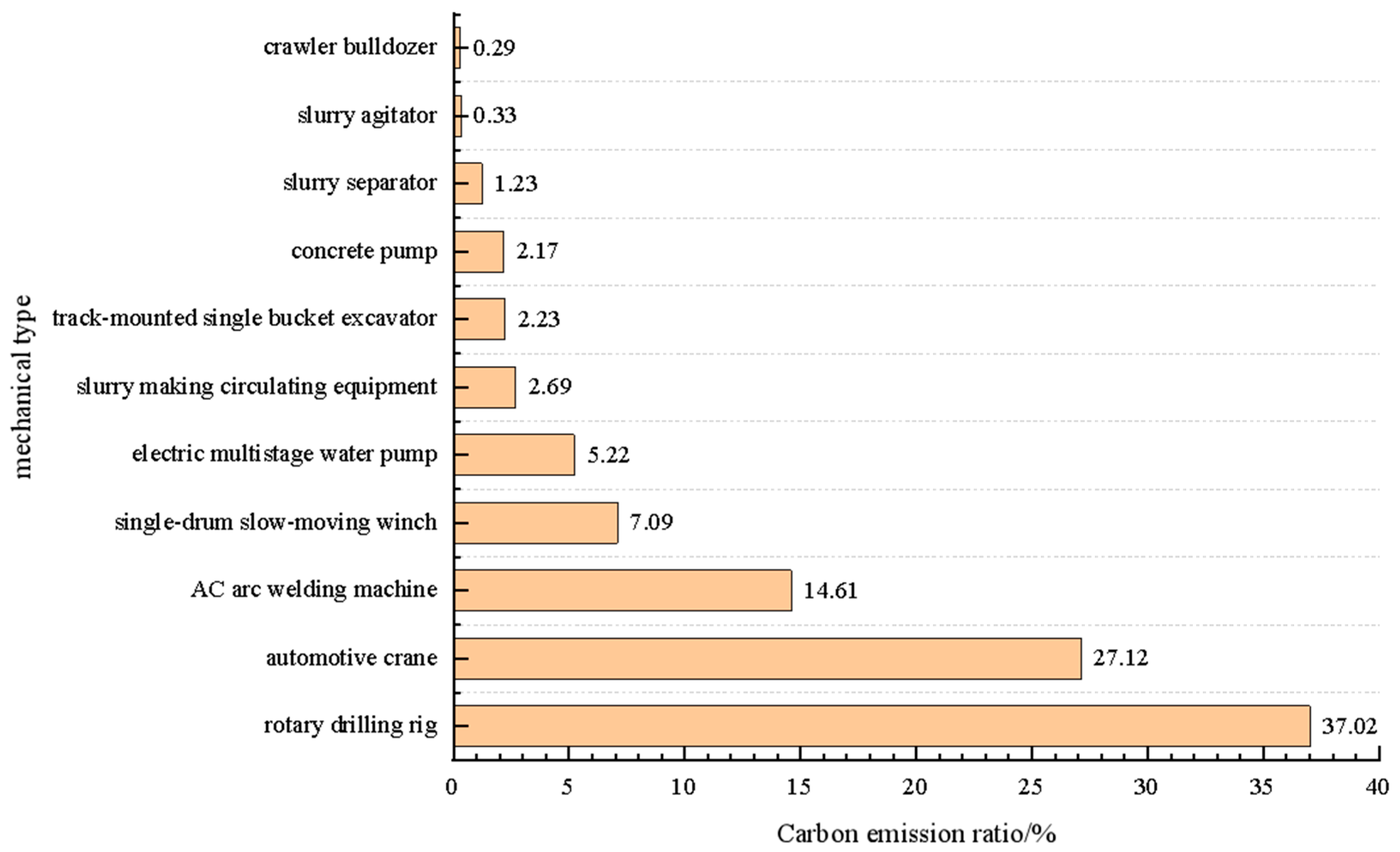
Although the carbon emissions during the on-site construction stage only account for 2.26% of the life cycle, it is a link that the project management team can directly control, and the emission sources are highly concentrated in a few large construction machinery. From the proportion of carbon emissions from major construction machinery, as shown in Figure 6, it can be seen that rotary drilling rigs (37.02%), automotive cranes (27.12%), and AC arc welding machines (14.61%) collectively contribute over 78% of carbon emissions during this stage, showing a significant concentration feature. Single-drum slow-moving winches (7.09%) and electric multistage water pumps (5.22%) represent secondary emission sources. Six categories of machinery, including slurry making circulating equipment, track-mounted single bucket excavator, and concrete pumps, each account for less than 3% of emissions. It is indicated by this distribution pattern that carbon reduction during the on-site construction stage should be accurately targeted at the top three types of high-emission machinery, and twice the result with half the effort should be achieved through equipment energy efficiency improvement and idle management.

4.4. Sensitivity Analysis

Taking the analysis results of carbon emission contribution ratios as the core basis, the key elements that play a dominant role in bridge engineering carbon emissions are identified. Findings indicate that cement and reinforcing steel dominate material-related emissions, while electricity and diesel are primary contributors at the energy level. Consequently, cement, reinforcing steel, electricity, and diesel are designated as the core subjects for the Jangwani Bridge carbon emission sensitivity analysis. The sensitivity coefficient method is applied in this analysis, where a higher sensitivity coefficient signifies a greater impact from changes in that factor. The sensitivity coefficient calculation formula is as follows:
Z = Δ C / C Δ x / x
where Z is the sensitivity coefficient; ΔC/C is the rate of change in carbon emissions; Δx/x is the rate of change in influencing factors.
The uncertainty of carbon emission factors was set at 10% and 20%, respectively. Specifically, the carbon emission factors for the core analysis subjects (cement, reinforcing steel, electricity, and diesel) to have fluctuation ranges of ±10% and ±20%, respectively. Four fluctuation conditions were established, with all other parameters held constant under each condition. The changes in the total carbon emissions over the life cycle of the bridge were calculated independently for each condition to determine the impact of fluctuations in a single factor on total emissions. The calculation results are shown in Table 5.
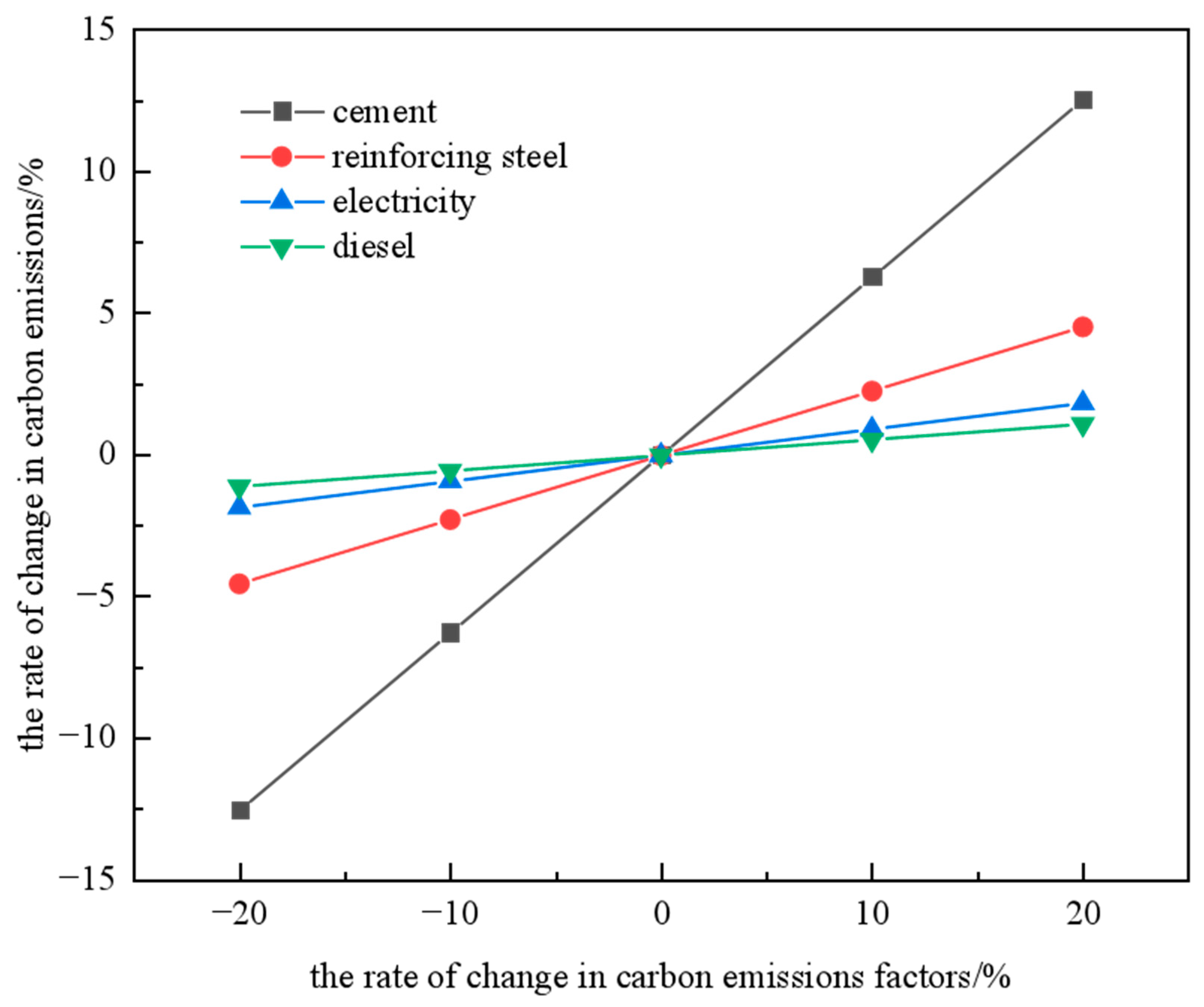
According to the quantitative analysis of carbon emission factors for the Jangwani Bridge in Figure 7, among the selected primary materials and energy sources, the impact of each factor on total carbon emissions varies significantly. The order of influence is as follows: cement > reinforcing steel > electricity > diesel. When the cement carbon emission factor fluctuates by ±10%, the carbon emission variation rate of the Jangwani Bridge is ±6.27%. When the fluctuation reaches ±20%, the carbon emission variation rate changes to ±12.54%. The corresponding sensitivity coefficient is 0.627, making it the variable with the greatest impact among the four factors. When the reinforcing steel fluctuates by ±10% and ±20%, the corresponding change rates of carbon emissions from the bridge are ±2.27% and ±4.53%, respectively, resulting in a sensitivity coefficient of 0.227, indicating a secondary degree of influence. In contrast, the impacts of electricity and diesel on the carbon emissions of bridges are relatively minor. When the carbon emission factor for electricity fluctuates by ±10% and ±20%, the resulting carbon emission change rates are ±0.92% and ±1.84%, respectively, with a sensitivity coefficient of 0.092. Similarly, under the same fluctuation ranges, the carbon emission change rates for diesel are ±0.55% and ±1.10%, yielding a sensitivity coefficient of 0.055.
In addition, with regard to key engineering parameters, preliminary calculations indicate that when the consumption of cement and reinforcing steel fluctuates within a range of ±5%, the total emissions vary by approximately ±3.14% and ±1.13%, respectively. If the maintenance interval of bridge deck pavement and other components is shortened from 15 years to 12 years due to the local high temperature and high-humidity climate, the carbon emissions during the maintenance stage increase by about 33.2%. However, because this stage accounts for only about 2.6% of total emissions, the impact on total emissions is less than 1%. The fluctuation of the above engineering parameters within a reasonable range does not alter the core conclusion that the production and the operational maintenance stage are the dominant emission links, and the research results exhibit good engineering robustness.

4.5. Emission Reduction Measures

Based on the analysis of the carbon emission calculation results, influencing factors and influencing patterns as previously mentioned, it can be known that cement and reinforcing steel are the main materials causing carbon emissions in bridge construction, while construction machinery and bridge deck lighting equipment also exert a significant influence. Therefore, considering the potential for carbon reduction, practical construction feasibility, and regional characteristics in Africa, recommendations are proposed across three areas: building materials, construction machinery, and lighting equipment.
(1)
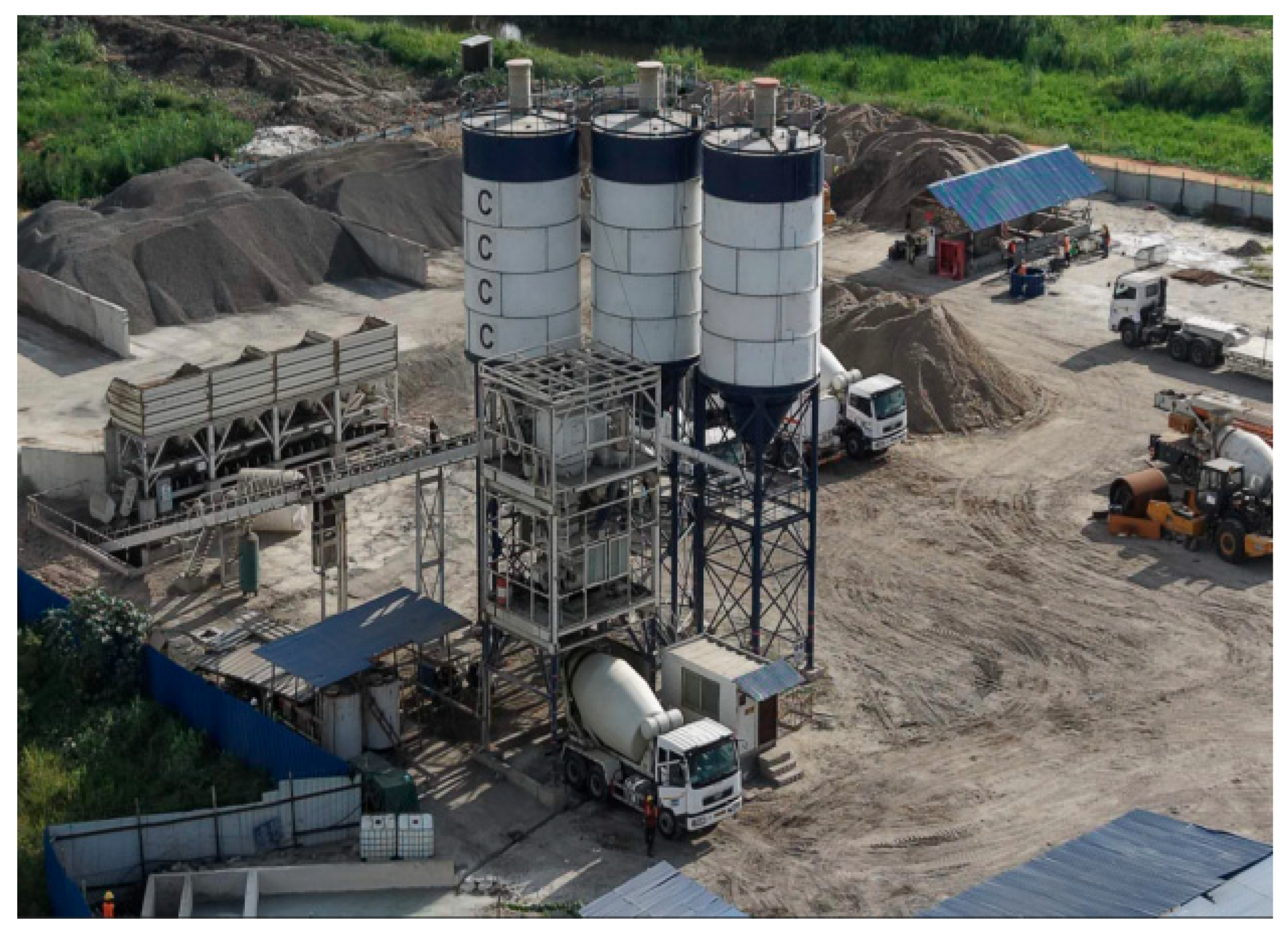
Low-carbon production of concrete materials. Unlike conventional emission reduction strategies in the domestic engineering sector, which typically emphasize the direct substitution of traditional materials with low-carbon alternatives, the present project takes full account of the actual characteristics of the African context. During the early construction preparation stage, a technical route centered on optimizing the concrete mix proportion was established through laboratory mix proportion optimization tests (Figure 8). In the concrete cementitious system, industrial solid wastes such as fly ash and slag powder are incorporated; high-efficiency water-reducing agents are employed to effectively reduce the water-binder ratio, significantly enhancing concrete density and strength while minimizing mixing water consumption. Optimizing the aggregate system by employing continuously graded rubble and scientifically adjusting particle gradation ensures excellent workability for concrete placement. Based on the experimental results, it is possible to reduce the cement consumption by approximately 8%, saving approximately 2105.45 tons of cement and cutting carbon emissions by 2,090,711.85 kgCO2e.
(2)
Green management and energy efficiency enhancement of construction machinery. It is recommended to adopt technologically advanced, environmentally friendly new machinery for operations. By establishing detailed maintenance protocols, promptly repair and maintain equipment in suboptimal operating conditions to ensure all machinery remains in peak working condition long-term. This approach safeguards construction efficiency while effectively preventing additional energy consumption caused by equipment failures or performance degradation. It is clearly stipulated that mechanical equipment in standby, dispatch and other non-operational states must be forcibly shut down to fundamentally reduce the fuel consumption caused by ineffective idling (Figure 9). Based on the monitoring data of idle time during the pile foundation construction stage of the project, the ineffective fuel consumption was reduced from approximately 5.2% of the total consumption to 2.8% by the implementation of the “shutdown and flameout” system. 3% is conservatively set as the target for fuel reduction throughout the entire construction period, resulting in a total carbon emissions reduction of 18,847.71 kgCO2e from construction machinery.
(3)
Enhance energy-saving management of lighting and other equipment. Given the unstable power grid and high electricity emission factors in Africa, a dual-control intelligent lighting system combining a “photosensitive sensor” with “vehicle flow monitoring” has been implemented to manage bridge deck and landscape lighting. This system monitors traffic flow and ambient illuminance in real time, allowing for automatic adjustments in light brightness or zoned-off control. It not only facilitates “lighting on demand” but also adapts to the current local power grid conditions, prioritizing energy conservation and operational stability. Based on research on actual engineering cases and technical reports, a 10% to 15% energy saving can typically be achieved by such intelligent control strategies. Considering local power grids and maintenance conditions, a 10% energy saving target is conservatively set as the expected outcome and is expected to decrease carbon emissions by 322,598.69 kgCO2e.
To enhance the practical applicability of the research findings, this section evaluates the synergistic emission reduction effect of the three proposed measures when implemented in combination. As these measures target different life cycle stages (production, on-site construction, and operational maintenance) and involve distinct energy and material flows, they are independent and cumulative—the emission reduction achieved through joint implementation equals the sum of the reductions from each individual measure. No negative synergies are expected.
Four combined scenarios are established for multi-scenario evaluation. Scenario 1 (cement reduction + fuel reduction) is expected to achieve an emission reduction of approximately 2109.56 tCO2e, accounting for 5.06% of the life cycle emissions. Scenario 2 (cement reduction + electricity reduction) is expected to reduce emissions by approximately 2413.31 tCO2e, representing 5.79% of the total. Scenario 3 (fuel reduction + electricity reduction) is expected to yield a reduction of approximately 341.45 tCO2e, or 0.82% of total emissions. Scenario 4 (all three measures combined) is expected to achieve a reduction of approximately 2432.16 tCO2e, accounting for 5.84% of the total.
The relative contributions of the individual measures can be clearly identified from cross-scenario comparisons. In Scenario 4, the contributions of the three measures to the total emission reduction are as follows: cement reduction accounts for approximately 86%, intelligent lighting accounts for approximately 13.2%, and mechanical idle management accounts for approximately 0.8%. This distribution pattern confirms the conclusion that the production stage of building materials is the dominant source of carbon emissions, while also revealing that energy-saving measures during the operation period provide an indispensable auxiliary contribution. Although the contribution of intelligent lighting is considerably lower than that of cement reduction, its emission reduction is still substantial. Moreover, it can be implemented without material substitution and offers the flexibility of traceable retrofitting. Despite having the smallest absolute emission reduction, mechanical idle management exhibits high feasibility and demonstration value, serving as an almost zero-cost management measure that can be immediately implemented on any construction site.

5. Conclusions

To address the context of Chinese-constructed bridges in Africa, life cycle theory and the IPCC methodology, integrating considerations of cross-border transportation and the project’s newly established green carbon sink offsets to develop a bridge carbon emission accounting model. Using the Jangwani Bridge in Tanzania as a case study, it quantifies carbon emissions across five stages: production, transportation, on-site construction, operational maintenance, and demolition and disposal. The emission characteristics are elucidated, key influencing factors identified, and mitigation strategies proposed. The main conclusions are as follows:
(1)
The application of the cross-border infrastructure LCA framework is advanced from three aspects. First, with respect to the boundary extension of cross-border supply chains: traditional bridge LCA implies a single-stage transportation assumption of “local or regional procurement”. In contrast, the entire cross-border transportation chain of “international maritime transport–inland Africa” is officially incorporated into the system boundary, thereby addressing the limitation in the applicability of the traditional model’s “local procurement” assumption to cross-border engineering. Second, regarding the principle of stratified selection of emission factors: for data-scarce regions such as Africa, a “local priority, graded supplementation” emission factor strategy is established and implemented. This strategy prioritizes the use of country-specific measured data, selects alternative values with similar technical backgrounds, and transparently labels the sources and applicability of each factor, thus providing replicable solutions for regions lacking local databases. Third, concerning the adaptation of Chinese construction standards to local conditions in Africa: the Chinese quota system is integrated with African construction practices into a unified analytical framework, the applicability of the LCA method under the “technology export + localized operation” model is verified, and the application of LCA in cross-border infrastructure scenarios is enriched.
(2)
The total carbon emissions of the Jangwani Bridge throughout its life cycle are quantified 41,668,548.20 kgCO2e. When converted into normalized strength indicators, approximately 106.84 tCO2e per linear meter and 2.54 tCO2e per square meter of bridge deck are emitted, by which a reference benchmark for carbon emissions of similar bridges is provided. Of the dominant emission sources, 87.48% is accounted for by the production stage of building materials, with cement and reinforcing steel identified as the core emission sources in this stage. This proportion is found to be close to the range from existing research based on Chinese cases (80% to 90%), and it is indicated that the dominant position of carbon emissions at the material end possesses cross-regional commonalities. For the operational maintenance stage, 7.28% is accounted for, a value that is significantly higher than the observed level of less than 5% for similar bridges in China. The fundamental driving factor is not the intensity of lighting demand itself, but the systematic amplification of carbon emission factors caused by the high transmission and distribution losses in Tanzania’s power grid dominated by fossil fuels. Although the proportion of the transportation stage is only 2.40%, as a direct mapping of cross-border maritime and inland transportation chains that is often overlooked within the domestic LCA framework, its methodological significance cannot be ignored. The proportions of carbon emissions during the on-site construction stage (2.26%) and the demolition and disposal stage (0.58%) are not found to be significantly different from those reported in similar studies in China.
(3)
Based on a sensitivity analysis in which the key factors are ranked as cement > steel bars > electricity > diesel, and with full consideration given to the practical constraints in Africa—namely the insufficient supply of low-carbon materials and the instability of local power grids—a three-level emission reduction strategy is proposed, which possesses engineering feasibility and practical guidance value. At the building materials level, an 8% reduction in cement can be achieved through the substitution of mineral admixtures and mix proportion optimization, corresponding to an emission reduction of approximately 2090.71 tCO2e. At the construction level, refined equipment maintenance and shutdown management can be promoted, leading to a 3% reduction in ineffective fuel consumption and an emission reduction of about 18.85 tCO2e. At the operation level, a photosensitive and traffic-controlled dual intelligent lighting system can be adopted, which reduces lighting power consumption by 10% and achieves an emission reduction of approximately 322.6 tCO2e. Multi-scenario evaluations indicate that the joint implementation of the three measures yields a total emission reduction of approximately 2432.16 tCO2e, and the combined strategy—with building material optimization as the core and construction and operation measures as supplementary—demonstrates the best overall benefits.
(4)
The following suggestions are proposed for engineering practice and infrastructure planning. At the design level, given that the operational maintenance stage constitutes the second largest source of emissions and is primarily driven by lighting electricity, priority should be given to the integration of energy-efficient lighting systems (e.g., LED luminaires with intelligent dimming functionality) into bridge design. At the procurement and supply chain level, emphasis should be placed on the localized procurement of building materials. The carbon footprint associated with the cross-border shipping of specialized components should be clearly accounted for, and a balance analysis between local production emissions and international shipping emissions should be conducted when equivalent products are available locally or regionally. At the material selection level, given that cement and reinforcing steels represent the absolute majority of emissions during the building materials stage, procurement standards should prioritize the use of low-carbon cement and high-strength steel bars to reduce material consumption. At the level of low-carbon infrastructure planning, policy makers and development banks should recognize that infrastructure investment planning should promote the combination of bridge construction and decarbonization measures for the power grid, such as the large-scale deployment of renewable energy for public utilities.

6. Research Limitations

The following limitations of this study need to be carefully considered in promotion and application:
(1)
Dependence on emission factors. Owing to the absence of local emission factor data in Africa, some materials (e.g., steel bars and steel sections) have been assigned IPCC default values or Ecoinvent international averages. Although these sources are widely accepted in life cycle assessment studies, the actual production processes of local materials may deviate from the global average levels represented by these factors. The differences in data accuracy across sources may introduce uncertainty. As local LCA databases in Africa are gradually established, the accuracy of the accounting is expected to be further improved.
(2)
Simplified assumptions are employed. Owing to data limitations, certain strong simplifications are necessitated. First, based on a reference study conducted in China, the carbon emissions during the demolition stage are assumed to correspond to 90% of the energy consumption during the on-site construction stage. Although it has been discussed that the impact of this assumption on total emissions is not limited, direct measurement of the number of shifts in dismantling machinery would provide higher accuracy. Single-factor sensitivity analysis is methodologically limited, as it fails to evaluate the joint disturbance effects of multiple factors. In future work, the conduct of a comprehensive probabilistic uncertainty analysis is recommended to fully characterize the global robustness of the model.
(3)
Uncertainty associated with future maintenance. The emissions during the maintenance phase are estimated under the assumption that a fixed number of components are replaced based on the design service life. In reality, the maintenance plan is contingent upon actual traffic load, environmental conditions, and initial construction quality. Consequently, deviations in the actual carbon emissions from maintenance may occur, which should be corrected based on monitoring data obtained during the operation period.
(4)
Limitations in generalizing to other bridges in Africa. The Jangwani Bridge in Tanzania is taken as a single case in this study, and it is concluded that caution should be exercised when extending the findings to other regions in Africa. Differences in energy structure, building materials supply chain, and climatic conditions among countries may significantly affect the distribution of carbon emission characteristics.

Author Contributions

Conceptualization, H.D. and Y.Y.; methodology, R.Z. and W.L.; validation, Q.H. and W.G.; formal analysis, H.D., R.Z. and W.L.; investigation, Q.H.; resources, W.G.; data curation, R.Z.; writing—original draft preparation, H.D.; writing—review and editing, Y.Y. and W.L.; visualization, R.Z.; supervision, Y.Y.; project administration, H.D. and W.G.; funding acquisition, H.D. and Y.Y. All authors have read and agreed to the published version of the manuscript.

Funding

This research was financially supported by the National Natural Science Foundation of China (Grant No. 52508554) and was based on the scientific research and development project of CCCC Second Highway Engineering Co., Ltd. International Company (Project No. 2025-S-14).

Institutional Review Board Statement

Not applicable.

Informed Consent Statement

Not applicable.

Data Availability Statement

The original contributions presented in this study are included in the article. Further inquiries can be directed to the corresponding author.

Acknowledgments

The authors wish to extend their profound gratitude to the School of Civil Engineering and Architecture at Henan University of Science and Technology for their foundational role in this research. The university’s provision of advanced computational resources and essential software licenses was instrumental in conducting the carbon emission simulations presented in this work. Additionally, the authors thank the collaborative partners from CCCC Second Highway Engineering Co., Ltd. for their vital role in facilitating the on-site data collection effort.

Conflicts of Interest

Author Honglong Deng, Qichao Hu and Wenguang Guo was employed by CCCC Second Highway Engineering Co., Ltd. The remaining authors declare that the research was conducted in the absence of any commercial or financial relationships that could be construed as a potential conflict of interest.

References

  1. Maurer, R.; Kossioris, T.; Hausberger, S.; Toenges-Schuller, N.; Sterlepper, S.; Günther, M.; Pischinger, S. How to Define and Achieve Zero-Impact Emissions in Road Transport? Transp. Res. Part D Transp. Environ. 2023, 116, 103619. [Google Scholar] [CrossRef]
  2. Liu, M.; Wang, J.; Wen, J.; He, G.; Wu, J.; Chen, H.; Yang, X. Carbon Emission and Structure Analysis of Transport Industry Based on Input-Output Method: China as an Example. Sustain. Prod. Consum. 2022, 33, 168–188. [Google Scholar] [CrossRef]
  3. Wang, J.; Shan, Y.; Cui, C.; Zhao, C.; Meng, J.; Wang, S. Investigating the fast energy-related carbon emissions growth in African countries and its drivers. Appl. Energy 2024, 357, 122494. [Google Scholar] [CrossRef]
  4. Karimova, A.; Abdurasulova, M. Methodology for Assessing Embodied Carbon in Bridge Structures. In Proceedings of the International Scientific-Practical Conference “Transport Inserts: Modern Technologies, Seismic Stability” Dedicated to the 85th Anniversary of Abduraxmon Asimovich Ishanxodjayev, Tashkent, Uzbekistan, 16 February 2026; pp. 94–97. [Google Scholar]
  5. Xia, B.; Xiao, J.; Ding, T.; Guan, X.; Chen, J. Life cycle assessment of carbon emissions for bridge renewal decision and its application for Maogang Bridge in Shanghai. J. Clean. Prod. 2024, 448, 141724. [Google Scholar] [CrossRef]
  6. Kaewunruen, S.; Sresakoolchai, J.; Zhou, Z. Sustainability-Based Lifecycle Management for Bridge Infrastructure Using 6D BIM. Sustainability 2020, 12, 2436. [Google Scholar] [CrossRef]
  7. Kim, H.; Roh, S.; Kim, J. Embodied carbon of BIM bridge models according to the application of off-site prefabrication: Precast concrete applied to superstructure and substructure. Dev. Built Environ. 2024, 20, 100550. [Google Scholar] [CrossRef]
  8. Yang, Y.; Yue, X.; Luo, Y.; Jin, L.; Jia, B. Building Information Modeling-Life Cycle Assessment: A Novel Technology for Rapid Calculation and Analysis System for Life Cycle Carbon Emissions of Bridges. Sustainability 2024, 16, 10574. [Google Scholar] [CrossRef]
  9. Srivastava, H.K.; Vimonsatit, V.; Clark, S.M. A Systematic Approach for Selection of Fit-for-Purpose Low-Carbon Concrete for Various Bridge Elements to Reduce the Net Embodied Carbon of a Bridge Project. Infrastructures 2025, 10, 274. [Google Scholar] [CrossRef]
  10. Zhao, B.; Guo, B.; Ye, D.; Xiu, M.; Wang, J. Research on and Application of a Low-Carbon Assessment Model for Railway Bridges During the Construction Phase Based on the ANP-Fuzzy Method. Infrastructures 2026, 11, 32. [Google Scholar] [CrossRef]
  11. Xu, R.; Yin, Y.; Miao, Y.; Yang, W.; Sun, J.; Li, H. Carbon emission calculation method of steel-concrete composite girder Bridge based on LCA: A case study of Yanchong Expressway (Hebei Section). E3S Web Conf. 2024, 561, 02015. [Google Scholar] [CrossRef]
  12. Xie, K.; Gong, M.; Xiao, J.; Guan, X.; Liu, Z. Process-based carbon emission assessment of the cable-stayed anchored cantilever construction method: A case study of a 600-meter-scale arch bridge. Case Stud. Constr. Mater. 2025, 24, e05742. [Google Scholar] [CrossRef]
  13. Hartono, W.; Naufal, M.R.; Firmanda, Y.A. Greenhouse Gas (GHG) emission analysis study using LCA method on foam mortar application to reduce carbon footprint of bridge construction project. IOP Conf. Ser. Earth Environ. Sci. 2026, 1586, 012010. [Google Scholar] [CrossRef]
  14. Muhammad, H.H.; Imran, S.; Humza, K.H.; Zhang, L.; Qin, J.; Pan, Y. Probabilistic Carbon Analysis of Pakistan’s Bridges Unveils the Urgent Needs of Overdesign Optimization and Policy Transformation. Research 2026, 7, 1175. [Google Scholar] [CrossRef] [PubMed]
  15. Cao, J.; Wang, D.; Han, Z.; Li, S.; Zhao, H.; Liu, X. Carbon footprint of expressway bridges based on LCA. Int. J. Low-Carbon Technol. 2024, 19, 2218–2224. [Google Scholar] [CrossRef]
  16. Wu, H.; Zhou, W.; Bao, Z.; Long, W.; Chen, K.; Liu, K. Life cycle assessment of carbon emissions for cross-sea tunnel: A case study of Shenzhen-Zhongshan Bridge and Tunnel in China. Case Stud. Constr. Mater. 2024, 21, e03502. [Google Scholar] [CrossRef]
  17. Zhou, Z.; Alcalá, J.; Yepes, V. Bridge carbon emissions and driving factors based on a life-cycle assessment case study: Cable-stayed bridge over Hun He river in Liaoning, China. Int. J. Environ. Res. Public Health 2020, 17, 5953. [Google Scholar] [CrossRef]
  18. Zhang, Z.H.; Huang, W.; Lu, G.Y.; Luo, S. A holistic life cycle assessment of steel bridge deck pavement. Renew. Sustain. Energy Rev. 2024, 200, 114575. [Google Scholar] [CrossRef]
  19. Hou, W.; Liang, S.; Zhang, T.; Ma, T.; Han, Y. Low-Carbon Emission Demolition of an Existing Urban Bridge Based on SPMT Technology and Full Procedure Monitoring. Buildings 2023, 13, 1379. [Google Scholar] [CrossRef]
  20. Qian, F.; Ding, Y.; Shi, X.; Shu, C.; Zhang, X. A comparative study of life cycle carbon emissions of two commonly used simple-supported beam bridges. Sci. Rep. 2025, 15, 14873. [Google Scholar] [CrossRef]
  21. Suwondo, R.; Keintjem, M.; Suangga, M.; Cunningham, L. Assessing embodied carbon and financial implications in concrete T-girder bridge design for cost-effective sustainability. Innov. Infrastruct. Solut. 2024, 9, 136. [Google Scholar] [CrossRef]
  22. Wang, J.; Pan, K.; Wang, C.; Liu, W.; Wei, J.; Guo, K.; Liu, Z. Integrated Carbon Emissions and Carbon Costs for Bridge Construction Projects Using Carbon Trading and Tax Systems—Taking Beijing as an Example. Appl. Sci. 2022, 12, 10589. [Google Scholar] [CrossRef]
  23. Zerin, A.; Kasuga, A. LCA of a challenging low carbon ultra-high durability non-metallic bridge. In Proceedings of the Fib Oslo Congress, Oslo, Norway, 12–16 June 2022. [Google Scholar]
  24. Praseeda, P.K.; Kamde, D.K.; Basavaraj, A.S.; Sankar, V.; Pillai, R.G. Effect of slag in concrete to enhance service life and reduce carbon footprint of a coastal highway bridge. Constr. Build. Mater. 2025, 489, 142313. [Google Scholar] [CrossRef]
  25. Khorgade, P.; Rettinger, M.; Burghartz, A.; Schlaich, M. A comparative cradle-to-gate life cycle assessment of carbon fiber-reinforced polymer and steel-reinforced bridges. Struct. Concr. 2023, 24, 1737–1750. [Google Scholar] [CrossRef]
  26. Li, X.; Xiao, J.; Zhu, L.; Zhu, D.; Song, X.; Liu, Y.; Hua, W. Assessing carbon emissions of the innovative renovation project of Yihe Bridge on Beijing Road. Low-Carbon Mater. Green Constr. 2025, 3, 9. [Google Scholar] [CrossRef]
  27. Ma, Z.; Zhang, S.; Jia, H.; Liu, K.; Xie, X.; Qu, Y. A Knowledge Graph-Based Approach to Recommending Low-Carbon Construction Schemes of Bridges. Buildings 2023, 13, 1352. [Google Scholar] [CrossRef]
  28. Qin, X.; Wangari, V.W.; Weiwei, G.; Qili, L.; Jie, L. Quantifying and scenario modelling carbon emissions in cable-stayed bridge construction: Analysing materials production, transportation, and machinery use with openLCA and LEAP. Clean Technol. Environ. Policy 2025, 27, 6887–6911. [Google Scholar] [CrossRef]
  29. Liu, T.-Y.; Lin, J.-J.; Ho, S.-P.; Chou, N.N.S.; Lee, C.-C. Quantifying and Mitigating Carbon Emissions in Long-Span Steel Bridge Construction: Lessons from the Anhsin Bridge in the Ankeng MRT System. Constr. Mater. 2026, 6, 20. [Google Scholar] [CrossRef]
  30. Karkour, S.; Rachid, S.; Maaoui, M.; Lin, C.-C.; Itsubo, N. Status of Life Cycle Assessment (LCA) in Africa. Environments 2021, 8, 10. [Google Scholar] [CrossRef]
  31. Isah, M.E.; Wasah, A.; Matsubae, K. Life cycle assessment research and application in Nigeria. Int. J. Life Cycle Assess. 2025, 30, 880–895. [Google Scholar] [CrossRef]
  32. Kwofie, T.E.; Aigbavboa, C.O.; Thwala, W.D. Clusters of key barriers to life cycle assessment adoption in the South African construction industry: Perspectives of stakeholders. J. Eng. Des. Technol. 2021, 19, 888–903. [Google Scholar] [CrossRef]
  33. Turrini, N.; Bajeneza, F.; Graham, M.; Cryer, L.; Murphy, C. Analysing Embodied Carbon for Rural Trail Bridges in East Africa. In Proceedings of the IABSE Conference, Manchester, UK, 10–12 April 2024. [Google Scholar] [CrossRef]
  34. Chen, J.; Gao, G.; Wang, X.; Wang, X. Calculation method of whole life-cycle energy consumption for urban rail transit. J. Traffic Transp. Eng. 2014, 14, 89–97. [Google Scholar]
  35. IPCC National Greenhouse Gas Inventories Programme, Technical Support Unit. 2006 IPCC Guidelines for National Greenhouse Gas Inventories: Third Authors/Experts Meeting on Industrial Processes and Product Use. In Proceedings of the Third Authors/Experts Meeting, Washington, DC, USA, 27–29 July 2004. [Google Scholar]
  36. Luo, Z. Study on Calculation Method of Building Life Cycle CO2 Emission and Emission Reduction Strategies. Ph.D. Thesis, Xi’an University of Architecture and Technology, Xi’an, China, 2016. [Google Scholar]
  37. GB/T 51366-2019; Standard for Calculation of Carbon Emissions from Buildings. Ministry of Housing and Urban-Rural Development of the People’s Republic of China: Beijing, China; China Architecture & Building Press: Beijing, China, 2019.
  38. Akintayo, B.D.; Olanrewaju, O.A.; Olanrewaju, O.I. Life cycle assessment of ordinary Portland cement production in South Africa: Mid-point and end-point approaches. Sustainability 2024, 16, 3001. [Google Scholar] [CrossRef]
  39. European Commission. Greenhouse Gas (GHG) Emissions Avoided (Tonnes CO2 eq) with EU Support. 2019. Available online: https://ec.europa.eu/ (accessed on 2 May 2026).
  40. Bao, X.; Ren, H.; Liu, B.; Li, H.; Li, Z. Research on carbon emission calculation and influencing factors of railway track-laying base. J. Chongqing Univ. 2024. online first. [Google Scholar] [CrossRef]
  41. JTG/T 3832-2018; Highway Engineering Budget Quotas. Ministry of Transport of the People’s Republic of China: Beijing, China; People’s Communications Press Co., Ltd.: Beijing, China, 2018.
  42. JTG/T 3833-2018; Quotation Standards for Machine-Hour Costs in Highway Engineering. Ministry of Transport of the People’s Republic of China: Beijing, China; People’s Communications Press Co., Ltd.: Beijing, China, 2018.
  43. CJJ45-2015; Standard for Urban Road Lighting Design. Ministry of Housing and Urban-Rural Development of the People’s Republic of China: Beijing, China; China Architecture & Building Press: Beijing, China, 2015.
  44. Chen, A.; Wang, Y.; Wu, H.; Ruan, X. Design Service Life Determination for Bridge Structural Elements. J. Tongji Univ. (Nat. Sci.) 2010, 38, 317–322. [Google Scholar]
  45. Tessema, B.; Sommer, R.; Piikki, K.; Söderström, M.; Namirembe, S.; Notenbaert, A.; Paul, B. Potential for soil organic carbon sequestration in grasslands in East African countries: A review. Grassl. Sci. 2020, 66, 135–144. [Google Scholar] [CrossRef]
Figure 1. Schematic diagram of the boundary of the life cycle carbon emission model.
Sustainability 18 05149 g001
Figure 2. Schematic diagram of core carbon emission sources during bridge construction stages.
Sustainability 18 05149 g002
Figure 3. Site construction drawing.
Sustainability 18 05149 g003
Figure 4. Carbon emissions distribution across the life cycle stages of the Jangwani Bridge.
Sustainability 18 05149 g004
Figure 5. Carbon emissions contribution of primary materials for the Jangwani Bridge.
Sustainability 18 05149 g005
Figure 6. Carbon emissions contribution of major construction machinery for the Jangwani Bridge.
Sustainability 18 05149 g006
Figure 7. Sensitivity analysis chart for carbon emission factors of cement, reinforcing steel, electricity, and diesel.
Sustainability 18 05149 g007
Figure 8. Project concrete batching plant.
Sustainability 18 05149 g008
Figure 9. Mechanical construction operations diagram.
Sustainability 18 05149 g009
Table 1. Material consumption.
Material TypesConsumptionUnitMaterial TypesConsumptionUnit
Rubble37,675.27m3Shape steel23.19t
Water37,247.22tIron parts17,516.44kg
Medium (coarse) sand18,708.91m3Iron wire8367.69kg
Cement26,318.11tConverted timber12.78m3
Clay16,894.74tCast iron pipe4956kg
Reinforcing steel4017.32tSteel pipe4.10t
Steel formwork169.21tWire line3.04t
Petroleum asphalt104.75tSafety ladder2.13t
Steel bearing61.23tPVC plastic pipe1335.89kg
Steel plate41.82tBolt0.58t
Welding electrode23,816.76kg
Table 2. Carbon emission factor list.
Material TypesQuantityUnitData SourceMaterial TypesQuantityUnitData Source
Rubble3.87kgCO2e/m3EcoinventConverted timber73.9kgCO2e/m3Ecoinvent
Water0.168kgCO2e/t[37]Cast iron pipe1.81kgCO2e/kgEcoinvent
Medium (coarse) sand3.64kgCO2e/m3EcoinventSteel pipe1282.8kgCO2e/tEcoinvent
Cement993kgCO2e/t[38]Wire line2151.43kgCO2e/tEcoinvent
Clay2.69kgCO2e/tEcoinventSafety ladder1282.8kgCO2e/tEcoinvent
Reinforcing steel2340kgCO2e/t[35]PVC plastic pipe7.39kgCO2e/kgEcoinvent
Steel formwork1282.8kgCO2e/tEcoinventBolt2050kgCO2e/tEcoinvent
Petroleum asphalt172.4kgCO2e/tEcoinventDiesel3.1kgCO2e/kg[35]
Steel bearing2050kgCO2e/tEcoinventElectricity0.529kgCO2e/kw·h[39]
Steel plate1282.8kgCO2e/tEcoinventDiesel truck0.10013kgCO2e/(km·t)[35]
Welding electrode3.59kgCO2e/kgEcoinventContainer shipping0.012kgCO2e/(km·t)[37]
Shape steel2365kgCO2e/tEcoinventConcrete landfill44kgCO2e/t[40]
Iron parts2.5kgCO2e/kgEcoinventSteel landfill39kgCO2e/t[40]
Iron wire2.192kgCO2e/kgEcoinventSteel recovery−1970kgCO2e/t[40]
Table 3. Mechanical and energy consumption.
Mechanical TypeConsumptionUnitMechanical TypeConsumptionUnit
Track-mounted single bucket excavator6773.72kg50 kN single-drum slow-moving winch124,497.62kw·h
Air compressor43.71kw·hConcrete pump38,578.11kw·h
Crawler bulldozer889.19kg30 kN single-drum slow-moving winch1718.04kw·h
Slurry separator21,996.48kw·hElectric multistage water pump93,034.42kw·h
Slurry agitator5974.38kw·h30 t Automotive crane15,691.10kg
25 t Automotive crane19,603.26kgRotary drilling rig112,540.89kg
AC arc welding machine260,196.90kw·hSlurry making circulating equipment47,847.46kw·h
12 t Automotive crane47,165.34kg
Table 4. Design service life of major replaceable components.
Component NameDesign Service Life (a)
Bridge deck pavement15
Crash barrier50
Expansion joint15
Bridge bearing15
Table 5. Sensitivity analysis results for four categories of impact factors.
ItemCementReinforcing SteelElectricityDiesel
Factor increased by 20%46,895,338.38 kgCO2e43,557,256.07 kgCO2e42,436,790.46 kgCO2e42,128,297.19 kgCO2e
Factor increased by 10%44,281,943.30 kgCO2e42,612,902.14 kgCO2e42,052,669.33 kgCO2e41,898,422.70 kgCO2e
Base-period value41,668,548.21 kgCO2e41,668,548.21 kgCO2e41,668,548.21 kgCO2e41,668,548.21 kgCO2e
Factor reduction by 10%39,055,153.12 kgCO2e40,724,194.27 kgCO2e41,284,427.08 kgCO2e41,438,673.71 kgCO2e
Factor reduction by 20%36,441,758.03 kgCO2e39,779,840.34 kgCO2e40,900,305.95 kgCO2e41,208,799.22 kgCO2e
Disclaimer/Publisher’s Note: The statements, opinions and data contained in all publications are solely those of the individual author(s) and contributor(s) and not of MDPI and/or the editor(s). MDPI and/or the editor(s) disclaim responsibility for any injury to people or property resulting from any ideas, methods, instructions or products referred to in the content.