1. Introduction
Waters and uplands meet and mingle at the riparian ecological edge. These land–water interactions provide numerous valuable services: pollutant removal and stream shading; flood attenuation and damage reduction; and creation of in-channel habitats, wildlife corridors, and sites for recreation [
1]. Such riparian services are essential to water-sensitive urban design (WSUD) approaches, which integrate “nature-based”, “green”, or “grey–green” hybrid infrastructure into traditional water management practices [
2,
3]. Yet human activities have degraded riparian structure and function in many locations [
4], reducing ecosystem services and potentially complicating or impeding WSUD.
Accordingly, policymakers and planners need high-quality information on the recent status and trends in riparian areas. This information enables the design of sustainable solutions to water and land use problems, including WSUD elements that rely on intact riparian functions and meet requirements to protect and rehabilitate these critical areas [
2,
5,
6,
7]. Characterizing the extent and configuration of vegetation cover, for example, is critical to effectively siting projects that foster floodplain connectivity, infiltration, and energy dissipation to reduce downstream damage. This information is also needed to understand how the benefits of natural infrastructure are socially distributed, for example, when assessing disparities in access to urban green spaces.
Such assessment demands attention to the construction of impervious surfaces, which threaten riparian ecological integrity, especially within urban settings. Replacing native vegetation with concrete and other built elements imposes direct habitat loss and alters flow paths, thereby impairing water quality, destabilizing channel forms, and adding to the functional demands on other WSUD practices [
8]. But despite the recognition of dramatic and ongoing shifts in western North American riparian ecosystems [
9,
10] and the importance of characterizing riparian land use and impervious cover at the larger spatial scales that inform regulatory policy, such assessment poses considerable technical challenges and may fall outside of the direct responsibility of any single entity due to decentralized planning and permitting processes.
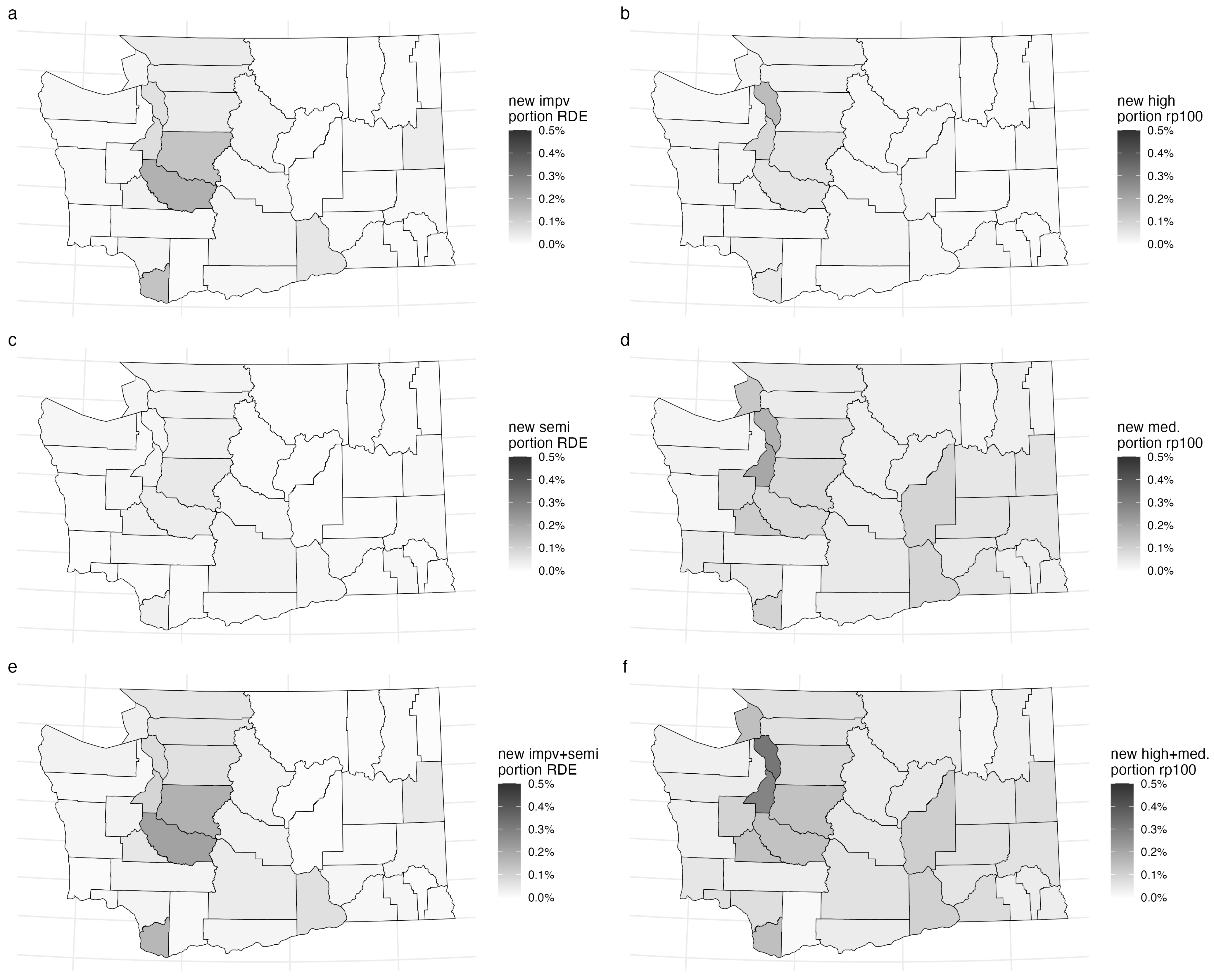
Indeed, many measures of riparian condition and change at larger spatial scales remain unknown or highly uncertain, hindering communication around policy objectives such as regional restoration targets. This study focuses on the example of Washington State (USA) to address a practical and seemingly simple question: how has riparian impervious cover changed statewide in recent years? In the course of quantifying regional-scale estimates from public datasets, this inquiry illustrates broadly relevant technical issues likely to affect the interpretation of outcomes from other assessments.
Riparian land cover in Washington is shaped by the different combinations of forestry, agriculture, and urbanization that occur within diverse ecoregions ranging from temperate rainforest to semi-arid shrubsteppe. Layered onto this varied landscape, riparian administrative responsibility is distributed among multiple entities, with no single statewide authority controlling the full suite of management decisions or the jurisdictional extent of riparian management zones (RMZs). Many individual permitting decisions fall to city and county governments, but federal and state statutes and U.S. treaties with sovereign tribes interact with local municipal codes to create a complex regulatory regime with ample variation in exactly what constitutes “riparian” for planning and permitting purposes. Specific buffer rules have differed substantially among local regulatory authorities [
11], sometimes between adjacent local jurisdictions along the same watercourse, but have commonly required 50 or 100 feet based on categorical stream types defined by flow permanence and fish use.
However, as the agency is mandated “to preserve, protect and perpetuate fish, wildlife and ecosystems”, the Washington Department of Fish and Wildlife (WDFW) has a responsibility to consult on rules and projects affecting habitat for harvested and non-harvested species statewide. In addition to participating in multi-stakeholder forums that shape forestry and agricultural regulations, WDFW defines “riparian areas (comprising riparian ecosystems, active floodplains, and riverine wetlands)” [
12] as a “Priority Habitat”. This designation means that under Washington’s Growth Management Act (GMA, RCW 36.70A) and Shoreline Management Act (RCW 90.58), local governments must protect riparian ecosystem functions in their policies, plans, critical area ordinances, and other development regulations. Protection must result in “no net loss” of ecosystem functions and values or shoreline ecological functions, respectively. In 2020, WDFW accordingly issued guidance describing a sufficient RMZ standard, after an extensive review, update, and synthesis of best available scientific evidence [
1,
13].
This RMZ standard proposes that the height of 200-year-old characteristic native trees at a location can determine a lateral distance from the channel that will protect “full ecosystem function” (SPTH
200yr). Though not compulsory, adoption of this method to define RMZ width increases the likelihood that regulated riparian extents will protect ecosystem functions and contribute to the recovery of threatened and listed species, including Chinook salmon (
Oncorhynchus tshawytscha). The SPTH
200yr approach to RMZ delineation accommodates the inherent natural variation and connectivity of riverscapes [
14], and it provides an alternative to buffers that afford less protection to smaller, upstream reaches, many of which have been implemented since the 1990 passage of the GMA [
11]. A gradual transition away from these older systems is underway as local governments adopt code revisions during regular update cycles.
Past research has shown increasing impervious cover in Washington without clearly characterizing statewide riparian conditions within the extent of the current RMZ guidance. Jones et al. (2010) [
15] considered late 20th-century land cover change (1973–2003) at a relatively coarse spatial resolution (60 m) within a 180 m buffer of National Hydrography Dataset (NHD) watercourses in several thousand sample blocks across the continental United States. They described a nationwide monotonic increase in the average riparian “urban %” over the assessed duration, and their results showed the Puget lowlands region of Washington had the nationally largest decrease in “natural land cover” during the “mid 80s–early 90s” period. A dramatic expansion of “urban” cover was also described by Powell et al. (2008) [
16] within Washington’s Snohomish River watershed, draining to Puget Sound north of Seattle. Though not constrained to riparian areas, they estimated a 255% increase, from 3285 ha in 1972 to 11,652 ha in 2006, based on an analysis combining manual orthophoto review with Landsat imagery. This study indicated that rapid impervious expansion during the 1980s slowed during the 1990s before returning to a faster rate after 2000. These authors postulated that a combination of socio-economic and regulatory factors likely contributed to this trajectory. Extending to additional Puget Sound watersheds, Bartz et al. (2015) [
17] focused on annual changes within 100 m or 200 m buffers around distinct habitat features important to salmon. Using a LandTrendr analysis of 30 m imagery spanning 1986 to 2008, they estimated that impervious cover in “mainstem” zones increased roughly 3% on average from 5820 ha in 1986, and that “tributary” zones increased roughly 5.5% from 2153 ha. They concluded that a legacy of degradation continues to affect Puget Sound salmon habitats but that the rate of additional impairment may be slowing.
Pursuing a current and comprehensive characterization of recent riparian impervious cover increases, we leveraged open geospatial datasets constructed for a decision support tool designed to facilitate habitat conservation planning. We examined impervious cover changes recorded by a public high-resolution change detection (HRCD) dataset [
18] within statewide riparian areas based on the current SPTH
200yr management recommendations. The HRCD data-generating process involves extensive manual review and verification of change polygons automatically delineated from 1 m aerial imagery pairs. This yields detailed and high-confidence observations of the sort that might be used in training or validation of traditional categorical land cover products. The HRCD data can capture impervious cover additions that occur within mosaics of multiple land cover types and that are much smaller than the 900 m
2 area of a single 30 m × 30 m pixel (0.09 ha, 0.22 acres). As an illustrative contrast, we compared the estimates that resulted from aggregating these individual, parcel-scale changes with those derived from an independent national dataset of land cover classes within a fixed-width corridor on a different hydrography. Complementing these change estimates, we also assessed the total impervious cover within the SPTH
200yr RMZ spatial extent in the western portion of the state using another independent 1 m land cover layer. We describe how these depictions of impervious cover and change relate to the distribution of Pacific salmon, a legally and culturally important part of life in the region, and we consider implications for future assessment to inform policies on riparian land use regulation.
2. Materials and Methods
2.1. SPTH200yr Riparian Areas
To facilitate uptake of the SPTH
200yr standard, WDFW developed a geospatial web application that enables rapid evaluation of riparian conditions and supports planning. The foundation of this Riparian Data Engine (RDE,
https://ripariandata.wdfw.wa.gov/, accessed on 4 February 2026) is a statewide polygon tessellation of RMZs generated from public hydrography (NHD) and soils (SSURGO) data [
19]. In generating the RMZ polygons, a default minimum of 100 feet (30.48 m) was used in locations without adequate data to establish a site index value. The RDE provides users with various attributes for the areas associated with each (junction to junction) reach, including descriptors of land cover, water quality (stream temperature impairments via 303d/305b listings), and salmon distribution via the Statewide Integrated Fish Distribution dataset (SWIFD,
https://geo.wa.gov/datasets/wdfw::statewide-washington-integrated-fish-distribution/about, accessed on 4 February 2026). The application offers a data-driven perspective on protection or restoration choices for specific locations within their broader upstream and downstream network context.
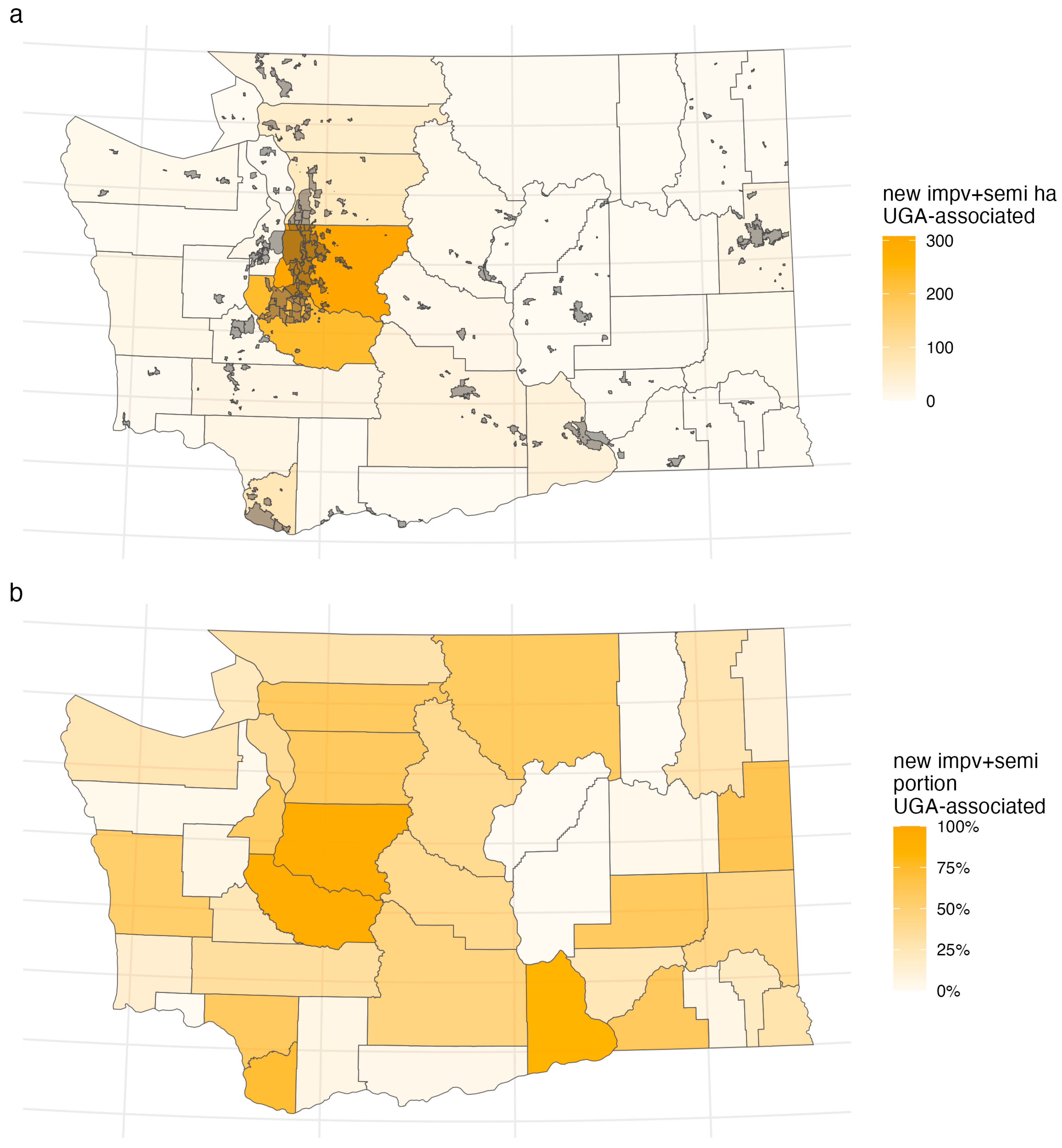
For this assessment, the complete set of more than 1 million individual reach units of the SPTH200yr RMZ tessellation was compiled from the RDE attribute “reach tables”. Each row in this dataset provides information about the combined area of the riparian management zone (RMZ, both banks where double-banked), the “extent of observed water” (EOW), and “floodplain” (primarily based on FEMA mapping). Within this area, the change in land cover was calculated from the intersection with HRCD polygons (see next section), and values were tabulated statewide and within individual county boundaries. Note that county geographic extents contain multiple tribal, federal, state, and local authorities and do not represent the exclusive jurisdiction of county governments. Attributes indicating whether individual reaches were associated with salmon distribution and the GMA-stipulated urban growth area (UGA) boundaries of cities and counties were used for stratification of summarized values.
2.2. High-Resolution Change Detection
Land cover changes were recorded following the methodology outlined in [
18], in which automated processing of sequential aerial imagery generated candidate polygons that were then manually reviewed for accuracy and attribution to change categories. Pierce (2015) [
18] provides further description and details than in this section, but the process consists of three main phases: (1) object-based change detection to create polygons of similar pixels, (2) estimation of a modeled probability of change for each of these polygons, and (3) manual review of model results and attribute assessment.
High-resolution imagery produced by the National Agriculture Inventory Program (NAIP) has been collected at two-to-three-year intervals beginning in 2006 [
20]. Mosaics of georectified tiles of these multispectral data formed the starting point for processing. This study is limited to the 2011 to 2013, 2013 to 2015, and 2015 to 2017 time windows due to their statewide coverage. Imagery for these periods was at 0.914 m (3 ft) resolution.
Object-based segmentation of these images via the Trimble eCognition software (versions 8.8–9.5.1) generated geodatabases of irregularly sized and shaped polygons determined by per-pixel spectral properties. Segmentation rule sets were constructed to distinguish potential changes down to the scale of about 1/50 hectare (200 m2, 0.05 acres).
During each of the 86 individual HRCD projects that have been conducted by the county or Water Resource Inventory Area to date, a distinct Random Forest model of the per-polygon probability of change was built from a time window and location-specific training set that combined approximately 1000 randomly sampled and manually reviewed polygons with approximately 500 manually searched and confirmed changes in two types: loss of canopy and increases in impervious surfaces. After assigning a probability of change to all the polygons according to this initial model, a second random sample of approximately 5000 units was drawn, stratified to equal portions with probabilities of change greater and less than 25%. These samples were all reviewed by analysts and assigned a value of “change” or “no change” to further inform the modeled probability of change. Samples were assigned a value of “change” if greater than 10% of the sample showed a loss of tree canopy (vegetation greater than 15 feet tall) or new impervious surface. Change was recorded in 25% increments. The results of this review of preliminary model output were supplemented with the original searched polygons to build a final Random Forest model assigning change probabilities. Using these final change probabilities, all the polygons with a change probability ≥ 25% were reviewed for commission errors and to apply attributes, and a random sample of at least 1% of the polygons with <25% change probability was reviewed to assess omission rates. The short intervals between NAIP images tend to skew the distribution of estimated change probabilities towards zero or “no change”, but a relatively low change probability of 25% was used to stratify between “change-likely” and “change-unlikely” groups, reducing omission errors from the “change-unlikely” polygons that contained real change.
Analysts used custom software to examine and attribute the set of all the “change-likely” polygons (prob. change ≥ 0.25) and the sample of “change-unlikely” (which varied from approximately n = 5000 to 40,000, depending on the location and time period). All the analysts followed a common protocol and definitions, and with cross-calibration tests performed to ensure consistency in assigning the final “change” or “no-change” values. For change events, visual comparison between image pairs allowed attribution of a likely “change agent” (e.g., Development or Natural–Stream), change type (i.e., tree loss and/or impervious increase), and estimated amount of loss (i.e., 25%). When visual comparison between two images did not produce clarity of change or no change, supplemental reference data (i.e., additional years of imagery or regional context) were reviewed by multiple analysts to inform final attribution and assignment. This addressed imperfections in the homogeneity of pixels within a change segment through assignment of categorical quartile values for the proportions of total change, lost tree canopy, new impervious surface, and new semi-pervious surface (e.g., new gravel roads). Assignment of the quartile percent change categories introduced measurement uncertainty in terms of imprecision and accuracy (e.g., selection of 25% or 50% when the true value was more or less), but inspection of millions of candidate change polygons has confirmed that this intensive approach is a feasible way to generate a high-quality dataset capturing many small changes over regional scales.
2.3. CCAP 1 m 2021 Impervious Surface
Complementing these change observations, values from a 1 m resolution raster dataset of 2021 impervious cover [
21] produced by the Coastal Change Analysis Program (CCAP) of the National Oceanic and Atmospheric Administration (NOAA) Office for Coastal Management were extracted within the RMZ and EOW zones of a Western Washington subset of the RDE riparian polygons. These values were then associated with the per-reach attributes provided by the RDE for summarization.
2.4. StreamCat-Processed National Land Cover Data
As a contrast to the RDE-HRCD dataset, the StreamCatTools (R package version 0.10.0) (Weber 2026 [
22]) R package version 4.5.3 was used to access the StreamCat dataset [
23], consisting of per-reach attributes for each unit of the medium resolution NHDPlus. This hydrography captures most substantial watercourses and is the precursor to subsequent higher-resolution hydrographic datasets that include many smaller channel units. For each NHDPlus reach “comid”, StreamCat provides attribute values calculated from many national datasets processed within the local contributing catchment (‘
cat’) and a 100 m riparian buffer (‘
rp100’) on “stream lines and on-network NLCD water pixels”. This includes values calculated from 8 cycles of the National Land Cover Dataset (NLCD; 2001, 2004, 2006, 2008, 2011, 2013, 2016, and 2019), which are based on classification of satellite and other imagery sources [
24]. The StreamCat NLCD values represent the percentages of each of 16 land cover classes within each of the
cat and
catrp100 areas of interest, such that approximate per-class areas were back-calculated against the per-comid area.
The StreamCat process and NLCD datasets have undergone thorough QAQC and been extensively reviewed since their initial development, and they are an established means to investigate large-scale patterns quickly. Numerous structural differences prevent direct quantitative comparisons between estimates based on these data and the RDE-HRCD, but the consideration of these differences can clarify assumptions and tradeoffs related to alternative assessment approaches.
4. Discussion
Assessing riparian land cover change at the scales of entire counties and watersheds is crucial to understanding the effects of land use policies and to designing integrated water management plans. These decision contexts can be contentious, and readily reproducible approaches based on open data can lend transparency and build confidence in outcomes. This statewide assessment, constructed from existing public datasets, showed hundreds of hectares of recent impervious cover increases within ecologically sensitive areas that influence flooding, water pollution, and native species populations. The results highlight the ongoing threats to aquatic systems and urban communities from watershed alteration, but these threats constitute an opportunity for expanded WSUD practices to sustainably address existing impairments in Washington and elsewhere. The results also underscore the need for continued attention to the definition and implementation of riparian regulations where “no net loss” of ecosystem function and values is a policy goal and statutory requirement (WAC 365-196-830) [
25].
The general statewide increase evident in the RDE-HRCD assessment was congruent with an independent analysis by Lazarus (2023) [
26], which also examined impervious cover within riparian extents defined by the current SPTH
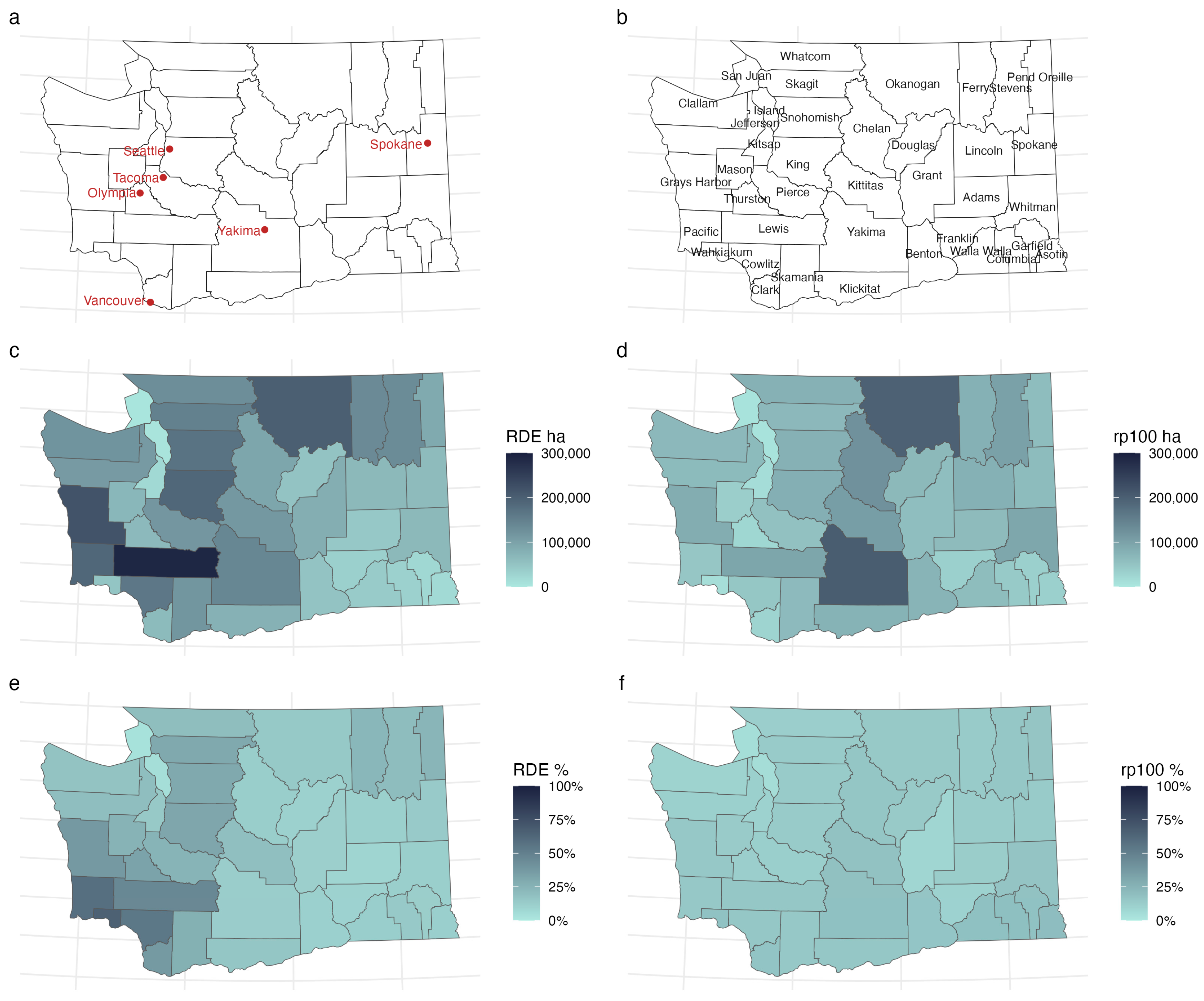
200yr management guidance. However, neither this nor the Streamcat-NLCD outcomes can be interpreted as directly corroborating RDE-HRCD patterns due to the differences in total stream length, overall assessed extent, and land cover resolution. Instead, attention to these differences can structure a consideration of the strengths and limitations and sources of uncertainty likely to affect assessments more broadly (
Table 3). The RDE-HRCD and Streamcat-NLCD approaches illustrate key methodological choices that determine the combination of observation and processing error in a watershed-scale quantification of riparian cover. The choices of hydrography, lateral width of evaluated extent, and spatial and temporal resolution of change events can fundamentally alter the characterization of risks and the perceived urgency of planning solutions.
The assessed extent and potentially estimated change are directly controlled by the spatial data representing streams, rivers, and other waterbodies. The RDE-HRCD and StreamCat-NLCD datasets both derive from hydrography that omits extensive lengths of the smaller, sometimes intermittent or ephemeral channels that contribute significantly to water quantity and quality [
27]. A coarser drainage network increases the likelihood of underestimating the overall functional impacts of land use changes. However, the improved representation of watercourses in hydrography generated from LiDAR elevation data (i.e., the USGS 3DHP initiative;
https://www.usgs.gov/3d-hydrography-program, accessed on 4 February 2026) is likely to improve the accuracy and comprehensiveness of riparian assessments. Building on extensive public data resources (i.e.,
https://lidarportal.dnr.wa.gov/, accessed on 4 February 2026), the development of such elevation-based hydrography is well underway in Washington State (
https://gis.ecology.wa.gov/portal/apps/sites/#/washington-state-hydrography-dataset-program, accessed on 4 February 2026). These datasets may also facilitate better integration of channel migration zone and valley form into RMZ delineations, potentially adding information on the vertical separation of fluvial geomorphic surfaces to the imagery-based “observed water” channel edges that delineate RDE-HRCD assessed extents.
Alongside the challenges and choices in determining watercourse locations, the question of “how wide” to make riparian buffers has received considerable research and debate, with answers reflecting various combinations of measurable biophysical conditions and sociocultural values [
28,
29]. The extents in this assessment do not represent any specific permitting authority and, in many locations, extend beyond the riparian management zones subject to regulatory protections during the evaluated time window. Consequently, the evidence of new impervious cover in these results does not necessarily represent inadequate or deficient implementation of regulations at the time of change. But these results do raise the question of how much of the additional impact would have been avoided, minimized, or mitigated had regulatory protections applied to the assessed extent (i.e., the composite of SPTH
200yr and default 100 ft RMZs in the RDE).
In Washington at present, variation in regulatory dimensions, for example, those stipulated in state forestry rules (WAC 222-30) and local critical area ordinances [
11], is compounded by on-the-ground heterogeneity in realized management [
30]. Adoption of the SPTH
200yr standard in WDFW guidance is not compulsory, but this minimum footprint is more likely to reduce ecological losses. Yet even the site-specific RMZ widths of the SPTH
200yr standard may not necessarily fully suffice to protect functions. In particular, the ecological risks from a too-narrow RMZ may be intensified by “upland” imperviousness outside of any jurisdictional corridor (e.g., more rapid overland flow due to shifts from saturation-excess to infiltration-excess dynamics). For example, a 30 m buffer is unlikely to offer equivalent functional protections within a primarily forested catchment as it would be adjacent to industrial, residential, or agricultural land uses. Site-specific factors are highly likely to influence the applicability of decay curves relating ecosystem function to buffer width, and a review of their continued validity is warranted where RMZ dimensions rely on them, but increasing imperviousness has continued to alter flow paths throughout watersheds.
Within the evaluated extent, the choice of land cover and change data also directly affects how a riparian assessment characterizes the condition. A rich temporal archive of traditional 30 m resolution data permits the examination of questions concerning long-term shifts, and these data may be the only option for assessments that require older baselines. For example, no dataset comparable to the 2021 1 m impervious cover exists for 2011 or earlier time periods, preventing a characterization of observed changes at a decadal temporal scale. Subsequent assessments may take advantage of newly available depictions of post-2021 to disentangle impervious increases related to different activities (i.e., changes related to transportation or commercial versus residential construction), thereby clarifying how comparable amounts of population and housing growth may impose smaller or larger demands on riparian habitat conditions [
31].
A transition to expanded use of higher resolution data will be important to future riparian assessments. As
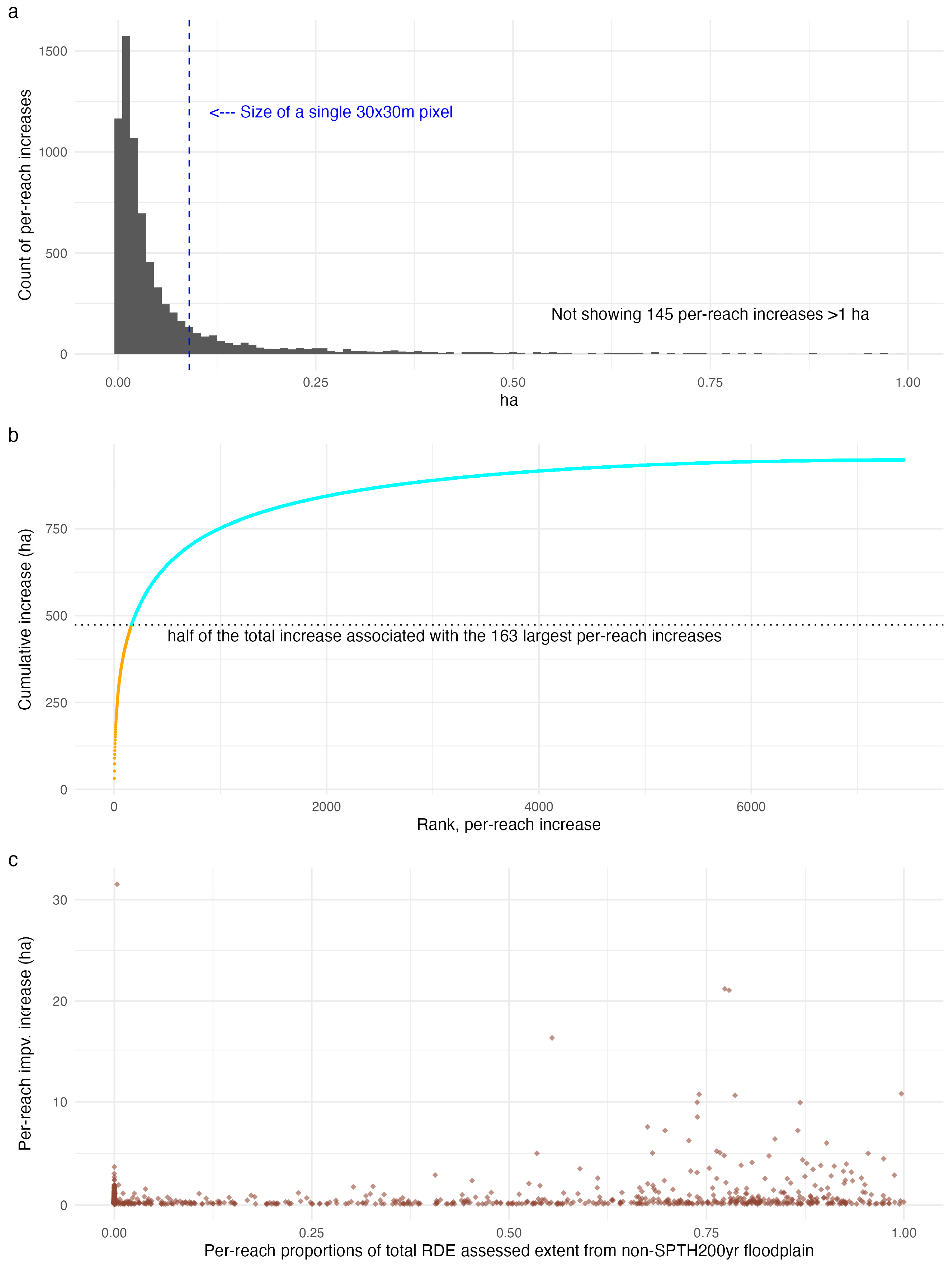
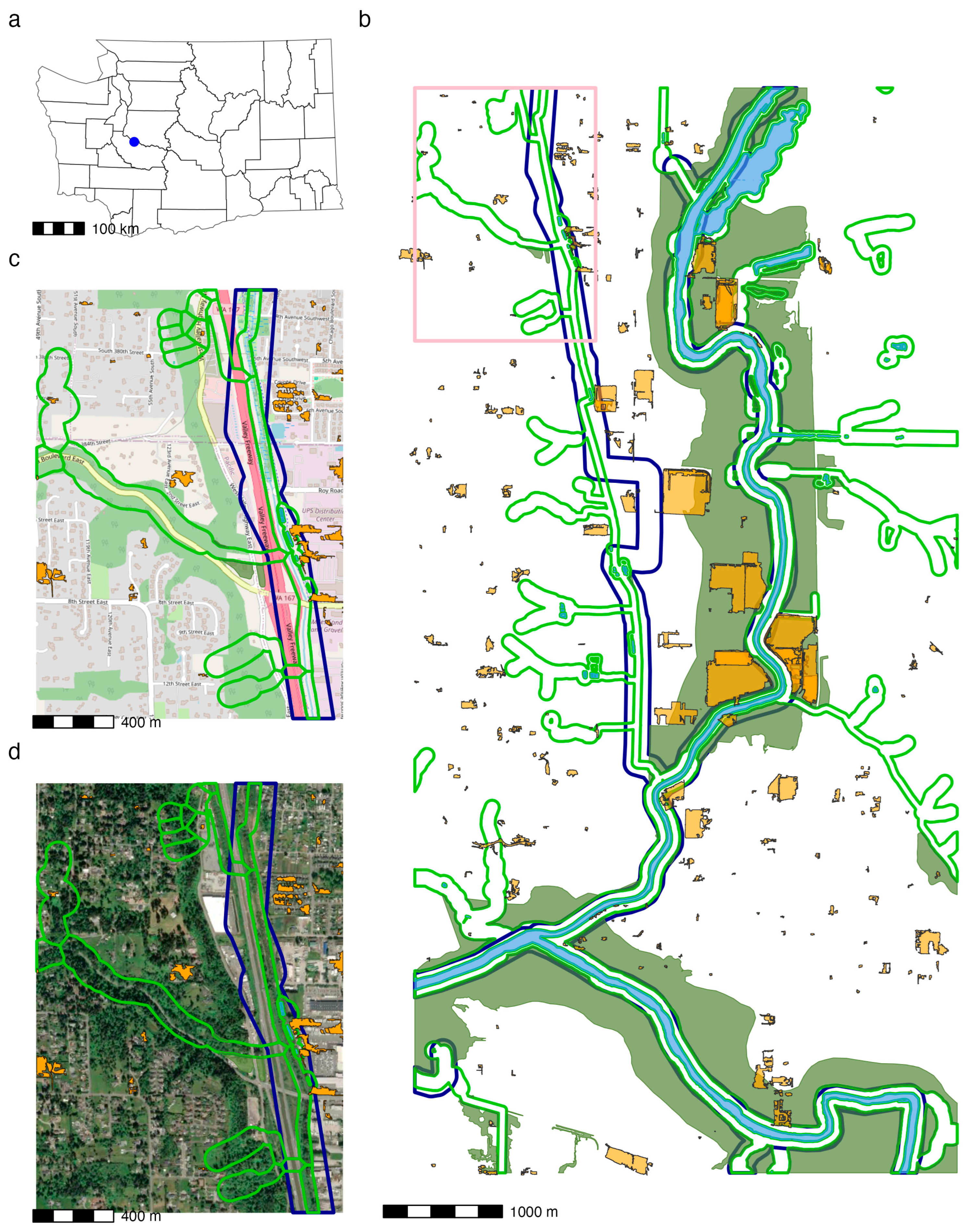
Figure 5 illustrates, a 30 m resolution has the potential to miss or mask changes smaller than a single pixel, yet many ongoing impervious increases may include narrow linear features and small parcel conversion (e.g., a single home and driveway). In contrast, the use of data at 1 m or finer resolution can capture these dynamics but has historically posed technical processing and storage challenges that limited applications, especially at larger spatial extents. The public datasets summarized in the RDE-HRCD estimates remove many of these barriers and demonstrate the viability of regional high-resolution assessment.
These data are subject to repeated manual review and quality control, and they constitute the type of observation that might be used to train classifiers or validate coarser resolution land cover products. Nonetheless, some residual error unavoidably persists in the change polygon locations and the attribution of the internal composition (i.e., the fine-scale analog of summarizing to a single cover class over the mixture within a 30 m pixel), with potential effects noted in
Table 3. The RDE-HRCD dataset tabulates per-reach change area as the product of the change polygon assigned change proportion quartile and the area of intersection with the reach polygon, summed over intersecting change polygons. This potentially allows for a high bias (i.e., overestimate) if the actual new impervious cover within HRCD polygons at lower change proportion quartiles occurred outside the area of intersection. Nonetheless, the effect of this possibility on statewide estimates was limited by the many change polygons with 100% or 75% quartile values, the many small change polygons that were fully encompassed or formed even smaller intersections, and the increasing probability that actual change was within the intersection as the intersected area increased (i.e., a larger numeric effect from a larger intersection area was associated with a decreasing chance of change outside the intersection). Moreover, limitations of the RDE-assessed extent almost certainly contributed to a countervailing low bias (under-estimation), including missing channels and missing SPTH
200yr data that required a default width of less than that based on site-index and species combinations.
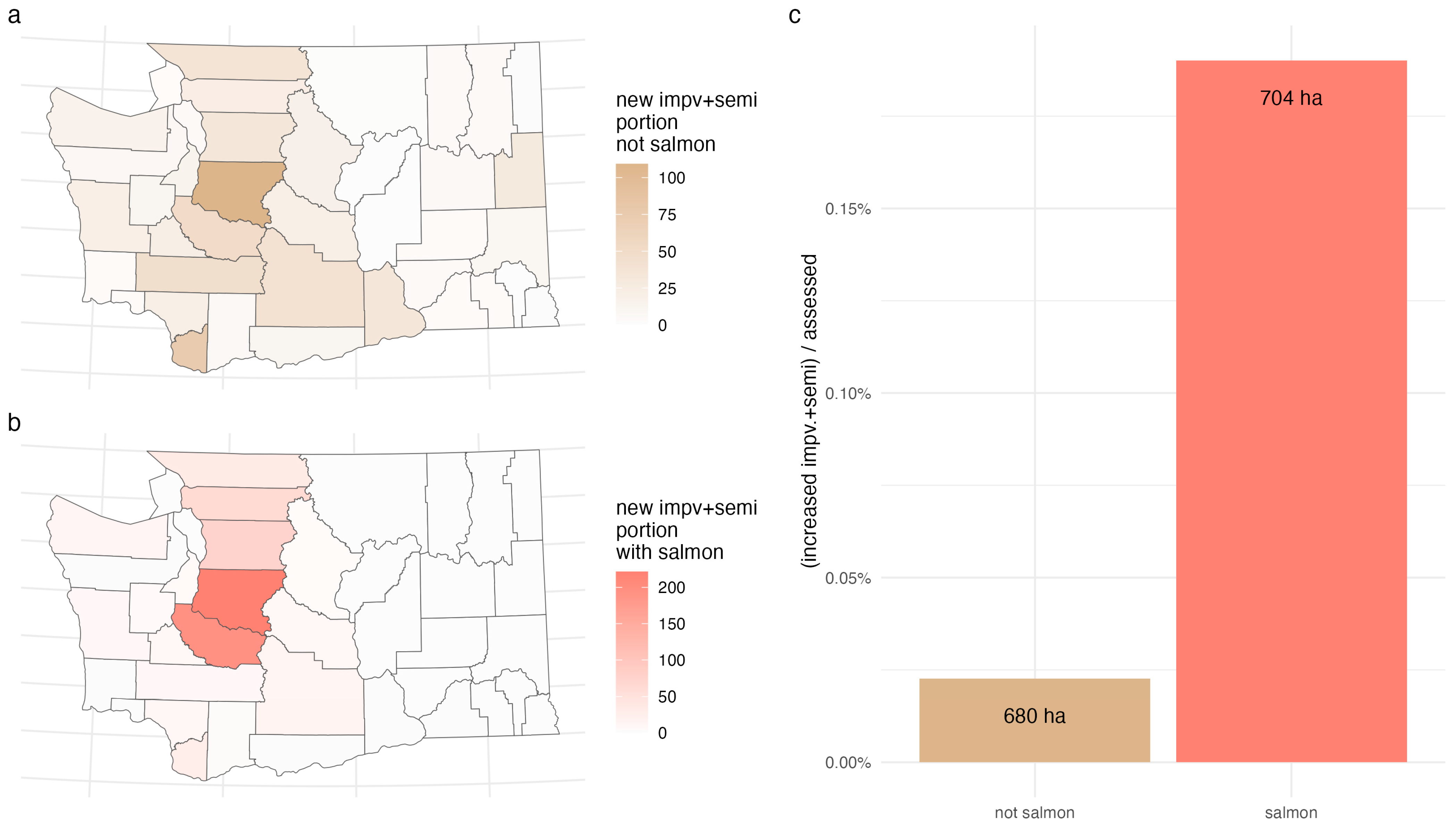
The relative concentration of riparian impervious cover increases in reaches associated with UGAs and salmon distributions appeared largely consistent across the state and reflected expectations based on experience with land use planning in Washington. Distinction by county geographic boundaries sufficed to illustrate broad spatial patterns, but this aggregation of assessed values did not produce meaningful replicates suited to standard correlation and regression analyses. Further research could explore in greater depth how differences in local governance, historical and current land use pressures, and economic drivers might account for variation among the 320 jurisdictions planning and implementing riparian and other critical area ordinances under GMA. The longitudinal statistical techniques appropriate to investigating this variation in terms of a common response measure of riparian change were beyond the scope of this work, but could afford greater insight into the socio-ecological conditions that have restricted or encouraged impervious cover increases.
Notwithstanding opportunities for additional studies, the tools and data underlying the statewide RDE-HRCD assessment described here have already seen application at the science-policy interface. Recent county-scale characterizations of high-resolution land cover and change within riparian management zones have drawn on these technical resources, and these reports have served as new “best available science” within mandated periodic updates of Critical Area Ordinances. In conjunction with precautionary principles, the evidence of recent land cover changes and the scope for additional loss of native habitats within SPTH200yr extents has contributed to the adoption of local regulations that more adequately protect riparian ecosystem function.
Many jurisdictions in Washington State already embrace WSUD principles within their comprehensive plans and deploy “low impact development” practices for new land use changes within their boundaries, sometimes going beyond existing permitting requirements [
32]. The 14-times higher proportion of 2021 standing impervious cover in the UGA-associated reaches reinforces the importance of these approaches in compensating for past losses of riparian function within UGAs. This study did not examine the extent to which the abundance of features like bioswales, rain gardens, or green roofs is associated with riparian impervious cover, or the magnitude of functional mitigation or “uplift” that these elements provide relative to losses of intact riparian buffers, but such questions are a worthwhile area for further research [
33]. For example, an ongoing study of existing municipal stormwater infrastructure is examining how different designs and maintenance protocols may influence not only runoff filtration and flood mitigation but simultaneously function as freshwater and wetland habitat supporting native biodiversity (S. Des Roches pers. comm.). Stormwater parks can provide even broader co-benefits to communities by providing recreational opportunities. Spatial decision support tools such as the Riparian Data Engine and results of landscape assessments such as this one can inform planners and local community leaders as they seek to understand where best to implement sustainable and multi-benefit water management practices.





 ,
,