1. Introduction
Against the background of continuous urbanization and green transformation, improving UER has become an important issue for achieving high-quality development and ecological security in China. Urban ecosystems face not only long-term pressures such as pollution emissions, resource constraints, and climate risks, but also sudden shocks caused by extreme weather and ecological disasters [
1]. Therefore, UER should not be understood merely as environmental governance performance, but should reflect the resistance, recovery, and adaptive capacities of urban ecosystems.
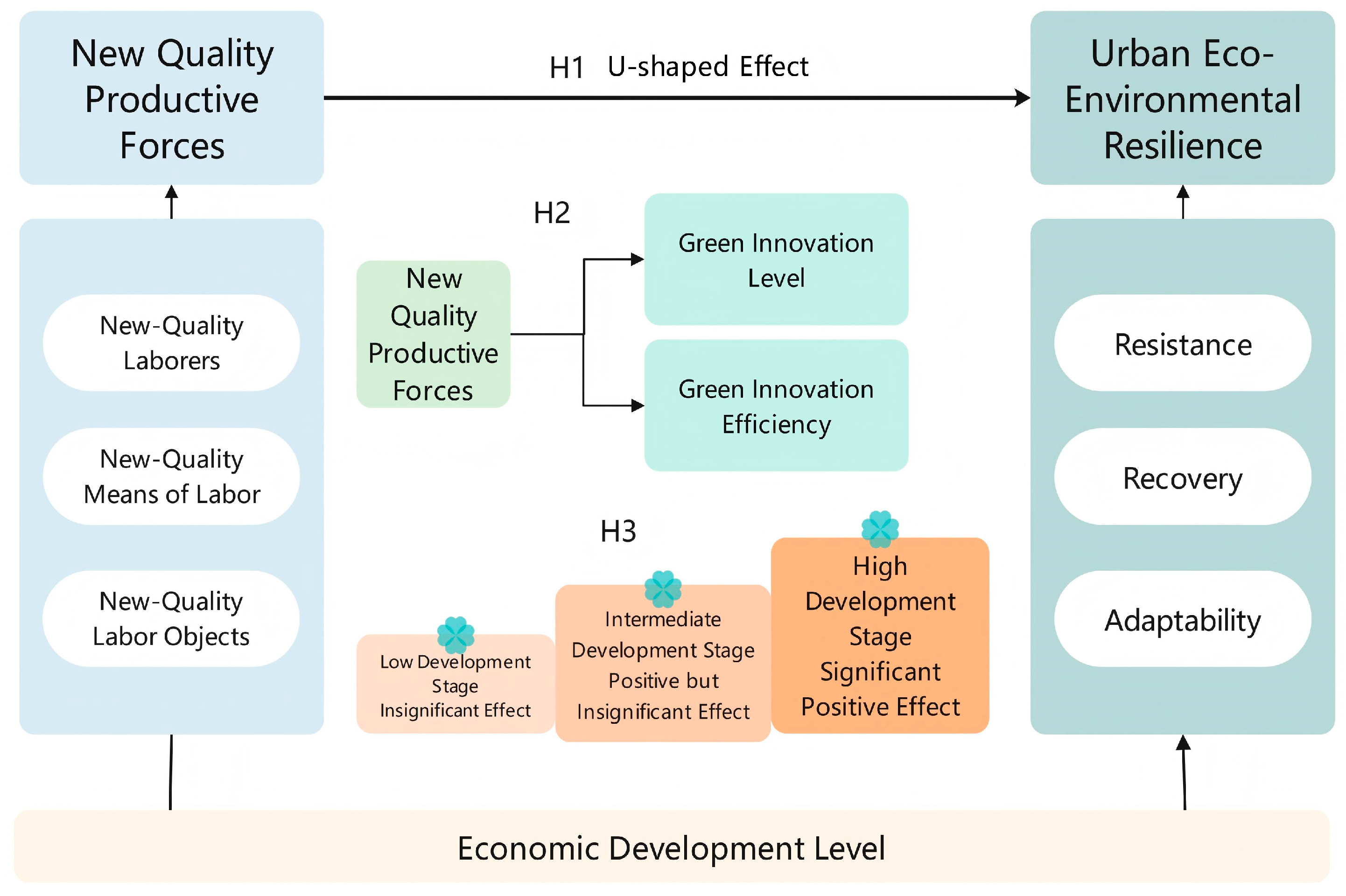
Meanwhile, NQPF is becoming an important force driving urban transformation in China. Unlike the single concepts of digital economy, technological innovation, or green innovation, NQPF emphasizes the coordinated upgrading of high-quality laborers, new means of labor, and high-value-added labor objects [
2]. Its core lies not only in technological progress and digital infrastructure construction, but also in scientific and technological investment, energy structure optimization, technology market activity, and the upgrading of industrial carriers. Therefore, NQPF may exert a profound influence on UER by reshaping resource allocation, production organization, and green innovation efficiency.
However, the effect of NQPF on UER may not be simply linear. In the early stage of development, NQPF may be accompanied by increased R&D investment, infrastructure expansion, industrial adjustment, and factor reallocation costs, thereby exerting short-term pressure on UER [
3]. As technological maturity improves, green production modes diffuse, and environmental governance capacity strengthens, the ecological effects of NQPF may gradually be released and eventually promote UER [
4]. This implies that there may be a U-shaped relationship between the two, characterized by initial inhibition followed by promotion. Meanwhile, the effect of NQPF may also be shaped by green innovation transformation efficiency, economic development stages, regional differences, and spatial association characteristics.
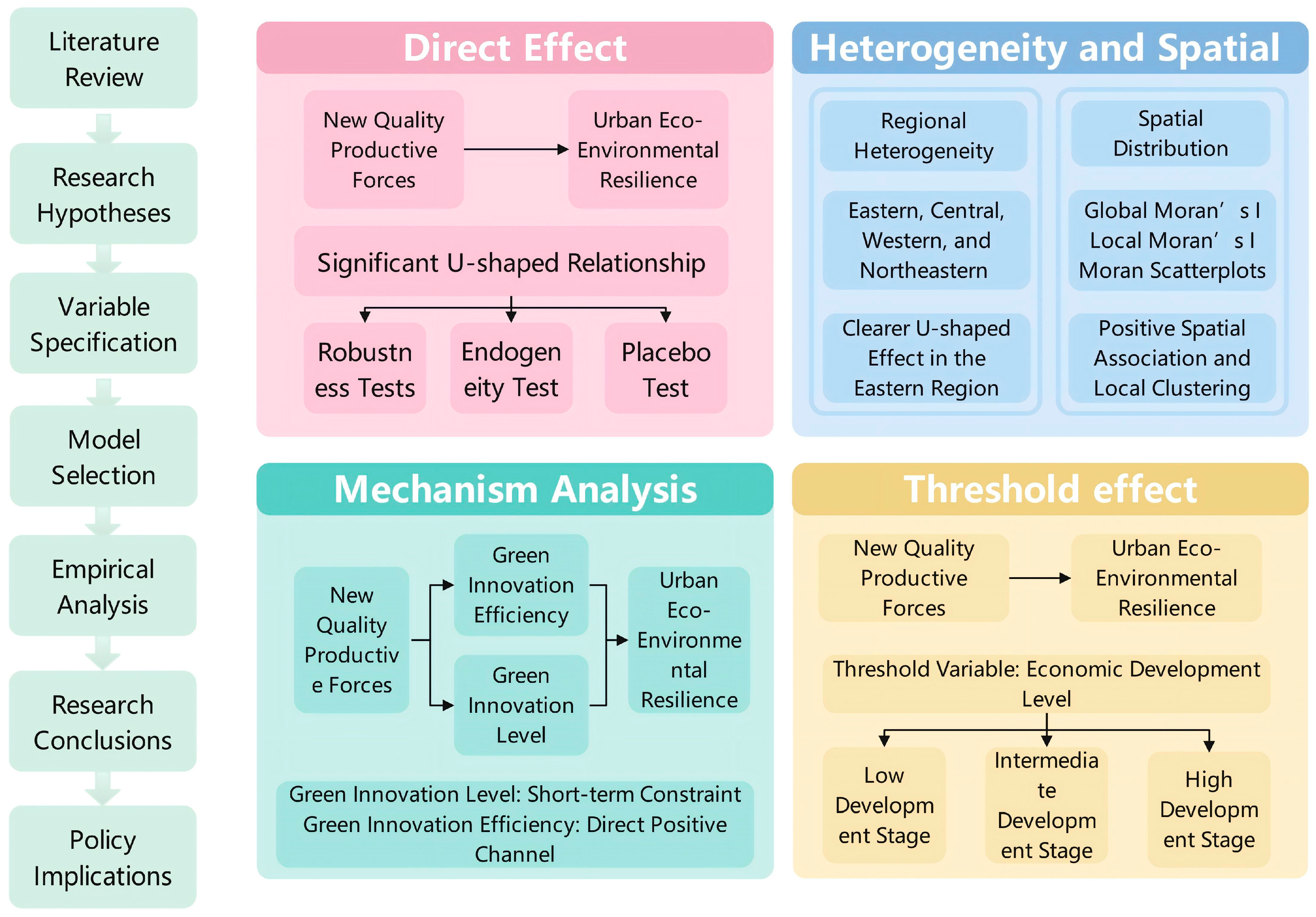
Based on this, this study uses a sample of 260 Chinese cities from 2006 to 2023 to systematically examine the nonlinear effect of NQPF on UER and its underlying mechanisms. First, this study constructs the NQPF indicator system based on the three-element framework of productive forces and measures UER from the dimensions of resistance, recovery, and adaptation. Second, a two-way fixed effects model is used to test the U-shaped relationship between NQPF and UER, and robustness tests and System-GMM are employed to alleviate potential endogeneity concerns. Third, the transmission mechanisms are identified from the perspectives of green innovation level (GIL) and green innovation efficiency (GIE). Finally, threshold effects, heterogeneity across economic development stages, regional heterogeneity, and spatial correlation analysis are introduced to reveal the stage-specific and spatial characteristics of the effect of NQPF on UER.
4. Research Design
4.1. Data Sources
This study uses prefecture-level and above cities in China from 2006 to 2023 as the research sample. Considering data availability, consistency of statistical standards, and changes in administrative divisions, Tibet, Hong Kong, Macao, and Taiwan are excluded, as are cities with substantial missing values in key variables or frequent administrative adjustments. The final sample is a balanced panel covering 260 cities and 4680 observations. In terms of data processing, this study first matches data from different sources by city name, administrative code, and year, and then unifies variable definitions and measurement units. For a small number of missing values at the city-year level, linear interpolation is used when only sporadic values are missing and adjacent-year trends are relatively stable. If missing values appear at the beginning or end of the sample period, adjacent-year information and original statistical materials are jointly checked before completion. Observations with continuous missing values over multiple years or those that cannot be verified are excluded. All missing-value treatment is conducted at the original indicator level before constructing composite indices.
In addition, all price-related variables are converted into constant 2006 prices. To reduce the influence of extreme observations, continuous variables are winsorized at the 1st and 99th percentiles. The main data sources include the China City Statistical Yearbook, China Environmental Statistical Yearbook, provincial and municipal statistical yearbooks and statistical bulletins, as well as the CSMAR and CNRDS databases.
4.2. Model Specification
To verify Hypothesis 1, this study constructs a two-way fixed-effects model to examine the nonlinear effect of NQPF on UER. Considering that the effect of NQPF on UER may not be simply linear, the squared term of NQPF is introduced into the model. The model is specified as follows:
where i and t denote city and year, respectively.
represents UER, and
denotes the development level of NQPF.
refers to a set of control variables, including urbanization level, population size, government intervention, and industrial structure.
and
represent city fixed effects and year fixed effects, respectively, while
is the random error term.
Equation (1) is used to examine the benchmark effect of NQPF on UER, while Equation (2) is used to test the nonlinear relationship between the two variables. If β1 < 0 and β2 > 0, and both coefficients are statistically significant, it indicates that NQPF has a U-shaped effect on UER. This means that NQPF may inhibit UER in the early stage but promote UER after crossing a certain development level. In addition, this study calculates the turning point and applies the Lind–Mehlum U-test to further examine whether the U-shaped relationship is statistically valid and practically meaningful.
To verify Hypothesis 2a, this study examines whether NQPF can promote GIL and whether the effect of GIL on UER is delayed or temporarily inhibitory. GIL mainly reflects the quantitative expansion of green innovation activities. However, green patent applications usually involve a time lag from application to practical use, and patent quantity does not necessarily represent effective green technology transformation. Therefore, the following models are constructed:
where
denotes GIL. Equation (3) is used to test whether NQPF promotes GIL. If
or
is statistically significant, it indicates that NQPF has a significant effect on GIL. Equation (4) further examines the effect of GIL on UER after controlling for NQPF and its squared term. If
has a negative or insignificant coefficient, it suggests that the ecological effect of GIL may be delayed or temporarily constrained, which is consistent with Hypothesis 2a.
To verify Hypothesis 2b, this study further examines whether NQPF improves UER by enhancing GIE. Compared with GIL, GIE places greater emphasis on the ability to transform green innovation inputs into green innovation outputs. Therefore, GIE can better reflect the practical transformation efficiency of green technologies. The models are specified as follows:
where
denotes GIE. Equation (5) is used to examine whether NQPF improves GIE, while Equation (6) is used to test whether GIE contributes to UER after controlling for NQPF and its squared term. If the coefficient of
is significantly positive, it indicates that GIE serves as an effective mechanism through which NQPF improves UER, thereby supporting Hypothesis 2b.
To verify Hypothesis 3, this study constructs a threshold model to examine whether the effect of NQPF on UER varies across different levels of economic development. Economic development level is selected as the threshold variable. The model is specified as follows:
where
represents the economic development level, measured by the logarithm of per capita GDP. I(·) is the indicator function, and
and
are the estimated threshold values. The coefficients
,
, and
capture the marginal effects of NQPF on UER at different economic development stages. If the coefficients differ significantly across threshold intervals and the promoting effect of NQPF becomes stronger as LNPGDP increases, it indicates that economic development plays a threshold role in the relationship between NQPF and UER, thereby supporting Hypothesis 3.
To verify Hypothesis 4, this study conducts regional heterogeneity analysis by dividing the sample into eastern, central, western, and northeastern regions. The following regional subsample model is constructed:
where r denotes different regions, including the eastern, central, western, and northeastern regions. The coefficients
and
are used to compare the regional differences in the nonlinear effect of NQPF on UER. If the signs, magnitudes, or significance levels of these coefficients differ across regions, it indicates that the effect of NQPF on UER exhibits regional heterogeneity. In particular, if the U-shaped relationship is more significant in regions with stronger economic foundations and innovation resources, Hypothesis 4 is supported.
4.3. Variable Definition
4.3.1. Dependent Variable
This study defines UER as the capacity of an urban ecosystem to resist, recover from, and adapt to environmental pressures, disaster shocks, and governance challenges. Consistent with the multidimensional resilience frameworks proposed by Lin et al. (2022) [
36] and Wang et al. (2024) [
37], UER is conceptualized as a composite urban ecological capacity rather than being equated with environmental governance performance alone. Accordingly, this study constructs the UER evaluation indicator system from three dimensions: resistance capacity, recovery capacity, and adaptive capacity.
Among them, resistance capacity mainly reflects the ability of urban ecosystems to withstand pollution pressure, including indicators such as industrial wastewater, industrial SO
2, industrial smoke and dust, industrial solid waste, and PM2.5. Recovery capacity mainly reflects the ability of cities to restore ecological functions and infrastructure carrying capacity after ecological shocks, including green coverage rate in built-up areas, per capita park green space, per capita water resources, drainage pipeline density, direct economic losses caused by natural or ecological disasters, and the proportion of affected population. Adaptive capacity mainly captures the long-term adjustment capacity of urban environmental governance and public service systems, including sewage treatment, harmless treatment of domestic waste, comprehensive utilization of industrial solid waste, sewage treatment capacity, and environmental governance investment. After standardizing all indicators, the entropy weight method is used to calculate the city-level UER composite index. The detailed selection of indicators is presented in
Table 1.
4.3.2. Independent Variable
This study defines NQPF as an advanced form of productive forces characterized by the coordinated evolution of new-quality laborers, new-quality means of labor, and new-quality labor objects. In this sense, NQPF is not equivalent to a single digital economy or green innovation indicator but represents a systematic upgrading of production factors and production conditions, including labor quality, scientific and technological investment, digital infrastructure, energy structure, technology market activity, and industrial carriers. Accordingly, drawing on the three-factor framework of productive forces and the NQPF measurement approach of Guan et al. (2025) [
38] and Liu et al. (2026) [
39], this study constructs a comprehensive NQPF evaluation indicator system from three dimensions: new-quality laborers, new-quality means of labor, and new-quality labor objects.
Specifically, the dimension of new-quality laborers reflects human capital, scientific and technological talent supply, and labor age structure; the dimension of new-quality means of labor captures technological investment, digital infrastructure, energy use, and technology market activity; and the dimension of new-quality labor objects reflects high-tech industries, strategic emerging industries, producer services, and industrial labor productivity. To avoid conceptual overlap with the UER indicator system, this study does not include indicators that directly reflect ecological and environmental outcomes, such as pollution control investment and pollution treatment performance, in the NQPF system. After standardizing all indicators, the entropy weight method is used to determine their weights and calculate the city-level NQPF composite index. The detailed selection of indicators is presented in
Table 2.
4.3.3. Mechanism Variable
To examine the transmission mechanism through which NQPF influences UER, this study draws on the research approach of Yao et al. (2020) [
40] for measuring urban innovation and the related practice of Liao et al. (2022) [
41] on green innovation efficiency, and selects green innovation level (GIL) and green innovation efficiency (GIE) as the mechanism variables. GIL mainly reflects the quantitative expansion of urban green innovation activities and is measured by the logarithm of the number of green patent applications plus one. GIL can capture the activity of green technology R&D in cities; however, green patents usually involve a time lag from application to practical use, and an increase in patent quantity does not necessarily mean that green technologies can be immediately transformed into ecological governance performance.
Furthermore, this study introduces GIE to reflect the efficiency with which green innovation inputs are transformed into green innovation outputs. Compared with GIL, GIE places greater emphasis on green technology transformation efficiency, resource allocation efficiency, and pollution governance efficiency, and can more directly capture the actual contribution of green innovation to UER. Therefore, this study incorporates both GIL and GIE into the mechanism analysis to distinguish between the “quantity expansion effect” and the “efficiency improvement effect” of green innovation.
4.3.4. Threshold Variable
To further examine whether the effect of NQPF on UER varies across different stages of urban economic development, this study follows the panel threshold model approach of Hansen (1999) [
42] and selects economic development level as the threshold variable, measured by the logarithm of GDP per capita (LNPGDP). The level of economic development not only reflects a city’s economic foundation and resource endowment, but also, to a certain extent, indicates its technological absorption capacity, fiscal support capacity, industrial carrying capacity, and public governance capacity, thereby potentially imposing important constraints on the ecological effect of NQPF.
4.3.5. Control Variables
The evolution of UER is affected by multiple factors. To minimize omitted variable bias and improve the reliability of model estimation, this study selects the following variables as control variables. First, urbanization level (URB) is measured by the proportion of urban resident population to total resident population at year-end. The process of urbanization affects UER through population agglomeration, infrastructure expansion, changes in spatial development intensity, and increasing ecological governance demand. Second, population size (LNPOP) is measured by the logarithm of the resident population at year-end, in order to control for resource and environmental pressure as well as scale effects caused by population agglomeration. Third, government intervention (LNGOV) is measured by the logarithm of the ratio of local general public budget expenditure to GDP, reflecting the intensity of local governments’ roles in resource allocation, ecological governance, and public service provision. Fourth, industrial structure (IND) is measured by the share of value added of the secondary industry in GDP, in order to control for the influence of industrial structure characteristics on UER. The detailed definitions and measurement methods of the above variables are presented in
Table 3.
6. Conclusions
6.1. Research Findings
Using balanced panel data from 260 Chinese cities from 2006 to 2023, this study constructs an NQPF index based on the three-element framework of new-quality laborers, new-quality means of labor, and new-quality labor objects, and measures UER from the dimensions of resistance capacity, recovery capacity, and adaptive capacity. On this basis, this study examines the nonlinear effects of NQPF on UER, the mechanisms of GIL and GIE, and the threshold effects of economic development, regional heterogeneity, and spatial dependence.
First, NQPF has a significant U-shaped effect on UER. In the early stage of NQPF development, R&D investment, infrastructure expansion, industrial adjustment, and factor reallocation may increase transformation costs and exert short-term pressure on UER. However, after NQPF crosses the turning point, technological maturity, green production diffusion, and improved governance capacity gradually release ecological benefits. The estimated turning point is 0.7761, and 1322 observations are below the turning point while 3358 observations are above it, indicating that the nonlinear relationship has practical significance.
Second, the mechanism analysis shows that NQPF affects UER through both GIL and GIE, but their roles differ. NQPF significantly promotes GIL, but the short-term effect of GIL on UER is negative, suggesting that the expansion of green patent quantity does not immediately translate into ecological resilience improvement. This may be related to R&D costs, technology transformation lags, and insufficient patent application quality. By contrast, GIE has a significantly positive effect on UER, indicating that improving green innovation efficiency is more effective than merely increasing green innovation output.
Third, the threshold and heterogeneity results show that the ecological effect of NQPF depends on economic development stages and regional conditions. The threshold model indicates that the promoting effect of NQPF on UER becomes significant only when economic development exceeds the second threshold. This suggests that sufficient economic foundation, technological absorptive capacity, fiscal support, and governance capacity are necessary for transforming NQPF into UER improvement. The regional heterogeneity results further show that the U-shaped relationship is more evident in eastern China, while the evidence is weaker in central, western, and northeastern regions.
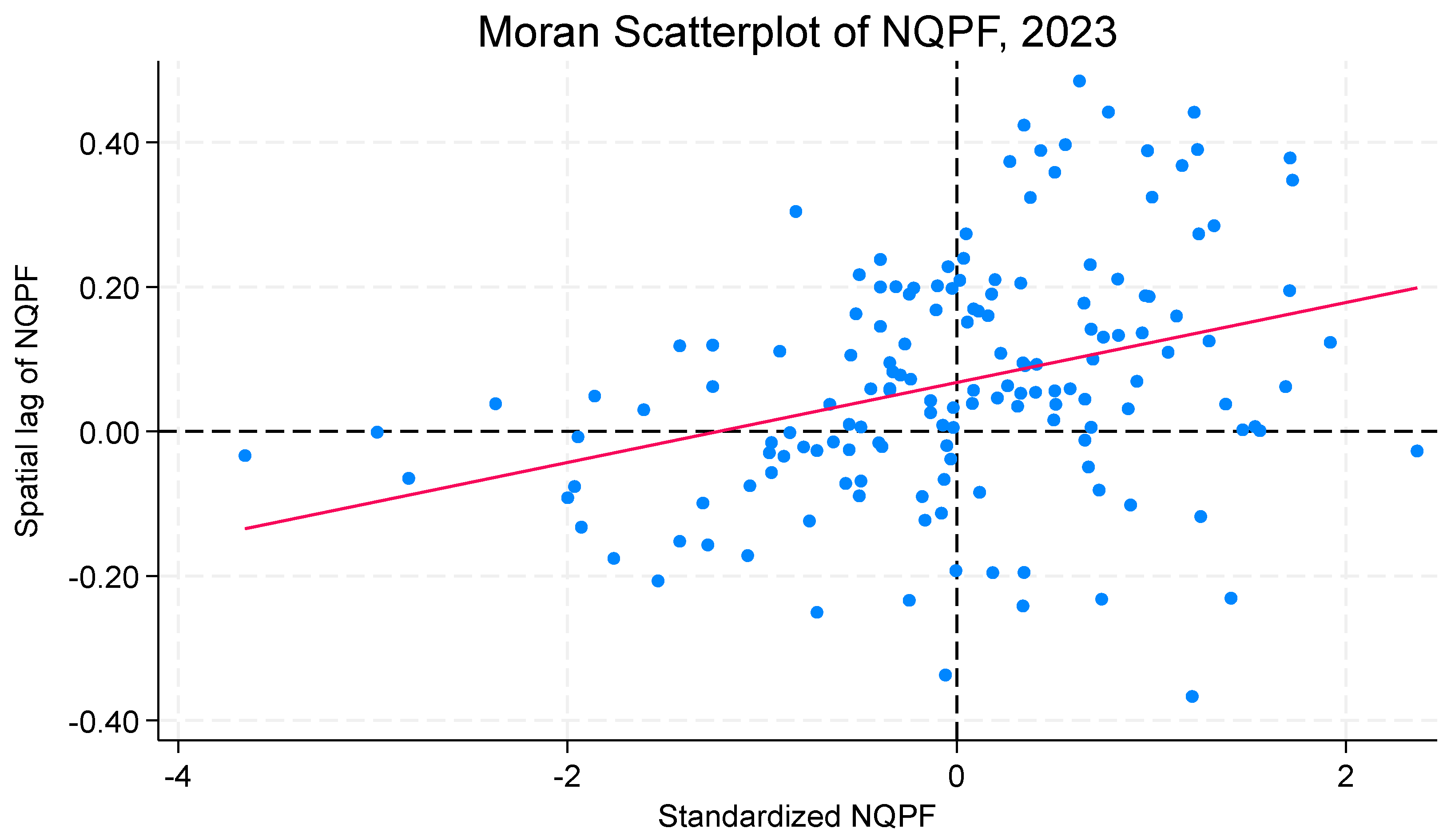
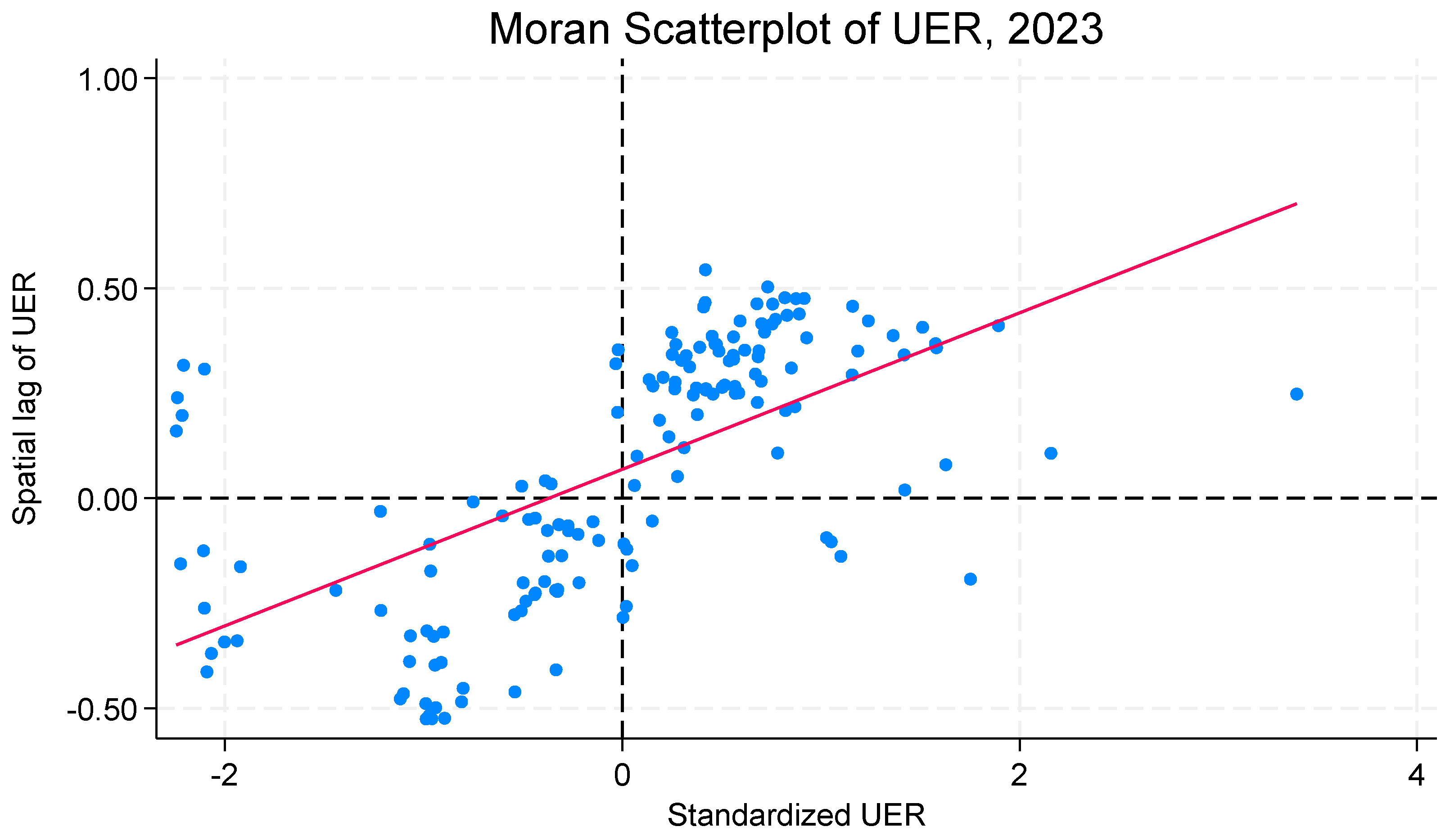
Fourth, the spatial analysis shows that both NQPF and UER exhibit spatial dependence and local clustering. The global Moran’s I results indicate positive spatial autocorrelation, and the LISA results further reveal local clustering patterns. This suggests that the development of NQPF and the improvement of UER are not isolated city-level phenomena but are associated with regional linkages and neighboring cities’ development conditions.
6.2. Policy Implications
Based on the above findings, this study proposes the following policy implications.
First, policies should be designed according to the nonlinear stage of NQPF development. The empirical results show that NQPF has a U-shaped effect on UER, with a turning point of 0.7761. For cities that have not yet crossed this turning point, the priority should not be the rapid expansion of NQPF alone, but the reduction in transformation costs. These cities should improve digital and green infrastructure, strengthen talent support, enhance industrial absorption capacity, and reduce resource misallocation during the early stage of transformation. For cities that have crossed the turning point, policy efforts should focus on accelerating green technology diffusion, improving industrial-chain coordination, and strengthening ecological governance institutions so that the ecological benefits of NQPF can be continuously released.
Second, green innovation policies should shift from quantity expansion to efficiency improvement. The mechanism analysis shows that NQPF significantly promotes GIL, but GIL does not immediately improve UER in the short term, while GIE has a more direct positive effect on UER. Therefore, local governments should avoid evaluating green innovation performance only by the number of green patents. More attention should be paid to green patent commercialization, green technology application, pollution reduction performance, and innovation input–output efficiency. This can help shorten the lag between green innovation activities and ecological resilience improvement.
Third, phased policy arrangements should be formulated according to the economic development thresholds. The threshold results show that the positive effect of NQPF on UER becomes significant only after economic development exceeds the second threshold. Therefore, cities with lower economic development levels should first improve basic infrastructure, fiscal support capacity, talent reserves, and ecological governance foundations. Cities in the intermediate stage should strengthen technological absorptive capacity and green industrial supporting systems. Cities with higher economic development levels should focus on advanced green technologies, institutional innovation, and regional demonstration effects while also preventing possible rebound effects caused by excessive scale expansion.
Fourth, regional and spatial coordination should be strengthened. The heterogeneity results show that the U-shaped effect of NQPF on UER is more evident in the eastern region, while the central, western, and northeastern regions show weaker effects. Therefore, the eastern region should further play a leading role in green technology diffusion, industrial upgrading, and ecological governance innovation. Central, western, and northeastern regions need more targeted support in digital infrastructure, green finance, talent agglomeration, and ecological restoration capacity. In addition, the Moran’s I and LISA results show that NQPF and UER have spatial clustering characteristics. Therefore, cross-city cooperation, regional environmental governance platforms, and intercity technology-sharing mechanisms should be strengthened to promote coordinated improvements in UER.
6.3. Limitations and Future Research
This study still has several limitations. First, although the UER indicator system incorporates resistance, recovery, and adaptive capacities, as well as indicators such as disaster losses and affected population, city-level statistical data still cannot fully capture the micro-level recovery process of urban ecosystems after ecological shocks. Second, although this study uses global Moran’s I and LISA analysis to reveal the spatial dependence and local clustering characteristics of NQPF and UER, it does not directly estimate causal spatial spillover effects. Future research may further combine finer-scale disaster data, remote sensing data, firm-level innovation data, and spatial econometric models, such as the spatial Durbin model, to more accurately examine how NQPF affects local and neighboring cities’ UER.