A Unified Deep Learning Framework for Biomass Burning Plume Detection and Domain-Adaptive PM1 Estimation



Abstract
1. Introduction
2. Methods
2.1. Dataset
2.1.1. Smoke Detection Dataset
2.1.2. In-Plume PM Estimation Dataset
2.1.3. Out-of-Plume PM Estimation Dataset
2.2. Deep Learning-Based Framework
2.2.1. Smoke Detection Model
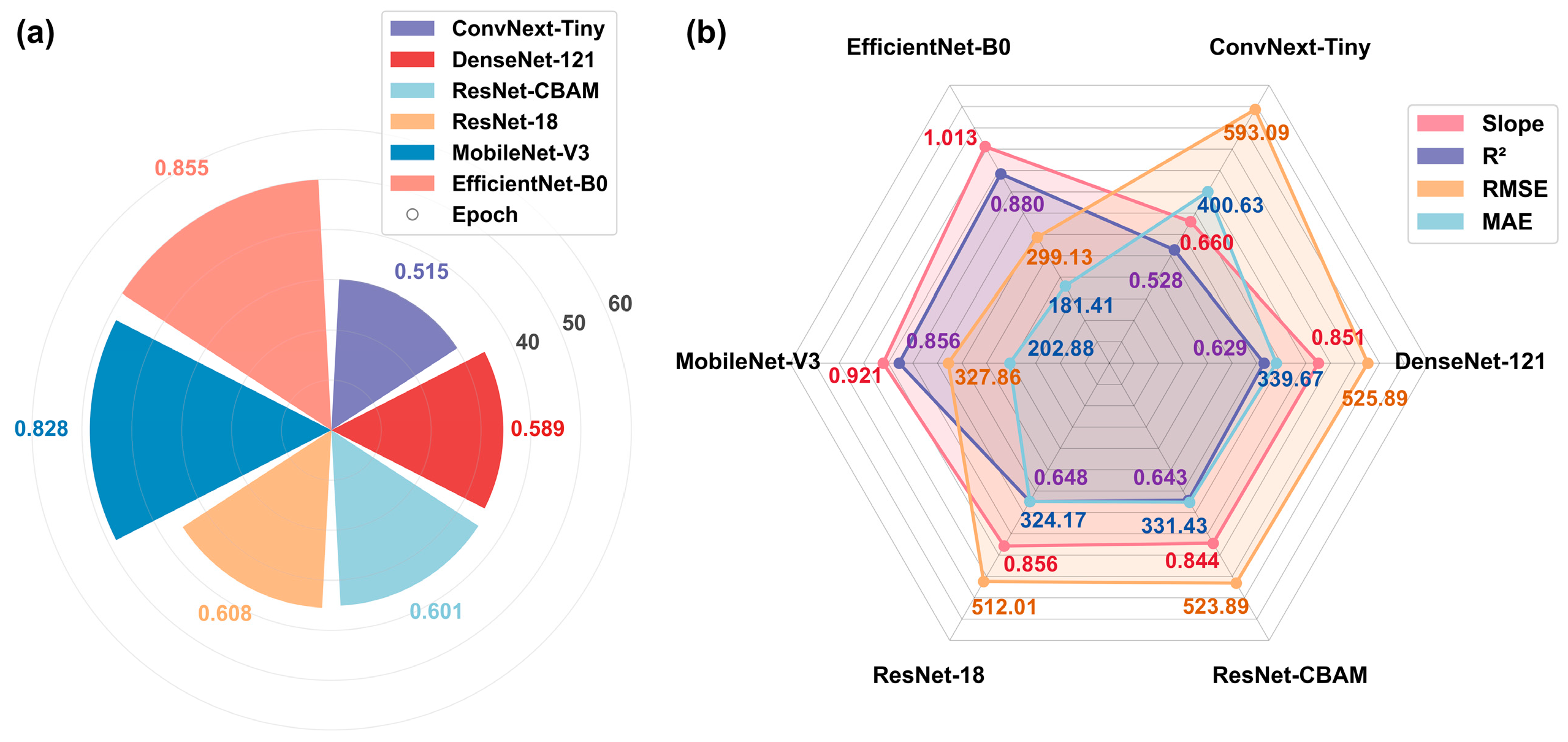
2.2.2. In-Plume PM Estimation Model
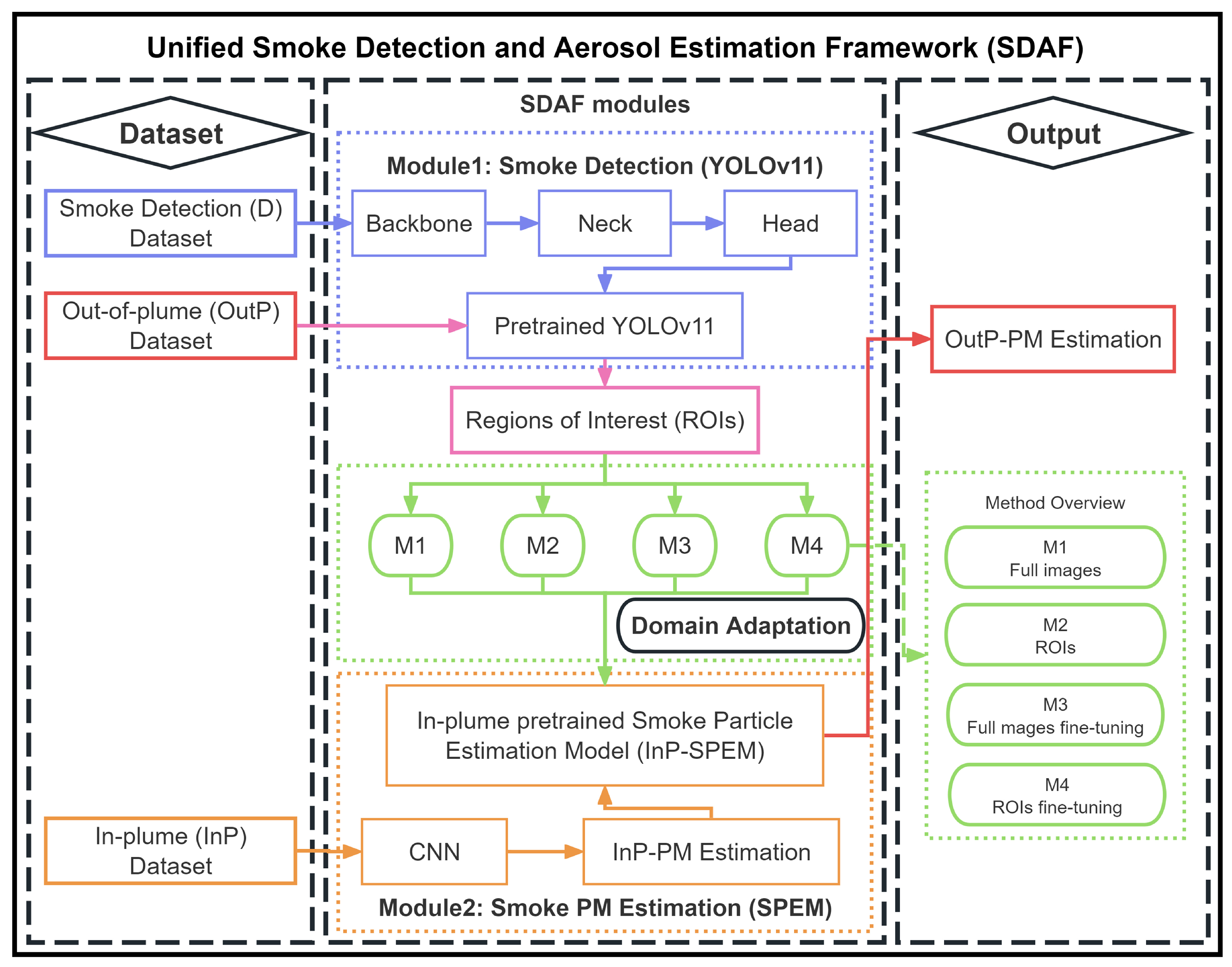
2.2.3. Unified Smoke Detection and Aerosol Estimation Framework (SDAF)
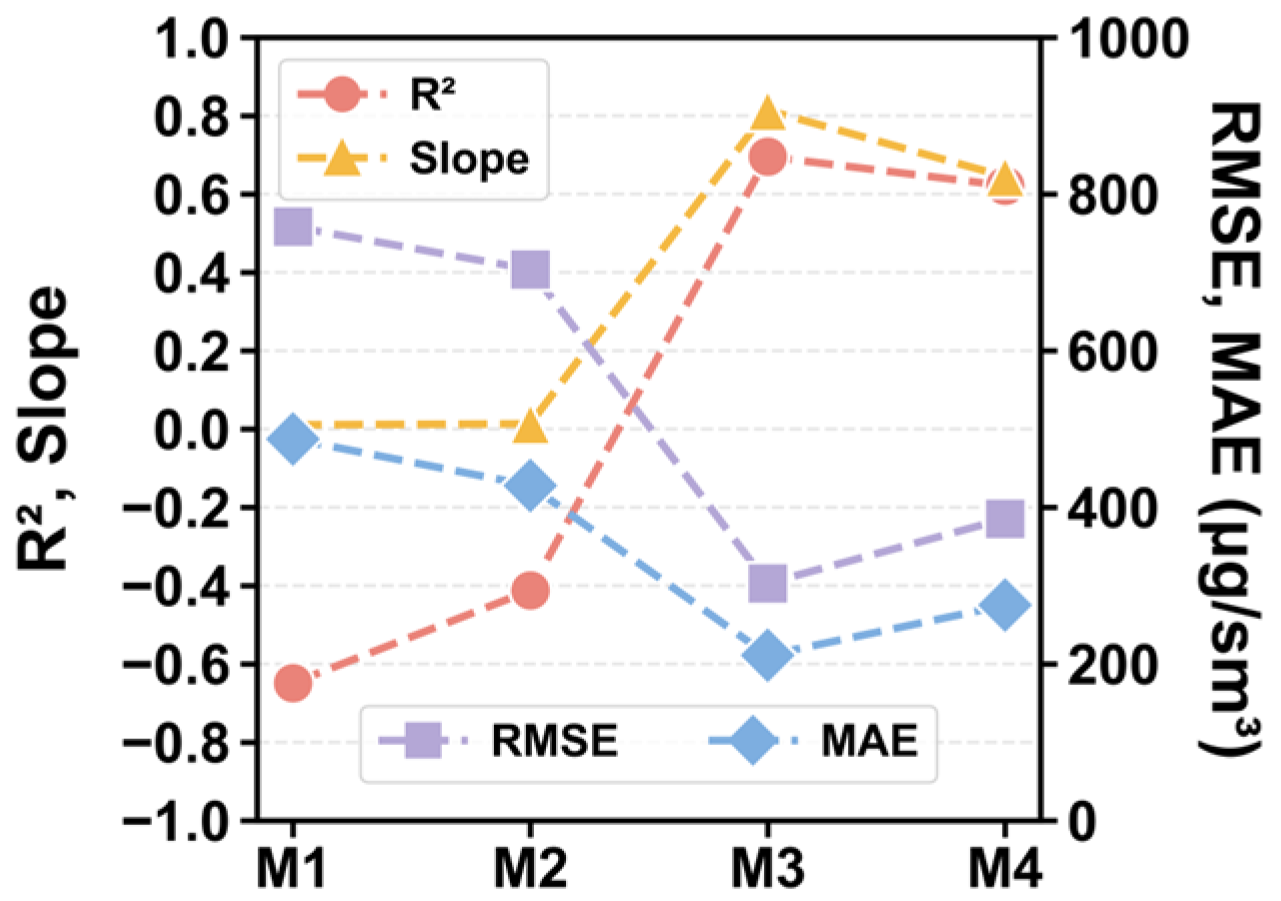
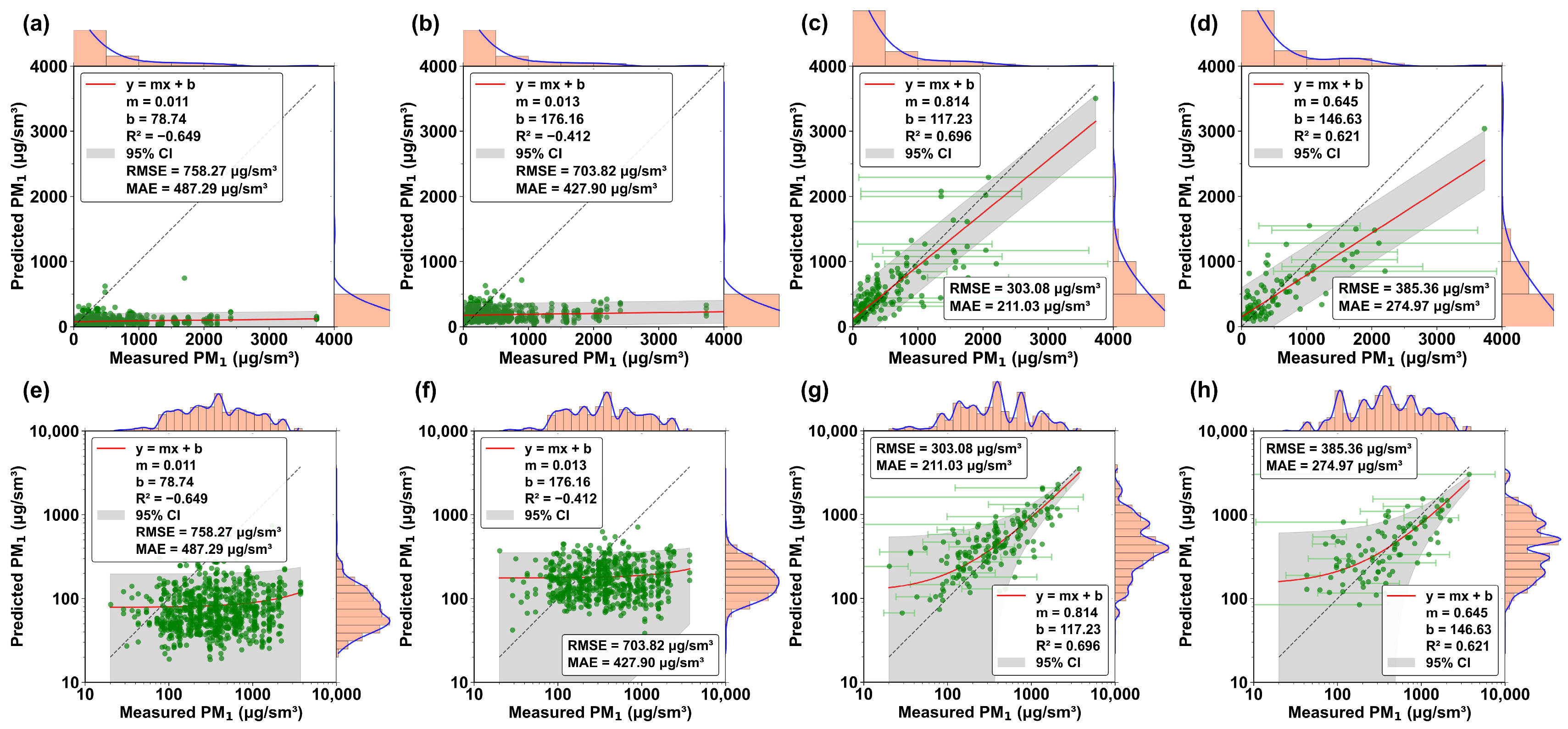
- M1 (OutP full images) applies InP-SPEM to full OutP images without any domain adaptation. The pretrained model is used for forward inference on OutP images, and performance metrics are computed to assess the feasibility of direct transfer.
- M2 (OutP ROIs) employs SPEM to estimate concentration from ROIs extracted from OutP images, rather than from the entire images. This approach is designed to evaluate the predictive benefits of incorporating ROI-based features.
- M3 (OutP full-image fine-tuning) performs fine-tuning of InP-SPEM on OutP raw images. The model is initialized from pretrained InP images weights and trained on the OutP dataset with an 8:2 train-validation split. A reduced learning rate is adopted to ensure stable adaptation while preserving pretrained representations. The model with the highest validation R2 is selected. This setting evaluates global domain adaptation under full-scene context.
- M4 (OutP ROI-level fine-tuning) integrates YOLOv11-based ROI extraction with an ROI-level fine-tuning strategy. Both training and testing are conducted on ROI-cropped samples to ensure consistency between training and inference distributions. The model is also initialized from pretrained InP-SPEM weights and undergoes full-parameter fine-tuning, enabling joint adaptation of the feature extraction and regression components under localized smoke regions.
2.3. Model Evaluation Metrics
2.3.1. Evaluation Metrics for Smoke Detection
2.3.2. Evaluation Metrics for PM Estimation
2.4. Model Training Hardware
3. Results and Discussion
3.1. Smoke Detection
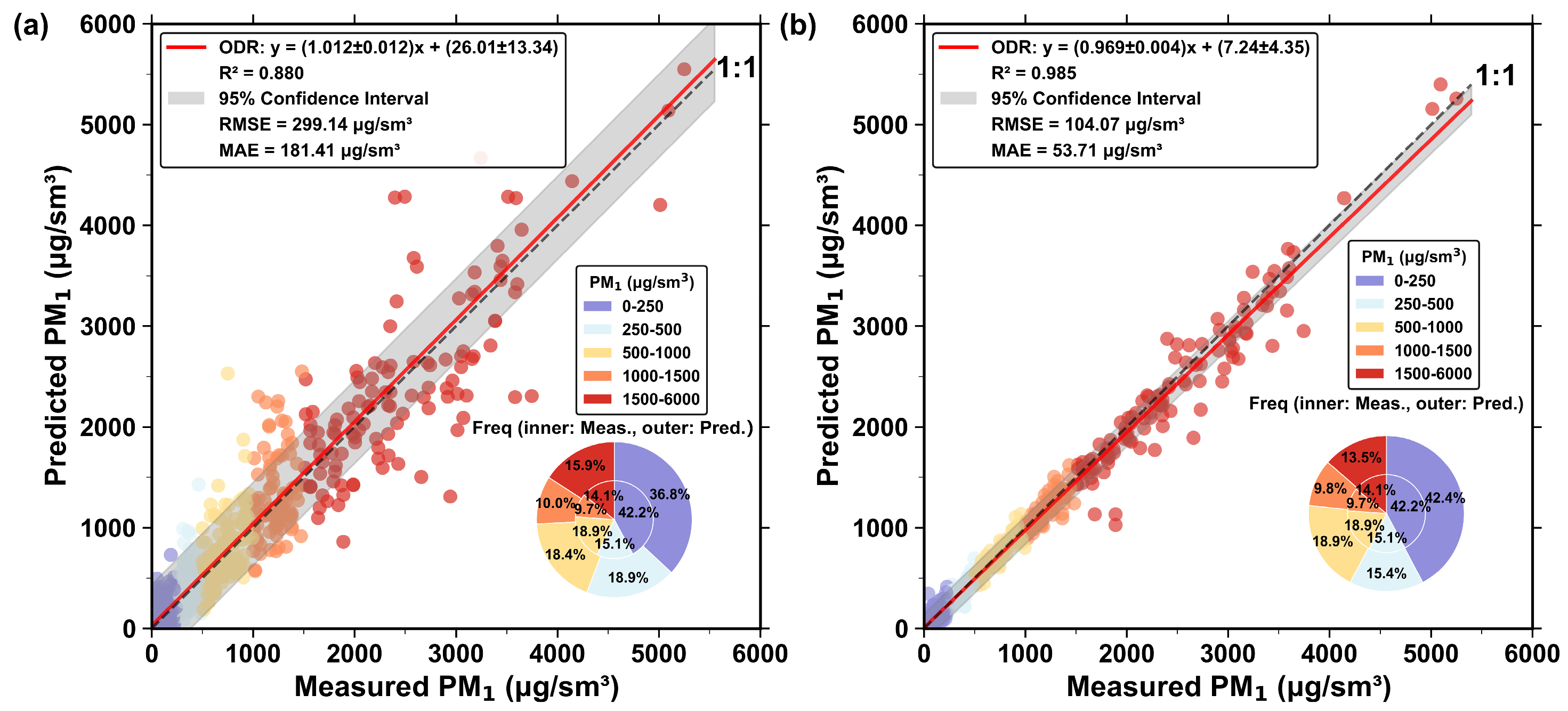
3.2. In-Plume PM Estimation
3.3. Out-of-Plume PM Estimation
4. Summary
Supplementary Materials
Author Contributions
Funding
Institutional Review Board Statement
Informed Consent Statement
Data Availability Statement
Acknowledgments
Conflicts of Interest
References
- Yao, W.; Zhao, Y.; Chen, R.; Wang, M.; Song, W.; Yu, D. Emissions of Toxic Substances from Biomass Burning: A Review of Methods and Technical Influencing Factors. Processes 2023, 11, 853. [Google Scholar] [CrossRef]
- Johnston, H.J.; Mueller, W.; Steinle, S.; Vardoulakis, S.; Tantrakarnapa, K.; Loh, M.; Cherrie, J.W. How Harmful Is Particulate Matter Emitted from Biomass Burning? A Thailand Perspective. Curr. Pollut. Rep. 2019, 5, 353–377. [Google Scholar] [CrossRef]
- Andreae, M.O. Emission of trace gases and aerosols from biomass burning—An updated assessment. Atmos. Chem. Phys. 2019, 19, 8523–8546. [Google Scholar] [CrossRef]
- Zhang, Q.; Wang, Y.; Xiao, Q.; Geng, G.; Davis, S.J.; Liu, X.; Yang, J.; Liu, J.; Huang, W.; He, C.; et al. Long-range PM2.5 pollution and health impacts from the 2023 Canadian wildfires. Nature 2025, 645, 672–678. [Google Scholar] [CrossRef] [PubMed]
- Ford, B.; Val Martin, M.; Zelasky, S.E.; Fischer, E.V.; Anenberg, S.C.; Heald, C.L.; Pierce, J.R. Future Fire Impacts on Smoke Concentrations, Visibility, and Health in the Contiguous United States. GeoHealth 2018, 2, 229–247. [Google Scholar] [CrossRef]
- Brown, H.; Liu, X.; Pokhrel, R.; Murphy, S.; Lu, Z.; Saleh, R.; Mielonen, T.; Kokkola, H.; Bergman, T.; Myhre, G.; et al. Biomass burning aerosols in most climate models are too absorbing. Nat. Commun. 2021, 12, 277. [Google Scholar] [CrossRef]
- Burke, M.; Childs, M.L.; de la Cuesta, B.; Qiu, M.; Li, J.; Gould, C.F.; Heft-Neal, S.; Wara, M. The contribution of wildfire to PM2.5 trends in the USA. Nature 2023, 622, 761–766. [Google Scholar] [CrossRef]
- Zheng, Y.; Han, Z.; Wu, J.; Li, J. Spatial Distribution and Temporal Variation of Biomass Burning Emissions and Intercomparison of Biomass Burning Emission Inventories over China. Clim. Environ. Res. 2023, 28, 495–508. [Google Scholar] [CrossRef]
- Cheng, Y.; Yu, Q.; Liu, J.; Cao, X.; Zhong, Y.; Du, Z.; Liang, L.; Geng, G.; Ma, W.; Qi, H.; et al. Dramatic changes in Harbin aerosol during 2018–2020: The roles of open burning policy and secondary aerosol formation. Atmos. Chem. Phys. 2021, 21, 15199–15211. [Google Scholar] [CrossRef]
- Van Der Werf, G.R.; Randerson, J.T.; Giglio, L.; van Leeuwen, T.T.; Chen, Y.; Rogers, B.M.; Mu, M.; van Marle, M.J.E.; Morton, D.C.; Collatz, G.J.; et al. Global fire emissions estimates during 1997–2016. Earth Syst. Sci. Data 2017, 9, 697–720. [Google Scholar] [CrossRef]
- Park, G.; Lee, Y. Wildfire Smoke Detection Enhanced by Image Augmentation with StyleGAN2-ADA for YOLOv8 and RT-DETR Models. Fire 2024, 7, 369. [Google Scholar] [CrossRef]
- Wiggins, E.B.; Soja, A.J.; Gargulinski, E.; Halliday, H.S.; Pierce, R.B.; Schmidt, C.C.; Nowak, J.B.; DiGangi, J.P.; Diskin, G.S.; Katich, J.M.; et al. High Temporal Resolution Satellite Observations of Fire Radiative Power Reveal Link Between Fire Behavior and Aerosol and Gas Emissions. Geophys. Res. Lett. 2020, 47, e2020GL090707. [Google Scholar] [CrossRef]
- Chen, Y.; Morton, D.C.; Randerson, J.T. Remote sensing for wildfire monitoring: Insights into burned area, emissions, and fire dynamics. One Earth 2024, 7, 1022–1028. [Google Scholar] [CrossRef]
- Schroeder, W.; Oliva, P.; Giglio, L.; Quayle, B.; Lorenz, E.; Morelli, F. Active fire detection using Landsat-8/OLI data. Remote Sens. Environ. 2016, 185, 210–220. [Google Scholar] [CrossRef]
- Moore, R.H.; Wiggins, E.B.; Ahern, A.T.; Zimmerman, S.; Montgomery, L.; Campuzano Jost, P.; Robinson, C.E.; Ziemba, L.D.; Winstead, E.L.; Anderson, B.E.; et al. Sizing response of the Ultra-High Sensitivity Aerosol Spectrometer (UHSAS) and Laser Aerosol Spectrometer (LAS) to changes in submicron aerosol composition and refractive index. Atmos. Meas. Tech. 2021, 14, 4517–4542. [Google Scholar] [CrossRef]
- Li, T.; Shen, H.; Yuan, Q.; Zhang, X.; Zhang, L. Estimating Ground-Level PM2.5 by Fusing Satellite and Station Observations: A Geo-Intelligent Deep Learning Approach. Geophys. Res. Lett. 2017, 44, 11985–11993. [Google Scholar] [CrossRef]
- Van Donkelaar, A.; Martin, R.V.; Brauer, M.; Kahn, R.; Levy, R.; Verduzco, C.; Villeneuve, P.J. Global Estimates of Ambient Fine Particulate Matter Concentrations from Satellite-Based Aerosol Optical Depth: Development and Application. Environ. Health Perspect. 2010, 118, 847–855. [Google Scholar] [CrossRef] [PubMed]
- Sanford, T.J.; Murphy, D.M.; Thomson, D.S.; Fox, R.W. Albedo Measurements and Optical Sizing of Single Aerosol Particles. Aerosol Sci. Technol. 2008, 42, 958–969. [Google Scholar] [CrossRef]
- Saide, P.E.; Thapa, L.H.; Ye, X.; Pagonis, D.; Campuzano-Jost, P.; Guo, H.; Schuneman, M.L.; Jimenez, J.L.; Moore, R.; Wiggins, E.; et al. Understanding the Evolution of Smoke Mass Extinction Efficiency Using Field Campaign Measurements. Geophys. Res. Lett. 2022, 49, e2022GL099175. [Google Scholar] [CrossRef]
- Di, Q.; Amini, H.; Shi, L.; Kloog, I.; Silvern, R.; Kelly, J.; Sabath, M.B.; Choirat, C.; Koutrakis, P.; Lyapustin, A.; et al. An ensemble-based model of PM2.5 concentration across the contiguous United States with high spatiotemporal resolution. Environ. Int. 2019, 130, 104909. [Google Scholar] [CrossRef] [PubMed]
- Gonçalves, L.A.O.; Ghali, R.; Akhloufi, M.A. YOLO-Based Models for Smoke and Wildfire Detection in Ground and Aerial Images. Fire 2024, 7, 140. [Google Scholar] [CrossRef]
- Ding, Y.; Wang, M.; Fu, Y.; Wang, Q. Forest Smoke-Fire Net (FSF Net): A Wildfire Smoke Detection Model That Combines MODIS Remote Sensing Images with Regional Dynamic Brightness Temperature Thresholds. Forests 2024, 15, 839. [Google Scholar] [CrossRef]
- Yang, H.; Wang, J.; Wang, J. Efficient Detection of Forest Fire Smoke in UAV Aerial Imagery Based on an Improved Yolov5 Model and Transfer Learning. Remote Sens. 2023, 15, 5527. [Google Scholar] [CrossRef]
- Hong, R.; Wang, X.; Fang, Y.; Wang, H.; Wang, C.; Wang, H. Yolo-Light: Remote Straw-Burning Smoke Detection Based on Depthwise Separable Convolution and Channel Attention Mechanisms. Appl. Sci. 2023, 13, 5690. [Google Scholar] [CrossRef]
- Bahhar, C.; Ksibi, A.; Ayadi, M.; Jamjoom, M.M.; Ullah, Z.; Soufiene, B.O.; Sakli, H. Wildfire and Smoke Detection Using Staged YOLO Model and Ensemble CNN. Electronics 2023, 12, 228. [Google Scholar] [CrossRef]
- Zheng, X.; Chen, F.; Lou, L.; Cheng, P.; Huang, Y. Real-Time Detection of Full-Scale Forest Fire Smoke Based on Deep Convolution Neural Network. Remote Sens. 2022, 14, 536. [Google Scholar] [CrossRef]
- Pan, J.; Ou, X.; Xu, L. A Collaborative Region Detection and Grading Framework for Forest Fire Smoke Using Weakly Supervised Fine Segmentation and Lightweight Faster-RCNN. Forests 2021, 12, 768. [Google Scholar] [CrossRef]
- Sharma, A.; Kumar, V.; Longchamps, L. Comparative performance of YOLOv8, YOLOv9, YOLOv10, YOLOv11 and Faster R-CNN models for detection of multiple weed species. Smart Agric. Technol. 2024, 9, 100648. [Google Scholar] [CrossRef]
- Redmon, J.; Divvala, S.; Girshick, R.; Farhadi, A. You Only Look Once: Unified, Real-Time Object Detection. In Proceedings of the IEEE Conference on Computer Vision and Pattern Recognition (CVPR), Las Vegas, NV, USA, 27–30 June 2016; pp. 779–788. [Google Scholar]
- Chakma, A.; Vizena, B.; Cao, T.; Lin, J.; Zhang, J. Image-based air quality analysis using deep convolutional neural network. In Proceedings of the 2017 IEEE International Conference on Image Processing (ICIP), Beijing, China, 17–20 September 2017; pp. 3949–3952. [Google Scholar]
- Sharma, G.; Khurana, S.; Saina, N.; Shivansh; Gupta, G. Comparative Analysis of Machine Learning Techniques in Air Quality Index (AQI) prediction in smart cities. Int. J. Syst. Assur. Eng. Manag. 2024, 15, 3060–3075. [Google Scholar] [CrossRef]
- Zhang, Q.; Fu, F.; Tian, R. A deep learning and image-based model for air quality estimation. Sci. Total Environ. 2020, 724, 138178. [Google Scholar] [CrossRef]
- Zimmerman, N.; Presto, A.A.; Kumar, S.P.N.; Gu, J.; Hauryliuk, A.; Robinson, E.S.; Robinson, A.L. A machine learning calibration model using random forests to improve sensor performance for lower-cost air quality monitoring. Atmos. Meas. Tech. 2018, 11, 291–313. [Google Scholar] [CrossRef]
- Wang, W.; Men, C.; Lu, W. Online prediction model based on support vector machine. Neurocomputing 2008, 71, 550–558. [Google Scholar] [CrossRef]
- Zhang, X.; Xia, Y.; Zhang, C.; Liu, B.; Wang, C.; Fang, H.; Wang, J. A prediction model for dyke-dam piping based on data augmentation and interpretable ensemble learning. Eng. Fail. Anal. 2025, 182, 110174. [Google Scholar] [CrossRef]
- Suh, K.-S.; Min, B.-I.; Yang, B.-M.; Kim, S.; Park, K.; Kim, J. Machine learning method using camera image patterns for predictions of particulate matter concentrations. Atmos. Pollut. Res. 2022, 13, 101325. [Google Scholar] [CrossRef]
- Liu, Y.; Nie, J.; Li, X.; Ahmed, S.H.; Lim, W.Y.B.; Miao, C. Federated Learning in the Sky: Aerial-Ground Air Quality Sensing Framework with UAV Swarms. IEEE Internet Things J. 2021, 8, 9827–9837. [Google Scholar] [CrossRef]
- Warneke, C.; Schwarz, J.P.; Dibb, J.; Kalashnikova, O.; Frost, G.; Al-Saad, J.; Brown, S.S.; Brewer, W.A.; Soja, A.; Seidel, F.C.; et al. Fire Influence on Regional to Global Environments and Air Quality (FIREX-AQ). J. Geophys. Res. Atmos. 2023, 128, e2022JD037758. [Google Scholar] [CrossRef]
- Pagonis, D.; Campuzano-Jost, P.; Guo, H.; Day, D.A.; Schueneman, M.K.; Brown, W.L.; Nault, B.A.; Stark, H.; Siemens, K.; Laskin, A.; et al. Airborne extractive electrospray mass spectrometry measurements of the chemical composition of organic aerosol. Atmos. Meas. Tech. 2021, 14, 1545–1559. [Google Scholar] [CrossRef]
- Pagonis, D.; Selimovic, V.; Campuzano-Jost, P.; Guo, H.; Day, D.A.; Schueneman, M.K.; Nault, B.A.; Coggon, M.M.; DiGangi, J.P.; Diskin, G.S.; et al. Impact of Biomass Burning Organic Aerosol Volatility on Smoke Concentrations Downwind of Fires. Environ. Sci. Technol. 2023, 57, 17011–17021. [Google Scholar] [CrossRef]
- Dollner, M.; Gasteiger, J.; Schöberl, M.; Gattringer, A.; Beres, N.D.; Bui, T.P.; Diskin, G.; Weinzierl, B. The Cloud Indicator: A novel algorithm for automatic detection and classification of clouds using airborne in situ observations. Atmos. Res. 2024, 308, 107504. [Google Scholar] [CrossRef]
- June, N.A.; Hodshire, A.L.; Wiggins, E.B.; Winstead, E.L.; Robinson, C.E.; Thornhill, K.L.; Sanchez, K.J.; Moore, R.H.; Pagonis, D.; Guo, H.; et al. Aerosol size distribution changes in FIREX-AQ biomass burning plumes: The impact of plume concentration on coagulation and OA condensation/evaporation. Atmos. Chem. Phys. 2022, 22, 12803–12825. [Google Scholar] [CrossRef]
- Reid, J.S.; Koppmann, R.; Eck, T.F.; Eleuterio, D.P. A review of biomass burning emissions part II: Intensive physical properties of biomass burning particles. Atmos. Chem. Phys. 2005, 5, 799–825. [Google Scholar] [CrossRef]
- Adachi, K.; Dibb, J.E.; Scheuer, E.; Katich, J.M.; Schwarz, J.P.; Perring, A.E.; Mediavilla, B.; Guo, H.; Campuzano-Jost, P.; Jimenez, J.L.; et al. Fine Ash-Bearing Particles as a Major Aerosol Component in Biomass Burning Smoke. J. Geophys. Res. Atmos. 2022, 127, e2021JD035657. [Google Scholar] [CrossRef]
- Hosna, A.; Merry, E.; Gyalmo, J.; Alom, Z.; Aung, Z.; Azim, M.A. Transfer learning: A friendly introduction. J. Big Data 2022, 9, 102. [Google Scholar] [CrossRef]
- Pan, S.J.; Yang, Q. A Survey on Transfer Learning. IEEE Trans. Knowl. Data Eng. 2010, 22, 1345–1359. [Google Scholar] [CrossRef]
- Ultralytics. YOLO11 NEW. Available online: https://docs.ultralytics.com/models/yolo11 (accessed on 15 September 2025).
- Terven, J.; Córdova-Esparza, D.-M.; Romero-González, J.-A. A Comprehensive Review of YOLO Architectures in Computer Vision: From YOLOv1 to YOLOv8 and YOLO-NAS. Mach. Learn. Knowl. Extr. 2023, 5, 1680–1716. [Google Scholar] [CrossRef]
- He, K.; Zhang, X.; Ren, S.; Sun, J. Deep Residual Learning for Image Recognition. In Proceedings of the 2016 IEEE Conference on Computer Vision and Pattern Recognition (CVPR), Las Vegas, NV, USA, 27–30 June 2016; pp. 770–778. [Google Scholar]
- Woo, S.; Park, J.; Lee, J.-Y.; Kweon, I.S. CBAM: Convolutional Block Attention Module. In Proceedings of the European Conference on Computer Vision (ECCV), Munich, Germany, 8–14 September 2018; pp. 3–19. [Google Scholar]
- Huang, G.; Liu, Z.; van der Maaten, L.; Weinberger, K.Q. Densely Connected Convolutional Networks. arXiv 2016, arXiv:1608.06993. [Google Scholar]
- Howard, A.; Sandler, M.; Chen, B.; Wang, W.; Chen, L.-C.; Tan, M.; Chu, G.; Vasudevan, V.; Zhu, Y.; Pang, R. Searching for MobileNetV3. In Proceedings of the 2019 IEEE/CVF International Conference on Computer Vision (ICCV), Seoul, Republic of Korea, 27 October–2 November 2019. [Google Scholar]
- Tan, M.; Le, Q.V. EfficientNet: Rethinking Model Scaling for Convolutional Neural Networks. arXiv 2019, arXiv:1905.11946. [Google Scholar]
- Liu, Z.; Mao, H.; Wu, C.; Feichtenhofer, C.; Darrell, T.; Xie, S. A ConvNet for the 2020s. arXiv 2022, arXiv:2201.03545. [Google Scholar] [CrossRef]
- Everingham, M.; Van Gool, L.; Williams, C.K.I.; Winn, J.; Zisserman, A. The Pascal Visual Object Classes (VOC) Challenge. Int. J. Comput. Vis. 2009, 88, 303–338. [Google Scholar] [CrossRef]
- Liu, L.; Ouyang, W.; Wang, X.; Fieguth, P.; Chen, J.; Liu, X.; Pietikäinen, M. Deep Learning for Generic Object Detection: A Survey. Int. J. Comput. Vis. 2019, 128, 261–318. [Google Scholar] [CrossRef]
- Willmott, C.; Matsuura, K. Advantages of the mean absolute error (MAE) over the root mean square error (RMSE) in assessing average model performance. Clim. Res. 2005, 30, 79–82. [Google Scholar] [CrossRef]
- Chicco, D.; Warrens, M.J.; Jurman, G. The coefficient of determination R-squared is more informative than SMAPE, MAE, MAPE, MSE and RMSE in regression analysis evaluation. PeerJ Comput. Sci. 2021, 7, e623. [Google Scholar] [CrossRef] [PubMed]
- Sun, L.; Li, Y.; Hu, T. ForestFireDetector: Expanding Channel Depth for Fine-Grained Feature Learning in Forest Fire Smoke Detection. Forests 2023, 14, 2157. [Google Scholar] [CrossRef]
- Hendrycks, D.; Gimpel, K. Gaussian Error Linear Units (GELUs). arXiv 2016, arXiv:1606.08415. [Google Scholar]



| In-Plume | Out-of-Plume | |
|---|---|---|
| Acquisition position | Inside plume | Outside plume |
| Smoke coverage | High | Partial |
| Smoke morphology | Homogeneous | Heterogeneous |
| Fire type | Wildfires | Agricultural fires |
| Background | Minimal/obscured | Complex |
| Viewing geometry | Consistent | Variable (multi-angle) |
Disclaimer/Publisher’s Note: The statements, opinions and data contained in all publications are solely those of the individual author(s) and contributor(s) and not of MDPI and/or the editor(s). MDPI and/or the editor(s) disclaim responsibility for any injury to people or property resulting from any ideas, methods, instructions or products referred to in the content. |
© 2026 by the authors. Licensee MDPI, Basel, Switzerland. This article is an open access article distributed under the terms and conditions of the Creative Commons Attribution (CC BY) license.
Share and Cite
Li, P.; Guo, H. A Unified Deep Learning Framework for Biomass Burning Plume Detection and Domain-Adaptive PM1 Estimation. Sustainability 2026, 18, 5138. https://doi.org/10.3390/su18105138
Li P, Guo H. A Unified Deep Learning Framework for Biomass Burning Plume Detection and Domain-Adaptive PM1 Estimation. Sustainability. 2026; 18(10):5138. https://doi.org/10.3390/su18105138
Chicago/Turabian StyleLi, Peimeng, and Hongyu Guo. 2026. "A Unified Deep Learning Framework for Biomass Burning Plume Detection and Domain-Adaptive PM1 Estimation" Sustainability 18, no. 10: 5138. https://doi.org/10.3390/su18105138
APA StyleLi, P., & Guo, H. (2026). A Unified Deep Learning Framework for Biomass Burning Plume Detection and Domain-Adaptive PM1 Estimation. Sustainability, 18(10), 5138. https://doi.org/10.3390/su18105138