Article

New Quality Productive Forces and Urban Eco-Environmental Resilience: Nonlinear Evidence from Chinese Cities Toward Sustainable Development

1
School of Economics and Management, North China University of Science and Technology, Tangshan 063000, China
2
School of Economics and Management, Hebei University of Technology, Tianjin 300401, China
*
Authors to whom correspondence should be addressed.
Sustainability 2026, 18(10), 5137; https://doi.org/10.3390/su18105137
Submission received: 21 April 2026 / Revised: 14 May 2026 / Accepted: 18 May 2026 / Published: 20 May 2026
(This article belongs to the Section Economic and Business Aspects of Sustainability)

Abstract

Against the background of green transformation and sustainable urban development, improving urban eco-environmental resilience (UER) is essential for enhancing ecological security and long-term urban sustainability. Using panel data from 260 Chinese cities from 2006 to 2023, this study constructs a new quality productive forces (NQPF) index based on new-quality laborers, new-quality means of labor, and new-quality labor objects, and measures UER from the dimensions of resistance, recovery, and adaptation. The results show that: (1) NQPF has a significant U-shaped effect on UER, indicating that it may inhibit UER in the early stage due to transformation costs and insufficient institutional adaptation but promotes UER after crossing a certain development level; (2) NQPF improves both green innovation level (GIL) and green innovation efficiency (GIE), while GIL faces short-term transformation constraints and GIE more directly enhances UER; (3) threshold, heterogeneity, and spatial analyses show that the positive effect of NQPF is stronger in cities with higher economic development levels and in the eastern region, and both NQPF and UER exhibit spatial clustering. This study provides empirical evidence for promoting productivity upgrading, ecological resilience, and sustainable urban transition.

1. Introduction

Against the background of continuous urbanization and green transformation, improving UER has become an important issue for achieving high-quality development and ecological security in China. Urban ecosystems face not only long-term pressures such as pollution emissions, resource constraints, and climate risks, but also sudden shocks caused by extreme weather and ecological disasters [1]. Therefore, UER should not be understood merely as environmental governance performance, but should reflect the resistance, recovery, and adaptive capacities of urban ecosystems.
Meanwhile, NQPF is becoming an important force driving urban transformation in China. Unlike the single concepts of digital economy, technological innovation, or green innovation, NQPF emphasizes the coordinated upgrading of high-quality laborers, new means of labor, and high-value-added labor objects [2]. Its core lies not only in technological progress and digital infrastructure construction, but also in scientific and technological investment, energy structure optimization, technology market activity, and the upgrading of industrial carriers. Therefore, NQPF may exert a profound influence on UER by reshaping resource allocation, production organization, and green innovation efficiency.
However, the effect of NQPF on UER may not be simply linear. In the early stage of development, NQPF may be accompanied by increased R&D investment, infrastructure expansion, industrial adjustment, and factor reallocation costs, thereby exerting short-term pressure on UER [3]. As technological maturity improves, green production modes diffuse, and environmental governance capacity strengthens, the ecological effects of NQPF may gradually be released and eventually promote UER [4]. This implies that there may be a U-shaped relationship between the two, characterized by initial inhibition followed by promotion. Meanwhile, the effect of NQPF may also be shaped by green innovation transformation efficiency, economic development stages, regional differences, and spatial association characteristics.
Based on this, this study uses a sample of 260 Chinese cities from 2006 to 2023 to systematically examine the nonlinear effect of NQPF on UER and its underlying mechanisms. First, this study constructs the NQPF indicator system based on the three-element framework of productive forces and measures UER from the dimensions of resistance, recovery, and adaptation. Second, a two-way fixed effects model is used to test the U-shaped relationship between NQPF and UER, and robustness tests and System-GMM are employed to alleviate potential endogeneity concerns. Third, the transmission mechanisms are identified from the perspectives of green innovation level (GIL) and green innovation efficiency (GIE). Finally, threshold effects, heterogeneity across economic development stages, regional heterogeneity, and spatial correlation analysis are introduced to reveal the stage-specific and spatial characteristics of the effect of NQPF on UER.

2. Literature Review

2.1. New Quality Productive Forces

NQPF is an important concept for explaining high-quality development and industrial transformation in China. Existing studies generally suggest that NQPF is not a simple substitute for the digital economy, technological innovation, or green innovation, but a comprehensive form of productive forces centered on the coordinated upgrading of high-quality laborers, new means of labor, and high-value-added labor objects [5]. Compared with the digital economy, NQPF emphasizes not only digital infrastructure and data factor allocation, but also human capital, scientific and technological investment, energy structure, technology market activity, and the upgrading of industrial carriers [6]. Compared with green innovation, NQPF focuses not only on green technology output, but also on systematic changes in factor combination, industrial organization, and production efficiency [7].
In terms of measurement, existing studies often use comprehensive evaluation indicator systems to measure the development level of NQPF, with common methods including the entropy weight method, principal component analysis, and composite index approaches [8]. Some studies focus on technological innovation and digital infrastructure, while others incorporate energy use, industrial upgrading, and scientific and technological resource allocation into the evaluation system [9]. However, measuring NQPF only from the single dimension of the digital economy or green innovation may weaken its overall attribute as a productive-force system. Therefore, based on the three-element framework of productive forces, this study constructs the NQPF indicator system from the three dimensions of new-quality laborers, new-quality means of labor, and new-quality labor objects to more comprehensively capture its theoretical connotation.

2.2. Urban Ecological Resilience

UER is generally understood as the ability of urban ecosystems to maintain functions, recover states, and continuously adapt under external shocks and internal pressures [10]. Unlike general environmental governance performance, UER focuses not only on pollution control and ecological investment, but also on the resistance, recovery, and adaptive capacities of cities when facing pollution pressure, resource constraints, climate risks, and ecological disasters [11]. Therefore, the measurement of UER should not remain only at the level of environmental quality or governance performance but should reflect the process by which urban ecosystems respond to shocks and recover.
Existing studies on UER measurement generally follow two approaches. One stream focuses on environmental quality and governance capacity, commonly using indicators such as pollutant emissions, green coverage, sewage treatment, and solid waste utilization [12]. The other stream places greater emphasis on resilience itself by incorporating disaster losses, affected population, infrastructure carrying capacity, and ecological recovery conditions into the analytical framework [13]. In comparison, the latter type of indicators better reflects the dynamic characteristics of ecological resilience. Based on this, this study measures UER from the three dimensions of resistance, recovery, and adaptation, and incorporates indicators such as natural or ecological disaster losses, the proportion of affected population, and drainage pipeline density to avoid simply equating UER with environmental governance level.

2.3. Relationship Between NQPF and UER

Existing studies have not reached a consistent conclusion on the effect of NQPF on UER. Some studies suggest that technological progress, digital transformation, industrial upgrading, and green innovation can improve environmental performance by optimizing resource allocation, reducing pollution intensity, and enhancing governance efficiency [14]. From this perspective, NQPF may promote UER by improving production efficiency, facilitating green technology application, and strengthening ecological governance capacity. However, other studies imply that the ecological benefits of new technologies and industrial transformation may not appear immediately. In the early stage of NQPF development, cities often need to increase R&D investment, expand infrastructure, and adjust industrial structures, which may increase resource consumption, transformation costs, and short-term ecological pressure [15]. Therefore, the relationship between NQPF and UER may be nonlinear rather than simply positive.
This nonlinear relationship can be explained by several theoretical perspectives. Similarly to the logic of the environmental Kuznets curve, the early stage of development may be accompanied by environmental pressure, while ecological benefits are gradually released after technological maturity and governance capacity improve [16]. From the perspective of technology–institution matching, new technologies can improve UER only when they are supported by suitable regulation, institutional arrangements, and governance capacity [17]. In addition, cities with stronger absorptive capacity are more able to transform NQPF into green production efficiency and ecological resilience. The rebound effect also suggests that efficiency improvement may stimulate scale expansion and additional resource consumption, thereby weakening short-term ecological benefits [18]. These arguments provide a theoretical basis for the possible U-shaped relationship between NQPF and UER.
The mechanisms through which NQPF affects UER also need to distinguish between innovation quantity and innovation efficiency. GIL reflects the quantitative expansion of green innovation activities, but green patents usually involve a time lag from application to practical use, and patent quantity does not necessarily represent effective green technology transformation [19]. Therefore, the short-term effect of GIL on UER may be delayed or temporarily constrained. By contrast, GIE emphasizes the efficiency of transforming green innovation inputs into green outputs and can better reflect green technology application efficiency, resource allocation efficiency, and pollution governance efficiency [20]. Thus, GIE may serve as a more direct channel through which NQPF improves UER. Moreover, the effect of NQPF on UER may vary across economic development stages, regional conditions, and spatial contexts. Cities with stronger economic foundations usually have better technological absorption capacity, fiscal support, industrial systems, and environmental governance capacity, making it easier to transform NQPF into UER improvement. Regional differences in innovation resources, industrial structure, and governance capacity may further lead to heterogeneous effects, while intercity technology diffusion and ecological interactions may generate spatial association [21].
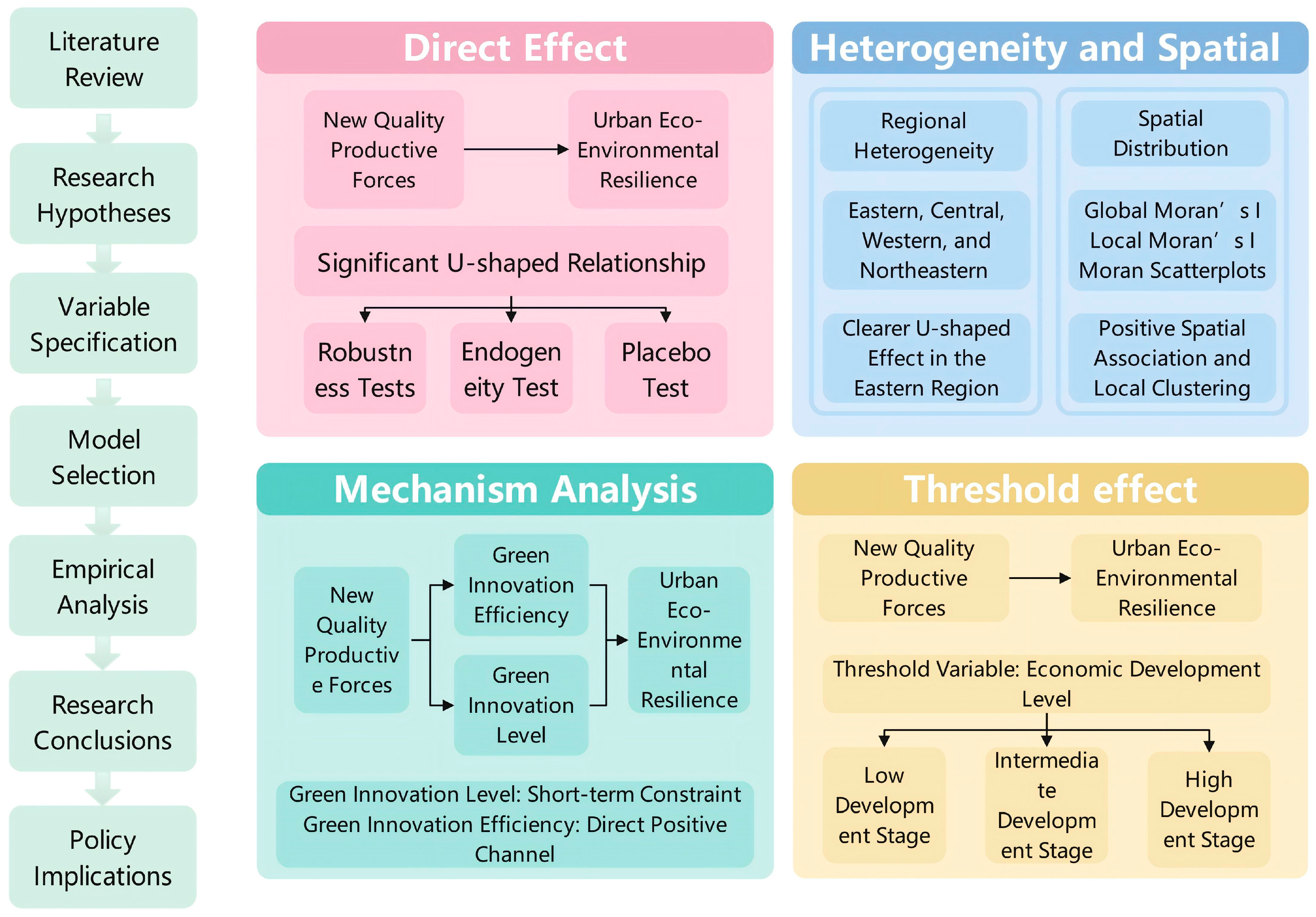
Based on these gaps, this study contributes to the literature in three ways. First, it treats NQPF as an independent productive-force system rather than a proxy for the digital economy or green innovation. Second, it measures UER from resistance, recovery, and adaptive capacities, thereby better reflecting the meaning of ecological resilience. Third, it examines the U-shaped effect of NQPF on UER, distinguishes the mechanisms of GIL and GIE, and further considers economic thresholds, regional heterogeneity, and spatial dependence. The overall research framework is presented in Figure 1.

3. Theoretical Framework and Hypotheses

3.1. Nonlinear Effect of NQPF on UER

NQPF is not a single digital economy, technological innovation, or green innovation variable, but a comprehensive productive-force system composed of new-quality laborers, new-quality means of labor, and new-quality labor objects [22]. Its effect on UER depends on the matching among factor upgrading, industrial structural adjustment, technology application efficiency, and ecological governance capacity [23]. Theoretically, NQPF can improve UER by optimizing resource allocation, promoting industrial upgrading, and enhancing green governance capacity.
However, the effect of NQPF on UER may not be linear. From the perspective of the environmental Kuznets curve, the ecological effect of development-related factors is often stage-dependent: in the early stage, resource input, infrastructure expansion, and industrial adjustment may increase environmental pressure, whereas in the later stage, technological progress and governance improvement can gradually generate ecological benefits [24]. Similarly, the theory of technology–institution fit suggests that new technologies can improve ecological outcomes only when they are matched with appropriate regulatory systems, governance capacity, and market mechanisms [25]. In the initial stage of NQPF development, cities need to invest substantial resources in scientific and technological R&D, digital infrastructure, and industrial upgrading, while green technologies may not yet be mature and institutional systems may not be fully adapted. In addition, the rebound effect may occur when efficiency improvements stimulate further production expansion and resource consumption, thereby temporarily weakening UER. As NQPF continues to develop, technological maturity, institutional adaptability, and urban absorptive capacity gradually improve. Cities become more capable of transforming technological upgrading and factor reallocation into green production efficiency, pollution governance capacity, and ecological recovery capacity [26]. Therefore, the effect of NQPF on UER may shift from short-term inhibition to long-term promotion. Accordingly, the following hypothesis is proposed:
H1. 
There is a U-shaped relationship between NQPF and UER; that is, NQPF may inhibit UER in the early stage, but promote UER after crossing a certain development level.

3.2. Mechanisms of GIL and GIE

Green innovation is an important channel through which NQPF affects UER, but it should not be simply treated as a single technological innovation variable. Green innovation level (GIL) mainly reflects the quantitative expansion of green innovation activities and is measured by green patent applications in this study [27]. NQPF can promote GIL by increasing R&D investment, strengthening digital coordination capacity, and optimizing the allocation of technological factors [28]. However, green patents usually involve a time lag from application to practical use, and patent quantity does not necessarily represent effective green technology transformation [19].
By contrast, green innovation efficiency (GIE) emphasizes the ability to transform green innovation inputs into green outputs. Higher GIE means that cities can obtain more effective green technology outputs with lower resource consumption, thereby improving pollution governance efficiency, resource utilization efficiency, and ecological adaptability [29]. Therefore, GIL may mainly reflect the quantitative accumulation of green innovation, whose ecological effect may be delayed or temporarily constrained, whereas GIE is more likely to serve as an effective mechanism through which NQPF improves UER [30]. Accordingly, the following hypotheses are proposed:
H2a. 
NQPF can promote GIL, but the effect of GIL on UER may be delayed or temporarily inhibitory.
H2b. 
NQPF can improve UER by enhancing GIE.

3.3. Threshold Effect of Economic Development Level

Whether NQPF can be effectively transformed into UER improvement also depends on the level of urban economic development. Cities with weaker economic foundations often face insufficient digital infrastructure, limited technological absorption capacity, inadequate fiscal support, and underdeveloped environmental governance systems [31]. Even if NQPF begins to develop, its ecological effect may be offset by transformation costs, industrial adjustment pressure, and governance capacity constraints, making it difficult to be fully released in the short term [32].
As economic development improves, cities can provide stronger scientific and technological investment, more complete industrial support systems, and more mature environmental governance systems, thereby increasing the efficiency with which NQPF is transformed into UER [12]. This means that economic development may play a conditional supporting role. Only after cities cross a certain economic threshold can technological maturity, industrial upgrading, and governance capacity improvement brought by NQPF be more effectively transformed into UER enhancement [33]. Accordingly, the following hypothesis is proposed:
H3. 
Economic development level has a threshold effect in the relationship between NQPF and UER; as economic development improves, the promoting effect of NQPF on UER gradually strengthens.

3.4. Regional Heterogeneity

Chinese regions differ significantly in economic foundation, industrial structure, innovation resources, digital infrastructure, and environmental governance capacity; therefore, the effect of NQPF on UER may exhibit regional heterogeneity. The eastern region usually has stronger innovation resources, technological absorption capacity, and governance foundations, making it easier to transform NQPF into UER improvement [34]. By contrast, the central, western, and northeastern regions may be constrained by industrial transformation pressure, insufficient technology diffusion, and limited governance resources.
Such regional differences imply that the nonlinear ecological effect of NQPF may not be released simultaneously across all regions. Regions with stronger economic foundations and innovation resources are more likely to overcome early-stage transformation costs and enhance UER through green technology application, industrial structure optimization, and governance efficiency improvement [35]. Meanwhile, considering potential technology diffusion, industrial linkages, and ecological-environmental interactions among cities, this study further employs global Moran’s I and LISA analysis in the empirical section to identify the spatial distribution characteristics of NQPF and UER, but does not directly test causal spatial spillover effects. Accordingly, the following hypothesis is proposed:
H4. 
The effect of NQPF on UER exhibits regional heterogeneity, and its nonlinear effect is more evident in regions with stronger economic foundations and innovation resources.
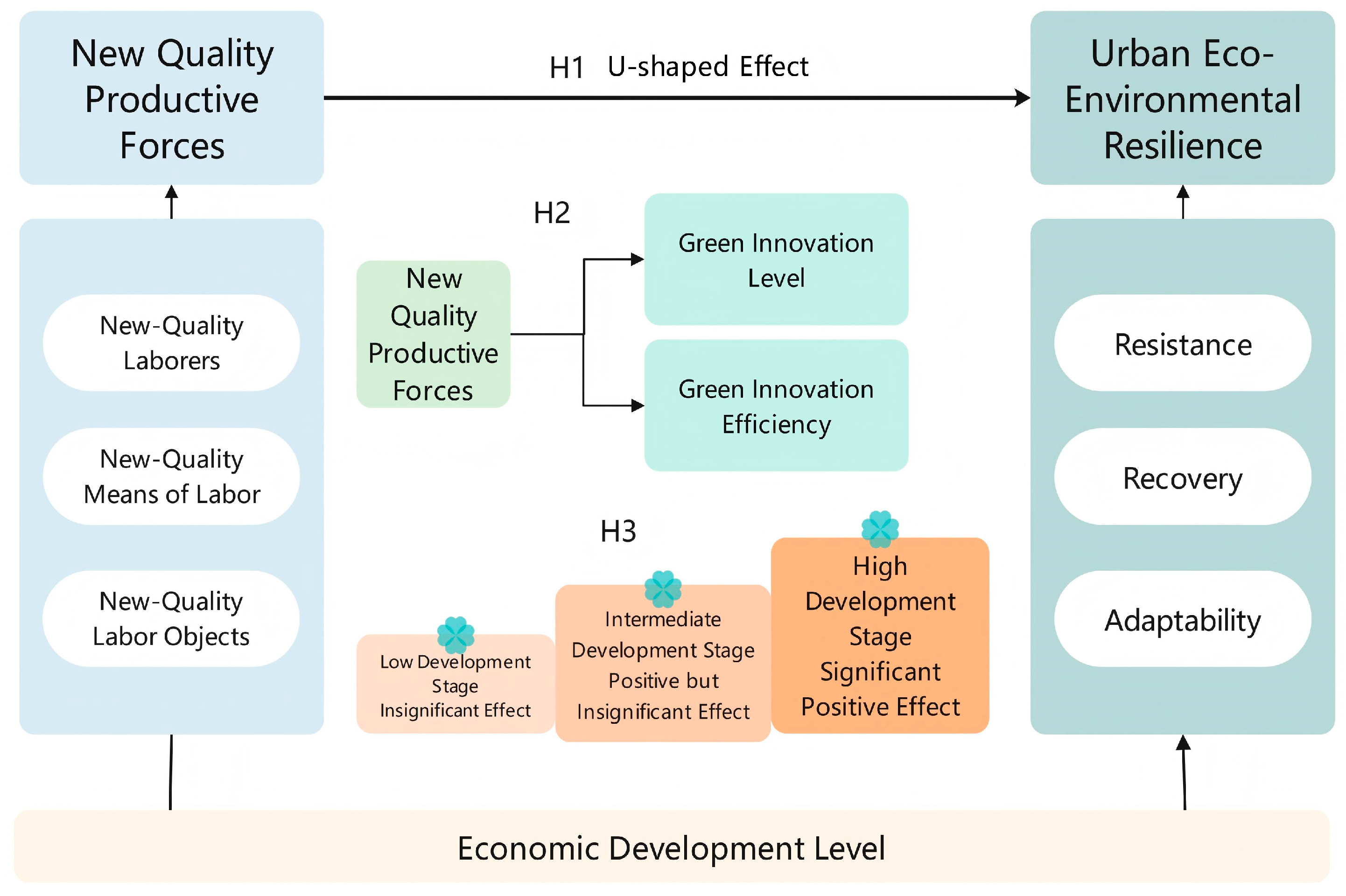
Based on the above theoretical analysis and research hypotheses, this study constructs a theoretical framework, as illustrated in Figure 2.

4. Research Design

4.1. Data Sources

This study uses prefecture-level and above cities in China from 2006 to 2023 as the research sample. Considering data availability, consistency of statistical standards, and changes in administrative divisions, Tibet, Hong Kong, Macao, and Taiwan are excluded, as are cities with substantial missing values in key variables or frequent administrative adjustments. The final sample is a balanced panel covering 260 cities and 4680 observations. In terms of data processing, this study first matches data from different sources by city name, administrative code, and year, and then unifies variable definitions and measurement units. For a small number of missing values at the city-year level, linear interpolation is used when only sporadic values are missing and adjacent-year trends are relatively stable. If missing values appear at the beginning or end of the sample period, adjacent-year information and original statistical materials are jointly checked before completion. Observations with continuous missing values over multiple years or those that cannot be verified are excluded. All missing-value treatment is conducted at the original indicator level before constructing composite indices.
In addition, all price-related variables are converted into constant 2006 prices. To reduce the influence of extreme observations, continuous variables are winsorized at the 1st and 99th percentiles. The main data sources include the China City Statistical Yearbook, China Environmental Statistical Yearbook, provincial and municipal statistical yearbooks and statistical bulletins, as well as the CSMAR and CNRDS databases.

4.2. Model Specification

To verify Hypothesis 1, this study constructs a two-way fixed-effects model to examine the nonlinear effect of NQPF on UER. Considering that the effect of NQPF on UER may not be simply linear, the squared term of NQPF is introduced into the model. The model is specified as follows:
U E R i t = β 0 + β 1 N Q P F i t + j γ j C o n t r o l s i t + μ i + λ t + ε i t
U E R i t = β 0 + β 1 N Q P F i t + β 2 N Q P F i t 2 + j γ j C o n t r o l s i t + μ i + λ t + ε i t
where i and t denote city and year, respectively. U E R i t represents UER, and N Q P F i t denotes the development level of NQPF. C o n t r o l s i t refers to a set of control variables, including urbanization level, population size, government intervention, and industrial structure. μ i and λ t represent city fixed effects and year fixed effects, respectively, while ε i t is the random error term.
Equation (1) is used to examine the benchmark effect of NQPF on UER, while Equation (2) is used to test the nonlinear relationship between the two variables. If β1 < 0 and β2 > 0, and both coefficients are statistically significant, it indicates that NQPF has a U-shaped effect on UER. This means that NQPF may inhibit UER in the early stage but promote UER after crossing a certain development level. In addition, this study calculates the turning point and applies the Lind–Mehlum U-test to further examine whether the U-shaped relationship is statistically valid and practically meaningful.
To verify Hypothesis 2a, this study examines whether NQPF can promote GIL and whether the effect of GIL on UER is delayed or temporarily inhibitory. GIL mainly reflects the quantitative expansion of green innovation activities. However, green patent applications usually involve a time lag from application to practical use, and patent quantity does not necessarily represent effective green technology transformation. Therefore, the following models are constructed:
G I L i t = α 0 + α 1 N Q P F i t + α 2 N Q P F i t 2 + j γ j C o n t r o l s i t + μ i + λ t + ε i t
U E R i t = δ 0 + δ 1 N Q P F i t + δ 2 N Q P F i t 2 + δ 3 G I L i t + j γ j C o n t r o l s i t + μ i + λ t + ε i t
where G I L i t denotes GIL. Equation (3) is used to test whether NQPF promotes GIL. If α 1 or α 2 is statistically significant, it indicates that NQPF has a significant effect on GIL. Equation (4) further examines the effect of GIL on UER after controlling for NQPF and its squared term. If G I L i t has a negative or insignificant coefficient, it suggests that the ecological effect of GIL may be delayed or temporarily constrained, which is consistent with Hypothesis 2a.
To verify Hypothesis 2b, this study further examines whether NQPF improves UER by enhancing GIE. Compared with GIL, GIE places greater emphasis on the ability to transform green innovation inputs into green innovation outputs. Therefore, GIE can better reflect the practical transformation efficiency of green technologies. The models are specified as follows:
G I E i t = η 0 + η 1 N Q P F i t + η 2 N Q P F i t 2 + j γ j C o n t r o l s i t + μ i + λ t + ε i t
U E R i t = ϕ 0 + ϕ 1 N Q P F i t + ϕ 2 N Q P F i t 2 + ϕ 3 G I E i t + j γ j C o n t r o l s i t + μ i + λ t + ε i t
where G I E i t denotes GIE. Equation (5) is used to examine whether NQPF improves GIE, while Equation (6) is used to test whether GIE contributes to UER after controlling for NQPF and its squared term. If the coefficient of G I E i t is significantly positive, it indicates that GIE serves as an effective mechanism through which NQPF improves UER, thereby supporting Hypothesis 2b.
To verify Hypothesis 3, this study constructs a threshold model to examine whether the effect of NQPF on UER varies across different levels of economic development. Economic development level is selected as the threshold variable. The model is specified as follows:
U E R i t =   θ 0 + θ 1 N Q P F i t I ( L N P G D P i t γ 1 ) +   θ 2 N Q P F i t I ( γ 1 < L N P G D P i t γ 2 ) +   θ 3 N Q P F i t I ( L N P G D P i t > γ 2 ) +   j γ j C o n t r o l s i t + μ i + λ t + ε i t
where L N P G D P i t represents the economic development level, measured by the logarithm of per capita GDP. I(·) is the indicator function, and γ 1 and γ 2 are the estimated threshold values. The coefficients θ 1 , θ 2 , and θ 3 capture the marginal effects of NQPF on UER at different economic development stages. If the coefficients differ significantly across threshold intervals and the promoting effect of NQPF becomes stronger as LNPGDP increases, it indicates that economic development plays a threshold role in the relationship between NQPF and UER, thereby supporting Hypothesis 3.
To verify Hypothesis 4, this study conducts regional heterogeneity analysis by dividing the sample into eastern, central, western, and northeastern regions. The following regional subsample model is constructed:
U E R i t r = ρ 0 r + ρ 1 r N Q P F i t r + ρ 2 r ( N Q P F i t r ) 2 + j γ j r C o n t r o l s i t r + μ i + λ t + ε i t r
where r denotes different regions, including the eastern, central, western, and northeastern regions. The coefficients ρ 1 r and ρ 2 r are used to compare the regional differences in the nonlinear effect of NQPF on UER. If the signs, magnitudes, or significance levels of these coefficients differ across regions, it indicates that the effect of NQPF on UER exhibits regional heterogeneity. In particular, if the U-shaped relationship is more significant in regions with stronger economic foundations and innovation resources, Hypothesis 4 is supported.

4.3. Variable Definition

4.3.1. Dependent Variable

This study defines UER as the capacity of an urban ecosystem to resist, recover from, and adapt to environmental pressures, disaster shocks, and governance challenges. Consistent with the multidimensional resilience frameworks proposed by Lin et al. (2022) [36] and Wang et al. (2024) [37], UER is conceptualized as a composite urban ecological capacity rather than being equated with environmental governance performance alone. Accordingly, this study constructs the UER evaluation indicator system from three dimensions: resistance capacity, recovery capacity, and adaptive capacity.
Among them, resistance capacity mainly reflects the ability of urban ecosystems to withstand pollution pressure, including indicators such as industrial wastewater, industrial SO2, industrial smoke and dust, industrial solid waste, and PM2.5. Recovery capacity mainly reflects the ability of cities to restore ecological functions and infrastructure carrying capacity after ecological shocks, including green coverage rate in built-up areas, per capita park green space, per capita water resources, drainage pipeline density, direct economic losses caused by natural or ecological disasters, and the proportion of affected population. Adaptive capacity mainly captures the long-term adjustment capacity of urban environmental governance and public service systems, including sewage treatment, harmless treatment of domestic waste, comprehensive utilization of industrial solid waste, sewage treatment capacity, and environmental governance investment. After standardizing all indicators, the entropy weight method is used to calculate the city-level UER composite index. The detailed selection of indicators is presented in Table 1.

4.3.2. Independent Variable

This study defines NQPF as an advanced form of productive forces characterized by the coordinated evolution of new-quality laborers, new-quality means of labor, and new-quality labor objects. In this sense, NQPF is not equivalent to a single digital economy or green innovation indicator but represents a systematic upgrading of production factors and production conditions, including labor quality, scientific and technological investment, digital infrastructure, energy structure, technology market activity, and industrial carriers. Accordingly, drawing on the three-factor framework of productive forces and the NQPF measurement approach of Guan et al. (2025) [38] and Liu et al. (2026) [39], this study constructs a comprehensive NQPF evaluation indicator system from three dimensions: new-quality laborers, new-quality means of labor, and new-quality labor objects.
Specifically, the dimension of new-quality laborers reflects human capital, scientific and technological talent supply, and labor age structure; the dimension of new-quality means of labor captures technological investment, digital infrastructure, energy use, and technology market activity; and the dimension of new-quality labor objects reflects high-tech industries, strategic emerging industries, producer services, and industrial labor productivity. To avoid conceptual overlap with the UER indicator system, this study does not include indicators that directly reflect ecological and environmental outcomes, such as pollution control investment and pollution treatment performance, in the NQPF system. After standardizing all indicators, the entropy weight method is used to determine their weights and calculate the city-level NQPF composite index. The detailed selection of indicators is presented in Table 2.

4.3.3. Mechanism Variable

To examine the transmission mechanism through which NQPF influences UER, this study draws on the research approach of Yao et al. (2020) [40] for measuring urban innovation and the related practice of Liao et al. (2022) [41] on green innovation efficiency, and selects green innovation level (GIL) and green innovation efficiency (GIE) as the mechanism variables. GIL mainly reflects the quantitative expansion of urban green innovation activities and is measured by the logarithm of the number of green patent applications plus one. GIL can capture the activity of green technology R&D in cities; however, green patents usually involve a time lag from application to practical use, and an increase in patent quantity does not necessarily mean that green technologies can be immediately transformed into ecological governance performance.
Furthermore, this study introduces GIE to reflect the efficiency with which green innovation inputs are transformed into green innovation outputs. Compared with GIL, GIE places greater emphasis on green technology transformation efficiency, resource allocation efficiency, and pollution governance efficiency, and can more directly capture the actual contribution of green innovation to UER. Therefore, this study incorporates both GIL and GIE into the mechanism analysis to distinguish between the “quantity expansion effect” and the “efficiency improvement effect” of green innovation.

4.3.4. Threshold Variable

To further examine whether the effect of NQPF on UER varies across different stages of urban economic development, this study follows the panel threshold model approach of Hansen (1999) [42] and selects economic development level as the threshold variable, measured by the logarithm of GDP per capita (LNPGDP). The level of economic development not only reflects a city’s economic foundation and resource endowment, but also, to a certain extent, indicates its technological absorption capacity, fiscal support capacity, industrial carrying capacity, and public governance capacity, thereby potentially imposing important constraints on the ecological effect of NQPF.

4.3.5. Control Variables

The evolution of UER is affected by multiple factors. To minimize omitted variable bias and improve the reliability of model estimation, this study selects the following variables as control variables. First, urbanization level (URB) is measured by the proportion of urban resident population to total resident population at year-end. The process of urbanization affects UER through population agglomeration, infrastructure expansion, changes in spatial development intensity, and increasing ecological governance demand. Second, population size (LNPOP) is measured by the logarithm of the resident population at year-end, in order to control for resource and environmental pressure as well as scale effects caused by population agglomeration. Third, government intervention (LNGOV) is measured by the logarithm of the ratio of local general public budget expenditure to GDP, reflecting the intensity of local governments’ roles in resource allocation, ecological governance, and public service provision. Fourth, industrial structure (IND) is measured by the share of value added of the secondary industry in GDP, in order to control for the influence of industrial structure characteristics on UER. The detailed definitions and measurement methods of the above variables are presented in Table 3.

5. Empirical Results and Analysis

5.1. Descriptive Statistics

Table 4 reports the descriptive statistics of the main variables. The mean value of UER is 0.2167, with a standard deviation of 0.0770, and the minimum and maximum values are 0.0254 and 0.5041, respectively, indicating certain differences in ecological resilience across sample cities. The mean value of NQPF is 1.1185, with a standard deviation of 0.5846, ranging from 0.0535 to 2.0764, suggesting obvious heterogeneity in the development level of NQPF among different cities. In terms of mechanism variables, the mean value of GIE is 0.0151, while the mean value of GIL is 4.6992, and both show relatively large dispersion, providing a data basis for the subsequent mechanism tests. Overall, the value ranges of the variables are reasonable and can support the subsequent empirical analysis.

5.2. Robustness Checks

Table 5 reports the baseline regression results for the effect of NQPF on UER. Since UER may be simultaneously affected by city-specific characteristics and macro-level yearly shocks, all models control for city fixed effects and year fixed effects, and control variables are introduced step by step to examine the stability of the results. Column (1) includes only the linear term of NQPF, whose coefficient is negative but statistically insignificant, indicating that the relationship between NQPF and UER is not simply linear. After NQPF2 is further introduced in Column (2), the coefficient of the linear term of NQPF is significantly negative, whereas the coefficient of NQPF2 is significantly positive, providing preliminary evidence of a U-shaped relationship between the two variables. As control variables such as URB, LNPOP, LNGOV, and IND are gradually included, the signs of the coefficients of NQPF and NQPF2 remain consistent. In the full model shown in Column (6), the coefficient of NQPF is −0.0062 and significant at the 5% level, while the coefficient of NQPF2 is 0.0040 and significant at the 10% level. This indicates that after controlling for city characteristics, yearly shocks, and relevant influencing factors, NQPF still exerts a significant nonlinear effect on UER.
To further verify the validity of the U-shaped relationship, this study calculates the turning point and marginal effects and conducts the Lind–Mehlum U-test. Table 6 shows that the sample range of NQPF is from 0.0535 to 2.0764, and the estimated turning point is 0.7761, which lies within the sample range, indicating that the U-shaped relationship has practical explanatory significance. In terms of sample distribution, 1322 observations are located below the turning point, accounting for 28.24%, while 3358 observations are located above the turning point, accounting for 71.75%. Meanwhile, the marginal effect of NQPF at the lower bound of the sample is −0.0058 and significant at the 5% level, while the marginal effect at the upper bound is 0.0104 and also significant at the 5% level. The p-value of the Lind–Mehlum U-test is 0.0458, further supporting the existence of a significant U-shaped relationship between NQPF and UER. This result indicates that in the early stage of NQPF development, technological investment, infrastructure construction, industrial adjustment, and factor reallocation may generate relatively high transformation costs and impose short-term pressure on UER; however, once NQPF crosses a certain critical level, improvements in technological maturity, the diffusion of green production modes, and enhanced governance capacity gradually take effect, thereby promoting UER.

5.3. Robustness Tests

To further examine the reliability of the baseline regression results, this study conducts robustness tests from several perspectives, including sample treatment, variable treatment, dynamic specification, and placebo testing. Specifically, the model is re-estimated by deleting outliers, applying 1–99% winsorization, applying 5–95% winsorization to the core variables, using the one-period lag of the core explanatory variable, adding city-specific linear trends, and employing the System-GMM method. The results are reported in Table 7.

5.3.1. Deleting Outliers

First, to avoid the interference of abnormal observations with the estimation results, this study re-estimates the model after deleting outliers from the sample. Column (1) of Table 7 shows that the coefficient of the linear term of NQPF is −0.0035 and significant at the 10% level, while the coefficient of NQPF2 is 0.0030 and significant at the 5% level. This result indicates that, after deleting outliers, the effect of NQPF on UER still follows a U-shaped pattern of initial inhibition followed by promotion, suggesting that the baseline conclusion is not driven by a few abnormal observations.

5.3.2. 1–99% Winsorization

Second, considering that extreme values may affect the stability of regression estimates, this study winsorizes continuous variables at the 1st and 99th percentiles. The results in Column (2) show that the coefficient of the linear term of NQPF remains negative, while that of NQPF2 remains positive, and both pass the significance tests. This further indicates that the U-shaped relationship between NQPF and UER does not depend on the treatment of extreme values, and the baseline regression results are robust.

5.3.3. 5–95% Winsorization of Core Variables

Furthermore, this study applies a stricter 5–95% winsorization to the core variables. Column (3) shows that the coefficient of NQPF is −0.0058 and significant at the 5% level, while the coefficient of NQPF2 is 0.0035 and significant at the 10% level. The corresponding turning point is 0.8132, which remains within the sample range. This result suggests that the nonlinear effect of NQPF on UER still holds even after the influence of extreme values is more strictly controlled.

5.3.4. One-Period Lag of the Core Explanatory Variable

Considering that the effect of NQPF on UER may have a time lag, this study further uses the one-period lag of NQPF and its squared term for regression. Column (4) shows that the coefficient of the lagged NQPF is −0.0065 and significant at the 5% level, while the coefficient of its squared term is 0.0049 and significant at the 5% level. This result indicates that the effect of NQPF on UER is not merely a contemporaneous correlation but also exhibits certain persistence and lagged effects.

5.3.5. City-Specific Linear Trends

Since cities differ persistently in industrial foundations, resource endowments, and ecological governance capacity, this study further adds city-specific linear trends to control for potential time-varying development paths at the city level. Column (5) shows that the linear term of NQPF remains negative and NQPF2 remains positive, although their significance declines. This suggests that, after controlling for long-term city trends, the signs of the core variables remain consistent with the baseline model, indicating directional stability in the U-shaped relationship between NQPF and UER.

5.3.6. System-GMM Estimation

To alleviate potential dynamic endogeneity and reverse causality concerns, this study further employs the System-GMM method for estimation. Column (6) shows that the coefficient of lagged UER is 0.8921 and significant at the 1% level, indicating strong dynamic persistence in UER. Meanwhile, the coefficient of NQPF2 is 0.0126 and significant at the 5% level, further supporting the nonlinear effect of NQPF on UER. The diagnostic results show that the AR(1) test is significant, the AR(2) test is insignificant, and the Hansen test has a p-value of 0.7389, indicating that the instrumental variable setting is generally valid and that there is no evident second-order serial correlation. Therefore, after considering dynamic effects and potential endogeneity, the core conclusion remains reliable.

5.3.7. Placebo Test

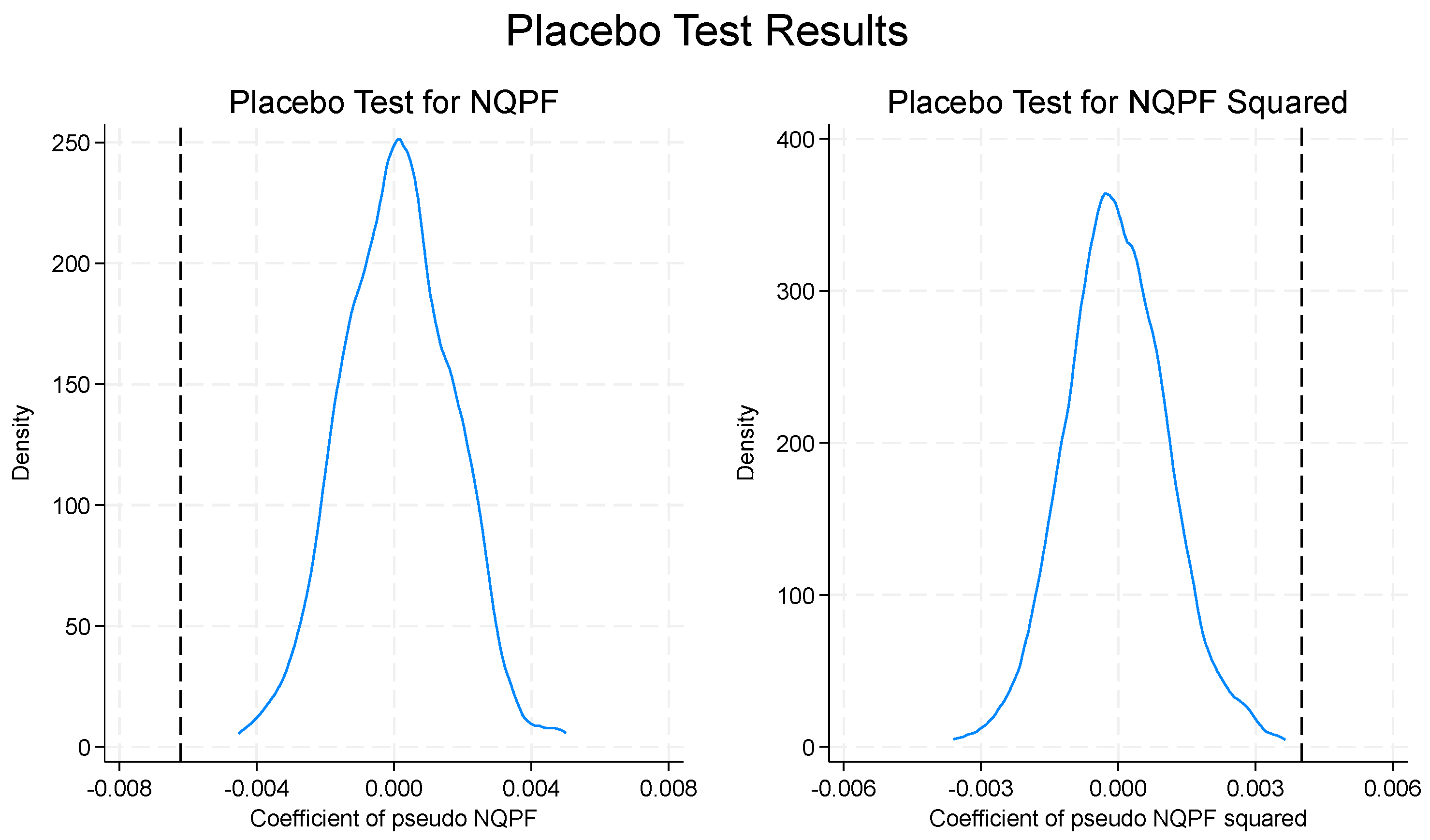
To further exclude the influence of random factors or omitted shocks on the estimation results, this study conducts a placebo test. Specifically, pseudo NQPF and its squared term are randomly generated, and the regression estimation is repeated. Figure 3 shows that the estimated coefficients of pseudo NQPF and pseudo NQPF2 are mainly concentrated around zero, while the actual estimates are located in the tail regions of the random distributions. This indicates that the baseline regression results are not caused by random assignment or accidental factors, further enhancing the credibility of the conclusion that NQPF affects UER.
Overall, the above robustness tests verify the baseline conclusion from multiple perspectives, including outlier treatment, winsorization, lagged effects, long-term city trends, dynamic panel modeling, and randomization testing. Although the significance of some coefficients declines after adding city-specific linear trends, the signs of the core variables remain generally consistent, and most tests support the U-shaped effect of NQPF on UER. Therefore, the conclusion regarding the nonlinear relationship between NQPF and UER is robust.

5.4. Mechanism Analysis

To further examine the transmission channels through which NQPF affects UER, this study conducts mechanism tests from the perspectives of green innovation level and green innovation efficiency. Specifically, GIL denotes the green innovation level and is represented by green patent applications, while GIE denotes green innovation efficiency and reflects the efficiency of transforming green innovation inputs into green innovation outputs. Unlike studies that treat technological innovation as a single mechanism variable, this study distinguishes between the quantity expansion and efficiency improvement of green innovation to more accurately identify the pathways through which NQPF affects UER.
Table 8 reports the results of the mechanism tests. Column (1) shows that the coefficient of NQPF on GIL is 0.1124 and significant at the 1% level, indicating that NQPF significantly improves the urban green innovation level. After GIL is further included in the UER equation, Column (2) shows that its coefficient is −0.0016 and significant at the 10% level. This indicates that the quantitative expansion of green innovation does not directly translate into UER improvement in the short term, possibly because green patents involve a time lag from application to practical use, while early-stage innovation is accompanied by R&D investment, resource reallocation, and industrial adjustment costs, thereby generating a temporary inhibitory effect on UER.
Columns (3) and (4) further examine the role of GIE. The results show that NQPF significantly improves GIE, with a coefficient of 0.0025 at the 1% significance level; meanwhile, the coefficient of GIE on UER is 0.0799 and significant at the 5% level, indicating that improved green innovation efficiency can effectively enhance UER. Column (5) uses the one-period lag of GIE for testing, and its coefficient remains positive and significant at the 10% level, suggesting that the promoting effect of GIE on UER has certain persistence. Overall, NQPF can promote both GIL and GIE, but their ecological effects differ. GIL mainly reflects the quantitative accumulation of green innovation, whose effect is constrained by transformation lags; by contrast, GIE more directly reflects green technology application efficiency and resource allocation efficiency, making it a more effective pathway through which NQPF improves UER.

5.5. Threshold Effect Analysis

To further examine whether the effect of NQPF on UER varies across different stages of urban economic development, this study uses LNPGDP as the threshold variable for the panel threshold test. Table 9 shows that both the single-threshold and double-threshold tests are statistically significant, whereas the triple-threshold test is insignificant, indicating a significant double-threshold effect on the impact of NQPF on UER. Further estimation results show that the two threshold values are 11.2690 and 11.6135, both of which fall within their corresponding confidence intervals, suggesting that the threshold estimates are statistically valid.
According to the threshold existence test, the double-threshold model is statistically valid, while the triple-threshold model is not significant. Therefore, this study further estimates the threshold values under the double-threshold specification. As shown in Table 10, the estimated thresholds of LNPGDP are 11.2690 and 11.6135, and both threshold values fall within their corresponding 95% confidence intervals. This indicates that the threshold estimates are reliable and that the sample can be divided into three economic development stages: a low stage where LNPGDP is no higher than 11.2690, an intermediate stage where LNPGDP lies between 11.2690 and 11.6135, and a high stage where LNPGDP exceeds 11.6135.
Based on the estimated threshold values, this study further examines the effect of NQPF on UER across different economic development stages. The results are reported in Table 11. When LNPGDP is no higher than 11.2690, the coefficient of NQPF is −0.0021 and statistically insignificant. When LNPGDP lies between 11.2690 and 11.6135, the coefficient turns positive at 0.0031 but remains insignificant. When LNPGDP exceeds 11.6135, the coefficient increases to 0.0085 and is significant at the 1% level. This indicates that the positive effect of NQPF on UER is not fully released in low- and intermediate-development stages but becomes significant only after cities reach a relatively high level of economic development.

5.6. Heterogeneity Analysis

5.6.1. Stage-Specific Analysis Based on Economic Development Level

To further verify the stage-specific implications of the threshold effect, this study divides the sample into low, intermediate, and high economic development stages according to the estimated LNPGDP thresholds and separately examines the nonlinear effect of NQPF on UER. The results in Table 12 show that, in the low and intermediate economic development stages, neither NQPF nor its squared term passes the significance test, indicating that when the urban economic foundation is relatively weak, the effect of NQPF on UER has not yet formed a stable nonlinear pattern. In contrast, in the high economic development stage, the coefficient of the linear term of NQPF is −0.0265 and significant at the 5% level, while the coefficient of NQPF2 is 0.0114 and significant at the 10% level, indicating a clearer U-shaped relationship in the high economic development stage.
This result is consistent with the previous threshold effect analysis. In other words, the effect of NQPF on UER is not fully released at all development stages, but depends on the joint support of economic foundation, technological maturity, and environmental governance capacity. Once cities enter a higher stage of economic development, their digital infrastructure, innovation resources, and fiscal support capacity become more developed, enabling NQPF to overcome early-stage transformation costs more easily and enhance UER through green technology application, industrial structure optimization, and governance efficiency improvement.

5.6.2. Regional Heterogeneity Analysis

Considering the obvious differences across Chinese regions in economic foundation, industrial structure, innovation resources, and ecological governance capacity, this study further divides the sample into eastern, central, western, and northeastern regions to examine the regional heterogeneity in the effect of NQPF on UER. The results in Table 13 show that, in the eastern region, the coefficient of the linear term of NQPF is −0.0098 and significant at the 10% level, while the coefficient of NQPF2 is 0.0071 and significant at the 5% level, indicating a relatively clear U-shaped relationship in the eastern region. In contrast, the linear terms of NQPF in the central and northeastern regions are negative, and the quadratic terms are positive, but none of them pass the significance tests; in the western region, the coefficient signs are inconsistent with a U-shaped relationship and are also insignificant.
This difference may be related to regional development stages. The eastern region has a stronger economic foundation and more developed innovation resources, digital infrastructure, and environmental governance systems, making it easier to overcome the adjustment costs in the early stage of NQPF development and transform technological progress and industrial upgrading into UER improvement. The central, northeastern, and western regions may be constrained by industrial transformation pressure, insufficient technological absorption capacity, and limited governance resources, preventing the ecological resilience effect of NQPF from being stably released. Therefore, future policies should avoid a one-size-fits-all approach and instead provide differentiated support according to each region’s development foundation and transformation stage.

5.7. Spatial Dependence Analysis

5.7.1. Global Spatial Autocorrelation

To examine the spatial distribution characteristics of NQPF and UER, this study calculates the global Moran’s I values for 2006, 2010, 2015, 2020, and 2023. The spatial weight matrix is constructed based on the geographical distance between sample cities. Specifically, an inverse-distance spatial weight matrix is used, where the spatial weight between city i and city j is defined as W i j = 1 / d i j for f o r   i j , and W i i = 0 . To reduce the influence of differences in distance scales across cities, the spatial weight matrix is row-standardized so that the sum of each row equals one. The statistical significance of the global Moran’s I values is assessed using permutation tests based on 999 random permutations.
As shown in Table 14, the Moran’s I values of NQPF are positive in all selected years, indicating a certain degree of positive spatial association. However, this association is significant only in 2006, 2020, and 2023, suggesting that the spatial clustering of NQPF fluctuates over time and becomes more evident in the later period. In contrast, the Moran’s I values of UER are positive and significant in all selected years, indicating that UER has a more stable spatial dependence pattern. Overall, both NQPF and UER are not randomly distributed across space, and spatial linkages should be considered when analyzing their relationship.

5.7.2. Local Spatial Association Analysis

To further identify local spatial clustering patterns, this study employs local Moran’s I and conducts LISA cluster analysis. Based on the standardized value of each city and the spatial lag of neighboring cities, the local spatial association patterns are divided into four types: High–High, Low–Low, High–Low, and Low–High. High–High and Low–Low indicate positive local clustering, while High–Low and Low–High reflect spatial heterogeneity between a city and its neighboring cities. Cities that do not pass the significance test are classified as not significant.
Table 15 reports the LISA clustering results of NQPF and UER in 2006, 2015, and 2023. For NQPF, the number of High–High clusters increase from 61 in 2006 to 66 in 2023, while Low–Low clusters decrease from 70 to 39. This suggests that low-level NQPF clustering weakens over time, whereas relatively high-level agglomeration becomes more evident. For UER, High–High clusters decrease from 124 to 78, while Low–Low clusters remain relatively stable. This indicates that UER maintains a stable local spatial dependence pattern, although the concentration of high-level UER cities weakens somewhat over time. These results further confirm that both NQPF and UER exhibit local spatial association rather than random spatial distribution.

5.7.3. Moran Scatterplot Analysis

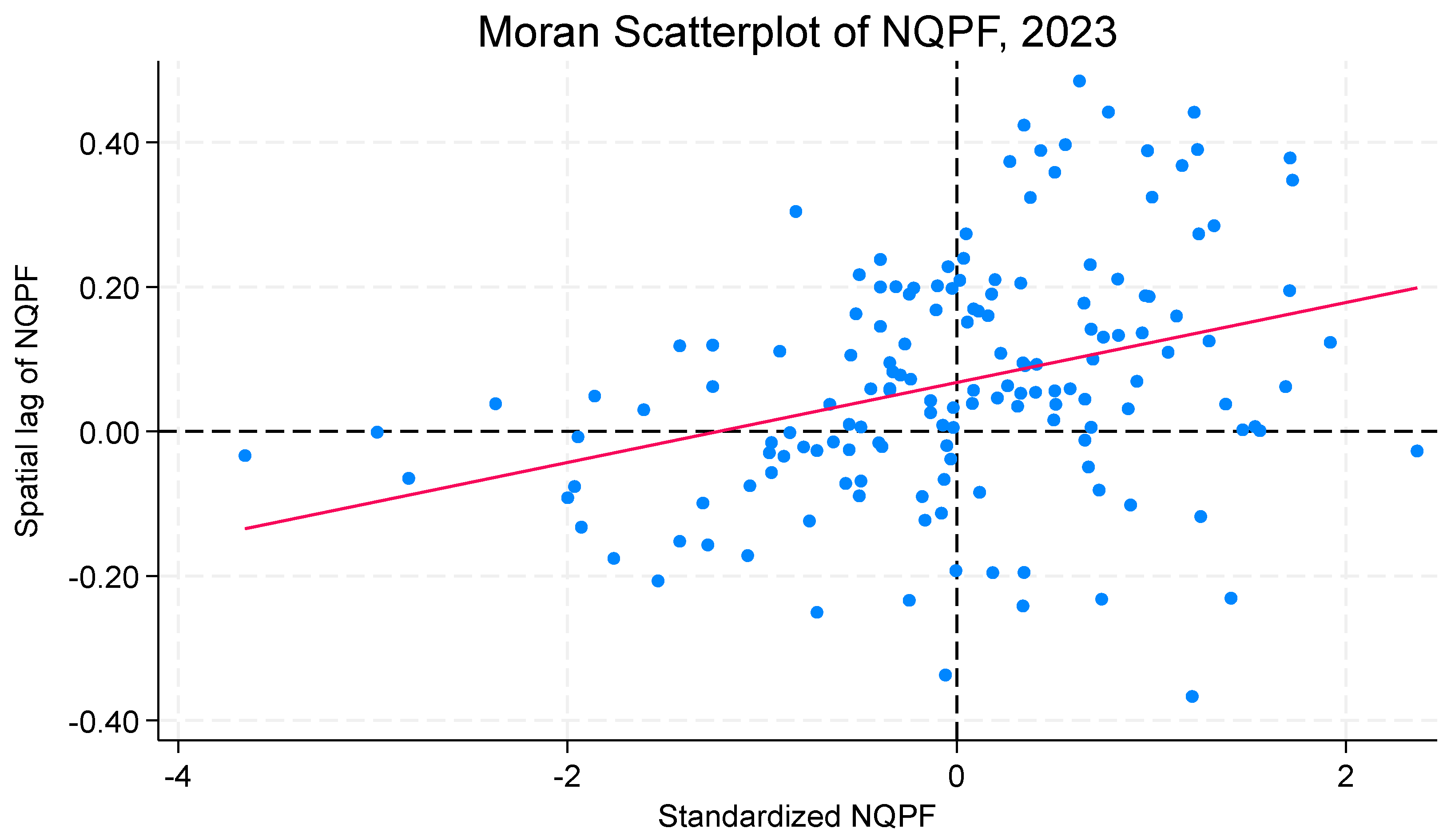
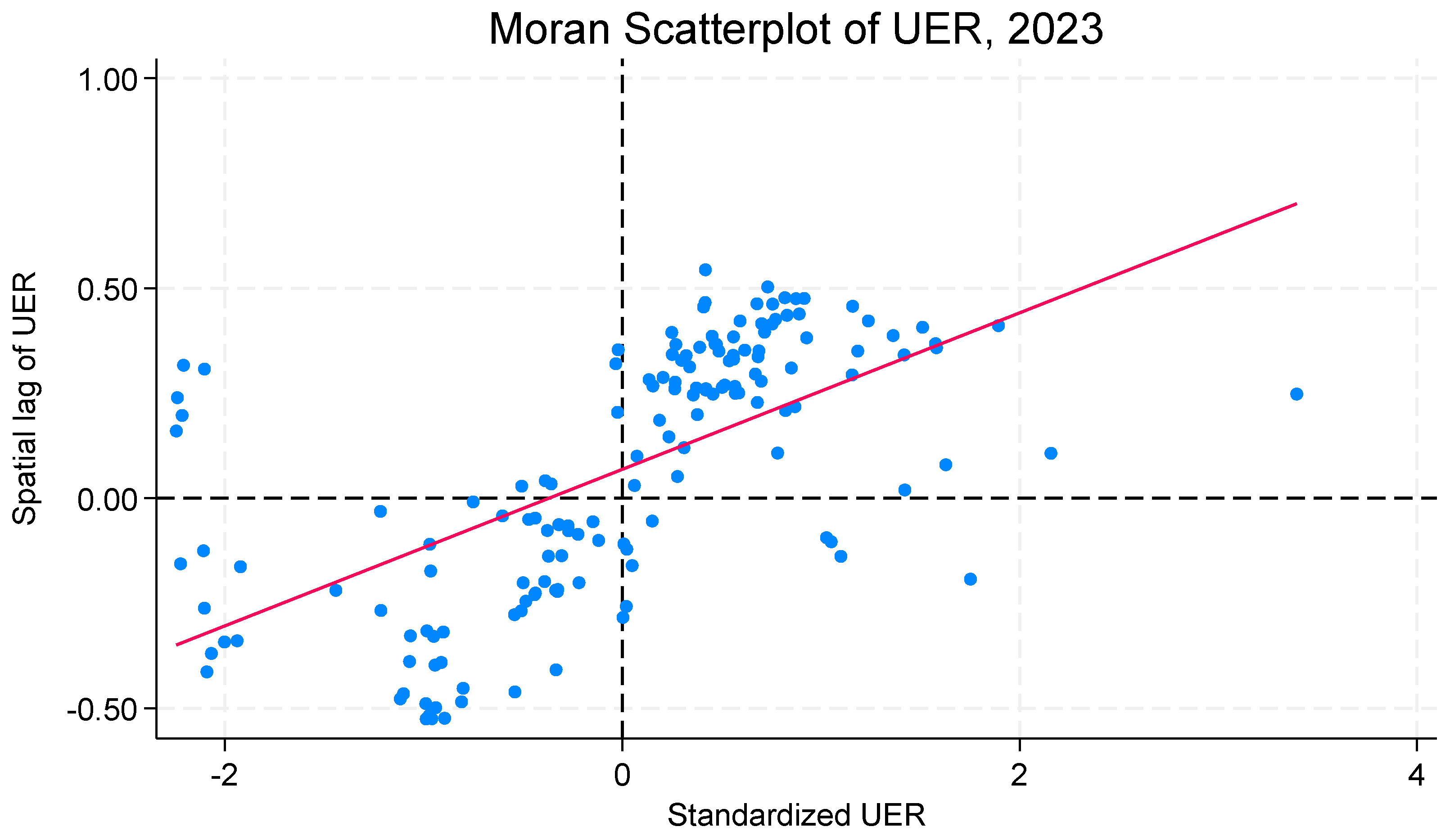
To visualize the spatial association patterns, this study further draws Moran scatterplots of NQPF and UER in 2023. In the scatterplots, the horizontal axis represents the standardized value of the variable itself, while the vertical axis represents its spatial lag. The slope of the fitted line corresponds to the global Moran’s I value and reflects the direction of spatial autocorrelation.
Figure 4 and Figure 5 show that the fitted lines of both NQPF and UER have positive slopes, which is consistent with the global Moran’s I results. Specifically, the Moran’s I value of NQPF in 2023 is 0.0553, indicating a significant but relatively weak positive spatial association. The Moran’s I value of UER is 0.1864, suggesting a stronger spatial dependence pattern. These findings indicate that the development of NQPF and the improvement of UER are spatially associated with neighboring cities. However, Moran’s I and LISA mainly reveal spatial distribution characteristics and cannot directly identify causal spatial spillover effects. Future research may further use spatial econometric models to examine such spillover mechanisms.

6. Conclusions

6.1. Research Findings

Using balanced panel data from 260 Chinese cities from 2006 to 2023, this study constructs an NQPF index based on the three-element framework of new-quality laborers, new-quality means of labor, and new-quality labor objects, and measures UER from the dimensions of resistance capacity, recovery capacity, and adaptive capacity. On this basis, this study examines the nonlinear effects of NQPF on UER, the mechanisms of GIL and GIE, and the threshold effects of economic development, regional heterogeneity, and spatial dependence.
First, NQPF has a significant U-shaped effect on UER. In the early stage of NQPF development, R&D investment, infrastructure expansion, industrial adjustment, and factor reallocation may increase transformation costs and exert short-term pressure on UER. However, after NQPF crosses the turning point, technological maturity, green production diffusion, and improved governance capacity gradually release ecological benefits. The estimated turning point is 0.7761, and 1322 observations are below the turning point while 3358 observations are above it, indicating that the nonlinear relationship has practical significance.
Second, the mechanism analysis shows that NQPF affects UER through both GIL and GIE, but their roles differ. NQPF significantly promotes GIL, but the short-term effect of GIL on UER is negative, suggesting that the expansion of green patent quantity does not immediately translate into ecological resilience improvement. This may be related to R&D costs, technology transformation lags, and insufficient patent application quality. By contrast, GIE has a significantly positive effect on UER, indicating that improving green innovation efficiency is more effective than merely increasing green innovation output.
Third, the threshold and heterogeneity results show that the ecological effect of NQPF depends on economic development stages and regional conditions. The threshold model indicates that the promoting effect of NQPF on UER becomes significant only when economic development exceeds the second threshold. This suggests that sufficient economic foundation, technological absorptive capacity, fiscal support, and governance capacity are necessary for transforming NQPF into UER improvement. The regional heterogeneity results further show that the U-shaped relationship is more evident in eastern China, while the evidence is weaker in central, western, and northeastern regions.
Fourth, the spatial analysis shows that both NQPF and UER exhibit spatial dependence and local clustering. The global Moran’s I results indicate positive spatial autocorrelation, and the LISA results further reveal local clustering patterns. This suggests that the development of NQPF and the improvement of UER are not isolated city-level phenomena but are associated with regional linkages and neighboring cities’ development conditions.

6.2. Policy Implications

Based on the above findings, this study proposes the following policy implications.
First, policies should be designed according to the nonlinear stage of NQPF development. The empirical results show that NQPF has a U-shaped effect on UER, with a turning point of 0.7761. For cities that have not yet crossed this turning point, the priority should not be the rapid expansion of NQPF alone, but the reduction in transformation costs. These cities should improve digital and green infrastructure, strengthen talent support, enhance industrial absorption capacity, and reduce resource misallocation during the early stage of transformation. For cities that have crossed the turning point, policy efforts should focus on accelerating green technology diffusion, improving industrial-chain coordination, and strengthening ecological governance institutions so that the ecological benefits of NQPF can be continuously released.
Second, green innovation policies should shift from quantity expansion to efficiency improvement. The mechanism analysis shows that NQPF significantly promotes GIL, but GIL does not immediately improve UER in the short term, while GIE has a more direct positive effect on UER. Therefore, local governments should avoid evaluating green innovation performance only by the number of green patents. More attention should be paid to green patent commercialization, green technology application, pollution reduction performance, and innovation input–output efficiency. This can help shorten the lag between green innovation activities and ecological resilience improvement.
Third, phased policy arrangements should be formulated according to the economic development thresholds. The threshold results show that the positive effect of NQPF on UER becomes significant only after economic development exceeds the second threshold. Therefore, cities with lower economic development levels should first improve basic infrastructure, fiscal support capacity, talent reserves, and ecological governance foundations. Cities in the intermediate stage should strengthen technological absorptive capacity and green industrial supporting systems. Cities with higher economic development levels should focus on advanced green technologies, institutional innovation, and regional demonstration effects while also preventing possible rebound effects caused by excessive scale expansion.
Fourth, regional and spatial coordination should be strengthened. The heterogeneity results show that the U-shaped effect of NQPF on UER is more evident in the eastern region, while the central, western, and northeastern regions show weaker effects. Therefore, the eastern region should further play a leading role in green technology diffusion, industrial upgrading, and ecological governance innovation. Central, western, and northeastern regions need more targeted support in digital infrastructure, green finance, talent agglomeration, and ecological restoration capacity. In addition, the Moran’s I and LISA results show that NQPF and UER have spatial clustering characteristics. Therefore, cross-city cooperation, regional environmental governance platforms, and intercity technology-sharing mechanisms should be strengthened to promote coordinated improvements in UER.

6.3. Limitations and Future Research

This study still has several limitations. First, although the UER indicator system incorporates resistance, recovery, and adaptive capacities, as well as indicators such as disaster losses and affected population, city-level statistical data still cannot fully capture the micro-level recovery process of urban ecosystems after ecological shocks. Second, although this study uses global Moran’s I and LISA analysis to reveal the spatial dependence and local clustering characteristics of NQPF and UER, it does not directly estimate causal spatial spillover effects. Future research may further combine finer-scale disaster data, remote sensing data, firm-level innovation data, and spatial econometric models, such as the spatial Durbin model, to more accurately examine how NQPF affects local and neighboring cities’ UER.


Author Contributions

Conceptualization, H.C.; methodology, H.C.; software, R.L. and H.C.; validation, R.L. and H.C.; formal analysis, R.L. and H.C.; investigation, R.L. and H.C.; resources, R.L. and H.C.; data curation, X.Z. and H.C.; writing—original draft preparation, R.L. and H.C.; writing—review and editing, X.Z. and H.C.; visualization, R.L. and H.C.; supervision, R.L. and H.C.; project administration, R.L. and H.C.; funding acquisition, H.C. All authors have read and agreed to the published version of the manuscript.

Funding

This study was funded by the Humanities and Social Science Research Project of Hebei Education Department, grant number: BJ2025298 and The APC was funded by Humanities and Social Science Research Project of Hebei Education Department.

Institutional Review Board Statement

Not applicable.

Informed Consent Statement

Not applicable.

Data Availability Statement

The original contributions presented in this study are included in the article. Further inquiries can be directed to the corresponding authors.

Conflicts of Interest

The authors declare no conflicts of interest.

References

  1. Meerow, S.; Newell, J.P.; Stults, M. Defining urban resilience: A review. Landsc. Urban Plan. 2016, 147, 38–49. [Google Scholar] [CrossRef]
  2. Zhang, H.; Chen, Y. The role of new quality productivity in driving China’s green economic growth. Int. Rev. Econ. Financ. 2025, 102, 104315. [Google Scholar] [CrossRef]
  3. Luo, Q.; Miao, C.; Sun, L.; Meng, X.; Duan, M. Efficiency evaluation of green technology innovation of China’s strategic emerging industries: An empirical analysis based on Malmquist-data envelopment analysis index. J. Clean. Prod. 2019, 238, 117782. [Google Scholar] [CrossRef]
  4. Tang, Y.; Wang, Y. Impact of digital economy on ecological resilience of resource-based cities: Spatial spillover and mechanism. Environ. Sci. Pollut. Res. 2023, 30, 41299–41318. [Google Scholar] [CrossRef]
  5. Liu, Y.; Wang, J.; Ma, D.; Ding, J.; Peng, T. New quality productivity, labor quality and corporate high-quality green development. J. Environ. Manag. 2025, 395, 128018. [Google Scholar] [CrossRef] [PubMed]
  6. Yu, L.; Zhang, Q. Measurement of new qualitative productivity kinetic energy from the perspective of digital and green collaboration—Comparative study based on European countries. J. Clean. Prod. 2024, 476, 143787. [Google Scholar] [CrossRef]
  7. Xu, Y.; Wang, R.; Zhang, S. Digital Economy, Green Innovation Efficiency, and New Quality Productive Forces: Empirical Evidence from Chinese Provincial Panel Data. Sustainability 2025, 17, 633. [Google Scholar] [CrossRef]
  8. Li, D.; Yao, Q. A pathway towards high-quality development of the manufacturing industry: Does scientific and technological talent matter? PLoS ONE 2024, 19, e0294873. [Google Scholar] [CrossRef]
  9. Zhao, H.; Li, C.; Yang, Z.; Zhang, Z.; Jin, C.; Guo, S. How can new quality productivity decrease carbon emission intensity? Evidence from 30 provincial regions in China. Energy 2025, 327, 136487. [Google Scholar] [CrossRef]
  10. Zhang, T.; Sun, Y.; Zhang, X.; Yin, L.; Zhang, B. Potential heterogeneity of urban ecological resilience and urbanization in multiple urban agglomerations from a landscape perspective. J. Environ. Manag. 2023, 342, 118129. [Google Scholar] [CrossRef]
  11. Nathwani, J.; Lu, X.; Wu, C.; Fu, G.; Qin, X. Quantifying security and resilience of Chinese coastal urban ecosystems. Sci. Total Environ. 2019, 672, 51–60. [Google Scholar] [CrossRef]
  12. Lan, C.; Li, X.; Peng, B.; Li, X. Unlocking Urban Ecological Resilience: The Dual Role of Environmental Regulation and Green Technology Innovation. Sustain. Cities Soc. 2025, 128, 106466. [Google Scholar] [CrossRef]
  13. Zhang, X.; Song, J.; Peng, J.; Wu, J. Landslides-oriented urban disaster resilience assessment—A case study in Shenzhen, China. Sci. Total Environ. 2019, 661, 95–106. [Google Scholar] [CrossRef]
  14. Peng, S.; Peng, H.; Pan, S.; Wu, J. Digital Transformation, Green Innovation, and Pollution Abatement: Evidence from China. Sustainability 2023, 15, 6659. [Google Scholar] [CrossRef]
  15. Yang, Z.; Gao, W.; Han, Q.; Qi, L.; Cui, Y.; Chen, Y. Digitalization and carbon emissions: How does digital city construction affect China’s carbon emission reduction? Sustain. Cities Soc. 2022, 87, 104201. [Google Scholar] [CrossRef]
  16. Glover, D. Economic Growth and the Environment. Can. J. Dev. Stud./Rev. Can. D’études Du Développement 1999, 20, 609–623. [Google Scholar] [CrossRef]
  17. Porter, M.E.; Linde, C.V.D. Toward a New Conception of the Environment-Competitiveness Relationship. J. Econ. Perspect. 1995, 9, 97–118. [Google Scholar] [CrossRef]
  18. Levinthal, C.D.A. Absorptive Capacity: A New Perspective on Learning and Innovation. Adm. Sci. Q. 1990, 35, 128–152. [Google Scholar] [CrossRef]
  19. Zhang, D.; Rong, Z.; Ji, Q. Green innovation and firm performance: Evidence from listed companies in China. Resour. Conserv. Recycl. 2019, 144, 48–55. [Google Scholar] [CrossRef]
  20. Fu, S.; Liu, J.; Wang, J.; Tian, J.; Li, X. Enhancing urban ecological resilience through integrated green technology progress: Evidence from Chinese cities. Environ. Sci. Pollut. Res. 2023, 31, 36349–36366. [Google Scholar] [CrossRef]
  21. Liu, J.; Mooney, H.; Hull, V.; Davis, S.; Gaskell, J.; Hertel, T.; Lubchenco, J.; Seto, K.; Gleick, P.; Kremen, C.; et al. Systems integration for global sustainability. Science 2015, 347, 1258832. [Google Scholar] [CrossRef]
  22. Yu, D.; Zou, X. The effect of smart city construction on the green evolution of enterprises under the formation of new-quality productivity: Based on double machine learning models. J. Clean. Prod. 2025, 521, 146286. [Google Scholar] [CrossRef]
  23. Luo, Y.; Mensah, C.; Lu, Z.; Wu, C. Environmental regulation and green total factor productivity in China: A perspective of Porter’s and Compliance Hypothesis. Ecol. Indic. 2022, 145, 109744. [Google Scholar] [CrossRef]
  24. Wang, C.; Qi, F.; Liu, P.; Ibrahim, H.; Wang, X. The effect of the digital economy on carbon emissions: An empirical study in China. Environ. Sci. Pollut. Res. 2023, 30, 75454–75468. [Google Scholar] [CrossRef] [PubMed]
  25. Unruh, G.C. Understanding carbon lock-in. Energy Policy 2000, 28, 817–830. [Google Scholar] [CrossRef]
  26. Xu, C.; Huo, X.; Hong, Y.; Yu, C.; de Jong, M.; Cheng, B. How urban greening policy affects urban ecological resilience: Quasi-natural experimental evidence from three megacity clusters in China. J. Clean. Prod. 2024, 452, 142233. [Google Scholar] [CrossRef]
  27. Block, J.; Lambrecht, D.; Willeke, T.; Cucculelli, M.; Meloni, D. Green patents and green trademarks as indicators of green innovation. Res. Policy 2025, 54, 105138. [Google Scholar] [CrossRef]
  28. Liu, Y.; Lin, Y.C. Converting knowledge into Productivity: The role of intellectual property empowerment and digital economy in enhancing regional new quality productivity forces—Evidence from China. Int. Rev. Econ. Financ. 2025, 102, 104316. [Google Scholar] [CrossRef]
  29. Xiang, X.; Geng, Y. Assessing the impact of green patents on pollution reduction: A micro-level study of Chinese industrial firms. J. Environ. Manag. 2024, 368, 122193. [Google Scholar] [CrossRef] [PubMed]
  30. Zhou, Y.; Wu, N.; Zhang, C.; Wang, Q.; Chen, Z.; Yin, S. How green technological innovation shapes urban ecological resilience: Structural, governance, and fiscal pathways in the Yangtze river economic belt. J. Clean. Prod. 2026, 543, 147607. [Google Scholar] [CrossRef]
  31. Ciarli, T.; Kenney, M.; Massini, S.; Piscitello, L. Digital technologies, innovation, and skills: Emerging trajectories and challenges. Res. Policy 2021, 50, 104289. [Google Scholar] [CrossRef]
  32. Xie, B.; Liu, R.; Dwivedi, R. Digital economy, structural deviation, and regional carbon emissions. J. Clean. Prod. 2024, 434, 139890. [Google Scholar] [CrossRef]
  33. Kong, S.; Zhang, C.; Zhang, M.; Lu, W. Heterogeneity analysis of the effects of new quality productive forces on ecological resilience in the Yangtze River Delta Economic Belt. Sci. Rep. 2025, 15, 20563. [Google Scholar] [CrossRef] [PubMed]
  34. Wang, L.; Li, F.; Li, X.; Zhou, S. Assessing smart cities policy on urban green growth in China: The mediating effect of urban resilience. Sustain. Cities Soc. 2025, 128, 106471. [Google Scholar] [CrossRef]
  35. Yu, H.; Wang, J.; Hou, J.; Yu, B.; Pan, Y. The effect of economic growth pressure on green technology innovation: Do environmental regulation, government support, and financial development matter? J. Environ. Manag. 2023, 330, 117172. [Google Scholar] [CrossRef]
  36. Lin, Y.; Peng, C.; Chen, P.; Zhang, M. Conflict or synergy? Analysis of economic-social- infrastructure-ecological resilience and their coupling coordination in the Yangtze River economic Belt, China. Ecol. Indic. 2022, 142, 14. [Google Scholar] [CrossRef]
  37. Wang, Y.; Shu, J.; Yuan, Y. Navigating urban risks for sustainability: A comprehensive evaluation of urban vulnerability based on a pressure-sensitivity-resilience framework. Sustain. Cities Soc. 2024, 117, 12. [Google Scholar] [CrossRef]
  38. Guan, Z.; Pan, P. New quality productive forces and new-type urbanization: Analysis of coupling coordination and influencing factors in China. Land Use Policy 2025, 158, 107724. [Google Scholar] [CrossRef]
  39. Liu, X.; Sun, F.; Li, Y. The impact of new quality productive forces on urban carbon emission performance in the Yangtze river economic belt of China. Sci. Rep. 2026, 16, 19. [Google Scholar] [CrossRef]
  40. Yao, L.; Li, J.; Li, J. Urban innovation and intercity patent collaboration: A network analysis of China’s national innovation system. Technol. Forecast. Soc. Change 2020, 160, 120185. [Google Scholar] [CrossRef]
  41. Liao, B.; Li, L. Urban green innovation efficiency and its influential factors: The Chinese evidence. Environ. Dev. Sustain. 2022, 25, 6551–6573. [Google Scholar] [CrossRef]
  42. Hansen, B.E. Threshold Effects in Non-Dynamic Panels: Estimation, Testing, and Inference. J. Econ. 1999, 93, 345–368. [Google Scholar] [CrossRef]
Figure 1. Graphical Summary. Note: Different colors are used only to distinguish the four analytical modules and do not represent statistical categories or quantitative results.
Sustainability 18 05137 g001
Figure 2. Research Framework Diagram. Note: Colors and symbols distinguish different theoretical components, and arrows indicate the hypothesized direction of influence.
Sustainability 18 05137 g002
Figure 3. Placebo Test Results. Note: The dashed vertical lines indicate the actual estimated coefficients from the baseline regression, while the distribution represents the placebo estimates.
Sustainability 18 05137 g003
Figure 4. Moran Scatterplot of NQPF, 2023. Note: Blue dots represent individual city observations, and the red fitted line indicates the spatial autocorrelation trend.
Sustainability 18 05137 g004
Figure 5. Moran Scatterplot of UER, 2023. Note: Blue dots represent individual city observations, and the red fitted line indicates the spatial autocorrelation trend.
Sustainability 18 05137 g005
Table 1. Evaluation Index System of UER.
Primary DimensionSecondary IndicatorMeasurement MethodAttribute
(+/−)
Resistance CapacityIndustrial wastewater discharge intensityIndustrial wastewater discharge/GDP
Industrial SO2 emission intensityIndustrial SO2 emissions/GDP
Industrial smoke and dust emission intensityIndustrial smoke and dust emissions/GDP
Industrial solid waste generation intensityIndustrial solid waste generation/GDP
Annual average PM2.5 concentrationAnnual average PM2.5 concentration
Recovery CapacityGreen coverage rate in built-up areasGreen coverage area in built-up areas/Built-up area+
Per capita park green space areaPark green space area/Urban population+
Per capita water resourcesTotal water resources/Urban population+
Drainage pipeline densityLength of drainage pipelines/Built-up area+
Direct economic losses caused by natural or ecological disasters as a share of GDPDirect economic losses caused by natural or ecological disasters/GDP
Proportion of population affected by natural or ecological disastersAffected population/Resident population
Adaptive CapacityUrban sewage treatment rateTreated sewage/Sewage discharge+
Harmless treatment rate of domestic wasteHarmlessly treated domestic waste/Domestic waste removed+
Comprehensive utilization rate of industrial solid wasteComprehensive utilization of industrial solid waste/Industrial solid waste generation+
Sewage treatment capacityDaily sewage treatment capacity/Urban population+
Environmental governance investment intensityInvestment in environmental pollution control/GDP+
Table 2. Comprehensive Evaluation Index System for NQPF.
Primary DimensionIndicatorMeasurement MethodAttribute
New-quality LaborersAverage years of educationWeighted average years of schooling based on population by education level+
University students per 10,000 peopleUniversity students/Resident population × 10,000+
Share of scientific and technical employeesEmployees in scientific research and technical services/Urban employees+
R&D personnel input intensityR&D personnel in industrial enterprises above designated size/Employees in industrial enterprises above designated size+
Population aging levelPopulation aged 65 and above/Resident population
New-quality Means of LaborR&D expenditure intensityR&D expenditure/GDP+
Fiscal expenditure on science and technologyScience and technology expenditure/General public budget expenditure+
Internet broadband access ports per 10,000 peopleBroadband access ports/Resident population × 10,000+
Telecommunication business intensityTotal telecommunication business volume/GDP+
Software and IT service capacityRevenue of software and IT services/GDP+
Energy consumption intensityTotal energy consumption/GDP
Clean energy consumption structureClean energy consumption/Total energy consumption+
Technology market activityTechnology contract transaction value/GDP+
New-quality Labor ObjectsHigh-tech industrial output shareHigh-tech industrial output/Total industrial output+
Strategic emerging industry developmentValue added of strategic emerging industries/GDP+
Producer service industry developmentValue added of producer services/GDP+
Industrial labor productivityIndustrial value added/Employees in secondary industry+
Table 3. Definitions and Measurement Methods of Main Variables.
Variable TypeVariable NameSymbolMeasurement Method and Description
Explained VariableUrban Eco-Environmental ResilienceUERA composite index constructed from resistance capacity, recovery capacity, and adaptive capacity using the entropy weight method.
Core Explanatory VariableNew Quality Productive ForcesNQPFA composite index constructed from new-quality laborers, new-quality means of labor, and new-quality labor objects using the entropy weight method.
Mechanism VariableGreen Innovation LevelGILMeasured by the natural logarithm of the number of green patent applications plus one, reflecting the quantitative expansion of green innovation activities.
Mechanism VariableGreen Innovation EfficiencyGIECalculated using a DEA-based input–output efficiency model to measure the efficiency with which green innovation inputs are transformed into green innovation outputs. Green patent output is used as the main desirable output, and the resulting efficiency score reflects green technology transformation efficiency rather than the quantity of innovation output alone.
Threshold VariableEconomic Development LevelLNPGDPMeasured by the natural logarithm of GDP per capita.
Control VariableUrbanization LevelURBMeasured by the proportion of urban resident population to total resident population at year-end.
Control VariablePopulation SizeLNPOPMeasured by the natural logarithm of resident population at year-end.
Control VariableGovernment InterventionLNGOVMeasured by the natural logarithm of the ratio of local general public budget expenditure to GDP.
Control VariableIndustrial StructureINDMeasured by the share of value added of the secondary industry in GDP.
Note: To avoid mechanical overlap between the core explanatory variable and mechanism variables, GIL and GIE are not included in the construction of the NQPF index. NQPF is used to capture the overall upgrading of productive-force elements, whereas GIL and GIE are used only in the mechanism analysis to reflect the quantity expansion and transformation efficiency of green innovation.
Table 4. Descriptive Statistics Summary.
VariableSample Size (N)MeanStandard DeviationMinimumMaximum
UER46800.21670.07700.02540.5041
NQPF46801.11850.58460.05352.0764
URB46800.53900.16780.11510.8374
LNPOP46805.89400.68052.94638.1363
LNGOV468014.64140.990711.711118.3581
IND468045.411211.034611.316185.6446
GIE46800.01510.05780.00011.0000
GIL46804.69921.93710.001210.4493
LNPGDP468010.56010.73218.252712.4565
Note: UER denotes urban eco-environmental resilience; NQPF denotes new quality productive forces; URB denotes urbanization level; LNPOP denotes the logarithm of resident population; LNGOV denotes the logarithm of the ratio of local general public budget expenditure to GDP; IND denotes industrial structure; GIE denotes green innovation efficiency; GIL denotes green innovation level; LNPGDP denotes the logarithm of GDP per capita.
Table 5. Baseline Regression Results.
(1)(2)(3)(4)(5)(6)
UERUERUERUERUERUER
NQPF−0.0017−0.0062 *−0.0061 *−0.0063 **−0.0062 **−0.0062 **
(−1.39)(−1.93)(−1.95)(−2.10)(−2.09)(−2.07)
NQPF2 0.0038 *0.0038 *0.0040 *0.0040 *0.0040 *
(1.72)(1.73)(1.90)(1.89)(1.88)
URB −0.0045−0.0051−0.0045−0.0045
(−0.42)(−0.49)(−0.43)(−0.43)
LNPOP −0.0024−0.0018−0.0018
(−0.43)(−0.33)(−0.33)
LNGOV −0.0028−0.0029
(−0.85)(−0.82)
IND 0.0000
(0.13)
Constant0.2007 ***0.2013 ***0.2032 ***0.2172 ***0.2508 ***0.2521 ***
(237.24)(230.07)(43.90)(6.97)(5.01)(4.84)
City fixed effectsYESYESYESYESYESYES
Year fixed effectsYESYESYESYESYESYES
N468046804680468046804680
adj. R20.37280.37440.37440.37450.37500.3748
Notes: Cluster-robust t-statistics at the city level are reported in parentheses. ***, **, and * indicate significance at the 1%, 5%, and 10% levels, respectively.
Table 6. Further Test of the U-Shaped Relationship between NQPF and UER.
ItemValuep-Value
NQPF lower bound0.0535
NQPF upper bound2.0764
Turning point0.7761
Turning point within sample rangeYes
Observations below turning point1322 (28.24%)
Observations above turning point3358 (71.75%)
Slope at lower bound−0.00580.0196
Slope at upper bound0.01040.0458
Lind–Mehlum U-test 0.0458
ConclusionEvidence supports a U-shaped relationship at the 5% level
Note: The turning point is calculated from the full baseline model. The Lind–Mehlum test is used to examine whether the nonlinear relationship between NQPF and UER satisfies the conditions for a U-shaped pattern.
Table 7. Robustness Test Results.
Variable(1) Delete Outliers(2) Winsor 1–99%(3) Core Winsor 5–95%(4) Lagged NQPF(5) City Linear Trend(6) System-GMM
NQPF−0.0035 *−0.0048 **−0.0058 **−0.0065 **−0.0016−0.0148
(−1.74)(−1.99)(−2.04)(−2.22)(−1.28)(−1.63)
NQPF20.0030 **0.0037 **0.0035 *0.0049 **0.00110.0126 **
(2.06)(2.08)(1.80)(2.22)(1.05)(2.00)
L.UER 0.8921 ***
(19.32)
URB0.00410.0000−0.0046−0.0070.00150.0197 **
(0.59)(−0.00)(−0.43)(−0.60)(0.24)(2.18)
LNPOP−0.0065 *−0.0047−0.0017−0.003−0.00270.0024
(−1.93)(−0.82)(−0.30)(−0.59)(−0.94)(1.49)
LNGOV−0.0024−0.0015−0.0029−0.0036−0.0047 **−0.0003
(−1.07)(−0.47)(−0.82)(−1.02)(−2.28)(−0.26)
IND−0.00000.00000.00000.00000.00010.0000
(−0.02)(0.04)(0.13)(0.47)(1.28)(1.08)
ControlsYESYESYESYESYESYES
City fixed effectsYESYESYESYESYES
Year fixed effectsYESYESYESYESYESYES
Turning point0.57690.65210.81320.6669
AR(1) p-value 0.0010
AR(2) p-value 0.6171
Hansen p-value 0.7389
Number of instruments 30
N468046804680468046804420
adj. R20.46240.36940.37450.35270.7468
Note: Columns report alternative robustness checks. City-clustered t-statistics are shown in parentheses. ***, **, and * indicate significance at the 1%, 5%, and 10% levels, respectively. AR(1), AR(2), and Hansen test results are reported for the System-GMM estimation.
Table 8. Mechanism Test Results.
VariableGIL(2) UER(3) GIE(4) UER(5) UER
NQPF0.1124 ***−0.0073 **0.0025 ***−0.0023 *−0.0019
(2.75)(−2.20)(2.65)(−1.88)(−1.28)
NQPF2 0.0047 ** 0.0006 **0.0005
(2.12) (2.17)(1.63)
GIL −0.0016 *
(−1.88)
GIE 0.0799 **
(2.39)
L.GIE 0.0633 *
(1.72)
ControlsYESYESYESYESYES
City fixed effectsYESYESYESYESYES
Year fixed effectsYESYESYESYESYES
N46804680468046804680
adj. R20.87330.35510.81660.22090.203
Note: The values in parentheses are city cluster-robust t-statistics; ***, **, and * denote statistical significance at the 1%, 5%, and 10% levels, respectively.
Table 9. Threshold Existence Test Based on Economic Development Level.
Threshold TypeRSSMSEF-StatisticBootstrap p-ValueCrit 10Crit 5Crit 1
Single threshold0.2190.0002126.250.000042.430250.050561.3239
Double threshold0.2130.000238.490.040028.302835.545745.9358
Triple threshold0.21210.00025.440.846724.646330.194545.8144
Note: LNPGDP is used as the threshold variable. Bootstrap p-values are obtained from repeated sampling. Crit10, Crit5, and Crit1 denote the critical values at the 10%, 5%, and 1% levels, respectively.
Table 10. Threshold Estimates Based on Economic Development Level.
Threshold VariableModelThresholdEstimated Value95% Confidence Interval
LNPGDPSingle-threshold modelγ111.2821[11.2673, 11.2861]
LNPGDPDouble-threshold modelγ111.2690[11.2334, 11.4873]
LNPGDPDouble-threshold modelγ211.6135[11.5789, 11.6187]
Note: γ1 and γ2 denote the first and second threshold values, respectively. The values in brackets report the 95% confidence intervals.
Table 11. Threshold Regression Results.
VariableUER
NQPF × I (LNPGDP ≤ 11.2690)−0.0021
(−0.86)
NQPF × I (11.2690 < LNPGDP ≤ 11.6135)0.0031
(1.45)
NQPF × I (LNPGDP > 11.6135)0.0085 ***
(2.70)
URB−0.0185
(−0.83)
LNPOP−0.0226 **
(−2.02)
LNGOV−0.012
(−1.43)
IND0.0002
(1.05)
City fixed effectsYES
Year fixed effectsYES
N4680
adj. R20.4242
Note: The sample is divided into different regimes according to the estimated thresholds of LNPGDP. The values in parentheses are t-statistics. ***, ** indicate significance at the 1%, 5% levels, respectively.
Table 12. Analysis of Heterogeneity in Economic Development Levels.
VariableLow StageIntermediate StageHigh Stage
NQPF0.0014−0.0007−0.0265 **
(0.67)(−0.29)(−2.30)
NQPF2−0.0013−0.00050.0114 *
(−0.59)(−0.26)(1.93)
URB0.00300.0144−0.0121
(0.48)(1.45)(−0.30)
LNPOP−0.0011−0.0089−0.0179
(−0.47)(−1.54)(−1.29)
LNGOV−0.00120.0051−0.0106
(−0.43)(0.85)(−1.27)
IND0.00000.00010.0002
(0.22)(0.44)(0.60)
ControlsYESYESYES
City fixed effectsYESYESYES
Year fixed effectsYESYESYES
Turning point0.5603−0.70481.1656
N159715971486
adj. R20.32580.2170.3573
Note: **, and * denote statistical significance at the 5%, and 10% levels, respectively.
Table 13. Regional Heterogeneity Analysis Based on Geographic Region.
VariableEasternCentralWesternNortheastern
NQPF−0.0098 *−0.00490.0053−0.0111
(−1.83)(−1.25)(1.21)(−1.53)
NQPF20.0071 **0.0041−0.00470.0057
(1.99)(1.40)(−1.43)(1.10)
URB−0.02340.0222−0.01230.0043
(−0.99)(1.39)(−1.19)(0.21)
LNPOP−0.0058−0.0141 **0.00120.0015
(−0.45)(−2.09)(0.32)(0.07)
LNGOV−0.0247 ***0.00350.00190.0128
(−3.09)(0.49)(0.55)(1.23)
IND0.0000−0.00010.0000−0.0002
(0.14)(−0.43)(0.00)(−0.49)
ControlsYESYESYESYES
City fixed effectsYESYESYESYES
Year fixed effectsYESYESYESYES
Turning point0.69380.6090.56220.9707
N18048211431624
adj. R20.46280.53470.27640.2749
Note: The values in parentheses are t-statistics. ***, **, and * indicate significance at the 1%, 5%, and 10% levels, respectively.
Table 14. Global Moran’s I Test Results.
YearMoran’s I of NQPFp-ValueMoran’s I of UERp-Value
20060.03320.00100.15370.0010
20100.00160.48200.20610.0010
20150.01060.33900.19210.0010
20200.11250.01800.17620.0010
20230.05530.02100.18640.0010
Notes: The p-values are obtained from permutation tests. NQPF denotes new quality productive forces, and UER denotes urban ecological resilience.
Table 15. LISA Clustering Results.
VariableYearHigh-HighLow-LowHigh-LowLow-HighNot Significant
NQPF20066170484041
NQPF20157341553457
NQPF202366391337105
UER200612467131541
UER20151177141157
UER202378561011105
Disclaimer/Publisher’s Note: The statements, opinions and data contained in all publications are solely those of the individual author(s) and contributor(s) and not of MDPI and/or the editor(s). MDPI and/or the editor(s) disclaim responsibility for any injury to people or property resulting from any ideas, methods, instructions or products referred to in the content.