Article

Synthesis, Characterization and Optimization of MgNiFe-CO3 Layered Double Hydroxide Material for Textile Dye Removal


1
Materials and Environmental Process Engineering Research Team, GeMaPE Laboratory, Higher School of Technology, Hassan II University of Casablanca, Casablanca 20360, Morocco
2
Multidisciplinary Research and Innovation Laboratory, FP Khouribga, Sultan Moulay Slimane University of Beni Mellal, BP. 145, Khouribga 25000, Morocco
*
Author to whom correspondence should be addressed.
Sustainability 2026, 18(10), 5111; https://doi.org/10.3390/su18105111
Submission received: 27 March 2026 / Revised: 10 May 2026 / Accepted: 12 May 2026 / Published: 19 May 2026

Abstract

The uncontrolled discharge of synthetic azo dyes such as methyl orange (MO) into water bodies has become a major environmental concern because of their strong chemical stability, limited biodegradability, and harmful effects on aquatic ecosystems. In this study, MgNiFe layered double hydroxides (LDHs) were synthesized through a co-precipitation route using a molar ratio of (Mg + Ni)/Fe equal to 3, and their adsorption ability toward MO in aqueous media was investigated. The prepared materials were characterized by X-ray diffraction (XRD), scanning electron microscopy coupled with energy-dispersive X-ray spectroscopy (SEM–EDX), Fourier-transform infrared spectroscopy (FTIR), and inductively coupled plasma atomic emission spectroscopy (ICP-AES). The characterization results revealed the successful formation of a hydrotalcite-like layered structure with good crystallinity, a relatively uniform distribution of metallic species, and the incorporation of carbonate anions within the interlayer galleries. In addition, the adsorption performance was evaluated by studying the effects of several operational factors, namely adsorbent dosage, initial pH, and contact time. To better understand the interaction between these parameters and identify the optimum operating conditions, a Box–Behnken response surface design was applied. The results indicate solution pH is the most influential parameter in the adsorption process. Under optimized conditions, a maximum removal efficiency of 86.86% was obtained, corresponding to an adsorption capacity of approximately ~86.86 mg·g−1 (based on 100 mL solution volume). The enhanced adsorption performance may be attributed to the combined effect of the multivalent metal cations (Mg2+, Ni2+, and Fe3+), likely increases the surface positive charge density of the LDH and promotes interactions with anionic dye molecules. These interactions are suggested to involve electrostatic attraction and possible surface adsorption processes. However, in the absence of post-adsorption characterization, the exact adsorption mechanism remains hypothetical. Overall, the results demonstrate the promising potential of MgNiFe LDHs as efficient adsorbent materials for the treatment of dye-contaminated wastewater.

1. Introduction

The discharge of synthetic dyes into wastewater has become a significant environmental concern, particularly in regions undergoing rapid industrial development, such as the textile, tanning, and printing sectors [1,2,3,4,5]. Effluents from these industries often contain persistent compounds specifically designed to resist degradation by light, pH variations, and oxidative conditions, which promotes their accumulation in aquatic ecosystems [2]. Among these pollutants, methyl orange (MO), a commonly used anionic azo dye, is considered one of the most representative contaminants released by several industrial activities. Due to its high chemical stability and intense coloration, MO can significantly limit light penetration in aquatic environments [6], which negatively affects photosynthetic activity and disrupts the ecological balance of water systems. Moreover, the decomposition of this dye may generate intermediate compounds with potentially toxic, mutagenic, or carcinogenic properties [7]. Previous reports indicate that nearly 10–15% of the dyes employed in industrial applications are eventually released into wastewater streams [8], emphasizing the importance of developing efficient treatment approaches prior to wastewater disposal.
A wide range of physical, chemical, and biological methods, including filtration, advanced oxidation, coagulation–flocculation, and membrane processes, have been explored for the removal of dyes from wastewater [9,10,11]. Nevertheless, these techniques often face limitations such as high operational costs, substantial energy requirements, or reduced efficiency when dealing with highly stable pollutants like azo dyes. In this context, adsorption has gained significant attention as a promising alternative due to its operational simplicity, cost-effectiveness, and adaptability to different types of wastewater [12,13,14]. As a result, adsorption is increasingly considered an effective approach for the removal of dyes from industrial effluents [15].
Despite their advantages, conventional adsorbents such as activated carbon present several limitations, including high production costs, difficulties in regeneration, a gradual loss of efficiency after repeated use, and relatively low selectivity toward specific pollutants [16]. These drawbacks have encouraged the development of alternative adsorbent materials that are more accessible, sustainable, and specifically designed to target particular contaminants. In this context, layered double hydroxides (LDHs), also known as hydrotalcite-like compounds, have emerged as promising candidates. LDHs are characterized by a tunable lamellar structure composed of positively charged brucite-like layers balanced by interlayer anions such as CO32−, NO3, and Cl [17,18,19]. Their general formula, [ M 1 x 2 + M x 3 + ( O H ) 2 ] x + A n x / n   . m H 2 O where M2+ and M3+ are divalent and trivalent metal cations and An− are interlayer anions, allows precise control over metal composition and interlayer chemistry, offering high anion-exchange capacity and a strong affinity for negatively charged dye molecules [20,21].
These characteristics make LDHs promising materials for the adsorption of various organic and inorganic contaminants, especially negatively charged compounds. In the case of methyl orange (MO), the anionic nature of the dye promotes its interaction with the positively charged LDH layers, allowing its incorporation within the interlayer region. This intercalation process contributes to the formation of MO-loaded LDH structures and enhances the adsorption efficiency of the material toward the organic pollutant [22,23,24].
Ternary LDHs incorporating Mg2+, Ni2+, and Fe3+ ions have shown particular potential. The combination of these cations enhances structural stability, increases layer charge, and raises the density of active sites, while carbonate anions contribute to strong electrostatic interactions and efficient anion-exchange mechanisms.
A comparative study of layered double hydroxides (LDHs) with different cationic compositions has shown that multi-cationic LDHs, containing a greater diversity of metal cations, display improved adsorption performance toward reactive dyes compared with conventional binary LDHs. This enhanced performance is attributed to their higher crystallinity, more homogeneous cation distribution, and favorable textural properties. In addition, the presence of multiple cations within the layered structure promotes a more efficient utilization of adsorption sites. As a result, multi-cationic LDHs have been identified as promising materials for the removal of persistent dyes such as methyl orange [25].
Over the past few years, considerable interest has been directed toward the design of efficient and sustainable adsorbent materials for wastewater remediation, especially for the elimination of persistent azo dyes present in textile effluents. Among the different classes of adsorbents studied, layered double hydroxides (LDHs) have attracted significant attention because of their adjustable layered architecture, high surface activity, and remarkable affinity for anionic contaminants. In particular, multi-cationic LDHs containing different divalent and trivalent metal ions have demonstrated enhanced adsorption performance compared with conventional binary LDHs owing to their improved charge density, structural stability, and higher availability of active adsorption sites. In this context, the present study investigates the removal of methyl orange (MO) using MgNiFe-CO3 LDH synthesized via the co-precipitation method. The synthesized material was characterized using XRD, SEM-EDX, FTIR, and ICP-AES techniques, while the effects of key adsorption parameters, including LDH dosage, solution pH, and contact time, were optimized using a Box–Behnken design (BBD). This approach not only enables efficient optimization of the adsorption process with reduced experimental runs and improved statistical reliability, but also highlights the potential of multi-cationic LDHs as sustainable and efficient materials for dye-contaminated wastewater treatment.

2. Materials and Methods

2.1. Materials

All reagents used in this work were of analytical grade and employed without further purification. Nickel nitrate hexahydrate (Ni(NO3)2·6H2O), magnesium nitrate hexahydrate (Mg(NO3)2·6H2O), iron chloride hexahydrate (FeCl3·6H2O), sodium carbonate (Na2CO3), sodium hydroxide (NaOH), and hydrochloric acid (HCl) were purchased from Sigma–Aldrich (St. Louis, MI, USA). Distilled water was used as the solvent during all experimental procedures.

2.2. Synthesis of MgNiFe LDH

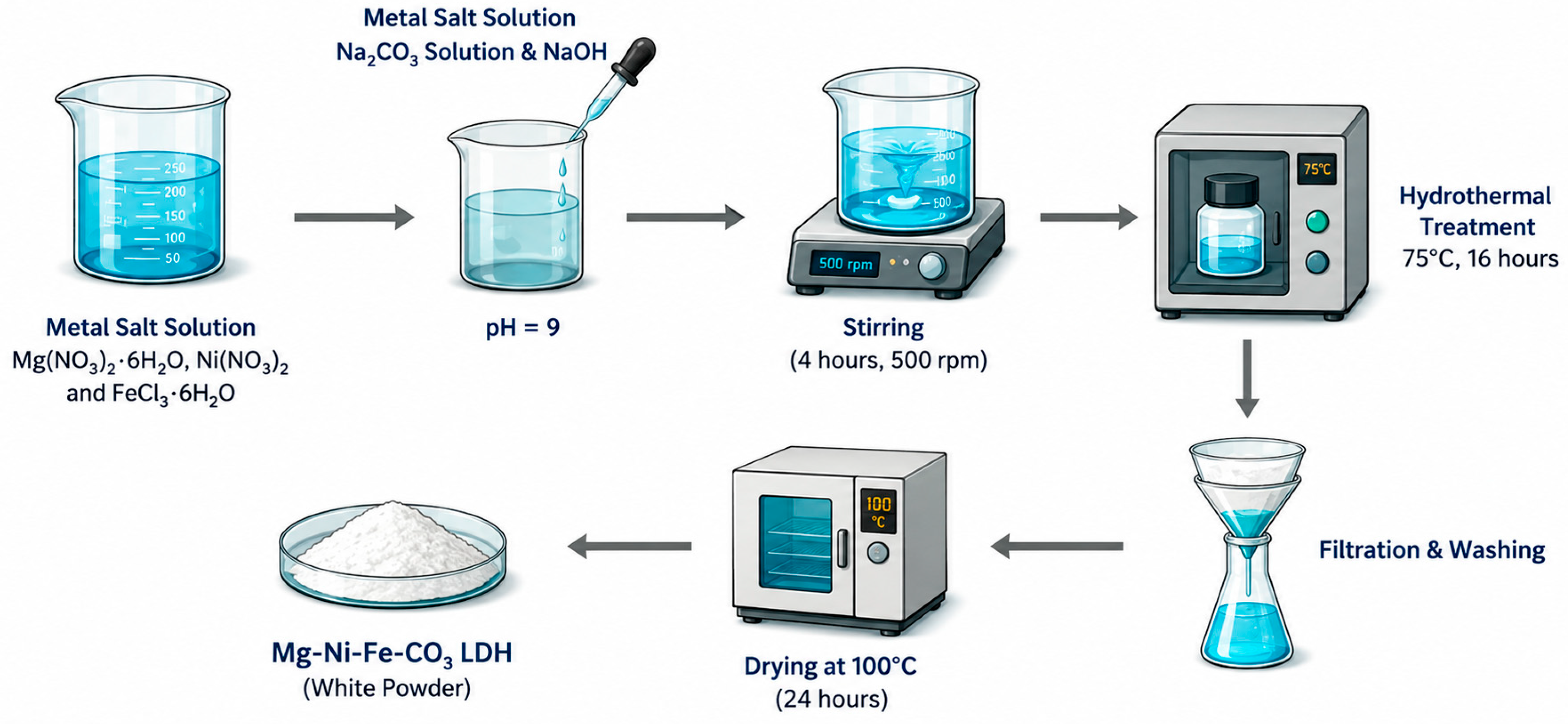
MgNiFe LDH was prepared via a conventional co-precipitation method. First, Mg(NO3)2·6H2O, Ni(NO3)2·6H2O, and FeCl3·6H2O were dissolved in 200 mL of deionized water to obtain a mixed metal solution with a total cation concentration of 2 mol/L. The molar ratios were fixed at (Mg + Ni)/Fe = 3 and Mg/Ni = 1. In parallel, a sodium carbonate solution (100 mL, 1 mol/L) was prepared to provide carbonate anions for the interlayer space. The metal precursor solution and the Na2CO3 solution were then added simultaneously and slowly into a reactor containing 100 mL of bidistilled water under constant magnetic stirring. During the precipitation process, a 2 mol/L NaOH solution was gradually introduced to maintain the pH at 9. The resulting suspension was continuously stirred at room temperature for 4 h to ensure complete precipitation and homogeneous mixing. Afterward, the suspension was transferred into an autoclave and subjected to hydrothermal treatment at 75 °C for 16 h. The solid product obtained was separated by filtration, repeatedly washed with bidistilled water to eliminate residual impurities and unreacted ions, and finally dried at 100 °C for 24 h to obtain the final MgNiFe LDH powder (Figure 1).

2.3. Characterization Techniques

X-ray diffraction (XRD) analyses were carried out at room temperature using a D2 PHASER diffractometer operating in Bragg–Brentano configuration with CuKα radiation (λ = 1.5406 Å). The instrument was operated at 30 kV and 10 mA. Diffraction patterns were recorded over a 2θ range of 10–80° using a step size of 0.01° and a counting time of 0.5 s per step. Fourier transform infrared (FTIR) spectra were obtained using a Perkin Elmer FTIR-2000 spectrophotometer within the spectral range of 4000–400 cm−1. The elemental composition corresponding to the molar ratios (Mg + Ni)/Fe = 3 and Mg/Ni = 1 was determined by inductively coupled plasma atomic emission spectroscopy (ICP-AES, JobinYvon Ultima 2). The morphology and surface composition of the synthesized materials were examined by scanning electron microscopy coupled with energy-dispersive X-ray spectroscopy (SEM/EDX) using a HIROX SH 4000 M apparatus.
The point of zero charge (pHpzc) was evaluated using the pH drift technique described by Noh and Schwarz [26]. Briefly, the initial pH of 50 mL NaCl solution (0.01 mol·L−1) was adjusted between 2 and 12 using dilute HNO3 (0.1 N) and/or NaOH (0.1 N). Afterward, 0.05 g of LDH sample was introduced into each solution, followed by stirring for 6 h. The final pH values were then measured and plotted as a function of the initial pH. The pHpzc value corresponded to the intersection where the initial and final pH values became equal (pHfinal = pHinitial).

2.4. Preliminary Study of Contact Time

The effect of contact time on the adsorption of methyl orange (MO) onto the synthesized MgNiFe LDH was investigated to determine the adsorption equilibrium time. A volume of 100 mL of MO solution (25 mg·L−1) was transferred into a beaker, followed by the addition of 25 mg of the LDH adsorbent. The suspension was maintained under continuous magnetic stirring at room temperature. At predetermined time intervals, aliquots were collected, and the residual MO concentration was determined by UV–Vis spectrophotometry at the maximum absorption wavelength (λmax = 464.5 nm). The results showed a progressive decrease in absorbance with increasing contact time, indicating the gradual adsorption of MO onto the LDH surface. Adsorption equilibrium was reached after approximately 120 min, beyond which no significant change in absorbance was observed. Consequently, this contact time was selected as a factor in the Box–Behnken design to investigate its influence on MO adsorption in the subsequent optimization study.

2.5. Experimental Design

A Box–Behnken design (BBD) was employed to optimize the number of experiments and to evaluate possible interactions between the studied parameters and their effects on the adsorption of methyl orange (MO). The experimental design and statistical analysis were performed using Design-Expert. A three-level three-factorial BBD with 17 experiments was applied. The factor levels were coded as −1 (low), 0 (central point), and +1 (high). Based on preliminary experiments to identify the relevant parameters and determine the experimental domain, LDH dosage (A), solution pH (B) and contact time (C) were selected as the most influential factors. Table 1 presents the BBD levels for each factor. The experimental results were analyzed using response surface methodology (RSM), and the obtained data were fitted to a second-order polynomial model according to the following equation:
Y = b 0 + i = 1 k b i X i + i = 1 k b i i X i 2 + i = 1 k j = 1 k b i j X i X j + ξ
where Y represents the predicted response corresponding to the removal efficiency (%), while b0 denotes the intercept of the regression model. The terms Xᵢ and Xⱼ refer to the independent variables, whereas bᵢ, bᵢᵢ, and bᵢⱼ correspond to the coefficients associated with the linear, quadratic, and interaction effects, respectively. The term ξ represents the random error between the experimental and predicted responses. In this study, the variables X1, X2, and X3 were assigned to LDH dosage (A), solution pH (B), and contact time (C), respectively.

3. Study of Methyl Orange Adsorption

Adsorption tests were carried out using methyl orange (MO) as a representative anionic dye pollutant. A stock aqueous solution containing 20 mg·L−1 of MO was prepared using distilled water. During each experiment, 100 mL of the dye solution was introduced into a beaker and maintained under continuous magnetic stirring to ensure proper mixing throughout the adsorption process. A predefined mass of MgNiFe LDH, ranging from 10 to 20 mg according to the Box–Behnken design (BBD), was added to the solution. The adsorbent dosage refers to the absolute mass of LDH added to a fixed solution volume of 100 mL; therefore, all values are expressed in mg and not in mg·L−1. The pH was adjusted to the desired value (4–8) using NaOH (1N) or HCl (1N). The suspension was agitated for the contact time specified by the experimental design (1–2 h) Table 2. After adsorption, the solid phase was separated using a syringe filter. The residual MO concentration was determined by UV-Vis spectrophotometry at λmax= 464.5 nm. It should be noted that although methyl orange is a pH-sensitive dye, its quantification was performed at its maximum absorption wavelength (λmax = 464.5 nm), which is widely used in adsorption studies. The stability of λmax within the investigated pH range was verified experimentally, and no significant shift was observed between pH 4 and 8. In addition, calibration curves were established at different pH values (pH 4 and pH 8), confirming excellent linearity and the validity of the Beer–Lambert law under all conditions.
Methyl orange has a pKa of approximately 3.47; therefore, within the studied pH range (4–8), it predominantly exists in its anionic form, which explains the stability of its spectral behavior and supports the use of a single wavelength for quantification.
Blank solutions prepared at the corresponding pH values were used as references in order to minimize any potential influence of pH on absorbance measurements. This approach ensures that the measured absorbance changes are mainly attributed to dye adsorption. The adsorption capacity and removal efficiency were calculated using Equations (2) and (3) [27,28].
q = C 0 C . V m
R % =   C 0 C C 0 × 100
where q (mg·g−1) represents the adsorption capacity of the material, C0 (mg·L−1) corresponds to the initial concentration of the dye solution, and C (mg·L−1) refers to the concentration of MO at a given contact time t. The parameter V (L) denotes the volume of the solution, while m (g) corresponds to the mass of the LDH adsorbent used during the experiment.

4. Results and Discussion

4.1. Characterization of MgNiFe LDH

4.1.1. XRD Analysis

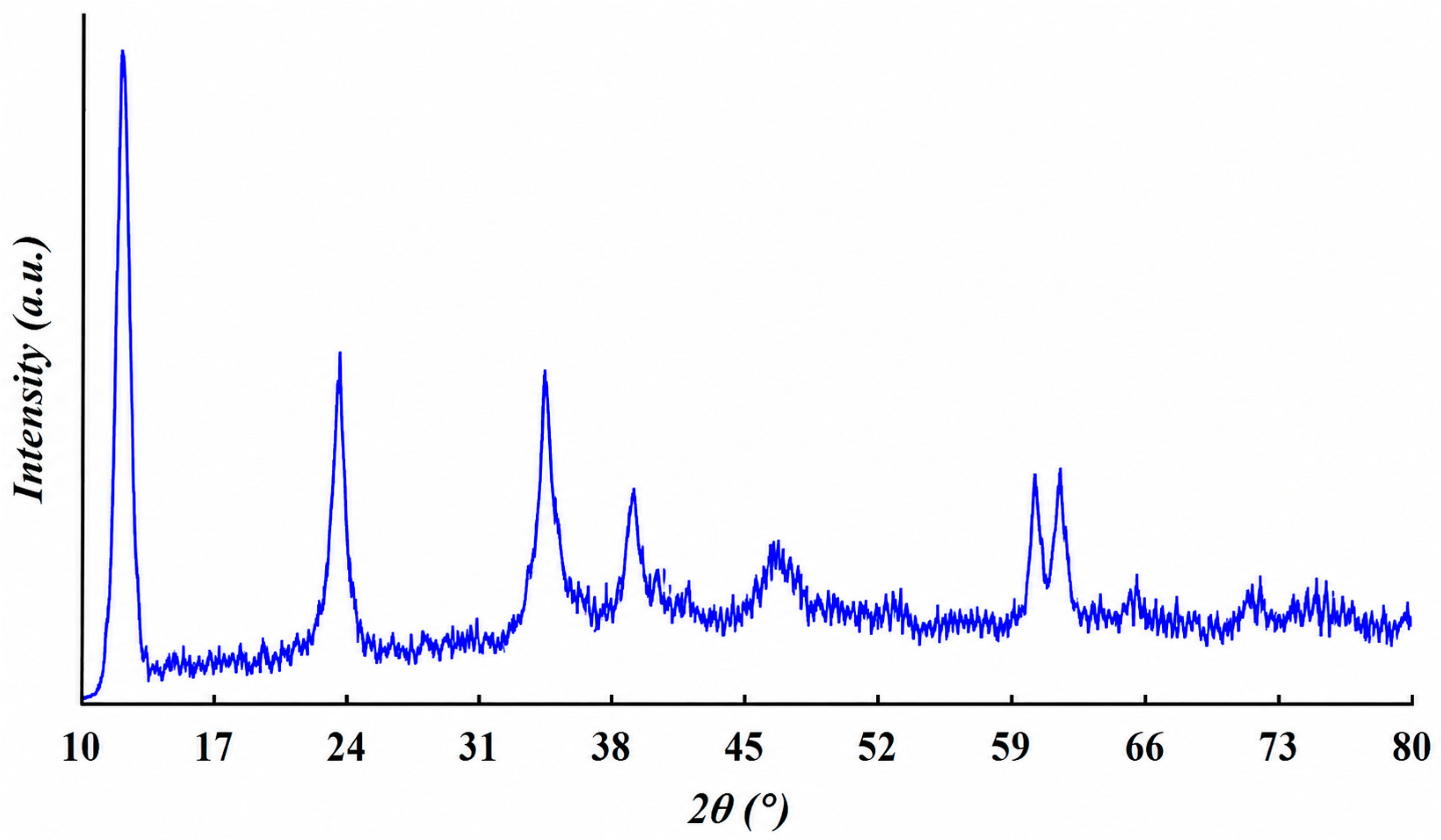
The X-ray diffraction (XRD) pattern of the synthesized MgNiFe LDH (Figure 2) shows several well-defined reflections at low and medium 2θ angles, which are typical of hydrotalcite-like layered double hydroxides [29]. A strong diffraction peak is observed at a low angle around 2θ ≈ 11.73°, corresponding to the (003) plane and associated with the basal spacing of the layered structure. Other reflections located at approximately 23.51°, 34.48°, 38.92°, and 61.33° can be indexed to the (006), (009), (015), and (110) planes, respectively. These peaks confirm the successful formation of a well-organized lamellar structure. The dominance of basal reflections at low diffraction angles indicates a regular stacking of the hydroxide layers, which is a characteristic feature of hydrotalcite-type LDHs. In addition, the diffraction peaks appear sharp and clearly defined, suggesting that the material possesses a satisfactory degree of crystallinity [30,31,32]. Furthermore, no additional peaks related to metal oxides or separate hydroxide phases are detected in the pattern. This observation suggests that Mg2+, Ni2+, and Fe3+ ions are effectively incorporated into the brucite-like layers of the LDH structure without the formation of detectable secondary phases.

4.1.2. SEM Morphology and EDX Analysis

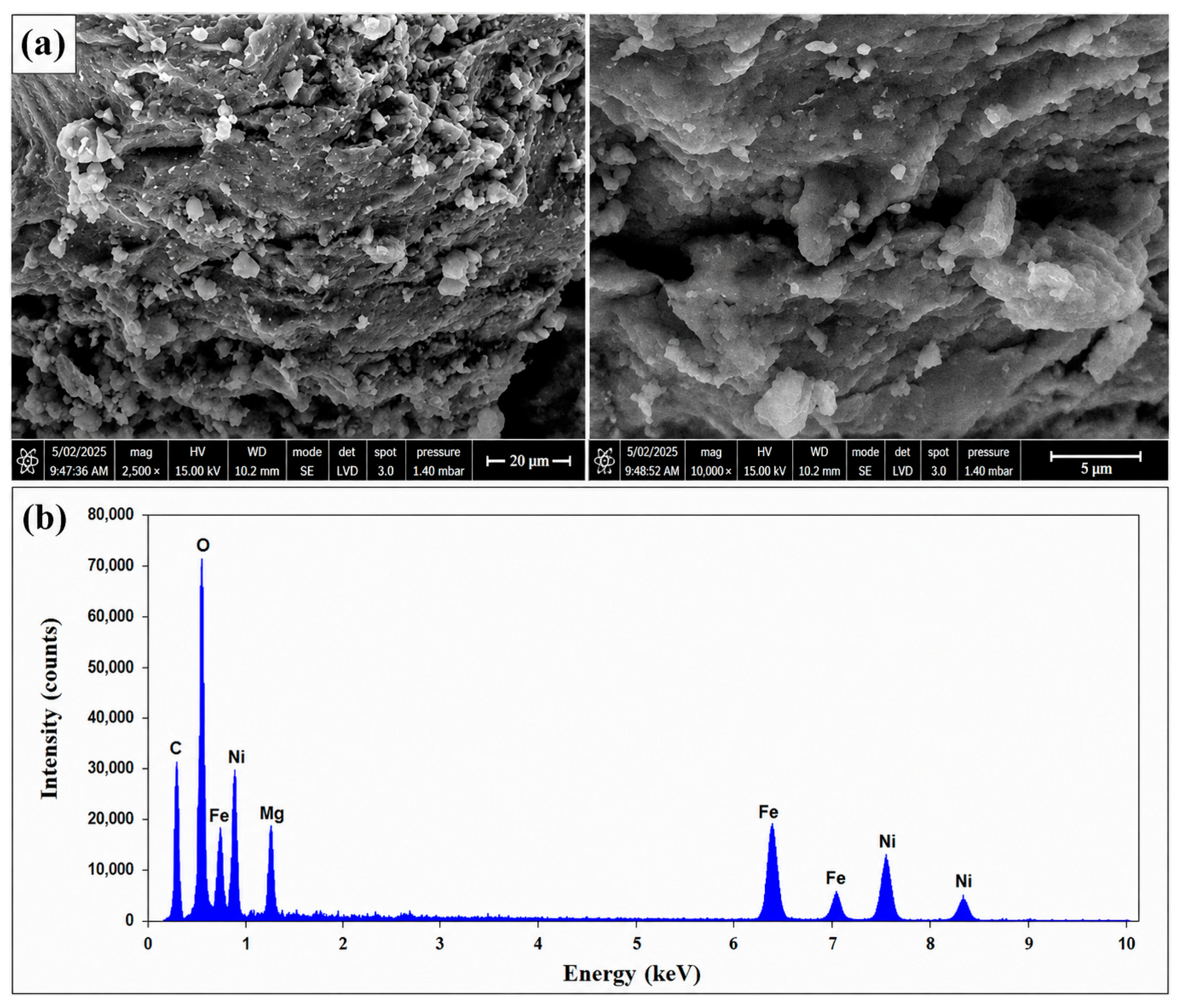
The surface morphology of the MgNiFe LDH was examined by scanning electron microscopy (SEM) (Figure 3a). The micrographs reveal a compact and irregular morphology composed of dense granular agglomerates, with no clearly distinguishable platelet-like layers. Such a morphology is commonly reported for LDHs synthesized via rapid coprecipitation, where fast nucleation limits crystal growth and results in disordered stacking of the lamellar sheets. Although this microstructure reflects a relatively low degree of crystallinity, it is generally associated with a high specific surface area and enhanced porosity, features that are particularly advantageous for adsorption processes. The morphological features observed by SEM indicate a layered agglomerated structure, providing qualitative information on the surface texture of the material.
The chemical composition of the synthesized MgNiFe layered double hydroxide (LDH) was investigated by energy-dispersive X-ray spectroscopy (EDX) (Figure 3b). The obtained spectrum confirms the presence of magnesium, nickel, iron, oxygen, and carbon elements, in agreement with the characteristic composition of hydrotalcite-like LDH materials. The strong oxygen signal is associated with the hydroxyl groups forming the brucite-like layers, while the carbon peak is attributed to carbonate anions located in the interlayer region. The simultaneous detection of magnesium, nickel, and iron confirms that these cations are successfully incorporated within the layered structure. Moreover, no additional peaks corresponding to secondary metal oxides or hydroxide phases are observed in the spectrum. This result indicates the high purity of the synthesized material and demonstrates the effectiveness of the coprecipitation method followed by hydrothermal treatment for the preparation of MgNiFe LDH.

4.1.3. Fourier Transform Infrared (FTIR) Spectra

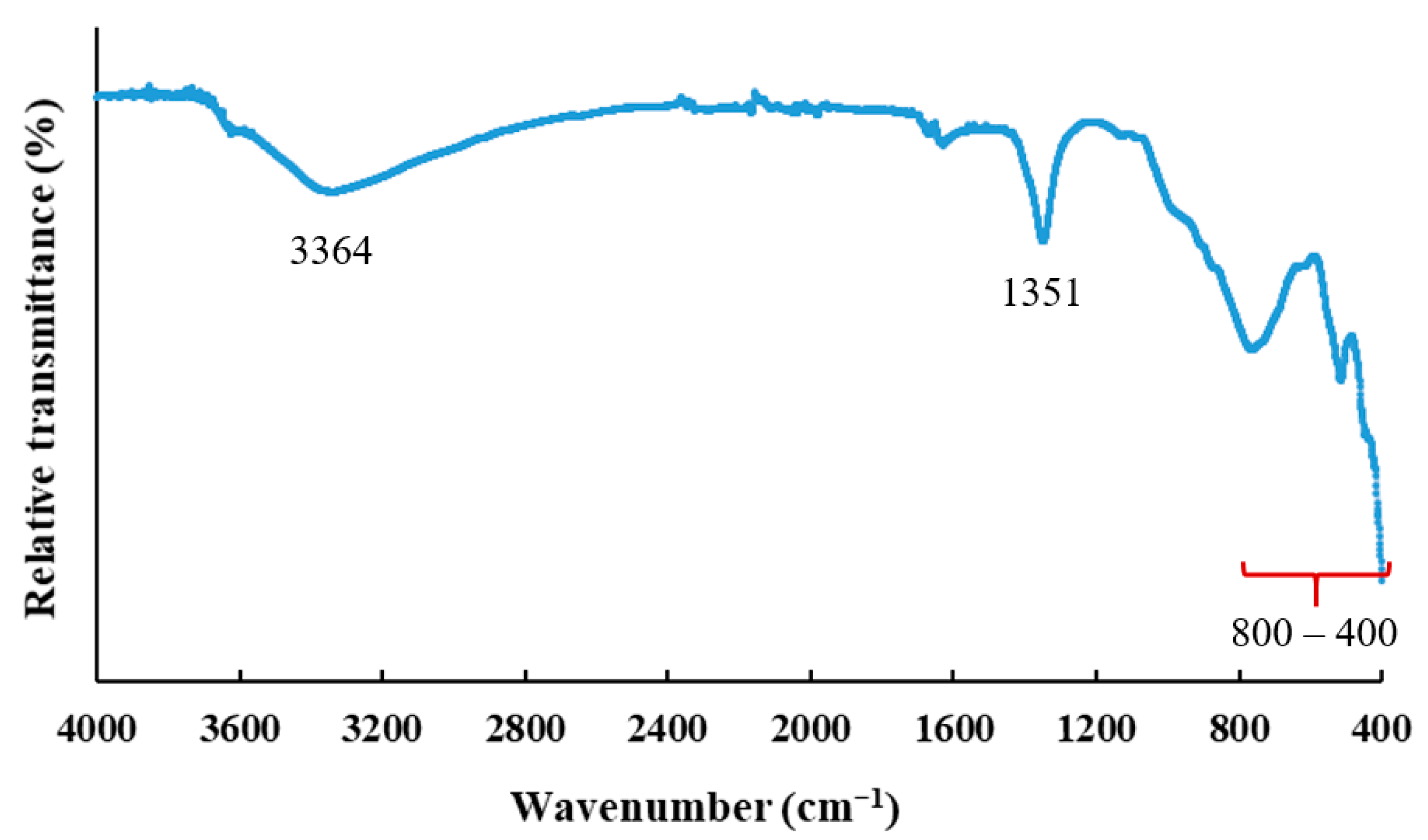
The functional groups present in the synthesized MgNiFe LDH were examined using Fourier-transform infrared (FTIR) spectroscopy (Figure 4). The spectrum displays a broad absorption band centered at 3364 cm−1, which is commonly assigned to the stretching vibrations of hydroxyl groups associated with both adsorbed water molecules and interlayer water in the LDH structure [33]. A strong band observed at 1351 cm−1 is attributed to the asymmetric stretching vibration of carbonate (CO32−) anions located in the interlayer region [33]. The presence of these carbonate species is characteristic of hydrotalcite-type LDHs. In the lower wavenumber region, between 800 and 400 cm−1, several absorption bands can be observed. These bands are related to metal–oxygen (M–O) and metal–oxygen–metal (M–O–M) vibrations [33], which are typically associated with the brucite-like layers forming the LDH framework.

4.1.4. ICP-AES Analysis

Inductively coupled plasma atomic emission spectroscopy (ICP-AES) was used to determine the metal cation composition of the synthesized MgNiFe LDH. The analysis indicates a molar ratio of (Mg + Ni)/Fe of 3.16, which falls within the typical range reported for layered double hydroxides, where the divalent-to-trivalent cation ratio generally varies between 2 and 4 [34]. This result confirms the effective incorporation of Fe3+ into the brucite-like layers while maintaining the structural integrity of the LDH framework. Furthermore, the Mg/Ni molar ratio was found to be 1.08, suggesting an almost equimolar distribution of Mg2+ and Ni2+ in the divalent cation positions. Such a distribution indicates that both cations are uniformly integrated into the layered structure. Overall, these findings demonstrate that the desired metal composition was successfully achieved during the synthesis process and support the formation of a homogeneous mixed-metal LDH structure. This conclusion is consistent with the structural and compositional results obtained from XRD and EDX analyses.

4.2. Experimental Results

Table 2 summarizes the experimental parameters and the corresponding adsorption performances obtained for methyl orange (MO) removal using the synthesized MgNiFe LDH material. The removal efficiency varied between 22.43% and 86.86%, indicating that the adsorption process was strongly affected by the LDH dosage (A), solution pH (B), and contact time (C). The maximum removal efficiency (86.86%) was achieved using an LDH amount of 20 mg at pH 4 with a contact time of 1.5 h. This behavior suggests enhanced electrostatic interactions between the anionic MO species and the positively charged LDH surface under acidic conditions.
Compared with Zn–AlCO3 LDH reported in the literature, which exhibited an adsorption capacity lower than 20 mg·g−1 for methyl orange even after prolonged contact times up to 300 min [35], the MgNiFe LDH synthesized in the present study demonstrated significantly enhanced adsorption performance, reaching a removal efficiency of 86.86% and an adsorption capacity of 86.86 mg·g−1. This improved adsorption behavior may be related to the synergistic effect of Mg2+, Ni2+, and Fe3+ cations, which increases the positive charge density of the LDH layers and possibly strengthens electrostatic interactions with the anionic methyl orange molecules. Furthermore, the optimized operating conditions determined using the Box–Behnken design contributed to the rapid and efficient adsorption process.
Conversely, the lowest efficiencies, around 22–30%, were observed at a low LDH dose (10 mg) or basic pH (8), indicating that an insufficient adsorbent dose or unfavorable surface charge limits the adsorption of MO. Overall, the results indicate that acidic conditions favor MO adsorption due to protonation of LDH surface sites, which is possible electrostatic attraction with the anionic dye, while basic conditions reduce adsorption efficiency by decreasing the positive surface charge. These observations support the regression analysis results and provide guidance for selecting optimal operating conditions for maximum adsorption efficiency.
The analysis of variance (ANOVA) results (Table 3) indicate that the adsorption of methyl orange (MO) is mainly influenced by solution pH and LDH dosage, whereas the effect of contact time is not statistically significant. Among the investigated factors, pH appears to be the most influential parameter, suggesting that the adsorption process is largely controlled by electrostatic interactions related to the surface charge of the LDH. Increasing the LDH dosage improves the adsorption efficiency by providing a greater number of available active sites for the anionic MO molecules. In contrast, the limited influence of contact time suggests that adsorption equilibrium is reached within the time range considered in this study.
The analysis of the linear interaction terms (AB, AC, and BC) shows that none of these interactions are statistically significant. This result indicates that the individual factors act independently on the adsorption process and that synergistic effects between them are negligible under the investigated conditions. Likewise, the quadratic terms (A2, B2, and C2) were not found to be significant, suggesting that the adsorption response varies approximately linearly within the studied experimental domain. Therefore, although the normal probability plot suggests an acceptable distribution of residuals, the significant lack of fit (p = 0.0486) indicates that the model does not fully capture the response variability over the experimental domain. Consequently, the developed regression model provides a general trend of the adsorption behavior; however, its predictive capability remains limited due to the observed experimental variability, particularly at the center points. Therefore, the full quadratic model cannot be considered statistically adequate for predictive or optimization purposes due to the significant lack of fit and poor predicted R2 value.
The regression coefficient analysis (Table 4) further supports the ANOVA results. The LDH dosage exhibits a positive effect on the adsorption efficiency, while increasing the solution pH negatively affects MO removal. This behavior can be explained by the gradual decrease in the positive surface charge of the LDH at higher pH values, which reduces the electrostatic attraction between the adsorbent surface and the anionic dye molecules. Although contact time shows a slight positive contribution, its effect remains statistically insignificant, confirming that equilibrium is achieved within the investigated time interval.
Furthermore, the interaction and quadratic terms remain statistically non-significant, reinforcing the assumption of a predominantly linear response within the studied parameter range. The variance inflation factor (VIF) values, which are close to unity, indicate the absence of multicollinearity among the regression variables and confirm the robustness of the developed model. Overall, the regression model provides a qualitative description of the adsorption behavior and helps identify the most influential factors, particularly solution pH and LDH dosage. However, due to the significant lack of fit and poor predictive performance, it cannot be considered reliable for optimization purposes.
In addition to the ANOVA analysis, the statistical parameters of the model were evaluated to assess its adequacy. The statistical parameters summarized in Table 5 provide additional insight into the adequacy of the developed model. The coefficient of determination (R2) was found to be 0.8783, indicating that a large proportion of the variability in the response is explained by the model. However, the adjusted R2 (0.7217) is significantly lower, suggesting that some non-significant terms may be included in the model.
More importantly, the predicted R2 value was negative (−0.6564), indicating a very poor predictive capability of the model. This result clearly suggests that the model is not suitable for predicting new observations and confirms the limitations highlighted by the significant lack of fit (p = 0.0486).
The relatively high coefficient of variation (C.V. = 23.14%) further reflects the experimental variability observed in the system, particularly at the center points.
Nevertheless, the Adeq Precision value (8.16), which is higher than the desirable value of 4, indicates an adequate signal-to-noise ratio, suggesting that the model can still be used to explore the design space and identify general trends in the adsorption process.

4.3. Development of a Reduced Model

In order to improve the statistical reliability of the model, a reduced linear model was developed by retaining only the statistically significant factors, namely LDH dosage (A) and solution pH (B).
The reduced model is expressed as:
Y = 42.61 + 10.59 A 23.48 B
The ANOVA analysis showed that both investigated factors had a statistically significant effect on the adsorption process, as confirmed by p-values lower than 0.05. In addition, the model F-value of 22.26 demonstrates that the proposed model is statistically significant and suitable for describing the experimental responses.
Furthermore, the lack-of-fit test was found to be non-significant (p = 0.0849), suggesting that the developed model provides an adequate representation of the experimental data within the selected operating range.
The reliability of the reduced model was also supported by the statistical coefficients obtained, namely R2 = 0.7607, adjusted R2 = 0.7266, and predicted R2 = 0.6410. Although these values indicate a satisfactory agreement between experimental and predicted responses, the predictive capability of the model remains moderate and should therefore be considered within the limits of the investigated experimental domain.
In contrast to the full quadratic model, the reduced model eliminates non-significant terms and avoids unrealistic predictions exceeding 100%, providing a more physically meaningful description of the adsorption process. The reduced model is considered more appropriate than the full quadratic model for describing the system within the studied experimental domain. Table 6 compares the statistical performance of the full quadratic model with that of the reduced model. According to the obtained results, the optimization study was conducted using the reduced model, since the full quadratic model exhibited inadequate statistical reliability, mainly due to its significant lack of fit and limited predictive capability.
Therefore, the reduced model is considered more appropriate for describing the system behavior and identifying approximate optimal conditions within the studied domain. This approach is consistent with standard RSM practice, where reduced models are preferred when the full quadratic model exhibits a significant lack of fit and poor predictive performance.

4.4. Diagnostics of the Regression Model

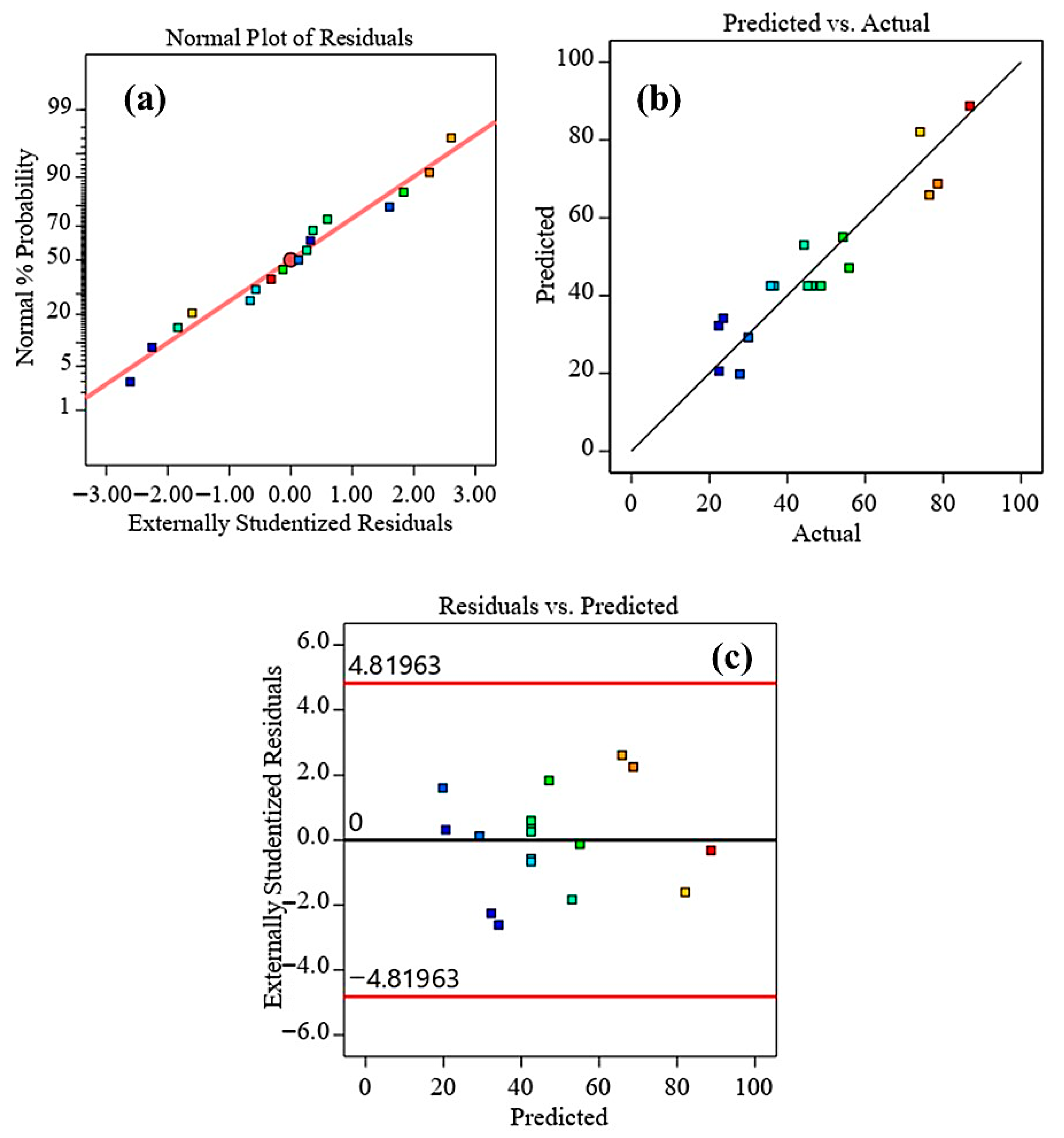
The normal probability plot of externally studentized residuals (Figure 5a), developed based on the full quadratic model used for diagnostic purposes, shows that the residuals are approximately aligned along the straight reference line, indicating that the error terms follow an approximately normal distribution. This suggests that the normality assumption required for ANOVA and regression analysis is reasonably satisfied.
However, slight deviations from the straight line are observed at the extreme residual values, which may indicate the presence of experimental variability or minor model inadequacy. These deviations are consistent with the previously observed significant lack of fit and the limited predictive capability of the full quadratic model.
A comparison between predicted and experimental values (Figure 5b) was also performed to evaluate the performance of the full quadratic model. The plot only shows partial agreement between predicted and experimental results, although noticeable deviations are observed, particularly around the center points. This further confirms the limited predictive capability of the model, as previously indicated by the negative predicted R2 value.
The residuals versus fitted values plot (Figure 5c) was also analyzed to assess the adequacy of the model. The residuals are randomly distributed without a clear pattern, indicating that no systematic error is present. However, the relatively wide dispersion of residuals reflects the experimental variability in the system, which contributes to the observed lack of fit.
The full quadratic model was found to be statistically inadequate for predictive purposes due to the significant lack of fit and the negative predicted R2 value. Therefore, although it can describe general trends, it is not suitable for process optimization in the present study. All optimization conclusions are based exclusively on the reduced model, as the full quadratic model is not statistically reliable for prediction.

4.5. Response Surface Analysis

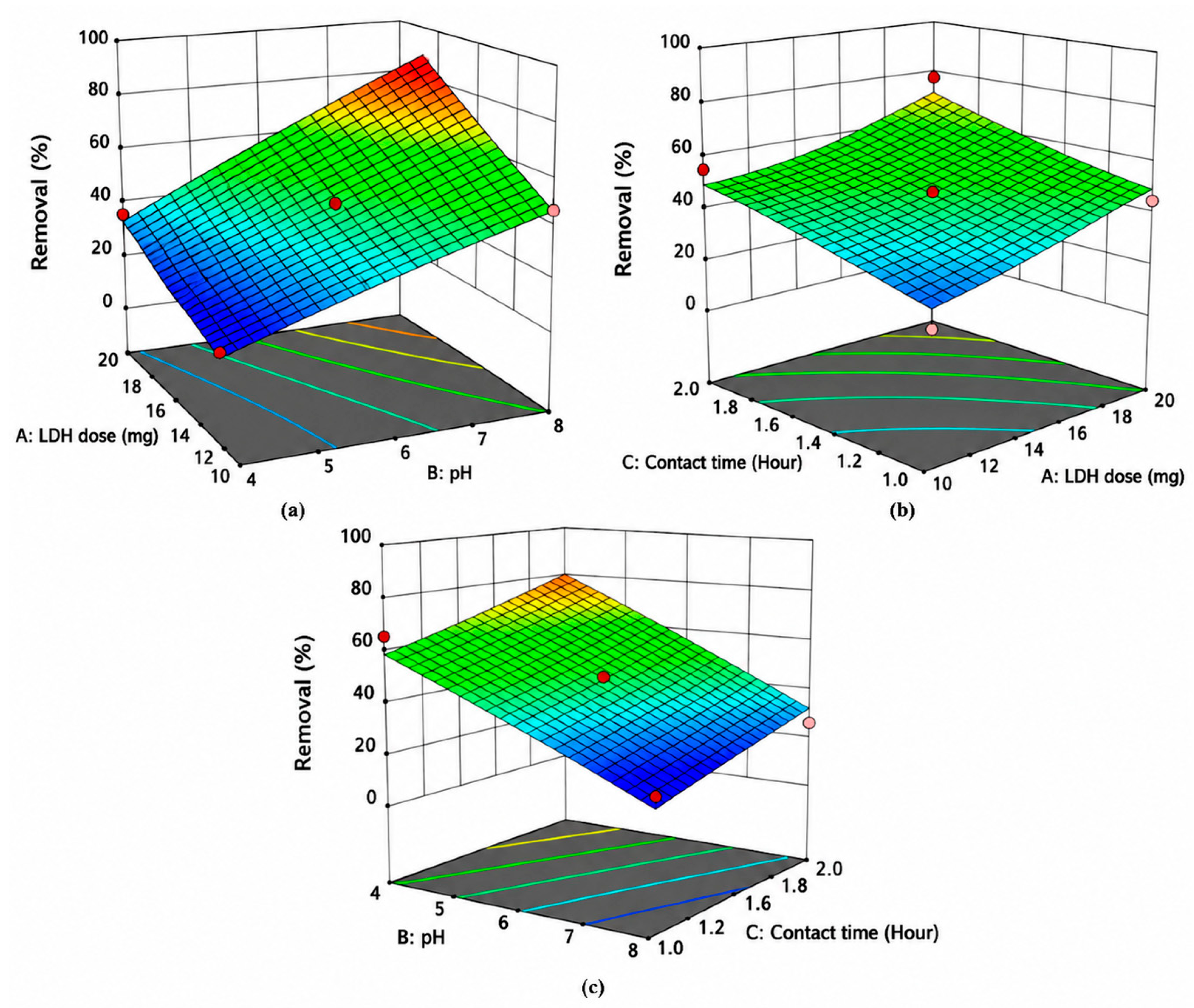
The three-dimensional response surface diagrams illustrating the interactive effects of the investigated parameters on methyl orange (MO) adsorption efficiency are displayed in Figure 6a–c. Although the ANOVA analysis indicated that the interaction terms were not statistically significant, these plots are used here to illustrate general trends within the studied experimental domain.
Figure 6a illustrates the combined effect of LDH dosage and solution pH on MO removal. The adsorption efficiency increases as the LDH dose increases and the solution pH decreases. The influence of pH becomes more evident at higher LDH doses, whereas at lower doses the removal efficiency remains relatively limited, regardless of pH variations. The highest adsorption efficiency is therefore observed under conditions of high LDH dosage and low pH.
Figure 6b presents the combined effect of LDH dosage and contact time. As expected, the adsorption efficiency improves with increasing LDH dose due to the greater availability of active adsorption sites. In contrast, the influence of contact time remains relatively weak within the investigated range. This suggests that extending the contact time beyond the studied interval does not substantially enhance MO removal, particularly when sufficient LDH dosage is provided, indicating that adsorption equilibrium is rapidly reached under the selected conditions.
Figure 6c shows the combined influence of solution pH and contact time on MO adsorption. A clear decrease in adsorption efficiency is observed with increasing pH, while contact time has only a minor effect at both low and high pH values. The maximum MO removal occurs at low pH conditions, regardless of the contact time, confirming that the adsorption process is likely controlled by electrostatic interactions related to the surface charge of the LDH. It should be noted that the present study does not include an evaluation of metal ion leaching (e.g., Ni, Mg, Fe) or long-term structural stability of the material under acidic conditions. Since the optimized adsorption was obtained at pH 4, a certain degree of partial dissolution of LDH components cannot be excluded. These aspects are important for environmental safety assessment and will be addressed in future work.
The influence of solution pH on methyl orange (MO) adsorption can be explained based on the point of zero charge (pHpzc) of the synthesized MgNiFe LDH, which was found to be around 6.8. At pH values below the pHpzc (pH < 6.8), the LDH surface acquires a positive charge as a result of the protonation of surface hydroxyl groups. Under these conditions, strong electrostatic attractions are established between the positively charged adsorbent surface and the negatively charged sulfonate groups (–SO3) of MO molecules, thereby enhancing the adsorption process.
On the other hand, when the solution pH exceeds the pHpzc (pH > 6.8), the LDH surface becomes negatively charged due to deprotonation phenomena. This negatively charged surface induces electrostatic repulsion toward the anionic dye molecules, leading to a decrease in adsorption efficiency. Moreover, hydroxide ions (OH) present at alkaline pH may compete with MO anions for the active adsorption sites, which further limits dye uptake. These observations indicate that electrostatic interactions constitute one of the main mechanisms governing the adsorption of MO onto the MgNiFe LDH material.
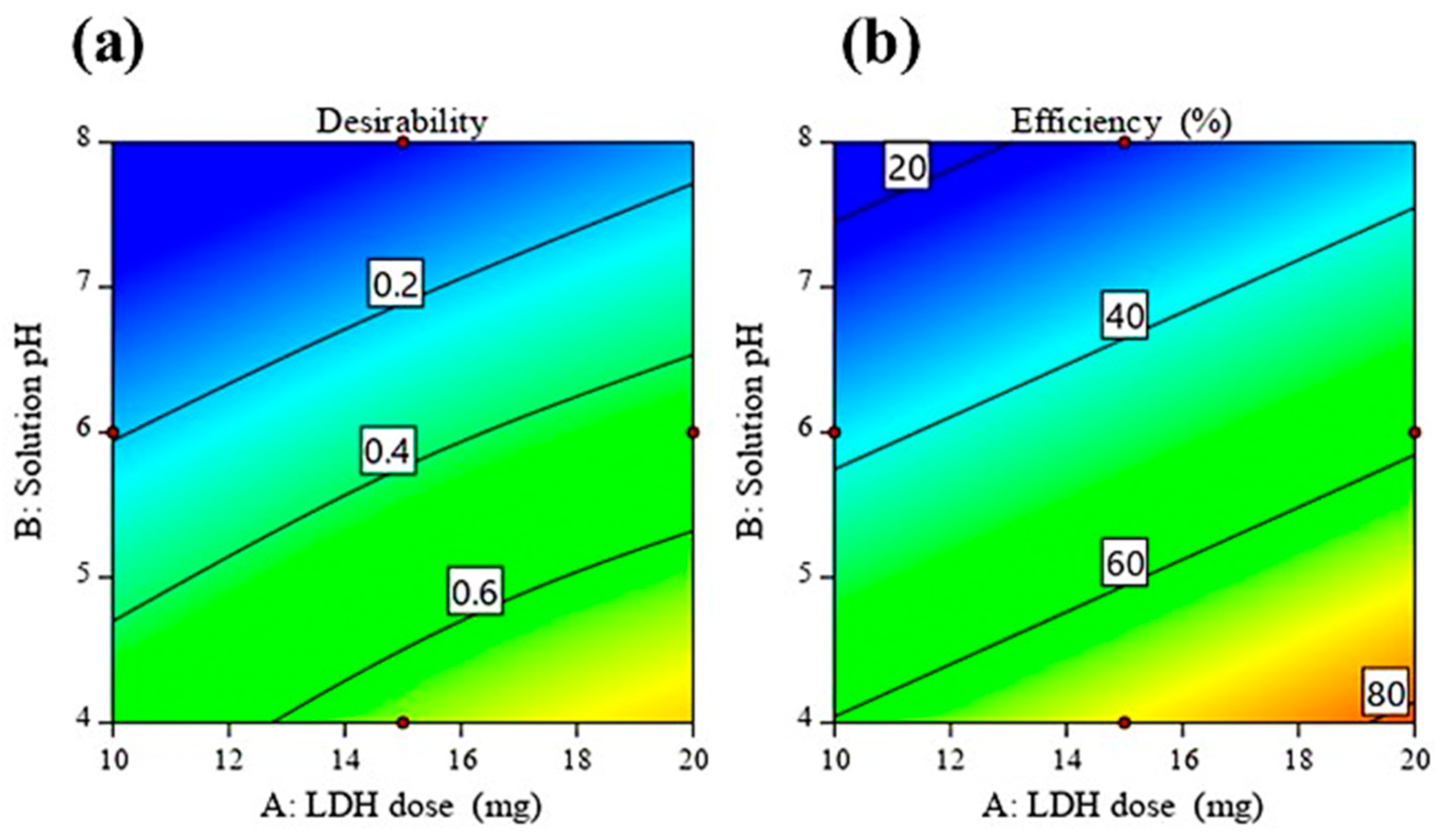
The response surface plots of the reduced model, presented in Figure 7a,b, illustrate the combined effects of the statistically significant variables on the adsorption process. Since the full quadratic model exhibited limited statistical significance, a reduced model was developed by retaining only the significant factors, which resulted in improved model interpretability and robustness. The coefficient of determination (R2) of the reduced model was also calculated and indicates acceptable agreement between experimental and predicted values within the studied experimental domain, suggesting an improved but still moderate predictive performance of the simplified model.
Figure 7a presents the combined effect of LDH dosage (A) and solution pH (B) on the desirability function. The results show that desirability increases with increasing LDH dosage and decreasing pH, confirming that these two variables are the main controlling factors of the process. The highest desirability values are observed at high LDH doses and low pH conditions.
Figure 7b illustrates the combined influence of LDH dosage and solution pH on the adsorption efficiency (%). A clear improvement in efficiency is observed with increasing LDH dosage, while a decrease in pH strongly enhances the removal performance. In contrast, pH plays a more dominant role than LDH doses at lower values, highlighting its strong influence on surface charge and adsorption behavior.
The response surface plots of the reduced model further confirm that the adsorption process is mainly governed by LDH dosage and solution pH, while interaction effects remain less significant, in agreement with the ANOVA results. The inclusion of these plots, together with the R2 value, strengthens the validity of the reduced model and provides a clearer understanding of the system behavior.

4.6. Comparative Study of LDH Adsorbents for MO Removal

A comparative analysis with previously reported LDH-based adsorbents for methyl orange removal is presented in Table 7. The adsorption performance of the synthesized MgNiFe-LDH was found to be competitive with several reported LDH systems. The obtained adsorption capacity (86.86 mg·g−1) demonstrates the potential of the prepared material as an efficient adsorbent for azo dye removal from aqueous solutions.

5. Conclusions

This work demonstrated the successful synthesis of MgNiFe layered double hydroxides through the co-precipitation method and highlighted their potential for the efficient removal of methyl orange (MO) from aqueous media. The characterization results confirmed the formation of a well-crystallized hydrotalcite-like structure with a relatively homogeneous distribution of metal cations and the presence of carbonate anions within the interlayer space, which provided favorable sites for the adsorption of anionic species.
The adsorption performance was further investigated and optimized using response surface methodology based on a Box–Behnken experimental design, evaluating the effects of LDH dose, solution pH, and contact time on MO removal efficiency. The results showed that solution pH and LDH dose significantly influenced the adsorption process, whereas contact time exhibited no statistically significant effect within the studied range. Among the investigated parameters, solution pH was identified as the most influential factor, followed by LDH dose, with a maximum adsorption of around 86% achieved under optimal conditions.
The analysis of interaction terms indicated that the combined effects between the studied variables were not statistically significant, suggesting that the adsorption behavior was mainly governed by the individual contributions of each factor. The developed regression model adequately described the experimental data and allowed the identification of optimal conditions, corresponding to high LDH dose and acidic pH, for maximizing MO adsorption efficiency. The developed regression model describes general trends in the adsorption behavior within the studied experimental domain and allows identification of the most influential parameters, particularly solution pH and LDH dosage. However, due to the significant lack of fit and poor predictive performance of the full quadratic model, optimization was performed using the reduced model only. Therefore, all optimization results and conclusions are based exclusively on the reduced model, which provides a more statistically consistent representation of the system.
The adsorption mechanism is suggested to be influenced mainly by electrostatic interactions between the negatively charged dye molecules and the positively charged LDH surface under acidic conditions. However, in the absence of post-adsorption characterization, this mechanism remains hypothetical and should be considered a plausible interpretation rather than a confirmed pathway.
As a perspective, future studies will focus on metal leaching, BET surface area analysis, adsorption isotherms, regeneration studies, and the environmental stability of the material to further elucidate the adsorption mechanism and improve its practical applicability.
From a sustainability perspective, this study contributes to the development of efficient and adaptable materials for wastewater remediation and environmental protection. The synthesized MgNiFe-CO3 LDH exhibited promising adsorption performance toward methyl orange removal under relatively mild operating conditions, highlighting its potential as an alternative to conventional treatment materials that are often associated with higher operational costs and regeneration limitations. Furthermore, the use of response surface methodology enabled process optimization while reducing the number of experimental runs, thereby minimizing chemical consumption and experimental waste. The development of such multi-cationic LDH materials supports sustainable water management strategies and contributes to pollution reduction, which is consistent with the objectives of sustainable development and cleaner environmental technologies.

Author Contributions

H.E.H.: Writing–review & editing, Writing–original draft, Visualization, Resources, Methodology, Investigation, Conceptualization. S.E.M.: Methodology, Investigation, Conceptualization. W.B.: Methodology, Investigation, Conceptualization. Z.F.: Writing–review & editing, Methodology, Investigation, Conceptualization. A.E. (Ahmed Errami): Methodology, Investigation, Conceptualization. A.E. (Abdelhafid Essadki): Methodology, Investigation, Conceptualization. N.B.: Methodology, Investigation, Conceptualization. A.E. (Alaâeddine Elhalil): Writing–review & editing, Writing–original draft, Visualization, Validation, Supervision, Resources, Project administration, Methodology, Conceptualization. All authors have read and agreed to the published version of the manuscript.

Funding

This research received no external funding.

Institutional Review Board Statement

Not applicable.

Informed Consent Statement

Not applicable.

Data Availability Statement

No new data were created or analyzed in this study.

Conflicts of Interest

The authors declare no conflict of interest.

References

  1. Dutta, S.; Adhikary, S.; Bhattacharya, S.; Roy, D.; Chatterjee, S.; Chakraborty, A.; Banerjee, D.; Ganguly, A.; Nanda, S.; Rajak, P. Contamination of textile dyes in aquatic environment: Adverse impacts on aquatic ecosystem and human health, and its management using bioremediation. J. Environ. Manag. 2024, 353, 120103. [Google Scholar] [CrossRef]
  2. Al Tohamy, R.; Ali, S.S.; Li, F.; Okasha, K.M.; Mahmoud, Y.A.G.; Elsamahy, T.; Jiao, H.; Fu, Y.; Sun, J. A critical review on the treatment of dye containing wastewater: Ecotoxicological and health concerns of textile dyes and possible remediation approaches for environmental safety. Ecotoxicol. Environ. Saf. 2022, 231, 113160. [Google Scholar] [CrossRef] [PubMed]
  3. Pang, Y.L.; Abdullah, A.Z. Current status of textile industry wastewater management and research progress in Malaysia: A review. CLEAN Soil Air Water 2013, 41, 751–764. [Google Scholar] [CrossRef]
  4. Islam, M.T.; Islam, T.; Islam, T.; Repon, M.R. Synthetic dyes for textile colouration: Process, factors and environmental impact. Text. Leather Rev. 2022, 5, 327–373. [Google Scholar] [CrossRef]
  5. Arif, M. Catalytic reduction/degradation of methyl orange by metal nanoparticle containing systems: A critical review. RSC Adv. 2025, 15, 27668–27684. [Google Scholar] [CrossRef]
  6. Hassan, M.M.; Carr, C.M. A critical review on recent advancements of the removal of reactive dyes from dyehouse effluent by ion-exchange adsorbents. Chemosphere 2018, 209, 201–219. [Google Scholar] [CrossRef]
  7. Lellis, B.; Fávaro-Polonio, C.Z.; Pamphile, J.A.; Polonio, J.C. Effects of textile dyes on health and the environment and bioremediation potential of living organisms. Biotechnol. Res. Innov. 2019, 3, 275–290. [Google Scholar] [CrossRef]
  8. Pinheiro, L.R.S.; Gradíssimo, D.G.; Xavier, L.P.; Santos, A.V. Degradation of Azo Dyes: Bacterial Potential for Bioremediation. Sustainability 2022, 14, 1510. [Google Scholar] [CrossRef]
  9. Forgacs, E.; Cserháti, T.; Oros, G. Removal of synthetic dyes from wastewaters: A review. Environ. Int. 2004, 30, 953–971. [Google Scholar] [CrossRef] [PubMed]
  10. Robinson, T.; McMullan, G.; Marchant, R.; Nigam, P. Remediation of dyes in textile effluent: A critical review on current treatment technologies with a proposed alternative. Bioresour. Technol. 2001, 77, 247–255. [Google Scholar] [CrossRef]
  11. Haider, Z.; Imran, M.; Muhmood, T. Photoelectrochemical Production of Peroxydisulfate (PDS), a Clean Oxidant: Recent Development and Challenges. Int. J. Mol. Sci. 2026, 27, 3066. [Google Scholar] [CrossRef]
  12. Il Yoon, S.; Han, M.; Wei, W.; Chaudhuri, H.; Yun, Y.-S. Facile and cost-effective fabrication of activated charcoal-carboxymethyl cellulose composite fiber for high-rate water-softening application. J. Ind. Eng. Chem. 2023, 126, 360–370. [Google Scholar] [CrossRef]
  13. Chaudhuri, H.; Dash, S.; Sarkar, A. Single-step room-temperature in situ syntheses of sulfonic acid functionalized SBA-16 with ordered large pores: Potential applications in dye adsorption and heterogeneous catalysis. Ind. Eng. Chem. Res. 2017, 56, 2943–2957. [Google Scholar] [CrossRef]
  14. Chaudhuri, H.; Lim, C.-R.; Yun, Y.-S. Polyethylenimine functionalized sulfur- containing POSS-based dendritic adsorbent for highly efficient and selective capturing of precious metal ions. Desalination 2023, 566, 116925. [Google Scholar] [CrossRef]
  15. Dutta, S.; Gupta, B.; Srivastava, S.K.; Gupta, A.K. Recent advances on the removal of dyes from wastewater using various adsorbents: A critical review. Mater. Adv. 2021, 2, 4497. [Google Scholar] [CrossRef]
  16. Momina; Shahadat, M.; Isamil, S. Regeneration performance of clay-based adsorbents for the removal of industrial dyes: A review. RSC Adv. 2018, 8, 24571–24587. [Google Scholar] [CrossRef]
  17. Miyata, S. Anion-exchange properties of hydrotalcite-like compounds. Clays Clay Miner. 1983, 31, 305–311. [Google Scholar] [CrossRef]
  18. Qiu, C.; Jiang, J.; Ai, L. When layered nickel–cobalt silicate hydroxide nanosheets meet carbon nanotubes: A synergetic coaxial nanocable structure for enhanced electrocatalytic water oxidation. ACS Appl. Mater. Interfaces 2016, 8, 945–951. [Google Scholar] [CrossRef] [PubMed]
  19. Qiu, C.; Ai, L.; Jiang, J. Layered phosphate-incorporated nickel–cobalt hydrosilicates for highly efficient oxygen evolution electrocatalysis. ACS Sustain. Chem. Eng. 2018, 6, 4492–4498. [Google Scholar] [CrossRef]
  20. Elhalil, A.; Qourzal, S.; Mahjoubi, F.Z.; Elmoubarki, R.; Farnane, M.; Tounsadi, H.; Sadiq, M.; Abdennouri, M.; Barka, N. Defluoridation of groundwater by calcined Mg/Al layered double hydroxide. Emerg. Contam. 2016, 2, 42–48. [Google Scholar] [CrossRef]
  21. Raheem, S.A.; Mohammed, A.A. Synthesis, characterization, and applications of layered double hydroxides nanocomposites for the adsorption of organic and inorganic contaminants from an aqueous solution: An overview. Results Surf. Interfaces 2025, 18, 100386. [Google Scholar] [CrossRef]
  22. Lan, T.; Kaviratna, P.D.; Pinnavaia, T.J. Mechanism of clay tactoid exfoliation in epoxy-clay nanocomposites. Chem. Mater. 1995, 7, 2144–2150. [Google Scholar] [CrossRef]
  23. Ai, L.; Zhang, C.; Meng, L. Adsorption of methyl orange from aqueous solution on hydrothermal synthesized Mg–Al layered double hydroxide. J. Chem. Eng. Data 2011, 56, 4217–4225. [Google Scholar] [CrossRef]
  24. Qu, J.; He, X.; Li, X.; Ai, Z.; Li, Y.; Zhang, Q.; Liu, X. Precursor preparation of Zn–Al layered double hydroxide by ball milling for enhancing adsorption and photocatalytic decoloration of methyl orange. RSC Adv. 2017, 7, 31466–31474. [Google Scholar] [CrossRef]
  25. Samuei, S.; Rezvani, Z.; Amani-Ghadim, A.R. Comparative study of removal of reactive dye by LDHs: The effect of cation variety. Environ. Prog. Sustain. Energy 2017, 36, 372–381. [Google Scholar] [CrossRef]
  26. Noh, J.S.; Schwarz, J.A. Estimation of the point of zero charge of simple oxides by mass titration. J. Colloid Interface Sci. 1989, 130, 157–164. [Google Scholar] [CrossRef]
  27. Habeeb, O.A.; Ramesh, K.; Ali, G.A.M.; Yunus, R.M. Experimental design technique on removal of hydrogen sulfide using CaO-eggshells dispersed onto palm kernel shell activated carbon: Experiment, optimization, equilibrium and kinetic studies. J. Wuhan Univ. Technol. Mater. Sci. Ed. 2017, 32, 305–320. [Google Scholar][Green Version]
  28. Ali, G.A.M.; Sadegh, H.; Abbasi, Z.; Nadagoud, M.N. Adsorption of ammonium ions onto multi-walled carbon nanotubes. Stud. Univ. Babes-Bolyai Chem. 2017, 62, 233–245. [Google Scholar] [CrossRef]
  29. Mostafa, M.; Betiha, M.; Rabie, A.; Hassan, H.; Morshedy, A. New Conduct in the Adsorptive Removal of Sulfur Compounds by New Nickel–Molybdenum Adsorbent. Ind. Eng. Chem. Res. 2018, 57, 425–433. [Google Scholar] [CrossRef]
  30. Zaghouane-Boudiaf, H.; Boutahala, M.; Arab, L. Removal of methyl orange from aqueous solution by uncalcined and calcined MgNiAl layered double hydroxides (LDHs). J. Chem. Eng. 2012, 187, 142–149. [Google Scholar] [CrossRef]
  31. Li, S.S.; Jiang, M.; Jiang, T.J.; Liu, J.H.; Guo, Z.; Huang, X.J. Competitive adsorption behavior toward metal ions on nano-Fe/Mg/Ni ternary layered double hydroxide proved by XPS: Evidence of selective and sensitive detection of Pb(II). J. Hazard. Mater. 2017, 338, 1–10. [Google Scholar] [CrossRef]
  32. Ul Hasnain, M.A.; Khoja, A.H.; Butt, F.B.; Ayesha, M.; Saleem, F.; Mehran, M.T.; Liaquat, R.; Ali, M.; Zaki, Z.I. Partial oxidation of methane over CeO2 loaded hydrotalcite (MgNiAl) catalyst for the production of hydrogen rich syngas (H2, CO). Int. J. Hydrogen Energy 2021, 46, 36663–36667. [Google Scholar] [CrossRef]
  33. Elhalil, A.; Elmoubarki, R.; Farnane, M.; Machrouhi, A.; Mahjoubi, F.Z.; Sadiq, M.; Qourzal, S.; Abdennouri, M.; Barka, N. Novel Ag-ZnO-La2O2CO3 photocatalysts derived from LDH structure with excellent photocatalytic performance for the degradation of pharmaceutical compounds. J. Sci. Adv. Mater. Devices 2019, 4, 34–46. [Google Scholar] [CrossRef]
  34. He, T.; Li, Q.; Lin, T.; Li, J.; Bai, S.; An, S.; Kong, X.; Song, Y.-F. Recent progress on highly efficient removal of heavy metals by layered double hydroxides. Chem. Eng. J. 2023, 462, 142041. [Google Scholar] [CrossRef]
  35. Mahjoubi, F.Z.; Khalidi, A.; Elhalil, A.; Barka, N. Characteristics and mechanisms of methyl orange sorption onto Zn/Al layered double hydroxide intercalated by dodecyl sulfate anion. Sci. Afr. 2019, 6, e00216. [Google Scholar] [CrossRef]
  36. Lesbani, A.; Taher, T.; Palapa, N.R.; Mohadi, R.; Yuliana, A.; Mardiyanto. Methyl orange dye removal using Ni/Fe-NO3 and Ni/Fe-[α-SiW12O40] layered double hydroxides. IOP Conf. Ser. Mater. Sci. Eng. 2020, 902, 012042. [Google Scholar] [CrossRef]
  37. Wijaya, A.; Siregar, P.M.S.B.N.; Badri, A.F.; Palapa, N.R.; Amri, A.; Ahmad, N.; Lesbani, A. Modified layered double hydroxide MG/M3+ (M3+ = AL and CR) using metal oxide (CU) as adsorbent for methyl orange and methyl red dyes. Period. Polytech. Chem. Eng. 2023, 67, 173–184. [Google Scholar] [CrossRef]
  38. Desalegn, Y.M.; Bekele, E.A.; Amibo, T.A.; Desissa, T.D. Optimization of adsorption of methyl orange from aqueous solution by magnetic CoFe2O4/ZnAl-layered double hydroxide composite using response surface methodology. IOP Conf. Ser. Mater. Sci. Eng. 2023, 10, 015505. [Google Scholar] [CrossRef]
Figure 1. Schematic representation of MgNiFe LDH synthesis via the co-precipitation method.
Sustainability 18 05111 g001
Figure 2. X-ray diffraction (XRD) pattern of synthesized MgNiFe LDH.
Sustainability 18 05111 g002
Figure 3. (a) SEM images and (b) EDX analysis of MgNiFe LDH.
Sustainability 18 05111 g003
Figure 4. FTIR spectra of the MgNiFe LDH material.
Sustainability 18 05111 g004
Figure 5. (ac): Diagnostic and validation plots of the full quadratic RSM model including (a) normal probability plot of residuals, (b) predicted vs. experimental values, and (c) residuals versus fitted values.
Sustainability 18 05111 g005
Figure 6. (ac) Response surface for MO adsorption.
Sustainability 18 05111 g006
Figure 7. (a,b) Response surface plots of the reduced model showing the combined effects of LDH dosage and solution pH on (a) desirability and (b) adsorption efficiency (%).
Sustainability 18 05111 g007
Table 1. Experimental factors with their actual and coded levels.
FactorsLevels
−10+1
A: LDH dose (mg)101520
B: Solution pH468
C: Contact time (h)11.52
Table 2. Box–Behnken experimental design matrix with coded and actual factor levels and the corresponding response values.
RunCoded ValuesActual ValuesResponse
ABCLDH Dose (mg)Solution pHContact Time (h)Efficiency %
1−10−1106122.4269
20001561.545.2502
3−1−101041.554.2753
40−1+1154274.0891
5+10+1206278.6104
6−10+1106255.8710
7−1+101081.522.4934
80+1+1158223.5572
9+10−1206144.3019
100001561.548.6604
11+1+102081.530.0066
120−1−1154176.4827
130+1−1158127.8125
14+1−102041.586.8551
150001561.546.2965
160001561.536.5891
170001561.535.7247
Table 3. Analysis of variance (ANOVA) for MO adsorption.
SourceSum of SquaresdfMean SquareF-Valuep-Value
Model6126.859680.765.610.0166Significant
A-LDH dose896.921896.927.390.0298
B-pH4410.1314410.1336.350.0005
C-Contact time466.711466.713.850.0906
AB157.081157.081.290.2926
AC0.186810.18680.00150.9698
BC0.866510.86650.00710.9350
A234.45134.450.28390.6106
B238.99138.990.32140.5885
C2102.671102.670.84630.3882
Residual849.257121.32
Lack of Fit708.483236.166.710.0486Significant
Pure Error140.77435.19
Cor Total6976.1016
Table 4. Regression coefficients and statistical parameters for MO adsorption.
FactorCoefficient EstimatedfStandard Error95% CI Low95% CI HighVIF
Intercept42.5014.9330.8654.15
A-LDH dose10.5913.891.3819.801.0000
B-pH−23.4813.89−32.69−14.271.0000
C-Contact time7.6413.89−1.5716.851.0000
AB−6.2715.51−19.296.761.0000
AC0.216115.51−12.8113.241.0000
BC−0.465415.51−13.4912.561.0000
A22.8615.37−9.8315.551.01
B23.0415.37−9.6515.741.01
C24.9415.37−7.7517.631.01
Table 5. Statistical indicators for model adequacy and predictive performance.
ParameterValue
R20.8783
Adjusted R20.7217
Standard Deviation11.01
Mean response47.61
Coefficient of Variation (%)23.14
Adeq Precision8.16
Table 6. Comparison between full quadratic and reduced models.
ModelR2Adj R2Pred R2Lack of FitComment
Full quadratic model0.87830.7217−0.6564SignificantNot predictive
Reduced linear model0.76070.72660.6410Not significantStatistically valid
Table 7. Quantitative comparison of LDH-based adsorbents reported for methyl orange removal.
AdsorbentContact Time (min)Adsorption Capacity (mg/g)Ref.
Zn–AlCO3 LDH30018.67 [35]
Ni/Fe-NO3703.190[36]
Mg/Cr-Cu9064.156[37]
CoFe2O4/ZnAl-LDH85.8942.3[38]
MgNiFe–CO3 LDH9086.86This work
Disclaimer/Publisher’s Note: The statements, opinions and data contained in all publications are solely those of the individual author(s) and contributor(s) and not of MDPI and/or the editor(s). MDPI and/or the editor(s) disclaim responsibility for any injury to people or property resulting from any ideas, methods, instructions or products referred to in the content.