Assessing Sustainable Autonomous Driving Performance by Real-World Multi-Dimensional Conflict Hotspot Analysis

Abstract
1. Introduction
- (1)
- Do conflict-based hotspots reflect the spatial patterns of crash occurrences?
- (2)
- Does multi-dimensional conflict analysis provide improved performance in identifying hotspots on urban roads compared to conventional approaches?
- A multi-dimensional SSM is adopted to capture diverse vehicle interactions in complex urban traffic conditions, supporting a more sustainable and reliable safety assessment in mixed traffic environments.
- A network-based spatial analysis is implemented to enable more appropriate representation of traffic events that inherently occur along linear networks.
- The conflict-based hotspot identification model is quantitatively evaluated using actual crash data to assess its ability to identify crash-prone locations, contributing to sustainable and proactive crash prevention strategies.
2. Data Description
3. Methodology
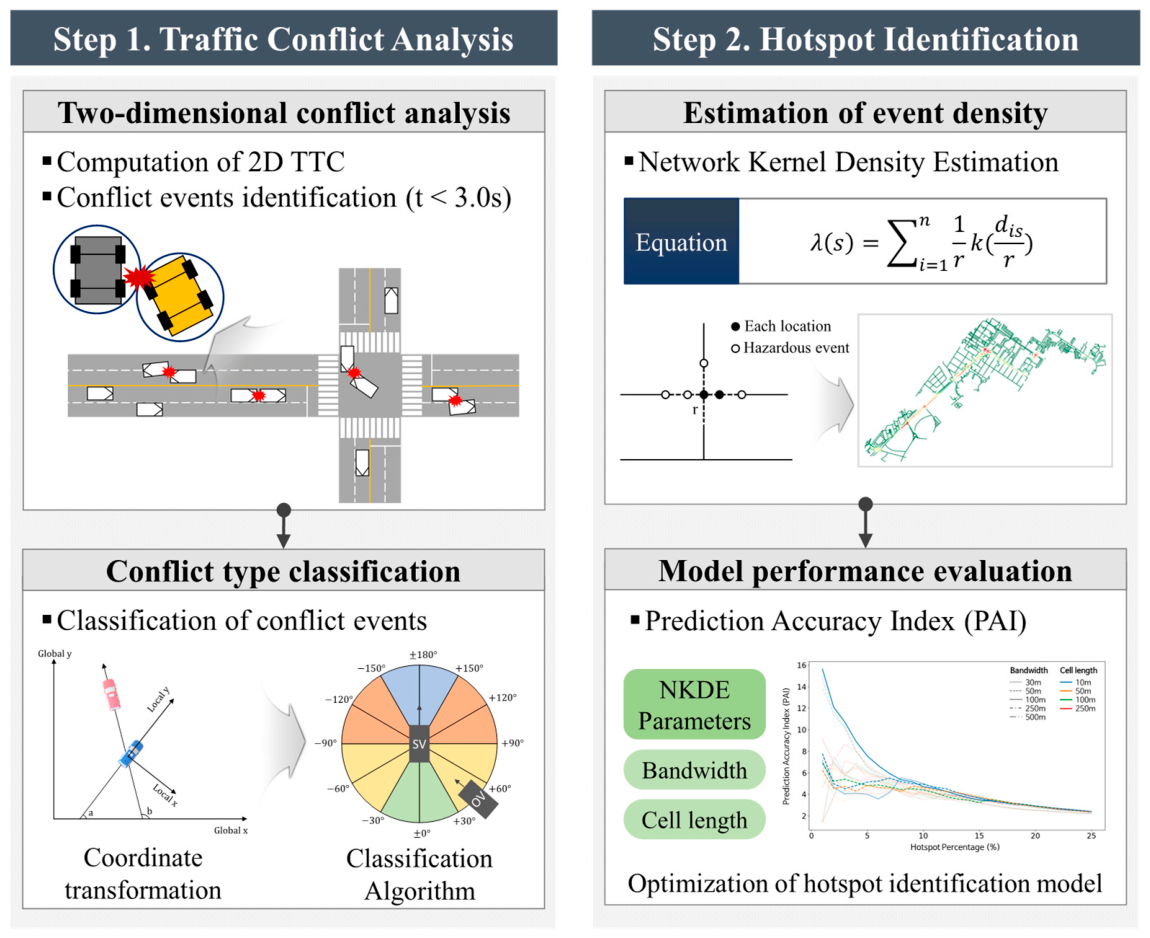
3.1. Two-Dimensional Conflict Indicator
- : Speed of the following vehicle at time t (m/s).
- : Speed of the leading vehicle at time t (m/s).
- : Spacing at time t (m).
- : Transition of vehicle state at time t.
- : State of the vehicle, including position and direction.
- : Control of vehicle, comprising acceleration and steering.
- : Matrices representing the state transition and control input, respectively.
- C: Constant drift vector.
- : Control of vehicle, comprising acceleration and steering.
- : Cartesian coordinates of the vehicle’s center of gravity.
- : Heading angle and steering angle, respectively.
- : Wheelbase of the vehicle.
- : Speed (m/s) and acceleration (m/s2), respectively.
3.2. Two-Dimensional Conflict-Type Classification Algorithm

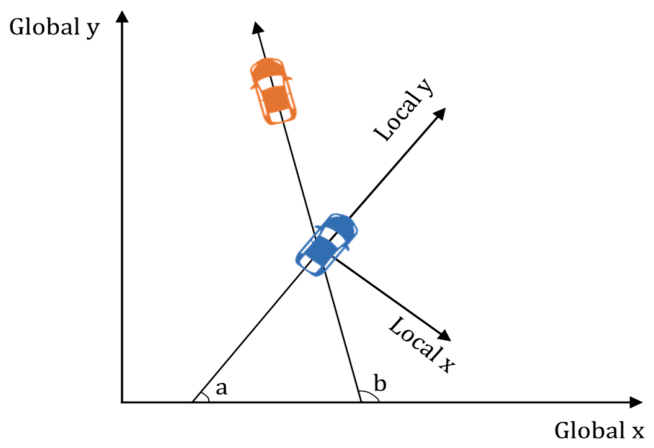
- : Local heading of the HV.
- : Local position angle.
- : Global heading of the vehicle.
| Algorithm 1. Traffic conflict classification algorithm |
3.3. Network Kernel Density Estimation

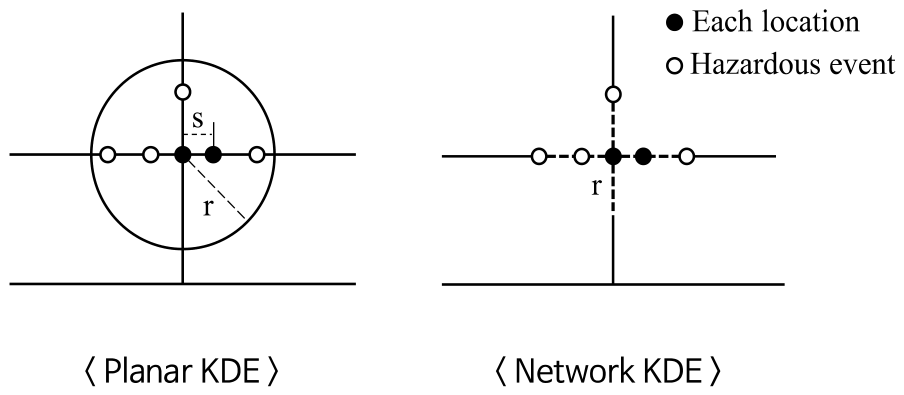
- : Density estimate at location
- : Local position angle.
- : The kernel function.
- : Network distance from point to location .
3.4. Model Performance Assessment
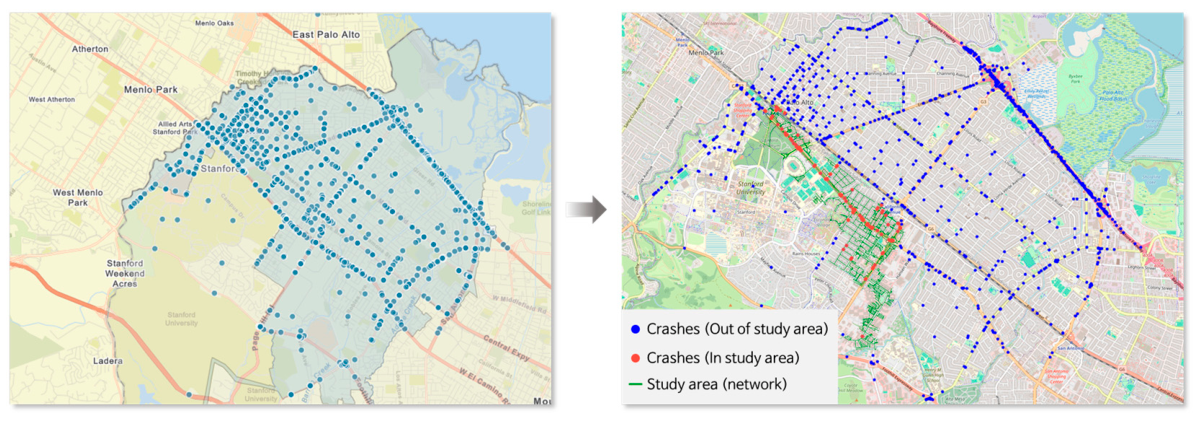
- : Number of traffic accidents in the hotspot area.
- : Number of traffic accidents in the study area.
- : Length of the road network in the hotspot area.
- : Length of the road network in the study area.
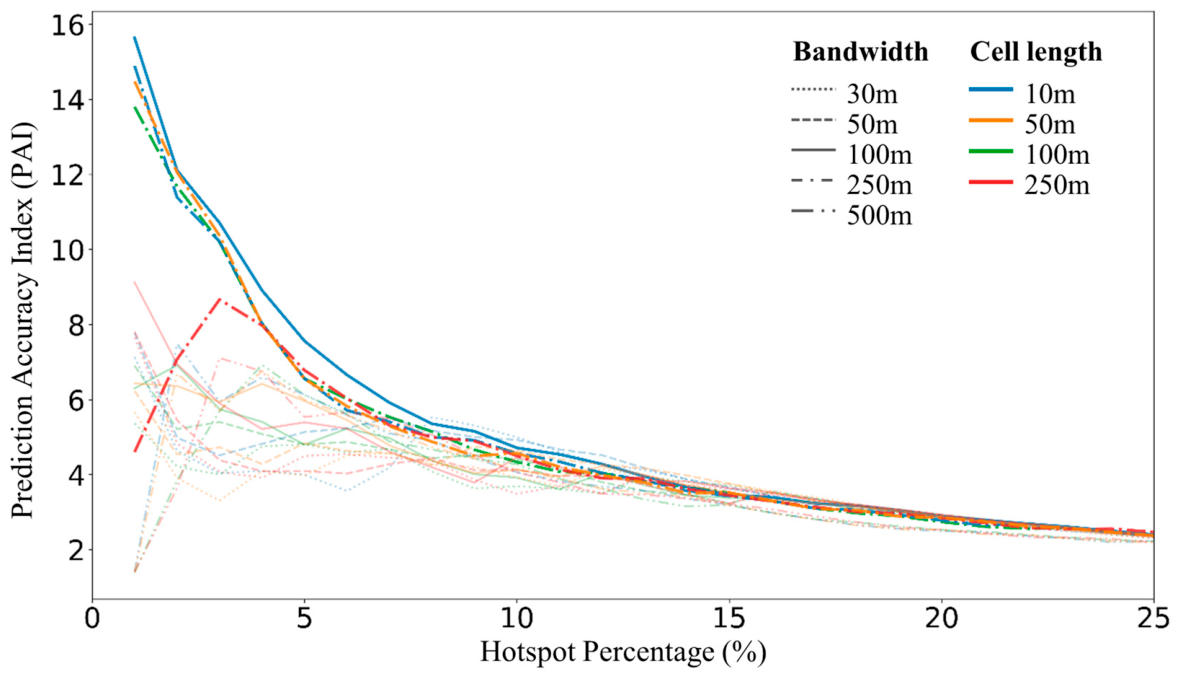
- : Network coverage percentage of the hotspot at step .
- : PAI score at percentage .
- : Total number of thresholds.
4. Results
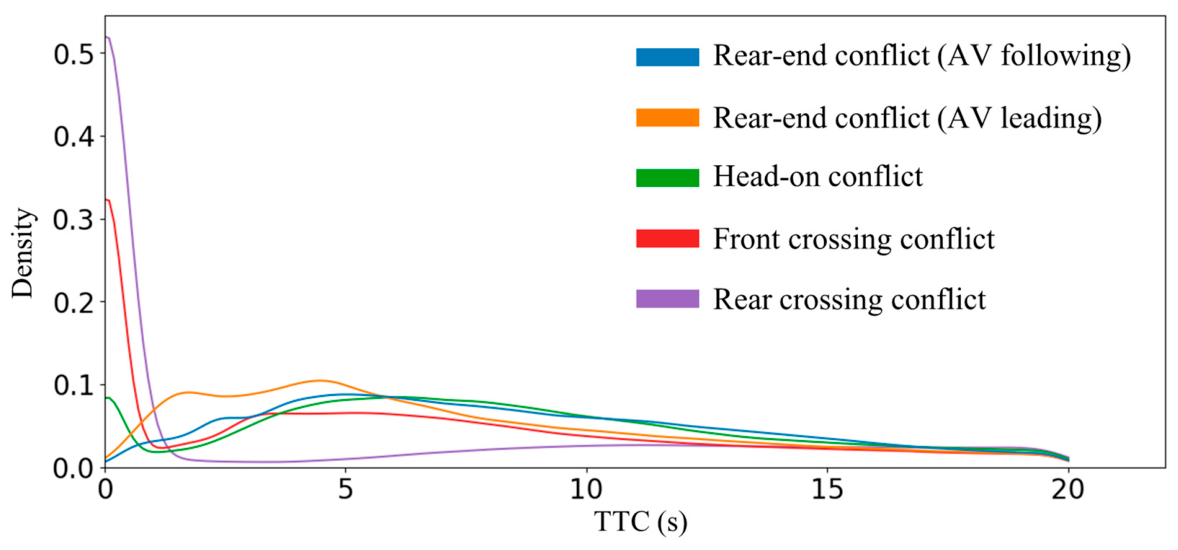
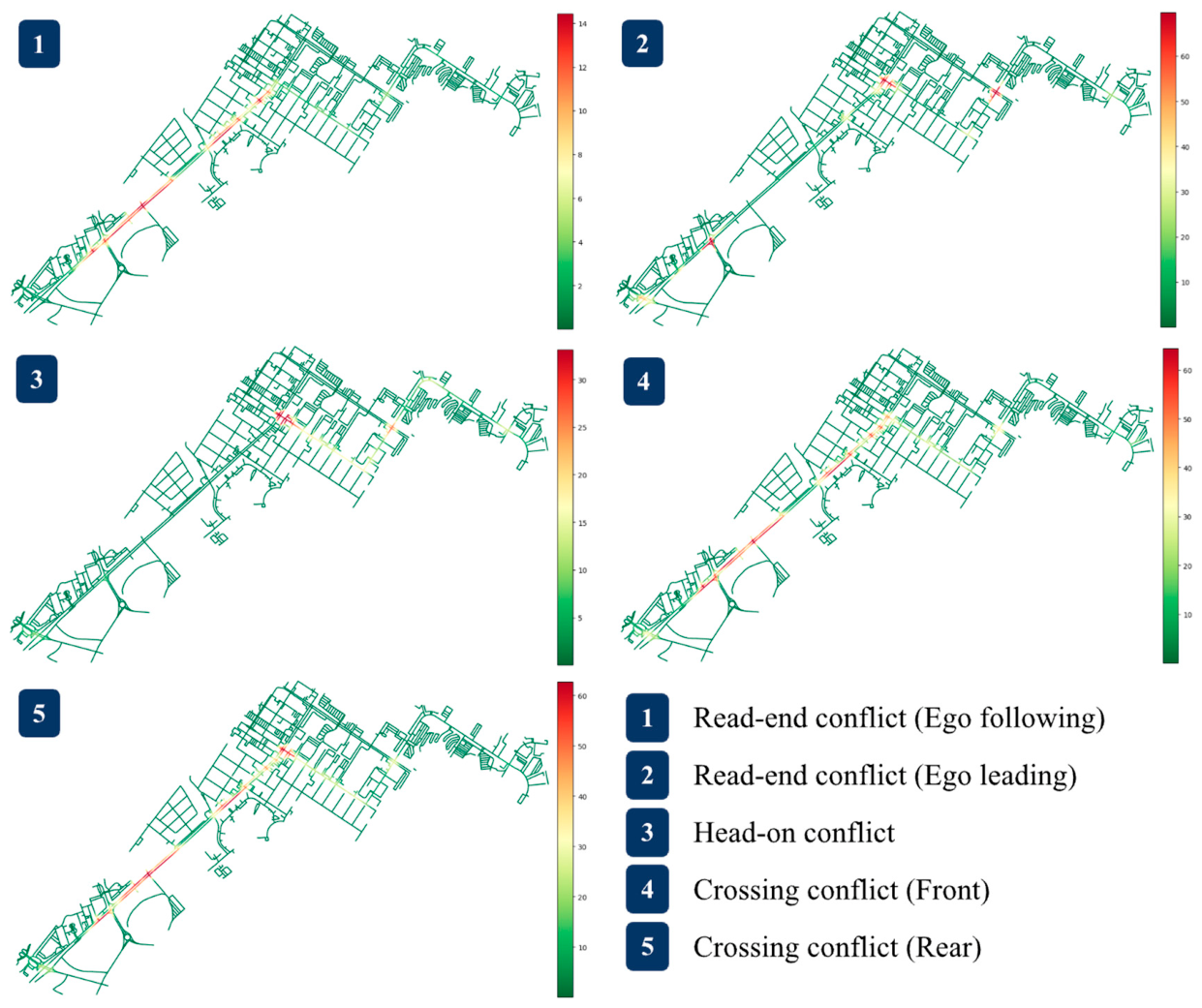
4.1. Multi-Dimensional Conflict Analysis
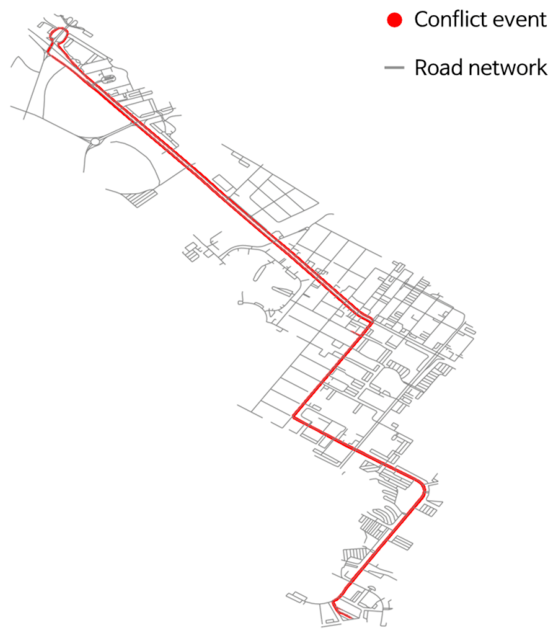
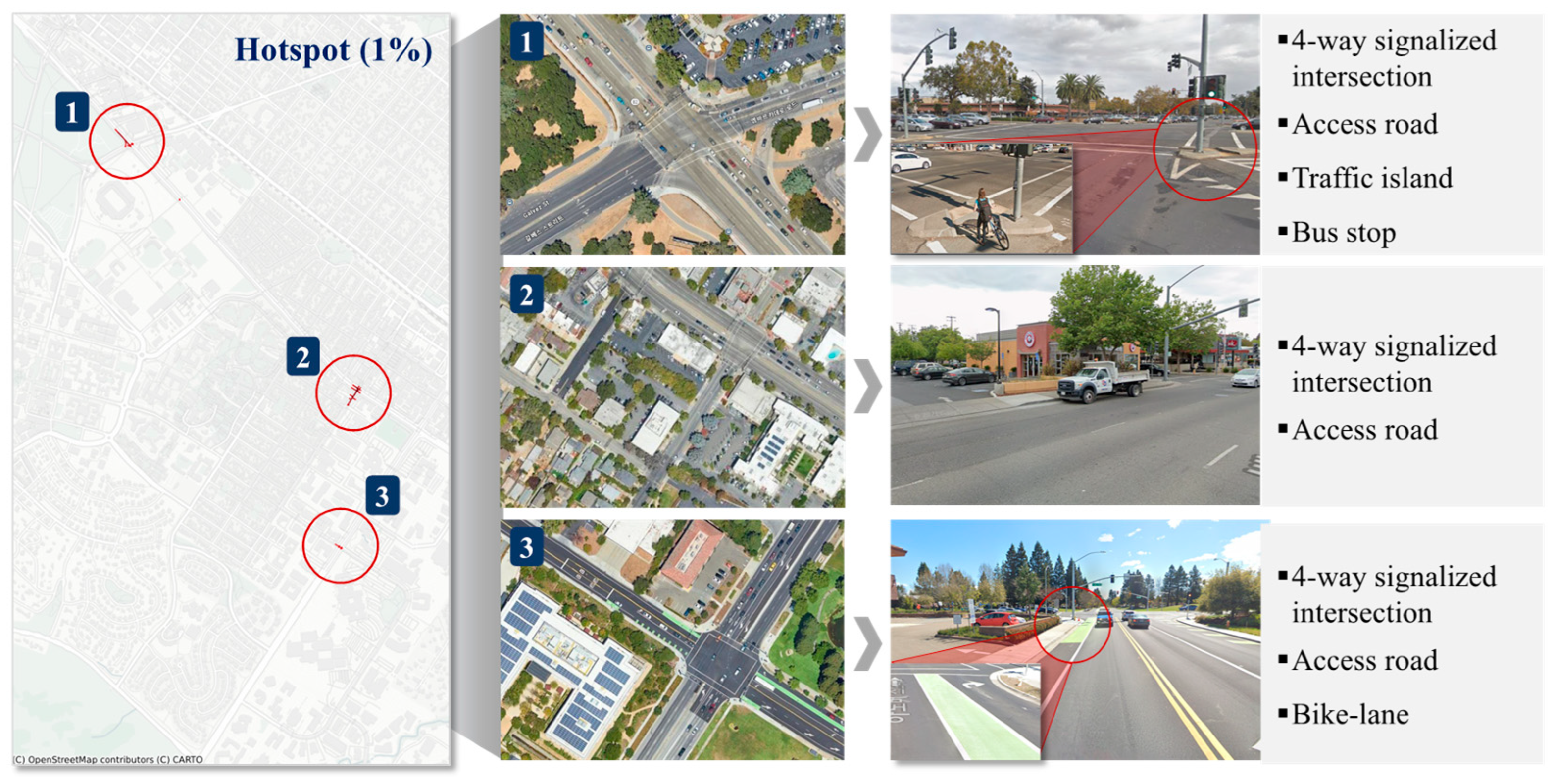
4.2. Identification of Autonomous Driving Risk Hotspots
5. Discussion
6. Conclusions
Author Contributions
Funding
Institutional Review Board Statement
Informed Consent Statement
Data Availability Statement
Conflicts of Interest
References
- WHO. Global Status Report on Road Safety; WHO: Geneva, Switzerland, 2023; pp. 6–7. [Google Scholar]
- KOROAD. The Social Cost of Road Traffic Accidents in 2022 Will be Approximately 26 Trillion 283.3 Billion Won; KOROAD: Wonju, Republic of Korea, 2024. [Google Scholar]
- Singh, S. Critical Reasons for Crashes Investigated in the National Motor Vehicle Crash Causation Survey; DOT HS 812 115; NHTSA: Washington, WA, USA, 2015. [Google Scholar]
- Ghorai, P.; Eskandarian, A.; Abbas, M.; Nayak, A. A causation analysis of autonomous vehicle crashes. IEEE Intell. Transp. Syst. Mag. 2024, 16, 33–45. [Google Scholar] [CrossRef]
- Ren, Q.; Xu, M. Heterogeneity in crash patterns of autonomous vehicles: The latent class analysis coupled with multinomial logit model. Accid. Anal. Prev. 2025, 209, 107827. [Google Scholar] [CrossRef] [PubMed]
- Ye, L.; Yamamoto, T. Evaluating the impact of connected and autonomous vehicles on traffic safety. Phys. A 2019, 526, 121009. [Google Scholar] [CrossRef]
- Wen, X.; Cui, Z.; Jian, S. Characterizing car-following behaviors of human drivers when following automated vehicles using real-world data. Accid. Anal. Prev. 2022, 172, 106689. [Google Scholar] [CrossRef]
- Wang, Y.; Farah, H.; Yu, R.; Qiu, S.; Van Arem, B. Characterizing behavioral differences of autonomous and human-driven vehicles at signalized intersections based on Waymo open dataset. Transp. Res. Rec. 2023, 2677, 324–337. [Google Scholar] [CrossRef]
- Hu, X.; Zheng, Z.; Chen, D.; Sun, J. Autonomous vehicle’s impact on traffic: Empirical evidence from Waymo open dataset and implications from modelling. IEEE Trans. Intell. Transp. Syst. 2023, 24, 6711–6724. [Google Scholar] [CrossRef]
- Li, S.; Anis, M.; Lord, D.; Zhang, H.; Zhou, Y.; Ye, X. Beyond 1D and oversimplified kinematics: A generic analytical framework for surrogate safety measures. Accid. Anal. Prev. 2024, 204, 107649. [Google Scholar] [CrossRef]
- Ryan, C.; Murphy, F.; Mullins, M. Spatial risk modelling of behavioural hotspots: Risk-aware path planning for autonomous vehicles. Transp. Res. Part A 2020, 134, 152–163. [Google Scholar] [CrossRef]
- Srikanth, L.; Srikanth, I. A case study on kernel density estimation and hotspot analysis methods in traffic safety management. In Proceedings of the 2020 International Conference on Communication Systems & Networks (COMSNETS), Bangalore, India, 7–11 January 2020; pp. 99–104. [Google Scholar]
- Zheng, M.; Xie, X.; Jiang, Y.; Shen, Q.; Geng, X.; Zhao, L.; Jia, F. Optimizing kernel density estimation bandwidth for road traffic accident hazard identification: A case study of the City of London. Sustainability 2024, 16, 6969. [Google Scholar] [CrossRef]
- Zahran, E.S.M.M.; Tan, S.J.; Tan, E.H.A.; Mohamad’Asri Putra, N.A.A.B.; Yap, Y.H.; Abdul Rahman, E.K. Spatial analysis of road traffic accident hotspots: Evaluation and validation of recent approaches using road safety audit. J. Transp. Saf. Secur. 2021, 13, 575–604. [Google Scholar] [CrossRef]
- Houston, J.; Zuidhof, G.; Bergamini, L.; Ye, Y.; Chen, L.; Jain, A.; Ondruska, P. One thousand and one hours: Self-driving motion prediction dataset. In Proceedings of the 2021 Conference on Robot Learning, London, UK, 8–11 November 2021; pp. 409–418. [Google Scholar]
- Sun, P.; Tang, X.; Huang, Y.; Sun, G. Wavelet de-noising Kalman filter-based global navigation satellite system carrier tracking in the presence of ionospheric scintillation. IET Radar Sonar Navig. 2017, 11, 226–234. [Google Scholar] [CrossRef]
- Hu, X.; Zheng, Z.; Chen, D.; Zhang, X.; Sun, J. Processing, assessing, and enhancing the Waymo autonomous vehicle open dataset for driving behavior research. Transp. Res. Part C 2022, 134, 103490. [Google Scholar] [CrossRef]
- Li, G.; Jiao, Y.; Knoop, V.L.; Calvert, S.C.; Van Lint, J.W.C. Large car-following data based on Lyft Level 5 open dataset: Following autonomous vehicles vs. human-driven vehicles. In Proceedings of the IEEE 26th International Conference on Intelligent Transportation Systems, Bilbao, Spain, 24–28 September 2023; pp. 5818–5823. [Google Scholar]
- Wang, J.; Liang, Y.; Tang, J.; Wu, Z. Vehicle trajectory reconstruction using Lagrange-interpolation-based framework. Appl. Sci. 2024, 14, 1173. [Google Scholar] [CrossRef]
- Tang, Y.; Gong, J.; Li, Y.; Zhang, G.; Yang, B.; Yang, Z. Wavelet transform-based inertial neural network for spatial positioning using inertial measurement units. Remote Sens. 2024, 16, 2326. [Google Scholar] [CrossRef]
- Anis, M.; Li, S.; Geedipally, S.R.; Zhou, Y.; Lord, D. Real-time risk estimation for active road safety: Leveraging Waymo AV sensor data with hierarchical Bayesian extreme value models. Accid. Anal. Prev. 2025, 211, 107880. [Google Scholar] [CrossRef] [PubMed]
- Altendorfer, R. Observable dynamics and coordinate systems for automotive target tracking. In Proceedings of the IEEE Intelligent Vehicles Symposium, Xi’an, China, 3–5 June 2009; pp. 741–746. [Google Scholar]
- Gettman, D.; Pu, L.; Sayed, T.; Shelby, S. Surrogate Safety Assessment Model and Validation: Final Report; FHWA-HRT-08-051; U.S. Department of Transportation: Washington, DC, USA, 2008.
- Shen, B.; Xu, X.; Li, J.; Plaza, A.; Huang, Q. Unfolding spatial-temporal patterns of taxi trip based on an improved network kernel density estimation. ISPRS Int. J. Geo-Inf. 2020, 9, 683. [Google Scholar] [CrossRef]
- Xie, Z.; Yan, J. Kernel density estimation of traffic accidents in a network space. Comput. Environ. Urban Syst. 2008, 32, 396–406. [Google Scholar] [CrossRef]
- Thakali, L.; Kwon, T.J.; Fu, L. Identification of crash hotspots using kernel density estimation and kriging methods: A comparison. J. Mod. Transp. 2015, 23, 93–106. [Google Scholar] [CrossRef]
- Ge, H.; Dong, L.; Huang, M.; Zang, W.; Zhou, L. Adaptive kernel density estimation for traffic accidents based on improved bandwidth research on black spot identification model. Electronics 2022, 11, 3604. [Google Scholar] [CrossRef]
- Zhuang, Y.; Dong, C.; Li, P.; Xu, B. Identifying spatio-temporal pattern of electric vehicles involved traffic accidents. J. Transp. Saf. Secur. 2024, 16, 1448–1468. [Google Scholar] [CrossRef]
- Hu, Y.; Wang, F.; Guin, C.; Zhu, H. A spatio-temporal kernel density estimation framework for predictive crime hotspot mapping and evaluation. Appl. Geogr. 2018, 99, 89–97. [Google Scholar] [CrossRef]
- University of California, Berkeley; Safe Transportation Research and Education Center. Transportation Injury Mapping System (TIMS): SWITRS Query & Map Tool. Available online: https://tims.berkeley.edu/ (accessed on 28 August 2025).
- Tavassoli, A.; King, D.; Xiouris, C.; Krauss, D. Revealing right-turn behavior of human drivers as a model for autonomous vehicles. SAE Tech. Pap. 2021, 2021-01-0866. [Google Scholar]
- Fu, H.; Ye, S.; Fu, X.; Chen, T.; Zhao, J. New insights into factors affecting the severity of autonomous vehicle crashes from two sources of AV incident records. Travel Behav. Soc. 2025, 38, 100934. [Google Scholar] [CrossRef]
- Liu, Q.; Wang, X.; Liu, S.; Yu, C.; Glaser, Y. Analysis of pre-crash scenarios and contributing factors for autonomous vehicle crashes at intersections. Accid. Anal. Prev. 2024, 195, 107383. [Google Scholar] [CrossRef] [PubMed]
- Tengilimoglu, O.; Carsten, O.; Wadud, Z. Implications of automated vehicles for physical road environment: A comprehensive review. Transp. Res. Part E Logist. Transp. Rev. 2023, 169, 102989. [Google Scholar] [CrossRef]
- Lee, H.; Jee, J.; Kim, H.; Oh, C. Machine learning-based analysis of contributing factors affecting autonomous driving behavior in urban mixed traffic. Comput. Mater. Contin. 2026, 87, 60. [Google Scholar] [CrossRef]
- Wu, Y.; Abdel-Aty, M.; Zheng, O.; Cai, Q.; Yue, L. Developing a crash warning system for the bike lane area at intersections with connected vehicle technology. Transp. Res. Rec. 2019, 2673, 47–58. [Google Scholar] [CrossRef]



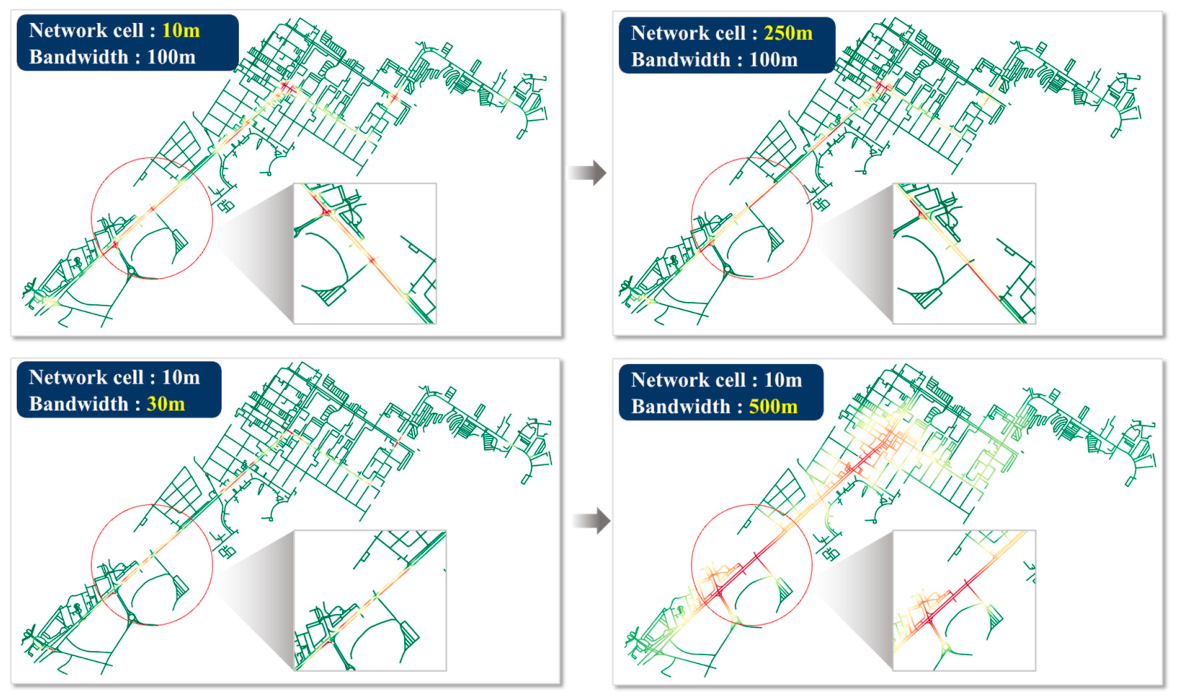

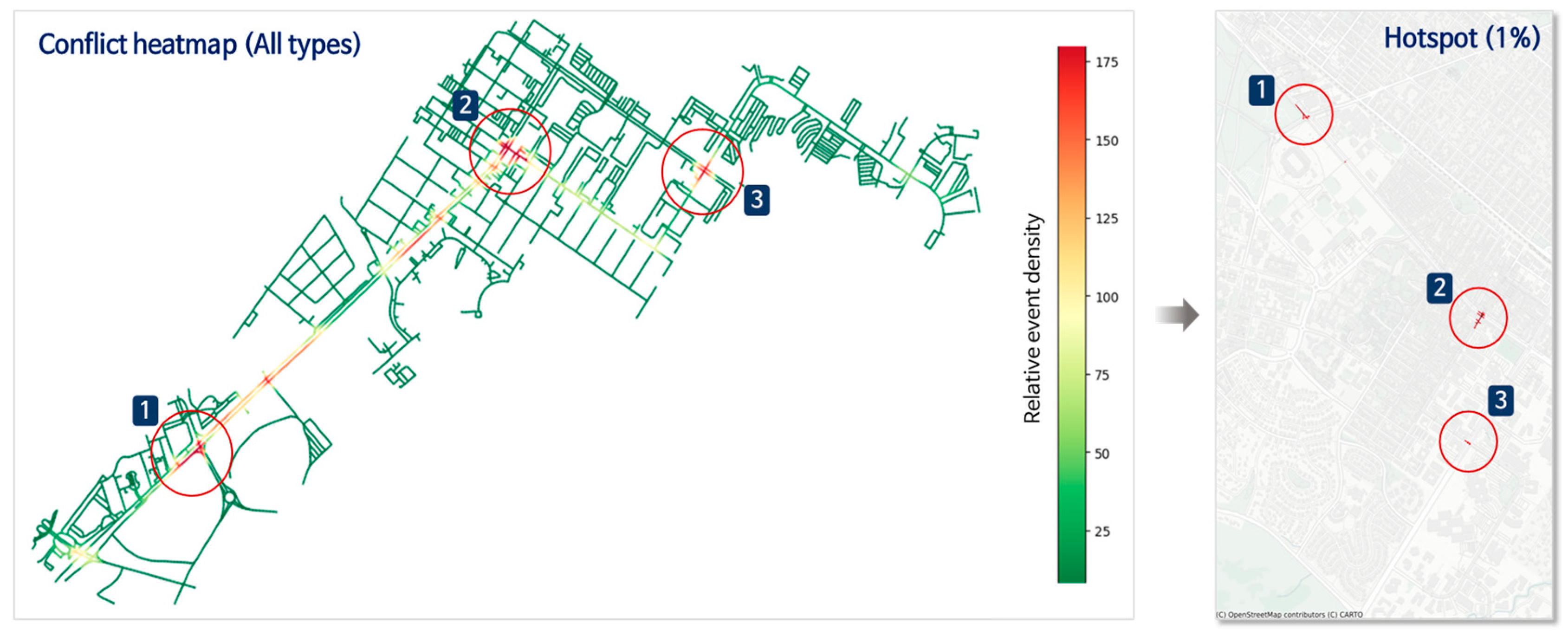



| Item | Contents |
|---|---|
| Period | October 2019~March 2020 |
| Total collection time | Over 1000 h |
| Number of vehicles | 20 vehicles |
| Total distance | Over 26,000 km |
| Number of scenes | 134,622 scenes |
| Driving time per scene | 25 s |
| Statistics | Total | Rear-End (AV Following) | Head-On | Rear-End (AV Leading) | Crossing (Front) | Crossing (Rear) |
|---|---|---|---|---|---|---|
| Samples | 958,011 | 73,577 | 154,686 | 154,686 | 343,362 | 312,873 |
| Mean | 0.697 s | 1.858 s | 1.764 s | 1.764 s | 0.465 s | 0.090 s |
| Standard deviation | 0.983 s | 0.772 s | 0.735 s | 0.735 s | 0.881 s | 0.308 s |
| Minimum | <0.001 s | <0.001 s | <0.001 s | <0.001 s | <0.001 s | <0.001 s |
| Maximum | 2.999 s | 2.999 s | 2.999 s | 2.999 s | 2.999 s | 2.998 s |
| Parameters | Average PAI | |||||
|---|---|---|---|---|---|---|
| Network Cell (m) | Bandwidth (m) | Mean | Standard Deviation | Minimum | Maximum | Median |
| 10 | 30 | 3.858 | 1.124 | 2.370 | 7.134 | 3.876 |
| 50 | 4.094 | 1.288 | 2.342 | 7.778 | 4.175 | |
| 100 | 5.255 | 3.369 | 2.400 | 15.636 | 3.954 | |
| 250 | 4.955 | 3.128 | 2.371 | 14.891 | 3.846 | |
| 500 | 3.775 | 1.602 | 1.418 | 7.486 | 3.365 | |
| 50 | 30 | 3.619 | 0.787 | 2.340 | 5.664 | 3.717 |
| 50 | 3.868 | 0.967 | 2.370 | 6.229 | 4.169 | |
| 100 | 4.075 | 1.323 | 2.396 | 6.428 | 3.950 | |
| 250 | 4.941 | 3.148 | 2.371 | 14.479 | 3.790 | |
| 500 | 3.732 | 1.523 | 1.393 | 6.766 | 3.414 | |
| 100 | 30 | 3.638 | 0.819 | 2.312 | 5.370 | 3.630 |
| 50 | 3.903 | 1.114 | 2.395 | 6.902 | 3.569 | |
| 100 | 3.934 | 1.244 | 2.398 | 6.916 | 3.611 | |
| 250 | 4.909 | 3.029 | 2.399 | 13.798 | 3.824 | |
| 500 | 3.617 | 1.402 | 1.394 | 6.928 | 3.188 | |
| 250 | 30 | 3.701 | 1.093 | 2.306 | 7.655 | 3.613 |
| 50 | 3.766 | 1.122 | 2.368 | 7.808 | 3.734 | |
| 100 | 4.128 | 1.548 | 2.363 | 9.120 | 3.819 | |
| 250 | 4.319 | 1.776 | 2.469 | 8.667 | 3.896 | |
| 500 | 3.680 | 1.498 | 1.413 | 7.109 | 3.361 | |
Disclaimer/Publisher’s Note: The statements, opinions and data contained in all publications are solely those of the individual author(s) and contributor(s) and not of MDPI and/or the editor(s). MDPI and/or the editor(s) disclaim responsibility for any injury to people or property resulting from any ideas, methods, instructions or products referred to in the content. |
© 2026 by the authors. Licensee MDPI, Basel, Switzerland. This article is an open access article distributed under the terms and conditions of the Creative Commons Attribution (CC BY) license.
Share and Cite
Lee, H.; Oh, C.; Jee, J. Assessing Sustainable Autonomous Driving Performance by Real-World Multi-Dimensional Conflict Hotspot Analysis. Sustainability 2026, 18, 5108. https://doi.org/10.3390/su18105108
Lee H, Oh C, Jee J. Assessing Sustainable Autonomous Driving Performance by Real-World Multi-Dimensional Conflict Hotspot Analysis. Sustainability. 2026; 18(10):5108. https://doi.org/10.3390/su18105108
Chicago/Turabian StyleLee, Hoyoon, Cheol Oh, and Jeonghoon Jee. 2026. "Assessing Sustainable Autonomous Driving Performance by Real-World Multi-Dimensional Conflict Hotspot Analysis" Sustainability 18, no. 10: 5108. https://doi.org/10.3390/su18105108
APA StyleLee, H., Oh, C., & Jee, J. (2026). Assessing Sustainable Autonomous Driving Performance by Real-World Multi-Dimensional Conflict Hotspot Analysis. Sustainability, 18(10), 5108. https://doi.org/10.3390/su18105108