Design of a Training Water Network Plant for Vocational Education in the Urban Water Cycle: A Case Study in Spain
 , ,
, ,
Abstract
1. Introduction
1.1. Water Scarcity and the Need to Optimise Its Management
- The available information covers 76.2% of the population, reaching 91% in cities and urban systems with more than 50,000 inhabitants.
- 2966 hm3 of water are supplied annually, of which 631 hm3 are not recorded due to leaks, municipal use or measurement errors.
- The average efficiency of the system is 79%.
- Actual leaks amount to 361 hm3 per year, equivalent to 13.8% of the water supplied.
1.2. Towards Water 4.0
1.3. Skills and Training Needs
1.4. Didactic Innovation in the Training of Technicians in the Urban Water Sector
1.5. Research Motivation and Study Aim
2. Materials and Methods
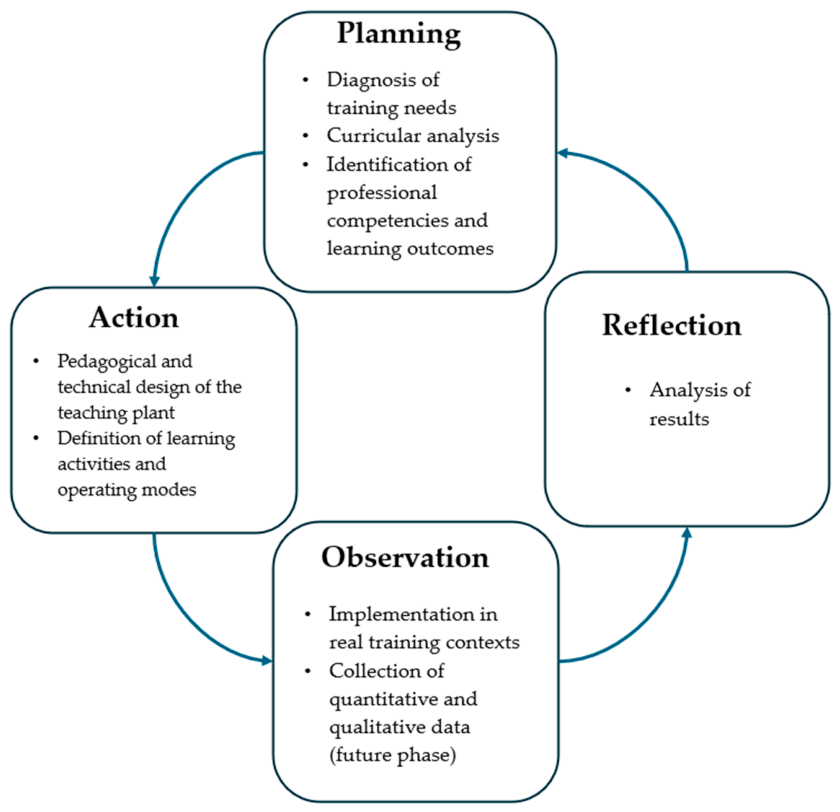
2.1. Methodological Framework of the Research
- A.
- Identification of the training needs of both students and professional sector within the urban water cycle through a rigorous diagnosis based on bibliographic sources, interviews with teachers and companies, and curricular analysis. This diagnosis guided the design of the teaching resource from a disciplinary perspective. The centre has established several actions that allow it to understand first-hand the training needs of companies. Since 2023, it has organised the “Water Day in Vocational Education and Training” event, which brings together companies from the sector, educational institutions and the regional education authority (Valencian Community). The 2024 edition focused on discussing the training needs of the sector at the VET level, emphasising digitalisation, soft skills, and the integration of knowledge and skills for problem solving [52]. In 2025, the centre organised, at the request of the regional education authority, the so-called Talent-PIME [53], a meeting between companies in the sector and vocational training centres aimed at identifying areas for improvement in the training provided, aligning it with the current needs of companies, and facilitating business collaboration in student training. Moreover, in 2024 the centre signed a collaboration agreement with the company Hidraqua, the main operator of urban water services in Benidorm [54], and in 2025 with the Water Institute of the University of Alicante [55], with the aim of carrying out actions to update the disciplinary knowledge of the teaching staff. Finally, it is worth noting that the centre maintains numerous internship agreements with practically all urban water service operators in the Valencian Community, which provides continuous feedback on potential improvements to the basic training of students before they begin their company internship period.
- B.
- Contextualisation of the process of designing practical activities based on active methodologies—especially project-based learning and collaborative activities—that foster the integration of curricular knowledge and techniques, as well as the development of transversal competencies, guiding the design of the learning activities to be implemented through the didactic plant. From a pedagogical perspective, this action focused on adapting teaching–learning processes to vocational training for technicians in urban water management and treatment. In vocational training, active methodologies are highly relevant for developing professional skills, complementing—rather than replacing—direct instruction [56]. Although there is extensive literature highlighting the potential benefits of applying the Project-Based Learning (PBL) approach [57,58,59] its implementation is not without risks [60,61]. A comprehensive analysis of regulations, teacher coordination, spaces, planning, and technical and financial resources led to the development of a plan to implement project-based learning (PBL), tailored to the urban water cycle curriculum and its professional context [34]. A pilot inter-modular project was also implemented [62]. Finally, in the pedagogical field, an exploratory study was conducted on the perceived usefulness for learning of the different teaching resources and methods used during the 2024–2025 academic year. This study indicated that there are different learning styles in the classroom that justify the use of diverse methods and resources to facilitate learning, but also that the resources perceived as most useful are those that simulate real professional activity using project-based learning approaches [63].
- C.
- Design of a digital and flexible teaching resource capable of simulating real operation and maintenance processes in water supply and distribution systems, incorporating emerging technologies and digitalisation criteria, considering the information obtained in the previous tasks and developed in collaboration with the integrated water utility FACSA. The outcome of this process is described in detail in this document.
- D.
- Implementation of the teaching resource in real training contexts, ensuring its alignment with the learning outcomes established in the professional modules of the vocational training programs.
- E.
- Evaluation of the impact of the resource on learning outcomes and skills acquisition through qualitative and quantitative assessment tools that allow measurement of its pedagogical effectiveness.
- F.
- Assessment of the perceptions of students, teachers and sector stakeholders regarding the professional relevance of the competences developed.
2.2. Backward Design
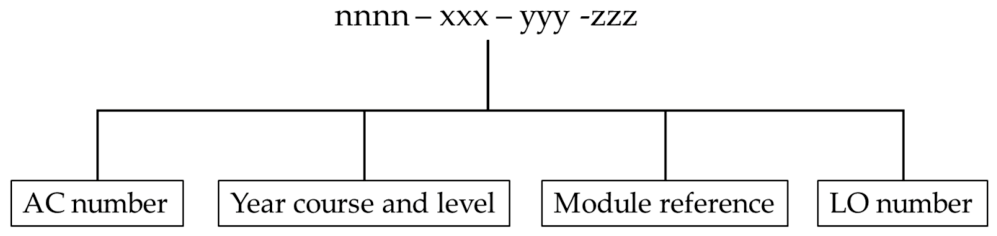
- LO HRA-47 (“Determine hydraulic parameters in water networks”) and AC379–385 required the inclusion of pressure transducers and electromagnetic flowmeters, enabling students to calculate head losses and hydraulic performance indices.
- LO ORI-134 (“Commission water networks”) required the ability to perform functional tests, which led to the incorporation of leak detection mechanisms, manometers and sector valves in the plant.
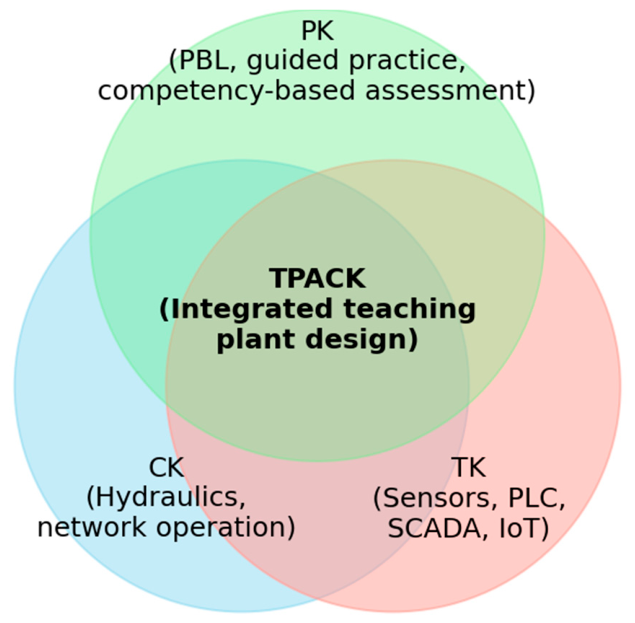
2.3. Technological–Pedagogical Integration: The TPACK Model
- Content Knowledge (CK): This is applied through the definition of techniques and technologies specific to urban water management and treatment. It includes knowledge of the integral water cycle, hydraulics, and maintenance processes. In the methodological procedure, this dimension is reflected in establishing the professional reference framework and selecting technically consistent learning outcomes (LO).
- Pedagogical Knowledge (PK): This dimension is applied in the selection of teaching methodologies, such as project-based learning (PBL), guided practices, or demonstrations. It also involves analysing official curricula to ensure the plant design allows for the verification of the assessment criteria (AC) established by regulations.
- Technological Knowledge (TK): This refers to the technological components that make up the physical plant, such as sensors (pressure, flow, pH, level), programmable logic controllers (PLC), SCADA systems, and design software like Autodesk AutoCAD.
3. Results
3.1. Establishment of the Guidelines for the Design of the Teaching Plant
- Based on the defined general competencies, the teaching resource should reflect real professional practice.
- It should provide an integrated framework encompassing multiple professional competencies.
- It should contribute to the acquisition of professional competences covered in both intermediate and advanced VET levels.
- It should contribute to the acquisition of different LOs covered in different disciplinary modules of the different courses of the levels involved, allowing for the verification of official assessment criteria.
- It should enable the design and implementation of individual and collaborative learning or activities using a variety of teaching approaches and methods that allow for the use of the selected ACs established in the official curricula associated with the LOs addressed with the teaching facility.
- It should be reusable and modifiable for future cohorts of students.
- Rubrics are recommended for procedural, design, and execution activities, as they allow the assessment of technical quality, methodology, autonomy, and compliance with standards.
- Checklists are most appropriate for verification tasks, particularly those related to safety, tool handling, and procedural compliance.
- Technical reports are best suited for activities involving analysis, diagnostics, calculations, planning, and decision-making, fully aligned with learning outcomes related to management, maintenance, and digitalisation.
- Objective tests are reserved for the assessment of theoretical foundations and hydraulic calculations.
3.2. Description of the Design of the Teaching Plant
3.2.1. General Considerations
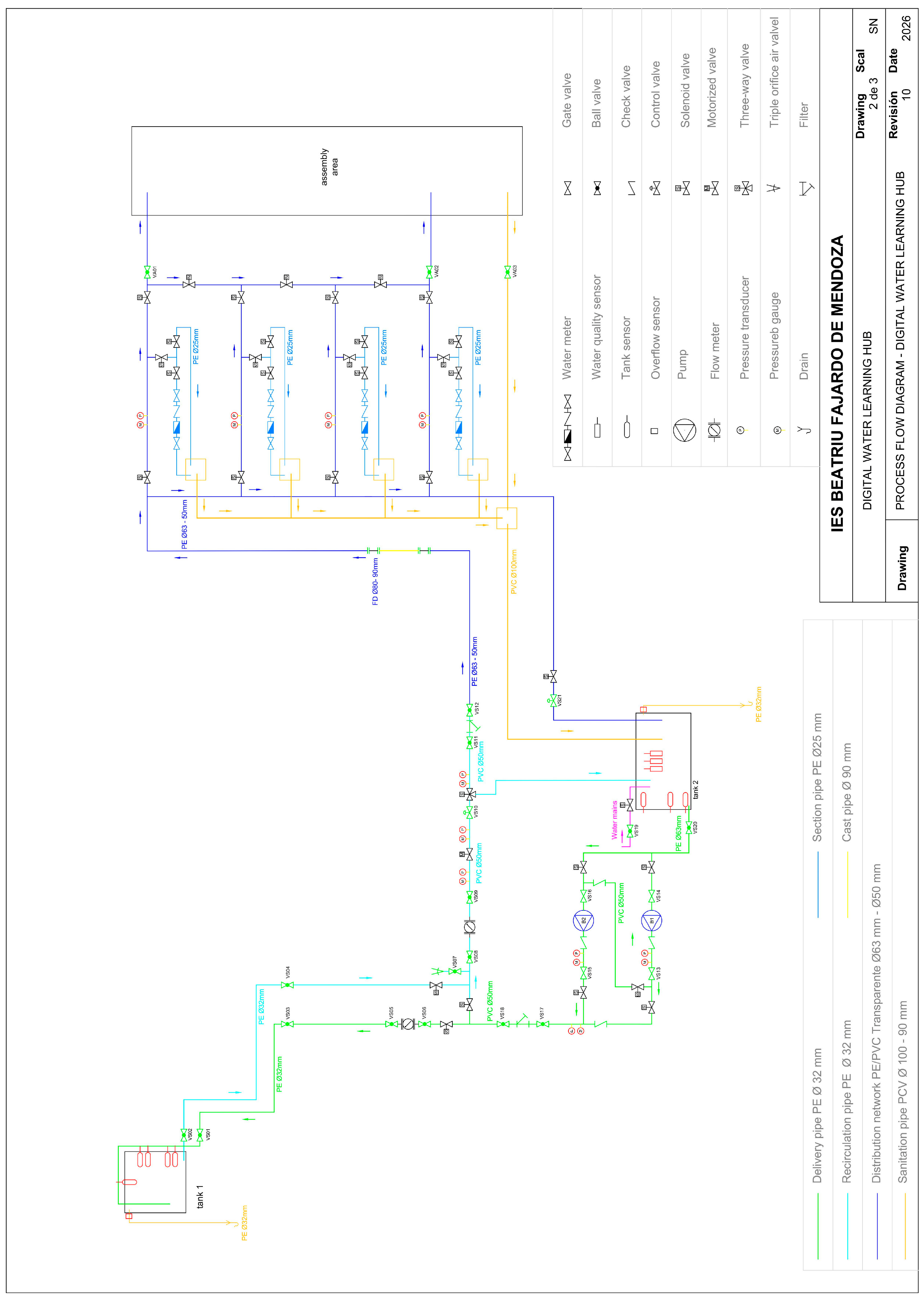
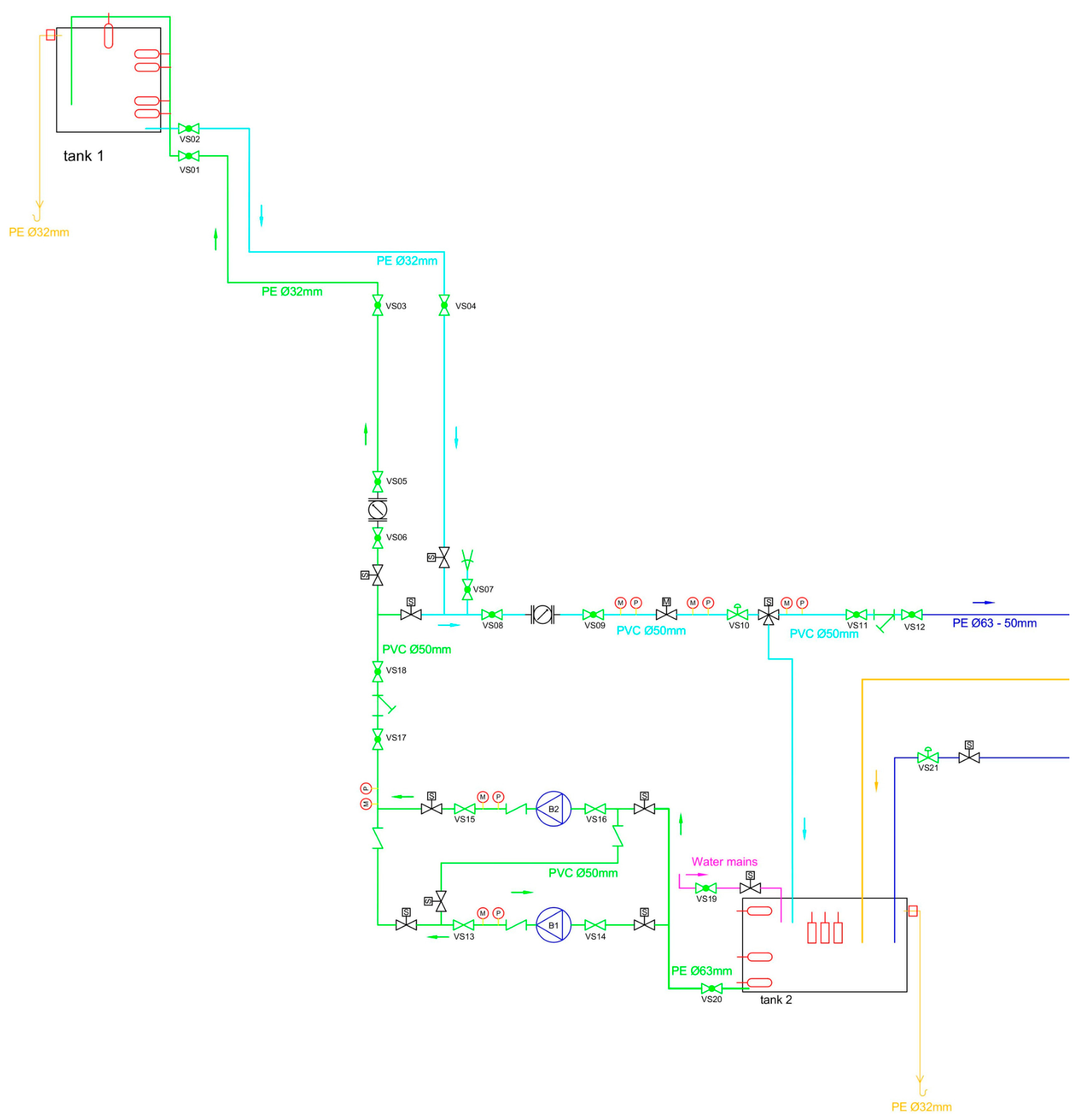
- Collection and pumping;
- Regulation reservoir;
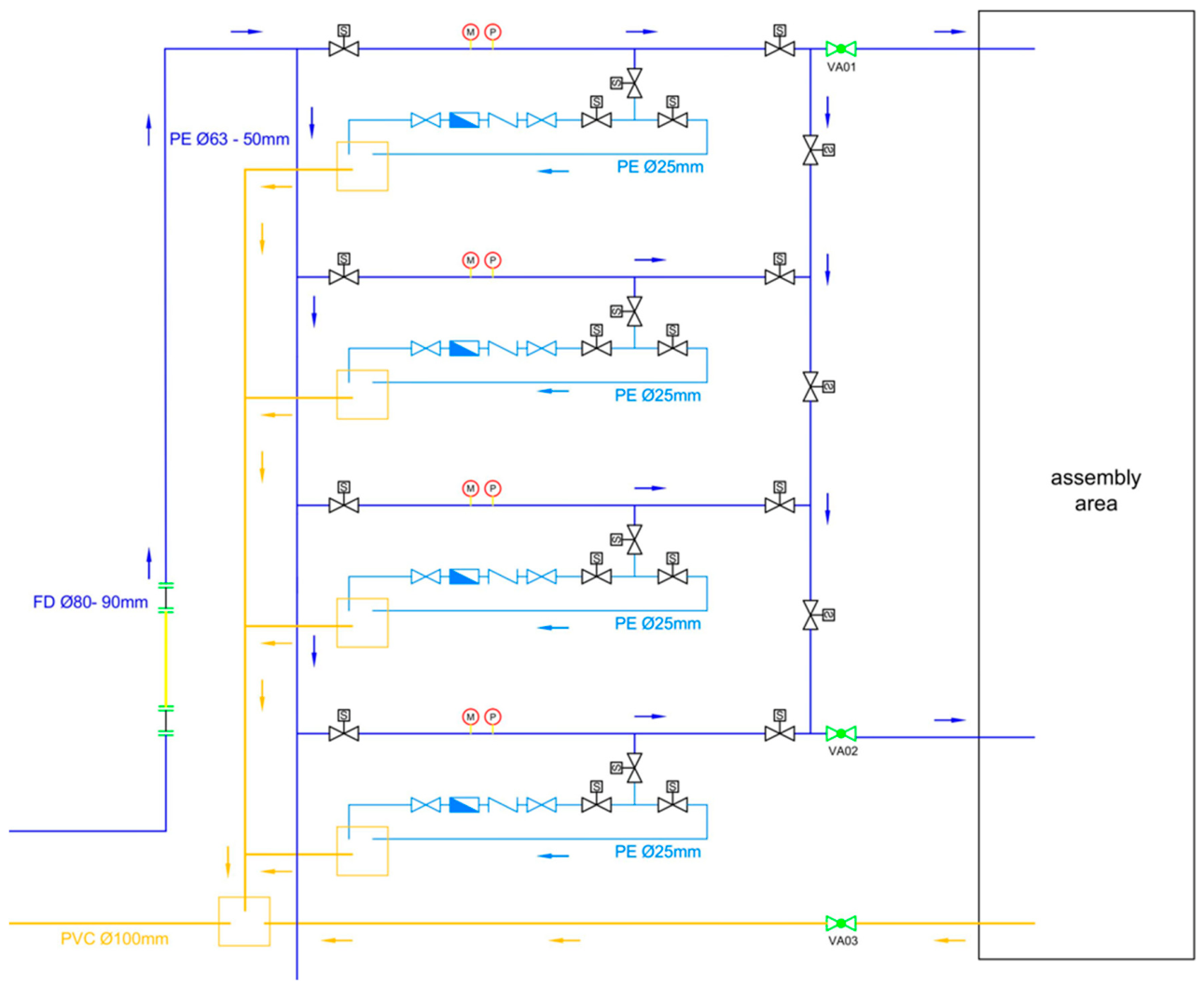
- Distribution pipe network with 4 sectors and sanitation network;
- Area for the assembly and temporary connection of complementary branches.
3.2.2. Elements Included in the Teaching Plant and Budget
- -
- Electrical panel;
- -
- Programmable logic controller Schneider;
- -
- Data acquisition system;
- -
- Communication system;
- -
- Cloud service for monitoring, data collection and operation.
- -
- Four smart meters to monitor consumption in each sector provided by Itron;
- -
- Two electromagnetic flow meters to monitor the volume of water abstracted and supplied to the network provided by IFM;
- -
- Pressure transducers in the pumping circuit, in the main artery and in each sector provided by IFM;
- -
- Manual pressure gauges for checking the pressure transducers;
- -
- Capacitive level sensors in tanks for level control and pump activation provided by IFM;
- -
- Water quality parameter sensors: temperature, pH provided by Hanna Instruments.
- -
- PLC-controlled solenoid valves to determine opening and closing times for the direction of flow to leakage or consumption to simulate demand patterns and leakage events;
- -
- Regulating valve provided by Hidroten;
- -
- Manual shut-off and non-return valves provided by Hidroten;
- -
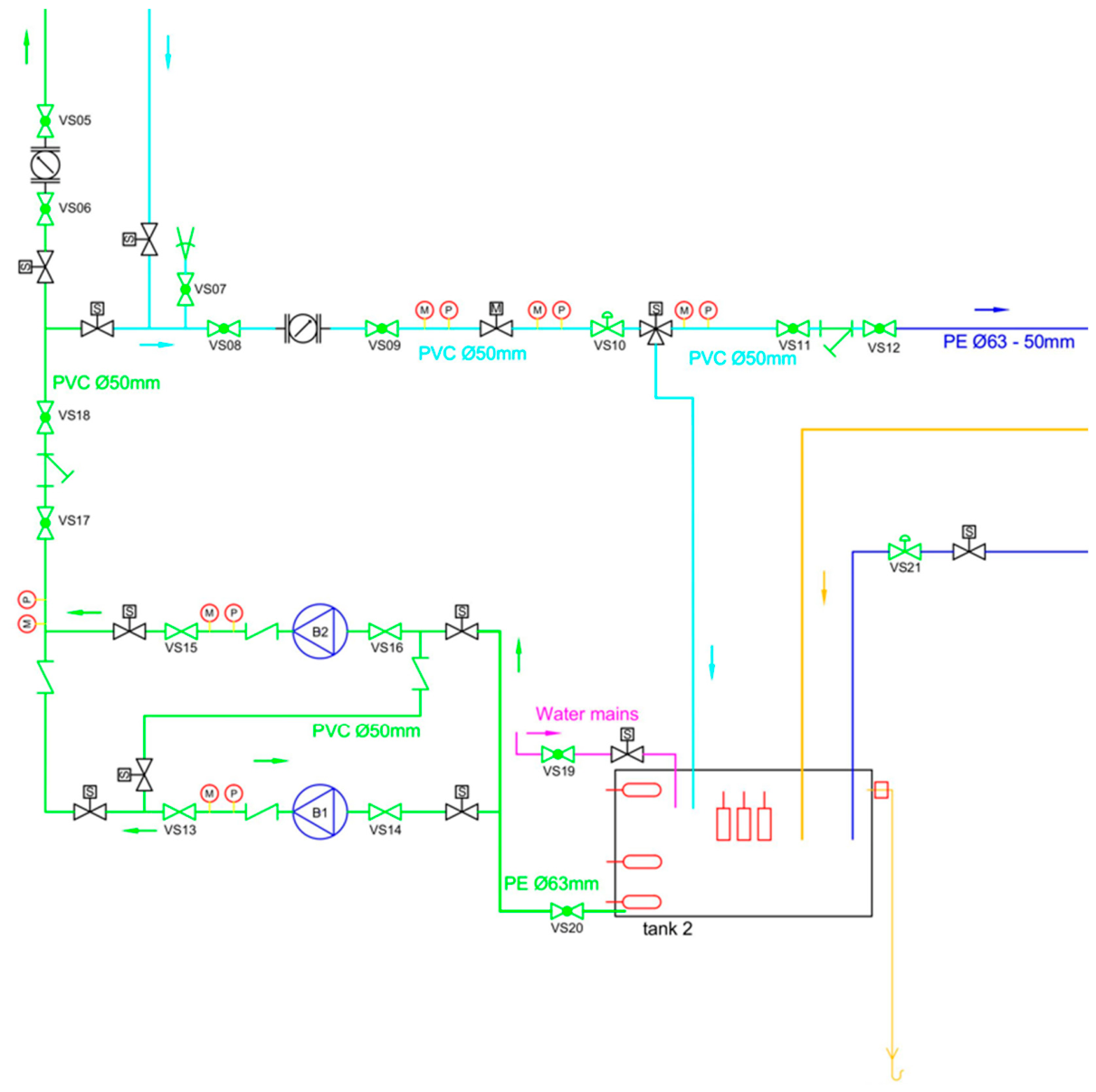
- Pumping unit with two pumps in a dry chamber with positive suction provided by Xylem;
- -
- Two frequency converters provided by Schneider;
- -
- Two safety floats.
3.2.3. Modes of Use and Operations
- Closed-circuit pumping mode for testing classic hydraulic parameters;
- Pump supply network mode;
- Gravity supply network mode from the regulating tank.
3.3. Evaluation Design
- Initial measurement (pre-test): level of technical, digital and transversal skills.
- Intervention: use of the digitized teaching resource in project-based activities.
- Final measurement (post-test): comparison of performance after the intervention.
- Qualitative evaluation: interviews, questionnaires and focus groups.
- Performance rubrics to evaluate participation in practical activities, problem solving, use of operational data and management of the simulation system.
- Specific tests of knowledge and procedures applied before and after the intervention.
- Indicators of achievement of technical skills, such as:
- ○
- Interpretation of operational data;
- ○
- Calculation of management parameters (e.g., non-revenue water, technical hydraulic performance);
- ○
- Operation and maintenance of the simulated system;
- ○
- Quality of the execution of assembly techniques.
- Semi-structured interviews with students to collect experiences, difficulties and perceptions of the educational value of the resource.
- Focus groups with teachers to assess the integration of the resource into the curriculum.
- Satisfaction surveys on the design, usability and perceived impact of the resource.
- Judgement of experts from the water sector to validate:
- ○
- Professional relevance of the resource;
- ○
- Realism of simulated scenarios;
- ○
- Relevance of the competencies developed.
3.4. Measuring the Success of the Didactic Plant
- Achievement of Learning Outcomes (Curricular Effectiveness): The primary indicator of success of the teaching plant is its effectiveness in supporting the achievement of the official learning outcomes (LOs) and assessment criteria (ACs) defined in the vocational training curricula. Success at this level will be measured through a quasi-experimental pre-test/post-test design, using a single cohort of students. Quantitative instruments will include written tests and problem-solving tasks aligned with selected LOs, allowing comparison of student performance before and after the didactic intervention. In addition, performance-based assessment will be conducted through rubrics explicitly mapped to the official assessment criteria, evaluating students’ ability to apply procedures, interpret operational data, and carry out commissioning, operation and maintenance tasks.
- Quality of Skill Acquisition and Knowledge Integration: Beyond the achievement of individual learning outcomes, a key success criterion is the extent to which students demonstrate integrated and transferable professional skills. This includes the ability to combine hydraulic knowledge, operational reasoning, digital tools and decision-making processes in realistic problem-solving situations. This dimension will be assessed through authentic performance tasks carried out using the teaching plant, such as leak detection analysis, pressure management, sectorisation planning, and interpretation of SCADA-based operational data. Student outputs (technical reports, operational logs, and project deliverables) will be analysed using analytic rubrics that consider not only correctness, but also reasoning, autonomy, collaboration and procedural coherence.
- Professional Relevance and Employability Alignment: A third dimension of success relates to the professional relevance of the competencies developed using the teaching plant. From this perspective, success is not defined by immediate employment outcomes, but by the perceived alignment between the skills acquired during training and the practices, technologies and procedures used in the urban water sector. This dimension will be evaluated through qualitative instruments, including structured questionnaires and interviews with students, teachers and sector professionals collaborating with the centre. Attention will be given to the perceived realism of the simulated scenarios, the relevance of the digital tools used, and the adequacy of the training provided to current operational and maintenance practices in water utilities.
- Usability, Acceptability and Sustainability of the Teaching Resource: The success of the teaching plant also depends on its usability, acceptance by teachers and students, and sustainability as a long-term educational resource. This includes factors such as ease of integration into the curriculum, flexibility to support different teaching approaches, robustness of the installation, and capacity for adaptation to future cohorts or curricular updates. Data for this dimension will be collected through satisfaction surveys, focus groups with teachers, and reflective reports documenting implementation challenges and improvement proposals. These data will support iterative refinement of the teaching plant in line with the action-research framework adopted.
4. Discussion
4.1. Contribution of the Teaching Plant to Vocational Training in Urban Water Management
4.2. Integration of Pedagogy, Technology and Content Within the TPACK Framework
4.3. Positioning the Teaching Plant as a Design-Based Educational Contribution
4.4. Expected Educational Impact and Research Hypotheses
4.5. Limitations of the Teaching Installation
5. Conclusions
6. Additional Work
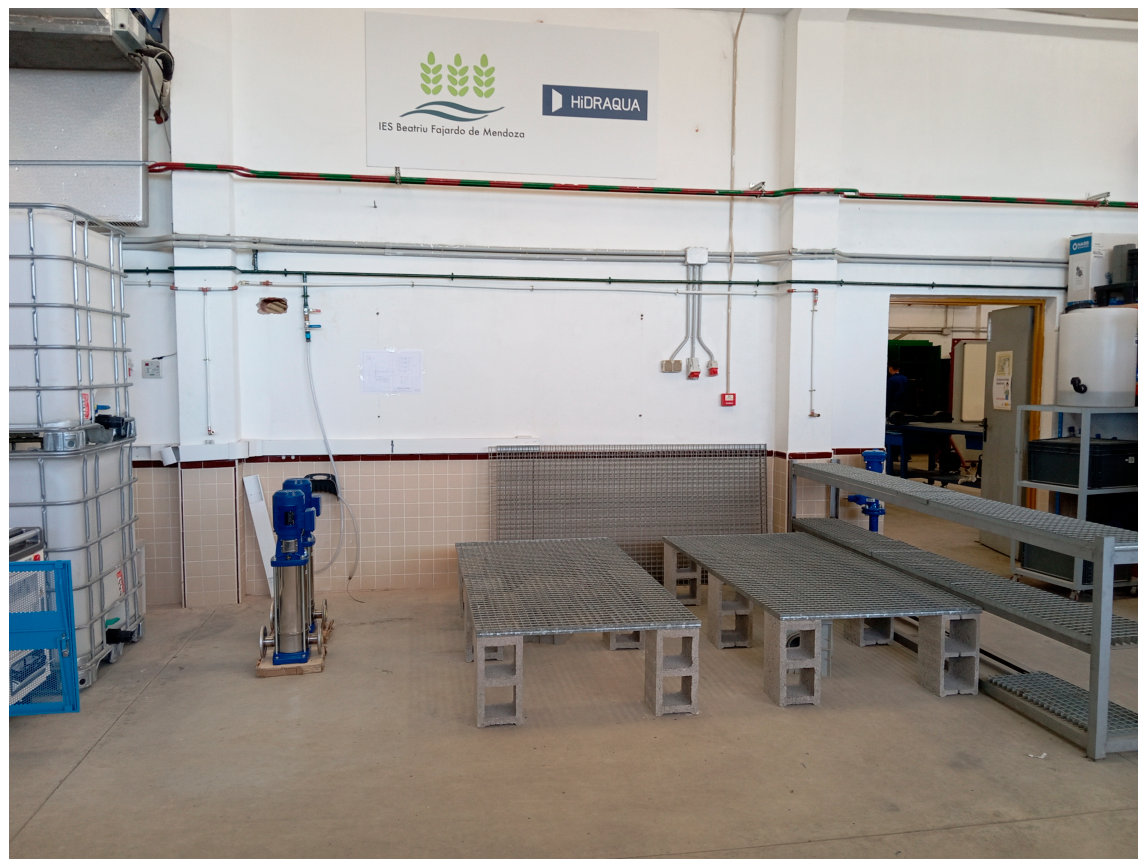
- Physical assembly and programming: Complete the assembly of the hydraulic and electrical components in the workshop of the educational (Figure 9) and proceed with the detailed programming of the PLC and SCADA system.
- Technical validation: Perform hydraulic leak tests, check sensor signals and validate automatic manoeuvres.
- Development of teaching materials: Draft guides for students and teachers detailing the practical activities linked to the learning outcomes.
- Training: Train teachers in the use of the plant and conduct pilot tests with small groups of students.
- Extensive use: Integrate the plant into the daily teaching of the four courses related to urban water.
- Implementation of the evaluation plan.
Supplementary Materials
Author Contributions
Funding
Institutional Review Board Statement
Informed Consent Statement
Data Availability Statement
Conflicts of Interest
Abbreviations
| LO | Learning Outcome |
| AC | Assessment Criterion |
| VET | Vocational Education and Training |
| PBL | Project Based Learning |
| TPACK | Technological Pedagogical Content Knowledge |
| CK | Content Knowledge |
| PK | Pedagogical Knowledge |
| TK | Technological Knowledge |
| SCADA | Supervisory Control and Data Acquisition |
| PLC | Programmable Logic Controller |
| RTU | Remote Terminal Unit |
| IoT | Internet of Things |
| AI | Artificial Intelligence |
| GIS | Geographic Information System |
| ERP | Enterprise Resource Planning |
| DWTP | Drinking Water Treatment Plant |
| IWA | International Water Association |
| LPWAN | Low-Power Wide-Area Network |
| NB-IoT | Narrowband Internet of Things |
| ILI | Infrastructure Leakage Index |
Appendix A

| Professional Competencies (Technical Skills) | |
|---|---|
| Intermediate Degree in Networks and Treatment Plants | Advanced Level in Water Management |
| Associated with construction and assembly | |
| (a) Carry out masonry and concrete work, organising activities and allocating resources. | (b) Plan and organise the execution of construction works and the assembly of water networks and installations based on the project. |
| (b) Carry out ground preparation operations associated with the assembly and maintenance of water and sanitation networks. | (c) Carry out tasks related to the assembly of water networks and installations. |
| (c) Assemble and maintain indoor water installations in accordance with the stipulated quality, safety and environmental protection conditions. | (m) Supervise the execution of construction works and the installation of water networks and facilities. |
| (d) Gather the resources and means necessary to undertake the installation, operation or maintenance of water networks. | (n) Configure water networks and installations, determining the characteristics of the elements that constitute them. |
| (e) Rethink the installation of water network elements, ensuring the feasibility of the assembly and reporting any possible contingencies. | (k) Organise the assembly of mechanical and electrical equipment in water networks and installations. |
| (g) Assemble auxiliary mechanical equipment and elements associated with water networks and treatment plants, ensuring their functionality. | |
| (h) Assemble electrical systems associated with water network and treatment plant equipment, ensuring their functionality. | |
| Associated with commissioning | |
| (f) Commission water networks, carrying out the necessary checks to ensure their correct functionality. | (d) Plan the commissioning of water networks and facilities. |
| (j) Perform functional and regulatory tests on water networks to check and adjust their operation. | (e) Carry out tasks for the commissioning of water networks and installations. |
| (h) Verify the suitability of functional and regulatory tests for the commissioning of water networks and facilities. | |
| Associated with preventive and corrective maintenance | |
| (n) Locate malfunctions and breakdowns in water networks and treatment plant equipment, applying established procedures. | (i) Develop preventive maintenance plans for water networks and facilities. |
| (ñ) Carry out operations associated with the maintenance and upkeep of water treatment plant networks, in accordance with the stipulated quality, safety and environmental protection conditions. | (j) Resolve breakdowns or malfunctions in water networks and facilities. |
| Associated with process control and management | |
| (i) Carry out operations associated with the operation of water networks and treatment plants, under the stipulated conditions of quality, safety and environmental protection. | (a) Determine the control operations of the processes involved in water management. |
| (k) Take representative samples, data and parameter records in accordance with existing specifications in water networks and treatment plants. | (f) Organise operations for the operation of water networks and facilities. |
| (l) Perform analyses of different types of water, using the procedures and techniques required in each case. | (g) Carry out operational tasks in water networks and facilities. |
| (m) Monitor the operation of processes in water treatment plants, verifying their correct development. | (l) Control processes using automatic systems in water networks and facilities. |
| (o) Prepare the technical and administrative documentation required to comply with regulations. | (ñ) Carry out the necessary management operations for the efficient use of water in a facility. |
| (o) Prepare the technical and administrative documentation required to comply with current regulations. | |
| Social skills | |
| (p) Adapt to new work situations arising from technological and organisational changes in production processes, updating knowledge, using existing resources for lifelong learning and information and communication technologies. | (p) Adapt to new work situations, keeping up to date with scientific, technical and technological knowledge related to their professional environment, managing their training and existing resources for lifelong learning and using information and communication technologies. |
| (q) Act responsibly and autonomously within their area of competence, organising and carrying out the work assigned to them, cooperating or working as part of a team with other professionals in the workplace. | (q) Resolve situations, problems or contingencies with initiative and autonomy within their area of competence, with creativity, innovation and a spirit of improvement in their personal work and that of team members. |
| (r) Resolve incidents related to their activity responsibly, identifying the causes that provoke them, within the scope of their competence and autonomy. | (r) Organise and coordinate work teams responsibly, supervising their development, maintaining fluid relationships and assuming leadership, as well as providing solutions to any group conflicts that may arise. |
| (s) Communicate effectively, respecting the autonomy and competence of the different people involved in their work. | (s) Communicate with peers, superiors, customers and persons under their responsibility, using effective means of communication, conveying appropriate information or knowledge and respecting the autonomy and competence of the persons involved in their work. |
| (t) Apply occupational risk prevention and environmental protection protocols and measures during the production process to prevent harm to people and damage to the workplace and the environment. | (t) Create safe environments for themselves and their team to work in, supervising and applying occupational and environmental risk prevention procedures in accordance with company regulations and objectives. |
| (u) Apply quality, universal accessibility and ‘design for all’ procedures in professional activities included in production or service provision processes. | (u) Supervise and apply quality management, universal accessibility and “design for all” procedures in professional activities included in production or service provision processes. |
| (v) Carry out basic management tasks for the creation and operation of a small business and take initiative in their professional activity. | (v) Carry out basic management tasks for the creation and operation of a small business and take initiative in their professional activity with a sense of social responsibility. |
| (w) Exercise their rights and fulfil the obligations arising from their professional activity, in accordance with current legislation, actively participating in economic, social and cultural life. | (w) Exercise their rights and fulfil the obligations arising from their professional activity, in accordance with current legislation, actively participating in economic, social and cultural life. |
References
- Water and Coastal Protection Commission; Spanish Confederation of Business Organisations—CEOE. Report on Water in Spain: Current Situation, Challenges and Opportunities; Spanish Confederation of Business Organisations—CEOE: Madrid, Spain, 2023; Available online: https://www.ceoe.es/es/publicaciones/sostenibilidad/informe-sobre-el-agua-en-espana-situacion-actual-retos-y-oportunidades (accessed on 15 January 2026).
- Martínez, J.; Brinquis, C.; Hernández-Mora, N.; Cuello, A.; Bataille, H. Good and bad practices in the face of droughts and water scarcity. In Challenges of Water Planning and Management in Spain: 2024 Report; La Roca, F., Martínez, J., Coords.; New Water Culture Foundation, Water Policy Observatory: Zaragoza, Spain, 2025; pp. 8–24. Available online: https://fnca.eu/biblioteca-del-agua/directorio/file/3079-retos-de-la-planificacion-y-gestion-del-agua-en-espana-informe-2024 (accessed on 15 January 2026).
- Ministry for the Transition. Directorate-General for Water. Strategic Guidelines on Water and Climate Change. Ministry for Ecological Transition and Demographic Challenge. Government of Spain, 2022. Available online: https://www.miteco.gob.es/content/dam/miteco/es/agua/temas/sistema-espaniol-gestion-agua/estrategia/eate_tcm30-543050.pdf (accessed on 15 January 2026).
- Babiano Amilibia, L.A. (Ed.) Guide to Adapting Urban Water Systems to Climate Change; Guide Collection, No. 2; University of Seville Press: Seville, Spain, 2025. [Google Scholar] [CrossRef] [Scilit]
- Ministry for Ecological Transition and Demographic Challenge; Government of Spain. PERTE for the Digitisation of the Water Cycle. Descriptive Report. Spain. 2022. Available online: https://www.prtr.miteco.gob.es/content/dam/prtr/es/perte/maquetacionperteoficialmoncloa-memoria-vertical-v1_tcm30-538587.pdf (accessed on 20 December 2025).
- Spanish Urban Water Association. 18th National Study on Drinking Water Supply and Sanitation in Spain 2025—Press Report. Available online: https://www.daquas.es/images/Doc_Es_Nacional/2025/2025-12-03_Informe_prensa_XVIII_Estudio_Nacional_Suministro_Agua_Potable_y_Saneamiento_DAQUAS_2025.pdf (accessed on 15 January 2026).
- Water Europe. The Value of Water. Towards a Smart Society in Water Use. 2023. Available online: https://watereurope.eu/wp-content/uploads/2023/11/WE-Water-Vision-2023_online.pdf (accessed on 20 December 2025).
- PTEA (Spanish Water Technology Platform). Strategic Agenda for R&D&I in the Water Sector in Spain (2024–2026); PTEA: Madrid, Spain, 2024; Available online: https://ptea.es/wp-content/uploads/2024/04/Agenda-Estrategica-IDi-sector-Agua-2024-2026_VDEF.pdf (accessed on 19 February 2026).
- European Parliament; Council of the European Union. Directive (EU) 2020/2184 of the European Parliament and of the Council of 16 December 2020 on the Quality of Water Intended for Human Consumption (Recast); OJ EU 2020, L 435; European Union: Brussels, Belgium, 2020; pp. 1–62. Available online: https://eur-lex.europa.eu/eli/dir/2020/2184/oj (accessed on 19 February 2026).
- Ministry of the Presidency, Relations with the Courts and Democratic Memory. Royal Decree 3/2023 of 10 January Establishing Technical and Health Criteria for the Quality of Drinking Water, Its Control and Supply; Official State Gazette: Madrid, Spain, 2023; pp. 3122–3222. Available online: https://www.boe.es/eli/es/rd/2023/01/10/3/con (accessed on 19 February 2026).
- Ministry for Ecological Transition and Demographic Challenge (MITECO). Manual for the Evaluation of Structural Leaks in Water Supply Systems (V02.03); MITECO: Madrid, Spain, 2024; Available online: https://sede.miteco.gob.es/portal/site/seMITECO/ficha-procedimiento?procedure_suborg_responsable=87&procedure_etiqueta_pdu=null&procedure_id=1093 (accessed on 19 February 2026).
- Hirner, W.; Lambert, A. Water Supply System Losses: Standard Terminology and Recommended Performance Measures. International Water Association, 2000. Available online: https://www.scirp.org/reference/referencespapers?referenceid=1894445 (accessed on 2 February 2026).
- Lambert, A.O. Ten years of experience in using the UARL formula to calculate the leakage index in infrastructure. In Proceedings of the IWA Waterloss 2009 Conference, Cape Town, South Africa, 28–30 April 2009; Available online: https://www.leakssuitelibrary.com/wp-content/uploads/2020/12/2009_LambertWaterlossCapetown-Update-8Dec.pdf (accessed on 2 February 2026).
- Ministry for Ecological Transition and Demographic Challenge (MITECO). National Report on the Assessment of Structural Leaks in Distribution Networks in SUPPLY areas in Spain; MITECO: Madrid, Spain, 2024; Available online: https://www.miteco.gob.es/es/agua/temas/planificacion-hidrologica/aguas-consumo-humano/fugas-estructurales/evaluacion-fugas-estructurales/informenacionalfugasestructurales.html (accessed on 19 February 2026).
- Daniel, I.; Ajami, N.K.; Castelletti, A.; Savic, D.; Stewart, R.A.; Cominola, A. A survey of water utilities’ digital transformation: Drivers, impacts, and enabling technologies. npj Clean Water 2023, 6, 51. [Google Scholar] [CrossRef] [Scilit]
- Beker, B.A.; Kansal, M.L. Application of SCADA and IoT for efficient management of urban water supply systems. In Innovation in Smart and Sustainable Infrastructure, Volume 2; Patel, D., Kim, B., Han, D., Eds.; ISSI 2022; Civil Engineering Notes; Springer: Singapore, 2022; Volume 485. [Google Scholar] [CrossRef] [Scilit]
- Okoli, N.J.; Kabaso, B. Building a smart city for water: Smart IoT technologies for water, applications and future directions. Water 2024, 16, 557. [Google Scholar] [CrossRef] [Scilit]
- Xylem. Water Technology Trends for 2025: Revolutionising Water Management Through Digitalisation. 2025. Available online: https://www.xylem.com/siteassets/brand/xylem-vue/resources/white-papers/202501_xv_trends-2025_es.pdf (accessed on 15 January 2026).
- Miltell, M.; Okwori, E.; Jennehag, U.; Kardeby, V.; Arnell, M. A practical roadmap for the digital transformation of urban water systems: Using the insights of a Swedish utility to chart the way forward. Water Pract. Technol. 2025, 20, 1540–1556. [Google Scholar] [CrossRef] [Scilit]
- Dai, Y.; Huang, Z.; Khan, N.; Labbo, M.S. Smart water management: Innovation in governance, technological integration and policy pathways towards economic and ecological sustainability. Water 2025, 17, 1932. [Google Scholar] [CrossRef] [Scilit]
- Pérez-Aguilar, L.Y.; Jiménez-Bernal, C.I.; López-Sotelo, Y.; López-Osorio, R.F. Artificial intelligence applications for sustainable water management: A systematic review of the literature. Int. J. Inf. Sci. Technol. Appl.-UAS IJISTA 2025, 1, 10–20. [Google Scholar]
- Dada, M.A.; Majemite, M.T.; Obaigbena, A.; Daraojimba, O.H.; Oliha, J.S.; Nwokediegwu, Z.Q.S. Review of smart water management: IoT and AI in water and wastewater treatment. World J. Adv. Res. Rev. 2024, 21, 1373–1382. [Google Scholar] [CrossRef] [Scilit]
- Ministry of Education, Culture and Sport. Royal Decree 114/2017, of 17 February, Establishing the Title of Technician in Water Treatment Networks and Stations and Setting out the Basic Aspects of the Curriculum; Official State Gazette: Madrid, Spain, 2017; pp. 11847–11910. Available online: https://www.boe.es/eli/es/rd/2017/02/17/114 (accessed on 22 February 2026).
- Ministry of Education, Culture and Sport. Royal Decree 113/2017, of 17 February, Establishing the Title of Senior Technician in Water Management and Setting out the Basic Aspects of the Curriculum; Official State Gazette: Madrid, Spain, 2017; pp. 11782–11846. Available online: https://www.boe.es/eli/es/rd/2017/02/17/113 (accessed on 22 February 2026).
- Head of State. Organic Law 3/2022, of 31 March, on the Organisation and Integration of Vocational Training; Official State Gazette: Madrid, Spain, 2022; pp. 43015–43105. Available online: https://www.boe.es/eli/es/lo/2022/03/31/3/con (accessed on 22 February 2026).
- CaixaBank Dualiza. Changes in Professional Profiles and Vocational Training Needs in Spain. Outlook 2030. 2022. Available online: https://www.caixabankdualiza.es/wp-content/uploads/2023/11/estudio-publicacion-junio-2022.pdf (accessed on 20 December 2025).
- National Reference Centre for Electricity, Water and Gas (CEAGU). Study of Training Needs in the Water Sector in Spain. 2020. Available online: https://crn.castillalamancha.es/sites/default/files/estudio_de_necesidades_formativas_del_sector_del_agua_en_espana_-_ceagu.pdf (accessed on 20 December 2025).
- Spanish Association of Water Supply and Sanitation. Challenges Facing the Urban Water Sector. Decisive Factors. 2024. Available online: https://www.daquas.es/images/Doc_Inf_Sector/Retos_del_sector_del_agua_manifesto_2024.pdf (accessed on 2 February 2026).
- Orkestra-Basque Institute of Competitiveness; CaixaBank Dualiza. Observatory of Vocational Training in Spain. 2024 Report. Available online: https://www.observatoriofp.com/downloads/2024/informe-completo-2024.pdf (accessed on 20 December 2025).
- Canut-Montalvà, A.; Rizo-Maestre, C. Development of a Vocational Training ecosystem in the urban water cycle in the province of Alicante. In Landscape, Heritage and Environment; Melgarejo Moreno, J., López Ortiz, M.I., Fernández Aracil, P., Eds.; University of Alicante: Alicante, Spain, 2025; pp. 1176–1183. Available online: http://hdl.handle.net/10045/159202 (accessed on 15 January 2026).
- Government of Spain. Recovery, Transformation and Resilience Plan. Component 20. Strategic Plan to Promote Vocational Training. 2023. Available online: https://planderecuperacion.gob.es/politicas-y-componentes/componente-20-plan-estrategico-de-impulso-de-la-formacion-profesional (accessed on 20 December 2024).
- Fernández March, A. Active methodologies for skills training. Educ. Siglo XXI 2006, 24, 35–56. [Google Scholar]
- Gómez, L.G.; Santiago, A.W. Consideraciones en torno a la tecnología y su didáctica. [Considerations on technology and its teaching]. Tecné Epistem. Didaxis TED 2013, 33, 123–145. [Google Scholar] [CrossRef] [Scilit]
- Canut, A. Plan for the Transition from a Module-Based Teaching-Learning Model to a Comprehensive Project-Based Learning (PBL) Model in a Training Cycle in the Professional Field of “Energy and Water” [Plan for the Transition from a Module-Based Teaching-Learning Model to a Comprehensive Project-Based Learning (PBL) Model in a Training Cycle in the Professional Field of “Energy and Water”]. Master’s Thesis, Cardenal Herrera University, Valencia, Spain, 2024. Available online: https://hdl.handle.net/10637/18392 (accessed on 10 January 2026).
- Vargas Murillo, G. Educational resources in the teaching-learning process. Cuad. Hosp. Clín. 2017, 58, 68–74. [Google Scholar]
- Colina Cantillo, A.L. Learning styles: A way to enhance education. Gac. Pedagog. 2024, 49, 117–134. [Google Scholar]
- Gallego, D.J.; Alonso, C.; Barros, D.M.V. Learning Styles and Teaching Styles. Pedagogical proposals for the transformation of education. J. Learn. Styles 2022, 15, 1–4. [Google Scholar] [CrossRef] [Scilit]
- Canut-Montalva, A.; Rizo-Maestre, C.; Martinez-Lopez, J. Use of pilot plants as a teaching resource to facilitate the acquisition of technical skills in the urban water cycle in vocational training and higher education. Water 2025, 17, 675. [Google Scholar] [CrossRef] [Scilit]
- Ferrer Riquett, C.M.; Barrios Deluquez, J.E.; Rosillón Olivares, K.E. Pilot Plant of Hydraulic Pumps for the Teaching and Learning of Fluid Mechanics. Rev. Tecnol.-Educ. Docentes 2020, 9, 124–131. [Google Scholar]
- Penaloza Lopez, M.A.; Tolentino Eslava, R. Characteristic curves of a centrifugal pump as a teaching resource. In Pistas Educativas; Tecnologico Nacional de Mexico en Celaya: Celaya, Mexico, 2022; Volume 43, ISSN 2448-847X. [Google Scholar]
- Khan, A.I.; Reynolds, O.; Hossan, M.R.; Thiessen, D.B.; Van Wie, B.; Dutta, P. Design, Fabrication, and Testing of Next Generation Desktop Learning Modules for Chemical and Mechanical Engineering Education. In Proceedings of the 129th ASEE Annual Conference and Exposition: Excellence Through Diversity, ASEE 2022, Minneapolis, MN, USA, 26–29 June 2022. [Google Scholar]
- Garrard, A.; Bangert, K.; Bangert, K.; Beck, S. Large-scale, multidisciplinary laboratory teaching of fluid mechanics. Fluids 2020, 5, 206. [Google Scholar] [CrossRef] [Scilit]
- Earp, B.C.; Parker, K.R. Hands-On Fluid Flow Trainer to Support Experimental Learning. In Proceedings of the ASEE Annual Conference and Exposition—The Harbor of Engineering: Education for 130 Years, ASEE 2023, Baltimore, MA, USA, 25–28 June 2023. [Google Scholar]
- Hernandez, E.; Uddameri, V.; Gurley, A. Enhancing Undergraduate Civil Engineering Mechanics of Fluids Laboratory Experiences using Sensors and Computing Tools. In Proceedings of the ASEE Annual Conference and Exposition: Excellence Through Diversity, ASEE 2022, Minneapolis, MN, USA, 26–29 June 2022. [Google Scholar]
- Johnson, B.E.; Das, P.K. Designing a Low-Cost Series, Parallel, and Single Centrifugal Pumps Exercise for an Upper-Level Undergraduate Laboratory. In Proceedings of the 2024 ASEE Annual Conference & Exposition, Portland, OR, USA, 23–26 June 2024. [Google Scholar]
- Savage, D.; Porterfield, T.; Penney, W.R.; Clausen, E.C. The Draining of a Tank: A Lab Experiment in Fluid Mechanics. In Proceedings of the 2021 ASEE Midwest Section Conference, Virtual, 13–15 September 2021. [Google Scholar]
- Repsa, E.; Kronbergs, E. Investigation of centrifugal pump characteristics. In Proceedings of the 20th International Scientific Conference, Engineering for Rural Development, Jelgava, Latvia, 26–28 May 2021. [Google Scholar]
- Solís, E. How to integrate research, innovation and practice in science teaching. Alambique Didáct. Las Cienc. Exp. 2011, 60, 80–88. [Google Scholar]
- Echeverría, B.; Martínez, P. Status quo of research on vocational training in Spain: SWOT analysis and CAME. Rev. Educ.-UPELIPB-Segunda Nueva Etapa 2.0 2021, 25, 8–34. [Google Scholar]
- Galindo-Domínguez, H.; Perines, H.; Verde Trabada, A.; Valero Esteban, J.M. Understanding the pedagogical gap between the educational research and the reality of teachers: An analisis of the difficulties and proposals. Educ. XX1 2022, 25, 173–200. [Google Scholar] [CrossRef] [Scilit]
- Canut, A.; Martínez, J.; Martínez, A.; Gabin, L.; Rizo, C. Digital water learning hub: Collaborative project for training in digitalization of the urban water cycle in vocational education and training. In ICERI2024 Proceedings; IATED: Valencia, Spain, 2024; pp. 6074–6078. [Google Scholar]
- III Jornada del Agua en la Formación Profesional, 2025. Available online: https://www.youtube.com/watch?v=kRP9kpC5I_E&t=651s (accessed on 2 February 2026).
- Talent PIME. Available online: https://ceice.gva.es/va/web/formacion-profesional/projecte-col-laboratiu-en-l-area-de-tecnologia-de-la-construccio-i-instal-lacions/energia-i-aigua (accessed on 2 March 2026).
- Convenio Hidraqua—IES Beatriu. Available online: https://ceice.gva.es/va/web/formacion-profesional/convenis (accessed on 2 February 2026).
- Convenio Universidad de Alicante—IES Beatriu. Available online: https://ceice.gva.es/va/web/formacion-profesional/convenis (accessed on 2 February 2026).
- Montanero-Fernández, M. Emerging pedagogical methods for a new century: What is really innovative. Teoría Educ. Rev. Interuniv. 2019, 31, 5–34. [Google Scholar]
- Lafuente, M. Does student learning improve through project work? In What Works in Education? Evidence for Educational Improvement; Fundació Bofill: Barcelona, Spain, 2019; Available online: https://ivalua.cat/sites/default/files/2020-05/Que_funciona_16_Castella.pdf (accessed on 10 December 2024).
- Zhang, L.; Ma, Y. A study of the impact. of project-based learning on student learning effects: A meta-analysis study. Front. Psychol. 2023, 14, 1202728. [Google Scholar] [CrossRef] [Scilit]
- Ruiz, D.; Ortega-Sánchez, D. Project-Based Learning: A Systematic Review of the Literature (2015–2022). Hum. Rev. Int. Humanit. Rev./Rev. Int. Humanidades 2022, 11, 2–14. [Google Scholar]
- Villagrá, C.J.; Molina, R.; Llorens, F.; Gallego, F.J. Project-Based Learning: Experience and Lessons Learned; Octaedro Editorial; Universitat de Barcelona: Barcelona, Spain, 2020; p. 41. Available online: http://hdl.handle.net/10045/108419 (accessed on 10 December 2024).
- Feeney, S.; Machicado, G.; Larrosa, L. Project-Based Learning as a Teaching Policy: Some Questions. Prax. Educ. 2022, 26, 1–23. [Google Scholar]
- Canut, A.; y Rizo, C. Una calle en obras: Una experiencia ABP en Formación Profesional. In Comunicación Presentada en el I Congreso de Profesorado STEM de Secundaria; Universitat Politécnica de Catalunya: Castelldefels, Spain, 2025. [Google Scholar]
- Canut-Montalva, A.; Rizo-Maestre, C.; Navarro-Soria, I. Perception of Students in Intermediate Vocational Training on the Usefulness of Different Teaching Resources and Methods Used in Their Learning: A Case Study. Societies 2025, 15, 345. [Google Scholar] [CrossRef] [Scilit]
- Branch, R.M.; Kopcha, T.J. Instructional design models. In Handbook of Research on Educational Communications and Technology; Spector, J., Merrill, M., Elen, J., Bishop, M., Eds.; Springer: New York, NY, USA. [CrossRef] [Scilit]
- Dávila, A.; Wiggins, G.; McTighe, J. (2005) Understanding by Design (2nd ed.). Alexandria, VA: Association for Supervision and Curriculum Development ASCD. Colomb. J. Appl. Linguist. 2017, 19, 140–142. Available online: https://www.redalyc.org/articulo.oa?id=305749845011 (accessed on 10 November 2025).
- Iduñate-Rossi, I.A. Backward design: The learning outcome creates the path. In Educational Innovations. Models, Designs, and Methodologies for Learning; Castañeda Sánchez, M.E., Ed.; Tepeyac University: Mexico City, Mexico, 2025; pp. 63–82. ISBN 978-970-746-017-1. Available online: https://www.researchgate.net/publication/396679479_INNOVACIONES_EDUCATIVAS_MODELOS_DISENOS_Y_METODOLOGIAS_PARA_EL_APRENDIZAJE (accessed on 10 November 2025).
- Cejas, R.; Navío, A.; Barroso, J. University teaching skills based on the TPACK model (technological and pedagogical content knowledge). Píxel-Bit. Media Educ. J. 2016, 49. [Google Scholar] [CrossRef] [Scilit]
- Sirín Sánchez, H.D. El modelo TPACK como herramienta para innovar en la educación superior del siglo XXI. Rev. Docencia Univ. 2025, 6, 102–116. [Google Scholar] [CrossRef] [Scilit]
- Soto, M.A.P.; Herrera, P.A.A. Conocimiento Técnico Pedagógico del Contenido (TPACK) en contextos STEM y STEAM: Una revisión bibliográfica. Espac. Blanco 2025, 2, 209–232. [Google Scholar]
- Koehler, M.; Mishra, P. What is Technological Pedagogical Content Knowledge (TPACK)? Contemp. Issues Technol. Teach. Educ. 2009, 9, 60–70. [Google Scholar]
- Naranjo, L.; Rubén, J.; Lucas, V.S.; Jeannett, G.; Vásquez, G.; Rosa, H. The TPACK model as a framework for the pedagogical integration of technology in the classroom. Virtual Classr. 2025, 6, e427. [Google Scholar] [CrossRef]
- Moreno Herrero, I. The use of teaching aids and resources in the classroom. In The Teaching and Learning Process; Sánchez Contreras, P., Ed.; ICE of the Complutense University: Madrid, Spain, 2004; Available online: https://cmapspublic2.ihmc.us/rid=1K2WRYPDP-8HX9V-13SZ (accessed on 15 January 2026).
- Ayala López, M.A. Technical and pedagogical considerations for the development and evaluation of teaching materials. Rev. Atlante Cuad. Educ. Desarro. 2014. Available online: https://www.eumed.net/rev/atlante/2014/02/materiales-didacticos.html (accessed on 15 January 2026).




| Step | TPACK Dimension |
|---|---|
| 1. Reference framework for the development of professional activity | A |
| 2. Analysis of the curricula and selection of technically consistent competencies | B-A |
| 3. Identification of the professional modules involved and selection of their respective technically consistent learning outcomes an assessment criteria | B-A |
| 4. Varied proposal of teaching-learning activities | B |
| 5. Specification of the main components of the teaching plant | C |
| 6. Preparation of the conceptual diagram of the teaching plant | B |
| 7. Description of the operating modes of the teaching plant | C |
| Technician in Water Networks and Treatment Plants 1 | Higher Technician in Water Management 2 |
|---|---|
| Assemble, operate and maintain water networks, as well as operate and maintain water treatment plant equipment and facilities, applying current regulations, quality protocols, safety and occupational risk prevention protocols, ensuring their functionality and respect for the environment. | Manage the efficient use of water, organising and developing the assembly, commissioning, operation and maintenance of water networks and treatment plants, applying quality requirements for both facilities and water, and the occupational risk prevention and environmental protection measures required by current regulations. |
| Professional Competencies (Technical Skills) | |
|---|---|
| Intermediate Degree in Networks and Treatment Plants | Advanced Level in Water Management |
| Associated with construction and assembly | |
| (d) Gather the resources and means necessary to undertake the installation, operation or maintenance of water networks. | (b) Plan and organise the execution of construction works, and the assembly of water networks and installations based on the project. |
| (e) Rethink the installation of water network elements, ensuring the feasibility of the assembly and reporting any contingencies. | (c) Conduct tasks related to the assembly of water networks and installations. |
| (g) Assemble auxiliary mechanical equipment and elements associated with water networks and treatment plants, ensuring their functionality. | (n) Configure water networks and installations, determining the characteristics of the elements that constitute them. |
| (h) Assemble electrical systems associated with water network and treatment plant equipment, ensuring their functionality. | (k) Organise the assembly of mechanical and electrical equipment in water networks and installations. |
| Associated with commissioning | |
| (f) Commission water networks, conducting the necessary checks to ensure their correct functionality. | (d) Plan the commissioning of water networks and facilities. |
| (j) Perform functional and regulatory tests on water networks to check and adjust their operation. | (e) Conduct tasks for the commissioning of water networks and installations. |
| (h) Verify the suitability of functional and regulatory tests for the commissioning of water networks and facilities. | |
| Associated with preventive and corrective maintenance | |
| (n) Locate malfunctions and breakdowns in water networks and treatment plant equipment, applying established procedures. | (i) Develop preventive maintenance plans for water networks and facilities. |
| (ñ) Carry out operations associated with the maintenance and upkeep of water treatment plant networks, in accordance with the stipulated quality, safety and environmental protection conditions. | (j) Resolve breakdowns or malfunctions in water networks and facilities. |
| Associated with process control and management | |
| (i) Carry out operations associated with the operation of water networks and treatment plants, under the stipulated conditions of quality, safety and environmental protection. | (a) Determine the control operations of the processes involved in water management. |
| (k) Take representative samples, data and parameter records in accordance with existing specifications in water networks. | (f) Organise operations for the operation of water networks and facilities. |
| (g) Carry out operational tasks in water networks and facilities. | |
| (l) Control processes using automatic systems in water networks and facilities. | |
| (ñ) Carry out the necessary management operations for the efficient use of water in a facility. | |
| Social skills | |
| (p) Adapt to new work situations arising from technological and organisational changes in production processes, updating knowledge, using existing resources for lifelong learning and information and communication technologies. | (p) Adapt to new work situations, keeping up to date with scientific, technical and technological knowledge related to their professional environment, managing their training and existing resources for lifelong learning and using information and communication technologies. |
| (q) Act responsibly and autonomously within their area of competence, organising and carrying out the work assigned to them, cooperating or working as part of a team with other professionals in the workplace. | (q) Resolve situations, problems or contingencies with initiative and autonomy within their area of competence, with creativity, innovation and a spirit of improvement in their personal work and that of team members. |
| Ref | Module |
|---|---|
| GM | Intermediate Degree (Grado Medio) |
| RRA | Replanteo de Redes de Agua (Setting out in water networks) |
| ETA | Estaciones de Tratamiento de Agua (Water treatment plants) |
| IER | Instalaciones Electricas en Redes de Agua (Electrical installations in water networks) |
| TMU | Técnicas de Mecanizado y Unión (Machining and joining techniques) |
| MPS | Montaje y Puesta en Servicio de redes de agua (Assembly and commissioning of water networks) |
| CA | Calidad del Agua (Water quality) |
| CR | Construcción de Redes y plantas de tratamiento de agua (Construction of water networks and treatment plants) |
| MEI | Mantenimiento de Equipos e Instalaciones (Maintenance of equipment and facilities) |
| HRA | Hidráulica en Redes de Agua (Hydraulics and water networks) |
| MR | Mantenimiento de Redes (Network maintenance) |
| MMI | Montaje y Mantenimiento de Instalciones de agua (Installation and maintenance of water systems) |
| PGM | Proyecto intermodular de Grado Medio (Inter-modular project) |
| INGM | Inglés Profesional de Grado Medio (Professional English—Intermediate Degree) |
| DIGM | Digitalización aplicada al Sistema productivo en Grado Medio (Digitalisation applied to the production system—ID) |
| GS | Grado Superior (Advanced Degree) |
| PYR | Planificación Y Replanteo (Planning and layout) |
| CTA | Calidad y Tratamiento del Agua (Water quality and treatment) |
| GEA | Gestión Eficiente del Agua (Efficient water management) |
| CREA | Configuración de Redes de Agua (Water network configuration) |
| SEI | Sistemas Eléctricos en Instalaciones de agua (Electrical systems in water installations) |
| ATI | Automatismos y Telecontrol en Instalaciones de agua (Automation and remote control in water installations) |
| ORI | Operaciones en Redes e Instalaciones (Operations in water networks and installations) |
| GCM | Gestión de operaciones, Calidad y Medioambiente (Operations, quality and environmental management) |
| TMI | Técnicas de Montaje de Instalaciones de agua (Assembly techniques in water facilities) |
| TC | Técnicas de Comunicación y relaciones (Communication and relations techniques) |
| PS | Proyecto Intermodular en gestion eficiente del agua 1º (Inter-module project on efficient water management, 1st year) |
| PS | Proyecto Intemodular en gestion eficiente del agua 2º (Inter-module project on efficient water management in 2nd year) |
| INGS | Inglés Profesional de Grado Superior (Professional English-Advanced) |
| DIGS | Digitalización aplicada a los sistemas productivos de Grado Superior (Digitisation applied to the production system AD) |
| GMGS | Módulos Comunes en GM y GS (Common modules in Intermediate and Advanced degrees) |
| IPE1 | Itinerario Personal para la Empleabilidad 1 (Personal itinerary for employability 1) |
| IPE2 | Itinerario Personal para la Empleabilidad 2 (Personal itinerary for employability 2) |
| SUS | Sostenibilidad aplicada al Sistema Productivo (Sustainability applied to the production system) |
| Considered Learning Outcomes and Associated Assessment Criteria | Teaching-Learning Activity | Components Teaching Plant |
|---|---|---|
| RELATED TO THE INSTALLATION AND COMMISSIONING OF NETWORKS Draw diagrams of electrical panels using conventional symbols (IER-11), which involves relating the symbols to real elements (AC93), knowing the components of electrical circuits and their function (AC94) and representing them graphically using drawing software that allows the simulation of circuits in accordance with regulations, including numbered terminal strips and terminals (AC95–100). Relate electrical systems and their functions to the operating environment in water network management (SEI-121). To do this, electrical equipment installed in supply networks must be handled, identifying its function, equipment and components (AC945–947). Perform non-welded joints of different types using different techniques (TMU-19). This involves listing the non-welded joint systems in pipes and equipment (AC158), knowing how to relate the types of joints to the type of pipe (material and diameter) (AC159), determining the sequence of operations to make the joint, and the tools required in each case (AC160–165). Weld plastic pipes and fittings, analysing the characteristics of the materials to be joined (TMU-21). To do this, students must know and be able to use equipment, perform plastic welding techniques (AC173–179) and identify the risks associated with this (AC181). Identify the different types of materials used in networks (TMI-144) (AC1132 and AC1133). Perform non-welded joints using different techniques (TMI146) (AC1147–1154). Perform assembly and maintenance operations on equipment and elements of water installations and networks, applying assembly techniques and interpreting plans and manufacturer’s instructions (TMI-148). To do this, select the tools, materials and techniques necessary for the assembly of elements and installations, fix and level equipment, pipes and accessories, interconnect equipment and elements in water installations and networks, and identify the main mechanisms of electromechanical groups. (AC1168–1175) Plan the assembly of networks considering the elements to be assembled and the required work procedures (MPS-23 and MPS-24) such as stowage, extension, anchoring, connection, flanging, welding and threading. This requires organising the work in phases with timetables and selecting the relevant tools and techniques (AC188–203), then proceeding with the assembly (MPS-25) of sections or network elements to finally prepare and carry out operational and commissioning tests (MPS-25 and MPS-26), which involves checking for leaks, checking manoeuvres, the functionality of all elements, cleaning and disinfection, checking flow rates and various measurements (AC204–239). Performing assemblies (LO: ORI-133), commissioning networks (LO: ORI-134) RELATED TO NETWORK MAINTENANCE Draw up preventive maintenance plans (MR-52) based on technical documentation and plans, extracting operations and frequencies (AC407–412) Carry out scheduled preventive maintenance operations (MR-53) according to the scheduled plan, using the techniques learned with the appropriate tools and elements (AC413–420) Perform corrective maintenance operations (MR-53) using the techniques learned with the appropriate tools and elements (AC421–427) Apply occupational risk prevention measures in maintenance operations (MR-54) (AC 429–431) Use measurement and control instruments (MEI-41) (AC338) for electromechanical equipment, understand their function in an installation as a whole (MEI-42) (AC340) and carry out the planned maintenance operations with the appropriate means (MEI-43) (AC345–353). Measure electrical quantities and perform safety checks on operating equipment (LO: IER-14) with appropriate instruments and interpret the values observed to recognise the presence of anomalies (AC 117–122). Identify risks and use the required safety measures when handling electrical equipment with the appropriate tools (IER16) (AC134–135). Perform electrical measurements and electrical safety checks with appropriate equipment and interpret the results obtained (SEI-121). To do this, use the appropriate measuring instruments, interpreting the values obtained from the measured parameters and recording them (AC 951–954). Implement preventive maintenance plans (ORI-135) and corrective maintenance plans (ORI-136). (AC1051, 1052, 1056, 1062–1066, 1068, 1070, 1072) RELATED TO NETWORK MANAGEMENT Characterise the urban water cycle (HRA-46), which involves identifying the phases and stages that comprise it and understanding its fundamentals (AC371–375), and determining the effects of water flow in pipes and the principles that govern them (HRA-47). To do this, it is necessary to understand the main hydraulic parameters (velocity, flow rate, pressure), the concepts of head loss, and to obtain measurements and determine operating parameters (AC379–385). Characterise the operation of networks (HRA-49, HRA-50), identifying the function of their components (AC387–439) (AC394–398) and, with all this, characterise and improve the efficiency of the network (HRA-50). Configure distribution and sanitation networks (CREA115 to CREA118), for which leak detection equipment, meters, measuring instruments and control devices must be described and used. Perform essential calculations to determine hydraulic parameters—such as pressures, flow rates, pressure losses and evaluate hydraulic performance. (AC905–937) by interpreting fundamental hydraulic equations. Propose measures to minimise water losses in an installation by analysing their causes (GEA-114). To do this, estimate unregistered water and various hydraulic efficiency indicators and propose measures to identify and reduce losses in the network (sectorisation, pressure management, minimum night-time flow rates, etc.) (AC898–904). Be familiar with the instrumentation, control and measurement elements used in water networks and facilities, assess the values of the recorded parameters (ATI-126), classify measurement sensors (ATI-126) according to their operation and application. Classify the signals generated by transducers used in water networks and facilities, listing the signal conditioning circuits and acquisition and measurement equipment associated with analogue and digital transducers, recognising the measurement instruments used in relation to variables specific to water networks and facilities. (AC993 to 1000). Characterise electronic and control voltage diagrams and identify components (ATI-127), which requires interpreting single-line diagrams and their correspondence with components, the control voltage circuit and protection elements (AC1001–CE1004). Use a SCADA to control operating parameters and adjust system conditions (ATI 126, 127, 131 and 132). This requires the use of graphical user interfaces as human-machine dialogue elements, data acquisition and control signal generation, the use of a SCADA system in facility control, simulation of the operation of a water management facility through a SCADA system, operation of the different elements of water networks, in a remote control simulator, control the different parameters and produce reports using chronological, historical and statistical analyses. (AC1032–1044). RELATED TO DIGITISATION APPLIED TO NETWORKS Compare digitised systems with classic systems, identifying the improvements introduced (DIGM-76). To do this, the digital enabling technologies that characterise a digitised system must be identified and the implementation of digital technologies (sensors, data, automation, communication, etc.) must be related to process optimisation. (AC613, 617, 620). Analyse the concept of digitalisation and its impact on productive sectors, taking into account the company’s activity and identifying characteristic IT (information technology) and OT (operational technology) environments. (DIGS-155) Characterise the digital enabling technologies necessary for the adaptation/transformation of companies to digital environments, describing their characteristics and applications (DIGS-156). This requires contextualising the concept of digitalisation, identifying typical digitalisation technologies and identifying the improvements produced by the implementation of enabling technologies in urban water management. (AC 1229, 1231, 1233, 1234, 1240, 1241–1242 DIGS) | Draw the single-line diagram and control diagram of the pumping unit (direct start and with variable speed drive). Prepare the electrical diagram of the complete teaching plant with conventional electrical symbols using appropriate software. Analysis of terminal strip labelling. Inventory of components and terminal numbering. Inventory of accessories and hydraulic components and preparation of a technical data sheet book. Identify the different types of joints present in the teaching plant. Replace sections of the teaching plant using the relevant joining techniques and elements. Connect an assembly to the teaching plant involving different non-welded and welded connection techniques in plastic using electrofusion or thermofusion, gluing, and clamps. Handling of various tools (radial saw, drill, torque wrench, electrofusion equipment, thermofusion equipment). Draw up action plans and timetables: (a) Modifications to the teaching facility (b) Assemblies complementary to the teaching plant Execute assembly: (a) Plant modifications (b)Complementary installations -Connections -Manholes -Sensors -Meters Preparation and execution of leak-testing procedures. Based on technical drawings and manuals develop an asset hierarchy and maintenance plan frequencies, spare parts, etc.). Inventory of equipment and components. Prepare equipment files Create databases of manufacturer manuals Design a spare parts warehouse Identify occupational hazards in network assembly and operation tasks. Carry out the maintenance operations set out in the maintenance plan for the teaching facility and record the actions taken Monitor relevant parameters using a thermal imaging camera. Measure electricity consumption and voltage using clamp meters, record the values obtained and interpret the results. Prepare preventive/corrective intervention records Repair leaks. Replace components (sensors, accessories, pipe sections). Prepare a process diagram of the teaching plant. Prepare a complete hydraulic diagram with all the components of the teaching plant. Report analysing the flow and pressure records in the network. Determination of pump characteristic curves. Determination of linear and singular point pressure losses. Solve problems (Darcy Weisbach/Hazen Williams). Perform a hydraulic balance of the system represented by the teaching plant. With recorded data, analysis of minimum night-time flow, leak estimation, sectorisation proposal and pressure management A report has been prepared that lists the technologies with their characteristics and areas of application and the improvements they have brought about. Prepare the telemetry architecture diagram | Electrical control and command panel equipped with the relevant operating, control and power elements, with the required protection and safety elements (protections, contactors, thermal relays, variable speed drives, etc.) Equipment with electric motors (pumps) Solenoid valves Wiring of the installation to supply power to the electrical components. Pipe network with sections of different materials (polyethylene, PVC, cast iron, multilayer) using different types of non-welded joints (socket-bell, mechanical joint, compression ring, threaded, flanged, glued and grooved) and welded joints for plastic elements (electrofusion and thermofusion). Connection area for additional branches for temporary annex assemblies. Pipe network with various accessories and elements: (tanks, valves of all types, reels, elbows, collars, tees, reducers, suction cups, flow meters, pressure sensors, level sensors, pH and temperature sensors, pumps. To simulate network management: The installation of pressure gauges, pressure transducers and flow meters is required. Smart meters Pumps Control valves. Frequency converters Safety elements such as suction cups, drains, etc. Smart meters Distribution network divided into sectors. Data recording and storage To simulate network maintenance, the above elements are required, and the workshop’s existing spare parts and consumables warehouse must be adapted to meet the maintenance needs of the teaching plant. The teaching plant must have: Sensors for obtaining fundamental parameters: (Levels, electricity consumption, flow rates, water consumption, pH, temperature, pressure). Programmable logic controller Supervisory control and data acquisition system Internet connection and communication system Data dump and creation of a control panel in the cloud through cloud services that allow remote interaction with the plant |
| Teaching–Learning Activity | Related Learning Outcomes | Proposed Assessment Instrument |
|---|---|---|
| Drawing the single-line diagram and control diagram of the pumping unit (direct start and variable speed drive) | IER-11, IER-13, SEI-120, ATI-127 | Analytical rubric (technical accuracy, standardised symbols, clarity, and correct operation) |
| Preparing the complete electrical diagram of the teaching plant using software | IER-11, PYR-98, ATI-127 | Analytical rubric |
| Analysis of terminal strip labelling and numbering | IER-11, SEI-121 | Checklist (correct identification and correspondence between drawings and actual installation) |
| Inventory of electrical components and terminal numbering | IER-11, ORI-137 | Brief technical report |
| Inventory of accessories and hydraulic components with technical data sheets | TMI-144, CREA-117 | Structured technical report |
| Identification of the different types of joints present in the teaching plant | TMU-19, TMI-146 | Checklist |
| Replacement of plant sections using non-welded joint techniques | TMU-19, TMI-146, TMI-148 | Practical rubric (procedure, tool use, watertightness) |
| Connecting an assembly to the plant using plastic welding (electrofusion/thermofusion) and mechanical joints | TMU-21, TMI-147, TMI-148 | Workshop practical rubric |
| Handling tools (cut-off saw, drill, torque wrench, electrofusion equipment) | TMU-18, TMU-22, TMI-149 | Safety and correct-use checklist |
| Preparation of action plans and schedules for facility modifications | MPS-23, MPS-24, ORI-133 | Planning rubric |
| Execution of modifications and complementary assemblies in the plant | MPS-25, ORI-133 | Execution rubric |
| Connection of branches, manholes, sensors, and meters | MPS-25, CREA-117, ATI-126 | Practical rubric |
| Preparation and execution of leak tests | MPS-26, ORI-134 | Technical checklist |
| Preparation of the asset tree, criticality analysis, and task plan | MR-51, ORI-135 | Technical report |
| Inventory of plant equipment and components | MR-51, ORI-137 | Checklist + report |
| Preparation of equipment data sheets | MR-51, ORI-137 | Standardised technical report |
| Creation of a manufacturer manual database | ORI-137, DIGS-155 | Functional checklist |
| Design of a spare parts warehouse | MR-51, GCM-140 | Technical report with layout |
| Identification of occupational hazards in assembly and operation | MR-54, ORI-138 | Risk analysis rubric |
| Execution and recording of preventive maintenance operations | MR-52, ORI-135 | Checklist + maintenance log |
| Parameter monitoring using a thermal imaging camera | MEI-42, MEI-43 | Diagnostic technical report |
| Measurement of electrical consumption and voltage using clamp meters | IER-14, SEI-121 | Checklist + measurement record |
| Preparation of preventive/corrective intervention reports | MR-52, MR-53, ORI-137 | Technical report |
| Repair of leaks | MR-53, GEA-114 | Practical rubric |
| Replacement of sensors, accessories, or pipe sections | MR-53, TMI-148 | Practical rubric |
| Preparation of the process diagram of the teaching plant | CREA-115, HRA-48 | Technical drawing rubric |
| Preparation of the complete hydraulic diagram of the plant | CREA-117, CREA-118 | Analytical rubric |
| Report analysing network flow and pressure records | HRA-47, ATI-126 | Technical report |
| Determination of pump characteristic curves | CREA-116, HRA-47 | Technical report with calculations |
| Determination of linear and singular pressure losses | CREA-116 | Objective test + solved exercises |
| Solving hydraulic problems (Darcy–Weisbach / Hazen–Williams) | CREA-116 | Written test |
| Performing a complete hydraulic balance of the installation | CREA-115, CREA-116 | Technical report |
| Analysis of minimum night flow, sectorisation, and pressure management | GEA-114, ATI-132 | Efficiency technical report |
| Report on applied digital technologies and introduced improvements | DIGM-76, DIGS-156 | Report rubric |
| Preparation of the telemetry architecture diagram | ATI-130, ATI-131 | Technical design rubric |
| Teaching Scenario (Example) | CK—Content Knowledge | PK—Pedagogical Knowledge | TK—Technological Knowledge | Indicator of TPACK Integration Success |
|---|---|---|---|---|
| 1. Leak detection and estimation using minimum night flow | Principles of water losses, non-revenue water, hydraulic behaviour at low demand | Project-based learning task involving data analysis and collaborative decision-making | Smart meters, flow sensors, SCADA data logging and historical analysis tools | Students correctly estimate leakage volumes, justify assumptions using recorded data, and propose technically coherent mitigation measures |
| 2. Pressure management through variable speed control | Relationship between pressure, demand, energy consumption and leak occurrence | Guided inquiry and problem-solving tasks comparing different operational scenarios | Frequency converters, pressure transducers, real-time SCADA visualisation | Students adjust control parameters, interpret pressure trends and explain the impact of control strategies on network performance |
| 3. Commissioning of a supply network sector | Network commissioning procedures, valve operation sequences, regulatory checks | Scenario-based simulation and role-based collaborative work | PLC-controlled valves, sensors, alarms and SCADA interfaces | Successful TPACK integration is evidenced when students execute commissioning steps correctly, detect anomalies and document procedures following professional standards |
| 4. Interpretation of pump characteristic curves under real operation | Pump hydraulics, characteristic curves, series and parallel operation | Learning by experimentation with guided reflection | Flow meters, pressure sensors, SCADA trend analysis and data export | Students relate experimental curves to theoretical models and explain deviations based on operational conditions and sensor data |
| 5. Diagnosis of operational anomalies using SCADA records | Causes of abnormal hydraulic behaviour (air entrainment, cavitation, valve malfunction) | Case-based learning and diagnostic reasoning activities | Historical SCADA data, alarms, time-series analysis dashboards | Students identify probable causes of anomalies, support diagnoses with data evidence and propose corrective actions consistent with professional practice |
| Evaluation Dimension | Success Indicator | Data Sources/Instruments | Interpretation of Success |
|---|---|---|---|
| Achievement of learning outcomes (curricular effectiveness) | Improvement in the level of achievement of selected learning outcomes (LOs) and assessment criteria (ACs) | Pre-test/post-test assessments; performance rubrics aligned with official ACs | A statistically and pedagogically relevant increase in post-intervention scores indicates that the teaching plant effectively supports the attainment of curricular learning outcomes |
| Integrated skill acquisition | Ability to apply hydraulic, operational and digital knowledge in realistic problem-solving tasks | Authentic performance tasks (e.g., leak detection, sectorisation, pressure management); technical reports; SCADA operation logs | Successful integration is demonstrated when students solve complex tasks autonomously, justify decisions using operational data, and apply procedures coherently |
| Professional relevance and employability alignment | Perceived alignment between acquired competencies and professional practice in the urban water sector | Questionnaires and semi-structured interviews with students, teachers and sector professionals | Success is indicated by a high perceived relevance of simulated scenarios, tools and procedures with respect to current industry practices |
| Usability and pedagogical integration | Ease of integration of the teaching plant into the curriculum and teaching practice | Teacher focus groups; implementation reports; satisfaction surveys | The plant is considered successful if teachers report feasibility, flexibility, and added pedagogical value across different modules |
| Student engagement and learning experience | Student motivation, engagement and perceived usefulness of the learning activities | Student surveys; reflective questionnaires; focus groups | Positive perceptions and sustained engagement suggest that the plant contributes to meaningful and motivating learning experiences |
| Sustainability and iterative improvement of the resource | Capacity of the teaching plant to be reused, adapted and improved over time | Reflective reports; documentation of modifications; action-research records | Success is reflected in the adaptability of the installation and its integration into iterative improvement cycles based on evidence and reflection |
Disclaimer/Publisher’s Note: The statements, opinions and data contained in all publications are solely those of the individual author(s) and contributor(s) and not of MDPI and/or the editor(s). MDPI and/or the editor(s) disclaim responsibility for any injury to people or property resulting from any ideas, methods, instructions or products referred to in the content. |
© 2026 by the authors. Licensee MDPI, Basel, Switzerland. This article is an open access article distributed under the terms and conditions of the Creative Commons Attribution (CC BY) license.
Share and Cite
Canut-Montalva, A.; Rizo-Maestre, C.; Martínez-López, J.; Solbes-Llorca, J. Design of a Training Water Network Plant for Vocational Education in the Urban Water Cycle: A Case Study in Spain. Sustainability 2026, 18, 5075. https://doi.org/10.3390/su18105075
Canut-Montalva A, Rizo-Maestre C, Martínez-López J, Solbes-Llorca J. Design of a Training Water Network Plant for Vocational Education in the Urban Water Cycle: A Case Study in Spain. Sustainability. 2026; 18(10):5075. https://doi.org/10.3390/su18105075
Chicago/Turabian StyleCanut-Montalva, Albert, Carlos Rizo-Maestre, Joaquín Martínez-López, and Joaquín Solbes-Llorca. 2026. "Design of a Training Water Network Plant for Vocational Education in the Urban Water Cycle: A Case Study in Spain" Sustainability 18, no. 10: 5075. https://doi.org/10.3390/su18105075
APA StyleCanut-Montalva, A., Rizo-Maestre, C., Martínez-López, J., & Solbes-Llorca, J. (2026). Design of a Training Water Network Plant for Vocational Education in the Urban Water Cycle: A Case Study in Spain. Sustainability, 18(10), 5075. https://doi.org/10.3390/su18105075