Article

Utilization of Waste Materials in Cement-Bound Mixtures for Sustainable Construction

Department of Construction and Road Engineering, West Pomeranian University of Technology in Szczecin, 70-310 Szczecin, Poland
*
Author to whom correspondence should be addressed.
Sustainability 2026, 18(10), 5066; https://doi.org/10.3390/su18105066
Submission received: 9 April 2026 / Revised: 5 May 2026 / Accepted: 12 May 2026 / Published: 18 May 2026
(This article belongs to the Special Issue Advances in Sustainable Pavement Design and Road Materials)

Abstract

The circular economy (CE) concept promotes the maximization of the use of waste-derived materials, particularly construction and demolition waste (CDW), as secondary raw materials in the production of new construction materials. One of the promising approaches for their valorization is the incorporation of recycled aggregates (RA) into cement-bound granular mixtures (CBGM), which are widely used in road pavement structures. This paper presents the results of laboratory-scale investigation on the mechanical performance of CBGM containing recycled aggregates. The study focused on evaluating the influence of secondary raw materials on the compressive strength and overall mechanical performance of the mixtures. The obtained results indicate that the incorporation of recycled aggregates not only represents an effective strategy for the management and reuse of construction waste, but also contributes to the improvement of the mechanical properties of CBGM. The findings confirm the potential of recycled materials as a viable and technically effective component of cement-bound mixtures, thereby supporting the development of sustainable road engineering and the implementation of circular economy principles.

1. Introduction

In 2022, construction and demolition waste accounted for 38.4% of total waste generated in the European Union, reaching as much as 70% in the case of France [1]. It is estimated that more than 75% of the waste generated by the construction sector is currently neither reused nor recycled [2], while over 35% of all construction and demolition waste is landfilled [3]. Evolving legal frameworks introduce both obligations to increase the use of waste-derived materials and to implement circular economy principles, as well as mechanisms encouraging their wider application [4]. Achieving a truly circular economy in the management of construction and industrial waste requires overcoming existing shortcomings at every stage of the value chain. The key challenges include inefficient waste collection and sorting systems, the lack of circular economy-oriented design, the absence of harmonized standards, insufficient economic incentives, as well as limited awareness and inadequate training [4]. Construction waste should be regarded not only as an environmental challenge, but also as a valuable feedstock for application in transport infrastructure engineering. Current trends indicate that components of existing pavement structures can be effectively and reliably reused. Reclaimed asphalt pavement (RAP) is already widely applied [5,6], as are stone and concrete elements [7,8], while in some cases entire road pavement structures are subjected to recycling processes [9,10]. Road engineering may therefore constitute an effective pathway for the valorization of waste-derived materials, while the recycling process itself contributes to reducing construction costs and the carbon footprint associated with road infrastructure projects. A road pavement structure consists of a series of layers fulfilling specific structural functions, each of which should be characterized by appropriate mechanical and performance-related properties. Beneath the base course, the pavement structure typically includes the subbase layer and the improved subgrade layer. These layers may be constructed using cement-bound granular mixtures or cement-bound soils (CBGM—Cement Bound Granular Material). Such materials are characterized by relatively low compressive strength, typically ranging from 0.5 to 6 MPa compared with structural concretes, a low cement content (usually 4–10%), and a relatively simple production and construction technology. CBGM materials exhibit considerable potential for incorporating various waste-derived constituents, including steel slag, recycled aggregates, including those derived from concrete, fly ash, crushed brick, coconut fiber, reclaimed asphalt pavement, and waste rubber [11,12,13,14,15,16,17,18,19,20,21]. Particularly favorable results have been reported for the incorporation of recycled concrete aggregate (RCA), which has been shown to improve the strength performance of cement-bound mixtures [11,17,22,23,24]. Replacing natural aggregates with waste-derived materials enables a reduction in environmental impact, particularly in terms of CO2 emissions and the consumption of primary raw materials. Due to the relatively high technological tolerance of cement-bound mixtures to variations in the properties of input materials, this solution creates favorable conditions for the use of waste materials of diverse origin and physical characteristics. At the same time, to ensure structural safety and the durability of pavement layers, a detailed evaluation of the influence of the applied waste-derived materials on the fundamental mechanical and functional properties of the mixtures is required. For this reason, the present study has a preliminary and comparative character, providing a basis for further in-depth investigations and potential optimization of the mixture for practical application in road pavement structures.

2. Materials and Methods

2.1. Aggregates

Selected waste-derived materials were used in the study, including crushed concrete waste (two types), aggregate obtained from crushed demolition brick, and fine sand (0/1 mm) obtained as a by-product of the aggregate production process. This sand contains a significant amount of fine particles (almost 60% of particles are smaller than 0.125 mm). Currently, it is stockpiled by the aggregate producer and considered waste. Table 1 summarizes the aggregates used in the study, together with their origin and key characteristics. Natural sand was also used, both as a constituent of the designed mixtures and as the material used for the preparation of the reference specimens. In the case of aggregates obtained from crushed concrete (CA I and CA II), the cement-bound mixtures were prepared using two aggregate fractions: 0/2 mm and 0/8 mm. For the crushed brick waste, the stage of separation into individual size fractions was omitted, as the sieving process itself resulted in additional fragmentation of the aggregate.
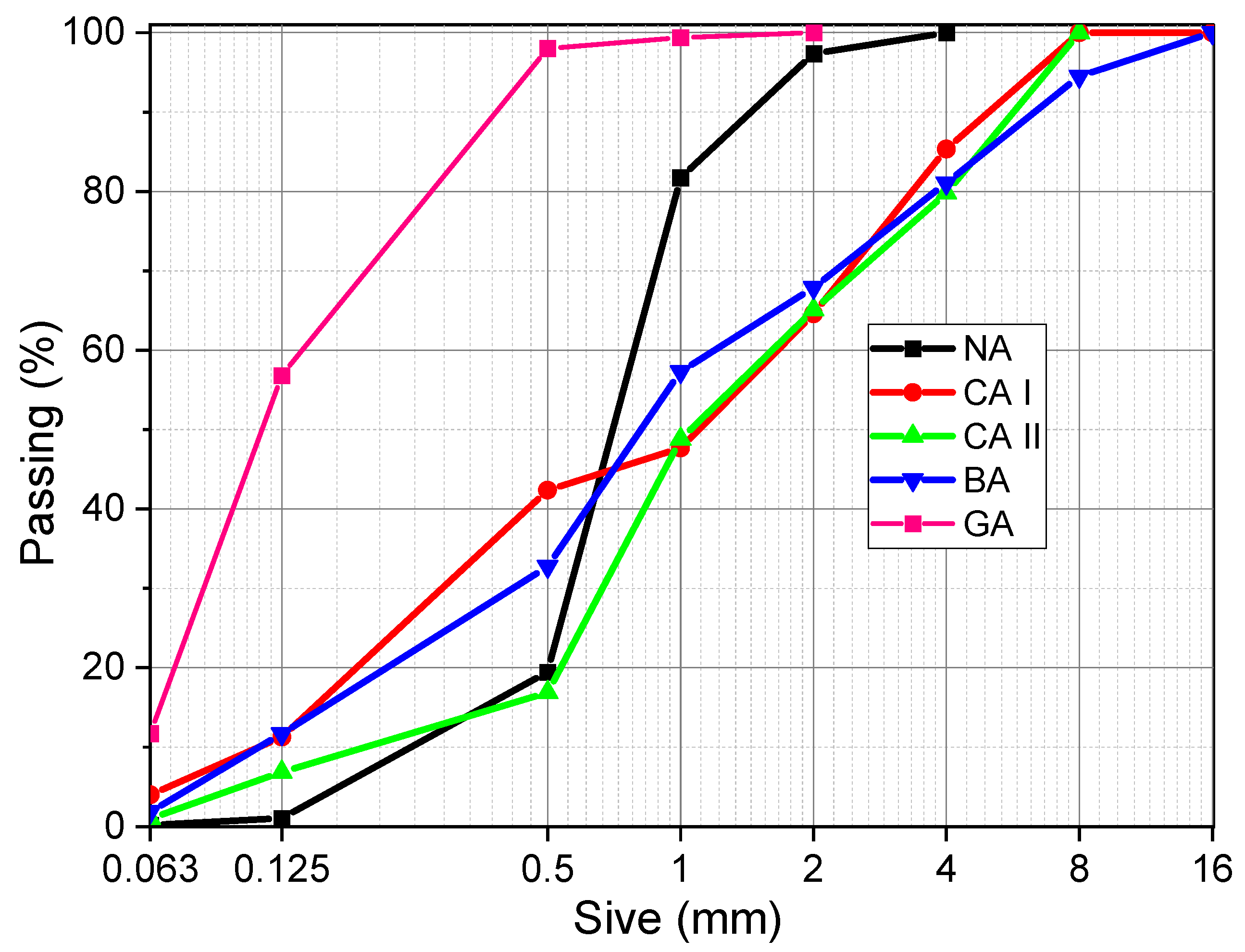
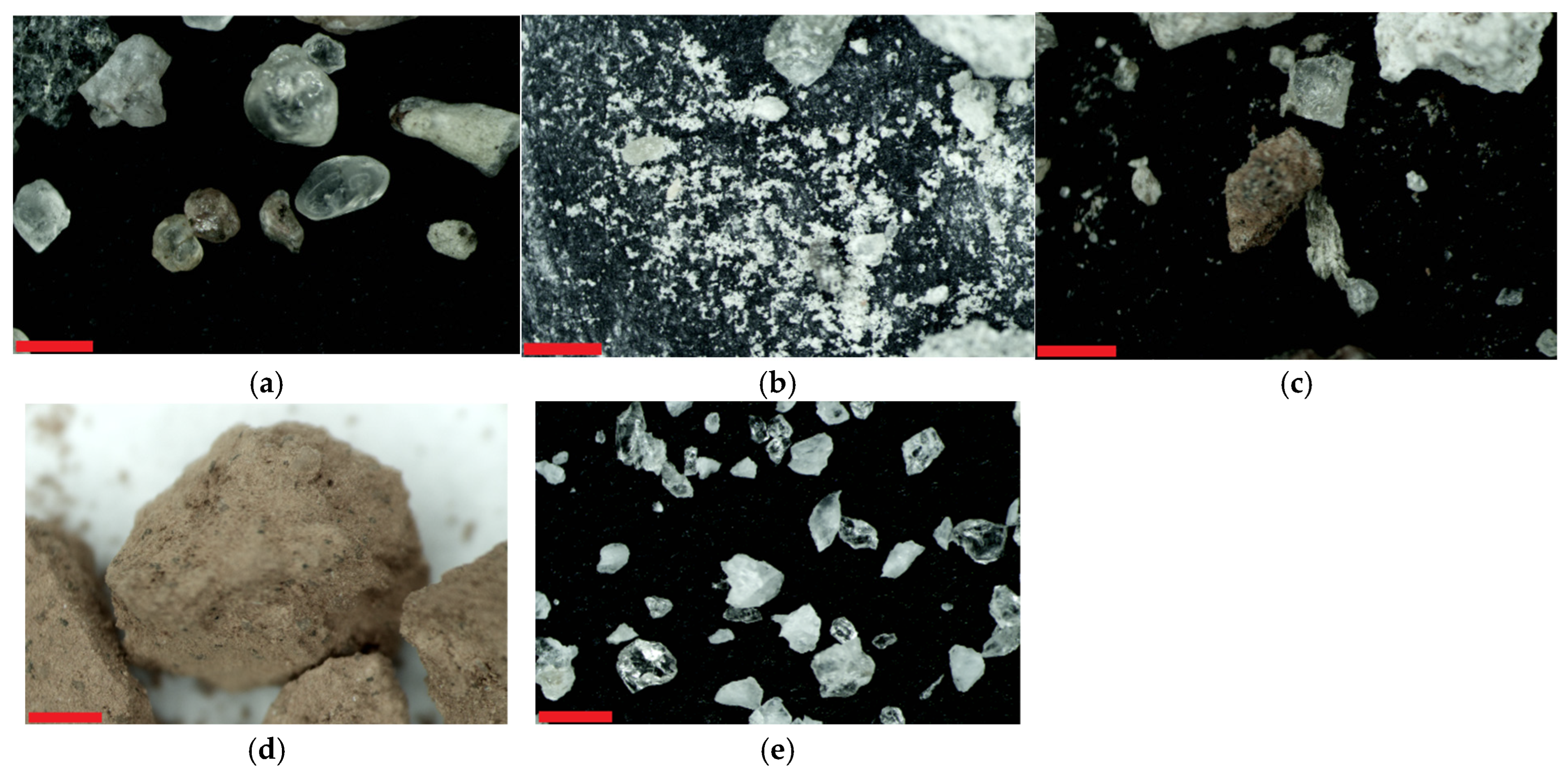
The particle size distribution curves of the individual aggregates used in the study are presented in Figure 1. Table 2 summarizes the basic parameters characterizing the aggregates used in the experimental program. The presented parameters refer to the materials in their as-crushed condition, without any additional treatment or fractionation. The crushing of all materials (CA I, CA II, and BA) was carried out using a laboratory crusher, which ensured comparable preparation conditions for all aggregates and minimized the influence of processing technology on the test results. This approach enabled an objective evaluation of the effect of aggregate type on the properties of the investigated mixtures. The images obtained using an optical microscope (Figure 2) indicate the presence of rounded particle edges in the natural aggregate (Figure 2a), in comparison with the remaining aggregates. In contrast, the brick aggregate is characterized by clearly visible porosity (Figure 2d).

2.2. Cement

A low-carbon cement, CEM II/C-M(V-LL) 32.5 R (Holcim Poland, Małogoszcz, Poland), was used in the mixtures. This cement is characterized by a CO2 emission reduction of at least 30% compared with ordinary Portland cement CEM I [28]. The reduction in carbon footprint results from the use of mineral additions, such as siliceous fly ash (V) and limestone (LL), which partially replace Portland clinker. The use of this type of cement is consistent with current trends in sustainable construction and reducing the environmental impact of road infrastructure. The basic physical and mechanical properties of the cement, relevant mixture design and the interpretation of test results are summarized in Table 3.

2.3. Water

Distilled water was used for specimen preparation.

2.4. Designed Mixtures

For the purposes of the study, mixtures with different compositions and varying contents of recycled materials were designed. The reference material consisted of mixtures produced exclusively with natural sand (NA), containing 6% and 8% cement. The cement content was defined as a mass percentage relative to the dry mass of the aggregate. The mixing water content was selected to obtain a moisture content close to the optimum moisture content, while ensuring adequate workability of the mixture to allow proper compaction and specimen moulding. The moisture content of the mixtures ranged as follows: for mixtures with CAI, from 11.5% to 13.7%; with CAII, from 11.5% to 12.5%; with BA, from 11.5% to 14.0%; and with GA, from 11.5% to 20.0% (for 100% GA in the mixture), where 11.5% corresponds to the moisture content of the reference samples. To standardize the mixture designation, the following notation system was introduced:
XX Y_Y ZZ CA%
XX—type of additive (CA I, CA II, BA, GA).
Y_Y—particle size fraction of the additive.
ZZ—percentage of additive replacing natural aggregate (NA) (%).
CA%—cement content (%) relative to the aggregate mass.

2.5. Preparation and Curing of CBGM Specimens

Due to the pilot and comparative nature of the study, cylindrical specimens with a diameter and height of 80 mm were prepared. The specimens were prepared in accordance with PN-EN 13286-50 [29], except that 80 × 80 mm molds were used, which are standard in Poland (PN-S-96012 [30]). The specimens were compacted in three layers using a Proctor rammer with a standard compaction energy of 0.59 J·cm−3. The number of blows applied per layer was equal to 10. The surfaces of the first and second layers were scarified after compaction to ensure the monolithic integrity of the specimen, while the top layer was leveled. Four specimens were prepared for each mixture and for each type of test. The specimens were stored in the molds for 24 h under conditions of approximately 100% relative humidity and a temperature of 20 °C, after which they were demolded. Following demolding, the specimens were cured until testing under the same conditions (100% relative humidity and 20 °C).

2.6. Methods

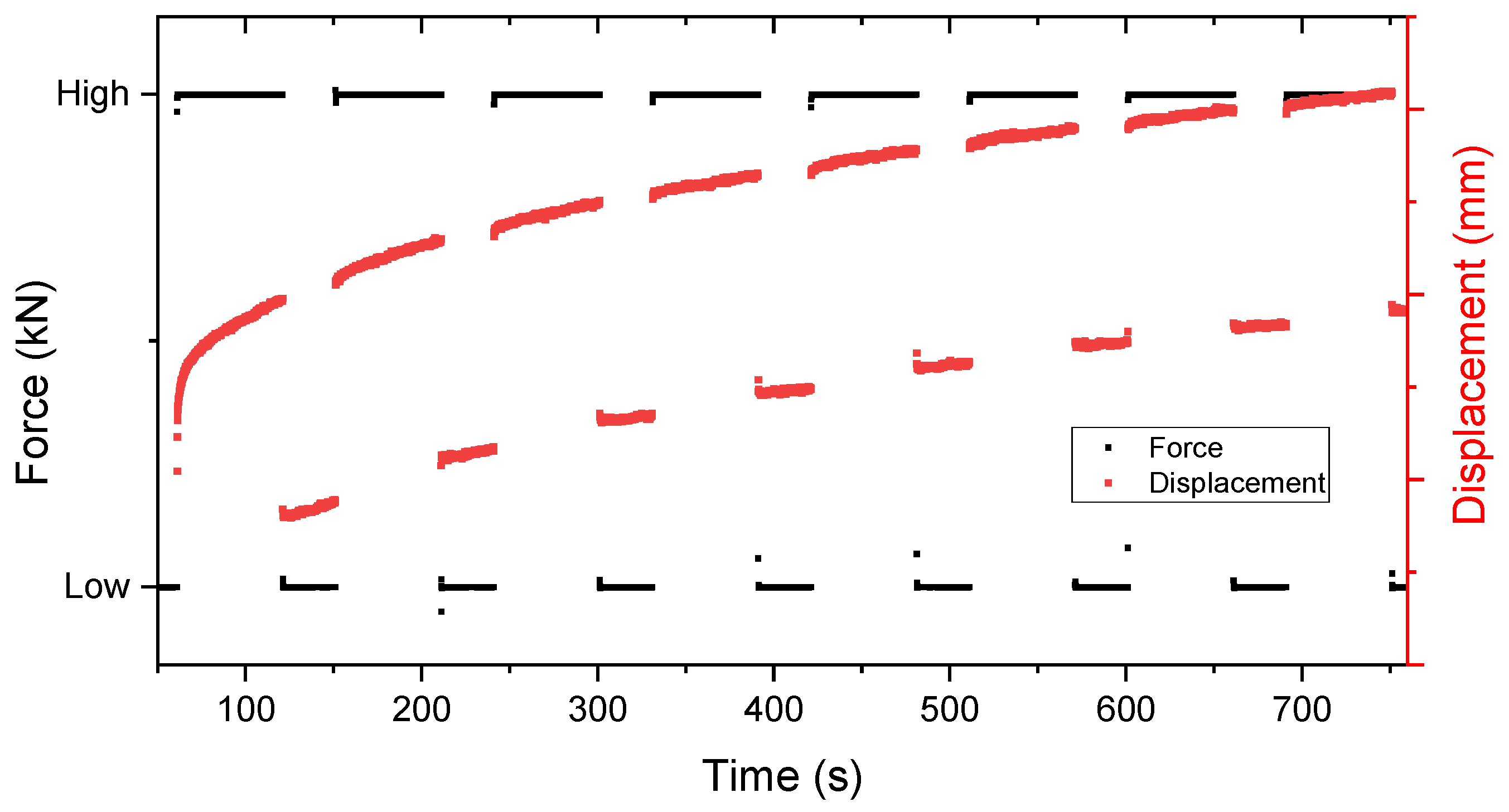
Before the compressive strength test, the mass of each specimen was determined, which made it possible to calculate the bulk density, assess the material homogeneity, and, if necessary, exclude improperly prepared specimens. The compressive strength tests were performed under a constant load increase rate, ensuring that the duration of each test ranged from 30 to 120 s. Measurements were carried out after 7, 28, and 56 days of curing. Simultaneously with the strength measurements, the axial strain of the specimens was recorded. The test was conducted in accordance with EN 13286-41 [31]. For selected specimens, the modulus of elasticity was additionally determined after 28 days of curing. Along with compressive strength, this is one of the key parameters of cement-bound granular mixtures (CBGMs) [21]. The test was performed under uniaxial compression, according to the setup shown in Figure 3. The modulus of elasticity is a key parameter affecting the stress–strain state in pavement structures, which directly influences their fatigue durability [32]. It was determined as the ratio of the increment in axial stress to the corresponding increment in axial strain, calculated based on the last three loading cycles. The strength and modulus tests were carried out using a servo-hydraulic testing system, DTS-30.

3. Results and Discussion

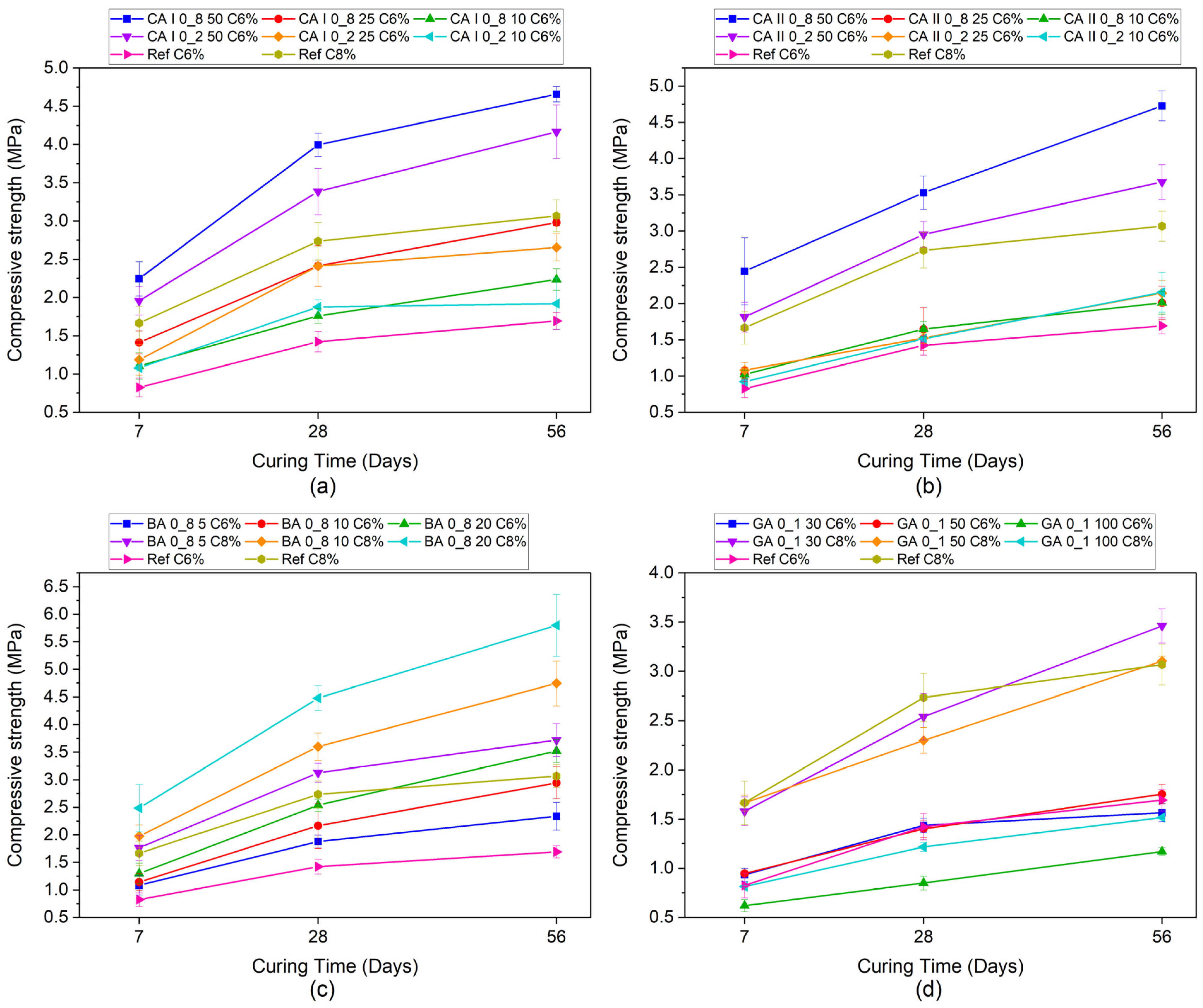
The compressive strength tests were performed after 7, 28, and 56 days of curing under conditions of 100% relative humidity (Figure 4). The plot also indicates a 28-day strength level of 2.0 MPa, corresponding to the requirements for the C1.5/2.0 strength class. This suggests a potential for application in subbase layers for roads subjected to light traffic loading; however, such use requires further investigation, including durability-related tests such as frost resistance, moisture sensitivity, and shrinkage. The obtained results indicate that the incorporation of various waste-derived materials into cement-bound granular mixtures (CBGMs) is not only feasible from the perspective of waste valorization but may also lead to an improvement in mechanical performance, particularly in terms of compressive strength. In the case of recycled concrete aggregate, both the higher-quality aggregate (CA I, Figure 4a) and the lower-quality aggregate (CA II, Figure 4b) resulted in a clear increase in compressive strength. The highest strength gain was observed at a 50% replacement level for both the 0/2 mm and 0/8 mm fractions. The greater strength increase observed for the 0/8 mm fraction may be attributed to a more favorable particle size distribution and particle shape, both of which improved the structure of the aggregate skeleton in the mixture. Importantly, the strength of mixtures containing 25% recycled aggregate and 6% cement was comparable to that of the reference mixture containing 8% cement. This indicates that, at a 25% replacement level, the influence of the recycled aggregate on the granular skeleton structure of the mixture remained limited, and the observed improvement in strength was mainly associated with the action of the cement binder. The lowest compressive strength was recorded for the reference mixture containing 6% cement. The higher strength of mixtures containing the 0/8 mm fraction compared with those containing the 0/2 mm fraction indicates that a broader grading range promotes better filling of void spaces and a more favorable arrangement of the aggregate skeleton, leading to increased stiffness and strength of the mixture. This finding suggests that extensive crushing and sieving to obtain narrower fractions may be unnecessary for practical applications. The incorporation of crushed brick aggregate (BA, Figure 4c) also had a beneficial effect on the compressive strength of the investigated mixtures. Even at a 5% BA content, the 28-day compressive strength increased from 1.7 MPa to 1.9 MPa, corresponding to an increase of approximately 10% for the mixture containing 6% cement. Further increasing the BA content resulted in a systematic increase in strength, reaching approximately 2.5 MPa at a 20% replacement level, which corresponds to an increase of approximately 50% improvement over the reference mixture.
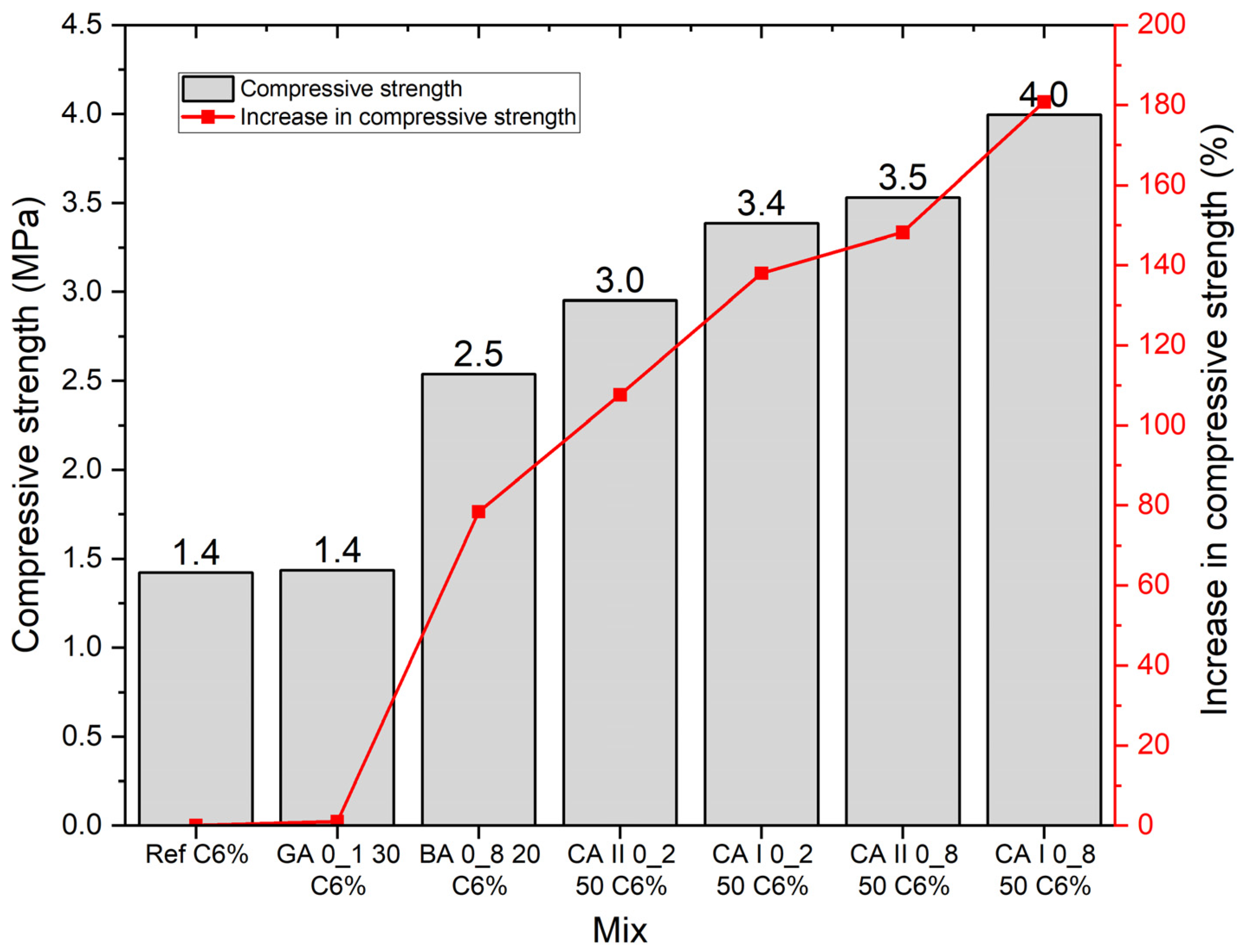
To demonstrate the statistical significance of the differences between the individual mixtures, a one-way analysis of variance (ANOVA) was performed. The results for 28-day compressive strength at a cement content of 6% are summarized in Table 4. For detailed pairwise comparisons of means, the Tukey HSD post hoc test was applied. This method is considered conservative and reduces the risk of Type I errors in the case of multiple comparisons. Homogeneous groups of means were determined at a significance level of α = 0.05. The analysis showed that mixtures produced exclusively with fine granite aggregate (GA) were characterized by a significantly lower compressive strength compared to the reference mixture. These mixtures formed a separate statistical group with the lowest values of the analyzed parameter. The next group consisted of mixtures for which no statistically significant differences were observed relative to the reference specimen. This indicates that, in these variants, the incorporation of recycled aggregate allows for the replacement of part of the natural aggregate without reducing compressive strength. The following group included mixtures exhibiting a statistically significant increase in strength compared with the reference specimen. In this range, the addition of recycled aggregate not only enables the valorization of waste-derived material, but also contributes to the improvement of the mechanical performance of the mixture. The final group, characterized by the highest strength values, differed significantly from the remaining variants and exhibited a clear strengthening effect. The individual groups identified in the analysis were marked with different colors in the table. Figure 5 presents selected results in comparison with the reference mixture, together with the corresponding percentage increase in strength. In the case of selected mixtures, the increase was substantial, reaching 180% of the reference value.

Modulus of Elasticity

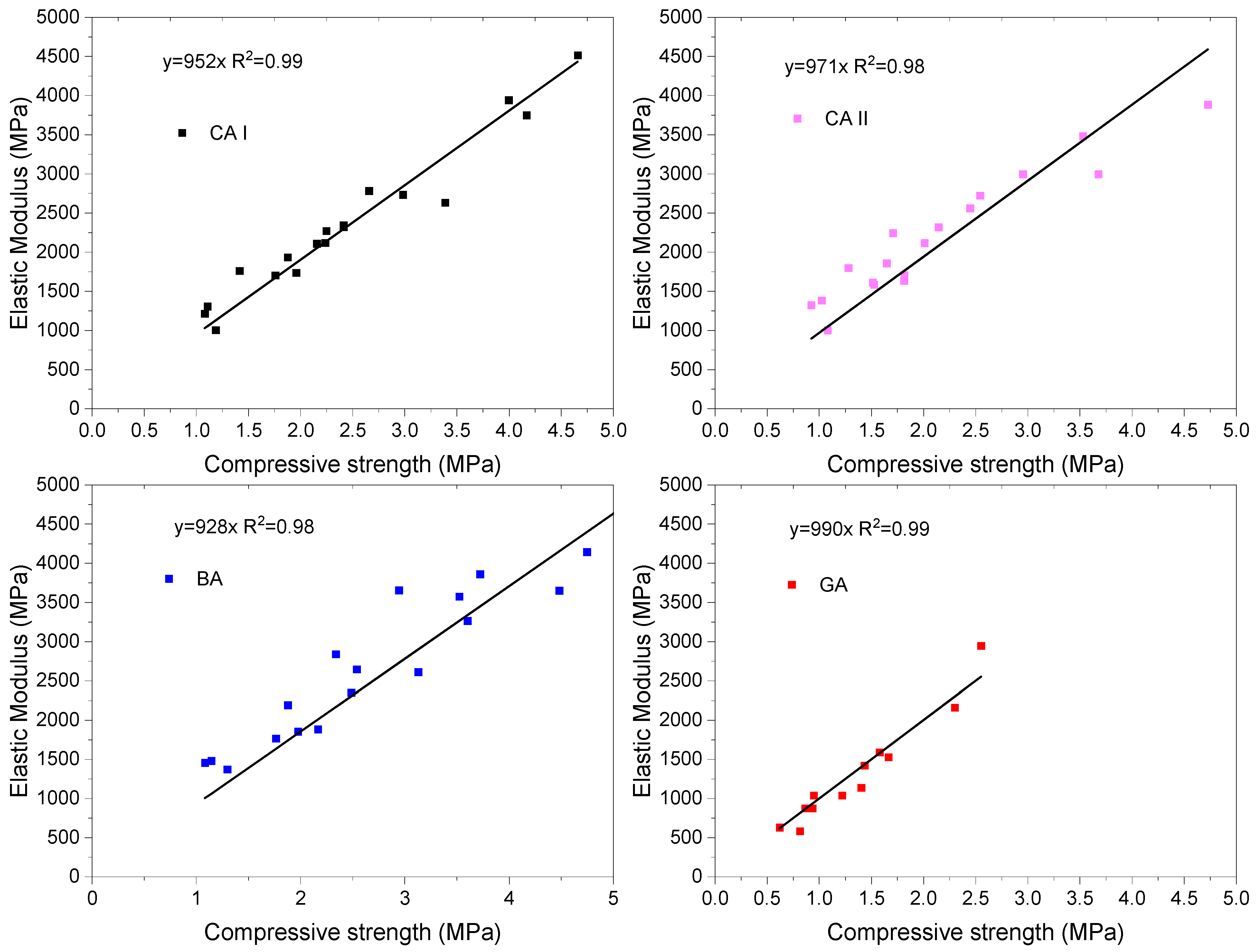
The obtained modulus of elasticity values indicate a linear correlation between the modulus of elasticity and the compressive strength of the investigated mixtures (Table 5). Figure 6 presents the relationship between compressive strength and modulus of elasticity. The plots include the results of tests performed after 7, 28, and 56 days of curing. It was found that the values of the modulus of elasticity were approximately 1000 times greater than the corresponding values of compressive strength. In practical terms, this means that an increase in compressive strength of 1 MPa corresponds to an increase in the modulus of elasticity of approximately 900–1000 MPa. These values are consistent with literature data and with the values commonly adopted in pavement design for the pre-cracking stage [33]. The obtained modulus values may therefore be useful in the structural design of pavement systems. Importantly, the 28-day modulus of elasticity values obtained for mixtures with compressive strength exceeding 2 MPa (C1.5/2.0) were significantly higher than the value of 400 MPa, which is conventionally assumed for layers constructed from unbound aggregate. However, it should be noted that these results refer to the pre-cracking condition of the layer, and further fatigue investigations of mixtures containing waste-derived materials are required. It is also worth noting the scatter of the experimental data. In the case of CA I and CA II, the measurement points were strongly concentrated around the regression line (MSE = 223 and 354 MPa, respectively), indicating a high degree of material homogeneity and good repeatability of the results. In contrast, the BA material exhibited slightly greater data scatter (MSE = 453 MPa), which may indicate greater variability in mechanical properties, potentially resulting from material heterogeneity or the processing method. An important conclusion from the conducted analysis is that compressive strength may be used as an indirect parameter for estimating the modulus of elasticity of the analyzed materials. Due to the relative simplicity of compressive strength testing under laboratory conditions, these relationships may have practical applications in the design and technical assessment of structural pavement layers.

4. Summary

Due to the pilot nature of the study, further research should focus on the fatigue durability of the mixtures and on determining their resistance to long-term traffic loading. Future work should therefore include fatigue testing, with particular emphasis on establishing the relationship between the fatigue performance of the mixtures and their modulus of elasticity.
This paper demonstrated the possibility of using selected waste-derived materials in the production of cement-bound granular mixtures (CBGMs). The tests were conducted under laboratory conditions. In engineering practice, the actual curing conditions of the mixture may differ, and this limitation should be considered when interpreting the results. The following conclusions can be drawn:
  • Recycled materials may represent not only an effective route for waste valorization, but also a technically viable component of cement-bound mixtures, contributing to an improvement in their compressive strength.
  • Mixtures containing lower-quality recycled concrete aggregate (CA II) exhibited higher strength parameters than the reference mixtures, indicating that materials of limited suitability for other applications, such as base courses or cement concrete, may still be effectively incorporated into cement-bound mixtures.
  • An optimal replacement level of recycled aggregates (CAI and CA II) was identified, with 25–50% substitution providing the most favorable balance between mechanical performance and material sustainability.
  • A clear correlation between compressive strength and modulus of elasticity was confirmed for the investigated mixtures, which is consistent with relationships reported in the literature for cement-bound materials. The obtained results confirm that compressive strength may be used as an indirect indicator of the stiffness of the mixtures.
  • The results suggest that extensive processing of recycled aggregates (e.g., additional crushing and fractionation) may not be necessary for CBGM applications, which can reduce production costs and energy consumption.
Due to the pilot nature of the study, further research should focus on the fatigue durability of the mixtures and on determining their resistance to long-term traffic loading.

Author Contributions

Conceptualization, B.B.; methodology, B.B.; validation, B.B. and S.M.; investigation, B.B., D.M., W.R., M.Z., K.Ż. and K.C.; resources, B.B. and S.M.; data curation, B.B.; writing—original draft preparation, B.B.; writing—review and editing, S.M.; visualization, B.B.; supervision, B.B. All authors have read and agreed to the published version of the manuscript.

Funding

This research received no external funding.

Institutional Review Board Statement

Not applicable.

Informed Consent Statement

Not applicable.

Data Availability Statement

The original contributions presented in this study are included in the article. Further inquiries can be directed to the corresponding author.

Conflicts of Interest

The authors declare no conflicts of interest.

References

  1. Eurostat Waste Statistics. Available online: https://ec.europa.eu/eurostat/statistics-explained/index.php?title=Waste_statistics (accessed on 8 March 2026).
  2. Purchase, C.K.; Al Zulayq, D.M.; O’Brien, B.T.; Kowalewski, M.J.; Berenjian, A.; Tarighaleslami, A.H.; Seifan, M. Circular Economy of Construction and Demolition Waste: A Literature Review on Lessons, Challenges, and Benefits. Materials 2021, 15, 76. [Google Scholar] [CrossRef]
  3. Menegaki, M.; Damigos, D. A Review on Current Situation and Challenges of Construction and Demolition Waste Management. Curr. Opin. Green Sustain. Chem. 2018, 13, 8–15. [Google Scholar] [CrossRef]
  4. Idir, R.; Djerbi, A.; Tazi, N. Optimising the Circular Economy for Construction and Demolition Waste Management in Europe: Best Practices, Innovations and Regulatory Avenues. Sustainability 2025, 17, 3586. [Google Scholar] [CrossRef]
  5. Sukhija, M.; Coleri, E. A Systematic Review on the Role of Reclaimed Asphalt Pavement Materials: Insights into Performance and Sustainability. Clean. Mater. 2025, 16, 100316. [Google Scholar] [CrossRef]
  6. Sukhija, M.; Coleri, E. A Review on the Incorporation of Reclaimed Asphalt Pavement Material in Asphalt Pavements: Management Practices and Strategic Techniques. Road Mater. Pavement Des. 2025, 26, 2991–3030. [Google Scholar] [CrossRef]
  7. Aytekin, B.; Mardani-Aghabaglou, A. Sustainable Materials: A Review of Recycled Concrete Aggregate Utilization as Pavement Material. Transp. Res. Rec. J. Transp. Res. Board 2022, 2676, 468–491. [Google Scholar] [CrossRef]
  8. Al-Mosawe, H.; Albayati, A.; Wang, Y.; Mashaan, N.S. An Experimental Study of Granular Material Using Recycled Concrete Waste for Pavement Roadbed Construction. Buildings 2022, 12, 1926. [Google Scholar] [CrossRef]
  9. Stępień, J.; Chomicz-Kowalska, A.; Maciejewski, K.; Wąsik, P. Engineering Performance, Environmental and Economic Assessment of Pavement Reconstruction Using Cold In-Place Recycling with Foamed Bitumen: A Municipal Road Case Study. Materials 2025, 19, 83. [Google Scholar] [CrossRef] [PubMed]
  10. Graczyk, M.; Kowalewska, A.; Blacha, K.; Kukiełka, J. Zastosowanie Technologii Rubblizingu w Recyklingu Nawierzchni Drogowych i Lotniskowych. Roads Bridg.–Drog. Mosty 2025, 24, 455–463. [Google Scholar] [CrossRef]
  11. Crucho, J.; Picado-Santos, L.; Neves, J. Mechanical Performance of Cement Bound Granular Mixtures Using Recycled Aggregate and Coconut Fiber. Appl. Sci. 2022, 12, 1936. [Google Scholar] [CrossRef]
  12. Pasetto, M.; Baldo, N. Experimental Analysis of Hydraulically Bound Mixtures Made with Waste Foundry Sand and Steel Slag. Mater. Struct. 2015, 48, 2489–2503. [Google Scholar] [CrossRef]
  13. Kumar, S.; Patil, C.B. Estimation of Resource Savings Due to Fly Ash Utilization in Road Construction. Resour. Conserv. Recycl. 2006, 48, 125–140. [Google Scholar] [CrossRef]
  14. Chomicz-Kowalska, A.; Maciejewski, K. Performance of Fly-Ash- and Cement-Bound Granular Mixtures with Dispersed Fiber Reinforcement—A Case Study. Appl. Sci. 2024, 14, 2618. [Google Scholar] [CrossRef]
  15. Singh, S.P.; Tripathy, D.P.; Ranjith, P.G. Performance Evaluation of Cement Stabilized Fly Ash–GBFS Mixes as a Highway Construction Material. Waste Manag. 2008, 28, 1331–1337. [Google Scholar] [CrossRef]
  16. Haichert, R.; Kelln, R.; Wandzura, C.; Berthelot, C.; Guenther, D. Cement Stabilization of Conventional Granular Base and Recycled Crushed Portland Cement Concrete. Transp. Res. Rec. J. Transp. Res. Board 2012, 2310, 121–126. [Google Scholar] [CrossRef]
  17. Krawczyk, B.; Szydło, A.; Mackiewicz, P.; Dobrucki, D. Suitability of Aggregate Recycled from Concrete Pavements for Layers Made of Unbound and Cement Bound Mixtures. Roads Bridg.–Drog. Mosty 2024, 17, 39–53. [Google Scholar] [CrossRef]
  18. Kasu, S.R.; Manupati, K.; Muppireddy, A.R. Investigations on Design and Durability Characteristics of Cement Treated Reclaimed Asphalt for Base and Subbase Layers. Constr. Build. Mater. 2020, 252, 119102. [Google Scholar] [CrossRef]
  19. Majer, S.; Budziński, B. Wykorzystanie Destruktu Asfaltowego Jako Kruszywo Do Mieszanek Stabilizowanych Spoiwem Cementowym. Roads Bridg.–Drog. Mosty 2023, 22, 527–532. [Google Scholar] [CrossRef]
  20. Disfani, M.M.; Arulrajah, A.; Haghighi, H.; Mohammadinia, A.; Horpibulsuk, S. Flexural Beam Fatigue Strength Evaluation of Crushed Brick as a Supplementary Material in Cement Stabilized Recycled Concrete Aggregates. Constr. Build. Mater. 2014, 68, 667–676. [Google Scholar] [CrossRef]
  21. Zvonarić, M.; Benšić, M.; Barišić, I.; Dokšanović, T. Prediction Models for Mechanical Properties of Cement-Bound Aggregate with Waste Rubber. Appl. Sci. 2024, 14, 470. [Google Scholar] [CrossRef]
  22. Crucho, J.; Picado-Santos, L.; Neves, J. Flexural Strength of Cement Bound Granular Mixtures Using Recycled Aggregate and Coconut Fiber. Transp. Res. Procedia 2023, 72, 232–239. [Google Scholar] [CrossRef]
  23. Chiranjeevi, K.; Kumar, D.H.; Yatish, R.G.; Mulangi, R.H.; Ravi Shankar, A.U. Optimization and Characterization of Ferrochrome and Recycled Concrete Aggregate Mixes for Pavement Base Layers. J. Mater. Civ. Eng. 2025, 37, 04024437. [Google Scholar] [CrossRef]
  24. Wang, K.; Hu, X.; Yuan, Y.; Lian, F.; Zhong, M.; Meng, K. Performance Study of Stabilized Recycled Aggregate Base Material with Two-Gray Components. Materials 2024, 17, 5038. [Google Scholar] [CrossRef] [PubMed]
  25. EN 933-1; Tests for Geometrical Properties of Aggregates—Part 1: Determination of Particle Size Distribution—Sieving Method. European Committee for Standardization (CEN): Brussels, Belgium, 2012.
  26. EN 933-8:2012+A1; Tests for Geometrical Properties of Aggregates—Part 8: Assessment of Fines—Sand Equivalent Test. European Committee for Standardization (CEN): Brussels, Belgium, 2015.
  27. EN 13286-2; Unbound and Hydraulically Bound Mixtures—Part 2: Test Methods for Laboratory Dry Density and Water Content—Proctor Compaction. Committee for Standardization (CEN): Brussels, Belgium, 2010.
  28. Holcim Poland. Available online: https://www.holcim.pl/cement-cem-iic-mv-ll-325-r-do-infrastruktury (accessed on 8 March 2026).
  29. EN 13286-50; Unbound and Hydraulically Bound Mixtures—Part 50: Method for the Manufacture of Test Specimens of Hydraulically Bound Mixtures Using Proctor Equipment or Vibrating Table Compaction. European Committee for Standardization (CEN): Brussels, Belgium, 2004.
  30. PN-S-96012; Roads—Subbase and Subgrade of Cement Stabilised Soils. Polish Committee for Standardization: Warsaw, Poland, 1997.
  31. EN 13286-41; Unbound and Hydraulically Bound Mixtures—Part 41: Test Method for the Determination of the Compressive Strength of Hydraulically Bound Mixtures. European Committee for Standardization (CEN): Brussels, Belgium, 2021.
  32. Pełczyńska, K.; Gajewski, M. Review of Selected Fatigue Criteria for Hydraulic Bound Layers in Road Pavements. Roads Bridg.–Drog. Mosty 2018, 17, 227–248. [Google Scholar] [CrossRef]
  33. Budziński, B.; Majer, S.; Lehner, P. Fatigue Performance of Flexible Pavements with Cement-Bound Granular Material (CBGM). Fract. Struct. Integr. 2025, 19, 165–170. [Google Scholar] [CrossRef]
Figure 1. Particle size distribution curves of the aggregates used in the study.
Sustainability 18 05066 g001
Figure 2. Optical microscope images of the aggregates: (a) NA, (b) CA I, (c) CA II, (d) BA, and (e) GA; the red line corresponds to 1 mm, equipment: stereoscopic microscope Delta Optical SZ-430B (Delta Optical Delta Optical, Mińsk Mazowiecki, Poland).
Sustainability 18 05066 g002
Figure 3. Schematic diagram of the modulus of elasticity test setup.
Sustainability 18 05066 g003
Figure 4. Compressive strength results after 7, 28, and 56 days of curing (a) CAI, (b) CAII, (c) BA, (d) GA.
Sustainability 18 05066 g004
Figure 5. Comparison of the compressive strength of selected CBGM.
Sustainability 18 05066 g005
Figure 6. Positive correlation between the compressive strength and the modulus of elasticity of the investigated mixtures.
Sustainability 18 05066 g006
Table 1. Aggregates used in the study.
Aggregate TypeAggregate Abb.Description
Natural sand 0/2NARiver sand with a particle size of 0–2 mm, used as the base material for producing mixtures without the addition of recycled aggregates
Crushed concrete waste—high qualityCA IAggregate produced by crushing concrete elements only; clean and free of contamination
Crushed concrete waste—low qualityCA IIAggregate produced by crushing construction and demolition elements, containing impurities such as sand, brick fragments, and humus
Crushed brick wasteBAAggregate produced by crushing demolition brick; free of contamination.
Fine sand 0/1 mmGA0–1 mm aggregate produced as a by-product of natural aggregate production (granite-based); clean and free of contamination
Table 2. Basic properties of the aggregates used in the study.
ParameterStandardUnitAggregate
NACA ICA IIBAGA
Color--Light yellowDark greyBrownOrangeGrey
Fines contentEN 933-1 [25]%0.24.01.01.911.7
Sand equivalentEN 933-8 [26]%9947505077
Maximum dry densityEN 13286-2 [27]g/cm31.721.791.781.59 *1.82
Optimum moisture contentEN 13286-2 [27]%11.316.213.122.5 *20.0
Loss on ignition %--2.1--
* During testing, the material undergoes further crushing; - material free of organic matter.
Table 3. Basic properties of the cement based on the manufacturer’s data [25].
ParameterValue
CO2 emissions/Carbon footprint348 CO2/t
Specific surface area (Blaine)5780 cm2/g
Initial setting time205 min
Final setting time265 min
Compressive strength after 2 days19.6 MPa
Compressive strength after 28 days41.0 MPa
Water demand29.6%
Chloride content0.06
Table 4. Results of the analysis of variance and Tukey’s HSD test for mixtures containing 6% cement.
MixMeanStd.12345678Change
1GA 0_1 100 C6%0.90.06** Decrease
2GA 0_1 50 C6%1.40.07 ** No change
3Ref C6%1.40.13 **
4GA 0_1 30 C6%1.40.06 **
5CA II 0_2 10 C6%1.50.04 **
6CA II 0_2 25 C6%1.50.07 **
7CA II 0_8 10 C6%1.60.10 **
8CA I 0_8 10 C6%1.80.10 ****
9CA II 0_8 25 C6%1.80.30 ****
10CA I 0_2 10 C6%1.90.10 ****
11BA 0_8 5 C6%1.90.12 ****
12BA 0_8 10 C6%2.20.41 **** Increase
13CA I 0_2 25 C6%2.40.26 **
14CA I 0_8 25 C6%2.40.26 **
15BA 0_8 20 C6%2.50.11 ****
16CA II 0_2 50 C6%3.00.18 **** Significant increase
17CA I 0_2 50 C6%3.40.30 ****
18CA II 0_8 50 C6%3.50.23 ****
19CA I 0_8 50 C6%4.00.15 **
Sample size for each group was n = 4, The colors indicate assignment to groups, and ** denotes the results of the ANOVA analysis.
Table 5. Linear regression results.
MIXParametersSummary
CAISlope = 952
Intercept = 0
95% LCL 910.2
95% UCL 994.5
F Value = 2272
Root-MSE (SD) = 223
CA IISlope = 971
Intercept = 0
95% LCL 896.4
95% UCL 1046.3
F Value = 748
MSE (SD) = 354
BASlope = 928
Intercept = 0
95% LCL 854.9
95% UCL 1001.0
F Value = 718
MSE (SD) = 453
GASlope = 990
Intercept = 0
95% LCL 912.2
95% UCL 1067.9
F Value = 783
MSE (SD) = 181
Disclaimer/Publisher’s Note: The statements, opinions and data contained in all publications are solely those of the individual author(s) and contributor(s) and not of MDPI and/or the editor(s). MDPI and/or the editor(s) disclaim responsibility for any injury to people or property resulting from any ideas, methods, instructions or products referred to in the content.