1. Introduction
Global ecological crises driven by climate change continue to intensify, with the rate of sea level rise having doubled [
1] and a growing frequency of extreme weather events posing a serious threat to ecological balance worldwide [
2]. Implementing the UN 2030 Agenda for Sustainable Development is critical to mitigating the climate crisis, as its key Sustainable Development Goals (SDGs), namely Zero Hunger (SDG2) and Climate Action (SDG13), are closely interconnected. Agriculture is not only the foundation of global food security but also a major source of greenhouse emissions, accounting for about 25% of global carbon emissions. Consequently, agricultural carbon emissions have become a central issue in global climate governance [
3]. China bears the responsibility of ensuring food security for a population of 1.4 billion, while its agricultural carbon emissions account for one quarter of global total [
4]. Some regions have continued to rely on an extensive production model characterized by high pollution and high energy consumption, which runs counter to the strategic goals of the carbon peaking and carbon neutrality (CPCN). Accordingly, promoting the low carbon transformation of agriculture is now an urgent requirement for achieving high quality advancement in China’s agricultural sector [
5].
At present, the world is advancing carbon emission reduction in a coordinated manner, while China is steadily pursuing its CPCN goals. In this process, green credit, as a core component of the green finance system, serves not only as an important financial instrument for implementing environmental regulation, but also as a key driver for enhancing the allocation of resources, supporting the regional diffusion and adoption of low carbon agricultural technologies [
6,
7]. Existing studies have confirmed the many functions of green credit, with primary focus on its carbon reduction effect [
8] and resource allocation function [
9]. Using a mediation effects model, Lyu et al. (2022) empirically demonstrated that green credit can significantly curb carbon emissions and serves as an important financial instrument for achieving global carbon reduction goals [
10]. Jiang et al. (2025) further pointed out that green credit mainly contributes to carbon reduction by promoting industrial restructuring and reducing energy consumption [
11]. Fan and Xu (2025) found that green credit policies significantly enhance both the quantity and quality of green innovation, although the promotion efficiency varies with firm size and the amount of available capital [
12]. Yi et al. (2025) found green finance to be instrumental in promoting sustainable rural development [
13]. Guo et al. (2022) also provided evidence that a more developed green finance system is associated with lower agricultural carbon emissions [
14].
However, existing studies have mainly focused on the macro level impacts of green credit on carbon reduction, green resource allocation, green innovation, and industrial structure upgrading. Even so, there are still three aspects that remain to be further deepened and expanded in the current literature. First, the current body of research has not given adequate consideration to the cross regional spatial spillover effects of agricultural green credit, particularly in the absence of a spatial weight matrix that reflects the diffusion of agricultural green technologies. Second, the transmission mechanisms through which green credit affects agricultural carbon emissions have yet to be fully explored. Third, most studies assume a linear relationship, overlooking possible nonlinear threshold effects across different development stages, which limits the policy relevance of the findings.
Against this backdrop, this study uses provincial panel data from China spanning 2005 to 2022 to examine the spatial spillover effects and channels linking provincial green credit development to agricultural carbon emission intensity (ACEI). The main contributions of this paper are as follows: (1) This study examines the impact of green credit on ACEI from a spatial spillover perspective, identifying both local emission reduction and cross-regional spillover effects. A green technology geographic composite distance matrix is constructed to better capture spatial dependence. (2) This study identifies two transmission channels through which green credit reduces ACEI, by lowering agricultural energy consumption intensity and promoting industrial structure upgrading, thereby revealing the mechanism by which financial instruments support the low-carbon transition of agriculture. (3) This study reveals a single threshold in the emission reduction effects of green credit. It also confirms that, as green credit develops further, these effects show diminishing marginal returns, thus adding to the emerging literature on nonlinear effects, while the existing research has still largely emphasized linear relationships. (4) This study further examines regional heterogeneity across eastern, central, and western China, revealing significant differences in the direct and spillover effects of green credit across regions and providing empirical evidence for differentiated green credit policies.
2. Theoretical Hypotheses
During the 1990s, Porter and Linde advanced the Porter Hypothesis, arguing that well-designed environmental regulations may motivate firms to accelerate green technological innovation and consequently enhance productivity. Firms can enhance their market competitiveness by leveraging the advantages of green products and pricing. The resulting additional gains can offset the higher costs imposed by environmental regulation, improve profitability, and ultimately achieve a mutually beneficial outcome between environmental protection and economic development [
15]. Green credit (GC), as an effective environmental policy instrument, can internalize environmental risks and emission reduction responsibilities into corporate costs through differentiated credit policies [
16,
17], accordingly creating an effective incentive and restraint mechanism that guides agricultural operators to increase investment in low carbon technology research and cleaner production, and to accelerate green transformation and technological upgrading [
18]. Under this mechanism, green credit may discourage high carbon production behavior at the provincial level, promote the transition of agricultural production toward low carbon and more efficient models, and thereby substantially reduce agricultural carbon emissions.
The Environmental Kuznets Curve (EKC) hypothesis suggests that there is a significant inverted U-shaped relationship between economic development and environmental pollution. In the early stages of economic development, industrialization and urbanization advance, social production is dominated by resource-intensive and energy-intensive patterns, leading to a continuous increase in environmental pollution and potentially irreversible ecological damage [
19]. Green credit can optimize resource allocation by guiding funds from high pollution, high emission sectors toward low carbon technologies, clean production, and green transition projects. By reducing pollutant and carbon emissions at the source, green credit helps flatten the peak of the EKC, promotes balanced economic and environmental progress, and ultimately advances agricultural carbon reduction and sustainable development [
20,
21].
Overall, as a crucial policy-oriented financial mechanism, green credit not only incentivizes firms to promote green innovation under effective environmental regulation but also strengthens their productivity and economic returns. On the other hand, by directing agricultural resources toward low carbon sectors, green credit can bring forward the turning point of the inverted U-shaped curve linking agricultural carbon emissions and agricultural economic development, sequentially achieving the goal of reducing agricultural carbon emissions in tandem with economic growth ahead of schedule. This will facilitate the green transformation of agriculture and help balance economic development with environmental protection [
22,
23,
24].
Accordingly, the first hypothesis is formulated as follows:
Hypothesis 1. Green credit generates a significant spillover impact on carbon emission intensity in agriculture.
Specifically, an increase in green credit in one region not only reduces local agricultural carbon emissions but also significantly lowers agricultural carbon emissions in neighboring regions and related regions through geographic proximity and technological connection.
Energy consumption constitutes the main source of carbon emissions, and its intensity largely determines the magnitude of such emissions [
25]. Meanwhile, optimizing capital allocation is an important means of regulating energy consumption intensity [
26,
27]. Following this logic, Luo et al. (2023) showed that green credit can generate energy-saving effects and form a synergistic mechanism with pollution decreasing and carbon emission reduction [
28]. Through differentiated credit policies for different types of enterprises, green policies impose financing constraints on high energy consuming agricultural production activities while expanding credit support for energy-saving agricultural technologies and green low carbon projects. This helps guide agricultural activities away from fossil fuel dependence, enhances energy efficiency, and finally reduces the intensity of agricultural energy consumption [
29].
Existing studies based on China’s provincial panel data further indicate that green finance can improve energy efficiency by promoting energy structure transformation, and these effects are also present in traditional sectors such as agriculture [
9,
20,
28]. In addition, Zhang et al. (2022) [
30] find that carbon pricing policies are superior to traditional fuel efficiency improvement projects in terms of implementation robustness and long-term incentive effects. Furthermore, tailoring differentiated low carbon policies based on the regional distribution of power plant efficiency facilitates the targeted rollout of these measures [
30]. In summary, as a market-based policy that shares similarities with carbon pricing policies, green credit can effectively encourage energy-intensive enterprises to upgrade their technologies and reduce energy consumption per unit of output. Lower agricultural energy intensity, in turn, leads to lower energy use and carbon release per unit of economic activity.
Accordingly, Hypothesis 2 is proposed:
Hypothesis 2. Green credit reduces agricultural carbon emission intensity through agricultural energy intensity.
Green finance plays an important role in driving industrial upgrading [
31], with industrial upgrading acting as an important mediating channel through which green finance affects carbon emissions performance. Industrial upgrading can drive the transition of production methods toward low carbon and high efficiency models, sequentially contributing to carbon emission reduction [
32,
33]. As a core tool of green finance, green credit optimizes and upgrades industrial structures through the targeted allocation of credit resources, driving the transition toward greener and more advanced industrial structures, and has emerged as a key force in guiding industries toward low carbon and high efficiency development [
34].
Existing empirical studies provide strong support for the role of industrial restructuring as an important channel through which green credit reduces carbon emissions. Based on data from 30 provinces and regions in China, Li et al. (2025) demonstrate that green credit greatly curbs regional carbon emissions by promoting industrial restructuring [
35]. Examining spatial effects, Dong et al. (2022) further find that industrial restructuring effectively reduces carbon intensity, and that green credit enhances this process, thus generating cross-regional synergies in emission reduction [
31]. Moreover, Mo et al. (2023) suggest that industrial restructuring reduces dependence on energy-intensive industries and fosters the adoption of green technologies in agriculture, which in turn lowers emissions from agricultural production and promotes green agricultural development [
7].
On this basis, this study puts forward Hypothesis 3:
Hypothesis 3. Green credit affects agricultural carbon emission intensity through industrial restructuring.
Green credit is a key driver of agricultural carbon reduction, but its effect may follow a threshold pattern rather than a simple linear relationship, depending on its own level of development. Kong et al. (2024) confirm the existence of such a threshold effect [
36]. Chang et al. (2022) show that below the first threshold, green credit can still effectively support green technology research and development and low carbon production innovation, thereby alleviating financing constraints on agriculture’s green transition and promoting emission reduction [
37]. Lv et al. (2023) reported that green finance exerts a double threshold effect on reducing agricultural non-point source pollution, and that this mitigation effect becomes stronger as green finance develops further [
38].
He et al. (2019) find that green credit has a threshold effect on the relationship between renewable energy investment and the green economic development index, dividing this impact into three stages: promotion, suppression, and promotion with a weaker promotional effect in the third stage than in the first [
39]. Cui et al. (2022), focusing on green credit policy, reveal that the environmental impacts of green credit policies are heterogeneous and vary according to different levels of green credit development, and that their emissions reduction effect varies depending on the progress of credit sector development [
40].
In light of the above research, this paper posits that green credit may also have a threshold effect on agricultural carbon emission intensity. Accordingly, Hypothesis 4 is put forward:
Hypothesis 4. The effect of green credit on agricultural carbon emission intensity shows threshold characteristics across different levels of green credit development.
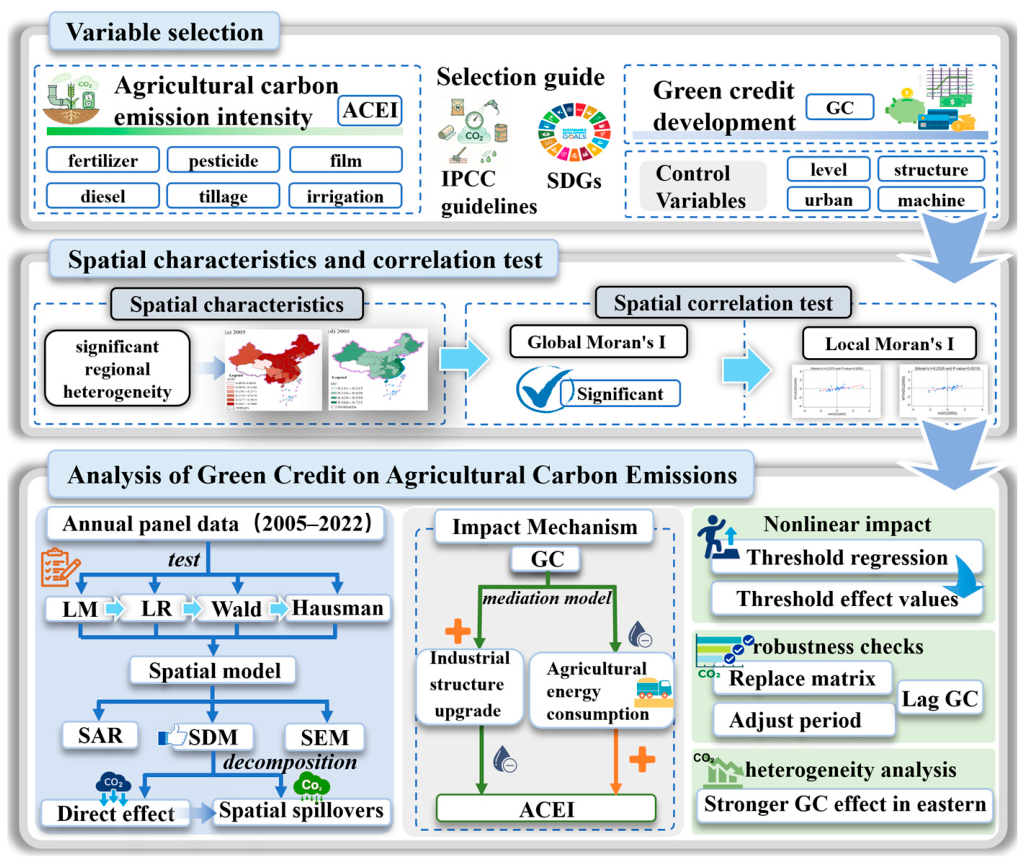
To clearly illustrate the research design and empirical analysis process of this study, the study’s analytical framework is illustrated in
Figure 1.
3. Empirical Model
Spatial econometric theory suggests that economic activities and factor flows across regions are inherently connected, and that spatial linkages may arise through spillover effects, policy imitation, and factor mobility [
41]. Accordingly, agricultural carbon emissions are shaped not only by local factors but also potentially by green credit development and regional development levels in neighboring regions, hence generating spatial dependence [
42]. When such spatial dependence is ignored, conventional linear regression models may yield biased or inefficient estimates [
43]. Thus, drawing on the extended STIRPAT framework [
44,
45], this study incorporates spatial interaction terms to specify the spatial econometric model.
According to spatial econometric theory, the commonly used models mainly include the spatial autoregressive model (SAR), the spatial error model (SEM), and the spatial Durbin model (SDM). The SAR model captures spatial dependence through the spatial lag of the dependent variable. The SEM reflects spatial correlation through the disturbance term. The SDM includes not only the spatial lag of the dependent variable but also the spatial lags of the explanatory variables and can simultaneously identify local effects and spatial spillover effects. Moreover, under certain parameter restrictions, the SDM can be reduced to the SAR or SEM. For this reason, the SDM is more general and is widely used in spatial empirical studies. Accordingly, the benchmark SDM is specified as follows:
where
denotes the agricultural carbon emission intensity,
represents the development of green credit,
denotes control variables and
represents a spatial weight between provinces
and
. The term
denotes the spatial lag of the dependent variable, which captures the spatial dependence of agricultural carbon emission intensity. The term
denotes the spatially lagged green credit term, reflecting a spillover effect from green credit from neighboring provinces, while
denotes the spatially lagged values of the control variables.
is the spatial autoregressive coefficient;
captures the direct effect within a province;
captures the spatial spillover effect of green credit;
and
are the coefficient vectors of the control variables and their spatial lags, respectively;
and
denote the individual fixed effects and time fixed effects, respectively;
is the random error term.
For comparison, we present the specifications of SAR and SEM below. Specifically, Equation (2) corresponds to the SAR model, a simplified form of the SDM that retains only the spatial lag of the dependent variable. Equations (3) and (4) together define the SEM, where spatial correlation is modeled through the error term. Additionally,
is the spatially correlated error term,
captures its spatial dependence and
denotes its spatial lag.
To identify the appropriate model specification, this study estimates the SAR, SEM and SDMs and conducts multiple specification tests such as the LM test, LR test, Wald test, and Hausman test. The findings show that the fixed effects SDM is the most appropriate model. Thus, the study adopts the SDM as the benchmark model for examining the effect of green credit on agricultural carbon emission intensity.
To further explore the transmission channels through which green credit influences agricultural greenhouse gas emission intensity (Hypotheses 2 and 3), this study adopts the mediation effect testing approach proposed by Baron and Kenny (1986) [
46], and integrates it into a spatial econometric framework. Given the potential spatial dependence and spillover effects of agricultural carbon emission intensity across regions, a three-step spatial mediation model based on the SDM is established to identify the underlying mediating mechanism through which environmentally friendly credit impacts agricultural greenhouse gas emission intensity.
where
is the mediating variable and Equations (1), (5) and (6) constitute the intermediary effect test equation. If the coefficients of
and
are significant, compared with
, the coefficient of
decreases significantly, indicating that
is an intermediary variable.
Although green credit is expected to reduce agricultural carbon emission intensity, its marginal effect may vary at different stages of green credit development. In other words, the relationship between green credit and agricultural carbon emission intensity may be nonlinear rather than purely linear. To examine this possibility, this study further employs Hansen’s panel threshold model [
47], uses the level of green credit development as the threshold variable and constructs the following model to test for threshold effects:
where
are the threshold values to be estimated and
is an indicator function that equals 1 if the specified condition is satisfied and 0 otherwise. The coefficients
capture the marginal effects of green credit on agricultural carbon emission intensity under different threshold regimes.
This threshold analysis is used as a complementary test of nonlinear effects. Unlike the baseline SDM, its purpose is to identify whether the carbon mitigation impact of green credit changes significantly throughout different development stages.
5. Empirical Analysis
5.1. Spatial Evolution of Green Credit and Agricultural Carbon Emission Intensity
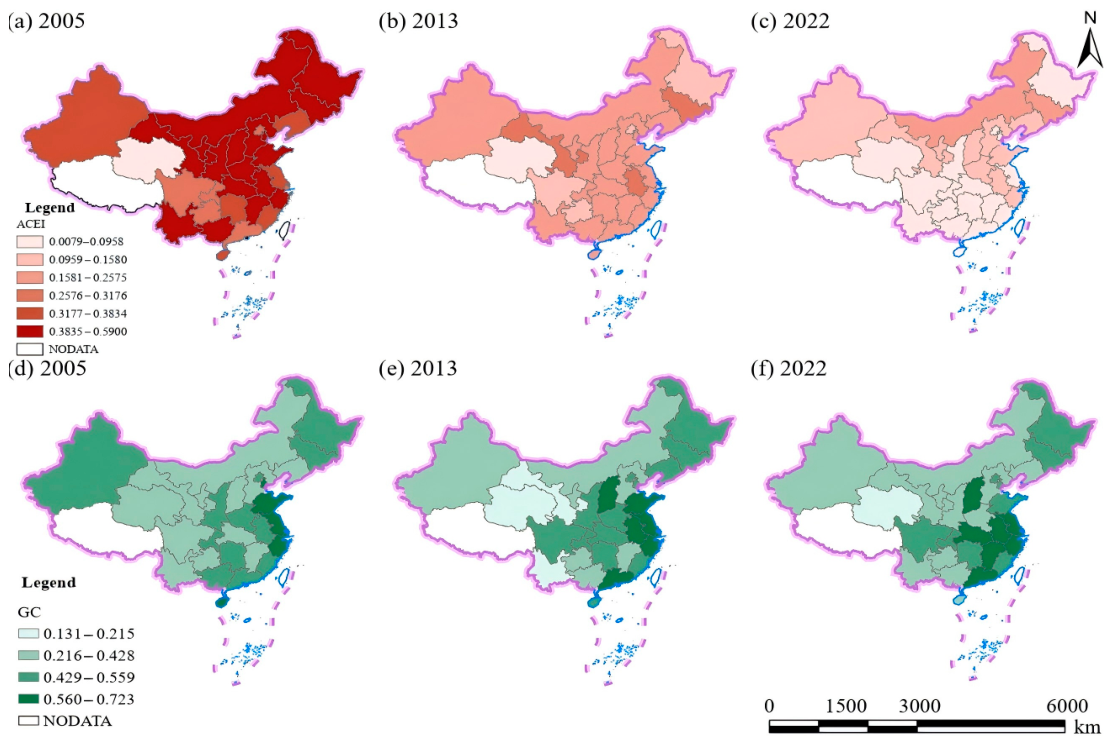
Using panel data on ACEI and green credit levels for 30 provinces in China from 2005 to 2022, this study employs the natural breaks method in ArcGIS (Pro 3.4) to classify provincial ACEI and green credit development levels and to depict their spatiotemporal distribution patterns (
Figure 2).
From a temporal perspective, as shown in
Figure 2a–c, ACEI in China exhibits an overall downward trend, shifting from high-intensity concentration to low-intensity dispersion. In 2005, most provinces were shaded dark red, reflecting the extensive mode of agricultural production at that time. By 2022, high-emission areas had contracted significantly, and the overall color of the map had become lighter, indicating that the carbon mitigation effects of green agricultural development guidelines were gradually emerging. In contrast, as shown in
Figure 2d–f, the level of green credit development displays a clear upward trend, with the map color shifting from light green to dark green, reflecting the continuous greening of financial resource allocation.
In terms of spatial distribution, both variables display distinct regional heterogeneity. Green credit development exhibits a typical uneven pattern of high in the east and low in the west. As shown in
Figure 2f, by 2022, the eastern coastal region had taken the lead in forming a green credit highland and had begun to generate spillover effects on the central region. Although the western region also experienced growth, it remained in the catch-up stage, showing an overall gradient pattern of eastern leadership, central follow-up and western catch-up. Further comparison of the two sets of maps indicates that regions with higher levels of green credit tend to have lower agricultural carbon emission intensity. This potentially negative spatial relationship provides preliminary empirical support for the subsequent examination of the inhibitory effect of green credit on ACEI.
5.2. Construction of the Weight Matrix
To examine the roles of geographic proximity and green agricultural technology development in spatial spillover effects, this study constructs a composite matrix of green technology and geographic proximity for analysis. This specification is motivated by the fact that the impact of green credit on agricultural carbon emissions may be transmitted not only through geographic proximity but also through green technology diffusion and knowledge spillovers. Therefore, compared with a single geographic distance matrix or economic distance matrix, the composite matrix can more accurately represent the geographically mediated transmission channels behind green credit. The spatial distance matrix is built using the squared reciprocal of the geographic distance between provincial capitals. Following Parent and LeSage (2008), the green technology matrix captures differences in regional green technology development by using the reciprocal of the absolute difference in the number of green patent applications between provinces [
59]. Shao et al. (2016) set α = 0.5 subjectively to balance the spillover effects of these two dimensions [
60]. To enhance objectivity relative to this subjective assignment, this study uses the entropy weighting method to determine the weights of the composite matrix [
61].
In the equation, represents the green technology composite geographic distance matrix, represents the spatial distance matrix and represents the green technology matrix. In the following analysis, W1, W2, and W3 represent the green technology composite geographic distance matrix, the economic composite geographic distance matrix, and the geographic distance matrix, respectively.
5.3. Spatial Autocorrelation Analysis
Before estimating spatial econometric models, this study first tests whether the core variables exhibit significant spatial correlation. Accordingly, this study uses Stata18 to calculate the global Moran’s I statistic for agricultural carbon emission intensity and green credit development level. The results show that Moran’s I values for both variables are significantly positive, which suggests the existence of strong global spatial clustering in both ACEI and the level of green credit development. Specifically,
Table 4 reports the test results for GC, whereas
Table 5 reports those for ACEI.
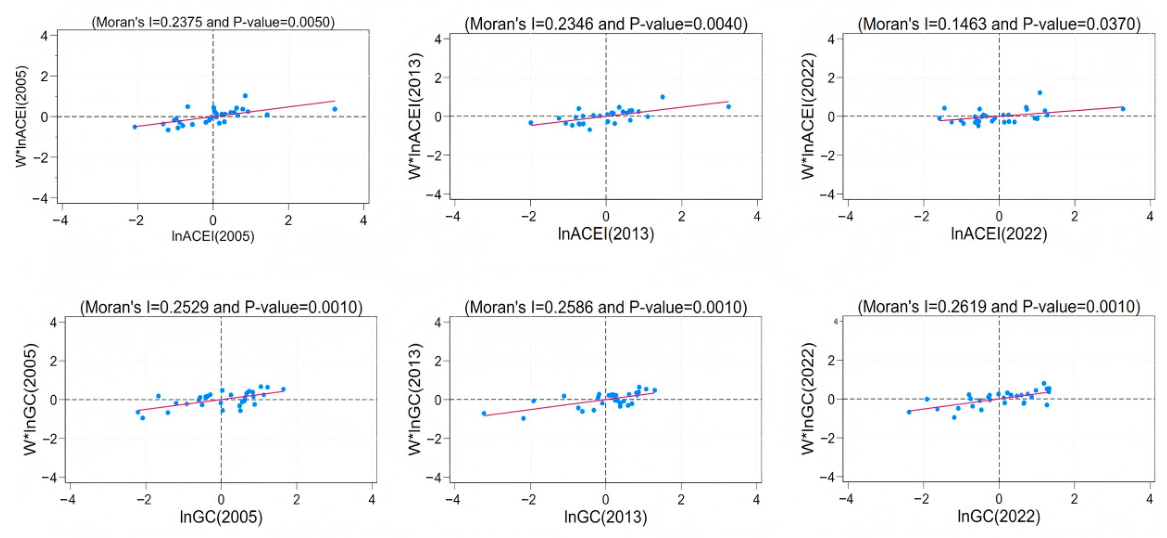
To further investigate the local spatial clustering patterns of these two variables, this study applies the local Moran’s I statistic to examine the local spatial autocorrelation of ACEI and green credit. Owing to space constraints, only the results for 2005, 2013, and 2022 are reported. As shown in
Figure 3, most provinces fall into the first and third quadrants, forming high-value clusters and low-value clusters. This finding indicates that both ACEI and green credit are characterized by significant positive local spatial autocorrelation. These results justify the use of spatial econometric models in the subsequent analysis.
5.4. Selection of Spatial Econometric Model
As reported in
Table 6, the LM-lag, LM-error and robust LM tests are all significant, indicating that both the SAR and SEM are applicable. The LR and Wald tests are significant at the 1% level, confirming that the SDM cannot be simplified to either the SAR or the SEM. Combined with the AIC and BIC results, the SDM is selected for subsequent analysis. The Hausman and LR tests further support the use of a two-way fixed effects specification. Thus, this study adopts a two-way fixed effects SDM.
5.5. Benchmark Regression Test
The estimation results, reported in
Table 7, show that the coefficient estimates for green credit development are significantly negative across all three spatial econometric models, indicating that green credit development is significantly associated with lower ACEI. According to the log-likelihood values, the SDM exhibits the best fit among the three models. This finding suggests that agricultural carbon emission intensity is influenced not only by local economic activities, but also by spillover effects from neighboring provinces, highlighting the spatial dependence in regional agricultural production activities that cannot be ignored.
The spatial autocorrelation test indicates that, under the green technology geographic composite matrix (W1), the spatial autocorrelation coefficient of agricultural carbon emission intensity is significant at the 1% level, indicating significant spatial dependence in ACEI across Chinese provinces. The coefficient on green credit is estimated at −0.276 and is significantly negative at the 1% level, suggesting that a stronger green orientation in regional credit allocation is significantly associated with lower ACEI. This association may be explained by the following three channels:
- (1)
Credit allocation guidance mechanism. Guided by green credit policies, financial institutions adopt differentiated pricing strategies for agricultural business entities. On the one hand, they offer preferential interest rates and green approval channels for projects that apply low carbon technologies, such as water-saving irrigation, comprehensive straw utilization, and soil testing-based formulated fertilization. On the other hand, they set higher financing thresholds for energy-intensive agricultural facilities and production practices that depend excessively on chemical fertilizers and pesticides. By regulating the direction of capital flows, this mechanism may redirect capital away from relatively high carbon agricultural activities toward green agricultural activities, sequentially improving the efficiency of agricultural capital allocation.
- (2)
The incentive mechanism of risk management. Banks integrate environmental risk ratings into the whole process of pre-loan investigation and post-loan management, requiring large-scale agricultural producers to provide environmental compliance certificates or carbon emissions monitoring data. This mechanism compels them to eliminate outdated energy-intensive equipment and accelerate the substitution of clean energy, hence reducing the carbon emissions from agricultural production at the source.
- (3)
Industrial structure optimization mechanism. The targeted allocation of credit funds accelerates the structural transformation of agricultural production methods. For example, in facility agriculture, traditional coal-fired heating systems are being rapidly replaced by electric heat pumps, while in the livestock and poultry sector, waste resource utilization projects have received dedicated credit support. Such technological substitution directly reduces the energy intensity of agricultural production, as a result of curbing agricultural carbon emissions.
In addition to the mechanism analysis presented above, the existing literature provides strong support for the findings of this study. Lu et al. (2025) found that green finance significantly reduces agricultural carbon emissions [
62]. Likewise, Yu et al. (2025) discovered that a one-unit increase in the green finance index leads to a significant reduction of 0.624 units in agricultural carbon emissions and that this effect is stronger in major grain-producing regions [
29]. Previous studies further indicate that the major components of green finance, including green credit, green insurance, and green securities, all play a role in curbing agricultural carbon emissions [
7]. Based on these findings, China should further improve its green credit policy framework, refine regional green credit guidance for agricultural low-carbon transition, and accelerate progress toward its 2030 carbon peaking target and 2060 carbon neutrality goal.
From the perspective of control variables, the results indicate that agricultural production structure, total agricultural machinery power, agricultural economic development, and urbanization all have significant effects on ACEI. (1) The coefficient for agricultural industrial structure is −1.044 (
p < 0.01), revealing that an expanded proportion of crop farming can significantly reduce the ACEI level. This is because crop farming has a lower carbon emission intensity per unit of output compared to livestock and poultry farming. (2) By contrast, the coefficient of total agricultural machinery power is 0.062 (
p < 0.01), indicating that a higher level of agricultural mechanization significantly increases carbon emissions. One possible explanation is that current agricultural production remains highly dependent on fossil fuel-powered machinery, and diesel consumption during operation directly results in carbon emissions. (3) The degree of agricultural economic development is −0.502 (
p < 0.01), which supports the applicability of the Environmental Kuznets Curve hypothesis in the agricultural sector and is consistent with the findings of Ritu et al. (2024) [
63]. As per capita agricultural output increases, agricultural producers tend to possess stronger financial capacity and greater capacity for technology adoption, thereby increasing the likelihood of adopting low-carbon agricultural technologies and promoting the transition toward green production practices. (4) The coefficient of urbanization is −0.161 (
p < 0.1), indicating that urbanization significantly reduces ACEI. The urbanization process has facilitated land transfers and large-scale agricultural operations, sequentially providing supportive conditions for the diffusion and use of green technologies [
64].
5.6. Spatial Spillover Effect
Drawing on the partial differential method proposed by LeSage et al. (2009) [
42], this study decomposes the regression coefficient of green credit on ACEI, that is, the total effect, into direct and indirect effects. The total effect reflects the comprehensive impact of green credit development on ACEI across all provinces. The direct effect refers to the impact of green credit development on ACEI within the local region, whereas the indirect effect captures the impact of green credit development on ACEI in neighboring provinces.
Table 8 reports the detailed decomposition results of these spatial effects.
As shown in
Table 8, under the spatial weight matrix based on the composite geographical distance of green technology, the local effect of green credit development on ACEI is −0.258, while its effect on ACEI in neighboring provinces is −0.168. Both effects are negative and significant at the 1% and 5% significance levels, respectively. This finding confirms Hypothesis 1, indicating that the development of green credit not only reduces ACEI in the local region but is also associated with lower ACEI in neighboring provinces through spatial spillover effects.
First, the rollout of green credit effectively reduces the costs associated with the research, development, diffusion, and deployment of low-carbon agricultural technologies in the local region. These green and low-carbon technologies then permeate and diffuse into neighboring provinces through channels such as interregional labor mobility, trade in agricultural products, and the circulation of agricultural inputs, sequentially promoting the green upgrading of agricultural production technologies in adjacent regions. Second, the successful practice of agricultural green transformation in the local region sends positive market signals, guiding business entities in neighboring areas to actively engage in imitation and learn from these practices, optimize the layout of agricultural production, and promote the low-carbon transformation of regional agricultural production models. Furthermore, by establishing green transformation demonstration bases, the government enables local green credit practices and environmental regulation to generate a demonstration effect on surrounding areas, thus fostering coordinated carbon reduction across the region. Thus, through technological spillovers, market guidance, and government support, green credit may contribute to coordinated emission reduction in agricultural emissions reduction across regions.
Among the control variables, urbanization shows a significantly positive indirect effect, implying a potential spatial spillover effect on agricultural carbon emission intensity. This finding is consistent with the conclusions of Cui et al. [
65] This may be related to labor mobility, factor reallocation, and regional industrial adjustment associated with urbanization. In contrast, the indirect effects of agricultural industrial structure, agricultural economic development, and total agricultural machinery power are insignificant, suggesting that their influences are mainly confined to the local region.
5.7. Mechanism Analysis
The results of the mediation effect test are reported in
Table 9. In Equation (1), the coefficient of green credit development is significantly negative, indicating that green credit is significantly associated with lower ACEI, meeting the prerequisite for the mediation effect test. In Equation (5), the coefficients of green credit on agricultural energy consumption intensity and industrial structure upgrading are −0.188 and 0.122, respectively, both of which are significant at the 1% level. This suggests that green credit significantly decreases agricultural energy consumption intensity while promoting industrial structure upgrading. In Equation (6), after the mediating variables are included, the coefficients of green credit, agricultural energy consumption intensity, and industrial structure upgrading remain statistically significant, indicating that both agricultural energy consumption intensity and industrial structure upgrading serve as partial mediators in the relationship between green credit and ACEI. Thus, green credit not only directly reduces the ACEI but can also indirectly promote agricultural emission reduction through two channels: lowering agricultural energy consumption intensity and advancing industrial structure upgrading. Thus, Hypotheses 2 and 3 are supported.
A plausible explanation is that green credit may contribute to agricultural emission reduction by improving resource allocation and easing financing constraints. On the one hand, differentiated financing support may encourage agricultural producers to adopt more energy-efficient machinery and greener production technologies, thereby reducing dependence on high-carbon energy inputs and improving energy use efficiency. This interpretation is consistent with the observed decline in agricultural energy consumption intensity. On the other hand, green credit may restrain the expansion of high energy-consuming industries and promote capital flows toward low energy-consuming and higher value-added sectors, thereby facilitating industrial structure upgrading. Such upgrading may help reduce overall energy consumption and support cleaner and lower-carbon agricultural production through technology spillovers and industrial linkage effects, which is consistent with the observed reduction in ACEI.
5.8. Threshold Effect of the Development Level of Green Credit
Prior research indicates that green credit significantly suppresses agricultural carbon emissions and induces spatial spillover effects. However, the emission reduction effects of green credit may not follow a simple linear relationship; rather, its impact may exhibit nonlinear characteristics as the level of green credit development changes. When green credit intensity is at different levels, its marginal impact on agricultural carbon emissions may differ. Hence, this study employs a panel threshold regression model, with green credit intensity as the threshold variable, to examine the nonlinear impact of green credit on ACEI.
Table 10 presents the results of the threshold tests. The single threshold model is significant at the 5% level (
p = 0.012), whereas neither the double threshold model nor the triple threshold model is statistically significant. Thus, this study selects the single threshold model for subsequent analysis and the estimated threshold value is −1.1146 (
Table 11). This estimate is based on the logarithmic transformation of green credit intensity and corresponds to approximately 0.328 after conversion to the original scale.
The results of the threshold regression analysis presented in
Table 12 indicate that the effect of green credit on ACEI exhibits a significant threshold characteristic. When the level of green credit is below the threshold value of 0.328, its inhibitory effect on ACEI is strongest. Once the intensity of green credit exceeds the threshold, the effect remains significantly negative, but the magnitude of its emission reduction effect declines markedly. This result indicates that as the scale of green credit expands, its marginal emission reduction effect gradually weakens.
To further interpret the estimated threshold value of −1.1146 corresponding to 0.328 on the original scale, we examine the temporal and spatial distribution of sample observations around this threshold. The results show that provinces below the threshold are mainly located in central and western China, whereas eastern provinces such as Guangdong, Jiangsu, and Zhejiang remain above the threshold throughout most or all years of the sample period. Beijing falls below the threshold only in 2005, while Guizhou and Yunnan remain below it for 17 years (2005–2021) and 18 years (2005–2022), respectively. This pattern suggests that the development of green credit remains at a relatively low level in several less developed regions.
In economic terms, the threshold can be understood as marking a change in the stage of green credit development. Below the threshold, an increase in green credit is associated with a more pronounced reduction in agricultural carbon emission intensity. Above the threshold, green credit continues to exert an inhibitory effect, but its marginal impact becomes weaker. This finding implies that once green credit reaches a relatively high level, further emission reduction may depend less on the expansion of credit scale itself and more on improvements in credit allocation efficiency and green technological upgrading. Therefore, the estimated threshold is not only statistically significant but also economically meaningful, suggesting that regions at different stages of green credit development should adopt differentiated policy priorities.
5.9. Robustness Test
This study tests the robustness of the baseline regression findings in three ways: replacing the spatial weight matrix, adjusting the sample period and using an alternative proxy for the core explanatory variable, green credit. First, to rule out the possibility that findings are contingent on a single spatial weight matrix, the baseline green technology geographic composite matrix (W1) is successively replaced by the economic geographic composite matrix (W2) and the geographic distance matrix (W3). Among them, the economic geographic composite matrix (W2) incorporates both geographic proximity and spatial correlation in regional economic development, thus capturing interregional linkages in both geographic and economic terms. Second, to minimize potential disturbances from the initial policy adjustment stage and data fluctuations at the end of the sample period, and estimation bias stemming from endpoint outliers, the first and final two years of the full dataset are excluded, narrowing the sample period to 2007–2020. Third, as a further robustness check, this paper uses the ratio of environmental project loans to total provincial loans as an alternative proxy for green credit. As reported in
Table 13, the direct, indirect, and total effects are −0.222, −0.431, and −0.653, respectively, all significant at the 1% level. Compared with the baseline estimates, the larger absolute values of the indirect and total effects suggest that the share-based measure better captures the structural allocation of green credit and its cross-regional transmission. Collectively, these findings demonstrate that green credit continues to exert a significant negative impact on ACI and produce substantial spatial spillover effects, thus verifying the robustness of the original baseline regression outcomes.
5.10. Endogeneity Tests
To address potential endogeneity, this study first employs a lagged variable strategy. When the core explanatory variable, green credit, is lagged by one period, the estimated effect remains significantly negative, indicating that the inhibitory effect of green credit on agricultural carbon emission intensity is robust [
21]. As reported in
Table 14, when both green credit and all control variables are lagged by one period, the direct effect becomes positive but insignificant (0.0295), while the indirect effect (−0.3095) and total effect (−0.2800) remain significantly negative. In the spatial Durbin model, the direct effect reflects the impact of green credit on local agricultural carbon emission intensity, the indirect effect captures the spillover effect on neighboring regions, and the total effect measures the overall impact. These findings suggest that although the local effect weakens under the stricter lag specification, green credit still significantly reduces. Agricultural carbon emission intensity through spatial spillover channels.
In addition, this study applies an instrumental variable approach to further address endogeneity concerns. As reported in
Table 15, the second stage results show that the coefficient of green credit (GC) is −0.569 and remains significantly negative at the 1% level, indicating that green credit continues to exert a significant suppressing effect on agricultural carbon emission intensity after accounting for endogeneity. Among the control variables, industrial structure and economic development level both show significantly negative effects, while the coefficients of agricultural mechanization and urbanization are not statistically significant. The identification tests further support the validity of the instrumental variable estimation: the Kleibergen-Paap LM statistic is significant at the 1% level, rejecting the null hypothesis of under identification; the first stage F statistic is 22.93, exceeding the conventional threshold of 10, suggesting that the instrument is sufficiently correlated with green credit; and the Cragg Donald F statistic reaches 83.17, indicating that the weak instrument problem is unlikely to be serious. Overall, the instrumental variable results are consistent with the baseline findings and provide further evidence that the negative effect of green credit on agricultural carbon emission intensity is robust rather than driven by reverse causality or omitted variable bias.
5.11. Analysis of Regional Heterogeneity
Given the pronounced disparities in economic development and financial sector development across China’s regions, the impact of green credit on ACEI is likely to exhibit regional heterogeneity. In particular, relative to central and western China, the eastern region, as the country’s most economically advanced area, has a more developed green financial system, stronger capacity for technology diffusion, and a distinct industrial structure. Accordingly, this study further divides the sample into eastern, central, and western regions and estimates the SDM separately for each group to examine regional variations in the effect of green credit on ACEI.
Table 16 reports the decomposition results for the three regions.
The results show that in the eastern region, the direct, indirect, and total effects of green credit intensity are all significantly negative. This suggests that green credit not only reduces ACEI within the eastern region but also produces significant emission reduction spillovers to neighboring regions. In the central region, the direct effect is nearly zero and lacks statistical significance (coefficient 0.0003, p = 0.995), while the indirect effect and total effect are significantly negative at the 1% level. In the western region, the direct effect is significantly negative at the 1% level, but the indirect effect is positive and insignificant (p = 0.166), and the total effect is also insignificant (p = 0.424).
These regional differences can be explained by China’s actual development gradient. In the eastern region, the mature green financial system, efficient allocation of green credit resources, and smooth interregional economic linkages and technology diffusion channels collectively enable the emission reduction effects of green credit to spill over effectively to neighboring areas. For the central region, the insignificant direct effect may be attributed to the region’s transitional stage of agricultural modernization, where smallholder farming dominates and green credit absorption is weak, while traditional input rigidities offset marginal emission reductions. However, the significantly negative indirect effect reflects the central region’s unique hub role connecting the east and west. Through industrial linkages, technology diffusion, and policy imitation, green credit in the central region generates positive spatial spillovers to neighboring areas, especially the east and west, even though its local effect has not yet materialized. For the western region, the strongly significant direct effect indicates a large marginal emission reduction potential, as the region’s relatively extensive agricultural practices leave ample room for improvement through green credit. Nevertheless, the weak and positive though statistically insignificant indirect effect suggests that spatial spillovers are hindered by vast geographical distances, poor infrastructure, and strong interregional market segmentation. Moreover, a faint pollution haven effect, where local green policies may drive high-carbon activities to even less developed neighbors, cannot be ruled out, but it is not statistically robust. Consequently, the total effect in the western region remains insignificant, implying that green credit’s net regional impact, including spillovers, is not yet reliable.
In summary, the eastern region exhibits a comprehensive radiation pattern of emission reduction; the central region acts as an outward-spillover hub; and the western region mainly achieves local abatement without effective spatial diffusion. These findings highlight the importance of region-specific green credit policies.
6. Conclusions, Suggestions, and Discussion
6.1. Conclusions and Suggestions
In the context of intensifying global climate change, reducing agricultural carbon emissions has become an important component of China’s dual carbon strategy. As a major instrument of green finance, green credit development may guide financial resources toward environmentally friendly agricultural activities and thereby support the low-carbon transition of the agricultural sector. Based on panel data from 30 provincial-level regions in mainland China over the period 2005–2022, this study systematically investigates the impact of green credit development on agricultural carbon emission intensity by employing the spatial Durbin model, mediation model, and the threshold effect model. The empirical results show that green credit is significantly associated with lower agricultural carbon emission intensity. This finding remains robust after replacing the spatial weight matrix, adjusting the sample period, and using a one-period lagged green credit indicator. Further analysis based on the composite geographical spatial weight matrix of green technology indicates that green credit not only exerts a significant inhibitory effect on local agricultural carbon emission intensity, but also generates a significant negative spillover effect on neighboring regions. Nevertheless, the local mitigation effect is stronger than the spatial spillover effect. The heterogeneity analysis reveals distinct regional patterns: in the eastern region, green credit generates both significant local and spillover effects; in the central region, only spatial spillover effects are significant, suggesting a hub role; in the western region, only local abatement is achieved without effective diffusion. These differences underscore the importance of region-specific policy design. The mechanism analysis confirms that green credit contributes to emission reduction mainly through two channels: facilitating the upgrading of the industrial structure and reducing agricultural energy consumption intensity. In addition, the threshold effect results suggest that the impact of green credit on agricultural carbon emission intensity is nonlinear. Although green credit continues to exert a significant mitigation effect after the threshold is crossed, its marginal emission reduction effect tends to weaken. Based on the above findings, the following recommendations are proposed:
- (1)
A more operational regional green credit support system should be established to better serve the low-carbon transition of agriculture. In addition to central bank funding, fiscal interest subsidies, and local guarantee mechanisms, the green orientation of regional credit allocation should be further strengthened. Where conditions permit, relevant standards for identifying agriculture-related green projects can be refined, and indicators such as ecological protection, resource conservation, and carbon reduction performance can be gradually incorporated into financing evaluation and policy support, so as to improve the effectiveness of green credit in supporting agricultural emission reduction.
- (2)
An interregional green credit coordination mechanism should be developed to strengthen the cross-regional diffusion of credit resources, low-carbon technologies, and implementation experience. A provincial-level coordination platform can be established to connect financial institutions, agricultural departments, and local governments, so as to promote information sharing and policy alignment. In addition, pilot counties and demonstration zones should be used to diffuse mature low-carbon agricultural models, while preferential credit support and interest subsidies can be provided to farmers, cooperatives, and agribusinesses that adopt verified emission-reduction technologies.
- (3)
Differentiated policies should be implemented according to regional development foundations and resource endowments. In the eastern region, where both direct and spillover effects are significant, green credit should be combined with cultivated land protection, high-quality agricultural development, and carbon performance incentives to improve the efficiency of fund allocation. In the central region, which plays a spillover hub role, policies should focus on strengthening local absorption capacity through land consolidation, support for green farming cooperatives, and technology diffusion channels. In the western region, where spatial spillovers are weaker, priority should be given to improving infrastructure, reducing interregional financing frictions, and establishing cross-provincial green credit linkages to enhance policy transmission.
- (4)
The transmission impact of green credit on reducing agricultural carbon intensity should be strengthened through industrial upgrading and higher energy efficiency. Greater collaboration among government, industry, universities and research institutions can accelerate the development and application of biopesticides, smart agricultural machinery, and clean energy. Meanwhile, green certification standards and supporting financial instruments, such as credit guarantees cooperatives, can further improve the accessibility and effectiveness of green finance.
- (5)
As green credit displays threshold effects and diminishing marginal returns in reducing carbon emissions, policy design should prioritize quality enhancement over simple scale expansion. In regions where green credit development remains relatively weak, credit supply can be moderately expanded to overcome financing constraints. In more advanced regions, policy emphasis should move toward improving allocation efficiency, optimizing loan structure, and strengthening post-loan monitoring, so as to sustain long-term emission reduction effects.
6.2. Discussion
This study suggests that the carbon mitigation role of green credit in agriculture should be understood not merely as a local financial intervention, but as a policy arrangement embedded in regional linkages, structural transformation and stages of development conditions. In the agricultural sector, where production activities are strongly influenced by technology diffusion, interregional factor mobility, and differences in development foundations, the effectiveness of green credit depends not only on the expansion of financial support but also on whether such support can be translated into cleaner energy use and more efficient industrial upgrading. In this sense, the findings enrich the existing literature by showing that the environmental effect associated with green credit in agriculture is both spatially connected and structurally transmitted.
Meanwhile, the results imply that the policy effectiveness of green credit is conditional rather than uniform. Regions with stronger green finance foundations and better capacities for technology absorption are more likely to convert financial input into sustained carbon reduction outcomes, while the weakening marginal effect after the threshold is crossed indicates that scale expansion alone may not guarantee continuously stronger mitigation effects. Therefore, future policy design should place greater emphasis on allocation efficiency, regional coordination and differentiated implementation.
Several limitations merit acknowledgment. Due to the lack of consistent and publicly available provincial data on agriculture-specific green credit, this study employs a provincial-level proxy to characterize green credit development. Although this measure is useful for capturing the green orientation of regional credit allocation at the macro level, it does not directly observe credit flows to agricultural green projects or producers. Moreover, the proxy may partly reflect other province-specific characteristics, including industrial composition, general credit allocation structures, and differences in policy enforcement, thereby introducing potential measurement error. For this reason, the findings should be interpreted with caution as indicating a macro-level relationship between the regional green credit environment and agricultural carbon emission intensity, rather than a precise estimate of the impact of agriculture-specific green lending. In addition, the use of provincial panel data limits the ability to uncover micro-level mechanisms involving farmers, cooperatives, and rural financial institutions. Future research may build on this study by using more granular data, including county-level observations, bank-level lending records, and household or cooperative-level survey data, to provide a more direct assessment of how green finance affects agricultural carbon outcomes.