Linking Urban Transport and Livability: A GIS-Integrated Multicriteria Decision-Making Evaluation in Kanarya İstanbul



Abstract
1. Introduction
2. Literature Review
3. Methodology
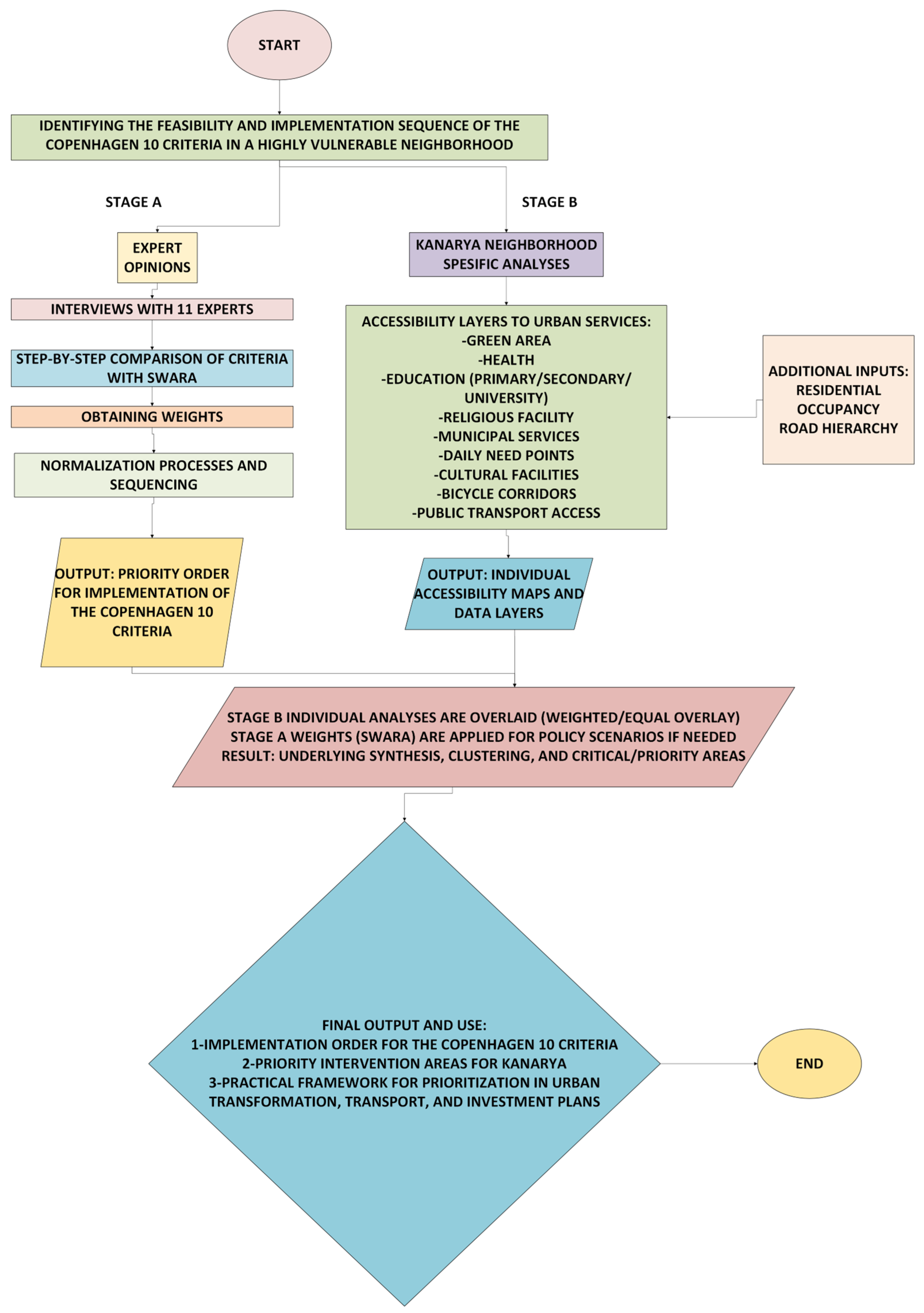
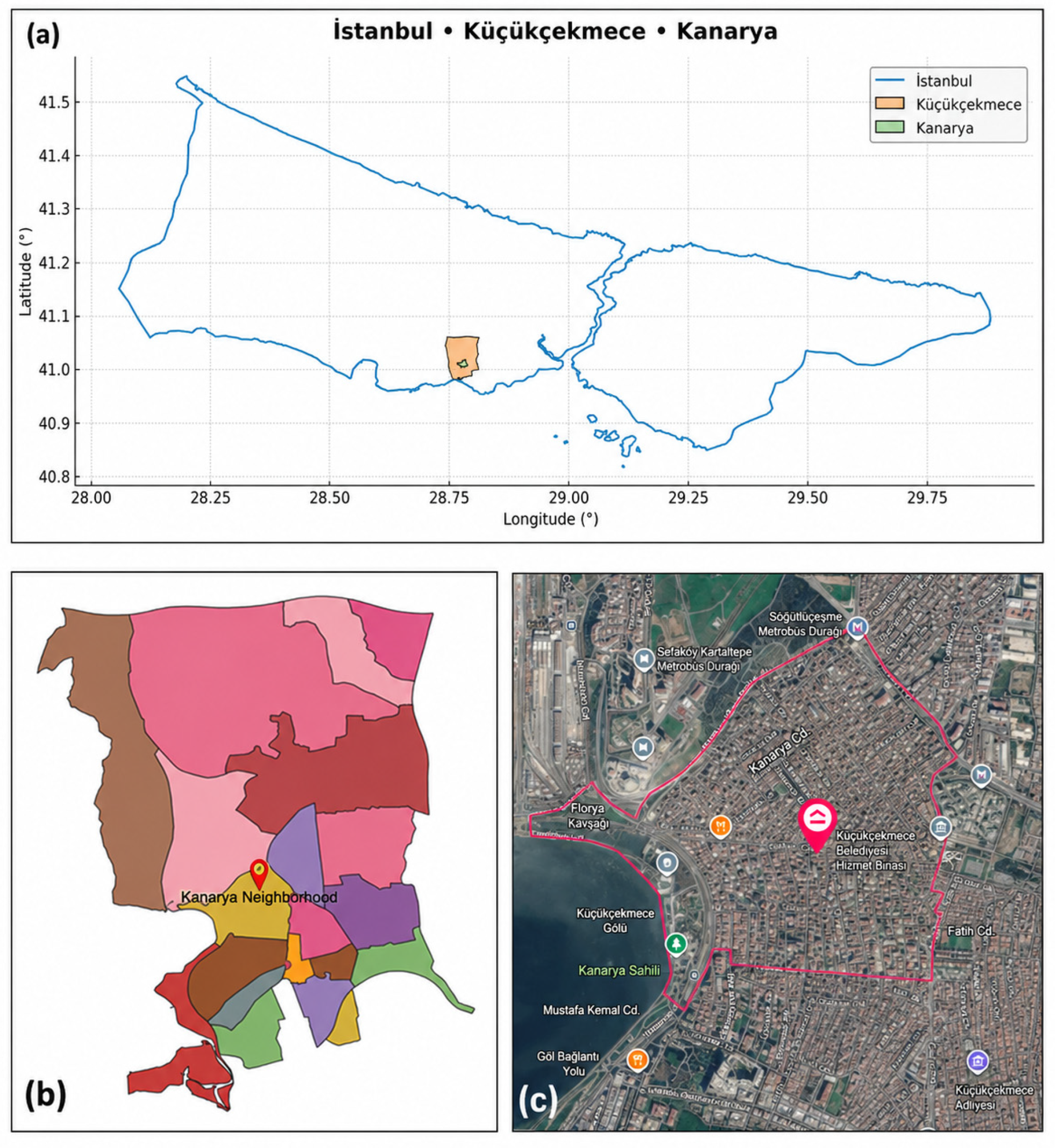
3.1. Study Area and Conceptual Framework
3.2. Application of the SWARA Method
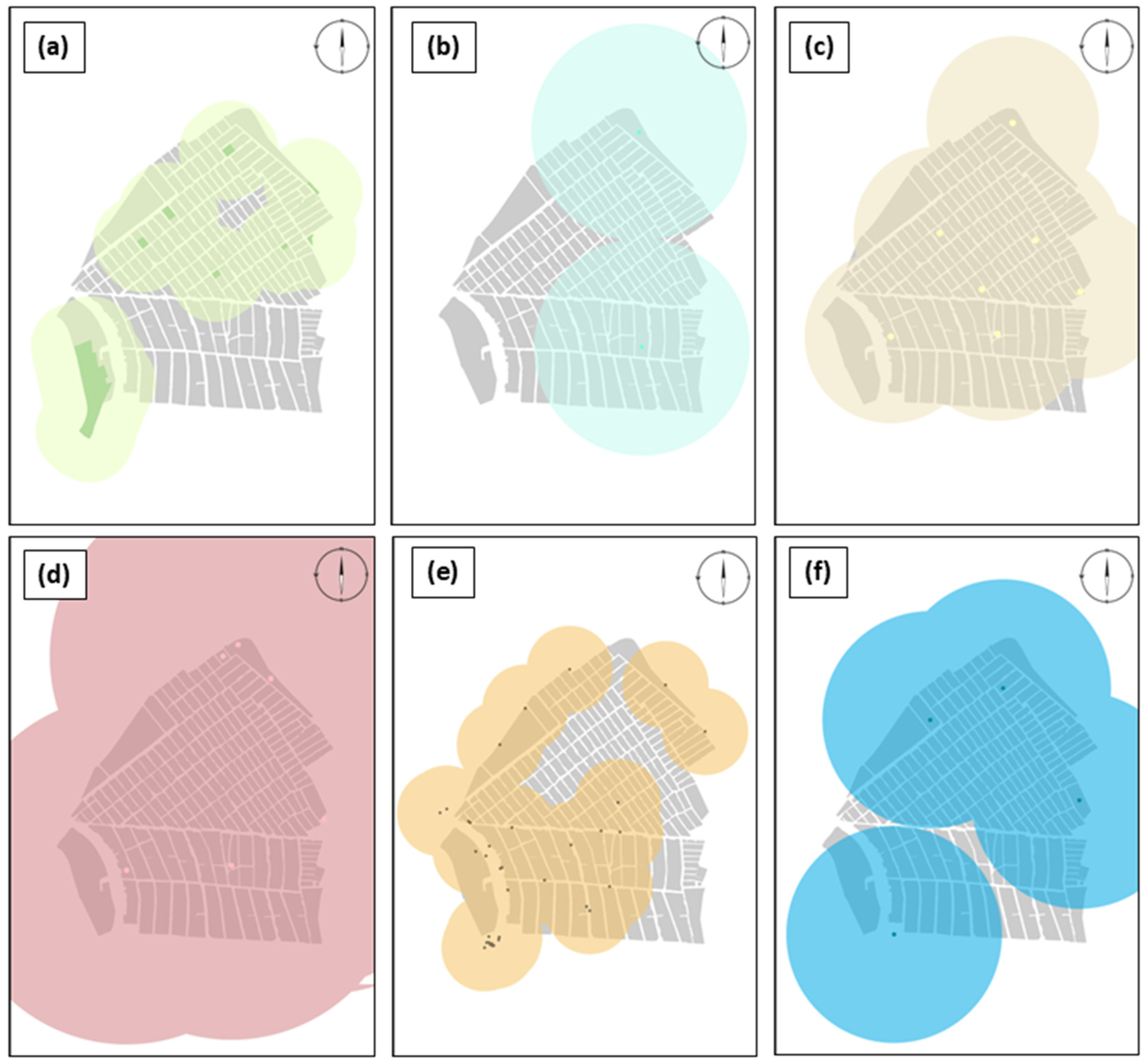
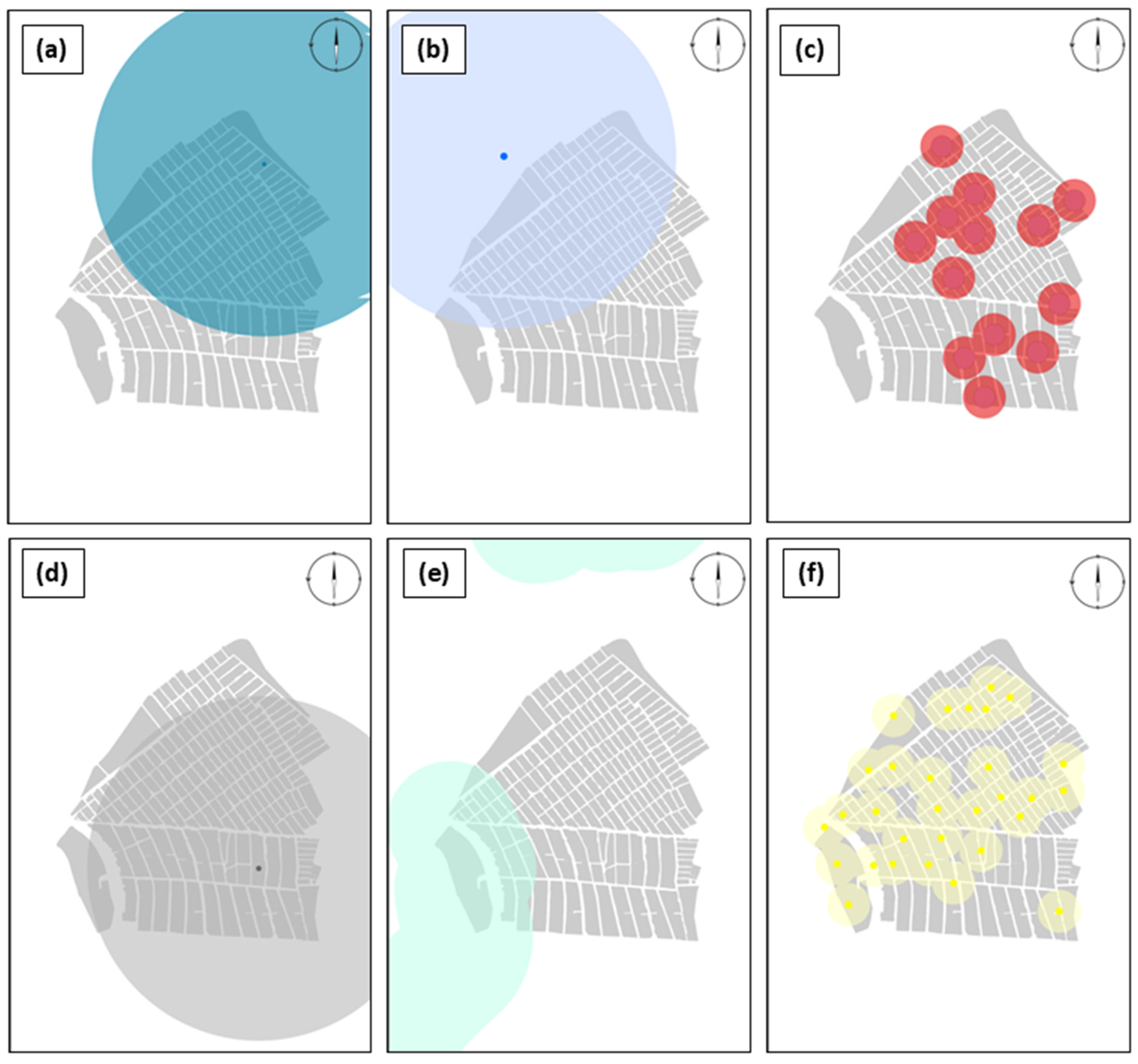
3.3. Preparation of Analysis Maps
3.3.1. Establishment of Administrative Boundaries
3.3.2. Transportation Map
3.3.3. DEM (Digital Elevation Model) and Elevation Analysis
3.4. Synthesis Map Creation and Findings
4. Results
5. Discussion
6. Conclusions
Author Contributions
Funding
Institutional Review Board Statement
Informed Consent Statement
Data Availability Statement
Acknowledgments
Conflicts of Interest
Abbreviations
| SWARA | Step-wise Weight Assessment Ratio Analysis |
| MCDM | Multi-Criteria Decision Making |
| DEM | Digital Elevation Model |
| TOD | Transit-Oriented Development |
| GIS | Geographical Information Systems |
| AHP | Analytical Hierarchy Process |
| ANP | Analytical Network Process |
References
- Buldurur, M.A. Sürdürülebilir Kentsel Ulaşım; Birsen Yayınevi: İstanbul, Turkey, 2018; Available online: https://www.birsenyayinevi.com/surdurulebilir-kentsel-ulasim-aysan-buldurur (accessed on 3 April 2026).
- Gehl, J. Cities for People; Island Press: Washington, DC, USA, 2010. [Google Scholar]
- Pojani, D.; Stead, D. Sustainable Urban Transport in the Developing World: Beyond Megacities. Sustainability 2015, 7, 7784–7805. [Google Scholar] [CrossRef] [Scilit]
- Bomberg, M.; Zorn, L.; Sall, E. Incorporating user based perspective of livability projects in SF-CHAMP mode choice models. Transp. Lett. 2013, 5, 83–95. [Google Scholar] [CrossRef] [Scilit]
- Gavin, K.; Bennett, A.; Auchincloss, A.H.; Katenta, A. A brief study exploring social equity within bicycle share programs. Transp. Lett. 2016, 8, 177–180. [Google Scholar] [CrossRef] [Scilit]
- Banister, D. The sustainable mobility paradigm. Transp. Policy 2008, 15, 73–80. [Google Scholar] [CrossRef] [Scilit]
- Sobczuk, S.; Borucka, A. Recent Advances for the Development of Sustainable Transport and Their Importance in Case of Global Crises: A Literature Review. Appl. Sci. 2024, 14, 10653. [Google Scholar] [CrossRef] [Scilit]
- Ashraf, A.; Idrisi, M.J. Smart and Sustainable Public Transportation—A Need of Developing Countries. Int. J. Networked Distrib. Comput. 2024, 12, 144–152. [Google Scholar] [CrossRef] [Scilit]
- Marcuse, P. Gentrification, abandonment, and displacement: Connections, causes, and policy responses in New York City. J. Urban Contemp. Law 1985, 28, 195–240. [Google Scholar]
- Wacquant, L. Urban Outcasts: A Comparative Sociology of Advanced Marginality, 1st ed.; Polity Press: Cambridge, UK, 2007. [Google Scholar]
- Lucas, K. Transport and social exclusion: Where are we now? Transp. Policy 2012, 20, 105–113. [Google Scholar] [CrossRef] [Scilit]
- Martens, K. Transport Justice: Designing Fair Transportation Systems; Routledge: New York, NY, USA; London, UK, 2017. [Google Scholar] [CrossRef] [Scilit]
- Faghihinejad, F.; Zoghifard, M.; Amiri, A.M.; Monajem, S. Evaluating Social and Spatial Equity in Public Transport: A Case Study. Transp. Lett. 2023, 15, 1420–1429. [Google Scholar] [CrossRef] [Scilit]
- Martens, K.; Singer, M.E.; Cohen-Zada, A.L. Equity in Accessibility: Moving From Disparity to Insufficiency Analyses. J. Am. Plan. Assoc. 2022, 88, 479–494. [Google Scholar] [CrossRef] [Scilit]
- Castro, R.B.; Ortega Sandoval, A.D.; Odamtten, G. Up around the bend? How transport poverty can lead to social exclusion in a low-income community in Lagos, Nigeria. J. Transp. Geogr. 2022, 102, 103388. [Google Scholar] [CrossRef] [Scilit]
- Durand, A.; Zijlstra, T.; Van Oort, N.; Hoogendoorn-Lanser, S.; Hoogendoorn, S. Access denied? Digital inequality in transport services. Transp. Rev. 2022, 42, 32–57. [Google Scholar] [CrossRef] [Scilit]
- Arku, R.N.; Higgins, C.D.; Fischer, J.; Farber, S. Do affluent neighbourhoods pay more for transit access? Exploring the capitalization of employment accessibility within different housing submarkets in Vancouver. J. Transp. Geogr. 2024, 121, 104038. [Google Scholar] [CrossRef] [Scilit]
- Jahangir, S.; Bailey, A.; Hasan, M.U.; Hossain, S. “We do not go outside, though We want to”: Unequal Access to Public Transport and Transport-Related Social Exclusion of Older Adults in Dhaka, Bangladesh. J. Appl. Gerontol. 2024, 43, 1165–1176. [Google Scholar] [CrossRef] [Scilit]
- Bruno, M.; Kouwenberg, M.; Van Oort, N. Addressing transport related social exclusion through transportation policy: A novel evaluation method applied to the Amsterdam Transport Region. Transp. Res. Interdiscip. Perspect. 2024, 26, 101177. [Google Scholar] [CrossRef] [Scilit]
- Zhalehdoost, A.; Taleai, M. Enhancing urban quality of life evaluation using spatial multi criteria analysis. Sci. Rep. 2025, 15, 22048. [Google Scholar] [CrossRef] [Scilit]
- Ayyildiz, E.; Yildirim, B. Evaluating urban mobility strategies to foster inclusive urban regeneration for vulnerable groups. Cities 2026, 173, 106932. [Google Scholar] [CrossRef] [Scilit]
- Giuffrida, N.; Binetti, M.; Viscio, S.; Ottomanelli, M. A Simplified Framework for the Equity-Based Spatial Assessment of Alternative Public Transport Networks. Sustainability 2022, 14, 16606. [Google Scholar] [CrossRef] [Scilit]
- Grande-Ayala, C.E. An Assessment of Accessibility from a Socially Sustainable Urban Mobility Approach in Mass Transit Projects: Contributions from the Northern Central American Triangle. Sustainability 2024, 16, 3766. [Google Scholar] [CrossRef] [Scilit]
- Duleba, S.; Moslem, S. Sustainable Urban Transport Development with Stakeholder Participation, an AHP-Kendall Model: A Case Study for Mersin. Sustainability 2018, 10, 3647. [Google Scholar] [CrossRef] [Scilit]
- Ahmed, T.; Pirdavani, A.; Wets, G.; Janssens, D. Bicycle Infrastructure Design Principles in Urban Bikeability Indices: A Systematic Review. Sustainability 2024, 16, 2545. [Google Scholar] [CrossRef] [Scilit]
- Chondrogianni, D.; Stephanedes, Y.J.; Fatourou, P. Assessing Cycling Accessibility in Urban Areas through the Implementation of a New Cycling Scheme. Sustainability 2023, 15, 14472. [Google Scholar] [CrossRef] [Scilit]
- Naseri, H.; Laviolette, J.; Waygood, E.O.D.; Manaugh, K. Cycling and GHG Emissions: How Infrastructure Makes All the Difference. Sustainability 2025, 17, 7577. [Google Scholar] [CrossRef] [Scilit]
- Zolfani, S.H.; Saparauskas, J. New Application of SWARA Method in Prioritizing Sustainability Assessment Indicators of Energy System. Eng. Econ. 2014, 24, 408–414. [Google Scholar] [CrossRef] [Scilit]
- Karabasevic, D.; Stanujkic, D.; Urosevic, S. The MCDM Model for Personnel Selection Based on SWARA and ARAS Methods. Manag.-J. Theory Pract. Manag. 2015, 20, 43–52. [Google Scholar] [CrossRef] [Scilit]
- Dinçer, H.; Yüksel, S.; Aksoy, T.; Hacıoğlu, Ü. Application of M-SWARA and TOPSIS Methods in the Evaluation of Investment Alternatives of Microgeneration Energy Technologies. Sustainability 2022, 14, 6271. [Google Scholar] [CrossRef] [Scilit]
- Keršulienė, V.; Zavadskas, E.K.; Turskis, Z. SELECTION OF RATIONAL DISPUTE RESOLUTION METHOD BY APPLYING NEW STEP-WISE WEIGHT ASSESSMENT RATIO ANALYSIS (SWARA). J. Bus. Econ. Manag. 2010, 11, 243–258. [Google Scholar] [CrossRef] [Scilit]
- Moslem, S.; Stević, Ž.; Tanackov, I.; Pilla, F. Sustainable development solutions of public transportation:An integrated IMF SWARA and Fuzzy Bonferroni operator. Sustain. Cities Soc. 2023, 93, 104530. [Google Scholar] [CrossRef] [Scilit]
- Canitez, F.; Alpkokin, P.; Kiremitci, S.T. Sustainable urban mobility in Istanbul: Challenges and prospects. Case Stud. Transp. Policy 2020, 8, 1148–1157. [Google Scholar] [CrossRef] [Scilit]
- Yılmaz, Y.E.; Gürsoy, M. Pedestrian Traffic Stress Levels (PTSL) in School Zones: A Pedestrian Safety Assessment for Sustainable School Environments—Evidence from the Caferağa Case Study. Sustainability 2026, 18, 1042. [Google Scholar] [CrossRef] [Scilit]
- Endeksa Data. 2025. Available online: https://www.endeksa.com/tr/analiz/turkiye/istanbul/kucukcekmece/kanarya/demografi (accessed on 3 April 2026).
- Şen, B.; Tunç, A. Kanarya mahallesi: Zorunlu göç, enformellik ve siyaset. Toplumbilim 2011, 26, 117–128. [Google Scholar]
- Overpass Turbo, 2025. Available online: https://overpass-turbo.eu/ (accessed on 7 April 2026).
- Küçükçekmece Belediyesi. Küçükçekmece Municipality, Kanarya Neighborhood, 1/8000 Scale Master Development Plan; Küçükçekmece Belediyesi: Küçükçekmece, Turkey, 2025. [Google Scholar]
- BBBike Data. 2025. Available online: https://extract.bbbike.org/ (accessed on 3 April 2026).
- USGS. 2025. Available online: https://earthexplorer.usgs.gov/ (accessed on 3 April 2026).
- Regulation on the Preparation of Spatial Plans. 2014. Available online: https://www.mevzuat.gov.tr/mevzuat?MevzuatNo=19788&MevzuatTur=7&MevzuatTertip=5 (accessed on 3 April 2026).
- National Transport and Logistics Master Plan 2053. 2022. Available online: https://www.uab.gov.tr/media/v3ifp3wn/20221025-2053-ulastirma-ve-lojistik-ana-plani-tr.pdf (accessed on 10 May 2026).
- Lowe, K.; Jones, P. Participation and Equity in Municipal Transportation Decisions: A Chicago Case Study and a Politicized Capacity-Building Alternative. Public Work. Manag. Policy 2024, 29, 276–295. [Google Scholar] [CrossRef] [Scilit]
- Amorim, J.D.M.; De Silva, A.E.; Gonçalves, J.M. Equity and Spatial Justice Perspectives in Transportation. Urban Sci. 2025, 9, 163. [Google Scholar] [CrossRef] [Scilit]
- Lemon, S.C.; Neptune, A.; Goulding, M.; Pendharkar, J.A.; Dugger, R.; Chriqui, J.F. Integrating Equity Into Bicycle Infrastructure, Planning, and Programming: A Mixed Methods Exploration of Implementation Among Participants in the Bicycle Friendly Community Program. Prev. Chronic Dis. 2023, 20, 230119. [Google Scholar] [CrossRef] [Scilit] [PubMed]
- Cunha, I.; Silva, C. Assessing the equity impact of cycling infrastructure allocation: Implications for planning practice. Transp. Policy 2023, 133, 15–26. [Google Scholar] [CrossRef] [Scilit]




| Field of Expertise | Professional Experience (Years) | Age | Gender |
|---|---|---|---|
| Urban Planner | 3 | 25 | Female |
| Civil Engineer | 10 | 36 | Male |
| Urban Planner | 13 | 35 | Female |
| Academic | 10 | 36 | Female |
| Architect | 17 | 41 | Female |
| Architect | 32 | 53 | Male |
| Real Estate Management Expert | 13 | 41 | Male |
| Urban and Regional Planner | 14 | 42 | Female |
| Transportation Engineer | 33 | 55 | Male |
| Urban Planner | 18 | 41 | Female |
| Architect | 25 | 57 | Female |
| Criterion | Title | Description |
|---|---|---|
| C1 | Transformation of streets into pedestrian corridors | Encourages pedestrian mobility and reduces car traffic; directly associated with “walkability” and pedestrian-oriented development. |
| C2 | Reduction in car traffic and parking areas | Limits private car use while strengthening public transport and active mobility (walking and cycling). |
| C3 | Conversion of parking areas into public spaces | Prioritizes access based on public transport rather than car dominance; part of the “reducing automobile dependency” approach. |
| C4 | Preservation of low-rise housing fabric | Supports a built environment suitable for walking and cycling without increasing density; connected to human-scale transportation. |
| C5 | Respect for human scale (grid street systems) | Grid street structures facilitate pedestrian and bicycle access and reinforce integration with public transport. |
| C6 | Making the city center attractive | A livable urban core should primarily be accessible by public transport and walking, aligned with the “TOD (transit-oriented development)” approach. |
| C7 | Promoting student life (cycling) | Affordable access through cycling and public transport is essential for students; it is directly related to accessibility and active mobility. |
| C8 | Adapting the city to seasonal changes | Infrastructure supporting year-round walking and cycling (e.g., sheltered stops in winter, shaded areas in summer) strengthens sustainable mobility. |
| C9 | Making the bicycle the main mode of transport | Positions the bicycle as the primary mode of mobility, a cornerstone of sustainable and active transport policy. |
| C10 | Improving bicycle usability | Enhances bicycle infrastructure and accessibility; linked to bike-sharing, parking facilities, and last-mile connectivity. |
| Facility Type | Regulatory Distance (m) | Applied Distance and Explanation |
|---|---|---|
| Municipal Service Area | 400–750 m | 600 m |
| Cultural Facility Area | 400–1000 m | 800 m (wider access) |
| Health Facility Area | 400–600 m | 500 m (neighborhood and regional function combined) |
| Primary Education Area | 300–500 m | 500 m |
| Secondary Education Area | 600–1000 m | 800 m (regional scale access) |
| Religious Facility Area | 300 m (neighborhood mosque) 500 m (regional mosque) | 400 m (median) |
| Neighborhood Square | 250–350 m | 300 m (pedestrian-oriented access standard) |
| Green Space/Park | 200–300 m | 250 m (daily access distance) |
| Public Transport Line | 300–500 m | 400 m (walkability distance) |
| Bicycle Path | 250–300 m | 275 m (student-oriented, green network integration) |
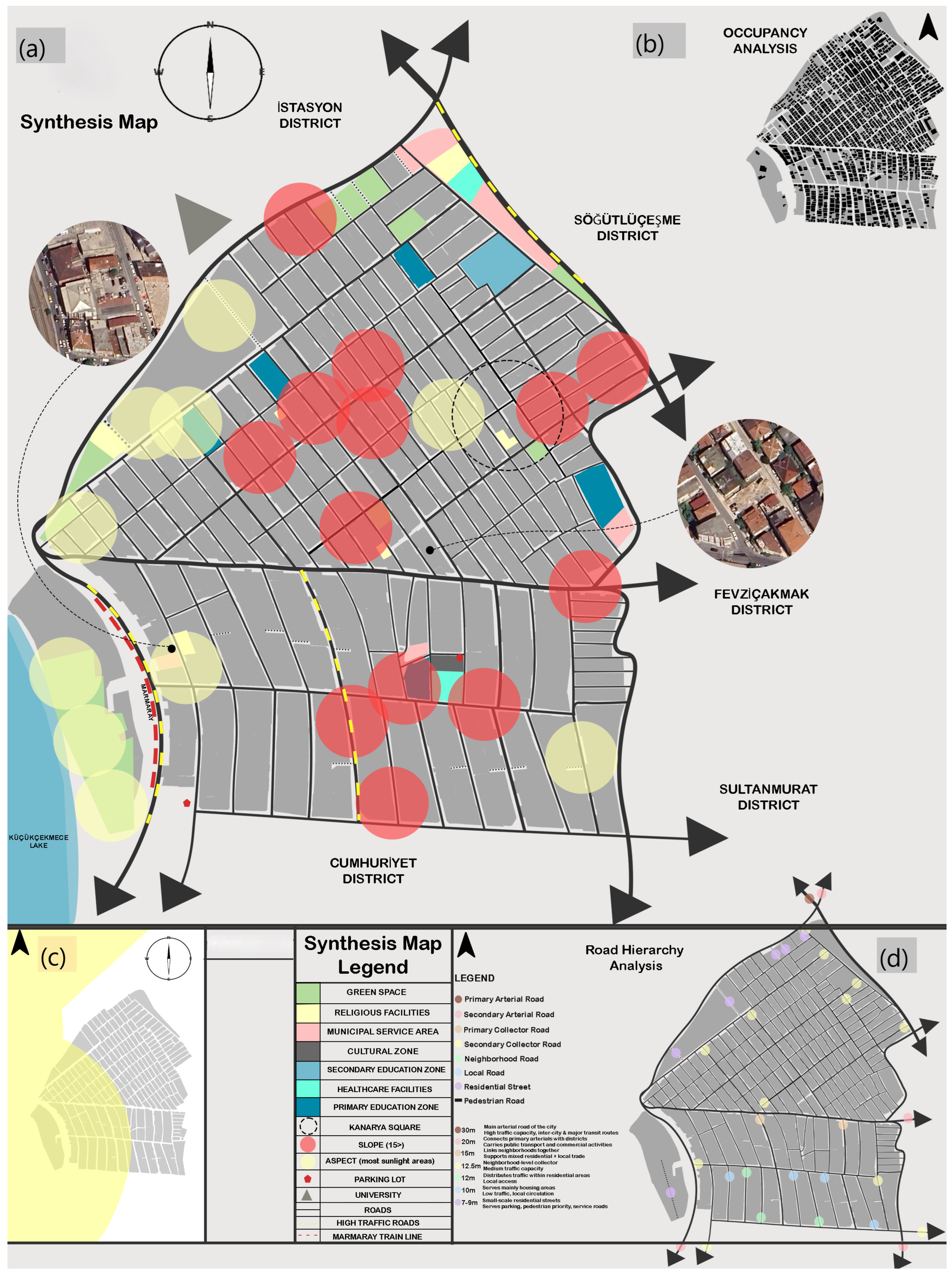
| Slope and Aspect | – | 50 m intervals, slopes greater than 15% |
| Criterion | c1 | c2 | c3 | c4 | c5 | c6 | c7 | c8 | c9 | c10 |
|---|---|---|---|---|---|---|---|---|---|---|
| Expert 1 | 0.077 | 0.070 | 0.070 | 0.058 | 0.106 | 0.106 | 0.089 | 0.155 | 0.140 | 0.128 |
| Expert 2 | 0.226 | 0.103 | 0.036 | 0.053 | 0.078 | 0.085 | 0.094 | 0.103 | 0.103 | 0.119 |
| Expert 3 | 0.093 | 0.098 | 0.103 | 0.113 | 0.103 | 0.103 | 0.098 | 0.103 | 0.098 | 0.089 |
| Expert 4 | 0.012 | 0.018 | 0.027 | 0.036 | 0.054 | 0.081 | 0.109 | 0.159 | 0.214 | 0.289 |
| Expert 5 | 0.012 | 0.018 | 0.025 | 0.038 | 0.055 | 0.080 | 0.111 | 0.156 | 0.210 | 0.295 |
| Expert 6 | 0.009 | 0.014 | 0.020 | 0.031 | 0.046 | 0.069 | 0.100 | 0.150 | 0.225 | 0.337 |
| Expert 7 | 0.075 | 0.063 | 0.048 | 0.079 | 0.134 | 0.122 | 0.111 | 0.111 | 0.141 | 0.116 |
| Expert 8 | 0.099 | 0.082 | 0.095 | 0.104 | 0.127 | 0.115 | 0.090 | 0.110 | 0.078 | 0.099 |
| Expert 9 | 0.051 | 0.080 | 0.101 | 0.166 | 0.127 | 0.127 | 0.080 | 0.066 | 0.092 | 0.111 |
| Expert 10 | 0.017 | 0.019 | 0.024 | 0.037 | 0.053 | 0.077 | 0.108 | 0.146 | 0.212 | 0.307 |
| Expert 11 | 0.453 | 0.252 | 0.132 | 0.070 | 0.037 | 0.022 | 0.017 | 0.009 | 0.006 | 0.003 |
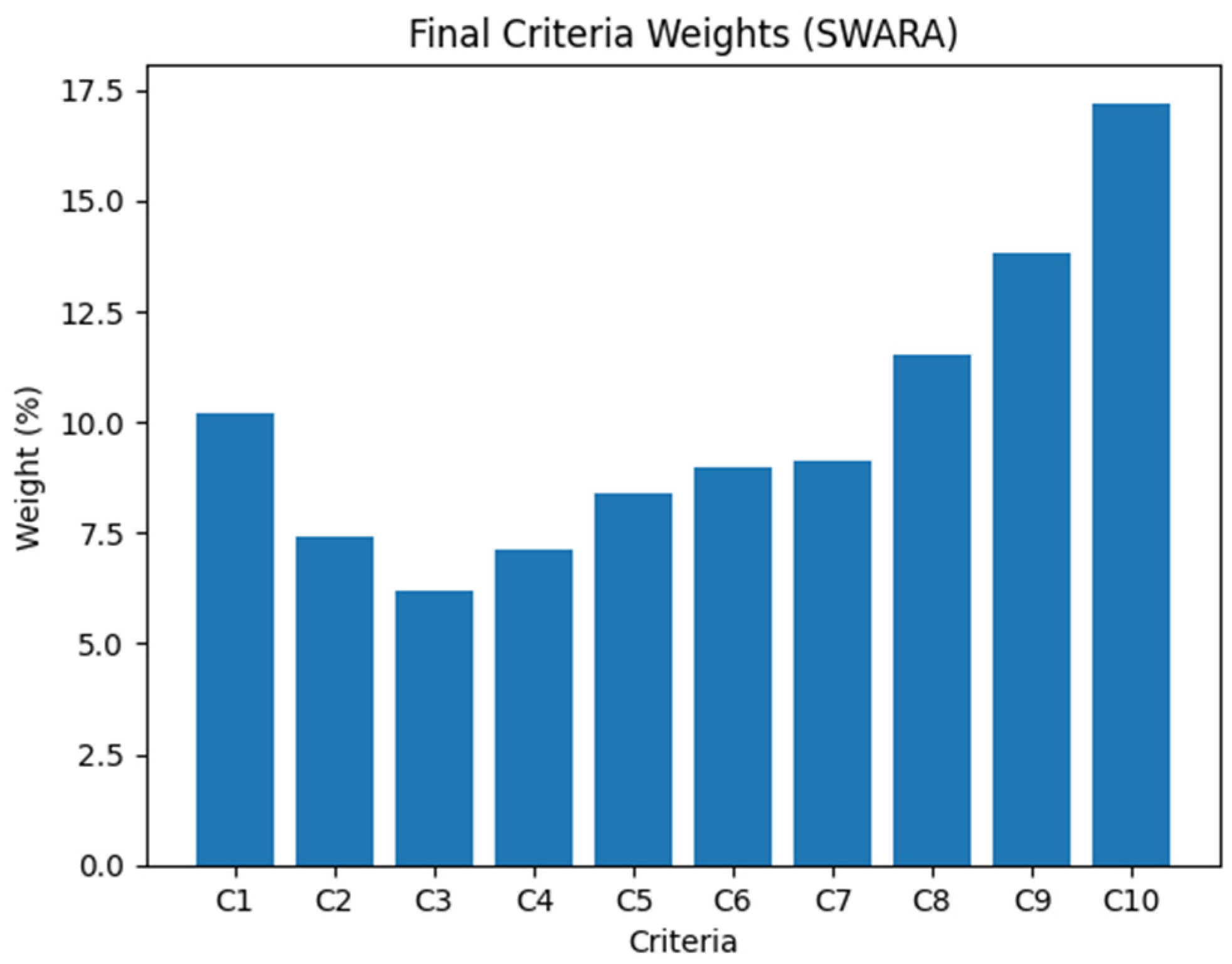
| Average | 0.102 | 0.074 | 0.062 | 0.071 | 0.084 | 0.090 | 0.091 | 0.115 | 0.138 | 0.172 |
| Rank | Criterion | Weight |
|---|---|---|
| 4 | C1 | 10.2% |
| 8 | C2 | 7.4% |
| 10 | C3 | 6.2% |
| 9 | C4 | 7.1% |
| 7 | C5 | 8.4% |
| 6 | C6 | 9.0% |
| 5 | C7 | 9.1% |
| 3 | C8 | 11.5% |
| 2 | C9 | 13.8% |
| 1 | C10 | 17.2% |
Disclaimer/Publisher’s Note: The statements, opinions and data contained in all publications are solely those of the individual author(s) and contributor(s) and not of MDPI and/or the editor(s). MDPI and/or the editor(s) disclaim responsibility for any injury to people or property resulting from any ideas, methods, instructions or products referred to in the content. |
© 2026 by the authors. Licensee MDPI, Basel, Switzerland. This article is an open access article distributed under the terms and conditions of the Creative Commons Attribution (CC BY) license.
Share and Cite
Aksoy, B.; Gursoy, M. Linking Urban Transport and Livability: A GIS-Integrated Multicriteria Decision-Making Evaluation in Kanarya İstanbul. Sustainability 2026, 18, 5058. https://doi.org/10.3390/su18105058
Aksoy B, Gursoy M. Linking Urban Transport and Livability: A GIS-Integrated Multicriteria Decision-Making Evaluation in Kanarya İstanbul. Sustainability. 2026; 18(10):5058. https://doi.org/10.3390/su18105058
Chicago/Turabian StyleAksoy, Berna, and Mustafa Gursoy. 2026. "Linking Urban Transport and Livability: A GIS-Integrated Multicriteria Decision-Making Evaluation in Kanarya İstanbul" Sustainability 18, no. 10: 5058. https://doi.org/10.3390/su18105058
APA StyleAksoy, B., & Gursoy, M. (2026). Linking Urban Transport and Livability: A GIS-Integrated Multicriteria Decision-Making Evaluation in Kanarya İstanbul. Sustainability, 18(10), 5058. https://doi.org/10.3390/su18105058