1. Introduction
The efficient use of associated petroleum gas (APG) is one of the key challenges facing the modern oil and gas industry, as it simultaneously affects resource efficiency, environmental constraints, industrial safety, and the economics of oil production projects. APG is generated as a byproduct during oil extraction, and when technological and infrastructure capabilities are insufficient, it is often not fully utilized in economic activity but is flared or lost through uncontrolled emissions [
1]. According to estimates, 148 billion m
3 of associated gas was flared globally in 2023, marking the highest level since 2019, with approximately 75% of this volume accounted for by nine countries, and the value of the lost resource equivalent to more than
$12 billion [
2]. Flaring results in emissions of over 350 million metric tons of CO
2-equivalent per year, while incomplete combustion additionally generates methane emissions, which have a significantly higher global warming potential compared to carbon dioxide [
3]. In this context, APG should be viewed as a significant energy resource, the level of utilization of which directly affects the technical and economic indicators of production and the emissions profile of the oil and gas sector.
Associated petroleum gas utilization may also be viewed as a form of low-carbon innovation, since it transforms a routinely flared byproduct into a managed energy and industrial resource while reducing methane leakage and combustion-related emissions.
For Russia, China, and India, the issue of APG utilization is particularly important because of the combination of large-scale oil and gas production, pronounced spatial heterogeneity of fields, and differences in the availability of infrastructure for gas collection, treatment, transportation, and processing.
In China, domestic oil and gas production continues to grow; however, the country remains about 70% dependent on crude oil imports, and underground natural gas storage capacity covers only 6.3% of consumption, indicating persistent structural constraints in the gas infrastructure [
4,
5]. In Russia, production cuts under the OPEC+ agreements have reached nearly 1 million barrels per day, and approximately 800,000 barrels per day of export shipments are at direct risk of sanctions, which underscores the importance of domestic reserves for improving the efficiency of hydrocarbon flows [
6]. In India, oil import dependence has reached 87.9%, while domestic crude oil production has declined by 22% over the past decade against a backdrop of a 47% increase in consumption [
7,
8]. These parameters suggest that the rational use of APG in India, Russia, and China should be treated as part of a broader strategy to improve the sustainability of the oil and gas sector, reduce losses of hydrocarbon resources, and strengthen energy security.
APG utilization should therefore be considered not only at the technological level but also in terms of energy policy, because regulatory priorities, infrastructure availability, and national energy security objectives directly shape the feasibility of gas utilization pathways in Russia, China, and India.
The issue is further complicated by cross-country and cross-regional variation in the characteristics of associated gas itself. An analysis of data and studies conducted across 16 oil and gas clusters in Russia, China, and India reveals significant variability in CO
2 content in associated gas; notably, China exhibits extreme geological heterogeneity, with CO
2 concentrations exceeding 60% in some fields, whereas, in cases where regional data were limited, country-wide average values of 0.8% for Russia, 4.09% for China, and 0.17% for India were used [
9,
10,
11]. This variability directly influences the choice of project configuration, as it determines the depth of purification, drying parameters, anti-corrosion protection requirements, and total energy costs for preparing the gas for further use. Consequently, universal solutions for APG utilization have limited analytical and practical applicability.
The research literature on APG utilization is extensive; however, most existing studies focus on individual aspects of the problem.
In a number of publications, the main emphasis is placed on technological options for utilizing APG and their engineering feasibility [
12]. Other published materials examine the economic losses and environmental consequences of flaring, including greenhouse gas emissions and the loss of resource rent [
3]. A separate line of research involves the analysis of regulatory, contractual, and infrastructural constraints that determine the feasibility of incorporating APG into economic circulation [
7,
13,
14]. Despite the large number of publications, research remains fragmented and does not provide a comprehensive, multi-criteria framework for comparing APG utilization projects under conditions of concurrent risks of various types, particularly as applied to the oil and gas clusters of Russia, China, and India.
Recent publications have examined APG and flare gas utilization from several perspectives. Ibañez-Gómez et al. demonstrate that field-level flare gas utilization requires not only engineering solutions but also process-flow optimization and integration into local energy demand [
15]. Abu et al. systematize the main options for reducing routine flaring, including energy, chemical-technological, and combined solutions [
16]. Kaczmarczyk and Gurgul consider associated gas as a feedstock for thermochemical conversion processes, highlighting the potential of more advanced processing routes [
17]. Petrochenkov et al. show that the use of associated gas in distributed generation requires alignment between gas-flow characteristics and the parameters of the local power system [
18]. Jing et al. further demonstrate that, for associated gas with high CO
2 content, the choice of separation and treatment scheme depends directly on the phase behavior of the multicomponent mixture [
19]. Overall, these studies show that the current literature considers APG not only as a byproduct of production but also as an independent object of technological optimization, energy utilization, and system management.
In this context, the identification of APG leakage risks takes on particular significance. As shown in the article by Evans et al., the actual efficiency of flaring and the associated gas losses and methane emissions require a refined assessment, since universal assumptions about complete combustion may underestimate the scale of emission and technological risks [
20]. The article by Jing et al. shows that, with a high CO
2 content in associated gas, the choice of separation and feed preparation scheme directly depends on the component composition of the stream, which increases the importance of gas quality requirements and heightens the sensitivity of projects to technological constraints [
19]. Consequently, the efficiency of associated gas utilization is determined by a set of interrelated factors, among which leaks, variability in component composition, feedstock quality requirements, as well as storage and transportation constraints and the energy intensity of processing operations play a central role.
APG leaks should be considered an end-to-end constraint, as they affect virtually all utilization strategies—from on-site power generation and reinjection into the reservoir to the production of liquefied petroleum gases (LPG), synthetic liquid fuels, methanol, and liquefied natural gas (LNG). For this reason, the evaluation of APG utilization projects cannot be limited to the analysis of a single technological or economic characteristic, as the risk structure itself is multi-layered and cascading.
Empirical data from three countries confirm the persistence of this problem across various institutional and geographical contexts. In Russia, despite a target of 95% for the beneficial use of APG, the actual figure was only about 85%, and in certain periods it dropped to 82.9% [
21]. In China, flaring volumes remained relatively stable, but in 2020 a 35% increase was recorded, with more than half of this increase coming from new fields in remote northwestern regions [
22]. In India, 823.79 million m
3 of natural gas was flared in 2018, with the main areas of such emissions concentrated in offshore production zones near Mumbai and in northeastern Assam [
23,
24]. These facts point to a general structural contradiction between the resource value of associated natural gas and the actual inability of oil and gas systems to ensure its full beneficial use under conditions of climatic, infrastructural, and technological heterogeneity.
Thus, a research gap persists in the scientific literature due to the absence of a comprehensive multi-criteria risk assessment system for APG utilization projects, adapted for a cluster comparison of selected BRICS countries using the example of Russia, China, and India. This study is based on the hypothesis that the feasibility of APG utilization projects is determined not by individual parameters, but by the structure of interactions among several classes of risks that act simultaneously and reinforce one another. It is assumed that the greatest influence on the overall sustainability of a project is exerted by combinations of factors related to gas leaks, the quality of associated gas, infrastructure accessibility, and the energy intensity of technological solutions.
In this regard, the objective of the study is to develop a multi-criteria risk assessment system for APG utilization projects in selected BRICS countries, using Russia, China, and India as case studies. The study aims to establish a comparable analytical framework that allows for identifying dominant project constraints, ranking key risks, and correlating alternative architectural strategies for utilizing associated gas with the characteristics of specific oil and gas clusters.
The scientific novelty of the study lies in combining expert risk ranking, geospatial characteristics of flaring activity, infrastructure constraints, and gas feedstock properties within a unified multi-criteria evaluation framework. Unlike approaches focused on individual technological solutions or isolated types of constraints, the proposed system allows for the identification of both general patterns in the formation of project risk profiles and specific national and regional constraints. The practical significance of the study lies in the applicability of the developed risk assessment system when selecting technological configurations, justifying investment decisions, and determining directions for infrastructure modernization aimed at expanding the beneficial use of APG.
2. Materials and Methods
A multi-criteria methodology was used to assess the risks of APG utilization projects, combining expert risk ranking, spatial aggregation of data on oil and gas clusters, and hierarchical mathematical modeling. This approach was chosen because the efficiency of APG utilization depends not on a single parameter, but on a combination of interrelated technological, infrastructural, and physical-geographical constraints [
1,
12].
Sixteen oil and gas clusters in Russia, China, and India were selected as the territorial units of analysis. The clusters were not intended to form a statistically exhaustive sample of all BRICS oil and gas regions. Rather, they were constructed as a comparative analytical set designed to capture the main combinations of production scale, infrastructure availability, spatial remoteness, climatic exposure, and gas-composition heterogeneity observed across the three countries. The logic of cluster selection followed four principles: the inclusion of major oil and gas producing basins and offshore zones; the representation of different infrastructure conditions, from highly connected processing regions to remote production areas; the inclusion of territories with contrasting climatic and physical-geographical constraints; and the availability of comparable data on flaring, infrastructure, and gas composition. This approach reduces the dimensionality of heterogeneous territorial data while preserving the main differences relevant to APG utilization strategies.
At the same time, the selected set should not be interpreted as a fully exhaustive representation of all national or BRICS-level oil and gas conditions. The conclusions should therefore be read as cluster-based comparative inferences rather than as universally generalizable statements for all oil and gas regions in the three countries.
For each cluster, a comparable risk profile was developed across five key areas, including the risk of APG leaks, the risk of fluctuations in gas composition, the risk associated with raw material quality requirements, the risk of storage and transportation constraints, and the risk of process energy intensity.
The choice of a multi-criteria framework is consistent with recent research, in which the challenges of managing complex energy and oil and gas systems are increasingly addressed through integrated risk-based approaches. The article by Gorzeń-Mitka and Wieczorek-Kosmala shows that the energy sector is characterized by a transition from isolated assessments of individual threats to systemic models that combine several types of risks within a single analytical framework [
25]. The development of spatial observation methods is also of great importance for tasks related to flaring. For example, Caseiro and Soszyńska compared methods for the quantitative assessment of gas flaring using satellite imagery [
26], while Faruolo et al. demonstrated the capabilities of multi-temporal satellite monitoring of flaring sources based on Landsat and Sentinel series [
27]. The work by Abu et al. has additional methodological significance, as it proposes a decision-making system for reducing routine flaring based on a combination of technological and techno-economic criteria [
28]. A similar integration of engineering, economic, and emission parameters is presented by Chen et al., who analyze flare gas utilization within a unified technical, economic, and environmental framework [
29]. Against this backdrop, the use of expert ranking, spatial aggregation, and hierarchical modeling in the study aligns with current trends in the development of analytical methods for oil and gas and energy issues.
The initial dataset included spatially referenced indicators characterizing flare sources, gas processing facilities, energy infrastructure, and associated emission parameters. Based on these data, aggregated indicators reflecting the severity of five basic risks were calculated for each cluster. Thus, the model simultaneously incorporated geospatial characteristics of flare activity and infrastructure parameters determining the availability of processing and utilization of associated gas.
The empirical base of the study was organized into three groups of variables. The first group included flare-related spatial observations used to identify the location and relative intensity of APG combustion sources. The second group included infrastructure indicators reflecting the availability of gas processing facilities, transport routes, energy facilities, and other elements that determine the technical feasibility of APG collection, treatment, transportation, and utilization. The third group included gas-composition and field-context indicators, including CO2 content, feedstock quality constraints, climatic conditions, and the spatial remoteness of production zones. Since the available data differed across countries in terms of spatial granularity, reporting format, and temporal coverage, all indicators were converted to a common cluster-level format. This means that individual observations and infrastructure objects were first assigned to one of the 16 oil and gas clusters and then aggregated into comparable risk indicators.
Where direct regional data were unavailable, proxy variables were used. In particular, infrastructure accessibility was approximated through the presence and density of gas-processing, transport, and energy facilities within or near the cluster, while leakage-related risk was approximated through the spatial concentration of flaring sources and the infrastructural conditions that affect gas capture. For gas composition, regional values were used wherever available; otherwise, country-level or basin-level averaged values were applied as harmonized proxy inputs. This procedure increases cross-country comparability but may reduce sensitivity to field-level heterogeneity, especially in clusters with complex geological conditions or highly variable gas composition. Therefore, the resulting indicators should be interpreted as comparative cluster-level estimates rather than as direct measurements of each individual field.
The reproducibility of spatial aggregation was ensured by the following sequence of operations. First, all observation points and infrastructure facilities were assigned to one of 16 oil and gas clusters. Then, for each cluster, spatial and sectoral indicators characterizing the intensity of flare combustion, infrastructure connectivity, and operational constraints were aggregated. Afterward, the aggregated cluster indicators were used to construct a risk profile across five core areas. These five risks were selected because they best reflect the feasibility of technological solutions for utilizing APG in regions with varying infrastructure and natural conditions. This procedure allowed the initial geospatial information to be translated into a comparable system of cluster assessments, which was subsequently used in a hierarchical model of strategic vulnerability.
In the first stage, the Fishburn method was applied to convert expert risk rankings into quantitative weights. For a set of
risks, where
is the total number of assessed risks, and
is the risk rank in descending order of priority, with
corresponding to the highest priority, the raw rank score
was determined as follows (1):
where
denotes the unweighted risk weight with rank
,
denotes the total number of risks, and
denotes the ordinal number of the risk in the expert ranking.
The normalized risk weight
was calculated as the ratio of the raw score of a given risk to the sum of the raw scores of all risks (2):
For the five criteria, the method yielded weights of 0.333, 0.267, 0.200, 0.133, and 0.067, respectively. Applying this procedure ensured a formalized transition from a qualitative expert assessment to a quantitative priority system.
The weighting procedure should be interpreted as a structured analytical prioritization step rather than as a survey-based expert elicitation exercise. In the present study, the Fishburn procedure was carried out by the authors as part of the analytical model construction process and did not involve a separate external expert survey. Therefore, the obtained weights should not be understood as statistically representative expert-survey results. Instead, they provide a transparent and reproducible way to formalize the relative priority of heterogeneous risk categories within a unified comparative framework.
This approach is consistent with a broader class of structured judgment-based studies in energy and policy analysis, where expert or analyst-based prioritization is used to systematize emerging research priorities and compare heterogeneous criteria under conditions of incomplete empirical comparability [
30,
31]. However, this also means that the resulting rankings are conditional on the adopted priority structure. For this reason, the weighting stage is explicitly treated as a methodological assumption and is further discussed as a limitation requiring sensitivity analysis under alternative weighting schemes.
After determining the weights, cluster risk profiles were formed. For this purpose, spatially referenced indicators were used that characterize flare sources, gas processing infrastructure, energy facilities, and associated emission parameters. Based on these, generalized indicators were calculated for each cluster, reflecting the severity of each of the five basic risks. Thus, the method combined two levels of information: an expert assessment of risk significance and a quantitative assessment of its manifestation in a specific cluster.
The next stage involved transitioning from cluster assessments to a hierarchical model describing the cascading propagation of risks from specific technological constraints to the level of architectural strategies for utilizing associated gas. The model identifies three sets.
Set of elementary risks (3):
where
is the complete set of elementary risks,
is a specific elementary risk, and
is the total number of elementary risks in the system.
Set of technological submethods (4):
where
is the complete set of technological submethods,
is a specific technological submethod, and
is the total number of submethods.
Set of architectural strategies (5):
where
is the complete set of architectural strategies,
is a single strategy, and
is the total number of strategies.
This structure made it possible to formalize the fact that risks do not affect strategy directly, but rather through the specific technological solutions that comprise it.
The relationship between risks, submethods, and strategies was defined by binary incidence matrices. The matrix described the relationship between elementary risks and technological submethods, where the element if the risk belongs to the submethod and otherwise. The matrix described the relationship between technological submethods and architectural strategies, where an element if the submethod is part of the strategy , and otherwise.
Each elementary risk was assigned a scalar significance
, interpreted as the product of the probability of its occurrence and the severity of the consequences (6):
The resulting risk significance vector took the form (7):
where
is the column vector of the weights of all elementary risks,
are the weights of individual risks, and
denotes the transpose operation.
For each submethod, its aggregated risk load was defined as the sum of the weights of all risks associated with it. In vector form, the riskiness of all submethods was described by expression (8):
where
is the vector of aggregated risks of technological submethods,
is the transposed matrix of relationships between risks and submethods, and
is the vector of significance values of elementary risks.
Thus, the operation ensured the transition from local risks to integral indicators at the level of technological submethods.
To transition to the strategy level, the risks of the submethods comprising each strategy were aggregated. If
denotes a diagonal matrix that is element-wise inverse to the number of submethods included in the corresponding strategy, then the vector of strategic risks was determined as follows (9):
where
is the vector of strategic risks,
is the normalization matrix accounting for the number of submethods in each strategy, and
is the transposed matrix of relationships between submethods and strategies.
Taking into account the previous expression, the complete composite form of the model took the form (10):
This formula described the cascading propagation of vulnerabilities from elementary risks to the level of architectural strategies through a system of technological submethods.
In simplified terms, the model workflow consists of three consecutive steps. First, elementary risks are identified and assigned significance values within the unified risk framework. Second, these risks are transmitted to technological submethods through the incidence structure of the model, producing aggregated submethod-level risk loads. Third, the risks of the submethods are combined at the level of architectural strategies, yielding final strategic risk scores that reflect the cascading influence of local technological, infrastructural, and compositional constraints on broader APG utilization pathways. This step-by-step explanation complements the formal notation and clarifies how cluster-level inputs are transformed into comparable estimates of strategic vulnerability.
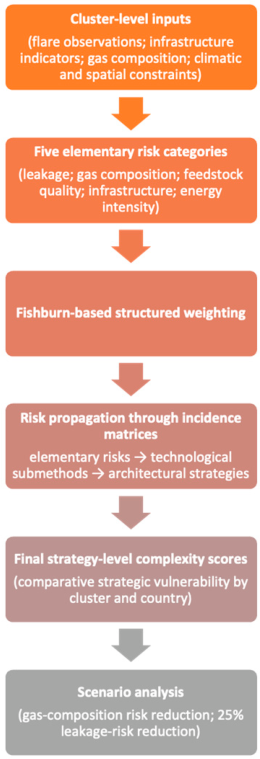
To improve the transparency of the model for non-technical readers,
Figure 1 summarizes the analytical workflow in simplified form. The figure shows that the model begins with cluster-level empirical inputs, which are converted into five elementary risk categories. These risks are then weighted and transmitted through the incidence matrices from elementary risks to technological submethods and further to architectural strategies. The final output is a set of comparable strategy-level complexity scores, which can be recalculated under alternative scenario assumptions.
For example, if the leakage risk increases in a remote cluster, this change first affects all technological submethods that depend on gas collection, compression, transportation, or combustion safety. These submethod-level changes are then transmitted to the architectural strategies that include these submethods, such as on-site energy generation, reinjection, or conversion into higher-value products. In this way, a local operational constraint is transformed into a strategy-level vulnerability indicator.
The resulting strategic risk vector was interpreted as an aggregated quantitative characteristic of each strategy’s vulnerability relative to the set of underlying risks. The component reflected the integral sensitivity of the strategy to technological and operational constraints, taking into account their distribution across related submethods and the internal structure of the strategy itself.
An important feature of the model was its sensitivity to local changes. Any change in the significance of an individual risk, including its partial reduction or complete elimination, was automatically reflected in those strategies to which this risk was transmitted via intermediate submethods, which made the model suitable for scenario analysis and allowed for the quantitative assessment of the effect of individual technical and organizational interventions aimed at reducing leaks, improving gas quality, or alleviating infrastructure constraints.
Additionally, the model allowed for the weighting of submethods to account for their relative importance within the system structure. If a weight vector
was introduced, reflecting, for example, the proportion of gas utilized by each submethod or its investment priority, then the riskiness of the submethods was adjusted according to Formula (11):
where
is the adjusted risk vector of submethods,
is the initial risk vector of submethods, and
denotes the element-wise product. This modification allowed for a more differentiated assessment of strategic vulnerability, taking into account not only the risk structure but also the contribution of each submethod to the system of natural gas utilization.
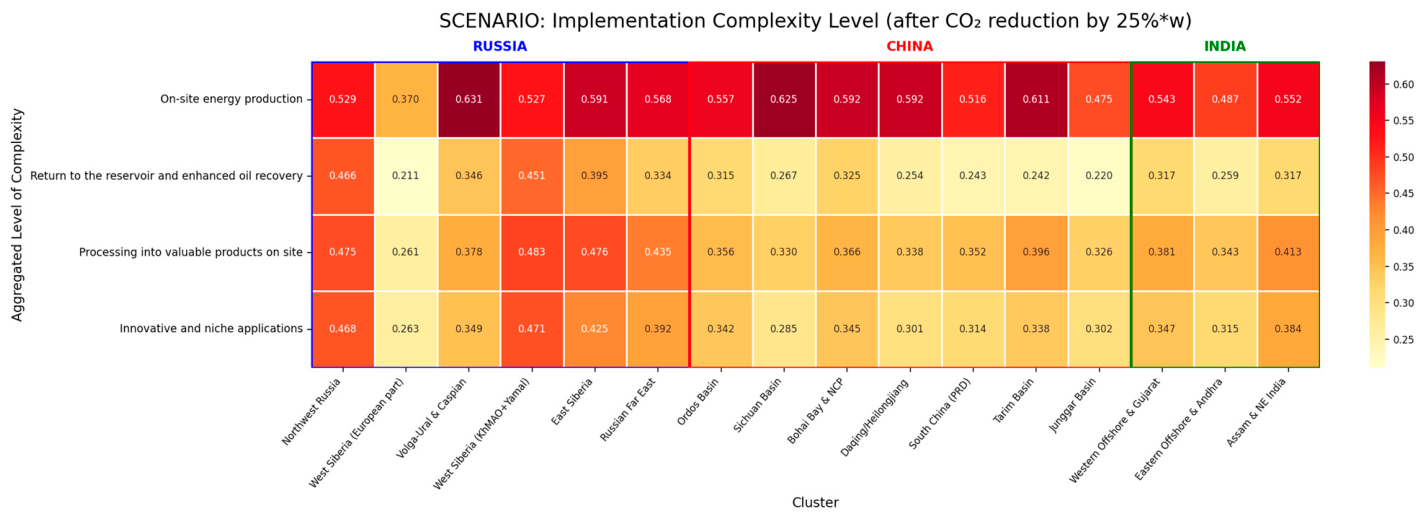
After constructing the base matrix of cluster risks and transferring it to a hierarchical model, scenario modeling was performed. In the computational loop, the factors were renormalized, the integral factor-based risk indicators were recalculated, and subsequent graph-based aggregation was performed, which allowed for obtaining updated levels of strategy implementation complexity when individual risk groups changed. In particular, scenarios for reducing constraints related to gas composition were analyzed, as well as scenarios for an additional 25% reduction in leakage risk. Based on this, heat maps of the final levels of strategy implementation complexity and maps of the cumulative effect deltas by country and cluster were constructed.
The 25% reduction in leakage risk was introduced as an illustrative comparative scenario designed to test the relative sensitivity of strategic profiles to a moderate improvement in leakage-related conditions. In this sense, the baseline scenario corresponds to the original cluster-level risk matrix prior to scenario modification, whereas the adjusted scenario represents an analytical reduction shock applied for comparative modeling purposes rather than a forecast of actual project performance.
Overall, the proposed model served as an analytical tool for quantitatively comparing architectural strategies for utilizing APG within a multi-layered risk structure. By combining expert ranking, cluster-based spatial characteristics, and hierarchical aggregation, it enabled systematic assessment, scenario comparison, and identification of dominant constraints across various oil and gas clusters.
3. Results
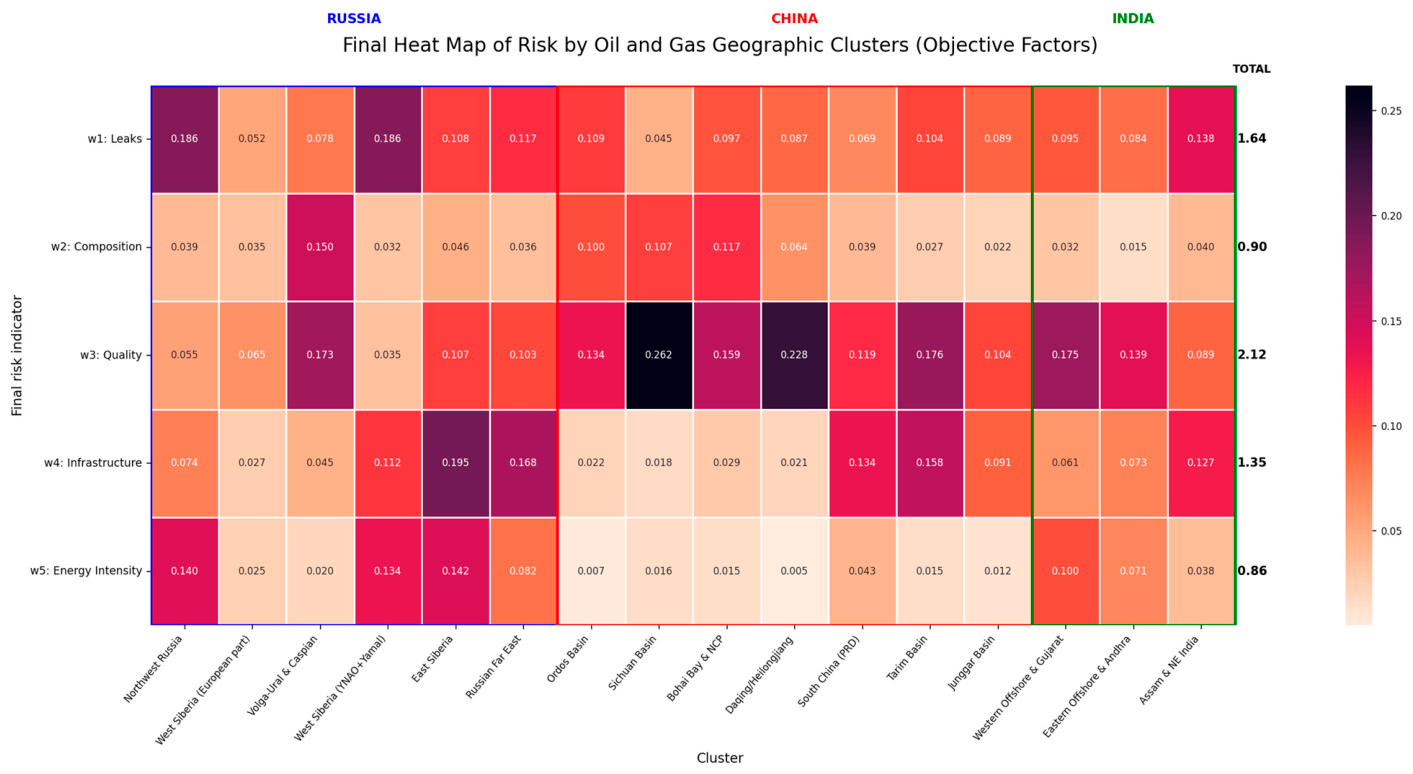
Combining expert weights derived from the Fishburn method with objective geospatial characteristics of oil and gas territories made it possible to construct a unified risk matrix for 16 clusters in Russia, China, and India in which five key constraints were compared, namely leaks, gas composition, raw material quality, infrastructure, and energy intensity. The final visualization of these assessments is presented in
Figure 2.
The heat map shows that the risk profile is markedly heterogeneous both between countries and within each of them. In the Russian group of clusters, the most notable risks are those related to leaks and infrastructure constraints. For example, in the “Northwest” cluster, the leak risk level reaches
, which corresponds to a combination of the remoteness of processing facilities, Arctic operating conditions, and a high share of offshore production. In Chinese clusters, the variability of risks associated with gas composition and quality is more pronounced, which is consistent with high geological heterogeneity and significant fluctuations in the component composition of APG [
4]. In Indian clusters, the risk profile is mixed, as constraints on feedstock quality and infrastructure manifest simultaneously against a backdrop of the sector’s high import dependence and a shortage of advanced gas infrastructure [
7,
8,
14].
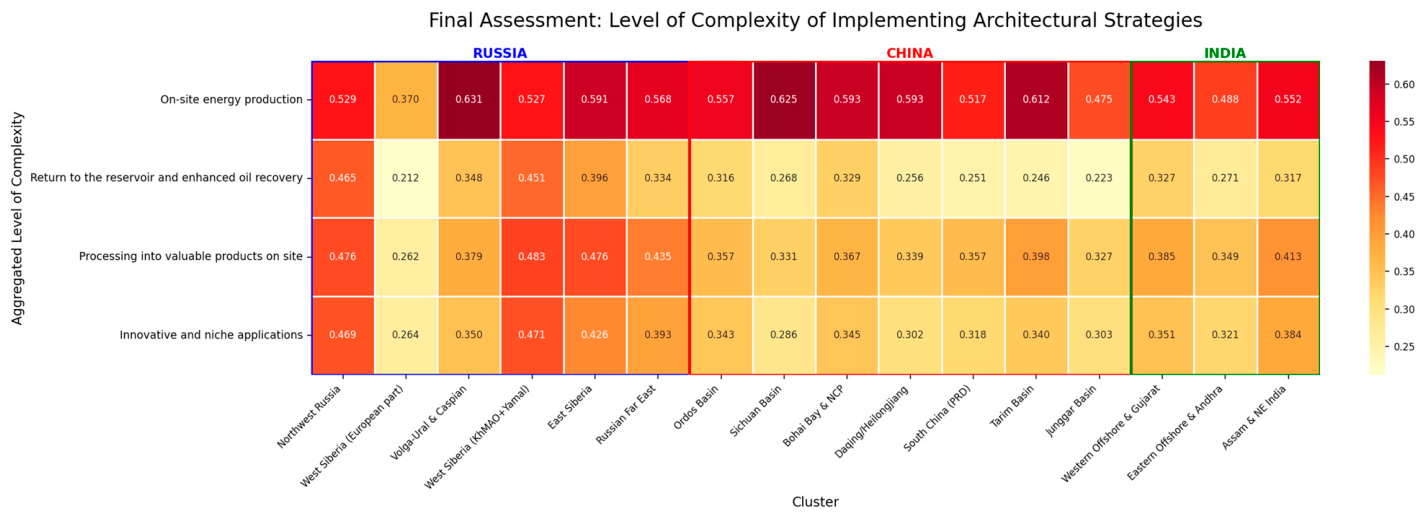
This observed heterogeneity served as the basis for transitioning from a cluster risk matrix to a hierarchical graph model, which allows for the assessment not only of individual constraints but also of the overall complexity of implementing architectural strategies for utilizing APG. The results of this transition are presented in
Figure 3.
Figure 3 shows that strategies of the same type in different clusters have varying degrees of feasibility, meaning that the same architectural scheme for utilizing APG cannot be considered universally applicable. At the cluster level, the initial geospatial and infrastructure characteristics are transformed into a harmonized risk profile, which is then translated into a graph model and allows for the assessment of the overall complexity of strategy implementation, including on-site energy production, gas processing, and innovative uses of gas. Thus, the graph model performs not only an aggregating but also an interpretive function, identifying combinations of risks that determine the strategic vulnerability of various clusters.
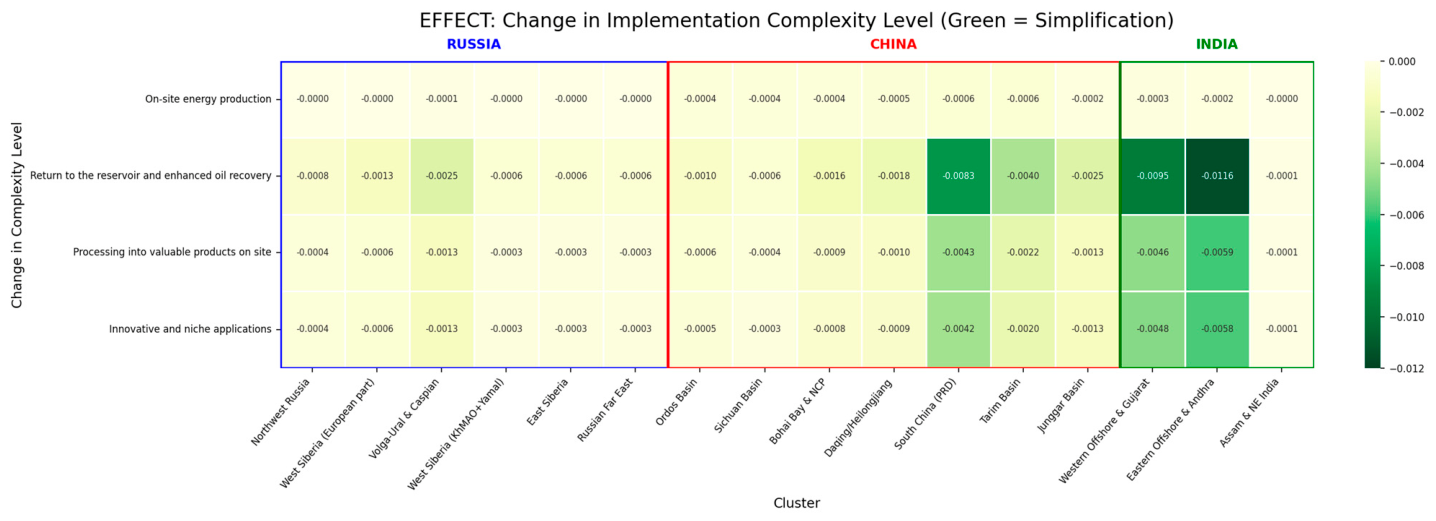
The next stage of modeling showed that a reduction in one group of risks affects strategies differently across various clusters. After re-normalizing the factors, recalculating the integral factor-based risk indicator, and subsequent graph-based aggregation, heat maps were obtained showing the levels of complexity in implementing strategies and their changes based on the results of the simulated reduction in risks associated with the composition of the natural gas stream. These results are presented in
Figure 4 and
Figure 5.
Figure 4 and
Figure 5 show that the effect of improving gas quality and composition is most noticeable in those clusters where chemical heterogeneity and the complexity of natural gas processing are the main constraints. For such clusters, reducing composition risks leads to the most pronounced decrease in strategic complexity. In contrast, in clusters with dominant infrastructure constraints, a similar intervention yields only a partial effect, since improving gas quality alone does not eliminate the spatial remoteness of processing facilities and logistical barriers.
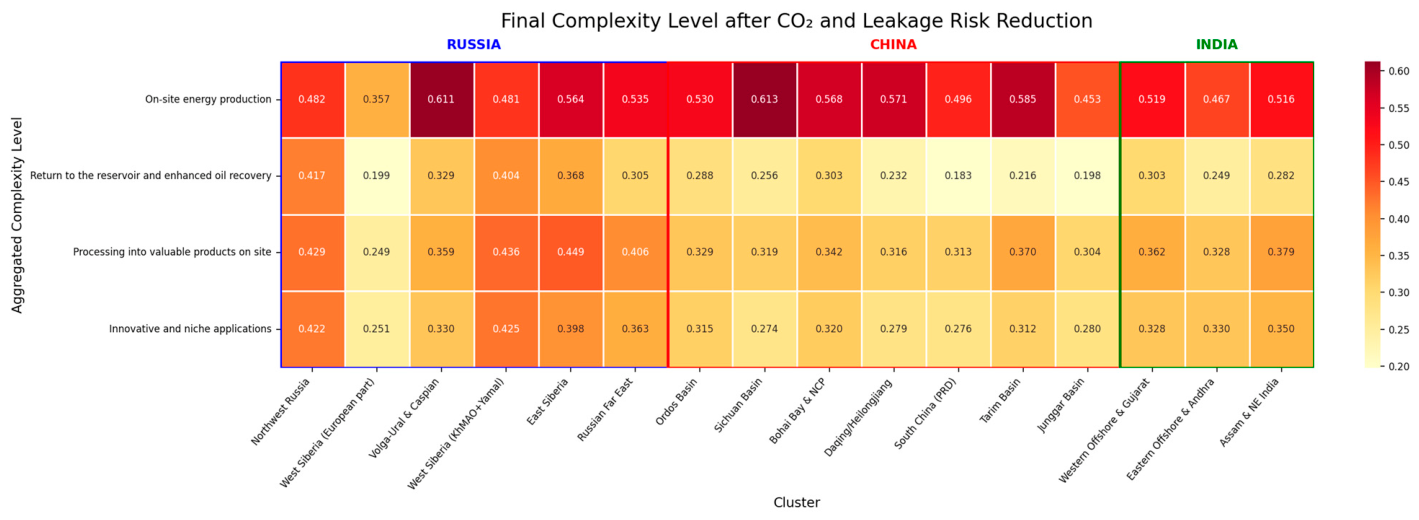
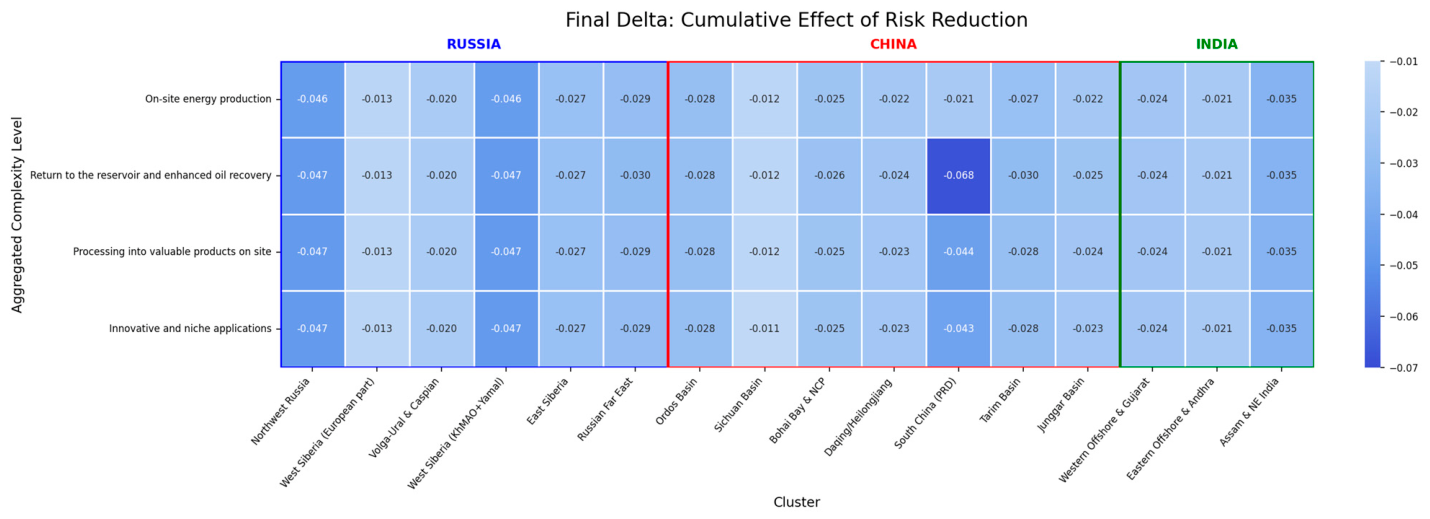
A similar pattern emerges in the final simulation scenario, where a 25% reduction in leakage risk is added to the reduction in operational risks associated with gas composition. The final heat map after all simulation stages is shown in
Figure 6, and the cumulative effect of the changes is shown in
Figure 7.
An interpretation of
Figure 6 and
Figure 7 shows that the cumulative reduction in risks leads to the most noticeable improvement in the risk profile in Russian clusters. For the “Northwest” cluster, the reduction in complexity reaches −0.047 for processing and innovative applications strategies and −0.046 for on-site energy production. This finding points to the systemic role of leakage in this region. This conclusion is consistent with the initial cluster matrix, in which northern and remote territories already demonstrated elevated values for leakage risks and infrastructure vulnerability at the baseline level.
At the cross-country level, the results paint a more complex picture. Russian clusters demonstrate the greatest sensitivity to leak reduction, which is explained by a combination of remoteness, harsh climatic conditions, and limited infrastructure connectivity. For China, the resulting profile is more heterogeneous, as alongside leakage risk, gas composition and quality play a significant role, as do differences between coastal and inland oil and gas zones. For India, the model shows that even with a reduction in operational risks, the impact of infrastructure constraints and the uneven territorial distribution of production capacity persists [
7,
8,
14]. This indicates that a unified risk model can be applied across all three countries, although the practical conclusions derived from it must remain cluster-specific.
The identified risk profiles are also consistent with documented operational constraints in the selected countries, including infrastructure deficits, regional remoteness of production zones, gas-processing bottlenecks, high import dependence, and persistent flaring in offshore and remote territories. In this sense, the proposed framework should be interpreted as a comparative decision-support tool that captures strategic vulnerability patterns under different territorial conditions, rather than as a direct predictor of the financial performance of individual APG projects. This interpretation strengthens the practical relevance of the model while preserving its analytical focus on cross-cluster comparison.
The correspondence between the model outputs and real-world operational conditions can be illustrated by several cluster-level examples. For Northwest Russia and West Siberia, the model assigns high importance to leakage and infrastructure constraints, which is consistent with the combination of Arctic or subarctic operating conditions, remote production sites, seasonal logistics, and incomplete APG collection and processing infrastructure. In these regions, APG management is affected not only by the availability of processing capacity, but also by long transport distances, low density of infrastructure in peripheral production zones, and the need for specialized equipment adapted to cold climates. This explains why leakage reduction and infrastructure modernization have a strong effect on the modeled strategic complexity of APG utilization.
For Chinese clusters, the model identifies a stronger role of gas composition and feedstock quality constraints. This is consistent with the heterogeneity of Chinese oil and gas basins, where differences between western, inland, and offshore production areas affect gas treatment requirements, purification depth, and the energy intensity of processing. In particular, basins such as Ordos and Sichuan combine large hydrocarbon production with different geological, climatic, and infrastructure conditions, which supports the model’s conclusion that gas-composition and quality-related risks cannot be treated as secondary factors. For Indian clusters, the mixed risk profile is consistent with the coexistence of offshore production zones, aging fields, import dependence, and underdeveloped infrastructure for advanced gas extraction and monetization. These examples indicate that the proposed framework captures not only abstract risk categories, but also territorially observable constraints affecting APG utilization decisions.
Table 1 provides an additional substantive framework for interpreting the results, summarizing the key challenges facing the oil and gas sectors in China, Russia, and India.
Table 1 shows that the dominant constraints identified in the model have not only quantitative but also sector-specific implications. For China, the key background constraints are a 70% dependence on crude oil imports and a gas storage capacity deficit of 6.3% of consumption [
4,
5]. For Russia, the determining factors are a reduction in production of nearly 1 million barrels per day under OPEC+ agreements, technological constraints, and pipeline barriers [
32]. For India, key factors include an 87.9% dependence on oil imports, a 22% decline in domestic production over ten years, and infrastructure constraints for advanced methods of gas extraction and monetization [
7,
8,
14]. When combined with heat maps, this confirms that the cluster differences identified by the model reflect the actual structural characteristics of the oil and gas systems in the three countries.
Table 1.
Key Challenges in the Oil and Gas Sector (China, Russia, India).
Table 1.
Key Challenges in the Oil and Gas Sector (China, Russia, India).
| Country | Key Challenges and Factors Contributing to Underutilization/Loss of Profit |
|---|
| China | High dependence on imports (70% of crude oil, significant volume of natural gas) [4].
Structural decline in fuel demand (due to electric vehicles, high-speed rail) [33].
Insufficient natural gas storage capacity (6.3% of consumption) [5].
A strategic shift toward petrochemical feedstocks as the main driver of oil demand growth, requiring refineries to adapt [33]. |
| Russia | Production cuts due to OPEC+ agreements (nearly 1 million bpd) [6].
Significant impact of U.S. sanctions (loss of export volumes, rising freight/insurance costs, approximately 800,000 bpd of exports at risk) [6].
Technological dependence and investment bottlenecks (risk of a 20% decline in production due to gaps in the offshore field development plan) [32].
Gazprom’s monopoly on pipelines, which hinders access to APG and its monetization [13].
Inconsistent enforcement of environmental standards, despite ambitious targets for APG utilization [6]. |
| India | High dependence on imports (87.9% of oil, significant volume of gas) [7].
Decline in domestic crude oil production (by 22% over 10 years, while consumption grew by 47%) [8].
Aging fields with low recovery rates [14].
Underdeveloped infrastructure for advanced gas production and monetization methods [14].
The need to balance regulatory liberalization to attract investment while minimizing operational risks [7]. |
The practical relevance of the model is also supported by observed APG utilization practices in the three countries. In China, the CNOOC Wenchang 9-7 project illustrates how offshore gas reinjection and power-generation solutions can support zero-flaring strategies when gas-treatment and local infrastructure are integrated into field development. In Russia, APG-fired power generation and reinjection projects, including practices implemented by Salym Petroleum Development, Surgutneftegaz, and Tatneft, show that infrastructure availability and leakage control are decisive for improving utilization levels in remote or mature production regions. In India, the dominance of offshore production, field redevelopment, and infrastructure modernization agendas, particularly in areas linked to ONGC operations and Mumbai offshore production, indicates that APG utilization is closely connected with broader investment and operational decisions. These examples support the interpretation of the model as a decision-support framework for comparing cluster-specific constraints rather than as a universal technological prescription.
Overall, the results show that combining Fishburn weights, satellite indicators of flaring activity, and spatial infrastructure characteristics forms not merely an integrated index, but a multilayered system for distinguishing clusters by type of dominant constraints. For some clusters, leaks remain the decisive factor; for others, the chemical complexity of the gas stream; and for still others, infrastructural remoteness and energy intensity. This is precisely why the hierarchical graph model enables a transition from local geospatial features to a quantitative assessment of the strategic feasibility of APG utilization options in the 16 clusters examined in Russia, China, and India.
4. Discussion
The results confirm the study’s hypothesis that the feasibility of APG utilization projects is determined not by a single constraint, but by the configuration of several interrelated risks acting simultaneously. This interpretation is consistent with published materials in which the utilization of APG is viewed as a multidimensional problem combining technological, infrastructural, environmental, and economic parameters [
1,
12]. At the same time, the analysis conducted shows that the significance of these factors varies across different oil and gas clusters; therefore, the risk structure itself must be considered as spatially differentiated.
Relative to the existing literature, the contribution of the present study lies not merely in confirming the importance of leakage, gas composition, and infrastructure constraints, but in integrating these factors into a unified multi-criteria comparative framework that links local cluster characteristics to the strategic feasibility of alternative APG utilization pathways. Unlike many previous studies focused on individual technologies, isolated constraints, or single-country cases, the proposed approach combines structured weighting, geospatial aggregation, and hierarchical graph modeling in a cross-country cluster-based setting.
This is most clearly evident with regard to APG leaks. In empirical studies on flaring and the rational use of associated gas, APG losses are interpreted as a source of simultaneous economic, environmental, and technological inefficiency [
3]. These findings not only support this interpretation but also refine it.
The constructed model shows that leaks should be viewed as a systemic constraint, since they affect not only the volume of the conserved resource but also the overall complexity of implementing architectural strategies. In other words, in clusters with harsh natural conditions and poor infrastructure connectivity, leaks prove to be a factor that simultaneously reduces resource efficiency, increases the emissions burden, and limits the range of practically feasible solutions.
These findings are consistent with studies on flaring efficiency and the actual scale of methane losses. In the article by Evans et al., it is shown that field measurements of flare efficiency may differ from widely used calculation assumptions, which means that universal estimates of combustion completeness may underestimate the actual emission effect [
20]. Tao et al. follow a similar line of reasoning, proposing a method for continuously assessing flare efficiency under field conditions [
34]. The paper by Riddick et al. shows that lower-bound estimates of methane emissions in oil and gas systems may be underestimated [
35]. Alongside this, Emekwuru et al. demonstrated that the consequences of flaring should be interpreted simultaneously in environmental, social, and economic terms [
36]. The broader context of technological transformation in the oil and gas sector is provided by the work of Cherepovitsyna et al., which shows that CO
2 capture and utilization projects are increasingly viewed by oil and gas companies as part of more complex carbon management chains [
37]. Collectively, these studies confirm the conclusion of the present study that leaks and incomplete control of flaring processes should be viewed as systemic constraints affecting not only the volume of gas losses but also the overall strategic vulnerability of APG utilization projects.
This broader interpretation is further supported by studies that conceptualize energy innovation, resource productivity, and sustainability as interdependent dimensions of structural transformation in resource-based economies. Brazovskaia et al. demonstrated that the deployment of alternative energy solutions may enhance the long-term sustainability of resource-oriented territories by reducing infrastructural vulnerability and improving regional resilience [
38]. Zaytsev, Kozlov et al. further showed that the innovation component embedded in resource productivity constitutes a significant determinant of strategic efficiency in resource-based systems, which is directly applicable to APG utilization as a mechanism for converting production-related losses into technological and economic value [
39]. In addition, Dmitriev, Zaytsev et al. emphasized that the innovative potential of alternative energy should be evaluated in conjunction with circular-economy transition processes, thereby supporting the interpretation of APG utilization as not only an emissions-mitigation measure, but also a resource-saving and system-restructuring practice [
40]. This perspective is reinforced by the findings of Zaytsev et al. on the economic aspects of green energy development, where strategic sustainability and environmental conservation are treated as mutually reinforcing objectives [
41]. From this perspective, APG utilization strategies should be understood not merely as localized technological responses to leakage and flaring, but as elements of a broader innovation-oriented pathway toward resilient, low-carbon, and resource-efficient energy systems.
However, the analysis shows that reducing the risk of leaks is not always the primary means of reducing strategic vulnerability. In clusters where the complex composition of APG is the determining constraint, requirements for feedstock quality and the extent of its processing come to the fore. This conclusion is consistent with studies emphasizing that high concentrations of CO
2 and other components significantly influence the choice of processing technology, energy consumption, and the capital intensity of solutions [
2]. Thus, the results obtained refine existing understandings, showing that the chemical heterogeneity of APG in some cases acts not as a secondary but as a structuring constraint.
The significance of infrastructure factors is interpreted in a similar manner. A number of studies on Russia, India, and other countries with unevenly distributed oil and gas assets have shown that the lack of gathering, treatment, and transportation capacity limits the incorporation of APG into economic circulation even when technologically feasible methods for its use are available [
7,
14]. The results obtained confirm this thesis but add an important clarification to it. Infrastructure inadequacy not only directly increases risk but also reduces the return on other interventions; that is, even a significant reduction in leaks or an improvement in gas quality does not always lead to a comparable reduction in the overall complexity of the strategy if the spatial remoteness of processing facilities and the weak connectivity of the production environment persist.
Cross-country comparisons also show that a single analytical model can be applied to various oil and gas systems; however, the interpretation of its results must remain cluster-specific. Publications on Russia’s oil and gas sector highlight the combination of remote fields, harsh natural conditions, and the system’s high sensitivity to gas losses and logistical constraints [
12]. For China, the focus is on the heterogeneity of oil and gas regions, a shortage of certain infrastructure capacities, and significant variability in gas composition [
2,
5]. For India, the key characteristics are high import dependence, a decline in the domestic resource base, and limited development of gas processing and transportation infrastructure [
7,
8,
14]. The results obtained are generally consistent with these findings and show that the differences between countries are not only quantitative but also structural in nature.
From a methodological standpoint, the analysis confirms the effectiveness of the hierarchical graph model for evaluating associated gas utilization projects. Published materials on multi-criteria evaluation and technology selection emphasize that for complex energy systems, it is fundamentally important to consider not only the risks themselves but also their transition from the local level to the level of integrated solutions [
12]. The findings confirm the applicability of this approach to associated gas utilization systems. The model makes it possible to trace how individual constraints first affect technological sub-methods and then transfer to the level of architectural strategies. This constitutes a significant advantage over single-criterion schemes, which fix a single parameter but do not reveal the cascading nature of strategic vulnerability.
When interpreting the results, the limitations of the study must also be taken into account. First, analysis at the level of aggregated clusters smooths out intra-cluster heterogeneity and does not fully reflect the differences between individual fields and production hubs. Related to this, the selection of 16 clusters, while analytically justified for comparative modeling purposes, may limit the external generalizability of the findings, especially in view of the substantial intra-country heterogeneity acknowledged in the study. Therefore, the conclusions should be interpreted as cluster-based comparative inferences rather than universally generalizable statements for all oil and gas regions in Russia, China, India, or the wider BRICS group. This limitation is particularly important because the selected clusters differ not only across countries but also within each country. For example, remote Arctic or subarctic Russian clusters differ substantially from more infrastructure-connected mature production regions; Chinese inland basins differ from coastal and offshore zones; and Indian offshore production areas differ from northeastern onshore regions. Therefore, the model is best understood as a comparative tool for identifying dominant risk configurations in selected territorial settings rather than as a statistically representative mapping of all APG utilization conditions in the three national oil and gas systems. Second, in cases of incomplete data, some gas composition parameters were described using averages, which reduces the accuracy of the assessment for areas with complex chemical profiles. Third, Fishburn’s risk ranking, despite its transparency and reproducibility, remains a structured judgment-based procedure and is therefore sensitive to the initial priority system. This limitation should, however, be interpreted within the broader context of structured judgment-based research, where comparatively small expert inputs are often used to formalize relative priorities under conditions of incomplete empirical comparability. An important direction for further research is the implementation of sensitivity analysis for alternative expert-weighting schemes, including uniform weighting and weighting structures based on expert experience or subject familiarity. Such an extension would make it possible to evaluate the stability of cluster rankings and strategic risk profiles under different assumptions regarding the relative influence of expert judgment and would strengthen the robustness of comparative conclusions.
In the present version of the model, a full sensitivity analysis was not implemented because the purpose of the study was to construct and test the baseline comparative framework rather than to compare several alternative expert-weighting protocols. Nevertheless, the robustness of the results should be examined in future research through at least three alternative weighting scenarios. The first scenario should apply uniform weights to all risk categories in order to test whether the main cluster rankings are driven primarily by the structure of the empirical inputs rather than by the Fishburn priority order. The second scenario should assign weights according to the level of domain experience of participating experts. The third scenario should use subject-familiarity weights, giving higher importance to judgments provided by experts with stronger familiarity with APG utilization, flaring, gas processing, or regional oil and gas infrastructure. Such a comparison would make it possible to distinguish stable cluster-specific patterns from rankings that are highly sensitive to the adopted weighting structure. This extension is consistent with recent expert-opinion-based studies in energy policy, where alternative weighting and prioritization approaches are used to identify the stability of research and policy priorities under uncertainty [
30,
31]. Since the present study focuses on the construction of the baseline framework, this sensitivity analysis is treated as a separate robustness stage rather than as part of the initial model calibration. Finally, the graph model used is static in nature and does not explicitly describe the temporal dynamics of infrastructure changes, technological upgrades, and the market environment.
Taken together, these limitations imply that the resulting rankings should be interpreted as comparative cluster-level estimates of strategic vulnerability rather than as exact representations of all local technological and temporal conditions.
These limitations also point to several directions for further research. Increasing the spatial detail of the model, expanding the set of gas-chemical characteristics, and incorporating the capital and operational parameters of specific technological schemes into the calculations appear to be promising avenues. An equally important direction is the development of a dynamic version of the model that allows for changes in risks over time. Such a development would make it possible to transition from a static vulnerability assessment to an analysis of the trajectories of technological adaptation of APG utilization projects in various oil and gas clusters.
Overall, the analysis conducted in this study shows that APG utilization projects should be viewed as spatially differentiated systems in which leaks, gas quality, infrastructure, and energy intensity form interconnected constraint loops. This is precisely why the practical significance of the results lies not in finding a single universal technology, but in justifying different priorities for different types of clusters. Consequently, the effectiveness of solutions in the field of APG is determined not by the universality of the chosen technology, but by the degree to which it corresponds to the specific risk configuration of the territory under consideration.




 ,
,