1. Introduction
1.1. DeFi as a Digital Business and Entrepreneurial Ecosystem
Decentralized finance (DeFi) has developed from a narrowly technical blockchain application into a broader digital market architecture in which protocols, liquidity providers, governance communities, and users interact within a fast-moving entrepreneurial environment. Recent literature reviews indicate that DeFi research has focused primarily on protocol design, governance, regulation, security, and market infrastructure, while business and management perspectives remain underdeveloped. For example, Puschmann & Hang-Sui [
1] emphasize the structural heterogeneity of DeFi and the need for clearer classification of decentralized financial systems, while Kumar et al. [
2] and León & Lehar [
3] show that the empirical DeFi literature is still dominated by financial, technological, and institutional themes rather than venture-level digital-market outcomes. Romero-Castro et al. [
4] similarly demonstrate that business and economics research on DeFi is expanding, but remains fragmented and relatively recent.
This perspective is important because DeFi protocols do not compete only through smart-contract architecture or financial incentives. They also compete through reputation, visibility, ecosystem positioning, and their ability to attract and retain users under volatile market conditions. In this sense, DeFi can be approached not only as an alternative financial infrastructure but also as a digitally mediated entrepreneurial ecosystem. Camps et al. [
5] argue that digital entrepreneurship increasingly unfolds through platform-based, ecosystem-dependent, and digitally enabled forms of opportunity creation. That logic is particularly relevant to DeFi, where interoperability, community participation, and network effects shape venture trajectories more closely aligned with digital platform ecosystems than with traditional financial intermediation.
Against this background, the present study is guided by the following research question: How do digital entrepreneurial capabilities—captured through visibility, embeddedness, and acquisition efficiency—interact with ecosystem-finance conditions to shape sustainable user traction in DeFi? This question is analytically useful because it shifts the focus from DeFi as a purely financial–technical system toward DeFi as a competitive digital ecosystem in which recurring user behavior, engagement quality, and efficient acquisition may reveal important dimensions of entrepreneurial performance. In other words, the study examines whether DeFi traction is better explained by ecosystem-finance expansion alone or by the interaction between finance conditions and digital entrepreneurial capability.
The remainder of the paper is organized as follows.
Section 1.2 reviews the literature on digital entrepreneurial capability, with emphasis on visibility, embeddedness, and acquisition efficiency.
Section 1.3 discusses sustainable digital traction and explains why retention, engagement, and efficiency outcomes are more informative than raw traffic volume alone.
Section 1.4 integrates these streams with DeFi ecosystem-finance conditions, identifies the research gap, and develops the hypotheses. The subsequent sections then present the methodology, results, discussion, and conclusions in line with this framework.
1.2. Digital Entrepreneurial Capability: Visibility, Embeddedness, and Acquisition Efficiency
Recent entrepreneurship research increasingly conceptualizes entrepreneurial performance as the outcome of ecosystem positioning, digital capability development, and platform-mediated resource orchestration rather than as a purely firm-internal process. Camps et al. [
5] show that digital entrepreneurship research has shifted toward digitally enabled opportunity creation, ecosystem logics, and platform-based business development. In related work, Zhou & Cen [
6] demonstrate that digital entrepreneurial ecosystem embeddedness positively affects the development of entrepreneurial opportunities, partly through knowledge dynamic capabilities. These studies suggest that entrepreneurial outcomes in digital environments depend not only on innovation itself but also on how actors are positioned within broader digital and relational structures.
Within this broader view, visibility can be understood as a market-facing entrepreneurial capability that shapes awareness, legitimacy, and discoverability. In digital contexts, visibility is not reducible to promotional spending; it is also built through authority, external references, digital reputation, and searchable presence. Digital entrepreneurship and business-model research indicate that market visibility becomes particularly important in ecosystem-based settings where attention, access, and legitimacy are mediated by digital interfaces and networked interactions rather than by traditional organizational boundaries. Camps et al. [
5] and Spieth et al. [
7] both point to the strategic importance of digitally enabled business-model positioning for competitive advantage and value creation.
Embeddedness represents a second key dimension. Zhou & Cen [
6] explicitly show that digital entrepreneurial ecosystem embeddedness supports the development of entrepreneurial opportunities, with knowledge sharing and knowledge acquisition serving as important mediating pathways. Pigola et al. [
8] further connect digital entrepreneurial ecosystems to broader sustainable-development dynamics, suggesting that embeddedness has implications not only for opportunity recognition but also for longer-run economic and organizational outcomes. In DeFi, embeddedness may be reflected in referral structures, external digital linkages, interoperability, and ecosystem-connected market presence.
A third dimension is acquisition efficiency, which concerns the extent to which digital attention translates into economically meaningful, potentially recurring user relationships. Although this idea is common in digital practice, it has been less systematically incorporated into DeFi-oriented entrepreneurial analysis. Pereira et al. [
9] show that in digital environments, retention and loyalty are shaped by multiple interrelated factors rather than by traffic generation alone. This suggests that acquisition efficiency should be treated as a substantive capability outcome rather than a purely operational marketing ratio. In DeFi, where traffic may rise with speculative cycles, efficiency-based indicators are especially useful because they help distinguish between temporary visibility and more durable behavioral traction.
Overall, the literature provides strong conceptual justification for treating visibility, embeddedness, and acquisition efficiency as distinct but related dimensions of digital entrepreneurial capability. However, empirical studies rarely examine these dimensions jointly in DeFi settings, using web performance indicators and ecosystem finance measures within the same framework. That omission becomes particularly visible when compared with the more mature entrepreneurship literature on ecosystem capability and opportunity development.
1.3. Sustainable Digital Traction: Retention, Engagement, and Efficiency as Performance Outcomes
A sustainability-oriented analysis of digital entrepreneurship requires performance to be conceptualized beyond short-term exposure or traffic accumulation. Palmié et al. [
10] argue that digital sustainable business models should be understood through the interaction among digitization, sustainability, and business model design, rather than through growth metrics alone. Gregori et al. [
11] similarly show that sustainable entrepreneurship on digital platforms depends on how business models are enacted and maintained over time. These perspectives imply that digital performance should be evaluated by the durability and quality of value creation, not only by scale.
This perspective has direct implications for the present study. In digital environments, retention, engagement quality, and acquisition efficiency are often more informative than raw visitor volume because they capture repeated use, behavioral persistence, and the cost-quality profile of growth. Pereira et al. [
9] show that customer loyalty and retention remain central concerns in digital-platform environments and that the literature increasingly links retention to technological, relational, and interaction-quality factors. Related research in digital consumer behavior also indicates that engagement and interaction quality shape downstream loyalty and performance outcomes.
From a sustainability-management perspective, this distinction is important because not all digital growth is equally durable. In that context, repeated usage and efficient acquisition can be read as manifestations of more stable digital value formation than simple traffic spikes. This framing is also consistent with broader strategic management research on digital sustainable business models, which emphasizes resilience, continuity, and the durability of business model outcomes.
In DeFi, this reframing is especially useful. TVL, trading volume, and liquidity activity may capture finance depth, but they do not necessarily reveal whether a protocol or ecosystem is generating persistent user interaction or efficient behavioral traction. A market can deepen financially while remaining behaviorally shallow from the standpoint of recurring users. For that reason, the present study treats sustainable digital traction as a multidimensional outcome reflected in recurring visitors, engagement quality, and acquisition-cost efficiency rather than in exposure alone.
1.4. Linking Ecosystem-Finance Conditions and Entrepreneurial Capability in DeFi: Toward the Research Gap and Hypotheses
The final step is to integrate the DeFi literature with the digital entrepreneurship and sustainability literatures. On one side, DeFi research shows that ecosystem-finance conditions matter. Kumar et al. [
2] and León & Lehar [
3] both emphasize that protocol design, liquidity conditions, exchange activity, incentives, and market structure shape economic outcomes in blockchain-based financial systems. Romero-Castro et al. [
4] also show that business-and-economics research on DeFi is growing, but remains relatively dispersed and still heavily influenced by finance-centric themes.
On the other hand, the entrepreneurship literature indicates that digital capability, ecosystem embeddedness, and business model positioning are central to the development of digital opportunities and performance. Camps et al. [
5] frame digital entrepreneurship as a research field centered on digitally enabled opportunities and ecosystem logic, while Zhou & Cen [
6] show that embeddedness is positively associated with the development of entrepreneurial opportunities. Palmié et al. [
10] add that digital-sustainable business models should be analyzed through integrated strategic frameworks rather than isolated metrics. Taken together, these streams imply that DeFi outcomes are likely to be shaped by both ecosystem-finance conditions and digital entrepreneurial capability.
The gap follows from this separation in the literature. Prior studies have examined DeFi as a financial and technological system, while other studies have separately examined digital entrepreneurial ecosystem capability, retention, and sustainable business model dynamics. However, limited empirical work has integrated ecosystem-finance conditions with digital visibility, embeddedness, and sustainable user-traction outcomes in DeFi ventures. Existing DeFi reviews highlight the need for broader empirical work on organizational and economic dimensions, while entrepreneurship studies continue to call for deeper analysis of how ecosystem conditions translate into the development of entrepreneurial opportunities and sustained digital outcomes.
Accordingly, the present study addresses this gap by examining whether DeFi’s sustainable user traction is associated with a combination of entrepreneurial visibility, ecosystem embeddedness, acquisition efficiency, and market-based finance conditions. Based on this framework, the paper develops hypotheses regarding the roles of Entrepreneurial Visibility Capital, Network Embeddedness, Organic Acquisition Efficiency, and ecosystem-finance conditions, and their joint association with sustainable user traction.
2. Materials and Methods
2.1. Methodology
This study adopts a quantitative, observational research design using a monthly DeFi dataset that combines digital performance indicators with ecosystem finance variables. Two clarifications frame the analytical design. First, because the study is observational and the sample is small (n = 12 full, n = 7 active-traffic subsample), the objective is the exploratory-explanatory description of multivariate associations rather than causal identification or out-of-sample forecasting. Predictive-fit statistics (Q
2, RMSE-CV) are therefore reported as internal robustness checks against overfitting rather than as claims of generalizable forecasting performance. Second, the multiple multivariate techniques are used in complementary rather than redundant roles: canonical correlation analysis (CCA) addresses the block-level association underlying H4; principal component analysis (PCA) serves a diagnostic dimensionality role; partial least squares (PLS) regression is the primary multivariate predictor–outcome model under multicollinearity and small n; and ridge regression provides a penalised-regression robustness check against the latent-component PLS results. The methodological objective is to examine whether sustainable user traction in DeFi is associated with digital entrepreneurial capability and ecosystem-finance conditions acting jointly. The term “jointly” is used here in a configuration-level conceptual sense, not as a formal statistical-interaction (product-term) specification, because the small sample does not support the reliable estimation of moderation coefficients. Given the structure of the dataset, the analysis was organized around two linked levels: first, the association between the ecosystem-finance block and the entrepreneurial-capability block; second, the predictive relationship between these variables and user-traction outcomes. This design is appropriate because the study does not seek to estimate a causal treatment effect, but rather to identify systematic multivariate relationships among interdependent digital and financial indicators. Broader business- and economics-oriented empirical analysis in DeFi has been called for in recent reviews beyond protocol design and market taxonomy, which supports the use of an integrative quantitative framework here [
4,
12].
The empirical strategy was implemented in five stages. First, descriptive statistics and distribution diagnostics were used to examine central tendency, dispersion, and non-normality across the variables. Second, Pearson correlations were estimated to identify preliminary association patterns and potential multicollinearity. Third, canonical correlation analysis (CCA) was employed to assess the multivariate relationship between two variable blocks: the ecosystem-finance block, consisting of DeFi TVL Avg, DEX Volume Month, and DEX Turnover/Avg TVL; and the entrepreneurial-capability block, consisting of Entrepreneurial Visibility Capital, Network Embeddedness Index, and Organic Acquisition Efficiency. CCA is designed precisely for situations in which the objective is to estimate the relationship between two sets of variables rather than isolated bivariate links, making it suitable for the present study’s block-level research question [
13,
14].
Fourth, principal component analysis (PCA) was applied to the active-traffic predictor set to assess dimensionality and determine whether fewer latent components could account for the predictors. This was followed by partial least squares (PLS) regression, which was used because the predictors are conceptually related and empirically intercorrelated, while the sample is small. PLS regression is well-suited to small-sample settings with intercorrelated predictors because component extraction stabilizes estimation where ordinary least squares would be unreliable; however, explicit cross-validation is required to guard against overfitting [
13,
15]. To assess predictive generalization, leave-one-out cross-validation (LOOCV) was used, and predictive quality was evaluated through Q
2 and RMSE-CV. Cross-validation is particularly important in small-sample settings, where in-sample fit is prone to over-optimism [
16].
Fifth, ridge regression was estimated as a robustness procedure. Ridge regression is appropriate when predictors are multicollinear because the ridge penalty stabilizes coefficient estimates and improves predictive performance with correlated regressors. Ridge regression is particularly useful in highly collinear datasets and where prediction stability is a central concern [
17,
18]. In the present study, ridge estimation served as a robustness check against the PLS results, allowing for comparison between a latent-component approach and a penalized regression approach. For the calculation of the statistical results, the SPSS 23 version was utilized.
2.2. Sample Selection
The sample consists of 12 monthly observations covering the period from October 2022 to September 2023. The dataset was constructed as an aggregated DeFi-level panel, consisting of the best DeFi platforms for earning interest while holding (staking) [
19] [namely, Crypto.com (Singapore, Singapore), Nexo (Zug, Switzerland), SwissBorg (Lausanne, Switzerland), Yield App (London, United Kingdom), and YouHodler (Lausanne, Switzerland)], and it combines two broad categories of variables (see
Supplementary Material). The first includes digital performance and web visibility indicators, such as Branded Traffic, Authority Score, Referral Domains, Backlinks, Organic Traffic, source- and channel-based variables, and visitor-based outcomes. The second includes ecosystem-finance measures, namely, DeFi TVL Month-End, DeFi TVL Avg, DEX Volume Month, DEX Daily Volume Avg, DEX Daily Volume StdDev, DeFi TVL MoM Growth, DEX Volume MoM Growth, and DEX Turnover/Avg TVL. This structure allows DeFi to be examined as both a financial system and a digitally mediated entrepreneurial environment, where market conditions coexist with user-facing capability indicators.
The October 2022–September 2023 window was selected for three coordinated reasons. First, it covers a substantively meaningful DeFi market phase, namely, the immediate post-FTX-collapse recovery window (the FTX failure occurred within the first observation month, November 2022) followed by the 2023 consolidation period; observing one internally coherent market regime avoids mixing the pre-collapse speculative peak with the post-collapse repricing phase, each of which would otherwise require regime-specific modeling assumptions that the present sample size does not support. Second, aggregated DEX and TVL reporting across the main DeFi data providers became consistently standardized only from late 2022 onwards, so constructing an ecosystem-level aggregation before that date would mix metrics defined under heterogeneous reporting conventions. Third, aligning the digital-visibility and ecosystem-finance indicators within this window produced the longest continuous series with complete coverage for every item required by the composite constructs described in
Section 2.3. The design has two direct and fully acknowledged consequences: the full sample consists of n = 12 monthly observations, and the behavioral active-traffic subsample of n = 7, so the findings reflect a single market regime and are not generalizable to other DeFi phases; these limitations are therefore carried forward into every analytical choice below and into
Section 5.2. Related to this sample framing, the comparative stability of Branded Traffic across the period is itself an artefact of the post-FTX context and of the five incumbent, brand-recognised platforms selected for aggregation (Crypto, Nexo, SwissBorg, Yield, YouHodler): these platforms already had established brand presence by late 2022, and in a recovery phase user attention tended to concentrate on recognisable brands rather than on newcomer protocols. Branded Traffic therefore stabilizes not because DeFi is low-variance in general but because the sample is anchored in incumbent platforms during a flight-to-known-brands phase; in a sample dominated by emergent protocols or covering a peak-speculation phase, Branded Traffic would likely display substantially greater variability. The sample is not protocol-specific; instead, it captures an ecosystem-level DeFi aggregation, which is appropriate for the present research because the hypotheses focus on entrepreneurial capability formation and sustainable user traction at the broader DeFi ecosystem level rather than on the behavior of a single protocol. This approach is consistent with recent literature examining DeFi as a broader digital-economic system alongside protocol-level analysis [
4,
20].
For the user-traction outcomes, an active-traffic subsample covering March 2023 to September 2023 was also used. This subsample applies to the models for Unique Visitors, Returning Visitors, Customer Stickiness Ratio, Engagement Quality Index, and Acquisition Cost per Unique Visitor, as these variables contain structural zeros before March 2023. Accordingly, the study distinguishes between a full-sample period for capability-related analyses and an active-traffic period for behavioral-traction analyses.
For analytical clarity, the variables were grouped into four categories: digital visibility and discoverability, ecosystem embeddedness and network characteristics, acquisition and engagement, and ecosystem-finance conditions. In addition, three composite indicators were used as focal explanatory constructs: Entrepreneurial Visibility Capital, Network Embeddedness Index, and Organic Acquisition Efficiency. These composite measures allow the analysis to move beyond isolated digital metrics and to capture broader dimensions of entrepreneurial capability, in line with recent digital entrepreneurship research emphasizing integrated capability constructs and ecosystem positioning [
5,
21].
2.3. Construction and Interpretation of Composite Indicators
Because the three composite constructs—Entrepreneurial Visibility Capital (EVC), Network Embeddedness Index (NEI), and Organic Acquisition Efficiency (OAE—together with the auxiliary Channel Diversification Index (CDI), are central to the analytical framework, their construction is described explicitly in this subsection so that the analysis can be reproduced and scrutinized.
Entrepreneurial Visibility Capital (EVC) captures the market-facing visibility capability of the DeFi ecosystem. It is constructed as the product of a log-transformed backlink stock and the platform’s authority rating: EVC = ln(1 + Backlinks) × Authority Score. The logarithmic transformation of the backlink count serves two purposes: it compresses a heavily right-skewed distribution (raw Backlinks range from approximately 2.4 million to 4.8 million across the sample period) onto a scale that is more commensurable with the 0–100 Authority Score, and it models the empirically plausible assumption that the marginal reputational contribution of each additional backlink diminishes as the stock grows. The multiplicative combination is chosen rather than an additive one because it captures a conceptually important interaction: a large backlink stock is more meaningful for visibility when it is paired with a higher domain authority, and vice versa; neither factor alone fully represents market-facing visibility capital. This is confirmed numerically: the EVC mean reported in
Table 1 (approximately 868) corresponds to ln(1 + 3,162,227) × 58.04 ≈ 14.97 × 58.04 ≈ 868.8. Full psychometric validation (for example, Cronbach’s α) is not reported, because the two input items are objective web analytics metrics rather than survey items; internal-consistency reliability in the psychometric sense is not the appropriate test for aggregated behavioral indicators of this type. EVC is therefore interpreted below as an empirical operationalization of visibility capability rather than as a latent psychometric construct, a stance further reflected in
Section 5.2.
The Network Embeddedness Index (NEI) captures the ecosystem’s relational positioning within the broader digital environment. It is computed as NEI = ln(1 + Referral Domains). The ln(1 + x) transformation is a standard choice for count-type relational-positioning variables: it maps the inbound referencing structure onto a more symmetric, approximately normally distributed scale. It models the plausible assumption that each additional referral domain contributes less to embeddedness as the network grows. The observed NEI range is compressed to approximately 9.52–9.64, corresponding to roughly 13,500–15,400 referral domains (confirmed numerically: ln(1 + 14,862) ≈ 9.61, matching the
Table 1 mean of 9.60). Compared with EVC, NEI is deliberately narrower in scope: it isolates the relational–structural dimension of embeddedness (the breadth of external domains that link into the ecosystem) without conflating it with the authority-level visibility captured by EVC. Although Referral Domains enters both constructs (as a raw input to NEI and indirectly through its contribution to the backlink stock in EVC), the two indices capture substantively different dimensions: NEI reflects the diversity of inbound relational ties, whereas EVC reflects the reputational depth of the link stock scaled by domain authority. This functional separation is what permits EVC and NEI to operate as distinct regressors despite their partial input overlap.
Organic Acquisition Efficiency (OAE) captures the efficiency dimension of digital acquisition. It is defined as OAE = Organic Traffic/Organic Costs, so higher values indicate more organic traffic is generated per unit of organic expenditure. OAE is therefore not a raw traffic count; it is a cost-efficiency ratio that enters the framework as a capability indicator rather than as a reach indicator. Conceptually, OAE reflects the extent to which the ecosystem converts organic-channel investment into actual user visits, which is economically meaningful because organic traffic (search-driven, content-driven, brand-driven) tends to signal higher user intent and lower marginal acquisition cost than paid traffic. The observed mean OAE of approximately 1.08 (
Table 1) indicates that, on average over the sample period, each unit of organic cost generated slightly more than 1 unit of organic traffic (in the standardized metric), suggesting a near-balanced but slightly positive efficiency state. The variation in OAE across the sample period (SD = 0.32, range: 0.26–1.55) is substantial, reflecting changes in organic costs and traffic conditions during the post-FTX recovery window. This variation is analytically useful because it allows OAE to serve as a meaningful explanatory variable rather than a near-constant.
The Channel Diversification Index (CDI) is the Herfindahl complement computed on the share distribution across the main traffic channels (direct, organic, referral, social, paid): CDI = 1 − ∑(s_i2), where s_i is the proportional share of channel i in total traffic. Higher CDI values indicate more diversified channel portfolios (CDI = 0 would mean all traffic comes from a single channel; CDI approaches 1 as traffic is spread evenly across many channels). The Herfindahl-Hirschman index is a standard measure of portfolio concentration widely used in industrial organization and marketing channel analysis. CDI is treated in what follows as an auxiliary explanatory control rather than as a focal hypothesis variable; the empirical results presented below confirm that it behaves as such, explaining little of the retention outcomes beyond what EVC and NEI already account for.
Three limitations of these composite measures are explicitly carried over into the interpretation of the results. First, the composites are empirical operationalizations of broader theoretical constructs rather than definitive measures of them: alternative weighting schemes or item selections would yield somewhat different numerical values, even though the month-to-month rank-ordering tends to be robust. Second, because each composite is derived from a small number of items, measurement-error propagation is possible; where the ridge and PLS results agree directionally, this convergence is treated below as the more reliable signal. Third, all composites were constructed ex ante, before any multivariate analysis, and were not retuned to maximize subsequent model fit, thereby removing a common route to overfitting that operates at the index-construction stage.
2.4. Research Hypotheses
Although prior research has examined DeFi as a financial and technological system and has separately explored digital entrepreneurial ecosystem capability, limited empirical work has integrated ecosystem-finance conditions with digital visibility, embeddedness, and sustainable user-traction outcomes in DeFi ventures. Recent DeFi reviews show that the literature remains heavily concentrated on taxonomy, market design, governance, security, and financial performance, while recent entrepreneurship studies emphasize digital ecosystem embeddedness, digital capability, and platform-based opportunity development. Yet the empirical overlap between these streams remains limited, especially in DeFi settings where financial depth and digital entrepreneurial positioning evolve simultaneously [
4,
5,
6].
Although prior research has examined DeFi as a financial and technological system and has separately explored digital entrepreneurial ecosystem capability, limited empirical work has integrated ecosystem-finance conditions with digital visibility, embeddedness, and sustainable user-traction outcomes in DeFi ventures.
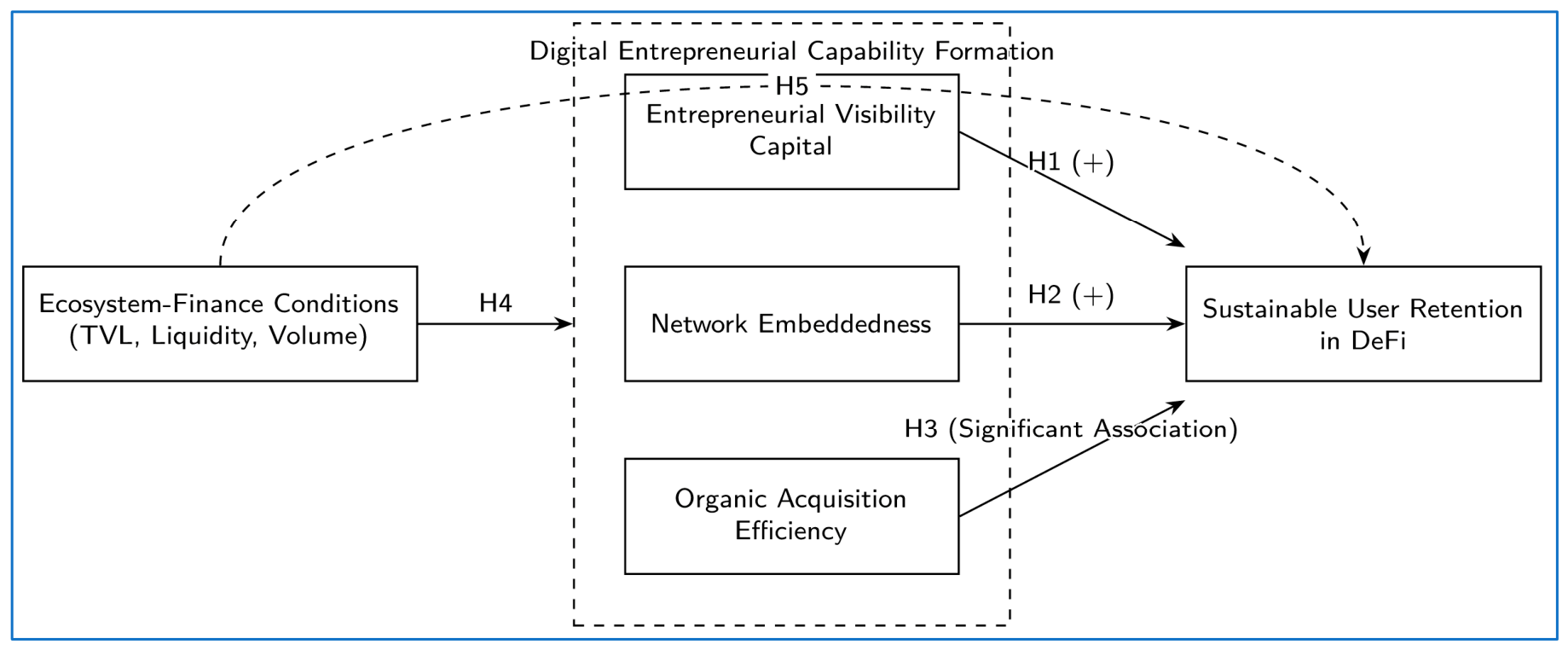
H1: Entrepreneurial Visibility Capital is positively associated with sustainable user retention in DeFi.
This hypothesis follows from research on digital entrepreneurship, suggesting that visibility functions as a capability rather than merely an exposure metric. In digitally mediated markets, visibility supports legitimacy, discoverability, and ongoing user access. When visibility is reinforced by authority, digital reputation, and external referencing structures, it is more likely to translate into repeated interaction rather than transient attention. Recent reviews of digital entrepreneurship and digital entrepreneurial capability emphasize that digitally mediated ventures depend on market-facing capabilities that allow them to attract and retain participants in competitive digital ecosystems [
5,
20]. In the DeFi context, where switching barriers are relatively low and competition for attention is intense, higher entrepreneurial visibility should therefore be associated with stronger sustainable retention.
H2: Network Embeddedness is positively associated with sustainable user retention in DeFi.
This hypothesis is grounded in the digital entrepreneurial ecosystem literature. Zhou & Cen [
6] show that digital entrepreneurial ecosystem embeddedness significantly promotes the development of entrepreneurial opportunities through knowledge acquisition and knowledge-sharing capabilities. More broadly, embeddedness is understood as a condition that strengthens relational positioning, knowledge flows, and ecosystem support. In DeFi, external digital linkages, referrals, and ecosystem integration may serve as functional analogues of embeddedness, increasing the likelihood that user relationships become more persistent rather than episodic. Therefore, stronger embeddedness is expected to be positively associated with sustainable user retention.
H3: Organic Acquisition Efficiency is significantly associated with sustainable user retention in DeFi.
The third hypothesis is stated in non-directional form because recent digital-retention research suggests that efficient acquisition and long-run retention are related, but not necessarily linear or positive under all market conditions. Pereira et al. [
9] show that customer retention in digital environments depends on multiple intertwined technological and relational factors, rather than on a single traffic-generation mechanism. In DeFi, acquisition efficiency may reflect not only the quality of digital conversion but also the cyclical conditions under which users arrive, meaning that higher efficiency may coincide with either stronger persistence or short-lived market-driven inflows. For this reason, the hypothesis is framed as a significant association rather than a strictly positive effect.
H4: Ecosystem-finance conditions are significantly associated with digital entrepreneurial capability formation in DeFi.
This hypothesis reflects the expectation that DeFi’s financial environment and its digital entrepreneurial characteristics are systematically connected. Prior DeFi studies indicate that TVL, liquidity, transaction activity, and trading volume shape the operating environment of decentralized protocols and broader DeFi markets [
2,
12]. At the same time, the entrepreneurship literature indicates that capability formation in digital ecosystems is influenced more by relational and environmental conditions than by isolated internal attributes [
5,
6]. Accordingly, changes in ecosystem-finance conditions should be associated with changes in the entrepreneurial-capability block, including visibility, embeddedness, and acquisition-related efficiency.
H5: Digital entrepreneurial capability and ecosystem-finance conditions are jointly associated with sustainable user traction in DeFi.
The final hypothesis integrates the previous four. Recent work on digital-sustainable business models argues that digital performance should be interpreted through broader configurations of capability, market conditions, and the durability of value creation rather than through isolated metrics alone [
10]. Related work on sustainable digital entrepreneurship similarly emphasizes the role of transparency, scalability, and digital resilience in shaping venture success [
22]. In DeFi, sustainable user traction is unlikely to be explained exclusively by financial depth or by digital capability. Instead, it is more plausible that visibility, embeddedness, acquisition-related quality, and ecosystem-finance conditions act jointly. Therefore, the analysis tests whether the combined predictor set explains sustainable user traction more effectively than any single variable dimension in isolation.
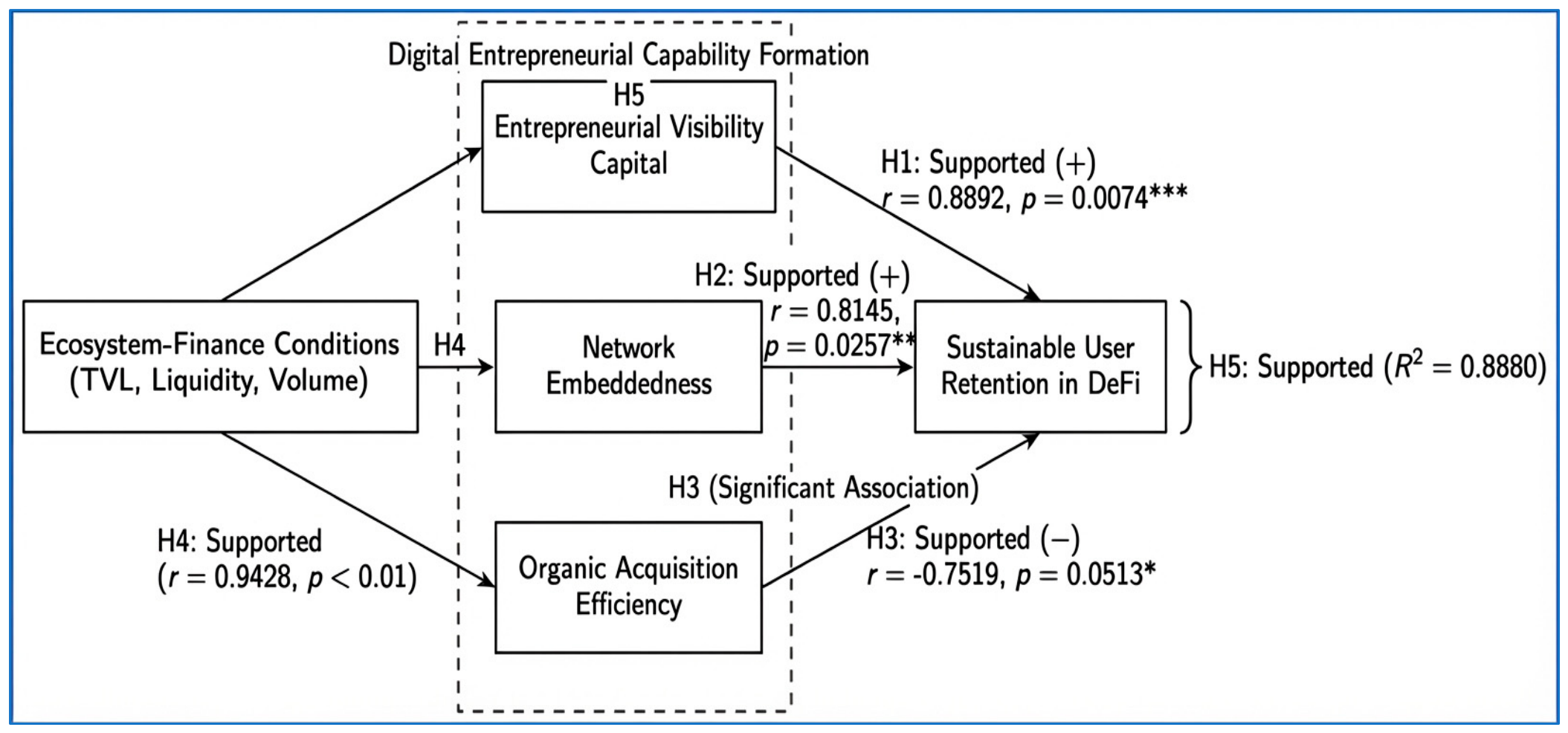
The conceptual framework of the present study is being presented below (
Figure 1).
3. Results
Three interpretive cautions apply throughout this section. First, because the full sample is based on 12 monthly observations and the active-traffic subsample on 7 observations, the high in-sample fit statistics (R2) reported by the PLS and ridge models below should not be read as evidence of predictive generalisability; they reflect the expected behaviour of component-based and penalised regression models when the number of predictors is close to the number of cases. Second, the cross-validated Q2 values (leave-one-out) are therefore reported as the more meaningful indicator of out-of-sample consistency, and even these are interpreted below as internal stability checks against overfitting rather than as forecasting-performance statistics. Third, all reported relationships are correlational and multivariate; language that might imply causation (“influences”, “drives”, “effect”) is avoided in what follows, and relationships are described as associations, co-movements, or predictor–outcome correspondences.
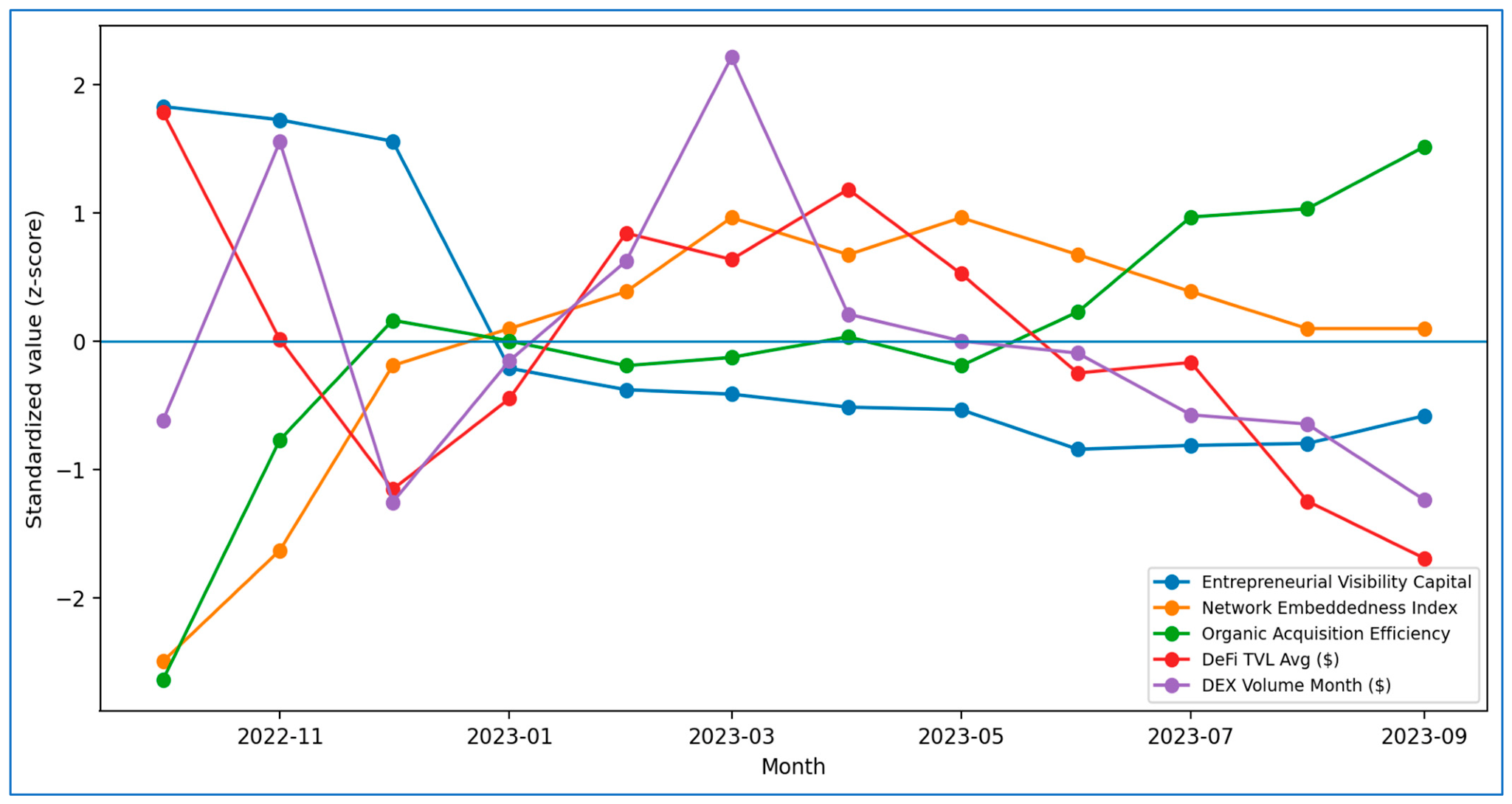
Table 1 reports the descriptive statistics and distribution diagnostics for the variables included in the analysis. Branded Traffic remained relatively stable over the study period, with a mean of 77.68 and limited dispersion, while Authority Score also exhibited moderate variation. Referral Domains and Backlinks showed greater variability, indicating that the external digital footprint of the observed DeFi environment was more dynamic than direct brand visibility alone. Organic Traffic also remained comparatively stable across months. Among the constructed indicators, Entrepreneurial Visibility Capital averaged 867.90, Network Embeddedness Index 9.60, and Organic Acquisition Efficiency 1.08, suggesting measurable temporal variation in the entrepreneurial capability variables. The finance-related measures also fluctuated meaningfully, particularly DEX Volume Month and DeFi TVL Avg, reflecting changing market conditions during the sample period. For the user-traction outcomes, Returning Visitors displayed a substantially higher average than Unique Visitors, while Engagement Quality Index and Acquisition Cost per Unique Visitor also showed sufficient dispersion to warrant further multivariate examination. The skewness and kurtosis values indicate departures from normality across several variables, consistent with the use of component-based and regularized estimation methods in subsequent analyses. Economically, this descriptive pattern is coherent with a post-FTX recovery phase: incumbent, brand-known DeFi platforms retained a relatively stable user base (hence the low dispersion of Branded Traffic and Organic Traffic), while their external digital footprint—the backlink and referral-domain structure—continued to evolve more visibly as link-building, partnerships, and ecosystem integrations were rebuilt during recovery. By contrast, the meaningful variability in DEX Volume Month and DeFi TVL Avg reflects the well-documented finance-side turbulence of this period, in which month-level capital flows into and out of DeFi remained unusually sensitive to macro news and liquidity events. The descriptive statistics, therefore, already suggest a configuration in which the digital-visibility side of the ecosystem behaves as a relatively stable capability stock, while the ecosystem-finance side behaves as a more volatile operating environment—a contrast that the multivariate analyses below exploit rather than suppress.
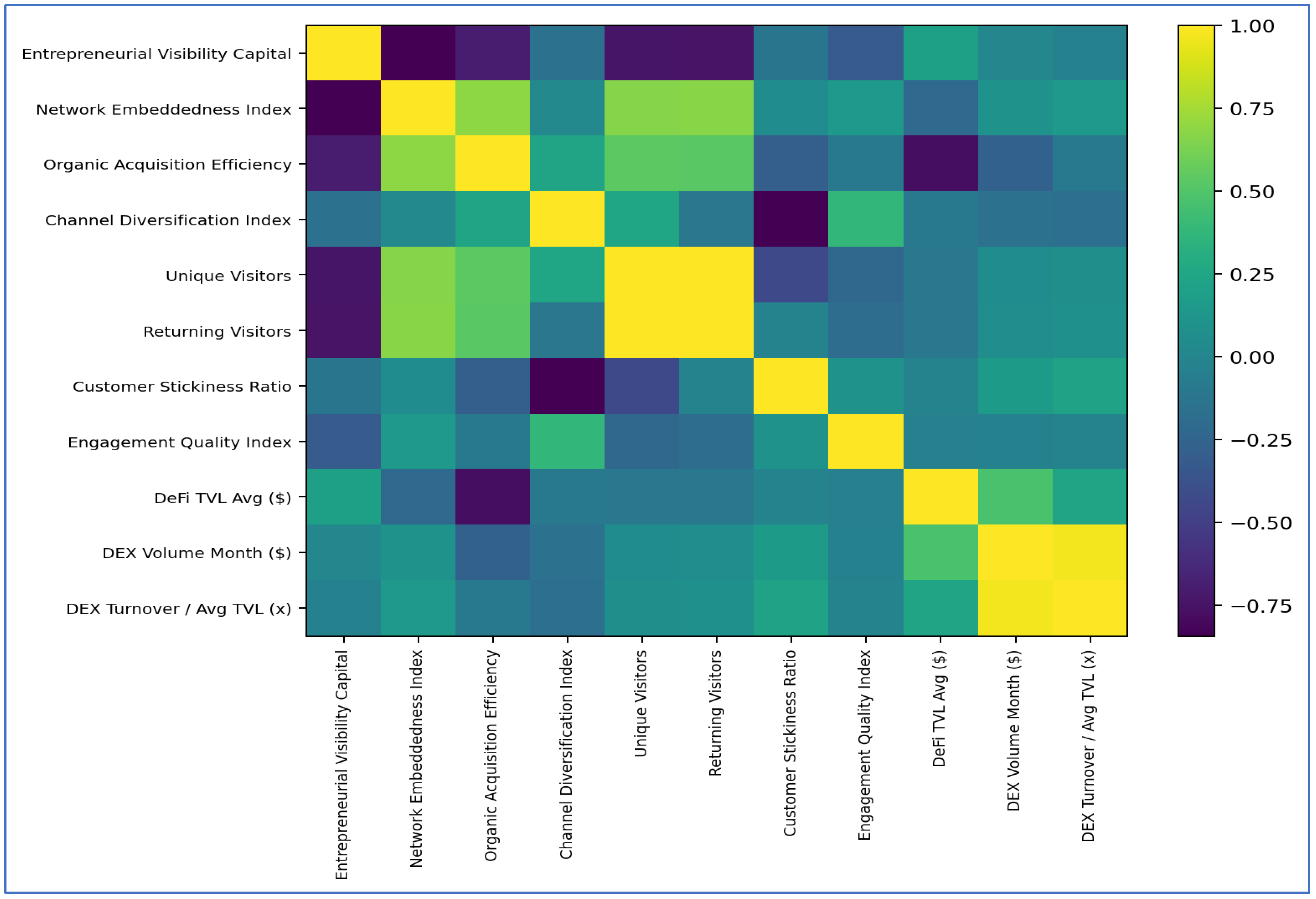
Table 2 and
Figure 2 present the Pearson correlation matrix for the key variables. Several clear patterns emerge. Entrepreneurial Visibility Capital is strongly negatively correlated with both Network Embeddedness Index and Organic Acquisition Efficiency, indicating that these measures capture different aspects of digital entrepreneurial capability rather than overlapping dimensions of the same construct. Unique Visitors and Returning Visitors are almost perfectly correlated, suggesting that both reflect a common underlying user-traction dimension, although the latter is the more behaviorally persistent measure. The Network Embeddedness Index is positively associated with both visitor outcomes, whereas Entrepreneurial Visibility Capital exhibits strong negative bivariate correlations with them in the full correlation structure. Organic Acquisition Efficiency is negatively associated with DeFi TVL Avg, indicating that higher finance depth does not automatically coincide with stronger acquisition efficiency during the period examined. The finance variables are also closely related, especially DEX Volume Month and DEX Turnover/Avg TVL.
Figure 3 visually reproduces this structure and confirms the existence of clustered association patterns among the digital entrepreneurial and market-based variables.
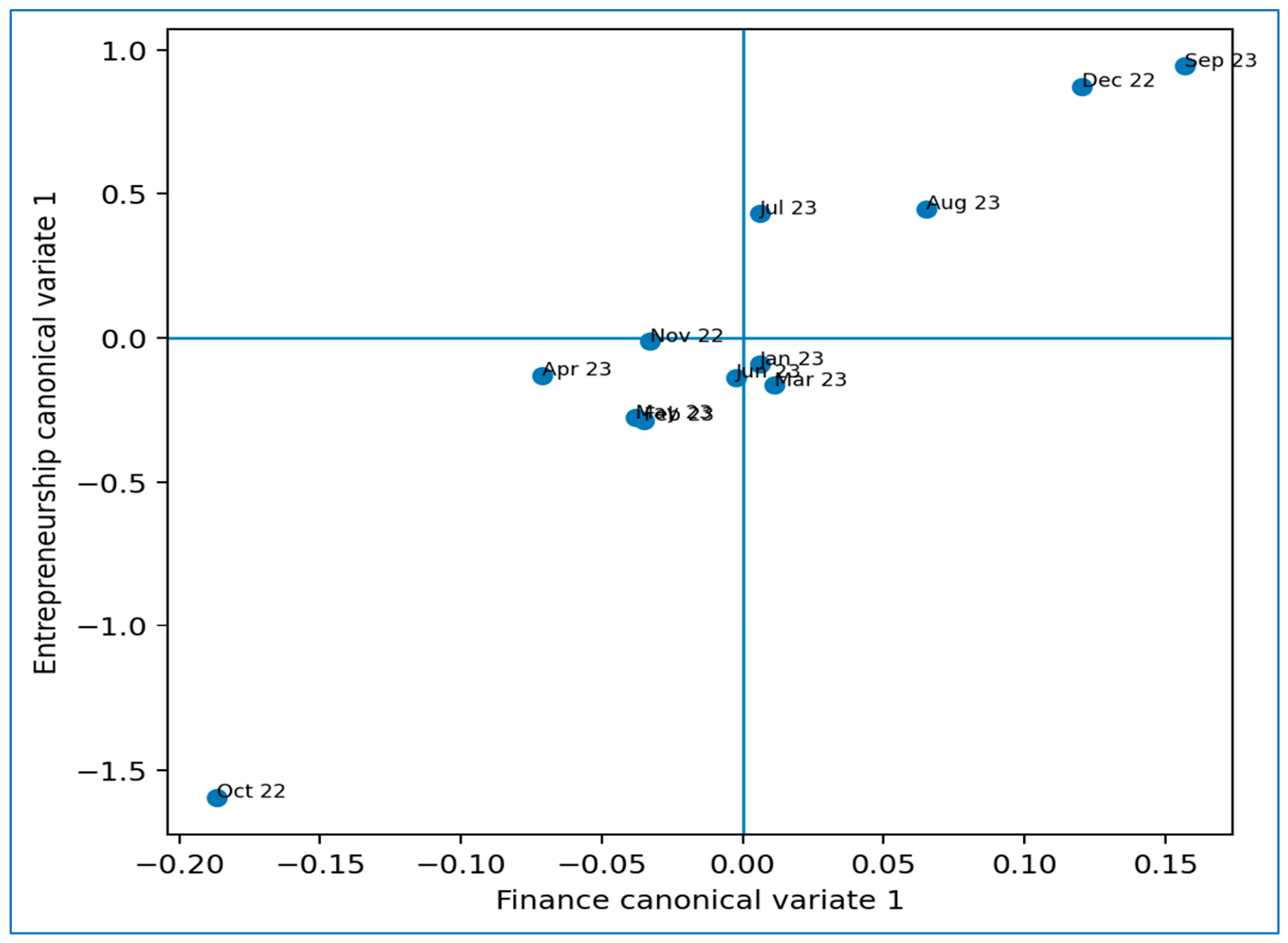
The relationship between the ecosystem-finance block and the entrepreneurship-capability block was examined using canonical correlation analysis. As shown in
Table 3, the first canonical function is very strong, with a canonical correlation of 0.9428 and a squared canonical correlation of 0.8890, while the second function remains moderate at 0.7146.
Table 4 indicates that the canonical relationship is statistically significant overall, with Wilks’ Lambda equal to 0.0543, Chi-square = 21.8435, df = 9, and
p = 0.0094. These results indicate that the two variable sets are linked through a strong shared multivariate structure.
The corresponding structure loadings clarify the internal composition of the canonical functions. In
Table 5, the finance block is dominated by DeFi TVL Avg on the first canonical variate, whereas DEX Volume Month and DEX Turnover/Avg TVL contribute more visibly to the second function. In
Table 6, Organic Acquisition Efficiency is the strongest loading on the first entrepreneurship-side variate, while Network Embeddedness Index is the strongest loading on the second. Entrepreneurial Visibility Capital loads more moderately on both functions.
Figure 4 provides a visual representation of the canonical scores and clearly shows an alignment between the finance and entrepreneurship canonical variates. Overall, the canonical results indicate that fluctuations in the finance environment are systematically associated with changes in the entrepreneurial-capability variables rather than evolving independently.
Table 7 and
Table 8 summarize the principal component analysis for the active-traffic subsample predictors. The first component, shown in
Table 7, loads positively on Network Embeddedness Index, DeFi TVL Avg, DEX Volume Month, and DEX Turnover/Avg TVL, while Organic Acquisition Efficiency loads negatively. This pattern suggests that the first component primarily reflects a broad common factor linking ecosystem-finance intensity and digital entrepreneurial positioning. By contrast, Channel Diversification Index loads almost entirely on the second component, indicating that channel diversification represents a more distinct strategic dimension.
Table 8 shows that the first component explains 64.43% of the variance and the first two components together explain 79.14%, indicating that the underlying predictor structure can be represented parsimoniously without excessive information loss.
Table 9 reports the partial least squares results. The full-sample model for Entrepreneurial Visibility Capital (PLS-F1) performs strongly, with R
2 = 0.9696 and Q2_LOOCV = 0.8834, indicating high explanatory and predictive consistency. Within the active-traffic subsample, the model for Unique Visitors (PLS-S1) performs less well, with R
2 = 0.7050 and Q2_LOOCV = 0.2193, indicating only modest out-of-sample predictive strength. The model for Returning Visitors (PLS-S2), however, performs substantially better, with R
2 = 0.8880 and Q2_LOOCV = 0.7079. The difference between the two visitor outcomes indicates that the predictor set is more closely aligned with repeated user behavior than with broad inflow alone.
The PLS coefficients and VIP scores reported in
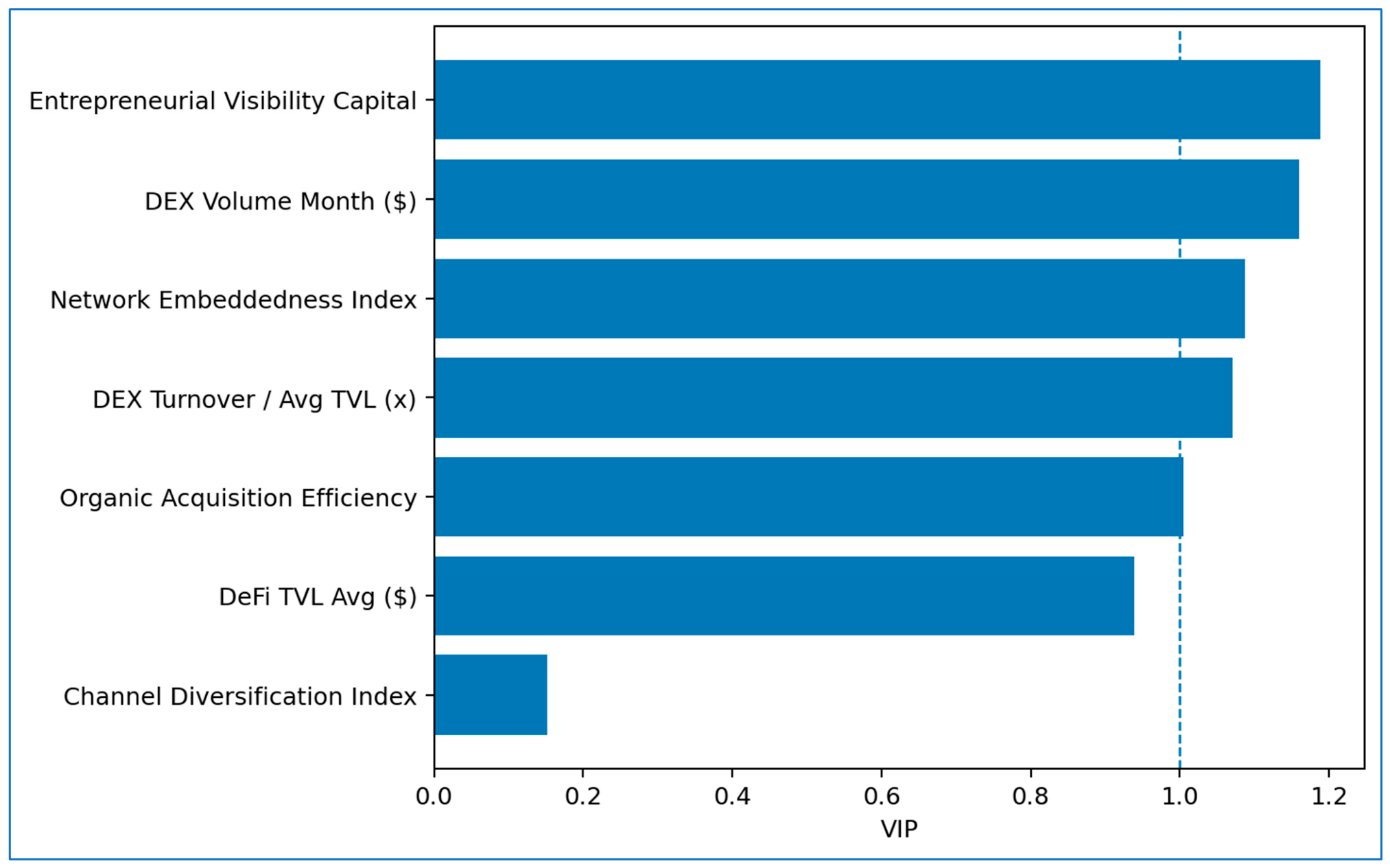
Table 10 provide more detailed insight into the relative importance of the predictors. In the full-sample model, Authority Score, Referral Domains, and Backlinks all exhibit VIP values above 1, indicating they are the principal predictors of Entrepreneurial Visibility Capital. Their standardized coefficients indicate that Authority Score and Backlinks are positively associated with the outcome, whereas Referral Domains has a negative coefficient within the multivariate specification. In the Unique Visitors model, Entrepreneurial Visibility Capital, Network Embeddedness Index, and DEX Volume Month are among the most important predictors, whereas Organic Acquisition Efficiency carries a negative coefficient and lower relative importance. In the Returning Visitors model, the most influential predictors are Entrepreneurial Visibility Capital, DEX Volume Month, Network Embeddedness Index, DEX Turnover/Avg TVL, and Organic Acquisition Efficiency, with most VIP values close to or above the conventional threshold of 1.
Figure 5 illustrates the VIP pattern for the Returning Visitors model and shows that repeated user activity is most closely associated with a combination of visibility-, embeddedness-, and market-activity-related variables.
Table 11 and
Table 12 report the robustness analysis of ridge regression. The ridge models display stronger predictive performance than the corresponding PLS models, particularly for Returning Visitors. As shown in
Table 11, RIDGE-S2 reaches R
2 = 0.9915 and Q2_LOOCV = 0.7759, while RIDGE-S1 for Unique Visitors also improves meaningfully relative to its PLS counterpart, with Q2_LOOCV = 0.5154. These results indicate that regularization is beneficial under the present conditions of small sample size and predictor interdependence. The ridge coefficients in
Table 12 are broadly consistent with the PLS findings. Entrepreneurial Visibility Capital remains the largest positive coefficient in both models, while Network Embeddedness Index, DeFi TVL Avg, and DEX Volume Month also contribute positively. The Channel Diversification Index is positive in the Unique Visitors model but negative in the Returning Visitors model, suggesting that channel breadth is not associated with the two outcomes in the same way. Organic Acquisition Efficiency is positive but relatively weak in the ridge framework.
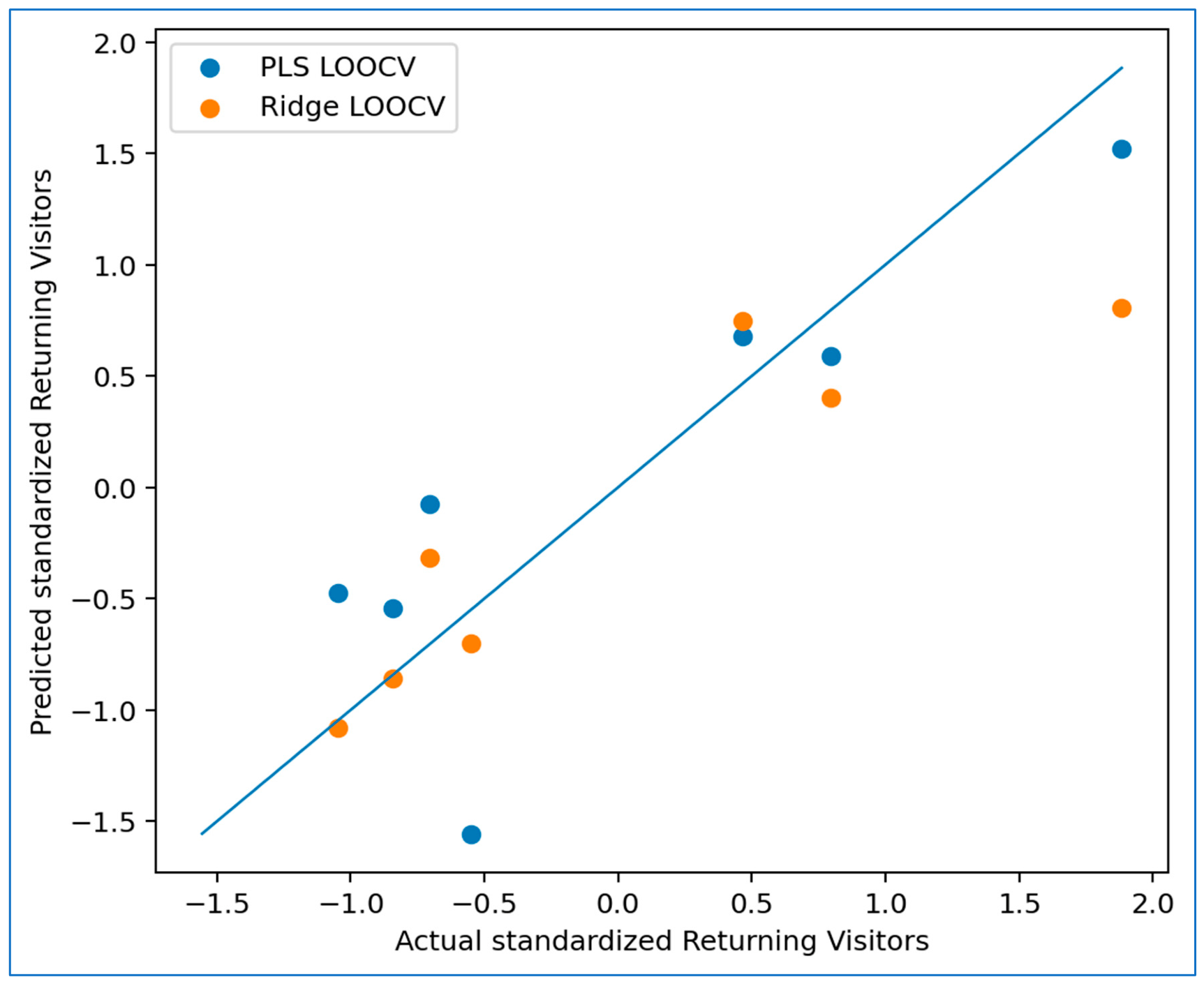
Figure 6 shows that both predictive approaches track the standardized Returning Visitors values reasonably closely, with the ridge estimates showing a tighter fit to the observed series.
4. Discussion
The findings indicate that sustainable user traction in DeFi is more closely associated with retention-oriented dynamics than with broad audience accumulation. This pattern is visible in the stronger predictive performance of the models for Returning Visitors relative to Unique Visitors, suggesting that the mechanisms captured in this study are more aligned with behavioral persistence than with one-time reach. This interpretation is consistent with recent digital-retention literature, which argues that stable user relationships are better indicators of enduring platform performance than simple traffic expansion, especially in digitally mediated and trust-sensitive environments [
9]. It also aligns with recent work on customer engagement and innovation, which shows that sustained behavioral responses are often more meaningful than initial adoption counts when assessing digital market performance [
23].
The results for H1 show that Entrepreneurial Visibility Capital is consistently associated with Returning Visitors across correlation-based and multivariate models. This suggests that digital visibility in DeFi should be interpreted as a strategic condition linked to recurring user behavior rather than as a superficial communication metric. In practical terms, stronger authority, discoverability, and digital reputation appear to be associated with more stable return patterns among users. This interpretation is in line with recent research on the online dimension of entrepreneurial ecosystems, which emphasizes that visibility and digital presence shape how actors gain attention, recognition, and continuing participation in digitally networked environments [
24]. More broadly, recent work on digital entrepreneurship shows that ventures increasingly depend on digitally mediated market presence to sustain interaction and relevance over time rather than merely to achieve short-lived awareness [
5].
The evidence for H2 is similarly consistent. The Network Embeddedness Index is positively associated with Returning Visitors in both bivariate tests and predictive models, indicating that broader digital connectedness is linked to sustained user re-engagement. This finding supports the view that embeddedness is not only a structural property of entrepreneurial ecosystems but also a behavioral mechanism through which market participants remain connected to a platform or digital environment. Recent research by Zhou & Chen [
6] shows that digital entrepreneurial ecosystem embeddedness supports opportunity development through knowledge acquisition and knowledge sharing, suggesting that embedded positions facilitate continuity rather than isolated participation. Likewise, contemporary entrepreneurial-ecosystem research highlights that the online dimension of ecosystems increasingly shapes how ventures attract, maintain, and coordinate user attention [
24]. The present results are consistent with this literature: ecosystems that are more embedded appear better positioned to sustain user return behavior.
The evidence for H3 is more nuanced. Organic Acquisition Efficiency shows a negative association with Returning Visitors in the bivariate tests and in the PLS model, while the ridge coefficient becomes weakly positive. This mixed sign suggests that acquisition efficiency matters, but not in a stable linear manner. One possible interpretation is that efficient user conversion does not always lead to enduring engagement in environments characterized by cyclical financial conditions and event-driven attention. In DeFi, user inflows may be efficient during periods of heightened market activity but remain temporary. Recent empirical reviews of DeFi have emphasized that incentive structures, liquidity dynamics, and market design strongly shape user behavior, often making platform engagement sensitive to shifting economic conditions rather than only to interface or marketing quality [
3]. That broader context may help explain why acquisition efficiency in the present analysis is associated with retention, but not in a consistently positive direction. This result, therefore, suggests that efficient acquisition should not be automatically equated with durable retention in DeFi environments.
The results for H4 provide strong evidence that the ecosystem-finance block and the entrepreneurial-capability block are systematically related. The canonical correlation analysis shows a statistically significant multivariate association between these two sets of variables, indicating that financial conditions and digital entrepreneurial capability evolve in connection rather than independently. This is an important empirical pattern because the literature often treats DeFi’s financial environment and its entrepreneurial or user-facing dimensions separately. Yet recent reviews suggest that DeFi should increasingly be understood as a broader digital-economic system in which governance, liquidity, innovation, incentives, and market participation interact in complex ways [
3,
12]. The present results align with that view by showing that TVL, DEX activity, and liquidity turnover are not isolated macro indicators; they are linked to shifts in visibility, embeddedness, and acquisition-related capability. In this sense, the findings support a more integrated reading of DeFi in which entrepreneurial capability formation is embedded within the wider finance environment.
The support for H5 further reinforces this interpretation. The combined predictive models for Returning Visitors perform strongly, particularly in ridge regression, and the most influential predictors come from both domains: entrepreneurial visibility, network embeddedness, and DEX-side market activity. This suggests that user persistence in DeFi is unlikely to be attributable to a single correlate. The combined association pattern is consistent with a configuration-level reading in which digital entrepreneurial capability and broader market conditions co-vary with user persistence, rather than with a mechanism in which one domain causally drives the other. Recent work on entrepreneurial finance ecosystems argues that financial environments shape entrepreneurial outcomes through systemic configurations rather than through one-dimensional effects [
25]. Similarly, research on digital technologies and sustainable development shows that finance-related digital infrastructures, including FinTech and blockchain, interact with broader capability environments to shape sustainable performance outcomes [
26]. Although the present study remains at the ecosystem level, its findings are consistent with this broader logic: retention-oriented traction appears strongest where entrepreneurial and financial conditions reinforce one another.
An additional point emerging from the results concerns the relative role of the individual predictors. Entrepreneurial Visibility Capital remains the strongest and most stable positive predictor across models, while Network Embeddedness also shows a durable positive association with Returning Visitors. By contrast, the Channel Diversification Index contributes only weakly and inconsistently, suggesting that channel breadth alone is insufficient to explain repeated user behavior. This distinction is analytically important. Recent research on digital customer loyalty emphasizes that sustainable retention is shaped more by the quality of meaningful interactions and trust-supporting mechanisms than by the sheer number of channels through which users can be reached [
9]. In DeFi, this may imply that not all forms of digital expansion are equally useful for supporting user persistence; deeper visibility and relational embeddedness appear to matter more than wider but thinner channel dispersion.
The finance variables also deserve careful interpretation. Their direct bivariate relationships with Returning Visitors are comparatively weak, but their role becomes more substantial in the multivariate and block-level analyses. DEX Volume Month and DEX Turnover/Avg TVL are especially relevant in the predictive models, while TVL dominates the first canonical finance function. This pattern suggests that financial conditions matter less as isolated correlates and more as part of a broader ecosystem configuration. Such an interpretation is consistent with recent empirical DeFi surveys showing that protocol design, liquidity depth, exchange activity, and incentives interact in shaping participation patterns and economic outcomes across decentralized systems [
3]. The current findings, therefore, support a configuration-based reading of DeFi dynamics rather than a simple one-variable explanation.
Read economically, these patterns have three implications for how sustainable traction in DeFi can be interpreted. First, the comparatively strong association of EVC and NEI with Returning Visitors is consistent with a reputation-and-linkage channel: within a recovery phase, users appear to re-engage primarily with platforms that signal authority (visibility capital) and that are well-integrated into the broader digital ecosystem (embeddedness), which are precisely the attributes that reduce perceived platform risk after a sector-wide confidence shock such as the FTX collapse. Second, the directionally mixed pattern for OAE invites a cautious managerial reading: strategies aimed at reducing acquisition cost can be compatible with retention when they exploit organic brand pull, but the same efficiency metric can also reflect market-driven inflows (e.g., yield-seeking during liquidity spikes) that do not persist once market conditions shift—so OAE is not reliably usable as a stand-alone KPI and should be read alongside retention and engagement quality. Third, from a sustainability-management standpoint, the results support performance dashboards that combine liquidity-side indicators (TVL, DEX Volume) with capability-side indicators (visibility, embeddedness, retention quality) rather than reporting either block in isolation, an approach consistent with the digital-sustainable-business-model literature. These implications are consistent with an exploratory reading of the data and are intended as hypotheses for future, larger-sample investigation rather than as prescriptive managerial directives.
Taken together, the discussion points to a consistent empirical picture. H1 and H2 are supported, showing that visibility and embeddedness are positively associated with sustainable user retention. H3 is only partially supported, indicating that acquisition efficiency is relevant but directionally unstable. H4 is supported by the canonical analysis, which reveals a strong association between ecosystem-finance conditions and the formation of entrepreneurial capability. H5 is supported by the predictive models, which show that sustainable user traction is best explained by the joint role of digital entrepreneurial capability and market-based ecosystem conditions. Overall, the results portray DeFi as a digital-economic environment in which recurring user behavior is associated not only with financial depth or market activity, but also with the quality of entrepreneurial positioning and ecosystem integration, as seen in
Table 13 and
Figure 7 below.





 and
and