Article

Advanced Nitrogen Removal from Low C/N Municipal Wastewater via an AvN–Controlled Anaerobic–Swing–Anoxic–Oxic (ASAO) Process: Pilot–Scale Performance and Microbial Mechanisms


1
A Key Laboratory of Integrated Regulation and Resource Development on Shallow Lakes, Ministry of Education, Hohai University, Nanjing 210098, China
2
College of Environment, Hohai University, Nanjing 210098, China
3
Department of Civil and Environmental Engineering, The Hong Kong University of Science and Technology, Hong Kong, China
*
Authors to whom correspondence should be addressed.
Sustainability 2026, 18(10), 5020; https://doi.org/10.3390/su18105020
Submission received: 23 March 2026 / Revised: 26 April 2026 / Accepted: 12 May 2026 / Published: 16 May 2026

Abstract

The challenge of attaining energy–efficient nitrogen removal at low carbon–to–nitrogen (C/N) ratios is a fundamental issue in the sustainable management of municipal wastewater treatment plants (WWTPs). This study investigates a pilot–scale Anaerobic–Swing–Anoxic–Oxic (ASAO) system coupled with an AvN (Ammonia versus NOx–N)–based aeration control strategy. A systematic evaluation of the system’s performance, nitrogen removal mechanisms, and microbial communities under a 350–day long–term pilot–scale operation using real municipal sewage is presented. The results reveal that the AvN control strategy can optimize aeration intensity and enhance nitrogen removal efficiency. Even under low influent C/N conditions, the ASAO system maintained stable operation with low dissolved oxygen levels (0.5–1.5 mg L−1), and the AvN control strategy effectively optimized aeration intensity and stabilized nitrogen conversion, achieving a total nitrogen (TN) removal rate of 83% and an average effluent TN concentration of 4.9 ± 2.6 mg L−1. Mechanistic analysis indicated that AvN regulation could alleviate over–nitrification and enhance intracellular carbon storage, thereby creating conditions that support the coordinated operation of multiple nitrogen removal routes, such as simultaneous nitrification–denitrification (SND), endogenous denitrification (EnD), and potentially anaerobic ammonium oxidation (anammox). These findings suggest that the AvN–controlled ASAO process offers a robust and scalable strategy for achieving high–efficiency nitrogen removal with reduced aeration demand, providing a promising technological pathway toward energy–neutral and sustainable municipal wastewater treatment.

1. Introduction

Municipal wastewater treatment plants (WWTPs) play an essential role in protecting aquatic environments; however, they are also significant energy consumers and are increasingly challenged by more stringent nutrient discharge standards [1,2]. Conventional biological nitrogen removal processes, such as the anaerobic/anoxic/oxic (AAO) process, are widely applied in municipal WWTPs worldwide, but are increasingly challenged by stricter effluent standards and environmental sustainability requirements [3,4]. To sustain biological reactions, these processes are usually operated under comparatively high DO (dissolved oxygen) conditions (2–4 mg/L). Under carbon–deficient influent conditions, external carbon is frequently supplied to maintain compliance with discharge requirements [5]. However, this strategy of achieving low emissions through high resource consumption is economically unsustainable [6,7].
To address these limitations, the anaerobic–oxic–anoxic (AOA) process was recently proposed and has gained more and more attention due to its high nitrogen removal capacity under low C/N ratios [8]. In the AOA process, a typical feast–famine pattern is followed to favor the accumulation of denitrifying glycogen–accumulating organisms (DGAOs) and utilize intracellular carbon storage. These microorganisms can rapidly assimilate more than 80% of the organic matter in wastewater and store it intracellularly in the form of polyhydroxyalkanoates (PHAs) and glycogen (Gly). During the subsequent famine phase, nitrate and nitrite produced in the preceding aerobic zone are removed through endogenous denitrification (EnD) [9]. These characteristics enable the AOA process to achieve remarkable nitrogen removal performance even under influent carbon–limited conditions [10]. Furthermore, Xu et al. [11] found that the aerobic zone of an AOA system achieved a TN removal rate of 0.24 ± 0.06 g VSS−1 d−1 through SND (simultaneous nitrification–denitrification), suggesting that the multi–compartment configuration of the process supports SND during municipal wastewater treatment. In addition, denitrification driven by intracellular carbon storage in the AOA system may also provide a favorable niche for the enrichment of anaerobic ammonium–oxidizing bacteria (AnAOB) [12,13]. It has been reported that anaerobic ammonium oxidation (anammox) and endogenous partial denitrification can be effectively integrated within AOA systems [14].
However, the occurrence and stability of these nitrogen removal pathways strongly depend on appropriate aeration regulation. Low–DO conditions of 0.5–1.5 mg/L have been reported to favor the development of simultaneous SND, which contributes to nitrogen removal efficiency [15]. Ma et al. [16] further reported that shortening the aeration duration in the aerobic phase significantly improved nitrogen removal efficiency and contributed to additional sludge reduction. Ji et al. [17] established an anaerobic/anoxic/oxic activated sludge system in an SBR reactor and achieved endogenous partial denitrification, providing a potential nitrite source for anammox, although the effective coupling of these pathways remains to be further explored.
Reducing aeration demand is essential for energy conservation and enhancing the sustainability of wastewater treatment plants [18,19]. Most existing studies have primarily focused on optimizing operational parameters to improve nitrogen removal performance in AOA systems, while the mechanisms governing nitrogen transformation pathways under dynamic aeration control remain insufficiently clarified. Recent laboratory–scale studies on the ASAO process have demonstrated its feasibility for low C/N municipal wastewater treatment and preliminarily revealed the roles of SND, EnD, and Heterotrophic nitrification–aerobic denitrification (HNAD) in nitrogen removal [20,21]. Moreover, intermittent aeration was also found to promote PN/anammox–related nitrogen conversion within this configuration [22]. These findings were mainly obtained in bench–scale systems under preset DO or aeration conditions, and their applicability in pilot–scale ASAO systems under dynamic AvN–based aeration control remains unclear.
The AvN (Ammonia versus NOx) control strategy, developed by World Water Works, provides a promising approach to regulate aeration intensity by dynamically adjusting the balance between ammonium and oxidized nitrogen species [23]. Fofana et al. [24] achieved partial denitrification–anammox via AvN–based upstream aeration control, emphasizing the critical importance of aeration regulation in the wastewater treatment industry. By avoiding excessive nitrification, the AvN strategy can potentially enhance internal carbon utilization and promote synergistic nitrogen removal pathways [25,26]. However, the performance and underlying microbial mechanisms of AvN–regulated systems in novel process configurations remain poorly understood.
In this study, a pilot–scale anaerobic–swing–anoxic–oxic (ASAO) process integrated with AvN–based aeration control was established and systematically investigated, and its performance was investigated at a pilot scale. The objectives of this study were to (i) investigate the nitrogen removal performance of the ASAO system under AvN regulation; (ii) elucidate the potential nitrogen transformation pathways, including SND, endogenous denitrification, and possible anammox; and (iii) explore the microbial community dynamics and functional gene responses associated with the AvN–controlled aeration strategy.

2. Materials and Methods

2.1. Set up of the Pilot–Scale ASAO System

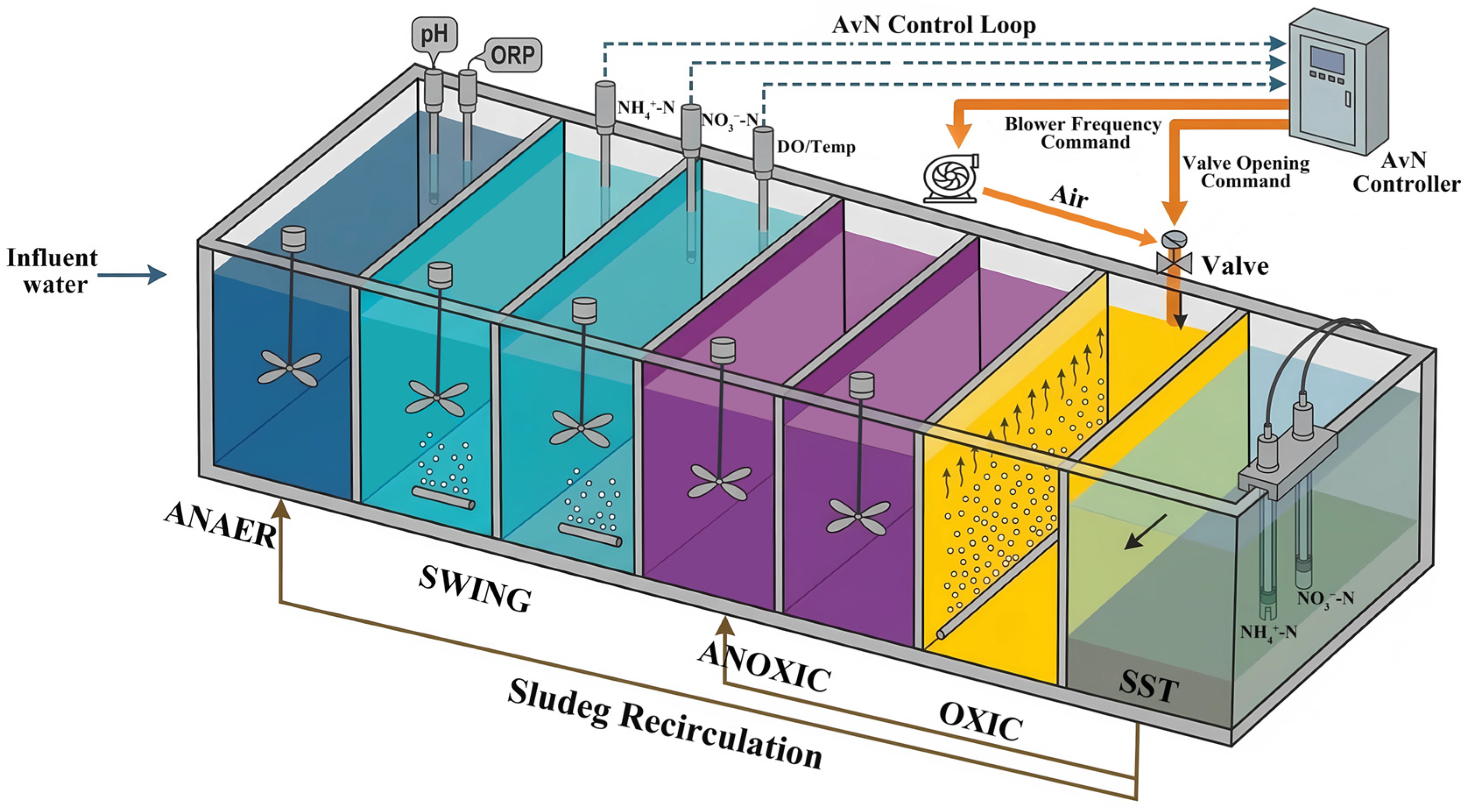
A pilot–scale continuous flow reactor (19.5 m3) was constructed, consisting of a bioreactor (15 m3, divided into 6 units) and a secondary sedimentation tank (4.5 m3) (Figure 1). The six chambers of the ASAO system were configured into four functional zones: anaerobic, swing, anoxic, and oxic. Each bioreactor unit was equipped with a hydrocyclone mixer and aeration devices, and various online instruments (Hach Company, Loveland, CO, USA) were installed in different units. In the bioreactor, the second and third units between the anaerobic and anoxic sections were designated as swing zones, enabling flexible adjustment of the functional.
Adjustment of the feeding pump rate was used to regulate the hydraulic retention time (HRT) of the system. Aeration time and operational modes were controlled through the on/off switching of aeration valves; DO levels were controlled by adjusting the frequency of the aeration blower in combination with precisely adjustable air valves. Sludge was recycled from the secondary sedimentation tank to both the anaerobic and anoxic zones through two separate return lines with controllable flow rates.

2.2. Seeding Sludge and Domestic Sewage

The inoculated sludge for the pilot plant was obtained from a WWTP in Kunshan, China, operating a cyclic activated sludge system (CASS), with MLSS = 3400 mg L−1 at the time of collection. Wastewater for the pilot unit was taken from the same WWTP and, after coarse screening and sand sedimentation, was fed directly to the reactor. Long–term influent characteristics are provided in Table 1.

2.3. Advanced Aeration Control

An AvN–based intelligent aeration control strategy was implemented to dynamically regulate aeration intensity. The model input variables, prediction method, and detailed stepwise control logic are described in Text S2 of the Supplementary Information. A total of 61,795 valid data records were collected from the plant PLC (programmable logic controller) system and HACH online sensors. After preprocessing according to the required input time sequence, the dataset was further randomized and normalized prior to model training, and model performance was evaluated using five–fold cross–validation to improve the stability and reliability of the prediction results while maximizing the use of the available data. When the predicted AvN value remained within the predefined target range, the aeration condition was maintained; otherwise, blower frequency and valve opening were dynamically adjusted to regulate aeration intensity. The control system integrated PLC, SCADA (supervisory control and data acquisition), and MCP (master control panel) modules to achieve zonal aeration distribution and precise DO regulation (±0.5 mg L−1), thereby optimizing nitrification–denitrification, enhancing nitrogen removal efficiency, and reducing aeration energy consumption.
Previous studies have suggested that maintaining an ammonium–to–NOx ratio close to 1:1 can provide favorable alkalinity conditions for ammonia–oxidizing bacteria (AOB), thereby improving AOB activity, promoting nitritation and NOx–N reduction [27]. Accordingly, long–term operational observations under low influent C/N conditions indicated that an AvN ratio of approximately 0.8 was more conducive to nitrogen removal, as it balanced NH4+–N oxidation with the limitation of excessive NOx–N accumulation.

2.4. Operation of the Pilot–Scale System

The ASAO was operated for 350 days, consisting of four phases, and its detailed operations are described in Table 2.
(1) The startup period (days 1–37): The startup period was designed as a pre–experimental stress test in which we applied varied aeration intensity, stepped the HRT, and switched inter–zone modes to probe operational bounds. Upon stabilization of effluent quality and MLSS in the stage, the operation advanced to Phase I.
(2) Phase I (days 38–95): Operated at A:S:A:O = 1:2:2:1 with Swing–zone under manual DO control. Performance was evaluated over the steady window.
(3) Phase II (days 96–208): Operation followed Phase I except that the inter–zone allocation was switched to A:S:A:O = 2:1:2:1. The reallocation was selected based on Phase I online profiles (and the seasonally lower winter temperature), with the intention of strengthening the synergistic interaction between aerobic and anaerobic denitrifying bacteria [28].
(4) Phase III (days 209–350): Inter–zone allocation A:S:A:O = 2:1:2:1 maintained, while Swing–zone DO was lowered to 0.5–1.5 mg O2·L−1. Continuous AvN control was enabled in this phase, targeting NH4+–N ≈ 0.8NOX–N at the oxic outlet by modulating aeration within the prescribed DO band.

2.5. Batch Experiments and Chemical Analysis

In order to assess the SND, EnD, and anammox processes, three batch tests were carried out using sludge samples collected at different operational periods from the ASAO reactor. The sludge samples were washed three times with deionized water to remove any residual substrates, after which it was transferred to 500 mL brown airtight bottles filled with synthetic wastewater. All tests were performed under controlled temperature, pH, mixing, and oxygen conditions appropriate for each process. Detailed media compositions are provided in the Supplementary Materials (Text S1).
Samples from the pilot–scale ASAO system were collected and passed through a 0.45 μm cellulose acetate membrane before analysis. COD was measured by a COD quick–analysis apparatus (Hach Company, Loveland, CO, USA). Standard methods were used to determine NO2–N, NO3–N, NH4+–N, TN, TP, MLSS, and the initial mixed liquor volatile suspended solids (MLVSS) [29,30]. Freeze–dried biomass was used for the determination of intracellular components, including glycogen (Gly) and poly–hydroxyalkanoates (PHAs), where PHAs include poly–β–hydroxybutyrate (PHB) and poly–β–hydroxyvalerate (PHV). The analyses followed established methods [31,32]. All measurements were performed in triplicate, and the results are presented as mean ± standard deviation (SD).

2.6. Microbial Community and Metagenomic Analysis

Activated sludge samples were collected from the ASAO system on days 50, 78, 158, 247, 284, and 330. These six samples were used for full–length 16S rRNA gene sequencing and metagenomic analysis to characterize microbial community composition and functional potential.
Genomic DNA was isolated using the E.Z.N.A.® Stool DNA Kit (Omega Bio–tek, Norcross, GA, USA), followed by integrity assessment on a 1% agarose gel. Full–length 16S rRNA genes were amplified with barcoded primers derived from 27F (5′–AGRGTTYGATYMTGGCTCAG–3′) and 1492R (5′–RGYTACCTTGTTACGACTT–3′). PCR amplicons were purified, quantified, and normalized to construct SMRTbell libraries following PacBio protocols. Marker gene sequencing was performed on the PacBio SMRT platform, and high–quality Circular Consensus Sequencing (CCS) reads were filtered to obtain Optimization–CCS reads for OTU clustering, taxonomic annotation, and microbial diversity analyses.
For metagenomic sequencing, shotgun libraries were constructed and sequenced at Shanghai Biozeron Biotechnology Co., Ltd. (Shanghai, China). Approximately 1 μg of DNA per sample was fragmented to ~450 bp using a Covaris S220 ultrasonicator and processed using standard Illumina library procedures (Illumina, San Diego, CA, USA). Sequencing was performed on the Illumina NovaSeq 6000 platform using the paired–end 150 bp mode. Raw reads were processed with Trimmomatic v0.36 for quality filtering, and host–related sequences were further removed using BWA–mem with the parameters of –M–k32–t16. The high–quality clean reads obtained were subsequently used for metagenomic analysis.

2.7. Statistical Analysis and Calculations

Pearson correlation analysis was used to determine the pairwise correlations among dominant genera based on genus–level relative abundance data. Mantel tests were applied to further explore the relationships between microbial community structure and environmental variables. Data analysis was carried out using genescloud tools, a freely accessible online platform for data analysis (https://www.genescloud.cn, accessed on 13 March 2026). The co–occurrence network in the ASAO system was constructed based on the online molecular ecology networks (MENA) pipeline (http://ieg2.ou.edu/MENA, accessed on 11 February 2026) in the previous study. Co–occurrence networks (r > 0.6, p < 0.05) were established with Gephi (v.0.9.5).

3. Results and Discussion

3.1. Long–Term Performance of the Pilot ASAO System

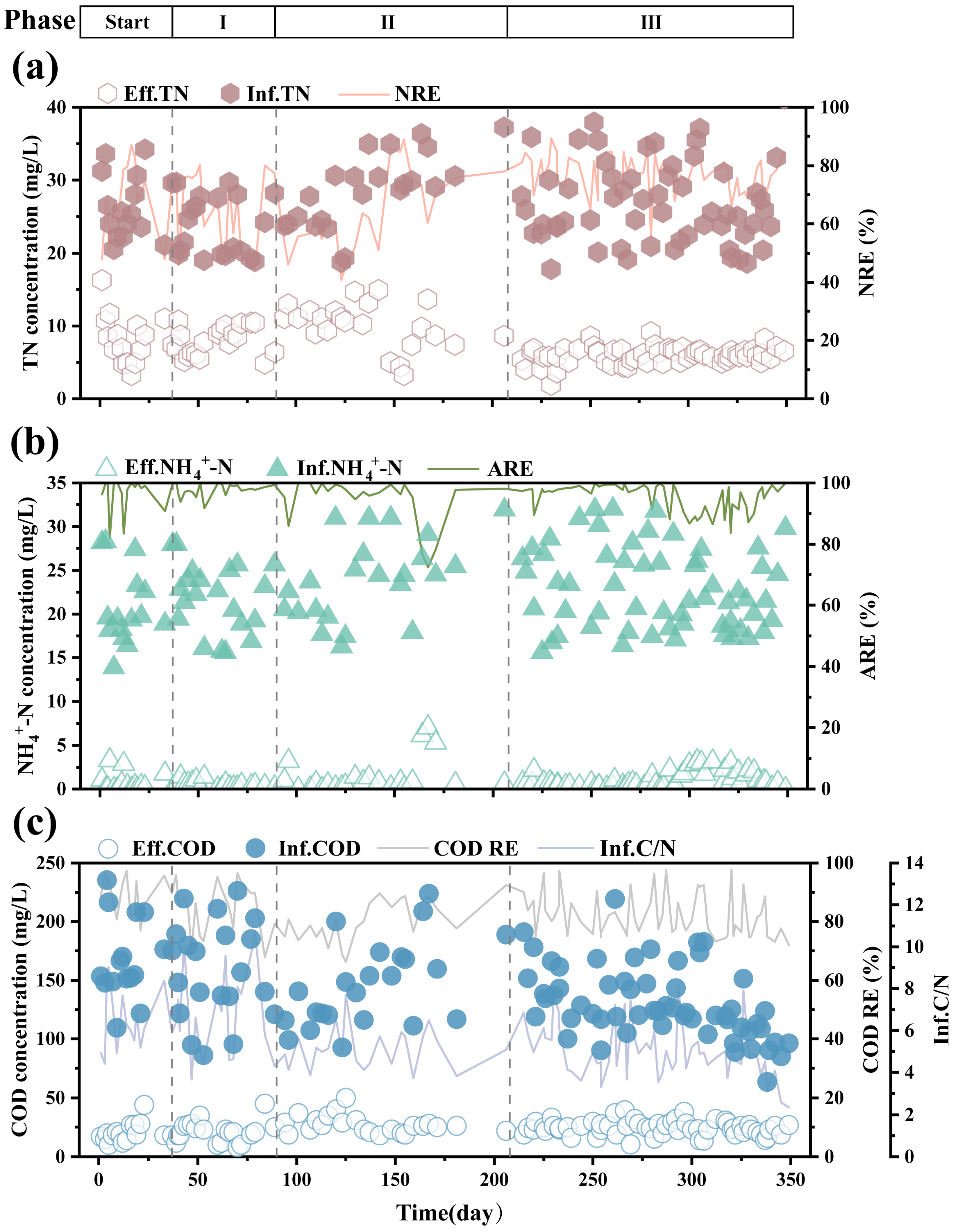
The pilot–scale ASAO reactor was stably operated for 350 days under varying operational and environmental conditions. Overall organics and nitrogen removal performance are presented in Figure 2. To enable the subsequent intelligent aeration control, the AvN prediction model was first trained and validated. The five–fold cross–validation results demonstrated good predictive performance and satisfactory generalization ability of the model (Figure S1).
During the startup period (days 1–37), the ASAO reactor maintained unexpectedly strong pollutant removal, achieving an average COD removal efficiency (COD RE) of 89% and an NH4+–N removal efficiency (ARE) of 97%, despite fluctuations associated with hydraulic and operational adjustments. TN removal efficiency (NRE) was initially variable, averaging 64.3% in the first 15 days, but increased to about 75% toward the end of the period, indicating that the system had largely completed biological acclimation and begun to form a stable nitrogen removal regime.
In Phase I (days 37–95), the reactor provided a relatively long aerobic residence time, together with a high DO level (2–4 mg/L) in the swing zone. COD RE remained high, averaging 87–90%, and NH4+–N was almost completely eliminated with efficiencies consistently above 97%. NRE also improved relative to the startup period, stabilizing at 70–78%, with an average effluent TN of 7.23 mg/L.
In Phase II (days 95–208), considering the decreasing influent C/N ratio and the onset of low–temperature conditions, the aerobic residence time was reduced while maintaining the same aeration intensity as in Phase I. At the beginning of Phase II, NRE greatly decreased from 80.1% to 56.6% in the beginning period of Phase II, due to the abrupt operational changes and the simultaneous decrease in water temperature. However, from approximately day 150, as the microbial community gradually re–acclimated, pollutant removal gradually recovered. In the latter part of Phase II, effluent TN decreased to 5.2 ± 2.1 mg/L, with NRE rising to about 82%. Meanwhile, COD RE returned to 88–90%, and NH4+–N removal remained consistently above 97%, aligning well with the improved performance trends observed in Figure 2a–c.
In Phase III (days 208–350), the AvN control strategy was implemented and the DO level in the swing zone was reduced to 0.5–1.5 mg/L. Under these optimized conditions, the reactor exhibited a marked improvement in nitrogen removal performance compared with Phase II. As shown in Figure 2a, the effluent TN decreased further and stabilized at 4.9 ± 2.6 mg/L, with the NRE increasing to 80–85%, despite the continuously low influent C/N ratio. Effluent ammonium concentrations remained low at 0.9 ± 0.5 mg/L, corresponding to an average removal efficiency greater than 92%, demonstrating that the reduced DO did not impair nitrification performance. COD RE also remained at 82%.
Overall, despite frequent influent fluctuations during long–term operation, the ASAO system maintained stable nitrogen removal. For example, influent COD decreased sharply from approximately 200 mg/L on day 120 to about 90 mg/L on day 123, whereas TN removal efficiency showed no obvious deterioration. Short–term influent NH4+–N fluctuations exceeding 10 mg/L were also frequently observed, but effluent NH4+–N remained low, particularly in Phase III under AvN control. This suggests that the ASAO system had a certain buffering capacity against short–term fluctuations.
To further assess temperature adaptability, representative low, moderate, and high–temperature periods were compared, and an additional low–temperature period under AvN control was included (Figure S2). The results showed that the low–temperature period without AvN control had the poorest TN removal performance. The implementation of AvN control increased the average TN removal efficiency to 70% and markedly reduced the effluent TN concentration. These results suggest that AvN regulation could partially alleviate low–temperature inhibition and enhance the winter stability of the ASAO process.
Sludge characteristics were evaluated to assess the operational stability of the pilot–scale ASAO system (Table 3). As shown in Table 3, MLSS decreased from 4.78 ± 2.12 g/L in Phase II to 4.02 ± 2.02 g/L in Phase III, while MLVSS/MLSS increased from 0.69 to 0.74, falling within the typical range of 0.7–0.8 for effective activated sludge systems, which indicates a high proportion of active microbial biomass and strong pollutant removal potential [33]. The SVI increased to 125 mL/g in Phase II, which was likely associated with the decrease in temperature during winter and the resulting tendency toward sludge bulking [34]. In Phase III, as the water temperature increased, the SVI decreased markedly to 82 mL/g. These results indicate that enhanced nitrogen removal under AvN control was achieved without sludge bulking or deterioration of sludge stability, supporting the operational sustainability of the ASAO process.

3.2. Advanced Nitrogen Removal Mechanism of the ASAO Process

3.2.1. Nitrogen/Carbon Transformation Under Different Phases

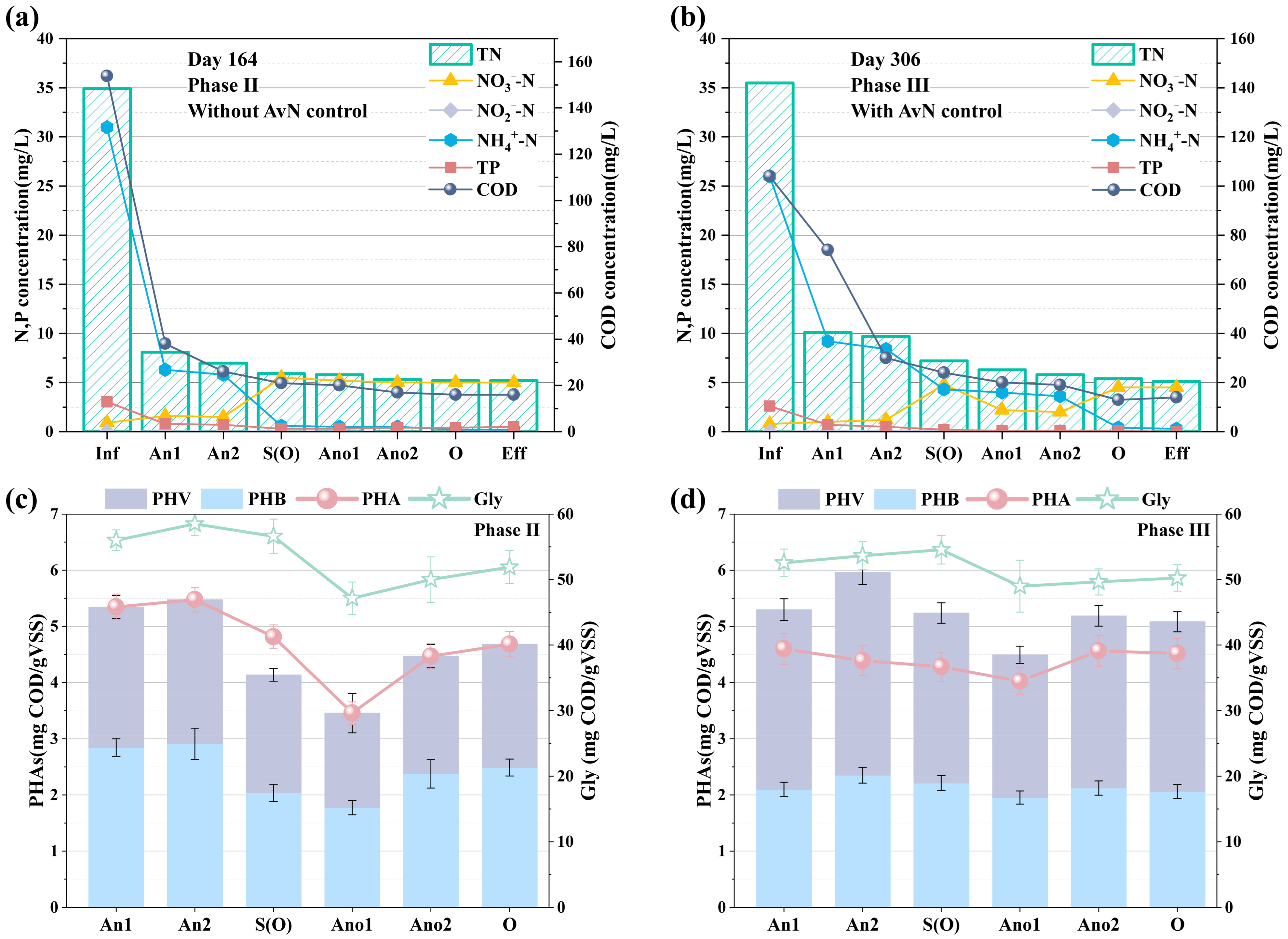
To better understand the effects of aeration strategies on nitrogen and carbon conversion in the ASAO system, the dynamics of nitrogen compounds and intracellular carbon reserves during a representative cycle were monitored on day 164 (Phase II) and day 304 (Phase III) (Figure 3). A substantial decrease in COD was observed across the anaerobic units with reductions of 133 mg/L in Phase II and 74 mg/L in Phase III. Consistent with previous studies, much of the anaerobic COD removal was likely directed to internal storage rather than solely to denitrification or maintenance [8]. Notably, even with the lower influent COD in Phase III, the system retained internal carbon at levels comparable to Phase II, indicating enhanced carbon preservation.
Despite similar COD removal behavior, the subsequent transformation pathways differed markedly between the two phases. In Phase II, the swing zone showed intensive nitrification, with NH4+–N decreasing from 5.6 to 0.5 mg/L and NO3–N accumulating, indicating predominantly oxic nitrification. By contrast, in Phase III, which was operated under conservative aeration with a swing–zone DO of 0.5–1.5 mg/L, NH4+–N was only partially oxidized (4.3–8.2 mg/L), NO3–N accumulation was suppressed, the AvN ratio stabilized at 0.85, and TN declined, suggesting a potential increase in the contribution of SND under low–DO conditions [35]. Correspondingly, higher PHAs and Gly levels were preserved in Phase III, reflecting reduced aerobic oxidation of intracellular carbon (Figure 3d). Studies have shown that maintaining DO around 1 mg/L helps sustain microbial activity while preventing excessive consumption of storage carbon [36]. Thus, AvN–based aeration effectively limited unnecessary full nitrification, conserved organic carbon, and strengthened SND in the swing zone, ultimately improving nitrogen removal efficiency.
During the anoxic stage, intracellular carbon decreased substantially in both phases (6.4 and 5.5 mg COD·g−1 VSS in Phases II and III, respectively). However, EnD was limited in Phase II but enhanced in Phase III, with low temperature during the later period of Phase II being a potential contributing factor. Lopez–Vazquez et al. [37] demonstrated that the glycogen–based metabolic pathway of GAOs is highly sensitive to temperature in terms of energy yield. Under low–temperature conditions, GAOs are forced to consume substantial amounts of Gly via glycolysis to generate ATP for cellular maintenance, thereby substantially reducing the electron flux available for denitrification [38]. Accordingly, internal carbon in Phase II was preferentially consumed for maintenance rather than nitrate reduction. In addition, in Phase III, the recovery of water temperature combined with AvN–controlled low–DO operation allowed the system to maintain effective ammonium oxidation while avoiding excessive nitrification and over–aeration. This reduced the unnecessary aerobic consumption of organic and intracellular carbon, thereby preserving more internal carbon for subsequent denitrification [39]. Although no obvious NO2–N was detected, previous studies have reported that endogenous partial denitrification (EPD) can provide NO2–N to support anammox activity through in situ microbial interactions [40].
At the post aerobic stage, further oxidation of the residual NH4+–N occurred, compensating for the incomplete nitrification in the upstream low–DO zones. Meanwhile, this stage functioned as an intermittent aeration step within the continuous–flow ASAO reactor, which contributed to the selective washout of nitrite–oxidizing bacteria (NOB) and created favorable conditions for Anammox [41].

3.2.2. Nitrogen Elimination Pathways in Different Periods

Batch tests were conducted to quantify the transformation rates of different nitrogen species during EnD, SND, and anammox under three operational phases. EnD consistently exhibited the highest TN removal rates in all phases, reaching −1.45 and −1.32 mg N·g−1 VSS·h−1 in Phases II and III, respectively. In contrast, the anammox pathway showed relatively lower rates, particularly in Phase I, although a clear enhancement was observed in Phase III (Table 4). In Table 4, negative rTIN values indicate the net removal of total inorganic nitrogen during the batch tests. Notably, slight nitrite accumulation was observed during the EnD batch tests, which became more pronounced in Phase III. With the enhancement of EnD under AvN control, endogenous heterotrophs (e.g., PAOs and GAOs) were able to redirect intracellularly stored electrons toward nitrate respiration [42]. This effectively constructed a flexible nitrite supply loop via sustained nitrate–to–nitrite reduction, creating favorable conditions for nitrite accumulation that fueled the concurrent Anammox process.
Collectively, these findings indicate that phase–dependent operational strategies dynamically modulate the relative importance of nitrogen removal pathways, with EnD being dominant under carbon–preserving conditions and SND/anammox becoming more important as dissolved oxygen control and system stability are enhanced.

3.3. Microbial Community Structure Under Different Operation Conditions

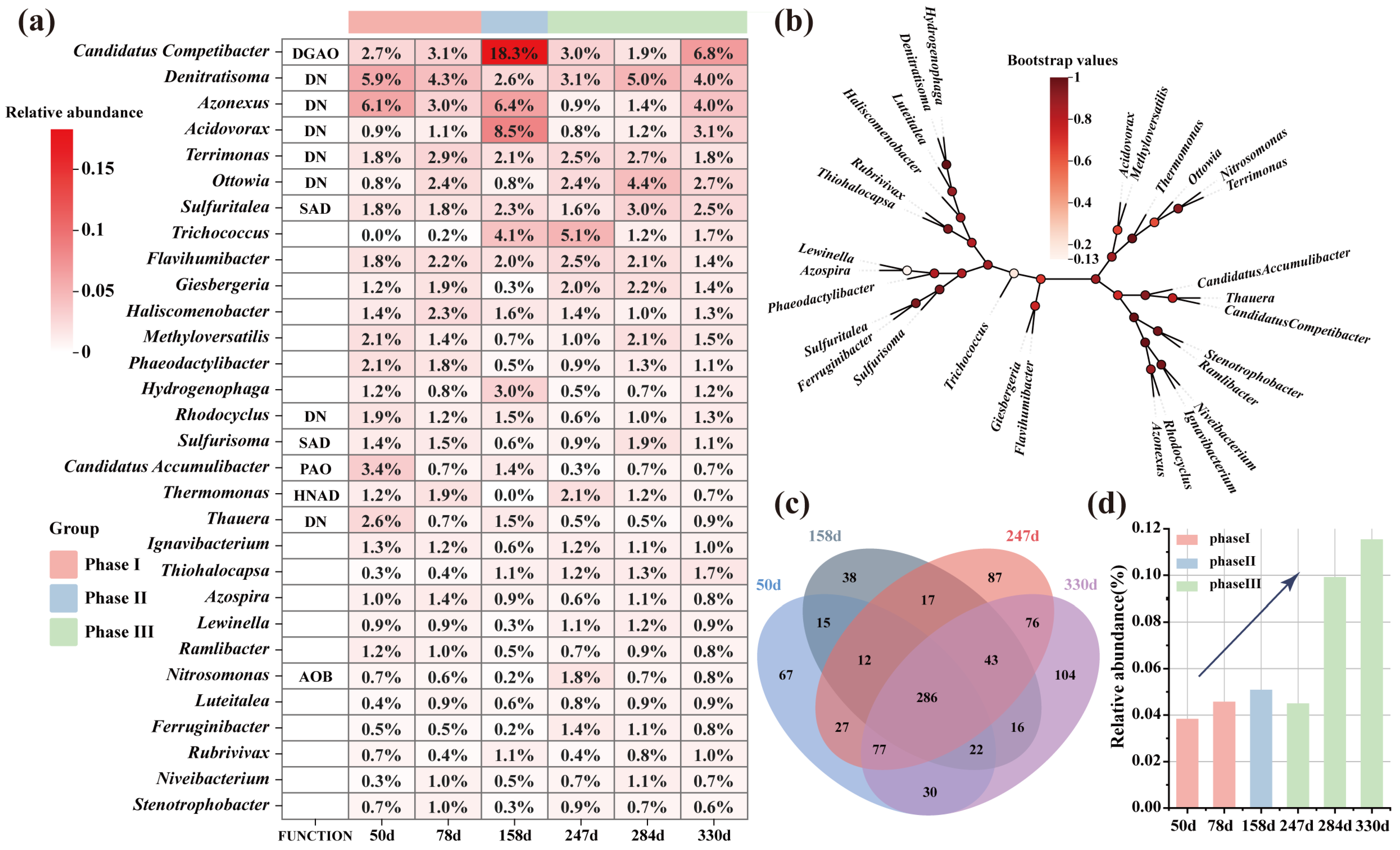
Sludge samples collected throughout the different operational phases were analyzed to evaluate how operational conditions shaped microbial community dynamics. As shown in Figure S3, the phyla Pseudomonadota and Bacteroidota dominated the microbial community throughout the entire operation. Pseudomonadota was dominant in every phase (57.5–76.2%) and is known to encompass a wide range of genera involved in biological nitrogen removal [43]. Bacteroidota, which is associated with heterotrophic organic matter degradation, remained relatively stable (9.3–20.6%) across phases. Other phyla, including Firmicutes (1.2–7.9%), Chloroflexi (1.2–4.3%), and Acidobacteriota (1.8–3.4%), were detected at moderate abundances. These phyla are commonly observed in activated sludge systems and are generally linked to organic matter degradation and nutrient removal processes. The Venn diagram (Figure 4c) shows the number of microbial genera at different sampling dates (50 d, 78 d, 158 d, and 247 d) as 536, 449, 625, and 654, respectively, confirming that microbial diversity increased as the reactor operation progressed [44].
The functional roles played by the dominant genera were also elucidated by integrating their abundance patterns (Figure 4a) with phylogenetic relationships (Figure 4b). Typical DGAOs, Ca. Competibacter [45], which was detected in the ASAO plant, presented a significant enrichment in Phase II (18.3%), reflecting the intensification of intracellular carbon storage under low–temperature and modified operating conditions. The stable abundance of this microorganism in Phase III reflects the shift towards balanced syntrophic cooperation under AvN control and low C/N.
Common DN, including Denitratisoma, Acidovorax, Azonexus, Ottowia, and Thauera [46], were consistently enriched across all samples. Notably, certain strains of Acidovorax and Thauera have been reported to exhibit oxygen–tolerant denitrification. Thauera can couple hydroxylamine oxidation with nitrite reduction to produce gaseous nitrogen [47], while Acidovorax are facultative anaerobic denitrifiers harboring key nitrate–reduction genes (nirK, napA) [48]. In Phase I, under relatively more elevated DO conditions, these denitrifiers were present consistently; presumably, constrained oxygen gradients within sludge flocs supported SND activity. In Phase II, despite significant enrichment of denitrifying genera, SND performance decreased likely due to increased DO levels, temperature–influenced activity loss of SND enzymes, and increased carbon competition from denitrifying glycolate–oxidizing organisms (DGAOs), limiting electron donor availability [49]. In contrast, Phase III under low–DO operation with control of ammonia–oxidizing bacteria (AvN control) supported stable oxygen stratification, suppressed activity of nitrite–oxidizing bacteria (NOB), and increased nitrite availability for simultaneous operation of microaerobic denitrifying communities, resulting in significantly enhanced SND performance [50].
In addition, the relative abundance of Candidatus Anammoximicrobium [51] increased markedly after the implementation of AvN control (Figure 4d). This enrichment was consistent with the increased potential anammox–related nitrogen removal rate inferred from the batch tests (Table 4), suggesting that the low–DO and nitrite–supplying conditions created under AvN regulation provided a favorable niche for anammox bacteria. However, this microbial evidence should be interpreted as an indirect indication of potential anammox–related activity rather than direct proof of its quantitative contribution. Future studies can incorporate isotope tracing techniques to further verify and quantify the role of anammox in the ASAO system.

3.4. Microbial Metabolic Patterns and Core Genera Under Different Operation Conditions

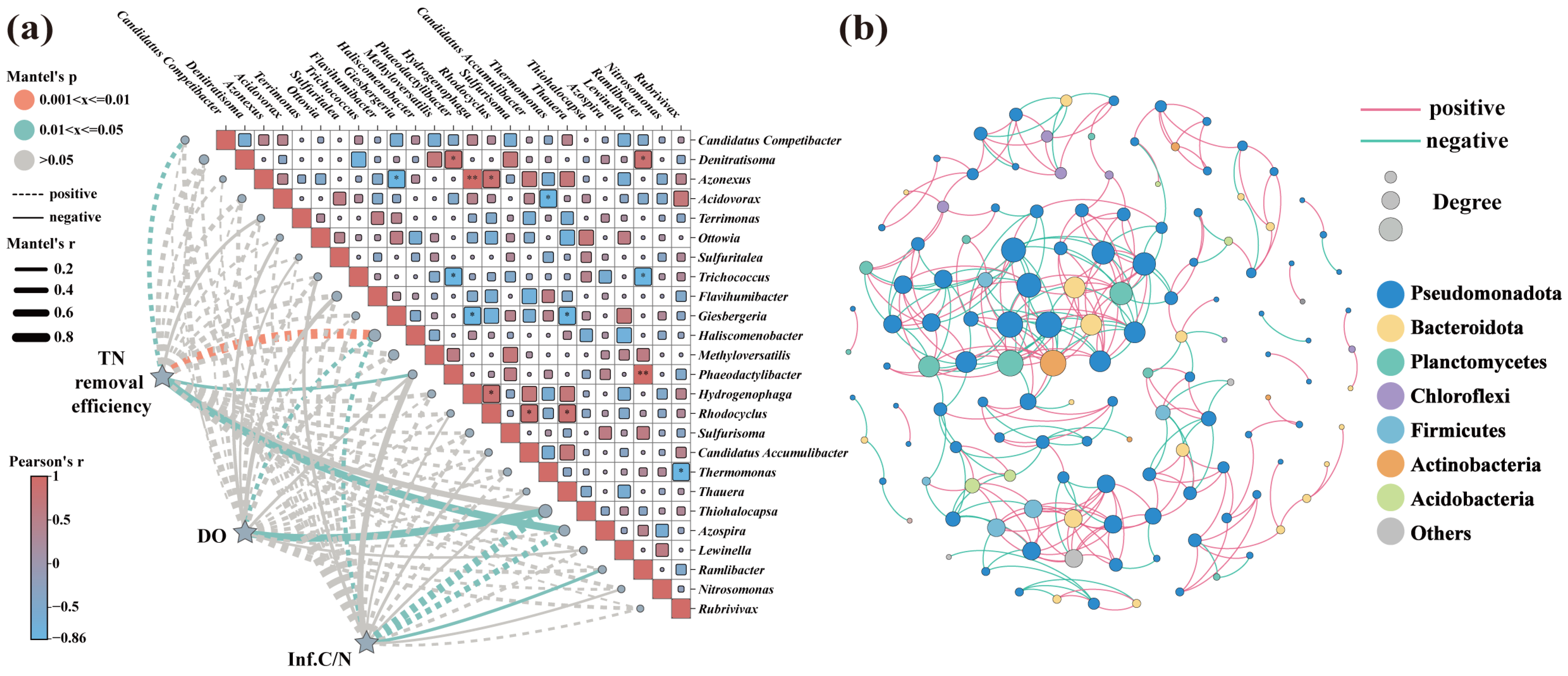
As illustrated in Figure 5a, intergenus relationships were analyzed using Pearson correlation, whereas the links between microbial abundance and environmental parameters (TN removal efficiency, DO concentration, and influent C/N) were further explored by the Mantel test. Several denitrifying genera, including Azonexus, Acidovorax, Hydrogenophaga, Rhodocyclus, and Thauera, exhibited strong positive correlations with each other, suggesting the formation of a functional module associated with nitrogen transformation. Fluctuations in denitrifying populations can play an important role in maintaining process stability in nitrogen removal. Mantel test results show that environmental factors play an important role in influencing microbial communities. Influent C/N ratios were found to show strong positive correlations with Azospira, Haliscomenobacter, and Thiohalocapsa. Therefore, influent C/N ratios are closely related to changes in these three genera and are important in driving microbial communities.
In addition, we constructed a co–occurrence pattern to investigate the microbial interactions. (Figure 5b) The network topology showed a good fit to a power–law distribution (R2 = 0.736). The modularity value (0.695) was higher than that of the corresponding random network (0.418), indicating that the microbial network exhibited a modular structure [52]. A total of 137 nodes were included in the constructed network, reflecting the size and complexity of the microbial interaction network. In total, 332 edges were identified, among which 215 (64.76%) represented positive interactions and 117 (35.24%) represented negative interactions. The dominance of positive over negative correlations indicates that cooperative or co–occurring relationships were more common among microbial taxa than antagonistic ones [15].
The network nodes were dominated by members of the phyla Pseudomonadota, Bacteroidota, and Planctomycetes. The relatively abundant genus Azonexus was identified as a critical node in the network. Azonexus is commonly associated with heterotrophic denitrification and nitrate/nitrite reduction, and its positive correlations with several denitrifying bacteria, including Hydrogenophaga and Dechloromonas, may indicate a cooperative role in nitrogen metabolism [53]. Hydrogenophaga has been reported to participate in hydrogen– or organic carbon–driven denitrification, while Dechloromonas is often linked to nitrate reduction and phosphorus–related metabolism, suggesting that these genera may jointly support denitrification under carbon–limited conditions [54]. Furthermore, the AOB Nitrosomonas showed high network connectivity, which might suggest a specific niche role for nitrifiers in the community. The relatively abundant Denitrifying Gaseous Ammonia–oxidizing organisms (DGAOs) showed low network connectivity and were positioned at the periphery of the network, suggesting limited interactions with other microorganisms. This might suggest that EnD acts independently of other nitrogen removal processes under different operational conditions, thus reducing carbon competition and allowing the coexistence of different nitrogen removal processes, such as SND.

3.5. Variations in Metabolic Potentials for Nitrogen Removal

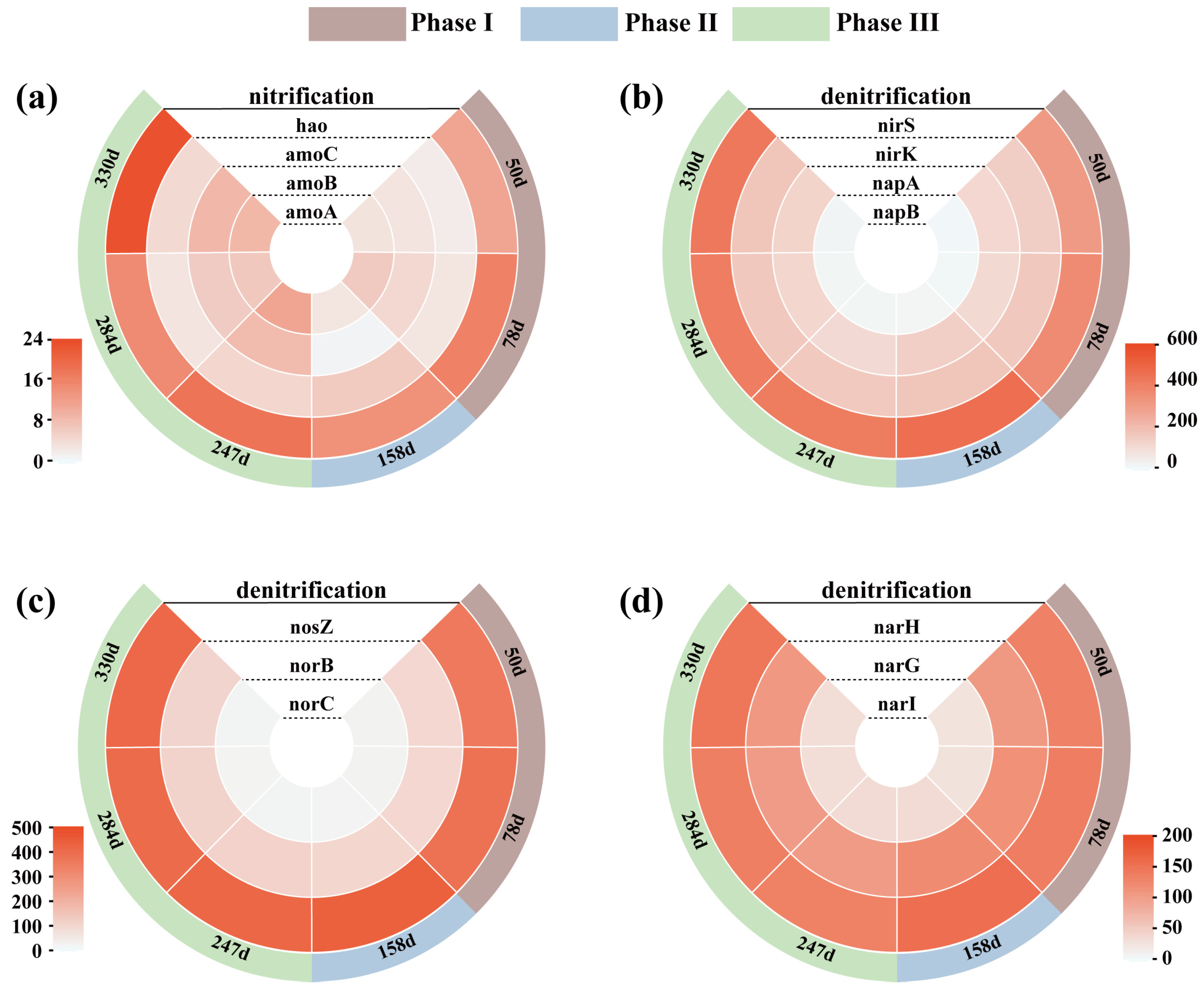
The functional potential of nitrogen transformation in the ASAO system was further evaluated by analyzing the abundance of key nitrogen cycling genes (Figure 6). As shown in Figure 6a, genes involved in nitrification, including amoA, amoB, amoC, and hao, exhibited relatively higher abundances during the later operational stages, suggesting an enhanced potential for ammonia oxidation in the system. The applied low DO level did not significantly inhibit nitrification activity. This may be attributed to the high oxygen affinity of ammonia–oxidizing microorganisms under oxygen–limited conditions [55].
For denitrification, genes involved in nitrate and nitrite reduction generally increased in Phase III, including nosZ, nirK, napA, and napB, while nirS exhibited a particularly pronounced increase (Figure 6b,d). Among them, napA and napB encode the periplasmic nitrate reductase that plays an important role in aerobic denitrification [56]. The nirK and nirS genes encode nitrite reductase, responsible for nitrite reduction during denitrification. The relatively high abundance of nir genes indicates a strong nitrite reduction potential, which may enable denitrifying microorganisms to sustain denitrification using intracellular carbon sources under carbon–limited conditions, thereby facilitating EnD [14]. In addition, the consistently high abundance of nosZ implied the potential for further reduction of N2O to N2 (Figure 6c). These results suggest that the AvN–based aeration strategy may have created favorable functional potential for multiple nitrogen transformation pathways, particularly aerobic denitrification and EnD, thereby enhancing nitrogen removal in the ASAO system. Future research integrating metatranscriptomic analysis, enzyme activity assays would further deepen the understanding of microbial activity and pathway contributions under AvN–regulated conditions.

3.6. Engineering Implications

Conventional plug–flow nitrogen removal processes generally rely on fixed DO control, whereas their effluent TN concentrations are still often limited under low influent C/N conditions [8]. The ASAO system introduces an AvN–regulated swing zone as a dynamic aeration control interface. Compared with previous studies on mainstream municipal wastewater treatment processes (Table S3), the AvN–controlled ASAO process showed practical engineering significance because it was operated under low influent C/N conditions without external carbon addition, while maintaining a moderate HRT and low–DO operation in the swing zone. Aeration has been reported to account for 50–70% of the total energy consumption in WWTPs in China [57]. The AvN strategy dynamically regulated blower frequency and valve opening according to the predicted balance between NH4+–N and NOx–N, allowing the system to avoid excessive nitrification and unnecessary aeration. Given these advantages, the AvN–controlled ASAO process shows promising potential for energy–saving and sustainable municipal wastewater treatment under low C/N conditions.

4. Conclusions

This study demonstrates that AvN–based aeration control in a pilot–scale ASAO system enables stable and efficient nitrogen removal from low C/N municipal wastewater, achieving average total nitrogen removal efficiencies of 80–85% and effluent concentrations of 4.9 ± 2.6 mg/L. By modulating aeration intensity and oxygen distribution, the AvN strategy suppressed excessive nitrification, preserved intracellular carbon reserves, and promoted synergistic interactions among multiple nitrogen removal pathways, including simultaneous nitrification–denitrification, endogenous denitrification, while potential anammox–related activity may have acted as an auxiliary nitrogen removal pathway. Microbial community analysis revealed the enrichment of key denitrifying taxa such as Thauera, Acidovorax, Azonexus, and Hydrogenophaga, which formed cooperative functional modules associated with nitrogen transformation. The upregulation of nitrogen cycling genes further corroborated the establishment of a multi–pathway nitrogen removal network. These findings highlight AvN control as an effective operational strategy for regulating nitrogen metabolism and microbial community assembly in advanced biological treatment systems. Future research integrating isotope tracing, functional gene quantification, and activity assays is warranted to elucidate the underlying synergistic mechanisms.

Supplementary Materials

The following supporting information can be downloaded at https://www.mdpi.com/article/10.3390/su18105020/s1, Text S1: Batch test procedures and conditions. Text S2: Control logic of the AvN–based intelligent aeration system. Table S1: Changes in nitrogen during the batch experiment. Table S2: Functional genes for pollutant removal and microbial functioning. Table S3: Comparison of different continuous plug–flow systems for low–C/N municipal wastewater treatment. Figure S1: Test results of the AvN prediction model for the five folds of cross–validation. Figure S2: Comparison of TN removal performance under different temperature conditions. Figure S3: Microbial community composition at phylum level. Figure S4: Actual photographs of the pilot–scale bioreactor used in this study. References [58,59,60,61] are cited in the Supplementary Materials.

Author Contributions

Data curation, J.-S.C. and K.S.; Writing—original draft, J.-S.C., K.S. and R.-Z.X.; Writing—review and editing, K.S. and R.-Z.X.; Visualization, J.-S.C., K.S. and R.-Z.X. All authors have read and agreed to the published version of the manuscript.

Funding

This research was funded by the National Natural Science Foundation of China (52400032), Natural Science Foundation of Jiangsu Province (BK2041534), China Postdoctoral Science Foundation (2024M750744 and 2025T180352), Jiangsu Funding Program for Excellent Postdoctoral Talent (2024ZB687). The authors acknowledge the support received from the foundation.

Data Availability Statement

The original contributions presented in this study are included in the article. Further inquiries can be directed to the corresponding author.

Conflicts of Interest

Author Jia-Shun Cao was employed by the company Guohe Environmental Research Institute (Nanjing) Co., Ltd. The remaining authors declare that the research was conducted in the absence of any commercial or financial relationships that could be construed as a potential conflict of interest.

Abbreviations

The following abbreviations are used in this manuscript:
ASAOAnaerobic–Swing–Anoxic–Oxic
AvNAmmonia versus Nitrate
AOAAnaerobic–Oxic–Anoxic
DODissolved Oxygen
TINTotal Inorganic Nitrogen
TPTotal Phosphorus
CODChemical Oxygen Demand
C/NCarbon–to–Nitrogen ratio
TNTotal Nitrogen
ORPOxidation–Reduction Potential
MLSSMixed Liquor Suspended Solids
HRTHydraulic Retention Time
PHAPolyhydroxyalkanoates
PHBPoly–3–hydroxybutyrate
PHVPoly–3–hydroxyvalerate
GlyGlycogen
SNDSimultaneous Nitrification–Denitrification
EnDEndogenous Denitrification
AOBAmmonia–Oxidizing Bacteria
DNDenitrifying Bacteria
SADSulfur–Autotrophic Denitrifying Bacteria
DGAODenitrifying Glycogen–Accumulating Organisms
PAOPolyphosphate–Accumulating Organisms
HNADHeterotrophic Nitrification–Aerobic Denitrification

References

  1. Abulimiti, A.; Wang, X.; Kang, J.; Li, L.; Wu, D.; Li, Z.; Piao, Y.; Ren, N. The trade–off between N2O emission and energy saving through aeration control based on dynamic simulation of full–scale WWTP. Water Res. 2022, 223, 118961. [Google Scholar] [CrossRef]
  2. Campo, R.; Sguanci, S.; Caffaz, S.; Mazzoli, L.; Ramazzotti, M.; Lubello, C.; Lotti, T. Efficient carbon, nitrogen and phosphorus removal from low C/N real domestic wastewater with aerobic granular sludge. Bioresour. Technol. 2020, 305, 122961. [Google Scholar] [CrossRef]
  3. Li, Y.; Gu, H.; Zhao, G.; Li, H.; Zhang, M.; Yang, X.-L.; Song, H.-L. Carbon accounting of A2O process based on carbon footprint in a full–scale municipal wastewater treatment plant. J. Water Process Eng. 2023, 55, 104162. [Google Scholar] [CrossRef]
  4. Zieliński, M.; Zielińska, M. Towards Energy Self–Sufficiency in Municipal Wastewater Treatment Plants. Energies 2026, 19, 1502. [Google Scholar] [CrossRef]
  5. Drewnowski, J.; Remiszewska–Skwarek, A.; Duda, S.; Łagód, G. Aeration Process in Bioreactors as the Main Energy Consumer in a Wastewater Treatment Plant. Review of Solutions and Methods of Process Optimization. Processes 2019, 7, 311. [Google Scholar] [CrossRef]
  6. Zhang, C.; Zhang, L.; Liu, J.; Li, X.; Zhang, Q.; Peng, Y. Achieving ultra–high nitrogen and phosphorus removal from real municipal wastewater in a novel continuous–flow anaerobic/aerobic/anoxic process via partial nitrification, endogenous denitrification and nitrite–type denitrifying phosphorus removal. Water Res. 2024, 250, 121046. [Google Scholar] [CrossRef] [PubMed]
  7. Lizarralde, I.; Fernández–Arévalo, T.; Beltrán, S.; Ayesa, E.; Grau, P. Validation of a multi–phase plant–wide model for the description of the aeration process in a WWTP. Water Res. 2018, 129, 305–318. [Google Scholar] [CrossRef]
  8. Gao, X.; Xue, X.; Li, L.; Peng, Y.; Yao, X.; Zhang, J.; Liu, W. Balance nitrogen and phosphorus efficient removal under carbon limitation in pilot–scale demonstration of a novel anaerobic/aerobic/anoxic process. Water Res. 2022, 223, 118991. [Google Scholar] [CrossRef] [PubMed]
  9. Bernat, K.; Wojnowska–Baryła, I.; Dobrzyńska, A. Denitrification with endogenous carbon source at low C/N and its effect on P(3HB) accumulation. Bioresour. Technol. 2008, 99, 2410–2418. [Google Scholar] [CrossRef]
  10. Wu, Y.; Peng, Z.; Wang, H.; Zhang, L.; Zeng, W.; Cao, Y.-A.; Liao, J.; Liang, Z.; Liang, Q.; Peng, Y. Hydraulic retention time optimization achieved unexpectedly high nitrogen removal rate in pilot–scale anaerobic/aerobic/anoxic system for low–strength municipal wastewater treatment. Bioresour. Technol. 2024, 393, 130128. [Google Scholar] [CrossRef]
  11. Xu, X.; Liu, G.; Zhu, L. Enhanced denitrifying phosphorous removal in a novel anaerobic/aerobic/anoxic (AOA) process with the diversion of internal carbon source. Bioresour. Technol. 2011, 102, 10340–10345. [Google Scholar] [CrossRef]
  12. Dan, Q.; Zhang, Q.; Wang, T.; Wang, H.; Peng, Y. Floc management enables integrated anammox and enhanced biological phosphorus removal for sustainable ultra–efficient nutrient removal. Nat. Water 2025, 3, 201–210. [Google Scholar] [CrossRef]
  13. Wang, T.; Zhang, Q.; Li, J.; Dan, Q.; Peng, Y. Unlocking the potential of anammox: Enhancing nitrogen removal in municipal wastewater through strategic nitrate introduction and microbial synergy. Bioresour. Technol. 2026, 441, 133523. [Google Scholar] [CrossRef]
  14. Liu, H.; Liu, J.; Zhang, L.; Wang, H.; Li, Y.; Chen, S.; Hou, Z.; Dong, W.; Peng, Y. Advanced N removal from low C/N sewage via a plug–flow anaerobic/oxic/anoxic (AOA) process: Intensification through partial nitrification, endogenous denitrification, partial denitrification, and anammox (PNEnD/A). Water Res. 2024, 267, 122452. [Google Scholar] [CrossRef]
  15. Lu, Z.; Cheng, X.; Xie, J.; Li, Z.; Li, X.; Jiang, X.; Zhu, D. Iron–based multi–carbon composite and Pseudomonas furukawaii ZS1 co–affect nitrogen removal, microbial community dynamics and metabolism pathways in low–temperature aquaculture wastewater. J. Environ. Manag. 2024, 349, 119471. [Google Scholar] [CrossRef] [PubMed]
  16. Ma, J.; Ji, Y.; Fu, Z.; Yan, X.; Xu, P.; Li, J.; Liu, L.; Bi, P.; Zhu, L.; Xu, B.; et al. Performance of anaerobic/oxic/anoxic simultaneous nitrification, denitrification and phosphorus removal system overwhelmingly dominated by Candidatus_Competibacter: Effect of aeration time. Bioresour. Technol. 2023, 384, 129312. [Google Scholar] [CrossRef]
  17. Ji, J.; Peng, Y.; Wang, B.; Wang, S. Achievement of high nitrite accumulation via endogenous partial denitrification (EPD). Bioresour. Technol. 2017, 224, 140–146. [Google Scholar] [CrossRef]
  18. Izadi, P.; Izadi, P.; Eldyasti, A. Evaluation of PAO adaptability to oxygen concentration change: Development of stable EBPR under stepwise low–aeration adaptation. Chemosphere 2022, 286, 131778. [Google Scholar] [CrossRef] [PubMed]
  19. Chen, S.; Liu, H. The role of pre–coagulation in wastewater nitrogen removal: Greenhouse gas emission reduction. J. Environ. Manag. 2025, 375, 124260. [Google Scholar] [CrossRef]
  20. Xu, R.-Z.; Cao, J.-S.; Luo, J.-Y.; Ni, B.-J.; Fang, F.; Liu, W.; Wang, P. Understanding nitrogen removal and N2O emission mechanisms in an anaerobic–swing–anoxic–oxic (ASAO) continuous plug–flow system for low C/N municipal wastewater. Sci. Total Environ. 2024, 955, 177041. [Google Scholar] [CrossRef] [PubMed]
  21. Xu, R.-Z.; Cao, J.-S.; Cheng, S.; Luo, J.-Y.; Ni, B.-J.; Fang, F.; Liu, W.; Wang, P. Heterotrophic nitrification–aerobic denitrification strains: An overlooked microbial interaction nexus in the anaerobic–swing–anoxic–oxic (ASAO) plug–flow system. J. Environ. Manag. 2025, 380, 125030. [Google Scholar] [CrossRef]
  22. Cao, J.; Wang, J.; Xu, R. Mainstream Wastewater Treatment Process Based on Multi–Nitrogen Removal Under New Anaerobic–Swing–Anoxic–Oxic Model. Water 2025, 17, 1548. [Google Scholar] [CrossRef]
  23. Jimenez, J.; Regmi, P.; Sturm, B.; Miller, M. Kinetic Considerations for Metabolic Selectors Design for Process Intensification. In Proceedings of the WEFTEC 2020, New Orleans, LA, USA, 5–9 October, 2020. [Google Scholar]
  24. Fofana, R.; Parsons, M.; Long, C.; Chandran, K.; Jones, K.; Klaus, S.; Trovato, B.; Wilson, C.; De Clippeleir, H.; Bott, C. Full–scale transition from denitrification to partial denitrification–anammox (PdNA) in deep–bed filters: Operational strategies for and benefits of PdNA implementation. Water Environ. Res. 2022, 94, e10727. [Google Scholar] [CrossRef]
  25. Regmi, P.; Miller, M.W.; Holgate, B.; Bunce, R.; Park, H.; Chandran, K.; Wett, B.; Murthy, S.; Bott, C.B. Control of aeration, aerobic SRT and COD input for mainstream nitritation/denitritation. Water Res. 2014, 57, 162–171. [Google Scholar] [CrossRef]
  26. Zhang, X.; Li, J. Advancements and challenges of high–speed active flow control: Plasma actuators. Int. J. Heat. Mass. Transf. 2025, 252, 127481. [Google Scholar] [CrossRef]
  27. Wett, B.; Rauch, W. The role of inorganic carbon limitation in biological nitrogen removal of extremely ammonia concentrated wastewater. Water Res. 2003, 37, 1100–1110. [Google Scholar] [CrossRef]
  28. Wang, F.; Cui, Q.; Liu, W.; Jiang, W.; Ai, S.; Liu, W.; Bian, D. Synergistic denitrification mechanism of domesticated aerobic denitrifying bacteria in low–temperature municipal wastewater treatment. npj Clean. Water 2024, 7, 6. [Google Scholar] [CrossRef]
  29. APHA. Standard Methods for the Examination of Water and Wastewater; American Public Health Association: Washington, DC, USA, 2012. [Google Scholar]
  30. Rong, H.; He, L.; Li, N.; Wang, Z.; Kou, S. Technical research on surrounding rock control of roadways crossing collapse columns in strong mine pressure working faces. Sci. Rep. 2025, 15, 31905. [Google Scholar] [CrossRef] [PubMed]
  31. Oehmen, A.; Zeng, R.J.; Yuan, Z.; Keller, J. Anaerobic metabolism of propionate by polyphosphate–accumulating organisms in enhanced biological phosphorus removal systems. Biotechnol. Bioeng. 2005, 91, 43–53. [Google Scholar] [CrossRef]
  32. Zeng, R.J.; van Loosdrecht, M.C.M.; Yuan, Z.; Keller, J. Metabolic model for glycogen–accumulating organisms in anaerobic/aerobic activated sludge systems. Biotechnol. Bioeng. 2003, 81, 92–105. [Google Scholar] [CrossRef] [PubMed]
  33. Jiang, Z.; Xia, Z.; Liu, S.; Wei, Q.; Fan, H.; Qi, L.; Liu, G.; Wang, H. The effect of fine grits and fine debris concentrations on the MLVSS/MLSS ratio of an activated sludge system. J. Environ. Sci. 2025, 147, 607–616. [Google Scholar] [CrossRef]
  34. Dai, J.; Feng, J.; Wang, W.; Zhang, X.; Gong, Z.; He, Y.; Wu, X.; Li, J. Successful control of low–temperature sludge bulking in a WWTP by installing iron–carbon polyurethane packing in the return–sludge channel. Water Res. 2026, 125992. [Google Scholar] [CrossRef]
  35. Li, Y.; Liu, S.; Lu, L.; Wang, J.; Huang, G.; Chen, F.; Zuo, J.-E. Non–uniform dissolved oxygen distribution and high sludge concentration enhance simultaneous nitrification and denitrification in a novel air–lifting reactor for municipal wastewater treatment: A pilot–scale study. Bioresour. Technol. 2023, 384, 129306. [Google Scholar] [CrossRef]
  36. Ding, J.; Gao, X.; Peng, Y.; Peng, Y.; Zhang, Q.; Li, X.; Wang, S. Anaerobic duration optimization improves endogenous denitrification efficiency by glycogen accumulating organisms enhancement. Bioresour. Technol. 2022, 348, 126730. [Google Scholar] [CrossRef]
  37. Lopez–Vazquez, C.M.; Song, Y.-I.; Hooijmans, C.M.; Brdjanovic, D.; Moussa, M.S.; Gijzen, H.J.; van Loosdrecht, M.M.C. Short–term temperature effects on the anaerobic metabolism of glycogen accumulating organisms. Biotechnol. Bioeng. 2007, 97, 483–495. [Google Scholar] [CrossRef]
  38. Ren, S.; Liu, Y.; He, Y.; Zhu, T.; Chen, X.; Liu, Y. Mathematical modeling of the dynamic effect of denitrifying glycogen–accumulating organisms on nitrous oxide production during denitrifying phosphorus removal. Chem. Eng. J. 2023, 453, 139802. [Google Scholar] [CrossRef]
  39. Monday, C.; Zaghloul, M.S.; Krishnamurthy, D.; Achari, G. Incremental machine learning and genetic algorithm for optimization and dynamic aeration control in wastewater treatment plants. J. Water Process Eng. 2025, 69, 106600. [Google Scholar] [CrossRef]
  40. Dan, Q.; Du, R.; Wang, T.; Sun, T.; Li, X.; Zhang, Q.; Peng, Y. Endogenous partial denitritation as an efficient remediation to unstable partial nitritation–anammox (PNA) process: Bacteria enrichment and superior robustness. Chem. Eng. J. 2023, 454, 140481. [Google Scholar] [CrossRef]
  41. Xu, Z.; Zhang, L.; Gao, X.; Peng, Y. Optimization of the intermittent aeration to improve the stability and flexibility of a mainstream hybrid partial nitrification–anammox system. Chemosphere 2020, 261, 127670. [Google Scholar] [CrossRef]
  42. Dan, Q.; Du, R.; Wang, T.; Sun, T.; Han, H.; Zhu, X.; Li, X.; Zhang, Q.; Peng, Y. Complete nitrogen removal from low–strength wastewater via double nitrite shunt coupling anammox and endogenous nitrate respiration: Functional metabolism and electron transport. Chem. Eng. J. 2023, 465, 143027. [Google Scholar] [CrossRef]
  43. Ren, T.; Chi, Y.; Wang, Y.; Shi, X.; Jin, X.; Jin, P. Diversified metabolism makes novel Thauera strain highly competitive in low carbon wastewater treatment. Water Res. 2021, 206, 117742. [Google Scholar] [CrossRef]
  44. Reid, D.; Craft, J.; Escudero, A.; Hunter, C.; Spencer, J. Biofilm and Wastewater Dynamics in an activated–sludge process in the UK: Insights into microbiome composition, metabolic activity, and antimicrobial resistance using 16S rRNA sequencing. Total Environ. Microbiol. 2025, 1, 100046. [Google Scholar] [CrossRef]
  45. McIlroy, S.J.; Albertsen, M.; Andresen, E.K.; Saunders, A.M.; Kristiansen, R.; Stokholm–Bjerregaard, M.; Nielsen, K.L.; Nielsen, P.H. ‘Candidatus Competibacter’–lineage genomes retrieved from metagenomes reveal functional metabolic diversity. ISME J. 2014, 8, 613–624. [Google Scholar] [CrossRef] [PubMed]
  46. Zheng, Z.; Liao, C.; Chen, Y.; Ming, T.; Jiao, L.; Kong, F.; Su, X.; Xu, J. Revealing the functional potential of microbial community of activated sludge for treating tuna processing wastewater through metagenomic analysis. Front. Microbiol. 2024, 15, 1430199. [Google Scholar] [CrossRef]
  47. Wang, Q.; He, J. Complete nitrogen removal via simultaneous nitrification and denitrification by a novel phosphate accumulating Thauera sp. strain SND5. Water Res. 2020, 185, 116300. [Google Scholar] [CrossRef]
  48. Fei, Y.; Zhang, B.; Zhang, Q.; Chen, D.; Cao, W.; Borthwick, A.G.L. Multiple pathways of vanadate reduction and denitrification mediated by denitrifying bacterium Acidovorax sp. strain BoFeN1. Water Res. 2024, 257, 121747. [Google Scholar] [CrossRef] [PubMed]
  49. James, S.N.; Vijayanandan, A. Recent advances in simultaneous nitrification and denitrification for nitrogen and micropollutant removal: A review. Biodegradation 2023, 34, 103–123. [Google Scholar] [CrossRef]
  50. Ma, Z.-S.; Zhang, H.-M.; Ma, W.-J.; Liu, N.-Y.; Yu, X.-C. Advanced total nitrogen removal in low C/N wastewater through simultaneous nitrification–heterotrophic denitrification coupled with sulfur–driven autotrophic denitrification: Performance and microbial succession. Environ. Res. 2025, 286, 122839. [Google Scholar] [CrossRef]
  51. Zhao, Q.; Chen, K.; Li, J.; Sun, S.; Jia, T.; Huang, Y.; Peng, Y.; Zhang, L. Pilot–scale evaluation of partial denitrification/anammox on nitrogen removal from low COD/N real sewage based on a modified process. Bioresour. Technol. 2021, 338, 125580. [Google Scholar] [CrossRef] [PubMed]
  52. Czatzkowska, M.; Rolbiecki, D.; Zaborowska, M.; Bernat, K.; Korzeniewska, E.; Harnisz, M. The influence of combined treatment of municipal wastewater and landfill leachate on the spread of antibiotic resistance in the environment—A preliminary case study. J. Environ. Manag. 2023, 347, 119053. [Google Scholar] [CrossRef]
  53. Liu, J.; Huang, J.; Li, W.; Shi, Z.; Lin, Y.; Zhou, R.; Meng, J.; Tang, J.; Hou, P. Coupled process of in–situ sludge fermentation and riboflavin–mediated nitrogen removal for low carbon wastewater treatment. Bioresour. Technol. 2022, 363, 127928. [Google Scholar] [CrossRef] [PubMed]
  54. Zheng, S.; Liu, X.; Yang, X.; Zhou, H.; Fang, J.; Gong, S.; Yang, J.; Chen, J.; Lu, T.; Zeng, M.; et al. The nitrogen removal performance and microbial community on mixotrophic denitrification process. Bioresour. Technol. 2022, 363, 127901. [Google Scholar] [CrossRef] [PubMed]
  55. Wang, R.; Liu, J.; Zhang, Q.; Li, X.; Wang, S.; Peng, Y. Robustness of the anammox process at low temperatures and low dissolved oxygen for low C/N municipal wastewater treatment. Water Res. 2024, 252, 121209. [Google Scholar] [CrossRef]
  56. Hu, B.; Lu, J.; Qin, Y.; Zhou, M.; Tan, Y.; Wu, P.; Zhao, J. A critical review of heterotrophic nitrification and aerobic denitrification process: Influencing factors and mechanisms. J. Water Process Eng. 2023, 54, 103995. [Google Scholar] [CrossRef]
  57. Yang, L.; Zeng, S.; Chen, J.; He, M.; Yang, W. Operational energy performance assessment system of municipal wastewater treatment plants. Water Sci. Technol. 2010, 62, 1361–1370. [Google Scholar] [CrossRef]
  58. Gao, R.; Peng, Y.; Li, J.; Li, X.; Zhang, Q.; Deng, L.; Li, W.; Kao, C. Nutrients removal from low C/N actual municipal wastewater by partial nitritation/anammox (PN/A) coupling with a step-feed anaerobic-anoxic-oxic (A/A/O) system. Sci. Total Environ. 2021, 799, 149293. [Google Scholar] [CrossRef]
  59. Jiang, C.; Xu, S.; Wang, R.; Feng, S.; Zhou, S.; Wu, S.; Zeng, X.; Wu, S.; Bai, Z.; Zhuang, G.; et al. Achieving efficient nitrogen removal from real sewage via nitrite pathway in a continuous nitrogen removal process by combining free nitrous acid sludge treatment and DO control. Water Res. 2019, 161, 590–600. [Google Scholar] [CrossRef]
  60. Zeng, W.; Li, L.; Yang, Y.; Wang, S.; Peng, Y. Nitritation and denitritation of domestic wastewater using a continuous anaerobic-anoxic-aerobic (A(2)O) process at ambient temperatures. Bioresour. Technol. 2010, 101, 8074–8082. [Google Scholar] [CrossRef]
  61. Wang, Z.; Peng, Y.; Li, J.; Liu, J.; Zhang, Q.; Li, X.; Zhang, L. Rapid initiation and stable maintenance of municipal wastewater nitritation during the continuous flow anaerobic/oxic process with an ultra-low sludge retention time. Water Res. 2021, 197, 117091. [Google Scholar] [CrossRef]
Figure 1. Schematic diagram of the pilot ASAO reactor. The bioreactor included anaerobic, swing, anoxic, and oxic zones, which were mainly responsible for phosphorus release and carbon storage, AvN–regulated oxygen–limited nitrification, denitrification–related conversion, and final COD and nitrogen removal.
Sustainability 18 05020 g001
Figure 2. Long–term operational performance of the pilot–scale ASAO reactor under different phases: (a) Total nitrogen (TN) removal efficiency; (b) NH4+–N removal efficiency; (c) COD removal efficiency, and influent C/N conditions.
Sustainability 18 05020 g002
Figure 3. Variation in nutrients and intracellular carbon sources along the ASAO reactor. An1 and An2, the first and second anaerobic zones; S(O), the swing zone; Ano1 and Ano2, the first and second anoxic zones; O, the oxic zone. (a) Nitrogen profiles in Phase II; (b) Nitrogen profiles in Phase III; (c) PHAs and glycogen profiles in Phase II; (d) PHAs and glycogen profiles in Phase III.
Sustainability 18 05020 g003
Figure 4. (a) Microbial communities on genus level, (b) a phylogenetic tree at genus level based on maximum likelihood method, (c) Venn diagram at the genus level under different phases, (d) the relative abundances of genera Candidatus Anammoximicrobium in all phases.
Sustainability 18 05020 g004
Figure 5. (a) Mantel test between microorganisms and environmental factors. The correlation between microorganisms was calculated by Pearson correlation. Single and double asterisks (* and **) indicate significant Pearson’s correlations at p < 0.05 and p < 0.01, respectively. (b) Co–occurrence network visualizing the correlations among microorganisms in all samples of the ASAO system (Spearman’s correlation coefficient > 0.6) and significant (p < 0.05).
Sustainability 18 05020 g005
Figure 6. The varying metabolic potential of microbial communities in the ASAO system. (a) The abundance of nitrification genes; (bd) the abundance of denitrification genes.
Sustainability 18 05020 g006
Table 1. Characteristics of municipal wastewater in each phase of the pilot–scale system.
Experimental PhasesCOD/TNCOD
(mg/L)
NH4+–N
(mg/L)
TN
(mg/L)
TP
(mg/L)
Temp
(°C)
Startup Period (0–37 d)6.7 ± 0.8172.1 ± 34.520.6 ± 2.725.9 ± 3.92.5 ± 0.731.2 ± 0.7
Phase I (37–95 d)7.6 ± 1.0180.5 ± 43.521.7 ± 1.224.2 ± 1.72.5 ± 0.627.8 ± 1.5
Phase II (95–208 d)5.3 ± 1.0151.0 ± 14.824.1 ± 5.628.8 ± 5.12.6 ± 0.717.8 ± 6.3
Phase III (208–350 d)4.6 ± 1.9122.4 ± 9.421.5 ± 3.625.7 ± 5.02.1 ± 1.024.3 ± 3.3
Table 2. Operation conditions of the pilot ASAO reactors.
Time (Days)Volume RatioDO Level in the Swing Zone (mg/L)SRT (d)HRT (h)
Startup Period (0–37 d)1:2:2:1
2:1:2:1
1:2:3:0
2.0–4.0>50 d10–20 h
Phase I (37–95 d)1:2:2:12.0–4.0≈40 d12–16 h
Phase II (95–208 d)2:1:2:12.0–4.0≈30 d12–16 h
Phase III (208–350 d)2:1:2:10.5–1.5≈40 d12–16 h
Table 3. Sludge characteristics during different operational phases.
Time (Days)MLSS (g/L)MLVSS (g/L)MLVSS/MLSSSVI (mL/g)
Startup Period (0–37 d)3.12 ± 0.511.81 ± 0.210.5863
Phase I (37–95 d)4.11 ± 1.342.01 ± 0.980.5678
Phase II (95–208 d)4.78 ± 2.122.98 ± 1.320.69125
Phase III (208–350 d)4.02 ± 2.023.02 ± 1.730.7482
Table 4. Specific total inorganic nitrogen (TIN) removal rates of different nitrogen transformation pathways during batch tests.
ParametersEnDSNDAnammox
Phase I−0.87−0.52−0.12
Phase II−1.45−0.35−0.21
Phase III−1.12−0.79−0.49
Unit: rTN, mg N/gVSS·h.
Disclaimer/Publisher’s Note: The statements, opinions and data contained in all publications are solely those of the individual author(s) and contributor(s) and not of MDPI and/or the editor(s). MDPI and/or the editor(s) disclaim responsibility for any injury to people or property resulting from any ideas, methods, instructions or products referred to in the content.