Article

A Sustainable Approach to Hydrogen Production: Sonochemical-Assisted Synthesis of CoFe2O4 Nanoparticles for Use as Electrocatalysts in Water Electrolysis


by
Nayuca A. Bampoky
1,2,
Samuel L. S. Medeiros
1,
Claver G. S. Pinheiro
3,*,
Igor F. Vasconcelos
1,2 and
Luís P. M. Santos
2,4,*
1
Department of Metallurgical and Materials Engineering, Universidade Federal do Ceará, Fortaleza 60440-900, CE, Brazil
2
Graduate Program in Materials Science and Engineering, Universidade Federal do Ceará, Fortaleza 60440-900, CE, Brazil
3
Department of Hydraulic and Environmental Engineering, Universidade Federal do Ceará, Fortaleza 60440-900, CE, Brazil
4
Russas Campus, Universidade Federal do Ceará, Russas 62900-420, CE, Brazil
*
Authors to whom correspondence should be addressed.
Sustainability 2026, 18(10), 5022; https://doi.org/10.3390/su18105022 (registering DOI)
Submission received: 16 September 2025 / Revised: 9 May 2026 / Accepted: 12 May 2026 / Published: 16 May 2026
(This article belongs to the Section Sustainable Materials)

Abstract

The quest for sustainable hydrogen production via water electrolysis requires the development of efficient, non-precious-metal electrocatalysts. This work presents the sonochemical-assisted synthesis of cobalt ferrite (CoFe2O4) nanoparticles as a sustainable alternative to noble metal catalysts. Nanoparticles were synthesized by varying the ultrasonic tip power (40%, 50%, and 60%) to investigate the this effect on their structural and electrochemical properties. Comprehensive characterization using X-ray diffraction, Mössbauer spectroscopy, and transmission electron microscopy confirmed the formation of phase-pure nanoscale spinel structures, with crystallite size increasing from 11.28 to 21.79 nm as the sonication power increased. Electrochemical analysis revealed that the sample synthesized at 60% power (CoFe2O4-60) exhibited the highest electrocatalytic performance among the synthesized samples for both the hydrogen and oxygen evolution reactions (HER and OER) in alkaline media. This superior performance is attributed to its largest electrochemically active surface area (ECSA = 6.95 cm2) and lowest overpotentials ( η 10 = 360 mV for HER and 410 mV for OER). Despite the larger crystallite size, high-power sonication induced higher density of surface defects and roughness, as evidenced by Mössbauer spectroscopy and electrochemical capacitance measurements. Furthermore, all samples exhibited excellent operational stability during 120 h of chronopotentiometric testing. Moreover, the efficiency of the electrolizer for water splitting was calculated to be 64.7%. These findings demonstrate that ultrasonic power tuning can influence the structural and electrochemical properties of CoFe2O4 nanoparticles, contributing to improving durability and bifunctional efficient electrocatalytic activity for alkaline water electrolysis.

1. Introduction

Fossil fuel consumption remains a leading contributor to atmospheric greenhouse gas emissions, which in turn drive changes in the planet’s climate. This link has been underscored by the increasing frequency of extreme weather events, which have caused significant disruption and disasters across multiple continents, and according to the 2023 British Petroleum Outlook, coal, natural gas, and petroleum together supplied 82% of the global energy demand [1]. That same year marked the highest average global temperature on record [2], prompting widespread international negotiations to limit global warming to well below 2 °C above pre-industrial levels, with an aspirational target of 1.5 °C by century’s end [3]. This target is considered vital to maintaining the stability of Earth’s environmental systems. Beyond temperature increases, air pollution from fossil fuels poses serious risks to public health, with emissions from sources such as coal-fired plants and diesel vehicles being linked to respiratory and cardiovascular illnesses, cancers, diabetes, neurological disorders, pregnancy complications, and heightened susceptibility to infectious diseases. Shifts in rainfall patterns due to climate change further threaten food security and ecosystem integrity, as some regions face severe droughts while others confront excessive rainfall [4].
Nuclear power has long been viewed as a potential cornerstone of the global energy landscape. While nuclear technology offers a potential solution for decarbonizing large economies, its broader adoption is hindered by ongoing debates over the management of radioactive waste and the associated risks [5]. These concerns have been amplified by notable nuclear incidents at Three Mile Island (1979, USA), Chernobyl (1986, Ukraine), and Fukushima (2011, Japan).
Thus, shifting the world’s energy system toward cleaner sources is essential to a sustainable future [6]. Renewable options such as solar and wind energy are promising, but each has its own set of challenges. Solar technologies face challenges related to efficiency, cost, material availability, durability, environmental concerns, and scalability for widespread deployment [7]. Wind power also faces hurdles, including maintaining long-term stability, developing infrastructure, manufacturing components, securing skilled labor, and navigating policy frameworks [8,9].
In this context, molecular hydrogen (H2) is recognized as a promising energy carrier with the potential to replace fossil fuels in residential heating, transportation, and industrial applications. H2 offers advantages over conventional fuels, notably its higher gravimetric energy density [10] and its ability to produce only water vapor when consumed [11]. There are multiple methods for generating hydrogen, ranging from conventional, non-renewable pathways to sustainable alternatives—currently, steam reforming accounts for approximately 96% of industrial hydrogen production [12,13]. Nonetheless, for hydrogen to serve as a genuinely sustainable energy vector, its production must rely on renewable feedstocks and energy sources. Among available technologies, electrochemical water splitting powered by renewable electricity is the most promising route to enable a sustainable energy transition [13].
Water electrolysis involves splitting water molecules (H2O) into hydrogen and oxygen gases by applying an electric current to electrodes, with hydrogen generated at the cathode and oxygen at the anode. This method enables the production of high-purity hydrogen without directly emitting greenhouse gases. The overall efficiency of this process is closely tied to the electrocatalytic properties of the electrode materials used. Precious metals such as platinum, ruthenium, and iridium serve as benchmarks for the hydrogen and oxygen evolution reactions (HER and OER). However, these noble metals are both rare and expensive, limiting their feasibility for widespread industrial use [14]. As a result, ongoing research is developing alternative electrocatalysts that are cost-effective, abundant, stable, and environmentally benign. Transition-metal-based materials, particularly oxides of elements like manganese, nickel, and cobalt, have emerged as promising candidates [1].
Advances in the design and synthesis of materials with superior electrocatalytic properties are crucial to the future of sustainable energy. Spinel ferrites, a family of transition-metal oxides, have demonstrated notable versatility and promise in this regard [15]. For instance, nanostructured nickel ferrite (NiFe2O4) has been developed as an effective catalyst for water splitting. Chanda et al. [16] showed that NiFe2O4 nanoparticles exhibit strong stability and catalytic activity at 125 mA cm−2 and a cell potential of 1.85 V. Hwang et al. [17] further reported that NiFe2O4 incorporated into coin electrodes with either polyethylene glycol (PEG) or styrene butadiene rubber (SBR) as binders is suitable for use in alkaline electrolytes, yielding OER and HER potentials of 1.57 V and 2.20 V at 0.41 mA cm−2, respectively. Zinc ferrite (ZnFe2O4), though less extensively studied for water electrolysis, has also shown efficacy in the OER. Li et al. [18] produced ZnFe2O4 microspheres with a yolk–shell architecture, achieving an overpotential of 280 mV at 10 mA cm−2 and a Tafel slope of 70 mV dec−1. Similarly, Hu et al. [19] anchored ZnFe2O4 nanoparticles onto nitrogen-doped graphene, resulting in an OER overpotential of 240 mV at 10 mA cm−2 and a Tafel slope of 63.5 mV dec−1—values that are superior to those of benchmark IrO2 under alkaline conditions. These findings underscore the potential of such materials for OER applications.
Cobalt ferrite (CoFe2O4) nanoparticles are of particular interest due to their chemical robustness, magnetic properties, and catalytic efficiency. Achieving optimized electrocatalytic performance requires synthesizing CoFe2O4 with carefully controlled morphology and high surface area. Huerta-Flores et al. [20] found that the water-splitting efficiency and hydrogen output of CoFe2O4 nanoparticles are closely linked to their physicochemical characteristics, with the highest H2 yield being observed for a Co/Fe ratio of 0.5 and minimal spinel inversion. Guo et al. [21] used surface defect engineering to produce CoFe2O4 nanosheets that demonstrated bifunctional water electrolysis activity, with overpotentials of 280 mV for the OER and 121 mV for the HER at a current density of 10 mA/cm2, and an overall water-splitting voltage of 1.53 V. Electrochemical methods have also enabled the fabrication of high-performing CoFe2O4 films for water splitting. For example, Zhang et al. [22] electrodeposited nanostructured CoFe2O4 onto Ni-foam, resulting in a 270 mV overpotential at 10 mA/cm2 and a Tafel slope of 31 mV/dec. Similarly, Sayeed and O’Mullane [23] electrodeposited Fe-Co oxide-based materials under a potential of −0.8 V (vs. Ag/AgCl) for durations between 1 and 60 s. Their material exhibited a high current density of 600 mA/cm2 at 1.6 V (vs. RHE) in 1 M NaOH, with a Tafel slope of 48 mV/dec for the OER. Although the catalyst was largely amorphous, crystalline CoFe2O4 domains became more prominent after OER cycling. In addition, sonochemical approaches have been investigated for their ability to precisely control particle size and distribution while also minimizing reaction time and energy input [24,25]. The use of ultrasonic irradiation enhances particle fragmentation and promotes the formation of micro- and nanostructured surfaces, increasing both porosity and roughness—features that are highly desirable for electrocatalytic applications [26,27].
In this work, we address the urgent need for clean energy solutions by proposing the sonochemical synthesis of CoFe2O4 nanoparticles for application as electrocatalysts in water electrolysis. The nanoparticles were synthesized using an ultrasound-assisted approach, varying the ultrasonic tip power (40%, 50%, and 60% of the maximum power). We present a comprehensive characterization of the synthesized materials using X-ray diffraction (XRD), ultraviolet–visible spectroscopy (UV–vis), Fourier transform infrared spectroscopy (FTIR), Raman spectroscopy, Mössbauer spectroscopy, transmission electron microscopy (TEM) and electrochemical analyses. Our results indicate that increasing the sonochemical power influences the structural and electrochemical characteristics of the synthesized CoFe2O4 nanoparticles. Specifically, the sample synthesized at 60% power (CoFe2O4-60) exhibited the best performance, displaying a larger electrochemically active surface area (ECSA) and superior electrocatalytic activity for both the HER and OER. The improved electroactivity response observed for CoFe2O4-60 is associated with surface morphology, roughness, and surface defect density induced by higher sonochemical power. Furthermore, the synthesized CoFe2O4 nanoparticles showed excellent operational stability and durability, highlighting their significant potential as efficient electrocatalysts for sustainable hydrogen production via water electrolysis.

2. Materials and Methods

2.1. Materials

The following chemicals were used without further purification: Co(NO3)2 · 6H2O (Êxodo Científico, Sumaré, SP, Brazil), FeCl 3 · 6H2O (Sigma-Aldrich, St. Louis, MO, USA), NaOH (Neon, Suzano, SP, Brazil), Nafion (10 wt%) (C7HF13O5S·C2F4, Sigma-Aldrich), and ethanol (C2H6O, Neon, Suzano, SP, Brazil).

2.2. Synthesis of CoFe2O4 Nanoparticles

CoFe2O4 nanoparticles were produced via a modified sonochemical-assisted method based on Andrade-Neto et al. [28]. In summary, 4 mmol of Co(NO3)2 · 6H2O and 7 mmol of FeCl 3 · 6H2O were dissolved in 15 mL of distilled water and stirred continuously. This solution was sonicated for 4 min using an ultrasound probe (Hielscher UI1500hd, Hielscher Ultrasonics GmbH, Teltow, Germany, 150 W max power) with 10-s on–off cycles, forming an orange mixture. Next, 10 mL of 3.0 mol·L−1 NaOH was gradually added at 0.2 mL·s−1 under ongoing sonication. The appearance of a black color signaled nanoparticle formation. The sonochemical process lasted 12 min. The final black suspension was centrifuged at 3600 rpm, washed three times with water and ethanol, and then dried at 80 °C for 12 h. Only the ultrasound probe’s tip power was varied to obtain samples designated CoFe2O4-40, CoFe2O4-50, and CoFe2O4-60, corresponding to 40%, 50%, and 60% of the maximum tip power, respectively.

2.3. Characterization

XRD was used to determine the crystal structure of the synthesized samples. Analyses were carried out with a Bruker D8 Advance diffractometer equipped with a Cu-Kα source ( λ = 0.15406 nm) at 40 kV and 40 mA (Bruker AXS GmbH, Karlsruhe, Germany). The measurements were taken with a step size of 0.031° and a scan step time of 96. The resulting diffraction patterns were matched to entries in the Inorganic Crystal Structure Database (ICSD) for phase identification. UV–vis absorption spectra were collected within the 200–900 nm range on a Shimadzu UV-2600 spectrophotometer, utilizing an ISR-2600 Plus integrating sphere in diffuse reflectance mode (Shimadzu Corporation, Kyoto, Japan). The Kubelka–Munk (KM) function [29] was applied to transform the reflectance data into absorption values. Room-temperature Mössbauer spectroscopy measurements were performed using a FAST (ConTec) instrument in transmission mode (Contec Medical Systems Co., Ltd., Qinhuangdao, Hebei, China), employing a 57Co source embedded in a Rh matrix. Spectral analysis was carried out with NORMOS software, version 95 (Wissenschaftliche Elektronik GmbH, Starnberg, Germany), and isomer shift ( δ ) values are referenced to α -Fe at room temperature.
FTIR spectra were obtained using KBr pellet samples on a Shimadzu 8300 spectrophotometer (Shimadzu Corporation, Kyoto, Japan), covering the 4000–400 cm−1 range with a 2 cm−1 resolution.
Raman spectral data were collected with a Horiba Jobin-Yvon T64000 system fitted with a CCD detector (HORIBA Europe GmbH, Oberursel, Germany), using a 514.5 nm excitation laser at 1 mW power under ambient conditions.
Electron microscopy, selected-area electron diffraction (SAED), and energy-dispersive X-ray spectroscopy (EDS) were performed using a Thermo Fisher Scientific Talos F200X G2 scanning transmission electron microscope (STEM) operated at 200 kV (Thermo Fisher Scientific GmbH, Dreieich, Germany). High-angle annular dark-field (HAADF) STEM imaging, combined with EDS using four in-column Super-X silicon drift detectors, provided detailed nanoscale structural and compositional analysis. Particle size distributions were assessed by analyzing more than 100 nanoparticles from TEM images, and histograms were generated using ImageJ, version 1.x.For transmission electron microscopy, samples were dispersed in ultrapure water and subjected to an ultrasonic bath for about 30 min to ensure thorough dispersion, followed by stepwise dilution to achieve optimal particle distribution on the grids.
Electrochemical measurements were conducted under ambient conditions using a three-electrode configuration and an AUTOLAB PGSTAT30 potentiostat/galvanostat (Metrohm-Eco Chemie, Utrecht, The Netherlands) operated via NOVA software (v.2.1). The working electrode consisted of a glassy carbon disk (0.07068 cm2) coated with CoFe2O4 samples. A platinum plate was employed as the counter electrode, while the reference was a Ag ( s ) |   AgCl ( s ) | Cl electrode (saturated KCl). All recorded potentials were recalculated to the reversible hydrogen electrode (RHE) scale using the Nernst relationship:
E RHE = E a + 0.059 × pH + E Ag | AgCl | Cl ( 0.197 V )
with E a denoting the applied potential. Linear-sweep voltammetry measurements were carried out in 1.0 mol·L−1 NaOH at room temperature, scanning from 0.1 to −0.6 V versus the RHE at a rate of 5 mV·s−1 [30]. No correction for the i R drop was applied to the polarization data.
The catalyst ink was formulated by mixing 0.9 mg of CoFe2O4 and 0.1 mg of carbon black with 950 μL of ethanol and 50 μL of a 5 wt% Nafion solution, followed by 30 min of sonication to ensure uniform dispersion. This suspension was applied to the glassy carbon electrode (GCE) (∼10 μL) using the drop-casting technique and allowed to dry at ambient temperature [31,32].
Before modification, the GCE surface was prepared by sanding it with 1200-grit sandpaper, rinsing it in distilled water, and polishing it with 1 μm diamond paste. The electrode was subsequently rinsed once more with distilled water and air-dried.

3. Results and Discussion

3.1. Physical Characterization

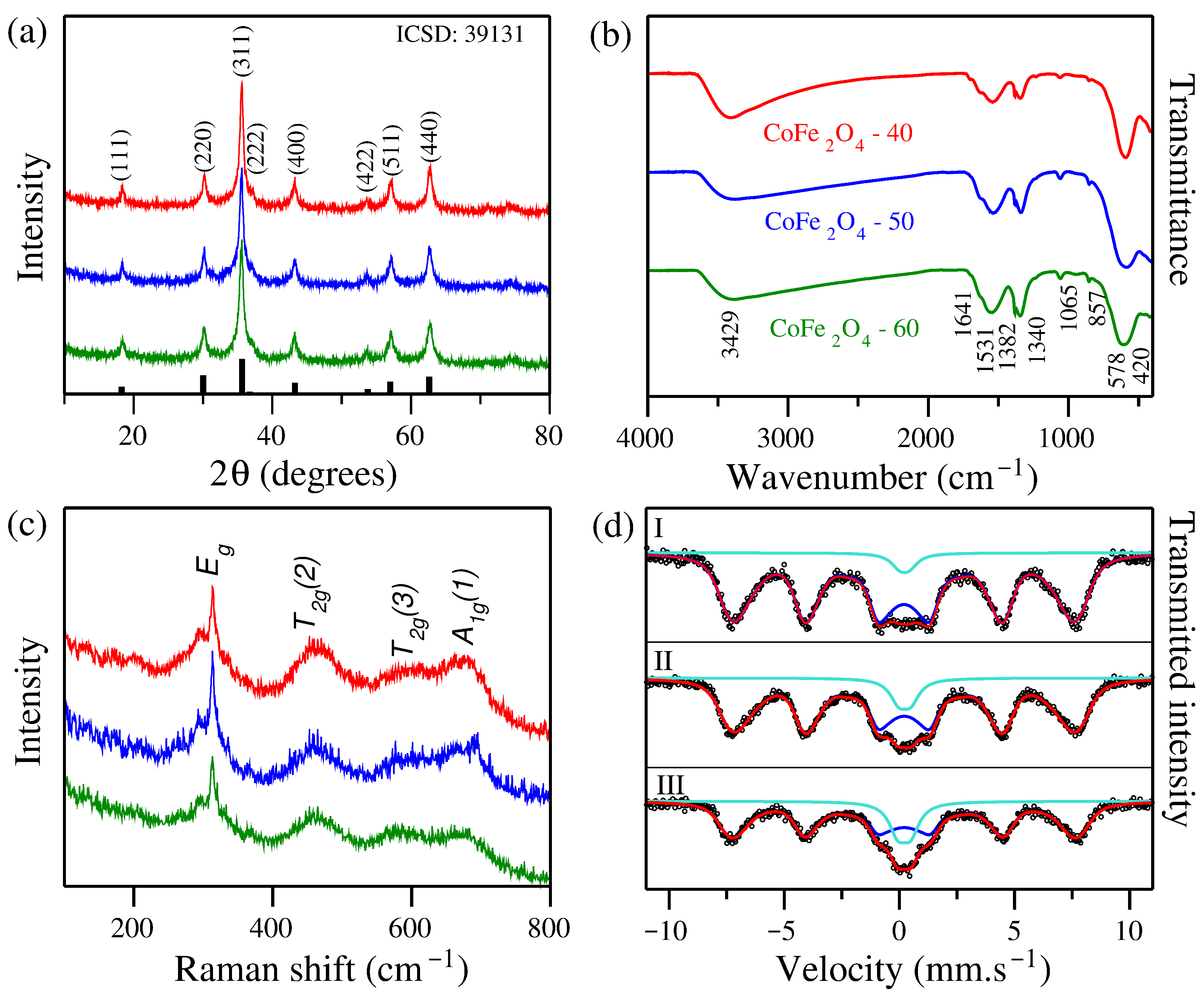
Figure 1a presents the XRD patterns for the CoFe2O4 samples. The data confirm the formation of a pure spinel cubic phase (space group F d 3 ¯ m , O h 7 , No. 227), matching ICSD reference card 39131. In comparison to the CoFe2O4 bulk XRD pattern reported by Islam et al. [33], the observed broadening of diffraction peaks across all CoFe2O4 samples suggests a reduced crystallite size relative to bulk counterparts, indicating the formation of nanoparticles [34], in agreement with previous findings [35]. Crystallite size (D) was estimated from the full-width at half-maximum (FWHM; β ) of the peaks using the Scherrer equation: D = κ λ β cos θ , where κ is typically set to 0.9 [36] and λ is the X-ray wavelength [37]. While β can also reflect instrument effects and microstrain [38,39], neglecting these factors and applying the Scherrer equation to the (311) reflection near 36° yield crystallite sizes of 11.3 nm, 11.5 nm, and 21.8 nm for samples synthesized at 40%, 50%, and 60% sonication power, respectively.
Figure 1b displays the FTIR spectra for the CoFe2O4 samples. Absorption bands at approximately 3429 cm−1 and 1630 cm−1 correspond to O–H stretching and H–O–H bending vibrations, most likely arising from surface-adsorbed water molecules [40]. Additional peaks near 1531 cm−1 and 1340 cm−1 are attributed to nitrate ( NO 3 ) stretching, suggesting the presence of residual synthesis byproducts [41]. Notably, the bands at 578 cm−1 and 420 cm−1 are characteristic of Co–O vibrations at octahedral sites and Fe–O vibrations at tetrahedral sites, respectively, confirming the formation of the spinel lattice typical of CoFe2O4 [42].
Figure 1c presents the Raman spectra for the CoFe2O4 samples. Group theory applied to the F d 3 ¯ m space group of the spinel structure (with 14 atoms per primitive cell) predicts 39 optical modes at the Brillouin zone center ( k = 0 ). The irreducible representation is Γ = A 1 g + E g + T 1 g + 3 T 2 g + 2 A 2 u + 2 E u + 4 T 1 u + 2 T 2 u , with five modes ( A 1 g , E g , and 3 T 2 g ) being Raman-active [43,44]. These modes correspond to singly, doubly, and triply degenerate vibrational states, respectively [45]. Table 1 summarizes the vibrational modes detected in the synthesized cubic-spinel ferrites.
The dominant Raman feature at approximately 681 cm−1 is attributed to the A 1 g ( 1 ) mode, associated with the symmetric stretching of Fe(Co)–O bonds in the tetrahedral sites [46]. Partial cation exchange between Fe3+ and Co2+ within these sites (cationic inversion) often leads to band broadening or splitting. In the present samples, while a clear separation into A 1 g ( 1 ) and A 1 g ( 2 ) was not observed, the broadening seen in Figure 1c supports the coexistence of cations in various lattice positions, consistent with prior observations by D’Ippolito et al. [47].
Examining the lower-frequency region, the band near 314 cm−1 corresponds to the E g mode, linked to the symmetric bending of Fe(Co)–O bonds in octahedral positions. Peaks at around 466 cm−1 and 590 cm−1 are attributed to the T 2 g ( 2 ) (asymmetric bending) and T 2 g ( 3 ) (asymmetric stretching) vibrational modes of octahedral site bonds [48,49]. The lowest-frequency T 2 g ( 1 ) mode, generally associated with translational movement of the tetrahedral sublattice (below 200 cm−1), was not distinctly visible in these samples, likely due to low signal intensity or instrument limitations.
As established by Chandramohan et al. [46], nanoscale effects, such as phonon confinement and reduced long-range order, broaden and shift Raman features, as observed in our results, where the A 1 g ( 1 ) mode exhibits a redshift relative to the bulk value (695 cm−1 versus 681 cm−1), corroborating the XRD findings that the sonochemical process yields nanoscale CoFe2O4.
Table 1. Raman vibrational modes (cm−1) observed for CoFe2O4 samples and comparison with literature data.
SampleRaman Modes (cm−1)
T 2 g ( 1 ) E g T 2 g ( 2 ) T 2 g ( 3 ) A 1 g ( 2 ) A 1 g ( 1 )
Ref. [45]212273482571660
Ref. [46]181306476563629686
Ref. [46] a210311470575625695
Ref. [48]183297473553615692
Ref. [50]181306476563629686
CoFe2O4-40314466590681
CoFe2O4-50314466590681
CoFe2O4-60314466590681
a Bulk.
Mössbauer spectroscopy was employed to examine the local environment of iron atoms, as depicted in Figure 1d. The data reveal that increasing the sonication power from 40% to 60% results in a greater proportion of iron in nonmagnetic (doublet) environments and a corresponding reduction in the magnetic (sextet) component, which suggests that higher sonication intensity may promote structural defects or alter particle size. Despite these changes, the hyperfine magnetic field (BHF) remains constant at 46 T, indicating that the material’s main magnetic framework is largely preserved throughout sonication. The dominance of the sextet feature in all spectra highlights the strong magnetic properties of the CoFe2O4 samples, with most iron atoms being magnetically active [51,52]. The coexistence of doublet and sextet components points to both superparamagnetic behavior, attributed to the nanoparticles’ small size, and ferrimagnetism arising from high-spin Fe3+ ions [53]. Table 2 lists the fitted parameter values.
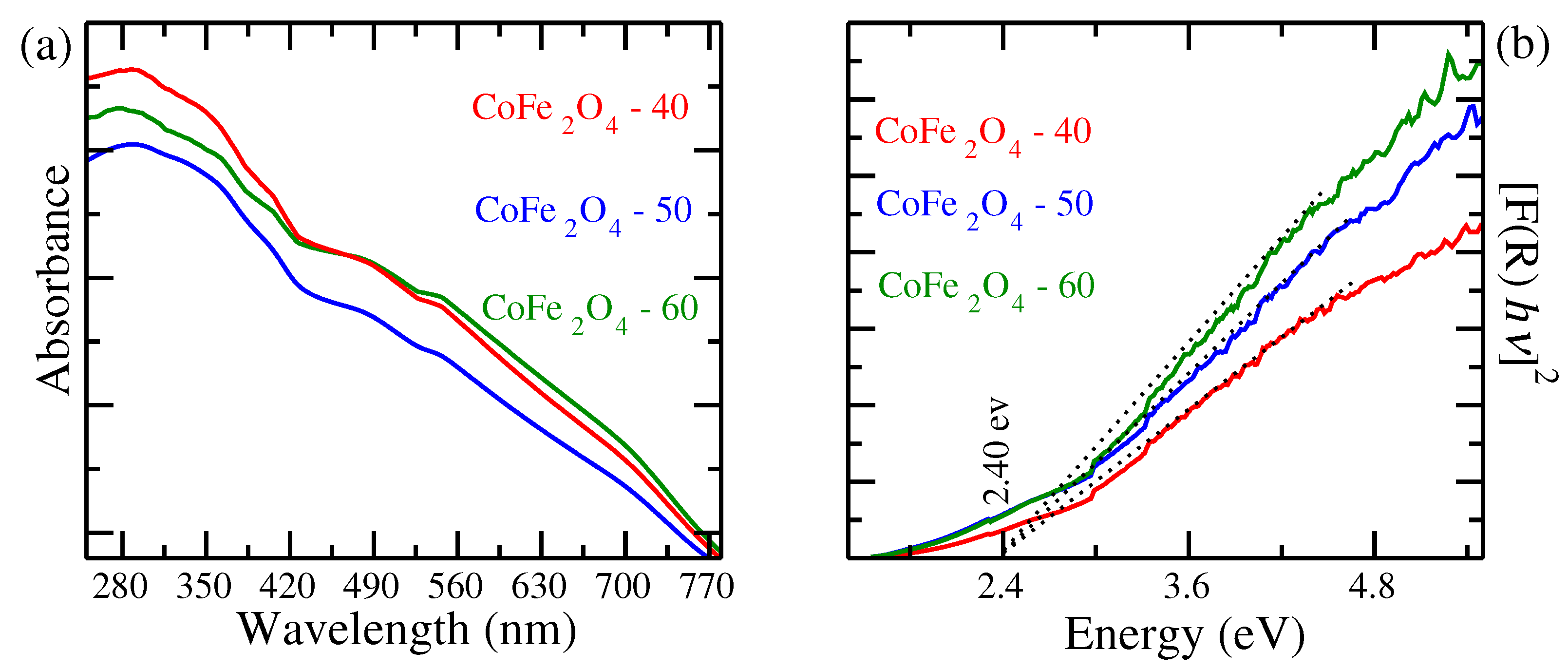
All CoFe2O4 samples display similar absorption spectra, with a distinct band in the 260–420 nm region, as illustrated in Figure 2a. This feature is likely associated with ligand field transitions (such as d-d transitions involving Co2+ or Fe3+) or charge transfer phenomena between oxygen ligands and metal ions [54,55]. The consistency of this spectral band across varying sonication powers indicates that changes in ultrasound intensity during synthesis have little impact on its position or strength.
The optical band gap ( E g ) for the samples was determined from their absorption spectra using the Tauc relation [40,54]:
α h ν = A ( h ν E g ) n ,
where α is the absorption coefficient, h is Planck’s constant, ν the photon frequency, A is a proportional constant, and n takes the values of 1/2 for direct band gap transitions and 2 for indirect ones [56]. CoFe2O4 is a p-type semiconductor characterized by a direct band gap [57]. The absorption coefficient can be related to the Kubelka–Munk function F ( R ) :
α F ( R ) = ( 1 R ) 2 2 R
where R is the reflectance. Thus, the Tauc equation can be rewritten as:
[ F ( R ) h ν ] 2 = A ( h ν E g )
The band gap was estimated by extrapolating the linear region of the [ F ( R ) h ν ] 2 versus h ν plot to where it intercepts the energy axis, as depicted in Figure 2b. The resulting band gap values for the cobalt ferrite samples are close to 2.40 eV, aligning with the previous literature [58,59,60].
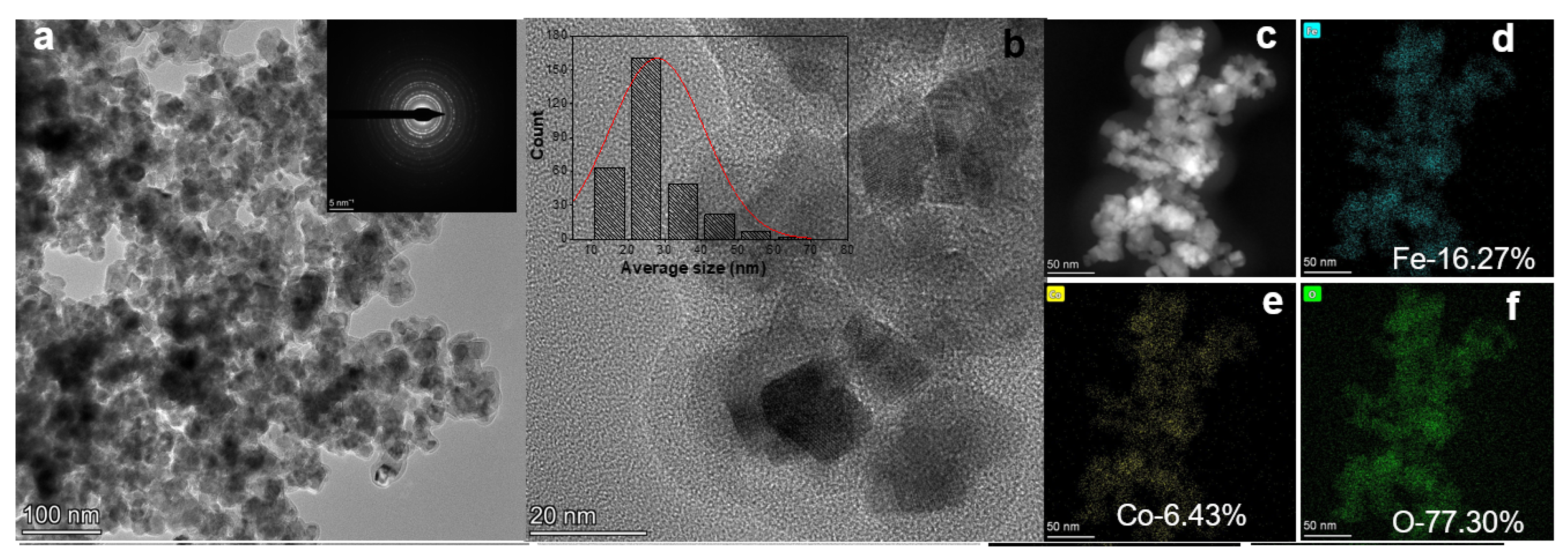
Transmission electron microscopy (TEM) was utilized to study the morphology, particle size, and composition of the samples, as illustrated in Figure 3. In Figure 3a, the partial overlapping of CoFe2O4-60 particles is observed, likely due to inherent magnetic interactions. The SAED pattern for this sample shows diffraction rings typical of polycrystalline nanoparticles, confirming their crystalline nature. Moreover, high-magnification TEM images (Figure 3b) reveal that the nanoparticles predominantly exhibit a polygonal shape. In addition, the TEM micrograph revealed the particle size, which is the size of a particle containing multiple crystallites. Therefore, the particle size distribution, as determined by histogram analysis, spans 10–65 nm, with an average of approximately 25 nm. High-resolution energy-dispersive X-ray spectroscopy (EDS) mapping on STEM-HAADF images (Figure 3c–f) further confirms that the Fe:Co atomic ratio is close to the nominal value of 2.
The apparent discrepancy between the crystallite sizes obtained from XRD and the particle sizes observed in TEM micrographs arises from the fundamental distinction between these two analyses. The crystallite size estimated using the Scherrer equation represents the size of coherently diffracting domains, which may correspond to either entire particles or domains within a particle [61]. On the other hand, a TEM image provides a direct measurement of the physical particle size [62], which may consist of either monocrystalline or polycrystalline nanoparticles.
In the present study, the crystallite size determined using XRD was around 22 nm for CoFe2O4-60 particles, whereas TEM observations for the same sample revealed particle sizes distributed between 10 and 65 nm, with an average around 25 nm. This difference suggests that a fraction of the particles may consist of multiple crystallites or that size broadening in XRD includes contributions from microstrain and structural defects, which contribute to peak broadening and are not accounted for in the Scherrer approximation [63]. Moreover, SAED patterns exhibited small spots making up a ring, which are characteristics of polycrystalline materials [64,65], confirming the nanosized and polycrystalline nature of CoFe2O4-60. Furthermore, the ring broadening observed in SAED is consistent with a distribution of crystallite sizes and possible lattice disorder.
Therefore, the combined XRD, TEM, and SAED results consistently support the formation of nanostructured CoFe2O4 while also indicating the presence of structural heterogeneity and possible defect-rich domains, particularly in samples synthesized at higher sonication power.

3.2. Electrochemical Performance

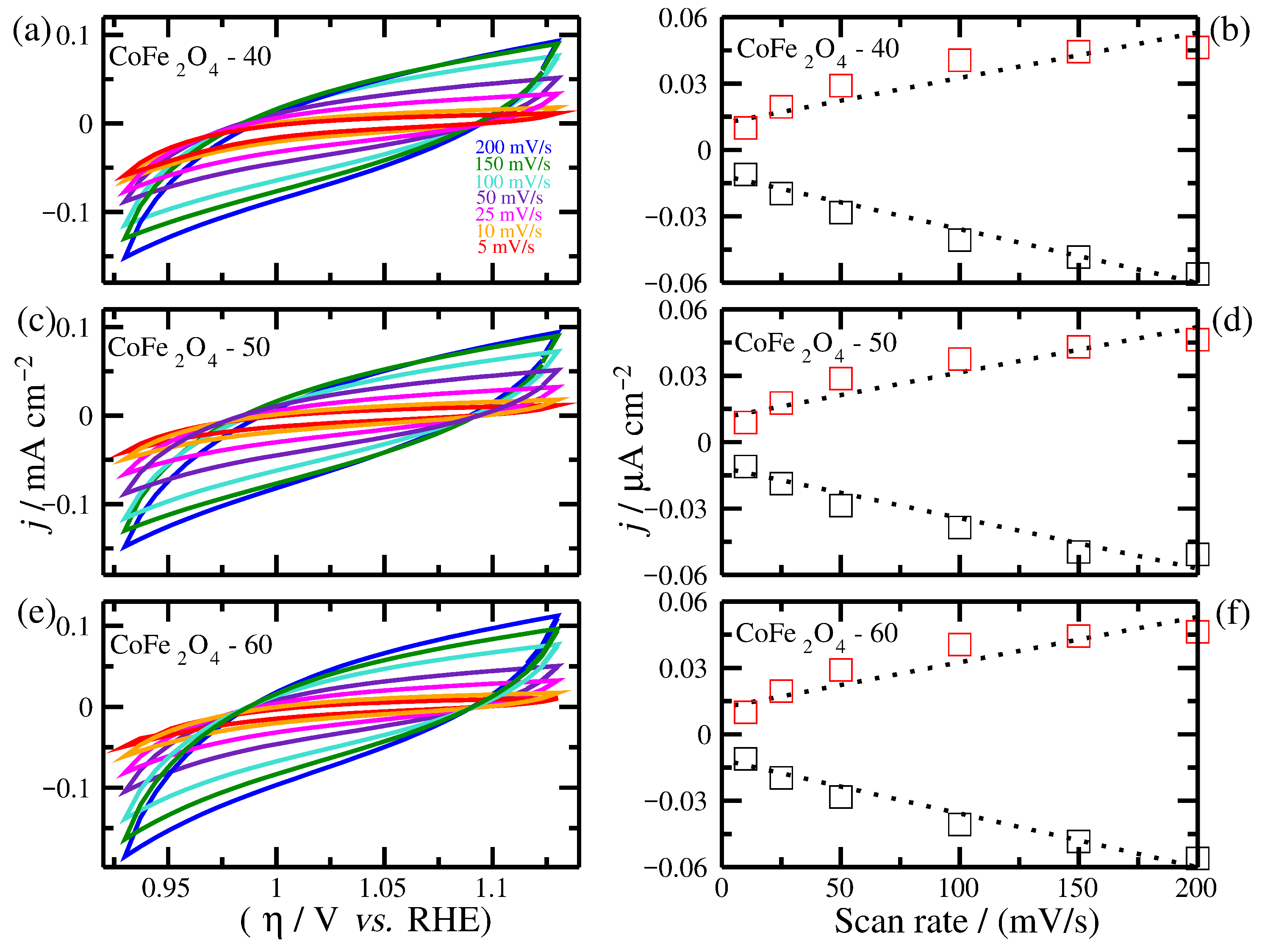
Electrochemical analysis of catalytic materials typically includes the interpretation of cyclic voltammograms (CVs) and measurement of double-layer capacitance ( C d l ). CVs are recorded at multiple scan rates to obtain the capacitive current, which is calculated using the difference between anodic and cathodic currents at potentials where faradaic reactions are minimal. In this study, the charging current was measured at 1.03V vs. the RHE as a function of scan rate.
The measured capacitance is related to the electrochemically active surface area (ECSA) through the following equation:
ECSA = C d l C s ,
where C s denotes the specific capacitance of the electrode. For the vitreous carbon electrode in 1.0 M NaOH solution, C s was taken as 0.040 mF cm−2, in agreement with values commonly cited in the literature [66,67,68,69]. The double-layer capacitance ( C d l ) was determined as follows:
C d l = j c v
where j c represents the charging current (in mA cm−2) and v is the scan rate (in mV s−1). The corresponding results are provided in Table 3.
The roughness factor ( R f ) is calculated as the ratio of the ECSA to the geometric electrode area (GA = 0.07065 cm2), as described in [70]:
R f = ECSA GA
The ECSA values derived for the cobalt ferrite samples (CoFe2O4-40, -50, and -60) from the CV data in Figure 4a–f show a steady increase, with measurements of 5.57, 6.15, and 6.95 cm2, respectively (refer to Table 3). These results align with trends reported in previous studies [69,71,72].
The increase in ECSA is likely due to structural changes in the nanoparticles caused by ultrasonic treatment. XRD analysis revealed that higher ultrasonic power increased the crystallite size, likely due to localized crystal growth or fusion induced by the energy input. However, the resulting cavitation also produced a more porous and defective surface. Mössbauer spectroscopy supported this, showing a higher proportion of iron at nonmagnetic sites (doublets) in CoFe2O4-60, indicating greater surface defects and lattice disorder. These defects provide additional active sites, and greater roughness aids electrolyte access [24,25,73]. Thus, high-intensity sonication modified the surface structure to increase the electrochemically active area, even as crystallite size grew [26,27].

3.2.1. HER Performance

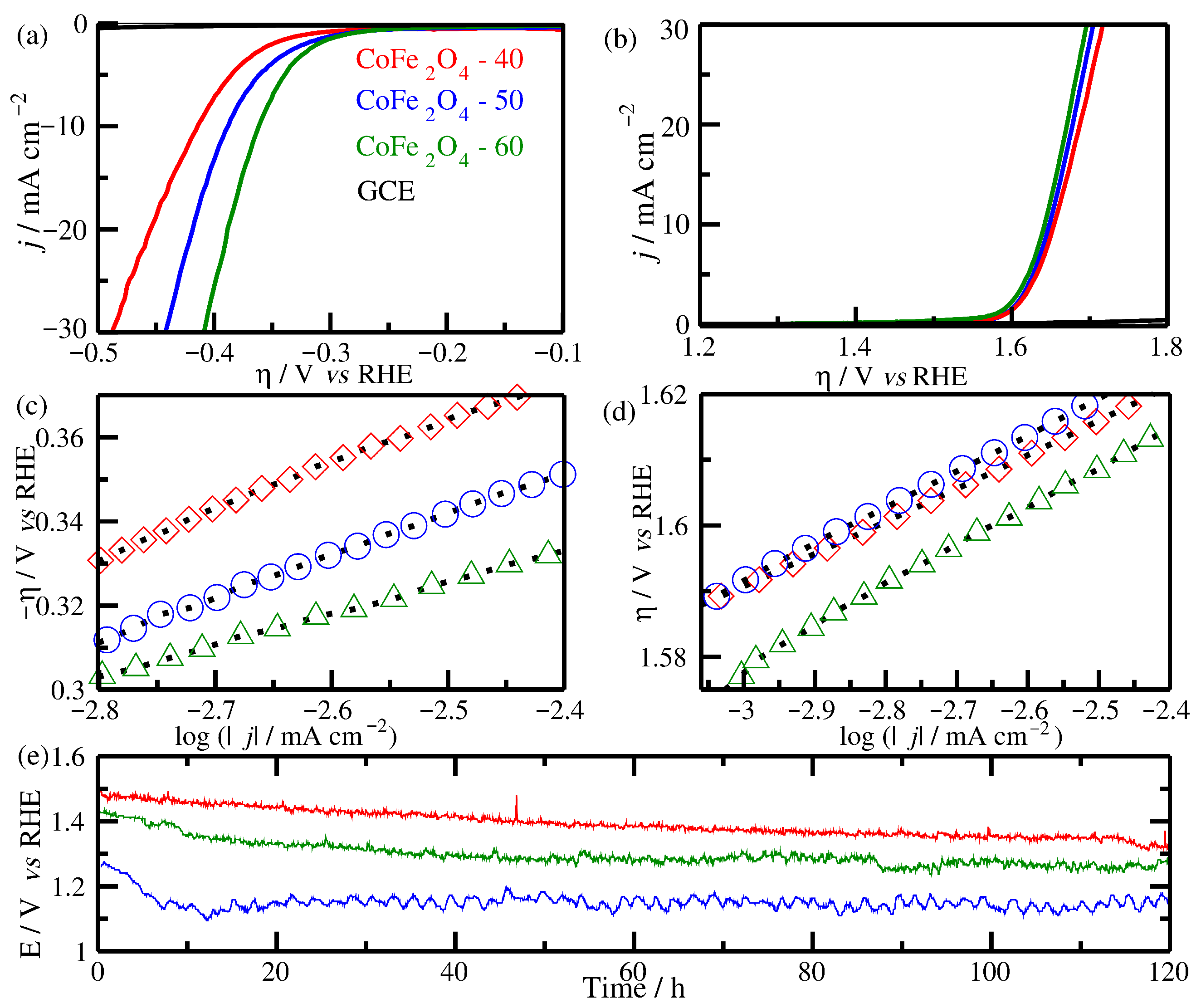
Figure 5a,b show the polarization curves used to assess the electrocatalytic activity of the three CoFe2O4 samples (-40, -50, and -60) for both the HER and OER, respectively. The electrochemical response of the unmodified glassy carbon electrode (GCE) was also measured for reference (black curve in Figure 5). Both the pristine and catalyst-coated electrodes were subjected to linear-sweep voltammetry at ambient temperature. The catalytic efficiency for the HER and OER is primarily determined by the overpotential required to reach a current density of 10 mA cm−2 [74]. The elevated overpotentials observed indicate that the electrocatalytic activity is attributable to the ferrite nanoparticles.
Among the tested samples, CoFe2O4-60 exhibited the lowest overpotential to achieve a current density of 10 mA cm−2, indicating comparatively improved electrocatalytic performance among the sonochemical-assisted-synthesized samples. The sequential improvement from CoFe2O4-40 through -50 to -60 implies that increasing ultrasonic power during synthesis promoted a structure with greater surface area and more optimally distributed active sites (see Table 4). This observation is consistent with the patterns observed in the ECSA and R f analyses.
In alkaline solutions, the hydrogen evolution reaction (HER) occurs via a series of electrochemical and chemical transformations at the cathode surface [71,75]:
H 2 O + e + M MH ads + OH ( Volmer step )
MH ads + H 2 O + e M + H 2 + OH ( Heyrovsky step )
2 MH ads 2 M + H 2 ( Tafel step )
The Heyrovsky and Tafel processes can occur either simultaneously or sequentially. If the Volmer step leads to electrochemical desorption, the Volmer–Heyrovsky pathway dominates; if surface-bound hydrogen atoms recombine, the Volmer–Tafel route is followed. In alkaline environments, water acts as the source of protons. Therefore, the HER typically proceeds via the Volmer step followed by either the Heyrovsky or the Tafel step. Kinetic analysis is usually performed using the Tafel equation:
η = a + b log j ,
where η represents the overpotential, j is the current density, a is the intercept associated with the exchange current density ( j 0 ), and b denotes the Tafel slope. For alkaline electrolytes at 25 °C, typical Tafel slopes are around 120, 40, and 30 mV dec−1 for the Volmer, Volmer–Heyrovsky, and Volmer–Tafel mechanisms, respectively.
The HER kinetic parameters were determined by applying the Tafel equation (Equation (11)) to the linear segments of the cathodic polarization curves, as depicted in Figure 5c. Tafel slopes for the three samples varied between 97.4 and 102.2 mV dec−1 (Table 4), indicative of the Volmer–Heyrovsky mechanism and pointing to relatively fast reaction kinetics, even without additional conductive support.
In comparison, catalysts produced by conventional (non-sonochemical) techniques—such as Co/Ni ferrites [76] and AP-CoFe2O4 [77]—tend to require higher overpotentials, reflecting increased energy barriers. While the sonochemical approach is advantageous for its simplicity and scalability, the data also indicate that adding a graphene-based support could further improve efficiency. Reports in the literature show that CoFe2O4/graphene or carbon composite catalysts [78,79] can reach lower overpotentials (around 270 mV) and exhibit better kinetic performance, likely due to more efficient electron transfer and improved dispersion of active sites.
Table 4. Kinetic parameters of electrocatalysts for hydrogen and oxygen evolution reactions.
Electrocatalysts η 10 (mV)b (mV dec−1) j 0 (mA cm−2)Ref.
HER
CoFeCoFe2O4-40−413102.0−0.34This work
CoFe2O4-50−38897.4−0.31This work
CoFe2O4-60−360102.2−0.26This work
CoFe2O4/CC−25491.4[78]
CoFe2O4/MWCNTs/IL−270172[80]
AP-CoFe2O4−369138[77]
CoFe2O4-1−364105[77]
CoFe2O4/graphene−248116.6[79]
CoFerrite−42272.7[76]
PtCo/C nanowires−32.733.9[81,82]
OER
CoFe2O4-40  42556.911.58This work
CoFe2O4-50  41661.091.56This work
CoFe2O4-60  41061.121.51This work
CoFe2O4/CC  39264.0[78]
AP-CoFe2O4  46592[77]
CoFe2O4-1  4288 3[77]
CoFe2O4-450 °C  35953.8[83]
CoFe2O4  41062[84]
CoFe2O4  434101.7[76]
CoFe2O4@CNTF  260149[85]
Ru-(a) 290 0.49[86]
R@RuO2 198 42.6[87,88]

3.2.2. OER Performance

Figure 5b displays the polarization curves for the OER, showing similar electrocatalytic behavior for all sonochemical-assisted-synthesized CoFe2O4 nanoparticles. However, CoFe2O4-60 exhibited the lowest overpotential (410 mV) at a current density of 10 mA cm−2, slightly superior among the CoFe2O4 samples, suggesting that the structural modifications induced by higher sonochemical power may facilitate the OER process. In addition, the Tafel slopes obtained from linear-sweep voltammetry were 56.91 , 61.09 , and 61.12 mV dec−1 for CoFe2O4-40, -50, and -60, respectively. These results are consistent with reported values for transition-metal oxide electrocatalysts in alkaline electrolytes, including CoFe2O4 nanoparticles, indicating comparable kinetics [89,90].
Assessing operational stability is vital when judging electrocatalysts for water splitting, since long-term performance under working conditions is crucial to real-world use. Here, stability was evaluated by chronopotentiometry: the working electrode was subjected to a constant current density of 10 mA cm−2 for 120 h, while the potential was continuously monitored (Figure 5e). All CoFe2O4 samples maintained excellent stability and durability throughout this period, supporting their promise as water-splitting catalysts.
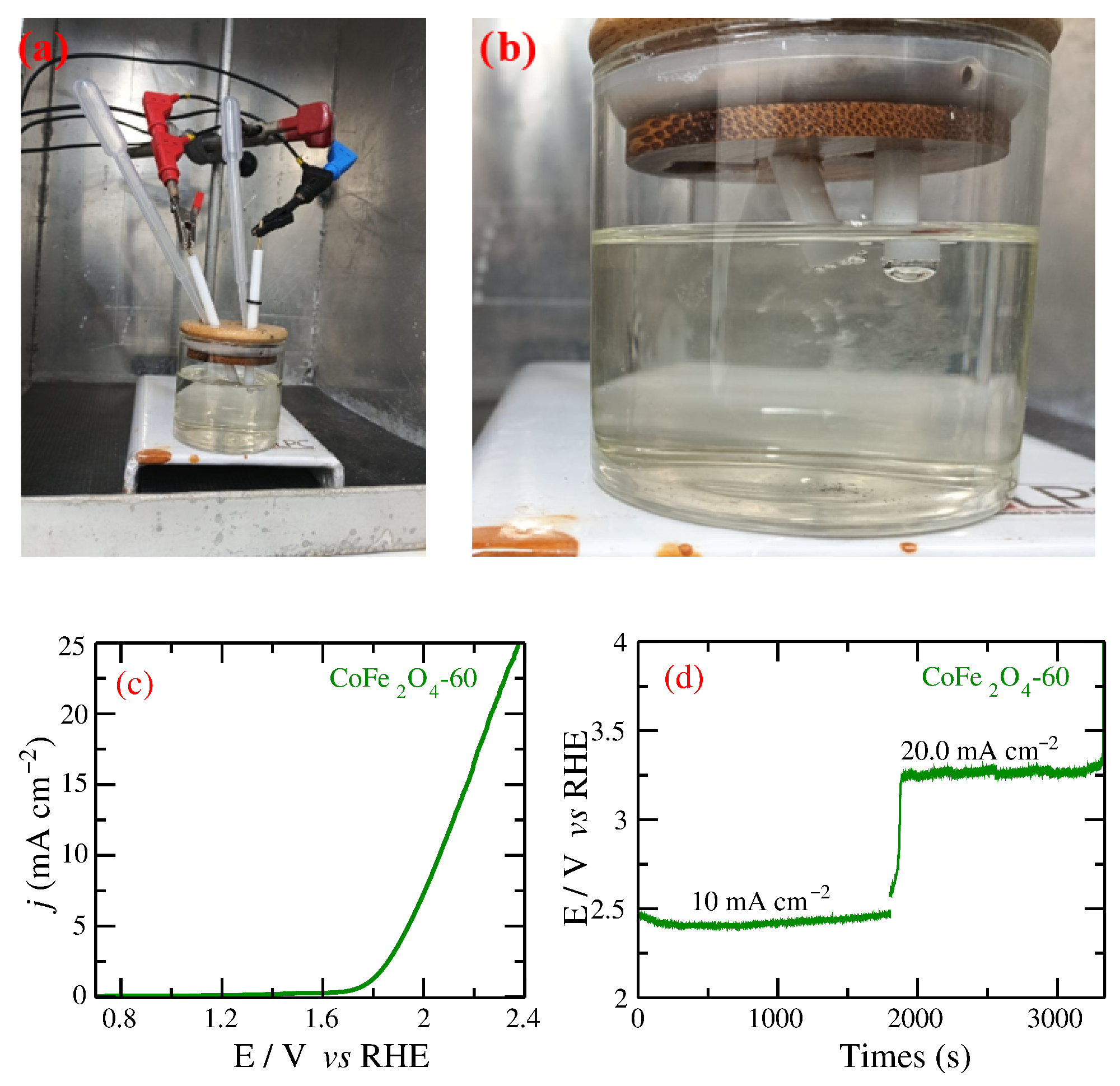
To assess the practical performance of the synthesized CoFe2O4-60, a two-electrode electrolyzer was constructed with this material serving as both the anode and the cathode (Figure 6a). Figure 6b illustrates the production of gas bubbles (H2 and O2) at the electrode surfaces, verifying effective water splitting. The polarization curve for the assembled cell (Figure 6c) shows that a cell voltage of about 1.9 V is needed to reach a current density of 10 mA cm−2—a value comparable to other reported non-noble metal oxide electrolyzers. The voltage efficiency was estimated by comparing the thermodynamic potential (1.23 V) to the applied voltage required to achieve 10 mA cm−2 [91], yielding a voltage efficiency of approximately 64.7%, based on thermodynamic cell potential. A long-term chronopotentiometric experiment (Figure 6d) demonstrated that the system maintained stable operation over time, with little change in the required potential. These findings underscore the promise of sonochemically prepared CoFe2O4 as a durable and cost-effective bifunctional catalyst for alkaline water electrolysis.

4. Conclusions

This study demonstrates that the sonochemical-assisted route is a simple, sustainable, and scalable strategy to produce CoFe2O4 nanoparticles with promising electrocatalytic properties for water splitting. Results indicate that the ultrasonic power used for synthesis of the nanoparticles can induce structural and surface modifications, which can influence the electrochemical properties of CoFe2O4 nanoparticles for water electrolysis. Among the tested samples, CoFe2O4-60 (synthesized at 60% tip power) exhibited the best electrochemical performance among the synthesized samples, with the largest electrochemically active surface area, the lowest overpotentials for both hydrogen and oxygen evolution, and excellent long-term stability in alkaline media.
These advantages could be linked to surface defect density, which boosts either surface roughness and/or porosity, which may contribute to increased exposure of electrochemically accessible sites. However, Mössbauer spectroscopy further revealed that higher ultrasonic energy induces minor changes in the iron atom environment, introducing structural disorder that likely supports the increased electrochemical performance.
Overall, these findings confirm that the sonochemical method provides a scalable and environmentally friendly route for the synthesis of stable, low-cost, and earth-abundant electrocatalysts. The CoFe2O4 materials developed here show strong potential for use in green hydrogen production via alkaline water electrolysis, representing a potential scalable alternative where cost-effective oxide-based electrocatalysts for water electrolysis are desirable.

Author Contributions

N.A.B.: Investigation, Formal analysis, Experimental design, and Writing—original draft. S.L.S.M.: Investigation and Formal analysis. C.G.S.P.: Formal analysis and Writing—original draft. I.F.V.: Project administration, Conceptualization, Supervision, Experimental design, and Writing—review and editing. L.P.M.S.: Investigation, Formal analysis, Conceptualization, Supervision, Experimental design, and Writing—original draft. All authors have read and agreed to the published version of the manuscript.

Funding

The authors are grateful to the Brazilian research agencies Fundação Cearense de Apoio ao Desenvolvimento Científico Tecnológico (FUNCAP) and Secretaria da Ciência, Tecnologia e Educação Superior (Secitece), Coordenação de Aperfeiçoamento de Pessoal de Nível Superior (CAPES) (Finance Code 001) and Conselho Nacional de Desenvolvimento Científico e Tecnológico (CNPq) for financial support. Claver G. S. Pinheiro thanks CNPq for his grant 446341/2024. Luís P. M. Santos thanks CAPES for his grants: grant number 88882.463158/2019-01 and grant number 23067.054243/2023-93.

Institutional Review Board Statement

Not applicable.

Informed Consent Statement

Not applicable.

Data Availability Statement

The data presented in this study are available upon request from the corresponding author.

Acknowledgments

The authors are thankful to José R. Franca (UFLA) and José A. Souza (UFABC) for TEM measurements and Alan Menezes for XRD measurements. The authors would also like to thank Central Analítica-UFC/CT-INFRA/MCTI-SISNANO/Pró-Equipamentos CAPES for the support.

Conflicts of Interest

The authors declare no conflicts of interest.

References

  1. Sarraf, D.K.; Dale, S. BP Energy Outlook 2023; Technical Report; BP plc: London, UK, 2023. [Google Scholar]
  2. Esper, J.; Torbenson, M.; Büntgen, U. 2023 summer warmth unparalleled over the past 2000 years. Nature 2024, 631, 94–97. [Google Scholar] [CrossRef]
  3. IPCC. Global Warming of 1.5 C: An IPCC Special Report on the Impacts of Global Warming of 1.5 C Above Pre-Industrial Levels and Related Global Greenhouse Gas Emission Pathways, in the Context of Strengthening the Global Response to the Threat of Climate Change, Sustainable Development, and Efforts to Eradicate Poverty; Special Report; Intergovernmental Panel on Climate Change: Geneva, Switzerland, 2018. [Google Scholar] [CrossRef]
  4. United Nations. Climate Action. 2025. Available online: https://www.un.org/en/climatechange (accessed on 2 September 2025).
  5. Prăvălie, R.; Bandoc, G. Nuclear energy: Between global electricity demand, worldwide decarbonisation imperativeness, and planetary environmental implications. J. Environ. Manag. 2018, 209, 81–92. [Google Scholar] [CrossRef]
  6. Lewis, N.S.; Nocera, D.G. Powering the planet: Chemical challenges in solar energy utilization. Proc. Natl. Acad. Sci. USA 2006, 103, 15729–15735. [Google Scholar] [CrossRef]
  7. Priya, P.; Stonier, A.A. Emerging innovations in solar photovoltaic (PV) technologies: The perovskite solar cells and more. Energy Rep. 2025, 14, 216–242. [Google Scholar] [CrossRef]
  8. Mugambi, G.R.; Darii, N.; Khazraj, H.; Saborío-Romano, O.; Raducu, A.G.; Sharma, R.; Cutululis, N.A. Methodologies for offshore wind power plant dynamic stability analysis. Renew. Sustain. Energy Rev. 2025, 216, 115635. [Google Scholar] [CrossRef]
  9. Wojtaszek, H.; Borowski, P.F.; Handschke, M.; Miciuła, I.; Stecyk, A.; Bielawa, A.; Ozdyk, S.; Kowalczyk, A.; Czepło, F. Wind Energy in Transition: Development, Socio-Economic Impacts, and Policy Challenges in Europe. Energies 2025, 18, 2811. [Google Scholar] [CrossRef]
  10. Kim, J.H.; Hansora, D.; Sharma, P.; Jang, J.W.; Lee, J.S. Toward practical solar hydrogen production—An artificial photosynthetic leaf-to-farm challenge. Chem. Soc. Rev. 2019, 48, 1908–1971. [Google Scholar] [CrossRef] [PubMed]
  11. Turner, J.A. Sustainable hydrogen production. Science 2004, 305, 972–974. [Google Scholar] [CrossRef]
  12. Kurian, S.; Santos, L.P.M.; George, S.C. Potential of water splitting in the global energy future. In Photochemical Splitting of Water; Elsevier: Amsterdam, The Netherlands, 2025; pp. 1–21. [Google Scholar] [CrossRef]
  13. Megía, P.J.; Vizcaíno, A.J.; Calles, J.A.; Carrero, A. Hydrogen production technologies: From fossil fuels toward renewable sources. A mini review. Energy Fuels 2021, 35, 16403–16415. [Google Scholar] [CrossRef]
  14. Li, X.; Hao, X.; Abudula, A.; Guan, G. Nanostructured catalysts for electrochemical water splitting: Current state and prospects. J. Mater. Chem. A 2016, 4, 11973–12000. [Google Scholar] [CrossRef]
  15. Archana, V.; Rastogi, P.K.; Thoufeeq, S.; Vinayasree, S.; Shaji, S.; Reddy, R.; Garza-Navarro, M.A.; Thomas, S.; Narayanan, T.N.; Anantharaman, M. Engineering nanostructured spinel ferrites by co-substitution for total water electrolysis by preferential exposure of metal cations on the surface. Sustain. Energy Fuels 2020, 4, 3915–3925. [Google Scholar] [CrossRef]
  16. Chanda, D.; Hnát, J.; Paidar, M.; Schauer, J.; Bouzek, K. Synthesis and characterization of NiFe2O4 electrocatalyst for the hydrogen evolution reaction in alkaline water electrolysis using different polymer binders. J. Power Sources 2015, 285, 217–226. [Google Scholar] [CrossRef]
  17. Hwang, G.J.; Gil, B.M.; Ryu, C.H. Preparation of the electrode using NiFe2O4 powder for the alkaline water electrolysis. J. Ind. Eng. Chem. 2017, 48, 242–248. [Google Scholar] [CrossRef]
  18. Li, L.; Zhang, Y.; Li, J.; Huo, W.; Li, B.; Bai, J.; Cheng, Y.; Tang, H.; Li, X. Facile synthesis of yolk-shell structured ZnFe2O4 microspheres for enhanced electrocatalytic oxygen evolution reaction. Inorg. Chem. Front. 2019, 6, 511–520. [Google Scholar] [CrossRef]
  19. Hu, Y.; Zhao, X.; Li, F.; Dong, Q.; Wen, B.; Sun, D.; Liang, W.; Lyu, X. Spherical ZnFe2O4 nanoparticles on nitrogen-doped graphene: A synergistic effect on efficient electrocatalytic oxygen evolution reaction. ACS Appl. Energy Mater. 2023, 6, 9985–9993. [Google Scholar] [CrossRef]
  20. Huerta-Flores, A.M.; Torre, F.; Taeno, M.; Barreno, R.C.; Del Barrio, E.P.; Doppiu, S. Influence of physicochemical properties on the thermochemical water splitting performance and H2 production of CoFe2O4. Int. J. Hydrogen Energy 2024, 71, 1293–1302. [Google Scholar] [CrossRef]
  21. Guo, C.; Liu, X.; Gao, L.; Ma, X.; Zhao, M.; Zhou, J.; Kuang, X.; Deng, W.; Sun, X.; Wei, Q. Oxygen defect engineering in cobalt iron oxide nanosheets for promoted overall water splitting. J. Mater. Chem. A 2019, 7, 21704–21710. [Google Scholar] [CrossRef]
  22. Zhang, C.; Bhoyate, S.; Zhao, C.; Kahol, P.K.; Kostoglou, N.; Mitterer, C.; Hinder, S.J.; Baker, M.A.; Constantinides, G.; Polychronopoulou, K.; et al. Electrodeposited nanostructured CoFe2O4 for overall water splitting and supercapacitor applications. Catalysts 2019, 9, 176. [Google Scholar] [CrossRef]
  23. Sayeed, M.A.; O’Mullane, A.P. Electrodeposition at highly negative potentials of an iron-cobalt oxide catalyst for use in electrochemical water splitting. ChemPhysChem 2019, 20, 3112–3119. [Google Scholar] [CrossRef]
  24. Goswami, P.P.; Choudhury, H.A.; Chakma, S.; Moholkar, V.S. Sonochemical synthesis and characterization of manganese ferrite nanoparticles. Ind. Eng. Chem. Res. 2013, 52, 17848–17855. [Google Scholar] [CrossRef]
  25. Slimani, Y.; Almessiere, M.A.; Baykal, A.; Gondal, M.A.; Tashkandi, N. Impact of sonication time on the structural and magnetic features of CoFe2O4/Ni0.8Cu0.1Zn0.1Fe2O4 hard-soft nanocomposites. J. Alloys Compd. 2022, 923, 166347. [Google Scholar] [CrossRef]
  26. An, C.; Wang, T.; Wang, S.; Chen, X.; Han, X.; Wu, S.; Deng, Q.; Zhao, L.; Hu, N. Ultrasonic-assisted preparation of two-dimensional materials for electrocatalysts. Ultrason. Sonochem. 2023, 98, 106503. [Google Scholar] [CrossRef] [PubMed]
  27. Yadav, R.S.; Kuřitka, I.; Vilcakova, J.; Jamatia, T.; Machovsky, M.; Skoda, D.; Urbánek, P.; Masař, M.; Urbánek, M.; Kalina, L. Impact of sonochemical synthesis condition on the structural and physical properties of MnFe2O4 spinel ferrite nanoparticles. Ultrason. Sonochem. 2020, 61, 104839. [Google Scholar] [CrossRef] [PubMed]
  28. Andrade-Neto, D.M.; Freire, R.M.; Gallo, J.; Freire, T.M.; Queiroz, D.C.; Ricardo, N.M.P.S.; Vasconcelos, I.F.; Mele, G.; Carbone, L.; Mazzetto, S.E.; et al. Rapid sonochemical approach produces functionalized Fe3O4 nanoparticles with excellent magnetic, colloidal, and relaxivity properties for MRI application. J. Phys. Chem. C 2017, 121, 24206–24222. [Google Scholar] [CrossRef]
  29. Kubelka, P.; Munk, F. Ein Beitrag zur optik der farbanstriche. Z. Tech. Phys. 1931, 12, 593–601. [Google Scholar]
  30. Li, R.; Zhou, D.; Luo, J.; Xu, W.; Li, J.; Li, S.; Cheng, P.; Yuan, D. The urchin-like sphere arrays Co3O4 as a bifunctional catalyst for hydrogen evolution reaction and oxygen evolution reaction. J. Power Sources 2017, 341, 250–256. [Google Scholar] [CrossRef]
  31. Jucá, R.F.; Evaristo, D.S.; Oliveira, F.G.; Santos, L.P.; Saraiva, G.D.; Castro, A.J.; Ferreira, N.S.; Lobato, L.F.; Soares, J.M.; Brito, A.L.B.; et al. Co-doped FeNbO4: Simple synthesis, DFT calculations and electrocatalytic performance for the hydrogen evolution reaction in alkaline medium. J. Phys. Chem. Solids 2025, 202, 112649. [Google Scholar] [CrossRef]
  32. Bampoky, N.; Medeiros, S.; Moura, T.; Paschoal, A.; Vasconcelos, I.; Santos, L. Synthesis of nanostructured Co3O4 by a surfactant-free hydrothermal method and its application to the hydrogen evolution reaction. Appl. Phys. A 2023, 129, 845. [Google Scholar] [CrossRef]
  33. Islam, M.; Hossain, A.A.; Ahsan, M.; Bally, M.; Ullah, M.S.; Hoque, S.; Khan, F. Structural characteristics, cation distribution, and elastic properties of Cr3+ substituted stoichiometric and non-stoichiometric cobalt ferrites. RSC Adv. 2022, 12, 8502–8519. [Google Scholar] [CrossRef]
  34. Holder, C.F.; Schaak, R.E. Tutorial on powder X-ray diffraction for characterizing nanoscale materials. ACS Nano 2019, 13, 7359–7365. [Google Scholar] [CrossRef]
  35. Pereira, M.S.; Vasconcelos, V.M.R.; Palacio, M.P.S.; Oliveira, F.G.S.; Santos, L.P.M.; Vasconcelos, D.L.M.; Freire, P.T.C.; Vasconcelos, I.F. Characterization of CoFe2O4, NiFe2O4, and ZnFe2O4 nanoparticles synthesized by a proteic sol-gel method. J. Supercond. Nov. Magn. 2021, 34, 2845–2853. [Google Scholar] [CrossRef]
  36. Cullity, B.D. Elements of X-Ray Diffraction; Addison-Wesley: Boston, MA, USA, 1978. [Google Scholar]
  37. Scherrer, P. Bestimmung der Grosse und inneren Struktur von Kolloidteilchen mittels Rontgenstrahlen. Nach Ges. Wiss. Gott. 1918, 2, 98–100. [Google Scholar]
  38. Gonçalves, N.S.; Carvalho, J.A.; Lima, Z.M.; Sasaki, J.M. Size–strain study of NiO nanoparticles by X-ray powder diffraction line broadening. Mater. Lett. 2012, 72, 36–38. [Google Scholar] [CrossRef]
  39. Weibel, A.; Bouchet, R.; Boulc’, F.; Knauth, P. The big problem of small particles: A comparison of methods for determination of particle size in nanocrystalline anatase powders. Chem. Mater. 2005, 17, 2378–2385. [Google Scholar] [CrossRef]
  40. Refat, N.M.; Nassar, M.Y.; Sadeek, S.A. A controllable one-pot hydrothermal synthesis of spherical cobalt ferrite nanoparticles: Synthesis, characterization, and optical properties. RSC Adv. 2022, 12, 25081–25095. [Google Scholar] [CrossRef]
  41. Rani, B.J.; Ravina, M.; Saravanakumar, B.; Ravi, G.; Ganesh, V.; Ravichandran, S.; Yuvakkumar, R. Ferrimagnetism in cobalt ferrite (CoFe2O4) nanoparticles. Nano-Struct. Nano-Objects 2018, 14, 84–91. [Google Scholar] [CrossRef]
  42. Gurumoorthy, M.; Parasuraman, K.; Anbarasu, M.; Balamurugan, K. Synthesis and Characterization of Cobalt Ferrite (CoFe2O4) Nanoparticles by Hydrothermal Method. J. Nano Sci. Technol. 2015, 5, 51–56. [Google Scholar]
  43. O’Horo, M.P.; Frisillo, A.L.; White, W.B. Lattice vibrations of MgAl2O4 spinel. J. Phys. Chem. Solids 1973, 34, 23–28. [Google Scholar] [CrossRef]
  44. Yu, T.; Shen, Z.X.; Shi, Y.; Ding, J. Cation migration and magnetic ordering in spinel CoFe2O4 powder: Micro-Raman scattering study. J. Phys. Condens. Matter 2002, 14, L613. [Google Scholar] [CrossRef]
  45. Ojha, V.H.; Kant, K.M. Investigation of structural and magnetic properties of strained CoFe2O4 nanoparticles. J. Phys. Chem. Solids 2021, 148, 109655. [Google Scholar] [CrossRef]
  46. Chandramohan, P.; Srinivasan, M.P.; Velmurugan, S.; Narasimhan, S.V. Cation distribution and particle size effect on Raman spectrum of CoFe2O4. J. Solid State Chem. 2011, 184, 89–96. [Google Scholar] [CrossRef]
  47. D’Ippolito, V.; Andreozzi, G.B.; Bersani, D.; Lottici, P.P. Raman fingerprint of chromate, aluminate and ferrite spinels. J. Raman Spectrosc. 2015, 46, 1255–1264. [Google Scholar] [CrossRef]
  48. Bart’uněk, V.; Sedmidubskỳ, D.; Huber, Š.; Švecová, M.; Ulbrich, P.; Jankovskỳ, O. Synthesis and properties of nanosized stoichiometric cobalt ferrite spinel. Materials 2018, 11, 1241. [Google Scholar] [CrossRef]
  49. Wang, W.; Ding, Z.; Zhao, X.; Wu, S.; Li, F.; Yue, M.; Liu, J.P. Microstructure and magnetic properties of MFe2O4 (M = Co, Ni, and Mn) ferrite nanocrystals prepared using colloid mill and hydrothermal method. J. Appl. Phys. 2015, 117, 17A328. [Google Scholar] [CrossRef]
  50. Jacintho, G.V.M.; Brolo, A.G.; Corio, P.; Suarez, P.A.Z.; Rubim, J.C. Structural investigation of MFe2O4 (M = Fe, Co) magnetic fluids. J. Phys. Chem. C 2009, 113, 7684–7691. [Google Scholar] [CrossRef]
  51. Karra, C.; Sarafidis, C. Mössbauer study of iron oxide nanoparticles. Appl. Res. 2024, 3, e202400008. [Google Scholar] [CrossRef]
  52. Lazarević, Z.Ž.; Milutinović, A.; Umićević, A.; Ivanovski, V.N.; Koteski, V.; Anđelković, L.; Romčević, N. Mössbauer spectroscopy study of nanosized spinel CoFe2O4 ferrite obtained during coprecipitation followed by mechanochemical treatment. Optoelectron. Adv. Mater.-Rapid Commun. 2024, 18, 289–295. [Google Scholar]
  53. Kliava, J.; Edelman, I.; Ivanova, O.; Ivantsov, R.; Bayukov, O.; Petrakovskaja, E.; Zaikovskiy, V.; Bruckental, I.; Yeshurun, Y.; Stepanov, S. Formation and evolution of magnetic nanoparticles in borate glass simultaneously doped with Fe and Mn oxides. J. Appl. Phys. 2008, 104, 103917. [Google Scholar] [CrossRef]
  54. Safari, M.; Mazloom, J. Electrochemical performance of spindle-like Fe2Co-MOF and derived magnetic yolk-shell CoFe2O4 microspheres for supercapacitor applications. J. Solid State Electrochem. 2021, 25, 2189–2200. [Google Scholar] [CrossRef]
  55. Hochu, F.; Lenglet, M. Co (II) optical absorption in spinels: Infrared and ligand-field spectroscopic study of the ionicity of the bond. Magnetic structure and Co2+→ Fe3+ MMCT in ferrites. Correlation with the magneto-optical properties. Act. Passiv. Electron. Compon. 1998, 20, 169–187. [Google Scholar] [CrossRef]
  56. Habibi, M.H.; Parhizkar, H.J. FTIR and UV–vis diffuse reflectance spectroscopy studies of the wet chemical (WC) route synthesized nano-structure CoFe2O4 from CoCl2 and FeCl3. Spectrochim. Acta Part A Mol. Biomol. Spectrosc. 2014, 127, 102–106. [Google Scholar] [CrossRef]
  57. Hasan, A.M.; Al-Keisy, A.; Khodair, Z.T. Investigation of p-type spinel structure as photocathode thin films under neutral pH condition. Int. J. Hydrogen Energy 2023, 48, 33937–33947. [Google Scholar] [CrossRef]
  58. Melo, R.; Banerjee, P.; Franco, A., Jr. Hydrothermal synthesis of nickel doped cobalt ferrite nanoparticles: Optical and magnetic properties. J. Mater. Sci. Mater. Electron. 2018, 29, 14657–14667. [Google Scholar] [CrossRef]
  59. Chatterjee, P.; Chakraborty, A.K. Band-gap engineering of tungsten oxide nanoplates by cobalt ferrite co-catalyst for solar water oxidation. Opt. Mater. 2021, 111, 110610. [Google Scholar] [CrossRef]
  60. Alves, T.E.P.; Pessoni, H.V.S.; Franco, A., Jr. The effect of Y3+ substitution on the structural, optical band-gap, and magnetic properties of cobalt ferrite nanoparticles. Phys. Chem. Chem. Phys. 2017, 19, 16395–16405. [Google Scholar] [CrossRef]
  61. Klug, H.P.; Alexander, L.E. X-Ray Diffraction Procedures: For Polycrystalline and Amorphous Materials; Wiley: Hoboken, NY, USA, 1974. [Google Scholar]
  62. Williams, D.B.; Carter, C.B. Transmission Electron Microscopy: A Textbook for Materials Science; Springer: Berlin/Heidelberg, Germany, 2009. [Google Scholar]
  63. Hargreaves, J. Some considerations related to the use of the Scherrer equation in powder X-ray diffraction as applied to heterogeneous catalysts. Catal. Struct. React. 2016, 2, 33–37. [Google Scholar] [CrossRef]
  64. Jankowski, K.; Jabłońska, J.; Uznański, P.; Całuch, S.; Szybowicz, M.; Brzozowski, R.; Ostafin, A.; Kwaśny, M.; Tomasik, M. Necked gold nanoparticles prepared by submerged alternating current arc discharge in water. RSC Adv. 2022, 12, 33955–33963. [Google Scholar] [CrossRef] [PubMed]
  65. Elsi, S.; Pushpanathan, K. Role of Cu and Mn dopants on d0 ferromagnetism of ZnS nanoparticles. J. Mater. Sci. Mater. Electron. 2019, 30, 10792–10807. [Google Scholar] [CrossRef]
  66. McCrory, C.C.L.; Jung, S.; Peters, J.C.; Jaramillo, T.F. Benchmarking Heterogeneous Electrocatalysts for the Oxygen Evolution Reaction. J. Am. Chem. Soc. 2013, 135, 16977–16987. [Google Scholar] [CrossRef] [PubMed]
  67. Hamze, M.; Rezaei, M.; Tabaian, S.H. Cobalt ferrite coated on Ti/Ni/PbOx with enhanced electrocatalytic stability for chloride ions-contained water splitting. J. Electroanal. Chem. 2023, 948, 117823. [Google Scholar] [CrossRef]
  68. de Oliveira, R.C.; Sousa, N.G.; da Silva, L.T.V.; do Nascimento, R.F.; Mascaro, L.H.; Casciano, P.N.S.; Oliveira, T.M.B.F.; de Lima-Neto, P.; Correia, A.N. The role of FexCu(1-x) electrodeposits from a deep eutectic solvent in promoting the hydrogen evolution reaction. Int. J. Hydrogen Energy 2024, 93, 346–354. [Google Scholar] [CrossRef]
  69. Sultan, F.; González Sepúlveda, G.E.; Medina, D.I.; Videa, M.; Sánchez-Domínguez, M.; Cholula-Díaz, J.L. Synthesis of MFe2O4 (M = Ni, Co) nanoparticles by a bicontinuous microemulsion method for the oxygen evolution reaction. ChemNanoMat 2024, 10, e202300541. [Google Scholar] [CrossRef]
  70. Ashfaq, K.; Saleem, M.I.; Ibrahim, A.; Dahshan, A.; Aslam, M.; Henaish, A.M.A.; Khan, M.J.; Ahmad, K. CoFe2O4 supported on g-CN nanosheet for oxygen evolution reaction in basic media. Int. J. Hydrogen Energy 2024, 80, 554–563. [Google Scholar] [CrossRef]
  71. Sadiq Mohamed, M.J.; Caliskan, S.; Gondal, M.A.; Almessiere, M.A.; Baykal, A.; Slimani, Y.; Elsayed, K.A.; Hassan, M.; Auwal, I.A.; Khan, A.Z.; et al. Se-doped magnetic Co–Ni spinel ferrite nanoparticles as electrochemical catalysts for hydrogen evolution. ACS Appl. Nano Mater. 2023, 6, 7330–7341. [Google Scholar] [CrossRef]
  72. Sagu, J.S.; Mehta, D.; Wijayantha, K.G.U. Electrocatalytic activity of CoFe2O4 thin films prepared by AACVD towards the oxygen evolution reaction in alkaline media. Electrochem. Commun. 2018, 87, 1–4. [Google Scholar] [CrossRef]
  73. Ramesh, T.; Madhavi, V.; Rao, P.V.; Vagdevi, K.; Basavegowda, N.; Baek, K.H. Impact of ultrasonic-assisted co-precipitation synthesis and ultrasonication duration on cobalt ferrite nanostructures: A comparative study of structural, morphological, optical and magnetic properties. Inorg. Chem. Commun. 2025, 174, 114035. [Google Scholar] [CrossRef]
  74. Wang, J.; Xu, F.; Jin, H.; Chen, Y.; Wang, Y. Non-noble metal-based carbon composites in hydrogen evolution reaction: Fundamentals to applications. Adv. Mater. 2017, 29, 1605838. [Google Scholar] [CrossRef]
  75. Hanan, A.; Shu, D.; Aftab, U.; Cao, D.; Laghari, A.J.; Solangi, M.Y.; Abro, M.I.; Nafady, A.; Vigolo, B.; Tahira, A.; et al. Co2FeO4@rGO composite: Towards trifunctional water splitting in alkaline media. Int. J. Hydrogen Energy 2022, 47, 33919–33937. [Google Scholar] [CrossRef]
  76. Chamani, S.; Khatamian, M.; Peighambardoust, N.S.; Aydemir, U. Microwave-assisted auto-combustion synthesis of binary/ternary CoxNi1-x ferrite for electrochemical hydrogen and oxygen evolution. ACS Omega 2021, 6, 33024–33032. [Google Scholar] [CrossRef]
  77. Debnath, B.; Parvin, S.; Dixit, H.; Bhattacharyya, S. Oxygen-defect-rich cobalt ferrite nanoparticles for practical water electrolysis with high activity and durability. ChemSusChem 2020, 13, 3875–3886. [Google Scholar] [CrossRef]
  78. Yuan, F.; Cheng, X.; Wang, M.; Ni, Y. Controlled synthesis of tubular ferrite MFe2O4 (M= Fe, Co, Ni) microstructures with efficiently electrocatalytic activity for water splitting. Electrochim. Acta 2019, 324, 134883. [Google Scholar] [CrossRef]
  79. Nivetha, R.; Chella, S.; Kollu, P.; Jeong, S.K.; Bhatnagar, A.; Andrews, N.G. Cobalt and nickel ferrites based graphene nanocomposites for electrochemical hydrogen evolution. J. Magn. Magn. Mater. 2018, 448, 165–171. [Google Scholar] [CrossRef]
  80. Ibarra, J.; Aguirre, M.J.; Del Río, R.; Henriquez, R.; Faccio, R.; Dalchiele, E.A.; Arce, R.; Ramírez, G. α-Fe2O3, Co3O4, and CoFe2O4/MWCNTs/ionic liquid nanocomposites as high-performance electrocatalysts for the electrocatalytic hydrogen evolution reaction in a neutral medium. Int. J. Mol. Sci. 2024, 25, 7043. [Google Scholar] [CrossRef]
  81. Tetteh, E.B.; Gyan-Barimah, C.; Lee, H.Y.; Kang, T.H.; Kang, S.; Ringe, S.; Yu, J.S. Strained Pt (221) facet in a PtCo@Pt-Rich catalyst boosts oxygen reduction and hydrogen evolution activity. ACS Appl. Mater. Interfaces 2022, 14, 25246–25256. [Google Scholar] [CrossRef]
  82. Gao, G.; Zhu, G.; Chen, X.; Sun, Z.; Cabot, A. Optimizing Pt-based alloy electrocatalysts for improved hydrogen evolution performance in alkaline electrolytes: A comprehensive review. ACS Nano 2023, 17, 20804–20824. [Google Scholar] [CrossRef]
  83. Kim, K.H.; Choi, Y.H. Highly efficient CoFe2O4 electrocatalysts prepared facilely by metal-organic decomposition process for the oxygen evolution reaction. Electrochim. Acta 2021, 395, 139195. [Google Scholar] [CrossRef]
  84. Krishnan, R.R.; Prasannakumar, A.T.; Chandran, S.R.; Prema, K.H. A novel approach for the fabrication of cobalt ferrite and nickel ferrite nanoparticles—magnetic and electrocatalytic studies. J. Mater. Sci. Mater. Electron. 2022, 33, 17100–17112. [Google Scholar] [CrossRef]
  85. Fatima, A.; Aldosari, H.; Al-Buriahi, M.S.; Al Huwayz, M.; Alrowaili, Z.A.; Alqahtani, M.S.; Ajmal, M.; Nazir, A.; Iqbal, M.; Tur Rasool, R.; et al. Cobalt ferrite surface-modified carbon nanotube fibers as an efficient and flexible electrode for overall electrochemical water splitting reactions. ACS Omega 2023, 8, 37927–37935. [Google Scholar] [CrossRef]
  86. McCrory, C.C.; Jung, S.; Ferrer, I.M.; Chatman, S.M.; Peters, J.C.; Jaramillo, T.F. Benchmarking hydrogen evolving reaction and oxygen evolving reaction electrocatalysts for solar water splitting devices. J. Am. Chem. Soc. 2015, 137, 4347–4357. [Google Scholar] [CrossRef] [PubMed]
  87. Li, Z.; Zou, J.; Liang, T.; Song, X.; Li, Z.; Wen, J.; Peng, M.; Zeng, X.; Huang, H.; Wu, H. MOF-derived ultrasmall Ru@RuO2 heterostructures as bifunctional and pH-universal electrocatalysts for 0.79 V asymmetric amphoteric overall water splitting. Chem. Eng. J. 2023, 460, 141672. [Google Scholar] [CrossRef]
  88. Bai, J.; Zhou, W.; Xu, J.; Zhou, P.; Deng, Y.; Xiang, M.; Xiang, D.; Su, Y. RuO2 catalysts for electrocatalytic oxygen evolution in acidic media: Mechanism, activity promotion strategy and research progress. Molecules 2024, 29, 537. [Google Scholar] [CrossRef] [PubMed]
  89. Chakrapani, K.; Bendt, G.; Hajiyani, H.; Schwarzrock, I.; Lunkenbein, T.; Salamon, S.; Landers, J.; Wende, H.; Schlögl, R.; Pentcheva, R.; et al. Role of composition and size of cobalt ferrite nanocrystals in the oxygen evolution reaction. ChemCatChem 2017, 9, 2988–2995. [Google Scholar] [CrossRef]
  90. Li, L.; Lu, S.; Dai, Y.; Li, H.; Wang, X.; Zhang, Y. Controlled synthesis of hierarchical nanostructured metal ferrite microspheres for enhanced electrocatalytic oxygen evolution reaction. ACS Appl. Nano Mater. 2023, 6, 2184–2192. [Google Scholar] [CrossRef]
  91. Suryanto, B.H.; Wang, Y.; Hocking, R.K.; Adamson, W.; Zhao, C. Overall electrochemical splitting of water at the heterogeneous interface of nickel and iron oxide. Nat. Commun. 2019, 10, 5599. [Google Scholar] [CrossRef] [PubMed]
Figure 1. (a) XRD patterns (the bars in black color corresponding to ICSD card file number 39131), (b) FTIR spectra, and (c) Raman spectra for CoFe2O4-40 (red line), CoFe2O4-50 (blue line), and CoFe2O4-60 (green line) samples. (d) Mössbauer spectra, where I, II, and III indicate the CoFe2O4-40, CoFe2O4-50, and CoFe2O4-60 samples, respectively.
Sustainability 18 05022 g001
Figure 2. (a) UV–vis spectra and (b) Tauc plots of CoFe2O4 samples. The extrapolate dotted line through the linear inflection point of the curve was used to determine the E g .
Sustainability 18 05022 g002
Figure 3. (a) Low-magnification bright-field TEM micrographs of CoFe2O4 nanoparticles and (b) high-magnification view. (cf) HAADF-STEM micrograph and the corresponding elemental mappings of CoFe2O4 nanoparticles. The insert in Figure 3a is SAED, while the insert in Figure 3b is the distribution of nano-sized of CoFe2O4 particles.
Sustainability 18 05022 g003
Figure 4. Cyclic voltammograms of CoFe2O4 in the potential window of 0.9–1.14 V (vs. RHE) at different scan rates (5, 10, 20, 50, 100, 150, and 200 mV s−1): (a) CoFe2O4-40, (c) CoFe2O4-50, and (e) CoFe2O4-60. Double-layer capacitance ( C d l ) calculated by plotting the difference between the anodic and cathodic current densities as a function of the scan rate from the cyclic voltammograms: (b) CoFe2O4-40, (d) CoFe2O4-50, and (f) CoFe2O4-60. The CVs were recorded at room temperature.
Sustainability 18 05022 g004
Figure 5. (a) HER polarization curves (potential window: −0.1 to −0.5 V vs. RHE; scan rate: 5 mV s−1). (b) OER polarization curves including the bare GCE control (black curve) (scan rate: 5 mV s−1). Tafel plots for (c) HER and (d) OER. (e) Stability test.
Sustainability 18 05022 g005
Figure 6. Overview of the experimental setup and stability tests for CoFe2O4-60. (a) Photograph of the two-electrode system configuration; (b) close-up detailing the bubble formation on the electrode, indicative of gas evolution; (c) polarization curve obtained for the system; (d) chronopotentiometric profile (potential vs. time) recorded during constant-current electrolysis, showing stable potentials at current steps of 10 mA cm−2 and 20 mA cm−2, respectively.
Sustainability 18 05022 g006
Table 2. Hyperfine parameters obtained from Mössbauer spectroscopy.
SampleComponent δ  (mm/s) Δ / ϵ  (mm/s)BHF (T)Area (%)
CoFe2O4-40Doublet0.32610.40944.033
Sextet0.30800.006946.095.97
CoFe2O4-50Doublet0.36430.76838.637
Sextet0.31790.019246.091.36
CoFe2O4-60Doublet0.31970.553416.84
Sextet0.31540.002446.083.16
Table 3. Double-layer capacitance ( C d l ), electrochemically active surface area (ECSA), and roughness factor ( R f ) for the CoFe2O4 samples.
Samples C dl  (mF/cm2)ECSA (cm2) R f
CoFe2O4-400.2235.5778.8
CoFe2O4-500.2456.1587.0
CoFe2O4-600.2776.9598.4
Disclaimer/Publisher’s Note: The statements, opinions and data contained in all publications are solely those of the individual author(s) and contributor(s) and not of MDPI and/or the editor(s). MDPI and/or the editor(s) disclaim responsibility for any injury to people or property resulting from any ideas, methods, instructions or products referred to in the content.