Article

Physical Deliverability-Oriented Carbon Cost-Constrained Low-Carbon Dispatch: A User-Centric Dispatch Framework with Demand Response

1
State Grid Shandong Electric Power Research Institute, Jinan 250003, China
2
Sichuan Energy Internet Research Institute, Tsinghua University, Chengdu 610041, China
*
Author to whom correspondence should be addressed.
Sustainability 2026, 18(10), 5019; https://doi.org/10.3390/su18105019
Submission received: 26 March 2026 / Revised: 13 May 2026 / Accepted: 14 May 2026 / Published: 15 May 2026

Abstract

Sustainable power-system operation requires carbon-reduction strategies that are emission-effective, physically deliverable, economically feasible, and compatible with user-side decarbonization claims. As Scope 2 carbon accounting increasingly emphasizes temporal, spatial, and physical consistency, dispatch models need to link user-level carbon claims with network-constrained power delivery. This paper proposes a User-Centric Carbon Cost-Constrained Low-Carbon Dispatch (CCC-LCD) framework that integrates carbon emission flow (CEF), nodal carbon intensity (NCI), network-constrained optimal dispatch, and endogenous demand response. A PTDF-based DC-OPF model represents active-power deliverability, while dual virtual flow variables determine carbon-flow directions endogenously. The model minimizes the target user’s physically traced Scope 2 emissions under a cost-tolerance budget and flexible-load constraints. Case studies on a modified IEEE 14-bus system show that nodal decarbonization is topology-dependent: high-load and high-NCI nodes obtain larger reductions from source-side generation substitution, whereas renewable-adjacent nodes exhibit limited marginal gains. The CEF-DR strategy outperforms single-mechanism cases, indicating the value of coordinating physical carbon-flow constraints with flexible demand. From a sustainability perspective, the proposed framework supports verifiable low-carbon electricity consumption, improves the economic feasibility of user-side decarbonization, and provides a practical dispatch tool for sustainable energy transition and corporate Scope 2 emission reduction.

1. Introduction

Achieving sustainable development requires a deep transformation of energy systems, especially the power sector, which is one of the largest sources of energy-related carbon emissions and a key infrastructure supporting economic and social activities. Recent studies have emphasized that sustainable energy transition should simultaneously consider renewable energy integration, low-carbon electricity supply, system security, and economic feasibility [1,2]. In the context of global carbon-neutrality commitments, power-system decarbonization has become a key pathway for advancing sustainable energy transition, requiring coordinated progress in emission reduction, operational reliability, energy affordability, and credible low-carbon electricity consumption claims [1,2]. Since the Paris Agreement, many countries have established carbon peaking and carbon neutrality targets, making the transition toward low-carbon and renewable electricity a central pathway for climate mitigation and sustainable energy development [3,4]. The sustainability of power-system decarbonization also depends on the physical deliverability of low-carbon electricity to end-users under real network constraints, rather than solely on the installed capacity of renewable energy [5,6]. The integration of high-penetration renewable energy sources, such as wind and solar, introduces significant intermittency and volatility, posing substantial challenges to the secure and flexible operation of modern power systems [7,8]. Therefore, sustainable power-system operation requires dispatch mechanisms that can coordinate renewable generation, network deliverability, user-side flexibility, and carbon emission responsibility in a unified framework.
From a physical perspective, although carbon emissions in power systems originate from the combustion of fossil fuels by generators, the fundamental driver is the electricity demand of end-users [9,10]. Currently, demand-side attributional carbon accounting primarily relies on two methodologies: the location-based method and the market-based method [11]. The former typically utilizes average emission factors (AEFs) across large geographical areas and longtime horizons, while the latter derives factors based on clean power market instruments such as Renewable Energy Certificates or Power Purchase Agreements [6]. However, as global regulatory frameworks tighten, the paradigm for carbon accounting is shifting from loose attribute-based reporting to strict physical deliverability-based attribution. Emerging regulations, such as the European Union’s green energy directives, increasingly require that emission reductions be verified through actual physical grid connections and real-time power delivery [12].
To address the lack of spatiotemporal granularity in traditional methods, the carbon emission flow (CEF) theory has been introduced and widely adopted in recent years [13,14]. CEF theory treats carbon emissions as virtual network flows embodied within physical power flows, establishing a rigorous physical link between generators and end-users [15]. Its primary advantage lies in its ability to accurately characterize the dynamic evolution of nodal carbon intensity (NCI) and ensure the fair allocation of emission responsibilities across complex network topologies [16,17].
However, despite the significant system-level emission reductions achieved by existing research, a substantial technical gap remains in aligning user-level carbon reduction with physical deliverability requirements. Existing models often prioritize system-wide welfare maximization or simplified emission penalties, while paying limited attention to the network characteristics that determine whether clean energy can physically reach a specific user node. Under network congestion or binding transmission constraints, low-carbon electricity may be available at the system level but not effectively deliverable to a designated user. Therefore, optimal power-system dispatch should move beyond aggregate cost and emission control toward a more sustainability-oriented framework that captures the spatiotemporal heterogeneity of carbon flows, the physical deliverability of low-carbon electricity, and the cost tolerance of end-users.

1.1. Theoretical Background and Related Work

The theoretical foundation of this study lies in the relationship between Scope 2 carbon attribution, carbon emission flow, and network-constrained power delivery. Conventional Scope 2 accounting distinguishes between location-based and market-based methods, which provide useful reporting frameworks but do not fully resolve whether a user’s low-carbon electricity claim is temporally and physically consistent with actual grid operation. Recent discussions on carbon-accounting accuracy further indicate that emission claims should be evaluated not only by contractual attributes, but also by whether they reflect the time-varying and location-dependent carbon consequences of electricity consumption [6,11,18]. This issue is especially important for user-level low-carbon services, because a corporate user may purchase or pay for low-carbon electricity attributes, while the actual power delivered to its node is still constrained by network topology, congestion, and dispatch feasibility.
CEF theory provides a physical accounting basis for addressing this limitation. By treating carbon emissions as virtual flows embedded in physical power flows, CEF enables generator-side emissions to be allocated to demand-side users through network paths [13,14,15,16]. The resulting NCI describes the carbon intensity of electricity physically delivered to each node and provides a more granular alternative to system-average emission factors. Existing CEF studies have established carbon-flow tracing models and extended them to integrated energy systems and dynamic carbon accounting [19,20,21,22,23]. However, many of these studies primarily focus on carbon measurement and responsibility allocation, while the direct use of CEF for user-oriented dispatch decisions remains less developed.
A second theoretical basis is network-constrained optimal dispatch. Low-carbon economic dispatch studies have incorporated carbon taxes, emission penalties, carbon trading, and green certificates into OPF or integrated energy system models, demonstrating that carbon-related costs can reduce total system emissions [24,25,26,27,28,29,30,31,32,33,34,35]. Recent carbon-aware OPF research further shows that carbon-flow equations and carbon-related objectives can be embedded into network-constrained optimization models [5,36]. These studies provide an important foundation for combining power-flow feasibility with carbon-flow accounting. Nevertheless, their objectives are generally formulated from a system-operator perspective, such as minimizing total cost, total emissions, or a weighted cost-emission objective. As a result, aggregate emission reduction does not necessarily imply that the carbon footprint physically attributable to a selected user node is reduced under transmission constraints.
A third related stream is carbon-aware demand response. Recent studies have shown that flexible loads can respond to carbon-intensity signals and shift consumption toward periods with lower emissions [37,38,39,40,41,42,43,44]. Locational marginal emission and NCI-based demand response models demonstrate that spatially and temporally differentiated carbon signals can improve the decarbonization value of demand-side flexibility [41,44]. However, most existing demand response studies treat the carbon signal as an external guidance variable or focus on system-level emission reduction. They do not fully integrate user-specific willingness to pay, endogenous NCI changes, physical deliverability, and Scope 2 attribution within a single dispatch model.

1.2. Research Gap and Contributions

Although existing studies have advanced low-carbon dispatch, carbon-flow accounting, carbon-aware OPF, and carbon-aware demand response, the integrated modeling of user-level Scope 2 attribution, network-constrained physical deliverability, and cost-constrained flexible demand remains limited. Most existing models evaluate decarbonization from a system-level perspective, whereas the physically attributable carbon footprint of a specific consumption node under power-flow constraints is less explicitly addressed. This issue is particularly relevant to emerging low-carbon electricity services and corporate carbon-accounting practices, where user-side emission claims should be aligned with the carbon intensity of electricity physically delivered through the network.
To address this issue, this study proposes a User-Centric Carbon Cost-Constrained Low-Carbon Dispatch (CCC-LCD) framework that combines CEF-based nodal carbon accounting, network-constrained optimal dispatch, and endogenous demand response. The framework minimizes the cumulative Scope 2 carbon footprint of a selected user node under an explicit cost-tolerance budget and provides a unified dispatch formulation for analyzing user-specific carbon reduction, physical deliverability, and economic feasibility.
Specifically, this study advances prior literature in both theoretical and practical aspects. Theoretically, it extends CEF-based carbon accounting from a measurement-oriented framework to a user-centric dispatch framework by explicitly linking nodal carbon attribution, physical power-flow deliverability, and user-side Scope 2 claims. Unlike conventional LCED models that internalize carbon as a system-wide penalty or trading cost, the proposed model separates the economic benchmark from the carbon-reduction objective through a user-specific cost-tolerance constraint. This allows the marginal value of user-level decarbonization to be evaluated without relying on an exogenously weighted cost-emission objective. Practically, the framework provides a dispatch-layer tool for grid operators and energy service providers to identify which users can obtain physically deliverable low-carbon electricity, how much additional system cost is required, and when cooperative multi-user decarbonization is more efficient than isolated procurement.
The main contributions of this paper are threefold. First, a cost-carbon decoupled optimization mechanism is developed by introducing user-specific economic tolerance constraints, so that the target user’s attributed emissions can be reduced without embedding carbon reduction only as a weighted penalty term in the system objective. Second, a deliverability-based nodal optimization framework is established by incorporating CEF equations into the dispatch model, ensuring that user-side emission reductions are consistent with power-flow deliverability, nodal carbon intensity, and physical network constraints. Third, an endogenous low-carbon demand response mechanism is formulated, allowing flexible loads to be co-optimized with generation dispatch and carbon-flow constraints so that consumption can be shifted toward periods and pathways with lower physically delivered carbon intensity.
The remainder of this paper is organized as follows. Section 2 presents the proposed CCC-LCD methodology and mathematical formulation, including the PTDF-based dispatch model, CEF tracking equations, cost-tolerance constraint, and endogenous demand response mechanism. Section 3 reports case studies on a modified IEEE 14-bus system and discusses nodal heterogeneity, cost-carbon trade-offs, cross-nodal effects, and cooperative decarbonization. Section 4 concludes the paper and outlines limitations and future research directions.

2. Methodology and Mathematical Model

To ensure that the dispatch decisions are physically implementable, we propose a User-Centric Carbon Cost-Constrained Low-Carbon Dispatch (CCC-LCD) framework aimed at achieving precise nodal-level carbon emission control. Before detailing the specific mathematical formulations, we outline the macro-level optimization architecture and systematically introduce four progressive operational scenarios to implement and validate the CCC-LCD methodology.
The method builds on established power-system and carbon-accounting approaches. PTDF-based DC-OPF is widely used in dispatch and electricity-market studies because it represents active-power transfer limits and congestion with transparent linear network constraints. CEF and power-flow tracing studies support the assignment of generator-side emissions to nodal loads through physical network paths, while recent low-carbon demand response studies justify treating flexible load as an emission-reduction resource. The following mathematical formulation therefore integrates these established methods rather than introducing an unsupported modeling structure.

2.1. Physical Power Flow and Refined Reserve Model

The physical operation of the power grid serves as the fundamental carrier for the carbon emission flow. We adopt a Direct Current Optimal Power Flow model based on Power Transfer Distribution Factors to describe the network physics. This approach neglects network losses and reactive-power to efficiently focus on active power transmission constraints, significantly reducing the dimensionality of the optimization problem by eliminating nodal phase angle variables.
(1)
Nodal power injection and line flow:
For any node i N at time t T , the net active-power injection P i , t i n j is defined as the difference between the local generation and the load demand:
P i , t i n j = g G i P g , t P i , t l o a d i N , t T ,
where G i represents the set of generators located at node i, P g , t is the active-power output of generator g , and P i , t l o a d is the active-power demand at node i .
Based on the pre-calculated PTDF sensitivity matrix, the active-power flow P l , t on transmission line l L is strictly constrained by its physical thermal limits P ¯ l :
P l , t = i N π l , i P i , t i n j l L , t T ,
P ¯ l P l , t P ¯ l l L , t T ,
where π l , i denotes the element in the PTDF matrix representing the sensitivity of line l to the power injection at node i .
(2)
Refined reserve constraints:
Existing low-carbon dispatch models frequently simplify reserve availability to the remaining unit capacity, critically ignoring the mechanical inertia of thermal units. To guarantee operational security under high renewable penetration, we propose a refined reserve formulation. The effective upward reserve R g , t u p provided by generator g is constrained by both the remaining capacity and its physical ramping capability Δ P g r a m p :
R g , t u p P ¯ g P g , t g G , t T ,
R g , t u p Δ P g r a m p g G , t T ,
Crucially, this formulation rigorously distinguishes between unit types. For ramp-limited coal-fired units, R g , t u p is strictly bounded by their physical ramp rates, properly restricting their reserve contribution. Conversely, for highly flexible gas-fired units, the ramping parameter Δ P g r a m p is set to a sufficiently large value, allowing their reserve provision to be limited solely by the available capacity. This distinction prevents the unrealistic allocation of reserve duties to slow-ramping baseload plants during aggressive low-carbon dispatch.

2.2. Standardized Carbon Emission Flow Tracking

Accurately calculating the dynamic nodal carbon intensity (NCI), denoted as e i , t , constitutes the core methodological challenge. Because the carbon flow relies entirely on the direction of the physical power flow—which is an unknown endogenous decision variable prior to optimization—a flow direction determination problem emerges. We resolve this utilizing a dual virtual flow reformulation technique.
(1)
Power Flow Mixing Principle:
Within a power system, when power flows from various incoming branches converge at a single node, their associated embodied carbon emissions concurrently aggregate. Governed by the fundamental laws of nodal power balance and carbon mass conservation, the nodal carbon intensity ρ n N of this specific node is mathematically formulated as the weighted average of the branch carbon intensities ρ i B associated with all incoming power flows. This relationship is expressed as:
ρ n N = i Ω n + ρ i B P i i Ω n + P i ,
where Ω n + denotes the set of incoming branches injecting power into node n , and P i represents the physical power flow traversing the incoming branch i .
(2)
Power Flow Allocation Principle:
Following the proportional sharing principle, any outgoing power flow departing from a node inherently contains a fractional component from every incoming branch. The magnitude of these components is distributed strictly proportionally. Taking node n as an illustrative subject, for the power flow on the j -th outgoing branch, the specific fraction originating from the i -th incoming branch is quantified as:
P j , i = P j P i s Ω n + P s , j Ω n ,
where Ω n denotes the set of outgoing branches departing from node n .
By synthesizing the aforementioned relationships, it can be rigorously proven that the branch carbon intensity of every outgoing branch originating from node n is absolutely identical to the nodal carbon intensity of node n itself. The detailed mathematical derivation is presented as follows:
ρ j B = i Ω n + P j , i ρ i B P j = i Ω n + P j P i s Ω n + P s ρ i B P j = i Ω n + P i ρ i B s Ω n + P s = ρ n N , j Ω n ,
(3)
Dual virtual flow decomposition:
The purpose of the dual virtual flow formulation is to determine the direction of carbon transfer without introducing binary variables. For each physical line, the net active-power flow may be positive or negative depending on the dispatch result. Since CEF follows the actual direction of power transfer, the optimization model must know which end of the line is the upstream carbon source at each time interval. A direct formulation would require logical direction indicators, leading to a mixed-integer non-linear model. To avoid this, each line flow is decomposed into two non-negative virtual components: one representing power moving along the predefined forward direction and the other representing power moving in the reverse direction. The complementarity condition ensures that only one component can be positive at a given time, so the model preserves the physical one-direction-at-a-time property while remaining in a continuous optimization form.
Instead of employing binary indicator variables that would render the problem a computationally expensive Mixed-Integer Nonlinear Programming (MINLP) problem, we decompose the physical net line flow P l , t into two non-negative virtual components: the forward flow π l , t + and the backward flow π l , t :
P l , t = π l , t + π l , t l L , t T ,
π l , t + 0 , π l , t 0 l L , t T ,
To ensure physical reality where power cannot flow in both directions simultaneously, we introduce an exact relaxation of the complementarity constraint [5]:
π l , t + π l , t 0 l L , t T ,
This reformulation transforms the logical flow direction condition into a continuous algebraic constraint, enabling advanced non-convex spatial branching algorithms to find the global optimum efficiently without integer variables.
(4)
Standardized nodal carbon balance equation:
Based on the aforementioned decomposition, we apply the conservation of carbon mass to establish a standardized, topology-adaptive nodal carbon balance equation. For any node i , the total carbon inflow must equal the total carbon outflow at any given time t :
g G i ( E g P g , t ) Local   Generation + l L e n d , i ( e s ( l ) , t π l , t + ) + l L s t a r t , i ( e r ( l ) , t π l , t ) Grid   Carbon   Inflow = e i , t P l o a d , i , t a c t Load   Carbon   Outflow + l L e n d , i ( e i , t π l , t ) + l L s t a r t , i ( e i , t π l , t + ) Grid   Carbon   Outflow ,
where: E g is the constant carbon emission factor of generator g . e s ( l ) , t and e r ( l ) , t represent the NCI of the upstream and downstream nodes of line l , respectively. L s t a r t , i and L e n d , i denote the sets of lines starting from and ending at node i , respectively. By solving this equation simultaneously with the physical constraints, the nodal carbon intensity e i , t is obtained as an endogenous variable, reflecting the real-time “greenness” of electricity physically delivered to node i .

2.3. User-Centric Optimal Dispatching Framework

The User-Centric Optimal Dispatching Framework can be generalized as follows:
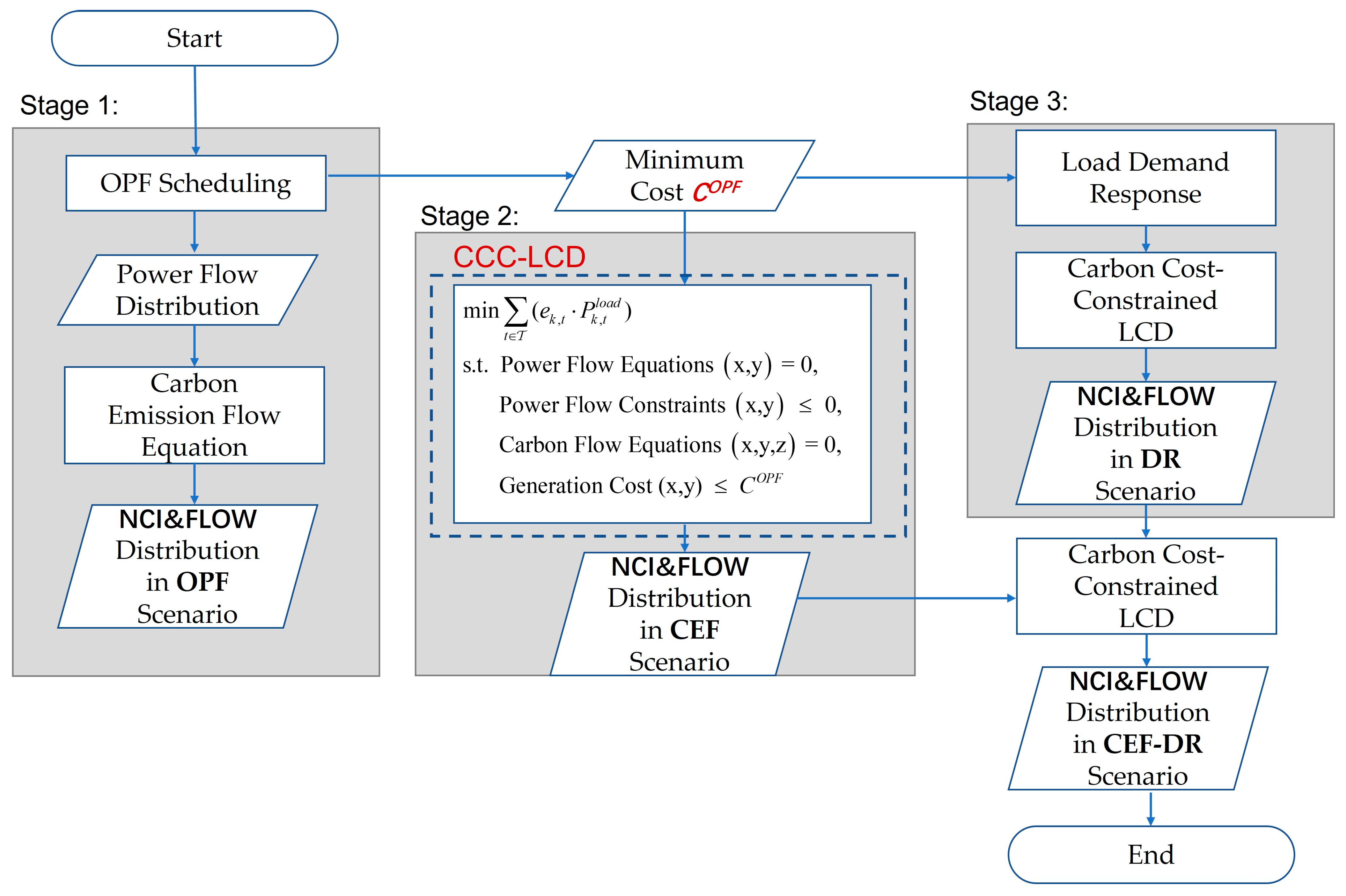
Figure 1 summarizes the complete CCC-LCD workflow. The upper layer first establishes the physical dispatch environment, including generator limits, PTDF-based line-flow constraints, and refined reserve constraints. The middle layer embeds CEF equations to convert physical power flows into time-varying nodal carbon intensities. The lower layer represents the user-centric decision process: a target user specifies a cost-tolerance budget and flexible demand range, after which the operator minimizes the user’s physically delivered Scope 2 emissions while maintaining power balance, network feasibility, and non-degradation constraints for selected neighboring nodes. The flowchart therefore links the economic benchmark, carbon-constrained dispatch, and endogenous demand response into one coordinated optimization procedure. Integrating the physical power layer and the virtual carbon layer, we construct a bi-level inspired optimization framework to minimize the specific carbon footprint of a target user at node k .
(1)
Stage 1: Economic Benchmark:
A traditional economic dispatch is initially performed to determine the system’s theoretical minimum operating cost, denoted as C O P F . This value serves as the absolute economic baseline for the subsequent decarbonization stage.
(2)
Stage 2: Carbon Cost-Constrained Low-Carbon Dispatch:
The primary objective of the second stage is to minimize the total cumulative Scope 2 emissions of the target user node k :
min t T ( e k , t P k , t l o a d ) ,
This objective function exhibits bilinearity, simultaneously coupling the grid’s carbon intensity variable e k , t with the user’s load decision variable P k , t l o a d .
(3)
Endogenous Demand Response Mechanism:
Unlike traditional fixed loads or price-responsive models, the load of the target user $k$ is modeled as an active decision variable subject to upper and lower flexibility bounds and daily energy conservation constraints:
P _ k , t l o a d P k , t l o a d P ¯ k , t l o a d t T ,
t T P k , t l o a d = E k d a i l y ,
To ensure system-wide economic feasibility, the entire localized low-carbon optimization is governed by a strict cost-tolerance budget constraint:
C t o t a l ( 1 + α ) C O P F ,
where C t o t a l represents the total system generation cost in the current scenario, and α signifies the user’s willingness to pay a financial premium for verified physical decarbonization. This mechanism enables the flexible load to actively track clean physical carbon flows within an acceptable economic boundary.
The resulting model is a continuous non-convex optimization problem because the objective contains bilinear products between nodal carbon intensity and flexible load, and the dual virtual flow formulation contains complementarity relationships. In the numerical implementation, the model is formulated as a non-convex quadratic constrained program and solved with a deterministic spatial branch-and-bound solver. The bilinear terms are kept explicitly rather than linearized by fixed carbon-intensity coefficients, because the nodal carbon intensity changes endogenously with generator dispatch, congestion, and flexible demand. The solver iteratively constructs convex relaxations of the bilinear terms and branches on variable bounds until the optimality tolerance is satisfied. This treatment preserves the interaction between source-side dispatch and load-side response while avoiding binary direction variables. All optimization models were implemented in Python 3.12 and solved using Gurobi 12.0.0 with the non-convex quadratic optimization option enabled.

3. Results and Discussion

3.1. Scenario Settings

To comprehensively evaluate the proposed framework, the dispatch simulations are categorized into four progressive scenarios:
OPF Scenario: A conventional optimal power flow is executed to determine the baseline unit dispatch profiles and establish the absolute minimum system operational cost.
CEF Scenario: In this scenario, specific end-users agree to pay a predefined financial premium to actively reduce their individualized nodal carbon footprints. To adhere to the fundamental principle of decarbonization—ensuring that localized emission reductions do not inadvertently compromise overall system emissions—an additional non-degradation constraint is introduced. Specifically, the total carbon emissions of adjacent heavy-load nodes are constrained not to increase. Constraining adjacent nodes rather than the entire network effectively balances computational tractability with system-wide environmental integrity.
DR Scenario: This scenario investigates the emission reduction potential when users exclusively participate in low-carbon DR. In conventional decentralized DR, users react to broadcasted nodal carbon intensity signals, which subsequently alter unit dispatch and the resulting carbon intensities. This typically triggers a repetitive, oscillatory game between user consumption and grid dispatch, yielding sub-optimal emission reductions. To circumvent this, our framework allows users to submit their load flexibility capabilities directly to the grid operator. The grid co-optimizes the system dispatch and user response endogenously, thereby maximizing the user’s emission reductions and eliminating the uncoordinated source-load game.
CEF-DR Scenario: This comprehensive scenario integrates both endogenous low-carbon DR and the financial premium mechanism, representing the most comprehensive scenario considered in this study for user-centric decarbonization. Under this framework, the grid operator coordinates generation dispatch and flexible demand to provide physically traceable low-carbon electricity services. By simultaneously securing cleaner energy supplies through financial tolerance and optimizing consumption strategies based on grid conditions, the framework achieves the largest carbon-footprint reduction among the considered scenarios.
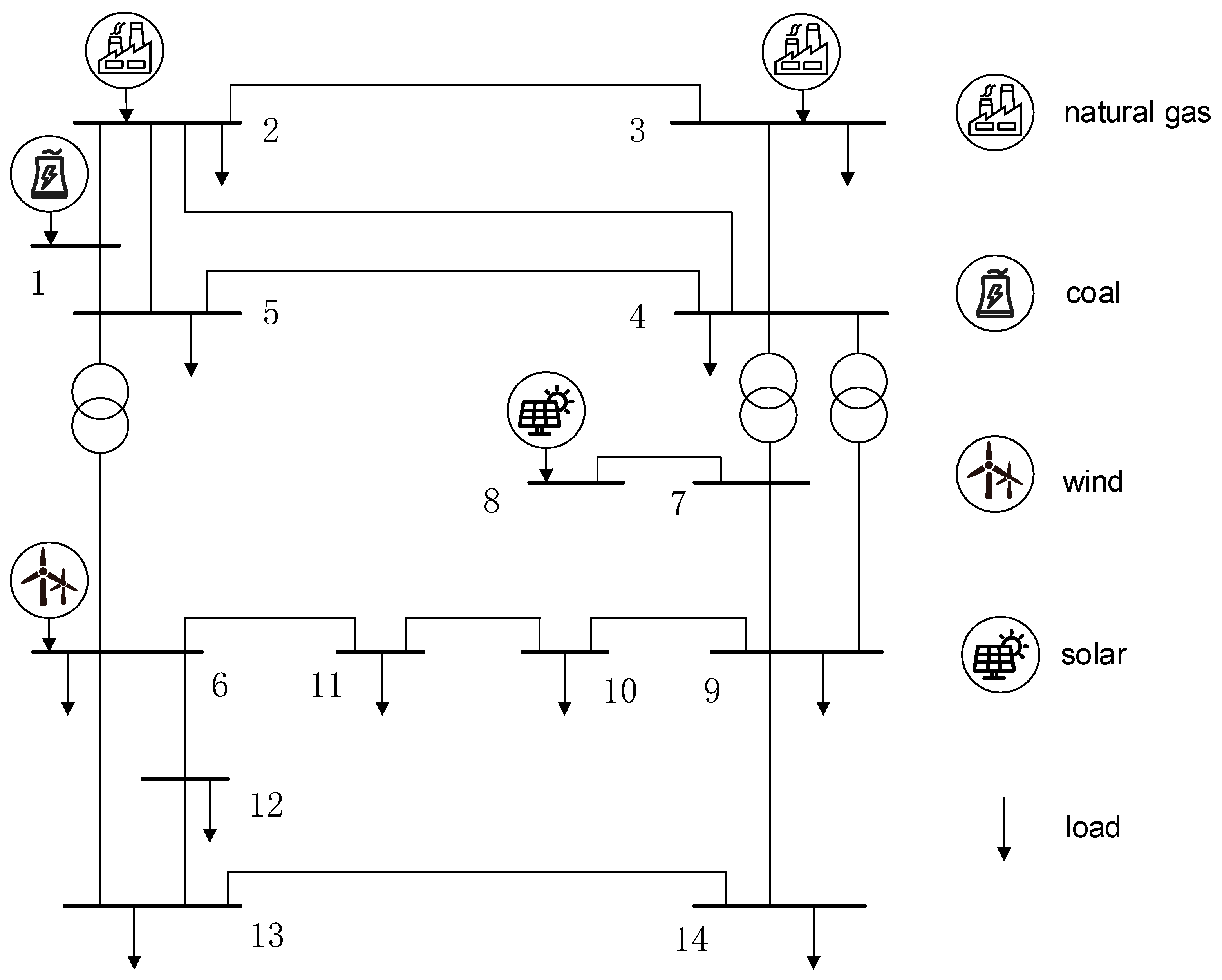
In the numerical simulations, we consider a day-ahead economic dispatch problem with a 24 h horizon and 1 h time intervals. As illustrated in Figure 2, a modified IEEE 14-bus test system is utilized, comprising one coal-fired power plant, two natural gas power plants, one wind farm, one solar farm, and 11 load nodes. The carbon emission factors for the coal plant, natural gas plants, and renewable generators are set to 0.9, 0.4, and 0 kg/kWh, respectively. Carbon flow constraints are consistently imposed across all load nodes for all operational periods t T . Further detailed system parameters and configurations are provided in the Supporting Materials. Nodes 3, 4, and 9 are selected as the primary reference nodes for subsequent detailed analysis.

3.2. Results Analysis

(1)
NCI distribution of carbon reduction nodes:
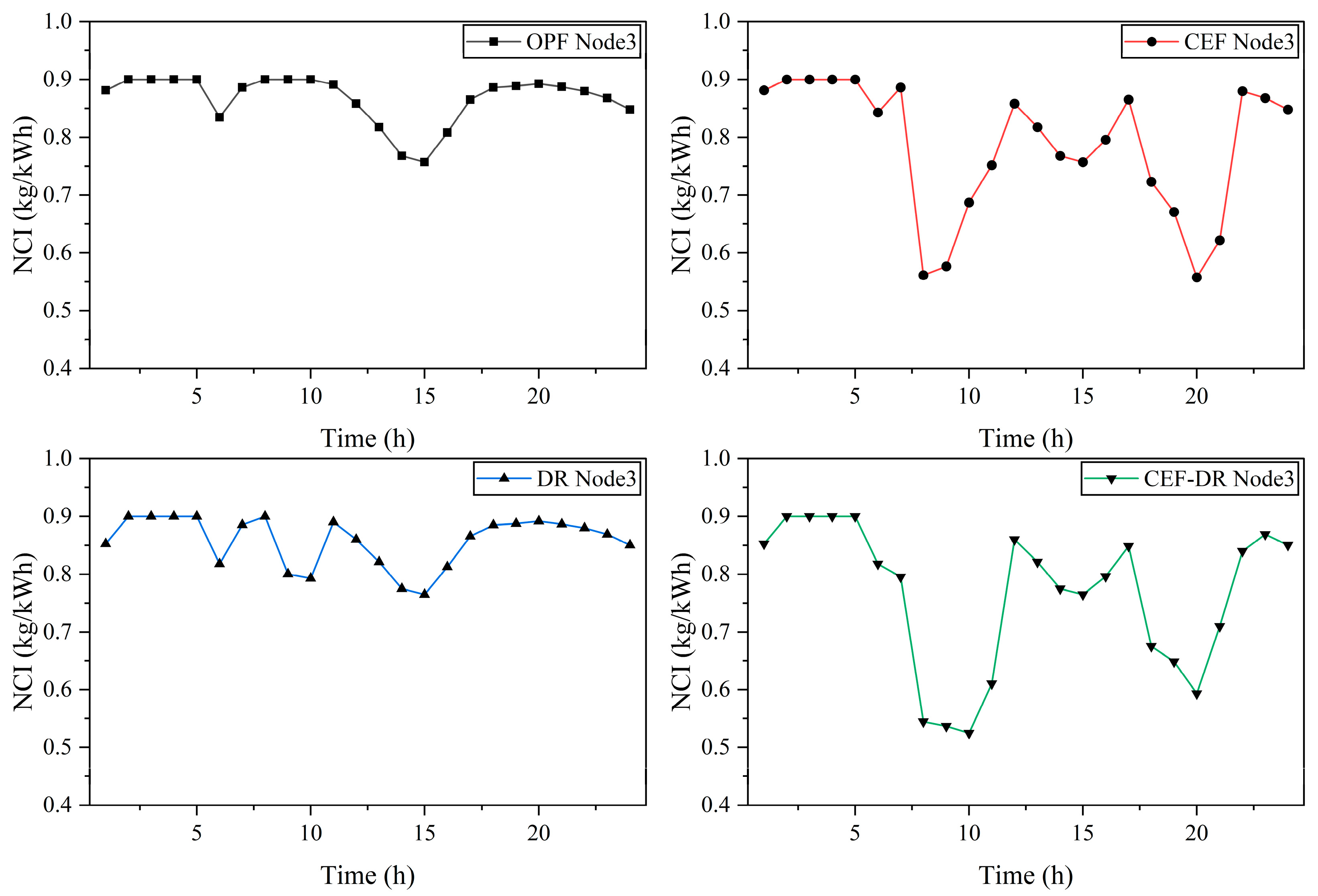
Figure 3 illustrates the NCI evolution for Node 3. In the Cost-Tolerance CEF and Composite CEF-DR scenarios, the target user commits to a 10% economic premium budget. For the Endogenous DR and Composite CEF-DR scenarios, 15% of the hourly load is designated as temporally flexible, representing shiftable resources such as thermal storage, while maintaining the total daily energy consumption strictly constant. Under the isolated DR scenario, the NCI is only marginally reduced during specific periods because the localized load curtailment merely suppresses the output of high-emission marginal units. Conversely, the CEF and CEF-DR frameworks achieve substantial and consistent NCI reductions. The user’s additional cost tolerance enables generation substitution across the network, prioritizing flexible natural gas units over carbon-intensive coal plants. Nevertheless, the dispatch results reveal that baseload coal units remain essential for system security; therefore, they are continuously dispatched during off-peak valleys to maintain robust grid stability.
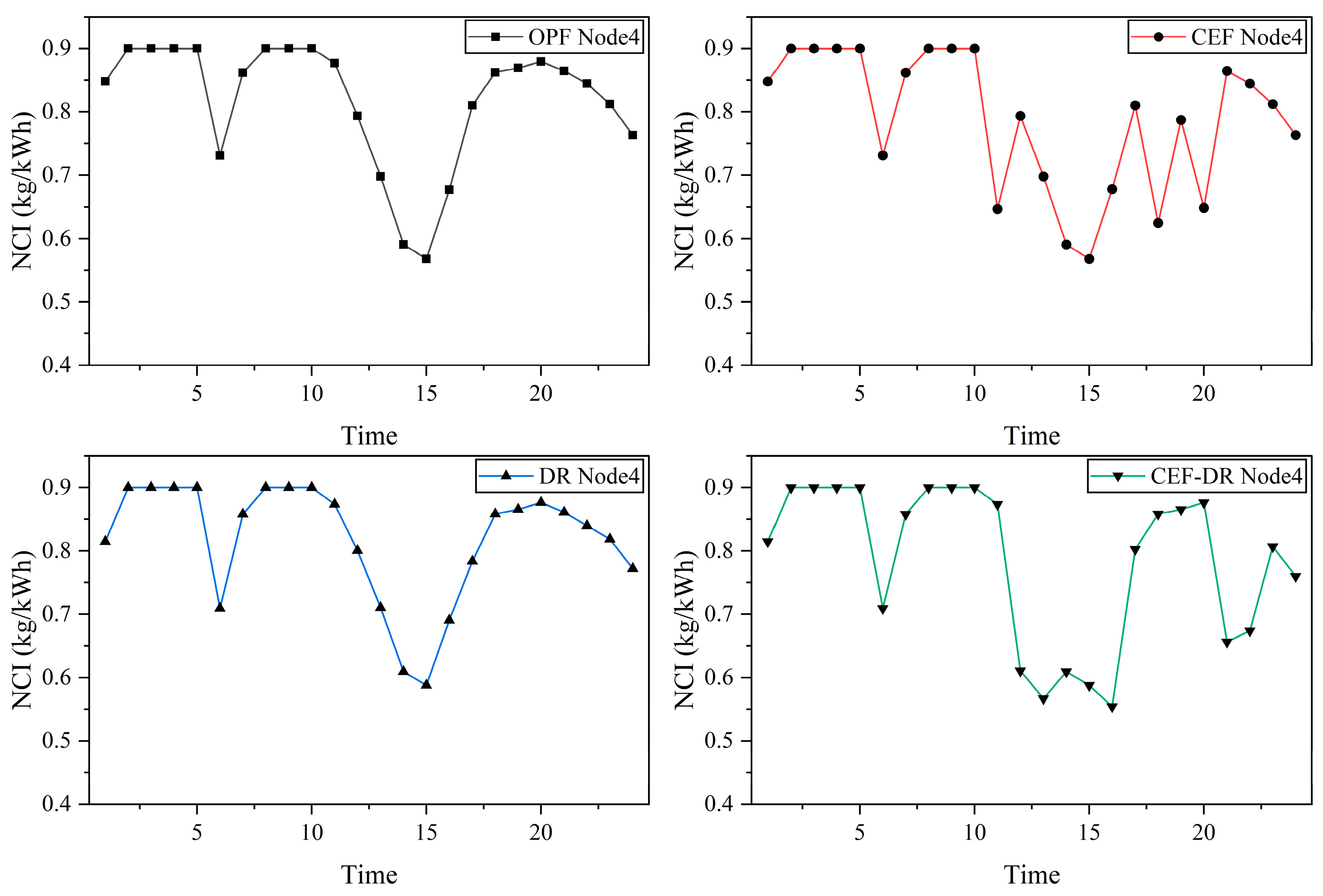
Figure 4 presents the NCI curves when Node 4 is selected as the target. From the baseline OPF perspective, Node 4 is supplied by a relatively cleaner baseline carbon-flow pattern than Node 3. Despite their direct topological connection, the precise physical carbon-flow tracking reveals distinct NCI disparities governed by their specific grid locations. Because the total load demand of Node 4 is approximately half that of Node 3, its isolated demand response exercises a negligible influence on the macro-level unit dispatch, resulting in an almost identical NCI curve in the isolated DR scenario. However, the application of the CEF framework results in a noticeable NCI reduction across most of the scheduling horizon. The composite CEF-DR approach further deepens this decarbonization, achieving a strictly lower cumulative carbon footprint through the synergistic optimization of source substitution and load shifting.
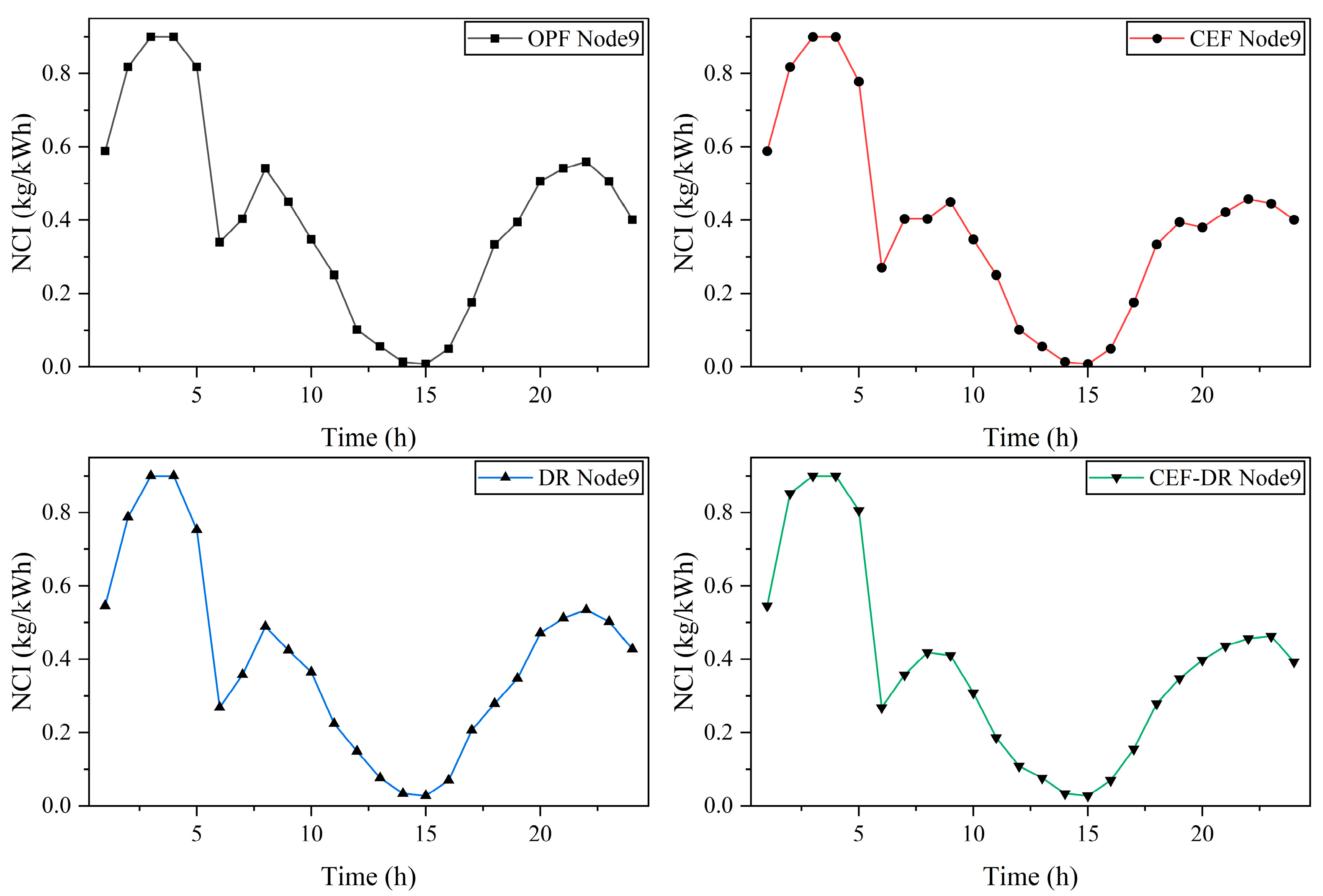
Figure 5 depicts the NCI trajectories for Node 9. Benefiting from a highly favorable topological location proximate to renewable energy injections, Node 9 inherently maintains a low baseline NCI. Consequently, the marginal decarbonization benefits derived from the optimization interventions are less pronounced, although the CEF and CEF-DR frameworks still secure minor emission reductions during specific intervals.
(2)
Impact of localized decarbonization on adjacent nodes
A fundamental premise of user-centric decarbonization is that localized emission reductions must not compromise the environmental attributes of other grid users. To evaluate the effectiveness of the proposed non-degradation constraint, we analyze the cross-nodal impact of targeted decarbonization.
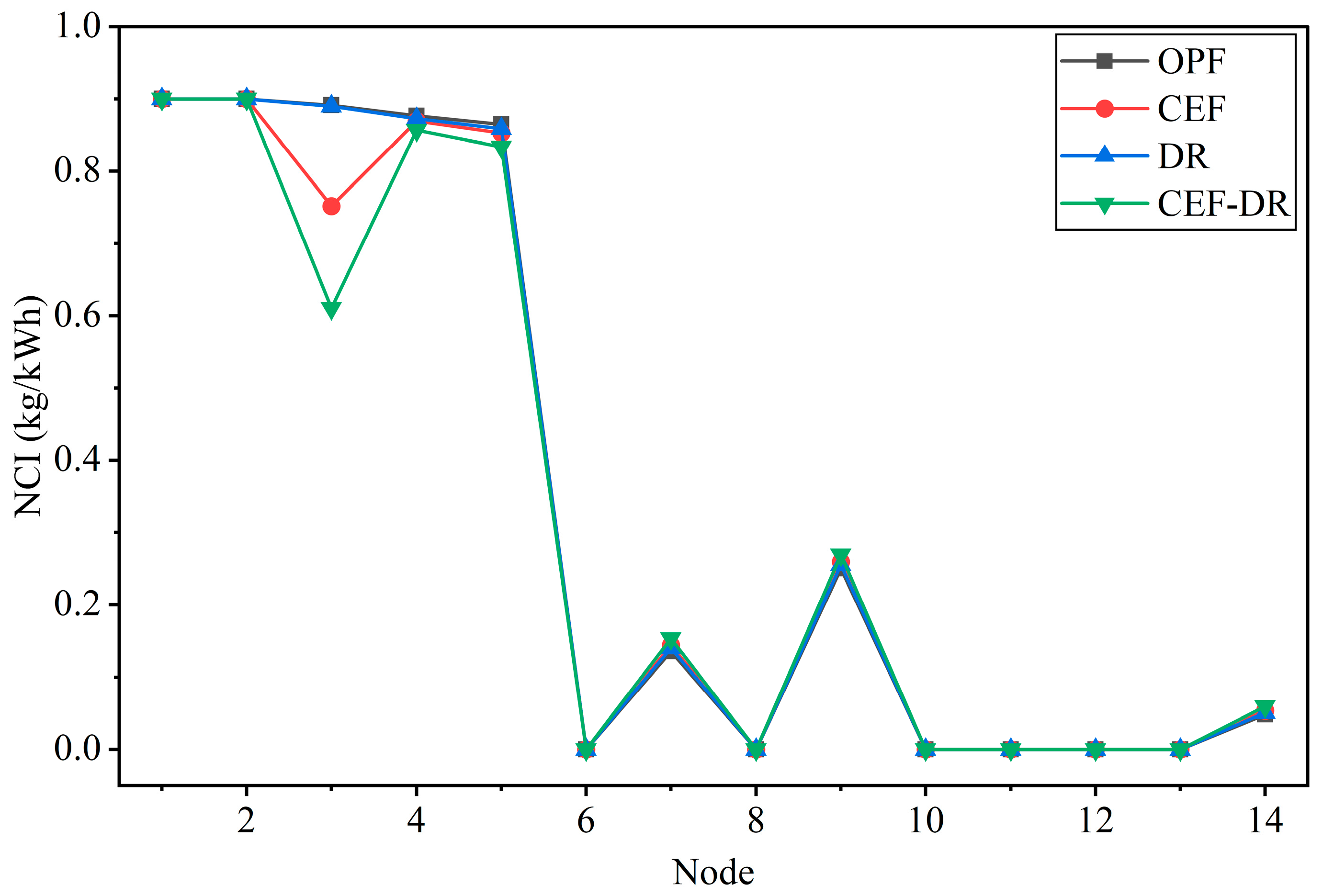
Figure 6 illustrates the NCI distribution across the network at 11:00 when Node 3 is designated as the target decarbonization node. Without the built-in non-degradation limits, the optimization engine would aggressively route all available clean energy to Node 3, inadvertently inflating the carbon intensities of adjacent nodes. Such carbon spillover violates the core objective of system-wide emission mitigation. By enforcing the proposed constraints, the dispatch results demonstrate that under both the CEF and CEF-DR scenarios, the NCI of the remaining non-target nodes remains unchanged or exhibits a slight decrease. This result demonstrates that the proposed method can decarbonize a single high-emission node while avoiding adverse carbon-intensity impacts on the broader network.
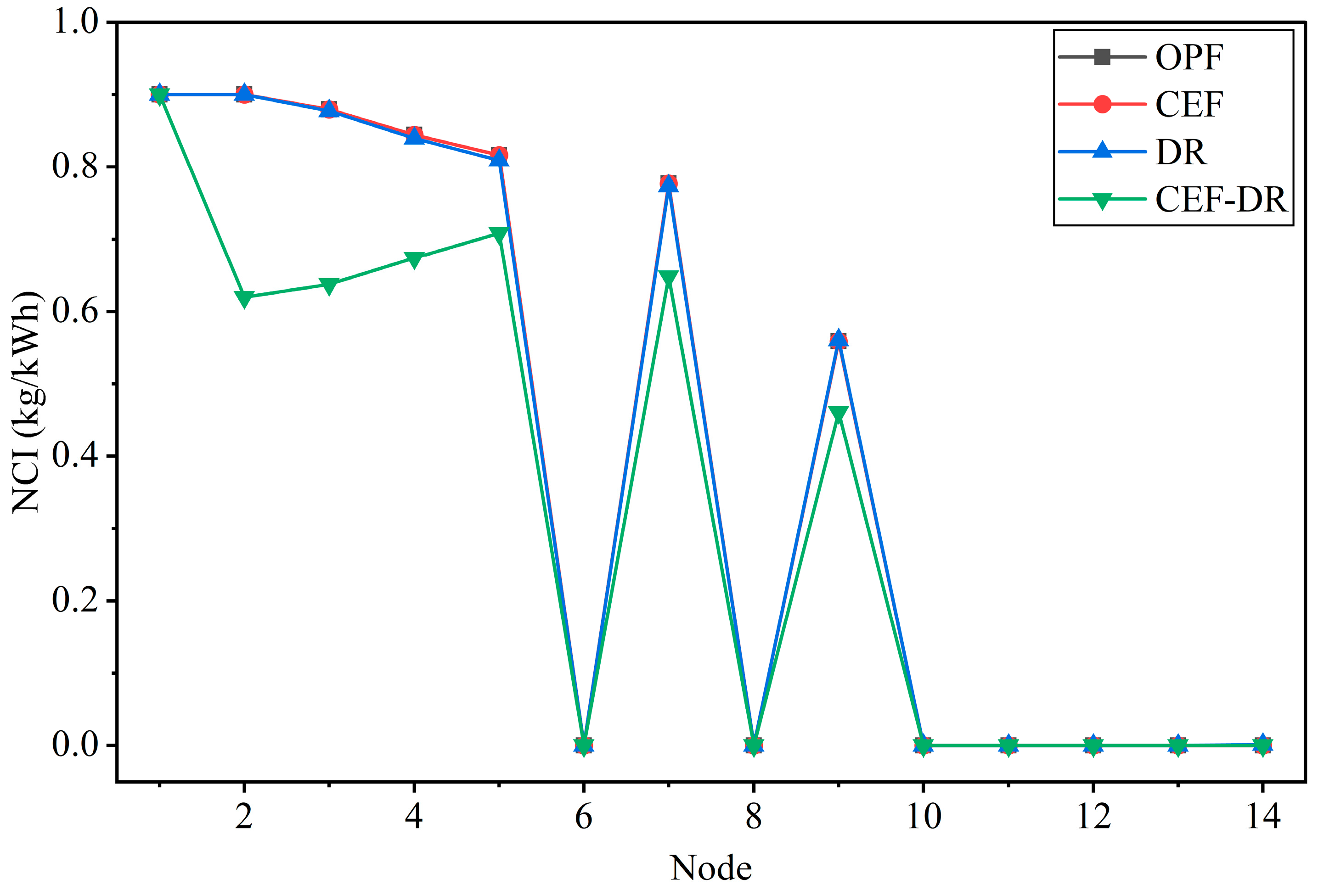
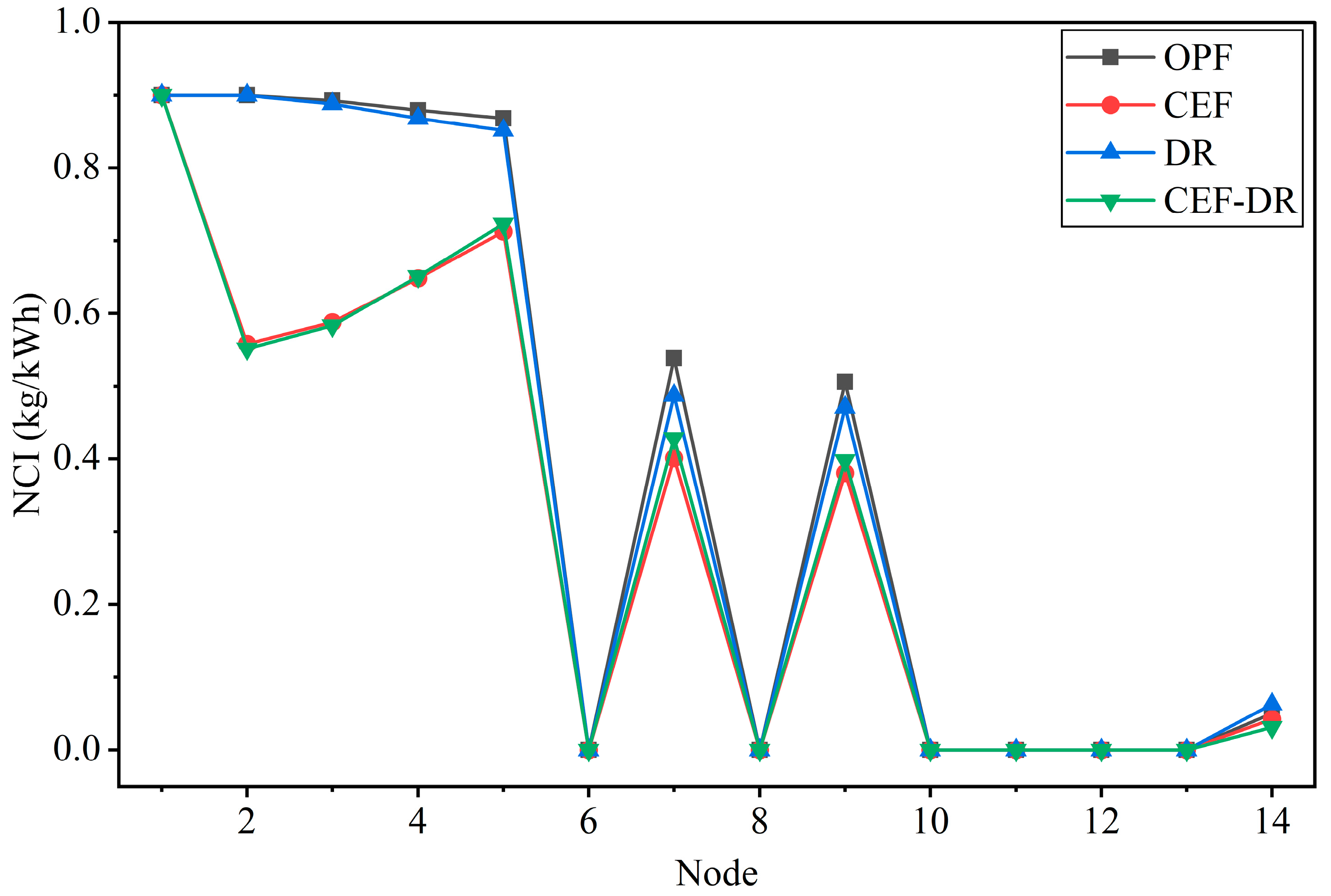
Conversely, Figure 7 presents the cross-nodal NCI impact at 21:00 when nodes with favorable baseline carbon-flow conditions, specifically Node 4 or Node 9, are targeted for decarbonization. Because these nodes inherently require less carbon-intensive generation, prioritizing their decarbonization effectively reduces overall coal dispatch, which simultaneously lowers the carbon footprint of the surrounding high-emission nodes. Consequently, targeting these nodes with favorable baseline carbon-flow conditions generates positive carbon-reduction externalities. However, from an economic perspective, this creates a free-rider dilemma: the targeted user bears the additional cost, while part of the resulting emission-reduction benefit may be transferred to non-paying nodes. This disproportionate cost–benefit alignment inevitably diminishes the economic incentive for users at low-NCI nodes to participate in individualized decarbonization. Therefore, transitioning from isolated single-node optimization to multi-node cooperative decarbonization emerges as a structurally superior approach.
(3)
Sensitivity analysis of cost-carbon trade-offs
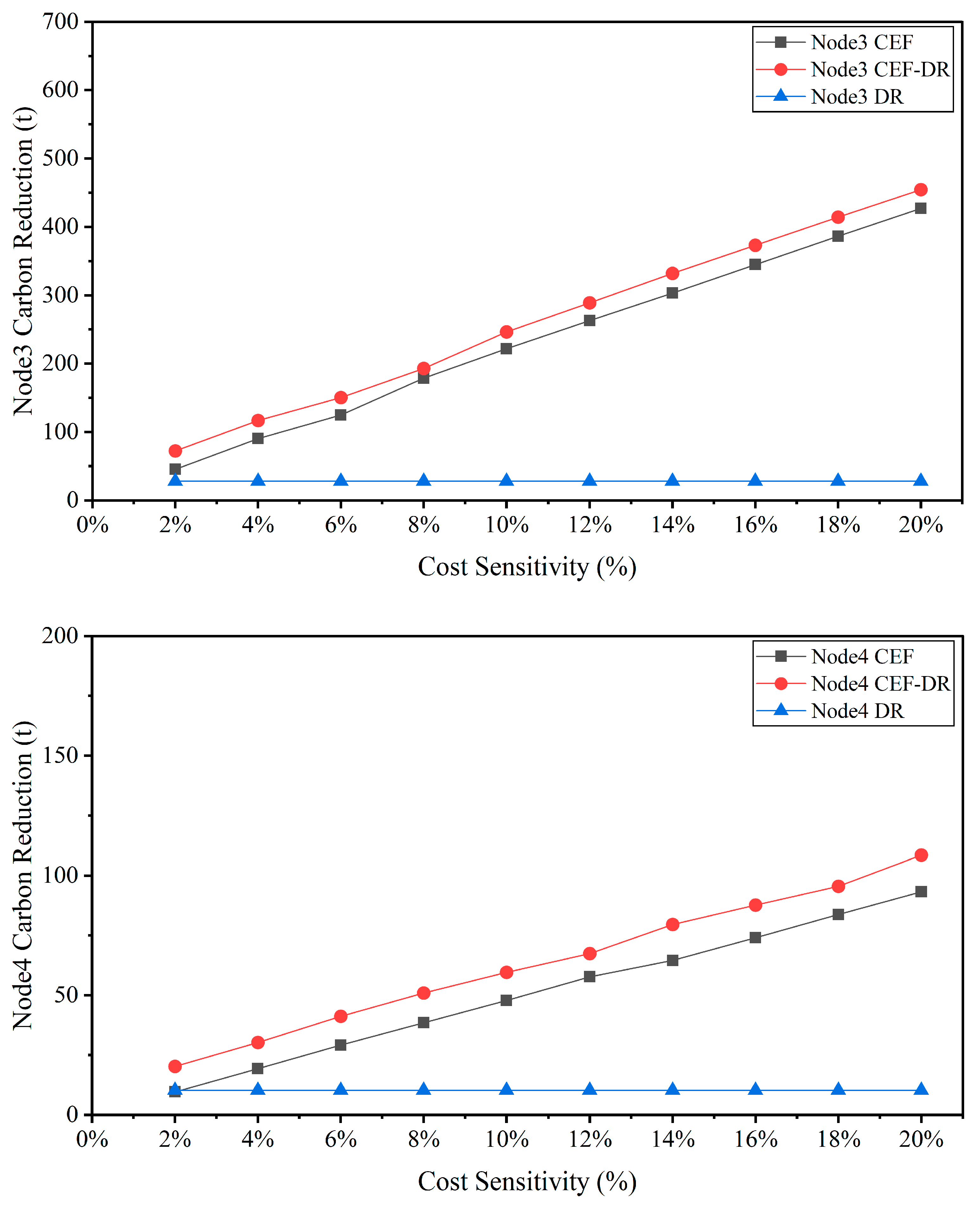
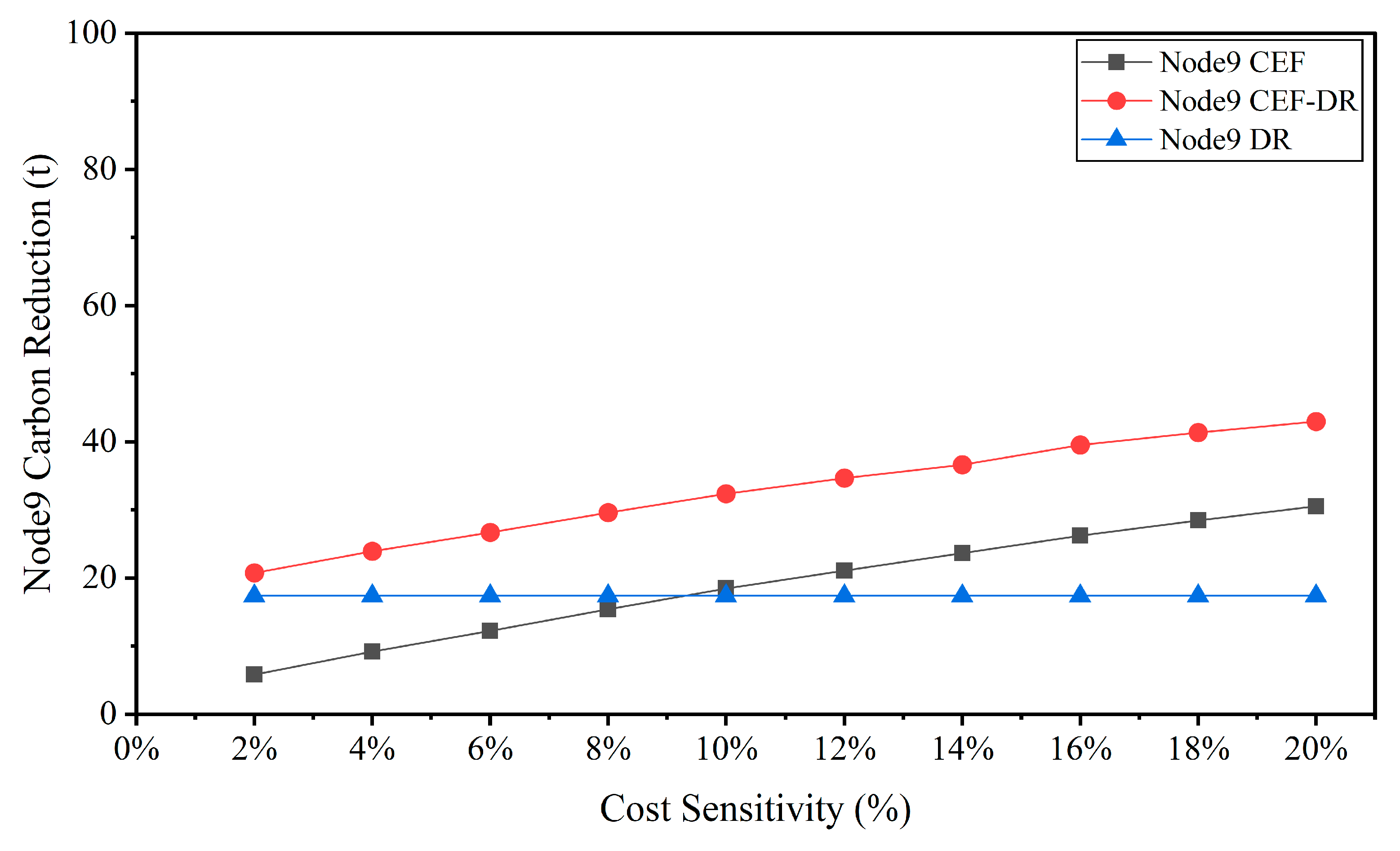
Figure 8 presents the sensitivity of nodal carbon reduction to different additional cost-tolerance levels for Nodes 3, 4, and 9. The results show that carbon-reduction benefits increase with the allowed system-cost premium, but the magnitude varies significantly across nodes.
Node 3 achieves the largest carbon reduction because it has a higher load level and more carbon-intensive baseline inflows. Therefore, additional cost tolerance can be effectively converted into source-side generation substitution. Node 4 shows a smaller but still evident reduction, reflecting its lower load scale and relatively cleaner baseline carbon-flow condition. Node 9 obtains the smallest reduction because it is closer to renewable generation and already receives low-carbon electricity under the baseline dispatch.
Across the three nodes, the CEF-DR strategy consistently outperforms the single-mechanism cases, confirming the complementarity between carbon-flow-constrained dispatch and endogenous demand response. Overall, Figure 8 shows that the same additional cost tolerance leads to different carbon-reduction outcomes depending on nodal location, load scale, and baseline NCI.
(4)
Multi-node synergistic decarbonization and alliance formation
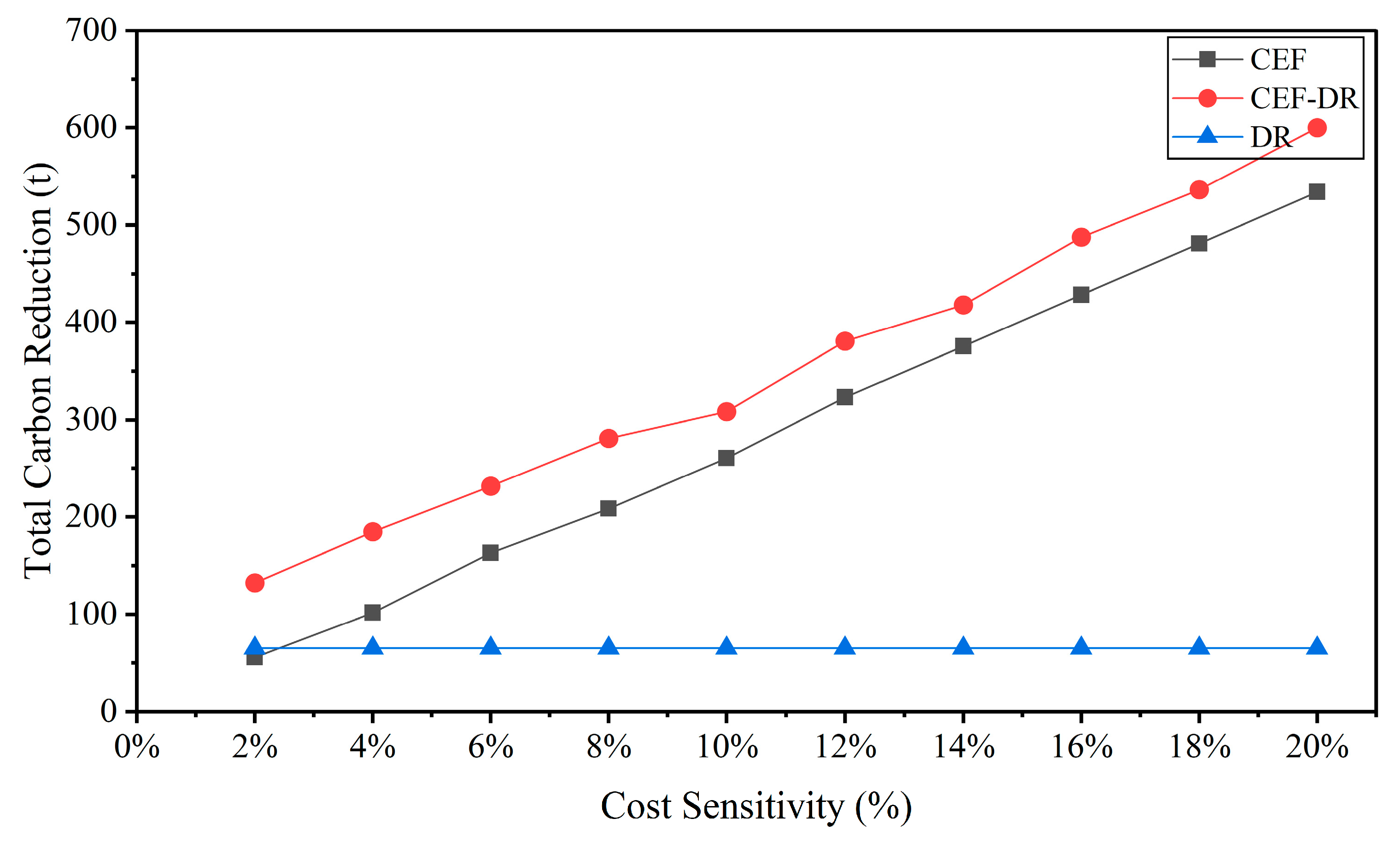
The preceding single-node analyses show that individualized decarbonization may generate uneven cross-nodal effects. In particular, when a user located at a relatively clean node pays for further decarbonization, part of the resulting carbon benefit may spill over to neighboring or electrically connected users. This creates a potential free-rider problem, in which one user bears the additional system cost while other users receive part of the emission-reduction benefit. To address this issue, Figure 9 evaluates a cooperative decarbonization scenario in which Nodes 3, 4, and 9 jointly participate in the carbon-constrained dispatch framework.
As shown in Figure 9, the total carbon reduction increases steadily with the aggregated additional cost tolerance under both the CEF and CEF-DR strategies. Compared with isolated single-node optimization, the cooperative framework pools the participating users’ cost-tolerance budgets and allows the system operator to identify carbon-reduction opportunities from a broader network perspective. As a result, the dispatch model can coordinate generation substitution, carbon-flow redistribution, and flexible-load adjustment across multiple nodes rather than optimizing the carbon footprint of one user in isolation.
The CEF-DR strategy achieves the highest total carbon reduction across the full range of cost-tolerance levels. This indicates that the synergy between source-side carbon-flow optimization and demand-side temporal flexibility becomes more valuable when multiple users participate simultaneously. The DR-only strategy, by contrast, produces a much smaller and relatively flat reduction because load shifting alone cannot fundamentally change the carbon composition of physically delivered electricity when source-side dispatch and carbon-flow constraints are not jointly optimized.
The cooperative framework also helps address the free-rider problem observed in single-node decarbonization. By forming a decarbonization alliance, the total verified emission reduction can be allocated among participating users according to contribution, baseline emissions, or contractual rules. This provides a more equitable and system-efficient mechanism for user-level Scope 2 reduction than isolated low-carbon procurement.
(5)
Overall discussion and practical implications
The numerical results highlight the importance of distinguishing system-level carbon reduction from nodal carbon attribution. Previous CEF studies have shown that carbon responsibility in power systems is spatially heterogeneous because generator-side emissions are transferred to loads through network-dependent power-flow paths [16,20,22]. The present results provide further evidence for this mechanism from a dispatch perspective. Nodes 3, 4, and 9 exhibit different carbon-reduction potentials under the same cost-tolerance setting, indicating that nodal decarbonization is jointly shaped by load scale, baseline NCI, and access to low-carbon generation. In particular, high-load nodes with carbon-intensive inflows provide larger room for generation substitution, whereas nodes located close to renewable injections exhibit weaker marginal responses.
The sensitivity results also show that the economic value of low-carbon dispatch is location-dependent. Existing low-carbon economic dispatch and carbon-aware OPF studies have demonstrated that carbon costs or carbon-flow constraints can be incorporated into dispatch models to reduce system emissions [5,25,33,36]. However, when the optimization target is shifted from system-wide emissions to the carbon footprint of a designated user node, the same additional system-cost allowance may lead to different nodal emission-reduction outcomes. This result suggests that user-level low-carbon services should not be priced or evaluated only by aggregate system abatement but should also consider the physical deliverability of low-carbon power to the target node.
The comparison among the CEF, DR, and CEF-DR scenarios further clarifies the role of demand-side flexibility. Prior carbon-aware demand response studies have shown that flexible loads can reduce emissions by responding to time-varying or location-specific carbon signals [37,41,44]. In this study, the isolated DR scenario provides limited reduction because load shifting alone does not directly change the carbon composition of electricity delivered to the target node. The stronger performance of the CEF-DR scenario indicates that flexible demand becomes more effective when it is coordinated with source-side dispatch and CEF-based nodal carbon constraints. Therefore, demand response contributes not only through temporal load shifting, but also through its interaction with network-constrained carbon-flow redistribution.
The cross-nodal results further indicate that individualized decarbonization may generate external effects among electrically connected users. When a target node pays for carbon reduction, part of the resulting decrease in carbon intensity may also benefit neighboring or related nodes. This effect explains why isolated single-user optimization may create a mismatch between cost-bearing and emission-reduction benefits. The cooperative decarbonization case provides a possible operational response to this issue by pooling the cost-tolerance budgets of multiple users and allocating the verified carbon-reduction benefits according to predefined rules. Such a mechanism is relevant to the design of physically deliverable low-carbon electricity services, especially for corporate Scope 2 accounting and green electricity procurement under network constraints.
These findings should be interpreted within the modeling scope of this study. The proposed framework is based on a PTDF-based DC-OPF approximation and therefore focuses on active-power deliverability rather than full AC feasibility. Nevertheless, the results demonstrate that embedding CEF constraints into dispatch can provide a more transparent basis for user-level carbon accounting than system-average emission factors. The framework can support grid operators and energy service providers in identifying suitable users for individualized decarbonization, quantifying cost-carbon trade-offs, and designing cooperative low-carbon service programs.

4. Conclusions

This paper proposes a User-Centric Carbon Cost-Constrained Low-Carbon Dispatch (CCC-LCD) framework for deliverability-oriented and sustainability-oriented power-system decarbonization. By combining PTDF-based physical dispatch, standardized CEF balance equations, user-specific cost-tolerance constraints, and endogenous demand response, the framework minimizes the physically traced Scope 2 emissions of designated load nodes rather than only reducing aggregate system emissions. This structure explicitly links a user’s willingness to pay with the nodal carbon intensity of the electricity physically delivered to that user, thereby supporting more transparent and verifiable low-carbon electricity consumption.
The IEEE 14-bus case study demonstrates that localized decarbonization benefits are strongly affected by network topology and load characteristics. High-load nodes with carbon-intensive baseline inflows obtain larger reductions from source-side dispatch adjustment, while nodes closer to renewable injections show smaller marginal returns from additional cost tolerance. The integration of CEF and DR generally outperforms either mechanism alone, because it coordinates generation substitution with temporal load shifting and improves the use of physically deliverable low-carbon electricity. These findings suggest that user-side carbon reduction should be assessed together with network deliverability and cost feasibility, which are important conditions for sustainable power-system operation. The cross-nodal analysis further shows that single-node decarbonization may create positive externalities or free-rider effects, motivating cooperative multi-node decarbonization programs. Such cooperative mechanisms can help align cost-sharing responsibilities with emission-reduction benefits among different users, thereby supporting credible low-carbon electricity services and corporate Scope 2 emission reduction.
Several limitations should be acknowledged. First, the model uses a DC-OPF approximation and therefore does not explicitly represent reactive power, voltage constraints, or network losses. Second, the modified IEEE 14-bus system is suitable for a controlled methodological demonstration but cannot fully represent the operational complexity of large-scale power grids. Third, the present sensitivity analysis focuses mainly on cost tolerance and flexible demand, while uncertainty in renewable generation, load forecasting, and carbon prices require further study. Future work should test the framework on larger systems, incorporate AC feasibility and uncertainty-aware optimization, and develop market rules for allocating verified nodal carbon benefits among multiple users.

Supplementary Materials

The following supporting information can be downloaded at: https://www.mdpi.com/article/10.3390/su18105019/s1, Table S1. Node peak loads and 24-h base load curve. Table S2. Generator cost factors, carbon factors, and operating limits. Table S3. Forecast output limits of renewable units and system reserve requirement. Table S4. Branch topology and line capacity. Table S5. PTDF matrix used in the modified IEEE 14-bus system. (a) PTDF matrix for buses 1–7. (b) PTDF matrix for buses 8–14.

Author Contributions

Conceptualization, K.L. and W.S.; methodology, Q.C.; validation, H.F. and Z.Z.; formal analysis, C.T.; data curation, H.F.; writing—original draft preparation, K.L.; writing—review and editing, C.Z. and C.Y.; visualization, C.Y.; project administration, Q.C.; funding acquisition, K.L. All authors have read and agreed to the published version of the manuscript.

Funding

This research is financially supported by the Science and Technology Project of State Grid Shandong Electric Power Company (No. 520626250008).

Institutional Review Board Statement

Not applicable.

Informed Consent Statement

Not applicable.

Data Availability Statement

The original contributions presented in this study are included in the article/Supplementary Material. Further inquiries can be directed to the corresponding author.

Conflicts of Interest

Authors Ke Liu, Wenhao Song, Chunsheng Zhou, Zhonghua Zhao, Chunxiao Tian were employed by the company State Grid Shandong Electric Power Research Institute. The remaining authors declare that the research was conducted in the absence of any commercial or financial relationships that could be construed as a potential conflict of interest.

References

  1. Kabeyi, M.J.B.; Olanrewaju, O.A. Sustainable Energy Transition for Renewable and Low Carbon Grid Electricity Generation and Supply. Front. Energy Res. 2022, 9, 743114. [Google Scholar] [CrossRef]
  2. Qiu, J.; Zhao, J.; Wen, F.; Zhao, J.; Gao, C.; Zhou, Y.; Tao, Y.; Lai, S. Challenges and Pathways of Low-Carbon Oriented Energy Transition and Power System Planning Strategy: A Review. IEEE Trans. Netw. Sci. Eng. 2024, 11, 5396–5416. [Google Scholar] [CrossRef]
  3. Huang, M.-T.; Zhai, P.-M. Achieving Paris Agreement temperature goals requires carbon neutrality by middle century with far-reaching transitions in the whole society. Adv. Clim. Change Res. 2021, 12, 281–286. [Google Scholar] [CrossRef]
  4. Wang, Y.; Guo, C.-H.; Du, C.; Chen, X.-J.; Jia, L.-Q.; Guo, X.-N.; Chen, R.-S.; Zhang, M.-S.; Chen, Z.-Y.; Wang, H.-D. Carbon peak and carbon neutrality in China: Goals, implementation path, and prospects. China Geol. 2021, 4, 720–746. [Google Scholar] [CrossRef]
  5. Chen, X.; Sun, A.; Shi, W.; Li, N. Carbon-Aware Optimal Power Flow. IEEE Trans. Power Syst. 2025, 40, 3090–3104. [Google Scholar] [CrossRef]
  6. Chen, X.; Chao, H.; Shi, W.; Li, N. Towards carbon-free electricity: A flow-based framework for power grid carbon accounting and decarbonization. Energy Convers. Econ. 2024, 5, 396–418. [Google Scholar] [CrossRef]
  7. Ahmed, S.D.; Al-Ismail, F.S.M.; Shafiullah, M.; Al-Sulaiman, F.A.; El-Amin, I.M. Grid Integration Challenges of Wind Energy: A Review. IEEE Access 2020, 8, 10857–10878. [Google Scholar] [CrossRef]
  8. Shafiullah, M.; Ahmed, S.D.; Al-Sulaiman, F.A. Grid Integration Challenges and Solution Strategies for Solar PV Systems: A Review. IEEE Access 2022, 10, 52233–52257. [Google Scholar] [CrossRef]
  9. Fan, H.; MacGill, I.F.; Sproul, A.B. Statistical analysis of drivers of residential peak electricity demand. Energy Build. 2017, 141, 205–217. [Google Scholar] [CrossRef]
  10. Geelen, D.; Reinders, A.; Keyson, D. Empowering the end-user in smart grids: Recommendations for the design of products and services. Energy Policy 2013, 61, 151–161. [Google Scholar] [CrossRef]
  11. Brander, M.; Bjørn, A. Principles for accurate GHG inventories and options for market-based accounting. Int. J. Life Cycle Assess. 2023, 28, 1248–1260. [Google Scholar] [CrossRef]
  12. European Commission. Commission Implementing Regulation (EU) 2025/2547 of 10 December 2025 laying down rules for the application of Regulation (EU) 2023/956 of the European Parliament and the Council as regards the methods for the calculation of emissions embedded in goods. In Official Journal of the European Union; European Commission: Brussels, Belgium, 2025; Available online: http://data.europa.eu/eli/reg_impl/2025/2547/oj (accessed on 1 March 2026).
  13. Zhou, T.; Kang, C.; Xu, Q.; Chen, Q.; Xin, J.; Wu, Y. Analysis on Distribution Characteristics and Mechanisms of Carbon Emission Flow inElectric Power Network. Autom. Electr. Power Syst. 2012, 36, 39–44. [Google Scholar]
  14. Zhou, T.; Kang, C.; Xu, Q.; Chen, Q. Preliminary Theoretical Investigation on Power System Carbon Emission Flow. Autom. Electr. Power Syst. 2012, 36, 38–43. [Google Scholar]
  15. Zhou, T.; Kang, C.; Xu, Q.; Chen, Q. Preliminary Investigation on a Method for Carbon Emission Flow Calculation of Power System. Autom. Electr. Power Syst. 2012, 36, 44–49. [Google Scholar]
  16. Kang, C.; Zhou, T.; Chen, Q.; Wang, J.; Sun, Y.; Xia, Q.; Yan, H. Carbon Emission Flow From Generation to Demand: A Network-Based Model. IEEE Trans. Smart Grid 2015, 6, 2386–2394. [Google Scholar] [CrossRef]
  17. Zhang, S.; Li, Y.; Du, E.; Wang, W.; Wang, M.; Feng, H.; Xie, Y.; Chen, Q. Research on Carbon-Reduction-Oriented Demand Response Technology Based on Generalized Nodal Carbon Emission Flow Theory. Energies 2024, 17, 4672. [Google Scholar] [CrossRef]
  18. Xu, Q.; Ricks, W.; Manocha, A.; Patankar, N.; Jenkins, J.D. System-level impacts of voluntary carbon-free electricity procurement strategies. Joule 2024, 8, 374–400. [Google Scholar] [CrossRef]
  19. Kang, C.; Cheng, Y.; Sun, Y.; Zhang, N.; Meng, J.; Yan, H. Recursive Calculation Method of Carbon Emission Flow in Power Systems. Autom. Electr. Power Syst. 2017, 41, 10–16. [Google Scholar]
  20. Cheng, Y.; Zhang, N.; Wang, Y.; Yang, J.; Kang, C.; Xia, Q. Modeling Carbon Emission Flow in Multiple Energy Systems. IEEE Trans. Smart Grid 2019, 10, 3562–3574. [Google Scholar] [CrossRef]
  21. Kang, C.; Zhou, T.; Chen, Q.; Xu, Q.; Xia, Q.; Ji, Z. Carbon emission flow in networks. Sci. Rep. 2012, 2, 479. [Google Scholar] [CrossRef]
  22. Li, J.; Zhou, Z.; Wen, B.; Zhang, X.; Wen, M.; Huang, H.; Yu, Z.; Liu, Y. Modeling and analysis method for carbon emission flow in integrated energy systems considering energy quality. Energy Sci. Eng. 2024, 12, 2405–2425. [Google Scholar] [CrossRef]
  23. Zhang, Y.; Sun, P.; Ji, X.; Yang, M.; Ye, P. Low-Carbon Economic Dispatch of Integrated Energy Systems Considering Full-Process Carbon Emission Tracking and Low Carbon Demand Response. IEEE Trans. Netw. Sci. Eng. 2024, 11, 5417–5431. [Google Scholar] [CrossRef]
  24. He, L.; Lu, Z.; Zhang, J.; Geng, L.; Zhao, H.; Li, X. Low-carbon economic dispatch for electricity and natural gas systems considering carbon capture systems and power-to-gas. Appl. Energy 2018, 224, 357–370. [Google Scholar] [CrossRef]
  25. Shao, C.; Ding, Y.; Wang, J. A low-carbon economic dispatch model incorporated with consumption-side emission penalty scheme. Appl. Energy 2019, 238, 1084–1092. [Google Scholar] [CrossRef]
  26. Huang, Y.; Wang, Y.; Liu, N. Low-carbon economic dispatch and energy sharing method of multiple Integrated Energy Systems from the perspective of System of Systems. Energy 2022, 244, 122717. [Google Scholar] [CrossRef]
  27. Yu, F.; Chu, X.; Sun, D.; Liu, X. Low-carbon economic dispatch strategy for renewable integrated power system incorporating carbon capture and storage technology. Energy Rep. 2022, 8, 251–258. [Google Scholar] [CrossRef]
  28. Liu, X.; Li, X.; Tian, J.; Yang, G.; Wu, H.; Ha, R.; Wang, P. Low-Carbon Economic Dispatch of Integrated Electricity-Gas Energy System Considering Carbon Capture, Utilization and Storage. IEEE Access 2023, 11, 25077–25089. [Google Scholar] [CrossRef]
  29. Peng, B.; Kong, X.; Tian, C.; Zhang, F.; Ma, X. An IGDT-based a low-carbon dispatch strategy of urban integrated energy system considering intermittent features of renewable energy. Energy Rep. 2023, 10, 4390–4401. [Google Scholar] [CrossRef]
  30. Zhang, Y.; Han, Y.; Liu, D.; Dong, X. Low-carbon Economic Dispatch of Electricity-Heat-Gas Integrated Energy Systems Based on Deep Reinforcement Learning. J. Mod. Power Syst. Clean Energy 2023, 11, 1827–1841. [Google Scholar] [CrossRef]
  31. Zhou, X.; Wang, J.; Wang, X.; Chen, S. Optimal dispatch of integrated energy system based on deep reinforcement learning. Energy Rep. 2023, 9, 373–378. [Google Scholar] [CrossRef]
  32. Li, Z.; Wu, Q.; Li, H.; Nie, C.; Tan, J. Distributed low-carbon economic dispatch of integrated power and transportation system. Appl. Energy 2024, 353, 122134. [Google Scholar] [CrossRef]
  33. Ouyang, T.; Li, Y.; Xie, S.; Wang, C.; Mo, C. Low-carbon economic dispatch strategy for integrated power system based on the substitution effect of carbon tax and carbon trading. Energy 2024, 294, 130960. [Google Scholar] [CrossRef]
  34. Yan, Q.; Ai, X.; Li, J. Low-Carbon Economic Dispatch Based on a CCPP-P2G Virtual Power Plant Considering Carbon Trading and Green Certificates. Sustainability 2021, 13, 12423. [Google Scholar] [CrossRef]
  35. Cao, J.; Yang, Y.; Qu, N.; Xi, Y.; Guo, X.; Dong, Y. A low-carbon economic dispatch method for regional integrated energy system based on multi-objective chaotic artificial hummingbird algorithm. Sci. Rep. 2024, 14, 4129. [Google Scholar] [CrossRef]
  36. Fang, M.; Xiang, Y.; Li, J. Locational electricity–carbon price model: Design and analysis. Energy Rep. 2022, 8, 721–728. [Google Scholar] [CrossRef]
  37. Hou, L.; Lin, H.; Yang, X.; Ren, H.; Shao, D. Low-carbon demand response strategy of buildings considering load rebound. Energy Rep. 2023, 10, 3599–3607. [Google Scholar] [CrossRef]
  38. Ma, F.; Ying, L.; Cui, X.; Yu, Q. Research on a Low-Carbon Optimization Strategy for Regional Power Grids Considering a Dual Demand Response of Electricity and Carbon. Sustainability 2024, 16, 7000. [Google Scholar] [CrossRef]
  39. Du, B.; Jia, H.; Zhang, B.; Li, Y.; Wang, H.; Yan, J.; Du, E.; Zhang, N. Evaluating the carbon-emission reduction potential of employing low-carbon demand response to guide electric-vehicle charging: A Chinese case study. Appl. Energy 2025, 397, 126196. [Google Scholar] [CrossRef]
  40. Feng, H.; Ji, J.; Yang, C.; Li, F.; Li, Y.; Lyu, L. Analysis of Carbon Emission Reduction with Using Low-Carbon Demand Response: Case Study of North China Power Grid. Processes 2024, 12, 1324. [Google Scholar] [CrossRef]
  41. Chen, X. Enhance low-carbon power system operation via carbon-aware demand response. Energy Internet 2024, 1, 141–149. [Google Scholar] [CrossRef]
  42. Qian, B.; Hu, H.; Tang, J.; Xiao, Y.; Lin, X.; Chen, Z. Low-Carbon Optimization Scheduling for Systems Considering Carbon Responsibility Allocation and Electric Vehicle Demand Response. Sustainability 2025, 17, 4299. [Google Scholar] [CrossRef]
  43. Long, Y.; Li, Y.; Wang, Y.; Cao, Y.; Jiang, L.; Zhou, Y.; Deng, Y.; Nakanishi, Y. Low-carbon economic dispatch considering integrated demand response and multistep carbon trading for multi-energy microgrid. Sci. Rep. 2022, 12, 6218. [Google Scholar] [CrossRef] [PubMed]
  44. Park, B.; Dong, J.; Liu, B.; Kuruganti, T. Decarbonizing the grid: Utilizing demand-side flexibility for carbon emission reduction through locational marginal emissions in distribution networks. Appl. Energy 2023, 330, 120303. [Google Scholar] [CrossRef]
Figure 1. CCC-LCD flowchart.
Sustainability 18 05019 g001
Figure 2. Modified IEEE 14-node test system.
Sustainability 18 05019 g002
Figure 3. Node 3 NCI curve at 10% additional cost.
Sustainability 18 05019 g003
Figure 4. Node 4 NCI curve at 10% additional cost.
Sustainability 18 05019 g004
Figure 5. Node 9 NCI curve at 10% additional cost.
Sustainability 18 05019 g005
Figure 6. NCI impact on other nodes during CCC-LCD for Node 3.
Sustainability 18 05019 g006
Figure 7. NCI impact on other nodes during CCC-LCD for Node 4 and Node 9.
Sustainability 18 05019 g007aSustainability 18 05019 g007b
Figure 8. Sensitivity curves of nodal carbon reduction and additional cost tolerance for Nodes 3, 4, and 9.
Sustainability 18 05019 g008aSustainability 18 05019 g008b
Figure 9. Sensitivity curves of total carbon reduction and additional cost tolerance under cooperative decarbonization.
Sustainability 18 05019 g009
Disclaimer/Publisher’s Note: The statements, opinions and data contained in all publications are solely those of the individual author(s) and contributor(s) and not of MDPI and/or the editor(s). MDPI and/or the editor(s) disclaim responsibility for any injury to people or property resulting from any ideas, methods, instructions or products referred to in the content.