Article

Rural–Urban Transition and Control of Agricultural Land Change in Greater Bandung Area, Indonesia


by
Setyardi Pratika Mulya
1,2,*,
Dilla Fathiyatur Rohmah
1,
Ernan Rustiadi
1,2 and
Andrea Emma Pravitasari
1,2
1
Regional Development Planning Division, Department of Soil Science and Land Resources, Faculty of Agriculture, IPB University, Bogor 16680, Indonesia
2
Centre for Regional System Analysis, Planning and Development (CRESTPENT), IPB University, Bogor 16680, Indonesia
*
Author to whom correspondence should be addressed.
Sustainability 2026, 18(10), 5016; https://doi.org/10.3390/su18105016
Submission received: 13 March 2026 / Revised: 5 May 2026 / Accepted: 12 May 2026 / Published: 15 May 2026

Abstract

Rapid urbanisation is threatening agriculture in major cities worldwide. In the Greater Bandung Area (GBA), large-scale conversion of agricultural land into built-up areas has occurred over recent decades. Therefore, this study aimed to understand the rural–urban transition and its control in the agricultural context over the last 20 years. The methods adopted were multitemporal analysis of land cover change (2003–2023), calculation of the sub-district development index (SDI) (2005–2014–2021), spatial clustering analysis, and assessment of the level of agricultural land control. The results showed a transformation of GBA’s spatial structure from a monocentric growth pattern to a polycentric configuration, with the peri-urban zone within a 10–20 km radius evolving as a high-performance area. This shift has diminished the dominance of the traditional city centre and produced a pronounced “donut effect”. An integrated analysis of SDI and spatial clustering identified three interrelated functional zones, namely urban, peri-urban, and rural, forming a continuous spatial gradient. The peri-urban area functioned as a dynamic interface where agricultural activities coexisted and competed with urban expansion pressures. These results outlined the need for context-specific and differentiated planning methods, supported by selective spatial control to guide metropolitan transition toward balanced and sustainable development.

1. Introduction

Land-use change is a global phenomenon that is challenging to circumvent. It generally occurs through the conversion of land with low economic rent, such as agricultural land, into uses with higher land rent, including settlements and industrial areas [1,2]. The phenomenon of agricultural land conversion is becoming increasingly intense in developing countries experiencing rapid urbanisation and economic growth [3].
Urbanisation as the main driver of land use cover change (LUCC) has led to uncontrolled physical expansion of cities, known as urban sprawl [4]. This expansion extends beyond the administrative boundaries of the city, leading to a rural–urban transition zone characterised by a mixture of rural and urban characteristics [5]. The phenomenon is characterised by uncontrolled expansion into peripheral areas, leading to inefficient land use and increased dependence on transport [6].
In Indonesia, the intensity of land use change varies based on regional characteristics and patterns that differ between densely populated metropolitan areas and low-density regions [7]. Areas with high population density, such as metropolitan areas on the island of Java, have seen productive agricultural land converted into massive built-up areas [8]. The ratio of rice field expansion and conversion in Jakarta and its surrounding areas between 2000 and 2019 was 1:8 [9]. Meanwhile, Surakarta City and its surrounding areas in Central Java recorded only a 1% conversion of agricultural land to non-agricultural use between 2010 and 2018. The decline in agricultural labour was more than 30 per cent during that period [10]. In Bogor, West Java, agricultural land conversion occurs at a relatively high rate of 51.45 hectares per year, with a potential loss of food crop production amounting to 3098.06 tonnes annually [11]. In areas with low population density, the conversion of forests into oil palm plantations dominates land use change patterns, with proximity to economic centres and soil quality being the main determinants of the rate of change [12]. This land conversion not only threatens food security and ecological functions, but also changes the socio-economic character of communities, shifting from a dominance of the agricultural sector to the non-agricultural sector and increasing inequality between regions [13]. This phenomenon of agricultural land conversion is common in global cities, including metropolitan areas in Indonesia.
Part of Indonesia’s metropolitan areas is Greater Bandung (often referred to as the Greater Bandung Area or GBA). Bandung is the capital of West Java Province, hydrologically forms part of the Upper Citarum River Basin, which faces complex urbanisation issues [14]. As part of the largest metropolitan areas in Indonesia, GBA attracts population migration, which further creates high development pressure in Bandung City as the centre and spreads to suburban areas influenced by factors such as population density and proximity to infrastructure [15]. During the 2010–2020 period, West Java’s population grew by 15%. Among the regencies and municipalities in the GBA, Bandung Regency saw the largest gain (19%), followed by Cimahi City and Purwakarta, both with 13% [16]. The uncontrolled urban expansion patterns in the GBA have led to competition for land and water use between urban domestic, industrial, and agricultural needs, making spatial planning increasingly difficult [17]. The GBA is unique in that it faces extremely high urbanisation pressures, with a basin-like topography that exacerbates the risks of both flooding and drought, whilst Jakarta is more predominantly affected by issues of land subsidence and tidal flooding [18]. The increase in GRDP in the metropolitan cities of Bandung is directly proportional to the development gap with the surrounding areas [19]. GBA is physically integrated with the Jakarta Metropolitan Area through urban corridors, forming an expanded metropolitan area known as the Jakarta Bandung Mega Urban Region (JBMUR) Corridor. These conditions make this area an ideal representation for understanding the dynamics of land use change and regional development in Indonesia.
Based on urgency, this study aims to analyse the spatio-temporal dynamics of agricultural land and regional development in the GBA through a multi-temporal and multi-aspect method. The analysis can provide recommendations for spatial control from the perspective of protecting agricultural land, which is always subject to conversion to other uses. The novelty of this study lies in three conceptual advancements. First, it moves beyond conventional land cover analyses by integrating multi-temporal land dynamics with regional development typology, thereby revealing not merely where conversion occurs but why it varies across different developmental contexts. Second, it introduces the concept of basin-constrained urbanisation, a distinct spatial logic shaped by topographic closure, which fundamentally differs from the sprawling dynamics observed in coastal metropolitan regions. This topographic condition intensifies land conversion pressures along the urban–peri-urban interface in ways that remain theoretically underarticulated. Third, it challenges the linear assumption of rural–urban transition by proposing a feedback loop mechanism: land conversion on the periphery generates new push factors for remaining agricultural households, which in turn accelerates further urbanisation. This conceptualisation extends classical land rent and urban sprawl theories by embedding institutional and socio-ecological feedback into their explanatory frameworks.

2. Materials and Methods

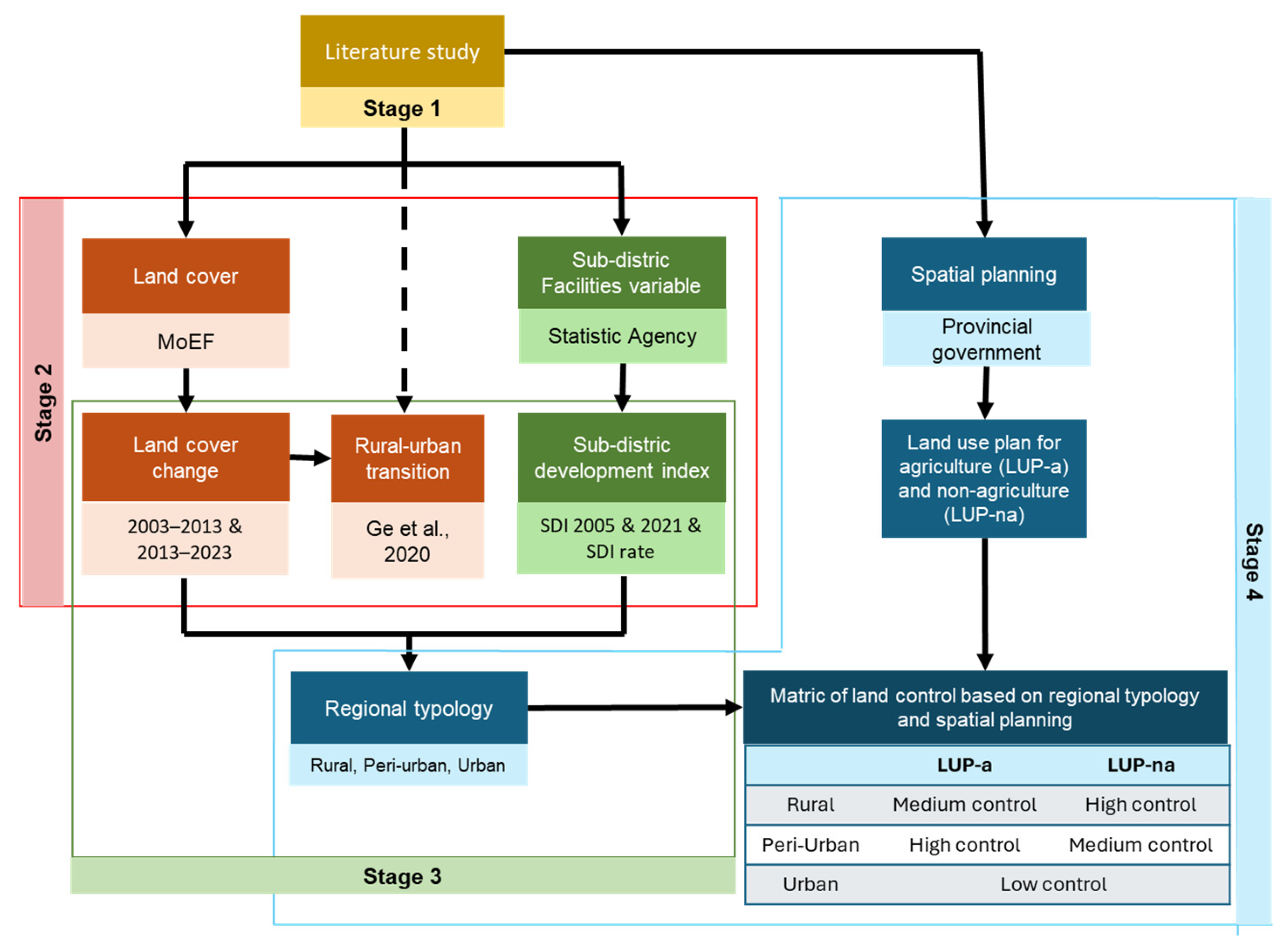
This study was divided into four stages. Stage 1 included a literature review related to the phenomena of urbanisation and rural–urban transition. Stage 2 explained land use change and village development indices. Stage 3 examined regional typologies, and Stage 4 assessed regional control mechanisms (Figure 1).

2.1. Study Area

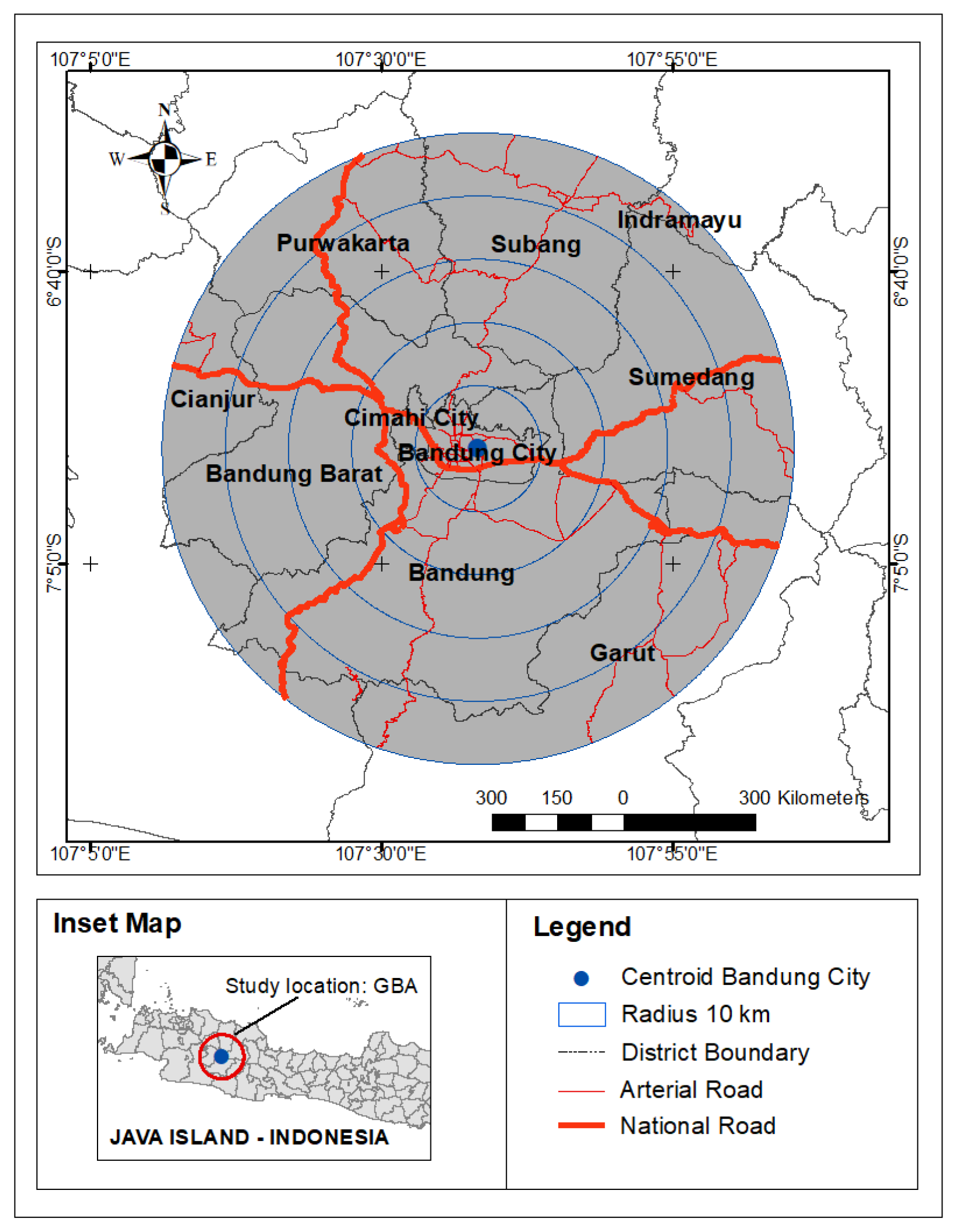
The study area was the GBA, which included the cities of Bandung and Cimahi, as well as the regencies of Bandung, West Bandung, Subang, Sumedang, Purwakarta, Garut, Cianjur, and a small part of Indramayu. The spatial method used concentric zones with radii ranging from 10 km to 50 km from the growth centre of Bandung City. This method was applied to identify variations in spatial characteristics using the straight-line distance method from the city centre, extending in all directions, commonly referred to as the Euclidean distance [21]. A distance of 50 km was selected to ensure that observed land use change dynamics were primarily influenced by the development of Bandung as the main growth centre and were not significantly affected by neighbouring cities.
The centre point of Bandung City was determined using a spatial method based on centroid calculation, which identified the geometric centre of the city’s administrative boundaries. This method was chosen because it was more objective and spatially consistent than using symbolic landmarks, such as “Alun-Alun” (town square), which are inherently subjective [22]. Figure 2 visualises concentric zones of 10–50 km in stages from the centre of Bandung City to the surrounding areas. Mathematically, the centroid of a polygon was calculated using the following formula:
X C =   i = 1 n x i A i i = 1 n A i ,   Y C =   i = 1 n y i A i i = 1 n A i
where:
  • xi, yi = coordinates of the centre point of Bandung City;
  • Ai = area of Bandung City;
  • XC, YC = coordinates of the centroid point originating from the overall polygon calculation.

2.2. Analysis of Land Cover Change from 2003 to 2023

We identified land cover changes using a geographic information system (GIS) analysis based on logical matrices [23]. In this study, land cover was divided into three main categories, namely built-up land including airports/settlements (LT), dryland agriculture and plantations (PP), and rice fields (S). Other land cover types were excluded to facilitate a clearer observation of urbanisation trends. The selection of land cover classes (LT, PP, and S) was based on the specific focus of this study, namely, analysing the conversion of agricultural land to built-up land in the context of urbanisation. According to [24], urbanisation in the Global South intensifies land use around cities, shifts production towards high-value commodities, and increases socio-economic vulnerability due to competition for land. Ref. [25] adds that peri-urban areas in the Global South are characterised by dynamic land-cover changes and unregulated expansion. In Indonesia, the primary pressure stems from the conversion of productive irrigated rice fields, which hold high food security and socio-economic value, into built-up areas [26]. In the GBA, primary natural forests are concentrated in the protected northern conservation areas, whilst rice fields constitute an agro-ecosystem with vital ecological functions (flood control, groundwater recharge, and microclimate regulation). Thus, the dynamics of rice paddies–dryland agriculture–built-up land form the core of this study as they highlight the most critical trade-off in urbanisation in the Global South, namely between food security and urban expansion.
In developing countries, changes in these three land cover types are used as indicators of spatial urbanisation [24]. A characteristic of peri-urbanisation in Asia is the conversion of rice paddies and farmland around cities into built-up areas [24]. These three land-use dynamics form the strength of this study, as they highlight the most critical trade-off in urbanisation in the Global South: food security versus urban expansion.
Spatial data were derived from the Ministry of Environment and Forestry (MoEF) of the Republic of Indonesia [9]. Temporal analysis with 10-year intervals (2003, 2013, and 2023) was conducted to identify patterns, trends, and driving factors of land use change. This multi-temporal method enabled the identification of regional development dynamics within the context of sustainable urbanisation, particularly in distinguishing urban and suburban characteristics.

2.3. Sub-District Development Index Analysis

Sub-district development index (SDI) analysis was based on the scalogram method [27]. This analysis used secondary data from PODES (village potencies) and BPS in 2005, 2014, and 2021, focusing on educational, health, and economic facilities in each sub-district. The educational facility variables included the number of junior high school equivalents, senior high school/vocational school equivalents, and universities. The health variables were the number of hospitals, maternity hospitals, community health centres, integrated health service posts, polyclinics/health centres, village maternity clinics, doctors’/midwives’ practices, and pharmacies/drug stores. Meanwhile, the economic variables included the number of government/private commercial banks, cooperatives, markets, supermarkets/shops, restaurants/eateries, hotels, and grocery stores.
The selection of variables was based on a sustainability perspective, encompassing physical, economic, and social aspects, with indicators such as the number of facilities and levels of accessibility reflecting regional development [28]. We selected educational, health, and economic facilities because they represent a hierarchy of services ranging from the local to the regional level and reflect the sub-district’s role as a centre for public and economic services. This approach does not aim to measure absolute quality or quantity, but rather to identify the existence and relative capacity of services to classify regional typologies within a scalogram framework commonly used in regional planning in Indonesia.
The stages of the scalogram analysis consisted of (1) inventory of facilities and development indicators per region, (2) calculation of capacity per 1000 inhabitants, (3) weighting, (4) standardisation to ensure uniform units, and (5) summation of standard values to obtain the sub-district development index (SDI) [29]. After selecting the relevant variables, the data matrix was compiled in a separate worksheet. The underlying assumption was that higher index values showed higher levels of regional development.
The sub-district development index per 1000 population was calculated using the following equation:
S i j = 1000 × x i , j P i ,
where:
  • Sij represents the e-th agricultural index in the i-th region;
  • xi,j denotes the number of facilities in the i-th region; and
  • Pi is the total population in the i-th region.
The data were then weighted by dividing the capacity value of facility j by the corresponding weight, where the weight of facility j was equal to the total capacity of facility j divided by the number of regions with facility j. Subsequently, data normalisation was performed using the following general formula:
y i j = ( x i j min ( x j ) ) SD ,
where:
  • yij represents the standardised index value for the e-th region and j-th feature;
  • xij′ denotes the weighted value of the characteriser index for i-th region and j-th feature;
  • min(xj) serves as the minimum index value for the j-th feature; and
  • SD is the standard deviation

2.4. Regional Typology Analysis Based on K-Mean Clustering

K-means clustering was used in this study as a non-hierarchical clustering method to identify regional typologies based on similarities in development and land use characteristics. This method grouped the units of analysis into a predetermined number of clusters by minimising intra-cluster variation and maximising inter-cluster differences, thereby effectively capturing structural patterns in standardised multivariate data. As this is an exploratory study, no stability test was conducted.
The variables reflected the spatial and functional dimensions of the region, including the sub-district development index rate (LJ_SDI), distance to the nearest city or district centre (JK), percentage of built-up land (PLT), percentage of rice fields (PS), and percentage of dryland agriculture and plantations (PPP) (Table 1). The identification of regional typologies based on LUCC characteristics and the sub-district development index (SDI) was important for understanding spatial variations in regional development [30]. In the typology developed in this paper, there was a discrepancy in the years covered between the land use change data (LUCC 2023) and the SDI rate data (2005–2021) due to the limited availability of official data from the Ministry of Environment and Forestry (MoEF) and the Central Statistics Agency (BPS). Land cover data were used to describe the current condition of the region, whilst SDI data were used to indicate its growth rate. Both were used only to observe general trends, and not for precise temporal comparisons. Nevertheless, the combination of these two datasets is still sufficient to explain the regional typology.
The K-means-based typological analysis consistently distinguished urban, peri-urban, and rural areas based on gradients of development intensity and land use structure, even without explicitly incorporating geographical proximity. As a non-spatial clustering method, this study grouped areas solely based on attribute similarity rather than spatial distance, thereby producing a comprehensive typology that reflected non-spatial dimensions of regional development [31]. The method proved efficient and robust for exploring regional typologies in developing metropolitan areas, and provided a strong analytical basis for integrating spatial analysis and evidence-based regional development planning [32].
Three clusters were identified, each representing distinct regional characteristics. Cluster 1 corresponded to developed urban sub-districts characterised by advanced infrastructure and a high dominance of built-up land. Cluster 2 represented peri-urban or transitional zones exhibiting mixed urban and rural characteristics. Cluster 3 showed hinterland or rural areas that remained dominated by agricultural land and exhibited lower levels of infrastructure development.
Table 1. Variables used in K-means clustering analysis.
NoAspectVariableFormulationSource
1Type of land cover in 2023Percentage of built-up area (PLT) b u a sda × 100 % ,
where bua represents the area of built-up area (ha); and sda is the sub-district area (ha).
[32,33,34]
Percentage of rice fields (PS) r f sda × 100 % ,
where rf represents the area of rice field area (ha); and sda is the sub-district area (ha).
[35,36]
Percentage of dryland farming & plantations (PPP) d l f sda × 100 % ,
where dlf represents the area of dryland farming area (ha); and sda is the sub-district area (ha).
[37,38]
2Sub-District Development IndexDistance to the nearest city centre (JRK)Original data[39,40]
SDI rate 2005–2021 (LJ_SDI) I P K   t 1 I P K t 0 I P K   t 0
where SDI t1 is the sub-district development index for the final year, and SDI t0 is the sub-district development index for the initial year
[41]
K-means is a widely used unsupervised clustering method that divides observations into k clusters by minimising the sum of the squared distances within each cluster between the observations and their respective cluster centres [42,43]. By using Euclidean distance (Equation (4)), this algorithm repeatedly assigns each observation to the nearest cluster centre and continues to update the position of that centre until convergence [44]. The distance between centroid points and object points was calculated using the Euclidean distance formula [45].
D = ( x 2 x 1 ) 2 + ( y 2 y 1 ) 2  
where:
  • D = Euclidean distance;
  • (x1, y1) = centroid coordinate;
  • (x2, y2) = object coordinate.
Its simplicity, computational efficiency and scalability make K-means a popular method in urban research, land-use mapping, and regional zoning [46]. K-means clustering is an algorithm that groups objects into k partitions (k < n) based on attribute similarity [47]. In this study, the initial centroid values for the first iteration were determined randomly. The K-means clustering objective function is defined as:
m i n { C 1 , , C k } i = 1 k x C i x μ i 2
where Ci denotes the i-th cluster, x represents an observation assigned to cluster Ci, and μi is the centroid of cluster i.
In this study, K-means clustering was evaluated using three different configurations, namely, k = 3, urban, peri-urban, and rural. We employed a top-down classification approach in which the number of clusters (k = 3) was determined substantively based on the theory of spatial gradients (urban, peri-urban, rural), rather than on purely statistical stability criteria. The K-means approach is commonly used in peri-urban studies in the Global South [48].
In addition to Euclidean distance, the spatial clustering assessment incorporated two additional parameters: contiguity (K) and the coefficient of variation within clusters (CV). Contiguity (K) measured the degree of spatial connectivity among areas within a cluster and was calculated manually by examining the adjacency of polygon boundaries [49]. The coefficient of variation (CV) described the degree of data dispersion within a cluster and was calculated as the ratio of variance to the mean distance, expressed as a percentage [50]. According to [51], smaller CV values showed lower internal heterogeneity and better cluster quality.
C V = ( σ 2 x ¯ )
where:
  • CV = coefficient of variation;
  • σ2 = standard deviation of distance (Dij);
  • x ¯ = mean distance (Dij).

2.5. Land Control

Agricultural land in metropolitan and peri-urban areas face increasing pressure from urban expansion, rising land values, and a shift in economic orientation toward non-agricultural sectors. Consequently, its sustainability cannot rely solely on market mechanisms [52]. Previous studies showed that productive agricultural land tended to undergo permanent conversion into built-up areas without strong and consistent policy intervention, leading to declining food production capacity, environmental degradation, and widening regional inequality [53]. Therefore, policy support in the form of agricultural zoning protection, economic incentives for farmers, land conversion control, and the integration of agricultural land into regional planning systems are key prerequisites for maintaining agricultural functions during the dynamics of urbanisation [54].
Agricultural land control was developed through a multi-criteria method that integrated land use planning (LUP) results with non-spatial regional typology analysis (Table 2). The primary objective was to determine control priority levels based on land conversion vulnerability and development pressure, thereby establishing an operational and measurable stratification of control zones. The level of control was determined based on a decision matrix that combined LUP status with regional typology.
The land use planning analysis was derived from zoning regulations that showed the planned allocation for agricultural land (LUP-a) and non-agricultural land (LUP-na). LUP-a included areas designated as production forest zones, agricultural zones, and fisheries zones. LUP-na comprised areas designated for residential, industrial, mining, energy, and defence and security purposes. Areas designated as conservation zones, local protected areas, areas providing downstream protection, and water bodies were excluded from the analysis, as these areas are already subject to strict regulations and enforcement mechanisms.
In agricultural land (LUP-a), controls are stricter in peri-urban areas due to high pressure for land conversion, moderate in rural areas which remain relatively stable, and more relaxed in urban areas that are already developed. Conversely, on non-agricultural land (LUP-na), the strictest controls are applied in urban areas to manage development intensity, moderate controls in peri-urban areas as transition zones, and low controls in rural areas to encourage limited development. This differential approach underscores that the success of preserving agricultural land depends heavily on the sensitivity of policies to spatial dynamics and development pressures in each type of area.
Agriculture in peri-urban areas exhibited higher vulnerability to conversion compared to urban and rural areas [55]. Therefore, peri-urban agriculture required higher levels of control relative to other zones. Control levels based on vulnerability were defined as presented in Table 2.

3. Results

3.1. Land Cover Change Patterns in the GBA and Surrounding Areas (2003–2023)

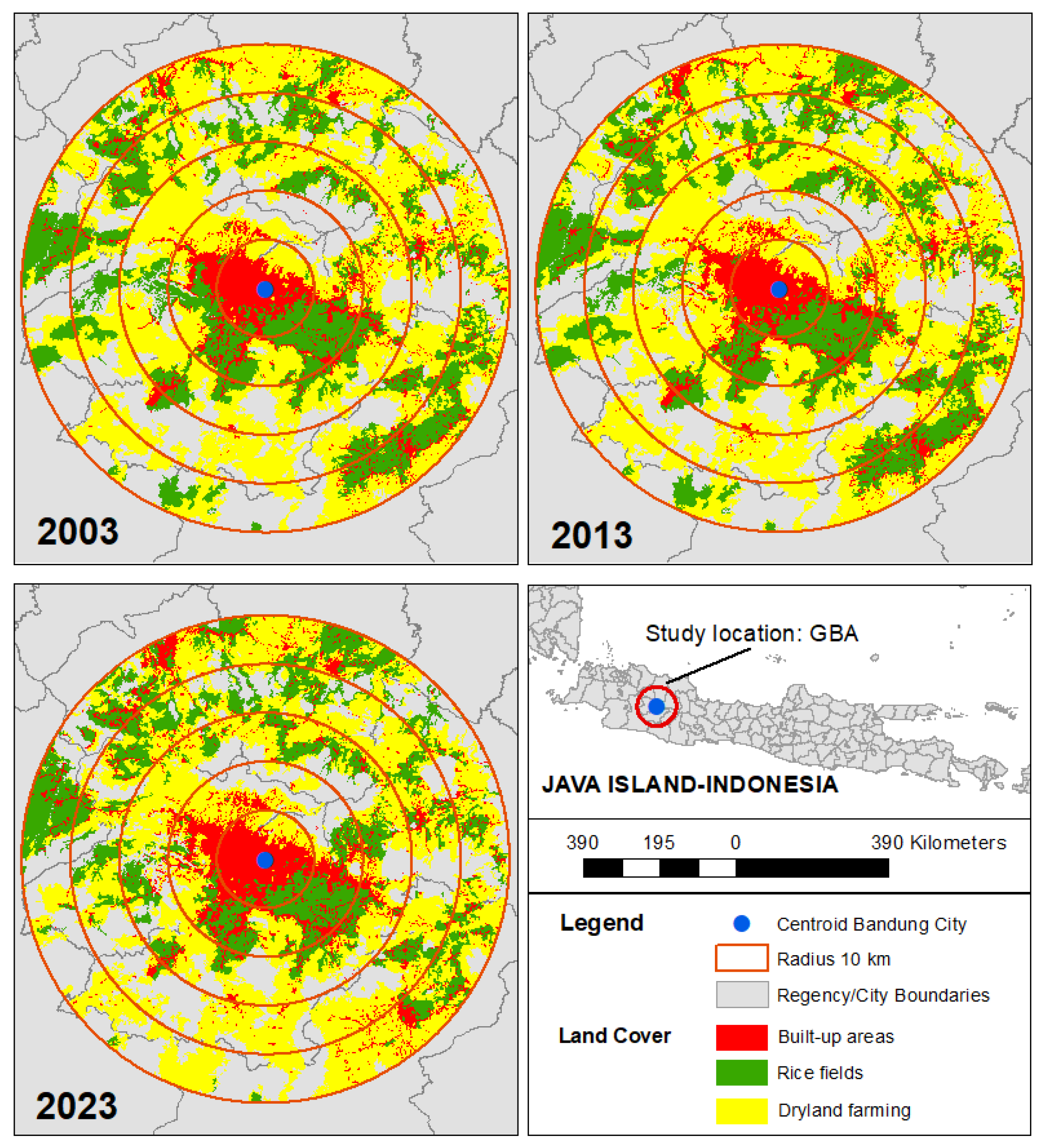
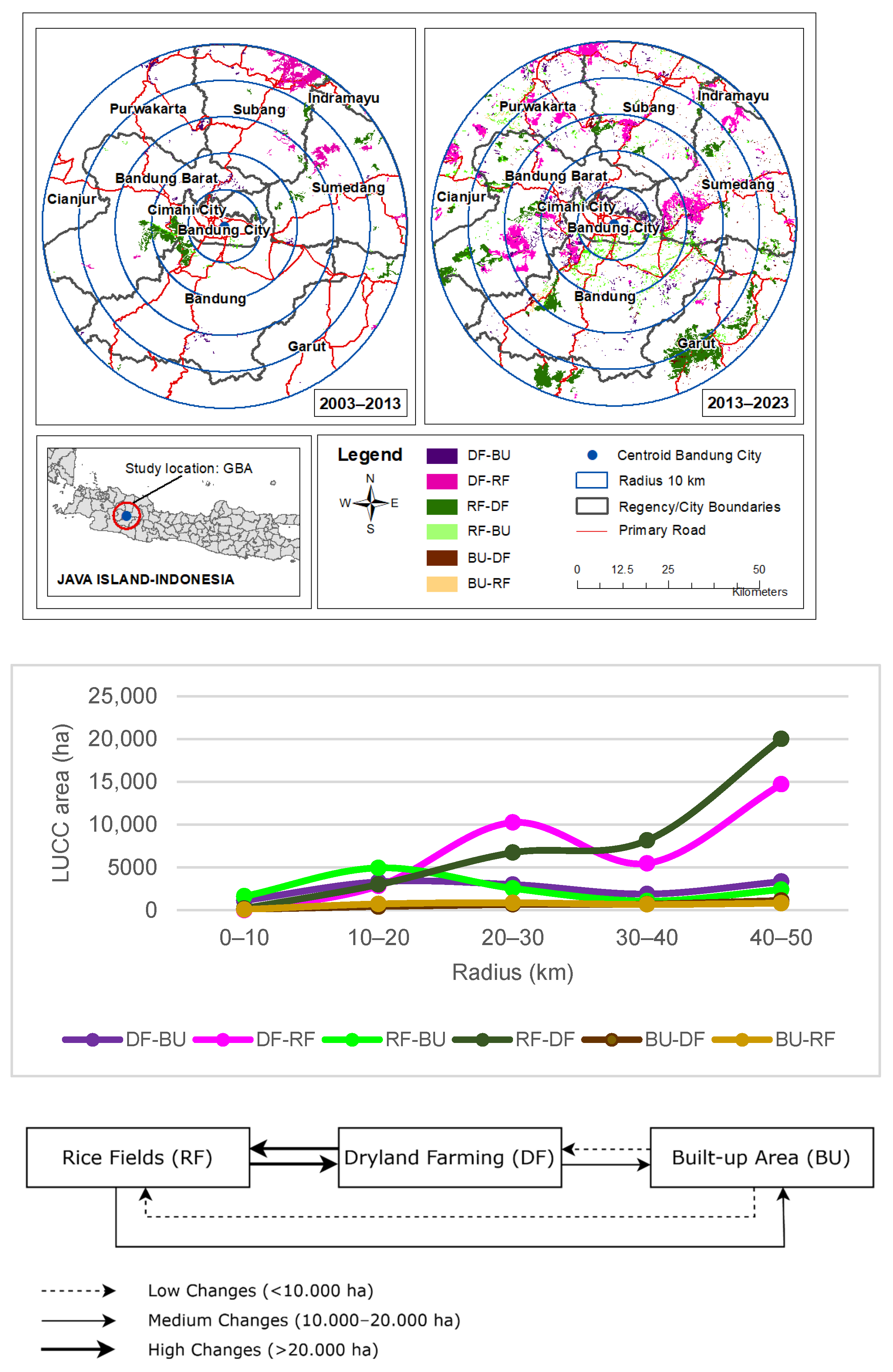
Land cover changes in the GBA and surrounding areas during the period 2003–2023 showed significant spatial transformation, particularly through the conversion of agricultural land into built-up areas. The observed dynamics followed a pattern consistent with urban sprawl theory, in which built-up areas expanded concentrically from the city centre toward the periphery.
In 2003, urban areas (marked in red) were concentrated in the city centre and showed a relatively limited urban radius, while rice fields and dryland agriculture (green and yellow) dominated the surrounding areas. By 2013, urban expansion became more extensive with an increased urban radius and the evolution of new residential areas and infrastructure, although agricultural and green land still occupied a substantial portion of the landscape. By 2023, the spatial pattern showed a marked acceleration of urbanisation with residential areas expanding rapidly and replacing large areas of agricultural land, alongside the emergence of industrial zones and other built structures. This expansion led to a significant reduction in agricultural land and green open spaces, with the highest conversion rates occurring in peri-urban areas [56].
Densely populated residential areas (red) were concentrated in the core of Bandung City and parts of Cimahi City, with urban expansion increasingly spreading northward towards West Bandung Regency and Purwakarta, and southward towards Bandung Regency. Subang Regency in the north and Garut Regency in the south remained largely dominated by dryland agriculture and plantations (yellow and light green), although these areas experienced increasing conversion pressure over time. Meanwhile, primary forest and dryland areas (dark green) persisted in hilly regions across several regencies, particularly in locations farther from the city centre and characterised by steep topography (Figure 3).
During the first phase (2003–2013), land use change remained relatively limited and was concentrated around the centre of Bandung. Conversion was dominated by transitions from rice fields to built-up land (S–LT), shown in light green, and to a lesser extent by conversions from dryland agriculture to built-up land (PP–LT), as indicated in purple (Figure 4). The spatial pattern during this period reflected relatively controlled development expansion, following a concentric trajectory from the city centre with a limited radius. In contrast, the second phase (2013–2023) exhibited a substantial acceleration in both the intensity and spatial extent of land use change. The conversion of rice fields to built-up land (S–LT) became more widespread and extended to greater distances from the city centre, including areas previously dominated by agriculture. Additional conversion patterns also evolved, including transitions from rice fields to dryland agriculture (S–PP), shown in dark green, and from dryland agriculture to rice fields (PP–S), as indicated in magenta.
Figure 4 further shows the magnitude of land cover change in hectares by distance from the city centre over the 2003–2023 period. The largest change occurred in rice fields converted to plantation land (S–PP), which showed a sharp increasing trend with distance, particularly within the 40–50 km radius, indicating the expansion of agricultural activities in outer suburban areas. Conversions from rice fields to built-up land (S–LT) and from plantations to built-up land (PP–LT) were more pronounced within the 10–30 km radius, outlining an active urban–peri-urban transition zone undergoing residential expansion. Other land cover changes, such as LT–PP and LT–S remained relatively small in magnitude and stable across distance intervals. Overall, this pattern showed stronger urbanisation pressure in the central and peri-urban zones, while land cover changes in the outer areas were more closely associated with agricultural restructuring, particularly plantation expansion replacing rice fields.

3.2. SDI

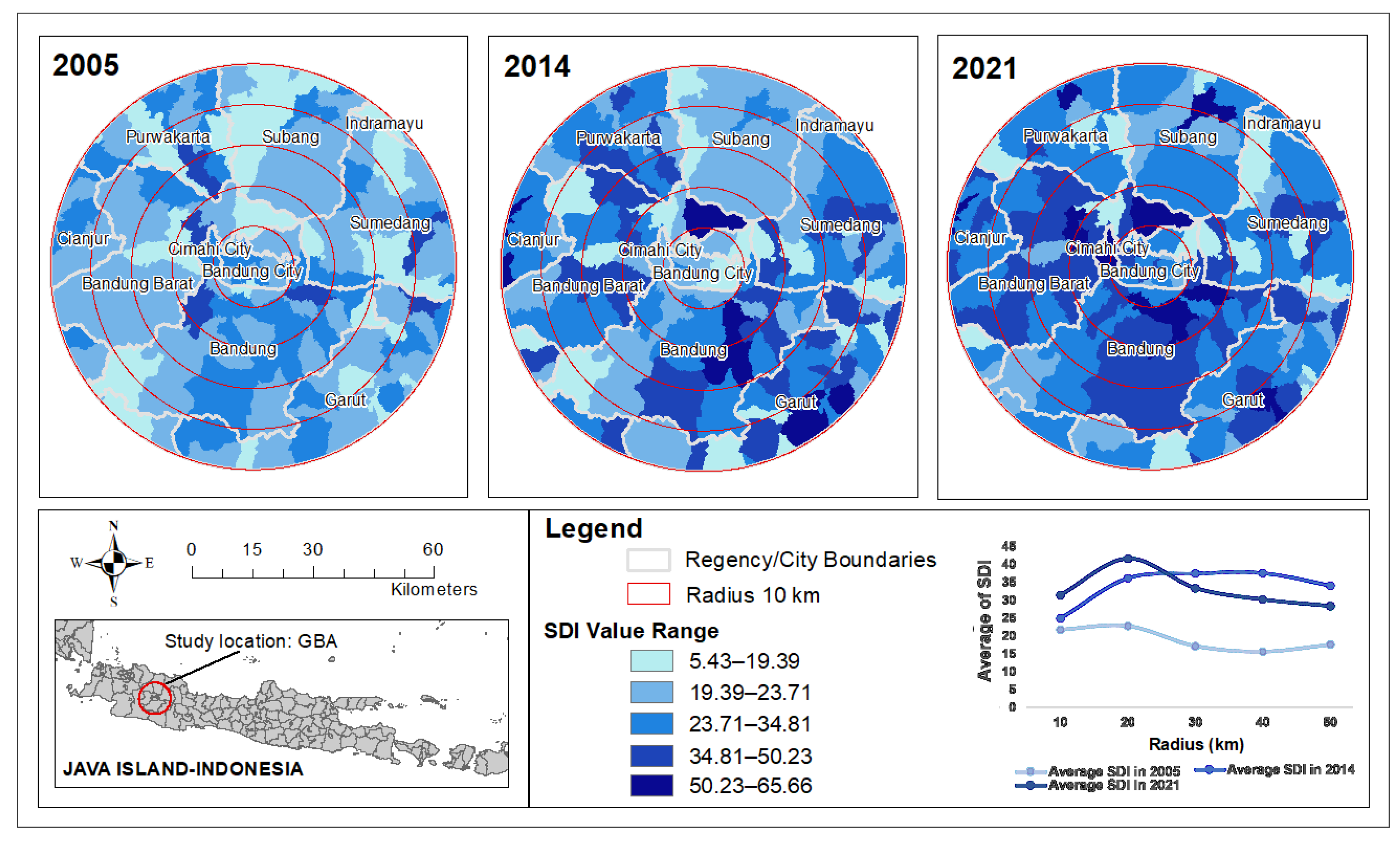
The spatial distribution of sub-district development levels and their temporal dynamics during the 2005–2021 period are shown in Figure 5. In 2005, high SDI values (50.23–65.66) were concentrated in the metropolitan core, showing a relatively consistent gradient that decreased with increasing distance from the city centre. Low SDI values (5.43–19.39) dominated peripheral areas in the outer radius, which retained predominantly rural characteristics and limited infrastructure provision. This concentric distribution reflected a clear development hierarchy, with the metropolitan core serving as the primary focus of infrastructure investment and public service provision. Therefore, regional development in 2005 indicated a relatively balanced distribution of SDI values with most sub-districts falling within the middle category (19.39–34.81), showing moderate development levels. Although the city centre and adjacent areas showed higher SDI concentrations, the contrast with peripheral areas was not pronounced.
Despite this general pattern, several sub-districts located within a 0–20 km radius of the city centre recorded relatively low SDI values despite being surrounded by higher-performing areas. In Bandung City, Arcamanik and Cibiru sub-districts exhibited low SDI values in 2014, outlining intra-urban development disparities [57]. Similarly, Cilengkrang sub-district in Bandung Regency consistently recorded low SDI values in both 2014 and 2021. The persistence of low development levels in this area suggests the presence of structural constraints, including limitations in infrastructure provision, public services, and connectivity [58].
The transformation of regional development included the conversion of agricultural land into built-up areas and the improvements in infrastructure quality, accessibility, and public service facilities in areas that were previously rural. Analysis of average SDI values by distance showed a distinctive spatial pattern. In 2005, the 0–10 km radius recorded the lowest average SDI value (21.8), while the 10–20 km radius recorded the highest value (22.8). Beyond this zone, SDI values gradually declined from 17.3 to 15.7 across the 20–50 km radius. During the 2014 transition period, all distance zones experienced substantial increases in SDI values, with the 20–40 km radius reaching peak values between 37.6 and 37.7, while the 0–10 km radius remained the lowest at 25.0. By 2021, the 10–20 km radius showed the highest SDI value (41.7), the 0–10 km radius increased to 31.5, and the 20–50 km radius experienced a relative decline.

3.3. Regional Typology

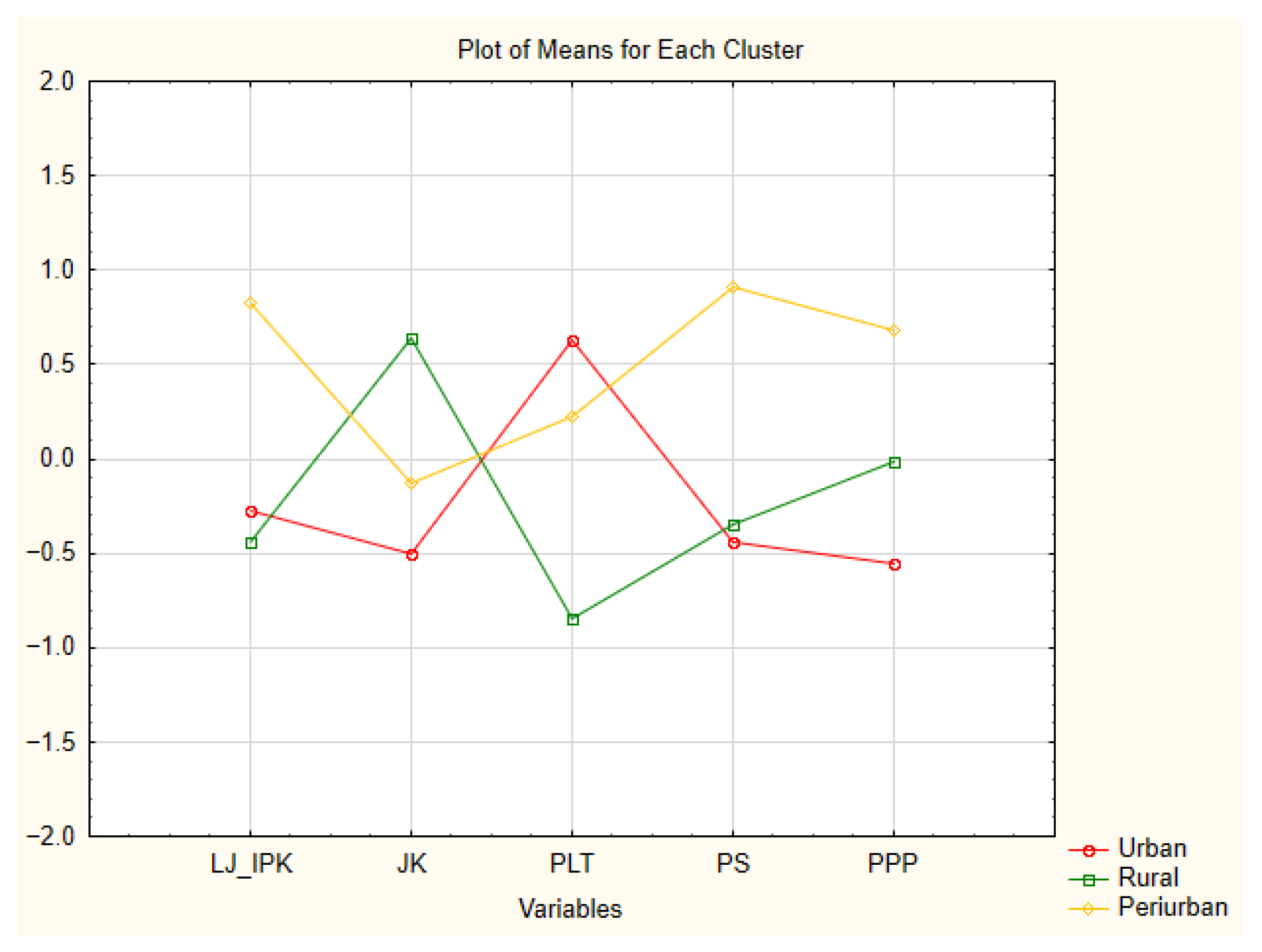
Figure 6 presents a plot of the average standardised values of the study variables across the three identified clusters. The graph denotes the distinct characteristic profiles of each cluster, with the horizontal axis representing the variables used to define regional typology and the vertical axis showing their standardised mean values. The results showed clear differentiation among clusters, providing a basis for interpreting regional typologies. Based on the results of the ANOVA (analysis of variance) test, all five variables, SDI growth rate (LJ_SDI), distance to the nearest city centre (JK), percentage of built-up land (PLT), percentage of rice fields (PS), and percentage of dryland agriculture and plantations (PPP), had a statistically significant effect, with p-values of 0.00 (<0.05). Among these variables, the percentage of built-up land (PLT) exerted the strongest influence on cluster differentiation, as showed by the highest F-statistic value (F = 63.14). This was followed by PS (F = 52.56), LJ_SDI (F = 39.74), PPP (F = 31.05), and JK (F = 29.16).
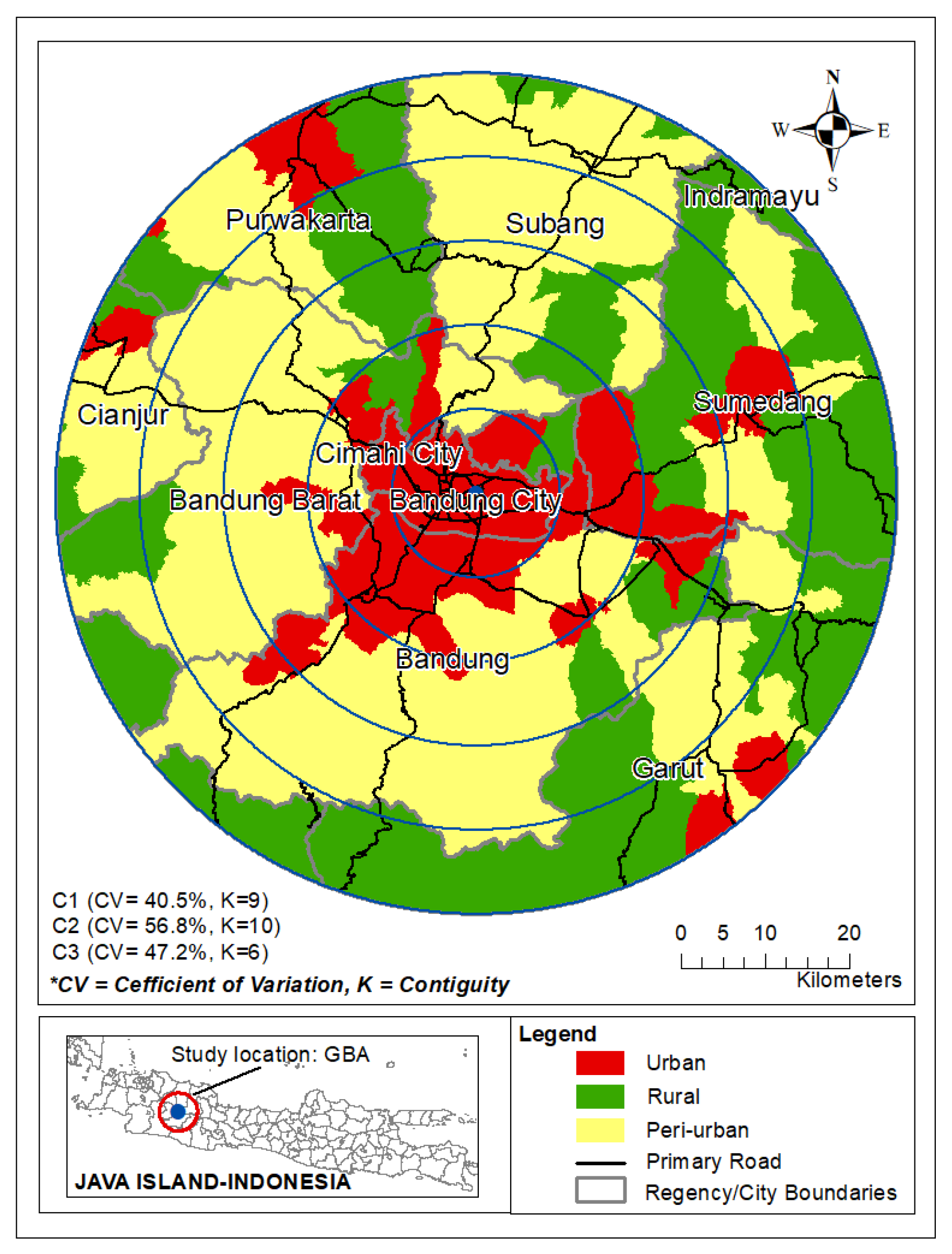
Based on Figure 6, three contrasting characteristics were identified. Urban areas (red) showed relatively low SDI growth rates, close proximity to city or district centres, the highest proportion of built-up land, and the lowest proportions of rice fields and dryland agriculture or plantations. This pattern showed areas that had undergone intensive urbanisation, where urban functions dominated land use. The dominance of built-up land combined with the scarcity of agricultural land reflected a transformation into densely populated urban environments. The low SDI growth rate suggested a saturation condition, in which development had reached a relatively optimal level in terms of facility provision. However, further growth was constrained by land scarcity or mismatches between population growth and facility expansion (Figure 7).
Rural areas (green) showed characteristics opposite to those of urban areas, including low and stagnant SDI growth rates, relatively long distances from city centres, very low proportions of built-up land, higher proportions of rice fields, and moderate proportions of dryland agriculture. The low SDI growth rates reflected stagnation in sub-district development and a general slowdown in regional progress. These areas remained dominated by agricultural activities, limited infrastructure, and slower development trajectories due to the distance from economic growth centres. Persistent stagnation showed limited investment in infrastructure and public services, contributing to low regional development dynamics.
In contrast, peri-urban areas showed a profile with high and rapid SDI growth rates, moderate distances from city/district centres, relatively high percentages of built-up land, and high percentages of rice fields, dryland agriculture, and plantations. These characteristics reflected transitional zones dominated by agricultural land but experiencing rapid development pressure [59]. The moderate distance from urban centres provided reasonable accessibility while maintaining a partially non-urban character. This combination of strong development growth and sustained agricultural dominance showed an active transformation process from rural to urban land use, a defining feature of peri-urban areas in a dynamic stage of development [60].
Overall, the three clusters formed a gradation from urban to rural areas, with peri-urban occupying an intermediate position still dominated by rice fields, dryland agriculture, and plantations. The persistence of extensive agricultural land in rapidly developing peri-urban areas outlined the complex interaction between urban expansion and rural land preservation within this transition zone [61]. Clustering results identified 67 sub-districts with rural characteristics, 56 peri-urban sub-districts, and 67 urban sub-districts, covering approximately 265,000 ha, 396,000 ha, and 123,000 ha, respectively.
However, these results differed slightly from those of Firman [62], who showed that peri-urban areas in the Jabodetabek region experienced more complex and fragmented land use patterns. In that context, urbanisation occurred in a more sporadic and non-linear manner. This suggests that typological transitions did not follow a smooth gradient from urban to peri-urban to rural areas, but may be scattered and discontinuous.
In addition to non-spatial regional typology information, the analysis showed imbalances in the spatial distribution of cluster membership. Urban areas (red), with a coefficient of variation (CV) of 40.5% and a contiguity (K) value of 9, represented relatively limited and compact zones concentrated in core areas such as Bandung City, Cimahi City, and parts of Sumedang Regency. The relatively low CV showed a high degree of internal homogeneity, while the compact spatial concentration confirmed that this typology represented areas with intensive urbanisation experience [63].
Rural areas (green) with CV = 56.8% and K = 10 were scattered across peripheral regions, including northern Subang, parts of Indramayu, eastern Sumedang, and northern Cianjur. The moderate CV value showed reasonable internal consistency, as reflected in low SDI growth rates, greater distances from city centres, low built-up land proportions, and moderate agricultural land dominance. The spatial distribution in areas far from the urban core showed that the clustering effectively captured rural characteristics [64].
The peri-urban area (yellow) with CV = 47.2% and K = 6 dominated large suburban areas across the south, east, and southwest, including parts of Cianjur, most of Bandung, Subang, and West Bandung, southern Sumedang, and parts of Garut. Despite the broad spatial coverage, the relatively low CV showed a fairly homogeneous typological profile, consistent with high SDI growth rates, moderate distances from urban centres, relatively high built-up land proportions, and very high proportions of rice fields, dryland agriculture, and plantations.

3.4. Planning for Agricultural and Non-Agricultural Land Use

Land use planning was positioned as a critical arena between short-term exploitative development objectives and long-term sustainability goals. Urbanisation was not treated as inherently antagonistic to agricultural land; rather, effective spatial planning was viewed as a mechanism for guiding urban growth toward compact, efficient, and liveable cities while safeguarding food production areas and ecological buffers in surrounding regions. It functioned as a fundamental instrument for directing sustainable regional development, particularly in metropolitan areas subject to intense urbanisation pressures. Planning classifications were divided into two main categories: agricultural land (LUP-a) and non-agricultural land (LUP-na), defined according to prevailing spatial planning policies and zoning regulations.
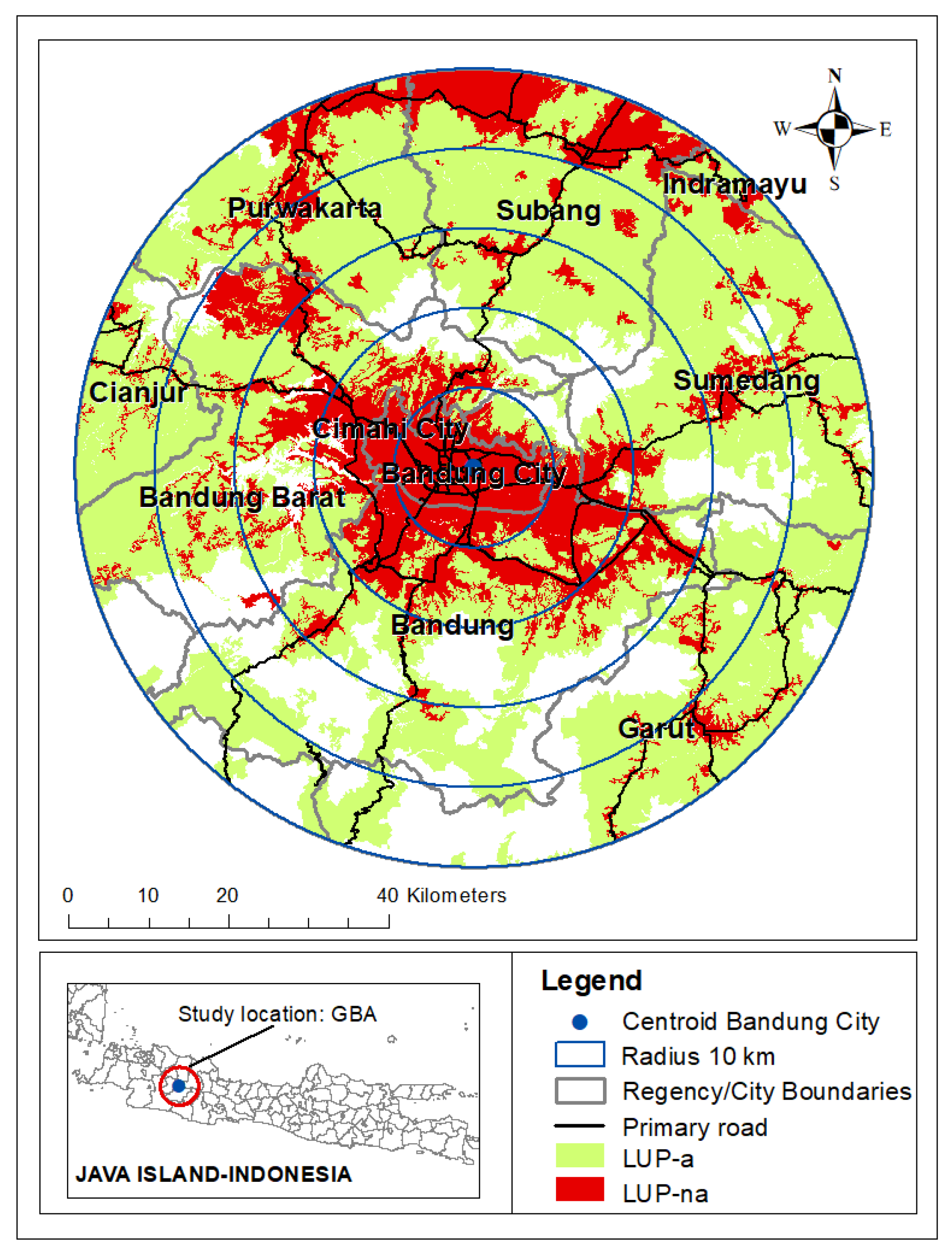
The results showed a significant spatial distribution between agricultural (LUP-a) and non-agricultural (LUP-na) areas, with areas of 448,549.81 ha and 165,990.82 ha, respectively (Figure 8). This allocation reflected a strategic method that prioritised the preservation of agricultural land while accommodating the pressure of urban expansion in the Bandung metropolitan area. The dominance of agricultural land (73% of the total area) further reflected a policy commitment to food security and sustainable resource management, which was crucial.
The spatial pattern on the planning map showed intensive non-agricultural development (LUP-na) concentrated in the urban centres of Bandung City, Cimahi City, and surrounding areas, forming red clusters within a 20–30 km radius of the city centre. This concentric expansion pattern followed the general model of urban growth with development extending along primary transport corridors towards neighbouring districts, including West Bandung, Sumedang, and Garut. The fragmentation of red areas in the peripheral zone showed urban development and industrial clusters that required careful management to prevent uncontrolled urban sprawl and the conversion of agricultural land.
Green agricultural zones (LUP-a) continued to dominate the outer 30-km radius and areas with topographical or environmental constraints unsuitable for intensive development. However, the spread of non-agricultural areas within the agricultural zone visible in the direction of Purwakarta, Subang, and Indramayu, showed pressure for land conversion that challenged agricultural land protection policies. This pattern required strong spatial planning enforcement mechanisms to maintain the agricultural buffer zone [65].

3.5. Spatial Control

Spatial control was a strategic mechanism for implementing spatial planning directives through the establishment of policy intervention priority levels [66]. This method allowed for the differentiation of control strategies based on the level of land conversion vulnerability and the intensity of development pressure in each zone [67]. The classification of control served as an operational tool for local governments in prioritising resource allocation and regulatory enforcement to maintain agricultural functions effectively and efficiently [68].
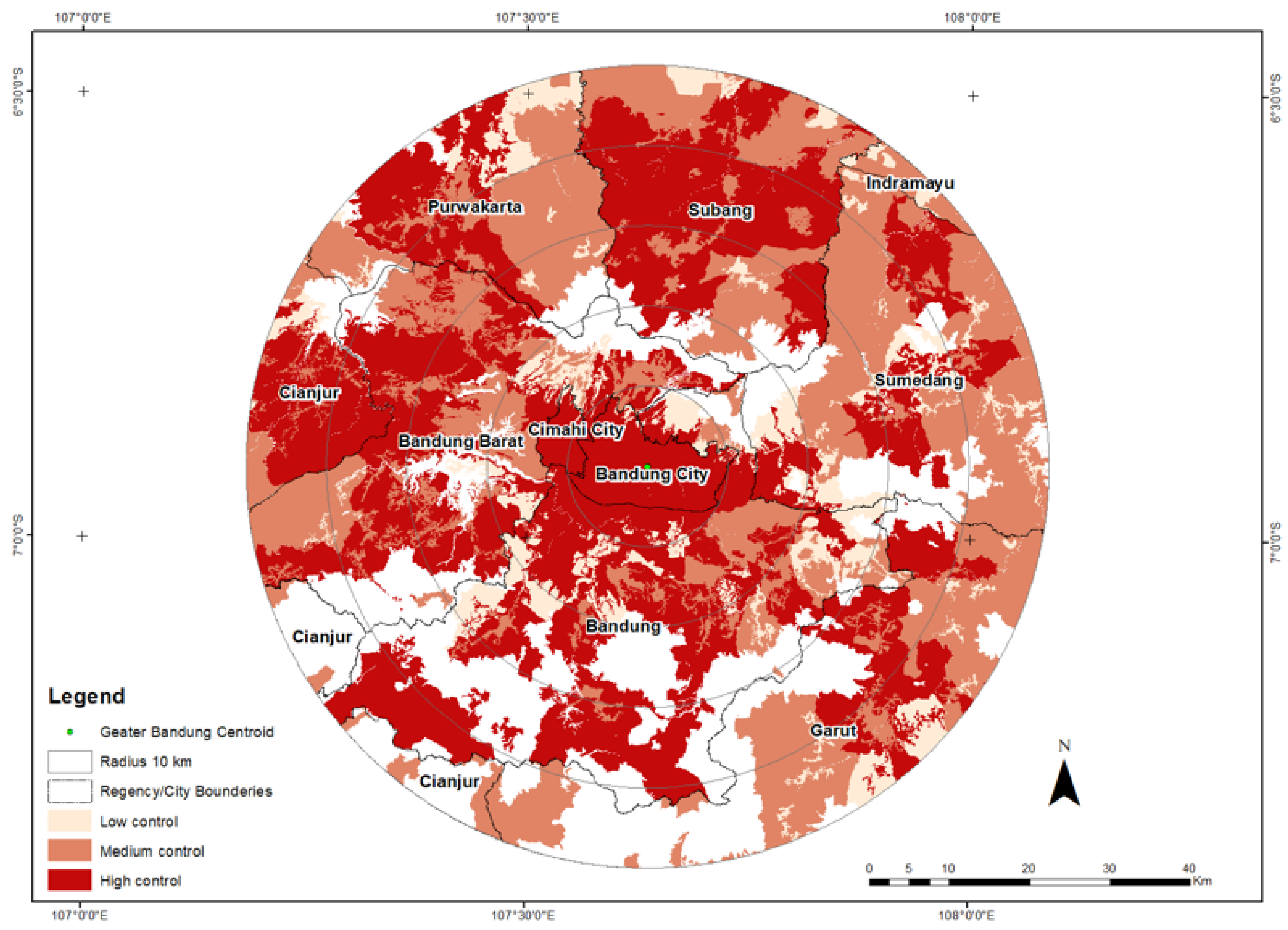
Three spatial control categories were defined: high control, medium control, and low control (Figure 9). The resulting stratification showed a relatively balanced spatial distribution, with high control covering 302,182 ha (49.2%), medium control covering 62,017 ha (10.1%), and low control covering 250,340 ha (40.7%).
Spatially, high levels of control, represented by dark red, dominated the core areas of Bandung City and Cimahi City. This concentration of high control also extended significantly northwards towards Subang Regency and eastwards towards parts of Sumedang Regency. This indicates the presence of a strong corridor of influence that crosses administrative boundaries, particularly along the north–south and east–west axes of the activity centre.
The medium control level, marked by the colour orange, functions as a transition zone surrounding the high-control centre. This area is widely distributed across West Bandung Regency and the southern part of Bandung Regency, creating a spatial pattern that shows a gradual decline in influence as the distance from the centroid increases.
Meanwhile, the low control level (low control), coloured pale cream, was found predominantly in peripheral or outlying areas beyond a 30 km radius. These areas include parts of Cianjur, Garut, and Indramayu Regencies, which lie at the outer limits of the scope of the analysis.
Interestingly, this distribution pattern is not entirely radially uniform; there is spatial fragmentation where pockets of high control persist at greater radii (for example, in Subang), indicating the presence of secondary growth centres or specific geographical factors that maintain levels of control despite being distant from the main centre. Generally, this map illustrates the dynamics of the core–periphery relationship within the metropolitan area, where the intensity of control tends to decrease with increasing distance (distance decay), yet remains influenced by the configuration of administrative boundaries and inter-regional connectivity in West Java. Relatively small areas of high control reflect a focus on strict monitoring in critical zones with the highest risk of land conversion, particularly in the transition zones between productive agricultural land and aggressive urban expansion. This pattern indicates that the pressures of urbanisation and land-use change have extended far beyond the city centre, reaching peri-urban and rural areas [69]. The ‘high control’ category generally denotes areas subject to strict regulations, either due to high levels of land-use violations or their status as strategic zones requiring special protection. This concentration in peripheral areas indicates significant pressure to convert productive agricultural land, which underpins West Java’s food security, to non-agricultural uses, driven by speculative investment, infrastructure development such as the Cisumdawu Toll Road, and an overflow of demand from the saturated core of the Bandung metropolitan area [15]. In this context, the concept of a green belt serves as one solution to curb urban expansion by preserving corridors of open space or farmland around the city centre [70] or high-control zones in the GBA. However, its implementation in Indonesia faces complex institutional challenges, primarily due to the fragmentation of spatial planning authority among regions and the lack of fiscal incentives for local governments to preserve agricultural land [71,72].
The pattern of white spaces (empty areas) observed in several locations showed that these areas were not used for agricultural land (LUP-a-rice fields and dry land) or built-up land (LUP-na), and were not included in the agricultural control scheme in this study. The distribution of these three control categories provided guidance for policy implementation, where high control required the strict suspension of land conversion, intensification of the LP2B (Sustainable Food Agricultural Land) programme, and high economic incentives for farmers. Medium control further required a selective licensing system and periodic monitoring, while low control only needed routine monitoring and the dissemination of regulations to local stakeholders to maintain the long-term stability of agricultural functions.

4. Discussion

4.1. Spatial Pattern Shifts: From Monocentric to Polycentric

The integrative analysis confirms the occurrence of a profound structural transformation in the spatial pattern of the GBA. Consistent results from radius-based SDI analysis and regional typology clustering show a paradigm shift from the long-standing monocentric growth model towards an evolving polycentric formation. This shift is not merely a physical expansion, but a fundamental change in the hierarchy and function of metropolitan space [73]. The traditional city centre (Bandung City) is not the sole epicentre of absolute growth, as its role is now shared and even surpassed in terms of new development dynamics by the surrounding peri-urban belt [14]. The phenomenon represents an urban metabolic cycle in which saturated city centres drive the birth of new sub-centres of growth in transitional areas [74].
The most obvious evidence of the transformation in the GBA manifested in the radial pattern of the SDI, which formed a ‘donut effect’. The core metropolitan zone within a radius of 0–10 km showed signs of saturation, with a slowing rate of SDI growth. Conversely, the peri-urban belt within a radius of 10–20 km evolved as the zone of optimal performance, recording the highest SDI values. These results are consistent with the modernised bid-rent theory, in which land value and development intensity are not determined solely by linear distance to the central business district (CBD), but by an optimal combination of accessibility and space availability [75]. This peri-urban belt offers adequate accessibility to the city centre, while at the same time having sufficient land reserves and more competitive development costs to accommodate industrial relocation, new business districts, and large-scale housing developments [76]. Peri-urban areas further serve as zones that absorb urban pressures while also acting as engines for new metropolitan economic expansion [77].
Further clustering sharpened the analysis in identifying three distinct functional areas, namely urban, peri-urban, and rural [78]. The spatial distribution of these three elements forms a geographical–functional continuum, in which peri-urban areas act as dynamic interfaces [77]. This typology is not a static entity, but rather a transitional space that is actively undergoing reconciliation between agricultural and urban functions [60]. The continuity of this pattern shows that land and economic transformation processes occur gradually and spatially dependently despite being derived from non-spatial analysis. This reinforces the thesis that regional characteristics do change along a distance gradient from the centre, albeit in a form not linear.
The implications of this polycentric pattern and ‘donut effect’ are significant. First, it shows that development inequality in a metropolitan area cannot be reduced to a simple centre-periphery dichotomy, but includes peri-urban areas as a third growth pole with its own dynamics and policy needs. Second, the 10–20 km peri-urban zone outlines the failure of containment policies and compact city consolidation when not accompanied by the provision of anticipatory infrastructure and spatial planning in these areas. Therefore, a unified planning framework with context-specific and differentiated strategies is required. This should focus on regeneration and revitalisation in saturated urban areas, targeted control measures and supporting infrastructure in peri-urban areas to ensure sustainable growth, and policies that strengthen resilience and connectivity in rural areas. The results confirm that the future of the GBA will be largely determined by the capacity to manage transitions and interactions within the increasingly complex and polycentric spatial system.

4.2. Rural–Urban and Agricultural Transition in GBA

The characteristics of countries in the Global South show that food agriculture is part of the dominant characteristics around metropolitan cities [24]. The method from the perspective of rural-to-urban transition theory in the context of agricultural production is appropriate in explaining the conditions in Indonesia [9]. Rural transition is also a matrix of spatial optimisation strategies, spatial coordination and mediation, land use regulation, development control, landscape management and design, protection, restoration, improvement of ecosystem services and natural capital, and community action [79]. These changes in agricultural land use are significantly correlated with population growth in the Bandung Metropolitan Area [80]. Figure 4 shows significant land-use changes in the Purwakarta, Cimahi City, and Sumedang areas (2003–2023), in line with high population growth.
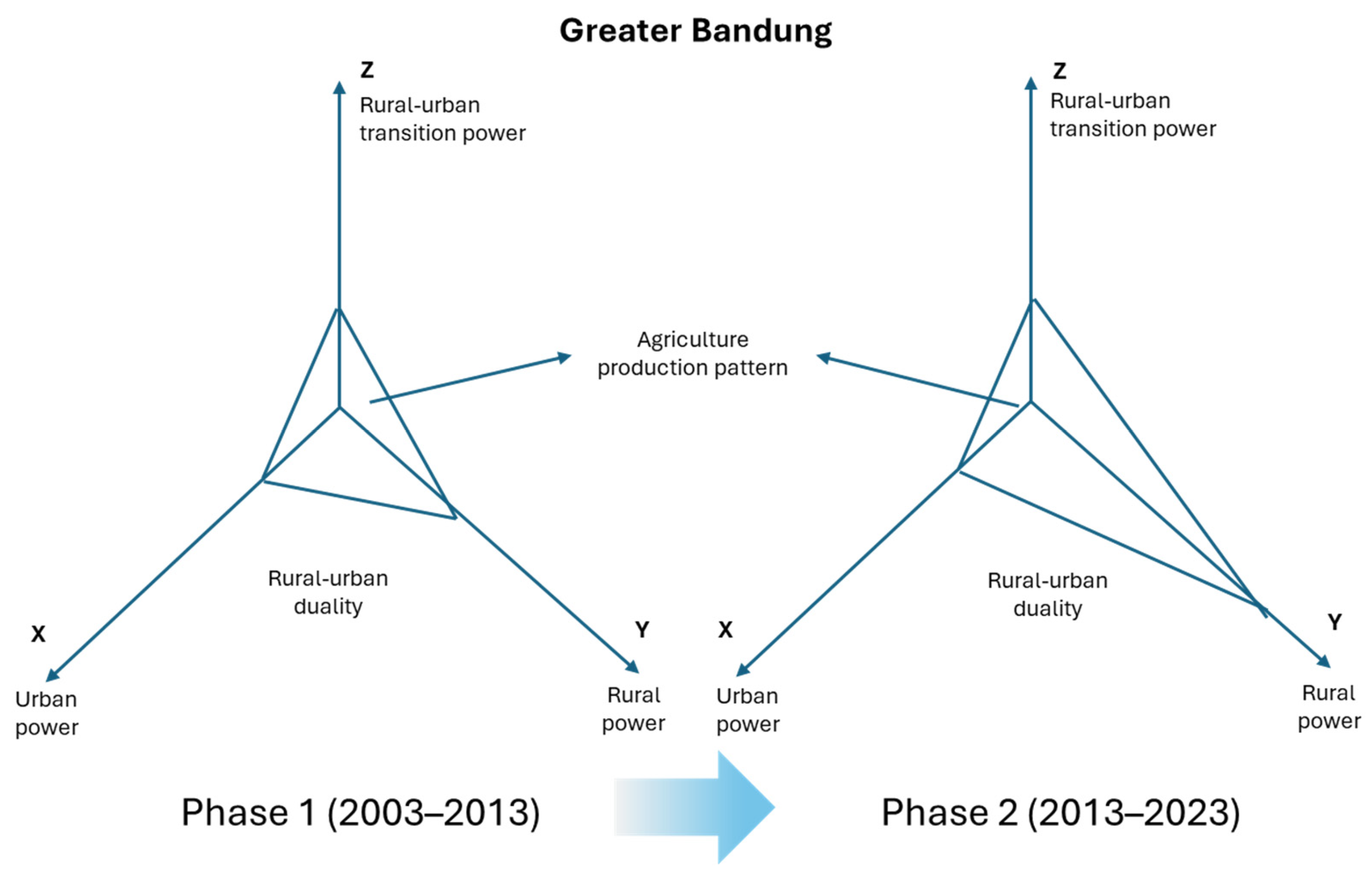
The phenomenon of land use change around the GBA shows a transition from rural to urban spatial patterns that differs from Greater Jakarta, the largest metropolitan area. According to [9], the transformation in Jakarta during Phase 1 (2000–2011) showed rapid urbanisation, with agricultural land being the most converted space. This was followed by a shift from high-intensity to low-intensity expansion in the city centre and suburbs. In Phase 2 (2011–2019), there were major changes in suburban areas due to rural forces and increasingly limited space in the city centre, which only allowed for expansion in low-intensity areas (Figure 7). In contrast, the transformation in Bandung in Phase 1 (2003–2013) and Phase 2 (2013–2023) showed less expansive agricultural land changes compared to Greater Jakarta. Extensive agricultural land changes occurred in urban areas close to the city centre (Bandung). Both phases show increasing intensity over time, or what Gee refers to as rural–urban duality (Figure 10).
The evolution of the rural–urban duality phenomenon can be traced back to limited livelihood options, where many farmers continue to remain in the agricultural sector due to limited skills and the lack of other employment alternatives [81]. In the GBA, push factors (drivers of rural–urban migration) may arise due to agricultural incomes that tend to be stagnant and low compared to wages in the non-agricultural sector in urban areas, farmers’ limited access to capital and modern agricultural technology, and the conversion of productive agricultural land into built-up areas, which reduces the space available for farming as well as the vulnerability of farmers’ livelihoods to the risk of crop failure due to hydrological uncertainty and land-use change upstream [71]. Meanwhile, pull factors in the GBA may include the appeal of more comprehensive urban infrastructure, such as access to transport, education, and healthcare; and a wider range of employment opportunities in the service sector, creative industries, and trade, in line with the growth of Bandung City and its surrounding areas (Cimahi, Soreang, and Majalaya) [15,18].

4.3. Impacts of Spatial Patterns on Regional Typology and Land Use Control

The spatial distribution of non-spatial clustering results shows patterns that are empirically consistent with classical and contemporary regional development theories, particularly metropolitan structure models positioning urban areas as centres of activity, peri-urban areas as dynamic transition zones, and rural areas on the outer edges of the region [82]. The similarity of these patterns shows that although clustering algorithms do not explicitly consider geographical proximity, similarities in socio-economic characteristics and land use between regions tend to form spatial linkages [83]. This condition correlates with the concept of spatial dependence and the first law of geography, stating that neighbouring regions have a higher degree of similarity than distant regions in terms of regional development dynamics and changes in land use [84]. Therefore, the formation of geographical continuity from non-spatial clustering results reinforces the validity of regional typology and confirms that metropolitan development inherently produces structured spatial patterns [85].
The resulting typology of areas has strategic implications for the regulation of agricultural and non-agricultural land use in the GBA. The dominance of agricultural land allocation (LUP-a), which covers more than two-thirds of the total area, reflects a spatial policy direction to maintain a balance between urban growth and the protection of productive land to support regional food security [86]. This method correlates with the principle of land use protection in developing metropolitan areas, where agricultural land in peripheral areas serves not only as a source of food production, but also as an ecological buffer and an instrument to control excessive urban expansion [4]. Conversely, the concentration of non-agricultural areas (LUP-na) in metropolitan centres and along major transport corridors reflects an accessibility-based pattern of urban growth, as described in urban economic and corridor development theories, which place transport infrastructure as a key factor in the intensification of activities and land conversion [87].
However, the discovery of non-agricultural clusters scattered within agricultural zones, particularly in peri-urban and peripheral areas, shows increasing pressure for land conversion, potentially undermining the sustainability of agricultural functions [88]. This pattern underscores the character of peri-urban areas as a contested space between the interests of urban expansion and the protection of agricultural land, where land use fragmentation is often triggered by weak spatial planning controls and the high economic appeal of the non-agricultural sector [89]. Therefore, the integration of regional typology outcomes into land use planning is important for formulating spatial and functional space use control policies for non-agricultural expansion to be directed selectively and managed, as well as metropolitan transformation taking place in a more balanced, adaptive, and sustainable manner [90].

4.4. The Policy Implications

Based on strategic levels, we recommend the following policy instruments. For high-level control strategies in core conservation zones, strict zoning instruments should be implemented, including a maximum building coverage ratio of 10% and floor area ratio of 0.2, a ban on converting productive agricultural land and water catchments, mandatory environmental impact assessments for any land cover change, and quarterly satellite monitoring with annual field verification. For medium-level control in transition zones, a combination of economic incentives and disincentives is proposed, such as a 30–50% property tax reduction for preserved agricultural land, a payment for the environmental services scheme involving Jasa Tirta Public Company (PJT I) and Regional Water Supply Company (PDAM), an annual land conversion quota of no more than 2% of the transition zone, and semi-annual monitoring using Landsat/Sentinel integrated with participatory GIS. For low-level control in urban cultivation zones, more flexible yet measurable instruments include transferable development rights requiring developers to purchase rights from protected agricultural land, an integrated online single submission licensing system with spatial utilisation verification, floor area ratio bonuses of up to 0.1 for private green open spaces, and annual monitoring with spatial audits involving civil society and academics. All proposed instruments are consistent with existing planning regulations in the GBA, including the West Java Provincial Spatial Plan (Regional Regulation No. 9 of 2020), the Detailed Spatial Plans of Bandung City and Bandung Regency, and Ministerial Regulation No. 21 of 2021 on spatial utilisation control and supervision.

5. Conclusions

In conclusion, the spatial and non-spatial clustering methods applied in this study successfully identified three main regional typologies, namely urban, peri-urban, and rural, each representing contrasting land use structures and development dynamics. Urban areas were characterised by the dominance of built-up land and development saturation, and rural areas maintained agrarian functions with relatively slow development dynamics. In contrast, peri-urban areas showed an active transition process and became the main zone of development expansion. Methodologically, the results of this study confirmed that spatial clustering with a weight of 2 was the most representative method for forming a geographically compact and characteristically consistent regional typology, with advantages for supporting spatial-based development analysis.
The theoretical contribution lies in strengthening the understanding of the relationships among urban sprawl, regional development dynamics, and spatial typology in the context of developing metropolitan areas. This condition shows that regional transformation does not follow a linear pattern from urban to rural, but rather forms a complex configuration of peri-urban transitions. Meanwhile, the methodological contribution was realised through the integration of land-use change analysis, a regional development index, and weighted spatial clustering into a comprehensive and replicable analytical framework. These results provide a strong scientific basis for formulating adaptive regional planning policies, particularly for controlling urban expansion, protecting agricultural land, and reducing development disparities in metropolitan areas experiencing rapid urbanisation.
Future research should focus on improving the accuracy of analyses by using high-resolution and annual temporal data, developing scenario-based predictive models to project land conversion, and quantifying its impact on ecosystem services. Furthermore, an in-depth evaluation of spatial planning policy implementation is required from institutional and law-enforcement perspectives, as well as comparative studies across metropolitan areas to identify common patterns and contextual factors in land conversion control.

Author Contributions

Conceptualisation, S.P.M. and D.F.R.; data curation, E.R.; formal analysis, S.P.M. and D.F.R.; methodology, D.F.R. and S.P.M.; supervision, E.R. and A.E.P.; writing—original draft, S.P.M. and D.F.R.; writing—review and editing, S.P.M., D.F.R., E.R. and A.E.P. All authors have read and agreed to the published version of the manuscript.

Funding

This research was funded by the Indonesian Endowment Fund for Education (LPDP) on behalf of the Indonesian Ministry of Higher Education, Science and Technology and managed under the EQUITY Program. Contract No. 4297/B3/DT.03.08/2025 and No./IT3/HK.07.00-4/P/B/2025).

Institutional Review Board Statement

Not appliable.

Informed Consent Statement

Not appliable.

Data Availability Statement

The data presented in this study are available on request from the corresponding author. The data indeed can be accessed on the website of Statistics Indonesia—precisely on provincial, regency, and municipality Statistics Agencies’ websites. Our data are not publicly available because they were obtained by agreement between the Department of Soil Science and Land Resource (IPB University) and Statistics Indonesia.

Acknowledgments

We would like to express our gratitude to the Indonesian Endowment Fund for Education (LPDP) on behalf of the Indonesian Ministry of Higher Education, Science and Technology (EQUITY Program. Contract No. 4297/B3/DT.03.08/2025 and No./IT3/HK.07.00-4/P/B/2025), the Rector, and the Directorate of Research and Innovation at IPB University for the opportunity to participate in the DAPT EQUITY New Doctoral Research Scheme. Agreement letter no. 59484/IT3.D10/PT.01.03/P/B/2025. In addition, we would like to thank our colleagues at the Centre for Regional Development Studies and Planning at IPB University for their assistance and support.

Conflicts of Interest

The authors declare no conflicts of interest. The funders had no role in (a) the design of the study; (b) the collection, analyses, or interpretation of data; (c) the writing of the manuscript; or (d) the decision to publish the results.

Abbreviations

The following abbreviations are used in this manuscript:
GBAGreater Bandung Area
SDISub-District Development Index
LUCCLand Use Cover Change
JBMURJakarta Bandung Mega Urban Region
GISGeography Information System
MoEFMinistry of Environment and Forestry
LUPLand Use Planning

References

  1. Pratama, I.P.; Winarso, H.; Hudalah, D.; Syabri, I. Extended Urbanization through Capital Centralization: Contract Farming in Palm Oil-Based Agroindustrialization. Sustainability 2021, 13, 10044. [Google Scholar] [CrossRef]
  2. Hudalah, D.; Firman, T. Beyond Property: Industrial Estates and Post-Suburban Transformation in Jakarta Metropolitan Region. Cities 2012, 29, 40–48. [Google Scholar] [CrossRef]
  3. Mahtta, R.; Fragkias, M.; Güneralp, B.; Mahendra, A.; Reba, M.; Wentz, E.A.; Seto, K.C. Urban Land Expansion: The Role of Population and Economic Growth for 300+ Cities. npj Urban. Sustain. 2022, 2, 5. [Google Scholar] [CrossRef]
  4. Surya, B.; Salim, A.; Hernita, H.; Suriani, S.; Menne, F.; Rasyidi, E.S. Land Use Change, Urban Agglomeration, and Urban Sprawl: A Sustainable Development Perspective of Makassar City, Indonesia. Land 2021, 10, 556. [Google Scholar] [CrossRef]
  5. Follmann, A. Geographies of Peri-Urbanization in the Global South. Geogr. Compass 2022, 16, e12650. [Google Scholar] [CrossRef]
  6. Hall, P. Metropolitan Settlement Strategies. In Shelter, Settlement & Development; Routledge: London, UK, 2022; pp. 236–259. [Google Scholar]
  7. Rachman, F.; Huang, J.; Xue, X.; Marfai, M.A. Insights from 30 Years of Land Use/Land Cover Transitions in Jakarta, Indonesia, via Intensity Analysis. Land 2024, 13, 545. [Google Scholar] [CrossRef]
  8. Gandharum, L.; Hartono, D.M.; Karsidi, A.; Ahmad, M. Monitoring Urban Expansion and Loss of Agriculture on the North Coast of West Java Province, Indonesia, Using Google Earth Engine and Intensity Analysis. Sci. World J. 2022, 2022, 3123788. [Google Scholar] [CrossRef]
  9. Mulya, S.P.; Hudalah, D.; Prilandita, N.; Dimara, A. Spatio-Temporal Changes in Agricultural Land and Rural–Urban Transitions in Greater Jakarta, Indonesia. Reg. Environ. Change 2024, 24, 145. [Google Scholar] [CrossRef]
  10. Rahayu, P.; Werdiningtyas, R.; Suminar, L. Kusumastuti The Challenge of Rice Farming in Urbanized Region: The Case of Sragen District, Central Java. IOP Conf. Ser. Earth Environ. Sci. 2023, 1186, 012013. [Google Scholar] [CrossRef]
  11. Fitri, T.Y.; Adiwibowo, S.; Pravitasari, A.E. The Impact of Land-Use Changes and Economic Losses of Paddy Field Conversion: A Case Study of Ciampea Sub-District, Bogor Regency, West Java Province. IOP Conf. Ser. Earth Environ. Sci. 2022, 950, 012104. [Google Scholar] [CrossRef]
  12. Novarina, D.; Supriatna, J.; Santoso, I.; Karuniasa, M. Peatland Transformation: Land Cover Changes and Driving Factors in the Kampar Peninsula (1990–2020). Land 2024, 13, 1699. [Google Scholar] [CrossRef]
  13. Li, T.; Fang, X.; Zhu, J.; Peng, Q.; Zhao, W.; Fu, X. Horizontal and Vertical Spatial Equity Analysis Based on Accessibility to Living Service Amenities: A Case Study of Xi’an, China. Land 2024, 13, 1113. [Google Scholar] [CrossRef]
  14. Indriasari, F.; Giyarsih, S.R.; Marwasta, D. Identification of Urban Form in the Bandung Metropolitan Area. GeoJournal 2023, 88, 5271–5285. [Google Scholar] [CrossRef]
  15. Salim, W.; Faoziyah, U. The Effect of Transport Infrastructure on Land-Use Change: The Case of Toll Road and High-Speed Railway Development in West Java. J. Reg. City Plan. 2022, 33, 48–65. [Google Scholar] [CrossRef]
  16. BPS-Statistics of West Java Province. West Java Province in Figure 2023; BPS-Statistics of Jawa Barat Province: Bandung, Indonesia, 2023; Volume 6. [Google Scholar]
  17. Suharjo, I.P.; Leksono, A.A.R.; Aththaariq, M.F.; Adnan, U.A.; Evangelista; Priadi, G.D. Examining Urban Development Trends and Characteristics: Future of Public Transportation in Greater Bandung. IOP Conf. Ser. Earth Environ. Sci. 2024, 1294, 012001. [Google Scholar] [CrossRef]
  18. Tarigan, A.K.M.; Sagala, S.; Samsura, D.A.A.; Fiisabiilillah, D.F.; Simarmata, H.A.; Nababan, M. Bandung City, Indonesia. Cities 2016, 50, 100–110. [Google Scholar] [CrossRef]
  19. Ghifara, A.S.; Iman, A.N.; Wardhana, A.K.; Rusgianto, S.; Ratnasari, R.T. The Effect of Economic Growth, Government Spending, and Human Development Index toward Inequality of Income Distribution in the Metropolitan Cities in Indonesia. Daengku J. Humanit. Soc. Sci. Innov. 2022, 2, 529–536. [Google Scholar] [CrossRef]
  20. Ge, D.; Long, H.; Qiao, W.; Wang, Z.; Sun, D.; Yang, R. Effects of Rural–Urban Migration on Agricultural Transformation: A Case of Yucheng City, China. J. Rural Stud. 2020, 76, 85–95. [Google Scholar] [CrossRef]
  21. Burgess, E.W. The Growth of the City: An Introduction to a Research Project. In Urban Ecology; Marzluff, J., Shulenberger, E., Endlicher, W., Alberti, M., Bradley, G., Ryan, C., ZumBrunnen, C., Simon, U., Eds.; Springer Science + Business Media, LLC: New York, NY, USA, 2008; Volume XVIII, pp. 71–78. [Google Scholar]
  22. Haug, R. Determining the Geographic Centroid: Methods and Practical Applications; Norwegian University of Science and Technology: Trondheim, Norway, 2024. [Google Scholar]
  23. Pontius, R.G.; Shusas, E.; McEachern, M. Detecting Important Categorical Land Changes While Accounting for Persistence. Agric. Ecosyst. Environ. 2004, 101, 251–268. [Google Scholar] [CrossRef]
  24. Van Berkum, S. How Urban Growth in the Global South Affects Agricultural Dynamics and Food Systems Outcomes in Rural Areas: A Review and Research Agenda. Sustainability 2023, 15, 2591. [Google Scholar] [CrossRef]
  25. Varkey, A.M.; Chinnasamy, J.; Johny, E. Perspectives on Environmental Sustainability and Land Use Dynamics in Peri-Urban Interface of Global South. Cent. Asia Cauc. 2025, 26, 27–39. [Google Scholar]
  26. Pribadi, D.O. Restricting Urban Sprawl Through Multifunctional Urban Agriculture at the Fringe of the Jabodetabek Metropolitan Area: A Multilevel Study. Doctoral Dissertation, Technische Universität München, Munich, Germany, 2017. [Google Scholar]
  27. Guttman, L.L. The Basis for Scalogram Analysis. In Scaling; Routledge: London, UK, 2017; pp. 142–171. ISBN 1315128942. [Google Scholar]
  28. Nogués, S.; González-González, E.; Cordera, R. Planning Regional Sustainability: An Index-Based Framework to Assess Spatial Plans. Application to the Region of Cantabria (Spain). J. Clean. Prod. 2019, 225, 510–523. [Google Scholar] [CrossRef]
  29. Tjahjono, G.A.; Sukmawati, S.A. Identification of Service Center Hierarchy for Spatial Planning Directives in Ngargoyoso District, Karanganyar Regency. In Proceedings of the IOP Conference Series: Earth and Environmental Science; IOP Publishing: Philadelphia, PA, USA, 2025; pp. 1–10. [Google Scholar]
  30. Wei, L.; Zhao, X.; Lu, J. Measuring the Level of Urban–Rural Integration Development and Analyzing the Spatial Pattern Based on the New Development Concept: Evidence from Cities in the Yellow River Basin. Int. J. Environ. Res. Public Health 2023, 20, 15. [Google Scholar] [CrossRef]
  31. Madeira, P.M.; Vale, M.; Malheiros, J. Regional Development and Non-Territorial Policies: Meaningful Evidence of a Neglected Relation. Reg. Stud. Reg. Sci. 2024, 11, 192–210. [Google Scholar] [CrossRef]
  32. Ji, D.; Tian, J.; Zhang, J.; Zeng, J.; Namaiti, A. Identification and Spatiotemporal Evolution Analysis of the Urban–Rural Fringe in Polycentric Cities Based on K-Means Chengdu City. Land 2024, 13, 1727. [Google Scholar] [CrossRef]
  33. Marwal, A.; Silva, E.A. Exploring Residential Built-up Form Typologies in Delhi: A Grid- Based Clustering Approach towards Sustainable Urbanisation. Urban. Sustain. 2023, 3, 40. [Google Scholar] [CrossRef]
  34. Wadduwage, S.; Millington, A.; Crossman, N.D.; Sandhu, H. Agricultural Land Fragmentation at Urban Fringes: An Application of Urban-to-Rural Gradient Analysis in Adelaide. Land 2017, 6, 28. [Google Scholar] [CrossRef]
  35. Azrifirwan; Yosefanny, M.R.P.; Santosa; Andasuryani. Prediction of K-Means Multivariable Rice Production Center Pattern. In Proceedings of the International Conference on Sustainability Agriculture and Biosystem (ICSAB 2022); IOP Publishing: Philadelphia, PA, USA, 2023; pp. 1–11. [Google Scholar]
  36. Alam, N.E.; Lobry, L.A.; Bruyn, D.; Osanai, Y.; Guppy, C.N. Typology of Rice-Based Cropping Systems for Improved Soil Carbon Management: Capturing Smallholder Farming Opportunities and Constraints in Dinajpur, Bangladesh. Geoderma Reg. 2022, 28, e00460. [Google Scholar] [CrossRef]
  37. Abdulkadir, A.; Dossa, L.H.; Lompo, D.J.P.; Abdu, N.; van Keulen, H. Characterization of Urban and Peri-Urban Agroecosystems in Three West African Cities. Int. J. Agric. Sustain. 2012, 10, 289–314. [Google Scholar] [CrossRef]
  38. Reza, N.; Seop, I.; Wook, S. ScienceDirect Special Issue: Intelligent Systems for Environmental Applications Rice Yield Estimation Based on K-Means Clustering with Graph-Cut Segmentation Using Low-Altitude UAV Images. Biosyst. Eng. 2018, 177, 109–121. [Google Scholar] [CrossRef]
  39. Li, J.; Li, C. Land Use Policy Characterizing Urban Spatial Structure through Built Form Typologies: A New Framework Using Clustering Ensembles. Land Use Policy 2024, 141, 107166. [Google Scholar] [CrossRef]
  40. Ran, X.; Zhou, X.; Lei, M.; Tepsan, W. A Novel K-Means Clustering Algorithm with a Noise Algorithm for Capturing Urban Hotspots. Appl. Sci. 2021, 11, 11202. [Google Scholar] [CrossRef]
  41. Basel, S.; Gopakumar, K.U.; Rao, R.P. Classification of Countries Based on Development Indices by Using K-Means and Grey Relational Analysis. GeoJournal 2022, 87, 3915–3933. [Google Scholar] [CrossRef]
  42. Oti, E.U.; Olusola, M.O.; Eze, F.C.; Enogwe, S.U. Comprehensive Review of K-Means Clustering Algorithms. Criterion 2021, 12, 22–23. [Google Scholar] [CrossRef]
  43. Sreevalsan-Nair, J. K-Means Clustering. In Encyclopedia of Mathematical Geosciences; Springer: Berlin/Heidelberg, Germany, 2023; pp. 695–697. [Google Scholar]
  44. Ikotun, A.M.; Almutari, M.S.; Ezugwu, A.E. Applied Sciences K-Means-Based Nature-Inspired Metaheuristic Algorithms for Automatic Data Clustering Problems: Recent Advances and Future Directions. Appl. Sci. 2021, 11, 11246. [Google Scholar] [CrossRef]
  45. Han, N.; Qiao, S.; Yue, K.; Huang, J.; He, Q.; Tang, T.; Huang, F.; He, C.; Yuan, C. Algorithms for Trajectory Points Clustering in Location-Based Social Networks. ACM Trans. Intell. Syst. Technol. 2022, 13, 1–29. [Google Scholar] [CrossRef]
  46. Yao, J.; Xu, P.; Huang, Z. Impact of Urbanization on Ecological Efficiency in China: An Empirical Analysis Based on Provincial Panel Data. Ecol. Indic. 2021, 129, 107827. [Google Scholar] [CrossRef]
  47. Yao, Y.; Li, X.; Liu, X.; Liu, P.; Liang, Z.; Zhang, J.; Mai, K. Sensing Spatial Distribution of Urban Land Use by Integrating Points-of-Interest and Google Word2Vec Model. Int. J. Geogr. Inf. Sci. 2017, 31, 825–848. [Google Scholar] [CrossRef]
  48. Shi, Z.; Liu, M.; Wang, Y.; Kovács, K.F. Comparative Study of Quantitative Identification Methods for Peri- Urban Areas Based on a Multi- Indicator System. Sci. Rep. 2024, 14, 29516. [Google Scholar] [CrossRef]
  49. Samsuri, S.; Sitorus, F.; Anita Zaitunah, A.; Ahmad, A.G. Fragmentation Typology of Sumatran Tropical Lowland Forest, Labuhanbatu Selatan-Indonesia. Indones. J. Environ. Manag. Sustain. 2021, 5, 105–112. [Google Scholar] [CrossRef]
  50. Arachchige, C.N.P.G.; Prendergast, L.A.; Staudte, R.G. Robust Analogs to the Coefficient of Variation. J. Appl. Stat. 2022, 49, 268–290. [Google Scholar] [CrossRef] [PubMed]
  51. Di Napoli, M.; Carotenuto, F.; Cevasco, A.; Confuorto, P.; Di Martire, D.; Firpo, M.; Pepe, G.; Raso, E.; Calcaterra, D. Machine Learning Ensemble Modelling as a Tool to Improve Landslide Susceptibility Mapping Reliability. Landslides 2020, 17, 1897–1914. [Google Scholar] [CrossRef]
  52. Zhou, L.; Zhou, Y.; Timo, W.; Vries, D.; Liu, Z.; Sun, H. Collective Action Dilemmas of Sustainable Natural Resource Management: A Case Study on Land Marketization in Rural China. J. Clean. Prod. 2024, 439, 140872. [Google Scholar] [CrossRef]
  53. Bisht, I.S.; Rana, J.C.; Ahlawat, S.P. The Future of Smallholder Farming in India: Some Sustainability Considerations. Sustainability 2020, 12, 3751. [Google Scholar] [CrossRef]
  54. Lu, C.; Cheng, C. Land Use Policy Does the Change of Agricultural Zoning Policy Achieve Farmland Protection in Taiwan? Land Use Policy 2023, 126, 106518. [Google Scholar] [CrossRef]
  55. Opitz, I.; Berges, R.; Piorr, A.; Krikser, T. Contributing to Food Security in Urban Areas: Differences between Urban Agriculture and Peri-Urban Agriculture in the Global North. Agric. Hum. Values 2016, 33, 341–358. [Google Scholar] [CrossRef]
  56. Priyanta, M.; Zulkarnain, C.S.A. Urban Green Open Space in Developing Countries: Indonesia Regulations, Problems and Alternative Solutions. J. Prop. Plan. Environ. Law 2024, 16, 134–151. [Google Scholar] [CrossRef]
  57. Lv, J.; Dong, C.; Yan, Q.; Liu, H.; Fu, L.; Wei, X. Decreasing Impact of Intra-City Disparities on Ecosystem Services During Rapid Urbanization in the Beijing–Tianjin–Hebei Urban Agglomeration. Land 2025, 14, 1196. [Google Scholar] [CrossRef]
  58. Kaiser, N.; Barstow, C.K. Rural Transportation Infrastructure in Low- and Middle-Income Countries: A Review of Impacts, Implications, and Interventions. Sustainability 2022, 14, 2149. [Google Scholar] [CrossRef]
  59. Samat, N.; Mahamud, M.A.; Tan, M.L.; Tilaki, M.J.M.; Tew, Y.L. Modelling Land Cover Changes in Peri-Urban Areas: A Case Study of George Town Conurbation, Malaysia. Land 2020, 9, 373. [Google Scholar] [CrossRef]
  60. Yoshida, S. Effects of Urbanization on Farmland Size and Diversified Farm Activities in Japan: An Analysis Based on the Land Parcel Database. Land 2020, 9, 315. [Google Scholar] [CrossRef]
  61. Sharma, S.K.; Pathak, S.L. Urbanization, Population and Environment; Springer: Berlin/Heidelberg, Germany, 2024; ISBN 9819760194. [Google Scholar]
  62. Firman, T.; Fahmi, F.Z. The Privatization of Metropolitan Jakarta’s (Jabodetabek) Urban Fringes: The Early Stages of “Post-Suburbanization” in Indonesia. J. Am. Plan. Assoc. 2017, 83, 68–79. [Google Scholar] [CrossRef]
  63. Wang, J.; Sun, K.; Ni, J.; Xie, D. Evaluation and Factor Analysis of the Intensive Use of Urban Land Based on Technical E Ffi Ciency Measurement—A Case Study of 38 Districts and Counties in Chongqing, China. Sustainability 2020, 12, 8623. [Google Scholar] [CrossRef]
  64. Wang, Y.; Huang, S.; Liu, J. Research on the Rural Environmental Governance and Interaction Effects of Farmers under the Perspective of Circular Economy—Evidence from Three Provinces of China. Sustainability 2023, 15, 13233. [Google Scholar] [CrossRef]
  65. Jakiel, M. Land Use Policy The Effectiveness of Spatial Planning in Preventing the Expansion of Built-up Areas in the Buffer Zones of Polish National Parks. Land Use Policy 2025, 159, 107795. [Google Scholar] [CrossRef]
  66. Li, G.; Wang, L.; Wu, C.; Xu, Z.; Zhuo, Y.; Shen, X. Spatial Planning Implementation Effectiveness: Review and Research Prospects. Land 2022, 11, 1279. [Google Scholar] [CrossRef]
  67. Xi, X.; Shi, X.; Wang, T.; Wang, X.; Huang, K. Vulnerability Assessment and Differentiated Regulation of Rural Settlement Systems in the Alpine Canyon Area of Western Sichuan Under Geological Hazard Coercion: Taking Maoxian County of Sichuan as an Example. Sustainability 2025, 17, 8629. [Google Scholar] [CrossRef]
  68. Kuusaana, E.D.; Eledi, J.A. Customary Land Allocation, Urbanization and Land Use Planning in Ghana: Implications for Food Systems in the Wa Municipality. Land Use Policy 2015, 48, 454–466. [Google Scholar] [CrossRef]
  69. Pearson, D. Lifestyle Properties, Ecosystem Services, and Biodiversity Protection in Peri-Urban Aotearoa–New Zealand: A Case Study from Peri-Urban Palmerston North. Land 2021, 10, 1345. [Google Scholar] [CrossRef]
  70. Mari, N.; Giobellina, B.; Benitez, A.; Marinelli, V. Mapping and Characterizing the Green Belt of Cordoba: Land Dynamics and the Urnam-Rural Transformation Process. J. Agron. Res. 2019, 2, 29–46. [Google Scholar] [CrossRef]
  71. Hudalah, D.; Winarso, H.; Woltjer, J. Gentrifying the Peri-Urban: Land Use Conflicts and Institutional Dynamics at the Frontier of an Indonesian Metropolis. Urban. Stud. 2016, 53, 593–608. [Google Scholar] [CrossRef]
  72. Winarso, H.; Hudalah, D.; Firman, T. Peri-Urban Transformation in the Jakarta Metropolitan Area. Habitat Int. 2015, 49, 221–229. [Google Scholar] [CrossRef]
  73. Abozeid, A.S.M.; AboElatta, T.A. Polycentric vs Monocentric Urban Structure Contribution to National Development. J. Eng. Appl. Sci. 2021, 68, 11. [Google Scholar] [CrossRef]
  74. Sharma, R.; Kumar, N.; Sharma, B.B. Applications of Artificial Intelligence in Smart Agriculture: A Review. Lect. Notes Electr. Eng. 2022, 832, 135–142. [Google Scholar] [CrossRef]
  75. Fei, S.; Wu, R.; Liu, H.; Yang, F.; Wang, N. Technological Innovations in Urban and Peri-Urban Agriculture: Pathways to Sustainable Food Systems in Metropolises. Horticulturae 2025, 11, 212. [Google Scholar] [CrossRef]
  76. Follmann, A.; Kennedy, L.; Pfeffer, K.; Wu, F. Peri-Urban Transformation in the Global South: A Comparative Socio-Spatial Analytics Approach. Reg. Stud. 2023, 57, 447–461. [Google Scholar] [CrossRef]
  77. Haldar, S.; Chatterjee, U.; Bhattacharya, S.; Paul, S.; Bindajam, A.A. Peri-Urban Dynamics: Assessing Expansion Patterns and Influencing Factors. Ecol. Process. 2024, 13, 58. [Google Scholar] [CrossRef]
  78. Cattivelli, V. Planning Peri-Urban Areas at Regional Level: The Experience of Lombardy and Emilia-Romagna (Italy). Land Use Policy 2021, 103, 105282. [Google Scholar] [CrossRef]
  79. Scott, M.; Gallent, N.; Gkartzios, M. The Routledge Companion to Rural Planning; Routledge: London, UK, 2019; ISBN 9781351591874. [Google Scholar]
  80. Maryati, S.; Humaira, A.N.S.; Pratiwi, F. Spatial Pattern of Agricultural Land Conversion in West Java Province. In Proceedings of the International Conference on Green Agro-Industry and Bioeconomy; IOP Publishing: Philadelphia, PA, USA, 2018. [Google Scholar]
  81. Stevens, A.W. The Economics of Land Tenure and Soil Health. Soil Secur. 2022, 6, 100047. [Google Scholar] [CrossRef]
  82. McGee, T.G. The Emergence of Desakota Regions in Asia: Expanding a Hypothesis. In Implosions/Explosions; University of Hawaii Press: Honolulu, HI, USA, 1991; pp. 121–137. [Google Scholar] [CrossRef]
  83. Gregory, I.N.; Geddes, A. Toward Spatial Humanities: Historical GIS and Spatial History; Indiana University Press: Bloomington, IN, USA, 2024; ISBN 0253011906. [Google Scholar]
  84. Allen, T.; Donaldson, D. Persistence and Path Dependence in The Spatial Economy; National Bureau of Economic Research: Cambridge, UK, 2022. [Google Scholar]
  85. Peng, J.; Zhang, S.; Li, X.; Chen, R.; Huang, X. Research on the Coupling Mechanism between Green Space Morphology and the Urban Heat Island Effect Based on Machine Learning: A Case Study of Dali City. Sci. Rep. 2026, 16, 1569. [Google Scholar] [CrossRef] [PubMed]
  86. Faoziyah, U.; Rosyaridho, M.F.; Panggabean, R. Unearthing Agricultural Land Use Dynamics in Indonesia: Between Food Security and Policy Interventions. Land 2024, 13, 2030. [Google Scholar] [CrossRef]
  87. Tapia, C.; Bianchi, M.; Pallaske, G.; Bassi, A.M. Towards a Territorial Definition of a Circular Economy: Exploring the Role of Territorial Factors in Closed-Loop Systems. Eur. Plan. Stud. 2021, 29, 1438–1457. [Google Scholar] [CrossRef]
  88. Rai, C.K.; Goyal, S.K.; Raj, K.; Kumar, V. Impact of Urbanization on Peri-Urban Agriculture. In Indian Agriculture: Challenges, Priorities and Solutions; Springer: Berlin/Heidelberg, Germany, 2025; pp. 105–119. [Google Scholar]
  89. Firman, T. The Urbanisation of Java, 2000–2010: Towards ‘the Island of Mega-Urban Regions’. Asian Popul. Stud. 2017, 13, 50–66. [Google Scholar] [CrossRef]
  90. Chen, F.; Liu, Y. An Integrated Analysis Framework for Territorial Space Governance: Combining Land Use Classification and Functional Evaluation toward Spatial Zoning. Habitat Int. 2025, 166, 103572. [Google Scholar] [CrossRef]
Figure 1. Study framework. Note: The rural-urban transition concept according to [20].
Sustainability 18 05016 g001
Figure 2. Study location: GBA.
Sustainability 18 05016 g002
Figure 3. Land cover types in the GBA and its surroundings, 2003–2023.
Sustainability 18 05016 g003
Figure 4. Land use and land cover change (LUCC) in agricultural land and built-up areas in the GBA and surrounding areas, 2003–2023. Description: DF = dryland farming (PLK & plantations), RF = rice fields, BU = built-up area, “_” = “becomes”.
Sustainability 18 05016 g004
Figure 5. Development level of GBA sub-district and surrounding areas, 2005–2021.
Sustainability 18 05016 g005
Figure 6. Plot of means for each cluster, K-means. Description: LJ_SDI (SDI rate), JK (distance to the nearest city/district), PLT (percentage of built-up land area), PS (percentage of rice field area), PPP (percentage of dry farming and plantation area).
Sustainability 18 05016 g006
Figure 7. Non-spatial clustering (without weighting) of GBA and surrounding areas. * Description: CV (coefficient of variation) = level of diversity; K (contiguity): spatial proximity/neighbourhood.
Sustainability 18 05016 g007
Figure 8. Land use planning for agricultural and non-agricultural purposes in the GBA.
Sustainability 18 05016 g008
Figure 9. Level of spatial control.
Sustainability 18 05016 g009
Figure 10. Conceptual model of rural–urban transition and agricultural transformation in Greater Bandung (illustrated in Figure 4, in accordance with the Ge [20] concept).
Sustainability 18 05016 g010
Table 2. Matrix of spatial control levels.
LUP StatusSpatial Planning
(Zoning Regulation)
Cluster
RuralPeri-UrbanUrban
LUP-aProduction forest areas, agricultural areas, and fishery areasMedium ControlHigh ControlLow Control
LUP-naResidential areas, industrial areas, mining and energy areas, defence and security areasLow ControlMedium ControlHigh Control
Blank (white colour)Conservation areas, local protected areas, areas that protect the areas below them, water bodiesNot classified and included in this stage of analysis
Note: LUP-a = land use planning for agriculture; LUP-na = land use planning for non-agriculture. Source: Synthesis by the author from various references.
Disclaimer/Publisher’s Note: The statements, opinions and data contained in all publications are solely those of the individual author(s) and contributor(s) and not of MDPI and/or the editor(s). MDPI and/or the editor(s) disclaim responsibility for any injury to people or property resulting from any ideas, methods, instructions or products referred to in the content.