Article

The Impact of Perceived Macaque Behavior on Pro-Environmental Behavioral Intentions in Non-Consumptive Wildlife Tourism

1
College of Art & Design, Nanjing Forestry University, Nanjing 210037, China
2
Faculty of Humanities & Social Sciences, Nanjing Forestry University, Nanjing 210037, China
*
Author to whom correspondence should be addressed.
Sustainability 2026, 18(10), 4991; https://doi.org/10.3390/su18104991
Submission received: 16 April 2026 / Revised: 10 May 2026 / Accepted: 12 May 2026 / Published: 15 May 2026
(This article belongs to the Special Issue Sustainable Nature-Based Tourism)

Abstract

Non-consumptive wildlife tourism serves as a vital vehicle for promoting ecological conservation and nature education. Understanding visitors’ perceptions of wildlife behavior and how these perceptions translate into long-term pro-environmental behavioral intentions is crucial for balancing visitor recreational experiences with ecological management in nature reserves. This study developed a hybrid analytical method integrating Latent Dirichlet Allocation (LDA) and Structural Equation Modeling (SEM). Based on 62,557 online reviews and 351 questionnaires collected from 33 macaque tourism sites in China, we identified three dimensions of perceived macaque behavior: food-driven approach (FDA), co-presence experience (CPE), and natural habitat-based behavior (NHB). SEM results revealed that all three dimensions significantly influenced Perceived Ecological Value (PEV) and Positive Emotional Arousal (PEA). NHB and FDA exert a stronger influence on PEV, while CPE primarily drives PEA. Furthermore, both PEV and PEA significantly promote PEBI, with PEV having a stronger effect. These findings indicate that PEBI formation relies more heavily on understanding ecological significance than on immediate positive emotions alone. These findings refine the “experience-to-conservation support” mechanism and suggest that managers should optimize ecological interpretation and regulate food interactions to foster sustainable wildlife tourism.

1. Introduction

Against the backdrop of the worsening global biodiversity crisis, the tourism industry is entering a phase of “nature-positive” transformation [1,2]. Non-consumptive wildlife tourism is therefore viewed with high expectations, as it advocates for experiences where visitors interact with wildlife without depleting natural resources, transforming their recreational experiences into tangible support for ecological conservation [3]. However, in the real world of tourism, this shift from sightseeing to conservation does not happen automatically; tourism destinations often need to strike a balance between visitors’ desire for recreational experiences and the goal of ecological education [4,5]. How to effectively guide visitors toward a sense of responsibility and foster long-term, stable pro-environmental behavioral intentions, all while ensuring a positive recreational experience, remains a critical issue that nature-based tourism destinations must urgently address.
Among the various types of non-consumptive wildlife tourism, non-consumptive macaque tourism presents a compelling microcosm. Unlike wildlife observed from a distance, macaques are highly active, spatially accessible, and display readily observable behaviors [6,7]. In this scenario, where the physical boundary between humans and animals has been significantly narrowed, the animals’ dynamic behaviors become active stimuli capable of triggering immediate psychological and emotional responses [8]. This means that the focus of the visitor experience has shifted from the superficial question of “whether or not they saw the animals” to a keen awareness of the animals’ dynamic behaviors, such as how they forage, interact, and approach visitors.
In the digital age, these highly contextualized on-site encounters are increasingly transformed into online user-generated content (UGC). Existing research has shown that online reviews can accurately identify the key aspects of wildlife encounters as well as their spatiotemporal characteristics [9,10]. It is important to note that the macaque behavior voluntarily documented by tourists in their reviews does not equate to the animals’ actual behavior, but rather represents a “perception of behavior” that has been filtered through their attention, interpreted for meaning, and expressed subjectively [11]. These spontaneously generated behavioral cues are precisely the starting point for subsequent value judgments and emotional arousal [12].
Existing research has demonstrated that perceived value and positive emotions in ecotourism can significantly drive tourists’ pro-environmental behavioral intentions [13,14]. Nevertheless, the current literature still has two limitations. First, most studies continue to start from researcher-predefined structured variables, rather than analyzing tourists’ spontaneous expressions of behavioral perception to identify the core sources of stimulation in real-world travel contexts. Second, while existing research generally acknowledges that both cognition and emotion influence behavioral transformation, there remains a lack of detailed examination of their distinct roles in wildlife tourism, particularly regarding empirical comparisons of the relative effects of the “perceived ecological value” and “positive emotional arousal” pathways. In this study, perceived ecological value refers to visitors’ cognitive judgments of the ecological significance of macaques and their habitats, whereas positive emotional arousal refers to the positive emotional responses elicited during macaque viewing. For destination managers, failing to identify which behavioral cues tourists are most sensitive to in their digital footprints makes it difficult to pinpoint the key triggers for transforming experiential value into support for conservation.
Accordingly, this study adopts the Stimulus–Organism–Response (SOR) model and examines non-captive macaque tourism sites in China as a species-specific empirical context within non-consumptive wildlife tourism. Using a mixed-methods design that combines User-Generated Content (UGC) text mining, Latent Dirichlet Allocation (LDA) and Structural Equation Modeling (SEM), the study aims to address the following core questions: (1) Based on UGC texts from tourists’ perspective, what core dimensions of perceived macaque behavior can be identified? (2) How do these behavioral stimuli differentially influence tourists’ perceived ecological value and positive emotional arousal? (3) How do these two internal states further influence pro-environmental behavioral intentions?
Based on the above discussion, the main contributions of this study are as follows. First, it shifts the focus of wildlife tourism research from species presence to visitors’ perceptions of animal behavior, thereby refining the stimulus sources underlying non-consumptive wildlife tourism experiences. Second, it highlights the methodological novelty of combining UGC data, LDA topic modeling, and SEM. Large-scale UGC reviews are used to capture tourists’ spontaneous perceptions of macaque behavior in real-world tourism contexts; after which LDA is applied to identify behavior-related topics, which are further transformed into measurable constructs and validated through SEM. This design links data-driven theme discovery with theory-driven mechanism testing. Third, this study reveals the differentiated effects of perceived macaque behavior on cognitive and emotional pathways and shows that perceived ecological value has a relatively stronger effect on pro-environmental behavioral intentions than immediate positive emotions, offering empirical evidence for balancing experiential value with conservation communication.

2. Literature Review and Hypotheses

2.1. Non-Consumptive Wildlife Tourism

Nature-based tourism has come to be regarded as a vital component of global tourism, and wildlife tourism remains one of the key areas of ongoing interest within this field [15]. Among these, non-consumptive wildlife-oriented recreation is a concept with a well-established theoretical foundation. Duffus and Dearden noted that such activities are not aimed at hunting or the direct consumption of animal resources [16]. Subsequent research has further specified these as non-destructive interactions such as viewing, observing, and photography, emphasizing that the relationship between humans and wildlife is fundamentally based on meaning-making and recreational experiences, rather than resource extraction [17]. As a result, it is widely regarded as a type of activity that holds potential for both tourism development and conservation outreach [18]. This means that visitors’ on-site perceptions serve as the starting point for the creation of such tourism experiences and the realization of their conservation potential.
Compared to general sightseeing or cultural tourism, the formation of the experience in non-consumptive wildlife tourism relies more heavily on the living nature of the wildlife itself. Wildlife is not a static landscape, but rather a natural entity characterized by autonomy, dynamism, and a degree of unpredictability [8]. Early evaluations of visitor experiences often focused on the accessibility and visibility of animals, viewing “seeing wildlife” as the primary factor influencing visitor satisfaction and attraction [19,20]. However, as the encounter progresses, visitors perceive more than just the “presence of animals” during their visit. They keenly form immediate judgments based on visual and behavioral cues conveyed by the animals’ movements, pauses, and interactions; these judgments not only determine the visitors’ propensity for on-site interaction [21], but also form a key component of deepening the experience. Research has shown that encounters based on dynamic behavioral cues are more effective than general nature-based recreation in strengthening individuals’ sense of connection with nature [22], thereby quickly transcending mere sensory impressions to transform into deep emotional responses and reflective understanding [23,24].
In this study, “non-consumptive macaque tourism” refers to a species-specific form of non-consumptive wildlife tourism. It does not necessarily require tourists to maintain strict physical distance from macaques at all times; rather, it emphasizes that tourists do not engage in activities aimed at capturing, harming, or extractively using macaque resources. Therefore, in non-captive macaque tourism sites, visitors’ close-range observation of macaques, spatial co-presence with them, and perceptions of food-related encounter scenarios are all considered parts of the tourism experiences examined in this study. Food-related encounters are treated here as one type of experiential content through which visitors perceive macaque behavior, but this does not mean that this study regards feeding as an appropriate or recommended tourism practice.
In the specific context of macaque tourism, the stimulating effect of behavioral cues is particularly pronounced. Macaques are highly active, spatially accessible, and observable; consequently, visitors’ experiences are often no longer limited to simply “seeing a troop of macaques,” but rather revolve around how the macaques forage, move, approach visitors, interact with one another, and display their natural behaviors. Related studies have found that visitors form immediate judgments based on the health, social behavior, and overall demeanor displayed by the macaque groups, and these judgments further influence their willingness to approach the macaques and the manner in which they interact with them [21]. The behavior of macaques is no longer merely a background element in tourism settings; it has become an important factor influencing visitors’ perceptions and experiences [25].

2.2. User Perceptions of Wildlife Behavior and Their Online Expression Through User-Generated Content

Identifying the specific behavioral cues that visitors focus on in macaque tourism contexts is a prerequisite for subsequent measurement and analysis. Because wildlife behavior is dynamic and highly context-dependent, traditional structured scales are often bound by researcher-imposed categories, making it difficult to fully capture what visitors spontaneously focus on during actual visits [26]. In contrast, user-generated content (UGC) stems from visitors’ natural expressions on digital platforms and can more directly reveal the behavioral cues they actually notice during on-site observations and are willing to document [27]. Therefore, identifying the behavioral characteristics of macaque groups as perceived by visitors from UGC texts can provide an empirical foundation for deriving the dimensions of perceived macaque behavior.
Research in nature-based and ecotourism settings has increasingly drawn on online reviews to identify shifts in visitor perceptions and the focal points of their experiences. For example, Kim et al. used topic modeling in a study of natural heritage sites to extract topics that international visitors consistently focused on [28]. In wildlife tourism contexts, visitors’ online texts can effectively reveal how they understand and describe specific wildlife encounters, thereby offering direct insight into the focal points of their perceptions during nature observation [29]. Related studies have also shown that online reviews in wildlife tourism not only reflect visitors’ attention to specific interaction scenarios, but also reveal deeper ethical reflections and psychological responses [30]. Therefore, this study treats UGC texts as an entry point for identifying the behavioral dimensions of wildlife encounters that function as experiential stimuli. By examining the behavioral characteristics of macaque groups spontaneously expressed by visitors, it seeks to derive the dimensions of perceived macaque behavior that drive experiential transformation.

2.3. Pro-Environmental Behavioral Intentions in Tourism Contexts and Their Formation Mechanisms

In wildlife and ecotourism research, pro-environmental behavioral intentions are widely regarded as a key outcome variable for examining whether tourism experiences foster tendencies toward sustainable action. Existing studies indicate that pro-environmental behavior in tourism contexts is not shaped solely by external stimuli, but is also rooted in visitors’ internal value judgments and emotional experiences [31].
In the cognitive pathway, when visitors observe focal species and develop a deep appreciation for the value of the natural environment and the importance of conservation, this rational and internalized understanding can be transformed into a strong sense of conservation awareness, environmental attitudes, or support for conservation efforts [32,33]. Related studies on destinations and ecotourism have also confirmed that visitors’ perceived environmental value can effectively drive their environmentally responsible behaviors and, through mechanisms such as environmental commitment, further reinforce their pro-environmental behavioral tendencies [34,35].
From an emotional perspective, positive emotions play an important catalytic role in promoting pro-environmental behavioral intentions. Compared to relying solely on rational judgment and normative constraints, the emotional resonance evoked by natural settings can directly promote more positive ecological conservation intentions and environmentally responsible behaviors [36,37]. Furthermore, positive emotions can exert a stable and significant indirect influence on environmental behavior through mechanisms such as place identity [38,39].
In summary, after encountering specific environmental cues and experiential elements, visitors form cognitive judgments regarding environmental significance and experience positive emotional responses, both of which ultimately translate into environmentally responsible behavior [40]. This “cognitive–emotional” dual-path mechanism provides a crucial theoretical foundation for understanding how visitors’ internal psychological states in non-consumptive wildlife tourism translate into substantive intentions to support conservation.
Pro-environmental behavioral intentions in tourism contexts may reflect different behavioral orientations. Previous research has distinguished tourists’ environmentally responsible behaviors into compliance-oriented and advocacy-oriented forms, corresponding respectively to rule compliance and more proactive participation in environmental protection [41]. Accordingly, the four pro-environmental behavioral intention items used in this study are designed to capture both orientations: rule compliance and footprint minimization represent compliance-oriented intentions, whereas active intervention and environmental advocacy represent advocacy-oriented intentions.

2.4. Research Hypotheses

The Stimulus–Organism–Response (SOR) model emphasizes that external environmental stimuli influence individuals’ subsequent behavioral responses through their internal psychological states. This model provides a clear framework for explaining the “situational stimulus–psychological processing–behavioral intention” process in tourism experiences. Non-consumptive macaque tourism is characterized by strong situational embeddedness and experiential immediacy. As tourists observe macaque behavior, experience human–macaque encounters, and interpret on-site context, they form corresponding cognitive evaluations and emotional responses. Based on this, this study treats visitors’ perceptions of macaque behavior as external stimuli, perceived ecological value and positive emotional arousal as internal cognitive and emotional states, and pro-environmental behavioral intentions as the corresponding behavioral responses. This establishes a theoretical pathway of “perceived macaque behavior–internal psychological state–pro-environmental behavioral intentions”.

2.4.1. Perceived Macaque Behavior and Visitors’ Internal Responses

The specific behavioral characteristics of macaque groups and the encounter context serve as the core stimuli that trigger visitors’ internal responses [42]. To characterize these stimuli more accurately, this study combines the results of UGC-based theme identification with relevant discussions in wildlife perception and visitor experience research. Perceived macaque behavior is therefore subdivided into three specific dimensions: food-driven approach, co-presence experience, and natural habitat-based behavior. Based on these dimensions, this study further develops the corresponding path hypotheses.
In wildlife tourism settings, food is often used to increase the predictability of animal sightings and to create opportunities for visitors to observe, photograph, and describe animals at close range [43]. In macaque tourism contexts, food-related cues are especially salient because macaques are highly responsive to human food, visitors’ belongings, and food-related traces in tourist areas. When such cues are accessible, macaques tend to forage, linger, and move around visitor activity zones, trails, and other areas where food-related cues are concentrated, leaving visitors with vivid impressions of food seeking, object exploration, and approach behavior [44,45]. Evidence comparing feeding and natural foraging contexts also suggests that the link between tourist food and macaque foraging can increase macaques’ approachability, observability, and behavioral adaptation to tourism settings [46]. Food-driven approach therefore refers to visitors’ perceptions of macaque behavior organized around food-related cues in tourism contexts, rather than foraging behavior alone.
Compared with distant viewing, close-range encounters—such as macaques actively approaching visitors, briefly pausing nearby, or moving around tourists—are more likely to reinforce visitors’ sense that wildlife is immediately present. Accessibility and the predictability of interaction are often important components of wildlife tourism experiences. However, such experiences are determined not only by physical distance; they are also shaped by viewing arrangements, site characteristics, interpretive information, and visitors’ psychological expectations [47]. Co-presence experience therefore refers to visitors’ integrated perception of shared presence, immediate encounters, and potential interactions within a specific tourism setting. The emotional connection generated through wildlife viewing may also enhance visitors’ support for protected areas and related management measures [48].
Visitors’ perceptions of wildlife are shaped by animal visibility, the authenticity of natural settings, and behavioral cues related to free movement, group living, and ecological embeddedness. In nature-based tourism experiences, authenticity, the local environment, and human–nature relationships constitute an important basis for visitors to construct experiential meaning [49,50]. Animals’ free movement, partially uncontrollable behavioral states, and presence in natural spaces can also be transformed by visitors into experiential understandings of wildness, restoration, attachment, and place-based meaning [51]. Therefore, natural habitat-based behavior provides important cues through which visitors understand macaques’ perceived wildness, ecological embeddedness, and conservation value. It further connects perceived macaque behavior with visitors’ perceived value and environmental responsibility tendencies [52].
Faced with these three types of high-intensity on-site behavioral stimuli, visitors’ psychological responses unfold simultaneously on both cognitive and emotional levels. On the cognitive level, these dynamic behavioral cues help visitors gain a deeper understanding of the macaque troop’s survival status, natural attributes, and ecological embeddedness, thereby forming a more profound and positive assessment of the species’ ecological significance. On the emotional level, wildlife viewing experiences are often accompanied by strong emotional connections. Immersive observation, based on specific behavioral displays and extreme proximity, readily evokes feelings of awe, joy, wonder, and fascination in visitors [53]. Based on this, this paper proposes the following hypotheses:
H1a. 
Food-driven approach positively influences perceived ecological value.
H1b. 
Co-presence experience positively influences perceived ecological value.
H1c. 
Natural habitat-based behavior positively influences perceived ecological value.
H2a. 
Food-driven approach positively influences positive emotional arousal.
H2b. 
Co-presence experience positively influences positive emotional arousal.
H2c. 
Natural habitat-based behavior positively influences positive emotional arousal.

2.4.2. The Influence of Perceived Ecological Value on Pro-Environmental Behavioral Intentions

In non-consumptive wildlife tourism, the experience involves a reconceptualization of the significance of species and their habitats. After interacting with focal species, visitors actively reconceptualize the subjects of their observation, moving beyond viewing them merely as “objects to be watched” to understanding them as natural entities with ecological and conservation significance [54], and incorporating them into a broader ecological framework [55]. In macaque tourism, the more visitors tend to interpret the specific behaviors of macaque troops as having ecological significance, natural value, and conservation necessity, the more likely they are to develop a strong sense of environmental responsibility and normative commitment, which directly translates into concrete pro-environmental behavioral intentions. Research indicates that perceived value directly drives pro-environmental behavioral intentions, and this effect can be reinforced through pathways such as place attachment and biospheric values [56,57]. Accordingly, the following hypothesis is proposed:
H3. 
Perceived ecological value positively influences pro-environmental behavioral intentions.

2.4.3. The Effect of Positive Emotional Arousal on Pro-Environmental Behavioral Intentions

Positive emotions are not only key outcomes of the tourism experience but may also serve as crucial psychological mechanisms driving behavioral change. The positive emotions most commonly experienced during wildlife viewing do not typically emerge in a vacuum; rather, they are closely tied to specific animal behaviors, close-up interactions, and vivid contextual details [53]. Recent empirical studies consistently demonstrate that specific positive emotions elicited during wildlife encounters (such as awe, surprise, and fascination) can significantly enhance tourists’ pro-environmental behavioral intentions, often reinforced through increased nature connectedness [58,59]. Accordingly, this study proposes the following hypothesis:
H4. 
Positive emotional arousal positively influences pro-environmental behavioral intentions.
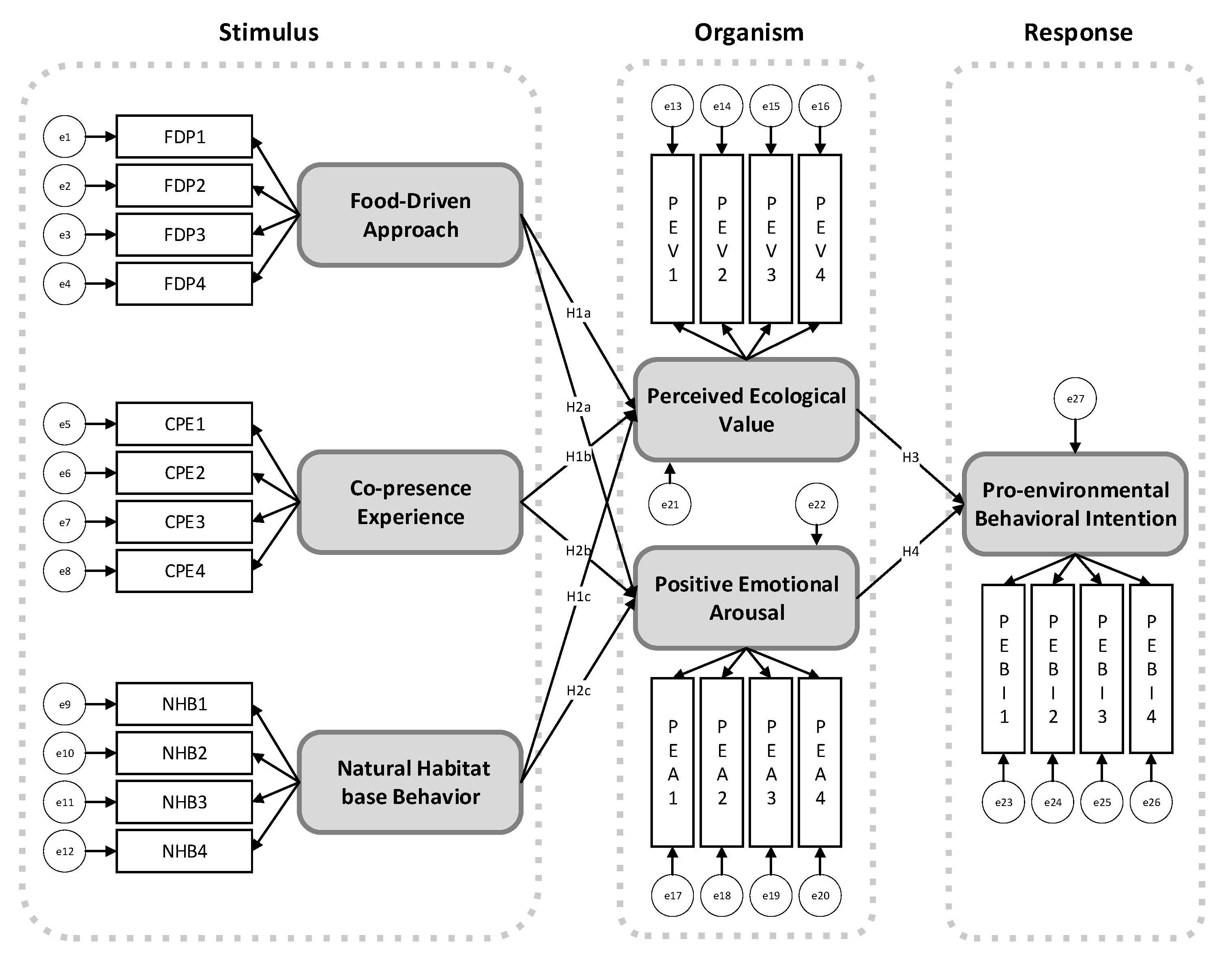
In summary, this section presents the research hypotheses asserting that, in non-consumptive wildlife tourism contexts, tourists’ perceptions of macaque behavior can influence their pro-environmental behavioral intentions through perceived ecological value and positive emotional arousal. Based on these hypotheses, this study further constructs the research model shown in Figure 1.

3. Methods

3.1. Data Source

This study utilizes user-generated content (UGC) from online travel platforms as its primary data source. Compared to traditional survey and interview data, UGC is characterized by its spontaneous generation, contextual relevance, and rich sample diversity. As a result, it has been widely applied in research areas such as destination image, tourist sentiment, travel experiences, and consumption decisions, thereby providing a robust empirical foundation for understanding tourist perceptions [60,61,62]. Specifically, this study obtained visitor review data regarding macaque tourism destinations from “Ctrip” (https://you.ctrip.com, accessed on 1 March 2025), a well-known Chinese online travel agency (OTA). Ctrip was selected as the data source based on comprehensive consideration of the research subject, data availability, and consistency in text structure. Reviews of scenic areas on Ctrip are typically generated on specific destination pages, and their content largely centers on visitors’ actual travel experiences, on-site observations, interactive encounters, and evaluations of tourism services. Therefore, these reviews are well aligned with the objective of this study, which is to identify tourists’ perceptions of macaque behavior. In addition, Ctrip covers a wide range of natural scenic areas and wildlife tourism sites in China, providing a relatively consistent and comparable data basis for cross-regional sample collection.
Macaques are widely distributed across China, providing a foundation for identifying non-captive macaque tourist attractions on a national scale. By combining data on macaque distribution in China, prior research, and online search results, this paper conducted a preliminary screening of over 60 relevant scenic areas across 20 provinces in mainland China [63]. These sites were then further filtered, retaining only those with more than 100 reviews on Ctrip, resulting in a final selection of 33 macaque tourism sites across 16 provinces and autonomous regions. Finally, this study developed a Python-based web crawler to extract online travel reviews, collecting a total of 62,557 reviews spanning from February 2015 to March 2025.

3.2. Data Analysis

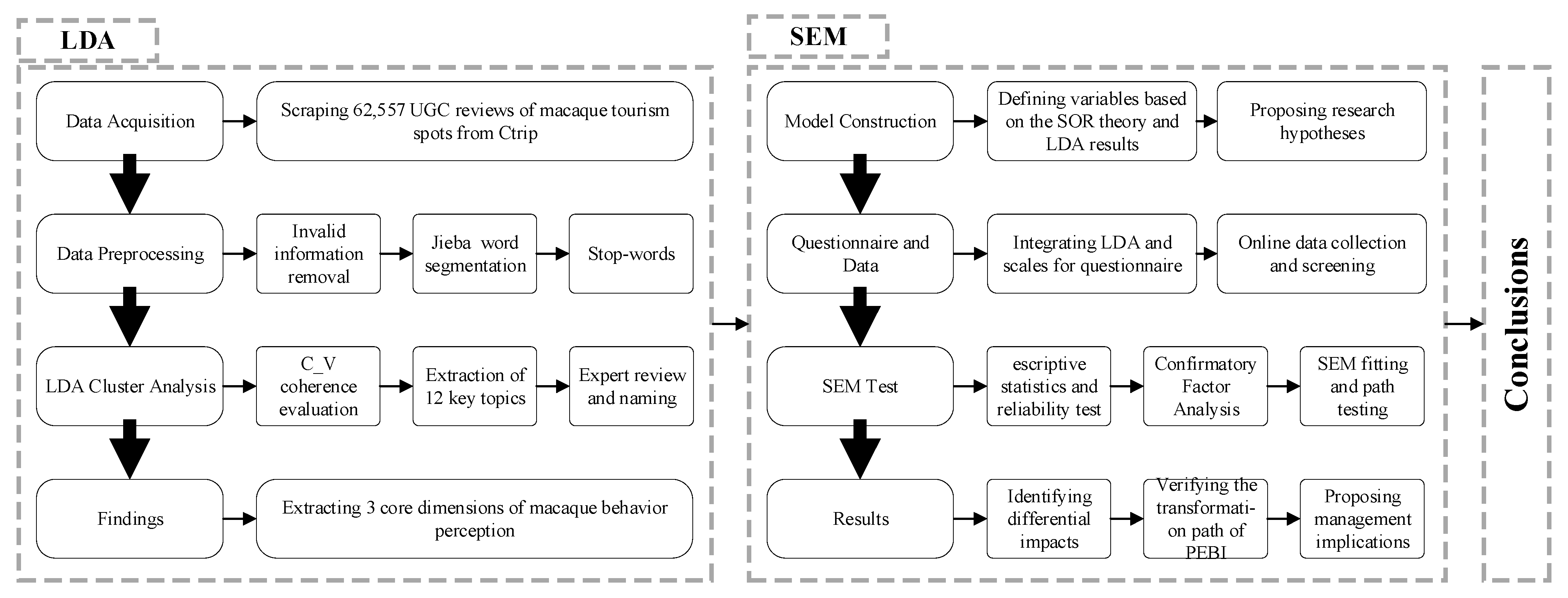
First, we performed text preprocessing on UGC reviews regarding macaque tourism and employed the Latent Dirichlet Allocation (LDA) model to identify behavioral themes of interest to tourists. LDA is an unsupervised probabilistic model used to extract latent thematic structures from text corpora [64]. By combining expert reviews with the research context, this study further synthesized the dimensions of perceived macaque behavior. Subsequently, a questionnaire was developed based on the results of the theme identification and relevant theories. Descriptive statistics and reliability tests were conducted using SPSS 27.0, while confirmatory factor analysis and structural equation modeling were performed using AMOS 29.0 to examine the relationships between perceived macaque behavior, perceived ecological value, positive emotional arousal, and pro-environmental behavioral intentions. The specific process is illustrated in Figure 2.

3.3. LDA Topic Modeling Techniques

To conduct topic modeling analysis more effectively, this study performed a series of data preprocessing steps. First, data cleaning and filtering were conducted. The scraped data were deduplicated to remove identical reviews and ensure sample uniqueness. Irrelevant reviews that did not mention macaques, such as those discussing only tickets, transportation, or other peripheral travel experiences, were then removed. Short reviews containing fewer than 10 Chinese characters and providing limited information, as well as invalid texts containing commercial links or highly templated content, were also excluded. Finally, Python 3.8 was used to remove HTML tags, special characters, non-Chinese textual elements, and emojis while retaining valid Chinese review content. Second, word segmentation and custom dictionary construction were performed. The jieba word segmentation tool was run in a Python 3.8 environment to segment the Chinese review texts. A custom dictionary was developed according to the macaque tourism context, incorporating specific animal behaviors and colloquial tourist expressions such as “rummaging through bags”, “begging for food”, “scratching”, and “protecting their young” in order to prevent key semantic units from being incorrectly segmented. Third, stopword processing was conducted. High-frequency words lacking substantive meaning were removed from the texts, including pronouns such as “we” and “they”, conjunctions such as “but” and “and” and modal particles. These preprocessing steps helped reduce textual noise and improve the consistency and interpretability of topic identification.
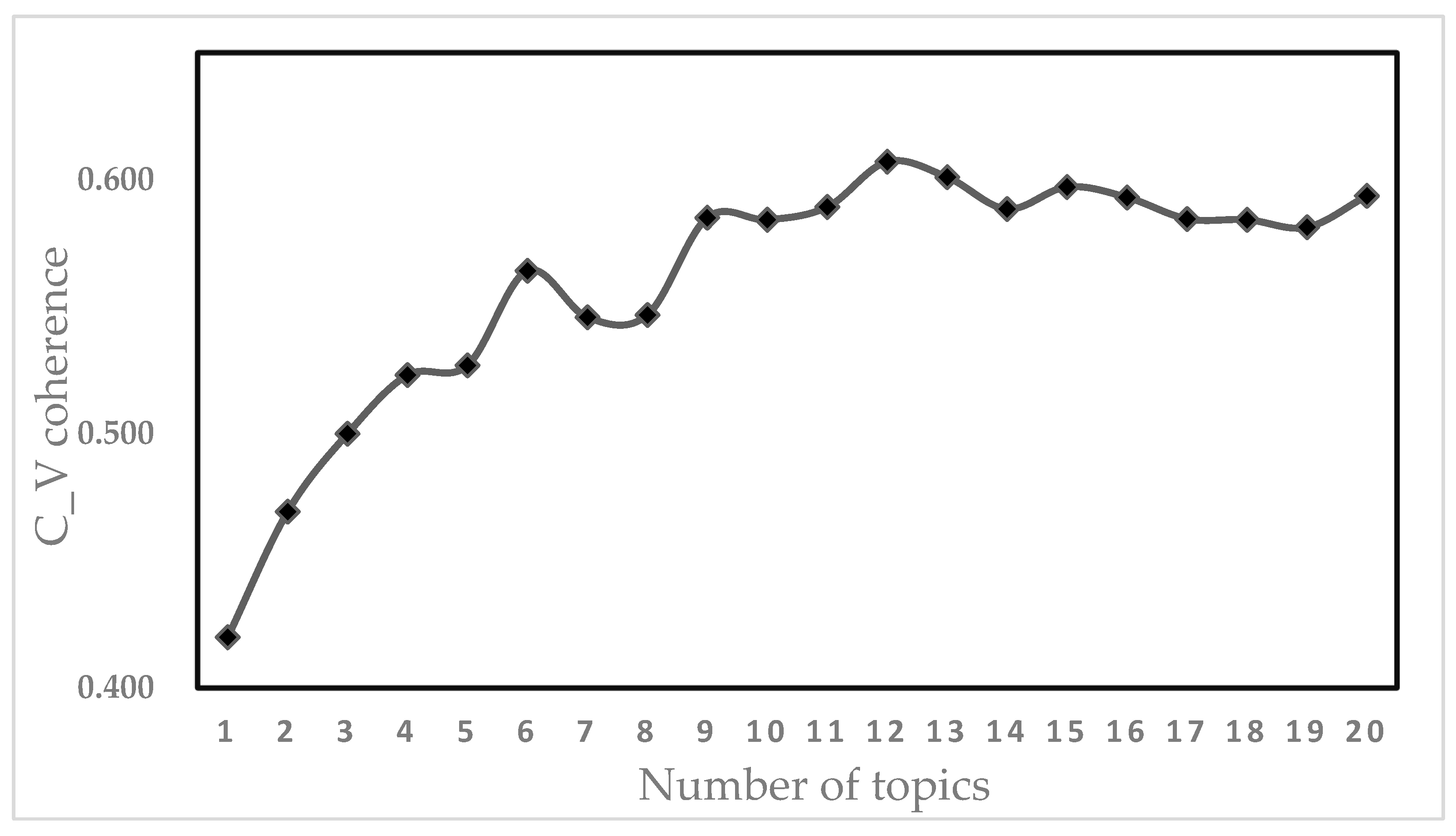
The C_V coherence score evaluates semantic coherence within a topic by calculating the pointwise mutual information for all word pairs within the topic and normalizing these values. A higher score indicates stronger correlations among words within the topic, meaning the topic exhibits greater coherence and interpretability [64]. As shown in Figure 3, the C_V coherence score fluctuates as the number of topics increases, while exhibiting an overall upward trend, with Dirichlet distribution parameters set to α = 0.01 and β = 0.01. The C_V coherence score reaches its maximum when there are 12 topics.
To further evaluate the robustness and interpretability of the topic solution, this study compared LDA models with topic numbers ranging from 10 to 14. The 12-topic model achieved the highest C_V coherence score of 0.607, indicating the strongest semantic coherence among the tested models. In addition, the 12-topic solution exhibited clearer semantic boundaries and better interpretability than adjacent models. When the number of topics was relatively small, different scenarios, such as food-related behaviors and close-range encounters, tended to be merged. When the number of topics was relatively large, some topics showed fragmentation and semantic overlap. Therefore, this study retained the 12-topic solution because it achieved the optimal balance among statistical coherence, semantic stability, and substantive interpretability.
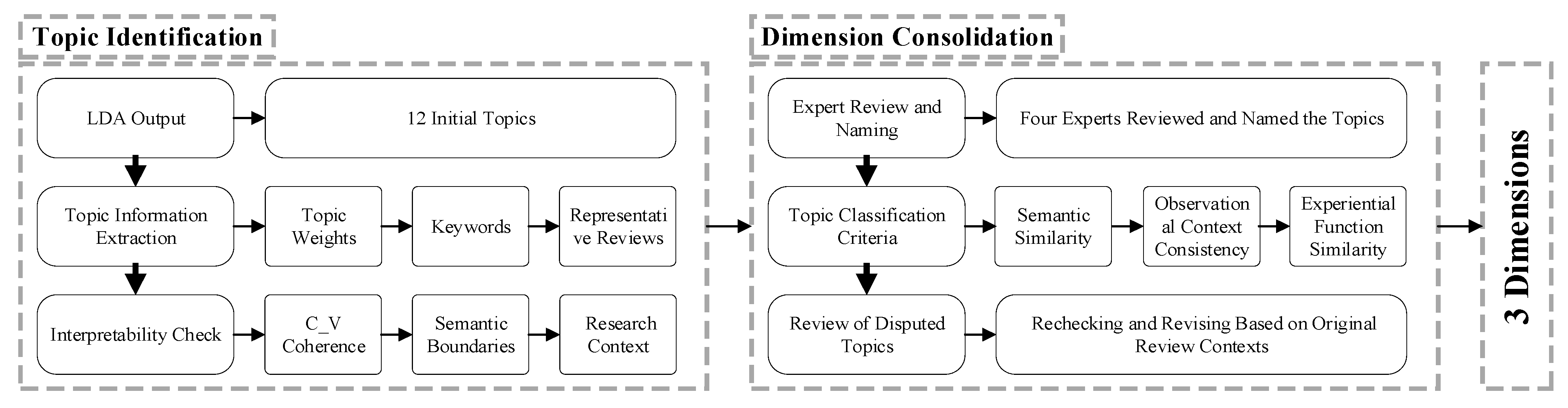
After obtaining the initial thematic results from LDA topic modeling, this study assembled a panel of four experts with at least five years of relevant research or practical experience in ecotourism and wildlife tourism to review, name, and classify the themes. The experts made comprehensive assessments of high-probability terms, topic weights, and representative review excerpts based on the principles of semantic coherence and representativeness. Ultimately, based on a comprehensive analysis of LDA outputs, existing literature, and the research context, they finalized the labels of the 12 topics and selected 10 representative keywords for each topic. This step drew upon existing research practices that combine LDA with expert reviews to enhance the systematic nature and robustness of the results [65,66,67].
The 12 topics identified by the LDA model remained empirical themes at the textual level and therefore needed to be further synthesized into theoretical dimensions suitable for questionnaire measurement and model testing. Accordingly, this study integrated the 12 topics into broader dimensions by considering high-probability keywords, topic weights, representative review excerpts, relevant literature, and the specific research context.
During the thematic categorization process, this study primarily followed three criteria. The first criterion was semantic similarity, namely whether the high-frequency keywords of different topics referred to similar macaque behavioral content. The second criterion was consistency of observation contexts, namely whether related topics pointed to similar visitor observation contexts and behavioral cues, such as food-related behavioral cues, spatial proximity cues, shared presence experiences, and behavioral displays in natural habitats. The third criterion was similarity in visitor experience functions, namely whether related topics played similar perceptual roles in the visitor experience. For example, some topics mainly directed visitors’ attention to food-driven behaviors, some evoked feelings of close-range co-presence, and others facilitated visitors’ observation and understanding of macaques’ natural living conditions.
In the specific classification process, this study first established a preliminary correspondence between the 12 LDA topics and the three perceptual dimensions according to the three criteria described above. Four experts were then invited to review and rate the proposed classification scheme using a five-point scale, in order to evaluate the degree of fit between each topic and its assigned perceptual dimension. Based on the experts’ feedback, the research team further reviewed the classification results and ultimately finalized the mapping between the 12 topics and the three perceptual dimensions.
Based on the above classification procedure, the 12 LDA topics were ultimately consolidated into three dimensions of perceived macaque behavior. Specifically, “Food-Driven Approach” mainly corresponds to visitors’ observations of macaques’ food-driven behavioral cues; “Co-presence Experience” mainly corresponds to visitors’ subjective experiences in situations of spatial proximity and shared presence; and “Natural Habitat-Based Behavior” mainly corresponds to visitors’ perceptions of macaques’ behaviors in natural or semi-natural habitat contexts. The specific topic weights, topic names, representative keywords, and representative visitor expressions are shown in Table 1.

3.4. Questionnaire Design

Based on the results of the preliminary LDA topic modeling, drawing on representative research findings in related fields such as tourism experience and environmental psychology, and considering the specific tourism context of wildlife travel in natural scenic areas in China, this study comprehensively integrated the themes of perceived macaque behavior extracted by LDA with authoritative measurement dimensions from previous research. These were then transformed into measurable questionnaire items, and the final questionnaire was systematically constructed and revised (Table 2).
First, for tourists’ perceived macaque behavior, which serves as the core stimulus variable in this study, item generation was primarily based on the results of LDA topic modeling. The topic names, high-frequency feature words, and representative visitor expressions of the 12 topics were used as the semantic basis for developing the measurement items. Specifically, the three dimensions—food-driven approach, co-presence experience, and natural habitat-based behavior—correspond to the relevant topics presented in Table 1 and were further transformed into measurable questionnaire items.
Second, the items for perceived ecological value, positive emotional arousal, and pro-environmental behavioral intentions were primarily adapted from established constructs in studies of environmental attitudes, tourists’ emotional experiences, and pro-environmental behavior in tourism, with semantic adjustments made to fit the non-consumptive macaque tourism context. The items for perceived ecological value drew on measurement concepts related to ecological limits, human–nature relationships, and environmental fragility in the New Ecological Paradigm Scale, and were contextualized in relation to the species’ ecological roles, habitat conservation, vulnerability of natural behaviors, and boundaries of human–macaque contact in macaque tourism [68]. The items for positive emotional arousal were designed with reference to studies on tourists’ emotional experiences, incorporating experiential manifestations such as pleasure, relaxation, wonder and awe, and psychological restoration in wildlife-viewing contexts [69]. The items for pro-environmental behavioral intentions drew on studies of place attachment, environmentally responsible behavior, and pro-environmental behavior in tourism contexts, and were operationalized as behavioral tendencies including rule compliance, footprint minimization, active intervention, and environmental advocacy [70]. Among these, rule compliance and footprint minimization primarily reflect tourists’ self-regulation of their own travel behaviors and are associated with compliance-oriented pro-environmental behavioral intentions. By contrast, active intervention and environmental advocacy reflect tourists’ willingness to influence others or extend their conservation attitudes beyond the immediate tourism setting, and are associated with advocacy-oriented pro-environmental behavioral intentions. This approach ensures theoretical continuity between the measurement constructs and existing research while enhancing the suitability of the items for non-consumptive macaque tourism scenarios.
Prior to the formal administration of the questionnaire, this study conducted a small-scale pilot test. A total of 35 completed questionnaires were collected from university students and faculty members who had experience with nature-based tourism or non-consumptive wildlife tourism. The pilot test sample was not included in the final structural equation modeling analysis. Preliminary internal consistency tests were then conducted using the pilot data. The Cronbach’s α coefficients for the latent variables ranged from 0.773 to 0.938, all exceeding the recommended threshold of 0.70, indicating that the scale had good preliminary reliability.
The questionnaire used in this study was divided into two distinct sections. The first section focused on collecting basic demographic characteristics and personal travel-related information from the surveyed tourists. The second section of the questionnaire aimed to accurately capture respondents’ perceptions, emotions, and attitudes using a 7-point Likert scale, where “1” indicates “Strongly Disagree”, “2” indicates “Disagree”, “3” indicates “Somewhat Disagree”, “4” indicates “Neutral”, “5” indicates “Somewhat Agree”, “6” indicates “Agree”, and “7” indicates “Strongly Agree.” The second section covers tourists’ perceptual evaluations of various behaviors exhibited by macaques; furthermore, this section also thoroughly measures the effects of these behavioral stimuli on positive emotional arousal, perceived ecological value, and pro-environmental behavioral intentions.
This study adhered to the principles of the Declaration of Helsinki. All participants provided informed consent prior to participation, and this study was conducted on an anonymous and voluntary basis.

3.5. Data Collection

This survey was conducted online from 15 March 2025 to 8 October 2025, yielding a total of 576 responses. To ensure sample validity and the reliability of the subsequent structural equation modeling analysis, this study conducted data quality control on all returned questionnaires prior to formal data analysis. Specifically, questionnaires were deemed invalid if they met any of the following criteria: failure to complete all core items; substantial missing data for key variables; respondents reporting no prior experience visiting non-captive macaque tourism sites; completion time significantly shorter than a reasonable response time; or obvious straight-lining or patterned responses on continuous scale items. These criteria were designed to exclude questionnaires that were not answered seriously, did not meet the target population criteria, or had insufficient data quality. Ultimately, among the 576 returned questionnaires, 225 were excluded as invalid, leaving 351 valid questionnaires and yielding a valid response rate of 60.9%.
The valid sample comprised 188 males (53.6%) and 163 females (46.4%). The largest age group was 18–35 years old (n = 235, 67.0%), followed by those aged 36–55 (n = 97, 27.6%), and 55 years and older (n = 19, 5.4%). In terms of educational attainment, 149 respondents (42.5%) had a bachelor’s degree, 87 (24.8%) had an associate’s degree, 71 (20.2%) had a high school education or below, and 44 (12.5%) held a graduate degree. Detailed demographic profiles of the respondents are presented in Table 3.

4. Results

4.1. Common Method Bias Test

Since the core variables in this study were measured using the same questionnaire, common method bias may be a potential concern. Therefore, before testing the measurement and structural models, Harman’s single-factor test was conducted to assess common method bias. All scale items were entered into an unrotated exploratory factor analysis. The results showed that the first factor explained 34.632% of the total variance, which is below the commonly recommended threshold of 40%. This indicates that common method bias is unlikely to pose a serious threat to the validity of the results in this study.

4.2. Measurement Model Assessment

This study first conducted descriptive statistical analyses using SPSS 27.0, followed by structural equation modeling (SEM) analysis using AMOS 29.0. As shown by the model fit test results in Table 4:
The chi-square-to-degrees-of-freedom ratio (CMIN/DF) was 1.351, falling well within the recommended range of 1 to 3 and demonstrating good initial model fit. Second, the root mean square error of approximation (RMSEA) was 0.032, well below the stringent threshold of 0.05, indicating excellent structural validity. Furthermore, all core relative fit indices demonstrated high consistency: the Normed Fit Index (NFI) was 0.947, the Incremental Fit Index (IFI) was 0.986, and the Comparative Fit Index (CFI) was 0.986. All these indices significantly exceeded the 0.9 threshold recommended for a good fit. Taken together, these metrics fully confirm that the constructed structural equation model achieves an ideal fit with the empirical data.
To assess the suitability of the data for factor analysis, the Kaiser–Meyer–Olkin (KMO) measure and Bartlett’s Test of Sphericity were evaluated. As shown in Table 5, the KMO value for the sample data was 0.917, well above the recommended threshold of 0.80, indicating excellent sampling adequacy. Furthermore, Bartlett’s Test of Sphericity yielded an approximate chi-square value of 5997.569 (df = 276, p < 0.001). This result indicates significant internal correlations among the measurement items in this study, further supporting the scientific validity and rationality of the factor analysis.

4.3. Confirmatory Factor Analysis

Prior to evaluating the structural model, confirmatory factor analysis (CFA) was conducted to assess the measurement model. The internal consistency of the scales was evaluated using Cronbach’s alpha. As shown in Table 6, the Cronbach’s alpha coefficients for the six latent variables in this study—food-driven approach, co-presence experience, natural habitat-based behavior, positive emotional arousal, perceived ecological value, and pro-environmental behavioral intentions—ranged from 0.868 to 0.922. All values significantly exceeded the recommended threshold of 0.70, indicating that the measurement scales constructed in this study possess excellent internal consistency and reliability, making them highly suitable for subsequent model testing.
To assess the convergent validity of the measurement model, composite reliability (CR), average variance extracted (AVE), and standardized factor loadings were examined. As shown in Table 7, the AVE values for all latent variables ranged from 0.623 to 0.747, all exceeding the critical threshold of 0.50. The CR values ranged from 0.869 to 0.922, well above the recommended standard of 0.80. Additionally, the standardized factor loadings for all measurement indicators ranged from 0.755 to 0.897, safely surpassing the 0.70 requirement. Collectively, these results confirm that the measurement model exhibits excellent convergent validity, indicating that each measurement indicator effectively captures its corresponding latent variable.

4.4. Structural Model Assessment

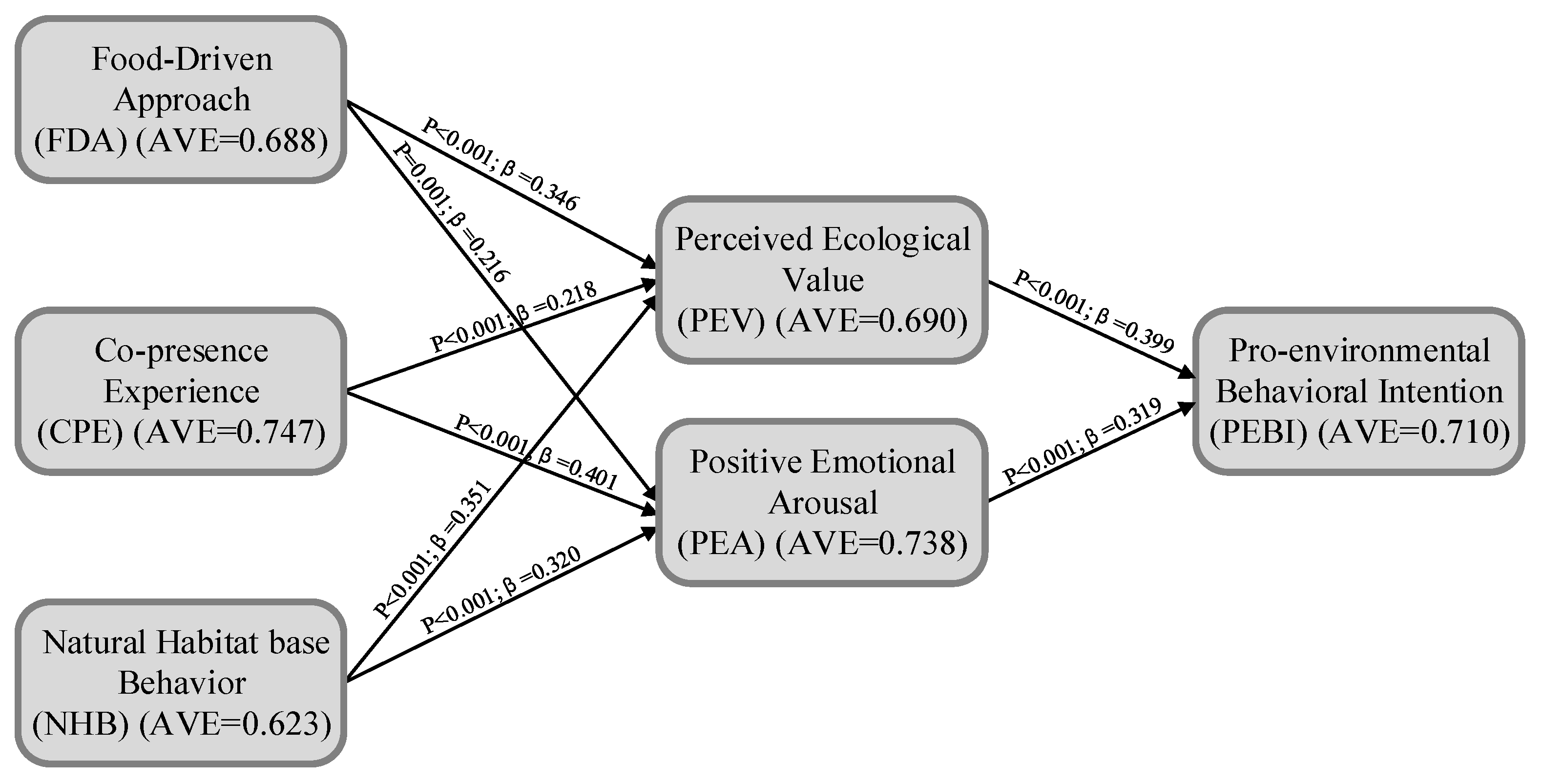
The results of the structural equation model path analysis are presented in Figure 4 and Table 8. All hypothesized paths were evaluated at a significance level of 0.05.
As shown in Table 8 and Figure 5, all path hypotheses proposed in the model were significantly supported. Specifically, perceived ecological value was significantly and positively influenced by food-driven approach (β = 0.346, p < 0.001), co-presence experience (β = 0.218, p < 0.001), and natural habitat-based behavior (β = 0.351, p < 0.001), thereby supporting H1a, H1b, and H1c. Similarly, positive emotional arousal was significantly enhanced by food-driven approach (β = 0.216, p = 0.001), co-presence experience (β = 0.401, p < 0.001), and natural habitat-based behavior (β = 0.320, p < 0.001), thereby supporting H2a, H2b, and H2c. Finally, both perceived ecological value (β = 0.399, p < 0.001) and positive emotional arousal (β = 0.319, p < 0.001) exerted significant positive effects on pro-environmental behavioral intentions, supporting H3 and H4.

5. Discussion

The results indicate that all hypotheses proposed in this study were supported. Specifically, food-driven approach, co-presence experience, and natural habitat-based behavior all exerted a significant positive influence on perceived ecological value and positive emotional arousal. In turn, both perceived ecological value and positive emotional arousal significantly and positively influenced pro-environmental behavioral intentions. This suggests that in non-consumptive wildlife tourism contexts, the formation of tourists’ pro-environmental behavioral intentions is not merely a natural extension of immediate pleasurable experiences; rather, it is deeply grounded in their understanding of the natural attributes, ecological significance, and conservation value of macaques.

5.1. Comparative Analysis of the Influence Pathways of Perceived Macaque Behavior

Different behavioral dimensions of macaque troops have markedly varying abilities to shape visitors’ perceived ecological value, with natural habitat-based behavior and food-driven approach exerting strongest positive influences. By showcasing macaques’ activities and social relationships within their natural environment (e.g., mother–infant bonding, group play, and forest activities), natural habitat-based behavior greatly fulfills visitors’ expectations of ‘wildness authenticity’. Such behavioral cues help reinforce visitors’ understanding of the species’ natural attributes, ecological roles, and the necessity of their conservation. Quantitative data effectively corroborate the conclusions of existing literature regarding the crucial role of authenticity experiences in nature conservation education [71]. It is worth noting that food-driven approach also demonstrated a strong positive driving force. This indicates that visitors’ perceptions of such behaviors extend beyond mere entertainment or excitement. Combined with high-frequency terms in UGC texts (such as ‘snatching food’, ‘rummaging through bags’, ‘safety’, ‘distance’, and ‘civility’), the food-driven approach has, to some extent, weakened tourists’ romanticized perceptions of wildlife, while also making them more aware that human–macaque contact has already altered the animals’ behavior to a certain degree. In other words, such behavior not only heightens visitors’ attention to the life processes of macaques but may also further prompt them to consider the relationship between human intervention, behavioral adaptation, and ecological boundaries. The strong effect of food-driven approach on perceived ecological value may partly reflect visitors’ heightened awareness of feeding rules, safety distances, and responsible visitation norms, alongside their understanding of macaques’ ecological roles. This interpretation resonates with the objective findings in the field of zoology that ‘human contact profoundly alters the foraging patterns and behavioral adaptations of primates’ [72,73].
The co-presence experience demonstrated the strongest stimulating effect in terms of positive emotional arousal, followed by natural habitat-based behavior, while the food-driven approach was relatively weaker. This indicates that, within the context of macaque tourism, what most directly evokes feelings of pleasure, wonder, relaxation, and immersion in visitors is often the on-site experience of humans and macaque groups sharing space at close quarters. The frequent use of terms such as ‘surprise’, ‘docile’, ‘humor’, and ‘accompanied tour’ in UGC texts also indicates that when macaques appear alongside visitors in a relatively natural and low-pressure manner, visitors are more likely to generate positive emotional responses. This text-based finding vividly illustrates the view proposed by McIntosh & Wright (2017) that ‘proximity and encounter contexts are central to shaping the meaning of profound wildlife experiences’ [74]. However, the role of the co-presence experience in shaping positive emotional arousal should also be understood in relation to specific encounter scenarios. Close-range co-presence does not necessarily generate exclusively positive emotions; its emotional effects may be influenced by perceived distance, on-site order, visitors’ prior experience, and management practices [75]. When macaques approach in a natural, predictable, and non-threatening manner, visitors are more likely to interpret the encounter as a pleasant surprise, companionship, or an immersive experience. Conversely, when the distance is too close, interactions become uncontrollable, or visitors lack relevant experience, close-range co-presence may also be accompanied by tension, wariness, or safety concerns. This also helps explain why food-driven approach has a relatively weaker effect on positive emotional arousal than co-presence experience. Although food-driven approach can enhance encounter intensity and generate immediate excitement, such situations are more likely to be accompanied by risk perceptions. UGC expressions such as “snatching food”, “scratches”, “provoking” and “stay safe” indicate that visitors may develop a sense of caution while gaining opportunities for close-range viewing. Consequently, the novelty and excitement generated by food-related interactions may coexist with tension, thereby weakening their contribution to positive emotional arousal. Existing research similarly indicates that while close-range encounters and feeding may enhance encounter frequency and experiential intensity, they may also lead to a higher degree of behavioral disturbance and interaction risks [76,77]. Therefore, the extent to which the food-driven approach stimulates positive emotions is lower than that of the co-presence experience, which is consistent with situational logic.
Within the causal pathways driving pro-environmental behavioral intentions, the role of perceived ecological value is significantly stronger than that of positive emotional arousal. These findings suggest that, in non-captive macaque tourism, although positive emotions can enhance visitors’ sense of immersion and affinity towards natural settings, it is the recognition of the ecological significance and conservation value of macaque troops that more consistently drives the formation of pro-environmental behavioral intentions. Considering the measurement of pro-environmental behavioral intentions in this study (i.e., rule compliance, footprint minimization, active intervention, and environmental advocacy), these actions require not only that visitors ‘enjoy’ the experience, but also that they understand why they should refrain from disturbance, maintain a safe distance, and support conservation. By comparison, positive emotions are closer to an immediate psychological activation, while perceived ecological value represents a more stable process of value judgment and cognitive internalization. This finding is also consistent with relevant research. Existing literature generally indicates that affective states can significantly promote tourists’ pro-environmental behaviors [78]. At the same time, values, norms, identity, and perception of consequences are also important foundations for pro-environmental behavioral intentions [79]. However, the strong effect of perceived ecological value should be interpreted cautiously. Since perceived ecological value is closely associated with tourists’ environmental attitudes, values toward nature, and pre-existing conservation awareness, The observed influence of perceived ecological value on pro-environmental behavioral intentions may partly reflect visitors’ pre-existing environmental inclinations before entering the tourism context [80]. This result is therefore better understood as a process of behavioral intention formation shaped by both ecological cognition activated by the tourism experience and visitors’ pre-existing environmental values. The relatively stronger effect of perceived ecological value suggests that cognitive evaluation may provide more stable explanatory power for pro-environmental behavioral intentions than immediate positive emotions.

5.2. Theoretical Implications

From a theoretical perspective, this paper not only validates the applicability of the Stimulus–Organism–Response (SOR) model in non-consumptive wildlife tourism contexts but also conceptualizes tourists’ spontaneous behavioral perceptions as the core stimuli of the experience. Methodologically, by integrating UGC text mining with structured questionnaire validation, this study bridges the gap between qualitative on-site expressions and quantitative measurement. This hybrid approach effectively enhances the situational relevance and ecological validity of stimulus measurement in wildlife tourism research. Furthermore, the results refine our understanding of the “experience-to-conservation support” conversion mechanism by revealing the distinct yet complementary roles of perceived ecological value and positive emotional arousal in driving pro-environmental behavioral intentions.

5.3. Managerial Implications

This study suggests that the management of non-consumptive wildlife tourism should shift from a focus on mere sightseeing and entertainment to the development of more context-specific management strategies based on the differentiated effects of perceived animal behaviors on visitors’ cognitive and emotional responses.
Since natural habitat-based behavior is more effective in enhancing visitors’ perceived ecological value, scenic areas can shift the focus of interpretation from “where macaques can be seen” to “how macaques live” along forest trails, at distant observation points, and in ecological exhibition areas. For example, at locations where visitors can easily observe group activities, mother–infant bonding, leaping through the forest, and foraging behaviors, simple interpretive signs or QR-code guides could be installed to explain the relationships between these behaviors and macaques’ habitat dependence, group structures, and ecological roles. This approach can guide visitors from merely “photographing macaques” to “understanding macaque troops” making the observation of natural behaviors a core setting for conservation education.
Regarding food-driven approach, scenic areas should prioritize the management of entrance areas, sales outlets, rest areas, dining areas, and sections where macaques frequently appear. Rather than merely posting “No Feeding” signs on site, staff should remind visitors to put away food and avoid carrying plastic bags or exposing snacks before they enter macaque activity zones. In situations where begging for food, rummaging through bags, or snatching food has already occurred, staff can transform immediate interventions into brief explanations, helping visitors understand the ecological importance of maintaining distance, reducing food-related stimuli, and avoiding active approaches.
The co-presence experience is most effective in fostering positive emotions; therefore, the management goal should not be to completely isolate visitors from macaques, but rather to maintain controlled close-range co-presence. Scenic areas can establish safe viewing lines, one-way circulation signs, or short-stay zones on narrow trails, bridges, viewing platforms, and other locations where visitors tend to gather for photographs, thereby reducing behaviors such as crowding, chasing, touching, and close-up selfies. When macaques actively approach visitors, on-site guidance should shift from simple prohibition to clear behavioral instructions, such as “Stop and observe, do not reach out, put away food, and move away slowly.” This management approach preserves visitors’ sense of presence and pleasant surprise while reducing the disturbance caused by high-intensity direct contact.
Since perceived ecological value has a stronger effect on pro-environmental behavioral intentions than positive emotional arousal, scenic areas should also integrate the three scenarios described above into a continuous conservation communication chain. Before the visit, entrance signage can be used to establish expectations regarding rules. During the visit, behavioral interpretation and on-site guidance can reinforce ecological understanding. After the visit, conservation messages can be extended through mini-programs, commemorative tickets, or educational push notifications. In this way, the positive experiences gained by visitors are more likely to be transformed into more stable pro-environmental behavioral intentions, such as rule compliance, footprint minimization, active discouragement of inappropriate behavior, and environmental advocacy.

5.4. Limitations and Future Research

Although this study combines UGC text mining with questionnaire analysis to reveal the cognitive and emotional pathways through which perceived macaque behavior influences pro-environmental behavioral intentions, several limitations remain.
First, the UGC data in this study were primarily sourced from the Ctrip platform. Although Ctrip reviews are strongly destination-specific and show a relatively high degree of data continuity, data from a single platform may still be influenced by user demographics, review mechanisms, and expression habits. Future research could integrate data from multiple platforms to compare the thematic structures, expression frequencies, and emotional tendencies associated with food-driven approach, co-presence experience, and natural habitat-based behavior across different platforms. This would help determine whether platform mechanisms influence how tourists express their perceptions of wildlife behavior.
Second, the UGC reviews and questionnaire data used in this study primarily reflect visitors’ subjective perceptions and retrospective expressions, making it difficult to fully capture the on-site dynamics of human–macaque encounters. Visitors’ descriptions of situations such as “approaching”, “surprise”, “food snatching”, or “safety” may have already undergone memory filtering and emotional processing. Future research could combine field observations, mobile interviews, or video-assisted recall of behavioral trajectories to further document variables such as actual human–macaque distance, visitor dwell time, food exposure, visitor crowding, and on-site management interventions. This would allow for a more direct examination of how different encounter scenarios influence visitors’ cognitive evaluations and emotional responses.
Third, this study measured visitors’ pro-environmental behavioral intentions rather than their actual pro-environmental behaviors. The willingness to comply with rules, minimize ecological footprints, engage in active intervention, and advocate for environmental protection expressed in the questionnaire does not necessarily translate into actual behavior. Future research could employ longitudinal tracking or field experiments to examine whether visitors who receive ecological interpretation, food management reminders, or distance guidelines are more likely to reduce feeding, maintain safe distances, avoid surrounding or chasing animals, or discourage inappropriate behaviors by others. This would further clarify the mechanism underlying the transition from behavioral intentions to actual behaviors. In addition, although the item design in this study covered both compliance-oriented and advocacy-oriented pro-environmental behavioral intentions, the structural equation model still treated pro-environmental behavioral intentions as a single latent variable and did not further compare the formation mechanisms of these two types of behavioral intentions. Future research could construct a multidimensional model of pro-environmental behavioral intentions to examine whether perceived ecological value and positive emotional arousal exert different effects on compliance-oriented intentions, such as rule compliance and footprint minimization, and advocacy-oriented intentions, such as active intervention and environmental advocacy.
Finally, this study did not fully examine differences in the path relationships across different visitor groups and management contexts. Visitors’ age, educational level, family travel context, nature-based tourism experience, wildlife encounter experience, and risk perception may influence how they interpret macaque behavior. In addition, the intensity of feeding control, interpretation systems, visitor density, and spatial organization within scenic areas may alter the effects of the food-driven approach, co-presence experience, and natural habitat-based behavior on perceived ecological value and positive emotional arousal. Future research could employ multi-group structural equation modeling, moderation analysis, cross-site comparisons, or situational experiments to examine whether visitor characteristics and management scenarios moderate the path relationships within the “perceived macaque behavior–internal psychological state–pro-environmental behavioral intentions” framework.

6. Conclusions

This study takes non-consumptive macaque tourism sites in China as its research context and integrates user-generated content (UGC) text data, Latent Dirichlet Allocation (LDA) topic modeling, and structural equation modeling to examine how tourists’ perceptions of macaque behavior influence pro-environmental behavioral intentions through perceived ecological value and positive emotional arousal. The study categorizes tourists’ perceived macaque behavior into three dimensions: food-driven approach, co-presence experience, and natural habitat-based behavior. Within the Stimulus–Organism–Response framework, it further examines the pathway of “perceived macaque behavior–internal psychological state–pro-environmental behavioral intentions.”
The results show that the three dimensions of perceived macaque behavior play differentiated roles in the cognitive and emotional pathways. Natural habitat-based behavior and food-driven approach are more likely to activate tourists’ cognitive judgments regarding the ecological significance of macaques, the necessity of conservation, and human–macaque boundaries, whereas co-presence experience more directly stimulates positive emotional responses. Furthermore, perceived ecological value explains pro-environmental behavioral intentions more consistently than positive emotional arousal. This finding suggests that conservation support in non-consumptive wildlife tourism relies not only on pleasure, surprise, or immersive experiences, but also on visitors’ cognitive internalization of animals’ ecological value.
Overall, this study reveals the internal connections among visitors’ behavioral perceptions, psychological responses, and pro-environmental behavioral intentions in non-consumptive macaque tourism. The findings indicate that specific animal behaviors serve not only as important sources of visitor experience, but also as key contextual cues for the formation of conservation cognition and emotional responses. These findings provide empirical evidence for understanding the formation mechanism of the “behavioral perception–psychological response–pro-environmental behavioral intentions” pathway in non-consumptive wildlife tourism and offer a research basis for further exploring the relationship between visitor experience and conservation communication in nature reserves.

Author Contributions

Conceptualization, S.M. and A.Z.; methodology, S.M. and A.Z.; software, S.M.; investigation, S.M.; resources, A.Z.; data curation, S.M.; writing—original draft preparation, S.M.; writing—review and editing, S.M. and A.Z.; validation, S.M. and A.Z.; visualization, S.M.; supervision, A.Z.; funding acquisition, A.Z. All authors have read and agreed to the published version of the manuscript.

Funding

This research was funded by the National Social Science Fund of China, grant number 22BYY019, for the project “Research on the Vocabulary of Northern Dynasties Epitaphs and Database Construction”, and by the Key Project of the Research Center for Forestry Heritage and Forest Environmental History of the National Forestry and Grassland Administration, grant number 2021LYZD02, for the project “Research on Ancient Chinese Forestry Inscriptions”.

Institutional Review Board Statement

The study was conducted in accordance with the Declaration of Helsinki, and approved by the Nanjing Forestry University Scientific Research Review Board Statement (Approval No.: [2025032], Approval Date: 16 February 2025).

Informed Consent Statement

Informed consent was obtained from all subjects involved in the study.

Data Availability Statement

The raw data supporting the conclusions of this article will be made available by the authors on request.

Conflicts of Interest

The authors declare no conflicts of interest.

References

  1. Driscoll, D.A.; Bland, L.M.; Bryan, B.A.; Newsome, T.M.; Nicholson, E.; Ritchie, E.G.; Doherty, T.S. A biodiversity-crisis hierarchy to evaluate and refine conservation indicators. Nat. Ecol. Evol. 2018, 2, 775–781. [Google Scholar] [CrossRef]
  2. Holden, A.; Jamal, T.; Burini, F. The future of tourism in the Anthropocene. Annu. Rev. Environ. Resour. 2022, 47, 423–447. [Google Scholar] [CrossRef]
  3. Higginbottom, K.; Tribe, A.; Booth, R. Contributions of non-consumptive wildlife tourism to conservation. In Nature-Based Tourism, Environment and Land Management; CABI Publishing: Wallingford, UK, 2003; pp. 181–195. [Google Scholar] [CrossRef]
  4. Gupta, A.; Arora, N.; Sharma, R.; Mishra, A. Determinants of tourists’ site-specific environmentally responsible behavior: An eco-sensitive zone perspective. J. Travel Res. 2022, 61, 1267–1286. [Google Scholar] [CrossRef]
  5. Chen, X.; Cheung, L. Balancing nature-based tourism and sustainable well-being: Exploring aesthetic quality, environmental benefits, and pro-environmental behaviour. Asia Pac. J. Tour. Res. 2025, 30, 809–830. [Google Scholar] [CrossRef]
  6. Fuentes, A.; Shaw, E.; Cortes, J. Qualitative assessment of macaque tourist sites in Padangtegal, Bali, Indonesia, and the upper rock nature reserve, Gibraltar. Int. J. Primatol. 2007, 28, 1143–1158. [Google Scholar] [CrossRef]
  7. Sengupta, A.; Widayati, K.A.; Tsuji, Y.; Yanti, R.; Rahman, M.F.; Balakrishna, N.; Radhakrishna, S. Why do people visit primate tourism sites? Investigating macaque tourism in Japan and Indonesia. Primates 2021, 62, 981–993. [Google Scholar] [CrossRef] [PubMed]
  8. Dybsand, H. In the absence of a main attraction—Perspectives from polar bear watching tourism participants. Tour. Manag. 2020, 79, 104097. [Google Scholar] [CrossRef]
  9. Mangachena, J.; Geerts, S.; Pickering, C. Spatial and temporal patterns in wildlife tourism encounters and how people feel about them based on social media data from South Africa. J. Outdoor Recreat. Tour. 2023, 44, 100642. [Google Scholar] [CrossRef]
  10. Mirzaalian, F.; Halpenny, E. Exploring destination loyalty: Application of social media analytics in a nature-based tourism setting. J. Destin. Mark. Manag. 2021, 20, 100598. [Google Scholar] [CrossRef]
  11. Aggarwal, S.; Gour, A. Peeking inside the minds of tourists using a novel web analytics approach. J. Hosp. Tour. Manag. 2020, 45, 580–591. [Google Scholar] [CrossRef]
  12. Marasco, A.; Marchi, V. Exploring transformative ecotourism experiences on Italian pathways through online reviews. Sustainability 2025, 17, 452. [Google Scholar] [CrossRef]
  13. Lee, T.H.; Jan, F.-H.; Chen, J.-C. Influence analysis of interpretation services on ecotourism behavior for wildlife tourists. J. Sustain. Tour. 2023, 31, 1233–1251. [Google Scholar] [CrossRef]
  14. Wang, L.; Yu, H.; Zhou, B. Formation mechanism of tourists’ pro-environmental behavior in plateau ecotourism destination. Humanit. Soc. Sci. Commun. 2025, 12, 71. [Google Scholar] [CrossRef]
  15. Silva, S.; Silva, L.F.; Vieira, A. Protected areas and nature-based tourism: A 30-year bibliometric review. Sustainability 2023, 15, 11698. [Google Scholar] [CrossRef]
  16. Duffus, D.A.; Dearden, P. Non-consumptive wildlife-oriented recreation: A conceptual framework. Biol. Conserv. 1990, 53, 213–231. [Google Scholar] [CrossRef]
  17. Catlin, J.; Jones, R.; Jones, T. Revisiting Duffus and Dearden’s wildlife tourism framework. Biol. Conserv. 2011, 144, 1537–1544. [Google Scholar] [CrossRef]
  18. Curtin, S. Lessons from Scotland: British wildlife tourism demand, product development and destination management. J. Destin. Mark. Manag. 2013, 2, 196–211. [Google Scholar] [CrossRef]
  19. Grünewald, C.; Schleuning, M.; Böhning-Gaese, K. Biodiversity, scenery and infrastructure: Factors driving wildlife tourism in an African savannah national park. Biol. Conserv. 2016, 201, 60–68. [Google Scholar] [CrossRef]
  20. Tan, X.; Yan, P.; Liu, Z.; Qin, H.; Jiang, A. Demographics, behaviours, and preferences of birdwatchers and their implications for avitourism and avian conservation: A case study of birding in Nonggang, Southern China. Glob. Ecol. Conserv. 2023, 46, e02552. [Google Scholar] [CrossRef]
  21. Clark, L.; Butler, K.; Ritchie, K.L.; Maréchal, L. The importance of first impression judgements in interspecies interactions. Sci. Rep. 2020, 10, 2218. [Google Scholar] [CrossRef]
  22. Wood, K.A.; Jupe, L.L.; McCutcheon, E.E.; Cooke, C.; Newth, J.L. Nature-based activities improve human-nature connectedness: A systematic review and meta-analysis. Perspect. Ecol. Conserv. 2025, 23, 219–230. [Google Scholar] [CrossRef]
  23. Ballantyne, R.; Packer, J.; Sutherland, L.A. Visitors’ memories of wildlife tourism: Implications for the design of powerful interpretive experiences. Tour. Manag. 2011, 32, 770–779. [Google Scholar] [CrossRef]
  24. Dybsand, H.N.H.; Fredman, P. The wildlife watching experiencescape: The case of musk ox safaris at Dovrefjell-Sunndalsfjella National Park, Norway. Scand. J. Hosp. Tour. 2021, 21, 148–168. [Google Scholar] [CrossRef]
  25. Yang, B.; Anderson, J.R.; Han, M.-Y.; Meng, X.-Y.; Luo, J.; Jia, K.-S.; Chen, Y.-F.; Tian, W.-Y.; Qiao, B.-B.; Zhang, C. Male aggressive behaviors as an indicator in primate tourism management assessment. Glob. Ecol. Conserv. 2024, 50, e02858. [Google Scholar] [CrossRef]
  26. Lee, H.-A.-R.; Bae, S.Y.; Kang, H.W.; Hwang, S.Y. Do memorable tourism experiences remain stable over time? An analysis of online reviews using dynamic topic modeling. Asia Pac. J. Tour. Res. 2026, 1–20. [Google Scholar] [CrossRef]
  27. Fan, Y.; Mandal, M.S.H.; Nakabayashi, M.; Hosaka, T. Visitor experience with biodiversity in tropical rainforests: A global-scale assessment using social media data. Biol. Conserv. 2024, 293, 110590. [Google Scholar] [CrossRef]
  28. Kim, K.; Park, O.; Barr, J.; Yun, H. Tourists’ shifting perceptions of UNESCO heritage sites: Lessons from Jeju Island-South Korea. Tour. Rev. 2019, 74, 20–29. [Google Scholar] [CrossRef]
  29. Shang, Z.; Luo, J.M. Topic modelling for wildlife tourism online reviews: Analysis of quality factors. Curr. Issues Tour. 2023, 26, 2317–2331. [Google Scholar] [CrossRef]
  30. Lee, S.; Hong, S.; Kim, J.; Meng, Z.M. Exploring the role of ethical experiences and psychological well-being in travel satisfaction: An animal welfare perspective in elephant-based tourism. Tour. Manag. Perspect. 2024, 51, 101248. [Google Scholar] [CrossRef]
  31. Lin, M.-T.B.; Zhu, D.; Liu, C.; Kim, P.B. A meta-analysis of antecedents of pro-environmental behavioral intention of tourists and hospitality consumers. Tour. Manag. 2022, 93, 104566. [Google Scholar] [CrossRef]
  32. Waylen, K.A.; McGowan, P.J.; Milner-Gulland, E.; Group, P.S. Ecotourism positively affects awareness and attitudes but not conservation behaviours: A case study at Grande Riviere, Trinidad. Oryx 2009, 43, 343–351. [Google Scholar] [CrossRef]
  33. Ziegler, J.; Araujo, G.; Labaja, J.; Snow, S.; King, J.N.; Ponzo, A.; Rollins, R.; Dearden, P. Can ecotourism change community attitudes towards conservation? Oryx 2021, 55, 546–555. [Google Scholar] [CrossRef]
  34. He, X.; Hu, D.; Swanson, S.R.; Su, L.; Chen, X. Destination perceptions, relationship quality, and tourist environmentally responsible behavior. Tour. Manag. Perspect. 2018, 28, 93–104. [Google Scholar] [CrossRef]
  35. Chiu, Y.-T.H.; Lee, W.-I.; Chen, T.-H. Environmentally responsible behavior in ecotourism: Antecedents and implications. Tour. Manag. 2014, 40, 321–329. [Google Scholar] [CrossRef]
  36. Yan, Y.; Wang, X.; Tse, S.; Wang, L. Connecting environmental perception, awe, face consciousness, and environmentally responsible behaviors: A mediated-moderated analysis. Behav. Sci. 2024, 14, 540. [Google Scholar] [CrossRef]
  37. Wang, C.; Lu, C. The effect of awe in wildlife tourists on animal-friendly behavioural intentions: A serial mediation model of connectedness to nature and empathy. Asia Pac. J. Tour. Res. 2025, 30, 161–175. [Google Scholar] [CrossRef]
  38. Gezhi, C.; Xiang, H. From good feelings to good behavior: Exploring the impacts of positive emotions on tourist environmentally responsible behavior. J. Hosp. Tour. Manag. 2022, 50, 1–9. [Google Scholar] [CrossRef]
  39. Jiang, J.; Xia, Q.; Tang, Y.; Chen, Y.; Su, X. How does nature heal tourists in the context of COVID-19? The perspective of the emotional mechanism. J. Hosp. Tour. Manag. 2022, 52, 368–381. [Google Scholar] [CrossRef]
  40. Zhang, T.; Wei, C.; Nie, L. Experiencing authenticity to environmentally responsible behavior: Assessing the effects of perceived value, tourist emotion, and recollection on industrial heritage tourism. Front. Psychol. 2022, 13, 1081464. [Google Scholar] [CrossRef]
  41. Yin, L.; Zhang, N.; Chang, Z. Study on the impact of tourism quality perception on tourists’ environmentally responsible behaviour in rural tourism areas. Proc. IOP Conf. Ser. Earth Environ. Sci. 2021, 626, 012015. [Google Scholar] [CrossRef]
  42. Tarver, R.; Cohen, K.; Klyve, D.; Liseki, S. Sustainable safari practices: Proximity to wildlife, educational intervention, and the quality of experience. J. Outdoor Recreat. Tour. 2019, 25, 76–83. [Google Scholar] [CrossRef]
  43. Senigaglia, V.; New, L.; Hughes, M. Close encounters of the dolphin kind: Contrasting tourist support for feeding based interactions with concern for dolphin welfare. Tour. Manag. 2020, 77, 104007. [Google Scholar] [CrossRef]
  44. Waterman, J.O.; Campbell, L.A.; Maréchal, L.; Pilot, M.; Majolo, B. Effect of human activity on habitat selection in the endangered Barbary macaque. Anim. Conserv. 2020, 23, 373–385. [Google Scholar] [CrossRef]
  45. Hasan, M.U.; Widayati, K.A.; Tsuji, Y.; Rianti, P. Feeding ecology of free-ranging long-tailed macaques in East Java, Indonesia: Relationship with human food availability. Primates 2023, 64, 429–438. [Google Scholar] [CrossRef]
  46. El Alami, A.; Van Lavieren, E.; Rachida, A.; Chait, A. Differences in activity budgets and diet between semiprovisioned and wild-feeding groups of the endangered Barbary Macaque (Macaca sylvanus) in the Central High Atlas Mountains, Morocco. Am. J. Primatol. 2012, 74, 210–216. [Google Scholar] [CrossRef] [PubMed]
  47. Bach, L.; Burton, M. Proximity and animal welfare in the context of tourist interactions with habituated dolphins. J. Sustain. Tour. 2017, 25, 181–197. [Google Scholar] [CrossRef]
  48. Pumphrey, A.; Meletis, Z.A. Roadside bear viewing in Kananaskis Country: Visitor perceptions of bear jams and related management strategies. J. Outdoor Recreat. Tour. 2023, 43, 100657. [Google Scholar] [CrossRef]
  49. Vespestad, M.K.; Lindberg, F. Understanding nature-based tourist experiences: An ontological analysis. Curr. Issues Tour. 2011, 14, 563–580. [Google Scholar] [CrossRef]
  50. Jiang, Y.; Ramkissoon, H.; Mavondo, F.T.; Feng, S. Authenticity: The link between destination image and place attachment. J. Hosp. Mark. Manag. 2017, 26, 105–124. [Google Scholar] [CrossRef]
  51. Molin, L.U.; Selvaag, S.K.; Aas, Ø. How Instagram shapes visitors’ relation to wild places. Tour. Geogr. 2025, 27, 1664–1679. [Google Scholar] [CrossRef]
  52. Yang, L.; Hu, X.; Lee, H.M.; Zhang, Y. The impacts of ecotourists’ perceived authenticity and perceived values on their behaviors: Evidence from Huangshan World Natural and Cultural Heritage Site. Sustainability 2023, 15, 1551. [Google Scholar] [CrossRef]
  53. Buckley, R.C. Sensory and emotional components in tourist memories of wildlife encounters: Intense, detailed, and long-lasting recollections of individual incidents. Sustainability 2022, 14, 4460. [Google Scholar] [CrossRef]
  54. Cheng, L.; Zhang, J.; Guo, Y. From cute to conservation: Interactive effects of perceptions of giant pandas’ cuteness and message framing on tourists’ conservation education. Curr. Issues Tour. 2025, 1–25. [Google Scholar] [CrossRef]
  55. de Mori, B.; Ferrante, L.; Florio, D.; Macchi, E.; Pollastri, I.; Normando, S. A protocol for the ethical assessment of wild animal–visitor interactions (AVIP) evaluating animal welfare, education, and conservation outcomes. Animals 2019, 9, 487. [Google Scholar] [CrossRef]
  56. Tian, Z.; Zhang, Q.; Kim, K. Experiential value and environmentally responsible behavioral intention in rock-climbing tourism: The role of place attachment and biospheric value. J. Outdoor Recreat. Tour. 2024, 48, 100829. [Google Scholar] [CrossRef]
  57. Fang, Y.; He, X.; Su, X.; Xu, Q.; Qiu, X.; Yang, X.; Wu, G. Place Attachment’s Mediating Role in Rural Residents’ Perceived Value of Tourism and Pro-Environmental Behavior of Rural Tourism Destinations in Western Sichuan Plateau Under Climate Change. Sustainability 2025, 17, 10453. [Google Scholar] [CrossRef]
  58. Li, J.J.; Huang, L.M.; He, M.; Ye, B.H. Understanding pro-environmental behavior in tourism: Developing an experimental model. J. Hosp. Tour. Manag. 2023, 57, 213–224. [Google Scholar] [CrossRef]
  59. Su, L.; Li, M.; Wen, J.; He, X. How do tourism activities and induced awe affect tourists’ pro-environmental behavior? Tour. Manag. 2025, 106, 105002. [Google Scholar] [CrossRef]
  60. Guo, X.; Pesonen, J.; Komppula, R. Comparing online travel review platforms as destination image information agents. Inf. Technol. Tour. 2021, 23, 159–187. [Google Scholar] [CrossRef]
  61. Ji, F.; Cao, Q.; Li, H.; Fujita, H.; Liang, C.; Wu, J. An online reviews-driven large-scale group decision making approach for evaluating user satisfaction of sharing accommodation. Expert Syst. Appl. 2023, 213, 118875. [Google Scholar] [CrossRef]
  62. Shi, J.; Chen, J.; Wu, J.; Liu, Y. Evaluating cruise user satisfaction through online reviews: A method based on sentiment analysis and large-scale group decision-making: J. Shi et al. Appl. Intell. 2025, 55, 418. [Google Scholar] [CrossRef]
  63. Wang, H.; Zou, H.; Zhang, H.-X.; Pan, H.; Wang, J.; Guo, G.; Hou, R.; Huang, K.; Guo, S.; He, G. Deduced Conservation Strategy of the Macaques in China from their Evolutionary Development. Zool. Stud. 2024, 63, e15. [Google Scholar] [CrossRef]
  64. Blei, D.; Ng, A.; Jordan, M. Latent dirichlet allocation. J. Mach. Learn. Res. 2003, 3, 993–1022. [Google Scholar] [CrossRef]
  65. Maier, D.; Waldherr, A.; Miltner, P.; Wiedemann, G.; Niekler, A.; Keinert, A.; Pfetsch, B.; Heyer, G.; Reber, U.; Häussler, T. Applying LDA topic modeling in communication research: Toward a valid and reliable methodology. In Computational Methods for Communication Science; Routledge: Milton Park, UK, 2021; pp. 13–38. [Google Scholar] [CrossRef]
  66. Chang, J.; Gerrish, S.; Wang, C.; Boyd-Graber, J.; Blei, D. Reading tea leaves: How humans interpret topic models. Adv. Neural Inf. Process. Syst. 2009, 22, 288–296. [Google Scholar]
  67. Ali, T.; Omar, B.; Soulaimane, K. Analyzing tourism reviews using an LDA topic-based sentiment analysis approach. MethodsX 2022, 9, 101894. [Google Scholar] [CrossRef] [PubMed]
  68. Dunlap, R.E.; Van Liere, K.D.; Mertig, A.G.; Jones, R.E. New trends in measuring environmental attitudes: Measuring endorsement of the new ecological paradigm: A revised NEP scale. J. Soc. Issues 2000, 56, 425–442. [Google Scholar] [CrossRef]
  69. Hosany, S.; Gilbert, D. Measuring tourists’ emotional experiences toward hedonic holiday destinations. J. Travel Res. 2010, 49, 513–526. [Google Scholar] [CrossRef]
  70. Ramkissoon, H.; Smith, L.D.G.; Weiler, B. Testing the dimensionality of place attachment and its relationships with place satisfaction and pro-environmental behaviours: A structural equation modelling approach. Tour. Manag. 2013, 36, 552–566. [Google Scholar] [CrossRef]
  71. Bueddefeld, J.N.; Erickson, B. Wild bears, real bears and zoo bears: Authenticity and nature in Anthropocene tourism. Tour. Stud. 2022, 22, 373–392. [Google Scholar] [CrossRef]
  72. Thatcher, H.R.; Downs, C.T.; Koyama, N.F. Understanding foraging flexibility in urban vervet monkeys, Chlorocebus pygerythrus, for the benefit of human-wildlife coexistence. Urban Ecosyst. 2020, 23, 1349–1357. [Google Scholar] [CrossRef]
  73. Doney, E.D.; Fry, T.; Donfrancesco, V.; Pettersson, H.; Nijhawan, S.; Clark, D.A.; Driessen, C.; Ampumuza, C.; Sandbrook, C. Reimagining habituation: The case for a reciprocal and contextual understanding. People Nat. 2025, 7, 2278–2290. [Google Scholar] [CrossRef]
  74. McIntosh, D.; Wright, P.A. Emotional processing as an important part of the wildlife viewing experience. J. Outdoor Recreat. Tour. 2017, 18, 1–9. [Google Scholar] [CrossRef]
  75. Freeman, S.; Taff, B.D.; Miller, Z.D.; Benfield, J.A.; Newman, P. Acceptability factors for wildlife approach in park and protected area settings. J. Environ. Manag. 2021, 286, 112276. [Google Scholar] [CrossRef]
  76. Maréchal, L.; MacLarnon, A.; Majolo, B.; Semple, S. Primates’ behavioural responses to tourists: Evidence for a trade-off between potential risks and benefits. Sci. Rep. 2016, 6, 32465. [Google Scholar] [CrossRef] [PubMed]
  77. Mansell, N.L.; McKinney, T. Interactions Between Humans and Panamanian White-Faced Capuchin Monkeys (Cebus imitator). Int. J. Primatol. 2021, 42, 548–562. [Google Scholar] [CrossRef]
  78. Gao, Y.; Zhao, Z.; Ma, Y.; Li, Y. A rational-affective-moral factor model for determining tourists’ pro-environmental behaviour. Curr. Issues Tour. 2023, 26, 2145–2163. [Google Scholar] [CrossRef]
  79. He, Y.; Xu, F.; Wang, L.; Nguyen, H. Modeling tourists’ pro-environmental behavior: A combination of the value-belief-norm theory and environmental identity theory. J. Environ. Plan. Manag. 2024, 67, 3694–3717. [Google Scholar] [CrossRef]
  80. He, X.; Su, L.; Swanson, S.R. The impacts of macro, meso, and micro antecedents on environmentally responsible behavior on tourism. J. Vacat. Mark. 2024, 13567667241297999. [Google Scholar] [CrossRef]
Figure 1. Hypothetical model.
Sustainability 18 04991 g001
Figure 2. Hypothesized Model.
Sustainability 18 04991 g002
Figure 3. C_V coherence–topic number curve.
Sustainability 18 04991 g003
Figure 4. Flowchart of the Theme Consolidation Process from LDA Topics to Perceptual Dimensions.
Sustainability 18 04991 g004
Figure 5. Path analysis of research model.
Sustainability 18 04991 g005
Table 1. Topic naming results of LDA.
Latent
Variable
Topic IDTopic Weight (%)Sub-ThemeRepresentative KeywordsRepresentative Review
Excerpts
Food-Driven ApproachT38.05%Curiosity and object explorationRummaging through bags, Bag, In front of, Distance, Safety, Maintain, Teasing macaques, Close by, Pleasant, GentleThere are indeed many macaques, both large and small. Do not rummage through your bag in front of them, as they may rush over. Do not point at them with your fingers. As long as you do not provoke them, they will just play by themselves.
T98.65%Active
foraging strategy
Food, In hand, Docile, Item, Feeding, Carrying infants, Scratch, Easy, Civility, ProvokeThe macaques are really clever. Visitors should not hold drinks or food in their hands, as the macaques may snatch them. There is a designated feeding area where children can have fun.
T108.44%Goal-oriented
foraging
Plastic bag, Food, In hand, Snacks, Snatching food, On body, Pocket, Playful, Bread, CleverDo not bring food onto Monkey Island; otherwise, the macaques may gather around you and even snatch things from your hands. Do not touch your pockets in front of them, or they may think you have food.
T119.09%Adaptation to
free-ranging environment
Pay attention to safety, In hand, In bag, Free-ranging, Searching, Food, Behavior, Bag, Unseen, OccasionallyIt is definitely a good place for a family trip with children, where visitors can see free-ranging macaques. Although the macaques may snatch tourists’ belongings, it is still safe as long as visitors follow staff instructions and avoid taking things out of their bags or holding items in their hands.
Co-presence ExperienceT18.06%Sudden
spatial
proximity
On hand, Backpack, In tree, Approaching, Bag, Encounter, Surprise, Watch out, Run into, FeedingI was startled by a macaque that suddenly rushed out.
T29.70%Close-range encounter and
interaction
Close range, Encounter, Fun, Opportunity, Docile, Exciting, Lively and cute, Proactive, Food, FierceVisitors can observe wild macaques at close range, with many of them wandering nearby. As long as you do not tease them, they usually ignore you.
T58.64%Intimate feeding
experience
Contact, Experience, Fun, In groups, Begging for food, Intimate, Humor, Playing, Watching, FeedingIt was quite fun to take children there, mainly because they had never had close contact with macaques before. They were very happy feeding the young macaques.
T87.29%Accompanied tour and
co-presence
Encounter, Play-fighting, Around, Touring, Action, Vitality, Human-like, Eating fruit, Excited, AffectionThere are many macaque troops along the mountain paths, often moving in groups to beg tourists for food, which is a major feature of the mountain.
Natural Habitat-based
Behavior
T47.87%Forest play behaviorPlaying, Frolicking, Leaping, In tree, Freedom, In the forest, Woods, Naughty, Jumping, BananaThe playful and lovely macaques leap among the branches and under the shade, chasing and play-fighting as if no one were around.
T68.32%Active group displayEncounter, Peanut, Snatched away, Fruit, Play-fighting, Around, Excited, Touring, Beautiful, FrolickingSeeing groups of macaques playing and frolicking nearby made me feel very close to nature.
T78.17%Display of gentle traitsRemember, Handbag, Pity, Children, Lively, Schoolbag, Luck, Bring some, Worth the trip, FriendlyThe macaques here are very gentle and do not snatch food. If you feed them, they will come over and take it obediently.
T127.71%Maternal behavior displayMacaque mother, Snuggle, In arms, Intelligence, Wild charm, Interesting, Happy, Macaque watching, Frolicking, TransparentYoung macaques groom older macaques, young macaques fight with each other, and mother macaques nurse infants in their arms. It is very interesting to watch.
Table 2. Measurement items and sources.
Latent
Variable
Measurement ItemIndicator DescriptionItem Source
Food-Driven ApproachItem CuriosityMeasures the visual attention and exploratory attempts exhibited by the animals towards non-natural human items.Derived from T3 “Curiosity and Object Exploration” T9 “Active Foraging Strategy” T10 “Goal-Oriented Foraging” and T11 “Adaptation to Free-Ranging Environment.”
Physical
Probing
Measures the substantial physical probing by the animals aimed at obtaining food.
Targeted
Foraging
Measures the direct motivational expressions of the animals treating tourists’ belongings as food sources.
Anthropogenic AdaptationMeasures tourists’ rational cognition of the changes in the animals’ behavioral habits caused by tourism development.
Co-presence ExperienceSudden
Proximity
Measures the momentary sensory stimulation brought about by the animals actively shortening the spatial distance.Derived from T1 “Sudden Spatial Proximity” T2 “Close-Range Encounter and Interaction” T5 “Intimate Feeding Experience” and T8 “Accompanied Tour and Co-Presence”
Active
Approach
Measures tourists’ perceived degree of the animals’ acceptance of humans or lack of fear towards humans.
Spatial SharingMeasures the depth of tourists’ experiences within the specific recreational context of “barrier-free, close-range encounters.”
Immersive
Co-presence
Measures the state of harmonious coexistence and immersive experience between humans and animals in a shared environment.
Natural
Habitat base Behavior
Physical VitalityMeasures the extent to which tourists capture the physical capabilities and vitality displayed by individual animals in their natural habitats.Derived from T4 “Forest Play Behavior” T6 “Active Group Display” T7 “Display of Gentle Traits” and T12 “Maternal Behavior Display”
Social
Interaction
Measures tourists’ observation of the internal social structure within the wildlife groups.
Affiliative and Maternal
Behavior
Measures tourists’ perceptions of specific animal behaviors, such as affection and caregiving, that easily evoke human empathy.
Habitat
Authenticity
Comprehensively measures tourists’ overall certainty regarding the “wild/pristine” attributes of the animal population.
Perceived
Ecological Value
Conservation ImportanceTests whether the experience awakens tourists’ rational judgment regarding the urgency and importance of protecting natural habitats.Adapted from established constructs related to environmental attitudes, ecological value, and conservation cognition, and contextualized for non-consumptive macaque tourism [68].
Ecological Niche ValueTests whether tourists recognize the objective role of the species in maintaining the ecological balance of the natural world.
Natural
Behavior
Vulnerability
Tests whether tourists realize that the natural lifestyles of wildlife are highly vulnerable to alteration by human activities.
Ecological Boundary AwarenessTests whether tourists, during their spatiotemporal intersection with macaque troops, realize the necessity of maintaining an appropriate physical distance and a non-interfering ecological baseline.
Positive
Emotional Arousal
Joy and PleasureMeasures the most direct, surface-level positive emotions, such as joy and amusement, brought about by viewing behaviors.Adapted from established constructs related to tourists’ emotional experiences and positive emotions, and contextualized for macaque-viewing experiences [69].
RelaxationMeasures the extent to which the natural environment and animal interactions help tourists relieve real-world stress and achieve psychological peace.
Awe and
Surprise
Measures the emotions of astonishment, novelty, and moderate awe brought to tourists by the vigorous vitality of the wildlife.
Perceived
Well-being
Measures the deep psychological satisfaction and spiritual comfort brought by the overall tour experience.
Pro-environmental
Behavioral
Intentions
Rule
Compliance
Measures tourists’ willingness to restrain personal desires in order to comply with ecological rules.Adapted from established constructs related to pro-environmental behavioral intentions and environmentally responsible behavior in tourism, and contextualized in relation to rule compliance, low-impact visitation, behavioral discouragement, and environmental advocacy in non-consumptive macaque tourism [70].
Footprint
Minimization
Measures tourists’ willingness to minimize their own negative impacts on the habitat.
Active
Intervention
Measures tourists’ willingness to incur social costs to correct the environmentally unfriendly behaviors of others.
Environmental AdvocacyMeasures tourists’ long-term willingness to translate environmental awareness into daily social advocacy after leaving the scenic area.
Table 3. Demographic profiles of the respondents.
VariableCategoryFrequency (N)Percentage (%)
GenderMale18853.6%
Female16346.4%
Age18–3523567.0%
36–559727.6%
55 and above195.4%
EducationHigh school or below7120.2%
Associate degree8724.8%
Bachelor’s degree14942.5%
Graduate degree and above4412.5%
Table 4. Results of model fit assessment.
Fit IndexRecommended ThresholdActual Value
CMIN/DF1–3 (Excellent); 3–5 (Acceptable)1.351
RMSEA<0.05 (Excellent); <0.08 (Acceptable)0.032
NFI>0.90 (Excellent); >0.80 (Acceptable)0.947
IFI>0.90 (Excellent); >0.80 (Acceptable)0.986
CFI>0.90 (Excellent); >0.80 (Acceptable)0.986
Table 5. KMO and Bartlett’s Test.
TestMetricValue
Kaiser–Meyer–Olkin Measure of Sampling Adequacy 0.917
Bartlett’s Test of SphericityApprox. Chi-Square5997.569
Degrees of Freedom (df)276
Significance (p-value)<0.001
Table 6. Results of confirmatory factor analysis.
Latent VariableMeasurement ItemCronbach’s α
Food-Driven ApproachItem Curiosity0.898
Physical Probing
Targeted Foraging
Anthropogenic Adaptation
Co-presence ExperienceSudden Proximity0.922
Active Approach
Spatial Sharing
Immersive Co-presence
Natural Habitat-Based BehaviorPhysical Vitality0.868
Social Interaction
Affiliative and Maternal Behavior
Habitat Authenticity
Perceived Ecological ValueConservation Importance0.898
Ecological Niche Value
Natural Behavior Vulnerability
Ecological Boundary Awareness
Positive Emotional ArousalJoy and Pleasure0.907
Relaxation
Awe and Surprise
Perceived Well-being
Pro-environmental Behavioral IntentionsRule Compliance0.919
Footprint Minimization
Active Intervention
Environmental Advocacy
Table 7. Model Convergent Validity.
PathEstimateAVECR
FDA1<---Food-Driven Approach0.8020.6880.898
FDA2<---Food-Driven Approach0.825
FDA3<---Food-Driven Approach0.827
FDA4<---Food-Driven Approach0.863
CPE1<---Co-presence Experience0.8970.7470.922
CPE2<---Co-presence Experience0.846
CPE3<---Co-presence Experience0.843
CPE4<---Co-presence Experience0.871
NHB1<---Natural Habitat-Based Behavior0.7760.6230.869
NHB2<---Natural Habitat-Based Behavior0.755
NHB3<---Natural Habitat-Based Behavior0.795
NHB4<---Natural Habitat-Based Behavior0.830
PEV1<---Perceived Ecological Value0.8670.6900.899
PEV2<---Perceived Ecological Value0.835
PEV3<---Perceived Ecological Value0.795
PEV4<---Perceived Ecological Value0.825
PEA1<---Positive Emotional Arousal0.8910.7380.919
PEA2<---Positive Emotional Arousal0.833
PEA3<---Positive Emotional Arousal0.840
PEA4<---Positive Emotional Arousal0.872
PEBI1<---Pro-environmental Behavioral Intentions0.8340.7100.907
PEBI2<---Pro-environmental Behavioral Intentions0.831
PEBI3<---Pro-environmental Behavioral Intentions0.809
PEBI4<---Pro-environmental Behavioral Intentions0.893
Table 8. Path analysis results.
Dependent VariablePathIndependent VariableStandardized
Estimate
S.E.C.R.p
Perceived Ecological Value<---Food-Driven Approach0.3460.0586.167***
Perceived Ecological Value<---Co-presence Experience0.2180.0564.053***
Perceived Ecological Value<---Natural Habitat-Based Behavior0.3510.0656.426***
Positive Emotional Arousal<---Food-Driven Approach0.2160.0513.2230.001
Positive Emotional Arousal<---Co-presence Experience0.4010.0565.535***
Positive Emotional Arousal<---Natural Habitat-Based Behavior0.3200.0634.337***
Pro-environmental Behavioral Intentions<---Perceived Ecological Value0.3990.0686.347***
Pro-environmental Behavioral Intentions<---Positive Emotional Arousal0.3190.0725.091***
When the p-value is less than 0.001, this is indicated by ‘***’ in the table.
Disclaimer/Publisher’s Note: The statements, opinions and data contained in all publications are solely those of the individual author(s) and contributor(s) and not of MDPI and/or the editor(s). MDPI and/or the editor(s) disclaim responsibility for any injury to people or property resulting from any ideas, methods, instructions or products referred to in the content.