Emotional Well-Being in Tourism Experiences on Pathways: Evidence from User-Generated Content

Abstract
1. Introduction
- How does emotional well-being emerge in travellers’ self-accounts of experiences on pathways expressed in their reviews?
- Which linguistic structure characterizes travellers’ reviews associated with emotional well-being?
- How are the main experiential factors associated with well-being communicated by travellers in their reviews?
2. Theoretical Background
2.1. Subjective Well-Being and Its Measurement Through Big Data
2.2. Transformative Tourism Experiences on Pathways and Well-Being
3. Research Methodology
3.1. Study Context: Italian Pathways
3.2. Data Collection and Coding
3.3. Data Analysis
4. Findings
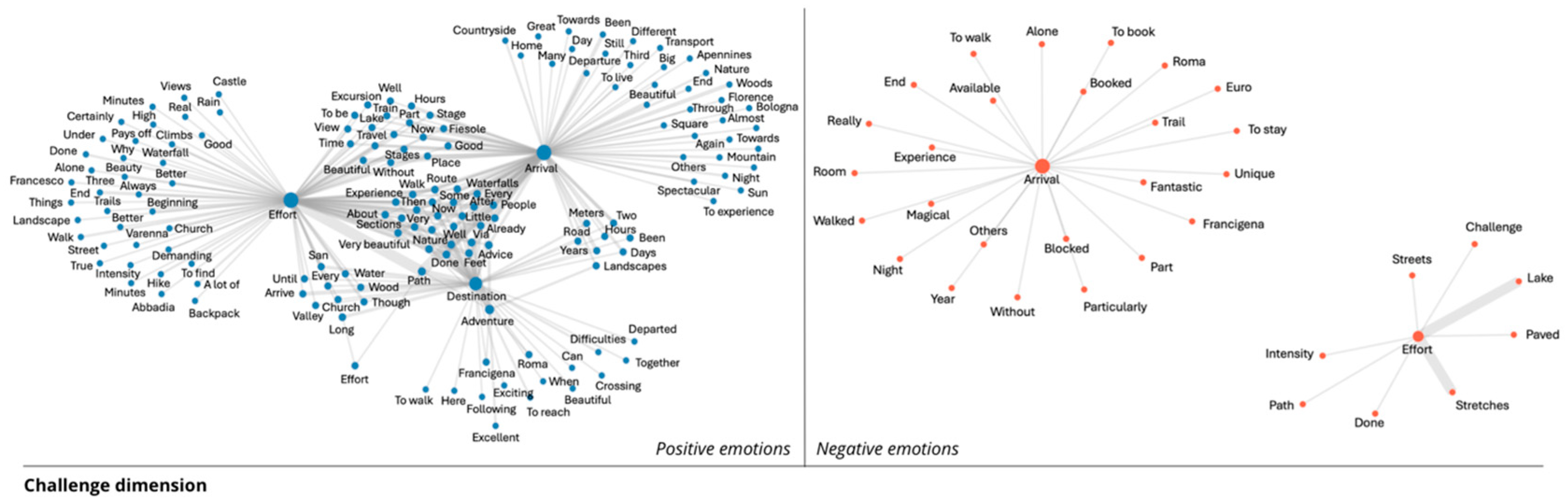
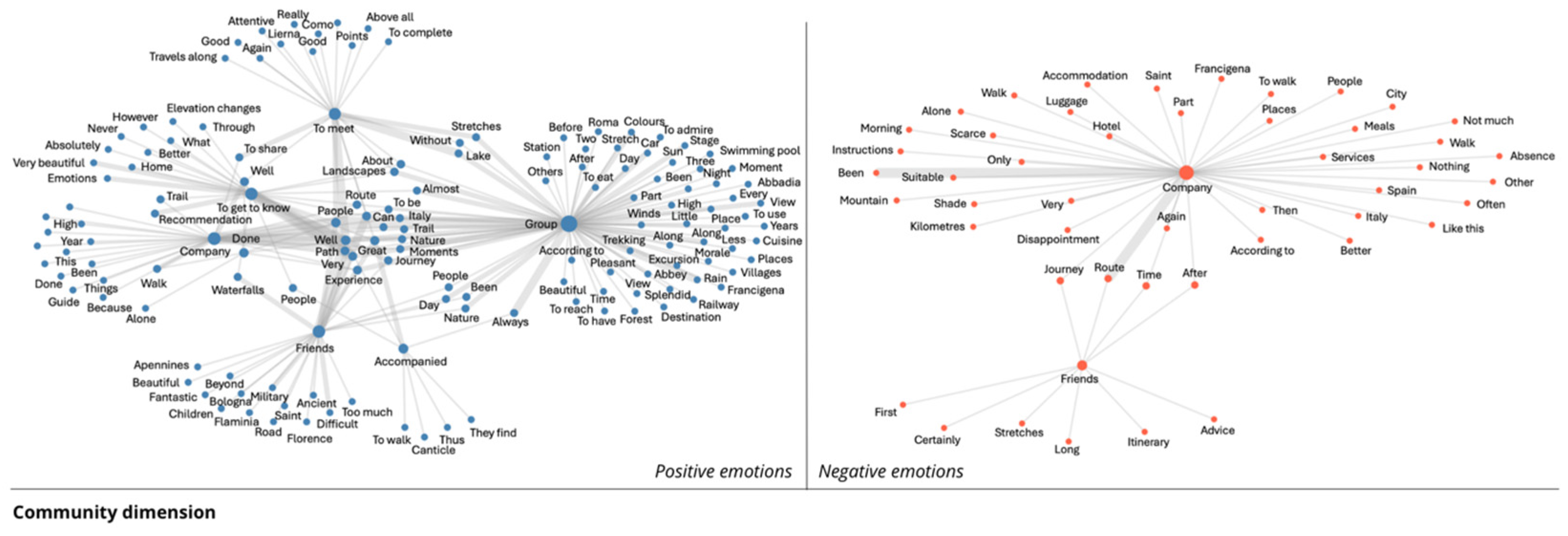
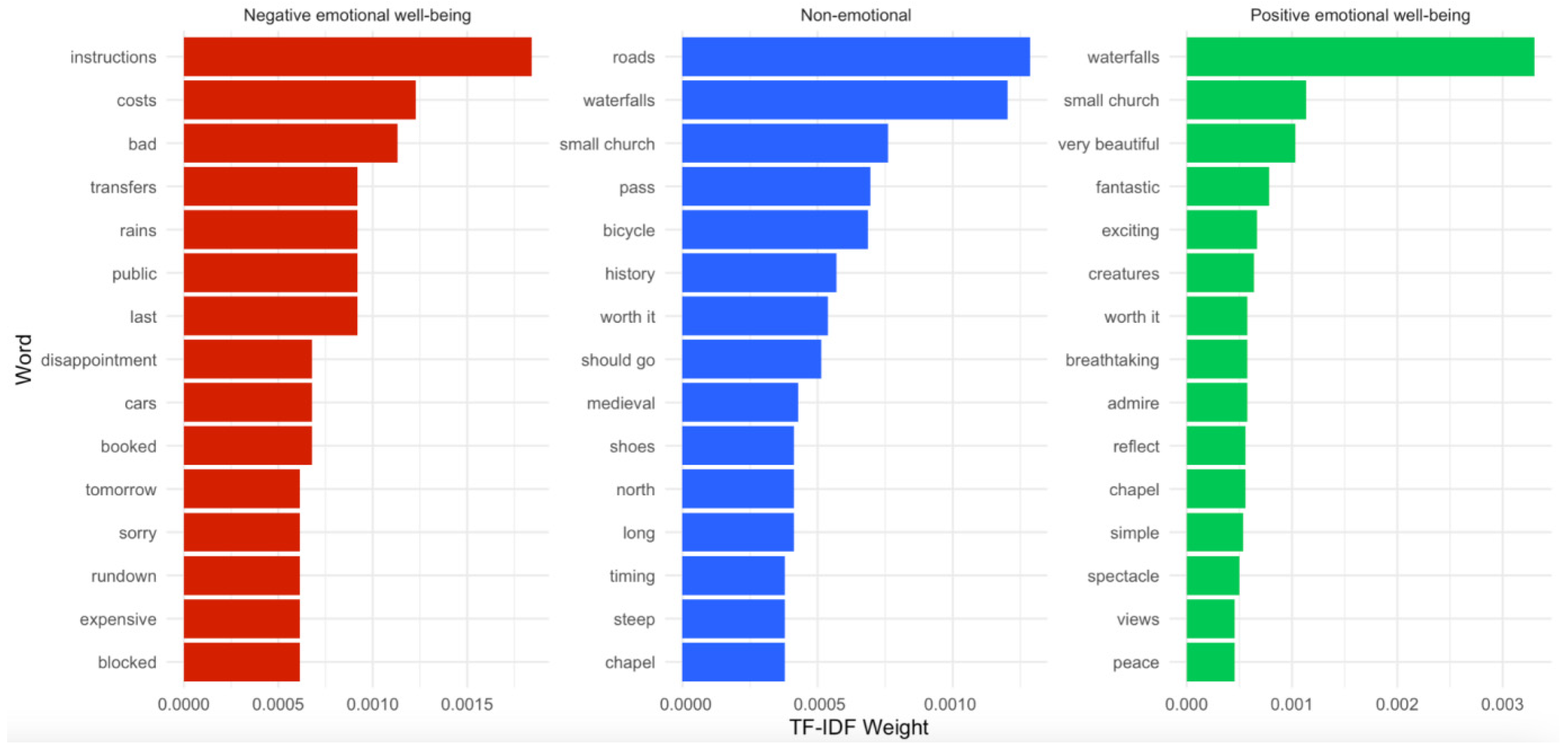
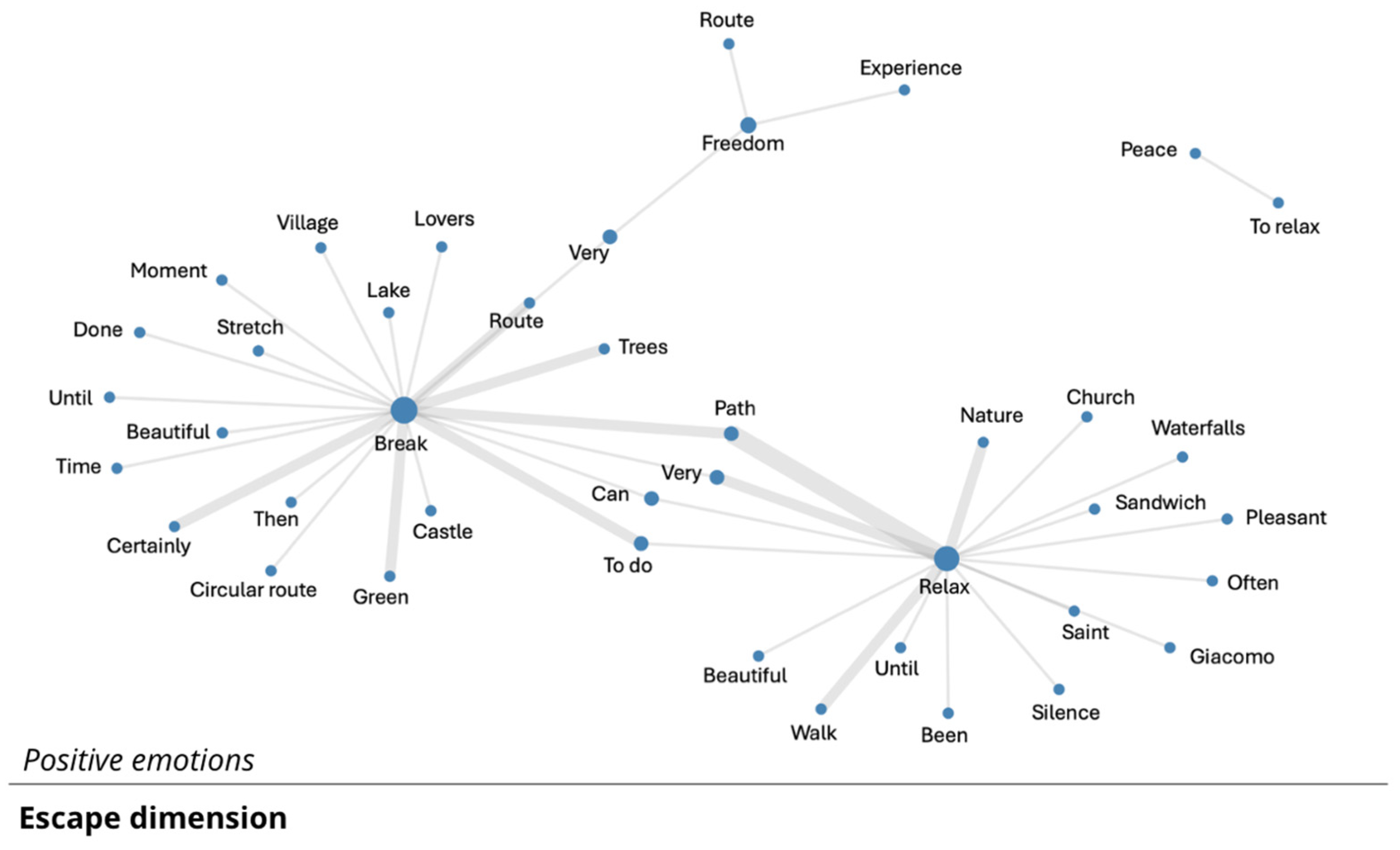
5. Discussion and Conclusions
5.1. Theoretical and Practical Implications
5.2. Research Limitations and Future Studies
Author Contributions
Funding
Institutional Review Board Statement
Informed Consent Statement
Data Availability Statement
Acknowledgments
Conflicts of Interest
References
- Hartwell, H.; Fyall, A.; Willis, C.; Page, S.; Ladkin, A.; Hemingway, A. Progress in tourism and destination wellbeing research. Curr. Issues Tour. 2018, 21, 1830–1892. [Google Scholar] [CrossRef] [Scilit]
- Konstantopoulou, C.; Varelas, S.; Liargovas, P. Well-Being and Tourism: A Systematic Literature Review. Economies 2024, 12, 281. [Google Scholar] [CrossRef] [Scilit]
- Neuhofer, B. Positive tourism experiences for human transformation: A Horizon 2050 paper. Tour. Rev. 2025, 80, 39–52. [Google Scholar] [CrossRef] [Scilit]
- Dwyer, L. Tourism development and sustainable well-being: A Beyond GDP perspective. J. Sustain. Tour. 2023, 31, 2399–2416. [Google Scholar] [CrossRef] [Scilit]
- Filep, S.; Moyle, B.D.; Skavronskaya, L. Tourist wellbeing: Re-thinking hedonic and eudaimonic dimensions. J. Hosp. Tour. Res. 2024, 48, 184–193. [Google Scholar] [CrossRef] [Scilit]
- Smith, M.K.; Diekmann, A. Tourism and wellbeing. Ann. Tour. Res. 2017, 66, 1–13. [Google Scholar] [CrossRef] [Scilit]
- Vada, S.; Prentice, C.; Scott, N.; Hsiao, A. Positive psychology and tourist well-being: A systematic literature review. Tour. Manag. Perspect. 2020, 33, 100631. [Google Scholar] [CrossRef] [Scilit]
- Olsen, D.H.; Trono, A. (Eds.) Religious Pilgrimage Routes and Trails: Sustainable Development and Management; CABI: Boston, MA, USA, 2018. [Google Scholar]
- Scuttari, A.; De Bortoli, I.; Pechlaner, H.; Riegler, H. Product innovation in route-based tourism: Interactive design of hiking routes as a driver for sustainable tourism. In BEST EN Think Tank XVII: Innovation and Progress in Sustainable Tourism; Emerald Publishing Limited: Leeds, UK, 2017; pp. 281–284. [Google Scholar]
- Splendiani, S.; Forlani, F.; Presenza, A. Route-based tourism as a driver of sustainable tourism development: Highlights from the Italian project “Atlas of Paths”. In Proceedings of the INVTUR 2021 International Conference “Tourism and the Sustainable Development Goals: From Theory to Practice”; Universidade de Aveiro—Serviços de Biblioteca, Informação Documental e Museologia: Aveiro, Portugal, 2021; pp. 271–273. [Google Scholar]
- Mau, M.; Klausen, S.H.; Roessler, K.K. Becoming a person: How long-distance walking can lead to personal growth–A cultural and health-related approach. New Ideas Psychol. 2023, 68, 100975. [Google Scholar] [CrossRef] [Scilit]
- Brumec, S.; Lavrič, M.; Naterer, A. Exceptional human experiences among pilgrims on the Camino de Santiago: A typology of experiences and transformative aftereffects. Psychol. Relig. Spiritual. 2023, 15, 605. [Google Scholar] [CrossRef] [Scilit]
- Devereux, C.; Carnegie, E. Pilgrimage: Journeying beyond self. Tour. Recreat. Res. 2006, 31, 47–56. [Google Scholar] [CrossRef] [Scilit]
- Han, J.W.; Kim, M.J.; Chung, N.; Kim, J.S. The effect of the authenticity of the Catholic pilgrimage site on spiritual well-being and quality of life of pilgrims. Int. J. Tour. Res. 2024, 26, e2634. [Google Scholar] [CrossRef] [Scilit]
- Marasco, A.; Marchi, V. Exploring Transformative Ecotourism Experiences on Italian Pathways Through Online Reviews. Sustainability 2025, 17, 452. [Google Scholar] [CrossRef] [Scilit]
- Mau, M.; Aaby, A.; Klausen, S.H.; Roessler, K.K. Are long-distance walks therapeutic? A systematic scoping review of the conceptualization of long-distance walking and its relation to mental health. Int. J. Environ. Res. Public Health 2021, 18, 7741. [Google Scholar] [CrossRef] [Scilit]
- Olafsdottir, G. ‘… sometimes you’ve just got to get away’: On trekking holidays and their therapeutic effect. Tour. Stud. 2013, 13, 209–231. [Google Scholar] [CrossRef] [Scilit]
- Porcelloni, L. Pilgrimage and hospitality along the Via Francigena: Revitalisation of rural areas and therapeutic mobilities. Tur. Psicol. 2021, 14, 69–82. [Google Scholar]
- Sørensen, A.; Høgh-Olesen, H. Walking for well-being. Exploring the phenomenology of modern pilgrimage. Cult. Psychol. 2023, 29, 27–44. [Google Scholar] [CrossRef] [Scilit]
- Walter, O. Walking on the Camino Paths: A Spiritual and Biopsychosocial Journey. Int. J. Relig. Tour. Pilgr. 2022, 9, 5. [Google Scholar]
- Wyles, K.J.; White, M.P.; Hattam, C.; Pahl, S.; King, H.; Austen, M. Are some natural environments more psychologically beneficial than others? The importance of type and quality on connectedness to nature and psychological restoration. Environ. Behav. 2019, 51, 111–143. [Google Scholar] [CrossRef] [Scilit]
- Lin, B.B.; Sollis, K.; Flies, E.J.; Marsh, P. Nature connection, wellbeing and pro-environmental behaviour across an urban gradient: Understanding the regional sweet spot. Ambio 2025, 55, 327–343. [Google Scholar] [CrossRef] [Scilit] [PubMed]
- Luhmann, M. Using big data to study subjective well-being. Curr. Opin. Behav. Sci. 2017, 18, 28–33. [Google Scholar] [CrossRef] [Scilit]
- OECD. Subjective Well-Being Measurement: Current Practice and New Frontiers; OECD Papers on Well-being and Inequalities, No. 17; OECD Publishing: Paris, France, 2023. [Google Scholar]
- Zhang, X.; Cheng, L.; Ma, G. Eliciting eudaimonic well-being in the tourism experiential space: Evidence from online reviews. Tour. Manag. 2024, 105, 104955. [Google Scholar] [CrossRef] [Scilit]
- Van Laer, T.; Izberk-Bilgin, E. A discourse analysis of pilgrimage reviews. J. Mark. Manag. 2019, 35, 586–604. [Google Scholar] [CrossRef] [Scilit]
- Diener, E. Guidelines for National Indicators of Subjective Well-Being and Ill-Being. Appl. Res. Qual. Life 2006, 1, 151–157. [Google Scholar] [CrossRef] [Scilit]
- Diener, E. Subjective well-being. Psychol. Bull. 1984, 95, 542–575. [Google Scholar] [CrossRef]
- OECD. OECD Guidelines on Measuring Subjective Well-Being; OECD Publishing: Paris, France, 2013. [Google Scholar] [CrossRef] [Scilit]
- New Economics Foundation. National Accounts of Well-Being: Bringing Real Wealth onto the Balance Sheet. Available online: https://neweconomics.org/uploads/files/2027fb05fed1554aea_uim6vd4c5.pdf (accessed on 26 March 2026).
- Algan, Y.; Beasley, E.; Guyot, F.; Higa, K.; Murtin, F.; Senik, C. Big Data Measures of Well-Being: Evidence from a Google Well-Being Index in the United States; OECD Statistics Working Papers, No. 2016/03; OECD Publishing: Paris, France, 2016. [Google Scholar] [CrossRef]
- Sametoğlu, S.; Pelt, D.H.M.; Eichstaedt, J.C.; Ungar, L.H.; Bartels, M. The value of social media language for the assessment of wellbeing: A systematic review and meta-analysis. J. Posit. Psychol. 2024, 19, 471–489. [Google Scholar] [CrossRef] [Scilit]
- Settanni, M.; Marengo, D. Sharing feelings online: Studying emotional well-being via automated text analysis of Facebook posts. Front. Psychol. 2015, 6, 1045. [Google Scholar] [CrossRef] [Scilit] [PubMed]
- Iacus, S.M.; Porro, G.; Salini, S.; Siletti, E. Social networks, happiness and health: From sentiment analysis to a multidimensional indicator of subjective well-being. arXiv 2015, arXiv:1512.01569. [Google Scholar] [CrossRef] [Scilit]
- Iacus, S.M.; Porro, G.; Salini, S.; Siletti, E. An Italian composite subjective well-being index: The voice of Twitter users from 2012 to 2017. Soc. Indic. Res. 2022, 161, 471–489. [Google Scholar] [CrossRef] [Scilit]
- Goh, S.; Neuhofer, B.; Duerden, M. Guest editorial: Designing experiences for transformation and sustainable futures. J. Hosp. Tour. Res. 2025, 49, 863–865. [Google Scholar] [CrossRef] [Scilit]
- Filep, S.; Laing, J. Trends and directions in tourism and positive psychology. J. Travel Res. 2019, 58, 343–354. [Google Scholar] [CrossRef] [Scilit]
- Su, L.; Tang, B.; Nawijn, J. How tourism activity shapes travel experience sharing: Tourist well-being and social context. Ann. Tour. Res. 2021, 91, 103316. [Google Scholar] [CrossRef] [Scilit]
- Buhalis, D.; Leung, X.Y.; Fan, D.; Darcy, S.; Chen, G.; Xu, F.; Tan, G.W.-H.; Nunkoo, R.; Farmaki, A. Tourism 2030 and the contribution to the sustainable development goals: The tourism review viewpoint. Tour. Rev. 2023, 78, 293–313. [Google Scholar] [CrossRef] [Scilit]
- Lavrič, M.; Brumec, S.; Naterer, A. Exceptional Human Experiences Among Pilgrims on the Camino de Santiago: A Study of Self-Reported Experiences and Transformative Aftereffects. Int. J. Transpers. Stud. 2022, 46, 1–13. [Google Scholar] [CrossRef] [Scilit]
- Brumec, S. Triggers of Exceptional Experiences on the Camino de Santiago Pilgrimage. Interdiscip. J. Relig. Transform. Contemp. Soc. 2024, 1, 1–30. [Google Scholar] [CrossRef] [Scilit]
- Feliu-Soler, A.; Royuela-Colomer, E.; Navarrete, J.; Jørgensen, N.N.; Mariño, M.; Demarzo, M.; Soler, J.; García-Campayo, J.; Montero-Marín, J.; Luciano, J.V. Assessing the impact of the way of Saint James on psychological distress and subjective well-being: The Ultreya study. J. Happiness Stud. 2024, 25, 105. [Google Scholar] [CrossRef] [Scilit]
- Johnmeyer, C.; Xu, S.; Stanis, S.W.; Morgan, M. The meaningful elements of the Camino: Toward understanding pilgrims’ transformative experience. Ann. Tour. Res. Empir. Insights 2025, 6, 100201. [Google Scholar] [CrossRef] [Scilit]
- Sarkar, S.; Negi, P.S. Mental health benefits of pilgrimage. Asian J. Psychiatry 2024, 95, 103977. [Google Scholar] [CrossRef] [Scilit]
- Schnell, T.; Pali, S. Pilgrimage today: The meaning-making potential of ritual. Ment. Health Relig. Cult. 2013, 16, 887–902. [Google Scholar] [CrossRef] [Scilit]
- Brumec, S. Life changes after the Camino de Santiago pilgrimage, including a deeper sense of spirituality. J. Study Spiritual. 2022, 12, 20–35. [Google Scholar] [CrossRef] [Scilit]
- Faria, C.A.P.; Remoaldo, P.C.; de Fátima da Silva Vieira Martins, M. Landscape and senses in a portuguese municipality on the way of St. James: Potential impacts on the well-being of pilgrims. J. Relig. Health 2024, 63, 133–158. [Google Scholar] [CrossRef] [Scilit]
- Zhang, K.; Ramos-Riera, I.; Labajo, V. Feet in hell, spirit in heaven: Spiritual transformation of Chinese travelers on the Camino de Santiago. J. Relig. Health 2024, 63, 89–108. [Google Scholar] [CrossRef] [Scilit]
- Zhang, K.; Labajo, V.; Ramos, I.; González del Valle-Brena, A. A guest at home: The experience of Chinese pilgrims on the Camino de Santiago. Sustainability 2021, 13, 10658. [Google Scholar] [CrossRef] [Scilit]
- Bakar, N.A.; Rahim, M.A.; Muhammad, N.H.B.; Nasir, M.N.M.; Halim, M.H.A.; Simpong, D.B. Exploring the profound influence of memorable religious tourism experiences on subjective well-being among Malaysian pilgrims. In The AI Revolution: Driving Business Innovation and Research; Springer Nature: Cham, Switzerland, 2024; Volume 1, pp. 691–702. [Google Scholar]
- Jørgensen, N.N.K.D.; Eade, J.; Ekeland, T.J.; Lorentzen, C.A.N. The processes, effects and therapeutics of pilgrimage walking the St. Olav Way. Int. J. Relig. Tour. Pilgr. 2020, 8, 6. [Google Scholar]
- Lin, L.P.L.; Hsieh, W.K. Exploring how perceived resilience and restoration affected the wellbeing of Matsu pilgrims during COVID-19. Tour. Manag. 2022, 90, 104473. [Google Scholar] [CrossRef] [Scilit]
- Afkhami Rohani, H.; Rahnama, N.; Gholami, M.; Saberi Moghadam Tehrani, Z. Analysing the Joy of Pilgrimage: Effects on Spiritual and Eudaimonic Well-Being. Int. J. Tour. Cult. Spiritual. 2025, 8, 107–129. [Google Scholar]
- van Iwaarden, M.; Nawijn, J. Eudaimonic benefits of tourism: The pilgrimage experience. Tour. Recreat. Res. 2024, 49, 37–47. [Google Scholar]
- Kim, H.; Lee, S.; Uysal, M.; Kim, J.; Ahn, K. Nature-based tourism: Motivation and subjective well-being. J. Travel Tour. Mark. 2015, 32, S76–S96. [Google Scholar] [CrossRef] [Scilit]
- Terre di Mezzo Editore. Italia, Paese di Cammini. Tutti i Numeri del 2025. Available online: https://www.terre.it/cammini-percorsi/i-dati-dei-cammini/italia-paese-di-cammini-il-dossier-di-terre-di-mezzo-tutti-i-numeri-del-2025/ (accessed on 26 March 2026).
- TripAdvisor. Tripadvisor’s 2025 Transparency Report Reveals Strong Review Submissions and Improved Fraud Detection. Available online: https://tripadvisor.mediaroom.com/2025-03-18-Tripadvisors-2025-Transparency-Report-reveals-strong-review-submissions-and-improved-fraud-detection (accessed on 26 March 2026).
- Mariani, M.; Borghi, M. Exploring environmental concerns on digital platforms through big data: The effect of online consumers’ environmental discourse on online review ratings. J. Sustain. Tour. 2023, 31, 2592–2611. [Google Scholar] [CrossRef] [Scilit]
- MiTur. Catalogo dei Cammini Religiosi Italiani. Available online: https://www.ministeroturismo.gov.it/catalogo-dei-cammini-religiosi-italiani/ (accessed on 6 May 2025).
- Terre di Mezzo Editore. Italia, Paese di Cammini. Tutti i Numeri del 2024. Available online: https://www.terre.it/cammini-percorsi/i-dati-dei-cammini/italia-paese-di-cammini-il-dossier-di-terre-di-mezzo-tutti-i-numeri-del-2024/ (accessed on 26 March 2026).
- Hennig-Thurau, T.; Gwinner, K.P.; Walsh, G.; Gremler, D.D. Electronic word-of-mouth via consumer-opinion platforms: What motivates consumers to articulate themselves on the internet? J. Interact. Mark. 2004, 18, 38–52. [Google Scholar] [CrossRef] [Scilit]
- Wankmüller, S. Introduction to neural transfer learning with transformers for social science text analysis. Sociol. Methods Res. 2024, 53, 1676–1752. [Google Scholar] [CrossRef] [Scilit]
- Do, S.; Ollion, É.; Shen, R. The augmented social scientist: Using sequential transfer learning to annotate millions of texts with human-level accuracy. Sociol. Methods Res. 2024, 53, 1167–1200. [Google Scholar] [CrossRef] [Scilit]
- Tian, J.; Cheng, Q.; Xue, R.; Han, Y.; Shan, Y. A dataset on corporate sustainability disclosure. Sci. Data 2023, 10, 182. [Google Scholar] [CrossRef] [Scilit]
- Li, K.; Mai, F.; Shen, R.; Yan, X. Measuring corporate culture using machine learning. Rev. Financ. Stud. 2021, 34, 3265–3315. [Google Scholar] [CrossRef] [Scilit]
- Marchi, V.; Apicerni, V.; Marasco, A. Assessing online sustainability communication of Italian cultural destinations—A web content mining approach. In Information and Communication Technologies in Tourism 2021: Proceedings of the ENTER 2021 eTourism Conference, Online, 19–22 January 2021; Springer International Publishing: Cham, Switzerland, 2021; pp. 58–69. [Google Scholar]
- Mohammad, S.M.; Turney, P.D. NRC Emotion Lexicon. NRC Technical Report. Available online: http://saifmohammad.com/WebPages/NRC-Emotion-Lexicon.htm (accessed on 26 March 2026).
- Zhang, W.; Fesenmaier, D.R. Assessing emotions in online stories: Comparing self-report and text-based approaches. Inf. Technol. Tour. 2018, 20, 83–95. [Google Scholar] [CrossRef] [Scilit]
- Wijffels, J. udpipe: Tokenization, Parts of Speech Tagging, Lemmatization and Dependency Parsing with the UDPipe NLP Toolkit; Institute of Formal and Applied Linguistics (ÚFAL): Prague, Czech Republic, 2022. [Google Scholar]
- Bosco, C.; Dell’Orletta, F.; Montemagni, S.; Sanguinetti, M.; Simi, M. The EVALITA 2014 dependency parsing task. In Proceedings of the First Italian Conference on Computational Linguistics (CLiC-it 2014) and of the Fourth International Workshop EVALITA 2014, Pisa, Italy, 9–11 December 2014; Pisa University Press: Pisa, Italy, 2014; pp. 1–8. [Google Scholar]
- ICCROM. Heritage and Wellbeing: What Constitutes a Good Life? Available online: https://www.iccrom.org/news/heritage-and-wellbeing-what-constitutes-good-life (accessed on 26 March 2026).



| Cammini d’Italia | Km | N. of Regions |
|---|---|---|
| Via Francigena | 1970 | 10 |
| Via Romea Germanica | 1050 | 6 |
| Via degli Dei | 121 | 2 |
| Sentiero della Pace | 520 | 3 |
| Cammino di Francesco | 500 | 3 |
| Cammino Minerario di Santa Barbara | 500 | 1 |
| Cammino di San Giacomo | 130 | 1 |
| Cammino dei Briganti | 108 | 2 |
| Via Spluga | 65 | 1 |
| Cammino di Oropa | 221 | 2 |
| Category | n. | % | Examples of Reviews |
|---|---|---|---|
| Positive emotional well-being | 449 | 60.5 | “…you can truly experience something unforgettable. For me, it was a wonderful day spent in contact with nature, streams, and waterfalls. Stunning waterfalls that give you the feeling of touching Paradise…” “…along the trails, the scents of unspoiled nature gradually give way to small paths that once served the higher homes for stocking up before winter. It is an absolute must-visit for nature lovers. I always return gladly to clear my mind of stress and fatigue…” “…it is possible to fully immerse yourself in nature and enjoy a variety of breathtaking views! It is a beautiful therapy for both mind and body—I highly recommend it if you feel the need to escape the greyness of the city while staying within our beautiful Italy!” |
| Non-emotional | 252 | 34.0 | “…From a hiking perspective, the trail does not present major technical difficulties. However, its hilly profile requires a moderate level of fitness and endurance, due to frequent ascents and descents, as well as the relative scarcity of well-equipped towns and supply points along the way. It is advisable to stock up on water and food for lunch at the beginning of each stage, even though water sources are generally available along the route…” “The famous Via Francigena, also known as the “Way of the Franks,” was the pilgrimage route taken by traveller’s from England and France on their way to Rome (or, conversely, by Romans heading north). The section of the road closest to Rome passed through territories once inhabited by the Etruscans—an area known in the Middle Ages as Tuscia. The “Franks’ path through Tuscia” ran directly through the city of Viterbo, from which Rome lies just over one hundred kilometres away.” |
| Negative emotional well-being | 41 | 5.5 | “Poorly marked, poorly maintained, with only rare views of the lake. Some stretches run along paved roads without sidewalks—a real risk of getting hit by a car… A pointless effort!” “A huge disappointment. Scenically, apart from a few short sections, it is very underwhelming. There is absolutely no organization, neither in terms of signage—which is terrible—nor in terms of amenities: bars, restaurants, and shops are virtually non-existent, and often the staff at the few places we did find were unfriendly… They do not have a welcoming attitude. The various farm stays were also rather unattractive and incredibly expensive…” “Needs improvement. It could definitely be an interesting trail if it were better maintained. Apart from the signage, which is not always clear, we did not feel entirely safe—part of the path goes near what look like abandoned houses, which is quite unsettling. Not recommended if you are alone. Bring plenty of water if you are hiking in the heat.” |
| Category | % of Emotional Words per Review | Emotional Words per Review | Examples of Emotional Words | ||||
|---|---|---|---|---|---|---|---|
| Beautiful | Unique | Pleasure | Interesting | Fear | |||
| Negative emotional well-being | 0.0067 | 1.02 | 0.19 | 0.21 | 0.08 | 0.05 | 0.02 |
| Positive emotional well-being | 0.0143 | 1.09 | 0.92 | 0.08 | 0.09 | 0.04 | 0 |
| Non-emotional | 0.0091 | 0.79 | 0.40 | 0.11 | 0.07 | 0.07 | 0 |
Disclaimer/Publisher’s Note: The statements, opinions and data contained in all publications are solely those of the individual author(s) and contributor(s) and not of MDPI and/or the editor(s). MDPI and/or the editor(s) disclaim responsibility for any injury to people or property resulting from any ideas, methods, instructions or products referred to in the content. |
© 2026 by the authors. Licensee MDPI, Basel, Switzerland. This article is an open access article distributed under the terms and conditions of the Creative Commons Attribution (CC BY) license.
Share and Cite
Marasco, A.; Marchi, V. Emotional Well-Being in Tourism Experiences on Pathways: Evidence from User-Generated Content. Sustainability 2026, 18, 5072. https://doi.org/10.3390/su18105072
Marasco A, Marchi V. Emotional Well-Being in Tourism Experiences on Pathways: Evidence from User-Generated Content. Sustainability. 2026; 18(10):5072. https://doi.org/10.3390/su18105072
Chicago/Turabian StyleMarasco, Alessandra, and Valentina Marchi. 2026. "Emotional Well-Being in Tourism Experiences on Pathways: Evidence from User-Generated Content" Sustainability 18, no. 10: 5072. https://doi.org/10.3390/su18105072
APA StyleMarasco, A., & Marchi, V. (2026). Emotional Well-Being in Tourism Experiences on Pathways: Evidence from User-Generated Content. Sustainability, 18(10), 5072. https://doi.org/10.3390/su18105072