Transforming Low-Grade Heat into Sustainable Cooling and Heating with Multicomponent Adsorbents


Abstract
1. Introduction
2. Preparation of Composite Adsorbents
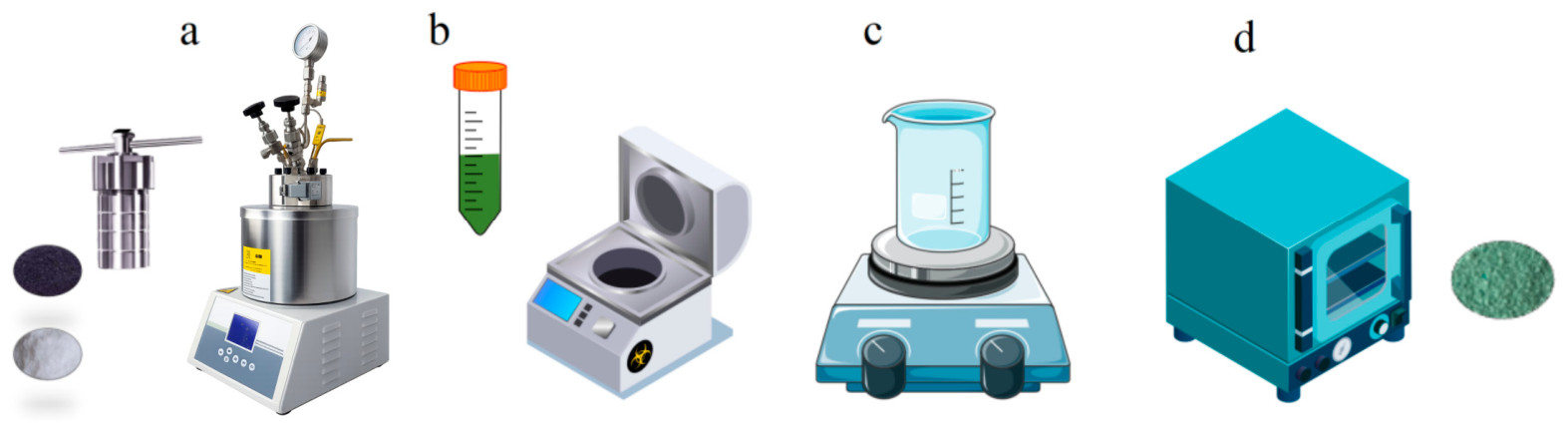
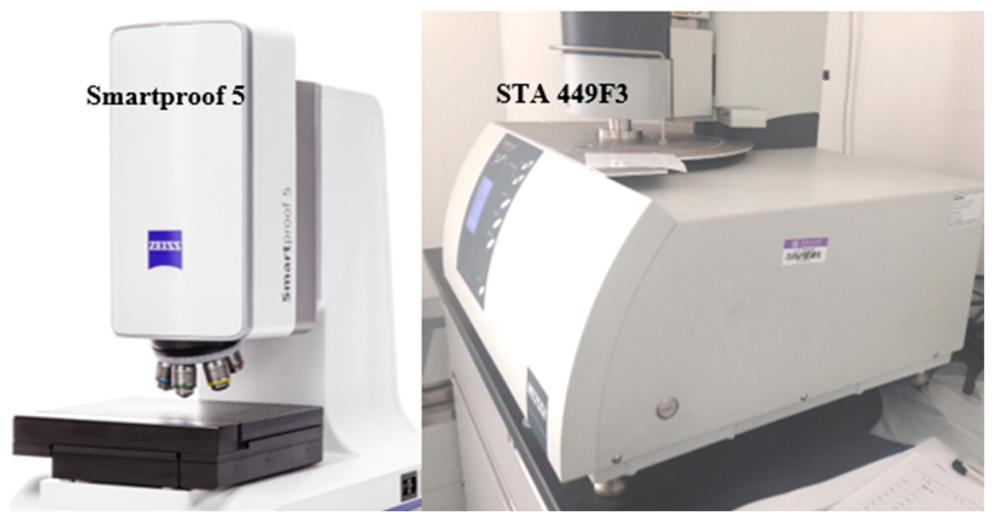
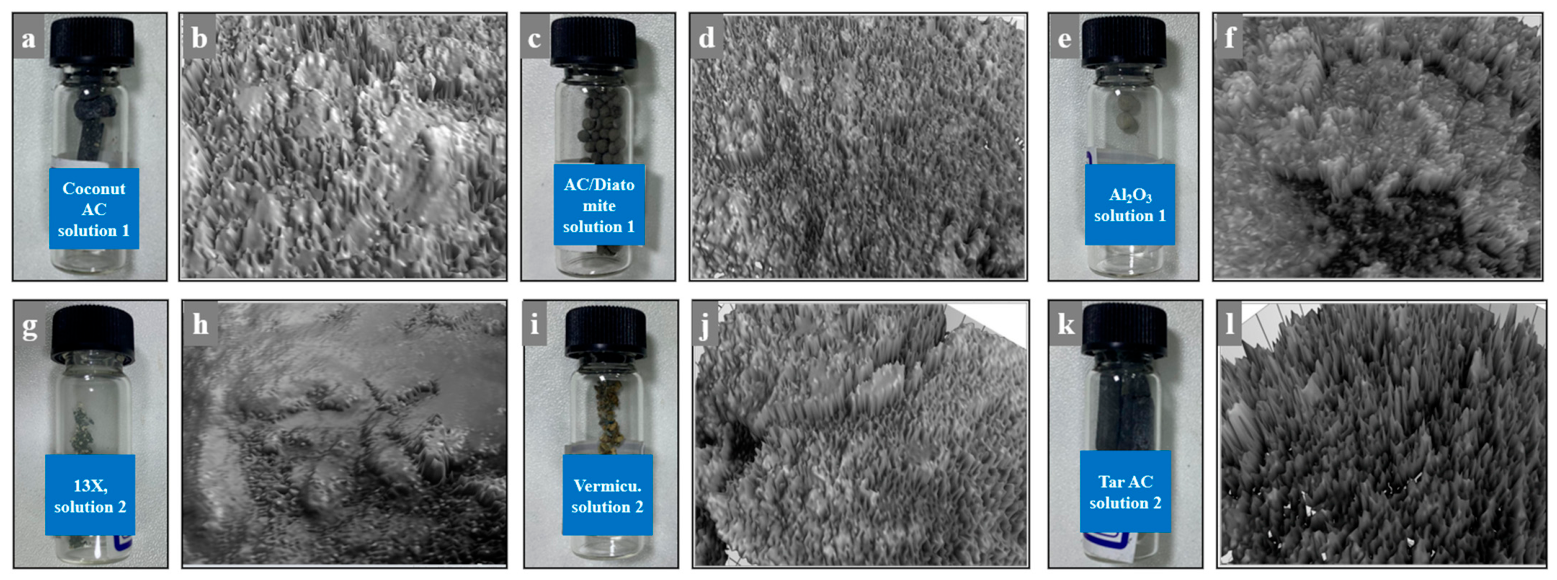
2.1. Materials and Composite Preparation
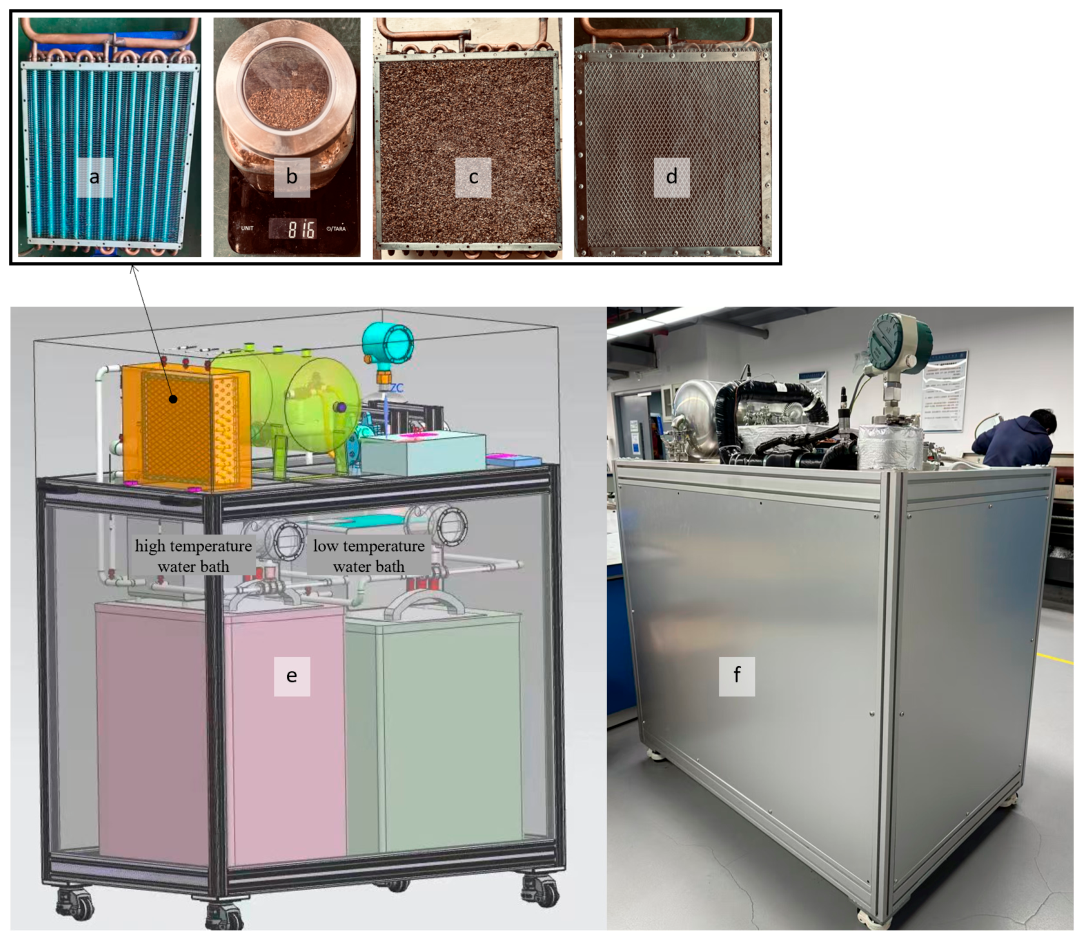
2.2. Experimental Setup and Procedures
- (1)
- Adsorbent properties are spatially uniform.
- (2)
- The adsorption bed and its environment are treated as adiabatic.
- (3)
- Pressure losses through the bed and condenser are neglected.
- (4)
- Pressure losses through the bed and evaporator are neglected.
- (5)
- Scroll expander efficiency is 0.85.
- (6)
- Electric generator efficiency is 0.85.
- (7)
- The heating loop is assumed adiabatic.
- (8)
- The cooling loop is assumed adiabatic.
- (9)
- The condenser is assumed adiabatic.
- (10)
- The evaporator is assumed adiabatic.
2.3. Performance Evaluation Methods
2.4. Uncertainty Analysis
3. Performance Results
3.1. System Operating Characteristics and Desalination Performance Analysis
3.2. Adsorption Cooling Performance Analysis
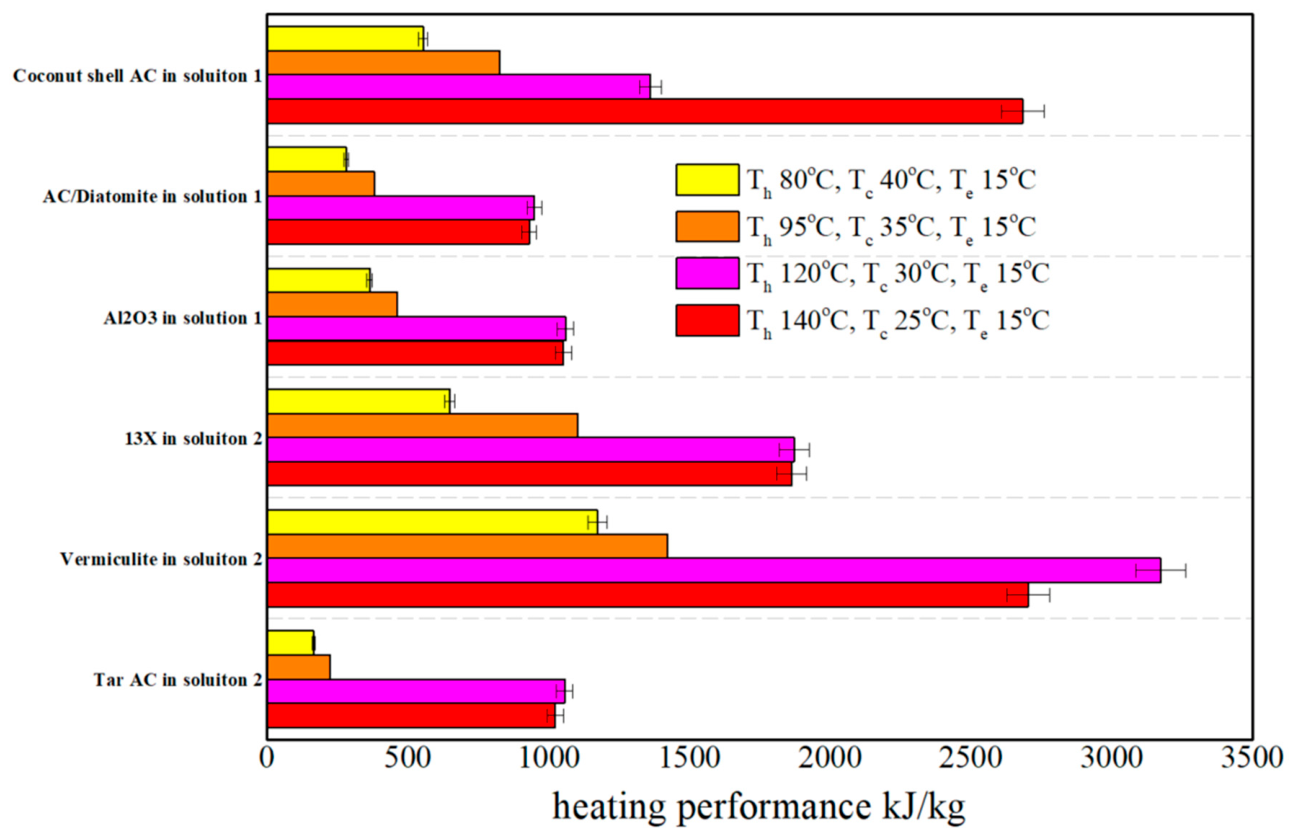
3.3. Adsorption Heat-Pump Heating Performance Analysis
4. Discussion
4.1. Comparative Assessment of Cooling, Heating, Desalination and Power-Generation Performance Relative to Earlier Studies
4.2. Calculation Assumptions and Limitations & Stability and Durability
4.3. Economic Feasibility
5. Conclusions
Funding
Institutional Review Board Statement
Informed Consent Statement
Data Availability Statement
Acknowledgments
Conflicts of Interest
References
- Sha, A.A.; Baiju, V.; Rehna, R.S.; Suzuki, T.; Singh, H.; Ichiyanagi, M. Performance investigations of carbon based consolidated composite adsorbents effective for adsorption cooling systems. Appl. Therm. Eng. 2022, 217, 119199. [Google Scholar] [CrossRef] [Scilit]
- El-Sharkawy, I.I.; Abdel Meguid, H.; Saha, B.B. Potential application of solar powered adsorption cooling systems in the Middle East. Appl. Energy 2014, 126, 235–245. [Google Scholar] [CrossRef] [Scilit]
- Calm, J.M. Emissions and environmental impacts from air-conditioning and cooling systems. Int. J. Refrig. 2002, 25, 293–305. [Google Scholar] [CrossRef] [Scilit]
- Rezk, M.; Elsheniti, M.B.; Rezk, A.; Elsamni, O.A. Multi-objective optimisation of MOF-801 adsorbent packed into copper foamed bed for cooling and water desalination systems. Appl. Therm. Eng. 2023, 229, 120642. [Google Scholar] [CrossRef] [Scilit]
- Chumnanwat, S.; Ota, S.; Nishizawa, J.; Sonthichai, C.; Takiguchi, N.; Kodama, A.; Kumita, M. Formation of adsorbent thin layer on aluminum sheet by using a silane coupling agent for vapor adsorption cooling system. Int. J. Refrig. 2023, 146, 40–46. [Google Scholar]
- Banda, H.; Rezk, A.; Elsayed, E.; Askalany, A. Experimental and computational study on utilising graphene oxide for adsorption cooling and water desalination. Appl. Therm. Eng. 2023, 229, 120631. [Google Scholar] [CrossRef] [Scilit]
- Albaik, I.; Diab, K.E.; Saleh, M.; Al-Dadah, R.; Mahmoud, S.; Elsheniti, M.B.; Solmaz, İ.; Salama, E.; Hassan, H.S.; Elkadi, M.F. MOF based coated adsorption system for water desalination and cooling integrated with pre-treatment unit. Sustain. Energy Technol. Assess. 2023, 56, 103006. [Google Scholar] [CrossRef] [Scilit]
- Zhao, H.; Wang, Q.; Xi, Z.; Liu, C.; Miao, C. Experimental investigation on water vapor adsorption performance of solvent-free synthesized MIL-100(Fe) and its composite adsorbent. J. Solid State Chem. 2023, 324, 124135. [Google Scholar] [CrossRef] [Scilit]
- Aboelmaaref, M.M.; Zhao, J.; Li, W.; Ali, E.S.; Askalany, A.A.; Ghazy, M.; Gu, L.; Zayed, M.E. Research on solar dish/Stirling engine driven adsorption-based desalination system for simultaneous co-generation of electricity and freshwater: Numerical investigation. Case Stud. Therm. Eng. 2023, 47, 103044. [Google Scholar]
- Yang, H.; Wang, C.; Tong, L.; Yin, S.; Wang, L.; Ding, Y. Salt hydrate adsorption material-based thermochemical energy storage for space heating application: A review. Energies 2023, 16, 2875. [Google Scholar] [CrossRef] [Scilit]
- Fan, Y.B.; Jiang, L.; Zhang, X.J.; Xu, X.G.; Frazzica, A. Heat pump assisted open three-phase sorption thermal battery for efficient heat storage. Energy Convers. Manag. 2023, 277, 116630. [Google Scholar] [CrossRef] [Scilit]
- Li, M.; Zhao, Y.; Long, R.; Liu, Z.; Liu, W. Metal foam packed adsorbent bed boosting the performance of the adsorption-based desalination and cooling system. Energy Convers. Manag. 2022, 254, 115250. [Google Scholar] [CrossRef] [Scilit]
- Lu, Z.S.; Hou, Y.; Han, Y. Engineering design, test analysis, and exergy calculation of multifunctional adsorption systems using chemical adsorbent and different thermal transfer fluids. J. Energy Storage 2021, 44, 103412. [Google Scholar] [CrossRef] [Scilit]
- Chauhan, X.P.R.; Kaushik, S.C.; Tyagi, S.K. A review on thermal performance enhancement of green cooling system using different adsorbent/refrigerant pairs. Energy Convers. Manag. 2022, 14, 100225. [Google Scholar] [CrossRef] [Scilit]
- Chao, J.; Xu, J.; Bai, Z.; Wang, P.; Wang, R.; Li, T. Integrated heat and cold storage enabled by high-energy-density sorption thermal battery based on zeolite/MgCl2 composite sorbent. J. Energy Storage 2023, 64, 107155. [Google Scholar] [CrossRef] [Scilit]
- Shi, R.; Yu, Y.X. Effective and green treatment of cyanide-containing wastewater over two-dimensional conjugated metal-organic frameworks: A combined density functional theory and descriptor study. Langmuir 2025, 41, 15031–15044. [Google Scholar] [CrossRef] [Scilit]
- Li, M.; Wang, R.Z.; Luo, H.L.; Wang, L.L.; Huang, H.B. Experiments of a solar flat plate hybrid system with heating and cooling. Appl. Therm. Eng. 2002, 22, 1445–1454. [Google Scholar] [CrossRef] [Scilit]
- Chang, W.S.; Wang, C.C.; Shieh, C.C. Design and performance of a solar-powered heating and cooling system using silica gel/water adsorption chiller. Appl. Therm. Eng. 2009, 29, 2100–2105. [Google Scholar] [CrossRef] [Scilit]
- Habib, K.; Saha, B.B.; Chakraborty, A.; Oh, S.T.; Koyama, S. Study on solar driven combined adsorption refrigeration cycles in tropical climate. Appl. Therm. Eng. 2013, 50, 1582–1589. [Google Scholar] [CrossRef] [Scilit]
- Jahan, I.; Rocky, K.A.; Pal, A.; Rahman, M.; Saha, B.B. A study on activated carbon and carbon nanotube based consolidated composite adsorbents for cooling applications. Therm. Sci. Eng. Prog. 2022, 34, 101388. [Google Scholar] [CrossRef] [Scilit]
- Pal, A.; Rocky, K.A.; Saha, B.B. Thermodynamic analysis of promising biomass-derived activated carbons/CO2 based adsorption cooling systems. J. CO2 Util. 2021, 46, 101457. [Google Scholar] [CrossRef] [Scilit]
- Ye, H.; Yuan, Z.; Li, S.; Zhang, L. Activated carbon fiber cloth and CaCl2 composite sorbents for a water vapor sorption cooling system. Appl. Therm. Eng. 2014, 62, 690–696. [Google Scholar] [CrossRef] [Scilit]
- Aristov, Y.I.; Sapienza, A.; Ovoshchnikov, D.S.; Freni, A.; Restuccia, G. Reallocation of adsorption and desorption times for optimisation of cooling cycles. Int. J. Refrig. 2012, 35, 525–531. [Google Scholar] [CrossRef] [Scilit]
- Xu, Q.; Wu, J.; Xu, Z. Performance study of adsorption refrigeration system with composite adsorbent. Int. J. Refrig. 2021, 131, 322–331. [Google Scholar] [CrossRef] [Scilit]
- Chan, K.C.; Chao, C.Y.H.; Sze-To, G.N.; Hui, K. Performance predictions for a new zeolite 13X/CaCl2 composite adsorbent for adsorption cooling systems. Int. J. Heat Mass Transf. 2012, 55, 3214–3224. [Google Scholar] [CrossRef] [Scilit]
- Elsayed, E.; Anderson, P.; Raya, A.L.D.; Mahmoud, S.; Elsayed, A. MIL-101 (Cr)/calcium chloride composites for enhanced adsorption cooling and water desalination. J. Solid State Chem. 2019, 277, 123–132. [Google Scholar] [CrossRef] [Scilit]
- Xia, X.; Liu, B.; Zhao, B.; Xia, Z.; Li, S. Enhanced water adsorption of MIL-101 (Cr) by metal-organic polyhedral encapsulation for adsorption cooling. Nanomaterials 2023, 13, 1147. [Google Scholar] [CrossRef] [Scilit] [PubMed]
- Tso, C.Y.; Chao, C.Y.H. Activated carbon, silica-gel and calcium chloride composite adsorbents for energy efficient solar adsorption cooling and dehumidification systems. Int. J. Refrig. 2012, 35, 1626–1638. [Google Scholar] [CrossRef] [Scilit]
- Liu, Z.; Xu, M.; Huang, C.; Huai, X. Performance evaluation of silicoaluminophosphate with SFO topology for water-sorption-driven heating and cooling systems. Appl. Therm. Eng. 2022, 216, 119100. [Google Scholar] [CrossRef] [Scilit]
- Pal, A.; El-Sharkawy, I.I.; Saha, B.B.; Jribi, S.; Miyazaki, T.; Koyama, S. Experimental investigation of CO2 adsorption onto a carbon based consolidated composite adsorbent for adsorption cooling application. Appl. Therm. Eng. 2016, 109, 304–311. [Google Scholar] [CrossRef] [Scilit]
- He, X.; Wei, R.; Jan, A.; Li, G.; Chen, T.; Xue, B. Process steam generation from low-grade waste heat in a direct-contact adsorption heat pump based on superhydrophobic surface-modified zeolite 13X. Energy Sources Part A 2023, 45, 9910–9927. [Google Scholar] [CrossRef] [Scilit]
- Baiju, V.; Abhishek, P.; Harikrishnan, S. Performance investigations of hybrid adsorption and thermo electric dehumidification desalination system. Energy Convers. Manag. 2024, 300, 117912. [Google Scholar] [CrossRef] [Scilit]
- Youssef, P.G.; Dakkama, H.; Mahmood, S.M.; Al-Dadah, R.K. Experimental investigation of adsorption water desalination/cooling system using CPO-27Ni MOF. Desalination 2017, 404, 192–199. [Google Scholar] [CrossRef] [Scilit]
- Alsaman, A.S.; Ahmed, M.S.; Ibrahim, E.M.M.; Ali, E.S.; Farid, A.M.; Askalany, A.A. Experimental investigation of porous carbon for cooling and desalination applications. npj Clean Water 2023, 6, 4. [Google Scholar] [CrossRef] [Scilit]
- Elsayed, E.; Raya, A.D.; Mahmoud, S.; Anderson, P.; Elsayed, A. Adsorption cooling system employing novel MIL-101 (Cr)/CaCl2 composites: Numerical study. Int. J. Refrig. 2019, 107, 246–261. [Google Scholar] [CrossRef] [Scilit]
- Lenzen, D.; Zhao, J.; Ernst, S.J.; Wahiduzzaman, M.; Inge, A.K.; Fröhlich, D.; Xu, H.; Bart, H.-J.; Janiak, C.; Henninger, S.; et al. A metal-organic framework for efficient water-based ultra-low-temperature-driven cooling. Nat. Commun. 2019, 10, 3025. [Google Scholar] [CrossRef] [Scilit]
- Mahesh, A.; Kaushik, S.C. Solar adsorption refrigeration system using different mass of adsorbents. J. Therm. Anal. Calorim. 2013, 111, 897–903. [Google Scholar] [CrossRef] [Scilit]
- Jribi, S.; Saha, B.B.; Koyama, S.; Bentaher, H. Modeling and simulation of an activated carbon-CO2 four bed based adsorption cooling system. Energy Convers. Manag. 2014, 78, 985–991. [Google Scholar] [CrossRef] [Scilit]
- El-Sharkawy, I.I.; Saha, B.B.; Koyama, S.; He, J.; Ng, K.; Yap, C. Experimental investigation on activated carbon-ethanol pair for solar powered adsorption cooling applications. Int. J. Refrig. 2008, 31, 1407–1413. [Google Scholar] [CrossRef] [Scilit]
- Banker, N.D.; Prasad, M.; Dutta, P.; Srinivasan, K. Experimental results of an activated carbon-HFC 134a adsorption cooling system for thermal management of electronics. Appl. Therm. Eng. 2011, 31, 1607–1612. [Google Scholar] [CrossRef] [Scilit]
- Saha, B.B.; Chakraborty, A.; Koyama, S.; Aristov, Y.I. A new generation cooling device employing CaCl2-in-silica gel-water system. Int. J. Heat Mass Transf. 2009, 52, 516–524. [Google Scholar] [CrossRef] [Scilit]
- Thu, K.; Kim, Y.D.; Myat, A.; Chun, W.G.; Ng, K.C. Entropy generation analysis of an adsorption cooling cycle. Int. J. Heat Mass Transf. 2013, 60, 143–155. [Google Scholar] [CrossRef] [Scilit]
- Al-Mousawi, F.N.; Al-Dadah, R.; Mahmoud, S. Low grade heat driven adsorption system for cooling and power generation using advanced adsorbent materials. Energy Convers. Manag. 2016, 126, 373–384. [Google Scholar] [CrossRef] [Scilit]
- Pérez-Carvajal, J.; Boix, G.; Imaz, I.; Maspoch, D. The imine-based COF TpPa-1 as an efficient cooling adsorbent that can be regenerated by heat or light. Adv. Energy Mater. 2019, 9, 1901535. [Google Scholar]
- Han, X.; Wu, P.; Huang, W.; Fu, G.; Zhang, S.; Li, Y.; Wang, L.; Xu, M.; Huai, X. Design of mixed-metal MOF-74-MgNi for water adsorption-driven solar thermal energy storage and heat transformation applications. Inorg. Chem. 2024, 63, 17993–18004. [Google Scholar]
- Han, B.; Chakraborty, A.; Saha, B.B. Enhancing cooling and atmospheric water harvesting via zeolite-MOF composites: Experimental and thermodynamic evaluation of MIL-160 (Al) and AFI-type zeolite hybrid adsorbents. ACS Sustain. Chem. Eng. 2025, 13, 17635–17656. [Google Scholar]




| No. | Matrix Name | Solution Type |
|---|---|---|
| 1 | Coconut activated carbon | solution 1 |
| 2 | Activated carbon/diatomite | solution 1 |
| 3 | Al2O3 | solution 1 |
| 4 | 13X zeolite | solution 2 |
| 5 | Vermiculite | solution 2 |
| 6 | Tar activated carbon | solution 2 |
| Item | Value | Unit |
|---|---|---|
| Cycle time | 60 | min |
| Adsorbent | 2 | kg |
| Evaporation mass | 0.288 | kg |
| Cooling capacity | 800 | W |
| Heat transfer coefficient of adsorber | 80 | W/m2.°C |
| Temperature different of adsorber | 7 | °C |
| Heat transfer capacity of adsorber | 2 | kW |
| Heat transfer area of adsorber | 3.85 | m2 |
| Distance between fins | 3.5 | mm |
| Fin thickness | 0.15 | mm |
| Heat transfer coefficient of condenser–evaporator | 1500 | W/m2.°C |
| Temperature different of condenser–evaporator | 3.5 | °C |
| Heat transfer capacity of condenser–evaporator | 0.8 | kW |
| Heat transfer area of condenser–evaporator | 0.15 | m2 |
| Outer diameter of heat exchange tube of condenser–evaporator | 9.52 | mm |
| Heat exchange tube length | 5.6 | m |
| Temperature uncertainty | ±0.15 | °C |
| Pressure uncertainty | ±0.25 | % |
| Mass flow rate uncertainty | ±0.1 | % |
| Process | Value | Unit | Time (min) | Evaporation or Condensation Pressure (bar) | Evaporation or Condensation Temperature (°C) |
|---|---|---|---|---|---|
| Heating | 25 | °C, rate 5 °C/min | 5 | / | / |
| Isothermal adsorption | 60 | min | 60 | 0.019 | 16.7 |
| Heating | 140 | °C, rate 5 °C/min | 23 | / | / |
| Isothermal desorption | 60 | min | 60 | 0.0317 | 25 |
| Cooling | 30 | °C, rate 2 °C/min | 55 | / | / |
| Isothermal adsorption | 60 | min | 60 | 0.019 | 16.7 |
| Heating | 120 | °C, rate 5 °C/min | 45 | / | / |
| Isothermal desorption | 60 | min | 60 | 0.0425 | 30 |
| Cooling | 35 | °C, rate 2 °C/min | 42.5 | / | / |
| Isothermal adsorption | 60 | min | 60 | 0.019 | 16.7 |
| Heating | 95 | °C, rate 5 °C/min | 30 | / | / |
| Isothermal desorption | 60 | min | 60 | 0.0563 | 35 |
| Cooling | 40 | °C, rate 2 °C/min | 27.5 | / | / |
| Isothermal adsorption | 60 | min | 60 | 0.019 | 16.7 |
| Heating | 80 | °C, rate 5 °C/min | 20 | / | / |
| Isothermal desorption | 60 | min | 60 | 0.0738 | 40 |
| working Pairs | Working Conditioning | Cooling COP | Heating COPh | Power Generation kJ/kg | Desalination | Reference |
|---|---|---|---|---|---|---|
| Vermiculite/CaCl2/LiCl-water | 140 °C heating, 25 °C condensation, 15 °C evaporation | 0.71 | 1.31 | 27.2 | 0.71 g/g | This work |
| AC-methanol | 100 °C heating, −3 °C condensation, 15 °C evaporation | 0.11 | / | / | / | [17] |
| Silica gel-water | 80 °C heating, 30 °C condensation, 14 °C evaporation | 0.41 | / | / | / | [18] |
| AC-R134a | 75 °C heating, 30 °C condensation, −10 °C evaporation | 0.15 | / | / | / | [19] |
| AC-CO2 | 100 °C heating, 30 °C condensation, 10 °C evaporation | 0.12 | / | / | / | [20] |
| AC-CO2 | 83 °C heating, 30 °C condensation, 5 °C evaporation | 0.12 | / | / | / | [21] |
| AC/CaCl2-water | 89 °C heating, 34 °C condensation, 10 °C evaporation | 0.70 | / | / | / | [22] |
| Silica gel/LiNO3-water | 110 °C heating, 20–45 °C condensation, 5–25 °C evaporation | 0.12 | / | / | / | [23] |
| Silica gel/CaCl2-water | 85 °C heating, 25 °C condensation, 20 °C evaporation | 0.3 | / | / | / | [24] |
| 13X/CaCl2-water | 90 °C heating, 25 °C condensation, 5 °C evaporation | 0.56 | / | / | / | [25] |
| MIL-101(Cr)/CaCl2-water | 25 °C evaporation, p/p0 0.1–0.9 | / | / | / | 0.65 g/g | [26] |
| MIL-101(Cr)/MOP-water | 80 °C heating, 30 °C condensation, 10 °C evaporation | 0.29 | / | / | / | [27] |
| AC/CaCl2-water | 110 °C heating, 27 °C condensation, 5.5 °C evaporation | 0.7 | / | / | / | [28] |
| SAPO/SFO-water | 80 °C heating, 30 °C condensation, 10 °C evaporation | 0.86 | 1.76 | / | / | [29] |
| SAPO-water | 80 °C heating, 25 °C condensation, 5 °C evaporation | / | 1.27 | / | / | [30] |
| 13X-water | 72 °C heating, 220 °C condensation | / | 0.223 | / | / | [31] |
| Silica gel-water | 60 °C heating, 28 °C condensation | 0.22 | / | / | 1.15 L/hr | [32] |
| CPO-27 (Ni)-water | 120 °C heating, 30 °C condensation, <20 °C evaporation | 0.4 | / | / | 0.65 L/hr | [33] |
| activated carbon Maxsorb III/(NH4)2CO3-water | 80 °C heating, 30 °C condensation,7 °C evaporation | 0.63 | / | / | / | [34] |
| AC/zeolite-water | 80 °C heating, 25 °C condensation, 22 °C evaporation | 0.26 | / | / | 0.38 g/g | [7] |
| MIL-101(Cr)/CaCl2-water | 90 °C heating, 30 °C condensation, 15 °C evaporation | 0.35 | / | / | / | [35] |
| CAU-10-water | 80 °C heating, 25 °C condensation, p/p0 0.20–0.30 | 0.73 | / | / | / | [36] |
| MIL-160-water | 80 °C heating, 25 °C condensation, p/p0 0.20–0.30 | 0.71 | / | / | / | |
| AC-methanol | 91 °C heating, 31 °C condensation, 12 °C evaporation | 0.27 | / | / | / | [37] |
| AC-CO2 | 95 °C heating,31 °C condensation, 12 °C evaporation | 0.1 | / | / | / | [38] |
| AC-ethanol | 80 °C heating, 30 °C condensation, 7 °C evaporation | 0.7 | / | / | / | [39] |
| AC-R134a | 82 °C heating, 33 °C condensation, 11.5 °C evaporation | 0.82 | / | / | / | [40] |
| Silica gel/CaCl2-water | 85 °C heating, 25 °C condensation, 10 °C evaporation | 0.43 | / | / | / | [41] |
| Silica gel-water | 85 °C heating, 28 °C condensation, 12.5 °C evaporation | 0.41 | / | / | / | [42] |
| SAPO-34-water | 120 °C heating, 26 °C condensation, 18 °C evaporation | 0.42 | / | 2.4 | 1 g/g | [43] |
| AQSOA-FAM-Z02-water | 65 °C heating, 30 °C condensation, 10 °C evaporation | 0.77 | / | / | / | [44] |
| MOF-74-MgNi-water | 110 °C heating, 30 °C condensation, 10 °C evaporation | 0.75 | / | / | / | [45] |
| MIL-160 (Al)/zeolite-water | 80 °C heating, 30 °C condensation, 15 °C evaporation | 0.33 | / | / | / | [46] |
Disclaimer/Publisher’s Note: The statements, opinions and data contained in all publications are solely those of the individual author(s) and contributor(s) and not of MDPI and/or the editor(s). MDPI and/or the editor(s) disclaim responsibility for any injury to people or property resulting from any ideas, methods, instructions or products referred to in the content. |
© 2026 by the author. Licensee MDPI, Basel, Switzerland. This article is an open access article distributed under the terms and conditions of the Creative Commons Attribution (CC BY) license.
Share and Cite
Lu, Z. Transforming Low-Grade Heat into Sustainable Cooling and Heating with Multicomponent Adsorbents. Sustainability 2026, 18, 4925. https://doi.org/10.3390/su18104925
Lu Z. Transforming Low-Grade Heat into Sustainable Cooling and Heating with Multicomponent Adsorbents. Sustainability. 2026; 18(10):4925. https://doi.org/10.3390/su18104925
Chicago/Turabian StyleLu, Zisheng. 2026. "Transforming Low-Grade Heat into Sustainable Cooling and Heating with Multicomponent Adsorbents" Sustainability 18, no. 10: 4925. https://doi.org/10.3390/su18104925
APA StyleLu, Z. (2026). Transforming Low-Grade Heat into Sustainable Cooling and Heating with Multicomponent Adsorbents. Sustainability, 18(10), 4925. https://doi.org/10.3390/su18104925