Valorization of Copper Slag Through Alkali-Activated Materials: A Systematic Review


Abstract
1. Introduction
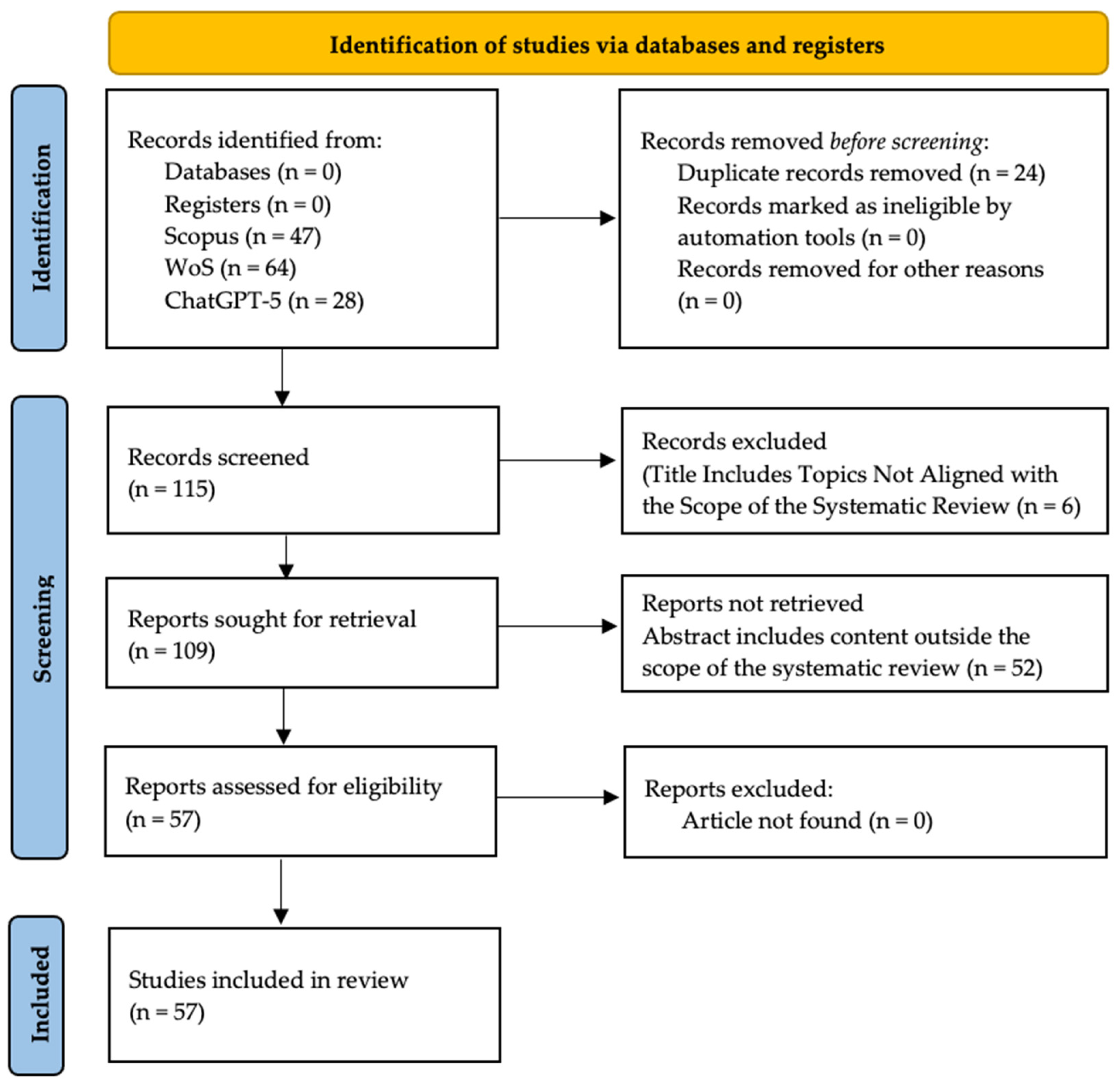
2. Methods
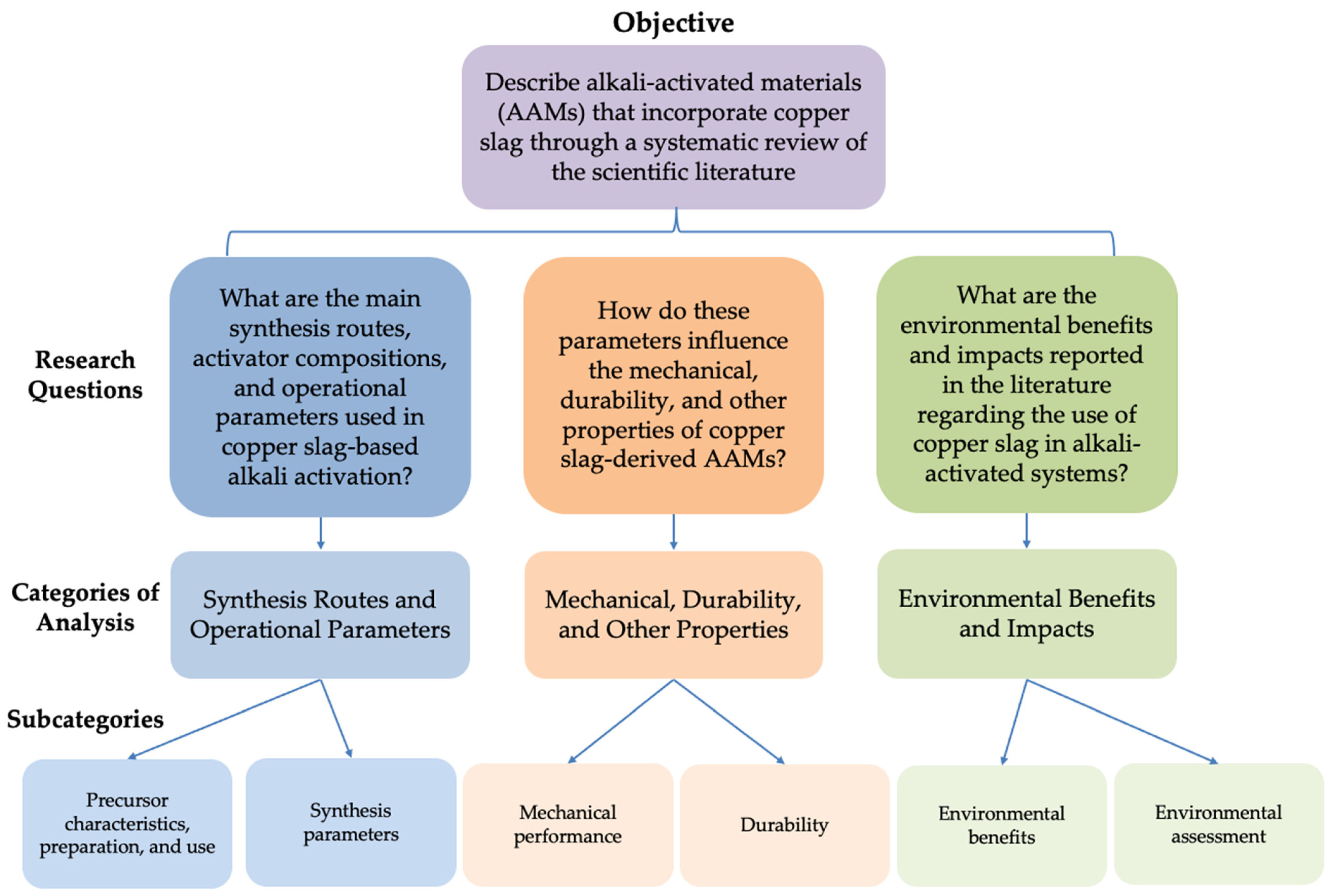
- What are the main synthesis routes, activator compositions, and operational parameters used in copper slag-based alkali activation?
- How do these parameters influence the mechanical aspects, durability, and other properties of copper slag-derived AAMs?
- What are the environmental benefits and impacts reported in the literature regarding the use of copper slag in alkali-activated systems?
- SC1.1—precursor characteristics, preparation, and use, covering the oxide composition of copper slag (SiO2, Al2O3, Fe2O3, CaO), its application either as a primary precursor or as a fine aggregate, and any pretreatment procedures such as grinding, sieving, homogenization, or thermal processing.
- SC1.2—synthesis parameters, encompassing the chemical composition of the alkaline activator, the precursor blend design (including the combination of copper slag with other aluminosilicate sources), mixture proportions involving fine aggregates and the reaction products or gels identified.
- SC2.1—mechanical performance, covering compressive, flexural, and tensile strength results, together with the key experimental conditions that influence them, including curing temperature, curing duration, and specimen geometry.
- SC2.2—durability and leaching behavior, addressing permeability, resistance to chloride, sulfate, and acid attack as well as the leaching of heavy metals under different exposure environments.
- SC3.1—environmental benefits, such as waste reduction, CO2 emission mitigation, and decreased demand for natural raw materials.
- SC3.2—environmental assessment, including life cycle assessment (LCA), energy consumption, and comparisons with conventional Portland cement-based systems.
3. Results
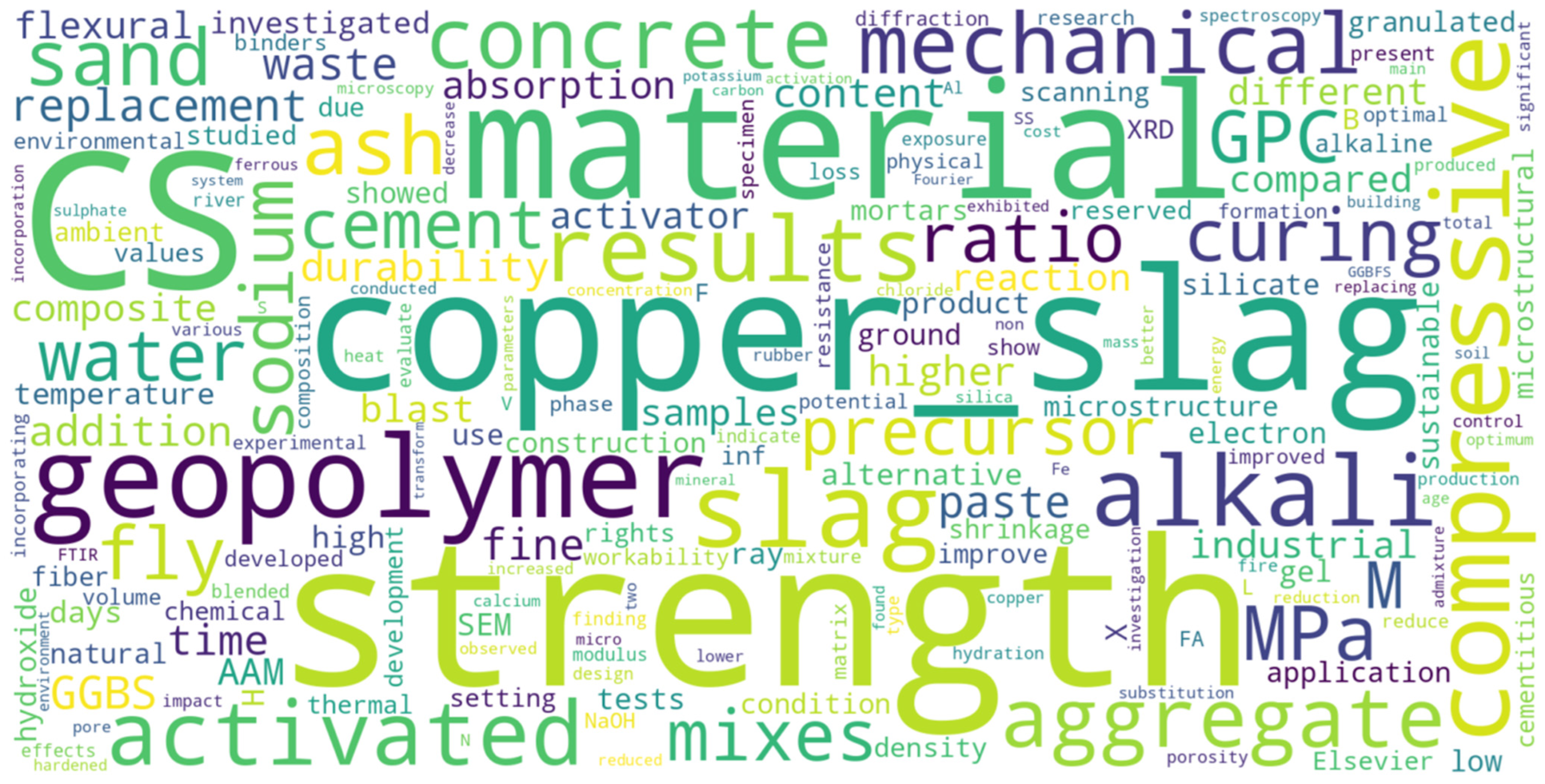
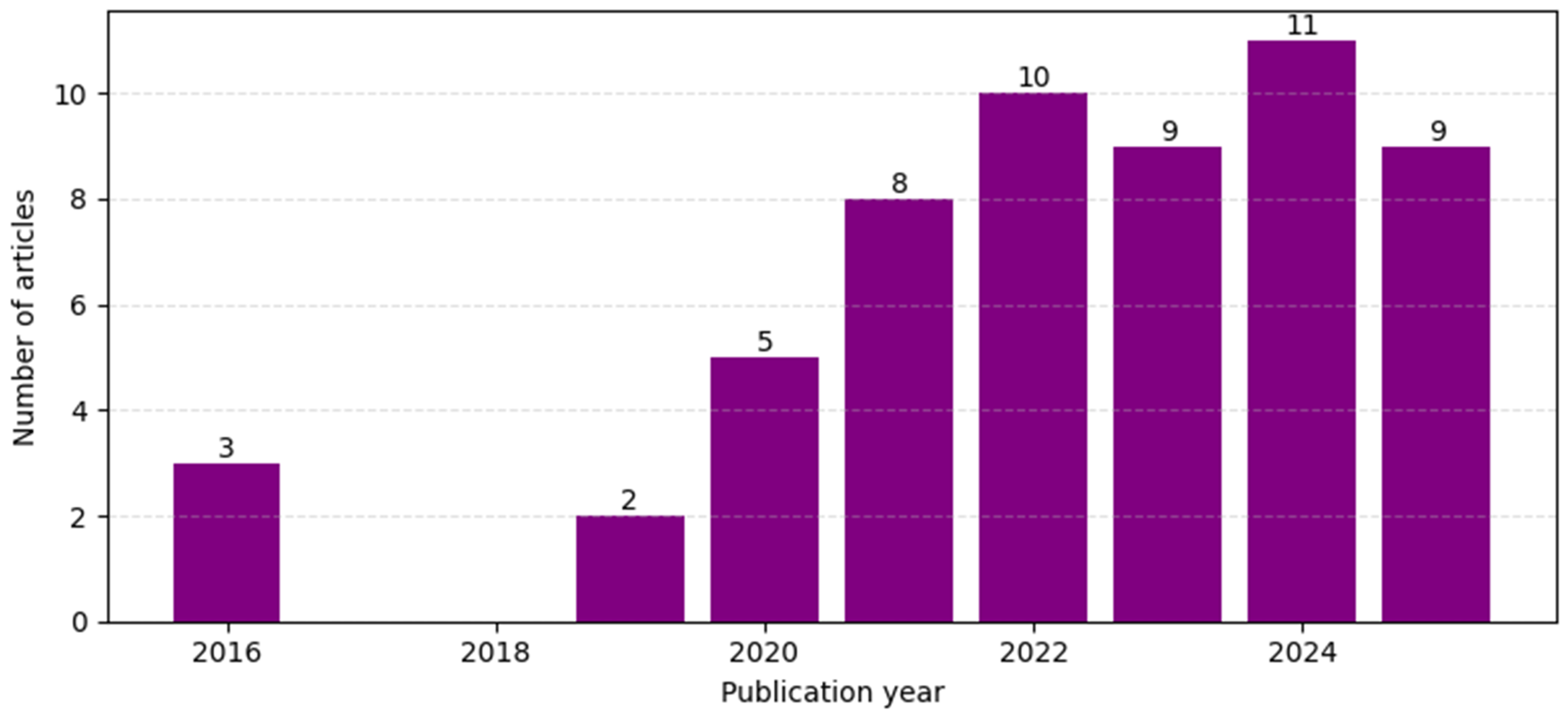
3.1. Bibliometric Overview of the Selected Studies
3.2. Synthesis and Operational Parameters
- SC1.1—Precursor characteristics, preparation, and use
- SC1.2—Synthesis parameters
3.3. Mechanical Properties
- SC2.1—Mechanical performance
- SC2.2—Durability and leaching behavior
3.4. Environmental Impacts
- SC3.1—Environmental benefits
- SC3.2—Environmental assessment
4. Discussion
5. Conclusions
Supplementary Materials
Author Contributions
Funding
Institutional Review Board Statement
Informed Consent Statement
Data Availability Statement
Acknowledgments
Conflicts of Interest
Abbreviations
| AAM | Alkali-Activated Material(s) |
| OPC | Ordinary Portland Cement |
| CS | Copper Slag |
| FA | Fly Ash |
| GGBFS | Ground-Granulated Blast-Furnace Slag |
| FS | Fayalite Slag |
| LS | Ladle Slag |
| DFA | Desulfurized Fly Ash |
| UFGGBFS | Ultrafine Ground Granulated Blast-Furnace Slag |
| NS | Natural Sand |
| RS | River Sand |
| RHA | Rice Husk Ash |
| SF | Silica Fume |
| CBA | Circulating Fluidized-Bed Combustion Bottom Ash |
| N–A–S–H | Sodium Aluminosilicate Hydrate |
| C–A–S–H | Calcium Aluminosilicate Hydrate |
| N–F–S–H | Fe-Substituted Sodium Aluminosilicate Hydrate |
| L/S | Liquid-to-Solid Ratio |
| XRD | X-Ray Diffraction |
| SEM | Scanning Electron Microscopy |
| EDS | Energy-Dispersive Spectroscopy |
| FTIR | Fourier-Transform Infrared Spectroscopy |
| NMR | Nuclear Magnetic Resonance |
| PRISMA | Preferred Reporting Items for Systematic Reviews and Meta-Analyses |
| ASTM | American Society for Testing and Materials |
| EE | Embodied Energy |
| CO2e | Carbon Dioxide Equivalent |
References
- Singh, J.; Singh, S.P. Geopolymerization of Solid Waste of Non-Ferrous Metallurgy—A Review. J. Environ. Manag. 2019, 251, 109571. [Google Scholar] [CrossRef] [Scilit]
- Hidalgo, D.; Verdugo, F. Harnessing Secondary Resources for Sustainable and Circular Practices in the Construction Sector: A Scoping Review. Appl. Sci. 2025, 15, 5410. [Google Scholar] [CrossRef] [Scilit]
- Alahmari, T.S.; Abdalla, T.A.; Rihan, M.A.M. Review of Recent Developments Regarding the Durability Performance of Eco-Friendly Geopolymer Concrete. Buildings 2023, 13, 3033. [Google Scholar] [CrossRef] [Scilit]
- Tian, X.; Chen, Z.; Wu, J.; Lv, X.; Liu, H.; Hu, S.; Gao, C.; Jiang, T.; Wang, L. Strength Enhancement and Resistance to Chloride Ions Penetration Mechanisms of Metakaolin/Fe-Rich Tailings Hybrid Geopolymers with Equivalent Flowability in Accelerated Marine Environments. Constr. Build. Mater. 2025, 493, 143273. [Google Scholar] [CrossRef] [Scilit]
- Zhang, T.; Zhi, S.; Li, T.; Zhou, Z.; Li, M.; Han, J.; Li, W.; Zhang, D.; Guo, L.; Wu, Z. Alkali Activation of Copper and Nickel Slag Composite Cementitious Materials. Materials 2020, 13, 1155. [Google Scholar] [CrossRef] [Scilit]
- Lemougna, P.N.; Hernandez, G.M.; Dilissen, N.; Kingne, F.; Gu, J.; Rahier, H. Alkali-Activated Copper Slag with Carbon Reinforcement: Effects of Metakaolinite, OPC and Surfactants. Appl. Sci. 2024, 14, 2081. [Google Scholar] [CrossRef] [Scilit]
- Mahajan, D.S.; Meena, S.S.; Muhammad, S. Alkali-activation of copper slag: Characterization and mechanical properties of inorganic polymer binder. Chem. Eng. J. 2025, 515, 163615. [Google Scholar] [CrossRef] [Scilit]
- Gómez-Casero, M.; Bueno-Rodríguez, S.; Castro, E.; Quesada, D.E. Alkaline activated cements obtained from ferrous and non-ferrous slags. Electric arc furnace slag, ladle furnace slag, copper slag and silico-manganese slag. Cem. Concr. Compos. 2023, 147, 105427. [Google Scholar] [CrossRef] [Scilit]
- Clement, D.; Rajasekaran, C.; Singh, S.K.; Tiwari, M. Assessment on the effectiveness of chemical admixture in processed laterite and copper slag based geopolymer mortar. Constr. Build. Mater. 2025, 464, 140135. [Google Scholar] [CrossRef] [Scilit]
- Haque, M.; Ankur, N.; Meena, A.; Singh, N. Carbonation and permeation behaviour of geopolymer concrete containing copper slag and coal ashes. Dev. Built Environ. 2023, 16, 100276. [Google Scholar] [CrossRef] [Scilit]
- Wu, J.; Li, J.; Rao, F.; Yin, W. Characterization of Slag Reprocessing Tailings-Based Geopolymers in Marine Environment. Minerals 2020, 10, 832. [Google Scholar] [CrossRef] [Scilit]
- Gómez-Casero, M.; Pérez-Villarejo, L.; Sánchez-Soto, P.; Eliche-Quesada, D. Comparative study of alkali activated cements based on metallurgical slags, in terms of technological properties developed. Sustain. Chem. Pharm. 2022, 29, 100746. [Google Scholar] [CrossRef] [Scilit]
- Khan, K.A.; Raut, A.; Chandrudu, C.R.; Sashidhar, C. Design and development of sustainable geopolymer using industrial copper byproduct. J. Clean. Prod. 2021, 278, 123565. [Google Scholar] [CrossRef] [Scilit]
- Development of a Sustainable Flax Fiber- Geopolymer Composite Matrix Incorporated with Copper Slag as a Filler. Glob. NEST Int. J. 2024, 26, 1–11. [CrossRef] [Scilit]
- Tsaousi, G.-M.; Sakkas, K.-M.; Panias, D. Development of advanced materials from industrial waste, with high thermal performance. Constr. Build. Mater. 2022, 315, 125779. [Google Scholar] [CrossRef] [Scilit]
- Singh, J.; Singh, S. Development of Alkali-activated Cementitious Material using Copper Slag. Constr. Build. Mater. 2019, 211, 73–79. [Google Scholar] [CrossRef] [Scilit]
- Arunachelam, N.; Maheswaran, J.; Chellapandian, M.; Murali, G.; Vatin, N.I. Development of High-Strength Geopolymer Concrete Incorporating High-Volume Copper Slag and Micro Silica. Sustainability 2022, 14, 7601. [Google Scholar] [CrossRef] [Scilit]
- Adediran, A.; Yliniemi, J.; Illikainen, M. Development of Sustainable Alkali-Activated Mortars Using Fe-Rich Fayalitic Slag as the Sole Solid Precursor. Front. Built Environ. 2021, 7, 653466. [Google Scholar] [CrossRef] [Scilit]
- Adediran, A.; Yliniemi, J.; Carvelli, V.; Adesanya, E.; Illikainen, M. Durability of alkali-activated Fe-rich fayalite slag-based mortars subjected to different environmental conditions. Cem. Concr. Res. 2022, 162, 106984. [Google Scholar] [CrossRef] [Scilit]
- Deep, A.; Sarkar, P. Durability of copper slag aggregate geopolymer concrete exposed to acid and sulphate attack. Constr. Build. Mater. 2025, 493, 143107. [Google Scholar] [CrossRef] [Scilit]
- Rathee, M.; Singh, N. Durability properties of copper slag and coal bottom ash based I-shaped geopolymer paver blocks. Constr. Build. Mater. 2022, 347, 128461. [Google Scholar] [CrossRef] [Scilit]
- Lemougna, P.N.; Dilissen, N.; Hernandez, G.M.; Kingne, F.; Gu, J.; Rahier, H. Effect of Sodium Disilicate and Metasilicate on the Microstructure and Mechanical Properties of One-Part Alkali-Activated Copper Slag/Ground Granulated Blast Furnace Slag. Materials 2021, 14, 5505. [Google Scholar] [CrossRef] [Scilit]
- Rathanasalam, V.; Perumalsami, J.; Jayakumar, K. Effect of Ultrafine Ground Granulated Blast-Furnace Slag (UFGGBFS) and Copper Slag on Ambient Cured Geopolymer Concrete. Ann. Chim.-Sci. Matér. 2019, 43, 377–382. [Google Scholar] [CrossRef] [Scilit]
- Arunachelam, N.; Maheswaran, J.; Chellapandian, M.; Ozbakkaloglu, T. Effective Utilization of Copper Slag for the Production of Geopolymer Concrete with Different NaOH Molarity under Ambient Curing Conditions. Sustainability 2022, 14, 16300. [Google Scholar] [CrossRef] [Scilit]
- Xu, Q.; Liu, S.; Qian, J.; Xu, R.; Ma, W. Effects of three different types of fibers and dosage on the properties of alkali-activated copper slag–slag cementitious materials. Sci. Rep. 2025, 15, 26438. [Google Scholar] [CrossRef] [Scilit]
- Deep, A.; Sarkar, P. Enhancing sustainability in concrete construction: Utilizing copper slag for improved properties of geopolymer concrete. Constr. Build. Mater. 2024, 453, 139044. [Google Scholar] [CrossRef] [Scilit]
- Adediran, A.; Yliniemi, J.; Moukannaa, S.; Ramteke, D.; Perumal, P.; Illikainen, M. Enhancing the thermal stability of alkali-activated Fe-rich fayalite slag-based mortars by incorporating ladle and blast furnace slags: Physical, mechanical and structural changes. Cem. Concr. Res. 2023, 166, 107098. [Google Scholar] [CrossRef] [Scilit]
- Stefanini, L.; Ghorbani, S.; De Schutter, G.; Matthys, S.; Walkley, B.; Provis, J.L. Evaluation of copper slag and stainless steel slag as replacements for blast furnace slag in binary and ternary alkali-activated cements. J. Mater. Sci. 2023, 58, 12537–12558. [Google Scholar] [CrossRef] [Scilit]
- Subash, N.; Avudaiappan, S.; Kumar, S.A.; Amran, M.; Vatin, N.; Fediuk, R.; Aepuru, R. Experimental Investigation on Geopolymer Concrete with Various Sustainable Mineral Ashes. Materials 2021, 14, 7596. [Google Scholar] [CrossRef] [Scilit] [PubMed]
- Experimental study on effective utilization of industrial solid wastes in developing Ultra-High Performance Geopolymer Concrete. Glob. NEST Int. J. 2024, 26, 1–11. [CrossRef] [Scilit]
- Erunkulu, I.; Malumbela, G.; Oladijo, O. Feasibility of geopolymer synthesis using soda ash in copper slag blended fly ash-based geopolymer. Mater. Today Proc. 2023, 86, 41–46. [Google Scholar] [CrossRef] [Scilit]
- Choudary, Y.; Singh, K.; Babu, T.S.; Deepthi, G. Impact on Mechanical and Durable Properties of Rubber and Copper Slag-based Geo-polymer Mortar using Various Sodium Hydroxide Molarities and Proportions of Alkali Activator Solutions. J. Min. Environ. 2023, 14, 853–870. [Google Scholar] [CrossRef]
- Tajaddini, A.; Saberian, M.; Sirchi, V.K.; Li, J.; Maqsood, T. Improvement of mechanical strength of low-plasticity clay soil using geopolymer-based materials synthesized from glass powder and copper slag. Case Stud. Constr. Mater. 2022, 18, e01820. [Google Scholar] [CrossRef] [Scilit]
- Erunkulu, I.O.; Malumbela, G.; Oladijo, O.P. Influence of chemical composition of soda ash activated fly ash and copper slag geopolymer pastes on compressive strength. Eng. Solid Mech. 2023, 11, 437–446. [Google Scholar] [CrossRef] [Scilit]
- Yaswanth, K.; Revathy, J.; Gajalakshmi, P. Influence of copper slag on Mechanical, durability and microstructural properties of GGBS and RHA blended strain hardening geopolymer composites. Constr. Build. Mater. 2022, 342, 128042. [Google Scholar] [CrossRef] [Scilit]
- Rathanasalam, V.; Perumalsami, J.; Jayakumar, K. Mechanical and Microstructural Properties of Copper Slag Based Blended Geopolymer Concrete. Mater. Sci. 2021, 27, 302–307. [Google Scholar] [CrossRef] [Scilit]
- Lu, X.; Liu, B.; Zhang, Q.; Wang, S.; Liu, J.; Li, Q.; Fan, J.; Wei, S. Mechanical properties and hydration of fly ash-based geopolymers modified by copper slag. Mater. Today Commun. 2024, 39, 108914. [Google Scholar] [CrossRef] [Scilit]
- Zhang, T.; Jin, H.; Guo, L.; Li, W.; Han, J.; Pan, A.; Zhang, D. Mechanism of Alkali-Activated Copper-Nickel Slag Material. Adv. Civ. Eng. 2020, 2020, 7615848. [Google Scholar] [CrossRef] [Scilit]
- Clement, D.; Rajasekaran, C.; Agarwal, S.; Pratap, M. Microstructural insights of geopolymer mortar using binary blended sustainable fine aggregates. Case Stud. Constr. Mater. 2025, 22, e04753. [Google Scholar] [CrossRef] [Scilit]
- Nithin, A.V.; Deepa Raj, S.; Soman, M. Optimizing the compressive strength of low-grade hydrous clay and copper slag-based sustainable ternary blended geopolymer mortar. J. Build. Eng. 2024, 90, 109431. [Google Scholar] [CrossRef] [Scilit]
- Ameri, F.; Shoaei, P.; Musaeei, H.R.; Zareei, S.A.; Cheah, C.B. Partial replacement of copper slag with treated crumb rubber aggregates in alkali-activated slag mortar. Constr. Build. Mater. 2020, 256, 119468. [Google Scholar] [CrossRef] [Scilit]
- Deep, A.; Sarkar, P. Performance assessment of steel reinforcement in copper slag-based geopolymer concrete: Bond strength and corrosion resistance. Structures 2025, 80, 109880. [Google Scholar] [CrossRef] [Scilit]
- Erunkulu, I.O.; Malumbela, G.; Oladijo, O.P. Performance evaluation of fly ash–copper slag-based geopolymer bricks. Low-Carbon Mater. Green Constr. 2024, 2, 14. [Google Scholar] [CrossRef] [Scilit]
- Mithun, B.; Narasimhan, M. Performance of alkali activated slag concrete mixes incorporating copper slag as fine aggregate. J. Clean. Prod. 2016, 112, 837–844. [Google Scholar] [CrossRef] [Scilit]
- Mahendran, K.; Arunachelam, N. Performance of Fly Ash and Copper Slag based Geopolymer Concrete. Indian J. Sci. Technol. 2016, 9, 1–6. [Google Scholar] [CrossRef] [Scilit]
- Ameri, F.; Shoaei, P.; Zahedi, M.; Karimzadeh, M.; Musaeei, H.R.; Cheah, C.B. Physico-mechanical properties and micromorphology of AAS mortars containing copper slag as fine aggregate at elevated temperature. J. Build. Eng. 2021, 39, 102289. [Google Scholar] [CrossRef] [Scilit]
- Tsaousi, G.-M.; Panias, D. Production, Properties and Performance of Slag-Based, Geopolymer Foams. Minerals 2021, 11, 732. [Google Scholar] [CrossRef] [Scilit]
- Chen, Z.; You, N.; Chen, C.; Zhang, Y. Properties of dredged sludge solidified with alkali-activated slag-based materials and blended with copper slag as fine aggregates of mortars. Constr. Build. Mater. 2021, 312, 125459. [Google Scholar] [CrossRef] [Scilit]
- Zhang, T.; Xu, R.; Tu, S.; Qian, Z.; Shi, T.; Zhang, K.; Zhang, G. Recycling copper slag as precursor in alkali-activated materials: Reaction mechanisms, microstructural features, and environment impact. Constr. Build. Mater. 2025, 492, 142886. [Google Scholar] [CrossRef] [Scilit]
- Adediran, A.; Yliniemi, J.; Lemougna, P.N.; Perumal, P.; Illikainen, M. Recycling high volume Fe-rich fayalite slag in blended alkali-activated materials: Effect of ladle and blast furnace slags on the fresh and hardened state properties. J. Build. Eng. 2022, 63, 105436. [Google Scholar] [CrossRef] [Scilit]
- Sharma, R.S.; Singh, N. Strength characterization of geopolymer paving blocks containing copper slag and coal ash. Discov. Concr. Cem. 2025, 1, 17. [Google Scholar] [CrossRef] [Scilit]
- Yaswanth, K.; Revathy, J.; Gajalakshmi, P. Strength, durability and micro-structural assessment of slag-agro blended based alkali activated engineered geopolymer composites. Case Stud. Constr. Mater. 2022, 16, e00920. [Google Scholar] [CrossRef] [Scilit]
- You, N.; Chen, Z.; Gao, Z.; Song, X. The effect of copper slag as a precursor on the mechanical properties, shrinkage and pore structure of alkali-activated slag-copper slag mortar. J. Build. Eng. 2024, 98, 111151. [Google Scholar] [CrossRef] [Scilit]
- MacLennan, S.; Almeida, F.C.R.; Klemm, A.J. The Effect of Superabsorbent Polymers on Mechanical Characteristics and Cracking Susceptibility of Alkali-Activated Mortars Containing Ground Granulated Blast-Furnace Slag and Copper Slag. CivilEng 2022, 3, 1077–1090. [Google Scholar] [CrossRef] [Scilit]
- Xu, R.; Wang, H.; Yang, R.; Kong, F.; Hong, T. The potential of copper slag as a precursor for partially substituting blast furnace slag to prepare alkali-activated materials. J. Clean. Prod. 2023, 434, 140283. [Google Scholar] [CrossRef] [Scilit]
- Sahu, A.; Kumar, P.; Pratap, B.; Gogineni, A.; Sembeta, R.Y. Thermal and mechanical performance of geopolymer concrete with recycled aggregate and copper slag as fine aggregate. Sci. Rep. 2025, 15, 28968. [Google Scholar] [CrossRef] [Scilit]
- Nikolov, A.; Karamanov, A. Thermal Properties of Geopolymer Based on Fayalite Waste from Copper Production and Metakaolin. Materials 2022, 15, 2666. [Google Scholar] [CrossRef] [Scilit] [PubMed]
- Miltiadis, S.K.; Giannopoulou, I.; Tahir, M.F.M.; Abu Hashim, M.F.; Panias, D. Upgrading Copper Slags to Added Value Fire Resistant Geopolymers. Waste Biomass Valorization 2019, 11, 3811–3820. [Google Scholar] [CrossRef] [Scilit]
- Kozub, B.; Sitarz, M.; Gądek, S.; Ziejewska, C.; Mróz, K.; Hager, I. Upscaling of Copper Slag-Based Geopolymer to 3D Printing Technology. Materials 2024, 17, 5581. [Google Scholar] [CrossRef] [Scilit]
- Nazer, A.; Payá, J.; Borrachero, M.V.; Monzó, J. Use of ancient copper slags in Portland cement and alkali activated cement matrices. J. Environ. Manag. 2016, 167, 115–123. [Google Scholar] [CrossRef] [Scilit]
- Zheng, X.; Pan, J.; Easa, S.; Fu, T.; Liu, H.; Liu, W.; Qiu, R. Utilization of copper slag waste in alkali-activated metakaolin pervious concrete. J. Build. Eng. 2023, 76, 107246. [Google Scholar] [CrossRef] [Scilit]
- ASTM C109/C109M-23; Standard Test Method for Compressive Strength of Hydraulic Cement Mortars (Using 2-in. or [50-mm] Cube Specimens). ASTM International: West Conshohocken, PA, USA, 2023.
- ASTM C39/C39M-21; Standard Test Method for Compressive Strength of Cylindrical Concrete Specimens. ASTM International: West Conshohocken, PA, USA, 2021.
- ASTM C1202-22; Standard Test Method for Electrical Indication of Concrete’s Ability to Resist Chloride Ion Penetration. ASTM International: West Conshohocken, PA, USA, 2022.
- ISO 14040:2006; Environmental Management—Life Cycle Assessment—Principles and Framework. International Organization for Standardization: Geneva, Switzerland, 2006.
- Page, M.J.; McKenzie, J.E.; Bossuyt, P.M.; Boutron, I.; Hoffmann, T.C.; Mulrow, C.D.; Shamseer, L.; Tetzlaff, J.M.; Akl, E.A.; Brennan, S.E.; et al. The PRISMA 2020 statement: An updated guideline for reporting systematic reviews. BMJ 2021, 372, n71. [Google Scholar] [CrossRef] [Scilit]





| Database | Search Algorithm |
|---|---|
| WoS | copper slag OR “copper smelting slag” OR “copper smelter slag*” OR “fayalite” AND geopolymer* OR “alkali activat*” OR “alkali-activated” OR “alkali-activated material*” OR “AAM” AND concrete OR mortar OR “construction material*” OR “building material*” OR brick* OR binder OR paste OR “cementitious material*” OR “supplementary cementitious material*” |
| Scopus | copper slag OR “copper smelting slag” OR “copper smelter slag*” OR “fayalite” AND geopolymer* OR “alkali activat*” OR “alkali-activated” OR “alkali-activated material*” OR “AAM” AND concrete OR mortar OR “construction material*” OR “building material*” OR brick* OR binder OR paste OR “cementitious material*” OR “supplementary cementitious material*” |
| Dimension | Inclusion Criteria | Exclusion Criteria | Justification |
|---|---|---|---|
| Alkali-activated material | To identify studies that apply alkali activation for the development of materials. | Studies that do not apply alkali activation in the synthesis of materials. | Focuses the review on alkali-activated methods relevant to the research objective. |
| Target residue | Synthesis of materials using copper slag as the target residue, either as the main precursor or as part of blended systems. | Studies that do not use copper slag in the synthesis of materials. | Ensures that all selected studies directly address the valorization of copper slag. |
| Accessibility | Only open-access publications were included. | Publications behind paywalls or without publicly accessible full-text versions. | Focuses the review on freely available and verifiable evidence, maximizing transparency, reproducibility, and accessibility. |
| Language | Publications written in English are limited due to the limited number of studies in other languages. | Publications in languages other than English. | Ensures consistent data extraction, although some non-English studies may have been excluded. |
| Resource type | Journal articles. | Reviews, conference papers, book chapters, theses, and reports. | Prioritizes peer-reviewed scientific literature. |
| Time frame | Publications from all available years were included with no time restrictions. | None based on publication year. | Focuses the analysis on original experimental research, ensuring methodological consistency and avoiding duplication. |
| Reference | Composition of CS (%) | Mineralogy | Pretreatments | CS Use | |||
|---|---|---|---|---|---|---|---|
| SiO2 | Al2O3 | Fe2O3 | CaO | ||||
| [5] | 32.37 | 1.18 | 53.87 | 1.66 | 72.42% fayalite + 27.58% amorphous glass | Fine planetary milling, 50 min | Precursor |
| [6] | 26.60 | 9.50 | 57.40 | 2.80 | Mostly amorphous; minor fayalite, ankerite, Fe-spinel | Mechanical milling to D50 ≈ 13.22 µm | Precursor |
| [7] | 25.43 | 5.07 | 59.36 | 3.21 | Fayalite ≈ 33%, magnetite ≈ 6%, amorphous ≈ 61% | Ball milling to 5000 cm2/g + sieving < 90 µm | Precursor |
| [8] | 27.65 | 2.04 | 62.18 | 1.25 | Fayalite + magnetite; ~65% amorphous | Hammer crushing + ball milling + sieving < 0.1 mm | Precursor |
| [9] | 35.67 | 3.01 | 54.29 | 0.20 | Fayalite, magnetite, quartz; amorphous not reported | None; only drying/cleaning | Fine aggregate |
| [10] | 30.53 | 2.80 | 57.82 | 1.60 | Not reported | None; only washing and drying | Fine aggregate |
| [11] | 28.19 | 4.24 | 57.83 | 1.91 | Mainly magnetite and fayalite; low amorphous | None; used after drying | Precursor |
| [12] | 27.65 | 2.04 | 62.18 | 1.25 | Fayalite + magnetite; partially amorphous | Crushing + ball milling + sieving < 100 µm | Precursor |
| [13] | 10.98 | 2.35 | 37.41 | 0.67 | Hematite + magnetite; amorphous not quantified | Sieving < 90 µm | Precursor |
| [14] | - | - | - | - | Amorphous XRD hump; no major crystalline peaks | Sieving only (fine sand adjustment) | Fine aggregate |
| [15] | - | - | - | - | Not specified; vitreous nature typical of Cu slag | Sieving ≤ 60 µm | Precursor |
| [16] | 37.60 | 11.50 | 42.40 | 3.80 | Highly amorphous; minor fayalite, clinoferrosilite | Planetary milling 2 h + sieving < 45 µm | Precursor |
| [17] | 44.38 | 3.17 | 42.94 | 2.36 | Amorphous dominant; minor fayalite and magnetite | None; used as received | Fine aggregate |
| [18] | 34.40 | 2.40 | 52.50 | 1.90 | Fayalite 42.4%, magnetite 2.1%, amorphous 55.5% | Drying 60 °C + sieving < 2 mm + variable milling | Precursor |
| [19] | 34.40 | 2.40 | 52.50 | 1.90 | Fayalite 43.1%, magnetite 1.6%, amorphous 55.3% | Drying 60 °C 24 h + ball milling 3 h | Precursor |
| [20] | 20.86 | 3.85 | 68.30 | 2.51 | Crystalline XRD profile; no amorphous quantification | None; washing + sieving only | Fine aggregate |
| [21] | - | - | - | - | Not reported | Mechanical milling 2 h (steel balls) | Precursor |
| [22] | 24.80 | 8.90 | 53.60 | 2.60 | Predominantly amorphous; minor fayalite, magnetite | Only drying and homogenization | Precursor |
| [23] | 31.20 | 2.42 | 55.00 | 5.37 | Predominantly amorphous; minor fayalite, magnetite | No milling; industrial sieving only | Fine aggregate |
| [24] | 44.40 | 3.20 | 42.90 | 2.40 | Predominantly amorphous; vitreous | None; used as fine aggregate | Fine aggregate |
| [25] | 24.00 | 7.77 | 38.24 | 12.71 | Fayalite, magnetite, melilite, calcite; amorphous dominant | Sieving 75 µm | Precursor |
| [26] | 19.50 | 3.34 | 68.30 | 1.39 | Crystalline: fayalite + magnetite; amorphous not quantified | None; used as aggregate | Fine aggregate |
| [27] | 34.40 | 2.40 | 52.50 | 1.90 | Amorphous 55.3%; crystalline 44.7% (fayalite + magnetite) | Drying 60 °C + ball milling | Precursor |
| [28] | 29.50 | 9.90 | 45.40 | 2.60 | Amorphous hump; fayalite + hematite + ankerite | Industrial milling only | Precursor |
| [29] | - | - | - | - | Not reported | None; used as sand replacement | Fine aggregate |
| [30] | - | - | - | - | Not reported | Sieving < 1.18 mm (SSD condition) | Fine aggregate |
| [31] | 23.89 | 5.26 | 59.10 | 2.72 | Predominantly vitreous; no crystalline phases | Milling (planetary) | Precursor |
| [32] | 35.00 | 3.01 | 55.00 | 0.20 | Predominantly amorphous; minor fayalite, magnetite | No pretreatment; dried only | Fine aggregate |
| [33] | 34.52 | 5.84 | 53.92 | 1.84 | Predominantly amorphous; minor crystalline phases | Sieving no. 200 | Precursor |
| [34] | 23.89 | 5.26 | 59.10 | 2.72 | Vitreous; minor fayalite + magnetite | Planetary milling + fine sieving < 45 µm | Precursor |
| [35] | 22.84 | 0.22 | 68.29 | 0.15 | Predominantly amorphous; minor fayalite, magnetite | Drying + sieving ≤ 2.4 mm | Fine aggregate |
| [36] | 31.20 | 2.42 | 55.00 | 5.37 | Vitreous with minor quartz, fayalite, magnetite | None; used directly | Fine aggregate |
| [37] | 30.69 | 8.47 | 51.45 | 1.60 | Fayalite, monticellite, magnetite, almandine; crystalline | Mill 8 h (dry) | Precursor |
| [38] | 29.68 | 1.47 | 55.45 | 3.25 | Crystalline: fayalite + forsterite | Mechanical milling + drying | Precursor |
| [39] | 35.67 | 3.01 | 54.29 | 0.21 | Crystalline: fayalite + magnetite; minor amorphous | Drying + sieving | Fine aggregate |
| [40] | 26.80 | 6.05 | 58.40 | 3.70 | Predominantly amorphous; minor fayalite + magnetite | Drying + sieving | Fine aggregate |
| [41] | 16.20 | 2.87 | 38.37 | 31.88 | Not reported | Drying + sieving; no calcination | Fine aggregate |
| [42] | - | - | - | 2.51 | Magnetite + fayalite; no percentages | Reported none | Fine aggregate |
| [43] | 23.90 | 5.26 | 59.10 | 2.72 | Vitreous morphology seen by SEM | Milling with fly ash + soda ash, 1 h planetary | Precursor |
| [44] | 32.74 | 6.06 | 49.30 | 0.84 | Not reported | None | Fine aggregate |
| [45] | - | - | - | - | Vitreous, black slag; amorphous dominant | None; chemical/physical characterization only | Fine aggregate |
| [46] | 16.20 | - | 38.40 | 31.90 | Not reported | None; SSD condition | Fine aggregate |
| [47] | 39.95 | 3.30 | - | 4.08 | Nearly fully amorphous; broad XRD hump | Drying, milling and sieving ≤ 60 µm | Precursor |
| [48] | - | - | - | - | Not reported | Drying + sieving only | Fine aggregate |
| [49] | 28.17 | 6.18 | 35.24 | 18.26 | Fayalite, magnetite, hematite; high amorphous fraction | Mechanical milling + drying | Precursor |
| [50] | 34.40 | 2.40 | 52.50 | 1.90 | Fayalite 43%, magnetite 1.6%, amorphous 55% | Drying 60 °C 24 h + milling 180 min + sieving | Precursor |
| [51] | 26.40 | 0.24 | 69.20 | 0.82 | Not reported | Milling + sieving | Precursor |
| [52] | 22.84 | 0.22 | 68.29 | 0.15 | Predominantly amorphous; minor crystalline phases | Drying + milling to fine sand size | Fine aggregate |
| [53] | 28.93 | 13.11 | 32.37 | 7.88 | Fayalite 27.2%, magnetite 0.6%, FeS 0.2% | Planetary milling 30 min (ethanol) | Precursor |
| [54] | 37.30 | 1.68 | 38.80 | 3.90 | Not reported | None; used as received | Precursor |
| [55] | 26.01 | 7.77 | 38.24 | 13.70 | Fayalite, magnetite, calcite, dolomite, anorthite; vitreous | None; slag used as received | Precursor |
| [56] | 35.39 | 4.54 | 53.25 | 0.90 | Not reported; vitreous texture | None; slag used as received | Fine aggregate |
| [57] | 29.34 | 4.40 | 58.42 | 2.66 | Fayalite dominant; magnetite + minor wüstite | Milling to D50 ≈ 25 µm + drying 100 °C | Precursor |
| [58] | 39.95 | 3.30 | 44.41 | 4.08 | ~95% amorphous; no crystalline peaks | Milling + sieving < 180 µm | Precursor |
| [59] | 27.30 | 7.40 | 51.80 | 3.10 | Fayalite 37.1%, dolomite 10.2%, ankerite 17.3%, magnetite 15.7%, hematite 19.6%; amorphous halo | Drying + fine milling + sieving | Precursor |
| [60] | 38.33 | 8.17 | 20.40 | 26.10 | Mostly amorphous; traces of diopside, fayalite, clinoferrosilite | Crushing + ball milling + fine sieving | Precursor |
| [61] | 28.34 | 4.25 | 55.96 | 2.60 | Predominantly amorphous; minor fayalite + magnetite | Drying + milling to SSA 912 m2/kg | Precursor |
| Reference | Alkaline Activator Characteristics | Precursor Composition | Fine Aggregate Composition | Gel Type Formed |
|---|---|---|---|---|
| [5] | Na2SiO3 solution (7 wt% of solids), diluted in water, L/S = 0.23 | 70% CS + 30% GGBFS | No fine aggregate—100% binder | C-S-H dominant with secondary calcite and AFt. |
| [6] | K2SiO3 + KOH (Ms = 2.25; 27.22% SiO2, 15.01% K2O), adjusted with KOH, L/S = 0.55 | 80% CS + 20% MK | No fine aggregate—100% binder | K-A-S-H with Fe-silicate incorporation. |
| [7] | NaOH + Na2SiO3 (6 wt% Na2O; SiO2/Na2O = 1.5–2.0; NaOH 2 M), silicate ratio ≈ 8:1, L/S = 0.25 | 100% CS | 100% CS (<2.36 mm)—aggregate:binder ≈ 3:1 | N-F-S-H (Fe-rich sodium aluminosilicate hydrate). |
| [8] | KOH 8 M + K2SiO3 (Ms = 1.4), mass ratio adjusted by modulus, L/S = 0.35 | 100% CS | No fine aggregate—100% binder | K-(Fe)-A-S-H dominant with secondary C-(Fe)-A-S-H. |
| [9] | NaOH 12 M + Na2SiO3 (SiO2/Na2O = 2.25), Na2SiO3/NaOH = 2.5:1 with CaCl2, L/S = 0.40 | 100% FA | 50% RS + 50% CS—binder:aggregate ≈ 1:2 | N-A-S-H. |
| [10] | NaOH 12 M + Na2SiO3 (2:1), superplasticizer 1% binder, L/S = 0.45 | 100% FA | 70% natural sand + 30% CS—binder ≈ 22%/aggregate ≈ 78% | N-A-S-H (inferred from FA + NaOH/Na2SiO3 system). |
| [11] | Na2SiO3 6.17 M, mixed with MK and CSRT, L/S not specified | 60% MK + 40% CS | No fine aggregate—100% binder | N-A-S-H confirmed by XRD, FTIR, and 29Si NMR. |
| [12] | KOH 35 wt% + K2SiO3 65 wt% (Ms = 1.17), L/S = 0.35 | 100% CS | No fine aggregate—100% binder | Fe-rich A-S-H and K-Fe-A-S-H. |
| [13] | NaOH 14 M + Na2SiO3, mixture 1358 g SS + 566.17 g SH, L/S = 1.8 | 40% CS + 30% FA + 30% CD | No fine aggregate—100% binder | Not specified (SEM/XRD discussed without gel naming). |
| [14] | NaOH 10 M + Na2SiO3 (SiO2/Na2O = 2.5), 1:2.5 ratio, L/S not specified | 70% FA + 30% GGBFS | 100% CS—binder ≈ 33%/CS ≈ 67% | N-A-S-H and C-A-S-H. |
| [15] | KOH 8 M with 0.15% Al powder, L/S = 3.5 g/mL | 64% CS + 29% cement + 7% SF | No fine aggregate (foam-type matrix)—not applicable | Mixed C-A-S-H/N-A-S-H (due to cement Ca content). |
| [16] | NaOH + Na2SiO3 (SiO2/Na2O = 1.25), L/S = 0.30 | 71% CS + 29% MK | 100% standard sand—binder:sand = 1:3 | N-A-S-H with zeolitic phases (Zeolite X). |
| [17] | NaOH 12 M + Na2SiO3 (2.5:1), L/S not reported | 100% FA | 90% CS + 10% sand—binder ≈ 30%/aggregate ≈ 70% | N-A-S-H. |
| [18] | NaOH 10 M + Na2SiO3 (50:50; SiO2/Na2O = 1.0), L/S = 0.30 | 100% CS | 100% CS—binder 25%/aggregate 75% | N-F-S-H (Fe-rich N-A-S-H analogue). |
| [19] | NaOH 10 M + Na2SiO3 (SiO2/Na2O = 1.0; Na2SiO3/NaOH = 2.5), L/S not specified | 80% FS + 20% LS | 100% FS—binder:sand = 1:2 | Mixed C-A-S-H/C-(N)-A-S-H/N-F-S-H. |
| [20] | NaOH 12 M + Na2SiO3 (1.5:1), alkaline solution/binder = 0.5, L/S = 0.50 | 30% GGBFS + 70% FA | CS 69.1% + NS 30.9%—binder ≈ 19%/aggregate ≈ 81% | Mixed C-S-H/C-A-S-H/N-A-S-H. |
| [21] | NaOH + Na2SiO3, SH:SS = 65.69 g:503.5 g, L/S = 0.30 | 70% CS + 30% CBA | 70% CS + 30% CBA—sand replacement; aggregate:binder = 2.5:1 | N-A-S-H (dense low-porosity matrix) with probable C-A-S-H contribution. |
| [22] | Na2SiO3 + Na2Si2O5 (10 wt% alkali solids; SiO2/Na2O ≈ 1), L/S = 0.33 | 70% CS + 30% GGBFS | No fine aggregate—100% binder | Mixed C-A-S-H and (N,C)-A-S-H. |
| [23] | NaOH 14 M + Na2SiO3 (2.5:1), matured 24 h, L/S ≈ 0.33 | 15% UFGGBFS + 85% FA | 100% CPS—binder ≈ 1:4.5 | C-A-S-H dominant (dense matrix). |
| [24] | NaOH 16 M + Na2SiO3 (2.5:1), L/S = 0.40 | 100% FA | 100% CS—binder ≈ 33%/aggregate ≈ 67% | N-A-S-H. |
| [25] | NaOH 6 M + Na2SiO3 (Na2SiO3/NaOH = 2.5), L/S = 0.55 | 31% CS + 69% GGBFS | 100% standard sand—binder:sand ≈ 1:2 | C-A-S-H dominant with minor N-A-S-H. |
| [26] | NaOH 12 M + Na2SiO3 (1.5:1), L/S = 0.40 | 70% FA + 30% GGBFS | 40% sand + 60% CS—binder ≈ 32%/aggregate ≈ 68% | Mixed C-A-S-H/C-S-H in FA–GGBFS systems. |
| [27] | NaOH 10 M + Na2SiO3 (2.5:1), L/S not reported | 80% FS + 20% LS | 100% FS—binder ≈ 33%/aggregate ≈ 67% | Mixed N-A-S-H/C-A-S-H. |
| [28] | Na2SiO3 + NaOH (SiO2/Na2O = 1.6; Na2O = 5.3 wt%), water/solid = 0.33, L/S = 0.33 | 25% CS + 75% GGBFS | Normesand 1535 g per 560 g binder—binder ≈ 27%/aggregate ≈ 73% | Mixed C-A-S-H/Fe–Si–Al gel. |
| [29] | NaOH 12 M + Na2SiO3 (2.5:1), matured 24 h, L/S not reported | 50% FA + 50% GGBFS | RS 50% + CS 50%—binder ≈ 35%/aggregate ≈ 65% | Mixed C-A-S-H/N-A-S-H (Ca from GGBFS and Na from activator). |
| [30] | NaOH 14 M + Na2SiO3 (1:2) with 2% PCE, L/S = 0.38 | 80% GGBFS + 20% dolomite | 100% CS—binder:aggregate ≈ 1:1 | C-A-S-H (GGBFS + dolomite system). |
| [31] | Na2CO3 (soda ash; 32 wt% of FA + CS), L/S = 0.30 | 60% FA + 40% CS | No fine aggregate—100% binder | Not specified (dense sodium–aluminosilicate inferred). |
| [32] | NaOH 12 M + Na2SiO3 (2:1), best performance at 12 M, L/S not specified | 100% FA | 50% natural sand + 50% CS + rubber—binder ≈ 39%/aggregates ≈ 61% | Mixed N-A-S-H/C-A-S-H. |
| [33] | NaOH 5 M, L/S not specified | 11% CS | Soil matrix (89% soil + 11% CS)—non-conventional; no mineral fine aggregate | Mixed N-A-S-H/C-A-S-H confirmed by SEM-EDS. |
| [34] | Na2CO3 (dense grade; 99.5% Na2O eq.; pH ≈ 11.03), L/S = 0.30 | 60% FA + 40% CS | No fine aggregate—100% binder | Nefeline (NaAlSiO4) + C-Na-A-S-H + unreacted fayalite/magnetite. |
| [35] | NaOH 8 M + Na2SiO3 (Ms = 2.22; 2.5:1) with 7% PCE and 30% water, L/S not indicated | 85% GGBFS + 15% RHA | M-sand 60% + CS 40%—binder:FA ≈ 1:1 | Fe-rich C-A-S-H (ferrosialate type). |
| [36] | NaOH 14 M + Na2SiO3 (2.5:1), L/S = 0.35 | 85% FA + 15% UFGGBFS | 100% CS—binder 30%/FA 35% (+coarse 35%) | N-A-S-H, C-S-H and C-A-S-H (SEM/XRD). |
| [37] | NaOH + Na2SiO3 (NaOH:Na2SiO3 = 0.15), L/S = 0.55 | 60% DFA + 40% CS | No fine aggregate—100% binder | N-A-S-H, C-(A)-S-H and Fe-rich gels. |
| [38] | Na2SiO3 solution (8 wt% of solids), L/S = 0.17 | 100% CS | No fine aggregate—100% binder | C-S-H with Fe(OH)2/Fe(OH)3 and CaCO3. |
| [39] | NaOH 12 M + Na2SiO3 (1:1), L/S = 0.788 | 100% FA | 40% CS + 60% sand—binder 40%/aggregate 60% | N-A-S-H (dominant) with minor C-A-S-H. |
| [40] | NaOH 12 M + Na2SiO3 (2.5:1), L/S = 0.30 | 30% FA + 40% GGBFS + 30% HC | 60% M-sand + 40% CS—binder:aggregate = 1:3 | Mixed C-A-S-H/N-A-S-H (Ca and Fe contribution). |
| [41] | NaOH 10 M + Na2SiO3 (1:1.5; Ms ≈ 2.6), L/S adjustable | 100% GGBFS | 100% CS—binder:aggregate ≈ 1:1.79 | C-A-S-H and C-S-H observed (SEM). |
| [42] | NaOH 12 M + Na2SiO3 (1.5:1), activator/binder = 0.5, L/S = 0.50 | 70% FA + 30% GGBFS | 40% NS + 60% CS—standard GPC mix (FA + GGBFS binder) | C-S-H/C-A-S-H compact matrices (GPC60). |
| [43] | Na2CO3 (soda ash; activator/precursor = 0.2; water/solid = 0.33), L/S = 0.33 | 61% FA + 39% CS | 100% sand—binder:sand = 1:2 | Not analyzed; inferred N-A-S-H/C-A-S-H (FA Class C + Cu slag). |
| [44] | NaOH + Na2SiO3 (14.7% Na2O, 32.8% SiO2), L/S = 0.40 | 100% GGBFS | 75% CS + 25% sand—binder ≈ 18%/Aggregate ≈ 82% | C-A-S-H (high Ca from GGBFS). |
| [45] | NaOH 14 M + Na2SiO3 (1:2.5) with 4% SP430, L/S = 0.40 | 100% FA | 100% CS—binder:aggregate ≈ 1:3.8 | Not specified; N-A-S-H probable (FA + NaOH/Na2SiO3). |
| [46] | NaOH 12 M + Na2SiO3 (1:1.5; SiO2/Na2O = 2.6), L/S = 0.60 | 100% GGBFS | 20% CS + 80% sand—binder:aggregate ≈ 1:2.75 | C-A-S-H dominant with minor C-(N)-A-S-H. |
| [47] | KOH 8 M, L/S = 3.5 g/mL | 100% CS | No fine aggregate—100% binder | Not specified; Ca- and Fe-rich system (C-A-S-H dominant). |
| [48] | NaOH + Na2SiO3 (Ms ≈ 3.31; SiO2/Na2O = 1.2), L/S = 0.53 | 100% GGBFS | 100% CS—binder:FA = 0.5:1 | C-S-H/C-A-S-H (discussion). |
| [49] | NaOH 4 M, L/S = 0.40 | 50% GGBFS + 10% FA + 40% CS | No fine aggregate—100% binder | C-(A)-S-H with Fe incorporation; secondary hydrotalcite. |
| [50] | NaOH 10 M + Na2SiO3 (1:1; Na2O/SiO2 = 1.0), L/S not specified | 80% FS + 20% LS | 100% FSA (granular fayalite slag)—binder:aggregate = 1:3 | Mixed C-(N)-A-S-H/N-F-S-H; andradite formation. |
| [51] | NaOH 12 M + Na2SiO3 (1.5:1; SiO2/Na2O ≈ 1.25–1.5), L/S = 0.30 | 70% CS + 30% CBA | 100% natural sand—binder ≈ 29%/aggregate ≈ 71% | Not specified. |
| [52] | NaOH 10 M + Na2SiO3 (2.5:1), L/S = 0.30 | 85% GGBFS + 15% RHA | 60% M-sand + 40% CS—binder ≈ 30%/aggregate ≈ 70% | Mixed C-A-S-H/N-A-S-H. |
| [53] | NaOH 8 M + Na2SiO3 (2:1), L/S = 0.40 | 50% CS + 50% GGBFS | 100% sand—binder ≈ 33%/sand ≈ 67% | C-A-S-H with Fe incorporation (C-A-S-F). |
| [54] | Na2SiO3 (6.5 wt% Na2O of precursor; Na2O = 17.8% in solution), L/S = 0.55 | 75% GGBFS + 25% CS | 100% silica sand—binder:sand = 1:2 | Not specified; Ca-rich system (C-A-S-H probable). |
| [55] | NaOH + Na2SiO3 (SiO2/Na2O = 1.5; 42 wt% solids), L/S = 0.42 | 30% CS + 70% GGBFS | 100% standard sand—binder:sand = 1:3 | C-A-S-H dominant with Fe-silicate gel. |
| [56] | NaOH 12 M with 2.95 kg/m3 PCE, L/S = 0.43 | 80% FA + 20% GGBFS | 40% CS + 60% other aggregates—binder ≈ 21%/aggregates ≈ 79% | Not specified. |
| [57] | Na2SiO3 + KOH 8 M, L/S = 0.139 | 83.33% FS + 16.67% MK | No fine aggregate—100% binder | N-A-S-H/Fe-S-H mixed aluminosilicate gels. |
| [58] | KOH 8 M, L/S = 6 g/mL (≈ 0.20) | 100% CS | No sand (lightweight mix with vermiculite/Al powder)—no fine aggregate | Fe- and K-bearing amorphous aluminosilicate gel. |
| [59] | K2SiO3 with 0.25% Al and 0.01% sodium oleate, L/S = 0.47 | 100% CS + activator + Al + oleate | No fine aggregate—100% binder | Fe-bearing aluminosilicate gel (K- and Fe-rich). |
| [60] | NaOH + Na2SiO3 (SiO2/Na2O = 1.45; Na+ = 5 mol/kg; water/slag = 25 wt%), L/S = 0.25 | 100% CS | 100% silica sand—binder:sand = 1:3 | N-F-S-H (Fe-rich amorphous gel). |
| [61] | Na2SiO3 + NaOH (Ms = 2.25; activator/precursor = 1:1), L/S = 0.27 | 70% MK + 30% CS | Basalt coarse agg + fine fraction (NS + CS; NS:CS = 40:60)—binder ≈ 14%/aggregates ≈ 86% | N-A-S-H with Fe incorporation. |
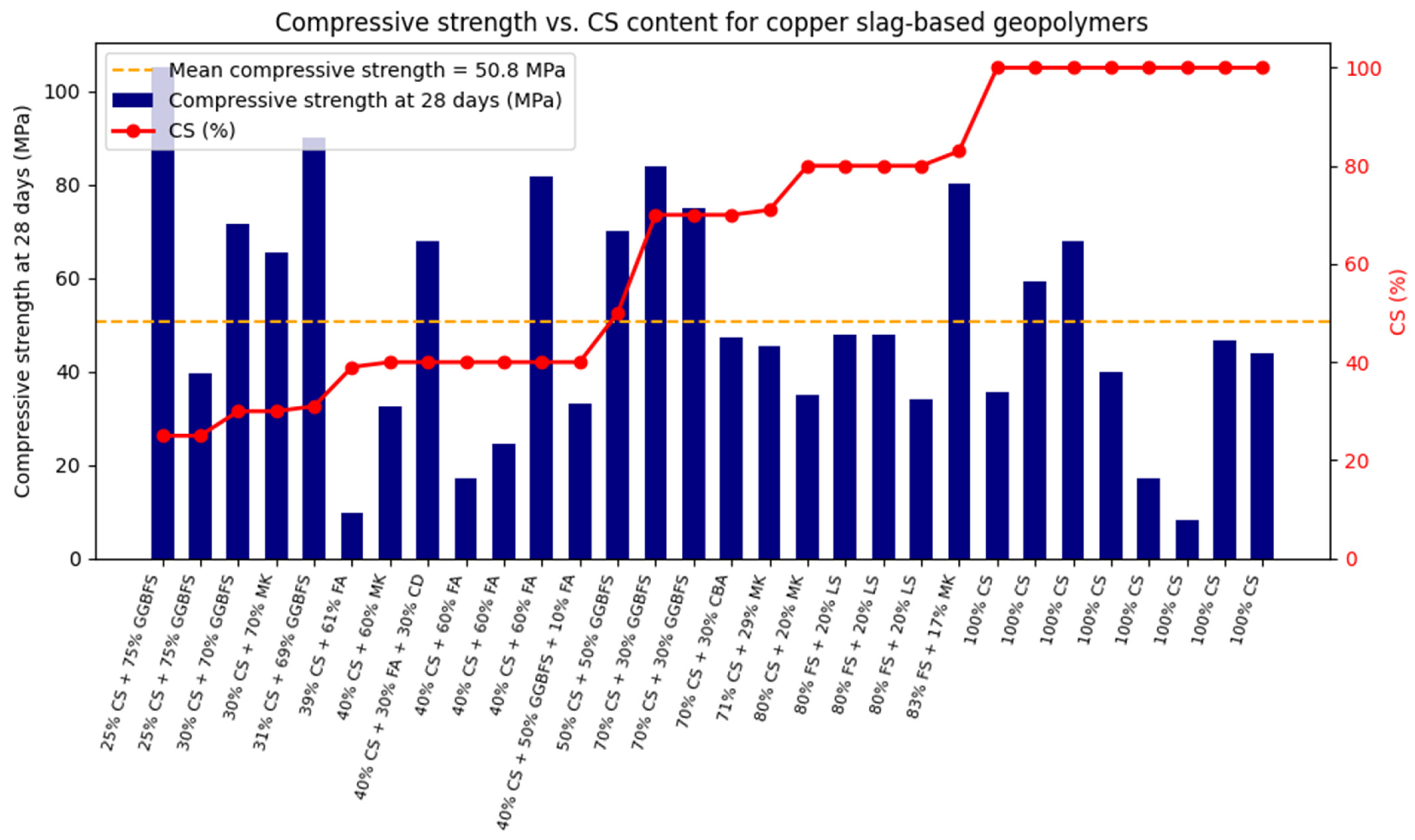
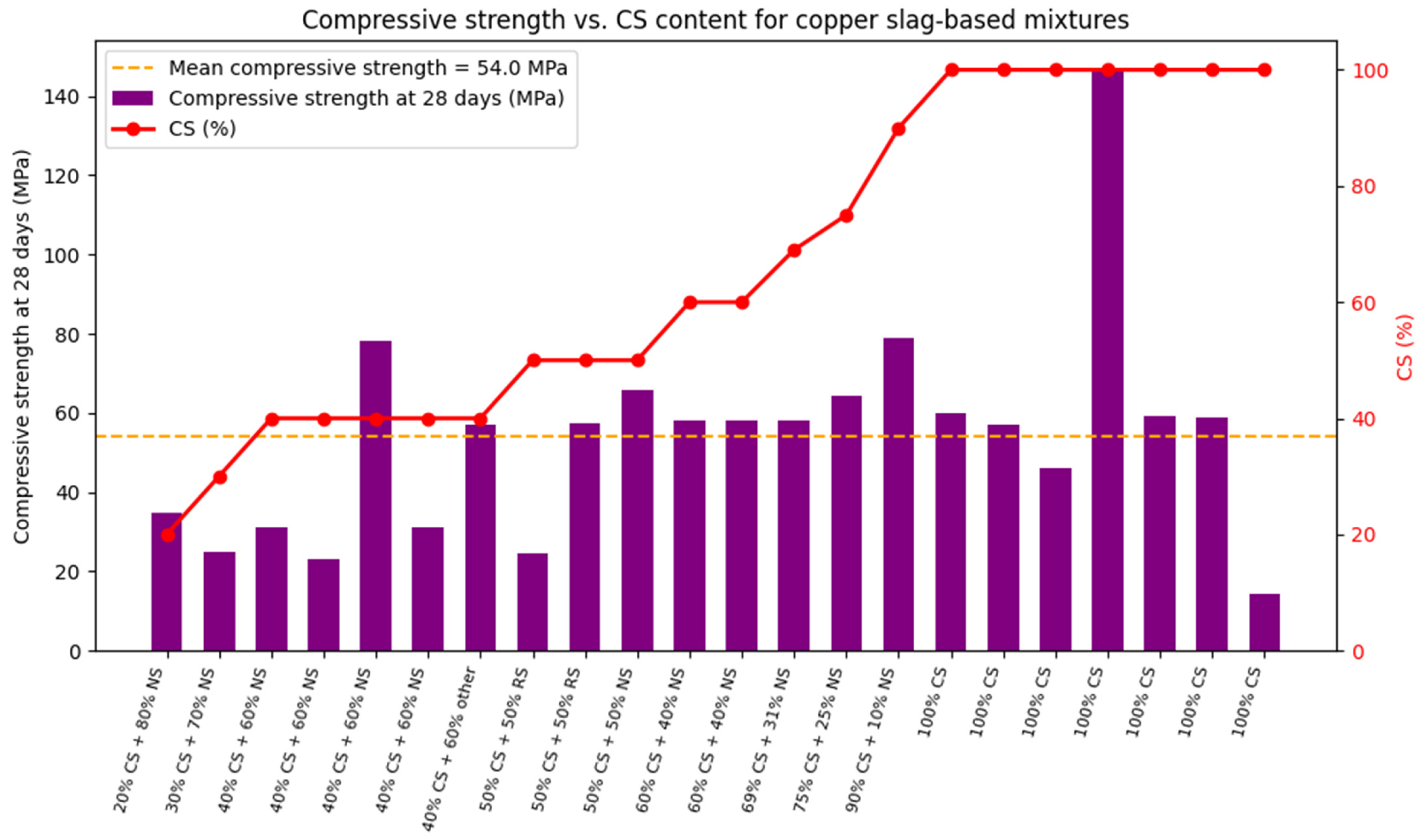
| Reference | Curing Temperature | Specimen Geometry | Compressive Strength at 28 Days (MPa) | Flexural Strength (MPa) | Tensile Strength (MPa) |
|---|---|---|---|---|---|
| [5] | Ambient curing | Cubes—20 × 20 × 20 mm | 84.00 | Not reported | Not reported |
| [6] | Oven curing (80 °C, 24 h), then ambient curing | Laminate—25 × 140 mm (composite plate) | Not reported (35, 7 d) | 3.70 | Not reported |
| [7] | Ambient curing | Prisms—160 × 40 × 40 mm | 35.50 | Not reported | Not reported |
| [8] | Ambient curing | Prisms—10 × 10 × 60 mm | 59.30 | 8.60 | Not reported |
| [9] | Ambient curing | Cubes—70.6 × 70.6 × 70.6 mm | 24.60 | Not reported | Not reported |
| [10] | Oven curing (65 °C, 24 h), then ambient curing | Cubes—100 × 100 × 100 mm | 25.00 | Not reported | Not reported |
| [11] | Oven curing (60 °C, 12 h), then ambient curing | Cubes—30 × 30 × 30 mm | 32.60 | Not reported | Not reported |
| [12] | Ambient curing | Bars—60 × 10 × 10 mm | 68.00 | 9.50 | Not reported |
| [13] | Oven curing (60 °C, 24 h), then ambient curing | Cubes—100 × 100 × 100 mm; Prisms—25 × 25 × 250 mm | 67.80 | 7.20 | Not reported |
| [14] | Ambient curing | Cubes—70.6 × 70.6 × 70.6 mm; tiles—250 × 250 × 10 mm | 60.04 | 3.56 | Not reported |
| [15] | Oven curing (70 °C, 24 h), then ambient curing | Cubes—50 × 50 × 50 mm; prisms—40 × 40 × 160 mm | 4.66 | 0.95 | Not reported |
| [16] | Oven curing (80 °C, 24 h), then ambient curing | Cubes—50 × 50 × 50 mm | 45.31 | Not reported | Not reported |
| [17] | Oven curing (80 °C, steam, 24 h), then ambient curing | Cubes—100 × 100 mm; cylinders—100 × 200 mm | 79.00 | Not reported | 6.00 |
| [18] | Oven curing (60 °C, 24 h), then ambient curing | Prisms—20 × 20 × 80 mm | 40.00 | Not reported | Not reported |
| [19] | Ambient curing | Cubes—50 × 50 × 50 mm | 48.00 | Not reported | Not reported |
| [20] | Ambient curing | Cubes—100 × 100 × 100 mm | 58.00 | Not reported | Not reported |
| [21] | Oven curing (60 °C, 3–7 days), then ambient curing | Cubes—100 × 100 × 100 mm | NR | Not reported | Not reported |
| [22] | Ambient curing | Cubes—35 × 35 × 35 mm | 75.00 | Not reported | Not reported |
| [23] | Ambient curing | Cubes—150 × 150 × 150 mm | Not reported (57, 56 d) | Not reported | Not reported |
| [24] | Ambient curing | Cubes—150 × 150 × 150 mm; cylinders—150 × 300 mm; Prisms—100 × 100 × 500 mm | 46.00 | 2.90 | 2.72 |
| [25] | Ambient curing | Prisms—40 × 40 × 160 mm | 90.00 | 17.25 | Not reported |
| [26] | Ambient curing | Cubes—150 × 150 × 150 mm | 58.00 | 7.10 | 4.80 |
| [27] | Ambient curing | Cubes—50 × 50 × 50 mm | Not reported (48, 24 h) | Not reported | Not reported |
| [28] | Ambient curing | Prisms—40 × 40 × 160 mm | 105.00 | 10.20 | Not reported |
| [29] | Ambient curing | Cubes—100 × 100 × 100 mm | 57.29 | Not reported | 6.44 |
| [30] | Ambient curing | Cubes—70.7 × 70.7 × 70.7 mm; cylinders—100 × 200 mm; Prisms—100 × 100 × 400 mm | 146.60 | 16.45 | 12.36 |
| [31] | Oven curing (80 °C, 72 h), then ambient curing | Cubes—50 × 50 × 50 mm | 17.00 | Not reported | Not reported |
| [32] | Ambient curing | Cubes—50 × 50 × 50 mm | 65.90 | Not reported | Not reported |
| [33] | Oven curing (60 °C, 3 days), then ambient curing | Not applicable | 0.68 | Not reported | Not reported |
| [34] | Oven curing (80 °C, 3 days), then ambient curing | Cubes—50 × 50 × 50 mm | 24.66 | Not reported | Not reported |
| [35] | Ambient curing | Cubes—70.7 × 70.7 × 70.7 mm; dog-bone—330 × 60 × 30 mm; prisms—160 × 40 × 40 mm | 31.10 | 12.78 | 1.98 |
| [36] | Ambient curing | Cylinders—150 × 300 mm | Not reported | 4.80 | 4.15 |
| [37] | Ambient curing | Cubes—40 × 40 × 40 mm | 81.60 | Not reported | Not reported |
| [38] | Oven curing (25 °C, steam), then ambient curing | Cubes—20 × 20 × 20 mm | 17.00 | Not reported | Not reported |
| [39] | Ambient curing | Cubes—50 × 50 × 50 mm | 23.00 | Not reported | Not reported |
| [40] | Ambient curing | Cubes—100 × 100 × 100 mm | 78.00 | Not reported | Not reported |
| [41] | Ambient curing | Cubes—50 × 50 × 50 mm; beams—160 × 40 × 40 mm | 59.20 | 5.70 | Not reported |
| [42] | Oven curing (80 °C, 72 h), then ambient curing | Cubes—100 × 100 × 100 mm; cylinders—100 × 200 mm; prisms—500 × 100 × 100 mm | 58.00 | 6.50 | 4.40 |
| [43] | Ambient curing | Bricks—210 × 110 × 70 mm | 9.64 | 2.70 | Not reported |
| [44] | Oven curing (60 °C, 24 h), then ambient curing | Cubes—100 × 100 × 100 mm; cylinders—100 × 200 mm; prisms—100 × 100 × 500 mm | 64.40 | 7.60 | 4.95 |
| [45] | Ambient curing | Cubes (size not reported) | 58.95 | Not reported | Not reported |
| [46] | Oven curing (70 °C, 48 h), then ambient curing | Cubes—50 × 50 × 50 mm; beams—40 × 40 × 160 mm | 34.60 | 5.08 | Not reported |
| [47] | Ambient curing | Cubes—50 × 50 × 50 mm [62] | 1.28 | 0.25 | Not reported |
| [48] | Ambient curing | Prisms—40 × 40 × 160 mm | 14.20 | 2.20 | Not reported |
| [49] | Ambient curing | Cubes—40 × 40 × 40 mm | 33.00 | Not reported | Not reported |
| [50] | Ambient curing | Prisms—40 × 40 × 160 mm | 34.00 | Not reported | Not reported |
| [51] | Oven curing (80 °C, 7 days), then ambient curing | Paving blocks (I-shape)—60 mm thickness | 47.20 | 4.50 | 4.10 |
| [52] | Ambient curing | Cubes—70.7 × 70.7 × 70.7 mm | 31.10 | Not reported | Not reported |
| [53] | Ambient curing | Cubes—40 × 40 × 40 mm [62] | 70.00 | 5.90 | Not reported |
| [54] | Ambient curing | Cylinders—mortar cylinders (dimensions not reported) | 39.50 | Not reported | Not reported |
| [55] | Ambient curing | Prisms—40 × 40 × 160 mm | 71.70 | 9.30 | Not reported |
| [56] | Oven curing (65 °C, 24 h), then ambient curing | Cubes—150 × 150 × 150 mm; cylinders—150 × 300 mm; prisms—100 × 100 × 500 mm | 57.00 | 10.50 | 5.20 |
| [57] | Ambient curing | Cubes—10 cm2 face area | 80.10 | Not reported | Not reported |
| [58] | Oven curing (70 °C, 48 h), then ambient curing | Cubes—50 × 50 × 50 mm | 8.06 | Not reported | Not reported |
| [59] | Ambient curing | Cubes—50 × 50 × 50 mm; prisms—50 × 50 × 200 mm; tensile plates—40 × 40 × 20 mm | 46.60 | 7.70 | 3.00 |
| [60] | Ambient curing | Cubes—40 × 40 × 40 mm | 44.00 | Not reported | Not reported |
| [61] | Ambient curing | Prisms—40 × 40 × 160 mm | Not reported (65.4, 7 d) | 4.20 | Not reported |
Disclaimer/Publisher’s Note: The statements, opinions and data contained in all publications are solely those of the individual author(s) and contributor(s) and not of MDPI and/or the editor(s). MDPI and/or the editor(s) disclaim responsibility for any injury to people or property resulting from any ideas, methods, instructions or products referred to in the content. |
© 2026 by the authors. Licensee MDPI, Basel, Switzerland. This article is an open access article distributed under the terms and conditions of the Creative Commons Attribution (CC BY) license.
Share and Cite
Arancibia-Zúñiga, A.; Carlesi, C.; Chamy, R.; Morales, J. Valorization of Copper Slag Through Alkali-Activated Materials: A Systematic Review. Sustainability 2026, 18, 4924. https://doi.org/10.3390/su18104924
Arancibia-Zúñiga A, Carlesi C, Chamy R, Morales J. Valorization of Copper Slag Through Alkali-Activated Materials: A Systematic Review. Sustainability. 2026; 18(10):4924. https://doi.org/10.3390/su18104924
Chicago/Turabian StyleArancibia-Zúñiga, Agustín, Carlos Carlesi, Rolando Chamy, and Jaime Morales. 2026. "Valorization of Copper Slag Through Alkali-Activated Materials: A Systematic Review" Sustainability 18, no. 10: 4924. https://doi.org/10.3390/su18104924
APA StyleArancibia-Zúñiga, A., Carlesi, C., Chamy, R., & Morales, J. (2026). Valorization of Copper Slag Through Alkali-Activated Materials: A Systematic Review. Sustainability, 18(10), 4924. https://doi.org/10.3390/su18104924