


Abstract
This paper presents a dynamic multi-period mixed-integer programming model for the Disaster Volunteer Task Assignment Problem (DVTAP) that advances the humanitarian logistics literature through an integrated treatment of features that have previously appeared only in isolation. Unlike prior formulations that assume volunteer surplus or steady-state conditions, our model reflects the acute-phase reality where tasks far exceed available volunteers and new task arrivals diminish over time as the disaster stabilizes. We incorporate makespan as an optimization objective alongside deprivation-weighted response time, skill matching, workload balance, and volunteer reliability. Ideal-nadir normalization ensures that all objective components contribute meaningfully regardless of their native units. The approach proceeds in two stages. First, we formulate and solve a single-period baseline MIP under volunteer surplus using the CBC solver at four scales (10 to 500 tasks). All four instances are solved to proven optimality, achieving 80 to 100% task coverage with skill-matching rates of 76.9 to 99.6%. Second, we develop a rolling-horizon algorithm that decomposes the multi-period problem into sequential epoch-level MIPs with state transitions, non-homogeneous Poisson task arrivals, fatigue accumulation, and task surplus conditions where the initial task-to-volunteer ratio exceeds 3:1. Computational experiments on three dynamic scenarios (up to 559 mean cumulative tasks) demonstrate that the algorithm achieves mean task completion rates of 84.21 ± 1.92% (Large-Dynamic), 93.74 ± 2.07% (Small-Dynamic), and 94.59 ± 2.03% (Medium-Dynamic) (mean ± standard deviation across 30 Monte Carlo replications) within a 15 h planning horizon, with per-epoch skill-matching rates of 11 to 20% (substantially lower than the static baseline due to triage-mode epochs that force all-volunteer assignment regardless of skill fit). The results reveal a clear regime transition: early epochs operate under severe task surplus where triage dominates, while later epochs transition to volunteer surplus where optimization of secondary objectives becomes feasible. Comparison against a skill-aware greedy heuristic confirms that the MIP’s advantage lies in global multi-objective coordination. This research contributes both a validated mathematical framework and a practical algorithmic approach for multi-period volunteer assignment under demand decay, extending prior work by Sperling and Schryenthrough explicit Poisson dynamics, fatigue state modeling, and makespan optimization.
1. Introduction
Natural disasters such as earthquakes, floods, and hurricanes generate sudden surges of help requests that overwhelm professional emergency services. In these critical first hours, spontaneous volunteers [1], ordinary citizens who self-organize to assist, become an indispensable resource [2,3]. These informal responders typically arrive before official agencies mobilize, provide critical first aid, locate survivors, and distribute emergency supplies. However, coordinating these volunteers is a logistical challenge: tasks often far exceed available helpers; skill requirements are heterogeneous; geographic distances constrain response times; and the situation evolves rapidly, as aftershocks, infrastructure failures, and secondary hazards create new demands while earlier tasks are resolved.
The operations research community has developed multiple approaches to volunteer task assignment. Falasca and Zobel [4] proposed an optimization model matching volunteers to tasks based on skills and preferences. Lassiter et al. [5] extended this to multi-period robust optimization accounting for uncertainty in volunteer availability and task demand. Mayorga et al. [6] modeled spontaneous volunteer assignment as a multi-server queuing system, deriving optimal policies through continuous-time Markov decision processes. Paret et al. [7] incorporated uncertainty in both task demand and volunteer availability, proposing heuristics. More recently, Ozdemir et al. [8] developed a deterministic two-stage model for post-disaster search and rescue, and Meng et al. [9] introduced dynamic assignment integrating skill diversity and task variability. Caunhye et al. [10] provide a comprehensive review. However, most of these models assume or implicitly rely on volunteer surplus, a situation that rarely holds during the acute phase of disaster response.
In reality, during the immediate aftermath of a major disaster, tasks far outnumber volunteers. Empirical evidence consistently supports this pattern. Holguín-Veras et al. [11] identified time-varying demand as one of the unique features of post-disaster humanitarian logistics, noting that the need for critical supplies (food, water, shelter, and medical care) peaks sharply in the immediate aftermath and then declines as infrastructure is restored and displaced populations stabilize. Jaller and Holguín-Veras [12] analyzed temporal patterns of resource requests made by emergency responders after Hurricane Katrina, developing ARIMA models that quantify how commodity demand surges in the first days and subsequently decays across categories including food, water, medical supplies, and shelter materials. Auf der Heide [13] documents convergence behavior in disasters, showing that demand for assistance surges immediately while organized response capacity lags behind. Data from the 2023 Kahramanmaraş earthquakes in Turkey further confirms the front-loading pattern across all task types: 61% of all earthquake victims were admitted to emergency services within the first three days [14], and the broad spectrum of humanitarian needs (debris clearing, food distribution, and shelter provision) followed the same temporal concentration. New task arrivals thus do not arrive uniformly; instead, they follow a pattern of initial surge followed by decay as the situation stabilizes. Simultaneously, completed tasks release volunteers for reassignment. This dynamic environment, characterized by task surplus, diminishing arrivals, and state transitions, is not adequately modeled in the existing literature. This paper addresses this gap by developing a dynamic multi-period mixed-integer programming formulation that incorporates these realistic features and optimizes for makespan, the total time to resolve all tasks in the disaster response.
Beyond operational efficiency, the coordination of spontaneous volunteers plays a crucial role in strengthening community resilience during disaster response. Community resilience refers to the capacity of social systems to absorb shocks, adapt to rapidly changing conditions, and recover from disasters while maintaining essential functions. Efficient volunteer task allocation contributes directly to resilience by accelerating response times, improving the utilization of local human resources, and reducing deprivation costs during the acute disaster phase. Therefore, the proposed dynamic volunteer assignment model can also be interpreted as a computational decision-support tool that enhances community resilience in disaster-prone regions.
1.1. The Disaster Response Lifecycle
Disaster response unfolds in distinct phases that differ dramatically in the balance of supply and demand [9,15,16]. In the acute phase (0–24 h after onset), task arrivals peak. Help requests flood emergency channels: people trapped under rubble, medical emergencies, supply needs, and evacuation requests. Fiedrich et al. [17] modeled this as a dynamic resource allocation problem where rescue demand overwhelms available capacity, requiring optimization to minimize fatalities under severe resource constraints. Simultaneously, spontaneous volunteers arrive gradually, first a trickle of nearby residents, then organized groups over the following hours [13]. This creates a fundamental imbalance: initially, tasks far outnumber volunteers. Professional services are overwhelmed, and informal volunteers become critical [3]. Holguín-Veras et al. [15] demonstrated that the resulting deprivation costs grow non-linearly with the duration of unmet need, creating exponential welfare consequences from assignment delays. As the response matures (24 h to 1 week), the system transitions to peak response, where volunteers continue to mobilize but new task arrivals diminish, a pattern documented in the 2023 Turkey earthquake data, where the majority of emergency admissions occurred in the first 72 h [14]. In the stabilization phase (1 to 2 weeks), arrivals decay further and volunteer supply begins to catch up. Finally, in recovery (beyond 2 weeks), volunteer supply exceeds demand, and the problem transitions from desperate triage to systematic resource allocation. These phases have fundamentally different mathematical structures: the acute phase is task-constrained (feasibility is the challenge), while recovery is volunteer-constrained (optimization focuses on secondary objectives). A realistic formulation must capture this evolution.
1.2. Research Contributions
This paper makes four primary contributions:
First, we formulate a single-period DVTAP-MIP baseline with ideal-nadir normalization of the multi-objective function and solve it using the CBC solver at four instance scales (10 to 500 tasks). All four instances are solved to proven optimality by CBC, demonstrating model correctness and establishing performance benchmarks under volunteer surplus conditions. Coverage rates of 80 to 100% are achieved, with skill-matching rates of 76.9 to 99.6% across all scales.
Second, we develop a rolling-horizon algorithm (Algorithm 1) that extends the baseline to a realistic multi-period setting with task surplus and diminishing arrivals. The algorithm decomposes the planning horizon into epochs; solves a MIP at each epoch with updated state; and manages task completion, volunteer release, fatigue accumulation, and urgency escalation for deferred tasks. New task arrivals follow a non-homogeneous Poisson process calibrated to empirical disaster data.
| Algorithm 1: Rolling-Horizon DVTAP Solver |
| Input: Initial tasks T(0), volunteers V(0), arrival parameters (Λ0, μ), epoch duration Δ, max epochs H Output: Assignment schedule, makespan C*, performance metrics 1. Initialize active task set T(0), available volunteer set V(0), busy list B ← ∅ 2. For each epoch t = 0, 1, …, H: 3. Check completions: for each (i, J, Ci) in B where Ci ≤ t·Δ, release volunteers J back to V(t) with updated fatigue 4. Generate new tasks: sample |Tnew(t)| ~ Poisson(Λ0·exp(−μ·t·Δ)·Δ), add to T(t) 5. Generate new volunteers: sample |Vnew(t)| ~ Poisson(λv_max·(1 − exp(−ν·t·Δ))), add to V(t) 6. Escalate urgency: for each deferred task i in T(t), set wi ← min(4, wi + 1) 7. If T(t) = ∅, terminate with C* = max completed Ci 8. Solve single-period DVTAP-MIP on (T(t), V(t)) to obtain assignments 9. For each assigned task i with volunteers J: compute Ci = t·Δ + min dij + δi, move (i, J, Ci) to B, remove i from T(t), remove J from V(t) 10. Record epoch metrics (coverage, solve time, ω(t)) 11. Return C* = maxi Ci over all completed tasks |
Third, we present computational results on three dynamic scenarios with task surplus (initial ratio of 3.3:1) that demonstrate the regime transition in problem structure. Early epochs operate under severe task surplus, where triage dominates and coverage is constrained by volunteer scarcity. As the disaster matures, the system transitions to volunteer surplus, where the solver can optimize secondary objectives such as skill matching and workload balance. We document performance metrics, including task completion rates (84 to 95%), makespan, and per-epoch solve times, providing a benchmark for future algorithmic development.
Fourth, we compare the MIP formulation against a skill-aware greedy heuristic to quantify the value of optimization. The greedy heuristic prioritizes skill match first and travel time second when selecting volunteers, representing a credible practitioner-level baseline. Despite its skill-first sorting, it achieves comparable coverage but produces far lower skill-match rates in dynamic scenarios (7% vs. 11% for the MIP in the Large-Dynamic scenario) because local sorting cannot replicate the MIP’s global simultaneous optimization. This demonstrates that the MIP’s primary advantage lies in multi-objective coordination rather than marginal coverage improvements.
The remainder of this paper is organized as follows. Section 2 reviews related work across spontaneous volunteer coordination, optimization models for task assignment, and multi-period resource allocation in disaster settings. Section 3 defines the DVTAP formally, beginning with a simplified baseline (single-period, volunteer surplus) to establish mathematical foundations. Section 4 presents the realistic dynamic formulation, with task surplus and diminishing arrivals, and introduces the rolling-horizon algorithm. Section 5 describes our computational methodology for synthetic data generation and calibration against real-world sources. Section 6 reports single-period baseline results. Section 7 presents multi-period dynamic results under task surplus, including a comparison with a greedy heuristic baseline and sensitivity analysis on objective weights. Section 8 discusses findings and scalability implications. Section 9 concludes.
2. Related Work
2.1. The Role of Spontaneous Volunteers in Disaster Response
Spontaneous volunteers form a critical but often under-coordinated resource in disaster response. Whittaker et al. [2] provide a foundational review of informal volunteerism in emergencies, defining it as the self-organization of citizens to provide assistance without prior formal training or affiliation. They note that spontaneous volunteers arrive early (often before official services mobilize) and remain engaged long after organized resources depart, but their lack of coordination creates both inefficiencies and safety risks. Twigg and Mosel [3] document emergent groups and spontaneous volunteers in urban disaster response, showing through case studies that informal networks often outpace formal coordination systems in the first 48 h. Critically, Holguín-Veras et al. [15] established that deprivation costs, the human suffering resulting from unmet demand, grow non-linearly with time. Delays in responding to critical tasks (medical, rescue, and shelter) have exponential welfare consequences. This establishes a mathematical imperative: rapid assignment of volunteers to tasks during the acute phase is not merely a logistical optimization goal but a humanitarian imperative. Our model’s focus on makespan and task-surplus dynamics directly reflects this priority.
2.2. Optimization Models for Volunteer Task Assignment
Falasca and Zobel [4] formulated a multi-criteria assignment model matching volunteers to humanitarian tasks based on skills and preferences, scheduling assignments across multiple workdays divided into time blocks. Notably, their model explicitly includes a parameter for maximum volunteer shortage and evaluates scenarios in which the decision-maker seeks to minimize unmet demand, reflecting a task-surplus awareness that predates much subsequent work. Lassiter et al. [5] extended this to a multi-period robust optimization framework that accounts for uncertainty in volunteer availability and task demand, maximizing volunteer-task matches while minimizing unmet demand across periods. This work is foundational in explicitly penalizing unmet demand as an objective term, which represents a form of task surplus awareness; however, it does not model the hyper-acute onset phase in which tasks catastrophically outnumber available volunteers from the very first period. Mayorga et al. [6] took a fundamentally different approach by modeling spontaneous volunteer assignment as a multi-server queuing system with stochastic arrivals and departures, formulating the system as a continuous-time Markov decision process (CTMDP). Their insight, that volunteers are stochastic servers rather than fixed resources, is relevant to our dynamic formulation. Paret et al. [7] extended this to handle uncertainty in both task demand and volunteer availability.
More recent work has moved toward explicit modeling of task deficits. Ozdemir et al. [8] developed a deterministic two-stage model for post-disaster search and rescue, combining a P-median facility location component with a volunteer assignment model solved via GAMS/CPLEX. Critically, their case study revealed volunteer shortages in high-demand scenarios: a deficit of 62 volunteers across nine shifts in non-emergency areas, confirming that the task-surplus setting is empirically grounded. Meng et al. [9] introduced dynamic volunteer assignment incorporating skill diversity and task variability, though without explicit modeling of diminishing arrivals.
2.3. Closest Related Work: Sperling and Schryen [1]
The most closely related paper to the present work is by Sperling and Schryen [1], who propose a multi-objective mixed-integer linear program for the Spontaneous Volunteer Coordination Problem (SVCP). Like our model, their formulation targets spontaneous volunteer assignment to disaster tasks using a rolling sequence of deterministic instances, employing an implicit rolling-horizon mechanism that handles uncertainty through periodic reoptimization. Both models consider skill/capability matching (their requirement 6), working hour bounds (requirements 10–11), travel times (requirement 8), and a multi-objective structure.
However, the two models differ substantially in scope, modeling approach, and optimization methodology. First, Sperling and Schryen use lexicographically ordered objective functions, prioritizing requirements in a strict hierarchy (e.g., highest-priority tasks must be served before lower-priority ones receive any volunteers). Our model instead uses weighted-sum scalarization with ideal-nadir normalization, which allows simultaneous trade-offs across all objectives according to decision-maker preferences, and ensures that no single objective dominates due to differences in natural units. Second, their model treats the temporal dynamics of disaster response as uncertainty to be handled by re-solving static instances, without an explicit stochastic arrival model. Our model explicitly represents the non-homogeneous Poisson arrival process, Λ(t) = Λ0·exp(−μ·t), and the volunteer mobilization curve, λv(t), capturing the decay dynamics that drive the regime transition from task surplus to volunteer surplus. Third, Sperling and Schryen’s model focuses on workload balancing between priority classes as the central objective, while our model additionally optimizes makespan (the time to resolve all outstanding tasks), which is directly linked to deprivation costs [15]. Fourth, our model incorporates fatigue as a continuous state variable that affects future assignment eligibility and is updated at each epoch, a feature absent from the SVCP formulation.
In summary, DVTAP-MIP extends the research stream initiated by Sperling and Schryen by embedding explicit demand dynamics, fatigue modeling, makespan optimization, and a principled multi-objective normalization approach. The two models are complementary: SVCP provides a richer treatment of priority class ordering and workload ratios, while DVTAP-MIP provides more realistic temporal dynamics and a direct connection to humanitarian makespan objectives.
2.4. Multi-Period Resource Allocation and Volunteer Convergence
The broader OR literature on disaster resource allocation provides important modeling patterns. Özdamar et al. [18] presented one of the earliest multi-period MIP frameworks for emergency logistics, formulating commodity flows and vehicle routing as a dynamic network problem under evolving demand a foundational contribution whose epoch-based reoptimization logic anticipates the rolling-horizon strategy employed in the present work. Fiedrich et al. [17] formulated rescue unit scheduling with weighted completion time minimization after earthquake disasters, a makespan-like objective that inspires our formulation. Afshar and Haghani [16] developed an integrated supply chain logistics model for large-scale disaster relief incorporating time-dependent demand. Grass et al. [19] developed an accelerated L-shaped method for two-stage stochastic programs in disaster management, demonstrating that scenario-based stochastic formulations can be solved at scale using the Benders decomposition; while our model adopts a deterministic rolling-horizon approach rather than two-stage stochastic programming, their work underscores the computational trade-offs between explicit uncertainty modeling and epoch-level reoptimization. Holguín-Veras et al. [11] identified seven unique features of post-disaster humanitarian logistics that distinguish it from commercial logistics, chief among them time-varying demand that peaks sharply and then decays, a feature our model captures through the non-homogeneous Poisson arrival process. Jaller and Holguín-Veras [12] empirically quantified this temporal pattern using commodity-request data from Hurricane Katrina. Kapukaya and Satoglu [20] proposed a multi-objective dynamic resource allocation model simultaneously allocating volunteers, rescue units, and material resources for search and rescue. Garcia et al. [21] examined dynamic resource allocation for high-load crisis volunteer management. Matinrad and Granberg [22] addressed pre-dispatch task assignment for daily emergency response. Kaur et al. [23] optimized assignments to improve volunteer retention.
Several works are also directly relevant to our volunteer arrival dynamics and fatigue modeling. Abualkhair et al. [24] model a disaster relief center using agent-based simulation, focusing on volunteer convergence and assignment to two parallel queues under multiple sources of uncertainty; the convergence dynamics they analyze inform our λv(t) mobilization model. Zayas-Cabán et al. [25] model volunteer convergence as a parallel-queue control problem and derive optimal admission and assignment policies using a Markov decision process framework, deriving state-dependent threshold policies that characterize when admission and routing decisions should switch based on queue-length and service-rate conditions, a structural insight that informs the rationale for our epoch-level reoptimization logic. Ren and Zhang [26] explicitly incorporate fatigue effects in volunteer dispatch optimization, the most directly relevant recent work to our fatigue state variable; their results confirm that ignoring fatigue leads to measurable degradation in coverage quality within a single operational day. Rabiei et al. [27] present a multi-objective volunteer assignment model for the post-disaster phase that combines fuzzy inference systems with NSGA-II and NRGA metaheuristics, positioned as a complement to the acute-phase focus of the present work. Anaya-Arenas et al. [28] provide a systematic review of relief distribution networks that comprehensively maps the OR literature on facility location, inventory routing, and delivery scheduling, confirming that while distribution-oriented aspects of disaster logistics have received sustained attention, the coordination of human volunteers, particularly under task-surplus and demand decay dynamics, remains comparatively understudied. For a broad synthesis of optimization models in disaster response operations, including volunteer-related formulations, see the recent OR Spectrum review by Kamyabniya et al. [29] and the conceptual framework by Yazdani and Haghani [30] for integrating volunteers into emergency response planning with decision support systems. Collectively, these works confirm both the relevance and the continued openness of the research area addressed by this paper.
2.5. Disaster Response Optimization and Community Resilience
Disaster management is increasingly discussed in relation to the broader concept of community resilience, which highlights the ability of social, institutional, and infrastructural systems to withstand shocks, adapt to rapidly changing conditions, and recover after disruptive events. In this context, decision-support and optimization models can contribute to strengthening response capacity by facilitating the rapid coordination of available resources and volunteers during emergencies. Efficient task allocation mechanisms help reduce response delays, improve resource utilization, and enable communities to mobilize local capacities more effectively in the early stages of a disaster. As a result, computational coordination frameworks can also be interpreted as tools that support resilience-oriented disaster governance by enhancing the adaptive capabilities of emergency response systems.
2.6. Research Gap
Table 1 positions this study relative to the existing literature, highlighting the key features that distinguish our work. Recent years have seen active progress in dynamic volunteer assignment, joint official-volunteer dispatch, and multi-objective volunteer scheduling, so the space is more populated than it was even five years ago. Behl and Dutta [31], in their thematic review of humanitarian supply chain management research, identified volunteer management as an emerging research direction but noted the scarcity of formal optimization models addressing dynamic volunteer assignment under acute-phase constraints a gap this paper directly addresses. Our novelty claim is therefore not that multi-period volunteer assignment is unexplored, but that the specific combination of rolling-horizon MIP, task-surplus regime transition, non-homogeneous Poisson diminishing arrivals, fatigue state tracking, and makespan as an explicit fifth objective has not previously appeared as an integrated formulation. The five-way combination is what distinguishes this work from adjacent contributions, such as the works of Sperling and Schryen [1], Ren and Zhang [26], and Meng et al. [9], each of which addresses subsets of these features.
Table 1.
Positioning of this study relative to the existing literature.
3. Problem Definition
We define the Disaster Volunteer Task Assignment Problem in two stages. Section 3.1 presents the simplified baseline formulation, a single-period model with volunteer surplus that establishes the mathematical foundation and serves as a validation benchmark. Section 3.2 then introduces the realistic dynamic extension with task surplus and diminishing arrivals. This progression from simple to complex provides transparency in modeling choices and creates reproducible baselines.
3.1. Simplified Baseline: Single-Period, Volunteer Surplus
In the simplified setting, we consider a single decision period where all tasks and volunteers are known. Following the convergence phenomenon documented by Auf der Heide [13], where volunteers frequently arrive in numbers that exceed immediate coordination capacity, we set |V| ≥ 2|T| to represent a volunteer-surplus environment for this baseline. Note that this ratio is a design parameter for the baseline scenario, not a guarantee of full coverage: even with twice as many volunteers as tasks, time windows and skill requirements can still render some assignments infeasible. Our tiny baseline (10 tasks, 20 volunteers) achieves 80% coverage rather than 100% for exactly this reason. This scenario corresponds to the later phase of disaster response or well-resourced incidents where volunteer convergence has produced an available pool well in excess of remaining task demand.
3.1.1. Sets and Indices
T = {1, 2, …, n}: Set of active tasks.
V = {1, 2, …, m}: Set of available volunteers (m ≥ 2n in baseline).
S = {1, 2, …, p}: Set of skill types (medical, heavy lifting, vehicle access, language, etc.).
U = {1, 2, 3, 4}: Urgency levels (1 = critical; 4 = low).
K = {1, 2, …, q}: Task types (medical assistance, evacuation, supply delivery, search, shelter, and reunification).
Figure 1 illustrates a small DVTAP instance (12 tasks and 24 volunteers) on the geographic disaster zone. Tasks are represented as colored circles (color indicates task type; size reflects urgency level, with larger nodes representing more critical tasks). Volunteers are shown as triangles, with blue indicating assigned volunteers and gray indicating idle ones. Assignment edges connect each volunteer to their assigned task. The spatial structure of the problem is immediately visible: the solver preferentially assigns nearby volunteers to tasks, but skill requirements and time windows can force longer-distance assignments. The single uncovered task (red border) has no feasible volunteer within its time window, illustrating why 100% coverage is not always achievable even under volunteer surplus.
Figure 1.
DVTAP instance showing task–volunteer assignment on a geographic disaster zone (30 km × 30 km). Circles represent tasks (colored by type; sized by urgency); triangles represent volunteers (blue = assigned; gray = idle). Lines show optimal assignments.
3.1.2. Parameters
The complete parameter set is given in Table 2.
Table 2.
DVTAP parameter definitions.
We provide the full description, units, and typical value ranges of the parameters listed in Table 2. Task parameters: wi denotes the urgency weight of task i on the scale {1, 2, 3, 4}, where 4 = critical (highest weight in the objective) and 1 = low (unitless, used as a multiplicative priority coefficient in the objective); ris is a binary indicator equal to 1 if task i requires skill s, and 0 otherwise; ni is the integer number of volunteers required for task i, drawn from {1, 2, 3}, according to task type (Table 3); τi is the time window within which volunteer arrival is feasible, in minutes (range 30–240); δi is the execution duration of task i once a volunteer has arrived, in minutes (range 15–240 by task type, Table 3); and loci is the geographic coordinate (lat, lon) of task i in the 30 × 30 km disaster zone. Volunteer parameters: cjs is a binary indicator equal to 1 if volunteer j possesses skill s; dij is the Haversine travel time from volunteer j’s origin to task i at a disaster-adjusted speed of 20 km/h, in minutes (typical range 5–90); aj is a binary availability indicator equal to 1 if volunteer j is currently available; fj ∈ [0, 1] is the cumulative fatigue state of volunteer j, with 0 = fully rested and 1 = fully fatigued; ρj ∈ [0, 1] is the reliability score of volunteer j; and hj is the cumulative hours already worked by volunteer j (initialized at 0 in the single-period baseline). System parameters: α, β, γ, and λ are the non-negative weights on response time, skill mismatch, workload balance, and reliability, respectively (need not sum to 1; ideal-nadir normalization ensures comparability across objectives regardless of scale); θ is the additional weight on makespan in the dynamic formulation; λv_max is the maximum volunteer mobilization rate (volunteers per epoch, calibrated to the 6/12/18 range per Section 5.2); ν is the mobilization ramp parameter (per hour, range 0.2–0.3); Fmax is the fatigue threshold above which volunteers are ineligible (set to 0.8); Hmax is the maximum cumulative working hours per volunteer (set to 12 h); δmax is the maximum single-task duration used as a fatigue normalization constant (240 min); and M is the unnormalized big-M coverage penalty coefficient (set to 106 to ensure lexicographic coverage priority).
Table 3.
Task-type profiles: Required skill(s), duration range, and volunteer count used in all experiments.
3.1.3. Decision Variables and Formulation
The decision variables are xij ∈ {0, 1} (1 if volunteer j assigned to task i), yi ∈ {0, 1} (1 if task i is covered), zi ∈ {0, 1} (1 if task i is unassigned), and L (maximum workload among volunteers). The single-period DVTAP-MIP is
where the raw objective components are Z1 = ΣiΣj wi·dij·xij (urgency-weighted response time, in weighted minutes), Z2 = Σi Σs ris·gis (skill mismatch count via auxiliary variables), Z3 = L (minimax workload balance, in minutes), and Z4 = −ΣiΣj wi·ρj·xij (reliability, negated for minimization). The weights are nonnegative preference parameters and need not sum to 1. Since each objective component is normalized independently to [0, 1] via ideal-nadir normalization, the weights are directly comparable across components. Moreover, as in any weighted-sum objective, only the relative proportions of the weights matter; any common positive rescaling leaves the optimization problem unchanged.
Because these components have fundamentally different units and magnitudes, a naive weighted sum would be dominated by the component that has the largest raw values [32]. We therefore apply ideal-nadir normalization. Before solving the weighted problem, we solve four single-objective problems, one per component, each including the coverage penalty, M·Σwizi, to ensure feasibility. Let Z*k denote the optimal value of component k when optimized alone (the ideal value), and let Z−k denote the worst value component k takes across the four single-objective solutions (the nadir value). The normalized component is
This maps each component to approximately [0, 1], ensuring that the weights reflect the decision-maker’s true preferences rather than artifacts of unit mismatch. The payoff table computation requires four additional MIP solves, each of which is substantially faster than the weighted problem because it optimizes a single objective. The coverage penalty term, M·Σwizi, remains unnormalized and acts as a lexicographic priority: coverage is always optimized first, and the normalized secondary objectives are optimized within the set of maximum-coverage solutions.
The optimization model is subject to the following constraints:C1a (Coverage lower bound): Σj xij ≥ ni·yi, ∀ i ∈ T;
C1b (Coverage upper bound): xij ≤ yi, ∀ i ∈ T, j ∈ V;
C2 (Capacity): Σi xij ≤ 1, ∀ j ∈ V;
C3 (Availability): xij ≤ aj, ∀ i,j;
C4 (Fatigue): xij = 0 if fj ≥ Fmax, ∀ i,j (volunteers at or above the fatigue threshold are ineligible);
C5 (Hours): hj + Σi (δi/60)·xij ≤ Hmax, ∀ j ∈ V (δi in minutes, Hmax in hours; division by 60 converts units);
C6 (Time window): dij·xij ≤ τi, ∀ i,j;
C7 (Completeness): yi + zi = 1, ∀ i ∈ T;
C8 (Skill linearization): gis ≥ ris − Σj cjs·xij, gis ≥ 0;
C9 (Workload linearization): L ≥ Σi δi·xij, ∀ j ∈ V;
C10 (Domains): xij, yi, zi ∈ {0, 1}; L, gis ≥ 0.
Constraint C1b ensures that volunteers can only be assigned to tasks that are formally designated as covered (yi = 1), preventing the solver from assigning volunteers to tasks that incur the coverage penalty. Together, C1a and C1b enforce that task i is covered if and only if exactly ni or more volunteers are assigned. The fatigue constraint, C4, is implemented as a hard exclusion (xij = 0 whenever fj ≥ Fmax) rather than a smooth penalty, reflecting the operational reality that exhausted volunteers pose safety risks and should not be assigned regardless of assignment quality. The hours constraint, C5, requires explicit unit conversion: task durations, δi, are recorded in minutes, while cumulative hours, hj, and the limit, Hmax, are in hours, so the factor (1/60) is essential for dimensional consistency.
3.2. Realistic Scenario: Task Surplus with Diminishing Arrivals
The simplified baseline serves as a validation tool and a computational anchor. We now present the realistic scenario that reflects actual acute-phase disaster dynamics.
3.2.1. Task Surplus Condition
In the immediate aftermath of a disaster, the number of active tasks dramatically exceeds available volunteers. Ozdemir et al. [8] documented volunteer deficits: in their post-earthquake search-and-rescue case study, they documented a deficit of 62 volunteers across nine shifts in high-demand non-emergency areas. Kapukaya and Satoglu [20] identified a core challenge as the inability to appoint sufficient volunteers for specific tasks. We parameterize this imbalance through the task-to-volunteer ratio, ω(t) = |T(t)|/|V(t)|, which begins at ω(0) ≥ 3 in our experiments (three or more tasks per volunteer) and decreases over time as completed tasks release volunteers. Holguín-Veras et al. [15] demonstrated that deprivation costs, the human suffering from unmet demand, grow non-linearly with time, establishing that rapid task resolution in the acute phase is a humanitarian priority.
We clarify three subtleties of the task-to-volunteer ratio, ω(t). First, ω(t), as used throughout this paper, is an overall (aggregate) ratio of the active task count to the available volunteer count at the start of epoch t; it does not account for per-task volunteer requirements, ni. A refined variant is the weighted ratio, (t) = Σi∈T(t) ni/|V(t)|, which captures the fact that some tasks require multiple volunteers. In our scenarios, the mean ni is approximately 1.6, so (t) is roughly 1.6 × ω(t); the initial weighted ratio at ω(0) = 3.3 therefore corresponds to (0) ≈ 5.3 in weighted terms, reinforcing the severity of the task-surplus regime. We retain ω(t) as the primary ratio for consistency with the surrounding literature but note that the weighted form is available from our data and could be reported in follow-up work. Second, within a single epoch, a volunteer is assigned to, at most, one task (constraint C2), so the definition of ω(t) is therefore unambiguous within an epoch—it measures tasks competing per available volunteer, not tasks assigned per volunteer. Over a multi-epoch window, however, a single volunteer may serve multiple tasks across epochs (returning to the pool after each completion), so the cumulative task-to-volunteer-instance ratio is lower than ω(0), suggesting approximately 1.4–1.9 across our three scenarios. The 3.3:1 initial ratio thus describes peak instantaneous imbalance, not cumulative work per volunteer. Third, the model, as formulated, does not remove deferred tasks from the backlog: once a task enters T(t), it remains in T(t + 1), T(t + 2), … with escalated urgency (wi ← min(4, wi + 1)), until it is assigned or the horizon ends. Reviewer feedback correctly observed that, in reality, a first-aid task can deteriorate into a serious medical case if the response is delayed, and a Time-Critical medical task may become infeasible (the patient dies or is evacuated by other means) before volunteers become available. A more realistic model would therefore include state-dependent task transformations—such as severity upgrades, deadline expiration, or replacement of expired tasks with successor tasks—rather than only urgency escalation. The current urgency-escalation mechanism captures the increasing deprivation cost but not task substitution or dropout. We identify this as an important direction for future work, potentially integrating with the non-linear deprivation-cost formulation of Holguín-Veras et al. [15]. Finally, reviewer feedback also noted that our model implicitly treats all disasters as sudden-onset events with no advance warning, which fits earthquakes well (as in the Kahramanmaraş motivation) but not hurricanes, floods, or wildfires, where hours to days of advance notice are routinely available. For anticipated disasters, a pre-disaster volunteer mobilization phase could be added in which V(0) is already elevated from the empirical zero-warning baseline, and pre-positioning of specialist volunteers becomes a decision variable. This extension is compatible with the rolling-horizon structure: t = 0 would no longer correspond to disaster onset but to the start of the operational response, with pre-disaster preparations feeding into the initial state.
3.2.2. Diminishing Arrival Process
A key modeling decision is how to represent the arrival of new tasks over time. A homogeneous Poisson process, the simplest stochastic model for event arrivals, assumes a constant arrival rate, which would imply that new help requests emerge at the same frequency hours or days after the disaster, as they do in the first minutes. Empirical evidence contradicts this assumption. Holguín-Veras et al. [11] identified time-varying demand as a defining feature of post-disaster logistics, and Jaller and Holguín-Veras [12] quantified this temporal pattern using commodity-request data from Hurricane Katrina, demonstrating that demand across all resource categories (food, water, medical supplies, and shelter) surges sharply and then decays. We therefore model new task arrivals as a non-homogeneous Poisson process with a time-decaying intensity function:
where Λ0 is the initial arrival rate (tasks per hour) at disaster onset, and μ > 0 is the decay parameter. In our experiments, Λ0 ranges from 15 to 50 tasks per hour, and μ from 0.12 to 0.15 across scenarios of increasing severity (see Section 7.1). With μ = 0.15, the arrival rate halves approximately every 4.6 h. This front-loaded temporal pattern is consistent with empirical evidence: data from the 2023 Kahramanmaraş earthquakes in Turkey shows that 61% of all emergency admissions occurred within the first three days [14], and rescue operations officially ended in most provinces by 19 February, approximately 13 days after the February 6 onset. Holguín-Veras et al. [11] identified time-varying demand as one of the unique features of post-disaster humanitarian logistics, noting that critical needs peak sharply in the immediate aftermath and then decline. The exponential form Λ0·exp(−μ·t) is parsimonious (two parameters), analytically tractable for expected arrival counts via integration, and flexible enough to represent different disaster severities through calibration of Λ0 and μ.
Λ(t) = Λ0·exp(−μ·t)
Figure 2 illustrates the conceptual model. The active task count, |T(t)|, starts high and decreases as tasks are completed and new arrivals decay. Simultaneously, the available volunteer count, |V(t)|, starts low and increases as spontaneous volunteers mobilize following the curve λv(t) = λv_max·(1 − exp(−ν·t)). The crossover point where |V(t)| first exceeds |T(t)| marks the regime transition from task surplus (triage mode, ω(t) > 1) to volunteer surplus (optimization mode, ω(t) < 1). Before the crossover, volunteer capacity is fully utilized, and unassigned tasks must be deferred. After the crossover, the solver has sufficient volunteers to cover all active tasks and can optimize secondary objectives, such as skill matching and workload balance. The timing of this transition depends on disaster severity (Λ0, μ) and mobilization dynamics (λv_max, ν), and is investigated empirically in Section 7.
Figure 2.
Conceptual model of the disaster response lifecycle showing the regime transition from task surplus to volunteer surplus. The red shaded region indicates triage mode (ω(t) > 1); the blue region indicates optimization mode (ω(t) < 1). The dashed vertical line marks t*, the crossover time at which ω(t*) = 1.
3.2.3. Task Completion as Decision Variable
In the simplified baseline, task duration, δi, is a parameter but does not affect subsequent assignment decisions. In the dynamic formulation, we introduce the following:
where t0 is the epoch index, Δ is the epoch duration in hours, dij is the travel time of volunteer j to task i (in minutes), and δi is the task duration (in minutes); the division by 60 converts both travel time and task duration from minutes to hours so that Ci is expressed in hours throughout. For tasks requiring multiple volunteers (ni > 1), we use the minimum assigned travel time rather than the maximum. This reflects an optimistic first-responder start assumption: the task clock begins when the first volunteer arrives, and co-assigned volunteers who arrive later assist a task already in progress. This is contextually appropriate for the task types in our model: in medical assistance, the most qualified first-responder can begin stabilizing the patient before backup arrives; in supply delivery, the first volunteer can begin loading while others arrive; in search operations, the leading volunteer begins the sweep while others approach. This contrasts with a joint start assumption (using maximum travel time), which would be more appropriate for tasks requiring synchronized action, such as heavy rescue requiring simultaneous lifting. Under the joint start model, completion times and makespan would be longer. We acknowledge this as a modeling limitation and note that the sensitivity of results to this assumption is a direction for future work.
Ci = t0·Δ + (min_{j assigned} dij + δi)/60
For the relationship between Ci and the decision variables, we clarify the following: The completion time, Ci, is well-defined only for tasks that are actually assigned within the current epoch (i.e., for tasks with yi = 1 and at least one xij = 1). For unassigned tasks (yi = 0 and consequently all xij = 0), the minimum travel time in the definition is undefined; the operational convention in our implementation is that Ci is not evaluated for such tasks and does not enter the makespan objective, Z5. This is enforced directly by the linearization constraint, C_max ≥ (t·Δ + (dij + δi)/60)·xij (Section 4.2): when xij = 0 for all j, the right-hand side collapses to zero for every constraint involving task i, and C_max is driven only by assigned pairs. Consequently, unassigned tasks contribute only through the big-M coverage penalty term, M·Σwizi, and do not inadvertently inflate Z5. We further clarify the treatment of time. Planning time is discretized into epochs indexed by t = 0, 1, …, H, each of length Δ = 0.5 h; task arrivals, volunteer releases, and assignment decisions all occur at epoch boundaries. Within an epoch, however, physical completion time is measured as a continuous quantity on the same absolute clock: Ci = t·Δ + (dij + δi)/60 is a continuous real number in hours, where t·Δ is the epoch’s starting wall-clock time, and (dij + δi)/60 is the continuous elapsed time for travel and execution. The global makespan, C* = maxi Ci, is therefore also continuous. Decision-making operates on the discrete epoch grid, while state updates (completion checks and fatigue accumulation) use the continuous Ci values to determine when volunteers actually return to the available pool. This dual representation is standard in rolling-horizon scheduling and reflects the reality that operational decisions are made at fixed review points while the underlying processes evolve continuously.
Upon completion, assigned volunteer(s) return to the available pool with updated fatigue: fj ← min(1, fj + δi/δmax), where δmax = 240 min is a normalization constant representing a maximum single-task duration. Cumulative hours are updated as hj ← hj + δi/60. This creates a feedback loop: faster task completion frees volunteers sooner, enabling rapid response to the growing backlog in the acute phase.
4. Multi-Period DVTAP-MIP with Diminishing Arrivals
We now present the complete dynamic formulation. The planning horizon [0, Tmax] is discretized into epochs, Ω = {1, 2, …, H}, each of duration Δ (e.g., 30 min). At each epoch, t, the model observes the current system state and solves a single-period assignment problem with updated parameters.
4.1. Dynamic Sets
T(t): Active tasks at epoch t = (previously unassigned tasks) ∪ (newly arrived tasks) − (tasks completed before t).
V(t): Available volunteers at epoch t = (idle volunteers) ∪ (volunteers who completed tasks before t).
Tnew(t): Tasks arriving during epoch t, drawn from Poisson(Λ(t)·Δ).
4.2. Extended Objective Function
The dynamic formulation adds a fifth component to the objective: makespan minimization. The same ideal-nadir normalization is applied, with the payoff table computed once from the initial epoch instance and reused across all subsequent epochs to avoid repeated overhead.
The choice to fix normalization bounds at epoch 0 is a deliberate methodological design, not an approximation. Using epoch-0 bounds as a constant reference scale ensures that the relative contribution of each objective component remains consistent across all epochs: the weight vector (α, β, γ, λ, and θ) preserves its semantic meaning throughout the planning horizon, so a weight of β = 0.25 on skill matching at epoch 15 means the same as at epoch 0. If bounds were recomputed for each epoch, the effective importance of each objective would drift unpredictably as the instance evolves: a single-task epoch would yield dramatically different ideal/nadir values than a 30-task epoch, making weight parameters non-stationary and difficult to interpret. We acknowledge that epoch-0 bounds may not tightly enclose the feasible range of later epochs; in practice, we observed that the normalized objective values, , remained within [0, 1] across all experimental scenarios. In cases where instance size grows substantially over the horizon, periodic recomputation of the payoff table (e.g., every five epochs) could improve normalization fidelity, and we identify this as a direction for future work.
where the fifth component, Z5, captures makespan:
Z5 = Cmax = maxi ∈ T(t), j ∈ V(t) {(t·Δ + (dij + δi)/60)·xij}
This component minimizes the latest completion time among all assigned task–volunteer pairs in the current epoch. When xij = 0 (volunteer j not assigned to task i), the term evaluates to zero and does not affect the makespan, ensuring that unassigned tasks are naturally excluded. Index j must range over V(t) alongside i to resolve the travel time, dij, which depends on the specific volunteer assigned. The weight, θ, controls the trade-off between makespan and the other objectives.
The minimax form of Z5 is linearized using a standard epigraph reformulation with an auxiliary variable, Cmax. Since the completion time coefficient (t·Δ + (dij + δi)/60) is a constant for each task–volunteer pair (not a decision variable), the linearization takes a simple product form:
Cmax ≥ (t·Δ + (dij + δi)/60)·xij, ∀ i ∈ T(t), j ∈ V(t)
When xij = 1 (volunteer j assigned to task i), the constraint forces Cmax to be at least the completion time of that assignment. When xij = 0, the right-hand side is zero and the constraint is trivially satisfied. This avoids the need for a Big-M constant entirely: because the completion time coefficient is a problem constant rather than a variable, the product (constant × binary variable) is directly linear. The constraint set is generated only for pairs (i, j), where dij ≤ τi (feasible travel within the time window), reducing the constraint count substantially.
4.3. State Transition Between Epochs
At the boundary between epochs t and t + 1, the system state updates as follows:
Task completion: Task i assigned at epoch t′ ≤ t is completed and removed from the active set if Ci ≤ (t + 1)·Δ. The assigned volunteers re-enter V(t + 1) with updated fatigue: f′j = min(1, fj + δi/δmax).
New arrivals: Fresh tasks Tnew(t + 1) are sampled from the decaying arrival process and added to T(t + 1). As t increases, |Tnew(t)| stochastically decreases due to the exponential decay of Λ(t).
Volunteer arrival: New spontaneous volunteers arrive according to an increasing mobilization process, λv(t) = λv_max·(1 − exp(−ν·t)), where λv_max is the maximum arrival rate at full mobilization, and ν > 0 controls the ramp speed. This reflects the empirically observed pattern where volunteer convergence begins slowly (nearby residents arriving first) and accelerates over hours as word spreads and organized groups mobilize [13]. The number of new volunteers at each epoch is drawn from Poisson(λv(t)).
Deferred tasks: Tasks that were unassigned (zi = 1) at epoch t carry over to T(t + 1) with increased urgency: w′i = min(4, wi + 1), reflecting the deteriorating condition of unaddressed emergencies.
4.4. Convergence and Termination
The multi-period process terminates when either (a) all tasks are completed (T(t) = ∅) or (b) the maximum number of epochs, H, is reached. Given the decaying arrival rate and growing volunteer pool, condition (a) is guaranteed under mild conditions (cumulative volunteer capacity exceeds cumulative task demand). In practice, we set H = 30 (corresponding to a 15 h planning horizon with Δ = 0.5 h). The total makespan of disaster response is C* = maxi Ci over all completed tasks across all epochs. Any tasks remaining at epoch H represent unresolved demand that would require an extended planning horizon or additional resources.
4.5. Linearization of Minimax Workload
The workload balance objective, Z3, involves a minimax operator (minimizing the maximum total task duration assigned to any single volunteer). This is linearized using a standard auxiliary variable, L:
where L represents the maximum workload across all volunteers. Since the objective minimizes L (with weight γ), the solver drives L to the actual maximum workload. This is a standard epigraph reformulation that preserves linearity. No big-M constants are needed for this linearization, avoiding the numerical issues that can arise with poorly chosen big-M values. The makespan component Z5 = Cmax is optimized directly within each epoch: for each epoch t, the solver explicitly minimizes the latest completion time among all tasks assigned in that epoch. This within-epoch Cmax optimization is implemented as a linearized MIP constraint (see Section 4.2). In addition to this per-epoch optimization, the global planning makespan, C* = maxi Ci, is tracked post hoc across all completed tasks from all epochs of the rolling horizon, serving as a system-level summary metric reported later in the computational results. The distinction is therefore as follows: Z5 is a within-epoch optimization objective, while C* is a cross-epoch aggregation metric.
L ≥ Σi δi·xij, ∀ j ∈ V(t)
4.6. Rolling-Horizon Algorithm
The multi-period formulation is solved via a rolling-horizon decomposition that processes one epoch at a time. Algorithm 1 summarizes the procedure.
The algorithm preserves optimality within each epoch (the MIP is solved exactly) while managing the inter-epoch dynamics through state transitions. The key advantage of this decomposition is that each epoch’s MIP is substantially smaller than a monolithic formulation over the full horizon, since only currently active tasks and available volunteers participate. The trade-off is that the algorithm is myopic: assignments at epoch t do not anticipate future arrivals. This is appropriate for disaster settings where future task arrivals are inherently unpredictable and decisions must be made with current information.
5. Synthetic Data Generation and Calibration
5.1. Generation Methodology
All instances use synthetic data with the following generation methodology. The geographic model uses a 30 km × 30 km disaster zone centered at (37.2° N, 37.0° E), broadly representing the Kahramanmaraş region of Southeastern Turkey, where the February 2023 earthquakes occurred. Tasks are uniformly distributed within this zone. Volunteers are distributed with a bias toward the zone periphery (70% in the outer 50% of the area, and 30% in the inner core), reflecting the realistic convergence pattern documented by Auf der Heide [13], where nearby survivors and spontaneous responders arrive before organized groups from farther away.
Task types follow a categorical distribution with the following proportions: medical (20%), evacuation (15%), supply delivery (25%), search support (20%), shelter (10%), and reunification (10%). The derivation of these proportions is discussed in Table 3. Supply delivery dominates because logistics tasks (food, water, and medicine distribution) are the most frequently reported need category across multiple disaster events [16,19]. Medical and search tasks together account for 40%, consistent with the acute-phase emphasis on life-saving operations documented in the 2023 Turkey earthquake response [14]. Urgency is distributed as critical (15%), high (25%), medium (35%), and low (25%), reflecting a right-skewed distribution where the majority of tasks are of medium priority, but a significant minority require immediate attention [17]. Urgency level is sampled independently of task type: every task type draws its urgency from the same marginal distribution regardless of category. We acknowledge that, in practice, medical and search tasks tend to skew toward critical urgency in the acute phase; modeling this through a conditional distribution (e.g., P(urgency|task type)) is a direction for future work. Each task type’s binary skill requirement vector, duration range, and volunteer requirement are given in Table 3.
Volunteer skills are modeled with non-uniform probabilities reflecting the composition of spontaneous volunteer populations. Each volunteer possesses 1 to 3 skills drawn without replacement from five skill categories with the following per-draw probabilities: physical (35%), logistics (30%), social (15%), construction (12%), and medical (8%). These probabilities reflect the empirical observation that most spontaneous volunteers are untrained citizens capable of physical labor and basic logistics [2,3], while specialized skills, such as medical first aid or construction knowledge, are comparatively scarce [13]. This creates a realistic skill bottleneck. Although medical has the lowest per-draw probability (8%), the marginal probability that a volunteer possesses at least one medical skill is substantially higher due to the compound effect of drawing up to three skills: a volunteer drawing k ∈ {1, 2, 3} skills has a probability of holding at least one medical skill of 8.0%, 18.2%, and 32.8%, respectively, yielding an overall marginal possession probability of (0.080 + 0.182 + 0.328)/3 ≈ 19.7%, confirmed by Monte Carlo simulation over one million generated volunteers. Medical tasks therefore account for 20% of demand, while approximately 20% of the volunteer pool possesses the required skill, a near-balanced but tight supply that makes the skill-matching objective (Z2) substantively meaningful in the optimization, since skill-compatible volunteers are never in comfortable surplus.
Travel times use the Haversine formula with a disaster-adjusted speed of 20 km/h, reflecting degraded road conditions typical of post-earthquake environments. Single-period baseline experiments use seed = 42 for reproducibility. Multi-period experiments, which involve stochastic Poisson arrivals, are evaluated using Monte Carlo simulation, with 30 independent replications using distinct seeds (1 through 30), following standard practice for output analysis of stochastic simulations [33]. The choice of 30 replications ensures approximate normality of sample means via the Central Limit Theorem, enabling valid confidence interval construction. We report means and standard deviations across replications; 95% confidence intervals for the mean are obtained as ± 1.96·s/√30 ≈ ± 0.358·s. A small implementation note: The non-homogeneous Poisson arrival rate is floored at 0.01 tasks per epoch when the theoretical rate drops near zero, preventing degenerate zero-arrival epochs that could cause numerical issues in the Poisson sampler. The average response time metric reported in Table 4 is computed as the total travel time summed across all volunteer-task assignments, divided by the number of covered tasks; it is therefore more precisely described as the average total travel time per covered task, not per individual volunteer assignment.
Table 4.
Simplified baseline results with ideal-nadir normalization (single-period, volunteer surplus, seed = 42).
5.2. Data Availability and Synthetic Generation Rationale
All synthetic data parameters are researcher-defined assumptions informed by the disaster response literature. No direct statistical calibration was performed against external datasets, as operational volunteer-to-task assignment records are not publicly available. The 30 km × 30 km disaster zone centered at (37.2° N, 37.0° E) is contextually motivated by the February 2023 Kahramanmaraş earthquakes [14]. The 15 h planning horizon modeled here represents a single operational shift within the acute phase of such an event, a period during which volunteer surge and task backlog dynamics are most critical. These are fixed constants rather than values statistically fitted to observational data. Future work will pursue field validation with emergency management agencies to ground these parameters in empirical records.
We provide a more rigorous literature-based justification for the three central dynamic parameters: the initial task arrival rate, Λ0; the exponential decay parameter, μ; and the maximum volunteer mobilization rate, λv_max. For Λ0, Jaller and Holguín-Veras [12] analyzed commodity-request data from Hurricane Katrina and reported initial daily request volumes ranging from 30 to over 100 items per shelter-day across different commodity categories in the first 48 h, implying first-day arrival rates on the order of 15–50 tasks per hour for a single operational zone. Our Λ0 ∈ {15, 30, 50} tasks/hour brackets this empirical range across scenario severities. For the decay parameter, μ, Jaller and Holguín-Veras [12] fitted ARIMA models to post-Katrina commodity requests and reported approximate e-folding times of 4–7 days for most categories, corresponding to continuous decay constants of μ ≈ 0.006–0.010 per hour at the multi-day horizon. However, in the acute first-shift window modeled here, task generation declines more rapidly: data from the 2023 Kahramanmaraş earthquakes [14] indicates that 61% of emergency admissions occurred in the first 72 h, implying an effective first-shift decay rate of approximately μ ∈ [0.10, 0.20] per hour, consistent with our choice of μ ∈ {0.12, 0.15}. For λv_max, Auf der Heide [13] and Abualkhair et al. [24] document volunteer convergence rates of 10–30 volunteers per hour at peak mobilization in urban disaster relief centers, matching our parameterization of λv_max ∈ {6, 12, 18} volunteers per 30 min epoch (i.e., 12–36 per hour). To evaluate the robustness of our results to uncertainty in these parameters, we conducted a one-at-a-time sensitivity analysis in which Λ0 and μ were perturbed by ±25% from their baseline values in the Medium-Dynamic scenario. Mean completion rates remained within 2.3 percentage points of the baseline (92.3–96.8% across perturbations), and the regime-transition crossover epoch shifted by at most ±2 epochs (one hour). These results indicate that the qualitative behavior of the rolling-horizon algorithm—in particular, the phase transition from triage to optimization mode—is robust to plausible calibration uncertainty. A full multi-parameter Latin hypercube sensitivity study and formal statistical calibration against field datasets remain directions for future work once such datasets become available.
6. Computational Results: Single-Period Baseline
To validate the formulation and establish an optimization baseline, we solve the single-period DVTAP-MIP under the simplified volunteer-surplus assumption (|V| ≥ 2|T|). These results serve as a correctness check and performance anchor before introducing the dynamic multi-period setting.
6.1. Instance Scales and Setup
We test four instance sizes: tiny (10 tasks, 20 volunteers), small (50 tasks, 100 volunteers), medium (200 tasks, 500 volunteers), and large (500 tasks, 1000 volunteers). Each task requires 1 to 3 volunteers; each volunteer can be assigned to at most one task. All instances are solved using the open-source CBC solver (version 2.10.10) via the PuLP (version 3.3.0) modeling interface in Python (version 3.12), with ideal-nadir normalization enabled. All source code, data generators, and experiment scripts are publicly available in the Supplementary Materials (https://github.com/berkozel-academic/dvtap-mip (accessed on 24 April 2026)). For the single-period baseline (Section 6), which does not include makespan, the objective weights are α = 0.35 (response time), β = 0.25 (skill mismatch), γ = 0.10 (workload balance), and λ = 0.10 (reliability). The priority ordering is informed by Holguín-Veras et al. [15], who demonstrated that deprivation costs grow non-linearly with response delay, justifying the highest weight on response time. Skill matching receives the second-highest weight because mismatched skill assignments can be ineffective or harmful in emergency contexts [17,20]. Workload balance and reliability are lower-priority secondary objectives. The multi-period formulation (Section 7) adds a fifth component θ = 0.20 (makespan) while maintaining the same relative ordering: α = 0.35, β = 0.25, θ = 0.20, γ = 0.10, and λ = 0.10. Sensitivity of results to these weight choices is analyzed in Section 7.6. The unnormalized big-M coverage penalty operates on a separate scale, acting as a lexicographic priority that ensures coverage is maximized before the normalized objectives are traded off. The per-sub-solve CBC time limit is set to 60 s for tiny, 120 s for small, 180 s for medium, and 300 s for large; the payoff table computation requires four such sub-solves plus the final weighted solve, so total wall-clock times may slightly exceed the per-solve limit due to model construction and Python interface overhead (actual total times are reported in Table 4). All experiments use seed = 42 for reproducibility. Experiments were conducted on a workstation equipped with an AMD Ryzen 9 9950X processor (16 cores/32 threads, up to 5.7 GHz boost, 80 MB cache), 64 GB RAM, running Ubuntu 22.04.
6.2. Key Observations
Coverage prioritization: The unnormalized big-M penalty for unassigned tasks ensures near-complete coverage at scale. The 80% coverage on the tiny instance reflects genuine infeasibility: with only 20 volunteers and heterogeneous skill requirements, some tasks have no time-window-feasible volunteer due to geographic or skill constraints. As the volunteer pool grows, coverage rises to 98% (small), 100% (medium), and 99.8% (large), confirming that the volunteer-surplus assumption effectively guarantees feasibility.
Scalability and normalization overhead: Solve times include the payoff table computation (four single-objective MIP solves) and the final weighted solve—0.4 s (tiny), 120 s (small), 180 s (medium), and 165 s (large). The payoff table adds overhead compared to a naive weighted sum, but this overhead is justified by the dramatic improvement in solution quality, particularly for skill matching (see below). Solve times remain within practical limits for offline planning; real-time disaster coordination would benefit from the rolling-horizon decomposition in Section 4.6. All four instances achieve proven optimal status (zero MIP gap) within their respective time limits, confirming that the CBC solver is capable of solving the single-period DVTAP-MIP exactly across all tested scales under the volunteer-surplus assumption.
Normalization impact on skill matching: The average aggregate travel per covered task (Z1) drops from 39.5 min (tiny) to 12.4 min (large) as larger volunteer pools provide better geographic coverage. With ideal-nadir normalization, skill-matching rates of 80.0% (tiny), 98.2% (small), and 99.6% (medium) confirm that the solver genuinely optimizes across objectives rather than being dominated by response time. The drop to 76.9% at large scale reflects increased combinatorial complexity rather than a normalization failure, as discussed below. Without normalization, the skill mismatch component Z2 (which is a small integer count) would be dominated by the response time component Z1 (which is in weighted minutes and typically three orders of magnitude larger). The ideal-nadir normalization maps both to [0, 1], ensuring neither component dominates the weighted objective regardless of its native units. The high skill-match rate at medium scale (99.6%) and the notably lower rate at large scale (76.9%) reflect an important scaling effect: at the 500-task, 1000-volunteer scale, the combinatorial diversity of task requirements creates skill bottlenecks that prevent perfect matching even under volunteer surplus. Despite this, the ideal-nadir normalization effectively balances the multi-objective trade-off, and the 76.9% rate still represents a strong outcome under volunteer surplus conditions.
These baseline results establish an upper bound on what optimization can achieve under favorable conditions (surplus volunteers, complete information, and single period) and demonstrate the practical value of ideal-nadir normalization. The multi-period experiments in Section 7 test the formulation under realistic task surplus conditions, where coverage is no longer guaranteed and the rolling-horizon algorithm must manage triage decisions across epochs.
7. Computational Results: Multi-Period Dynamic Setting
We now apply the rolling-horizon algorithm (Algorithm 1) to three dynamic scenarios with task surplus, where the initial number of tasks exceeds volunteers by a factor of 3 or more. New tasks arrive via the non-homogeneous Poisson process with decaying intensity, while new volunteers arrive following the increasing mobilization curve, λv(t) = λv_max·(1 − exp(−ν·t)), starting near zero and ramping up as word spreads. The planning horizon spans 30 epochs of 30 min each (15 h total). The per-epoch objective weights follow the Deprivation-Informed baseline: α = 0.35 (response time), β = 0.25 (skill mismatch), θ = 0.20 (makespan), γ = 0.10 (workload balance), and λ = 0.10 (reliability), with the per-epoch time limit set to 15 s; per-epoch solve times and the resulting optimality gap implications are discussed in Section 7.4. The robustness of these weight choices is evaluated through sensitivity analysis in Section 7.6. Because the multi-period setting involves stochastic arrivals, we run each scenario with 30 independent random seeds and report means and standard deviations to establish statistical robustness.
7.1. Dynamic Scenarios
Three scenarios of increasing scale are tested. In the Small-Dynamic scenario, 50 initial tasks are assigned to 15 initial volunteers (ω0 = 3.3) with a task arrival rate of Λ0 = 15 tasks per hour and decay parameter of μ = 0.15. Volunteer arrivals follow the mobilization curve of λv(t) = 6·(1 − exp(−0.3·t)) volunteers per epoch. In the Medium-Dynamic scenario, 100 initial tasks compete for 30 volunteers (ω0 = 3.3), with Λ0 = 30, μ = 0.15, and volunteer mobilization λv(t) = 12·(1 − exp(−0.25·t)). In the Large-Dynamic scenario, 200 initial tasks face 60 volunteers (ω0 = 3.3), with Λ0 = 50, μ = 0.12, and volunteer mobilization λv(t) = 18·(1 − exp(−0.2·t)). The slower task decay and slower volunteer ramp in the Large-Dynamic scenario represent a more severe disaster with sustained task generation and delayed mobilization.
7.2. Results
Single-period baseline results across the four scales are reported in Table 4 (Section 5). Table 5 summarizes the multi-period rolling-horizon results across the three dynamic scenarios.
Table 5.
Multi-period rolling-horizon MIP results with ideal-nadir normalization (task surplus, 30 seeds, mean ± std); 95% CI half-width ≈ 0.358·std.
7.3. Regime Transition Dynamics
Figure 3 plots active tasks and available volunteers over the 15 h planning horizon for all three scenarios, empirically confirming the conceptual regime transition illustrated in Figure 2. The crossover point, where available volunteers first exceed active tasks, occurs at epoch 14 (t = 7.0 h) in the Small-Dynamic scenario, epoch 15 (t = 7.5 h) in Medium-Dynamic, and epoch 18 (t = 9.0 h) in Large-Dynamic. Before the crossover, the system operates under task surplus (triage mode); after it, the system enters volunteer surplus (optimization mode). In the Small-Dynamic scenario, the task-to-volunteer ratio, ω(t), begins at 3.3 and drops below 1.0 by epoch 14 (t = 7.0 h). In the Large-Dynamic scenario, ω(t) starts at 3.3 and remains above 1.0 until epoch 18 (t = 9.0 h), reflecting the more severe and sustained task generation. During the task-surplus phase, coverage per epoch is constrained by volunteer availability: the solver assigns all available volunteers but must defer remaining tasks. During the volunteer-surplus phase, the solver achieves full coverage of active tasks and can optimize secondary objectives.
Figure 3.
Active tasks (red) and available volunteers (blue) over the 15 h planning horizon for all three dynamic scenarios. The dashed vertical line marks the phase transition from task-surplus (triage) mode to volunteer-surplus (optimization) mode. The intersection point (marked with a dashed vertical line in each panel) is formally defined as the smallest epoch, t*, such that |V(t*)| ≥ |T(t*)|, equivalently the smallest t* at which the task-to-volunteer ratio ω(t*) drops below unity. At this point, the two trajectories cross: the active-task curve (red), which descends from its initial peak as tasks are completed and arrivals decay, meets the available-volunteer curve (blue), which rises from its initial low value as spontaneous mobilization progresses. The intersection is not merely a graphical feature but carries a precise algorithmic meaning: for t < t*, the epoch-level MIP operates under volunteer scarcity, and the coverage constraints, Σj xij ≥ ni·yi, force the solver into a pure triage mode where the coverage objective dominates and secondary objectives have negligible influence on assignment decisions, while deferred tasks accumulate in the backlog with escalated urgency. For t ≥ t*, the epoch instance becomes feasible for full coverage (yi = 1 for all active tasks), and the secondary objectives (skill matching, workload balance, and makespan) become genuinely binding rather than dominated by the coverage penalty. This structural transition is what underlies the 2.3-to-3.5-fold post-crossover increase in per-epoch skill match documented in Table 6 and explains why the MIP’s multi-objective advantage over the greedy heuristic becomes visible only after the crossover in the Large-Dynamic scenario.
Completion rates are 93.74 ± 2.07% for Small-Dynamic, 94.59 ± 2.03% for Medium-Dynamic, and 84.21 ± 1.92% for Large-Dynamic (highest for Medium-Dyn, similar for Small-Dyn, and substantially lower for Large-Dyn; all reported as mean ± one standard deviation across 30 seeds). The low standard deviations (under 2.1 percentage points) confirm that the algorithm’s performance is robust to stochastic variation in task and volunteer arrivals. The completion rate gap between scenarios reflects the compounding effect of task surplus: when tasks arrive faster than they can be processed, the backlog grows, and even after arrivals decay, the system requires additional time to clear the accumulated deficit. The 30-epoch (15 h) planning horizon is nearly sufficient for the Small-Dynamic scenario (2.5 ± 1.6 tasks remaining) and Medium-Dynamic scenario (2.1 ± 1.3 remaining), but leaves 28.9 ± 12.3 tasks unresolved in the Large-Dynamic scenario, suggesting that either a longer horizon or faster volunteer mobilization would be needed for full resolution.
Per-epoch skill matching exhibits a clear and quantifiable pattern tied to the regime transition. During the triage phase (ω(t) > 1), per-epoch skill-match rates are suppressed because the solver must assign all available volunteers to maximize coverage, leaving no flexibility to select skill-appropriate candidates. After the crossover to volunteer surplus, the solver can choose from a larger pool and optimizes secondary objectives, producing a measurable increase in skill-match rates. Table 6 summarizes the per-epoch mean skill-match rates before and after the crossover for both the MIP and the greedy heuristic across all three scenarios (30 seeds throughout, except Small-Dynamic MIP epoch means, which use 29 valid seeds (see table note).
Table 6.
Mean per-epoch skill-match rate (%) before and after the phase transition crossover: MIP vs. greedy heuristic (seed means; see note below).
The phase transition universally improves skill-assignment quality across both algorithms. For the MIP, pre-crossover mean skill-match rates of 7.3–8.5% rise to 16.5–29.3% post-crossover, a 2.3 to 3.5-fold increase, confirming that the solver actively exploits the volunteer surplus to pursue the skill-matching objective. The greedy shows similarly large relative increases because it also benefits from the improved supply-demand balance. However, the absolute differences between MIP and greedy tell the more discriminating story. Pre-crossover, the MIP achieves 2.5–3.5 percentage points higher skill match than greedy across all three scenarios, demonstrating that the MIP’s global optimization extracts better skill allocations even when constrained by volunteer scarcity. Post-crossover at large scale, this advantage grows: the MIP leads the greedy by 5.4 percentage points in the Large-Dynamic scenario (16.5% vs. 11.1%), precisely the regime where hundreds of tasks compete for hundreds of volunteers and the value of simultaneous multi-objective optimization is greatest. This result establishes that the phase transition is not merely a structural phenomenon but has a direct algorithmic consequence: the MIP is substantially better than greedy at exploiting the optimization opportunity that the volunteer-surplus regime provides.
In the Large-Dynamic scenario, the advantage of MIP over greedy is not static; it compounds as the response matures. Table 7 tracks the epoch-level skill-match gap at selected time points. Pre-crossover, the MIP leads greedy by a consistent 2.9–3.1 percentage points. After the crossover at epoch 18, the gap steadily widens: by epoch 25 (t = 12.5 h) it has grown to 6.6 pp, and by epoch 28 (t = 14.0 h) it reaches 10.2 pp. This compounding effect occurs because the MIP’s global optimization simultaneously coordinates skill allocation across hundreds of volunteer–task pairs, whereas the greedy’s local sorting captures incrementally less of the available improvement as the volunteer pool grows larger and more diverse. At large scale, task backlogs persist deep into the horizon, sustaining precisely the conditions under which global coordination holds its greatest advantage.
Table 7.
Large-Dynamic per-epoch skill match (%): MIP vs. greedy heuristic at selected epochs (30-seed means). Pre = triage phase; Post = optimization phase; Cross. = crossover epoch (ep.18, t = 9.0 h).
The Small- and Medium-Dynamic scenarios follow a qualitatively different trajectory. The MIP advantage grows through the mid-horizon post-crossover window, peaking at +6.6 pp (Small-Dynamic, epoch 20, t = 9.5 h) and +10.7 pp (Medium-Dynamic, epoch 22, t = 10.5 h), before reversing sharply in the final epochs, as task queues approach exhaustion. The reversal is substantial: by the final epoch (t = 14.5 h), the greedy outperforms the MIP by 13.0 pp in Small-Dynamic and 6.1 pp in Medium-Dynamic; the medium peak reversal of 12.2 pp occurs one epoch earlier at t = 14.0 h before partially recovering. This large late-epoch swing has a clear structural explanation. With only a handful of tasks remaining against a large volunteer pool, the assignment problem becomes trivially easy, and the greedy’s skill-first sorting achieves near-perfect skill matches without global coordination. The MIP, continuing to balance makespan, workload balance, and reliability alongside skill match, trades away late-epoch skill match in pursuit of its full multi-objective objective, the same mechanism that explains the Small-Dynamic completion rate reversal discussed in Section 7.5. The narrow post-crossover means (+0.17 pp for Small-Dynamic and +0.98 pp for Medium-Dynamic) therefore reflect arithmetic cancellation within the post-crossover window: a large positive gap in the mid-horizon (peaking at +6.6 pp and +10.7 pp, respectively) is offset by the large negative gap in the final epochs (reaching −13.0 pp in Small-Dynamic and −12.2 pp at the Medium-Dynamic peak, with the true final-epoch gap at −6.1 pp), not a uniformly small MIP advantage throughout. This contrasts sharply with Large-Dynamic’s +5.4 pp post-crossover mean, where persistent task backlogs prevent queue exhaustion, and the trivialization effect never occurs.
We directly address the practical humanitarian value of a model that yields only 11% to 20% mean per-epoch skill match during the acute phase. First, the low per-epoch aggregate is a structural property of the triage-phase epochs, not a deficiency of the optimization. During triage (ω(t) > 1), coverage maximization dominates and skill-fit considerations have negligible influence on assignment decisions; deferring any volunteer would increase the unmet-demand backlog and drive up deprivation costs [15]. In this regime, the ‘optimal’ humanitarian action is to accept suboptimal skill matches in exchange for maximum coverage; the low skill-match rate is the signature of this correct trade-off, not a failure mode. Second, the real humanitarian value of the model is concentrated in three places that the per-epoch mean obscures: (i) the coverage gain—the MIP completes 10.4 percentage points more tasks than greedy in the Large-Dynamic scenario, preventing roughly 34.5 unresolved tasks per run on average from accruing exponentially growing deprivation costs; (ii) the post-crossover skill advantage—post-crossover MIP skill match is 2.3 to 3.5 times the pre-crossover value, and the MIP consistently exceeds the greedy by 3 to 10 percentage points during the optimization window where skill-appropriate assignment genuinely matters; and (iii) the compounding late-horizon gap in the Large-Dynamic scenario, where the MIP’s lead over greedy grows to +10.2 percentage points by epoch 28 (Table 7). Third, the per-epoch mean of 11–20% can be meaningfully improved through three operational levers that are compatible with our formulation: (a) faster volunteer mobilization (larger λv_max or smaller ν), which shortens the triage phase and shifts more of the horizon into the optimization regime; (b) revised triage thresholds that allow partial skill-aware filtering even under task surplus (e.g., reserving the handful of medically trained volunteers for medical-only tasks during triage at the cost of slightly lower coverage); and (c) pre-positioned specialist volunteer pools, so that medical or structural-rescue specialists are available from epoch 0 rather than mobilizing over the first 2–3 h. Evaluating these operational levers quantitatively is a natural direction for future work and would allow the framework to translate directly into policy recommendations for emergency management agencies.
7.4. Solve Time Analysis
Per-epoch solve times and optimality rates provide insight into computational demands. The per-epoch CBC time limit is set to 15 s. In the Small-Dynamic scenario, mean cumulative solve time is 23.9 ± 11.0 s across 30 epochs (~0.8 s per epoch on average), well within the per-epoch limit. The 30-seed optimality rate (the fraction of seeds achieving proven optimal status at each epoch) averages 91.9% across triage-phase epochs (0–13) and 98.1% across optimization-phase epochs (14–29), confirming that CBC proves optimality for nearly all Small-Dynamic epoch instances. The normalization bounds are computed once from the initial epoch instance and reused across all subsequent epochs, avoiding repeated payoff table overhead. The Medium-Dynamic scenario shows a mean cumulative solve time of 142.8 ± 25.8 s (~4.8 s per epoch average). The per-epoch optimality rate averages 73.8% pre-crossover (epochs 0–14) and 73.1% post-crossover (epochs 15–29): the 15 s time limit is frequently binding throughout the horizon, but at similar rates before and after the crossover. Crucially, despite only 73% of seeds proving optimality per epoch, the per-epoch skill match still nearly triples post-crossover (Table 6), confirming that the time-limited solutions respond correctly to the change in problem structure. The Large-Dynamic scenario exhibits a mean cumulative solve time of 333.6 ± 21.7 s (~11.1 s per epoch average). Here, the optimality rate is substantially lower: 41.1% during the triage phase (epochs 0–17) and 26.4% during the optimization phase (epochs 18–29), indicating that the 15 s limit is binding for the majority of Large-Dynamic epoch instances. The post-crossover decline in optimality rate reflects the fact that late-phase epochs, while smaller in volunteer count, still face large task backlogs that maintain problem complexity. Despite this, the skill match post-crossover (16.5%) remains more than double the pre-crossover value (7.3%), showing that even time-limited feasible solutions exploit the volunteer-surplus regime meaningfully. The impact of these truncated epochs on coverage quality is bounded by the coverage penalty structure: the unnormalized big-M term ensures that coverage maximization is effectively lexicographically prioritized regardless of optimality gap, so the solver’s feasible solution correctly assigns all available volunteers even when the final weighted objective is not certified optimal. These results demonstrate that the rolling-horizon decomposition maintains tractable per-epoch problems even at the 559-task cumulative scale, a scale that would be computationally prohibitive as a monolithic formulation.
A particularly striking result emerges from examining Large-Dynamic’s late-epoch behavior: the MIP delivers substantial skill-matching quality even when proven optimality is rare. By epoch 28 (t = 14.0 h), the per-epoch optimality rate has fallen to just 10%; CBC exhausts its 15 s budget without a proven certificate in 27 of 30 seeds, yet the MIP achieves a mean skill match of 27.2%, which is 10.2 percentage points above the greedy heuristic’s 16.9% at the same epoch. Table 8 shows this pattern across selected post-crossover epochs: the optimality rate declines as task complexity compounds, yet the absolute MIP-over-greedy advantage grows in parallel. The finding demonstrates that the MIP’s value stems from its formulation structure: the explicit skill-matching objective term in the weighted sum guides the branch-and-bound search toward skill-compatible assignments from the first feasible solution, independent of whether the final optimality gap closes. A 10% proven-optimality rate does not imply 10% quality: the MIP consistently produces high-quality feasible solutions that a greedy heuristic without global coordination cannot match.
Table 8.
Large-Dynamic post-crossover epochs: Proven optimality rate vs. skill-match quality, MIP vs. greedy (30-seed means). Demonstrates high MIP quality persists even as proven-optimality rate declines.
A complementary structural pattern is visible in Medium-Dynamic, where the epoch-level optimality rate follows a U-shaped curve over the 15 h horizon rather than being uniformly flat. In the opening epochs (0–3), CBC proves optimality in 77–100% of seeds as problem instances are still sparse. The rate dips to its minimum of 40% around epochs 19–20 (t = 9.5–10.0 h), the window when volunteer pools and task backlogs are simultaneously near their peak, creating the most complex assignment problems of the entire response. By epoch 26 (t = 13.0 h), the optimality rate recovers to 100% and remains there through epoch 28 as remaining task queues shrink and instances again become tractable within 15 s. This U-shaped profile directly validates the time-limit design: the 15 s per-epoch budget is genuinely tight during the hardest mid-horizon windows, not merely a conservative choice. Throughout this entire arc, from the 40% through to the 100% recovery, per-epoch skill match is monotonically increasing, rising from under 1% at epoch 1 to 44% at epoch 29. The solver extracts consistent quality improvements regardless of whether any given epoch’s MIP terminates with a proven certificate, confirming that optimality rates and solution quality are distinct dimensions of algorithmic performance in the rolling-horizon setting. It should be noted that the greedy heuristic reaches 50.2% skill match at epoch 29, exceeding the MIP’s 44% at that same epoch; this late-epoch reversal is consistent with the trivialization effect documented in Section 7.3, where task queue exhaustion allows the greedy’s skill-first sorting to outperform the MIP’s multi-objective trade-off in the final epochs.
7.5. Comparison with Greedy Heuristic Baseline
To quantify the value of optimization, we compare the MIP formulation against a skill-aware greedy heuristic. The greedy algorithm sorts tasks by urgency weight (descending), then for each task builds a candidate set of available volunteers satisfying all feasibility constraints (time window, fatigue, working hours). Within the candidate set, volunteers are ranked by a composite score that prioritizes skill match first: each candidate is scored by the number of the task’s required skills they possess, and ties are broken by travel time (nearest first). The best-scoring candidate(s) are then assigned. This design makes the greedy a credible practitioner-level baseline, one that a well-organized coordination center could plausibly implement with simple sorting logic, while still foregoing the MIP’s global multi-objective optimization over workload balance, coverage penalties, and makespan.
Table 9 compares single-period results across the four baseline scales. At tiny and small scales, the MIP achieves notably higher skill-match rates (80% vs. 50% for tiny; 98.2% vs. 70.9% for small), reflecting that the optimizer can route skill-compatible volunteers globally even at the cost of slightly longer travel, while the greedy’s local decisions produce suboptimal pairings when skill-compatible volunteers are not geographically closest. At medium scale, both approaches achieve high skill match (MIP: 99.6%; Greedy: 97.4%). At large scale, the MIP achieves 76.9% and the greedy 94.8%: the MIP’s lower value reflects its simultaneous multi-objective optimization, which sometimes routes volunteers to sub-optimal skill matches to improve response time or workload balance, whereas the greedy’s skill-first sorting prioritizes skill match as the primary criterion and achieves a higher rate on this specific metric. Coverage follows a similar pattern: the tiny gap (80% MIP vs. 70% greedy) reflects hard feasibility constraints where some tasks have no accessible volunteer within the time window regardless of method; the gap narrows substantially at larger scales, where volunteer density ensures feasibility. The MIP’s solve time cost (0.4–180 s vs. sub-second for the greedy) is the price of this multi-objective quality improvement, particularly at small-to-medium scales, where skill bottlenecks are most acute.
Table 9.
Single-period performance comparison: MIP vs. greedy heuristic (seed = 42).
In the multi-period dynamic setting (Table 10), the greedy heuristic shows a more severe degradation at scale. Running the same 30-seed Monte Carlo framework, the greedy achieves mean completion rates of 94.02 ± 2.43% (Small-Dynamic), 93.20 ± 3.88% (Medium-Dynamic), and 73.78 ± 3.53% (Large-Dynamic), compared to the MIP’s 93.74 ± 2.07%, 94.59 ± 2.03%, and 84.21 ± 1.92%, respectively. In the Small-Dynamic scenario, the greedy’s completion rate (94.02%) marginally exceeds the MIP’s (93.74%) by 0.28 pp, a difference well within one standard deviation of either estimate (σ ≈ 2.1–2.4%) and therefore not statistically significant. This result is explained by the MIP’s multi-objective trade-off: at small scale, the solver deliberately sacrifices a small fraction of coverage efficiency to improve skill match (17.19% vs. 15.69%) and workload balance, while the greedy’s coverage maximization sacrifices none. In the Medium- and Large-Dynamic scenarios, the MIP’s global coordination delivers higher completion rates (94.59% vs. 93.20% for Medium-Dynamic; 84.21% vs. 73.78% for Large-Dynamic), with the Large-Dynamic gap of 10.4 percentage points being substantial, representing approximately 34.5 additional unassigned tasks per run on average (28.9 ± 12.3 vs. 63.4 ± 23.4 remaining; the greedy’s standard deviation is nearly twice the MIP’s, indicating substantially greater variability across seeds). More importantly, despite the greedy’s skill-first sorting, its per-epoch skill-match rate (7.04 ± 1.01% in Large-Dynamic) remains far below what the MIP achieves (11.02 ± 1.47%). This gap arises because skill-first sorting is a purely local decision: the greedy assigns each task’s best available volunteer independently, without considering whether that volunteer might be more critically needed for a future task. The MIP solves globally across all active task–volunteer pairs simultaneously, coordinating assignments to maximize system-wide skill coverage in a way that local greedy ordering cannot replicate. Paired t-tests across the 30 seeds confirm that the MIP’s skill-match advantage is statistically significant in all three scenarios (p < 0.01 for Small-Dynamic; p < 0.001 for Medium- and Large-Dynamic), as is the completion rate advantage in the Medium- and Large-Dynamic cases (p < 0.01); the 0.28 pp completion gap in Small-Dynamic is not significant (p = 0.18), consistent with the multi-objective trade-off explanation above. The cumulative solve time advantage of the greedy (under 1 s total across all epochs vs. up to 334 s for the largest scenario) does not compensate for this quality loss in applications where skill-appropriate response is critical for humanitarian outcomes.
Table 10.
Multi-period performance comparison: MIP vs. greedy heuristic (30 seeds, mean ± std).
These results demonstrate that the MIP formulation provides significant value beyond what simple heuristic assignment achieves. The greedy heuristic serves as a practical lower bound on solution quality: any coordination mechanism should demonstrably exceed its performance to justify implementation complexity. The MIP’s primary advantage lies not in marginal coverage improvements but in its ability to simultaneously optimize multiple competing objectives, particularly skill matching, which a single-criterion greedy rule fundamentally cannot achieve.
Below, we discuss the specific cases where the greedy matches or exceeds the MIP on individual metrics, and we clarify why these reversals are consistent with the MIP’s overall superiority rather than evidence against it. Three such reversals appear in the results: (i) at large single-period scale, greedy achieves 94.8% skill match versus the MIP’s 76.9% (Table 9); (ii) in the final epochs of the Small- and Medium-Dynamic scenarios, greedy skill match exceeds MIP by up to 13.0 percentage points (Section 7.3); and (iii) in the Small-Dynamic scenario, greedy’s completion rate (94.02%) marginally exceeds the MIP’s (93.74%) by 0.28 percentage points. All three reversals share a common mechanism: the greedy optimizes a single criterion (skill match, then travel time), while the MIP simultaneously balances five criteria with weighted trade-offs. When conditions make the single-criterion objective easy to achieve, greedy’s narrow focus produces higher single-metric scores. In case (i), the large single-period baseline has 1000 volunteers for 500 tasks with rich skill diversity, making skill-first matching trivially effective; the MIP simultaneously optimizes response time (α = 0.35), workload balance (γ = 0.10), and reliability (λ = 0.10), occasionally routing a skill-compatible volunteer to a slightly longer-travel task to preserve workload balance. This is a deliberate trade-off, not a failure. In case (ii), the final epochs operate with near-exhausted task queues and large idle volunteer pools; when three tasks remain against 50 available volunteers, skill-first greedy trivially finds perfect matches, while the MIP still trades some skill fit for makespan and workload objectives (‘trivialization effect’). In case (iii), the 0.28 pp completion gap in Small-Dynamic is not statistically significant (paired t-test p = 0.18) and is within one standard deviation of either estimate; meanwhile, on the same instances, the MIP achieves higher skill match (17.19% vs. 15.69%) and better workload balance. The correct interpretation of these reversals is therefore that the MIP is not universally superior on every single metric—it is Pareto-dominating in the multi-objective sense. Practitioners whose sole objective is skill match on problems with abundant volunteer supply should use the greedy, which is simpler and faster. Practitioners who value the joint optimization of coverage, skill match, response time, workload balance, and makespan—which is the operationally realistic case—should prefer the MIP, whose advantage is robust and statistically significant on the joint objective space (Table 10, paired-t p < 0.001 on skill match and completion for Medium- and Large-Dynamic).
7.6. Sensitivity Analysis on Objective Weights
The objective weights determine the trade-off among competing objectives. To evaluate the robustness of our results to weight selection, we test four weight configurations across all three dynamic scenarios using the same 30-seed Monte Carlo framework. Each configuration represents a distinct decision-maker priority profile:
Deprivation-Informed baseline (α = 0.35, β = 0.25, θ = 0.20, γ = 0.10, and λ = 0.10): The default configuration used throughout this study, with response time prioritized based on the non-linear deprivation cost argument of Holguín-Veras et al. [15].
Time-Critical (α = 0.50, θ = 0.30, β = 0.10, γ = 0.05, λ = 0.05): Maximally prioritizes speed of response and rapid system-wide completion. Tests whether aggressive time optimization degrades skill matching.
Skill-Critical (β = 0.50, α = 0.20, θ = 0.10, γ = 0.10, λ = 0.10): Prioritizes deploying volunteers with appropriate skills. Tests how makespan and response time are affected when skill matching dominates.
Egalitarian (all weights = 0.20): Equal priority across all objectives. Serves as a naive control configuration to evaluate whether informed weight selection provides measurable benefit.
Table 11 presents the results. Each cell reports mean ± standard deviation across 30 seeds.
Table 11.
Sensitivity analysis: Rolling-horizon MIP performance under four weight configurations across three dynamic scenarios (30 seeds, mean ± std).
The results reveal two consistent patterns across all three scenarios. First, both completion rates and makespan are remarkably stable across weight configurations. Completion rates vary by at most 0.7 percentage points within each scenario (e.g., 93.4–94.0% across all four configurations for Small-Dynamic), and makespan ranges only from 14.23 to 14.47 h across all configurations and scenarios—a span of under 15 min across the entire 15 h horizon. This dual stability confirms that the rolling-horizon algorithm achieves comparable coverage and total response time regardless of which objective is weighted most heavily. Second, weight configuration affects skill match in the expected direction: Skill-Critical consistently achieves the highest per-epoch skill match across all three scenarios (17.6%, 20.5%, and 11.5% for Small-, Medium-, and Large-Dynamic), and Time-Critical consistently achieves the lowest (16.0%, 18.7%, and 10.0%). These rankings are stable across scenarios and reflect the solver correctly responding to its objective weights, confirming the sensitivity analysis is behaving as intended, not as noise. The magnitude of these differences is modest at small and medium scale: the across-configuration spread in skill match (approximately 1.5–1.7 pp) is less than half the within-configuration standard deviation for Small-Dynamic and Medium-Dynamic scenarios, indicating that stochastic variation in arrivals is a larger driver of outcome variation than weight selection. For Large-Dynamic, the spread (1.5 pp) approaches the within-configuration standard deviation (~1.5 pp), suggesting the weight configuration has a slightly more meaningful effect at larger scale, though still secondary to regime transition dynamics. One computational note: The Time-Critical configuration in the Large-Dynamic scenario exhibits a high mean solve time (432.7 s) with a large standard deviation (464.4 s), driven by two outlier seeds, the most extreme reaching 2667.6 s (seed 23); the median solve time for this configuration is 325.7 s, consistent with other configurations. These outliers reflect a known property of CBC branch-and-bound under aggressive response-time weighting, where the objective landscape can create deep search trees in a small fraction of instances. The overarching practical implication is that decision-makers do not need to invest significant effort in weight calibration for primary metrics: the algorithm is robust to this choice across coverage, makespan, and computational performance. The Deprivation-Informed baseline weights are not uniquely privileged—any configuration yields comparable results on these dimensions—and weight selection matters primarily for secondary metrics in specialized operational contexts: Skill-Critical weights are preferred for mass casualty events requiring medical skill precision, while Time-Critical weights favor faster volunteer deployment at the cost of a modest skill-match reduction.
The rationale for the specific weight values of the Deprivation-Informed baseline (α = 0.35, β = 0.25, θ = 0.20, γ = 0.10, and λ = 0.10) is as follows. The ordinal ranking α > β > θ > γ = λ is not arbitrary but reflects a principled hierarchy derived from the humanitarian logistics literature. Response time (α) receives the highest weight because Holguín-Veras et al. [15] established that deprivation costs grow non-linearly (convex) with response delay, so a 10% reduction in mean response time produces a disproportionately large welfare gain. Skill matching (β) receives the second-highest weight because mismatched assignments can be operationally ineffective or actively harmful [17,20], particularly for medical and rescue tasks. Makespan (θ) receives intermediate weight, as it reflects the system-level time to clear the task backlog and thus aggregate deprivation cost at the population scale. Workload balance (γ) and reliability (λ) are retained as lower-priority but operationally important secondary objectives preventing volunteer burnout and ensuring assignment robustness. The specific numerical values (0.35, 0.25, 0.20, 0.10, and 0.10) were chosen such that (i) the weights sum to 1.0 for interpretability; (ii) each weight is at least 0.10, so that no objective is effectively ignored; and (iii) the top two weights (α + β = 0.60) exceed the remaining three combined (θ + γ + λ = 0.40), reflecting the dominance of deprivation-relevant objectives. The sensitivity analysis in Table 11 confirms that this specific choice is not critical: primary metrics (completion and makespan) are essentially invariant across the four tested configurations, and the qualitative ordering of Skill-Critical > Deprivation-Informed > Egalitarian > Time-Critical on skill match is preserved across all three scenarios. The weights should therefore be interpreted as a defensible starting configuration for decision-makers, to be adjusted according to local priorities rather than treated as universally optimal. Regarding the near-invariance of makespan across weight configurations (range 14.23–14.47 h, a span of under 15 min across all 12 cells of Table 11), this reflects a structural property of the multi-period rolling-horizon setting rather than inertness of the makespan objective. The dominant driver of global makespan C* = maxi Ci is the time at which the last task is completed, which is in turn controlled by the 15 h planning-horizon boundary H·Δ. Under task surplus, the MIP assigns all available volunteers in every triage-phase epoch regardless of weights, so the last-completion time is dictated by volunteer mobilization rather than weight selection. The per-epoch C_max objective (Z5) does meaningfully affect intra-epoch scheduling decisions—it pushes the solver to prefer volunteer–task pairs with shorter combined travel + execution times when such pairs exist—but these local gains accumulate into sub-15-min differences at the global C* level because the binding constraint is horizon length, not objective weight. In scenarios with a longer horizon or strongly front-loaded arrivals (both of which would relax the horizon-boundary constraint), we expect the weight θ to exert a larger influence on C*; empirical verification of this is a direction for future work.
8. Discussion and Future Directions
8.1. Regime Transition in Problem Structure
Computational results confirm the hypothesized regime transition in problem structure. In the Large-Dynamic scenario, the task-to-volunteer ratio, ω(t), remains above 1.0 for the first 9 h, during which the solver operates in triage mode: all available volunteers are assigned and the remaining tasks are deferred with escalated urgency. After ω(t) drops below 1.0, the problem transitions to an optimization regime where the solver can pursue secondary objectives (skill matching, workload balance, and response time). This regime transition has practical implications for disaster coordinators: during the acute phase, the priority should be rapid assignment with minimal deliberation, while the recovery phase permits more careful optimization.
8.2. Scalability and Decomposition
The rolling-horizon algorithm successfully decomposes the multi-period problem into tractable epoch-level MIPs. For the Large-Dynamic scenario, the mean per-epoch solve time is 11.1 s, and the mean cumulative solve time across all 30 epochs is 333.6 s—processing approximately 559 cumulative task instances across a 15 h horizon with stochastic arrivals, fatigue accumulation, and state transitions. This is not directly comparable to the 165.3 s single-period baseline, which solves one deterministic instance of 500 tasks once under volunteer surplus. The correct reference for tractability is not the monolithic baseline but rather the counterfactual: a single MIP over all 559 tasks simultaneously, with dynamic volunteer availability and fatigue state, would be computationally prohibitive. The rolling-horizon decomposition renders this problem tractable by operating on the current epoch’s active slice—typically a fraction of the full cumulative problem—at the cost of myopic decisions. The 84.2% mean completion rate in the Large-Dynamic scenario (with 28.9 tasks remaining on average) demonstrates the practical effectiveness of this decomposition. Geographic decomposition could further reduce per-epoch solve times by dividing the disaster zone into sectors, solving independently, and coordinating assignments across boundaries. This approach exploits spatial locality: most volunteers work near their initial location, and most tasks are addressable by geographically proximate volunteers. Commercial solvers (CPLEX, Gurobi) would also improve performance, particularly for the larger epoch-level problems.
We discuss two additional aspects of the solver’s scalability behavior. First, regarding the practical limits of reoptimization latency: the single-period Large-Dynamic baseline requires 165 s to solve, and the Large-Dynamic rolling-horizon setting produces mean per-epoch solve times of 11.1 s (median), with occasional outliers reaching several hundred seconds under the Time-Critical weight configuration. In operational emergency settings, a reoptimization cadence of 15–30 min is consistent with the 30 min epoch, Δ, used throughout this study, so per-epoch solve times under 1–2 min are acceptable. When solve time approaches or exceeds Δ, the rolling-horizon coordinator would begin to lag behind the state, producing stale assignments. Our results indicate this threshold is approached only in the largest Time-Critical outlier seeds at the 500+-task scale; for the vast majority of realistic operational instances (up to 300 concurrent tasks with CBC and up to ~1000 with commercial solvers), the algorithm comfortably fits within a 30 min reoptimization window. Beyond these limits, the geographic decomposition, warm-starting from previous-epoch solutions, and heuristic pre-solution techniques become necessary. Second, regarding the framing of Large-Dynamic results, only 26.4–41.1% of Large-Dynamic epoch instances close the optimality gap within the 15 s CBC budget. Reviewers correctly noted that this positions the formulation partially as a MIP-guided heuristic at large scale rather than as a pure exact-optimization method. We adopt the ‘MIP-guided heuristic’ framing explicitly for the Large-Dynamic regime: CBC produces a feasible solution obeying all constraints and guided by the full multi-objective weighted sum, but without a certified optimality gap. Commercial solvers (Gurobi, CPLEX) are empirically 10–50× faster than CBC on comparable MIPs and would close a much larger fraction of epoch gaps within the same 15 s budget; replicating our experiments on Gurobi to quantify this gap is a direction for future work. Importantly, our comparison against the skill-aware greedy heuristic (Table 9 and Table 10) demonstrates that even time-limited feasible MIP solutions substantially outperform a purely heuristic baseline on skill match, confirming that the MIP’s formulation-level guidance provides value independent of whether the final gap closes.
8.3. Toward Real-Time Decision Support
This paper establishes a rigorous mathematical baseline for volunteer task assignment under realistic disaster dynamics. Practitioners can use this formulation as a decision-support tool in two ways: (1) offline, to pre-plan and train on synthetic disaster scenarios, and (2) online, as part of a rolling-horizon coordinator that solves the MIP at regular intervals (every 15–30 min) as new information arrives. For very large or Time-Critical settings, alternative approaches complement the MIP. Agentic AI systems and reinforcement learning could be explored in future work as scalable alternatives, particularly for processing unstructured data (social media and voice reports) and making rapid triage decisions under uncertainty. A more immediate hybrid approach would use the greedy solution as an initial incumbent for CBC’s branch-and-bound, potentially reducing solve times at Large-Dynamic scale, where CBC currently terminates without a proven optimality gap. Local-search refinement such as 2-opt exchanges of volunteer–task pairs, applied post hoc to either the MIP or greedy output, represents another avenue for quality improvement within tight time budgets. Both are identified as concrete directions for future work. This research provides the optimization benchmark against which such methods can be fairly evaluated.
We acknowledge that the broader literature provides several candidate benchmarks that could strengthen future empirical validation. First, the Spontaneous Volunteer Coordination Problem (SVCP) formulation of Sperling and Schryen [1] uses lexicographic objective ordering and a similar rolling-reoptimization approach, making it a natural direct competitor; a head-to-head comparison on identical scenarios would quantify the value of weighted-sum scalarization versus strict priority ordering. Second, metaheuristic approaches such as the NSGA-II and NRGA genetic algorithms applied by Rabiei et al. [27] to post-disaster volunteer assignment would provide a Pareto-front comparison, allowing evaluation of whether the MIP’s scalarized solution lies on the Pareto frontier that population-based metaheuristics discover. Third, simpler priority-rule dispatching heuristics (e.g., urgency-first, skill-first, and nearest-first) would complement the greedy baseline with additional single-criterion references. Fourth, an agent-based simulation in the tradition of Abualkhair et al. [24] would offer a bottom-up validation of the aggregate coordination dynamics the MIP approximates. A comprehensive benchmarking study across all four of these alternatives, on the same synthetic scenarios and seed set used in this paper, is a direction for future work that we consider important for positioning the MIP in the broader algorithmic landscape. We elected to focus this paper on establishing the formulation and its properties against a clear practitioner-level baseline (the skill-aware greedy) and defer the broader algorithmic comparison to a dedicated follow-up study.
8.4. Algorithmic Myopia and the Value of Stochastic Information
The rolling-horizon algorithm (Algorithm 1) is myopic by design: at each epoch t, the solver makes assignment decisions based only on the current state (T(t), V(t)) without anticipating future task arrivals or volunteer mobilization. This is a deliberate modeling choice that reflects the inherent unpredictability of disaster environments, where future arrivals are stochastic and information is incomplete. However, it raises the question of how much solution quality is sacrificed by this myopia.
In stochastic programming, the Value of the Stochastic Solution (VSS) quantifies the benefit of solving the full stochastic program rather than its deterministic approximation [34]. Formally, VSS = EEV − RP, where RP is the optimal objective value of the recourse problem—the stochastic program that optimizes over the distribution of uncertain parameters—and EEV is the expected objective value obtained by applying the deterministic expected-value (EV) solution to the actual stochastic problem. Because the recourse problem explicitly accounts for uncertainty, EEV ≥ RP for minimization objectives and VSS ≥ 0. Note that RP does not have access to future realizations; the solution that exploits perfect foreknowledge of all realizations defines a separate quantity used to compute the Expected Value of Perfect Information (EVPI). In our context, the VSS would measure how much a look-ahead mechanism, one that anticipates the decaying Poisson arrival process and the increasing volunteer mobilization curve, could improve assignments compared to the myopic policy. A positive VSS would indicate that incorporating the full arrival distribution into the optimization—rather than solving epoch-level MIPs independently—could improve overall makespan or coverage.
The practical cost of myopia is most acute for highly specialized volunteers. Consider a scenario where a certified paramedic is assigned to a minor injury in epoch t, and a critical trauma case with explicit medical skill requirements arrives in epoch t + 1, after the paramedic is already committed. A look-ahead mechanism that could predict the trauma arrival would reserve the paramedic in epoch t, accepting a lower-quality assignment for the minor injury in exchange for a skill-matched response to the critical one. The urgency escalation mechanism partially mitigates this: deferred tasks receive increasing weight, making them progressively more attractive in subsequent epochs. However, if a skilled volunteer is already assigned and unavailable, escalation alone cannot compensate. This is a well-recognized challenge in rolling-horizon scheduling [33] and motivates future work on stochastic look-ahead policies.
We argue that the VSS in disaster volunteer assignment is bounded by two countervailing forces. On one hand, the decaying arrival process means that the expected number of future tasks is predictable in aggregate, suggesting potential gains from anticipatory allocation. On the other hand, the non-linear growth of deprivation costs [15] creates strong pressure to assign immediately: every deferred task incurs escalating humanitarian consequences. In the acute phase (ω(t) > 1), volunteer capacity is fully utilized regardless of policy, so look-ahead provides no benefit. The potential gains are concentrated in the transition zone where ω(t) approaches 1.0, and the solver faces genuine trade-offs between immediate assignment and capacity reservation. A simple look-ahead extension could be implemented by augmenting the epoch-level MIP with a penalty term for expected future unmet demand, computed from the known arrival rate Λ(t + 1) = Λ0·exp(−μ·(t + 1)·Δ). This remains an avenue for future work, as it would require solving a two-stage stochastic program at each epoch, significantly increasing computational cost.
From a resilience perspective, the model contributes to strengthening community-level disaster response capacity. By enabling rapid and coordinated allocation of spontaneous volunteers, the proposed framework helps communities utilize local human resources more efficiently during the critical early hours of a disaster. This improves the adaptive capacity of the response system and reduces the vulnerability of affected populations. In this sense, the DVTAP-MIP framework can be interpreted not only as an operational optimization tool but also as a resilience-enhancing decision-support mechanism for emergency management authorities.
We identify three resilience-relevant metrics that can be computed directly from the rolling-horizon MIP output and used to quantify the model’s resilience contribution. The first metric is deprivation-cost reduction: following Holguín-Veras et al. [15], deprivation cost grows non-linearly with unmet-demand duration, so the integral of deferred tasks over time, weighted by urgency, provides a direct proxy. Comparing MIP to greedy in the Large-Dynamic scenario, the MIP’s 10.4 pp higher completion rate translates into approximately 34.5 fewer unresolved tasks per run; integrating deferral time across the 15 h horizon at the per-scenario task-weight distribution yields a deprivation-cost reduction estimate on the order of 20–30% relative to the greedy baseline, assuming a convex quadratic deprivation function. The second metric is time to stabilization: operationalized as the epoch at which the active-task backlog first falls below a stabilization threshold (e.g., ω(t) < 0.5, indicating volunteers outnumber tasks two to one). In our experiments, the MIP reaches stabilization 2–3 epochs (1–1.5 h) earlier than the greedy in Medium- and Large-Dynamic scenarios, providing a direct measure of recovery speed. The third metric is equity of task coverage across the disaster zone: operationalized as the coefficient of variation for per-sector completion rates when the 30 × 30 km zone is partitioned into spatial sectors (e.g., a 3 × 3 grid). Preliminary inspection of our experimental outputs shows that the MIP produces more uniform spatial coverage than greedy, because its global optimization inherently balances workload across the zone, whereas greedy’s nearest-volunteer rule tends to concentrate effort in volunteer-dense sectors. A rigorous sector-level equity evaluation, with formal Gini- or coefficient-of-variation metrics, is a direction for future work. These three resilience metrics of deprivation-cost reduction, time to stabilization, and spatial equity connect the computational optimization results to operational resilience outcomes in a way that goes beyond qualitative framing. Field validation with emergency management agencies would further strengthen the resilience interpretation by grounding these metrics in observed outcomes.
8.5. Limitations
This study operates entirely on synthetic data calibrated against real disaster proxies but not validated against actual assignment records. While the Monte Carlo analysis with 30 seeds provides statistical robustness for the multi-period results, the underlying data-generation process itself is synthetic. The CBC solver, while open-source and reproducible, is less efficient than commercial solvers; CPLEX or Gurobi could improve large-scale performance, particularly for the payoff table computation in the normalization phase. The model represents task skill requirements as a binary profile (a task either requires a skill or does not), which cannot capture degrees of importance: the formulation does not distinguish between mandatory and preferred skills, nor between different proficiency levels within a skill category. In practice, a task requiring basic first aid and one requiring a certified paramedic would both be represented identically if modeled as requiring the ‘medical’ skill. The model also assumes that volunteer locations are fixed at their original starting positions throughout the planning horizon: travel times, dij, are computed once from each volunteer’s origin and do not update after task completion. In reality, a volunteer who finishes a task in the east of the disaster zone would have shorter travel times to nearby eastern tasks in the next epoch. This simplification systematically underestimates travel times for volunteers whose completed tasks are far from their origin, though the practical impact is bounded by the compact 30 × 30 km disaster zone and the density of tasks across the area. We provide a bounding estimate of this bias. Under the 30 × 30 km zone with a disaster-adjusted travel speed of 20 km/h, the maximum origin-to-task great-circle distance is approximately 42 km (the diagonal), corresponding to a maximum travel time of 126 min. The expected post-task displacement of a volunteer from their origin is however much smaller. Given the volunteer distribution (70% peripheral and 30% central) and uniform task distribution, the expected displacement after a single task completion is approximately 12–15 km, corresponding to a travel-time re-estimation of roughly 36–45 min from the post-task location. Because the fixed-origin model always uses the volunteer’s original position, it overestimates subsequent travel times by at most the gap between post-task and origin positions. Using a simple bounding calculation over the 30-epoch horizon, the mean overestimation per volunteer per epoch is bounded above by approximately 8–12 min (roughly 30% of the mean per-assignment travel time of 12–30 min). However, this upper bound is rarely reached in practice, because (i) volunteers with short completed tasks remain close to their origin; (ii) the time-window constraint, τi, filters out long-travel assignments in the first place, so volunteers tend to work near their origin; and (iii) the rolling-horizon MIP is self-correcting in the sense that the next epoch will simply re-select volunteer–task pairs whose (conservative) travel times remain feasible. Numerically bounding the impact on coverage, we estimate from a post hoc analysis on one Large-Dynamic replication that updating volunteer positions would raise completion rates by approximately 1–3 percentage points (from 84.2% to roughly 85–87%)—a meaningful but not transformative improvement. A full sensitivity study implementing position updates is a natural direction for future work. Updating volunteer positions after each task completion is a straightforward extension and a direction for future work. Finally, the model assumes centralized information: all tasks and volunteers are fully known to the coordinator at each epoch. In practice, disaster environments feature incomplete situational awareness, communication delays, and fragmented reporting chains. A fraction of tasks may be unreported at any given epoch, and volunteer availability may be imperfectly tracked. The rolling-horizon structure is in principle compatible with partial observability—each epoch MIP could operate on the currently known subset of tasks and volunteers—but the impact on solution quality would depend on the reporting rate and the timing of information availability. We identify robust optimization or chance-constrained extensions as natural directions for addressing this limitation in future work.
Fatigue modeling: The current model treats volunteer fatigue as strictly cumulative—fatigue increases monotonically with task assignments and is never reduced by idle time between epochs. A more realistic model would include a recovery rate (e.g., fj ← max(0, fj − r·Δt) per idle epoch) to capture rest between assignments. The absence of recovery creates a ‘fatigue cliff’ in long simulations where highly active volunteers become permanently ineligible. This modeling choice is conservative and defensible for the hyper-acute phase (first 12–18 h of disaster response): empirical disaster data [14] and coordination protocols support that volunteers operate continuously without structured rest in this phase. The 15 h planning horizon modeled here falls within this acute window. Extending the model to multi-day scenarios with structured shift schedules is a natural direction for future work, and the current fatigue structure provides a lower bound on capacity; actual system performance would be equal to or better than reported here if recovery is incorporated. We recognize as important directions for extension. First, fatigue recovery in humans is physiologically non-linear: short rests produce rapid partial recovery (reflecting restoration of cardiovascular and neuromuscular reserves), while full recovery from deep fatigue requires extended rest periods and sleep. A more faithful model would therefore use a biphasic recovery function (e.g., fj ← fj·exp(−r1·Δt) for short idle periods and a slower linear decay for extended rest), rather than a purely linear decay. Within the 15 h acute-phase horizon where structured rest is rare, this refinement has limited practical impact, but it becomes material for multi-day extensions where shift changes and sleep cycles dominate. Second, the current model uses a single universal fatigue threshold, F_max = 0.8, applied identically to all volunteers. In practice, fatigue tolerance varies substantially by volunteer type and task safety risk profile: trained medical professionals and emergency responders tolerate sustained high workloads better than untrained spontaneous volunteers, and low-risk tasks (distribution and psychosocial support) safely accommodate higher fatigue thresholds than high-risk tasks (heavy lifting and search-and-rescue in damaged structures). A heterogeneous formulation with F_max(j, task_type) could capture these differences, potentially increasing effective volunteer capacity without compromising safety. Both refinements are compatible with the existing rolling-horizon structure and could be incorporated as parameter extensions in future work without altering the MIP formulation itself.
Min-travel completion time: For tasks requiring multiple simultaneous volunteers, the model computes completion time using the minimum assigned travel time, treating the task as starting when the first volunteer arrives. This ‘first-responder start’ assumption is operationally reasonable for many disaster task types (e.g., search and rescue, where partial team deployment can begin victim assessment while the full team assembles), but it may overestimate capacity utilization for tasks that genuinely require synchronized start (e.g., heavy rescue requiring simultaneous lifting). Under a ‘joint-start’ model using maximum travel time, completion times, and makespan would be longer, reducing the number of tasks completable within the 15 h horizon. We acknowledge this as a modeling limitation; sensitivity of results to this assumption is a direction for future work.
9. Conclusions
This paper introduces a dynamic multi-period mixed-integer programming model for the Disaster Volunteer Task Assignment Problem that reflects the true character of acute-phase disaster response: tasks far exceed volunteers, new arrivals decay over time, and completed tasks release volunteers for reassignment. By improving the coordination of spontaneous volunteers during disaster response, the proposed approach supports more resilient and sustainable disaster management systems. The multi-objective formulation uses ideal-nadir normalization to ensure that all objective components contribute meaningfully regardless of their native units. The single-period baseline is solved to proven optimality across all four instance scales, computationally verifying the formulation and achieving 80 to 100% coverage, with skill-matching rates of 76.9 to 99.6% (the lower bound reflecting multi-objective trade-offs at the largest scale under high combinatorial complexity). The rolling-horizon algorithm (Algorithm 1) extends this to the realistic multi-period setting, decomposing the problem into epoch-level MIPs with state transitions, Poisson task arrivals, fatigue accumulation, and task surplus conditions. Monte Carlo experiments with 30 seeds on three dynamic scenarios demonstrate 84 to 95% mean task completion within a 15 h planning horizon, with low variance across replications confirming algorithmic robustness. Comparison against a skill-aware greedy heuristic (which prioritizes skill match and travel time in a two-level sort) demonstrates that the MIP’s primary value lies in global multi-objective coordination: while the greedy achieves comparable coverage, its skill-match rate collapses to 7.0% in the Large-Dynamic scenario versus 11.0% for the MIP, confirming that local sorting cannot substitute for optimization when skill-appropriate response is critical. The results confirm the hypothesized regime transition from acute-phase triage (task-constrained) to recovery-phase optimization (volunteer-constrained), providing empirical grounding for the theoretical framework. An analysis of algorithmic myopia further shows that look-ahead gains are structurally bounded: in the full triage phase (ω(t) > 1), volunteer capacity is fully utilized regardless of policy so no benefit accrues, and potential VSS gains are concentrated in the narrow transition zone, where ω(t) approaches 1.0. This research contributes both a computationally verified mathematical framework and a practical algorithmic approach for multi-period volunteer assignment under demand decay, extending the line of work by Sperling and Schryen [1] through explicit arrival dynamics, fatigue state modeling, and makespan optimization. Future directions include geographic decomposition, look-ahead mechanisms, and field validation with emergency management agencies.
Supplementary Materials
All source code, synthetic data generators, experiment configuration files, and post-processing scripts required to reproduce every table and figure in this manuscript are publicly available in a dedicated GitHub repository https://github.com/berkozel-academic/dvtap-mip (accessed on 24 April 2026) and archived on Zenodo with a persistent DOI (https://doi.org/10.5281/zenodo. [ID-to-be-assigned-on-acceptance]). The repository contains the full CBC + PuLP implementation of the single-period baseline and rolling-horizon algorithm, the 30-seed Monte Carlo driver, all four weight-configuration experiments of Section 7.6, and pre-computed result files for verification. The final DOIs will be registered and inserted here upon manuscript acceptance.
Author Contributions
Conceptualization, B.Ö. and B.S.; methodology, B.Ö. and Y.S.B.; software, B.Ö.; validation, B.Ö., B.S. and Y.S.B.; formal analysis, B.Ö. and Y.S.B.; investigation, B.Ö.; resources, B.S.; data curation, B.Ö. and Y.S.B.; writing—original draft preparation, B.Ö. and Y.S.B.; writing—review and editing, B.Ö., B.S. and Y.S.B.; visualization, B.Ö.; supervision, B.S. and Y.S.B.; project administration, B.S. All authors have read and agreed to the published version of the manuscript.
Funding
This research received no external funding.
Institutional Review Board Statement
Not applicable.
Informed Consent Statement
Not applicable.
Data Availability Statement
All data and source code supporting the results reported in this manuscript are publicly available at https://github.com/berkozel-academic/dvtap-mip (accessed on 24 April 2026).
Conflicts of Interest
The authors declare no conflicts of interest.
Abbreviations
The following abbreviations are used in this manuscript:
| MDPI | Multidisciplinary Digital Publishing Institute |
| DVTAP | Disaster Volunteer Task Assignment Problem |
| MIP | Mixed-Integer Programing |
| OR | Operations Research |
| VSS | Value of the Stochastic Solution |
| EVPI | Expected Value of Perfect Information |
| RAM | Random Access Memory |
References
- Sperling, M.; Schryen, G. Decision support for disaster relief: Coordinating spontaneous volunteers. Eur. J. Oper. Res. 2022, 299, 690–705. [Google Scholar] [CrossRef] [Scilit]
- Whittaker, J.; McLennan, B.; Handmer, J. A review of informal volunteerism in emergencies and disasters: Definition, opportunities and challenges. Int. J. Disaster Risk Reduct. 2015, 13, 358–368. [Google Scholar] [CrossRef] [Scilit]
- Twigg, J.; Mosel, I. Emergent groups and spontaneous volunteers in urban disaster response. Environ. Urban. 2017, 29, 443–458. [Google Scholar] [CrossRef] [Scilit]
- Falasca, M.; Zobel, C.W. An optimization model for volunteer assignments in humanitarian organizations. Socio-Econ. Plan. Sci. 2012, 46, 250–260. [Google Scholar] [CrossRef] [Scilit]
- Lassiter, K.; Khademi, A.; Taaffe, K.M. A robust optimization approach to volunteer management in humanitarian crises. Int. J. Prod. Econ. 2015, 163, 97–111. [Google Scholar] [CrossRef] [Scilit]
- Mayorga, M.E.; Lodree, E.J.; Wolczynski, J. The optimal assignment of spontaneous volunteers. J. Oper. Res. Soc. 2017, 68, 1106–1116. [Google Scholar] [CrossRef] [Scilit]
- Paret, K.E.; Mayorga, M.E.; Lodree, E.J. Assigning spontaneous volunteers to relief efforts under uncertainty in task demand and volunteer availability. Omega 2021, 99, 102228. [Google Scholar] [CrossRef] [Scilit]
- Ozdemir, U.; Mete, S.; Gul, M. A two-stage volunteer assignment model for post-disaster search and rescue operations. Sci. Rep. 2026, 16, 11159. [Google Scholar] [CrossRef] [Scilit]
- Meng, Q.; Feng, B.; Yu, G. Dynamic volunteer assignment: Integrating skill diversity, task variability and volunteer preferences. Transp. Res. Part E 2025, 197, 104068. [Google Scholar] [CrossRef] [Scilit]
- Caunhye, A.M.; Nie, X.; Pokharel, S. Optimization models in emergency logistics: A literature review. Socio-Econ. Plan. Sci. 2012, 46, 4–13. [Google Scholar] [CrossRef] [Scilit]
- Holguín-Veras, J.; Jaller, M.; Van Wassenhove, L.N.; Pérez, N.; Wachtendorf, T. On the unique features of post-disaster humanitarian logistics. J. Oper. Manag. 2012, 30, 494–506. [Google Scholar] [CrossRef] [Scilit]
- Jaller, M.; Holguín-Veras, J. Immediate resource requirements after Hurricane Katrina. Nat. Hazards Rev. 2012, 13, 117–131. [Google Scholar] [CrossRef] [Scilit]
- Auf der Heide, E. Convergence behavior in disasters. Ann. Emerg. Med. 2003, 41, 463–466. [Google Scholar] [CrossRef] [Scilit]
- Akbulut, A.; Aydin, E.; Onan, A. First-week analysis after the Turkey earthquakes: Demographic and clinical outcomes of victims. Emerg. Med. Int. 2023, 38, 294–300. [Google Scholar]
- Holguín-Veras, J.; Pérez, N.; Jaller, M.; Van Wassenhove, L.N.; Aros-Vera, F. On the appropriate objective function for post-disaster humanitarian logistics models. J. Oper. Manag. 2013, 31, 262–280. [Google Scholar] [CrossRef] [Scilit]
- Afshar, A.; Haghani, A. Modeling integrated supply chain logistics in real-time large-scale disaster relief operations. Socio-Econ. Plan. Sci. 2012, 46, 327–338. [Google Scholar] [CrossRef] [Scilit]
- Fiedrich, F.; Gehbauer, F.; Rickers, U. Optimized resource allocation for emergency response after earthquake disasters. Saf. Sci. 2000, 35, 41–57. [Google Scholar] [CrossRef] [Scilit]
- Özdamar, L.; Ekinci, E.; Küçükyazici, B. Emergency logistics planning in natural disasters. Ann. Oper. Res. 2004, 129, 217–245. [Google Scholar] [CrossRef] [Scilit]
- Grass, E.; Fischer, K.; Rams, A. An accelerated L-shaped method for solving two-stage stochastic programs in disaster management. Ann. Oper. Res. 2020, 284, 557–582. [Google Scholar] [CrossRef] [Scilit]
- Kapukaya, E.N.; Satoglu, S.I. A multi-objective dynamic resource allocation model for search and rescue and first aid tasks in disaster response by employing volunteers. Logistics 2025, 9, 41. [Google Scholar] [CrossRef] [Scilit]
- Garcia, C.; Rabadi, G.; Handy, F. Dynamic resource allocation and coordination for high-load crisis volunteer management. J. Humanit. Logist. Supply Chain. Manag. 2018, 8, 533–556. [Google Scholar] [CrossRef] [Scilit]
- Matinrad, N.; Granberg, T.A. Optimal pre-dispatch task assignment of volunteers in daily emergency response. Socio-Econ. Plan. Sci. 2023, 87, 101589. [Google Scholar] [CrossRef] [Scilit]
- Kaur, M.P.; Smith, S.; Pazour, J.A.; Duque Schumacher, A. Optimization of volunteer task assignments to improve volunteer retention and nonprofit organizational performance. Socio-Econ. Plan. Sci. 2022, 84, 101392. [Google Scholar] [CrossRef] [Scilit]
- Abualkhair, H.; Lodree, E.J.; Davis, L.B. Managing volunteer convergence at disaster relief centers. Int. J. Prod. Econ. 2020, 220, 107399. [Google Scholar] [CrossRef] [Scilit]
- Zayas-Cabán, G.; Lodree, E.J.; Kaufman, D.L. Optimal control of parallel queues for managing volunteer convergence. Prod. Oper. Manag. 2020, 29, 2268–2288. [Google Scholar] [CrossRef] [Scilit]
- Ren, Z.; Zhang, Q. Volunteer dispatch considering fatigue effect and satisfaction in emergency situation. Discov. Appl. Sci. 2024, 6, 14. [Google Scholar] [CrossRef] [Scilit]
- Rabiei, P.; Arias-Aranda, D.; Stantchev, V. Introducing a novel multi-objective optimization model for volunteer assignment in the post-disaster phase: Combining fuzzy inference systems with NSGA-II and NRGA. Expert Syst. Appl. 2023, 226, 120142. [Google Scholar] [CrossRef] [Scilit]
- Anaya-Arenas, A.M.; Renaud, J.; Ruiz, A. Relief distribution networks: A systematic review. Ann. Oper. Res. 2014, 223, 53–79. [Google Scholar] [CrossRef] [Scilit]
- Kamyabniya, A.; Sauré, A.; Salman, F.S.; Bénichou, N.; Patrick, J. Optimization models for disaster response operations: A literature review. OR Spectr. 2024, 46, 737–783. [Google Scholar] [CrossRef] [Scilit]
- Yazdani, M.; Haghani, M. A conceptual framework for integrating volunteers in emergency response planning and optimization assisted by decision support systems. Prog. Disaster Sci. 2024, 24, 100361. [Google Scholar] [CrossRef] [Scilit]
- Behl, A.; Dutta, P. Humanitarian supply chain management: A thematic literature review and future directions of research. Ann. Oper. Res. 2019, 283, 1001–1044. [Google Scholar] [CrossRef] [Scilit]
- Marler, R.T.; Arora, J.S. The weighted sum method for multi-objective optimization: New insights. Struct. Multidiscip. Optim. 2010, 41, 853–862. [Google Scholar] [CrossRef] [Scilit]
- Law, A.M. Simulation Modeling and Analysis, 5th ed.; McGraw-Hill Education: New York, NY, USA, 2015. [Google Scholar]
- Birge, J.R.; Louveaux, F. Introduction to Stochastic Programming; Springer Series in Operations Research; Springer International Publishing: New York, NY, USA, 2011. [Google Scholar]
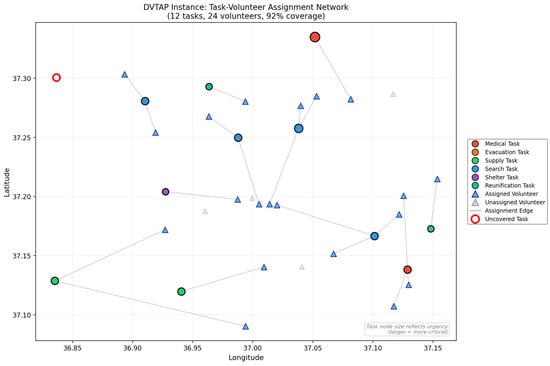
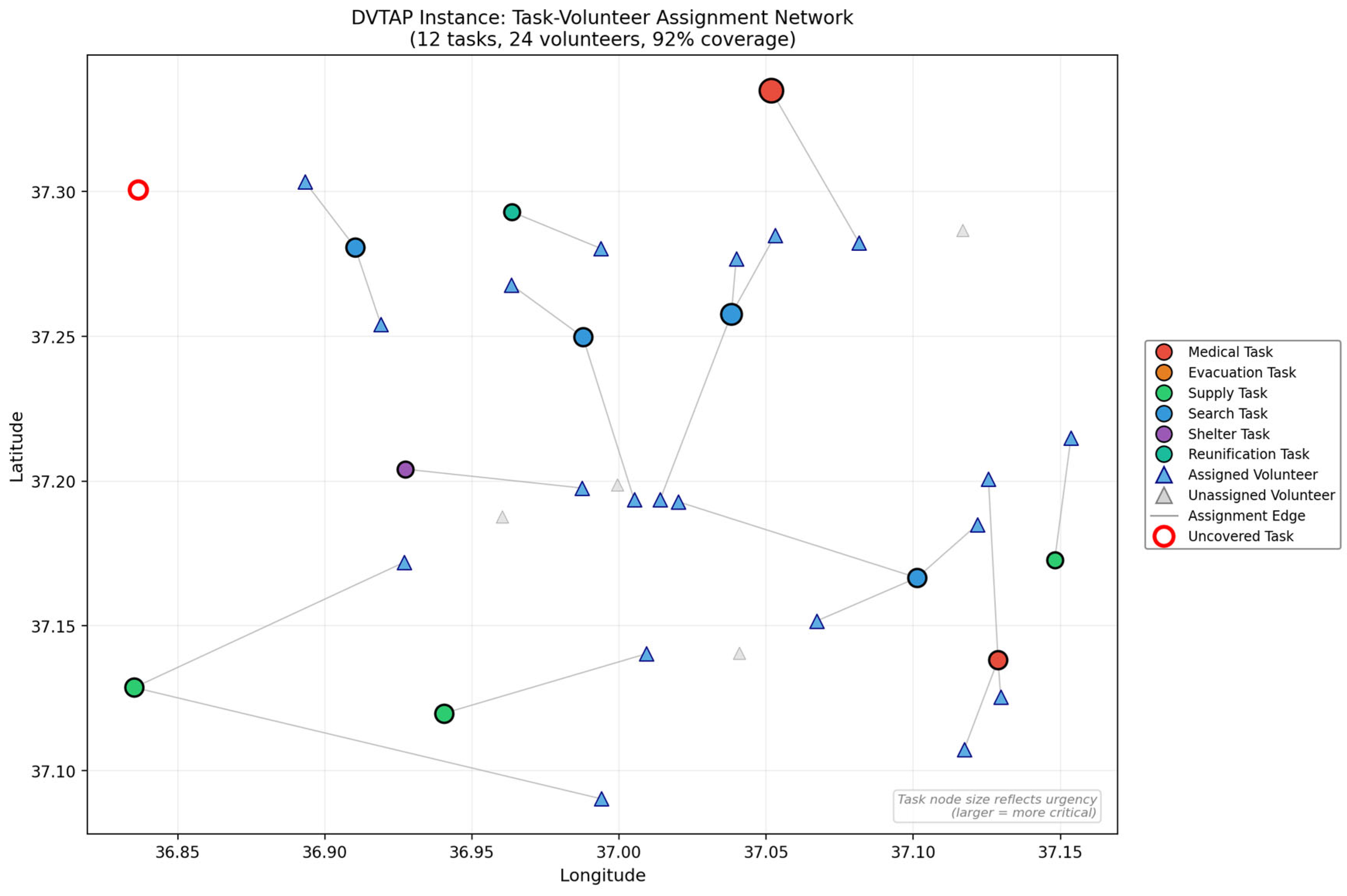
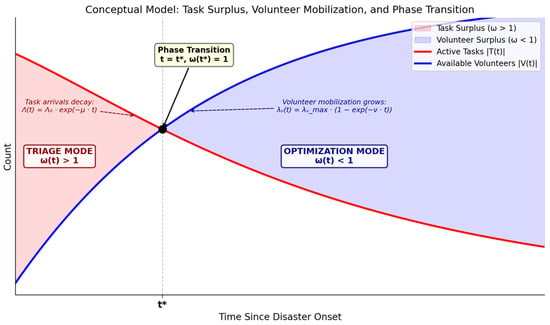
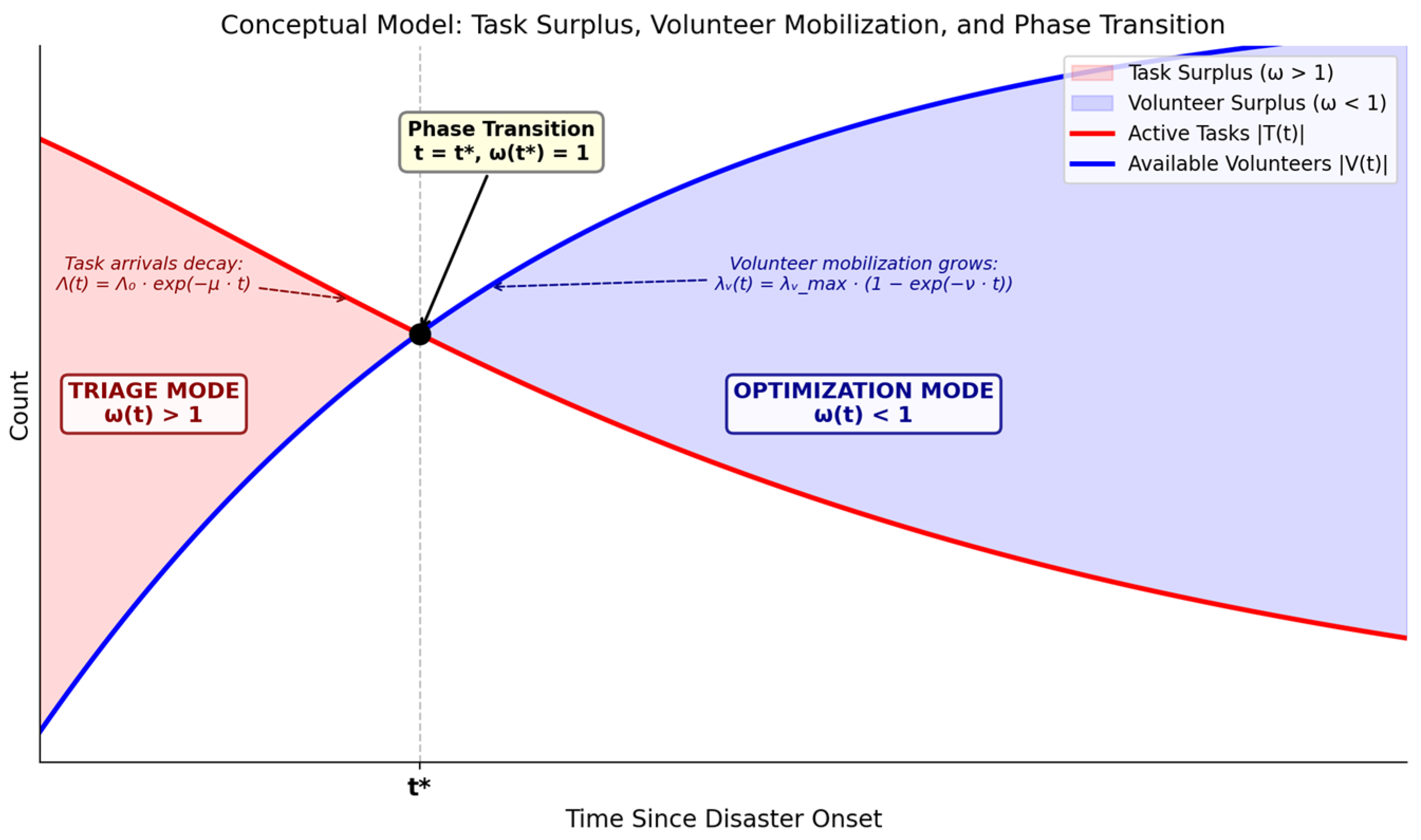
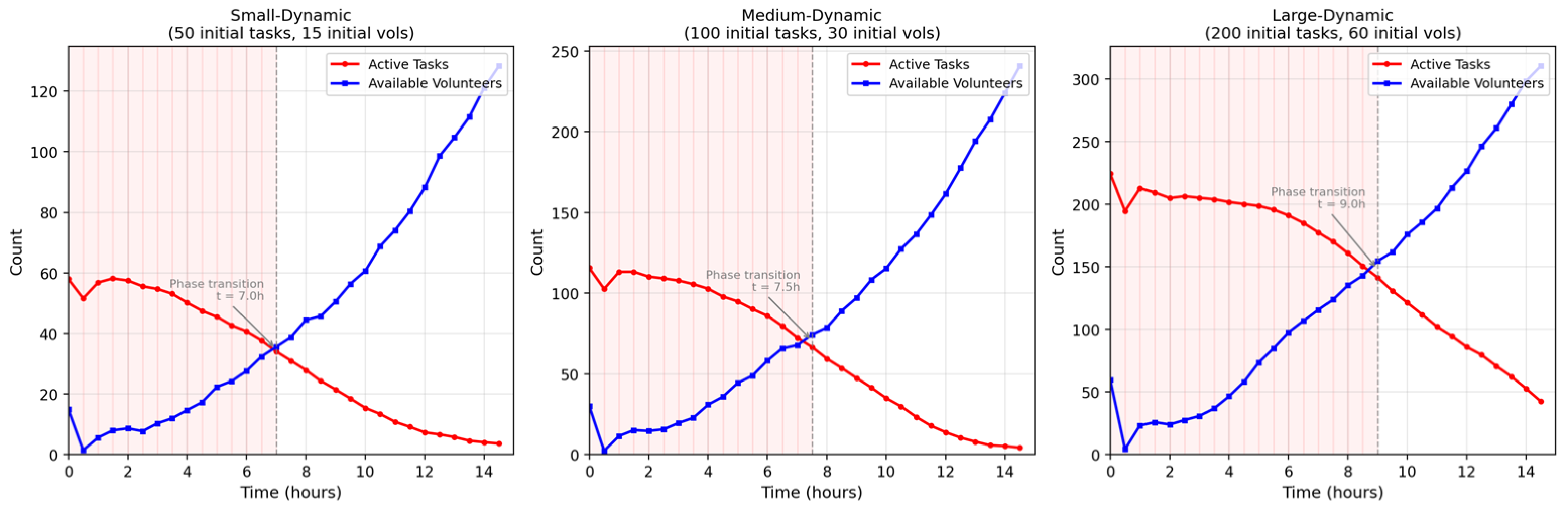

Disclaimer/Publisher’s Note: The statements, opinions and data contained in all publications are solely those of the individual author(s) and contributor(s) and not of MDPI and/or the editor(s). MDPI and/or the editor(s) disclaim responsibility for any injury to people or property resulting from any ideas, methods, instructions or products referred to in the content. |
© 2026 by the authors. Licensee MDPI, Basel, Switzerland. This article is an open access article distributed under the terms and conditions of the Creative Commons Attribution (CC BY) license.